Game Corner [Bat-Month]: Batman Forever (Mega Drive)


Since his first appearance in the pages of Detective Comics, Bruce Wayne/Batman has become a pop culture icon. September celebrates “Batman Day”, the perfect excuse to celebrate this grim and broody vigilante.


Released: 7 September 1995
Developer: Probe Entertainment
MobyGames Score: 5.8

Also Available For: Game Boy, Game Gear, MS- DOS, R-Zone, Super Nintendo Entertainment System (SNES)

Quick Facts:
Though divisive, Batman Forever (Schumacher, 1995) made over $330 million at the box office and was accompanied by both toys and videogames. While Acclaim’s arcade tie-in was met with mixed reviews, it still fared better than the vastly different home console versions. Reviews criticised the clunky, digitised sprites, the obtuse and ugly environments, and unintuitive controls, resulting in what’s been called one of the worst releases for the Mega Drive.

Gameplay and Power-Ups:
Batman Forever is a 2D, sidescrolling beat-‘em-up that sticks pretty closely to the plot of the film (except Dick Grayson/Robin, looking decidedly more adult here, is already Batman’s partner). The game supports both two-player co-operative play and, bizarrely, competitive play, in which players can attack each other, which seems a terrible idea given how awkward this game is. Unlike its predecessors, which were simple brawlers, Batman Forever opts to lumber the player with fighting game mechanics not unlike the Mortal Kombat games from the time (Midway, 1992 to 1995). The game offers two control schemes, though option two is for those with a six-button controller (honestly, the recommended way to play this nonsense). By choosing this option, up makes Batman (or Robin) jump, up and left performs a somersault, and tapping and holding up when jumping executes a glide. While this helps reach out of the way areas, you’re locking into this animation and at the mercy of the awful level layouts. You perform a roll by double tapping left or right and hitting A, hold B to block, and attack with A, B, X, and Z. These see you firing rapid punches high and low, kicking, sweeping the leg, or performing a roundhouse kick or uppercut depending on your stance. Enemies generally attack one or two at a time, but you perform back attacks with the right button combinations (none of which are displayed onscreen). Button combinations also activate the many gadgets. While some are available from the start, others are only obtained by finding blueprints and Batman and Robin have unique gadgets as well as sharing weapons like the Batarangs and grapnel gun.
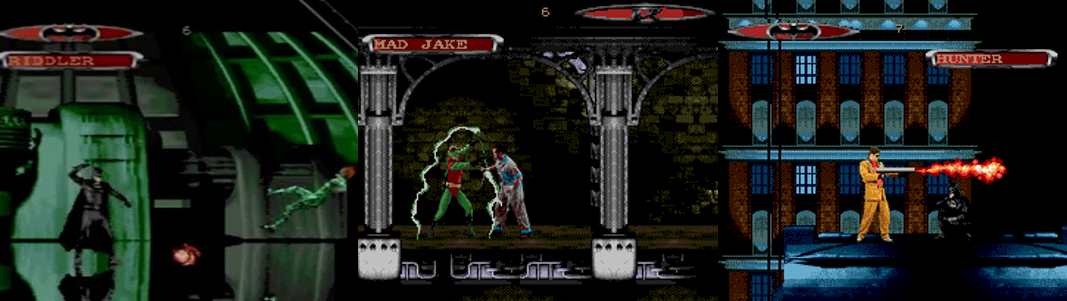
Sadly, the crippling fighting game controls are the least of this awful game’s worries.

While you can only pick two additional gadgets per level, you get unlimited ammo and can switch gadgets after clearing levels. Batman can perform his weird-ass cape morph from the film, erect a holographic decoy, and toss smoke and flash pellets to disorientate foes. Robin primarily utilises his bo staff, whacking enemies and using it as a shield, though he can also throw tranquilizer darts. While the jumping is finnicky and the glide is even worse, these aspects aren’t too difficult to get to grips with and can even be fun. However, you’ll run into a literal dead end seconds into starting the game as Batman and Robin must use their grapnel to get about. It’s not always immediately clear where or when you use the grapnel, or even how as even the six-button layout sees you hitting up and X with precision timing in the right spot. Occasionally, you may need to fire it while standing to swing over gaps but you’re more likely to be awkwardly leaping to handholds to fling yourself to higher platforms. Jumping down is even crazier as you must hold C and press down, making even the most basic movements needlessly complicated. Some elements of the environment are destructible, gifting partial or full med kits and extra lives, while riddles interrupt the gameplay when collected. Each enemy has a health bar that must be whittled down in janky-ass combat and all enemies must be defeated to progress as it’s the only way to open previously locked doors. However, this is also pointlessly convoluted as it’s not always clear where the exit is (it often appears as regular parts of the environment!) A counter showing how many enemies are left and an onscreen arrow pointing you to the exit would’ve been nice! While most areas are straightforward, the visuals don’t make exploration easy and areas you need to get to are often hidden behind the many foreground elements, compounding the issue.
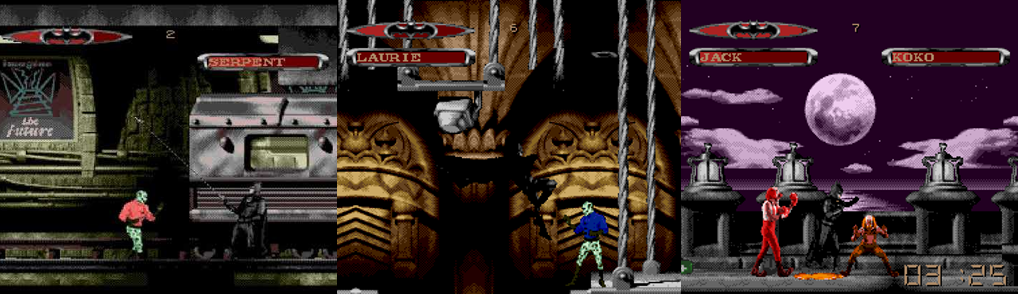
Grappling and basic exploration is an uphill battle thanks to the confusing level layouts.

Mostly, you’ll just be wandering about digitised approximations of locations from the movie, beating up thugs to progress and smashing walls for goodies or secret areas. At first, you’re using the grapnel and drop down a lot but these elements fade over time, replaced by awkward jumps, annoying gliding, and obtuse puzzles. While clumsily grappling about the bank, you’ll rescue guards and end up fighting Harvey Dent/Two-Face’s goons on the extracted vault. As if the confusing, largely vertical layout of the circus wasn’t bad enough, you’re also battling a timer as you hop to hanging lights. While you can collect clocks to add additional time, you have around five minutes to search for goons to beat up, which drops rope ladders and opens the roof so you can disarm the bomb (in a cutscene). While exploring Two-Face’s warehouse lair, you must destroy crates to progress or grapple up to hanging crates to bypass water (or maybe it’s acid?) hazards, occasionally using them as platforms to get past larger bodies and struggling with the game’s large hit boxes whenever those crushing presses are onscreen. As confusing and unsightly as Arkham Asylum is, things really take a nosedive in level five, where you must search all over for levers to kick, which open trap doors to new areas. Many loop you back to an underground section, though, forcing you to clamber to background handholds (when the game decides you can grab them) to get back to where you need to be…only for platforms to drop as you’re on them and the whole tedious process to start again! By comparison, battling through and onto a subway train is far easier, even with the electrical hazards, but it’s equally aggravating to fling yourself around Nygma’s Claw Island lair to activate six of Edward Nygma/The Riddler’s pods. Between the awful controls, unintuitive combat, and confusing layouts, everything is overly complicated and tiresome, with even simple shit like fighting enemies on a descending platform being tedious chores.

Presentation:
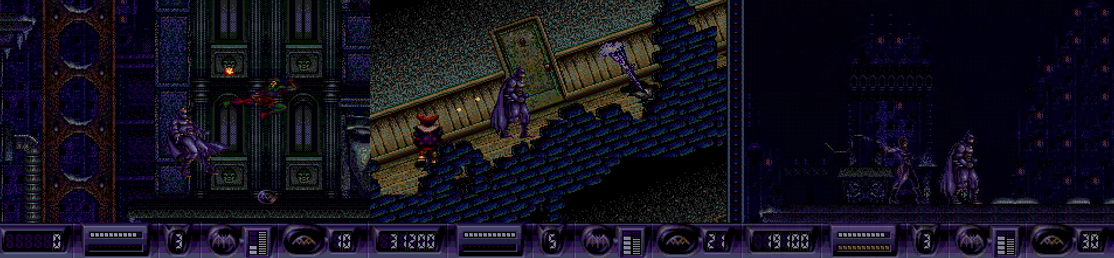
Sadly, Batman Forever ends up being a product of its time as it opts to use the same technology and techniques as Mortal Kombat to present digitised sprites and pre-rendered backgrounds in an attempt to be innovative and groundbreaking. Unfortunately, it ends up being unsightly and confusing as the game loves to block your view with foreground elements. As impressive as these may be, they don’t equate to enjoyable gameplay as you’re left scrambling about trying to grapple or drop to new areas. Batman and Robin look awful, flailing about in standard fighting poses and jerkily executing the basic moves you’d see in Mortal Kombat. It’s such a shame as the game might’ve been somewhat tolerable if the developers hadn’t used this restrictive format and had used a more traditional beat-‘em-up style of play. Instead, combat is wild and unpredictable, with moves sometimes missing or passing through your target or being cancelled as the computer reads your inputs. While Batman Forever doesn’t include the game’s bombastic score, it does feature some digitised voice samples, though the story is entirely related through boring text rather than digitised recreations of the movie, or even sprite animations. The visual presentation relies heavily on shadow, which is pretty ironic considering how vivid the film was, with colour only coming into play at the circus (and even then, its muddy browns and oranges). While you sometimes see enemies burst from their prison cells or drums and the environment often changes, the level layouts are all over the place and difficult to navigate as it’s never clear where you have to go.
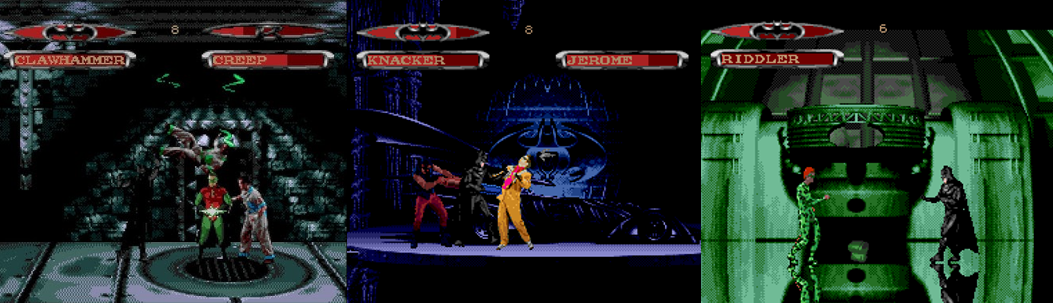
The digitised sprites and ugly visuals make for an unappealing and aggravating gameplay experience.

While the title screen is disappointingly basic and the ending is little more than a still image of Gotham City and some congratulatory text, Batman Forever does a commendable job recreated locations from the movie. The game starts in Arkham Asylum, which is actually a deep cut reference to the film’s original opening, where crazed inmates burst from their cells as players traverse a rusted walkway with the city in the background. Arkham Asylum is very gothic, dark, and claustrophobic, which is fitting but also makes for a confusing opening stage as dead ends are everywhere. Next, you head to the bank that Two-Face robs in the film. This level sees you fighting past desks, large windows, and potted plants, visiting each floor via the cylindrical lift on the outside, where the overly ornate Gotham City stretches to the horizon. As mentioned, the circus brings some colour to the game but also additional anxiety due to the timer and the vertical layout. You must grapple and jump to trapeze platforms, past clown cars and stage equipment and to the rafters and lights in search of baddies to beat to reach the bomb, which explodes in a still image if you fail. Two-Face’s warehouse is a disappointingly bland visual follow-up, comprised mainly of wooden crates and storage containers, until you reach the boss area and see Two-Face’s bizarre décor recreated. Level 5 was equally disappointing, being mainly the Ritz Hotel in the background and various tunnels and rafters, but the subway made up for it by having you fight through the dark tunnels and atop a speeding subway train. Level 7 takes place in Wayne Manor and the Batcave below, where you’ll see the Batcomputer, Batmobile, and Batwing in the background (with the latter two being sadly unusable). Level 8 starts on Claw Island and then shifts to inside the Riddler’s madcap lair, which rises from the background, forces up a narrow cylindrical shaft, and features various elaborate, overly complicated, technologically stuffed rooms full of monitors and question marks.

Enemies and Bosses:
A bunch of disposable goons are littered throughout Batman Forever, all of whom sport their own names and health bars. I don’t recall ever fighting more than two at a time, however, so you’ll be constantly backtracking and searching for any enemies you’ve missed to open the next area or level exit. Enemies largely share the same basic moves as Batman and Robin, and between each other, though there are some variations. This means enemies can punch, kick, and roll at you but they’ll also burst from the background, throw you, and wield various weapons. The Arkham inmates attack with knives (or possibly the rags of their straightjackets), batons, and tasers, pulling off fancier combos than either Batman or Robin, while Two-Face’s suited-up thugs carry pistols or high-powered shotguns. His gimp-masked brutes are more likely to grapple you, tossing you around with wrestling-style moves, or thrust a chainsaw into your crotch! The circus clowns wear comically oversized boxing gloves, performing jumping split kicks, and either vomit or toss paint, it’s not clear which. Level 5 debuts the Riddler’s bizarre minions, who teleport about, fire sticky goop overhead, and erect an energy shield to negate your attacks. Sadly, that’s about it and Batman Forever is very light on bosses. In fact, there are barely four bosses to worry about here. You fight Sugar and Spice before your first encounter with Two-Face (who goes wild with dual knives) and dispatch the Riddler’s holographic doubles before fighting him on Claw Island. The Riddler is surprisingly formidable, whacking you with his cane, stunning you, and using energy waves. He also transforms into a hulking form that stomps, shakes the ground, and cracks you over his knee before reverting to his normal form for the finale. Two-Face also returns in the finale, leaving himself open whenever he flips his coin or mocks you while also boasting an impressive and wholly uncharacteristic bicycle kick!

Additional Features:
There are three difficulty modes available in Batman Forever (“Easy”, “Normal”, and “Hard”), though I didn’t care to find out what’s different about them. The game also gives you the option to turn the music off (probably best given how awful the soundtrack is) and play alongside a friend. You can also enable friendly fire and battle a friend in traditional one-on-one fights in the “Training Mode”, where other characters are also available to play as. Players must collect blueprints to unlock additional gadgets, but I wouldn’t say it was necessary as they’re all pretty similar, and can find hidden areas if they care to experiment. Batman Forever features a handy cheat code to enable a level select and one-hit kills, though this strangely doesn’t apply to the final Two-Face or Big Riddler bosses.

Final Thoughts:
I was honestly dreading playing this game as I’ve played the SNES version before through emulation and am well aware of how frustrating, ugly, and overly complicated it is. I wanted to give it a good go, though, and was surprised to find it quite beatable…if you enable those one-hit kills. While I’m a big fan of Mortal Kombat, translating those fighting game mechanics into a sidescrolling beat-‘em-up never works and Batman Forever is no different. Every fight is a chore and a coin toss regarding whether your moves will hit or miss. There’s a noticeable delay between pressing buttons and performing actions, Batman and Robin are clunky, and the level layouts are all over the place. Batman Forever tries so hard to be ground-breaking and innovative, using digitised sprites and pseudo-3D, pre-rendered environments to appear cutting edge, and in doing so is one of the ugliest games you’ll ever see from this time. The digitised sprites look awful, especially Robin, and the environments are needlessly complicated by obstructive foreground elements, confusing layouts, and the bizarre fixation on having you defeat every enemy. I liked that the game tried to mix things up with the timer gimmick and the looping path and grapple mechanics could’ve been fun, but they (like everything here) were executed so poorly. You’ll need a guide to perform even the most basic functions, the game’s awful at telling you where you need to go and what needs to be done, and the sheer lack of bosses and story elements is laughable. Of all the Mega Drive Batman games, this is clearly the worst and that’s saying a lot as I couldn’t beat the other ones! I would say that things might’ve fared better if the developers had ported or adapted the action-packed arcade game instead, but that was a manic mess of a game as well so it seems a videogame adaptation of Batman Forever was doomed to fail no matter what format it found itself on.

My Rating:

Rating: 1 out of 5.

Terrible

Are you a maniac and somehow a fan of Batman Forever? Did you also struggle with the fighting mechanics and grapple or did you find them enjoyable? What did you think to the digitised spites and pre-rendered backgrounds? Which of Batman and Robin’s gadgets was your favourite? Did you also struggle to defuse the circus bomb? Were you disappointed by the lack of boss battles or did you find Big Riddler a fun surprise? How are you planning on celebrating Batman Day this year and what is your favourite Batman videogame? Whatever your thoughts on this version of Batman Forever, or Batman in general, please leave a comment below and donate to my Ko-Fi to suggest other Batman videogames for me to review.

Mini Game Corner [Bat-Month]: Batman Returns (Mega Drive)


Since his first appearance in the pages of Detective Comics, Bruce Wayne/Batman has become a pop culture icon. September celebrates “Batman Day”, the perfect excuse to celebrate this grim and broody vigilante.


Released: October 1992
Developer: Malibu Interactive
MobyGames Score: 6.4

Also Available For: Amiga, Game Gear, Master System, Mega/SEGA-CD, MS-DOS

Quick Facts:
Just as Batman (Burton, 1989) was accompanied by a smorgasbord of merchandise and videogames from Sunsoft, so too was the controversial (but nonetheless profitable) Batman Returns (ibid, 1992). While Konami brought their success with sidescrolling arcade brawlers to the widely praised Super Nintendo version, SEGA got wildly different games released for their consoles. Though echoing Sunsoft’s work on the Mega Drive adaptation of Batman, this version of Batman Returns was regarding as a forgettable brawler at best and a frustrating, unsightly release at worst and is largely seen as inferior to its Super Nintendo counterpart.

First Impressions:
Batman Returns borrows quite a few elements from Sunsoft’s Batman adaptation for the Mega Drive, featuring a nearly identical options menu and some similar gameplay mechanics, while expanding the scope and giving Batman more toys. While you cannot change the game’s difficulty, you can still set how many lives you start with (three, five, or seven) and can now pick between a few control presets. I mapped attack to the A button, jump to B, and Batman’s “Special Weapon” to C. Batman still throws punches but can also execute kicks depending on which direction you press on the directional pad (D-pad). Batman’s feet are so well armoured that they protect him from bullets and attacks so you might want to throw a kick to defend yourself. When jumping, you can tap B to shoot Batman’s grapple and swing from overhead platforms, though you can still fire it upwards while standing still and pressing up and A. If you tap or hold C in mid-air, you either flap or spread Batman’s cape, allowing you to glide across gaps. This is marginally more useful than Batman’s somersault from the last game, but it has an energy meter and, more crucially, level design so cluttered, ugly, and confusing that you never know if you’re going to glide into a bottomless pit! You can replenish Batman’s health by grabbing hearts, collect 1-ups (or earn extra tries by accumulating points), and appear to have unlimited continues. However, this also comes with two major drawbacks that crippled my run. First, if you die when fighting a boss, you respawn at a pre-set checkpoint, meaning the boss’s health is restored. Second, if you exhaust all your lives and continue, you are sent back to the beginning of the stage, which makes Batman Returns needlessly frustrating very quickly.

Ugly graphics, horrendous music, and clunky controls make this a chore to play through.

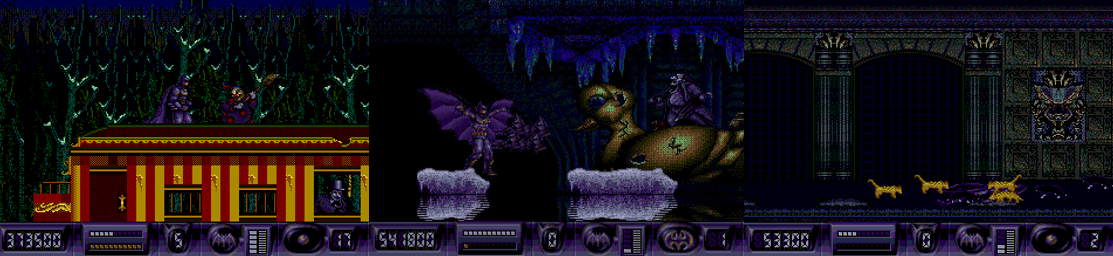
Batman has a bunch of Special Weapons he can use with C. Each consume ammo, replenished by collecting item-specific power-ups, and is selected from the pause menu. Batman tosses Batarangs, stuns enemies with smoke bombs, fires his grapple gun, disorientates them with a swarm of bats, or throws “super seeking” Batarangs. These last three are the most powerful and cost the most to use so they’re best saved for boss battles, though I also found myself forced to waste a seeker Batarang when a shaft was blocked by enemies above. There are five levels (or “Acts”) with three stages each. Each Act sees Batman pull up in the Batmobile and swoop into the scene but, while Batman is a far bigger sprite than before, he still has no idle animations. He’s also a far bigger target and, though faster, is very slippery and as ungainly as ever. It doesn’t help that the visuals are uncomfortably distorted and pixelated. Batman Returns may retain the Christmas aesthetic of the movie and recreate elements like the gothic architecture and Max Shreck’s cat-themed shops, but it’s painful to look at and listen to. While there are some fun effects, like slanted buildings, and stages are far bigger than in the last Mega Drive game, it’s no fun struggling with the clunky controls, constantly taking damage from enemies or spike pits, or falling down a bottomless pit or to the bottom of the stage because hazards are obscured by foreground objects. Though enemies don’t respawn, everything is too zoomed in and too big, making it difficult to see or know where you’re going, health is sparse, and bosses absorb a bunch of hits before being defeated. While it’s fun seeing the Red Triangle Circus Gang rendered as enemies, it’s weird that stone gargoyles spring to life and attack you and Batman’s again forced to endure some needlessly aggravating platforming challenges.

My Progression:
Although I was immediately put off by the graphics and music of Batman Returns, I found Batman more durable than in the last game and was quite enjoying seeing recognisable landmarks from the movie recreated, however ugly, in each stage. Oswald Cobblepott/The Penguin’s goons and maniacal fowls litter each stage, exploding upon defeat, and stages contain multiple mini bosses. You soon fight Selina Kyle/Catwoman on the rooftops, for example, struggling to avoid her lengthy whip and frustrated to find she’s invulnerable when cartwheeling about. Gotham City itself attacks you as well, with those giant, ostentatious statues flinging gears from the background, and the Penguin battles you in a bell tower, flying about on his comical helicopter umbrella and tossing missiles. At first, this was a bit of a chore, especially as you must grapple up, avoiding gargoyles as you go, if you die against him. But, on my second try, I found the Penguin could easily be cheesed if you stay in one corner and throw punches. Things fell apart in Act 2, however, where one of the Penguin’s brutes stalks about atop one of Shreck’s department stores and tosses giant letters at you. This bastard follows your movements, meaning I couldn’t figure out how to grapple up to him without taking damage and, when I did, he decimated me with his meaty punches and kicks. Technically, this is where my game ended as I was so annoyed by this that I resorted to inputting the stage select code (a chore in itself!) I used this to skip to the inside of the store, where roller-skating punks, knife-tossing temptresses, and bomb-tossing jesters await before giant windows and around escalators. I then got my ass handed to me in a rematch with Catwoman that I had no hope of beating, found the next section started with an insta-kill rolling hazard I couldn’t avoid no matter how hard I tried, and skipped to the Red Triangle Circus stage…where a simple jump over a pit proved too difficult for this heavy-ass Batman!

Unintuitive controls and awful enemy placement make this short game frustrating and tedious.

Honestly, I was glad to be done with the game, which was an assault on my senses and a far cry from the simple, arcade action of the SNES beat-‘em-up. While I couldn’t reliably get the stage select code to work to check out the game’s later stages, a longplay I watched revealed that Batman Returns is only about half an hour long in the right hands. It also turns out that you have to grapple over that pit in Act III and battle through the background cages, but I’m buggered if I’m going to endure this game again any time soon. But, for due diligence, the rest of the game sticks pretty closely to the movie once Batman’s finished swinging about the Red Triangle’s ferris wheel, circus tent, and colourful, hazardous train. Act 4 takes him into the sewers, which feature rushing water slides, gun-toting clowns, and a maze of pipes. This leads to the Penguin’s frozen lair, where Batman slips about on frigid, precarious, often sloped platforms, avoiding icicles and riding ice floats. While there are sadly no vehicle sections here, you do battle the Penguin at the end of each subsequent Act. He flies about in Act 3 tossing buzzsaws, blasts you with toxic sludge from a giant cannon before unloading with his machine gun umbrella in Act 4, and pilots his giant duck vehicle in Act 5, which displays battle damage as you attack. Finally, the dishevelled and maniacal Penguin hops about his lair, blasting with his shotgun-like umbrella while electrical bursts flare overhead. After he’s defeated, Batman battles Catwoman one more time as the credits roll, with her being mysteriously spirited away by cats to end the game.

Continue?
My expectations were low for Batman Returns after how disappointing Sunsoft’s efforts were with Batman and having played the SNES version (through emulation) in my teens. I’ve always known that the Mega Drive version is an entirely different game, which immediately makes it far less appealing, but the reality is so much worse. For everything the developers improved from the last game, there are a bunch of bizarre decisions that make Batman Returns just as bad, if not worse. Visually, the game is dreadful. It’s so muddy and pixelated and almost impossible to see Batman against the drab, overly complicated backgrounds. They’re fantastically faithful to the movie, but that just makes it worse as half the time I couldn’t see enemies or projectiles and most of the time I had no idea if I was gliding into a bottomless pit. I liked Batman’s array of gadgets, but their usefulness is negligible as you’re probably just going to save them for the bosses. Batman’s weird glide doesn’t get much play, thankfully, and the grapple is restricted to just reaching higher ground, but Batman’s still a clunky character with limited moves in his arsenal. As if the visuals weren’t bad enough, the game sounds awful, lacking both Danny Elfman’s timeless score and jaunty tunes to make the janky gameplay more tolerable. I probably could beat this one now that I know how to get around that pit, but I have no desire to come back to it, especially when I could just emulate the SNES version or even try out a Mega Drive conversion of that game. This was ridiculously disappointing, doubly so as there are no vehicle levels despite Batman Returns feature three Bat-vehicles! I’d be surprised if you thought this game was any good but let me know if you did in the comments. While you’re here, why not check out my other Batman-related content or pop over to my Ko-Fi to drop a donation to keep the site going?

Mini Game Corner [Bat-Month]: Batman (Mega Drive)


Since his first appearance in Detective Comics, Bruce Wayne/Batman has become a pop culture icon. September celebrates “Batman Day”, the perfect excuse to celebrate this grim and broody vigilante.


Released: 27 June 1990
Developer: Sunsoft
MobyGames Score: 7.4

Other Versions Available For: Amiga, Amstrad CPC, Arcade, Atari ST, Commodore 64, Game Boy, MS-DOS, MSX, Nintendo Entertainment System (NES), PC, PC Engine/TurboGrafx-16, ZX Spectrum

Quick Facts:
At the tail-end of the eighties, “Batmania” swept the nation after Tim Burton eschewed his camp reputation in favour of a hugely successful and influential gothic feature film. This blockbuster hit was accompanied by a slew of merchandise, including a fondly remembered (if challenging) NES title and a generally well-regarded arcade title. The Mega Drive adaptation was developed by Sunsoft, who crafted noticeably different games for each console. The Mega Drive Batman was praised for its visuals and soundtrack, but criticised for being far too short to be truly challenging.

First Impressions:
Batman is a 2D, sidescrolling brawler that surprisingly follows the plot of the 1989 classic quite closely. Before starting, you might want to dip into the “Options” menu and tinker with the settings, which allow you to set your maximum number of lives (three, five, or seven) and set the game to “Normal” or “Hard”. From there, you’re given five continues and a limited supply of Batarangs and dropped into it. Batman tosses Batarangs with A, punches goons (or kicks their shins when crouching) with B, and jumps with C. You can double-tap C to perform a somersault but it’s far too unreliable for precision platforming between small, moving platforms. By pressing down and C, Batman jumps down wherever possible but again, watch out as you don’t want to drop into one of the many bottomless pits! Holding B sees Batman block and pressing up and C fires his grapnel, which snags parts of the environment and lets you reach higher ground or scale shafts. You’ll get points for each enemy you defeat (with most going down in one hit) and can refill Batman’s health, ammo, and lives by collecting specific items (usually placed over bottomless pits). Batman also features two autoscrolling vehicle sections, one where you blast through Gotham City in the awesome 1989 Batmobile and another where you cut through the skies in the Batwing. In both cases, you blast enemy vehicles with B and fire a limited supply of missiles with A, which you’ll want to stock up on as they’re seriously overpowered!

Clunky platforming and limited combat handicap Batman even when he’s in his fancy Batmobile.

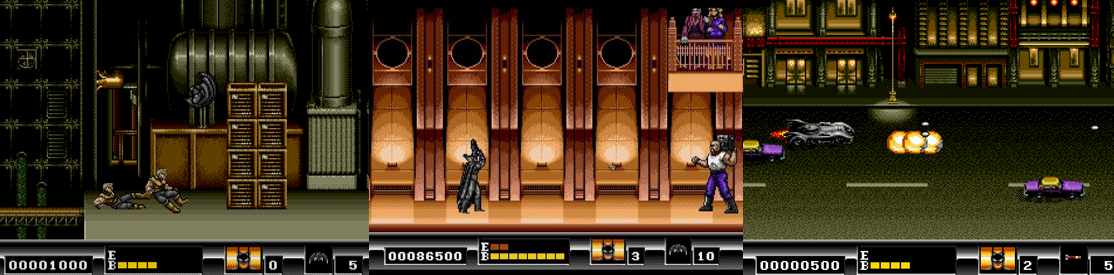
Things start off okay in Batman. The title screen’s nothing to shout about, the story is a wall of text over digitised images, Danny Elfman’s memorable score is absent, and Batman doesn’t even have idle poses…but he swoops down at the start of each stage and there are occasionally partially animated cutscenes recreating scenes from the film. Batman’s quite clunky and awkward, shambling about and struggling with the finnicky platforming sections. At first, this isn’t a problem as you’re just punching respawning thugs, but things turn frustrating and unfair at the Flugelheim Museum. Pits are strangely all over the place here, with you hopping to moving platforms or grappling up narrow shafts, often as enemies shoot at you or chandeliers drop from above. The Axis Chemicals stage isn’t much better, featuring collapsible pipes, toxic sludge, conveyor belts, and narrow spaces that make manoeuvring Batman’s bulky ass even more aggravating. Being able to crouch-walk or giving Batman a slide or even the wall jump ability from the 8-bit Nintendo game would’ve really helped with this. While Batman respawns on solid ground if he dies, you must restart the stage from the beginning if you exhaust your lives and use a continue, which also resets your score. Respawning or continuing also starts you with the lowest health, meaning you can be easily killed very quickly, especially in the Batmobile stage as the car is surprisingly fragile! There are no combos or throws here and Batman’s gadgets are painfully limited. You’ll want to save your Batarangs and Batmobile missiles for tougher enemies and bosses, but the former are stopped by the environment and the latter are limited. Grappling is equally restrictive at times, primarily being used to get to higher ground to leap over crates and tackle enemies on balconies.

My Progression:
Batman recreates the movie with surprising fidelity, marginally impressing in some areas while also being painfully basic in others. In the first stage, for example, Gotham City stretches off to the horizon and the foreground is occasionally dotted by cars or filled with rain and lightning, but the same shops and buildings loop endlessly. Axis Chemicals is a bit more interesting but also appears cluttered and confusing. It’s never clear which pipes will burst or which jumps lead to bottomless pits, and it’s disappointing that the game doesn’t use digitised stills to show Jack Napier’s transformation into the Joker (even the Game Boy game did that!) The Flugelheim Museum may be a booby-trap filled madhouse, but it eventually resembles the art gallery seen in the film, only to reduce the Joker and Vicky Vale to static sprites as you fight the Joker’s roided-up henchman. I really enjoyed the Batmobile chase, which switches to an isometric perspective and has you racing past the city. Sadly, the Batmobile is as ungainly as Batman and can barely weave between the Joker’s goon cars. When faced with the more formidable tanks, the Batmobile is shredded in seconds unless you either stay back or get under their bombs. Despite how limited the combat is and the respawning enemies, Batman is quite easy to get to grips with…until you’re faced with the ridiculous platforming, then you burn through lives pretty quickly as troublesome enemies await on narrow platforms and pits exhaust your continues. This happened to me in Stage 4, right after clearing the Batmobile section, where a slew of mimes made traversing the power plant too taxing and I finally ran out of chances after being kicked down the pit or roasted alive one time too many.

Undone by the frustrating platforming, I never got to see the Batwing or final Joker fight.

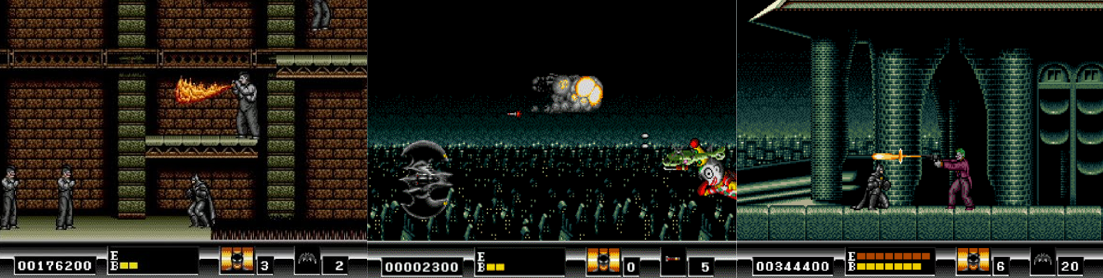
Since there are no cheat codes for Batman and limited continues, I tapped out at the power plant, which was very disappointing as the next stage ends with a boss fight against that overly enthusiastic sword-wielding Joker goon from the movie and is followed by the Batwing section. This autoscrolling shoot-‘em-up mirrors the Batmobile stage but is far more visually impressive, especially in the way the Batwing tilts while flying. In this stage, you gun down the Joker’s attack helicopters and destroy his comical balloons, before battling a more formidable attack helicopter. As in the movie, the game culminates at the Gotham cathedral, which is full of the Joker’s trigger-happy thugs, spiked ceilings, and overhead walkways to grapple to. There are more bullets than ever here, though they’re nearly impossible to see when fired, and Batman must also contend with another sword-swinging brute, more fire-breathing mimes, bazooka-carrying baddies, and endure rematches against reskinned versions of the previous bosses! Surviving this onslaught leads to a gruelling spike-filled tower climb and a final confrontation with the Joker. Whereas Jack Napier simply stood there firing shots and relied on the nearby turret, bazooka goon, and acid pit to do his dirty work, the Joker fires flaming shots from his comically large hand cannon and, bizarrely, summons lightning blasts to fire across the ground. Ironically, it seems he’s incredibly easy to beat if you have enough Batarangs or jump in to land punches over and over, and the ending is simply a digitised rendition of the Joker’s demise with a splash of text and the credit roll.

I remember playing Batman on the Amiga as a kid, and the Game Boy version was one of the first games I owned for the handheld, and I even had this for the Mega Drive during my early twenties. I sold it off but got it back when I started collecting for the system, hoping for a simple little brawler that wouldn’t be too taxing. At first, that seems to be exactly what Batman offers. It’s ludicrously basic, even for an early Mega Drive title, translating only the bare minimum from the movie and next to nothing of the plot. The developers didn’t even use the in-game assets to recreate moments from the film save for a couple of instances, and Batman’s arsenal is as limited as his mobility and combat. This might’ve been tolerable if it wasn’t for the awful platforming sections. Batman either jumps too far with his somersault or falls painfully short with his dodgy basic jump, easily dropping down pits as a consequence only to drop down anyway when he lands due to knockback! The grapple is next to useless except to reach higher ground and the respawning enemies (particularly those aggravating sliding goons!) are a constant headache. The vehicle sections are fun ways to break up the awkward action stages, but the Batmobile wasn’t much easier to control than Batman and I can’t imagine the Batwing was much better. Batman is a game that’s handicapped by lumbering the Dark Knight with cliché videogame gimmicks like pits and platforms, meaning it’s not much fun fighting the bosses as they’re just bigger goons with cheap-ass attack patterns. But what do I know? I couldn’t beat the game and it’s apparently really easy! Maybe you beat it and found it quite enjoyable. Or maybe you prefer a different videogame adaptation of the movie, perhaps the arcade version? Maybe you can think of a better or worst Batman videogame to mention in the comics? And maybe you can donate to my Ko-Fi to help support the site.

Back Issues [Sonic CDay]: The Return of Chaotix / Return to the Miracle Planet


Developed alongside the blockbuster Sonic the Hedgehog 2 (SEGA Technical Institute, 1992), Sonic the Hedgehog CD (Sonic Team, 1993) released on this day back in 1993 and introduced Metal Sonic (one of Sonic’s most popular and enduring rivals).


Story Title: “The Return of Chaotix” (Part 1 to 6)
Published: 9 December 1995 (cover-dated: 22 December 1995) to 17 of February 1996 (cover-dated: 1 March 1996)
Writer: Nigel Kitching
Artist: Richard Elson

Story Title: “Return to the Miracle Planet”
Published: 25 May 1996 (cover-dated: 7 June 1996)
Writer: Nigel Kitching
Artist: Roberto Corona

Quick Facts:
After Sonic the Hedgehog became a mainstream success, SEGA quickly capitalised with a slew of ancillary merchandise, like “Britain’s Official SEGA Comic”, Sonic the Comic (StC). StC quickly veered from the source material while still featuring loose adaptations of the videogames. When StC adapted Sonic CD, they reimagined Metal Sonic as “Metallix”, a robotic doppelgänger who reappeared alongside a “brotherhood” of the Badniks and tangled with the likes of Sonic, Knuckles, and the Chaotix in numerous time travel plots.

The Review:
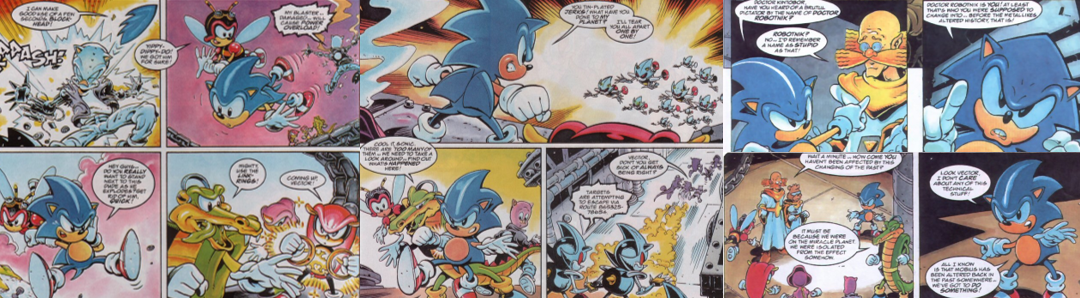
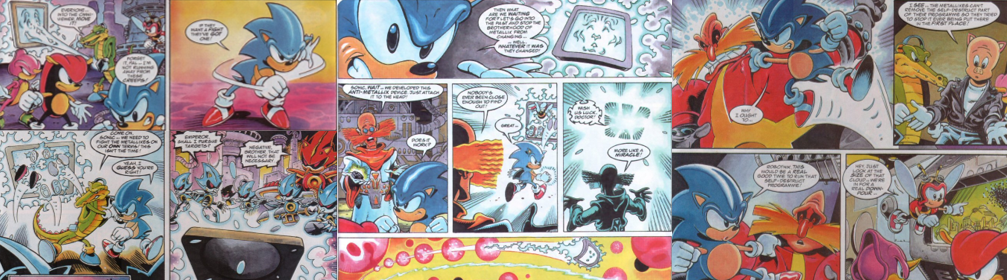
Although Sonic has every reason to frequently return to Never Lake since the last time he was there, his childhood friend and fellow Freedom Fighter, Porker Lewis, was trapped on the tiny planetoid known as the Miracle Planet when it disappeared from Mobius as it does every month. Instead, Sonic seems surprised when the Miracle Planet reappears, anchored to Mobius by a giant chain, and wary when some “dude” comes down that same chain. It’s an odd start considering I would’ve expected Sonic to be eagerly waiting the Miracle Planet’s return since Porker’s was trapped there after helping defeat the Brotherhood of Metallix and their gigantic emperor, though that’s largely inconsequential compared to Porker’s odd demeanour when Sonic rushes to meet him. Nearby, the Chaotix Crew – leader Vector the Crocodile, muscle Mighty the Armadillo, stealthy Espio the Chameleon, and aggravating Charmy Bee – make a rough landing at Never Lake courtesy of the Omni-Viewer, a sentient computer monitor capable of travelling across dimensions. As soon as they recover, the Chaotix Crew are attacked by Doctor Ivo Robotnik’s Troopers, including a formidable tank-like variant from the Special Badnik Service (SBS). Although the tank shrugs off Mighty’s hefty haymaker, Espio trashes a Trooper with his patented spinning top attack. Mighty then reduces the tank to scrap metal and the remaining Troopers are trashed by Sonic, whom the Chaotix Crew highly regard after hearing tales of him from the Omni-Viewer. Vector reveals that they’ve travelled from the Special Zone under the belief that the Brotherhood of Metallix are up to no good on the Miracle Planet, a suspicion the Omni-Viewer soon proves to be true, despite Sonic’s claims, when he reveals the usually lush and fertile planetoid has been conquered by the Metallix!

Sonic and the Chaotix Crew are horrified when the Metallix alter the past to conquer the present!

Although Porker claims ignorance of this drastic transformation, Sonic eagerly leads the Chaotix Crew to investigate, dismissing Mighty’s hopes for a plan. However, Sonic’s stunned when Porker turns out to be a Metallix variant! The Porkertallix knocks Sonic from the chain with its piston-like arm (though he’s saved by Charmy Bee), headbutts Mighty when he tries to wrestle with it, and gets a kick in the head when Espio sneaks up behind it. Taking to the sky, the Porkertallix charges a “death ray” only to be damaged by Sonic’s Spin Attack. With only seconds to spare before the robot blows up, Mighty and Vector bust out their “Link-Rings” and knock the Porkertallix away so it can explode harmlessly in the sky. Though aggravated by Sonic’s ego, the Chaotix Crew venture onto the polluted, mechanised hellscape of the Miracle Planet and discover the real Porker tied up as bait. While saving his friend, Sonic is confronted by the Emperor Metallix, its army, and its corrupted version of the Omni-Viewer and is horrified to see that the Metallix have travelled into the past and turned Mobius into an equally mechanical hellhole! Realising they’re outnumbered and outgunned, Vector urges the Chaotix Crew to escape via the Omni-Viewer with a reluctant Sonic, who’s so mad he initially tries to take on the entire Metallix army by himself. Teleporting to “Planet Metallix”, the team arrives in a world overrun by machinery and Metallixes, one very unlikely to have any organic life. Once again, Vector must stop Sonic when he tries to take his anger out on an army of nearby Metallix, though they’re led straight into a dead end by the foolish Charmy Bee. Luckily, a mysterious, hooded individual urges them to follow them into the sewers, fooling the Metallix with a holographic projection and then blowing them to smithereens with a bomb. Though grateful, Sonic’s eager to know who’s saved them and discovers that Mobius’s few survivors have taken refuge in the sewers under the leadership of Doctor Ovi Kintobor, the kindly scientist who was transformed into Dr. Robotnik by a laboratory accident!

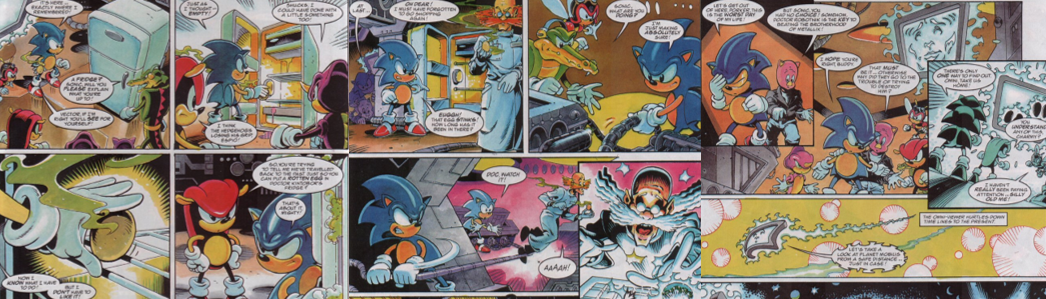
Sonic’s distraught when he’s forced to create his most hated enemy!

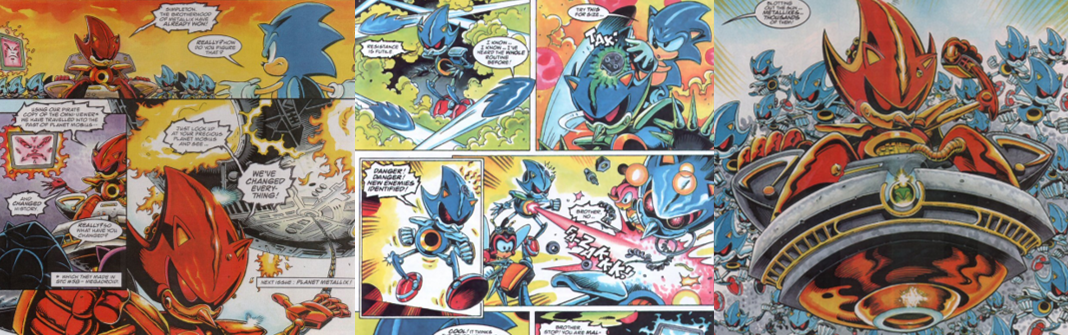
Although Sonic’s overwhelmed at the state of the survivors and at seeing his old friend again, Vector boots up the Omni-Viewer to track the “chronotron trails” left behind by the Metallix’s time travelling and they hop into the screen for a jaunt to the past, taking Dr. Kintobor’s “Anti-Metallix” device with them. This comes in handy when the heroes are jumped by a group of Metallix guarding the timeline as even the combined abilities of Sonic and the Chaotix Crew struggle against the hedgehog’s dangerous doubles. Instead, Sonic slaps the device onto a Metallix and sends it haywire, causing it to attack its “brothers” and allowing our heroes to jump back into the Omni-Viewer, but not before Sonic finds that one of the Metallix was holding a strangely familiar rotten egg. Naturally, this means that the chronotron trail ends in a place Sonic’s all-to familiar with: Dr. Kintobor’s underground lab, back when he was helping a distinctly brown and far less cool-looking Sonic master his super speed. Watching from a doorway, the group witnesses past Sonic breaking the sound barrier, destroying the kinetic gyratoscope used to measure his speed and turning him into his cool, blue self. After reliving this literal blast from the past, Sonic realises with dread how the Metallix changed the past. Sure enough, Dr. Kintobor’s fridge is empty, meaning the rotten egg he found was taken by the robots. Although the Chaotix Crew are baffled as to why this is so important or why Sonic’s so reluctant to put a rotten egg into a fridge, a quick jump to twenty-four hours later clues them in as they watch Dr. Kintobor retrieve the egg for a light snack. Wanting to be absolutely sure, Sonic yanks on a nearby cable and forces his kindly friend to trip into the Retro-Orbital Chaos Compressor (R.O.C.C.), thus causing the accident that birthed Dr. Robotnik! Although devastated at having created the world’s most ruthless dictator, Sonic takes some comfort in Porker’s belief that Dr. Robotnik is obviously important to the Metallix’s survival.

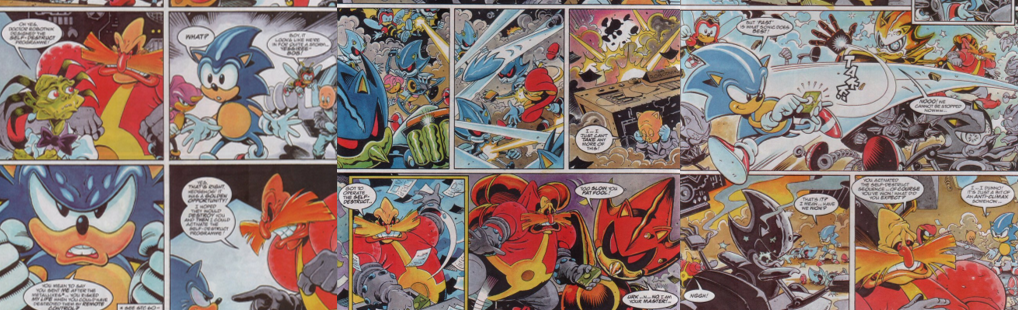
Though the Metallix come close to victory, a last-second save by Sonic finally ends their threat.

When the Omni-Viewer returns them to the present, they’re relieved to see the Mobius has been restored. However, since the Miracle Planet is still corrupted by his robotic doppelgängers, Sonic has the Omni-Viewer transport them to Citadel Robotnik, though Dr. Robotnik dismisses their story as hogwash. Porker rightly questions why the Metallix would want to erase Dr. Robotnik from history as this would surely destroy them, since he created them. However, it turns out they were the brainchild of Dr. Robotnik’s long-suffering assistant, Grimer (though it’s not clear why he would create them without Dr. Robotnik’s influence…) When Grimer reveals that Dr. Robotnik installed a self-destruct mechanism into the machines, Sonic is livid since the tyrant risked his life sending him after the Metallixes about ten issues ago in the hopes the two would destroy each other. Sonic’s only stopped from bashing Dr. Robotnik by the fact that they need that self-destruct device to win and the approach of a swarm of Metallix so vast that they block out the sky! The Emperor Metallix and its thousand-strong hoard crash into the citadel and wreak havoc, easily overwhelming the heroes and leaving Porker a distraught, cowering mess from all the violence and stress. Just as Dr. Robotnik retrieves the self-destruct device, he’s snagged by the Emperor Metallix, who begins to crush it ahead of doing the same to its former master’s neck! Luckily, Sonic swipes the self-destruct device, deactivating the Metallix army. Sonic’s somewhat perplexed by this anti-climactic end, though Vector’s just grateful for it to be over since they barely survived the onslaught. Although Sonic tries to lecture Dr. Robotnik on his heinous actions, he gives up and leaves, clearly still rattled by the adventure. Still, Dr. Robotnik is left ruminating on how close they all came to death, but Grimer gleefully lifts his spirits by unveiling his plans for a new, more stable Metallix…one based on Knuckles the Echidna!

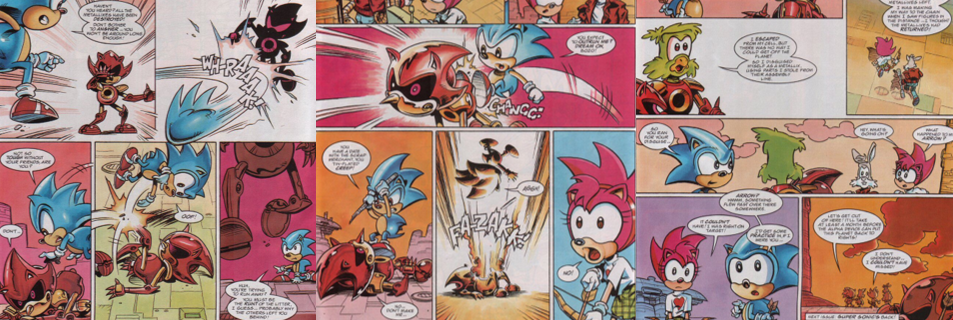
A brief rematch with a Metallix isn’t all it seems in this largely forgettable epilogue.

Although this Metallix variant and the original machine did appear again in StC, “The Return of Chaotix” effectively ended the comic’s ongoing adaptation of Sonic CD and Knuckles’ Chaotix (SEGA, 1995) save for one final epilogue a couple of months later, which I may as well include here. “Return to the Miracle Planet” sees Sonic and fellow Freedom Fighters Amy Rose and Johnny Lightfoot…return to the Miracle Planet (shocker!) in its first reappearance since “The Return of Chaotix”. Despite toppling the Brotherhood of Metallix, the Miracle Planet still bares their visage and is still a mechanised hellscape thanks to the Alpha Device, now a gigantic mechanical tower rather than a simple staff. Guided by the Kintobor Computer (a sentient artificial intelligence that’s essentially a copy of Dr. Kintobor’s personality), Johnny Lightfoot scales the Alpha Device tower looking for a port to plug in a cable, with the hope being that the Kintobor Computer can reverse the damage caused by the Alpha Device. Frustrated by the “techno babble”, Sonic races off to investigate some nearby movement, scrambling through the mechanised landscape until spotting the source of the movement: a red-tinted Metallix! Amazed that one of his robotic doppelgänger’s survived, Sonic immediately attacks, surprised when the machine flees rather than fighting. Naturally, Sonic quickly catches up to it and knocks it down, ready to impale the robot with a piece of scrap metal. However, Amy’s horrified when the Metallix blasts Sonic with its chest ray, only for Sonic to be relatively unscathed since the machine had its weapon on the lowest setting. The Metallix then reveals that it was a bird-like Mobian in disguise all along, a captive of the Brotherhood who disguised himself as one of them after escaping his cell and has been searching for a way home ever since. After quickly snatching Amy’s misguided crossbow bolt from the air, Sonic taunts his friend’s aim and offers to take the Mobian home, confident that the Miracle Planet will be back to normal when it returns in a month.

Final Thoughts: 
Although I naturally have more bias towards Sonic the Comic since I grew up reading it, I generally find that their art and storytelling was overall much better than those in the Archie Comics in the United States. Sonic the Comic had more variety and personality, being fun but also quite dark right from the start, whereas Archie’s Sonic comics took a while to drop the inane slapstick. Neither of them have a great track record when it comes to adapting specific videogames, however, and these two stories continue that trend as, rather than using this opportunity to showcase new areas of the Miracle Planet, both limit the planetoid-based action to a single, indistinct, mechanical area. This would’ve been a great opportunity to bring the Bad Futures of Stardust Speedway or Metallic Madness to life but, instead, there’s little to distinguish the mechanised Miracle Planet from any of Dr. Robotnik’s other facilities. Similarly, “The Return of Chaotix” features the only adaptation of Knuckles’ Chaotix’s “Combine Ring” mechanic and, like in Archie’s Sonic comics, it’s simply used to swing a character into a robot and never used again. On the plus side, “The Return of Chaotix” boasts gorgeous artwork from the unmatched Richard Elson, who masterfully renders Sonic and the Chaotix Crew in ways Archie’s Art Mawhinney and Ken Penders can only dream of. The Metallix especially benefits from this, with the story giving a few subtle background variants (which recall Silver Sonic and the Mecha-Metallix) and an all-new Porkertallix that’s both fearsome and formidable. I liked how rattled Sonic was by this robot and how dangerous a single Metallix was to the combined force of Sonic and the Chaotix Crew. Since his emotions are so high in this story, Sonic almost blunders into an unwinnable situation more than once, forcing Vector to restrain him and pull him away from getting himself killed, which leads to some interesting interactions between Sonic and the team.

Sonic’s time travel journey tests his mettle as his worst nightmares come to life.

Naturally, Sonic’s used to getting his own way with the Freedom Fighters and bossing them around, but the Chaotix Crew are a well-honed team who analyse situations and attack as a cohesive unit. This means they clash with Sonic’s more impulsive attitude but, ultimately, he begrudgingly agrees that discretion is better when faced with such a formidable foe. “The Return of Chaotix” largely re-treads much of and undoes the “Brotherhood of Metallix” story (Kitching, et al, 1995), with the Metallix dominating the Miracle Planet and Mobius thanks to time travel shenanigans. The sight of the Miracle Planet transformed into a giant Metallix head is harrowing, to say the least, but outdone when they do the same to Mobius and essentially turn it into Apokalips! It might’ve been fun to stretch this story out over a few more issues and backup stories, maybe spend a few weeks living on Planet Metallix and having Sonic reconnect with Dr. Kintobor, thereby making his decision to restore the timeline even more difficult. Instead, the story shifts to revisiting “The Origin of Sonic” (ibid, 1993) in the style of Back to the Future Part II (Zemeckis, 1989), with Sonic witnessing his origin as a bystander and manipulating events to cause Dr. Robotnik’s creation. As far as I remember, the guilt and self-loathing he feels about this are limited to this story, which is a shame as it adds an interesting dramatic wrinkle and extra personal beef to Sonic’s war against Dr. Robotnik. The time travel stuff does get a bit wonky here, though, as I alluded to. I guess we have to assume that Grimer was always destined to be a bad guy and create Metallix, which seems unlikely given his attitude towards Dr. Robotnik. Still, it’s fun revisiting Sonic’s past and seeing him so angered at having to birth his greatest enemy, and knowing that Dr. Robotnik could’ve stopped the Metallix at any time. However, it is also kind of strange that the Metallix never removed their self-destruct device, especially as they became autonomous and improved upon their original design.

The Metallix have never looked stronger ore deadlier than in their final, epic appearance.

“Return to the Miracle Planet” isn’t much of a coda to this story. It might’ve been better if we’d seen Sonic return alone to find the Miracle Planet restored, allowing him to explore somewhere like Tidal Tempest of Quartz Quadrant, or if the Metallix he encountered was the real deal, allowing for a recreation of their iconic Stardust Speedway race. Instead, it largely serves to tie up the loose end of returning the Miracle Planet to normal and leaves me wondering why the Metallix kidnapped and experimented on Mobians when they just wanted to exterminate all life in the most efficient (if convoluted) way possible (i.e. time travel). Still, “The Return of Chaotix” was an enjoyable end to this sprawling Metallix saga. I was disappointed that the Emperor Metallix didn’t do much, but it was shocking seeing it threaten to crush Dr. Robotnik’s neck and seeing how close its Brotherhood came to ultimate victory. I also liked how dangerous the Metallix were, with them easily holding their own against the Chaotix Crew, who were unexpectedly outmatched by the faster, deadlier machines. I love the idea of the Metallix being stationed across the timelines and manipulating the timestream to cheat their way to victory, so much so that I do think it would’ve been fun to marinate on this idea for a few weeks. “The Return of Chaotix” also led to a pivotal status quo change as Porker suffered a nervous breakdown and left the team, something Sonic initially struggled to deal with, and led to the creation of the Knuckles Metallix (though this wouldn’t be anywhere near as prevalent as its Sonic variants). While it is disappointing that StC never gave us a true Sonic CD adaptation or made the most of the source material and “Return to the Miracle Planet” is a largely forgettable coda, I really enjoyed the time travel plot in “The Return of Chaotix” and how it changes the perception of Sonic’s relationship with Dr. Robotnik.

“The Return of Chaotix” Rating:

“Return to the Miracle Planet” Rating:

Rating: 4 out of 5.

Rating: 2 out of 5.

Great Stuff

Could Be Better

Do you think “The Return of Chaotix” was a fitting end to StC’s loose adaptation of Sonic CD? How do you think StC’s Chaotix Crew compare to their Archie Comics counterparts? Did you enjoy the twist that Sonic created Dr. Robotnik? Were you also disappointed that we didn’t spend more time on Planet Metallix or see more areas from the game? Did you think “Return to the Miracle Planet” was a worthwhile story to tell? How are you celebrating Sonic CD’s anniversary today? Whatever your thoughts on Sonic CD, or StC in general, feel free to leave a comment below, support me on Ko-Fi, and check out my other Sonic content.

Mini Game Corner [Sonic Month]: Sonic Battle (Game Boy Advance)


Sonic the Hedgehog first appeared on June 23 1991 and has become not only SEGA’s most enduring and popular character but also a beloved videogame icon. Thus, in keeping with tradition, I’m dedicating some time to celebrate SEGA’s supersonic mascot.


Released: 30 December 2003

Developer: Sonic Team

Metacritic Score: 69

Quick Facts:
After many costly decisions forced SEGA to withdraw from the “Console War”, they developed ports of their games and teamed with Dimps for the first two Sonic Advance titles (2001; 2002) to establish a successful foothold on the Game Boy Advance. To coincide with their “Year of Sonic” celebration, SEGA developed a new fighting game for their mascot that became notorious for its lacklustre and repetitive combat.

The Review:
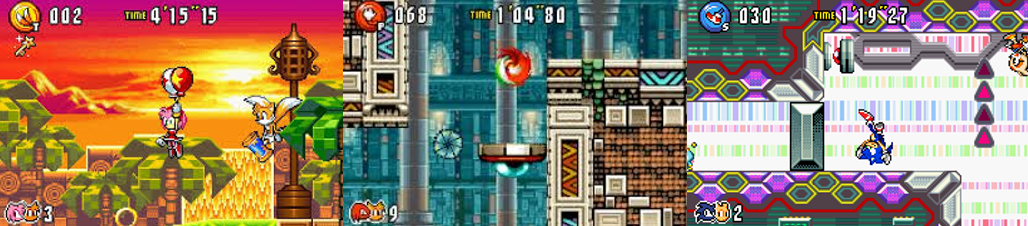
Taking place between the second and third Sonic Advance titles, while also existing in its own canon that paradoxically acknowledges past 3D adventures while ignoring classic Sonic titles, Sonic Battle sees Sonic and his friends befriend a child-like fighting robot known as the “Gizoid”. Nicknamed “Emerl”, this robot forms a “Link” with whoever demonstrates true power, copies the moves and abilities of anyone it fights, and becomes stronger and more coherent by absorbing Chaos Emeralds. This story is told over eight chapters, with each focusing on a different character teaching Emerl new abilities, learning more about him, and helping him to become an independent entity, all while defending Emerl from Doctor Eggman, who seeks to reclaim it to power his new fangled “Final Egg Blaster”. Although each character has their own special abilities and attributes, they all share the same controls. You jump with A (executing either a double jump, a glide, a mid-air dash, or flying by pressing A again in the air) and attack with B. Subsequent taps of B string together a simple combo that often sends foes flying. You can use the directional pad to hit opponents upwards or across the screen, double tap left or right to dash towards them, or hit a heavier attack. Tapping the Left trigger sees you guard and holding it sees you recover health points (HP) and build your “Ichikoro Gauge” to land one-hit kill special attacks with the Right trigger. While holding L, you can rotate the battle arena to track your opponents, though I found this to be little use. Additionally, you never see your enemy’s HP, just their remaining or accumulated knockouts, so it can be difficult to judge how much damage you’re doing.

While each character has unique attacks and abilities, combat quickly becomes tedious and annoying.

Each character controls a little differently and has different special attacks. Sonic and Shadow the Hedgehog are fast, Miles “Tails” Prower, Cream the Rabbit, and Rouge the Bat fly, Knuckles the Echidna (and Rouge) glides, and Amy Rose uses her Piko-Piko Hammer. Some characters are slower; others recover HP or fill their Ichikoro Gauge at different rates; and others have more powerful special moves. Chaos Gamma (a rebuilt, antagonistic E-102 γ “Gamma”) and his Guard Robo lookalikes self-destruct upon defeat to deal heavy damage, which is incredibly frustrating due to the clunky controls and you often being locked into combos. Rouge also hovers for quite a while before landing, making her difficult to hit and control. Before each fight, you select between three special attacks: Shot, Power, and Set/Trap, with each set either to your ground or aerial attack or making you immune to the remaining attacks when guarding. Set/Trap lays or hides a mine, either while jumping or standing, and was the special attack I use the least as I prefer to be aggressive. Each character’s special attacks are different. Sonic unleashes a blast of wind or a version of his Homing Attack, for example, while Shadow employs Chaos magic, Cream attacks with her Chao companion, Cheese, and Tails employs nanotechnology to conjure an arm cannon and spring-loaded punches. Thanks to the odd, isometric battle arenas and how slow even the fastest characters are, it can be difficult to land combos or judge your angle, so I found it better to cheese the special attacks. You figure out what works (like the Sonic Wave, Chaos Combo, Meteor Crush, or Air E. Ball) and spam them until the opponent makes themselves immune, then you switch to another special attack and repeat until you win. This strategy makes battles much easier, but also incredibly tedious, something not helped by the frustrating way Sonic Battle presents its fights.

Constant combat allows you to customise and power-up Emerl into a formidable fighter.

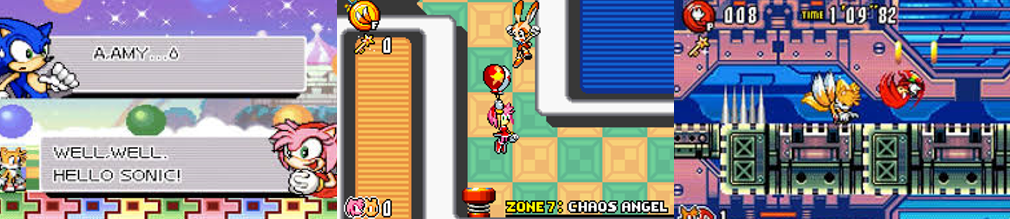
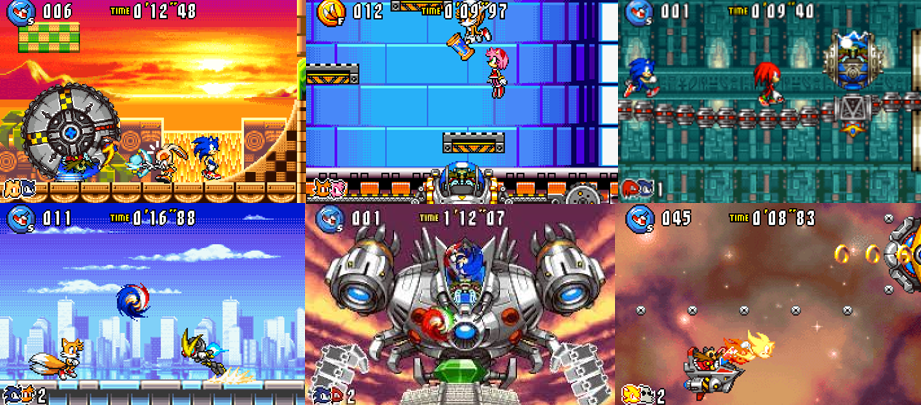
In the “Story Mode”, characters are challenged by friends and foes alike, often with Emerl alongside or against you as training. Typically, you emerge victorious after five knockouts, only to be immediately challenged to a ten KO battle! Often, victory means reaching five or ten KOs first and you sometimes face a time limit or more opponents (often at a two- or three-on-one disadvantage) but the game never deviates from this pattern. Well, it does a bit when Emerl is challenged to avoid damage or using special moves, but these variations are incredibly rare. Instead, you fight Guard Robos and Dr. Eggman’s Gizoid copies, the Phi series, over and over, to say nothing of endlessly sparring with Sonic and his friends to learn new skills. “Skill Points” and “Skill Cards” are awarded after most victories and are used to customise and enhance Emerl, who apes any character’s attacks, special moves, and stances. You can even change his colour and unlock “Ultimate” Skills to make him an incredibly powerful fighter but be wary as you’re often asked to fight him and he’ll trounce you if you don’t edit his abilities beforehand. At first, Emerl is slow and weak and pathetic but, after you clear all eight stories, he’ll be far stronger, making the game incredibly easy, especially as you don’t face much of a challenge until Shadow or Emerl’s stories. Even then, you can simply spam the same special moves, charge a one-hit KO strike, and repeat to cheese most fights. Sure, it gets tougher when you face three Guard Robos at once and they’re all exploding, or when you face Sonic and Shadow alone, or when Rouge forces you to fight with a handicap, but it’s nothing you can’t power through. It’s just not very interesting as fights drag on way too long and are far too repetitive, with enemies largely playing hide and seek to regain HP or charge their meter and it being easy to telegraph where they’ll respawn.

On the plus side, the game looks amazing and has a pretty emotional story.

Thankfully, the game looks gorgeous. Utilising a variation of the Sonic Advance art style for its sprites, characters are energetic and expressive, spouting some rudimentary voice clips to accompany their attacks, which are colourful and fitting for each character, if sadly limited by the shallow combat. Combat arenas are quite ugly, however, and are simple, isometric dioramas filled with rudimentary blocks to obscure enemies. There are no hazards or gimmicks to worry about, which is nice, but arenas feel half-assed compared to other fighting games. The music is also quite dreadful, employing a synthesized rock score for the most part and being grating to listen to. When on the interconnected overworld map, you direct your character using an arrow to interact with characters or enter new areas, which are all modelled after the Sonic Adventure games (Various, 1998 to 2001). You’ll chat with Tails in Emerald Town, train with Amy in Central City, visit Rouge’s casino in Night Babylon, mock Knuckles at Holy Summit, and confront Dr. Eggman on his Death Egg space station. When interacting with characters, you’re treated to some funky portrait art that changes to suit their mood and speech bubbles that overemphasises key worlds like “Chaos Emerald” and “Link”. Each chapter is quite short and directly leads to the next, with some overlap and jumping about the timeline to fill in gaps. Sonic and Tails adopt Emerl to improve him, Rouge uses him for heists, Amy sees him as a surrogate son, and Shadow is out to destroy him since he knows Emerl’s destructive past. Sonic Battle is surprisingly story heavy, with Emerl evolving as you acquire Chaos Emeralds or Chaos Shards, adopting a cocksure attitude, questioning his existence, and ultimately fighting against his destructive urges to sacrifice himself for his friends.

After besting Dr. Eggman, you’re left with some single- and multiplayer challenges and mini games.

You’re forced into many battles and encouraged to partake in more, with Shadow challenging Emerl to battle everyone before a final showdown and Emerl urged to train before teleporting to the Death Egg. When this space station launches, part of Holy Summit freezes and the legendary water god Chaos appears for you to challenge. Though incredibly powerful and sporting elongated limbs, Chaos is slow and not especially smart so it’s easy to beat it and learn some of Emerl’s most powerful moves. When on the Death Egg, Emerl confronts Dr. Eggman, who fights in his Egg-O-Matic and unleashes a barrage of missiles and mines. Dr. Eggman floats about, making him difficult to hit, and explodes upon defeat to make things even more frustrating. This was the only time I consistently used the Set/Trap special attack as it’s ridiculously easy to spam these beneath Dr. Eggman to finish him. Outside “Story Mode”, you can hone your fighting prowess in “Training Mode” or on up to fifteen fights in “Challenge Mode” at three difficulty levels. Although they don’t get a story chapter, Chaos and Chaos Gamma are both playable in the game’s other modes and you even unlock a Green Hill battle arena by completing Emerl’s story. You can enter codes on Dr. Eggman’s computer to unlock additional Skills and replay chapters over and over to unlock any Skills you’re missing. If you have friends, you can compete via the Link Cable in battles that mimic the “Story Mode” or in various mini games. I’ve never actually played these as I never knew anyone else who owned the game, but they look pretty fun. Four are unlocked by beating certain story chapters and see you bouncing around like a game of air hockey, collecting Golden Rings in what looks like a variation of Tails’ Skypatrol (Japan System House SIMS, 1995), playing a Knuckles-themed reskin of Minesweeper (Microsoft, 1990), dig up treasure on a beach, or race down a highway while attacking players and dodging obstacles.

Final Thoughts
Although Sonic Battle wasn’t the first time the series was translated into a fighter, it is, to date, the last. Rather than capitalise on the success of the Super Smash Bros. series (Various, 1999 to present) with a main console 3D fighter, Sonic Team lumbered us with this tedious, clunky brawler that’s visually very appealing and has a surprisingly engaging narrative but is a chore to play. The basic combat loop becomes extremely tedious once you figure out how to cheese the system, or equip certain Skills to Emerl. Simply assign him the most powerful attacks and the fastest healing Skill and you’re essentially unbeatable, making it even more frustrating when the game artificially increases its challenge by having you fight the same enemies but with a higher KO quota. As gorgeous as the sprite art and animations are, the fighting mechanics are shallow and awkward thanks, in no small part, to the weird isometric arenas. While it’s fun to constantly be rewarded after every fight and to tinker with Emerl, there’s not enough combat variety to sustain Sonic Battle, which runs out of steam about three chapters into its story. Perhaps if the mini games had been included in the “Story Mode” as additional challenges, or if the game had challenged you to use certain moves or defeat enemies in certain ways, things might’ve been more enjoyable. On the plus side, each chapter is a breeze to get through, but this just highlights how little Sonic Battle has to offer unless you have friends to play with. It’s a shame as I often defend this game, but it really is a poor experience with the most basic combat you could ask for. It’s made doubly worse when you realise that Sonic Team chose to make this mess rather than just do what they always do and copy Nintendo with a Sonic-themed Super Smash Bros. clone like everyone else.

My Rating:

Rating: 2 out of 5.

Could Be Better

Did you enjoy Sonic Battle? Do you agree that it failed to live up to its potential? Were you also frustrated by the repetitive combat and lacklustre difficulty curve? Did you enjoy the art style and the narrative? How powerful did you make Emerl in the end and did you ever unlock all of his Ultimate Skills? Would you like to see a true Sonic-themed fighter some day? How are you celebrating Sonic’s anniversary this year? Let me know what you thought of Sonic Battle in the comments and donate to my Ko-Fi to recommend more Sonic spin-off games for me to cover.

Mini Game Corner [Sonic Month]: Sonic X Shadow Generations (Xbox Series X)


Sonic the Hedgehog was first introduced to gamers worldwide on June 23 1991 and, since then, has become not only SEGA’s most enduring and popular character but also a beloved videogame icon. Thus, in keeping with tradition, I’m dedicating some time to celebrate SEGA’s supersonic mascot.


Released: 25 October 2024
Originally Released: 1 November 2011
Developer: Sonic Team
Metacritic Scores: 80 / 8.9

Also Available For: Nintendo Switch, Nintendo Switch 2, PC, PlayStation 4, PlayStation 5, Xbox One, Xbox Series S (Shadow Generations); PlayStation 3, Nintendo 3DS, PC, Xbox 369, Xbox One (Original Version)

Quick Facts:
SEGA celebrated Sonic’s 20th anniversary with Sonic Generations (Sonic Team, 2011), a largely praised love letter for long-time fans. The game remained a strong seller for SEGA but got a new lease of life as part of the 2024 “Year of Shadow” to coincide with Shadow the Hedgehog’s big-screen debut. Bundled alongside a new remaster of Sonic Generations, Shadow Generations featured an open-world, additional powers for the brooding anti-hero, Shadow-specific levels, and downloadable content (DLC).

The Review:
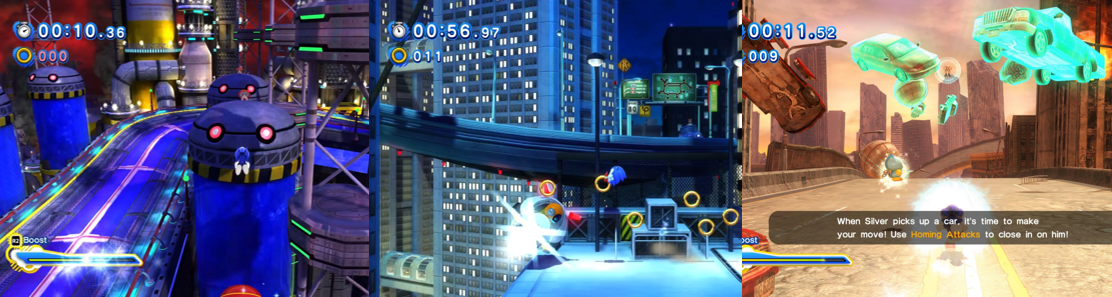
Since I’ve already reviewed Sonic Generations, I was tempted to gloss over treading the same ground again, however I think there are a few additions to the original game that are worth mentioning. We get a new title screen and some updated visuals for the original game, with Sonic X Shadow Generations offering a bunch of new options and even removing the lives system so you can play through levels (or “Acts”) and Challenges as often as you like. You’ll still die if you’re hit without Golden Rings or fall down a pit, and your ranking will decrease, but at least you don’t have to grind for Rings and lives. As before, Sonic Generations sees you blasting through nine reimagined areas (or “Zones”) from Sonic’s past as the “Classic” pudgy Sonic and the sleek “Modern” Sonic. Classic Sonic runs through Act One of each Zone on a 2.5D plane while Modern Sonic switches between 3D and 2.5D as he blasts through Act Two. Both share some common controls despite these differences: you jump with A or X and press either again in mid-air to perform a Homing Attack. You crouch or slide through gaps with B, activate any equipped “Skills” with Y, and blast away with Modern Sonic’s “Boost” or Classic Sonic’s Spin Dash with the Right Trigger. Golden Rings, tricks, and bashing Badniks fills Modern Sonic’s Boost gauge, allowing him to plough through enemies and destructible objects. Holding the Left and Right Triggers lets you drift, the Left and Right Bumpers quick step, and Modern Sonic performs a mid-air stomp with B, wall jumps off certain walls, and dashes along Ring lines with Y. Both Sonic’s now begin with the Drop Dash equipped, allowing you to hold A or X to quickly dash away, and you can again unlock Skills with the points you earn from clearing Acts and by finding Red Star Rings and completing Challenges.

The original game returns, as fun as ever, with a couple of new features and a visual upgrade.

These Skills increase your acceleration and underwater movement, grant elemental shields, extend the Boost gauge, and give you a skateboard, among other perks. You must clear each Act to partially restore the bleak White Space hub world, collecting Boss Gate keys and taking on rivals and additional Challenges as you go. These see you race against or team up with a friend, like using Rouge the Bat’s feminine wiles to discombobulate enemies, digging for treasure with Knuckles the Echidna, and being smashed higher by Amy Rose’s hammer. Each Zone faithfully recreates its source material by with added gimmicks and twists, such as incorporating parts of Hidden Palace Zone into Sky Sanctuary and adding an airship to Rooftop Run. You still utilise Wisps to traverse Planet Wisp, still run from that rampaging truck, and still hop to rails and avoid bottomless pits. You must also tackle three of Sonic’s rivals and three reimagined bosses to acquire Chaos Emeralds, with each sporting new attacks such as hurling debris and attacking from the background. Alongside the five Red Star Rings hidden in each Act, there are three Chao to find, too, which bring more life to White Space when found. Finding them all pops a new Achievement, though most of the original Achievements return, earned for restoring each area and unlocking all Skills. Sonic Generations continues to impress, with remixed tracks returning for each area and fantastic detail packed into every environment, even if things can get cluttered. Sonic X Shadow Generations isn’t just a visual upgrade; the game runs faster, with no lagging or slowdown, which greatly improves the gameplay experience. The payoff is that it’s even easier to slip or fly off stages, and both Sonics still have an incredibly stunted jump that can make platforming trickier than it needs to be. The focus remains on high-speed, action-packed gameplay, however, with each Zone sporting multiple paths and shortcuts (via springs, pulleys, rockets, cannons, and the like) to shave a few seconds off or find Red Star Rings or Chao. The Casino Night minigame is here by default and there are two skins to purchase for each Sonic, one that turns Classic Sonic into a Saturn-era polygonal model, and another ripped right out of the Dreamcast Sonic Adventure (Sonic Team, 1999). Unfortunately, the game remains as short and easy as ever, with no new Challenges or additional stages or unlockables added, which is a shame considering I would’ve loved to play as someone other than Sonic.

Take on an additional challenge using Shadow’s new powers and abilities.

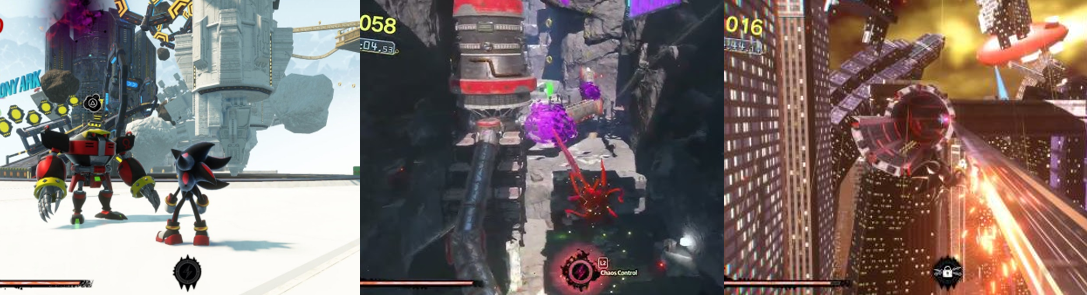
For Shadow Generations, the controls remain the same, with Shadow performing his own version of the Homing Attack, blasting along with a boost, and stomping through crates. Unlike Sonic, Shadow cannot equip Skills and instead stuns enemies with his Chaos Spear (Y), builds a gauge to activate Chaos Control (LT) to temporarily slow time, and gains new “Doom” powers by attacking Black Doom’s eye to acquire a Doom Gear. When cashed in, Shadow can launch Chaos Spear at up to five targets, surf across water (and attack with RT or LT) on a manta ray-like lifeform, launch Black Arms soldiers by charging X, traverse sticky goop by pressing X to transform into a tentacled form, and sprout Doom Wings by pressing RB and LB together when he has 50 Rings, allowing him to awkwardly glide for as long as he has Rings and Boost. Some of these new abilities are more fun than others, with the Doom Surf being quite slippery and the Doom Morph being quite finnicky and the Doom Wings quickly draining your Boost gauge and being stunted since you can’t freely fly. Instead of Red Star Rings, players can find three “Collection Keys” in each Act, which open coloured crates in his version of White Space, thereby unlocking concept art, music, and other goodies. Players can also shoot balloons to collect pages of Professor Gerald’s journal (a physical version is included with the game) and find Machine Parts in White Space to help Cubot and Orbot escape. There are also sixteen Achievements specifically tied to Shadow Generations, with most popping when you restore areas and defeat bosses, but you’ll need all those “S” ranks and collectibles to 100% the game. Shadow also doesn’t have to worry about running out of lives, but you must be super quick and super attentive to earn an “S” rank as Shadow’s stages are much longer and tougher than Sonic’s. Pits, hazards, and enemies are plentiful, with you having to make faster decisions on the fly to take alternative paths, switch rails, and avoid a nasty fall, especially as Shadow is just as slippery and wild as Sonic at times.

Open-world gameplay and an increased difficulty add an extra kick to the core gameplay.

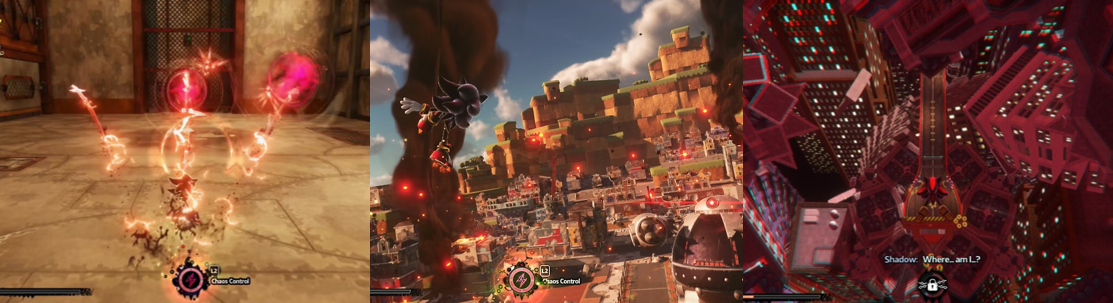
Shadow Generations mimics Sonic Frontiers (Sonic Team, 2022) by making Shadow’s White Space more of an open-world experience, allowing you to freely roam, spawn rails, springs, and platforms, and search for goodies. While I found this tedious, you can skip to an Act, boss, or Challenge Act from the pause menu and shortcuts do appear. You’ll again have to beat Challenge Acts to earn Boss Gate Keys, with these seeing you complete obstacle courses with just one Ring, defeating a certain number of enemies, utilising Shadow’s new powers to clear gaps, and avoiding or triggering environmental hazards. These are much harder than in Sonic Generations, but fun challenges that ramp up after you clear the game and activate “Doom Zone”, which also makes the bosses tougher. Shadow’s allies, like Rouge the Bat and E-123  “Omega”, appear in White Space to offer encouragement, Shadow’s reunited with Professor Gerald and Maria and once again reconciles his past, and Doom’s Eye taunts him in most Acts, warping the environment and testing your platforming skills. Shadow’s stages are mostly decent, with players revisiting various locations from the Space Colony ARK, rushing through Rail Canyon, and blasting through a dramatically improved version of Kingdom Valley. Shadow’s Act Twos are usually shorter 2.5D challenges, as in Sonic Generations, but Act Ones see Doom’s Eye dropping Shadow in an increasingly twisted and nightmarish version of Radical Highway. This serves as the final area of the story, and the toughest challenge yet, but I was surprised that Westopolis didn’t appear as well (or instead). I was baffled by how many stages went with the “wrecked city” theme and by the inclusion of Chaos Island, an area Shadow never visits, rather than a stage from Shadow the Hedgehog (Sonic Team USA, 2005), and that Sunset Highway was reimagined considering Shadow’s small role in Sonic Forces (Sonic Team, 2017). By dropping some real-world cash, you can unlock a bonus stage where you play through downtown Shibuya from Sonic the Hedgehog 3 (Fowler, 2024) as the movie version of Shadow, with Keanu Reeves reprising his role. Upgrade to the digital deluxe version and you also get a prototype skin for Shadow, though I’m not sure this is worth the hefty price tag.

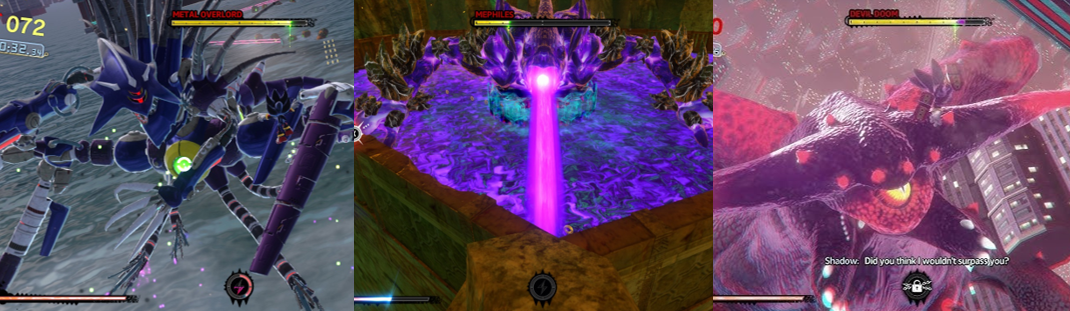
Shadow’s old rivals get monstrous makeovers for epic and action-packed rematches.

Shadow Generations takes place alongside Sonic Generations, with Shadow menaced by the revived Black Doom and struggling to control his anger and new powers. In addition to playing through reimagined versions of some of his most recognisable stages, Shadow also battles some returning enemies, mainly Guardian Units of Nations (G.U.N.) robots, Artificial Chaos, Black Arms soldiers, and Ancients. A gigantic, dragon-like Black Arms conjures twisters and blocks your path in Radical Highway, massive Death Egg Robos destroy the environment in Sunset Highway, while terrifying robotic trains barrel at you in Rail Canyon. Although Shadow encounters Sonic in a cutscene, there’s no do-over of their Rival Battle from Shadow’s perspective, and no Rival Battles at all, unfortunately. Instead, players battle four of Shadow’s most fearsome foes in reimagined fights, starting with the fearsome Biolizard. Like Sonic Generations’ Nintendo 3DS port, you must race away from the creature’s chomping mouth and thrashing tail, dodging energy balls and grinding up to attack its life support system. You still bounce off orbs to do the same, but the Biolizard now spawns extra limbs and produces shockwaves, and clings to the wall to spit projectiles. Next, you battle the Metal Overload while Doom Surfing, knocking back its projectiles and sea mines and avoiding spike balls and laser walls. After grinding along rails to attack it, you must time jumps to avoid its tail (trickier than it sounds) and win a bout of dead man’s volley to finish it. Shadow then battles Mephiles, Doom Morphing to attack, destroying his minions and clones with Chaos Spear, and dodging his massive mouth laser. The finale pits you against Devil Doom in a three-stage fight. First, like with Metal Overload, you Doom Surf and hit laser orbs at the demonic alien; then, you Doom Morph to swing about, dodging fireballs and pummelling his eye, hopping to platforms as he destroys them beneath you. Black Doom then transforms into Neo Devil Doom and Shadow attacks with Doom Wing rather than as Super Shadow, though you’ll still need Rings to stay alive. Dodge through debris to reach him, then reflect his projectiles and charge towards his eye when prompted. Neo Devil Doom attacks with his tentacle-like tail, summons a vortex, and is constantly launching shit at you, but it’s not too difficult to bypass these, break free of his Chaos Control, and finish him off with a quick-time event.

Final Thoughts:
I’ve always enjoyed Sonic Generations. It was a fast-paced, action-packed adventure full of fun Easter Eggs and references to Sonic’s colourful past. My biggest gripe with the game was how barebones it was and how it could’ve done more to celebrate gaming’s famous hedgehog. Sonic X Shadow Generations aims to fix that with a visual overhaul and some new features to refine the original experience and add a few new bells and whistles, though nothing’s really that different in the main game. The big selling point here is Shadow Generations, an impressive and thrilling celebration of Sonic’s infamous anti-hero that takes the core gameplay and mixes it up to offer a brand-new challenge. The presentation here is top notch, with genuinely impressive CG cutscenes and an open-world hub world that, while still a bit bland and aggravating, shows more effort than a simple white void. Shadow’s new powers were a bit hit and miss but were largely very fun, with players blasting through enemies and wrecking the environment in a blaze of glory. While stages do stretch on for a while and are noticeably more challenging than in Sonic Generations, I loved the recreations of Shadow’s past, though it’s genuinely perplexing that Shadow the Hedgehog isn’t represented considering the main villain is Black Doom! I really enjoyed the reimagined bosses, which were suitably epic and a blast to fight, incorporating elements from Sonic Frontiers for an extra kick. The challenge is certainly upped in Shadow Generations, which can make it a bit frustrating, but I had a great time here. However, it’s still too short and Sonic Team didn’t let Sonic and Shadow crossover into each other’s White Spaces, or include Rival Battles, Super Shadow, or even a motorcycle section. If you’ve never played Sonic Generations before, though, this is absolutely the definitive and recommended way to play as it revamps and bolsters the original. And, if you have played the game, there’s enough here to warrant a replay, though all the old gripes remain behind the action.

My Rating:

Rating: 3 out of 5.

Pretty Good

Were you a fan of this revamp of Sonic Generations? What did you think to the tweaks to the original game and did you find all those Chaos? Were you a fan of Shadow’s new abilities and powers? Were you surprised by the stages chosen for his story? What did you think to the added challenge and the reimagined bosses? How are you celebrating Sonic’s anniversary this year? Whatever your thoughts on Sonic X Shadow Generations, leave a comment below, support me on Ko-Fi, and go check out my other Sonic content!

Game Corner [Sonic Month]: Sonic Lost World (Nintendo 3DS)


Sonic the Hedgehog was first introduced to gamers worldwide on June 23 1991 and, since then, has become not only SEGA’s most enduring and popular character but also a beloved videogame icon. Thus, in keeping with tradition, I’m dedicating some time to celebrate SEGA’s supersonic mascot.


Released: 18 October 2018
Developer: Dimps

Metacritic Score: 59
Also Available For: Nintendo Wii U and PC

Quick Facts:
Shortly after the release of Sonic Colours (Sonic Team, 2010), Sonic Team teamed with Dimps once more for a more streamlined and diverse Sonic title that emphasised “parkour” mechanics. Sonic Lost World was developed for the Wii U and 3DS due to SEGA’s previous success on Nintendo’s consoles and saw the debut of the “Deadly Six”. The Wii U version got special editions and downloadable content (DLC) and both received mostly mixed reviews.

Gameplay and Power-Ups:
Sonic Lost World is a 3D and 2.5D hybrid action platformer that continues the high-speed “Boost” formula that popularised Sonic’s 3D titles. As was the style at the time, this is a single-player experience, with Miles “Tails” Power only appearing in cutscenes, though Sonic gains temporary power-ups by collecting benevolent alien “Wisps” scattered around the “Lost Hex”. The standard Sonic formula returns, with players collecting Golden Rings to survive most hazards, encouraged to finish stages (or “Zones”) quickly to earn letter grades, and bashing Badniks to free woodland critters. As ever for 3D Sonic titles, players lock-on to nearby targets (Badniks, springs, rails, etc) after jumping with either A or B. While jumping destroys Badniks and certain obstacles with Sonic’s patented Spin Attack, tapping A or B again performs a double jump or launches Sonic at his target. You can chain multiple Homing Attacks together and must often quickly tap the button to hop between rails, clear gaps, or cling to rockets. A new feature in Sonic’s arsenal is a mid-air somersault attack, performed by pressing X or Y after jumping. This sends a blast of wind-like energy towards your target, stunning it for a few seconds so you can bypass their defences or hit their weak spot, and this is essential when confronted with giant Badniks that must be destroyed to reveal springs or teleporters and such. Pressing X or Y in mid-air when not locked onto an enemy performs a bounce to give you extra height, Sonic clambers over some ledges, air bubbles keep him from drowning, and you earn extra lives by grabbing Sonic Icons, collecting five Number Rings, or for every 100 Rings. Hitting capsules also gifts you some returning power-ups, like the returning temporary invincibility, ten additional Rings, and three elemental shields. The aqua shield allows you to breathe underwater, the lightning shield attracts nearby Rings and keeps you from being hurt by electrical hazards, and the flame shield resists all fire hazards.

Run up walls, power-up with Wisps, and wrestle with the 3DS to control Sonic.

Unlike other 3D Sonic games from this era, there is no Boost option in Sonic Lost World. Instead, you hold down the Right trigger to run, which is essentially the same but lacks the fast-paced, action-packed feeling of ploughing through hordes of Badniks and instead highlights the game’s slower pace. The big new gimmick is “parkour”; hold R or hit boost pads to run up walls, tapping X or Y for a boost and to keep from falling and hitting A or B to hop between walls. You can quick step around corners and to avoid enemies and use the Left trigger to better position the camera, but I found this mechanic very finnicky and that I was more likely to simply plummet to my death or be forced to repeat a wall run due to poor hazard placement. As mentioned, some Wisps return, with you tapping the lower screen to activate them and collecting Wisp capsules to top up the energy bar, though you’ll lose your shield if you use a Wisp. You can Drill!! through certain dirt or cut through water with the Yellow Wisp, attract items and enemies to float with the Indigo Wisp, and ricochet off walls and ceilings with the Cyan Wisp. You can also zap to nearby coils and targets with the Ivory Wisp, blast about as the explosive, fiery Red Wisp, or wrestle with the Nintendo 3DS’s god-awful gyroscopic controls with the Gray Wisp. Wisps are relatively sporadic, though some Zones require them to be cleared, with you desperately topping up your meter to avoid a fatal fall or being devoured by gigantic enemies. The Yellow Drill dispels whirlpools, the Gray Quake destroys certain blocks and activates big switches, and Indigo Asteroid lets you float to faraway platforms. Players also earn “Materials” by completing Zones, earning more for “S” or “A” ranks. These upgrade Tails’ Lab and allow him to create remote controlled (RC) vehicles, which can be transferred to the Wii U version so a second player can drop bombs, turn Sonic invisible, or slow him down. If you lose too many lives here, a golden RC Vehicle flies over the environment or become invisible and invincible, allowing you to bypass trickier sections. Finally, one item per life can be stored on the touchscreen, which is handy in a pinch.

Some dull puzzles and aggravating sections bog down the more action-packed moments.

These are quite prevalent in Sonic Lost World since basically every Zone takes place over a bottomless void. When Sonic speeds off uncontrollably or is met by gaps, temporary platforms, or tricky jumps, you’re likely to fly to your doom, which is very frustrating. Spikes regularly appear to screw up your parkour, you must often defeat Badniks to progress, or you’ll be hitting or rolling objects onto switches to activate or move platforms. There are often branching paths, with some having hard jumps or chasms dotted by rails and Spinners, loops, springs, and bouncy bumpers regularly appear, and you’ll be floating or being pushed along by fans. The screen often tilts and rotates in 2.5D sections, which can be very disorientating; you’ll use motion controls to steer high-speed rockets; the environment often pops up as you race along; and some platforms swing ominously. Quicksand and marsh water slow you, teleports loop you around, and you’re often asked to explore in different directions, tackling different puzzles to activate switches or teleporters. Pistons crush you, gravity sometimes fights against you, and you’re often pushing objects about. There’s one part where you must roll giant apples into holes and then into a giant blender, freezing gusts must be blocked by large snowballs, and you occasionally go sky diving, holding X, Y, or R to dive faster. Sometimes, you run around spheres in a mad rush trying to defeat all enemies or find switches, occasionally forced to barrel about with the aggravating Gray Wisp. Bouncy clouds and tubes are commonplace, as are moving platforms that you must ride to progress and giant springs that launch you to other parts of the Zone. Zones go on for ages, with multiple checkpoints and escalating platforming and puzzle challenges, which can be irritating. You’ll frantically hop to rails (often dodging enemies and hazards), ricochet about Casino Night Zone-style pinball tables trying to score a bingo, dodge lava pits and flame pillars spawned by Zavok’s Mech Dragon, and trick enemies into activating switches.

Presentation:
At first glance, Sonic Lost World is quite impressive. The game features prerendered cutscenes with full voice acting, though they’re obviously compressed compared to its Wii U counterpart, with no in-game models being used to convey the game’s story. This involves Sonic reluctantly teaming with Doctor Eggman against the Deadly Six, driving a wedge between him and Tails, Dr. Eggman faking his death, and the Deadly Six briefly brainwashing Tails to fight his buddy. There’s a pseudo map screen where players freely choose which Zone to play or visit Tails’ Lab, and the music is very jaunty and catchy. There are even remixes of “Sonic Heroes” and “Reach for the Stars” tossed in, which was nice, and I loved how the game brought the Flickies and bonkers, surreal aesthetic of the original games to life after years of fusing real-world elements into the franchise. Sonic gets impatient when you leave him, runs with a lovely 3D recreation of his classic spinning legs, sprouts catchphrases and voice lines, and your goal is to hit the classic animal capsule at the end of each Zone. However, there’s a distinct blurriness to the visuals, one only exacerbated when you inch on the 3D slider. While the depth is impressive, the colours pop, and giant Badniks fly at you in 3D, this option remains headache inducing and is best left off. There is also lots of pop up, with spiralling paths literally appearing as you run and environments loading as you’re pinballed about. This means some Badniks and hazards appear out of nowhere, it’s not always clear where you’re heading, causing you to miss rails or landings, and the Homing Attack has a noticeable lag that causes many unnecessary and aggravating deaths. Sonic Lost World generally has two playfields: cylindrical and spherical 3D worlds or 2.5D obstacle courses that recreate some classic Sonic environments, like Green Hill Zone and Casino Night Zone. The 3D sections take a lot of inspiration from the Super Mario Galaxy games (Nintendo EAD Tokyo, 2007 to 2010), being spherical, cylindrical, and/or blocky worlds offering a mixture of high-speed action and tricky platforming. Unfortunately, Sonic Lost World’s 3D Zones all take place in a void, so you can rocket to your death with ridiculous ease.

While colourful and impressive, Sonic Lost World can be blurry and messy at times.

This is made more irritating by the clunky parkour mechanics and the split-second timing required to switch rails or hop to platforms in later Zones, though it’s the motion controls that really screw you up since they make your movements so erratic and loose. There are seven areas with three Zones and a boss, and each Zone is broken down into multiple sections separated by giant springs or teleporters. Things start familiar enough in Windy Hill Zone, a decidedly Green Hill Zone environment featuring boulders, totem poles, caves, waterfalls, and you running from a giant Caterkiller. Loops, bridges, and spiralling paths are introduced here, while Desert Ruins Zone sees more obstacles coming your way. You must jump to move over quicksand, explore a darkened tomb, and hop to platforms as Zomom’s Ganmen blows you back and blasts you with its eye beams. Tropical Coast is like the love child of Angel Island Zone and Emerald Coast, featuring calypso music and underwater sections alongside palm trees and islands. The Yellow Drill is super useful for navigating the underwater mazes, which easily turn you around thanks to that annoying screen tilt, and this is also where you’ll find that giant blender. Frozen Factory Zone starts you snowboarding down a snowy mountain, pulling off tricks and griding across rails, before having you creep along narrow platforms, plug up freezing hazards, and desperately avoiding giant snowman heads to hit switches. Silent Forest Zone is a dense jungle full of sticky marsh water, spring-loaded flowers, and a grind through night-time ruins as Zor’s Owl Mech searches for you and alters the environment, confusing the already troublesome platforming sections. Sky Road Zone starts very basic, with just an open sky background, and heavily focuses on bottomless pits, but also transitions to a neon city and pinball aesthetic. It’s capped off by far more treacherous, Windy Hill Zone sections that burst into flame, requiring you to pop water balloons or grab a fire shield. There’s a lot of variety in each Zone, for sure, but perhaps a bit too much at times as they quickly outstay their welcome, especially when the game blasts you down pits and calls it a challenge.

Enemies and Bosses:
Many of Dr. Eggman’s most recognisable Badniks return here; in fact, there’s surprisingly few new enemies and some returning Badniks even sport new mechanics. Motobugs race about, Newtrons crawl along walls to screw up your wall running, Buzz Bombers hover about taking shots at you, Jaws patrol the waters, and Orbinauts catch you off-guard when you’re stringing together homing chains. Spinners and Batbrains act as “bridges” over gaps, though some Spinners zap you and cause you to fall to your death. Caterkillers and Sandworms are noticeably prevalent, coming in gigantic sizes and requiring you to stun them to hit their weak spot, while Crawl now sports a projectile attack. Those bloody Metropolis Zone Slicers return to fling your blades mid-jump, Cluckers (both small and giant) pop up to blast cannonballs at you, and even Egg Pawns prove troublesome as they run about flailing their arms. Balkirys swarm, Grabbers and Antlions lurk from above, and Penguinators endlessly respawn to slide across ice. Clucker variants hop into mine carts to chase you across rails, giant robotic turtles sport shell cannons, and huge mechanical blowfish often guard switches and teleporters. These bigger enemies are best stunned to halt their attacks or lower their defences, which you’ll also use to stun Zeena’s Snowman Mech as it relentlessly pursues you. this allows you to rapidly attack it, causing it to temporarily press switches. Often, switches and teleporters and such cannot be accessed until you’ve defeated a certain number of Badniks, usually a giant one, and even bigger variants often chase you and instantly kill you if they touch you. Some of the Deadly Six appear in the Zones, such as Zazz appearing in the background of Windy Hill Zone and tossing his Moon Mech at you. The Deadly Six act challenge you at the end of each area and are battled again in Lava Mountain Zone, where they’re tougher, have altered attacks, and you have less time to hit them.

Bosses can be quite fun, when they’re not forcing motion controls and insta-deaths.

Zazz rolls around on his Moon Mech, trying to crush you, so race away and knock him off to pummel him on the ground, avoiding his shockwaves and star projectiles. Zomom attacks atop the block-headed Ganmen, raining fireballs and vulnerable in the rear (and to Indigo Asteroid), and running around in a rage at the end. Master Zik was a pain as he’s protected by a ring of fruits. When he rolls one, jump and hit it from behind to pierce his barrier and attack him, and use the Yellow Drill to deal big damage. Zeena can also be a headache, especially in Lava Mountain Zone, as her giant snowman constantly pushes you back. You must push towards her and attack her mech’s belly for an Ivory Wisp, and then latch onto the enemies to zap her, which gets very annoying. This is nothing compared to Zor, though, who charges up a devastating eye beam from afar on his Owl Mech. You must quickly hop in the cannon and whirl around like an idiot with the gyroscopic controls to locate his mech, with more fakes and less time to attack him in Lava Mountain Zone. Zavok is comparatively easier but still troublesome as you’re in freefall, have little idea of where he is, and he blocks your Homing Attack. You must avoid his dragon’s fireballs and lasers (with the circling laser attack being especially frustrating) to hit him from behind, or grab the Cyan Wisp to decimate his health bar. After battling all six again in teams, you finally fight Dr. Eggman in a repurposed Death Egg Robo, racing towards him on a never-ending path like in Sonic Colours. You must avoid the Eggrobo’s increasingly troublesome Wisp-like attacks, which include lasers and electrical bolts, numerous fireballs, rocks kicked up by his drills, boulders, and an insta-kill black hole that’ll have you rage-quitting! After avoiding his attacks, you must hop about to select the mech’s limbs and unleash a counterattack, barrelling into the cockpit and eventually mashing B to deal the final blow.
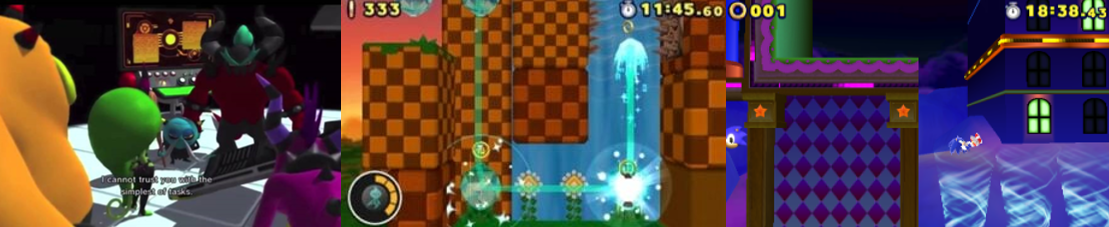
Additional Features:
Each Zone that isn’t a boss battle or Lava Mountain Zone contains five Red Star Rings, with their collection being helpfully displayed prior to starting a Zone and during it. Collecting all fifteen Red Star Rings unlocks an “Extra level” for Zone for an additional challenge and beating those unlocks an even tougher final boss! Beating the game also unlocks “Hard Mode”, applicable by pressing Y prior to starting a Zone, if you want to make this finnicky game even more challenging. If you want Tails to build every RC Vehicle, you’ll need to grind away at each Zone to get those “S” and “A” ranks and earn better Materials, though this only really seems to benefit those with the Wii U version. There’s a time attack and a “VS. Mode” for players to go head-to-head with a friend in virtual reality races. You can also visit Tails’ Lab to listen to the soundtrack or view the game’s blurry cutscenes, or use the 3DS’ “StreetPass” feature, apparently to unlock additional missions but I’ve never actually used this. This version includes seven Special Stages, which can be replayed from the main map after you’ve beaten them, and the seven Chaos Emeralds. These Special Stages are similar to the classic Blue Sphere ones and have you flying through a cosmic void collecting Orbs and avoiding walls, electrified hazards, and navigating mazes. You have a strict time limit that decreases with each Chaos Emerald, so you must snag those time bonuses, and your reward is being able to tap the screen when you have 50 Rings to become the all-powerful Super Sonic. Unfortunately, while the Special Stages are doable and welcome, you’ll end up spinning around like a moron and giving yourself a headache as you’re forced to use motion controls to direct Sonic’s movements, making these more of a chore than they need to be.

Final Thoughts:
This is only the second time I’ve played Sonic Lost World, which says a lot about how memorable it was. While the game is undoubtedly the best-looking Sonic game on the Nintendo 3DS, the execution of its new mechanics was troublesome, at best. I’ve never really cared for the Deadly Six and find them extremely one-dimensional and generic, though I admit that they did make for somewhat unique boss battles that subverted the usual Sonic formula. I’m also not a big fan of the Wisps, especially as their powers mean Sonic’s friends take a back seat, and their inclusion seems like more of an afterthought. While some Zones looks really good and the music is very catchy, others are painfully uninspired and they all drag on for far too long. There’s maybe too much crammed into each area (and this title), with all sorts of weird gimmicks being thrown at the player as though SEGA were desperate to copy Super Mario Galaxy and then make it unique by slapping unnecessary bells and whistles onto it. The constant bottomless pits were a headache, the parkour mechanics were clunky, and the forced gyroscopic controls were frustrating. It might’ve been okay if these were limited to the Zor fight and the Special Stages but tying them to the rockets and Gray Wisp was a kick in the teeth. The RC vehicles could’ve been really fun but they’re not really implemented here, the tilting and rotating effects were aggravating, and the weird not-quite-boost run mechanic just made the game feel slow. It’s nice that the developers tried to break up the action with some puzzles, but these are a drag and Sonic Lost World is much more fun when you’re blasting off at high speed, quickly hopping to rails and platforms and bopping Badniks. The stun mechanic was weird, too, Sonic takes forever to recover when hit, and it’s just far too easy to lose a bunch of lives on what should be simple sections made difficult by the half-baked mechanics. It’s a shame as it does have a certain visual appeal, even with all the pop-up, but Sonic Lost World fumbles more than it succeeds, making it a disappointing swansong for Sonic’s days on the 3DS.

My Rating:

Rating: 3 out of 5.

Pretty Good

Did you enjoy Sonic Lost World? What did you think to the parkour mechanics and gyroscopic controls? Were you annoyed or happy to see the Wisps return? Do you agree that Zones stretched on for too long and had too many gimmicks? What did you think to the Deadly Six? Did you ever collect the Chaos Emeralds and defeat the Eggrobo? Which of Sonic’s Nintendo 3DS titles is your favourite and how are you celebrating Sonic’s anniversary this year? Whatever your thoughts on Sonic Lost World, share them below, support me on Ko-Fi, and check out my other Sonic content!

Game Corner [Sonic Month]: Sonic Chronicles: The Dark Brotherhood (Nintendo DS)


Sonic the Hedgehog was first introduced to gamers worldwide on June 23 1991 and, since then, has become not only SEGA’s most enduring and popular character but also a beloved videogame icon. Thus, in keeping with tradition, I’m dedicating some time to celebrate SEGA’s supersonic mascot.


Released: 6 August 2009

Developer: BioWare

Metacritic Score: 74 / 6/3

Quick Facts:
Forces to abandon console manufacturing, SEGA developed games for Nintendo’s GameCube and Game Boy Advance alongside Dimps. Following a highly praised trilogy and two very successful dual screen adventures, SEGA partnered with noted roleplaying game (RPG) developer BioWare for Sonic’s first RPG and BioWare’s first handheld title. Developed with a darker theme focused on characterisation and accessible combat mechanics, Sonic Chronicles was heavily criticised for its low quality MIDI soundtrack and forever changed Sonic’s comic book adventures when hack artist/writer Ken Penders sued SEGA for copyright infringement.

Gameplay and Power-Ups:
Sonic Chronicles: The Dark Brotherhood is an RPG in which players form a team of up to four characters from a roster of ten familiar faces from the franchise (two being optional and one being newcomer Shade the Echidna) and battle against the mysterious Nocturnus Clan across ten chapters. While Sonic is always on your team unless you’re asked to form two teams to handle separate objectives, you can switch the onscreen character by tapping the lower screen and the story progresses regardless of who’s in your team, with only some optional additional dialogue and exploration options being available for each. Sonic Chronicles goes all-in with the Nintendo DS touch screen, meaning every action is conducted via the stylus and touch screen, including controlling your characters, progressing dialogue, solving puzzles, and battling enemies. This is a touch jarring, and disappointing, as it can be difficult comfortably holding the Nintendo DS and I found tapping the screen inconsistent at times (though this could’ve been due to my touch screen). You start as Sonic but quickly hook up with Miles “Tails” Prower and Amy Rose to rescue Knuckles the Echidna, with each giving a sense of what the game has to offer. Characters come in three classes: “Power” (who focus on attacking), “Shifter” (who shift between attacking, supporting, and afflicting status ailments), and “Support” (who focus purely on supporting your team and have low attack power). Personally, I focused more on powering through battles, which will serve you well for the most part as the game doesn’t get too taxing until the final chapter, though you can heal and inflict status ailments on enemies, such as stunning them or putting them to sleep. Naturally, you earn Character Experience (XP) from battles that allows you to level-up and become stronger, adding special “Power/POW Moves” to your arsenal, though the highest level you can achieve is thirty and I found you don’t gain much XP compared to other RPGs.

Whether you’re exploring, fighting, or chasing, everything’s controlled via the touchscreen and stylus.

As you awkwardly explore, uncovering more of the map and interacting with various non-playable characters (NPCs), you’ll see context-sensitive actions pop-up to help you navigate. This means tapping the screen to make Sonic or Shadow the Hedgehog run through loops, flying across gaps as Tails or Cream the Rabbit, and smashing crates with Amy or Knuckles. Knuckles is a bit of a jack-of-all-trades as he can glide over short gaps, smash crates, and climb walls, but you’ll need Tails to fly further and Amy to smash metal crates. Enemies appear on the overworld, meaning you can avoid most battles if you wish, and you can flee most battles or fight for XP, items, and Golden Rings (used to purchase items or retry if you’re defeated). When in battle, you must deplete the enemy’s hit points (HP) before yours are drained, regaining HP from certain POW Moves, restorative items (like Health Roots and Health Seeds), or when meeting at safe houses like Tails’ lab. While your regular attacks deal decent damage, especially with the right setup, and require only that you tap the “Attack” command, POW Moves cost POW Move Points (PP) to execute and see you completing various touch screen actions. You must also complete these when enemies use their own POW Moves, reducing or even avoiding damage if you tap every icon, mash in a circle, or drag the stylus as directed. These can be finnicky and become tougher when executing or defending against stronger attacks, but they can deal greater damage, damage all enemies, and inflict status effects. You can also defend against incoming attacks, use items to heal HP or PP or revive fallen allies (with you still being able to attack after selecting an item), and flee. Enemies may also flee, triggering a chase sequence where you must grab Rings, tap the screen to jump over obstacles, and use dash pads to catch your foes or escape, with your success largely dictated by how accurately you tap the screen and how high your “Speed” stat is.

Sadly, the side missions, puzzles, and various gimmicks don’t add up to much.

The “Speed” stat also allows you to attack first, or multiple times per “Round”, while the “Luck” stat dictates how often you “ambush” enemies, avoid attacks, or deal critical hits. You can boost stats by equipping gloves, shoes, accessories, and a Chao to each character. These are either purchased, found in crates, earned from battles, or (in the case of Chao) found on the overworld and take time to hatch. These all boost your stats and maximum HP, allowing you to land one-hit KOs or inflict elemental damage (with some enemies being weak to lightning or ice attacks), and increase your rewards, among many other benefits. With the right setup, your team can be virtually unstoppable, especially in “New Game+” where you decimate enemies without taking a single hit. While your primary objective is investigating the Nocturnus Clan, initially determining whether Doctor Eggman is still a threat and then briefly teaming with him against a common foe, NPCs offer side missions to tie into the main plot or offer secondary rewards (usually item crates or Chao eggs). Objectives often involve exploring, battling or clearing out all enemies, recovering key items, and activating consoles to power or deactivate barriers, doors, and even flooded corridors. These appear in the final chapter and see you using air bubbles to avoid draining your PP. While these gimmicks can be tedious, especially as enemies respawn and it can be annoying navigating environments without the right characters (you need Big the Cat to pass through toxic clouds, for example), they’re relatively simple. There are also more aggravating switch-based puzzles that see you placing each character on a specific switch, either in the correct order or to activate various machinery (like a crane or a lift). Some of these, such as the puzzle leading to Dr. Eggman’s secret tunnel, are unnecessarily aggravating, while others are just trial and error. Optional objectives can further bolster your team with additional characters and rewards and the final chapters see you earning the trust of the various aliens in the “Twilight Cage” and splitting into two teams to lead an all-out assault against Nocturnus leader, Imperator Ix.

Presentation:
Sonic Chronicles opts for a cel-shaded, quasi-isometric aesthetic for the most part, with 3D modelled characters navigating what appear to be hand-drawn environments with some polygonal elements. Character models vary between the overworld and the battle screens, mostly appearing as chibi-style renditions somewhat reminiscent of Sonic Shuffle (SEGA, 2000), and are quite limited at times. Sure, they have some fun animations when idle, using their abilities, POW Moves, or succeeding in battle, but they also look a bit ugly, deformed, and low resolution. These co-exist alongside comic book-style animated sequences that badly echo the Sonic X (2003 to 2005) art style, resulting in some disturbingly off-model cutscenes. There are a fair few characters to pick from, however, with each offering different challenges in their POW Moves and most having decent story arcs. Knuckles largely takes centre stage as he’s reunited with his lost people, but there are some fun moments to mess with Sonic’s characterisation as the dialogue options see him mock, encourage, or dismiss his allies and enemies depending. I liked seeing outcasts like Shadow and newcomer Shade begrudgingly join forces with Sonic and the others, and seeing Sonic and Dr. Eggman team up (only for him to betray them in a sadly unresolved cliff-hanger), and that the story is peppered with references to the wider Sonic franchise. There’s talk of “Robotization”, for example, and you battle a few “Swat Bots”, and Imperator Ix delivers additional lore for the echidnas and the Gizoid fighting robots. While many complained about the game’s soundtrack, I never had an issue with it. It’s not the most memorable, save for a chip tune rendition of the “Doomsday Zone” theme in the final chapter that I always found fun, but it matches the action and events. There are also some recognisable sound effects from the games and a handful of sound bites peppered in, though even I have to admit that much of the presentation is very basic and lacking, with environments being clunky to navigate and largely empty.

Sadly, the intriguing story is bogged down by some confused and muddy visuals.

Sonic Chronicles sees you visiting and exploring some familiar, if drastically altered, locations from the videogames. Naturally, you start in Green Hill Zone, which acts as a tutorial, before venturing to Central City, where the Guardian Unit of Nations (G.U.N.) and Tails’ lab are. These areas also hide hidden bases used by Dr. Eggman and the Nocturnus Clan and see you using the Tornado to fast travel around. They also lead directly to the toxic Mystic Ruins and, after teaming with Dr. Eggman, players venture to his decimated main base, Metropolis, which gets further damaged after Imperator Ix steals the Master Emerald and causes Angel Island (a sadly limited play field) to crash into it. There are also some original areas to explore, like Blue Ridge Zone (an Old West style town that includes the remnants of Station Square and Dr. Eggman’s secret tunnel to Metropolis), and fun Easter Eggs (such as Eggrobos and a Mega Drive being strewn about Metropolis). Things really turn bizarre when Dr. Eggman helps Sonic and his friends travel to the Twilight Cage, a surreal, alternative dimension housing various wacky aliens. You’ll encounter the Kron, proud rock-monster miners, the gelatinous, slug-like N’rrgal, the Voxai (psychic manta ray-like aliens), and the warlike Zoah, who must be united against the Nocturnus Clan. The various areas in the Twilight Cage may be noticeably smaller than their predecessors, but they’re more visually interesting, including volcanic mines, bizarre alien fauna, and luminescent, high-tech cities. Imperator Ix’s citadel is a complex maze of paths and doors, one swarming with Gizoids and other powerful enemies, and desperately fending off the allied aliens’ assault. When in combat, things switch to a simple battle arena that reflects whatever area you’re in and, when exploring, you’ll constantly see the map on the top screen to keep track of alternative routes, your objective, and any Chao eggs you’ve missed.

Enemies and Bosses:
Unlike most Sonic videogames, you won’t be freeing cute woodland critters from Badniks here. As the game starts with Dr. Eggman defeated and presumed dead, you mostly fight enraged armadillos, wild boar, and wasp swarms and their queens. Giant scorpions, raptor hawks, and giant millipedes also appear, with them parrying your attacks, poisoning with their quills, regenerating HP, or blasting you with their tails. The Nocturnus Clan’s Marauders and Dr. Eggman’s Swat Bots toss grenades to stun you and self-repair, respectively. Dr. Eggman’s various sentry bots and drones use buzzsaws, bombs, and self-destruct, while rocket-firing or shield-carrying Pawns up their defence. When in the Twilight Cage, you must initially battle the locals, with the Kron Warriors being noticeably durable (unless you equip wind, water, or ice elements), the brainwashed Voxai firing psychic waves and hiding behind shields, and N’rrgal drones draining your HP. The Twilight Cage is also swarming with higher-level Nocturnus soldiers and various Gizoids that are both far more durable and deal greater damage, especially as their POW Moves are trickier to avoid. Nocturnus Praetorians, for example, target one character with a Hellfire blast, Nocturnus Triarius leech HP with their blades, and these enemies are more likely to parry or avoid your attacks, too. The Gizoids can utilise every playable character’s and Nocturnus’ POW Moves and regenerate their HP, making them formidable and unpredictable to the unprepared player. Some enemies appear as mini bosses, too, like the Swat Bots that guard Dr. Eggman’s bases, the three powerful “Overmind” Voxai, and the Gizoid “Prefects” Charyb and Scylla, who are initially unbeatable before your two teams solve some puzzles to make them vulnerable.

Battles are ridiculously easy until you reach the final chapters, where the difficulty noticably spikes.

Shadow is also fought as a mini boss in the Mystic Ruins and Blue Ridge Zone, where Sonic must fight him alone after chasing him down. Although Shadow is fast and can hurl his Chaos Spear, he’s not especially difficult. Shade is initially fought as a mysterious Nocturnus “Procurator” who can activate a cloak and attack with her Leech Blade. You must also battle one of Dr. Eggman’s malfunctioning Egg Bots to reach the Twilight Cage and endure a gauntlet on the Zoah Colony that sees you battling General Raxos’ minions and Commander Syrax, with no chance to heal or save between bouts. This culminates in a one-on-one fight between Sonic and General Raxos that can be troublesome as the Zorah regenerate HP, target your allies, and use shields. Charyb and Scylla can also be formidable as their Mighty Slash inflicts sleep, though your greatest test comes from Imperator Ix. You first fight him on Angel Island, which isn’t much to shout about, but he’s far more formidable in the final chapter, where he’s fought in a multi-stage battle. First, Knuckles and his team battle Imperator Ix and his Power Pylons. These regenerate Imperator Ix’s HP so it’s worth taking them out (though he can also resurrect them), but you must also watch out for Imperator Ix’s Doom Orb (which will put you to sleep and/or stun you), his aggravating counter attacks, and his sceptre blast that can easily KO you or your allies. When you fight him with Sonic’s team, he’s much easier as the Power Pylons can be ignored. You then form another team to chase him down (hopping over his energy balls) and battle him alongside a couple of Gizoid Guardians, which is also a lot easier than the first fight (though you must defeat the Gizoids as well as Imperator Ix). Imperator Ix then transforms into Super Ix using the Master Emerald for a final bout with Super Sonic. This is fought entirely using automatically executed POW Moves, meaning you must tap and drag the stylus to avoid taking damage. Since you cannot use your items and Super Ix regenerates a load of HP, you must perfectly execute your POW Moves and taps to avoid taking too much damage and finish Imperator Ix off for good.

Additional Features:
There are forty Chao to hatch in Sonic Chronicles, with numerous eggs scattered across every environment. There are also a bunch of treasure chests to find, each containing regular items and additional accessories to further boost your stats. Further rewards are earned by helping various NPCs and you’ll often need specific characters for this as you need different abilities to explore, but it’s not always mandatory unless you want a fully stocked inventory. I would advise helping E-123 Ω “Omega” in Metropolis, however, as he’s an absolute powerhouse who can really make a difference in a fight. I didn’t have as much use for Cream but, if you’re a fan, you can recruit her in Green Hill Zone. You can also review your Chao in the Chao Garden and even trade them with friends using multi-card play. Completing the game unlocks “New Game+”, which starts a new save file with all your skills, equipment, Chao, and XP carrying over. You must auto-level-up and set each character up, but this makes replaying the game a breeze as you’re so overpowered that nothing poses a threat until you reach the Twilight Cage.

Final Thoughts:
I’ve always been a fan of Sonic Chronicles: The Dark Brotherhood. It’s ridiculously easy at times, especially on “New Game+”, and incredibly basic for an RPG, but I’ve always found it a fun, hassle-free game for the most part. I enjoyed the story and how it expanded upon echidna lore in interesting ways, finally bringing in some new echidna characters and giving Sonic and his friends a chance to showcase more of their personalities through the dialogue options. I’m still annoyed we never got a resolution to the cliff-hanger and that Shade has vanished into obscurity, and have always defended the game as a decent enough adventure. Yet, Sonic Chronicles is far from perfect. The emphasis on the touch screen was a big mistake, in my opinion, and I would’ve much preferred being able to control my character and make selections with the left stick or directional pad rather than using the stylus. This control scheme makes it clunky and awkward to navigate the sadly barren worlds, whose puzzles are repetitive and often frustrating and amount to little more than accessing a new area or reaching another chest or Chao egg. I quite enjoyed the combat, as limited as it can be. Your enjoyment of the POW Moves may vary depending on how good your touch screen is, but they were a visually fun twist on the usual magic system of most RPGs and I quite liked the chase mechanic, as finnicky as it was. I do think more could’ve been done with this, the character-specific actions, and the character classes, however. It seems the only thing the developers did to make Sonic Chronicles unique was force you to complete touchscreen quick-time events, which is disappointing given the potential of the characters and this world. Graphically, the game’s okay and I never had an issue with the music, but I can see why these aspects are a turn off. Perhaps sticking to traditional 2D for everything but the combat would’ve been a better solution? Either way, I still think Sonic Chronicles is under-rated and over-hated. It’s not going to appeal much to die-hard RPG players but it’s a fun enough introduction to the genre that I’d love to see referenced again in the mainstream games.

My Rating:

Rating: 3 out of 5.

Pretty Good

Did you also enjoy Sonic Chronicles: The Dark Brotherhood or did you find it disappointing? Were you a fan of the touchscreen controls and mechanics? Did you find the graphics and music ugly and grating? Which characters made it into your final team? What did you think to Nocturnus Clan and Shade? Would you like to see these original characters return and get some resolution? Which of Sonic’s spin-off titles is your favourite and how are you celebrating Sonic’s anniversary this year? Let me know your thoughts on Sonic Chronicles: The Dark Brotherhood in the comments and go support me on Ko-Fi to fund more Sonic content!

Game Corner [Sonic Month]: Sonic Advance 3 (Game Boy Advance)


Sonic the Hedgehog was first introduced to gamers worldwide on June 23 1991 and, since then, has become not only SEGA’s most enduring and popular character but also a beloved videogame icon. Thus, in keeping with tradition, I’m dedicating some time to celebrate SEGA’s supersonic mascot.


Released: 7 June 2004
Developer: Dimps / Sonic Team
Metacritic Scores: 79 / 7.9

Also Available For: Nintendo Wii U (Virtual Console, Japan only)

Quick Facts:
When SEGA lost their stake in the home console market, they produced software for their rivals, Nintendo, teaming with Dimps for Sonic Advance (2001), 2D throwback to Sonic’s glory days and a Game Boy Advance best-seller. Following the equally lauded (if difficult) Sonic Advance 2 (2002), Yuji Naka conceived of the third game’s team-up mechanic. Sprite scaling created psuedo-3D rotation effects and the game surprisingly tied in to the under-rated Sonic Battle (Sonic Team, 2003) with its new robot antagonist, “Gemerl”. Like is predecessors, Sonic Advance 3 was met rather warmly, with the new team-up mechanics being widely praised but the level layouts criticised.

Gameplay and Power-Ups:
Unsurprisingly, considering the history of 2D Sonic titles and the previous Sonic Advance series, Sonic Advance 3 is a 2D, sidescrolling platformer in which players race across seven stages (or “Zones”), each with three levels (or “Acts”), collecting Golden Rings to avoid losing a life (and to gain a life once you collect 100) and bashing Badniks to add to your score tally. Like its predecessors, Sonic Advance 3 gives you the option to toggle off the timer, which I’d recommend as the series continues to be stingy with its lives and Sonic Advance 3 substitutes the breakneck speed into bottomless pits from the last game with frustrating surprise hazards, awful enemy placement, and bizarre level geometry that makes Sonic the Hedgehog CD (SEGA, 1993) look well designed! Sonic Advance 3 can also be played on “Easy” or “Normal” difficulties to make bosses easier or harder and players can reconfigure the buttons, though I wouldn’t say there’s a need for this. While each character controls a little differently, being faster or slower and having different jumping heights, they all share some common abilities. Therefore, A always jumps and attacks, B always performs a “Special Attack”, holding the Right trigger always calls your partner to you and allows you to charge and perform a “Tag Action”, and you can pretty much always perform a Spin Dash by holding down on the directional pad and pressing B. All the same power-ups appear in Sonic Advance 3, too, with players getting a speed boost, temporary invincibility, either five, ten, or a random number of Rings, an extra life, being thrust to their maximum speed, being shielded from a single attack, or attracting nearby Rings. This time around, Omochao also appears to give you tips, remind you of the controls, and tell you what stuff does on the hub world. Since there are ten Chao hidden in each Zone, you may need Omachao’s help to find them if you want to enter the Special Stages. Finally, all the usual gimmicks return, such as air bubbles to stave off drowning, springs, boost pads, loop-de-loops, spikes, bottomless pits, and ramps to fly off and perform tricks with R (depending on your team).

Team up characters to change their abilities and perform special Tag Actions.

Yes, like Knuckles’ Chaotix (SEGA, 1995) and Sonic the Hedgehog 4: Episode II (Dimps/Sonic Team, 2012), and in keeping with the theme of the “real superpower of teamwork!” emphasised in Sonic Heroes (Sonic Team USA, 2003), Sonic Advance 3 features a partner system. Players must make a two-person team, with Sonic and Miles “Tails” Prower being the default team and others being unlocked through the story mode. A second player can even jump in for some co-op action and some combinations have special team names, like Sonic and Amy Rose being “Lovely Couple”. While your partner often disappears from the screen due to the game’s fast-paced action and much of it can be played alone, there are times when it’s beneficial to use Tag Actions to bypass obstacles or reach hidden areas. Also, each team fundamentally alters the gameplay, adding or removing abilities from your characters. For example, Tails can still fly by twirling his tails, Knuckles the Echidna can glide and climb walls, Amy whacks Badniks with her Piko-Piko hammer, and Cream the Rabbit flies and commands her Chao, Cheese, to attack enemies, but these abilities change depending on their partner. Consequently, if you partner Tails with Knuckles, Tails cannot fly and instead performs a Knuckles-like glide; Knuckles’ glide gains a homing attack when partnered with Cream; Amy gains a jumping dash when teamed with Sonic; and Cream can spin Cheese in an attack when teamed with Knuckles. There are pros and cons to this; teaming Sonic with Cream, for example, lets him breathe underwater, but having Amy as a partner often leaves you defenceless when jumping. Holding R to summon them performs a Tag Action, such as blasting you ahead at breakneck speed, flinging you high into the air, having Tails carry you around, launching Knuckles as a projectile or gliding on his back, using Cheese as Cream would, and giving you better jumping options with Amy. It’s an interesting system, with some combinations working better than others (Sonic gains and loses his Insta-Shield, Tails his tail swipe, Knuckles his drill claw, and characters gain or lose their ability to perform tricks depending on their partner) but it’s not required to have specific combinations just to beat the game, so just find what works for you and experiment later when you’re hunting for Chao.

There’s a greater emphasis on platforming in this clunky, colourful title.

While the partner system is somewhat lacklustre, it’s a joy compared to Sonic Advance 3’s awful level layouts. The game’s faster than Sonic Advance but slower than Sonic Advance 2, blasting you along at high speeds but rarely to unfair deaths. This would be great if it didn’t still throw bottomless spits in the worst places, place Badniks and surprise spikes right in your path, and ask you to make leaps of faith into the void. You can swing on poles, dash up slopes, and run across gaps on moving platforms to falling stones (providing your partner doesn’t screw you over!) You hop in cannons, race across twisting paths, slide down (and jump up) waterfalls, fling into the air off bungees, and spring to higher ground using aggravating jack-in-the-boxes that randomly produce spikes! Often, Acts loop around unless you take the correct path, either using a spring, ramp, platform, or if you fall from a higher path, which gets very old very fast. Almost every time you build up speed, a hazard suddenly appears in your path or you run head-first into an insta-death trap, forcing you to slow down and get around them, Sonic Advance 3 features huge stages and, while the checkpoints help, your limited lives are whittled away by the game’s frustrating trial-and-error approach to gameplay. Sometimes, you bounce off balloons, grab rockets, or get fired from a freezing cannon to reach higher areas; often, you’ll be grinding on rails as shortcuts; and you run around spinning wheels or roll into pipes to reach new areas. Some Zones include platforms that carry you across a track, with you either having to duck or jump over hazards or even hop down to a lower platform to progress, and many include switches that temporarily spawn springs or moving platforms. Many Zones feature specific gimmicks, like Ocean Base largely being underwater, Cyber Track having a gravity gimmick that has you running on ceilings, while other mechanics (see-saw platforms and spinning handholds) are commonplace. Sonic Advance 3 forcibly breaks up the action with its annoyingly large hub worlds, which force you to manually enter each Zone and Act, though they also house minigames to break up the tedium. One sees you racing around an enclosed arena to defeat every Badnik, while the other has you hitting switches on a giant capsule to earn points, with players earning a handful of extra lives if they succeed.

Presentation:
Sonic Advance 3 is the visual peak of this spin-off series. The sprite sheets and assets provided loads of content for my old sprite comics and remain the most expressive and visually engaging renditions of these characters, at least in 2D, in my opinion. The team up gimmick adds a bunch of additional animations for the five characters, such as Tails sporting boxing gloves, Cream getting a life ring or an umbrella, Cheese changing sprite depending on who’s using him, and Amy’s hammer changing size and colour. Each has a very cartoony and fun idle pose, new victory poses where they’re running along (with a pseudo-3D effect applied after beating bosses), and the game includes more voice samples, with Doctor Eggman’s “You’re going to pay for this!!” never getting old. The game’s soundtrack isn’t much to shout about, though we do get yet another remix of Green Hill Zone in Sunset Hill. The Chao Garden theme also returns, despite the minigame being sadly absent, and the game utilises more cutscenes. This time, the game doesn’t just use partially animated sprite art and large mug shots of the characters over their speech bubbles but also includes more interactions between the player sprites as they encounter meet during the main story and are unlocked. Despite Dr. Eggman’s newest creation being a copy of Emerl, and players encountering Gemerl several times, no dialogue or cutscenes delve into their shock at seeing him. In fact, the characters don’t refer to Dr. Eggman splitting the world apart either, and no effects of this are seen, which is a bit of a shame as there was a lot of potential in both plots, but especially in the game acting as a quasi-sequel to Sonic Battle.

The colourful visuals and variety are saving graces for this awkward mess of a platformer.

Sonic Advance 3 continues the aesthetic of the last game, which switched from a somewhat blurry and basic 2D recreation of Sonic’s 3D adventures to a more plasticine world. This gives some depth and colour to the environments, though things can get very cluttered and chaotic. Foreground elements are plentiful, backgrounds are deep and busy, and the play area can be so indistinct that it adds to the frustration of surprise hazards. Badniks are ridiculously small, which doesn’t help, and they don’t even release animals when destroyed, just Rings! While I didn’t care for the hub worlds, most Zones are pretty colourful and lively, if a bit barren and overly designed. In a change of pace, players start in a busy highway in Route 99, racing up and down walls and around loops as an egg-shell blue cityscape looms in the background. Sunset Hill actually has more in common with Turquoise Hill Zone and the later Splash Hill Zone than Green Hill, except for some familiar gimmicks, making me wish the developers had worked a little harder rather than relying on nostalgia. Ocean Base somewhat makes up for that, with its nautical theme, wavy water backgrounds, and steampunk/industrial theming. Toy Kingdom is an upgraded Music Plant, featuring big toy construction blocks, fireworks, an ornate background palace, and circus gimmicks like spinning panda cars, balloons, and rockets. It’s all very colourful, but I don’t think this aesthetic suits the franchise. Twinkle Snow veers back to nostalgia, being very reminiscent of Ice Cap Zone and even Ice Mountain Zone, with its aurora borealis and snowy mountain peak aesthetic. I liked the frozen grind rails and icicle spikes, the mine carts, and that the snow slowed you down. Cyber Track echoes Cosmic Angel Zone and Techno Base, apparently taking place in cyberspace, but the Zone is so messy and busy that it ends up looking ugly and being a chore. Finally, Chaos Angel is a riff on Sky Sanctuary Zone and Sonic Advance’s Angel Island Zone, being ruins up in the sky, and is perhaps the most derivative and aggravating area as a result thanks to all the bottomless pits. However, I liked the lightning storm brewing in the clouds, the rolling boulders, and the forgotten ruin aesthetic. This all culminates in a battle before the Master Emerald and, naturally, a final battle in space (albeit set against a cosmic cloud of sorts rather than in orbit).

Enemies and Bosses:
While Buzzer and Spinner appear as returning Badniks, Sonic Advance 3 features an all-new selection of robots to smash. We’ve got little ladybug-like Badniks who wander about like Motobugs, jet-powered sharks who torpedo you at the worst possible moments, exploding penguins, crab-like robots who launch their shells, robot monkeys who toss bombs from trees, eel-like robots who burst from walls, and even a praying mantis Badnik who flings its scythe-like blades! Robot octopi hover overhead on propellers and spit projectiles, snowmen toss snowballs, little toy soldiers march along, robot frogs hop about and shoot their tongues at you, robot moles pop from the ground, and there are even robotic piggy banks and hanging spiders. Unfortunately, all these Badniks are way too small and often blend into the background or are placed in the worst places, making them extremely irritating since they’ll either damage you or send you careening down a bottomless pit! Players will battle Gemerl five times throughout the game, sometimes at the end of an Act 3 and sometimes prior to facing Dr. Eggman. In the first encounter, Gemerl is much like Silver Sonic and simply blasts across the screen; then, he gains a jump and homing attack to recall the Hidden Palace Zone battle with Knuckles. Then, he adds a slow-moving missile that gets upgraded into a full-blown airstrike, before protecting himself with a shield, learning to teleport, and taking a few more hits to defeat. However, what works in the first fight will work every time and he’s more a nuisance than a real threat, at least until the finale. Gemerl pulls double duty here and also gets plugged into Dr. Robotnik’s latest contraptions, occasionally popping out during boss fights but otherwise being a non-factor. Thankfully, the auto-runner bosses of the last game are gone, replaced with standard battles against Dr. Eggman, though they can still be a bit irritating.

Gemerl constantly gets in your way, eventually transforming into a massive mech!

Dr. Eggman tries to crush you in the spring-loaded Egg Hammer 3 (which is quite large and difficult to avoid), tries to run you down in the Egg Ball No.2, with players hopping to a temporary platform to time attacks on his cockpit, before hopping about in his frog-like Egg Foot that you can easily scoot under. The Egg Cube was a touch more threatening thanks to the gaps either side of the platform and its large homing missile, chained mace, and annoying toy soldiers. However, you must hit the cockpit enough times to force it over the edge and you can just to stay up close for an easy win. Things really ramped up with the Egg Chaser, where you desperately hop to falling platforms as Dr. Eggman clambers up an igloo tower. As if the bottomless pit wasn’t bad enough, it’s really easy to slip and you can only damage his craft by having the platforms drop on him, so it’s best to use someone who can fly. The Egg Pinball was also kinda annoying there are disappearing platforms either side of the arena and you must ricochet Dr. Eggman’s balls back at him. The best idea is to avoid Amy since she often removes your spin jump and just spam jump until you randomly hit him enough times. The Egg Gravity was a pain in the ass, too. You’re on this chain-like, spindly platform, and Dr. Eggman’s protected by an electric current and causes the platform hit into the spikes. You must run into the tubes on either side to quickly hit Gemerl’s head, which rams Dr. Eggman into the spikes, but this gets tricker as the battle progresses and things speed up. You then battle the gigantic, looming Hyper Eggrobo, who tries to crush you with his massive hands and temporarily removes platforms from the arena. However, you can hop onto those hands to attack the cockpit, but you’ll have to be quick as the Hyper Eggrobo produces spheres that can be tricky to avoid (but also act as platforms). Finally, Dr. Eggman tries to clap you between the mech’s hands and hit you with a wind-up punch! Grab all the Chaos Emeralds and you’ll battle the true final boss, Ultimate Gemerl, which unexpectedly sees Super Sonic team up with Dr. Eggman! In this fight, you must hold R to charge an attack that sees Dr. Eggman hurled at Ultimate Gemerl, though you’ll have to contend with your Rings constantly ticking down, Ultimate General’s long and spindly arms, his stunning laser, and his missile barrage.

Additional Features:
There are ten Chao hidden in every Zone. Unlike the last game’s Special Rings, these are much easier to find and you only have to find them once, and you can find them with any character. However, tracking them down can be a ball ache and, once you do, you have to replay an Act to find a Special Key, which you must then bring to a Special Spring hidden in the hub world and then you can challenge the Special Stage! Again, you can carry a stock of Special keys but I’ll never understand why the Sonic Advance games overcomplicated the Special Stages so much! Although I never got all seven Chaos Emeralds, I did get five of them, which is more than the last two games. The Special Stages are a vast improvement over their predecessors, but still quite finnicky. You must move the Tornado about a surreal landscape, collecting Ring clusters and hitting speed boosts for multipliers, while avoiding bombs and missiles. Collect all seven Chaos Emeralds and you unlock a special cutscene where Gemerl turns on Dr. Eggman and forces him to team up with Super Sonic to battle Ultimate Gemerl in the true final Zone, “Nonaggression”, which earns the game’s real ending that sees Tails reprogram Gemerl to live with Cream. Beyond that, Sonic Advance 3 offers different languages, a harder difficulty mode, a time attack feature, and a multiplayer mode. I’ve never experienced this but apparently you can play the main game in co-op or take on up to four players in a race to the goal or to find and hold on to a Chao. Clearing Altar Emerald unlocks the game’s sound test, and you’ll also unlock a boss time attack if you get bronze, silver, and gold medals for every Act and boss fight. These medals are awarded for how quickly you beat each Act, which I’m sure is an incentive for speed runners but I wasn’t all that bothered.

Final Thoughts:
As slow, dull, and uncreative as Sonic Advance was, I think Sonic Advance 3 is probably the worst of the series. There’s just enough here to keep it enjoyable and somewhat on par for the franchise, but my God did this game annoy me! I like the idea of the team up mechanic, and I enjoyed that different partners changed how characters played and what abilities they had, but all it really boiled down to was an extra layer of challenge if you pick a shite combination. There are rarely any instances where you need a specific duo, no significant alternative paths afforded to certain combinations, and your partner isn’t even on the screen half the time! It’s just so barebones and lacklustre that it makes me wonder why they bothered since even the Tag Actions rarely add much, especially if you use Tails or Cream to simply fly to where you need to go. The level layouts are also a mess this time around. Zones are a visual cacophony at times, which doesn’t help, with teeny-tiny Badniks and way too many surprise hazards, but the geometry had me running into walls or looping around in frustration. I honestly preferred the high-speed mechanic of the last game to this, which might’ve worked better here given Sonic Advance 3 is a bit fairer with its pits. They still appear and they’re still annoying, but I felt they were less prevalent, likely because the game’s focused more on platforming than racing. The lack of emotional significance given to Gemerl was also disappointing, though I did like the large role he played in boss battles (even if the two-on-one fights against him were quite tame). The lack of a Chao Garden was a shame, and I didn’t like that the game still massively overcomplicates accessing Special Stages (even if I was able to actually play and beat some this time). Ultimately, I feel Sonic Advance 3 failed to (dare I say it) advance the series to a satisfying conclusion as it replaced fast-paced action with muddling platforming and annoying mechanics, ending things of a bit of a downer for what was supposed to be a throwback to Sonic’s 2D glory days.

My Rating:

Rating: 3 out of 5.

Pretty Good

What did you think to Sonic Advance 3? Did you enjoy the team-up mechanic and, if so, which combination was your favourite? What did you think to Gemerl, the battles against him, and the game’s ties to Sonic Battle? Did you also struggle with the level layout and focus on platforming? Were you also annoyed by the annoying requirements to enter the Special Stages? Did you ever collect the Chaos Emeralds and defeat Ultimate Gemerl? Which of Sonic’s Game Boy Advance titles is your favourite and how are you celebrating Sonic’s anniversary this year? Whatever your thoughts on Sonic Advance 3, leave a comment below, support me on Ko-Fi, and go check out my other Sonic content!

Game Corner [Sonic Month]: Sonic 3D Blast / Flickies’ Island (Mega Drive)


Sonic the Hedgehog was first introduced to gamers worldwide on June 23 1991 and, since then, has become not only SEGA’s most enduring and popular character but also a beloved videogame icon. Thus, in keeping with tradition, I’m dedicating some time to celebrate SEGA’s supersonic mascot.


Released: 8 November 1996
Developer: Traveller’s Tales / Sonic Team
MobyGames Score: 6.9

Also Available For: GameCube, PC, Nintendo Wii (Virtual Console), PlayStation 2, PlayStation 3, PlayStation 4, PlayStation 5, SEGA Saturn, Xbox, Xbox 360, Xbox One, Xbox Series S/X

Quick Facts:
After Sonic became a pop culture icon, SEGA quickly capitalised with spin-off titles. However, costly add-ons for the Mega Drive meant there were in a tough spot when their expensive, cult classic SEGA Saturn, launched in 1994/1995. SEGA struggled to translate Sonic to 3D, leading to the cancellation of the ambitious Sonic X-treme. To fill the void, SEGA ported Sonic 3D, a game intended to be Sonic’s 16-bit swansong, resulting in some much-needed improvements to the title. Impressed by their work with Disney videogames, SEGA approached Traveller’s Tales to develop the game, which was created in just eight months. Inspired by Donkey Kong Country (Rare, 1994), the developers used the tried-and-tested isometric perspective to simulate a 3D environment. Sonic 3D was surprisingly praised for its gameplay mechanics and ambitious visuals, though many criticised the game’s easy difficulty and clunky gameplay.

Gameplay and Power-Ups:
Sonic 3D: Flickies’ Island (as I’ve always known it) advertises itself as Sonic’s first 3D romp but is actually an isometric action game that’s basically a remake of the classic SEGA arcade game Flicky (SEGA, 1984). While many of the traditional Sonic mechanics and tropes remain, the new perspective and focus on rescuing Flickies significantly changes the usual gameplay, slowing the action and putting more emphasis on exploration. As ever, players collect Golden Rings to stay alive; 100 grant an extra life and players get a score bonus at the end of each level (or “Act”). There are no underwater sections in Sonic 3D so there’s no danger of drowning, and (thankfully!) no bottomless pits. Even insta-kill crushing hazards are few and far between, though players must avoid spikes, lava, and slippery ice. There are seven worlds (or “Zones”) to play through, each with three Acts (the third being a boss battle against Dr. Eggman), and no time limit (though, again, players get a time bonus upon competing an Act). From the main menu, players can tinker with the controls but they’re ridiculously simple: two buttons see you perform Sonic’s iconic spin jump to bop Badniks and hop to springs and platforms, while one sees you rev up and blast away with his Spin Dash. Both are quite irksome as Sonic 3D isn’t built for speed and Sonic slips and slides about even on stable ground, and the isometric perspective makes it tricky to judge the angle of your attack. Players can smash monitors to gain additional Rings, a near useless speed boost, an extra life, or a limited invincibility. There are also three shields to find that protect you from one hit: a regular blue shield, an extremely useful red shield that also makes you fireproof, and a gold shield that adds a super helpful homing attack to your jump to easily smash nearby Badniks. Players start with three lives and no continues, but can earn continues by collecting Sonic icons floating above springs; get ten and you get a continue.

Search all around for Flickies, using Zone gimmicks to rescue and safeguard the elusive birds.

Sonic uses boost pads, loops, springs, and special fans to twirl around like a tornado and smash pillars in Rusty Ruin Zone to reach other areas. You must also keep an eye out for cracked walls as these can be Spin Dashed into to access hidden areas. Sometimes, cannons blast you across stages; other times, pipes and teleports blast you across the surprisingly large maps. You’ll need all these gimmicks, and more, to hunt down the Badniks roaming the first and second Acts of each Zone. Unlike in other Sonic games, where bashing Badniks is somewhat optional, it’s mandatory in Sonic 3D as you must collect the Flickies each robot releases. Each Act has up to three areas in it, each with five Badniks (and therefore five Flickies) to find and bring to a Dimension Ring. Flickies trail behind you, giving you extra reach to snag Sonic icons, and are protected by your shields and invincibility, but you lose them if your trail is hit. You must then recollect the Flickies you’ve lost, which can be tricky as each has a different personality. The traditional blue Flickies actively fly towards Sonic or circle around; the pink ones are the same but fly in bigger circles; red Flickies don’t try to find Sonic and are hard to snag due to their large jumps; and green Flickies wander around at random, sometimes avoiding Sonic! Acts can be quite large and have many branching paths or sections, meaning you must often do multiple laps to find all the Badniks and Flickies, though the heads-up display helpfully keeps track of how many you’ve found. When you reach Panic Puppet Zone, the Badniks are empty so you must liberate Flickies from capsules, and every time you bring them to a Dimension Ring, you get a point bonus and activate a transport or path to another section. This mechanic is quite fun, on paper, and adds extra incentive to smash Badniks, but it can get frustrating running in circles looking for Badniks or if your Flickies get separated near dangerous sections. Sonic’s so slippery and sluggish that it makes precise movements difficult, to say nothing of jumps, attacks, and retrieving Flickies being compounded by the isometric angle.

The game’s simple difficulty is compounded by the awkward camera and clunky controls.

This is even more annoying in the many sections where players must jump, spring, or float to shifting or temporary platforms on angled slopes. It’s extremely difficult to angle Sonic correctly, causing you to constantly slip and have to retry, something even more aggravating when you must take a long route back around. Spikes jut from the floor or buzz along the walls, destructible stones reveal lava tiles surrounding shortcut tubes, the floor is often electrified or defending by land mines, and flames burst from the walls or up from lava. Sonic can hop to ballons (if you can angle him right) to avoid many hazards, or float about using floor fans, and high-speed tubes and teleports or hidden passageways will provide shortcuts. Often, areas are defended by turrets that fire laser bolts or rapid-fire projectiles. Some springs are buried beneath destructible snow drifts in Diamond Dust Zone, and you’ll bounce around like a pinball by Spring Stadium Zone’s bumpers and spring tiles. Diamond Dust Zone also features rushing water you must frantically jump across to avoid being pushed into icicles. Spear-like spikes jut from the floor, you’ll sometimes use wall springs or awkward jumps to cross gaps or hop to moving or temporary platforms (thankfully not that often, given the janky perspective), and you’ll be frantically seeking out a red shield in Volcano Valley Zone to safely cross lava and survive the many flaming hazards. Even when floor tiles open, you won’t fall to your death, at least, and the game is mostly pretty easy. It can be aggravating running around looking for Badniks and Flickies, especially in the more confusing Zones like Gene Gadget Zone, and hazards increase as you reach the endgame, but there are no cheap deaths in Sonic 3D. Still, the pacing can be very draining since the areas are so big, and the Badniks only pose a significant threat in Panic Puppet Zone, where you can largely ignore them.

Presentation:
I remember getting Sonic 3D for Christmas as a kid. Back then, I was super excited for it and really enjoyed the new graphical approach, especially as the game ambitiously sticks pre-rendered videos and imaging onto a Mega Drive cart. Unfortunately, Sonic 3D hasn’t aged very gracefully and Donkey Kong Country was never at risk of being surpassed by it. The game makes a bad impression right away, replacing the iconic “SE-GAA!” fanfare with a desperate scream, before treating players to one of the blurriest and most pixelated pre-rendered openings of the era. The pre-rendered stills used in cutscenes are much more effective, and Sonic 3D is one of the few classic Sonic titles to use story text and even dialogue for Sonic in its cutscenes. Players are then dropped into an isometric landscape that is a real mixed bag. On one hand, the environments are somewhat impressive and fun to look at, particularly the outer edges, but the checkerboard floor tiles are ridiculously basic and really distract from the pre-rendered environments. In this regard, the Saturn fares much better, bringing environments to life with much more detail. Sonic looks pretty good and still taps his foot impatiently when left idle, but his sprite is very blurred and indistinct, and he hobbles about like he’s on rollerskates most of the time. Miles “Tails” Prower and Knuckles the Echidna appear as cameos, performing their own idles, which is a nice touch (though Knuckles’s socks are the wrong colour…) and I liked that Dr. Eggman’s crafts show battle damage as you land hits and that the Flickies had distinct personalities. While Sonic 3D recycles some sound effects from Sonic & Knuckles (SEGA Technical Institute, 1994), which is a bit cheap, they’re some of the best, bombastic sound effects in the classic games and the excellent soundtrack, courtesy of Jun Senoue, more than makes up for it. The boss themes and the likes of Green Grove Zone and Panic Puppet Zone, especially, really stood out for me and I’m glad some of the game’s music was repurposed for Sonic Adventure (Sonic Team, 1998) as Sonic 3D has some of the best tunes in the classic games.

As colourful and ambitious as Sonic 3D is, the Saturn version is visually superior.

It’s thus a shame that the Zones are so painfully lacklustre. The action begins in Green Grove Zone, which is essentially just Green Hill Zone in a pseudo-3D style. There are loops, ponds, grassy verges, and hills and dips all around this simplistic sandbox that allows players to get to grips with Sonic 3D’s clunky controls and gameplay mechanics. Things improve with Rusty Ruins Zone, where you explore the ruins of an ancient civilisation, smashing pillars and spotting vases and suits of armour in the moss-encrusted brickwork. This Zone uses a unique mechanic where players must carefully manoeuvre Sonic as he spins like a top, trying not to bounce off walls and into the spinning maces, to break open new areas. Spring Stadium Zone is an isometric rendition of the classic pinball trope, with players being bounced around by bumpers and spring tiles. Balloons help get you to higher ground, spiral tubes blast you around, and there’s far more emphasis on vertical traversal. Diamond Dust Zone is a frozen landscape of snow, freezing cannons, slippery slopes, and rushing water. Sonic can be frozen into an ice cube, must avoid exploding snowmen, and will skid along uncontrollably on ice. Volcano Valley Zone is kind of an isometric interpretation of Lava Reef Zone, featuring painful lava all over, flame bursts, hidden tubes, and elevators you must activate with your Spin Dash. Gene Gadget Zone is one of Dr. Eggman’s mechanical facilities, featuring a mess of tubes and wires, propellers to float you across gaps, energy barriers to dispel with Flickies, and teleporters to disorientate you. Panic Puppet Zone is the heart of Dr. Eggman’s operation, as indicated by his gigantic statue which you must work your way into. Flickies are held in capsules here, conveyor belts must be reversed so you can progress, and there are many annoying slopes with moving platforms on them. Things end up very basic in the finale, which is largely a black void filled with sparkling tiles, and even the Special Stages are disappointingly simple as you just run along a blurring path, the Rings vanishing with no special effect, compared to the Saturn version’s polygon halfpipe challenges.

Enemies and Bosses:
Naturally, Dr. Eggman’s encased the local Flickies into robotic Badniks, the most useless and ineffectual to date! Their primary threat comes from the game’s isometric angle, which makes targeting enemies difficult unless you have the gold shield, as Badniks don’t even fire projectiles until late in the game! Anyway, we’ve got a pretty mediocre affair here, with some recognisable faces tossed in for good measure. The Snake, for example, resembles a Caterkiller; the Bug is not unlike a Motobug; and the Octopus turret is a bit like an Octus. While the likes of Hunter, Shell, and Scorpy have spiked appendages, these are little threat unless you’re at the wrong angle. Mouses are quite fast and tend to wander near hazardous floor tiles, Spiders spit projectiles (but also don’t contain Flickies), and the robotic puffer fish inflate themselves to skewer you, forcing you to properly time your spin attack. Some are less than useless, however, like a Charmy Bee lookalike, defenceless robotic penguins, crocodiles, and dragonflies, and pogo-riding rabbits. Honestly, it’s the various turrets, floor tiles, spikes, and wall defences that give you the hardest time as these cannot be defeated. Most Badniks just wander in a circle or stand still, making them easy targets, but it can be tricky retrieving their Flickies. Naturally, every third Act features a battle against Dr. Eggman. These take place in an enclosed arena with a handful of Rings, but can also contain environmental hazards, like spikes and lava, and the final fights also have multiple phases. Again, the biggest challenge here is getting the angle of your attack right as you can often only attack when Dr. Eggman descends in his craft. Jump too soon and you’re liable to take a hit; jump too late and you might just bounce off without dealing damage.

Angle your jumps just right to smash Dr. Eggman’s pre-rendered crafts.

In the first fight, Dr. Eggman circles the arena and drops a spiked ball that bounces around; you can ram him when he descends to retrieve it. In the second, he hides inside an armoured suit and tries to crush you with stone paws. You must hop to these to ram his cockpit while avoiding pellets from his belly cannon. Spring Stadium Zone sees Dr. Eggman frantically slap his craft’s spiked arms to the floor, making him very difficult to hit due to the deceptive angle. Although he drops exploding snowmen and his craft is protected by freezing appendages in Diamond Dust Zone, this boss is far easier as you’ll destroy his defences with each hit. Volcano Valley Zone’s boss is a bit trickier, despite Dr. Eggman being stationary, due to the travelling flames, the flames bursting from the pipes, and the lava. However, you can stand in one spot and spam your spin attack as long as you keep collecting a Ring. Gene Gadget Zone’s boss is a bit like Quartz Quadrant’s as you’re on a treadmill and must keep running to avoid the wall spikes, while also dodging projectiles, though you still ram his craft to win. Panic Puppet Zone concludes in a three-stage battle, with Dr. Eggman fleeing to lower levels and utilising different attacks each time. You must lure his arms to slam the floor in the first phase, dodge his flames in the second, and frantically avoid the ricocheting bullets in the third, targeting the shoulders of his craft each time and disabling each appendage in turn. If you collect all seven Chaos Emeralds, you’re taken to “The Final Fight”, where Dr. Eggman’s battlecraft uses five different attacks across a looping stage and can only be hit once per section, when it briefly moves forwards. First, you must avoid the lasers shot by his fingers; then, you must dodge dancing flames; then, avoid his slamming spiked hands; he rains missiles in the fourth section, and fires ricocheting projectiles in the fifth. As long as a you hit him each time, you can beat this in two loops, but don’t linger when moving to each section as you’ll lose a life!

Additional Features:
There are loads of Sonic icons to find in Sonic 3D, with many requiring all five Flickies to reach. Ten grant a continue, which aren’t really necessary, but it gives you something else to do as you’re playing. Many areas sport hidden paths, tunnels, islands, or sections containing goodies like extra lives or shields, and you’ll encounter Tails and Knuckles in almost every Act. If you give them 50 Rings, you’ll warp to a Special Stage to challenge for one of the seven Chaos Emeralds, and Sonic 3D offers perhaps the easiest Special Stage in the entire series! You must run across a winding bridge, avoiding mines and collect 50, 100, then 150 Rings to get a Chaos Emerald, which is ridiculously easy to do (though finding Tails and Knuckles can be difficult). Though you won’t unlock Super Sonic, the seven Chaos Emeralds allow you to play “The Final Fight” and see the game’s true ending. If you fiddle with the Mega Drive cartridge, you can legitimately to unlock a level select feature (though a traditional push button code also exists on both this and the Saturn version). When playing on the SEGA Mega Drive Classics (SEGA/D3T, 2018), you can use the Right and Left triggers to rewind and fast forward the game, create and load save states, apply filters and borders, and earn a couple of Achievements.

Official and unofficial re-releases offer additional features alongside the standard true final boss.

If you’re lucky enough to own a SEGA Saturn, Sonic 3D has some additional features. Obviously, this version benefits from improved visuals, particularly in the appearance of the Zones, including textured floors and weather effects. The Special Stages are also completely different, featuring new cutscenes and a polygonal recreation of the iconic halfpipe stages. This version also features an improved and remixed soundtrack, clearer and longer pre-rendered cutscenes, and limits you to collecting one Chaos Emerald per act. However, the most definitive way to play Sonic 3D must be the Director’s Cut ROM hack by Jon Burton. This unofficially official re-release adds a world map so you can replay any Zone or Act, a time attack mode, a level editor, and a password feature to save your progress. Collecting the seven Chaos Emeralds also unlocks Super Sonic when you collect 50 Rings, giving you the benefits of all the game’s power-ups, as well as a score attack mode after attaining 100% completion. Sonic is made faster, the camera is vastly improved, and Sonic only loses one Flicky at a time when hit. As in the Saturn version, you can only get one Chaos Emerald per Zone, Sonic icons are now simply collectibles rather than gifting continues, scrapped Badniks have been programmed back in, and the HUD now flashes to alert you when you’ve lost Flickies. While the game still has its flaws, this is easily the best and most enjoyable way to play Sonic 3D due to the many gameplay and graphical improvements and it really goes to show the potential the game had, and how little effort SEGA often puts into its ports and remasters of the classic titles.

Final Thoughts:
I have a lot of nostalgia for Sonic 3D: Flickies’ Island. My Sonic fandom was at its peak when I first got it and I was consuming Sonic any way I could, so naturally I had to enjoy his newest and most ambitious release yet. And, yet, I remember being disappointed by it even back then. Sure, it uses “3D graphics”, but it limits you to playing as Sonic, the usual fast-paced, action-packed gameplay is gone, and the new mechanics can be laborious at times. The visuals are a mixed bag for me, with some aspects of the Zones being quite impressive and others being very bland. The size of the areas is impressive, until you realise how much backtracking and exploring you have to do, which just drags the game out as you’re shunted about the different areas. Sonic looks okay as a pre-rendered sprite but is so slippery and ungainly that he loses his trademark speed and it’s far too easy to take damage or miss your target due to the annoying angle. I’ve always disliked isometric games for this very reason and, while Sonic 3D isn’t too aggravating with this perspective, some platforming challenges are infuriating because you can’t properly see what you’re doing or where you’re going. I didn’t mind the scavenger hunt for the Flickies, and it was a fun, unique way to reinterpret Flicky (SEGA, 1984) and change up the gameplay, but it gets quite tedious after a while and Sonic 3D doesn’t offer anything to break up the monotony. I like that the game, and its Special Stages, are easy, but you can’t save your progress, so you have to do it all over every time, and it’s barely worth it to get 100% completion. Just about the only think worth mentioning about this disappointing title is the amazingly catchy soundtrack and the incredible work Jon Burton did improving its many flaws years after its release. It’s not a Sonic title I often revisit, and I wish SEGA would port the Saturn version, but Sonic 3D is okay if you haven’t played it before or in a while, just perhaps trying a little too hard to do something different and therefore losing what makes Sonic special in the process.

My Rating:

Rating: 3 out of 5.

Pretty Good

Are you a fan of Sonic 3D: Flickies’ Island? Which version did you grew up with, which do you think is superior, and have you ever played the Director’s Cut ROM hack? What did you think to the Flicky rescuing gimmick and isometric perspective? Were you also a fan of the soundtrack? Did you ever collect the seven Chaos Emeralds and see the true ending? Which Sonic spin-off is your favourite and how are you celebrating SEGA’s mascot this month? Let me know your thoughts on Sonic 3D in the comments, support me on Ko-Fi, and go check out my other Sonic content.