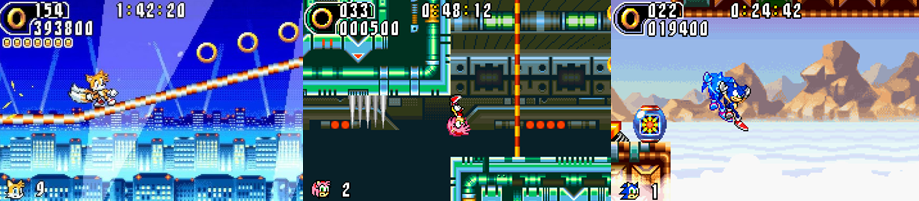
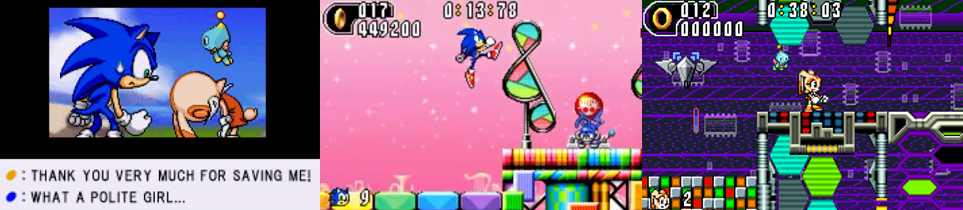
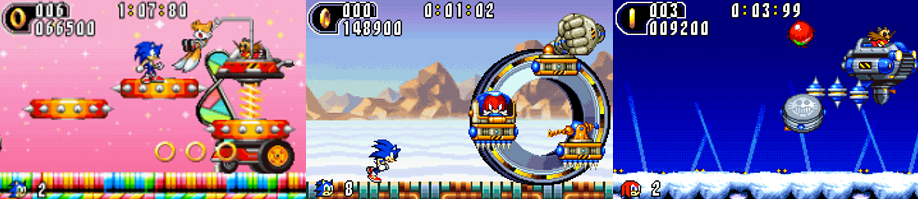
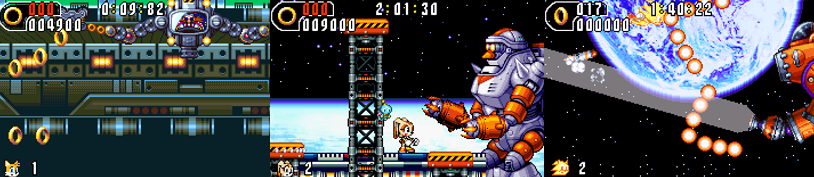
Mini Game Corner [Sonic Month]: Sonic Battle (Game Boy Advance)


Sonic the Hedgehog first appeared on June 23 1991 and has become not only SEGA’s most enduring and popular character but also a beloved videogame icon. Thus, in keeping with tradition, I’m dedicating some time to celebrate SEGA’s supersonic mascot.


Released: 30 December 2003

Developer: Sonic Team

Metacritic Score: 69

Quick Facts:
After many costly decisions forced SEGA to withdraw from the “Console War”, they developed ports of their games and teamed with Dimps for the first two Sonic Advance titles (2001; 2002) to establish a successful foothold on the Game Boy Advance. To coincide with their “Year of Sonic” celebration, SEGA developed a new fighting game for their mascot that became notorious for its lacklustre and repetitive combat.

The Review:
Taking place between the second and third Sonic Advance titles, while also existing in its own canon that paradoxically acknowledges past 3D adventures while ignoring classic Sonic titles, Sonic Battle sees Sonic and his friends befriend a child-like fighting robot known as the “Gizoid”. Nicknamed “Emerl”, this robot forms a “Link” with whoever demonstrates true power, copies the moves and abilities of anyone it fights, and becomes stronger and more coherent by absorbing Chaos Emeralds. This story is told over eight chapters, with each focusing on a different character teaching Emerl new abilities, learning more about him, and helping him to become an independent entity, all while defending Emerl from Doctor Eggman, who seeks to reclaim it to power his new fangled “Final Egg Blaster”. Although each character has their own special abilities and attributes, they all share the same controls. You jump with A (executing either a double jump, a glide, a mid-air dash, or flying by pressing A again in the air) and attack with B. Subsequent taps of B string together a simple combo that often sends foes flying. You can use the directional pad to hit opponents upwards or across the screen, double tap left or right to dash towards them, or hit a heavier attack. Tapping the Left trigger sees you guard and holding it sees you recover health points (HP) and build your “Ichikoro Gauge” to land one-hit kill special attacks with the Right trigger. While holding L, you can rotate the battle arena to track your opponents, though I found this to be little use. Additionally, you never see your enemy’s HP, just their remaining or accumulated knockouts, so it can be difficult to judge how much damage you’re doing.

While each character has unique attacks and abilities, combat quickly becomes tedious and annoying.

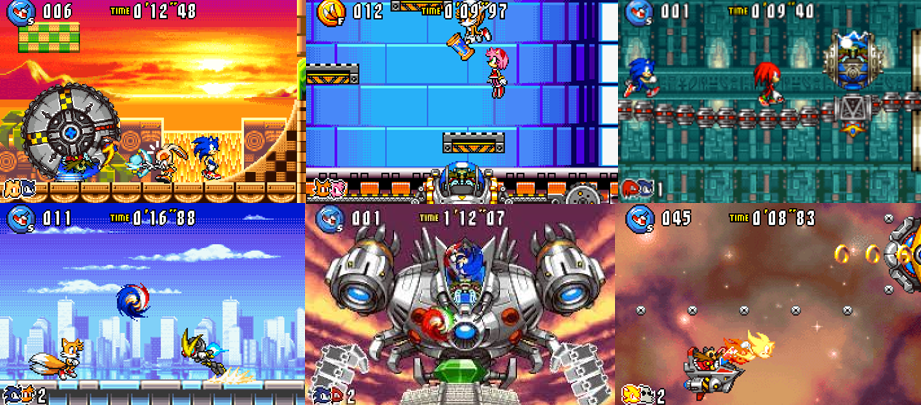
Each character controls a little differently and has different special attacks. Sonic and Shadow the Hedgehog are fast, Miles “Tails” Prower, Cream the Rabbit, and Rouge the Bat fly, Knuckles the Echidna (and Rouge) glides, and Amy Rose uses her Piko-Piko Hammer. Some characters are slower; others recover HP or fill their Ichikoro Gauge at different rates; and others have more powerful special moves. Chaos Gamma (a rebuilt, antagonistic E-102 γ “Gamma”) and his Guard Robo lookalikes self-destruct upon defeat to deal heavy damage, which is incredibly frustrating due to the clunky controls and you often being locked into combos. Rouge also hovers for quite a while before landing, making her difficult to hit and control. Before each fight, you select between three special attacks: Shot, Power, and Set/Trap, with each set either to your ground or aerial attack or making you immune to the remaining attacks when guarding. Set/Trap lays or hides a mine, either while jumping or standing, and was the special attack I use the least as I prefer to be aggressive. Each character’s special attacks are different. Sonic unleashes a blast of wind or a version of his Homing Attack, for example, while Shadow employs Chaos magic, Cream attacks with her Chao companion, Cheese, and Tails employs nanotechnology to conjure an arm cannon and spring-loaded punches. Thanks to the odd, isometric battle arenas and how slow even the fastest characters are, it can be difficult to land combos or judge your angle, so I found it better to cheese the special attacks. You figure out what works (like the Sonic Wave, Chaos Combo, Meteor Crush, or Air E. Ball) and spam them until the opponent makes themselves immune, then you switch to another special attack and repeat until you win. This strategy makes battles much easier, but also incredibly tedious, something not helped by the frustrating way Sonic Battle presents its fights.

Constant combat allows you to customise and power-up Emerl into a formidable fighter.

In the “Story Mode”, characters are challenged by friends and foes alike, often with Emerl alongside or against you as training. Typically, you emerge victorious after five knockouts, only to be immediately challenged to a ten KO battle! Often, victory means reaching five or ten KOs first and you sometimes face a time limit or more opponents (often at a two- or three-on-one disadvantage) but the game never deviates from this pattern. Well, it does a bit when Emerl is challenged to avoid damage or using special moves, but these variations are incredibly rare. Instead, you fight Guard Robos and Dr. Eggman’s Gizoid copies, the Phi series, over and over, to say nothing of endlessly sparring with Sonic and his friends to learn new skills. “Skill Points” and “Skill Cards” are awarded after most victories and are used to customise and enhance Emerl, who apes any character’s attacks, special moves, and stances. You can even change his colour and unlock “Ultimate” Skills to make him an incredibly powerful fighter but be wary as you’re often asked to fight him and he’ll trounce you if you don’t edit his abilities beforehand. At first, Emerl is slow and weak and pathetic but, after you clear all eight stories, he’ll be far stronger, making the game incredibly easy, especially as you don’t face much of a challenge until Shadow or Emerl’s stories. Even then, you can simply spam the same special moves, charge a one-hit KO strike, and repeat to cheese most fights. Sure, it gets tougher when you face three Guard Robos at once and they’re all exploding, or when you face Sonic and Shadow alone, or when Rouge forces you to fight with a handicap, but it’s nothing you can’t power through. It’s just not very interesting as fights drag on way too long and are far too repetitive, with enemies largely playing hide and seek to regain HP or charge their meter and it being easy to telegraph where they’ll respawn.

On the plus side, the game looks amazing and has a pretty emotional story.

Thankfully, the game looks gorgeous. Utilising a variation of the Sonic Advance art style for its sprites, characters are energetic and expressive, spouting some rudimentary voice clips to accompany their attacks, which are colourful and fitting for each character, if sadly limited by the shallow combat. Combat arenas are quite ugly, however, and are simple, isometric dioramas filled with rudimentary blocks to obscure enemies. There are no hazards or gimmicks to worry about, which is nice, but arenas feel half-assed compared to other fighting games. The music is also quite dreadful, employing a synthesized rock score for the most part and being grating to listen to. When on the interconnected overworld map, you direct your character using an arrow to interact with characters or enter new areas, which are all modelled after the Sonic Adventure games (Various, 1998 to 2001). You’ll chat with Tails in Emerald Town, train with Amy in Central City, visit Rouge’s casino in Night Babylon, mock Knuckles at Holy Summit, and confront Dr. Eggman on his Death Egg space station. When interacting with characters, you’re treated to some funky portrait art that changes to suit their mood and speech bubbles that overemphasises key worlds like “Chaos Emerald” and “Link”. Each chapter is quite short and directly leads to the next, with some overlap and jumping about the timeline to fill in gaps. Sonic and Tails adopt Emerl to improve him, Rouge uses him for heists, Amy sees him as a surrogate son, and Shadow is out to destroy him since he knows Emerl’s destructive past. Sonic Battle is surprisingly story heavy, with Emerl evolving as you acquire Chaos Emeralds or Chaos Shards, adopting a cocksure attitude, questioning his existence, and ultimately fighting against his destructive urges to sacrifice himself for his friends.

After besting Dr. Eggman, you’re left with some single- and multiplayer challenges and mini games.

You’re forced into many battles and encouraged to partake in more, with Shadow challenging Emerl to battle everyone before a final showdown and Emerl urged to train before teleporting to the Death Egg. When this space station launches, part of Holy Summit freezes and the legendary water god Chaos appears for you to challenge. Though incredibly powerful and sporting elongated limbs, Chaos is slow and not especially smart so it’s easy to beat it and learn some of Emerl’s most powerful moves. When on the Death Egg, Emerl confronts Dr. Eggman, who fights in his Egg-O-Matic and unleashes a barrage of missiles and mines. Dr. Eggman floats about, making him difficult to hit, and explodes upon defeat to make things even more frustrating. This was the only time I consistently used the Set/Trap special attack as it’s ridiculously easy to spam these beneath Dr. Eggman to finish him. Outside “Story Mode”, you can hone your fighting prowess in “Training Mode” or on up to fifteen fights in “Challenge Mode” at three difficulty levels. Although they don’t get a story chapter, Chaos and Chaos Gamma are both playable in the game’s other modes and you even unlock a Green Hill battle arena by completing Emerl’s story. You can enter codes on Dr. Eggman’s computer to unlock additional Skills and replay chapters over and over to unlock any Skills you’re missing. If you have friends, you can compete via the Link Cable in battles that mimic the “Story Mode” or in various mini games. I’ve never actually played these as I never knew anyone else who owned the game, but they look pretty fun. Four are unlocked by beating certain story chapters and see you bouncing around like a game of air hockey, collecting Golden Rings in what looks like a variation of Tails’ Skypatrol (Japan System House SIMS, 1995), playing a Knuckles-themed reskin of Minesweeper (Microsoft, 1990), dig up treasure on a beach, or race down a highway while attacking players and dodging obstacles.

Final Thoughts
Although Sonic Battle wasn’t the first time the series was translated into a fighter, it is, to date, the last. Rather than capitalise on the success of the Super Smash Bros. series (Various, 1999 to present) with a main console 3D fighter, Sonic Team lumbered us with this tedious, clunky brawler that’s visually very appealing and has a surprisingly engaging narrative but is a chore to play. The basic combat loop becomes extremely tedious once you figure out how to cheese the system, or equip certain Skills to Emerl. Simply assign him the most powerful attacks and the fastest healing Skill and you’re essentially unbeatable, making it even more frustrating when the game artificially increases its challenge by having you fight the same enemies but with a higher KO quota. As gorgeous as the sprite art and animations are, the fighting mechanics are shallow and awkward thanks, in no small part, to the weird isometric arenas. While it’s fun to constantly be rewarded after every fight and to tinker with Emerl, there’s not enough combat variety to sustain Sonic Battle, which runs out of steam about three chapters into its story. Perhaps if the mini games had been included in the “Story Mode” as additional challenges, or if the game had challenged you to use certain moves or defeat enemies in certain ways, things might’ve been more enjoyable. On the plus side, each chapter is a breeze to get through, but this just highlights how little Sonic Battle has to offer unless you have friends to play with. It’s a shame as I often defend this game, but it really is a poor experience with the most basic combat you could ask for. It’s made doubly worse when you realise that Sonic Team chose to make this mess rather than just do what they always do and copy Nintendo with a Sonic-themed Super Smash Bros. clone like everyone else.

My Rating:

Rating: 2 out of 5.

Could Be Better

Did you enjoy Sonic Battle? Do you agree that it failed to live up to its potential? Were you also frustrated by the repetitive combat and lacklustre difficulty curve? Did you enjoy the art style and the narrative? How powerful did you make Emerl in the end and did you ever unlock all of his Ultimate Skills? Would you like to see a true Sonic-themed fighter some day? How are you celebrating Sonic’s anniversary this year? Let me know what you thought of Sonic Battle in the comments and donate to my Ko-Fi to recommend more Sonic spin-off games for me to cover.


Game Corner [Sonic Month]: Sonic Chronicles: The Dark Brotherhood (Nintendo DS)


Sonic the Hedgehog was first introduced to gamers worldwide on June 23 1991 and, since then, has become not only SEGA’s most enduring and popular character but also a beloved videogame icon. Thus, in keeping with tradition, I’m dedicating some time to celebrate SEGA’s supersonic mascot.


Released: 6 August 2009

Developer: BioWare

Metacritic Score: 74 / 6/3

Quick Facts:
Forces to abandon console manufacturing, SEGA developed games for Nintendo’s GameCube and Game Boy Advance alongside Dimps. Following a highly praised trilogy and two very successful dual screen adventures, SEGA partnered with noted roleplaying game (RPG) developer BioWare for Sonic’s first RPG and BioWare’s first handheld title. Developed with a darker theme focused on characterisation and accessible combat mechanics, Sonic Chronicles was heavily criticised for its low quality MIDI soundtrack and forever changed Sonic’s comic book adventures when hack artist/writer Ken Penders sued SEGA for copyright infringement.

Gameplay and Power-Ups:
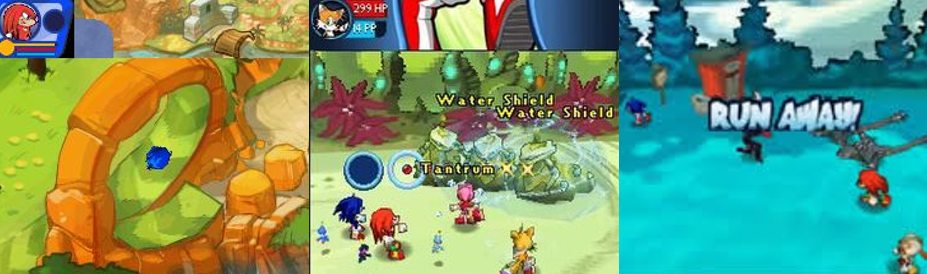
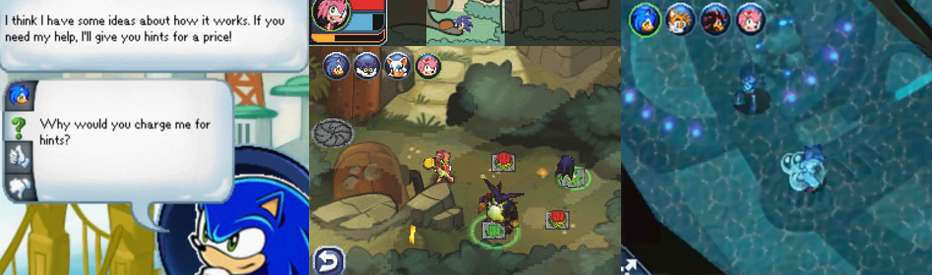
Sonic Chronicles: The Dark Brotherhood is an RPG in which players form a team of up to four characters from a roster of ten familiar faces from the franchise (two being optional and one being newcomer Shade the Echidna) and battle against the mysterious Nocturnus Clan across ten chapters. While Sonic is always on your team unless you’re asked to form two teams to handle separate objectives, you can switch the onscreen character by tapping the lower screen and the story progresses regardless of who’s in your team, with only some optional additional dialogue and exploration options being available for each. Sonic Chronicles goes all-in with the Nintendo DS touch screen, meaning every action is conducted via the stylus and touch screen, including controlling your characters, progressing dialogue, solving puzzles, and battling enemies. This is a touch jarring, and disappointing, as it can be difficult comfortably holding the Nintendo DS and I found tapping the screen inconsistent at times (though this could’ve been due to my touch screen). You start as Sonic but quickly hook up with Miles “Tails” Prower and Amy Rose to rescue Knuckles the Echidna, with each giving a sense of what the game has to offer. Characters come in three classes: “Power” (who focus on attacking), “Shifter” (who shift between attacking, supporting, and afflicting status ailments), and “Support” (who focus purely on supporting your team and have low attack power). Personally, I focused more on powering through battles, which will serve you well for the most part as the game doesn’t get too taxing until the final chapter, though you can heal and inflict status ailments on enemies, such as stunning them or putting them to sleep. Naturally, you earn Character Experience (XP) from battles that allows you to level-up and become stronger, adding special “Power/POW Moves” to your arsenal, though the highest level you can achieve is thirty and I found you don’t gain much XP compared to other RPGs.

Whether you’re exploring, fighting, or chasing, everything’s controlled via the touchscreen and stylus.

As you awkwardly explore, uncovering more of the map and interacting with various non-playable characters (NPCs), you’ll see context-sensitive actions pop-up to help you navigate. This means tapping the screen to make Sonic or Shadow the Hedgehog run through loops, flying across gaps as Tails or Cream the Rabbit, and smashing crates with Amy or Knuckles. Knuckles is a bit of a jack-of-all-trades as he can glide over short gaps, smash crates, and climb walls, but you’ll need Tails to fly further and Amy to smash metal crates. Enemies appear on the overworld, meaning you can avoid most battles if you wish, and you can flee most battles or fight for XP, items, and Golden Rings (used to purchase items or retry if you’re defeated). When in battle, you must deplete the enemy’s hit points (HP) before yours are drained, regaining HP from certain POW Moves, restorative items (like Health Roots and Health Seeds), or when meeting at safe houses like Tails’ lab. While your regular attacks deal decent damage, especially with the right setup, and require only that you tap the “Attack” command, POW Moves cost POW Move Points (PP) to execute and see you completing various touch screen actions. You must also complete these when enemies use their own POW Moves, reducing or even avoiding damage if you tap every icon, mash in a circle, or drag the stylus as directed. These can be finnicky and become tougher when executing or defending against stronger attacks, but they can deal greater damage, damage all enemies, and inflict status effects. You can also defend against incoming attacks, use items to heal HP or PP or revive fallen allies (with you still being able to attack after selecting an item), and flee. Enemies may also flee, triggering a chase sequence where you must grab Rings, tap the screen to jump over obstacles, and use dash pads to catch your foes or escape, with your success largely dictated by how accurately you tap the screen and how high your “Speed” stat is.

Sadly, the side missions, puzzles, and various gimmicks don’t add up to much.

The “Speed” stat also allows you to attack first, or multiple times per “Round”, while the “Luck” stat dictates how often you “ambush” enemies, avoid attacks, or deal critical hits. You can boost stats by equipping gloves, shoes, accessories, and a Chao to each character. These are either purchased, found in crates, earned from battles, or (in the case of Chao) found on the overworld and take time to hatch. These all boost your stats and maximum HP, allowing you to land one-hit KOs or inflict elemental damage (with some enemies being weak to lightning or ice attacks), and increase your rewards, among many other benefits. With the right setup, your team can be virtually unstoppable, especially in “New Game+” where you decimate enemies without taking a single hit. While your primary objective is investigating the Nocturnus Clan, initially determining whether Doctor Eggman is still a threat and then briefly teaming with him against a common foe, NPCs offer side missions to tie into the main plot or offer secondary rewards (usually item crates or Chao eggs). Objectives often involve exploring, battling or clearing out all enemies, recovering key items, and activating consoles to power or deactivate barriers, doors, and even flooded corridors. These appear in the final chapter and see you using air bubbles to avoid draining your PP. While these gimmicks can be tedious, especially as enemies respawn and it can be annoying navigating environments without the right characters (you need Big the Cat to pass through toxic clouds, for example), they’re relatively simple. There are also more aggravating switch-based puzzles that see you placing each character on a specific switch, either in the correct order or to activate various machinery (like a crane or a lift). Some of these, such as the puzzle leading to Dr. Eggman’s secret tunnel, are unnecessarily aggravating, while others are just trial and error. Optional objectives can further bolster your team with additional characters and rewards and the final chapters see you earning the trust of the various aliens in the “Twilight Cage” and splitting into two teams to lead an all-out assault against Nocturnus leader, Imperator Ix.

Presentation:
Sonic Chronicles opts for a cel-shaded, quasi-isometric aesthetic for the most part, with 3D modelled characters navigating what appear to be hand-drawn environments with some polygonal elements. Character models vary between the overworld and the battle screens, mostly appearing as chibi-style renditions somewhat reminiscent of Sonic Shuffle (SEGA, 2000), and are quite limited at times. Sure, they have some fun animations when idle, using their abilities, POW Moves, or succeeding in battle, but they also look a bit ugly, deformed, and low resolution. These co-exist alongside comic book-style animated sequences that badly echo the Sonic X (2003 to 2005) art style, resulting in some disturbingly off-model cutscenes. There are a fair few characters to pick from, however, with each offering different challenges in their POW Moves and most having decent story arcs. Knuckles largely takes centre stage as he’s reunited with his lost people, but there are some fun moments to mess with Sonic’s characterisation as the dialogue options see him mock, encourage, or dismiss his allies and enemies depending. I liked seeing outcasts like Shadow and newcomer Shade begrudgingly join forces with Sonic and the others, and seeing Sonic and Dr. Eggman team up (only for him to betray them in a sadly unresolved cliff-hanger), and that the story is peppered with references to the wider Sonic franchise. There’s talk of “Robotization”, for example, and you battle a few “Swat Bots”, and Imperator Ix delivers additional lore for the echidnas and the Gizoid fighting robots. While many complained about the game’s soundtrack, I never had an issue with it. It’s not the most memorable, save for a chip tune rendition of the “Doomsday Zone” theme in the final chapter that I always found fun, but it matches the action and events. There are also some recognisable sound effects from the games and a handful of sound bites peppered in, though even I have to admit that much of the presentation is very basic and lacking, with environments being clunky to navigate and largely empty.

Sadly, the intriguing story is bogged down by some confused and muddy visuals.

Sonic Chronicles sees you visiting and exploring some familiar, if drastically altered, locations from the videogames. Naturally, you start in Green Hill Zone, which acts as a tutorial, before venturing to Central City, where the Guardian Unit of Nations (G.U.N.) and Tails’ lab are. These areas also hide hidden bases used by Dr. Eggman and the Nocturnus Clan and see you using the Tornado to fast travel around. They also lead directly to the toxic Mystic Ruins and, after teaming with Dr. Eggman, players venture to his decimated main base, Metropolis, which gets further damaged after Imperator Ix steals the Master Emerald and causes Angel Island (a sadly limited play field) to crash into it. There are also some original areas to explore, like Blue Ridge Zone (an Old West style town that includes the remnants of Station Square and Dr. Eggman’s secret tunnel to Metropolis), and fun Easter Eggs (such as Eggrobos and a Mega Drive being strewn about Metropolis). Things really turn bizarre when Dr. Eggman helps Sonic and his friends travel to the Twilight Cage, a surreal, alternative dimension housing various wacky aliens. You’ll encounter the Kron, proud rock-monster miners, the gelatinous, slug-like N’rrgal, the Voxai (psychic manta ray-like aliens), and the warlike Zoah, who must be united against the Nocturnus Clan. The various areas in the Twilight Cage may be noticeably smaller than their predecessors, but they’re more visually interesting, including volcanic mines, bizarre alien fauna, and luminescent, high-tech cities. Imperator Ix’s citadel is a complex maze of paths and doors, one swarming with Gizoids and other powerful enemies, and desperately fending off the allied aliens’ assault. When in combat, things switch to a simple battle arena that reflects whatever area you’re in and, when exploring, you’ll constantly see the map on the top screen to keep track of alternative routes, your objective, and any Chao eggs you’ve missed.

Enemies and Bosses:
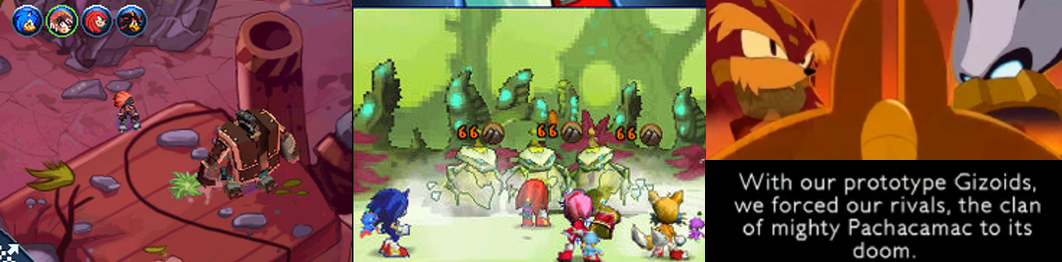
Unlike most Sonic videogames, you won’t be freeing cute woodland critters from Badniks here. As the game starts with Dr. Eggman defeated and presumed dead, you mostly fight enraged armadillos, wild boar, and wasp swarms and their queens. Giant scorpions, raptor hawks, and giant millipedes also appear, with them parrying your attacks, poisoning with their quills, regenerating HP, or blasting you with their tails. The Nocturnus Clan’s Marauders and Dr. Eggman’s Swat Bots toss grenades to stun you and self-repair, respectively. Dr. Eggman’s various sentry bots and drones use buzzsaws, bombs, and self-destruct, while rocket-firing or shield-carrying Pawns up their defence. When in the Twilight Cage, you must initially battle the locals, with the Kron Warriors being noticeably durable (unless you equip wind, water, or ice elements), the brainwashed Voxai firing psychic waves and hiding behind shields, and N’rrgal drones draining your HP. The Twilight Cage is also swarming with higher-level Nocturnus soldiers and various Gizoids that are both far more durable and deal greater damage, especially as their POW Moves are trickier to avoid. Nocturnus Praetorians, for example, target one character with a Hellfire blast, Nocturnus Triarius leech HP with their blades, and these enemies are more likely to parry or avoid your attacks, too. The Gizoids can utilise every playable character’s and Nocturnus’ POW Moves and regenerate their HP, making them formidable and unpredictable to the unprepared player. Some enemies appear as mini bosses, too, like the Swat Bots that guard Dr. Eggman’s bases, the three powerful “Overmind” Voxai, and the Gizoid “Prefects” Charyb and Scylla, who are initially unbeatable before your two teams solve some puzzles to make them vulnerable.

Battles are ridiculously easy until you reach the final chapters, where the difficulty noticably spikes.

Shadow is also fought as a mini boss in the Mystic Ruins and Blue Ridge Zone, where Sonic must fight him alone after chasing him down. Although Shadow is fast and can hurl his Chaos Spear, he’s not especially difficult. Shade is initially fought as a mysterious Nocturnus “Procurator” who can activate a cloak and attack with her Leech Blade. You must also battle one of Dr. Eggman’s malfunctioning Egg Bots to reach the Twilight Cage and endure a gauntlet on the Zoah Colony that sees you battling General Raxos’ minions and Commander Syrax, with no chance to heal or save between bouts. This culminates in a one-on-one fight between Sonic and General Raxos that can be troublesome as the Zorah regenerate HP, target your allies, and use shields. Charyb and Scylla can also be formidable as their Mighty Slash inflicts sleep, though your greatest test comes from Imperator Ix. You first fight him on Angel Island, which isn’t much to shout about, but he’s far more formidable in the final chapter, where he’s fought in a multi-stage battle. First, Knuckles and his team battle Imperator Ix and his Power Pylons. These regenerate Imperator Ix’s HP so it’s worth taking them out (though he can also resurrect them), but you must also watch out for Imperator Ix’s Doom Orb (which will put you to sleep and/or stun you), his aggravating counter attacks, and his sceptre blast that can easily KO you or your allies. When you fight him with Sonic’s team, he’s much easier as the Power Pylons can be ignored. You then form another team to chase him down (hopping over his energy balls) and battle him alongside a couple of Gizoid Guardians, which is also a lot easier than the first fight (though you must defeat the Gizoids as well as Imperator Ix). Imperator Ix then transforms into Super Ix using the Master Emerald for a final bout with Super Sonic. This is fought entirely using automatically executed POW Moves, meaning you must tap and drag the stylus to avoid taking damage. Since you cannot use your items and Super Ix regenerates a load of HP, you must perfectly execute your POW Moves and taps to avoid taking too much damage and finish Imperator Ix off for good.

Additional Features:
There are forty Chao to hatch in Sonic Chronicles, with numerous eggs scattered across every environment. There are also a bunch of treasure chests to find, each containing regular items and additional accessories to further boost your stats. Further rewards are earned by helping various NPCs and you’ll often need specific characters for this as you need different abilities to explore, but it’s not always mandatory unless you want a fully stocked inventory. I would advise helping E-123 Ω “Omega” in Metropolis, however, as he’s an absolute powerhouse who can really make a difference in a fight. I didn’t have as much use for Cream but, if you’re a fan, you can recruit her in Green Hill Zone. You can also review your Chao in the Chao Garden and even trade them with friends using multi-card play. Completing the game unlocks “New Game+”, which starts a new save file with all your skills, equipment, Chao, and XP carrying over. You must auto-level-up and set each character up, but this makes replaying the game a breeze as you’re so overpowered that nothing poses a threat until you reach the Twilight Cage.
Final Thoughts:
I’ve always been a fan of Sonic Chronicles: The Dark Brotherhood. It’s ridiculously easy at times, especially on “New Game+”, and incredibly basic for an RPG, but I’ve always found it a fun, hassle-free game for the most part. I enjoyed the story and how it expanded upon echidna lore in interesting ways, finally bringing in some new echidna characters and giving Sonic and his friends a chance to showcase more of their personalities through the dialogue options. I’m still annoyed we never got a resolution to the cliff-hanger and that Shade has vanished into obscurity, and have always defended the game as a decent enough adventure. Yet, Sonic Chronicles is far from perfect. The emphasis on the touch screen was a big mistake, in my opinion, and I would’ve much preferred being able to control my character and make selections with the left stick or directional pad rather than using the stylus. This control scheme makes it clunky and awkward to navigate the sadly barren worlds, whose puzzles are repetitive and often frustrating and amount to little more than accessing a new area or reaching another chest or Chao egg. I quite enjoyed the combat, as limited as it can be. Your enjoyment of the POW Moves may vary depending on how good your touch screen is, but they were a visually fun twist on the usual magic system of most RPGs and I quite liked the chase mechanic, as finnicky as it was. I do think more could’ve been done with this, the character-specific actions, and the character classes, however. It seems the only thing the developers did to make Sonic Chronicles unique was force you to complete touchscreen quick-time events, which is disappointing given the potential of the characters and this world. Graphically, the game’s okay and I never had an issue with the music, but I can see why these aspects are a turn off. Perhaps sticking to traditional 2D for everything but the combat would’ve been a better solution? Either way, I still think Sonic Chronicles is under-rated and over-hated. It’s not going to appeal much to die-hard RPG players but it’s a fun enough introduction to the genre that I’d love to see referenced again in the mainstream games.
My Rating:

Rating: 3 out of 5.

Pretty Good

Did you also enjoy Sonic Chronicles: The Dark Brotherhood or did you find it disappointing? Were you a fan of the touchscreen controls and mechanics? Did you find the graphics and music ugly and grating? Which characters made it into your final team? What did you think to Nocturnus Clan and Shade? Would you like to see these original characters return and get some resolution? Which of Sonic’s spin-off titles is your favourite and how are you celebrating Sonic’s anniversary this year? Let me know your thoughts on Sonic Chronicles: The Dark Brotherhood in the comments and go support me on Ko-Fi to fund more Sonic content!

Game Corner [Sonic Month]: Sonic Advance 3 (Game Boy Advance)


Sonic the Hedgehog was first introduced to gamers worldwide on June 23 1991 and, since then, has become not only SEGA’s most enduring and popular character but also a beloved videogame icon. Thus, in keeping with tradition, I’m dedicating some time to celebrate SEGA’s supersonic mascot.


Released: 7 June 2004
Developer: Dimps / Sonic Team
Metacritic Scores: 79 / 7.9

Also Available For: Nintendo Wii U (Virtual Console, Japan only)

Quick Facts:
When SEGA lost their stake in the home console market, they produced software for their rivals, Nintendo, teaming with Dimps for Sonic Advance (2001), 2D throwback to Sonic’s glory days and a Game Boy Advance best-seller. Following the equally lauded (if difficult) Sonic Advance 2 (2002), Yuji Naka conceived of the third game’s team-up mechanic. Sprite scaling created psuedo-3D rotation effects and the game surprisingly tied in to the under-rated Sonic Battle (Sonic Team, 2003) with its new robot antagonist, “Gemerl”. Like is predecessors, Sonic Advance 3 was met rather warmly, with the new team-up mechanics being widely praised but the level layouts criticised.
Gameplay and Power-Ups:
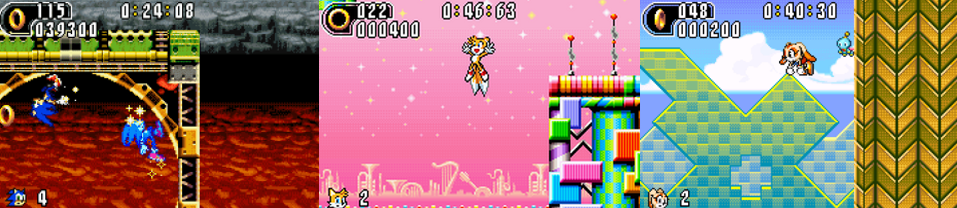
Unsurprisingly, considering the history of 2D Sonic titles and the previous Sonic Advance series, Sonic Advance 3 is a 2D, sidescrolling platformer in which players race across seven stages (or “Zones”), each with three levels (or “Acts”), collecting Golden Rings to avoid losing a life (and to gain a life once you collect 100) and bashing Badniks to add to your score tally. Like its predecessors, Sonic Advance 3 gives you the option to toggle off the timer, which I’d recommend as the series continues to be stingy with its lives and Sonic Advance 3 substitutes the breakneck speed into bottomless pits from the last game with frustrating surprise hazards, awful enemy placement, and bizarre level geometry that makes Sonic the Hedgehog CD (SEGA, 1993) look well designed! Sonic Advance 3 can also be played on “Easy” or “Normal” difficulties to make bosses easier or harder and players can reconfigure the buttons, though I wouldn’t say there’s a need for this. While each character controls a little differently, being faster or slower and having different jumping heights, they all share some common abilities. Therefore, A always jumps and attacks, B always performs a “Special Attack”, holding the Right trigger always calls your partner to you and allows you to charge and perform a “Tag Action”, and you can pretty much always perform a Spin Dash by holding down on the directional pad and pressing B. All the same power-ups appear in Sonic Advance 3, too, with players getting a speed boost, temporary invincibility, either five, ten, or a random number of Rings, an extra life, being thrust to their maximum speed, being shielded from a single attack, or attracting nearby Rings. This time around, Omochao also appears to give you tips, remind you of the controls, and tell you what stuff does on the hub world. Since there are ten Chao hidden in each Zone, you may need Omachao’s help to find them if you want to enter the Special Stages. Finally, all the usual gimmicks return, such as air bubbles to stave off drowning, springs, boost pads, loop-de-loops, spikes, bottomless pits, and ramps to fly off and perform tricks with R (depending on your team).

Team up characters to change their abilities and perform special Tag Actions.

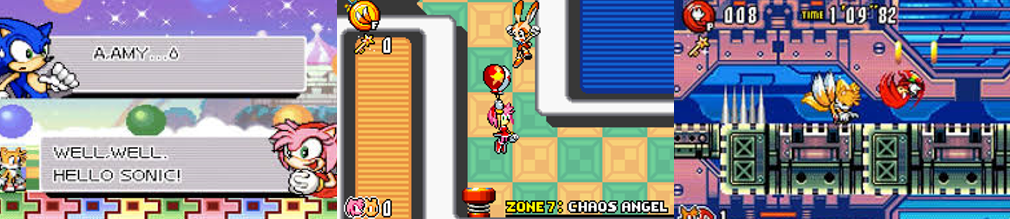
Yes, like Knuckles’ Chaotix (SEGA, 1995) and Sonic the Hedgehog 4: Episode II (Dimps/Sonic Team, 2012), and in keeping with the theme of the “real superpower of teamwork!” emphasised in Sonic Heroes (Sonic Team USA, 2003), Sonic Advance 3 features a partner system. Players must make a two-person team, with Sonic and Miles “Tails” Prower being the default team and others being unlocked through the story mode. A second player can even jump in for some co-op action and some combinations have special team names, like Sonic and Amy Rose being “Lovely Couple”. While your partner often disappears from the screen due to the game’s fast-paced action and much of it can be played alone, there are times when it’s beneficial to use Tag Actions to bypass obstacles or reach hidden areas. Also, each team fundamentally alters the gameplay, adding or removing abilities from your characters. For example, Tails can still fly by twirling his tails, Knuckles the Echidna can glide and climb walls, Amy whacks Badniks with her Piko-Piko hammer, and Cream the Rabbit flies and commands her Chao, Cheese, to attack enemies, but these abilities change depending on their partner. Consequently, if you partner Tails with Knuckles, Tails cannot fly and instead performs a Knuckles-like glide; Knuckles’ glide gains a homing attack when partnered with Cream; Amy gains a jumping dash when teamed with Sonic; and Cream can spin Cheese in an attack when teamed with Knuckles. There are pros and cons to this; teaming Sonic with Cream, for example, lets him breathe underwater, but having Amy as a partner often leaves you defenceless when jumping. Holding R to summon them performs a Tag Action, such as blasting you ahead at breakneck speed, flinging you high into the air, having Tails carry you around, launching Knuckles as a projectile or gliding on his back, using Cheese as Cream would, and giving you better jumping options with Amy. It’s an interesting system, with some combinations working better than others (Sonic gains and loses his Insta-Shield, Tails his tail swipe, Knuckles his drill claw, and characters gain or lose their ability to perform tricks depending on their partner) but it’s not required to have specific combinations just to beat the game, so just find what works for you and experiment later when you’re hunting for Chao.
There’s a greater emphasis on platforming in this clunky, colourful title.

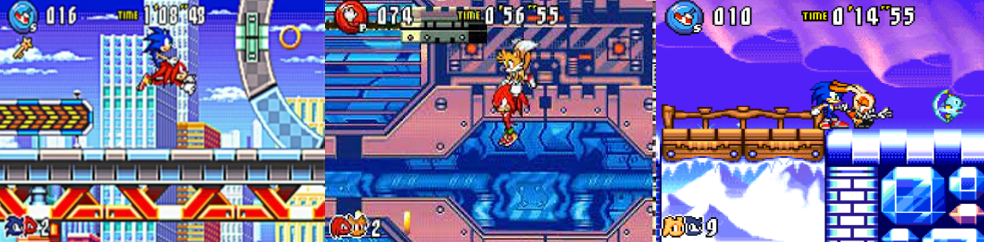
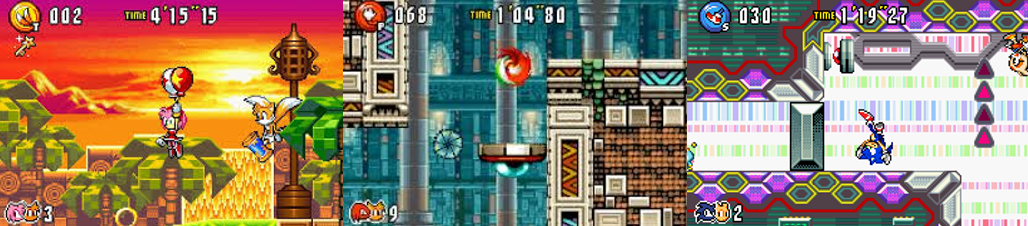
While the partner system is somewhat lacklustre, it’s a joy compared to Sonic Advance 3’s awful level layouts. The game’s faster than Sonic Advance but slower than Sonic Advance 2, blasting you along at high speeds but rarely to unfair deaths. This would be great if it didn’t still throw bottomless spits in the worst places, place Badniks and surprise spikes right in your path, and ask you to make leaps of faith into the void. You can swing on poles, dash up slopes, and run across gaps on moving platforms to falling stones (providing your partner doesn’t screw you over!) You hop in cannons, race across twisting paths, slide down (and jump up) waterfalls, fling into the air off bungees, and spring to higher ground using aggravating jack-in-the-boxes that randomly produce spikes! Often, Acts loop around unless you take the correct path, either using a spring, ramp, platform, or if you fall from a higher path, which gets very old very fast. Almost every time you build up speed, a hazard suddenly appears in your path or you run head-first into an insta-death trap, forcing you to slow down and get around them, Sonic Advance 3 features huge stages and, while the checkpoints help, your limited lives are whittled away by the game’s frustrating trial-and-error approach to gameplay. Sometimes, you bounce off balloons, grab rockets, or get fired from a freezing cannon to reach higher areas; often, you’ll be grinding on rails as shortcuts; and you run around spinning wheels or roll into pipes to reach new areas. Some Zones include platforms that carry you across a track, with you either having to duck or jump over hazards or even hop down to a lower platform to progress, and many include switches that temporarily spawn springs or moving platforms. Many Zones feature specific gimmicks, like Ocean Base largely being underwater, Cyber Track having a gravity gimmick that has you running on ceilings, while other mechanics (see-saw platforms and spinning handholds) are commonplace. Sonic Advance 3 forcibly breaks up the action with its annoyingly large hub worlds, which force you to manually enter each Zone and Act, though they also house minigames to break up the tedium. One sees you racing around an enclosed arena to defeat every Badnik, while the other has you hitting switches on a giant capsule to earn points, with players earning a handful of extra lives if they succeed.

Presentation:
Sonic Advance 3 is the visual peak of this spin-off series. The sprite sheets and assets provided loads of content for my old sprite comics and remain the most expressive and visually engaging renditions of these characters, at least in 2D, in my opinion. The team up gimmick adds a bunch of additional animations for the five characters, such as Tails sporting boxing gloves, Cream getting a life ring or an umbrella, Cheese changing sprite depending on who’s using him, and Amy’s hammer changing size and colour. Each has a very cartoony and fun idle pose, new victory poses where they’re running along (with a pseudo-3D effect applied after beating bosses), and the game includes more voice samples, with Doctor Eggman’s “You’re going to pay for this!!” never getting old. The game’s soundtrack isn’t much to shout about, though we do get yet another remix of Green Hill Zone in Sunset Hill. The Chao Garden theme also returns, despite the minigame being sadly absent, and the game utilises more cutscenes. This time, the game doesn’t just use partially animated sprite art and large mug shots of the characters over their speech bubbles but also includes more interactions between the player sprites as they encounter meet during the main story and are unlocked. Despite Dr. Eggman’s newest creation being a copy of Emerl, and players encountering Gemerl several times, no dialogue or cutscenes delve into their shock at seeing him. In fact, the characters don’t refer to Dr. Eggman splitting the world apart either, and no effects of this are seen, which is a bit of a shame as there was a lot of potential in both plots, but especially in the game acting as a quasi-sequel to Sonic Battle.

The colourful visuals and variety are saving graces for this awkward mess of a platformer.

Sonic Advance 3 continues the aesthetic of the last game, which switched from a somewhat blurry and basic 2D recreation of Sonic’s 3D adventures to a more plasticine world. This gives some depth and colour to the environments, though things can get very cluttered and chaotic. Foreground elements are plentiful, backgrounds are deep and busy, and the play area can be so indistinct that it adds to the frustration of surprise hazards. Badniks are ridiculously small, which doesn’t help, and they don’t even release animals when destroyed, just Rings! While I didn’t care for the hub worlds, most Zones are pretty colourful and lively, if a bit barren and overly designed. In a change of pace, players start in a busy highway in Route 99, racing up and down walls and around loops as an egg-shell blue cityscape looms in the background. Sunset Hill actually has more in common with Turquoise Hill Zone and the later Splash Hill Zone than Green Hill, except for some familiar gimmicks, making me wish the developers had worked a little harder rather than relying on nostalgia. Ocean Base somewhat makes up for that, with its nautical theme, wavy water backgrounds, and steampunk/industrial theming. Toy Kingdom is an upgraded Music Plant, featuring big toy construction blocks, fireworks, an ornate background palace, and circus gimmicks like spinning panda cars, balloons, and rockets. It’s all very colourful, but I don’t think this aesthetic suits the franchise. Twinkle Snow veers back to nostalgia, being very reminiscent of Ice Cap Zone and even Ice Mountain Zone, with its aurora borealis and snowy mountain peak aesthetic. I liked the frozen grind rails and icicle spikes, the mine carts, and that the snow slowed you down. Cyber Track echoes Cosmic Angel Zone and Techno Base, apparently taking place in cyberspace, but the Zone is so messy and busy that it ends up looking ugly and being a chore. Finally, Chaos Angel is a riff on Sky Sanctuary Zone and Sonic Advance’s Angel Island Zone, being ruins up in the sky, and is perhaps the most derivative and aggravating area as a result thanks to all the bottomless pits. However, I liked the lightning storm brewing in the clouds, the rolling boulders, and the forgotten ruin aesthetic. This all culminates in a battle before the Master Emerald and, naturally, a final battle in space (albeit set against a cosmic cloud of sorts rather than in orbit).

Enemies and Bosses:
While Buzzer and Spinner appear as returning Badniks, Sonic Advance 3 features an all-new selection of robots to smash. We’ve got little ladybug-like Badniks who wander about like Motobugs, jet-powered sharks who torpedo you at the worst possible moments, exploding penguins, crab-like robots who launch their shells, robot monkeys who toss bombs from trees, eel-like robots who burst from walls, and even a praying mantis Badnik who flings its scythe-like blades! Robot octopi hover overhead on propellers and spit projectiles, snowmen toss snowballs, little toy soldiers march along, robot frogs hop about and shoot their tongues at you, robot moles pop from the ground, and there are even robotic piggy banks and hanging spiders. Unfortunately, all these Badniks are way too small and often blend into the background or are placed in the worst places, making them extremely irritating since they’ll either damage you or send you careening down a bottomless pit! Players will battle Gemerl five times throughout the game, sometimes at the end of an Act 3 and sometimes prior to facing Dr. Eggman. In the first encounter, Gemerl is much like Silver Sonic and simply blasts across the screen; then, he gains a jump and homing attack to recall the Hidden Palace Zone battle with Knuckles. Then, he adds a slow-moving missile that gets upgraded into a full-blown airstrike, before protecting himself with a shield, learning to teleport, and taking a few more hits to defeat. However, what works in the first fight will work every time and he’s more a nuisance than a real threat, at least until the finale. Gemerl pulls double duty here and also gets plugged into Dr. Robotnik’s latest contraptions, occasionally popping out during boss fights but otherwise being a non-factor. Thankfully, the auto-runner bosses of the last game are gone, replaced with standard battles against Dr. Eggman, though they can still be a bit irritating.

Gemerl constantly gets in your way, eventually transforming into a massive mech!

Dr. Eggman tries to crush you in the spring-loaded Egg Hammer 3 (which is quite large and difficult to avoid), tries to run you down in the Egg Ball No.2, with players hopping to a temporary platform to time attacks on his cockpit, before hopping about in his frog-like Egg Foot that you can easily scoot under. The Egg Cube was a touch more threatening thanks to the gaps either side of the platform and its large homing missile, chained mace, and annoying toy soldiers. However, you must hit the cockpit enough times to force it over the edge and you can just to stay up close for an easy win. Things really ramped up with the Egg Chaser, where you desperately hop to falling platforms as Dr. Eggman clambers up an igloo tower. As if the bottomless pit wasn’t bad enough, it’s really easy to slip and you can only damage his craft by having the platforms drop on him, so it’s best to use someone who can fly. The Egg Pinball was also kinda annoying there are disappearing platforms either side of the arena and you must ricochet Dr. Eggman’s balls back at him. The best idea is to avoid Amy since she often removes your spin jump and just spam jump until you randomly hit him enough times. The Egg Gravity was a pain in the ass, too. You’re on this chain-like, spindly platform, and Dr. Eggman’s protected by an electric current and causes the platform hit into the spikes. You must run into the tubes on either side to quickly hit Gemerl’s head, which rams Dr. Eggman into the spikes, but this gets tricker as the battle progresses and things speed up. You then battle the gigantic, looming Hyper Eggrobo, who tries to crush you with his massive hands and temporarily removes platforms from the arena. However, you can hop onto those hands to attack the cockpit, but you’ll have to be quick as the Hyper Eggrobo produces spheres that can be tricky to avoid (but also act as platforms). Finally, Dr. Eggman tries to clap you between the mech’s hands and hit you with a wind-up punch! Grab all the Chaos Emeralds and you’ll battle the true final boss, Ultimate Gemerl, which unexpectedly sees Super Sonic team up with Dr. Eggman! In this fight, you must hold R to charge an attack that sees Dr. Eggman hurled at Ultimate Gemerl, though you’ll have to contend with your Rings constantly ticking down, Ultimate General’s long and spindly arms, his stunning laser, and his missile barrage.

Additional Features:
There are ten Chao hidden in every Zone. Unlike the last game’s Special Rings, these are much easier to find and you only have to find them once, and you can find them with any character. However, tracking them down can be a ball ache and, once you do, you have to replay an Act to find a Special Key, which you must then bring to a Special Spring hidden in the hub world and then you can challenge the Special Stage! Again, you can carry a stock of Special keys but I’ll never understand why the Sonic Advance games overcomplicated the Special Stages so much! Although I never got all seven Chaos Emeralds, I did get five of them, which is more than the last two games. The Special Stages are a vast improvement over their predecessors, but still quite finnicky. You must move the Tornado about a surreal landscape, collecting Ring clusters and hitting speed boosts for multipliers, while avoiding bombs and missiles. Collect all seven Chaos Emeralds and you unlock a special cutscene where Gemerl turns on Dr. Eggman and forces him to team up with Super Sonic to battle Ultimate Gemerl in the true final Zone, “Nonaggression”, which earns the game’s real ending that sees Tails reprogram Gemerl to live with Cream. Beyond that, Sonic Advance 3 offers different languages, a harder difficulty mode, a time attack feature, and a multiplayer mode. I’ve never experienced this but apparently you can play the main game in co-op or take on up to four players in a race to the goal or to find and hold on to a Chao. Clearing Altar Emerald unlocks the game’s sound test, and you’ll also unlock a boss time attack if you get bronze, silver, and gold medals for every Act and boss fight. These medals are awarded for how quickly you beat each Act, which I’m sure is an incentive for speed runners but I wasn’t all that bothered.

Final Thoughts:
As slow, dull, and uncreative as Sonic Advance was, I think Sonic Advance 3 is probably the worst of the series. There’s just enough here to keep it enjoyable and somewhat on par for the franchise, but my God did this game annoy me! I like the idea of the team up mechanic, and I enjoyed that different partners changed how characters played and what abilities they had, but all it really boiled down to was an extra layer of challenge if you pick a shite combination. There are rarely any instances where you need a specific duo, no significant alternative paths afforded to certain combinations, and your partner isn’t even on the screen half the time! It’s just so barebones and lacklustre that it makes me wonder why they bothered since even the Tag Actions rarely add much, especially if you use Tails or Cream to simply fly to where you need to go. The level layouts are also a mess this time around. Zones are a visual cacophony at times, which doesn’t help, with teeny-tiny Badniks and way too many surprise hazards, but the geometry had me running into walls or looping around in frustration. I honestly preferred the high-speed mechanic of the last game to this, which might’ve worked better here given Sonic Advance 3 is a bit fairer with its pits. They still appear and they’re still annoying, but I felt they were less prevalent, likely because the game’s focused more on platforming than racing. The lack of emotional significance given to Gemerl was also disappointing, though I did like the large role he played in boss battles (even if the two-on-one fights against him were quite tame). The lack of a Chao Garden was a shame, and I didn’t like that the game still massively overcomplicates accessing Special Stages (even if I was able to actually play and beat some this time). Ultimately, I feel Sonic Advance 3 failed to (dare I say it) advance the series to a satisfying conclusion as it replaced fast-paced action with muddling platforming and annoying mechanics, ending things of a bit of a downer for what was supposed to be a throwback to Sonic’s 2D glory days.

My Rating:

Rating: 3 out of 5.

Pretty Good

What did you think to Sonic Advance 3? Did you enjoy the team-up mechanic and, if so, which combination was your favourite? What did you think to Gemerl, the battles against him, and the game’s ties to Sonic Battle? Did you also struggle with the level layout and focus on platforming? Were you also annoyed by the annoying requirements to enter the Special Stages? Did you ever collect the Chaos Emeralds and defeat Ultimate Gemerl? Which of Sonic’s Game Boy Advance titles is your favourite and how are you celebrating Sonic’s anniversary this year? Whatever your thoughts on Sonic Advance 3, leave a comment below, support me on Ko-Fi, and go check out my other Sonic content!

Back Issues [Sonic Month]: Doomsday / The Final Victory


Sonic the Hedgehog was first introduced to gamers worldwide on June 23 1991 and, since then, has become not only SEGA’s most enduring and popular character but also a beloved videogame icon. Thus, in keeping with tradition, I’m dedicating some time to celebrate SEGA’s supersonic mascot.


Story Title: “Doomsday” (Part 1 to 3)
Published: 5 February 1997 (cover dated: 18 February 1997) to 5 March 1997 (18 March 1997)
Writer: Nigel Kitching
Artist: Richard Elson

Story Title: “The Final Victory” (Part 1 to 4)
Published: 18 March 1997 (cover-dated: 1 April 1997)
Writers: Nigel Kitching and Lew Stringer,
Artists: Richard Elson, Nigel Dobbyn, Roberto Corona, and Nigel Kitching

Quick Facts:
Thanks to an aggressive marketing campaign, Sonic briefly usurped Super Mario and his mainstream popularity saw him expand into comics. Sonic the Comic (StC) was published fortnightly in the United Kingdom, based its lore from the now defunct Mobius storyline, and boldly portrayed Sonic as an egotistical narcissist. Though eventually cancelled and survived by an online continuation, these four issues spelled the end of both an ongoing story arc and Doctor Ivo Robotnik’s dictatorship over planet Mobius.

The Review:
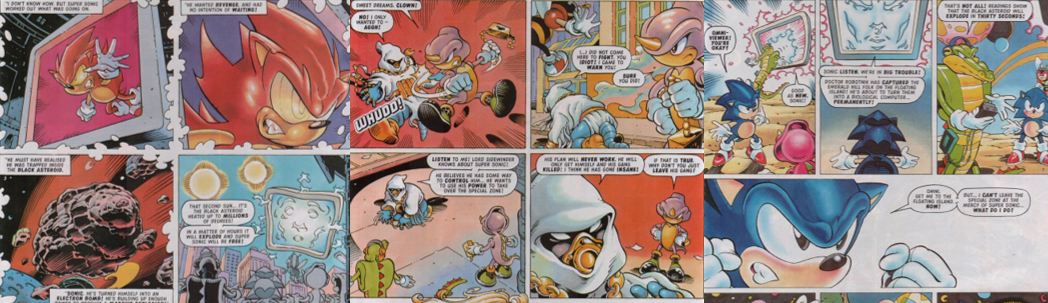
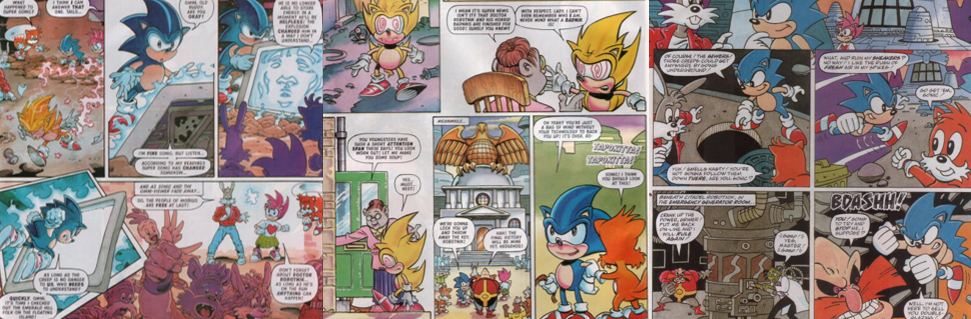
“Doomsday” and “The Final Victory” marked not just the historic 100th issue of StC, but also the culmination of a months-long story arc that saw pig-headed freedom fighter Sonic the Hedgehog trapped in the Special Zone. This happened after he went on a rampage as Super Sonic, his demonic, Chaos-powered alter ego. Using a Star Post, Sonic’s allies – namely Miles “Tails” Prower and Amy Rose – separated Sonic and Super Sonic into separate beings. Sonic then ventured into the Special Zone (a chaotic alternate dimension guarded by the Chaotix Crew) to keep his destructive alter ego from hurting anyone, eventually being stranded when Super Sonic was time locked within the Omni-Viewer, a benevolent, sentient television screen that was Sonic’s only way home. This meant Tails, Amy, and the other Freedom Fighters faced an uphill battle against Doctor Ivo Robotnik, who had conquered Mobius some years prior, without their point man and Sonic embarked on many strange adventures in the Special Zone trying to find a way home. This brought him into conflict with devious crime boss Lord Sidewinder and his gang, who seek to harness Super Sonic’s power for their own nefarious ends in part one of “Doomsday”. This story also sees Sonic and the Chaotix Crew (fresh off being framed as criminals) stopping Doctor Plague from unleashing a deadly virus upon New Tek City. Even when Dr. Plague launches a bunch of vials into the air, Sonic quickly retrieves them with a flourish. His gloating is interrupted by a desperate call from Porker Lewis, his neurotic childhood friend, and the sudden appearance of two suns in the sky. Super strong Mighty the Armadillo states such an occurrence is said to herald the end of the world, an event more likely than ever as the damaged and panicked Omni-Viewer soon appears.

Sonic is torn between battling his demonic double in the Special Zone or helping his friends on Mobius.

The Omni-Viewer reveals that he was unable to trap Super Sonic within his interdimensional vortex since the demon was far too powerful. Instead, he slowed time to a crawl, meaning it should’ve taken years for Super Sonic to escape. Instead, he somehow retained his consciousness and slowly built his power, turning the Black Asteroid he was imprisoned in into an electron bomb, hence the “second sun”. Although Sonic demands that the Omni-Viewer transport him back to Mobius to help Porker, team leader Vector the Crocodile begs him to stay to combat Super Sonic. It’s all moot anyway, though, as the Omni-Viewer is too weak to help and Lord Sidewinder’s mage, Lightmare, suddenly appears. Naturally, Sonic and the Chaotix Crew attack Lightmare before she can explain, forcing her to trap them in living nightmares using her Pandora’s box. After being surprised by Espio the Chameleon’s invisibility, Lightmare reveals she’s Lord Sidewinder’s daughter and begs them to stop to her father’s plot before it kills him and their gang. While Sonic and the others go to stop Lord Sidewinder, who loads himself and his gang into a rocket to head to the Black Asteroid, Vector stays behind to help the Omni-Viewer think up a plan to deal with Super Sonic. Vector restores the Omni-Viewer at the Equinox laboratory, where a scientist also reveals that an electromagnetic pulse (EMP) will be generated when the Black Asteroid explodes, causing chaos as every computerised system will immediately fail. Apparently driven mad by his ambition, Lord Sidewinder scoffs at any danger posed by the Black Asteroid, causing the oafish Bio-Hazard and Mister Fry to question his sanity and logic. This, as much as the pressing threat, allows Sonic and Mighty to easily rough up Lord Sidewinder’s goons, though Sonic remains conflicted between his duty to protect Mobius and the imminent destruction of the Black Asteroid.

An EMP knocks out Dr. Robotnik’s machines, finally ending his rule over Mobius.

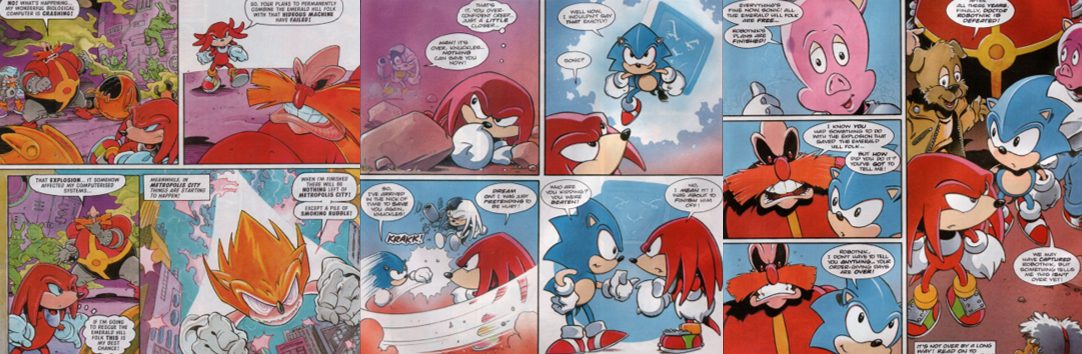
However, upon learning of the EMP, Sonic has a genius brainwave and demands that the Omni-Viewer transport the Black Asteroid into the skies above Mobius, where it promptly explodes. As Dr. Robotnik’s entire army and operation consists of or is run by machines, this effectively disables all his Badniks and systems, releasing all the woodland critters from their mechanical prisons, shutting down the biological computer Dr. Robontik hooked the Emerald Hill residents up to on the Floating Island, and disabling Vermin the Cybernik, thus saving Sonic’s allies and allowing Knuckles the Echidna to rescue the Emerald Hill folk. Naturally, the demonic Super Sonic immediately goes on a warpath, desperate to destroy Metropolis City and attacking Sonic right as he reunites with Tails, Amy, and Johnny Lightfoot. Initially toying with his prey, Super Sonic unleashes a barrage of energy beams, cackling maniacally and overwhelming his more benevolent doppelgänger. However, right as Super Sonic is poised to deliver the killing blow, his energy suddenly drains and he’s forced to flee, with the Omni-Viewer revealing that the explosion somehow changed Super Sonic’s biology. With no time to ponder this or celebrate, Sonic has the Omni-Viewer transport him to the Floating Island, where a confused and troubled Dr. Robotnik orders his ally, turncoat, semi-cybernetic echidna Doctor Zachary, to destroy Knuckles. Although Dr. Zachary can’t use the ancient Guardian robots due to the EMP, he’s somehow still able to use his cybernetic weapons, though he’s quickly blasted by Sonic right as Knuckles was playing possum and summarily trapped in a gorge courtesy of the super strong echidna. Despite the two realising they’ve been so distracted with their rivalry and battling Dr. Zachary that they’ve forgotten about Dr. Robotnik, they’re amazed to find Porker has apprehended the tyrant.

Sonic stops Dr. Robotnik’s attempts to get back online and finally liberates the planet from his rule.

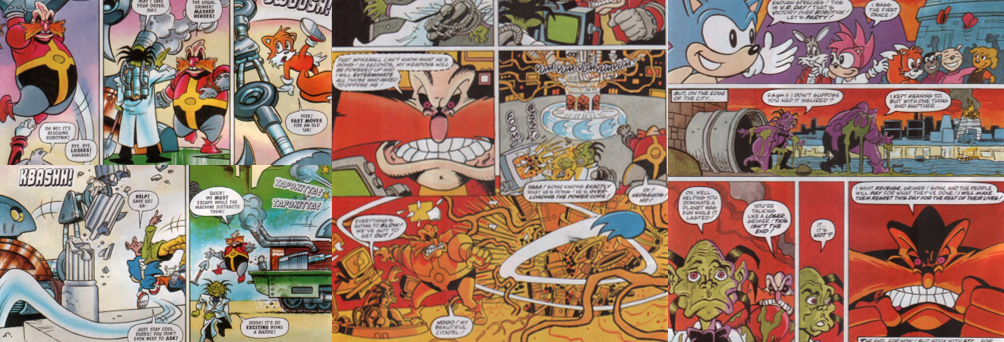
While a confused, powerless, and amnesiac Super Sonic wanders Metropolis City and is taken in by a kindly resident, Sonic wastes no time in parading the fallen despot through the city, gleefully proclaiming the end of his rule to the cheering masses and delivering him to the city courthouse so he can be locked up and eventually tried for his crimes. Though humiliated, Dr. Robotnik remains defiant, even more so when his long-abused assistant, Grimer, suddenly shows up riding an antique, steam-powered robot and promptly rescues his master. Although Sonic easily smashes the machine, the confusion allows Grimer to get Dr. Robotnik to safety. As they know every inch of the city, the two promptly vanish, frustrating Sonic so much that he chastises Tails for distracting himself with Vermin. Prompted by Johnny, Sonic realises that Dr. Robotnik and Grimer must’ve fled back to their ominous citadel using the city’s sewer system and promptly gives chase, crashing in right as Dr. Robotnik is ordering Grimer to start up the clunky emergency generator. Desperate to keep Dr. Robotnik from getting his machines back online, Sonic knocks Grimer aside and speeds around the generator, which overloads the power core and causes the ostentatious citadel to dramatically explode. With the immediate threat ended and the symbol of Dr. Robotnik’s rule in flames, Sonic finally celebrates their victory alongside his friends and the liberated inhabitants of Metropolis City. However, Dr. Robotnik and Grimer escaped the explosion using the sewers and retreat to the outskirts of the city. Although Grimer wallows in despair, Dr. Robotnik is practically frothing at the mouth at the indignity and vows to take a terrible revenge upon his enemies for ousting him from power.

Final Thoughts: 
As an avid collector of Sonic the Comic back in the day, I was beyond hyped for these four issues and StC’s big 100th issue release. The months leading up to “Doomsday” had seen all the Sonic-related back-up stories deal with his exile to the Special Zone and Dr. Robotnik’s plot to use the Emerald Hill folk to power his giant supercomputer, meaning “The Final Victory” was the culmination of not just years of the dictator’s stranglehold over Mobius but months of semi-connected storytelling. It’s therefore fitting that “The Final Victory” takes up the entirety of issue 100 and showcases many of StC’s artists, though Richard Elson remains the gold standard and I do wish he’d illustrated the entire story as it’s very jarring to go from his beautiful, epic artwork to the comparatively basic and cartoonish illustrations of Nigel Kitching. Although you could argue that using an EMP was a contrived and convenient way to defeat Dr. Robotnik in one fell swoop, it was also the best and most efficient way. For years, Sonic and his friends settled for scoring minor victories, liberating the odd Zone or taking out garrisons, battleships, or Dr. Robotnik’s commanders, but were unable to strike a decisive blow against the tyrant. As Dr. Robotnik is all about machines and robots, an EMP is the perfect way to knock out his army and end his rule, ushering in a new age of StC as Sonic struggles to define his role in a world without war and conflict and Dr. Robotnik schemes to return to power. This story also saw the Emerald Hill folk return home after being given sanctuary on the Floating Island, Super Sonic have a few side adventures as a distinct character, and marked the beginning of Amy’s journey into an independent character.

A cathartic end and start of a new era that would’ve been made even better by Richard Elson.

The timeline of events are a bit strange, however. Super Sonic apparently frees himself, or the Omni-Viewer decides to abandon him to get help for the impending explosion, and is seemingly unable or unwilling to stop charging his power for his dramatic escape. Given how powerful Super Sonic is, it’s strange that he wouldn’t just burst free of the Black Asteroid as soon as possible. This threat is also subdued very quickly, which is a shame as it might’ve been fun to somehow involve him in Dr. Robotnik’s scheme to restart his systems (perhaps he could’ve taken Super Sonic’s unconscious body and used it as a battery?) Knuckles also gets a bit side-lined, though it’s clear his focus is on helping the Emerald Hill folk since Dr. Zachary’s been taken care of and Dr. Robotnik’s in custody. I liked that Sonic never broke character here: he still gives Tails shit, mocks Knuckles, and acts like a jackass even though he’s won the day. I also liked how conflicted he was between helping the Special Zone and getting back to Mobius. StC-Sonic might be an insufferable prick most of the time, but he’s dedication to defeating Dr. Robotnik and saving lives is never in question, even if he does alienate those closest to him. I also enjoyed seeing Dr. Robotnik humiliated and aggravated by Sonic’s taunting and the cheers of the Mobians, and that he still had a few tricks up his sleeve despite his machines being knocked out. I’m not sure why Dr. Zachary’s weapons were unaffected by the EMP, but the steam powered robot was a nice touch, so much so that I kind of wish Dr. Robotnik had hopped in a steam-powered mech for one more brutal fight with Sonic. Still, this as a satisfying conclusion to years and months of storylines. It was great to finally have Sonic back home and to see Dr. Robotnik so utterly defeated so quickly, and to finally give the good guys a decisive victory after years of simply chipping away at Dr. Robotnik’s rule.

My Rating:

Rating: 3 out of 5.

Pretty Good

Were you impressed by Sonic’s final victory over Dr. Robotnik? Were you a little confused about how Super Sonic escaped from the Omni-Viewer? Would you have liked to see Super Sonic play a greater role as a villain in the end? Do you agree that Richard Elson should’ve illustrated the entire final story? What are some of your favourite StC stories and how are you celebrating Sonic the Hedgehog this year? Whatever your thoughts on Sonic the Comic, or Sonic in general, drop a comment below and donate to my Ko-Fi to suggest other Sonic comic stories for me to review.

Back Issues & Knuckles: Super Sonic vs. Hyper Knuckles


When Sonic the Hedgehog 3 (SEGA Technical Institute, 1994) released on this day in 1994, gamers were introduced to Knuckles the Echidna. Takashi Yuda’s mischievous, dreadlocked antagonist is my favourite of Sonic’s supporting cast so excuse me while I celebrate his debut throughout February.


Published: 8 February 1996

Story Title: “Crash of the Titans” (Part I to IV)
Writer: Mike Gallagher
Artist: Art Mawhinney

Story Title: “Fathers and Sons”
Writers: Mike Kanterovich and Ken Penders
Artist: Ken Penders

Quick Facts:
Following an initial four-part miniseries, Archie Comics’ Sonic comic books became the longest-running videogame comic book in history. As proven by cartoons like Sonic the Hedgehog/SatAM (1993 to 1994), Sonic was extremely popular at the time, so Archie branched out with a Knuckles the Echidna companion series that eventually became bogged down by convoluted lore. Before a bitter lawsuit forever changed Sonic’s comic books, Knuckles famously matched his rival in every way, including getting his own impressiveSuper” form.

The Review:
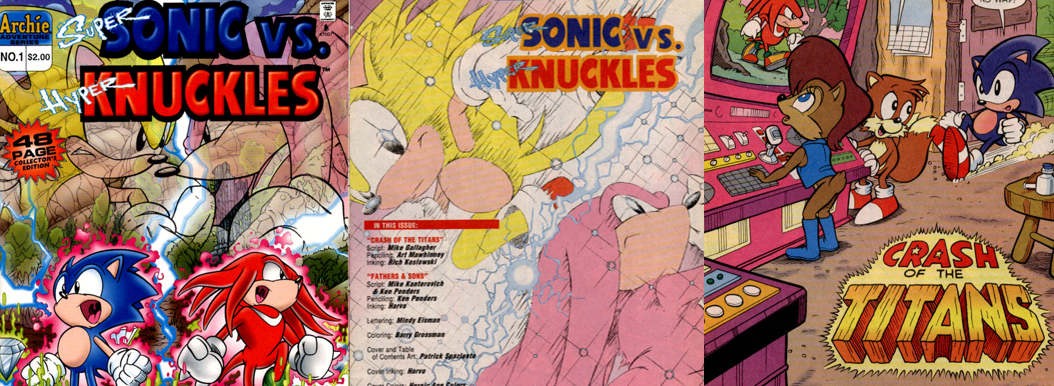
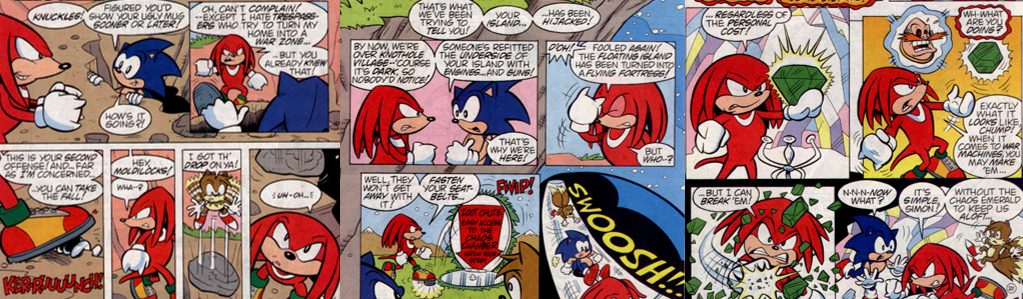
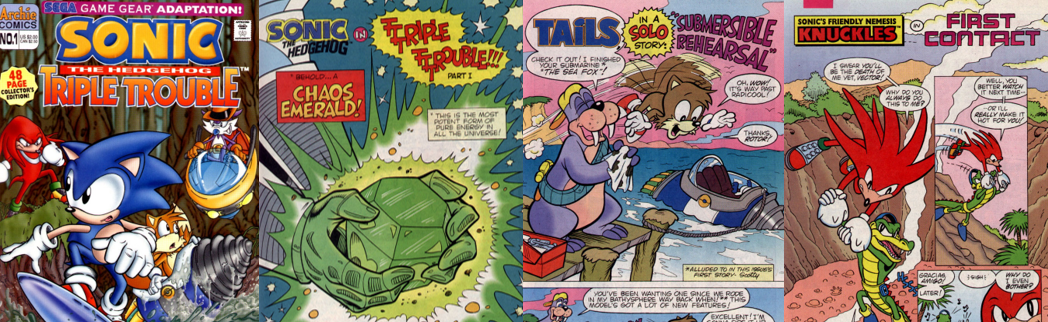
“Crash of the Titans” sees stubborn loner Knuckles the Echidna make an unexpected appearance in the Great Forest just outside of Knothole Village, the home of the Freedom Fighters. When intrepid leader Princess Sally Acorn and enthusiastic sidekick Miles “Tails” Prower spot Knuckles stomping around, they call in Sonic the Hedgehog. Despite always parting on friendly terms with Knuckles in the past, Sonic and the others are suspicious of their visitor, especially as he never leaves the Floating Island he’s duty-bound to protect. Sonic’s suspicions become full-blown paranoia when Knuckles heads towards Robotropolis, the mechanical, polluted capital of Mobius’s semi-cybernetic dictator, Doctor Ivo Robotnik. Assuming Knuckles is out to cut a deal with Dr. Robotnik, Sonic races off, barely acknowledging Sally’s order that he simply talk to the echidna. When the story shifts to Knuckles, we learn that he’s disgusted by the environmentally destructive ways of “landlubbers” and why he’s come to the surface. After witnessing a Chaos Emerald be split in two in the Triple Trouble special (Gallagher, et al, 1995), Knuckles became concerned about his floating home, which was once held aloft by a dozen Chaos Emeralds and now relies on only one. Determined to keep the island from falling, Knuckles consults the legendary Book of Myths and discovers a link between the Chaos Emeralds and the Magic Rings found within “Zones” (in Archie’s comics, Zones are temporary, semi-magic dimensions that spawn from Chaos energy). Knuckles also learns that Magic Rings sporadically appear at the fabled “Lake of Rings”. However, Knuckles assumes that the Lake of Rings must be in Robotropolis due to the high radiation generated by the mechanical hellscape and left the island under the care of his super strong ally, Mighty the Armadillo, to investigate. Instead of a mystical lake, Knuckles finds a polluted, desolate grotto on the city outskirts, one that was apparently once closely monitored, and is suddenly blindsided by the hot-headed Sonic.

Sonic’s reckless desire to fight Knuckles sees the two transform into their Super forms!

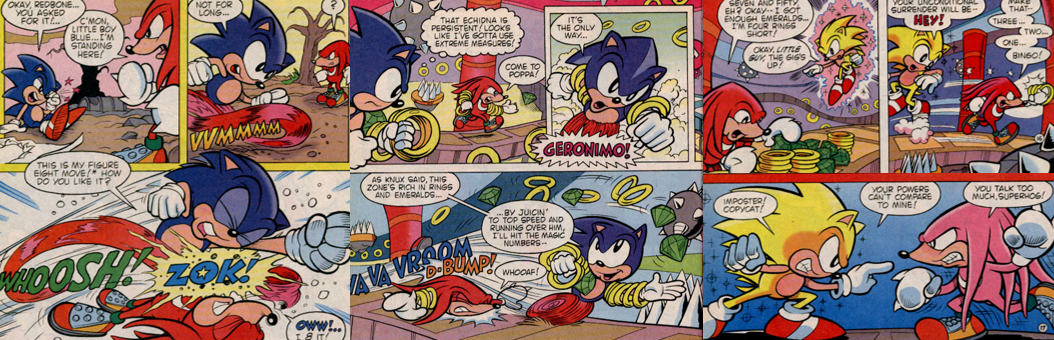
After landing the first hit, Sonic speed reads Sally’s declaration for a parlay but, naturally, Knuckles isn’t interested and the two go at it. Sonic smacks Knuckles with his signature Figure Eight but finds himself running right into a tree when Knuckles yanks on a nearby root. Though temporarily stuck, Sonic uproots the tree and collapses it onto Knuckles, forcing Princess Sally to intervene to keep the landscape from being damaged. While her presence quells the fighting, Sonic and Knuckles continue to bicker, but Sally ignores them as her portable computer companion, Nicole, detects vast radiation coming from where the tree was standing, discovering the entrance to an unknown, hazardous Zone swimming with Magic Rings and Chaos Emeralds! Eager to get what he came for, Knuckles dives in, prompting Sally to offhandedly comment that Knuckles “hasn’t changed since [they spent] summers together”. Stunned by the revelation that Sally has known Knuckles all this time, Sonic pauses his pursuit to question the princess, only to be dismissed and sent after the echidna, the matter shelved in favour of some dubious flirting. Sonic enters the chaotic, hazardous Zone (a mishmash of Badniks, spikes, and other vaguely recognisable videogame elements) to find Knuckles snagging the Magic Rings and making a run for a Chaos Emerald. Thanks to his superior speed, Sonic easily snags fifty Magic Rings and seven Chaos Emeralds, transforming into Super Sonic, a golden, super-powered form that makes him functionally invincible. While Super Sonic is busy bragging, Knuckles quickly collects enough Magic Rings to trigger his own transformation, a burning pink form he dubs “Hyper Knuckles”.

The fierce, super-powered battle destroys a temporary Zone and earns Knuckles a backup Emerald.

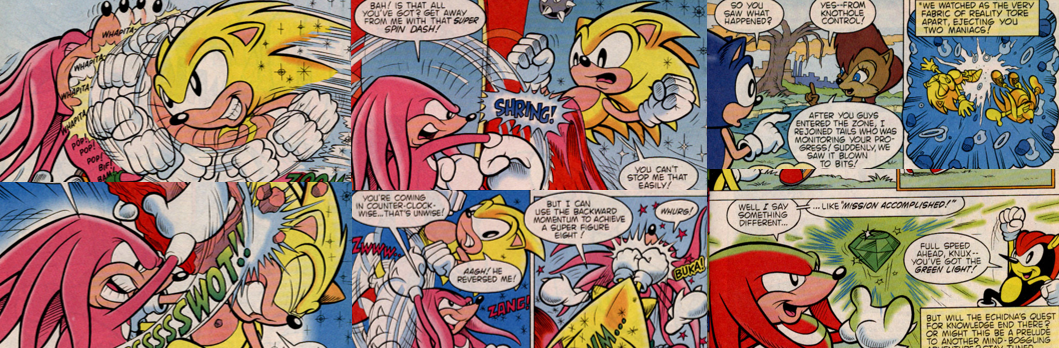
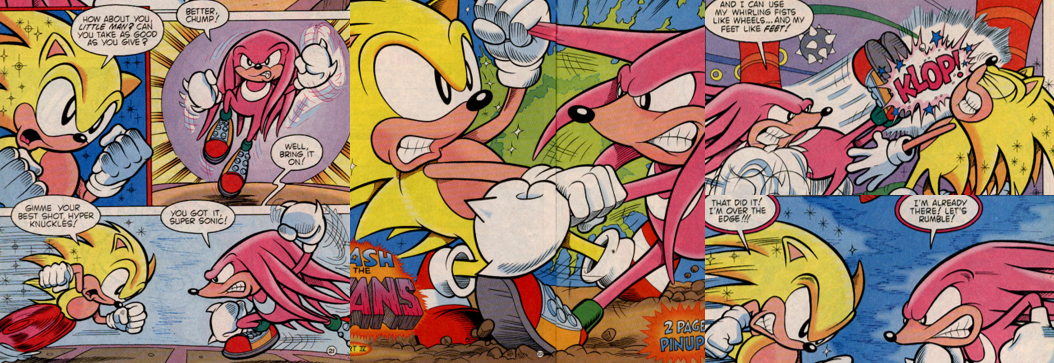
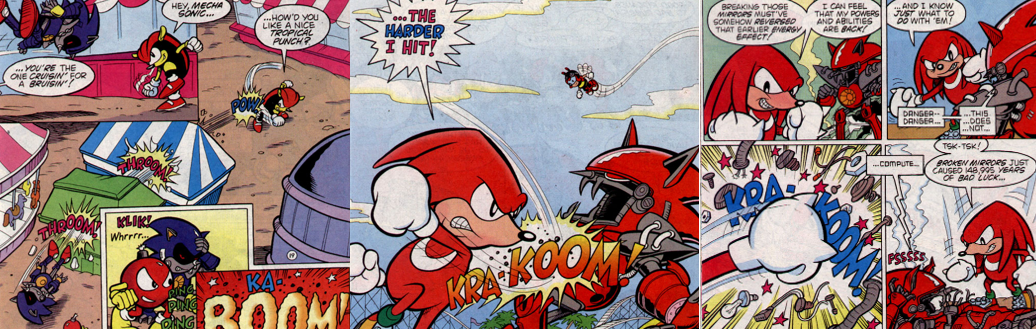
Angered by the gimmick infringement, Super Sonic quickly learns that Hyper Knuckles’ strength has been increased “a thousandfold” when he takes an uppercut. However, Super Sonic immediately answers back by demonstrating that he’s now “a thousand times faster than before” with some rapid punches to Hyper Knuckles’ snout. Hyper Knuckles retaliates by smashing a chunk off the Zone and bashing Super Sonic over the head, amazed at how fast Super Sonic recovers but refusing to back down. The two super-powered rivals fly at each other, brutally grappling in an impressive two-page spread before Hyper Knuckles easily deflects Super Sonic’s Super Spin Dash (which is oddly drawn to be the Figure Eight) and snatches his golden-hued rival out of mid-air with his superior strength. However, Super Sonic pivots, using the “backward momentum” to propel himself at Hyper Knuckles with a Super Figure Eight, only for Hyper Knuckles to immediately recover, spin his spiked fists like wheels, and launch a flying kick to Super Sonic’s nose! With both combatants enraged, the two clash with such incredible force that they literally bend time and space and disrupt the integrity of the Zone. The unstable energies are so powerful they cause the Zone to explode, triggering an earthquake so massive that Dr. Robotnik picks it up on his sensors. The explosion obliterates the Zone, drains Sonic and Knuckles of their Super forms, and returns the exhausted, disorientated Sonic to the Lake of Rings. Princess Sally confirms that the Zone and all its Magic Rings and Chaos Emeralds were destroyed, revealing that she saw everything using the seemingly inoperable camera setup nearby. She then gives Sonic a lift back to Knothole but refuses to elaborate on her past with Knuckles. As for Rad Red, he returns to the Floating Island with a brand-new Chaos Emerald in hand, his epic fight with Super Sonic apparently having made waves amongst its residents.

Recalling his father’s teachings gives Knuckles the motivation to find his missing friends.

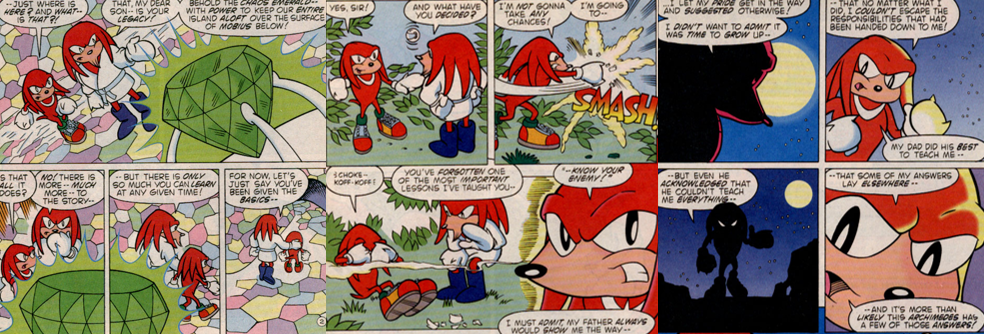
Of course, it wouldn’t be an Archie Sonic special without a backup story. Super Sonic vs. Hyper Knuckles opts not to feature an additional story focusing on the two Super-powered forms and instead continues Ken Penders’ convoluted backstory for Knuckles with a flashback to his youth. “Fathers and Sons” shows that young Knuckles grew up alongside his father, Locke, who taught him his duties as a future guardian of the Floating Island. Locke reveals that this responsibility is passed down through the generations and takes Knuckles to the Chaos Chamber for the first time, revealing that the island is held aloft by a Chaos Emerald and emphasising Knuckles’ duty to protect it. This flashback is revealed to be the ruminations of the troubled Knuckles in the present day as he ponders the puzzle of the mysterious “Archimedes”, a disembodied voice who’s been testing him over the last few months and recently kidnapped his allies, the Chaotix. After dismissing the idea that Archimedes is his father testing his mettle, Knuckles recalls his father’s teachings, which stressed analysing a situation before deciding the best course of action and understanding an enemy before attacking. Knuckles also remembered how his father disappeared into the “Forbidden Zone”, passing his duties as guardian to his son, and his run-ins with Sonic, Dr. Robotnik, and the Chaotix. Realising that he’s let his pride get in the way and that he still needs to grow up to be the guardian his father always wanted, Knuckles vows to track down Archimedes, get the answers he’s seeking, and rescue his friends to make his father proud.

Final Thoughts: 
Super Sonic vs. Hyper Knuckles is a lot better than some of the other 48-page Archie Comics specials I’ve read, but not by much. The main story is showcased far better than some of Archie’s other videogame adaptations, taking up most of the pages and thankfully limiting the backup stories to one ugly, but ultimately forgettable footnote in Penders’ weird Knuckles canon. “Crash of the Titans” retains the distinctly “SatAM” style rendering of its characters but still laces that more serious tone with puns and daft moments, like Tails and Dr. Robotnik breaking the fourth wall, the Book of Myths being hidden in a tree trunk, and Princess Sally’s letter. The story is another example of Archie’s writers awkwardly trying to mash videogame elements with their largely disconnected canon, placing videogame mechanics like traps, spikes, Magical Rings, and Chaos Emeralds in unstable, interdimensional Zones that randomly appear throughout Mobius. I’ve never been a big fan of this and much prefer it when the comics simply adapt the game Zones into locations within the comic’s world, which seems like a far easier solution. They could still have had Rings and Chaos Emeralds in Special Stages/Zones to include fantastical elements, which is something the Fleetway comics did to really well. As presented here, the Zone is kind of baffling. I don’t get why it’s populated by Dr. Robotnik’s Badniks and traps or why Archie’s Sonic comics had so many damn Chaos Emeralds floating around. I guess they figured the many Chaos Emeralds included in Sonic’s games were all different sets, but that doesn’t explain why they’re all green. Archie also deviates from SatAM by changing the nature of the Magic Rings. In SatAM, the Power Rings were invented by Sonic’s Uncle Chuck, spawning from a machine installed at the Lake of Rings every twenty-four hours, temporarily boosted Sonic’s speed and power, and could also be used as a power source. Here, they’re much closer to their videogame counterparts and simply facilitate a Super transformation.

The colourful, heated brawl between Super Sonic and Hyper Knuckles certainly delivers.

Technically, “Crash of the Titans” is a very barebones story. It’s simply another chapter in the rivalry between Sonic and Knuckles, one given extra spice by the revelation that Sally and Knuckles grew up together and Sonic’s many dubious run-ins with the hot-headed echidna. Accordingly, Sonic doesn’t hesitate to attack, suspicious as he is of his untrustworthy rival, and the two finally have a more physical fight that’s given time to breathe with the additional pages and panels. “Crash of the Titans” emphasises that Sonic and Knuckles are as bad as each other and evenly matched: both are stubborn, prideful, and occasionally reckless, letting their emotions get the better of them, and Sonic’s pure speed is perfectly matched by Knuckles’ brawn. Even Sonic’s hitherto-unique ability to turn Super is matched by Knuckles, who debuts his Hyper Knuckles form and proves every bit Super Sonic’s equal. The battle between Super Sonic and Hyper Knuckles was really well executed, being a colourful, engaging brawl that saw the two bust out some unique moves, such as Knuckles spinning his fists for added momentum and Super Sonic super-charging his Figure Eight. As they’re both functionally invulnerable, the stakes are minimal during this fight and there could never have been a clear winner, hence the destruction of the Zone, which only further reinforced how evenly matched the two were. Still, I think it might’ve helped differentiate the two if Sonic had been reckless and irresponsible and Knuckles had been trying to avoid a confrontation and talk sense into his rival, only to be pushed to the edge and fight back, if only to show that Knuckles is the more mature of the two. The backup story is barely worth mentioning but, again, I would’ve preferred to see this ditched to perhaps see Super Sonic and Hyper Knuckles set aside their differences to battle Dr. Robotnik (or one of his creations). Still, Super Sonic vs. Hyper Knuckles was an enjoyable, if mindless special that delivered exactly what it promised and upped the ante for future conflicts between the two rivals.

My Rating:

Rating: 3 out of 5.

Pretty Good

Did you enjoy the clash between Super Sonic and Hyper Knuckles? What did you think to Hyper Knuckles’ first appearance in Archie’s Sonic comics? Did you enjoy his Archie Comics changed the lore of the Chaos Emeralds, Rings, and Zones? Would you have liked to se the two team up against a common enemy? Which of Archie’s Knuckles stories and/or characters was your favourite and how are you celebrating Knuckles’ debut? Use the comments below to share your thoughts and donate to my Ko-Fi to suggest more Knuckles content for the site.

Back Issues & Knuckles: Knuckles’ Chaotix


When Sonic the Hedgehog 3 (SEGA Technical Institute, 1994) released on this day in 1994, gamers were introduced to Knuckles the Echidna. Takashi Yuda’s mischievous, dreadlocked antagonist is my favourite of Sonic’s supporting cast so excuse me while I celebrate his debut throughout February.


Published: 9 November 1995 (cover-dated: January 1996)

Story Title: “The Chaos Effect” (Part 1 to 3)
Writers: Mike Kanterovich and Ken Penders
Artist: Art Mawhinney

Story Title: “Tag! You’re It!”
Writer: Ken Penders
Artist: Harvey Mercadoocasio

Story Title: “The Hunt is On!”
Writer: Ken Penders
Artist: Ken Penders

Quick Facts:
After publishing a four-part miniseries, Archie Comics spearheaded the longest-running videogame comic book and expanded their reach with a popular Knuckles the Echidna companion series. Prior to that first three-issue series, Archie detailed how Knuckles met his Chaotix running buddies in this loose adaptation of the rare and obscure Knuckles’ Chaotix (SEGA, 1995) and they were by his side even when overly complicated lore and a lawsuit changed Archie’s Sonic comic books forever.

The Review:
“The Chaos Effect” sees the Knothole Freedom Fighters (reckless point man hog Sonic the Hedgehog and his enthusiastic, two-tailed buddy Miles “Tails” Prower, fearless leader Princess Sally Acorn, tech guru Rotor the Walrus, the partially roboticized Bunny Rabbot, and officious Antoine D’Coolette) invited to what was then known as the Floating Island, a near-mythical hovering peninsula held aloft by a Chaos Emerald and known to dislike intruders. When Sonic and his friends arrive, they find a fully decked out carnival theme park populated by their fellow Freedom Fighters (including Sonic’s number one fan, Amy Rose, and his rival, Geoffrey St. John). Surprised that the island’s guardian, super strong loner Knuckles, would invite them much less host such an extravagant attraction, Sonic and the others are introduced to the brains behind the carnival: Renfield T. Rodent, who invites them to try out the Hall of Mirrors. Inside, while the others are startled (or amazed) by their warped reflections, Sonic’s suspicions about the whole thing immediately turn out to be true when the Freedom Fighters are trapped within the mirrors! Knuckles’ shock is doubled when Doctor Ivo Robotnik, the cruel-hearted despot who has conquered and polluted most of Mobius, reveals the entire thing was an elaborate trap to dispose of his hated enemies. When Knuckles attacks, he finds the light has stripped him of his natural abilities and that Dr. Robotnik spared him so Knuckles could witness the madman’s ultimate victory.

When Dr. Robotnik captures Sonic and co, Knuckles reluctantly teams with some new allies to rescue them.

With his dreadlocks pruned and his fists lacking spikes, the handicapped Knuckles ponders how he’s going to save his allies, only for a hyperactive little honeybee, Charmy Bee, to suddenly fly by and offer some advice. Both are startled when Espio the Chameleon reveals he’s been hanging out, while invisible, in the forest and all three ready themselves for a fight when a ruckus storms their way. When this turns out to be music loving, wannabe rap star Vector the Crocodile, Espio relieves him of his headphones before being knocked on his ass, along with the others, when powerhouse Mighty the Armadillo bursts through the mountainside. Although Knuckles is suspicious to see that Mighty is accompanied by two robots, Heavy and Bomb (strangely sporting very different appearances to their videogame counterparts), the duo explain that the “power gems” installed into them by Dr. Robotnik allowed them to develop sentience and a conscience. When they learned of Dr. Robotnik’s carnival-themed plot, they came to help, bringing a cache of power gems and experimental weapons to disrupt Dr. Robotnik’s mad scheme. Encouraged, Knuckles sets to work rescuing the Freedom Fighters and Dr. Robotnik is alarmed when his theme park attractions and rides suddenly activate. As they’re all powered by separated control mechanisms, the semi-cybernetic tyrant correctly surmises that Knuckles must’ve had help to bring them all online. However, Dr. Robotnik quickly adapts and uses his “material transport system” (because “teleporter” would be too simple, I guess) to bring in some reinforcements.

Despite its immense size, Mecha Sonic is reduced to scrap metal by an enlarged Knuckles.

This comes in the form of Metal Mecha Sonic, Sonic’s deadly, robotic doppelgänger. Greatly enhanced since its last deployment, the ever-loyal Mecha Sonic is sent after Knuckles and his new allies and immediately locates them in the heart of the carnival. Immediately taking charge, Knuckles commands they attack preemptively, which sees Charmy Bee fly around Mecha Sonic to little effect and Espio turning invisible to lure the super-fast robot into crashing into a building. Utilising a ring-like tether wielded by Vector, Knuckles dives at his foe, only for Mecha Sonic to switch to infra-red (seems tactically dangerous in the daytime, but whatever…) and snag the energy beam connecting the two rings. However, Vector apparently uses the mysterious rings to teleport or switch places with Knuckles (the art isn’t very clear…) and toss Mecha Sonic towards Mighty, who sends it crashing through a few buildings. While still recovering, Mecha Sonic is surprised when Bomb explodes next to him, only to shrug it off and grow to immense size thanks to a power gem. To face this Kaiju-sized, red tinted goliath, Knuckles utilises one of Heavy’s power gem’s to also become a giant, battling Mecha Sonic Kai on equal ground. Dr. Robotnik’s fears about the volatile nature of the power gems comes to fruition when Knuckles smacks Mecha Sonic Kai into the Hall of Mirrors, freeing the Freedom Fighters and restoring Knuckles. Rather than ponder why he didn’t smash the mirrors when he was in there (could’ve just tossed a rock or something…), Knuckles smashes Mecha Sonic Kai to pieces with his renewed strength. However, Dr. Robotnik makes a hasty exit on a rocket-powered rollercoaster, leaving Renfield to take the fall. Although Sonic encourages Knuckles and his “chaotic” new friends to form a super-team, they all comically disagree and refuse to entertain such an idea.

Once again, Archie wastes time on pointless backup stories that are largely disconnected from the game.

This not-team then appear in the special’s two back-up stories. The first sees Charmy Bee kick off a game of “tag” between the group. While Mighty’s initially reluctant, he quickly participates by shoving Vector into a pool since he doesn’t have anything better to do. Vector’s frustration doubles when Charmy Bee deftly avoids him and Mighty knocks over a tree to fend him off. While hopping aside, Vector trips over the sleeping, invisible Espio, who he quickly tags before racing off. Annoyed, Espio tries to pounce upon Vector, only to crash and burn and briefly meet a mysterious fire ant who quickly disappears in a puff of smoke. When Charmy Bee flutters by to check on Espio, he unwittingly leaves himself open for a tag and the story ends with the game said to continue. “The Hunt is On!” continues Knuckles’ issues with the elusive and mysterious Archimedes, a hitherto-disembodied voice who’s been testing the guardian’s abilities (and patience) over the past few months. The story begins with Knuckles frantically running from an explosive barrage and stumbling upon Charmy Bee, Mighty, and Vector, who are confused by the attack. While gathering his wits, Vector stumbles down a hole and, when the others try to get him out, they’re suddenly attacked by more explosive orbs, which put Charmy Bee down for the count. Knuckles and Mighty are joined by Espio, who’s amazed that Knuckles spotted him during all the commotion. While Knuckles discusses Archimedes with a confused Espio, Mighty is suddenly attacked by a strange robot on treadmills. Relishing a “challenge worthy of [his] matchless strength”, Mighty battles his mechanical attacker, with the two beating each other into submission. Knuckles urges Espio to find the puppet master behind these events, only for a shadowy figure to quietly abduct Espio (since he’s not a ninja yet). When Knuckles notices his friend is gone, Archimedes challenges him to decide whether his friends are more important to him than safeguarding the Floating Island. This ends the story on a cliffhanger that would finally be resolved in Knuckles’ first miniseries the following year.

Final Thoughts: 
Archie Comics strikes again with another meandering, borderline insulting 48-page special that has little to do with the source material and wastes its pages on forgettable backup stories and the asinine Archimedes sub-plot Ken Penders was pushing. As ever, the art in the main story is passable and mirrors the popular cartoon on which the comics were partially based, though things appear much more rushed than usual here, with many characters being bloated and off-model. Things are far worse in the backup stories, with Knuckles appearing like liquid at many points and Charmy Bee seemingly growing and shrinking between panels. “The Chaos Factor” is further hampered by Knuckles magically being physically altered by Dr. Robotnik’s technology (removing his dreads, spikes, and super strength) and the introduction of colourful new characters. It’s bizarre to me that Heavy and Bomb look so widely different; I wonder if Archie had seen any screenshots or artwork of the two when writing this special? Regardless, Art Mawhinney seems to be struggling with the Chaotix, which I kind of understand as they’re more complicated designs than Sonic’s regular crew. Vector and Espio, especially, appear warped throughout and the group’s characterisation is painfully one-dimension. Charmy Bee is playful, Espio turns invisible, Mighty is super strong, and Vector likes music. That’s about all we get here, apart from the random inclusion of the tether rings (which appear without explanation and are only used once, just like in Fleetway’s Knuckles’ Chaotix adaptation). On the plus side, the story seems to insinuate that the Chaotix live on the Floating Island (Espio and Charmy Bee seem to know each other) and the group expands Knuckles’ character, taking him from a loner who protects his residents as part of his duties to a team leader rallying his troops.

The main story pays partial lip service to the videogame but is a poor representation of the source material.

That’s about where the praise for Knuckles’ Chaotix ends, though. Like many of Archie’s videogame adaptations, the story is a disservice to the source material, taking place entirely in and around the amusement part that acts as the hub world in the game. This barely resembles Newtrogic High Zone, however, and is much closer to Carnival Night Zone or a standard amusement park. Rather than capturing Espio, Dr. Robotnik captures (presumably all) the Freedom Fighters with bizarre mirror technology that’s easily undone by breaking the mirrors (though Knuckles is apparently powerless to do this at first). The story does include Mecha Sonic, which is cool, and I quite liked its fight with Knuckles and the Chaotix as it was a good way to show their powers and test their mettle. Sadly, the group don’t overcome Mecha Sonic Kai with the “real superpower of teamwork”. Instead, Knuckles just grows to gargantuan size and fights Mecha Sonic Kai, somehow toppling the monstrous machine despite him lacking his super strength. None of the stories feature the Zones (or “Attractions”) from the videogame which is, again, a massive disappointment. Why not spend the entire 48-pages following Knuckles as he fights through a few locations (like Botanic Base and Speed Slider) slowly learning to co-operate and accept the Chaotix before reaching Dr. Robotnik’s secret base in Techno Tower? Or, at the very least, produce two, far better backup stories set in locations like Marina Madness or Amazing Arena, perhaps including some of the Badniks and bosses from the game. Instead, once again, it seems Archie Comics only had access to a few screenshots and the basic details of the game, meaning the cover art is the best thing about this let-down of a special that’s only notably for half-assing the introduction of the Chaotix.

My Rating:

Rating: 1 out of 5.

Terrible

Did you enjoy the Chaotix’s debut Archie’s Sonic comics? Were you also disappointed by how badly represented Knuckles’ Chaotix was? Did you enjoy the fight between the enlarged Knuckles and Mecha Sonic Kai or would you have preferred to see the team tackle the titanic terror? Whare some of your favourite Chaotix adventures and moments from the Archie comics? How are you celebrating Knuckles this month? Whatever you think about Archie’s Sonic comics, and especially Knuckles and the Chaotix, comment below, support me on Ko-Fi, and check out my other Knuckles content!

Back Issues & Knuckles: Sonic the Hedgehog: Triple Trouble


When Sonic the Hedgehog 3 (SEGA Technical Institute, 1994) released on this day in 1994, gamers were introduced to Knuckles the Echidna. Takashi Yuda’s mischievous, dreadlocked antagonist is my favourite of Sonic’s supporting cast so excuse me while I celebrate his debut throughout February.


Published: 3 August 1995 (cover-dated: October 1995)

Story Title: “Tttriple Tttrouble!!!” (includes “Part II: Zone Sweet Zone!”, “Part III: Echidnapped!”, and “Part IV: Blue Blur vs. Rough and Red!”)
Writer: Mike Gallagher
Artist: Dave Manak

Story Title: “Submersible Rehearsal”
Writer: Mike Gallagher
Artist: Art Mawhinney

Story Title: “First Contact”
Writers: Ken Penders
Artist: Jon D’Agostino

Quick Facts:
Following their initial four-part miniseries, Archie Comics began the longest-running videogame comic book and capitalised on Sonic’s popularity with a popular Knuckles the Echidna companion series. Before that convoluted lore and a bitter lawsuit forever changed Sonic’s comic books, Knuckles featured in this loose adaptation of the largely under-rated Sonic the Hedgehog: Triple Trouble (Aspect, 1994).

The Review:
Not unlike its videogame source material, “Tttriple Tttrouble!!!” sees ruthless cybernetic dictator Doctor Ivo Robotnik in possession of a Chaos Emerald. Rather than having one of five after his experiments scatter the others across the planet, Dr. Robotnik has one of many Chaos Emeralds, though this is sufficient to power his “mega-engine” and pollute the entire planet Mobius. However, this plan gets dashed due to an oversight by his robotic assistant, Crabmeat, who miscalibrated the machine. The imbalance causes an explosion that breaks the Chaos Emerald in two and rockets each part into orbit, prompting Dr. Robotnik to call “Bounty Hunters ‘Я’ Us” to hire a bounty hunter to retrieve the gems (again, not a million miles away from the videogame). While making a messy chili dog snack (or four…), Sonic is brought to the Freedom Fighters’ control room, where their resident mechanic and scientist, Rotor the Walrus, has detected the erratic energy signature of a Chaos Emerald. The three then watch as the Chaos Emerald shard crashes into the Great Forest, its unstable “magic” creating a “new Zone” (apparently, this is how the game’s environments are integrated into Archie lore). Excited to explore a new area, Sonic speeds off, refusing to wait for Rotor’s analysis and unaware that he’s being stalked by a mysterious, wolf-like figure. Meanwhile, Knuckles finds a rare moment of relaxation under the sun interrupted by the other Chaos Emerald shard, which streaks overhead and crashes into Mount Osohai, the Floating Island’s unconquerable mountain range. Undeterred, Knuckles glides over and is stunned to see the shard burrowing into the mountain, then ends up unconscious and plummeting to certain doom after being struck by a piece of rock.

While recovering a Chaos Emerald shard, Sonic is blindsided by Nack the Weasel.

When Sonic arrives at the crash site in the Great Forest, he’s greeted by a bizarre, fairground like portal leading to “Triple Trouble”. Naturally, he enters without a thought, completely oblivious to his mysterious stalker, whom Dr. Robotnik orders (via “2-way, 3-D holo-wrist radio”) to follow. Exasperated by the rotund dictator’s blustering, the mercenary mutes his employer and heads into the Zone in his sky-cycle, which has been programmed to mimic Sonic’s moves! In a change of pace for most Archie adaptations, we get to see Sonic racing through Triple Trouble’s Zones, but this is reduced to a simple montage of panels that literally just show him bouncing, running, snowboarding, or adventuring across the game’s locations before bopping Dr. Robotnik on the head and reaching the exit. There are no battles against Dr. Robotnik’s enlarged Badniks, none of the game’s power-ups (except the snowboard), and the comic just blasts through them all rather than taking place in one or two of the game’s locations. The snowboard panel is essentially a rip-off of the game’s artwork, there’s no explanation as to how or why Dr. Robotnik or his Badniks are there, and the Chaos Emerald shard is bizarrely housed within a futuristic chamber, which Sonic races into to deactivate before the Zone presumably closes behind him. However, as soon as Sonic retrieves the shard, he’s blasted by his stalker, the infamous bounty hunter Fang the Sniper Jet the Jerboa Nack the Weasel! With Sonic successfully captured, Nack demands Dr. Robotnik pay him double the price to retrieve the other half of the Chaos Emerald and the tyrant, eager to mount Sonic’s head on his wall, begrudgingly agrees.

Despite a disagreement between Sonic and Knuckles, the Floating Island is saved.

Oblivious to Nack’s impending arrival, Knuckles wakes in a hidden cave and is cared for by the Ancient Walkers, mute, masked, enigmatic figures from echidna lore. Astonished, Knuckles interprets their cave drawings as a warning that the Emerald shard will cause Floating Island to explode if it reaches the island’s Chaos Emerald power source. Returned to the surface, Knuckles spots and summarily knocks out the passing Nack, unaware that he’s just knocked Sonic into a lake. This wakes Sonic and, pissed at being blindsided, he bursts from the water looking for payback and immediately assumes that Knuckles attacked him. Attacking without thinking, Sonic is easily overpowered by his super strong rival, who’s driven into a fury after Sonic kicks him in the nose. Going “Hyper-Knuckles” (which sees Knuckles turning his fists into buzzsaws rather than adopting a Super form), Knuckles sends Sonic flying with a haymaker, leading to them flying at each other in a rage. Their scuffle ends, however, when they recognise Dr. Robotnik’s voice coming from Nack’s communicator (…despite him muting it earlier…) This clears up the misunderstanding and sees Sonic direct Knuckles to puppet Nack’s unconscious, battered body to deceive Dr. Robotnik. Retrieving Nack’s Emerald shard, Sonic joins Knuckles in intercepting the other half in the island’s crystalline Chaos Chamber, where they just barely reunite the two in time to save the island. The two frenemies almost come to blows again when the restored Chaos Emerald mysteriously vanishes but part on mostly friendly terms, unaware that the Chaos Emerald teleported into the possession of the mysterious Ancient Walkers.

Tails and Knuckles embark on separate adventures largely disconnected from the source material.

While I’m here, I may as well go over the other  stories also included in this 48-page special. The first is a solo adventure for Sonic’s two-tailed buddy, Miles “Tails” Prower, which features his Sea Fox submarine from Triple Trouble and laid the groundwork for Archie’s Tails-centric miniseries. Unfortunately, “Submersible Rehearsal” takes place in the waters near Knothole Village rather than, say, Tidal Plant Zone and sees Tails confront an enlarged Octobot rather than one of Triple Trouble’s bosses. Though amazed by the Sea Fox built for him by Rotor, Tails is outraged to learn that Princess Sally Acorn has forbidden him from taking it out to sea because of concerns about his age. However, Tails improvises when an injured sea gull washes up warning that Dr. Robotnik is rebuilding his “submerged, waterproof robot maker”, draining the oil from the bird into his tank and setting off to help. When Tails finds the underwater facility guarded by Octobot, he doesn’t hesitate to ram to mechanic cephalopod, rescuing the marine life it held captive before destroying the roboticizer with the Sea Fox’s missiles, making an enemy of the besmirched Octobot in the process. The second story sees Knuckles once again tested by the mysterious Archimedes on the Floating Island, making this story even less connected to Triple Trouble. In fact, “First Contact” has more in common with Sonic & Knuckles (SEGA, 1994) as Archimedes sends one of Dr. Robotnik’s Fire Breath units after him and then makes him battle a Hey-Ho. At first, these robots see Knuckles believe “Archimedes” is Dr. Robotnik pulling another trick, but a plunge into the Chaos Chamber sees Archimedes dispel these accusations and aggravate Knuckles with cryptic taunts about his hot-headed nature. Challenged to solve Archimedes’ puzzle, Knuckles later contemplates the lesson with his friend, rocker Vector the Crocodile, and the mystery of who or what Archimedes is and what he wants.

Final Thoughts: 
As always, Archie’s adaptation of a videogame leaves a lot to be desired and takes the barebones, basic suggestion of the source material and reconfigures it into one-and-a-half semi-original stories set within their convoluted canon. I tried really hard to cut this 48-page special some slack, especially the main story, as it almost mirrored the videogame in a dysfunctional way but then it completely dropped the ball. Although I’ve read all the Archie Sonic comics, I don’t recall it being established that the game’s Zones spring out of thin air (or “magic”), though even if that was established it’s a pretty stupid idea. Mobius is a planet, for God’s sake! You just have the Zones be places in the world, which is what Archie usually does, so this weird-ass funfair-like portal…thing…was ridiculous. It also appears to be temporary, as Sonic must race to the Chaos Emerald Chamber and “shut [it] down” with a lever. How that lever, the chamber, and the technology surrounding it appeared is anyone’s guess (more “magic”, I suppose) but it’s nowhere near as ludicrous as Triple Trouble’s Zones conveniently having Badniks, traps, and even Dr. Robotnik in them. Normally, I complain that these adaptations are limited to a single, barely recognisable location from the videogames but this time, I’m complaining because Triple Trouble’s Zones are reduced to a montage. Sure, it emulates the 2D action of the videogame but it’s very lazy. Why not have Dr. Robotnik’s “secret lab” be in Robotnik Winter Zone or Atomic Destroyer Zone, the Emerald shard land in Great Turquoise Zone or Meta Jungura Zone, “Submersible Rehearsal” set in Tidal Plant Zone and “First Contact” be reconfigured into having Knuckles be tested in Sunset Park Zone? There’s really no excuse for these stories not to be set in the game’s locations and it’s kind of insulting that they’re limited to Knothole and the Floating Island.

Sadly, though it comes close, the comic is a poor representation of the videogame.

As ever, the art is passable, resembling the main Sonic comics and the cartoons that inspired them, except for “First Contact”, which sees Knuckles rendered painfully off-model and Hey-Ho looking like its melting! I can’t say I was massively blown away by the Ancient Walkers, who didn’t seem necessary to the story, but I did like the introduction of Nack the Weasel. It took a little too long for him to be revealed and it’s a shame to reduce him to Dr. Robotnik’s lackey, but it’s a role that suits him and he’s always been a visually interesting character. Although we never get to see what his sky-cycle is capable of, it’s not insignificant that he got the drop on Sonic and was well on his way to succeeding when Knuckles clobbered him. I quite enjoyed the fight between Sonic and Knuckles, which is thematically similar to the videogame and sees them go at it with a bit more gusto than in previous encounters. I do think this special issue suffers from not devoting its entire length to the source material to depict a literal three-way chase for the Chaos Emerald (or its shards, or whatever!) between Sonic, the opportunistic Nack, Knuckles, and Dr. Robotnik. Had Archie done this, we could’ve seen at least three or four locations from the game in more detail, seen Sonic battle Dr. Robotnik’s giant Badniks, and had a more action-packed adventure rather than a middling story that essentially acts as a shameless advertisement for the game. Ultimately, this was a very frustrating issue to read as it came so close to being at least tolerable and was very promising but, once again, the covert is the best thing about this special (aside from Nack) and the backup stories aren’t really worth your time unless you’re really invested in Ken Penders’ awful plans for Knuckles and getting a prelude to Tails’ later solo adventure.

My Rating:

Rating: 2 out of 5.

Could Be Better

Did you enjoy Nack’s debut in Archie’s Sonic comics? Were you also disappointed by how poorly this adaptation represented Triple Trouble? Did you enjoy the fight between Sonic and Knuckles? How interested were you in the riddle of Archimedes? Did you enjoy Archie’s Knuckles lore or did you find it to be overly complicated? How are you celebrating Knuckles this month? Let me know your thoughts on Archie’s Triple Trouble adaptation in the comments and donate to my Ko-Fi if you want to see more of Knuckles’ Archie adventures on the site.

Back Issues & Knuckles: Sonic & Knuckles


When Sonic the Hedgehog 3 (SEGA Technical Institute, 1994) released on this day in 1994, gamers were introduced to Knuckles the Echidna. Takashi Yuda’s mischievous, dreadlocked antagonist is my favourite of Sonic’s supporting cast so excuse me while I celebrate his debut throughout February.


Published: 11 May 1995 (cover-dated: August 1995)

Story Title: “Panic in the Sky” (Part 1 and 2)
Writers: Mike Kanterovich and Ken Penders
Artists: Art Mawhinney and Dave Manak

Story Title: “Fire Drill”
Writers: Ken Penders
Artist: Jon D’Agostino

Story Title: “Lord of the Floating Island”
Writers: Ken Penders
Artist: Harvey Mercadoocasio

Quick Facts:
Following an initial four-part miniseries, Archie Comics started the longest-running videogame comic book and capitalised on Sonic’s popularity with a popular Knuckles the Echidna companion series that eventually became tarnished by convoluted lore and a bitter lawsuit that forever changed Sonic’s comic books.

The Review:
The two-part story “Panic in the Sky”, which acts as the centrepiece to this 48-page special, sees the legendary Floating Island (as it was then known) sending the locals in a panic when it descends below the clouds and passes over the Western Coast of Mobius (as Sonic’s world was once called). Naturally, the Knothole Freedom Fighters (engineer Rotor the Walrus, semi-Roboticized Bunny Rabbot, cowardly Antoine D’Coolette, and fearless leader Princess Sally Acorn) are bemused and alarmed by the floating continent, which is heading straight for Knothole Village. When Sally wonders how the island floats (odd, considering a later retcon reveals she knew Knuckles as a child), Sonic and his enthusiastic two-tailed fox pal, Miles “Tails” Prower, fill the gang in on their earlier adventure to the Floating Island and their encounter with Knuckles. Although Sonic left on friendly terms with the echidna, he and Sally ponder Knuckles’ true allegiance and she orders Antoine to investigate any potential threat posed by the island. Sonic’s alarmed when their “turbo-prop” biplane is suddenly attacked by heavy artillery now installed around the island and orders Antoine to fly to safety while he and Tails parachute down to see what’s going on. After being knocked loopy by a pendulum in a vague allusion to the Mushroom Hill Zone, Sonic’s attacked by the axe-wielding Hey-Ho, though a single hit is enough to destroy what’s presented as a mini boss in the videogame. Sonic then runs right into a trap and finds himself hanging on for dear life. He’s therefore glad when Knuckles shows up, only to find the echidna is unimpressed with “trespassers [turning his] home into a war zone” and ready to send Sonic plummeting to his doom.

The hot-headed Knuckles makes a desperate gamble to safeguard his island.

Luckily, Tails is on hand to help but, in his haste, his rock misses its target and both Sonic and Knuckles fell into an underground cavern, eventually ending up on a slab of rock floating in a lava stream (like in Lava Reef Zone). Before the two can come to blows or be boiled alive, Tails swoops in for the save and Sonic makes Knuckles realise that the Floating Island has been hijacked. Angered and concerned, Knuckles leads Sonic and Tails (via “zoot chute”) to the Chaos Chamber, a crystalline cavern that houses the Chaos Emerald that keeps the island aloft. When Knuckles investigates a strange device siphoning power from the gem, he gets a nasty shock that doubles when Mobius’s devious, semi-cybernetic dictator, Doctor Ivo Robotnik, appears (via hologram projection) to spill his latest plot. After discovering the Floating Island, Dr. Robotnik began surreptitiously turning it into his personal battleship, installing engines, a command centre, and weaponry, all powered by the Chaos Emerald and with the purpose of annihilating Knothole Village. Distraught that he was easily duped into fighting Sonic and Tails rather than spotting the takeover, Knuckles smashes the Chaos Emerald, causing the Floating Island to drop from the sky! Panicked, Dr. Robotnik quickly ejects, though his hopes of seeing Knothole decimated by the falling island are dashed when Knuckles busts out a spare Emerald to keep his home aloft (only to later reveal he smashed the spare and replaced it with the original in a double bluff). Though he vows to use better judgement next time, Knuckles refuses Sonic’s offer to join the Freedom Fighters, with Sonic musing that Knuckles is apparently destined to be a loner.

Ever wondered what Knuckles does in his day-to-day? Yeah, me neither…

Accordingly, the rest of the special is taken up with two solo stories for Knuckles. The first, “Fire Drill”, sees Knuckles investigating an explosion at the beach (which borders Sandopolis Zone), finding only a crater and footprints in the sand leading to a nearby bush. Leaping into action, Knuckles is left angered and humiliated when whoever it is disappears and, eager to get his mitts on whoever’s messing with him, Knuckles glides over to the only place they could’ve gone: the ruins of the Sandopolis Zone. Assuming only Sonic could evade him so fast, Knuckles braves his fear of the dark to enter the temple ruins and is further enraged when he’s buried beneath falling debris. Blundering into the maze-like temple, Knuckles barely avoids being skewered by an axe and finds a room full of strange hieroglyphics that momentarily puzzles him before sand pours in. Knuckles easily leaps to safety and smashes his way out of the temple, following “Sonic’s” footprints to the island’s edge and, bizarrely, assuming the hedgehog ran to his death, completely oblivious to the shadowy figure (later revealed to be the fire ant Archimedes putting the young guardian through his paces). “Lord of the Floating Island” closes the special and sees Knuckles rescuing Benjy the Kangaroo during a particularly wild storm as part of his duty to safeguard the island’s other inhabitants. Though grateful, the youngster asks his protector to “bring back the sky”, learning about eclipses from Knuckles before being air-lifted out of the path of a pack of dingoes rattled by the chaotic weather. Although Benjy’s scared by the harsh winds, the weather calms as the eclipse passes and Knuckles returns the youngster to his mother, happy to “protect and serve” his floating home and all its inhabitants.

Final Thoughts: 
Considering how rushed and short Knuckles’ introduction into Archie’s Sonic the Hedgehog comics was, Sonic & Knuckles was ideally placed to deliver a more comprehensive adaptation of Sonic 3 or the titular videogame (SEGA, 1994), perhaps something again to the French adaptation published in the year prior to this special. Instead, as Archie (and Fleetway, to be fair) often did, the publisher spread elements of Sonic 3 & Knuckles across multiple stories and specials, meaning the best thing about this one-off comic is the cover, which promises a far more enjoyable story than anything contained in its pages. Like Knuckles’ debut story, “Panic in the Sky” takes place almost entirely in one location, which can only be generously described as the Mushroom Hill Zone. Sure, Sonic hops to some giant mushrooms, flies through the sky using a pendulum, and fights Hey-Ho, but there’s basically no substance to any of this and comic does an awful job of bringing this colourful location to life. I again have to assume that Archie’s writers and artists only had access to very limited materials when producing these stories as everything’s presented out of context or radically altered, such as the lava flow and the “Emerald Chamber”, neither of which evoke the same feeling of grandeur as Lava Reef Zone of the Hidden Palace Zone. Dr. Robotnik’s plot to weaponise the Floating Island is an interesting one but it’s ridiculous that Knuckles prioritises attacking Sonic and Tails over wondering why the stars have changed position and his island is so wildly off course! Rather than Sonic and Tails enduring a hazardous trek across Sonic & Knuckles’ recognisable locations, struggling to talk sense into Knuckles and racing to prevent the launch of the Death Egg, we get a nothing burger of a rematch between Sonic and Knuckles and a lame-ass, childishly simple solution to Dr. Robotnik’s plot.

Sadly, the special fails to deliver an enjoyable or visually appealing adaptation of the videogame.

Incredibly, rather than devote all 48 pages to adapting Sonic & Knuckles, Archie’s one-off special wastes the rest of its pages on meaningless solo stories for Knuckles. On the one hand, I don’t mind this as Knuckles was still new to readers (and gamers) at the time and “Fire Drill” does at least take place in Sandopolis Zone. On the other hand, he’s not fighting any of the Badniks or mini bosses from the videogame or exploring its locations in interesting ways. The Sandopolis Zone temple is a far cry from the haunted pyramid of the videogame, which would’ve made for an awesome setting for a story, and “Fire Drill” seems more concerned with introducing some mystery around Knuckles and his shadowy stalker. “Lord of the Floating Island” is, in a word, ridiculous. All this story tells us is that Knuckles is committed to safeguarding the island, which we already knew, and that Archie Comics decided that the Floating Island should have a bunch of other anthropomorphic inhabitants on it rather than Knuckles literally living in isolation. This would be fine if he were doing something interesting, but all he does is save Benjy, recap Dr. Robotnik’s threat, and teach him/us about eclipses. While the art in “Panic in the Sky” is in-line with Archie’s Sonic publication and mirrors the 1993/1994 Sonic the Hedgehog cartoon on which it’s partially based, the other two stories are awful. Knuckles, especially, looks disgustingly off model and his gliding is constantly depicted as flying, which was a common mistake. I appreciated seeing his climbing and super strength on show, but none of the stories are particularly impressive showcases for Knuckles and the entire special feels like a waste of time as the main story is essentially a repeat of Knuckles’ debut story and the other two are a waste of time.

My Rating:

Rating: 1 out of 5.

Terrible

Were you also disappointed by Sonic & Knuckles, its atrocious art, its pointless stories, and its less than half-assed attempts to adapt the videogame? Perhaps you enjoyed this era in the Archie comics and would like tot ell me why when everything is so cheaply done? Which of Archie’s Knuckles stories and/or characters was your favourite and why? Are you celebrating Knuckles’ debut this month? Comment below with your thoughts and support me on Ko-Fi for more Knuckles content!

Game Corner [Sonic Month]: Sonic Advance 2 (Game Boy Advance)


Sonic the Hedgehog was first introduced to gamers worldwide on June 23 1991 and, since then, has become not only SEGA’s most enduring and popular character but also a beloved videogame icon. Thus, in keeping with tradition, I’m dedicating some time to celebrate SEGA’s supersonic mascot.


Released: 19 December 2002
Developer: Dimps / Sonic Team
Also Available For: Nintendo Wii U (Virtual Console, Japan only)

The Background:
After a lengthy development process and a conscious effort to create a mascot iconic enough to challenge Super Mario, SEGA’s initial success with Sonic the Hedgehog exploded into mainstream popularity with Sonic the Hedgehog 2 (SEGA Technical Institute, 1992). This was followed by the spectacular Sonic 3 & Knuckles (ibid, 1994) a game too big for one cartridge, but, oddly, one of the best Sonic games led only to many disappointing spin-offs. Following Sonic’s well received jump to 3D, numerous delays, blunders, and costly decisions saw SEGA withdraw from the “Console War”. Alongside ports of their games for other manufacturers, SEGA teamed with Dimps for Sonic Advance (2001), 2D throwback to the classic games that became a best-seller for the Game Boy Advance renowned for its visuals and gameplay. Having solidified SEGA ’s new relationship with Nintendo, development of a sequel was said to have started immediately following the first game. Sonic Advance 2 built upon the existing engine and sought to make a more action-orientated, faster title. The game saw the debut of a brand new character, Cream the Rabbit, who was specifically designed for younger players, and it also went a long way to popularising the “Boost” mechanics of later games. A commercial success, Sonic Advance 2 was praised for its cartoonish sprites, catchy soundtrack, and replay value. While its difficulty deterred some players, Sonic Advance 2 is largely regarded as one of the best Sonic titles and it was followed by a third game just two years later.

The Plot:
When Doctor Eggman vies for the legendary Chaos Emeralds and tricks Knuckles the Echidna into helping him, Sonic the Hedgehog and his friends – Miles “Tails” Prower, Amy Rose, and newcomer Cream the Rabbit – race to end his latest scheme for world domination.

Gameplay and Power-Ups:
Sonic Advance 2 takes the basic engine and core mechanics of the first game, which was already an interesting mash-up of the 2D and 3D gameplay, and expands upon them to create a high-octane, action-packed 2D sidescroller that puts a great deal of emphasis on blasting along at high speeds while holding right on the directional pad. The controls, already heavily borrowed from the 2D games, thus remain relatively unchanged: you can still jump with A, performing a Spin Attack in the process to bust Badniks and power-up pods, perform your character’s signature moves with B, and execute various mid-air “tricks” by pressing B or the Right trigger in mid-air off springs and ramps. Pressing up or down scrolls the screen vertically and pressing down and A charges a Spin Dash, allowing you to blast ahead (even as Amy this time). Although there are five playable characters to pick, each with their own special moves to slightly alter their gameplay, only Sonic is available at the start. The others are unlocked by playing the story mode and, in Amy’s case, by collecting all seven Chaos Emeralds with the four main characters. You play through seven main levels (referred to as “Zones”), each with two stages (or “Acts”) and a dedicated “Boss Attack” stage, with two additional Zones unlocked when certain criteria are met. As ever, Golden Rings are your lifeline; as long as you have at least one, you’ll survive enemy attacks. Every Act is played against a ten-minute time limit, with you losing a life once this expires, though you can disable this from the “Options” menu. You can also switch between “Easy” or “Normal” mode from this menu, though this simply reduces the hits that bosses take to defeat, and select different language options, something far more relevant this time since there are more cutscenes and text dialogue than before. As you might expect, you can also grab various power-ups as you play: you’ll get a 1-up (also from collecting 100 Rings), 5, 10, or a random number of Rings, a shield (and a magnetic variant to attract Rings), a temporary invincibility, and a new power-up that instantly puts you at maximum speed (though is, essentially, a variation on the classic speed up power-up).

Cream lends her game-breaking cuteness to the increased emphasis on speed and tricks.

Much of this is carried over from Sonic Advance and the same is true of your character’s abilities. Each one plays a little differently, which can alter how difficult the game is. Tails and Cream, for example, can fly, easily avoiding the many pits that spell Sonic’s doom. Every returning character sports the same special moves as in Sonic Advance, with Sonic performing his Insta-Shield by pressing A twice, sliding ahead with B, and executing a fairly useless mid-air dash and Homing Attack when in mid-air. Sonic can also now bounce to the ground by pressing B in mid-air, similar to his bounce ability from Sonic Adventure 2 (Sonic Team USA, 2001) and almost as a precursor to the Drop Dash. Tails flies, as normal, and takes out enemies with a tail swipe with B, Knuckles glides and climbs walls and executes a three-punch combo with B and also now drills downwards when you press B in mid-air. Previously the most unique and difficult character to use, Amy now has a Spin Attack and Spin Dash just like her friends, meaning she’s a far more viable character this time (if you can unlock her!) She still swings her Piko-Piko Hammer with B, dives ahead, and uses it to attack aerial enemies. Every character can also grind on various rails, grab overhead poles, swing from vines and such, and blast ahead at break-neck speeds after building momentum. Flying off ramps sees you pull off mid-air tricks, which are essential to clear bottomless pits and reach higher areas and can spell your doom if you fail them. Since every character essentially adopts Sonic’s super-fast gameplay, there are far less opportunities to use their unique special moves beyond flying and gliding and each one loses a lot of their appeal as a result. There is a mild saving grace in newcomer Cream, however. Essentially the “Easy” mode character, Cream can fly like Tails (though seemingly for less time) and, crucially, fire her Chao companion, Cheese, like a homing shot with B. This absolutely decimates bosses and even surrounds her with a protective barrier when used on the ground, making Cheese the go-to choice for the game’s tougher Zones and bosses.

The fast-paced, action-orientated gameplay means bottomless pits and cheap deaths and commonplace.

Sonic Advance 2 structures its Zones like high-speed races and obstacle courses; the “rollercoaster” aesthetic has never been truer than in this game as rails, ramps, loops, springs, and boost pads litter every environment. There is still the occasional instance of water, putting you at risk of drowning, though you’re far more likely to run across the water than sink into it. Moving and temporary platforms also still appear, often placed at the end of solid ground to screw up your jumps, as do slopes, poles, destructible elements, and bouncy surfaces. This latter gimmick is most prevalent in Music Plant, which has you bouncing around on keyboards and cymbals, while Hot Crater is more about overhead rails and annoying spikes. While things start familiar enough in Leaf Forest (functionally an amalgamation of the classic Green Hill Zone and Green Forest) and Ice Paradise is like a fancy do-over of the previous game’s Ice Mountain, things take a turn for the worst in Sky Canyon. Bottomless pits, poor hazard placement, and tricky jumps appear before this point, but Sky Canyon really ramps them up, hiding ramps and springs and platforms behind clouds and forcing you to make split-second decisions at high-speeds that will quickly drain your pathetic stock of lives. It’s very easy to miss jumps or overshoot your landing, or to plummet to your death since you often drop through rails rather than landing on them. This continues in Techno Base and Egg Utopia, which borrows gimmicks like the light-based bridges and topsy-turvy gravity from Sonic 3 & Knuckles’ Death Egg Zone and marries them with rails and pits, pits, pits! Sonic Advance 2 quickly conditions you to “hold right to win” with its emphasis on speed; Badniks are few and far between and everything is geared towards propelling you ahead at incredible speeds. It’s thus incredibly frustrating to settle into this mindless gameplay loop and fall down an endless chasm, get skewered by spikes, or miss a ramp or a rail and drop to your death.

Presentation:
If there’s one area where Sonic Advance 2 truly excels, it’s the visuals. Again, there’s a reason I used these sprites and backgrounds when made sprite comics; they’re so vivid and detailed and really bring the characters to life like never before in 2D. While Sonic Advance 2 features some recycled animations from the last game, every character has loads more frames of animation either in their poses, tricks, or when performing basic functions. Every main Act starts with your character taking their marks and getting ready to race ahead as a countdown ticks place, they’re followed by shadowy afterimages when at top speed, and their run cycles are vastly improved as the game ditches the classic “rubber band legs” animation to more closely emulate the 3D games of the time. This racing aesthetic continues when you finish an Act as you’re no longer passing a signpost or reaching a Goal Ring; instead, you run through a finish line and your character poses while running and your score is tallied. While the introductory cutscene is nothing special (and is actually worse than in Sonic Advance since it just focuses on the island, Sonic Advance 2 utilises a map screen for its stage select that’s almost an exact copy of Sonic Adventure 2’s, and includes bigger, more detailed and cartoonish sprite art for its cutscenes. As you clear Zones, Sonic rescues his friends, chatting with them and unlocking them to be played, though these cutscenes only appear when playing as Sonic and only once. Once you’ve cleared the game, you can’t view them again and the game is irrevocably changed. Cream is no longer held hostage when you fight the EggHammerTankII and Dr. Eggman pilots the Egg Saucer on subsequent playthroughs, as opposed to Knuckles. While the Game Boy Advance sound system is still grating, Sonic Advance 2 features far catchier tunes and more musical variety than its predecessor. Bosses and Acts have differing tracks and game’s more frustrating moments are somewhat alleviated by the jaunty music, with Ice Paradise being a particular highlight.

More story and detailed animations contrast with some garish environments.

Although Sonic Advance 2 doesn’t exactly break the mould with its Zone aesthetics, the presentation is far better than its predecessor. Sonic Advance had a rather blurry, pixelated, bland look that’s been completely overhauled into a smooth, sleek, almost plasticine-like aesthetic. Admittedly, this can make some of the foregrounds more generic and the Zones do suffer from being far more linear, with ramps and long raceways being predominant, but there’s no denying the graphical upgrade. Sonic Advance 2 also borrows more from Sonic Adventure 2 for its overall presentation, especially in Zones like Leaf Forest and Sky Canyon, with the latter basically being a 2D version of Rail Canyon. Given the game’s emphasis on speed, ramps, springs, loops, and boost pads are common gimmicks in each Zone, somewhat robbing them of their individuality, though unique gimmicks can still be found (however sporadically) amidst the cheap-ass pits and hazards. Hot Crater, a mechanical base built into a volcano, features overhead rails, a heat effect to the background, and hooks to fling yourself upwards. Music Plant is a garish slice of ridiculousness that looks like it’d fit right in in Zool: Ninja of the Nth Dimension (Gremlin Graphics, 1992) and begins an annoying trend in Sonic games of this era of featuring an overly kiddified level. Ice Paradise has a Christmas theme to its soundtrack, features a bustling city in the background, flurries of snow, and big neon signs, giving the impression of a ski slope. Sky Canyon is a mess of pits and vertical columns, featuring windmills, those fans from Starlight Zone, and balloons to carry you up. Techno Base is a mess of hexagons, lights, lines, and vulgar colours; it’s essentially a new version of Cosmic Angel Zone from Sonic Advance, though with digitized spikes and some pinball mechanics. Egg Utopia is essentially a 2D version of Final Rush/Final Chase mixed with the Death Egg Zone, featuring rails between different areas of the space station set against the background of space, a gravity gimmick that has you running on the ceiling, cannons, and spiked balls. This aesthetic is carried over to XX, which is simply an autorunner (like all the game’s bosses) gauntlet before the final showdown, while True Area 53 takes place in the void of space with the Earth in the background.

Enemies and Bosses:
No doubt due to the game’s focus on fast-paced action, Badniks are few and far between in Sonic Advance 2. The game would rather surprise you with spikes or bottomless pits than have you free critters from robotic shells, something further emphasised by the lack of capsules at the end of each Act. When Badniks do appear, they’re generally awfully placed to screw up your jumps or tricks and send you plummeting to your death, and they’re largely recycled throughout each Zone. Some of their designs may be familiar to long-time Sonic fans, though: the Geji-Geji aren’t too dissimilar from Caterkillers, the Circues are reminiscent of the monkey-like Kikis, Flickey is literally a robotic version of Flicky, and the Buzzers return wholesale from Sonic Advance. Kikis hide in trees and toss coconuts like in the 3D games and like their predecessor, Coconuts; Spinners return from the 3D games and can be bounced on to cross gaps; and little robot mice scurry about on the ground. Mechanical penguins launch themselves across the snow like Penguinators, clown-like robots swing their own Piko-Piko hammers, and large robotic hammerheads await in the waters at times. Each one releases a woodland critter and adds to your score tally, but they’re mainly there to get in your way and are such a non-factor that it’s easy to be blindsided by them. The E-100 “ZERO”-like Robot Guard also appears, relentlessly pursuing you in Special Stages, sapping your Rings and kicking you out of the stage if it touches you. Having somehow been tricked by Dr. Eggman, Knuckles is battles you in your first playthrough, piloting the Egg Saucer at the end of Sky Canyon, though his presence doesn’t change anything except the cockpit sprite.

The autorunning mechanic used in boss battles makes them needlessly annoying at times.

Therefore, you’ll be battling Dr. Eggman’s newest machines at the end of each Zone. Unlike in Sonic Advance, every single boss battle is an autoscroller that sees you constantly running on an endless loop, snagging Rings and timing attacks and compensating for the knockback and the tougher “pinch” mode, which can get so aggravating that it’s often easier just to cheese the bosses with Cream. Things start off familiar enough with the EggHammerTankII, an upgrade from Sonic Advance that also attacks with a giant hammer but this time it can extend its reach. While the hammer is a large hazard to avoid, this isn’t too tricky. The Egg Bomber Tank is a bit trickier as you can only attack its cannon in the first phase; the main body can only be attacked in the second phase, and both see you avoiding bouncing, explosive cannonballs. Though functionally simple, the autoscrolling gimmick makes the Egg Totem a bit difficult since it’s hard to get up to speed and hop to its spiked platforms to hit the cockpit. Each platform sprouts turrets that must be destroyed to clear the field of projectiles and they also move quiet erratically to screw up your jumps. The Aero Egg also causes problems as its bombs have wide splash damage and you can only attack it by bouncing off its tail platform (unless you just aggressively fire Cheese). Things can get very frustrating against the Egg Saucer as the laser cannon has a wide range and the robotic hand can instantly kill you with its slap attack! Your best bet is to take out the cannon and hang back, way back, running in whenever the cockpit spins into view.

You’ll need to overcome all the bosses again and get the Chaos Emeralds to fight the true final boss.

The Egg-Go-Round was much easier in comparison. This machine flies along on a rail and is protected by four platforms, two that sprout spikes and two that fire projectiles. It can be tricky avoiding these but it’s a hell of a lot easier to ram the cockpit than the Egg Saucer. The Egg Frog is a different matter entirely, though. This boss incorporates the Egg Utopia’s gravity gimmick, hopping to the floor and ceiling and dropping carpet bombs that are very difficult to avoid. While you can switch to the floor and ceiling by holding up and down, the Egg Frog’s hit box is so large and the window of opportunity so small to hit it that it’s better to just give up and use Cheese to decimate it. Similar to the last game, XX features a boss rush…but this time its against all the bosses you previously fought! Though they take less hits to defeat, the only checkpoint occurs after defeating the EggHammerTankII and this gruelling prospect means you’ll likely be low on lives and/or Rings by the time you reach the Super Eggrobo Z, a modified version of Sonic Advance’s true final boss. This giant mech takes up the entire right-side of the screen and fires its claw arms (which can be destroyed) and a sweeping laser from its eyes. Platforms will raise, allowing you to attack its main weak spot (the head) but also putting you at risk of being skewered or crushed against the ceiling spikes. After a few hits, the mech’s attacks increase but, again, you can make a joke of it by using Cream, destroying Dr. Eggman’s newest space station and treating you to a character-specific ending. However, this isn’t the true final boss. Collect all seven Chaos Emeralds with the four main characters and you’ll be taken to true Area 53 where, as Super Sonic, you battle perhaps Dr. Eggman’s most visually disappointing final mech ever, an unnamed, worm-like cannon. I’ve never battled this boss, but you’re limited, as ever, by your Ring count and must bash its missiles back at it, watching for the mech’s freeze ray and suck attack while also avoiding projectiles and dealing with its invisibility gimmick.

Additional Features:
Just like in the classic games, you can challenge Special Stages to collect the seven legendary Chaos Emeralds, which unlocks the game’s true final boss and ending. Unfortunately, if you thought Sonic Advance’s hidden springs were a pain in the ass, let me introduce you to the “Special Rings”. Seven of these are hidden in each of the main Acts and all seven must be collected to enter the Special Stage. If you lose a life in the Act, you’ll lose all the Special Rings you collected and you probably won’t be able to backtrack to get them, especially as Sonic, since many are hidden in hard-to-reach areas. If you somehow find them all, you’re taken to a large, pseudo-3D checkerboard arena and must race around collecting Rings, gaining multipliers and utilising boost pads, all while the Robot Guard chases after you. Because of how difficult the Special Rings are, I’ve never entered a single Special Stage and have therefore never collected even one Chaos Emerald, which is extremely frustrating as a life-long Sonic player. To make matters worse, you must beat every Special Stage with the four main characters to unlock Amy Rose, a needlessly obtuse criteria for a character who was available by default in the last game. Sonic Advance 2 also includes a time attack mode and a Tiny Chao Garden, where you raise and play with Chao and even transfer them to and from the 3D games, though you’ll only unlock this after collecting the seven Chaos Emeralds with a single character. Similarly, you can unlock a boss rush by beating the game with three characters and all seven Chaos Emeralds, which you’d think would invite replayability but instead makes me want to tear my hair out since entering the Special Stages is so ridiculously difficult. You can also play a single- or multi-pack multiplayer mode, racing to the finish or collecting Rings against other players and utilising the additional Attack, Brake, Confusion, and Warp power-ups to gain an advantage.

The Summary:
The visual upgrade between Sonic Advance and Sonic Advance 2 is as startling as the differences between the first two Sonic games. Where one was colourful and fun but handicapped by a slow, meandering pace, the sequel is both brighter, slicker, and much faster and more action-packed in its design. Sonic Advance 2 brings its characters to life like never before with some truly incredible, amusing, and charming sprite work. The animations are great, making the game resemble its 3D counterparts and a cartoon, and the upgrade to the environments makes everything pop so much more. Things are a little tame at times and the Zones can be annoyingly linear, but this ties into the focus on high-speed gameplay. Unfortunately, this approach does hamper the gameplay somewhat since everyone blasts ahead at full speed like Sonic, meaning their individual playstyles fall further to the wayside. This wouldn’t be so bad if the game didn’t throw bottomless pits, annoyingly placed enemies and hazards, and cheap deaths at you in a paper-thin attempt at increasing the game’s challenge. Pits definitely should appear in Sky Canyon and difficult sections should definitely appear by the end, but scattering them throughout every Zone really stunts my enjoyment as you must either memorise the Act layouts or have split-second reactions to make unfair jumps. While I enjoyed the bosses, the autoscrolling mechanic got old fast and I didn’t appreciate the boss gantlet in XX. I think the autoscrollers would’ve worked better if it had only be used, say, three times. I did like the emphasis on story and how the bosses changed because of it, but not that these changes were undone upon beating the game. It’s also maddening that the Special Stages, Amy Rose, and true final boss are all-but inaccessible thanks to the irritating Special Ring mechanic and the fact you need to get the Chaos Emeralds with every character. I liked Cream, she was cute and fun and made the bosses a joke, and the visuals still blow me away, but the difficulty curve is a nightmare. Because of all this, I can’t rate Sonic Advance 2 higher than the original, even if it is technically and visually a better game since my enjoyment is constantly soured by my inability to experience everything it has to offer.

My Rating:

Rating: 3 out of 5.

Pretty Good

Are you a fan of Sonic Advance 2? How do think it compares to the original and the third game? What did you think to Cream and her boss-breaking powers? Were you a fan of the increased emphasis on speed? What did you think to the reliance on bottomless pits and boost pads? Did you ever collect the Chaos Emeralds and unlock Amy…and, if so, how? Which of Sonic’s Game Boy Advance titles is your favourite and how are you celebrating Sonic’s anniversary this year? Whatever your thoughts on Sonic Advance 2, leave a comment below and go check out my other Sonic content!

Game Corner: Mario & Sonic at the Olympic Games Tokyo 2020 (Nintendo Switch)

Released: 1 September 2019
Developer: 
SEGA
Also Available For: Arcade and Mobile

The Background:
Super Mario and Sonic the Hedgehog engaged in a fierce “Console War” during the nineties as Nintendo and SEGA battled to be the top dog of the videogame industry. In the end, thanks largely to wasting money on expensive peripherals and the pressures of an ever-changing marketplace, SEGA withdrew from the home console market. On the plus side, their supersonic mascot appeared on his rival’s consoles, prompting discussions of a long-awaited crossover began between their respective creators, Shigeru Miyamoto and Yuji Naka. Surprisingly, the two came together in the spirit of friendly competition once SEGA obtained the 2008 Beijing Olympic licence. Essentially a collection of Olympic-themed mini games, Mario & Sonic at the Olympic Games (SEGA Sports R&D, 2007) saw Mario and Sonic characters co-existing for the first time and its commercial success led to subsequent titles releasing annually to promote different Olympic events across the world. This year, to coincide with the Special Olympics World Winter Games, I’m looking at the 2020 iteration (and currently last) of the series. Released following a significant gap between entries and the first to appear on the Nintendo Switch, the game including story elements and events that incorporated sprites from both franchise’s classic 2D games. Retaining its branding despite the delay to the Olympic games, Mario & Sonic at the Olympic Games Tokyo 2020 attracted mixed reviews that praised the nostalgic feel of the 2D mini games but criticised the tedious story mode and limited options.

The Plot:
When Bowser, King of the Koopas, and Doctor Eggman are trapped inside an 8-bit videogame console alongside Super Mario and Sonic the Hedgehog, Luigi, Miles “Tails” Prower, and all their extended supporting characters must compete in the Tokyo 2020 Olympic games to free them.

Gameplay and Power-Ups:
If you’re familiar with the Mario & Sonic series of Olympic game tie-ins, you probably won’t be surprised to learn that Mario & Sonic at the Olympic Games Tokyo 2020 is a collection of Olympic-themed minigames starring the biggest names from both franchises. As ever, Mario and Sonic’s worlds are mashed together with our own, allowing these anthropomorphic and comical characters to wander around real-world locations (courtesy of not one but two overworld maps) and learn interesting facts about both franchises, the Olympic games, and Tokyo. You start the game by selecting your region, being bombarded by pop-up notifications that tell you basic stuff like what the sound settings do, and customising your player profile, assigning icons and such. From there, you have a few gameplay choices: you can jump into a quick game solo or against other players, picking from every event as they’re all unlocked from the start and setting the difficulty of each, or tackle the game’s story mode. Regardless of which option you pick, your gameplay experience will change depending on which character you play as. While the Story Mode forces you to play as certain characters, you can pick almost any character for any event in Quick Match, but you’ll need to consider their capabilities. These are pretty simple: some characters are faster, some are all-rounders, some do better with Super Moves. It doesn’t get more complicated than that and I’m not sure how much of a factor they are as basically every game comes down to how fast you can tap buttons or work the various controls. There are thirty-two characters to choose from, though twelve are only selectable in certain events (like Jet for Football and Ludwig for Fencing) and, when playing the 2D-styled “Dream Events”, your choices are limited to just eight characters.

Up to four players can tackle the game’s 3D, nostalgic 2D, and chaotic “Dream” events.

There are twenty-one Olympic events to play, ten 2D Events set during the 1964 Olympic games, and three special challenge “Dream Events”. You’ll get a chance to review the controls and success criteria prior to each event, though it’s worth pressing X during one of the many introductory scenes or after pausing to review any additional controls. Players can choose from three different ways to play, including flailing around with the motion controls or using the buttons like a normal person, though some events (like the Discus Throw and Javelin Throw) force you to use motion controls to angle your shot, making them some of the more aggravating events. Generally, you can hold the Right trigger or A at the start of an event to build power and must tap A to run or move. B is usually reserved for jumping while R or A execute a Super Move (such as a burst of speed or dancing flourish). The simplest events, like the 100m Race and 110m Hurdles, have you tapping A to run to the finish line, with players hitting B at the right time to clear hurdles and gain a boost in the latter. Most events have a foul line that will disqualify you if you cross it, some of the trickier ones have an optional practice mode beforehand, and your objective is to win every event to set a best time (or break a World Record) and earn gold medals or the top spot on the podium. If you fail an event three times in the Story Mode, you can choose to skip the event, progressing the story with no consequences, something I eventually did quite often when the events became too laborious or finnicky. I was fine with the challenge offered by, say, the Long Jump where you tap A to run, hold B to adjust your jump angle, and complete a series of button presses akin to a quick-time event (QTE), even if it took some practice. Similarly, Sport Climbing was tricky but not too taxing. You press the Left trigger and R at the start to latch on, aim your jump with the left and right control sticks, and hop to hand-holds against a time limit, avoiding spiked balls and replenishing your stamina with hearts. I also had a fair bit of fun in Boxing and Fencing, where you must time button presses and build combos, guarding against incoming attacks and frantically tapping A (in the latter) to avoid being counted out.

Skill and character choices can help with the game’s harder events, which include team-based sports.

Things took a turn whenever the events became a bit more complicated, however. It’s not too difficult timing your button presses in the Triple Jump event or pulling off gnarly tricks in the Surfing – Shortboard and Skateboarding – Park events, but you need to be on point to win those gold medals as a poor score will cost you and you often have to complete a few rounds to win, making it even more annoying. Archery was a similar issue; here, you have to think about the wind direction, the distance of the targets, and the angle of your shot. It’s a far cry from Shooting – Trap, where you just pick a square and hit a button to shoot clay discs. The Judo event also caused me a lot of headaches; you have to mess about trying to keep your balance to toss the opponent, which I just couldn’t figure out. I didn’t mind completing increasing difficult QTEs in the 10m Platform and Vault events, but tilting the left stick to match your partner’s strokes in Canoe Double (C-2) 1000m and frantically rotating the control stick to chase to the goal in Kayak (K-1) 1000m was a pain in the ass. You even play team games, like Volleyball, Football, and Rugby Sevens. I couldn’t figure out the Volleyball event; no matter how well I timed my presses of A and B and how often I hit the ball over the net, I couldn’t score a point. Rugby Sevens was a touch more enjoyable; here, you press A to pass and score a try, B to evade, and race around a pitch tackling other players and scoring a conversion by timing a press of X as a meter goes back and forth. And then there’s the aforementioned Discus Throw and Javelin, where I could just about figure out the motion controls in practice and then kept screwing up my throws when it came time to compete. If the option had been there to just use the left stick to direct my shot, it would’ve been far more enjoyable!

The minigames are some of the best parts of the game, often outshining the main Olympic events!

When playing Story Mode, you’ll alternate between moving Luigi around the 3D world of the 2020 Olympic games and Mario around the 2D world of the 1964 Olympic games, with Tails and Sonic following each. You’ll chat with other characters and non-playable characters (NPCs) like Toads and Omachao to obtain passes to other areas and compete in additional events and find glowing tickets to learn fun facts. For such small overworld maps, there’s a hell of a lot of backtracking and dialogue to skip through, and it quickly gets a bit tedious slogging through the twenty-chapter story to reunite the two groups. Occasionally, characters will ask you to complete one of ten minigames to advance the plot; these are then unlocked for free play in the Game Room. These minigames are some of the best parts of Mario & Sonic at the Olympic Games Tokyo 2020 and see you flying through the Tokyo skies in a sidescrolling shooter like in Sky Chase Zone, chasing down a bullet train, painstakingly searching Shibuya’s Hachiko Square for specific characters in a game of Where’s Wally?, and chasing down (and attacking) Dr. Eggman’s taxi in what’s somewhat similar to Rad Racer (Square, 1987). You’ll be bouncing on Cheep-Cheeps as you chase after Bowser’s river boat, sneaking through a museum, avoiding Koopas and other Mario enemies as you collect keys, and desperately trying not to fall as you scale Tokyo Tower. Other times, you’ll be beating up waves of Shy Guys or shooting Egg Pawns before they throw spiked balls at you, both options that are far more enjoyable than the game’s odd depiction of Badminton that’s essentially just a rhythm game, just press the button when prompted, using the left stick to aim your shot, and your character moves by themselves (though I found the doubles partner screwed up more than I did). You’ll also dash around an obstacle course in Equestrian – Jumping, building speed to jump fences and puddles, knock a ball back and forth in table tennis until you can hit your Super Shot, and throw hands and feet in Karate – Kumite, toppling your opponent to earn extra points. Most of the events are pretty fun but some of them are way too short and others outstay their welcome very quickly. It’s also pointless trying to master the difficult ones as you can just skip them in Story Mode, unless you’re aiming for 100% completion.

Presentation:
In keeping with the tradition of this spin-off series, Mario & Sonic at the Olympic Games Tokyo 2020 is a bit of a mixed bag in this area. None of the familiar tunes from either franchise appear, leaving the game to plod along on the strength of a weak-ass, generic soundtrack that barely eases the pain of a failure. Things start off strong with a beautiful pre-rendered cutscene that showcases many of the new and returning events and shows these two franchises co-existing side y side, a visual that never gets old even if I’ll never forgive either company for not doing a more suitable crossover. It’s a bit downhill from there, though, as prerendered cutscenes are eschewed in favour of partially animated 2.5D models, endless dialogue boxes, and a parade of pop-ups. The 2D sprites and environments ease this pain a bit, but the developers limited themselves by using the sprites from Mario’s debut title, meaning he and his fellow characters have very few frames of animation. Sonic and his cohorts fare slightly better in this regard but the aesthetic is all over the place since Knuckles the Echidna’s sprites are obviously more detailed than Sonics, leading to some weird moments when the sprites are awkwardly depicted holding items. It even looks weird when they celebrate their victories or react to their failures since the developers didn’t create any new animations, so you’re left with Sonic looking annoyed and Mario flipping on his ass. Overall, I did enjoy the 2D environments and events, though; they reminded me of the many 8-bit sports games on the Nintendo Entertainment System (NES). I would’ve liked to see some 16-bit ones thrown in, even if just as additional “Dream Events”, but these retro-styled sections were the best parts of the game, despite my complaints.

The limited 3D visuals are decent but it’s the retro-styled aesthetic that really impresses.

The 3D sections hold up well, for the most part, but aren’t that dissimilar from what we’ve seen in the previous Mario & Sonic titles. You can hold B to run and characters are far more animated in 3D, spouting gibberish and sound bites and even wearing different outfits for every event. Strangely, every area felt very bland and empty, despite often being populated by at least a handful of NPCs. Eventually, larger crowds of Sonic’s Animal Friends, Chao, Shy Guys, and Toads fill certain areas and populate the stands, but they don’t help to make the areas feel very lively. Still, you’ll see NPCs like Charmy Bee and Lakitu serving as referees and other side characters operating cameras; these NPCs even get in on the action in the atrocious Marathon event. The 2D sections sported an announcer I either missed or ignored in the 3D parts and characters all gain a suitably dramatic glow and flourish when executing Super Moves. However, while event locations and interiors are far more interesting to look at, the game’s let down by its painfully bland overworlds. You can visit many real-world locations in 1964 and 2020, seeing planes fly overhead and learning their history, but it’s all stuck on a rather uninspired overworld map. This is especially disappointing considering how interactive and varied previous overworlds in the series have been, and the fact that you visit these areas time and again to find passes or charge this magical battery created by Doctor Eggman Nega. Many of the minigames again steal the show in terms of visuals, incorporating additional sprites to serve their needs and being visually akin to lost titles from Nintendo’s 8-bit heyday, which only adds to their replay factor. The game also performs really well; I noticed no slowdown or texture warping or anything like that. However, there are a lot of menus to navigate, lots of instructional text to read, and replaying events after a loss can be tedious as you have to skip a bunch of introductory scenes.

Enemies and Bosses:
As you might imagine, every character in Mario & Sonic at the Olympic Games Tokyo 2020 is your enemy at some point though, luckily for you, there’s very little to distinguish them. Computer-controlled opponents have the same abilities as you, charging power, getting a starting boost, and attacking and defending just as you would. Their individual classes do become a factor, however (you may struggle to win a race against Shadow the Hedgehog when playing as Wario, for example), though you can certainly overcome these if you mash buttons faster enough or don’t screw up when playing the event. I did notice some characters seemed to be unfairly good at some events; Vector the Crocodile never struggled to toss his discus, for example, and I could never hope to match Bowser Jr. in the Javelin Throw. Admittedly, the fact that I struggled with these events probably has a lot to do with that. however, I did notice my opponents would charge their Power Gauge much faster than me, or would sprint past me at the last minute even if I had a commanding lead. The general advice here is to simply do better the next time around, something that’s easier said than done when you have to restart a Table Tennis match after playing to deuce and match point for God-knows how many rounds! Unlike in some of the previous Mario & Sonic titles, there are few examples of what could loosely be called “boss battles” here. It’s generally seen as a big deal when you challenge Dr. Eggman or Bowser, but then a lot of those events aren’t that difficult to win…to start with… Bosses (and Badniks) do appear in the Tokyo Sky Flight minigame, however, including Mecha Sonic and a variation on the classic Egg Wrecker fight, which were fun inclusions.

A handful of quasi-boss battles and harder events test your skills…and patience…

There are some exceptions, however. The Metropolitan Goal Kick minigame, for example, has you tackling Egg Pawns to grab a rugby ball and then timing a button press to kick it up the length of the Metropolitan Government Building and deal damage to Metal Sonic. As far as I could see, Eggrobos only appear in the Volleyball event, while you must tackle Boom Booms in Rugby Sevens and score penalties against Egg Pawns in Football. The twelve guest characters can only be challenged or controlled in specific events, as well, and you must best them (or skip the event) in Story Mode to unlock them. This means you’ll only see Zavok and Zazz of the Deadly Six in Boxing and Table Tennis, respectively, Diddy Kong only appears in Rugby Sevens, while Eggman Nega and Rosalina must be challenged in games of Karate – Kumite and Surfing, respectively. Depending on your level of skill, these can be difficult events; it took me a couple of tries to clear the Sport Climbing event and unlock Rouge the Bat, for example. When playing Story Mode, other playable characters challenge you to events before helping you or joining your team, meaning you must best Knuckles and Shadow in a game of Badminton (Doubles) and win a canoe race against Wario and Waluigi to gain their help. You must also defeat Bowser’s Koopalings to charge up that stupid battery and deal with Bowser, Dr. Eggman, and their minions stealing your gold medals in 1964. Both baddies challenge you to various events, with Dr. Eggman easily being overtaking in a straight-up race or in the Vault event. Once you reach the final chapter, you must pick to play as either Mario or Sonic and race Bowser in the dread Marathon. In this event, you must tap A to run, which depletes your stamina. Hitting other runners, the walls, swarms of bees, or puddles also depletes your stamina and will eventually knock you over, costing you valuable time. You can grab water with B and ride slipstreams to regain stamina, charging up for a boost or using boost pads, but this is a hell of a final ask that I ended up skipping as I never had enough stamina to beat Bowser to the finish.

Additional Features:
There are 122 pieces of trivia to find in Mario & Sonic at the Olympic Games Tokyo 2020, spread out across both 1964 and 2020. You’ll get trivia by inspecting glowing tickets and talking to other characters, who’ll either ask a question or offer titbits about the characters, the Olympic games, and Tokyo. These are all saved in the Trivia section so you can re-read them if you wish or see which ones you’re missing. There are also eighty hidden “Challenges” to complete, with the obscured list available from the main menu. These are mainly tied to setting new World Records, finishing events on the hardest difficulty, scoring a set number of points, and clearing Story Mode. Finishing the Story Mode, you’re returned to the overworld upon loading your file, now able to replay all previous events and take on additional challenges in the “Dream Events”. Though there are only three of these, they’re pretty enjoyable and interesting, featuring additional power-ups and gameplay mechanics that make them perfect for multiplayer games. Dream Racing sees you racing through a mainly half-pipe-like course, performing tricks and hopping rails not unlike in the Sonic Riders series (Sonic Team/Now Production, 2006 to 2010) and attacking with items similar to the Mario Kart series (Various, 1992 to present). Dream Shooting sees you running around, awkwardly aiming your weapon with motion controls, and blasting targets, grabbing multi-shots and shooting down gliders in an arena shooter that reminds me of the Splatoon games (Various, 2015 to 2022). Finally, in Dream Karate, you attack with combos, kicks, and throws to toss your foes around and colour the floor panels, grabbing springs and Super Stars for temporary buffs. Beyond that, you can challenge the computer on harder difficulties, aim to get gold medals and break World Records, and play alongside up to four players…if you can find anyone to play with.

The Summary:
As a lifelong Sonic fan (and a pretty big fan of the Super Mario games), I’m basically obligated to pick up the Mario & Sonic games whenever they release. I believe I’ve played all of them, but only on portable devices, which I think made the already aggravating gameplay all the more vexing. Free from the restrictions of the small size of Nintendo DS and 3DS screens, Mario & Sonic at the Olympic Games Tokyo 2020 is easily the most visually impressive of all the Mario & Sonic games I’ve played, offering relatively attractive 3D models and worlds that show a decent amount of personality. I can never shake the feeling like these games are just soulless cash grabs, however, and that’s reflected in how empty a lot of the arenas seem, despite the NPC crowds. Mario & Sonic at the Olympic Games Tokyo 2020 impresses with its nostalgic 2D sections, which harken back to the NES days and capture a lot of the magic of Nintendo’s 8-bit glory days. While the sprites are fun to see, they’re extremely limited and a bit difficult on the eyes because of the mishmash of 8- and 16-bit sprites. I was glad to see the game allowed for traditional controls, though the forced motion controls for some events were more jarring as a result; however, it’s a bit disappointing that so many of the events play the same. Thankfully, the various minigames offered a great distraction from the main events, which were either too short or too annoying. I honestly could’ve done with a few more of these minigames, and the “Dream Events”, as there wasn’t enough of these to offset the more annoying Olympic events. With a half-assed approach to cutscenes and some of the dullest unlockables in all of videogaming, Mario & Sonic at the Olympic Games Tokyo 2020 does little to shake the franchise’s stigma of being a collection of nonsense minigames, even with its few good points. It’s easily the best of the series I’ve played, but that’s not a very high bar and I remain bitter that we never got a more traditional crossover between the two nineties icons.

My Rating:

Rating: 3 out of 5.

Pretty Good

Did you enjoy Mario & Sonic at the Olympic Games Tokyo 2020? Did you also play without the motion controls? What did you think to the 2D sections and events? Were the minigames also the best part for you, or did you prefer a different Olympic event? Would you like to see more games in the series, or a proper crossover between Mario and Sonic? Which country are you rooting for in the Special Olympics World Winter Games this year? Whatever your thoughts, leave a comment below, support me on Ko-Fi, and go check out my other content for both franchises!