Screen Time & Knuckles: Sonic Underground & Knuckles


With the release of Sonic the Hedgehog 3 (SEGA Technical Institute, 1994), gamers were introduced to Knuckles the Echidna. This mischievous, dreadlocked antagonist was created by Takashi Yuda and his debut was made all the more impressive by virtue of the fact that Sonic 3 was too big to fit on one cartridge. This meant that Knuckles was the first of Sonic’s supporting characters to co-star in a main series videogame when Sonic & Knuckles (ibid) was released on this very day in 1994.


Episode Title: “Friend or Foe?”
Air Date: 28 February 1999

Episode Title: “Flying Fortress”
Air Date: 31 March 1999

Episode Title: “No Hedgehog is an Island”
Air Date: 7 April 1999

Episode Title: “New Echidna in Town”
Air Date: 13 April 1999

Directors: Marc Boreal, François Hemmen, and Daniel Sarriet
US Network:
BKN Kids II – UK Network: Channel 4

Stars: Jaleel White, Brian Drummond, Garry Chalk, Maurice LaMarche, and Peter Wilds

The Background:
After Sonic the Hedgehog blasted onto the videogame scene with Sonic the Hedgehog (Sonic Team, 1991), SEGA’s aggressive marketing campaign paid off dividends. Sonic’s popularity exploded after the release of Sonic the Hedgehog 2 (SEGA Technical Institute, 1992) and, suddenly, Sonic was everywhere, including two concurrent cartoons courtesy of DIC. While Adventure of Sonic the Hedgehog (1993; 1996) is generally criticised for its slapstick comedy, its darker counterpart, Sonic the Hedgehog (widely known as “SatAM”) is regarded as one of the defining cartoons of the nineties for its darker tone and mature themes. Although the cartoon inspired the original Archie Sonic comics, fans were left confused and disappointed when SatAM ended on an unresolved cliff-hanger. When the time came for SEGA to promote their up-coming Dreamcast, a new Sonic cartoon was commissioned, one that oddly took many visual inspirations from SatAM but told an entirely original story, one that owned more to Alvin and the Chipmunks (1983 to 1990) than its fan-favourite predecessor. Although Jaleel White returned to voice Sonic and his new siblings and writer Ben Hurst had some influence on the show, Sonic Underground became notorious for its musical interludes and struggled to find an audience thanks to the episodes being aired out of order. While the concept had even less to do with the source material than its predecessor (Sonic’s sidekick, Miles “Tails” Prower is nowhere to be found) and is widely regarded as one of the worst Sonic adaptations, Sonic Underground featured the debut of Knuckles the Echidna in Western animation and there was a sadly cancelled attempt to publish an epilogue to the much-maligned cartoon in 2013.

The Plot:
Whilst searching Planet Mobius for their mother, siblings, rebels, and rock stars Sonic, Manic, and Sonia (all voiced by White) cross paths with the distrustful and hot-headed Knuckles (Drummond). However, when the dastardly Doctor Robotnik (Chalk) manipulates Knuckles into providing him with a legendary Chaos Emerald, these four conflicting personalities must set aside their differences to oppose the doctor’s latest evil scheme.

The Review:
I watched all of Sonic’s cartoons when I was a kid. I distinctly remember watching Adventures of Sonic the Hedgehog every weekend, usually recording episodes for prosperity, and enjoying Sonic’s slapstick antics so much that I was shocked and confused when the entire tone and cast of the show suddenly changed. Sonic was no longer ridiculing Dr. Robotnik (Long John Baldry) and his minions and was instead the point man in an outnumbered resistance movement against a far darker, semi-cybernetic dictator much like in Sonic the Comic (1993 to 2002). I adapted to the new format and found myself enjoying Sonic’s dark escapades, only to be left further confused when SatAM ended on a massive cliff-hanger that teased a larger role for Dr. Robotnik’s long-suffering nephew, Snively (Charlie Adler) and a mysterious, red-eyed figure who I hoped would be Metal Sonic or even Knuckles! Sadly, we never got to see this ending resolved, even in the comics, and I was forced to adapt once again to an all-new Sonic cartoon, one that looked very similar to SatAM but was widely different and made the bold and frankly bizarre choice to lumber Sonic with two siblings. Why Tails and Amy Rose weren’t used in these roles I’ll never know but I was still a Sonic fan so I tried to give it a go, but to be fair I was about fourteen in 1999 so I was starting to veer away from cartoons like this.

After some initial antagonism, Knuckles and Sonic team up to safeguard the Chaos Emerald.

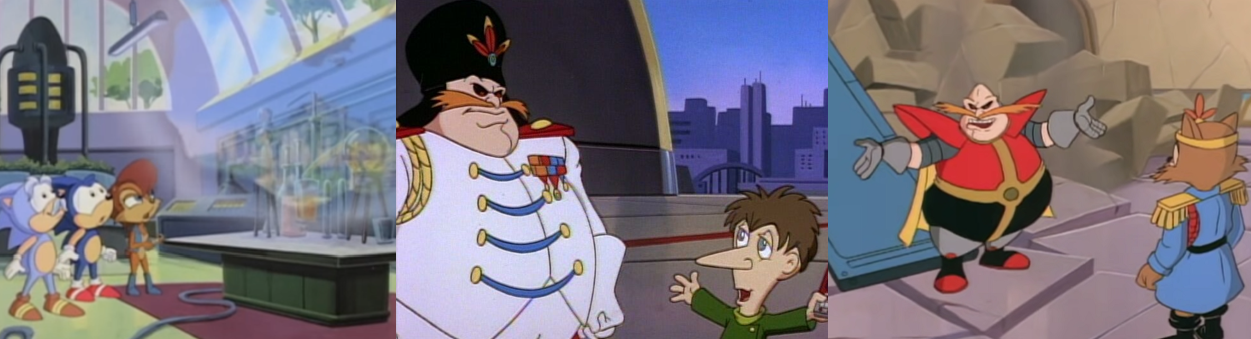
Although “Flying Fortress”, “No Hedgehog is an Island”, and “New Echidna in Town” make up a three-episode story arc revolving around Knuckles and the Chaos Emerald, they were broadcast out of order and the character actually made his first appearance in the standalone story “Friend or Foe?” Following the surprisingly catchy opening theme song (one of the few highlights of the cartoon), the episode finds Sonic, Sonia, and Manic travelling to the “dreaded” Floating Island in search of their long-lost mother, Queen Aleena Hedgehog (Gail Webster, and running afoul of boobytraps laid across the island by its mysterious echidna guardian. As ever, Dr. Robotnik is lumbered with two bungling minions: sleazy-but-cunning wolf Sleet (LaMarche) and the block-headed Dingo (Wilds), who transforms into different forms at the touch of Sleet’s remote controller. The two are ordered to the Floating Island to poison Knuckles’ mind against the hedgehogs, distracting him so they can steal the Chaos Emerald and send the island (and their enemies) plummeting to the ground. Thanks to a hilariously bad holographic fake, Knuckles is easily tricked and takes off to confront the three hedgehogs right as they learn from one of the island’s “sacred pools” that their mother was (and possibly still is) there. Despite Sonia’s best attempts to keep the peace, a sluggish and awkward scuffle breaks out between Knuckles and Sonic, which ends with the Sonia and Manic exploring the island’s underground caverns (in a close approximation of the Hidden Palace Zone) and learning of Knuckles’ deception. Although Sonic talks sense into Knuckles, they’re too late to stop Sleet and Dingo from stealing the Chaos Emerald and endangering the island. Luckily, Dingo is distracted by his lust for Sonia and the baddies are forced to flee without the emerald while the three fend off a contingent of SWATbots. In the aftermath, the siblings make amends with Knuckles, who reveals that he knows Queen Aleena and that she left a message indicating that he would become a pivotal ally in their crusade.

The siblings recruit Knuckles to help defeat the flying fortress, only for Sleet and Dingo to steal its Chaos Emerald.

A few episodes later, the siblings are relaxing at the beach when they’re attacked by Dr. Robotnik’s spherical “Fortress of Altitude” (almost a downgraded version of the Death Egg or the Egg Carrier), a flying fortress capable of bombarding his foes and shrugging off the laser blasts from their magic weapons thanks not only to being comprised of “Mobibindum” but also being powered by a Chaos Emerald, which atomises everything it touches. After fending off Dr. Robotnik’s SWATbots and evading the flying fortress, the siblings seek out Knuckles’ help. Initially reluctant to leave the Floating Island, Knuckles is convinced by their awful song (“No One is and Island”), though his resolve falters when the astral spirt of his great-grandfather, Athair (LaMarche), warns that this will result in a greater calamity. After easily fooling Dr. Robotnik with a decoy, Knuckles and the others slip aboard the flying fortress, avoid the ship’s defences, and burrow their way to the Chaos Emerald thanks to Knuckles’ super strength. However, after being callously dismissed by Dr. Robotnik, Sleet and Dingo claim the Chaos Emerald for themselves to both stand on their own and to try and prove their worth to their master. This causes the fortress to fall from the sky and into the sea below. Crippled by hydrophobia and unable to swim, Sonic relies on his family and friend to help get him to safety, but Sleet is stunned when usually thick-headed Dingo swipes the gem for himself! However, Dingo accidentally drops the Chaos Emerald, shattering it and unleashing a wave of unbridled Chaos Energy across the land that causes storms, earthquakes, and threatens the entire planet.
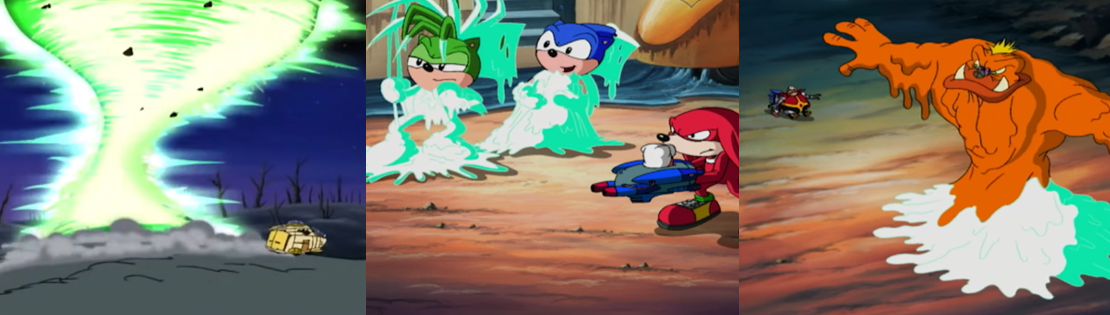
The heroes forge unlikely alliances to save the planet from being torn apart by Chaos Energy.

After his despair is lifted by another of the band’s terrible songs (“Learn to Overcome”), Knuckles leads them to his great-grandfather, who gifts them a special canister to house the shattered pieces and reveals that the only way to save the world is to ally with Dr. Robotnik. Naturally, Sonic and his siblings are aghast at this, but Knuckles is reluctant to defy his elder, especially with the fate of the world at stake. With the planet literally shaking apart from the rising Chaos Energy, the siblings race to find Knuckles and find another way to solve their problem, only to find that he’s been coerced into capturing them on Dr. Robotnik’s orders in exchange for the tyrant’s help in saving the world. Regretfully, Knuckles betrays his friends, only to be immediately double-crossed when Dr. Robotnik reneges on his promise not to roboticize the hedgehogs. Angered by this, a remorseful Knuckles fights back and frees his friends from their sticky bonds and joins them in searching for the Chaos Emerald, but they’re too late to keep Sleet from finding it and containing it in Dingo. This results in Dingo absorbing a full dose of Chaos Energy and transforming into a mindless, clay-like beast that threatens friend and foe alike. In what could arguably be described as a very loose adaptation of Sonic Adventure (Sonic Team, 1998), Dingo goes on a rampage that not only causes a series of volcanic eruptions but also destroys Manic’s magic drum set before heading to nearby Robotropolis, forcing Sonic to manipulate Dr. Robotnik’s ego to help subdue the beast. Toppled by the band’s music (“The Mobius Stomp”) and Dr. Robotnik’s special glue, Dingo spits out the Chaos Emerald, reverting to normal and saving the world and earning him his master’s ire. Knuckles then delivers the reassembled Chaos Emerald to Athair. Although the old echidna charges him with safeguarding the gem on the Floating Island, but the band promises that Knuckles will always have a place with them whether near or far.
The Summary:
Although the show has little in common with SatAM, Sonic Underground’s Sonic remains the same boastful, reckless speedster. In place of Princess Sally Acorn (Kath Soucie), Sonia acts as the voice of reason and intelligence in the trio, chastising Sonic’s irresponsible nature and emphasising diplomacy over impulsiveness wherever possible. Manic is characterised as a laid-back surfer dude who’s not as reckless as Sonic but still isn’t as attentive as Sonia. However, while Sonia might be the smartest of the bunch, she’s from an entirely different world to both. Sonic was raised to be a Freedom Fighter by his beloved Uncle Chuck (LaMarche) and has been fighting Dr. Robotnik for as long as he can remember, Manic is a streetwise thief, and Sonia comes from a life of privilege and luxury. All three were united by a common enemy when Dr. Robotnik roboticized the only family they ever knew and wield magic medallions that transform into music instruments that act as weapons, but Sonic Underground continuously emphasised their strength as a unit more than any previous Sonic cartoon. While Sonic possesses incredible speed, he’s impulsive and also crippled by hydrophobia. Sonia might have some fancy martial arts moves but she’s often too easily trusting of wealthy folk, who are often in Dr. Robotnik’s pocket. And Manic generally gets himself into trouble since he can’t help but half-inch when the temptation arises.
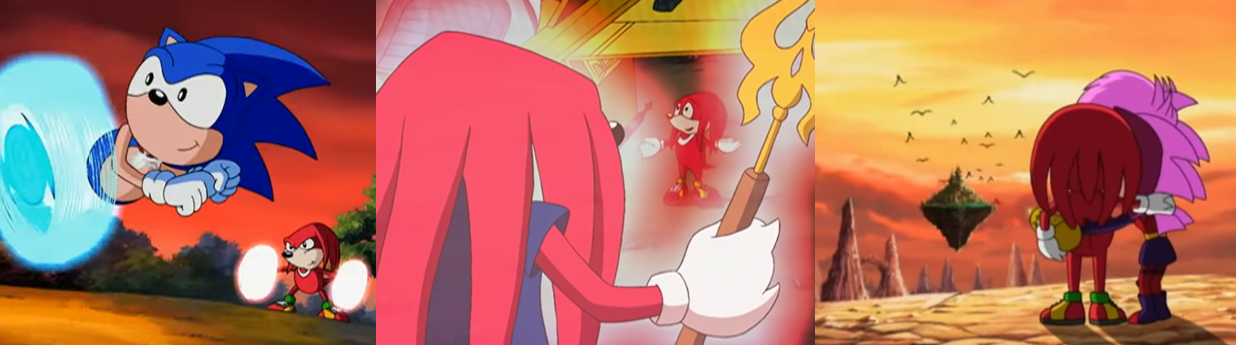
Though tough and wily, Knuckles is easily duped and fiercely loyal to this duties as the island’s guardian.

Of the three Sonic cartoons that aired in the nineties, Sonic Underground is somehow the most bizarre. Its tone is all over the place, lacking the ominous menace of SatAM but also veering more towards comedy like Adventures. Despite still being lighting fast and capable of bending physics, Sonic is surprisingly weak here. Perhaps because of the need desire emphasise themes of teamwork and friendship, Sonic is not only hampered by recklessness but shows fear when confronted by large groups of SWATbots, sluggishly fumbles through his initial fight with Knuckles, and succumbs to an uncharacteristic panic when left floundering in the ocean. Although the Floating Island is common knowledge in Sonic Underground and easily accessible, it’s far more accurate compared to the small mass seen in SatAM. It’s large, with a variety of different environments and wildlife on its soil, and Knuckles is later seen using a radar and communications system, and anti-aircraft cannons to fend off intruders. Knuckles’ reputation proceeds him to the point where even Sleet is aware of how tough he is and his skill at laying traps, and he makes an immediate impression by capturing the two dolts and roasting them over a spit for the local wildlife! However, as fleet-footed and super strong as he is, and despite showcasing a distrustful and snarky attitude, Knuckles is easily duped by Slate and Dingo and, like every character here, suffers from atrociously bad animation, appearing pudgy and disproportionate every time he moves. Knuckles’ go-to move is to spin his arms like a buzzsaw to rapidly burrow through surfaces. Just doing this is enough to knock Sonic on his ass and impress Manic, and Knuckles proves durable enough to withstand Sonic’s patented “Triple Spin Attack” and wily enough to use his knowledge of the island against his foe. Knuckles takes his role of guarding the Floating Island very seriously, to the point where he’s isolated himself from the rest of the world, but he’s equal loyal to his newfound friends and defies his instincts, and the will of his great-grandfather to aid them even though he’s extremely uncomfortable with leaving his island unguarded.
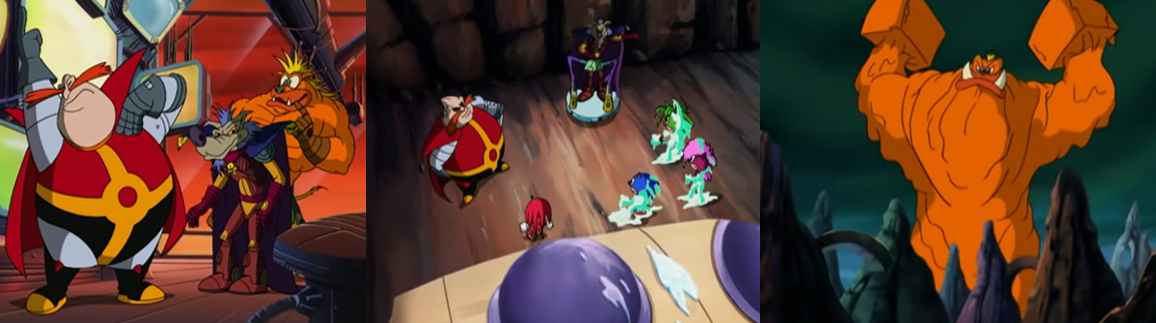
As if Dr. Robotnik wasn’t bad enough, the siblings must content with Knuckles and a rampaging Dingo.

There are some benefits to this for Knuckles; namely, that he spends more time socialising with his friends and bonding with Sonia, with whom he develops a mutual attraction. However, there are major drawbacks, too. Most notably, Knuckles is naïve and easily fooled; not only does he fall for Sleet and Dingo’s lies about the hedgehogs, he trusts his great-grandfather’s word so blindly that he willingly allies with Dr. Robotnik despite knowing full well of the semi-cybernetic dictator’s malicious nature. While he looks just like SatAM’s Dr. Robotnik (save for sporting two robotic arms) and even resides in a similar citadel in the heart of Robotropolis, this Dr. Robotnik lacks the gravelly, mechanical voice, employs wildly different SWATbots, and often spares the aristocracy the indignation of roboticization in return for hefty bribes. Although Dr. Robotnik appears to be at his most dangerous when he launches his Fortress of Altitude, the airship is as disproportionate and inconsistent as everything else on the show. The Mobibindum apparently makes it super heavy and tough, yet both Sonic and Knuckles smash through its structure without issue and a simple drop in the ocean is enough to trash the fortress and leave it literally blowing up in the dictator’s face. Even when Mobius is being torn apart around him, Dr. Robotnik finds a way to turn things in his favour. He’s willing to see the world destroyed if it means being rid of Sonic and strong-arms Knuckles into doing his bidding so that he can have the final victory of his hated enemies. Honestly, there are only a few episodes of Sonic Underground that are worth watching and these four are a handful of them. The animation and voice acting is atrocious (it’s insane that Jaleel White voices all three siblings), with Knuckles sadly getting the worst of both, but it was nice to finally see him in a Western Sonic cartoon. It’s not enough to salvage the series but it certainly makes these episodes more enjoyable. If only it had been an actual continuation of SatAM, it could’ve been even better.

My Rating:

Rating: 2 out of 5.

Could Be Better

Were you a fan of Sonic Underground? What did you think of the four Knuckles-centric episodes? Were you disappointed that we never got a continuation of SatAM? Which of Sonic’s siblings was your favourite and what did you think to the use of rock music in the show? Are you celebrating Knuckles’ big day today? Whatever you think about Sonic Underground, and especially Knuckles, leave a comment down below or let me know by commenting on my social media.

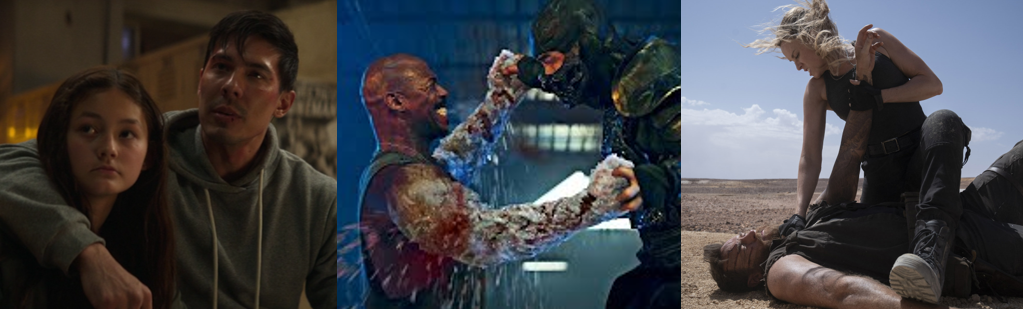
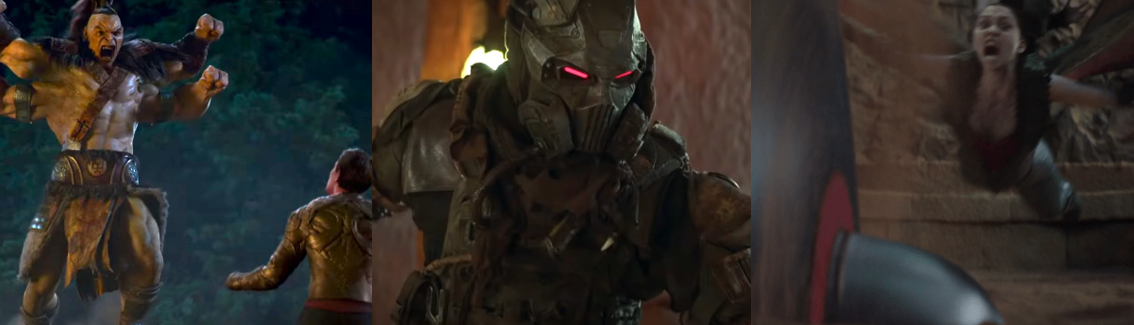
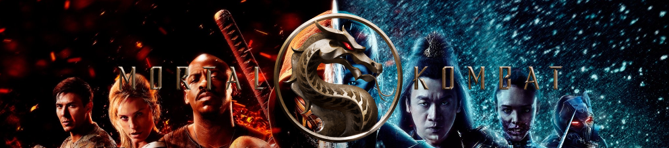
Movie Night [MK Day]: Mortal Kombat (2021)


This image has an empty alt attribute; its file name is mortalmonday.png

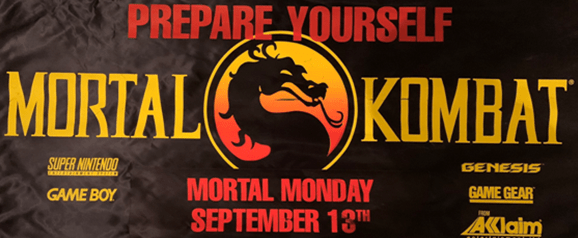
To celebrate the simultaneous worldwide release of Mortal Kombat (Midway, 1992) on home consoles, 13 September 1993 was dubbed “Mortal Monday”. Mortal Kombat’s move to home consoles impacted not only the ongoing “Console War” between SEGA and Nintendo but also videogames forever thanks to its controversial violence. Thus, it’s only fitting that we continue celebrating this influential fighting series every September 13th…except this year that clashes with Friday the 13th so…


Released: 23 April 2021
Director: Simon McQuoid
Distributor: Warner Bros. Pictures
Budget: $55 million
Stars: Lewis Tan, Jessica McNamee, Josh Lawson, Joe Taslim, Mehcad Brooks, Tadanobu Asano, and Chin Han

The Plot:
Struggling fighter Cole Young (Tan) is targeted by the relentless Bi-Han/Sub-Zero (Taslim), an assassin working under orders by the malevolent sorcerer Shang Tsung (Han) to kill Earthrealm’s chosen warriors before they can compete in the ages-old martial arts tournament known as Mortal Kombat.

The Background:
Inspired by the success of Street Fighter II: The World Warrior (Capcom, 1991), developers Ed Boon and John Tobias used innovative digitised sprites to unleash Mortal Kombat upon impressionable gamers. Attracting both popularity and controversy for its bloody content and gruesome “Fatalities”, Mortal Kombat soon expanded its scope not just with additional videogames but also into mainstream media thanks, largely, to catching the eye of producer Lawrence Kasanoff. Kasanoff envisioned a multimedia venture for the franchise and initially got off to a great start with the first live-action adaptation. Mortal Kombat (Anderson, 1995) became a cult hit that’s still one of the most highly regarded videogame adaptations ever made. Unfortunately, this success didn’t pan out quite as Kasanoff originally planned. A universally panned sequel was followed by lukewarm television ventures and talks of a third film evaporated into Development Hell. After the series made a dramatic comeback following Midway’s bankruptcy, hopes for a new Mortal Kombat movie were raised through the web series helmed by Kevin Tancharoen. Although he never got to direct a big screen adaptation, Tancharoen’s efforts were picked up by producer James Wan, writer Greg Russo, and director Simon McQuoid, with the trio determined to bring the franchise’s gory violence to life in all its glory. Despite long-running rumours of the original movie’s cast returning for another film, this new Mortal Kombat featured an all-new cast and attracted early controversy for creating a new audience surrogate and its poor use of Goro, now a disappointing CGI creature rather than a traditional effect. While the film’s $84.4 million box office made it a mild success, reviews were somewhat mixed. The fights and gore were praised but the characters, acting, and plot all drew criticism. Yet, despite it not living up to the standards set by the 1995 film, Mortal Kombat delivered some stellar fight scenes between the franchise’s most popular characters and was successful enough to warrant a 2025 sequel.

The Review:
I’ve always enjoyed the original Mortal Kombat movie. Even now, it’s still my favourite live-action adaptation of a videogame, to the point where I wrote an entire chapter of my PhD thesis about the film and its infamous legacy! I waited eagerly for the follow-up, only to be met with a surreal, nonsensical bombardment of noise and mess that basically killed the franchise dead. Even the relatively enjoyable television ventures couldn’t undo the damage, and Mortal Kombat was left to fester for years as fans waited for news of a third film or an all-out reboot. Those dreams were almost answered by Kevin Tancharoen, whose online videos showed a certain promise, but Warner Bros. randomly decided to go in a different direction and sign-off on this reboot instead. From the first trailers, things looked somewhat promising by focusing on bloody combat, the franchise’s trademark Fatalities, and with much of the marketing revolving around fan favourite ninjas Hanzo Hasashi/Scorpion (Sanada) and Sub-Zero. Indeed, Mortal Kombat immediately makes up for the character assassination these icons received under the direction of Paul W.S. Anderson by opening in 17th century Japan and depicting the wholesale slaughter of Hasahi’s ninja clan, the Shirai Ryu, at the hands of Bi-Han and his own ninja assassins, the Lin Kuei. Hasashi, an honourable family man who lives a relatively peaceful life tending to the land with his wife, Harumi (Yukiko Shinohara), and young son, Satoshi “Jubei” Hasashi (Ren Miyagawa), and infant daughter (Mia Hall). However, when his family and clan are threatened, Hasashi becomes a force to be reckoned with, making use of a digging trowel as a makeshift kunai to oppose the assassins, only to realise all-too-late that the attack was merely a distraction so the sadistic Bi-Han could leave Harumi and Jubei little more than ice sculptures for the grief-stricken Hasashi to find. 

A strong opening soon gives way to an audience surrogate no-one asked for.

Naturally, a fierce battle ensues between the two rivals that sees Bi-Han’s face permanently scarred and Hasashi stabbed and killed by his own weapon, condemning his soul of the hellish Netherrealm, ending his bloodline, and leaving the Lin Kuei victorious. Well…not quite, for Hasashi’s baby survived and was recovered by Raiden (Asano), God of Thunder and protector of Earthrealm, since it was foretold that the “blood of a Hasashi” would unite Earth’s champions against the realm-conquering Outworld. Honestly, Mortal Kombat might’ve fared better if the entirety of its runtime was built around the Hasashi/Bi-Han rivalry, taking place in the past and including select appearances from other prominent franchise characters. Instead, the story jumps ahead to 2021, a time when Outworld has won nine out of ten Mortal Kombat tournaments and needs just one more victory to legally invade our world. They have succeeded in this endeavour thanks to the unmatched sorcery and deceitful nature of Outworld representative Shang Tsung, an enigmatic man who uses any means at his disposal (including bending the sacred rules of the tournament) to preemptively target those destined to fight against Outworld. Thus, any Earthrealmer bearing a dragon-shaped birthmark is targeted by Shang Tsung’s lead assassin, Bi-Han, now clad in armour and taking the name Sub-Zero, who presumably retains his youth and vigour thanks to the sorcerer’s influence. Sub-Zero’s latest target is Cole Young, a down-on-his luck mixed martial artist who’s struggling with self-doubt and to make a career out of his skills to provide for his family, wife Allison (Laura Brent) and daughter Emily (Matilda Kimber). Once a champion fighter, Cole has been reduced to taking $200 fights to put food on the table and is thus incredulous when Jax shows up inquiring about his unique dragon mark. 

Cole is amazed when he’s drawn into a world of supernatural violence.

Cole is drawing into the crazy world of Mortal Kombat when Sub-Zero attacks him and his family at dinner, and it’s only the intervention of Jax that allows the Asano to escape. While Cole follows Jax’s instructions to meet with his partner, Sonya Blade (McNamee), Jax ends up mutilated when he battles Sub-Zero to cover Cole’s escape. Hopelessly outmatched despite his size and power, Jax has his arms frozen and shattered by the cruel cyromancer. Unlike Cole, and the other chosen warriors, Sonya does not carry a dragon mark, which is a source of great distress for her and something adversarial mercenary Kano (Lawson) and even Raiden mock her for. However, Sonya is acutely aware of Mortal Kombat, the threat against Earth, and the bizarre individuals associated with it. While Cole is sceptical, despite witnessing Sub-Zero’s abilities, his cynicism is quashed when another of Shang Tsung’s assassins, the voracious Syzoth/Reptile, who viciously attacks Sonya’s hideout. Since he’s her only chance to track down Raiden’s hidden temple, Sonya is forced to free Kano to assist in the fight. Although his face is mauled by the beast, Kano circumnavigates Reptile’s camouflage by stabbing him with a flare and proves his viciousness by tearing the Saurian’s heart out. While he’s a crude, crass, antagonistic criminal who can’t be trusted, Sonya is forced to bribe Kano with money she doesn’t have and he reluctantly joins the group, and the allies they find there, delighting in lording his superiority, verbally tearing them down, and excited at the prospect of gaining superpowers under Liu Kang’s (Lin) tutelage. Similar to Tancharoen’s previous adaptation, Mortal Kombat explains the videogames’ special moves not just in explicitly bestowing them to Shang Tsung’s demonic forces but in the concept of “Arcana”,  abilities unique to those with the dragon mark. Since she doesn’t have a mark, Sonya can’t unlock her power but is permitted to stay and help train the others, giving Kano ample opportunity to rile her up, though Cole also struggles to unlock his Arcana despite his efforts.

Raiden is unimpressed by Earthrealm’s chosen fighters.

Protected from Shang Tsung’s assassins by Raiden’s mystical barrier, Cole, Sonya, and Kano train alongside warrior monks Liu Kang and Kung Lao (Max Huang), who also tend to Jax’s wounds and furnish him with a rudimentary set of cybernetic arms. Like Cole, Jax is frustrated by his newfound handicap, but Liu Kang and Kung Lao strive to push them all to unlock their true potential to defend Earthrealm. Staunch believers in Raiden’s cause, Liu Kang and Kung Lao have already unlocked their Arcanas, demonstrating incredible abilities such as fireballs and teleportation, and Kung Lao also utilises his iconic razor-sharp hat. Although Liu Kang is sympathetic to their confusion, time is against the would-be champions and he and his fellow Shaolin repeatedly subject the group to intense sparring sessions to push their bodies and minds to the absolute limit. Unfortunately for them, the only one who achieves this is Kano who, angered by “Kung Pow’s” dismissive attitude towards him, suddenly fires lasers from his injured eye. Far from the wise, playful mentor of previous adaptations, this version of Raiden is a blunt deity. Indeed, he’s so disappointed by the fighters and Cole’s progress that he regularly runs them down and even out-right dismissing Cole when, after revealing his lineage as Hasashi’s ancestor, he expresses displeasure that the struggling fighter didn’t live up to the expectations set by his forefather. When returned to his family, however, Cole finally unlocks his Arcana to defend them from Prince Goro (Angus Sampson), a four-armed Shokan who attempts to kill them and is instead torn to pieces when Cole spontaneously grows organic armour that allows him to absorb any attack, grow tonfas to attack with, and grants him superhuman strength. 

Outworld’s monstrous forces meet gruesome ends at the hands of our heroes.

Galvanised by his awakened abilities and his victory over Goro, Cole reunites with his allies, now shaken following Kano’s betrayal. After a discussion with former ally Kabal (Daniel Nelson/Damon Herriman), Kano is convinced to betray Raiden, lowering the shield and allowing Shang Tsung’s assassins to attack. In the fracas, Jax unlocks his Arcana to save Sonya, upgrading his gaunt metal arms to more formidable appendages, but Kung Lao is lost when Shang Tsung steals his soul. Retreating to a void between realms to regroup, Cole shares a plan to target Shang Tsung’s warriors individually before teaming up to tackle Sub-Zero, their greatest threat, together. Like the original movie, Shang Tsung’s minions are given very little characterisation outside of two exceptions, Sub-Zero and Kabal. It’s genuinely upsetting seeing Goro reduced to an easily-dispatched underling and that more time wasn’t spent making Nitara (Mel Jarnson), Mileena (Sisi Stringer), and Reiko (Nathan Jones) more than lifeless minions for the good guys to fight. It seems the filmmakers were banking on Nitara’s and Mileena’s sex appeal (and the former’s unique, if poorly realised, vampiric abilities) and Reiko’s gargantuan stature to make up for this, but it doesn’t really work and it’s hard to care when they’re defeated, however gory it is, making me wish that Goro had taken Reiko’s place. Thankfully, Kabal somewhat makes up for this. He and Kano have the same snarky demeanour and Kabal has an awesome look, but we learn very little about their time together in the Black Dragon Clan and it’s weird that Liu Kang believed killing Kabal avenged Kung Lao’s death when Shang Tsung dealt the finishing blow. Similarly, Chin Han is as miscast as the sorcerer as Tadanobu Asano is as Raiden; neither can hold a candle to their predecessors or even their television counterparts and, while Han tries to exude an authoritative menace, both are very weak and forgettable in their roles. 

The Nitty-Gritty:
Similar to the much-maligned Mortal Kombat: Annihilation, faith in yourself and teamwork are core themes of this new Mortal Kombat. Much of Cole’s characterisation comes from his declining martial arts career; he went from a champion to a chump and he struggles with feelings of inadequacy and self-doubt, despite having a caring and supportive family behind him. It’s this, as much as his scepticism, that holds him back while training, and these issues are only compounded when Raiden literally tells him he was destined for more and has failed to accomplish even half of his potential. It’s thus telling that Cole’s Arcana awakens when he’s defending his loved ones, but it’s hard to deny that Cole’s bland and completely unnecessary character. The Mortal Kombat franchise has one of the biggest and most diverse rosters in all its genre but the filmmakers created a brand-new audience surrogate when Johnny Cage would’ve fulfilled this role just as well. Hell, it would only have taken a couple of slight tweaks to have Cage assume Cole’s role, and all the hints towards Cage’s future involvement can’t make up for his absence here. Cole’s struggles are echoed in both Jax and Sonya, who both face an uphill battle to overcome either their physical limitations or their lack of an official brand to contribute to Earthrealm’s defence, something they ultimately accomplish when forced to go beyond their limits to save their friends or avenge their losses. 

This adaptation is much more faithful to the violent nature of the source material.

While the first Mortal Kombat unquestionably captured the spirit of the source material, smartly drawing from martial arts cinema to focus more on memorable characters and fights than the trademark gore, this Mortal Kombat clearly draws from NetherRealm’s modern titles and even explicitly recreates Kung Lao’s infamous “Razor’s Edge” Fatality by having him slice Nitara in two with his hat! Similarly, Jax crushes Reiko’s head and Liu Kang conjures a flaming dragon to take out Kabal, just like in the videogames, and of course there’s Kano’s classic heart rip Fatality, which are all suitably gruesome and give the film an entertaining edge since it’s the first time we’ve seen such explicit gore in an official live-action adaptation of the famous franchise. Similarly, the film is full of cursing, with Kano clearly channelling the late Trevor Goddard into his performance as the bombastic and outrageous Kano to steal the show like his predecessor did with his rude quips and abrasive attitude. I do enjoy these more adult aspects of the film and, in many ways, they make it a superior and more faithful adaptation than the original film, but all the blood and swearing in the world can’t make up for bland characters and uninspiring acting. Say what you will about the original’s tame content but at least the main cast was charismatic and embodied their roles. I like the performances from Liu Kang and Kung Lao here but they show up so late into the story and we learn so little about them that it’s difficult to be too attached to them. Raiden is an unlikeable jackass, most of Shang Tsung’s underlings are disposable baddies to be offed, and once again Sonya fails to impress as a bad-ass female protagonist, coming across more like a spare part since she isn’t even a chosen warrior. It’s as though the filmmakers did the opposite of the original film, focusing on gore and spectacle over character and heart, meaning it also falls short of being a definitive adaptation and can’t even rely on a memorable soundtrack to get by since the remix of “Techno Syndrome” isn’t used as prominently as in the original film. 

The film’s bookended by the best parts and limp’s to an uninspired finish.

Mortal Kombat tries to claw back some credibility in the finale when, after dispatching Shang Tsung’s dull minions and finally granting Sonya an Arcana and a dragon mark when she kills Kano, Cole is drawn into a confrontation with Sub-Zero after he kidnaps Allison and Emily. Unfortunately, even with his organic armour, Cole is no match for the cold-blooded assassin. Luckily, however, Raiden gifted Cole his ancestor’s kunai, which returns Hasashi from the Netherrealm as the vengeful Scorpion. Thus, the film comes full circle as the two most popular characters battle once more, completely stealing the thunder from Cole and making all the time spent with the other characters largely superfluous. If Johnny Cage wasn’t going to be used in Cole’s place, Cole could’ve at least been a reincarnation of Hasashi or have been transformed into Scorpion by the Arcana or the kunai. Instead, Cole’s left freeing his family and watching from the sidelines as his ancestor avenges himself on his killer in a bloody battle that’s easily the best of the film. Again, this is why these two should’ve been the primary focus. If you’re not going to do the tournament anyway, you may as well focus on the two most interesting characters in the franchise, and Taslim and Sanada excel in their kinetic, brutal fight scenes. In this rematch, the two are far more equally matched and Scorpion takes his revenge, immolating the injured assassin alive. Strangely there’s a moment of sympathy for Sub-Zero that, like Shang Tsung’s throwaway line regarding the resurrection of his fallen forces, is potentially a hint at his return in the next instalment, possibly as Noob Saibot. In the aftermath, Hasashi charges Cole with protecting their bloodline and returns to the Netherrealm. As Shang Tsung threatened to bring an entire army to their door, the galvanised Cole readily accepts Raiden’s offer to find and train new warriors and heads out to recruit movie star Johnny Cage (Unseen) to the cause. 

The Summary:
I was pretty excited about Mortal Kombat at the time. I’d wanted to see a new adaptation for years and truly believed the original movie could be outdone if the filmmakers drew inspiration from it as much as the modern videogames. Obviously, nostalgia is a huge factor in the original’s appeal. Truthfully, it has many flaws that go beyond its tame nature, but it’s still an enjoyable action film, primarily because of the cast and execution. This Mortal Kombat stumbles somewhat in this aspect, predominantly because of its bland and unnecessary main character. Lewis Tan may have a good look and fight well, but he’s not much of an actor and it’s hard to be invested in Cole since I spent the entire time wondering why he’s even there. His Arcana wasn’t that great, either, and I’m not sure I liked this concept, while I’m on the subject. It worked as a goal for the characters to strive towards, but I honestly think it’s better to have the mortal warriors have to overcome fantastic abilities rather than giving everyone superpowers. The gore and Fatalities were great, as were many of the fight scenes and action sequences, and I enjoyed how closely these aspects mirrored the videogames. Sadly, this is juxtaposed with lacklustre version of Shang Tsung (because it’s hard to improve upon Cary-Hiroyuki Tagawa), an unlikeable rendition of Raiden, and a bizarrely unimpressive Goro who not only goes out like an idiot but is an awful CGI monstrosity. Indeed, for every aspect that works here, there’s two or three things that don’t, making this enjoyable enough but far from an improvement over the original film. It’s a shame as there’s a lot of potential here, and I’m sure viewers unfamiliar with the original movie will find a lot to like in this version. However, it missed the mark in a lot of ways for me, primarily in overcomplicating and overstuffing the narrative, making it a bit of a mess at times. 

My Rating:

Rating: 3 out of 5.

Pretty Good

Did you enjoy Mortal Kombat? What did you think to Cole Young; was he an interesting enough protagonist for you or did you find him a bit bland? Would you have preferred to see Johnny Cage in his role? What did you think to the blood, Fatalities, and fights? Were you also disappointed by the depiction of Raiden, Shang Tsung, and the underling villains? Would you have preferred to see Scorpion and Sub-Zero be the primary focus? Which Mortal Kombat characters would you like to see featured in a future film? How are you celebrating Mortal Kombat today? Whatever your thoughts, leave a comment below or on my social media and be sure to check out my other Mortal Kombat content across the site. 

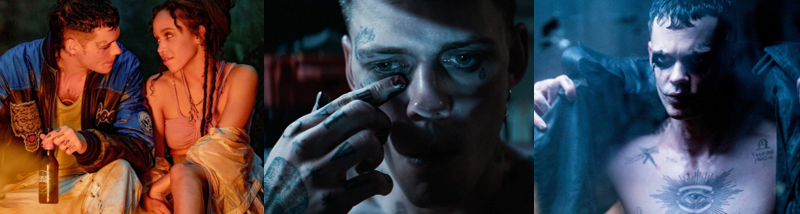
Movie Night: The Crow (2024)

Released: 23 August 2024
Director: Rupert Sanders
Distributor: Lionsgate
Budget: $50 million
Stars: Bill Skarsgård, FKA Twigs, Danny Huston, Laura Birn, and Sami Bouajila

The Plot:
When troubled youth Eric (Skarsgård) and his girlfriend, Shelly (Twigs), are brutally murdered on the orders of demonic crime lord Vincent Roeg (Huston), a supernatural crow resurrects Eric to take his revenge.  

The Background:
Created by James O’Barr in 1989, The Crow was an underground success that reflected O’Barr’s anger and pain after a tragic loss to. Since dark comic book narratives were all the rage in Hollywood at the time, the comic soon transitioned into a critically and commercially successful film adaptation, one that achieved cult status and infamy after the accidentally on-set death of star Brandon Lee. Determined to capitalise on The Crow’s (Proyas, 1994) success, series producers Edward R. Pressman and Jeff Most signed off on a slew of sequels and even a short-lived television show that was notably better received than the three cinematic and direct-to-video follow-ups. Following the universally panned fourth movie, the franchise entered Development Hell for nearly twenty years as various writers, directors, and actors were attached to a potential reboot. Stephen Norrington was in talks to direct at one point, stars Bradley Cooper and Jason Momoa were tapped for the lead role, production was stalled by financial issues, and series creator James O’Barr stated repeatedly that the new film would be a “re-adaptation” of the source material rather than an outright remake just as Alex Proyas slammed its production. Finally, in 2020, the project was revived and gained traction; Bill Skarsgård won the lead, impressing director Rupert Sanders with his conditioning and enthusiasm, and harmless firearms were mandatory onset to avoid a repeat of Brandon Lee’s tragedy. Upon release, The Crow was met with largely negative reviews that reflected the reactions to the film’s trailers. The chemistry and performances of the leads was questioned, the pacing was slandered, and even more positive spins decried it as derivative of the original and ultimately unable to escape the shadow of its predecessor. Given the franchise’s persistence, it should be no surprise that the ending was reportedly tweaked (against Skarsgård’s objections) to leave the door open for a sequel, though the film’s dismal $24 million box office makes the prospect unlikely.

The Review:
I’ve been a fan of the Crow concept since I was a kid and we first taped the original movie off the television. From there, I discovered the original graphic novel (which, honestly, took me a little while to properly appreciate) and I delved into the movie sequels hoping to at least see more of the same. Unfortunately, it seems The Crow was lightning in a bottle and none of the follow-ups came close to matching the movie’s aura and appeal, which is weird to me as the concept is pretty simple and I maintain there’s a lot of material in the comic (and its follow-ups) that could make for a good film. Like, why not do it hyper-stylised and hyper-violent, like the Sin City movies (Rodriguez and Miller, 2005;2014)? Or take inspiration from The Crow: Dead Time (O’Barr, et al, 1996) or The Crow: Flesh and Blood (Vance, et al, 1996), maybe put a twist on the story and have Shelly be the one resurrected? I was cautiously optimistic for this long-gestating remake, hopeful that it would go for grim and gritty and try to get back to the roots of the concept, but immediately lost faith once I saw the first trailers and went into it hoping that it would at least be full of enjoyable, bloody action. My first wish (that it does something different with the concept) was kind of granted in that a huge portion of the film focuses on Eric (not Draven) and Shelly (no last name) and their budding attraction to each other. Unlike in the original, we spend a significant amount of time hanging with the two, seeing them flirt and play and fuck and apparently fall in love, and the entire time I was thinking to myself…I just don’t care. It’s so weird. Like, I felt more of an emotional connection to Shelly Webster (Sofia Shinas) in the original film and she only appeared in flashbacks or as an apparition. Her and Eric’s (Brandon Lee) love and relationship was conveyed through fragmented memories, both happy and agonisingly violent, and through Eric’s pained, righteous anger. Yet, here, we see the two coming together and finally finding some peace together and I just couldn’t buy into it was it seemed so shallow and hollow.

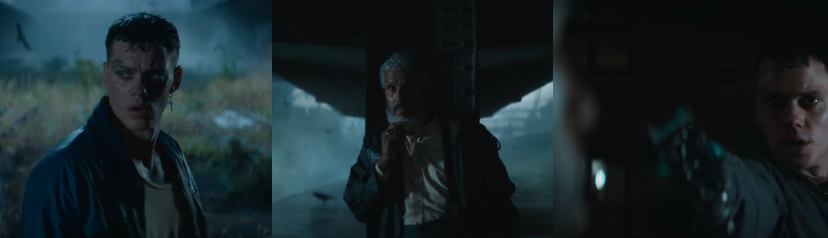
When he and Shelly are murdered, emo try-hard Eric returns to mope about and eventually get revenge.

It doesn’t really help that we really don’t learn much about them. The film opens with a dream sequence from Eric’s childhood where he was apparently traumatised by the death of his beloved horse and it’s implied that his alcoholic or addict mother (Unknown) was abusive, then jumps to him in rehab, covered in ludicrous tattoos, and moping about, barely speaking and being further abused by his fellow inmates and the strangely aggressive guards. We’re told he turned to drink and drugs but never learn what he went through in the interim or what drove him to cut his wrists, and instead are presented with this sullen, damaged young man who’s essentially sleepwalking through life. In contrast, we do eventually learn a bit more about Shelly, but it still feels like pieces are missing from her puzzle. She begins the film freaked out because her friend, Zadie (Isabella Wei), is killed for recording some mysterious video of them and their friends at some party, then randomly gets arrested for possession and is locked up with Eric, whom she becomes attracted to because the script says so. when her mother, Sophia (Josette Simon), shows up with the mysterious Marian (Birn), Shelly has a partial panic attack and Eric encourages the two to flee. After escaping with ridiculous ease, the two then hole up in Shelly’s apartment and her pursuers never think to check there while the two shack up, befriend a bunch of unnamed fellow lowlifes, and revel in their freedom, despite apparently having no jobs or income (beyond, I guess, drug dealing?) eventually, Shelly opens up about being her past as a piano prodigy and Eric later learns that she was targeted by the enigmatic Vincent Roeg, who preys upon innocent souls and corrupts them with a demonic whisper. Since Shelly had video evidence of Roeg’s supernatural abilities, he eventually has his men storm the couple’s digs and suffocate them to death with plastic bags, condemning Shelly’s soul to eternal damnation since she was manipulated into stabbing a girl to death by Roeg’s influence. While Eric returns from the grave, Shelly also pops up here and there as a phantom, in Eric’s memories, or as he uncovers more of her past and she’s honestly a more fleshed out character than he is, and she’s cute and serviceable enough, but I struggled to believe the strength of their love since I didn’t see a lot of chemistry between the two.

Despite constant exposition and the obvious, Eric remains largely clueless for most of the film.

Upon being killed, Eric immediately awakens in a mysterious, desolate landscape dominated by crows (what I would describe as purgatory). There, he meets a shadowy figure the credits call Kronos (Bouajila) who basically acts as an exposition dump for what’s happened, delivering the famous “People once believed…” line from the original film and describing Eric’s situation and abilities. It’s honestly a little insulting, especially as we didn’t need such ham-fisted exposition in the original film; probably due to Brandon’s untimely death, all of his supernatural powers were conveyed using a simple “show, don’t tell” method but here, Kronos lays it all out to the stunned Eric, who returns to the living world a short time later not by bursting from his grave but by waking up on the apartment floor. Confused and disoriented, he attacks and kills corrupt cop Detective Milch (Dukagjin Podrimaj) when he comes to search for Shelly’s phone and discovers that he can heal from any wound, though isn’t spared the agony of bullet wounds and broken bones. Guided by a supernatural crow, Eric wanders about the streets, largely in disbelief about what’s happened, desperately trying to put names to the faces of his murderers; although he ends up as clueless as we are until the credits, he does stumble upon one of Roeg’s men, only for him to commit suicide rather than talk. Even Sofia is largely tight-lipped about providing him with information, though “luckily” Roeg is aware of the crow’s nature and sends his goons out to find Eric so he can steal his powers, meaning Eric gets to take out some baddies and the guys that wronged him, but he’s hardly as proactive as his predecessors.

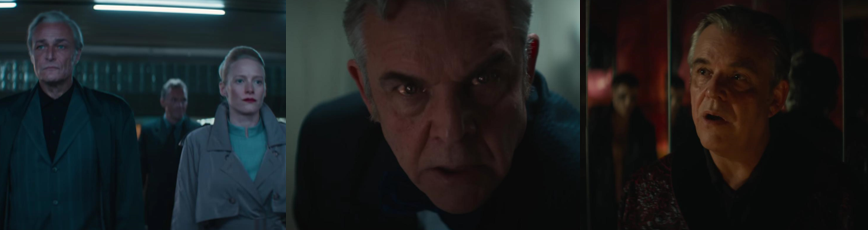
Probably the biggest sin of the film is it’s dull and forgettable villains.

Although he lacks any formal fighting training and is unfamiliar with guns, Eric attempts to outfit himself and largely holds his own in a fight by relying on his supernatural healing. He simply ploughs ahead, absorbing damage and enduring the pain of resetting broken bones or healing from wounds. This time around, he remains virtually indestructible as long as his love for Shelly remains pure. While I would’ve expected this to factor into the finale, rendering him mortal as in previous iterations, this becomes a throwaway moment in the second act, when his belief in Shelly falters after watching her video and he dies a second time, forcing him to barter his soul for hers to return once again, finally donning a version of the iconic face paint and committing himself to his mission. This turns him from a melancholy, reluctant avenger to a stoic, enraged crusader as he systematically slaughters a bunch of goons with a sword, cutting his way through a wave of nine-to-fivers to reach Marian, who finally points him in Roeg’s direction. It’s hard to watch The Crow without comparing it to The Crow, but one area where it really fumbles the ball is in the bad guys. Instead of an eclectic bunch of over the top, memorable, despicable glorified street punks, we have a handful of unnamed goons who get so little screen time that I found myself forgetting which ones were responsible for Eric and Shelly’s death. The only one who stands out is Marian and, again, I have no idea who she is or what her motivations are. Roeg’s power is said to manipulate, corrupt, and control, so I assume they all follow him out of a desire for power or because he has leverage over time, but we learn nothing about any of them. They’re just people for Eric to kill, and while he may gain some catharsis and satisfaction from their deaths, I was briefly entertained by the blood splatter and then immediately forgot them. The exception, of course, is Roeg, played with quiet menace by the ever-reliable Danny Huston. He’s said to be centuries old, to have made a deal with the Devil, and corrupts innocents to keep himself out of Hell but…we never learn how this deal came about or anything about him except his predication for young piano players. He desires Eric’s powers, of course, and seems to covet power in general over everything else, but he’s such a vacuous and forgettable character compared to Michael Wincott’s Top Dollar and none of his underlings were as memorable as the latter’s gang of sadists.

The Nitty-Gritty:
As is to be expected, a central theme of The Crow is love. Eric and Shelly are both damaged and lonely individuals, one seemingly tortured by an abusive childhood and the other forced into horrendous acts against her will. Shelly apparently sees a reflection of herself in Eric, or perhaps feels whole with his damaged parts literally and figuratively filling the void in her soul, and they’re portrayed as carefree youngsters who live outside the system. Yet, while they may make for passionate lovers, I never felt like their love was anything more than the fiery lust of the young and attractive. Draven and Webster were a proper couple, set to be married, when they were killed, having built a life together filled with passion, fashion, and music. Eric and Shelly get drunk and high and doss about with their mates. Considering the threat Shelly knows Roeg represents, it seems weird to me that they didn’t go on the run and stayed not only in town but in her apartment; almost as weird as Roeg not sending his men there right away. Eric is especially disappointing; even if he’d had a different name so as not to be associated with Brandon Lee’s character, he’s such a sulky little emo try-hard, with his “edgy” tattoos and lethargic attitude, that I found it hard to care about him. He has none of Draven’s charisma or concern for others; he’s purely motivated by his emotions, slaughtering anyone in his way and struggling to understand what’s going on. He’s a very ineffectual avenger, something Kronos chastises him for, until the finale, where he finally accepts the responsibility placed on him and comes close to giving a decent interpretation of the character. Similarly, the soundtrack is noticeably lacking; sure, I’m an old man who isn’t into the weird tunes featured in this movie, but the lack of emo-infused, gothic rock and traditional heavy metal really works against the aural identity of the film as much as the bland setting keeps it from standing out visually.

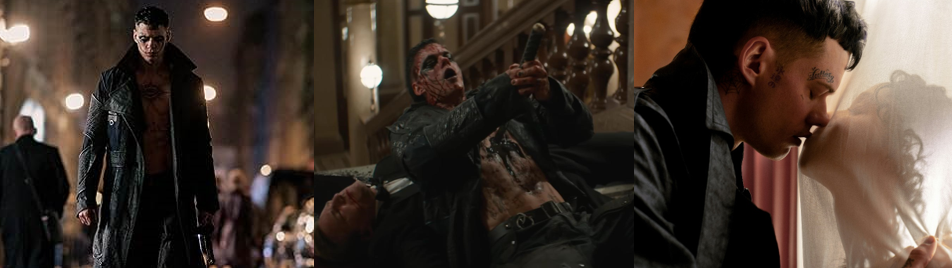
By the time Eric embraces his mission, it’s too little, too late for this snooze-fest.

So, okay, maybe The Crow makes up for all this with action and gore. Well…no. yes, there is a lot of blood splatter and some creative, gory kills (certainly more than in the original film) but they’re not seen until the final act. Eric and Shelly are killed in a terrifying, but toothless manner compared to their counterparts and many of Eric’s later kills boil down to headshots and quick swipes of his sword. The opera slaughter (easily the best sequence in the film) is thus a highlight, with Eric cutting through waves of henchmen, slicing off arms, cutting through jaws, and absorbing every shot like a juggernaut, revelling in his bloodlust. His earlier freeway fight was okay, but lacked the focus and physicality of this scene, though naturally none of the antagonists offer a physical challenge to him given his supernatural abilities. There was a brief moment where this seemed to be a point of contention: Marian mentions how Eric, covering in the blood of his victims, has “the same look” as Roeg and Roeg explicitly states that Eric’s lust for revenge has cost him his humanity. Then it’s just swept under the rug and forgotten. Similarly, it seems Roeg is set to follow in Judah Earl’s (Richard Brooks) footsteps and steal Eric’s power using a combination of his demonic voice and Eric’s “black blood”, but that doesn’t happen either. Instead, Eric transports them to the crow’s realm and beats the old man to a pulp until he’s spirited away by demons. As per his deal, Shelly is returned to him and to life, with time apparently rewinding slightly to see her resuscitated soon after being suffocated. Eric remains dead, but seemingly chooses to wander purgatory, halfway between life and death, sure that their souls will reunite someday. Honestly it’s a bit of a confusing ending; almost as confusing as Roeg’s powers and background. Personally, I’ve always disliked that the Crow franchise has included other supernatural elements as they’ve progressed; to me, the avatar should be the only supernatural thing, set against earthly beings who must find other ways to combat him. But then again I also think The Crow is worthy of being more than just a plodding, generic, confuddled mess of a film. A sentiment Hollywood seems not to share.

The Summary:
I wanted to bee excited for The Crow. I genuinely believe a new version or adaptation of the story or concept could work, especially if it took a hyper-stylised or gritty, gothic aesthetic. Instead, The Crow is as generic as I feared and, I suspect, spent way too much time overthinking the concept. We didn’t need everything explained to us by Kronos and, arguably, we gained very little from following Eric and Shelly up to and past their deaths. I didn’t feel an emotional connection to them and, trust me, I wanted to. I kept waiting, begging, for the film to kick into gear and get started only for it to keep dragging its feet, giving us mopey emo-dude looking clueless when the obvious happens around him or is explained to him. For me, he should’ve taken on the familiar guise after his second resurrection and been all-in from there. I also wonder if the film would’ve been fitted from being told out of sequence, with the relationship aspects scaled down and reduced to nightmares and flashbacks. Also, the villains just missed the mark completely. There’s only so much Danny Huston can do with such limited screen time and development, and none of his underlings were as remotely memorable as those seen before. Even the brutal action sequences and copious blood can’t save The Crow, which is so far away from the spirit of the original that I wouldn’t call this a remake or a reboot, more a re-imagining. It’s a real shame as we’ve endured so many terrible Crow sequels and the concept deserves so much better, but do yourself a favour and just watch the original again because this tripe is as dull as dishwater and, worst of all, completely and immediately forgettable.

My Rating:

Rating: 1 out of 5.

Terrible

Did you enjoy The Crow? Do you think the film added some interesting new wrinkles to the formula or did you find it generic and tasteless? What did you think to Bill Skarsgård’s performance and Eric’s characterisation? Did you like the addition focus on his relationship with Shelly? What did you think to Roeg and his largely forgettable henchmen? Which of The Crow’s sequels was your favourite, if any, and would you like the see the character return again? Whatever you think about The Crow, join the discussion below and go check out my other Crow reviews.

Screen Time [Sonic CDay]: Sonic the Hedgehog: “Blast to the Past” (S2: E17/18)


Developed alongside the blockbuster Sonic the Hedgehog 2 (SEGA Technical Institute, 1992), Sonic the Hedgehog CD (Sonic Team, 1993) released on this day back in 1993. Expanding upon the Blue Blur’s debut title, Sonic CD introduced Metal Sonic (one of Sonic’s most popular and enduring rivals) and Amy Rose, and is considered by many to be one of the best of the classic Sonic titles.


Season Two, Episode 17 and 18:
“Blast to the Past”

Air Date: 1 October 1994 and 8 October 1994
Director: Ron Myrick
US Network: ABC
UK Network: Channel 4
Stars: Jaleel White, Kath Soucie, Jim Cummings, Tahj Mowry, Lindsay Ridgeway, Tim Curry, and William Windom

The Background:
Sonic the Hedgehog took the videogame industry by storm thanks to SEGA’s aggressive marketing campaign. Sonic the Hedgehog (Sonic Team, 1991) was a huge success and Sonic’s popularity exploded after the release of Sonic the Hedgehog 2. Suddenly, Sonic was everywhere: not only was he included in the Macy’s Day Parade but he also made the jump to television with two concurrent cartoons. After seeing the success that DiC Entertainment had producing cartoons that were effectively little more than half-hour advertisements for Nintendo’s videogames, SEGA of America partnered with DiC to develop an animated series for their super-sonic mascot. To help sell their pitch to ABC, DiC signed Jaleel White for the title role but ABC believed their original slapstick pitch was unsuitable for a Saturday morning slot. Undeterred, producer Robby London simply developed an entirely separate Sonic cartoon for the prime Saturday morning slot, giving audiences two very different Sonic cartoons, each with their own tone and animation style. While Adventures of Sonic the Hedgehog (1993; 1996) emphasised over-the-top, memeworthy, slapstick humour, Sonic the Hedgehog (or “SatAM”) was a far darker take on the franchise. Though both cartoons awkwardly collided when Archie Comics published Sonic comic books, the majority of Adventures’ influence was eventually stripped away in favour of those from SatAM and Adventures is generally regarded less favourably than its darker counterpart. For many, SatAM was a defining aspect of their childhood and impressed with its more mature themes. Although it exhibited only questionable fidelity to the source material, SatAM did, occasionally, include elements from the videogames, with this two-part story being one of the most notable examples.

The Plot:
In a bid to stop Doctor Robotnik (Cummings) from conquering the Planet Mobius, Sonic the Hedgehog (White) and Princess Sally Acorn (Soucie) use the legendary Time Stones to travel back in time, only for an error to land them right in the middle of the dictator’s life-changing coup d’état.

The Review:
When I was a kid, I used to watch Adventures of Sonic the Hedgehog religiously. Every Sunday morning (as I recall; it might’ve been Saturday…), I would sit and watch it, usually record it, and delight in seeing Sonic’s slapstick antics. Then, one morning, something was different. The entire tone and cast of the show had changed; suddenly, Sonic wasn’t dressing up in ridiculous costumes and acting like a super-fast version of Bugs Bunny (Mel Blanc/Various) and Dr. Robotnik (Long John Baldry) wasn’t a comical, bumbling buffoon. Instead, Sonic was the point man in an outnumbered resistance movement against a far darker, semi-cybernetic dictator. Miles “Tails” Prower (Christopher Stephen Welch; Bradley Pierce) was completely absent in the first episode I watched, “Sonic Boom” (Sebast, 1993), and the bright, zany world of Adventures was replaced with a grim, polluted hellhole. It was a jarring change for me, but I loved Sonic so I quickly adapted. It helped that SatAM opened with an absolutely jamming theme song and that a lot of its presentation was very close to what was happening in Sonic the Comic (1993 to 2002) at the time, and that the visual style of the show and Sonic’s battle against this far more malevolent Dr. Robotnik were so compelling.

Desperate to defeat Dr. Robotnik, Sonic and Sally seek out the legendary Time Stones.

Although SatAM’s second season would later include concurrent narratives, and there was always an ongoing theme of the Knothole Freedom Fighters desperately opposing Dr. Robotnik’s regime, “Blast from the Past” is the only two-part story arc in the series. The first part opens, as many episodes do, with Sonic, Sally, and some unnamed Freedom Fighters on a covert mission in the polluted hellscape known as Robotropolis. Although a brash and reckless egomaniac, Sonic is instrumental to the Freedom Fighters; he’s classified as “Hedgehog: Priority One” by Dr. Robotmik’s SWATbots (Frank Welker), which immediately deviate from their regular patrols to chase him. While this creates enough of a distraction for their unnamed allies to sabotage Robotropolis’s main power grid, their friends are captured and taken to Dr. Robotnik’s citadel, and summarily roboticized. Although the jovial dragon Dulcy (Cree Summer) tries to alleviate the guilt Sonic and Sally feel for this loss by pointing out that all the planning and moxie in the world can’t oppose Dr. Robotnik’s resources or malice, Sonic can’t help but wish they’d fought back harder when Dr. Robotnik first took over, even though they were only five years old back then. Dulcy suggests that they use the legendary Time Stones to travel back in time and fulfil this wish. Sceptical, an exasperated Sally initially shoots down the plan as she believes the Time Stones and their equally mythological home, the Floating Island, are nothing more than a fantasy, to say nothing of the moral and scientific dangers of violating the time stream. However, Sally reluctantly agrees when the clumsy Dulcy reveals that she once crashed into the Floating Island, but she remains sceptical until Dulcy braves a tumultuous storm and crashes the three on the fabled island. Rather than being home to Knuckles the Echidna and the Master Emerald, the Floating Island is represented as a much smaller land mass that houses an ornate palace guarded by two stone gargoyles. Sonic outraces the guardians and causes them to vanish by running himself and Sally off the island. After being rescued by Dulcy, the two enter the palace and navigate a confusing M. C. Escher-esque labyrinth before being confront by the owl-like Keeper of the Time Stones (Curry). Despite Sonic’s blockheadedness, Sally solves the Keeper’s riddle (the answer is “time”) and the Keeper explains how to use the Time Stones’ power.

Unfortunately, Sonic and Sally are too late to stop Dr. Robotnik enacting a destructive coup d’état.

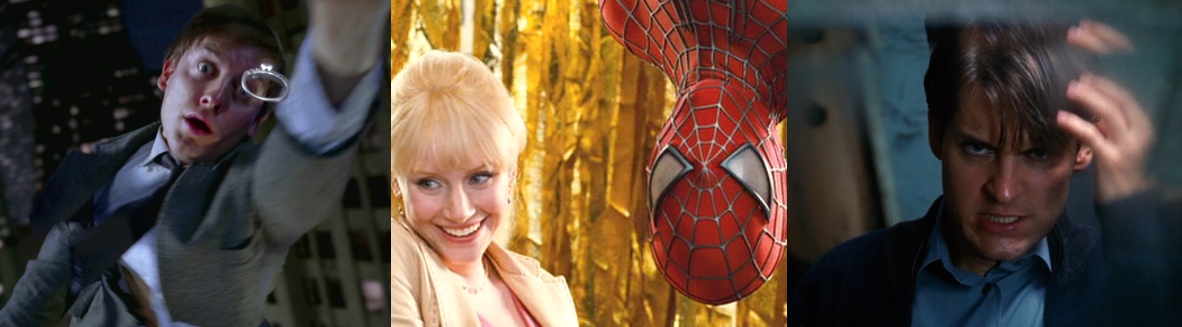
However, despite Sonic’s best attempts to focus only on the palace fountain in Mobotropolis circa 3224, his mind wanders to chili dogs, throwing off their arrival. The two are overwhelmed to find their home lush and verdant and alive, but even more stunned when their younger selves (Mowry and Ridgeway, respectively) wander by. It turns out that Sonic never really grew out of his childish, arrogant ways as his younger self delights in gobbling down chilli dogs and boasting of his super speed, much to the chagrin of the younger princess. Sonic and Sally go straight to Sonic’s beloved uncle, genius inventor, and loveable father-figure Sir Charles “Chuck” Hedgehog (Windom) and reveal the impending threat to the city. Back in this time, Sally’s father, King Maximillian Acorn (Curry), ruled a thriving, technologically robust city thanks to support from his Grand Vizier, Julian. Julian helped Mobotropolis win the “Great War” with his machinery, earning him a promotion to Minister of Science, though he secretly conspires with his long-suffering nephew, Snively (Charlie Adler), to take over Mobotropolis using not only the decommissioned war machines but Uncle Chuck’s Roboticizer machine. As shocked as Sonic and Sally are to discover that Uncle Chuck invented the nightmarish device, Uncle Chuck is horrified to learn this his invention (which was created to help old people “live longer”) is to be perverted into a tool for evil. Although they initially stay avoid their younger selves, they inevitably meet; introducing themselves as “Alicia” and “Juice” and presented as distant cousins, the Sallys despair of their childish antics and Sonic is stunned to find that his younger self is actually faster than him! However, their fun is interrupted by the realisation that they’ve arrived on the eve of Julian’s destructive coup d’état. Uncle Chuck has Sally’s nanny, Rosie (April Winchell), take the kids to safety in Knothole then introduces Sally to her father. Understandably emotional given that her father has been trapped in the “Void” for most of her life, their heartfelt reunion convinces King Acorn to trust Uncle Chuck’s warnings about Julian. Unfortunately, they’re too late to intercede; Julian reprograms the city’s robotic defences to recognise his commands and sends them to capture the inhabitants, including the young Sonic and his friends, before storming into the king’s throne room. Now garbed in his iconic red outfit, Julian rechristens himself Doctor Robotnik, and Mobotropolis “Robotropolis”, much to the anger and horror of Sonic and his friends.

Although they humiliate Snively, Sonic and Sally are faced with a race against time to salvage the timeline.

After a brief recap, part two picks up with Uncle Chuck disabling the SWATbots and causing a distraction so that Sonic can speed Sally to safety. However, they’re quickly imprisoned alongside their younger counterparts and forced to watch from their cell as Dr. Robotnik’s massive mechanical blimp, the Destroyer, spreads a polluting cloud over Mobotropolis that instantly kills all plant life, transforms the once idyllic landscape into a mechanical hell, just like before. Thanks to the schematics of Dr. Robotnik’s citadel on her pocket computer, Nicole (Soucie), Sally directs Sonic in burrowing them to safety, though Dr. Robotnik arrogantly dismisses the potential threat since he’s already imprisoned 80% of the population. Unfortunately, Sonic and Sally are too late to save their younger selves; since their very existence is threatened by this, the two buy themselves some time by having Nicole cause a brief power outage in the Roboticizer. To amuse himself in the meantime, Dr. Robotnik takes great pleasure in banishing King Acorn to the Void, an extradimensional portal where he once banished his rival, the sorcerer Ixis Naugus (Michael Bell). Luckily, the power outage allows Sally to download the machine’s schematics for future reference, but things are exacerbated when they spot the Destroyer heading for the Great Forest and threatening Knothole and, once again, their futures. Faced with a ticking clock, the two blast away to intercept the Destroyer, earning Snively’s ire by stripping him of his hair with a sonic boom and briefly stopping to rescue Dulcy’s mother, Sabina, from Dr. Robotnik’s forces.

Although they fail to save Mobius, Sonic and Sally’s jaunt isn’t a total loss and renews their fighting spirit.

Using a Power Ring for a speed boost and his anti-gravity sneakers, Sonic rockets himself and Sally up to the Destroyer, where even Sonic’s breezy demeanour is strained by Dr. Robotnik’s inexhaustible forces. Luckily, Sabina fends them off and brings the Destroyer crashing to the ground, so Sonic and Sally race back to Robotropolis to save their younger selves. Sadly, Sonic fails to prevent his defiant uncle’s roboticization, meaning his younger self has to endure the horror of watching the only family he has be transformed into a mindless robotic slave, though Sonic assures the grieving boy that Uncle Chuck will be restored in time. Sonic and Sally get the kids to safety and, in the process, Sonic earns Dr. Robotnik’s boundless fury by not only mocking and defying him, but also roboticizing his left arm. After teaching the younger Sonic a thing or two about trashing robots, the kids are brought to Rosie and spirited to the safety of Knothole. Before she goes, Sally makes Rosie promise to never leave the village to avoid her becoming another of Dr. Robotnik’s minions in the near future. With Dr. Robontik’s full force closing in, Sonic and Sally use the Time Stones to return to the future, infuriating the newly-crowned dictator. Although Sonic believes the entire escapade was a waste of time since they never changed the past like they intended, Sally is bolstered by the odds now that they have the Roboticizer plans, and Sonic is left nursing a migraine when he tries to understand how Rosie is still in Knothole…despite being right there when Sally told her not to leave.

The Summary:
I’ll be the first to admit that reviewing “Blast to the Past” as an adaptation of Sonic CD is a bit of a monumental stretch. To be honest, the tangential link was enough of an excuse for me to talk about SatAM, one of a handful of cartoons that defined my childhood. While, on the surface, there doesn’t appear to be much of a relation between the two, they actually have a fair amount in common: obviously, the Time Stones appear (though in a vastly different format) and Sonic travels through time (again, in a very different way to Sonic CD), but there’s also shared themes of pollution and time paradoxes at work in the episodes. Sonic and Sally travel to the past, where Mobius and Mobotropolis especially were free from pollution and war, in an attempt to stop Dr. Robotnik before he can rise to power. When they fail in this endeavour, the once lush and thriving landscape becomes a dark, grimy, mechanical hellhole (a “Bad Future”, if you will) and we clearly see the consequences of their time travel onscreen just like in Sonic CD’s gameplay. Again, that might seem like a stretch, but you have to remember how few inspirations SatAM took from the source material. While I was disappointed that we never got Knuckles, the Chaos Emeralds, Metal or Super Sonic in the series (especially the first two in these episodes), it was still fun to see gameplay elements adapted to fit the context of this dark and mature series.

While things get very bleak very quickly, the time travel plot showcases our hero’s vulnerable sides.

“Blast from the Past” is easily one of the strongest arcs of SatAM. For the first time, we get to see what life was like before Dr. Robotnik took over. We’re so used to seeing Knothole and the Great Forest being the one bastion of nature in an otherwise ransacked, almost post-apocalyptic world that it’s extremely poignant to see Sonic and Sally react in awe when they walk the streets of the thriving Mobotropolis once more. The episodes give both characters a chance to show some vulnerability; this wasn’t uncommon in SatAM given how bleak their situation was, but it’s heart-warming (and breaking) to see Sonic reunited with his unroboticized uncle and Sally finally reunited with her beloved and long-lost father. It was also quite fun seeing Sonic and Sally interact with their younger selves; their personalities haven’t changed much over the years, with Sonic being impulsive and Sally being more restrained, but the younger Sonic makes an impression by outpacing his elder (and even referring to Sonic as “old”) and breaking down in tears when his cherished uncle is roboticized before his eyes. Although characterised as a brash, headstrong, and snarky speedster, Sonic showcased some surprising emotional depth in SatAM and “Blast to the Past” emphasises that beautifully. We see his anger at Dr. Robotnik’s heinous actions, his desperation to save the future, and the guilt he feels at having potentially screwed up their best chance of saving the world before it goes to hell. Although functionally unstoppable and capable of physics-bending feats, Sonic isn’t beyond fatigue or weakness. Mainly, this is realised in his inability to sit still, focus, or think of or work to a plan, which is why he and Sally work so well together as she does the thinking and he does the fighting (though she’s perfectly capable of holding her own in a pinch, too).

Dr. Robotnik is at his most malicious in SatAM and this two-parter showcases his rise to power.

As ever with SatAM, the star of the show is the reprehensible Dr. Robotnik. Never before or since has the rotund dictator been portrayed as such a malevolent and spiteful force (well, maybe in Sonic the Comic and obviously in the Archie comics…). SatAM-Robotnik was a serious threat, even when he was doing more comical stuff or being humiliated by his foes. Thanks to his incredible resources and relentless craving for power and conquest, Dr. Robotnik delights in subjecting his captives to the Roboticizer and turning them into his mindless, obedient slaves. Abusive towards his long-suffering nephew, Dr. Robotnik cares only about himself and his insane lust for power. Despite his prominent position of trust and authority alongside King Acorn, Dr. Robotnik has grander designs for himself and easily takes what he wants by force, without any real resistance. This oppressive, suffocating malevolence makes battling Dr. Robotnik an uphill, almost unwinnable battle even when Sonic has the speed and power advantage, and even time on his side as in this two-parter. Ultimately, Sonic and Sally’s efforts to prevent Dr. Robotnik’s coup d’état are met with failure but they are bolstered enough to continue fighting after remembering what they’re fighting for. While Rosie ironically didn’t actually show up in future episodes, “Blast to the Past” led to the creation of the De-Roboticizer and the Freedom Fighters’ attempts to restore Dr. Robotnik’s victims to normal. So, yeah, while it may have almost nothing to do with Sonic CD and vastly reimagines the Floating Island, “Blast to the Past” is still an enjoyable and significant two-part arc. SatAM remains one of the most influential Sonic canons and is still heralded as one of the best cartoons of the nineties. While it wasn’t exactly true to the source material and has, in my view, since been surpassed, I can’t deny my love for the series, especially darker and more introspective episodes like these two, so I’m always happy to return to the series and relive my youth.

My Rating:

Rating: 4 out of 5.

Great Stuff

Did you enjoy “Blast to the Past”? Were you disappointed by how few elements from Sonic CD were present in the story or were you just happy to see videogame elements incorporated into SatAM? Did you enjoy SatAM as a kid? What did you think to the depiction of Dr. Robotnik’s rise to power? Which of SatAM’s original characters was your favourite and what did you think to Sonic’s characterisation in the show? How are you celebrating Sonic CD’s anniversary this year? Whatever your thoughts on Sonic CD, or SatAM in general, feel free to leave a comment below or on my social media.

Movie Night [Spidey Month]: Spider-Man 3


Easily Marvel Comics’ most recognisable and popular superhero, unsuspecting teenage nerd Peter Parker was first bitten by a radioactive spider and learned the true meaning of power and responsibility in Amazing Fantasy #15, which was first published in August 1962. Since then, the Amazing Spider-Man has featured in numerous cartoons, live-action movies, videogames, action figures, and countless comic book titles and, in celebration of his debut and his very own day of celebration, I’ve been dedicating every Tuesday of August to talk about everyone’s favourite web-head!


Released: 4 May 2007
Director: Sam Raimi
Distributor: Sony Pictures Releasing
Budget: $258 to 350 million
Stars: Tobey Maguire, Kirsten Dunst, James Franco, Thomas Haden Church, Topher Grace, and Bryce Dallas Howard

The Plot:
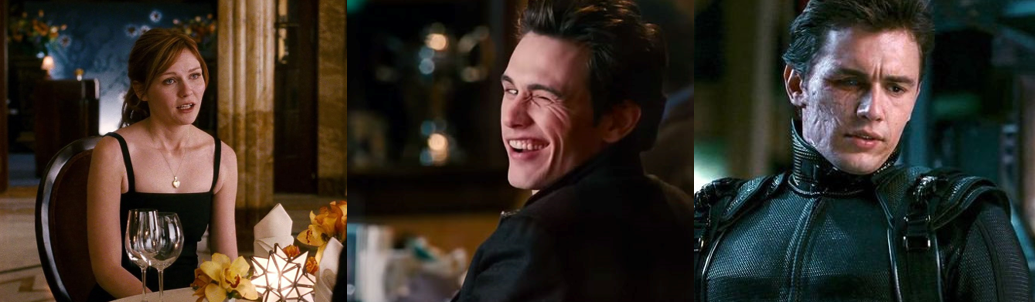
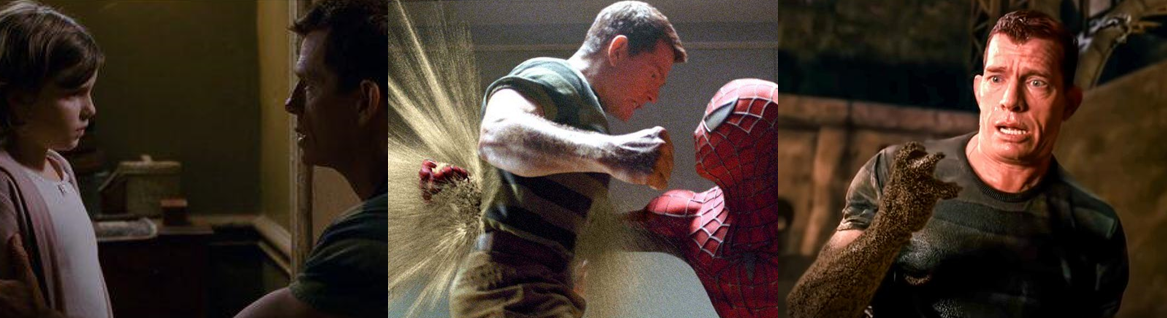
Having finally gotten the girl of his dreams, Peter Parker (Maguire) finds his life on the upswing, but an attack by vengeful Harry Osborn (Franco), and the discovery that recently-superpowered thief Flint Marko (Church) killed his beloved uncle see Peter giving in to the power and allure of a mysterious black suit from space.

The Background:
Following his debut issue becoming one of Marvel’s best selling titles at the time, Spider-Man’s popularity saw him become their flagship character. Soon, the wall-crawler fronted numerous team-up comics, videogames, cartoons, and even a live-action series. Although his cinematic debut was constantly delayed by script and legal issues, Sam Raimi and Sony Pictures Entertainment landed a critical and commercial success with Spider-Man (Raimi, 2002) and followed this two years later with Spider-Man 2 (ibid, 2004), which is widely regarded as one of the greatest superhero movies ever made. There was never any question that a third film would follow and Raimi initially planned to explore Peter’s morality, the humanity of his villains, and themes of forgiveness; However, his wish to cast Ben Kingsley as Adrian Toomes/The Vulture was blocked by producer Avi Arad, who insisted that the more popular Eddie Brock/Venom be included instead. Although Raimi was initially hesitant, he acquiesced after relating to the character as a dark mirror of Peter, but soon found his script so bloated that he initially toyed with filming two films back-to-back. Spider-Man 3 upped the ante for its special effects; painstaking hours went into crafting the scene in which the Sandman reconstitutes himself, an amputee stuntman was brought in to bolster Spidey’s fight with the Sandman, and Spidey’s iconic black suit was redesigned to emphasis it corrupting his morals. Although it was the most financially successful of Raimi’s Spider-Man films, Spider-Man 3 divided critics; while reviews praised the action and drama and the mixture of humour and visual spectacle, many felt the film was overstuffed with villains and failed to live up to the expectations set by its predecessors. Though accompanied by a comic book tie-in and videogame adaptation, Spider-Man 3 would mark the end of Raimi’s time with the web-slinger. Although plans for a fourth film got as far as casting and storyboarding, they were ultimately scrapped in favour of a complete reboot, though Tobey Maguire and Thomas Hayden Church would later reprise their roles nearly twenty years later for the multiversal epic Spider-Man: No Way Home (Watts, 2021).

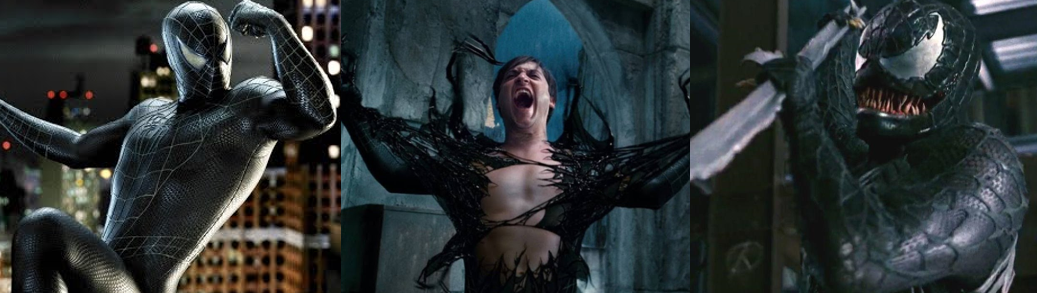
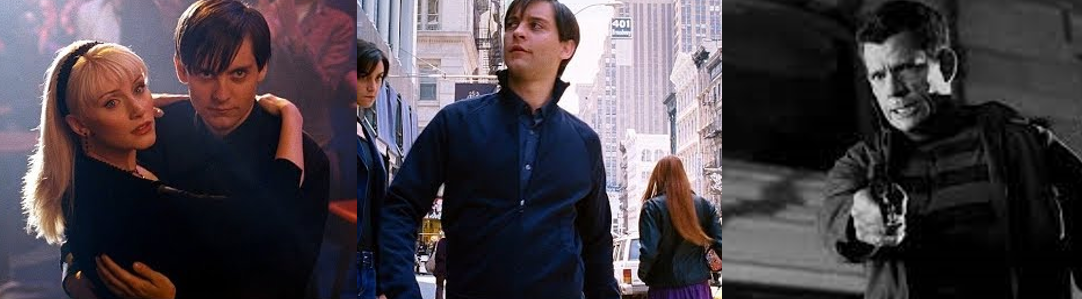
The Review:
These days, with superhero films dominating the box office, many of them involving one or more heroes teaming up and a variety of villains, it’s easy to forget both the impact that Sami Raimi’s first two Spider-Man films had and state of the genre back in 2007. Superhero films were cropping up more and more and they didn’t always stick the landing; often, they struggled with too many villains, a lack of fidelity to the source material, or just being a bit of a tonal and narrative mess as studios tried to cash-in on the success of Raimi’s films and 20th Century Fox’s X-Men movies (Various, 2000 to 2020). Still, anticipation was high for Spider-Man 3; Spider-Man 2 was well-regarded as one of the best superhero movies ever made and it ended with a lot of plot threads to carry over into the third film, primarily the inevitable clash between Peter and Harry and the question of whether Mary-Jane Watson/M. J. (Dunst) was truly ready to accept the responsibility of being Spider-Man’s girlfriend. Unfortunately, little else from Spider-Man 2 directly carries over to Spider-Man 3 and this is made evident right from the opening titles, which barely feature Doctor Otto Octavius/Dr. Octopus (Alfred Molina) or any plot points from the second film beyond those that involve Peter, Harry, and M. J. Regardless, things get off to a decent start; the tension between Peter and Harry is emphasised in the reveal that Harry not only stalks Peter at every opportunity but refuses to listen to his explanations regarding the death of his father, Doctor Norman Osborn/The Green Goblin (Willem Dafoe). Although Peter doesn’t really make that much of effort to absolve himself of Norman’s murder, Harry’s mind is clouded by rage and stubbornness, which directly lead to him subjecting himself to a version of his father’s Goblin formula to give him the power to go toe-to-toe with his former friend.

Peter’s attempts to propose are interrupted by his inflated ego and the influence of his black suit.

For Peter, life is pretty good; he’s finally found a balance between his dual identities, or at least feels less conflicted now that he has M. J.’s full support. It’s not made clear how much time has passed between the two films (honestly, given how well the actors have aged and the way Peter and Harry treat each other, it feels like it could only be a few weeks) but Peter’s so at peace with himself and the world that he plans to propose to M. J., despite him still living in a crummy apartment and being stiffed on his wages by the cantankerous J. Jonah Jameson (J. K. Simmons). After receiving his Aunt May’s (Rosemary Harris) blessing, Peter heads out to seal the deal, only to be suddenly attacked by Harry, how sporting sleek, Goblin-inspired armour and weapons of his own. Peter battles this…*sigh*…“New Goblin” through the city skies but is both horrified and relieved when Harry takes a nasty bump to the head and recovers with no memory of Spider-Man’s true identity. This brings even more joy to Peter’s life as he rekindles his brotherly relationship with Harry and basks in the adulation of the city as Spider-Man. In fact, Peter’s so blinded by his own success and happiness that he fails to notice that he’s being a bit self-absorbed and that M. J. is having her own issues, faults that cause him to make the bone-headed mistake of kissing Gwen Stacy (Howard) in front of an adoring crowd and completely disregarding M. J.’s struggles to make it as a successful Broadway actress.

Peter’s relationships suffer because of his actions, leading to a brutal brawl with his former best friend.

Despite the fact that she made it into the cast, to the point where she received top billing, M. J.’s producers aren’t happy with the reviews about her performance and summarily drop her from the play, rattling her confidence and digging up bad memories of her childhood under her abusive father. Although she tries to confide in Peter and understand that his superhero commitments make him very busy, a rift forms between them when Peter fails to recognise how upset she is and keeps focusing on his own success. This scuppers Peter’s carefully-planned proposal dinner and drives M. J. to seek comfort from Harry, who’s only too happy to make time for her now that he’s rediscovered his carefree personality. They grow so close that they even share a brief kiss, though M. J. quickly comes to her senses and leaves before anything else can happen. This humiliation is enough for Harry’s mind to snap once more; visions of his dead father restore his memories and he resumes his vendetta against Spider-Man. He targets M. J. and blackmails her into breaking up with Peter, breaking his heart, and then twists the knife in further by insinuating that he and M. J. are having a love affair. Although Harry plays this conniving, manipulative role well, he can’t resist revelling in Peter’s anguish, meaning Peter immediately figures out that Harry has been using M. J. against him but, by that point, Peter is not only consumed by rage and ego but also fuelled by the negative impulses of his black suit. When Peter confronts Harry in the Osborn home, a brutal fight to the death breaks out between them; previously, Peter simply tried to avoid and quell Harry’s rage but, this time, he unleashes the full extent of his power and easily manhandles his former friend. Stubborn to the last, Harry attempts to blow Peter up with a pumpkin bomb, only to have the explosive tossed back in his face, permanently scarring him and leaving him an embittered recluse.

The Sandman might do bad things with good intentions but his mistakes raise Spidey’s ire.

Peter’s good mood is shattered when he and Aunt May are randomly called into the office of police captain George Stacy (James Cromwell) and told that they’ve been sitting on evidence for the last few years that proves thief Dennis Carradine (Michael Papajohn) didn’t killed Peter’s beloved Uncle Ben (Cliff Robertson). Instead, Carradine is retroactively revealed to have been working with a partner, Flint Marko, who recently (somehow…) escaped from jail. Peter had already had a run-in with Marko not long before this, but by that point the crook had already conveniently fallen into a random particle accelerator and been molecularly altered into a living man of sand. Now able to shift and alter his appearance at will, becoming almost intangible and rock-hard, the Sandman easily robs armoured cars to steal the cash he needs to help his critically ill daughter, Penny (Perla Haney-Jardine), as well as fend off Spider-Man when he inevitably arrives to stop him. Now armed with the knowledge that the Sandman killed his uncle, Peter seethes and obsesses over tracking down the thug and make him pay out of a combination of guilt over the death of both Uncle Ben and Dennis Carradine and the aggression encouraged by his mysterious black suit. Although generally a sympathetic and reluctant villain in the comics, the Sandman is reconfigured into a tragic figure here; he’s painted as a good man driven to crime and hampered by poor choices, and carrying a sense of guilt and responsibility over the evils he’s done and his love for his sick daughter. However, Peter has little time for the Sandman’s sob story and willingly succumbs to the black suit’s influence when they fight in the New York subway. Spider-Man angrily confronts the Sandman over his murderous actions and attacks without quarter, eventually dissolving him into a gloopy, muddy mess with a dismissive “Good riddance!” As if this battle didn’t hammer it home enough, Peter’s discussion with Aunt May reveals that he fully intended to kill the Sandman to make him pay for what he’d done. However, despite being heartbroken by Ben’s loss, May makes it clear that revenge is never the answer and lays the groundwork for Peter finding the courage to forgive the Sandman for his misguided actions.

Peter’s personality is corrupted by the symbiote, which finds a willing host in demented Eddie Brock.

That takes a bit of time, though, as Peter is under the poisonous influence of a mysterious alien goo that randomly (and conveniently) crashed to Earth right by his scooter. Latching on to him in the midst of a terrible nightmare, the viscous substance (later identified by Doctor Curt Connors (Dylan Baker) as a “symbiote”) turns Peter’s colourful costume a deep black and enhances his abilities considerably, granting him a strength and sense of exhilaration beyond his usual web-slinging. However, it also feeds and enhances his negative emotions; anger, fear, and aggression are all heightened by the creature, but Peter is so captivated by the allure of the black suit that he can’t deny himself its power when he gets a lead on the Sandman. Like an addict who doesn’t know when to quit, Peter wears the black suit under his clothes, caressing and stroking it, and even alters his appearance to match the sense of confidence and power the suit inspires in him. After his confrontations with Harry and the Sandman, Peter fully gives in to this rush, parading himself down the street like a dork and believing he’s God’s gift to the world. He all-but-demands a permanent position at the Daily Bugle, takes Gwen to a jazz bar and performs an elaborate dance number to make M. J. jealous, and angrily confronts rival photographer Edward “Eddie” Brock Jr. (Grace) over his doctored pictures of Spider-Man. However, after lashing out at M. J. in a rage, Peter finally sees that the suit is turning him into a literal and metaphorical monster. Fleeing to a church, he tries to remove the suit and is shocked to find that it truly is a living organism. Although the symbiote desperately tries to defend itself, it’s driven off Peter’s body by the ringing of the church bell, leaving him guilt-ridden and despondent over his recent actions, but the creature finds itself a new host when it latches onto Eddie. A snivelling little creep of a man, Eddie is driven to begging the All-Mighty to avenge his recent slights after failing to win Gwen’s heart or cheat his way into a full-time job. This bitterness and borderline psychopathy is all the symbiote needs to birth the film’s third villain, a “strange black-suited figure” (because he’s never referred to as “Venom” onscreen), and immediately set about making Peter pay for his actions.

The Nitty-Gritty:
There’s a lot happening in Spider-Man 3; so much so that it’s difficult to watch and not think about how easy it would’ve been to streamline things. I get that Sam Raimi was basically forced to include Venom in the film and I can see how that might’ve clashed with his ideas for the final entry, but just doing another couple of script rewrites really would’ve helped tighten things up because, as is, there’s just too much crammed in here. This is one of the few times where I would’ve been happy to see the film split into two parts to actually do Venom justice, but a far easier solution would’ve been to omit Eddie Brock entirely and just have the symbiote attach itself to Harry. Yes, it goes against the comic lore, but I think it would’ve tied in perfectly with the film’s themes of obsession, revenge, and forgiveness. Plus, it’s not like the Venom mantle hasn’t been assumed by others before. I also think the Sandman should’ve either stayed dead after his fight with Symbiote Spider-Man or been revealed to be alive in a post-credits scene (either using him emerging from the sewer as seen in the film or by repurposing a cut scene with his daughter), which not only would’ve made the final fight between Spider-Man and Venom/Harry less of a cluttered mess but also would’ve shown that the symbiote’s influence had real consequences for Peter as he would’ve had to live with the guilt of killing another man (or, at least, assuming he had).

Some odd decisions, cringe-worthy scenes, and pointless retcons bog down an already bloated film.

However, there is a decent film in here somewhere, it’s just buried beneath odd decisions, bizarre sequences, and a whole mess of characters. Did we really need Gwen Stacy in this when she barely has any relevance to the plot, for example? She’s nothing like her comic book counterpart and is literally there to emphasise what a creep Eddie is. She doesn’t even have a rivalry with M. J. or factor into the climax, so it feels like she was shoe-horned in as fan service more than anything. Peter’s cornball demeanour once he gives into the black suit is also extremely cringey; many have come to defend this decision, claiming that Peter is living out his idea of what it means to be “cool” and I totally get that he would have this dorky perception of what’s “hip” and such. But it’s surreal to see him strutting down the street and then doing this cartoonish dance number in the jazz club that’s immediately juxtaposed with him smacking M. J. and being so wracked by guilt that he goes and broods in the rain on a church! Spider-Man 3 also commits the cardinal sin of retconning the character’s origin to awkwardly wedge Flint Marko in as the man who killed Uncle Ben. Just…why? People moaned to high heaven when this happened in Batman (Burton, 1989) and it just confuses things here. Spider-Man 3 has the perfect means to tell its story of forgiveness in the Peter and Harry story. It didn’t need to complicate matters by forcing a link between him and the Sandman, especially as Marko already had a perfectly understandable and relatable tragic motivation that’s barely touched upon no matter how many times he stares at that damn locket. And then there’s the weird side plot of Harry’s amnesia. Again, I get it, they wanted to show how deep the bond between Harry and Peter is and explore their relationship as brothers, but it just leads to more goofball scenes and unnecessary drama between Peter and M. J. I feel like a similar outcome could’ve been achieved by just having Harry play mind games with Peter throughout the movie, especially if he adopted some of Eddie’s comic book antics and used his knowledge of Peter’s identity against him. And don’t even get me started on this “New Goblin” crap. Just make him the damn Hobgoblin! They even made a damn mask!

Unfortunately, all the impressive visuals and action sequences can’t counterbalance the muddled plot.

Luckily, amidst all of this negativity, Spider-Man 3 has some of the best action sequences and special effects of the entire trilogy. The mid-air fight between Peter and Harry may suffer from a little too much obvious green screen, but it’s far more versatile and fluid compared to the battles between Spidey and the Green Goblin, which were a bit clunky and grounded at times. While I have little love for the Sandman and could take or leave his inclusion, he does allow for some more visually interesting fight scenes. Seeing Spidey punch right through Marko, blast him into particles, and be smashed by his rock-hard appendages makes for some fun sequences. Unfortunately, all this goodwill is undone in the climax where any personality and nuance the Sandman has is completely washed away as he adopts a gigantic, mindless, rampaging sand monster form that, while intimidating and a suitable escalation of his threat, pales in comparison to the surprising emotional depth he shows beforehand, particularly in the admittedly beautiful and heart-breaking scene where Marko first pulls himself together after his accident. As ever, the Spidey suit looks great but it looks even better in black. While I prefer the classic white logo for the symbiote suit, saving it for Venom was a great idea to help him stand out more (even if it doesn’t make much sense for him to randomly have a big-ass symbol) and I loved the twisted, torn webbing and claws used on Venom. Indeed, the fact that Venom barely appears in the film and only for the finale is a massive disservice to both the character and his look in the film. Venom may lack the bulk and plural identifiers, but he looks fantastic when he’s got his claws out and is adopting his ironic, drooling, fang-filled visage. As much as I rag on the film, I do enjoy the visuals of the climax; seeing the construction site covered in Venom’s twisted webbing, the monstrous Sandman looming, and Venom screeching and attacking from the shadows makes for a very different and intense finale. It’s just a shame it’s intercut with cringe-inducing performances from tertiary characters.

Through the sacrifice of his friend and letting go of his hate, Peter earns a bittersweet ending.

After shedding the symbiote, Peter is left trying to pick up the pieces of his fractured life; M. J. has rejected him and is ready to leave town, he’s tried to kill his best friend, and his reputation has been sullied somewhat by his poor decisions. Thankfully, Eddie easily tracks down the Sandman and convinces him to forge a partnership, one primarily based on Eddie avenging himself on Peter by humiliating him and taking away his true love. Unlike Peter, who realised the damaging influence of the symbiote, Eddie is only too happy to give into it’s power (“I like being bad. It makes me happy!”) and refuses to listen to reason since he’s so consumed by hatred and a twisted sense of injustice. Ultimately, he’s unable to resist the power and temptation offered by the symbiote and perishes (quite violently) in a grenade blast, a disappointingly weak ending for a disappointingly weak version of Venom. However, Eddie does leave a lasting impression on Peter by delivering a fatal blow to Harry, who heroically sacrifices his life to save his best friend. Unfortunately, as cool as it is to see Peter and Harry team up for the finale (and it really is an awesome feel-good moment with some great team-up attacks from the two), it comes after Harry’s entire philosophy and vendetta is reversed thanks to a pep talk by his family butler, Bernard Houseman (John Paxton), who decided to wait until the last minute to be honest. Although the result is seeing Harry and Peter set aside their differences and finally make peace as Harry dies in his friends’ arms, this random revelation really detracts from it and takes all the agency out of Harry’s character. The Sandman is equally rattled by all the death; he regrets his actions and tries to justify them, and it’s clear that a massive weight lifts from his shoulders when Peter forgives him (why he let him get away is beyond me, though). Unlike the last two Spider-Man films, Spider-Man 3 ends on an emotional note with Peter having learned valuable lessons about forgiveness and him and M. J. sharing an emotional embrace, apparently ready to start over, rather than ending on a high with the traditional final swing.

The Summary: 
Spider-Man 3 just can’t help but be a disappointment. There’s just way too much happening in it, too many missteps and odd decisions, and too much of that goodwill tossed aside to rate it much higher. It’s such a shame, too, as it could’ve been an emotional and intense finale to Sam Raimi’s trilogy if only another attempt had been taken at the script to tidy things up. I just can’t help but think it would’ve been so much better to drop Eddie Brock and have Harry become Venom as a nice compromise between the filmmakers because the desperation to do everything and please everyone just results in a disappointing effort. It’s doubly disappointing for me as I’m a huge Venom fan and Venom did look really fantastic for the few minutes he was onscreen, but they really deserved their own dedicated movie or to be incorporated better to justify including them. Although I didn’t really like the forced drama between Peter and the Sandman, I did enjoy how human and relatable Flint Marko was. Ultimately, though, he feels like a bit of an afterthought and the only reason you remember him is because they made an unnecessary retcon to the first film. The drama between Harry and Peter was honestly strong enough to carry the entire film but it’s lost between all the other moving parts and has its legs completely cut out from under it by the amnesia side plot and that damn butler! Sadly, all the effects and impressive visuals in the world can’t salvage this film, which will forever go down as one of the genre’s biggest missed opportunities no matter how hard people try and defend it.

My Rating:

Rating: 2 out of 5.

Could Be Better

Are you a fan of Spider-Man 3? Where does it rank for you against the many other Spider-Man movies? What did you think to Peter’s struggles with the temptation of the black suit? Were you also disappointed by the execution and screen time of Venom? What did you think to Harry’s character arc and were you sad to see him die a hero in the end? What changes would you have made to the film to try and salvage it? Whatever your opinion on Spider-Man 3, leave a comment and be sure to check out my other Spider-Man content.

Movie Night: Deadpool & Wolverine

Released: 26 July 2024
Director: Shawn Levy
Distributor: Walt Disney Studios Motion Pictures
Budget: $200 million
Stars: Ryan Reynolds, Hugh Jackman, Emma Corrin, Matthew Macfadyen, and Aaron Stanford

The Plot:
Struggling with doubt, Wade Wilson/Deadpool (Reynolds) jumps at the chance to join the “Sacred Timeline” of the Marvel Cinematic Universe (MCU). However, when he learns the cost is his universe, he scours the multiverse to recruit a disillusioned version of James “Logan” Howlett/Wolverine (Jackman) to help save his loved ones.

The Background:
Created by Fabian Nicieza and Rob Liefeld in 1991, Deadpool as originally an X-Force antagonist before his self-aware humour and creative violence catapulted him to mainstream popularity. This eventually led to his live-action debut in the much-maligned X-Men Origins: Wolverine (Hood, 2009), with Ryan Reynolds finally assuming the role, with a spin-off teased. However, after X-Men Origins and the Reynolds-led Green Lantern (Campbell, 2011) flopped, 20th Century Fox got cold feet about producing an expensive, R-rated superhero movie. However, after director Tim Miller’s early test footage mysteriously leaked online, the positive reaction saw Fox backpedal, resulting in a critical and commercial success for the “Merc with a Mouth”. Deadpool’s (Miller, 2016) success naturally led to a sequel; Deadpool 2 (Leitch, 2018) upped the ante with an increased budget and bringing in Josh Brolin as fan favourite, time travelling cyborg Nathanial “Nate” Summers/Cable, and was met with similar success, and Disney higher ups were adamant about including Deadpool in the MCU after their acquisition of 20th Century Fox. During development, Reynolds was contacted by Hugh Jackman – who had famously retired from his iconic Wolverine role in Logan (Mangold, 2017) – and, despite concerns about undoing that film’s poignant ending, actively lobbied to portray an alternative version of the character for a long-awaited team-up. Finally garbed in a comic book-accurate suit courtesy of costume designers Graham Churchyard and Mayes C. Rubeo, Jackman joined Reynolds for what was to be a love letter to the X-Men films (Various, 2000 to 2020) and their legacy, as well as a slew of fan service cameos. After enduring the SAG-AFTRA strike, Deadpool and Wolverine released to largely positive reviews; critics praised Jackman’s return and the film’s buddy comedy/road trip vibes, and that it remained true to the raunchy humour of the previous films. Though some criticised its shallow plot, Reynolds’ performance was lauded and the film quickly became Disney’s highest-grossing R-rated release, bringing in over $1.300 billion and seemingly cementing the character’s place in the future of the MCU.

The Review:
It was genuinely shocking, and heartbreaking, when Logan finally met his end in Logan. After living and fighting and struggling for so long, after an unprecedented run from an actor in a role, the character was finally laid to rest. So, naturally, Deadpool & Wolverine opens with Deadpool digging up Logan’s corpse, convinced he’s still alive, and then massacring an army of soldiers from the Time Variance Authority (TVA) with the dead Mutant’s Adamantium skeleton, even donning Logan’s signature claws at one point, all to the tune of NSYNC’s “Bye Bye Bye”. It turns out that Wade’s life took a bit of a downturn after Deadpool 2; he struggled with his mercenary lifestyle and his place in the world, pushing his lover, Vanessa Carlysle (Morena Baccarin) away after everything he did to save her life and ending up selling used cars in a bad toupee alongside Peter Wisdom (Rob Delaney). While celebrating his birthday alongside his returning supporting cast, Wade is accosted by the TVA and brought to Mr. Paradox (Macfadyen) at their headquarters. Despite Wade’s flagrant misuse of Cable’s time machine in Deadpool 2 (and him using it to sidestep into the MCU and lobby for application with the Avengers), the TVA are seeking to recruit him rather than “prune” him. Wade’s told that Logan’s tragic death is causing his universe to collapse; since Logan was an “Anchor Being”, Earth-10005 literally cannot sustain itself without him and will die out in a few thousand years. Wade’s given the opportunity to avoid this fate and join the MCU (Earth-616), finally taking his rightful place alongside Earth’s Mightiest Heroes and proving that he matters not just to himself, but to Vanessa and the entire world.

Deadpool recruits a jaded version of Wolverine to save his world, and the two naturally clash..

However, Deadpool’s dreams of raking in the Disney cash are quickly dashed when Mr. Paradox immediately reveals that he doesn’t care for Earth-10005 and has aspirations to take over the TVA and take a more direct approach to such events. Realising that Mr. Paradox’s “Time Ripper” device will destroy his world and everyone he loves within 72 hours, Deadpool immediately defies the TVA, steals once of their time devices, and embarks on a short jaunt throughout the multiverse to find a “Variant” of Wolverine to replace his one. After some fun homages and being attacked at every turn, he finally finds a disillusioned Wolverine drowning his sorrows in a bar. However, when Mr. Paradox scoffs at the idea of this Variant (widely known as the “worst” version of Wolverine) could ever replace Logan, he zaps the two to the “Void”, a barren wasteland filled with discarded remnants from deleted or forgotten timelines. While Deadpool is determined to find a way back and safe his universe, Wolverine has no interest and lashes out at Wade at every turn for getting him involved. Surly, jaded, and wracked with guilt after failing to save his X-Men, this Wolverine may wear the most comic accurate suit of any live-action portrayal (not counting some of his other Variants seen in this film) but he’s not interested in playing the hero anymore. Deadpool and Wolverine’s relationship is antagonistic and strained from the start; Logan is constantly frustrated by Wade’s motormouth and is incensed to find Deadpool lied to him to get him to help. The banter and interactions between Jackman and Reynolds are the highlight of the film, as are their many bloody fights against and alongside each other. The two bounce off each other so well, with Deadpool being like an annoying, peppy, snarky younger brother to the older, cynical Wolverine. Wolverine’s attitude towards Deadpool is only further soured when his childishness and blatant lies cause newfound allies to be killed, yet he’s forced to help the Merc with a Mouth on the slim chance that Logan’s timeline can be corrected and his mistakes can be undone.

Nova sets her sights on the TVA’s tech and is protected by a misfit army of Variants.

Unfortunately for the two, they’re stuck with each other in a desolate world outside of time, one filled with cameos, Easter Eggs, and Variants who are both out to help and hider them. The first they encounter, Johnny Storm/The Human Torch (Chris Evans), tells them that the Void is not only constantly preyed upon by the monstrous Alioth but also ruled over by the psychotic Cassandra Nova (Corrin), the telepathic twin sister of Professor Charles Xavier/Professor X (Patrick Stewart/James McAvoy) who resides within the colossal skeletal remains of Scott Lang/Ant-Man (Paul Rudd). Nova, who was sent to the Void by the TVA as a child, has known nothing but hardship. Resentful towards her brother and craving only power, she has a tentative arrangement with Mr. Paradox to dispose of his trash, but is delighted to finally have a Wolverine in her midst. Unlike Xavier, Nova prefers to get (literally) hands-on when probing her victim’s minds, twisting their memories and reality to learn their secrets and showcasing incredible recuperative powers as well as telekinesis. Surrounding by an army of disgruntled cast-offs (including right-hand-man John Allerdyce/Pyro (Stanford), Cain Marko/Juggernaut (Aaron W. Reed), and cameos from other disposable Brotherhood characters), Nova makes a sport of torturing and executing both her enemies and allies. Although she shows a glimmer of humanity when she learns of her brother’s loving ways from Wolverine, her desire for conquest is sparked when she learns of Mr. Paradox’s Time Ripper and she doesn’t hesitate to leave the Void via a stolen Sling Ring to get her hands on it, determined to eradicate world after world until all that’s left is the Void’s blissful emptiness. Although Deadpool and Wolverine can take on Nova’s minions (with some help), they’re no mater for her in a one-on-one fight due to her incredible psychic powers. As if that wasn’t bad enough, there’s an entire legion of Deadpool Variants wandering the Void, all of them devoted to protecting Nova, and this army of wise-cracking psychos literally stands between our heroes and their target in the finale, leading to one of the best and bloodiest action sequences in the film, made all the more enjoyable not just by Logan’s happiness at slaughtering so many Deadpools but him finally donning his comic accurate mask!

The Nitty-Gritty:
Considering Deadpool & Wolverine is largely focused on delivering the much-needed spectacle of seeing the titular characters interact and cut each other to ribbons, the film has a surprising emotional depth. I guess this shouldn’t actually be that surprising as the previous films had an unexpected pathos to them as well, but it’s incredibly effective here. While still a loquacious, self-referential, crude dervish, Wade is struggling with his purpose in life. When Harold “Happy” Hogan (Jon Favreau) rejects his application to the Avengers, Wade enters a slump so deep that Vanessa leaves him, he gives up his mercenary ways, and he’s resigned to a boring, normal life. He’s elated at the idea of joining the MCU but cannot bring himself to sacrifice his loved ones to do so, and is so determined to stop Mr. Paradox that he defies the entire TVA. However, it’s through Wolverine that the film finds most of its emotion. While similar to the Wolverine we knew and loved, this one is notably different; he’s at the bottom of the barrel, regularly drinks away his pain, and is wracked by guilt after his selfish actions caused the death of the X-Men and persecution of Mutants on his world. He’s dismissive of his counterpart’s more heroic stature and openly scoffs at Wade’s aspirations to save his world, but his heart is still flickering beneath his pain. Its flame is once again fanned by Laura Kinney/X-23 (Dafne Keen), who’s heartfelt thanks to Logan convince him to oppose Nova, and by the finale he’s even prepared to make the ultimate sacrifice once again to save Wade’s world and gain some redemption. While Logan was a perfect swansong for the character and actor, Jackman continues to nail Logan and bring new nuance to the role. He’s in phenomenal shape for his age and better than ever here as an unhinged, broken version of the character, and it’s a delight not just to see him back but to see him donning the iconic costume and portraying other Wolverine Variants, such as Patch, Age of Apocalypse, a hilarious pint-sized Variant,  and even one in the middle of a fight against Doctor Bruce Banner/The Incredible Hulk (Mark Ruffalo). However, he does have some competition for the role when Deadpool briefly meets a gruff and buff variation played by Henry Cavill!

Violent, crude, and packed with cameos, Deadpool & Wolverine also features some surprising pathos.

Although some were sceptical that Disney could stay true to Deadpool’s R-rated roots, Deadpool & Wolverine is just as crude and bloody as its predecessors. Wade has lost none of his fourth-wall-breaking charm, regularly making digs at Disney, MCU head honcho Kevin Feige, 20th Century Fox, and even the mixed reception of the MCU’s fourth phase of movies. Both he and Wolverine cuss up a storm here, ripping into each other and their enemies (and allies) with quips, barbs, and even “fucks” to make a vicar blush. Not only that but the two regularly engage in bloody fights with each other; since both are functionally immortal and have rapid healing, they can carve seven kinds of shit out of each other all day and never get tired. While this could get boring, the film mixes up their fights and has them engage in a barroom scuffle, and all-out knife fight in the Void, and a brutal punch-up in a car! The action continues as their fights are momentarily derailed to focus on Nova’s underlings, including a short (but satisfying) rematch between Wolverine and Victor Creed/Sabretooth (Tyler Mane), and a massive brawl against Nova’s ragtag army. Although Johnny meets a rather gruesome end thanks to Wade’s motormouth, Deadpool and Wolverine are regularly aided by “Nicepool” (Reynolds) and his super-ugly pup, Mary Poppins/Dogpool (Peggy). X-23 also brings them to Elektra Natchios (Jennifer Garner), Eric Brooks/Blade (Wesley Snipes), and Remy LeBeau/Gambit (Channing Tatum), forgotten characters who are eager to have their chance in the limelight. These cameos were some of the best and most unexpected parts of the film; never in a million years would I have thought Snipes and Reynolds would work together again, but he’s still got it as Blade and (while I’m not fan of his) Tatum overdelivered in finally getting to play Gambit. It was also fun seeing Evans swear like a trooper as Johnny and to see X-23 all grown up, still as ferocious as ever. Although Deadpool’s other Variants remain masked, this army of psychos was quite the highlight as well; we had a Lady Deadpool (Unknown/Blake Lively), a “Cowboypool” (voiced by Matthew McConaughey), a disembodied floating head (voiced by Nathan Fillion), samurai Deadpool, Deadpool 2099, and so many others (though, strangely, no “Barakapool”).. The cost of all these amazing cameos and returning characters was the side-lining of Deadpool’s supporting cast, who mainly bookend the film, with the exception of Peter, who’s presence is enough to stop the Deadpools from fighting since all of them love him in every reality!

Deadpool and Wolverine must set aside their differences to stop Nova from destroying the multiverse.

Trapped in the Void, Deadpool and Wolverine’s only way home is through Cassandra Nova. Thus, wade convince Elektra, Blade, Gambit, and X-23 to help them storm Nova’s compound and get them home. While they’re able to appeal to her humanity to help them, she soon follows, eager to get her hands on the Time Ripper, and Deadpool and Wolverine have to lice and dice their way through the Deadpool army to get to her. Thanks, as mentioned, to Peter, they reach the TVA facility, where Nova has forcibly coerced Mr. Paradox into activating the machine. The only ay to stop it is for one of them to connect the matter/anti-matter coils, an act that would vaporise them instantly. Reinvigorated by this time with Deadpool, Wolverine offers (almost begs) to take the fall and redeem himself in death, but Deadpool swaps places with him at the last minute, determined to give Logan a second chance and prove that he’s worthy as a hero. With time running out and Deadpool struggling to connect the wires, Wolverine joins him and, together, they endure the strain of the connection, creating a feedback loop that destroys Nova and has the unexpected side effect of saving Earth-10005 from destruction. Although Mr. Paradox tries to talk himself out of a reprimand, he’s scuppered when the Mutants survive their ordeal and turn him in to Hunter B-15 (Wunmi Mosaku), who agrees to free Deadpool’s allis from the Void but refuses to change Logan’s world since those experiences made him into a hero. Victorious, Deadpool and Wolverine make amends, finding common ground from shawarma and their adventure, and Wade invites him to meet his friends, restoring Wolverine to Earth-10005. Although the post-credits scene is nothing to shout about and simply shows Johnny Strom cussing out Cassandra Nova, a beautiful tribute to the 20th Century Fox Marvel films plays during the credits that shows the love and heart that went into the X-Men films, in particular, and shows that Marvel Studios are more than willing to acknowledge their presence and contribution to the genre.

The Summary:
The promise of seeing Deadpool and Wolverine, Ryan Reynolds and Hugh Jackman, match wits and weapons in live-action has been an enticing one for fifteen years, ever since Reynolds took his first tentative steps into the role. Even after Deadpool got a second chance and became a solo success, a team-up between the two has been teased and it seemed we’d never get it after Logan’s poignant end. While I had no doubt we’d see Deadpool transition into the MCU, I never expected Jackman to return to his iconic role beyond a sly cameo here and there, so to se the two finally together, in uncompromising action and wearing glorious comic-accurate suits, was a joy. Deadpool & Wolverine might alienate some who haven’t been keeping up with the MCU’s multiverse shenanigans, but it goes out of its way to emphasis time and again that this Wolverine is a different version to what we’ve seen before and Jackman delivers probably his best performance as the character to date. His Wolverine is at his lowest end, bad-tempered and burdened by impossible guilt, and quick to animalistic violence. He’s the gruff “straight man” to Deadpool’s wacky, outrageous humour and the two have such chemistry that every interaction and punch thrown is a delight. Seeing Wade go to such lengths to save his loved ones and prove himself is as emotional as seeing Wolverine try one last time to do the right thing, with both having to overcome incredible emotional baggage to save the world despite neither being the right man for the job. Emma Corrin made for an unsettling villain; a twisted version of Professor X, she’s both unhinged and psychotic, perfectly matching Deadpool’s eccentricities and Wolverine’s ferocity, and I liked that she was powerful enough that they had to think of other ways to stop her. Of course, a huge highlight of the film is all the cameos, Easter Eggs, and returning characters, allowing Deadpool & Wolverine to not just be a homage to the X-Men movies but also an acknowledgement of the Marvel properties that paved the way for the MCU. It’s stuffed with crude humour, gratuitous violence and swearing, and fanboy pandering in all the right ways, making Deadpool & Wolverine a fantastic step in the right direction for the MCU and laying the foundation for further fan service later down the line.

My Rating:

Rating: 5 out of 5.

Fantastic

Did you enjoy Deadpool & Wolverine? Were you excited to see the two finally team up, and to see Hugh Jackman back as Wolverine? What did you think to Wolverine’s comic-accurate costume? Which cameo was your favourite and which did you least expect? What did you think to Cassandra Nova as a threat and which of the fight scenes was your favourite? Which of the X-Men films was your favourite and how do you think the X-Men will be introduced into the MCU? Whatever your thoughts on Deadpool, Wolverine, and the X-Men, drop a comment below.

Movie Night: Red Heat

Released: 17 June 1988
Director: Walter Hill
Distributor: Tri-Star Pictures
Budget: $29 million (estimated)
Stars: Arnold Schwarzenegger, James Belushi, Ed O’Ross, Larry Fishburne, and Peter Boyle

The Plot:
When drug kingpin Viktor Rostavili (O’Ross) kills Captain Ivan Danko’s (Schwarzenegger) partner and flees to the United States, Danko is partnered with Chicago police detective Art Ridzik (Belushi). Echoing the tensions between the US and the Soviet Union, the odd couple must set aside their differences to keep Rostavili from smuggling cocaine into Russia.

The Background:
Following the end of the Second World War, the United States and the Soviet Union frequently clashed in a “Cold War”, a nearly-fifty-year political stalemate in which the threat of all-out nuclear annihilation was high as tensions escalated between the two superpowers. Consequently, Russians were frequently vilified in Hollywood productions, characterised as stoic, almost machine-like, and cruel, with perhaps the most memorable fictional Russian being the ice-cold genetic freak Captain Ivan Drago (Dolph Lundgren). In 1987, Mel Gibson and Danny Glover saw critical and financial success as mis-matched police officers in Lethal Weapon (Donner, 1987), which inspired a slew of similar odd-couple, buddy cop action/comedies. With Arnold Schwarzenegger a hot commodity after the success of The Terminator (Cameron, 1984), writer/director Walter Hill combined these two elements into the basic premise of Red Heat and approached Schwarzenegger to star. Despite the lack of a complete script, Schwarzenegger agree to join the production based on Hill’s success with the buddy cop hit 48 Hrs. (Hill, 1982), and Hill purposely aimed to tone down Schwarzenegger’s bombastic persona in favour of a more realistic performance. Schwarzenegger was joined by comedy actor James Belushi, who saw the contentious relationship between their characters as the heart of the movie above all else. With a $34.9 million box office, Red Heat was a modest financial success; it briefly held the number one spot at the box office, but was met with mixed reviews. Many criticised the gratuitous violence and middling pace, though the film has since been seen as a cult classic. Since today is Arnold’s birthday, this is the perfect time to revisit the film and see if it’s worthy of being classified as an under-rated entry in Schwarzenegger’s filmography.

The Review:
Red Heat begins, appropriately enough, in the frigid yet architecturally stunning city of Moscow. There we find Yuri Ogarkov (Oleg Vidov) amidst a bunch of surly, beefed-up Russians and naked babes working out and relaxing in a gym; among them is Captain Ivan Danko, who seemingly fits right in with his intense, stone-faced expression and peak, Olympian physique. They’re there looking for a lead on drug baron Viktor Rostavili, but Danko is forced to take a more direct approach when he’s challenged by the other men. Luckily, Danko is more than capable, handling a boiling-hot stone without flinching and easily beating the shit out of his hulking attackers despite wearing nothing but a little shawl to cover his modesty. The fight spills to the outside where, in the freezing snow, Danko absorbs some comically enhanced shots and demands information on Viktor’s whereabouts, learning that he’s holed up at the Druzhba Café. After a tense confrontation and a shoot-out (that includes the amusing reveal that Rostavili’s underling is hiding cocaine in his artificial leg), Danko pursues and guns down Rostavili’s brother, Vagran (Gábor Koncz), but the man himself manages to slip away after surprising Yuri with a spring-loaded pistol attached to his wrist. Though impassive at his friend’s funeral, Danko is clearly seething and grateful to be given the chance to retrieve Rostavili from Chicago.

Ridzik’s hot-headed temperament clashes with Danko’s more subdued demeanour.

While Danko is introduced as a serious, focused man who’s all business on the job, the opposite is true of Art Ridzik, who we first meet ogling women, much to the exasperation of Lieutenant Charlie Stobbs (Fishburne) and Sergeant Max Gallagher (Richard Bright). A natural smart mouth who’s become somewhat disillusioned with the daily grind of the job, Ridzik’s outspoken and cynical nature rubs his superiors the wrong way since he’d rather make snappy quips than focus on the job. Although he facies himself a ladies’ man, Ridzik is beset by rejections at every turn, which he brushes off with a casual disinterest, though he’s frustrated by Stobbs’ low opinion of him (but, it has to be said, not enough to actually buck up his ideas, knuckle down, and be less snarky and lackadaisical). Ridzik almost immediately gets on the wrong side of Danko with his irritating curiosity and sarcastic nature; Ridzik sees chaperoning and being lumbered with Danko as a shitty deal, one akin to babysitting, which is a constant headache to his overly stressed superior, Commander Lou Donnelly (Boyle). Hot-headed and trigger happy, Ridzik is eventually shown to be incensed when Rostavili’s goons callously gun down Gallagher to rescue their boss and at being constantly left in the dark (and the lurch) by Danko’s standoffish nature. Although their personalities and methods clash and Ridzik is irritated at being stuck with “Gumby” and having to deal with his strait-laced, blunt attitude, Ridzik proves invaluable to Danko’s investigation. He takes him to visit the enigmatic, blind, drug dealer Abdul Elijah (Brent Jennings) in prison and learns that Rostavili has been working with the local street gangs to smuggle cocaine into Moscow. Unfortunately, whether because of cruel fate or his own abrasive behaviour and questionable methods, Ridzik is beset by misfortune no matter how hard he tries; he gets hot coffee splashed on his crotch, is forced to endure a tetanus shot, and is constantly being reprimanded even for things out of his control. However, he and Danko have more in common than they’d care to admit, which ultimately leads to them reaching a mutual respect and understanding when it comes to nailing Rostavili by any means necessary.

Danko’s blunt methods and standoffish personality bring major headaches for Ridzig.

Although Danko is generally portrayed as a stoic and almost emotionless machine (especially compared to his more emotional and bombastic peers in Chicago) and with an extremely strong sense of duty, he’s not above moments of levity and emotion. He owns a parakeet that he’s extremely protective of, is clearly rattled when his superiors blame him for Rostavili’s escape (even though he did nothing wrong), and shown to have a close relationship with Yuri, one that sees him both amused by his partner’s brand of banter and driven into an obsession towards Rostavili, whom he relentlessly pursues to make pay not just for the laundry list of crimes he’s perpetrated against the Soviet Union, but for Yuri’s death as well. Upon landing in Chicago, Danko doesn’t waste time or words getting right down to business; he bluntly greets his peers and impassively liaises with Donnelly and his officers simply to get his hands on Rostavili and reacts with stoic disinterest when Donnelly and even Ridzik challenge his aggressive methods and unlicensed firearm. Danko’s standoffish demeanour is exacerbated not just by the tensions surrounding the two nations but by his direct orders not to air Russia’s political and social problems in public, and his obvious embarrassment regarding the violent past of his country. It also doesn’t help that he’s largely disgusted by the decadent West and the excess of Capitalism; he despairs at their lack of discipline, the lawlessness of their streets, and their obsession with sex and debauchery. Danko’s has a very methodical approach to his job (even though all he has is a mysterious locker key to go on) and is granted license by Donnelly to continue his investigation since he’s a “loose cannon” that will either get results or take the fall through his actions, but not above being reprimanded when he pushes his luck too far. An extremely private individual, Danko reluctantly shares details of his life and career with Ridzik, revealing a morbid background that has hardened him into an instrument of uncompromising justice, yet even he shows sympathy towards deluded fitness trainer Catherine “Cat” Manzetti (Gina Gershon), just one of many women Rostavili has wooed into marrying him and acting as a patsy for his operations out of misguided devotion.

Rosta is a cruel manipulator with an underused gimmick who plots to spread cocaine throughout Moscow.

Rostavili (who has taken the clever alias Viktor Rosta) is depicted as a reprehensible and callous criminal, one who is seen as a poison to the great Soviet Union because he floods Moscow with drugs and threatens to upset the strict, carefully maintained balance of law and order. A snarling, embittered Georgian man who feels slighted by prejudice towards his people, Rosta has nothing but disgust for authority, especially the Moscow Militsiya, and delights in defying them both explicitly and in the peddling of cocaine. Rosta flees to Chicago after being outed in Moscow and immediately sets himself up as the newest crime boss in town; alongside his fellow Georgians, he establishes an intricate network of underworld contacts and associates and a simple system of communication using go-fers, telephone booths, and torn bills to peddle his wares with the aim of smuggling $5 million worth of cocaine into Moscow using local gangs and even a shame marriage, one he ends in brutal fashion after Cat tries to escape his clutches, revealing himself to be as calculating as he is cruel. Unfortunately, a disruption in his operation causes him to get a little sloppy and be arrested for speeding, alerting Moscow to his presence and causing Danko to pursue him with a vengeance. Although Rosta escapes custody, he loses the key to his drug stash in the process, and this naturally becomes his primary goal; he lures Danko into an ambush and attempts to first appeal to his patriotism and then bribe him into handing it over, to no avail, much to Rosta’s disgust. Rosta then has his assassin, Josip Baroda (Tengiz Borisoff), impersonate a nurse to murder his own man (Roger Callard) before he can talk, before using his gang buddies as bait to distract Danko so he can retrieve his key and callously murdering Cat, bringing major heat on both Danko and Ridzik.

The Nitty-Gritty:
As was often the case around this time, the depiction of the Soviet Union and Russians is greatly exaggerated for comedic effect. Well, I say that but for all I know Russians really were massive, surly, patriotic robots during this time, but just going by the bombastic soundtrack and the in-your-face presentation of Moscow and Russian culture as this uncompromising and ruthless society makes me assume that these elements were enhanced to paint them comedic opposites to the more laidback and carefree United States. This forms much of the film’s comedy; Danko’s peers and superiors mock America’s theatricality, Danko (regal in his pressed uniform) stands out like a sore thumb on the streets of Chicago, and then there’s the obvious contentious relationship between him and Ridzik. Given the genre of the film, it’s tempting to make parallels to Lethal Weapon, but they don’t really have much relevance here beyond some superficial similarities; for all his talk of “Miranda Rights” and due process, Ridzik isn’t exactly a by-the-book cop so seeing him chew Danko out for his more extreme and blunt methods is oddly hypocritical considering he openly plants incriminating evidence on “Streak” (Brion James). Some of the best moments in Red Heat are born from Danko’s inability to understand American slang and humour and his commentary on the decadent West compared to the more efficient (and brutal) nature of the Soviet Union when it comes to punishing criminals and dealing with politicians and drugs alike. With Schwarzenegger being at his physical peak, Danko’s punches land with comic book-style power and he’s shown to be extremely formidable. Even he isn’t impervious to damage, however, as seen when Rosta’s attack leaves him with a nasty concussion, but naturally he’s up and about before too long.

Despite their differences, Danko and Ridzik work together to stop Rosta and part as friends.

Of course, it wouldn’t be a buddy cop movie without some shoot-outs: Danko gets into violent gunfight at the beginning (somehow avoiding being shot despite being such a big target in a small space), but Ridzik’s bust of Salim’s (J.W. Smith) apartment is noticeably more frantic and involves a lot more guns and chaotic shouting. Danko also impresses with his massive Soviet cannon and .44 Magnum, gunning down Rosta’s goons in glorious ‘80’s fashion, complete with blood squibs and crashing glass. Uniquely, Red Heat concludes with a bus chase through the busy Chicago streets; this comes after Ridzik’s sleazy brother-in-law, Pat Nunn (Michael Hagerty), inadvertently solves the mystery of the locker key, which sees Ridzik and Danko confront Rosta at the bus station. Unfortunately, a conflict of opinion regarding which one of them gets to take him in allows Rosta to flee in a stolen bus, so the two commandeer one of their own to pursue him. This results in a surprisingly frantic chase considering the size and unwieldy nature of the buses and sees them careening through traffic and landmarks alike, all while Ridzik loudly curses in frustration. Ultimately, Danko and Rosta drive at each other, each one determined to see the other dead regardless of their own life. Luckily for Danko, Ridzik is on hand to force a last-second swerve, resulting in minor injuries for them and a final, blood-soaked showdown between Danko and Rosta that sees the despicable drug pusher gunned down. Despite their differences, Ridzik and Danko part as friends; they even exchange wrist watches in the time-honoured tradition of the Soviets (though Ridzik gets amusingly shafted on the exchange) and agree that, while their countries may have their differences, they’re “police officers, not politicians”.

The Summary:
Although I grew up watching Arnold Schwarzenegger films and I was (and still am) a massive fan of his, Red Heat is one of his movies I’m not as familiar with. I didn’t see it until I was much older, so I don’t have the same nostalgia for it as I do his other films. While this doesn’t mean I’m any less entertained by it, I can’t say I often choose to watch it over his other films or other, more enjoyable buddy cop flicks. Schwarzenegger is great in this role; it plays into the strengths that made him so memorable in The Terminator while also allowing him to showcase a different range of emotions, such as a subdued sense of duty and an implacable determination to get his man. I also really enjoyed Belushi here as the wise-ass jerk of the two, and I think they had real chemistry together, but I feel like the film never lives up to the potential this pairing has. It’s weird seeing Ridzik be such a smart-ass to everyone and yet lecture Danko on proper procedures even when he’s (as in Ridzik) brazenly breaking the rules; their relationship is made wildly inconsistent because of this and I think it would’ve been better if Ridzik had been the hot-headed loose cannon and Danko had been the by-the-books military man, with the two then learning from and understanding each other’s perspective across the film. Instead, while it seems to lean that way, Ridzik wildly jumps from doing things right, to defying his orders or openly insulting his superiors, and between criticising and admiring Danko from scene to scene, needlessly complicating their pursuit of Rosta. The action and gunplay was decent, and the film’s definitely leaning more into the cop drama aspects of Lethal Weapon rather than the comedy/action of its sequels, but I don’t think it really out-does Lethal Weapon in this regard. Its main unique aspect is the dichotomy between the US and Russia, with the US being mocked and criticised for its debauchery and Russia for being so uptight. It’s amusing, and I liked the clash of styles and methods, but it loses a lot of impact due to the aforementioned inconsistent tone and kind of feels like it was just an excuse to poke fun at the militant Russians. Ultimately, it’s a decent enough movie but there are better Schwarzenegger and buddy cop movies out there; it’s a quick watch (maybe too quick at times, resulting in a serious lack of screen time for Rosta) with some potential, but I can’t rate it much higher (despite the chemistry between the two leads) since it squanders a lot of that potential.

My Rating:

Rating: 3 out of 5.

Pretty Good

What do you think to Red Heat? How do you think the film holds up against other buddy cop movies and where would you rank it against Arnold’s other films? What did you think to Schwarzenegger’s portrayal of the stoic Danko and his banter with Ridzik? Do you feel the film had the right balance of action and comedy or were you also left a bit deflated by it? What did you think to Rosta and commentary on US and Russian society? Do you have any memories of the Cold War? How are you celebrating Schwarzenegger’s birthday today and what is your favourite Schwarzenegger film? Whatever you think, go ahead and leave your thoughts below or drop a comment on my social media.

Mini Game Corner: RoboCop 3 (Mega Drive)

Released: 1993
Developer: Digital Image Design
Also Available For: Amiga, Atari ST, Commodore 64, DOS, Game Gear, Master System, Nintendo Entertainment System (NES), Super Entertainment System (SNES), ZX Spectrum

A Brief Background:
Director Paul Verhoeven’s RoboCop (1987) proved profitable enough to earn a sequel, one that was unfairly met with mixed reviews. Both RoboCop and RoboCop 2 (Kershner, 1990) were accompanied by videogame adaptations courtesy of Ocean Software, a British developer known for adapting film and television franchises, and Data East. While RoboCop 3 (Dekker, 1993) was a critical and commercial bomb, it also received a handful of tie-in videogames. Unlike the other versions of the game, which were again published by Ocean Software, the Mega Drive version was developed by Digital Image Design, who had only one game under their belt at the time. RoboCop 3’s delayed production also meant that many played the game before seeing the movie. Not that it mattered since Orion Pictures kept the specifics of RoboCop 3’s plot a secret, so the developers had to make educated guesses based on rumours and production stills, leading to them wasting weeks of time creating motorcycle sequences that weren’t included in the movie. Although the Amiga and ZX Spectrum versions of the game have been praised for their cinematic atmosphere and gameplay mechanics, the SNES and Mega Drive versions were criticised for their unfair difficulty, uninspired environments, and crude graphics, and the game was ultimately labelled as being one of the worst videogame outings for the famous cyborg cop.

First Impressions:
Similar to the first two RoboCop arcade games, RoboCop 3 is a sidescrolling shooter with some minor platforming mechanics. Players must lug RoboCop’s notoriously bulky ass across six levels filled with street punks and robotic enemies all looking to turn him into scrap metal. Like all the best Mega Drive games, RoboCop 3 allows you to set your life count (between one and three), the amount of continues you have (between none and two), and the game’s difficult (Easy, Medium, or Hard; I opted to try out the Easy mode for this play session), but there are there’s no option to disable the in-game timer. By default, A allows you to switch between RoboCop’s different weapons (acquired from item drops during gameplay), B fires his current weapon, and C allows him to jump. These controls didn’t work for me so I took advantage of the customisation options to change them to something that actually makes sense: A to fire, B to jump, and C to change weapons. I should also note that you can hold the fire button to continuously shoot, but this will burn through your ammo pretty quickly (when you run out completely, you’re left relying on RoboCop’s weak-ass punches until you grab some ammo), and you can also shoot upwards, diagonally, and while crouching and jumping. Although the options also include a music and sound effects test, the iconic RoboCop theme is missing and, in its place, are a series of generic, cyberpunk-style rock tunes.

RoboCop is beset by tough enemies and tricky platforming sections that his bulky frame struggles with.

Although we’re treated to a big, detailed graphic of RoboCop and the RoboCop 3 logo, there’s no story graphics or even text here; we’re simply dropped right onto the streets of Detroit, which actually makes a pretty good first impression. You can see the city in the background, RoboCop’s police cruiser, dilapidated buildings (with eviction notices slapped onto them), flickering lampposts, and even signs advertising the impending arrival of Delta City. RoboCop also looks pretty good, far better than the generic and uninspiring enemies he faces, though he has no idle poses and remains an unwieldy and bulky character. You’ll need to make use of the various crates piled about to take cover and avoid incoming fire, but enemies can simply walk and shoot right through them and it’s almost impossible to avoid taking a bullet or rocket to the face as RoboCop is so chunky, meaning you’re liable to see him downed in a dramatic explosion if you’re not careful. RoboCop can pick up a couple of additional ammo types as he goes, including a helpful three-way shot and a powerful laser (that even alters his sprite to include his new gun arm attachment from the movie), and replenish his health using rare pick-ups, but you’ll have to be careful of stage hazards. Falling wrecking balls and bottomless pits are abound and RoboCop’s platforming skills leave a lot to be desired. There’s only one checkpoint in the stage, meaning you have to be really on the ball hopping to small moving platforms and taking out the bullet-sponge tanks and drones that patrol the streets and skies above.

My Progression:
I’d heard RoboCop 3 was a difficult game but I didn’t really have many expectations; I vaguely remember playing an polygonal, first-person shooter version of the game on the Amiga (I think…) and enjoying the arcade versions of the previous two adaptations, but there’s one advantage to playing games like those: emulation generally allows you infinite chances to succeed. Mega Drive games don’t always have this luxury and RoboCop 3 is one of those titles where the only cheat available is a level skip, so I decided to go into it with as much of a pure experience as I could and ended up getting quickly frustrated. I really don’t understand why developers had such a problem making RoboCop videogames back in the day; Contra (Konami, 1985) would’ve been a good source of inspiration, hell they could’ve just copied from Turrican (Factor 5/Various, 1990) and been on the right track. Instead, we got these awkward, aggravating platforming/shooter mash-ups that just didn’t work with a character as ungainly as RoboCop. RoboCop Versus The Terminator (Virgin Games USA/Various, 1994) remains the best of the bunch so far and even that game plods along thanks to how unwieldy RoboCop can be. Here, he has no chance against the barrage of enemies (with more appearing on harder difficulties) and you can’t afford to waste too much time as there’s a damn timer ticking down overhead!

Some vague movie references and a top-down shooting section help bolster the mediocre gameplay.

So, no, I didn’t even get past the first stage. With a great deal of patience and abuse of save states, I reached the first boss with full health and armed with RoboCop’s three-way shot and laser, but I stood little chance against the wave-upon-wave of rocket launcher-toting baddies since they attacked from both sides and RoboCop’s crouch is next to useless for avoiding incoming fire. I’ll admit that I kind of rushed a bit and lost patience with the game a lot faster than normal just because of how cheap some of the platforming and challenges were, but I had to tap out in the end as I just couldn’t be bothered to fight my way back to that part. It’s a bit of a shame as the game looks pretty decent; there’s a lovely, detailed graphic of RoboCop on fire and the Enforcement Droid-209 (ED-209) when you die (that even includes a voice sample) and there’s some visual promise to the game, and playthroughs of the game show that it can easily be beaten in less than fifteen minutes if you’re able to stick with it. Looking ahead, there’s more voice samples (all of them from the first movie) and RoboCop fights up and across rooftops, battles waves of Rehab mercenaries alongside a reprogrammed ED-209 (Nikko Halloran even pops in for a cameo), acquires a flame burst, and even encounters a gigantic robotic Satan in a parking garage! Other movie locations include the church (where RoboCop must find keys to open doors and fight the agile robot ninja Otomo in the sewers) and the Omni-Consumer Productions (OCP) tower, where players must defeat two Otomos to finish the game and finally earn some story text. The gameplay is even broken up by some fun-looking, bullet hell overhead shooter sections where RoboCop flies above the city streets in his jetpack blasting at demonic-looking robots and drones, but I honestly can’t be bothered to fire up this drek of a game to try and play them.

I admit that I probably didn’t give RoboCop 3 a fair shake of the stick. Since a boxed, complete version of the game can fetch quite a high price, I settled for emulating the game, but I couldn’t be bothered to hook a second controller up to my Raspberry Pi to input the level select code and I kept accidentally overwriting my save state, so I grew very frustrated with the game myself very quickly. But as I say, even when I reached the first enemy swarm that masqueraded as a boss battle, I couldn’t beat it even with full health, though I’d wager that I might be able to get a little further now that I know what to expect from the game. However, I have no desire to; there are far better similar games on the Mega Drive, the RoboCop arcade games are a much better use of your time, and there’s no way you’d ever pick this game over RoboCop Versus The Terminator. But maybe my opinion doesn’t count as I gave up too quickly. Maybe you actually enjoyed this game. Maybe there are some positives that I missed, or I just didn’t connect with it like you did. If so, I’d love to hear about it. tell me your experiences of RoboCop 3, or RoboCop games in general, in the comments and go check out my other RoboCop reviews across the site!

Mini Game Corner [Ghostbusters Day]: The Real Ghostbusters (Arcade)


Throw on your proton pack and get ready to bust some ghosts because June 8th is, officially, “Ghostbusters Day”! Ghostbusters (Reitman, 1984) was first released on this day back in 1984 and, since then, has become a major pop culture franchise that includes comic books, a popular cartoon and line of action figures, and videogames and it is, easily, one of my favourite films and franchises from that era.
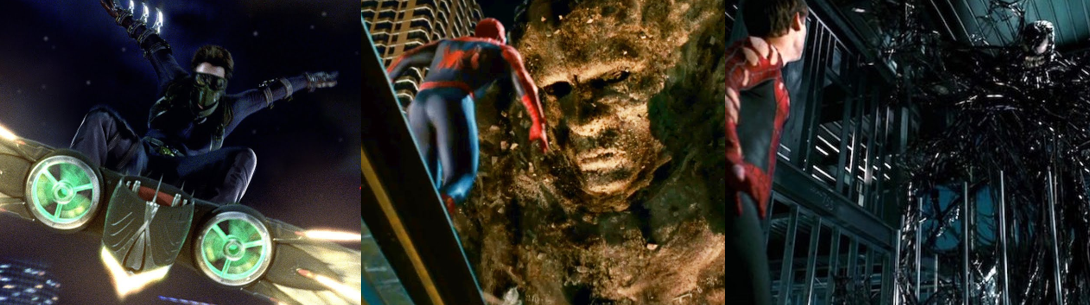

Released: 1987
Developer: Data East
Also Available For: Amiga, Amstrad CPC, Atari ST, Commodore 64, and ZX Spectrum

A Brief Background:
After Ghostbusters became a big hit, it spun off into a pretty significant franchise comprised of an under-rated sequel, a questionable reboot, some okay modern follow-ups, and a handful of videogames. The first Ghostbusters-branded videogame was a multi-platform release from Activision that was a huge success despite being wildly different across each home console and containing humorous grammatical errors. This was followed up by an arcade title loosely based on one of the most memorable Ghostbusters spin-offs, the much-loved cartoon. Licensing issues saw the game released as Meikyuu Hunter G in Japan, which included redrawn sprites, the removal of the iconic Ray Parker Jr. song, and the multi-player stripped down to two players instead of three. Unlike the beloved cartoon, The Real Ghostbusters attracted mixed reviews across its various iterations; while some praised the fun gameplay and graphics, many others disagreed and criticised it as an ugly, repetitive, unfair and undemanding, and overall unimpressive shooter.
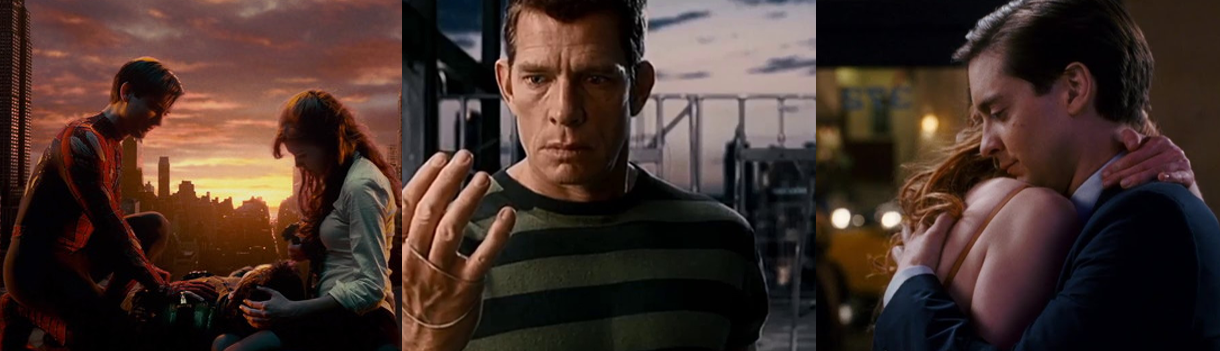
The Review:
I’m doing things a little differently for my review of the Real Ghostbusters arcade game. It’s a naturally shorter review but that’s mainly because the game is so short and simplistic that I don’t see the point in dragging it out too much, but I was also able to finish it so I want to touch base with everything I saw and give it a proper rating. The Real Ghostbusters is a top-down, semi-isometric shooter not unlike its successor, Smash TV (Williams, 1990), perhaps the most popular of this genre. The game allows up to three players (because, once again, Winston Zeddemore gets the shaft) to play simultaneously, but your character is never identified onscreen by name (they’re just “1Up”, “2Up”, and “3Up”) and their sprites are just palette swaps, so you have to go by the colour of their uniforms (blue for Doctor Egon Spengler, yellow for Doctor Ray Stantz, and orange for Doctor Peter Venkman). They also all play exactly the same; there are no stats or attributes to differentiate them, so it really doesn’t matter which character you play as (though “2Up”/Orange/Venkman stands out a little more against the backgrounds). The Real Ghostbusters offers basic, arcade-style gameplay; you simply move your character around the ten stages and blast at monsters with your proton pack using two buttons: one that fires a slower, infinite projectile shot and one that unleashes your proton stream. The proton stream is tied to a yellow meter under your character’s name and score. As you fire it, the meter depletes and you’ll need to grab power-ups or insert a coin to replenish it, which is necessary as the proton stream is the only way of sucking up the ghosts that pop out from defeated baddies and earning points to both out-do your friends between stages and work towards earning extra lives, which are awarded for every one hundred ghosts you capture.

Players compete against each other to grab power-ups and capture the most ghosts.

Following the big title font and a fun scene of Ecto-1 pulling up outside of the Ghostbusters’ headquarters, you’re dropped into the first stage and tasked to “Capture the ghosts, collect the keys, save the city” which is done by zapping the bizarre monsters and ghouls that swarm every area and confronting a boss at the top of the stage. This earns you a key to move on to the next stage, but the game very quickly recycles its environments; you’ll explore the dilapidated rooftops on the first and final stages, then play through a canyon (with bones scattered all about), a graveyard (containing gravestones and tree stumps), a moss-infested catacomb, and a more Hellish variant of the graveyard over and over between the first and last stages. While the environments are quite repetitive, the action is thick and fast. Ghoulies, goblins, and nightmarish creatures infest every screen, constantly respawning, shooting lightning bolts or other projectiles, and making a beeline towards you. As if that wasn’t bad enough, laughing spikes pop up from the floor and the excised spirits will steal power-ups if you’re not fast enough. You’ll also have to climb (well, just walk up) ladders and cross tree trunks to progress, sometimes by blasting rocks or trees to make them appear. Be careful, though; there are a lot of things you can blast, like toxic waste bins and barrels and such, but some of these are just as likely to spawn more enemies as they are power-ups! Power-ups include upgrades to your proton stream and projectile shot to make them more powerful and replenish your meter, an “aura” shield that protects you from damage, and a “Green Ghost” (because, apparently, Slimer wasn’t a popular name just yet?) that both protects you and takes out enemies for a short time. There is also a power-down item, helpfully indicated by its skull-and-crossbones symbol, that debuffs your shot, so watch out for that, but two or more players are able to cross their streams for a more powerful attack. You also have to deal with a timer; you have five in-game minutes to clear each stage, but you can earn more time by inserting a coin or grabbing a power-up. Finally, The Real Ghostbusters is classic coin-muncher if I ever saw one; it’s one-hit kills here and you’ll die a lot throughout the course of the game as the enemies just never stop coming. It’s actually quite impressive how many appear onscreen at once and the sheer variety on offer; it’s a shame that the music didn’t get the same attention as the chip-tune rendition of the iconic Ghostbusters soon wears out its welcome after a few minutes.

The gruesome bosses are recycled and poor substitutes for more iconic Ghostbusters foes.

The Real Ghostbusters is similarly limited in its gameplay variety; between each stage, the Ghostbusters deposit the spirits they’ve captured into the containment unit for bonus points and extra lives, but this is purely a non-interactive cutscene and there are no bonus games to break up the action here. The same goes for the game’s bosses; sure they’re bigger and tougher than the regular enemies and are accompanied by a boss theme, but they don’t require any more skill on your part than to keep blasting and avoiding taking a hit. As if that wasn’t bad enough, the game both recycles bosses and substitutes a boss battle with a gauntlet against swarms of enemies. I gave this a pass at first since the first two introduced two new enemies to the game (weird rotund bird-things that extend their beaks and scythe-wielding demons), but the third gauntlet is simply against the bulbous purple bolt-shooting monsters you’ve been busting all along. The first boss is two large, cloaked figures that resemble the Grim Reaper and bop about shooting spooky napkins. The second is a disgusting, blob-like monster with a gnashing face in its stomach and a single, disgusting eye at the end of an extendable neck, and both of these guys appear again at the end of stage nine. Extendable appendages and swarms of projectiles are commonplace with The Real Ghostbusters’ bosses; the two wall-mounted demons in stage four, the scarier robed priests of stage six, and the lava/rock golems of stage seven all featured these tactics though the priests mix things up a bit by being able to teleport and the golems come armed (literally) with swinging maces. Rather than taking on the iconic Stay Puft Marshmallow Man, your final challenge is to fight to the end of the rooftops and battle two of these golem-like giants, something that’s barely a challenge at all since you can easily make mincemeat of all the game’s enemies with three players. Defeat them and you’re treated to an odd scene of the ghosts and monsters all escaping the Ghostbusters’ firehouse (it’s almost as if the intro and outro cutscenes should’ve been reversed to show the ghosts escaping and the Ghostbusters returning home victorious), a bit of congratulatory text, and the chance to enter your initials into the high score table.

The Summary:
I love a good, mindless arcade title, especially one where you can just keep pumping in coins and mowing down waves of enemies to achieve victory. I actually have memories of playing the Amiga version of The Real Ghostbusters back when I was a kid and quite enjoying it, especially compared to the more confusing and taxing Ghostbusters (Activision, 1984), and I could definitely see myself and other kids blowing our pocket money on this fast-paced action shooter back in the day. Having said that, the game is painfully basic; the lack of bonus stages and gameplay variety is staggering, even for an arcade title, and things quickly become repetitive and chaotic. I was obviously emulating the game, so I had unlimited credits, making it a breeze to blast through; while enemies swarmed the screen and took me out again and again, I was back in action at the press of a button but all this tells me was that The Real Ghostbusters was unfairly cheap and designed to rid you of your hard-earned coins with its one-hit kills, strict timer, and sheer amount of enemies. While the chip-tune music gets grating and the semi-isometric perspective can be a little confusing, the game looks decent enough. The Ghostbusters might look awful, but the monsters are all suitably bizarre, Lovecraftian creatures, though this visual appeal is diminished by the fact that most of them just bounce, fly, or wander about shooting the odd projectile. The power-ups are kind of fun but, again, basic; why not change up the projectiles the Ghostbusters shoot or have a screen-clearing bomb or something? Also, the lack of Mr. Stay Puft really diminished the appeal and finale of the game; he was the obvious final boss, but The Real Ghostbusters chose to play it cheap and safe and cycle previous bosses instead. Overall, The Real Ghostbusters was a decent enough arcade game, especially with three players, but nothing massively memorable or innovative.

My Rating:

Rating: 2 out of 5.

Could Be Better

Have you ever played the Real Ghostbusters arcade game? If so, what did you play it on and did you enjoy it? Which Ghostbuster did you play as, and were you upset by Winston’s absence? Were you disappointed by the recycled bosses and environments? What are your memories of The Real Ghostbusters and how are you celebrating Ghostbusters Day today? Whatever your thoughts and memories of Ghostbusters, feel free to share them below and be sure to check out my other Ghostbusters reviews across the site.

Movie Night [Dinosaur Day]: Jurassic Park III


Sixty-five million years ago, dinosaurs ruled the Earth. These massive beasts existed for about 180 million years and came in all shapes and sizes, before finally going extinct following a cataclysmic event that forever changed our world and rendered these creatures mere fossils to be discovered and studied. Fittingly, “Dinosaur Day” is actually celebrated twice a year, giving dino fans the world over ample opportunities to pay homage to this near-mythical titans.


Released: 18 July 2001
Director: Joe Johnston
Distributor: Universal Pictures
Budget: $93 million
Stars: Sam Neill, William H. Macy, Téa Leoni, Trevor Morgan, Alessandro Nivola, and Laura Dern

The Plot:
When Paul (Macy) and Amanda Kirby’s (Leoni) son, Eric (Morgan), is stranded on Isla Sorna, the estranged couple enlist Doctor Alan Grant (Neill) to help them brave the genetically resurrected dinosaurs that reside there and rescue him.

The Background:
In 1993, legendary director Steven Spielberg teamed up with special effects wizards Stan Winston, Phil Tippett, and Dennis Muren to turn Michael Crichton’s bestselling Jurassic Park (ibid, 1990) into a pioneering blockbuster. Despite grossing over $1.030 billion at the box office and overwhelmingly positive reviews, both Crichton and Spielberg were reluctant to work on sequel. Ultimately, while The Lost World: Jurassic Park (ibid, 1997) broke box office records, it was met with mixed reviews and even Spielberg believed it failed to match expectations. Thus, he passed the director’s chair to his friend Joe Johnston since he felt the series needed fresh blood behind the camera. Initial ideas to have Dr. Alan Grant stranded on a dinosaur-infested island were scrapped, as was a sequence involving a motorcycle chase against a pack of Velociraptors, but the idea of characters being marooned on the island continued to persist. Star Sam Neill eagerly signed on, believing he could improve on his original performance, and Stan Winston and Industrial Light & Magic returned to provide the dinosaur effects. Various versions of the film’s newest dinosaur, the Spinosaurus, were created; it was purposely chosen as a more horrifying counterpart to the returning Tyrannosaurs rex and was so powerful that it tore the animatronic T. rex’s head off! Although Spielberg afforded Johnston complete creative freedom, he had a chair reserved for him on set and insisted that Pteranodons were included after the were cut from the last two films. With a box office gross just shy of $370 million, Jurassic Park III became the lowest-grossing film in the franchise and was subjected to near unanimous negative reviews that criticised the redundant narrative, muddled tone, and ridiculous moments. In time, Jurassic Park III has been re-evaluated and come to be regarded as the black sheep of the franchise, but this was far from the end for the series, which made a dramatic comeback in 2015 that (more or less) successfully revived the franchise.

The Review:
I think a lot of us take for granted just how big Jurassic Park was when it first released; undeniably, the film redefined what a modern blockbuster could be and brought cutting-edge CGI effects and animatronics to the forefront of cinema, to say nothing of the wave of “Dinomania” it unleashed. Although I have no love for the book or its literary follow-up, I, like pretty much my entire generation, was captivated by Jurassic Park and much of this enthusiasm meant that I was overly generous towards the sequel movie for the longest time. It made sense: I liked Jurassic Park, I liked Jeff Goldblum, so of course I had to like The Lost World. Unfortunately, time has not been kind to The Lost World, which fumbled in areas where the first film succeeded, but I definitely think that it pretty much tapped out the appeal and reach of the concept, especially once it showed dinosaurs in the outside world. All this is to say that I’ve always been disappointed by Jurassic Park III; sure, it features some new dinosaurs and even recycles sequences from the book into its content, but there’s a reason why it’s the shortest and most universally disliked of the franchise. In a word, the film is just unnecessary, and offers very little to entice fans of the original back, to the point where you may as well just watch Jurassic Park three times and you’d probably get more enjoyment than suffering through the surprisingly disappointing follow-ups.

Grant is horrified to find he’s been duped into fighting off his beloved dinosaurs once again.

The first indication that we’re simply retreading old ground is that the film immediately returns to Isla Sorna and the majority of it takes place in this setting. It makes sense; the unfamiliarity of an isolated island adds to the wonder and danger of the franchise, but we’d seen everything this setting could offer in the last two movies and Jurassic Park III really could’ve done with trying something different, especially after The Lost World established that dinosaurs were basically free to roam as they desired, within their capabilities. One way Jurassic Park III attempts to stand out is by addressing the scientific inaccuracies in the dinosaurs; even though the first film did cover this quite conclusively, Grant makes a point to clearly spell out that the island’s genetically-engineered dinosaurs were “theme park monsters” and that the real science is found in fossils, a sentiment that remains true today. However, the dinosaurs were real enough to haunt not only Grant’s scientific career but also his nightmares. While he remains awestruck at having seen close approximations to dinosaurs up close and personal, he has no desire to ever return to the island, much less encounter them again. But, as ever, he can’t turn down the chance to inject some serious cash into his Velociraptor research when Paul Kirby comes asking for his expertise in taking him and his wife on a tour of the island. Of course, this is all a ruse; the couple have no money to offer him and have simply tricked him into helping them navigate the island’s dangers to rescue their son, but Grant’s experience is immediately hampered by the fact that he’s never actually been to Isla Sorna before, to say nothing of the Kirbys’ foolishness when it comes to heeding Grant’s advice and warnings about the local wildlife.

Unlike their son, the Kirbys are woefully incompetent and in way over their heads.

Despite Paul being little more than a painter and decorator, he and his estranged wife somehow pull together the funds not just to fly to Isla Sorna, but to hire some unscrupulous characters to transport them and stave off the ravenous dinosaurs with some serious firepower. However, these would-be mercenaries prove as ill-equipped as the Kirbys, who are immediately in over their heads and realise that they’ve vastly underestimated the dangers of the island. It doesn’t help that Amanda is painfully idiotic; not only does she yell into a megaphone as soon as they land but she, more than any of the other characters, constantly ignores or disregards Grant’s expertise, putting herself and the others in danger when the carnivores come sniffing around for their next meal. Grant is incensed to learn the truth and even more perturbed when the survivors are stranded after the Spinosaurus destroys their plane and devours their satellite phone, but even then his main concern is reaching the safety of the coast rather than actively searching for the couple’s lost son, Eric (indeed, it’s heavily implied that Grant thinks the boy is dead). Following a Velociraptor attack, Grant is separated from the couple but runs across Eric, who has done a decent job of surviving by himself thanks to his adaptability, knowledge of dinosaurs from Grant’s research, and resources afforded by InGen’s abandoned facilities. Grant, now far more comfortable with children thanks to his experiences in the first film and his close relationship with former flame Doctor Ellie Sattler’s (Dern) infant son Charlie (Blake Bryan), is very impressed by Eric’s survival instincts over the last eight weeks. Eric uses tear gas and even Tyrannosaurs rex urine to keep the dinosaurs at bay but he’s more upset at the prospect of his estranged parents trying to work together than he is by the locals. However, their shared trauma and determination to find Eric brings the two closer together but their joy at being reunited is cut short when they’re separated by a massive fence, with the Spinosaurus hot on their heels, and driven into the dilapidated aviary. Once he’s back with his parents, Eric reverts back to being a scared kid and fades into the background; he consoles Grant over the apparent loss of his assistant, Billy Brennan (Nivola), but basically just becomes another screaming would-be meal for the Spinosaurus.

Trumping any other dinosaur, the Spinosaurus obliterates every threat and constantly dogs the humans.

As ever, the humans are under constant threat from the genetically-recreated dinosaurs; while there’s a sense of wonderment about herbivores like the Corythosaurus and Parasaurolophus, the Velociraptors remain a persistent danger to the group. Grant continues to be enamoured with the pack hunters, which now sport rudimentary feathers and an intelligence beyond even his expectations as they call to each other, signal for help, and even use live, injured humans as bait to lure in other victims. This time around, the Velociraptor threat is only escalated thanks to Billy secretly stealing their eggs to sell on the black market to help fund Grant’s research, which causes the creatures to furiously hunt them throughout. For the first time, winged dinosaurs play a key role in the events of the franchise; in one of Jurassic Park III’s better sequences, one ripped right out of the first book, the group stumble into the twisted, rusted remains of a Pteranodon aviary and the giant, bat-like creatures briefly carry Eric off to their young before Billy successfully rescues him in what appears to be redemptive act of self-sacrifice but which the would-be black marketeer inexplicably survives. The franchise’s most recognisable dinosaur and brand mascot, the Tyrannosaurs rex, also reappears but, sadly, it’s little more than a cameo; the T. rex is primarily here to show off the bigger, badder Spinosaurus, which not only makes an immediate impression by splattering Cooper (John Diehl) all over the Kirbys’ plane but easily bests the T. rex and snaps its neck in a startling show of power. Unfortunately, this means that we’re denied a proper battle between the two or a suitable opponent to slay or challenge the Spinosaurus in the finale, though the Spinosaurus’ threat lingers over the entirety of the film and recalls the constant sense of dread the characters faced from the T. rex in the first. Far larger, with a crocodile-like jaw and massive talon-like claws, the Spinosaurus is Isla Sorna’s undisputed apex predator, unhindered by any weaknesses and capable of fending off any obstacle, swimming through water, and even…somehow…sneaking up on its prey despite not only its massive size but the constant ringing of the satellite phone in its stomach!

The Nitty-Gritty:
Jurassic Park III tries so hard to emulate the epic wonder of the first film but there’s just not enough material left to support it. John Williams’ sweeping, iconic theme still permeates the picture despite him being replaced by composer Don Davis, and the awesome sight of seeing dinosaurs brought to life onscreen remains, but it’s undeniable that it’s just not as impressive as it was the first time around. These issues are only compounded by some absolutely detestable characters; Paul and Amanda Kirby are clueless, deceitful morons who are difficult to root for, especially in the case of the foolhardy Amanda, whose desperate need to rescue her son costs the lives of three other people and endangers them all on numerous occasions. Téa Leoni is easily the worst part of this film; she’s so wooden and rigid and just mumbles her way through the narrative, dragging every scene down and making Amanda a thoroughly unlikeable and moronic character. Paul is a spineless fool who’s in way over his head and I can absolutely understand Grant’s exasperation at being surrounded by such ridiculous characters, and his admiration for Eric at somehow breaking the chain and being a smart and capable young boy. Billy’s side plot where he plans to sell the Velociraptor eggs is an interesting wrinkle, but it really doesn’t go anywhere and is basically a scaled down version of the plot seen in The Lost World, plus it’s difficult to really care about Billy’s betrayal of his mentor or his apparent death because about he only thing Billy has going for him before his greed is revealed is that he has a “lucky backpack”.

Somehow, the effects have worsened and, with some exceptions, everything seems rushed and lazy.

As ever, the main selling point is the dinosaurs. While, for the most part, they still look as amazing as ever, it’s clear that the quality of the animatronics and CGI have taken a hit despite Jurassic Park II having the highest budget of the original trilogy. The animatronic dinosaurs, especially, look far less realistic than before; it’s almost as if the filmmakers got lazy or rushed the process, coasting on the influential effects of the first film and putting in less effort, with the brief appearance by the Ceratosaurus being a particularly poor effect, but a lot of the CGI is surprisingly awful. I can’t help but be disappointed at how unconvincing the ’raptor puppets are this time around; it might not have been so bad if the film didn’t choose to explore the depths of Grant’s trauma by having him experience a nightmare involving a talking ’raptor (though, admittedly, I do find this scene hilarious!) A ’raptor does make an impression when the characters are exploring the ruins of an InGen facility, chasing them through the dark corridors, scaling cage walls to reach its prey and even signalling for help, much to Grant’s horror and amazement, though this does result in a pretty lacklustre chase through a herd of herbivores that is, again, a pale imitation of the first film. Although the Spinosaurus often also looks cartoonish and its battle with the T. rex is disappointingly brief, it is truly horrifying. Clearly chosen for its fearsome appearance and for looming over even the T. rex with an ominous poise, the Spinosaurus is a nightmarish creature that really pushes Jurassic Park III into monster movie territory as it glares at its prey and stalks them with vicious purpose. Indeed, Jurassic Park III’s better moments are when it leans into horror; the Pteranodon attack is especially evocative of this, with the massive prehistoric bird/lizards looming and flapping through the mist like something out of a slasher movie, to say nothing of the terrifying way the Spinosaurus cuts through the water in the dead of night during a torrential downpour. Although the Jurassic Park films have often strived to be more than monster movies, these more terrifying and intense sequences are a definite highlight and demonstrate that there was still some gas left in the tank for the franchise, it was just sadly hampered by an overall poor execution.

After inexplicably scaring off Spiney and placating the ‘raptors, the survivors are saved by the Navy!

After narrowly escaping the Pteranodons, the survivors finally manage to retrieve Paul’s annoying satellite phone from a pile of Spinosaurus excrement (again evoking imagery from the first film) and Grant makes a frantic call for help to Ellie. The Spinosaurus attacks, however, while the group is sailing on a barge; since we were denied a proper T. rex vs Spinosaurus showdown, though, the franchise’s newest, most dangerous predator yet is simply scared off after Grant ignites some oil with a flare gun, making for a painfully unsatisfying final showdown with the vicious carnivore. Instead, as ever, Jurassic Park III falls back on the Velociraptors for one last scare; having tracked the humans and the eggs Billy stole, the Velociraptors corner them on the beach and appear ready to strike; however, Grant manages to confuse the pack by randomly blowing into a replica ’raptor larynx. Just then, the film simply comes to an end when Ellie was somehow not only able to understand that Grant was on the island but was also able to get the US Navy to storm the beach for a rescue, scaring off the raptors, who reclaim their eggs and run into the jungle. Just like in the first movie, Grant and the other survivors (even, inexplicably, Billy) are airlifted to safety and left to contemplate the beauty, awe, and danger of the long-extinct dinosaurs, but again this is simply the same ending as in Jurassic Park but with an additional bit of family drama slapped on top of it! The tension and horror of the island rekindles the relationship between the Kirbys, who are overjoyed to be reunited with their son, who is equally pleased to see his parents finally getting along, and all it took was a few lives and the threat of mortal danger to bring them back together. Although he isn’t going to get the funding he was promised, it seems as though Grant is content to have faced his fears, though I would argue that his experiences on Isla Sorna only galvanised his dislike for InGen’s genetically-engineered monstrosities.

The Summary:
It’s really hard to rate Jurassic Park II very high as the entire film just feels like an unnecessary cash-grab, one final desperate attempt to wring the life out of a franchise that, at the time, really only had enough gas for two movies (and even then, the second one was a questionable effort). Certainly, there’s enough material in Michael Crichton’s books and the prehistoric to be reconfigured into another movie, but Jurassic Park III plays things way too safe. It’s just a shorter, less fanciful, and far less thrilling retread of the first film: Grant is a grouchy traditionalist forced to adapt to a dangerous situation, he’s forced to bond and work alongside a kid, there are ill-prepared morons running around just looking to get eaten, and there’s a monstrous prehistoric predator stomping around looking to snap everybody up. Even the sub-plot about stealing the ’raptor eggs is half-baked and familiar, and the effects somehow look worse than in the original Jurassic Park despite the higher budget and what I would assume would be the refinement of those original techniques. Sam Neill puts in a great performance but even he can’t save this grating cast; Téa Leoni is always dreadful, and William H. Macy just lacks the charisma to be all that compelling. I did enjoy the sadly underutilised Pteranodons and the monstrous Spinosaurus, but the filmmakers really dropped the ball by not having a longer, more brutal fight scene between ol’ Spiney and the T. rex. Thankfully, the revived entries would correct this, and many of Jurassic Park III’s mistakes, but that doesn’t help wash the sour taste of this ill-conceived, rushed, and lazy entry out of the mouth. Just watch the first one again and then jump to the fourth, it’s the best way.

My Rating:

Rating: 1 out of 5.

Terrible

Are you a fan of Jurassic Park III? Do you think I’ve judged the film too harshly and that there are actually some positives to be found here? Were you happy to see Dr. Alan Grant return and what did you think to the Kirbys? What did you think to the Spinosaurus and would you have liked to see a more competitive fight between it and the T. rex? Do you agree that the film was too lazy and that the concept was tapped out by this point? Which of Jurassic Park’s sequels is your favourite or do you consider the first one to be the best? How are you celebrating Dinosaur Day this year? Whatever your thoughts on Jurassic Park III, and dinosaurs in general, leave them below or drop a comment on my social media.