Back Issues [National Superhero Day]: Kingdom Come


In 1995, Marvel Comics created “National Superhero Day” and, in the process, provided comics and superhero fans the world over with a great excuse to celebrate their favourite characters and publications.

Story Titles: “Strange Visitor”
“Truth and Justice”
“Up in the Sky”
“Never-Ending Battle”

Published: May 1996 to August 1996
Writer: Kurt Busiek
Artist: Alex Ross

The Background:
While working on Marvels (Ross, et al, 1994), artist Alex Ross pitched a similar “grand opus” to celebrate DC Comics’ long and illustrious history. Inspired by a similar, rejected proposal by Alan Moore, Ross brought his signature photorealistic artwork to this acclaimed, thought provoking miniseries. Kingdom Come was such a hit that it spawned numerous spin-offs and follow-ups and has influenced DC Comics ever since.

The Review:
Perhaps the greatest DC “Elseworlds”, Kingdom Come begins with audience surrogate and main character, pastor Norman McCay, visiting the aged, sickly Wesley Dodds/The Sandman. Wesley has been driven to near mania by nightmares of an apocalyptic future, one akin to the “Book of Revelations” and dismissed as the delusions of a dying old man. Insistent to the end, Wesley begs Norman to read from the Bible to understand the coming crisis but passes before he can fully explain himself. Having met Wesley near the end of his life and shared many dinners with him, Norman is somewhat aggrieved that he took Wesley’s stories of his past heroics for granted, especially as this is a world (since designated Earth-22) where superheroes (or “metahumans”) are a controversial topic. Wandering the streets, Norman reminisces about how Wesley despaired of society, which placed so much faith in a new, more violent and less morally skewed generation of superheroes and wished more than anything for the legends of yesteryear to be remembered rather than reduced to mere pastiches by the likes of the Planet Krypton restaurant chain. Recognising that “hope” has become a precious commodity, Norman tries to take solace in scripture, but his faith is tested as the “mighty” far outweigh the “meek” and seem destined to inherit the Earth. The heroes of today are largely the children and grandchildren of legends, numbering in the thousands and fighting mainly for their own egos, having eliminated most old-school supervillains and caring little for the collateral damage their battles cause. Indeed, it’s up to normal folk like Norman to rescue crying children from these dangerous conflicts, though even he despairs for the fate of the world when Earth’s greatest and most belligerent “hero”, David Sikela/Magog, led the Justice Battalion against the confused and desperate Parasite and caused widespread devastation when he split Nathaniel Adam/Captain Atom open in a panic and decimated Kansas with a nuclear explosion.
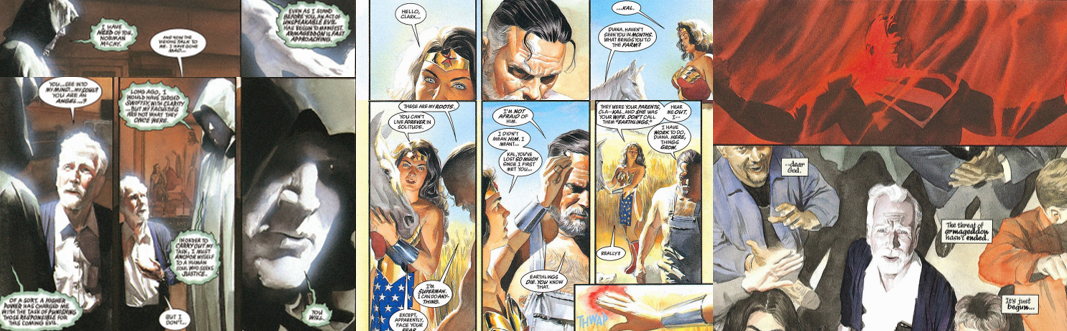
The Spectre recruits pastor Norman McCay to observe and judge the world’s new and old metahumans.

Already suffering from the same horrific visions that plagued Wesley and rattled by these events, Norman believes he’s gone mad when Jim Corrigan/The Spectre appears and tasks Norman with assisting him in judging the world in Wesley’s absence. Though initially reluctant, Norman accompanies the Spectre to a seemingly innocuous midwestern farmland (actually an elaborate virtual reality environment tied to the Fortress of Solitude), where the aged, bitter, reclusive Clark Kent/Kal-El-Superman has exiled himself and his livestock after losing faith in humanity. Norman watches, unseen and unheard, as Princess Diana Prince/Wonder Woman visits Clark Kal and expresses concern for him, believing he has lost touch with humanity after all the losses he’s suffered. Annoyed at Kal’s dismissive stubbornness, Wonder Woman demands that he remember what he once stood for (“truth and justice”) and review Magog’s destructive behaviour. Though stoic, Kal’s obviously disturbed by the devastation, yet he urges Wonder Woman to return to Themyscira where she will be safe. The Spectre reveals that Superman’s exile caused many of his contemporaries to also give up their crusade, but not all: Wally West/The Flash (now pure energy) still patrols Keystone City as a lightning fast “guardian angel”, an unknown Hawkman protects the forests of the Pacific Northwest, and Alan Scott/Green Lantern guards the Earth from extraterrestrial threats from an emerald-hued space station. Bruce Wayne/The Batman also still maintains order in Gotham City (despite being confined to an exoskeleton) with a series of Batman-themed robots. Angered that their successors have become even more reckless after Kansas, Norman rages at the Spectre, asking why he or his “higher power” didn’t stop the madness. While the Spectre remains impassive, Norman’s pleas are answered when a noticeably changed version of Superman makes a dramatic return, immediately awing the masses but bringing only dread to Norman as his visions tell him this is a sign of greater conflict.
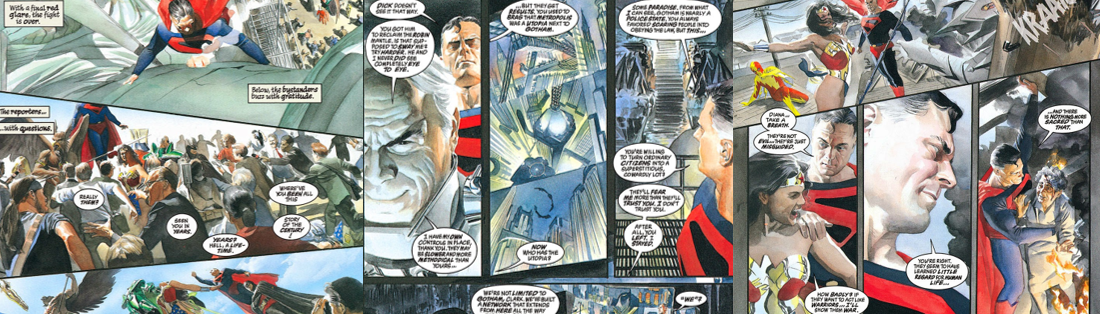
Although Batman refuses to join the new Justice League, Superman hopes to inspire the new heroes.

Norman finds himself displaced from time and space as the Spectre follows the pastor’s visions, eventually watching with horror as super-patriot (and aggressive fascist) the Americommando and his Minutemen attack immigrants coming to the United States. Luckily, the reformed Justice League (Superman, Wonder Woman, Green Lantern, the Flash, Hawkman, Kara Zor-L/Power Woman, and Raymond Terrill/The Ray) quell the danger, with Richard “Dick” Grayson/Red Robin also dispatching two psionics (the Brain Trust) who were escalating the situation. The Justice League then address the world’s press from the United Nations to state their intentions: namely, to inspire hope in people once more and mentor their misguided protectors into more benevolent force, though Superman is noticeably reluctant to discuss Magog given their history. Still puzzling the link between Superman and his prophetic visions, Norman accompanies the Spectre and Superman to the remains of Wayne Manor, obliterated years ago when Bane and Harvey Dent/Two-Face exposed Bruce’s identity. Since then, he’s lived in the Batcave, his crimefighting efforts largely aided by the deaths of many of Gotham’s worst criminals in unsanctioned bombings. Bruce dismisses Superman’s offer to join the new Justice League, persists in calling him “Clark”, and criticises Superman for pretending like the state of the world is anything new. Bruce believes the metahuman situation requires a finesse the Justice League isn’t equipped for and is as unimpressed that Superman recruited Dick (Batman’s former partner and adopted son) to his cause as Superman is that Gotham is now a police state ruled by fear. Bruce has his own allies (Oliver Queen/Green Arrow, Dinah Lance/Black Canary, and Ted Kord/Blue Beetle) and his own plans to address the situation. Norman’s stunned at the bickering between Batman and Superman but watches with hesitant optimism as the Justice League, through diplomacy and force alike, turn others to their cause and bring hope to the masses.
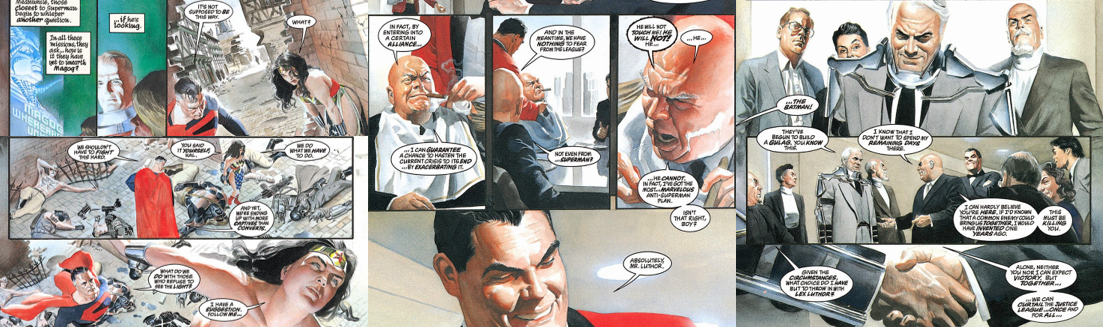
Superman’s decision to imprison rebellious metahumans inspires an unlikely alliance for Batman.

Norman and the Spectre then observe a meeting between Lex Luthor and his “Mankind Liberation Front” (including Selina Kyle/Catwoman, immortal tyrant Vandal Savage, and Raʾs al Ġhūl’s heir (and Batman’s illegitimate son) Ibn al Xu’ffasch). Luthor offers medical aid to the Kansas victims while also outfitting survivors of the Belle Reve and Arkham Asylum massacres to arm vigilantes and metahumans to their cause, aiming to heighten tensions between humans and metahumans so humanity can reclaim their world through war. Justice League’s unexpected return sees Luthor’s plan escalate to a ten-day plan that largely depends on Billy Batson/Captain Marvel, who’s been swayed to Luthor’s manservant. Next, Norman observes as the Justice League gate-crash a metahuman bar and chastises the patrons, offering the chance to be better or be dealt with, only for the awestruck metahumans to receive an alternative pitch from Green Arrow. Still, many join Superman and setup their headquarters in Green Lantern’s emerald space station to spread their mission across the globe. When Superman shares his concerns about the resistance they’ve met, Wonder Woman takes him to Atlantis to ask King Arthur Curry/Aquaman to setup an underwater penal colony for rebellious metahumans. Although Diana tries to appeal to Aquaman by reveal that she’s been stripped of her royal heritage and has committed herself to improving the world, he refuses to grant the request as his focus remains on his people. Superman’s similar talks with Orion end in failure as he’s disappointingly become as grim and ruthless a ruler of Apokalips as his father, Darkseid. Although Scott Free/Mister Miracle and Big Barda provide the solution (a labyrinthine gulag built on the ashes of Kansas), this sees Batman and his allies join forces with Luthor in response. Superman’s worries about Wonder Woman’s anger are shelved when Magog resurfaces in the wastelands of Kansas, desperately trying to repair the damage he caused.
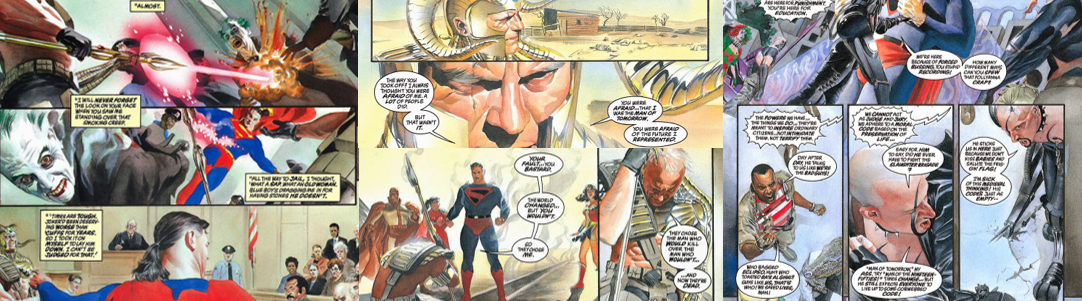
The reunion between Superman and Magog is as combustible as the tensions in the gulag.

When Superman chastises him, Magog challenges him to punish him, mocks him, and then blames the Kal for everything that happened ten years prior since he refused to change with the times and the people’s demands for darker, more violent heroes. Magog bitterly recounts how the Joker easily murdered the Daily Planet staff, including Superman’s wife, Lois Lane, because of the heroes’ refusal to kill. Magog had no such compunction and publicly murdered the Joker, only to be arrested by Superman and summarily acquitted for ending the Joker’s threat. Magog was then slighted when Superman refused to acknowledge him as Metropolis’s “number one” and exiled himself in disgust rather than fighting for that title. Interestingly, Magog isn’t some unhinged psychopath. Instead, he’s incensed that he had to become the man, the killer, Superman refused to be and blames him for it, submitting to Superman’s custody after raging at the Man of Steel. Yet, Norman’s cataclysmic visions only increase, especially as the gulag is filled within two weeks, its embittered inmates only incensed by Superman’s hologrammatic lectures. The events catch the attention of God-like beings like the Wizard, Shazam, the Phantom Stranger, and Ganthet, who refuse to intervene since the affairs of man are insignificant in the grand scheme of things. While observing this, Norman is approached by Boston Brand/Deadman, who questions the Spectre’s motivations as he’s lost touch with humanity since becoming God’s avenging spirit. While Superman and Wonder Woman debate metahuman ethics and motivations, Luthor subjects Captain Marvel to further brainwashing using a combination of his silver tongue, doctored videos, and Mister Mind’s psychic powers. Luthor the reconvenes with his allies, sure to keep Batman on side by talking of necessary evil rather than world domination and reveals that Superman’s no longer vulnerable to Kryptonite, though Batman assures him that the youths they’ve recruited are more than willing to fight.
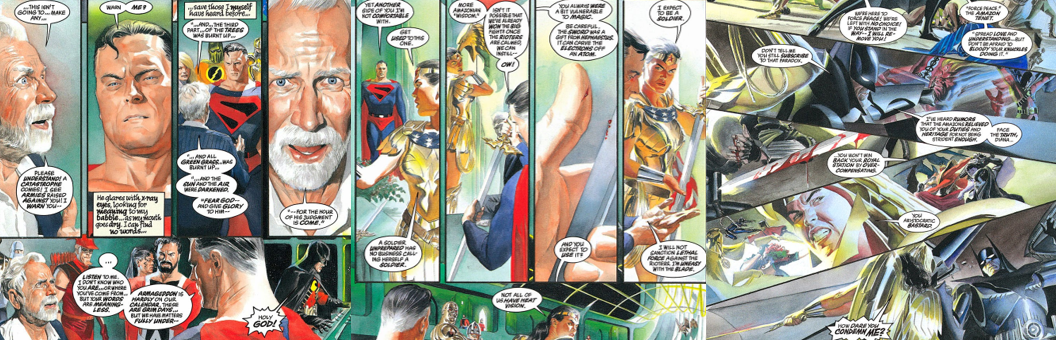
Despite Norman’s pleas, the Justice League war with themselves over their conflicting views.

While listening in to Red Robin’s concerns about the gulag, Norman is stunned when the Flash drags him into the real world. Met with suspicion, Norman tries to warn Superman of the coming apocalypse, only for his fears to first be disregarded and then come to light by reports of a riot at the gulag. Although Superman orders it to be quelled peacefully, Wonder Woman orders the opposite, leading to some conflict between them ahead of their meeting with the United Nations. Despite Superman’s assurances, the representatives are unimpressed with their God-like saviours and their prison and ready to act for themselves, if necessary. When Luthor prepares Billy to capitalise on the gulag riot, Batman punches him out and betrays Luthor, subduing him and his allies and trying to reason with Billy, only for him to panic and explosively become Captain Marvel. Superman’s fears about Wonder Woman’s warrior lust come to a head when she dons her ceremonial battle armour and leads their allies to war when the gulag riot turns violent and fatal, forcing Superman to demand help from the Batman before things escalate further. After learning of Captain Marvel’s threat, Superman speeds to the battlefield, only to be intercepted by the Big Red Cheese and a fist fight to break out between them as the Justice League battles the rioting prisoners in all-out war! Norman is horrified to see his visions coming to life and begs the Spectre to intervene, though he refuses as he’s simply there to judge. While Superman unsuccessfully tries to talk sense into Captain Marvel, the United Nations tasks the Blackhawks with launching three multi-megaton nuclear missiles at the site, reasoning that the collateral damage is acceptable to ensure the survival of the human race. Norman watches as both sides (Wonder Woman, especially) use lethal force, all moral qualms abandoned, and Batman and his allies try and subdue and save whoever they can, leading Bruce and Diana into a moral and physical conflict.
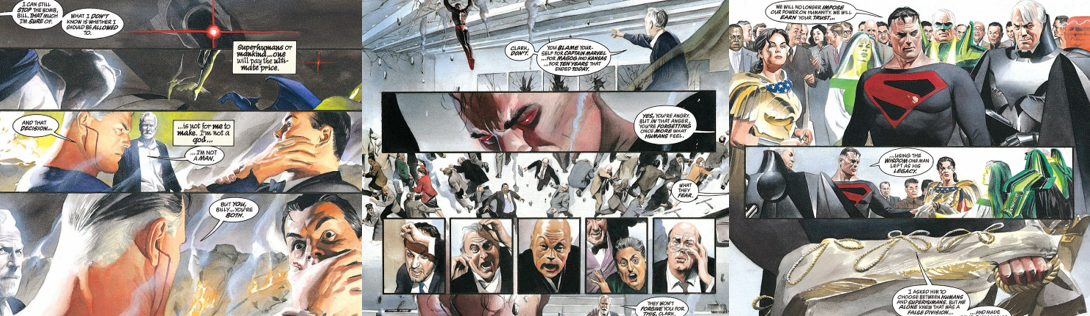
Though many lives are lost, Norman appeals to Superman’s reason and a new age is born.

When they spot the incoming Blackhawks, Wonder Woman finally sees she’s consumed by anger and violence and tries to intercept the planes alongside Batman, toppling two of three. Superman struggles against Captain Marvel’s magic and desperately shuts him up, rendering him powerless, but is horrified to see the third, wayward nuclear missile heading towards them. When it easily shrugs off Superman’s heat vision, he hesitates to intercept it, unsure if he should keep it from destroying them all. Reasoning that Billy, who’s both man and demigod, is the best to make the decision, Superman begs for his help and releases him before racing towards the missile. The Spectre then turns to Norman and demands that he decides what should happen, shouldering the burden of judgement to the unsure priest, who sees “good” and “evil” on both sides. Ultimately, Norman’s unspoken decision impacts Superman and Billy, who transforms into Captain Marvel one last time and takes Superman’s place, unleashing his magic upon the missile and detonating it up high. Norman is as devastated as Superman to see the battlefield littered with charred corpses and few survivors. Overcome with grief and rage, Superman turns his wrath on humanity and, enraged at the Spectre’s impassive nature, Norman demands to talk sense into him. Thankfully, Norman succeeds, appealing to Superman’s better nature and talking him down, with him and the other survivors vowing to exist alongside humans as equals rather than acting as Gods. Thus, Batman follows in his father’s footsteps and becomes a healer, caring for any survivors and building bridges with his family; Wonder Woman reconnects with her sisters; Green Lantern joins the United Nations; and the Spectre thanks Norman for giving him perspective, with the whole experience having reaffirmed Norman’s faith in a higher power. After building a fitting monument to the lives lost, Superman works to restore Kansas and begins a new life with Wonder Woman as lovers, with them naming Bruce godfather to their pending child and the DC Trinity finally committed to making the world a better place together.

Final Thoughts: 
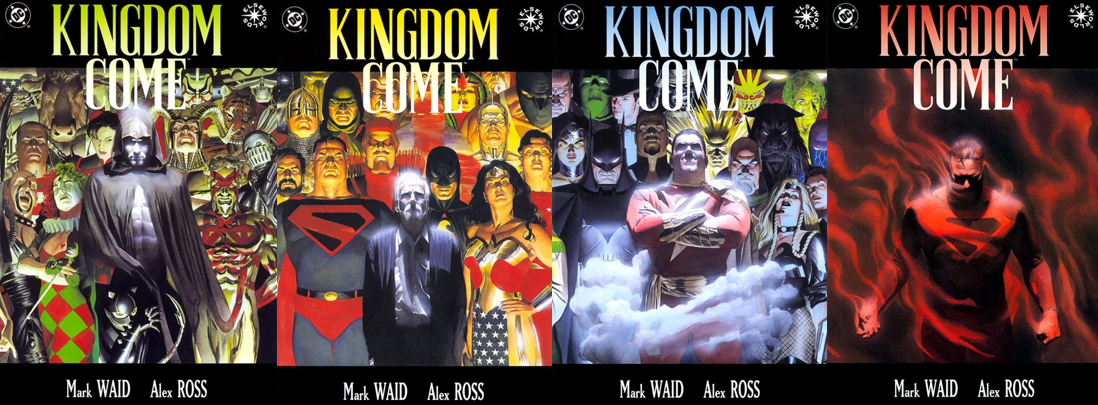
Unquestionably, Kingdom Come is an absolutely gorgeous and glorious piece of work from Alex Ross, with the artist’s signature, painted realism bringing these classic characters to life in ways never seen before. Although it’s similar to Marvels in that we follow a mortal man as he observes these God-like beings, Kingdom Come presents a possible future for the DC Universe with a new generation of violent anti-heroes. Thus, the likes of Batman, Superman, and Wonder Woman are aged and noticeably changed by time and conflict, meaning the story doesn’t present these characters at their physical peak and renders many in very different guises, yet it beautifully captures the spirit of their morals, conflicts, and very personalities in its morality tale. Superman, especially, is rocking a striking look. While his costume is extremely familiar, his signature S-shield is visibly simplified and tinged with black to show he’s still morning his losses and attempting to be the light against the dark. Wonder Woman is largely unchanged, but more focus is placed on her warrior heritage, especially when she shuns Superman’s more pacifist ways and takes up her Themysciran armour for war. Batman is only briefly seen in his recognisable suit in a flashback and is dramatically presented as physically broken and relying on an exoskeleton, but is no less cunning and capable, employing gigantic robotic bats to curb any crimes in Gotham and eventually donning a mechanised Batsuit for the finale. I especially liked Green Lantern’s emerald armour and the Flash’s disembodied look, and the blend of “Golden Age” and “Silver Age” heroes, such as using Alan Scott and Wally West. While these legendary heroes are changed, they’re still recognisable and inspire the same awe (and fear) from the masses, who embraced more violent heroes some time ago, ones whose designs are purposely exaggerated and “extreme”.
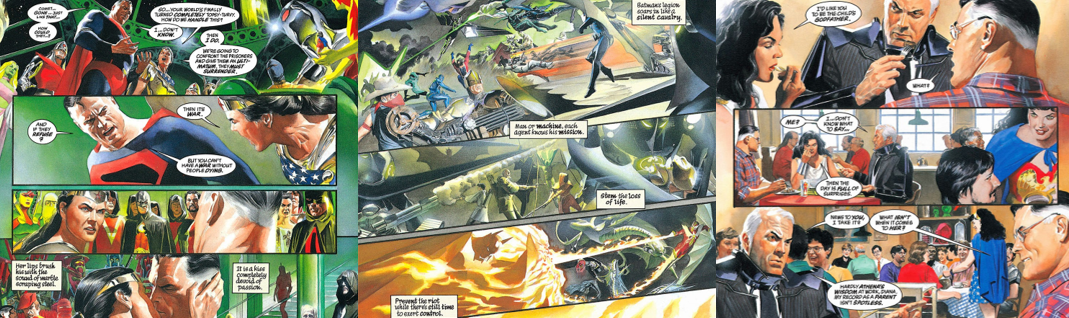
Classic heroes face new challenges in this alternative future in desperate need of hope.

Magog is the figurehead of this new generation. Donning golden, ram-like armour and wielding an energy staff, Magog won over the people when he did what other heroes refused to do and made violent supervillains pay for their crimes with their lives. It’s an interesting ethical quandary as, undoubtably, the Joker is more than deserving of the death penalty but, on principal, Superman cannot sanction wanton execution and is disgusted when the people embrace such violence. Interestingly, Magog isn’t exactly happy about having to be what Superman refused to be, and it’s implied he would’ve preferred to be more virtuous but was forced to fill that void because the “old guard” wouldn’t change. The absence of the legendary heroes and the rise of increasingly violent vigilantes saw conflicts escalate as “heroes” disregard the innocents caught in their crossfire and cause as much damage and death as they prevent, with them only resenting being locked up and judged by the reformed Justice League. While Superman urges his followers to teach and inspire first, he’s forced to imprison those who refuse to conform, which quickly skews his mission as he and the Justice League act autonomously, agitating the United Nations and causing many to question their methods. This is part of the reason why Batman refuses to join the new Justice League as he’s always been a little resentful of metahumans, but he also sees that the situation requires a more strategic approach. He allies with Luthor to influence those on his side away from all-out war and worldwide domination, though largely out of his own sense of self-preservation due to his stubborn nature. Though Wonder Woman urges Superman to reconnect with humanity, she’s ironically as separate from them as he since she takes a far more aggressive approach towards the rebels, believing that violence is often necessary to ensure peace and still clinging to her demigod status despite being ostracised from Themyscira.
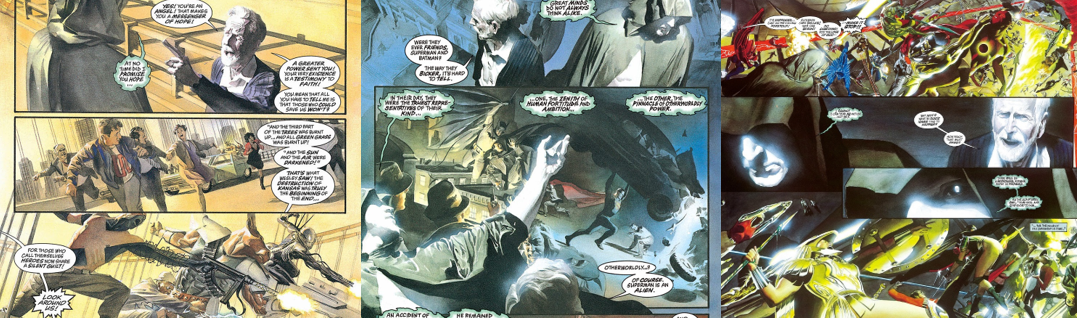
Norman’s given an impossible task, one that will decide the fate of the entire world.

Norman is not only our guide through all this, but also the Spectre’s. Norman’s amazed by the events he witnesses, which test his faith in the metahumans of hold and in the almighty, with him astonished to see just how flawed and vulnerable these God-like beings really are. Norman’s understandably enraged at the Spectre, and God, for simply standing back and letting such awful things happen, though the Spectre impassively maintains that it’s not their place to intervene…only to judge. Norman’s journey is a tumultuous one, with him seeing heroes and villains on both sides, meaning his final judgement is clouded by shades of grey and isn’t as simple as saying they all deserve to live or die. This is the same conflict that laces disagreements between Superman and Wonder Woman, as one wants to preserve and improve life, and the other is adamant to protect it. In the end, Norman is faced with an impossible, heart wrenching decision that he seemingly subtly delegates to Superman and Captain Marvel, meaning Norman carries as much of the guilt for all the deaths as Superman. Yet, Norman has seen how inspiring these heroes can be and how they need to use their powers for the greater good by acclimatising with humanity, with both sides understanding that they’re each flawed and must work together for the greater good. I loved seeing Superman so consumed by guilt and rage that he became a wrathful God ready to scorch the Earth, and that Norman managed to appeal to his humanity and core values. It’s not a pretty end, as many lives are lost, much has been destroyed, and there’s a lot of work and healing to be done, but the message is clear: there’s hope for the future. This sees the DC Trinity reunite as equals, committed to improving the world using all their talents, rather than just being seen as God-like figures to be revered, feared, or hated. All this makes Kingdom Come one of the most emotionally engaging and visually stirring tales in all of comics and easily places it as one of the quintessential alternative takes on these beloved characters.

My Rating:

Rating: 5 out of 5.

Fantastic

Ae you a fan of Kingdom Come? Do you also appreciate Alex Ross’s artwork? Were you shocked to see the classic DC superheroes so changed by time? Do you prefer violent anti-heroes or those with a moral compass? Would you have saved or destroyed all the characters if you were in Norman’s shoes? Which DC Comics character is your favourite? How are you celebrating National Superhero Day today? Whatever your thoughts, leave a comment down below, support me on Ko-Fi, and check out my other superhero and comic book content.

Movie Night [Alien Day]: Prometheus


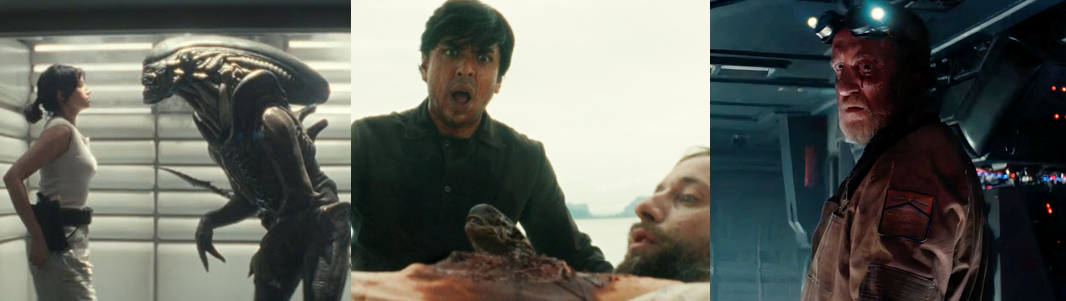
In the classic science-fiction horror Alien (Scott, 1979), an unsuspecting cargo crew investigates the barren world of LV-426. Thus, the 26 April is “Alien Day”, a day to celebrate one of the greatest sci-fi/horror franchises ever created.


Released: 8 June 2012
Director: Ridley Scott
Distributor: 20th Century Fox

Budget: $120 to 130 million
Box Office: $403.4 million
Rotten Tomatoes Scores: 73% / 68%

Quick Facts:
Although the Alien vs. Predator movies (Various, 2004; 2007) quashed a collaboration between Ridley Scott and James Cameron, Scott was enticed back to his seminal sci-fi/horror franchise to explore the origins of his volatile Xenomorphs. The concept quickly evolved from a simple prequel to explore existential themes, employing practical effects wherever possible, with Neal Scanlan and Conor O’Sullivan designing the proto-Xenomorph creatures. Despite a somewhat mixed reception, Prometheus was followed by a 2017 sequel, though its place in the franchise canon has become notably dubious since its release.

The Review:
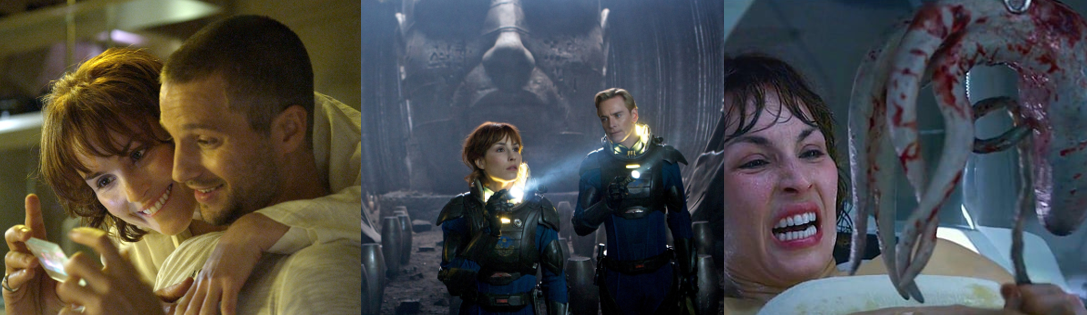
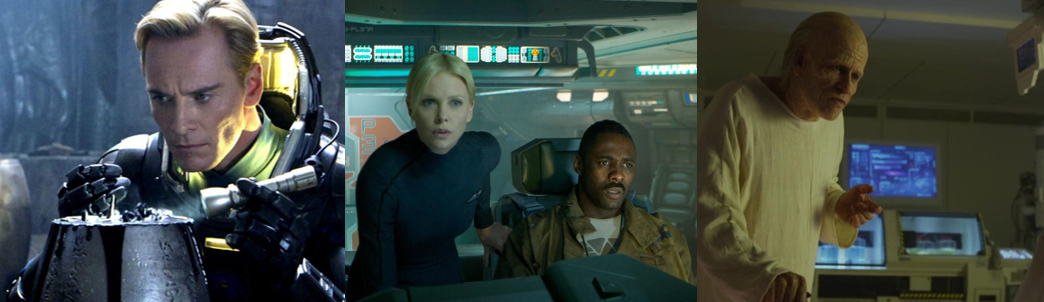
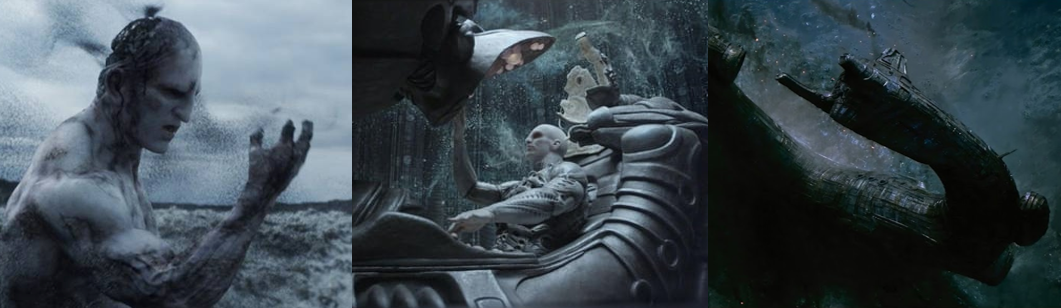
Set in 2093, over around one hundred years before Alien, Prometheus is full of oddities compared to its other, Xenomorph-ridden brethren. For starters, it begins on Earth, a location rarely seen or visited in these films, where archaeologists and lovers Doctor Elizabeth Shaw (Noomi Rapace) and Doctor Charlie Holloway (Logan Marshall-Green) unearth one of many ancient cave paintings depicting a tall man being worshipped by primitive humans and pointing towards a constellation in the stars. A combination of research and blind faith, especially by Shaw, sees them convince billionaire founder and chief executive officer (CEO) of Weyland Corporation Peter Weyland (Guy Pearce) to fund an expedition to the stars to find what they firmly believe to be the maker of humankind, dubbed “Engineers”. While the crew of the USCSS Prometheus are sceptical, with mentally unstable geologist Sean Fifield (Sean Harris) and cold-hearted Weyland Corp bureaucrat Meredith Vickers (Charlize Theron) scoffing at their theory, the film shows that the towering, muscular Engineers (Ian Whyte and Daniel James) visit habitable worlds like Earth and seed them with their very bodies after consuming a mysterious black goo, which kick-starts the evolutionary process. Interestingly, Shaw is a deeply spiritual woman, wearing her father’s (Patrick Wilson) cross and trusting in a higher power, yet is committed to seeking out the Engineers and asking them the big questions, like “Who am I?” and “Why am I here?” Rapidly dying of extreme old age, Weyland gives Shaw and Holloway carte blanche to lead the expedition, this ruffles Vickers’ feathers as she doesn’t share Weyland’s optimism and is instead intent on claiming whatever they find on behalf of the corporation (and herself). She pointedly informs Shaw and Holloway that they’re not as in charge as they think, though Vickers chooses to remain on the ship while the others investigate the faraway world of LV-223. Vickers is equally forced to defer to Prometheus Captain Janek (Idris Elba) and deal with the surreptitious nature of her synthetic “brother”, David (Michael Fassbender), who monitors the crew and maintains the ship’s functionality while they’re in cryosleep.

Shaw and Holloway’s search for humanity’s makers leads them to some horrific discoveries.

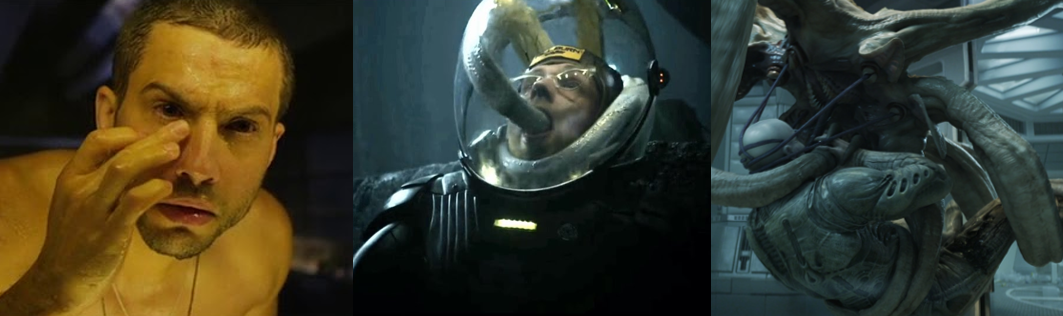
Despite Vickers’ warnings, Shaw and Holloway join the others in investigating a large, seemingly artificial structure on the toxic planet’s surface, with Shaw chastising Holloway for trusting Fifield’s readouts and removing his helmet to breathe the self-contained atmosphere within. Initially, Shaw and Holloway are ecstatic to find the structure and the ancient, biomechanical technology within, where holograms triggered by David show the Engineers to be humanoid creatures, and even more thrilled when they discover an Engineer’s dead body and a tomb-like chamber filled with mysterious, vase-like containers. However, Holloway’s excitement evaporates as Shawn and medic Ford (Kate Dickie) investigate the Engineer’s severed head and he becomes despondent to learn that they’re all apparently all dead, having strangely perished while fleeing an unseen threat. Drunk, unaware that David has infected him with a tiny sample of black goo, Holloway vents his frustrations to David and Shaw, voicing his disappointment at being unable to talk to “God” and the revelation that there’s nothing special about human life. Shaw maintains her enthusiasm, though, largely because she cannot have children and their discovery promises to reveal so much about human evolution. At first, Shaw is as far from Lieutenant Ellen Ripley (Sigourney Weaver) as you can get, being an intellectual and a scientist first and foremost. Despite this, she fearlessly ventures into the Engineer’s structure and evolves into a more pro-active character, desperately dragging Holloway back to the ship when his infection takes root, faking being sedated afterwards so she can escape David’s custody, and even enduring a horrific automated caesarean to remove the Trilobite implanted by the android’s machinations. Shaw’s also far more emotional, feeling both angry and betrayed by Weyland Corp and the Engineers after she learns the truth about both and demanding answers from humanity’s stoic makers in the final act. In contrast, Holloway is largely uncharismatic and bland, initially mirroring Shaw’s enthusiasm before falling into despair before being doomed by David, a fate Holloway somewhat brings onto himself through his blind ambition to commune with “God” and his arrogant, malicious treatment of David.

Vickers is enraged by David’s surreptitious nature and her father’s callous attitude.

Unlike his successors, David is somewhat less refined and efficient, being noticeably more machine-like in his mannerisms and movements. He spends two years studying every modern and ancient language to transcribe and communicate with the Engineers and diligently serves the crew despite Holloway and Vickers treating him as inferior. David makes every effort to fit in, dressing like the crew and even donning a space suit he doesn’t need, only to be met with disdain or hostility. While David’s presumably programmed not to have emotions, it’s also implied that he’s learned to mask them to deceive people and this is only made more relevant when he observes Shaw’s dreams and specifically targets Holloway with the black goo, indicating that he has something of an obsession with Shaw. David is mostly helpful and polite, but Vickers’ hatred of him is rooted in jealousy as Weyland saw the android as the son he never had, favouring David over his daughter, Vickers, leading her to despise the android. Vickers’ stone-faced, no-nonsense demeanour sees her mocked (in private) by most of the crew and prompts Janek to question if she’s also a robot, resulting in a rare break in her icy exterior as she orders him to sleep with her. Vickers’ efforts to remain in control, even having a self-contained lifeboat quarters, are doomed to failure by LV-223’s chaotic atmosphere and her father’s plot, which sees David surreptitiously experiment with the black goo to report back to her father, who’s in cryosleep on the Prometheus. Thanks to David’s constant updates, the decrepit old man is confident that he can demand an extension on his already well-lived life, a decision which only brings Vickers further pain as Weyland would rather barter with “God” to extend his life than willingly pass on his legacy and company to her.

Any charisma Janek has is overshadowed by the stupidity and blandness of his crew.

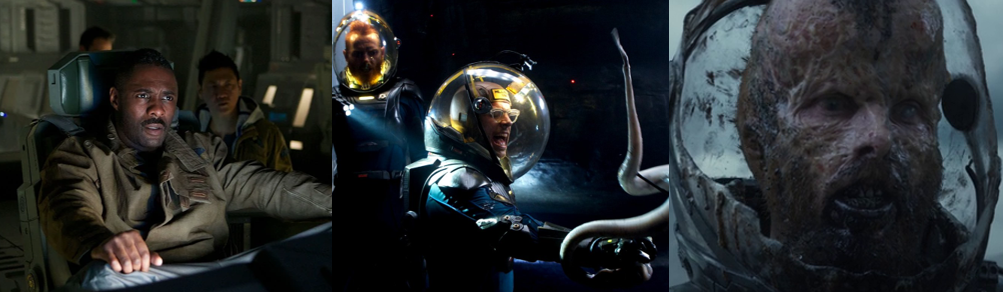
Despite being an exploration vessel largely crewed with scientists, the Prometheus has some dumb-ass characters onboard, namely Fifield and biologist Millburn (Rafe Spall). While Fifield’s spheres map the Engineer structure, he gets spooked and gets lost (despite having the map) alongside Millburn, whom Fifield has a contentious relationship with because one of them is a crazy, abrasive asshole and the other is a chirpy annoyance. Millburn shows his own stupidity when they decide to weather a static storm inside the chamber and are confronted by snake-like Hammerpedes. While Millburn tries to keep his wits, he insists on approaching the mutated earthworm and unsurprisingly gets his arm broken and is infected by the slithering creature. Fifield is also infected while scrambling to help Millburn, taking a splash of acid to his helmet and landing face-first in black goo, which strangely transforms him into a zombie-like creature (because a humanoid Xenomorph would’ve been too cool, I guess). Pilots Chance (Emun Elliott) and Ravel (Benedict Wong) basically do nothing except fly and land the ship and opt to stay by Janek’s side in the finale as he plots a collision course with the escaping Engineer ship, sacrificing themselves to keep the Engineer from returning to Earth. Overall, the crew is far less memorable that the “space truckers” seen in Alien, despite Idris Elba’s bizarre accent and talent with an accordion. While it makes sense that Weyland’s ship would have all the mod-cons and be much cleaner and more impressive than haulage vessels like the USCSS Nostromo, the slick, high-tech ship (with all its holograms and touchscreens and such) feels too advanced for this point in the timeline and I never felt as connected to the ship or its crew as a result since they’re not as relatable as working class schmuks.

Prometheus goes out of its way to rewrite the lore yet struggles to juggle its identity.

This leads me into perhaps the biggest thing I’ve always disliked about Prometheus: it goes out of its way to distance itself from being a direct prequel to Alien, but apparently without changing the script. The ship travels to LV-223, not LV-426 as seen in the original film, but encounters an Engineer ship exactly like the one discovered by the Nostromo and which crashes in exactly the same position as that ship. It’s honestly distracting as it feels like these elements were changed at the last minute, meaning they just had to roll with what was shot, though I suppose it wouldn’t make much sense for the Company to forget about the planet where their founder died for over 100 years. Prometheus also seems to decanonise the AVP films, for better or worse, by stating that the Engineers created human life (and, apparently, all life) and suggesting that the Xenomorphs haven’t yet been bred or aren’t as prevalent. There’s a mural in the chamber depicting a Xenomorph and the “Deacon” that emerges from an Engineer resembles an Alien, but the creature itself is otherwise absent as the film clumsily tries to lay the seeds for their origin, again awkwardly juggling being a prequel and a standalone story. Indeed, Prometheus is more concerned with existential questions about existence and evolution, faith and science, and the nature of humanity. The Engineers are revealed to have sparked human evolution, but apparently “changed their minds” about humanity over the thousands of years and were preparing to wipe us out with the black goo. We never really find out why or what the Engineers’ true purpose was. Janek suggests they were creating weapons of mass destruction on LV-223 and it can be implied that they seeded worlds to breed hosts for the black goo, but none of this is explicitly said, with Shaw simply believing humanity somehow angered their creators. An abandoned idea, however, was to have an Earth-bound Engineer be Jesus Christ, explaining their wrath against humanity.
Sadly, few of the aliens and horrific moments can match the visual impact of the Xenomorph.

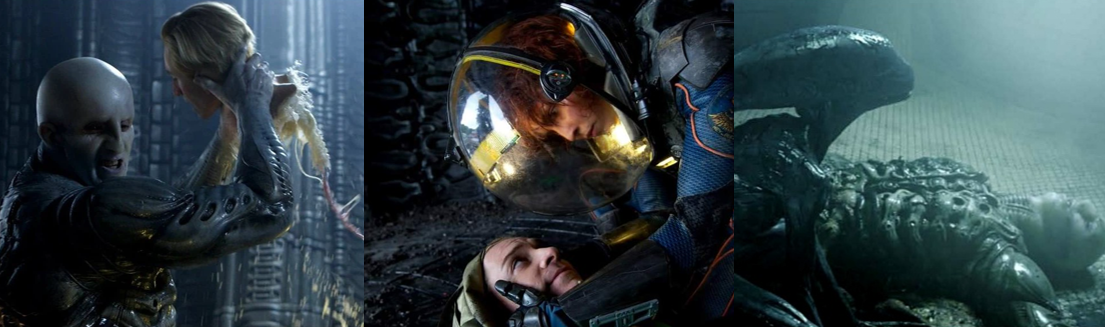
Instead of Xenomorphs, Prometheus offers a handful of other aliens and horrific creatures. The Engineer ship has that same unsettling, bone-like structure as before and is a disturbing combination of H.R. Giger and ancient civilisations like the Egyptians and Mayans. The dark, moody interior is littered with Engineer corpses, one of which has exploded from the inside out, and the crew unwittingly activate the black goo by disturbing the chamber’s ecosystem, causing it to horrifically mutate earthworms into Hammerpedes. This sees Fifield transformed into a bizarre, voracious, zombie-like creature that bashes some guy’s head in and must be run down and immolated to be killed. Holloway’s transformation isn’t as gruesome but does see his eyes go black and his skin malform as the black goo courses through his veins, leading him to invite Vickers to kill him before it’s too late. Thanks to them sneaking in some sexy time, Shaw is aghast to find she’s been impregnated with a rapidly growing alien parasite, which she forcibly removes with Vickers’ medical machine and which turns out to be a cephalopod-like creature that’s somehow an even more sexually disturbing and terrifying version of the traditional Facehugger. Unlike the elephantine “Space Jockeys” seen in the Dark Horse Comics, the Engineers are physical specimens and highly advanced, developing incredible technology and regularly kick-starting life on other worlds. Physically imposing and with science way beyond ours, they seemingly embody a physical and mental perfection far beyond humanity but are implied to have either become bored with humanity or to have always planned our extermination in the name of biological warfare. Despite their stature, David seemingly takes some pleasure in observing that the Engineers are as “mortal” as their creations and they were ultimately undone when one of their experiments somehow escaped and killed them (though we never see how this happened). Rather than being visually terrifying, it’s the implication of the Engineers which rattles most of the crew as they deconstruct religious and scientific ideas about humankind, though Shaw maintains her faith in a higher power as someone obviously made the Engineers.

Shaw heads to a doomed future with David to confront the malevolent Engineers.

After extracting the Trilobite, the grievously injured Shaw discovers Weyland was on the ship all along and, despite being betrayed and manipulated by him and David, agrees to accompany him to confront the remaining Engineer, desperate to understand why they turned on humanity. Unfortunately, neither she or Weyland get any answers as the hulking brute barely acknowledges them and opts to rip David’s head off rather than answer Weyland’s desperate plea for more life. The Engineer then bashes Weyland with David’s severed head, unceremoniously killing him and making Weyland’s plea to the Gods as futile as David’s efforts to earn the respect of his organic peers. The Engineer then resumes its mission to unleash black goo on Earth and cull humankind. However, thanks to Janek, Chance, and Revel’s sacrifice, the Engineer’s ship is downed as it takes off, with Vickers crushed when it rolls to a stop and Shaw left exploring her badly damaged lifeboat, where the enlarged Trilobite latches onto the Engineer in a disturbingly sexual manner. Distraught and at her wit’s end, Shaw faces a slow and painful death from her dwindling oxygen supply when David’s severed head contacts her. Despite being wary of him, Shaw is convinced to return to the Engineer ship and recover the dismembered android as David reveals that there are more alien ships on LV-233 and that he can pilot them. However, upon reaching David’s head, Shaw states her desire to go further, to the Engineer’s home world, to demand answers from her makers and David agrees, despite knowing that Shaw will never get the answers or the closure she’s seeking. As they fly off to a fate that leaves one of them doomed and the other destined to upset the universe’s food chain, the dead Engineer violently bursts open and “births” the Deacon, a pseudo-Xenomorph that was sadly never seen again and whose fate remains a mystery.

Final Thoughts:
I remember being very impressed when I first saw Prometheus, seeing it as a return to the more atmospheric sci-fi horror of the 1970s and appreciating that it took its time and raised interesting questions about faith, evolution, and the origin of the Xenomorphs. Over time, however, my opinion has soured as I grew more and more resentful of it not being a more straightforward prequel, especially as all the elements are in place for that but were seemingly changed at the last minute. That aside, this isn’t an especially impressive film and feels ridiculously disconnected from Alien thanks to the overly elaborate technology and the largely bland and unrelatable characters. Janek’s the only one who evokes the down-to-earth vibe of the Nostromo crew as everyone else is either stupid, insufferable, bland, or just inferior. Shaw, especially, did little for me despite her impressive resolve and the others were too forgettable or idiotic to talk about. David was the obvious standout and exuded an unsettlingly menace in his subtle mannerisms and thinly veiled dialogue, to say nothing of him clearly being resentful towards his creatures. Guy Pearce was laughable under all that make-up and made me wish they’d just brought Lance Henriksen back to the role, though I did like the bitter narrative regarding the search for answers. While the film looks great and has some disturbing moments, none of the creatures had the same visceral impact as the Xenomorph and the attempt at an origin fell flat as the narrative felt muddled since it doesn’t know if it wants to be a prequel, a standalone, or something else. Even now, I rarely revisit this one as it’s pretty tedious to get through and has few saving graces. I appreciate that Prometheus tries to be somewhat vague about the Engineers and the Xenomorphs, but it just doesn’t gel very well with the story that’s being told and feels like all its potential was sucked out the airlock by a pretentious, confused script. In the grand scheme of the Alien franchise, Prometheus is easily forgotten, and I can’t say my opinions have changed for the better since its release.

Rating: 2 out of 5.

Could Be Better

Did you enjoy Prometheus and, if so, why? Were you also disappointed that it wasn’t a straight-up prequel or did you like that it tried to do something more? What did you think to Shaw and her search for answers? Is David your favourite synthetic character? Why you you think the Engineers wanted to destroy humanity? Which of the Alien movies is your favourite and why, and how are you celebrating Alien Day today? Whatever your thoughts, eave them below and support me on Ko-Fi for more Alien reviews.

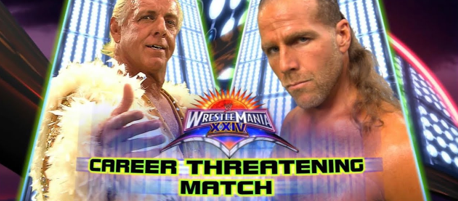
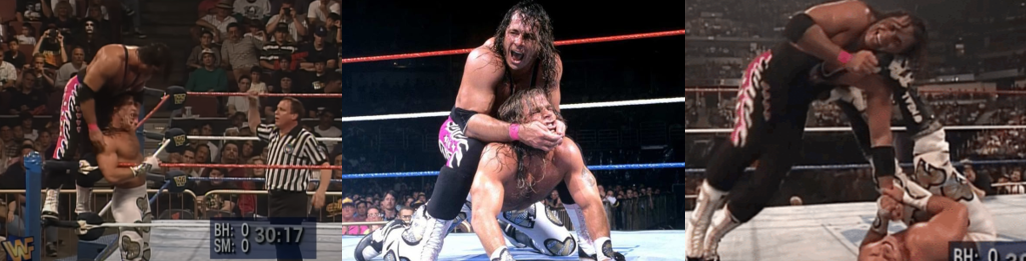
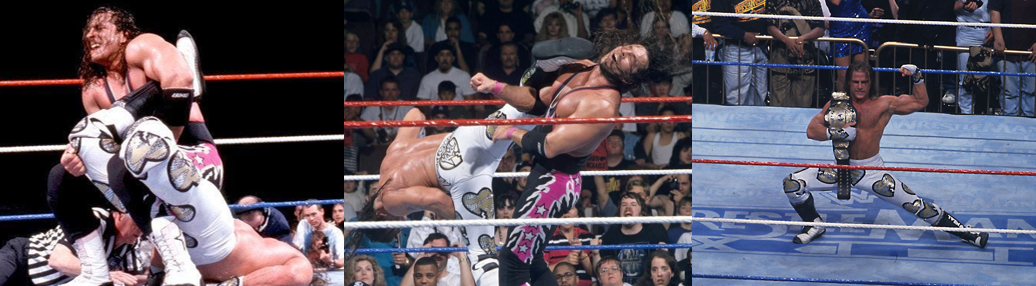
Wrestling Recap: HBK vs. Flair (WrestleMania XXIV)

The Date: 30 March 2008
The Venue: Florida Citrus Bowl; Orlando, Florida
The Stakes: Singles match with Ric Flair’s career on the line

The Commentary: Jim “J.R.” Ross and Jerry “The King” Lawler
The Referee: Charles Robinson
Dave Meltzer’s Rating: 3.5

The Build-Up:
After making one of the most celebrated comebacks in wrestling history, former wild child “The Heartbreak Kid” Shawn Michaels saw a career resurgence. The legendary “Nature Boy” Ric Flair also had a career revival after returning to World Wrestling Entertainment (WWE) in 2001 and running with super sable Evolution, but saw his livelihood in jeopardy when WWE Chairman Vince McMahon promised to force Flair to retire the next time he lost a match as he believed Flair had paid his dues. After defying McMahon’s efforts, the wily veteran challenged HBK to a WrestleMania match while being inducted into the 2008 Hall of Fame, seemingly happy to end his career against the Showstopper if he lost.

The Match:
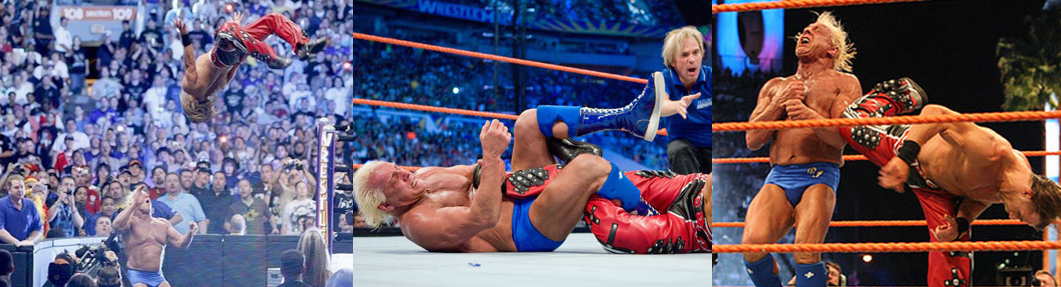
Shawn Michaels bounded to the ring with his usual enthusiasm to start, despite the implications of the match stipulation, to a raucous reception only matched by a unanimous show of support for Ric Flair. J.R. and the King expressed hope that the legendary Nature Boy could “rise to the occasion” once again but their intonation and word choices were a bit odd, as though they figured the outcome was a forgone conclusion and that Flair would be retiring by the night’s end. Ever the wily showman, Flair baited Shawn before the bell rang before going in for a traditional tie-up, suffering a knockdown from a shoulder block and trading wristlocks before being taken down with a hammerlock. A lazy hip toss was enough to send Flair strutting and taunting HBK with his signature “Woo!” cry, resulting in the two grappling and shoving each other in a corner. An errant slap from Shawn left Flair with a bloody lip, compelling him to unleash a flurry of knife edge chops in the corner and drop his patented running knee drop. Shawn went to the top and paid for it when Flair tossed him to the mat. Flair then followed up and, incredibly, hit a diving crossbody for a near fall! Flair then targeted Shawn’s leg to set up for the Figure Four Leglock, causing Shawn to frantically send Flair outside, where HBK crashed through an announce table off an apron moonsault. Favouring his ribs, Shawn gingerly returned to the ring, got tossed into the corners, and ate a back body drop for a two count. Though noticeably winded, slow, and weak from age, Flair continued his assault with a falling hip toss for another near fall and even hit a stalling vertical suplex for two more pin attempts.
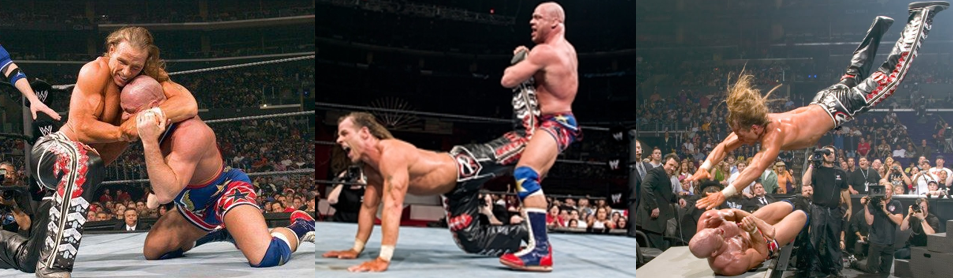
Despite his best efforts, a noticeably struggling Flair was bested by the reluctant HBK.

HBK fought back with a swinging neckbreaker and tossed Flair back outside, though barely landing a top-rope moonsault. After they beat the ten count, they once again traded chops in the ring before Shawn hit his running forearm, kipped up, and hit a couple of inverted atomic drops. Still clutching his ribs, HBK landed his signature diving elbow drop and prepared for Sweet Chin Music, only to hesitate at the last second and find himself in the Figure Four! Luckily, Shawn quickly reversed it, leaving both men hobbled as they tried for pin falls. After turning Shawn inside out off a whip into a corner, Flair returned to the leg with a chop block but almost got pinned when HBK reversed a Figure Four. Tenacious, Flair reapplied the hold regardless, dragged Shawn from the ring ropes and maintaining the hold even as Shawn tried to reverse it. Eventually, HBK grabbed the ropes and nailed Sweet Chin Music out of nowhere as Flair was stylin’ and profilin’. A lackadaisical cover saw the Nature Boy get his shoulder up and hit a mule kick to HBK’s balls when Shawn muscled him up for another kick. After kicking out, Shawn applied a Figure Four of his own, though Flair weaselled out by thumbing his rival in the eye and returned to the chops, eating another surprise superkick and leaving a distraught Shawn preparing the final shot. Stubborn to the end, Flair goaded Shawn on, leading HBK to mutter “I’m sorry… I love you!” and immediately embrace Flair after landing Sweet Chin Music and bringing the Nature Boy’s in-ring WWE career to an end. Afterwards, an emotional Flair received a standing ovation and embraced his family at ringside, tears streaming as he acknowledge the crowd’s support.
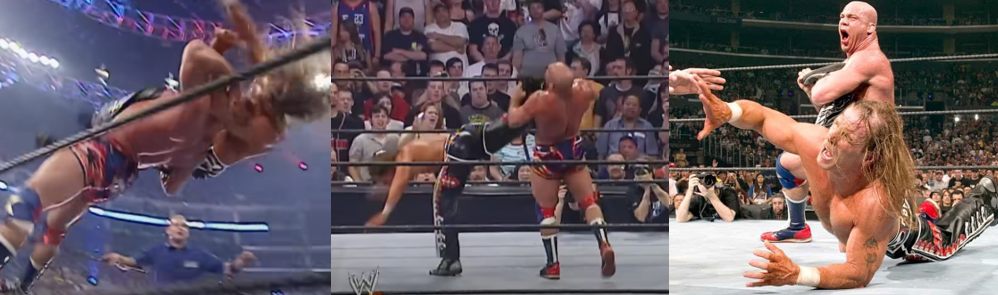
The Aftermath:
An emotionally charged match, to be sure, but hardly the greatest match of Ric Flair’s storied career. It’s obvious that Flair is way past his prime here as he’s stumbling about, clearly winded, and struggling to do much but the basics. Shawn Michaels can have a good match with anyone and bounced all over the place for Flair, but it only served to highlight the Nature Boy’s flaws so I’m glad he went out with a bang. The next night on Raw, Flair came out to deliver a rousing farewell speech and being celebrated by the WWE roster, old friends like the Four Horseman and rivals like Ricky “The Dragon” Steamboat and even earning the respect of the stoic Undertaker. Though Flair buried the hatchet with Shawn, HBK was near-immediately targeted by Flair’s old Evolution enforcer, Batista, for retiring his mentor. This obviously wasn’t the end for Ric Flair, who was involved in Chris Jericho’s campaign against his fellow WWE Legends at WrestleMania 25 before being written off television following an attack by Randy Orton. Flair had a brief spell in Ring of Honor (ROH) before embarking on a two-year run with Total Nonstop Action (TNA) that saw him mentor “The Phenomenal” AJ Styles, form the Fortune and Immortal stables, and return to the ring for matches against his old foes, Hulk Hogan and Mick Foley. Flair returned to the WWE in 2012 to manage his daughter, “The Queen” Charlotte Flair, and was brutalised by Batista during his own retirement tour. After being released from the WWE in 2021, Flair participated in a widely criticised “last match”, teaming with son-in-law Andrade El Ídolo against Jeff Jarrett and Jay Lethal, before appearing in All Elite Wrestling (AEW) as part of “The Icon” Sting’s road to retirement.

My Rating:

Rating: 3 out of 5.

Pretty Good

Were you satisfied by Ric Flair’s final WWE match or do you feel he tarnished the ending by continuing to wrestle? Did you also find Flair to be lacking in the match or were you captivated by the emotion? Do you think Flair should’ve won or do you think this was a fitting end? What are some of your favourite Flair and/or HBK matches? Like this review and let me know what you think in the comments, then donate to my Ko-Fi to suggest other Ric Flair and/or Shawn Michaels matches for me to review.

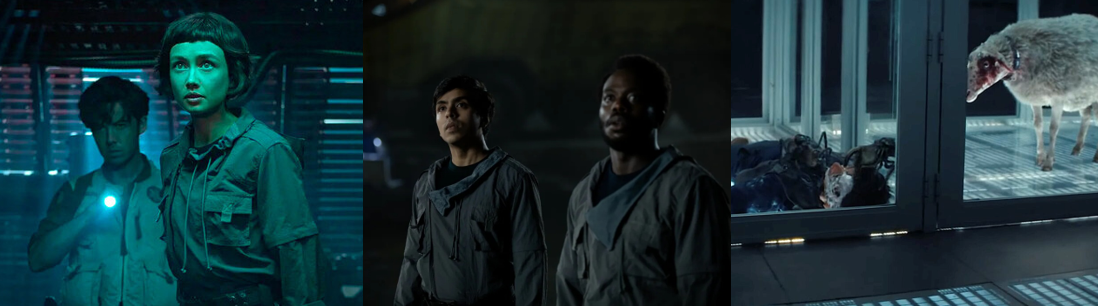
Screen Time: Alien: Earth (Season One)

Season One

Air Date: 12 August 2025 to 23 September 2025
UK Network: Disney+

Original Network: FX / FX on Hulu
Rotten Tomatoes Scores: 94% / 65%

Quick Facts:
First announced in February 2019, showrunner Noah Hawley pitched Alien: Earth as a prelude to Ridley Scott’s 1979 sci-fi horror classic Alien rather than being beholden to Scott’s divisive prequels. One of FX’s biggest productions, filming was delayed by COVID-19 and the 2023 SAG-AFTRA strike and employed practical effects from Wētā Workshop wherever possible. Praised by a critics and former franchise star Sigourney Weaver, Alien: Earth was successful enough to greenlight a second season.

The Review:
Ever since the troubled Alien3 (Fincher, 1992), the Alien franchise has teased bringing the titular Xenomorphs to Earth. However, this concept appeared only in comic books and the poorly received Aliens vs. Predator movies (Various, 2004; 2007), and even then the Xenomorphs were limited to Antarctica and a quiet America suburb, respectively. Alien: Earth therefore had a lot of potential, though strangely chose to be a prequel to Alien rather than taking place at any point after that. To be fair, I don’t have a massive issue with this as it was always clear to me that the malevolent Weyland-Yutani Corporation knew about the Xenomorphs prior to Alien, and the decision to set the series in this time seems purely to recreate the aesthetics of Alien and Aliens (Cameron, 1986), just as Alien: Romulus (Álvarez, 2024) did the year prior. Still, it was a little disappointing that the series didn’t depict Aliens loose in a heavily populated, sci-fi city. There is a bit of that, particularly in “Mr. October” (Gonzales, 2025), where a Xenomorph (Cameron Brown) goes on a bloody rampage through a New Siam skyscraper, but mostly the narrative is limited to a private island facility overseen by Prodigy Corporation’s chief executive officer (CEO) and “Boy Genius” Boy Kavalier (Samuel Blenkin). Things start off quite strong when the Weyland-Yutani’s deep-space research vessel, the USCSS Maginot, crashes into New Siam, causing a fair bit of damage and raising tensions between Company CEO Yutani (Sandra Yi Sencindiver) and the arrogant, condescending Kavalier, who plunders the ship’s bizarre and hazardous aliens to further increase his already staggering trillionaire wealth and get one-up on Weyland-Yutani by weaponising the aliens before they can.

The first of a new breed of hybrids, Wendy showcases amazing potential despite her young age.

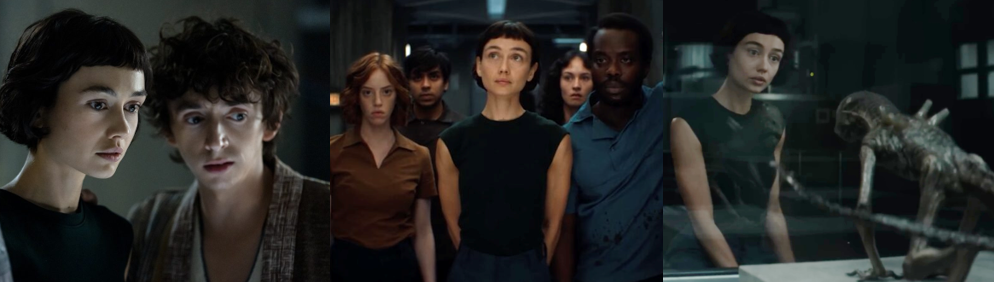
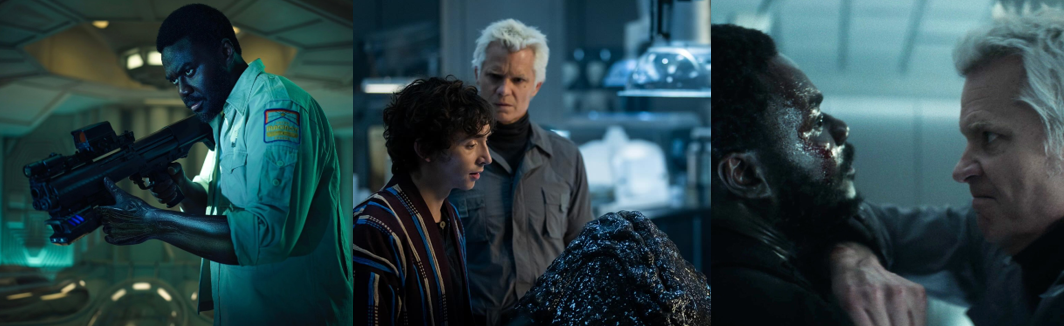
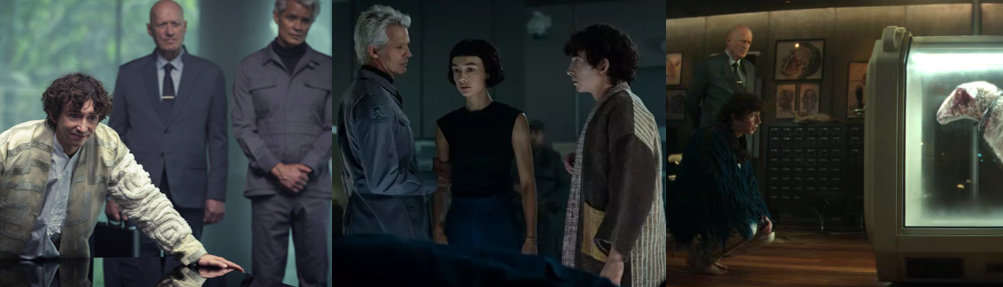
Kavalier’s manic ambitions see him favour these aliens over his newest creation, the first-ever symbiosis between human and synthetic life, which he frames as a way to give dying children a chance at immortality but is actually to feed his own wealth and ego. Kavalier’s prize “hybrid” is Wendy (Sydney Chandler), formally terminal Marcy Hermit (Florence Bensberg), who volunteered after being won over by the Boy Genius and his lead scientists, Arthur (David Rysdahl) and Dame Sylvia (Essie Davis), who frame the procedure as a life-saving opportunity to essentially live forever in a superhuman body, likening Wendy and her fellow hybrids to Peter Pan’s “Lost Boys”. As the first and oldest, Wendy is Kavalier’s favourite and designated the leader of the Lost Boys, whom she helps acclimatise to their new synthetic bodies, which allow them to expand their learning and abilities (though they retain their child-like demeanour). Initially, Wendy is enamoured by the Boy Genius and eager to prove herself and the Lost Boys to Kavalier, volunteering to investigate the Maginot to show that she’s “premium” and also reunite with her brother, Joe (Alex Lawther), a medic for Prodigy’s Security Service. Wendy’s childhood memories and desire to reunite with Joe trouble Kavalier and her handler, Kirsh (Timothy Olyphant), a stoic synthetic who barely tolerates Kavalier and seeks to protect his investment in the Lost Boys while also being intrigued by the aliens. Despite her childish nature, Wendy proves a formidable character when she kills a Xenomorph to protect her brother and soon becomes invaluable to Kavalier as she can sense and even communicate with the Xenomorphs due to a software glitch, which also sees her hack Prodigy terminals and even disable synthetics like Atom Eins (Adrian Edmondson), Kavalier’s sinister butler who delivers veiled threats on his behalf.

The Lost Boys range from naïve, to ambitious, to emotionally unstable but all struggle with their new bodies

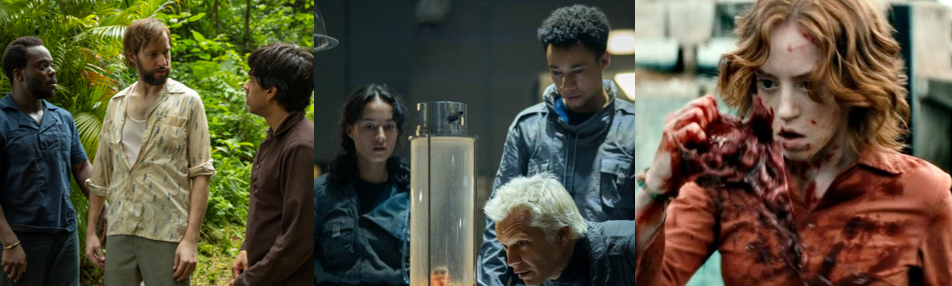
Wendy’s extremely protective of the Lost Boys, initially urging them to follow the Boy Genius’s lead and be the next step in the evolutionary chain, and later defending them when they’re threatened. The Lost Boys are far more immature compared to Wendy, and some are much more emotionally unhinged, like Rose Ellis/Nibs (Lily Newmark), who’s severely traumatised after an encounter with the Trypanohyncha Ocellus that sees Dame forced to wipe her memory to ease her pain and sees her become violently unstable. Jane Mita/Curly (Erana James) harbours a jealousy towards Wendy and seeks to replace her as Kavalier’s favourite, somewhat ostracising her from the others, though she ultimately defers to Wendy’s authority after witnessing Kavalier’s callous attitude towards them. Steven DiMarco/Tootles (Kit Young) gets an inflated ego by working as Kirsh’s assistant, renaming himself Isaac to suit his “adult” personality and ultimately being melted by flying alien bugs after foolishly trapping himself in their cage. Aarush Singh/Slightly (Adarsh Gourav) and Christopher Okafor/Smee (Jonathan Ajayi) are largely inseparable, though Smee’s wish to simply play and have fun like kids is constantly ignored or shot down by the others and especially Slightly, who’s amazed after they encounter the Maginot’s cyborg security officer, Kumi Morrow (Babou Ceesay), and is targeted by him in his quest to secure a Xenomorph sample for Yutani. Manipulated by Morrow, Slightly’s forced to impregnate Arthur with a Chestburster to spare his mother, Meera (Anjana Ghogar), and his family. Conflicted about this, Slightly is prone to outbursts, especially once Joe joins the group, and is wracked by guilt following Arthur’s death. Joe bonds with the Lost Boys quite well but remains focused on keeping Wendy safe, risking being fired, fined, or even prosecuted when he threatens to take her away and encountering some resistance from Wendy about this as she’s so grateful to be part of Kavalier’s operation.

Morrow and Kirsh were two standout characters for their complex morals and actions.

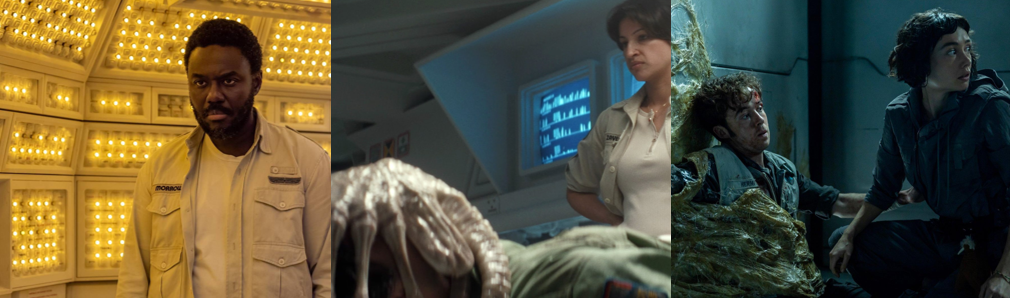
Morrow is one of the standout characters of Alien: Earth. Met with distrust and even hatred by the Maginot crew as many in this world are dismissive or prejudiced against synthetics and cyborgs, Morrow is initially very cold-hearted, uncompromising, and almost machine-like character. He thinks nothing of sacrificing the Maginot’s crew as per Company orders or leaving others to face similarly gruesome ends to achieve his goal. Having lost sixty-five years and his daughter to the Maginot, Morrow has nothing to live for but the aliens and stubbornly sets out to reclaim the Xenomorph from Kavalier, threatening Slightly’s family and sacrificing anyone in the process. “In Space, No One…” (Hawley, 2025), which is essentially a retelling of Alien, gives Morrow the spotlight and shows his desperate attempts to lockdown the Maginot after science officer Chibuzo’s (Karen Aldridge) aliens escape and the ship is sabotaged by chief engineer Petrovich (Enzo Cilenti) on Kavalier’s orders. Thanks to acting captain Zoya Zaveri’s (Richa Moorjani) blunders, which cost additional lives, Morrow takes command and tries to contain the situation, then seals himself in the computer room to survive the crash to Earth. Despite his cybernetic arm (which sports a knife and a blowtorch) and nodes, Morrow is ultimately bitched out by Kirsh, though badly damages the android. Kirsh was also a standout thanks to Olyphant’s quiet, measured performance which fittingly recalls Blade Runner’s (Scott, 1982) Roy Batty (Rutger Hauer). Though he cares for the Lost Boys and encourages them to fulfil their full potential, Kirsh is quick to focus on the aliens but is ultimately bound to the Boy Genius’s orders, which clearly doesn’t sit well with Kirsh as he, like Arthur and Joe, are frustrated at being talked down to by Kavalier and forced to bend to his will or risk potentially fatal punishment.

Arrogant, impulsive Kavalier endlessly feeds his own ego and wealth with outrageous projects.

Kavalier is easily the most aggravating aspect of Alien: Earth. Having been abused by his jealous, alcoholic father and amassed a trillion-dollar company at a young age, Kavalier is widely regarded as a boy prodigy and fully aware of his high intellect. Prone to emotional outbursts and flights of fancy, Kavalier thinks nothing of threatening or sacrificing anyone to get his way, having built a synth to kill his father and barely caring about the alien threat. All he sees is an excuse to expand his empire and prove his superiority over Yutani, arrogantly swanning around in robes, baggy clothing, or with his shoes off and being a condescending little shit to everyone, no matter how integral they are to his operation. Even the Lost Boys aren’t spared his patronising demeanour as he quickly grows bored of their emotional baggage and childish ways, urging them to be more and expand their minds to give him at least an interesting conversation, if not an intellectual equal. Though impressed by Curly’s ambition, he dismisses her attempts to replace Wendy when he sees that Wendy can communicate with the Xenomorphs and barely flinches upon seeing Isaac’s partially melted (and digested) body. Even Atom despairs of his master’s impulsive nature and advises against separating the aliens due to the potential risk, as well as questioning Kavalier abandoning the hybrids to obsess over the T. Ocellus as it demonstrates intelligence after infecting a sheep. Kavalier’s arrogance eventually proves his downfall as he assumes the Lost Boys will be happy with being regarded as mere products to be sold to others and doesn’t see their rebellion coming in “The Real Monsters” (Gonzales, 2025), where he, Atom, and Dame are spared the bloody end that they deserve and left imprisoned and at the mercy of Wendy and her friends.

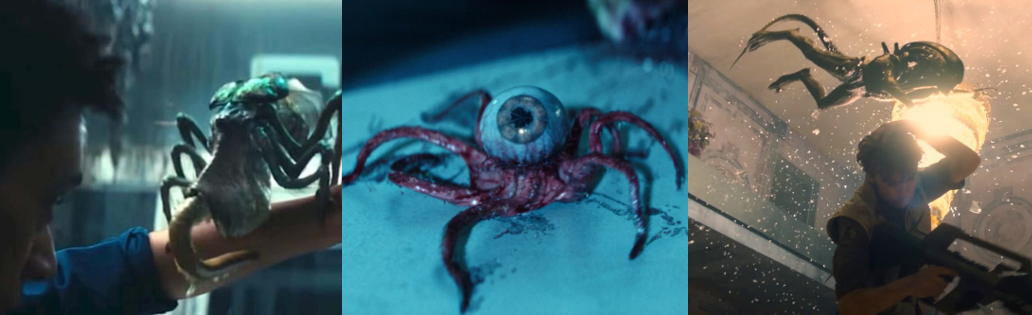
The Alien shares the small screen with some gruesome new creatures, including a living eyeball!

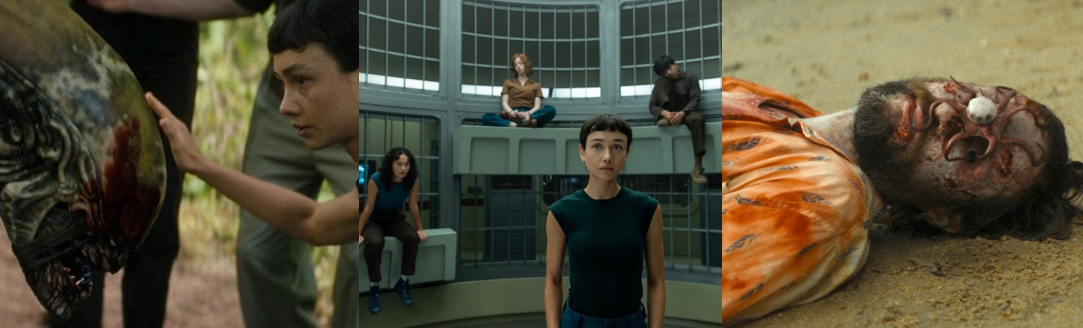
Having investigated distant moons, Maginot is carrying some alien specimens for Weyland-Yutani’s bio-weapons division. Though the aliens unsettle the crew, Chibuzo is fascinated by them, particularly the resilient bloodsucking leeches that escape and infect apprentice engineer Malachite (Jamie Bisping). These nasty little critters attach themselves to his oesophagus and ultimately kill him, Chibuzo, and medical officer Rahim (Amir Boutrous) by releasing a toxin when threatened. Thanks to Morrow, we also see that these bugs favour latching onto a victim’s neck and draining their blood, like leeches. Isaac falls victim to fly-like aliens that have evolved to consume inorganic matter and secrete an acid-like substance to subdue their prey, being much more proactive than the carnivorous plant D. Plumbicare, which patiently waits to strike. The T. Ocellus was the show’s breakout star, for sure, being an octopus-like eyeball that removes its victim’s eyeball and then controls their body like a puppet. Oddly, the T. Ocellus exhibits intelligence and even benevolence as it tries to warn Chibuzo of the ticks and even attacks the Xenomorph threatening the Maginot but later causes Slighty’s death and is more dismissive of humans, perhaps due its time in captivity. Naturally, the ship’s main prize is the Xenomorph eggs and Facehuggers they bring back, which we learn continue to gestate even in cryosleep and again emerge in record time to get an Alien onscreen. While the Aliens are used sparingly, they’re as ferocious and vicious as ever, tearing apart anyone in their path or partially cocooning them to lure in prey. We see a different side to the Alien here, though, as one is pacified by Wendy and follows her commands, effectively being tamed by the hybrid to be turned against those who would harm her or her friends. Though the Alien returns to its terrifying roots in “In Space, No One…”, it’s seen in full daylight in “Emergence” (Gonzales, 2025) and there are times when the suit looks a little dodgy and clunky. However, CGI renditions of the creature allow it to move faster and be more versatile and it still causes much carnage, skewering prey with its tail, ripping torsos from legs, and massacring woefully even troops of armed soldiers.

The show’s visual fidelity to the first two films is impressive and very welcome.

If there’s one thing Alien: Earth has going for it, it’s the atmosphere. The show perfectly recreates the look, sound, and feel of Alien and Aliens, clearly working from production designs or blueprints from the Nostromo to build the Maginot’s sets, which include darkly lit, claustrophobic corridors, a clinical mess hall, and a beautifully seventies computer room, complete with all the keyboard and computer sounds from the first movie. The sets bring an unprecedented level of authenticity to Alien: Earth and really help it fit right in with the original films as cameras, weapons, and terminals all have a clunky, retro-futuristic vibe rather than being all slick touchscreens and holograms. This is obviously best seen in “In Space, No One…”, which recreates the same claustrophobic horror and paranoia as Alien, but all Kavalier’s facilities feel right at home in this world too, as though he invested heavily in the research but wasn’t bothered by the aesthetics. While I had some issues with the Xenomorph suit, the effects are largely very impressive, and every episode felt like a mini movie with a lot of money and attention to detail behind it. Morrow’s cybernetic arm could be a bit dodgy, but everything was shot in a way that benefitted the effects and highlighted how complacent many of these characters are as they get distracted, make mistakes, or simply aren’t mature enough to think about every eventuality. I’ve seen people complaining that each episode ends with a rock song or music track, but I didn’t mind this, mainly because one is by Metallica and I simply skipped the credits, and because the score echoed the foreboding tunes of Alien and the militaristic adrenaline of Aliens. While we don’t spend much time in New Siam, the city and its architecture fittingly mirror Blade Runner, depicting a “lived-in” world where the decadent indulge their excess and trillionaires measure their dicks before their android servants.

Wendy’s command over the Aliens sees her take charge, but a greater threat still looms…

Blade Runner is a fitting comparison as Alien: Earth focuses almost entirely on synthetic life, to some degree. Wendy and other Lost Boys constantly question their humanity and mortality, believing they cannot get sick or die and are “premium” and thus leaving them rattled when Isaac is killed. Some of them struggle with their identity, others with their maturity, and they all insist that they are now adults simply because they have grown-up bodies and yet cannot escape the fact that they’re still children and prone to mistakes and manipulation. Alien: Earth isn’t saying anything especially groundbreaking with these characters, but it’s an interesting wrinkle on the franchise’s synthetics, which are generally always subservient to humans or blindly loyal to the Company. There’s a lot of prejudice against synthetics, even cyborgs like Morrow, which eventually fuels Wendy’s revolution against Kavalier when she realises that they don’t need to follow his commands as she can freely manipulate his technology and control Xenomorphs. Her perception of Kavalier changes when Dame rewrites Nibs’ personality, allowing her to finally agree with Joe’s plan to flee the island, only for tensions to flare between them when Joe’s marine buddies attack Nibs in self-defence. They quickly overcome their differences, however, to unite against Kavalier, who devastates the Lost Boys with his dismissive attitude towards them. Even Curly comes around in the face of this, reclaiming her previous name and joining Wendy in solidarity, the Lost Boys realising that they were manipulated into accepting nigh-immortality but being merely regarded as products, seen by Kavalier as being little better than a regular synth despite their unique composition. Despite Wendy getting the Xenomorphs on side and claiming dominion over Kavalier’s island, the hybrids and Joe face an uncertain future as the T. Ocellus is still out there, puppeting Arthur’s body, and Weyland-Yutani are closing in to retrieve their specimens from the belittling Boy Genius…   

Final Thoughts:
I was admittedly sceptical about an Alien TV show, primarily because TV spin-offs of big movie franchises rarely work, especially effects-heavy, R-rated franchises. I was mostly pleasantly surprised, especially by the aesthetics and the atmosphere. It was immensely satisfying seeing practical sets that lovingly recreate the environments from the original film, especially to create a visual cohesion within the franchise. Alien: Romulus did the same thing, recreating Nostromo-like architecture and technology, but Alien: Earth takes it to the next level with the Maginot, which is almost a 1:1 recreation of the Nostromo. This extends to the spotlight episode of the series, “In Space, No One…”, which sees the Maginot crew mumble and talk over each other, bicker, and struggle to work together against a hostile force just like in Alien. Tensions are raised even further here, though, thanks to the vitriol aimed at Morrow and the crew’s disdain for the unsettling Teng (Andy Yu), to say nothing of their lack of faith in Zaveri. It’s a bit of a shame that we don’t spend more time with the crew as they’re exactly the sort of blue-collar workers who the Alien films typically revolve around, but I was intrigued by the focus on the hybrids and their existential crisis. I can see why some would find the constant references to Peter Pan (Barrie, 1904; Luske, Geronimi, and Jackson, 1953) annoying but it makes a morbid sense considering the hyperactive Kavalier is like a bratty child who feels a kinship with children and their endless imaginations. Morrow and the Xenomorph flesh out this analogy as Captain James Hook and the crocodile, respectively, though if anything this thematic through-line isn’t emphasised enough. It mainly boils down to the hybrids worrying about their humanity, concerned that they’ll never really grow up, and struggling to adapt to their adult bodies when they’re still ruled by childish impulses…much like the Boy Genius.

The existential narrative is largely hit or miss but the characters are intriguing, at least.

Dodgy haircut aside, I quite liked Wendy’s character and arc, though I don’t recall it being explained how and why she can mess with Prodigy’s systems or communicate with the Aliens. It was an interesting wrinkle, though, and something we haven’t seen from the franchise before (outside of the comics, maybe) with a tamed Xenomorph. This worked in the sense that Wendy showed the Alien compassion, respect, and understanding rather than reacting violently to it or trying to capture and study it like everyone else, and it shows the potential for the Xenomorphs to be more than just killing machines. They still are, thankfully, splattering blood and entrails all over and bursting from chests with a voracious appetite, and fully taking advantage of stupid people who stupidly mess with their eggs or try to remove the Facehuggers. Wendy is inarguably the most fleshed out of the hybrids, running a gamut of emotions as she is first blindly loyal to the man who gave her a new life and then realises that she’s seen as nothing but property when she’s capable of so much more. The other Lost Boys were entertaining enough, but there were maybe too many of them. Smee, Slightly, and Nibs were probably all that were needed and could’ve have characteristics of Curly and Isaac merged with them, just to offer more well-rounded characters, but it was kinda fun seeing them act like kids while operating these adult and very powerful synthetic bodies. Joe was a bit of a weak link to me, despite the tender bond he shares with Wendy, and I found myself hoping for the T. Ocellus to possess him just to give him more personality and agency and create a bizarre dynamic between him and Wendy, as he wouldn’t be fully human and neither would she. As is, he’s just a nice guy trying to protect his sister, but who is largely out of his depth when fighting both Prodigy’s legal department and the Xenomorph.

While the iconic Alien takes a backseat, the other ghastly aliens leave a lasting impression.

The aliens were obvious a highlight, stealing every scene with their weird and horrific natures. Even the ticks are incredibly intelligent and dangerous, and I liked that the Alien universe gave us a glimpse of the other “bugs” out in the stars. The T. Ocellus was disgustingly intriguing, seemingly wanting to help its human captors and then choosing chaos when imprisoned on Kavalier’s island. The Xenomorph is rightfully presented as the ultimate predator and the primary goal of Weyland-Yutani, with Morrow manipulating Slightly into infecting an innocent victim just to smuggle a specimen to Yutani. Morrow was quite a complex character, too, being hardened and ruthless but also compassionate at times, and driven to complete what he saw as his life’s goal. It was interesting that he remained loyal to Yutani despite having every reason to go on a vendetta against her for costing him his family, his life, and his crew, though he was clearly conflicted between his mission and his loyalties. Kirsh was equally a consistently complex character, exhibiting disgust at his position with Prodigy and his subservience to Kavalier while moulding the hybrids into functioning individuals and gleefully experimenting on the different aliens despite knowing how dangerous they were. Alien: Earth is definitely very ambitious, expanding the lore to include competing corporations and existential discussions, but this was also a season of highs and lows. The highs were very enjoyable and did the franchise justice, delving deeper into the characterisation and perception of synthetics and delivering some gruesome new alien creatures, but the lows undeniably dragged it down. These are mainly the length of each episode, the repetitive nature of the hybrids’ existential worries, and failing to properly pay off some of its plot threads in favour of a cliff-hanger. I think long-time Alien fans will still find plenty to enjoy, however, especially when the show is paying homage to the first two movies.

My Rating:

Rating: 3 out of 5.

Pretty Good

Were you a fan of season one of Alien: Earth? Did the constant references to Peter Pan irk you or were you intrigued by the existential narrative? Which of the new aliens was your favourite and did you like seeing a tame Xenomorph? Were you also impressed by the visuals and attention to detail in the sets and props? What direction would you like to see the series go in the future? Which Alien movie is your favourite? Tell me what you thought about Alien: Earth in the comments and then show me some love on Ko-Fi to support the site.

Game Corner [Superman Day]: Superman: Shadow of Apokolips (PlayStation 2)


In 2013, DC Comics declared April 18 “Superman Day” to celebrate Clark Kent/Kal-El/Superman, the superpowered icon widely regarded as the first ever costumed superhero.


Released: 24 September 2002
Developer: Infogrames Sheffield House

Also Available For: GameCube
MobyGames Score: 6.2

Quick Facts:
Over his eighty-odd years as a pop culture icon, Superman has featured in numerous videogame adaptations. Following his runaway success with Batman: The Animated Series (1992 to 1999), Bruce Timm spearheaded an equally lauded Superman cartoon that led to the infamous Superman: The New Superman Adventures (Titus Interactive, 1999), widely regarded as one of the worst videogames ever. Superman 64 was so bad that people often forget about this marginally more positively received action adventure, a continuation of the cartoon that was seen a decent but ultimately lacklustre effort hampered by clunky controls.

Gameplay and Power-Ups:
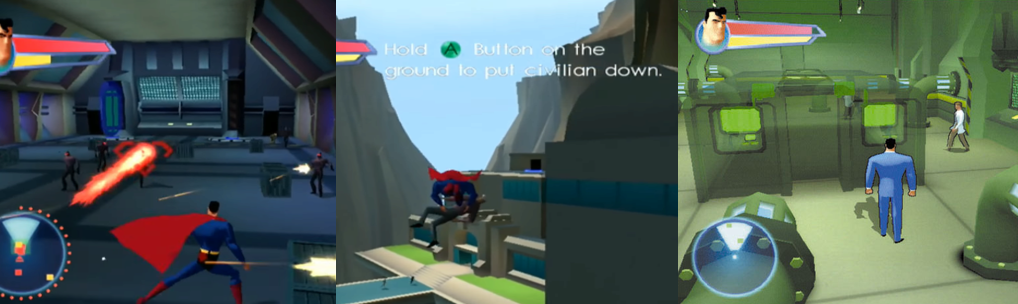
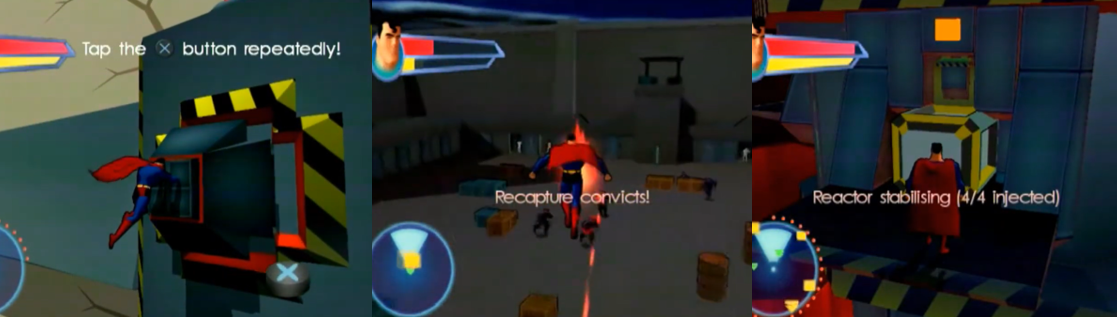
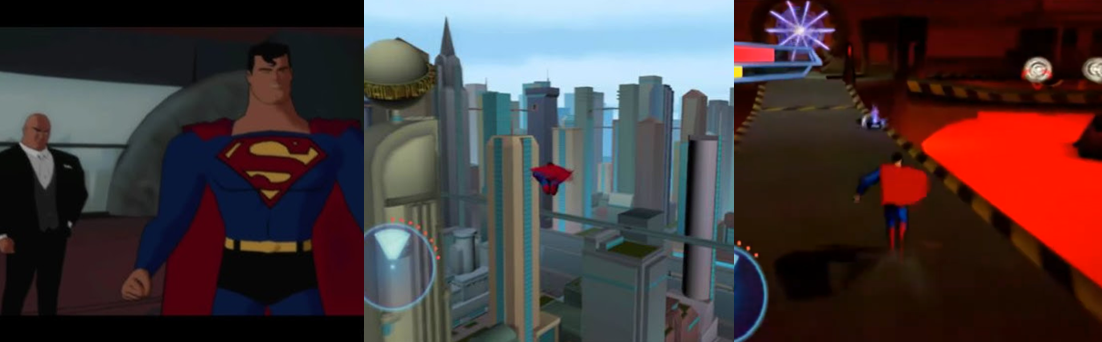
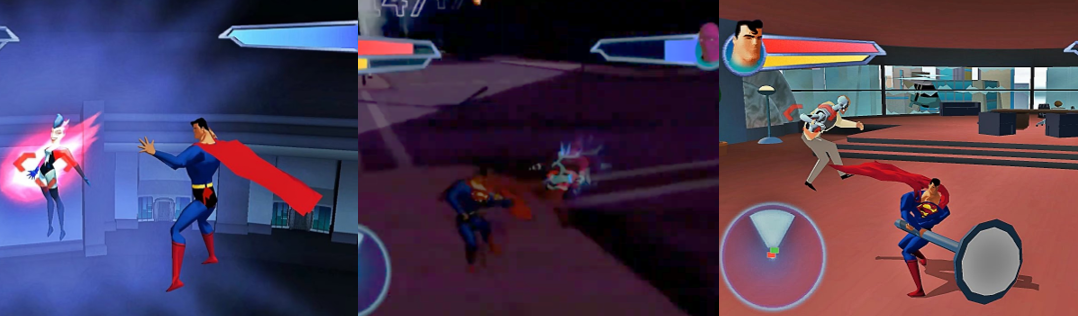
Superman: Shadow of Apokolips is a third-person, cel-shaded, 3D action-adventure game set within the continuity of Superman: The Animated Series (possibly between the first and second seasons). The game is divided into thirteen chapters, with no difficulty levels and some surprisingly generous checkpoints. Superman has all his usual abilities but is still vulnerable, so you must wait for his health and “Super Power Energy” to automatically replenish when you take damage or use his various superpowers. Players lock on to nearby targets with L1 and R1 (though there’s no way to cycle between targets), execute a surprisingly weak and boring combo with X, and also hold X to grab things. You can lift cars, crates, and explosive barrels to toss at enemies, grab billboards to make bridges, and carry civilians to safety. When enemies are stunned, you can also grab them to send them flying with a “Super Punch”. Square pulls off a “Speed Dodge” to avoid damage, Triangle unleashes your heat vision, and Circle blows enemies away or extinguishes fires with super breath. While on the ground, you can press X and Square together to perform a “Super Spin” to send enemies flying, or press it while hovering or flying to hit a slam attack for crowd control. While the left stick moves Superman, the right controls his flight. You take off by moving the right stick up (or pressing R2), bank and strafe while flying, and land by holding down or double-tapping R2. While in the air, you can press X and Square together to speed up, ramming into enemies, through certain doors, or chasing airborne targets. Finally, you can enter first person mode with L2 to better aim your heat vision or hold Circle to highlight hidden destructible walls with your x-ray vision.

When not awkwardly fighting or saving civilians, Superman struggles to sneak past eagle-eyed scientists.

While these abilities can be fun, they do have drawbacks. Their limited use is the most obvious, but many enemies take a lot of hits to put down. Sure, you can set most on fire with your heat vision and blow them back with your breath, but these don’t do much damage. It’s usually better to toss cars or swing pipes than to use your fists, and Superman is constantly being knocked from the sky or into walls by missiles. Superman is rather clunky to control, both on the ground and in the air. When you get used to the janky controls, the flying mechanics are quite fun but, when asked to dart at enemies or perform precision turns, the gameplay fells apart. The finnicky camera doesn’t help, either. You can centre it with L2, but I constantly lost track of who I was targeting or had my vision obscured by the environment. Superman’s powers are primarily used for busy work, and in very rare,  specific situations. You’re more likely to be getting civilians to safety or retrieving objects than putting out fires with your super breath, for example, with Superman opting to plug lava spills and volcanic eruptions with boulders and coolant tanks later in the game. Heat vision is often used to seal objects, but only after you’ve mashed X like a madman (a frustrating mechanic that often failed for no reason). Amusingly, one level sees you infiltrating LexLabs as Clark Kent, using your heat vision to short out control panels and security cameras and sneaking past Lex Luthor’s scientists. You do this by clumsily walking behind them and hoping they don’t randomly spot you because the game decides they should, making for one of the worst stealth sections I’ve ever played. Clark must also dash past laser traps, mash X to fight past a giant fan, gently blow about explosive mines, and repair leaking gas pipes with cylinders, none of which is particularly fun.

Your objectives are not only repetitive, but needlessly frustrating, especially when you have a time limit.

When he’s not rescuing civilians and smashing Intergang’s robots, Superman is defending scientists or police officers from said robots, escorting guards through Stryker’s Island Penitentiary at one point and helping to apprehend rioting inmates. Often, Superman faces a time trial to resolve some crisis, with your time represented by little red dots that creep around your radar. At the dam, you must find and replace three generators, fly to Lois Lane’s endangered cable car, and then frantically mash A to plug up the dam before it bursts. When LexLabs threatens to self-destruct, an audible fifteen-minute countdown pressures you to wipe out all nearby enemies, activate switches, and then bring a glowing orb to a control panel to stop the sequence. However, you then have a scant few minutes to plug another gas leak and extract the poison from the area. Deep in Intergang’s mountain lair, you must protect three scientists as they activate Luthor’s portal technology and then get about five minutes to cool down the overactive reactor, all of which can be extremely aggravating as Superman moves and fights like a bag of sand. Things are much easier when you’re not being timed and you can freely take out tanks, soldiers, and turret placements to defend shield generators or scientists. In the dam level, you must cool down fuel tanks with your breath and break open doors to find civilians; at one point you must take out waves of enemies to open new areas and short out five control panels; and you’re often asked to destroy a certain number of enemies to clear each area. It all gets quite repetitive and challenging very quickly, with the awkward controls and tight time limits artificially increasing the difficulty of even mundane tasks, and the sheer number of enemies and projectiles is often as daunting as it is frustrating. I admire the attempt at some variety but there’s very little margin for error, button inputs often fail to register, and Superman’s powers aren’t used as much as I’d like (I only used his x-ray vision once, for example, and even then it was confusing!)

Presentation:
Superman: Shadow of Apokolips opts for a cel-shaded look to better represent the cartoon and therefore  looks pretty good, having aged rather gracefully and visually appearing like the animated series. This is aided by Tim Daly and Clancy Brown reprising their famous roles and adding further authenticity to this as a “lost” episode. Consequently, the likes of Lois Lane, Perry White, Jimmy Olson, and even the tyrannical Darkseid pop up in cutscenes as cameos, though sadly Lois and Darkseid play almost no part in the in-game action. On the downside, the game isn’t tailored for newcomers to the series or character, explaining basically nothing about this world and restricting exposition regarding Superman’s powers to tutorial text and unlockable biographies. Superman looks just as he did in the cartoon, being bright, broad-shouldered, and powerful. Even Clark makes an impression in his eggshell-blue suit, even if his stealth skills aren’t anything to write home about! The game performs pretty well, though combat is often sluggish and Superman always feels like he’s moving through jelly. Enemies conveniently teleport in or come crashing through walls so there’s very little pop-up, there’s no distance fog either as every level is constrained to a small area, though I did notice moments of slowdown when a lot was happening and the load times are pretty atrocious.

While the game perfectly mirrors the cartoon, environments are as tedious as the gameplay is clunky.

Things start off promising here as the opening tutorial sees you flying around Metropolis, which appears just as it did in the cartoon, warts and all. This means that while you’ll see skyscrapers, bustling traffic, and the iconic Daily Planet building, buildings are incredibly basic and blocky, with no textures and simple colours bringing them to life. While this mirrors the minimalist style of the cartoon, it does make the game seem very basic, lifeless, and samey. This is exacerbated when you’re stuck in the claustrophobic corridors and rooms of Luthor’s facilities and Intergang’s lair, which assault your eyes with drab greys and browns. To be fair, these environments try to spice things up by basing Intergang’s operation within a volcanic mountain, with lava spilling out, flames bursting from the floor, and volcanic eruptions needing to be plugged. Intergang also use Apokoliptian technology, apparently trying to create a Boom Tube, and their lair does eventually fall apart around you. The dam stage made for a good follow-up to Metropolis as well, featuring different areas with different crises needing to be averted, and I did enjoy escorting the guards around Stryker’s Island, which is damaged by Intergang’s attack and caught in a thunderstorm. Unfortunately, that’s about as crazy as locations get as, despite its title, you don’t visit Apokolips or venture off-world. I did enjoy fighting John Corben/Metallo in Luthor’s office in the penultimate chapter, especially as the walls take battle damage from your fight, and that you confront Metallo in an auto factory, but environments are still disappointingly bland and there’s rarely a chance to fully flex Superman’s muscles or stretch his legs.

Enemies and Bosses:
Things are equally disappointing here as you fight the same, generic enemies over and over. Conveniently, Intergang deploy humanoid androids, meaning Superman can fight them without breaking his “no kill” rule. The Intergang robots are as basic as it gets, often just standing in place and shooting (though they occasionally take cover) or whacking you with their weapons up close. These robots carry machines guns and Apokoliptian plasma rifles, sometimes snipe from above, and later self-destruct upon defeat. Sometimes they use jetpacks, or pour from armoured personally carriers, and their slightly lager variants wield rocket launchers that send you flying. Intergang bolsters its forces with a few military armaments, like turrets and tank-like vehicles. These can be tossed or simply bashed, but sport chainguns, plasma cannons, and missile launchers. Intergang also employ Apokoliptian attack copters that can be tricky to target as they’re quite nimble, but they simply circle around the main areas so you won’t need to chase them or anything, and you’ll sometimes find mines in crates. That’s literally it for the basic enemies as they never get, like, energy swords or tasers or shields and there are no hulking brutes to match wits with. It’s just the same enemies recycled again and again. To be fair, there are a lot onscreen at once, but this isn’t a good thing as Superman’s better in one-on-one fights. Also, while on Stryker’s Island, you come up against the rioting inmates, but these guys are knocked out with a single punch or left dazed to be comically punched into their cells and are hardly a threat.

You wait all game for the bosses to show up and then they’re ridiculously dull affairs.

The bosses are even more of a let-down, with your first test being to chase down and disable a helicopter, a mechanic that never returns. When you finally confront the Intergang Leader, he turns out to just be a more formidable version of the regular enemies. Once you shoot him from the sky, deal with his minions, and whittle down his life bar, you must quickly dash him to drop him into molten metal or the fight repeats until you succeed. Similarly, while I was excited to see the Machiavellian Iluthin/Kanto appear, Darkseid’s weaponeer simply fights in you in a variation of the same tanks you see everywhere. Oddly, the game ends with three consecutive boss battles, starting with a three-phase fight with Leslie Willis/Livewire. As you’ll be electrocuted if you touch her, she teleports about, and her electrical blasts either stun-lock you or send you flying, you must trick her into falling into water. You can do this by side-stepping her attacks and blasting bridge controls with your heat vision, but you can also whittle her down by tapping Triangle to fire concentrated blasts. To short circuit and finish her, you must avoid her attacks and fight the useless camera and destroy seven locks with your heat vision, gaining only a temporary reprieve when you blast her away as her health regenerates. Rudy Jones/Parasite is fought on the city streets, where you toss cars and blast him with heat vision from a distance and extinguish his fires. While he’s constantly flying around, tossing energy bolts, and regenerating health, your best bet is to crash into him and land your slam attack to make short work of him. Finally, you face Metallo in a multi-stage fight across two chapters. Metallo fires a deadly Kryptonite beam, rushes you, grabs you and punches you across the room, and later wields a machine gun and an Apokoliptian plasma rifle. It’s best to toss stuff at him and use your eye beams as your punches don’t do much, but you’ll have to quickly fly up and blast a control panel if you want to best him.

Additional Features:
That’s about it for Superman: Shadow of Apokolips. There are no collectibles to find, no difficulty modes to challenge, and no skins to unlock (which is criminal for a superhero game, if you ask me). As you clear each mission, you can freely replay them from the “Level Attack” menu, though there’s little point as there’s nothing to go back for and no time trials or anything. Clearing the game also unlocks the cutscenes to view in the “Movie Theatre”, character biographies, and loading screens to look at if that’s your thing. Thankfully, you don’t have to unlock these or deal with the onslaught of enemies as there are some super helpful cheat codes to access everything and enable invincibility and such. These cheats won’t help you beat the horrendous timed missions, but they do make the game more bearable.

Final Thoughts:
I was really excited to play Superman: Shadow of Apokolips. Ever since I started collecting for the PlayStation 2, this game had been on my wish list and I purposely scoured a retro videogame market in mid-2025 to find a copy, believing it would be a fun (if mindless brawler) that mirrored the cartoon. Well, the last part was right, at least. Superman: Shadow of Apokolips looks really good, especially for a PlayStation 2 title, thanks largely to its cel-shaded aesthetic that perfectly captures the vibe of the cartoon. Sadly, it’s all downhill from there as this is a clunky, aggravating mess at the worst of times and repetitive nonsense at the best. While Superman looks great and occasionally feels fun to control in the air, his attacks and powers are pitifully weak, with no new combos or abilities being added to your arsenal as you progress. The enemies are painfully tedious, especially considering Superman’s colourful rogues’ gallery, and your objectives rarely challenge you to do more than fetch stuff against a tight time limit. It got to the point where I was almost wishing for a ring-based time trial! It was so monotonous, and even Clark’s stealth section didn’t add much variety as it was so poorly implemented. The worst part was the back-loaded boss battles, which could’ve easily been sprinkled throughout the early and mid-game, and the lack of a confrontation with Darkseid, who basically appears as a cameo, leaving all the heavy lifting to the far less interesting Metallo. I was so disappointed by Superman: Shadow of Apokolips, which is more frustrating than enjoyable as even simple busy work is complicated by the janky controls and clunky camera, sadly resulting in yet another poor videogame outing for the Man of Steel.

My Rating:

Rating: 2 out of 5.

Could Be Better

How high do you rate Superman: Shadow of Apokolips? Were you impressed by the cel-shaded look and fidelity to the cartoon? Did you also find that Superman was quite difficult to control and his powers were poorly implemented? Were you disappointed by the repetitive environments and back-loaded boss battles? Would you have liked to see a sequel where Superman actually fights Darkseid? Which Superman videogame is your favourite and how are you celebrating Superman Day today? Whatever your thoughts, share them in the comments below, check out my other Superman content, and donate to my Ko-Fi to suggest another Superman game you’d like me to review.

Wrestling Recap: HBK vs. Angle (WrestleMania 21)

The Date: 3 April 2005
The Venue: Staples Center; Los Angeles, California
The Stakes: Interpromotional grudge match

The Commentary: Jim “J.R.” Ross and Jerry “The King” Lawler
The Referee: Brian Hebner
Dave Meltzer’s Rating: 4.75

The Build-Up:
Following a remarkable return to World Wrestling Entertainment (WWE) and a dramatic character change, “The Heartbreak Kid” Shawn Michaels embarked on a celebrated comeback tour. Drafted to different brands during the first roster split, Shawn first crossed paths with Olympic champion Kurt Angle in the 2005 Royal Rumble, where Angle snapped after HBK eliminated him from the match. Angle accepted Shawn’s challenge and immediately made the feud personal, mocking HBK’s theme song, recreating some of his greatest moments, and even brutalising Marty Jannetty to wind Shawn up heading into the match.

The Match:
Sadly, Kurt Angle didn’t follow-up his hilarious rendition of Shawn Michaels’ “Sexy Boy” theme by sauntering out to “Sexy Kurt” or coerce HBK’s former valet, Sensational Sherri, to accompany him to the ring for added mind games heading into this match. Though the two seemed reluctant to get into it, Shawn kicked the match off with a disrespectful slap to Angle’s face, prompting Kurt to wrestle HBK to the mat and impress his amateur and Olympic background upon the Showstopper. Shawn answered back with a headlock takedown to keep Angle grounded, keeping the hold cinched in even after Angle planted him with a back suplex. Shawn also had the wherewithal to keep his shoulders off the mat whenever Angle rolled him into a pinning predicament, but Kurt only managed to break the hold by forcing Shawn into a corner. Frustrated at being outwrestled, Angle resorted to elbowing HBK in the face, ending up in a short-arm scissors as HBK switched to targeting Kurt’s left arm. Angle resorted to muscling Shawn up, barely escaping a couple of roll-ups and backslides and ending up back in the side headlock. Once back in the corner, the match descended into a slugfest, forcing the referee to physically separate the two and giving Kurt the chance to land a cheap shot and briefly apply the Ankle Lock. HBK quickly squirmed free, however, and clotheslined his opponent (and himself) to the outside, where he tore apart the SmackDown! announce table.

After a long period of mat wrestling, Angle targeting HBK’s ankle and forced Shawn to take high risks.

Angle desperately retaliated with some uppercuts and hoisted Shawn onto his shoulders to bash HBK’s spine off a ring post rather than plant him to the floor or through the table. Angle focused on Shawn’s injured back and tossed him into the ring to hit a suplex, score a couple of two counts, and apply a bodyscissors to wear HBK down. Shawn fought back with some chops but was turned inside out off a whip into a corner and tossed with belly-to-belly suplex for another near fall, so Angle buried his knee into HBK’s lower back with a modified Camel Clutch. Ever resilient, Shawn fought to his feet and returned to the chops, prompting Angle to answer back with punches and a stiff clothesline for a two count. Angle sat Shawn on a top turnbuckle and tried for a superplex, only for HBK to frantically fight him off and miss his signature diving elbow. However, when Angle tried for the Angle Slam, Shawn countered and sent Kurt flying  outside with a back body drop before awkwardly diving on his opponent from the top rope. Angle quickly recovered and teased hitting a German Suplex off the ring apron, forcing Shawn to retaliate with a mule kick to Kurt’s balls (to a chorus of boos) and a dive from the apron to Angle as he lay prone across the announce table (which didn’t break). Both men, bleeding from the assault, struggled to return to the ring before the referee counted to ten and again traded blows, with Shawn landing his signature flying forearm and nipping to his feet to mount a comeback and finally nail his diving elbow drop and build momentum for Sweet Chin Music.

As the two busted out their biggest moves, Angle’s tenacity won out as he forced Shawn to tap out.

Angle countered with the Ankle Lock, retaining the hold even as Shawn desperately tried to roll through and even keeping it locked in for a bit when HBK grabbed the ropes. Even when Shawn countered an Angle Slam, Kurt returned to the Ankle Lock, barely kicking out when HBK rolled him up, and then countered another superkick attempt into an Angle Slam. Angle was incensed, driven to tears, when Shawn kicked out at two, so he amusingly pulled his straps up and then lowered them again before clambering a nearby turnbuckle for his picture-perfect moonsault. Naturally, Angle missed and the exhausted, injured HBK tried to capitalise by climbing the turnbuckle, only for Kurt to suddenly recover and hit an Avalanche Angle Slam…for a ludicrous near fall! Enraged and frustrated, Angle screamed in Shawn’s face and ate Sweet Chin Music, but HBK was too out of it to immediately make the cover, meaning Kurt just barely got his shoulder up before the three count. The confused Shawn was then caught in the Ankle Lock, which Kurt maintained as HBK writhed and thrashed in pain, pulling Shawn away from the ropes and applying a grapevine for additional punishment. HBK endured the agony for a ridiculously long time, but was eventually forced to tap out. This was a thrilling affair between two of the all-time greats that told a very simple story, sadly one that was prevalent during Shawn’s comeback, of HBK struggling with his lower back. While this made for a great tide-turner, I think it would’ve been better if Angle had damaged Shawn’s knee or leg on the outside and had focused on HBK’s leg rather than his back. It was fun seeing Shawn showcase his fundamentals but the extended time on the mat and with the headlock made for a slow start, especially as it didn’t have much payoff, so it might’ve been better to trim some of that and tell a story of Shawn’s agility versus Angle’s mat skills.

The Aftermath:
Following his loss to Kurt Angle in this award-winning bout, Shawn Michaels returned to his issues with WWE Chairman Vince McMahon, leading to Shawn being beaten by Vince and his son, Shane, at Backlash when Vince forced HBK to team with “God” and coerced the Spirit Squad into attacking his rival. Luckily, Shawn’s old D-Generation X buddy and former blood rival Triple H got involved, eventually teaming with Shawn to fend off the Spirit Squad and eventually the McMahons. After causing havoc with Triple H as the revived D-X, HBK made it to the main event of the following WrestleMania in a losing effort against WWE Champion John Cena. Angle embarked on one of his more questionable storylines where he made lewd and disturbing advances towards Booker T‘s wife before being traded to Raw and having a rematch with Shawn at Vengeance 2005, losing the match and entering an equally questionable feud with Eugene before returning to SmackDown! in 2006 and capturing the World Heavyweight Championship. Angle would drop the belt to Rey Mysterio at WrestleMania 22, which would be his last WrestleMania match for over ten years as he battled with substance abuse after leaving the WWE in late-2006.

My Rating:

Rating: 4 out of 5.

Great Stuff

Is this one of your favourite WrestleMania matches or did you find it a bit lacking? Do you agree that Angle should’ve focused on Shawn’s leg from the beginning or did you enjoy the story being told in the ring? Who was your pick to win at the time and which of the two is your favourite wrestler? What are some of your favourite Angle and/or HBK matches? Leave a like if you read this review and share your thoughts before, then donate to my Ko-Fi to suggest other Kurt Angle and/or Shawn Michaels matches for the site.

Movie Night: Frank Miller’s Sin City: Recut & Extended

Click here to listen to my guest spot on the Anthological podcast discussing this film

Released: 21 April 2009
Originally Released: 1 April 2005
Directors: Robert Rodriguez and Frank Miller
Distributor: Miramax Films

Budget: $40 million
Box Office: $158.7 million
Rotten Tomatoes Scores: 76% / 78%

Quick Facts:
After making a name for himself at DC and Marvel Comics, writer/artist Frank Miller brought his love of film noir to life with his Sin City comics, attracting genre fan Robert Rodriguez, who defied convention to give Miller a co-director credit. The entire film was shot on elaborate green screen sets to recreate Miller’s stark visuals, lifting panels and dialogue directly from the books. The results were widely praised, though it took about ten years to get a sequel and a planned television series has still yet to materialise.

The Review:
Frank Miller’s Sin City is one of the most faithful big screen adaptations of a comic book property ever made, not just because the writer and artist of the acclaimed series was directly involved in the directing and production of the film, but because the movie rips its visuals directly from Miller’s books. The stories are direct adaptations of the Sin City comics, with the shortest – “The Customer is Always Right” – serving as a bookend for the theatrical version. The first part of this segment part was produced by co-director Robert Rodriguez as a proof-of-concept to gain Miller’s blessing for the project. The short sees a mysterious and attractive hitman known only as the “Salesman” (Josh Hartnett) approach a gorgeous young woman (Marley Shelton) at a party. He’s captivated by her looks and her scent and immediately professes his love for her, giving her affection and comfort right before fulfilling his contract and murdering her. The Salesman then pops up in the theatrical film’s coda, approaching misguided prostitute Becky (Alexis Bledel), presumably to execute her after the events of “The Big Fat Kill”. This is just one instance of Sin City’s interconnectivity. All the stories overlap, with characters appearing in the background in one story before taking the lead in another. Basin City is one of the most corrupted, violent, and seediest places in all of comicdom. It seems 90% of the police force are on the take and there’s little that conniving, controlling Senator Ethan Roark (played with delicious relish by the late, great Powers Booth) doesn’t own or control. This is an overlapping theme throughout the film, with Roark directly impacting the lives of Detective John Hartigan (Bruce Willis) and Marv (Mickey Rourke), and “The Big Fat Kill” exploring how ineffectual the police are in “Old Town”, where a shaky truce with the resident prostitutes – led by Gail (Rosario Dawson) – keeps the cops out. As this is essentially an anthology film, I’ll delve into each story separately before discussing some overarching themes and such.

Veteran cop Hartigan endures years in prison to save a little girl from a pervert’s wrath.

“That Yellow Bastard” is one of two segments I find the most enjoyable in this film. The story follows Hartigan, a thirty-year veteran who’s spent his entire career doing things “by the book”. Whereas his partner, Bob (Michael Madsen), reluctantly turns a blind eye to Roark’s corruption, Hartigan refuses, especially with his retirement literally hours away when we first meet him. Hartigan’s one loose end is Roark’s son, Ethan Roark Jr. (Nick Stahl), a sick little paedophile who likes to toy with, rape, and mutilate young girls. Rather than simply walking away, Hartigan defies his partner and the Roarks by pursuing Junior to a warehouse, arriving just in time to save young Nancy Callahan (Makenzie Vega) all while battling angina. Determined to “go out with a bang”, Hartigan’s crusade sees him literally and figuratively disarm Junior. leaving him a mangled and comatose wreck. Unfortunately, that’s not how justice works in Sin City and Hartigan’s betrayed by Bob, arrested, and framed for Junior’s crimes. As Roark puts it, Hartigan learns the true meaning of power as witnesses and evidence are all bought or tampered with to paint Hartigan as a bent cop with a taste for kids. His reputation and marriage are left as tattered as his body, which Roark pays to restore so he can get off on seeing Hartigan disgraced and stuck in solitary confinement. Hartigan accepts this, unwilling to endanger young Nancy, who remains indebted and besotted with him. Due to his stubborn refusal to speak up, Hartigan spends eight years alone in prison, with only letters from Nancy (using a pseudonym) to keep him going. He comes to see Nancy as a dear friend and daughter (though it’s clear his feelings run deeper and he’s just in denial) and thus falls into despair when the letters suddenly stop, a nineteen-year-old girl’s severed finger arrives in his cell, and a strange, disgusting, yellow-colouring imp attacks him.

You know a film’s doing something right when even Nick Sthal puts in a captivating performance!

Fearing for Nancy’s life, Hartigan begrudgingly swallows his pride and confesses, which is enough to have him released due to “time served”. Rather than dwell on his losses, Hartigan returns to his mission to keep Nancy safe, only to find she’s grown into Jessica fuckin’ Alba and works at a strip bar! Blinded by his love for Nancy and his obsession with saving her, Hartigan realises all-too late that he’s been tricked and is soon struggled with his lust for Nancy and keeping her safe from the titular “Yellow Bastard”, an unnerving lunatic who really pops thanks to his yellow complexion. It turns Junior was radically altered by experimental surgery as Roark was desperate for a grandchild. While it scuppered Junior’s Presidential prospects, he continued to abuse, rape, and torture children while Hartigan rotted in his cell, and is determined to avenge himself on Hartigan and Nancy. I was surprised by how good Nick Stahl is here, especially once he’s under all the prosthetics and make-up. Junior’s a pathetic little man at the best of times, a spoiled rich boy brat who enjoys the immunity offered him by his father’s power and is so pathetic that he can’t get it up unless his victims scream. Hartigan knows this secret and tells it to Nancy, who frustrates Junior with her defiance and proves that she grew up strong after all. Similarly, Bruce Willis was the perfect choice for grizzled veteran cop Hartigan, despite Bruce obviously not matching Miller’s hulking, exaggerating artwork and the somewhat controversial nature of his relationship with the much-younger Nancy. Hartigan tries to resist her, but he can’t deny that he’s also in love with her and it’s only due to Junior’s interference that we’re spared a love scene between them. It’s a little disturbing, for sure, though it’s explicitly said and shown that Hartigan doesn’t think of Nancy in that way until she’s nineteen, at least. Plus, like…it is Jessica Alba so it’s understandable he’d have the hots for her.

Despite triumphing, Hartigan can’t fight Roark’s corruption and makes the ultimate sacrifice to protect Nancy.

Hartigan is much more durable than the average man, basically telling his heart attack to sit the fuck down, surviving multiple gun shots and beatings, and besting most foes with a single punch. Hartigan’s aware of his limitations and regularly chastises himself for being reckless, allowing him to keep his cool even during a high-speed chase with Junior firing at him. Hartigan never wastes his time or his bullets, firing accurately and blasting off limbs and sending yellow blood spraying. He also proves driven and strong enough to pound the Yellow Bastard’s head into bloody mush by the end, showing he’s not your average cynical old man. There’s a tragedy to Hartigan that I’ve always felt palpable. Of all the characters and narrators of Sin City, I gravitate to him the most as he’s cynical, self-deprecating, and honest in a way that makes him extremely relatable. He’s clearly proud of his work and sees his retirement as bittersweet. It means leaving behind the violence and corruption, but also means he can’t help people, something he feels so strongly about that he happily takes the fall to protect Nancy, enduring beatings, slander, and solitude all to keep her safe. Hartigan knows that Roark is beyond the law. Roark even demonstrates that when he visits the hospital and boasts about how he could simply shoot Hartigan without repercussion. Hartigan consoles himself with the small victory that killing Junior ends Roark’s bloodline, which he frames as an absolute win to reassure Nancy. Hartigan sends her away, promising to follow her after clearing his name and bringing down Roark. Maybe that’s something John McClane might do, but not John Hartigan. Instead, he lies to Nancy to give her hope and keep her safe, then does the only thing he can do to ensure her safety by killing himself. It’s a startling ending, especially consider Bruce’s action credentials, but really sums up Hartigan’s commitment to shouldering the burden for others.

When his hooker love is killed, simple-minded brute Marv embarks on a brutal investigation.

My second favourite segment, “The Hard Goodbye” represented Mickey Rourke’s big Hollywood comeback and casts the former heartthrob as the brutish and disfigured Marv, a well-meaning but borderline psychotic bruiser who suffers from an unspecified medical condition that often leaves him confused, paranoid, and imagining things. Since he’s so badly disfigured, Marv is overjoyed when voluptuous prostitute Goldie (Jaime King) hooks up with him, throwing herself at him and giving him the affection and tenderness he’s craved his whole miserable life. Marv’s joy is short-lived, however, as he wakes to find Goldie dead and heavily-army cops ready to pounce. Thanks to his unexplained superhuman strength and durability, Marv easily brutalises the cops and escapes, patching up his minor wounds and beginning a vendetta to figure out who killed the only woman he’s ever loved (besides his doting, blind mother (Lucina Paquet)). Determined to kill his way to the truth, but still conscious of his medical condition, Marv goes to his parole officer, Lucille (Carla Gugino), for a fresh batch of pills and some insight into Goldie. While Lucille tries to warn Marv off his killing spree, not wanting to see him locked up for the rest of his life, Marv relishes a return to the “all-or-nothin’ days” of old, employing what little intelligence he has in weeding out small time thugs and torturing them in creative ways for leads, before killing them. Marv’s methods might be brutal, but they’re incredibly efficient and lead him to a crooked priest (Frank Miller), who reveals that Roark’s brother, Cardinal Patrick Henry Roark (Rutger Hauer), was behind Goldie’s murder. This throws Marv and sees him questioning reality as even he is shocked at the idea that someone so powerful he could’ve become the Pope or the President would go to the trouble of framing a meathead like him for a hooker’s murder.

Silent cannibal sadistic Kevin forces Marv to rethink his strategy.

Still, Marv investigates the Roark family farm on the outskirts of town and finds a creepy, silent man-child living there. Silent, agile, and deadly, Kevin (Elijah Wood) easily bests the unsuspecting Marv and he wakes to find Lucille missing an arm and to learn that Kevin killed and ate Goldie’s fellow hookers. Kevin also chopped off and ate Lucille’s arm and forced her to watch, briefly shattering her hard-ass demeanour before she composes herself. Though grateful to Marv for saving her, Lucille turns him in when the cops arrive and gets gunned down for her troubles, compelling Marv to go on hatchet-wielding killing spree. Marv’s confusion only doubles when he’s attacked by what he assumes to be a hallucination of Goldie, but which turns out to be her twin sister, Wendy (Jaime King). Bewildered, overwhelmed, and exhausted, Marv is easily subdued by Wendy and taken to Gail and their fellow prostitutes in Old Town. While Wendy initially blames Marv for her sister’s death and plans to beat and kill him, they quickly realise that it’s all a setup and Wendy confirms Cardinal Roark’s involvement since Goldie “worked the clergy”. Wendy helps Marv gather supplies to return to the farm, though he only tolerates her help for so long. He refuses to let her finish Kevin off and cold clocks her to keep her from seeing what he does to Kevin since he doesn’t want to scar her for life. Thanks to his amazing durability, Marv weathers Kevin’s swift attack and talon-like nails and handcuffs him, dropping him with a single punch and using a hacksaw to saw off his arms and legs. Still, while Marv delights in watching Kevin’s dog feed upon him and hacking off the psycho’s head, he’s left unfulfilled since Kevin refuses to scream, or make any sound at all, through the whole ordeal.

After avenging Goldie for himself and Wendy, Marv willingly meets his end.

Luckily for Marv, Cardinal Roark is a much more willing participant. Cardinal Roark is horrified when Marv brings him Kevin’s severed head and reveals that he not only encouraged Kevin’s cannibalism, but joined in, targeting “whores” since no one would miss them and feeling the touch of God almighty upon consuming human meat. Unimpressed and disgusted, Marv brutalises Cardinal Roark with his bare hands, giving him the “hard goodbye” he promised Goldie on her death bed. Unfortunately, Marv is subdued by the cops shortly after and spends months in hospital recovering from his wounds, initially convinced Roark’s men will come to finish the job before realising they plan to besmirch him, too. Though he refuses to co-operate, he’s coerced into taking the fall for Kevin and Cardinal Roark’s crimes and is branded a “psycho killer”. Regardless, Marv is largely nonplussed at his impending execution, believing the world would be a better place without him in it, and is eager to get it all over with. Out of gratitude for his actions and sacrifice, Wendy visits him one last time and allows Marv to have her, thinking of her as Goldie. Ever the stubborn meathead, Marv forgoes the obligatory Bible verses and hastens his execution, amusingly shrugging off the first round of electricity before finally breathing his last, consoling himself with memories of Goldie. Rourke shines as Marv, a simple-minded brute with a clear-cut code of honour who feels no remorse at roughing up or killing anyone who’s wronged him or his friends, especially dames. Marv is a very tragic figure, one constantly on the brink of a psychotic breakdown, who’s determined to bring down “gods” like Cardinal Roark even if it means his death. I loved the running gag of him acquiring new coats and offing his victims in increasingly bonkers ways, and how vicious his mean streak was.

When unstable cop Jackie runs afoul of Old Town, self-righteous Dwight desperately tries to protect his friends.

Finally, there’s “The Big Fat Kill”, which is enjoyable but probably the weakest segment for me, mainly because it has far more “Millerisms” than the other stories (that is, repetitive, childish, and stupid dialogue). This story explores Old Town in more detail, depicting it as Sin City’s seedy red-light district where the ladies are the law. The cops don’t patrol there and, in return, they get sent home alive if they accidentally cross the border and get to unwind with the girls when off duty. The women are therefore free to police themselves, dishing out brutal and efficient vigilante justice whenever their clients get too full of themselves, with Gail leading the charge and silent, deadly little Miho (Devon Aoki) slicing guys up with her katana. The story follows Dwight McCarthy (Clive Owen), a mysterious and grizzled man with a “new face” who’s back in town and hooking up with Shellie (Brittany Murphy), a rambunctious waitress. When Shellie’s accosted by her drunken, obsessively aggressive ex, Jack Rafferty (Benicio del Toro), Dwight stands up for her without hesitation, shrugging off her protests and determined to teach “Jackie Boy” a lesson about respecting women. Concerned for the ladies of Old Town, Dwight pursues Jack and his drunken friends to the red-light district, where they attract Gail’s wrath after accosting Becky. Gail, angry at Dwight for ditching her in the past, immediately takes charge and orders Jack’s death, refusing to listen to Dwight’s sudden feeling that something’s off. Sure enough, Dwight discovers a bombshell on Jackie Boy’s corpse: he was Lieutenant “Iron Jack” Rafferty, a “goddamn hero cop”, and his death would mean an end to the shaky truce and a return to all-out war in Old Town. Thanks to her ill-will towards Dwight, Gail’s reluctant to go along with his plan to ditch Jackie Boy’s corpse in the tar pit across town but he convinces her with his conviction, passion, and quick hands, determined to safeguard the women and avoid any bloodshed.

Dwight and his sultry allies must set aside their grievances to avoid bloodshed in Old Town.

Still, the experience rattles Dwight and sees him hallucinating conversations with Jackie Boy’s mangled corpse. Dwight’s right to be on edge as some previous actions mean he’s one fingerprint away from execution and he’s risking a lot to protect his friends, but he follows through since he can’t help but protect those he cares about. Unfortunately, Dwight’s plan hits a snag when the car the ladies give him conks out and he’s attacked by Irish mercenaries led by Brian (Tommy Flanagan). Despite Brian’s penchant for grenades being largely ineffective (it’s seriously laughable how characters shrug off explosions even when they’re right at their feet!), Dwight ends up in the tar and Brian escapes with Jack’s severed head. Luckily, Miho rescues Dwight and they retrieve the head, then concoct a desperate plan to trade it for Gail, who’s held hostage by eloquent and imposing man-mountain Manute (Michael Clarke Duncan). Sporting a golden eye and holding a grudge against prostitutes, Manute certainly cuts an intimidating figure, with his slightest touch causing Gail agony. He works for unseen mob boss Wallenquist, who’s keen to expedite the war between Old Town and the cops so he can regain control of the red-light district. Manute, much like Junior, is joined by an eclectic bunch of underlings, from loquacious minions to Neo-Nazis, who add a splash of (metaphorical) colour to Sin City’s underworld. Manute also seems to have a grudge against Dwight, though it’s not expanded upon in this story. In fact, pretty much nothing is known of Dwight’s past life; you’d have to read A Dame to Kill For (Miller, 1993 to 1994) or watch the sequel to find out more about that.

Though visually striking, Miller’s quirky dialogue makes “The Big Fat Kill” the least enjoyable segment.

Anyway, Dwight’s plan echoes a famous strategy employed by the Spartans and depicted (in Miller’s typical exaggerated fashion) in 300 (ibid, 1998). He forces Manute and his goons into a dark, narrow alleyway where their numbers are less effective and demands a simple trade: Jack’s severed head for Gail. Despite Becky questioning why Jackie Boy’s head has tape around its mouth, Manute agrees and Gail initially despairs of Dwight, before he reveals he stuffed one of Brian’s grenades into Jackie Boy’s head. The explosion scars Manute and takes out some of his minions before Miho and the other ladies emerge from the rooftops and join Dwight and Gail in slaughtering “every last rat-bastard one of them” to send a message to Wallenquist. The act sees Dwight and Gail rediscover their passion for each other, though they each lament that they’re seemingly doomed to never truly be together. It’s not that I don’t like “The Big fat Kill”, but I do find it the weakest segment in Sin City. Clive Owen is great as the gritty, gruff Dwight, a man trying to keep his head down and move on from his mysterious past and yet caught up in a potential war because he can’t help but defend women. He’s depicted as being a bit unpredictable and unstable, talking to himself (while hallucinating talking to Jackie Boy’s corpse) and happily ready to engage with multiple foes at once. He has a bloodlust and a sexual passion he’s quick to indulge, despite trying to deny both, and a deep-rooted respect for the ladies of Old Town. He knows how dangerous Miho is, for example, and doesn’t want to step on their toes, but he’ll slap Gail and make demands if it means avoiding a war. Dwight’s comically as invulnerable as Hartigan and Marv, despite being much smaller, and equally determined to achieve his goals. I really liked Benicio del Toro’s slurring, madcap performance as the erratic Jackie Boy, a guy so obviously off his rocker that it’s laughable that he’s what Sin City designates a “hero cop”.

A masterful use of green screens, gritty noir atmos, and sporadic colour make this a faithful adaptation.

I actually studied Sin City years ago at university as an example of fidelity in film adaptations. The film remains one of the best examples of a one-to-one adaptation of a text largely because the production literally used Frank Miller’s comic books as the storyboards. However, this is a bit of a double-edged sword for me as I’m not a huge fan of Frank Miller’s writing or his art. There are obvious exceptions. I enjoyed his work on Daredevil, for example; Batman: Year One (Miller, et al, 1987) is still the definitive Bruce Wayne/Batman origin story for me; and I do like the Sin City comics I’ve read. However, his art is often quite ungainly and ugly and his writing, and especially his dialogue, can be atrocious. I often cite his work on a Batman/Spawn crossover, where his “Millerisms” depicted Batman as a mardy youth and completely ruined Todd McFarlane’s gorgeous art. However, Sin City is an exception. This is Miller’s world, his toy box, and this is really where he shines, with his own original characters and narratives, all rendered in a startling noir colour palette that heavily emphasises shadows and silhouettes. The movie captures that aesthetic perfectly, using colour (mainly blue, red, and yellow) sparingly as a contrast to the noir presentation. I really like the stylistic way the film is shot, the use of black-and-white and shadows, and the way the few examples of colour pop, and how gritty and dirty and moody everything is. There are times when it’s obvious the film is being shot on a green screen set, but it perfectly fits Miller’s hyper-stylised world. Sin City is a drab, depressing, and dangerous town where it’s almost constantly raining, gangs and perverts roam, and the corrupt control everything. This is a world where we’re forced to rely on anti-heroes or where straight arrows like Hartigan are disgraced for daring to oppose Senator Roark’s rule, and where surviving the day is seen as a happy ending.  

A few extra scenes bring this film even closer to the source material and emphasise its anthology roots.

This Recut & Extended version of the film is technically the best way to watch it as it adds in a few extra scenes, primarily to “That Yellow Bastard”, but oddly presents each segment like a mini movie, with its own opening titles and closing credits, which is a bit annoying when trying to watch it as one movie. Similarly, while the additions to “That Yellow Bastard” are scenes from the comics, I can understand why they were cut as they’re pretty redundant. For example, Roark comes into the hospital to gloat over Hartigan’s bed-ridden form and tells us everything we need to know without Eileen Hartigan (Babs George) and other visitors repeating the same information. These visitors also come to Hartigan before Roark in the film, rather than after Roark as in the comics, which doesn’t make much sense narratively. I did like the inclusion of Lucille to further tie the segment into “The Hard Goodbye”. Her scenes also add a bit of extra context as to why Hartigan is released after he confesses. Without them, it views like this perverted old man finally confessed to being a child rapist and murderer and was let out because of “time served”. “The Hard Goodbye” adds a scene where Marv sneaks into his mother’s home to retrieve his beloved pistol, Gladys, restoring a heartwarming interaction between the two that shows that Marv actively hides his violent nature from his mother. Otherwise, there’s not much else added to the film as Rodriguez and Miller were extremely faithful to the source material the first go around. I prefer the extended version of “That Yellow bastard”, though, as it means more Bruce Willis, but it does annoy me that there’s no option to watch it as a continuous film without skipping past the end credits each time.

Final Thoughts:
I’ve always enjoyed Frank Miller’s Sin City. I’d never read the comics when I first saw the trailers or when I went to see it upon release, but I was captivated by the black-and-white visuals and stylistic presentation. I really enjoy how the film brings Miller’s neo-noir world to life using green screens and sparse sets. It all feels very gritty and almost like a stage play at times and makes me nostalgic for the noir thrillers of old. Despite the actors having to growl out Miller’s often painful dialogue and often acting against stand-ins or thin air, the performances were captivating throughout. Bruce Willis and Mickey Rourke especially shined in their roles, with Willis perfectly capturing Hartigan’s grizzled nature and Rourke channelling a great deal of emotion into the brutish Marv. Clive Owen was equally impressive as Dwight, though I still find “The Big Fat Kill” the weakest segment because of Miller’s writing and some of the deliveries. Still, the visual appeal of Sin City cannot be denied, the stark use of shadows, blacks and whites, the sparing use of colour, and the exaggerated violence all pop off the screen. It really is like the comic book panels have come to life and it amazes me that more movies didn’t opt for this aesthetic for other pulp characters (or even Batman and the Crow). I enjoyed the film so much that I sought out The Hard Goodbye and That Yellow Bastard to read and I eagerly anticipated the follow-up, and I would’ve loved to see an ongoing television series adapting more of Miller’s Sin City stories as it’s such a vivid and intriguing cesspool of corruption and violence.

My Rating:

Rating: 4 out of 5.

Great Stuff

Did you enjoy Frank Miller’s Sin City? Which segment was your favourite? Were there other Sin City stories you would’ve liked to see in the film? Did you enjoy the hyper-stylised presentation? Do you think Hartigan made the right decision sacrificing himself? Were you interested to learn more about Dwight? Why do you think Marv was so unstoppable? Whatever your thoughts on Sin City, drop a comment below, support me on Ko-Fi if you’d like me to cover more of this world.

Movie Night [National Anime Day]: Casshan: Robot Hunter


15 April has been designated National Anime Day to celebrate the stylistic genre, which achieved mainstream success thanks to animators like Osamu Tezuka.


Released: 1995
Directors: Carl Macek
Distributor: Manga Entertainment / Discotek Media

Budget: Unknown
Box Office: Unknown
Rotten Tomatoes Score: 73%

Quick Facts:
Beginning life as a thirty-five episode anime spearheaded by Hiroshi Sasagawa in the early-1970s, Neo-Human Casshern proved an action-packed, emotional, and influential series that was reimagined into a four-part original video animation (OVA) between 1993 and 1994. Praised for its polished animation and explosive action, Casshan: Robot Hunter is generally seen as an enjoyable (if cheesy) hidden anime gem.

The Review:
Set in dystopian future where machines have all-but driven humanity to extinction, Casshan: Robot Hunter is essentially a more serious and far darker version of Capcom’s cutesy Mega Man franchise (1987 to present). Like Rock, Tetsuya Azuma (Steve Bulen) was a human boy transformed into an artificial human by the technology of his genius father, Doctor Kotaro Azuma (Kirk Thornton). He’s accompanied by a robotic canine, Friender, and reluctantly receives assistance from a female, in this case his former lover, Luna Kozuki (Edie Mirman), rather than his sister (though Luna resembles Roll). To be fair, that’s about where the comparisons end as Casshan has a completely different power set and is far more introspective than Mega Man and battles not against a mad scientist, but his father’s malevolent creation, Android BK-1 (Jeff Winkless), which surpassed it programming and wars against humankind as the Black King. Because of this, Dr. Azuma is branded a madman and the betrayer of humanity as it’s widely believed he caused the Black King’s rampage, with even Casshan wondering if the Black King is a combination of human and “neoroid” like himself and therefore responsible for untold deaths. This also means that Tetsuya wasn’t transformed into a cyborg like Mega Man and has instead forsaken his past and his humanity to gain incredible augmented powers to oppose and destroy the Black King and his neoroid army, which quickly sweeps away most of humankind and enslaves whoever’s left. Naturally, pockets of resistance exist, and efforts are made to strike back against the neoroids, but they’re largely ineffective. The resistance remains emboldened, however, by the legend of Casshan, a nomadic, masked warrior whose powers rival those of the Black King and inspire even the most hopeless people to either take up arms against their mechanic oppressors or endure their horrendous, non-stop enslavement.

Reborn as a cyborg, Casshan struggles with his purpose and his humanity.

Unaware of Tetsuya’s fate, Luna searches for him and assists the resistance however she can, presenting herself as mysterious and capable as Casshan thanks to her prototype “MK gun”, a weapon that easily dispatches neoroids. Luna inspires those enslaved by the Black King and his lieutenants – Akubon (Ardwight Chamberlain), Barashin (Michael Reynolds), and Sagria (Catherine Battistone) – to revolt, urging them to disregard myths like Casshan and instead fight for themselves, with somesuspecting her of being their legendary hero. Even the Black King dismisses reports and rumours of Casshan, believing him a phantom hero dreamed up by humans desperately clinging to hope, leading Akubon to capture Luna and plan to publicly execute “Casshan” to break the people’s spirit. Upon meeting the cloaked Casshan, Luna immediately recognises him as Tetsuya, a name he claims to have abandoned, and finds him stone walling her, urging her to flee to avoid being hurt or killed as only he has the power to stop the neoroids. Casshan certainly is powerful, able to rocket along (and through neoroids) with little hip-mounted boosters, smash through any enemy with karate chops and tornado attacks and being backed up by Friender’s flamethrower breath. However, his power comes from the sun, so he’s weakened when it gets cloudy and his body is incredible unstable, apparently not built to last as he’s constantly struggling with maintaining his power and overexerts himself by the finale, to the point where he’s facing certain death. Casshan is also wracked by doubt and grief, constantly consulting with a holographic representation of his mother, Midori Azuma (Melanie MacQueen), whose consciousness is confined to a robotic swan, and questioning his existence and his mission. Initially, Casshan is motivated only to destroy the neoroids and their leader, shunning Luna’s concerns or any notion of being a hero but warms to the idea of being humanity’s saviour after rescuing Luna from Akubon and seeing the hope he inspires.

Despite his crippling doubts, Casshan inspires the remnants of humanity to stand against the neoroids.

Casshan constantly struggles with his purpose and his humanity, to the point where it impedes his mission as much as a lack of sunlight. Casshan sees much of himself in the Black King as both were created by his father and neither are human, and Casshan even briefly considers if his father’s wish to purge humanity should be fulfilled. Luna and Midori constantly reassure Casshan that he’s there to serve a greater good and that he’s still human inside, despite his android body, due to his heart, compassion, and soul. Still, Casshan’s mission is incredibly dangerous, and people are constantly being enslaved or gunned down by neoroids, so he fights to keep Luna at arm’s length. However, she repeatedly refuses to leave him, even jumping from a helicopter to be with him and give him comfort so he doesn’t have to fight alone. Luna delivers the plans for the magnetic field (“MF”) gun to the remains of humanity’s leadership, who hide on submarines or within the Cheyenne Mountain Complex, giving the likes of Admiral Rudolph (Michael Forest) and General Montgomery (Steve Kramer) hope that they can turn the tide, though they remain sceptical of trusting any weaponry designed by the traitorous Dr. Azuma. Luna is determined to assist her former lover, wracked with guilt after being forced to leave a pilot (Kerrigan Mahan) behind to safeguard the weapon plans, but even she struggles with Casshan’s mood swings. When the resistance plots an elaborate, two-pronged scheme to destroy a bridge and a vital supply train commanded by Barashin, Casshan interferes, leading to Captain Tork’s (Michael McConnohie) death, and immediately regrets it, again vowing to serve humanity rather than defend his seemingly mad father’s ambitions. Casshan atones by derailing the train and destroying Barashin, thereby saving Captain Tork’s village, but it’s interesting that none of the others question or suspect Casshan for his recklessness afterwards.

The Black King is surprisingly complex as he’s aiming to save the world by destroying humans.

Much of Casshan’s indecisiveness comes from his worries that the Black King is actually the corrupted consciousness of his father, and his knowledge of the “Sigma Project”. It turns out that the Black King isn’t simply a one-dimensional, malevolent robotic despot and is instead programmed to safeguard and nurture the natural environment. Of course, the Black King twisted this mission and decided that the planet would be better off without humans polluting it or waging war, but he and his neoroid army actually improve environmental conditions whenever they wipe the populace from each piece of conquered land, despite constructing a massive robot and weapons factories and employing a hell of a lot of rocket fuel. Still, while the Black King has deluded himself into thinking he’s acting in the best interests of the planet, he’s still committed what appears to be genocide. He and his lieutenants regularly mock and despise humans, disgusted by their fragility, perseverance, and self-destructive ways, and delight in forcing them to repair any damage they’ve caused or leaving them dead or severely injured as an example to others. The neoroids are happy to use and endanger human lives to fit their purposes or stave off thoughts of insurrection, manipulate them into betraying their own just to show how selfish we are, and are fully committed to solving the world’s human infestation…ironically by acquiring nuclear missiles to destroy mankind. Interestingly, the Black King still shows some twisted compassion for his “parents”, considering it a mercy that Dr. Azuma and Midori live on in robotic bodies, and later uses this to try and unsettle Casshan as destroying the Black King means destroying what’s left of Tetsuya’s father. By that point, though, Casshan is on his last legs and focused on ending the neoroid threat, summoning the last of his power to defeat the Black King, which frees his and his parents’ souls and activates Dr. Azuma’s failsafe, deactivating the neoroids forever and saving the world.

A visually gorgeous effort with some fun action that’s slightly bogged down by some pacing issues.

Though clearly four episodes stitched together by a narrator (Alexandra Kenworthy), Casshan: Robot Hunter impresses with some slick and beautiful hand-drawn animation. Casshan is a striking figure in his skin-tight, all-white outfit and ostentatious helmet and I really like all his little gadgets and how unstoppable he is at full power. Since Casshan’s fighting an army of robots, there’s a lot of smashing here and the animation does a wonderful job of rendering this, with debris, sparking wires, and flailing tubes punctuating each action scene alongside a bunch of super cool and visually dramatic explosions where Casshan strikes a pose mid-fight. There’s a fair bit of blood, too, as humans are gunned down and crushed by neoroids or debris, and a good sense that this is a dire time for humanity as people are so scattershot. The neoroids have many forms, with their commanders assuming more humanoid bodies and the drones being chunky, clunky tank-like mechs with retractable claw arms and giant maces. Sagria orders jellyfish-like suicide drones to overwhelm Casshan in the finale and the neoroids are seen to be highly adaptable, sprouting tentacle-like cables to interface with other technology and continuing to fight even after being dismembered, sparks flying from their severed arms. Yet, Casshan: Robot Hunter isn’t just about exciting action; there’s a lot of heart at the core of the story. Casshan is deeply conflicted and extremely troubled by his existence, seeing himself as separate from the humans he defends and yet constantly drawn to his former people. Casshan’s very presence galvanises the resistance into a more capable and effective force, with them standing up to the neoroids even when hopelessly outnumbered, though there’s a hint that humanity’s true, selfish nature still lives on as Casshan is forgotten in the ending and Admiral Rudolph (Michael Forest) takes credit for defeating the Black King.

Final Thoughts:
I was first introduced to Casshan through the visually stunning, if narratively bloated, live-action/CGI feature film Casshern (Kiriya, 2004), which impressed me so much that I sought out this OVA to get a better sense of the character. The two are extremely different, of course, with Casshan: Robot Hunter featuring more elaborate and mechanical designs for its neoroids and presenting the Black King as a hulking, humanoid tyrant. Still, much of the appeal is still there, especially in the visuals. Casshan is a nigh-unstoppable force when properly motivated and at full power, cutting through neoroids with ease and leaving them little more than flaming debris. However, Casshan is crippled by doubts about his mission and his humanity, believing he’s traded his life to become something more, neither human or neoroid that doesn’t belong in this war-torn world. While this existential debate does hamper the OVA’s pacing, I liked seeing Casshan inspire others and Luna paying that forward by boosting his spirit. I particularly enjoyed the idea that the Black King is wiping out humanity to preserve the world’s natural order rather than wanting to cover the planet in machinery and pollution. While he’s clearly an amoral villain, this gives him some extra dimension as his argument about the dangers of mankind has some weight. Ultimately, I can’t say that I regularly return to Casshan: Robot Hunter and I definitely prefer the 2004 movie over this one, and it’s true that there are better overall anime out there. Yet, I still find the story, characters, and visuals very appealing and it was fun coming back to it and seeing how many different sci-fi influences are weaved into its narrative, such as Mega Man and the first two Terminator films (Cameron, 1984; 1991), and given that classic, timeless anime shine.

My Rating:

Rating: 3 out of 5.

Pretty Good

Have you ever seen Casshan: Robot Hunter? Are you a fan of Casshan and his different interpretations? Do you agree that the existentialism slowed the pace a bit? Did you enjoy the explosive action and Casshan’s nigh-unstoppable nature? Were you also intrigued by the Black King’s twisted mission to save the world by destroying humans? How are you celebrating National Anime Day today? Whatever your thoughts on Casshan: Robot Hunter, or anime in general, share them in the comments and support me on Ko-Fi to fund more anime content on the site.

Wrestling Recap: Dreamer vs. Raven (Wrestlepalooza ’97)

The Date: 6 June 1997
The Venue:  ECW Arena; Philadelphia, Pennsylvania
The Stakes: Loser Leaves Town Match

The Commentary: Joey Styles and “Ravishing” Rick Rude
The Referee: Billy Silverman
Cagematch Rating: 7.79

The Build-Up:
After wrestling guru Paul Heyman established a cult following in Philadelphia, Extreme Championship Wrestling (ECW) produced their first-ever pay-per-view on this day in 1997. One of ECW’s biggest stars, Raven embarked on a lengthy and memorable feud with beloved underdog Tommy Dreamer that saw them fight over Beulah McGillicutty and Raven constantly best Dreamer. With ECW colliding with the then-World Wrestling Federation (WWF) and Raven due to leave for World Championship Wrestling (WCW), the two were set to end their personal feud in a match that would banish the loser from ECW.

The Match:
Accompanied to the ring with Chastity and Lupus from his extremist “Nest” stable, Raven was showered with jeers of “You sold out!” from the ECW faithful, who historically had no love for the “Big Two” of professional wrestling. Despite this, Raven remained focused on his lifelong rival, who came to the ring with the gorgeous Beulah McGillicutty, whom Tommy Dreamer had wooed away from Raven’s clutches prior to the match. The two rivals briefly went nose-to-nose once the bell rang and then circled each other apprehensively before Lupus awkwardly took to the microphone and urged his “boss” to simply walk away as he had no reason to fight and nothing to prove. Although Raven took the advice and fled the ring, Dreamer shoved Lupus and pursued his archenemy through the raucous crowd, ramming him into a shutter door and smashing a steel chair across his spine amidst the braying masses. Dreamer bashed a fan’s juice bottle over Raven’s head, took a swig, and spat the red liquid into Raven’s face before they tumbled off the bleachers and through a merchandise table. Raven recovered first but failed to drive the bloodied Dreamer through a table as the hardware tipped over, spilling both to the concrete. Undeterred, Raven forced Dreamer onto a small stage on the bleachers and suplexed a table onto him before propping it against the wall and driving Dreamer through it. Raven then set a second table up and tried for a piledriver, only to bounce his tailbone off the wood when Dreamer countered with a back body drop. However, Dreamer crashed through the wood when Raven rolled off to avoid a running jogging body splash, leaving Dreamer favouring his elbow as “The Franchise” Shane Douglas and Franchise gleefully watched on.

The animosity between Dreamer and Raven saw them brawl and employ any advantage they could.

Although Raven capitalised by tossing Dreamer into a steel barricade, Raven ate the metal and landed crotch-first on the barricade when Dreamer reversed a second attempt. Finally back at ringside, Dreamer planted Raven to the concrete with a running bulldog, splitting his forehead open, before tossing him into the crowd to whack a steel chair over Raven’s head. Fighting near the Philadelphia Eagles’ private box, Dreamer tried to haul Raven up a small ladder and ended up being dropped onto a vending machine and taking a few shots to the back from a steel chair. Once they returned to the ring, Raven tripped the dazed Dreamer into the chair with a drop-toe hold and dropped a fist to Dreamer’s balls. Raven then muscled Dreamer to the top rope and teased a superplex onto the chair. Although Dreamer fought back with a low blow, Tommy still took the bump when Raven tossed him from the top and into the chair with a Rocket Launcher, though Dreamer kicked out at two. Dreamer then countered a hip toss with a DDT and grabbed a fan’s sign, resulting in a tug of war that saw the referee get knocked down. Nevertheless, Dreamer bashed Raven with the sign and planted him with a piledriver onto it, only for Lupis to break up the cover and launch an ineffectual assault on Dreamer that Beulah ended with a DDT. Distracted by his woman, Dreamer got hit with a low blow and barely kicked out of a roll-up, only to return the favour and almost score the victory. Chasity then blasted Dreamer with hair spray for another near fall, leading to a cat fight between her and Beulah.

Sadly, Dreamer’s hard-fought victory over his rival was overshadowed by the WWF invasion angle.

When Raven pulled Beulah off and tried to reconcile with her, he took another shot to the balls and ate a DDT from Dreamer, though he still kicked out before the three. When Dreamer signalled for a second DDT, Raven muscled him into the corner, taking the referee out again so there was no one to count the pin when Dreamer hit the DDT. Dreamer’s other rival, Louie Spicolli, then attacked Dreamer with a DDT, only for Dreamer to kick out of Raven’s follow-up pin. Although Dreamer countered Spicolli’s Death Valley Driver, he got drilled with Raven’s beautiful Evenflow DDT…for a two count! When Raven tried for a second, Dreamer landed a Death Valley Driver and triumphantly stood over his exhausted rival before hitting a DDT to finally get the better of Raven. Tommy Dreamer’s hard-fought victory was short-lived, however, as “Mr. Monday Night” Rob Van Dam suddenly attacked, egged on by his ever-annoying manager, Bill Alfonso, and aided by “The Homicidal, Suicidal, Genocidal, Death–Defying Maniac” Sabu, who threw a chair in Dreamer’s face and joined the “Whole Dam Show” in stomping Dreamer as Raven wandered from the ring. When Dreamer fought back with a double DDT, Jerry “The King” Lawler arrived and had his cronies assault Dreamer and the ECW roster with boots and steel chairs as part of the WWF/ECW invasion angle. After finally getting the mic to work, Lawler mocked the crowd and ECW, before eventually being chased off by the “Human Suplex Machine” Taz. Sadly, this all completely distracted from what was supposed to be a massive win for Dreamer, though it was honestly more memorable than most of the match, which was mainly a messy brawl through the crowd more than a brutal and personal war between these two hated enemies.

The Aftermath:
As per the match stipulation, Tommy Dreamer’s victory saw Raven kicked out of ECW. He made his dramatic return to WCW later that same month, watching matches from ringside to scout recruits for his newest band of misfits, the Flock, who eventually secured him the WCW United States Heavyweight Championship in 1998. Dreamer was unsuccessful at getting payback on RVD and Sabu at the following month’s Orgy of Violence event as he and the Sandman were defeated by Lawler’s flunkies thanks to a surprise appearance by Jim Cornette. To make matters worse, Dreamer ended up in hospital getting his testicles drained after an errant low blow with a Singapore cane! This wasn’t the last time Dreamer and Raven crossed paths, however, as Raven was back in ECW by 1999 and unexpectedly won the World Tag Team Championship with his nemesis. When ECW folded in 2001, Raven and Dreamer ended up in the WWF prior to and during the ill-fated “Invasion” story. While they only had one match, it did result in Raven’s banishment to Heat being lifted…though Raven was released shortly after. Raven and Dreamer also fought with and against each other in Total Nonstop Action (TNA) and Pro Wrestling Superstars (PWS), but never recaptured the magic of their memorable and personal feud in ECW.

My Rating:

Rating: 2 out of 5.

Could Be Better

Did you enjoy this Loser Leaves Town match between Tommy Dreamer and Raven? Do you agree that their rivalry was a high point of ECW? Were you disappointed that so much of the match was basic brawling? What are some of your matches and moments of these two competitors? Whatever your thoughts on Dreamer, Raven, and ECW, leave them below and donate to my Ko-Fi to suggest other ECW matches for the site.

Wrestling Recap: Bret vs. HBK (WrestleMania XII)

The Date: 31 March 1996
The Venue: Arrowhead Pond of Anaheim; Anaheim, California
The Stakes: 60-minute Iron Man match for the WWF Championship

The Commentary: Vince McMahon and Jerry “The King” Lawler
The Referee: Earl Hebner
Dave Meltzer’s Rating: 4.25

The Build-Up:
Thanks to his backstage power and lengthy run in the then-World Wrestling Federation’s (WWF), “The Heartbreak Kid” Shawn Michaels amassed a long list of rivals but none were more personal than Bret “Hitman” Hart. Their personal and professional antagonism was legendary even before this polarising match, which Shawn earned by winning the 1996 Royal Rumble after a troubled 1995. Much of the build focused on the two engaging in the first-ever 60-minute Iron Man match, which ultimately became the first spark that ignited a decades-long blood feud between the two.

The Match:
You might be confused at the start of this match when Shawn’s newly acquired manager, José Lothario, comes to the ring when “Sexy Boy” first plays. However, José quickly directed everyone’s attention to the far top of the arena, where Shawn dramatically rappelled down in a death-defying stunt that earned him the nickname “Mr. WrestleMania”. Once WWF Champion Bret Hart came out, Earl Hebner ran down the rules (the winner would be whoever scored the most pin falls, submissions, count outs, or disqualifications). Bret handed his shades to his son before he and Shawn tested each other’s mettle by grappling in the corner and exchanging takedowns and fundamentals, with Shawn surprisingly outwrestling Bret in the early going. When Shawn worked over his left arm, Bret countered into a headlock, keeping it locked in even as Shawn tried to shove him off. HBK quickly got his shoulders up when caught in a pinning predicament but repeatedly ended up back in the hold after desperately trying to weasel his way out of with hip tosses and wrist locks. Eventually, Shawn tossed Bret with a couple of arm drags and slapped on an arm lock, targeting the limb with leg and knee drops as the crowd faintly chanted “Boring!” Shawn scrambled out of Bret’s headlock counter with a hammerlock and modified butterfly stretch as the two continued to pace themselves, before they went at it in the corners with a flurry of punches and shoulder blocks that ended with Bret being flung outside off a headscissor.

Rest holds and submission moves dominated the early going as both men wore each other down.

Shawn returned to the arm bar back in the ring, so Bret tried to throw Shawn outside, only for HBK to flip back into the ring and surprise Bret with another takedown. Bret answered back with a knee to the gut off a whip into the ropes and then slapped on a chinlock. Shawn countered with a jawbreaker and another armbar takedown, with Bret surprisingly nipping up, slamming Shawn with a spinebuster, and almost slapping on the Sharpshooter. When Shawn frantically grabbed the ropes, a frustrated Bret clotheslined him outside only to get run into a ring post (though he avoided a super kick, unlike the unfortunate timekeeper!) Bret returned to the chinlock, they exchanged energetic clotheslines; the chinlock returned, so Shawn threw some punches to the gut, hit a dropkick, and locked on the armbar again. This time, Shawn drove his knee into Bret’s ribs and tugged on the arm for added pressure, though Bret continued to keep his shoulder up to avoid a pin fall. Bret fought to his feet and elbowed Shawn in the face in the corner to break the hold, landing some uppercuts for good measure, only to take a knee to the gut and being rammed shoulder first into the corner. Shawn doubled down by ramming Bret’s arm off the post before hitting a shoulder breaker. A double axehandle off the second rope and hammerlock slam followed before HBK rammed Bret’s injured shoulder into the corners, wrenching on the arm when Bret fought back in frustration. Shawn applied a grapevine arm lock for extra pressure, only for Bret to scramble up and stomp his way free. Too injured to capitalise, Bret found himself pounded in the corner and returned to the mat, forcing him to dump Shawn’s throat across the ropes for a reprieve. Bret catapulted Shawn into the corner to extend his recovery time but only scored a two count, though he nimbly dodged Shawn’s corner splash and punished HBK as he was tangled on the top rope to earn another near fall.

The two were evenly matched in their fundamentals despite brief bursts of energy and drama.

After a bulldog, Bret performed a weird top-rope hair pull…thing…that briefly knocked the referee down, so Shawn answered back with a powerslam for a near fall before taking a nasty piledriver for another two count that really should’ve been a three! Shawn tossed Bret off the top rope and landed a hurricanrana takedown followed by a backbreaker, though Bret wisely fled outside to avoid Sweet Chin Music. HBK immediately followed up with some crossbodies, which Bret reversed for another near fall that should’ve been a three count. The two fought over a backslide, with Shawn surprising Bret with a small package that should’ve been a fall in his favour, before executing a Perfect Plex that would’ve also made for a great three count. HBK applied a sleeper hold before being absolutely launched outside off a corner splash! Incredibly, Bret rammed Shawn into a ring post rather than take a count out, tossing Shawn into the ring to continue targeting the spine with a big back suplex off the top rope. When this still wasn’t enough for a three count, Bret applied a Camel Clutch and hit a Russian Leg Sweep after countering Shawn’s desperate top rope axehandle. Shawn took another bad tumble to the outside after being whipped into a corner, knocking down José in the process (and when Bret launched HBK at the ring steps), before Bret scored a two count off a belly-to-belly slam. Bret shut down a brief flurry from Shawn and kicked out when Shawn surprised him with another roll-up, diving on Shawn when HBK got kicked to the outside but failing to gain a count out victory. When Bret’s beautiful German Suplex resulted in a near fall, he pummelled a helpless Shawn (who goaded him from his knees) and returned to the Camel Clutch.

Following a frustrating tie ending, HBK toppled Bret for his first WWF Championship.

When Shawn fought up, both men got knocked down from a double clothesline and exchanged blows after recovering. Bret took control and landed a huge superplex but was too exhausted to make a cover and insisted on applying the Sharpshooter, which Shawn frantically fought out of, so the Hitman tried for a Figure Four Leglock and settled for a one-legged Boston Crab. Luckily, Shawn grabbed the ropes to break the hold, so Bret hit a backbreaker, only to get kicked in the face when he went for a second-rope elbow. After hitting a dropkick, Shawn hit a forearm and whipped Bret chest-first into the far corner before throwing Bret around with a flurry of moves. With Bret down off a suplex, Shawn landed his patented diving elbow drop that also failed to earn him a fall before hitting a gutwrench powerbomb and a moonsault that also didn’t result in a three count! A janky-looking diving hurricanrana also wasn’t enough, so Shawn tried for a top-rope dropkick, only to get tied up in the Sharpshooter. However, Shawn outlasted the clock for a ridiculous 0:0 tie! Fictional WWF President Gorilla Monsoon ordered sudden death overtime to determine a winner, forcing Bret to target Shawn’s injured lower back. After deftly avoiding a corner charge, Shawn glanced Bret with a desperation Sweet Chin Music before landing a fully loaded superkick from the corner to finally realise his “boyhood dream” of becoming WWF Champion, to rapturous applause and leaving a frustrated Bret to stalk to the back as HBK celebrated. While this is undoubtably a wrestling clinic and a masterpiece of storytelling, this match is a gruelling and largely tedious watch full of endless rest holds, submission holds, and stalling. The tie ending really annoys me as there were plenty of chances to give each man a victory and they could’ve achieved the same ending by finishing at three falls apiece before going into overtime, meaning it’s hard to stay invested as they just seem to be going through the motions rather than trying to win.

The Aftermath:
Following his loss, Bret Hart briefly considered jumping to World Championship Wrestling (WCW) before re-signing with the WWF and starting a career-making rivalry with “Stone Cold” Steve Austin that saw Bret slowly become an angry “heel” embittered by the downward spiral of professional wrestling. Renouncing America and forming a new incarnation of the Hart Foundation, Bret recaptured the WWF Championship from the Undertaker and continued to butt heads with Shawn Michaels. Presumably as punishment for the controversial “Curtain Call” incident, Shawn lost the WWF Championship later in 1996 but recaptured it about two months later, only to vacate the title after “[losing] his smile”. After overcoming a worrisome knee injury, Shawn’s backstage and on-air feud with Bret continued to escalate, leading to Shawn’s D-Generation X stable clashing with the Hart Foundation and HBK’s reprehensible actions turning Bret “babyface” again. Their feud led to the now-infamous 1997 Survivor Series, where they again battled for the WWF Championship, only for Vince McMahon to screw Bret out of the title after the Hitman decided to jump to WCW. Betrayed by the company and those around him, Bret punched Vince backstage and started a new, ultimately doomed chapter in WCW, harbouring an understandable grudge against McMahon, Shawn, and the WWF for decades before finally burying the hatchet with HBK in 2010.

My Rating:

Rating: 2 out of 5.

Could Be Better

Are you a fan of this long-winded classic between Bret Hart and Shawn Michaels? Do you like that both men go the distance with no falls or would you prefer to see them getting some victories? Were you surprised by Shawn’s wrestling fundamentals and to see Bret on the backfoot? Who was your pick to win at the time? Which of Bret and Shawn’s matches and moments was your favourite? What’s your favourite WrestleMania moment? Leave a like and tell me what you think in the comments and donate to my Ko-Fi to suggest more Bret and/or HBK matches for me to review.