Movie Night: Frank Miller’s Sin City: Recut & Extended

Click here to listen to my guest spot on the Anthological podcast discussing this film

Released: 21 April 2009
Originally Released: 1 April 2005
Directors: Robert Rodriguez and Frank Miller
Distributor: Miramax Films

Budget: $40 million
Box Office: $158.7 million
Rotten Tomatoes Scores: 76% / 78%

Quick Facts:
After making a name for himself at DC and Marvel Comics, writer/artist Frank Miller brought his love of film noir to life with his Sin City comics, attracting genre fan Robert Rodriguez, who defied convention to give Miller a co-director credit. The entire film was shot on elaborate green screen sets to recreate Miller’s stark visuals, lifting panels and dialogue directly from the books. The results were widely praised, though it took about ten years to get a sequel and a planned television series has still yet to materialise.

The Review:
Frank Miller’s Sin City is one of the most faithful big screen adaptations of a comic book property ever made, not just because the writer and artist of the acclaimed series was directly involved in the directing and production of the film, but because the movie rips its visuals directly from Miller’s books. The stories are direct adaptations of the Sin City comics, with the shortest – “The Customer is Always Right” – serving as a bookend for the theatrical version. The first part of this segment part was produced by co-director Robert Rodriguez as a proof-of-concept to gain Miller’s blessing for the project. The short sees a mysterious and attractive hitman known only as the “Salesman” (Josh Hartnett) approach a gorgeous young woman (Marley Shelton) at a party. He’s captivated by her looks and her scent and immediately professes his love for her, giving her affection and comfort right before fulfilling his contract and murdering her. The Salesman then pops up in the theatrical film’s coda, approaching misguided prostitute Becky (Alexis Bledel), presumably to execute her after the events of “The Big Fat Kill”. This is just one instance of Sin City’s interconnectivity. All the stories overlap, with characters appearing in the background in one story before taking the lead in another. Basin City is one of the most corrupted, violent, and seediest places in all of comicdom. It seems 90% of the police force are on the take and there’s little that conniving, controlling Senator Ethan Roark (played with delicious relish by the late, great Powers Booth) doesn’t own or control. This is an overlapping theme throughout the film, with Roark directly impacting the lives of Detective John Hartigan (Bruce Willis) and Marv (Mickey Rourke), and “The Big Fat Kill” exploring how ineffectual the police are in “Old Town”, where a shaky truce with the resident prostitutes – led by Gail (Rosario Dawson) – keeps the cops out. As this is essentially an anthology film, I’ll delve into each story separately before discussing some overarching themes and such.
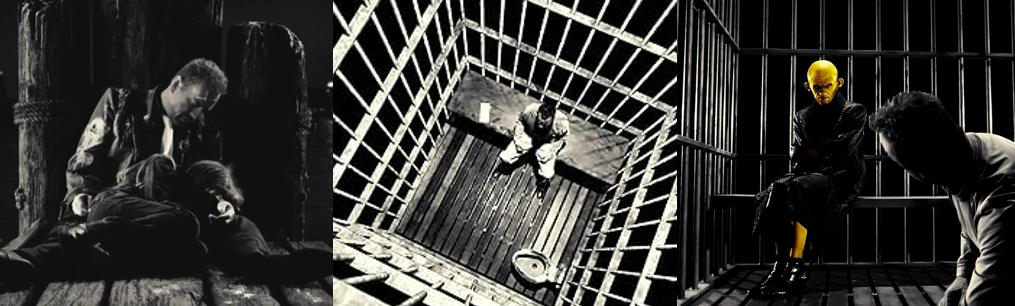
Veteran cop Hartigan endures years in prison to save a little girl from a pervert’s wrath.

“That Yellow Bastard” is one of two segments I find the most enjoyable in this film. The story follows Hartigan, a thirty-year veteran who’s spent his entire career doing things “by the book”. Whereas his partner, Bob (Michael Madsen), reluctantly turns a blind eye to Roark’s corruption, Hartigan refuses, especially with his retirement literally hours away when we first meet him. Hartigan’s one loose end is Roark’s son, Ethan Roark Jr. (Nick Stahl), a sick little paedophile who likes to toy with, rape, and mutilate young girls. Rather than simply walking away, Hartigan defies his partner and the Roarks by pursuing Junior to a warehouse, arriving just in time to save young Nancy Callahan (Makenzie Vega) all while battling angina. Determined to “go out with a bang”, Hartigan’s crusade sees him literally and figuratively disarm Junior. leaving him a mangled and comatose wreck. Unfortunately, that’s not how justice works in Sin City and Hartigan’s betrayed by Bob, arrested, and framed for Junior’s crimes. As Roark puts it, Hartigan learns the true meaning of power as witnesses and evidence are all bought or tampered with to paint Hartigan as a bent cop with a taste for kids. His reputation and marriage are left as tattered as his body, which Roark pays to restore so he can get off on seeing Hartigan disgraced and stuck in solitary confinement. Hartigan accepts this, unwilling to endanger young Nancy, who remains indebted and besotted with him. Due to his stubborn refusal to speak up, Hartigan spends eight years alone in prison, with only letters from Nancy (using a pseudonym) to keep him going. He comes to see Nancy as a dear friend and daughter (though it’s clear his feelings run deeper and he’s just in denial) and thus falls into despair when the letters suddenly stop, a nineteen-year-old girl’s severed finger arrives in his cell, and a strange, disgusting, yellow-colouring imp attacks him.
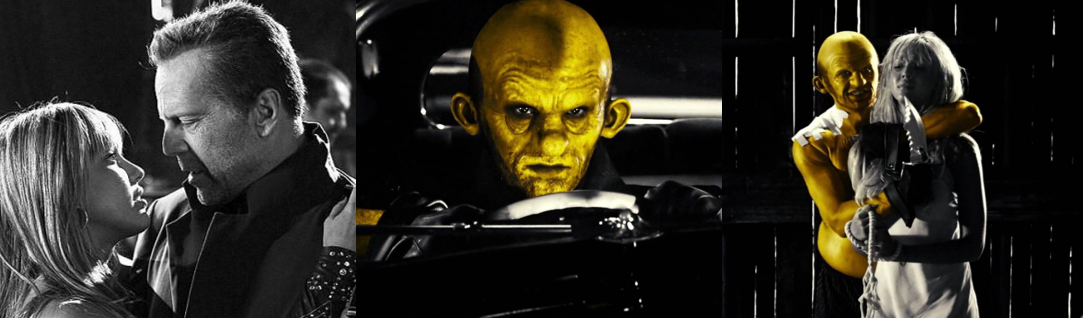
You know a film’s doing something right when even Nick Sthal puts in a captivating performance!

Fearing for Nancy’s life, Hartigan begrudgingly swallows his pride and confesses, which is enough to have him released due to “time served”. Rather than dwell on his losses, Hartigan returns to his mission to keep Nancy safe, only to find she’s grown into Jessica fuckin’ Alba and works at a strip bar! Blinded by his love for Nancy and his obsession with saving her, Hartigan realises all-too late that he’s been tricked and is soon struggled with his lust for Nancy and keeping her safe from the titular “Yellow Bastard”, an unnerving lunatic who really pops thanks to his yellow complexion. It turns Junior was radically altered by experimental surgery as Roark was desperate for a grandchild. While it scuppered Junior’s Presidential prospects, he continued to abuse, rape, and torture children while Hartigan rotted in his cell, and is determined to avenge himself on Hartigan and Nancy. I was surprised by how good Nick Stahl is here, especially once he’s under all the prosthetics and make-up. Junior’s a pathetic little man at the best of times, a spoiled rich boy brat who enjoys the immunity offered him by his father’s power and is so pathetic that he can’t get it up unless his victims scream. Hartigan knows this secret and tells it to Nancy, who frustrates Junior with her defiance and proves that she grew up strong after all. Similarly, Bruce Willis was the perfect choice for grizzled veteran cop Hartigan, despite Bruce obviously not matching Miller’s hulking, exaggerating artwork and the somewhat controversial nature of his relationship with the much-younger Nancy. Hartigan tries to resist her, but he can’t deny that he’s also in love with her and it’s only due to Junior’s interference that we’re spared a love scene between them. It’s a little disturbing, for sure, though it’s explicitly said and shown that Hartigan doesn’t think of Nancy in that way until she’s nineteen, at least. Plus, like…it is Jessica Alba so it’s understandable he’d have the hots for her.
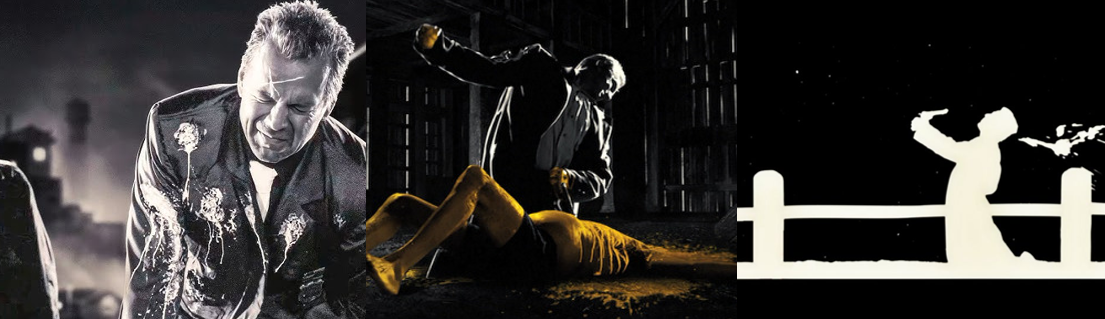
Despite triumphing, Hartigan can’t fight Roark’s corruption and makes the ultimate sacrifice to protect Nancy.

Hartigan is much more durable than the average man, basically telling his heart attack to sit the fuck down, surviving multiple gun shots and beatings, and besting most foes with a single punch. Hartigan’s aware of his limitations and regularly chastises himself for being reckless, allowing him to keep his cool even during a high-speed chase with Junior firing at him. Hartigan never wastes his time or his bullets, firing accurately and blasting off limbs and sending yellow blood spraying. He also proves driven and strong enough to pound the Yellow Bastard’s head into bloody mush by the end, showing he’s not your average cynical old man. There’s a tragedy to Hartigan that I’ve always felt palpable. Of all the characters and narrators of Sin City, I gravitate to him the most as he’s cynical, self-deprecating, and honest in a way that makes him extremely relatable. He’s clearly proud of his work and sees his retirement as bittersweet. It means leaving behind the violence and corruption, but also means he can’t help people, something he feels so strongly about that he happily takes the fall to protect Nancy, enduring beatings, slander, and solitude all to keep her safe. Hartigan knows that Roark is beyond the law. Roark even demonstrates that when he visits the hospital and boasts about how he could simply shoot Hartigan without repercussion. Hartigan consoles himself with the small victory that killing Junior ends Roark’s bloodline, which he frames as an absolute win to reassure Nancy. Hartigan sends her away, promising to follow her after clearing his name and bringing down Roark. Maybe that’s something John McClane might do, but not John Hartigan. Instead, he lies to Nancy to give her hope and keep her safe, then does the only thing he can do to ensure her safety by killing himself. It’s a startling ending, especially consider Bruce’s action credentials, but really sums up Hartigan’s commitment to shouldering the burden for others.
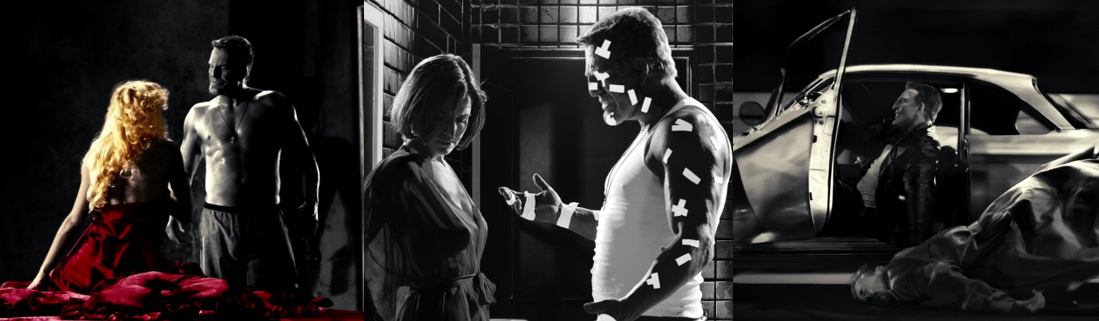
When his hooker love is killed, simple-minded brute Marv embarks on a brutal investigation.

My second favourite segment, “The Hard Goodbye” represented Mickey Rourke’s big Hollywood comeback and casts the former heartthrob as the brutish and disfigured Marv, a well-meaning but borderline psychotic bruiser who suffers from an unspecified medical condition that often leaves him confused, paranoid, and imagining things. Since he’s so badly disfigured, Marv is overjoyed when voluptuous prostitute Goldie (Jaime King) hooks up with him, throwing herself at him and giving him the affection and tenderness he’s craved his whole miserable life. Marv’s joy is short-lived, however, as he wakes to find Goldie dead and heavily-army cops ready to pounce. Thanks to his unexplained superhuman strength and durability, Marv easily brutalises the cops and escapes, patching up his minor wounds and beginning a vendetta to figure out who killed the only woman he’s ever loved (besides his doting, blind mother (Lucina Paquet)). Determined to kill his way to the truth, but still conscious of his medical condition, Marv goes to his parole officer, Lucille (Carla Gugino), for a fresh batch of pills and some insight into Goldie. While Lucille tries to warn Marv off his killing spree, not wanting to see him locked up for the rest of his life, Marv relishes a return to the “all-or-nothin’ days” of old, employing what little intelligence he has in weeding out small time thugs and torturing them in creative ways for leads, before killing them. Marv’s methods might be brutal, but they’re incredibly efficient and lead him to a crooked priest (Frank Miller), who reveals that Roark’s brother, Cardinal Patrick Henry Roark (Rutger Hauer), was behind Goldie’s murder. This throws Marv and sees him questioning reality as even he is shocked at the idea that someone so powerful he could’ve become the Pope or the President would go to the trouble of framing a meathead like him for a hooker’s murder.
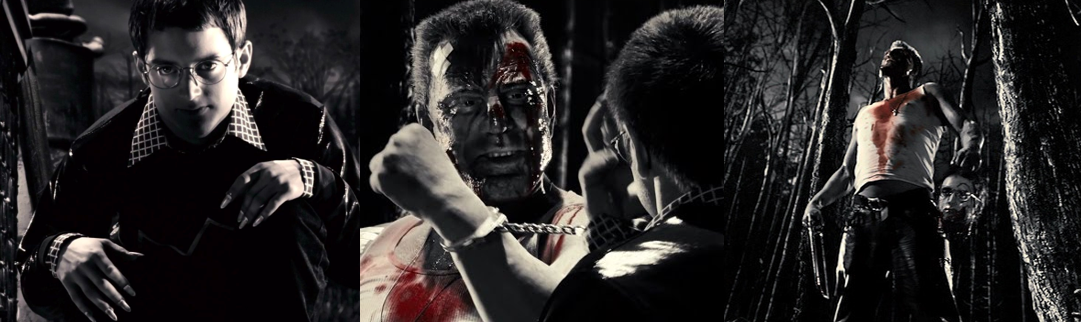
Silent cannibal sadistic Kevin forces Marv to rethink his strategy.

Still, Marv investigates the Roark family farm on the outskirts of town and finds a creepy, silent man-child living there. Silent, agile, and deadly, Kevin (Elijah Wood) easily bests the unsuspecting Marv and he wakes to find Lucille missing an arm and to learn that Kevin killed and ate Goldie’s fellow hookers. Kevin also chopped off and ate Lucille’s arm and forced her to watch, briefly shattering her hard-ass demeanour before she composes herself. Though grateful to Marv for saving her, Lucille turns him in when the cops arrive and gets gunned down for her troubles, compelling Marv to go on hatchet-wielding killing spree. Marv’s confusion only doubles when he’s attacked by what he assumes to be a hallucination of Goldie, but which turns out to be her twin sister, Wendy (Jaime King). Bewildered, overwhelmed, and exhausted, Marv is easily subdued by Wendy and taken to Gail and their fellow prostitutes in Old Town. While Wendy initially blames Marv for her sister’s death and plans to beat and kill him, they quickly realise that it’s all a setup and Wendy confirms Cardinal Roark’s involvement since Goldie “worked the clergy”. Wendy helps Marv gather supplies to return to the farm, though he only tolerates her help for so long. He refuses to let her finish Kevin off and cold clocks her to keep her from seeing what he does to Kevin since he doesn’t want to scar her for life. Thanks to his amazing durability, Marv weathers Kevin’s swift attack and talon-like nails and handcuffs him, dropping him with a single punch and using a hacksaw to saw off his arms and legs. Still, while Marv delights in watching Kevin’s dog feed upon him and hacking off the psycho’s head, he’s left unfulfilled since Kevin refuses to scream, or make any sound at all, through the whole ordeal.
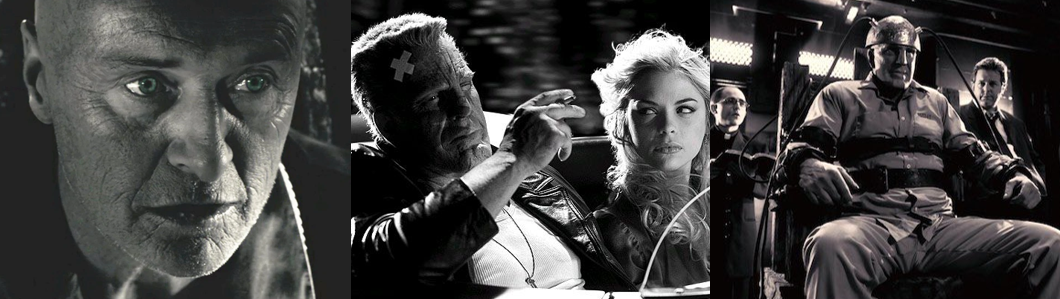
After avenging Goldie for himself and Wendy, Marv willingly meets his end.

Luckily for Marv, Cardinal Roark is a much more willing participant. Cardinal Roark is horrified when Marv brings him Kevin’s severed head and reveals that he not only encouraged Kevin’s cannibalism, but joined in, targeting “whores” since no one would miss them and feeling the touch of God almighty upon consuming human meat. Unimpressed and disgusted, Marv brutalises Cardinal Roark with his bare hands, giving him the “hard goodbye” he promised Goldie on her death bed. Unfortunately, Marv is subdued by the cops shortly after and spends months in hospital recovering from his wounds, initially convinced Roark’s men will come to finish the job before realising they plan to besmirch him, too. Though he refuses to co-operate, he’s coerced into taking the fall for Kevin and Cardinal Roark’s crimes and is branded a “psycho killer”. Regardless, Marv is largely nonplussed at his impending execution, believing the world would be a better place without him in it, and is eager to get it all over with. Out of gratitude for his actions and sacrifice, Wendy visits him one last time and allows Marv to have her, thinking of her as Goldie. Ever the stubborn meathead, Marv forgoes the obligatory Bible verses and hastens his execution, amusingly shrugging off the first round of electricity before finally breathing his last, consoling himself with memories of Goldie. Rourke shines as Marv, a simple-minded brute with a clear-cut code of honour who feels no remorse at roughing up or killing anyone who’s wronged him or his friends, especially dames. Marv is a very tragic figure, one constantly on the brink of a psychotic breakdown, who’s determined to bring down “gods” like Cardinal Roark even if it means his death. I loved the running gag of him acquiring new coats and offing his victims in increasingly bonkers ways, and how vicious his mean streak was.
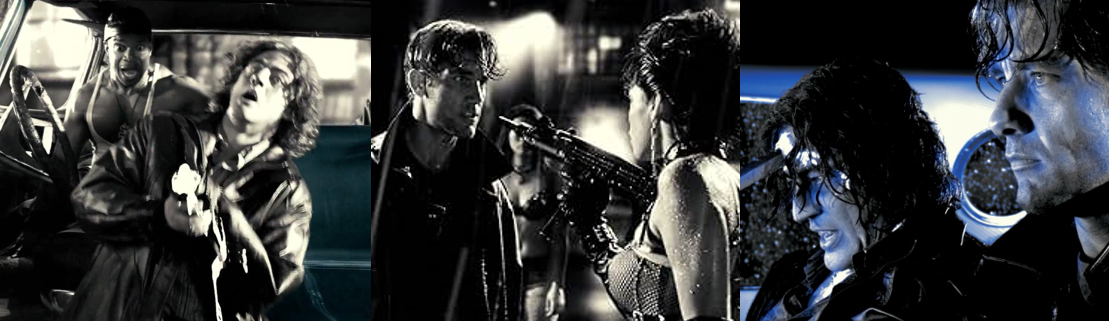
When unstable cop Jackie runs afoul of Old Town, self-righteous Dwight desperately tries to protect his friends.

Finally, there’s “The Big Fat Kill”, which is enjoyable but probably the weakest segment for me, mainly because it has far more “Millerisms” than the other stories (that is, repetitive, childish, and stupid dialogue). This story explores Old Town in more detail, depicting it as Sin City’s seedy red-light district where the ladies are the law. The cops don’t patrol there and, in return, they get sent home alive if they accidentally cross the border and get to unwind with the girls when off duty. The women are therefore free to police themselves, dishing out brutal and efficient vigilante justice whenever their clients get too full of themselves, with Gail leading the charge and silent, deadly little Miho (Devon Aoki) slicing guys up with her katana. The story follows Dwight McCarthy (Clive Owen), a mysterious and grizzled man with a “new face” who’s back in town and hooking up with Shellie (Brittany Murphy), a rambunctious waitress. When Shellie’s accosted by her drunken, obsessively aggressive ex, Jack Rafferty (Benicio del Toro), Dwight stands up for her without hesitation, shrugging off her protests and determined to teach “Jackie Boy” a lesson about respecting women. Concerned for the ladies of Old Town, Dwight pursues Jack and his drunken friends to the red-light district, where they attract Gail’s wrath after accosting Becky. Gail, angry at Dwight for ditching her in the past, immediately takes charge and orders Jack’s death, refusing to listen to Dwight’s sudden feeling that something’s off. Sure enough, Dwight discovers a bombshell on Jackie Boy’s corpse: he was Lieutenant “Iron Jack” Rafferty, a “goddamn hero cop”, and his death would mean an end to the shaky truce and a return to all-out war in Old Town. Thanks to her ill-will towards Dwight, Gail’s reluctant to go along with his plan to ditch Jackie Boy’s corpse in the tar pit across town but he convinces her with his conviction, passion, and quick hands, determined to safeguard the women and avoid any bloodshed.
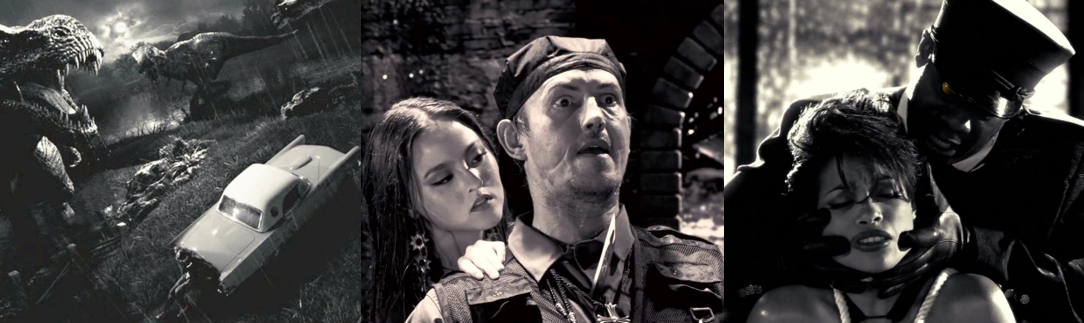
Dwight and his sultry allies must set aside their grievances to avoid bloodshed in Old Town.

Still, the experience rattles Dwight and sees him hallucinating conversations with Jackie Boy’s mangled corpse. Dwight’s right to be on edge as some previous actions mean he’s one fingerprint away from execution and he’s risking a lot to protect his friends, but he follows through since he can’t help but protect those he cares about. Unfortunately, Dwight’s plan hits a snag when the car the ladies give him conks out and he’s attacked by Irish mercenaries led by Brian (Tommy Flanagan). Despite Brian’s penchant for grenades being largely ineffective (it’s seriously laughable how characters shrug off explosions even when they’re right at their feet!), Dwight ends up in the tar and Brian escapes with Jack’s severed head. Luckily, Miho rescues Dwight and they retrieve the head, then concoct a desperate plan to trade it for Gail, who’s held hostage by eloquent and imposing man-mountain Manute (Michael Clarke Duncan). Sporting a golden eye and holding a grudge against prostitutes, Manute certainly cuts an intimidating figure, with his slightest touch causing Gail agony. He works for unseen mob boss Wallenquist, who’s keen to expedite the war between Old Town and the cops so he can regain control of the red-light district. Manute, much like Junior, is joined by an eclectic bunch of underlings, from loquacious minions to Neo-Nazis, who add a splash of (metaphorical) colour to Sin City’s underworld. Manute also seems to have a grudge against Dwight, though it’s not expanded upon in this story. In fact, pretty much nothing is known of Dwight’s past life; you’d have to read A Dame to Kill For (Miller, 1993 to 1994) or watch the sequel to find out more about that.
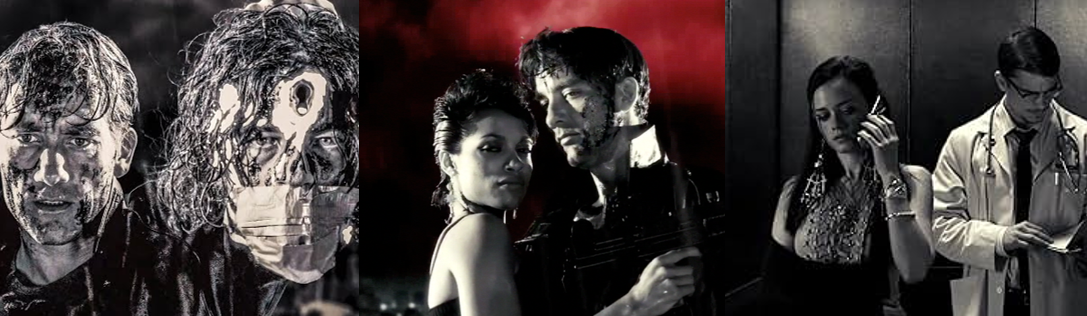
Though visually striking, Miller’s quirky dialogue makes “The Big Fat Kill” the least enjoyable segment.

Anyway, Dwight’s plan echoes a famous strategy employed by the Spartans and depicted (in Miller’s typical exaggerated fashion) in 300 (ibid, 1998). He forces Manute and his goons into a dark, narrow alleyway where their numbers are less effective and demands a simple trade: Jack’s severed head for Gail. Despite Becky questioning why Jackie Boy’s head has tape around its mouth, Manute agrees and Gail initially despairs of Dwight, before he reveals he stuffed one of Brian’s grenades into Jackie Boy’s head. The explosion scars Manute and takes out some of his minions before Miho and the other ladies emerge from the rooftops and join Dwight and Gail in slaughtering “every last rat-bastard one of them” to send a message to Wallenquist. The act sees Dwight and Gail rediscover their passion for each other, though they each lament that they’re seemingly doomed to never truly be together. It’s not that I don’t like “The Big fat Kill”, but I do find it the weakest segment in Sin City. Clive Owen is great as the gritty, gruff Dwight, a man trying to keep his head down and move on from his mysterious past and yet caught up in a potential war because he can’t help but defend women. He’s depicted as being a bit unpredictable and unstable, talking to himself (while hallucinating talking to Jackie Boy’s corpse) and happily ready to engage with multiple foes at once. He has a bloodlust and a sexual passion he’s quick to indulge, despite trying to deny both, and a deep-rooted respect for the ladies of Old Town. He knows how dangerous Miho is, for example, and doesn’t want to step on their toes, but he’ll slap Gail and make demands if it means avoiding a war. Dwight’s comically as invulnerable as Hartigan and Marv, despite being much smaller, and equally determined to achieve his goals. I really liked Benicio del Toro’s slurring, madcap performance as the erratic Jackie Boy, a guy so obviously off his rocker that it’s laughable that he’s what Sin City designates a “hero cop”.
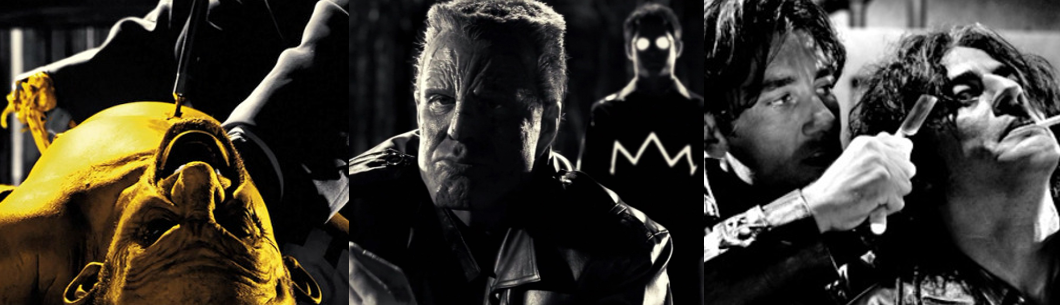
A masterful use of green screens, gritty noir atmos, and sporadic colour make this a faithful adaptation.

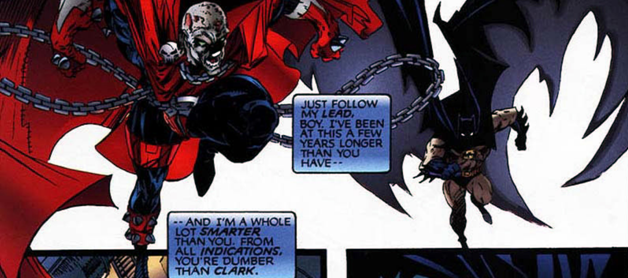
I actually studied Sin City years ago at university as an example of fidelity in film adaptations. The film remains one of the best examples of a one-to-one adaptation of a text largely because the production literally used Frank Miller’s comic books as the storyboards. However, this is a bit of a double-edged sword for me as I’m not a huge fan of Frank Miller’s writing or his art. There are obvious exceptions. I enjoyed his work on Daredevil, for example; Batman: Year One (Miller, et al, 1987) is still the definitive Bruce Wayne/Batman origin story for me; and I do like the Sin City comics I’ve read. However, his art is often quite ungainly and ugly and his writing, and especially his dialogue, can be atrocious. I often cite his work on a Batman/Spawn crossover, where his “Millerisms” depicted Batman as a mardy youth and completely ruined Todd McFarlane’s gorgeous art. However, Sin City is an exception. This is Miller’s world, his toy box, and this is really where he shines, with his own original characters and narratives, all rendered in a startling noir colour palette that heavily emphasises shadows and silhouettes. The movie captures that aesthetic perfectly, using colour (mainly blue, red, and yellow) sparingly as a contrast to the noir presentation. I really like the stylistic way the film is shot, the use of black-and-white and shadows, and the way the few examples of colour pop, and how gritty and dirty and moody everything is. There are times when it’s obvious the film is being shot on a green screen set, but it perfectly fits Miller’s hyper-stylised world. Sin City is a drab, depressing, and dangerous town where it’s almost constantly raining, gangs and perverts roam, and the corrupt control everything. This is a world where we’re forced to rely on anti-heroes or where straight arrows like Hartigan are disgraced for daring to oppose Senator Roark’s rule, and where surviving the day is seen as a happy ending.  
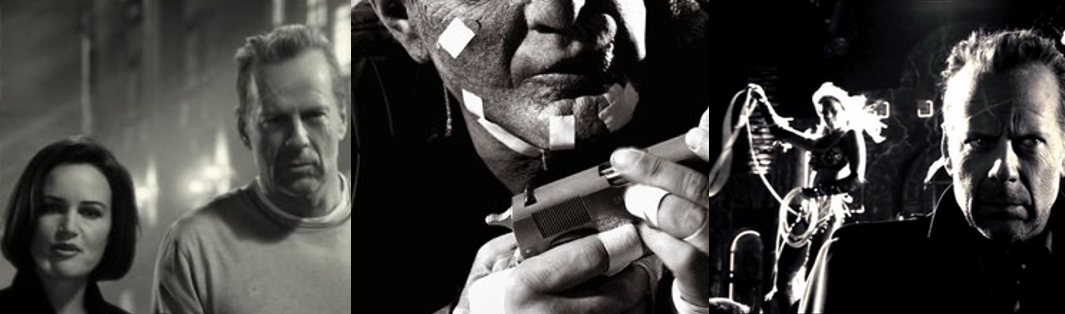
A few extra scenes bring this film even closer to the source material and emphasise its anthology roots.

This Recut & Extended version of the film is technically the best way to watch it as it adds in a few extra scenes, primarily to “That Yellow Bastard”, but oddly presents each segment like a mini movie, with its own opening titles and closing credits, which is a bit annoying when trying to watch it as one movie. Similarly, while the additions to “That Yellow Bastard” are scenes from the comics, I can understand why they were cut as they’re pretty redundant. For example, Roark comes into the hospital to gloat over Hartigan’s bed-ridden form and tells us everything we need to know without Eileen Hartigan (Babs George) and other visitors repeating the same information. These visitors also come to Hartigan before Roark in the film, rather than after Roark as in the comics, which doesn’t make much sense narratively. I did like the inclusion of Lucille to further tie the segment into “The Hard Goodbye”. Her scenes also add a bit of extra context as to why Hartigan is released after he confesses. Without them, it views like this perverted old man finally confessed to being a child rapist and murderer and was let out because of “time served”. “The Hard Goodbye” adds a scene where Marv sneaks into his mother’s home to retrieve his beloved pistol, Gladys, restoring a heartwarming interaction between the two that shows that Marv actively hides his violent nature from his mother. Otherwise, there’s not much else added to the film as Rodriguez and Miller were extremely faithful to the source material the first go around. I prefer the extended version of “That Yellow bastard”, though, as it means more Bruce Willis, but it does annoy me that there’s no option to watch it as a continuous film without skipping past the end credits each time.

Final Thoughts:
I’ve always enjoyed Frank Miller’s Sin City. I’d never read the comics when I first saw the trailers or when I went to see it upon release, but I was captivated by the black-and-white visuals and stylistic presentation. I really enjoy how the film brings Miller’s neo-noir world to life using green screens and sparse sets. It all feels very gritty and almost like a stage play at times and makes me nostalgic for the noir thrillers of old. Despite the actors having to growl out Miller’s often painful dialogue and often acting against stand-ins or thin air, the performances were captivating throughout. Bruce Willis and Mickey Rourke especially shined in their roles, with Willis perfectly capturing Hartigan’s grizzled nature and Rourke channelling a great deal of emotion into the brutish Marv. Clive Owen was equally impressive as Dwight, though I still find “The Big Fat Kill” the weakest segment because of Miller’s writing and some of the deliveries. Still, the visual appeal of Sin City cannot be denied, the stark use of shadows, blacks and whites, the sparing use of colour, and the exaggerated violence all pop off the screen. It really is like the comic book panels have come to life and it amazes me that more movies didn’t opt for this aesthetic for other pulp characters (or even Batman and the Crow). I enjoyed the film so much that I sought out The Hard Goodbye and That Yellow Bastard to read and I eagerly anticipated the follow-up, and I would’ve loved to see an ongoing television series adapting more of Miller’s Sin City stories as it’s such a vivid and intriguing cesspool of corruption and violence.

My Rating:

Rating: 4 out of 5.

Great Stuff

Did you enjoy Frank Miller’s Sin City? Which segment was your favourite? Were there other Sin City stories you would’ve liked to see in the film? Did you enjoy the hyper-stylised presentation? Do you think Hartigan made the right decision sacrificing himself? Were you interested to learn more about Dwight? Why do you think Marv was so unstoppable? Whatever your thoughts on Sin City, drop a comment below, support me on Ko-Fi if you’d like me to cover more of this world.

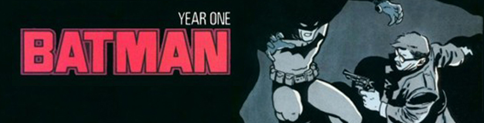
Back Issues: Batman: Year One

Story Titles: “Chapter One: Who I Am – How I Come to Be”, “Chapter Two: War Is Declared”, “Chapter Three: Black Dawn”, and “Chapter Four: Friend in Need”
Published: February 1987 to May 1987
Writer: Frank Miller
Artist: David Mazzucchelli

The Background:
Capitalising on the success of Clark Kent/Superman’s debut, artist Bob Kane drew up a design for a new masked crimefighter, the “Bat-Man”. Thanks to the tireless and long-suppressed work of artist Bill Finger, the Bat-Man was transformed into the figure who would become a mainstream cultural icon. Over the many years since his debut, however, Batman underwent significant changes and alterations to his character and supporting cast; he gained a kid sidekick to appear more appealing to younger readers and was transformed into a much softer, more fantastical character. Indeed, although writers like Dennis O’Neil helped to rectify this in the 1970s, it’s safe to say that Batman’s image had been tainted somewhat by the glorious camp (and incredibly popular) 1960s television show. After wiping their continuity mostly clean in the Crisis on Infinite Earths (Wolfman, et al, 1985 to 1986), DC Comics sought to retell the origins of many of their most popular characters, with Batman being chief among them. Following his mainstream success with his work on Daredevil, writer and artist Frank Miller signed a contract with DC Comics that led not only to his seminal Batman: The Dark Knight Returns (Miller, et al, 1986) but also a revamped origin for the Dark Knight. Assured he would be given full creative control, Miller expanded upon Batman’s original story to craft one of the most lauded and well-regarded Batman stories that would go on to influence numerous Batman films, stories, and interpretations for years to come.

The Review:
Batman: Year One is as much a story about James “Jim” Gordon as it is about Bruce Wayne’s first appearance as the Batman. The story is split between the two men and their separate narratives, with each having their own distinct text boxes, perspectives, and experiences within Gotham City. This helps to show the parallels between the two and how they are both driven to extremes due to the city’s bleak, depressing, and corrupt nature and we see their differing perspectives right off the bat (no pun intended) with their respective arrivals in the city in January. Lieutenant Gordon, who has just transferred to Gotham and whose wife Barbara (not that Barbara) is currently pregnant with their first child, laments the state of the city, which he experiences first-hand by mistakenly arriving by train. Twenty-five-year-old Bruce, however, thinks the exact opposite; he wishes that he’d arrived by train to “see the enemy” rather than by air, where the city almost looks civilised. While Bruce is mobbed by reporters desperate for the story of his twelve year absence from Gotham, Gordon is met at the train station by the hulking Detective Arnold Flass, who assures him that “cops got it made in Gotham”.

Both Bruce and Gordon struggle with the harsh nature of Gotham City.

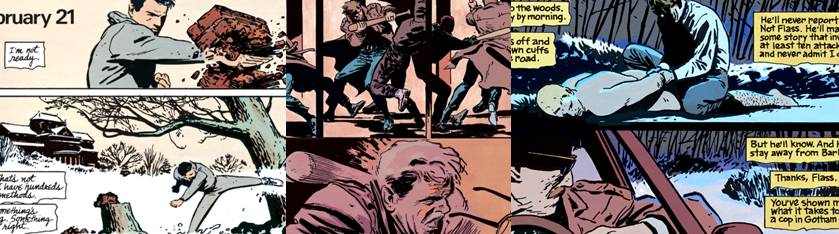
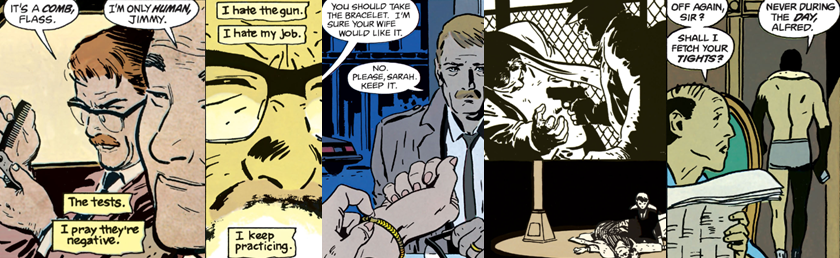
While Gordon grits his teeth through his first meeting with the detestable Commissioner Gillian Loeb, Bruce returns to his familial home, Wayne Manor, and his faithful butler, Alfred Pennyworth. Bruce spends the next month or so mentally preparing himself for the task ahead of him; physically, he’s well-trained and highly capable, able to smash through bricks and topple a tree with a single kick, but he feels something is missing for his plans for Gotham. Gordon, however, is immediately introduced to the ugly side of Gotham’s police force as Flass randomly assaults a group of youths for no good reason at all. Gordon keeps his opinions to himself but takes care to study Flass’ movements and physical capabilities for later, but soon finds himself under suspicion as Flass disagrees with his morals. Having brought this to Loeb’s attention, Flass is given permission to put a beating on Gordon in an effort to teach him how important it is to “fit in” in Gotham. Although Gordon has a military background, it has, in his words, “been a while” and, while he puts up a good fight, he takes a bit of a beating from a few masked assailants wielding baseball bats. Riled up, Gordon heads over to Flass’ favourite bar and runs his drunk-ass off the road. Tossing his gun aside, Gordon offers Flass a baseball bat as a “handicap” and sets about taking the big man to school. Beaten and left naked and cuffed in the snow, Gordon feels confident that he has taught Flass not to mess with him again.

Bruce’s first night goes pretty bad, leading to him assuming a frightening persona.

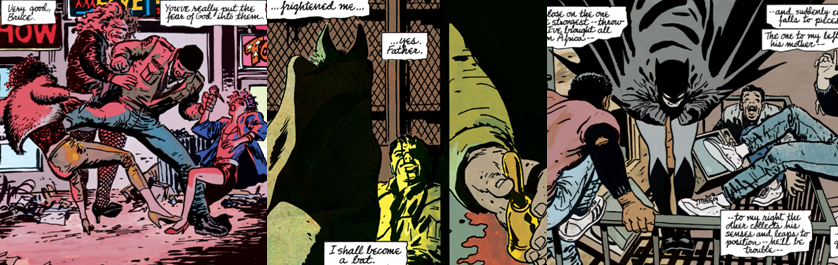
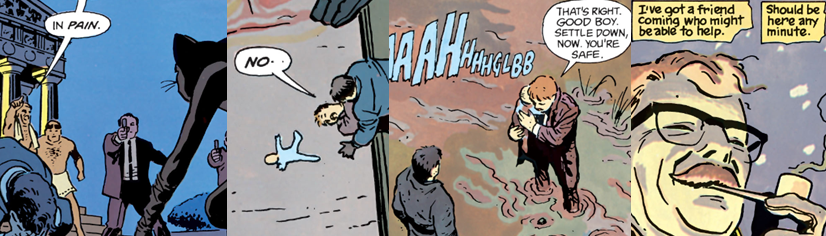
Coincidentally enough, this occurs on the very first night that Bruce attempts to strike back at the city’s criminal underworld; disguising his identity with some make-up and a fake scar, he goes out looking for trouble in the Red Light District and ends up taking a beating of his own. Stabbed in the leg, mauled by a cat-like prostitute, and shot by some of Gotham’s finest, Bruce manages to escape police custody and, with his last ounce of strength, stumble back to Wayne Manor. Bleeding out, he contemplates his failures and begs his deceased father, Doctor Thomas Wayne, for guidance on how to do better and to strike fear into the hearts of criminals. Tormented at having witnessed the brutal and random deaths of his parents as a small boy, he resolves to let himself die unless he can find the answer and, at that moment, a gigantic bat crashes through the window of his study. Just like that, Bruce has his answer and vows to “become a bat”. By April, Gordon has built up something of a reputation as a soft touch, which brings him into direct opposition with Sergeant Branden of Special Weapons and Tactics (S.W.A.T.) and the support of the press (which makes reprimanding him extremely difficult for Loeb). Gordon’s mounting aggravation and depression at bringing his wife and pregnant child to such a cesspit is interrupted by reports of a “giant bat” in the city as, across town, the Batman makes his dramatic first appearance. Thanks to his fearsome appearance and an animalistic growl, Batman is able to frighten a group of thieves a little too well as one of them topples over the edge of the balcony they’re on. So determined is Batman to keep the perp from falling to his death that he puts himself at risk to save the guy’s life and only manages to come out of it relatively unscathed due to his adaptability, strength, sheer for of will, and (as he chastises himself) a great deal of luck.

Batman threatens the city’s mobsters but runs afoul of the trigger-happy police.

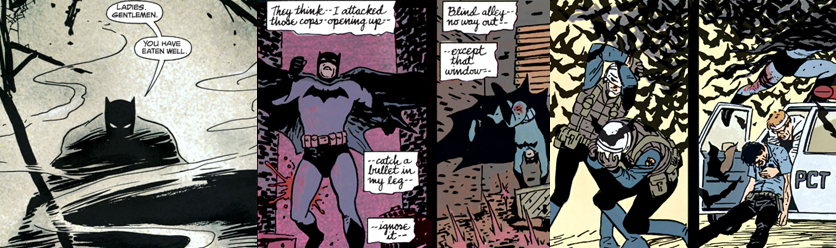
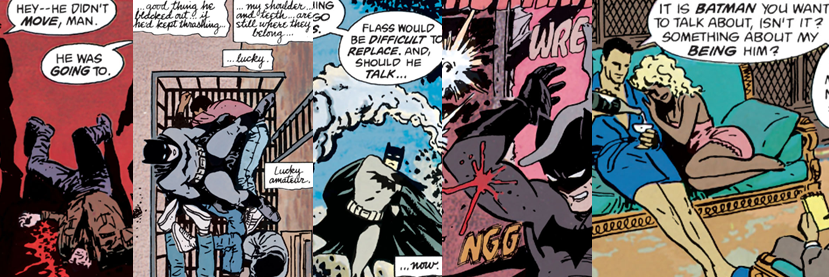
To ensure that the criminals and corrupt know that they are living on borrowed time, Batman makes a dramatic show of himself at a dinner function hosted by noted mob boss Carmine “The Roman” Falcone and attended by corrupt commission Loeb. News of the Batman, of course, reaches the Gotham police department; Flass is just one of the officers to have encountered the vigilante, who is widely regarded as a horrific, winged demon. Ordered by Loeb to bring Batman in, Gordon’s efforts are met with failure; staged muggings go without incident and Falcone is left humiliated in his own chambers, and not just because of Batman’s wily prowess as Assistant District Attorney Harvey Dent has entered into a secret alliance with the Dark Knight. Batman and Gordon’s paths finally cross when the two both risk their lives to save a homeless woman from being run down by a truck. Despite Batman’s heroic actions, Gordon orders his men to take the vigilante alive; however, Batman receives a bullet to the leg and is quickly left trapped and wounded thanks to Branden laying waste to the building he’s hiding in. The spreading fires destroy Batman’s utility belt and leave him with only his wits and ninja training to survive, which are more than enough to pick off the S.W.A.T. team one by one despite his leg wound. Cornered and running out of tricks, however, Batman is barely able to avoid another round of gunfire but manages to elude capture by attracting a flock of bats all the way from Wayne Manor that cover his escape, leave many of the cops and bystanders in hospital, and go a long way to adding to the Batman’s dramatic mystique.

Gordon’s efforts to uncover Batman’s identity lead him into a passionate affair.

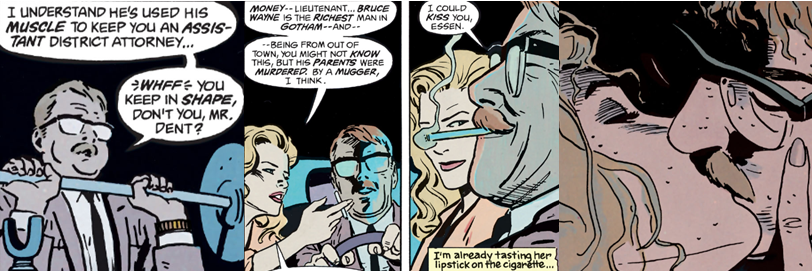
Humiliated by this incident, Gordon increases his efforts in trying to decipher the Batman’s true identity. Initially suspicious of Dent, it is Detective Sarah Essen who nudges his attentions towards Bruce Wayne because of his wealth and traumatic childhood. Over the course of the last few months and pages, the two have grown extremely close since Gordon is spending more and more time at work and trying to shield Barbara from the atrocities in Gotham. This leads to a passionate affair between the two that Gordon immediately hates himself for; his guilt is matched only by his confusion regarding Batman, who is clearly taking the law into his own hands and yet may very well be the most righteous and incorruptible person in the city. Bruce, however, is able to throw Gordon’s suspicions off by playing up the role of a wealthy, bored socialite but, after Batman’s efforts see Flass incarcerated for taking part in a massive drug operation, Loeb threatens to expose the Lieutenant’s affair to his wife.

Bruce saves Gordon’s son and gains a valuable ally in the process.

Although he already ended the affair, Gordon decides to admit to his wrongdoings to his wife in order to begin repairing his marriage (something also aided by the birth of their son, James Junior) and to dispel any leverage the corrupt have over him. Batman’s world, however, becomes a little more complicated when the prostitute he countered on his first night, Selina Kyle, decides to craft a costumed identity of her own and begins targeting Falcone’s operation as Catwoman. After Catwoman scars his face, Falcone (who believes that the two are in cahoots) orders his men to kidnap James Jnr. Gordon arrives too late to save his son but is able to keep Barbara from harm; however, he also shoots and wounds Bruce (who is disguised in a motorcycle jacket and helmet) in the process. The two of them chase after Falcone’s goon and a fight breaks out on the bridge; overpowered by the thug, Gordon is helpless to keep his baby boy from falling to the cold, shallow water below. Luckily, Bruce dives after the boy and saves him, earning Gordon’s respect and gratitude. In the aftermath, Loeb is forced to resign after Flass spills the beans on all his dirty dealings and Sarah moves away to New York. As for Gordon, he and Barbara agree to attend marriage counselling, he is in line for a promotion to Captain, and he has found himself a friend to help tackle a manic named “The Joker” who has poisoned the city’s reservoir.

The Summary:
Of all the Batman stories crafted by Frank Miller, Batman: Year One is still my favourite. It’s a gritty, bleak, grounded reinterpretation of Batman’s origin and first year in Gotham City and paints him as a regular man (albeit one well trained and with more wealth than you or I) who isn’t yet the hyper-prepared, experienced vigilante with a network of allies and resources. The artwork is simple but gorgeous, with everything taking on a wash of waterpaint-like noir that emphasises deep shadows and harsh lights and has the majority of the story taking place in the dank, depressing darkness of night. One of the main reasons I dislike The Dark Knight Returns (and other Batman stories by Miller) is the dialogue (and the artwork). Miller has a very…shall we say “distinctive” way of having characters talk and likes to kind of just spit words and odd statements at the reader. For the most part, Year One is relatively light on these “Miller-isms” but they do still show up here and there (mostly when Batman is eluding or attacking people). Thankfully, Alfred’s trademark dry wit makes up for this and seeing Bruce act like an complete cad to throw off Gordon’s suspicions was absolutely fantastic.

Year One is focused much more on Gordon’s perspective of the city and its vigilante.

It’s interesting that Batman: Year One is such an effective Batman story considering it’s much more of a Jim Gordon story. We learn very little about Bruce, his background, or his training and, instead, focus more on Gordon and his struggles to adjust to and cope with life in the city. Everything we learn about Gotham and the state of its police force comes from Gordon, a flawed man who has made mistakes and is trying to hold onto his morals but struggles in the face of near-endless corruption and his own temptations towards Sarah. Bruce’s tragic origin is recounted very briefly and much of his training and motivation is delivered through exposition or his thought boxes, which take on a cursive slant that can be difficult to make out at times. Still, it provides a fascinating glimpse into Bruce’s early struggles to find the means by which to fight crime in the city and the preparation that goes into his various traps and assuming the guise of the Batman. At its core, Batman: Year One is a story of struggle and trust; both Gordon and Bruce struggle to find their place in Gotham and figure out how to conduct themselves and their mission in a city that is constantly fighting back against them and both of them feel alone in this endeavour. It isn’t until their paths cross and they see how selfless the other is that they both begin to consider changing their position; while guys like Branden just want to shoot Batman dead no questions asked, Gordon would prefer to see him brought in alive to get to the root of his mystery and Bruce realises that he needs the good-natured  lieutenant onside if he is ever to be effective as Batman and avoid getting shot on a nightly basis.

As it’s Batman’s first year, he’s a far more inexperienced and flawed character than usual.

This comes to a head in the finale where, rather than Batman saving Gordon’s son, it is Bruce in a questionable disguise. Indeed, the artwork and dialogue makes it intentionally vague as to whether or not Gordon truly recognises his boy’s saviour or not and, in the end, he decides it doesn’t matter who the Batman is as he has learned to think of him as a friend in a lawless city. As a tale of Batman’s earliest days in action, it’s hard to get much better than Year One. Personally, I love Batman stories that show him to be vulnerable and flawed and we definitely see a lot of that here as he’s constantly being stabbed and shot and hurt and forced into tight corners. This is a Batman who is lacking many of the bells and whistles of his later career; there’s not really a Batcave, no Bat-Signal or Batmobile, and a limited array of Bat-themed gadgets, all of which means that Batman has to use his wits and adaptability a lot more than his fancy high-tech toys which, again, I also find incredibly appealing. The portrayal of Batman’s influence is equally great; most treat the idea of a giant bat-garbed vigilante as ridiculous until they come face-to-face with him and then they are scared witless and this goes a long way to painting the Batman as this urban myth amongst the just and unjust alike.

My Rating:

Rating: 5 out of 5.

Fantastic

Have you ever read Batman: Year One? What did you think of Frank Miller’s reinvention of Batman? Are you a fan of Miller’s work, especially on Batman? What did you think to Year One’s focus on Jim Gordon and the depiction of a Batman without all his bells and whistles? What was your first experience of Batman and how are you celebrating his debut this month? Whatever your thoughts, sign up to drop them below and be sure to check in next Saturday for my review of Batman’s newest big-screen outing!

Back Issues: Spawn/Batman

BackIssues

I didn’t get to read a lot of comic books as a kid; growing up in the United Kingdom in the mid-nineties, it seemed my access to DC and Marvel Comics was far more restricted than it is these days, when comics are available in almost every corner shop or newsagent. Mostly, I read the odd graphic novel from the library or annual compilations picked up from car boot sales and the like. Nevertheless, I had a fondness for Bruce Wayne/Batman, Peter Parker/Spider-Man, and Clark Kent/Superman. These were the heroes I had the most exposure to growing up, which was lucky considering the movies and television shows these characters had around this time. As my exposure to more comics grew, however, I soon gravitated towards the likes of Eddie Brock/Venom, Frank Castle/The Punisher, and Doctor Bruce Banner/The Hulk, skewing my preference towards the more violent and aggressive comic heroes. In the nineties, there was no superhero that embodied violence, aggression, or edgy angst more than Todd McFarlane’s Spawn. Initially an assassin for a covert arm of the Central Intelligence Agency (CIA), Al Simmons was betrayed by his commander, Jason Wynn, and murdered as part of a pact between Wynn and the ruler of the Eighth Circle of Hell, Malebolgia.

SpawnBatCameos
McFarlane included some cheeky cameos in early Spawn titles.

Simmons returned to the world of the living five years later, with few of his memories, decked out in a living, symbiotic costume and wielding tremendous (if finite) hell powers as Spawn. Constantly plagued by Malebolgia’s chief lieutenant, the Violator (who generally assumed the form of the disgusting Clown), Spawn was torn between wanting to reconnect to his previous life (specifically his wife), rejecting his apparent destiny as the general of Hell’s armies, and using his abilities to protect those in need. Few superheroes had the impact that Spawn had upon his debut; after breaking away from Marvel with a bunch of talented writers and artists, McFarlane founded Image Comics and spearheaded his new company with Spawn. Issue one sold over a million copies and Spawn’s place as a cultural icon has since been secured thanks to a fantastic animated series, an…okay live-action movie, a bunch of surprisingly decent videogames, and a whole host of fantastically-detailed toys and merchandise. While Spawn may not be as prominent a figure in the world of comics as he once was, his impact certainly changed the way the industry viewed independent publications. So great was Spawn’s popularity that he featured in a number crossovers; initially, this was restricted simply to Spawn appearing alongside other Image characters, or other independent characters popping up in Spawn comics, but, after some cheeky, barely legal cameos from some famous faces in issue ten, Spawn officially teamed up with Batman in 1994 for a couple of crossover specials.

SpawnBatLogo

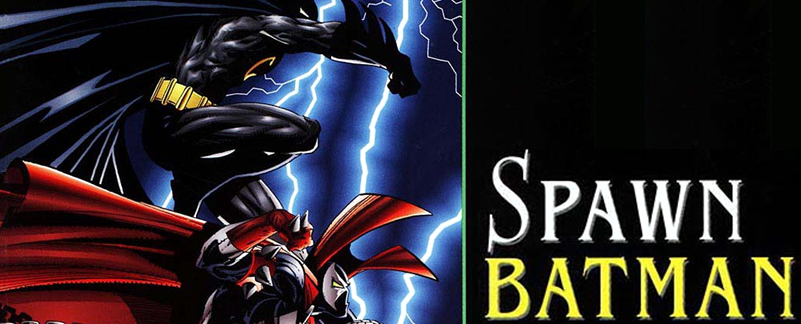
Spawn/Batman saw artist Todd McFarlane join forces with celebrated Batman writer Frank Miller. Being that this was 1994, Miller was still riding high off genre-changing titles like The Dark Knight Returns (Miller, et al, 1986) and Batman: Year One (ibid, 1987) and knee deep into his Sin City (ibid, 1991 to 2000) series. Yet, the signs of Miller’s degradation into self-parody and absurdity still managed to crop up in this one-shot title; while it’s nowhere near as bad as what we got in The Dark Knight Strikes Again (ibid, 2002) or All-Star Batman & Robin, The Boy Wonder (ibid, 2005 to 2008), Miller’s writing and characterisation of Batman is noticeably lacking and questionable, especially compared to what we saw in The Dark Knight Returns or Year One.

SpawnBatCoexist
In this story, Batman and Spawn co-exist on the same world.

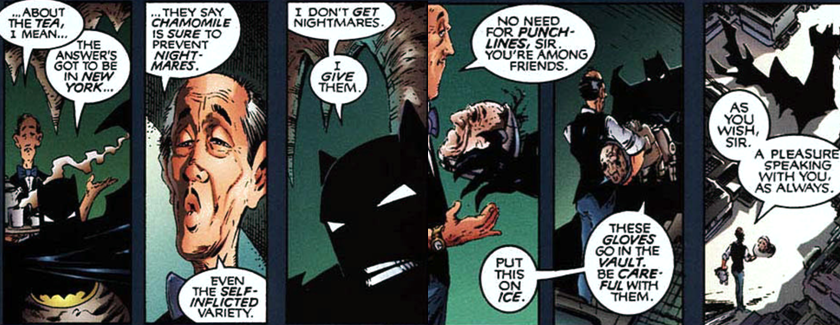
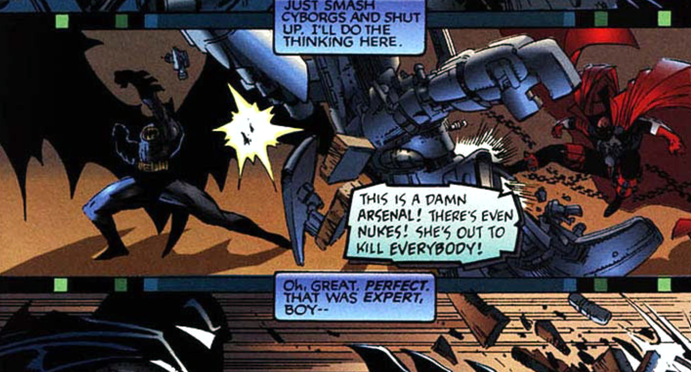
But we’re jumping ahead a bit. Spawn/Batman is one of those crossovers that, rather than having the DC and Image characters exist in separate universes, acts as though they all co-exist in the same world at the same time. Honestly, I always prefer it when crossovers are handled this way as, while it can be difficult to believe that Superman, Spider-Man, X-Men, and the Teen Titans all co-exist but we never hear about it until they cross paths every once in a blue moon, it’s a lot less messy than dreaming up another reality-shattering Crisis or out of place dimension shift. The story opens with Batman (described as “Protector. Avenger. Detective. Champion”) busting up some thugs transporting high-tech weapons and getting into a throwdown with a massive robot. Slipping on a robotic gauntlet that fills him with superhuman strength, Batman is able to tear the robot apart…only to find that it is a cyborg that is powered by a still-living severed head.

SpawnBatAlfred
Alfred’s wit is as dry as ever.

Back at the Batcave, he examines the head while his loyal butler and father-figure, Alfred Pennyworth, tries in vain to patch up his injuries and recommend some tea, rest, and relaxation. After running the head’s dental records through the Batcomputer, Batman discovers it belonged to a homeless vagrant from New York City. Batman heads there immediately (and, as you might expect, is immediately reminded of the night his parents were murdered…) and, as he stalks the alleyways and dark corners of the city, overhears “legends” of a bum named Al with magic powers, which he dismisses as “nonsense”. I find this a little out of character for Batman, who rubs shoulders with Atlanteans, Amazons, and aliens on a regular basis and has a long-standing friendship with an actual magician but who am I to question the legendary Frank Miller?

SpawnBatVs1
Batman drastically underestimates Spawn in their first encounter.

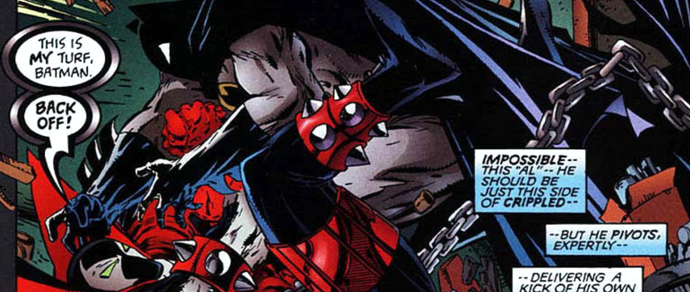
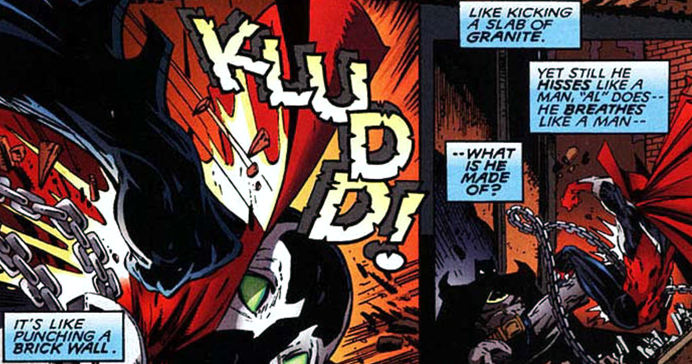
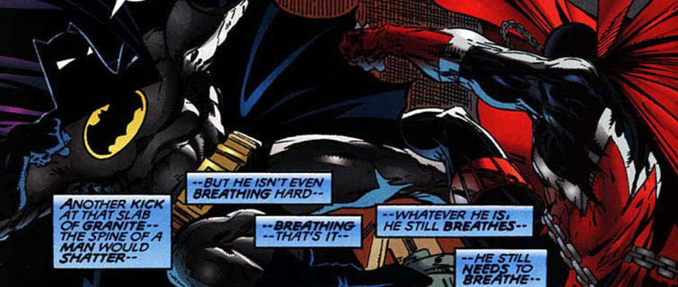
Anyway, this leads to a natural segue into Spawn’s introduction to the story. Spawn’s not happy (but then again when is he ever?) because a lot of his friends have suddenly gone missing; after returning from the dead, Spawn found a home amongst the bums of New York City and made it his mission to protect them. This mission (which was more of an obsession, in many ways) leads to him mercilessly burning alive a couple of thugs who want to set alight a sleeping bum. Although this is perfectly in keeping with Spawn’s brand of justice, it catches the attention of Batman who, none-too-pleased with what he sees as cold-blooded murder, leaps in to attack without a second’s hesitation. However, Batman’s confidence (more of an aggravating arrogance under Miller’s pen…) is misplaced against Spawn, who is tough enough to take everything Batman can dish out and repay it in kind without mercy.

SpawnBatLove
Spawn’s past returns to haunt him…again…

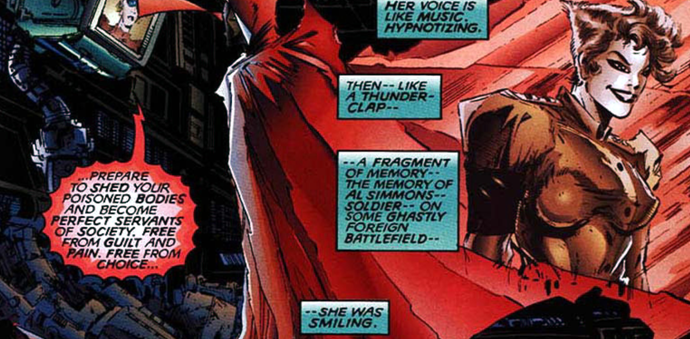
With Batman having made a strategic retreat, Spawn is free to continue his investigation and soon runs into another of the cyborgs that messed up Batman at the start of the story. Spawn is horrified to find that the cyborg was powered by the severed head of a bum he knows, Chuck, and is further disgusted to discover that the cyborgs are the product of Margaret Love, an old acquaintance of his from his days as an assassin. Love fuels Batman’s newfound obsessive vendetta against Spawn and, armed with the robotic gauntlet he picked up in the opening panels, Batman soon engages with Spawn once again. This time, the fight is a bit more even but it suffers from some really out of character “trash talking” from Batman, who criticises Spawn’s lack of discipline and sloppiness as a fighter.

SpawnBatDeath
Batman is killed, forcing Spawn to save his life.

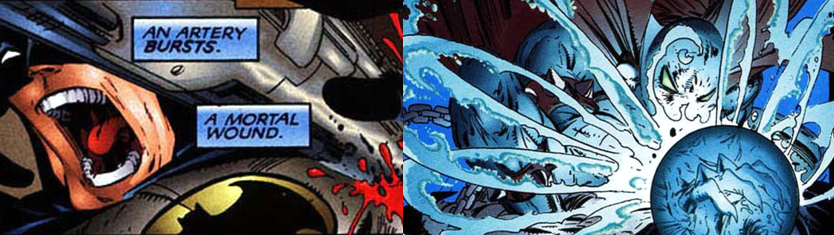
After beating each other senseless, the two are easy pickings for another of Love’s cyborgs, which mortally wounds Batman. Though tempted to leave him to die, Spawn ultimately opts to expend his limited Hell power to obliterate the cyborg and then save Batman’s life. Spawn also uses this opportunity to telepathically communicate with Batman in a bid to find some common ground. You know it’s bad when Spawn, of all people, is trying to be the bigger man and the voice of reason; his efforts are met with extreme resistance by Batman (who calls Spawn a “twit”) but, after being shown what Love is capable of, Bats begrudgingly agrees to postpone his vendetta against Spawn to put a stop of Love’s experiments. Luckily, Love is hosting a fancy fund-raiser on a luxury cruise liner to help raise funds and interests for her almost hypnotic campaign to “heal the world” with a nuclear arsenal capable of destroying the world ten times over.

SpawnBatTeam2
Batman takes any excuse to criticise Spawn.

Still in telepathic contact (much to Batman’s chagrin which, again, I find odd considering the Martian Manhunter often enables the Justice League to communicate in very much the same way…), Batman and Spawn crash the party and wreck Love’s cyborgs. The entire time, all Batman does is criticise Spawn for being a “blunt instrument” (even getting a very Miller-esque dig in at Superman while he’s at it) and lacking any finesse…which runs a little contrary to Spawn’s military training and seems to be present only to artificially extend the gulf between their methods when it was sufficient enough to focus on Batman as a practical, mortal man doing the best he can and Spawn as a violent, magic-infused undead man-monster.

SpawnBatDeath2
I’m pretty sure Batman would have an answer…

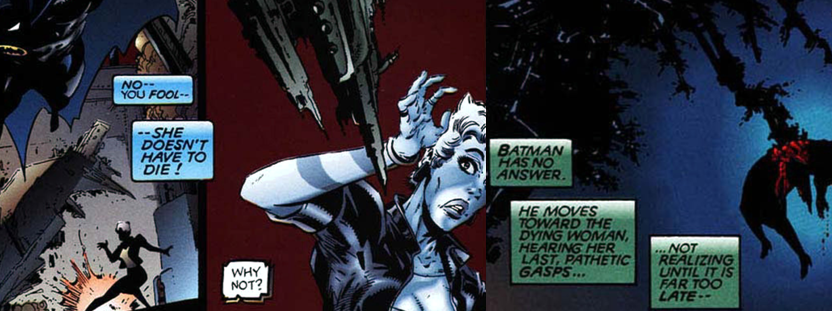
Speaking of which, Batman is unable to come up with a viable reason to spare Love’s life. Again, this is very out of character for Batman who surely would not hesitate to come up with a reason to spare a life; this is the same man who has spared the Joker time and time again but, when it comes to Love, he “has no answer” and does nothing to save her from being skewered. With her dying breath, though, Love launches a nuclear missile directly into the center of New York City, forcing Spawn to further expend his finite magic to teleport himself and Batman to the missile so they can disarm it. Miller gushes over Batman’s genius, his mind, his skilled hands, as he uses his unparalleled abilities to disarm the weapon without any assistance or input from Spawn. Instead, Batman ignores Spawn’s knowledge of the missile and is more concerned with the fact that Spawn dared to touch his cape!

SpawnBatEnd2
Batman sure made an impression on Spawn…

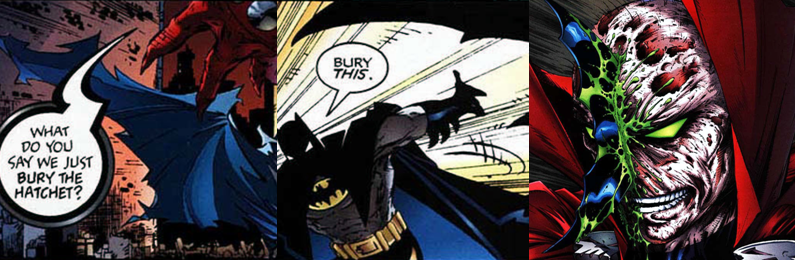
With the threat ended, Batman takes his final moments to berate everything about Spawn: his motives, his discipline, his moral compass. Literally everything. He vows to one day find the means and power to put an end to Spawn for good but Spawn, again acting massively out of character, instead pleas for Batman to recognise all the good they did together and asks that they bury the hatchet. Batman responds by lobbing a Batarang right into Spawn’s face, which would leave a wound that Spawn would, eventually, seal up with a shoe lace rather than waste his precious magic.

SpawnBatArt
McFarlane’s art is the highlight of the story.

If there’s one thing that Spawn/Batman has going for it, it’s Todd McFarlane’s absolutely gorgeous artwork. McFarlane is truly without peer in the comic’s world and he doesn’t get enough praise for his distinctive art style. Spawn is featured in his original, far more heroic and less complicated costume in this story as it takes place not long after his debut; while I prefer his later tattered look, McFarlane obviously makes his signature character look great whenever he puts pen to paper. Similarly, his Batman is a dark, gritty avenger constantly swamped in deep shadow, with pointed tips to his cape and often appearing more as a wraith-like silhouette than a man. The story is full of violent action as the two exchange blows on more than one occasion but what really lets this down is Miller’s writing. His narration is repetitive and almost embarrassing to read at times; it’s clear that Miller is only interested in praising Batman as the be-all and end-all of superheroes as the narrative boxes (and Batman’s “dialogue”) are all geared towards explicitly stated how amazing and well-disciplined and unbeatable Batman is even as he’s bleeding to death at Spawn’s feet.

SpawnBatWriting2
Are they meant to sound like squabbling kids? Is that the point?

Spawn, for the most part, reads quite well but his characterisation falls off a cliff during the rematch between the two, where both characters simply sound like children having a punch up. Maybe that is the point? Maybe Miller is making some kind of commentary on childish “tradition” of superheroes always fighting each other before teaming up and I could appreciate that…if it didn’t come at the detriment of both characters, who just come off as foolish. Batman should be smarter than that, for one thing; you would think that Miller, of all people, would know that too, especially given the lengths Batman went to battle Superman in Miller’s seminal work. Instead, Batman slips on a robotic gauntlet and thinks that’ll be enough to stop a guy who can literally reassemble himself with his magic. Batman then spends the remainder of the story chastising Spawn at every opportunity despite the fact that, without Spawn’s help and his powers, they would both have died.

SpawnBatWriting4
Batman’s characterisation is grating, to say the least.

I get that Miller’s Batman is this gritty, unrepentant hard-ass who doesn’t need help from anybody but this emphasis on him being some ultra-disciplined “soldier” who knows better than anyone else just comes across as supremely arrogant. Again, maybe that’s the point, but it’s an extreme, ill-fitting characterisation of Batman I don’t like at the best of times, to say nothing of when he’s teaming with an actual soldier! Given how protective Todd McFarlane is of Spawn as a brand and a character, it seems weird to me that Miller was given such free reign to, effectively, bury Spawn every chance he got in this story. Sure, it’s probably to make explicit the differences between the two but I think that could have been handled better with about forty percent less “stupid punk!” being sent Spawn’s way.

SpawnBatLegacy
This wouldn’t be the last time these two crossed paths.

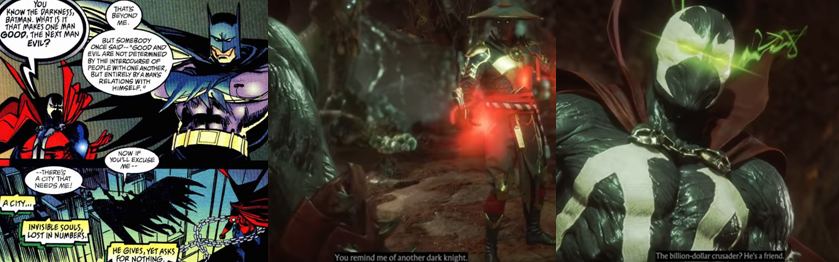
Nevertheless, Spawn/Batman is a pretty decent read, mainly for the artwork and for the thrill of seeing Spawn side-by-side with Batman. This wouldn’t be the last time these two teamed up either, as DC and Image released Batman-Spawn: War Devil (Moench, et al, 1994) that same year; while that’s a slightly more cohesively-written tale, its artwork is nowhere near as good as in Spawn/Batman. These crossovers were even referenced in Mortal Kombat 11 (NetherRealm Studios, 2019), in which Spawn appears as a playable guest character, though, since Image Comics isn’t quite the trend-setting powerhouse it used to be, I wouldn’t expect to see these two teaming up again any time soon.

My Rating:

Rating: 4 out of 5.

Great Stuff

What did you think of Spawn/Batman? Were you a big fan of Spawn’s or did you, perhaps, find him over-rated? What are your thoughts on Frank Miller, specifically his Batman? Which comic book crossover is your favourite, or which characters would you like to see cross paths and butt heads? Whatever you think, good or bad, drop a comment below.