
15 April has been designated National Anime Day to celebrate the stylistic genre, which achieved mainstream success thanks to animators like Osamu Tezuka.

Released: 1995
Directors: Carl Macek
Distributor: Manga Entertainment / Discotek Media
Budget: Unknown
Box Office: Unknown
Rotten Tomatoes Score: 73%
Quick Facts:
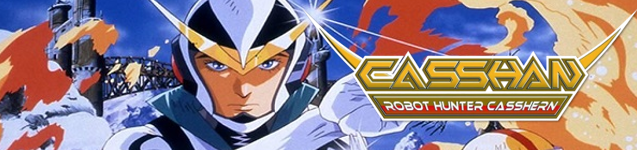
Beginning life as a thirty-five episode anime spearheaded by Hiroshi Sasagawa in the early-1970s, Neo-Human Casshern proved an action-packed, emotional, and influential series that was reimagined into a four-part original video animation (OVA) between 1993 and 1994. Praised for its polished animation and explosive action, Casshan: Robot Hunter is generally seen as an enjoyable (if cheesy) hidden anime gem.
The Review:
Set in dystopian future where machines have all-but driven humanity to extinction, Casshan: Robot Hunter is essentially a more serious and far darker version of Capcom’s cutesy Mega Man franchise (1987 to present). Like Rock, Tetsuya Azuma (Steve Bulen) was a human boy transformed into an artificial human by the technology of his genius father, Doctor Kotaro Azuma (Kirk Thornton). He’s accompanied by a robotic canine, Friender, and reluctantly receives assistance from a female, in this case his former lover, Luna Kozuki (Edie Mirman), rather than his sister (though Luna resembles Roll). To be fair, that’s about where the comparisons end as Casshan has a completely different power set and is far more introspective than Mega Man and battles not against a mad scientist, but his father’s malevolent creation, Android BK-1 (Jeff Winkless), which surpassed it programming and wars against humankind as the Black King. Because of this, Dr. Azuma is branded a madman and the betrayer of humanity as it’s widely believed he caused the Black King’s rampage, with even Casshan wondering if the Black King is a combination of human and “neoroid” like himself and therefore responsible for untold deaths. This also means that Tetsuya wasn’t transformed into a cyborg like Mega Man and has instead forsaken his past and his humanity to gain incredible augmented powers to oppose and destroy the Black King and his neoroid army, which quickly sweeps away most of humankind and enslaves whoever’s left. Naturally, pockets of resistance exist, and efforts are made to strike back against the neoroids, but they’re largely ineffective. The resistance remains emboldened, however, by the legend of Casshan, a nomadic, masked warrior whose powers rival those of the Black King and inspire even the most hopeless people to either take up arms against their mechanic oppressors or endure their horrendous, non-stop enslavement.
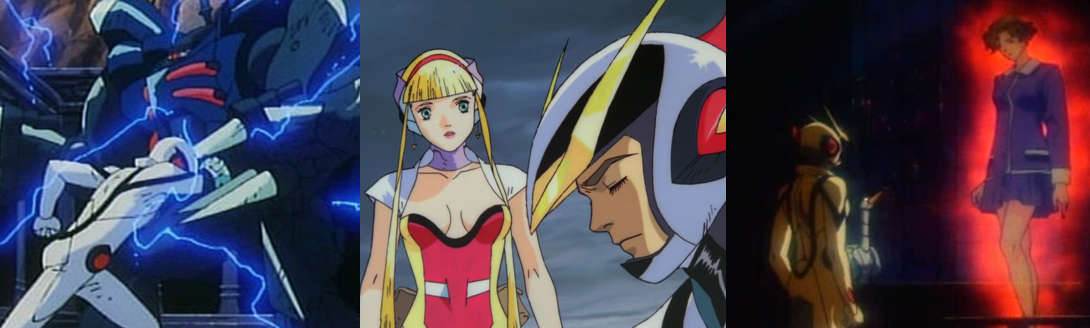
Unaware of Tetsuya’s fate, Luna searches for him and assists the resistance however she can, presenting herself as mysterious and capable as Casshan thanks to her prototype “MK gun”, a weapon that easily dispatches neoroids. Luna inspires those enslaved by the Black King and his lieutenants – Akubon (Ardwight Chamberlain), Barashin (Michael Reynolds), and Sagria (Catherine Battistone) – to revolt, urging them to disregard myths like Casshan and instead fight for themselves, with somesuspecting her of being their legendary hero. Even the Black King dismisses reports and rumours of Casshan, believing him a phantom hero dreamed up by humans desperately clinging to hope, leading Akubon to capture Luna and plan to publicly execute “Casshan” to break the people’s spirit. Upon meeting the cloaked Casshan, Luna immediately recognises him as Tetsuya, a name he claims to have abandoned, and finds him stone walling her, urging her to flee to avoid being hurt or killed as only he has the power to stop the neoroids. Casshan certainly is powerful, able to rocket along (and through neoroids) with little hip-mounted boosters, smash through any enemy with karate chops and tornado attacks and being backed up by Friender’s flamethrower breath. However, his power comes from the sun, so he’s weakened when it gets cloudy and his body is incredible unstable, apparently not built to last as he’s constantly struggling with maintaining his power and overexerts himself by the finale, to the point where he’s facing certain death. Casshan is also wracked by doubt and grief, constantly consulting with a holographic representation of his mother, Midori Azuma (Melanie MacQueen), whose consciousness is confined to a robotic swan, and questioning his existence and his mission. Initially, Casshan is motivated only to destroy the neoroids and their leader, shunning Luna’s concerns or any notion of being a hero but warms to the idea of being humanity’s saviour after rescuing Luna from Akubon and seeing the hope he inspires.
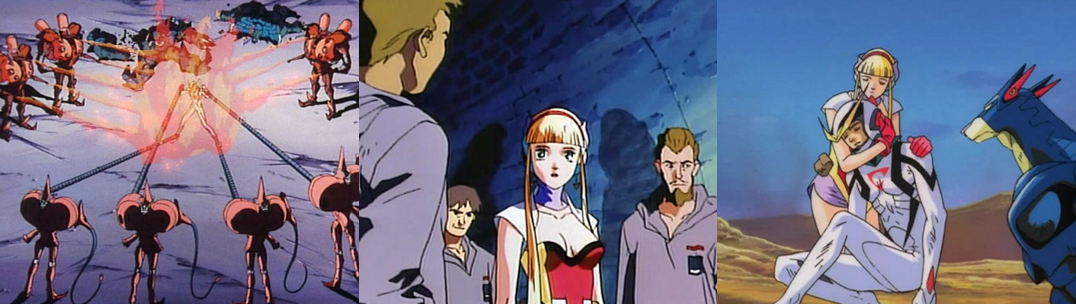
Casshan constantly struggles with his purpose and his humanity, to the point where it impedes his mission as much as a lack of sunlight. Casshan sees much of himself in the Black King as both were created by his father and neither are human, and Casshan even briefly considers if his father’s wish to purge humanity should be fulfilled. Luna and Midori constantly reassure Casshan that he’s there to serve a greater good and that he’s still human inside, despite his android body, due to his heart, compassion, and soul. Still, Casshan’s mission is incredibly dangerous, and people are constantly being enslaved or gunned down by neoroids, so he fights to keep Luna at arm’s length. However, she repeatedly refuses to leave him, even jumping from a helicopter to be with him and give him comfort so he doesn’t have to fight alone. Luna delivers the plans for the magnetic field (“MF”) gun to the remains of humanity’s leadership, who hide on submarines or within the Cheyenne Mountain Complex, giving the likes of Admiral Rudolph (Michael Forest) and General Montgomery (Steve Kramer) hope that they can turn the tide, though they remain sceptical of trusting any weaponry designed by the traitorous Dr. Azuma. Luna is determined to assist her former lover, wracked with guilt after being forced to leave a pilot (Kerrigan Mahan) behind to safeguard the weapon plans, but even she struggles with Casshan’s mood swings. When the resistance plots an elaborate, two-pronged scheme to destroy a bridge and a vital supply train commanded by Barashin, Casshan interferes, leading to Captain Tork’s (Michael McConnohie) death, and immediately regrets it, again vowing to serve humanity rather than defend his seemingly mad father’s ambitions. Casshan atones by derailing the train and destroying Barashin, thereby saving Captain Tork’s village, but it’s interesting that none of the others question or suspect Casshan for his recklessness afterwards.
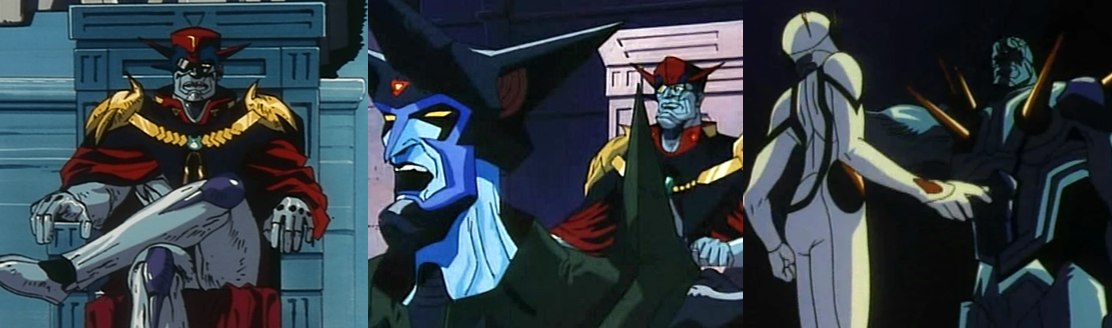
Much of Casshan’s indecisiveness comes from his worries that the Black King is actually the corrupted consciousness of his father, and his knowledge of the “Sigma Project”. It turns out that the Black King isn’t simply a one-dimensional, malevolent robotic despot and is instead programmed to safeguard and nurture the natural environment. Of course, the Black King twisted this mission and decided that the planet would be better off without humans polluting it or waging war, but he and his neoroid army actually improve environmental conditions whenever they wipe the populace from each piece of conquered land, despite constructing a massive robot and weapons factories and employing a hell of a lot of rocket fuel. Still, while the Black King has deluded himself into thinking he’s acting in the best interests of the planet, he’s still committed what appears to be genocide. He and his lieutenants regularly mock and despise humans, disgusted by their fragility, perseverance, and self-destructive ways, and delight in forcing them to repair any damage they’ve caused or leaving them dead or severely injured as an example to others. The neoroids are happy to use and endanger human lives to fit their purposes or stave off thoughts of insurrection, manipulate them into betraying their own just to show how selfish we are, and are fully committed to solving the world’s human infestation…ironically by acquiring nuclear missiles to destroy mankind. Interestingly, the Black King still shows some twisted compassion for his “parents”, considering it a mercy that Dr. Azuma and Midori live on in robotic bodies, and later uses this to try and unsettle Casshan as destroying the Black King means destroying what’s left of Tetsuya’s father. By that point, though, Casshan is on his last legs and focused on ending the neoroid threat, summoning the last of his power to defeat the Black King, which frees his and his parents’ souls and activates Dr. Azuma’s failsafe, deactivating the neoroids forever and saving the world.
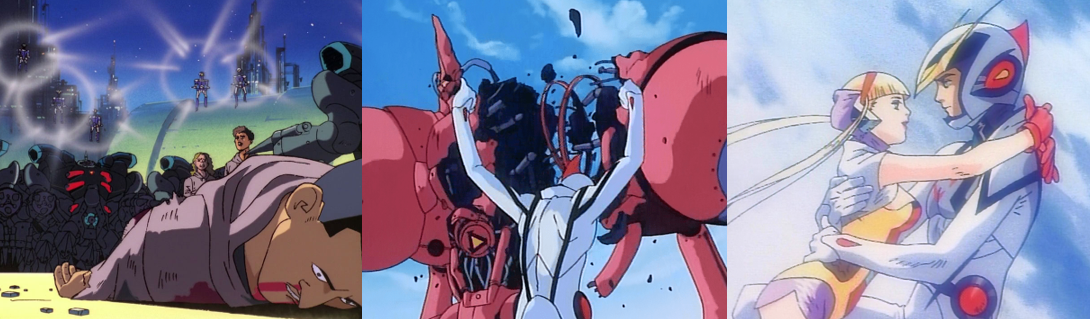
Though clearly four episodes stitched together by a narrator (Alexandra Kenworthy), Casshan: Robot Hunter impresses with some slick and beautiful hand-drawn animation. Casshan is a striking figure in his skin-tight, all-white outfit and ostentatious helmet and I really like all his little gadgets and how unstoppable he is at full power. Since Casshan’s fighting an army of robots, there’s a lot of smashing here and the animation does a wonderful job of rendering this, with debris, sparking wires, and flailing tubes punctuating each action scene alongside a bunch of super cool and visually dramatic explosions where Casshan strikes a pose mid-fight. There’s a fair bit of blood, too, as humans are gunned down and crushed by neoroids or debris, and a good sense that this is a dire time for humanity as people are so scattershot. The neoroids have many forms, with their commanders assuming more humanoid bodies and the drones being chunky, clunky tank-like mechs with retractable claw arms and giant maces. Sagria orders jellyfish-like suicide drones to overwhelm Casshan in the finale and the neoroids are seen to be highly adaptable, sprouting tentacle-like cables to interface with other technology and continuing to fight even after being dismembered, sparks flying from their severed arms. Yet, Casshan: Robot Hunter isn’t just about exciting action; there’s a lot of heart at the core of the story. Casshan is deeply conflicted and extremely troubled by his existence, seeing himself as separate from the humans he defends and yet constantly drawn to his former people. Casshan’s very presence galvanises the resistance into a more capable and effective force, with them standing up to the neoroids even when hopelessly outnumbered, though there’s a hint that humanity’s true, selfish nature still lives on as Casshan is forgotten in the ending and Admiral Rudolph (Michael Forest) takes credit for defeating the Black King.
Final Thoughts:
I was first introduced to Casshan through the visually stunning, if narratively bloated, live-action/CGI feature film Casshern (Kiriya, 2004), which impressed me so much that I sought out this OVA to get a better sense of the character. The two are extremely different, of course, with Casshan: Robot Hunter featuring more elaborate and mechanical designs for its neoroids and presenting the Black King as a hulking, humanoid tyrant. Still, much of the appeal is still there, especially in the visuals. Casshan is a nigh-unstoppable force when properly motivated and at full power, cutting through neoroids with ease and leaving them little more than flaming debris. However, Casshan is crippled by doubts about his mission and his humanity, believing he’s traded his life to become something more, neither human or neoroid that doesn’t belong in this war-torn world. While this existential debate does hamper the OVA’s pacing, I liked seeing Casshan inspire others and Luna paying that forward by boosting his spirit. I particularly enjoyed the idea that the Black King is wiping out humanity to preserve the world’s natural order rather than wanting to cover the planet in machinery and pollution. While he’s clearly an amoral villain, this gives him some extra dimension as his argument about the dangers of mankind has some weight. Ultimately, I can’t say that I regularly return to Casshan: Robot Hunter and I definitely prefer the 2004 movie over this one, and it’s true that there are better overall anime out there. Yet, I still find the story, characters, and visuals very appealing and it was fun coming back to it and seeing how many different sci-fi influences are weaved into its narrative, such as Mega Man and the first two Terminator films (Cameron, 1984; 1991), and given that classic, timeless anime shine.
My Rating:
Pretty Good
Have you ever seen Casshan: Robot Hunter? Are you a fan of Casshan and his different interpretations? Do you agree that the existentialism slowed the pace a bit? Did you enjoy the explosive action and Casshan’s nigh-unstoppable nature? Were you also intrigued by the Black King’s twisted mission to save the world by destroying humans? How are you celebrating National Anime Day today? Whatever your thoughts on Casshan: Robot Hunter, or anime in general, share them in the comments and support me on Ko-Fi to fund more anime content on the site.


You must be logged in to post a comment.