Back Issues [Dare-DAY-vil]: Daredevil #227-231


Co-created by writer/editor Stan Lee and artist Bill Everett (alongside the legendary Jack Kirby), blind lawyer Matt Murdock debuted in April 1964.

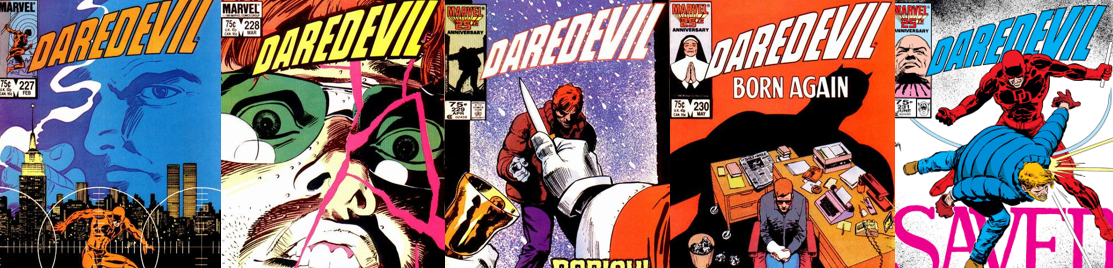
Writer: Frank Miller Artist: David Mazzucchelli

Story Title: “Apocalypse”
Published: 22 October 1985 (cover-dated: February 1986)

Story Title: “Purgatory”
Published: 26 November 1985 (cover-dated: March 1986)

Story Title: “Pariah”
Published: 24 December 1985 (cover-dated: April 1986)

Story Title: “Born Again”
Published: 28 January 1986 (cover-dated: May 1986)

Story Title: “Saved”
Published: 25 February 1986 (cover-dated: June 1986)

Quick Facts:
Stan Lee and artist Bill Everett’s most challenging hero yet, Daredevil became a popular and enduring character thanks to writer/artist Frank Miller, who spearheaded many of Daredevil’s most memorable stories. Miller was behind perhaps the greatest Daredevil story of its time (or ever), colloquially referred to as “Born Again”, a story so definitive that it inspired Daredevil’s celebrated return to the Marvel Cinematic Universe in 2025.

The Review:
This seminal storyline was kicked off by Karen Page, former secretary for Murdock and Franklin “Foggy” Nelson’s law firm and Murdock’s ex-girlfriend, who left to pursue an acting career and ended up a heroin addict. She becomes so desperate for cash and a shot of heroin that she trades the only thing of value she has left, Daredevil’s true identity, to the unscrupulous Raldo. He sells it higher up the chain to Tonio, who eventually brings it to Wilson Fisk/The Kingpin, who immediately orders the death of everyone who’s touched the document and heads to New York City to verify its contents. Unaware of this, Murdock awakes from a troubled sleep, nursing the bruises of his recent battles, to find only bills and a breakup cassette from his girlfriend, Glorianna “Glori” O’Breen, rather than job offers. To make matters worse, Murdock gets a disturbing phone call from his accountant and is then accused of perjury by decorated cop Lieutenant Nick Manolis. As snow blankets the city, Foggy comforts Glori after a break-in and reporter Ben Urich tries to offer Matt some council, only to get a cynical brushoff. Murdock uses Daredevil as an escape from all this drama, sprinting and leaping into the bitter winter night and gives Manolis a scare, learning that the cop lied to protect his son and then returns home to find his utilities have been cut off. The Kingpin watches with relish as Murdock’s life falls apart over the next few weeks. He exhausts himself trying to build a defense with Foggy, physically deteriorating from the stress and becoming increasingly violent as Daredevil, and becoming a shell of his former self as he loses his licence to practice law and is faced with poverty and public shame.
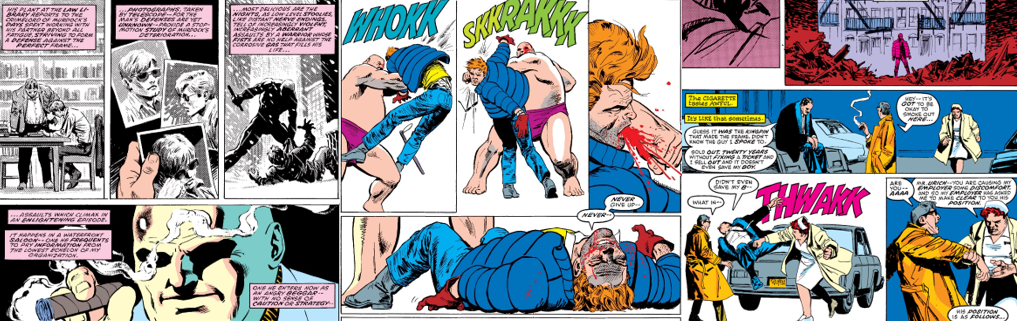
The Kingpin makes Murdock’s life a living hell and targets those closest to him.

Grateful to Foggy for his help, the destitute and despondent Murdock wanders home just as his apartment building is destroyed, leaving even his costume a smouldering ruin. Forced into a dingy, cramped hotel room, the distressed Murdock considers killing the Kingpin for all the pain he’s caused him but resolves simply to beat Fisk to within an inch of his life instead. The Kingpin, meanwhile, continues to savour the pain he’s caused his foe, who hounded him relentlessly, and in the knowledge that Murdock is at his lowest point. Disorientated and exhausted, Murdock fantasises about leaving the Kingpin a bloody mess, babbles nonsense to Glori, and threatens Foggy and rambles to a dial tone thinking it’s his friend. The Kingpin is amused to learn that Murdock throttled the hotel manager, paranoid that he’s one of the Kingpin’s men, and attacked punks and even a cop while in his civilian identity on his way to Fisk’s opulent tower. The Kingpin welcomes Murdock’s challenge, easily shrugging off a few hits with a baton and flooring Murdock with devastating haymakers. Restraining himself from tearing Murdock apart, the Kingpin settles for staging an accident, leaving the battered Murdock to drown in a cab off the East River. However, the Kingpin is enraged when the cab is discovered some weeks later and there’s no sign of Murdock’s corpse as he dragged himself out and ended up sleeping on the streets, haunted by memories of his origin and his losses. While Foggy and Glori grow closer over Christmas, Manolis reluctantly confesses to Urich after his son dies, leaving them brutally maimed by the Kingpin’s burly henchwoman. Over in Mexico, a Karen steals and sells herself to Paulo Scorcese for a fix and get back to New York after barely escaping the Kingpin’s assassins, desperate to be reunite with Murdock and wracked by guilt, eventually taken in by Foggy despite the danger.
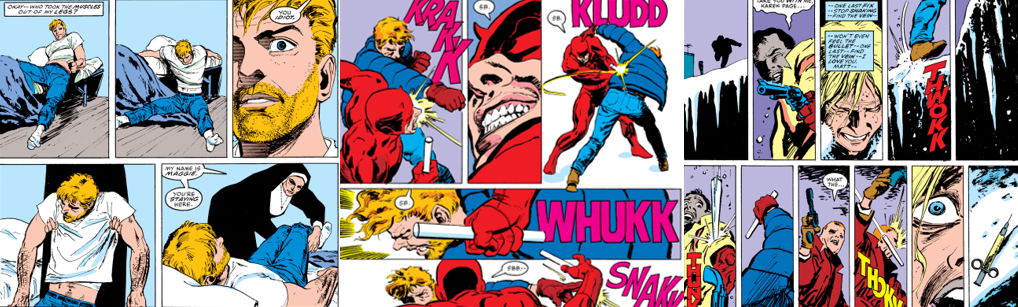
Murdock overcomes great physical and mental trauma to rescue Karen and return to action.

After stumbling into traffic in a stupor, Murdock takes a knife to the gut when trying to stop lowlife Turk Barrett from stealing a Santa Claus suit, only to find his childhood home torn down. While taking shelter in his father’s old gym, Murdock blacks out from blood loss, though miraculously survives after he’s rescued by nuns (one of whom is implied to be his mother). While Murdock recovers and struggles through pneumonia, Urich is left traumatised and meekly drops all interest in the Kingpin. However, Urich finds his resolve after overhearing Manolis being strangled to death, goes to the cops, and prints an exposé on the Kingpin. Luckily for Urich, a recovering Murdock saves him, his wife, and a cop from the Kingpin’s henchwoman. Murdock also learns that Melvin Potter has been contracted coerced into fashioning a replica Daredevil costume for a psychopath Fisk wants to send after Karen and Foggy, and Murdock encourages him to take the job to discover this plot. With Scorcese outside gunning down cops, Karen cold-clocks Foggy and flees, intending to take the heat off him, while Murdock confronts his crazed imposter. Though the imposter is violent and determined, Murdock subdues him by targeting his pressure points, allowing Matt to save Karen from a gunshot…and from taking one last hit of heroin. The two emotionally embrace, finally reunited and, in the aftermath, Urich pens another story wrapping everything up. The doctor who the Kingpin ordered to release the crazed imposter was dismissed, the cops Scorcese killed are mourned and their killer arrested, and Urich is left determined to track down Murdock and find out what happened to him as he’s been missing, presumed dead, for some time.

Final Thoughts: 
“Born Again” is undoubtably one of Daredevil’s most iconic stories, and some of Frank Miller’s best work with the character. It’s a very different story; very mature and gritty and full of brooding and interpersonal drama. Drugs and addiction are at the forefront as a desperate Karen sells her ex-lover’s identity for a fix and is then so consumed by guilt that she prostitutes herself to Scorcese to reunite with Murdock, convinced he’s the only man who can save her. Along the way, she continually shoots up and fantasises about kicking the habit to be with Matt again, though she only goes cold turkey when she’s taken in by Foggy, and this just leaves her a paranoid wreck. Karen’s story somewhat echoes Murdock’s as he’s driven to exhaustion, paranoia, and violence by the Kingpin’s machinations. With his life literally falling apart, Murdock tries to escape from reality through Daredevil, lashing out at lowlife scum and taking his anger out on anyone who gets in his way and only exacerbating his self-destruction. Murdock becomes disorientated and confused, randomly blacking out and babbling to his friends (or pretending to), all while hyper-fixated on avenging himself on the Kingpin. Naturally, this means Murdock is no match for Fisk, who’s more than just a bulbous criminal mastermind. He’s pure iron and muscle and easily takes Murdock’s best shots before beating him unconsciousness without a word, making for a short, brutal confrontation between the two that’s sadly not followed up on in this story.
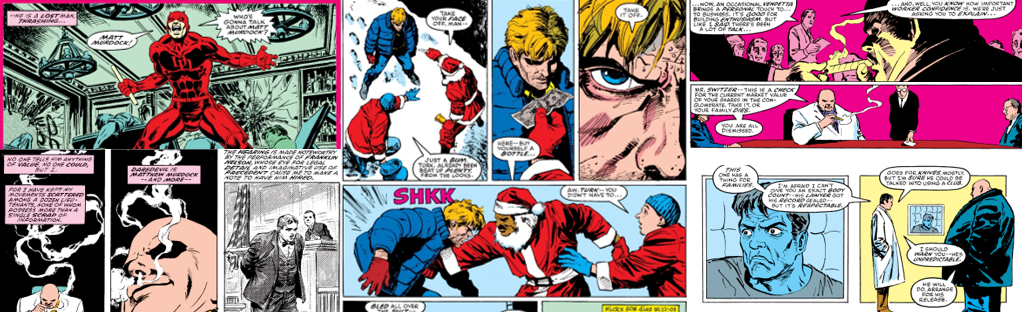
Murdock gets put through hell thanks to the Kingpin’s malicious machinations.

Instead, the remainder of the time is spent following Murdock’s struggles. The Kingpin makes Murdock’s life hell almost to the point of parody, freezing his accounts, framing him, blowing up his home, and targeting his loved ones, all while Glori and Foggy fall for each other. Publicly shamed and disbarred, Murdock’s forced to live on the streets and only suffers further torment when his impulsive nature leaves him hit by a car and mortally stabbed. It’s only near-literal divine intervention that keeps him alive and, even then, Murdock must fight through his physical rehabilitation. When he does, he’s confronted by a Daredevil imposter, though the significance of this is sadly downplayed. I was hoping that the thematic allegory of Murdock facing his literal devil and obsession would have more relevance, but the fight’s over extremely quickly and is merely an inconvenience for Murdock, who’s more focused on saving Karen. This is disappointing as it might’ve been good to see Murdock become so lost in his Daredevil persona that it worsens his woes, meaning he’d have to mentally overcome his trauma and then physically best the monster he’d become to reclaim himself. Still, I liked the side stories, such as Urich fighting in Murdock’s corner behind the scenes and having to overcome his own issues to do what’s right. It’s a nice parallel to Murdock’s tumultuous journey and these little victories extremely aggravate the Kingpin, who turns to the violent and the insane to do his bidding. It’s a shame there isn’t a rematch between Daredevil and the Kingpin here, and that some of Miller’s wonky dialogue and let’s say “colourful” writing is peppered throughout the otherwise harrowing drama, but there’s no denying how important “Born Again” was and still is. It’s a fascinating showcase of Daredevil’s near-superhuman willpower and shows that he continues to fight, even when emotionally and physically wrecked, placing him as an inspirational underdog who does what’s right regardless of the personal cost.

My Rating:

Rating: 3 out of 5.

Pretty Good

Do you consider “Born Again” an all-time classic Daredevil story? Do you think the hardship Murdock suffered was a tad over the top? Were you disturbed by Karen’s struggles with heroin? Did you enjoy seeing Murdock having to overcome the odds staked against him by Fisk? What are some of your favourite Daredevil stories and how are you celebrating the Man Without Fear this month? Let me know what you think of “Born Again” in the comments below and donate to my Ko-Fi to suggest more Daredevil content for the site.

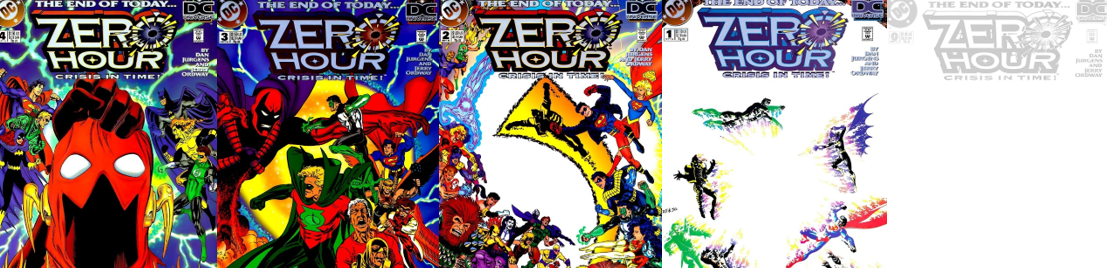
Back Issues [Crossover Crisis]: Zero Hour: Crisis in Time!


Cover-dated April 1985, the first issue of Crisis of Infinite Earths (Wolfman, et al) precipitated the destruction of the “Multiverse” and what better way to celebrate than with a “Crossover Crisis” of my own?


Published: September 1994

Writer/Artist: Dan Jurgens

Quick Facts:
After DC established an infinite number of parallel worlds in Showcase #4 (1956), writers like Mark Wolfman became frustrated with this concept and spent two years planning Crisis on Infinite Earths, one of the greatest comic book crossovers. However, while the likes of Clark Kent/Kal-El/Superman and Wally West/The Flash benefitted from this reboot, others like Carter Hall/Hawkman did not so writer/artist Dan Jurgens sought to correct this about ten years later with Zero Hour: Crisis in Time! Accompanied by numerous tie-in issues and occurring during the “Dark Age” of the industry, the story is largely regarded as a confusing, poorly executed mess that created more problems than it solved.

The Review:
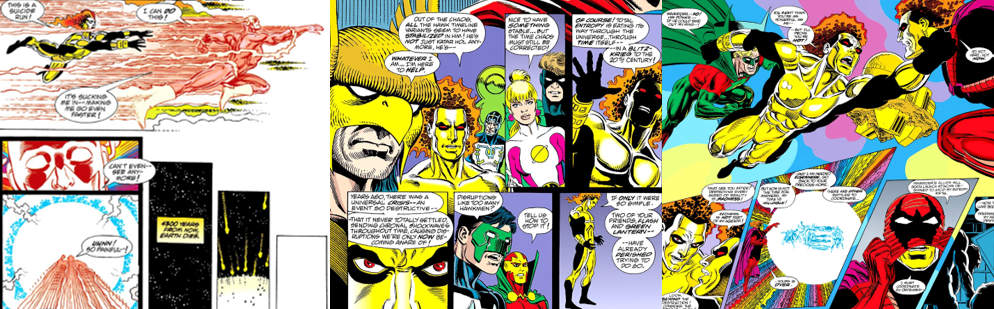
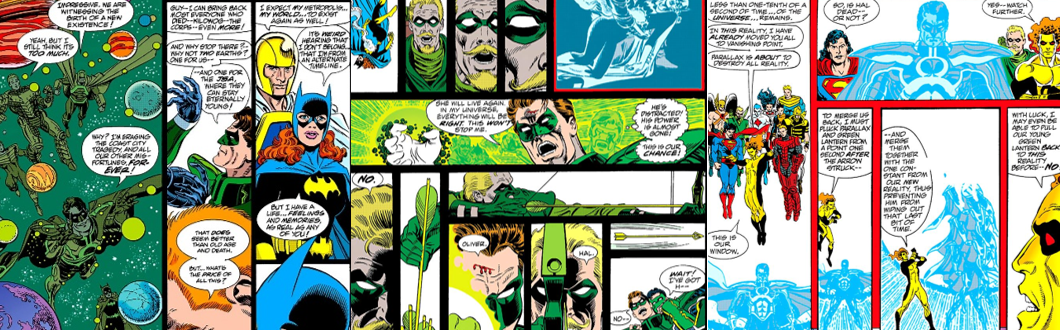
As if numbering this miniseries in reverse order (so the story starts in issue #4 and concludes in issue #0) wasn’t unique enough, each page and/or panel takes place at different times, both literally and relatively, making this a confusing time-based tale. The story begins at the literal end of time, when destructive, unstoppable entropy has engulfed the cosmos. Here, an unseen force executes the mysterious Time Trapper while berating the cloaked figure and others like him for flaunting their omnipotence and yet allowing injustice to prosper. This powerful, unseen figure then harnesses entropy’s destructive power and vows to end the universe’s suffering. His actions (unseen at this point but probably related in one of the event’s many tie-in comics) are detected by Metron, the scientific advisor to almighty Darkseid, who’s so concerned by the unravelling universe that he defies his master and seeks out allies to halt annihilation. Our first indication that something is very wrong with time occurs in Gotham City, where the Joker’s latest killing spree is unexpectedly ended by Barbara Gordon/Batgirl, apparently back in her prime and perplexing even Bruce Wayne/Batman since she was dramatically paralysed by a gunshot some time ago. The enigmatic Linear Men, who monitor and safeguard time from a pocket dimension, then observe entire timelines being erased, dispatching Matthew Ryder/Waverider and Rip Hunter to investigate. In the 64th century, Wally West/The Flash notices the surreal light engulfing the world and learns from Waverider that entropy is ceaselessly making its way back through time, wiping out everything in its path. Though Waverider’s powerless to stop it, Citizen Abra/Abra Kadabra and the Linear Men suggest that the Flash create a super-speed vortex. However, Waverider realises all-too late that the effort is futile and is unable to keep the Flash from running to his untimely doom just like his mentor in the previous Crisis, resulting in the death of the 64th century and Waverider vowing to honour Wally’s sacrifice.

Waverider desperately gathers the forces of justice to stand against Extant and this time rifts.

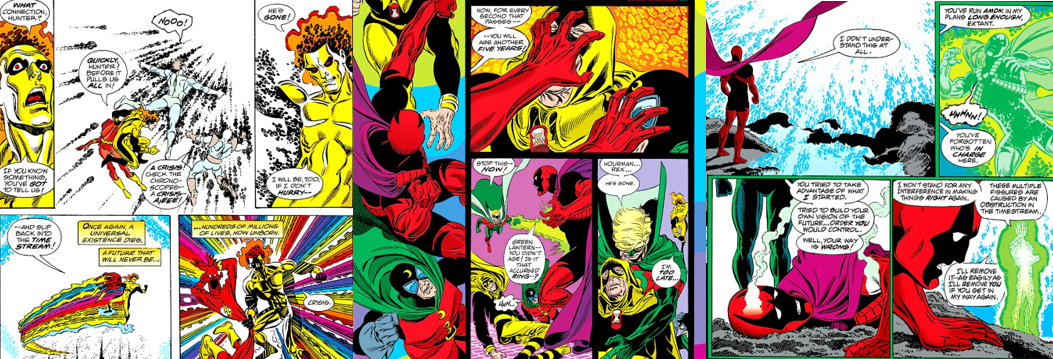
Their next stop is 57000 A.D, where a youthful Harold “Hal” Jordan/Green Lantern (plucked from before he became the malicious Parallax) is currently battling entropy. Green Lantern’s efforts only feed the destructive force, however, causing it to obliterate Hal and Rip. Before he dies, Rip tells Waverider to research the previous Crisis. Disregarding an anomaly in the timestream, Waverider returns to Vanishing Point and is horrified to learn of the last Crisis and frantically heads to Earth for help, arriving to find Hawkman fluctuating between his various incarnations, Alan Scott/Green Lantern randomly de-aged, and reminding Jay Garrick/The Flash of Barry Allen’s fate while simultaneously informing him of Wally’s leaving Jay heartbroken at having lost the men he considered sons. When Waverider transports the Justice Society of America (JSA) to Vanishing Point, they’re mysteriously separated and attacked by the malevolent Extant. Metron recruits Batman and Superman, who call an emergency meeting of all costumed heroes (though Metron fails to enlist Jim Corrigan/The Spectre’s help as he’s unconcerned by natural disasters). Already rattled from experiencing his own time anomalies, Superman stops to assist the debuting Bartholomew “Bart” Allen II/Impulse (displaced from the 30th century) and recruits him. Earth’s heroes discuss the time anomalies, which see heroes pop in and out of existence, the various Hawk-beings merged into a single, God-like entity, and timelines to merge as the Crisis worsens. Waverider brings the group up to date (inspiring Guy Gardner/Warrior to attempt to change Hal’s fate) but quickly teleports to Vanishing Point when he senses the JSA are in trouble. When he arrives, Extant has killed Al Pratt/The Atom and Kent Nelson/Doctor Fate and rapidly aged Doctor Charles McNider/Doctor Mid-Nite and Rex Tyler/Hourman (to the point that he dies). Although the grief-stricken Alan’s ring is depleted, Waverider gets his comrades to safety and confronts Extant, horrified to find his future self behind the mask and not Hank Hall/Monarch as he suspected!

Parallax is revealed to be the mastermind behind the Crisis and wishing to reset time in his image.

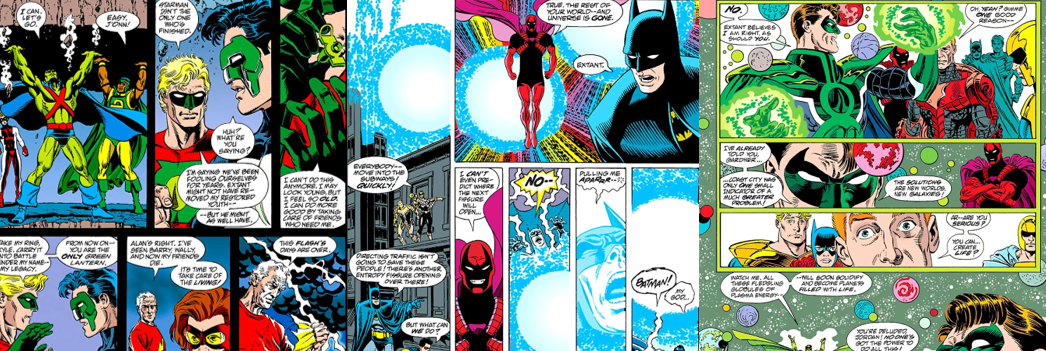
Extant reveals that he’s the amalgamation of Waverider, Monarch, and others, having assimilated incredible powers, amassed an army, and spread entropy to birth a new world. Extant teleports Waverider and the others away since it’s too soon for them to fight, though the shattered, aged JSA quit from superheroics due to their losses, officially making Kyle Rayner the only Green Lantern. Inspired by their sacrifices, Superman and the others transport to the 30th century with Metron. As they struggle to halt the entropy, Kara Zor-L/Power Girl suddenly goes into a mystical labour, and Warrior suddenly sprouts weapons by mere thought, they’re attacked by Extant’s brainwashed Team Titans before the man himself attacks…as his future self watches on! Waverider desperately teleports the others away right before Extant plunges his hand into his body and absorbs his incredible time-based energy, assuming Waverider’s guise and completing his time loop as an unseen other retrieves Alan’s discarded power ring. Returned to the 30th century, Metron has Superman and Princess Diana Prince/Wonder Woman hurl his “Mobius Chair” into the entropy rift and Captain Nathanial Adam/Captain Atom pour his full power into it, creating a Boom Tube that successfully dispels the rift. Unfortunately, entropy continues to ravage the timelines, shredding John Henry Irons/Steel and leaving Warrior distraught. Still, angered at his plans being disrupted and his armies defeated, Extant’s past and present-selves merge to ponder the rampant entropy rifts, only to be blind-sided by a greater power for attempting to usurp his plans for reality with the rifts, which erase Impulse and Michael Carter/Booster Gold. Luckily, Jay convinces guilt-trips he Spectre into joining the fray right before he also dies and the few survivors flee to Vanishing Point to restore Waverider. Although he arrives too late to save the Batman from being torn apart by a random rift, Waverider leads the assault against Extant (which leaves Doctor Ray Palmer/The Atom de-aged to a teenager!), only for Parallax to finally assert himself as the man behind the destruction of time!

Although Parallax’s mad ambitions are stopped and reality is reset more naturally, the cost is high.

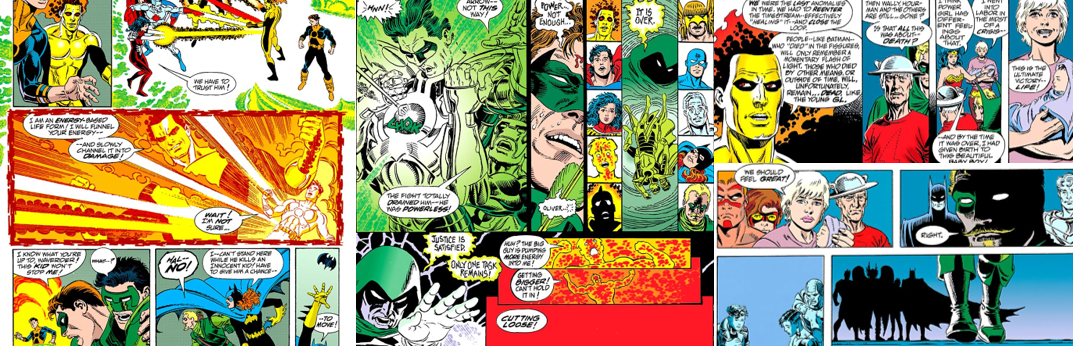
Determined to re-write reality to undo all the injustices they’ve suffered, Parallax wills entropy to engulf all that ever has or will be in the hopes of starting fresh, reshaping reality from a pocket dimension of pure, white space as the handful of shocked survivors watch. Although Guy and the others think he’s mad, Parallax vows to ensure all of them, even the time displaced Batgirl and Extant, get the world they desire, utilising leftover chronal energy and cosmic power from the first Crisis to effectively make himself a God. Having saved a handful of others and spirited them away to Vanishing Point, Waverider proposes piggybacking off Parallax’s efforts and restarting the universe in a more natural way, rather than allowing Parallax to decide who exists and who doesn’t, bringing them into conflict with Batgirl and those who want their worlds back. Lamenting having to fight his old allies and amazed that they would oppose his promise of paradise, Parallax easily fends off Superman and even the wrathful Spectre. While Oliver Queen/Green Arrow tries in vain to reach his friend and laments how far he’s fallen, Waverider has Superman and a few others channel their awesome powers through him, which he then redirects to confused outcast Grant Emerson/Damage, with the remorseful Batgirl sacrificing herself to protect the boy from Parallax’s fury. Heartbroken by how far his friend’s fallen, Green Arrow does the only thing he can and fire an arrow at the weakened Parallax, seemingly killing Hal and leaving the stage clear for the super-charged Damage to spark a new big bang. Thanks to Waverider’s intervention, Superman and the others watch as a new timeline forms, restoring many lost during the Crisis but leaving others, like Batgirl, lost to memory. Although Power Girl rejoices at having birthed new life in this new world, Green Arrow is left devastated and the survivors are both rattled and haunted by the experience, which caused numerous changes to their history (such as Warrior losing his armour and Batman no longer knowing who killed his parents, and the “Modern Age” of superheroes having only started “10 Years Ago” with the debut of Superman).

Final Thoughts: 
As I really started getting into comics during the 1990s, Zero Hour: Crisis in Time! was possibly the first Crisis event I ever read (or, at least, the one I read the most). I’ve only ever read the main five issues and a few of the tie-in and aftermath issues, which mainly dealt with our heroes encountering other versions of themselves or bizarre time anomalies. However, I would probably advise that you seek out the complete event as the main story can be confusing without context. For example, Superman says he encountered his Kryptonian parents and different versions of Batman, Warrior’s left devastated by some unexplained loss, and it’s clear that key events are missing from the main story. This may be the first DC event where the tie-in issues were semi-required to fully grasp what’s going on, which does impact the story as it’s so crammed with characters and events that it’s difficult to keep track of what’s happening and a chore to read at times. Every panel is stuffed with heroes and word bubbles, with many just standing around aimlessly, justifiably confused, or summarily executed by the entropy rifts. This means Raymond “Ray” Terrill/The Ray is left spouting “Cool!” and hovering in the background before randomly helping to kick-start the new big bang, and powerhouses like Matrix/Supergirl are as powerless to stop the destruction as the likes of Richard “Dick” Grayson/Nightwing, who joins Batman in a futile attempt to save lives. However, I did like that the heroes were determined to save as many as they could, and to intervene when the timelines merged, even though it was blindingly obvious they couldn’t stop the entropy, and how devastated they were when they inevitably failed. The stakes are definitely high and the heroes are constantly fleeing, reeling from their losses, or trying new ways to halt the destruction, keeping tensions high as they constantly fail.

This confusing mess of a Crisis is bogged down by copious exposition and cluttered action.

However, the pacing is all over the place. One minute, things are going a mile a minute; the next, things grind to a halt, and the cluttered panels are filled with endless dialogue as Waverider describes what’s going on. This really comes to a head in issue #0, where Waverider plucks the survivors from a microsecond of time and they witness the rebirth of the universe, all while Waverider waffles on about how they have one shot to re-join the timestream and it must be at the exact moment. He then explains, in great and confusing detail, why the likes of Batgirl (and, it’s assumed, Kyle) are dead but Batman and the billions of others are alive. Conveniently, this is because those latter examples died before the timeline reset; but anyone killed afterwards is really, truly dead. This does tie into Green Arrow’s grief and anger as he’s devastated at being forced to kill his best friend, despite having no choice as Hal was clearly mad with power and had appointed himself judge and jury over all lives and timelines. Green Arrow gets into a physical and ethical debate with Batgirl regarding this as Batgirl simply wants to live, just as the other anomalies want their worlds and lives back, and they briefly defend Parallax since he promises to give them everything they want. Though impressed by Batgirl’s spirit, Green Arrow echoes Warrior’s sentiments and believes Parallax isn’t qualified to make these decisions since it defies the natural order, but Oliver is distraught at being forced to take such extreme actions and this informed his characterisation for a while in the aftermath. Sadly, this comes far too late in the main story to be as impactful as it could be. I’m sure it’s fleshed out more in a tie-in comic but it’s noticeably lacking here, just like Warrior’s desire to undo Hal’s corruption and restore the Green Lantern Corps, which ends up being just one of many sidebars that aren’t resolved in the main story.

Extant and Waverider don’t make for compelling characters, making the story more dull than exciting.

As Zero Hour features time travel shenanigans, it makes sense for it to be confusing story and that the likes of Metron and Waverider must rattle off a lot of exposition. It gets frustrating as every issue reiterates a lot of this information, and if you’re not a big fan of Waverider, like me. I liked the twist that Extant was a gestalt entity comprised of different time-based powers and people, reducing him to an energy-based being with no real identity who sowed destruction for this own ends. I quite like Extant and feel he got short-changed here as he was rendered completely impotent once Parallax emerged from the shadows. Consequently, I think Zero Hour would’ve been far better and more coherent if Parallax had been the antagonist from the start, going around time destroying and absorbing power from the likes of Extant, the Time Trapper, and Waverider, just to give the story more focus and really emphasise how shocking it is when the JSA are de-aged and killed and characters are erased. This would’ve been a natural evolution of his original turn when he destroyed the Guardians of the Universe and would’ve made for more drama as his former allies lamented his madness and struggled with fighting him, rather than Extant constantly unmasking to be different people, and could’ve even seen Hal’s past self confronted by his future, corrupted counterpart. While the art is okay, Zero Hour suffers from having far too many characters crammed into every panel, making it difficult to keep track of who’s still around or not. I liked the depiction of entropy erasing characters and timelines, especially as a metaphor for DC literally streamlining their time, but the execution was lacking as it left Hawkman a combined entity rather than simply resetting him and I always come out of this story wondering what the purpose was beyond being a cluttered celebrating of DC’s colourful characters. Sadly, it falls very short and everything that happened in it was rewritten eventually, with even Parallax being redeemed, making the entire story forgettable and pointless.

My Rating:

Rating: 2 out of 5.

Could Be Better

Were you also disappointed by Zero Hour: Crisis in Time!? Were you able to follow all the time-based nonsense and exposition? Are you a fan of Waverider and Extant or did you also find them dull characters? Which of the deaths was most impactful or senseless to you? Were you a fan of Hal’s turn as Parallax and do you agree he should’ve been the sole villain here? Did you like the changes made to DC following Zero Hour? Which Crisis event was your favourite and what are some of your favourite cosmic events? Tell me what you thought about Zero Hour: Crisis in Time! in the comments and donate to my Ko-Fi to suggest other Crisis events for me to cover.

Back Issues [Robin Day]: Batman #440-442 / The New Titans #60-61


In April 1940, about a year after the debut of Bruce Wayne/Batman, DC Comics introduced “the sensational find of [that year]”, Richard “Dick” Grayson/Robin. Since then, many have assumed the mantle and the Dynamic Duo have become an iconic staple of DC Comics.


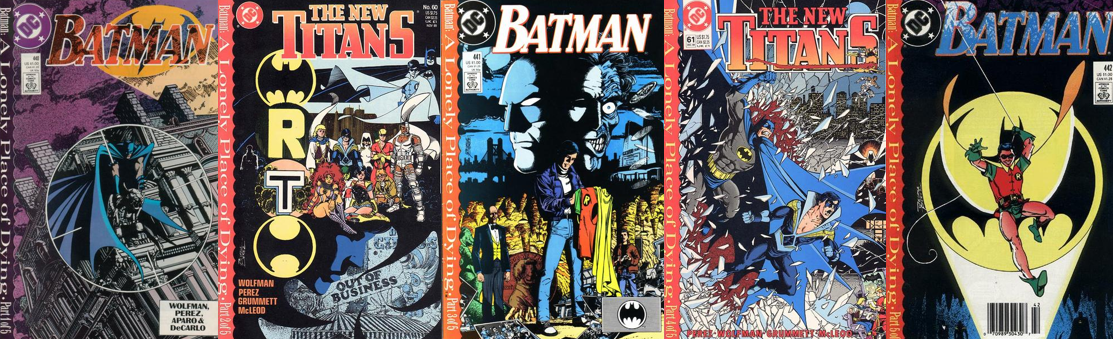
Story Title: “A Lonely Place of Dying”

Story Title: “Part 1: Suspects”
Published: 31 August 1989 (cover-dated: October 1989)
Writers: George Pérez and Marv Wolfman
Artist: Jim Aparo

Story Title: “Part 2: Roots”
Published: November 1989 (cover date)
Writers: George Pérez and Marv Wolfman
Artists: George Pérez and Tom Grummett

Story Title: “Part 3: Parallel Lines!”
Published: 28 September 1989 (cover-dated: November 1989)
Writers: Marv Wolfman
Artist: Jim Aparo

Story Title: “Part 4: Going Home!”
Published: December 1989 (cover date)
Writers: George Pérez and Marv Wolfman
Artists: George Pérez and Tom Grummett

Story Title: “Part 5: Rebirth”
Published: 2 November 1989 (cover-dated: December 1989)
Writers: George Pérez and Marv Wolfman
Artist: Jim Aparo

Quick Facts:
Initially created to literally replace Dick Grayson as Robin, readers came to dislike Jason Todd when he was reimagined as a bratty street kid, leading Jim Starlin and Dennis O’Neil to dramatically kill the new Robin off in the iconic “A Death in the Family” (1988). While Jason’s death haunted Batman for years, a new Robin debuted almost exactly one year later in this five-issue crossover story. Created by Marv Wolfman and Pat Broderick as the opposite of Jason and possessing keen deductive skills to rival Batman, Timothy “Tim” Drake saw a dramatic redesign for the character and was popular enough to not only get his own solo book, but also be widely considered the best incarnation of Robin.

The Review:
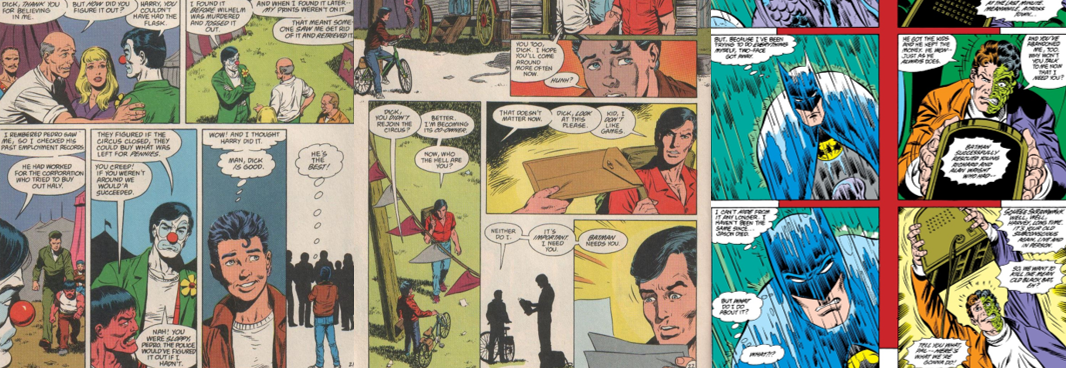
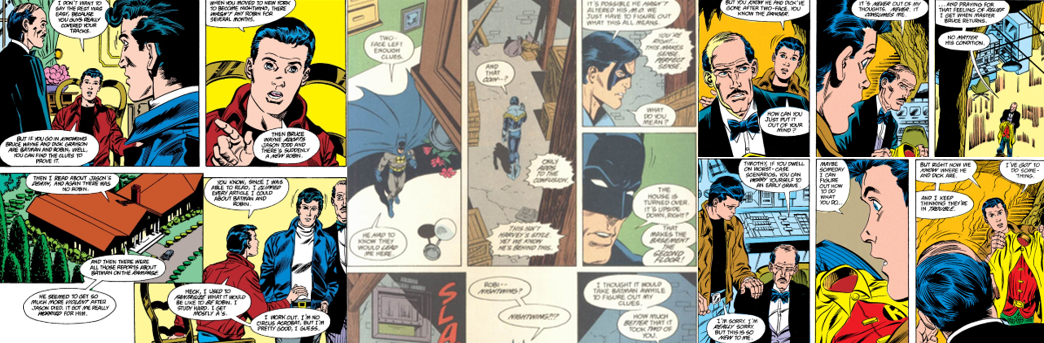
Our story opens with the Batman in bad shape and tussling with the Ravager, a sadistic masked psychopath who’s been on a killing spree. Although the Batman’s cut and bruised from the Ravager’s attacks and knives, he turns the killer’s golden chain against him and sends him plummeting off dam. Limping to the Batmobile. Batman stumbles back to Wayne Manor, where his faithful butler and father figure, Alfred Pennyworth, cares for him as he struggles against a fever, exhaustion, and his wounds. In his frazzled state, Batman completely missed that a mysterious individual photographed his fight and has been following his career for some time. An avid fan of Batman and the Dynamic Duo, this individual notes that Batman’s been getting more reckless and violent since Jason’s death and longs for the confident, compassionate Batman of old. These concerns are echoed by Alfred, who candidly expresses worries for Bruce’s mental health, which has severely impeded his judgement and impacted his physical health, though Bruce ignores these concerns and suits up for another night’s patrol. Following the Ravager’s failure, his shadowy employer, baited by a voice from a radio that’s actually his own delusions, arranges a trap for the Dark Knight by manipulating mob boss Gerry Syke. Naturally, the Batman shows up, triggering a firefight. While dispatching Sykes’ mooks, Alfred’s words rattle around Batman’s head (“think with our heads, not with our fists”) and he realises he’s been too distracted to see the obvious clues (everything related to the Ravager and the break-in points to the number two in some way) and that former district attorney turned scarred crime boss Harvey Dent/Two-Face is back in town! Meanwhile, Batman’s mysterious teenage stalker tries to contact Dick Grayson/Nightwing, learning from a concerned Princess Koriand’r/Starfire that Nightwing left the Teen Titans, leading him to discover that Dick returned to Haly Circus.

Concerned for Batman’s welfare, fanboy Tim Drake tries to persuade Dick to return as Robin.

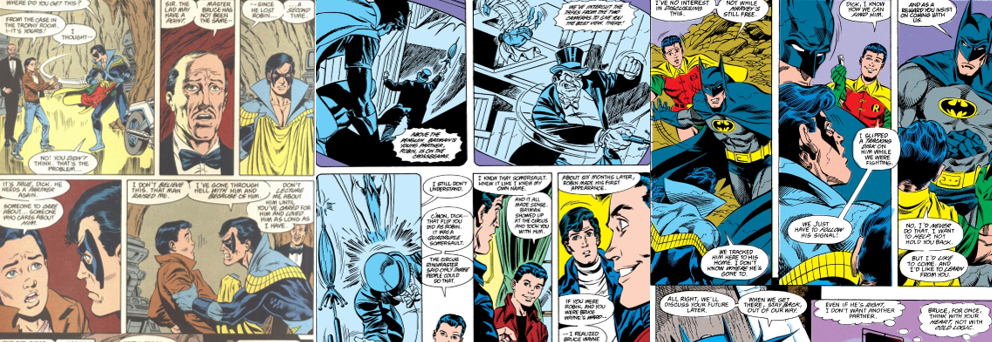
Dick is heartbroken to learn from Harrison “Harry” Haly that the circus has been struggling financially and suffered some bizarre accidents, though he jumps at the chance to be part of their swansong show. Although the teen briefly panics when hot-headed lion tamer Wilhelm is suddenly killed by a lion, he’s amazed when Dick swoops to ensnare the beast, though it’s the final straw for Haly. While pondering the strange “jinx” cursing the circus, Dick spots the teen as he’s chased by some of the staff and is amazed to learn the boy not only knows his true identity but also suspects drunkard Harry the Clown doped the lion. However, Dick masquerades as Harry and tricks little person Pedro and circus strongman Samson/Mister Muscles into revealing they were behind everything as part of a plot to buy the circus for peanuts. After helping Haly out by becoming a co-owner, Dick confronts the teen, who shows him pictures of Batman and begs him to return to his mentor’s side as Robin, concerned that Bruce is on a downward spiral without him. Back in Gotham City, Batman and Two-Face brood over how best to lure each other out, with Two-Face stressing over the best way to concoct a scheme related to the number two that will both kill his foe and net a profit, vetoing every suggestion with a flip of his coin. Simultaneously, Batman mulls over Two-Face’s possible targets, ruling out the obvious and trying to think of an enticing target for the villain. Ironically, Two-Face settles on kidnapped twin child actors Alan and Richard Wright and flips out when he learns that Club Gemini is holding a poker tournament with a $22 million grand prize. Thus, the two are compelled to abandon their plans to address the other situation, unable to deny their obsession towards justice and greed, respectively, resulting in the kids being saved and Two-Face missing out on the cash thanks to a coin toss.

Inspired by Batman and Robin, Tim reluctantly steps up to save Batman from himself.

Meanwhile, Dick brings the boy, Tim Drake, to Wayne Manor, where Alfred is as amazed by the boy’s knowledge as Tim is awestruck by the opulent abode. Encouraged by them, Tim reveals that he first met Dick on the day his parents were killed. Though traumatised by the murder, Tim was fascinated by the Batman, who comforted the grieving Dick, and had recurring nightmares of that night. Thus, when Tim saw Robin performing Dick’s patented quadruple somersault on television, he realised that Bruce and Dick were Batman and Robin and avidly followed their careers, inspired to hone his body and mind. Believing Batman and Robin need to live again, Tim begs Dick to reclaim his mantle but Grayson refuses, having established himself as Nightwing. Indeed, Nightwing is angered at the suggestion and races off to Batman’s aid, believing Robin should stay dead, much to Tim’s dismay. Although Alfred’s rattled by Tim’s probing questions, he can see how much Batman and Robin mean to the boy and shares some insight into Bruce and Dick’s tumultuous relationship, revealing the two are as stubborn as each other. This stubbornness is what drives Batman to lead Nightwing to him through surreptitious means rather than simply asking for help, though he orders Nightwing to hold back when he (as in Batman) scopes out Two-Face’s possible location. Inside, Batman’s disturbed to find the house literally turned upside down. Struggling to figure out what it means, and constantly snapping at Nightwing and almost calling him “Robin”, Batman refuses to rest until he figures out what’s going on, meaning they walk right into Two-Face’s trap and become so distracted by the mystery that they’re caught off-guard by the bombs Dent planted in the house, leaving them trapped beneath the rubble and Two-Face practically giddy with manic glee.

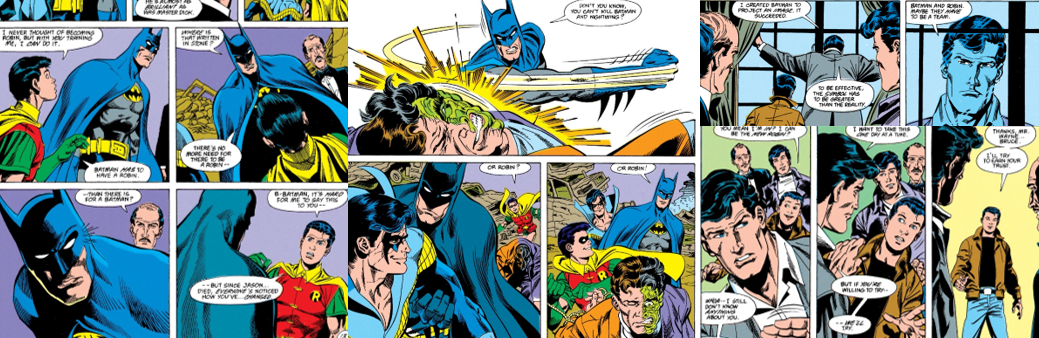
Though reluctant to take on a new partner, Batman’s impressed by Tim and agrees to a trial run.

Although Alfred insists that they must stay in the Batcave and trust that the heroes will overcome the situation, Tim refuses and dons Dick’s old Robin costume, convincing the grieving manservant to help. After overcoming his self-deprecating madness, Two-Face exits the building and blows up another charge only to be attacked by the new Robin. Though amazed to see the Boy Wonder alive, Two-Face spitefully fights back with a brick and a piece of scrap metal, compelling Alfred to intervene. This allows Robin to send Two-Face slinking away with a punch and to shift the wreckage and free Batman and Nightwing, though Batman is unimpressed and chastises the boy. Once outside, however, Alfred and Nightwing praise Tim’s deductive instincts, bravery, and physical skill, though Batman refuses to endanger another youth. When Tim stresses the importance of Robin to keep Batman from being reckless and to send a message to the underworld that the Dynamic Duo are more than just flesh and blood since “Robin” is as much a symbol for justice as Batman or even regular police officers. Tim then further proves his worth by revealing he slipped a tracking device on Two-Face, allowing the three to confront Dent at a scrap yard, where Batman reveals he truly does care as he freaks out when it seems like Robin and Nightwing are killed and seemingly accepts Tim as part of the team after apprehending Two-Face. Back at Wayne Manor, the four discuss the situation further, with a reluctant Bruce begrudgingly admitting that Tim made some good points and agreeing to take it one day at a time since Tim still needs to earn their trust, despite all his enthusiasm. The story ends by revealing that the voices Two-Face was hearing were not only real, but belonged to a bed-bound Joker, who relishes the chance to kill Robin again…

Final Thoughts: 
I’m somewhat biased towards “A Lonely Place of Dying” as the fifth part was the first Batman comic book I ever owned outside of the annuals and collections I picked up here and there. Consequently, while I was aware of Dick’s tenure as Robin, I had little experience with Jason and this was my first, true Robin origin story, meaning Tim has a special place in my heart as perhaps the best to ever don the pixie boots. I was very invested in this era of Batman, meaning Jim Aparo is the artist I most associate with “classic” Batman adventures. While his art is as sublime as ever here, I am disappointed by how rigid everyone, especially Batman, appears at times. When the characters leap into the action, they pop off the panels but, when at rest or pondering Two-Face’s next hit or what’s to do about Tim, they often appear lifeless and stilted. I’m also a little confused about the age gap between Dick and Tim. Tim states he’s thirteen years old and that he met Dick when they were both kids. The art makes it seem like there’s only a couple of years between them in the flashback, yet Dick is a full-grown adult, and Tim is somehow a teenager. Still, “A Lonely Place of Dying” has some fascinating insight into the nature of Batman’s relationship with Robin, with it being explicitly stated that Batman has become more reckless and violent since Jason died and that he needs a partner to keep him from driving himself into an early grave. Batman’s reluctance to take another partner is understandable given what happened to Jason, but his pig-headedness is fuelled by this guilt, blinding him to how close he’s come to death in the time since Jason died and how the legend of the Batman has grown beyond his control to make Batman and Robin a necessity.

Tim might be a little too perfect at times but he’s a far better fit for Robin than Jason.

“A Lonely Place of Dying” is another great example of how Two-Face is often a litmus test for new Robins, being just dangerous enough to be a formidable threat but not as dangerous a challenge as, say, the Joker. I loved how obsessed Two-Face was by his compulsions, how he drove himself to madness figuring out the perfect bait for Batman and couldn’t fight the urge to flip his coin or chase a more enticing target. I liked that he was duped into thinking he’d gone mad and that his scarred side was talking to him and how close he came to ultimate victory thanks to how distracted Batman is by his grief and arguing with Nightwing. Naturally, this story is a showcase for newcomer Tim, who’s depicted as the polar opposite of Jason and even Dick, being a more cerebral and emotionally stable youngster thanks to being inspired by Batman and Robin and coming from a normal (if somewhat wealthy…and crucially alive) family. Tim may have fantasised about being Robin, but never dreamed it would be possible; his goal is simply to reunite Bruce and Dick. However, Tim doesn’t hesitate to take up the mantle when his idols are in danger and argues passionately for the role, easily winning over Alfred and Dick and, eventually, convincing Bruce, too. As much as I like Tim, though, he does come across as a bit too perfect here. It’s impressive that he deduces Batman and Robin’s identities, but he only does this because he has personal experience with both so that gave him an edge. Tim says that he’s kept up with his studies and worked out a bit, but Alfred compares him to Dick in his prime at one point, which seems a bit ridiculous as Tim’s no circus acrobat and only bests Two-Face by sheer luck and determination. Still, he’s shown to be likable, capable, and enthusiastic and greatly impresses Nightwing, making Tim a far better fit than the rebellious Jason. While Tim wouldn’t get his iconic custom costume until he passed Bruce’s trials, this was a great introduction to the new Robin and went a long way to establish Tim as one of the best to serve in the role.

My Rating:

Rating: 3 out of 5.

Pretty Good

Did you enjoy “A Lonely Place of Dying”? Were you disappointed to see a new Robin debut just a year after Jason’s death? Did you like Tim at the time or did you think he was a little too perfect? Do you like seeing Two-Face used as a litmus test for Robins? What do you think of the idea that Batman needs Robin to keep him from going off the deep end? Which Robin is your favourite? Whatever your thoughts on “A Lonely Place of Dying”, and Tim Drake, leave a comment below and donate to my Ko-Fi to suggest other Robin stories for me to cover in the future.

Wrestling Recap: Razor vs. HBK (WrestleMania X)

The Date: 20 March 1994
The Venue: Madison Square Garden; New York, New York
The Stakes: Ladder match for the Intercontinental Championship

The Commentary: Vince McMahon and Jerry “The King” Lawler
The Referee: Earl Hebner
Dave Meltzer’s Rating: 4.75

The Build-Up:
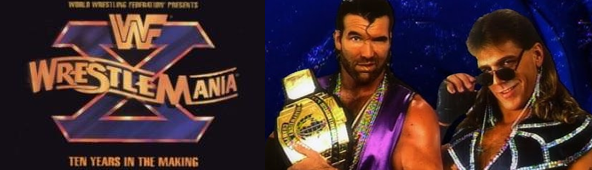
Few wrestlers has as much backstage power as “The Heartbreak Kid” Shawn Michaels back in the day. Alongside his buddies “The Kliq”, Shawn politicked his way to advantageous positions and ensured the spotlight was on him and his friends, such as “The Bad Guy” Razor Ramon. Razor and HBK feuded throughout 1993, with HBK famously being stripped of the Intercontinental Championship in September, only to declare himself the true champion after Razor won the belt in a battle royale. HBK stole Razor’s gold chains to escalate the rivalry, which culminated in the World Wrestling Federation’s (WWF) first-ever pay-per-view ladder match.

The Match:
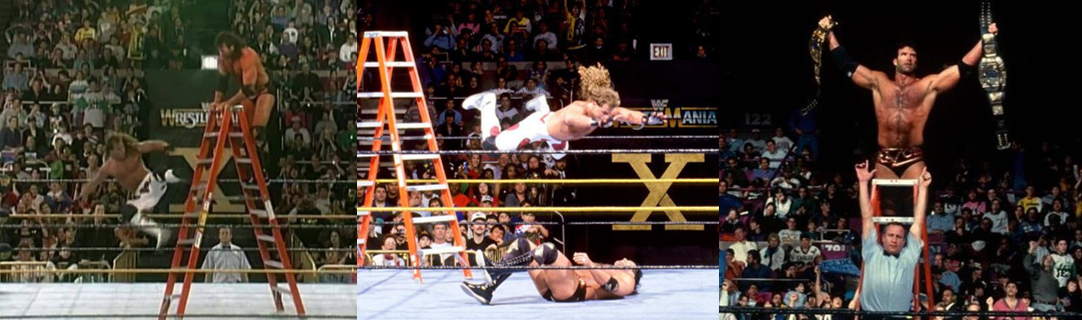
This is one of the rare WWF matches where the competitors are both claiming to be the champion, meaning the ladder match was set to determine the “undisputed” Intercontinental Champion. Shawn entered the match with all his usual arrogance and swagger and accompanied by his hulking bodyguard, Diesel, while Razor tempted fate by walking underneath the ladder set on the rampway during his entrance. Once the bell rang, the two competitors got into a tie-up and exchanged fundamentals before Razor gave Shawn a receipt for poking him in the eye by landing a falling chokeslam. Shawn ducked some clotheslines, took control with a running neckbreaker, and sent Razor outside after being knocked down by a shoulder tackle. When Diesel helped soften up the Bad Guy with a big clothesline, the referee ejected him, much to Shawn’s chagrin, and Razor again got his comeback by clotheslining Shawn outside. HBK quickly cut Razor off when he started removing the protective floor pads and soon tossed Razor to the exposed concrete after countering a Razor’s Edge attempt in the ring! With Razor stunned, Shawn shunted a ladder into Razor’s chest. Shawn followed up by driving the ladder into Razor’s gut in the ring and then repeatedly smashing it into his ribs and across his spine as he lay prone on the canvas. Finally, Shawn threw the ladder at Razor’s back and made his first try for the belts, only for Razor to yank Shawn’s tights down (earning him a diving elbow drop for his trouble).

Razor triumphed in this slower, more methodical but nonetheless engaging ladder match.

After fixing his tights, HBK set the ladder up near a corner and used it to land a diving splash. Razor got some payback by toppling the ladder with Shawn on it, sending HBK crashing to the ropes. While scuffling in the ring, the competitors collided and fell to the mat for a breather; though Shawn recovered first, he was sent flying into the ladder in the corner when Razor reversed an Irish whip. Razor followed Shawn outside and attacked with the ladder, targeting the back and catapulting Shawn into the apparatus from the rampway. A ladder shot to the face sent Shawn tumbling from the ring and allowed Razor to climb for the first time, but HBK cut him off with an awkward diving axehandle. Both struggled up the ladder from either side before battling up the top, an exchange Razor won after suplexing Shawn from the ladder. A dropkick from HBK sent Razor tumbling soon after, however, and Shawn doubled down by hitting Sweet Chin Music to KO Razor. Dissatisfied, Shawn hit a scary-looking piledriver and crushed Razor with a ladder-assisted splash from the corner. Shawn then positioned the ladder over Razor’s downed body and made his climb, only for Razor to recover and shove HBK crotch-first onto the ropes, leaving him dangling from his ankle. Thus, Shawn was helpless to stop Razor climbing the ladder and retrieving the belts to secure the victory in this impressive early ladder match. While tame by today’s standards, there’s something very effective about building a wrestling match around a ladder rather than peppering the bout with high spots. Neither man did anything too crazy, though those ladder shots looked pretty hard and Shawn definitely got a chance to show off with his use of it as a weapon. The match did wonders for Razor, who came out of it looking extra tough from all the punishment he endured.

The Aftermath:
Now regarded as one of the greatest ladder matches in WWF history, Shawn and Razor’s WrestleMania X bout set the blueprint for many subsequent ladder matches and is generally thought to be one of Scott Hall’s greatest moments. Sadly, Razor’s reign with the Intercontinental Championship would be short-lived as Shawn helped Diesel defeat the Bad Guy for the belt a few weeks later, kick-starting Diesel’s disastrous push towards the WWF Championship. Razor won the belt back at the 1994 SummerSlam, lost it to “Double J” Jeff Jarrett at the following WrestleMania, and then became the first man to win the belt three times by recapturing it from Jarrett in another ladder match. After losing the WWF Championship to Diesel at WrestleMania XI, HBK and Razor clashed in another ladder match for the Intercontinental Championship at the 1995 SummerSlam, with Shawn capturing the belt this time. Although Razor made history again by winning the belt a fourth time, drug issues saw him suspended for six weeks and Hall jumped ship to World Championship Wrestling (WCW) following this to begin one of the greatest stories in wrestling history…

My Rating:

Rating: 3 out of 5.

Pretty Good

Did you enjoy this historic ladder match between HBK and Razor Ramon or do you think it’s over-rated? Were you surprised to see Razor absorb so much punishment? Do you think the right man won? Did you like that the ladder was more of a prop than the focus of the match? What are some of your favourite matches from these two competitors? What’s your dream WrestleMania match? Like this review and leave your thoughts before, then donate to my Ko-Fi to suggest more Razor and/or HBK matches for me to review.

Back Issues [Deadpool Day]: Cable & Deadpool #1-6


February 1991 marked the debut of Wade W. Wilson, the wise-cracking, fourth-wall-breaking Merc With a Mouth, one of Marvel’s most popular anti-heroes. Sideshow even rechristened April 1st as “Deadpool Day” to give fans an excuse to celebrate all things Deadpool.


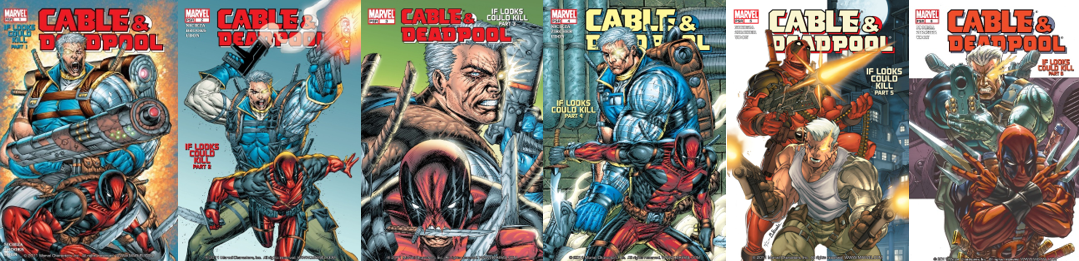
Story Title: “If Looks Could Kill” (Part 1 to 6)

Published: 19 May 2004 (cover-dated: July 2004)
Writer: Fabian Nicieza
Artist: Mark Brooks

Published: 21 April 2004 (cover-dated: June 2004)
Writer: Fabian Nicieza
Artist: Mark Brooks

Published: 19 May 2004 (cover-dated: July 2004)
Writer: Fabian Nicieza
Artist: Patrick Zircher

Published: 16 June 2004 (cover-dated: August 2004)
Writer: Fabian Nicieza
Artist: Patrick Zircher

Published: 21 July 2004 (cover-dated: September 2004)
Writer: Fabian Nicieza
Artist: Patrick Zircher

Published: 18 August 2004 (cover-dated: October 2004)
Writer: Fabian Nicieza
Artist: Patrick Zircher

Quick Facts:
As instructed by then-chief editor Jim Shooter, Chris Claremont and Bob McLeod create the New Mutants, Mutant youngsters tutored by time travelling Mutant Nathan Summers/Cable as (eventually) X-Force. This also saw the debut of Fabian Nicieza and Rob Liefeld’s Deadpool, a composite of James “Logan” Howlett/Wolverine, Peter Parker/Spider-Man, and (most infamously) DC Comics’ Slade Wilson/Deathstroke the Terminator. Years after establishing himself, Deadpool famously partnered with his frenemy, Cable, in team-ups that would define them as one of Marvel’s most entertaining and chaotic duos.

The Review:
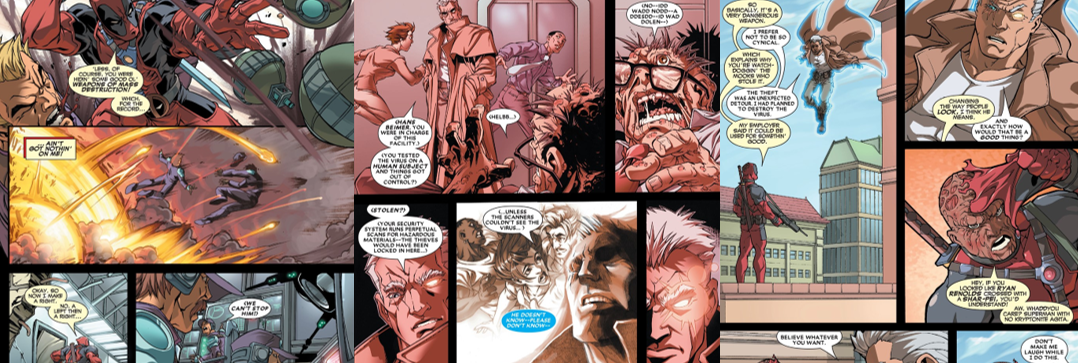
Our story begins with Wade lounging around his apartment, aimlessly flicking through channels until called about a job. Although Wade’s initially reluctant as his client, the One World Church, is based in France as he mistakenly believes the United States is at war with France, he soon dons some synthetic skin and jets over there with the promise of a big payday. He’s met by the less-than-inconspicuous robed representatives of the church, who accept Wade’s gruesome, scarified visage as they’ve been “cleansed” of their identities and rendered androgynous, blue-skinned monks by their order. Though Wade warns them about preaching to him, he meets with their Prime Minister, Anton Kruch, at their colony and, though dubious, learns that the order has purged themselves of all material goods and societal boundaries. Inside the church’s high-tech mansion, Deadpool learns that Sunic Pharmacopoeia created a synthetic virus that could destroy or greatly benefit mankind, and that his mission is to retrieve the “Façade Virus” from their German facility. The toxin was created by Hans Beimer, a scientist currently being mind scanned by Cable. After advising a Mutant bellboy to reach out to Professor Charles Xavier/Professor X, Cable asks Irene Merryweather at the Daily Bugle to fill him in on Sunic, whom he suspects are up to no good. However, he finds the facility in chaos as Deadpool is cutting, shooting, and blasting through the security. Disturbed to find his old nemesis ransacking the place, Cable takes Wade’s advice and “[blows his] mind” with his telekinetic powers but is concerned to find the Façade Virus has been stolen and Beimer has been exposed to it, rendering him a blubbering mess of tumours, and realising too late that the fear he detected in three of the staff was actually guilt from the thieves. These “Spammers” experience different side effects from the virus, with Gunther Herschein/Sour Kraut being violently sick, Asahiri Aoki/Go-Go finding her skin extremely malleable, and Tuatola T’Tuana Timōn/T-5 seemingly unaffected.

Cable and Deadpool clash when it comes to a potentially dangerous man-made virus.

When his telepathic, city-wave search for the three proves futile, Cable calls Irene to learn their real names before running into Deadpool again. As Wade’s been contracted to steal the virus and hopefully help disfigured people like himself and Cable’s made it his mission to destroy it, the two seem destined for a conflict, only for Cable to blow Deadpool’s brains out again. By the time Cable reaches Sour Kraut, he’s literally melting from the virus after using it to masquerade as a movie star in a misguided attempt to cause anarchy. Despite his dismissive attitude towards Sour Kraut, Cable permits him a swift death and then confronts T-5 as he’s gunning down civilians and shouting about government hypocrisy. Chastising T-5’s hypocrisy, Cable easily brings him down and then evaporates Go-Go’s bazooka before extracting the virus from her as she did the others. The effort leaves Cable physically and mentally drained, allowing Deadpool to get the drop on him and bring the sample back to the church so its disciples can forgo the agony associated with their physical transformation. However, the church betrays him and harvests his unique accelerated healing factor to stabilise the virus, allowing them to quickly and efficiently transform everyone into their followers with a simple injection. Luckily, Cable’s ridiculously overpowered telekinetic abilities kept him from being killed and he takes some time to heal from the mental strain in Switzerland with a fully healed Professor X. Since Cable has purged his body of the “techno-organic virus” that held back his powers, Professor X worries that he’s overexerting himself, especially as he’s easily able to hold the returning virus at bay and push himself beyond his previous limits. Brushing these concerns aide, Cable asks for advice about how to best utilise his incredible powers while he still has control and Professor X warns him against employing them in a God-like manner to “fix” society’s ills.

Deadpool seemingly becomes transformed into the church’s loyal acolyte.

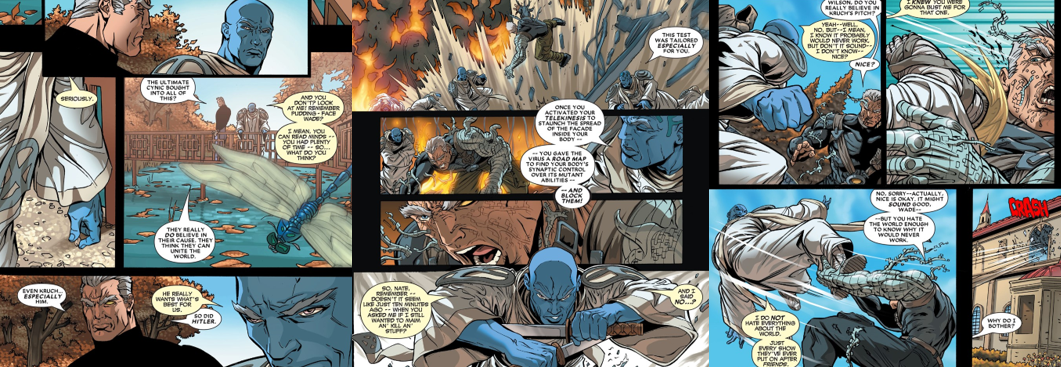
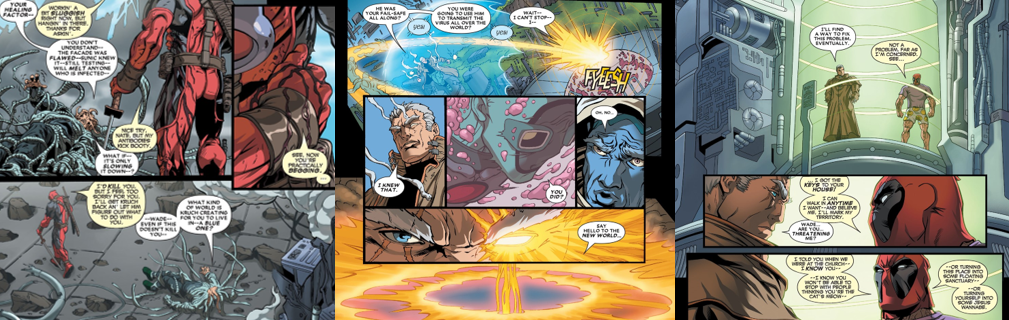
While infiltrating the church, Cable reluctantly apologies for the position the delirious and helpless Deadpool has found himself in and the two bury the hatchet through a psychic rapport, though Cable postpones rescuing him to scope out Kruch’s operation while functionally invisible. Kruch preaches of eliminating strife and bigotry by remaking everyone in their image and presents a fully transformed and brainwashed Deadpool to his congregation, who immediately exposes Cable, though Kruch insists that the church is no threat. Cable is amazed to see that Deadpool’s been cured of his mania and anger, though he’s sceptical about Kruch’s vision of world peace. Invited to witness the first test of the “Deliverance”, Cable and Deadpool witness Kruch’s plan to “infect” the world using electrical transmissions beamed into the eyes, afflicting Cable with the Façade Virus. When Cable decides to use it for himself, he unwittingly allows the virus to run rampant within him, sending his Mutant and technological abilities haywire and leaving him wide open for Deadpool’s sudden attack. After fending Wade off, Cable threatens Kruch was castration if he doesn’t tell him how to stop the virus. When Deadpool redoubles his attack, he ends up tossed into his dorm room, his healing factor struggling with the virus as he struggles with his sanity, slipping back into his costume to attack Cable. Stunned to learn that there is no cure for the Façade Virus, Cable’s easily overwhelmed by Deadpool since the infection is causing his techno-organic virus to spread like wildfire. Conveniently, Cable crash-lands into the church’s armoury, allowing him to blast his way into the facility, only for Deadpool to attack again, convinced that Cable’s become the very thing he claimed to fight against.

Tensions between Cable and Deadpool remain high after Cable takes Kruch’s plan for his own.

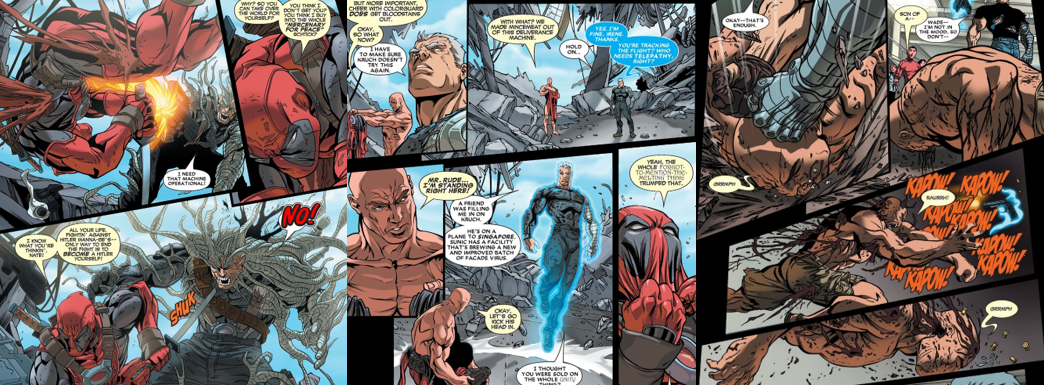
Upon seeing Cable transformed into a bizarre, tentacled grotesque as the combined Façade and the techno-organic virus partially melts and ruins his body and his cyborg parts, Deadpool briefly takes pity on him but refuses to use his blood to cure Cable. Although Deadpool believes that Kruch can eliminate xenophobia, which justifies taking away people’s opinions, he’s stopped in his tracks when his body also begins to melt from the Façade Virus. Though he keeps talking nonsense even as he melts into a pile of goop, Deadpool cannot drag himself to Cable’s paralysed form to cure them both. Luckily, Cable uses his telekinetic powers to draw Deadpool’s liquified remains to him, restoring him and literally puking up the restored Deadpool. Pissed at being deceived by Kruch, Deadpool insists on accompanying Cable to Sunic’s Singapore office, where Merryweather tells him the church has fled, though Cable leaves the visibly cured Wade to find his own way there. Although Cable arrives first, he’s intercepted by Doctor Edward Lansky/Lightmaster, who attacks with blades at blinding speed and ends up teleported into the Moon’s orbit. While Cable agrees with Kruch’s philosophy for world peace and anticipated that he planned to spread the Façade Virus through Lightmaster, he redirects Dr. Lansky’s counterattack into the Singapore Deliverance Device, spreading a modified version of the virus across the world and turning them pink instead of blue. Cable then flies over the world reassembling his old space station and worrying Merryweather so much that she asks him to visit her in person. Knowing he’d use his teleporter, and that the incident has genetically bonded Cable with Deadpool, Merryweather leads Cable into a confrontation with Wade, one Cable easily ends by repeatedly tearing Deadpool apart with teleporters. Cable then restores everyone to normal and proclaims himself a saviour, unwittingly restoring Deadpool’s gruesome visage. Deadpool then vows to abuse their biological link to keep tabs on Cable and ensure he doesn’t let his God complex go to his head, a sentiment shared by the X-Men.

Final Thoughts: 
I was expecting a lot more from Cable and Deadpool’s first team-up. On the plus side, the art is pretty much flawless. While I prefer Cable as a man-mountain and it was jarring to see him so trim, lacking in ostentatious accessories, and relying on his awesome psychic powers, the art had a very kinetic and colourful style to it. The few fight and action scenes we get are frantic and detailed and I particularly enjoyed how expressive Mark Brooks and Patrick Zircher make Deadpool, despite his disappointing lack of time in his costume. This is Deadpool at his most self-referential and wacky, with him constantly chattering nonsense and making timely pop culture references to Dennis the Menace and Brigitte Nielsen. I liked that Deadpool is haunted by his ghastly appearance, which leaves him a cross between “Ryan Renolds [sic] and a shar-pei”, and that this seems to inform his defence of the One World Church. Sadly, this isn’t as developed as I’d like. Indeed, when Deadpool hears Kruch’s pitch, he’s sceptical and only in it for the money, then he’s suddenly fighting Cable to the death over the Façade Virus even before he’s pumped full of it and seemingly indoctrinated into the order. It seems Deadpool is only half-heartedly on Kruch’s side, with him finally achieving inner peace thanks to his restored visage (even if he is blue) and believing there’s a small chance the church can end conflict and bigotry. However, this isn’t as explicit as I would’ve liked. It seems Deadpool’s been brainwashed, then he seemingly denies that. Then, he makes amends with Cable a couple of times and then turns on him, suddenly convinced Cable wants to conquer the world by perverting the Façade Virus, which kind of comes out of nowhere, and Wade turns against Kruch when he suffers the horrendous side effects of the virus.

While the art is great, the plot and characterisations are distractingly haphazard.

This is much more of a Cable story, one centred on his conflicting morality regarding his incredible powers, which are stronger than ever. Having witnessed apocalyptic futures and a lifetime of conflict and suffering, Cable is obsessed with saving the world and is tempted to use his almost God-like powers for the greater good even if it means putting himself on a pedestal. Indeed, Cable is ridiculously powerful here, forgoing any weapons but his telekinetic abilities and easily rendering himself invisible or having psychic conversations from half a world away. Cable sees a logic in Kruch’s twisted vision for the world, which would make “all as one” as a homogenised, placid species. Although Cable believes Kruch is taking away people’s opinions, it’s not clear to me how Cable’s plan for the Façade Virus is any different beyond making people pink instead of blue. He spreads the virus and worries friends and foes alike by reconstructing his space station, but seemingly does nothing despite claiming to have full control of the virus. He then restores everyone and is apparently heralded as a hero, though I’m not sure how or why, inspiring Deadpool, the X-Men, and others to believe he’s gone “too far”. I can just about understand Deadpool’s behaviour being all over the place as he’s nuts, but I don’t get why Cable’s characterisation is so radically different panel to panel and issue to issue. I can only assume it was part of an ongoing story arc, but it made this first six-part story unnecessarily difficult to read. The dialogue bounces around so much I had trouble keeping track of what was going on or why the two were fighting and I was left disappointed that this wasn’t a more action-packed, unhinged team-up between the titular Mutants.

My Rating:

Rating: 2 out of 5.

Could Be Better

Did you enjoy the first story arc of Cable and Deadpool’s team-up comic? Were you also disappointed that it wasn’t a more action-packed story? Can you explain why Deadpool was so devoted to the One World Church and what the hell was going on with Cable? What are some of your favourite moments between Cable and Deadpool and how are you celebrating Deadpool Day today? Let me know what you thought down in the comments and donate to my Ko-Fi to suggest other, better Cable and/or Deadpool content for the site.