Back Issues [Crossover Crisis]: Zero Hour: Crisis in Time!


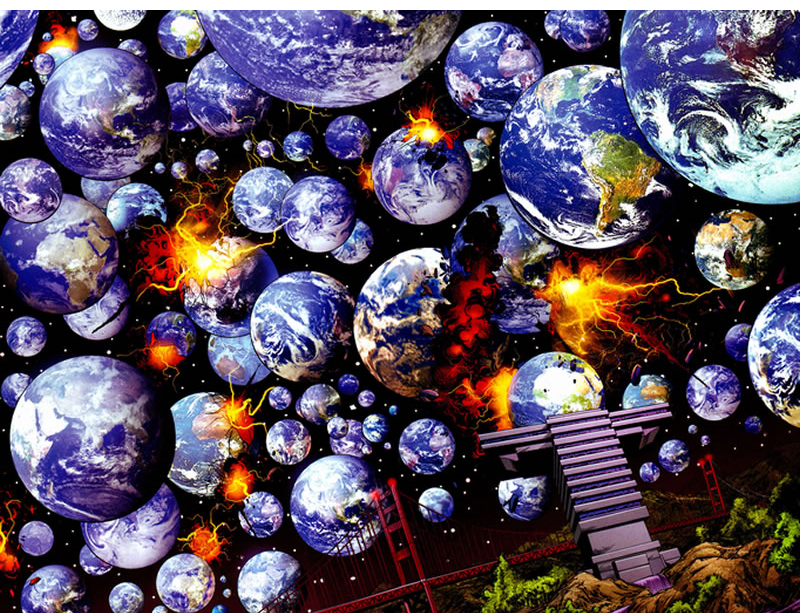
Cover-dated April 1985, the first issue of Crisis of Infinite Earths (Wolfman, et al) precipitated the destruction of the “Multiverse” and what better way to celebrate than with a “Crossover Crisis” of my own?

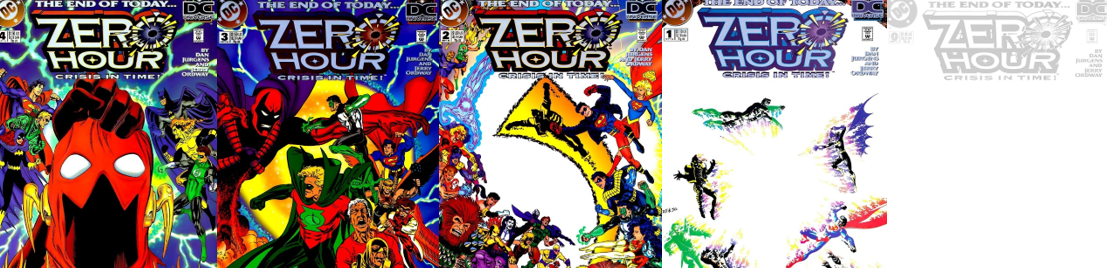
Published: September 1994

Writer/Artist: Dan Jurgens

Quick Facts:
After DC established an infinite number of parallel worlds in Showcase #4 (1956), writers like Mark Wolfman became frustrated with this concept and spent two years planning Crisis on Infinite Earths, one of the greatest comic book crossovers. However, while the likes of Clark Kent/Kal-El/Superman and Wally West/The Flash benefitted from this reboot, others like Carter Hall/Hawkman did not so writer/artist Dan Jurgens sought to correct this about ten years later with Zero Hour: Crisis in Time! Accompanied by numerous tie-in issues and occurring during the “Dark Age” of the industry, the story is largely regarded as a confusing, poorly executed mess that created more problems than it solved.

The Review:
As if numbering this miniseries in reverse order (so the story starts in issue #4 and concludes in issue #0) wasn’t unique enough, each page and/or panel takes place at different times, both literally and relatively, making this a confusing time-based tale. The story begins at the literal end of time, when destructive, unstoppable entropy has engulfed the cosmos. Here, an unseen force executes the mysterious Time Trapper while berating the cloaked figure and others like him for flaunting their omnipotence and yet allowing injustice to prosper. This powerful, unseen figure then harnesses entropy’s destructive power and vows to end the universe’s suffering. His actions (unseen at this point but probably related in one of the event’s many tie-in comics) are detected by Metron, the scientific advisor to almighty Darkseid, who’s so concerned by the unravelling universe that he defies his master and seeks out allies to halt annihilation. Our first indication that something is very wrong with time occurs in Gotham City, where the Joker’s latest killing spree is unexpectedly ended by Barbara Gordon/Batgirl, apparently back in her prime and perplexing even Bruce Wayne/Batman since she was dramatically paralysed by a gunshot some time ago. The enigmatic Linear Men, who monitor and safeguard time from a pocket dimension, then observe entire timelines being erased, dispatching Matthew Ryder/Waverider and Rip Hunter to investigate. In the 64th century, Wally West/The Flash notices the surreal light engulfing the world and learns from Waverider that entropy is ceaselessly making its way back through time, wiping out everything in its path. Though Waverider’s powerless to stop it, Citizen Abra/Abra Kadabra and the Linear Men suggest that the Flash create a super-speed vortex. However, Waverider realises all-too late that the effort is futile and is unable to keep the Flash from running to his untimely doom just like his mentor in the previous Crisis, resulting in the death of the 64th century and Waverider vowing to honour Wally’s sacrifice.
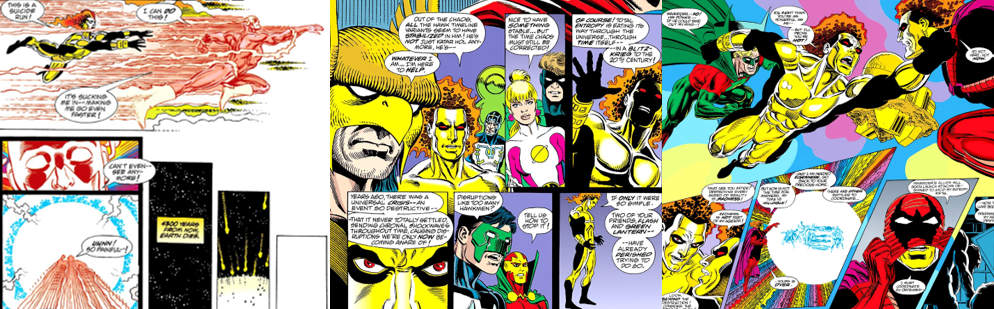
Waverider desperately gathers the forces of justice to stand against Extant and this time rifts.

Their next stop is 57000 A.D, where a youthful Harold “Hal” Jordan/Green Lantern (plucked from before he became the malicious Parallax) is currently battling entropy. Green Lantern’s efforts only feed the destructive force, however, causing it to obliterate Hal and Rip. Before he dies, Rip tells Waverider to research the previous Crisis. Disregarding an anomaly in the timestream, Waverider returns to Vanishing Point and is horrified to learn of the last Crisis and frantically heads to Earth for help, arriving to find Hawkman fluctuating between his various incarnations, Alan Scott/Green Lantern randomly de-aged, and reminding Jay Garrick/The Flash of Barry Allen’s fate while simultaneously informing him of Wally’s leaving Jay heartbroken at having lost the men he considered sons. When Waverider transports the Justice Society of America (JSA) to Vanishing Point, they’re mysteriously separated and attacked by the malevolent Extant. Metron recruits Batman and Superman, who call an emergency meeting of all costumed heroes (though Metron fails to enlist Jim Corrigan/The Spectre’s help as he’s unconcerned by natural disasters). Already rattled from experiencing his own time anomalies, Superman stops to assist the debuting Bartholomew “Bart” Allen II/Impulse (displaced from the 30th century) and recruits him. Earth’s heroes discuss the time anomalies, which see heroes pop in and out of existence, the various Hawk-beings merged into a single, God-like entity, and timelines to merge as the Crisis worsens. Waverider brings the group up to date (inspiring Guy Gardner/Warrior to attempt to change Hal’s fate) but quickly teleports to Vanishing Point when he senses the JSA are in trouble. When he arrives, Extant has killed Al Pratt/The Atom and Kent Nelson/Doctor Fate and rapidly aged Doctor Charles McNider/Doctor Mid-Nite and Rex Tyler/Hourman (to the point that he dies). Although the grief-stricken Alan’s ring is depleted, Waverider gets his comrades to safety and confronts Extant, horrified to find his future self behind the mask and not Hank Hall/Monarch as he suspected!
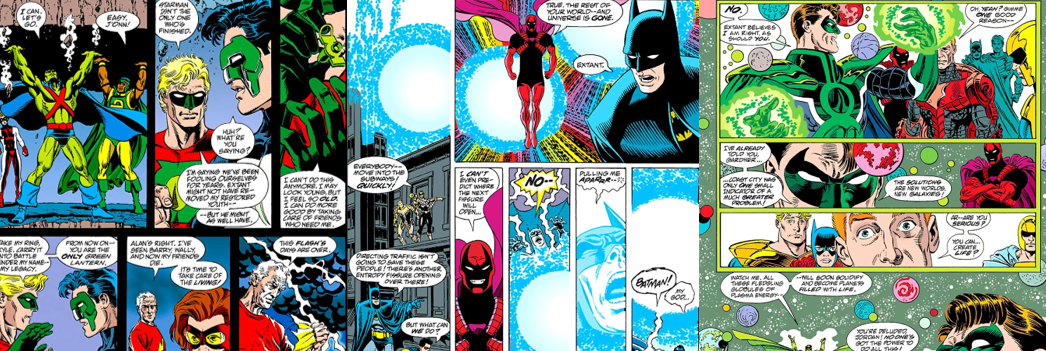
Parallax is revealed to be the mastermind behind the Crisis and wishing to reset time in his image.

Extant reveals that he’s the amalgamation of Waverider, Monarch, and others, having assimilated incredible powers, amassed an army, and spread entropy to birth a new world. Extant teleports Waverider and the others away since it’s too soon for them to fight, though the shattered, aged JSA quit from superheroics due to their losses, officially making Kyle Rayner the only Green Lantern. Inspired by their sacrifices, Superman and the others transport to the 30th century with Metron. As they struggle to halt the entropy, Kara Zor-L/Power Girl suddenly goes into a mystical labour, and Warrior suddenly sprouts weapons by mere thought, they’re attacked by Extant’s brainwashed Team Titans before the man himself attacks…as his future self watches on! Waverider desperately teleports the others away right before Extant plunges his hand into his body and absorbs his incredible time-based energy, assuming Waverider’s guise and completing his time loop as an unseen other retrieves Alan’s discarded power ring. Returned to the 30th century, Metron has Superman and Princess Diana Prince/Wonder Woman hurl his “Mobius Chair” into the entropy rift and Captain Nathanial Adam/Captain Atom pour his full power into it, creating a Boom Tube that successfully dispels the rift. Unfortunately, entropy continues to ravage the timelines, shredding John Henry Irons/Steel and leaving Warrior distraught. Still, angered at his plans being disrupted and his armies defeated, Extant’s past and present-selves merge to ponder the rampant entropy rifts, only to be blind-sided by a greater power for attempting to usurp his plans for reality with the rifts, which erase Impulse and Michael Carter/Booster Gold. Luckily, Jay convinces guilt-trips he Spectre into joining the fray right before he also dies and the few survivors flee to Vanishing Point to restore Waverider. Although he arrives too late to save the Batman from being torn apart by a random rift, Waverider leads the assault against Extant (which leaves Doctor Ray Palmer/The Atom de-aged to a teenager!), only for Parallax to finally assert himself as the man behind the destruction of time!
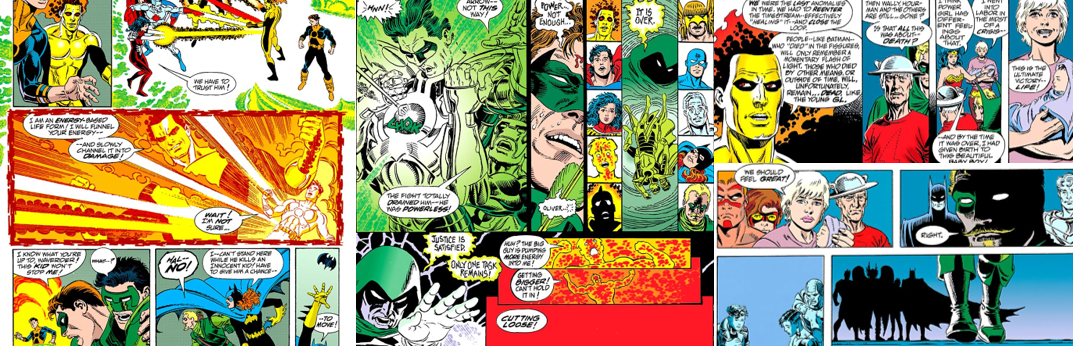
Although Parallax’s mad ambitions are stopped and reality is reset more naturally, the cost is high.

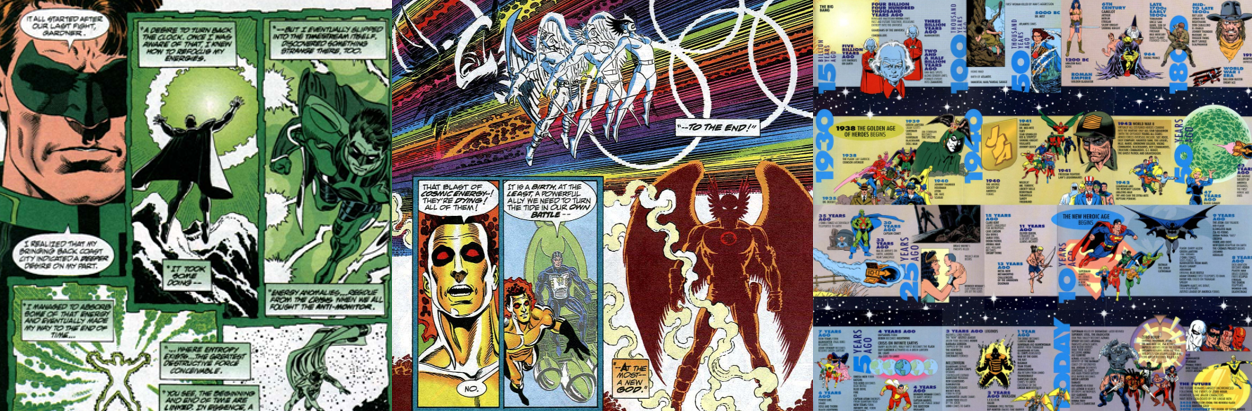
Determined to re-write reality to undo all the injustices they’ve suffered, Parallax wills entropy to engulf all that ever has or will be in the hopes of starting fresh, reshaping reality from a pocket dimension of pure, white space as the handful of shocked survivors watch. Although Guy and the others think he’s mad, Parallax vows to ensure all of them, even the time displaced Batgirl and Extant, get the world they desire, utilising leftover chronal energy and cosmic power from the first Crisis to effectively make himself a God. Having saved a handful of others and spirited them away to Vanishing Point, Waverider proposes piggybacking off Parallax’s efforts and restarting the universe in a more natural way, rather than allowing Parallax to decide who exists and who doesn’t, bringing them into conflict with Batgirl and those who want their worlds back. Lamenting having to fight his old allies and amazed that they would oppose his promise of paradise, Parallax easily fends off Superman and even the wrathful Spectre. While Oliver Queen/Green Arrow tries in vain to reach his friend and laments how far he’s fallen, Waverider has Superman and a few others channel their awesome powers through him, which he then redirects to confused outcast Grant Emerson/Damage, with the remorseful Batgirl sacrificing herself to protect the boy from Parallax’s fury. Heartbroken by how far his friend’s fallen, Green Arrow does the only thing he can and fire an arrow at the weakened Parallax, seemingly killing Hal and leaving the stage clear for the super-charged Damage to spark a new big bang. Thanks to Waverider’s intervention, Superman and the others watch as a new timeline forms, restoring many lost during the Crisis but leaving others, like Batgirl, lost to memory. Although Power Girl rejoices at having birthed new life in this new world, Green Arrow is left devastated and the survivors are both rattled and haunted by the experience, which caused numerous changes to their history (such as Warrior losing his armour and Batman no longer knowing who killed his parents, and the “Modern Age” of superheroes having only started “10 Years Ago” with the debut of Superman).

Final Thoughts: 
As I really started getting into comics during the 1990s, Zero Hour: Crisis in Time! was possibly the first Crisis event I ever read (or, at least, the one I read the most). I’ve only ever read the main five issues and a few of the tie-in and aftermath issues, which mainly dealt with our heroes encountering other versions of themselves or bizarre time anomalies. However, I would probably advise that you seek out the complete event as the main story can be confusing without context. For example, Superman says he encountered his Kryptonian parents and different versions of Batman, Warrior’s left devastated by some unexplained loss, and it’s clear that key events are missing from the main story. This may be the first DC event where the tie-in issues were semi-required to fully grasp what’s going on, which does impact the story as it’s so crammed with characters and events that it’s difficult to keep track of what’s happening and a chore to read at times. Every panel is stuffed with heroes and word bubbles, with many just standing around aimlessly, justifiably confused, or summarily executed by the entropy rifts. This means Raymond “Ray” Terrill/The Ray is left spouting “Cool!” and hovering in the background before randomly helping to kick-start the new big bang, and powerhouses like Matrix/Supergirl are as powerless to stop the destruction as the likes of Richard “Dick” Grayson/Nightwing, who joins Batman in a futile attempt to save lives. However, I did like that the heroes were determined to save as many as they could, and to intervene when the timelines merged, even though it was blindingly obvious they couldn’t stop the entropy, and how devastated they were when they inevitably failed. The stakes are definitely high and the heroes are constantly fleeing, reeling from their losses, or trying new ways to halt the destruction, keeping tensions high as they constantly fail.
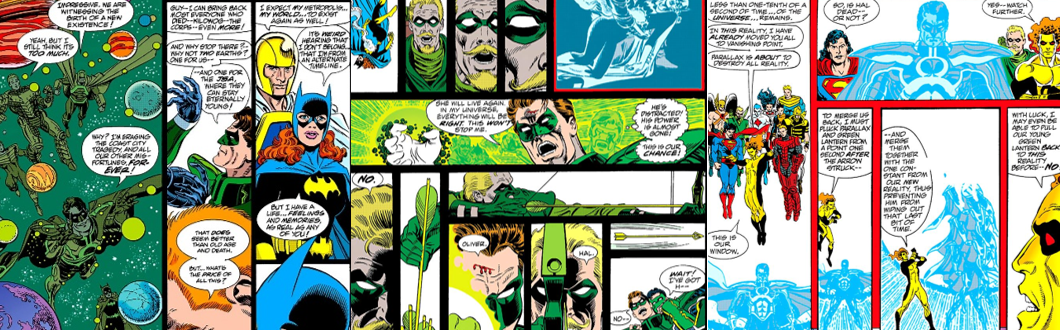
This confusing mess of a Crisis is bogged down by copious exposition and cluttered action.

However, the pacing is all over the place. One minute, things are going a mile a minute; the next, things grind to a halt, and the cluttered panels are filled with endless dialogue as Waverider describes what’s going on. This really comes to a head in issue #0, where Waverider plucks the survivors from a microsecond of time and they witness the rebirth of the universe, all while Waverider waffles on about how they have one shot to re-join the timestream and it must be at the exact moment. He then explains, in great and confusing detail, why the likes of Batgirl (and, it’s assumed, Kyle) are dead but Batman and the billions of others are alive. Conveniently, this is because those latter examples died before the timeline reset; but anyone killed afterwards is really, truly dead. This does tie into Green Arrow’s grief and anger as he’s devastated at being forced to kill his best friend, despite having no choice as Hal was clearly mad with power and had appointed himself judge and jury over all lives and timelines. Green Arrow gets into a physical and ethical debate with Batgirl regarding this as Batgirl simply wants to live, just as the other anomalies want their worlds and lives back, and they briefly defend Parallax since he promises to give them everything they want. Though impressed by Batgirl’s spirit, Green Arrow echoes Warrior’s sentiments and believes Parallax isn’t qualified to make these decisions since it defies the natural order, but Oliver is distraught at being forced to take such extreme actions and this informed his characterisation for a while in the aftermath. Sadly, this comes far too late in the main story to be as impactful as it could be. I’m sure it’s fleshed out more in a tie-in comic but it’s noticeably lacking here, just like Warrior’s desire to undo Hal’s corruption and restore the Green Lantern Corps, which ends up being just one of many sidebars that aren’t resolved in the main story.
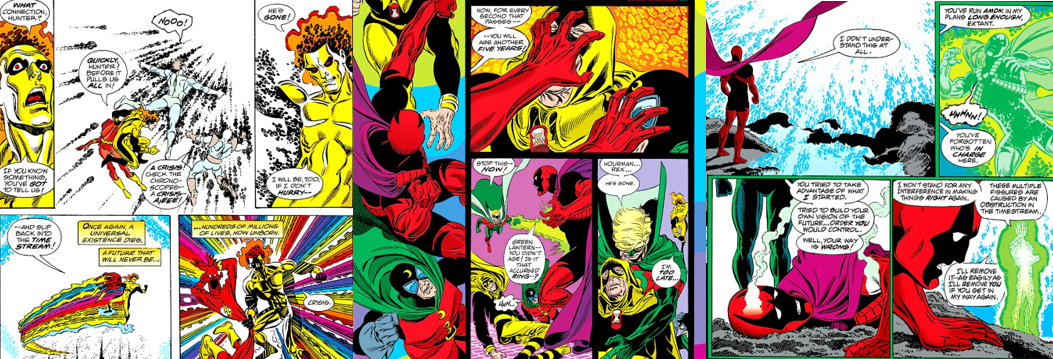
Extant and Waverider don’t make for compelling characters, making the story more dull than exciting.

As Zero Hour features time travel shenanigans, it makes sense for it to be confusing story and that the likes of Metron and Waverider must rattle off a lot of exposition. It gets frustrating as every issue reiterates a lot of this information, and if you’re not a big fan of Waverider, like me. I liked the twist that Extant was a gestalt entity comprised of different time-based powers and people, reducing him to an energy-based being with no real identity who sowed destruction for this own ends. I quite like Extant and feel he got short-changed here as he was rendered completely impotent once Parallax emerged from the shadows. Consequently, I think Zero Hour would’ve been far better and more coherent if Parallax had been the antagonist from the start, going around time destroying and absorbing power from the likes of Extant, the Time Trapper, and Waverider, just to give the story more focus and really emphasise how shocking it is when the JSA are de-aged and killed and characters are erased. This would’ve been a natural evolution of his original turn when he destroyed the Guardians of the Universe and would’ve made for more drama as his former allies lamented his madness and struggled with fighting him, rather than Extant constantly unmasking to be different people, and could’ve even seen Hal’s past self confronted by his future, corrupted counterpart. While the art is okay, Zero Hour suffers from having far too many characters crammed into every panel, making it difficult to keep track of who’s still around or not. I liked the depiction of entropy erasing characters and timelines, especially as a metaphor for DC literally streamlining their time, but the execution was lacking as it left Hawkman a combined entity rather than simply resetting him and I always come out of this story wondering what the purpose was beyond being a cluttered celebrating of DC’s colourful characters. Sadly, it falls very short and everything that happened in it was rewritten eventually, with even Parallax being redeemed, making the entire story forgettable and pointless.

My Rating:

Rating: 2 out of 5.

Could Be Better

Were you also disappointed by Zero Hour: Crisis in Time!? Were you able to follow all the time-based nonsense and exposition? Are you a fan of Waverider and Extant or did you also find them dull characters? Which of the deaths was most impactful or senseless to you? Were you a fan of Hal’s turn as Parallax and do you agree he should’ve been the sole villain here? Did you like the changes made to DC following Zero Hour? Which Crisis event was your favourite and what are some of your favourite cosmic events? Tell me what you thought about Zero Hour: Crisis in Time! in the comments and donate to my Ko-Fi to suggest other Crisis events for me to cover.

Back Issues: DC’s Crisis Conundrum

BackIssues

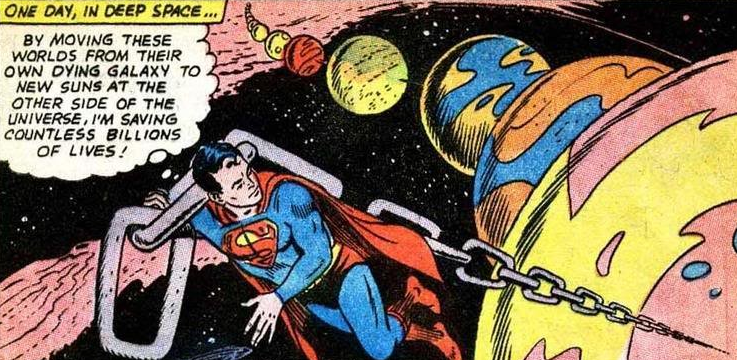
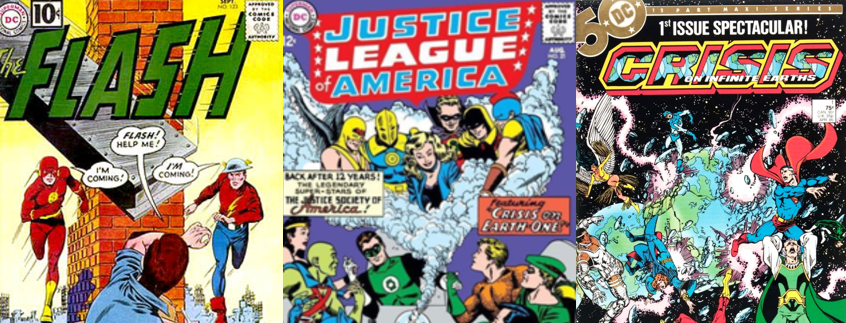
Ever since the 1938 introduction of Clark Kent/Superman, DC Comics has been known for its vast array of costumed crimefighters and interconnected, densely populated fictional narratives. For decades, continuity was played fast and loose; Superman evolved from being a moderately powerful superhuman who could leap over tall buildings into a God-like figure who could turn back time, possessed a super-human intellect, and could tow entire worlds through space with ease. Similarly, Bruce Wayne/Batman was depicted as being as youthful as ever despite having been active since 1939 and having taken part in World War Two. Some of these issues were resolved when, in the 123rd issue of The Flash, DC Comics introduced the concept of the multiverse. The issue postulated that there were an infinite number of parallel worlds co-existing in the same space and time but slightly out of synch with our own world due to being on a different vibrational frequency. The fallout from “Flash of Two Worlds” (Fox, et al) was the revelation that DC’s Golden Age superheroes, such as the Justice Society of America and older versions of Superman and Batman, existed on the parallel world known as Earth-Two while their Silver Age contemporaries (Hal Jordan, Barry Allen, and the like) in the Justice League of America existed on Earth-One.

CrisisStupidlySuperman
Superman was originally more like a God than a man.

This concept allowed DC Comics to portray multiple iterations of their most popular characters as existing side-by-side, as well as numerous alternative worlds; Earth-Three, for example, was home to the Crime Syndicate, made up of villainous versions of the Justice League, while Earth-S was home to Freddy Freeman/Captain Marvel and other characters DC acquired from their purchase of Fawcett Comics. Unfortunately, decades of over-reliance of the multiverse concept meant that, by the 1980s, DC continuity was extremely difficult to keep track of and DC Comics were virtually inaccessible to new readers who had no idea what the multiverse was, much less how it worked. As a result, DC embarked on their most ambitious inter-company crossover yet. Crisis on Infinite Earths (Wolfman, et al, 1985) saw the entirety of the DC multiverse under threat from the malevolent Anti-Monitor. Seeking to rule in the desolation of nothingness, the Anti-Monitor begins destroying entire parallel worlds with an anti-matter wave, reducing their number from infinite to a mere five and causing the deaths of Barry Allen/The Flash and Kara Zor-El/Supergirl. In the end, Kal-L/Superman of Earth-Two, Alexander Luthor of Earth-Three, and Superboy of Earth-Prime end the Anti-Monitor’s threat and retreat to a “pocket dimension”, alongside the Lois Lane of Earth-Two, where they are protected from the merging of the remaining worlds.

Crises were commonplace in the Silver Age before DC tried to streamline their complex continuity.

It seemed like DC had come up with the perfect way to consolidate their continuity; the concept of parallel worlds was done away with and one singular reality was established. Stories like Superman: The Man of Steel (Byrne, et al, 1986) and Batman: Year One (Miller, et al, 1987) re-established the origins of DC’s flagship characters and, over the next few years, DC established that, while the events prior to the Crisis had occurred, very few of the characters who survived remembered much beyond vagaries (Wally West, for example, was now the Flash and knew, like everyone else, that Barry had died saving the world but not the exact specifics of how and why). Additionally, DC Comics began emphasising the idea of legacy superheroes; the Justice Society of America was established as having been active during World War Two and, while some of their members were active in present day continuity, they were noticeable aged and took on more of a mentorship role. Unfortunately, DC dropped the ball with Crisis. Rather than simply end every existing comic they published and reboot with brand new issue one’s and origin stories, some characters (such as Diana Prince/Wonder Woman) were not reintroduced into the new canon until much later. Others, like the Legion of Superheroes, had their entire origins altered forever by the removal of Superboy from the new canon (something that could have easily been remedied had DC simply rebooted the Legion and had them be inspired by Superman; instead, writers hastily incorporated an alternative Superboy from a pocket dimension or substituted him with Mon-El).

Zero Hour tried to fix DC’s post-Crisis lore but actually did more harm than good.

In an effort to address some of these lingering issues, and further incorporate some of the popular Pre-Crisis characters and ideas into modern continuity, DC capitalised on Green Lantern Hal Jordan’s recent descent into madness, genocide, and villainy with another massive inter-company event. Zero Hour: Crisis in Time! (Jurgens, et al, 1994) saw Jordan, as Parallax, absorbing vast amounts of cosmic and chronal energy with which he planned to remake reality and undo all the wrongs that had happened since the death of Superman. Due to Parallax messing about with time, many continuity changes were forced into DC canon; Superman was explicitly described as having debuted “ten years ago”, the Legion of Superheroes were (finally) completely rebooted, Batman’s killer became anonymous and at large, and all conflicting versions of Carter Hall/Hawkman were consolidated into one singular character since DC never really bothered to reboot his origin story following the original Crisis. With the bulk of Zero Hour’s five-issue run being made up primarily of exposition from Richard Rider/Waverider or Parallax, many of the consequences of Parallax’s actions were told in DC’s individual comics. In the end, despite the insanity of time literally being ripped apart around them, the heroes were able to thwart Parallax’s efforts and allow time and reality to unfold naturally, albeit with many changes. Zero Hour resulted in many changes to popular DC characters; Guy Gardner suddenly became a shape-changing Vuldarian, many of the Justice Society were rapidly aged or killed off, Connor Hawke was introduced as the new Green Arrow, and Arthur Curry/Aquaman now sported an unkempt look and a harpoon for a hand.

Infinite Crisis returned the multiverse to the DC universe.

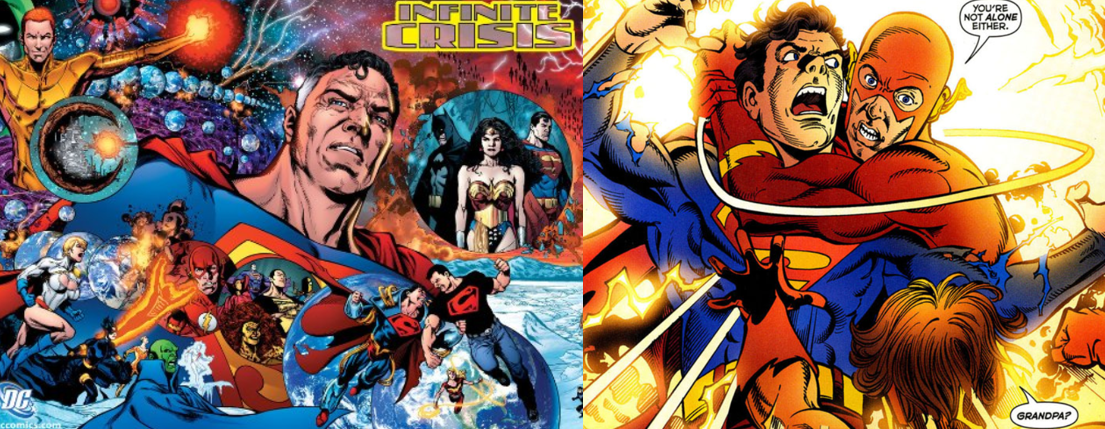
However, Zero Hour actually created more problems than it solved; Hawkman’s origins were no more clearer now than they had been before. Eventually, The Return of Hawkman (Goyer, et al, 2002) returned the character to mainstream continuity, explaining that the character was locked in a constant cycle of death and rebirth. Additionally, DC sought to address their ongoing continuity issues (and tell out of continuity stories) through the concept of Hypertime, which, much like the previous infinite Earths concept, allowed for alternative versions of events to be played out. Eventually, and with the twentieth anniversary of the original Crisis looming, DC decided to commission their biggest inter-company crossover yet. Consisting of multiple ongoing stories all building up to its central narrative, Infinite Crisis (John, et al, 2006) aimed to not only re-establish the multiverse concept and finally tie-up all of the lingering continuity issues left in the wake of Crisis on Infinite Earths and Zero Hour, but also move the company away from the dark stories that had dominated during the mid-nineties. After numerous event-scale storylines, the DC trinity (Batman, Superman, and Wonder Woman) were divided and the DC universe was in turmoil. Frustrated with how bad Earth heroes have let things get and perceiving that they have squandered their new world, Kal-L, Alexander Luthor, and Superboy-Prime break free from their pocket dimension and set about cannibalising the Anti-Monitor’s corpse to re-establish the multiverse and return peace and order to the universe. However, it turns out that seeing his world destroyed and having his youth ripped away from him, coupled with living in isolation and the machinations of Alexander Luthor, have driven Superboy-Prime mad. While Alexander straps various heroes and villains to an inter-dimensional tuning fork, Superboy-Prime goes on an accidental murder spree before Bart Allen/Kid Flash forces him into the Speed Force itself, at the cost of Wally West and his family.

CrisisEarths
Infinite Crisis smashed together parallel worlds created 52 alternate Earths.

However, Superboy-Prime escapes, sporting a modified version of the Anti-Monitor’s armour and driven completely insane. With no regard for himself or others, he goes on a rampage; although Conner Kent/Kon-El/Superboy destroys Alexander’s inter-dimensional tower, it costs him his life and, finally convinced that Alexander’s plan would mean the genocide of countless lives, Kal-L joins forces with Superman to end Superboy-Prime’s threat. Infinite Crisis ends with the multiverse restored; though instead of there being an infinite number of parallel worlds, there were now a much more easy to wield fifty-two alternate Earths. In the aftermath, DC’s titles all jumped forward one year later, while the weekly 52 series explored the fallout of the events from the main crossover. This New Earth restored Superboy to Superman’s origin, depicted multiple non-canon stories as existing on the alternative Earths, introduced a new all-powerful villain in the form of Superboy-Prime, and resulted in Batman becoming far more trusting and open with his allies and family. For me, this was a great time to be reading DC comics. Unlike previous Crisis-level events, Infinite Crisis felt like a soft reboot that would be accessible to new readers; the multiverse existed but rarely impacted mainstream DC continuity and it felt like DC had finally closed the door of the events of the original Crisis and had finally moved on.

And then Grant Morrison happened.

CrisisFinal
somethingsomethingsomething Darkseid somethingsomething…

Morrison spearheaded an inter-company crossover that would change the DC universe forever. Unfortunately, DC decided to spend an entire year building up to this event with the weekly Countdown (later Countdown to Final Crisis) series, in addition to numerous tie-in and spin-off titles. As Countdown was of far less writing and artistic quality compared to 52, and due to the fact that many of its events contradicted what was happening in the associated titles, the build up towards Final Crisis (Morrison, et al, 2009) was lacklustre and confusing, to say the least. The basic premise, as far as I can understand it (Morrison’s writing is confusing and disjointed at the best of times) is that the New Gods have all died and been reincarnated on New Earth, causing a tear in space, time, and reality. Reborn, Darkseid finally solves the Anti-Life Equation and enslaves the planet; however, using a radion bullet, Batman mortally wounds Darkseid, before being erased from existence. As his essence dies, Darkseid attempts to obliterate all of reality until he is finally thwarted by Superman; Superman, and an army of his counterparts from across the multiverse then restore Earth and reality before it can be destroyed by Darkseid and Mandrakk, the Dark Monitor. Once you got past the mess of Morrison’s writing and the mess of a build-up to the main event, the fallout from Final Crisis made for very accessible stories. DC also focused on using the Green Lantern titles to expand their universe through sprawling, inter-connected stories.

Dick Grayson took over as Batman before Flashpoint gave us an angst-ridden jerk version of Superman.

However, rather than fully capitalise on this (by, say, returning Bruce Wayne to life as an aged man, killing off Alfred, and having an elderly Wayne take his place as mentor to the new Batman and Robin), DC instead decided to undo all of their recent efforts a mere two years after the end of Final Crisis. The best thing about Final Crisis was the fallout; Batman, thought dead, actually embarked on a trip through time and space that threatened all reality until he was safely returned home by the Justice League. However, in the meantime, his duties were performed by Dick Grayson and Damian Wayne as an all-new, fresh take on the Batman and Robin duo. Additionally, both Kon-El and Bart Allen were resurrected and, for fans of the Silver Age, Barry Allen finally returned to the land of the living to become the Flash once more (though, personally, I am more of a fan of Wally West). In Flashpoint (Johns, et al, 2011), Barry Allen’s grief apparently got the better of him, causing him to go back in time and save his mother’s life. This results in a vastly altered timeline, which threatens to solidify itself as the true reality unless Barry can set things right. Teaming up with Thomas Wayne, here a violent version of Batman, and amidst an ongoing war between Atlantis and the Amazons, the Reverse-Flash reveals the key to restoring reality to Barry, allowing him to undo his actions. However, instead, we got what DC marketed as the “New 52” reality for the better part of five years. In this radically altered version of events, the DC universe has only existed for five years (meaning that Batman burned through one Robin every year-and-a-half or so), Barbara Gordon controversially recovered from the Joker’s attack and continued to fight crime as Batgirl, and many characters got entirely new origin stories (Superboy, Supergirl, and, in particular, Superman was changed so drastically that I swear he was a completely different character).

CrisisConvergence
Convergence slightly altered the original Crisis.

Additionally, Wildstorm and Vertigo publications were officially absorbed into the DC universe, while many recent events, particularly in Batman and Green Lantern titles, continued with very little alteration, truly begging the question as to why DC even bothered to reboot their continuity so severely just as their titles had become engaging and accessible for new and long-term readers. The biggest problem with the New 52, however, was that while DC still incorporated a version of the multiverse (complete with slightly different versions of Earth-Two and Earth-Three), it took DC almost a year to properly establish their new continuity; many characters went without detailed revised origins until this time, causing a great deal of confusion as to what events and characters were still canon, and largely alienating me in the process. Eventually, though, DC decided to bring the New 52 to a close and restart everything…again…using the Convergence (King, et al, 2015) storyline to kick-start their Rebirth titles. In Convergence, Brainiac has collected numerous cities and their inhabitants from across the multiverse (even some from prior to the original Crisis) and deposited them on Telos, a sentient planet that forces them to fight each other to see which is superior. Amidst the chaos and the fighting, the sorcerer Deimos usurps Telos and declares himself ruler and protector of this imprisoned on there. Eventually, Deimos is defeated by Parallax (drawn straight out of Zero Hour), which causes a chain reaction that threatens to annihilate the entire multiverse (…again). Brainiac, seeking to atone for his misdeeds, intervenes and sends pre-Flashpoint Superman and Zero Hour-Parallax back to the original Crisis to change its outcome and save the multiverse from collapsing.

Rebirth returned pre-Flashpoint characters and brought the Watchmen to the DC Universe.

Convergence concluded with the return of the multiverse proper, with a potentially infinite number of worlds once again present in DC comics, while absorbing yet more commonly displaced titles into DC continuity; an ongoing theme throughout the resultant Rebirth-branded comics has been the introduction of characters from Watchmen (Moore, et al, 1987) into the larger DC universe for the first time. Perhaps the best thing to come out of Convergence and the resultant Rebirth titles was not only the death of the New 52-Superman but the return of the pre-Flashpoint Superman and the true Wally West. The pre-Flashpoint Superman is revealed to have been living a quiet family life with his version of Lois Lane and their young son and, despite starting as a separate character, has recently been amalgamated with and replaced the new 52-Superman entirely. Additionally, Wally now exists alongside his biracial counterpart, retconned as being his cousin, and even explains that Flashpoint was actually caused by Doctor Jon Osterman/Doctor Manhattan rather than Barry Allen. So, once again, DC Comics have been softly rebooted to attract new readers while reintroducing numerous popular concepts and characters into mainstream continuity. The return of the pre-Flashpoint Superman, a confidant married man with a superpowered child, is enough to bring me back to DC after the debacle of the New 52 yet their ongoing titles (particularly, again, Batman and Green Lantern, and even The Flash) continue the stories from the New 52 and with little consequence from the events of Convergence save for Batman and the Flash’s investigation of the Comedian’s button.

While Crises can be fun, they often cause more problems than they solve.

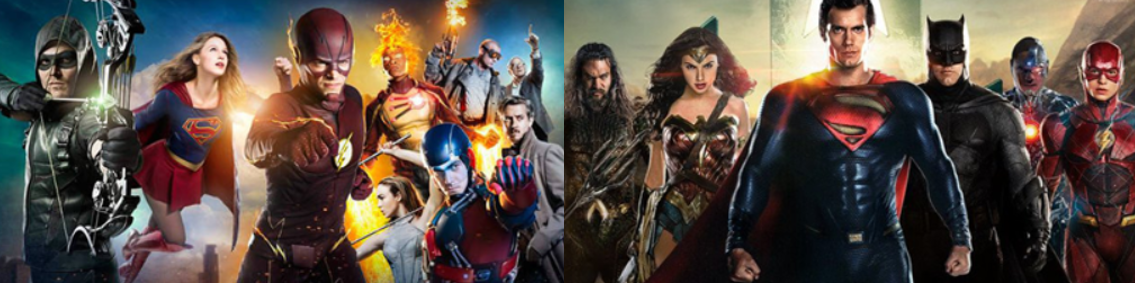
One of the things I love about DC Comics is that they’ll cook up a massive story whenever they want to make major continuity changes (as opposed to Marvel, who usually just quietly retcon stuff away, ignore it completely, or constantly update their sliding timescale to keep everything within an approximate five year timeline). While this means that everything can be canon at any one time, DC have notoriously dropped the ball with every Crisis-level event they produce. After Crisis, every title should have reset to zero and all continuity should have been rewritten and reset to accommodate the major changes they had made; to only have a few titles do this is ludicrous and created a knock-on effect that led to the disastrous Zero Hour event. It wasn’t until Infinite Crisis and Final Crisis that DC finally resolved the fallout from the original Crisis, and then they went and threw it all away with Flashpoint in an obvious attempt to bring in new readers unfamiliar with the events that had already transpired. Ironically, as a long-time comics fan, even I sometimes struggle with these massive Crisis events because they require a lot of background reading. As I mentioned, the New 52 publications alienated me completely and it’s only recently, now that DC has moved on to the Rebirth branding, that I have bothered to collect some key New 52 graphic novels. The worst part is that DC and Warner Bros. apparently would rather reference and incorporate elements from the multiverse concept in their movies and television shows. For example, the Flash seen in The Flash television show is not the Flash we see in Batman v Superman: Dawn of Justice (Snyder, 2016). This goes even further though as the Superman seen in Supergirl is not the Henry Cavill version of the character and Supergirl is not only separate the DC movies but also from The Flash, Arrow, and DC’s Legends of Tomorrow television shows (The Flash even goes to great lengths to introduce and explore the concept of the multiverse, again represented as 52 parallel worlds).

The DCEU is quite divided, to say the least.

This basically means that we will never see Stephen Amell appear as Green Arrow alongside Ben Affleck’s Batman and has resulted in two versions of the Flash, two wildly different versions of Batman’s origin between Batman v Superman and Gotham, two iterations of the Suicide Squad, and many more all existing simultaneously on television and in movies. DC and Warner Bros. then compound things even further by constantly talking about the multiverse and hinting that their movies are not all connected all with the intention of presenting themselves as doing things differently from Marvel Studios. However, the multiverse concept is incredibly complex and something only die-hard fanboys really understand. The general audience might not quite be ready for it and, besides that, it seems really stupid to want to have three different versions of Superman on screen at any one time, especially as DC have previously placed an embargo on Batman crossing over into other television properties. The multiverse has worked in comics because it has existed for so long and been explored to death; The Flash has done a great job of introducing the concept but that had three entire seasons to explore and discuss it at length. For a movie to do it would surely be far more trouble than it’s worth beyond simplifying it to a great degree, perhaps by introducing the Crime Syndicate or stating that a villain such as Darkseid has devoured parallel worlds or something.

Hopefully, however, DC has learned to better manage their Crisis-level events from now on, and also to limit them to one every ten or fifteen years or so; having massive inter-connected plots where the fate of the multiverse is at stake (and sticking guys like Batman at the centre of them!) occur every two to five years is just overkill, in my opinion, especially if DC screw the pooch as badly as the did with the New 52.