In the classic science-fiction horror Alien (Scott, 1979), an unsuspecting cargo crew investigates the barren world of LV-426. Thus, the 26 April is “Alien Day”, a day to celebrate one of the greatest sci-fi/horror franchises ever created.


Released: 8 June 2012
Director: Ridley Scott
Distributor: 20th Century Fox
Budget: $120 to 130 million
Box Office: $403.4 million
Rotten Tomatoes Scores: 73% / 68%
Quick Facts:
Although the Alien vs. Predator movies (Various, 2004; 2007) quashed a collaboration between Ridley Scott and James Cameron, Scott was enticed back to his seminal sci-fi/horror franchise to explore the origins of his volatile Xenomorphs. The concept quickly evolved from a simple prequel to explore existential themes, employing practical effects wherever possible, with Neal Scanlan and Conor O’Sullivan designing the proto-Xenomorph creatures. Despite a somewhat mixed reception, Prometheus was followed by a 2017 sequel, though its place in the franchise canon has become notably dubious since its release.
The Review:
Set in 2093, over around one hundred years before Alien, Prometheus is full of oddities compared to its other, Xenomorph-ridden brethren. For starters, it begins on Earth, a location rarely seen or visited in these films, where archaeologists and lovers Doctor Elizabeth Shaw (Noomi Rapace) and Doctor Charlie Holloway (Logan Marshall-Green) unearth one of many ancient cave paintings depicting a tall man being worshipped by primitive humans and pointing towards a constellation in the stars. A combination of research and blind faith, especially by Shaw, sees them convince billionaire founder and chief executive officer (CEO) of Weyland Corporation Peter Weyland (Guy Pearce) to fund an expedition to the stars to find what they firmly believe to be the maker of humankind, dubbed “Engineers”. While the crew of the USCSS Prometheus are sceptical, with mentally unstable geologist Sean Fifield (Sean Harris) and cold-hearted Weyland Corp bureaucrat Meredith Vickers (Charlize Theron) scoffing at their theory, the film shows that the towering, muscular Engineers (Ian Whyte and Daniel James) visit habitable worlds like Earth and seed them with their very bodies after consuming a mysterious black goo, which kick-starts the evolutionary process. Interestingly, Shaw is a deeply spiritual woman, wearing her father’s (Patrick Wilson) cross and trusting in a higher power, yet is committed to seeking out the Engineers and asking them the big questions, like “Who am I?” and “Why am I here?” Rapidly dying of extreme old age, Weyland gives Shaw and Holloway carte blanche to lead the expedition, this ruffles Vickers’ feathers as she doesn’t share Weyland’s optimism and is instead intent on claiming whatever they find on behalf of the corporation (and herself). She pointedly informs Shaw and Holloway that they’re not as in charge as they think, though Vickers chooses to remain on the ship while the others investigate the faraway world of LV-223. Vickers is equally forced to defer to Prometheus Captain Janek (Idris Elba) and deal with the surreptitious nature of her synthetic “brother”, David (Michael Fassbender), who monitors the crew and maintains the ship’s functionality while they’re in cryosleep.

Despite Vickers’ warnings, Shaw and Holloway join the others in investigating a large, seemingly artificial structure on the toxic planet’s surface, with Shaw chastising Holloway for trusting Fifield’s readouts and removing his helmet to breathe the self-contained atmosphere within. Initially, Shaw and Holloway are ecstatic to find the structure and the ancient, biomechanical technology within, where holograms triggered by David show the Engineers to be humanoid creatures, and even more thrilled when they discover an Engineer’s dead body and a tomb-like chamber filled with mysterious, vase-like containers. However, Holloway’s excitement evaporates as Shawn and medic Ford (Kate Dickie) investigate the Engineer’s severed head and he becomes despondent to learn that they’re all apparently all dead, having strangely perished while fleeing an unseen threat. Drunk, unaware that David has infected him with a tiny sample of black goo, Holloway vents his frustrations to David and Shaw, voicing his disappointment at being unable to talk to “God” and the revelation that there’s nothing special about human life. Shaw maintains her enthusiasm, though, largely because she cannot have children and their discovery promises to reveal so much about human evolution. At first, Shaw is as far from Lieutenant Ellen Ripley (Sigourney Weaver) as you can get, being an intellectual and a scientist first and foremost. Despite this, she fearlessly ventures into the Engineer’s structure and evolves into a more pro-active character, desperately dragging Holloway back to the ship when his infection takes root, faking being sedated afterwards so she can escape David’s custody, and even enduring a horrific automated caesarean to remove the Trilobite implanted by the android’s machinations. Shaw’s also far more emotional, feeling both angry and betrayed by Weyland Corp and the Engineers after she learns the truth about both and demanding answers from humanity’s stoic makers in the final act. In contrast, Holloway is largely uncharismatic and bland, initially mirroring Shaw’s enthusiasm before falling into despair before being doomed by David, a fate Holloway somewhat brings onto himself through his blind ambition to commune with “God” and his arrogant, malicious treatment of David.
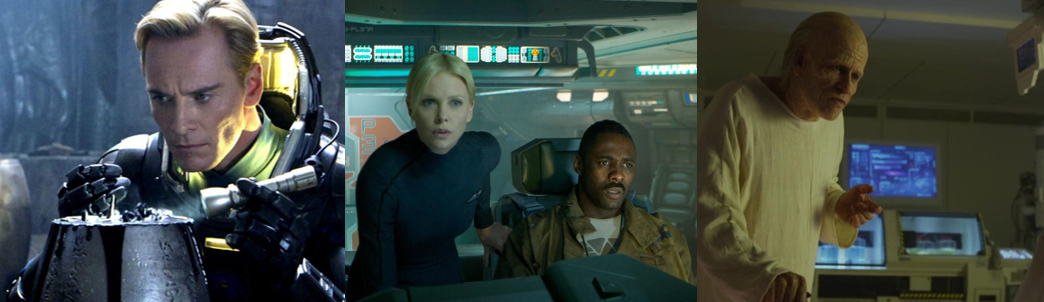
Unlike his successors, David is somewhat less refined and efficient, being noticeably more machine-like in his mannerisms and movements. He spends two years studying every modern and ancient language to transcribe and communicate with the Engineers and diligently serves the crew despite Holloway and Vickers treating him as inferior. David makes every effort to fit in, dressing like the crew and even donning a space suit he doesn’t need, only to be met with disdain or hostility. While David’s presumably programmed not to have emotions, it’s also implied that he’s learned to mask them to deceive people and this is only made more relevant when he observes Shaw’s dreams and specifically targets Holloway with the black goo, indicating that he has something of an obsession with Shaw. David is mostly helpful and polite, but Vickers’ hatred of him is rooted in jealousy as Weyland saw the android as the son he never had, favouring David over his daughter, Vickers, leading her to despise the android. Vickers’ stone-faced, no-nonsense demeanour sees her mocked (in private) by most of the crew and prompts Janek to question if she’s also a robot, resulting in a rare break in her icy exterior as she orders him to sleep with her. Vickers’ efforts to remain in control, even having a self-contained lifeboat quarters, are doomed to failure by LV-223’s chaotic atmosphere and her father’s plot, which sees David surreptitiously experiment with the black goo to report back to her father, who’s in cryosleep on the Prometheus. Thanks to David’s constant updates, the decrepit old man is confident that he can demand an extension on his already well-lived life, a decision which only brings Vickers further pain as Weyland would rather barter with “God” to extend his life than willingly pass on his legacy and company to her.
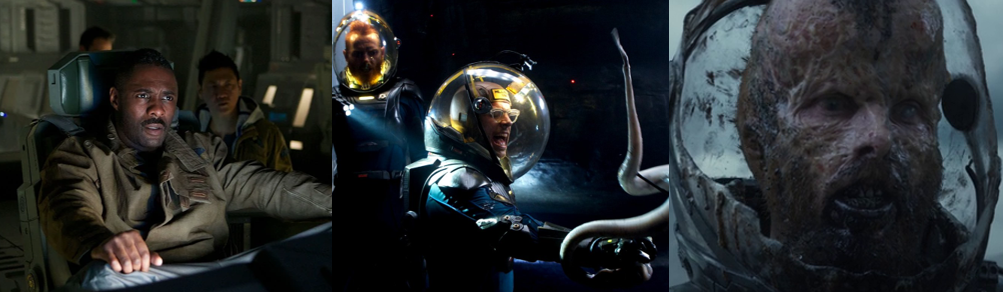
Despite being an exploration vessel largely crewed with scientists, the Prometheus has some dumb-ass characters onboard, namely Fifield and biologist Millburn (Rafe Spall). While Fifield’s spheres map the Engineer structure, he gets spooked and gets lost (despite having the map) alongside Millburn, whom Fifield has a contentious relationship with because one of them is a crazy, abrasive asshole and the other is a chirpy annoyance. Millburn shows his own stupidity when they decide to weather a static storm inside the chamber and are confronted by snake-like Hammerpedes. While Millburn tries to keep his wits, he insists on approaching the mutated earthworm and unsurprisingly gets his arm broken and is infected by the slithering creature. Fifield is also infected while scrambling to help Millburn, taking a splash of acid to his helmet and landing face-first in black goo, which strangely transforms him into a zombie-like creature (because a humanoid Xenomorph would’ve been too cool, I guess). Pilots Chance (Emun Elliott) and Ravel (Benedict Wong) basically do nothing except fly and land the ship and opt to stay by Janek’s side in the finale as he plots a collision course with the escaping Engineer ship, sacrificing themselves to keep the Engineer from returning to Earth. Overall, the crew is far less memorable that the “space truckers” seen in Alien, despite Idris Elba’s bizarre accent and talent with an accordion. While it makes sense that Weyland’s ship would have all the mod-cons and be much cleaner and more impressive than haulage vessels like the USCSS Nostromo, the slick, high-tech ship (with all its holograms and touchscreens and such) feels too advanced for this point in the timeline and I never felt as connected to the ship or its crew as a result since they’re not as relatable as working class schmuks.
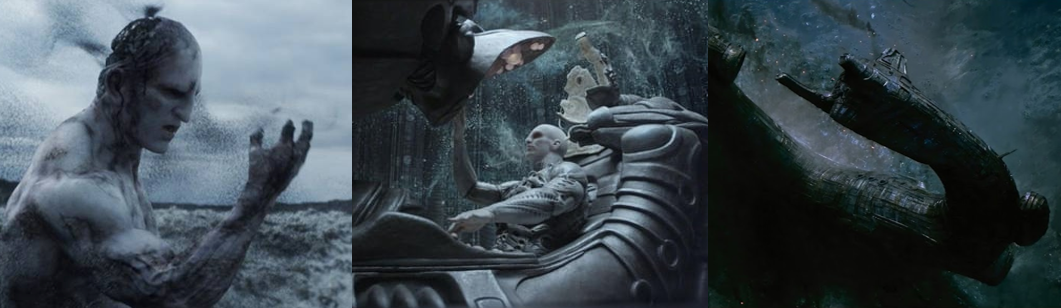
This leads me into perhaps the biggest thing I’ve always disliked about Prometheus: it goes out of its way to distance itself from being a direct prequel to Alien, but apparently without changing the script. The ship travels to LV-223, not LV-426 as seen in the original film, but encounters an Engineer ship exactly like the one discovered by the Nostromo and which crashes in exactly the same position as that ship. It’s honestly distracting as it feels like these elements were changed at the last minute, meaning they just had to roll with what was shot, though I suppose it wouldn’t make much sense for the Company to forget about the planet where their founder died for over 100 years. Prometheus also seems to decanonise the AVP films, for better or worse, by stating that the Engineers created human life (and, apparently, all life) and suggesting that the Xenomorphs haven’t yet been bred or aren’t as prevalent. There’s a mural in the chamber depicting a Xenomorph and the “Deacon” that emerges from an Engineer resembles an Alien, but the creature itself is otherwise absent as the film clumsily tries to lay the seeds for their origin, again awkwardly juggling being a prequel and a standalone story. Indeed, Prometheus is more concerned with existential questions about existence and evolution, faith and science, and the nature of humanity. The Engineers are revealed to have sparked human evolution, but apparently “changed their minds” about humanity over the thousands of years and were preparing to wipe us out with the black goo. We never really find out why or what the Engineers’ true purpose was. Janek suggests they were creating weapons of mass destruction on LV-223 and it can be implied that they seeded worlds to breed hosts for the black goo, but none of this is explicitly said, with Shaw simply believing humanity somehow angered their creators. An abandoned idea, however, was to have an Earth-bound Engineer be Jesus Christ, explaining their wrath against humanity.
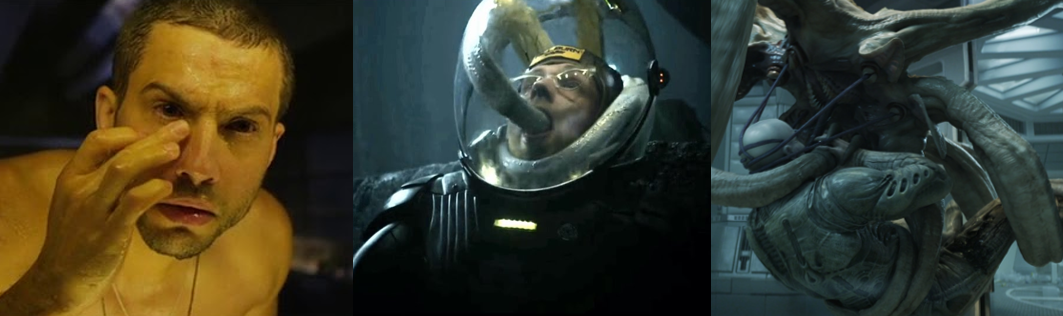
Instead of Xenomorphs, Prometheus offers a handful of other aliens and horrific creatures. The Engineer ship has that same unsettling, bone-like structure as before and is a disturbing combination of H.R. Giger and ancient civilisations like the Egyptians and Mayans. The dark, moody interior is littered with Engineer corpses, one of which has exploded from the inside out, and the crew unwittingly activate the black goo by disturbing the chamber’s ecosystem, causing it to horrifically mutate earthworms into Hammerpedes. This sees Fifield transformed into a bizarre, voracious, zombie-like creature that bashes some guy’s head in and must be run down and immolated to be killed. Holloway’s transformation isn’t as gruesome but does see his eyes go black and his skin malform as the black goo courses through his veins, leading him to invite Vickers to kill him before it’s too late. Thanks to them sneaking in some sexy time, Shaw is aghast to find she’s been impregnated with a rapidly growing alien parasite, which she forcibly removes with Vickers’ medical machine and which turns out to be a cephalopod-like creature that’s somehow an even more sexually disturbing and terrifying version of the traditional Facehugger. Unlike the elephantine “Space Jockeys” seen in the Dark Horse Comics, the Engineers are physical specimens and highly advanced, developing incredible technology and regularly kick-starting life on other worlds. Physically imposing and with science way beyond ours, they seemingly embody a physical and mental perfection far beyond humanity but are implied to have either become bored with humanity or to have always planned our extermination in the name of biological warfare. Despite their stature, David seemingly takes some pleasure in observing that the Engineers are as “mortal” as their creations and they were ultimately undone when one of their experiments somehow escaped and killed them (though we never see how this happened). Rather than being visually terrifying, it’s the implication of the Engineers which rattles most of the crew as they deconstruct religious and scientific ideas about humankind, though Shaw maintains her faith in a higher power as someone obviously made the Engineers.
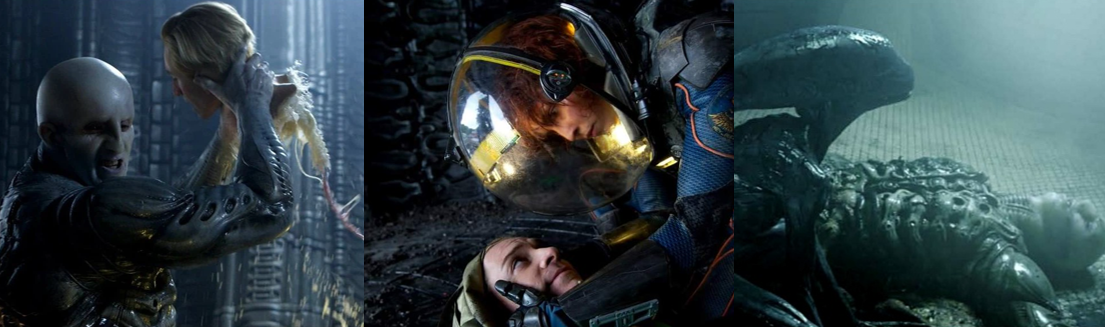
After extracting the Trilobite, the grievously injured Shaw discovers Weyland was on the ship all along and, despite being betrayed and manipulated by him and David, agrees to accompany him to confront the remaining Engineer, desperate to understand why they turned on humanity. Unfortunately, neither she or Weyland get any answers as the hulking brute barely acknowledges them and opts to rip David’s head off rather than answer Weyland’s desperate plea for more life. The Engineer then bashes Weyland with David’s severed head, unceremoniously killing him and making Weyland’s plea to the Gods as futile as David’s efforts to earn the respect of his organic peers. The Engineer then resumes its mission to unleash black goo on Earth and cull humankind. However, thanks to Janek, Chance, and Revel’s sacrifice, the Engineer’s ship is downed as it takes off, with Vickers crushed when it rolls to a stop and Shaw left exploring her badly damaged lifeboat, where the enlarged Trilobite latches onto the Engineer in a disturbingly sexual manner. Distraught and at her wit’s end, Shaw faces a slow and painful death from her dwindling oxygen supply when David’s severed head contacts her. Despite being wary of him, Shaw is convinced to return to the Engineer ship and recover the dismembered android as David reveals that there are more alien ships on LV-233 and that he can pilot them. However, upon reaching David’s head, Shaw states her desire to go further, to the Engineer’s home world, to demand answers from her makers and David agrees, despite knowing that Shaw will never get the answers or the closure she’s seeking. As they fly off to a fate that leaves one of them doomed and the other destined to upset the universe’s food chain, the dead Engineer violently bursts open and “births” the Deacon, a pseudo-Xenomorph that was sadly never seen again and whose fate remains a mystery.
Final Thoughts:
I remember being very impressed when I first saw Prometheus, seeing it as a return to the more atmospheric sci-fi horror of the 1970s and appreciating that it took its time and raised interesting questions about faith, evolution, and the origin of the Xenomorphs. Over time, however, my opinion has soured as I grew more and more resentful of it not being a more straightforward prequel, especially as all the elements are in place for that but were seemingly changed at the last minute. That aside, this isn’t an especially impressive film and feels ridiculously disconnected from Alien thanks to the overly elaborate technology and the largely bland and unrelatable characters. Janek’s the only one who evokes the down-to-earth vibe of the Nostromo crew as everyone else is either stupid, insufferable, bland, or just inferior. Shaw, especially, did little for me despite her impressive resolve and the others were too forgettable or idiotic to talk about. David was the obvious standout and exuded an unsettlingly menace in his subtle mannerisms and thinly veiled dialogue, to say nothing of him clearly being resentful towards his creatures. Guy Pearce was laughable under all that make-up and made me wish they’d just brought Lance Henriksen back to the role, though I did like the bitter narrative regarding the search for answers. While the film looks great and has some disturbing moments, none of the creatures had the same visceral impact as the Xenomorph and the attempt at an origin fell flat as the narrative felt muddled since it doesn’t know if it wants to be a prequel, a standalone, or something else. Even now, I rarely revisit this one as it’s pretty tedious to get through and has few saving graces. I appreciate that Prometheus tries to be somewhat vague about the Engineers and the Xenomorphs, but it just doesn’t gel very well with the story that’s being told and feels like all its potential was sucked out the airlock by a pretentious, confused script. In the grand scheme of the Alien franchise, Prometheus is easily forgotten, and I can’t say my opinions have changed for the better since its release.
Could Be Better
Did you enjoy Prometheus and, if so, why? Were you also disappointed that it wasn’t a straight-up prequel or did you like that it tried to do something more? What did you think to Shaw and her search for answers? Is David your favourite synthetic character? Why you you think the Engineers wanted to destroy humanity? Which of the Alien movies is your favourite and why, and how are you celebrating Alien Day today? Whatever your thoughts, eave them below and support me on Ko-Fi for more Alien reviews.


3 thoughts on “Movie Night [Alien Day]: Prometheus”