In 1995, Marvel Comics created “National Superhero Day” and, in the process, provided comics and superhero fans the world over with a great excuse to celebrate their favourite characters and publications.

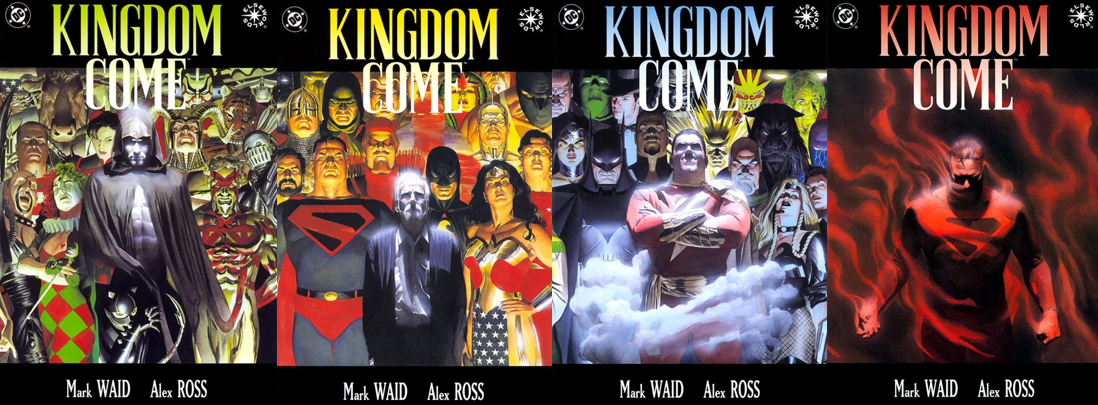
Story Titles: “Strange Visitor”
“Truth and Justice”
“Up in the Sky”
“Never-Ending Battle”
Published: May 1996 to August 1996
Writer: Kurt Busiek
Artist: Alex Ross
The Background:
While working on Marvels (Ross, et al, 1994), artist Alex Ross pitched a similar “grand opus” to celebrate DC Comics’ long and illustrious history. Inspired by a similar, rejected proposal by Alan Moore, Ross brought his signature photorealistic artwork to this acclaimed, thought provoking miniseries. Kingdom Come was such a hit that it spawned numerous spin-offs and follow-ups and has influenced DC Comics ever since.
The Review:
Perhaps the greatest DC “Elseworlds”, Kingdom Come begins with audience surrogate and main character, pastor Norman McCay, visiting the aged, sickly Wesley Dodds/The Sandman. Wesley has been driven to near mania by nightmares of an apocalyptic future, one akin to the “Book of Revelations” and dismissed as the delusions of a dying old man. Insistent to the end, Wesley begs Norman to read from the Bible to understand the coming crisis but passes before he can fully explain himself. Having met Wesley near the end of his life and shared many dinners with him, Norman is somewhat aggrieved that he took Wesley’s stories of his past heroics for granted, especially as this is a world (since designated Earth-22) where superheroes (or “metahumans”) are a controversial topic. Wandering the streets, Norman reminisces about how Wesley despaired of society, which placed so much faith in a new, more violent and less morally skewed generation of superheroes and wished more than anything for the legends of yesteryear to be remembered rather than reduced to mere pastiches by the likes of the Planet Krypton restaurant chain. Recognising that “hope” has become a precious commodity, Norman tries to take solace in scripture, but his faith is tested as the “mighty” far outweigh the “meek” and seem destined to inherit the Earth. The heroes of today are largely the children and grandchildren of legends, numbering in the thousands and fighting mainly for their own egos, having eliminated most old-school supervillains and caring little for the collateral damage their battles cause. Indeed, it’s up to normal folk like Norman to rescue crying children from these dangerous conflicts, though even he despairs for the fate of the world when Earth’s greatest and most belligerent “hero”, David Sikela/Magog, led the Justice Battalion against the confused and desperate Parasite and caused widespread devastation when he split Nathaniel Adam/Captain Atom open in a panic and decimated Kansas with a nuclear explosion.
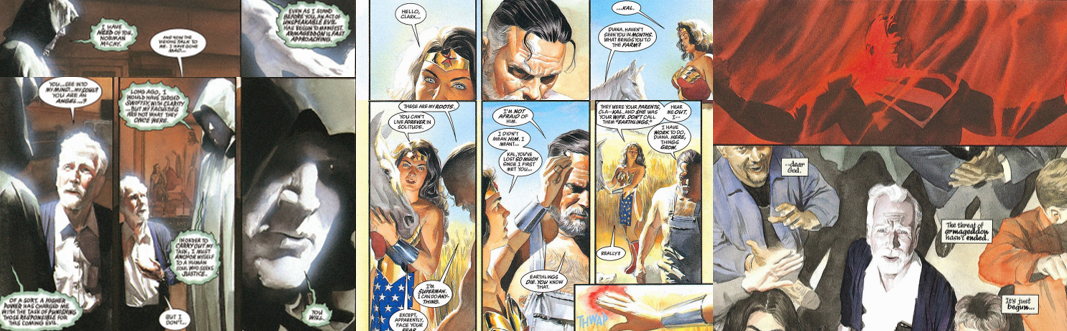
Already suffering from the same horrific visions that plagued Wesley and rattled by these events, Norman believes he’s gone mad when Jim Corrigan/The Spectre appears and tasks Norman with assisting him in judging the world in Wesley’s absence. Though initially reluctant, Norman accompanies the Spectre to a seemingly innocuous midwestern farmland (actually an elaborate virtual reality environment tied to the Fortress of Solitude), where the aged, bitter, reclusive Clark Kent/Kal-El-Superman has exiled himself and his livestock after losing faith in humanity. Norman watches, unseen and unheard, as Princess Diana Prince/Wonder Woman visits Clark Kal and expresses concern for him, believing he has lost touch with humanity after all the losses he’s suffered. Annoyed at Kal’s dismissive stubbornness, Wonder Woman demands that he remember what he once stood for (“truth and justice”) and review Magog’s destructive behaviour. Though stoic, Kal’s obviously disturbed by the devastation, yet he urges Wonder Woman to return to Themyscira where she will be safe. The Spectre reveals that Superman’s exile caused many of his contemporaries to also give up their crusade, but not all: Wally West/The Flash (now pure energy) still patrols Keystone City as a lightning fast “guardian angel”, an unknown Hawkman protects the forests of the Pacific Northwest, and Alan Scott/Green Lantern guards the Earth from extraterrestrial threats from an emerald-hued space station. Bruce Wayne/The Batman also still maintains order in Gotham City (despite being confined to an exoskeleton) with a series of Batman-themed robots. Angered that their successors have become even more reckless after Kansas, Norman rages at the Spectre, asking why he or his “higher power” didn’t stop the madness. While the Spectre remains impassive, Norman’s pleas are answered when a noticeably changed version of Superman makes a dramatic return, immediately awing the masses but bringing only dread to Norman as his visions tell him this is a sign of greater conflict.
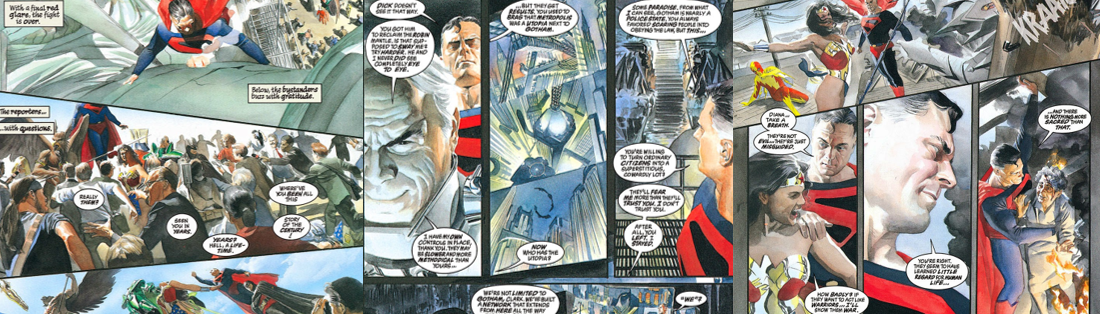
Norman finds himself displaced from time and space as the Spectre follows the pastor’s visions, eventually watching with horror as super-patriot (and aggressive fascist) the Americommando and his Minutemen attack immigrants coming to the United States. Luckily, the reformed Justice League (Superman, Wonder Woman, Green Lantern, the Flash, Hawkman, Kara Zor-L/Power Woman, and Raymond Terrill/The Ray) quell the danger, with Richard “Dick” Grayson/Red Robin also dispatching two psionics (the Brain Trust) who were escalating the situation. The Justice League then address the world’s press from the United Nations to state their intentions: namely, to inspire hope in people once more and mentor their misguided protectors into more benevolent force, though Superman is noticeably reluctant to discuss Magog given their history. Still puzzling the link between Superman and his prophetic visions, Norman accompanies the Spectre and Superman to the remains of Wayne Manor, obliterated years ago when Bane and Harvey Dent/Two-Face exposed Bruce’s identity. Since then, he’s lived in the Batcave, his crimefighting efforts largely aided by the deaths of many of Gotham’s worst criminals in unsanctioned bombings. Bruce dismisses Superman’s offer to join the new Justice League, persists in calling him “Clark”, and criticises Superman for pretending like the state of the world is anything new. Bruce believes the metahuman situation requires a finesse the Justice League isn’t equipped for and is as unimpressed that Superman recruited Dick (Batman’s former partner and adopted son) to his cause as Superman is that Gotham is now a police state ruled by fear. Bruce has his own allies (Oliver Queen/Green Arrow, Dinah Lance/Black Canary, and Ted Kord/Blue Beetle) and his own plans to address the situation. Norman’s stunned at the bickering between Batman and Superman but watches with hesitant optimism as the Justice League, through diplomacy and force alike, turn others to their cause and bring hope to the masses.
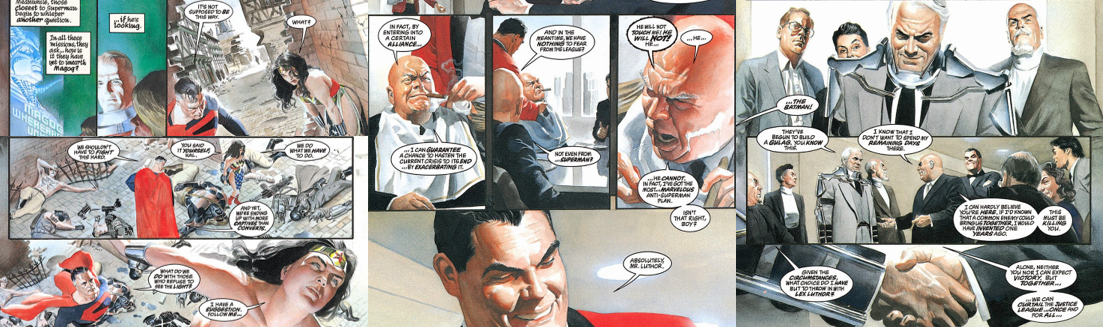
Norman and the Spectre then observe a meeting between Lex Luthor and his “Mankind Liberation Front” (including Selina Kyle/Catwoman, immortal tyrant Vandal Savage, and Raʾs al Ġhūl’s heir (and Batman’s illegitimate son) Ibn al Xu’ffasch). Luthor offers medical aid to the Kansas victims while also outfitting survivors of the Belle Reve and Arkham Asylum massacres to arm vigilantes and metahumans to their cause, aiming to heighten tensions between humans and metahumans so humanity can reclaim their world through war. Justice League’s unexpected return sees Luthor’s plan escalate to a ten-day plan that largely depends on Billy Batson/Captain Marvel, who’s been swayed to Luthor’s manservant. Next, Norman observes as the Justice League gate-crash a metahuman bar and chastises the patrons, offering the chance to be better or be dealt with, only for the awestruck metahumans to receive an alternative pitch from Green Arrow. Still, many join Superman and setup their headquarters in Green Lantern’s emerald space station to spread their mission across the globe. When Superman shares his concerns about the resistance they’ve met, Wonder Woman takes him to Atlantis to ask King Arthur Curry/Aquaman to setup an underwater penal colony for rebellious metahumans. Although Diana tries to appeal to Aquaman by reveal that she’s been stripped of her royal heritage and has committed herself to improving the world, he refuses to grant the request as his focus remains on his people. Superman’s similar talks with Orion end in failure as he’s disappointingly become as grim and ruthless a ruler of Apokalips as his father, Darkseid. Although Scott Free/Mister Miracle and Big Barda provide the solution (a labyrinthine gulag built on the ashes of Kansas), this sees Batman and his allies join forces with Luthor in response. Superman’s worries about Wonder Woman’s anger are shelved when Magog resurfaces in the wastelands of Kansas, desperately trying to repair the damage he caused.
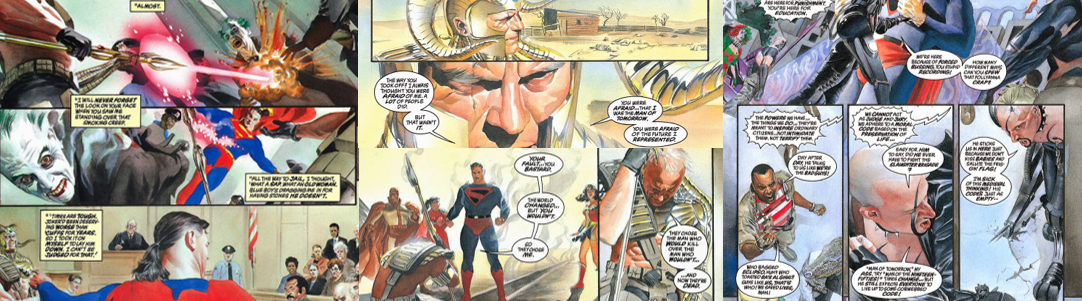
When Superman chastises him, Magog challenges him to punish him, mocks him, and then blames the Kal for everything that happened ten years prior since he refused to change with the times and the people’s demands for darker, more violent heroes. Magog bitterly recounts how the Joker easily murdered the Daily Planet staff, including Superman’s wife, Lois Lane, because of the heroes’ refusal to kill. Magog had no such compunction and publicly murdered the Joker, only to be arrested by Superman and summarily acquitted for ending the Joker’s threat. Magog was then slighted when Superman refused to acknowledge him as Metropolis’s “number one” and exiled himself in disgust rather than fighting for that title. Interestingly, Magog isn’t some unhinged psychopath. Instead, he’s incensed that he had to become the man, the killer, Superman refused to be and blames him for it, submitting to Superman’s custody after raging at the Man of Steel. Yet, Norman’s cataclysmic visions only increase, especially as the gulag is filled within two weeks, its embittered inmates only incensed by Superman’s hologrammatic lectures. The events catch the attention of God-like beings like the Wizard, Shazam, the Phantom Stranger, and Ganthet, who refuse to intervene since the affairs of man are insignificant in the grand scheme of things. While observing this, Norman is approached by Boston Brand/Deadman, who questions the Spectre’s motivations as he’s lost touch with humanity since becoming God’s avenging spirit. While Superman and Wonder Woman debate metahuman ethics and motivations, Luthor subjects Captain Marvel to further brainwashing using a combination of his silver tongue, doctored videos, and Mister Mind’s psychic powers. Luthor the reconvenes with his allies, sure to keep Batman on side by talking of necessary evil rather than world domination and reveals that Superman’s no longer vulnerable to Kryptonite, though Batman assures him that the youths they’ve recruited are more than willing to fight.
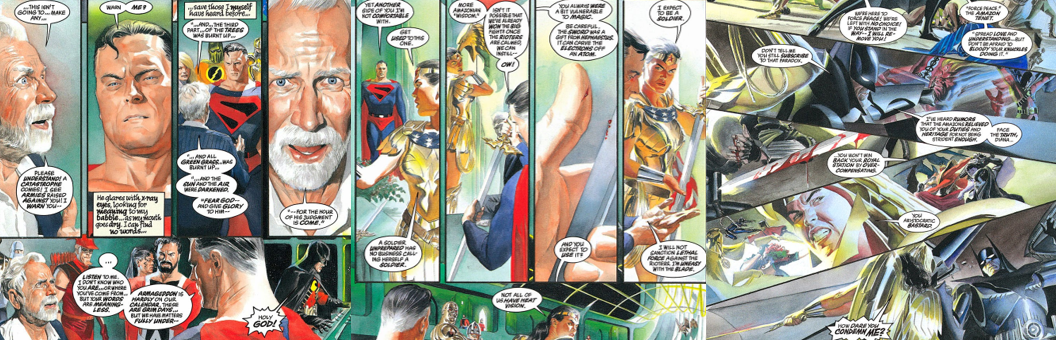
While listening in to Red Robin’s concerns about the gulag, Norman is stunned when the Flash drags him into the real world. Met with suspicion, Norman tries to warn Superman of the coming apocalypse, only for his fears to first be disregarded and then come to light by reports of a riot at the gulag. Although Superman orders it to be quelled peacefully, Wonder Woman orders the opposite, leading to some conflict between them ahead of their meeting with the United Nations. Despite Superman’s assurances, the representatives are unimpressed with their God-like saviours and their prison and ready to act for themselves, if necessary. When Luthor prepares Billy to capitalise on the gulag riot, Batman punches him out and betrays Luthor, subduing him and his allies and trying to reason with Billy, only for him to panic and explosively become Captain Marvel. Superman’s fears about Wonder Woman’s warrior lust come to a head when she dons her ceremonial battle armour and leads their allies to war when the gulag riot turns violent and fatal, forcing Superman to demand help from the Batman before things escalate further. After learning of Captain Marvel’s threat, Superman speeds to the battlefield, only to be intercepted by the Big Red Cheese and a fist fight to break out between them as the Justice League battles the rioting prisoners in all-out war! Norman is horrified to see his visions coming to life and begs the Spectre to intervene, though he refuses as he’s simply there to judge. While Superman unsuccessfully tries to talk sense into Captain Marvel, the United Nations tasks the Blackhawks with launching three multi-megaton nuclear missiles at the site, reasoning that the collateral damage is acceptable to ensure the survival of the human race. Norman watches as both sides (Wonder Woman, especially) use lethal force, all moral qualms abandoned, and Batman and his allies try and subdue and save whoever they can, leading Bruce and Diana into a moral and physical conflict.
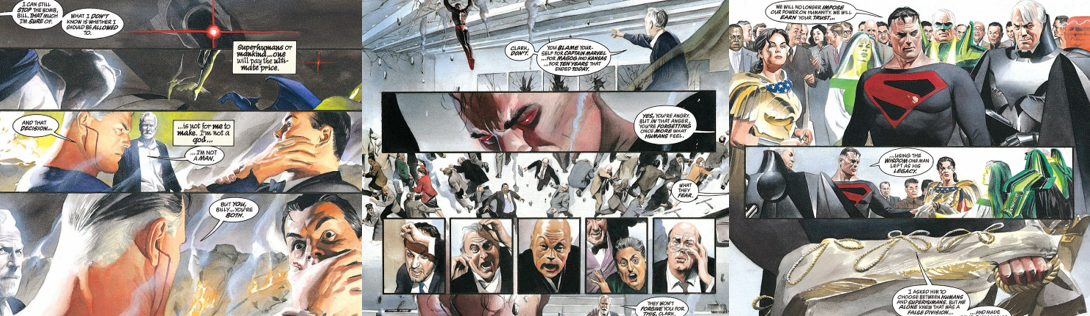
When they spot the incoming Blackhawks, Wonder Woman finally sees she’s consumed by anger and violence and tries to intercept the planes alongside Batman, toppling two of three. Superman struggles against Captain Marvel’s magic and desperately shuts him up, rendering him powerless, but is horrified to see the third, wayward nuclear missile heading towards them. When it easily shrugs off Superman’s heat vision, he hesitates to intercept it, unsure if he should keep it from destroying them all. Reasoning that Billy, who’s both man and demigod, is the best to make the decision, Superman begs for his help and releases him before racing towards the missile. The Spectre then turns to Norman and demands that he decides what should happen, shouldering the burden of judgement to the unsure priest, who sees “good” and “evil” on both sides. Ultimately, Norman’s unspoken decision impacts Superman and Billy, who transforms into Captain Marvel one last time and takes Superman’s place, unleashing his magic upon the missile and detonating it up high. Norman is as devastated as Superman to see the battlefield littered with charred corpses and few survivors. Overcome with grief and rage, Superman turns his wrath on humanity and, enraged at the Spectre’s impassive nature, Norman demands to talk sense into him. Thankfully, Norman succeeds, appealing to Superman’s better nature and talking him down, with him and the other survivors vowing to exist alongside humans as equals rather than acting as Gods. Thus, Batman follows in his father’s footsteps and becomes a healer, caring for any survivors and building bridges with his family; Wonder Woman reconnects with her sisters; Green Lantern joins the United Nations; and the Spectre thanks Norman for giving him perspective, with the whole experience having reaffirmed Norman’s faith in a higher power. After building a fitting monument to the lives lost, Superman works to restore Kansas and begins a new life with Wonder Woman as lovers, with them naming Bruce godfather to their pending child and the DC Trinity finally committed to making the world a better place together.
Final Thoughts:
Unquestionably, Kingdom Come is an absolutely gorgeous and glorious piece of work from Alex Ross, with the artist’s signature, painted realism bringing these classic characters to life in ways never seen before. Although it’s similar to Marvels in that we follow a mortal man as he observes these God-like beings, Kingdom Come presents a possible future for the DC Universe with a new generation of violent anti-heroes. Thus, the likes of Batman, Superman, and Wonder Woman are aged and noticeably changed by time and conflict, meaning the story doesn’t present these characters at their physical peak and renders many in very different guises, yet it beautifully captures the spirit of their morals, conflicts, and very personalities in its morality tale. Superman, especially, is rocking a striking look. While his costume is extremely familiar, his signature S-shield is visibly simplified and tinged with black to show he’s still morning his losses and attempting to be the light against the dark. Wonder Woman is largely unchanged, but more focus is placed on her warrior heritage, especially when she shuns Superman’s more pacifist ways and takes up her Themysciran armour for war. Batman is only briefly seen in his recognisable suit in a flashback and is dramatically presented as physically broken and relying on an exoskeleton, but is no less cunning and capable, employing gigantic robotic bats to curb any crimes in Gotham and eventually donning a mechanised Batsuit for the finale. I especially liked Green Lantern’s emerald armour and the Flash’s disembodied look, and the blend of “Golden Age” and “Silver Age” heroes, such as using Alan Scott and Wally West. While these legendary heroes are changed, they’re still recognisable and inspire the same awe (and fear) from the masses, who embraced more violent heroes some time ago, ones whose designs are purposely exaggerated and “extreme”.
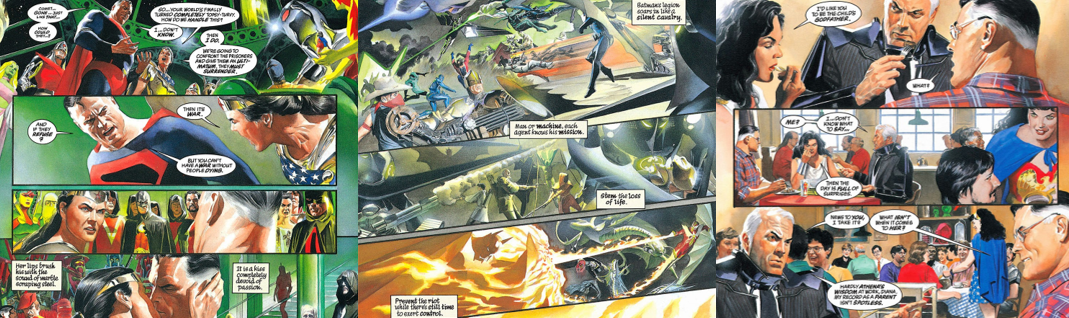
Magog is the figurehead of this new generation. Donning golden, ram-like armour and wielding an energy staff, Magog won over the people when he did what other heroes refused to do and made violent supervillains pay for their crimes with their lives. It’s an interesting ethical quandary as, undoubtably, the Joker is more than deserving of the death penalty but, on principal, Superman cannot sanction wanton execution and is disgusted when the people embrace such violence. Interestingly, Magog isn’t exactly happy about having to be what Superman refused to be, and it’s implied he would’ve preferred to be more virtuous but was forced to fill that void because the “old guard” wouldn’t change. The absence of the legendary heroes and the rise of increasingly violent vigilantes saw conflicts escalate as “heroes” disregard the innocents caught in their crossfire and cause as much damage and death as they prevent, with them only resenting being locked up and judged by the reformed Justice League. While Superman urges his followers to teach and inspire first, he’s forced to imprison those who refuse to conform, which quickly skews his mission as he and the Justice League act autonomously, agitating the United Nations and causing many to question their methods. This is part of the reason why Batman refuses to join the new Justice League as he’s always been a little resentful of metahumans, but he also sees that the situation requires a more strategic approach. He allies with Luthor to influence those on his side away from all-out war and worldwide domination, though largely out of his own sense of self-preservation due to his stubborn nature. Though Wonder Woman urges Superman to reconnect with humanity, she’s ironically as separate from them as he since she takes a far more aggressive approach towards the rebels, believing that violence is often necessary to ensure peace and still clinging to her demigod status despite being ostracised from Themyscira.
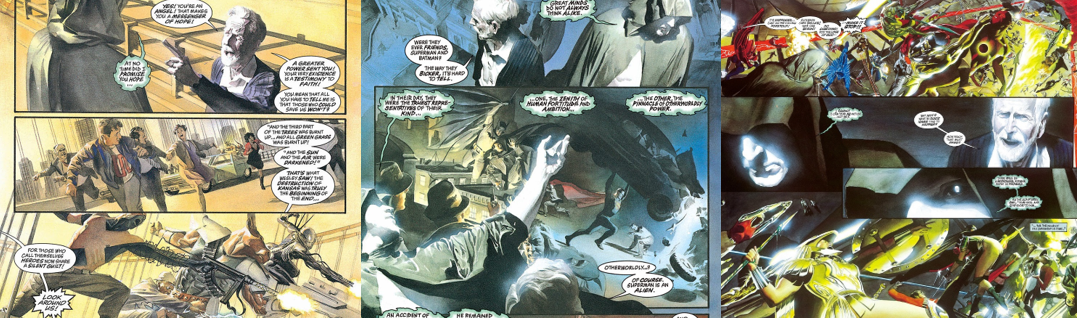
Norman is not only our guide through all this, but also the Spectre’s. Norman’s amazed by the events he witnesses, which test his faith in the metahumans of hold and in the almighty, with him astonished to see just how flawed and vulnerable these God-like beings really are. Norman’s understandably enraged at the Spectre, and God, for simply standing back and letting such awful things happen, though the Spectre impassively maintains that it’s not their place to intervene…only to judge. Norman’s journey is a tumultuous one, with him seeing heroes and villains on both sides, meaning his final judgement is clouded by shades of grey and isn’t as simple as saying they all deserve to live or die. This is the same conflict that laces disagreements between Superman and Wonder Woman, as one wants to preserve and improve life, and the other is adamant to protect it. In the end, Norman is faced with an impossible, heart wrenching decision that he seemingly subtly delegates to Superman and Captain Marvel, meaning Norman carries as much of the guilt for all the deaths as Superman. Yet, Norman has seen how inspiring these heroes can be and how they need to use their powers for the greater good by acclimatising with humanity, with both sides understanding that they’re each flawed and must work together for the greater good. I loved seeing Superman so consumed by guilt and rage that he became a wrathful God ready to scorch the Earth, and that Norman managed to appeal to his humanity and core values. It’s not a pretty end, as many lives are lost, much has been destroyed, and there’s a lot of work and healing to be done, but the message is clear: there’s hope for the future. This sees the DC Trinity reunite as equals, committed to improving the world using all their talents, rather than just being seen as God-like figures to be revered, feared, or hated. All this makes Kingdom Come one of the most emotionally engaging and visually stirring tales in all of comics and easily places it as one of the quintessential alternative takes on these beloved characters.
My Rating:
Fantastic
Ae you a fan of Kingdom Come? Do you also appreciate Alex Ross’s artwork? Were you shocked to see the classic DC superheroes so changed by time? Do you prefer violent anti-heroes or those with a moral compass? Would you have saved or destroyed all the characters if you were in Norman’s shoes? Which DC Comics character is your favourite? How are you celebrating National Superhero Day today? Whatever your thoughts, leave a comment down below, support me on Ko-Fi, and check out my other superhero and comic book content.


You must be logged in to post a comment.