Game Corner [Mario Month]: Super Mario Bros. Wonder (Nintendo Switch)


So, for no better reason than “Mar.10” resembling Mario’s name, March 10th is widely regarded as being “Mario Day”, a day to celebrate Nintendo’s portly plumber, an overalls-wearing mascot who literally changed the videogame industry forever and shaped the home console market of the nineties.


Released: 20 October 2023
Developer: Nintendo EPD

The Background:
Following the collapse of the videogame industry from a slew of overpriced consoles and mediocre titles, Nintendo revitalised the landscape with Super Mario Bros. (Nintendo EAD, 1985). Once the “Console Wars” of the mid-nineties ended, Nintendo and their famous mascot became an innovative and reliable staple of the videogame industry. After successfully transitioning into 3D gaming, Nintendo continued to pay homage to Mario’s 2D roots with hit 2.5D titles. Shiro Mouri, director of New Super Mario Bros. U Deluxe (Nintendo EAD, 2012), returned to develop Super Mario Bros. Wonder and he and his team worked without a deadline, allowing them far more freedom to develop new ideas. Producer Takashi Tezuka suggested implementing a gimmick that would alter the game’s locations in fun and wacky ways, birthing the “Wonder Flower” mechanic, and features and accessibility options were implemented to make the game appealing to players of all ages. A live commentary feature was scrapped early on, long-time Mario voice actor Charles Martinet was replaced for the first time following his retirement, and Mouri also personally lobbied for Princess Daisy to be included so girls (specifically his daughters) would have more playable options. Super Mario Bros. Wonder was met with widespread acclaim; critics adored the gameplay innovations and responsive controls, and it sold 4.3 million units in its first two weeks alone.

The Plot:
While visiting the Flower Kingdom, Mario and his friends are stunned when Bowser, King of the Koopas, steals the Wonder Flower, turns himself into a giant flying fortress, and wreaks havoc throughout the kingdom. Our heroes thus travel across this new land to gather the Royal Seeds and stop their nemesis.

Gameplay and Power-Ups:
Like its 2- and 2.5D predecessors, Super Mario Bros. Wonder is a 2.5D action platformer, albeit one that gives players twelve characters to pick from and offers four player co-op, both on- and offline. Players journey across the Flower Kingdom collecting golden Coins (100 of which will grant a 1-Up), stomping on Goombas, and leaping to flagpoles to clear the six main stages (known as “Worlds”) alongside Prince Florian, a caterpillar-like character who pops out when you’re idle and chimes in during cutscenes. Regardless of which character you select, they all control the same with the exception of Yoshi, who can flutter jump by holding A (giving you a bit more airtime to clear gaps) and eats enemies and spits them back out with B. Otherwise, you can pick from two control schemes and choose to play with or without motion controls. The setup I chose saw me jumping or swimming with A (holding it to jump higher), running and picking up certain objects (like Koopa shells) by holding B (releasing it to launch my item upwards or straight ahead), and ground pounding by pressing ZL in mid-air to squash enemies and break blocks. Y brought up an emoji wheel to communicate to other players and X either placed a standee (used to revive players in co-op) or spawned an item balloon when I had one saved up. Pressing R performed a spin jump and jumping against walls and vertical surfaces performed a wall jump. You can also hold down when on slopes to slide into enemies, and pressing the L and R triggers together in co-op sees you become a ghost to float around stages. Also, you can jump atop and ride Yoshi players in multiplayer and press B to perform your special attacks when you have a power-up item.

Mario and friends utilise new power-ups and the Wonder Flowers to explore this new kingdom.

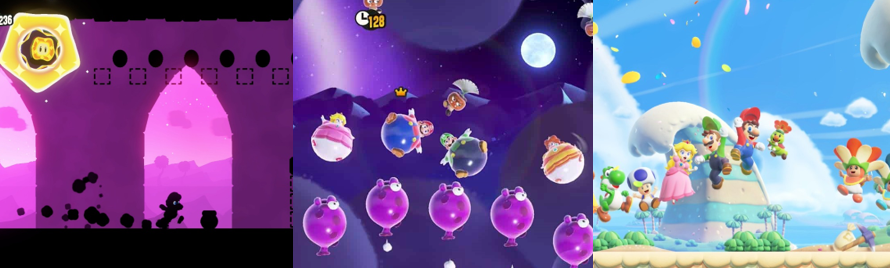
As you might expect, grabbing a Super Mushroom allows your character to grow and take an extra hit and break certain blocks. Get hit when in your small form and you’ll lose a life, respawning either at the beginning of the stage or from the last checkpoint you touched. Touching a checkpoint automatically causes you to grow if you’re small, rare green mushrooms grant extra lives and Fire Flowers let you toss fireballs to defeat enemies and melt ice blocks. Blue Coins appear when you hit P Switches, POW blocks defeat all onscreen enemies and break all visible blocks, and Super Stars make you invincible for a short time and add a somersault to your jump. This is all very familiar but Super Mario Bros. Wonder does add in three new power-ups. The Bubble Flower sees you throw bubbles to trap and defeat enemies and make temporary platforms, the Drill Mushroom lets you dig into floors and ceilings to reach new areas, and the Elephant Fruit transforms you into a rotund elephant that smacks enemies with its trunk and sprays water to cause various effects whenever you enter a fountain. If you have one power-up active, you’ll store the next one as a bubble, which is very useful as an extra chance to bypass tricky areas, and you can even commandeer Lakitu’s cloud or ride Missile Megs and Ancient Dragons to clear gaps. Wonder Flowers are the game’s biggest new feature and temporarily alter the game’s environments or your character’s appearance to mix things up. You’ll see Warp Pipes come to life, adopt a top-down perspective, float around in zero gravity, race to collect Wonder Tokens, ride along stampeding enemies, get chased by King Boo, and even explore in near darkness when the Wonder Flower is collected. These also transform you into new forms, such as a Goomba (stunting your jump but allowing you to safely cross spikes), a Biyon (stretching your character considerably), a Hoppycat (increasing your jump height), a floating balloon, granting you the Metal Cap power-up, and allowing you to stick to walls and ceilings as a Wubba, amongst other effects. These effects are sometimes timed but will last until you find a Wonder Seed or clear the stage and really add to the visual variety and mix up the gameplay as you never know what effect the Wonder Flower will have.

You’ll need all your skills and the game’s Badges to find all the collectibles and stop Bowser.

Sadly, this variety doesn’t extend to the playable characters as much as I’d like. Luigi jumps higher and has less traction than the others, Toad seems to have floatier jumps, and the Yoshis and Nabbit are invulnerable to damage (but can still lose lives), but Princess “Peach” Toadstool doesn’t have her glide ability and I question the logic behind having three Toads and four Yoshis rather than putting in Wario and Waluigi. Still, the game does allow for some character customisation in the form of “Badges”, which are either bought using the new purple Flower Coins (with three 10-Flower Coins hidden in most stages) and by conquering bite-sized Badge Challenge levels. You can equip one Badge at a time and each one grants different buffs or abilities, such as allowing you to glide by holding R, adding to your wall jump, increasing your running or swimming speed, and allowing you to snag platforms with a vine. Other abilities are more passive, such as allowing you to sense nearby collectibles, giving you a one-time save from instant-death traps like pits and lava, or turning every power-up into a specific item. You can also earn “Expert” Badges that further increase your running speed and add a limited double jump, turn you invisible (actually more trouble than it’s worth), add a spring to your step for added jump height, or allow you to hear strange voices. While it’s fun challenging for and collecting the Badges, I stuck with the Parachute Cap for my entire playthrough bar one or two exceptions as it was far more useful to add a short glide to my arsenal than anything else. You can also spend your Flower Coins on new standees (which are randomised), 1-Ups, Wonder Seeds, and paying off the local Poplins to repair bridges or smash rocks to create shortcuts and open new areas on the overworld. Furthermore, if you search hard enough, you’ll not only uncover new stages to challenge but also meet Captain Toad, who’ll gift you some Flower Coins, alongside visiting the locals to get Wonder Seeds or be told of regional issues caused by Bowser’s influence.

There’s a lot of challenge and variety on offer thanks to the Wonder Flowers.

While Super Mario Bros. Wonder contains many of the same gimmicks and mechanics you’d expect from a Super Mario title (platforming, taking Warp Pipes, smashing blocks, climbing vines, sliding on ice, and dodging fireballs are all common tropes recreated here), the game is structured more like an obstacle course than ever before. You’ll be taking Warp Pipes to the foreground and background, pushing pipes and blocks to clear paths, entering doors and taking leaps of faith, hopping to moving, spinning, and temporary platforms, and dashing across zip lines to reach new areas. Like many Super Mario games, there are often hidden exits to find (generally by collecting or avoiding Wonder Flowers), you’ll need to face Boos to stop them in their tracks or lure them into the light to destroy them, and bottomless pits, boiling lava, and toxic gunk will instantly end your run if you’re not careful. You must also avoid giant spiked balls, lure Bulrushes and Konks into smashing through blocks, outrun shadowy enemies who relentlessly chase you, time your jumps to avoid being hit by Hoppycats, stay out of reach of Maw-Maws so they eat enemies instead of you, and hold B to unzip the background, unwrap Mumsys, and send Revvers dashing. Sometimes, you’ll grab keys to open doors; others, you’ll be climbing or shimmying across striped poles. Often, you’ll touch Wow Buds to spawn Coins or cause platforms to appear, move, or sway. Balloons must be popped, balloon-like enemies need to be carefully bounced across to clear gaps, and rhythm platforms and mushroom trampolines will have you timing your jumps to progress higher. You’ll also cross hazards in rolling wheels or on rafts made from dinosaur fossils, and transport to the clouds using Propeller Flowers. Timer Switches activate block platforms for a short time, Bowser’s ship fires from the background, you’ll ride an out-of-control avalanche, race against Wiggler, and battle through autoscrolling sections on Bower’s battleships, dodging Bullet Bills and flame bursts that’ll test your reaction times. The difficulty spike is pretty fair, and each stage has a star difficulty to alert you to the challenge on offer. Things never get too tricky and you can always purchase additional lives from the shop, though the game does ramp up as you progress and offer incredibly tough missions up in the Special World.

Presentation:
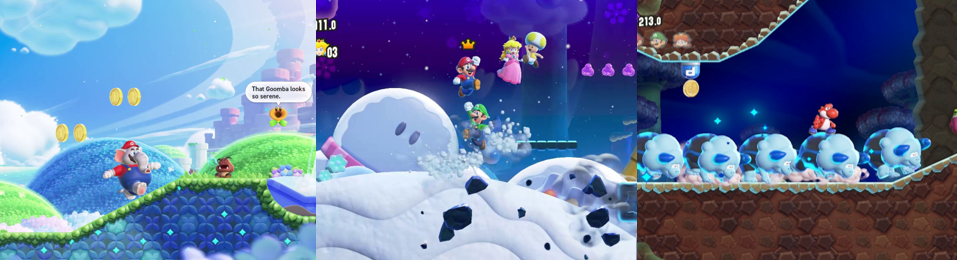
Super Mario Bros. Wonder is, in a word, gorgeous. 2.5D Mario has never looked or played better than here, with the game performing incredibly well throughout and the action never slowing down. It helps that most stages are bite-sized obstacle courses and that there’s a lot happening in every stage. Talking Flowers are everywhere, offering encouragement, calling for help, or commenting on the effects of Wonder Flowers. These, as mentioned, alter the stages so drastically that it’s almost like having two versions of most stages at times. They’ll be plunged into darkness, surreal colours bombard the player, and a kaleidoscope of bizarre and amusing effects spawn once you touch them, making for an enjoyable twist on the tried-and-tested formula. Mario and his friends might not play as differently as I’d like but they’re full of life and personality. Chattering through gibberish and pantomime movements, they hop and explore like never before, with caps flying off as you jump or fall or being swiped when you enter pipes. Your Elephant form squeezes through narrow passageways and Prince Florian pops out whenever you’re left idle or finish a stage. The game takes into account which character you’re playing as, too, with character-specific hidden blocks appearing in stages, personalised flags appearing at checkpoints and end goals, and the in-game text referring to whomever you’re controlling at that time. The music is as catchy and whimsical as ever; classic Super Mario tunes return, as you’d expect, as end of stage and power-up jingles but also for bonus stages and boss battles. The story is light-hearted and secondary to the action, for the most part, but just different enough to be unique. Peach isn’t a damsel in distress, for example, Bowser’s ominous ship form looms in the centre of the overworld, and you’re even actively searching for lost Poppins when you explore the Fungi Mines.

Mario has never looked better in this colourful, quirky adventure.

While Super Mario Bros. Wonder doesn’t break the mould that much when it comes to its stage designs, everything looks great and there are a lot of stages on offer in each World, with each sporting a unique and interconnected overworld. Things start relatively familiar in Pipe-Rock Plateau, where Warp Pipes are prevalent and you’ll be bouncing from Hoppos, before taking a turn for the surreal in Fluff-Puff Peaks. With the action mostly up in the clouds, you’ll be adding to your temporary platform in “Cruising with Linking Lifts” and slipping on icy platforms as you make way for Pokipedes on their set paths. Shining Falls adds an isometric aesthetic to its overworld and offers unique platforming challenges as the Hoppycats copy your jumps, the Anglefish fly from different directions, and you race along at high speeds on Zip Tracks. The Sunbaked Desert sees new stages appear from the arid sands as you explore or open by performing tasks on the overworld, and its stages have a tangible Arabian theme. You’ll be exploring a door maze in the Shova Mansion, gatecrashing the Ninji’s jump party, and exploring pyramid-like tombs for goodies. Things take an ominous turn in the Fungi Mines, where toxic clouds and goop lurk amongst haunted mansions and destructive rifts in the fabric of reality. The Deep Magma Bog overworld is not only the most menacing yet but also a maze of tunnels and paths. Its stages are volcano themed and feature dinosaur bones, fireballs, and flaming enemies who rush from the walls. As you explore the overworld, Kamek occasionally spawns huge Bowser-themed battleships not unlike those seen in Super Mario Bros. 3 (Nintendo EAD, 1988). Here, the game becomes an autoscrollers and you’re forced to avoid numerous hazards and destroy the central core, which doubles as a baddy maker. Finally, simple cutscenes and interactions with the locals pepper the action, with the game concluding with an all-out frenzy to get the highest score during the credits as recycled (now non-lethal) hazards fly past.

Enemies and Bosses:
Many of Mario’s most recognisable enemies make a return in Super Mario Bros. Wonder. Goombas will snooze in stages and wander or float about, Piranha Plants of various sizes pop up from pipes to bite you or spit fireballs, green and red Koopas trot about or flutter in the air, Bullet Bills blast across the screen, Boos shy away from your gaze, and Hammer Bros toss hammers in an annoying arc, as ever. Mechakoopas patrol Bowser’s battleships and castles, Pokeys wander the desert, Lakitus drop Spinys, Thwomps try to crush you, and Cheep Cheeps swim about underwater to get in your way. These are joined by some new enemies, with some offering different mechanics. The Babooms, for example, shoot fireworks that can be used to defeat enemies above you. Blewbirds fire their beaks, which then become platforms, Bloomps can be bounced on to clear gaps, Bulrushes can be ridden, and Wonder Hoppins can be tricked into smashing through the stage to make new paths. Mumsys must be unwrapped by grabbing their handle, Noknoks masquerade as doors, Renketsu Search Killers offer themselves as temporary, explosive platforms, and Skedaddlers spit seeds and run off with collectibles. Shovas push pipes and blocks about, Smogrins lurk near tricky jumps, you can swing across gaps by grabbing Tailys, and Wubbas will cut through sticky goo that slows you down. Spikes, flame bursts, electrical sparks, giant balls, toxic gunk, and crushing pistons are persistent hazards, with you often bouncing from enemies to avoid them or luring nearby foes into unwittingly aiding you.

The game’s disappointingly light on bosses but goes all-out for the finale.

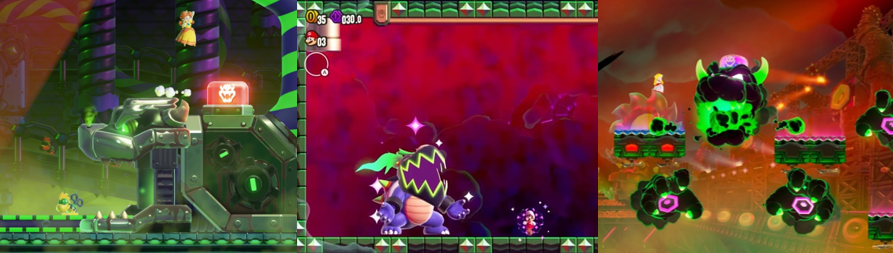
Sadly, Super Mario. Bros Wonder is disappointingly light on unique boss battles, a trend I’ve noticed in a lot of 2- and 2.5D Mario adventures. While larger variants of certain enemies do exist (King Boo being the most memorable), they’re more like chase sections rather than boss battles. The Mecha Makers are close to a boss in that you have to avoid hazards on the conveyer belt and smash the big red button to down Bowser’s battleships, but that’s being generous. Since Bowser’s busy being a giant, living ship, you’ll instead battle Bowser Jr. to clear four of the six main Worlds and retrieve the Royal Seeds and remove Bowser’s defences. Each battle against Bowser Jr. is a two-stage affair, with the first simply having you avoid his shell spin, jumps, and occasional fireball. After one hit, he transforms into Wonder Bowser Jr. and alters the terrain and your abilities somewhat. In the first fight, either you or he will change size; in the second, the rising and falling platforms alternate between being ice or jelly; in the third, water floods the arena (either above or below); and, in the fourth, Wonder Bowser Jr. distracts you with clones and by having you fight in the dark. While these fights can be tricky without any power-ups on hand, it only takes a couple of hits to defeat Bowser’s kid and his attack pattern doesn’t change much. You never battle Kamek, which is a shame, and Bowser Jr. is ultimately done in for good in a cutscene, which is also disappointing. After braving Bowser’s Rage Stage, you’ll face off against Castle Bowser in a somewhat harrowing, multi-stage final fight. In each phase, Castle Bowser spawns more hands to rain flaming Piranha Plants or to try and slam you. You must time your jumps to gain a boost from the rhythm blocks to either dispose of the hands or smack the weak spot under his chin, which he shields with his extra hands. As the battle progresses, Castle Bowser retreats to the background and fires larger Piranha Plants that can be tricky to dodge, alternates the floor to screw up your jumps, and tosses big, spiked balls that bounce around the arena. Power-ups are occasionally deposited as well and, after enough hits, a big button appears on Castle Bowser’s head that you must propel up to to end to his latest mad scheme.

Additional Features:
As mentioned, there are three 10-Flower Coins to find the game’s main stages and you’re encouraged to snag the top of every flagpole. Like the collection of Wonder Seeds, these statistics are recorded on your save file, though they appear to have no other function other than bragging rights (and, in the case of Flower Coins, allowing you to buy items). You must search high and low for every Badge Challenge and hidden sage if you want to earn every Badge in the game and enough Wonder Seeds to progress through the story. You can easily review each stage from the main map and jump to any stage where it shows you’ve missed anything, though you’ll need a guide or to pay attention to the overworld to spot when stages have secret exits. Bonus levels appear that bombard you with Coins, you can take a break by searching for Flower Tokens or taking out enemies across various arenas, and you can hunt across each map in search of Captain Toad. Eventually, you’ll unlock the Special World, where ten additional, super tough stages await, each one themed after the main Worlds and remixing hazards and enemies in new, challenging ways. Clear them all and you’ll gain access to a new Poplin House and earn yourself a congratulatory message and the Sound Off? Badge, though personally I couldn’t even clear one of the Special World’s stage…so good luck to you! Finally, of course, you can tackle any of the game’s stages in multiplayer, vying for Coins, power-ups, and a high score at the end, though I wasn’t able to play this so I can’t say how good or bad it is.

The Summary:
While I usually prefer Mario’s 3D adventures due to his 2D outings being slippery and unfamiliar to my SEGA-hardened gaming skills, I’ve really enjoyed his 2.5D titles and was blown away by Super Mario Bros. Wonder. Visually, the game is such a treat to behold; I loved all the little, goofy details and the whimsical (yet familiar) nature of the Flower Kingdom. I loved the callbacks to Mario’s previous adventures, with some returning gimmicks and mechanics, and the new abilities were a real treat. While the Bubble and Elephant forms weren’t that special, the Wonder Flower mechanics really helped to inject new life into the tried-and-tested Mario formula. I loved how unpredictable it was, how it reimagined stages and decades old fixtures like Goombas and Warp Pipes in fun new ways, and how it bombarded you with such an array of visually interesting mechanics. The new Worlds were also very enjoyable; I liked how the stages were short obstacle courses that never outstayed their welcome. The level of challenge was just right, with the game being upfront about when things get trickier and the onus being on the player to have the right skills accumulated or Badges equipped. The Badge mechanic was a little wasted on me but may have more appeal in multiplayer, and I was disappointed by the poor variety of the boss battles. There really was no excuse not to have Kamek be a boss fight at least once and I do think the developers sell the franchise short by not doing more with the likes of King Boo. Similarly, the character selection could’ve been better; I don’t get why Wario and Waluigi are always shafted or why Peach and Princess Daisy don’t have unique attributes. These negatives are mere nit-picks, however, to the overall enjoyment and fun on offer in Super Mario Bros. Wonder. It really does feel like a brand-new addition to the classic games and I liked how it provided just enough of a spin on the usual formula to be a wholly unique and accessible experience.

My Rating:

Rating: 5 out of 5.

Fantastic

Did you enjoy Super Mario Bros. Wonder? How do you feel it compares to other Mario titles, specifically the previous 2.5D Super Mario games? Which of the playable characters was your go-to and were you disappointed that they didn’t have more unique playstyles? What did you think to the new power-ups and the Wonder Flower mechanic? Were you disappointed by the lack of variety in the boss battles? Did you ever conquer the Special World? How did you celebrate Mario’s birthday this year? Whatever your thoughts on Super Mario Bros. Wonder, feel free to share them below and be sure to check out my other Mario content!

Game Corner [Mario Month]: Super Mario World 2: Yoshi’s Island (Nintendo Switch)


So, for no better reason than “Mar.10” resembling Mario’s name, March 10th is widely regarded as being “Mario Day”, a day to celebrate Nintendo’s portly plumber, an overalls-wearing mascot who literally changed the videogame industry forever and shaped the home console market of the nineties.


Released: 26 May 2023
Originally Released: 5 August 1995
Developer: Nintendo
Original Developer: Nintendo EAD
Also Available For: Game Boy Advance, Nintendo 3DS, Nintendo Wii, Nintendo Wii U, Super Nintendo Entertainment System (SNES) Classic Edition, SNES

The Background:
When the videogame industry collapsed under the weight of overpriced consoles and disappointing titles, Nintendo swooped in and revitalised the industry with the runaway success of Super Mario Bros. (Nintendo EAD, 1985). Despite a bizarre development, Super Mario Bros. 2 (Nintendo R&D4, 1986) was also a much praised best-seller, and Mario’s star rose further following the unique marketing strategy behind Super Mario Bros. 3 (ibid, 1988). This culminated in what many have deemed Mario’s greatest 2D outing, Super Mario World (Nintendo EAD, 1990), a title specifically designed to showcase the processing power of the SNES. The game also introduced one of Mario’s most popular supporting characters, Yoshi, who took the spotlight in Super Mario World’s sequel thanks to designer Shigefumi Hino. For this not-inconsiderable-task, Hino and his team opted to produce a more relaxed gameplay experience, doing away with the timer and a traditional health system and emphasising exploration. To further distinguish the game, the team introduced an egg-throwing mechanic and focused on a linear story to make the game more accessible to younger players. Artist Hisashi Nogami came up with the game’s distinctive colouring-book aesthetic, which was painstakingly brought to life by hand drawing every aspect. The game’s late release for the SNES also allowed the team to utilise everything the machine had to offer, including enlarging and rotating sprites and backgrounds. Yoshi’s Island proved a hit, eventually selling over 4 million units and being met with widespread acclaim. Reviews raved about the colourful graphics, the innovative gameplay, and the surprising scale of the title, and the game was largely cemented Yoshi’s legacy in Super Mario canon. The game was followed by a divisive sequel for the Nintendo 64, a couple of spin-off games, follow-ups for the Nintendo DS and 3DS, and many other Yoshi-centric games before being ported to multiple virtual consoles, including being made available for the Nintendo Switch Online service in 2023.

The Plot:
Years ago, Kamek attacked a stork delivering baby brothers Mario and Luigi. While Baby Luigi was kidnapped, Baby Mario fell onto the back of Yoshi, whose friends helped deliver him across Yoshi’s Island, conquering Kamek’s enlarged minions and confronting the Magikoopa – and his diminutive master, Baby Bowser – to rescue Baby Luigi.

Gameplay and Power-Ups:
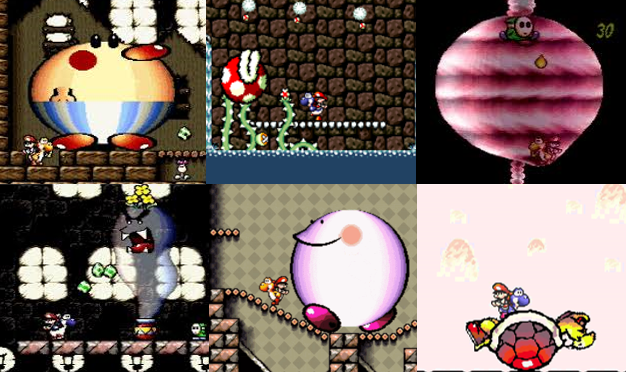
Essentially, Yoshi’s Island is a 2D, sidescrolling action/platformer like its predecessor, but it’s also a very different gameplay experience for a typical Super Mario title. For starters, you play as one of many different-coloured Yoshi’s, each sporting the same moves and abilities, and Mario is simply a baby on your back who acts as your life meter. After starting the game and picking a save file, you can pick between two control schemes, though the default is perfectly acceptable. Yoshi jumps with the B button and holding it performs a little “flutter” by kicking his legs, giving him more airtime to reach platforms. You can chain these together when falling to extend your jump and press down in mid-air to perform a butt stomp to pound down switches and stakes, smash through the environment, and defeat enemies. Enemies are also defeated by simply jumping on them, or gobbling them up with Yoshi’s tongue. Pressing Y sees him swallow them and you can either press it again to spit them out or press down to turn them into an egg. You can store up to six eggs at a time and throw them by pressing A to bring up an aiming reticle, hold either the Left or Right bumper to steady the ever-moving crosshair, and press A again. Some enemies can’t be swallowed or turned into eggs; in the latter case, you simply spit them out again but, in the former, you use other means to defeat them. Yoshi can also get eggs from hitting blocks and Egg Plants and find them scattered around the game’s many colourful environments. Green-spotted eggs are the standard, but you can also use yellow-spotted eggs that cause enemies to drop Yellow Coins, red-spotted eggs cause them to drop two health-replenishing Stars, and Flashing Eggs cause them to drop Red Coins. This can be a bit cumbersome at times; Yoshi can only aim in an arc, so you must pause the reticle or ricochet your shot to hit your targets. However, it’s easy to get distracted with the aiming system and either take damage or fall to your death. Some enemies can even steal your eggs and, while you’re never short on replacement eggs, it can leave you vulnerable and restricted when you exhaust your supply.

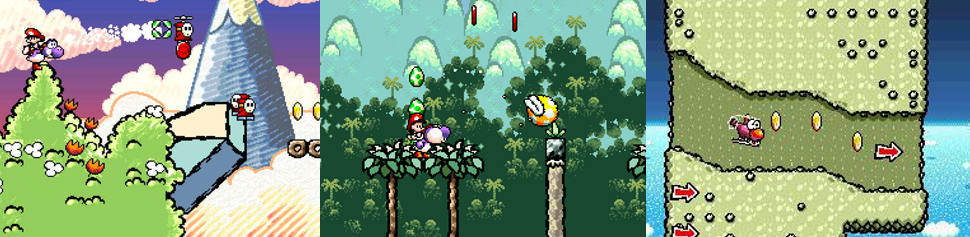
Toss eggs, eat melons, or transform into various forms to progress through colourful Worlds.

Yoshi also gobbles different-coloured watermelons to gain temporary additional attacks. Green watermelons let you spit seeds, red watermelons let you breathe fire, and blue watermelons let you freeze enemies, all of which are quite powerful and often more useful alternatives to throwing eggs. Yoshi can also, oddly, briefly transform into vehicular forms, the most common being his helicopter form that sees him awkwardly fly about, avoiding enemies and collecting Coins and passing over large gaps to a Yoshi Block. Another common transformation is Yoshi’s Mole Tank that lets him automatically dig through dirt, but you’ll also become a missile-firing submarine, a small train capable of riding tracks set into the background, and a car to plough through enemies. Similarly, Yoshi pushes Chomp Rocks to decimate anything in his path and reach higher areas, and Baby Mario even briefly takes centre stage when you find a Super Star. This turns Yoshi into a giant egg and lets you control “Powerful Mario”, who’s invincible, floats using his cape, and dashes across spike beds and up walls and ceilings with Y, though you must grab more Super Stars to maintain the form. Finally, Yoshi can jump on a pair of skis in certain snow-themed Worlds, dashing down snow at high speeds and turning into an uncontrollable snowball if he hits an object. Additionally, Special Items are won by playing the game’s Bonus Challenges. Here, you can earn extra lives and special one-use items you can select from the pause menu. These include POW Blocks that turn all onscreen enemies into Stars, instant refills for your eggs, instantly grant you one of the three watermelon power-ups, reveal hidden items in the level, grant you Stars to refill your health, and transform all onscreen enemies into Winged Clouds, though you can’t use Special Items in boss battles.

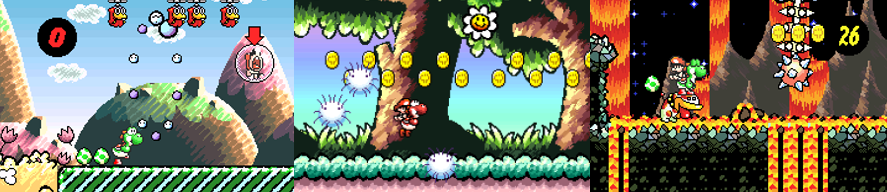
Watch out for your bawling companion when you’re going for those enticing collectibles.

As mentioned, Baby Mario is Yoshi’s life meter; when Yoshi’s hit, Baby Mario floats away in a bubble, screaming his head off, and you have a few seconds to retrieve him before he’s carried away. This meter slowly refills after you save him and is replenished and boosted by collecting Stars, usually by breaking crates or shooting Winged Clouds. Enemies like the annoying Bandits, Fishing Lakitu, and propeller-powered Green Toadies can also steal Baby Mario, so you must take them out or avoid them, and you’ll want to save him as quickly as possible because that scream gets really annoying! Like previous Super Mario titles, Yoshi’s Island features a map system, but one laid out more like a storybook. There are six Worlds with eight core levels, including a mini boss fort and a boss castle, alongside two bonus levels for each World. Levels are generally just a few screens but can be quite long. I really felt like my playthrough dragged quite a bit as things can be quite slow and the map progression isn’t very exciting. Throughout each level, you can find Yellow Coins (100 grant an extra life), extra lives, floating 1-Ups, giant eggs to defeat all onscreen enemies, and Message Blocks for gameplay tips. There are thirty Stars to find, twenty red Coins, and five Flowers in each level. Sometimes these are carried by Fly Guys, sometimes you need a transformation, and sometimes Winged Clouds spawn them, but they’re often either out in the open, tucked away, or require some tricky platforming to snag. Getting them all nets you the best completion score for each level and unlocks the secret levels for each World. However, it’s not easy collecting everything as some stuff is cleverly hidden behind the foreground, requiring you to enter areas from different positions, or is just out of reach and requires some clever egg bouncing. Occasionally, you’ll find some helpful characters to give you an assist. The enthusiastic pup Poochy carries you over dangerous terrain, happily gobbling up any enemies in his path, Huffin Puffin’s chicks substitute for eggs, and large, amorphous ghosts indirectly aid you by carrying platforms through spiked passageways.

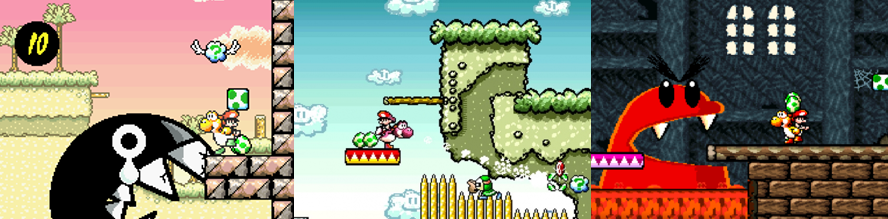
Despite its whimsical appearance, the game can be surprisingly long and challenging.

Considering it’s his home turf, Yoshi’s Island is a hazardous place for the friendly dinosaurs; areas are filled with bottomless pits, instant-death spikes and lava, haunted ruins, and small, but dangerous, enemies. While the game isn’t especially difficult, the challenge ramps up as the Worlds slowly become more like dangerous obstacle courses that will test your jumping, egg-shooting, and reaction times. Like Mario, Yoshi can be a little slippery; he makes for quite a big target and is completely vulnerable when aiming, too. Thus, it’s easy to get blindsided by enemies, especially those hiding in the background or constantly spawning from pipes. Yoshi uses hills, slopes, and hidden tunnels to get around, as well as various platforms; these rise, fall, move along a track, or require you to jump on each in turn, rotating in a wheel to progress. Sometimes you’ll be locked into a maze-like loop and need to find a key; sometimes you’ll hit Winged Clouds to create bridges or spawn vines to get higher. Other times, you’ll knock buckets into water or lava to progress, quickly hop between platforms while a Shark Chomp chases you, or be forced to stay on the move in autoscrolling sections (with some even forcing you to the left!) You’ll ride balloons, run and jump to timed destructible platforms, be flung across the screen by spinning logs, play Breakout (Atari, Inc., 1976) to destroy coloured blocks with your eggs, watch for Chomps flying from the background and creating bottomless pits, spring to higher areas, ride circles that change direction when you jump off them, and cross a chasm on a deflating giant balloon. Thankfully, you can pass through sparkling rings to create a checkpoint and lives are quite easy to build up, but things do get surprisingly challenging as the game progresses. Flipping spiked platforms, mazes of dark sewers and pipes, and claustrophobic quartz caves are juxtaposed with bright, cheery exteriors that also hide many dangers, the most annoying being the Fuzzies. These fluffy puffs fill the screen when they appear and touching them sends everything into a psychedelic haze and messes with your controls for a few seconds, meaning it’s even easier to slip or run off a platform to your doom.

Presentation:
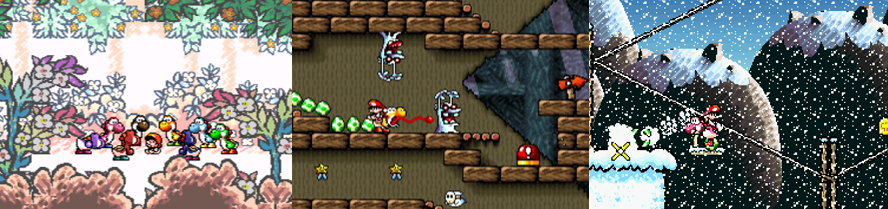
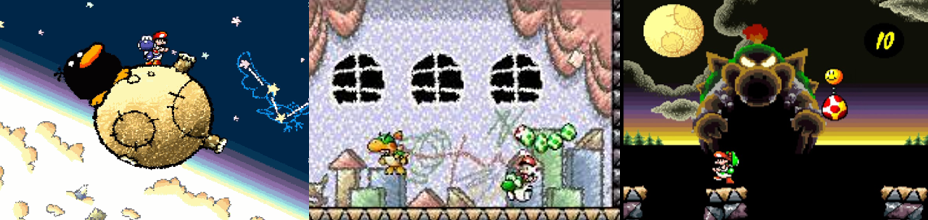
Yoshi’s Island not only plays very differently to other Super Mario games, it also looks very different. The entire game is styled after a children’s colouring book, with pastels and crayon effects used in place of traditional coloured backgrounds, giving the entire game a whimsical feel that’s perfectly in keeping with the baby-centred focus and its status as a more child-friendly gameplay experience. The Yoshis are all very fun sprites; they do a little dance when idle and react comically when hurt or performing their flutter jump. Baby Mario is very animated when separated from Yoshi, bawling his head off in his bubble and encouraging you to retrieve him as quickly as possible, and the game’s cutscenes utilise a storybook aesthetic that makes it feel like you’re playing through a bedtime picture book. Every level pops with colour and environmental effects; sometimes it’s a bright sunny day, sometimes it’s the red hue of dusk, sometimes it’s a starry night, and you’ll see birds, mountains, giant flowers, waterfalls (and lavafalls), giant mushrooms, and thin trees in the foreground. There’s a lot of depth to each area; I particularly liked levels where Chomps fly at the screen and destroy the ground, and the many caves where little details are hidden way back, and you’ll often open up tunnels by leaping at walls or avoid leaping fish and water jets when paddling through or jumping over water. Blizzards are commonplace in World 5, often blanketing the screen as you ride ski lifts and melt ice blocks, and you’re forced to navigate labyrinthine forts and castles, taking different paths to find keys or get past spike beds. It’s all very colourful and playful, which is reflected in the infectious soundtrack and amusing Yoshi sounds peppered throughout the game. This lulls you into thinking it’s a simple kid’s platformer, making the sudden challenging sections even more jarring.

The game’s visual presentation is incredible, emphasising a vivid storybook aesthetic.

Yoshi’s Island was a late release for the SNES and, as such, effectively uses all the machine’s vaulted power. Parallax scrolling and sprite manipulation are abundant, with Kamek enlarging regular enemies and inanimate objects into large bosses and huge, amorphous enemies stretching and filling the screen at times. This is equally reflected in the giant eggs and transformation sequences, and the scaling all works beautifully to add to the depth of each level. Typically, levels will consist of some common themes, such as a grassy starting area, a cavernous second area, and a final area that takes place in the skies or over a pit. You’ll venture into many dark caves, where things are far more claustrophobic and maze-like, as well as sewers or areas were it’s so dark Yoshi is lit by a single light source. While the forts and castles can be quite samey, they do mix things up a bit by featuring dilapidated backgrounds and a spooky ambiance further emphasised by the resident Boos and ghosts. The grassier areas are where the game shines for me; I love seeing fields and mountains in the background and hopping to the precarious log platforms, or taking the smaller platforms on tracks, or interacting with the environment using Yoshi’s transformations. Everything’s so lively that it’s easy to be surprised by enemies that pop up from pipes, fly from above, or sneak in from the background. I also enjoyed how the time of day changed, when the game leaned into its dinosaur theme to show skeletal remains and tar-like dirt, and the impressive quasi-3D rotating map that wasn’t utilised enough for my liking.

Enemies and Bosses:
Although it takes a while to encounter them, some of Mario’s most famous enemies make an appearance in Yoshi’s Island. You’ll come across Koopa Troopers and their flying variants, the Para-Koopa, shy Boos who cover their faces when you look at them, disposable Goombas, the ever-annoying Lakitu (who tosses Spin Eggs at you), and ravenous piranha plants. The most prominent returning enemy are the Shy-Guys, who come in an assortment of colours and variations, such as hovering overhead and dropping bombs, turning giant spiked maces, fatter ones, and ones that run around on fire. Yoshi’s Island is home to some unique and annoying new enemies, too, such as Frog Pirates who’ll steal Baby Mario, somewhat familiar blue hedgehogs who defend themselves with their quills, tiny Mousers who steal your eggs, and large lava, ghost, and aquatic enemies who pop up from liquid or the walls. Some enemies are more annoying, like the inedible Ravens and the spiky Tap-Taps, while others are more tricky. Spookies can be ridden but can’t be defeated by jumping on them and will steal Baby Mario if they’re hiding a Bandit, one of the most annoying enemies in the game. Equally frustrating are the Grunts, whose spiked helmets must be knocked off to make them vulnerable, the Sluggers that deflect your projectiles, and the karate-and-ki-throwing Zeus Guys. Many enemies are small are relatively harmless, but there’s so many and they pop up so frequently that it’s easy to take a hit. Others, like the piranha plants and Blow Hards either pop up at the worst moments or are placed on walls, ceilings, and platforms when you’re trying to jump about or ride platforms. Others are very large and must be pelted with eggs to whittle them down or fend them off, and you’ll even get attacked by an enemy masquerading as a collectable Flower!

The gigantic bosses look intimidating but they’re mostly a cakewalk.

With the exception of World 6, each World boasts two bosses: a mini boss hiding in the World’s fort and the actual boss holed up in the World’s castle. Each time, Kamek enlarges a regular enemy or inanimate object, kicking off the fight, which typically involves a large but cumbersome and surprisingly limited enemy filling the screen and must be hit with eggs to defeat, with other smaller enemies or Egg Plants providing ammo. World 1 sees you battling Burt the Bashful and Salvo the Slime, which are both ridiculously easy. Simply hide in the ditches and fire eggs as Burt slowly bounces around, then pelt Salvo with eggs, shrinking him with each hit and gobbling his minions, easily avoiding the lava below. World 2 features fights against ghosts, the Bigger Boo and Roger the Potted Ghost, with the Bigger Boo requiring you to ricochet your eggs to damage him, becoming intangible, and accompanied by bat-like Fangs who act as ammo. Roger tries to push you back and spits homing blue flames but is super easy to defeat as you just need to push his plant pot until he topples over the edge. In World 3, you’ll be swallowed by a gigantic Frog Pirate and need to fire eggs at his dangling uvula, dodging his gastric acid and the gigantic enemies that also drop in, which is quite a visually fun fight. Afterwards, you battle the Naval Piranha, who’s a little tricker. You must jump when it lunges and eat the Nipper Spores, then quickly ricochet eggs to hit the target at its base, though you can apparently one-shot it before the fight even starts. World 4 sees you encounter a massive Milde who wanders back and forth, requiring you to butt stomp from above, splitting her into smaller Puchipuchi L and, finally, regular Mildes. Hookbill the Koopa had me confused for a bit; this enlarged Koopa slowly lumbers around and performs a belly flop, spitting out eggs whenever you jump on his shell, but is invulnerable until you hit his head. Hit him enough times and he’ll topple onto his shell, exposing his stomach for a butt stomp, which took me a while to figure out.

The final bosses require a little more strategy and offer a bit more challenge.

World 5’s Sluggy the Unshaven was also a bit troublesome. This ghost-like blob’s gelatinous skin sags when you shoot eggs at it, and it slowly tries to force you over the edge. However, if you target the same spot, you’ll deal damage and eventually defeat it by striking its heart. Raphael the Raven was also quite unique as he flings you to a small moon where he relentlessly chases you in a rotating circle and creates shockwaves. To damage him, you must butt stomp the wooden stakes so the opposite one pops out as he’s passing over it, which can be difficult to time due to the nauseating rotation. Finally, in World 7, the invincible Tap-Tap the Red Nose hops about until you destroy the coloured blocks and drop him in lava. Kamek then chases you through the castle, firing magical bolts and teleporting away, and you eventually battle his cantankerous master, Baby Bowser. Baby Bowser was a bit difficult to figure out, too. He toddles about in his playroom, causes big shockwaves with a belly flop, and swats Baby Mario away so he can ride Yoshi, but is completely invulnerable. Instead, you must cause your own shockwaves with a butt stomp, though Kamek embiggens the enraged turtle king for the true final battle. This takes place on the castle roof during a nighttime storm and sees Big Baby Bowser slowly stomp towards you from the background. You must dodge the rocks he rains down and his massive fireballs while simultaneously avoiding the gaps he creates in the ground and swallowing Baron von Zeppelins. You must use your eggs to blast him in the face, which can be tricky due to how far away he is. If he gets too close, he’ll instantly kill you so you must frantically target just the right place to deal damage and force him back. Repeat this seven times, being mindful of the crumbling ground as the fight progresses, and Baby Bowser finally goes down, allowing the Mario brothers to be safely delivered to their parents.

Additional Features:
When you complete each level, you can tackle a Bonus Challenge if the goal ring lands on a Flower or a Mini Battle by finding a hidden key and entering a locked shack. These see you tossing or popping balloons, matching cards, uncovering matching pairs, gathering Coins against a time limit, attacking enemies with watermelon seeds, and playing roulette and a slot machine. It’s a nice distraction to play these mini games and they award Special Items and a load of extra lives, especially by abusing the Nintendo Switch Online’s rewind and save state features, which make the game a breeze even with its lengthy playtime. Each World also contains two bonus levels, with the Extra levels unlocked when you score a perfect 100 on all the regular levels. These extra levels are shorter, contain no checkpoints, and generally revolve around a gimmick, such as Poochy, traversing Grinder-infested vines, tackling a confusing maze, and a ski run down a mountain in pursuit of Kamek. The game has three save files for multiple playthroughs and you can replay all previous levels with the exception of the opening tutorial-esque stage, though I’m not sure when or how the game saves (I assume it’s after you beat each level). There are no rewards for 100% completion, so you can’t pick which coloured Yoshi you ride or choose to carry Baby Luigi or anything, and there are no two-player options here beyond players taking turns to play.

The Summary:
This isn’t my first time playing Super Mario World 2: Yoshi’s Island. I’ve played it on emulators in the past as part of my fascination with the SNES library, but this is the first time I’ve completed the game. Yoshi’s Island definitely makes a strong visual impression; the story is at the forefront here, as are cute, colouring book graphics and whimsical, charming music. The sprites and environments are absolutely gorgeous and some of the best the SNES had to offer, boasting vivid areas, a greater level of detail and depth, and bundles of charm and life to every sprite. As annoying as Baby Mario’s screaming is, I liked the mechanic as a health meter and an incentive not to get hit, though it can be a mad scramble to rescue him that costs you life anyway. Unfortunately, I didn’t feel the same about Yoshi’s egg throwing; while he’s versatile enough, if as slippery as Mario, his egg-aiming and throwing gameplay can be cumbersome, especially when you’re on moving platforms or surrounded by enemies, making it difficult to make split second decisions. It worked in the boss battles, which were fun, and I really liked the enlarged sprites and technical tricks on show, though the bosses were generally a complete joke and I only really struggled with a few. The levels beforehand, though, can become surprisingly challenging. Bottomless pits and instant death traps increase, as do the moving and confusing gimmicks, and it’s often tempting to risk death to grab those elusive collectibles. Overall, this was enjoyable, but Yoshi’s Island is more fun to look at than play at times. It’s a bit slow and clunky, the levels can outlive their stay quite quickly, and there wasn’t as much variety in the Worlds as I would’ve liked or expected from a Super Mario title. Still, it’s something a little different and provides a unique, colourful twist on the usual Super Mario formula so I’d say it’s worth checking out, but I’d much rather play Super Mario World again than this.

My Rating:

Rating: 3 out of 5.

Pretty Good

Was Super Mario World 2: Yoshi’s Island in your SNES library back in the day? What did you think to the new gameplay mechanics and how do you think it compares to Super Mario World? Did you enjoy the colourful, colouring book presentation and the egg-based mechanics? Were you annoyed by Baby Mario’s screaming, and did you ever score 100 on every stage? Are you a fan of Yoshi and, if so, which of his games is your favourite? How are you celebrating Mario’s birthday this year? Whatever your thoughts on Super Mario World 2: Yoshi’s Island, feel free to share them below and be sure to check out my other Mario content!

Game Corner: Mario & Sonic at the Olympic Games Tokyo 2020 (Nintendo Switch)

Released: 1 September 2019
Developer: 
SEGA
Also Available For: Arcade and Mobile

The Background:
Super Mario and Sonic the Hedgehog engaged in a fierce “Console War” during the nineties as Nintendo and SEGA battled to be the top dog of the videogame industry. In the end, thanks largely to wasting money on expensive peripherals and the pressures of an ever-changing marketplace, SEGA withdrew from the home console market. On the plus side, their supersonic mascot appeared on his rival’s consoles, prompting discussions of a long-awaited crossover began between their respective creators, Shigeru Miyamoto and Yuji Naka. Surprisingly, the two came together in the spirit of friendly competition once SEGA obtained the 2008 Beijing Olympic licence. Essentially a collection of Olympic-themed mini games, Mario & Sonic at the Olympic Games (SEGA Sports R&D, 2007) saw Mario and Sonic characters co-existing for the first time and its commercial success led to subsequent titles releasing annually to promote different Olympic events across the world. This year, to coincide with the Special Olympics World Winter Games, I’m looking at the 2020 iteration (and currently last) of the series. Released following a significant gap between entries and the first to appear on the Nintendo Switch, the game including story elements and events that incorporated sprites from both franchise’s classic 2D games. Retaining its branding despite the delay to the Olympic games, Mario & Sonic at the Olympic Games Tokyo 2020 attracted mixed reviews that praised the nostalgic feel of the 2D mini games but criticised the tedious story mode and limited options.

The Plot:
When Bowser, King of the Koopas, and Doctor Eggman are trapped inside an 8-bit videogame console alongside Super Mario and Sonic the Hedgehog, Luigi, Miles “Tails” Prower, and all their extended supporting characters must compete in the Tokyo 2020 Olympic games to free them.

Gameplay and Power-Ups:
If you’re familiar with the Mario & Sonic series of Olympic game tie-ins, you probably won’t be surprised to learn that Mario & Sonic at the Olympic Games Tokyo 2020 is a collection of Olympic-themed minigames starring the biggest names from both franchises. As ever, Mario and Sonic’s worlds are mashed together with our own, allowing these anthropomorphic and comical characters to wander around real-world locations (courtesy of not one but two overworld maps) and learn interesting facts about both franchises, the Olympic games, and Tokyo. You start the game by selecting your region, being bombarded by pop-up notifications that tell you basic stuff like what the sound settings do, and customising your player profile, assigning icons and such. From there, you have a few gameplay choices: you can jump into a quick game solo or against other players, picking from every event as they’re all unlocked from the start and setting the difficulty of each, or tackle the game’s story mode. Regardless of which option you pick, your gameplay experience will change depending on which character you play as. While the Story Mode forces you to play as certain characters, you can pick almost any character for any event in Quick Match, but you’ll need to consider their capabilities. These are pretty simple: some characters are faster, some are all-rounders, some do better with Super Moves. It doesn’t get more complicated than that and I’m not sure how much of a factor they are as basically every game comes down to how fast you can tap buttons or work the various controls. There are thirty-two characters to choose from, though twelve are only selectable in certain events (like Jet for Football and Ludwig for Fencing) and, when playing the 2D-styled “Dream Events”, your choices are limited to just eight characters.

Up to four players can tackle the game’s 3D, nostalgic 2D, and chaotic “Dream” events.

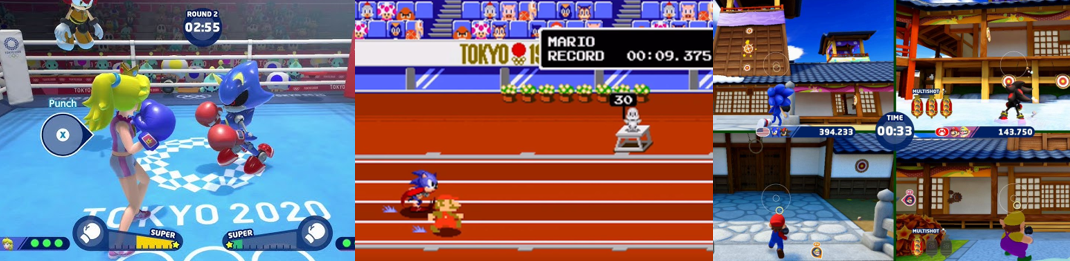
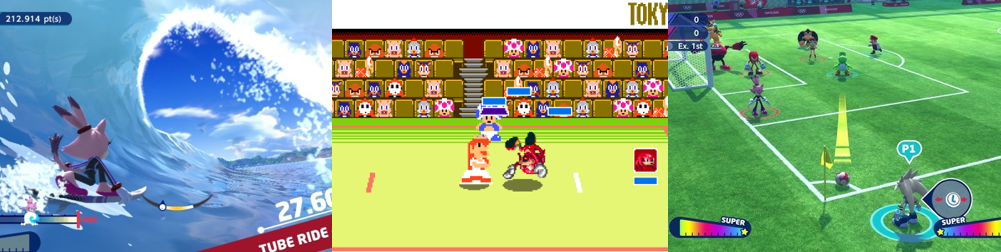
There are twenty-one Olympic events to play, ten 2D Events set during the 1964 Olympic games, and three special challenge “Dream Events”. You’ll get a chance to review the controls and success criteria prior to each event, though it’s worth pressing X during one of the many introductory scenes or after pausing to review any additional controls. Players can choose from three different ways to play, including flailing around with the motion controls or using the buttons like a normal person, though some events (like the Discus Throw and Javelin Throw) force you to use motion controls to angle your shot, making them some of the more aggravating events. Generally, you can hold the Right trigger or A at the start of an event to build power and must tap A to run or move. B is usually reserved for jumping while R or A execute a Super Move (such as a burst of speed or dancing flourish). The simplest events, like the 100m Race and 110m Hurdles, have you tapping A to run to the finish line, with players hitting B at the right time to clear hurdles and gain a boost in the latter. Most events have a foul line that will disqualify you if you cross it, some of the trickier ones have an optional practice mode beforehand, and your objective is to win every event to set a best time (or break a World Record) and earn gold medals or the top spot on the podium. If you fail an event three times in the Story Mode, you can choose to skip the event, progressing the story with no consequences, something I eventually did quite often when the events became too laborious or finnicky. I was fine with the challenge offered by, say, the Long Jump where you tap A to run, hold B to adjust your jump angle, and complete a series of button presses akin to a quick-time event (QTE), even if it took some practice. Similarly, Sport Climbing was tricky but not too taxing. You press the Left trigger and R at the start to latch on, aim your jump with the left and right control sticks, and hop to hand-holds against a time limit, avoiding spiked balls and replenishing your stamina with hearts. I also had a fair bit of fun in Boxing and Fencing, where you must time button presses and build combos, guarding against incoming attacks and frantically tapping A (in the latter) to avoid being counted out.

Skill and character choices can help with the game’s harder events, which include team-based sports.

Things took a turn whenever the events became a bit more complicated, however. It’s not too difficult timing your button presses in the Triple Jump event or pulling off gnarly tricks in the Surfing – Shortboard and Skateboarding – Park events, but you need to be on point to win those gold medals as a poor score will cost you and you often have to complete a few rounds to win, making it even more annoying. Archery was a similar issue; here, you have to think about the wind direction, the distance of the targets, and the angle of your shot. It’s a far cry from Shooting – Trap, where you just pick a square and hit a button to shoot clay discs. The Judo event also caused me a lot of headaches; you have to mess about trying to keep your balance to toss the opponent, which I just couldn’t figure out. I didn’t mind completing increasing difficult QTEs in the 10m Platform and Vault events, but tilting the left stick to match your partner’s strokes in Canoe Double (C-2) 1000m and frantically rotating the control stick to chase to the goal in Kayak (K-1) 1000m was a pain in the ass. You even play team games, like Volleyball, Football, and Rugby Sevens. I couldn’t figure out the Volleyball event; no matter how well I timed my presses of A and B and how often I hit the ball over the net, I couldn’t score a point. Rugby Sevens was a touch more enjoyable; here, you press A to pass and score a try, B to evade, and race around a pitch tackling other players and scoring a conversion by timing a press of X as a meter goes back and forth. And then there’s the aforementioned Discus Throw and Javelin, where I could just about figure out the motion controls in practice and then kept screwing up my throws when it came time to compete. If the option had been there to just use the left stick to direct my shot, it would’ve been far more enjoyable!

The minigames are some of the best parts of the game, often outshining the main Olympic events!

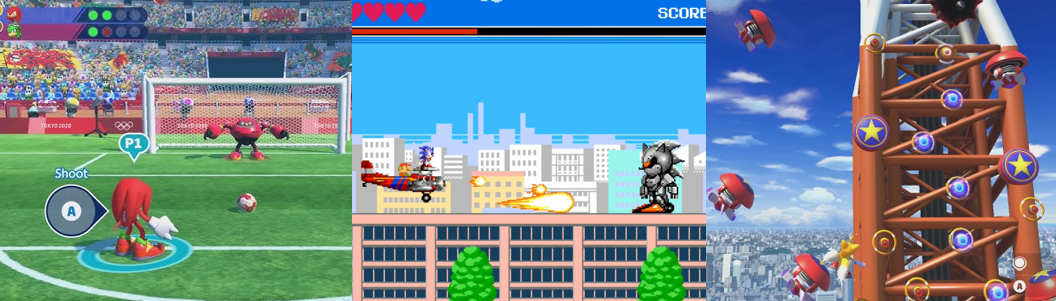
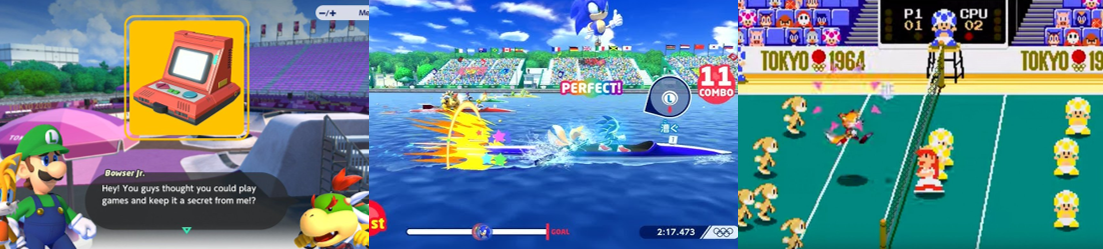
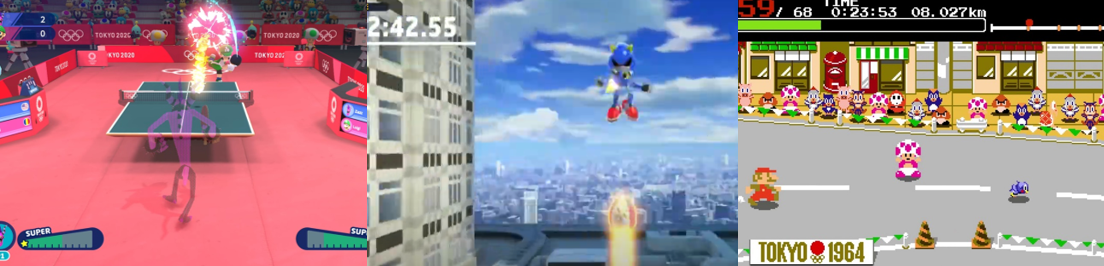
When playing Story Mode, you’ll alternate between moving Luigi around the 3D world of the 2020 Olympic games and Mario around the 2D world of the 1964 Olympic games, with Tails and Sonic following each. You’ll chat with other characters and non-playable characters (NPCs) like Toads and Omachao to obtain passes to other areas and compete in additional events and find glowing tickets to learn fun facts. For such small overworld maps, there’s a hell of a lot of backtracking and dialogue to skip through, and it quickly gets a bit tedious slogging through the twenty-chapter story to reunite the two groups. Occasionally, characters will ask you to complete one of ten minigames to advance the plot; these are then unlocked for free play in the Game Room. These minigames are some of the best parts of Mario & Sonic at the Olympic Games Tokyo 2020 and see you flying through the Tokyo skies in a sidescrolling shooter like in Sky Chase Zone, chasing down a bullet train, painstakingly searching Shibuya’s Hachiko Square for specific characters in a game of Where’s Wally?, and chasing down (and attacking) Dr. Eggman’s taxi in what’s somewhat similar to Rad Racer (Square, 1987). You’ll be bouncing on Cheep-Cheeps as you chase after Bowser’s river boat, sneaking through a museum, avoiding Koopas and other Mario enemies as you collect keys, and desperately trying not to fall as you scale Tokyo Tower. Other times, you’ll be beating up waves of Shy Guys or shooting Egg Pawns before they throw spiked balls at you, both options that are far more enjoyable than the game’s odd depiction of Badminton that’s essentially just a rhythm game, just press the button when prompted, using the left stick to aim your shot, and your character moves by themselves (though I found the doubles partner screwed up more than I did). You’ll also dash around an obstacle course in Equestrian – Jumping, building speed to jump fences and puddles, knock a ball back and forth in table tennis until you can hit your Super Shot, and throw hands and feet in Karate – Kumite, toppling your opponent to earn extra points. Most of the events are pretty fun but some of them are way too short and others outstay their welcome very quickly. It’s also pointless trying to master the difficult ones as you can just skip them in Story Mode, unless you’re aiming for 100% completion.

Presentation:
In keeping with the tradition of this spin-off series, Mario & Sonic at the Olympic Games Tokyo 2020 is a bit of a mixed bag in this area. None of the familiar tunes from either franchise appear, leaving the game to plod along on the strength of a weak-ass, generic soundtrack that barely eases the pain of a failure. Things start off strong with a beautiful pre-rendered cutscene that showcases many of the new and returning events and shows these two franchises co-existing side y side, a visual that never gets old even if I’ll never forgive either company for not doing a more suitable crossover. It’s a bit downhill from there, though, as prerendered cutscenes are eschewed in favour of partially animated 2.5D models, endless dialogue boxes, and a parade of pop-ups. The 2D sprites and environments ease this pain a bit, but the developers limited themselves by using the sprites from Mario’s debut title, meaning he and his fellow characters have very few frames of animation. Sonic and his cohorts fare slightly better in this regard but the aesthetic is all over the place since Knuckles the Echidna’s sprites are obviously more detailed than Sonics, leading to some weird moments when the sprites are awkwardly depicted holding items. It even looks weird when they celebrate their victories or react to their failures since the developers didn’t create any new animations, so you’re left with Sonic looking annoyed and Mario flipping on his ass. Overall, I did enjoy the 2D environments and events, though; they reminded me of the many 8-bit sports games on the Nintendo Entertainment System (NES). I would’ve liked to see some 16-bit ones thrown in, even if just as additional “Dream Events”, but these retro-styled sections were the best parts of the game, despite my complaints.

The limited 3D visuals are decent but it’s the retro-styled aesthetic that really impresses.

The 3D sections hold up well, for the most part, but aren’t that dissimilar from what we’ve seen in the previous Mario & Sonic titles. You can hold B to run and characters are far more animated in 3D, spouting gibberish and sound bites and even wearing different outfits for every event. Strangely, every area felt very bland and empty, despite often being populated by at least a handful of NPCs. Eventually, larger crowds of Sonic’s Animal Friends, Chao, Shy Guys, and Toads fill certain areas and populate the stands, but they don’t help to make the areas feel very lively. Still, you’ll see NPCs like Charmy Bee and Lakitu serving as referees and other side characters operating cameras; these NPCs even get in on the action in the atrocious Marathon event. The 2D sections sported an announcer I either missed or ignored in the 3D parts and characters all gain a suitably dramatic glow and flourish when executing Super Moves. However, while event locations and interiors are far more interesting to look at, the game’s let down by its painfully bland overworlds. You can visit many real-world locations in 1964 and 2020, seeing planes fly overhead and learning their history, but it’s all stuck on a rather uninspired overworld map. This is especially disappointing considering how interactive and varied previous overworlds in the series have been, and the fact that you visit these areas time and again to find passes or charge this magical battery created by Doctor Eggman Nega. Many of the minigames again steal the show in terms of visuals, incorporating additional sprites to serve their needs and being visually akin to lost titles from Nintendo’s 8-bit heyday, which only adds to their replay factor. The game also performs really well; I noticed no slowdown or texture warping or anything like that. However, there are a lot of menus to navigate, lots of instructional text to read, and replaying events after a loss can be tedious as you have to skip a bunch of introductory scenes.

Enemies and Bosses:
As you might imagine, every character in Mario & Sonic at the Olympic Games Tokyo 2020 is your enemy at some point though, luckily for you, there’s very little to distinguish them. Computer-controlled opponents have the same abilities as you, charging power, getting a starting boost, and attacking and defending just as you would. Their individual classes do become a factor, however (you may struggle to win a race against Shadow the Hedgehog when playing as Wario, for example), though you can certainly overcome these if you mash buttons faster enough or don’t screw up when playing the event. I did notice some characters seemed to be unfairly good at some events; Vector the Crocodile never struggled to toss his discus, for example, and I could never hope to match Bowser Jr. in the Javelin Throw. Admittedly, the fact that I struggled with these events probably has a lot to do with that. however, I did notice my opponents would charge their Power Gauge much faster than me, or would sprint past me at the last minute even if I had a commanding lead. The general advice here is to simply do better the next time around, something that’s easier said than done when you have to restart a Table Tennis match after playing to deuce and match point for God-knows how many rounds! Unlike in some of the previous Mario & Sonic titles, there are few examples of what could loosely be called “boss battles” here. It’s generally seen as a big deal when you challenge Dr. Eggman or Bowser, but then a lot of those events aren’t that difficult to win…to start with… Bosses (and Badniks) do appear in the Tokyo Sky Flight minigame, however, including Mecha Sonic and a variation on the classic Egg Wrecker fight, which were fun inclusions.

A handful of quasi-boss battles and harder events test your skills…and patience…

There are some exceptions, however. The Metropolitan Goal Kick minigame, for example, has you tackling Egg Pawns to grab a rugby ball and then timing a button press to kick it up the length of the Metropolitan Government Building and deal damage to Metal Sonic. As far as I could see, Eggrobos only appear in the Volleyball event, while you must tackle Boom Booms in Rugby Sevens and score penalties against Egg Pawns in Football. The twelve guest characters can only be challenged or controlled in specific events, as well, and you must best them (or skip the event) in Story Mode to unlock them. This means you’ll only see Zavok and Zazz of the Deadly Six in Boxing and Table Tennis, respectively, Diddy Kong only appears in Rugby Sevens, while Eggman Nega and Rosalina must be challenged in games of Karate – Kumite and Surfing, respectively. Depending on your level of skill, these can be difficult events; it took me a couple of tries to clear the Sport Climbing event and unlock Rouge the Bat, for example. When playing Story Mode, other playable characters challenge you to events before helping you or joining your team, meaning you must best Knuckles and Shadow in a game of Badminton (Doubles) and win a canoe race against Wario and Waluigi to gain their help. You must also defeat Bowser’s Koopalings to charge up that stupid battery and deal with Bowser, Dr. Eggman, and their minions stealing your gold medals in 1964. Both baddies challenge you to various events, with Dr. Eggman easily being overtaking in a straight-up race or in the Vault event. Once you reach the final chapter, you must pick to play as either Mario or Sonic and race Bowser in the dread Marathon. In this event, you must tap A to run, which depletes your stamina. Hitting other runners, the walls, swarms of bees, or puddles also depletes your stamina and will eventually knock you over, costing you valuable time. You can grab water with B and ride slipstreams to regain stamina, charging up for a boost or using boost pads, but this is a hell of a final ask that I ended up skipping as I never had enough stamina to beat Bowser to the finish.

Additional Features:
There are 122 pieces of trivia to find in Mario & Sonic at the Olympic Games Tokyo 2020, spread out across both 1964 and 2020. You’ll get trivia by inspecting glowing tickets and talking to other characters, who’ll either ask a question or offer titbits about the characters, the Olympic games, and Tokyo. These are all saved in the Trivia section so you can re-read them if you wish or see which ones you’re missing. There are also eighty hidden “Challenges” to complete, with the obscured list available from the main menu. These are mainly tied to setting new World Records, finishing events on the hardest difficulty, scoring a set number of points, and clearing Story Mode. Finishing the Story Mode, you’re returned to the overworld upon loading your file, now able to replay all previous events and take on additional challenges in the “Dream Events”. Though there are only three of these, they’re pretty enjoyable and interesting, featuring additional power-ups and gameplay mechanics that make them perfect for multiplayer games. Dream Racing sees you racing through a mainly half-pipe-like course, performing tricks and hopping rails not unlike in the Sonic Riders series (Sonic Team/Now Production, 2006 to 2010) and attacking with items similar to the Mario Kart series (Various, 1992 to present). Dream Shooting sees you running around, awkwardly aiming your weapon with motion controls, and blasting targets, grabbing multi-shots and shooting down gliders in an arena shooter that reminds me of the Splatoon games (Various, 2015 to 2022). Finally, in Dream Karate, you attack with combos, kicks, and throws to toss your foes around and colour the floor panels, grabbing springs and Super Stars for temporary buffs. Beyond that, you can challenge the computer on harder difficulties, aim to get gold medals and break World Records, and play alongside up to four players…if you can find anyone to play with.

The Summary:
As a lifelong Sonic fan (and a pretty big fan of the Super Mario games), I’m basically obligated to pick up the Mario & Sonic games whenever they release. I believe I’ve played all of them, but only on portable devices, which I think made the already aggravating gameplay all the more vexing. Free from the restrictions of the small size of Nintendo DS and 3DS screens, Mario & Sonic at the Olympic Games Tokyo 2020 is easily the most visually impressive of all the Mario & Sonic games I’ve played, offering relatively attractive 3D models and worlds that show a decent amount of personality. I can never shake the feeling like these games are just soulless cash grabs, however, and that’s reflected in how empty a lot of the arenas seem, despite the NPC crowds. Mario & Sonic at the Olympic Games Tokyo 2020 impresses with its nostalgic 2D sections, which harken back to the NES days and capture a lot of the magic of Nintendo’s 8-bit glory days. While the sprites are fun to see, they’re extremely limited and a bit difficult on the eyes because of the mishmash of 8- and 16-bit sprites. I was glad to see the game allowed for traditional controls, though the forced motion controls for some events were more jarring as a result; however, it’s a bit disappointing that so many of the events play the same. Thankfully, the various minigames offered a great distraction from the main events, which were either too short or too annoying. I honestly could’ve done with a few more of these minigames, and the “Dream Events”, as there wasn’t enough of these to offset the more annoying Olympic events. With a half-assed approach to cutscenes and some of the dullest unlockables in all of videogaming, Mario & Sonic at the Olympic Games Tokyo 2020 does little to shake the franchise’s stigma of being a collection of nonsense minigames, even with its few good points. It’s easily the best of the series I’ve played, but that’s not a very high bar and I remain bitter that we never got a more traditional crossover between the two nineties icons.

My Rating:

Rating: 3 out of 5.

Pretty Good

Did you enjoy Mario & Sonic at the Olympic Games Tokyo 2020? Did you also play without the motion controls? What did you think to the 2D sections and events? Were the minigames also the best part for you, or did you prefer a different Olympic event? Would you like to see more games in the series, or a proper crossover between Mario and Sonic? Which country are you rooting for in the Special Olympics World Winter Games this year? Whatever your thoughts, leave a comment below, support me on Ko-Fi, and go check out my other content for both franchises!

Game Corner [Zelda Month]: The Legend of Zelda: Tears of the Kingdom (Nintendo Switch)


On 21 February 1986, The Legend of Zelda (Nintendo EAD, 1986) was first released in Japan. The creation of legendary game designer Shigeru Miyamoto and Takashi Tezuka, The Legend of Zelda launched one of Nintendo’s most popular franchises. This year, I’ve been dedicating every Friday to Nintendo’s most famous silent protagonist, Link and his vast and enduring fantasy world of sword and sorcery.


Released: 12 May 2023
Developer: Nintendo EPD

The Background:
Selling over 6.5 million copiesThe Legend of Zelda was a big hit for the Nintendo Entertainment System (NES) and kickstarted one of Nintendo’s most lucrative and popular franchises of all time. After a successful jump to 3D with The Legend of Zelda: Ocarina of Time (ibid, 1998), Zelda titles have only gotten more ambitious with each successive entry, though none were more ambitious than the critical and commercial success of The Legend of Zelda: Breath of the Wild (Nintendo EPD, 2017). While producing the downloadable content for Breath of the Wild, the developers had so many ideas that they were inspired to create a follow-up title and sought to expand upon the existing world and game engine with new areas. The Dungeons were revised to be more visually unique compared to the last game and the developers added a building mechanic to allow players to craft new vehicles and expand their exploration potential, with Link’s new abilities presenting new challenges for the developers to overcome. Like its predecessor, The Legend of Zelda: Tears of the Kingdom was met with universal acclaim; reviews praised the expanded map, the implementation of Link’s new abilities, and the expansive story. While the Dungeon design and performance was criticised, the game still sold 21.04 million copies worldwide and won numerous awards.

The Plot:
Years after Breath of the Wild, Link and Zelda discover the rancid “Gloom” seeping from the depths beneath Hyrule, heralding Ganondorf’s return. When Zelda disappears and the Master Sword is shattered, Link turns to an ancient race to combat the Dark King once more.

Gameplay and Power-Ups:
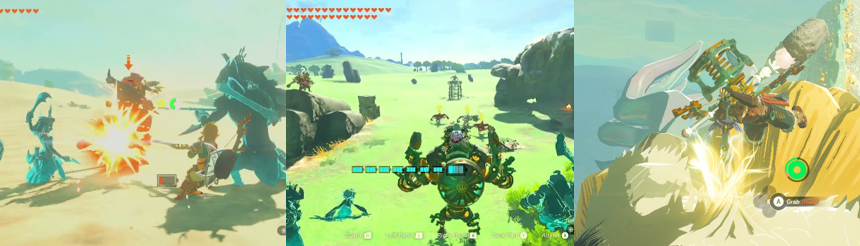
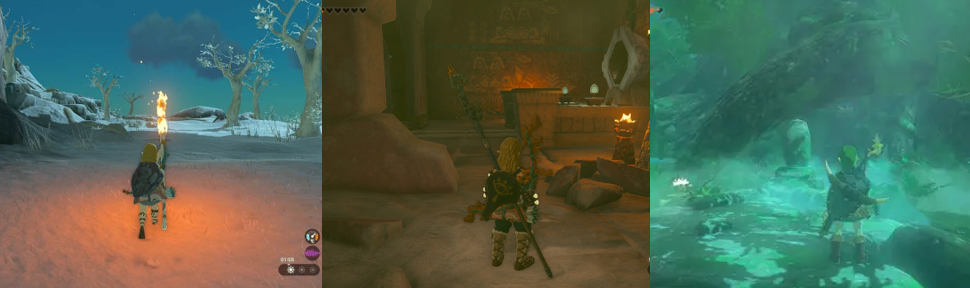
Like its predecessor, The Legend of Zelda: Tears of the Kingdom is an open-world action/adventure game in which players control Link (in one of the rare instances of him not only having that name but being the same incarnation) and explore the vast wilds of Hyrule, a diverse and treacherous land of sword and sorcery. Fundamentally, the controls and basic gameplay mechanics remain unchanged from Breath of the Wild, for better or worse. You press A to talk to Hyrule’s many and varied non-playable characters (NPCs), interact with the environment or pick up objects (stones, weapons, etc), and open treasure chests. To run, simply hold B but keep an eye on your stamina wheel as Link will quickly get exhausted unless you expand it by conquering the returning mini Dungeons (again dubbed “Shrines”). Y swings your currently equipped weapon in a simple combo; hold it to charge up a spin but, again, watch your stamina as you don’t want to end up dizzy and vulnerable. X jumps, with Link deftly hopping over most low objects or executing a jumping attack; you’ll also use this to clamber up walls and surfaces (again, stamina willing). When in combat, press ZR to target the nearest enemy and raise your currently equipped shield to fend off attacks. Successfully tap A while raising your shield to perform a “Perfect Guard” that reflects certain attacks and leaves enemies stunned (though I still can’t get the timing right). Similarly, pressing X at just the right time to dodge an attack allows you to hit a powerful “Flurry Rush” to whittle down their health. Pressing in the left stick sees Link crouch and stealthily sneak around, allowing for one-hit strikes, and you can hold down R when at full health to unleash a Sword Beam.

Link’s returning abilities are bolstered by bizarre building and fusing mechanics.

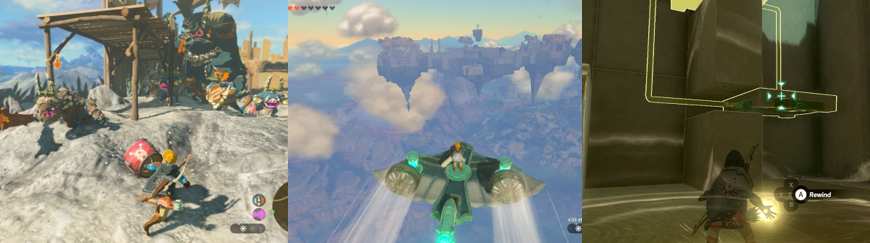
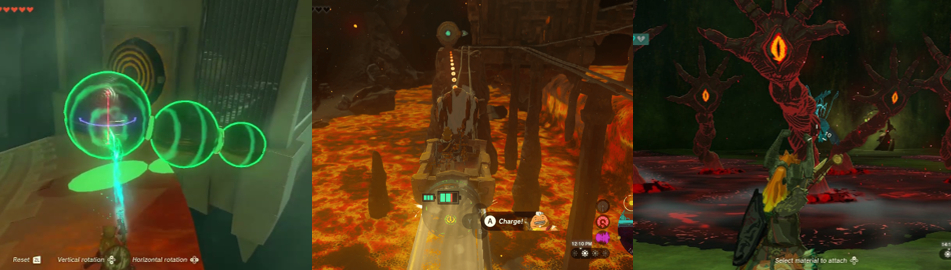
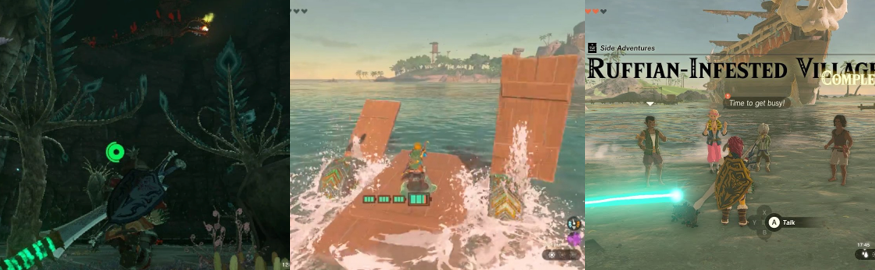
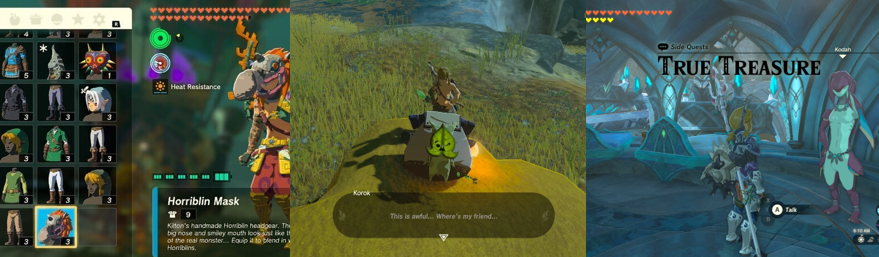
As before, Link can utilise almost anything as a weapon; sticks, skeletal arms, various swords, clubs, and axes are all acquired by defeating enemies or exploring your surroundings. Each has a different power rating that determines not just how much damage it does, but also how durable it is. The lower the rating, the more likely your weapon will shatter after a few hits. Wooden weapons also catch fire and metal weapons attract lightning, so you must swap them out or drop them to avoid taking damage or being caught short. Similarly, items like pot lids, wooden circles, and iron shields can defend against incoming attacks and have the same elemental issues to consider. Link also acquires various bows, with some firing more shots at the cost of their durability and others hitting harder; similar effects are also applied to weapons and shields. Link can also throw items and attach them to his arrows for additional effects, such as blowing up rock walls and enemy hoards with Bomb Flowers, freezing them with Ice Fruit, or setting vines and baddies alight with Fire Fruit. In Tears of the Kingdom, this comes courtesy of Link’s new Purah Pad, and upgrade to the previous game’s Sheikah Slate, which quickly allows him to “Fuse” objects to his arsenal. This is a versatile ability, allowing you to Fuse items to your swords (and even combine weapons) for added effects and damage. Fuse makes shields more durable or rocket you into the air with…well, an attached rocket…and is also essential for solving puzzles since you must cobble together wooden boards to create bridges, rafts, or more complex vehicles. You can manipulate almost anything with the “Ultrahand” ability, which telekinetically picks up objects to be awkwardly rotated to solve puzzles or piece together your creations. Eventually, you learn the “Autobuild” ability that makes this much easier but at the cost of “Zonaite”, a new mineral that powers your creations and allows your gliders to fly, your fans to blow, and your carts to roll along. Perhaps Link’s most useful new ability is “Ascend”, which sees him clip upwards through the environment when able, eliminating the need to expend stamina climbing rugged mountains and sheer walls. Link can also rewind time, to a limited degree, with “Recall”, allowing him to dart into the sky by reversing the direction of falling debris and bypass raging lava flows on makeshift rafts.

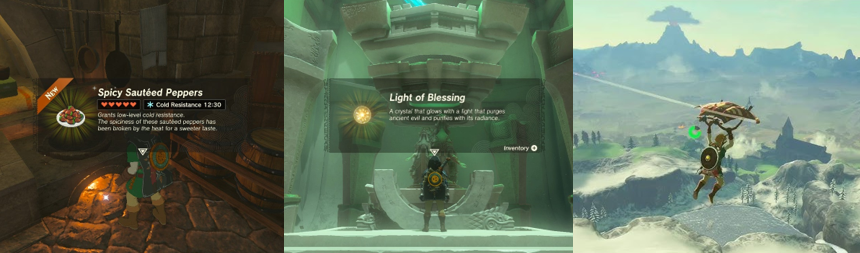
Cook meals and earn Light of Blessings to increase your maximum health and stamina.

As before, Link’s weapon inventory is painfully limited. It can be expanded by finding Korok seeds, but only one slot at a time and the cost increases as you progress. Link’s defensive options are also tied to his outfits, which are found in chests, tied to tricky side quests, or bought from various shops for ridiculous prices. Instead of relying on gathering Rupees, you’re better off selling the precious gems you find by smashing rocks with rock-Fused weapons. You’ll need to do this as Link won’t last long in extreme heat or cold without the right outfits, and some offer additional perks such as speeding up your swimming rate, rocketing you up waterfalls, resisting elements, and upping your attack and defence. Rather than collecting hearts from defeated enemies, Link can either spend Rupees at an inn, collect a “Light of Blessing” from Shrines, or cook meals. This time, any meals you cook are recorded for easy reference; meals can also have added effects, such as temporarily increasing your maximum hearts and stamina wheel. To permanently extend these, you must trade four Light of Blessings at prayer statues dotted around Hyrule to gain either a new heart container or an extra slither to your stamina wheel, a process that remains as tedious as before. Similarly, you can still sneak up on and tame wild horses, adding them to stables and calling them with a whistle. If you have a Breath of the Wild save file, your horses will even be carried over, which is nice. There is a generous fast track mechanic, as before, but you must again activate towers (revealing more of the map in the process) or beat Shrines to utilise this. Finally, you can jump from high places and glide using your Paraglider and, though you can’t drop bombs like before, you can whip out your bow and use the slowdown effect to pick enemies off and, eventually, speed up your gliding with a gust of wind.

The Sages fight alongside you, though it takes all your strength to retrieve the Master Sword.

Like in Breath of the Wild, Link is aided in his journey by reincarnations of the ancient Sages. Following the main story quest (something easily done from the extensive “Adventure Log”) sees you conquer five ancient “Temples” and encounter these allies, who then join your quest, in spirit. Tulin blasts a gust of wind that speeds up your gliding and blows over enemies; Yunobo cannonballs ahead, setting fire to grass and smashing rocks; Sidon protects you with a water shield and blasts foes with a burst of water; Riju adds a lightning bolt to your arrows; and you can pilot Mineru’s mech, attaching various accessories to essentially make a Rock ’Em Sock ’Em Robot. Each ability has a cooldown element (with Mineru’s abilities tied to Zonite) and each Saga follows you on the overworld unless dismissed, battling enemies and bosses alongside you to take some of the heat off you. Mineru is especially usefully when explore the “Depths”, a vast, pitch-black, incredible dangerous environment found beneath Hyrule and accessed via chasms. Down here, you’ll activate Lightroots and toss Brightbulbs to brighten up the area and encounter vast deposits of “Gloom”, a Malice-like substance that permanently saps your maximum health unless you recharge at Lightroots or cook special food. Mineru walks through Gloom and lava without fear, but you must watch for Gloom-infected enemies and the horrific Gloom Spawn, which essentially act as this game’s second counterpart to the Guardians (the first being the various Zonai Constructs). While it’s not necessary to explore the entirety of the Depths, you will visit there many times throughout the story, and it can be beneficial to venture down there to collect powerful weapons or Poes to obtain new clothing. Additionally, you can blast up to the skies to explore various disparate floating ruins not a million miles away from the floating islands of Skyloft. Up here, you’ll find mine carts, caves, and the remnants of the Zonai people, alongside additional Shrines and rewards. The skies are also great for scoping out points of interest on the surface, such as Shrines, towns, or the various geoglyphs that dot Hyrule’s landscape. If you’re really lucky, you’ll spot one of four elemental dragons who can be farmed for precious minerals, with one in particular (the Light Dragon) awarding the legendary Master Sword if you have enough stamina to retrieve it.

Puzzles and traversal are made more challenging with the building mechanics and spiteful Gloom.

Hyrule’s surface remains relatively unchanged from Breath of the Wild; many of the same towns, locations, and landmarks can still be found, though with some alterations. Lurelin Village has been infested with ruffians who need to be fought off, for example; the Rito Village has been beset by a blizzard; and the Gorons have become obsessed with Marbled Rock Roast. The Korok Forest and eerie Lost Woods are shrouded by an impassable mist, Hyrule Castle floats above a chasm of Gloom thanks to the “Upheaval” caused by Ganondorf’s awakening, and Zora’s Domain is polluted by sludge. You must clear out these issues with both your items and by completing Temples, which are thankfully far more visually distinct this time around. Rather than every Temple relying on a clunky rotating gimmick and a repetitive Sheikah aesthetic, they’re much more traditional in their depiction and use of elemental themes. You’ll solve a primary puzzle in each, from activating propellers to unlock giant locks, hitting gongs to release padlocks, powering up water wheels and ancient batteries, and collecting Mineru’s parts. While you do collect keys, this element is downplayed, though you still activate levers and switches (albeit with Ultrahand). Typically, you’re more likely to be moving or combining items, rolling giant balls into targets, and either using Ascend or fans to progress upwards. The Water Temple has a unique gravity gimmick that sees you float around in bubbles, you’ll get a prelude to the Lightning Temple’s boss battle before entering, and the Fire Temple is full of mine carts that require you to switch tracks by firing Yunobo at targets. Just getting to the Temples is a feat in itself, with you forced to venture higher and higher into the skies and cross flying ships to reach the Wind Temple and explore the murky Depths to find the Spirit Temple. Hyrule Castle again acts as a Temple, one guarded by powerful enemies and covering Gloom, and you must venture deep into the hazardous, Gloom-filled chasm beneath it to confront the Demon King. Shrines are far more challenging and diverse this time around, ranging from combat challenges to logic puzzles that’ll have you using Link’s Purah Pad abilities in unexpected ways or battling enemies with makeshift items.

You’ll search high and low and build all sorts to help out Hyrule’s inhabitants.

Like Breath of the Wild, Tears of the Kingdom is an unforgiving experience. Link begins with three hearts and acquiring more is a chore since you’re forced to seek out Shrines (something made much easier by completing a side quest to add the Sensor to your Purah Pad). Even then, having more health can be detrimental since it means consuming more food to replenish your health and Link is frustratingly weak at times. Even simple encounters can end in a game over, meaning it’s often better to just sprint past enemies to preserve your weapons, health, and sanity. To make matters worse, all enemies and treasure respawn when the “Blood Moon” rises, meaning the environment never gets any less dangerous. This remains a frustrating experience for me as I enjoy the combat in the Zelda games but the risk/reward of battling even simple enemies often isn’t worth it. Add to that the frustrating weather effects, which see you slip down mountains, tumble about like a ragdoll from a lightning strike, and collapse from heat exhaustion and you have a game that can be a chore to play. While the Gloom and the Depths can largely be avoided, you’ll endure both eventually and they’re a major headache as it’s not fun to stumble about in the darkness, have your hearts sapped away, and then be surprised by a Gloom-infected rematch with a boss! It seems like every NPC has a story to tell and a mission for you, be it reuniting lost Koroks, exploring wells, seeking out evidence of Zelda sightings, or bringing musicians to the Great Fairies so you can upgrade your clothing (for a small free…) Sometimes, you’re forced to battle waves of enemies or NPCs will turn out to be the aggravating Yiga Clan in disguise. Other times, you’re performing glorified fetch quests for minimal rewards or cobbling together constructs to help Addison campaign for President Hudson. Some Shrines only reveal themselves after you retrieve their crystal, either by battling a mini boss or solving some tedious nearby puzzle; others offer no challenge at all, making for a nice change of pace. Link’s building abilities can result in some remarkable craft, from boats to full-blown planes, but it can be annoying rotating pieces into position, and you’ll expend a lot of your resources to get all the pieces you need and power everything.

Presentation:
Link’s model, like all the character models, appears essentially unchanged from Breath of the Wild save for some different attire and his new monster arm. When in sweltering heat, he pants and sweats; when in blistering cold, he shivers; and when standing too close to an explosion, he catches fire. Although he doesn’t speak save for some grunts, there are dialogue options here and there that show is does communicate with those around him. Other NPCs communicate through traditional text boxes or voice acting, which is generally saved for the more dramatic cutscenes and the various memories. Link’s companions have a fair bit of personality, with Yunobo being a standout for me since he’s brainwashed into turning against his people and then determined to make up for it with an enthusiastic gusto! Tears of the Kingdom takes the expansive overworld from Breath of the Wild and expands upon it considerably. The surface is largely the same from what I remember, featuring towns, swamps, mountains, a massive volcano, and rushing waters. Settlements like Kakariko Village and Hateno Village remain, with Link now having a home and encountering many of the same NPCs (some of whom recognise him and others who strangely don’t). The landscape is altered by the presence of chasms leading to the Depths but still contains hidden caves, stables, the ruins of the old world, and recognisable landmarks like the Temple of Time. Hyrule is gigantic and full of different cultures, from the distrustful Gerudo in the arid desert to the proud Zora in their waterfall kingdom. Each area has different weather effects to worry about, from stifling heat to bitter cold, something exacerbated by random thunderstorms and the titanic elemental Gleeoks. There’s also a day/night cycle present, some mist and fog effects here and there, and a real sense of the world having changed both between games and from the fallout of the Upheaval, which sees debris rain from the skies and uncovers long-forgotten ruins that you must explore and decipher.

Hyrule is bigger and more varied (and dangerous) than ever.

By their very nature, the Depths aren’t as immediately impressive simply because they’re seeped in darkness. It’s an oppressive, bleak, and dangerous environment with no inhabitants save for Ganondrof’s minions, the remains of a Zonai outpost, and Robbie’s tentative efforts to explore the Gloom-infested environment. Still, there is a lot to see here once you illuminate your surroundings; Zonai depots, lava flows, and Gloom-versions of the game’s bosses all dwell alongside Bargainer statues where you trade your Poes and rusted weapons you can take. The skies aren’t much better, being a fragmented series of ruins, tracks, and Zonai deposits that you must often glide between. The Shrines have been redesigned (for the worst, in my opinion) and returning areas like Hyrule’s labyrinths and even the elegant castle have an added danger thanks to being infested by Gloom. Shrine interiors are very similar to what we saw in Breath of the Wild, favouring substance over style and restricting your abilities so you can’t just glide to the exit. They retain the ancient mixture of science and magic from Breath of the Wild, but I remain unimpressed by how tedious it gets searching for Shrines just to get enough Light of Blessings to gain one extra heart that’s immediately shattered by Gloom. Still, as mentioned, the Temples are much improved this time around. They not only have a better visual identity but contain more interesting puzzles and a greater enemy variety. The standout for me was the Lightning Temple, which sits within a vast pyramid in the storm-swept Gerudo Desert and is home to the mummified Gibdos. I felt like a proper tomb raider shifting blocks and riding wind currents in here, though the Fire Temple also impressed by being an abandoned mine within a volcano. The Spirit Temple was the most disappointing since it simply hosts a boss battle, but the journey to it through the Construct Factory in the murky Depths was challenge enough.

The world and story have been expanded and changed by the recent, cataclysmic events.

Tears of the Kingdom makes great use of ambient sound for the most part. There’s no sweeping Zelda theme when galloping across the overworld here; just the sounds of enemies approaching or light piano tunes. This changes once you get into battles, ramping up the anxiety when you’re suddenly attacked by a spear-wielding Moblin and battling the finnicky controls as you tumble down a mountainside. Music really only plays a role in the game’s cutscenes, however, which can be replayed from the Adventure Log. Like its predecessor, Tears of the Kingdom invites you to challenge yourself; if you’re brave (or stupid), you can head right to the final confrontation (and win!) and you’re free to explore every area out of sequence, for the most part. The map and Adventure Log can quickly become cluttered with waypoints and primary and optional quests, making it difficult to remember where you’re going and what’s happening next. However, I never experienced any performance issues save for one terrifying moment where the game crashed during the Yunobo fight. The environment renders well; wild animals and NPCs roam freely with no slowdown or noticeable pop-up, though the weather effects do help mask this at times, I feel. Traversing the surface is far less hazardous thanks to the absence of Guardians but the Gloom Hands definitely get your blood pumping when they slither to life and relentlessly chase you across walls and ceilings. Long-time Zelda fans should also enjoy the various nods to previous games in the names of certain locations and NPCs, as in the last game, and Tears of the Kingdom definitely feels like a celebration of the franchise’s rich history as much as anything else. Probably the best callback for me was exploring Hyrule Castle again; though much more restricted thanks to the Gloom and the damage, it was fun revisiting the library and royal rooms. Unfortunately, the plot lost me a bit; I still don’t understand why no one makes a connection between Ganondorf and Calamity Ganon and I must have been distracted when the game explained why Zelda’s been sighted across Hyrule when she’s actually flying through the skies as the Light Dragon.

Enemies and Bosses:
As far as I could tell and remember, every enemy encountered in Breath of the Wild reappears here, sporting the same strengths and weaknesses and dropping the same items upon defeat. Hyrule is full of sentient trees, jelly-like Chuchus, odd Pebblits, bat-like Keese, and rock-spitting Octoroks. These common enemies aren’t much to shout about, popping up as you explore and generally being more a nuisance than a threat, but the land is also patrolled by Ganondorf’s more organised and formidable forces. The most commonly encountered are the squawking Bokoblins, often found around campfires, guarding towers, or riding Battle Talus’s. They’re often subordinate to their more challenging silver-clad commanders, trailing behind bulbous Boss Bokoblins, or taking orders from large, goblin-like Moblin. Skeletal variants of these are also encountered, some ride horses on the overworld, and Gloom-infested variants swarm the Depths, but they’re also echoed in the cave-dwelling, ape-like Horriblins. Exploring deserts, swamps, and water-rich areas sees you surprised by the lizard-like Lizalfos, who spit water and turn invisible, and you’ll often face a double threat as Aerocudas patrol the skies. Bokoblins, Moblins, and Lizalfos wield various weapons, from swords to lances and bows, and will call for backup upon spotting you, making even a handful of them a significant threat. Various Wizzrobes are also encountered, often skipping and teleporting about and firing different elemental magic, and the Yiga Clan will jump you when you least expect it, disappearing in a puff of smoke and charging you with their blades. You’ll also contend with mummified Gibdos both on the ground and in the air, though fire- and lightning-based attacks make short work of them. Various armed Zonai Constructs test your combat prowess, acting as smaller but no less threatening counterparts to Breath of the Wild’s Guardians.  

Formidable and horrific mini bosses roam Hyrule and launch surprise attacks!

Hyrule is also populated by various mini bosses. Boss Bokoblins are larger versions of regular Bokoblins that wield big clubs and can take quite a beating, caves house different elemental Like-Likes, and giant stone Talus’ assemble from the environment to catch you by surprise, with their only real weak point being the Ore Deposit on their heads. If you’re really unlucky, a massive cyclopean Hinox will wake up and chase you (though targeting the eye turns the tide in your favour), mutated crocodile-like Molduga burrow through the Gerudo Desert and in the sands of the Depths, and a combination of the two, the Frox, also appears down there, sporting the same weaknesses as both. Flux Constructs are usually found in the skies; these sentient Zonai cubes are controlled by a central cube that must be targeted before they pummel you into the stone. Master Kohga also returns, having dropped to the Depths and mastered the Autobuild ability to fashion giant trucks, flying machines, and even a mech to rival Mineru. Though he’s more troublesome this time around, he’s quite susceptible to arrows in each encounter. Before he joins your cause, you must fight the brainwashed Yunobo, dodging his cannonball-like roll in a prelude to one of Ganondorf’s devastating charge attacks. Though far less prominent (at least in my playthrough), powerful, centaur-like Lynels still exist in Hyrule, with a silver variant encountered in the Gloom-filled Depths prior to battling Ganondorf. They’re joined by the various elemental Gleeoks, massive, three-headed dragons that breathe fire, frost, and lightning and are lorded over by an even tougher king. I’m gonna be honest and say I never fought these; I saw them flying around or standing atop mountains and felt their power in the intense weather effects they emit, but didn’t dare test myself against them (or the Lynels, for that matter). Similarly, I simply fled from every Gloom Swarm so I wouldn’t be decimated by Phantom Ganon, though you’re forced to fight this terrifying foe at least twice, once when exploring Hyrule Castle and again to free the Great Deku Tree. Phantom Ganon acts as an appetiser for Ganondrof’s battle, charging with a sword, striking with a lance, causing massive shockwaves with a club, duplicating himself, and spreading Gloom everywhere in easily some of the toughest battles in the game.

The five Scourges are visually distinct and range from simple to frustratingly challenging.

Each Temple houses at least one boss, a “Scourge”, that is, thankfully, not simply a variant of Ganon this time around. You can tackle these in any order but I first battled Colgera, Scourge of the Wind Temple, a gigantic insectoid creature that flies up from within the Wind Temple and forces you to battle it in mid-air (not unlike the game’s final challenge). Colgera emerges from portals and fires ice shards from its body, unwittingly exposing its weak spot, which you must target with Fire Arrows (using Keese eyeballs to help aid your aim). Tornados keep you in the air and Tulin gives you a speed boost, but this wasn’t an especially taxing boss, even when its weak spot switches to its underbelly in the second phase. Next, I battled the Water Temple’s Mucktorok (after getting to grips with Sidon’s abilities in battle with the Sludge Like), a cackling little imp who rides a Molduga-like sludge shark. You must blast this with Sidon’s water wave, clearing a path through the sludge, avoiding its spit attack and shockwaves and chasing the slippery devil down to give it a good thrashing. To enter the Fire Temple, you first dispatch the volcanic dragon, Moragia, that’s attached to Death Mountain by flying around on a nearby Zonai flyer and firing Yunobo at it. Inside, you’ll face the Marbled Gohma, a spider-like rock beast that tries to stomp you and fires explosive chunks of rock. You must fire Yunobo at its legs, crippling it so you can pummel its eye, then send Yunobo rolling up to smack it when it retreats to the ceiling. The difficulty noticeably spikes when you face Queen Gibdo in the Lightning Temple, mainly because you’re so reliant upon Riju’s lightning attacks and lightning-adjacent attachments to your bow. The battle’s further complicated by the Gibdos she spawns in, distracting you and making things very frustrating and difficult near the end. In comparison, the Seized Construct is much easier. Fought in an electrified boxing ring with you controlling Mineru, this thing’s a breeze with the right attachments as you stun it with your arm cannon and smash it into the electrified ropes using a wrecking ball.

Ganondorf throws his forces at you, decimates your health, and then becomes a titanic dragon!

These bosses return in the Depths, if you fancy testing your skills further, and are fought as part of the final battle, much like in the last game. If you best them prior to confronting Ganondorf, however, you obviously won’t need to worry about them. The King of Evil is no joke, however, and is fought in an aggravating multi-stage battle. First, you and the Sages face four waves of Gloom-infested enemies, collecting their loot and hoping you have enough Gloom-resistant armour or food to survive the next stage. Here, you face Ganondorf one-on-one in a fight functionally identical to those against Phantom Ganon. Ganondorf switches between a sword, spear, club, and bow, inflicting Gloom damage with each hit and both parrying and perfect-dodging your attacks. With the right timing, you can whittle him down with the Master Sword; attack-boosting gear and food is a must here, as is Gloom food, but you can also fire Bomb Flowers, Rubies, and Gibdo Bones to take chunks off his health. Victory sees Ganondrof duplicate himself, gaining a ridiculously long health bar in the process. Though the Sages help you, they mostly end up cluttering the screen so it’s advisable to take to the air however you can (Fusing a rocket or Autobuilding something) to litter the battlefield with Rubies and Bomb Flowers. After many deaths, I finally got lucky and got Ganondorf back to half health, which returns the fight to a one-on-one contest. Unfortunately, the Demon King is faster and stronger than ever, sending waves of Gloom and Gloom projectiles, causing Gloom shockwaves, and charging at you, leaving a trail of Gloom in his wake. Luckily, you can strike his projectiles to stun him and, with the right food and a little luck, he’ll eventually be bested. In his rage, Ganondorf consumes his Secret Stone and transforms into a gigantic dragon! Zelda, as the Light Dragon, swoops in to save you, keeping you from falling to your doom, and giving you a boost to reach the Demon Dragon’s back. This stage is mostly a formality, however; just avoid the Gloom scales and target the Gloom pustules on the Demon Dragon’s back. When you get the chance to target the Sacred Stone on his forehead, hold Y to deliver the killing blow and then dive through the sky to rescue Zelda in freefall!

Additional Features:
There are 152 Shrines to find across the skies and surface of Hyrule. Each one houses a chest that contains a weapon or some kind of treasure and also awards a Light of Blessing. With four of them, you can trade for an extra heart or an extra sliver of your stamina wheel, which can make combat and exploration much less of a headache. There are also 120 Lightroots in the Depths which, like the Skyview Towers, simply exist as fast travel points (though Lightroots also restore your Gloom-shattered hearts). There are now a whopping 1000 Koroks to find; some are under rocks, some require transporting to their friends, and some task you with solving puzzles. Finding them all expands your inventory and again awards you with a useless (but golden) piece of poop. You’ll also find loads of treasure chests in every area of Hyrule; some house Rupees or rare materials, some gift weapons, and some have clothing. Collecting all three pieces of an armour set can award additional buffs both by default and courtesy of a Great Fairy, and you can dress Link up as his dark counterpart, an enraged God, and even to resemble various enemies. Some materials can be dyed to further customise them and you can further bolster your stats by cooking food, with recipes being saved for further use. Your horses can also be upgraded and customised; by discovering stables and boarding your horse, you’ll earn “Pony Points” to trade in for harnesses and accessories to complete side quests.

Hundreds of treasures, collectibles, and side quests await in this sprawling adventure.

Speaking of, there are loads of optional missions in Tears of the Kingdom. Some are pretty simple, like liberating villages from enemy hordes or retrieving Shrine stones. Others see you gathering materials, photographing enemies and objects, investigating Zelda sightings, and recovering lost or stolen items. Completing side quests earns you Rupees and other rewards, such as food, additional shops, and even armour. Helping Robbie with his research not only upgrades the Purah Pad to detect Shrines and other targets, it also adds the “Hero’s Path” mode to the tablet so you can see where you’ve travelled and gifts you “Travel Medallions” that are essential when fighting your way to Ganondorf. Misko will mark the locations of rare treasure on your map, allowing you to find new armour sets, dogs can be befriended to dig up treasure chests, shop prices can be reduced, and the truth about Zelda’s draconification can be discovered if you explore high and low. Completing the game adds a star to your save file but returns you to your last manual save before battling Ganondorf, meaning you never get to see peace returned to the land on your save file. You can go back and finish any tasks remaining, however, exploring Hyrule Castle docks for the powerful Hylian Shield and collecting Poes to collect new gear. Tears of the Kingdom is also compatible with Amiibos, allowing you to scan in entire armour sets quickly and easily. Sadly, the Master Cycle from Breath of the Wild’s downloadable content isn’t available (though you can build a close approximation) and there is currently no additional content available for the game, but it’s not as if there aren’t hours of content to return to once you’ve completed the main story.

The Summary:
Since I struggled with The Legend of Zelda: Breath of the Wild, I was hesitant to get into the sequel, and these fears were entirely justified. The weapon durability mechanic is as tedious as ever, forcing me to run from most encounters when I’d rather be fighting like in the Nintendo 64 games. Link is frustratingly fragile, easily being killed by even the weakest of enemies, and the entire game is an uphill battle to learn and improve. Link’s new abilities do mitigate these issues somewhat; you can effectively double your weapon inventory by Fusing swords and shields together, though often at the cost of holding a shield. I was also very pleased by how much easier the five main bosses were compared to Breath of the Wild’s and how much more visually unique the Temples were. Getting to them was a chore at times but it was much closer to a traditional Zelda experience once I was inside. The Shrine mechanic is as annoying as before, though, and I wish there was a “Novice” option to give you at least one set of weapons that don’t break and that allocated hearts to one set of Shrines and stamina to the other. I didn’t really like the focus on building; it was finnicky to rotate and Fuse things together to solve puzzles and the vehicles weren’t very fun to control. The mechanic didn’t work for Banjo-Kazooie so I don’t see why Nintendo thought it’d work for Zelda, and it just got in the way most of the time. I liked seeing how Hyrule had changed, with familiar areas altered from the passage of time, and how much bigger the world was, but I hated the Gloom mechanic, the sky islands were dull, and battling Ganondorf was like chewing nails. The story was convoluted and somewhat lost amidst all the hundreds of other sub-plots and side quests, though I enjoyed seeing bigger, more ferocious optional bosses patrolling the overworld. Despite all the changes, though, The Legend of Zelda: Tears of the Kingdom still feels like a glorified expansion pack of its predecessor. I had the same issues as before, if not more thanks to the new inclusions, but remain impressed by the scope and sheer scale of the world, so I think it’s fair to give it the same rating as Breath of the Wild and stay in the minority of people who just don’t click with this approach to the Zelda franchise.

My Rating:

Rating: 3 out of 5.

Pretty Good

What did you think to The Legend of Zelda: Tears of the Kingdom? How do you think it holds up against its predecessor and were you excited to revisit this world? What did you think to Link’s new abilities, specifically the building and Fusing mechanics? Were you also frustrated by the Depths and the dangerous Gloom? Did you also find the main bosses easier than Breath of the Wild’s only to struggle against Ganondorf? Did you ever complete all the side quests and find all the Koroks? Which Zelda game is your favourite and how did you celebrate the franchise this month? Whatever your thoughts on Tears of the Kingdom, drop a comment down below and go check out my other Zelda reviews.
Game Corner [Zelda Month]: Hyrule Warriors: Definitive Edition (Nintendo Switch)


On 21 February 1986, The Legend of Zelda (Nintendo EAD, 1986) was first released in Japan. The creation of legendary game designer Shigeru Miyamoto and Takashi Tezuka, The Legend of Zelda launched one of Nintendo’s most popular franchises. This year, I’ve been dedicating every Friday to Nintendo’s most famous silent protagonist, Link and his vast and enduring fantasy world of sword and sorcery.


Released: 18 May 2018
Originally Released: 14 August 2014
Developer: Omega Force / Team Ninja
Also Available For: Nintendo Wii U (Original Version), Nintendo 3DS (Legends Version)

The Background:
The Legend of Zelda has consistently been one of Nintendo’s most popular, celebrated, and successful franchises and one of the reasons for this is the consistent quality of its games. While Zelda titles have often included unique gimmicks to separate them from each other, the tried-and-true sword and sorcery formula has remained present throughout the series. Indeed, Nintendo’s few attempts at veering away from this formula have resulted in mediocrity, at best, and ridicule, at worst. It was therefore surprisingly (to me, at least) when Nintendo joined forces with Koei Tecmo to produce a spin-off game, one that incorporated the chaotic hack-and-slash action of Koei Tecmo’s popular Dynasty Warriors series (Omega Force, 1997 to 2018). Long-time Zelda producer, Eiji Aonuma jumped at the chance to do something new with the franchise and the game pulled inspirations from across the entire Zelda series and eventually achieved Koei Tecmo’s president Yoichi Erikawa’s dream of selling of a million copies. Initially released on the Wii U and bolstered by a slew of downloadable content (including a previously cut female version of Link), Hyrule Warriors garnered positive reviews, with critics praising the merging of the two franchises while criticising the repetitive gameplay. In 2016, the game was ported to the Nintendo 3DS as Hyrule Warriors Legends; it included all previous downloadable content, a new Fairy system, and new gear for existing characters as well as a code to upload these additions to the Wii U version. Although reviews still praised the port, the limitations of the 3DS hardware (even when playing on the more powerful New Nintendo 3DS) were highlighted as negatives. Regardless, a newer port later came to the Nintendo Switch; billed as the Definitive Edition, this version included everything from the previous games alongside some new costumes. It was also received much more favourably, perhaps contributing to the release of a sequel title in 2020.

The Plot:
In an alternative timeline, the sorceress Cia seeks to resurrect the King of Evil, Ganon, by waging war against the kingdom of Hyrule. To defend her kingdom, Princess Zelda recruits lowly knight Link, the bearer of the Triforce of Courage, to amass an army of familiar faces against Ganon’s dark forces.

Gameplay and Power-Ups:
This is the Definitive Edition of Hyrule Warriors, a third-person hack-and-slash action//adventure in which players take control of Link (and many other new and familiar faces from across the Legend of Zelda franchise) to plough their way through seemingly endless hordes of enemies, many of them also series staples. Although each character has their own strengths and weaknesses, they share similar attributes, abilities, and control methods, with a couple of exceptions. Players can fully customise their control scheme but, by default, you’ll throw a regular attack with Y, a combo attack with X, a special attack (when your Special Attack Gauge is full) with A, and dodge with B. You can string together presses of Y and end them with X to pull off combos and character-specific special attacks (such as Link’s trademark sword spin), with more being unlocked as you defeat enemies, earn Materials, and level-up. I preferred to mix these buttons up, assigning B to the regular attack, special to Y, combo to X, and dodge to A but it’s entirely up to you. L targets nearby enemies (an occasionally finnicky system that can keep you from targeting the right enemy if larger bosses are around), ZL guards, R unleashes a powerful “Focus Spirit” attack when the Magic Power meter is full, and ZR lets you use sub-items, such as bombs, arrows, or bottles to restore or buff your character. Later on, if you have a Fairy in a bottle, you can press in the right stick to activate Fairy Magic. You can also switch items by pressing left and right on the directional buttons, or switch characters by pressing up and down. Characters are largely differentiated by their stats; Darunia and Impa, for example, are slower but more powerful characters compared to Sheik and Ruto. Their weapons are also a factor, with Wizzro favouring blasts of dark energy, Midna riding and attacking with Link’s wolf form and her malleable hand, and Young Link having a unique Focus Spirit ability that allows him to potentially retain an empowered state indefinitely.

Cut through endless waves of enemies with special attacks and sub-weapons.

As you defeat the game’s near-infinite enemies, your Special Attack gauge will fill; you can also collect Force Fragments from enemies or pots to fill it faster, and increase its length by levelling-up. Similarly, the Magic Power meter fills by collecting Magic Jars, with these collectibles being as abundant as the hearts and Rupees that enemies, pots, and chests drop all over the map. When these meters are full, you can pull off more powerful special, character-specific attacks that change depending on which weapon you have equipped and any elemental effects associated with that weapon. For example, Lana can equip a spell book or a spear and Link can equip both a Magic Rod with fire properties and swords (including the legendary Master Sword), with each weapon unleashing different special attacks (often with cameos by other Zelda staples, such as Dark Link or the Great Deku Tree). Focus Spirit is a little different and more universal; activating it empowers you for a short time, negating any knockback and instantly exposing an enemy’s “Weak Point Gauge” if you perform a special attack. The Weak Point Gauge appears on tougher enemies and bosses; draining this lets you perform a bigger, more devastating attack to dramatically reduce or completely destroy your target. Other enemies, mini boss types like enemy commanders and such, are susceptible to specific sub-weapons. Bombs against shield Moblins, arrows against the Deku Babas, the hammer against the Blins; whatever the case, an onscreen indicator shows which sub-weapon is most effective against your target. Sub-weapons can also be temporarily powered up from random pick-ups and to activate switches, cross gaps, or stun giant bosses. When equipped with a bottle, your character can drink various potions for buffs and restorative effects, or utilise Fairy Magic in much the same way. Finally, activating Owl Statues across each map sets up warp points so you can quickly teleport to different areas using the ocarina.

The sheer amount of objectives and notifications means it’s probably best to play with a friend.

The game’s onscreen map shows the locations of allies, enemies, bosses, and other notable objectives and items. It’ll display which of your allies are talking, flash when Keeps are in danger, and show the many different objectives that pop up throughout each mission. Pressing + pauses the action and accesses a more comprehensive map. From here, you can check mission dialogue and objectives, review the controls, create a manual save point (though checkpoints occur during most missions), and issue orders to your allies. This is crucial as the game progresses and more objectives appear in each mission; ideally, you want four playable characters in each mission, each powerful enough to hold their own in battle, and to order them to different objectives. The AI attacks enemies and bosses, with allies reducing a boss’s health and defence, but they do tend to wander about or stay in place and I often found it difficult to select a specific target from the map. Ideally, you want to play Hyrule Warriors with a friend as the game can get very chaotic; tutorials, dialogue, objectives, and notifications swamp the already messy battlefield. While you can turn some of these and other onscreen effects off to clear things up, it can make it easy to fail missions if you miss an objective. Luckily, mission success is often malleable; you can lose a Keep or have captains and commanders flee and not fail the mission, and you can fail side missions (usually escorting an ally, defending a Mama Cucco, or defeating Messenger enemies) and still continue. However, if a primary ally (usually Princess Zelda) or your main Allied Base falls, you’ll restart from the last save, checkpoint, or the start of the mission.

Combat is fun and satisfying, if chaotic and often repetitive.

“Chaotic” is definitely the best word to describe Hyrule Warriors; enemies spawn (or pop) in constantly, swarming from Outposts and Keeps that must be captured to secure your position on each map. Mission objectives usually always boil down to capturing as many as four Keeps or strategic locations, such as the Fairy Fountain (which you activate with B to weaken bosses or otherwise aid your allies). Sometimes, you’ll intercept giant Bombchus to keep them from damaging or destroying Keeps. Other times, you’ll defend against enemy commanders, searching for allies or the correct enemy in a swarm of doubles, or taking out Transport troops and Keep Saboteurs. Generally, it’s not a massive issue if a Keep falls, but it is inconvenient. To secure a Keep, you must drain its energy bar by defeating the enemies housed there. This spawns the Keep Boss, who’s easily defeated, and secures the Keep for yourself, occasionally spawning a treasure chest containing Rupees, a weapon, a Heart Piece, or other item. If a Keep or Outpost is captured by the enemy, simply retake it in the same manner. Other times, allies will call for aid; you must rush to them and enter the glowing circle around them to rescue them and restore their health, and you must do this for certain allies (again, Zelda, but often Darunia or Impa and the like) for the mission to continue. Often, enemy Keeps are locked, forcing you to find alternative routes or, you guessed it, search for and destroy specific enemies to open the doors. Combat is satisfying and fun; you plough through hundreds and thousands of enemy troops with relative ease when playing on “Easy” mode, especially with a higher level character. However, it can become frustrating and repetitive; when there are four or five different objectives and you’re bombarded by notifications, it can be hard to know what you should prioritise. Things can get very frantic when playing alone as you’re constantly switching characters and warping across the map to put out fires, so to speak.

You’re encouraged to battle over and over to level-up and buff your weapons and skills.

Defeating enemies earns you experience points (EXP), which allow you to level-up and become stronger. It also earns you power-ups, Materials, and Rupees. Outside of battle, Materials and Rupees are used to further improve your character. They unlock “Badges” that gift additional combos, attacks, and increase their stats and meters in the attack skill tree. You can unlock additional bottles and improve their defence against elemental attacks, reduce knockback and stun, and other defensive buffs; or you can speed up how fast your meters fill or how quickly you take Keeps. You can also spend Rupees to quickly level-up any characters you haven’t used much (since AI-controlled characters don’t appear to level-up) or new characters you’ve unlocked, or spend them in the Smithy. Here, you sell or fuse weapons to reduce your inventory and add extra buffs to weapons. Weapons will either have no “slots” or as many as three, allowing them to be empowered to strengthen your regular or special attacks, earn extra EXP, spawn extra Rupees, deal elemental damage, and so forth. Initially, your inventory is quite limited, but it expands as you progress through the story, though I found it easier to stick with the most powerful weapon and sell the weaker ones and rarely saw a benefit of fusing weapons. There’s also an apothecary, where you mix new potions and elixirs, and you’ll gain new items and sub-weapons from treasure chests. After clearing each mission in “Legend Mode”, you can replay it either in this mode or with any character in “Free Mode”. You can play on a harder difficulty to earn more rewards, or search for the elusive and skittish Gold Skulltulas, which add to various portraits and unlocks additional maps and bonuses. On the whole, Hyrule Warriors is quite easy; if you stick to one or two characters as I did (usually Link), you can become very powerful very quickly. However, it’s easy to get caught off-guard when stronger enemies or multiple objectives pop-up. The game obviously gets tougher on harder difficulties as enemies are stronger and deal more damage, and some missions add additional hazards, such as lightning strikes, bombardments, and health-sapping auras.

Presentation:
I first played Hyrule Warriors on the 3DS, where the game was serviceable but the hardware struggled with all the enemies and action, causing some slowdown an pop-up. I specifically bought the Definitive Edition to mitigate these issues and, for the most part, the upgrade is immediate and welcome. The game still suffers from a bit of pop-up and occasional slowdown when there’s a lot happening onscreen or when you’ve completed a mission (meaning many battles abruptly end). There are also noticeable loading times between missions (though tips, fun 8-bit graphics, and story dialogue help to speed them up), but the game performs really well otherwise. Hyrule Warriors mostly pulls its locations and characters from Zelda’s 3D adventures, recreating and reimagining areas such as Hyrule Field and Hyrule Castle, the Twilight Realm, and Skyloft as restrictive sandbox battlefields populated by Keeps, pots, and occasional bridges, dips, and alternate paths. These locations are rather hit and miss; later, you’ll battle in cel-shaded arenas like Windfall Island, which are far more vibrant and fun than the dense, confusing forest or the apocalyptic wastelands ruled by Ganon or the relatively sparse Gerudo Desert. One enjoyable exception was Lake Hylia, which includes not just the lakeside area but the labyrinthine catacombs of the Water Temple. Indeed, with the game’s emphasis on fast-paced, chaotic combat, it’s no surprise that the locations are rather bland. Sometimes, bridges will crumble and you’ll hookshot over gaps, or lightning and other bombardments will fall, or there’ll be plumes of lava or some limited scenery to see (fortifications, usually, or ruins). However, the environments are there to contain you, not distract you, and are largely fun, if limited, nostalgia trips to Zelda’s 3D games.

The game redesigns classic Zelda characters and locations into a new style.

Character models far much better, despite constantly being in motion, attacking, or being bashed about. While I’m not a big fan of Link’s weird scarf, he’s well represented, pulling off all his signature attacks with the same gusto I’d expect from his first 3D adventure. This extends to other playable characters, who all exude their own personalities and fighting styles (helped by intro and outro cutscenes): Darunia is a mighty Goron warrior swinging a giant hammer, Fi gracefully flies and dances about, and Ruto conjures water geysers as she attacks. New characters like Agatha, Volga, and Cia also impress, spawning large magical allies, transforming into dragons, and conjuring dark minions, respectively. Each character has a few costumes to unlock and is fully voiced, with the exception of Link (who talks via a fairy appropriately named “Proxie”) and certain cutscenes, furthering the convoluted plot and alerting you to objectives. Outside of battle, the narrative is told through impressive, high-quality pre-rendered cutscenes that show these heroes coming from across all the Zelda timelines to combat Cia’s threat and Ganon’s return, and they were a joy to watch for how lovingly they recreated the 3D Zelda games. Similarly, the game’s soundtrack includes orchestral remixes of classic Zelda tunes, especially those associated with each of the environments, and collecting Materials and weapons plays a remix of the “Get Item” Zelda jingle. The character selection is impressive, with each having different weapons and attack animations, some more elaborate than others to include cameos and references from across the franchise, and I was really impressed by the stability and options offered, alongside the presentation. Things can get very cluttered and frantic, but Hyrule Warriors is a great homage to the entire Zelda franchise, even with its restrictive environments.

Enemies and Bosses:
There are seemingly infinite enemies in Hyrule Warriors, technically speaking, with maps being flooded by monstrous beings recognisable to long-time Zelda fans, most of them being simple cannon fodder to up your combo, EXP, Rupee, and KO count. You’ll cut through swarms of relatively harmless Bokoblins, Miniblins, and Stalchilds (and even Gorons and Hyrulian Soldiers when playing as bad guys or they’re turned against you), which offer only a token resistance. Amongst them, you’ll encounter more formidable commanders, captains, summoners (who quickly become a priority to keep enemy forces down), and the like who target your allies or Keeps and must be prioritised. From there, it only escalates: Dinolfos, Lizalfos, and elemental Poes appear spewing fire, welding stronger weapons, or teleporting and firing elemental or dark projectiles, respectively. Darknuts, Shield Moblins, and Big/Stone Blins put up a tougher fight thanks to their greater armour and more powerful attacks, Gibdos and ReDeads can freeze you in your tracks and spew a heart-sapping poisonous aura, and Aeralfos hover overhead, swopping down and spewing fire. Deku Babas also emit a poisonous aura and are only vulnerable to arrows; Beamos status will blast away unless you explode them with bombs; Cuccos will turn against you if their mother is defeated; Manhandla Stalks burst from the ground to take a bite out of you; and elemental Chuchus need a good whack with your hammer. You’ll also contend with traitorous or mind-controlled forces, restless spirits of dead soldiers, and dark doppelgängers of all the game’s playable characters, with Dark Link being especially notable as numerous versions of him spawn in across maps and must be taken down.

You’ll battle the same boss enemies again and again in a bid to control each map.

These dark doppelgängers often serve as the primary target of a mission, but you’ll also battle the real versions of these on more than one occasion, especially in “Legend Mode”. You’ll battle the likes of Volga, Wizzro, Ghirahim, and Zant more than once, with boss encounters against these often taking place multiple times across a mission. Often, you encounter the boss early on, causing them to flee to the fortified Keep. Defeating enemies or activating a Fairy Fountain draws them out or weakens them, kicking off a rematch, though sometimes you’ll battle two at once or at different times in a mission. One may appear as an ally and then turn against you, adding more enemies to your path, or they’ll summon a Giant Boss to distract you so they can increase their power and send more troops against you, your allies, and your Allied Base. Often, you’ll also battle traditionally heroic characters like Lana, Impa, and Darunia, either because they’ve been corrupted or you’re playing one of Cia’s missions. Either way, these battles aren’t much different than facing regular enemies or their commanders: simply lock on and pummel away, dodging and blocking as needed and unleashing your special attacks whenever possible. Sure, Ghirahim is pretty swift, Volga becomes a gigantic fire-breathing dragon, Wizzro can be a pain in the ass, and Zant can crush you with totem poles, but I never had any issues battling the playable characters when they appeared as bosses. Cia and Ganondorf put up a bit more of a fight, but this was mainly due to them being invulnerable, magically empowered, or hidden behind dark forcefields or fortified Keeps. In these instances, you must cut off the dark power protecting them by, you guessed it, capturing Keeps, defeating enemies, and activating Fairy Fountains. It’s advisable to order your allies to target these bosses to whittle them down and reduce their defences, but I actually had more trouble against Phantom Ganon than regular Ganondorf since the phantom conjured duplicates and did a bit more than aggressively swipe with his swords.

Your allies and sub-weapons are instrumental in besting the game’s Giant Bosses.

As mentioned, these bosses are often joined by Giant Bosses, with multiple sometimes spawning across the map and causing a real headache on the harder missions. These include series staples such as the massive, armoured spider queen Gohma, the fire-breathing dragon King Dodongo, and the monstrous plant-creature Manhandla. These can be some of the most annoying encounters due to having to whittle down their Weak Point Gauge, their high health pool, and the ways you must attack them. Gohma, for example, shields itself from all regular attacks and is only vulnerable when you shoot its laser-blasting eye with an arrow. Similarly, the rolling, rampaging King Dodongo can only be stunned by tossing bombs into its mouth, the Argorok can only be brought down by hookshotting its tail when it glows blue, and you’ll only get to go nuts on the Helmaroc King after whacking its head with your hammer. By far the worst of these for me was the Manhandla, which can only be stunned with the boomerang and, even then, there’s a small window where you can do this. The rest of the time, it spits seeds and bombs about the place completely impervious, making it the most aggravating of the Giant Bosses, especially when it teams up with the others! Another Giant Boss you face (and even control in one mode) is Ganondorf’s true form: the Dark Beast, Ganon. Accompanied by a perpetual lightning storm and attacking with claw and tail swipes, Ganon incorporates the attacks and the associated weaknesses of the other Giant Bosses, meaning you toss bombs when he’s charging a fireball, fire arrows when he charges a laser blast, hookshot his tail when it glows blue, and throw your boomerang after a seed bombardment. You must gather all your allies around Ganon to weaken him, but you’ll only defeat him once Zelda gifts you the Light Arrows in a cutscene. When playing as Ganon in “Ganon’s Fury”, you’ll battle the other Giant Bosses in kaiju fights. However, despite Ganon’s vast size and incredible power, he struggles against these (and, strangely, even regular enemies and commanders) in a straight up fight. Finally, you’ll also contend with the Imprisoned and its smaller minions; this aggravating walking slug can only be brought down by attacking its toes and can send you flying or stun you with paralyzing stomps and a big slam.

Additional Features:
There are 100 Gold Skulltulas to find in Hyrule Warriors, with one appearing for a short time in each mission. Collecting them uncovers a picture; there are thirteen of these to uncover, and completing them adds to the game’s options and maps. Completing each mission in “Legend Mode” unlocks it in “Free Play” mode, allowing you to tackle any mission with any character and grind up their level. Since this is the Definitive Edition of Hyrule Warriors, the DLC missions are available as you play through “Legend Mode”. These see you playing a side mission as Linkle, utilising her unique dual crossbows to prove her worth in recycled maps against recycled enemies and bosses, and secondary side missions as Cia and Ganondorf. These act as a prequel and midquel to the main story and see you cutting down Gorons and Hyrule’s finest and recruiting (or outright controlling) dark allies like Wizzro, Volga, and Ghirahim. Finally, there’s an epilogue to the main story where the cel-shaded world of The Legend of Zelda: The Wind Waker (Nintendo EAD, 2002) bleeds into that of Hyrule Warriors, resulting in you teaming up with Tetra and battling the Helmaroc King and Phantom Ganon to stave off the incursion. As mentioned, there are three difficulty settings (“Easy”, “Normal”, and “Hard”), with the even harder “Hero Mode” unlocked after beating “Legend Mode”. The game can be played with another player as well, which I think I would recommend given how chaotic battles can get, and you can test your mettle in the game’s “Challenge Mode”. Here, you’ll be tasked with defeating set numbers of enemies against a time limit, though this is easier said than done as not only are the enemies far stronger, but you also often have to content with multiple, far tougher Giant Bosses stomping about the place. You can also customise your fairy setup in “My Fairy” mode, but I couldn’t access this despite acquiring fairies in “Adventure Mode” (I think you may need an empty bottle on hand for this to activate).

Play Linkle’s story, rampage as Ganon, or test your mettle in the comprehensive “Adventure Mode”.

There’s also the aforementioned “Ganon’s Fury” mode, where you rampage as Ganon, wiping out hordes of enemies and battling other Giant Bosses, sometimes without the ability to restore your health or against a time limit. Sadly, I found this mode wasn’t as enjoyable as it could’ve been as Ganon is surprisingly weak. The major source of replayability in Hyrule Warriors, though is “Adventure Mode”. Unlocked after you clear “Legend Mode”, “Adventure Mode” is a series of additional maps and challenges all themed around different games from the Zelda series. There are two maps based on the first game, one for Link’s first Game Boy adventure, a Wind Waker map, and others themed around his other 3D adventures. Generally, these boil down to the same gameplay loop of taking Keeps and defeating enemies, but they carry a few more modifiers. Manual saves appear to be deactivated, for example, as the missions are much shorter. You’re more likely to be fighting against a time limit, for example, or encountering heart-sapping Keeps. Fun new additions include competing with other forces for KOs or Rupees or taking quizzes where you must defeat the right enemy. Map items acquired in this mode allow you to search for and uncover secrets using bombs, candles, and the like, unlocking new Heart Pieces, costumes, and even characters like the Skull Kid and Marin. These maps can get very difficult thanks to additional concerns: the “Master Quest” map includes stronger enemies, for example; the Wind Waker map includes wind elements, the Majora’s Mask (Nintendo EAD, 2000) map resets with a devastating moon strike after you’ve exhausted your turns; and you must watch out for Nightmare’s influence and portals to Lorule on the Link’s Awakening (ibid, 1993) and A Link Between Worlds (ibid, 2013) maps, respectively. As fun as these maps are, though, it’s the same repetitive gameplay loop over and over and you’ll need a decent guide to unlock all the extras, and even need to find all the Skulltulas to unlock all the maps!

The Summary:
I knew that Hyrule Warriors wasn’t optimised for the 3DS when I bought it, but I got it anyway as I’m a big fan of the Zelda series and the gameplay looked fast-paced and hectic. Given I didn’t own a Wii U, this was my only way of playing the game and I remember enjoying it at the time as a bit of mindless fun, so I jumped at the chance to upgrade to this Definitive Edition of the game. The upgrade is readily apparent; the game shines on the Nintendo Switch, performing leagues better and packing all the extra content into one convenient package but still leaving plenty of stuff for you to unlock and discover. The character roster is great, as are the references to the franchise in their appearances, moves, and interactions. While the locations aren’t as impressive, they do what they’re made to do, which is provide a limited, recognisable sandbox for you to plough through thousands of disposable pawns with ease, and the music is absolutely on point. Sadly, the gameplay loop can be very mind-numbing and, at times, aggravating. As the game progresses, the action becomes a chaotic assault on your senses as you desperately try to spread yourself across the map and solve every problem to reap the best regards. This means Hyrule Warriors is probably best played with a friend so you can share the anxiety of having multiple objectives at once, but it’s perfectly do-able alone as long as you know what missions can be prioritised over others. This also means that Hyrule Warriors is probably best enjoyed in short bursts rather than one long session. Missions can get repetitive and annoying as enemies disappear and reappear and the goal posts constantly move, but it’s endlessly satisfying cutting them down with your powered-up character, taking out those annoying Giant Bosses, and snagging new rewards. The sheer variety and content packed into the “Adventure Mode” is daunting, to say the least, and I don’t know if I’ll ever 100% even a single map, much less the entire game, but it’s good to know it’s always there to pick up and bash out a few missions when I need to wind down.

My Rating:

Rating: 4 out of 5.

Great Stuff

Have you ever played Hyrule Warriors? If so, what did you think to this definitive Edition of the game? Which character was your favourite? What did you think to the chaotic gameplay and playable roster? Have you ever played the Dynasty Warriors games and, if so, do you think the formula translated well into the Zelda series? Did you ever find all the Gold Skulltulas? Which of the “Adventure Mode” maps was your favourite? Would you like to see more Zelda spin-off titles? How are you celebrating the Zelda franchise today? Whatever your thoughts on Hyrule Warriors and the Zelda games, feel free to leave them below or on my social media, and be sure to check out my other Zelda content across the site!

Mini Game Corner [PokéMonth]: Pokémon Stadium 2 (Nintendo Switch)


Upon the release of Pokémon: Blue Version and Pokémon: Red Version (Game Freak, 1996), a new craze swept through playgrounds. An entire generation grew up either playing Pokémon, watching the anime, playing the trading card game, and watching the feature-length movies as clever marketing saw it become a massively lucrative and popular multimedia powerhouse. Accordingly, February 27th is now internationally recognised as “National Pokémon Day”, which I expanded to an entire month of Pokémon this February.


Released: 12 April 2023
Originally Released: 14 December 2000
Developer: Nintendo EAD
Also Available For: Nintendo 64

A Brief Background:
Pokémon’s status as a cultural phenomenon wasn’t just due to savvy marketing. It was thanks to a slew of merchandise and ancillary media, such as the popular trading card game, that the franchise dominated an entire generation on the Game Boy. Pokémon first made the jump to 3D two years after the original games released with the Japan-exclusive Pocket Monsters’ Stadium, a limited proof of concept initially created for the ill-fated Nintendo 64DD that was quickly followed by Pokémon Stadium (Nintendo EAD, 1999). Impressing with its lauded 3D rendition of the turn-based battles of the mainline games and ability to transfer Game Boy data via the underutilised “Transfer Pak”, Pokémon Stadium became a best-selling Nintendo 64 title. This success naturally led to a follow-up, first showcased at the 2000 Nintendo Space World festival and which expanded the concept to incorporate Pokémon from the second-generation games. Like its predecessor, Pokémon Stadium 2 reviewed well; the game was largely seen as superior to the original, despite including many of the same features and issues, though its sharp difficulty spike was criticised. Like the first game, Pokémon Stadium 2 was stuck on the Nintendo 64 for decades and extremely expensive to buy, until it was finally made available on the Nintendo Switch Online + Expansion Pak in 2023.

The Review:
Like its predecessor, Pokémon Stadium 2 is a collection of mini games, battles, and various options to gawk at your favourite Pokémon in 3D. In the original release of the game, players could again copy over Pokémon from the Game Boy games (all six versions) to take them into 3D battles against computer-controlled opponents or their friends in single or team-based contests. Of course, this option isn’t available in the Nintendo Switch Online version, but you can still use “rental” Pokémon (though, unlike the CPU’s Pokémon, these can’t be renamed and you can’t change their moves). Although all 251 Pokémon are represented in the game, you won’t get access to Legendary Pokémon Mewtwo, Mew, Lugia, or Ho-oh until you clear each of the game’s various battle modes. Rental Pokémon all come with four moves that have decent Type-coverage and try to accommodate different battle styles. For example, your Pokemon may sport a Physical and Special Attack move, a move to buff their stats (speed, defence, etc), and a move of a different Type (such as Ampharous, an Electric-Type, using Dynamicpunch, a Fighting-Type move). If you pick third-stage evolutions (Typhlosion, Lantern, Houndoom, etc) or Legendary Pokémon, your Pokémon will boast better stats (which you can now view when selecting a Pokémon) and more powerful moves, but these moves may have a greater chance of missing or will have less Power Points (PP). This time around, you can visit Earl’s Pokémon Academy and read through various tutorials (presented as “lectures”) to learn the controls and battle mechanics. You can also view stats and details about each Pokémon in the Library, learning about what each move does and viewing details on Type advantages, making it much easier to pick a diverse team and plan your attack strategies. Type advantages are key to scoring wins and, in Pokémon Stadium 2, you’ll need to factor in the new Dark- and Steel-Type moves and Pokémon. Dark-Types finally level the playing field against the all-powerful Psychic-Types, for example, and Steel-Type Pokémon can cut through Rock-Types.

New Types, items, and moves spruce up the battles but the core gameplay remains unchanged.

As ever, moves deal additional damage if you score a “critical hit”, but your Pokémon may also take recoil damage. You’ll need to be mindful of status effects such as being paralyzed or poisoned, though the game’s still rigged so no two Pokémon can be frozen or asleep per battle. As before, you’ll put together a team of six but only battle with three. You’ll see which Pokémon your opponent has but won’t know which ones they’ve picked, though I did find that Trainers and Gym Leaders tended to favour Pokémon of a certain Type this time (when challenging Falkner, for example, he and his underlings mostly used Flying-Type Pokémon). Still, you need to be mindful of enemy Pokémon surprising you with unforeseen moves and dragging battles out with moves like Protect, Disable, and Attract, which can cost you turns. The battle system has been tweaked here to incorporate items; when selecting you team, you can have them hold a single item that will passively take effect in battle. This will restore some health points (HP), or cure status effects like confusion, paralysis, or poisoning; however, you cannot manually use these items, and your opponent also holds the same items. Winning without receiving any damage earns you a continue should you be defeated (though abusing the save state feature greatly aids in this regard) and conquering the four “cups”, each with their own level restrictions and one of four PokéBall-themed trophies. The Gym Leader Castle returns, now pitting you against the Johto Gym Leaders and your Rival (who battles with Mewtwo, Ho-oh, and Lugia!) This time around, each Gym Leader has a different number of underlings you must battle beforehand, and Team Rocket even gatecrash the castle, forcing you to battle them. Besting all the Johto challengers unlocks the Kanto Gym Leader Castle, where you must face the Kanto Gym Leaders, Elite Four, and resident champion, Red, though you won’t have to battle past their understudies. Sadly, there is no big boss battle against a Legendary Pokémon this time around, though you’ll still unlock a much more challenging “Round 2” mode by winning all the cups and besting the Gym Leader Castle. There is a new cup on offer, Challenge Cup, where you’re forced to battle with a set team of Pokémon, and the “Event Battle!” mode is strictly for players with a game cartridge installed. Battles are as basic as before; since the items are limited, you can still get stuck if you’re hit with status ailments and it’s still way too easy to sweep your opponent’s team in a few hits.

Game modes are slightly expanded but it’s primarily a graphically improved copy of the last game.

There are more options to alter the game’s difficulty and you can even create your own rules for free battles and the expanded move and Type pool does mix things up. However, you’ll still be facing non-stop battles to get to Round 2, which can get tedious. The overly enthusiastic announcer returns, though can again be disabled, and Pokémon still don’t scream their names, which is much more true to the source material than the anime. While the returning 3D models aren’t much different, Pokémon Stadium 2 also brings the Johto Pokémon to life, allowing Lugia to dwarf the likes of Spinarak and even the battlefield. Though the new moves are also represented, the Pokémon still have limited attack animations, however the textures and details have been given a boost thanks to the Nintendo 64 Expansion Pak. Pokémon Trainers are still just profile pictures rather than 3D models but the battle display has been tweaked to include pre- and post-game comments from your foe and even mid-battle statements to better mirror the mainline games. Many of the Pokémon you face will again sport bizarre nicknames and even different palettes, but the arenas are just as empty as before. However, there are more of them and they have more detail and variety going on; even the PokéBall intros and outros have been made more grandiose and the menu screens are far more visually interesting. However, it’s still all very similar to what came before and just feels like a graphical glow-up rather than actually rendering arenas full of animated spectators. Remixes of all your favourite Pokémon themes try to keep battles fun and engaging and the introductory cutscene, title screen, and main map have been spruced up, but again it’s just presenting the same game in a slightly more appealing way instead of addressing the monotonous gameplay flaws. Once again, many game modes are locked off in this version. You can’t visit the Pokémon Lab to organise or bring in Pokémon from the Game Boy games, you can’t visit the “My Room” mode to see a 3D representation of your bedroom from the second-generation games, and you can’t utilise the “Mystery Gift” feature to earn items or decorations for your room.

In the absence of other modes, read up on gameplay mechanics and enjoy some new mini games.

Again, most annoyingly, you cannot access the GB Tower, so you can’t play the first- and second-generation Pokémon games or utilise the speed-up features you unlock through battle. The Hall of Fame and picture mode also seems to be missing, though you can view all 251 Pokémon from the academy, essentially giving you a 3D PokéDex, and take part in quizzes to earn Medals (presumably for bragging rights). A whole new batch of mini games are also on offer here; each has three difficulty levels, with a fourth unlocked by playing on “Hard” mode. There’s another quiz here, too, and you can challenge the “Mini-Game Champion” mode where you play through each mini game, rolling dice beforehand to determine how many “Tokens” are needed to win and competing for the top score. Some mini games are similar to those from before; Pichu’s Power Plant, for example, has you tapping A or B in conjunction with a direction to charge electrodes like Thundering Dynamo and Tumbling Togepi sees you rolling across a treadmill avoiding obstacles, like Run, Rattata, Run. Otherwise, you’ll be tapping A to fly about as Golbats, bashing other players and collecting hearts, tackling rival Hitmontop out of a sumo ring, pressing A at just the right time to slice through falling logs, and dashing various PokéBalls into goals for points. There’s a four-way version of Pong (Atari, 1972) in which you ricochet balls using Mr. Mime’s Barrier, you’ll be running laps around a dirty track with Donphan, counting Pokémon as they march past, and gathering up presents to fill Delibird’s sack. You’ll also be catching falling eggs and avoiding Voltorb with Chansey and playing a version of musical chairs in Eager Eevee, tackling Aipom and avoiding an exploding Pineco when they appear in the middle of the arena. Since I didn’t play Pokémon Stadium 2 as a kid, I have less nostalgia for these mini games but they’re a decent enough distraction. Technically, though, they’re better and more challenging than the last game. As before, you’ll be awarded with special prize Pokémon for beating the game’s battle modes; you’ll even unlock a “Move Relearner” mode, though you obviously can’t take full advantage of any of this since you can’t plug in a Game Boy game.

The Summary:
As I said, I never got to play Pokémon Stadium 2 as a kid. I enjoyed the novelty of the first game, and was still playing the Game Boy games, but I think the game was just too difficult to come by or I was spending my money on more fulfilling Nintendo 64 experiences at the time. However, the second-generation games are my favourites so I was excited to see some of my favourite Pokémon, like Typhlosion and Lugia, come to life in 3D. In this regard, Pokémon Stadium 2 doesn’t disappoint; the new Pokémon all look great and the graphical bump provided by the Expansion Pak spruces up the visuals and makes battles a bit more engaging. Sadly, the arenas are still very bland and the game is basically a carbon copy of the last, flaws and all. Once again, it’s just a constant stream of non-stop battling with little to break the monotony. Incorporating items and allowing players to view details of the Pokémon, moves, and Types was great but it’s again all very limited. You’re limited by moves, by levels, and by your customisation options and these issues are only exacerbated in this version since you can’t access the Game Boy titles. To make matters worse, there isn’t even a big battle against, like, Lugia and/or Ho-oh. Sure, the Rival has these Pokémon but that’s not as epic as facing off against Mewtwo. The new mini games are a step up, for sure, and I liked how the overall presentation was much improved over its barebones predecessor. However, it’s still the same game at its core; you battle over and over for cups and trophies, then do it all over again in Round 2. The Rocket takeover was a fun inclusion; I would’ve liked to see that expanded on, maybe even looped in as a rudimentary story mode. Ultimately, I’d say this is the version of Pokémon Stadium you should focus your time and energy on because of the improvements it brings to the table, but it still falls way off the mark of giving a true 3D Pokémon experience and can’t help but disappoint as a result.

My Rating:

Rating: 3 out of 5.

Pretty Good

Did you ever own Pokémon Stadium 2 back in the day? What did you think to the graphical boost and the inclusion of items? Did you enjoy the new mini games? Were you disappointed that the core gameplay remained unchanged? Did you ever best all the cups and Gym Leaders? Would you like to see another title in the series? How are you celebrating National Pokémon Day this year? Whatever your thoughts on Pokémon Stadium 2, drop them below and check out my other Pokémon content.

Mini Game Corner [PokéMonth]: Pokémon Stadium (Nintendo Switch)


Upon the release of Pokémon: Blue Version and Pokémon: Red Version (Game Freak, 1996), a new craze swept through playgrounds. An entire generation grew up either playing Pokémon, watching the anime, playing the trading card game, and watching the feature-length movies as clever marketing saw it become a massively lucrative and popular multimedia powerhouse. Accordingly, February 27th is now internationally recognised as “National Pokémon Day”, which I expanded to an entire month of Pokémon this February.


Released: 12 April 2023
Originally Released: 30 April 1999
Developer: Nintendo EAD
Also Available For: Nintendo 64

A Brief Background:
Pokémon was an instant cultural phenomenon when it first released. It wasn’t just because of the games, which cleverly encouraged players to “Catch ’Em All”; it was the slew of merchandise and ancillary media that made Pokémon a household name. Right from the beginning, Pokémon was followed by spin-off games; whether it was the incredibly popular trading card game or other videogame genres, like pinball, Pokémon dominated an entire generation, especially on the Game Boy. Two years after the original games released, Japanese Nintendo 64 players were treated to Pocket Monsters’ Stadium. Originally intended as a launch title for the ill-fated Nintendo 64DD, the game was limited to only forty playable Pokémon but set the template for 3D Pokémon battles. Pokémon Stadium was its successor, incorporating 3D models and animations for all 151 Pokémon and being chosen for international release over its predecessor, much like how the inferior Pocket Monsters: Green Version was superseded by its successors. It was HAL Laboratory president Satoru Iwata who studied the Game Boy source code and converted it to work on the Nintendo 64, though Pokémon Stadium’s other big selling point was its ability to communicate with the Game Boy using the unique (and sadly underutilised) “Transfer Pak” to import copies of Pokémon from the handheld titles. Pokémon Stadium was generally well received at the time; reviews largely focused on praising the 3D models and impressive adaptation of the turn-based battle system, though criticised the annoying announcer. Though a best-seller, and followed by a superior sequel in 2000, Pokémon Stadium was stuck on the Nintendo 64 until it was finally made available to modern gamers, via the Nintendo Switch Online + Expansion Pak, in 2023.

The Review:
Pokémon Stadium is a 3D Pokémon adventure in which players could upload copies of the Pokémon from the Game Boy games and battle it out in 3D against computer-controlled opponents or their friends. Since the Nintendo Switch Online version lacks connectivity with the Game Boy games (which aren’t even available on the Nintendo Switch Online as of this writing), you’re limited to using “rental” Pokémon, which can’t be renamed or customised in any way. When you first start the game, only 149 Pokémon are available to rent but you’ll gain access to Mewtwo and Mew by clearing all the game’s battle modes. Each rental Pokémon has four moves, with the third-stage evolutions (like Blastoise and Charizard) sporting better stats (higher attack and defence, for example) but wielding more unreliable moves (such as Fissure, a one-hit knockout move that can miss four times out of five) or moves with less Power Points (PP), such as Fire Blast and Mega Beam. Although I mentioned stats earlier, you can’t view the stats for any Pokémon in the game, rental or otherwise. You have no idea how strong your Pokémon is beyond the level they are and you have no options to improve their stats. The best you can do is use moves that buff them in battle, such as Swords Dance, to increase your chances of attacking before your opponent, or ones that de-buff your foe (such as Sand Attack to reduce their accuracy). As ever, Type advantages are a key factor in battle; Fire-Type moves are “super effective” against Grass-Type Pokémon, for example, which have the edge over Water-Type Pokémon. Many moves also have a chance of landing a “critical hit” for extra damage, missing, hitting you with recoil, or causing status effects. Pokémon can be burned, frozen, put to sleep, paralysed, and poisoned and you have no way to solve these ailments as there are no items here (though the game’s rigged to ensure no two Pokémon can be frozen or asleep in a battle).

All your favourite Pokémon are brought to life to battle in 3D.

The limitations don’t end there, either. Although you assemble a team of six Pokémon, you only ever battle with three. Similarly, while you can see your opponent’s available Pokémon, you have no way of knowing which ones they’ve picked so it’s best to assemble a diverse team. Luckily, every Pokémon has a diverse move pool consisting of elemental attacks, status-inflicting attacks, buffs, or alternative elemental attacks (Marowak, for example, not only has Ground-Type moves but also uses Fire Blast, a Fire-Type move) to provide additional coverage in battle. If you win without taking a single hit, you’ll earn an extra continue to battle on should you be defeated (though the Nintendo Switch’s save state feature can mitigate this). When taking on the titular Pokémon Stadium, you compete in one of four “cups”, each imposing level restrictions, to win one of four PokéBall-themed trophies by gaining six consecutive victories. The Gym Leader Castle has a similar setup, except you only have to win four battles (besting three underlings before challenging the Kanto Gym Leaders, Elite Four, and your Rival) and there are no level restrictions. Besting all these battles unlocks a final super boss battle against Mewtwo, in which you take six Pokémon in battle to beat him, unlocking the much tougher “Round 2” mode and changing both the title screen and the main menu accordingly. Battles are pretty basic; once you get over the fun, colourful, cartoonish animations of the Pokémon, you start to see how limited your options are. You can’t do anything but power through if your Pokémon is poisoned, its moves are disabled, or it gets confused and attacks itself. Type advantages can see you sweep entire teams, but the diverse move pools mean you can’t underestimate opponents, especially if you chose poorly when assembling your team. Finally, battling non-stop can get really tiresome; it’s definitely a game best played in little spurts rather than trying to beat everything in one sitting as the novelty quickly wears off.

While the visuals are decent, gameplay quickly becomes tiresome.

The grating announcer doesn’t help; this overly enthusiastic guy will spout the same exclamations over and over, chastising you if you take too long or pick the wrong Pokémon and screaming praise for every correct decision. Luckily, you can turn him off from the options. Unlike in the anime, Pokémon don’t scream their name when in battle (except for a Pikachu imported from Yellow Version), but this actually makes the game more appealing in my eyes. Pokémon are rendered in full 3D and exhibit a lot of personality; Mr. Mime actually mimes when idle, Onix’s body rotates and squirms, Muk is all sludgy and gooey, and Primeape dances about ready to fight. Rival Pokémon often sport rudimentary nicknames and alternative colour schemes and, while they only have a handful of animations, these work for the moves they perform, which are all brought to life in suitably dramatic fashion even if physical moves (like Mega Punch and Slash) don’t actually connect with the opponent as the Pokémon stay on each side of the arena. You never see the Pokémon Trainers except in profile pictures before and after battle and, while audiences react and make noise in arenas, you won’t see any spectators (at least, not clearly, anyway). Arenas are largely empty and underwhelming, to be honest; some are suspended over water or lava, some are inside, some outside, and you battle Mewtwo in a surreal sky landscape, but there’s nothing to really see as the focus is squarely on the 3D Pokémon models and their attack animations. This is fine and it all looks good and more accurate than the depictions in the anime, but again it’s all quite bland and tiresome after a while. The game is bolstered by renditions of the classic Pokémon theme, battle music, and other in-game tunes, which are always fun to listen to, but the introduction movie is incredibly basic and just showcases a few Pokémon models flying about.

While the mini games are fun, many of the game’s best features are now missing.

Of course, it’s not all battling in Pokémon Stadium, but that is half of the story in this version of the game. Normally, you could visit Professor Samuel Oak’s lab and organise or trade in Pokémon from the Game Boy games, but you can’t do that here. Most notably, you used to be able to access the GB Tower and play the original games on your TV screen, with options to speed up the gameplay at hand, but that’s also not available. Since you can’t import Pokémon, you can’t get the special Surfing Pikachu, though you’ll still be awarded with one of eight semi-rare Pokémon each time you clear the Gym Leader Castle. You can still visit the Hall of Fame and view the Pokémon character models up close, though you must best the Gym Leader Castle with all 151 Pokémon to do this (which also earns you a Psyduck that knows Amnesia). Luckily, you can still visit the Kids Club and play the many fun mini games on offer, either against the computer or alongside your friends. Here, you’ll copy Clefairy’s dance instructions, gobble up sushi with Lickitung, race against Rattata, cast Hypnosis against other Drowzee, see how any times you can get Magikarp to splash, charge up a dynamo with Pikachu or Voltorb, defend against incoming rocks with Kakuna and Metapod, toss Ekans like a ring, and dig into the ground with Sandshrew. These mini games are only short but they’re quite fun and addictive; the timing can be a little off at times and other times you must pay attention to not drain your health bar, but it’s enjoyable enough battling alone or against friends. I do wish the game did more with these, though, like maybe had a random mini game play during the cups to let you earn single-use items or some kind of buff. Other options include a gallery (another limited feature where you can photograph Pokémon to view its model, though you obviously can’t print these anymore), the ability to jump straight into a CPU battle, and unlockable stickers for the gallery when you beat “Round 2”. Beating the Kids Club’s “Who’s the Best?” mode on “Hard” unlocks the “Hyper” difficulty, but it can’t be denied that the game’s appeal and longevity suffer with this version since you can’t access the GB Tower.

The Summary:
I remember when Pokémon Stadium was announced and first released. It was the first time I can remember pre-ordering a game, and all my friends and I delighted in seeing our portable Pokémon brought to life in 3D. It was a big deal then, but it can’t be denied that Pokémon Stadium hasn’t aged well, hence this shorter review. It’s certainly still a lot of fun and a nostalgic high to see those early 3D Pokémon models, which were reused for many years after and are actually more lively than in some of the modern games, and I loved that they made noises like the in the Game Boy titles rather than screaming their names like in the anime. There are a few options available here, but Pokémon Stadium is essentially a glorified party game. When you’re not battling for cups and trophies, you’re battling the Gym Leaders, a friend, or the computer. When you’re not doing that, you’re playing mini games which, while fun, aren’t enough to sustain your interest for longer than half an hour or so. Without the GB Tower functionality, Pokémon Stadium loses a lot of its replay value, and you’re forced to focus on the repetitive and tiresome battling. With limited options, no items, and no room for customisation since you can’t import your portable team, the battling just appears very shallow and basic. As a 3D representation of Trainer and Gym Leader battles, it’s serviceable but Pokémon Stadium only does a rudimentary job of representing that one aspect of the mainline games. It’s fun enough in short bursts, but even then it can be tedious hearing the same announcements over and over and essentially just hitting A again and again to spam super effective moves since it lacks the depth and complexity of its far superior portable counterparts.

My Rating:

Rating: 2 out of 5.

Could Be Better

Did you enjoy Pokémon Stadium? Were you excited to see your team brought to life in 3D back in the day? Which of the mini games was your favourite? What did you think to the limited battle options and repetitive gameplay? Did you ever fill up the Hall of Fame and defeat Mewtwo? Are you disappointed that so much of the game is inaccessible in this version? Would you like to see another battle-centric 3D Pokémon game? How are you celebrating National Pokémon Day this year? Whatever your thoughts on Pokémon Stadium, feel free to leave them below and check out my other Pokémon content across the site.

Game Corner [Sci-Fanuary]: Metroid Dread (Nintendo Switch)


January celebrates two notable dates in science-fiction history, “National Science Fiction Day” on January 2 and Arthur C. Clarke’s HAL 9000’s birthday on January 12. Accordingly, I’m dedicating January to celebrating sci-fi with an event I call “Sci-Fanuary”.


Released: 8 October 2021
Developer: MercurySteam / Nintendo EPD

The Background:
Despite popularising the “Metroidvania” subgenre and the hefty praise heaped upon the franchise, it’s fair to say that the Metroid series (Various, 1986 to present) is one of Nintendo’s under-rated properties. The original release is known as one of the greatest games ever made, to say nothing of the universal acclaim shown to its 16-bit sequel and successful jump to 3D first-person shooting. After suffering a blow with the poor reception of Metroid: Other M (Team Ninja/Nintendo SPD, 2010) and Metroid Prime: Federation Force (Next Level Games, 2016), Metroid bounced back with Metroid: Samus Returns (MercurySteam/Nintendo EPD, 2017), a remake of the divisive Metroid II: Return of Samus (Nintendo R&D1, 1991) that was successful enough to see MercurySteam develop a new Metroid title. Conceived as a sequel to Metroid Fusion (Nintendo R&D1, 2002) and initially developed for the Nintendo DS, producer Yoshio Sakamoto wanted to place further emphasis on stealth gameplay but the project remained dormant for several years when initial prototypes failed to meet his standards. After much speculation, the project was eventually revived for the Nintendo Switch, largely thanks to MercurySteam’s work on Samus Returns. Returning to the series’ roots with a 2.5D perspective and forcing players to swiftly and silently avoid mechanical pursuers, Metroid Dread aimed to live up to its title by marrying the traditional exploration and combat mechanics of the series with a constant sense of dread. The result was a warmly received title that was praised for its return to form, vast exploration options, and challenging gameplay and bosses.  

The Plot:
The Galactic Federation dispatches versatile Extraplanetary Multiform Mobile Identifiers (E.M.M.I.) robots to investigate the X Parasites. However, when the E.M.M.I. go haywire, Samus is deployed, uncovering a sinister plot by rogue Chozo to exploit the Metroids. 

Gameplay and Power-Ups:
Metroid Dread is a 2.5D action/adventure game very much in the style of Super Metroid (Nintendo R&D/Intelligent Systems, 1994) in which players once again assume the role of famed bounty hunter Samus Aran, fresh off Metroid Fusion, and navigate the many corridors, caves, and laboratories of the creatively named planet ZDR, picking up new items and upgrades and returning to previous areas to obtain even more items or progress further. As ever, Samus comes equipped with her arm blaster, which you fire with Y. Later upgrades allow you to charge up a more powerful shot by holding the button, and you can also switch to Samus’s missiles with the R trigger, holding it to fire and using the L trigger to freely aim with a laser sight. B allows you to jump; holding it lets you jump higher while the Space Jump and the Screw Attack allow infinite jumping and a spinning attack. Samus can slide under narrow gaps or past certain enemies with ZL, transform into her Morph Ball with the same button when standing still (or tilt the left stick down when crouching) and gains the ability to jump, place various bombs, and cling to certain surfaces while in this form with the Spider Magnet ability. Samus’s weapon and suit upgrades are managed from the + menu, where you view an expanded map, which is unlocked at various map stations (though the onscreen mini map is extremely useful). The + menu also allows you to view your mission log and place helpful markers on the map. You can enter a separate menu with – to alter in-game settings such as the rumble feature, use any compatible Amiibos, load previous checkpoints, or quit to the main menu.

All Samus’s old and new abilities are nothing against the E.M.M.I, who require a special cannon.

All of Samus’s signature abilities make a return in Metroid Dread. They’re once again waiting at various Chozo Statues and will open up the game in various ways, such as allowing free movement when underwater and resisting extreme heat or cold. You’ll grab the Charge Beam for a stronger charged shot, the Wide Beam to fire three simultaneous shots to open certain doors, the Diffusion and Plasma Beam to fire through the environment and destroy tougher, metallic enemies, and the Grapple Beam to swing or hang from certain blocks and platforms and shunt blocks out of the way. Samus can also utilise various missiles, freezing enemies with the Ice Missile and targeting multiple enemies or weak spots at once with the Storm Missile. Unlike her beam shots, these use up ammo so you’ll need to defeat enemies to refill your stock or find upgrades to increase your maximum capacity. Samus’s newest weapon is the Omega Cannon, a situational, finite upgrade acquired by defeating various eye-like Central Units. This temporarily allows you to hold L and Y to fire a concentrated beam that eventually melts metallic shielding and hold L and R to charge the Omega Blaster, which you must then fire with Y to dispatch the aggravating E.M.M.I. robots encountered throughout ZDR. In multiple instances, Samus will enter an E.M.M.I. Zone and must stealthily avoid the clambering, relentlessly E.M.M.I. Until she gets the temporary Omega Cannon, her only hope of avoiding detection is the Phantom Cloak (which consumes Aeion energy to allow temporary invisibility by pressing in the right-stick) and the new Parry function. When E.M.M.I. or other enemies attack, there is a brief flash that’s your indication to tap X. This will Parry the attack, stunning the enemy and allowing you to one-shot them for additional resources, stun them, or deliver massive damage. It’s absolutely essential that you master this technique as some enemies are a chore to fight without it, though the timing required to stun the E.M.M.I. is so tight that you may never get it right. Samus can also find upgrades that allow her to run at super-fast speed, shift past sensors and across gaps (again at the cost of Aeion energy), scan her environment to uncover hidden blocks, and even obliterate enemies and obstacles in the final escape sequence of the game.

ADAM’s advice will direct you to the next area or terminal that needs activating.

As ever, you’ll grab ammo and health orbs from defeated enemies, who respawn when you leave the screen, and can find upgrades the increase your maximum health, missile, and Power Bomb capacity. You won’t find and upgrades for the Aeion meter as it automatically refills over time, but you can still find ammo and health restoration points all over ZDR, as well as interfaces where you are given hints and objectives by the initially condescending ADAM. This also allows you to manually save your game and a waypoint marker will appear on your map, with teleporters, elevators and other transports allowing for a degree of fast travel. However, you will be revisiting several areas of ZDR over and over again, particularly the elaborate halls of Ferenia, a once thriving Chozo temple. As you obtain new abilities, previously impassable ways open up. You can squeeze through gaps and blast around small tunnels with the Morph Ball, clamber up or cling to blue surfaces with the Grapple Beam, and blow up or run through blocks, and better navigate underwater. For such a large and interconnected map, Metroid Dread is surprisingly linear; areas are often impassable due to flaming obstacles or debris, forcing you to go a certain way, though you can acquire abilities and upgrades out of order if you’re persistent enough. Large areas are a death sentence without the temperature resistant suit upgrades, many areas are seeped in darkness and require you to power up generators, awakening enemies and hazards, and you’ll redirect thermal flows to reach new areas more than once. Other times, you’ll blast several targets to open doors, push or drag them out of the way entirely, or use temporary platforms or your Phase Shift ability to bypass gaps or breakable blocks. Typically, though, the game has a very clear structure that it rarely deviates from. You enter a new area, restore power or redirect thermal flow, maybe blow open a glass corridor or dodge flaming or buzzsaw hazards, and endure a gruelling E.M.M.I. Zone until you destroy the E.M.M.I. and gain a new ability to repeat this process in another area.

Presentation:
Overall, Metroid Dread looks really good. The whole game has a dark, foreboding feel to it that’s reflected in its ominous soundtrack and the various environments, which are either dank or in disrepair or swarming with monstrous enemies. Samus herself looks both familiar and different; she’s had a bit of a glow up and doesn’t come to resemble her usual orange and red colour scheme for some time. Her suit changes colour and reflects the environment around her as you progress, which was a great way to add to the ambiance and visually show her becoming more powerful and capable. Though largely silent, taking in ADAM’s patronising tone and the exposition spouted by the likes of Raven Beak and Quiet Robe, she does utter a line at one point (though in the Chozo language) and screams in agony when defeated, her suit exploding and revealing her form-fitting costume beneath. Although the game doesn’t make a great first impression with its surprisingly plain title screen, motion comic-like opening, and long loading times, the pre-rendered cutscenes showcase Samus’s capabilities and wary nature through her body language and action-focused mentality. Each E.M.M.I. is introduced through a suitably ominous cutscene that showcases its different abilities, such as increased shielding or speed or climbing ability, and everything becomes very tense when you’re trapped in an E.M.M.I. Zone, desperately trying to escape to the nearest exit before it inevitably skewers you with its spiked appendage.

While the game looks and sounds great, it’s rare that areas make much of a visual impression.

While character and enemy models are very impressive and detailed, I wasn’t massively impressed with the variety in the game’s environments. Sure, there are some nice touches here and there, like rain and water raging outside Burenia, Chozo Soldiers scampering about in the background, various wildlife (from insects to writhing tentacles to disgusting slug-like barriers obstructing doors), and areas changing as they crumble and collapse around you, but there are often far too many dark, samey corridors and areas for my liking. While you’ll venture into dripping caves, explore flooded laboratories, wade through lava, and frantically flee from extreme cold, many areas are just the same dark, futuristic locations repeated over and over. You’ll quickly see a pattern of having to traverse these foreboding areas, repute with sparking power lines and small jump scares, and restoring power to them or redirecting thermal energy to access new areas, with little separating one area from the next. Similarly, the E.M.M.I. Zones are all largely indistinguishable, being very cold and grey and military in their appearance, with only more complicated layouts changing things up. Maybe there’s some water, or more E.M.M.I. probes, or you need to slide and destroy blocks a bit more, but the general look of each E.M.M.I. Zone doesn’t change much, which is odd considering the E.M.M.I. have different colour schemes. Thankfully, Ferenia and the Itorash are on hand to mix things up a bit. These ornate, gold-themed Chozo environments are filled with large Chozo statues, banners, windows, and a sense of grandeur that are in stark contrast to ZDR’s other more bland environments, though again you revisit Ferenia so often that each screen starts to become indistinguishable. I think it would’ve helped a lot to give each area a more prominent theme. Like, have a dark, dishevelled lab but just on one section of the map, lump the frozen and water sections together, combine the caves with the lava/red-hot sections, and maybe do a little bit more to make things feel more varied than they actually were.

Enemies and Bosses:
ZDR is crawling with bug-like enemies for you to Parry away and blast with your arm cannon. Many are small and simple cannon fodder, like the slug-like Plys, amorphous blobs, squid-like creatures, spider-like Yampas, swarming eels, and various burrowing insectoids that chase you in narrow tunnels and fly out of the dark. While these are easily bested with your basic attacks, larger enemies (like the crab-like Muzbys and rock-encrusted Obsydomithons) require your Parry to stun and defeat. As you progress, robotic enemies become more prominent; large tetrapot robots blast at you with a powerful eye beam, the spherical Autclast causes flames to burst across the ground, and E.M.M.I. probes either float in place or explode when you get close, dealing damage and giving away your location. When exploring Ghavoran, you’ll encounter the whale-like Hecathon that slowly floats overhead, draining your health with its wide energy beam; a similar enemy awaits in Burenia, but even basic enemies become a formidable threat when Raven Beak unleashes the X Parasites. These gelatinous blobs infect any onscreen enemies, turning them into gooey zombies that absorb a great deal of shots and utilise additional attacks. While you can defeat them in much the same way as before, you must absorb the X Parasite that’s released to refill your health and/or ammo or else it’ll simply attach to another enemy or cause another foe to spawn, which can be quite a headache. Interestingly, though, neither the titular Metroids or the traditional Space Pirates appear as enemies in Metroid Dread.

Fights between the Central Cores, E.M.M.I.’s, and Chozo Soldiers quickly become laborious.

Easily the most persistent foes in Metroid Dread are the E.M.M.I. robots. There are six of these bastards to contend with, with each encounter being more difficult that the last. Similar to the SA-X from Metroid Fusion, Samus can only avoid the E.M.M.I. upon first entering an E.M.M.I. Zone since her weapons are useless against it. If it catches her, you can try and Parry its instant-kill attacks but the timing is so tight that I rarely managed to succeed. Instead, you must flee through the E.M.M.I. Zone until you find the Central Core. These eye-like mechanical spheres float overhead while numerous projectiles fly at you from the walls and ceilings. You must blast the Central Core with missiles and your charged shot to destroy it and temporarily gain the Omega Cannon, but even then it’s not so easy to put the E.M.M.I. down. Not only does the Omega Cannon take time to charge, the E.M.M.I. are ridiculously fast and often shielded, meaning you need to get some distance and use the Omega Spread before you can even fire your kill shot. E.M.M.I. are soon joined by probes that give away your location, scamper across walls and ceilings, squeeze through gaps, and can even freeze or outright kill you with their spotlight. The Phantom Cloak helps you avoid detection, but keep an eye on your Aeion meter and avoid touching the robots as it’ll instantly give you away. Over time, they become more aware of your presence, and you have less room to charge your shot, though it’s always a relief to blast them in the head and put them down for good. As if the dread caused by these persistent assholes isn’t bad enough, you’ll also be forced to battle numerous Chozo Soldiers, both mechanical and organic and sometimes faced with two at a time! These nimble, heavily armed and armoured warriors leap about the screen taking shots at you and charge with a lance, hiding behind a shield and crashing to the ground from above. Luckily, you can Parry their attacks if your timing’s right and use the Storm Missiles to deal a lot of damage very quickly, but you’ll have to watch out for a massive mouth laser and a wide goo attack when they become infected by the X Parasite and increase in their aggression.

Monstrous bosses require all of your skills to get around and dish out damage.

Other, more monstrous bosses also await on ZDR. Corpius (a horrendous mixture of a lizard and a scorpion) lashes with its tail, requiring you to jump or slide under it and pepper its ugly face with missiles or a charged shot. Corpius also boasts an acid spit and the ability to turn invisible, though a shining weak spot remains for you to target, and you must cling to the walls to avoid its acid belch. When it reappears, you have a small window to Parry its attacks and deal massive damage, provided you remember to keep hammering R during the Parry sequence, which is true for all subsequent boss battles. Metroid Dread also includes a rematch with the gargantuan Kraid. At first, he’s chained up and can only swipe at you or rain claws from above (which you can shoot for resources). Blast his head, avoiding his fireballs, and the battle descends to a lower level, where you must rain fire on Kraid’s bulging belly button, which spews purple blobs and splash damage. After enough hits, you must scramble up the temporary platforms to the magnetic strip above to hit his head, which is easier said that done given how much crap is on the screen (though you can make quick work of him if you grabbed the Morph Ball out of sequence). While in Burenia, you’ll battle the tentacled mollusc Drogyga. This takes place entirely underwater and sees you blasting Drogyga’s orbs and tentacles until a button lights up. You must quickly blast it to lower the water, then use the overhead grapple point to reach another and drain the water entirely, leaving Drogyga briefly vulnerable. You must repeat this multiple times and be quick to avoid its massive tentacle counterattack or Parry its attacks for additional damage, which is good practise for the more aggressive and versatile Escue. This enlarged, X-empowered winged beetle shields itself with an electrical field and lunges at you with an attack that can be tough to dodge. Escue also fires destructible orbs that either home in on you or cause massive splash damage, and even keeps up its attack when you whittle it down with missiles and charged shots, reducing itself to a hardened shell of X that spits out smaller parasites and must be bombarded with Ice Missiles.

As they become bigger, more aggressive, and tougher, bosses will test your mettle to the limit!

While exploring Cataris, you’ll’ve noticed the corpse of a massive, mutated spider-like creature in the background. You’ll fight one of these, Experiment No. Z-57, to defrost the region, with the battle taking place in multiple phases. At first, Experiment No. Z-57 lingers in the background, firing a massive mouth laser that briefly irradiates the floor and taking a massive swipe at you. The Space Jump and Storm Missiles are essential here, as is a successful Parry when Experiment No. Z-57 comes into the forefront to take a shot at you. Parrying initiates the second phase where you blast its limbs to keep it from charging a powerful shot, then frantically Space Jump to avoid screen-filling plasma waves and a double-sided claw swipe, before initiating another Parry sequence that should finish it off. Similar to Escue, Golzuna is an enlarged, X-empowered variant of a typical enemy, the Muzby, now completely invulnerable thanks to its rock-like hide save for a single weak spot on its rear. Due to its bulk, Golzuna is slow and difficult to jump over; it charges at you and fills the screen with explosive pink orbs, restricting your movements. Staying on the move is the key to this battle, which eventually reduces Golzuna to a hardened shell that, like with Escue, is destroyed with Ice Missiles. After several encounters, you’ll eventually confront the maniacal Chozo, Raven Beak, aboard the Itorash in a true test of your skills. In the first phase, Raven Beak is shielded by a golden aura and completely invulnerable. He’ll launch a devastating three-hit melee attack, bathe the arena in a health-sapping red beam, and spawn giant orbs that can be destroyed for resources, but take multiple shots to pop. When he stands at the far end, you must Parry his rush to deal damage; similarly, when he taunts, get in close and immediately Parry his attacks to move to the next phase. Here, Raven Beak is much faster and there is no health or ammo to help you. He spawns wings, darts at you (easily slid under), fires a big charged shot (easily dodged), or spews a stream of shots that you must desperately Space Jump to avoid in a circle motion, all while bombarding him with Storm Missiles. The final phase is much like the first, but Raven Beak sports faster, more powerful attacks and a barrage of energy waves. Again, you must hit your Parries and unload all your missiles and charged shots at least three times to win. With no checkpoints between phases and very little health and ammo, this is a gruelling final bout even with maximum health and ammo capacity.

Additional Features:
While you require all of Samus’s weapon and suit upgrades to clear the game, many of the health and ammo-increasing power-ups can be missed. These are marked on your map and it’s highly recommended that you seek them out as you’ll need that extra ammo and health in the later stages, and Samus tends to take quite a bit of damage even with expanded health. If you look at your save file, you’ll see a percentage completion counter for the number of items you’ve found. Your map indicates where items can be found in each area and finding 100% in all areas unlocks art to view in the game’s ‘Gallery’ mode. As is usually the case for a Metroid title, you’ll see different endings and unlock different artwork depending on how fast you beat the game and on which difficulty. At the start, you can pick between “Rookie” and “Normal” mode, and you’ll unlock “Hard” mode after your first playthrough on “Normal”. This is selectable when beginning a new game, though your original save file can be returned to at any time, allowing you to seek out items you’ve missed. You can also unlock and play through a “Boss Rush” mode and grant yourself health and ammo refills using Amiibos. However, there are no other costumes to unlock, data files to scan, or hidden collectibles to find beyond the health and ammo upgrades.

The Summary:
I was excited to get stuck into Metroid Dread. After largely enjoying four of the classic Metroid titles and being impressed by the detailed, moody 2.5D aesthetic, I was eager to get to grips with this more traditional Metroid adventure. Graphically, the game impresses; I may not have liked how samey many environments were or the repetitive gameplay loop, but the depth to each screen and the attention to detail in the ominous lighting, foreboding atmosphere, and detailed character models was very impressive. The controls are tight and responsive; I wasn’t a big fan of the aiming system at times, and the Parry mechanic became laborious as enemies became faster and more aggressive, but Samus has never controlled better, overall, than here, in my experience. I even enjoyed how comparatively linear the game was. I rarely felt like I was lost and enjoyed exploring, even if I potentially played out of sequence at times. Sadly, though, I did not enjoy the E.M.M.I. encounters, which quickly became a frustrating chore, with little variation except it getting harder to line up your shot. I also didn’t like how the E.M.M.I. basically killed you the moment they grabbed you. I liked the tension (the “dread”, if you will) at times, but I wonder if these sections might’ve been better if restricted to certain areas. Like, maybe you travel to Cataris and avoid an E.M.M.I. the entire time. Or if the encounters had been more varied and less restrictive, like maybe an E.M.M.I. stalks you throughout Ghavoran, causing cave-ins and changing the environment as you go. Similarly, the Central Core battles were all basically the same, which is a shame considering how varied the other bosses were. I think merging the E.M.M.I. and the X-Parasite concept might’ve worked better; maybe E.M.M.I. nanobots infect enemies instead of the X, just to mix things up. It’s hard not to be a little disappointed by the gameplay loop in Metroid Dread. It’s fun the first few times but there’s only so many times you can restore power, flee from and destroy an E.M.M.I., then fight a boss before it starts to feel repetitive.

My Rating:

Rating: 3 out of 5.

Pretty Good

What did you think to Metroid Dread? Did you enjoy the E.M.M.I. encounters or did they start to become annoying for you as well? What did you think to the Parry mechanic and the more linear nature of the game? Which of the bosses and upgrades was your favourite? Did you ever get 100% completion? Which of the Metroid games is your favourite? Whatever your thoughts, feel free to leave a comment below and be sure to check out my other Metroid content across the site.

Mini Game Corner [Sci-Fanuary]: Metroid: Zero Mission (Nintendo Switch)


January celebrates two notable dates in science-fiction history, “National Science Fiction Day” on January 2 and Arthur C. Clarke’s HAL 9000’s birthday on January 12. Accordingly, I’m dedicating January to celebrating sci-fi in an event I call “Sci-Fanuary”.


Released: 19 June 2024
Originally Released: 9 February 2004
Developer: Nintendo R&D1
Also Available For: Game Boy Advance (Original); Nintendo 3DS, and Nintendo Wii (Virtual Console)

A Brief Background:
Metroid (Nintendo R&D1/Intelligent Systems, 1986) owes its creation to Nintendo’s success with their industry-saving Nintendo Entertainment System (NES), producer Gunpei Yokoi and directors Satoru Okada and Masao Yamamoto collaborated on the title, and Alien (Scott, 1979). Alongside Castlevania (Konami, 1986), the game birthed a videogame subgenre dubbed “Metroidvania” and Metroid was praised for its challenging gameplay. Since being recognised as one of the greatest games ever made, Metroid spawned numerous sequels and spin-offs and was ported to many subsequent Nintendo consoles. Nintendo (and Metroid) veteran Yoshio Sakamoto oversaw the development of this Game Boy Advance remake, which came about when someone working on Metroid Fusion (Nintendo R&D1, 2002) suggested porting Super Metroid (Nintendo R&D1/Intelligent Systems, 1994) to the console. The developers fittingly sought to return to the franchise’s roots, while still adding new elements to make the game feel fresh and modern. Principally, this involved placing greater emphasis on the story, allowing players to pick between difficulty settings, providing Samus with a new form-fitting suit, and adding an epilogue to the story. Reviews for the enhanced remake were largely positive; its content and features and refined controls were praised, though many complained of its short length and that newcomers would get more from it. Still, Zero Mission was said to be one of the best Game Boy Advance titles and it finally found a life outside of its system once Nintendo made it available through their online consoles.

The Review:
Metroid: Zero Mission is a Game Boy Advance remake of the original game, following essentially the same narrative structure (bounty hunter Samus Aran explores Zebes, conquering monstrous bosses to confront Mother Brain, leader of the Space Pirates) and offering the same power-ups, but with a decidedly 16-bit glow up that basically reimagines the original game as though it were a 16-bit title. Consequently, the game looks, sounds, and plays almost exactly like Super Metroid and Metroid Fusion, enhancing Samus’s abilities with moves like the Speed Boost, Spineshark, and ledge grab and allowing her to better dispatch her enemies with an expanded move set, one ripped entirely from those aforementioned games. You fire her trademark blaster arm with B or X (eventually acquiring power-ups that allow you to charge a shot, temporarily freeze enemies, and fire through enemies and obstacles), jump with A (again upgrading this to the iconic Screw Attack and Hi Jump Boots), hold the Left trigger to stand in place and aim in multiple directions, and quickly acquire the Morph Ball to squeeze through tunnels. As you’d expect, you can acquire upgrades that let Samus jump and lay bombs in this form and upgrade her suit to reduce the damage she takes or resist extreme heat and acid pools. Zero Mission adds not only a mini map to the main screen but a large, detailed map for each area of Zebes, expanded whenever you find a Map Room and easily allowing you to see where you need to go (thanks to Chozo Statues highlighting your next objective) and any hidden secrets to find or bosses to confront. Pausing the game lets you review this map, see Samus’s currently available weapons and upgrades, and enter sleep mode. From the main menu, you can select up to three save slots (manually saving in various save rooms) and choose to play on either “Easy” or “Normal” mode.

Alongside the 16-bit glow up, Samus sports some returning and new abilities.

Thanks to the graphical upgrade, Zero Mission is almost completely indistinguishable from the original Metroid and aesthetically has much more in common with Super Metroid and Metroid Fusion as a result. The basic layout is still there (go left at the start of the game and you’ll still find the Morph Ball, for example), with you still ploughing through hallways, dropping down vertical shafts, and riding elevators to explore Brinstar, Norfair, Kraid’s Lair, Ridley’s Lair, and Tourian, but each area is far more visually interesting compared to its 8-bit predecessor. Lava and acid bubbles beneath you, platforms crumble, enemies constantly spawn, and you’ll be backtracking and finding alternate routes as your abilities expand, as always, all while traversing various rocky, mechanical, and ominous environments. Backgrounds are given far more depth and detail, rain effects sweep across the terrain, volcanic caverns smoulder, and enemies are far more detailed (and much bigger) this time around. The game’s story is also given an upgrade with partially animated sequences, Samus’s inner monologue, and in-game graphics providing suitably dramatic cutscenes. The soundtrack has also been upgraded, featuring 16-bit versions of Metroid’s tracks and various remixes that work in tandem with the graphical improvements to again allow the game to stand side-by-side with its 16-bit counterparts. Areas also have new gimmicks, such as the Morph Ball Launcher (which blasts you to new areas), overhead zip liners, and power generators and Chozo Statues that require your Morph Ball and recharge your health and missiles. The Speed Boost is incorporated to break through walls and reach new areas, some doors are barred by grotesque eyes, you’ll occasionally have to unleash small bugs to clear out vine blockages, dead bodies, discarded carcasses, and creeping vegetation are commonplace. Indeed, the entire world seems much bigger and more alive and dangerous than ever thanks to the updated visuals and ominous soundtrack.

New bosses and Super Metroid inclusions basically make this an entirely new game.

Those familiar with Metroid may also be surprised to find a few new enemies here: the hopping Barisutes act almost as mini bosses with their tough armour plated hides, larva-like Kiru Giru fill narrow tunnels and must be baited in to attack their underside with bombs (or shot from below), and Space Pirates shrug off even your strongest missiles. These appear alongside improved versions of the original enemies and Samus will have to hunt down, freeze, and explode every energy-draining Metroid in Tourian if she hopes to escape. Zero Mission also boasts five new bosses in the main portion of the game: two of these are gigantic, spiked, worm-like creatures that burst through the environment or up through acid, lunging at Samus and firing spores or spikes. The first, the Deorem, uses its spiked body to box you in and must be shot in its eye when it appears. The second, the Mua, lunges from an acid pit, giving you a small window to target its pulsating weak spot. Norfair itself later attacks by ensnaring a Kiru Giru in vines and unleashing spores. You must freeze the Rippers in the arena to hop to and attack the vines to send the enslaved creature crashing down. This monster lands in Ridley’s Lair, sheds its skin, and mutates into a grotesque wasp, the Imago, that flies around its nest, charging about and firing spikes from its stinger. You must use yourself as bait and then pelt the stinger with missiles to finally end it. Metroid’s classic bosses also appear in their respective areas, but they’re now reimagined duplicates of Super Metroid. Kraid is a gigantic, bulbous beast you must shoot in the head and mouth while hopping to temporary platforms, while Ridley flies about breathing fire, striking with his spiked tail, and trying to get his claws on you. Samus still braves a nightmare of projectiles and lava hazards when confronting Mother Brain, whose glass case must be shattered with missiles before you can attack her single eye, but her eye blast and the knockback from the swarming projectiles makes this a tricky affair.

A tense stealth section and all-new bosses await in the extended finale.

After making a desperate escape from Zebes, Samus’s ship is attacked and crash lands in the all-new Chozodia sector. Robbed of her armour and abilities, Samus has only her form-fitting Zero Suit and a crappy pistol on hand, meaning players must sneak past Space Pirates, laser traps, and spotlights, desperately running to safety when they inevitably trigger the alarm and only being able to briefly stun enemies. This is quite a tense and frustrating section; when you’re spotted, an alarm sounds, all doors lock, and Space Pirates chase you relentlessly. You can hide behind pillars or in dark corners, but it can be tough to find these when you’re in a panic and the Space Pirates sometime crawl through alternate paths or blast through destructible blocks to find you. Eventually, Samus makes it to the main bridges and the Chozo Ruins, where her mettle is tested by a holographic, lighting-casting projection. Make sure you don’t attack when the mirror of Samus is in the sphere as you’ll take damage. Instead, target the central sphere when images appear and you’ll regain all your abilities, and more. Previously, you’ll have explored different Chozo Ruins and acquired “unknown items” that were incompatible with your suit; these are enabled here. This allows you to plough through Space Pirates with ease with the Plasma Beam, continuously jump with finnicky Space Jump, and freely move through liquid with the Gravity Suit. You’ll also acquire the Power Bombs here and it’s advisable to backtrack to use these new abilities to uncover previously hidden expansions to your health and ammo. When you’re ready, you challenge Mecha Ridley which, though intimidating and powerful, is actually a pretty anti-climactic final boss. You can simply jump over its claw swipes, fireballs, and lasers and pummel the glowing core on its chest to defeat it with much less trouble than its biological counterpart. Samus then has five minutes to make it to an escape shuttle to finish the game, and players are of course treated to different ending images depending on how fast they made it to the end and how many power-ups they acquired. Completing the game also unlocks an additional gallery mode and, impressively, a fully playable port of the original Metroid.

The Summary:
Given I much prefer Samus’s 16-bit adventures to her original game, I was pleasantly surprised by Metroid: Zero Mission. The game is similar enough, but different, featuring a far more visually appealing graphical style that perfectly matches its 16-bit counterparts and updates the original game to be comparable to its successors. If anything, I feel like more could’ve been changed; the Chozodia was a fun addition, but it was more of an unexpectedly epilogue that served as padding. Perhaps if each area featured stealth sections where Samus was reduced to her Zero Suit as part of a Chozo test it might’ve helped with the game’s pacing. The new bosses could’ve been fought at the end of these sections, with the “unknown item” power-ups being rewarded and allowing Samus to get progressively more powerful, as usual. It was a tense and surprising inclusion, though, one that fundamentally changed how you play. I just wonder if more could’ve been done with it, perhaps allowing players to try the whole game with the Zero Suit? The other changes were very welcome (except for the Spineshark; I’ll never enjoy that ability), especially to the returning bosses. Sure, seasoned Metroid players will have a distinct advantage but recreating the Super Metroid battles made these bosses far more intimidating and epic. It’s a shame Samus didn’t get any new abilities beyond the standard Super Metroid ones, which again I feel could’ve been addressed by emphasising the Zero Suit more, but Zero Mission does a fantastic job of bringing the original Metroid up to par with its successors. As if that isn’t enough, you unlock the original game, so anyone who doesn’t like the changes can just play the original game after!

My Rating:

Rating: 3 out of 5.

Pretty Good

Have you ever played Metroid: Zero Mission? How do you think it compares to the original game? Did you like the graphical upgrade and the changes to the bosses? What did you think to the Chozodia section, and do you agree the pacing was a little off? Did you ever get the best ending and play through the original Metroid? Which Metroid game is your favourite? Whatever your thoughts, feel free to leave a comment below and be sure to check out my other Metroid reviews.
Game Corner [Sci-Fanuary]: Metroid Fusion (Nintendo Switch)


January celebrates two notable dates in science-fiction history, “National Science Fiction Day” on January 2 and Arthur C. Clarke’s HAL 9000’s birthday on January 12. Accordingly, I’m dedicating January to celebrating sci-fi with an event I call “Sci-Fanuary”.


Released: 8 March 2023
Originally Released: 18 November 2002
Developer: Nintendo R&D1
Also Available For: Game Boy Advance (Original); Nintendo 3DS, and Nintendo Wii (Virtual Console)

The Background:
Nintendo introduced gamers to Samus Aran in August 1986. Her debut title was celebrated for its challenging gameplay, is now regarded as one of the greatest games ever, and helped popularise the action/explorationMetroidvania” subgenre. Nintendo followed Metroid with the Game Boy-exclusive Metroid II: Return of Samus (Nintendo R&D1, 1994), a contentious and divisive title whose narrative nevertheless directly influenced Samus’s jump to Nintendo’s ground-breaking 16-bit console. After two years in development, Super Metroid (Nintendo R&D1/Intelligent Systems, 1994) was universally praised for its impressive visuals and tight gameplay, becoming a must-have title for any Super Nintendo owner. Despite this, it would take over ten years for Samus to receive another solo title, with the first footage of “Metroid IV” being shown at the 2001 E3 convention. The team behind Super Metroid returned for Metroid Fusion, introducing a mission-based structure to the gameplay to guide players towards objectives rather than them having to figure things out blindly as before. The developers also took the opportunity to revamp Samus’s appearance and the way she replenished her health and missiles, as well as simplify the controls compared to Super Metroid. Like Super Metroid, Metroid Fusion received critical acclaim; the gameplay, graphics, and mechanics were praised, though many were disappointed by its short length. While Metroid ventured into the 3D arena after Fusion, a sequel came less than ten years later, and the game eventually became available outside the Game Boy Advance (albeit digitally) as Nintendo branched out into virtual consoles.
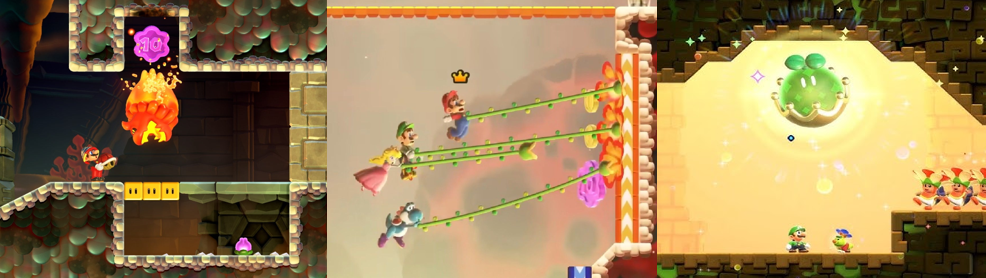
The Plot:
While exploring planet SR388, bounty hunter Samus Aran is attacked by the parasitic “X” organisms. Though saved by a Metroid-based vaccine, Samus is physically altered. Despite this, she investigates a Biologic Space Laboratories (BSL) space station overrun by the X, now led by “SA-X”, an X parasite mimicking Samus at full power!
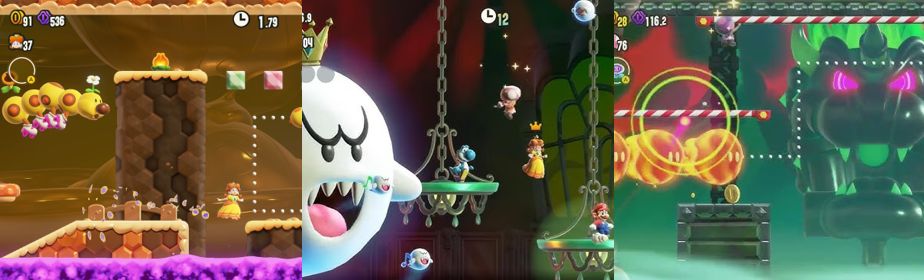
Gameplay and Power-Ups:
Metroid Fusion is a 2D, action-orientated exploration title that takes a lot of inspiration from Super Metroid. As in that game, you (as Samus Aran) will be exploring a vast space station home to numerous elevators and hidden tunnels to various high-tech laboratories, caverns, flooded and lava-filled areas, and other regions, all infested by the X parasite. This time around, Samus’s abilities are restricted by her superiors, represented by a station computer that gives the player objectives, points you in the right direction, and offers advice about how to tackle each area. In this regard, Metroid Fusion is the most linear Metroid game so far; the station computer warns you of nearby hazards, says what weapon or upgrade you need to overcome them, and highlights your objective on the game’s map screen. That’s not to say you won’t be backtracking and searching high and low for secret passages and hidden power-ups, but it definitely helps to have an in-game system guiding you along. This, in conjunction with the helpful mini map and the larger full map (accessed with the + button), means it’s easier than ever to navigate the station’s different environments, at least at the start of the game. The + menu also allows you to review Samus’s current suit, abilities, and weapons, refresh yourself on your current objective, and enter sleep mode if you ever need a break. As always, Samus can only save at designated Save Stations (though you can make liberal use of the Switch’s save state and rewind feature to compensate for this) and she can replenish her health, and missile and bomb ammo, at various Recharge Stations. Defeated enemies will also replenish these, but things are a little different this time around. When defeated, enemies release an X parasite that must be collected to refill your health or ammo. If you linger too long, it’ll spawn another enemy, or a tougher variant, adding a level of anxiety that was missing from the previous games.

All of Samus’s abilities return, though she’s strangely light on new tricks.

Samus’s abilities are limited at the start of the game, narratively explained by her being fragile following her encounter with the X. To begin with, you can fire her trademark arm cannon with B or Y, holding the button to charge it and aiming in all directions. A allows her to jump, and she’ll jump higher the longer you hold the button, and you can enable precision aiming while holding down the Left trigger. As you explore the game’s locations and defeat bosses, you’ll gradually regain all her signature abilities. Samus will gain missile upgrades that deal additional damage, open different doors, and even freeze enemies, eventually allowing you to charge up a wider shot by holding the R trigger. She can also morph into a spherical ball to pass through vents and narrow tunnels, eventually dropping bombs and hopping to higher tunnels. Her arm cannon can be upgraded to increase her rate of fire and pass through enemies and walls, shredding enemies who normally take multiple shots to defeat. Her jumping ability can also be enhanced, allowing her to jump higher and continuously and adding her signature “Screw Attack”, though abilities like the Space Jump can be difficult to master due to the finnicky timing required to sustain her jumps. This is equally true of Samus’s aggravating wall jump, which is just as frustrating as in Super Metroid, though thankfully I found it wasn’t necessary to clear the game. Samus’s suit can also be upgraded to withstand extreme temperatures, allowing her to enter frozen areas, freely move through water, and even endure lava. While Samus’s suit will change with each upgrade, she doesn’t showcase anything new her with two exceptions: Samus can grab ledges, making platforming and entering tunnels much easier, and absorbs the different coloured X parasites to refill health and ammo. However, her maximum health, missile, and bomb count can still be expanded by searching around. While you’re told how to use all these abilities and the map even highlights when there’s something in each area, you’ll get no direction on how to use her wall jump or her “Shinespark” ability. The Speed Boster lets Samus crash through certain blocks, but you can press down when she’s at full speed to store that energy and then direct her to smash through higher blocks, which I found extremely aggravating and difficult. I still don’t know why simply jumping while running and pressing A at a wall isn’t enough to pull off these manoeuvres.

Activate consoles, clear areas of hazards, and stay far away from the SA-X!

The level layout of Metroid Fusion again owes a lot to Super Metroid, with long vertical shafts, bio-organic areas, and ominous facilities being the order of the day. Puzzles are generally solved using Samus’s abilities; you can uncover destructible blocks by blasting the environment or laying a Power Bomb, though sometimes you need to find an alternative route to access them. Lifts, doors and tunnels will take you to new areas, with the game’s bosses often wrecking the environment and forcing you to take a longer path around blockades or hazards. Samus will be constantly searching for Data Rooms, Navigation Rooms, security consoles, and the like to discover her objective, restore power to an area, or unlock coloured doors. Sometimes, these will remove obstacles such as water or encroaching darkness from an area, though her suit upgrades often circumvent these. Sometimes, you’ll need to drop Power Bombs to break open tubes; often, you’ll be climbing ladders or clinging to overhead rails; occasionally you have to race against a timer to solve overloads or escape areas; and you can again freeze enemies to make temporary platforms. Enemies respawn after you leave a screen, as ever, but the unique X parasites revive corpses or spawn new enemies while you’re on the screen. Some doors are barricaded by disgusting, energy-shooting eye growths that need to be destroyed, some blocks and platforms crumble under your feet, and some areas are veritable mazes that have their pathways hidden within the foreground. Easily the biggest edition to the game is the nigh-unstoppable SA-X, a twisted doppelgänger of Samus that occasionally stalks the corridors or wrecks the background. When the SA-X appears, take the computer’s advice and stay out of sight or run as it can drain your health in seconds with its advanced abilities. On the few occasions when you’re chased by the SA-X, you can use your Ice Missiles to (very) briefly freeze it, adding a great deal of tension to the game in these instances.

Presentation:
Visually, the game also owes a lot to Super Metroid and its Aliens (Cameron, 1986) inspirations. The BSL space station is ominously empty, often devoid of music, and home to a huge docking bay (where Samus’s ship is parked), a series of large ventilation shafts, and elevators that take you to the station’s other areas. As you progress, you’ll return here a few times and explore new areas, such as the Sub-Zero Containment area that houses Ridley’s frozen husk, a teeming Habitation Deck (where Samus frees the friendly Dachoras and Etecoons from confinement), and the sprawling Reactor Silo, with Samus exploring each to tackle various issues with the space station. There are six “Sectors” to explore, all accessed by a main elevator system (though you can take alternative paths when this system fails or is inaccessible) and each with new areas to uncover as you expand Samus’s repertoire. You won’t explore these in numerical order, and you’ll also have to backtrack to them both as part of the story and to find all of Samus’s upgrades and power-ups. Sector 1 is a cavernous area, featuring rocky platforms spotted with vegetation, not unlike SR388, where Samus initially has to find and destroy atmospheric stabilisers to dispel the mist filling the area. Later, she ventures into mechanical hallways similar to Tourian, discovers Metroid husks in lava-filled caves, and battles Neo-Ripley in a large, cargo hold-like room. Sector 2 is like a Mayan temple, full of ancient ruins completely overtaken by foliage. Plants, vines, and flowers swarm the environment, creating a jungle-like feel and masking pathways, and these are married with a coral reef-like subsection. Sector 3 is both a sweltering laboratory and an arid desert, featuring a desolate, muddy aesthetic and a baking boiler room that threatens to destroy the entire station.

The surprisingly chatty Samus visits some interesting, if familiar, locations.

Sector 4 is basically an aquarium; it features a blue theme, lots of water, exposed power nodes that’ll sap your health, and beautifully detailed underwater sections full of anemones and a tranquil water effect. Sector 5 is a frozen laboratory filled with glass panels in the background and that’s eventually wrecked when an X-infused creature, the Nightmare, escapes captivity. Sector 6 is another cavern, but this time dank and dark, save for areas sporting vivid mushrooms. It’s also home to a restricted laboratory; Samus needs a beam upgrade to enter, where she’ll find various Metroids held captive. These are then unleashed when the SA-X arrives and blasts the environment, forcing Samus to make a desperate escape up a shaft while avoiding the panicked jellyfish. The SA-X and other bosses are prone to affecting the game’s environments; they’ll crash through walls, block off doors, and seal off some areas, forcing you to either escape, find alternative paths, or battle them in enclosed areas. Metroid Fusion focuses on story more than any previous game, featuring lovely cutscenes at the start and at various points throughout the story that showcase the SA-X’s power and Samus’s reaction to the events happening around her. This is further reinforced through various cutaways that detail Samus’s inner thoughts as she thinks of her former commander and ponders her newfound physiology. The game’s soundtrack is a further extension of Super Metroid; remixes of classic Metroid themes are featured, as are ambient sounds and suitably ominous tracks, but nothing really stood out to me as particularly new or memorable. Everything looks and sounds and plays really well, but the game owes so much to Super Metroid that it almost feels like a remake at times. I would’ve liked to see more variety in the locations and more effort put into the soundtrack, rather than playing it so safe.

Enemies and Bosses:
The BSL space station and its six Sectors and various areas are teeming with all kinds of alien lifeforms that are all hostile to some degree thanks to the X. The theme here is bugs and vegetation, as every enemy is some kind of insect or mollusc or plant-life turned monstrous, with only a few exceptions. We’ve got scuttling bug-like Gemmers, slug-like Choots that spring up from the ground and lazily float down, crab-like Dessgeegas that jump at you sideways, weird coloured balls floating around pumping out toxic gas, the Xenomorph-like Genesis creatures pouncing from above and below, and the armoured Gerubus crabs that need missiles to be dispatched. Piranha-like fish, tiny snails, and even zombified corpses are all infected by the X and, occasionally, stronger versions will be spawned upon defeat or you’ll need to defeat enemies a certain way to open up doors. Some enemies will be more than familiar to players of Super Metroid: the crustacean-like Evirs swim about firing projectiles from their tails, worm-like Funes snap at you from walls, and the Space Pirates even make an appearance. Kind of. The Zebesians are functionally the same, clambering up walls, firing shots from their claws, and even resisting your shots unless you charge up a beam or blast them from behind with missiles. Each defeated enemy releases an X parasite that must be collected, but you’ll also encounter blue X parasites that damage you until you upgrade your suit. Metroids also make a brief appearance, though they’re more of an annoyance than a threat as they simply knock you back rather than causing damage.

The X parasites assume some monstrous forms to keep you from your full arsenal.

There are twelve bosses to battle in Metroid Fusion, though one is encountered twice. Many of the bosses will not only be familiar to Super Metroid players but are simply super-powered X parasites. Defeating them reveals their true form, the eye-like Core X, which floats around firing lasers or protecting itself with spikes or electricity. Defeating this restores your health and ammo and bestows a new ability, but their inclusion essentially means every boss fight is a two-stage affair. The first you encounter, the Arachnus X, is an armadillo-like creature that stomps around, rolls at you, slashes with its pinchers, or unleashes an energy wave attack. Luckily, there are small tunnels you can retreat into to avoid these, though you’ll need to be wary of its widespread fireball attack, and it’s only vulnerable from the front and to your missiles. Next, you’ll battle the weird, plant-like Zazabi X, a strange jellyfish-like tentacle that hops around and tries to squash you. While it’s overhead, you can shoot up to bombard it with missiles but be sure to move as it saps your energy if it envelops you. Serris X presents quite the challenge. This serpentine beast bursts from the ground and circles the screen, taking up a lot of real estate and getting faster the more damage you deal to its head. You’ll then have your first encounter with the Security Robot B.O.X., a crab-like walker that charges you and spits bombs that spew fire plumes. Luckily, there’s a rail overhead you can grab to fire missiles into its opening from above, which eventually causes it to flee. When you battle it again later, these overhead rails are essential to avoid the electrified water in the arena, and it now sports a missile barrage in its arsenal!

Gigantic, disgusting bosses will test you patience and skill.

Since you get a lot of experience battling Core X’s, targeting their eyes and dodging them as they float about, the Barrier Core X doesn’t pose much of a problem beyond being bigger, surrounded by smaller variants, and retreating to the water. The giant spider, Gedo X, is much more formidable; if this thing gets you in its mandibles, you’re in for a bad time! Luckily, you can retreat to the corners of the cargo bay in your Morph Ball to leave it bouncing around aimlessly. Gedo X also spits a spew of fireballs you’ll need to avoid and eventually starts dropping garbage on you, so you’ll need to dodge this as well as you frantically target its head with Super Missiles. Plant Core X reminded me of the Mother Brain battles from the first two games. This tangled mess of vines and thorns has infested a Chozo Statue and is protected by spore-spitting flowers and carnivorous plants. Pieces of the boss fall off and become hazards as you pepper it with Super Missiles and, while the spores eventually stop, the creature rears to life and blasts you with Plasma Beams! Like SA-X, Nightmare X’s threat is foreshadowed as soon as you venture into Sector 5 and see its shadow flying about it. Later, it wrecks the area and you’re forced to confront it, where it’s revealed to be this gigantic, bio-mechanical…thing that takes up most of the screen! Nightmare X hovers around erratically, fires a barrage of lasers from its arm/wing/things, and is only vulnerable to Super Missiles and the Charge Beam, and only in its mewling face. You must lure it to one side of the room and clamber up the ladders to attack it, marvelling as its face bleeds and degenerates as it takes damage, but your missiles will be useless when it engages it gravity-warping abilities so make sure to switch to the Charge Beam.

Some familiar faces, a formidable doppelgänger, and a ghastly Metroid beast await in the finale.

After a tense, manic escape from the Restricted Zone that sees you blast the SA-X into space, you’ll come face-to-face with an X masquerading as Samus’s archenemy, Ridley. Another gigantic sprite, Ridley flies about the place and charges at you, testing your reaction time and agility. It also breathes fire and tries to grab you. While this drains your energy, you can pummel it with Super Missiles to deal big damage, though it’s also recommended to use the Charge Beam. Eventually, the shrieking creature crumbles and you defeat one more Core X before finally facing SA-X. This X is a perfect copy of Samus in her classic suit and with all her abilities; it pops up throughout the game searching for you or chasing you down, decimating you with its Screw Attack and Ice Beam. You can finally settle the score in this fight but the SA-X is fast and powerful and you can only damage it with a fully charged Plasma Beam. Your Ice Missiles briefly freeze it but the window of opportunity is very small so be ready to Screw Attack to safety. After enough hits, it mutates into a monstrous form, one much easier as it simply tries to crush you, but it surprisingly saves you in the final fight when it sacrifices itself to empower you in the battle against the Omega Metroid. This gargantuan, insectile, alien monstrosity rips through the docking bay and is fought against a time limit. Initially, it’s invulnerable, but the SA-X’s Ice Beam lets you to damage it. However, you need to hit hard and fast and escape to safety. If its slashes land, you’ll be stun locked and killed in seconds or waste valuable time, so rush in, blast its head, and quickly retreat to end it. With the timer ticking down and the Omega Metroid’s huge hit box, this can be a frustrating test of patience and sadly lacks much strategy beyond shooting and retreating.

Additional Features:
Scattered all around the space station and its Sectors are numerous power-ups that will increase your maximum health and the number of missiles and Power Bombs you can carry. These are invaluable as the game progresses and tougher enemies and specialised hidden blocks become more prominent. You’ll gain all of Samus’s weapon and suit upgrades by defeating bosses, Core Xs, or from the odd Chozo Statue, so you don’t have to worry about missing anything. Maps are automatically provided when you interact with the Navigation Room or activate consoles as well, and as ever you can utilise the Nintendo Switch’s save state and rewind feature to drastically reduce the game’s difficulty. You get three save slots with Metroid Fusion and each one tracks your completion percentage, which is tied to how many power-ups you’ve found as well as how quickly you’ve played through the game. These factors also impact the ending you get upon finishing the game, with five on offer in the North American and European versions and eleven in the Japanese version, ranging from seeing Samus pose in her suit to showing off her form-fitting blue suit. If this is incentive enough for you to challenge the game again and finish it faster, then by all means go ahead, but there is nothing else on offer here, which is a bit of a shame as it would’ve been nice to see an SA-X skin or Samus’s blue suit form unlocked.

The Summary:
Although I’ve played a few Metroid games now, I still feel unaccustomed to the franchise. Nostalgia and a longing for Super Nintendo games means Super Metroid is probably my favourite of the series, so I was naturally very pleased with Metroid Fusion. As mentioned, the game has so much in common with Super Metroid that it’s basically a remake, with Samus’s abilities copied wholesale alongside many familiar locations and bosses. I didn’t expect the call-backs to Metroid II though, that was pretty neat, and I enjoyed seeing the game’s environments change as you explore the space station. There’s always something happening, be it an overload or a power drain or an escaped monster, and it’s a fun reason to backtrack and try out Samus’s new abilities. Pitting you against a ticking clock was a great way to break up the action, and adding an element of danger to defeating enemies with the X parasites was a neat touch, too. I also enjoyed the threat of the SA-X; this formidable double increases the tension and causes nothing but trouble throughout your adventure. Unfortunately, I don’t think it was utilised enough. There were some areas where the SA-X was entirely absent, and I think running from it, sneaking around it, or engaging with it multiple times would’ve helped the game stand out more from Super Metroid. Like, one of Samus’s power-ups could’ve been left lying in the open and be stolen by the SA-X and maybe you have to sneak around to retrieve it. Or you’d see it in the background or something. I would’ve liked to see more done to each area, too, to properly embrace each theme. All of them share similar high-tech features, just with different colours, which was a bit disappointing. Still, I imagine this was a great Metroid experience upon release as Super Metroid wasn’t available on the go like it is now and it still holds up really well as a companion piece to Super Metroid that does just enough to make it unique.

My Rating:

Rating: 4 out of 5.

Great Stuff

Did you enjoy Metroid Fusion? Did you like how similar it was to Super Metroid or would you have liked to see it stand out a bit more? What did you think to the SA-X and do you think more could have been done with the concept? Which of the areas was your favourite? Did you ever achieve 100% completion and Samus’s true form? Which Metroid game is your favourite? Whatever your thoughts, feel free to leave a comment below, and be sure to check out my other Metroid reviews across the site.