So, for no better reason than “Mar.10” resembling Mario’s name, March 10th is widely regarded as being “Mario Day”, a day to celebrate Nintendo’s portly plumber, an overalls-wearing mascot who literally changed the videogame industry forever and shaped the home console market of the nineties.

Released: 3 September 2020
Originally Released: 14 July 1993
Developer: Nintendo
Original Developer: Nintendo R&D4
Also Available For: Arcade, Game Boy Advance, Nintendo Entertainment System (NES), Nintendo Wii, Nintendo Wii U, Satellaview, Super Nintendo Entertainment System (SNES) Classic Edition, SNES
The Background:
When the videogame industry crumbled following an influx of overpriced consoles and mediocre titles, Nintendo swooped in and effectively saved the industry with the runaway success of Super Mario Bros. (Nintendo EAD, 1985), which marked an early victory in the subsequent “Console Wars” of the mid-nineties. However, as successful and popular as that game was, development of its sequel is one of the most bizarre stories in all of gaming; Super Mario Bros. 2 (Nintendo R&D4, 1986) released in Japan a year later and was, essentially, a remixed version of the first game that included a higher challenge of difficulty. When Nintendo of America saw this, they were wary of alienating their players, especially as videogames were only just recovering from the industry crash of 1982, so they decided it would be better to reskin whimsical Mario clone Yume Kōjō: Doki Doki Panic into an official Super Mario Bros. videogame. Although the gameplay was noticeably changed from its predecessor, Super Mario Bros. 2 was both a best-seller and highly praised; when it came time for Nintendo to release their game-changing SNES, Nintendo not only developed a 16-bit remaster of Super Mario Bros. 2 for the Super Mario All-Stars (Nintendo EAD, 1993) compilation title, they also included a 16-bit version of the original version of the game, though retitled The Lost Levels (ibid). Another remastered version of Super Mario Bros. 2 was later released on the Game Boy Advance, and all versions of the game were made available on the Nintendo Switch Online service, which is the version I am looking at here.
The Plot:
While sleeping, Mario dreams of a staircase leading to Subcon, a mysterious dreamland facing invasion from the villainous frog tyrant Wart. When Mario awakens, he recruits his brother, Luigi, Toad, and Princess “Peach” Toadstool to help liberate Subcon from Wart.
Gameplay:
Like its predecessor (and the vast majority of the classic Super Mario Bros. videogames), Super Mario Bros. 2 is a 2D, sidescrolling platformer but that’s about where the similarities to Super Mario Bros. end. The game is made up of seven Worlds, each with three different levels (except for World 7, which has only two); the timer is gone, as is the player’s score, but players can still jump with A or B and run by holding either X or Y (these controls can also be slightly tweaked from the game select menu). You can use the dash to jump higher and further, but combat is made far more methodical and clunky by the fact that you can no longer defeat enemies by jumping on them. If you jump on an enemy’s head, you’ll simply stand on them as they wander or fly around or take damage and you can only defeat enemies by holding X or Y to pick them up (or pull up various vegetables, bombs, and other offensive items from grass patches) and then toss them at other enemies. While this is similar to the combat mechanics of one of my favourite Mario spin-offs, Wario Land: Super Mario Land 3 (Nintendo R&D1, 1994), it’s made all the more awkward as you need to time your throws carefully to knock out enemies and enemies respawn the moment the screen scrolls along, meaning it’s usually better to just avoid enemies altogether. Additionally, you can’t climb vines or ladders while holding throwable items, though there are times when the screen loops horizontally like in the original Mario Bros. (Nintendo R&D1, 1983), which can help you avoid enemies and hazards.
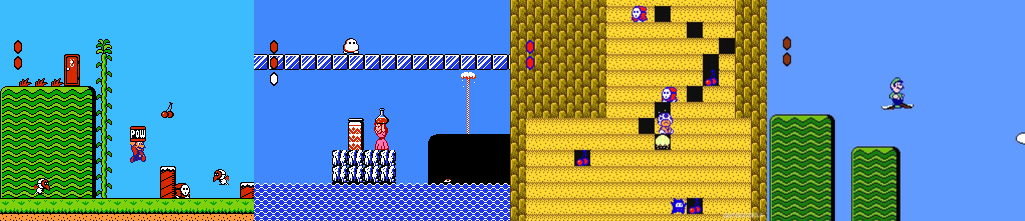
Another new mechanic is the charged jump ability shared between the four playable characters. By holding down on the directional pad, your character will duck and begin to flash; pressing A or B will then see them jump higher than normal, which is crucial to reaching out of the way platforms. This time around, players can pick from four different characters, each with slightly different gameplay mechanics. Mario is an all-rounder, with average speed and jumping abilities, and is the most familiar and easiest to control; Luigi is taller, has a higher jump, and can also perform a “flutter jump” for extra height and distance but is a bit slower and slipperier than Mario. Toad is the smallest but also the strongest, but his jumping ability is so bad that you’ll be relying on the charged jump to reach higher platforms; Peach is also quite tall and can glide along using her dress, but she’s also the weakest and the slowest of the four. You can pick your character at the start of every stage or after losing a life, and it can help to break up the gameplay to switch them up; you also might find it better to pick Luigi or Peach for stages that require more horizontal traversal or are focused more on platforming as their extra jumping powers can be useful here. There are no flagpoles to reach here; instead, your goal is to go from the left side of the screen to the right (except for one level where you need to ride an albatross to the left), defeat a mini boss (usually a coloured variant of Birdo) and grab a Crystal Ball to open the Mask Gate and complete the level.

Another major change is the incorporation of a heart-based life meter; players start with five lives and can take two hits, though these can both be extended by finding Hearts, uprooting 1-Ups, or winning the bonus stages you play after clearing each level. If you only have two hearts and take a hit, you’ll shrink to a smaller form but will grow again upon replenishing your life bar and your life bar automatically resets to two at the start of every level. Another new mechanic is the use of secret doors; you’ll often uproot a bottle of Magic Potion that, when thrown, creates a door to “Sub-space”, a brief, inverted version of your current location where you can often find 1-Ups and Coins to play the bonus games. You’ll also be charged with retrieving keys to open locked doors; once you grab a key, Phantos will relentlessly chase you until you find and unlock the door, which can be harrowing and frustrating especially when trying to avoid other enemies. Bottomless pits are again commonplace, but you’ll also have to contend with spikes, conveyer belts, destructible walls and platforms, and occasionally have to commandeer an enemy (or a temporary magic carpet) to bypass gaps or quicksand. There are no underwater levels in Super Mario Bros. 2, but you’ll often be hopping across logs to get past waterfalls, digging through dirt while avoiding Shyguys in gameplay similar to Dig Dug (Namco, 1981), stacking up Mushroom Blocks to reach higher platforms, climbing chains, vines, and ladders to progress, and even hopping into the odd rocket ship to travel even higher.
Graphics and Sound:
Since this version of Super Mario Bros. 2 was remastered for the more powerful SNES, the graphical upgrade from the first game is immediate and obvious. However, you’ll still see an improvement in the sprite details, colours, and quality even if you play the original 8-bit version, where everything is far more vivid and defined compared to the basic pixel art of Super Mario Bros. However, as impressive as it is that we’re actually able to play as four relatively distinct characters, with their own strengths and weaknesses and detailed sprites, some corners have been cut; none of the characters has an idle animation and they can’t look up, for example, and the intelligence and presentation of the enemies leaves a lot to be desired (many simply wander in predictable patterns, often to their deaths, or constantly spawn in to cause you headaches). Although the game’s soundtrack is still limited to a few tracks, they’re very jaunty and memorable and, in my view, some of the more influential themes and sound effects in the early games. Another new feature here is the inclusion of text that actually explains the (admittedly weak and bizarre) story and the use of large, partially animated pixel art in the ending, which includes a somewhat questionable bestiary rather than developer credits.

As disappointing and awkward as I found the combat to be, I was equally disappointed by the level variety on offer in Super Mario Bros. 2; like the first game, locations are limited, recycled, and generally just palette and asset swaps, which really limits the game. While there are many times when you can enter a jar or a door and travel to cave-like areas or enter large stone towers or pyramids to tackle vertical-scrolling platform challenges, you’ll mostly be going from left to right through the same plains, deserts, and waterfalls in every World. Occasionally, you’ll see something different in the background, like the starry night sky or mountaintops or pyramids, or you’ll be in an ice-themed world covered in snow and ice blocks, or venture into a pyramid filled with hieroglyphics, but it all gets very samey very quickly. Things only really get visually interesting in the boss rooms, which feature colourful LEGO-like blocks, and in Worlds 4 and 7, where you have to hop across whales and use their waterspouts to progress across the hazardous water and which takes place amongst the clouds, respectively.
Enemies and Bosses:
While Super Mario Bros. 2 features an entirely new set of enemies (the Goombas are completely absent and the only hint of Koopa Troopers is when you unearth shells to toss at enemies), it also introduces some of the most recognisable enemies to the franchise. Right at the forefront are the Shyguys, diminutive, masked baddies who wander to and fro, constantly spawn from pots, or hop up and down and spit projectiles at you. This game also marks the first appearance of the Bob-omb (an anthropomorphic bomb that wanders about until it explodes are can be tossed to defeat enemies or break open certain walls) and Pokey, a wriggly caterpillar-type enemy that you can use to ride over quicksand. Other enemies include the bird-like Tweeters, fireball-spitting Pansers, rideable enemies such as Pidgit and Ostro, Cobrats (snakes the ambush you from jars and spit at you) and you’ll even come across Shyguys rolling around on cannons! The Phantos are easily the most annoying enemy; these mask-like bastards come to life when you grab a key and chase you until you drop the key or unlock the door; they cannot be picked up and can only be defeated if you grab a Starman (and even then another one spawns in!)
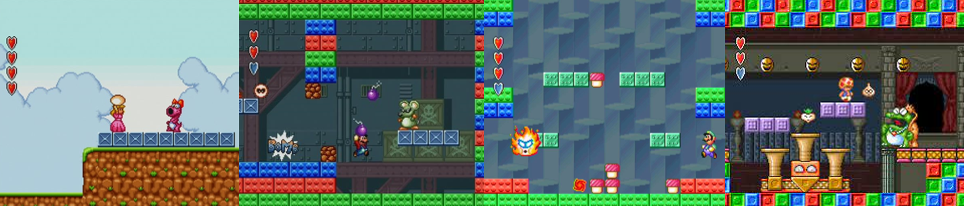
Although you’ll face a mini boss at the end of every level and each World is guarded by an actual boss, Super Mario Bros. 2 equally fails to impress in both departments. The most common recurring mini boss is Birdo, with a different-coloured variant fought in every first and second level and each one spitting more projectiles at a faster rate or being in a slightly more awkward position, such as on the high ground, on a conveyer belt, or in an enclosed area. Birdos will spit out eggs which you must jump on and toss back at them; occasionally, you’ll have to use Mushroom Blocks instead or even ride their eggs to clear large gaps, but you’ll always have to watch out for their fireballs and can defeat them with three hits. Fighting Birdo is basically preparation for each of the game’s bosses, with the first, Mouser, setting the bar low for the rest of the game. Mouser pops up three times and each time you need to intercept or pick up his bombs and toss them back at him to damage him, which can be tricky as the fuses are quite short and he tends to move about on his platform a lot. The hydra-like Tryclyde also appears twice; both times it spits a bunch of fireballs from its heads and you need to toss Mushroom Blocks at it to be victorious. Thankfully, things get a little more interesting (and challenging) when battling Fryguy, Clawgrip, and the Mask Gate; Fryguy will float about a bit harmlessly enough but splits into four smaller Fry Guys upon defeat, the crab-like Clawgrip throws rocks at you like he’s Donkey Kong in an interesting spin on the Mouser fight, and the sentient Mask Gate caught me completely off-guard as I wasn’t expecting the exit to come alive and start attacking me! Once you’ve bested all of these using the same tactic of grabbing items and throwing them at them until they keel over, you’ll battle Wart to decide the fate of Subcon. Unlike the other bosses, Wart is invulnerable except for when his mouth is open and he’s spitting a spray of bubbles into the arena; this is your brief opening to grab a vegetable from the Dream Machine in the background and toss one at him to score a hit. Successfully dodge his one attack and hit him six times and Wart will be defeated, liberating the land and waking Mario from his slumber.
Power-Ups and Bonuses:
Although players are far less reliant on power-ups to stay alive thanks to the new life bar system, some familiar power-ups do exist in Super Mario Bros. 2; you can uproot mushrooms to helpfully increase your maximum heart count, grab a 1-Up mushroom for an extra life, and snag Coins to play the bonus game and win a few more extra tries. As you play, you’ll also spot cherries dotted all over the place; while these appear to have no purpose, if you grab five in a row it’ll cause a Starman to spawn, which will grant you a brief period of invincibility. Similarly, when you defeat eight enemies in a row, a Heart will float up from the bottom of the screen so you can replenish your health. The POW Block also returns and will instantly defeat all onscreen enemies when thrown, and (after plucking four vegetables in a row) you’ll also unearth a stopwatch that will briefly freeze all enemies.
Additional Features:
There really isn’t much of anything extra to do or see in Super Mario Bros. 2; there’s no two player mode (though you can still take it in turns to tackle each level, I guess), no hard mode to unlock, and the only real replay value is in tackling different levels with different characters and exploring any areas of Sub-space you might’ve missed. When you finish the game, each character is given a “contributor” tally that I assume displays how often you picked that character, but it’s ultimately meaningless and there isn’t even a high score table for you to work towards. You can save and continue (or save and quit) from the pause menu at any time, but this is somewhat negated by the Switch’s save state ability and life-saving rewind function, which I am not ashamed to say I exploited at every opportunity to cheese past the game’s more frustrating sections or revert back to before I entered a dead end or down the wrong path.

The Summary:
I was really on the fence about playing through Super Mario Bros. 2; not only do I notoriously struggle with Mario’s early 2D adventures, but I also wasn’t looking forward to the awkward gameplay mechanics introduced in this game. I really don’t like that enemies suddenly can’t be defeated by jumping on them, which severely limits the game’s action-orientated gameplay and forces you to take things much slower and more cautiously as you pick up enemies or unearth vegetables to toss at foes, only to miss your target and be left either taking a hit or simply rolling your eyes and bypassing the enemy completely. While the visuals are colourful and fun, the lack of variety in the locations and bosses was really disappointing; I got very tired of seeing the same plains and backgrounds repeated over and over and battling Birdo more times than I could count. Similarly, while it seems fun and adds a little spice to have four slightly different characters available to you, I really only noticed a difference in gameplay when playing as slippery, unwieldy Luigi or Peach and I definitely felt the absence of some decent power-ups, like the Fire Flower. Similar to the dramatic left-turn Nintendo took with Zelda II: The Adventure of Link (Nintendo R&D4, 1987), Super Mario Bros. 2 is just too different from its predecessor; the use of a traditional life bar system and hampering Mario’s jumping abilities just makes this another bog-standard platformer and easily one of the most bizarre and forgettable pit stops in the portly plumber’s career, no matter how prominent some of its enemies and characterisations might’ve been for the franchise.
My Rating:
Could Be Better
Did you enjoy Super Mario Bros. 2? How do you feel it compares other Mario titles, specifically the first Super Mario Bros.? Which of the playable characters was your favourite and why? Do you prefer this version over the Japanese version of Super Mario Bros. 2? Were you also disappointed by the lack of variety in the environments and boss battles? What did you think to Subcon and would you like to see Wart return to the franchise? How are you celebrating Mario’s birthday this year? Whatever your thoughts on Super Mario Bros. 2, feel free to share them below or drop a comment on my social media and be sure to check out my other Mario content!


10 thoughts on “Game Corner [Mario Month]: Super Mario Bros. 2 (Nintendo Switch)”