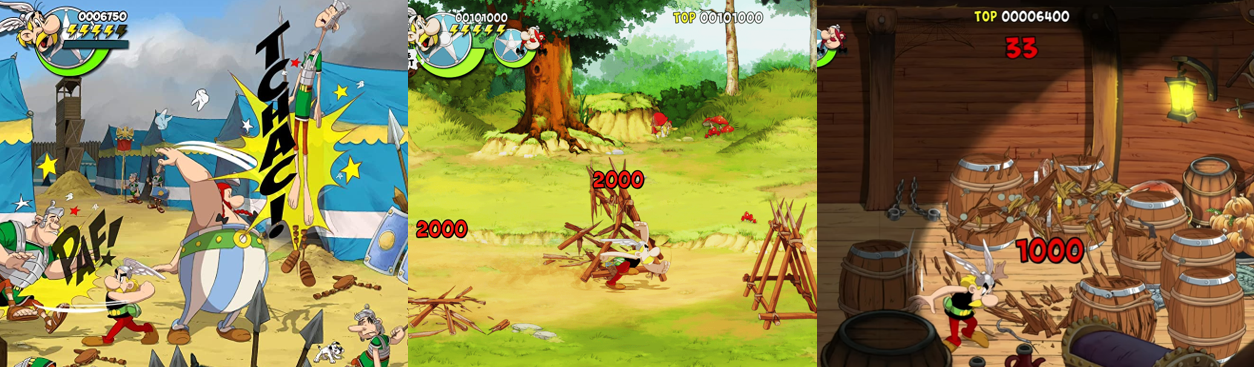
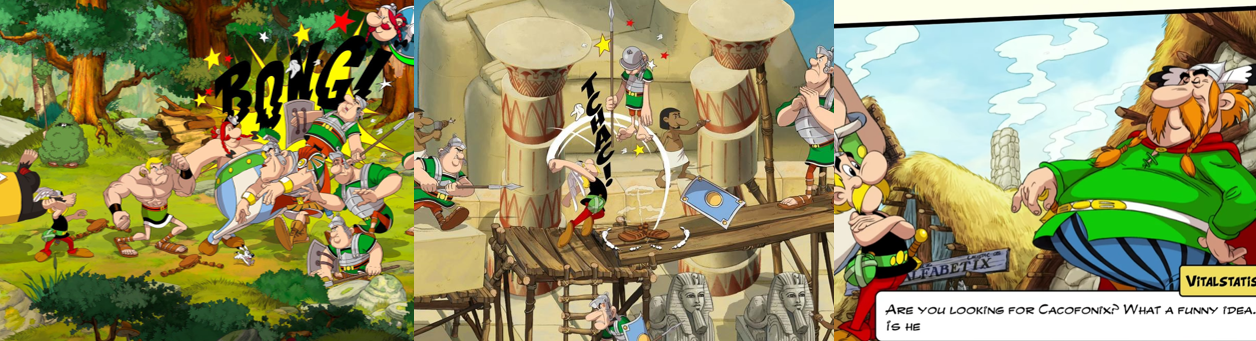
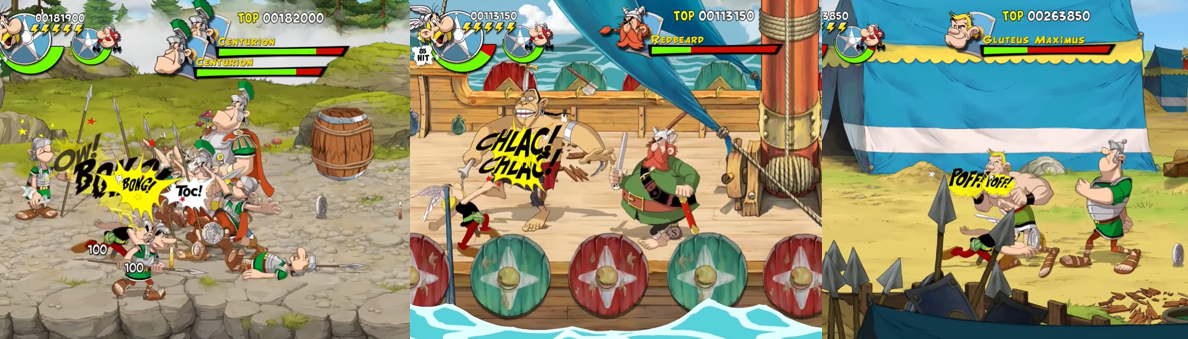
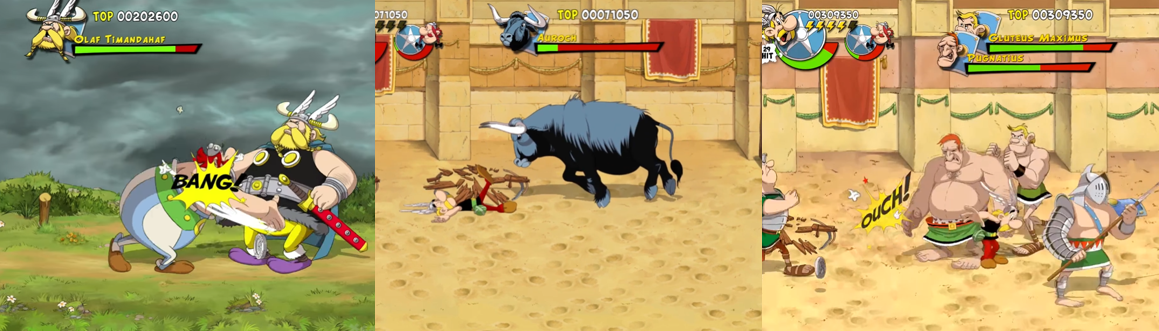
Game Corner [Sonic 2sday]: Sonic the Hedgehog 2 (2013; Nintendo 3DS)


After the release of Sonic the Hedgehog (Sonic Team, 1991), Sonic had firmly established himself as the hot new icon on the block and catapulted SEGA to the forefront of the Console Wars. Anticipation was high for a sequel and, in keeping with their aggressive marketing strategies, SEGA dubbed November 24, 1992 as “Sonic 2sday”, a marketing stunt that not only heralded the worldwide release of the bigger, better sequel but changed the way the videogame industry went about releasing games for years to come.


GameCorner

Released: June 2013
Originally Released: 29 October 1992
Developer: SEGA
Original Developer: Aspect
Also Available For: GameCube, Game Gear, Master System, Nintendo Wii, PC, PlayStation 2, Xbox

The Background:
I went into great detail about just how important a release Sonic the Hedgehog 2 (SEGA Technical Institute, 1992) was for SEGA; hot off an aggressive marketing campaign and the incredible sales of the first game, Sonic 2 saw SEGA’s supersonic mascot catapulted into mainstream popularity and success. Like with the first game, SEGA also commissioned an 8-bit version of the game; unlike its predecessor, Sonic 2’s 8-bit version was developed by Aspect and, unlike its 16-bit counterpart (and despite the game’s title cards), it did not feature Sonic’s new sidekick, Miles “Tails” Prower, as a playable character. Similar to the 8-bit version of Sonic the Hedgehog, I first played the 8-bit Sonic 2 on the Master System, before its 16-bit counterpart, and the game was noticeably different from its equivalent. Despite being more difficult on the Game Gear, the 8-bit Sonic 2 scored high upon release and, even years later when it was re-released on Nintendo’s Virtual Console, it was praised for not being a mere clone of its Mega Drive cousin.

The Plot:
Doctor Eggman is back! This time, he’s kidnapped Sonic’s new friend, Tails, and invaded South Island in search of the six Chaos Emeralds once more. Only Sonic has the speed, the skills, and the attitude to bust up Dr. Eggman’s Badniks, find the Chaos Emeralds, and rescue Tails from the egg-shaped madman’s grasp.

Gameplay:
Like its predecessor, and pretty much every Sonic the Hedgehog videogame, Sonic the Hedgehog 2 is a 2D, sidescrolling action/platformer in which you must guide Sonic through seven stages (referred to as “Zones”) with three levels (referred to as “Acts”) each. Unlike in the 16-bit game of the same name, Sonic’s arsenal remains unchanged from the previous title; pressing any button will see him become a whirling ball of spikes and allow him to break open power-up monitors and smash Dr. Eggman’s Badniks with his patented “Super Sonic Spin Attack” and you can also put him into a similar spin by pressing down on the directional pad (D-Pad) when running along or down slopes. Pressing up or down also lets you scroll the screen vertically but, otherwise, that’s it for Sonic. While he doesn’t have the Spin Dash here, Sonic is noticeably much faster than in the last game; the game, overall, runs much smoother than its predecessor and there are numerous quality of life improvements as well. While the heads-up display (HUD) is still limited, with your Golden Rings counter still rolling over to zero after you collect more the ninety-nine Rings and your life counter capped at nine despite you accumulating more lives in the end of Act score screen, you can now recollect a few Rings when you’re hit, which is a hell of a boon over the last game, and there’s far less periods of slowdown unless you’re underwater.
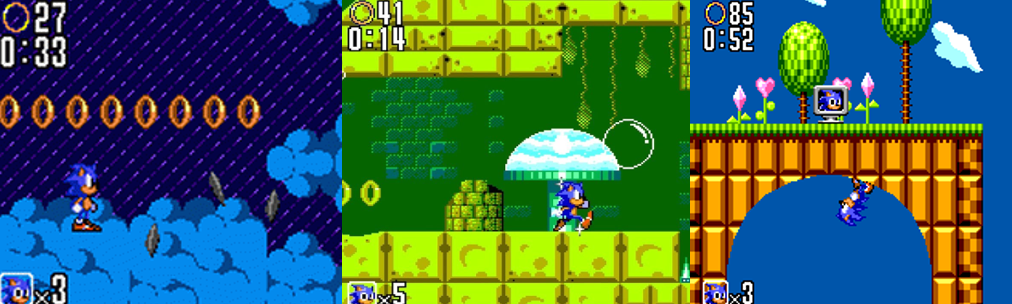
The game’s much bigger and smoother than its predecessor, if still restricted by its hardware.

There are, however, some noticeable omissions that make the game much harder. Gone are the Arrow Monitors and neither Signposts or Starposts are present, meaning that you’ll need to restart the entire Act if you lose a life. There’s also far less benefit to finishing Acts with fifty Rings or more; sometimes you’ll get a Ring or life bonus but there are no Special Stages to play this time around and, while extra life monitors can be found in Zones (usually off the beaten track or hidden behind hidden walls), these bonuses are much less prevalent than in the last game. Finally, while it’s great that the sprites are bigger and much more detailed, screen size is a real issue in the 8-bit Sonic 2; I don’t recall it being as big an issue in the Master System version but the Game Gear version definitely suffers from bottomless pits, spike pits, and other hazards being hidden off screen and, in a first for me, respawning Badniks whenever you leave the screen. Where the 8-bit Sonic 2 excels, though, is in its clear desire to mix things up a bit more. It bares absolutely no resemblance to its 16-bit counterpart and instead features entirely different Zones; while some are familiar, and their gimmicks are similar, the two are like night and day. This is seen right away in the first Zone, Underground Zone, which is a far cry from the bright, colourful levels that generally open Sonic games. This Zone features destructible blocks (which make their 8-bit debut here), ceiling spikes, lava pits, and, of course, the mine cart gimmick that appears again later in the game. Sonic’s options while riding a mine cart are limited to simply jumping from it before he meets a sudden end but your options are even more limited in Scrambled Egg Zone’s fast-paced tubes.
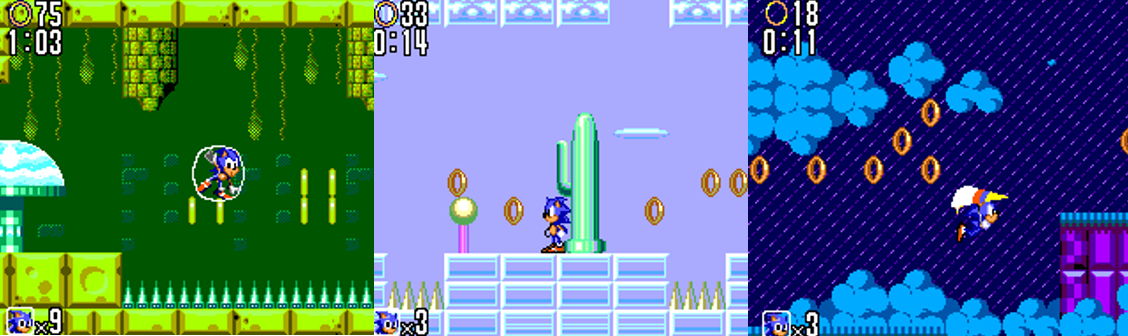
Spike pits are plentiful but the game’s finicky bubble and hang glider are a massive aggravation.

Similar tubes last you around in other Zones but these will require split-second decision making on your part and will often return you to the beginning of the maze, at best, or spit you out onto a spike pit or into the path of a Badnik at worst. You can also skim over the surface of the water in Aqua Lake Zone and explore its underwater ruins, collecting air bubbles to breathe and desperately fighting with the game’s clunky controls as you navigate Sonic through narrow, spike-filled tunnels while trapped in a big bubble. The 8-bit Sonic 2 also features the game’s trademark loop-de-loops, which appear most prominently in Green Hills Zone, a stage that features many uphill slopes and blind jumps over long spike pits. You’ll also roll around on spinning cogs in Gimmick Mountain Zone, bash through Dr. Eggman-branded blocks in Crystal Egg Zone, and generally find that most of the game’s Zones are much bigger and more difficult to navigate as a result. By far the absolute worst Zone in the game is Sky High Zone; at first, it’s a pretty typical sky-based level but, once you get past the collapsing platforms, sneaky spike pits, and figure out which clouds can be run along or bounced off, you’re met with the worst gimmick in this (or any) videogame: the goddamn hang glider! Controlling this damn thing is the hardest thing ever as you must have a lot of speed built up to stay airborne, tap left on the D-Pad in just the right way to gain height, and will fall to the ground (and usually your death) if you press the jump button, hit the ceiling, or hit a wall. All they had to do was have it so that you tapped up to stay afloat but, as it is, the controls are extremely counterintuitive and I have no doubt that many players’ experiences of the 8-bit Sonic 2 ended the moment they were forced to use this damn thing.

Graphics and Sound:
Sonic the Hedgehog 2 is a marked improvement over its predecessor in terms of presentation; apart from the aforementioned differences in screen size, there’s next to no discernible difference between the sprites and Zones of the Master System and Game Gear versions. Sonic’s sprite is thus bigger, more colourful, and much more cartoony; he has a whole new idle pose where he shrugs his shoulders with indifference when left idle and a whole bunch of new animations thanks to the game’s new gimmicks. Sadly, the Badniks don’t really get the same upgrade; you’ll encounter the same handful of enemies in every Zone and most of them are just recycled versions of Motobugs, Crabcrawlers, and Newtrons, with none of them really standing out.

Zones are bigger and more varied but have very sparse backgrounds.

The game’s Zones are quite the mixed bag; on the one hand, I absolutely love how they’re completely different from the 16-bit version and they’re definitely very unique, with some big and detailed foreground elements. On the other hand, the backgrounds are actually less detailed than before, with only Gimmick Mountain Zone really impressing me with its background elements. While Green Hills Zone is somewhat derivative, it distinguishes itself from its predecessor by having more slopes and (unfair) spike pits. Aqua Lake Zone might be similar to Aquatic Ruins Zone and Labyrinth Zone but stands out by allowing you to take the upper path across the water or using the new bubble mechanic. It was also quite the bold strategy to start the game with the dank and dreary Underground Zone but the use of mine carts and lava helps to make it a fun and simple enough opening stage.
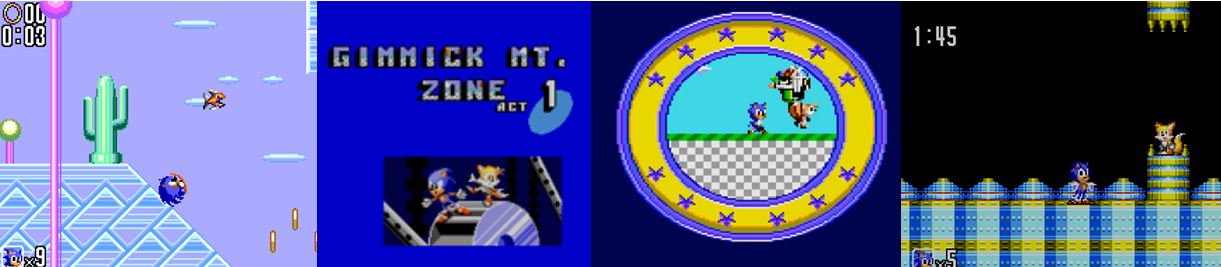
Jaunty music, odd-ball Zones, and some fun little cutscenes add to the game’s flavour.

Perhaps the most bonkers Zone is Crystal Egg, which is populated by flying fish Badniks, cacti plants, falling crystal blocks, and a maze of translucent scenery that is a far cry from the mechanical hellscapes of most final Zones. Indeed, Scrambled Egg Zone (which bares more than a few similarities to Hidden Palace Zone from later Sonic titles) arguably would have been a better choice for the final stage, especially as the final boss is fought in an arena that’s more like Scrambled Egg Zone than Crystal Egg Zone. In addition to featuring a short opening cutscene, more detailed title cards (which replace the map of the last game and, oddly, feature Tails accompanying Sonic), and the traditional ending cutscene (including a cute little sprite of Tails), the game’s music is also quite a step up. Still featuring jaunty, catchy chip tunes, Sonic 2’s music is much longer and more layered than in its predecessor and more than makes up for the game’s less impressive sound effects (though the “SE-GA!!” chant at the beginning was a welcome and unexpected addition).

Enemies and Bosses:
As I alluded to above, the 8-bit Sonic 2 kind of drops the ball when it comes to its Badniks; once again, the only time you’ll see Sonic’s woodland friends dancing about is when you free them from the Dr. Eggman-branded flying saucer at the end of Act 3 and you’ll encounter the same handful of baddies in every Zone. There’s only really one new one (the hovering turtles, or “Game-game”, which are a constant pain in the ass) but some returning Badniks have been given an upgrade; Bomb, for example, spews pellets when it explodes and Buton appears as a more fearsome version of Ball Hog but lacks the former’s bomb-throwing ability.

Dodge Dr. Eggman’s bombs to destroy the Antlion and watch for the Goose’s little minions!

Rather than taking on Dr. Eggman in Act 3 of every Zone, you’ll instead have to battle the mad scientist’s six “Master Robots”, which each one appearing as a large, mechanical creature. As before, you’ll have to navigate through a few obstacles to even reach the boss without the aid of any Rings, which can be a pretty tall order when spikes and hazards are much more prominent this time around. Indeed, Dr. Eggman even inexplicably saves you from an unavoidable dip in lava to force you into battling the Antlion Mecha, a mechanical beetle that waits for you at the bottom of a steep slope. To defeat the Antlion Mecha, you have to jump over or avoid the bombs that bounce in from the left side of the screen so that they damage the boss instead of you. This is much easier said than done thanks to the slippery slope and the Game Gear’s reduced screen size; also, Dr. Eggman will rush in to try and ram you near the end so be sure to hop over him. The Goose Mecha requires a lot less strategy; it drops little Mecha Hiyoko around the clouds that you must take out and then bobs around the arena shooting projectiles at you. Simply ram it in the head and avoid getting hit and it’ll go down pretty easily.
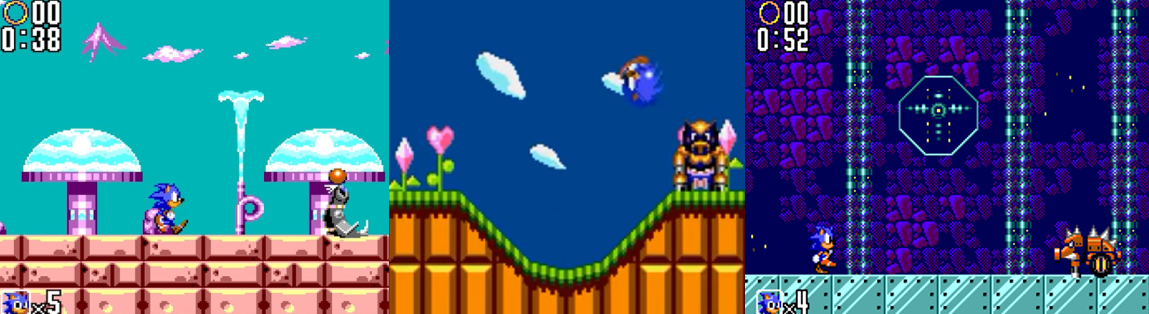
Unlike the last game, many Master Robots require a more strategy than just head-on attacks.

Strategy rears its head again when you face the Mecha Sea Lion; if you try and attack as you would a normal Badnik, the Mecha Sea Lion simply balances Sonic on its nose and tosses him around. You can only damage it when its blowing up a red balloon; attack this before it can launch it at you and you’ll land a hit but, otherwise, this is a pretty simply battle. Similarly, the hardest thing about tackling the Pig-Boar Mecha is the spikes on its back and the rocks it causes to fall from the sky. Jump over it when it charges and it’ll stun itself, leaving it vulnerable for a quick hit before charging at you again, kind of like a mixture of the Emerald Hill Zone and Mystic Cave Zone bosses. The Pig Mecha can also be quite a pain; not only is it arguably the hardest boss to even reach thanks to you needing to spring your way over vast spike pits but it also can only be damaged when not curled up into a ball and the window of opportunity to strike is quite small. The Pig Mecha will roll, jump, or fly across the arena and screen trying to hit you and then uncurl to taunt you, making it functionally very similar to the fight against Mecha Sonic in the 16-bit game.
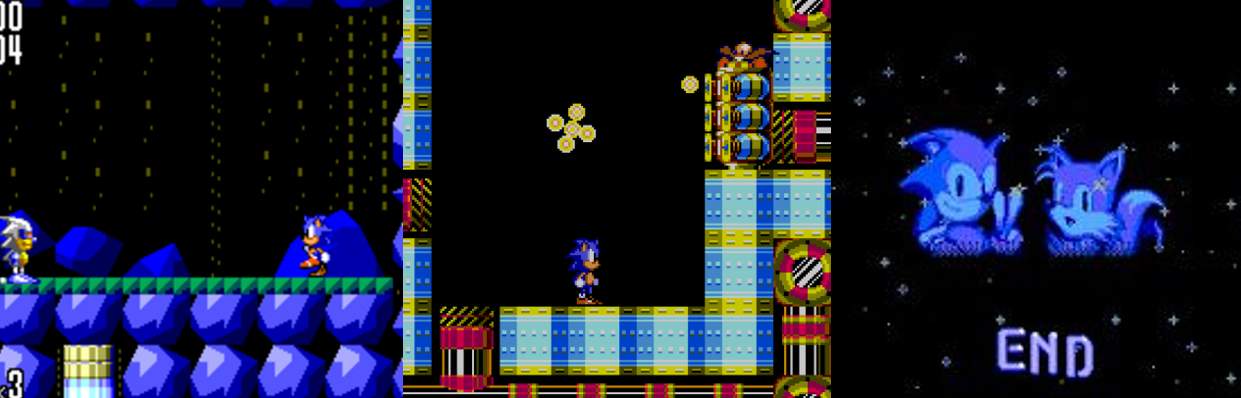
Defeat Silver Sonic without the Chaos Emeralds and you’ll never see the good ending.

Speaking of Sonic’s robotic doppelgänger, you’ll encounter Silver Sonic at the end of Scrambled Egg Zone. Despite its sleeker, more futuristic appearance, though, Silver Sonic is far easier to take on; it tries to slap you with an extending arm and will repel your Spin Attack with one of its own but is otherwise very easy to attack when it’s standing out in the open or trying to charge at you with its rocket boots. If you didn’t find the five Chaos Emeralds before this boss, your game will end here but, if you did, Silver Sonic relinquishes the sixth and final Emerald and you get to play Crystal Egg Zone. This culminates in a final battle against Dr. Eggman; this time, he summons spinning energy balls, arena-filling electrical storms, and little thunderbolts to try and kill you but, while this fight is certainly more harrowing than in the last game, it’s actually more about patience and timing. Sonic must hop into the tubes and circle the arena over and over, popping out to land a hit only when the timing is right and the hazards are gone, which can take some time and be a bit frustrating. Once you defeat Dr. Eggman, he’ll flee once more but, rather than delivering a final blow, Sonic is content to be reunited with Tails.

Power-Ups and Bonuses:
Oddly, Sonic the Hedgehog 2 actually includes less power-ups than its predecessor. You can still find monitors in Zones that will grant you an extra ten Rings or an extra life, but there are no longer shield monitors and I don’t recall seeing any speed-up shoes, either. The invincibility is still present, though, and not only appears far more often but is actually required to reach the Goal Post in some Zones as it’s the only way of safely crossing the spike pits.

Additional Features:
Like the previous game, playing the 8-bit Sonic 2 on the 3DS is highly recommended; the game is much tougher than its predecessor so the save states are massively helpful when trying to hunt down the six Chaos Emeralds. With no Special Stages to play, you once again have to hunt for the gems in Zones, with all of them being found in Act 2 this time around. However, these are much harder to get to than before, requiring you to stay on higher paths when it’s almost impossible to do so, jump through hidden walls that don’t look any different to other parts of the environment, and making pixel-perfect bounces on springs. They’re also far more important than in many Sonic titles as, if you don’t have all five by the time you fight Silver Sonic, you can’t play the final Zone or rescue Tails; indeed, the game’s bad ending heavily implies that Tails dies as a result of your inadequacies! Sadly, you’ll probably see this ending a lot without a guide; the Master System version has a convoluted level select code that used to help me out a lot as a kid but legitimately beating this game with the good ending takes a great deal of skill…and it’s not like you get to play as Tails for your efforts, or at all for that matter.

The Summary:
Sonic the Hedgehog 2 contains many quality of life improvements over the original; the game is bigger, with more colourful and detailed sprites, has a more developed soundtrack, more Zones, and runs a lot fast and smoother (especially when underwater). There’s loads of fun new gimmicks introduced here that help the game stand out from its 16-bit counterpart; the two are like night and day, with each Act being a little different from the last and new mechanics at your disposal so that it isn’t just more of the same Sonic action. However, at the same time, there’s noticeably less; no Special Stages, no real incentive to finish Zones with Rings, less power-ups, and the noticeable absence of Sonic’s two-tailed companion. Not only that but the game is far more difficult, almost unreasonably so, and made even trickier by the Game Gear’s lower screen resolution. Tracking down the Chaos Emeralds this time around was an absolute chore rather than being fun and making it so that you have to have them to even play the full game was a bit of a stretch. However, by far the worst thing is that damn hang glider; it basically derails the entire game as it’s almost impossible to control and, while you can finish Sky High Zone (and even acquire its Chaos Emerald) without using them, I can’t help but feel like this mechanic could have been better implemented. Overall, I’d say it’s definitely a worthwhile inclusion to your library but do yourself a favour and get it on a console like this that allows for save states as it makes the game far more enjoyable.

My Rating:

Rating: 2 out of 5.

Could Be Better

What did you think to the 8-bit version of Sonic the Hedgehog 2? How do you think it compares to its predecessor and its Mega Drive counterpart? Which of its unique Zones is your favourite? Were you annoyed that Tails was reduced to a hostage rather than being a playable character? Did you ever manage to get the hang of the hang glider and find all the Chaos Emeralds? How are you celebrating “Sonic 2sday” this year? Whatever your thoughts on Sonic 2, and Sonic in general, drop a comment below.

Game Corner [JLA Day]: Justice League Heroes (PlayStation 2)


To celebrate the release of Justice League (Snyder/Whedon, 2017), DC Comics named November 18 “Justice League Day”. Setting aside all the drama surrounding that movie, this provides a perfect excuse to spotlight DC’s premier superhero team, which set the standard for super teams in comics by bringing together DC’s most powerful heroes.


Released: 22 November 2006
Developer: Snowblind Studios
Also Available For: Nintendo DS, PlayStation Portable, and Xbox

The Background:
After coming together in November 1959, the Justice League of America (JLA) quickly became one of DC Comic’s best-selling titles. This shouldn’t be entirely surprising considering the team came to be comprised of DC’s most popular characters: Clark Kent/Superman, Bruce Wayne/Batman, Diana Prince/Wonder Woman, Hal Jordan/Green Lantern, Arthur Curry/Aquaman, Barry Allan/The Flash, and J’onn J’onzz (also known as “John Jones”)/Martian Manhunter. The team saw many members come and go over the years but was a constant staple of DC’s library of comic books and soon expanded into other media. Interestingly, the Justice League’s success hasn’t always resulted in the best videogames, though, meaning developers Snowblind Studios faced a bit of an uphill battle right from the start when creating Justice League Heroes. Built out of a modified engine of their critically acclaimed title Baldur’s Gate: Dark Alliance (ibid, 2001), the developers ending up removing features from that game and engine to focus on extending the length of Justice League Heroes, which has more than a few similarities to Marvel: Ultimate Alliance (Raven Software/Barking Lizards Technologies, 2006), which released about a month earlier. Reviews of the game were mixed across platforms, though, and the game was generally regarded as a bit of a mediocre and mindless beat-‘em-up.

The Plot:
The Earth is under attack from the robot forces of Brainiac, who has coerced many of the world’s most notorious supervillains into helping him consolidate the power afforded to him by a mysterious box from the stars. In response, the world’s greatest heroes, the Justice League, leap into action and team up to oppose Brainiac’s plot in a globe-trotting adventure that requires all of their individual abilities and skills.

Gameplay:
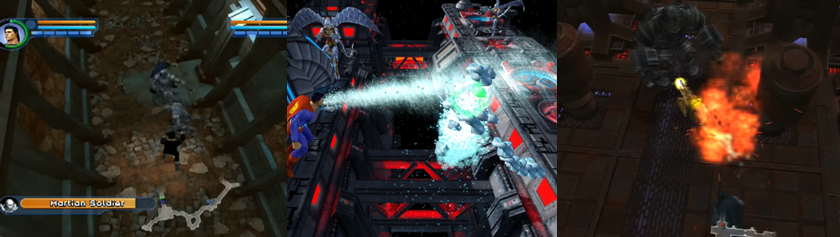
Justice League Heroes is a top-down action brawler in which you (and either another player or a computer-controlled partner) battle through a number of recognisable locations from the DC universe as various members of the Justice League. The game’s story is split into a number of missions that see two members of the Justice League teaming up at any one time; a second, human player can join the game at any point from the pause menu, a solo player can freely switch between the two heroes at will by pressing up on the directional pad (D-pad), and you’ll also be tasked with assembling one or more custom teams of two characters later in the story but you’ll never get the opportunity to switch out characters completely or replay missions with different characters. Gameplay in Justice League Heroes revolves almost entirely around beating up endless hoards of robots and aliens and solving some very light puzzles; characters can jump with a press of the Triangle button (and double jump or fly/glide with subsequent presses depending on who you’re playing as), attack with strong and fast attacks with Circle and X, respectively, and can grab enemies or objects with Square and block incoming attacks by holding R1. By entering different button presses (X, X, O, for example), players can pull off simple combo attacks to take out enemies but there are, sadly, no team up attacks to be found here.

The Justice League’s various superpowers are at your disposal and can be upgraded to be more effective.

While every character controls the same except for their ability to fly or glide, each one is made slightly different from the other through their individual superpowers. By pressing L1 and either Triangle, Square, Circle, or X, players can pull off their character’s signature super moves as long as they have enough energy stored up. This allows you to blast enemies with Superman’s heat vision, for example, or turn them into rabbits with Zatanna Zatara’s magic, or smash them with John Stewart/Green Lantern’s massive sledgehammer. Pressing L1 and R1 will see each character (with some exceptions) pull off a more powerful  super special attack which, again, varies per character; Superman, for example, will become stronger while Batman unleashes a swarm of bats to damage foes and Martian Manhunter briefly becomes intangible and invisible. They’re all pretty useful and different enough in their own way, with most characters having a projectile of some sort, a move to boost their attack or speed, or being able to stun or otherwise incapacitate enemies and you’ll sometimes (very rarely) need to use a specific character’s superpowers to bypass obstacles in order to progress. When playing alone, you can also issue simple commands to your partner using the D-pad; this allows you to increase the aggressiveness of their attack or have them focus on defence, which can be useful when teamed with Zatanna as she’s able to heal all team members.

Rescue civilians, activate consoles, and destroy targets to progress amidst the mindless brawling.

Overall, I found the computer to be surprisingly useful and competent; if your partner gets downed, however, you’ll have to rush in to revive them but the game automatically revives any downed characters when you reach one of its numerous checkpoints and enemies will often drop health-restoring orbs to keep you ticking over. Furthermore, if you’re able to attack enemies without taking damage, you’ll build up your “Heroic Meter”, which will increase your damage output until you get hit, and you can alter the difficulty of the game and its enemies by selecting different difficulty settings from the main menu. Despite the game being extremely linear, the developers included a helpful mini map, which you can expand by pressing in the right analogue stick. This isn’t always necessary but, as many of the environments are rather drab, grey, similar, and somewhat labyrinthine at times, it’s a welcome addition to keep you on track even during the game’s shorter and more straightforward missions. Unfortunately, the top-down view can be rather restrictive at times; many areas are filled with debris or obstructions and it always seems like you can only see just enough of the area, which can lead to enemies catching you off guard or hiding behind parts of the environment with no way to see them as they don’t show up on the map. It’s not all mindless brawling, either; occasionally, you’ll be tasked with rescuing a number of civilians or hostages, faced with a time limit, or directed to activate consoles to lower barriers in order to progress. As alluded to earlier, these very rarely require you to use the Flash’s superspeed or the Martian Manhunter’s intangibility to get past obstacles and stop fans, lower energy barriers, or deactivate Kryptonite hazards so that you can progress further. Sometimes you’ll also need to destroy a wall or use a character’s flight to progress across rooftops and, in the final portion of the game, you’ll not only have to protect Superman as he smashes through Darkseid’s fortress but you’ll also be faced with an extremely frustrating and confusing teleport puzzle that was the only time I had to actively look up a solution online.

Graphics and Sound:
Thanks to its zoomed out, top-down perspective, Justice League Heroes is, largely, able to get away with hiding any inconsistencies and defects in its in-game character models. Since you never really see your characters up close, the developers can have them talk and drop hints and quips without really needing to animate their mouths and the simple beat-‘em-up action of the game means that characters just need to look somewhat decent when they throw punches, grab cars, or blast out energy beams. And, for the most part, they do; there’s some neat little touches here and there (like Martian Manhunter being able to transform into his true, more monstrous form and the Flash being accompanied by a speed force double and lightning) and characters are always talking so you know when you need to drop or combine Boosts or have a vague idea of how the story is progressing.

Sadly, the game’s environments and enemies tend to be quite dark, bland, and boring.

Sadly, enemies and environments don’t always live up to the colourful and eye-catching depiction of the titular Justice League. It takes a long time for you to battle anything other than Brainiac’s generic robots or explore areas beyond the wrecked streets of Metropolis or the cold, grey corridors of Scientific and Technological Advanced Research Laboratories (S.T.A.R. Labs) and the like. Eventually, though, you do venture into more visually unique environments like the subways, a honeycomb and sap-encrusted hive, the ruins of J’onn’s civilisation on Mars, Gorilla City, a Lovecraftian dimension populated by strange rock creatures and living tentacles, and a version of Apokolips created on Earth but there’s very little variety offered in terms of the enemies or puzzles and hazards you face as you progress. No matter where you are, it’s the same thing every time: defeat all enemies, maybe activate a console, and reach the end of the stage.

Even Ron Perlman can’t salvage the blurry, rubbery graphics of the game’s cinematics.

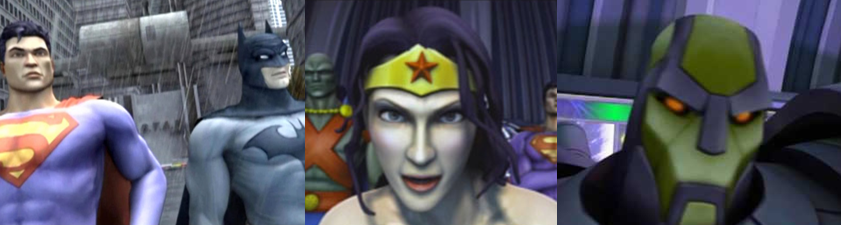
The bulk of the game’s story (which is about as generic as you can get for a Justice League videogame) is conveyed through CG cutscenes featuring the traditional rubbery-looking graphics you’d expect from a PlayStation 2 game. I did notice some slowdown when there was a lot happening onscreen and, in terms of music and sound, the game is very unimpressive; the voice cast isn’t even the same one as in the popular Justice League animated series (2001 to 2006) and, while I love me some Ron Perlman, he just sounds bored whenever his Batman speaks (I’m also not really a fan of how often Batman is shown in broad daylight).

Enemies and Bosses:
As I’ve mentioned a bit already, you’ll wade through numerous disposable enemies in your mission to stop Brainiac and his lieutenants but none of them are particularly interesting. You’ll battle robots of varying sizes, humanoid wasps, White Martians on the surface of Mars, Gorilla Grodd’s gorilla forces, and Parademons but, once you’ve fought one lot of enemies, you’ve fought them all as they all feature regular foot soldiers who shoot at you and both flying and bigger variants that can take a bit more punishment. Honestly, the only enemies I even remotely found interesting were the weird crab and toad-like enemies you face later in the game and the instances where you battle Brainiac’s skull robots and failed clones of Doomsday because they at least looked a little different.

Many of the game’s bosses require you to fend off minions or destroy or activate consoles to attack them.

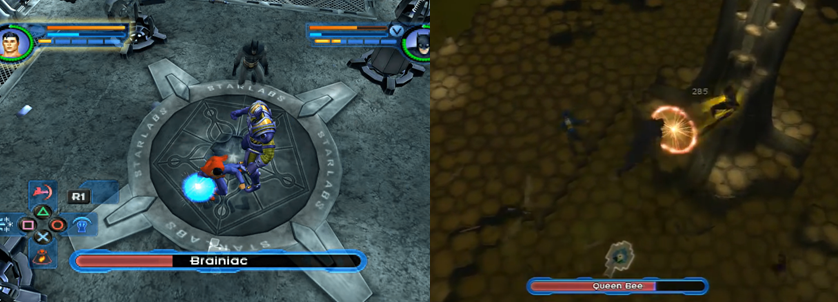
Before you can defeat Brainiac, you’ll have to battle a number of bosses; some of these are simply bigger, more dangerous versions of enemies you’ve already fought or Brainiac’s more deadly robots and duplicates. You’ll battle a Brainiac duplicate in S.T.A.R. Labs, for example, but this fight isn’t just about throwing punches. Instead, you have to activate consoles to lower barriers and rescue the scientists against a time limit all while “Brainiac” fires lasers and energy blasts at you. You’ll also encounter some of the more obscure villains from DC Comics’ gallery; Queen Bee has established a hive in the Metropolis subway and is transforming civilians into monstrous insect hybrids and, when you confront her in her throne room, she shields herself from your attacks and rains missiles into the arena that make the floor sticky. She’s only vulnerable when she leaves her throne but your window of opportunity to attack her is hampered somewhat by her minions, her energy blasts, and her tendency to dart across the screen like a madwoman. You’ll also butt heads with the Key, of all people. Like with Brainiac’s duplicate, you have to rescue some scientists against a time limit during this battle but the Key proves to be a particularly elusive and versatile enemy as he teleports around the place and causes hazards to blast out from his dimensional portals.

Grodd and Brainiac use their powers, technology, and minions to keep you at bay.

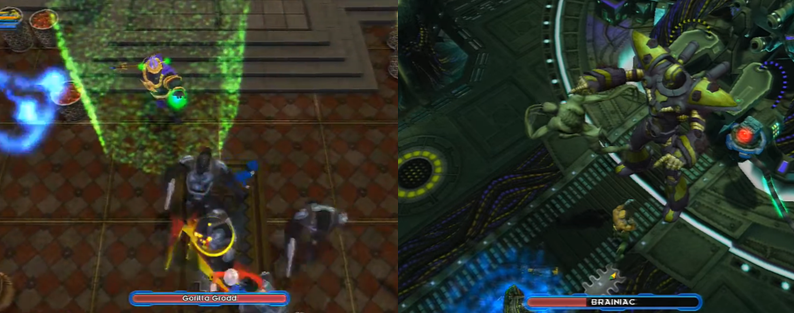
Similarly, when fighting Doctor Louise Lincoln/Killer Frost, you’re given one minute and forty seconds to destroy three missiles (and five seconds to get away from each before they explode) in addition to battling her and her icy minions. Killer Frost can conjure grunts, form ice shields, and blast at you with ice and icicles, all of which can make battling her quite tricky and annoying as your attentions are constantly divided. After reaching the core of a pyramid-like structure on Mars, Superman and the Martian Manhunter have to battle the White Martian leader; this guy is also accompanied by disposable White Martian grunts and you’re tasked with activating four nearby power nodes to defeat him. Things get noticeably more interesting when the Justice League splits into teams; while one team flies through the upper atmosphere destroying generators on invading spacecraft, another destroys power turbines in Gorilla City and gets into a confrontation with Gorilla Grodd. Grodd primarily uses his staff to attack and is joined not only by an inexhaustible supply of gorilla minions but also a series of energy-firing turrets so it’s probably best to try and keep your distance and stay on the move to emerge victorious in this fight. After battling their own security system in their Watchtower space station, the Justice League then faces off with a larger, more powerful Doomsday clone that, unlike pretty much every other boss in the game, boils down to a question of who can attack hardest and fastest rather than distracting you with tricks and puzzles.

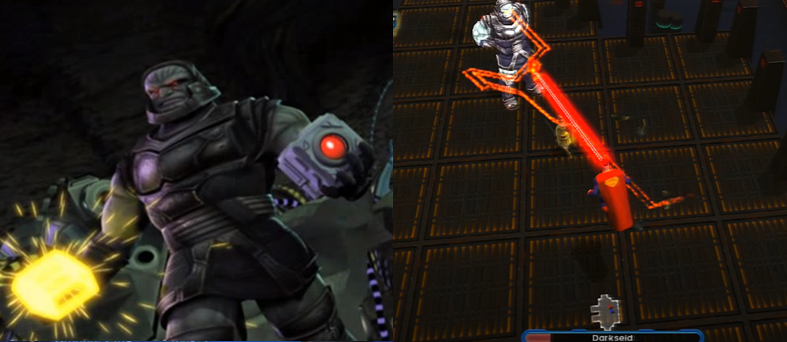
Of course Darkseid turns out to be the true final boss of the game!

Eventually, you’ll breach Brainiac’s main base and be forced to battle his three robot guardians before you confront him; Brainiac is completely protected by an energy shield and is only vulnerable when he rises from his throne and only for a brief window of time. He also likes to teleport you to the far end of the arena, where you’re forced to destroy the generators that power his barriers and take out some minions just to get back up to him, so it’s more a question of patience than anything. As you might have guessed, the moment you defeat Brainiac he is immediately usurped by Darkseid, who teleports you away to a hellish dimension and then converts Earth into a new Apokolips. You’ll need to assemble two teams of four to confront Darkseid, who stomps around his throne room creating shockwaves and plumes of fire along the ground and blasting at you with his powerful Omega Beams. Being an all-powerful New God, his health also regenerates over time, meaning you’ll have to keep pummelling him again and again in order to keep him down. This was, honestly, a bit of a confusing fight; you can grab the “Apokolips Hypercube” nearby, which seems to weaken him and make him vulnerable to your attacks but I also found myself running around with it in my hands and not doing any damage to Darkseid at all and then he just suddenly succumbed to my attacks and was defeated.

Power-Ups and Bonuses:
In almost every area in the game, you’ll find objects that you can grab and use as weapons; some of these are limited to the specifics of your character, though, meaning that you won’t be lifting cars over your head as, say, Oliver Queen/Green Arrow, for example. Still, you can grab post boxes and parking meters and cars and such to bash over enemy’s heads, which adds a bit of variety to the otherwise relentless combat. You can also pick up temporary power-ups throughout each environment to give yourself and your team mate a bit of a power boost so it can be worth exploring a little bit and smashing destructible objects wherever you see them.

Level-up to increase your stats power-up your attacks with Skill Points and Boosts.

The game also features some light role-playing elements; as you defeat enemies, you’ll gain experience points (EXP) and level-up once you’ve earned enough EXP. This will increase your stats and abilities but you also earn Skill Points that you can spend upgrading your character’s superpowers up to five different ranks to increase their effectiveness and duration. Additionally, enemies will also drop various “Boosts” that you can equip at any time; you can also combine Boosts together to create new, more powerful Boosts and equipping these will also boost your superpowers, increase your damage output or defence, or increase the range and duration of your attacks.

Additional Features:
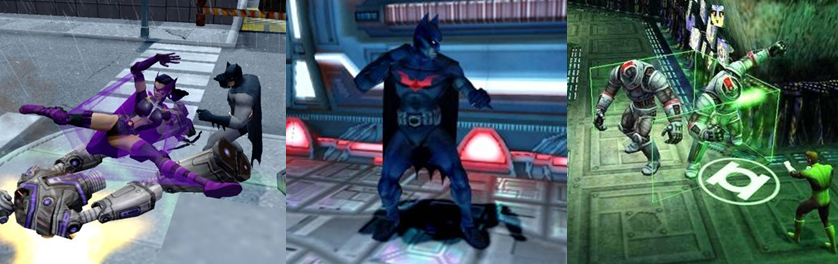
Although the game is extremely linear, there are often some rewards to be found through exploration; generally, these will just be stockpiles of health, energy, or Boosts but you’ll also find be civilians in danger who need rescuing who will drop “Justice League Shields”. Shields can also be found by destroying parts of the environment and you can spend these on skins and additional characters. While you can select any of the unlockable costumes at any time, they won’t actually load until you reach the next checkpoint/area and you can only select to play as the unlocked characters when the game allows you to pick a team of your own. The skins available are quite impressive, though; while not every character gets a skin, some offer bonus boosts to your stats and there’s some fan favourites available here, like Superman’s black suit, Batman’s traditional blue and grey suit, and the Jay Garrick version of the Flash. You can also unlock the likes of Green Arrow, Aquaman (sporting his water hand), Helena Bertinelli/The Huntress, and what I assume is the Kendra Saunders version of Hawkgirl.

Unlock additional characters, costumes, and modes by finding Shields and completing the game.

You’ll notice, however, that neither Huntress, Aquaman, or Hawkgirl have an L1+R1 special move, though I’m not entirely sure why. You can also unlock Hal Jordan and Kyle Rayner but, despite these two being separate characters, they control exactly the same as John Stewart, which is a little disappointing; none of the unlockable characters have alternate costumes either, which is a bit of a missed opportunity in my book. Initially, you can select from Easy, Normal, or Hard difficulties but you’ll unlock two more difficulty levels (Elite and Superhero, on which most enemies will kill you in one hit) and be given the option of starting the game over from the beginning with all of the upgrades and EXP you amassed during your run upon completing the game. Sadly, there’s no option to free play any mission with any character, no versus mode, and no option to play online or with more than one other player but there are a number of cheats that you can activate from the pause menu to give yourself invincibility, infinite energy, all upgrades, and a bunch of Shields to quickly unlock all of the game’s skins and characters.

The Summary:
Justice League Heroes isn’t going to really offer you anything you can’t get from any other mindless beat-‘em-up; the stages and enemy designs can be very bland and boring and there really isn’t much asked of you other than to mash the same buttons over and over and activate a few consoles. Still, as a fan of beat-‘em-ups and brawlers, I found Justice League Heroes to be a pretty decent way of spending an afternoon; there’s a lot of characters available to you and I like that the story mixes the teams up quite often and allows you to put together your own teams, and the game is probably even more enjoyable with a friend to play with. There could have been more options and unlockables available (such as free play mode, maybe some challenges, and a boss rush), the music and graphics can stutter a bit, and the game is awash with dark, boring, grey locations, but, as a repetitive brawler featuring the Justice League, it’s decent enough, though probably not very appealing to those that aren’t fans of the source material and characters.

My Rating:

Rating: 2 out of 5.

Could Be Better

Have you ever played Justice League Heroes? If so, what did you think to it? Were you disappointed by the game’s presentation, selection of villains, and the inability to freely pick characters on the go? Which of the available characters was your favourite and preferred duo? What genre do you think would work for a future Justice League videogame? What version of the Justice League is your favourite and are there any DC superheroes you’d like to see added to the team someday? How are you celebrating Justice League Day this year? Whatever your thoughts on Justice League Heroes, and the Justice League in general, feel free to drop a comment below.
Game Corner [Wolvie Wednesday]: X-Men Origins: Wolverine: Uncaged Editon (Xbox 360)


When readers were first introduced to the character of James Howlett, better known by the names “Logan” and “Wolverine”, it was in the pages of The Incredible Hulk. From his first full debut in issue 181 all the way back in November 1974 to him officially joining the X-Men in 1975, the character has become one of Marvel Comics’ most recognisable and enduring superheroes, regularly featuring in solo and team comics, cartoons, movies, videogames, and countless other merchandise.


Uncaged Edition

Released:  May 2009
Developer: Raven Software
Also Available For: Mobile, Nintendo DS, Nintendo Wii, PC, PlayStation 2 PlayStation 3 PlayStation Portable

The Background:
20th Century Fox profited greatly after acquiring the X-Men movie rights from Marvel Comics. Under their banner, the first three X-Men movies (Various, 2000 to 2006) made over $600 million and, eager to capitalise on that financial success and the popularity of their star, Hugh Jackman, they quickly began production of a spin-off film focusing solely on breakout star Wolverine. While X-Men: Origins Wolverine (Hood, 2009) proved a financial success, reviews ranged from mixed to scathing (unfairly, in my opinion) but the same couldn’t be said about the obligatory tie-in videogame. Developed by Raven Software, the game was a violent hack-and-slash adventure that expanded upon the film’s storyline using elements from the comic books and emphasised frenetic, gory violence very much like the God of War videogames (Santa Monica Studio/Various, 2005 to present). X-Men Origins: Wolverine: Uncaged Edition was highly regarded by critics and fans alike as one of the most enjoyable and entertaining videogame adaptations ever made.

The Plot:
Decades before he joined the X-Men, Logan (a Mutant with retractable bone claws, a superhuman healing factor, and heightened senses) was a part of William Stryker’s Team X and operated under the codename Wolverine. After many years working alongside his half-brother, Victor Creed, Logan walked away from his violent life only to be forced back into the fight (and to undergo a radical procedure to bond indestructible Adamantium to his skeleton) when Victor killed his lover.

Gameplay:
X-Men Origins: Wolverine is a hack-and-slash action brawler with very light platforming and puzzle elements that sees you cast into the role of the titular Mutant, who has the voice and likeness of X-Men star Huge Jacked-Man Hugh Jackman. The story can largely be summarised as taking “inspiration” from the movie, as the narrative constantly switches back to Africa to follow Wolverine’s final mission with Team X, and to the present day of the mid-1980s in a truncated and decidedly different, if similar, version of the events from the film. The gameplay is primarily geared towards slicing and dicing enemies with Wolverine’s bone or Adamantium claws in a variety of gruesome ways: Wolverine can attack with quick, light strikes with X, heavier attacks with Y (which can also be charged by holding the button), and string together successive presses of X and Y to pull off devastating combos (which you can review at any time from the pause menu) that turn Wolverine into a whirling dervish.

Lunge at enemies, unleash your Fury Attacks, and use Feral Senses spot environmental kill spots.

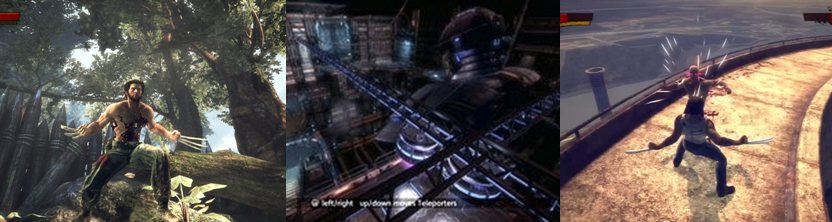
Wolverine can also jump with A, cling to ledges and climb certain walls, block, reflect, or counter incoming attacks with the Left Trigger, and grab enemies with B. Once grabbed, you can mash X to pummel them or toss them at other enemies (or into instant death environmental traps), or charge Y to perform a “Quick Kill”. Wolverine can also dash ahead with the Left Bumper but I found that this was a bit clunky and awkward as there is a delay between Wolverine stopping at the end of the dash and returning to a run, so it’s far better to press the Right Bumper and LB to perform a rolling dodge instead. One of Wolverine’s most useful skills, though, is his lunge attack. By holding RB to target enemies, you can then press LB to leap towards your target and attack them with X, B, or Y to quickly pounce across gaps and from target to target, which is endlessly satisfying when overrun by enemies. As you progress through the game, you’ll also unlock four Fury Attacks that can be unleashed when your Rage Meter is full and by pressing the Right Trigger and either A, B, X, or Y. Each of these can also be upgraded further and will see Wolverine fly into a berserker rage and becoming a spinning whirlwind of claws and death as you mash buttons to extend the duration of his onslaught. Wolverine also has the benefit of his heightened senses; by pressing up on the directional pad (D-pad), you’ll see the body heat of nearby enemies, climbable ledges and surfaces, footprints when tracking targets, and an ethereal blue light that points you in the right direction in a mechanic very similar to the Detective Vision from the Batman: Arkham games (Rocksteady Studios/Various, 2009 to 2015), though much more basic.

Puzzles are pretty simple and amount to little more than button mashing or powering up consoles.

While the environments you find yourself in are quite linear, they are also made up of a lot of dark, grey corridors, so Wolverine’s Feral Senses are helpful for keeping you on track and spotting opportunities to instantly kill your opponents. I’m not sure why but the developers also allowed you to sheath and unsheathe your claws by pressing down on the D-pad; this doesn’t really seem to do anything but I guess it adds to the immersion of being Wolverine and, very rarely, you’ll be able to instantly kill enemies by sneaking up behind him and pressing either B or X. A good 90% of the game is made up of mindless hack-and-slash combat, usually restricting you to a set area and fending off waves of enemies who can seem never-ending at times. Other times, though, you’ll need to pull off some tricky jumps and awkward platforming; mostly, this isn’t a problem, but that are times when you have to jump from platforms and ledges or ropes and it can be very difficult to make even simple jumps thanks to the dodgy camera and invisible barriers nudging you to your death. Wolverine will also have to zip down wires to cross gaps, precariously walk across balance beams and girders, and occasionally pull or push large objects (usually crates or jeeps) by holding B. Other times, you’ll need to mash A to turn a wheel to open a door or find a crank or power source and carry it to a power node by picking it up with B. It’s all very simple and puzzles generally don’t become more taxing than that, standing on pressure pads, or scaling towers. Given his Mutant abilities, Wolverine is extremely durable, able to sustain prolonged gunfire and attacks and continue fighting. Your health bar will automatically regenerate if you avoid attacks for a few seconds but you can still be “captured” if your bar is completely drained and your vital organs are damaged so, while you can largely leap head-first into situations and groups of enemies, it’s best to keep an eye out from spiked traps and avoid being set on fire or pummelled by larger enemies.

Gameplay is mixed up by a few different sections and mechanics, some more welcome than others.

Wolverine’s biggest danger in this regard is falling while trying to jump or navigating across bottomless pits or large chasms; if you fall, you’ll have to restart from your last checkpoint but, thankfully, checkpoints are quite numerous and generally always come right before a tricky situation. Gameplay is further mixed up by a few quick-time events (QTEs), mainly when opening doors, and slightly different camera angles and chase sequences, such as when Wolverine has to race down the spill well of the Alkali Lake facility and leap from jeep to jeep, dispatching enemies as a wall of water comes inexorably after him. Other times, helicopters will fire at you relentlessly and you’ll have to dart between platforms and cover to avoid fire or frantically run and jump across surfaces that crumble beneath your feet. In another mission, you have to lunge at enemies on speedboats down a racing river; if you fall in the water, you’ll have to restart but you eventually commandeer a machine gun turret and can fire wildly at your pursuers by holding RT. One particularly annoying mission has you dodging between metal shields as automatic turrets fire at you; you’ll need to activate a console to put the shields in place to stave off the heavy ordinance and use similar consoles to position teleporters around the sentinel facility.

Graphics and Sound:
Generally speaking, X-Men Origins: Wolverine looks pretty good; environments can be a bit bland and drab at times but you’re constantly hopping back to the jungles of Africa, which helps add a bit of visual variety to the game even if the environments remain quite linear and have very few opportunities for you to explore in a meaningful way. Character models are decent enough but the developers clearly put the most time and effort into the titular character; no other character from the movie save Victor Creed bares the voice or likeness of their actor, which is disappointing, and most of the enemies you encounter are largely generic soldiers with little to really make them stand out. As mentioned, Wolverine spends a lot of his time flashing back to Africa; here; you’ll run through the ruin-strewn jungle and encounter a number of machete-wielding natives and ancient booby traps and such. It’s a stark contrast to the boring, grey corridors of Alkali Lake (a location I could live with never having to see again) but the game claws back (no pun intended) some visual variety in the Sentinel facility and the casino where you pursue and battle Remy Lebeau/Gambit. These locations are much more interesting to look at, being a vast technological complex full of intricate machinery and Sentinel parts and a neon-drenched skyscraper that sees you climbing horizontally and vertically, respectively.

Environments can be dark, drab, and bland but some manage to stand out regardless.

It’s a shame, then, that the game doesn’t change the location of its finale, which sees you back in dull, concrete surroundings on Three Mile Island, but I did enjoy the visual of battling Wade Wilson/Weapon XI/Deadpool atop the cooling tower like in the movie. The game’s story is largely told during gameplay using the in-game graphics, often with Wolverine conversing with his superiors or allies via an earpiece (again, very similar to the Batman: Arkham games). There are some CG cutscenes here, though, which are quite blurry and muddy as you might expect from an Xbox 360 title. Similarly, the music isn’t really anything to shout about; it’s not exactly memorable or catchy and the only thing really salvaging the audio presentation is Jackman’s unparalleled work as the titular character. There was, however, quite a bit of slowdown whenever there was a lot happening onscreen and the game doesn’t do a very good job of masking its loading times; often, the game stops completely and you’re left with a “Streaming…” message while it loads the next area, which interrupted the flow of the game considerably at times. You’ll find some interesting audio logs and references to (and cameos from) some recognisable X-Men characters, though, and the final cutscene even places Wolverine in the “Days of Future Past” (Claremont, et al, 1981) timeline.

The game’s biggest appeal is in its graphic violence and gore in depicting Wolverine’s brutal nature.

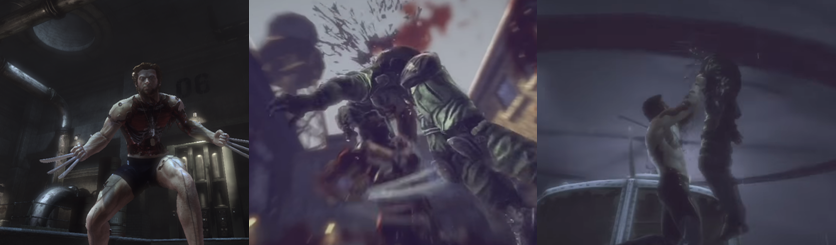
Where the game excels, though, is in its unrelenting gore and violence; ironically, X-Men Origins: Wolverine is more violent and uncompromising than the film it’s based on, meaning that kids who enjoyed the film probably weren’t old enough to play the game at the time! As Wolverine takes damage, his skin and clothing is torn and shredded, revealing his Adamantium skeleton, which is both gruesome and fantastic to see. The wounds heal up over time but you’ll often be running around with a fully metallic arm or half a metal skull, which is something we really haven’t seen in the films yet. When attacking enemies, Wolverine can slice off limbs, impale them on the environment, and set them alight or electrocute them with environmental hazards and you’ll often see dismembered bodies writhing on the floor in agony and heads flying from their shoulders. One of the most brutal kills in the game comes when Wolverine rips a helicopter pilot out of his cockpit and forces him head-first into the blades! There’s no nonsensical censoring in this game; it’s bloody, violent action all the way through and this really helps to make the repetitive hack-and-slash gameplay more interesting and entertaining.

Enemies and Bosses:
As mentioned previously, the majority of the enemies you’ll encounter in the game are machine gun-toting soldiers; when in Africa, you’ll fight wild natives who wield machetes but you’ll also battle some rather generic-looking robots when breaching the Sentinel facility. It doesn’t take long for you to encounter more formidable variants of these enemies, such as the Machete Champion (who can set you ablaze), shield carrying soldiers (whose guard you must break with a charged heavy attack), soldiers packing grenade launchers (whose projectiles you must reflect back), and even invisible enemies (“Ghosts”) who carry shotguns and are be dispatched by grabbing them and tapping Y to blow their heads off. You’ll also come up against more monstrous enemies such as the lava-and-rock-covered Leviathan and the Weaponized Experiment Neurodindritic Incident Gamma Zero (W.E.N.D.I.G.O.) prototypes; these are best attacked with your Fury Attacks as they charge at you, deliver big damage with their swings, and can catch you in mid-air as you lunge if you don’t get around behind them. As you damage the Leviathan, it’ll protect itself with tougher rock and start tossing and smashing boulders at you so you’ll have to lunge at it whenever possible and you’ll soon be faced with two to four of these enemies at a time so it’s best to get a rhythm on.

You’ll be leaping at a lot of helicopters but especially to bring down the sharp-shooting Agent Zero.

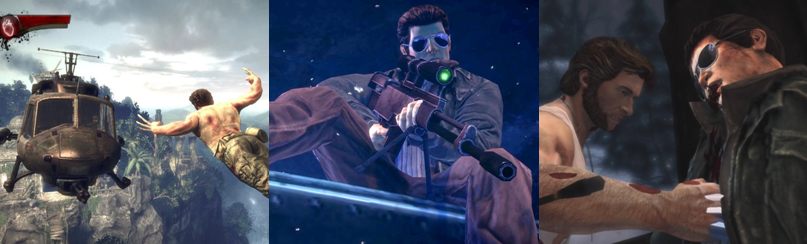
You’ll also have to fight “Jungle Mutants” like Shifter, a blue energy being who teleports about the place, traps you in electrical prisms of light, and can duplicate itself (but is, thankfully, easily dispatched with environmental kills). The first time you encounter these enemies, they act as sub-bosses but quickly become regular enemies and you’ll often be faced with a variety of different opponents and forced to adapt to each on the fly. A recurring element in the game are the helicopters that are sent to bring you down; at least three times you’ll have to outrun these pursuers and then lunge at them, moving the left analogue stick to avoid being shot at and smashing your way into the cockpit with X or Y to bring them down. There’s a particularly gruelling battle that has you dodging helicopter fire as four W.E.N.D.I.G.O.s attack you at once but, thankfully, enemies can damage each other so you can position the beasts into each other’s attacks and the bullets from the helicopter. Prior to this battle, you’ll also have to contend with a pretty unique switch in perspective as David Nord/Agent Zero takes shots at you with his sniper rifle and you control Wolverine from the perspective of Nord’s sniper scope.

Creed is a far less pivotal or threatening figure in the game despite being fought twice.

The first real boss you’ll battle is Victor, Logan’s stepbrother (though this plot point, like a lot of plot points from the film, is nowhere near as relevant or emphasised as in the movie). You’ll fight Victor twice throughout the game, with the first bout taking place in and outside of a bar and the second inside of Stryker’s island base, just like in the film. Victor mirrors many of your own abilities and can lunge, swipe, and claw at you; he can also grab you to deliver combos and you’re in just as much danger of being impaled on the environment throughout the game as he and your other enemies are. Still, Victor isn’t much of a threat; although he boasts the same healing factor as Wolverine, I never actually noticed his health regenerating in either fight and it’s pretty simple to lunge at him, block and counter his attacks, and either use the environment or your Fury Attacks to whittle his health down and defeat him in both battles.

The Sentinel poses a formidable threat and must be attacked both on the ground and in mid-air!

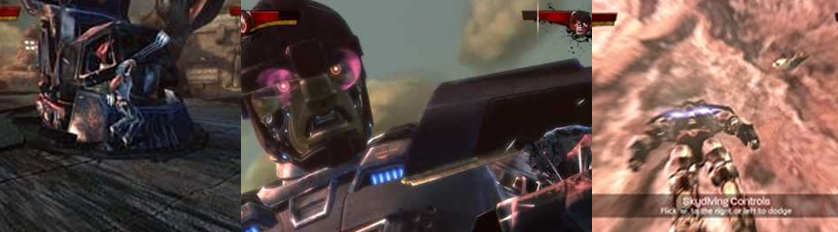
As you might expect given that you end up in a Sentinel facility, you’ll have to battle with a Sentinel prototype as well. The first time you encounter the Sentinel, it’s in pieces and you have to solve a bit of a track puzzle to position its hand in place to attack its head but, despite your efforts, Bolivar Trask activates the prototype and you have to fight it outside the facility. The Sentinel is suitably massive and stomps around the place, leaps at you to cause shockwaves, fires laser blasts from its hand, and grabs you to blast you with its eyebeams in a homage to that iconic “Days of Future Past” cover art. To battle the Sentinel, you need to attack its feet and hands; this is best done by luring it towards the electrified panels on the floor, which will stun it for longer (though it’s difficult to tell that you’re actually dealing damage to it because of its high health bar). Once you damage it enough, it’ll take off and you’ll have to freefall down to it, dodging or ploughing through debris and guiding Wolverine to its thrusters. Eventually, you’ll do enough damage that Wolverine targets its main power source, which requires you to mash B to rip open its chest plate before it can blast you.

While the Blob is simple, Gambit leads you on an elaborate chase and is the most frustrating boss.

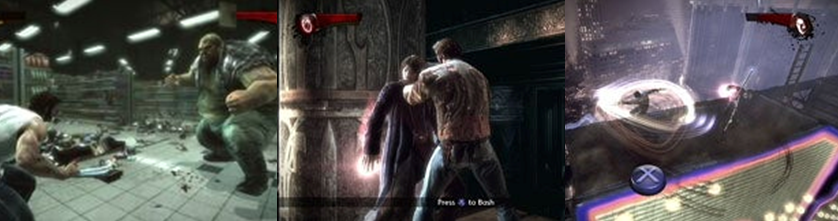
Immediately after felling the Sentinel, you’ll fight with Fred Dukes/The Blob; unlike in the movie, this fight takes place in a supermarket full of destructible elements. The Blob is very similar to the Leviathan and W.E.N.D.I.G.O. enemies and will charge at you and repel your lunges with his drum-like belly. Once you damage him enough, though, he’ll try to squash you with a belly flop, which stuns him long enough for you to lunge or mount him and claw at him and force him into walls to bring him down. Immediately after that fight, you’ll have to battle what was, for me, the most annoying, frustrating, and long-winded boss of the entire game: Gambit. Gambit attacks with his staff and kinetically-charged playing cards, which must be countered and reflected back, respectively, to stun him. What makes this boss so annoying, though, is that you fight him a whole bunch of times and are forced to chase through up and through a skyscraper. Eventually, you battle him on giant neon letters, lunging at him when he charges and destroys them and mashing A when he tosses you over the edge. This was, honestly, the most exasperating part of the entire game as each fight with Gambit just went on and on and it seemed never-ending; of all the characters and Mutants in the game, I never would have expected Gambit to be so versatile, resilient, and challenging!

Deadpool will push your button mashing skills to breaking point!

After the finale battle with Victor, you are forced to battle Deadpool at Three Mile Island. If you haven’t seen the film, you might be a bit confused about who Deadpool is since he barely appears at all in the game’s story but he’s a pretty formidable boss in his own right. Fighting him is, essentially, the same as fighting Victor except that you’ll damn near break your wrist trying to mash A following a counter of his blades and it’s a two-stage boss fight. In the first, you fight him in an ordinary area of the island, avoiding his spinning blades and jumping attacks and whittling his health down with your Fury Attacks but, in the second, you battle him atop a cooling tower. Here, he demonstrates his ability to teleport and will blast at you with optic blasts that can destroy parts of the environment. Still, he’s pretty easy to defeat; you simply block his attacks, unleash your Fury Attacks, and lunge at him after he fires his eye beams. When you’ve dealt enough damage, the QTE becomes easier to pull off and is a great way to deal additional damage; while Deadpool’s health doesn’t regenerate during the fight, it will fill up at least once, which can make this rather long-winded and frustrating but it’s nothing compared to fighting Gambit!

Power-Ups and Bonuses:
As you battle enemies and destroy crates, you’ll earn red Rage Orbs to fill up your Rage Meter and experience points (XP) that will see you level-up in time. Levelling up increases your health meter and earns you Skill Points, which you can spend in the “Character” sub-menu. Here, you can increase your maximum health, Rage Meter, and the damage and duration and effectiveness of your Fury Attacks. Each one will cost you more Skill Points as you upgrade them, though, so it’s best to either stock up or focus on one attribute to upgrade at a time. You can also boost your health and earn additional Skill Points by finding power-ups hidden in each environment, generally just off to one side or the opposite way from where you’re being directed to go. Every time you fight and defeat enemies, you’ll also fill up a “Reflex” meter in the Character sub-menu; when each of these is mastered, you’ll find that you deal more damage to, and have a greater defence against, the game’s enemies, which adds an extra incentive to combat. Finally, you’ll also find “Mutagens” hidden throughout the game; up to three of these can eventually be equipped and each one can also by upgraded further to increase you damage, Fury Attacks, or regenerative capabilities as well as boosting the speed which you build up your Reflexes.

Additional Features:
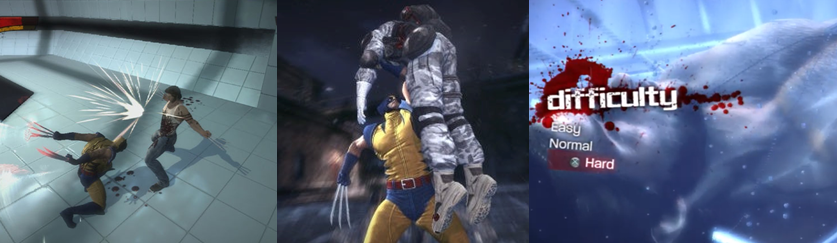
There are fifty Achievements for you to earn throughout the game, the majority of which you’ll get just by playing through the story mode. You get Achievements for killing up to 2000 enemies, performing lunges and Quick Kills, tossing enemies from high ledges, and clearing each chapter of the main story. As you explore your environment, you’ll also find dead bodies and acquire Dog Tags for XP and which count towards Achievements and you’ll need to venture off the beaten path a little bit or attack enemies and bosses in specific ways to get some of the more obscure Achievements but you can track your progress towards them at any time from the “Statistics” menu. When you first start the game, you can select to play on “Easy” or “Normal” difficulty; you may as well pick “Easy” as the only difficulty-based Achievement comes after you clear the game and unlock “Hard” mode. Once you beat the game, though, you can replay any mission you like and pick a costume to wear beforehand but you’ll lose all of your saved progress and upgrades if you want to get the “Walking Death” Achievement so I’d recommend clearing the game and mopping up any Achievements you’ve missed tied to kills and Dog Tags and such before playing on Hard.

Unlock some cool classic costumes and beat the game to access a harder difficulty mode.

Also hidden throughout the game are a number of different Wolverine action figures; finding enough of these will unlock a special challenge from the main menu. Here, you’re pitted against three different Wolverines and, when you defeat them, you’ll unlock a new costume to wear including Wolverine’s classic brown-and-tan outfit, his yellow-and-blue spandex, and his awesome black-and-grey X-Force outfit. There are actually more action figures than you need but collecting them only awards you an XP boost rather than the likes of Wolverine’s Weapon-X outfit or movie costume, and there is a fourth challenge available but it seems that this was a Gamestop exclusive unlockable that would give you access to the X-Men’s Danger Room and it doesn’t appear to be accessible now. Sadly, that’s about it as far as bonus content goes; you can enter some codes to make the game easier but you won’t be able to get Achievements with these activated and it’s a shame that there aren’t more costumes to unlock.

The Summary:
I was very much looking forward to playing X-Men Origins: Wolverine; I’d heard time and time again that it was one of the best licensed videogames out there and actually better than the movie (which I have always considered to be pretty enjoyable and under-rated). However, I was surprised to find that all of the praise I had heard about the game didn’t relate to it doing a very good job of recreating the events of the movie. To be fair, a lot of licensed videogames falter a bit in this regard but X-Men Origins: Wolverine does a pretty lacklustre job of rushing through the film’s story, glossing over Team X and Wolverine’s relationship with the team and his brother, and simultaneously paying lip service to the film’s narrative while also awkwardly staying beholden to it in other ways. The game excels when it veers from the film’s plot, to be honest, and I can’t help but think it would have been better for it to act as a prequel and sequel to the movie rather than actually including events from the film. The sections in Africa are much more visually interesting than those in Alkali Lake (even though the developers tried to mix things up a bit by stripping you of your powers here) and I’d rather infiltrate a Sentinel production plant than visit Stryker’s bland island. This would also have given the developers the opportunity to include more characters, enemies, and elements from the comic books; they hint at this with the final cutscene but fall back on disposable grunts and characters from the movie rather than the likes of Mister Sinister or Omega Red. Thanks to its gore, violence, and frenetic gameplay, X-Men Origins: Wolverine is definitely a fun, if monotonous, experience; it’s probably the best and most accurate videogame portrayal of Wolverine ever made and is worth a play if only to see him hack up enemies and be stripped to his metal skeleton but there’s not a lot in terms of replayability and will probably be a mediocre distraction for fans of the hack-and-slash genre.

My Rating:

Rating: 3 out of 5.

Pretty Good

Are you a fan of the videogame adaptation of X-Men Origins: Wolverine? Did you prefer it to the movie? How do you feel it compares to other hack-and-slash videogames? Were you a fan of the gratuitous violence and gore? What did you think to the game’s interpretation of the film’s plot; were you also a bit perturbed by the truncated narrative or did you prefer the alterations presented in the game? Which of the bosses was your favourite or most frustrating? Which of Wolverine’s costumes was your default? Which X-Men or Wolverine videogame is your favourite and why? How are you celebrating Wolverine’s debut this month? Whatever your thoughts on X-Men Origins: Wolverine, or Wolverine and the X-Men in general, drop a comment down below.

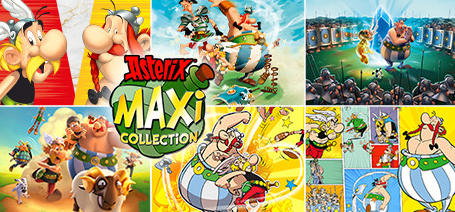
Game Corner: Asterix & Obelix: Slap Them All! (Xbox Series X)

Released: 25 November 2021
Developer: Mr Nutz Studio
Also Available For: Nintendo Switch, PC, PlayStation 4, PlayStation 5, Xbox One, Xbox Series S

The Background:
Less than ten years after debuting in the pages of Pilote, the first Asterix book was adapted into a feature-length animation and animated and live-action Asterix films have been pretty consistent ever since. Similarly, we’ve seen a number of Asterix videogames, with the first being released for the Atari 2600 in 1983 and a large part of my childhood spent playing Astérix (SEGA, 1991) on the Master System as opposed to its flawed Mega Drive counterpart. Although Asterix dabbled in all sorts of genres, from real-time strategies to action/platformers and mini game collections, perhaps the most suitable format has always been the classic sidescrolling beat-‘em-up. Sadly, while Konami’s 1992 arcade title looked and played really well, it was unnecessarily restrictive, and was never ported to home console ports, a flaw this spiritual sequel somewhat rectified despite physical versions of the game being difficult to come by. Sporting hand-drawn graphics and gameplay specifically designed to evoke the arcade games of old and the original comics, Asterix & Obelix: Slap Them All! was met with generally positive reviews, which praised the visual style and fidelity to the source material. Though the tedious combat and lack of content was criticised despite the short, sharp fun offered by the game’s emphasis on action, it still received a sequel.

The Plot:
The year is 50 BC. Gaul is entirely occupied by the Romans save for one village of indomitable Gauls. With the Romans expanding their campaign across the ancient world, Asterix and Obelix, embark on a globe-trotting adventure to fight them off wherever they may be.

Gameplay:
Asterix & Obelix: Slap Them All! is a 2D, sidescrolling beat-‘em-up that emulates the classic arcade brawlers of yesteryear. Players can choose to go it alone as either Asterix or Obelix, or team up with a friend for some couch co-op action, which sees them bashing Romans and other baddies across the ancient world in six chapters (referred to as “Acts”) Fundamentally, Asterix and Obelix have the same range of motion and attack options available to them, but there are a couple of differences. Both can jump with A and attack enemies with X; successive presses of X will see each of them pull off a combo, building up your “Slap” counter and allowing you to amass greater and greater combo strings, and you can perform a jumping attack by pressing X in mid-air (though this can be a little inaccurate against smaller foes). You can block incoming attacks with the Right Bumper, dash across the screen and clear away enemies by double tapping the direction you’re facing, press B to pick up health items or grab enemies, and Y pulls off a special attack. This is one area where the characters differ: if you hold Y as Asterix, he’ll pull off a spinning top-like attack for a bit and pressing Y in mid-air will see him performing a jumping variation of this move. Obelix, however, can pull off a slower, far more powerful combo of punches by pressing Y and stun enemies with a huge butt stomp with A and Y. All of these special attacks, blocking, and even dashing consume energy, represented by lightning bolts under your health meter. Energy automatically refills as you attack and defeat enemies, however, but you still need to be careful about how and when you pull off your special attacks. Pressing up and Y or down and Y will see both characters uppercut their enemies or slam the ground, respectively, and each has different options for grabbing and throwing: pressing A and Y together allows Asterix to swing enemies over his head and tapping B sees him fire them across the screen, while Obelix can tap X to slap them about, tap Y to slam them on the ground, or launch them across the screen with B.

Pummel enemies, race through barricades, and smash everything in this mindless brawler.

You can switch between Asterix and Obelix at any time with the Left Bumper, however there is a short delay as each character performs an intro animation, which can leave you vulnerable to attack, and there’s distinct differences between the two: Asterix is smaller, more agile, and a little weaker whereas Obelix is stronger but slower and a far bigger target. Those playing with a friend will be disappointed to learn that there are no team moves in this game, though there’s no friendly fire option either; the game also lacks a timer, but the life system is a little wonky. The mission ends if either Asterix or Obelix’s health is drained, meaning you’ll need to restart from the beginning of the stage; there are no checkpoints, no revive system, and you can’t simply continue on as the other character, meaning it’s best to play through the majority of the stage as one and switch to the other when it’s safe, making sure to swap to whoever needs any health pick-ups you find. Pretty much the whole game is a simple beat-‘em-up; you start on the left side of the screen and travel to the right, bashing any enemies that cross your path. It quickly becomes very tedious, especially as the game’s Acts are proceeded by brief interludes where you’re in the forest, storming a Roman camp, or battling pirates on their ship in environments that change very little as the game progresses. Occasionally, you can explore other paths for goodies and barricades, rocks, or catapults to smash for extra points; you’re also tasked with climbing ladders, cliff faces, and vines as well as smashing down doors on a handful of missions. Gameplay is broken up a little bit by a couple of different racing sections; one has you rapidly tapping A to beat your friend or Roman gladiator Gluteus Maximus in a foot race, and the other sees you holding X as you automatically race through the forest hunting boar and smashing through barricades, barrels, and Romans. One mission gives you sixty seconds to destroy all the barrels in the pirates’ cargo hold; you get another timed mission in Act VI, where you’re given one minute and forty seconds to destroy all the catapults and barrels across the Roman landscape. Finally, you’ll be tasked with fighting your way to, into, and through various Roman camps between Acts; these mostly all amount to the same thing, however, though there are a couple of occasions where you’re placed on a static screen and asked to fend off waves of enemies as they try to storm the village or other allied settlement.

Graphics and Sound:  
If there’s one thing Asterix & Obelix: Slap Them All! has going for it, it’s the game’s graphics; sporting a beautiful hand drawn style that perfectly captures the spirit of the comic books and apes the look of the feature-length animations, the game is lovely to look at. Asterix and Obelix are full of life; each has idle animations, different walk cycles, and a range of reactions and animations when attacking or being hurt. They’ll both drop a few quips and lines here and there as you plough through enemies (oddly, they seem to have British accents, which is strangely common in Asterix adaptations), though voice acting is restricted to a few clips and a very brief bit of narration between Acts. The game’s music is equally forgettable; there’s some jaunty, fitting tunes but nothing massively spectacular, which is a shame as it would’ve been nice to have some memorable music to hum along to as you’re bashing through countless enemies. Comic book sound effects punctuate the action, which absolutely nails the slapstick violence of the source material; you can uppercut Romans out of their sandals with a loud PAF!, charge through them at superhuman speeds and send their shields flying, and some enemies have fun defeat animations where their weapons break over their heads or their pants fall down. Just about the only complaint I have about the sprites is that they get very repetitive very quickly; there are a few different types of enemies, but you’ll have encountered the majority of them within the first few missions and the game doesn’t always take advantage of its globe-trotting narrative to deliver new enemy types (there are no unique enemies in Corisa or Egypt, for example).

As beautiful as the game is, environments and enemies repeat far too often, offering little visual variety.

This is true of the environments as well; while they’re equally beautifully and are also ripped straight from the source material, there’s only so many times you can fight through the same forest, ship, and beach before things start to get a little tedious. In this regard, the original arcade title does a far better job of keeping things visually interesting because it simply dropped you in a new area that altered as you fought through it; here, the Acts are broken down into missions, so you have to traverse a forest, then cross a stone pathway or bridge, then fight on a ship, then across a beach, then maybe up some cliffs (which may or may not have some mist effects), and into a Roman camp in practically every single mission. It smacks of padding, unfortunately, and it takes too long for the game to mix things up by spiriting you away to Egypt, where you’ll fight through pyramid construction sites and dark tombs. To be fair, some of these areas do get a bit of a visual change up; you’ll battle on different ships and different times of day, forests and rural landscapes are eventually interspersed with Roman trappings like roads, villas, and columns, and you’ll find yourself fighting through jails and in the sands of the arena in due time…it just takes a while to get there. The game’s cutscenes are a mixture of static images and written dialogue, animated sequences with a bit of voice acting, and motion comic-like sequences; they’re okay and they tell truncated versions of some classic Asterix stories, but I think I would’ve preferred more sprite-based cutscenes just so we could’ve had a little more visual variety in the onscreen characters.

Enemies and Bosses:
As you might expect from an Asterix videogame, your primary enemies will be the Roman forces that have swept across ancient Europe. Romans came in all shapes and sizes, from smaller legionnaires to plumper ones with swords and gaunt variants who annoyingly toss spears at you from a distance or perform a melee attack up close. Eventually, the Romans try and get a little clever and hide in bushes and tree stumps, jabbing at you with swords and spears from each, and bring in a bigger brute who can block your attacks and cannot be thrown but their greatest asset is their sheer numbers. Asterix & Obelix: Slap Them All! certainly doesn’t shy away from filling the screen with enemies for you to plough through and, if you’re not quick enough, it’s easy for your enemies to whittle your health down and force a restart. I was surprised, and disappointed, that the game didn’t include the chunkier gold-armoured Roman commander, any Roman formations, or enemies on horseback (though you do have to dodge speeding chariots and bulls on a couple of occasions). Other enemies include a persistent gang of pirates and brigands; the former sport more elaborate weapons, such as axes and nunchakus, while the latter are capable of charging across the screen with their fists thrashing in an unblockable attack that also damages other enemies. Much later into the game, you’ll also encounter armoured and armed gladiators in the game’s fighting arenas who also race across the screen and attack you with tridents, and even lions, though you’ll only encounter the hulking Normans in Act II and they all unfortunately look the same.

Sadly, you’ll be facing these same bosses over and over, with little to differentiate them.

Bosses are few and far between and easily one of the game’s biggest let downs as the game reuses and recycles five of the bosses over and over, with little variation between them. The first boss you’ll fight is a Roman Centurion who pretty much sets the standard for all of the game’s bosses; they’re too big to grab or throw, often block your attacks, sport a health bar, and are accompanied by endless reinforcements, the remainder of which you must take out to complete the mission. The Centurion is fought five times throughout the game, usually inside of or outside of the Roman camps, with Act III and Act IV forcing you to battle two at once, but again I would’ve liked to see them be more visually distinct. Additionally, they’re not too difficult to defeat; they attack with a sword combo and can defend against your attacks, but they’re a pretty big target and easy to just spam a combo on over and over until they’re bested. You’ll also fight the pirate captain, Redbeard, a bunch of times. He’s a little bit more formidable as he performs a wake-up attack every time you knock him down, so you need to remember to jump out of the way after you’ve sent him flying. This fight is changed up a little on two occasions; one where there isn’t any health pick-ups on the ship and another where you fight him on a beach instead of that same damn ship. Another boss you’ll encounter a couple of times is Gluteus Maximus; this proud gladiator challenges you to a race on two occasions and then engages you in hand-to-hand combat alongside other bosses on two others. In a fist fight, Gluteus is actually pretty tough; he has a good block and a fast punching combo, so it’s better to use jump attacks, your special attacks, and stay on the move when fighting him.

Unique bosses are in short supply as the game prefers to just throw more of the same at you.

Thankfully, there are some visually unique bosses to fight, though you can pretty much use the same tactics you use against all of the others to best them. Olaf Timandahaf might look intimidating but he’s no different from the Centurion except he uses a sword (which can get stuck in the ground) and performs a rhino-like charge. Similarly, the Auroch you fight in Act III is probably the easiest boss battle as there aren’t any other enemies to distract you and you simply jump over it when it charges and pummel it at every opportunity. Pugnatius, a man mountain of a Roman enforcer, pops ups in Act V; though he sports a clubbing punch and a double-handed clap attack, he’s very slow and a massive target so he only really becomes a threat when he teams up with Gluteus as the final bosses of the game. Before you reach that point, though, you need to fight through a whole bunch of gladiators, lions, brutish Romans, and the sadly underutilised Insalubrius, a whip-wielding gladiator who pummels you with punches if you get too close. Pugnatius and Gluteus form quite the formidable duo for the finale, especially as they’re backed up by other large enemies, but it’s not a massive stretch of your skill to isolate one or even attack both with a combo and I was a little disappointed that there wasn’t a more visually distinct enemy to face in the end. The lack of a chariot race and other recognisable Asterix baddies bad the game’s bosses needlessly repetitive; I don’t expect to go one-on-one with Julius Caesar, but I was a little disappointed that the game didn’t crib more enemy types from the various Asterix comic books.

Power-Ups and Bonuses:
As you battle through the game’s environments, you’ll come across a number of barrels that can be smashed apart to yield coins; coins and bags of sestertii also drop from enemies and all add to your score, though there’s very little incentive to collect these beyond earning an Achievement. Smashing barrels also uncovers apples, legs of meat, and roast boar to refill your health but there are no other power-ups to find here. There’s no invincibility, no allies to call in, no temporary buffs to your strength or defence, and no weapons to pick up. Obelix doesn’t even use his trademark menhir and the only way you’ll drink magic potion is by switching to Asterix, who automatically swigs from a gourd before a fight.

Additional Features:
There are thirty Achievements up for grabs here, with six automatically being awarded after clearing each Act and four given for besting the game on the different difficulty settings. There are four difficulty settings (Easy, Medium, Hard, and Hardest), but you’ll be swamped by enemies on even the “Medium” difficulty mode, which makes for a very chaotic an action-packed experience. If you’re struggling, the game allows you to lower the difficulty whenever you like, but the majority of its Achievements are earned by playing on at least “Medium”. You’ll get an Achievement for clearing a mission with each character, performing all of the duo’s attacks in a single mission, and for starting a mission in co-op (but, oddly, not for clearing the game in co-op). If you get the combo counter over six-hundred you’ll snag some G too; other Achievements pop from landing forty hits with Asterix’s spinning attack, destroying objects within a time limit, knocking over or uppercutting a certain number of enemies, and clearing a mission without being hit. Mostly, they’re all pretty do-able but, again, it feels like there could’ve been more done here, such as scattering pick-ups throughout the game or allowing you to spend your coins on concept art or alternate costumes or something. Instead, the only think you unlock by beating the game’s story is a freeplay mode that lets you replay any mission; there’s no gallery, no concept art, and no other unlockables on offer. This is a shame as a boss rush, some kind of endless arena mode, or even a versus mode where you replay the races or fight with a friend would’ve been nice but the only incentive to replay the game is to beat your high score or clear the game on the harder difficulty settings.

The Summary:
I was really excited, and surprised, when I learned of Asterix & Obelix: Slap Them All!, which just kind of came out of nowhere as I hadn’t heard anything about it or seen any advertising or anything. As a massive fan of the franchise, the arcade game, and classic arcade beat-‘em-ups, I was equally taken by the game’s artistic style and direction. Certainly, this is probably the most faithful Asterix game I’ve ever played; the format really lends itself to a brawler like this and it’s definitely fun ploughing through endless waves of Romans and pulling off the duo’s iconic moves. I liked how the game adapted a bunch of classic Asterix stories, but I question the inclusion of some; there’s very little to distinguish Corsica from Spain, for example, so it would’ve been nice to journey to America or India to mix things up a bit. Equally, I was surprised by the length of the game; I expected it to be a short beat-‘em-up but the game is unnecessarily padded with its rural jaunts, pirate ships, and the storing of Roman camps. This wouldn’t be so bad if they were changed up a little, with other Gauls aiding you or a stronger visual identity to each camp, but they’re basically the same environments with the same enemies and bosses. By the time this game came out, there were thirty-nine Asterix stories to pull from, with numerous visually interesting and distinct enemies to use as inspiration, but Asterix & Obelix: Slap Them All! plays things way too safe in this regard. It plays well, for the most part, but combat and gameplay quickly becomes very repetitive as there’s nothing to collect or unlock, little incentive to explore, and you’re just bashing up the same enemies over and over again. It’s a shame as the game really does look beautiful and perfectly captures the slapstick violence and humour of the source material, but the original arcade game, for all its faults, offered a lot more variety and was way less monotonous. Similarly, there are other arcade-style beat-‘em-ups out there for modern consoles that offer more incentive to play through additional characters, modes, and unlocks, meaning Asterix & Obelix: Slap Them All! comes across like an ambitious, but limited, budget title (and it’s not even that, as they’re charging over £30 for this as a digital title and nearly £40 for a physical copy!)

My Rating:

Rating: 3 out of 5.

Pretty Good

Have you played Asterix & Obelix: Slap Them All!? If so, what did you think to it and which of the two characters was your favourite to play was? Did you enjoy the game’s visual presentation and combat? What did you think to the more repetitive aspects, such as the recycled enemies, locations, and bosses? Were there and character or stories you would’ve liked to see included in the game? What is your favourite Asterix videogame, story, or adaptation? Whatever your thoughts on Asterix & Obelix: Slap Them All!, or Asterix in general, feel free to leave a comment below.
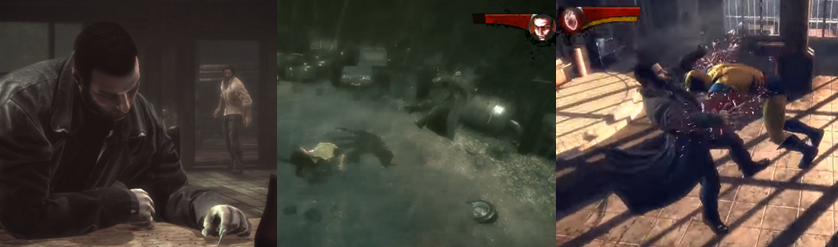
Game Corner [Day of the Dead]: The House of the Dead: Remake (Xbox Series X)


The Day of the Dead (or Dia de los Muertos) is a traditional Latin American holiday on which, every November 1st, the lives of deceased loved ones are celebrated with food, drink, parties, and a great deal of masquerade involving the calacas and calaveras (skeletons and skulls). For me, this seems like the perfect excuse to look back on the long-running and ever-changing zombie genre that was largely popularised by director George A. Romero, which I devoted a great deal of my PhD thesis towards and which has often been used as a parallel to various aspects of society and culture.  


Released: 27 April 2022
Originally Released: 13 September 1996
Developer: MegaPixel Studio S.A.
Original Developer: SEGA AM1
Also Available For: Google Stadia, Nintendo Switch, PlayStation 4, Xbox Series S, Xbox One (Remake); Arcade, PC, and SEGA Saturn (Original Release)

The Background:
The influence of renowned horror writer and director George A. Romero cannot be understated; not only did he forever change the concept of zombies from their origins as voodoo slaves to the shambling undead we know and love today, but his zombie movies had a profound influence on videogames. The Resident Evil franchise (Various, 1996 to present) was directly inspired by (and constantly paid homage to) Romero’s films, and his influence can be equally felt in the popular light-gun title The House of the Dead. Originally built using the same game engine as Virtua Cop (SEGA AM2, 1994), The House of the Dead was put together over the course of a year and three months by a team that couldn’t speak a word of English. Initially, the developers wanted to include more complex branching paths, but these ideas had to be dropped due to time constraints; to save time, the enemy designs skipped the rough sketch phase and went straight from the initial idea to the design drawing stage, though the developers were able to anticipate the game’s violence would need to be toned down overseas and so included the option to change the blood colour. The initial arcade version of the game was a critical and commercial hit and the SEGA Saturn port was generally well regarded in turn, thus kick-starting a pretty successful series of follow-ups despite two widely derided live-action adaptations. In April 2021, a remake of the original game was announced for the current generation of consoles that included updated visuals and controls, a new “Horde Mode” that increases the number of onscreen enemies, and other additional features. While the Nintendo Switch version received mixed reviews, critical feedback for the Xbox One/Series version of the game was largely positive, with reviews praising the horror presentation and nostalgia offered by the title despite the lack of a physical light-gun accessory.

The Plot:
After renowned biochemist and geneticist Doctor Curien becomes obsessed with discovering the nature of life and death, his experiments at the Curien Mansion take a gruesome turn. After government agent Thomas Rogan receives a distress call from his fiancée, Sophie Richards, from the Curien Mansion, he and his partner, “G”, fly out to investigate only to find the mansion overrun with Curien’s undead creatures!

Gameplay:
The House of the Dead: Remake is a first-person rail shooter in which players step into the role of two government agents, Thomas Rogan and “G”, and blast their way through hoards of zombies and other demonic creatures across four chapters. While you never have to worry about moving your character, as you traverse a set path at all times with few deviations, you can direct an aiming reticule using the left stick and automatically centre it with the X button. Otherwise, though, your controls are nice and simple: The Right Trigger and A button lets you fire, the Left Trigger and B button lets you reload, Y activates a torch (or “flashlight” for your Americans), and that’s basically it. You can go into the options and set up an auto reload function (though I find manually reloading is far more intuitive) as well as set a variety of other gameplay and aesthetic effects (such as changing the colour of your reticule and the level of aiming assistance you receive). You can also switch between your different weapons using left and right on the directional pad, though you’ll have to go to some effort to actually unlock additional weapons to use; they’re found in weapon crates scattered throughout each chapter, but these are only accessible by saving scientists from zombies and other life-threatening situations, which can be easier said that done when you have a trigger finger as itchy as mine gets in games such as this.

Mow down hoards of the undead but be careful not to kill any innocent scientists!

The game comes with two playable modes: “Original” and “Hoard”, with each one sporting four difficulty levels, the option to switch to a “Classic” and “Modern” scoring system, and allowing solo, co-operative play, or competitive play. The main different between original and Hoard is that there are loads more enemies in Hoard mode, making for a much more frenetic and action-packed experience. While the different difficulty levels make enemies tougher and more resilient, the “Arcade” option imposes health and credit limits; in this mode, you still get three health bars (represented as these glowing jugs) but each hit fully depletes one of them rather than dealing half damage as on the easier difficulties and, when you lose a life, you have a limited number of credits available to continue playing. You can use your points to buy more credits, but these cost about 5000 points a piece so you can easily run out in a playthrough, but the “modern” scoring system earns you extra points for successive kills without missing or being hit. Some enemies can block your shots with their arms or weapons, meaning you either need to time your shot to hit their weak spot or blast away their weapon or limbs to take them out but, while you can shoot their heads off, some will continue to attack regardless. All of them lumber towards you until you put them down but will slash and bite at you up close, and they even throw projectiles, barrels, and bladed weapons from a distance and have a tendency to pop out of nowhere so you need to be quick on the trigger, but not so quick that you shoot the scientists and cost yourself some health and points. At times, levels will split into multiple paths, but it’s not always clear how you take these routes; sometimes you need to shoot a button or blast away a door, debris, or trap door, but other times you need to shoot specific enemies, save certain scientists, or even let yourself get hit to drop down to a new area, which encourages experimentation and multiple playthroughs.

Graphics and Sound:  
Rail shooters don’t tend to be the most graphically intense games, in my experience; generally, the action is far too fast and frenetic to worry about the presentation as you’re constantly on the move and being swung about the place by the auto movement, but The House of the Dead: Remake looks and sounds really, really good. There’s a fantastic B-movie-level menace to everything, from the mansion’s grounds to the gothic interior, the rancid sewers, and Dr. Curien’s high-tech laboratory. The exteriors are bathed in a red glow or the darkness of night, while the interior as full of little touches, from suits or armour to wrecked paintings, and decorations that you can destroy at will. As you explore, you can blast crates and barrels to find the odd health pick-up or score bonus, but you’ll also activate new paths in the same manner, calling elevators, dropping through trap doors, and wading through water depending on your actions, which will then lead you to disgusting sewers, narrow corridors, billiard rooms, and stone hallways not unlike a medieval castle.

Blast your way through a gothic mansion and high-tech lab all while the fantastically cheesy plot unfolds.

Eventually, you’ll reach Dr. Curien’s laboratory, where blast doors block your path and require key cards to open, high-tech computers and monitors are everywhere, and tougher enemies are stored in glass tanks or scrambling about on the ceiling. Enemies can also come crashing through doors and windows, pop out from electrical barriers, and will blast into chunks when you shoot them, losing limbs and heads and having their skeleton and guts exposed as they take damage. The music is all very suitable for the action and the aesthetic, being an adrenaline-pumping mixture of rock and synth, and the satisfaction gained from hearing zombies groan in pain as you put them down or hearing your bullets clang against metal or tear apart a false door or chandelier is pretty fulfilling. The voice acting is hilariously bad, of course, but that’s all part of the charm of the game’s B-movie presentation; both Rogan and “G” have different dialogue and grunts as you play, which is a nice touch, and the line delivery is suitably over the top to immerse you in the atmosphere (there’s even some typos in the subtitles which, intentional or not, I found amusing).  

Enemies and Bosses:
Dr. Curien’s mansion has primarily been overrun by zombies; these shambling, bloody ghouls will stumble towards you, throw knives or axes from a distance, or pop up right in your face to scratch and bite at you, but they can be blasted apart and put down into a rapidly bubbling pool of viscera pretty quickly. Bats, weird winged dogs, vicious worms, spiders, and even mutated monkeys are all commonplace enemies too, but it’s the various zombie variants who’ll give you the most trouble. Larger, more rotund zombies will throw barrels at you or charge at you with a chainsaw in hand, slimy decomposing corpses pop out of the sewers or drop from above, suited zombies scamper about with knives, and hulking brutes wield massive sledgehammers or balls on chains that you need to shoot out of the air. Similarly, the Borg-like cybernetic zombies fire claw projectiles at your face, a pale variant attacks with a laser knife, and you’ll even encounter bigger zombies covered in iron armour that can resist your bullets.

Dr. Curien’s most monstrous creations await you at the end of each chapter.

Each chapter ends in a battle against one of Dr. Curien’s more powerful creations, with two of these returning as sub-bosses in the final chapter. The first you’ll battle is Type-27 (or “Chariot”), a large, rotting humanoid garbed in heavy armour and swinging a bardiche. Chariot relentlessly shuffles towards you, looking to maim you with his weapon, but can be forced back by shooting at the weak spot on his breastplate. After enough hits, he’ll burst free of his armour and you can start blasting his decomposing flesh to put him down for good but he can also defend against your shots by covering up with his armour and limbs. Type-041 (or “The Hanged Man”) is much trickier to defeat; this bat-like creature hovers above the rooftops sending bats to attack you, which you must shoot out of the sky and then desperately try and get a good shot at the weak point on his chest as he darts about the night sky and closes in on you for a close range attack. This fight goes on a bit as, when weakened, the Hanged Man will fly away and then force you to a different section of the rooftop, where he repeatedly dives at you to attack, which also leaves him wide open for your shots. Type 6803 (“Hermit”) is a far easier fight; this giant spider-like creature climbs towards you up a cobwebbed tunnel and you must shoot it in the face to force it back. When you follow it, it backs up and fires projectiles from its egg sack and then protects its head as it scurries towards you, but it’s pretty simple to blast it in the face once its exposed. Finally, after dispatching Chariot and the Hanged Man once more, you’ll face Dr. Curien’s greatest creation: Type-0, AKA “Magician”. This synthetic humanoid floats around the arena, quickly darting all over the place and making itself a difficult target, while tossing flaming projectiles at you that can be difficult to shoot down. Covered in an armoured hide, its only weak spots are the exposed flesh dotted around its body, mainly on the legs, and it can summon a rain of projectiles that you need to shoot down and also zoom up close to land a swiping attack, making it easily the toughest boss in the game simply because just landing a hit can be difficult due to its speed and small weak point.

Power-Ups and Bonuses:
As you play through the game’s four chapters, you’ll find scientists being chased, threatened, or otherwise endangered by Dr. Curien’s creatures. Saving them nets you a score bonus and eventually leads to you unlocking new weapons, but they will also often gift you some health, which can either replenish or increase your health, so it’s worth taking the time to save them. Shooting crates and barrels may also reveal health power-ups and other objects, like coins and golden frogs, which add to your score tally. Sadly, the only way to actually access new weapons is to save as many scientists as you can, which will unlock the weapon crates found in each chapter and gift you far better weapons, such as the assault rifle and grenade launcher, as well as a crossbow and the pitter.

Additional Features:
There are forty-one Achievements to earn here, with five being earned simply by beating the game on any difficulty setting. There are three endings to earn as well, with four Achievements tied to them, and these are gained by finishing the game with a certain number of points rather than on different difficulty settings. There is an Achievement for beating the game’s “Arcade” mode, but not the “Hoard” mode, and others for playing with a friend, killing a certain number of enemies, rescuing and killing scientists, and unlocking every weapon. In addition to “busy work” Achievements (like finding every alternative path or picking up every item you see in one playthrough), there are some more obscure and inventive ones, such as blasting enemies over a wall or juggling a zombie with your assault rifle. As you play through the game and encounter enemies, they’ll be added to the creature gallery, which allows you to view their character models, bio, and weak spots. After beating the game for the first time, you can replay any chapter at will (meaning you can just jump to chapter four to beat “Arcade” mode for an easy Achievement), and you can also play alongside a friend, register your high score on the leaderboard, and even input cheat codes on the main menu to unlock infinite ammo, all weapons, one-hit kills, a free-play option and, eventually, invincibility but, while you’ll still be able to get Achievements with these cheats activated, they’ll only take effect once you’ve earned a certain number of Achievements.

The Summary:
The House of the Dead: Remake is a fun, frantic, blood-soaked shoot-‘em-up that’s packed full of gore, action, and fun gameplay. I really enjoyed the presentation, the call-backs to B-movies and zombie classics, and the fast-paced shooting that had me mowing down zombies without a second’s thought and desperately trying not to hit any innocent scientists. Sadly, though, the game is very short; “Hoard” mode really doesn’t add all that much except a whole bunch of additional enemies to fill full of holes and, while it’s fun discovering new paths and burning through the game in repeated playthroughs trying to save everyone you find, it’s not always clear which route you need to take or when these are even available to you. The content is also lacking a bit; it would’ve been nice to have Achievements specifically tied to “Hoard” mode or to have the option to play the original arcade release, or to have included the other arcade titles in with the package as it’s not exactly a lengthy or deeply complex game. Overall, it’s a great way to spend a few hours of your time but the novelty soon wears off; I used to have The House of the Dead: Overkill – Extended Cut (Headstrong Games, 2011) on the PlayStation 3 and I think I remember that having a lot more going for it in terms of length, variety, and unlockable content but if you’re itching for a bit of simple, arcade, zombie-blasting action then The House of the Dead: Remake has you more than covered.

My Rating:

Rating: 3 out of 5.

Pretty Good

Did you enjoy The House of the Dead: Remake? How do you think it compares to the original game, or other titles in the franchise? Did you ever discover al the different paths and save all those scientists? What did you think to the variety and gameplay options, and did you think there was anything lacking in the game? Which of the bosses was your favourite and what did you think to the B-movie presentation of the game? What is your favourite House of the Dead game, or other zombie videogame? How are you celebrating the Day of the Dead today? Whatever your thoughts on The House of the Dead: Remake, and zombies in general, feel free to either sign up and leave a comment below or leave your thoughts on my social media.

Game Corner: Quake (Xbox Series X)

Released: 19 August 2021
Originally Released: 22 June 1996
Developer: Nightdive Studios
Original Developer: id Software
Also Available For: Amiga, Linux, MS-DOS, Nintendo 64, Nintendo Switch, PC, PlayStation 4, PlayStation 5, SEGA Saturn, Xbox One, Xbox Series S

The Background:
Following the unprecedented success of Doom (id Software, 1993), first-person, PC-based shooters were suddenly all the rage and the pioneers of the genre, unquestionably, were developers id Software. Having capitalised on Doom’s success, and the wave of knock-offs, with a sequel, expansions, and ports, id Software drafted in Doom creator John Romero to create a successor series based on the original Doom engine. After his pitch for a third-person melee title was turned down, tensions were raised between Romero and id Software that ultimately led to his departure. Originally intended to feature a Thor-like character, Aztec elements, and even role-playing mechanics, Quake eventually took the form of a more action-orientated follow-up to the Doom games and was bolstered by a sinister soundtrack from Trent Reznor of Nine Inch Nails fame. For my part, I played a decent amount of Quake on PC as a kid and, based on my enjoyment of Duke Nukem 3D (3D Realms, 1996), I picked up the Nintendo 64 port back in the day, something which earned me a great deal of flack from my friends. Regardless, Quake is very highly regarded, especially on the PC, kick-started a popular sub-series of first-person shooters (FPS), and surprisingly received a remaster for modern consoles in August of 2021 that I decided to snap up since I was signed up to Game Pass Ultimate at the time.

The Plot:
When the military’s experiments with teleportation technology result in the creation of an inter-dimensional portal known as the “Slipgate”, humanity find itself threatened by the demonic beings code-naked “Quake”. After “Operation Counterstrike” is slaughtered, a sole surviving Marine is left to gather the four magic runes that are the key to stopping the enemy and ending their invasion of Earth.

Gameplay:
Quake is a first-person shooter (FPS) in which players are placed into the role of a hardened, nameless Marine and traverse a number of dark, demon environments battling all kinds of monsters and ghouls. If you’ve ever played Doom or any of its classic sequels, you’ll be immediately familiar with Quake’s gameplay and presentation but there are a few things that make Quake stand out from its predecessor. First of all, the player is able to actually aim their crosshair, allowing for full 3600 field of view and making it easier than ever to blast enemies no matter where they’re hiding. The rest of the game’s controls are standard fair but are also fully customisable from the main options menu; when I played the game, I mapped jump to A, shoot to the Right Trigger, and the ability to quickly switch between weapons to X and B. This remaster of Quake adds a weapon wheel to the game, which I mapped to the Right Bumper but never actually used, and you can also assign buttons to have you dive and rise when swimming or use the Anti-Grav Belt to fly. You can also customise various display options while you’re at it, which allows you to change the size of the crosshair and the presentation of the heads-up display (HUD), but I left most of these alone. When in the pause menu, you can also use the Left Bumper and Right Bumper to quick load and quick save the game, which is super useful.

Explore dark, terrifying environments in search of keys to find the exit.

Like in Doom, your primary objective when playing Quake is to fight your way to the Slipgate exit. This sees you traversing a number of dark, ominous environments and taking out a whole mess of demons and monsters while collecting gold and silver keys (known as Keycards, Keys, and Runekeys depending on the theme of the level) to open doors and progress throughout the area. You’ll also be pressing in buttons and switches by walking into them to lower drawbridges, creating bridges, or otherwise opening up tunnels or doors so you can progress a little further. One thing you’ll probably notice right away is that Quake lacks any kind of map system but, for the most part, it doesn’t really need it; while many levels are somewhat maze-like and a handful are specifically constructed to be more labyrinthine than others, overall the environments are much smaller and easier to find your way around than in its sister-series and you’ll often find arrows, Slipgates, and gates to help you get to where you need to go. Exploration is often rewarded with secret areas containing armour, health, and other power-ups and the game’s difficulty is entirely up to you as you can select different difficulty settings from the main menu (ranging from “Easy” to “Nightmare”); in this remaster, you can also select whichever level you want to start from right from the start but this won’t count towards you unlocking the game’s many completion Achievements. Selecting higher difficulty settings will naturally increase the amount of enemies, their aggression, and how much damage they dish out, which can mean the difference between dispatching a boss with one move or with three.

Press switches, swim through water, and watch out for death traps as you explore.

When you start a new game, you are dropped into a small hub world from which you can also choose from different difficulty paths and jump into the next mission and you’ll need to make liberal use of the manual save system because, when you die, you’ll have to restart the last mission right from the start without any of the weapons you picked up before and during your last run. It doesn’t take long before you’ve experienced basically everything that Quake has to offer; dark military bases, bloodstained castles, and Hellish dimensions are the order of the day and you’ll find yourself taking a dip in water to reach new sections in each area, dodging balls of molten rock, and being surprised when the floor suddenly collapses beneath you and drops you into either a pit of lava for an instant death or a body of slime that slowly saps your health. Gameplay gets mixed up a little bit the further you progress, though, allowing you to hop between stationary and moving platforms or rising and falling columns of rock, riding in boats, elevators, and lifts, and blasting you around the place in air tubes. Occasionally, you’ll be faced with slightly more ambiguous puzzles that have you pushing barely-visible buttons, shooting or pressing and number of Quake pads to complete a sequence and open a new area, and dodging a variety of environmental hazards. Levels will contain crushing weights, electrical traps, rapid-firing nail guns, spears, and other death traps that you’ll often have to either run through as fast as you can, jumping madly to try and keep damage to a minimum, or carefully make your way through the trap to avoid being crushed into a bloody paste.

Graphics and Sound:
Unlike Doom or the vast majority of Duke Nukem 3D, Quake’s enemies are entirely rendered as 3D character models. This gives them a much more solid and weighty appearance and means that enemies now lumber about as jerkily-animated 3D models rather than clumsily stumbling about the place as jerkily-animated 2D sprites. Still, they do explode into bloody, meaty chunks when defeated and their bodies drop to the floor and stay there, which is super useful for retracing your steps. The main character is primarily represented as one of many floating guns and a grimacing face on the HUD that reacts when you’re attacked and becomes more bloodied and dishevelled as your health drops, but you will get to see the Marine in full during the handful of brief third-person cutscenes that punctuate the end of each of the game’s episodes.

Dark, ominous hallways, medieval ruins, and pixelated Hellish surroundings are the order of the day.

Environments are dark, foreboding, and full of Lovecraftian and Satanic imagery. You’ll navigate through futuristic military bases of rusted metal, grey stone castles full of spikes and drawbridges, and volcanic levels full of demonic ruins. While the game retains that old-school, pixelated graphical sheen that was the order of the day for videogames at the time, the textures and game stability are undoubtedly the best they’ve ever been and, while you’ll see a lot of the game’s architecture and layouts repeated, they’re often mixed up enough to make each level distinct from others. You’ll see blinking control panels, pools of blood, dank sewers filled with zombies, blast through graveyards and catacombs, and explore high-tech military installations overrun with all manner of beasts. When you finish each episode or defeat one of the game’s handful of bosses, you’ll be met with a bit of text to help give some context to the game but much of Quake’s horror and tension comes from the fantastic soundtrack, which manages to be both fittingly ominous and rocking at the same time. Levels are also made all the more terrifying by the screams and roars of enemies and the sounds of more monsters teleporting in, all of which helps to keep the adrenaline constantly pumping as you bolt through pitch-black tunnels and explore caverns barely lit by flickering candles.

Enemies and Bosses:
Contrary to other FPS videogames, Quake doesn’t actually feature that many boss battles; instead, you’ll generally have to collect keys to open exits and battle through hordes of enemies in order to finish most episodes. Enemies are visually very interesting and range from zombies (who throw chunks of bloody meat at you and can only be put down for good with your heavier ordinance), gun-toting Marines possessed by Quake’s evil, and sword-swinging knights. One of the most recurring (and annoying) enemies in the game is the Ogre, a chainsaw-wielding monstrosity that has a tendency to shoot grenades right in your face! You’ll also come across Death Knights, who fire flaming bolts at you in addition to wildly swinging at you with their swords, the floating, leech-like Scrags, piranha-like fish and eels in some bodies of water, Rottweilers, and vicious Fiends (who leap at you and swipe at you with their claws).

You’ll need to employ speed and strategy to take down Cthon and avoid Vore’s seeking explosives.

That’s not to say that boss battles don’t exist in Quake, however; at the end of the first episode, you’ll have to battle the mighty Cthon, a gigantic beast made entirely of lava and resembling Satan Himself. Cthon is entirely immune to all of your weapons and can only be defeated by running up to the upper path and pressing two buttons to lower two columns either side of him. You then race back to the start of the enclosed arena and press a third button to activate a bolt of electricity that either blows Cthon into chunks or sends him back to his lava pit for you to repeat the sequence on higher difficulty levels. At the end of the second mission, you’ll encounter the disgusting Vore enemy for the first time; this spider-like monstrosity scuttles around trying to slice you with its limbs and shoots heat-seeking spiked balls that explode on contact, meaning you have to constantly stay on the move and dodge behind walls and cover to avoid taking damage. After clearing this mission, Vores will appear sporadically as regular enemies but this can actually be to your benefit; when large groups of enemies gather, you can race/strafe around in a circle and cause them to attack and damage each other, which is super helpful.

The recurring Shamblers are far more dangerous than their eldritch creator.

Another boss-like enemy that becomes a recurring foe is the horrific Shambler, a massive beast that stomps around the environment blasting a bolt of lightning at you and trying to pummel you with its huge claws. After taking out the first with your best weapons, these bastards will teleport in or appear at the most inappropriate moments and often guard the keys you need to collect to progress and can even appear in groups of two or alongside Vores and other enemies. Both Shamblers and Vores populate the final mission of the main game, which sees you confronting the leader of these enemies, code-named “Quake” but in actuality the “Black Goat of the Woods with a Thousand Young” herself, Shub-Niggurath. You’ll have to settle for battling those enemies, though, as Shub-Niggurath is little more than a screaming, pulsating mound of flesh in the middle of a lava pit and, while she’s immune to your weapons, defeating Shub-Niggurath is ridiculously easy; simply wait for the spiked ball that’s circling the arena to enter the demonic Old One and then jump into the Slipgate. This will see your character teleport inside Shub-Niggurath, who simply explodes in a burst of chunky pieces.

A host of new maps, enemies, weapons, and challenging bosses await in the additional missions.

Thankfully, this remaster of Quake comes with four additional mission packs that include not only all-new maps but also additional enemies, such as Gremlins (essentially a reskin of the Fiends), nail-shooting, cybernetic scorpions known as Centroids, sentient swords, Grim Reaper-like Wraths, and a number of additional bosses. The first is the cybernetic Armagon, who fires lasers, rockets, and shockwaves at you in a claustrophobic arena. Luckily, you can take cover behind the many columns and take advantage of the weapons and power-ups strewn around, and he actually goes down pretty easily on the easiest difficulty as a result. Far more troublesome is the multi-armed, Grim Reaper-esque Overlord; this robed mage teleports around an arena full of Wraths and nail traps, hacking at you with its axes and firing a homing ball at you much like the Vores. Other additional bosses include Hephaestus, (a smaller, weaker version of Cthon), a Mummy (which is functionally the same as a zombie but does (and takes) greater damage), and three Guardians (Aztec and Egyptian warriors and blast at you with their staffs and spawn in more minions the more damage you inflict). After battling through longer, far more dangerous levels filled with a variety of the game’s enemies that will test your mettle to the limit, you’ll eventually face off against a monstrous dragon in an arena filled with lava and narrow rock pathways. The dragon flies overheard in a circular motion and spits fireballs and energy blasts at you, but you’re completely safe as long as you stay out of its sight, follow it from behind, and don’t slip into the lava. The arena is full of some of the game’s most powerful weapons but, even so, the dragon can absorb a great deal of punishment and can be tricky to hit while safely circling the arena. After you do bring it down, you’ll have to unload the remainder of your weapons on the Quake Temporal Energy Convertor (while, again, being careful not to slip into the lava beneath it) to finally put a stop to the demons’ invasion of Earth.

Power-Ups and Bonuses:
Being an FPS title, your most recurring power-up will be the large amount of weapons and ammo made available to you as you play through Quake’s missions. Unlike other FPS protagonists, the Marine has no unarmed combat mode and, instead, swings a pretty useless bloodied axe at enemies when no other weapons are available; you’ll also be happy to learn that there are no pistols or small firearms here and that your default weakest weapon is a good, old-fashioned shotgun. You can also grab heavier ordinance, such as grenade and rocket launchers, but the signature weapon of the game is undoubtedly the rapid-fire Nailgun. Furthermore, you can also pick up upgrades to these weapons, such as a double-barrelled shotgun (my preferred weapon of choice) and the Super Nailgun, and the game’s super weapon, the Thunderbolt, a futuristic-looking firearm that blasts enemies with a bolt of lightning.

In addition to a slew of devastating weapons, you can also grab temporary power-ups.

You’ll find more weapons in the additional mission packs, such as the lightning-spewing Mjölnir of Norse legend, a multi-grenade and rocket launcher, a proximity mine launcher, a laser cannon (that shoots high-intensity laser blasts that ricochet all over the environment and can damage even you), a grapple gun and throwing star, and further upgrades to the Nailgun and Thunderbolt that spit out lava nails and a burst of energy, respectively. In addition to health packs and armour, you can also find a number of temporary power-ups: the aforementioned Anti-Grav Belt allows you to moon jump to higher areas, the wetsuit and biosuit allow you to traverse water and slime without fear of drowning or taking damage, respectively, and you can grab Quad Damage to deal four times as much damage for a limited time. You can also pick up the Pentagram of Protection and Ring of Shadows to become temporarily invulnerable and invisible, respectively (although enemies will still attack you if you fire on them while invisible), and there are even more opportunities to increase your defence and attack in the additional mission packs. You can even grab the Horn of Conjuring to summon a random monster to fight by your side, and there are also other power-ups that are exclusive to the multiplayer deathmatch modes, such as the Rune and Vengeance Sphere.

Additional Features:
Quake comes loaded with thirty-five Achievements for you to earn, with the vast majority of these being tied to completing the game’s single player campaign and finding secret exits. In fact, there is only one Achievement reserved for multiplayer, which is good news for me, though you will have to take on the game’s more challenging difficulty modes in order to get 100% completion. Additionally, you can’t just load up the final levels of the game and beat them to pop the Achievements; you actually need to play through the entire game to earn them, and you’ll find that there are a couple of quirky ones that have you killing a Shambler with only an axe or before it can fire its lightning attack, and causing enemies to kill each other. As mentioned, the game comes with a multiplayer component that allows you to play on- and offline against a friend or other players in standard deathmatches, such as free-for-all and team play, and you can even play alone against computer-controlled ‘bots that you can set to different difficulty levels. As I also detailed, the game comes with four additional mission packs to play through that seriously up the game’s difficulty; new enemies, weapons, power-ups and bosses have been added and maps and textures have been redesigned to create entirely new levels so you can keep fragging demon scum to your heart’s content. Finally, you can also download the Nintendo 64 port, though unlike the other mission packs there are no Achievements tied to this version of the game (which is basically just a stripped down version of the base game).

The Summary:
For over twenty years, my friends have ragged on me because I once owned the Nintendo 64 version of Quake. I didn’t have it for long but, for whatever reason, it was enough to become a recurring joke between us and I have shunned the series ever since in favour of Duke Nukem 3D and a cursory relationship with the Doom franchise. When I heard that there was a remaster of Quake, I was both surprised and sceptical but, against my better judgement, I took advantage of it being free on Game Pass and downloaded it mainly to snag the game’s Achievements and up my Gamer Score. However, I found myself really enjoying the game, far more than I remember in the past. Thanks to a dark, foreboding atmosphere, a fittingly ominous soundtrack, and some disturbing visuals and enemies, Quake is a tense and action-packed experience. The controls are tight and intuitive; blasting demons has arguably never felt more gratifying and, despite a few annoying instances where the floor suddenly collapsed into lava or I was unexpectedly overwhelmed by a horde of enemies, I found the game to be an enjoyable and intense ride. Although the game has a serious lack of boss battles, the ones it does have generally require more from you than just mindlessly blasting away, and though the environments can be dark and confusing at times, they’re not brain-bending mazes and it’s pretty simple to plough your way through to the exit in short bursts. Overall, I’d actually say I rate this higher than the original Doom since Quake definitely improves upon the game engine of its predecessor and delivers one of the most horrific and bloodthirsty shooters in the process.

My Rating:

Rating: 4 out of 5.

Great Stuff

Are you a fan of the original Quake? How do you think it compares to other FPS titles of that time? What did you think to the game’s enemies, aesthetic, and soundtrack? Were you a fan of the focus on medieval and Lovecraftian horrors and what did you think to the battle against Shub-Niggurath? Which of the game’s weapons and expansion packs was your favourite and what did you think to Quake’s multiplayer options? Which game in the Quake franchise is your favourite and would you like to see a new game on modern hardware? Have you ever had your friends take the piss out of you for owning a game before? What horror-theme videogames are you playing this October in anticipation of Halloween? Whatever your thoughts on Quake, sign up and drop a comment below or comment on my social media.

Game Corner: Rambo: The Video Game (Xbox 360)

Released: 21 February 2014
Developer: Teyon
Also Available For: Arcade, PC, and PlayStation 3

The Background:
In 1972, David Morrell’s First Blood was published; a harrowing tale of the horrors of the Vietnam War, the book was well-received upon release eventually led to a live-action adaptation directed by Ted Kotcheff and starring Sylvester Stallone. A commercial success, First Blood (Kotcheff, 1982) is widely regarded as one of the most enduring and influential movies of its genre and was followed by a series of successful and popular action films that helped make Stallone a household name. John Rambo had featured in a number of videogames, most of which were based on the more action-orientated sequels rather than the more introspective First Blood, before Reef Entertainment acquired the rights to the franchise in 2011. Hoping to capitalise on the recent success of Rambo (Stallone, 2008) and the upcoming The Expendables 2 (West, 2012), Reef opted to use voice clips and dialogue ripped straight from the movies for their rail-shooter rather than record new dialogue with existing actors or soundalikes. This was one of many criticisms levelled against the game upon release; critics were equally unimpressed with the game’s over-reliance upon quick-time events (QTEs), the lacklustre enemy intelligence, and the game’s short length and Rambo: The Video Game was generally regarded as being a disappointing and mediocre use of the license. However, since today marks the anniversary of First Blood’s release, this seems like the perfect time to take a look at this poorly-received shooter and see if it truly deserves its overwhelmingly negative reputation.

The Plot:
Rambo: The Video Game sees players take control of John J. Rambo (and one of his allies, if you have a friend to play alongside) and reenact key events from the first three movies. This sees Rambo enduring horrendous torture in Vietnam, battling bigotry in Hope, Washington, infiltrate the Vietnam jungle to rescue a number of captured soldiers, and finally stand against a Soviet invasion of Afghanistan.

Gameplay:
Rambo: The Video Game is a first-person rail shooter that places you into the role of Rambo (or the likes of Colonel Sam Trautman and Co Bao) and has you playing through a number of missions that are either based on key moments from the first three films or directly recreate some of the most iconic moments of Rambo’s film career. Since it’s a rail shooter, your control and movements options are a little limited; Rambo moves as the story dictates and you’re left controlling the aiming reticule with the right stick and holding the left stick to take cover from fire. The Right Trigger will see you fire one of your two main weapons, which can be switched with either Y or the directional pad (D-pad), and you can occasionally use an alternate fire mode with the Left Bumper.

Shoot down your enemies to enter a Wrath state and unleash the full force of Rambo’s rage.

Rambo can reload his weapon with either X or the Right Bumper; this will bring up a small reloading wheel and you’ll need to press the button again to reload faster to grant yourself additional ammo (though your overall supply is unlimited). Press it too soon or too late and your gun will jam, giving you less ammo and slowing down your reload time, thus leaving you vulnerable. LB and the B button also allow you to throw one of your limited supply of grenades, while the Left Trigger provides you with an aiming lock to target specific enemies, and you can also use the D-pad to cycle through different types of arrowheads once they’ve been unlocked. As Rambo kills enemies, scoring headshots or disarming them or blowing them to pieces by shooting explosive barrels, he’ll not only earn points but also fill up his “Wrath” bar. When a segment of this is filled, players can press X to enter “Wrath” mode, which slows down time, highlights enemies using their body heat, and refills Rambo’s health for every kill he performs during this limited burst of rage. Rambo: The Video Game allows you to play missions in three different difficulty settings: Private, Sergeant, and Green Beret; each one tweaks the aggressiveness and competence of the enemies, provides a different number of checkpoints, and makes quick-time events (QTEs) either easier or harder. If you’re playing on the easiest setting, you’ll be blessed with an unlimited number of checkpoints but won’t earn as many points for your playthrough; Sergeant or higher will limited your checkpoints to five and three, respectively, and end your game if you run out, though you can lower the difficulty setting from the death screen if you’re having a hard time. As you gun down enemies, you’ll rack up a score multiplier, which is key to increasing your final ranking at the end of each mission; you’ll also gain extra points for your accuracy, headshots, the difficulty setting, and how many deaths you suffered during the mission, promoting more efficient and calculated playthroughs on higher difficulty levels in order to level Rambo up, gain Skill Points, and upgrade his stats and unlock Perks and increase his combat proficiency.

QTEs, stealth sections, and explosive vehicle gameplay help add some much needed variety.

However, it’s not just about going in all guns blazing; Rambo will also need to take up his bow and arrow or his iconic knife and sneak through the woods, jungle, or under cover of darkness to take out enemies undetected. This means completing a number of QTEs, which award additional points for pressing the onscreen prompt at the last minute or tapping the button as fast as possible; while QTE time is severely reduced on higher difficulties, the onscreen prompts are always the same so you can simply memorise their order and concentrate on your timing. Sometimes these will crop up mid-mission to have you avoid incoming bullets or mortars, and one particular mission offers you the choice between a stealthy route or a more action-orientated path. You’ll also come across “Cautious Enemies”, indicated by a ! prompt, who will one-shot you if they spot you; enemies can also lean over or shoot through your cover and be bolstered by “Commanders”. Gameplay is given a little variety by the few times you take control of a mounted gun or a helicopter to wreak havoc on the immediate area. These sections are timed and involve blasting at the Hope police station, assaulting a Vietnam base from above, destroying mines and boats while sailing down a river, or blasting away at Soviet forces and their vehicles. These moments of intense action are where the game really excels, though the controls are a little slippery and it can be difficult to aim at your targets with the crosshair slipping all over the screen. This crops up again as Rambo is tasked with disarming and wounding Hope’s police officers for extra points; you can kill them as normal, but you get more points for disarming the cops, which is difficult to do without taking a lot of damage so it’s probably best to turn off the aiming assist option for this mission to make things easier. While sneaking through the Soviet base in Afghanistan, you’ll also have to follow onscreen prompts to arm explosives and can shoot at glowing sections of the cavernous environment to crush your enemies under boulders. If you’re playing alone, you can share your ammo with Co Bao in Vietnam by pressing Y at the right time and she’ll help you out with cover fire, and you’ll even have to take out snipers from afar in Afghanistan. Although the game starts of pretty simply, with you blasting at Viet Cong and diving to cover to reload and catch your breath, things quickly ramp up and get very frustrating and unfair as combinations of the game’s most formidable and annoying enemies ambush you, leaving you on the back foot if you’re out of grenades; things are made all the more maddening by some wonky hit detection than can see your point-blank shots miss or enemies hitting you through normally impenetrable cover.

Graphics and Sound:
I’ve played Rambo: The Video Game in the arcades before; there, on a big screen with a real (albeit plastic) gun in your hand, the game looks and plays pretty well for a standard light gun shooter. However, on home consoles, the game is pretty much an embarrassment from top to bottom; while the missions do a decent enough job of bringing to life the dark, dank jungles of Vietnam and recreating the town of Hope and the Soviet cave from the films, there’s a lot of graphical pop up and corners cut here as it’s simply a rail shooter and you’re not really meant to be stopping and taking in the details around you. Similarly, enemy models are decent enough, but ragdoll all over the place at times and you’ll see the same enemy types again and again with very little variation.

While locations are okay, the character models, music, and audio dialogue are all absolutely dreadful.

The actual character models are pretty laughable; Rambo himself looks more like an off-model action figure than the surly Stallone thanks to his ridiculous mane of a haircut. Trautman doesn’t look too bad, but hardly any of the corrupt cops from Hope resemble their onscreen actors. The game’s story is framed as a series of flashbacks at Rambo’s “funeral” as some nameless, unknown military man gives those in attendance a rundown on Rambo’s career and reputation in order to afford him some anonymity for his excursion into Afghanistan. This allows the game to recreate the most memorable moments of the films with the absolute bare minimum of effort; the music is dreadful, repeating in embarrassing loops mid-mission, but it’s the voice acting where the game really falls flat. Stallone and Richard McKenna’s audio are ripped right from the films, making their words distorted and wildly inconsistent and hilariously out of context at times, and only emphasising the cheapness of the title.

Enemies and Bosses:
Rambo will gun down a whole host of nameless, faceless, interchangeable groups of enemies themed after each of the game’s missions: Viet Cong, Hope’s police department, and Soviet forces all try to fill Rambo with holes, popping up from the background, the sides of the screen, and rolling in to take shots at you. Enemies make use of cover to avoid your shots, can have their hats shot off, and some can even be disarmed to render them harmless to you but, for the most part, they are easily offed with just a few shots. Soon enough, you’ll encounter more formidable and annoying enemies, such as grenadiers (who take cover and toss grenades you can shoot out of the air), “Heavy” enemies covered in armour and vulnerable only in their face masks, and “Flamers” who wield flamethrowers and force you to shoot at their flame tank. Commanders will bolster the morale and efficiency of all onscreen enemies, so you should prioritise taking them out, though you must duck behind cover when turrets are rolled out into the field as they’ll shred you pretty quickly. Snipers, armoured enemies, and groups of these foes can whittle your health down in no time at all so it’s best to make use over cover, shoot any nearby explosives, and try to get off some one-shot headshots to off your enemies as quickly as possible.

Some familiar faces and final encounters close out each of Rambo’s explosive adventures.

Each of the game’s missions includes a timed sequence where Rambo must destroy parts of the environment, usually by making use of a large cannon or a helicopter but, in Afghanistan, you’ll also be hounded by helicopters and tanks that you cannot destroy and must either avoid by taking cover or run past by eliminating all onscreen enemies (and objective the game makes frustratingly vague) and completing some QTEs. Each mission culminates in something that can be generously described as a boss battle; after laying waste to the Hope police station, you’ll need to avoid Sheriff Teasle’s gunfire by pressing the onscreen prompts when it’s safe to move around, then desperately shoot at him when he peeks out at you from his elevated position. After laying waste to his base with your explosive arrows, you’ll find Lieutenant Tay far less of a challenge as you simply have to fire an arrow at him to blow him up, but you’ll need to take the controls of a helicopter and frantically fire your bullets and rockets at an enemy chopper to finish Rambo’s redemption in Vietnam. Finally, after a harrowing rescue mission in Afghanistan that sees you struggling past formidable and frustrating groups of various enemies, you’ll take the controls of a tank and get into a ground-to-air firefight with Colonel Alexei Zaysen. Jeeps and soldiers run around distracting you, but your primary concerns are Zaysen’s missiles and the tanks, which can severely reduce your vehicle’s health and destroy it in one shot, respectively. You’re thus forced to frantically fire your main gun and your cannon like a madman, desperately hoping to shoot down the missiles and destroy your targets before they can do too much damage, before finally ending Zaysen’s threat in this surprisingly aggravating final showdown.

Power-Ups and Bonuses:
Aside from your Wrath state, there aren’t any in-game power-ups to make use of beyond being tossed a grenade or making use of explosive barrels or other environmental hazards. You don’t need to worry about picking up ammo and health is restored in Wrath mode, so your primary focus should be on staying alive, killing as many enemies as possible, and keeping your multiplier chain and accuracy high. This will net you the Skill Points you need to level-up and improve your efficiency; these can be spent upgrading your resistance to damage, your grenade inventory, the power of both light and heavy weapons, and extending the duration of your Wrath bar. When you level-up high enough, and complete certain requirements (known as “Trautman Challenges”), you’ll unlock additional weapons to take with you into each mission, which can definitely turn the tide in your favour in the game’s tougher stages. You’ll also unlock up to three Perk points and a variety of Perks that allow you to perform perfect QTEs or gain increased health and ammo while reloading or killing enemies in Wrath, for example.

Additional Features:
There are twenty-seven Achievements on offer in Rambo: The Video Game; the vast majority of these are tied to you getting at least a two-star rank on every mission, which will require you to beat the game in at least Sergeant mode, while others include maintaining a high chain multiplier, using every weapon in the game, completing it on Green Beret mode, and killing a total of 3000 enemies. Sadly, none of this is easily accomplished and meeting these criteria quickly becomes a very laborious and needlessly frustrating process as achieving even a two-star rank can be more trouble than it’s worth at times. The game can also be played in two-player co-op, which is very much appreciated and probably makes some of the tougher sections a bit easier, but there’s no head-to-head multiplayer mode and Trautman’s “challenges” amount to fulfilling certain objectives (which you can’t review in-mission) to unlock new weapons. If you simply must have more Rambo, there was some downloadable content released for the game that included some additional missions and Achievements, but I can safely say that I won’t be checking this out any time soon given how infuriating this game can be at times.  

The Summary:
I’d heard nothing but bad things about Rambo: The Video Game; however, even after my last few attempts to play the arcade version resulted in my coins being eaten by the machine, I maintained that it would be an inoffensive enough rail gun shooter to blast through and rack up some easy Achievements. Instead, what I got was an absolute slog of a gaming experience; bland environments which, while somewhat faithful to the movies, are way too dark, unimpressive and frustrating enemies, and a lack of variety really bring down the otherwise enjoyable enough gameplay. The stealth and QTE sections are okay, if painfully simple, and the parts where you’re in control of heavy ordinance and vehicles can be a lot of fun, but the presentation is just so cheap and rushed. The muted dialogue ripped right from the movies is the most glaring offense, of course, but the lack of gameplay options, the stringent criteria for unlocking stuff, and the odd little glitches and annoyances peppered through the game definitely don’t make it worth investing your time and money in when there are far better first-person shooters out there. It’s a shame as there’s definitely a lot of potential here, but the execution screams “cheap cash grab” and you really won’t be missing out on all that much if you skip this title, which I’d argue even die-hard Rambo fans would struggle to find enjoyable.

My Rating:

Rating: 1 out of 5.

Terrible

Have you ever played Rambo: The Video Game? If so, did you enjoy it or were you as disappointed by it as I and many others were? What did you think to the Wrath system and the recreation of the film’s moments? Were you also disturbed by the poor quality character models and audio clips? Which Rambo videogame, or videogame appearance, is your favourite? Which of the Rambo films is your favourite? Whatever your thoughts on Rambo, drop them below or leave a comment on my social media.

Game Corner: Dead Space (Xbox 360)

Released: 13 October 2008
Developer: EA Redwood Shores
Also Available For: PC, PlayStation 3, Xbox One and Xbox Series S/X (Backwards Compatible)

The Background:
Dead Space was the creation of Glen Schofield, who was inspired by the likes of Silent Hill (Konami/Various, 1999 to 2012) and Resident Evil (Capcom/Various, 1996 to present) and attracted the attention of a small, but committed, team of developers and Electronic Art’s (EA) Redwood Studios. The team worked tirelessly to put together a proof of concept and push the game within the company, and constantly tweaked the different gameplay mechanics to keep things action-packed and tense. Crucially, Dead Space opted to forgo a traditional heads-up display (HUD) and render cutscenes and story sequences using the in-game engine to avoid breaking the player’s immersion, and combat became more about dismembering enemies rather than mindlessly blasting away. Dead Space is an extremely well-regarded title; reviewers praised the innovative mechanics and horrifying atmosphere, though the story faced some criticism. Still, the game sold over one million copies and kicked off a successful new survival-horror franchise that came to be comprised of animated tie-ins, two sequels, and even a next generation remake.

The Plot:
When a massive deep-space mining ship goes dark after unearthing a strange artifact on a distant planet, troubled engineer Isaac Clarke joins the repair mission. There, he finds a nightmarish bloodbath as the ship’s crew have been horribly slaughtered and infected by alien scourge known as Necromorphs.

Gameplay:
Dead Space is a third-person, survival/horror action shooter with an emphasis on atmospheric horror, light puzzle solving, and exploration. Players are placed into the mute boots of engineer Isaac, who spends pretty much the entire game garbed in a steampunk-like work suit and hiding behind a glowing helmet. Isaac comes armed with a Plasma Cutter by default, but has a few options available to him when it comes to combat: players can hold down the Left Trigger to enter aiming mode (and, crucially, can move while aiming and shooting) and press the Right Trigger to fire their weapon. Outside of aiming mode, you can press RT to throw a slow, clunky, and awkward melee attack to fend off Necromorphs, hold the Left Bumper to jog along a bit faster, to press the Right Bumper to deliver a big stomp to downed Necromorphs or break open crates. There’s no jump or dodge function, but you can press A to interact with consoles or shake off Necromorphs when they grab or claw at you; providing you have some Med Packs on hand, you can heal yourself by pressing X, the directional pad (D-pad) functions as a shortcut to your weapons and allows you to quickly switch between up to four guns on the fly, and you can reload by pressing LT and A or switch to an alternative fire mode by pressing LT and RB.

Dismember enemies, move objects with Kinesis, or freeze them in place with Stasis.

While most of this is standard third-person fare, Isaac also acquires a couple of “modules” that allow him to perform a few unique tricks: You can activate the Kinesis Module by holing LT and pressing B, which will allow you to move certain obstacles out of the way, activate certain consoles, and move platforms and doors to progress further and solve problem. While you can use this as much as you like, the Stasis Module is limited by a meter than can only be replenished at refill stations scattered around the game’s locations or with a pickup. Stasis can be used to freeze enemies in place for a limited time, slow fans or other hazards, and is crucial to keeping you safe from attacks or the game’s many instant-kill traps. Unlike many other videogames, Isaac’s health, ammo, and Stasis meter are all displayed either on his suit or on his weapon, a system that easily allows you to see how well you’re doing or when you need to reload or replenish your meters. You can access your inventory, map, and current objectives by pressing the ‘Back’ button (though this won’t pause the game) and are given the option of dropping items if your inventory is full, or dropping them in a safe at Store stations found around the game’s environments. While the map isn’t too clear, you can press in the right analogue stick at any time to drop a light that will briefly point you in the right direction, which is super helpful; slightly less helpful is the abundance of text and holographic imagery that appears onscreen to advance the story and mask the game’s loading screens, though this does flesh out the story and point you towards your next objective. Although you have to manually save the game at save stations, the game does actually contain checkpoints; so, if you die halfway between save points, you’ll respawn pretty close to where you were split in two by a Necromorph.

Puzzles involve activating or repairing consoles, avoiding hazards, and eliminating Necromorphs.

Dead Space’s story is split into twelve chapters, with each one separated by a tram-like system around the ship, and can initially be played on Easy, Normal, or Hard difficulty settings, with additional difficulties being unlocked after you complete the story. You cannot replay previous chapters at will, so if you miss any of the pick-ups or collectibles, you’re either going to have to start over or make multiple save files. For the most part, it’s pretty simple to figure out where to go and what you need to do but the camera is placed very close to Isaac at times; when aiming, I found that his character model took up quite a bit of the screen, which made it difficult to get off a good shot (something that’s pretty important considering you need to dismember the Necromorphs to kill them rather than shooting at their bodies). Isaac’s objectives don’t tend to get more complicated than exploring a foreboding area of the ship, fending off Necromorphs, and recovering key items such as a key card, a piece of machinery, or other object and bringing it (or them) back to another area or non-playable character (NPC) to repair a console, machine, or other part of the ship or progress further. Sometimes, areas will get locked down as a quarantine is put into effect and you’ll need to hold out against waves of Necromorphs; other times, the ship decompresses or starts exploding around you; but, mostly, you’ll need to use Stasis or Kinesis to slow down hazards, move platforms, or activate switches to get closer to your objective. While you’re often tasked with moving big batteries around with Kinesis to power up lifts, you’ll also need to kill special Necromorphs that are poisoning the air in the botanical gardens, watch out for air vents, whipping power lines, and laser cutters that threaten to splatter or skewer you or your enemies, clear an area of radioactive material in order to restore gravity and power, and dash through (or shield yourself) from bursts of flame while shooting electrical panels to open doors.

Watch your air supply in a vacuum, jump around in zero gravity, and blast asteroids with gun turrets.

Indeed, a prominent aspect of Dead Space is the presence of zero gravity areas; here, you need to hold down LT and press Y to leap across the environment, often while fending off Necromorphs, moving items with Kinesis or activating consoles. You can’t jump to every part of the environment, and the game will notify you when you’re trying to jump to the wrong part of the floor (or ceiling), and it can be a bit disorientating trying to direct yourself in these areas, though they do help to break up the gameplay a bit. There are also many sections that take place either in a vacuum or out in the depths of space; here, sounds are suitably muted, your flamethrower won’t work, and you are in a race against time to cross through the vacuum to the next air lock before your oxygen supply runs out. You can replenish your oxygen supply at refill stations or with items, though, and increase your capacity using Power Nodes; sometimes, you’ll have to deal with zero gravity and a vacuum at the same time. A little more variety is added to the game in a couple of sections where Isaac takes the controls of a massive gun turret to fire at incoming asteroids or a gigantic Necromorph using LT and RT (both separately and at the same time) to keep the ship from being destroyed, but don’t get too trigger happy or you’ll have to wait for the turret to cool down from overheating.

Graphics and Sound:
If I had to use one word to describe Dead Space, “atmospheric” would spring instantly to mind. Players spend the majority of the game exploring a deep space mining vessel, the Ishimura, which has been absolutely wrecked by the outbreak of the Necromorph virus. Dead bodies, blood stains, claw marks, and even dismembered NPCs are all over the place; sometimes they’re still alive and shoot themselves in a frenzy, other times they’re torn apart by Necromorphs, and there’s one harrowing moment where it looks as though a mass suicide has taken place. Ominous words written in blood can be seen everywhere and you can never be too careful when turning a corner as Necromorphs have a nasty tendency to burst out from air vents, glass capsules, or from every nook and cranny to attack you. Sometimes, a massive tentacle will grab at you and drag you around by the ankle, forcing you to blast at its tumour-like weak spot, and visibility it often low thanks to a foreboding darkness, intermittent lighting and power failures, and bursts of flames and electrical sparks in the flickering darkness.

The environment is suitably bleak, blood-soaked, and teeming with atmospheric horror.

The best way to describe this game is by calling it Resident Evil meets Event Horizon (Anderson, 1997). The technology and environments all have the same “lived in” feel of that gloriously entertaining space horror and the sense of dread that constantly hangs in the air is just as palpable. Nowhere is this comparison more apt than in one particularly annoying mission where you have to plant markers on a giant asteroid being mined by lasers; the asteroid is protected by huge concentric rings that will slice you in two and is heavily reminiscent of Event Horizon’s Gravity Drive. Other notable areas of the ship include a cargo bay medical facility, the aforementioned botanical gardens, and the main bridge, all of which are crawling with hazards or Necromorphs waiting to pounce on you. You’ll find workstations in disarray, ammo, credits, and collectibles in lockers and crates, and areas frozen from exposure to the void of space. At one point, another ship crashes into the Ishimura and you have to help guide and load up a shuttle with the dangerous “Red Marker” that is the cause of all this chaos, a mission that also forces Isaac to face up to some unsettling truths on the hellish planet of Aegis VII for the finale.

Isaac may not say anything, but he gets lots of video messages and is a surprisingly complex character.

You don’t really interact with too many NPCs outside of holographic messages, video calls, or seeing them shielding behind glass or trapped in other rooms. There are some exceptions, however, such as Isaac’s frequent encounters with his wife, Nicole, who he thought was dead and whose voice and memories haunt him throughout the story. Although Isaac himself doesn’t actually talk (always a weird decision for a third-person shooter, I find), you can review his thoughts in his mission log and objectives, and he cuts a formidable and interesting figure. His suit and helmet are instantly iconic and, though they hide his face throughout the game, they make him seem almost as horrific as the creatures he encounters and his grunts of pain and panting wheezes when in a vacuum or running low on health really add to his otherwise blank personality. Transferring the HUD to Isaac’s suit and weapons is a great way to keep the screen from getting too cluttered, and the use of ambient sounds (particularly a haunting rendition of “Twinkle, Twinkle, Little Star”) really add to the game’s horrifying, ominous sense of dread and claustrophobia. Even brightly lit or familiar areas aren’t always a safe haven as the ship can be thrust into a lockdown or dead bodies can suddenly burst to life as Necromorphs, often even while you’re trying to save the game.

Enemies and Bosses:
Isaac is hounded throughout his treacherous and nightmarish mission by demonic Necromorphs, which come in all shapes and sizes and are the result of a horrific alien virus that reanimates corpses and transforms them into shrieking, taloned beasts hungry for human flesh. The most common variant is the Slasher, a blood-soaked, malformed corpse that sports blade-like appendages and shambles towards you either alone or in groups. As with the vast majority of the Necromorphs, these are best dispatched by targeting their limbs rather than their central mass; dismember their insectile arms to keep them from skewering you, and cut off their legs to slow their movement, but be sure to make sure they’re really dead as these bastards have a tendency to take a lickin’ and keep on tickin’! Other common enemies includes the Lurker (a sort of disembodied head that sports three tentacles, hops all over the walls and ceilings, and fire projectiles at you), the Leaper (which, as its name suggests, leaps at you (appearing to float in zero gravity areas) and scuttles across surfaces whipping its scorpion-like tail at you), and the bulbous Pregnant (which lumbers about and bursts forth a swarm of tiny Necromorphs that can quickly whittle down your health bar). Rather than facing off against a boss at the end of each chapter, Isaac will generally encounter newer and deadlier variants of the Necromorphs in each area: The Exploders shuffle about and try to blow you up with their huge, explosive arm (which you can shoot to blow them up, and any nearby Necromorphs), bat-like Infectors will try to attach themselves to you and cause any nearby corpses to burst to life as dangerous Necromorphs, and the corpse-like Dividers are gangly, gory corpses that split into smaller, equally dangerous Necromorphs after being downed.

Some massive monstrosities await you in Dead Space, but most have nice, obvious weak spots to shoot.

Large Brutes often act as sub-bosses and must be slowed with Stasis so you can target their various weak spots across their armour-like hide, and you’ll encounter Guardians merged with the walls and have to fend off the Pods they spit out, watch for their instant-kill attack, and severe the tentacles tying them to the Corruption that covers the environment. That’s not to say that there aren’t encounters that could be called boss battles in the game; the intimidating Hunter regenerates lost limbs and tissue so fast that, at first, all you can do is hit it with Stasis or temporarily immobilise it while running to safety. To properly destroy these creatures, you’ll need to lure them into a cryogenic chamber or behind the thrusters of a space shuttle and hold them in place with Stasis and get them into their regeneration animation to put them down once and for all. You’ll also battle the gigantic Leviathan in the food storage area of the ship; this battle takes place in zero gravity and sees you dodging tentacles and firing at the tumorous lumps on its appendages to kill it off. A similar creature, the Slug, attaches itself to the outer hull of the Ishimura and begins ripping it apart, forcing you to man the controls of a gun turret and blast at its tentacles and the debris it throws your way. After being tricked into activating the Red Marker, Isaac must face down the Hive Mind on Aegis VII; this eldritch abomination is a mess of flesh, tentacles, and teeth but sports yellow/green tumorous growths in its gaping maw that you can shoot to damage it. As long as you avoid its massive tentacles and target these areas when its rib cage opens up, you can put this beast down pretty quickly and bring the Necromorph threat to an end.

Power-Ups and Bonuses:
Isaac has a decent variety of weapons at his disposal; the Plasma Cutter he begins the game with is pretty much capable of taking care of every enemy you come across, but you can also pick up a Pulse Rifle for rapid fire, a Line Launcher to shoot out explosives, a flamethrower, and the Ripper, which shoots out buzzsaw-like blades that you can direct to chop up incoming Necromorphs. Each weapon has an alternative fire mode and some are more useful against different enemies; you can charge up the Contact Beam to blow apart bigger enemies, for example, but it’s probably best to use the flamethrower when swarmed by little Necromorphs or to subdue large groups. It pays to explore your environment from top to bottom, and to ransack the corpses of the Necromorphs you kill, to find ammo, health and restorative items, credits, and other items. These are often found in smashable boxes, crates and lockers or strewn around the environment, but be wary as you only have a limited inventory. You can, however, expand your inventory, health bar, Stasis meter, and the power, capacity, and reload speed of your weapons at Workbenches. Here, you can spend Power Nodes you’ve either found or bought on the skill tree of each weapon, your modules, and your suit, though you’ll need a hell of a lot of them to upgrade all of Isaac’s weapons and equipment. You can also find blueprints to allow you to buy new weapons, better restorative items, and even better suits that increase your maximum health, meter, and air supply, so be sure to search all around and focus your efforts on upgrading what works best for you.

Additional Features:
There are forty-eight Achievements on offer in Dead Space, with one popping after you complete each chapter. You’ll get Achievements for dismembering a certain number of limbs, killing a certain number of enemies with each weapon, acquiring every weapon in the game, and completing the story, and for upgrading every weapon and piece of equipment available to you. There are also audio logs to be found to flesh out the story and earn you some G, secret areas to find, and mini games to play that will pop an Achievement. These include a shooting gallery and a zero gravity ball game, and you’ll also get Achievements for keeping the ship’s hull integrity above a certain percentage when shooting down incoming asteroids. After finishing the game on Easy mode, I unlocked a new suit for Isaac, additional logs, 50000 credits, ten Power Nodes, and “Impossible Mode” (which, I assume, is a one-life-only type of mode). While you don’t get to replay specific chapters, you can replay the game from the beginning with all of the weapons, upgrades, and gear you’ve collected, but the lack of a chapter select means that tracking down the last of those Achievements can be a bit of a slog.

The Summary:
Being a big fan of the Resident Evil franchise, and having largely exhausted the games available to me in that series, I was eager to get my teeth into Dead Space and found that it more than scratched my itch for an atmospheric, claustrophobic survival/horror experience. Infusing a desolate sci-fi aesthetic into the genre was an ingenious idea and had me constantly thinking back to films like Event Horizon and games like Doom (id Software, 1993) thanks to the merger of horror, sci-fi, and demonic imagery. While I could have done with the camera being pulled back just a tad and Isaac could be a little clunky to control at times (a quick-turn function really would have helped), and it was pretty much impossible to upgrade all of his gear in one playthrough, I found myself really enjoying the ominous aesthetic of the game, the tight dark corridors, and the thrill of each encounter and managing my resources. I was worried that the limb-targeting system would be difficult to get the hang of but I picked it up pretty easily and was soon dismembering Necromorphs left and right, but even on the easiest setting the game offers a decent challenge as enemies can take a fair bit of damage before finally going down and it’s easy to get overwhelmed or blunder into traps and instant-death hazards. Still, the game had a fantastic atmosphere, tight controls, and intriguing premise, and a suitably morbid and gory presentation and I found myself thoroughly entertaining as I ploughed through each chapter, splattering Necromorph (or Isaac’s) guts all over the walls and clear just one more chapter and I’m excited to tackle the second game in the near future.

My Rating:

Rating: 4 out of 5.

Great Stuff

Have you ever played the original Dead Space? How do you think it compares to other survival/horror titles and do you think it still holds up today? What did you think to the game’s enemies, aesthetic, and mechanics? Did you like the mixing of sci-fi with survival/horror or did you find the game a bit derivative? Which of the game’s weapons and was your favourite and what did you think to Isaac as a protagonist? Which game in the Dead Space franchise is your favourite and are you looking forward to the remake? What horror-theme videogames are you playing this October in anticipation of Halloween? Whatever your thoughts on Dead Space, drop them below or comment on my social media.

Game Corner: Luigi’s Mansion 3 (Nintendo Switch)

Released: 31 October 2019
Developer: Next Level Games

The Background:
In 1996, following their success in the “Console Wars” of the nineties, Nintendo entered the third dimension with Nintendo 64, a console that stood out against its competitors by continuing to use cartridges, coming readymade for multi-player player, and featuring a unique controller design. Having lost out to Sony’s new-fangled PlayStation, Nintendo sought to recoup their once-vaulted position as the premier entertainment option with the Nintendo GameCube, which finally saw the company switch to discs (albeit with a suitably “Nintendo” flair) and was also notable for Mario’s younger brother, Luigi, finally receiving his time in the spotlight with Luigi’s Mansion (Nintendo EAD, 2001), a game that focused more on exploration and puzzle solving as Luigi channelled his inner Ghostbuster to suck up ghosts infesting a hotel and rescue his brother. Although the game sold extremely well and was a critical success, it took twelve years for the game to get a sequel. Luigi’s Mansion: Dark Moon (Next Level Hames, 2013) released for the Nintendo 3DS and was also a best-selling title for the system and met with largely unanimous praise. After development of a third game for the Wii U was delayed, Next Level Games finally returned to the franchise six years after the release of the second game; developed for the Nintendo Switch, Luigi’s Mansion 3 saw the setting expand from a mansion to a high-rise hotel and also increased the game’s accessibility by including on- and offline multiplayer modes. Considering the success of its predecessors, it’s perhaps no surprise that Luigi’s Mansion 3 became one of the Switch’s best-selling titles and was regarded as Luigi’s best adventure yet.

The Plot:
Luigi, his pet ghost dog Polterpup, Mario, Princess Peach, and three Toads are invited to the luxurious Last Resort hotel for a vacation. Soon after arriving, Luigi awakens to find the hotel transformed into a haunted building and the others imprisoned in pictures by the hotel’s ghostly owner, Hellen Gravely, as part of a trap set by the nefarious King Boo. Arming himself with Professor E. Gadd’s newest Poltergust vacuum, Luigi hesitantly sets out to rescue his friends and suck up the hotel’s ghost infestation.

Gameplay:
Like its predecessors, Luigi’s Mansion 3 as an action/adventure game with a strong emphasis on exploration and puzzle solving. Players are played into the shoes of Mario’s younger, often unfairly overlooked brother, Luigi, who is robbed of his usual athletic abilities and must rely on a vacuum-cleaner like device, the Poltergust G-00, rather than his jumping prowess to dispose of the many ghosts that have infested the hotel. As you explore the many dark hallways and various themed floors of the hotel, you’ll need to use Luigi’s torch (or “flashlight” for any Americans out there) to stun nearby ghosts; you can do this by tapping or holding A, which will freeze most ghosts on the spot for a few seconds so you can suck them up by holding down ZR and filling up an onscreen circle by holding back on the left analogue stick. Once this is full, you can press A to perform a slam move that will deal greater damage to the ghost and speed up the process, but just sucking them up is enough to whittle down their health.

Stun ghosts and suck them up with your trusty Poltergust G-00.

You can also use ZL to send out a gust of air to push enemies back or fire certain items at ghosts as projectiles, or press ZR and ZL together to perform a quick burst akin to a jump that won’t let you reach higher platforms but will knock back enemies. All of these Poltergust functions are also useful for interacting with your environment; you can suck up curtains and sheets, blast furniture and chandeliers, and affect almost everything in every room either with the vacuum or by pressing X. This will reward you with loot, such as Golden Coins, gold bars, bills of money, and pieces of heart to refill your health, but can also uncover hidden ghosts. Some of these, such as shiny gold and blue-coloured variants, will reward you with additional loot and collectibles, so it’s well worth exploring every room you enter to see what you can uncover. You can use the left-hand circle pad (or directional pad, depending on which Switch you have) to call for Mario with left, right, and down, or enlarge the onscreen map by pressing up. The map can also eventually be accessed from the + menu, which allows you to view the floor you’re on, review your current objectives, and chat with E. Gadd for hints, though it’s generally pretty clear where you need to go and not only will Polterpup occasionally pop up to show you where you need to go but E. Gadd will communicate hints to you through the “Virtual Boo” if you struggle to solve puzzles.

Luigi can use his plunger or his gooey doppelgänger to solve puzzles.

As the story progresses, E. Gadd will furnish you with these additional upgrades, and others; eventually, you’ll gain the ability to fire plungers with Y, which you can suck up to destroy chests and other parts of the environment, activate switches and such, and remove protective items from certain ghosts. You’ll also acquire the “Dark-Light Device”, another torch-like appendage that lets you uncover hidden chests, doors, and other secrets, track Polterpup and the mischievous Polterkitty, and even defeat certain enemies by holding X to shine the dark-light around the environment. Your most useful ability, and the game’s big new gameplay mechanic, is “Gooigi”, a protoplasmic double of Luigi that E. Gadd eventually supplies you with and which you can send out of the Poltergust but pressing in the right stick. Doing so switches your control to the gooey double, who can slip through bars, vents, and grates and allow you to clear rooms and puzzles by activating switches or opening doors as one character and progressing as the other. Gooigi is quite fragile, having only twenty-five hearts to his name, and immediately dissolves upon touching water, and many of the game’s puzzles and bosses that involve him are geared specifically towards having a second player on hand. If you don’t have one, you’re forced to switch between the two on the fly using the right analogue stick, which can be tricky and frustrating at times and leaves Luigi vulnerable to attack while playing as Gooigi. Still, it’s an interesting mechanic and make you think a little harder about approaching each room, as your exploration may uncover a hidden vent that leads to a key or other loot.

You’ll need to make innovative use of Gooigi and the Poltergust to find the keys needed to progress.

Your primary objective in Luigi’s Mansion 3 is to rescue the three Toads, Mario, and Princess Peach from the magical paintings they’ve been trapped in. To do this, you’ll need to defeat a number of bosses to acquire the missing buttons for the hotel’s elevator; each boss you defeat awards a button, giving you access to another floor of the hotel, and many of the floors contain a specific theme that help them to stand out. Most of the time, you need to navigate through rooms clearing out all of the ghosts you encounter and exploring any hidden areas; other times, you’ll need to find a key to open doors, or find another way around if doors are blocked or barred, or use the two Luigis to activate switches and fans with their weight or Poltergusts. The game’s puzzles eventually become a bit more complex, and it’s not always immediately clear what you need to do: in one area, you need to roll and unroll carpets according to how they appear in a mirror; in another, you need to use the jump burst to uncover dangerous and painful laser traps; and other times, you need to blast Toad at breakable walls or use your plunger to pull down weights to activate lifts. Quite a few puzzles require you to shut off water streams so that Gooigi can reach a switch, or have you creating shortcuts using ladders, or blowing on windmills to rotate rooms and access hidden switches or keys. Probably the most complex puzzle is found on the eighth floor, which is a television studio; here, you need to warp between four different film sets using television sets and activate a film camera as one character while the other fends off ghosts to acquire an item, which must be then taken to another set and so on until you’re able to get the key item you require.

Graphics and Sound:
Luigi’s Mansion 3 retains both the charming, cartoony aesthetic of its iconic characters and also the gloomy, ominous surroundings of its predecessors. Luigi’s character model is fantastically expressive; his body shivers and his teeth chatter as he cautiously wanders the hotel’s hallways, and he jumps with fright at any sudden movements or sounds. I find it endlessly amusing that the developers continue to implement a specific button to have him call out for Mario in a terrified voice, and it’s a continual source of amusement to see how he comically reacts to scares, rooms, and even damage. Of all the other Mario characters seen in the game, the one you’ll interact with the most on a gameplay level is Toad; you have to rescue three of these little blighters, and they’ll follow you around, squealing with fear at every opportunity, and you can give them a little high-five or even shoot them as a projectile to progress further. You’ll also spend a great deal of time interacting with Professor E. Gadd, who sets up a laboratory in the hotel basement that you can quick travel to for upgrades, hints, and to view bonus materials, and all of these familiar characters are brought to life wonderfully using the power of the Nintendo Switch.

The Last Resort is full of rooms both bizarre and expected, and carries a comical horror throughout.

The Last Resort is quite a large and versatile environment; although it’s a hotel, it contains many areas and rooms that you might not expect. At first, you’ll explore such traditional areas as the basement, laundry room, and various bedrooms and dining rooms you would expect to find in a hotel. Each of these are infested with ghosts, of course, and filled with interactable objects, but things start to get incredibly bizarre as you explore the upper floors of the hotel. Here, you’ll enter the aforementioned television studio, a floor littered with magician’s tricks and apparel (including mirrors and upside-down rooms), a gymnasium, and an Egyptian-themed floor full of hieroglyphics, sand, and even a pyramid. You’ll also find a pirate-themed cavern, a beach, and explore rat-infested sewers and a boiler room, and scale a crumbling, wrecked staircase in the overgrown gardens. There are fifteen floors to visit and two basement levels to explore, with secrets and enemies increasing the further you progress; areas start to become more and more overrun with ghosts and different combinations of enemies, which constantly keeps you on your toes, and it’s continuously amusing to see what new surprises await you on the next floor as the hotel is crammed full of both surreal areas like the Unnatural History Museum and the comparatively normal master suite at the top floor.

The game’s presentation shines through, but especially in the pantomime-like cutscenes.

While the graphics and environments are impressive and full of a decent amount of variety, the music isn’t really all that interesting. The iconic Luigi’s Mansion theme plays sporadically throughout the game, and areas are mostly accompanied by bursts of lightning, skittering rats, chattering ghosts, and the sounds of Luigi’s terrified footsteps and whimpers. Ambient sounds and subdued musical cues help add to the game’s comical terror, and Polterpup’s inexhaustible enthusiasm is a welcome addition and, as is the standard for Mario games, characters speak using text boxes, gibberish, and a few choice voice clips, so you won’t have to worry about sitting through any overblown cutscenes here and can simply enjoy the characters employing amusing pantomime-like motions and spouting nonsense when they interact.

Enemies and Bosses:
As you might expect, given the franchise, your primary enemies in Luigi’s Mansion 3 are a series of ghosts who have taken residence in the hotel. These range from the standard blue-coloured Goobs (who are easily mopped up but sometimes shield themselves with shades and wield melee weapons like baseball bats), the yellow-coloured Oozers (who pop up from hiding spots to throw projectiles at you), and miniature versions of these enemies. You’ll also have to fend off rats, bats, and spiders (though these little critters can be easily dispatched with a burst of your flashlight), and possessed chests and bins that need to be blasted with projectiles or subjected to your dark-light. Soon enough, you’ll come across more formidable ghosts, however: the Hammers will try to crush you with their cube-like bodies and must be sucked up from behind, Slinkers will scare you and leave you vulnerable and also try to kidnap Toads, and Trappers require both Luigi and Gooigi to suck on their tongues to dispatch them. When in the Tomb Suites, you’ll have to knock over mummified ghosts with your jump burst and unravel their bandages to expose their ectoplasmic bodies, and larger and more diverse groups of enemies will eventually populate the hotel’s higher floors, causing you to mix and match your attack strategies.

The first few bosses slowly introduce mechanics that prove extremely useful for later battles.

Seventeen bosses must be fought in the game’s story, with fifteen of them being required to beat in order to access every floor in the mansion; while their attacks differ from each other and you’ll generally have to employ different strategies in each battle, they all mostly boil down to finding a way to stun the boss and then suck them up with the Poltergust. The first boss you’ll encounter is a ghostly steward, who shields himself from your flashlight with suitcases and then tosses them at you in the hotel’s basement. On the fifth floor, you’ll counter a particularly malevolent maid who disappears through the bedrooms of the RIP Suites and will cause Luigi to sneeze with her feather duster, and can only be sucked up after using your plunger to slam the briefcase stuck in her stomach. In the hotel’s mall, you’ll need to find a number of different keys to confront Kruller, a bulbous security guard who dissolves Gooigi with a water pistol and must have his shades sucked off so that he can be stunned, but also strikes with a rolling attack. While in the second floor kitchen, you’ll battle the first formidable boss of the game, Chef Soulfflé, who shields himself with a frying pan and unleashes a spinning attack with his knives. To defeat him, you’ll need to avoid the fishes he throws at you and stun him by firing melons at him to leave him vulnerable to your torch and Poltergust.

Soon, you’ll need to use your Poltergust in innovative ways to outwit and defeat the bosses.

Things start getting a little more complicated when you battle Amadeus Wolfgeist, a pianist who remains safely out of reach on the stage and causes chairs to fly at you, distracts you with ballerina ghosts, and then possesses his piano. In this form, he is invulnerable and hops around the theatre, but can be stunned when Amadeus pops out of the piano; you then need to try and shoot bombs into the piano lid to collapse it and drag Amadeus out with your plunger, which gives you the chance to properly damage him but you’ll also have to watch out for his flaming attacks and the piano keys he tosses at you. Another troublesome boss is King MacFrights, who’s fought in a medieval coliseum and can only be stunned when he charges at you for a lance attack while archers shoot arrows at you. After slamming him a few times, his armour will break and you’ll have to dodge his spinning attack and strike while he’s left dizzy and vulnerable. Just reaching Doctor Potter can be a chore as you have to weave through the wild gardens to get to him and, when you do, he sends his Venus flytrap at chomp away at you; avoid this, however, and it’ll get stuck on the environment, allowing you to cut it using a convenient buzzsaw, which leaves him vulnerable to your Poltergust. After helping Morty the ghostly director find his megaphone, he’ll force you to star in his latest production and battle a Goob inside a Godzilla-like costume; you must use the Poltergust, in conjunction with Gooigi, to force the monster’s fireballs back into its face in order to damage it. Once you destroy the suit, the Goob is easily sucked up, and you can also choose to suck up Morty as well by going into his office in you fancy it.

Later bosses make use of their environment to defend themselves and attack you!

In the Unnatural History Museum, you’ll be attacked by another monstrous enemy as the caveman-like Ug possesses a giant Tyrannosaurus rex skeleton, which can only be damaged by firing eggs first into its mouth and then into the glowing red orb in its rib cage. Once the T. rex is destroyed, Ug himself will come out to fight; while he’s a bit of a bruiser, as long as you stay away from his club and burst-jump over his shockwaves, you can stun and suck him when his club gets stuck in the floor. Clem awaits you in the boiler for a battle in a reservoir of water lined with spikes; he’ll attack you with a fan and send out landmines, which you must direct towards him to blast him out of the water and leave him vulnerable, meaning it’s best to leave Luigi floating in the water and have Gooigi on the outside ready to attack. After conquering the Tomb Suits’ puzzles and traps, you’ll battle Serpci, a pharaoh-like entity that protects herself with a mound of sand and strikes at you with cobras. Sucking at her sand and snakes will cause her to become exposed, then you must dodge the projectiles she fires to stun her, though her speed and unpredictability make her a particularly aggravating boss. A trio of magician ghosts, Nikki, Lindsey, and Ginny, await you in the Twisted Suites; this is actually good preparation for the final boss as the three fire playing cards at you from their magician’s hats and must be stunned with a jump-burst when they try and grind you up at close range and you must attack each ghost in turn, with decoy ghosts taking the place of each of the triplets as they’re captures.

After chasing down Polterkitty, you’ll need to make use of Gooigi to defeat the game’s later bosses.

One of the most recurring enemies you’ll face is Poltergkitty, a mini boss who steals a couple of the elevator keys and forces you to chase after it across the floors of the hotel. When you finally confront it, you need to face away from it and wait for it to creep up behind you; right as it’s rearing to strike, at the very last minute, you must turn around and stun it so you can suck it up and remove one of its tails until it’s defeated. Captain Fishook awaits you in the Spectral Catch; at first, you need to avoid his charge and the swing of his hook, stunning and sucking him up when he gets stuck in the deck of the ship, but things get much more harrowing when the shark possesses the ship itself, turning the wooden decking into a gnashing mouth that you must fire bombs into and avoid being tipped into it by the ship’s wild dipping. Johnny Deepend absolutely requires the use of both Luigi and Gooigi and is best fought with another player; Luigi must take cover and distract the boss so that Gooigi can slip around behind it and drain the water from the pool. After that, simply avoid his fists, remove his shades, and stun him with a water polo ball to suck him up, and you’ll then have to contend with DJ Phantasmagloria. First, you have to deal with the dancing Goobs, stunning the one who has the elevator button you need with a jump-burst, before the boss officially joins the battle. DJ Phantasmagloria teleports around the dance floor tossing vinyl records at you and you need to use the burst-jump to knock off her afro and leave her vulnerable to your flashlight so you can suck her up.

Fittingly, thanks get extremely challenging and chaotic for the final showdown with Hellen and King Boo.

When you finally reach the fifteenth floor of the hotel, you’ll have to face off against the hotel owner, Hellen Gravely, in another boss battle that is absolutely built to be conquered by two players. While Luigi must avoid the spinning lasers and coloured laser walls, Gooigi must head down into the lower levels to deactivate the aforementioned laser walls by pulling four switches. Removing all four walls makes trying to suck her up much easier but realistically you can probably do just as good a job of avoiding her attacks and going after her with one or two of the walls deactivated. As the battle progresses, you’ll have to avoid more lasers by either frantically running around the arena or jump-bursting over them, and water will flood the lower level, restricting which switches you can pull, though you can flash the green lights on the walls and the insects to replenish your health if necessary. Afterwards, you must head to the roof to do battle with King Boo, who tries to squash and rattle you by dropping down from above and causing shockwaves, spits a bunch of fireballs at you, tries to slam and swipe at you with his tongue, electrifies the roof tiles, and tosses bombs into the arena. You must quickly suck one of these up and fire them into his mouth, which is easier said than done given how tricky the aiming mechanics can be, and this only makes the battle harder as King Boo spawns first one and then two duplicates and vastly increases the aggression and number of its attacks. You’ll only gain victory by firing bombs into the right King Boo, but it’s actually easier to just blast as many bombs as possible at all the targets and hope for the best as things get very chaotic very quickly thanks to the time limit in the final phase.

Power-Ups and Bonuses:
At the start of the game, your options are limited to your flashlight but it doesn’t take long before you acquire the Poltergust G-00. However, once you have this, you’ve basically got everything you’ll need for the remainder of the game; sure, you get the dark-light, the plungers, and the Virtual Boo but there’s only really one prominent upgrade to the Poltergust, the Super Suction, and it’s only used once in the game, which is a little disappointing. You can earn additional upgrades for the device by meeting certain requirements, such as collecting all of the game’s gems or defeating all of the optional Boos, but none of the money you earn is used to upgrade your repertoire or even your health. When Professor E. Gadd sets up his shop, however, you can buy some helpful items, such as Gold Bones to have Polterpuppy resurrect you when your health is drained and sensors to alert you to nearby Gems and Boos, but that’s about it in terms of items and power-ups beyond the temporary use of a buzzsaw in the gardens.

Additional Features:
As alluded to, there are some rewards you can earn for meeting specific requirements, referred to as “Achievements”; these are directly tied to repetitive actions, such as riding the elevator, defeating specific numbers of ghosts, and interacting with certain objects in each environment. They’re also tied the game’s few collectibles; every floor has six hidden gems to find, with many requiring quite a bit of exploration and ingenuity to track down, and you’ll also be given the optional task of hunting down sixteen hidden Boos, who require a little more strategy than just stunning and sucking up as they like to play hide-and-seek, must be stunned with the dark-light, and can be difficult to pin down. When you complete the story, you’ll receive a letter grade and get to see a rebuilt version of the hotel that reflects how much money you have but, unlike in the first game, you don’t get to play through a mirrored version of the game on a new save file.

Hunt down hidden gems and Boos, and battle against friends in the game’s multiplayer modes.

You can view the ghosts you’ve defeated and the gems you’ve collected at Professor E. Gadd’s lab, but the majority of your additional playtime will probably be taken up with the game’s extra modes, which can be played either solo or alongside fellow players. The ScreamPark challenges you to collect Coins, defeat ghosts, or shoot at targets to score points for your team; the ScareScraper sees you defeating ghosts, rescuing Toads, and fulfilling other objects either alone or in teams while avoiding traps. At the end of those mode, you’ll battle the Boolossus, an even more formidable version of King Boo that adds a phasing attack to its arsenal and splits into a number of regular Boos after eating a bomb. If you fancy putting your hand in your pocket, you can also purchase some additional content (such as costumes, games, and ghosts) for these modes, though I have to say that I remain unimpressed with the lack of post-game content.

The Summary:
I remember enjoying the original Luigi’s Mansion back when I borrowed it for the GameCube when it came out, but being disappointed by the post-game content; there wasn’t too much on offer beyond the main game, despite there being a lot to see and do as you explore, and I can’t say that I was too interested in revisiting the franchise after that experience but I was won over by the game’s visual style and charm. Luigi’s Mansion 3 is basically more of the same; the gameplay and mechanics haven’t really changed all that much as far as I can tell, and the developers haven’t really complicated the premise with too many different mechanics. The addition of Gooigi is an interesting one that is tailor-made for two players (specifically an older and younger player) but perfectly acceptable to play solo as long as you can properly manage your characters thanks to the puzzles and areas being quite restricted to closed off areas. As visually impressive as the game is, and as expansive and diverse as the hotel is, however, there’s really not too much to occupy your time in the main game outside of bustin’ ghosts and ransacking the hotel for loot. There’s still no option to play as any other character, which I find endlessly disappointing, and while you suck up a lot of currency, there’s very few opportunities to really spend your money on anything beyond a few minor additions to your arsenal, and beyond the hidden gems and Boos there’s not really much incentive to explore or search around the hotel’s rooms. I imagine that the additional modes offer a lot of replay value, and that the game is more enjoyable in co-op mode, but I put all of my time into the single player story and, while I had a good time, I was hoping for a little more from it. A mirrored mode, purchasable upgrades and skins, and maybe the option to utilise Polterpup and/or Toad would have been nice but there’s definitely enough content and gameplay on offer to keep players (especially younger players) invested and challenged, I just think there could have been a little more spice added to the mix.

My Rating:

Rating: 3 out of 5.

Pretty Good

Have you played Luigi’s Mansion3? What did you think of it compared to the previous two games, and which was your introduction to the franchise? Are you a fan of the series and how different it is from the traditional Mario formula? Do you agree that there could have been a little more in-game content or were you satisfied with what was on offer? Which of the floors and bosses was your most, or least, favourite and did you ever play the game in co-op? What games are you playing this Halloween season? Whatever you think about Luigi’s Mansion, sign up to leave your thoughts or let me know on my social media.

Game Corner: Doom (1993; Xbox Series X)

GameCorner

Released: 26 July 2019
Originally Released: 10 December 1993
Developer: Bethesda Softworks
Original Developer: id Software
Also Available For: 3DO, Amiga, Android/iOS, Atari Jaguar, Game Boy Advance, Linux, MS-DOS, Nintendo Switch, PC/Mac, PlayStation, PlayStation 3, PlayStation 4, RISC, SEGA Saturn, SEGA-32X/Mega-32X, Solaris, Super Nintendo Entertainment System (SNES), Xbox 360, Xbox One, Xbox Series S

The Background:
First-person shooter (FPS) videogames existed before Doom but, thanks to having been ported to every console and format available, the genre was pretty much defined by Doom, which inspired a wave of FPS titles on the PC and home consoles, as well as popularising online “Deathmatches” against other human players. Doom owes its existence to its forefather, Wolfenstein 3D (id Software, 1992), and id co-founder and lead programmer John Carmack. Inspired by classic science-fiction and horror films and board games, Carmack joined forces with designer John Romero and lead artist Adrian Carmack to create Doom, though the process wasn’t all plain sailing. The small, five-person team disagreed about the importance of story to the game and certain gameplay features, such as a score tally and the expansive nature Carmack envisioned, and the limitations of the hardware available to them. Carmack wanted the game to be faster and more brutal than its predecessor, and to have more abstract level designs to separate it from Wolfenstein 3D, which upset designer Tom Hall and saw him replaced late into the game’s development.

Doom64Ports
Doom has been run on nearly every device, including in Doom itself!

Largely programmed in ANSI C, Doom was released as “shareware”; the first episode was distributed for free and gamers were encouraged to play it, share it around, and purchase the full game if they liked it. Although it was a late addition to the game, Doom’s deathmatches were so popular that the game caused servers to crash, and the game was such a success that it was said to have been installed on more computers than Windows 95! Accordingly, id Software were making $100,000 a day (!) from sales of the game as Doom topped 3.5 million physical copies sold and was banned from workplaces after employees kept clogging the networks with deathmatches! Doom was met with widespread critical acclaim; despite some criticisms regarding the presentation and difficulty, critics lauded the game’s addictive gameplay, and it has cemented its legacy by being regarded as one of the greatest games of all time. Naturally, Doom was the subject of much controversy due its graphic violence and Satanic imagery, but its success led to a slew of expansions, sequels, ports, ancillary media, and even movie adaptations, which more than speaks to the popularity and longevity of the franchise.

The Plot:
In the future, an unnamed marine (popularly known as the “Doomguy”) is posted to a Union Aerospace Corporation (UAC) outpost on Mars, where a secret teleportation experiment opens a portal to Hell!

Gameplay:
Surprising absolutely nobody, Doom is the quintessential classic FPS gameplay experience that eschews the modern gameplay mechanics we’ve become so accustomed to and is as basic as you can get. There’s no options here for strafing, no quick-turn, and you can’t aim the crosshair anywhere but left and right but, on the plus side, your shots will generally always hit your target no matter where they are as long as you’re shooting in their general vicinity. The Right Trigger fires your current weapon at a steady rate, with no worries about reload times or the amount of weapons you can carry at any one time; you can use the Right and Left bumpers and the directional pad to quickly switch between your available arsenal, though its important to remember that you’ll lose everything but the basic pistol and your trusty fists when progressing between the game’s four chapters.

Blast through the demonic hordes to find coloured keys and make your way to the exit.

You can either hold down the Left Trigger to sprint or turn auto-run on from the options (I recommend the latter) and, while there’s no awkward first-person jumping or platforming to worry about, you can interact with switches, levels, and doors by pressing A. Y will bring up a useful wire-frame map of the current level, but this can be a bit disorientating as it takes up the entire screen and I always found it difficult to figure out which direction I was heading. Your ammo, health, and armour, are all helpfully displayed in the heads-up display (HUD), and this is where you’ll keep track of the coloured key cards and skulls you’ve collected in each level. These are necessary to open the appropriately-coloured doors or activate coloured barriers, and function as the primary puzzle/objective of each area: wade in, dispose of demons, grab keys, and get to the exit, snagging new weapons, ammo, and power-ups along the way. While you don’t need to worry about submerging or swimming through water or hopping from columns, you will have to keep an eye out for poison, lava, and crushing traps and getting all turned around from teleporters. On the plus side, you can lure enemies into attacking and killing each other, which is a nice touch, and destroy explosive barrels to take out larger groups of enemies.

While levels quickly become bizarre hellscapes, it’s easy to get lost in the samey environments.

And make no mistake, the hordes of Hell are out for your blood. The game has five different difficulty levels, with the enemies increasing in number and aggression depending on how difficult you set the game, and enemies will skulk around in the dark, fly at you from the shadows, and teleport in to take shots at you. You can also take advantage of these teleporters to be instantly transported around the level, and the further you progress into the game’s story, the more prominent such puzzles will be. Equally, things start off quite linear and it’s not too difficult to make your way from the start to the exit and find secret areas and rooms hidden behind seemingly innocuous walls. However, it isn’t long before the levels get a bit bigger, a bit more open, and start to take on a maze-like quality; walls, rooms, and textures start to look the same and it’s easy to find yourself running around in circles, desperately trying to figure out how to get to the next key and open up the next door. Sometimes, this requires you to pull a series of levels to active a bridge, open a door, or open up an area and it’s not always entirely clear what you’ve done or changed in a level, making exploration that much more confusing at times.

Graphics and Sound:
I mean it’s classic Doom so you know exactly what to expect. I have to say that Doom has probably never looked better than in this high-definition version for the Xbox Series X; environments are as dark and foreboding and gothic as ever, and there’s some impressive and ominous use of flickering lights and darkness to help add to the claustrophobia and horror. While enemies are comprised of 2D sprites, giving the game something of a 2.5D look that’s often like blasting through a diorama at times, I’m not going to dump on the visuals because they speak to the nostalgia in my veins and add to the game’s charm. The game’s iconic soundtrack only bolsters the experience; while areas might be strewn with bloodied corpses, flickering candles, crucified souls, and Satanic imagery, a number of memorable beats help to keep the adrenaline up.

While the graphics are nothing special now, the nostalgia is strong, the gore is brilliant, and the soundtrack is fantastic.

Demons and other enemies growl and snort at you from the dark, exacerbating the constant feeling of dread at work in the game, but all the sound work in the world can’t change the fact that many of the game’s areas look the same and only add to Doom’s confusing, maze-like nature. You’ll explore space facilities and outposts, cargo holds full of UAC crates, and journey to gothic castles and medieval structures sitting amidst the burning lava of Hell, but it can be difficult to distinguish one area from the next after a while. Some odd colour effects also make some mountains look like they’re glitching out, though neat touches like pentagrams, drawbridges, blood fountains, and lava waterfalls help to make some areas more memorable. One of the most entertaining aspects of Doom is the HUD, which features a pixelated representation of the Doomguy reacting in pain when hurt or grin sadistically when acquiring new weapons, and there’s some really fun, gory death animations included to make blasting demons (and your friends) endlessly enjoyable. After completing each chapter, you’ll be presented with some small, very difficult to read text that gives you the low-down on the story, but I didn’t really pay much attention to this, and a cool little map screen shows where you are in each chapter between levels, which helps to make up for the limitations of the game’s graphics.

Enemies and Bosses:
As you make your way through UAC’s Mars outposts and into the fiery depths of Hell, you’ll come up against a handful of macabre enemies that are all out for your blood. There’s not much in the way of enemy variety, and you’ll encounter the same enemies in ever chapter, but they can take a few good shots to put down and often attack you from the shadows, from afar, or randomly spawn in to swarm over you. The weakest enemies in the game are the zombified marines, who shuffle about firing at you with either a pistol or a shotgun, and these are often found alongside or near to fireball-throwing Imps, the most common demon you’ll encounter. Things progressively get more harrowing when you’re attacked by the gorilla-like Pinky, which can also be invisible for added annoyance, and the bulbous, disgusting Cacodemon, but by far the most annoying enemies are the Lost Souls, flaming skulls that float about and fly at you in a suicide run!

Some huge, monstrous demons await you at the end of each chapter and double as sub-bosses!

Each of the game’s four chapters ends with a boss battle to wrap up the action. The first of these is the Baron of Hell, a huge demonic Satyr that plods around throwing balls of green, flaming energy at you and swiping at you when you get in close. You’ll actually battle two of these at once at the conclusion of “Knee-Deep in the Dead” and they tend to crop up at the worst time in the game’s later chapters as sub-bosses, of sorts, usually guarding keys, doors, or the level’s exit. The Barons are succeeded by the Cyberdemon, a gigantic devil-like monster that lumbers around a wide open arena firing rockets at you. Luckily, there’s loads of rocket launcher ammo nearby and columns to run behind for cover, meaning you can easily hit and run and stay on the move, but when the Cyberdemon randomly appears in later chapters as a sub-boss, your options for weapons and cover are severely limited! The game’s final boss is the Spiderdemon, a massive brain-like ghoul trapped in a mechanized, spider-like body that jerks around the place rapidly firing its chaingun at you and accompanied by Cacodemons. The first time you fight it, you can take cover behind loads of columns and structures, but then it randomly reappears in the last level of the fourth and final chapter, “Thy Flesh Consumed”, it’s proceeded by Barons of Hell, Cyberdemons, accompanied by far more enemies, and lurking out in the open. However, focus your fire on the cybernetic arachnid and you’ll be awarded with the final victory over Hell’s minions.

Power-Ups and Bonuses:
Doomguy starts out with nothing more than a pistol and his bare fists, but it’s not long before you get your hands on my go-to weapon of choice, the shotgun. There’s no Super Shotgun available here, but get up close to most of the game’s enemies with this bad boy and you’ll put the majority of them down in one hit. When surrounded by enemies, it’s best to bust out the chaingun or plasma cannon for some rapid fire action, or whip out the chainsaw to chew up demon meat into bloody chunks, but I would save the rocket launcher for the game’s bigger enemies and bosses. Of course, if you look hard enough, you’ll get your hands on Doom’s signature weapon, the BFG-9000, which will unleash a powerful green energy blast that obliterates any onscreen enemies and makes short work of the game’s bosses.

Grab some ordinance, protect yourself with armour, and power-up to make short work of demon scum!

As you explore your environments, you’ll find stimpacks and medikits to restore your health and pick up various armours to increase your resistance to attack. While your maximum health and armour is defaulted to 100%, you can increase it further with health and armour bonuses, and shrug off the damage dealt by lava or poison with radiation shielding suits. Poorly lit or darkened areas are a worry of the past with the light amplification visor, and you can unlock the entirety of the map, including seeing all the secret areas, with the computer area map. You can also pick up temporary powerups like the Berserk, Invulnerability, Invisibility, and Supercharge to help you dish out additional damage against enemies, full heal yourself, and shrug off any dangers you might encounter for a short time.

Additional Features:
There are nineteen Achievements to earn in Doom, with four of these popping after successfully completing every level of the game’s four chapters, others popping for killing a certain number of enemies in certain ways, and others awarded for beating every level of the game’s highest difficulty setting. There are a number of secret areas to find, and you’ll get an Achievement for finding one and then all of them, and you can also earn a few by finishing every level in co-op mode or getting first twenty-five and then a hundred kills in the game’s deathmatch mode. Although the game is severely cropped in this mode and your options are limited to setting how many kills equate to victory and the time limit of each match, it remains a fun and frantic little extra that can make or break friendships, and it’s nice to see a co-op feature included as I don’t think I’ve seen that in Doom before. You can also input a number of push-button codes to activate cheats, though being able to select every level right from the off and having a quick-save function makes this a little bit of overkill, and sign up to Bethesda.net to download some additional add-ons to add a little more to your Doom experience.

The Summary:
Unlike so many other gamers, I didn’t grow up playing Doom; I was playing Duke Nukem 3D (3D Realms, 1996) instead and the closest I got to playing Doom was my tumultuous relationship with the Nintendo 64 version of Quake (id Software, 1998). Still, I have played Doom before, specifically the port included in Doom3’s (ibid, 2004) BFG Edition on the PlayStation 3, but I jumped at the chance to pick up the Doom: Slayers Collection (ibid, 2019) for Xbox One when I saw it going cheap so I could experience the game once more. I have to say, even some thirty years after it first released, Doom remains an almost timeless gaming experience. Sure, your control options are limited, the game quickly becomes quite repetitive as there’s little to do but collect keys and mow through enemies, and the game isn’t the prettiest thing you’ll ever play, but nostalgia is a powerful thing and there’s something very powerful about the simplicity of Doom. It’s such a fun game to play in short bursts or one quick-fire playthrough, and the feeling of blowing demon scum into bloody chunks never gets old. The game is tight as a drum and controls very well even all these years later; while the maze-like construction of some areas is annoying and really not my thing, I enjoyed having some bad-ass beats to nod along to, discovering secrets or bloody Easter Eggs, and the rush of adrenaline from a Baron of Hell suddenly emerging from behind a door! Obviously, Doom’s sequels and successors would tweak and improve upon the presentation, mechanics, and options but, in terms of the FPS genre, it all began here and it remains a rollicking good time even after all this time and a must-play for fans of horror, shooters, and videogames in general.

My Rating:

Rating: 4 out of 5.

Great Stuff

Are you a fan of the original Doom? When did you first play it? Do you have fond memories of playing deathmatches with your friends? Which of the game’s chapters and weapons was your favourite? Which boss was the toughest for you? How highly do you rate this version of the game? Whatever your thoughts on Doom, or FPS games in general, sign up to drop a comment below or let me know on my social media.