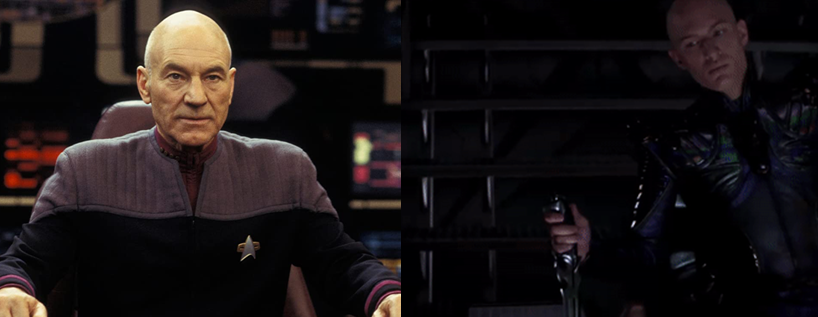
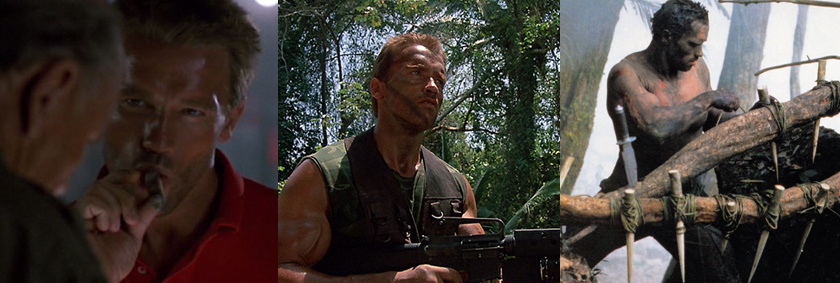
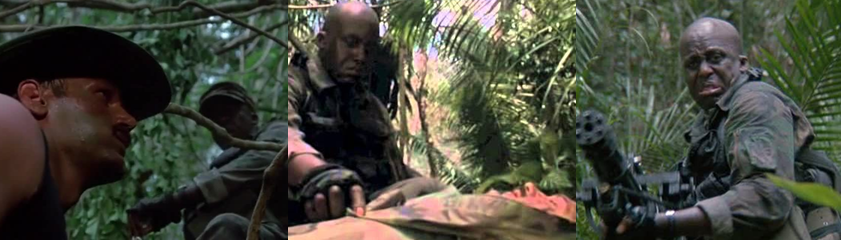
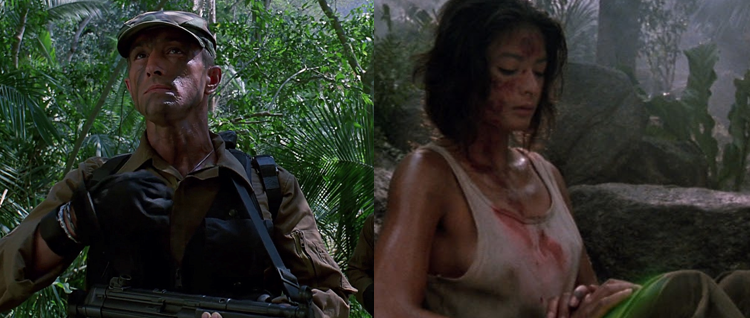
Screen Time [Sonic Month]: Adventures of Sonic the Hedgehog: “The Quest for the Chaos Emeralds” (E37-40)


Sonic the Hedgehog was first introduced to gamers worldwide on 23 June 1991 and, since then, has become not only SEGA’s most enduring and popular character but also a beloved videogame icon. The Blue Blur turned thirty this year and, to celebrate, I’ve been dedicating every Friday to SEGA’s supersonic mascot.


Episode 37 to 40:
“The Quest for the Chaos Emeralds”

Air Date: 26 October 1993 to 29 October 1993
UK Distributor: Channel 4
Original Network: ABC
Stars: Jaleel White, Christopher Stephen Welch, Long John Baldry, Phil Hayes, Garry Chalk, and Jim Byrnes

The Plot:
Doctor Robotnik (Baldry) has forced Professor Caninestein (Chalk) to build him a time machine so that he can acquire four magical Chaos Emeralds that would grant their bearer the powers of Invisibility, Invincibility, Immortality, and Life in a bid to become an all-powerful Demi-God. After escaping, Caninestein supplies Sonic (White) with the means to follow Robotnik across time and space to thwart his diabolical plot.

The Background:
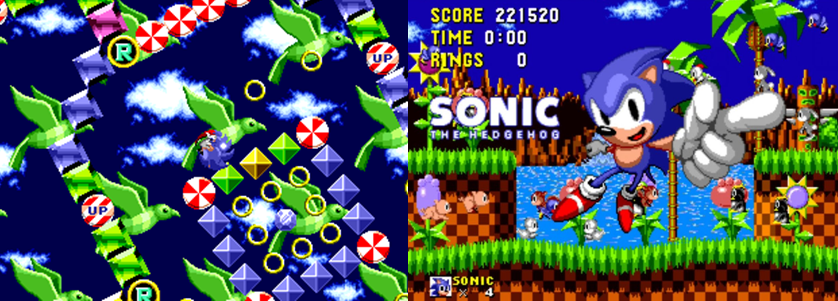
Sonic the Hedgehog blasted onto the videogame scene with his debut, self-titled release in 1991. Thanks to being bundled with the Mega Drive and SEGA’s aggressive marketing campaign, Sonic the Hedgehog (Sonic Team, 1991) was a huge success but Sonic’s popularity exploded after the release of Sonic the Hedgehog 2 (SEGA Technical Institute, 1992). Suddenly, Sonic was everywhere: comic books, t-shirts, in the Macy’s Day Parade and, soon enough, on television in the form of not one but two concurrent cartoons. After seeing the success that DiC Entertainment had with producing cartoons that were effectively little more than half-hour advertisements for Nintendo’s videogames, characters, and franchises, SEGA of America contacted DiC to begin developing an animated series for their own super-sonic mascot. Artist Milton Knight set about redesigning Doctor Eggman (widely known at the time as Doctor Ivo Robotnik) into “Animation’s Sexiest Fat Man!” and Long John Baldry was cast in the role, reimagined as an egotistical, narcissistic blowhard. To help sell their pitch to ABC, DiC also roped in Jaleel White for the title role but ABC deemed their original slapstick pitch unsuitable for a Saturday morning slot. Undeterred, producer Robby London made the decision to develop an entirely separate Sonic cartoon for the prime Saturday morning slot and develop Adventures of Sonic the Hedgehog for syndication instead. The result was two vastly different Sonic cartoons, each with a differing tone and animation style and far removed from their source material; Adventures was comprised of sixty-five episodes of over-the-top, meme–worthy, slapstick humour while Sonic the Hedgehog (generally referred to as “SatAM”) was a far darker take on the franchise. Though both cartoons awkwardly collided when Archie Comics began publishing Sonic comic books, the majority of Adventures’ influence was eventually stripped away in favour of those from SatAM and Adventures is generally regarded less favourably than its darker counterpart with the notable exception of the four-part “Quest for the Chaos Emeralds” story arc.

The Review:
While “Black Bot the Pirate” (Butterworth, 1993) forms the first in a four-part saga and is thus a rare example of continuous, sequential storytelling in what was generally a more fast-paced, comedic cartoon, it still contains many of the same elements that made up what can be loosely described as Adventures’ “charm”: an abundance of sight gags, slapstick, cheesy lines, and jokes. Having grown up with the series, I have a certain affection for some of these elements and Robotnik’s long-suffering, clumsy lackeys Scratch (Hayes) and Grounder (Chalk), who make for some of the most annoying and yet amusing characters in the series. Constantly getting into scrapes and bumbling even the simplest of plans, there’s a pretty funny gag right at the start of the episode where Scratch accidentally activates Robotnik’s time machine (which looks more than a little like H.G. Wells’ famous contraption and which Scratch mistakes for a vacuum cleaner) and returns as a roast chicken. It makes no sense but then that’s pretty much par for the course of Adventures of Sonic the Hedgehog.

Dr. Robotnik’s plot is unusually devious but he’s no less immune to falling for obvious tricks.

Robotnik, easily the most charismatic and appealing part of the cartoon, is unusually focused and determined in this first episode (and the entire saga); having learned of four Chaos Emeralds scattered throughout time and space, he wishes to acquire their individual and collective powers to become “Supreme High Robotnik”, a lofty goal that is far beyond his usual plots to destroy or take over towns, cities, or even the planet. Of course, Robotnik is as much his own worst enemy as Sonic is a hindrance to him; blinded by his egotism and quick temper, he’s quick to throw tantrums, is easily fooled, and makes massively glaring errors in judgement that often lead as much to his downfall as Sonic’s involvement. Long John Baldry really puts his all into portraying Robotnik as a loquacious and comically exaggerated character; in this episode, he is also joined by his pirate counterpart Black Beard (Byrnes), whom Robotnik transforms into a robot dubbed Black Bot. Unlike Scratcher and Grounder, Black Bot is a relatively competent minion as it forces Sonic and Tails off the ship; while Sonic is perfectly capable of swimming and his no fear of water in this cartoon, this does leave him and Tails at the mercy of a gigantic robotic whale.

There’s no situation Adventures-Sonic can’t find a way to escape out of.

While this causes a momentary issue for Sonic, who is unable to cut through the whale’s metallic shell, literally nothing is beyond the ability of Adventures-Sonic; he always has a solution for any situation whether by using his incredible speed, a series of elaborate disguises, or literally pulling a solution out of thin air. Jaleel White pretty much defined Sonic’s characterisation for generations of kids and, while I have a lot of respect for his work, as always it’s Sonic’s constant need to spout quips and one-liners that makes his character as aggravating as he is entertaining. No matter the situation or how bad the odds look, Sonic always finds a way to succeed and make fools of Robotnik and his robots; even when Robotnik has a time machine on hand to get the drop on him, Sonic is able to trick Robotnik into trapping him in the treasure chest with the Chaos Emerald and using its powers to best his foes. Even when Robotnik manages to steal back the Chaos Emerald and strand Sonic and Tails in the past, Sonic simply uses some dodgy time-manipulation to get them out of the jam.

Tails spends most of the episode being used as a hostage and in need of rescue.

Speaking of Tails, as is tradition for most Adventures’ episodes, there’s not really a lot for him to do here except say cringe-worthy stuff, act as a hostage, or provide minimal support for Sonic. He’s the very definition of the kid sidekick, existing mainly for Sonic to have someone to talk and brag to (though, ironically, Sonic is more than capable of simply breaking the fourth wall and addressing the audience directly). “Black Bot the Pirate” is a pretty standard episode of Adventures of Sonic the Hedgehog; as is often the case, there’s some enjoyment and humour to be found between the show’s more aggravating clichés and the influence of films such as the Back to the Future trilogy (Zemeckis, 1985 to 1990) and Bill & Ted’s Excellent Adventure (Herek, 1989) is obvious, making for a quick shorthand to explain the show’s concepts of time travel. The second episode, “Hedgehog of the “Hound” Table” (Butterworth, 1993), begins with Doctor Robotnik, Scratch, and Grounder crash-landing in another time and place and with a recap of Robotnik’s plot to obtain four Chaos Emeralds and become and all-powerful “Supreme High Robotnik”. This is unusual for the series as, generally, episodes were not sequential or consecutive; characters and storylines did reappear and were revisited at times but, as a rule, every episode was a self-contained bit of wacky fun so seeing the cartoon actually attempt a concurrent storyline is a nice breath of fresh air.

This time, simply holding the Chaos Emerald isn’t enough to use its power.

Robotnik quickly finds the laboratory of Merlynx the Magician (Unknown) and, in his quest for the Chaos Emerald of Invincibility, obtains Merlynx’s magic wand and, in short order, the Chaos Emerald. However, unlike with the last Chaos Emerald, simply holding the gem isn’t enough to grant the wearer invincibility; instead, one must also become King of the Hound Table because…well, the episode needs to happen, I guess. Back in the present day, Sonic and Tails are still trying to relax on the beach when their good time is again interrupted by Professor Caninestein, who once again supplies Sonic with his time-travelling Atomic Relativity Boots. Immediately arriving at King Arfur’s (ibid) castle, Sonic and Tails meet the king’s daughter, Princess Gwendolyn (ibid), who plead for Sonic’s help in fending off the “Evil Bloated Knight” (spoilers: it’s Robotnik in a suit of armour). Motivated by the egotism he feels at being declared the “Holy Hedgehog”, Sonic, of course, agrees to help as Robotnik’s technology is surprisingly effective at dispatching the Knights of the Hound Table with minimal effort. I say “surprising” as, generally, Robotnik’s credibility is…sketchy at best especially because of the bungling and incompetent nature of his goons. This is emphasised in a short action scene wherein Sonic (with minimal assistance from Tails) humiliates the three in true Adventures slapstick fashion by tying up Robotnik’s moustache, painting a target on a wall, and tricking Grounder into taking out his own team mates.

Though momentarily distressed at his lack of speed, Sonic is still able to best Scratch and Grounder.

Robotnik then coerces Merlynx into using his magic to turn Sonic’s feet into solid rock, which robs him of his speed and allows Robotnik to steal Arfur’s crown; this is, apparently, enough to render Robotnik invincible, transforming him into a muscle-bound version of himself and locking Sonic and Tails in the castle dungeon. Being robbed of his speed makes Sonic uncharacteristically despondent…for a time. It’s not the first time he’s fallen into despair at the loss of his abilities in this, or other, cartoons and is an interesting wrinkle in his otherwise flawless character but we only see the briefest of glimpses into this aspect of his personality as he immediately perseveres to appeal to Merlynx to undo his spell. Even when Sonic is robbed of his speed, he is more than a match for Scratch and Grounder; you’d think this would be the perfect opportunity for Tails to actually help Sonic but he doesn’t even carry him to Merlynx’s house or help take out the Badniks when they block their path. After they separate Robotnik from the Chaos Emerald, Tails actually lays claim to it and briefly transforms into his own hulking form…but does nothing with that power beyond childish posturing. Still, at least he isn’t constantly used as a hostage this time around.

Even after becoming invincible, Robotnik is as foolish and bungling as ever.

You might also think that being rendered invincible pretty much means Robotnik has claimed victory but of course not; not only does Robotnik not kill Sonic and Tails when he has the chance, he quickly falls into boredom with his kingship, and foolishly agrees to answer Sonic’s challenge for a jousting match. Although the Chaos Emerald renders him unbeatable, he wears the damn thing on his head, under his helmet, for some reason so he loses his powers when he is knocked off his horse by a cactus plant Sonic randomly plants on the battlefield. In the end, it is Robotnik’s own bumbling nature that causes his downfall as he is easily goaded into falling for Sonic’s tricks and winds up being packed off to a Roman coliseum. “Hedgehog of the “Hound” Table” is marginally better than the first episode; for one thing, there’s a bit more action and a few more interesting characters in this episode compared to the last one. There’s not a lot to Merlynx, Princess Gwendolyn, and King Arfur beyond being one-dimensional characters in exactly the roles you’d expect (wacky reclusive magician, stuttering, worrisome princess, and wholesome, honourable king, respectively) but they help to make the episode a bit more lively compared to the more barren and lifeless setting of the last episode. However, of all of the episodes that make up the “Quest for the Chaos Emeralds” saga, the third episode, “Robotnik’s Pyramid Scheme” (Butterworth, 1993), is the only one I actually watched as a kid. Somehow, I missed the previous two episodes, and the final part of the saga, despite religiously watching and/or taping each episode of Adventures of Sonic the Hedgehog every Sunday morning. Still, here in the United Kingdom, the airing of Sonic cartoons was a little in flux; I remember watching Adventures one week and then waking up the next week to find it had inexplicably changed in tone and narrative and was suddenly the far darker SatAM with no explanation as far as I could see.

In trying to stop himself from being erased, Sonic accidentally undoes his own birth!

Again, sequential narratives weren’t really a thing in Adventures of Sonic the Hedgehog so it’s surprisingly unique to find this episode picking up almost immediately where “Hedgehog of the “Hound” Table” left off with Robotnik, Scratch, and Grounder running for their lives in an ancient coliseum. After a brief encounter with his equally rotten ancestor, Julius Robotnikus, Robotnik helpfully brings any new viewers up to speed before heading to Ancient Mobigypt. This opening serves a few purposes; obviously, first and foremost, it’s to continue the story but it also places a bit more emphasis on the characters meeting their ancestors, something that is of particular importance to this episode’s plot. This is further emphasised back at the beach, where Professor Caninestein reveals that Sonic’s bloodline is being systematically erased from history due to Robotnik’s actions in the past. Rather than being provided with his time travelling Atomic Relativity Boots, Sonic is gifted the Time Warp Boogie Board to travel back in time and keep himself from being erased. Unfortunately, while Sonic and Tails manage to rescue Sonic’s ancestor, Masonic (White), from Robotnik, they inadvertently interrupt the meeting between Masonic and his fated future wife, Penelope (Cathy Weseluck), which causes Sonic to be erased from history.

Apparently, it’s easier to use time-bending shenanigans than to break some flimsy chains?

Yeah, it’s basically the plot of Back to the Future (Zemeckis, 1985); however, thanks to the convenient fact that Tails not only remains in the past but also still remembers someone who never existed, being erased from existence is only a minor inconvenience for Sonic as Tails simply forces Masonic and Penelope to meet, instantly returning Sonic to life. Rather than actually removing the infallible Sonic from the plot and having Tails team up with Masonic in an effort to undo their actions, what should be a major plot point is almost immediately undone and, once again, Tails is rendered to a mere sidekick. Similarly, when the Pharaoh of Mobigypt (Chalk) refuses to give up the location of the Chaos Emerald, Robotnik declares himself Pharaoh and forces Sonic, Tails, and Masonic to spend the next twenty or thirty years building pyramids. Oddly, it’s actually easier for Sonic to repeat the same time-bending trick he pulled in “Black Bot the Pirate” and carve a hieroglyphic message for Professor Caininestein to conjure up a saw to cut through their piddling little chains that it is for him to simply buzz saw through them but I guess that wouldn’t be anywhere near as impressive as having Sonic “Mary Stu” his way out of another hopeless situation.

In a morbid twist, Robotnikhotep would rather die than endlessly fight with his version of Sonic.

Still, they’re unable to keep Robotnik from discovering that the Chaos Emerald is hidden deep within the booby-trapped pyramid of Robotnikhotep (Baldry); this is where Scratch and Grounder are at their best as they first squabble over which of them is smart and fast enough to decipher the clues that lead Robotnik to the pyramid and then constantly run afoul of the pyramid’s many traps to keep Robotnik safe from harm. There’s even a surprising nod to the videogames in the pyramid’s final puzzle, which requires a number of Golden Rings to be collected; it’s always nice when the cartoons actually include some of the more obscure gameplay elements of the source material. However, they all wind up in the burial chamber and encounter Robotnikhotep, who is functionally immortal thanks to the Chaos Emerald he wears; after a mummified hedgehog (White) awakens and defeats Robotnikhotep, Robotnik takes the Chaos Emerald from his ancestor and gains immortality. In a surprisingly poignant exchange, Robotnikhotep expresses gratitude for being relieved of not only the curse of immortality but the constant interference of Sonic’s mummified counterpart.

Robotnik’s immortality is quickly bested by Sonic’s own emerald powers.

In the Adventures of Sonic the Hedgehog universe, “immortality” is realised not only as everlasting life but also, apparently, immunity to harm as, once Robotnik has the gem, Sonic’s attacks simply bounce off of him. Although, again, Robotnik has claimed near-unstoppable power, Sonic is easily able to defeat him by being gifted an emerald of his own (whether it’s a Chaos Emerald or not is not made clear but, judging by its blue colouration, it doesn’t appear to be one of the legendary gems) that grants him a “blue energy shield” and the means to take the immortal Robotnik down and secure his future.
“Robotnik’s Pyramid Scheme” is probably the best of the “Chaos Emerald” saga so far thanks to the influences and unashamed homages to Back to the Future; unfortunately, it squanders the potential of a largely Sonic-less plot by undoing his erasure within about two minutes of it occurring. This could have been a good chance to have Tails take a more proactive role and still involve a Sonic-like character in Masonic, having Sonic return to life in far more dramatic fashion for the action-packed conclusion but, instead, it’s just another excuse to show how flawless Sonic is. The final episode, “Prehistoric Sonic” (Butterworth, 1993) begins exactly where the last episode left off, with Robotnik, Scratch, and Grounder escaping back into the timestream to hunt down the final Chaos Emerald. However, Professor Caninestein once again supplies Sonic with a new time machine (a time-travelling skateboard, naturally) so that Sonic and Tails can put a stop to Robotnik’s plot once and for all. Robotnik and his Badniks arrive in prehistoric times, soon followed by Sonic and Tails, with the characters quickly encountering the prehistoric Mobians who are guard the volcano where the Chaos Emerald lies waiting.

Robotnik has the power of life in his hands and uses it to its…fullest..? extent…

Robotnik conjures up a gigantic robotic dinosaur to take care of Sonic and Tails; Sonic is, of course, immediately able to tame the Badnik and turn it against Robotnik’s underlings, however, and when Robotnik attempts to obtain the Chaos Emerald he is stopped by the volcano’s monstrous guardian, Magma the Volcano God. Like Stonekeeper (Ross Marquand), the lava creature demands a sacrifice before anyone can claim the Chaos Emerald, so Robotnik willingly and casually tosses Scratch and Grounder to certain doom in order to get his hands on it. Now imbued with the power of life, Robotnik conjures lava minions of his own to finally capture Sonic and Tails; actually learning from his past mistakes, he even ties Tails’ tails together so there’s no chance of them surviving a plummet into the volcano. But, of course, Sonic is easily able to escape his fate and get them to safety, so Robotnik reunites with his Badniks and flees, victorious, back into the timestream.

Robotnik finally becomes a God and immediately sets his sights disappointingly low…

Sonic and Tails immediately give chase, heading back to Ancient Mobigypt, but are too late to stop Robotnik from stealing the Chaos Emerald of Immortality from Robotnikhotep. Next, they head back to medieval times and arrive right as Robotnik claims the Chaos Emerald of Invincibility with minimal effort. Now immune to all of Sonic’s attacks, there’s nothing stopping Robotnik from digging up the final Chaos Emerald, the Chaos Emerald of Invisibility, and finally claiming all four as his own as Robotnik brings a treasure chest to life to cover his escape. Returning to the present day, Robotnik makes a suitably dramatic show of placing all four Chaos Emeralds around his neck (…even though he had already three of them around his neck) and transforming into “Supreme High Robotnik, Master of the Universe”, a gargantuan, God-like version of himself who immediately begins destroying a nearby town in a demonstration of his power. With his limitless powers, Robotnik easily throws Sonic and Tails to the beginning of the universe (of course represented by a gigantic stick of dynamite). However, after managing to escape (with trademark ease), they concoct a plan to defeat Supreme High Robotnik: using their time machine, they travel back through time and recruit a small army of their past selves for help.

Even when he’s a God, Robotnik is toppled with ease as, for some reason, he still feels pain…

After the five Tailses render Robotnik visible, the five Sonics are…somehow…able to damage and hurt Robotnik enough to bring him crashing to the ground with a pathetic amount of ease. Toppled, Sonic easily retrieves the Chaos Emeralds, stripping Robotnik of his God-like abilities, and ending his desires for the gems, and veritable omnipotence, once and for all. Honestly, this is quite a disappointing end to the saga as, even with the combined powers of the Chaos Emeralds, Robotnik is defeated way too easily. There was potential here for a veritable army of Sonics to attack Robotnik but, instead, the episode limits itself to just five. Sonic could also have used the Chaos Emeralds to become Super Sonic but the cartoons never seemed able to actually adapt this element into their stories so, instead, the Sonics simply attack Robotnik until he falls to the ground. There’s never a question that Sonic could fail in facing Robotnik’s ultimate form. Even when he’s thrown to the beginning of time it’s little more than a minor inconvenience; being trapped inside of an anthropomorphised treasure chest is more of an obstacle for him as he actually needs Tails’s help to escape because, again, he never thinks to just spin his way free. Other than that, and dropping flour on Supreme High Robotnik, Tails is next to useless in this episode and is simply along for the ride to screech out the obvious or words of panic or encouragement.

The Summary:
It’s rare that Adventures of Sonic the Hedgehog actually uses gameplay mechanics from the videogames; although the series contained more references and nods to its source material than SatAM, these were still few and far between thanks to the cartoon’s focus on slapstick humour and largely original, self-contained episodes. As a result, the concept of the Chaos Emeralds is massively different compared to how they are portrayed in the videogames but it makes for a unique spin on the mechanic to have their powers more explicitly defined and associated with different abilities. In a small example of how low the standards were for the cartoon, though, there are a few instances where the characters say “invisible” or “invisibility” instead of “invincible” and “invincibility”. Still, seeing Robotnik obtain the Chaos Emerald of Invincibility and actually attain its power was a nice, if brief, distraction; had he acquired this power and Merlynx’s wand (which the episode establishes that Robotnik, and anyone for that matter, can easily wield), he arguably could have laid claim to complete victory but, of course, that was never going to happen as Sonic had to emerge victorious by the episode’s end. Nevertheless, actually getting a glimpse of the potential of “Supreme High Robotnik” helps to understand the stakes involved and why it’s so important to keep all of the gems out of his hands.
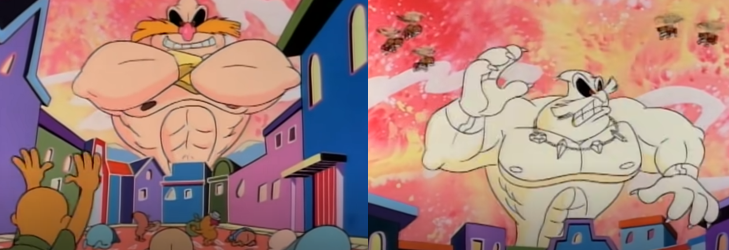
Robotnik constantly squanders his God-like powers, remaining little more than a bumbling idiot.

Something I do enjoy about these episodes compared to many episodes of Adventures of Sonic the Hedgehog is how many elements it includes from the videogames; obviously, we have the inclusion of a Chaos Emerald but the traps, obstacles, and danger of the pyramid remind me quite a bit of the hazards encountered in Sonic the Hedgehog (in particular the Marble and Labyrinth Zones). Having the Badniks be forced to collect Golden Rings to enter the burial chamber was also a nice touch and we get the briefest glimpse of the threat “Supreme High Robotnik” could pose if he obtained all four Chaos Emeralds thanks to seeing him actually wielding the power of the Chaos Emerald of Immortality…even if he is, again, defeated with comparative ease. In the end, the “Quest for the Chaos Emeralds” saga had so much potential in seeing Robotnik’s dreams of Godhood realised in full form but, instead, the final episode wastes too much of its runtime back in the past and on the acquisition of the Chaos Emerald of Life. For a man of such vaulted intelligence and imagination, Robotnik is surprisingly rubbish at using the powers of the Chaos Emeralds, or his assumed omnipotence, to their full extent, simply conjuring up a few ineffectual goons and growing to gargantuan size. He obtains the Chaos Emerald of Invisibility but remains visible 95% of the time; he has the Chaos Emerald of Invincibility and Immortality but is able to feel pain and be brought to his knees despite being immune to Sonic’s attacks in previous episodes (and even earlier in this episode!), and he has the Chaos Emerald of Life but doesn’t just strip and Sonic and Tails of their lives. Obviously, a lot of these things would render the episode unwatchable but I still think we could have gotten a much better, more interesting saga if Robotnik had dominated Mobius as Supreme High Robotnik and Sonic and Tails had been forced to go to a little more effort to end his threat.

Sonic the Comic did the God/Super-Robotnik story arc far better.

As a four-part saga, the “Quest for the Chaos Emeralds” is pretty good when watched sequentially as a kind of mini movie or television special. Had the saga been presented in this manner, it might have benefited from this format and been able to balance its pacing and structure a little better. Instead, each episode is still largely self-contained and concerned more with being just another fun entry in a largely slapstick cartoon series and, as a result, too much of the runtime is spent lingering and on padding rather than seeing Robotnik being all-powerful and actually dominating his nemesis for a change. Unfortunately though, similar plots have been done far better in Sonic the Comic (1993 to 2002) and, while the saga is a cut above the usual madcap nature of the cartoon and has some interesting ideas, it ultimately wastes a lot of the potential of the multi-part format and its plot.

My Rating:

Rating: 2 out of 5.

Could Be Better

What did you think to the four-part “Quest for the Chaos Emeralds” and the eventual realisation of “Supreme High Robotnik”? Would you have liked to see more episodes taking a similar multi-part format or revolving around gameplay elements like the Chaos Emeralds or did you prefer the cartoon’s wackier, slapstick tone? Where you surprised to see the Chaos Emeralds playing such a pivotal role in the series or were you, perhaps, annoyed and confused as to why they were depicted so differently? Which character from Adventures of Sonic the Hedgehog did you like, or hate, the most and what did you think about the cartoon’s tone and aesthetic? Whatever your thoughts, feel free to share your memories of Adventures of Sonic the Hedgehog in the comments below.


Game Corner [Sonic Month]: Sonic the Hedgehog (2007; Xbox One)


Sonic the Hedgehog was first introduced to gamers worldwide on 23 June 1991 and, since then, has become not only SEGA’s most enduring and popular character but also a beloved videogame icon. This year, the Blue Blur turns thirty and what better way to celebrate than by dedicating an entire month’s worth of content to SEGA’s supersonic mascot.


Check out my guest spot on The Reviews Brothers

GameCorner

Released: July 2007
Originally Released: June 1991
Developer: Sonic Team
Original Developer: Sonic Team
Also Available For: Arcade, Game Boy Advance, Gamecube, Game.com, iPod, Mega Drive, Mobile, Nintendo 3DS, Nintendo DS, Nintendo Switch, Nintendo Wii, PC, PlayStation 2, PlayStation 3, PlayStation 4, PlayStation Portable, SEGA Saturn, Xbox, Xbox 360, Xbox Series X

The Background:
You know the story by now: there was a time when videogames and home consoles ran rampant and, for a while, it was good. But, inevitably, the market became swamped with lacklustre releases and poorly conceived movie tie-ins; after the collapse of the videogame industry, Nintendo were there to pick up the pieces, dominating the market with the Nintendo Entertainment System (NES) and Super Mario Bros. (Nintendo EAD, 1985). Though they had successfully recaptured the flailing market and seemed unstoppable, one former slot machine developer dared to try and knock Nintendo from their perch. In 1990, SEGA ordered their developers to design a mascot and a title capable of leaving Mario in the dust and showcasing the power of their 16-Bit Mega Drive; after an internal contest produced numerous rejected designs (including a rabbit and an armadillo), SEGA soon settled on Naoto Ohshima’s design of a spiky hedgehog dubbed “Mr. Needlemouse”. With up-and-coming developer Yuji Naka, composer Masato Nakamura, and level designer Hirokazu Yasuhara also onboard, the character’s design was refined and defined, renamed to Sonic, and “Sonic Team” was born. Conceived to be as appealing as possibly, Naka wanted Sonic the Hedgehog to focus on speed and user-friendliness; unlike his rival, Mario, Sonic controlled with only the directional pad and one button and his gameplay was based on physics, momentum, and an emphasis on action and speed. Thanks largely to an aggressive marketing campaign and copies of the game being bundled in with SEGA’s brand new console, Sonic the Hedgehog was an immediate success, selling over 15 million copies in this format alone and kick-starting the “Console War” between SEGA and Nintendo that would dominate the nineties. Since then, Sonic has become an enduring icon; he’s had a slew of critical and commercial hits alongside a number of unfortunate and very disappointing hiccups and yet his character and brand remain strong and he is still an iconic character in both videogames and other media to this day.

The Plot:
South Island is under siege! The maniacal Doctor Eggman (widely known as “Robotnik” during the game’s original release) has been capturing the island’s animals and turning them into robotic Badniks! With Eggman’s machinery and pollution threatening the entire island, only one super-fast, super-cool hedgehog can stop him!

Gameplay:
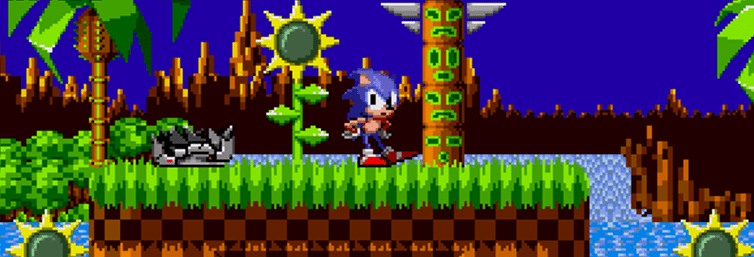
Sonic the Hedgehog is a 2D, sidescrolling action/platformer in which you control the titular blue hedgehog. Sonic must journey across six stages (known as “Zones”), each split into three “Acts”; at the end of each Zone’s third Act, Sonic must battle Eggman in one of his contraptions and, upon clearing all six Zones, face the diabolical doctor in the game’s Final Zone. Sonic is a smooth and responsive character to play as; slightly weighty, his speed and agility are dependant upon you building momentum and using the game’s level layout and gimmicks to your advantage. When you move Sonic, he quickly breaks from a trot, to a jog, to a run that is so fast his legs appear as little more than a rubber band of red, white, and blue but, in order to reach Sonic’s top speeds, you’ll need to make use of slopes, curves, the game’s signature loop-de-loops, and Sonic’s rolling mechanics.

It’s not all high-speed Badnik bashing; Sonic will also have to pull off some slower platforming.

Any time you press a button, Sonic jumps into a blazing spinning ball of spikes known as the “Super Sonic Spin Attack”. You can use this to destroy Badniks and bounce off of them, springs, and monitors to increase your height, momentum, and speed. Additionally, pressing down whilst running will see Sonic roll along for a similar effect. In the original release of the game, Sonic couldn’t utilise his patented Spin Dash as this wasn’t introduced until the bigger, better sequel but subsequent re-releases and ports have seen this function added in, which can be extremely helpful in moving Sonic along (unfortunately, though, it’s not available in this version of the game). And that’s a noteworthy point as, unlike in the sequels, Sonic is painfully slow in his debut title; the game’s first stage, the iconic and massively over-used Green Hill Zone, is a perfect playground for getting to grips with Sonic’s speed and abilities. You’ll blast through this Zone in no time at all, feeling the rush of adrenaline and action-packed speed, only to literally run into a brick wall with the next stage, Marble Zone, which slows the game down to a crawl so Sonic can navigate precarious platforms, push blocks, activate switches, and simply wait for the game to allow him to continue.

The game’s slower sections betray its marketing as a non-stop action platformer.

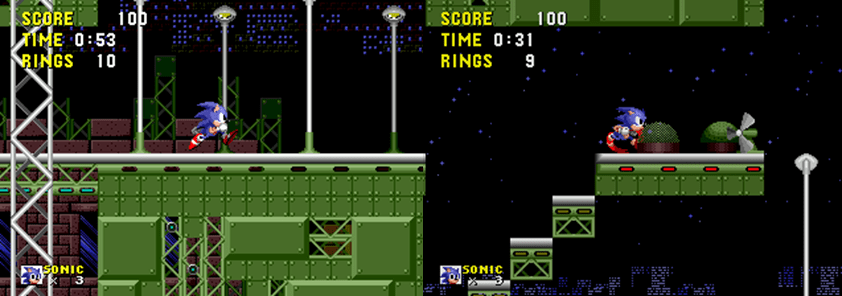
That’s not to say that speed doesn’t become a recurring factor in Sonic’s gameplay; both Spring Yard Zone and Starlight Zone give you a chance to stretch your legs again but the pinball mechanics of the former and the obstacle-course-like layout of the latter were definitely refined in the sequel. As a result, most of your time is spent using more traditional platforming skills to progress forward rather than simply blazing through as the game’s marketing would have you believe. This means jumping from platform to platform, navigating maze-like areas, activating switches, and hopping to disappearing, crumbling, or spinning platforms. In Starlight Zone, you’ll also have to use some see-saws to bounce up to higher areas and navigate a bottomless void while Scrap Brain Zone includes teleportation tubes and speed-sapping conveyor belts to screw up your momentum and sense of direction. You’ll also have to watch the in-game timer as well; if you take too long to finish an Act, you’ll lose a life, so it pays to keep moving but, fortunately, none of the game’s Zones or Acts are that long or difficult to get through within the required time limit.

There are many ways to keep Sonic alive and kicking.

Luckily, Sonic is a relatively sturdy videogame character, especially compared to Mario; collecting the many Golden Rings scattered throughout the game’s Zones allows you to survive a single hit. You’ll lose all of your Rings but you won’t lose a life unless you get squashed, fall into one of the game’s many bottomless pits, get hit without a Ring or a shield, or drown. Sonic’s momentum becomes sluggish and awkward when underwater and, unlike his rival, he cannot survive for long in the murky depths of the Labyrinth Zone; linger too long and an ominous, heart-pounding countdown will begin and, if it reaches zero, you’ll drown and lose a life. Fortunately, just as you can collect dropped Rings, you can save yourself from this fate by finding air bubbles. Sonic can also earn an extra life if he collects one hundred Rings or earns a high enough score and you’ll also be given a chance to continue should you lose all of your lives. You can earn extra continues in the game’s Special Stages but you’ll also lose your current accumulated high score if you have to use a continue. Sonic gains points for destroying Badniks, defeating Eggman, and clearing Acts; once you reach the end of Act signpost or break open the prison capsule, you’ll be awarded bonus points for your current score, the time you took to clear the Act, and the amount of Rings you were holding when you did so. As a result, you are actively encouraged to blast through Acts as quickly as possible as this will net you a higher score and more lives and continues.

Labyrinth Zone more than lives up to its name thanks to being far more vertical and maze-like.

Sonic the Hedgehog’s Zones are thus laid out in such a way to allow you to experiment to find the fastest routes; typically, the higher path is the most dangerous but also the fastest compared to the middle and lower paths. This isn’t always the case, however, and this mechanic is not as refined as in later games; some Zones, such as the aforementioned Labyrinth and Spring Yard, are more vertically constructed, meaning that your completion speed will be directly tied to your level of skill and precision with controlling Sonic. For the most part, this isn’t a problem but, unfortunately, Sonic the Hedgehog does suffer from a few noticeable issues that can unfairly impede your progress; early copies of the game featured an infamous glitch whereby, upon landing on a bed of spikes, Sonic would lose his shield, Rings, and then a life all without the usual few seconds of invincibility frames to save him. Other times, especially in Spring Yard Zone, you may find yourself crushed by blocks even though you’re not actually beneath them; Sonic also has a curious animation glitch where he will jump while running in the air if you try to jump to close to obstacles or items, though these issues are, admittedly, rare and minor. Sonic the Hedgehog isn’t an especially difficult game; there are no difficulty settings to choose from so the game’s difficulty is supposed to gradually increase as you progress from Zone to Zone. As you race through Zones, you’ll automatically activate Lampposts as you run past them, which acts as a checkpoint should you die in the Zone, however your skill is tested by the way the game requires you to finish every Act that doesn’t feature a boss battle holding fifty Rings or more in order to try for the game’s six Chaos Emeralds.

Graphics and Sound:
Sonic the Hedgehog is still one of the most impressive and visually appealing games of its kind. Everything from the sprites to the background art pops out in gorgeous colours and the game’s Zones are full of life and character, despite being largely cliché in hindsight. You’ll race through verdant fields, explore lava-filled ruins, slog through the sunken remnants of an ancient civilisation, careen around a bonkers pinball-inspired obstacle course, and face a myriad of deadly hazards in Scrap Brain Zone, the heart of Eggman’s operation on South Island.

As much as I like Starlight Zone, it’s quite empty compared to other Zones in the game.

Just about the only Zone that isn’t interesting or fun is Starlight Zone and I say this with a heavy heart as it’s actually one of my favourite Zones in the game and a welcome return to the more speed-orientated gameplay after the annoyance of Labyrinth Zone. However, Starlight Zone is largely empty and lifeless; the wind-based mechanic is clunky, the bottomless pits are insufferable, and the Badniks are far harder to destroy than in other Zones.

Leave Sonic idle and he’ll grow impatient, something videogame avatars have aped ever since.

What saves Starlight Zone, however, is its music; in fact, Sonic the Hedgehog has some of the best and most memorable music in videogame history. From the catchy title theme to the iconic sounds of Green Hill Zone, every Zone has an excellent, jaunty, and fitting theme to go with it. This is also true of the game’s boss battles, which all feature the same ominous-yet-lively tune that let you know Eggman is inbound. The game doesn’t feature any cutscenes or story-telling elements; this isn’t entirely unexpected as a lot of games released around this time didn’t and, to be fair, the game’s story is pretty simple to pick up either through association (the Zones change from lush and vibrant to polluted and desolate and woodland critters bounce around the Zones after being freed from captivity) or from the game’s manual. One thing that the game does excel at, though, is giving Sonic a distinct personality; if you leave him idle, he’ll turn to the screen and impatiently tap his foot, a quirk that has been aped and emulated but almost every videogame avatar since.

Enemies and Bosses:
In each Zone of the game, Sonic will face opposition from Eggman’s Badniks; these mechanical monsters may look cute and quirky but they can be extremely deadly. Mostly themed after animals, Badniks will fly across the screen shooting fireballs at Sonic, slink along the floor and break into spiked balls upon defeat, toss bombs at his head, and even explode in his face, among other things. Generally, Badniks are exclusive to each Zone but there is some crossover in later stages. While most of these Badniks aren’t too much bother, their placement in the Zones can be frustrating; others, like Roller and Burrobot, can be a pain due to the speed and surprise of their attacks while Badniks like Spike and Orbinaut cause issues due to their spiked defences.

Eggman may have a lot of different attachments for his craft but he’s not much of a challenge.

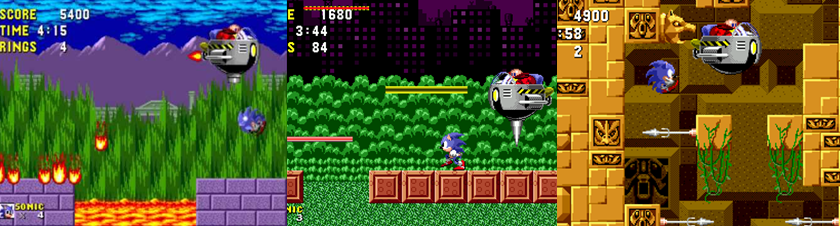
At the end of each Zone’s third Act, you’ll battle Doctor Eggman in his Egg-O-Matic hovercraft; each time you face him, he has a new, deadly appendage attached to his craft but his attack pattern remains generally the same. He’ll come puttering in, flying from right to left, and trying to attack with his appendage all while remaining a large, open target for Sonic’s Spin Attack. Unfortunately, while Eggman’s wrecking ball is simple to get around, his later appendages become more dangerous thanks to the presence of other hazards; in Marble Zone, he’ll drop fireballs that briefly render the ground too dangerous to stand on but there’s also a pit of lava to watch out for, for example. Attack too fast in Spring Yard Zone and you might drop to your death as Eggman uses his spike to remove parts of the platform you’re standing on. Labyrinth Zone’s boss battle is more of a race than a fight as, no matter how often you hit Eggman, he won’t be defeated; instead, you need to jump up the flooded vertical shaft dodging spikes and fireballs and desperately hoping to reach the top before you drown.

The final boss battle is pretty disappointing and stupidly easy.

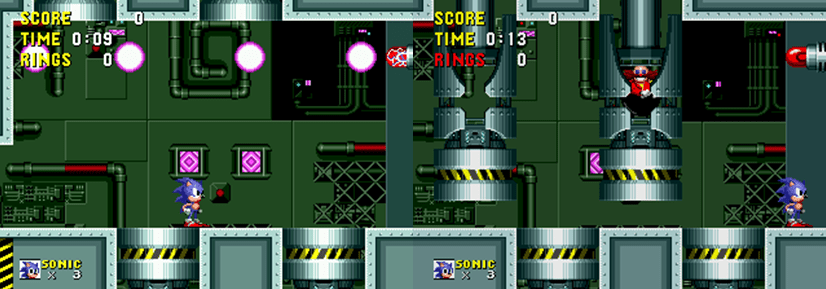
Once you’ve cleared all six Zones, you’ll reach the Final Zone; in this final showdown with Eggman, you’re stuck in a room with no escape and no Rings as Eggman tries to crush you with four weights and fry you alive with electrical balls. Fortunately, however, there is always a gap between these sparkling orbs for you to safely jump through and, by simply waiting at the far right of the screen, you can just take your time and ram Eggman whenever he pops up. Compared to the final boss battles of later Sonic games, this one is a bit of a joke, to be honest, and ends the game not with a bang but with a kind of shrug.

Power-Ups and Bonuses:
To help tip the odds in your favour, you’ll find a number of computer monitors scattered throughout the game’s Zones. Breaking these open will award you with such gifts as an instant hit of ten Rings, a shield that protects you from losing Rings or a life for one hit, or even an extra life. You can also find monitors containing Power Sneakers, which immediately increase Sonic’s running speed for a short time, or an invincibility, which coats Sonic in a sparkling protective aura. Combine these two together and you’re basically unstoppable unless you run head-first into a bottomless pit.

Additional Features:
Playing Sonic the Hedgehog on the Xbox One allows you to earn some pretty simple and easy Achievements; if you’ve played Sonic before, it should be no challenge at all to reach the game’s later Zones, collect one hundred Rings, or complete the game. As I mentioned above, finishing every Act except Act 3 with fifty Rings or more allows you to enter a Special Stage (why they’re not called “Special Zones” I don’t know…); these are accessed by Giant Rings that appear when you pass the end of Act signpost, so jump in quickly before you miss your chance!

Collect all six Chaos Emeralds to earn the game’s best ending.

The Special Stages are a psychedelic maze-like area filled with bright colours and weird effects; here, you’ll have to bounce and roll Sonic (who is in a constant spin) around the arena trying to avoid the flashing “Goal” lights. Touch these and you’re instantly ejected from the Special Stage with nothing to show for it but, if you manage to avoid them, you’ll find a Chaos Emerald hidden within each Special Stage. Collect all six of these and you’ll be awarded with the game’s true ending; without them, Eggman will mock you for failing to collect them all but, aside from seeing flowers blooming in Green Hill Zone and an Achievement, there’s little incentive to collect all six as you don’t unlock anything else. Sadly, thanks to the way Sonic the Hedgehog works on the Xbox One, there’s no way to enter the iconic cheat codes from the original game and, while a save state system is included, it only allows you to save to three separate slots. You can, however, access online leaderboards to compare your score, time, and progress with other players, if that’s your thing.

The Summary:
Sonic the Hedgehog will forever be an iconic, classic platformer; its place in the echelon of videogame history was cemented upon its bombastic release and, even to this day, it remains as a solid action/platformer. Unfortunately, years of enjoying the bigger, better, much improved sequels somewhat dampens the appeal of Sonic the Hedgehog. Playing the game in hindsight, you can see how the developers took the very best aspects and elements of this game and improved upon them in the sequel, removing the slower, clunkier elements and focusing more on action and speed. The game’s marketing made Sonic out to be this superfast character with a radical attitude but the actual game is quite slow, for the most part, and elevated above its peers thanks to its eye-catching graphics, distinct personality, and catchy music. It’s still a great game and obviously laid the foundations for even better things to come but is far less impressive than its sequels.

My Rating:

Rating: 3 out of 5.

Pretty Good

What did you think about Sonic the Hedgehog? Where do you rate it against the other games in the franchise? Did you purchase a Mega Drive simply to play Sonic? Which port or re-release of the game is your favourite? Are you as annoyed as I am that the excellent mobile version of the game isn’t available to play on the Xbox One? How are you celebrating Sonic’s thirtieth anniversary? Whatever you think, feel free to share your thoughts and memories regarding Sonic below.

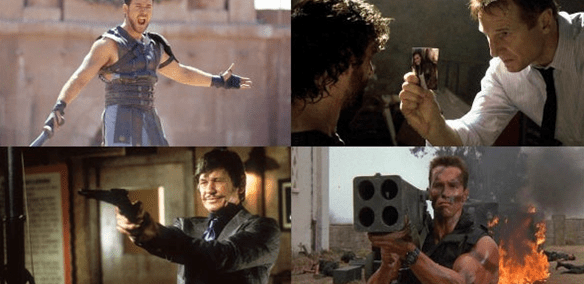
10FTW: Bad-Ass Movie Dads

10FTW

Being a dad in a movie is tough; often, dads are portrayed as slovenly, uncaring, even abusive individuals who care more about drinking beer, watching football, cheating on their spouses, or work than their kids. It’s a bit of a cliché at this point and also quite a bum rap, to be honest, and often seems like a case of lazy writing to have the dad be the cause of all the problems and negativity in a child’s life in a film.

10FTW: Badass Movie Dads

I suppose it makes sense, in a way; many movies involve a story about a child, son, or daughter standing up to adversity or challenging, even confronting, their neglectful parents to say nothing of the myriad of stories out there of fathers more concerned with work than the well-being of their child. Still, good movie dads do exist, even while being flawed characters in their own right, and so, seeing as today is Father’s Day, I’m going to run through ten that I consider to be amongst the most bad-ass of all movie dads…

10 Steven Freeling – Poltergeist (Hooper, 1982)

If I’m being completely honest, Poltergeist is more the story of a bad-ass mother as, throughout the film, it is Diane (JoBeth Williams) who eventually steps up after the demonic force inhabiting their house kidnaps her daughter, Carol Anne (Heather O’Rourke). Diane is the one who first feels and alerts her family to the presence in their house, she’s also far more emotionally stable despite her exhaustion and grief, and of course there’s the fact that she leaps into the “other side” to rescue Carol Anne and then has to suffer through a veritable horror show as their house is torn inside and out. Yet Steven (Craig T. Nelson) is the ever-reliable rock of the household; a bit of a goofball and perhaps (even by his own admission) too soft on his kids, he is the one who contacts a group of parapsychologists to assist them (despite his scepticism) and let’s not forget that Diane and Carol Anne never would have made it to back to the real world had Steven not been holding their literal lifeline. Despite his will weakening, Steven steps up even more in the sequel, Poltergeist II: The Other Side (Gibson, 1989), even landing what appears to be a killing blow to the malevolent Reverend Henry Kane (Julian Beck) who has been terrorising them, but, while reliability is an admirable quality, he takes the lowest spot for largely just being a supporting player (and for him and Diane sending Carol Anne away out of fear by the third film).

9 Frank – 28 Days Later (Boyle, 2002)

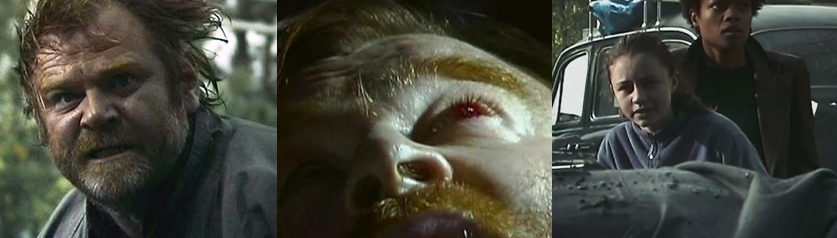
Here’s a shocking revelation for you: I’m not actually that big a fan of 28 Days Later. It starts off with such promise and with all those eerie shots of London but it’s a slow, plodding, miserable little film and the only thing I really like about it is that it made zombies faster, more aggressive, and ferocious as, for me, it otherwise wastes its potential. Still, amidst all of this we have Frank (Brendan Gleeson), a former cab driver and one of the few survivors of the infection. Initially hostile and a largely grouchy character, to say the least, Frank’s sole concern (beyond survival) is the safety of his daughter, Hannah (Megan Burns) but he soon bonds with Jim (Cillian Murphy) and Selena (Naomie Harris). Sadly, though, Frank can’t place much higher as, despite his capability as a father and a combatant, he grows complacent; in a world where the highly contagious Rage plague has turned the majority of the population into ravenous, zombie-like creatures, characters must constantly be on their guard and, for a split second, Frank lowers his. However, even while the Rage quickly overwhelms his body, his first thought is to warn Hannah back for her own safety before he is summarily put down.

8 Rick O’Connell – The Mummy Returns (Sommers, 2001)

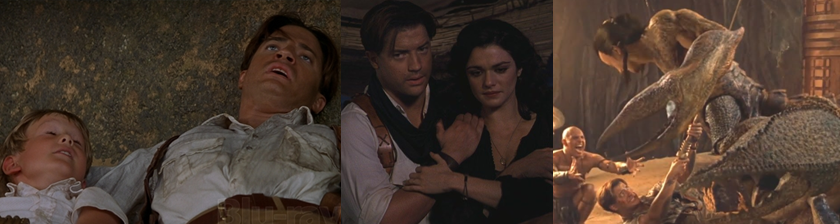
I miss Brendan Fraser; whatever happened to him? Arguably best known for his appearances in the Mummy trilogy (ibid/Cohen, 1999 to 2008), in which he portrayed a quick-witted and capable Indiana Jones-style adventurer, Fraser’s Rick O’Connell undergoes an interesting character arc throughout the trilogy, beginning as a disillusioned soldier and transforming from a reluctant hero motivated only by his libido to a doting father and content family man who was happy to put his adventuring days behind him. In The Mummy Returns, Rick is mortified when Imhotep’s (Arnold Vosloo) minions kidnap his smart-alecky little git of a son, Alex (Freddie Boath), and relentlessly uses every resource at his command to track Imhotep across the globe to rescue his son. Encouraging of the boy’s mischievous nature, one could argue that Alex only gets himself into a position to be kidnapped thanks to his father’s influence and their relationship has soured somewhat by the start of the third movie but that doesn’t take away from the fact that Rick travels across the world braving sea, air, and all manner of mummified atrocities to rescue his boy. When his beloved Evelyn (Rachel Weisz) is temporarily killed, we see a heartbreaking vulnerability to Rick’s usual bravado and his first action is to shield Alex from watching his mother suffer and die. Fuelled by rage and vengeance, he then takes on a now-mortal Imhotep in a fist-fight and rapidly accepts his destiny as a Medjai to deliver a killing blow to the monstrous Scorpion King (The Rock) to not only avenge his fallen wife but also as payback for putting his son in danger.

7 John McClane – Die Hard 4.0 (Wiseman, 2007)

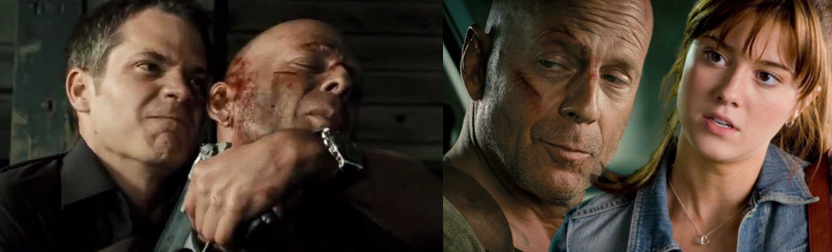
In my experience, Die Hard 4.0 (also known by the far better title, Live Free or Die Hard) is generally not as highly regarded as its predecessors and I will always take issue with this; sure, it’s massively over the top and essentially turns the wise-cracking John McClane (Bruce Willis) into a superhero but that doesn’t make it bad. For me, it’s easily in the top three of the Die Hard films (Various, 1988 to 2013) thanks to Willis’ portrayal of McClane as weary, out of touch, and hiding a lot of his emotions behind a snarky attitude and grouchy demeanour. Now, to be fair, McClane doesn’t start the film as the greatest father; his daughter, Lucy (the always appealing Mary Elizabeth Winstead) is initially hostile towards him, refusing to call him “Dad” and preferring to take her mother’s last name. However, when she is kidnapped by Thomas Gabriel (Timothy Olyphant) as payback for McClane interfering in his “fire sale”, McClane doesn’t hesitate to throw himself into danger to rescue her, accumulating numerous injuries, enduring shots from a F-35B Lightning II, and even shooting himself in the shoulder at point-blank range to kill Gabriel. When taken by Gabriel, Lucy not only fights back at every opportunity but knows full well that her father will stop at nothing to rescue her, defiantly taking his last name and ultimately reconciling with him after seeing the lengths he would go to for her safety.

6 Darren McCord – Sudden Death (Hyams, 1995)

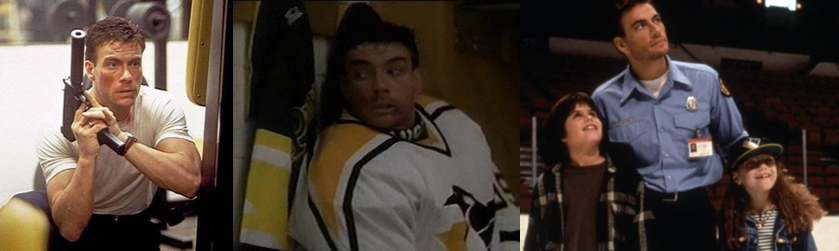
I feel like people don’t talk about Sudden Death enough; sure, it’s just “Die Hard on a boat” but it’s pretty decent for the most part, even with Jean-Claude Van Damme’s characteristically awkward acting and line delivery. McCord is very much like McClane, being a normal, average fire-fighter-turned-fire-inspector who has the odds against him. Though he’s much less cynical and grouchy compared to McClane, he is tormented by his failure to save a young girl from a house fire and has an extremely strained relationship with his ex wife. Similar to McClane, McCord’s relationship with his kids is a little shaky at the start of the film; Emily (Whittni Wright) views him with a heroic awe, believing him to still be a fire-fighter, while Tyler (Ross Malinger) is slightly more antagonistic and resentful. Still, he does obediently stay in his seat even as the hockey arena falls into chaos around him and Emily bravely stands up to terrorist Joshua Foss (Powers Boothe) after she is kidnapped, never faltering in her belief that her father will come to rescue her. For his part, McCord is slightly irresponsible as he leaves his young kids alone at the hockey game but more than makes up for it by taking it upon himself to disarm as many of Foss’s bombs as he can and take out the terrorists with little more than his wits, ingenuity, and some impressive kicks.

5 Damon Macready / Big Daddy – Kick-Ass (Vaughn, 2010)

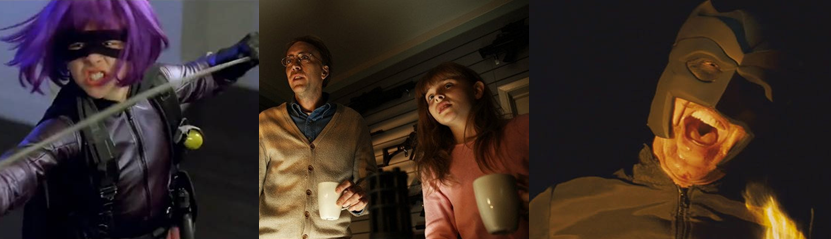
Although his look and the specifics of his motivations were wildly different from his comic book counterpart, Nicolas Cage really stole the show for this awesome adaptation of the comic book of the same name (Mark Millar, John Romita Jr, et al, 2008 to 2014). Channelling the spirit of Adam West while wearing a particularly Tim Burton-esque “Bat-Suit”, Cage channelled his usual manic energy into a far more nuanced, complex performance that showed Macready to be both slightly unhinged and eerily logical. To be fair, you could argue that Macready is a pretty awful father since he pulled his daughter, Mindy (Chloë Grace Moretz) out of school and trained her to be his crimefighting partner, Hit-Girl, causing her to be more interested in elaborate knives and skewering criminals than…whatever it is pre-teen girls are into these days. However, you’d be forgetting the fact that Macready is tough but fair on Mindy, always encouraging her and pushing her to test her limits. Thanks to his training, she’s fully capable of taking out entire rooms full of armed men with ease; not only that, he also does cool stuff like purchase a whole bunch of weapons, toys, and even a jetpack. When’s the last time your dad bought you a jet pack!? Plus, there’s the fact that he continues to encourage and help his daughter even while burning to death before her eyes.

4 Harry Tasker – True Lies (Cameron, 1994)

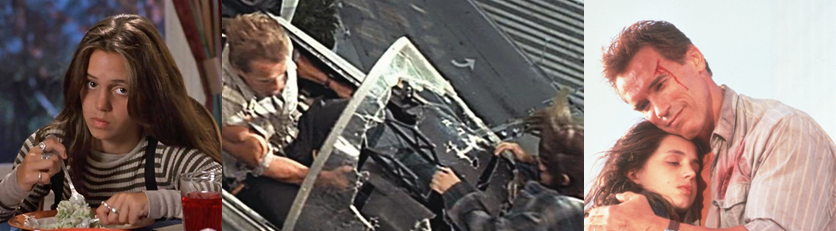
Arnold Schwarzenegger has a bit of an iffy record when it comes to portraying dads, as we’ll see; sometimes he’s the career-obsessed type, other times he’s the overly protective type. In True Lies, he lies to his wife, Helen (Jamie Lee Curtis) and daughter, Dana (Eliza Dushku), on a daily basis to keep his true identity as a secret agent just that: a secret. As a result, and because she’s in that moody teenage phase of her life, his relationship with Dana is somewhat strained at the start of the film in that she sees him as dull and unreliable, unappreciative of the token gifts he brings her, casually stealing from his partner, Albert Gibson (Tom Arnold), and running off with her boyfriend or to her room to escape from him. However, like her mother, Dana’s entire perception of Harry is changed after she is kidnapped by terrorist Salim Abu Aziz (Art Malik) and it is her unassuming father who comes to her rescue…in a Harrier Jump Jet, no less! What makes Harry a bad-ass dad is that, when the chips are down, he drops all pretenses and shows his family exactly what he is capable of, gunning down countless terrorists and flying through city airspace just to rescue his daughter and shouldering the burden of keeping his true life from them in order to protect them. Once the secret is out, though, his relationships with both alter dramatically and they become a much more stable, contented, and united family.

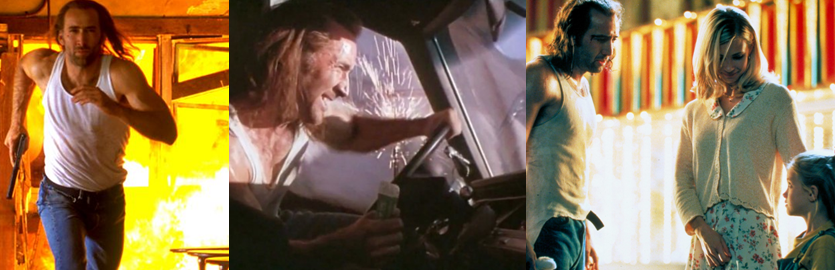
3 Cameron Poe – Con Air (West, 1997)

Aaah, yes, Con Air; a ridiculously over-the-top action film, to be sure, featuring Nicolas Cage not only with an absolutely gorgeous head of hair and henched up to the nines but also sporting possibly the worst Southern draw I’ve ever heard outside of The Fast and the Furious: Tokyo Drift (Morgan, 2006). Still, as ridiculous as Cage sounds (and as ludicrous as it is that his character, a decorated Army Ranger, would be sent to prison for ten years for what amounted to a clear case of self defense, at best, and manslaughter, at worst), the film is full of equally bombastic action and performances, with John Malkovich, especially, stealing the show (and, presumably, all that scenery he chewed) as the malicious Cyrus “The Virus” Grissom. Poe stands out from the other dads on this list as he doesn’t actually meet his daughter, Casey (Landry Allbright), until the film’s conclusion; however, through his numerous correspondences with Casey, he encourages her to stay in school and listen to her mother and builds the best, loving relationship he can given his position. His entire motivation throughout the film is to get back to his daughter and, while he’s tempted to simply let things play out in order to meet that goal, his morals won’t let him stand idly by and he fights through overwhelming odds and explosions galore to not only finally meet Casey but also to teach her valuable lessons about paying for your sins and standing up against injustice.

So, I said early that Schwarzenegger has a bit of an iffy reputation as a movie dad. Well, Commando, in addition to being, perhaps, the quintessential action movie of the eighties, also showcases Arnie as one of the most devoted and bad-ass dads ever put to film. A retired Colonel, Matrix (a gloriously ridiculous name if there ever was one) is perfectly content to have put down his guns and to live peacefully amidst nature with his young daughter, Jenny (Alyssa Milano). However, when Matrix’s past (or, more specifically, the fantastically sadistic Bennett (Vernon Wells)) catches up with him and Jenny is taken as a hostage, Matrix has only around twelve hours to track Bennett down to recover his daughter. Like Poe, Matrix’s entire motivation is geared towards rescuing Jenny but, while Poe (and many of the dads on this list), must use subterfuge to meet this end, Matrix instead literally moves Heaven and Earth to find Jenny, violently dispatching of all of Bennett’s henchmen and literally walking right into a camp full of seemingly-endless, fully armed soldiers, mowing them down with such reckless abandon that he barely needs to aim or reload. Witty, determined, and possessing a razor-sharp focus, Matrix is a veritable one-man army, capable of besting anyone who stands in his way, and yet still vulnerable and human enough to be injured when dramatically appropriate and fully prepared to go to any lengths to rescue her since, as he puts it: “All that matters to [him] now is Jenny”.

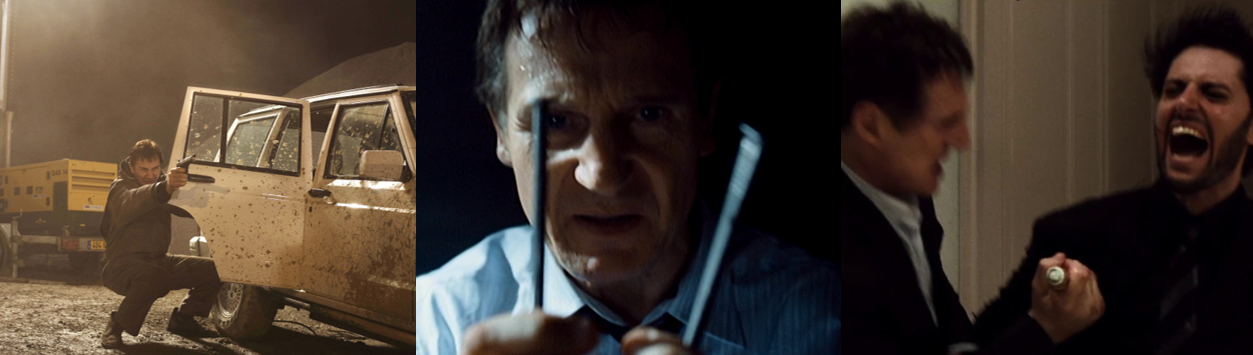
I mean, honestly, could it really be any other dad? Who else but Bryan Mills (Liam Neeson) could make the top of a list like this? Like a lot of the other dads I’ve talked about, Mills is a devoted father who has left behind a violent life to focus on building a relationship with his daughter (Kim (Maggie Grace), in this instance) despite having a frosty relationship with his ex-wife, Lenore Mills-St John (Famke Janssen). Having lost his marriage, and many years of bonding with Kim, due to his work as a “preventer” for the government, Mills is a loyal, if somewhat overprotective, father who just wants to be there for Kim and to encourage her dreams of being a singer. However, when she is taken by Albanian sex traffickers, Mills puts his unique set of skills to good use; like Matrix, his entire motivation revolves around finding his daughter but Mills has even less to go on and yet, within twenty-four hours, manages to track down enough of a lead to bring him within arm’s reach of Kim’s location. Along the way, Mills dispatches anyone who opposes him with a cold, calculating efficiency; age, clearly, hasn’t dwindled his skills or resources and, for the most part, he’s still able to function at peak efficiency with very little sleep or food. Of all the dad’s on this list, Mills is the most determined and competent; every movement is premeditated, meticulously thought through, and executed with alarming proficiency and yet Mills is still humble and vulnerable enough to show real pain, fatigue, and to deliver Kim back into the arms of her mother and stepfather.

Do you agree with my list? Perhaps you have another favourite movie dad who you think should have made the cut; if so, who is it and who are some of your favourite (or least favourite) movie dads? What are you doing this year for Father’s Day? Do you have any particularly fond memories of your dad? If so, feel free to share them, and any other comments, below.

Back Issues [Sonic Month]: Sonic the Hedgehog (US Promo Comic)


Sonic the Hedgehog was first introduced to gamers worldwide on 23 June 1991 and, since then, has become not only SEGA’s most enduring and popular character but also a beloved videogame icon. Since the Blue Blur turned thirty this year, I have been dedicating every Friday to SEGA’s supersonic mascot.


Story Title: Sonic the Hedgehog
Published: Fall 1991
Writer: Francis Mao
Artist: Francis Mao

The Background:
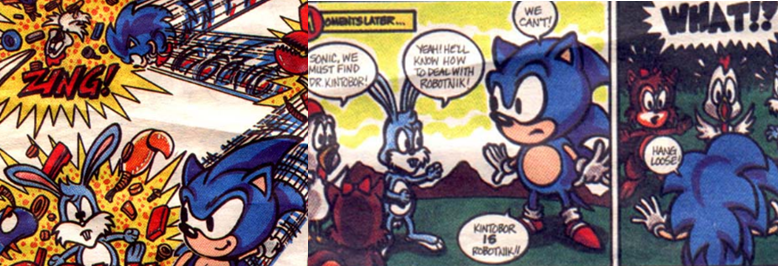
So, I mentioned previously that, during the development and marketing of Sonic the Hedgehog (Sonic Team, 1991) for a wider audience outside of its native Japan, Sonic’s design and lore underwent significant alterations. In Japan, Sonic originally had a human girlfriend and battled Doctor Eggman in a wacky fantasy world that was an alternative version of ours openly populated by humans and anthropomorphic animals. However, for Sonic’s American debut, the character was redesigned from a sleek, aerodynamic character and into a Mohawk-sporting superhero who lived on the alien world Mobius and fought with Doctor Ivo Robotnik, who was once the kindly scientist Doctor Ovi Kintobor. This story, which was only briefly reflected in the game’s manual and had pretty much no representation in the videogame, became a prominent and influential part of Sonic’s canon outside of Japan thanks to it featuring in a variety of media. Most notably, the story was told in great detail in Stay Sonic (Mike Pattenden, 1993), formed the basis of Sonic the Comic’s (1993 to 2002) lore, but it first featured in a promotional comic book released in the United States in autumn of 1993. The comic had a very limited run and is now extremely rare, so the only way to read this time capsule of a vastly different and conflicting time in Sonic’s life is by use of online scans.

The Review:
“Sonic the Hedgehog” beings in medias res with SEGA’s super-speedy mascot racing through the Green Hill Zone and being chased by Dr. Robotnik (who is piloting his wrecking ball Egg-O-Matic and being flanked by a variety of Badniks). The narration box provides a brief bit of context to establish where we are and what’s going on: this is, of course, the planet Mobius, which was once a peaceful and fun place to live before the evil Dr. Robotnik began his attempt to take the planet over and the only one who can stop his the “short, blue, super-fast, and radically cool” Sonic the Hedgehog.

Sonic rescues his animal friends and drops a bombshell regarding their friend, Dr. Kintobor…

After outrunning Robotnik, Sonic makes short work of his mechanical Badniks, freeing his animal friends in the process. However, he gets distracted and, thanks to a crumbling cliff side, plummets to a spiky death! Thankfully, Johnny Lightfoot (one of the aforementioned animal friends) pushes a swinging platform into Sonic’s path and save him from an unfortunate end. Panicked by the appearance of Dr. Robotnik, Sonic’s animal friends suggest they ask Dr. Kintobor for help and Sonic breaks the news that Robotnik is Kintobor and reveals not just Robotnik’s origin story but his (Sonic’s) as well.

Kintobor wishes to drain Mobius of all negative energy using six special Emeralds.

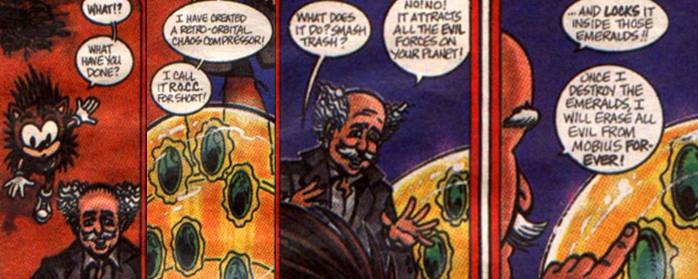
The story the flashes back to show Sonic, then a brown, far less aerodynamic character, stumbling upon the laboratory of the kindly Dr. Kintobor. Kintobor (who is modelled directly on Albert Einstein), an absent-minded but kind-hearted scientist, has created a machine called the Retro-Orbital Chaos Compressor (or R.O.C.C. for short). Inside of the R.O.C.C. are six orbs that Kintobor calls “Emeralds”; Kintobor’s machine is (…somehow) able to channel all the evil forces from the planet and lock them into these Emeralds, with the Doctor’s end goal being the complete removal of negativity from the planet. However, he is unable to achieve this goal without a Grey Emerald, which would neutralise the evil energy and stabilise the Emeralds.

Sonic undergoes a startling and dynamic transformation after breaking the sound barrier…

Upon seeing Sonic, Kintobor is shocked and intrigued (apparently he never noticed in all this time that Mobius was home to anthropomorphic animals…) and he begins to help Sonic develop his super-speed using a supersonic treadmill. During one of these experiments, Sonic breaks the sound barrier, destroying the treadmill and being physically altered into his more recognisable blue form thanks to “the cobalt effect”; Kintobor also gifts Sonic with his iconic red sneakers after his battered old trainers get wrecked.

Kintobor is bombarded with evil energy and becomes the maniacal Dr. Robotnik!

Things take a turn for the worst, however, when Kintobor accidentally spills a soda onto the R.O.C.C.’s main control console, causing a massive explosion; in the process, the “containment Rings” that were inside the R.O.C.C. were scattered across the planet and Kintobor was bombarded with “over 10,000 volts of pure evil energy”. This, combined with the hardboiled egg Kintobor was holding, transformed him into the egg-shaped madman Dr. Robotnik, a literal inversion of his former self.

Sonic randomly acquires a Chaos Emerald while escaping from Robotnik’s traps…

Sonic reveals to his friends that he has set out to collect all of the scattered Golden Rings in order to rebuild the R.O.C.C. and reverse the process…while also vowing to oppose and defeat Robotnik. To that end, he randomly races off and comes across Robotnik but blunders straight into an ambush of Badniks. In a mad dash to escape, he tumbles into the Labyrinth Zone and barely avoids being scorched alive and drowning but, in the process, randomly finds one of the Chaos Emeralds (I guess this comic is based more on the Master System version of the game…)

Although Robotnik escapes with the Emerald, Sonic vows to continue opposing his threat!

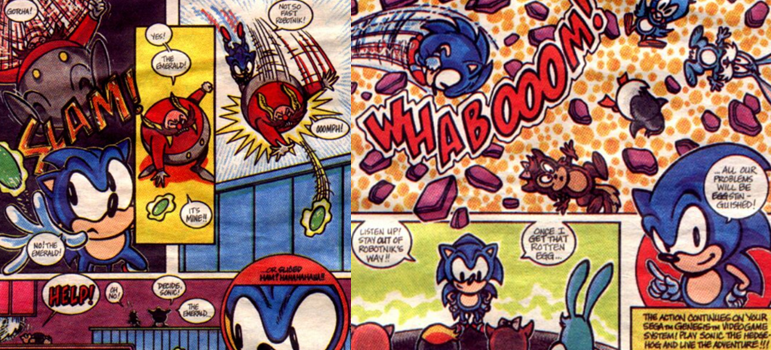
Emerging from the water, Sonic chases Dr. Robotnik through what appears to be the Marble Zone and the dastardly doctor manages to slow Sonic down by having him race through the Starlight Zone. Sonic, however, is easily able to avoid Robotnik’s traps and Badniks and finally confronts Robotnik in his “secret lab” (clearly the Scrap Brain Zone). There, he finds another of his animal friends, Porker Lewis, bound and tied to a conveyor belt and facing certain death. This distraction allows Robotnik to literally get the drop on Sonic and cause him to drop the Chaos Emerald; Robotnik then presents Sonic with a choice: save his friend or retrieve the Chaos Emerald! Sonic opts to save Porker, allowing Robotnik to take the Chaos Emerald for himself and make a hasty retreat, vowing to rule the world in due time. It’s not a completely sour ending, though, as Sonic summarily destroys Robotnik’s Badnik Transforming Machine and frees even more of his animal friends and swears to end Robotnik’s threat over the course of the Mega Drive videogame.

The Summary:
Being a fifteen page promotional piece, there’s not really a lot going for “Sonic the Hedgehog”; unlike its Japanese counterpart, the art isn’t as appealing, the story isn’t as fun and exciting, and the dialogue is nowhere near as quirky and unique. A lot of SEGA’s promotional media at the time was focused (obsessed, you might say) with characterising Sonic as this cool, edgy, radical surfer-dude so his dialogue hasn’t exactly aged well when looking back at adaptations of this time.

Some of the game’s Zones and gimmicks are briefly featured in the story.

Still, the comic does a decent job of adapting the gameplay mechanics and features of the videogames; it doesn’t showcase every Zone from the game and is largely focused on Green Hill Zone more than the others but it does include things like the crumbling cliffs, spike pits, swings, and the various hazards of the other Zones that briefly feature in the games. There’s a sense that anyone reading this would get a small head’s up on what to expect when playing Sonic for the first time and the objectives of the game are spelled out pretty clearly in the comic’s narrative: Collect Golden Rings to save the planet and smash Badniks to free woodland critters.

The Kintobor origin became accepted canon in many of Sonic’s multimedia ventures.

The biggest contribution “Sonic the Hedgehog” makes is, of course, the popularisation and depiction of Sonic and Robotnik’s American origin. Rather than the two simply being who they are, they undergo separate transformations (one into a super-fast superhero and the other into a crazed madman) that have more in common with traditional superhero origin stories than the simple plot of environmentalism that is prevalent in the videogames. The idea that Sonic and Robotnik were once friends adds an interesting wrinkle to the plot but, honestly, this concept rarely, if ever, impacted subsequent continuations of this narrative. Even in Sonic the Comic, which revisited Kintobor on more than one occasion, had Sonic more determined to defeat Robotnik rather than turn him back into his former self and, since the transformation basically turned Kintobor into an entirely different, deranged individual, this previous relationship wasn’t ever really used by Robotnik as a means to goad Sonic and considering that it was never mentioned in the games or the manuals it really does make me wonder why they ever bothered to come up with such a convoluted way to explain why an anthropomorphic hedgehog has super speed and is collecting Golden Rings and smashing robots.

It’s an interesting, if outdated, piece of obscure Sonic merchandise, if nothing else…

If you’re unfamiliar with Sonic’s previous lore or in need to a jolt of nostalgia, I’d say it’s worth giving “Sonic the Hedgehog” a quick read, if only to scratch that itch and to satisfy a curiosity for one of the franchise’s rarer materials. Still, as much as I loved Sonic the Comic, I never really cared for the whole Kintobor/R.O.C.C. origin story and feel that it didn’t really add anything to the videogames. Add to that the fact that the comic doesn’t really showcase much of the source material beyond the basic concept and the Green Hill Zone and you have a disappointingly barebones piece of media designed specifically to tantalise children with bright colours and quirky characters and to help sell the videogame, which is fine but the manga proved that there are ways of creating a piece of shameless promotion and still producing an entertaining comic at the same time.

My Rating:

Rating: 1 out of 5.

Terrible

Have you ever come across the Sonic the Hedgehog promotional comic online, or perhaps out in the wild? Maybe you own a copy; if so, how did you get it and what is the condition like? What did you think to it as a reflection on Sonic’s lore at the time? Were you a fan of the Kintobor origin or do you, like me, find it a bit of an unnecessary addition to the story? Which Sonic canon did you go up with and are there any unused aspects of Sonic’s long and complex story that you’d like to see make a return? Share your thoughts in the comments below and be sure to check back in next week for even more Sonic content!

Here There Be

For the children, Haverhill was just their normal, boring hometown: quiet, unassuming, and living in the shadow of other places nearby.

As winter fell, bathing the town in frost and snow, an ominous, primeval shadow rose from the darkest parts of Haverhill.

Watching, lurking … grasping in ravenous fury.

When this nightmarish force takes their friend, dragging him to a cold, watery death, the children suddenly find themselves prey to a malevolent horror that has finally woken after centuries of slumber.

Movie Night [Captain Picard Day]: Star Trek: Nemesis


As amusing detail in the Star Trek: The Next Generation (1987 to 1994) episode “The Pegasus” (Burton, 1994) is that the crew and children of the U.S.S. Enterprise-D celebrate “Captain Picard Day” on Stardate 47457.1, which roughly translates to this day, the 16th of June. They do this by producing drawings, models, and paintings that the bewildered Captain Jean-Luc Picard (Patrick Stewart) must then judge. I, however, am using this as another good excuse to delve into some more Picard and Next Generation content.


Released: 13 December 2002
Director: Stuart Baird
Distributor: Paramount Pictures
Budget: $60 million
Stars: Patrick Stewart, Tom Hardy, Brent Spiner, Jonathan Frakes, and Marina Sirtis

The Plot:
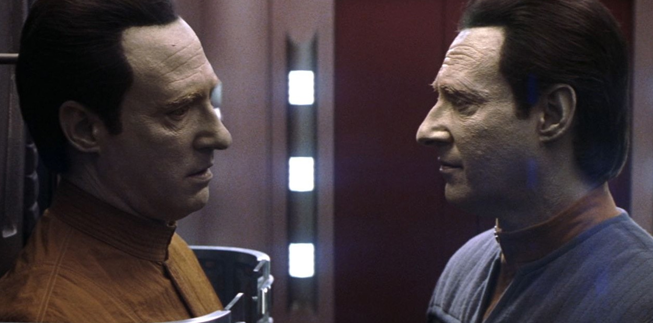
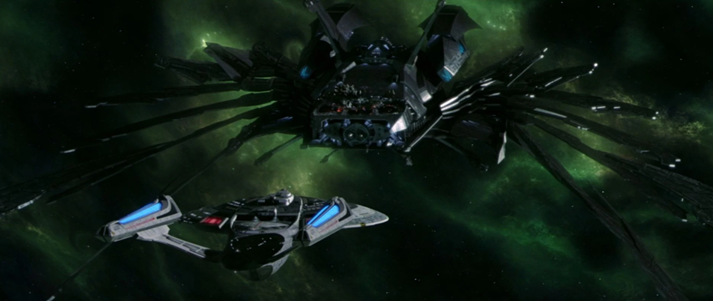
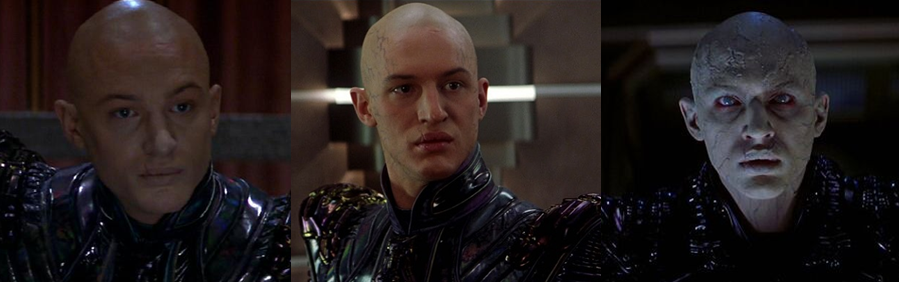
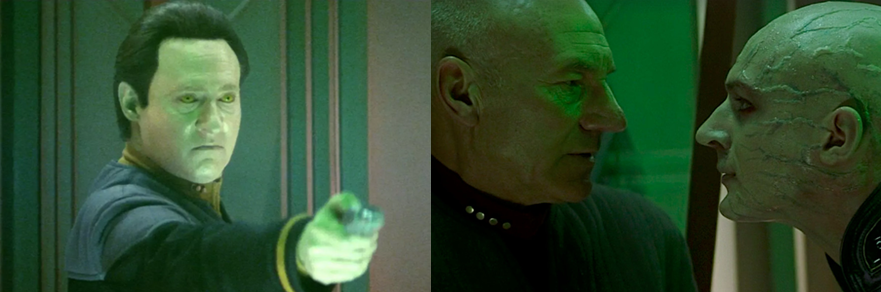
After locating an earlier version of Lieutenant Commander Data (Spiner), B-4, in Romulan space, the crew of the U.S.S. Enterprise-E soon discovers that the Romulan Empire has been taken over by Praetor Shinzon (Hardy), a young clone of Picard, who threatens to destroy both the Romulans and Starfleet with his highly advanced and unstable battleship, the Scimitar.

The Background:
Following the conclusion of the popular Star Trek: The Next Generation, the crew, like their predecessors, moved into a series of feature-length films. Although the much anticipated meeting between Captain Picard and Captain James T. Kirk (William Shatner) failed to really deliver on the potential of its premise, it performed decently at the box office. The sequel (and one of my favourite Star Trek movies), Star Trek: First Contact (Frakes, 1996) performed much better, beating its predecessor by some $30 million, but the follow-up, Star Trek: Insurrection (ibid, 1998) failed to exceed at the box office or impress critics. For the fourth Next Generation movie, long-term cast member and director Jonathan Frakes was replaced as director by Stuart Baird, who wasn’t too familiar with the long-running franchise. Indeed, after numerous scenes depicting more character-based moments ended up being cut from the finished film to focus on action and many cast members questioned Baird’s suitability as director. For a film that was supposed to be the grand finale of the Next Generation crew, Star Trek: Nemesis was a crushing financial disappointment at the box office, with critics, and even with its main star. The film’s paltry worldwide gross of just of $67 million made Star Trek: Nemesis not just a box office bomb but also the lowest-grossing Star Trek film to date; it also saw any plans for a follow-up to be cancelled, and led to a major reboot of the franchise in 2009.

The Review:
Star Trek: Nemesis begins without the usual Star Trek fanfare and drops us immediately into the political intrigue that forms the basis for the movie’s overall plot by opening with peace between Romulus and Remus being debated within the Romulan senate. Of course, this peace would be achieved through an imperial alliance under Praetor Shinzon that would allow the Romulan Empire to openly and directly oppose the might of the United Federation of Planets and, when the proposal is resoundingly rejected, the council is summarily executed. We then re-join the crew of the Enterprise-E at the long-awaited wedding between Commander William Riker (Frakes) and Counsellor Deanna Troi (Siritis), which also finally sees Riker being promoted to a position of captaincy and Data replacing him as Picard’s first officer. Picard’s best man speech is a particular highlight, emphasising his rapport with his crew and the central theme of the film: family. Picard sees his crew as family, his ship as home, out of both pride and necessity, since he is the last of his family line.

Data is shaken by B-4’s existence but attempts to help his brother realise his potential.

The wedding, of course, helpfully reunites the crew with Lieutenant Commander Worf (Michael Dorn), who picks up B-4’s positronic signal. The implications of such a signal intrigue Picard on Data’s behalf and (thanks to the ion storm of Kolarus III) gives him, Worf, and Data the perfect excuse to bust out a futuristic dune buggy. It’s not often we get so see wheeled vehicles in Star Trek so it’s a nice moment of levity for Picard, who begins the film in a far more jovial and mischievous mood than usual thanks to the wedding, and leads to a pretty decent, old-fashioned car chase and shoot out. Unlike Data and Lore, B-4 is an inquisitive, naïve, child-like being; a precursor to his big brothers, B-4 has the potential to be as advanced and evolved as Data but is limited by his less sophisticated technology and childish demeanour. His existence creates something of a crisis for Data, who begins to question his creation and life and the meaning of his own existence and raises interesting questions regarding our capacity for intelligence and how important experience and personality are to our development. The film briefly explores this by downloading Data’s memories and experiences into B-4 but it doesn’t immediately affect B-4 or allow him to evolve in the same way; for the most part, it seems to be a failure but, of course, by the end we’re left with the suggestion that B-4 could, in time come to be as advanced and experienced as his older brother.

The Scimitar is a forboding and intimidating warship that dwarfs the Enterprise-E.

Normally, it’s massively convenient that the Enterprise-E just happens to be the “closest ship” to the current crisis but, in this case, it actually does make sense since the ship was heading that way, drawn to nearby Romulan space by B-4’s signal, and it’s later revealed that the ship was specifically lured there by Shinzon. Shinzon is given quite a bit of build up prior to his actual appearance; as a Remun, a race bred to simply be cannon fodder and slaves for the Romulans, it is unusual that he has reached such a vaulted position but his threat is immediately established in the dramatic reveal of his supped-up warship, the Scimitar, and the monstrous appearance of his Reman viceroy (Ron Perlman).

Shinzon’s physical appearance degrades as his true twisted is revealed.

Shinzon’s reveal is a stunning blow to the crew but especially for Picard; in Shinzon, he sees himself as a younger man, the son he always yearned for and the life he could have had were he exposed to the same traumas and horrors as the Reman warrior. As if it wasn’t immediately clear, Shinzon is a clone of Picard, bred to be placed as a destructive mole within the Federation, and exists as Picard’s obvious dark opposite. The crux of the film, and Picard’s arc, is reconciling that Shinzon’s true nature has been twisted, skewed by his experiences; to begin with, he believes he has finally found the chance to nurture a son and continue his legacy but, very quickly and harshly, learns that Shinzon desires nothing but power, destruction, and vengeance upon not just his Romulan overlords but the Federation itself. Shinzon is a charismatic and alluring antagonist; eloquent and calculating, he is perfectly capable of subtle manipulation and subterfuge and aggressive, uncompromising fury. Immediately after his introduction, we see that he has no interest in peace; he is merely curious by Picard’s existence but determined to destroy his enemies, viewing the Romulans, the Federation, and especially Picard with disgust and hatred. This is an intriguing element and really throws Picard for a loop but it’s unfortunately very underdeveloped as, almost immediately, we learn that Shinzon is a destructive, aggressive force, resentful of Picard and his other enemies, so he may as well have been introduced as a villain right away rather than through half-hearted subterfuge.

The Nitty-Gritty:
I can understand why people disliked Star Trek: Nemesis; for me, the film’s glaring flaw is the pacing. The film is very short and wastes a lot of its potential; it’s not often we get to really peel back the layers of Picard’s officious and complex personality and seeing him vulnerable, somewhat helpless against his dark doppelgänger was genuinely intrigued…for all of ten minutes or so. Similar to Star Trek Generations, the film squanders its potential but, unlike that film (which is largely a snore-fest), Star Trek: Nemesis does, at least, have a lot of action sequences packed into its run time. I mentioned in my review of Star Trek: First Contact that one of the few flaws of that film is the lack of space-based combat and, while Star Trek: Nemesis doesn’t really have a space battle until the finale, it does include an entertaining chase sequence and a shoot out between Picard, Data, and the Remuns aboard the Scimitar.

Troi’s traumatic experience isn’t as big of a focus as you might expect.

Again, though, the bulk of the film’s focus is on Picard and Data; given the plot of the film, this isn’t entirely unsurprising but it is still a bit disappointing. Riker and Troi’s long-overdue wedding is a central focus of the early part of the film but, very quickly, Riker is pushed to the background as simply a voice of concern among Picard’s crew. Troi gets an interesting sub-plot where Shinzon, enamoured by her appearance, initiates a mental invasion of her mind via his viceroy that is a very blatant allegory for rape but, again, this is only briefly touched upon. Clearly Troi is affected by this experience and she does get to extract a measure of revenge against her tormentors, but she also disappears for a lot of the film between these two events. Similarly, Doctor Beverly Crusher (Gates McFadden) is barely in the film, Lieutenant Commander Geordi La Forge (LeVar Burton) exists mainly to debate the merits of B-4’s potential, and Worf doesn’t really get much of anything to do but man (Klingon?) the phaser banks.

While Picard exorcises his dark half, Data makes the ultimate sacrifice for his surrogate family.

As I mentioned, this isn’t entirely surprising and the film’s primary narratives revolving around Picard and Shinzon and Data and B-4 do go some way to making up for this. Picard is heartbroken and enraged at how selfish and disappointing his “son” is and the final confrontation with his doppelgänger is as much a fight for his (Picard’s) survival as it is against himself and the dark side that dwells deep beneath his morals and ethics. Similarly, Data is saddened by his younger brother, his childish nature, and his position as Shinzon’s slave. I mentioned earlier that family is a central theme of the film and that’s true; the idea is that the bond between a surrogate family of close friends and colleagues is just as strong as those between blood relatives. This is even reflected in Shinzon, who literally needs Picard’s blood to survive and who only truly confides and trusts in his viceroy, treating everyone else as disposable and expendable filth. In the end, both Picard and Data choose their surrogate family over their actual family, with Picard exorcising his dark half and Data willingly sacrificing his existence to ensure the survival of his family.

Nemesis explores Picard’s more vulnerable side but, sadly, fails to really capitalise on its potential.

Of course, this ending draws immediately and blatant parallels to the classic finale of Star Trek II: The Wrath of Khan (Meyer, 1982); while Data’s sacrifice kind of comes out of nowhere, so did Spock’s (Leonard Nimoy), if we’re being really honest, and both relate to the aforementioned themes of family and sacrifice that are prevalent in both movies. It’s a sudden and heart-breaking end to a beloved character but one, perhaps, long overdue since Spiner had desired to be killed off for some time. Like Spock, Data is able to create a kind of back-up or failsafe to ensure his legacy lives on, in some way, through B-4. The similarities don’t end there either, really: Shinzon is a more blatant dark mirror of Picard but Khan Noonien Singh (Ricardo Montalbán) was also a dark reflection of Kirk, his ship a dark opposite of the Enterprise, and his motivations similarly based on horrific experiences that he largely blamed his opposite for. It’s a deeply personal story for Picard, one that ties into themes that have brewing since, at least, Star Trek Generations and demonstrates that the difference between nature and nurture is often an extremely blurred line.

The Summery:
I can understand, to a degree, why Star Trek: Nemesis wasn’t received all too well but, honestly, I find it to be the second-best of the Next Generation films. It’s not a complete bore-fest like Star Trek Generations or Star Trek: Insurrection, featuring a lot more action and thought-provoking narrative elements but it’s still not quite on the same level as Star Trek: First Contact. Sadly, however, the film does squander a lot of its potential; the pace is very brisk and the film just doesn’t focus itself in the right ways. There’s a very intriguing story here, a deeply personal one, for the normally composed Picard but the potential of that story is thrown out the window all too fast as any question about Shinzon’s motivations is immediately rendered mute shortly after we’re introduced to him. Shinzon is, in many ways, a fascinating antagonist; he has every reason to hate his enemies and his motivations are as understandable as they are abhorrent but, sadly, not enough is done with the concept of him as Picard’s dark mirror. Still, I feel Star Trek: Nemesis is an underappreciated and overlooked film in the franchise; it’s worth a view for the potential of the Picard/Shinzon story and Data’s ultimate, poignant sacrifice alone and it’s easily the most aesthetically impressive of the Next Generation movies so I’d say it’s worth a bit more consideration that it got upon release.

My Rating:

Rating: 3 out of 5.

Pretty Good

What did you think to Star Trek: Nemesis? Where does it rank against the other Next Generation and Star Trek films for you? Do you agree that the film isn’t as bad as people made it out to be or do you think it deserves its negative reputation? What did you think to Shinzon and his position as Picard’s dark mirror, and to Data’s sacrifice? Do you think these elements were warranted or do you feel they were squandered? Would you like to see another go-around for the Next Generation crew or do you prefer to see new, unique takes on the franchise? How are you celebrating Captain Picard Day today? Whatever your thoughts on Star Trek: Nemesis, or Star Trek in general, go ahead and share them below.

Movie Night: Predator

Released: 12 June 1984
Director: John McTiernan
Distributor: 20th Century Fox
Budget: $15 to 18 million
Stars: Arnold Schwarzenegger, Carl Weathers, Bill Duke, Jesse Ventura, Sonny Landham, Shane Black, Richard Chaves, and Kevin Peter Hall

The Plot:
Major Alan “Dutch” Schafer (Schwarzenegger) and his crack rescue team are recruited by Dillon (Weathers), an old friend turned government operative, to rescue an important group of hostages from guerrilla forces in a Central American jungle. However, they soon find themselves being picked off one at a time by a mysterious extraterrestrial hunter (Hall) who kills for sport.

The Background:
After the release of Rocky IV (Stallone, 1985) there was a joke circulating around Hollywood that Rocky Balboa (Sylvester Stallone) had run out of earthly opponents and would have to fight an alien next time around. Writers Jim and John Thomas took this concept and expanded it into a screenplay initially titled Hunter that, after being bought by 20th Century Fox and placed into the hands of producer Joel Silver, was transformed from a pulp sci-fi tale into a big-budget action vehicle. Initially, the then-relatively-unknown Jean-Claude Van Damme was cast as the titular alien creature, which was originally conceived of as a more agile and bug-like monster; however, after Van Damme bowed out after issues with the original suit, the creature was redesigned by special effects legend Stan Winston (with some input from director James Cameron) to accommodate a new actor, the monolithic Kevin Peter Hall. Filming was rough for the cast and crew, many of whom became ill from food poisoning and the intense heat, and the lead actors (all big, beefy boys in their own right) became obsessed with working out and appearing in peak physical condition. Upon release, Predator was met with largely negative reviews; despite this, the film made nearly $100 million at the box office and quickly became a cult classic that is now regarded far more favourably. Of course, it also spawned an under-rated sequel and marked the beginning of a multimedia franchise that includes further sequels, videogames, and comic books. There were even crossovers with 20th Century Fox’s other sci-fi/horror franchise, the Alien saga (Various, 1979 to 2017), and a fan movement to declare June 12th as “Predator Day”; although this clashes with “Superman Day”, any excuse to revisit this franchise is a win for me.

The Review:
I know how it sounds but let’s not beat around the bush here: Predator is as much a man’s film as you can get! I say that having known plenty of girls who enjoy the film, and the franchise, but come on now, this is a film made for a very specific type of audience at a very specific time when films such as this were popular and the fact that it is so unapologetically hyper-masculine really plays into its strengths as an enjoyable sci-fi/action/horror romp that can be appreciated by anyone and everyone, regardless of gender identification. Right off the bat, Predator isn’t pulling any punches: first, we get the blatant shot of an alien craft shooting a capsule to Earth, then the manliest team of men who ever menned disembark a helicopter while Alan Silvestri’s fantastic, iconic score plays, and, finally, we get perhaps the single greatest interaction between two characters ever put to film as Dutch and Dillon reunite with the world’s most powerful handshake! The excess and testosterone is practically oozing out of the film at every moment but, perhaps, none more so than in these first ten minutes or so where we learn all we need to know about Dutch and his team: They’re the best at what they do but have certain principals, seeing themselves as “a rescue team, not assassins” and being suspicious of outsiders joining their party.

Predator showcased many different sides of Arnold’s range and charisma.

Though one of Arnold’s early roles, Dutch is a fantastic part for the Austrian Oak; rather than being a stoic and silent character, Dutch is confident and instantly likeable, with a playful sense of humour and camaraderie with this teammates. However, when on mission, Dutch is all business, exhibiting a keen sense of his surroundings, comprehensive knowledge of guerrilla tactics and survivalist skills, and a natural ability to adapt to any and all situations. We first see this when he provides a distraction by sending a truck careening into the guerrilla camp and, later, when he sets traps for the Predator and learns how to use mud to camouflage himself and put together a proactive plan to bring the fight to the alien hunter. Of course, while Dutch is a physically capable mountain of a man, he’s no one man army (well…he is but he’s part of a team so I have to talk about his team…); while you can make the argument that Predator’s characters are all largely interchangeable, with the majority of them being heavily-muscled, snarky brutes who attack with a cold, clinical efficiency, each of them has many opportunities to stand out and be a little more than a one-dimensional caricature despite the fact that we really know and learn next to nothing about them.

Mac is distraught and driven to mindless vengeance when his friend is killed.

Hawkins (Black), for example, is the awkward bookworm type, one of only two members of the team to sport a more slender physique, whose “thing” (beyond his ridiculous glasses) is trying to get Billy (Landham) to laugh with so-bad-they’re-good Dad jokes. Billy, in comparison, is the strong, silent type; introspective, with an aptitude for tracking, he is the first of the group to really sense that something otherworldly is afoot in the jungle. Superstitious and an appropriation of the Native American spiritualist, Billy believes that a spirit or some cursed demon is stalking the group yet, while he doesn’t rate their chances of survival, he never gives in to despair and is the first of team to confront the Predator head-on in single combat…with results so disastrous that they’re not seen onscreen. Easily the most amusing and memorable character, beyond Dutch and Dillon, is Blaine (Ventura), a gigantic, musclebound soldier who exudes a macho charm that is both endearing and entertaining. Oh, and, he’s also got a fuckin’ galting gun that he uses to mow down guerrillas with reckless abandon and shrugs off bullet wounds like they’re nothing! Blaine also stands out through his love of chewy tobacco, some fantastically memorable one-liners (his “sexual Tyrannosaurs” line is a personal favourite but who can forget “I ain’t got time to bleed!”, perhaps the most unforgettable line of the film) and his brotherly relationship with Mac (Duke). Mac’s “thing” is the little razor he uses to constantly shave sweat from his face and his friendship with Blaine; he’s the only one to refer to one of his team mates as a friend and he’s deeply affected by Blaine’s violent death. Mac is also the only one of the team to really crack under the pressure of the Predator’s assault; grief-stricken and hungry for revenge, he blindly rushes into the jungle to pursue the creature and tries to make good on his promise to avenge his fallen comrade. Of course, he is unsuccessful, mainly because he is so emotionally distraught that, despite being the first to really “see” the camouflaged Predator, he’s unable to think rationally enough to get the upper hand on the alien.

Poncho and Anna help flesh out the team and the world but are largely insignificant.

Perhaps the most underwhelming and easily forgotten member of the team is Poncho (Chaves); in fact, Poncho is so inconsequential that I’m also surprised that he manages to outlive Hawkins, who appears the least physically capable of the group. Poncho, instead, does very little beyond asking rhetorical questions, taking a log to the gut, and ultimately being killed by an unceremonious plasma blast to the head when the last few survivors are trying to escape. The team is also joined by Anna (Elpidia Carrillo), the last remaining hostage from the guerrilla camp; like Billy, she’s a quiet, superstitious, and perceptive character who believes that a devil is stalking them, having heard stories of similar events happening in the past. She adds very little to the team beyond being a hinderance and to add an extra layer of dread to the proceedings, especially when the Predator is still being hidden from view and is a mysterious presence, but she’s largely inoffensive. Best of all, there’s no awkward romantic subplot between her and Dutch; he orders her to “Get to dah choppah!!” the first chance he gets and is left to fend for himself, with no sexual distractions or damsels to rescue.

Dillon’s presence causes tension and his downfall comes from his wounded pride.

The wild card to the team is, of course, Dillon; numerous vague hints and references are made towards Dillon’s past and friendship with Dutch but, even with that in mind, Dutch is immediately suspicious of the mission when he is ordered to take Dillion, now a CIA operative, along with him. The rest of the team, particularly Mac, don’t care much for Dillon’s presence, seeing him as a liability to their operation, and these suspicions turn out to be well founded when it’s revealed that the team was drafted in to take out a group of terrorists rather than rescue hostages. This causes tensions within the group, who are already on edge thanks to the mysterious killer picking them off, but they are nevertheless forced to work together to try and corner the Predator. Dillon is the only one of the team that is unwilling to believe in a supernatural or extraterrestrial threat stalking them from the trees but, when the Predator is exposed, he willingly joins Mac in attempting to extract a measure of revenge against the alien for all the death and trouble it has caused him. For Dillon, it’s pride that causes his downfall; had he stayed with Dutch, he may have been in with a chance of surviving but, in the end, he’s dismembered and skewered with an effortless efficiency.

The Predator is initially kept well hidden and vague for maximum tension.

It is, perhaps unsurprisingly, the titular Predator who brings the most appeal and distinctiveness to the film; although we know that an alien presence is clearly stalking the team, we don’t get out first real look at it for a good hour or so and, even then, it’s a fleeting shot. Instead, we see through the Predator’s unique and costly thermal vision, watching as it pursues and observes its prey from the treetops and attempts to mimic their speech (a haunting feature, to be sure). When the Predator does appear, it’s little more than a pair of luminous glowing eyes and a vague, distorted shape and, despite almost the entire film taking place during the day, the creature is kept well hidden. We see glimpses of its blade, spend a lot of time watching its arms, legs, and torso as it ritualistically cleans up its gruesome trophies, and only get a good, lingering look at the creature when it follows Dutch into the water and its cloaking device is disrupted. The result is one of the most iconic alien designs of all time; rather than the bug-like creature that was the Predator’s original design or the animalistic nature of the Xenomorph, the Predator is a humanoid being made up of two arms, two legs, and sporting an impressive frame and physique. Garbed in light armour and sporting a vast array of weaponry (that ranges from low-tech but incredibly lethal wrist-mounted blades to the creature’s iconic plasma cannon), the Predator is instantly recognisable thanks, in large part, to its helmet and dreadlocks but also because of its monstrous crab-like visage and mandibles.

The Nitty-Gritty:
Take away the alien and Predator would be a largely forgettable, by-the-numbers action film about a troupe of crack soldiers fighting terrorists. The Predator, though, takes that concept and the film’s various clichés and completely flips them on their head; as soon as we first see the Predator’s thermal vision, and definitely after Hawkins’ brutally swift death, the film becomes something entirely different from a hyper-masculine action film. It transforms before your eyes into a survival/horror film against an alien presence that is far beyond that of man, changing from a routine mission to defend America’s freedoms to one about man’s battle for survival.

The film evolves from bombastic action to one man’s primal battle for survival.

Before we get to the point, it’s important to make mention of the wide variety of action scenes on offer in Predator: the film starts off relatively simple, with Dutch and his team gunning down the entire guerrilla camp with a clinical efficiency and a bevvy of one-liners, before escalating into a paranoid firefight into the dense jungle in a desperate attempt to kill whatever is responsible for the deaths of their team mates. When it becomes apparent that they’re facing something beyond their understanding, Dutch leads the survivors in setting up a series of low-tech traps, using survival tactics to create a perimeter to ensnare the creature so that they can get a clear shot at it. Though Dillon is sceptical, he helps with this task regardless and it works…until the full extent of the Predator’s capabilities quickly render all their planning mute. Dutch, however, continues to employ these same tactics out of desperation and necessity more than anything else when he’s left the sole survivor; he loses his gun and is left with only a handful of shells and melee weapons with which to make his final stand. He does this through simple guerrilla strategies, using mud to mask his heat signature after a close call with the Predator and then fashioning a bow, a series of explosive arrows, and a number of deadly traps with which to enact his last, desperate stand against the creature. In this sequence, the film’s title takes on a double meaning as Dutch becomes both predator and prey, turning the Predator’s weapons and technology against it to draw it out into the open for a more even fight.

Despite the Predator’s superior strength, Dutch triumphs through his wiles.

While the sequels and extended media would, of course, greatly expand upon the Predator’s society and culture, there’s enough evidence towards the race’s ethos in this first movie: the Predator only attacks those who are armed and that it deems worthy prey (with the exception of Hawkins and Poncho, who were largely defenceless…), methodically stalks its victims from afar to ascertain their strengths and weaknesses, and makes trophies out of the skulls of those it kills. With its cloaking device compromised and faced with an enduring, persistent, and adaptable foe, the Predator chooses to ditch its signature plasma cannon to engage Dutch in a one-on-one fight, even hampering its vision by removing its helmet. Of course, the fight is anything but fair since the Predator is inhumanly strong; I watched a lot (basically all) of Arnold’s films as a kid and it was massively impressive to see a foe not only tower over him but also lift him up by one hand and beat him to near death. In the end, of course, Dutch is able to outsmart the Predator and lure it into a fatal trap; mortally wounded and defeated, the Predator chooses to activate a devesting self-destruct device in an attempt to take Dutch with it but, just as Dutch casually shrugged off a plasma blast early, no small-scale nuclear blast is enough to put down Arnold and he manages to outrun and avoid the blast but is left clearly affected, traumatised even, by his encounter with the creature and the Predator’s systematic slaughter of his friends and comrades.

The Summary:
To me, Predator will always be a near-peerless classic; everything about the film, from start to finish, is so gloriously over the top and entertaining that it never fails to be an enjoyable sci-fi/horror romp. Endlessly quotable and immensely fun, Predator is a fantastic film to throw on with a group of friends with some pizza and a few drinks and just have an unapologetic good time. I regard Predator as one of Arnold’s best films since it was a role with some real meat to it that really showcased his charisma and what he was capable of as a subtly complex action hero: Dutch isn’t just some muscle-bound meathead; he’s intelligent, experienced, and highly adaptable while also being charismatic, well-respected, and tough as nails at the same time. The film is full of testosterone and ridiculously macho characters yet, despite this, they’re all really endearing and likeable; there’s a real sense of camaraderie amongst the team, who all work together as a unit, and even the tension and suspicion regarding Dillon is largely a non-factor in the face of their struggle against a greater, common enemy. The titular Predator is a fantastically unique creature; here, it and its culture are, largely, a mystery and a lot of what we learn about it comes from inference and speculation, all of which adds to the otherworldly nature and appeal of the alien, to say nothing of its horrific appearance and impressive weaponry and physical skill, and I will always have time for Predator and the Predator concept because of this.

My Rating:

Rating: 5 out of 5.

Fantastic

So, tell me, what did you think to Predator? Did you see the film in the cinema back when it first came out and, if so, what did you think of it at the time and how do you think it holds up today? Which of the film’s characters did you like the most, or the least, and why and did you enjoy the film’s excessive machismo? What did you think to the Predator and its design and weaponry and how differently do you think the film would have turned out if Van Damme had remained in the role? Which of the Predator sequels and merchandise was your favourite and did you celebrate Predator Day this year? If you’re a girl and you enjoy Predator and over-the-top action films, chime in with your thoughts about how any one can enjoy these films but, either way, do please leave a comment below sharing your thoughts and opinions on Predator.

Back Issues [Superman Day]: Action Comics #1


In 2013, DC Comics declared the 12th of June as “Superman Day”, a day for fans of the Man of Steel the world over to celebrate Clark Kent/Kal-El/Superman, the superpowered virtue of “Truth, Justice, and the American Way” who is widely regarded as the first ever costumed superhero.


Story Title: “Superman”
Published: 18 April 1938 (cover-dated June 1938)
Writer: Jerry Siegel (credited as “Jerome Siegel”)
Artist: Joe Shuster

The Background:
Jerry Siegel and Joe Shuster, both sons of Jewish immigrants, first met in 1932 while attending Glenville High School; by the time they were both sixteen, the two were already accomplished comics creators and, in 1933, they thought up their first concept for a superman with the story “The Reign of the Super-Man”. This story depicted a bald mad scientist (very much a prototype for Superman’s arch nemesis, Lex Luthor) attempt to dominate others with his telepathic powers; later, the two would revisit and dramatically retool this concept into the world’s first super-powered crimefighter. Considering the massive success Superman has become as a character and a brand, it took some time for Siegel and Shuster to sell their revised concept, which took inspiration from mythological figures such as Hercules, fictional adventurers like Robin Hood and Zorro, and even circus strongmen for the character’s now-iconic costume. Yet, when DC Comics eventually purchased the character for publication, the two were paid a pittance for the now globally renowned superhero. Legal issues and disputes would follow the character for many decades before DC were able to iron out a mutually beneficial agreement with Siegel and Shuster’s heirs and allow them to be more fairly compensated for depictions of perhaps the most influential fictional character in American history.

The Review:
Action Comics #1 presents a much different version of Superman, one who might seem far removed from the virtual demigod we know and love today; back in 1938, for the Man of Steel’s iconic debut, Superman was still very much superhuman but he had yet to develop many of the powers and abilities he is now known for, much less the crazy, over-the-top powers he would later possess throughout later decades. The story begins by detailing Superman’s memorable origin…by summing it up in one simple panel. Yep, Superman’s home world (not yet identified as “Krypton”) is “destroyed by old age” in the comic’s opening panel and the future Superman’s rocket is discovered by a passing motorist in the next. Unlike traditional depictions of Superman’s origin, the alien infant within is immediately handed over to an orphanage where the attendants were “astounded at his feats of strength”. The next few panels quickly showcase the range of Clark Kent’s (his name comes out of nowhere a few panels later with no explanation) superhuman abilities: he can easily leap over a twenty-story building, lift incredible weight, run faster than an express train, and possesses impenetrable skin. Rather than explain his abilities as the result of Earth’s yellow sun or the differences in atmosphere between Earth and Krypton, the comic explains that the inhabitants of Kent’s home world had evolved a “physical structure millions of years advanced of our own” and compares them to the abilities of insects to lift incredible weights and leap vast distances.  

There are many convenient excuses to show off Superman’s awesome powers in the story.

Rather than being taught values and morals by loving, doting parents, Clark simply decides, off panel, to put his fantastic abilities to good use and crafts the persona of Superman, “champion of the oppressed [and] physical marvel]”. Superman is then introduced racing through the night with a bound and gagged woman, with no context or explanation; he can’t fly yet so he just runs at super speed to “the governor’s estate”, barging his way in and forcing his way past the governor’s butler with an uncharacteristic discourtesy. The butler is aghast when Superman easily dismantles the door to the governor’s “sleeping room” which, for some reason, is made out of solid steel! Superman explains to the governor that he has a signed confession that proves one Evelyn Curry is innocent of murder but, before the governor can properly digest this information, his butler confronts the costumed intruder with a pistol. Superman, however, easily shrugs off the bullet and disarms the man. With time fast running out, Superman convinces the governor to make the life-saving call and leaves the real culprit (the woman he was carrying in his first panel) in the custody of the governor. The next day, Kent is pleased to see that his actions, as Superman, have made the front page of the Daily Planet Star and the governor is left feeling eternally grateful that Superman is on their side…and well he should be given Superman’s blunt and direct approach to the fight against injustice.

Clark keeps up his façade as a weakling, much to Lois’s continued disgust.

Kent then meets with the unnamed chief editor of the Daily Star, who orders him the assignment of covering the mysterious Superman who has been making so many headlines. While it might seem like Kent has walked in off the street, the next panel seemed to prove that he does, in fact, work for the paper as he is informed by a co-worker of a wife-beating taking place (seems like an odd thing for a paper to be tipped off about but I didn’t live in the 1930s so maybe this was a thing…?) Superman immediately rushes over to the scene of the crime and makes the abuser pay by shoving him violently into a wall, breaking his knife on his impenetrable skin, and threatening the man so fully that he faints in his arms. Superman then quickly changes back into his civilian guise to explain the situation to a policeman, making sure to attribute the woman’s rescue to his super-powered alter ego. Later, Clark works up the courage to ask his co-worker, Lois (no last name yet), out on a date and she decides to “give him a break…for a change”. This, and the next panel, quickly summarises that Lois tends to avoid Clark and give him the run around in the office as, when he asks why she treats him so unfairly, she simply scoffs: “I’ve been scribbling “sob stories” all day long. Don’t ask me to dish out another”. When Butch Matson, a local tough or possibly a mobster, decides to impress his gang of apes by cutting in on Lois and Clark, Lois reveals the truth about why she avoids Clark: she sees him as nothing more than a “spineless, unbearable coward!”

Superman easily catches up to and destroys Butch’s car in an iconic visual.

Of course, during Clark’s confrontation with Butch, the narration boxes and Clark’s thought balloons briefly gloss over the fact that Clark merely pretends to be a “weakling” to keep his secret identity…well…a secret, which is another pivotal aspect of the character that would be explored further in later Superman stories. Lois leaves in a huff and her taxi is soon forced off the road by Butch’s car; in what would quickly become a recurring tradition, Lois is kidnapped by Butch and his gang for little other reason than he took a liking to her, felt slighted by her rejection, and apparently has plans on raping her. Clark, as Superman, had been observing the whole thing from a distance and puts the wind up Butch and his cronies by first leaping over their speeding vehicle, then catching up to it, shaking them all out, and finally smashing it to pieces on a nearby rocky hill.

You’ll have to read the next issue to find out what the hell Superman is doing!

Superman teaches Butch a further lesson by leaving him stranded high up on a telephone pole before racing Lois, who is struck with fear and awe at his presence, to safety. Against Superman’s wishes for anonymity, Lois tries to tell her editor about her ordeal but he dismisses her story as ravings (which is really strange as the other day he was desperate for the scoop on Superman!) Anyway, Kent’s editor sends him to San Monte to cover an escalating conflict but, similar to when he was given the Superman assignment, Clark immediately disobeys this directive and, instead, takes a train to Washington, D.C. to investigate Senator Barrows. Clark snaps a picture of Barrows talking with a man whom the local newspaper identifies as Alex Greer, “the slickest lobbyist in Washington”. His unfounded and unexplained suspicions about the senator aroused, Superman climbs up to Barrows’ residence (the visual of him clambering up a building like Peter Parker/Spider-Man is both amusing and bizarre) and discovers the senator and Greer are in cahoots to get a seemingly innocent bill passed that will see America “embroiled with Europe” before anyone even knows what’s happened. Superman immediately confronts Greer and demands answers, taking him out onto the telephone wires high above the city and taunting the crook him with the threat of electrocution. He then leaps over to the White House to put the wind up Greer and the issue ends with a cliffhanger as Superman continues his intimidation of his victim by, apparently, unsuccessfully making the leap to a nearby skyscraper.

The Summary:
“Superman” is, honestly,  a dreadful story in terms of its pacing and narrative; very little time is spent explaining much of anything, with Superman’s alien origins completely glossed over and readers being forced to infer everything through context. We’re never told that Clark works as a reporter for the Daily Star, we just have to get that he is through inference; Superman races around with a bound woman and barges into homes without provocation and we only find out why after the fact; and God only knows why he pursues Senator Barrows rather than attempting to intervene in the San Monte conflict. But…it’s Action Comics #1, the first ever appearance of the greatest and most recognisable superhero the world has ever known, so I have to recommend that you read it if only for the purposes of witnessing history but, if I’m being brutally honest, the story isn’t really that great beyond the introduction of such an iconic character.

Whether by coincidence or design, Superman primarily saves women from abuse and persecution.

The entire story hinges on the colourful and extraordinary character of Superman himself; an enigma capable of incredible superhuman feats, Superman is visually and imaginatively appealing, I’ll admit. He has no time for decorum or adhering to the rules of the system; he simply strikes back at injustice no matter how trivial it may seem. To Superman, the life of an innocent woman is just as important as the torment of a victim of abuse and he tackles both with the same brute efficiency, utilising his fantastic strength and unmatched physical abilities to dominate the corrupt and the wicked. It’s interesting that pretty much everyone Superman saves in the story is a woman, with each of them being powerless victims of male oppressors, making Superman the paragon of virtue and honour as much as justice.

Superman’s more recognisable elements wouldn’t appear for some time…

As Superman’s first ever story, and a product of its time, a lot of forgiveness and leeway needs to be given to Action Comics #1. Many of Superman’s more recognisable and traditional elements wouldn’t be introduced for some time so, in that regard, the story is a little alienating to those who’ve only ever known him as the flying, all-powerful demigod with a colourful rogues gallery and fully developed supporting cast. Indeed, the seeds for Superman’s more critically regarded aspects are there, they’re just glossed over or barely touched upon: Superman’s status as the most powerful immigrant, for example, and his adoption of a meek alter ego in a reflection of his views on humankind are seen very briefly but the story is more focused on the wish fulfilment of a colourfully-garbed super man shrugging off bullets, smashing up vehicles, and teaching good-for-nothings a much needed lesson.

Make no mistake, Lois was a despiable character here and for many, many years.

Similarly, the story introduces the idea of tension and friction between Clark and Lois. I’ve always hated the early characterisation of Lois Lane and never understood what Clark ever saw in her or why she was deemed worthy enough to carry her own comic title; she was a snobby, condescending, annoying woman who constantly berated Clark and was obsessed (obsessed!) with marrying Superman for no other reason than she wanted him and she was a far cry from the strong-willed, independent, snarky, and yet actually likeable and supportive character she is often depicted as these days. Interestingly, Lois reacts to Superman more with fright than the fanatical wonder she was known for for many decades and isn’t shown to prefer Superman over Clark in this story but her bitchy attitude towards Clark is well and truly intact, though it’s just a hint towards the despicable character she would eventually become.

My Rating:

Rating: 2 out of 5.

Could Be Better

Have you ever read Action Comics #1; if so, what did you think of it and Superman’s debut? Were you surprised at how underdeveloped Superman’s origin and powers are in his debut issue or do you feel the focus on the action and spectacle of Superman justifies the brevity of its narrative? Do you prefer Superman as a more grounded, less elaborate superhero or do you prefer him as an all-powerful character? Which of Superman’s later, wackier powers and stories was your favourite? What is your favourite Superman story, character, or piece of media? How are you celebrating Superman Day today? Whatever you think, feel free to share your opinion and thoughts on Superman in the comments below.
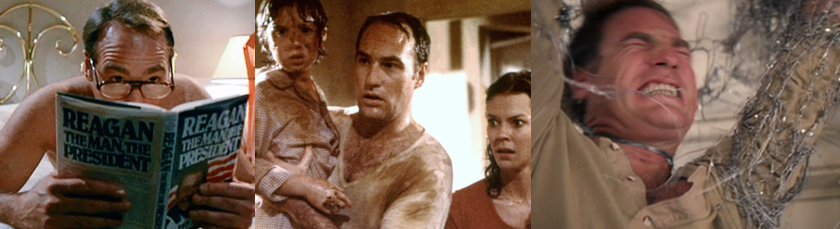
Back Issues [Sonic Month]: Sonic the Hedgehog Story Comic


Sonic the Hedgehog was first introduced to gamers worldwide on 23 June 1991 and, since then, has become not only SEGA’s most enduring and popular character but also a beloved videogame icon. Since the Blue Blur turned thirty this year, I have been dedicating every Friday to SEGA’s supersonic mascot.


Story Title: Dr. Eggman’s Challenge!!, Clash!! South Island, and Sonic Rampage
Published: June to July 1991
Writer/s: Unknown
Artist/s: Unknown

The Background:
Sonic the Hedgehog (Sonic Team, 1991) underwent quite a complex development cycle; intended to be SEGA’s mascot and their answer to Nintendo’s Super Mario, numerous designs and concepts were submitted internally before SEGA settled on Naoto Ohshima’s spiky protagonist, later coloured blue and christened Sonic, and SEGA put a lot of effort and money into marketing and adapting Sonic to be appealing to a worldwide audience. This included not only redesigning the character somewhat but also stripping away some of the crazier aspects of Sonic’s Japanese lore. As a result, Sonic’s human girlfriend and rock band was dropped and Doctor Eggman was renamed Doctor Ivo Robotnik. Though this only really impacted the game’s manual, these changes were famously seen in a 1991 American promotional comic that established Sonic’s canon and informed his characterisation and world in comics and cartoons outside of Japan for years. Earlier that same year, though, Japanese readers of Mega Drive Fan were treated to a three-part manga that not only stuck far closer to the original, wackier ideas concerning Sonic’s lore but also the gameplay of the source material. Though never released outside of Japan, a fan translation does exist to provide a bit of a window into Sonic’s differing interpretations between the East and the West.

The Review:
The first part of the story, “Dr. Eggman’s Challenge!!”, begins with the mysterious South Island suddenly being invaded by Dr. Eggman and a horde of never-before-seen robots. Rather than his traditional Badniks, Dr. Eggman is accompanied by an army of construction and worker robots who quickly set to work building his fortress on South Island, displacing the cute and cuddly natives and destroying the natural ecosystem.

Dr. Eggman is a fun, goofy villain with some pretty daft motivations.

Dr. Eggman (often referred to as “Dr. Eggman-sama” in a reflection of his high status) is an extremely excitable, volatile, and goofy character; he has an odd tendency to end every sentence with a enlivened “Yes!!”, mischievously chuckles with a dastardly “Dohohoho”, and is primarily motivated to invade South Island to aid his desire for world conquest and to buy lots of his favourite food: eggs. When one of his minions informs him of the presence of a Chaos Emerald on South Island, Dr. Eggman becomes even more excitable and doubles his endeavours to build his fortress and excavate to legendary gem. However, Dr. Eggman mainly wants the Chaos Emerald to power the world’s largest pot and boil the world’s largest egg, which he claims has been his “life dream ever since [he] was young”. Remember, back in Sonic’s early days, Dr. Eggman was often associated with eggs and egg puns so this is a fun way to reference that recurring in-joke.

Sonic, here a rowdy rock star, wastes no time in dispatching Eggman’s robots.

The story then jumps to Green Hill Zone where Sonic and his oft-forgotten rock band are putting on a show for a huge gaggle of screaming fans and his own personal “bodyguard platoon”. Unfortunately, and quite conveniently, Sonic’s concert is taking place right where the Chaos Emerald is hidden and, thus, Dr. Eggman and his robots quickly attack, disrupting the crowd, attacking his fans, and wrecking the stage. In response to the interruption, Sonic attacks Dr. Eggman’s robots and trashes them with his patented speed and Super Sonic Spin Attack. Sonic is a slightly different character than you might be used to at this point; he’s not some snarky freedom fighter or a cool anime hero. Instead, he’s a rock star who’s all about putting on a performance for the adulation of others; when Dr. Eggman interrupts his concert, he takes it as a personal insult and doesn’t hesitate to strike back with his skills and a snarky attitude that has, sadly, been largely dropped from his characterisation.

Sonic is enraged at Dr. Eggman’s plot to turn his friends into robotic Badniks.

With his robots destroyed, Dr. Eggman tries to squash Sonic with his Egg-O-Matic’s wrecking ball but Sonic is much too fast to be hit and makes short work of Dr. Eggman’s contraption. With the dastardly doctor defeated, Sonic goes back to his concert and Eggman retreats to lick his wounds and plot his revenge by playing Sonic the Hedgehog on the “Megadora”, which motivates him to capture South Island’s woodland critters and transform them into the iconic Badniks. Dr. Eggman’s plot continues in the second part, “Clash!! South Island”; Sonic is incensed to see Dr. Eggman’s robots have spread to Marble Zone and learns from Pocky and Picky that Dr. Eggman has captured all of their friends and used them as living batteries for his Badniks. Disgusted and enraged, Sonic vows to head straight to Dr. Eggman’s base to put an end to his plot and rescue his friends…but is momentarily embarrassed to discover that he has no idea where to go.

Sonic takes a beating from Dr. Eggman’s various nefarious traps and hazards.

Picky points Sonic in the general direction and he speeds off, only to run afoul of the many and varied traps that Dr. Eggman has built into Marble Zone. Despite almost being crushed and fried to a crisp, Sonic is able to avoid Dr. Eggman’s traps with his super speed but ends up getting bashed about by bumpers in “Sparkling Zone”. Regardless, though having taken a beating, Sonic survives and is able to free Ricky and Cucky from their Badnik casings. Ricky and Cucky lead Sonic to “Star Land Zone” and to a capsule where their friends are being held captive. Sonic uses one of the Zone’s seesaws to spring himself up there and easily gets past an Orbinaut before Dr. Eggman comes in to battle him again.

Curse words and a bevvy of traps dog Sonic’s progress.

As in the game, Dr. Eggman is now packing a large spike on the underside of his craft but Sonic is easily able to outmanoeuvre him and take him out with a single Spin Attack. With Dr. Eggman sent packing once again, Sonic breaks open the capsules and revels in the adulation of his friends. Despite the setback, though, Dr. Eggman is only enraged even further and even more motivated to make Sonic pay for his interference by holding Flicky, Pecky, and Pocky hostage in his heavily fortified mountain lair. The final part of the story, “Sonic Rampage”, mainly details Sonic’s livid assault on the remainder of Dr. Eggman’s forces (this includes a hilarious piece of questionable translation when a Burrobot and Motobug spit out “Fuck off, Sonic!” to which Sonic replies (whilst smashing them to junk): “Fuck off yourselves!!”) Also of note is the mixed up order of the Zones Sonic visits here as the story opens with him in “Clockwork Zone” before going to Labyrinth Zone, where the final confrontation with Dr. Eggman takes place. This actually helps, in a way, to explain an oddity in Sonic the Hedgehog that I never really understood, which is why the third Act of Scrap Brain Zone is basically a fourth Act for Labyrinth Zone.

Sonic frees the last of his friends and defeats Dr. Eggman once and for all.

Rather than battling Eggman in the Final Zone and contending with his giant weighted machine, Eggman holds Flicky, Pecky, and Pocky prisoner in an unseen claw-like attachment to his Egg-O-Matic and threatens to squeeze them to death. However, faster than the naked eye, Sonic frees his friends and destroys the claw attachment before Eggman can even register what has happened and, with a fury of spikes, he unleashes his “Rolling Attack Rapid Strikes!!” attack to defeat Eggman once and for all and end his threat against South Island.

The Summary:
Sonic the Hedgehog Story Comic is a pretty simple but incredibly fun little adventure; obviously, the manga was designed purely to help advertise, promote, and sell copies of Sonic the Hedgehog and, as a result, each chapter ends with the characters or narrative breaking the fourth wall to advertise the game and the Mega Drive console. Still, what separates it from a lot of other Sonic media at the time is its fidelity to the source material; despite the fact that there are only a handful of Badniks, one for each of Sonic’s friends, and only three encounters between Sonic and Dr. Eggman (with only two involving his contraptions from the game), the manga captures the manic feel of the videogames much closer and reflects the simplistic narrative of the games much better than bogging it all down with the Ovi Kintobor story.

I really enjoy Sonic’s characterisation, which actually shows off his attitude and personality.

Of course, that’s not to say that it’s a 100% adaptation of the comics; for one thing, the Chaos Emeralds barely factor into the story at all. Only one is ever spoken about and it never actually appears in the story; the other five are completely missing, as are the Special Stages and Golden Rings, but then that does somewhat reflect how little importance the Chaos Emeralds had on the first game’s plot as it wouldn’t be until they were joined by a seventh that they would become a much more integral part of the plot. Two areas where the manga does excel, though, are the art and the characterisations; the art is very faithful to Akira Watanabe and Naoto Ohshima’s original Japanese artwork and aesthetic direction for Sonic, featuring such little details as Sonic have fangs and a great sense of his speed, with many of the illustrations of Sonic in action directly referencing his in-game sprites. As for characterisations, this is one of my favourite interpretations of Sonic; when he was first conceived, Sonic was the “Hedgehog with Attitude!” but, for the most part, he never really showcased that attitude. Sonic the Comic (1993 to 2002) reinterpreted Sonic as a sarcastic asshole but, for the most part, he was this good natured teenager who liked being the center of attention and getting praise and was extremely egotistical but was nowhere near as snarky and unruly as he is portrayed here and in the original video animation (OVA).

Eggman’s plans turn from conquering to a vendetta against Sonic.

Similarly, Dr. Eggman isn’t some bungling idiot or a semi-cybernetic dictator bent on subjected all of those beneath him; instead, he’s a goofy, maniacal bad guy motivated mainly out of greed, power, and the desire to have all the eggs he can handle. His temper flares as Sonic interferes in his plans and his plot alters from a vague desire for world domination to vindictively pursuing Sonic in a mounting obsession for revenge. It would be all too long before the goofier, more clown-like aspects of Dr. Eggman’s personality would find their way back into his character and they’re delightful to see here; he’s a goof, sure, but he’s also quite threatening at times, destroying the environment and kidnapping Sonic’s friends without hesitation, though he remains a largely ineffectual buffoon since, while he has a lot of robots and resources at his disposal, Sonic is easily able to take them all out and is never in any real danger.

My Rating:

Rating: 5 out of 5.

Fantastic

Have you ever read Sonic the Hedgehog Story Comic? Did you, perhaps, read the story when it was published in Mega Drive Fan or, like me, did you discover it through an online fan translation? What do you think to the early interpretation of Sonic as a snarky rock star? Were you a fan of the original ideas and design for Sonic or do prefer the changes made for his worldwide debut? What’s the most obscure piece of Sonic media you’ve ever seen or owned? Whatever your thoughts, feel free to leave a comment below and pop back next Friday for more Sonic content!

Game Corner [Donald Duck Day]: QuackShot Starring Donald Duck (Mega Drive)


DonaldDuckDay

It’s June 9th, which means that it’s National Donald Duck Day! Disney’s foul-tempered fowl first debuted in The Wise Little Hen (Jackson, 1934) way, way back on 9 June 1934 and has since become one of the multimedia conglomerate’s most enduring and popular characters, featuring in a variety of cartoons, videogames, and other merchandise.


GameCorner
QuackShotLogo

Released: December 1991
Developer: SEGA
Also Available For: SEGA Saturn

The Background:
As I’ve said once or twice before, Disney had quite the reputation back in the nineties for licensing their popular characters and film franchises and producing some of the best 8- and 16-bit action/platformers on SEGA’s home consoles. Of all their enduring characters, Mickey Mouse, as the brand’s mascot, obviously featured in the majority of these titles but Donald Duck had his fair share of pixelated adventures over the years as well. Generally, Donald’s adventures were very similar to Mickey’s in that he would explore a fantasy world, generally trying to rescue his nephews Huey, Dewey, and Louie, and featured an abundance of jumping and platforming. QuackShot Starring Donald Duck was unique in that respect as, rather than bouncing on enemies and following a linear path from right to left, Donald becomes an Indiana Jones-type figure who travels the world in search of a lost treasure and the game featured a lot more backtracking and puzzle solving than most titles featuring Disney’s characters.

The Plot:
When flicking though a book in his Uncle Scrooge McDuck’s library, Donald stumbles across a map that leads to the lost treasure of King Garuzia, former ruler of the Great Duck Kingdom in ancient times. Alongside his three nephews, Donald hops in his biplane and heads out across the world to track down the lost treasure all while Big Bad Pete and his goons try to stop him at every turn and beat Donald to the treasure.

Gameplay:
QuackShot Starring Donald Duck is a 2D, sidescrolling action/platformer with a heavy emphasis on backtracking, exploration, and puzzle solving. Players take on the role of Donald Duck, decked out in an Indiana Jones-inspired getup, as he travels from Duckburg to Transylvania, to the South Pole and the ancient tomb of King Garuzia in pursuit of a lost treasure.

QuackShotControls
Run or slide to move a little faster and avoid a chargrilled butt.

Unlike other Disney titles, especially those starring either Donald or Mickey Mouse, QuackShot is a much slower, more methodical affair; Donald’s standard walking speed is painfully slow but, by holding down the A button, Donald will break out into what can best be described as a “spirited trot” for a few seconds, which really doesn’t speed things up all that much. When ducking, you can press the C button and Donald will slide forwards on his front, which is super handy for passing through small passageways and underneath spiked ceilings and can be a faster way of getting from start to finish.

QuackShotAttacks
Stun enemies with plungers or knock them out with popcorn.

Donald can also jump, as you might expect, but it’s more of a hop than anything else; Donald’s jumping height and distance is dependant on his momentum, angle, and the length at which you press the C button. Sadly, Donald cannot defeat enemies by jumping on them and is therefore entirely reliant on his special pop-gun to take out enemies. Donald’s gun can shoot out plungers to stun enemies so he can safely pass by or popcorn to permanently dispose of them; though he has unlimited plungers, Donald’s popcorn shots are limited and run out quite quickly as they fire in a spread. Plus, you know…enemies respawn after you leave the screen anyway so it’s better to just use the plungers.

QuackShotMap
Travel across the world using the map, checkpoints, and Donald’s handy-dandy biplane.

When you start QuackShot, you are presented with a map and can choose to travel to one of three destinations: Duckburg, Mexico, or Transylvania. Where you choose to go determines how far you can progress in the game; for example, if you visit Duckburg first, you’ll be soon stopped as you don’t have the ability to scale walls yet; if you visit Mexico, you’ll be told that you need a key to progress further; and, if you visit Transylvania first, you’ll need special ammo for your gun to progress further. In each case, a non-playable character (NPC) directs you to one of the other locations so you can get what you need to progress. Donald thus plants a flag (essentially a checkpoint) and you are able to call your nephews in your biplane to return to the map and travel elsewhere. Once you’ve cleared these first three areas, the map will expand and you’ll be able to travel to four new locations where the cycle repeats itself again; you can’t enter the temple in Egypt without retrieving the Sphinx Tear from the palace of the Maharajah and you can’t clear the Viking Ship of its ghost infestation without a special key from the South Pole, and so on. This partial progression and backtracking format makes the game much slower and requires a little more brain power than the average platformer; while NPCs always tell you where you need to go to progress in a particular level, if you miss that message and travel somewhere else instead, the only way to remind yourself of where you need to go is to hope that you remember where you just came from.

QuackShotTemper
Collect enough peppers and you’ll fly into a berserker rage.

Donald’s health is indicated by a small power meter in the game’s heads-up display (HUD); when attacked or otherwise hurt, Donald loses some of his power but can replenish his health by stunning or attacking enemies and picking up ice cream cones or a roast chicken (there’s something very disconcerting about a duck eating chicken to replenish its health…). Attacking enemies adds to your score, which is also displayed in the HUD, and you’ll be awarded with an extra life when you reach a high enough score; extra lives can also be found in levels as well and, if you die, you can grab these again to effectively have infinite lives but, should you exhaust all of your lives, the game has infinite continues so you can simply choose to restart from your last checkpoint. The HUD also shows Donald’s current temper; when he picks up enough red-hot chilli peppers, he flies into a berserker rage that renders him invincible for a few seconds and allows you to attack any particularly annoying enemies. These peppers are few and far between, however, so I didn’t find myself entering this state too often. Some levels feature bottomless pits and instant death traps (falling ceilings, water, or lava) as well so you’ll have to factor this in as you explore the game’s environments. As you explore each area and speak to NPCs, you can access an in-game menu with the Start button. This is how you can call your aircraft (which can only be done when near to a checkpoint flag), use certain items (though these will only work when you’re right next to where they need to be used), and read things such as your map or other items to help you solve puzzles. The game’s puzzles are generally simple enough, requiring you to hop over moving platforms, stun moving blocks so you can progress, or hitch a ride on passing enemies. Probably the game’s more troublesome puzzle comes when Donald is about to be crushed by a falling ceiling and you have to hop on certain blocks in the right order in order to halt it and keep you from being flattened.

Graphics and Sound:
As a Disney title on the SEGA Mega Drive, QuackShot looks just as gorgeous and appealing as the rest of their titles released around this time. Disney’s games are always bright, vibrant, and eye-catching and QuackShot is no different, with Donald, Pete, and the game’s various enemies and environments popping out and full of charm. When you leave Donald idle for some time, he’ll tap his foot impatiently like a certain blue hedgehog and he is full of life as he waddles and hops along. Levels aren’t quite as varied and unique as in some of Donald’s other outings, or those that feature Mickey; instead, you’ll visit more real-world locations than fantasy environments, which will see you walking through the streets and jumping across the rooftops of Duckburg, exploring the haunted lower depths of a Viking Ship, and traversing dangerous jungles.

QuackShotGraphics
QuackShot is colourful and lively, if a bit by the numbers.

They’re all pretty standard locations for your average action/platformer and they’re not especially teeming with life or background elements but they’re serviceable enough and generally quite short; you’ll play half a level and then have to jet off to another location before you can proceed any further, making playing both short and sweet but also quite long and complex. The game’s music is equally fun and lively and catchy enough but nothing especially ground-breaking or memorable. The game’s plot is told through a combination of stationary cutscenes and in-game dialogue boxes between Donald and recognisable characters like Goofy and Gyro Gearloose; they’re large and cartoony, though, and perfectly in keeping with the cartoon aesthetic of the videogame and certainly a lot more in-depth than those of other platformers from the same time period.

Enemies and Bosses:
While Mickey generally had to deal with some fantastical and outlandish enemies, Donald is faced with more lacklustre and generic enemies sucu as vampire bats (that travel along a straight line and are easily avoided), incorporeal ghosts that cannot be harmed, and birds that drop wasp nests or bombs on you. Donald will also butt heads with a number of Pete’s goons who shoot at you or toss bombs at your head, Vikings who hide in barrels and try to shoot you full of arrows, kangaroos (complete with boxing gloves), evil cactus plants that break apart for added annoyance, and even skeletons who try to throw their heads at you.

QuackShotBosses
Bosses are big and lively but pretty simple to put down.

While exploring Dracula’s Castle, you’ll also encounter a giant ghost who floats just out of reach and cannot be harmed; every so often, he breaks up into smaller ghosts before reforming and, rather than try to damage him, you actually have to find a certain platform that will take you to the castle’s upper levels and out of harm’s way. You’ll also come up against a few bosses on your travels, none of which really pose that much of a threat as long as you have enough health, ammo (if necessary), and can avoid their simple attack patterns. Donald has to fight against Count Dracula (easily dispatched by standing beneath him when he opens his cape and shooting plungers upwards), a ferocious fire-breathing tiger (dispatched by firing bubblegum shots when it’s jumping), and a possessed suit of Viking armour that constantly shields against your attacks and can only be harmed by hitting its head.

QuackShotPete
Pete finds his position as the game’s final boss usurped at the last second…

Eventually, you’ll face off against Pete himself in a bid to retrieve the map; this battle sees Pete circling the area in a massive press machine and attempting to squash Donald into a fine paste. Pete’s goons are also stationed around the arena to make hitting Pete in the face that much harder as you climb higher and higher up the arena but, like all the bosses, this is simply a test of patience rather than being an exercise in frustration.

QuackShotFinalBoss
The game’s true final boss isn’t much of a threat…

Once Pete is taken out, Donald heads over to the Great Duck Treasure Island, where the tomb of King Garuzia lies, to do battle with the knight guarding Garuzia’s treasure. As final battles go, this is a bit of a disappointment; the knight basically stays in the centre of the screen, twirling his sword and trying to fling it at you, and causing blocks to fall from the ceiling. He leaves himself wide open for your attacks, meaning it’s pretty simple to dodge the falling debris and blast him with your plungers or other weapons until he finally gives up King Garuzia’s treasure.

Power-Ups and Bonuses:
The only real power-up you can get through regular gameplay is the aforementioned red-hot chilli peppers; you can also collect bags of cash to increase your score, though, and find some cheeky shortcuts peppered through stages that lead either to stockpiles of items and ammo, extra lives and health, or hidden doors to progress further.

QuackShotWeapons
Donald’s plunger gets a few upgrades along the way.

As you explore, you’ll receive two upgrades for your pop-gun; the first changes your yellow plunger to a red one, which allows you to scale vertical walls with temporary platforms, and the second changes it to green and allows you to hitch a ride on flying enemies. Gyro also supplies you with bubblegum ammo, which allows you to break open walls and certain blocks so you can explore a bit more of the map and the game’s locations. These bubbles are quite slow and linger around the screen for some time, which can limit your firing speed (which is already quite slow to begin with).

Additional Features:
There’s not much replayability in QuackShot beyond playing through a perfectly acceptable action/platformer over and over. There’s no difficulty settings to choose from, no additional characters to unlock or play as, and there aren’t even any cheats or passwords to input. While this does mean you have to rely on old school gaming and memorisation to play through the game’s relatively short length, it also means that you can’t save your progress or jump to a later stage in the game if you have a power cut.

QuackShotBanner

The Summary:
Generally speaking, QuackShot Starring Donald Duck isn’t especially challenging but its pacing really ruins the many positive aspects of the game. Donald is so slow and clunky and the gameplay is so plodding and sluggish that there’s no real sense of urgency or agency to the game’s plot or action. QuackShot looks great and isn’t especially punishing or unfair but it’s nowhere near as action-packed or appealing as other Disney titles, even ones that also feature Donald Duck. Instead, you’re left with a perfectly average little title that looks and sounds great but doesn’t exactly leave you clamouring for more or especially excited.

My Rating:

Rating: 2 out of 5.

Could Be Better

What did you think of QuackShot Starring Donald Duck? Where do you rate the game compared to other Disney titles of that era? Do you agree that it’s not as appealing as other Disney videogames on the Mega Drive or did you find it to be just as enjoyable? Which was your favourite, or least favourite, and who is your favourite Disney character? How are you celebrating National Donald Duck Day? Whatever you think about QuackShot, Donald Duck, or Disney in general, drop a comment below and have a great Donald Duck Day!