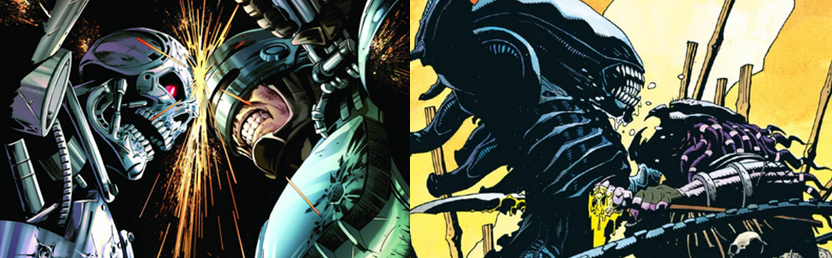
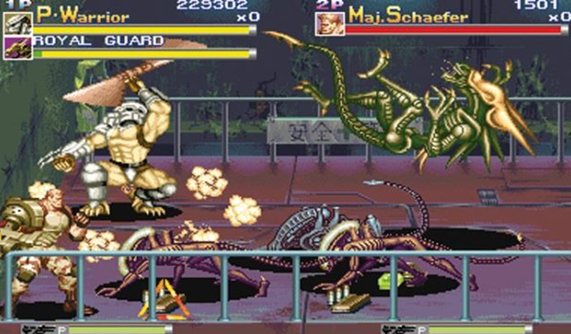
Movie Night [Crossover Crisis]: AVPR: Aliens vs. Predator – Requiem


In April 1985, the first issue of the ground-breaking Crisis on Infinite Earths (Wolfman, et al, 1986) released and saw the temporary destruction of the “Multiverse”. To celebrate this momentous event, I’m discussing multiversal crossovers all throughout April in an event I dubbed “Crossover Crisis”.


Released: 25 December 2007
Director: The Brothers Strause
Distributor:
20th Century Fox
Budget: $40 million
Stars:
Steven Pasquale, Ian Whyte, Johnny Lewis, Reiko Aylesworth, Kristen Hager, and Tom Woodruff Jr.

The Plot:
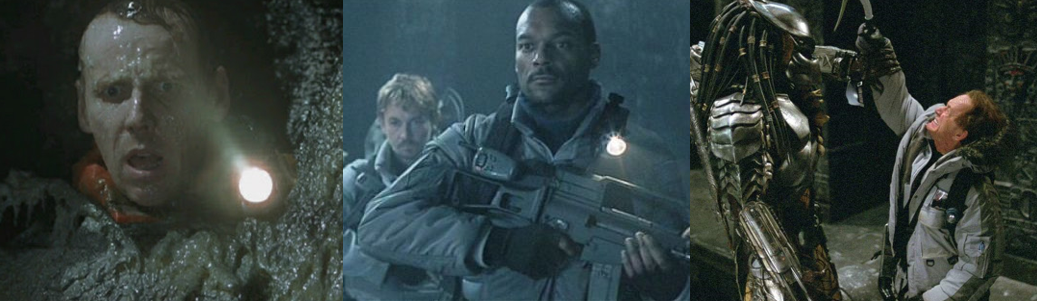
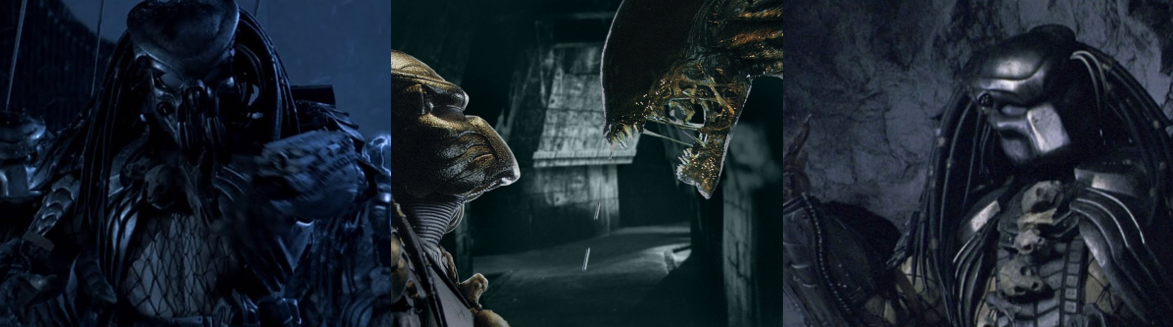
Following the last clash between Xenomorph and Predator, a “Predalien” (Woodruff Jr.) hybrid begins a bloody rampage in a small Colorado town. While former convict Dallas Howard (Rasquale), his troublesome younger brother Ricky (Lewis), and soldier Kelly O’Brien (Aylesworth) desperately try to survive as their town is overrun with viscous alien drones, a lone Predator, “Wolf” (Whyte), is dispatched to remove all traces of the creatures from the town by any means necessary.

The Background:
Starting life in the pages of Dark Horse Comics with a three-issue short story courtesy of writer Chris Warner, the Aliens vs. Predator concept quickly expanded into multiple follow-up stories, an expansive toy line, and videogames. After a lengthy stint in Development Hell in which notable figureheads from the Alien franchise (Various, 1977 to present) openly criticised a crossover between the two horror icons, Paul W. S. Anderson won over the studio with his pitch and turned a tidy profit with AVP: Alien vs. Predator (ibid, 2004). Though the film was subjected to largely negative reviews, brothers Colin and Greg Strause were brought in to helm a follow-up, having previously unsuccessfully pitched a similar crossover and making a mark in Hollywood with their work as visual effects supervisors. Excited at the prospect on working on such a film, the two insisted that the bulk of the film’s effects were achieved practically, with CGI being used sparingly to render alien spacecraft, the more elaborate sets, and to bolster the practical effects wherever possible. Amalgamated Dynamics, Inc. created the monstrous Predalien suit, which incorporated visually recognisable aspects of both species and was brought to life using an animatronic head and practical suit. Despite the brothers’ attention to detail and clear love of both franchises, and making a respectable $130.2 million worldwide gross, Aliens vs. Predator: Requiem failed to impress critics: many have cited it as one of the worst films in either franchise and critics dismissed the film as a mindless, violent mess akin to a videogame that suffered from dull human characters and poor lighting. While some were impressed by the film, especially compared to the first one, plans for another movie was indefinitely suspended and fans would have to settle for the 2010 videogame as a quasi-third entry as both franchises have continued on separately on the silver screen.

The Review:
As a big fan of both the Alien and Predator franchises, and of their crossover comic books and videogames, I was left pretty disappointed with the first AVP film. While I believe that the premise of pitting these two iconic extraterrestrial monsters against each other has a lot of potential, and should be a license to print money, the execution of their long-awaited clash fell flat thanks to a by-the-numbers, toothless effort on behalf of all involved. Despite some decent practical effects and an interesting expansion of the Predator lore, the film just played things far too safe and couldn’t live up to either the standards of its predecessors or the expectations set by other meetings between the two. Unfortunately, AVP: R had a bit of a mountain to climb in that regard as many audiences went into it with low expectations after the last film and because it picks up immediately where AVP left off, meaning the entire film beyond the opening sequence is set on then-modern-day Earth. And in the suburbs, no less! While I’ll never agree with the decision to set the conflict between the two creatures on Earth in the mid-2000s rather than in the far future and on another world, at least AVP: R doesn’t shy away from the gore and immediately delivers something new by quickly accelerating the birth of Scar’s (Whyte) progeny and bringing to life a truly gruesome Alien/Predator hybrid, the Predalien.

Sadly, AVP: R falters with its human characters, who are far too generic to make an impression.

After slaughtering the Predator’s on their shuttle and causing it to crash-land in the forests of Gunnison, Colorado, the Predalien immediately sets about establishing a nest for itself in the sewers under the town, while the ship’s payload of Facehuggers gets to work impregnating the unsuspecting townsfolk…including a little boy, showing that AVP: R really isn’t pulling any punches compared to the last film. One of the things I criticised about the first film was the strength and quality of its cast; however, at least AVP had Colin Salmon and Lance Henricksen to add some gravitas to the proceedings. AVP: R is completely robbed of this benefit, giving us a cast of no-name television actors who struggle to offer any kind of dimension or intrigue to the largely expendable human characters. The film ties to focus itself around Ricky, a normal, everyday high schooler who works a shitty job, is the target of farcical jock-like bullies, and pines after the unreasonably attractive Jesse Salinger (Hager). I guess we’re supposed to like and connect with Ricky because he’s just a regular kid, but he’s basically just every semi-rebellious, resentful teenager you’ve ever seen. While he’s not very appealing by himself, I ironically didn’t mind the relationship between him and his older, far more interesting brother, Dallas. A former convict with a no-nonsense attitude who’s trying to turn his life around, Dallas might be burdened by desperate attempts to make him appealing (he’s a rugged ex-con, he shares his name with Tom Skerritt’s Alien character, he shares an awkward flirtation with Kelly, and he even gets the iconic “Get to the chopper!” line) but at least he demonstrates a brief glimmer of character through his practical, if blunt, solutions to the escalating horror. Kelly is shoehorned into the mandatory “tough female protagonist” role made synonymous with the Alien films by Lieutenant Ellen Ripley (Sigourney Weaver); sadly, like Lex Woods (Sanaa Lathan) before her, Kelly struggles in this role; she’s not nearly dynamic or captivating enough to be a strong female protagonist, despite her being given a layer of vulnerability and maternal appeal in her strained relationship with her young daughter, Molly (Gade). Kelly is barely seen processing the death of her husband, Tim (Sam Trammell), before she’s flirting with ex-cons and blasting shotguns and Xenomorphs and it seems she’s primarily there in a half-hearted attempt to call-back to the far ore memorable Ripley and to have someone in the group who can pilot them to safety in the finale.

Gunnison is caught not just between the Aliens and Predator but the rampage of the monstrous hybrid.

Gunnison is naturally a central focus of the film; the Xenomorphs nest and rampage through the town and its inhabitants are picked off and impregnated by them for the first half of the film, with the town’s homeless and gung-ho hunters particularly suffering in the early going. Law and order is maintained in the town by Sheriff Eddie Morales (John Ortiz), a childhood friend of Dallas’s and former problem child himself who makes efforts to help him get his life back on track but who’s soon overwhelmed by the sudden invasion of bloodthirsty biomechanical monstrosities. Completely out of his depth, Morales calls in the National Guard (who are promptly slaughtered) and desperately radios for military aid; however, he refuses to heed Dallas and Kelly’s advice that Colonel Stevens (Robert Joy) is misleading them with the promise of an air evacuation and therefore dooms himself and his posse, who are so terrified that they’re focused only on escaping rather than using rational thought. Gunnison is also home to some disreputable characters; bullies Dale Collins (David Paetkau), Mark (Matt Ward), and Nick (Michal Suchánek) give Ricky more than his fair share of grief, with Dale beating him in the street for giving him backchat and eyeing up his girl, Jesse. Despite their differences, they’re forced to band together when they’re attack by a Xenomorph in the school pool and hunted through the school corridors, with the bullies soon paying for their misguided machismo. For all the focus AVP: R puts on the mutual attraction between Ricky and Jesse, it’s absolutely brutal when she is unceremoniously cut in half by Wolf’s shuriken-like Smart Disc; her death is so spontaneous that it’s both shocking and amusing and indicates just how much more ruthless AVP: R is compared to its predecessor. However, nowhere is this more evident when the Predalien stalks through a maternity ward at the local hospital, where it uses its proboscis to lay a bunch of Chestbursters into the bellies of the pregnant women in there! While this kind of cruelty may understandable frowned upon by some, I’m actually a big fan of shock value and AVP: R certainly delivers in that regard thanks to being unapologetically gory and violent.
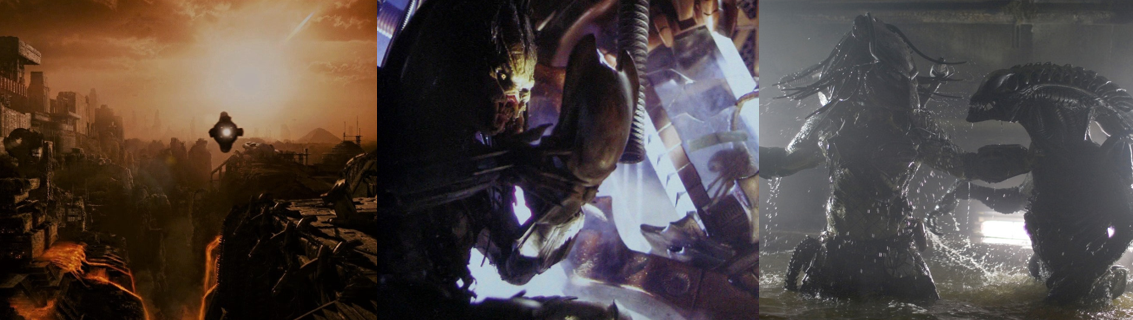
Wolf comes to clean up the Alien infestation and proves to be the film’s most interesting character.

Similar to the last film, and true to the nature of the concept, the Predator takes an active role as an anti-hero throughout the film’s events, however I’d argue that Wolf is such a presence here that he’s almost portrayed as the film’s primary character. After the Predator shuttle crashes and the Facehuggers and Predalien escape into the wild, Wolf picks up the signal (giving us our first live-action glimpse of the Predator home world) and immediately sets out to contain the outbreak. An accomplished hunter and veteran, Wolf is far more capable and experienced compared to the rookies seen in the last film; carrying the acid scars on his face and missing a mandible, Wolf is portrayed as something of a “cleaner” and damage control for unwanted or unsanctioned Xenomorph infestations, but comes across more like a detective in his investigation of the crash site, which sees him arm himself with two shoulder cannons, and his meticulous destruction of all traces of either species using a corrosive blue goop. Though largely surreptitious and focused on this mission, Wolf does stray to partake in a little hunting, recreating scenes from Predator when interrupted by the Gunnison search party in the  forest (actually skinning his victims rather than just stringing them up as in the last film) and bringing undue attention to himself by causing a blackout when picking off Xenomorph’s at the town power plant. However, humans are of little interest to this Predator, meaning we’re thankfully spared any awkward and cheesy team ups between Wolf and Dallas; indeed, Wolf is largely nonplussed when the townsfolk get caught in the crossfire between him and his prey and he’s perfectly happy to blast their heads off if it means containing the outbreak. Sporting all the tried-and-true weapons and tactics associated with the alien hunter, Wolfe is given the tactical and technological edge that the humans sorely lack; he can view multiple spectrums and review recorded footage from his fallen comrades using his helmet, has all the tools and toys of his predecessors (but with two shoulder cannons), and is far more adept at dealing with Xenomorphs than any other Predator we’ve seen before.

Led by the grotesque Predalien, the Xenomorphs swarm through the sleepy, unassuming town.

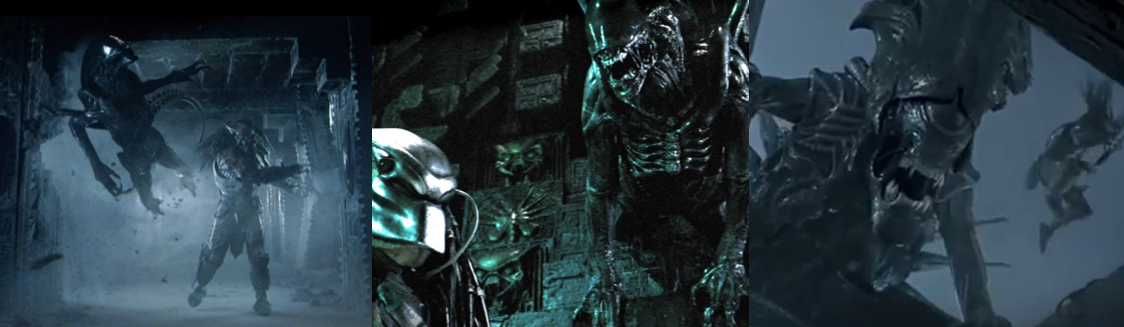
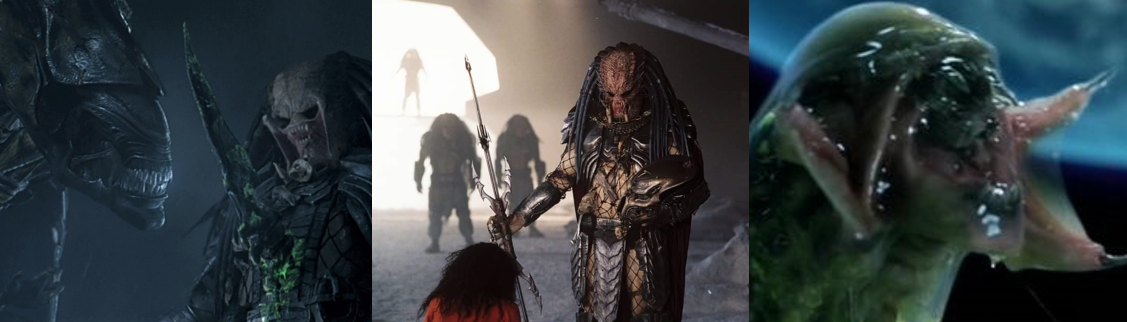
As before, the Xenomorphs are portrayed as being more stereotypically and recognisably “bad” compared to Wolf, who’s firmly entrenched as a bad-ass anti-hero. Alien acid severs limbs and melts faces, and Facehuggers and scurrying to the sewers to set up a nest. The fully-grown Xenomorphs seem largely unfazed at their urban settings, easily skulking through town in the dead of night to pick off victims and being framed in a suffocating, near constant darkness that really helps to add to their terror (when you can actually see them, that is). In a nice change of pace, AVP: R doesn’t rely on the cliché of a Xenomorph Queen and instead has the creatures directed by a far more mobile and altogether more versatile and horrifying alpha, the Predalien. A hulking, drooling nightmarish mish-mash of Alien and Predator biology, the Predalien is framed very much like the original Xenomorph drone (Bolaji Badejo) and a figure of disgusting, uncomfortable sexually-charged horror rather than some disposable, squealing drone. Although I often think of the Predalien as being a masculine counterpart to the Alien Queen, it’s actually an asexual creature, able to impregnate multiple Chestbursters directly into a host using its proboscis. Not only does the Predalien sport the mandibles and dreadlocks of a Predator but it also rips the spines out of its prey much like the alien hunter; seen as an abomination by Wolf, the two have a deep-rooted instinctual hatred of one another and their inevitable conflict is so brutal that it would be a fight to the death even without the impending threat of nuclear destruction.

The Nitty-Gritty:
AVP: R tends to get a bad name primarily because of its poor lighting; when I went to see it in the cinema, I don’t remember it being that dark or difficult to make out what’s happening but it’s hard to deny that sections of the film are all-but impossible to see since they’re bathed in a pitch-black darkness. On the one hand, I don’t actually mind this; it recalls the dark atmospheric horror of the first Alien film and returns these creatures to their roots as frightening monsters rather than lessening their threat through over exposure, however I think the Brothers Strause went a little too far into the dark, perhaps in an attempt to keep the film from upsetting the censors by adding unnecessary monster horror to its gore, swearing, and violence. Fiddling with your TV settings and the lighting in your home can improve things, for sure, but it’s a shame that so much of the film, suits, and brutality is lost to this impenetrable blackness. Unlike the last film, AVP: R is unapologetically R-rated; characters swear throughout the film and blood and gore are far more prevalent, bringing the film more in line with the standards set by previous entries in the series. As alluded to, this also can be taken as a detriment as the Brothers Strause go super dark by having Chestbursters burst out of children and pregnant women, but these films have always had some uncomfortable gory scenes and I’m certainly not going to complain about this considering how toothless the first AVP film was. I also have to commend the Brothers Strause for their clear affection for the source material; this is evident right from the start, where the film’s credits are a mixture of both franchise’s fonts and the ambient sound is a mash-up of the classic motion tracker beeping and the Predator’s thermal vision, and the amalgamation of the franchises continues to be felt throughout the film in Brian Tyler’s score.
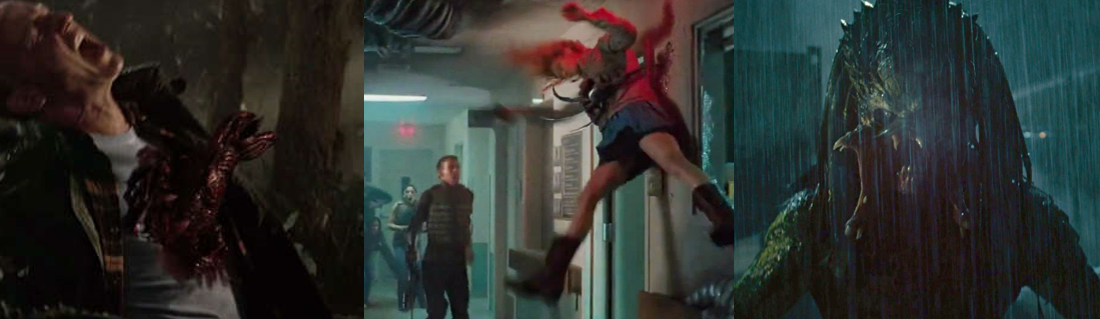
The increased focus on gore and recreating both franchise’s atmospheres is very much appreciated.

As ever, the main appeal of the film are the practical effects used to bring both species to life; again, this is why the low lighting is such a drawback as the Aliens finally include their most memorable design (the rigged skull variant from the second film) and we never really get a decent look at the Predalien thanks to the all-encompassing darkness and wash of rain throughout the movie. Still, the suits, puppets, and animatronics are as good as they’ve ever been and sometimes benefit from the darkness; Wolf sticks very closely to the classic Predator look defined in the first two films, though with a more visually interesting helmet and sporting the battle scars of his many hunts. The cloaking effect is much improved this time around, as are the CGI blasts used to represent his shoulder cannon projectiles, both of which harken back to the first two films and Wolf even uses the trajectory tracking system seen in the first Predator. Best of all, his face more resembles the classic Stan Winston design rather than the butt-ugly travesty we saw in AVP, and we get an all-too-brief glimpse of the Predator home world, a searing hot planet of ancient pyramids and structures that just cries out to be revisited in more detail some time, and the additional toys Wolf gets to play with. Wolf has the spear and the gauntlets but also has little mapping devices that double as laser traps he to cover his back and cut down any Xenomorphs, he can charge up his gauntlet to burst through solid concrete, has a slick razor-sharp whip, and he’s also easily powerful and adept enough to hold multiple Xenomorphs off at once. The Aliens not only have their signature squeal, but we also get to see them feeding on human brains; they’re also slimier and more grotesque than ever, though none more so than the Predalien. This thing is absolutely abhorrent to look at, drooling and stomping about with a real weight. In many ways, it reminds me of the Newborn (Tom Woodruff Jr./Joan La Barbara/Archie Hahn) in that it’s an even more monstrous variant of one of cinema’s classic creatures, though the Predalien enforces its will far more aggressively than the Queen, striking Xenomorphs when they try to eat or act before it and slashing at its victims with its huge claw-like hands and prehensile tail.

Sadly, the brawl is interrupted by a nuke that kills the town and puts an end to the alien threat.

Many of the human survivors are whittled down in their efforts to arm themselves thanks to Wolf using them as bait and picking them off simply for being armed; the National Guard and absolutely massacred by the Xenomorphs as well, and the remaining survivors split up after disagreeing about Colonel Steven’s evacuation plan. Colonel Stevens directs the survivors to the centre of town on the pretence of an evacuation but it’s actually to ensure that the Aliens all congregate on ground zero of his tactical nuclear strike, which obliterates the entire town and all traces of the alien infestation save for Wolf’s shoulder blaster. Before the town is destroyed, however, Dallas, Kelly, Molly, and a wounded Ricky fight their way to the roof of the town hospital (which has been partially converted into a horrific Alien nest) to get to the helicopter and escape the incoming blast in tense scenes awash in darkness and flickering lights that recall Ripley’s desperate last-minute escapes as much as Kelly’s drive through the wrecked streets calls back to Ripley’s rescue of the Colonial Marines in their armoured transports. Barely able to fend off the skulking Xenomorphs with their weapons, Dallas covers their escape by wielding Wolf’s repurposed shoulder cannon, but ultimately it comes down to a one-on-one, hand-to-hand slugfest between Wolf and the Predalien. This takes place on the rooftop of the hospital, in the dead of night, and amidst a torrential downpour with their destruction an inarguable guarantee since we know Stevens has a missile inbound. And yet, as in the last film, actually seeing the Predator go at it with the Aliens and that horrific hybrid are the highlight of the film despite the low lighting; overpowered by the Predalien and ready to fight to the death, Wolf discards his weapons and battles his rival in a test of strength that sees him rip out its inner mouth, stab it through the head, and be left impaling on its spear-like tail. Unfortunately, Wolf is incinerated along with his foe and the entire town by Stevens’ missile; although our human protagonists escape, the shockwave causes their helicopter to crash and they’re apprehended by military police shortly afterwards. In the aftermath, Colonel Stevens recovers Wolf’s damage cannon from Dallas and presents it to Ms. Yutani (Françoise Yip) of the Yutani Corporation, awkwardly implying that they were somehow able to reverse-engineer enough technology from this one weapon to eventually become a universe-spanning colonising force alongside the Weyland Industries some two-hundred years in the future.

The Summary:
I’m a firm believer that AVPR: Aliens vs. Predator – Requiem isn’t as bad as people make it out to be, but also that it still has plenty of undeniable flaws that keep it from being classified as under-rated and which also make me hesitate to rate it much higher. I’ve always enjoyed that the film veers back to the horror atmosphere that popularised each franchise; the swearing, blood, gore, and shocking violence all make quite an impact and make this film the extreme other end of the spectrum compared to the first AVP movie. I also enjoy Wolf’s character and presence throughout the film; in many ways, I almost wish that we’d followed him more as he’s far more interesting a character than any of the disposable humans, but I would be surprised if we ever saw something like that in a live-action movie. I also really enjoyed the Prealien; as much as I love the Xenomorph Queen, she’s very played out and it’s nice when the franchise uses a similar concept but in a different, uniquely grotesque way and the Predalien is such a striking character design and vicious concept that it really helps to up the ante in a more visceral way. In these regards, AVP: R is worlds better than its predecessor; the tone, presentation, and atmosphere are far more in line with what I expect from each franchise and I would choose to watch this one out of the two on any day of the week…but sadly it’s still a mess of a movie. The film’s just way too dark, there’s no denying it; some scenes are just a blank screen of darkness with the vaguest hint of movement and the sounds of gnashing, slobbering teeth, and the impressive practical effects are almost entirely lost in this death shroud. Furthermore, the characters and setting are just awful; an urban environment might be something different from the franchise but a present-day setting just doesn’t work for this concept and the lack of any strong, recognisable faces and human protagonists means it’s almost impossible to give a damn when they’re in danger or die. Overall, this was a step in the right direction in many ways but the execution again fell short of the mark; it’s a shame that we probably won’t see a proper Aliens versus Predator film set in space and in the future and that we’re left with these two largely disappointing live-action adaptations as the premise has so much potential but the studio clearly didn’t have faith to put the money and effort behind it so we’re left with these sub-par efforts that really could’ve, and should’ve, been much better.

My Rating:

Rating: 3 out of 5.

Pretty Good

Are you a fan of AVPR: Aliens vs. Predator – Requiem? How do you think it compares to the first film and other films in each franchise? Were you disappointed that it continued the modern-day setting? Did the poor lighting and shock value of the gore and horror bother you? Which of the humans was your favourite? What did you think to Wolf and his mission to erase all traces of the Aliens? Were you a fan of the Prealien or do you find it to be a little too unrealistic? Which of the Aliens vs. Predator stories or adaptations was your favourite? Would you like to see the two cross paths again in some form or another? Whatever you think about Alien vs. Predator, leave a comment down below or share your thoughts on my social media.


Movie Night [Crossover Crisis]: AVP: Alien vs. Predator: Extreme Edition


In April 1985, the first issue of the ground-breaking Crisis on Infinite Earths (Wolfman, et al, 1986) released and saw the temporary destruction of the “Multiverse”. To celebrate this momentous event, I’m discussing multiversal crossovers all throughout April in an event I dubbed “Crossover Crisis”.


Released: 7 March 2005
Originally Released: 12 August 2004
Director: Paul W. S. Anderson
Distributor:
20th Century Fox
Budget: $60 to 70 million
Stars:
Sanaa Lathan, Raoul Bova, Colin Salmon, Ewen Bremner, Ian Whyte, Tom Woodruff Jr., and Lance Henriksen

The Plot:
When sickly, wealthy industrialist Charles Weyland (Henriksen) discovers a pyramid buried in Antarctica, he coerces experienced guide Alexa “Lex” Woods (Lathan) to lead a team of scientists, mercenaries, and archaeologists to investigate. However, they soon find themselves caught in a war as three Predators (Whyte) seek to prove their worth against the ferocious Xenomorphs (Woodruff Jr.), whom they breed within the ancient structure.

The Background:
The concept of Aliens vs. Predator originated in the pages of Dark Horse Comics; founded in 1980 by Mike Richardson, Dark Horse Comics stood out from its competition by by primarily publishing creator-owned titles and achieved mainstream success with its licensed adaptations of horror and science-fiction films, such as the original meeting of these two icons in a three-issue short story, courtesy of writer Chris Warner, which was then followed by multiple follow-ups, action figures, and videogames. Although it appears that plans for a live-action adaptation can be traced back to the late-nineties, these were paused to focus on Alien Resurrection (Jeunet, 1997) and, despite director James Cameron and actor Sigourney Weaver openly criticising the idea of diluting both creatures with a crossover, with director Paul W. S. Anderson spearheading the production after pursuing the project for eight years and winning over the studio with his pitch. While the comic books were set in the future like the Alien films (Various, 1977 to present), AVP was set in the then-modern day, but Anderson strived to maintain continuity by setting the film in the wilderness of Antarctica. Anderson’s focus on continuity and paying homage to the existing franchise compelled him to bring star Lance Henriksen back to play an ancestor of the Bishop seen in previous films, though star Arnold Schwarzenegger was unable to make an appearance. Amalgamated Dynamics Incorporated (ADI), who had worked on the last two Alien films, created AVP’s special effects, which focused on practical suits as often as possible, which led to ADI re-using many of the suits and animatronics from the previous movies. Although Alien vs. Predator eventually grossed over $177 million at the box office, it was met with overwhelmingly negative reviews; while some found it to be an enjoyably dumb action/horror flick, others saw it as a boring film filled with one-dimensional characters and lacking in either franchise’s trademark gore. The box office was clearly enough to convince the studio to push forward with a sequel, however, and, prior to that film’s release, this “Extreme Edition” of AVP was released on home video and contained a few extended scenes for home audiences.

The Review:
In all honesty, AVP was off to a bad start in my book right away with its rating; while it’s possible to have violent, gory, and sweary 15-rated films, scary monsters and subject matter need to be factored into the equation, meaning AVP lacks not only the iconic soundtracks from its forefathers but also completely wastes its one f-bomb and denies us the signature “Ugly motherfucker” line. This method of playing things way too safe extends to the film’s setting, which, unlike the comic books and videogames, takes place on then-present-day Earth, a decision that works for the Predator narrative but somewhat conflicted with the Alien timeline as we know it back then. It tries to get around this by having the bulk of the plot take place in secluded Antarctica, but it just doesn’t work for me. I feel like the simplest solution would’ve been to set it in the future, perhaps between the second and third Alien film, and have it take place on a remote ice world; you replace Weyland’s mercenaries with renegade Colonial Marines, splice in a bit more of the malevolent designs of his corporation, and maybe throw in an android (Maxwell Stafford (Salmon) would be my pick) and you’d already be on a better path than shoehorning Xenomorphs onto Earth long before their existence was discovered. Instead, we get the briefest tease of a space-based film before a Weyland satellite picks up an unexplained heat flare at a whaling station way down South and then we’re meeting Weyland’s recruits for an expedition to investigate. Just when you feel you can accept the setting presented, AVP immediately throws a few idiotic decisions at you within the first five minutes; Lex is supposed to be this experienced Arctic explorer and yet she’s climbing up a mountain without any face coverings and she somehow failed to hear Stafford’s helicopter land above her. Later, she even rushes out in the dark, bitterly cold temperatures of the whaling station in little more than a body suit, surely inviting hypothermia despite the scattered fires, but these are the least of AVP’s problems.

Lex and Sebastian are stuck between an age-old conflict between two alien races.

Lex is the best at what she does; she’s climbed everything and is highly recommended, so naturally Weyland seeks her out the lead his expedition. A hardened veteran of numerous climbs, Lex believes in being prepared; she’s far from intimidated or impressed by Weyland’s wealth or Stafford’s guns and balks at the idea of heading to the site without proper training or preparation. In fact, she chooses to abandon the expedition entirely when the two ignore her warnings and is only convinced to stay when archaeologist Professor Sebastian De Rosa (Bova) and chemical engineer Doctor Graeme Miller (Bremner) point out that they spend a better chance of surviving with her there and without her and, once they reach the site, she’s quick to enforce her rules to ensure their survival no mater how much it irks Stafford. There’s a subtle romantic tension between Lex and Sebastian, but thankfully it’s not dwelled upon all that much; a down on his luck digger who’s just about ran out of money for his excavations, he jumps at the chance to be a part of Weyland’s team and his expertise is invaluable first in recognising that the pyramid contains elements of Cambodian, Egyptian, and Aztec structures and, later, in translating the hieroglyphics contained within, though his warnings go unheeded by Weyland’s gung-ho mercenaries. Against his better judgement, Sebastian is left with no choice but to go along with Lex’s plan to side (or, at least, appease) the Predators since their true targets are the Xenomorphs infesting the pyramid; her entire character is built around survival, by any means necessary, while he’s more inclined towards braving the odds to find a way out. While I never for a second believed they had any chemistry, it was still a sad moment when Lex was forced to mercy kill him rather than let him suffer the agony of a Chestburster, but I can’t help but feel like this would’ve landed better if there’d been less disposable mercenaries and more time spent on developing their characters and interactions (and a better script…and a couple of better actors to boot…) Miller is primarily part of the group to be the somewhat awkward, likeable everyman who we will feel sorry for when he inevitably falls victim to the extraterrestrial menaces within the pyramid; you know he’s destined for a bad ending the moment he whips out pictures of his kids and, while he lasts a fair amount of time, this eventually comes to pass when he’s cocooned up for a Facehugger buffet.

Stafford and Weyland just about manage to stand out against a bunch of forgettable characters.

Still, at least he shows a bit of character, however cliché, which is a bit more than can be said about most of Weyland’s team; Adele Rousseau (Agathe de La Boulaye) seems like she’s channelling a bit of Private First Class Jenette Vasquez (Jenette Goldstein) in her snarky, non-nonsense attitude but she never even gets the chance to put up a fight and is the first of the team to be imploded from within by a disappointingly bloodless Chestburster. Mark Verheiden (Tommy Flanagan) cuts an intimidating figure with his facial scar and surly demeanour and for a second it seems like him and Miller are going to be to odd couple pairing of the group but then he’s unceremoniously offed in a scene that apes the fate of Captain Dallas (Tom Skerritt). Thankfully, Colin Salmon is on hand to lend some gravitas and presence to the proceedings; Stafford comes across as an arrogant, conceited mercenary who always believes that he’s right and that his weapons and training are more valuable than expert knowledge, but he’s sadly wasted here. It’s fun seeing his icy demeanour crack as the pyramid constantly shifts and changes around him; I also liked that he ends up giving Weyland some backchat after his obsession costs so many lives and that he met a suitably gruesome end, but I can always do with more Colin Salmon in my films and he was criminally underutilised here. That just leaves Charles Bishop Weyland himself; it’s always a blast seeing Lance Henriksen and he really lends a legitimacy to this farce of a film. Although incredibly wealthy, and powerful and influential enough to do almost anything, Weyland can see the end of his life coming and knows that his legacy will only be remembered as a businessman rather than anything tangible. Having witnessed her father die from his obsession with climbing and exploration, she recognises the condition in the deathly ill Weyland and cautions him about pursuing his fixation when he’s physically incapable of taking the strain; however, just as she earns his respect through her expertise, so too does he manage to convince her that he needs to explore the strange pyramid to feel like his life was actually worth something. His need to show that he’s not out of the fight just yet comes to bite him, however, when he angrily confronts the lead Predator (known as “Scar”) and ends up skewered after forcing the alien hunter to recognise him as a threat, thereby becoming one of only two actors to be killed by a Xenomorph, Predator, and a T-800.

With his comrades easily offed, Scar is left to achieve glory in the great hunt.

More than ever, the Predator is naturally a key character in the film; a novice hunter compared to the Predators we’ve seen before, Scar and his comrades – “Chopper” and “Celtic” (both also played by Whyte) – make landfall hoping to prove their mettle by hunting the ultimate prey. The pyramid is thousands of years old and the film very blatantly shows that the Predators were instrumental in the development of the human race; worshipped as Gods and using ancient humanity as slave workers and sacrificial victims to the Xenomorphs, the Predators are recast as being the inspiration for, at the very least, the Egyptian deities of lore. Scar and his comrades might be much bigger and sport shinier armaments but, without the ritual scar that one earns from a Xenomorph kill, they’re far less experienced than their predecessors. Indeed, these rookies don’t even come equipped with their signature shoulder blasters; these weapons are hidden within the pyramid and act as the trigger to set off the automated process that sees their captive Xenomorph Queen literally thawed out and laying eggs ready for the hunt. Still, that’s not to say that they’re completely useless; they sport all the same weaponry and technology as the “City Hunter” (Kevin Peter Hall), meaning they can bend light to appear invisible, have wrist-mounted blades, an extendable lance, an alternative version of the Smart Disc that appears more like a shuriken, and their razor-sharp net. As ever, they’re also afforded the benefits of their helmets, which allows them to see in a variety of spectrums and stalk their prey, but they’re woefully ineffectual against even a single Xenomorph; only Scar proves capable enough to earn his mark and even then he’s impregnated by a Facehugger with a ridiculous amount of ease and essentially a dead Predator walking for the rest of the film.

Lex and Scar team up against a hoard of Aliens led by their enraged Queen.

With all of her comrades dead, Lex is left no choice but to force a team up with Scar, something he’s understandably disinterested in. not only is there an obvious language barrier between the two, there’s also a cultural one; the Predator clearly sees her (and all humans) as little more than cannon fodder and he’s ready to kill her before she impresses him by killing a Xenomorph. Thus, in easily one of the cheesiest scenes in the film, franchise, and all of cinema, Scar cobbles together a weapon and shield for her and the two literally run off into the pyramid to fight their way out. As is often the case in these types of movies, one of the two monsters are cast as being more recognisably “evil” and, in this case, it’s the Xenomorphs. Vicious, brutal, and animalistic in nature, the Xenomorphs are little more than a swarm of near-mindless locusts intent only on killing, feeding, and defending their Queen. Since the Predators are more recognisably humanoid, and obviously have a twisted code of honour of sorts, it makes sense for them to be the more heroic of the two, but Scar is more of an anti-hero and his partnership with Lex is one of convenience more than anything. Also, it can’t be forgotten that the film makes it very explicitly clear that the Predators bred the Xenomorphs using humans and that the film’s entire events happen because they returned to embark on their great hunt, meaning that they’re just as destructive and dangerous as the more voracious Xenomorphs. Although largely interchangeable and disposable, one Xenomorph manages to stay out from the pack after being scarred by the Predator’s net; “Grid” crops up as a recurring threat throughout the film, but is naturally supplanted by the fearsome Alien Queen once she breaks free from her shackles and goes on a rampage for the film’s bombastic finale.

The Nitty-Gritty:
I’m not really sure that this “Extreme Edition” really makes the best use of its rare second chance to improve upon the theatrical release; this version of the film adds a very brief opening sequence showing a cloaked Predator chasing down some poor fool at the whaling station in 1904 but that really doesn’t add a whole hell of a lot to the film. We know the whaling station’s been abandoned, it’s said in the script, and the fact that a fuckin’ Predator pyramid is hidden beneath it kind of heavily implies that the creatures slaughtered whoever was there a hundred-plus years ago so it basically adds nothing except the short thrill of hearing that iconic Predator gurgle within the first two minutes. There’s a little bit ore time spent with some of the characters at the start of the film, none of which really amounts to all that much; we already know Sebastian is struggling for financing and that Verheiden is an asshole, though I did like the clarification that Sebastian was planning to decline and return to his dig with Weyland’s money). The main addition beyond the useless opening is some extra gore courtesy of some CGI blood; it’s not enough to salvage the film or bring it on par with its predecessors, but it helps to add a bit of colour to the proceedings and at least pretend to be an Alien/Predator film. The issue is, however, that there are fundamental missteps with the entire film from a script and concept level; AVP betrays its gory roots in favour of trying to capture a wider audience, reducing both franchises to a mindless action/monster film full of one-dimensional and forgettable characters. Try as she might, Lex is no Lieutenant Ellen Ripley (Sigourney Weaver) and Sanaa Lathan fails to impress as a tough leading lady. Of course, it doesn’t help that characters are constantly just saying the obvious simply to spell out what’s happening and to have something to say; subtlety was never Paul W.S. Anderson’s strong suit but he abandons it entirely for endless diatribes about the nature of the pyramid and its monstrous inhabitants just in case the kids watching can’t keep track of what’s happening.

When the two monsters actually go at it, it’s a pretty impressive and brutal physical affair.

AVP is a strange contradiction; on the one hand, the film is awash with CGI and green screen, shots, with the Predators’ cloaking effects and shoulder cannon being the most egregious, but, on the other hand, it employs traditional practical effects and composite shots. The result is that, for much of the film, the two creatures are brought to life using men in suits; specifically, the Xenomorphs recall (or are perhaps ripped straight from) Alien Resurrection and the Xenomorph Queen is a bigger and more complex animatronic than the original, though I can’t say that I’m a fan of the woeful redesign of the Predator’s face, which somehow looks even worse than the 1987 original thanks to a misguided attempt to make Scar appear more sympathetic. Other missteps can be found when the Predators slaughter the drilling team on the surface; this scene plays out like a rushed and toothless rendition of its predecessors, made all the more obvious by the bodies being strewn up but not skinned. When the two monsters do finally do battle, however, the film largely delivers; the scuffles we do see are primarily suit-on-suit or suit-on-animatronic action, though some odd creative licenses were made regarding the length of the Xenomorph’s tails and the Predators are disappointingly neutered in these conflicts. Chopper is impaled through the back like a loser and, despite Celtic absolutely dominating Grid during their destructive brawl, he ends up being pounced up and having his brains blasted out. Although Scar dispatches of a Xenomorph with a deft skill and earns his mark, even he’s unable to keep himself from being impregnated, though he is able to use his self-destruct device to destroy the pyramid and contain the Xenomorph outbreak in keeping with the traditions of his people. While I’m unimpressed with the digital coat of paint given to the Predator’s technology, it’s the impotent portrayal of the Xenomorphs that really lets this film down; the incubation time of the Chestbursters has been shortened from days or hours to mere minutes and they pop out with barely a splash of blood, and the only time we really see them splattering gore is when they’re spilling the vivid neon green blood of the Predators.

Although Lex earns the clan’s respect, Scar doesn’t make it and gives birth to an even greater threat…

Eventually, of course, Lex is the only human left standing; armed with the gutted skull of a Xenomorph and a modified spear, she accompanies her newfound partner to the exit of the pyramid, with Scar destroying the entire structure but getting injured following a surprise attack by a Xenomorph. Still, the two manage to escape to the surface, burying all evidence behind them and, in a moment of respect, Scar brands Lex with the sacred mark in recognition of her Xenomorph kill (despite the fact that she got lucky, something I’m pretty sure the Predators would’ve acknowledged). However, the Xenomorph Queen somehow escaped the blast to menace them in the film’s finale; here, the Queen is a combination of a massive animatronic, puppetry, and CGI and the result isn’t actually half bad, making for a pretty impressive last few minutes as Scar and Lex desperately try to fight it off with their weaponry. With Scar having lost his shoulder cannon during the escape, the two have to improvise somewhat; Lex takes cover in a frozen bone yard and the remains of the whaling station, which only riles the Queen up more, but Scar is able to impale her through the head with his lance. Unfortunately for the young hunter, Scar is run through from behind just like Weyland’s android counterpart while helping Lex to tangle the Queen up in a water tower; it’s thus Lex who not only delivers the coup de grâce to the rampaging matriarch, sending her plunging to the frigid depths of the ocean, but who is honoured by the Predator Elder (Whyte). Just like in Predator 2 (Hopkins, 1990), a group of Predators decloak before her and grant her a gift for her bravery before departing with Scar’s body, which I have to give props to as any film that actually acknowledges the under-rated Predator 2 gets a nod from me. While Lex’s fate is unknown (there’s a snowmobile nearby so presumably she uses that to get back to civilisation), Scar is taken back aboard the Predator ship and left on a ceremonial alter in reverence to his accomplishments (such as they are)…only for a disgusting little Alien/Predator hybrid Chestburster to emerge from his chest to set up for the sequel…

The Summary:
As a fan of both franchises, and the concept of Aliens Versus Predator, I was pretty disappointed by AVP: Alien vs. Predator. Everything that made the two franchises great has been stripped away and replaced by a by-the-number monster/action flickthat has none of the nuance of the Alien series or the machismo of the Predator films. It comes to something when the comic books are gorier than the movies and I think AVP really let itself and its honestly impressive practical effects down by toning back the violence and blood and slipping in some unnecessary CGI. Although it massively contradicted the mythology we’d seen in the films up until that point; I enjoyed the flashback to the conflict between the Predators and Aliens; I’ve always liked the idea of the Xenomorphs being the ultimate prey and even the idea that the Predators were frequent visitors to Earth has sone legs, I just find it questionable depicted the Aliens being on Earth in 2004. Still, there are still quite a few elements from the Dark Horse Comics here, most notably the Predator using a strung-up Xenomorph Queen to breed their prey and depositing them across the galaxy. Aesthetically, there’s a few noteworthy elements too; I like that the film’s set in the frozen wilderness as I think it’s important to place the Predators in new environments and the dark, claustrophobic corridors of the ever-shifting pyramid recall the atmospheric, oppressive nature of the first and third Alien film. Scar is a notable highlight of the film, for sure, and I did enjoy his brutal throwdown with the Xenomorph Queen and the inclusion of Lance Henricksen, but the overall toothless nature of the film really stops it from being everything it could’ve been. There’s enough here to like if you’re just looking for a mindless monster romp but, as both franchises are capable of so much more, I can’t help but remain disappointed by the end product, especially as it would’ve been so easy to bring it more in line with the standards set by its predecessors.

My Rating:

Rating: 2 out of 5.

Could Be Better

What did you think to the live-action version of Alien vs. Predator? Were you disappointed by the lack of gore, the modern-day setting, and the toothless execution of its titular monsters? Which of the humans was your favourite and what did you think to Lex and her alliance with Scar? What did you think to the alternations made to the Predator lore and the relationship/conflict between the two species? Which of the Aliens vs. Predator stories or adaptations was your favourite? Would you like to see the two battle again in some form or another? Whatever your thoughts on Alien vs. Predator, drop a comment down below or share your thoughts on my social media.

Back Issues [Crossover Crisis]: Dark Horse Presents #34-36


In April 1985, the first issue of the ground-breaking Crisis on Infinite Earths (Wolfman, et al, 1986) released and saw the temporary destruction of the “Multiverse”. To celebrate this momentous event, I’m discussing multiversal crossovers all throughout April in an event I dubbed “Crossover Crisis”.


Writer: Randy Stradley – Artist: Phill Norwood

Story Title: “Aliens vs Predator: Aliens”
Published: November 1989

Story Title: “Aliens vs Predator: Predator”
Published: December 1989

Story Title: “Aliens vs Predator”
Published: February 1990

The Background:
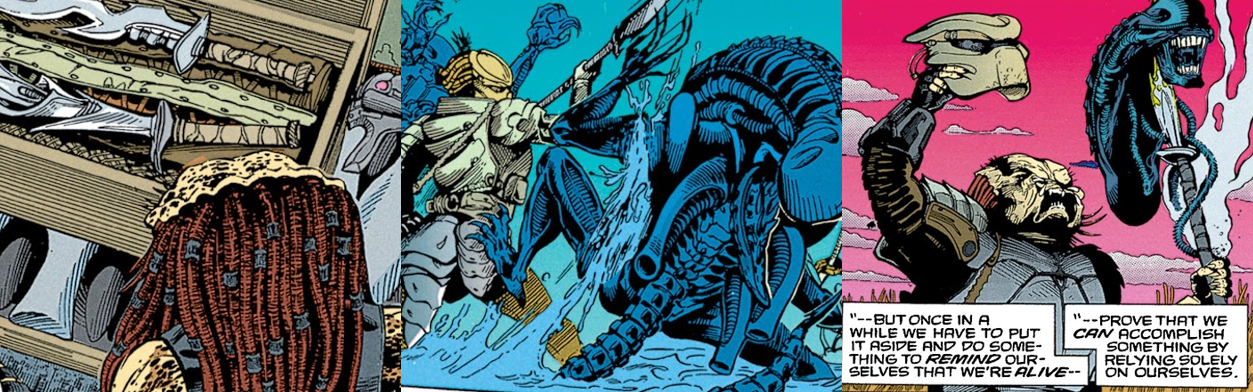
Founded in 1980 by Mike Richardson, Dark Horse Comics separated itself from the heavy-hitters like DC Comics and Marvel Comics by primarily publishing creator-owned titles. In 1988, the company achieved greater mainstream success by publishing licensed stories and adaptations of horror and science-fiction films and franchises, the most prominent of these being the merging of the Alien franchise (Various, 1977 to present) and the Predator films (Various, 1987 to present). About a year before a Xenomorph skull appeared as a trophy in Predator 2 (Hopkins, 1990), the two alien species clashed in this three-issue short story that was the brainchild of writer Chris Warner. This story served as the basis for a five-issue follow-up that greatly expanded upon the premise, which soon exploded into a slew of additional publications, action figures, videogames, and (eventually) live-action movies that pitted the two creatures against each other.

The Review:
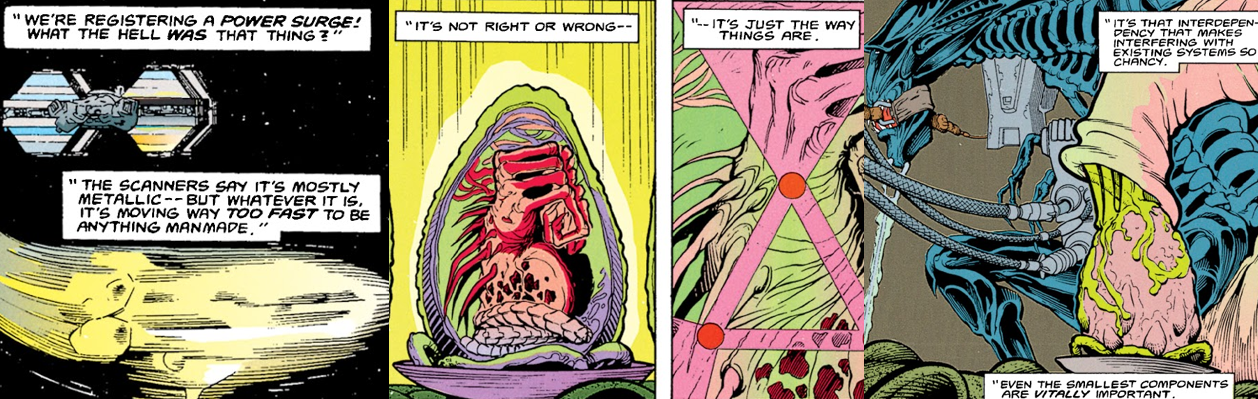
Our story begins “some time in the future” where the commercial transport vessel Lecter is making its way to the ranching outpost of Prosperity Wells on the planet Ryishi. Pilots Scott and Tom provide the entirety of the story’s narration, and are deeply engaged in a debate about the ethics and morals of mining other worlds for their resources, especially after humanity used up Earth’s in such a short space of time. Tom believes that it’s irresponsible to strip other worlds of their resources as it could stunt or even prevent the evolution of entire species, while Scott believes that it’s absolutely necessary to ensure the long-term survival of the human race.

Against the backdrop of a philosophical debate, Predators forcibly harvest Xenomorph eggs.

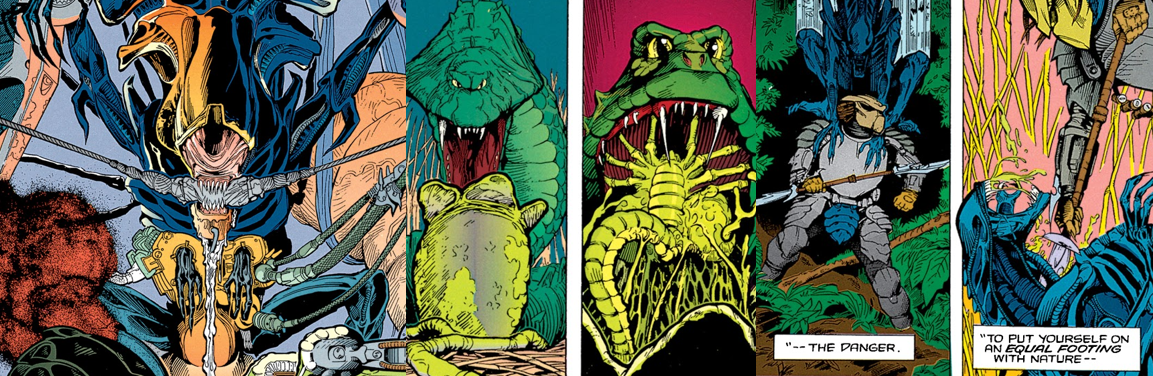
Their debate is briefly interrupted by what they assume is a meteor but is actually a Predator spacecraft darting through the cosmos. Scott and Tom’s discussion about the morals of harvesting unintelligent species for food and such are paralleled by the Predator’s harvesting on Xenomorph eggs aboard their ship; as Scott delivers a lecture about survival of the fittest and the strong overpowering the weak, the eggs and their Facehugger contents are scanned and processed and placed into pods to be seeded on other worlds. The eggs are all being forcibly harvested from a captive Xenomorph Queen, here an allegory for the “bitch” that is Mother Nature, who has no choice but to pump out egg after egg and watch as they are summarily processed and shot into space in a clean and efficient system.

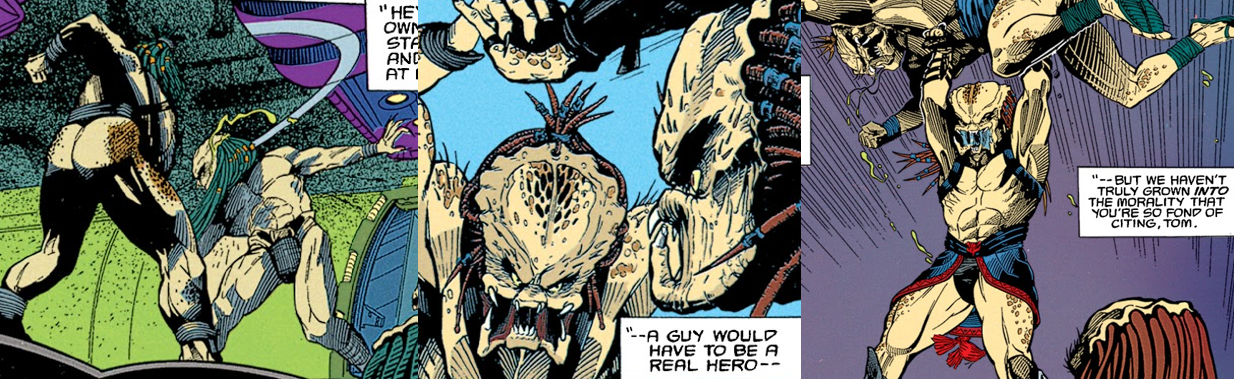
Broken Tusk fends off a challenge by the upstart Top-Knot.

As Scott and Tom move their philosophical debate on to the merits of technology versus man’s primal nature, the story introduces us to a Predator warrior known colloquially as “Broken Tusk”. As Broken Tusk arms himself with all the standard Predator weaponry we’ve come to know and love over the years, Scott and Tom endlessly comment on the difference between passive leaders and active combatants. Broken Tusk observes a bout of ritual combat between other Predators and we catch a glimpse of just how many worlds have been seeded with Xenomorphs by the creatures in order to give them something worthwhile to hunt. When upstart Predator “Top-Knot” wins the bout, he’s not content with just choosing which hunting ground he gets to visit and challenges Broken Tusk’s position, which results in the rookie being bested by his superior.

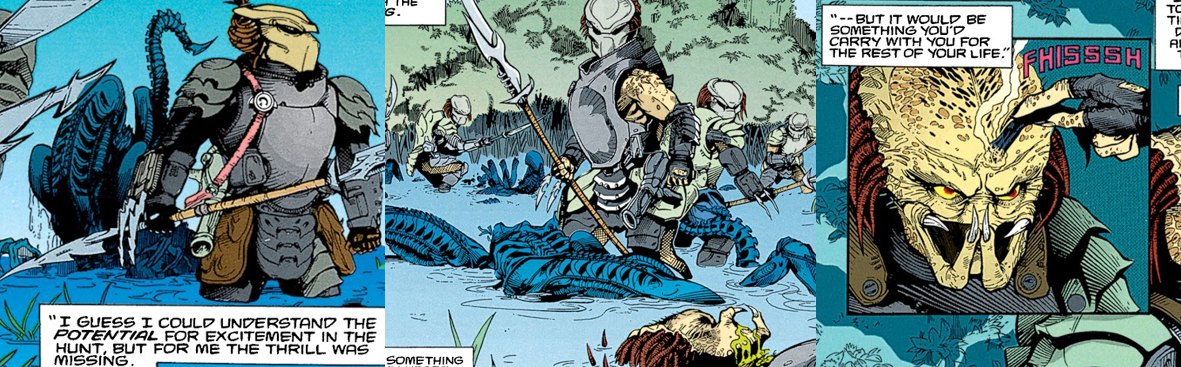
The Predators engage in a successful hunt and gain their ritual markings.

One of the Predator’s seeding pods touches down on a marsh-like alien world; the automated, tank-like vehicle drives around the environment dropping off Xenomorph eggs in its wake before finally exploding, ensuring that many of the native creatures become impregnated by the Facehuggers. As Scott and Tom move their discussion to safari hunts and the like, Top-Knot and his hunting party make landing to begin their hunt, quickly and efficiently moving through the foliage and tracking their Xenomorph prey by following the exploded dead bodies. Soon, the Predators are attacked by the full-grown Xenomorphs; despite the Aliens’ greater numbers, the Predators have the benefit of their advanced weapons and their absolute devotion to the thrill of the hunt. They emerge victorious, having suffered only one casualty, and Top-Knot brands one of his subordinates with the Xenomorph’s acid blood for successfully executing his first kill.

The Summary:
The original, three-issue run of Aliens vs. Predator is basically just a prelude to greater things to come in the subsequent Aliens vs. Predator (Stradley, et al, 1990) comics series. Consequently, it’s quite the brief and tantalising glimpse into this shared universe of the two popular, sci-fi/horror franchises, but establishes a lot of the themes for how these franchises would crossover going forward. Rather than being set in the present day or on Earth, like the Predator films tend to be, Aliens vs. Predator takes place in the future like the Aliens films; it also heavily borrows from the aesthetics of Alien (Scott, 1977), especially in the depiction of the Lecter, which is essentially the same kind of vessel as the Nostromo. Similarly, the Predator’s spaceship and appearances are heavily inspired by what we see in the first two films, but the comic greatly expands upon their society and depiction even while utilising a philosophical debate between two humans for the entirety of its dialogue.

The story provides a glimpse into the Predator’s society and lore.

Aliens vs. Predator took the idea of the Xenomorphs being this biomechanical infestation, a swarm of vicious insect-like creatures, and really ran with it; because they lack the higher levels of intelligence seen in the Predators, they are reduced to being forcibly bred specifically for young Predators to test their mettle. The visual of the Xenomorph Queen being strung up and held captive is a powerful one, and one that subsequent comics, and movie and videogame adaptations would heavily borrow from, and is a humbling visual considering how formidable the Alien Queen was depicted in Aliens (Cameron, 1986). The implication is clear: The Predators, with their greater intelligence and superior technology and weapons, were easily able to overpower and capture a Xenomorph Queen and make a regular routine of harvesting her eggs for their own ends. They’re so efficient at it that the entire process is completely automated, with the eggs being forcibly removed, processed, and seeded without any manual intervention on the Predators’ part. Predator society is expanded upon greatly here; we see the hierarchy and feudal nature of the species, with ritual combat being the norm and the younger, less experienced hunters having to fight against their peers for recognition and the chance to hunt. Like lions and other members of the animal kingdom, it’s common for the young upstarts to challenge their betters in an attempt to claim the top position. While this doesn’t go well for Top-Knot, as he’s easily bested by Broken Tusk, he’s still dispatched to lead a hunting party, so it seems as though making the challenge isn’t necessarily a sign of disrespect. During the hunt, even the inexperienced Predators are formidable and capable warriors; while we don’t get to see much of their traditional strategies (there’s no cloaking, no need to modulate their prey’s voices, and very little use of the plasma cannon), we do get to see them working in a co-ordinated effort to eradicate their prey. Although the Aliens are fast and strong and have the numbers advantage, the Predators are keen hunters and superior warriors, meaning they are victorious with minimal effort, and the honour that comes from killing a Xenomorph is of high standing in their society (which, again, would be a crucial plot point in later stories).

A decent story, but clearly just a taste of greater things to come for this crossover.

However, it has to be said that the concept of bringing together the Aliens and Predator franchises probably sounded better on paper than it worked in execution. I have read the subsequent comic series, and it’s definitely a lot better and more in-depth, but I didn’t want to get into that without first tackling the three-issue arc that kick-started this entire sub-franchise and Aliens vs. Predator, while a novelty, is really just an appetiser for the main course. Dark Horse Comics teased readers by framed the first two stories as Aliens and Predator tales, so the actual Aliens on Predator action doesn’t kick in until right at the end, and it’s very brief when it does happen. I applaud the creative use of Scott and Tom’s philosophical debate as a parallel to the events of the story, but I found myself tuning the text boxes out and focusing more on the visuals. While the art does tell us a lot about what the Predators and even the Xenomorph Queen are thinking and feeling, I am not a massive fan of the art on show here. It’s both messy and yet simple, oddly coloured (I get that we hadn’t seen much of the Predator society or their ships but there’s a lot of odd purples and yellows and blues here), and it’s not that easy to tell the Predators apart. Obviously, this is in keeping with the aliens as depicted in the movies, which had very subtle differences, but I think for a comic you need a little more than just a barely distinguishable broken tusk or hair being styled differently. It’s also a little disappointing that we don’t get more variations of the Xenomorphs; considering they were all born from alien lifeforms, it’s a little odd that they are just carbon copies of the drones seen in Aliens, but again I can understand why this decision was made as it makes sense to focus on the familiar visual of a Predator we recognise from the movies fighting Aliens as they appear in the films. Overall, it’s a fun little novelty that’s worth checking out as long as you read it as a prelude to the longer, far more exciting and visually interesting follow-up.

My Rating:

Rating: 2 out of 5.

Could Be Better

Have you ever read the original, three-issue Aliens vs. Predator story? If so, what did you think to it? Do you own a copy of the original comics or did you pick up the collected edition as I did? Were you also disappointed by the brevity of the story and the artwork or did it get you excited to see subsequent clashes between the two aliens? Which of the two creatures, and franchises, was/is your preference? Which of the Aliens vs. Predator stories or adaptations was your favourite? Would you like to see the two battle again in some form or another? Whatever your thoughts on Aliens vs. Predator, and comic book crossovers of this kind, drop a comment down below.

Game Corner: Alien Trilogy (PlayStation)

GameCorner
AlienTrilogyLogo

Released: February 1996
Developer: Probe Entertainment
Also Available For: PC and SEGA Saturn

The Background:
Over the years, there has been a slew of media and merchandise produced based on the Alien movies (Various, 1979 to present); we’ve had action figures, comic books, crossovers with the Predator films (ibid, 1987 to present) and various other comic book characters, and, of course, videogames. Typically, videogames based on the Alien series prior to Alien Trilogy focused on the more action-orientated Aliens (Cameron, 1986) and were fast-paced, sidescrolling run and gun videogames. This changed with the arcade title Alien3: The Gun (SEGA, 1993) and Alien vs. Predator (Rebellion Developments, 1994) for the ill-fated Atari Jaguar. Both titles still largely borrow more from Aliens than any of the other Alien movies but transitioned the franchise into a first-person shooter for the first time. With the under-rated Alien: Resurrection (Jeunet, 1997) due to be released late the following year and Final Doom (TeamTNT, 1996) having been released that same year, it’s safe to say that traditional first-person shooters (FPS) were still relatively popular and just starting to be just as much fun on home consoles as they were on PC and that the Alien franchise was still very much alive in the public mind, no doubt contributing to the development and release of this title.

The Plot:
After their colony on LV-426 is over-run with the volatile biomechanical creatures known as Xenomorphs, the malevolent Weyland-Yutani corporation enlists a group of Colonial Marines to head into the colony under the pretext of suppressing the Xenomorph infestation (though their true goal is to capture a live sample for use in their bio-weapons division).

Gameplay:
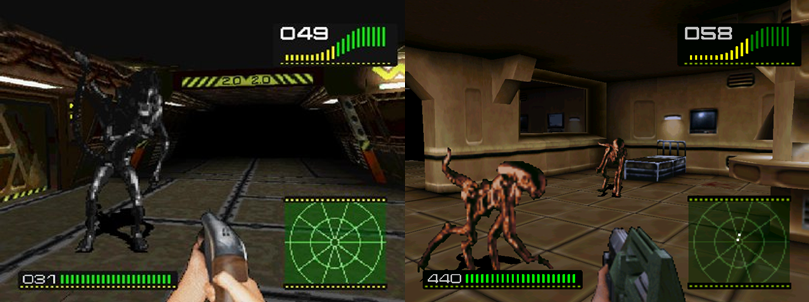
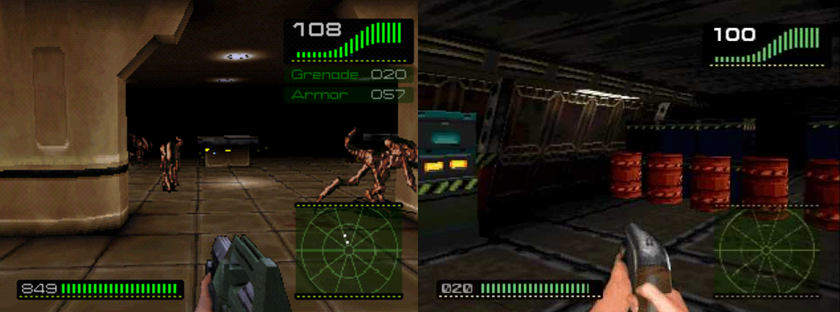
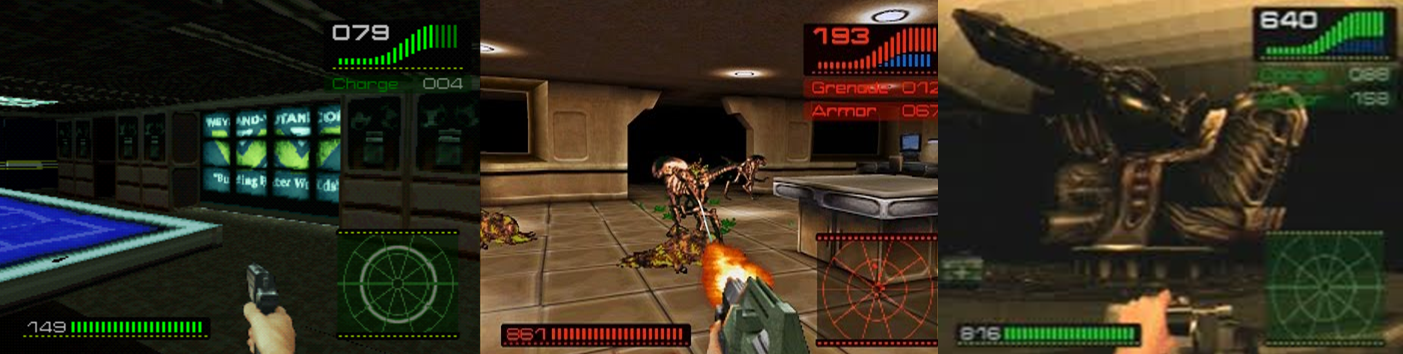
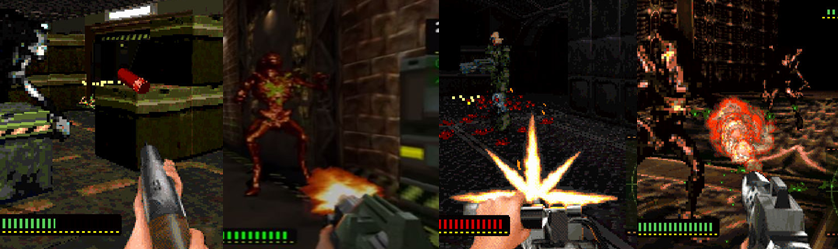
Alien Trilogy is a first-person shooter in which players are cast in the familiar role of iconic Alien series protagonist Lieutenant Ellen Ripley and dropped head-first into what is, basically, a Doom (id Software, 1993) clone. If you’ve ever played the original Doom or any of its sequels or knock-offs prior to the franchise making the jump to 3D, you’ll know exactly what Alien Trilogy is all about: navigating dark, dismal, maze-like environments, picking up a variety of weapons, and blasting at never-ending swarms of enemies until you reach a pre-determined exit.

AlienTrilogyGameplay
Explore some familiar locations in Alien trilogy.

Despite its title, Alien Trilogy doesn’t have you running through each of the Alien films in concurrent order; instead, the plot is like a condensed and abridged amalgamation of all three movies stuffed primarily into the setting of Aliens. Ripley closely resembles her appearance from Alien3 (Fincher, 1992), for example, but now she appears to be a Marine and all the weapons she has available are ripped straight from Aliens. After clearing the first few stages (all of which are based on environments from Aliens), she explores a nearby prison colony that is exactly like Fury 161 and, in the game’s finale, ends up investigating the crash alien spacecraft responsible for LV-426’s problems first seen in Alien (Scott, 1979). So Alien Trilogy is not framed in the same vein as, say, another trilogy title developed by Probe in that same year but more like Mortal Kombat Trilogy (Avalanche Software/Midway Games/Point of View, Inc, 1996) in that it mashes together all of the most recognisable elements from the three Alien movies and merges them with a traditional, Doom-style FPS title. Once you clear a stage, you’ll receive three percentage grades that track the number of Xenomorphs you destroyed, secrets you found, and how much of the mission directive you met. If your mission completion percentage is too low, you may find yourself repeating the stage to get a higher grade and progress further and, after every other stage or so, you’ll be placed in an area completely devoid of enemies and given a short time to stock up on health, ammo, and other items.

AlienTrilogyMap
The map is useful, if vague and awkward.

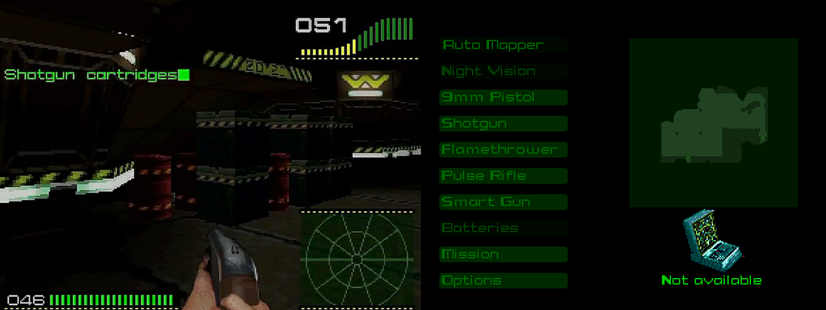
Unlike Doom, however, rather than simply making your way from point A to point B and collecting coloured keys to progress further, each stage of Alien Trilogy has a mission directive tied to it that must be met in order for players to activate the exit or successfully clear the stage. These directives range from eliminating all enemies within an area, collecting identification tags, destroying Xenomorph eggs, eliminating infected colonists or rogue androids, and activating lights, lifts, or other mechanisms to access new areas of the colony. Ripley is quite well equipped for the task at hand; she starts each stage with a default handgun but soon acquires all of weapons made famous by Aliens; ammo and health items are scarce, though, and severely limited compared to the number of respawning enemies you’ll face on the game’s higher difficulty levels, so it’s unwise to go in all guns blazing like you would in Doom. Ripley is equipped with the iconic Aliens motion tracker, which will emit a beep whenever enemies are close by; it’s helpful but a bit erratic and vague and doesn’t seem to pick up when enemies are hiding behind doors. Ripley can also acquire a few items to aid her efforts; night vision goggles and a shoulder-mounted light are perfect for illuminating the game’s near-pitch-black environments but run out quite quickly. By pausing the game, you can view a map of the area, which unfolds as you explore or becomes immediately accessible and far more detailed if you manage to find the Auto Mapper device. This is a must-have item as it allows you to zoom in on your current labyrinthine location and see where doors are (marked in green) and terminals and secret areas (both marked in blue).

AlienTrilogyNavigate
Navigation can be tricky when a lot of areas look the same.

Without this item, you’ll be left wandering around in circles almost swamped in darkness and you’ll have a tough time getting through the game’s stages yet, while the map is helpful, it’s still very vague and it’s annoying that you have to keep pausing the game to view it; it would have been super helpful if the developers had mapped it to the Select button and allowed you to toggle between the motion sensor and a mini map. Speaking of controls, Alien Trilogy is quite antiquated in its control scheme. You’ll find no support for your analogue controller here, meaning you’re left navigating using the directional-pad (D-pad) and using the shoulder buttons to strafe. Your primary fire button is X, with Square launching a smart bomb or a grenade depending on what weapon you’re carrying, Triangle cycling to the next weapon in your inventory, and Circle used to open doors or activate switches. It can get a bit clunky navigating with the D-pad and having to stand directly in front of terminals and doors to activate them but, thankfully, it doesn’t take long to adapt to the controller set-up and there’s no jump function so you never need to worry about awkwardly jumping from platforms. Unfortunately, the developers doubled down on making every environment a maze; while stages are rendered quite well considering the shoddy graphics we had to put up with at the time and everything looks quite faithful to the source material, it’s easy to get lost as every corridor looks the same, areas are nearly pitch black with darkness, and it’s not always clear how you reach new areas as the map is very vague. A lot of your time will be spent activating lifts to reach upper and lower levels of the stages but sometimes these lifts are timed; similarly, you might finally find a battery to power up a door but it’s not always clear where that door is, leaving you to run around in circles and get slaughtered by your enemies.

Graphics and Sound:
Alien Trilogy doesn’t hold up too badly compared to some of its later titles; obviously, it’s a very pixelated experience but, despite the developers rendering a lot of the game’s assets using 2D sprites, the pre-rendered environments contain a surprising amount of detail and fidelity to the movies upon which they are based.

AlienTrilogyGraphics
Many of the iconic Alien locations are recreated in Alien Trilogy.

The game’s first ten missions take place inside of LV-426, meaning you’ll be traversing a lot of dark, broken down corridors and cargo bays similar to the ones seen in Aliens; after that, you endure ten missions set in a prison area that is ripped straight from Alien3 (it includes the med bay area, the canteen, and even the smelting plant, all rendered in copper-tinted, polygonal glory). The game’s final ten missions all take place in the derelict Engineer spacecraft from Alien (referred to here as the “Boneship”, which even includes the egg depository and iconic image of the dead pilot (though it’s significantly smaller than shown in Alien). Each of these stages have hidden walls, doors, and areas to find and, eventually, become infested with the Xenomorph’s influence, degenerating into hives and nightmarish environments the further you progress. While the environments all look pretty good (when you can actually see them, that is), the game’s other assets don’t fare much better; barrels, crates, and other destructible objects are large, clunky polygons and enemies resemble little more than flat, heavily-pixelated 2D textures. Ripley’s various weapons don’t look too bad when they’re onscreen, though the developers didn’t really do much to make them any different from the stilted animations seen in Doom apart from giving them an Aliens aesthetic, but enemies only really look halfway decent when they’re obscured in shadow or coming at you from a distance. As soon as the Xenomorphs get right up close to you or a Facehugger obscures your vision, you’re faced with little more than a frightfully pixelated mess.

AlienTrilogyCutscenes
Some basic 3D cutscenes break up the action.

Surprisingly, Alien Trilogy also includes a handful of short 3D cutscenes with some passable voice acting; these are mainly used for the game’s opening and ending and the transition between stages and they’re obviously limited but, considering the rest of the game’s plot is told through onscreen text, they’re an inoffensive inclusion. Even better, when you die you’ll be treated to a gruesome little animated sequence of Ripley being skewered or gunned down by her enemies, which is a nice touch. Unfortunately, Alien Trilogy suffers a bit in the music and sound department; none of the usual Alien tracks are featured and most levels skip foreboding, atmospheric tunes or Doom-like hard rock for some odd melodies. While Ripley’s weapons make sounds that resemble those heard in Aliens, the Xenomorph’s lack the memorable squeal made famous in Cameron’s sequel and settle for animalistic grunts and hisses, though it’s quite creepy hearing cocooned or infected colonists whispering “Kill me…” as you pass them by.

Enemies and Bosses:
Primarily, as you explore the different environments on offer in Alien Trilogy, you’ll be contending with Xenomorphs more often than not. The standard drones are plentiful, especially around LV-426, and hobble over to you, hissing and snarling, to swipe at you with their claws. When bested, the Xenomorph enemies collapse into a bile of bloody pieces but be careful not to walk over their remains as their acidic blood will drain your health (though, thankfully/disappointingly, the Xenomorphs are unable to spit their acid at you in this game).

AlienTrilogyXenos
There are a few different Xenomorphs to contend with.

You’ll also come up against Facehuggers and Chestbursters; these annoying little critters skitter and jump all over the place, leaping out of eggs, destroyed crates or vents and, in the Facehugger’s case, obscuring your vision and slowly whittling your health down. As you progress further, you’ll also have to deal with Dog Aliens based on the Xenomorph from Alien3, which are smaller and faster Xenomorph variants, Xenomorphs that crawl along the ceiling, and larger, more powerful and far tougher variants in different colourations to add to the game’s difficulty.

AlienTrilogyEnemies
Infected colonists, androids, and Company stooges make up the game’s other enemies.

As if that wasn’t bad enough, you also have to contend with infected colonists; when the word “infected” appears in Alien media, I generally take this to mean someone is impregnated with a Chestburster but, in Alien Trilogy, this means they’re apparently driven by an insatiable need to shoot you to ribbons. Similarly, androids and containment crew working on behalf of Weyland-Yutani (we saw them at the end of Alien3) crop up, all of which are more than happy to blast at you with pulse rifles and shotguns.

AlienTrilogyQueen
Three Alien Queens act as the games only bosses

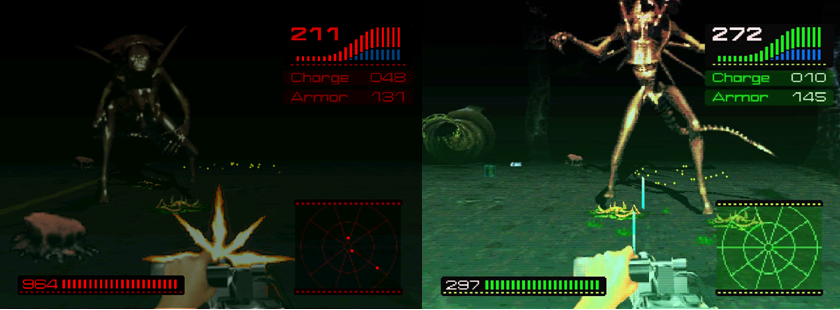
As for bosses, Alien Trilogy has three and they’re all exactly the same. After clearing ten missions, you’ll wind up in an Alien nest in the LV-426 colony, the prison, and the Boneship, respectively. These nests are littered with Xenomorph eggs, ammo, weapons, and health packs and guarded by an enormous Alien Queen, who begins each battle attached to that iconic egg sack. After wrenching herself free, she’ll plod along the arena swiping and biting and clawing at you, so you’ll need to back away, keep your distance, and just unload on her while clearing away nearby Facehuggers. Honestly, the hardest part about these boss battles is having enough ammo to put the Queen down; as long as you can keep your grenades, pulse rifle, or smart gun stocked up, you should be fine as long as you keep your distance.

Power-Ups and Bonuses:
Be sure to shoot any crates, lockers, and other parts of the environment if you can spare the ammo as you’ll likely uncover some helpful items such as health packs, ammo, or even a new weapon or some night vision goggles. You can also pick up armour to boost your durability, Hypos to increase your maximum health, and Boosts to increase your speed and damage output. Ripley has access to a decent arsenal of weapons in Alien Trilogy; she starts the game with a simple handgun but you’ll soon be wielding a shotgun, flamethrower, and the iconic pulse rifle and smart gun. The pulse rifle is doubly effective as it comes with its trademark grenade launcher, which is perfect for one-shotting most enemies and opening hidden doorways (though you’ll also find seismic charges that do the same job, they are far slower to throw).

Additional Features:
Alien Trilogy has three difficulty settings, each of which affects the amount of enemies, health, and ammo you’ll find in the game’s stages. When you die, you’re given a (stupidly long) password to enter and continue your progress if you need to stop playing and, best of all, there are some nifty cheat codes available which grant you invincibility, all weapons (with infinite ammo, as standard), and the ability to warp to any stage in the game. Otherwise, that’s about it; there’s no multiplayer or co-op component (unless you’re playing on PC…) or even a high score system in place so you’re literally just replaying to try your skill on a higher difficulty setting.

The Summary:
Alien Trilogy is a decent enough Doom clone; it doesn’t really do anything new with the formula popularised by Doom except slap an Alien aesthetic over it but it does an admirable job of recreating the weapons, enemies, and locations from the first three Alien movies. Unfortunately, the game is just way too dark at various points; I get that this adds to the game’s tension and atmosphere but it’s more annoying than fun to be scrabbling around in near pitch darkness trying to find your way as you don’t have the full map available to you. I could almost (almost) forgive the underwhelming music, sound effects, and terribly rendered graphics if not for the game’s insistence on making every environment a near-impossible maze. The game really could have been called Alien: Labyrinth for all the twisting, turning, nigh-identical areas it throws at you and it’s a hell of a chore trying to track down paths to even find the batteries you need to open doors or activate lifts, much less actually find those passageways.

My Rating:

Rating: 1 out of 5.

Terrible

What did you think about Alien Trilogy? Where does it rate as an FPS title or as an Alien game? Do you agree that the game is let down by its mazes and more confusing elements or did you find it more of an enjoyable challenge? Which videogame or piece of media based on the Alien franchise is your favourite? Whatever you think about Alien, and FPS games in general, feel free to leave a comment below.

Game Corner: Aliens vs. Predator (2010; Xbox 360)

GameCorner
AVP360Logo

Released: February 2010
Developer: Rebellion Developments
Also Available For: PC and PlayStation 3

The Background:
I’ve mentioned this before but Aliens vs. Predator has been a thing for a long, long time now. These two iconic science-fiction/horror franchises first came to blows in a series of excellent comic books published by Dark Horse comics between 1989 and 1990 and, since then, we’ve seen countless additional comic books, action figures, two divisive movies, and a whole host of videogames based around the concept. In the same year that the exceptional arcade beat-‘em-up was released, Rebellion developments crafted a first-person shooter (FPS) for the short-lived Atari Jaguar (remember that?) that allowed players to take on the role of a Colonial Marine, a Xenomorph, and a Predator in what was, essentially, a reskin of popular FPS games like Wolfenstein 3D (id Software, 1992) and Doom (ibid, 1993). A few years after AVPR: Aliens vs. Predator – Requiem (The Brothers Strause, 2007) effectively killed the concept of seeing the Predators hunting the Xenomorphs onscreen (though I actually quite enjoyed that movie; it was worlds better than the first AVP movie), Rebellion Developments rebooted the concept for then-modern consoles and produced another FPS title that, despite bringing two of cinemas most iconic franchise together for a new generation, failed to really impress players or critics alike. Despite this, and my general disdain for FPS games (I just don’t like the restrictive view or being shot in the back), these are two of my favourite franchises and the game is dirt cheap so I decided to pick it up and see it was really as mediocre as everyone said it was.

The Plot:
The malevolent Weyland-Yutani corporation finds their colonies, laboratories, and spaceships under attack when their experiments with Xenomorphs inevitably break out and the alien Predators become enraged at the corporation desecrating their sacred hunting grounds. Roping in an expendable team of Colonial Marines to secure their sites, the corporation scrambles to ensure that their new cross-breed specimen survives to be sold as a military weapon.

Gameplay:
Like its Atari namesake, Aliens vs. Predator is a first-person shooter than gives players the option of playing as a Colonial Marine (known as the “Rookie”), a Xenomorph (codenamed “Specimen 6” or simply “Six”, and a Predator (referred to as “Dark”). Each story sees you exploring similar environments and the game’s over-lapping story from different perspectives, with slightly different control schemes, gameplay mechanics, and objectives to fulfil as part of your mission.

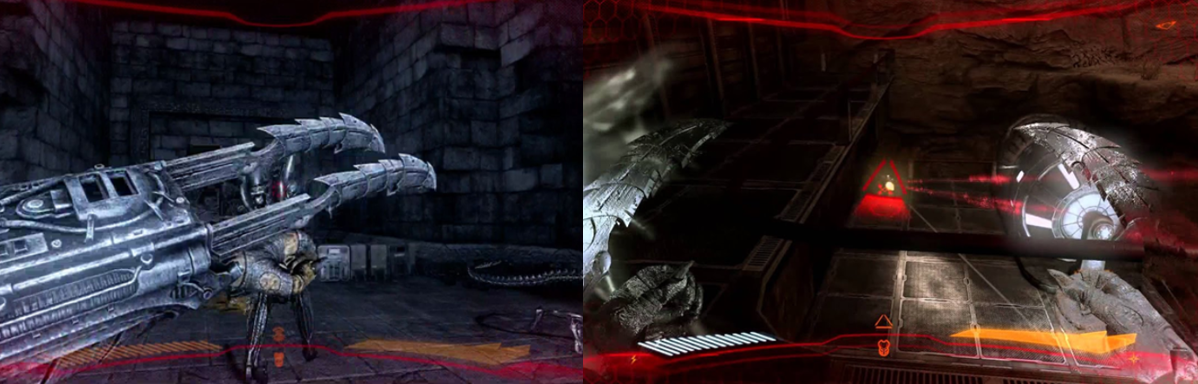
Block and slash with wrist-mounted blades or make short work of his prey with the Predator’s plasma cannon.

As much as I love Aliens (Cameron, 1986), I have a soft spot for Predator (McTiernan, 1987) so, naturally, upon booting up Aliens vs. Predator, I completed my first playthrough as the Predator character. In an effort to better evoke the spirit of that first movie, you’re dropped into the middle of an alien jungle to learn the many complex controls associated with the Predator, who has access to the majority of his iconic abilities right off the bat. The Predator engages in combat primarily through the use of his wrist-mounted blades; the right bumper slashes with a weak blow, the left with a stronger attack necessary for breaking through an enemy’s guard, and holding them both down allows you to defend yourself from melee attacks. Pressing the right trigger sends out an energy blast from the Predator’s trademark shoulder cannon and holding the trigger down lets you lock on to a target. You can also press the Y button to activate the Predator’s signature cloak, though both of these abilities drain Dark’s energy meter and this can only be replenished by charging up at various electronic panels scattered across the game’s limited environments. Also, it might just be me but I found the cloak almost completely useless; if you activate it and walk in front of a human enemy, they will still spot you and open fire upon you and they’ll still be able to see and track you even if you leap behind cover. Add to that the fact that the Xenomorphs can detect you whether you’re cloaked or not and Dark’s invisibility is all but ineffective in execution and it’s far easier to simply sneak around behind cover than depend upon this mechanic. Dark can also cycle through various vision modes (the usual thermal vision allows you to see human and android enemies but renders Xenomorphs as nearly invisible and the reverse is true for the green-tinted Xenomorph vision) with a press of the B button and you can even lure his prey into an ambush by pressing X and mimicking cries for help. This is the perfect way to sneak up behind your prey and execute a “Trophy Kill” that sees the Predator wrench a man’s head from his shoulders or skewer them with his wrist blades.

Even with all the Predator’s advantages, first-person doesn’t seem to be a suitable gameplay perspective.

You can also execute these gloriously gory kills by stunning enemies through melee combat and can expand the Dark’s arsenal as you progress through the story and acquire other weaponry popularised by the criminally under-rated Predator 2 (Hopkins, 1992). As you explore your environments, you’ll be given objectives and hints through your heads-up display (HUD) and can hold down the left trigger to entire a “Focus Mode” that allows you to see points of interest, your exit, and other secrets and items scattered around the environment. The Predator can also jump with the A button and, when in Focus Mode, will leap to higher vantage points automatically to allow you to take the high ground and pick off your targets. Dark has a health bar in the bottom right of his HUD; he can take a decent amount of damage but falls surprisingly quickly under sustained gunfire or Xenomorph clawing. You can restore your health by holding the Y button as long as you have a Health Shard on hand; you can hold three of these at any one time and will find them scattered sporadically across the game’s locations. Luckily, there are numerous checkpoints so, if (well…when) you die, you can simply load up your last checkpoint. You can also manually save the game at any time but this doesn’t create a checkpoint; also, quite often I found that I would reload a checkpoint only to be dumped in the middle of a full-on gunfight, which was a bit annoying, to say the least. Similarly, for me, the FPS perspective is clunky and awkward for the Predator; since you’ll soon run out of energy for your plasma cannon, you’ll be relying on close-combat melee attacks or Dark’s other, less interesting weapons. It’s also slightly awkward and annoying to have to constantly cycle through the Predator’s various vision modes when dealing with combinations of enemies so you rarely get the chance to properly appreciate the game’s surprisingly detailed environments. Personally, I feel like the Predator would have controlled and been realised better if his gameplay had been rendered from the third-person as in Predator: Concrete Jungle (Eurocom, 2005) though, to be fair, I found that game even more daunting in the vast array of controls and mechanics it used to bring to life all of the Predator’s various abilities and weaponry.

The Marine controls much like a typical FPS, but with poorer lighting and a handful of rudimentary puzzles thrown in.

After finishing the Predator’s story, I next took on the role of a Colonial Marine (known as “Rookie”). The Marine’s gameplay is very similar to a standard FPS videogame, which makes the game far less clunky and awkward when compared to playing as the Predator from a first-person perspective; the HUD is simplified, incorporating the Aliens motion tracker to give you a vague idea of where enemies are and pointing you in the right direction, and the Marine also regenerates a small portion of his health as long as you don’t lose an entire block. You can still pick up health, though, this time in the form of Stim Packs, which operate in exactly the same was as the Predator’s Health Shards, but are afforded far more limited options when it comes to your ability to see and navigate through the game’s many dark and dismal corridors. Pressing B will activate Rookie’s torch (or “flashlight” for you Americans) to bring some light to darkened areas and you even have an unlimited supply of flares that you can toss into the darkness for a brief period of light, which is a nice touch. Rookie’s story is one of survival and meeting many varied objectives; the Xenomorph infestation has left Weyland-Yutani’s many facilities in quite a state so you’ll be repairing power points, activating doors, and setting up automated gun turrets to progress further, fortifying the barricades the few remaining Marines have set up, and mowing down swarms of Xenomorphs. Because of this, the Marine’s gameplay feels far more tense and reminds me of playing Doom 3 (id Software, 2004) thanks to the sparse use of lighting, dark, dank, and dreary futuristic environments, and claustrophobic, mounting horror that fills every area. The Marine is your typical silent FPS protagonist and spends most of his time taking orders from fellow Marine Tequila and being directed by Company android turned good Katya. Generally, this means hacking into terminals and then surviving while hoards of Xenomorphs or Combat Androids (or both) fill the immediate area, which can be a tall order in some situations. Other times, you’ll simply be running from certain death and, while Rookie can jump, he isn’t required to do any tricky platforming, which I am very thankful for, but he also can’t duck and there’s no real snap-to-cover system in place so, in the face of a hail of bullets, you’re limited to taking a more old school approach and simply, awkwardly, hiding behind bits of the environment. You can take advantage of the environment to help clear out enemies, though, as you’ll find explosive pipes and barrels conveniently scattered across narrow hallways and bridges that will help to thin out swarms of Xenomorphs or put down those Goddamn Combat Androids.

It can be disorientating playing as a Xenomorph since Six’s clunky gameplay makes stealth tricky.

Honestly, I dreaded playing as the Xenomorph, Six, simply because I could tell that it was going to be the most troublesome and least fun campaign. Six is the fastest and most agile character, able to clamber over walls, ceilings, and pretty much all of the game’s environments just by moving the left analogue stick. While it’s pretty simple to run up walls and use the Xenomorph’s a panther-like leap to traverse the game’s areas, it’s maybe too easy; you’ll slide up walls when you don’t mean too, slip around like you’re constantly on ice, and it’s more than a little disorientating when you’re scuttling upside down on ceilings. Six attacks entirely with melee attacks; while other Xenomorph enemies spit acid, Six isn’t able to do that so must rely on her claws and her spear-like, whipping tail. By holding down the left trigger, you can engage Six’s own Focus Mode to target specific enemies and leap at them at attack; you can also block, like the Predator, and break an enemy’s block with her stronger tail attack. Sneak up on enemies, or damage them enough, and you’ll be prompted to press X to grab them and perform a gruesome instant kill. Six, apparently, performs best when shrouded in darkness so, during her tutorial, you’ll be asked to smash out ceiling and wall lights to keep her shrouded in darkness. In practise, though, I found few opportunities to really do this and, similar to the Predator’s cloaking mechanism, enemies seem to spot you no matter how deep in the shadows you are. Sometimes you can slowly sneak up behind them, other times they’ll turn around with the slightest press of the analogue stick; one time, though, I snuck up on a Marine and skewered her through the chest as she stood next to her team mate…who just stood there, completely oblivious, and let me do the same to him. Scattered throughout Six’s environments are a series of vents that she can dart through to avoid gunfire; unlike the other characters, Six’s health automatically regenerates after a few seconds and she has no other way of refilling her health bar so it’s crucial that you hit and run if you take too much damage. Similar to the Predator, Six can hiss to attract enemies closer to her and you’ll also find some civilians scattered throughout each mission, helpfully highlighted in green. Sometimes, these civilians will run and cower in a corner but others they’ll shoot themselves or blow themselves up so you’ll have to be quick about pouncing on them to harvest them with the X button. If the FPS view is unbefitting of the Predator, it’s really awkward for a Xenomorph; it’s very difficult to know where you are or how to orientate yourself. It’s like the game wants to be like the Predator sequences from the Batman: Arkham series (Various, 2009 to 2015) but it falls way off the mark as it’s difficult to target and isolate Marines in narrow areas. I can’t help but think the Xenomorph campaign would’ve been better as a kind of top down strategy style of game similar to Aliens Versus Predator: Extinction (Zono, 2003) where you play as an Alien Queen and direct drones and other Xenomorphs from the hive to spread her progeny throughout the game’s environments.

Graphics and Sound:
Honestly, for an Xbox 360 game and considering the age of this title, Aliens vs. Predator doesn’t look half bad; graphically, the game struggles to render human models in a realistic way, once again making them appear as little more than plastic action figures, but the various Xenomorphs and Predators all look really good and are very true to their source material.

AVP360Fidelity
The game’s visual fidelity to the aesthetics of the movies is top notch!

Visual fidelity is key to Aliens vs. Predator’s presentation; the jungle is clearly modelled after the one seen in Predator, for example, and the various Weyland-Yutani corridors all evoke the same lived-in aesthetic as seen in Aliens but there were a few surprising call-backs to Alien (Scott, 1979) in the game’s visuals as well; even Alien3 (Fincher, 1992) feels evoked through copper-tinted, wind- and water-swept areas such as the mines and the refinery. While I expected the game to recycle a lot of the alien and mixed dynasty architecture of the AVP movies (which it did, particularly in rendering the ancient Predator hunting grounds and pyramids, with liberal use of hieroglyphics depicting the two species’ long history), I wasn’t expecting the game to so faithfully evoke the spirit and feeling of any movie beyond Aliens so that was a nice surprise for me. Unfortunately, you’ll be visiting the same five different environments across each of the three campaigns. Sure, you’ll have access to different areas, different objectives, and different options available to you but, essentially, Aliens vs. Predator simply recycles the same levels three times, which is a bit of a disappointment.

AVP360Sound
Sounds are all ripped straight from the movies and even Lance Henriksen is back!

Where Aliens vs. Predator excels, though, is in its sound design; the music and sound effects are all ripped directly from the two Predator movies and Aliens, providing a stamp of authenticity that works really well with the game’s slavishly faithful environments. The pulse rifle sounds exactly as it did in Aliens, the Predator’s various growls and ticks mirror those from the movies exactly, and the Xenomorphs even sequel in pain exactly as they did in Aliens. Aliens vs. Predator even brought back the immortal Lance Henriksen as another iteration of the Bishop Weyland dynasty, lending his likeness and voice to the character and rightfully cropping up more than once through each campaign to add a level of malevolence and quality to the product. The game does feature a number of cutscenes but, honestly, they’re few and far between, especially in the Marine’s campaign. The story is quite minimal, to be honest, and mostly related through onscreen text and in-game dialogue as you progress through each campaign rather than being long, in-depth cinematics that cut away from the game’s many and varied gameplay mechanics. Bare-bones as it is, though, the story is serviceable enough and does a far better job of meshing these two franchises together than either of the movies, which made the inexplicably stupid decision to set their narratives on then-present-day Earth rather than the furthest reaches of future space.

Enemies and Bosses:
Typically, the most common enemy you’ll be coming up against as you play through Aliens vs. Predator are the Xenomorphs themselves; these come in a few different shapes and sizes, from the annoying little Facehuggers, which leap out from slimy Xenomorph eggs, to the regular drones and their larger variants that like to block your attacks, to acid-spitting crawlers, all of which can further damage you with their acidic blood so don’t go running over their corpses! When playing as Six, you won’t have to worry about fighting other Xenomorphs; instead, your primary prey are a smattering of Marines who wander around the game’s environments and blast at you with shotguns, pulse rifles, and flamethrowers as soon as they spot you. Combat Androids pop up later in the campaign and are just as bad but the strategy to taking them out remains the same; stay away, strike quickly, and hopefully split them up the middle with your tail.

Xenomorphs and Combat Androids will come at you from all sides!

The Xenomorphs are slippery, agile little devils and will clamber all over the environment to avoid your attacks, sneak in through tunnels, and strike from the darkness with an aggressive fury; quite often, you’ll be faced with endless swarms of the creatures and forced to either run for your life or solve a rudimentary puzzle to escape from them. When playing as Dark and Six, you’ll also have to contend with gun-toting Marines who are far less sporadic than the Xenomorph enemies, moving in specific patterns, taking cover, and blasting to you with their heavy weaponry the moment they catch a glimpse of you. However, while their firepower can easily overwhelm you, they go down pretty easily once you get a good lock on with the Predator’s weapons and you can thin out their numbers by allowing nearby Xenomorphs to run roughshod over them, which is a nice touch. Rookie has a tougher time taking on Xenomorphs, which are much harder to get a good lock on thanks to the Marine lacking the same vision options as the Predator, and, while they don’t have to fight other Marines, they will have to contend with the Combat Androids that patrol Weyland-Yutani’s facilities. When I encountered these as the Predator, they weren’t any different to battling the Marines (except they exploded upon destruction) but the Marine will find himself shot and beaten to death in seconds by these artificial enemies if you don’t attack from a distance with the scope rifle and make liberal use of cover. The androids can only be damaged by shooting their limbs (blow off their heads and they’re still 90% combat efficient) and often suddenly jerk to life and blast at you with a shotgun from the ground; later, they also make use of the Predator’s cloaking technology, practically forcing you to use the scope rifle’s x-ray feature to get a bead on them.

The Praetorian is not as intimidating as it looks whether you face it as the Predator or the Marine.

Bosses, though, are few and far between in Aliens vs. Predator, which is a bit of a shame considering the vast numbers of different Predator and Xenomorph variants there are and even the presence of those mech-like Loaders from Aliens. Each campaign sees you tangling with different boss battles, though, so at least you won’t have to battle the same bosses over and over again. Dark’s first boss battle is within the walls of an ancient and decrepit coliseum of sorts; here, you’ll face off against a Praetorian Xenomorph variant which looks like a smaller version of the Alien Queen. Though the largest and most intimidating Xenomorph you’ve encountered by that point in the Predator’s campaign, the Praetorian is a joke; you simply strafe around, blasting at it with your plasma cannon or chucking spears at it and it goes down fairly easily. Rookie also gets to take on a Praetorian; the first time, it’s a one-on-one battle in a small, enclosed area as regular drones swarm nearby and, the second time, you take on two after mowing down wave upon wave of Xenomorphs. Luckily, the Marine’s weaponry (particularly the pulse rifle’s grenade launcher and smart gun) are more than up to the task of cutting these monstrous bastards down to size.

The hardest thing about these bosses is the environmental hazards and waves of enemies.

Disappointingly, Rookie only encounters a Predator once or twice during his campaign but you do get to battle one in the combat arena as a boss. This generally involves you running around the arena collecting health and ammo and watching out for the Predator’s laser sight; once you spot it, dodge out of the way and trace the laser back to its source and unload your pulse rifle. The Predator eventually (or sporadically) drops to ground level to try and skewer you but just keep your distance and unload with the shotgun or grenade launcher and he goes down pretty easily. The Predator’s campaign ends with him facing off against the Predalien, a monstrous abomination that is a cross-breed between a Xenomorph and a Predator, which takes place on a series of small platforms floating on instant-death lava! Luckily, in this restrictive arena, your energy bar (not your health, mind) regenerates indefinitely so you can simply keep your distance (especially from the Predalien’s devastating pound attack) and blast away to your heart’s content. Don’t even bother trying to jump from platform to platform; simply stay back and shoot him, landing a few melee attacks when it’s safe to do so, and he’ll be done in no time. As the Marine, quite early into his campaign, you’ll have to destroy an Alien Queen; luckily, this is far easier than the fight in Aliens as the Queen is helpless and chained up. You’re simply required to sweep the nearby eggs with a flamethrower, start up the massive furnace, fend off some drones, and then blast at some explosives conveniently located right near the Queen’s head to put an end to her egg-laying ways.

While Six eventually fights an Elite Predator, the Marine’s final challenge is another Bishop android…

Rookie’s final boss isn’t another Queen, a Predator, or even the Predalien; instead, you go toe-to-toe with Karl Bishop Weyland who, as you might have guessed, is actually an android. I found this to be one of the toughest boss fights in the game as Bishop shrugs off bullets, you quickly run out of grenades, and he just runs right at you, spouting megalomaniacal nonsense and blasting at you with his devastatingly dangerous shotgun. Once you finally manage to put him down, you’re then suddenly tasked with shooting him in the head after a cutscene so don’t put your controller down after defeating him or you might find yourself getting shot. Six gets off slightly easier compared to her counterparts in that the only bosses she has to worry about are some Predators. When you reach the now-familiar combat arena, you’ll have to take on two Predators at once; the key here is to target one with your Focus Mode and stalk them incessantly. Once they reach ground level, leap in and strike and then back away and strafe around them, whittling their health down (hard to judge as they have no health bar), and don’t try to go toe-to-toe with them or to grab them and, if they block your attacks, back away immediately as you’ll be made mincemeat of in seconds. As soon as the two Predators are defeated, an Elite Predator enters the arena and the battle begins again. This time, the boss does have a health bar, which makes tracking your process much easier. However, while the Elite is technically tougher, the fight and your strategy are exactly the same; the only real difference is that, once you’ve weakened the Elite down, you’ll harvest it to give birth to the Predalien from the Predator’s campaign.

Power-Ups and Bonuses:
As you explore the game’s different locations, you’ll find a number of collectables to flesh out the game’s lore and contribute towards obtaining all of the game’s Achievements; Audio Diaries, Trophy Belts, and Royal Jelly Containers can be found (or destroyed in the jelly’s case) dotted throughout each of the three campaigns but, unfortunately, this is the extent to which additional bonuses and points of interest go for Aliens vs. Predator beyond admiring the fidelity the game pays to the various movies that comprise each franchise. Of the three available characters, the Predator has the most exotic weaponry; you start off with the wrist blades and the plasma cannon but soon acquire proximity mines (that, honestly, I never actually used during my playthrough), the razor-tipped smart disc (which you must awkwardly direct using your laser targeting), and the Predator’s iconic spear (or “Combi Stick”, which deals massive damage when thrown but is incredibly inaccurate and takes some time to return to your hand).

While the Predator and Marine wields a bevvy of weapons, the Xenomorph has far less combat and gameplay options.

The Marine isn’t exactly lacking in weaponry, though; the Rookie has access to a handgun (which, thankfully, has unlimited ammunition) and all the iconic weaponry from Aliens (the pulse rifle, the smart gun, even the flamethrower and shotgun). Pressing the right trigger allows you to perform a melee attack with each of these weapons and they all feature a secondary firing mode as well; the handgun has a rapid fire mode, the pulse rifle shoots out grenades, and the shotgun can fire from both barrels, for example. The Marine also gets access to a scope rifle that is, essentially, a sniper rifle, which comes with a handy x-ray scope that us extremely useful for picking off enemies (and Combat Androids) from a distance but quite tricky to wield in execution as your enemies generally move faster than your eye can track. Compared to the other two, Six gets the short end of the stick when it comes to power-ups and bonuses in that she has no such options available to her. Once you learn everything she can do, that’s all you get; you don’t get taught how to spit acid or do anything new, despite Six metamorphosing into a Praetorian throughout the story, leaving her as the most limited of the three available characters.

Additional Features:
As you might expect, Aliens vs. Predator features a wide variety of Achievements that you can earn as you play through the game’s different modes; the majority of these are tied to unmissable story events or the game’s multiplayer but others will require you to kill a number of enemies with certain weapons or find all of the Audio Diaries, Trophy Belts, or destroy all of those Royal Jelly Containers. The game also features a “Survival” mode where you must hold out against wave upon wave of Xenomorphs for as long as you can using a number of restrictive maps based on the game’s different environments. Unfortunately, you can only play as the Marine in this mode and, honestly, it’s not really all that challenging as your entire health will regenerate in time and there are loads of respawning health packs, ammo, and weapons strewn around the maps. The waves do increase in challenge and aggression as you progress, though, but you don’t really earn anything for playing beyond using the mode to easily grab a few Achievements so there’s not a lot of incentive to revisit the mode. As you might expect from an FPS, Aliens vs. Predator also includes a multiplayer component; unfortunately, I wasn’t able to experience this as there is no couch multiplayer option and I haven’t renewed my Xbox Gold for some time now (if anyone wants to get me a subscription or, better yet, Xbox Ultimate, feel free to drop me a message). The game also apparently did well enough to justify the release of some downloadable content (DLC); however, as this is entirely comprised of additional multiplayer maps and options, I won’t be investing any money into this. How cool would it have been to have an additional single-player DLC that cast you as the Predalien or was themed around the movies? Like recreating the events of Predator or Aliens using the game’s maps, which are already heavily inspired by those movies, or to crawl around in a cobbled together recreation of Fury 161 from Alien3 as a Xenomorph, or even play as the likes of Hicks (Michael Biehn) or Ripley (Sigourney Weaver) in a short mission-based campaign?

AVP360Banner

The Summary:
With three different campaigns to play through and a variety of different gameplay styles on offer, you’d think that Aliens vs. Predator had a lot of replay value and incentive to keep you playing. Unfortunately, despite is aesthetic and aural fidelity to its rich source material, the game ends up being just another lacklustre FPS title with little to really tempt you back once you clear the three single-player stories beyond tackling a harder difficulty level. I suppose it’s possible that the game’s multiplayer is worth revisiting the game but I wouldn’t know about that and, even if it as, I generally judge a videogame by the merits of its single-player campaign and options since that’s where I spend the majority of my time. While Aliens vs. Predator is nowhere near as bad as I was led to believe going into it, it’s also quite mediocre in a lot of ways. Enemies and environments are strikingly faithful to the movies but incredibly linear; while this works to evoke the claustrophobic and atmospheric moments of the films, it doesn’t do much for the game’s replayability and there are definitely better FPS, and AVP, games out there.

My Rating:

Rating: 2 out of 5.

Could Be Better

What did you think of Aliens vs. Predator? Which of the three campaigns was your favourite, or least favourite? Did you also enjoy the level of fidelity in the game’s presentation or were you too put off by the game’s short length and simplistic story mode? Was the multiplayer any better? Which Aliens, Predator, and/or AVP videogame or piece of ancillary merchandise is your favourite? Whatever your thoughts on these franchises, please feel free to leave a comment.

10 FTW: Comic Book Crossovers We Need To See

If there’s one thing comic books allow, it’s the grandiose crossover between characters. Ever since Barry Allen met Jay Garrick all the way back in 1961 and introduced the idea of multiple parallel universes, comic book characters have existed in both isolated shared universes and travelled across a near infinite multiverse. However, while it’s relatively common to see Bruce Wayne/Batman and Clark Kent/Superman interact with the Justice League or the Teen Titans, or to have Peter Parker/Spider-Man randomly join forces with the Fantastic Four or the X-Men, we’ve also seen the characters of DC and Marvel Comics interact with each other. We’ve seen Superman and Batman both cross paths with Spider-Man, the X-Men team with the New Teen Titans, and both publishers’ greatest heroes go head-to-head in the epic DC Versus Marvel Comics (Marz and David, et al, 1996) crossover.

10FTWCrossoversWeird
There have been some weird crossovers in comics.

In addition, Dark Horse Comics snapped up multiple science-fiction and horror film franchises, giving us crossovers such as RoboCop Versus The Terminator (Miller, et al, 1992) and a whole slew of Aliens vs. Predator (Various, 1989 to present) comics. It doesn’t end there, either; we’ve seen Batman cross paths with Judge Dredd on multiple times and Frank Castle/The Punisher team up with not only Eminem but also pop up in Archie Comics, and it was thanks to such comic book crossovers that we finally got to see the three-way mash-up between Freddy Kruger, Jason Voorhees, and Ash Williams! Yet, as many and varied and seemingly limitless as these crossovers can be, it seems like we’ve missed out on a few seemingly-obvious crossovers. Maybe it’s because of licensing issues or the fact that DC and Marvel Comics don’t tend to do a lot of business together lately, but, either way, I figured I’d talk about ten crossovers I’d love to see in comic books.

10FTWCrossoversJSWM
10 Justice Society/Watchmen

After DC Comics finally put an end to the largely-awful New 52 run, they teased Alan Moore’s seminal work, Watchmen (ibid, et al, 1986 to 1987), becoming part of DC canon when Edward Blake/The Comedian’s iconic smiley-face button turned up in the Batcave. Cue the extremely delayed publication schedule of Doomsday Clock (Johns, et al, 2017 to 2019), a storyline that revealed that Doctor Jon Osterman/Doctor Manhattan had been influencing DC canon for decades. While this, obviously, brought the characters of Watchmen (or, at least, versions of them) into conflict with Superman, Batman, and other versions of the Justice League, it’s the older, more seasoned members of the Justice Society of America (JSA) I’d like to see have extended interactions with the Crimebusters. The JSA were at their peak around the time of World War Two, meaning they are decidedly more optimistic and pragmatic about their approach to crimefighting. The Crimebusters, meanwhile, existed in a largely dystopian version of the 1980s that was pretty bleak and constantly on the verge of another World War, meaning this team up could produce an interesting clash of styles and philosophies that would probably be more in keeping with Moore’s more reflective text rather than an all-out brawl. Plus, who doesn’t want to see who would win a battle between Jim Corrigan/The Spectre and Doctor Manhattan?

10FTWCrossoversPulp
9 Pulp Heroes United

Before Batman and Superman, there were the pulp heroes of the 1930s to 1950s. Names like the Phantom, the Shadow, the Spirit, the Rocketeer, and Green Hornet may have faded from mainstream relevance in recent years, but they live on thanks to publications from Dynamite Comics and crossovers with DC Comics. Speaking of Dynamite Comics, they came very close to this crossover with their Masks (Various, 2014 to 2016) series, which saw the Shadow teaming up with the Green Hornet and Kato, a version of Zorro, and the Spider but this crossover has so much potential to really pay homage to the heroes of yesteryear. Ideally, such a comprehensive team up would be similar to The League of Extraordinary Gentlemen (Moore, et al, 1999 to 2019) in its scope and legacy; hell, I’d even have the Phantom, the Shadow, the Spirit, the Rocketeer, Green Hornet and Kato, Zorro, Doc Savage, the Lone Ranger and Tonto, and the rest of their ilk butting heads with the Martians from The War of the Worlds (Wells, 1897) at the turn of the century. A proper sepia-toned, steampunk-filled piece that sees these wildly different pulp heroes begrudgingly working together to save the world could be a great way to thrust these overlooked classic heroes back into the spotlight.

10FTWCrossoversRHWS
8 Red Hood/Winter Soldier

If the comic industry was like it was back in the mid-nineties, we would surely have already seen this crossover, which is as obvious and as fitting as the team up between the Punisher and Jean-Paul Valley/Azrael during his brief tenure as Batman. Speaking of which, a team up between Jason Todd/Red Hood and the Punisher is just as enticing but, in terms of thematically complimentary characters, you’re hard pressed to find two more fitting that Jason Todd and Bucky Barnes. Both characters were well-known sidekicks to greater heroes whose deaths shaped, influenced, and affected their mentors for years, and both even returned to life as violent, broken anti-heroes around the same time.

10FTWCrossoversJTBB
Jason and Bucky’s deaths weighed heavily on Bat and Cap for years.

Yet, while Bucky has gone on to not only redeem himself and assume the mantle of Captain America (and is largely far more mainstream thanks to his prominent inclusion in the Marvel Cinematic Universe), Jason Todd has floundered a little bit. It didn’t help that Jason’s resurrection was directly tied to DC’s latest reality-shattering Crisis for years (even though there have since been far less convoluted explanations, and he really should have been Hush all along) but, even ignoring that, Jason’s place is skewed as one minute he’s a sadistic killer, then he’s a violent anti-hero, then he’s wearing the Bat embalm and is an accepted (however begrudgingly) member of the Bat Family. However, both characters have carved a name out for themselves as being willing to go to any lengths to punish the guilty; each has blood on their hands, a butt load of emotional and personal issues, and a degree of augmented strength, speed, and skill thanks to their training or resurrection. While both are similar, Bucky is far more likely to be the bigger man and take the more moral ground, which would be more than enough to emphasise the differences between the two (provided Jason feels like being more antagonistic in this theoretical crossover).

10FTWCrossoversRCJD3
7 Judge Dredd/RoboCop

It’s no secret that RoboCop exists almost solely because of Judge Dredd; without 2000 A.D.’s no-nonsense lawman, we’d likely never have seen the excellently gore-and-satire-filled sci-fi action that is RoboCop (Verhoeven, 1987). While Batman has had more than a few run-ins with Judge Dredd, Detroit’s resident cyborg supercop has yet to meet his cinematic counterpart. The story is so simple is basically writes itself; you could have RoboCop awakened from suspended animation or reactivated after decades of being offline in the war-ravaged dystopia of Mega City One and briefly come into conflict with Dredd. I’d wager that RoboCop would be the more likely of the two to be more morally inclined; RoboCop generally operates based on very specific, law-abiding directives (or, depending on the version, his own conscience) that justify violence in service of protecting the innocent. Dredd, meanwhile, is just as likely to arrest victims of crimes as those who perpetrate them and is generally more an example of totalitarianism and uncompromising brutality in the name of the “law!” Yet, just as Dredd and Batman were able to work together despite coming to blows over their methods and philosophies, these two would make quite the formidable team once they’d ironed out their differences…though RoboCop may need an upgrade or two to survive in the future.

10FTWCrossoversDPTM
6 Deadpool/The Mask

DC Comics have had many crossovers with Dark Horse over the years, resulting in numerous interactions between DC’s finest and the Xenomorphs, Predators, and Terminators. Similarly, both companies worked together on a number of crossovers revolving around the violent, big-headed cartoon anti-hero “the Mask”. It stands to reason, then, that if the Joker acquiring the magical mask and gaining its powers is a natural fit, a crossover between the near limitless power of the mask and everyone’s favourite fourth-wall breaking Mutant, Wade Wilson/Deadpool, would be just as fitting. Both characters are known for their over-the-top, cartoony violence, springing weapons out of thin air, directly addressing the reader, and busting heads with a maniacal glee. Hell, DC and Dark Horse had Lobo team up with “Big-Head” and even acquire the mask in another crossover and, given Lobo’s similarities to Deadpool, it wouldn’t bee too hard to imagine a crossover between these two being little more than a non-stop bloodbath as they tried in vain to damage each other, before Deadpool inevitably acquires the mask for himself and, in all likelihood, reduces all of conscious reality to a cheesy puff.

10FTWCrossoversRvTvAvP
5 RoboCop vs. Terminator vs. Aliens vs. Predator

Speaking of Dark Horse Comics, they really have brought us some great crossovers over the years; RoboCop Versus The Terminator and Aliens vs. Predator were natural stories to present in comics, videogames, and toys that were (arguably) too big for movies. They also merged three of these franchises together in Aliens versus Predator versus The Terminator (Schultz, et al, 20000), though that story was more a sequel to Alien: Resurrection (Jeunet, 1997) and a continuation of the Aliens vs. Predator comics than anything to do with the Terminator (Various, 1984 to 2019) films. Instead, this four-way crossover would give Dark Horse a chance to take the time-hopping, action-packed story of RoboCop Versus The Terminator and merge it with their complex Aliens vs. Predator comics. RoboCop would probably be best served as the central character of the story; a member of the human resistance could travel back in time to try and eliminate RoboCop, only to run into a T-800 right as Predators come to clean up a Xenomorph outbreak in Detroit. A time dilation could transport them to the war-ravaged future, where RoboCop could team up with a reprogrammed T-800 (or John Connor) against the aliens, or perhaps the future war would be changed by the reverse-engineering or Predator technology. There’s a lot of potential in this crossover but, for me, it only really works if you include RoboCop. Without him, you end up with a poorly-executed concept like Aliens versus Predator versus The Terminator, which really didn’t utilise the Terminator franchise enough. But imagine a Terminator/Xenomorph (or Predator) hybrid exchanging plasma blasts with a Predator-tech-upgraded RoboCop and tell me that doesn’t sound cool!

10FTWCrossoversHBJC
4 Hellboy/Constantine

We’re scaling back a bit with this one. Honestly, I am very surprised we’ve never seen these two team up before, especially considering the amicable relationship DC and Dark Horse Comics have had over the years. Hell, we did get a brief team up between Hellboy and Batman but, arguably, this is the far more fitting choice. In this concept, I would go with the idea that John Constantine and Hellboy co-exist in the same world and have them cross paths when investigating the same supernatural threat or mystery. Obviously, they’d have to fight before teaming up (or, perhaps, they’d just rub each other the wrong way after being forced to team up), but can you imagine the quips and taunts and insults Constantine would have for Hellboy all throughout this crossover? Toss in guys like Swamp Thing and Etrigan, or even the Justice League Dark and the rest of Hellboy’s buddies (and absolutely have Mike Mignola provide his distinctive art style to the piece alongside co-authoring the story with either Grant Morrison or Neil Gaiman) and you could have a very dark, moody, and entertaining paranormal crossover.

10FTWCrossoversBGSG
3 Batgirl/Spider-Gwen

This one is more of a light-hearted pick but there’s nothing wrong with a bit of unapologetic fun amidst all the big action set pieces and violent action. After her debut in the “Spider-Verse” (Slott, et al, 2014 to 2015) storyline and prominent inclusion in Spider-Man: Into the Spider-Verse (Persichetti, Ramsey, and Rothman, 2018), this alternative version of Gwen Stacy has gained quite the fan following over the years and has become firmly entrenched in Marvel canon as Ghost-Spider. Meanwhile, since the New 52, DC have returned Barbara Gordon to the role of Batgirl; this wasn’t without some controversy as, for years, Barbara had operated just fine as a paraplegic and the Batgirl mantle had been assumed by other, far more suitable candidates. Yet, DC have continued unabated, largely changing Barbara from a smart and capable tech and information wizard, to a far more catty, athletic, and socially-conscious young lady. Despite this, this has the potential to be a really fun crossover between these two; while Babs should really be the older and more mature of the two, they’re both around the same age these days (somewhere between fifteen and twenty-one, depending on DC and Marvel’s sliding timelines), meaning there would be a lot of common ground between the two. No doubt they would have plenty to say about each other’s costumes, hair, and ex boyfriends (throw Nightwing in there and have that cause a bit of tension between the two) and I would even have them team up against C-list villains, like the Vulture, Chameleon, Shocker, Mad Hatter, or Killer Moth, just to keep the focus on fast-paced, witty action rather than getting all sour and bleak.

10FTWCrossoversSM2099BB
2 Spider-Man 2099/Batman Beyond

I know what you’re thinking: Shouldn’t this be a crossover between Batman Beyond (1999 to 2001) and Spider-Man Unlimited (1999 to 2001), considering both cartoons aired at the same time and both characters wore similar, futuristic costumes? Well, you might be right, but Spider-Man Unlimited really should have been based on the initial Spider-Man 2099 (Various, 1992 to 1996) comics as that cartoon is largely remembered for being a poor follow-up to the superior Spider-Man (1994 to 1998) animated series and for featuring a pretty neat new costume for Spidey. Instead, I’d go with Spidey’s futuristic counterpart, Miguel O’Hara, who is more famous for operating in an alternative future of Marvel Comics. Again, the easiest way for him to interact with Terry McGinnis would be to have them exist in the same world but there’s a bit of an issue with that: Batman Beyond was set in 2039 when Terry was sixteen. The Justice League Unlimited (2004 to 2006) episode “Epilogue” (Riba, 2005) jumps to fifteen years later and Terry is a thirty-one-year-old Batman but the story would probably need some kind of time travel plot to bring these characters together at their peak.

10FTWCrossoversSM2099BB2
Both characters come from similar futuristic worlds.

Luckily, neither character is no stranger to time-hopping adventures; perhaps the best way to do this would be to have two similar villains in each world experimenting with time/reality-bending technology and cause a dilation that threatens to merge both timelines unless Miguel and Terry can stop them. I’d even have them both swap places; have Miguel wake up one morning in Neo-Gotham, running into the aged, grouchy Bruce Wayne (Kevin Conroy) and battling some of Terry’s foes, while Terry randomly finds himself dumped in Nueva York and running afoul of Alchemax. After two issues of them exploring each other’s world, the third issue would be the obligatory fight between the two before they agree to team up for the fourth and final issue and sort out the problem. Both characters’ futuristic costumes have very similar traits and exist in visually interesting futuristic worlds, making a potential clash and eventual team up between them an exciting prospect for the art work and banter alone.

10FTWCrossoversDetective
1 Batman/The Crow

Easily the top choice for me, and the genesis of this list, I literally cannot shake how perfect a crossover between Batman and Eric Draven/The Crow would be. Neither are strangers to inter-company crossovers but, while the Crow has had to settle for teaming up with the likes of Razor, The X-Files (1993 to 2018), and Hack/Slash (Seeley/Various, et al, 2014 to 2018), Batman has met Al Simmons/Spawn, Spider-Man, Judge Dredd, and even Elmer Fudd and the Teenage Mutant Ninja Turtles. Yet, this crossover provides the opportunity to get Batman back to the gritty, noir-inspired style of stories like The Long Halloween (Loeb, et al, 1996 to 1997) utilising an art style that is part Dave McKean and part James O’Barr. As for the plot, I’d have Eric return to his undead life once again after it is revealed that there was another figure pulling the strings of Top Dollar’s gang. This would, of course, bring Eric to Gotham City, where he’d start killing members of this extended gang of thugs with his usual brand of violence and poetic justice. Naturally, this would lead him into conflict with Batman but, rather than the two descending into a poorly written, childish brawl as in Spawn/Batman (Miller and McFarlane, 1994), it would probably be better to focus on Batman’s detective skills as he investigates Eric’s murder, those behind the murder, and Eric’s violent actions on the streets of Gotham. In fact, I probably would only have the two interact right at the conclusion of the story, just as Eric is about to kill his final target; they could have a discussion on morality and the meaning of justice but, ultimately, Eric would fulfil his mission and return to the grave regardless of Batman’s protestations, leaving Batman to ponder the line between justice and vengeance.

10FTWCrossoversEnd

What comic book crossover would you like to see? Which comic book crossover has been your favourite, or most reviled? Whatever you think about comic book crossovers, leave a comment below.

Game Corner: RoboCop Versus The Terminator (Mega Drive)

GameCorner
RCvTLogo

Released: May 1994
Developer: Virgin Games USA
Also Available For: Game Gear, Master System, Super Nintendo Entertainment System, and Game Boy

The Background:
One of the greatest things about comic books published in the nineties was that the sky was, seemingly, the limit for plots, crossovers, and all kinds of stories to be told. Thanks to Dark Horse Comics snapping up the rights to some of the biggest science-fiction/horror franchises of the time, we got to see not only the likes of Aliens vs. Predator but also the cybernetic clash you always wanted to see in a movie but never got, RoboCop Versus The Terminator (Miller, et al, 1992). Given that the comic was written some time before Frank Miller flushed his reputation down the toilet with The Dark Knight Strikes Back (2001 to 2002), the RoboCop Versus The Terminator was relatively well-written, action-packed fun. The general premise was that RoboCop’s artificial intelligence (A.I.) formed the basis of the world-killing Skynet, which sent Terminators back through time to protect him and ensure its survival. Cue a time-line hopping, reality-bending story that sees RoboCop reduced to his digital consciousness, construct a fully robotic body, and travel back in time to destroy Skynet once and for all. It’s a pretty mental comic but, like Aliens vs. Predator, a fantastic concept that, apparently, had enough legs to warrant a videogame released on a number of consoles. I had owned and played the Master System version for years but, once I set my literal come corner up in my cabin, I knew that I had to track down the superior Mega Drive version.

The Plot:
Unwittingly responsible for the creation of Skynet, RoboCop must battle from the streets of Detroit, to the offices of Cyberdyne, to a war-ravaged future eradicating the Terminator threat and freeing hostages as he goes to ensure a future free from Skynet’s influence.

Gameplay:
Like the majority of videogames based on the RoboCop (Various, 1987 to present) and Terminator (Various, 1984 to present) movies, RoboCop Versus The Terminator is a side-scrolling action shooter with light platforming elements. Unlike the Alien vs. Predator (Capcom, 1994) arcade game, this is a strictly one-player experience that sees the player control RoboCop, who must blast his way through about ten levels taking out the likes of regular street thugs and Terminator alike. As much as I love RoboCop, he’s always a terrible character to control and play as; even in the excellent RoboCop (Data East, 1987) arcade game he was a slow, plodding hunk of metal and it’s more of the same here. RoboCop lumbers his way through levels at a steady pace, hopping half-heartedly to platforms (and, amusingly, monkeying his way across lines and pipes) and struggling to dodge incoming fire. While this is obviously a realistic way to portray RoboCop (who, despite being a massive efficient combat shooter, has never been the most versatile of sci-fi cyborgs), it does mean you can’t just plough ahead guns blazing.

RCvTJump
RoboCop has a real weight to him.

Instead, it’s best to hang back and keep an eye on enemy projectiles, ducking and hopping out of the way as best you can considering RoboCop’s massive hit box. Thankfully, many of the game’s environments are destructible and will yield all kinds of goodies, from baby food that will restore Robo’s health to extra lives and weapons. There are also loads of secret rooms to be found that hold similar rewards, encouraging exploration. RoboCop is armed with his trademark Auto-9 handgun and can fire in multiple directions; this alone is more than enough to take out most of the enemies he’ll come up against but, if you get up close to enemies, you can also punch them, and you can acquire bigger, better weapons as you make your way through the game’s levels. You can switch between these with a button press but, once your health is drained and you lose a life, you’ll lose one of your weapons until you return to the default Auto-9. the good news is that RoboCop can take a fair amount of damage and will return to action right on the spot where he fell, but the bad news is that it doesn’t take much to drain Robo’s health and there are a few occasions where environmental hazards (like vats of toxic waste or flaming pits) will instantly kill RoboCop.

RCvTHostages
Rescue hostages to refill health and score points.

While RoboCop is generally given simple objectives (like cleaning up the streets or destroying the Terminator threat), some levels will see him having to rescue a number of hostages. Upon being rescued, a portion of Robo’s health will be restored, which is helpful; also helpful is that it doesn’t appear to be a requirement to clearing the level to rescue these hostages; when you see them, you can touch them to rescue them but I never reached the end of a level and was told I’d failed or was forced to go back and save any hostages I’d missed, so it’s more about gaining health and points than a level-clearing obligation. Yes, like pretty much every videogame ever made, there’s a nice little score tally at the bottom of the screen that’ll increase as you take out enemies, rescue hostages, and collect items. Earn enough points and you’ll gain an extra life, which you’ll need as the game ramps up in difficulty as you progress from the thug-infested streets of Detroit to the robot-infested headquarters of the killer A.I. known as Skynet. It’s around this point that you’ll struggle a bit with RoboCop’s controls, hit box, and clunkiness; Terminators of all shapes and sizes (from the traditional T-800s, to the robotic endoskeletons, to spider-like drones and wall-and-ceiling-mounted cannons) will unleash a hailstorm of projectiles your way and you’ll need all of your best weapons and skills to make it through the game’s bullet sponge of a final boss.

Graphics and Sound:
Coming off of the Master System version (which, honestly, isn’t too and compared to some Master System ports), RoboCop Versus The Terminator boasts some gorgeous in-game graphics. RoboCop and his various enemies are big, fantastically-detailed sprites; while this does mean they have large hit boxes, it makes for some impressive, arcade-quality graphics.

RCvTBlood
Come for the cyborgs, stay for the gore!

One of the most enjoyable things about RoboCop Versus The Terminator is the copious amounts of gore it contains; when you blast away thugs, they explode in a bloody mess and it’s absolutely glorious. You’ll miss these effects once the Terminators begin to take precedence as the game’s primary enemies but, even then, you’ll see the T-800’s skin degenerate until only the endoskeleton is left, which is a nice addition. Alongside a few choice sound bites from the first RoboCop movie, the game features a techno-inspired soundtrack with a lot of beats and rocking bass; there’s some odd choices, like a sultry voice blurting out “Terminator!” every ten seconds or so but, while the game doesn’t feature either of the iconic themes from the two franchises, its techno-inspired beats seem heavily inspired by both.

Enemies and Bosses:
RoboCop will initially face little resistance from the street thugs of Detroit; they’ll shoot at him, sometimes from behind windows, and get in his way but they’re small fry and easily dispatched with a single shot.

RCvTRCvT
The T-800’s façade can be destroyed, revealing the robotic endoskeleton.

At the end of the second level, though, RoboCop comes face-to-face with a T-800 Terminator modelled closely on Arnold Schwarzenegger’s appearance from the end of the first film and the majority of the second. As a boss, this guy obviously takes more hits, degenerating from a fully clothed and skinned appearance to the iconic Terminator endoskeleton as the battle progresses. After this, similar Terminators will begin to appear as regular enemies; the Arnold models will take around three hits to put down (one to blast away the façade and two to destroy the endoskeleton) while the endoskeletons will take around two. Smaller Terminator drones also show up to spew projectiles at you as you journey deeper into the future and Skynet, but you’ll also encounter red Terminators, which are endoskeletons that take even more hits to put down.

You’ll also battle some classic RoboCop enemies, though Skynet is a giant floating skull…

You’ll also battle some iconic RoboCop bosses, such as ED-209 and (rather inexplicably) RoboCop 2 (or “RoboCain”), each of which are guarding the facilities and offices or RoboCop’s megalomaniacal creators, Omni Consumer Products (OCP). Once RoboCop travels to the war-torn future, he’ll battle bosses such as Terminator-controlled gatling guns, super-powered endoskeletons, and Skynet itself. Skynet is represented as a giant floating endoskeleton head that tosses small drones and projectiles at you while endoskeletons march in from either the left or the right side of the screen. This final battle is, honestly, a little underwhelming (though, honestly, most of the game’s bosses are after the first few and you’ve finished with RoboCain and Ed-209); you’ll have your work cut out for you to dodge all of the projectiles it throws at you and to unload enough bullets to finally do it in but I can’t help but feel the game missed out by not including a T-1000 battle or a final boss more reminiscent of the giant liquid metal T-1000000 spider from T2-3D: Battle Across Time (Cameron, Bruno, and Winston, 1996).

Power-Ups and Bonuses:
As mentioned, there are a variety of power-ups RoboCop can collect as he explores (and destroys) each level; baby food will replenish his health, little RoboCop heads will grant an extra life, and shields will grant RoboCop a generous period of invincibility. Most notably, though, RoboCop can acquire a variety of bigger, better guns which will dramatically increase his odds of survival; we’ve got everything from a traditional three-way spread to a grenade launcher, to homing missiles and a laser pistol. You can also grab one of ED-209’s arm cannons from a rapid fire burst, which is a pretty great little bonus; you can grab one of these during the boss battle with ED-209 but they do crop up in secret rooms and other areas of the game, too,

Additional Features:
There are three difficulty settings to pick from, each one carries a different set of lives, continues, and affects the amount of damage RoboCop can take. If you play on the hardest setting, enemies will be much more aggressive and the arrows that show you the way to go will also be missing. Aside from that, the only real incentive to replay again is to find all the secret rooms. As with all great old school games like this, there are a variety of cheats you can input that will grant you a whole bunch of lives and let you pick from all the available weapons. Unfortunately, though, you can only play as RoboCop; the narrative is geared in a way where Robo is the hero and the Terminators are the enemy but it might have been nice to see a mode where you play as a reprogrammed T-800.

RCvTBanner

The Summary:
RoboCop Versus The Terminator is a blast to play; while RoboCop is a clunky and cumbersome videogame protagonist at the best of times, you really get the sense that you’re playing as RoboCop and his quick-firing weapon and variety of additional armaments more than makes up for his heavy, stilted control. It also helps that there’s not many cheap deaths here; projectiles can come at you quickly but each enemy has a specific pattern that you can learn and exploit and, given the generous amount of health and power-ups on offer, there are instances when it’s okay to plough ahead guns blazing. Some levels can be a bit of a maze but, other than that, it’s worth it for the gore and the joy of seeing RoboCop punch a Terminator right in the face.

My Rating:

Rating: 3 out of 5.

Pretty Good

What did you think of RoboCop Versus The Terminator? What is your favourite RoboCop or Terminator videogame? What did you think of Frank Miller’s comic book? Do you think we missed out on seeing these two sci-fi icons clash on the big screen? Whatever you think, feel free to leave a comment below.

Game Corner: Alien vs. Predator (Arcade)

GameCorner
AVPLogo

As always, I am opening this review by asking you to cast your minds back to the 1990s. This time, we’re specifically winding the clock back to 1994, a time when Xenomorphs had been off cinema screens since Alien3 (Fincher, 1992) and we hadn’t seen a Predator onscreen since Predator 2 (Hopkins, 1990). Both franchises were in a state of flux not entirely unlike where they are now; these latter sequels had resulted in divisive audience reactions, to say the least, and 20th Century Fox had made the genius decision to allow Dark Horse Comics to mash their two science-fiction/action/horror franchise together into a series of comic books, action figures, novels, and other media. Basically every type of media that wasn’t onscreen. This was also a time when the arcade was still going strong; sidescrolling 2D beat-‘em-ups were staples in arcades everywhere thanks to titles like Final Fight (Capcom, 1989), The Punisher (Capcom, 1993), The Simpsons (Konami, 1991), and X-Men (ibid, 1992) and violent videogames were suddenly massively popular thanks to the controversy surrounding Mortal Kombat (Midway, 1992). This was also around the time when adult films like Aliens (Cameron, 1986) and RoboCop (Verhoeven, 1987) were being turned into comic books, action figures, cartoons, and videogames. Mash all of these factors together and you get the topic of today’s discussion: Alien vs. Predator (Capcom, 1994).
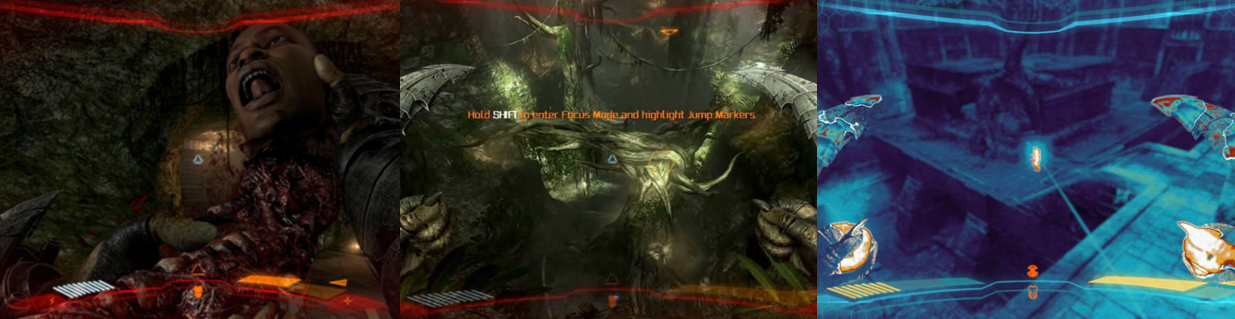
The story is simple but effective.

Far from the disappointingly neutered down mess we got in AVP: Alien vs. Predator (Anderson, 2004), the arcade game of the same (well…similar) name is a straight-up combination of the balls-to-the-wall action embodied by the Colonial Marines and the Xenomorphs in Aliens and the brutal efficiency of the Predators. Rather than lumbering the story in the present day, Alien vs. Predator takes place in a far more futuristic setting more befitting the Alien franchise (Various, 1979 to present), immediately making it look and feel like an actual entry in the franchise rather than a toned down cash grab. It is in this setting that the game shows a whole horde of Xenomorphs descending onto Earth and ravage the city of San Drad; although the cybernetic soldiers Major Dutch Schaefer (fittingly with the likeness of Arnold Schwarzenegger) and Lieutenant Linn Kurosawa try to fight them off, they are quickly overwhelmed but, surprisingly, saved by a group of Predators. The Predators, seeking to curb the infestation of their prey, ally themselves with the humans and the four set out to eradicate the Xenomorph swarm. If you think the idea of the Predators conversing (in English) with the humans is madness, it might also blow your mind to know that this plot was, apparently, based on an early draft for a potential Alien vs. Predator movie…let that settle in for a second.

AVPGameplay
Just keep killing aliens until the stage ends!

If you’ve played any sidescrolling 2D beat-‘em-up, you’ve played Alien vs. Predator; you select a character and battle from the left of the screen to the right, bashing enemies with simple combos, grapples, and a variety of weapons until you defeat a massive boss and clear the game’s seven stages. Up to four players can play simultaneously and each character has certain strengths and weaknesses over the others; the Predator Warrior is quite well-balanced, for example, while Dutch is a slow powerhouse. As you traverse each stage, you can pick up a variety of items and power ups; some, like gems and jewels, exist only to add to your high score while others, like pizza, soda, and chicken, replenish your health. You can grab pipes to bash in Xenomorph heads, grenades to blast them apart, and even the iconic Smart and Pulse Guns from Aliens to mow their numbers down.

AVPEnemies
You’ll encounter some new Xenomorph forms as you progress.

Each character also has their own weaponry and special attacks; the two Predators start with unique alien bladed weapons to increase their range while the two humans boast better range through their firepower. You can even use the Predator’s plasma cannon; while it is prone to overheating through repeated use, the “Super” power-up allows repeated use to decimate entire screens of enemies. At the cost of some health, you can also perform powerful special attacks, as is the norm for sidescrolling 2D beat-‘em-ups. Each stage is swarming with enemies, to the point where it’s genuinely tough to find your character much less plough through your opponents. Luckily, if you’re playing this on Mame or other arcade emulators, you can continue with as many lives and chances as you like until you clear each stage. To break up the monotony of the button-mashing and fighting, you’ll mount an M577 vehicle and blast away endless hordes of Xenomorphs and be tasked with destroying various objects under a time limit. Taking its cue from Aliens, most of the enemies you’ll encounter are various Xenomorph types, most of which were made famous as action figures and never seen in the movies. You’ll be blasting away at recognisable Xenomorphs such as Warriors (who resemble the Xenomorphs from Aliens), Stalkers (who are more like the Xenomorph seen in Alien), and Chestbursters but also encounter Alien Arachnoids, Smashers, and the Queen’s Royal Guard. Oddly, you’ll also come across zombie-like humans and cut your way through the Weyland-Yutani Corporation’s personal army as they seek to use the Xenomorphs as biological weapons.

AVPBosses
The game’s fidelity to the source material is impressive.

Of course, it wouldn’t be a 2D sidescroller without some big boss battles; you’ll battle the hulking Alien Chrysalis, the deadly Raor Claws, a couple of infected Predators, some Power Loaders, and, of course, the gigantic Xenomorph Queen…twice. Most of these bosses will also spawn a bunch of lesser enemies to distract you can whittle you down, meaning that it’s best to partner up with at least one other player to take on these big guys. While the gameplay and premise of Alien vs. Predator is nothing new or exciting, what sets it apart is its aesthetic fidelity to the look and feel of both franchise but, in particular, Aliens; the sprites and backgrounds are big, colourful, and full of energy, making you feel as though the iconic Predator has been dropped right into the middle of Cameron’s action/horror sci-fi classic, which is exactly what Alien vs. Predator should be.

AVPMulti
Team up with a friend to cut through the alien hordes.

It is extremely satisfying to punch and skewer your way through the seemingly-endless swarms of Xenomorphs and seeing a Predator wield the classic Aliens weaponry, as well as their own iconic weapons, never gets old. It’s repetitive at times, of course (it is a sidescrolling beat-‘em-up, after all) but it’s a fantastic way to waste an hour or so with a friend (or alone). While a similar title was also released for the SNES a year before, this classic arcade title has been lost to the mists of time and complicated rights and legal issues. Thankfully, thanks to the release of the Capcom Home Arcade, you can relive this timeless classic in the (relative) comfort of your own home (as long as you have the cash). Of you can just emulate the game on a Raspberry Pi or similar console and get to slaughtering those Xenomorph scum right away, and I highly recommend that you do.

My Rating:

Rating: 4 out of 5.

Great Stuff

Did you ever play Alien vs. Predator in an arcade? If so, what did you think? If not, why not go give a play? Either way, leave your memories and impressions below and let me know what you think.