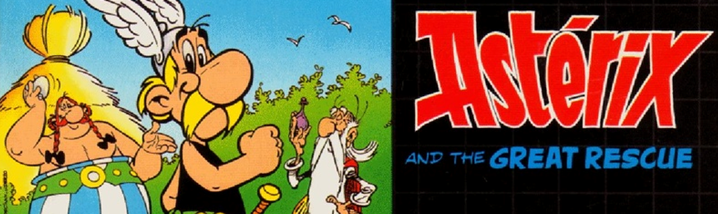
Game Corner [Asterix Anniversary]: Asterix and the Great Rescue (Mega Drive)


Asterix the Gaul (and his best friend Obelix) first debuted on 29 October 1959 as a serial in the French/Belgium magazine Pilote. Since then, the plucky Gauls have gone on to have many adventures in comic books, videogames, and feature-length productions and Asterix himself has become a popular and enduring character in his native France and beyond as his stories have been translated into over a hundred languages across the world.


Released: November 1993
Developer: Core Design
Also Available For: Game Gear and Master System

The Background:
It didn’t take very long at all for the French comic book series Asterix to make the jump from the comics and into other media; the first Asterix book was adapted into a feature-length animation in 1967 and both animated and live-action Asterix films have been pretty consistent over the years. Similarly, there have been a number of Asterix videogames; the first of these was released for the Atari 2600 in 1983 and one of my absolute favourites was Konami’s arcade game from 1992. Growing up, I had a lot of fun playing Astérix (SEGA, 1991) on the Master System, a colourful and entertaining little platformer that I’ve yet to finish ever thirty years later, and figured that the Mega Drive title would be a good investment. Asterix and the Great Rescue was developed by Core Design, the team behind the classic SEGA title Chuck Rock (Core Design, 1991), and was met with mixed reviews upon release. With today also being the birthday of the SEGA Mega Drive, I figured it was the perfect time to put this game in and see how it holds up compared to its 8-bit counterpart.

The Plot:
The year is 50 BC. Gaul is entirely occupied by the Romans. Well, not entirely… One small village of indomitable Gauls still holds out against the invaders and life is not easy for the Roman legionnaires thanks to the Gauls’ magic potion, which gives them superhuman strength. Like in many Asterix videogames, the Romans kidnap the village druid, Getafix, to stunt the village’s supply of magic potion so their bravest warriors, Asterix and Obelix, set out to rescue Getafix and teach those crazy Romans a lesson.

Gameplay:
Asterix and the Great Rescue is a 2D, sidescrolling action platformer in which one player gets to pick between Asterix and Obelix before each journey across six Levels to rescue the druid Getafix from the Romans. Disappointingly, unlike in the majority of Asterix videogames, there’s very little actual difference between Asterix and Obelix; both characters move at the same plodding speed, have the same amount of health, jump at the same height, and have exactly the same special abilities. Indeed, the only discernable difference I could identify is that Obelix’s hit box is larger (due to his characteristic girth) but it’s not like Asterix’s is that much smaller. You can customise the game’s controls from the main “Options” menu but the default setup is functional as is. Players can jump with A, attack with a punch with B, and use a “Special Weapon” with C. Pressing up on the directional pad (D-pad) in conjunction with C allows you to pick from four different Special Weapons while pressing down on the D-pad allows you to crouch and crawl to avoid incoming projectiles.

Rooms can be short but also painfully frustrating at times.

Sadly, considering the characters’ and comics’ focus on madcap fighting, combat is extremely disappointing and limited here; there are no jumping attacks, your punches have a pathetically short range, and the only additional combat option available to you is that you can hold down B to perform a series of rapid punches while moving to take out groups of enemies faster. Asterix and the Great Rescue is constructed in a strangely confusing way; there are six Levels, each split into four “Huts” and each Hut has up to three “Rooms”. The wording is very confusing as you’re not necessarily inside of a hut or a room as you might think but what it actually boils down to is six levels, four worlds, and up to four zones in each world and I guess the developers thought it would be “fun” to supplant this usual videogame terminology with terms from the comic book. While six Levels might not seem a lot, the game is actually surprisingly long; the Rooms are generally short sprints asking little more from you than to travel to the right, bashing enemies, and reaching the goal (“magic elixir” for Asterix and a roast boar for Obelix) but you’ll also be tasked with finding keys, performing some tricky jumps, or navigating some confusing areas.

Your biggest obstacles are the time limit, hit boxes, and obtuse nature of the gameplay.

Your greatest enemy in each Room will be the time limit; every Room has a time limit that is anywhere from less than a minute to two minutes of game time and, if you fail to reach the goal before the time runs out, you’ll lose a life and have to restart from the beginning of the Room. There’s very little room for error in some of these Rooms and, if you mess up or take too long, then that’s just too damn bad as there are no checkpoints. Thankfully, you can acquire extra lives by earning enough points or stumbling upon a beating heart pickup. You start each game with three lives and three credits and, when you lose all of your lives, you’ll be given the option to cash in a credit and continue from the start of the last Room you played but, if you use up your credits, it’s game over. After clearing each Level, you get a password to jump to later in the game, which is helpful, but the damage you sustain throughout the game carries over to each Room, which is extremely frustrating, and you’ll find an abundance of bottomless pits as you progress, which mean instant death.
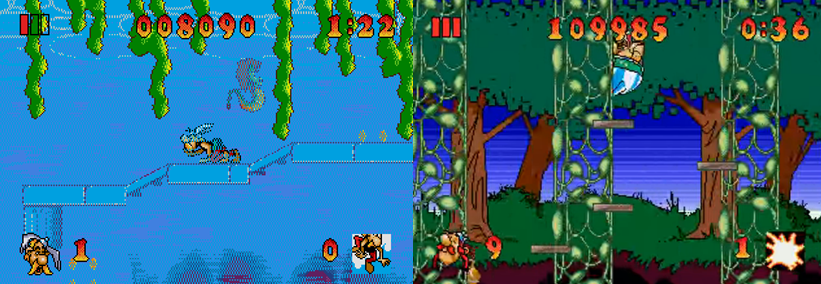
Gameplay is very inconsistent, being ridiculously easy one minute and frustratingly difficult the next.

Gameplay in Asterix and the Great Rescue is extremely inconsistent and frustrating; generally you just have to fight your way to the goal but other times you have to dodge bursts of fire, press switches to progress further, dodge falling blocks or incoming boulders, or hop around moving or temporary platforms to get through the Room. This can be extremely frustrating as some enemies are too small to hit, others take multiple hits to defeat, and it’s not always clear what you have to do in order to progress; all too often, platforms will suddenly drop underneath you, animals or bridges will collapse after carrying you across gaps, and you’ll need pixel-perfect timing to reach far away platforms. You’ll also need to hop across lava pits, make a number of blind jumps, contend with murky water that slows you down, teleport across Rooms using special statues, or use a series of bubbles, springs, and catapults to travel higher and further. Spikes, thorns, spiked balls, flames, and rotating platforms all compound matters, making avoiding damage extremely difficult even when playing on “Easy” mode, where enemies are less frequent and aggressive. Thankfully, there’s no knockback from taking damage but my experience was that my character would simply keel over and die more often than not since their hit box is so big that it’s extremely difficult to avoid being hit (especially when you get dropped literally right into the path of oncoming enemies in some Rooms).

Graphics and Sound:
Asterix and the Great Rescue has a lot of promise but doesn’t quite manage to deliver in terms of its graphics. Sprites are colourful and faithful to the comics, for example, but not especially big or full of animation frames; there are no idle animations, for instance, and neither Asterix, Obelix, or their enemies exude the same charming humour as they do in the comics or even the Master System game. Environments can similarly be very hit and miss; the Gaulish village is beautiful to behold but little more than a tutorial to learn the basic controls. Occasionally, you’ll see familiar Asterix characters like Unhygienix in the background but he’s wildly out of proportion compared to the avatar’s sprites. Other times, the background will be quite sparse (a simple night sky) or somewhat detailed but then it’ll also look really crude (especially in the Forest and Rome levels). There are a lot of different environments to explore, however. You’ll travel from the Gauls’ village, cross the dock, enter a Roman camp, explore a dense forest and jump through the treetops and past gigantic spider’s webs, battle through dungeons in Germany, hop across clouds and birds and wander around stages made out of Frankfurters, pass through an ice Room (with some impressive snowflake effects falling over the screen) on the way to a Roman galley, and finally jump and fight through water ruins, an ornate garden, a lavish banquet hall, and the coliseum in Rome.
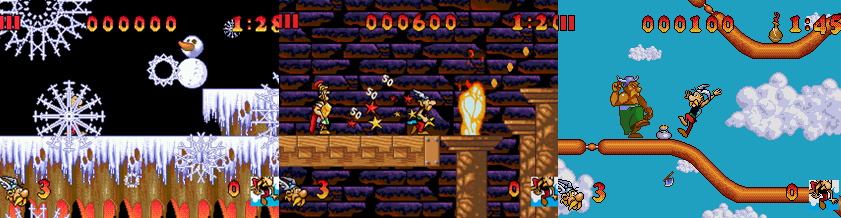
Levels are quite varied and can be quite bit but they’re hampered by the constant ticking clock.

All of these are locations that will be familiar to any Asterix fan but, for most videogame players, will seem very by-the-numbers for the average platformer and full of clichés such as weighted switches, temporary platforms, and rising or moving platforms. A lot of the time it can be difficult to tell where you need to go as you can sometimes pass through certain walls but not others, despite them both looking the same, and you’ll need to experiment with your Special Weapons in order to progress (if you have enough time left to figure that out, of course). I did experience a bit of slow down at times, which is quite ludicrous as there’s rarely a lot happening on screen, and some graphical hiccups here and there. The music is quite jazzy, however; it’s not especially varied but it’s decent enough, and certainly far better than the game’s sound effects. The game’s story is told through text and a recreation of the map of the invaded Gaul, all of which will be more than familiar to any Asterix reader. Though the game’s title screen leaves a lot to be desire, each Level is proceeded by a pretty nice still picture of the famous duo but you’ll have to wait for the final screen on the game for anything resembling any kind of impressive sprite art and even then it’s basically just a partially animated still.

Enemies and Bosses:
As any self-respecting Asterix fan might expect, your primary enemies in this game will be the Romans. Roman soldiers charge at you with spears, march along in groups wielding swords, toss spears at you from above, and gold-armoured Centurions will also show up to try and skewer you as you progress. These are all pulled straight from the comics and even include Roman’s hiding in tree disguises; most of them will go down in just one hit but the more rotund and golden Romans will take two to three hits. You’ll also have to content with woodland critters scurrying and flying your way, axe-throwing Germans, German maidens who explode when you get too near, mermaids and sea creatures, archers whose arrows stay on screen way too long, Romans trying to jab you from beneath with their swords, spiders and other bugs, dogs, and even hatchlings trying to take a bit out of your ass. By far the worst obstacle is the mule-kicking horses who will send you flying clear across the screen; I swear you need as much luck as you do skill to time your jumps past those assholes!

It makes sense to be fighting Romans but Cacofonix is a strange choice for a boss

Each Level culminates in a boss battle, the first of which is, oddly, against the village bard Cacofonix (I know he’s an annoyance in the comics but to make him a boss seems a bit extreme). Cacofonix stands in one spot atop his tree hut and spits musical notes at you from his lyre and can only be damaged by hopping on top of one of village chief Vitalstatistix’s shield bearers and tossing rotten fish at him. It takes a lot of hits to finally put the bard down so, again, your biggest enemy here is the time limit as it’s pretty easy to avoid his musical notes by standing in the right spots. The second boss fight sees a Roman encampment firing rocks at you; these must be hit back over and over again until the camp finally surrenders to your might. After this, a Roman soldier awaits you on a log and will instantly force you to your death unless you mash A, B, and right as fast as possible to knock him off instead but, of course, the game never tells you any of this so it is easy to simply fail time and time again.

After besting many enemies, the last two Levels culminate in battles against large, voracious animals!

The final Room of Germany has you desperately outracing a rising sea of red and taking out enemies as you make your way up to a goal which, again, is more a test of your skill and patience with the game’s controls than any sort of actual combat. On the Roman Galley, you’ll be attacked by a gigantic alligator (or is it a crocodile?); simply hop up onto the platforms to avoid the creature’s snapping jaws and then jump down to smack him in the head but watch out for his massive hit box clipping your avatar. The finale sees Julius Caesar set two vicious tigers against you in the Coliseum; these will randomly pop in and out of archways under Caesar’s view box and must be smacked whenever they appear and hopped over to avoid damage. Like all of the game’s bosses, though, this is simply a test of patience and landing hits before you get a time out and the bosses are, by far, the least challenging aspect of the game.

Power-Ups and Bonuses:
There are numerous items to pick up and collect in Asterix and the Great Rescue; you’ll find gold coins, bags of coins, and Roman helmets, all of which will add to your score and bring you one step closer to an extra life. You can also replenish your health either partially or fully by collecting pieces of roast chicken or a chalice, respectively, and you can grab a sickle for a brief period of invincibility or a bomb to enter “Mega Attitude Mode”, which increases your speed and strength so you can blast through enemies and obstacles.

Special Weapons are useful but limited and you won’t always have to to backtrack for more ammo.

The main thing to keep an eye out for, though, are the gourds that you’ll find scattered throughout each Room. These will give you ammo for your Special Weapons and will respawn when you move the screen a little bit. Your Special Weapons are essential to your progress but it’s not always abundantly clear where or when you have to use them (such as the first screen of Rome where you’re seemingly trapped but actually have to blast a wall that doesn’t appear to be destructible). The Fireball adds a ranged attack to your arsenal and can be used to destroy certain blocks, hit targets, or deactivate certain traps; the Ice Block (which is actually a cloud) creates a temporary platform to allow you to reach higher areas or cross spike or lava pits safely (if you can get the angle of the throw right…); the Disguise covers you in a series of vines and flowers so that enemies will walk right past you; and Levitation allows you to (chunkily) float about using the D-pad to avoid spikes and reach higher or further areas. 

Additional Features:
There’s not really much else on offer in Asterix and the Great Rescue beyond the single-player experience; there’s no two-player simultaneous play, meaning that the only way for two players to play is to take it in turns, and no real benefit to playing as either of the two main characters. You can tackle the game on a harder difficulty setting and try to get your name at the top of the high score table but the game is so tough anyway that I wouldn’t recommend it. There aren’t even any decent cheats for the game as the password system is simply for jumping to the game’s levels so you’ll probably be done with this game after one playthrough or session.
The Summary:
Boy, was I disappointed with Asterix and the Great Rescue. Once again, I as met with a 16-bit iteration of a videogame that pales in comparison to its bright, humourous, and fun 8-bit counterpart; you know it’s bad when even the Master System’s game gives Asterix and Obelix different abilities and playstyles and has more gameplay variety. Honestly, I can’t even say that this game looks good as, compared to other games of a similar genre that came out at the same time, Asterix and the Great Rescue looks and sounds like 1989 Mega Drive title rather than a 1993 release. Clunky, awkward controls, a rubbish combat system, confusing and frustrating gameplay, and just a complete lack of entertainment and engagement make Asterix and the Great Rescue an extremely disappointing title that saves itself from a one-star review simply because I am a big fan of the comics and characters but, honestly, I wouldn’t recommend anyone actually bother playing this letdown of a game.

My Rating:

Rating: 2 out of 5.

Could Be Better

What did you think to Asterix and the Great Rescue? How do you think it compares to other Asterix videogames and games of its genre? Did you enjoy the title and feel I’m being too harsh on it or do you agree that it was a frustrating and disappointing mess of a game? Which character, book, or movie is your favourite? How are you celebrating Asterix and Obelix’s anniversary, and the release of the Mega Drive, this year? Whatever your thoughts on Asterix, feel free to leave a comment below or on my social media.

Movie Night: Man-Thing

Released: 30 April 2005
Director: Brett Leonard
Distributor: Sci-Fi Pictures
Budget: $5 million
Stars: Matthew Le Nevez, Rachael Taylor, Jack Thompson, Steve Bastoni, and Conan Stevens

The Plot:
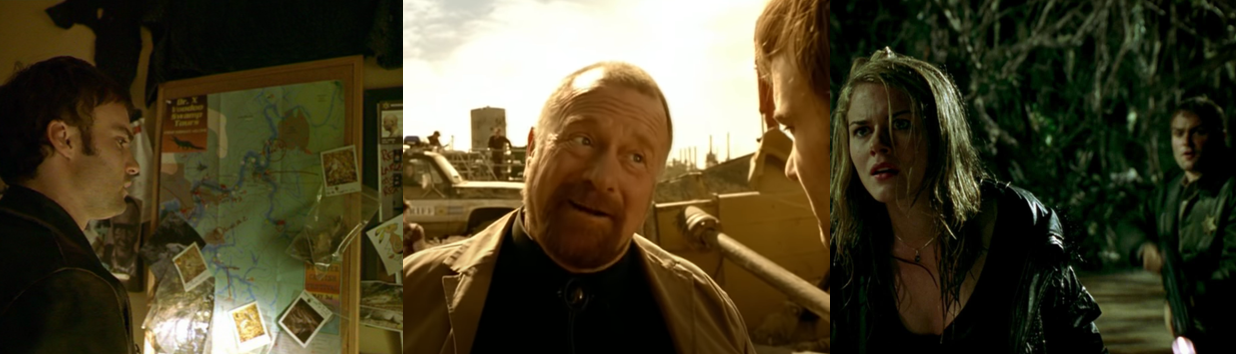
New Sheriff Kyle Williams (Le Nevez) arrives in the sleepy town of Bywater, only to find the area subjected to a series of gruesome murders. As he investigates, Kyle uncovers a plot to pollute and desecrate the sacred swamp waters, and the presence of a horrific swamp creature (Stevens) looking to enact revenge!

The Background:
Due to the implementation of the Comics Code Authority (CCA) in 1954 following widespread public concern, comic book publishers like Marvel had to dance around nonsensical rules to avoid corrupting vulnerable child readers from such horrors as violence, supernatural threat, and sexual content. Consequently, publisher Martin Goodman cancelled the none-CCA-approved Savage Tales after just one issue, though it released long enough to introduce Doctor Theodore “Ted” Sallis/Man-Thing. A creation of writers Stan Lee, Roy Thomas, Gerry Conway, and artist Gray Morrow (and entirely different from DC Comics’ Alec Holland/Swamp Thing), Man-Thing has had a not insignificant impact in Marvel since his debut but, it’s fair to say, is one of their more obscure monstrous characters so it was a little surprising to see him included in Marvel’s deal with Artisan Entertainment to produce at least fifteen adaptations of Marvel properties. Development of a Man-Thing movie can thus be traced back to 2000, where the project flip-flopped between a straight-to-video and a cinematic release before the then-recent success of superhero movies like Blade (Norrington, 1998), X-Men (Singer, 2000), and Spider-Man (Raimi, 2002) made a theatrical release more financially viable. Filming took place entirely in Sydney, Australia, which producer Avi Arad later blamed for the film’s failures as Marvel Studios were unable to properly micromanage and supervise the production to ensure a higher standard of quality. A low-budget production meant that the titular creature’s screen time was often rushed, causing the impressive practical effects and suit to become mired in sub-par CGI and, while the film had a very limited theatrical release, it eventually saw the light of day on the Sci-Fi Channel and home video. Consequently, Man-Thing made a paltry $1.1 million gross and was torn apart by scathing reviews that attacked everything but the special effects. Largely forgotten these days, the Man-Thing rights eventually reverted back to Marvel Studios and, after a few subtle allusions to the character, the Man-Thing officially joined the MCU in the Werewolf by Night special (Giacchino, 2022).

The Review:
If I’m being completely honest, I barely had any knowledge of the Man-Thing prior to this movie; I think he cropped up in an issue of Howard the Duck or a Hulk comic I once read as a kid, but it could’ve just as easily been someone like Taboo or Joseph Timms/The Glob. I was slightly more familiar with his DC Comics counterpart, Swamp Thing, thanks to watching (and being unimpressed by) Wes Craven’s 1982 movie and hazy memories of his short-lived cartoon from the nineties but, suffice it to say, I was not some die-hard Man-Thing fan, and in the years since I first picked up this movie the most I’ve really experienced of the character is this movie and his debut story. Still, back when this film came out, I was intrigued by the footage I’d seen; being a big fan of monster and horror films and gory practical effects, I was well on board for experiencing a different kind of comic book movie at a time when the genre was properly moving into a “safe zone” of family-friendly action spectacle. All of this means that I had relatively low expectations, couldn’t really get worked up about any changes made to the source material, and was mildly satisfied upon my first viewing and, even now, I often chuck Man-Thing on if I’m in the mood for a gore-fest that’s not something more mainstream.

Kyle Williams is new in town and beset by local issues and a string of grisly murders.

That’s not to say that Man-Thing is very impressive, by any means; it has a definite made-for-television presentation in the camera work and the quality of the actors, with the cast made up of mostly Australian television and bit-part players, which is fine for this kind of B-movie but keeps it from living up to the standards (however low they may be) for similar films released around this time, like Doom (Bartkowiak, 2005) and Hatchet (Green, 2006), which were both B-movie horrors that were bolstered by a bigger budget, bigger stars, or from being throwbacks to the slasher genre of old. Nowhere is this more evident than in our lead character; a kind of Ben Browder knock-off, Matthew Le Nevez does what he can, but his fish-out-of-water character is nothing we haven’t seen a million times. Looking for a fresh start and a chance to prove himself in a position of authority, the new sheriff is flustered to find his hideously departed predecessor has left him only one deputy, Eric Fraser (Alex O’Loughlin), and that the town is torn between preserving the sacred swamplands of Dark Water and welcoming the profits brought in by industrialist Frederick Schist (Thompson). Still, while Fraser is amicable enough towards Kyle, there’s a degree of distrust and scepticism levelled towards him not just because he’s new in town but also because of his youth and perceived lack of experience, especially considering the many missing people and gruesome deaths in the small town. Though he’s very much a by-the-book sheriff, Kyle’s also quite fair and humble; he doesn’t want to ruffle any feathers and is eager to ensure total co-operation with his department, but is equally sympathetic towards schoolteacher Teri Elizabeth Richards’ (Taylor) attempts to oppose the desecration and pollution brought by Schist’s operation. The feisty and moralistic Teri immediately clashes with Kyle, kicking him to the dirt and winning herself a stay in the cells for her disruptive actions; however, Kyle admires her fighting spirit and soon turns to her for assistance with the swamp and the legends that permeate it. Naturally, as the two most attractive characters in the film, a mutual attraction sparks up between the two as they’re both captivated by their shared sense of moral justice and desire to do what’s right, and they find a common cause to rally against once the extent of Schist’s violent nature becomes apparent.

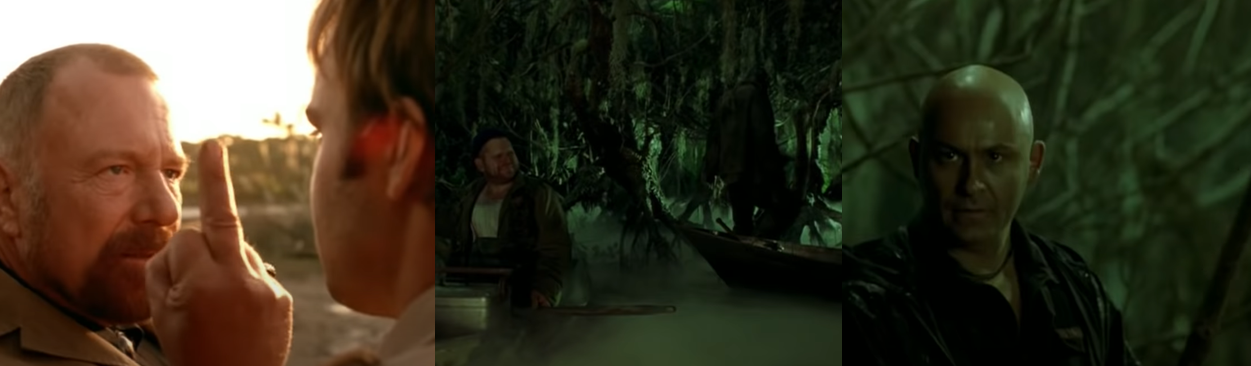
Local industrialist Schist has no problem killing or rolling over those who threaten his operation.

Kyle’s most pressing concern, however, isn’t local politics or superstition, but the number of violent deaths that have recently occurred in Bywater and around the Dark Water swamp. Initially, the most obvious suspect (at least, according to Schist) is Mestizo extremist Rene LaRoque (Bastoni), who has been sabotaging Schist’s facilities. Schist resents the backlash from locals and the Seminole community of Bywater since he legally appropriated all of his land from Ted Sallis, the Seminole shaman and chieftain, who then disappeared after stealing the money for himself. However, in truth, LaRoque helped broker the deal to improve things for the tribe, while Sallis was vehemently opposed to it and, in an effort to make up for his greed, LaRoque has been disrupting Schist’s operations ever since. Schist is a force to be reckoned with, however; firmly seeing himself as nothing more than an industrialist, Schist is protected by his wealth and influence and the fact that all the paperwork says he hasn’t broken any American laws. With no time for mysticism or mumbo-jumbo, Schist is concerned only with profit and expanding his empire but, while Kyle is smart enough to initially be respectful and amicable to Schist, it’s pretty clear that he’s a shady character not just through his boisterous and somewhat condescending nature but also in the startling similarity between his company logo and the Nazi swastika. Since he’s a prominent entrepreneur and wealthy businessman, Schist holds a lot of sway in Bywater; he can influence the hiring and firing of sheriffs, encourages Kyle to play the game and pursue LaRoque, and even orders people to be arrested for disturbing his building and oil digging. Naturally, he’s also an extremely ruthless and shady character; bolstered by his son, Jake (Pat Thompson), and local thugs Wayne (John Batchelor) and Rodney Thibadeaux (Ian Bliss), Schist has no problem ordering LaRoque’s death, aggressively leaning on those who get in his way, or getting his own hands dirty since he killed Sallis and photographer Mike Ploog (Robert Mammone) when they threatened his empire.

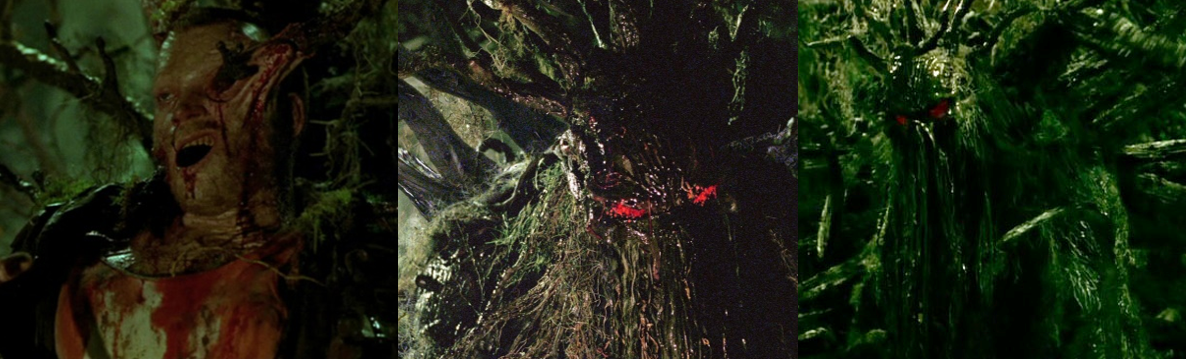
Ted Sallis is transforming into a monstrous creature that slaughters anyone who threatens its swamp.

At first, all evidence points to LaRoque being behind the sabotage and even the strange events in town, no matter how bizarre they may be; despite Teri’s insistence that LaRoque is innocent of murder, Kyle has no choice but the venture into the swamp to find him to get to the bottom of what’s going on. Of course, Schist’s operation has a far bigger threat, one that’s caused the murky swamps of Bywater to become a hazardous land and violently takes lives, such as Fraser’s, with an inhuman brutality. The region, which is seeped in mysticism and dark supernatural power, is regarded by Native Americans like Peter Horn (Rawiri Paratene) to be the “Nexus of All Realities”, a place where a malevolent spirit dwells that brutally attacks any trespassers, especially those who taint its lands. This is the force that transforms Sallis after his murder at Schist’s hands; while the locals have long believed in a swamp guardian, it’s only after Sallis’s corpse is buried in the Dark Water that this actually comes to life in the form of a hulking swamp creature the obsessive and eccentric Ploog haphazardly dubs the “Man-Thing, man!” While many scoff at such local superstitions, they still actively avoid the swamp because of how dangerous it can be, but Horn knows full well the extent of the dark magic that dwells within it. Horn explains that the angered creature seeks blood to atone for the blood spilled on its sacred land, and has determined that everyone will die, though this is a bit misleading as the creature seems satisfied once Schist’s pump is destroyed in the finale (raising the question why the Man-Thing didn’t just destroy the pump itself, especially considering it was formed right in front of it!) Although the creature shows no real signs of intelligence or humanity, appearing more a force of nature (or supernatural wrath) than anything, it’s driven to slaughter those who venture into its waters, especially any that try to desecrate its swamp. It does this through increasingly brutal means, such as tearing its victims apart, causing roots and foliage to burst from their bodies, or pumping him full of Schist’s polluting oil. Those who know fear have no chance of burning at this Man-Thing’s touch as its whipping tentacles and huge, claw-like hands are far more likely to leave its prey little more than bloody, swamp-covered remains. Even people like Plooq and LaRoque, who routinely visit and live in the swamp, and Sallis’s friends and fellow Seminole aren’t safe from the Man-Thing’s rage; the monstrous being rids its swamp of all interlopers and violatiors, friend or foe and, to make matters worse, is functionally immortal and impervious to harm, even to ancient rituals and sacrifices designed to appease its wrath.

The Nitty-Gritty:
While Man-Thing might be a decidedly low-budget (and low-brow) affair, I have to give it props for going all-in with its genre and its premise. It’s fascinating re-watching these licensed properties from before the Marvel Cinematic Universe found a winning formula in family-friendly productions that only touch upon horror or violent elements, and Man-Thing is far more a throwback to the violent, carefree slashers and monster movies of the eighties than anything else. This is evident right from the beginning thanks to a raucous sex scene out on a canoe in the wilds of the swamp that leaves busty Sarah (Imogen Bailey) a screaming, bloody mess and the frequent, barking use of curse words and dark, sticky blood effects. As you might expect, the swamp is very much a big part of Man-Thing; a dark, murky, overgrown mess of withered trees, vines, gloopy muck, and full of alligators and bugs, the swamp is unsightly and hazardous place. While Teri regards it with a great deal of affection, Horn is filled with a respect for its dark power, and Schist just wants to plunder its natural resources, Kyle is completely out of his depth when he ventures into those dark and muddy waters and the film does a decent job of presenting it as a very ominous and mysterious place. Personally, however, I have no love for swamp settings; they’re invariably murky and suffer from low lighting and green filters, all of which is true here, but you can’t really make Man-Thing without a swamp and, considering the time the film takes in building up to the Man-Thing’s first full appearance, the swamp makes for a visually unsettling compromise.

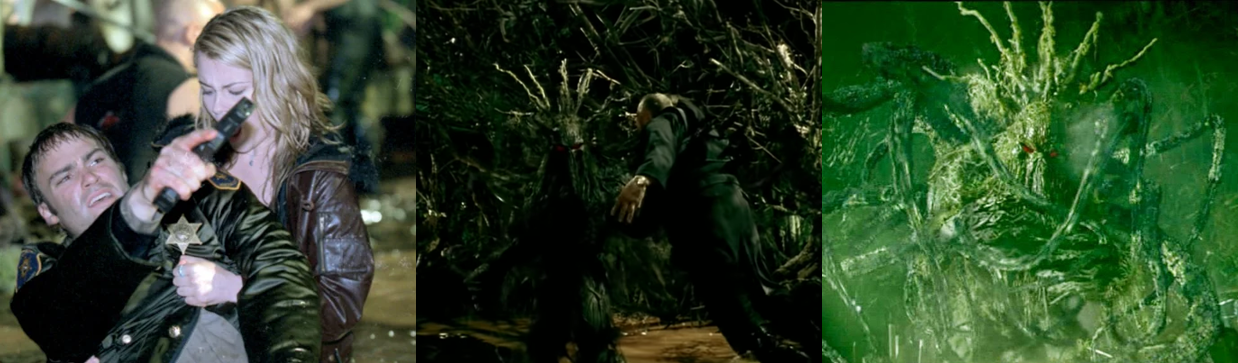
The impressive Man-Thing monster takes its brutal revenge.

Still, if there’s one thing Man-Thing has going for it, it’s the impressive and ambitious special effects. The Man-Thing itself is introduced slowly, building tension and anticipation towards its big reveal, which comes about an hour into the film’s runtime when it stalks and slaughters the Thibadeaux’s before ripping Fraser apart like an insect. Before that, we get an idea of how the creature came into being in flashbacks that resemble the grisly horror of Hellraiser (Barker, 1987) and we see the gruesome aftermath of its unique methods of killing, with Fraser left sickened by the awesome brutality (though both Kyle and coroner Val Mayerick (Brett Leonard) are surprisingly nonplussed by the mangled corpses, which have long been chalked up the alligator attacks). The creature itself is an incredibly impressive combination of a practical suit enhanced by CGI, which is the perfect blend when creating a movie monster, and it’s pretty clear that a big chunk of the budget (if not all of it) went to bringing Marvel’s monstrous swamp-man to life. A hulking beast dripping with vile vines and oozing menace, the Man-Thing easily manhandles and rips apart even the likes of Pete Horn after he tries to sacrifice himself to quell its rage, glaring at its prey with burning eyes and pursuing Kyle and Teri relentlessly for trespassing in its swamp. Determined to track down and kill LaRoque, who seeks to destroy his drilling tower in the Dark Water, Schist ventures into the swamp only to find Kyle and Teri being chased by the Man-Thing in their own attempts to get to LaRoque. Although Schist confesses to killing Sallis and wounds both LaRoque and Kyle, he ultimately meets his grisly end when the Man-Thing impales him with vine-like tentacles and pumps Schist’s own oil back into his body for a fitting and gory demise. Devoid of all humanity and fixated only on eliminating intruders, the Man-Thing turns on Kyle and Teri, forcing LaRoque to sacrifice himself by blowing up the drilling tower, taking himself and the Man-Thing with it. The blast doesn’t actually destroy the beast, however; it simply absorbs the flames and then, after seeing that Schist’s destructive influence has been driven from the Dark Water, it is reclaimed by the swampland to slumber once more until needed, allowing the injured and stunned Kyle and Teri to gingerly make their way back to what passes for civilisation in those parts.

The Summary:
For many, Man-Thing will be little more than a low-budget, made-for-television B-level monster movie that pales in comparison to other films in its genre, especially those it owes much of its horror and imagery to. For fans of the titular character, many may also be put off by how different the film is from the source material, which casts the Man-Thing as an uncompromising force of vengeful nature rather than a more sentient and complex character like I assume it is in the comics. For me, though, as a fan of gory monster movies of this type, there’s a lot to like about Man-Thing; the atmosphere, the sense of dread and horror building throughout the film thanks to the near constant darkness and the disgusting murkiness of the swamp really give the film a foreboding ambiance. Of course, the main selling point is the Man-Thing itself; kept in shadow and blending in with the trees and vines of the gloomy swamp, the creature is an extraordinary and terrifying mixture of CGI and practical effects and impresses every time its on screen, which isn’t often, and always makes an impact. Unfortunately, the acting and overall presentation is very cheap and befitting of its made-for-television status; you don’t really watch a film like this for the performances or any kind of nuance beyond one-dimensional villains, gratuitous sex and violence, and somewhat capable lead characters, and Man-Thing definitely doesn’t try to deliver anything beyond these clichés. Overall, I do feel it’s an under-rated and often forgotten Marvel film that can be fun at times, but I can see why this didn’t really make much of an impact, though I am interested in seeing how the MCU utilises the Man-Thing going forward.

My Rating:

Rating: 2 out of 5.

Could Be Better

Have you ever seen Man-Thing? Were you a fan of the film or did it leave you disappointed? What did you think to Schist and his plot to besmirch the sacred land, and the lead characters and their performances? Were you impressed by the Man-Thing’s special effects and brutal kills? If you’re a fan of the source material, what did you think to this adaptation? Whatever your thoughts on Man-Thing, leave them below and go check out my other horror content!

Movie Night: Ghost Rider: Extended Cut

Released: 12 June 2007
Originally Released: 16 February 2007
Director: Mark Steven Johnson
Distributor: New Line Cinema
Budget: $110 million
Stars: Nicolas Cage, Eva Mendes, Wes Bentley, Donal Logue, Sam Elliott, and Peter Fonda

The Plot:
Motorcycle stunt rider Johnny Blaze (Cage) finds his past literally haunting him when the fiendish Mephistopheles (Fonda) calls upon a blood debt from Blaze’s youth. Transformed into the demonic Ghost Rider in the presence of evil, Blaze must hunt down Blackheart (Bentley), a rogue demon who seeks to acquire power to rival that of Mephistopheles!

The Background:
Created by Gary Friedrich, Roy Thomas, and Mike Ploog, Johnny Blaze/Ghost Rider made his Marvel Comics debut in the pages of Marvel Spotlight #5 in 1972. He graduated to his own self-titled comic about a year later and was at the forefront of many supernatural adventures in one form or another. In addition to cameo appearances in various Marvel videogames, Ghost Rider has popped up in other avenues outside of the comics; he cameod in Marvel’s nineties cartoons and an incarnation of the character later featured in a semi-prominent role in the fourth season of Marvel’s Agents of S.H.I.E.L.D. (2016 to 2017). However, development of a live-action adaptation of the Spirit of Vengeance can be traced back to 1992, when Marvel tried to shop the idea around Hollywood. In 1997, Gale Anne Hurd and Jonathan Hensleigh were attached to the project but things really took off in late-2000, when writer David S. Goyer, director Steven Norrington, and stars Jon Voigt and Johnny Depp were all associated or involved with the film in some capacity. By May 2002, Columbia Pictures had purchased the rights; all previous associates dropped out of the project and Shane Salerno was brought in to rewrite Goyer’s script, but eventual director Mark Steven Johnson did his own script soon after being hired to helm the film. Life-time superhero fan and nineties action star Nicolas Cage won the title role and chose to portray the character not as a hard-drinking bad-ass but more as someone desperately trying to come to terms with the curse hanging over his soul. The character’s visual effects were the work of Kevin Mack and Sony Pictures Imageworks, who painstakingly animated Ghost Rider’s flames on a shot-by-shot basis, with one of their most difficult and time-consuming sequences being the first horrific transformation and the digital transformation of the iconic “Hell Cycle”. With its final worldwide gross falling just shy of $230 million, Ghost Rider didn’t exactly set the world on fire (pun intended) and this was reflected in the reviews; critics were left disappointed by the film’s focus on humour rather than horror, with the dialogue and Cage’s performance drawing the most criticism, though the special effects were praised and some have since re-evaluated it as an under-rated comic book film. Despite being labelled as one of the worst films of the decade, Ghost Rider not only received this extended edition on home media but was actually followed by a sequelof sortsin 2011, that was a critical and commercial failure which, coupled with Cage’s disappointment with the role and franchise and the rights being reacquired by Marvel in 2013, dashed any plans for a third entry.

The Review:
Ghost Rider is another of those Marvel superheroes I’m not all that familiar with; unlike others like this, I can’t even say that I’ve been able to get a sense of the character and his incarnations and adventures as Marvel haven’t yet released one of their Marvel Platinum definitive collections for him and a lot of his classic collections are a bit overpriced for my tastes. I’ve always been drawn to the character, though, since he’s visually very striking and his powers and background really speak to me as a long-time fan of Al Simmons/Spawn, but the most I’ve experienced of him are his debut story and the Spirits of Vengeance: Rise of the Midnight Sons trade paperback (Cooper, et al, 2016), his appearances in Marvel cartoons and TV shows, and a few sporadic appearances in videogames. I’d love to read more of him, but I definitely wasn’t as clued up on the character as I usually am when I first went to see Ghost Rider. Hell, I wasn’t even (and still am not, really) a big fan of Nicolas Cage; I’d seen him in The Rock (Bay, 1996), Con Air (West, 1997), and Face/Off (Woo, 1997) but he never really clicked for me as an actor or personality because he always came across as being more than a little nuts. Thus, I originally went into Ghost Rider with quite low expectations; I was expecting an action-packed romp full of special effects and bonkers visuals and fights and that’s basically what the film delivers, though even I was hoping it’d lean a bit closer towards the dark connotations of the character and Ghost Rider’s more horror-themed elements.

Johnny’s deal with the Devil costs him his soul and his happiness that no amount of fame can assuage.

The film is immediately handicapped by an opening narration. I’ve talked about this a few times but this really is a cliché that’s hard to get right in cinema; it makes sense to want to clue the audience in early on to what’s going on and give some lore and context to the world being presented, but it ends up becoming redundant as Carter Slade/The Caretaker (Elliot) repeats it to Johnny later in the film so it’s just another example of narration for narration’s sake. Anyway, when we first meet Johnny Blaze, he’s just a kid (Matt Long) working as a carny stunt cyclist alongside his father, Barton (Brett Cullen). Although he enjoys the thrill of entertaining the masses with increasingly dangerous and ludicrous jumps (to the chagrin of his father, who chastises him for being a show off), Johnny is frustrated with the lifestyle and playing second fiddle to his father and is determined to leave it all behind and run away with his girlfriend, Roxanne Simpson (Raquel Alessi). When he spots a convenient letter detailing the seriousness of Barton’s cancer, however, Johnny hesitates; his concern and desperation for his father’s welfare are all the leverage Mephistopheles needs to convince Johnny into signing away his immortal soul to keep Barton from succumbing to his illness. Johnny’s elation at seeing his father rejuvenated is soon dashed when the slightest twitch from Mephistopheles causes Barton to die in a motorcycle stunt, leaving young Johnny wracked with guilt, devastated at losing the only family he has, and burdened by the debt he now owes to the conniving Devil, who promises to one day collect on his contract. Having lost everything and fearing for Roxanne’s safety, Johnny opts to abandon her and hit the road, eventually growing up into Nicolas Cage. The now-adult Johnny Blaze has become a media sensation; famous for his privacy and death-defying stunts, we catch up with him in the middle of a cross-country tour with his entourage, which includes best friend and impresario Mack (Logue). However, despite his best attempts to overcome his fear, Johnny is haunted by his past, which is annoyingly drummed home to us through constant flashbacks to events we just witnessed, as though we’d forget what happen less than a minute ago. Constantly questioning whether he’s actually as good as everyone says or whether it’s Mephistopheles’ influence keeping him successful and healthy, Johnny just about gives Mack an ulcer due to his insistence on pushing his stunts to the absolute limit to maintain his reputation as “Mister Invincible”

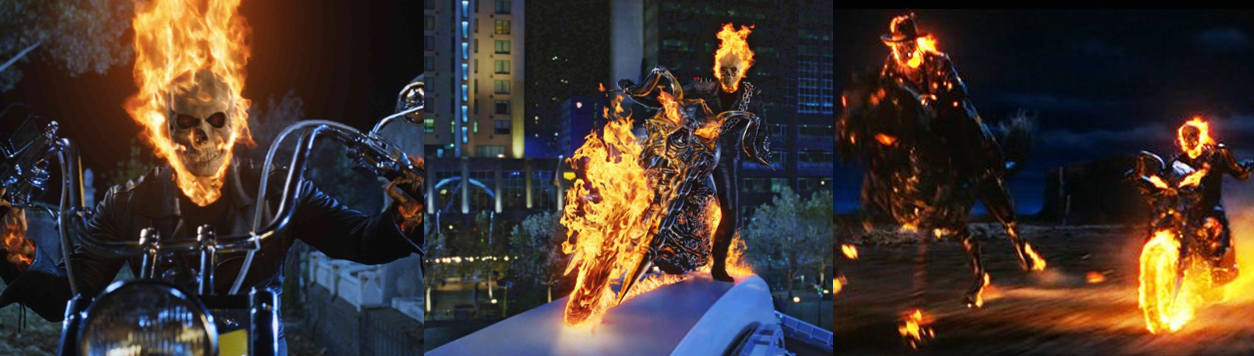
Johnny is cursed to transform into a flaming skeletal demon at night and in the presence of evil.

Though he forgoes alcohol and drugs, preferring to swig down cocktail glasses of jelly beans and sooth his anxiety with the Carpenters (amongst other weird traits), Johnny is a tortured soul who is forever trying to outrun the literal Devil. When he happens to cross paths with the grown-up Roxanne, he sees it as a sign that his days of living in fear are over; reinvigorated with a newfound zest for life, he regresses to a child in his attempts to impress and woo her and, despite being burned by him in the past and her better nature, the budding reporter agrees to give him a chance. However, right as he’s about to begin his new life, Johnny is approached by Mephistopheles once more; rather than claiming Johnny’s soul, Mephistopheles orders him to track down and kill his son, Blackheart, and imbues him with the power of the Ghost Rider to fulfil this mission with the promise of releasing him from his vow once the deed is done. Although Johnny has no interest in doing the Devil’s bidding, he’s horrifically transformed into a monstrous being, a leather-clad demon with a flaming skull for a head and a semi-sentient blazing motorcycle for transport. In a change of pace from most superhero movies, Johnny actually confesses to his curse and newfound duality to Roxanne but, naturally, she doesn’t believe him and he just comes across as a madman thanks to his awkward personality quirks and madcap nature. Ghost Rider is a tricky character, in many ways; a supernatural creature with near-unlimited power, it’s hard to put him in situations where he would be vulnerable, so the film lumbers him with the caveat that he can only appear at night and in “the presence of evil”. Even then, and when faced with other supernatural foes, the Ghost Rider is a formidable creature; practically impervious to pain and injury, his wounds heal abnormally fast, he exhibits superhuman strength and dexterity, and he can supernaturally ignite and extended his chain and conjure hellfire at will. His most powerful weapon is his “Penance Stare”, which forces a victim to relive all the pain and evil they’ve done and, presumably, be consumed by it. What’s not made immediately clear in the film, however, is whether or not the Ghost Rider is a separate entity from Johnny or if Johnny retains his personality when transformed. It seems like he does, and Johnny can fully recall everything he did while transformed, but other times the Ghost Rider talks and acts very differently, but there’s no mention of Zarathos in the film and the Ghost Rider doesn’t say much, so it’s a bit unclear as to what’s going on there. Even more ludicrous, however, is the part when Johnny just takes control of the “possessing spirit” after reading a single passage in one of his occult books and stating he wants control, which both skips over any kind of hardship he might have to face and undermines even the slightest but of duality between him and the Ghost Rider.

Neither Blackheart or his minions ever come across as a serious, monstrous threat.

Johnny (and the audience) are given some context through the Caretaker, a wizened and gruff old man whom Johnny stumbles upon after his first transformation. It’s the Caretaker who narrates the film and delivers the bulk of its exposition regarding Mephistopheles, Blackheart, the Ghost Rider, and the Contract of San Venganza, a binding note of a thousand damned souls which Mephistopheles covets and Blackheart seeks to acquire in order to gain the power necessary to overthrow his father. Mephistopheles is a bit of a contradiction as well; he can assume a human guise, affects the weather and environment around him simply by walking, can bargain for people’s souls, and grant unimaginable power to a human host…but is somehow rendered “powerless” to actively oppose Blackheart. Conversely, Blackheart has no such limitations; he can come and go as he pleases, lower the temperature through his sheer presence alone, drain the life and flesh from humans with a touch, and even enter hallowed ground without any consequences, to say nothing of being immune to his father’s influence while on Earth. Blackheart enlists the help of the Hidden, three Fallen Angels with elemental powers: Abigor (Mathew Wilkinson), Gressil (Laurence Breuls), and Wallow (Daniel Frederiksen), however we learn very little about them (or even Blackheart, for that matter, beyond his childish resentment towards his father and lust for power and conquest) and they mainly exist to give Ghost Rider someone to fight against. Indeed, despite Abigor being able to become practically intangible, Gressil transforming to earth and stone, and even Wallow having the advantage during an underwater skirmish with the titular Spirit of Vengeance, all three are dispatched by the Ghost Rider with relative ease (Johnny even offs Gressil mere moments after his first transformation, showing no hesitation or trouble with his newfound powers). Despite being fully aware of his father’s favouritism to the Ghost Rider, and showing a flicker of fear at the demon’s power, Blackheart is so arrogant that he expresses suprise when the Ghost Rider survives his futile attempts to kill him and bests his minions…even though he knows what the Ghost Rider is capable of so he should’ve known better. Blackheart puts up a bit more of a fight, but this is mainly because their final showdown happens at the onset of sunrise, thus dispelling the Ghost Rider curse, and because Blackheart “[has] no soul to burn”. Those who are familiar with the comic book versions of Blackheart and Mephistopheles will be left disappointed by their decidedly undemonic appearances; though both show signs of their true, monstrous nature and Blackheart eventually transforms into a dark-skinned demon referring to itself as “Legion”, neither appear as demonic forces, which is great for maintaining the actors’ likenesses and performances but not so good for matching the visually impressive Ghost Rider against similarly interesting enemies and leaves Blackheart resembling more of a try-hard emo than a menacing threat.

The Nitty-Gritty:
This extended version of the film adds a paltry nine minutes to the runtime, which mostly translates into further fleshing out Johnny’s youth and his relationship with his father but is most notable in an altered meeting between Mephistopheles and Blackheart, which changes the location and placement of the scene but basically serves the same purpose as in the theatrical cut. Even with these extra scenes, Ghost Rider doesn’t really seem to know what it wants to be; in its drive to avoid being too dark and scary, it veers way too much towards awkward comedy and bizarre inclusions. While many of these are exemplified by Cage’s weird take on the character, they’re not exclusive to him: Roxanne bizarrely takes a Magic 8 Ball to her date, but Eve Mendes fails to really impress as an interesting or forthright character and is mainly here to look hot, chew Johnny out, and be a hostage for him to rescue. To make things worse, the always-aggravating Rebel Wilson hams up her cameo like she’s the film’s comic relief (a role Mack fills wonderfully), and Blackheart’s minions are robbed of any sense of menace by their over the top performances and line delivery. Wes Bentley is equally guilty of this, with every line being delivered with a spitting, deliberate campness that completely destroys any allure and threat his character might (and should) have. However, it’s Nicolas Cage who absolutely tips Ghost Rider over the edge with his truly bonkers ideas and performance: I’ll admit, it’s refreshing to not see another alcohol-dependent, tortured character but Johnny’s reliance on sweets, pop music, and daft clips just make him seem like an absolute goofball…and he doesn’t need any help in that department! From his drawly Southern twang, his childish antics with Roxanne and the way he greets the paparazzi, to his over the top screams of anguish and joy when first transforming into the Ghost Ruder, it’s hard to really get a sense of who Johnny is since he just seems like a cartoon character on acid or hyped up on sugar, bouncing from mood to mood, dramatically pointing at people and growling “You!”, and chastising Mack for “steppin’ on Karen” or trying to talk him out of jumping over a field of helicopters. All I can say is thank God for Peter Fonda, Sam Elliot, and the underutilised David Roberts (whose Captain Jack Dolan is more of a nuisance than anything and the film arguably would’ve benefitted from replacing the police pursuit of the Ghost Rider with more development of Blackheart and his cronies); these three carry the film, playing the straight men in a glorified comedy and adding a gravitas to even the most ridiculous lines and concepts.

While the film struggles with its identity, at least the Ghost Rider’s special effects look great.

Thankfully, the film is also bolstered by its impressive special effects; although many of these suffer from a lack of polish (Blackheart’s arrival, for example, where he appears out of flaming rain and randomly screams at the camera for no reason, his minions, and the finale haven’t benefitted from age), it’s clear that all of the time, money, and energy was spent on making the Ghost Rider himself look absolutely top notch and bad-ass. Although there’s been some debate over whether Cage’s abs were real or not, Ghost Rider is easily one of the most visually impressive comic book characters on the page and on the screen; garbed in a spiked leather jacket, wielding a flaming chain, and having a flaming skull for a head, seeing him rocket down roads, leaving a trail of fire and devastation in his wake, is quite the spectacle and the flame effects still hold up pretty well. Probably as a consequence of how difficult the character was to conceive and animate, the Ghost Rider doesn’t talk much, and his action sequences tend to be very blunt; it’s all about ending things quickly, with as much visual and dramatic impact as possible, rather than having overly choreographed fight scenes or dragging things out. This works in context as the Ghost Rider certainly has the power to shrug off knives, blows, and even a truck to the face, to say nothing of leaving Gressil a charred mess of stones with a single lash of his whip. Easily one of the best parts of the film comes when Johnny is locked in a cell full of criminals, where he manhandles the lowlifes and reclaims his bike to race through the city streets in a blazing inferno while Dolan frantically tries to chase him down. This results in cool shots like Ghost Rider idling on top of the Southbank Pedestrian Footbridge, emerging from water completely ablaze, and racing up the side of a building to reel in a police chopper using his chain. This is also where he fights with Abigor; despite the fact that the Wind Elemental can become nigh-on intangible, even this creature is no match for the Ghost Rider, who easily immolates the Fallen Angel by whipping up a flaming tornado. The movie then makes a big show of revealing that the Caretaker was Carter Slade, the Ghost Rider who kept the Contract of San Venganza, and then completely squanders it by simply having him wander off to his death after accompanying Johnny to the ghost town rather than heroically die in battle with Blackheart, which kind of makes the entire reveal pointless beyond a cool shot of the two riding through the desert to a cover of “(Ghost) Riders in the Sky: A Cowboy Legend”.

Johnny bests Blackheart and then keeps the Ghost Rider power since that’s something he can do, apparently…

For all his immense power and his lofty dreams of domination, Blackheart ends up being little more than a petulant child; he’s dangerous, for sure, and even Mephistopheles fears his ambition, but he’s really only seen as a threat to humans. Although he increases Johnny’s personal stake in the plot (as if saving the world from untold eons of darkness wasn’t motivation enough) by killing Mack, Blackheart loses a lot of credibility by taking Roxanne hostage to bargain for the contract. This is especially egregious considering Carter hid the contract in the handle of his spade, so Blackheart had the means to acquire it all along and just…didn’t…because he wanted to toy with his prey rather than be a little more thorough. The movie tries to escalate things in the finale by forcing Johnny to retreat to the shadows to summon his powers, but it just ends up seeming like the filmmakers ran out of money and couldn’t render Ghost Rider in his full glory for the final showdown. Blackheart doesn’t fare much better, either; after absorbing San Venganza’s damned souls, he gains a moderately more monstrous appearance but is actually less of a threat as he’s now filled up with a thousand souls for the Penance Stare to run through, leaving him a useless, catatonic lump of wasted potential for Mephistopheles to take back to Hell and punish for being a naughty boy. Despite the fact that all Mephistopheles has done is lie, it’s surprising when the Devil actually makes good on his promise of releasing Johnny from his curse but, rather than finally be free and live the life he’s always wanted with Roxanne, Johnny inexplicably vows to wield the Devil’s power as the Spirit of Vengeance. While this is treated like some big dramatic character moment and Johnny finally embracing his destiny, it’s another of the film’s many head-scratching moments: Mephistopheles can bestow the Ghost Rider power against a person’s will but can’t remove it against their will? It’s almost as if the film’s implying that the Ghost Rider is more powerful than the Devil himself (and, in actual fact, he is since Mephistopheles couldn’t touch Blackheart on Earth!) Of course, the real reason for this nonsensical ending is to set-up a sequel, but I’d argue we could’ve still gotten that while also offering something a little bleaker. Like, have Mephistopheles betray Johnny and say he’s still bound by his contract, but Johnny could still vow to put his powers to good use and to oppose Mephistopheles wherever possible. Instead, it just seems like Mephistopheles is all bark and no bite as he just throws a temper tantrum (clearly where Blackheart gets it from…) and promptly disappears to allow his greatest and most powerful creation to wander the Earth outside of his control.

The Summary:
I think the biggest issue with Ghost Rider, even for someone like me who barely knows anything about the character, is that it’s just a bit of a disappointment from start to finish. It seems like the filmmakers thought the concept alone and Nicolas Cage’s star appeal would be enough for the film to compete against other blockbuster superhero franchises and didn’t really believe in the source material or the essence of the character’s horror roots. While I’m an advocate that 12/15-rated movies are more than suitable for most superhero properties, Ghost Rider definitely feels like it would’ve benefitted from being a smaller, more gritty horror vehicle rather than this bog-standard, over the top production. Considering the film is clearly pulling from classic horror movies like American Werewolf in London (Landis, 1981) and the Universal Horror movies, it’s a shame that it veers so far into the comedic and the absurd; everything from the acting, the soundtrack, and the overall corny nature of much of the movie constantly holds Ghost Rider back from being a more memorable picture, regardless of how good the titular character looks in the film. And he does look good, but the issue is the confusion regarding whether there’s any duality between him and Johnny, how ridiculously overpowered he is, and the vaguely defined powers of Mephistopheles and Blackheart. I can’t help but feel a smaller production, one more focused on Johnny Blaze struggling to cope with his monstrous curse, demonic alter ego, and his past mistakes while the Devil pulls his strings would’ve made for a darker, more unique horror piece but, instead, the film doubles down on its star power and visual effects rather than trying to give the Ghost Rider a tangible threat or tighten up the script. It’s definitely not the worst film I’ve ever seen, and has some fun and amusing and cool moments, but it’s far more akin to the disaster that was Spawn (Dippé, 1997) rather than a cross between The Crow (Proyas, 1994) and Constantine (Lawrence, 2005) or even something along the lines of Hellboy (del Toro, 2004), all far better movies that came out prior to this and which I feel are far more suitable to the tone of the Ghost Rider comics.

My Rating:

Rating: 2 out of 5.

Could Be Better

Did you enjoy Ghost Rider? If you’re a fan of the comics, how do you think it worked as an adaptation and what would you have changed? What did you think to Nicolas Cage’s performance in the film and the changes made to Johnny Blaze’s character? Were you a fan of the special effects, and what did you think to the villains and their minions? Can you explain why Mephistopheles has such inconsistent powers when on Earth? What are some of your favourite Ghost Rider stories and moments? Whatever your thoughts on Ghost Rider, share them below and be sure to check out my other horror-themed Marvel content!

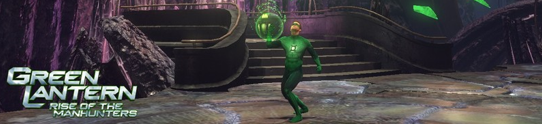
Game Corner [Brightest Day]: Green Lantern: Rise of the Manhunters (Xbox 360)


Although February 2014 was dubbed “Green Lantern Day” (because, by the American calendar, the date read as “2814”, the space sector assigned to Earth in DC Comics), the significance of this date has passed over time. Instead, I’m choosing to celebrate the debut of perhaps the most popular iteration of the character, Hal Jordan, who first appeared in October 1959.


Released: 7 June 2011
Developer: Double Helix Games
Also Available For: Nintendo DS, Nintendo 3DS, Nintendo Wii, PlayStation 3

The Background:
When Green Lantern first appeared in All-American Comics #16 in July 1940, it was as the superhero persona of of Alan Scott. However, in 1959, Julius Schwartz had writer John Broome and artist Gil Kane reinvent the character as space cop Hal Jordan, thereby creating what we now know as DC Comics’ resident intergalactic police force. After years of aborted attempts, Hal Jordan finally made his big-screen debut (alongside the Green Lantern Corps) in Green Lantern (Campbell, 2011), a critical and commercial failure that set back the formation of a DC cinematic universe a couple of years. However, one thing that came out of the movie was Green Lantern’s first (and, so far, only) solo videogame outing with this tie-in title, which was made by an amalgamated developer whose previous titles were also mostly videogame adaptations. Although featuring the likenesses and voices of many of the film’s stars and allowing players to utilise stereoscopic 3D during gameplay, Green Lantern: Rise of the Manhunters received mixed reviews; while some praised the various gameplay mechanics and the game’s presentation, others criticised the repetitive combat and lack of replayability. Since Green Lantern failed to produce a sequel, we’ve yet to see another solo videogame for the ring-slinger, which is a bit of a shame considering how much potential the character has in the near-limitless scope of the genre.

The Plot:
Before harnessing the green energy of willpower and creating the intergalactic peacekeepers known as Green Lanterns, the Guardians of the Universe employed androids called Manhunters. After being shut down for becoming too violent, the Manhunters suddenly return for revenge against their former masters, and Green Lantern’s Hal Jordan and Thaal Sinestro are just two of the emerald corpsmen dispatched to combat this threat.

Gameplay:
Green Lantern: Rise of the Manhunters is a third-person action/adventure game very much in the style of hack-and-slash brawlers like the God of War franchise (Various, 2005 to present). Players take on the role of Hal Jordan and fight their way through some pretty long and bland environments slashing about Manhunters with a variety of attacks generating by his Power Ring. If you have a friend, they can join the action at any time as Thaal Sinestro, though he’s basically just a skin and doesn’t have any unique dialogue or attacks and the camera becomes a bit restricted with two players on screen. Still, you have quite a few options available in terms of combat: X unleashes a fast attack with some sword swipes, Y delivers a strong attack that includes a fist and a hammer, B sees you grasping smaller enemies or objects with a claw, and the Right Bumper lets you blast ahead with a drill and chaining all of these together will allow you to pull off some basic combos to take out larger and multiple enemies pretty quickly.

Hal’s Power Ring affords him numerous options in combat and puzzle solving.

A allows you to jump but, unfortunately, you can’t fly unless you’re activating a Green Lantern logo to leap to a new area in a cutscene or dropped into one of the games shooting sections. You can evade, however, with the right stick and shield yourself from attacks with the Left Bumper. As you play through the story, you’ll unlock constructs to assign to the Left and Right Trigger; holding these down and pressing a button lets you pull off up to eight different Power Ring abilities that will drain your meter (though this refills over time and by collecting green orbs). Hal can blast enemies from afar with the Ring Blaster and Gatling Gun, smash them and activate pressure pads with the War Hammer, deploy and throw a Hover Mine to blow them up or destroy power cores, send them flying (and knock back projectiles) with the Baseball Bat, and swing around a couple of maces to devastate groups of enemies. Hal can also rapidly whip Manhunters, auto target and pummel them with the Rocket Punch, smash through enemy shields with the Piston Blitz, deliver targeted attacks to enemy weak points with the Missile Pack, and eventually dish out big damage with a Jet Fighter and a huge Mech Suit. The bigger and more powerful constructs will drain more of your Power Ring’s energy, but you can upgrade your Power Ring and your basic attacks by defeating enemies and smashing parts of the environment for Will Points (strangely still abbreviated to XP). The more XP you earn, the higher your level raises (up to a maximum of ten) and the more upgrades and additional constructs you’ll unlock, eventually allowing you to purchase Lantern’s Light to recharge your Power Ring with the directional pad at the risk of being left vulnerable. Finally, as you defeat enemies, you’ll build up your Ring Surge meter; once it’s full, press the Left and Right Bumper to activate a Ring Surge, which restores your health and Power Ring to full and powers up your attacks for a short time; the effectiveness of your Ring Surge can also be upgraded with XP.

QTEs, simple puzzles, and rail shooting sections add some variety.

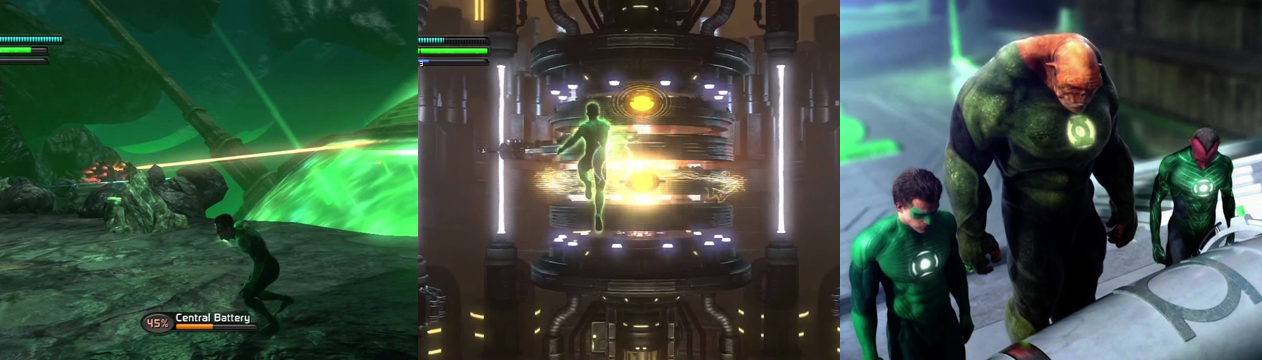
The bulk of your gameplay revolves around combat; near endless, mindless combat against Manhunters of all shapes and sizes. The game is incredibly linear, with no need for a map or directions since it’s pretty clear where you need to go, though there are inevitably times when it’s easy to get a little turned around since environments became very samey very quickly. When you’re not smashing apart endless Manhunter drones, you’re given a handful of additional missions, such as destroying mines, leaping to Siege Towers and destroying them by smashing open their armoured cores, and destroying teleport gates to stop enemies spawning in. One mission has you taking out a bunch of lasers before they destroy the Central Power Battery, sometimes you’ll need to press A and rotate the left stick to open doors or spawn in a battery, and other times you’ll be dodging electrified walls and floors to progress. These latter elements get mixed up you play through the story, requiring you to grab a battery and get it to a power node before it explodes or smashing Hover Mines into spinning holes as the floor tries to fry you. Later in the game, yellow Fear Energy nodes and enemies drain your Ring Energy meter and limit your constructs, and Queen Aga’po helps you out on Zamaron by lowering crystal barriers, where you’ll also need to destroy Boost Crystals to stop the Zamarons being powered up. Generally, puzzles are pretty simple, requiring little more than clearing out enemies, grabbing something to plug in somewhere else, either to match symbols or to destroy an energy core, and you’ll only really get a taste of some variety in the handful of rail shooter sections. In these, you use X or Y to fire (with no limits and a rapid-fire option) and can lock onto enemies with LT to fire off energy-draining missiles or become a Jet Fighter with your Ring Surge, making for some fun shooting sections. Additionally, you’ll occasionally have to perform some quick-time events (QTEs) to finish off some of the bigger enemies and bosses, and you can lower the difficulty level after you die if the game becomes too tough.

Graphics and Sound:  
Technically speaking, Green Lantern: Rise of the Manhunters looks, sounds, and plays pretty decently; I experienced a bit of a delay when activating my Ring Surge (though this could’ve been my controller) but there wasn’t really any slowdown, which is good as things can get a bit hectic at times. Ryan Reynolds returns to voice and lend his likeness to Hal, playing him a little more straight-laced now that he’s a fully-fledged Green Lantern, and he (and the other Green Lanterns) matches his much-maligned movie appearance very well. His constructs all look big and fun and imaginative, though they are a bit restrictive; his basic attacks change appearance as you upgrade them, which is a nice touch, and the developers even made the bizarre decision to include a function where Hall becomes dizzy if you rapidly spin the control stick.

The game evokes the aesthetic of its movie counterpart, for better or worse.

Sadly, the game’s environments and music aren’t much to shout about; you visit Oa twice, at the start and end of the game, and both times it recreates the look of the movie but is little more than a bizarre alien landscape under attack from various Manhunters. Zamaron is a rocky, mushroom-strewn alien world that is more bland than interesting, though it does include canyons and crystal mines and temples and such. The only other area in the game is Biot, a massive mechanical factory and processing plant for the Manhunters that’s full of gears and pistons and consoles and such, but there’s very little to interact with in any of the game’s locations and few rewards or incentive to explore as there aren’t really any collectibles. The game’s cutscenes work well enough, with the suit and the movie’s aesthetic actually translating pretty well to the action figure presentation of this era of gaming, and I liked how the story was a sequel to the movie, though it’s weird how there was no expansion on Sinestro’s decision to switch to a Yellow Ring.

Enemies and Bosses:
The vast majority of the enemies you’ll face are Manhunters, disposable tin cans that fly or teleport in and attack in some large numbers. You’ve got regular drones, ones with shields or blasters, and annoying bastards on these hoverboards that allow them to zip around and bombard you with laser fire. Sometimes you’ll be attacked by mines and laser cannons or Manhunter ships, which can be destroyed by smashing back their projectiles, and larger Manhunter variants will rush at you and grab you in a bearhug, draining your Ring Energy and forcing you to mash A to escape. On Zamaron, you’ll battle some different enemies, mainly mind controlled Zamarons who attack with staffs and such, but you’ll also encounter Willhunters, which drain your Ring Energy, and Manhunters also exhibit this ability on Biot and later in the game.

Only Zamaron offers a reprieve from the endless Manhunter variants.

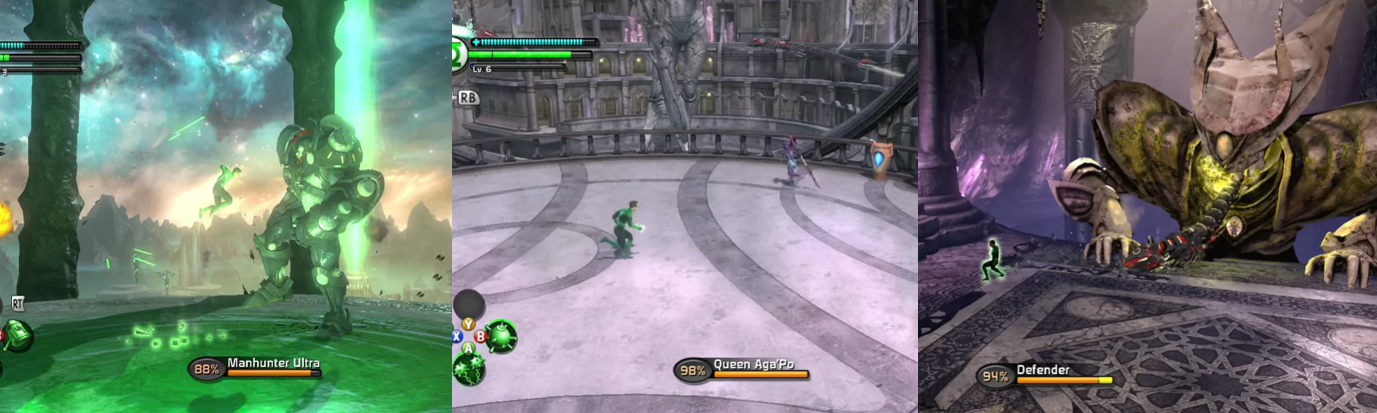
Bosses are primarily larger Manhunters, which then return as mini bosses or are strewn throughout shooting stages. The Ultra Manhunter is the best example of this; you’ll first battle it on Oa, where it stomps about firing lasers and shooting its fists at you but you can evade it, take advantage of the nearby Lantern power-up, and land some combos when it gets stuck on the ground. Ultra Manhunters reappear numerous times, often in twos and accompanied by a slew of other Manhunters; they later add a gravity bomb to their arsenal which sucks you in before exploding, but you can destroy these with your Hover Mines and you can put them down with a QTE after dealing enough damage and blast them to smithereens in the shooting sections. The Siphoner Manhunter, which bearhugs you, and the Willhunters are presented like mini bosses when you first encounter them but they quickly just become regular enemies. On Zamaron, you’ll battle Queen Aga’po after she’s corrupted by the Yellow Energy; she causes crystals to burst from the ground (which freeze you and enemies if you touch them) and sends her minions after you between attacks before attacking with her lance. After pursuing her in a shooter section and taking out another Ultra Manhunter, she sets the Zamaron Defender on you. This battle takes place on a 2.5D pane and sees you attacking its hands and the Willhunters it sends out, avoiding its swipes and the falling boulders, smashing back its projectiles and dodging its electrical barriers and shockwaves in easily the most annoying boss battle of the game so far (and you don’t even get the catharsis of finishing it yourself as Hal delivers the final blow in a cutscene).

After besting the Manhunters, you’ll face off against renegade Amon Sur.

Biot is full of Siphoners and Ultra Manhunters, Manhunters who exude Yellow Energy, and annoying reactor cores that you need to destroy with your Hover Mines. The mechanical hellhole culminates in a battle against the titanic Grandmaster, which is essentially an even bigger Ultra Manhunter and your Mech Suit comes in handy here, allowing you to go toe-to-toe with the armoured foe, who loves to blasts its fists at you and swing them around the arena to send you flying. Take it down and you get to battle the even bigger Highmaster afterwards, which is an even larger Ultra Manhunter that blasts out bigger versions of those gravity bombs and sends a massive laser beam from its hand to cut you down. The only way to damage this guy is to attack the glowing points on its knees, then run around behind it and awkwardly toss your Hover Mines into its knees so it drops to the floor, allowing you to attack the cockpit where Kilowog is being held captive. Repeat this three times, fending off the Manhunters and dodging its faster and more aggressive attacks, and you’ll progress to the final stage of the game. This sees you returning to Oa, where Amon Sur has become consumed by Yellow Energy and is leading a renewed Manhunter assault against the Guardians. You’ll need to dispatch his minions before engaging with him one-on-one, which sees Amon dashing at you with his scythe-like lance, conjuring skeletal hands, bombarding you with laser blasts, and protecting himself with an impenetrable shield. Deal enough damage and he also constructs a massive mech suit for himself, meaning the finale becomes a game of Rock ‘Em Sock ‘Em Robots as you throw slow punches at him, guard against his attacks, and stomp the ground to break his guard, completely negating all of the combat and gameplay you’ve endured and mastered and having the final boss come down to a QTE with obnoxious timing.

Power-Ups and Bonuses:
As you defeat enemies and smash pots and other parts of the environment, green, white, and blue orbs will refill your health and Ring Energy and grant you XP. Occasionally, you’ll find Lantern charge points in the environment which fully replenish your health and energy and allow you to pull off a Ring Surge, but that’s about it for in-game power-ups. New constructs are made available as the story progresses and as you level-up, which also unlocks upgrades for your attacks and Ring Meter so they become flashier, more powerful, and charge/last longer. You can assign Hal eight different constructs to use and can swap them out from the pause menu, but it’s best to keep a couple (like the War Hammer, Baseball Bat, and Hover Mine) in your arsenal since they’re useful for solving puzzles and defeating certain enemies. Other constructs, like the Jet Fighter and Mech Suit, may deal a lot of damage but they have a long charge time and drain more of your Ring Energy, though you can find and destroy coloured meteorites in each mission that will extend both of these meters.

Additional Features:
There are forty Achievements to earn in Green Lantern: Rise of the Manhunters, with eleven being awarded simply for clearing the game’s missions and story mode. You’ll also get Achievements for racking up high combos, acquiring and upgrading every construct and ability, defeating certain enemies with each construct, and fully expanding Hal’s health and energy. There are three difficulty levels for the game, with an additional Achievement awarded for beating it on the hardest setting, and two more for playing in co-op, making for some pretty simple to earn Achievements. Co-op mode is pretty good, though there’s a distinct lack of individuality to Sinestro, and you can replay any cleared mission from the main menu and even take advantage of a 3D functionality if you have one of those 3D TVs. Sadly, there really isn’t much to keep you playing; you can go back and look for things you’ve missed, but there are no collectibles, no concept art or gallery, and no skins to unlock, making for a pretty cheap and barebones experience.

The Summary:
Green Lantern: Rise of the Manhunters is a pretty decent hack-and-slash videogame; fans of the God of War franchise will be immediately familiar with the vast majority of the gameplay, but those who crave a little more depth to their games will be left wanting more from this tie-in title. The controls and combat are pretty good, but the stages are extremely restrictive and tediously drawn out, artificially extending the length of the game without really providing much visual variety. Combat quickly becomes tedious and you can easily mow through most enemies with the same button inputs or constructs without needing to mix things up and, while the rail shooting sections are fun, they’re few and far between and don’t really have a great deal of challenge to them. The enemies you battle get old very quickly, making things even more monotonous, and the few puzzles offered are ridiculously easy to solve and recycled over and over. Graphically, the game does a good job of emulating the style of the movie it’s based on and the story functions as a lacklustre follow-up to a mediocre film, but there’s very little replay value to be offered here. As a quick, cheap cash-in that rips off the gameplay of a more successful franchise, Green Lantern: Rise of the Manhunters does alright but there’s obviously better hack-and-slash titles out there and the only reason to really get this is if you see it cheap and you fancy adding some quick and easy Achievements to your gamer score. Overall, the game just lacks in imagination; Green Lantern is a character who can potentially do and conjure almost anything he desires but he feels needlessly handicapped here and the lack of skins, unlockables, or visual variety really drag this game down.

My Rating:

Rating: 2 out of 5.

Could Be Better

Have you ever played Green Lantern: Rise of the Manhunters? If so, what did you think to it? How do you feel the combat and constructs worked in the context of the game? What did you think to the plot and its status as a follow-up to the movie? Were you disappointed by the lack of variety in the enemies and locations? Which of the constructs was your favourite and were you a fan of Ryan Reynolds reprising the role? What did you think to the movie the game’s based on and would you like to see a new Green Lantern game in the future? Which Green Lantern character, villain, or story is your favourite and why? How are you celebrating this pseudo-Green Lantern day today? Whatever you think about Green Lantern: Rise of the Manhunters, and the Green Lantern comics books, feel free to leave a comment below.

Movie Night: Blade (1998)

Released: 21 August 1998
Director: Stephen Norrington
Distributor: New Line Cinema
Budget: $45 million
Stars: Wesley Snipes, Stephen Dorff, N‘Bushe Wright, Donal Logue, Kris Kristofferson, and Udo Kier

The Plot:
Blade (Snipes), a half-human, half-vampire dhampir born with all of the strengths of a vampire but none of their weaknesses (save the thirst for human blood), hunts vampires alongside his grouchy mentor and father-figure, Abraham Whistler (Kristofferson). Their mission is upended when Blade helps haematologist Doctor Karen Jenson (Wright) after she is bitten, and when sadistic upstart vampire Deacon Frost (Dorff) sets in motion a plot to usurp his elders and evoke the mythical “Blood God”.

The Background:
Eric Brooks/Blade began life as an extremely obscure, culturally problematic vampire hunter in the pages of The Tomb of Dracula, courtesy of Marv Wolfman and Gene Colan, after Marvel Comics were were finally allowed to publish stories involving vampires and other supernatural creatures. Development of a Blade movie can be traced back to 1992, when New World Pictures bought the rights to the character and rapper LL Cool J was initially attached to the role. Obviously, this never came to fruition and the rights eventually ended up with New Line Cinema, where the property caught the attention of writer David S. Goyer. After battling against the studio’s wishes to make a spoof film, and change Blade’s race, Goyer won out with his gritter, bloody, realistic reimagining of the character. Goyer’s revised ideas for Blade were reflected in his guest appearances on the nineties Spider-Man animated series where he was also a dhampir and accompanied by Whistler (Malcolm McDowell/Oliver Muirhead). Although actors Denzel Washington and Laurence Fishburne were considered for the role, Goyer pushed for Snipes, who had previously been attached to star in an unproduced Black Panther movie. Norrington’s first 140-minute cut was heavily trashed by test audiences, necessitating not just heavy reshoots but also an entirely new ending, but the final movie went on to be a huge success; it grossed over $131 million at the box office and was highly praised for its slick visual style, seedy depiction of vampire society, and unapologetic violence and gore. Though there were some reservations with the disparate genres at work in the film, the results spoke for themselves; not only was the comic book Blade altered to match his live-action counterpart, but Blade spawned two sequels of varying quality and an unfortunately short-lived TV show. Blade was also one of the first movies to really kick-start the surge in popularity for superhero properties in cinema, so it was only fitting when Marvel Studios reacquired the rights to bring the character back to the big screen with a reboot.

The Review:
Before Blade, I (like many) had never heard of Marvel’s most famous vampire hunter. Hell, I wasn’t even that familiar with Wesley Snipes, having seen him in Demolition Man (Brambilla, 1993) and very little else since my action movie dance card was firmly filled up with Arnold Schwarzenegger’s body of work. Still, like The Matrix (The Wachowski Brothers, 1999) and Armageddon (Bay, 1998), Blade was a  constant presence at sleepovers and birthdays, and probably the last good vampire film I watched until 30 Days of Night (Slade, 2007)). It didn’t help that the genre became oversaturated with lame-ass, love drunk teenage vampires and Blade and Matrix rip-offs like the God-awful Underworld franchise (Various, 2003 to 2017). Don’t get me wrong, I’m a huge fan of the dark, gory, gritty, leather-and-guns aesthetic that these films popularised at the time, but crafting a good vampire film in this day and age seems like a lost art as filmmakers lean a little too heavily towards the camp and an excess of CGI. But still, Blade was (largely) immune to all of that, and barely even had the stigma of being a comic book movie (the film doesn’t even have the classic Marvel logo in the opening) since no-one really knew who he was; I’d seen him in Spider-Man and even I hardly remembered him, so in many ways this was the perfect “back door pilot” for the superhero movies we were about to see explode onto cinema screens. Unfortunately, we wouldn’t see R-rated superhero films take centre stage during this movement, but I still maintain that not every superhero property even needs to be full of gore and cuss words; but those who do deserve it, like Blade, should definitely veer more towards that and would do well to take a few notes from this classic horror/action film.

With all a vampire’s strengths but none of their weaknesses, Blade wages a relentless crusade.

Blade is the story of…well…Blade…a stoic and highly skilled vampire hunter who was born Eric Brooks. When his mother, Vanessa (Sanaa Lathan), was bitten by a vampire (later revealed to have been the big bad, Deacon Frost) while pregnant, Eric was born a “dhampir” (though the film prefers the term “Daywalker”), a human being with all the strengths of a vampire (heightened senses, superhuman strength, agility, and durability, and skin-piercing fangs) but with none of their weaknesses to sunlight or ultraviolet radiation (which burns and eventually explodes on contact), garlic, or silver. For all his fantastic abilities, though, Blade still ages like a normal human and is still hampered by perhaps the vampire’s most crippling affliction: “The Thirst” for human blood. While other vampires freely indulge their bloodlust, luring in unsuspecting prey and literally raving at underground bloodbaths, Blade relies upon a special serum, derived by his half-crippled mentor, Whistler, to keep the Thirst at bay. Blade takes this serum at least once a day and this is the first time (and one of the rare times) that we see him in an kind of vulnerable state; strapped to a chair, grasping Whistler’s hand for support, his body is wracked by seizures as the serum courses through his veins, leaving his hunger satiated and his body trembling. Aside from this, Blade is an absolute machine when out in the field; stone-faced and exuding menace and confidence, he thinks nothing of walking into a club filled to the brim with horny, blood-hungry vampires and even little of storming a hospital or Frost’s penthouse in the pursuit of his targets. Harbouring a deep-rooted hatred towards vampires since they killed his mother and cursed him with a life of violence and pain, Blade is relentless in his quest to kill every vampire that crosses his path, disrupt and destroy their entrenched hierarchy, and track down and kill Frost, which has earned him a reputation amongst the vampire community as a feared and formidable figure, the aforementioned Daywalker, who is effectively their bogeyman. However, Blade is deeply ashamed by himself; disgusted at his inhuman thirst for blood and sickened at what Frost did to his mother, he seeks solace in the only thing he knows: killing the monsters responsible for his existence to gain just a small sliver of his humanity back with each victory.

Grouchy hard-ass Whistler has devoted his life to training Blade and killing vampires.

Although Blade is somewhat cold and dismissive towards Whistler, who is a crotchety and jaded old man with a prominent limp and a tendency to smoke around flammable liquids, there’s a mutual respect and admiration between the two. When Blade was a boy, Whistler stumbled upon him on the streets and nearly killed him before realising what he was and has been teaching him everything he knows ever since. Whistler has even less love for vampires than the titular hunter; years ago, his wife and children were killed after taking in a drifter, who turned out to be a vampire, and he was forced to watch as they were tortured before his eyes. Quite how he survived this encounter isn’t elaborated, but he’s made it his mission to take them out one by one. Despite their contentious relationship, where Whistler is often admonishing Blade for his actions, there’s a father/son bond between the two; it’s obvious that they care about each other, and Whistler is clearly disturbed at the serum’s increasing ineffectiveness and concerned for Blade’s welfare out in the field. Unfortunately, age, injuries, and cancer have taken their toll on Whistler and he’s no longer able to be an active combatant, something you can tell is a source of great frustration for him. Despite this, he’s still a valuable ally and resource for Blade; his vast knowledge of vampire society and their inner workings allows Blade to pursue Deacon Frost, and Whistler furnishes Blade with all his weapons and his supped-up muscle car, and even makes a dramatic and amusing last-minute save later in the film (his “Catch you fucker’s at a bad time?!” and “Somebody get me a Goddamn wheelchair!” lines are some of the best in the film). For all his piss and vinegar, Whistler has a large heart; he truly cares for Blade and sympathises with Karen’s plight, and his whole mission is motivated by a desire to protect others from the vampire’s bloodlusts. However, while he has an indomitable fighting spirit, his best efforts to protect Karen and fend off Frost are for naught, leaving him beaten, bloodied, and bitten. Blade is left shell-shocked and refuses to finish off his father figure; it’s all he can do to clean Whistler’s wounds and, seeing his protégé’s struggle, Whistler demands that he walk away so he can finish the job himself, and Blade begrudgingly obeys, resuming his grim façade and fuelled by an even greater need to extract revenge on Frost.

Violently thrust into Blade’s world, haematologist Karen works to find a cure for vampirism.

When we first meet her, Karen is just an average overworked and underpaid haematologist trying to get through a nightshift while dismissing the advances of her colleague and former flame, Doctor Curtis Webb (Tim Guinee). She’s violently introduced to Blade’s gruesome world, however, when the charred corpse of Frost’s underling, Quinn (Logue), springs to life and violently attacks both her and Curtis. Although it’s admittedly a bit weird that Blade went to all the trouble of setting Quinn alight to send a message to Frost and then immediately came back to “finish [him] off”, thereby endangering innocents by letting Quinn live, it does mean that he crosses paths with the injured and infected Karen. In a rare moment of emotion, Blade sees a resemblance between Karen and his mother and chooses to take her to his lair rather than finish her off or leave her to turn. Karen thus becomes the audience surrogate; it’s through her interactions with Whistler and Blade that we learn about Blade’s origin, the rules of these vampires, and the lore behind the movie. At first, she’s naturally terrified; not only has she just been attacked by a ravenous, burned up corpse but this hulking motherfucker just threw her out a window and effectively kidnapped her, and her fear only worsens when she’s told that she has a high chance of becoming a vampire even after the treatment they give her. Determined to avoid this fate, and fascinated by their operation, Karen experiments with ethylenediaminetetraacetic acid (EDTA), discovering that it not only has explosive results when mixed with vampire blood but could also hold the key to curing vampirism. Though this wouldn’t have any affect on Blade since he was born with his abilities, she’s confident that she can cure him with enough time but, ultimately, he requests that she synthesise a more effective serum for him. Since she was attacked, Karen becomes “marked” and thus remains at risk of vampire attacks; this comes to a head when she’s taken hostage by Frost, meaning she willingly allows Blade to drink her blood in order to restore his strength for the finale, but any romantic subplot between them is continually (and refreshingly) downplayed due to Blade’s intense focus on his never-ending mission (although the scene where he drinks her blood seems purposefully shot to evoke an intense love scene).

Upstart sadistic Frost wants nothing more than to rule over the humans and usurp his antiquated elders.

As different as Blade is from his comic book counterpart, Frost is equally a departure from the silver-haired, middle-aged man seen in the comics. Indeed, the movie version of Frost has more in common with David Powers (Kiefer Sutherland) from The Lost Boys (Schumacher, 1987), both aesthetically and in terms of his motivation. Frost is seen by his more composed elders as a disruptive and chaotic individual, one who regards vampires as the dominant species and humans as mere food and whosr antics draw unnecessary attention to their kind not just from Blade, the scourge of vampire society, but also from the humans they so tentatively live alongside. Frost’s mindset is an intriguing one; since he was “merely turned” into a vampire, and was thus once human, his hatred and resentment towards humanity seems to stem from an untampered, sadistic lust for power, bloodshed, and a superiority complex afforded by his superhuman abilities. Seeing the vampire high council as relics of a bygone era, Frost wants nothing more than to run free and rampant, unrestricted by antiquated rules and treaties, and has even found a way to operate in the sunlight using sun block (a ludicrous solution, but it makes for an intimidating confrontation between him and Blade and one of the first popular instances of “bullet time” in cinema). Frost is a twisted, arrogant punk who surrounds himself with a gaggle of likeminded cronies, all of whom revel in indulging their thirst for blood and anarchy, and this extends even as far as to threaten a young girl just to hold Blade at bay and to take the head of the vampire council, Gitano Dragonetti (Kier), rip his fangs out with pliers, and leave him to be annihilated by the rising sun. Despite his disrespect and frustration with the old ways, Frost devotes a great deal of his time, energy, and resources to translating the secret of the “Blood God”, La Magra, from the Book of Erebus (the “Vampire Bible”), discovering that sacrificing twelve “Pure Bloods” will summon the eldritch force and infuse him with its power. A cruel-hearted and vicious individual, Frost takes great pleasure in beating Whistler half to death and delights in torturing Blade not just with the knowledge that his mother is still alive (and a vampire now entirely loyal to Frost) but also by draining his blood to fuel his transformation into the Blood God. Imbued with a virtual immortality, Frost’s ambition more than exceeds his grasp, allowing him to effectively usurp his elders and ascend to a level of existence that threatens to spell the end of days for both humans and any vampires that don’t pledge undying fealty to him.

The Nitty-Gritty:
If there’s a downside to Blade, it’s that it suffers from the annoying trend of having its antagonists sit around in suits and in elaborate boardrooms and office buildings, lording their power and control over the city. However, this actually plays into Frost’s character; unlike the vampire high council and the likes of Gitano Dragonetti, Frost shuns the corporate ways of their society and prefers to indulge his whims, and this dispute leads to a great deal of antagonism between his upstart group and their elders. Indeed, vampire society in Blade is depicted as being firmly entrenched within what we recognise as the real world; they’ve infiltrated every level of society, from politics to law enforcement and real estate, and enjoy the wealth and privileges such influence brings, allowing them to carefully select their victims and modulate their base desires so as not to draw attention to themselves. In contrast to these Pure Bloods, Frost and his cronies are seen as petulant children; admonished for encouraging gatherings of similarly turned vampires and threatening the “treaty” they have with the human politicians (indicating an awareness of vampire society at a higher governmental level, but it’s ignored and/or tolerated to keep from sparking an all-out war that would cost humans their lives and vampires their lofty position). If you’ve ever watched Buffy the Vampire Slayer (1997 to 2003), you’ll be immediately familiar with vampire society in Blade: there’s the older Pure Bloods at the top of the food chain, those they’ve turned and inducted into their cabal (like Frost), but there are also more monstrous variants in their ranks. The morbidly obese Pearl (Eric Edwards), who’s been feeding on children while helping translate the Vampire Bible, is just one such example, but Curtis later pops up as a horrific zombie-like creature as a common by-product of being bitten. On the other side of the coin, the vampires frequently employ “Familiars”, regular humans like Krieger (Kevin Patrick Walls), a police officer who carries Frost’s tattoo and hopes to one day be turned for assisting his master.

Blade excels in its action-packed fight scenes, gritty presentation, and unapologetic gore.

One of the things I absolutely love about Blade is, like The Crow (Proyas, 1994) and The Matrix before it, the film has a heavy reliance upon bad-ass leather trench coats and kung-fu. Garbed head to toe in black and sporting a nifty armour vest, Blade cuts quite the intimidating figure; our introduction to him, standing bone dry amidst a literal bloodbath, couldn’t be more striking and watching him dismantle vampires left and right with ease and skill is always a joy thanks to Snipes’ slick movements and some incredibly well-shot and well-choreographed fight scenes. The action is easy to follow, even when in low or strobe lighting, and Blade oozes confidence and charisma every time he’s on screen even though the character is largely stoic and no-nonsense. Having said that, though, Blade’s grim demeanour does crack on more than one occasion; he gives himself a little fist pump after nailing Quinn to a wall, shares some banter with Whistler, expresses concern over Karen and appreciation towards his allies, but perhaps his most amusing attribute is that he often delivers cool, snappy one-liners (his outburst of “Motherfuckah, are you outta your damn mind?” when the cops shoot at him never fails to amuse and his “Some motherfuckahs are always tryin’ t’ice skate uphill” is exactly the right level of awesome and ridiculous). Blade is so proficient at killing vampires because his superhuman abilities are bolstered by some awesome weapons, courtesy of Whistler; he carries a variety of silver stakes to instantly turn vampires to charred ash, wields a modified MAC-11 for rapid fire like he’s fuckin’ Alex Murphy/RoboCop, blows vampire heads clean off with his shotgun and, of course, carries a titanium, silver-tinted sword that easily allows him to not only sever limbs and reduce even roomfuls of armed vampires to dust but also contains a security feature that means no one but him can hold it without losing a hand! Whistler even furnishes Karen with a compound of “vampire mace” to fend off any unwanted attention, and has put together quite the sexy muscle car for Blade to bomb around the city streets in.

Unfortunately, the film’s effects and finale are bogged down by some ugly CGI blood.

I mentioned Buffy the Vampire Slayer earlier and the comparison is more fitting that you might think; while the vampires don’t sport monstrous make-up like in the show and appear much sexier with their glistening fangs and gothic attire, they die in very much the same way. After being stabbed or sliced with silver, or exposed to sunlight, vampires quickly and violently burn to ash and cinders, an effect that is visually interesting if a little dated. For the most part, Blade does a great job of keeping everything nice and practical; Snipes excels in his fight scenes and shoot-outs, which are all nice and varied and have a great balance of fast-paced, hard-hitting action, explosions, and blood, and the sets are equally diverse, ranging from high-tech archives, the juxtaposition between Frost’s elaborate penthouse and Blade’s rundown lair in the industrial district, and the ancient stone of the Temple of Eternal Night. On the other hand, Pearl is little more than a disgusting mass of rubbery flesh, Frost’s Mac is strangely able to render a complete 3D recreation of the temple simply from translating the Vampire Bible, and, of course, there’s the final confrontation between Blade and Frost himself. After being restored by Karen’s blood (and receiving a power boost as a result) and cutting through Frost’s underlings, and even killing his mother (ultimately an underutilised plot point, I feel, that could’ve easily been dropped), Blade battles the empowered Frost one last time. This one is actually a challenge for Blade; not only is Frost able to match him blow for blow and sword swing for sword swing, but he’s functionally immortal thanks to the Blood God. Despite Frost’s henchwoman, Mercury (Arly Jover), killing one of the twelve Pure Bloods, the ceremony goes off without a hitch, imbuing Frost with the powers of the God (although it’s possible that Mercury’s actions caused him to be more of a demigod than a literal whirlwind of blood). When Blade does cut through Frost’s abdomen for a killing blow, the upstart vampire easily reconnects himself using probably the worst CGI blood effect you’ll ever see. Luckily, these poor blood effects are fleeting and don’t overpower the finale like in the first disastrous test footage, but they do rear their ugly head when Blade bests Frost by injecting him with his entire supply of EDTA, causing him to violently explode in an ugly, bloated mess. Although Frost is dead, this was merely a battle in an ongoing and never-ending war and the film ends with Blade more willing than ever to see his cause through to the conclusion (even ending up hunting vampires in Russia) rather than accept the vague promise of a cure.

The Summary:
It’s actually a little surprising to me how well Blade holds up today; the film has a slick, science-fiction edge to it that permeated subsequent comic book movies like the X-Men films (Various, 2000 to 2020) but it had something to it, a dark, gritty edge, that even now films in the same genre tend to either downplay or ignore. Although it’s undeniably comic book-y in its premise and execution, Blade eschews many of the clichés we’ve come to see from the genre; rather than being a by-the-numbers origin story or feature form-fitting costumes, Blade is primarily a horror/action film and, in this regard, it exceeds tremendously. Full of fast, exciting fight scenes, frenetic chase sequences, and action-packed shoot-outs, Blade is even a cut above other films in the action genre and may very well be the perfect marriage of all these disparate elements. Edgy, gory, and unapologetically aimed at a more mature audience, the film takes everything that worked in The Crow and expands upon it with its gothic, gruesome premise and proceeds the “wire-fu” craze popularised by The Matrix. I’ve never been a massive fan of Wesley Snipes; he’s undeniably cool and certainly has some skills, but it’s a little difficult for me to reconcile his personal life with his movies, which haven’t always been able to compete with his peers, but Blade was a great showcase of his physical abilities and easily his most iconic character for me since it allows him to be stoic, deeply emotional, and snarky in addition to tossing fools around like they were nothing. The depiction of vampire society as being a conflict of interests between the antiquated old guard and Frost’s arrogant upstarts echoed The Lost Boys and nicely challenged the cliché of all-powerful, corporate antagonists, and was a significant influence on the genre going forward. While some of the effects haven’t aged too well and the plot point of Blade’s mother still being alive didn’t really land for me, neither of these things really detract from how enjoyable Blade is. Although I actually prefer the more violent and action-packed sequel, there’s a definite appeal to how raw and uncompromising the original is, especially in its depiction of more horrific and gory moments, and it’s a great piece of dark, gritty vampire fiction for fans of the genre.

My Rating:

Rating: 4 out of 5.

Great Stuff

Are you fan of Blade? What did you think to it when it first came out and how do you think it holds up today? Were you a fan of the comic book character prior to this film and, if so, what did you think to the changes made to his powers and origin? What did you think to the performances, specifically Wesley Snipes and Stephen Dorff, and were you moved by Whistler’s death? Did you enjoy the film’s gore and action sequences, and what are your thoughts on the CGI used in the finale? Which vampire movie or story is your favourite, and which of the Blade films or comics do you enjoy? Whatever your thoughts on Blade, feel free to share them below.

Movie Night [Global James Bond Day]: The Man with the Golden Gun


To celebrate the release of Dr. No (Young, 1962), the first in the long-running series of James Bond movies (Various, 1962 to present), October 5th is officially recognised as “Global James Bond Day”. Today, this franchise stands as the longest-running franchise ever and the character is one of the most recognised and popular movie icons of all time.


Released: 19 December 1974
Director: Guy Hamilton
Distributor: United Artists
Budget: $7 million
Stars: Roger Moore, Christopher Lee, Britt Ekland, Hervé Villechaize, Soon-Taik Oh, Richard Loo, and Maud Adams

The Plot:
Sophisticated super spy James Bond/007 (Moore) may have met his match in Francisco Scaramanga (Lee), a world-renowned assassin whose weapon of choice is a distinctive gold pistol. When Scaramanga seizes the priceless Solex Agitator energy convertor, Bond must recover the device and confront the trained killer in a heart-stopping duel to the death!

The Background:
James Bond, Agent 007 of MI6, was the creation of writer Ian Fleming in 1953 and was heavily inspired by his time and experiences as a navy intelligence officer. James Bond was most famously brought to life by Sean Connery, who kick-started an unparalleled cinematic franchise. However, after five films as the super spy, Connery began to tire of the role; after being lured back for a whopping $1.25 million and other perks, Connery walked away from Bond (…for a time…) and, while still finishing up with The Saint (1962 to 1969), suave Roger Moore took over and immediately set about making it his own so as not to imitate Connery’s iconic performance, eventually becoming a softer and more gentle Bond. Moore’s Bond debut, Live and Let Die (Hamilton, 1973) was a commercial success, though garnered mixed reviews, and famed Bond producers Albert R. Broccoli and Harry Saltzman finally set about making a big-screen adaptation of Fleming’s 1965 novel, a polarising tale that set Bond against a notorious assassin. It was writer Tom Mankiewicz who altered Scaramanga’s character into a dark mirror of Bond himself, and the adaptation ended up being very different from the source material after taking inspiration from the 1973 energy crisis. Christopher Lee, Fleming’s step-cousin, finally got his chance to play a Bond villain and received high praise for his performance, though he struggled a bit with the Golden Gun prop device. The film was shot in numerous locations around Hong Kong, with the nearby Ko Khao Phing Kan islands housing Scaramanga’s suitably elaborate and bizarre lair. The Man with the Golden Gun was notable for its car stunts, one of which made it into the Guinness Book of Records; the barrel roll was caught in one take and saw a stunt driver guide an AMC Hornet over a specially-constructed ramp for the shot, which was mired only by an unfortunate slide whistle sound effect. Although The Man with the Golden Gun grossed over $97 million at the box office, notably less than its predecessor and coming in as the fourth-lowest-grossing film in the series. Reviews were mixed upon release, with critics questioning the script and redundancy of the film, regarding it as an uninspiring entry, despite Lee’s performance, and the film very nearly ended the franchise right then and there. It didn’t, of course; Moore’s Bond was back three years later with The Spy Who Loved Me (Gilbert, 1977), which got the franchise back on track and has been regarded as one of the best Bond movies ever.

The Review:
It was very interesting in preparing for this review to find out that The Man with the Golden Gun wasn’t very successful or well liked upon release, and that it’s since garnered a legacy as one of the worst Bond films ever made. When I first started getting into James Bond, Roger Moore was my main doorway into the classic films; Pierce Brosnan was the Bond of my generation and I’d struggled to get into the Sean Connery films for some time, but Moore’s films were far more appealing to me as they were more fun and quirky and far less dry and dull like a lot of Connery’s films. Consequently, I always had a fondness for The Man with the Golden Gun; granted, much of this was because there was a mystique surrounding the title character thanks to his trademark weapon being such a game-breaking inclusion in the classic GoldenEye 007 (Rare, 1997) but this game was my primary gateway into the franchise so anything that was included in it became a fascination for me. The film opens not with a crazy action sequence or with James Bond on a mission, but on Scaramanga’s opulent island getaway near Red China. Here, surly gangster Rodney (Marc Lawrence) shows up to kill Scaramanga and claim a hefty bounty from his pint-sized butler, Nick Nack (Villechaize). Naturally, he’s unsuccessful, but this establishes many aspects of the titular assassin that come into play later in the film: he’s a skilled gunman and survivor who delights in engaging in live competition against other killers, his island is a veritable funhouse full of animatronic distractions used to disorientate both him and his foe, he’s a crack shot with his trademark weapon, easily scoring a headshot even under low lighting, and he seems to regard James Bond as the ultimate opponent since he has a life-sized dummy of the super spy in his house of tricks.

The bullish Bond appears to have met his match in renowned assassin Scaramanga.

Scaramanga holds a unique distinction amongst other Bond villains in that he’s only the second one to have not only the film but also the title song named after him. Everything you need to know about this sadistic marksman is related in Lulu’s awkward, if catchy, opening song; he’s a world-famous assassin who’s so proficient that he can afford to charge $1 million for a hit. With few morals, he’ll take any contract as long as the client pays this fee, and he likes to engage in “love” before completing his assignment, and only requires one bullet to claim his bounty. However, there’s actually a surprising amount of depth and quirkiness to Scaramanga; as a child, he worked in the circus training animals, and was so enraged when his best friend, a performing elephant, was killed by a stage hand that he immediately took his revenge and found that he enjoyed killing even more than animals. Consequently, while he basks in the opulence of his fully-automated and luxurious island abode, Scaramanga takes a perverse pleasure in every kill and thrives on testing his skills against other, equally worthy opponents. Though he’s notorious enough that even James Bond and MI6 are aware of him, few have actually seen Scaramanga’s face and lived to tell of it; he’s readily identifiable, however, by his recognisable third nipple, a curious physical quirk that allows Bond to impersonate Scaramanga. Although he comes across as a cool, calculating, and even charismatic man, charming women and clients alike with his eloquence and wealth, Scaramanga is a ruthless and abusive man; Andrea Anders (Adams) lives in constant fear of him, to the point where she risks her life and offers her body just to get Bond to free her from his grasp, and even Nick Nack appears to covet Scaramanga’s wealth and power. Bond also gives a quick rundown of the titular assassin’s life history; of course, during his time, Bond films loved to have 007 do this, so this isn’t exactly anything new and actually helps establish the a reputation Scaramanga has. Despite his constant despair over Bond’s childish antics, M (Bernard Lee) is thus understandably perturbed when one of Scaramanga’s golden bullets arrives baring not only Bond’s number but also Scaramanga’s fingerprints, resulting in one of my favourite exchanges in the film where M gruffly rattles off the list of potential suspects who would happily pay $1 million to kill Bond. Recognising the threat, M forces Bond to take a sabbatical, but surreptitiously gives him carte blanche to investigate the threat. Luckily for Bond, his concerns about the “energy crisis” and the mysterious Solex Agitator align with his efforts to track down Scaramanga, which is made easier by Scaramanga having assassinated a fellow 00 Agent in Beirut but also because Bond is approached by Andrea, the woman behind the golden 007 bullet, who offers him anything he desires to kill her abuser.

Bond is aided, and opposed, by a variety of cartoonish supporting characters.

As much as I enjoy the quirkier side of Bond as embodied by Moore, it’s true that he’s not quite in that role here; Bond is unduly rude and dismissive of Mary Goodnight (Ekland), threatens to shoot a man in the groin, tosses a little boy into water, and smacks Andrea around before seducing her in the same brutally manipulative style of his predecessor. Still, Moore’s suave charm is more than evident (he easily seduces a belly dancer (Carmen du Sautoy) in possession of one of Scaramanga’s bullets) and to be fair, it’s implied that Bond is more than familiar with Goodnight and doesn’t regard her as much of an agent (and why would he? She’s easily one of the more scatter-brained Bond Girls so I’m not surprised that Bond is exasperated by her). Bond walks into every situation with an effortless confidence; even when attacked by larger men, or highly-trained karate students, his resolve doesn’t falter and he finds a way to fight, shoot, or run from the problem with trademark physics-defying deftness. A far cry from later, more independent and capable Bond Girls, Goodnight is little more than an inconvenience; she has some local knowledge, but mostly just gets in the way and ends up taken hostage. Although she has one flash of brilliance when she superbly knocks down Bond’s charms, she’s only too eager to hop into bed with him and is incensed when he literally stuffs her into a wardrobe to screw Andrea to get closer to Scaramanga, meaning she’s one of the few Bond Girls who’s immediately besotted by Bond and desires him, whereas most of her counterparts at least need a bit of convincing first. Goodnight is juxtaposed by the alluring Andrea, a desperate victim of Scaramanga’s lusts and control who puts her life on the line getting his finger prints on the bullet and note sent to MI6 all so Bond can slap her about and bully her into revealing Scaramanga’s location. However, this is nothing compared to Scaramanga; we never see or learn exactly what he does to Andrea, aside from a brief scene of her clearly disgusted by him, but it’s clear that she has nothing but hatred for the cold-blooded assassin, who has no compunction about putting killing her for her betrayal. While in Hong Kong, Bond works with local agent Lieutenant Hip (Oh) who, wouldn’t you know it, is not only proficient in martial arts but even has nieces who are similarly trained, allowing the movie to clumsily capitalise on the recent popularity of kung-fu movies like Enter the Dragon (Clouse, 1973). Sadly, Q’s (Desmond Llewelyn) role is disappointingly small and little more than a cameo and armaments expert Colthorpe (James Cossins) steals lines and screen time away from the recurring quartermaster, and the secondary villains aren’t much to shout about either. Scaramanga takes a contract from Thai industrialist Hai Fat (Richard Loo), whom he promptly kills (for free, despite Lulu’s assertions to the contrary…) so he can assume control of his business and claim the coveted Solex Agitator for himself, and his reportedly perverted, diminutive henchman Nick Nack is little (no pun intended…) more than a cackling nuisance who Bond easily dispatches, despite wishing to take his employer’s vast estate for himself by arranging (or, at least, co-operating) in his death.

The Nitty-Gritty:
As with any James Bond film, it’s always worth discussing the title sequence and song. Sadly, The Man with the Golden Gun doesn’t impress in this department; James Bond films of this era were decidedly simple and lacklustre compared to the more elaborate title sequences that would come later, but this is a mess of glittering lights, dancing bodies, and primarily focuses on the titular weapon being held and waved in our faces just in case you forget what Scaramanga is known for. Earlier, I described Lulu’s song as “awkward”; it’s a catchy tune and definitely sticks in the head, but there’s some weird lines like “If-you-want-to-get-rid-of-some-one, the-man-with-the-golden-gun-n-n…willgetitdone!”, which would flow a lot better if “want to” was substituted with “wanna”. While Bond films tend to be quite formulaic, especially in this era, they’re often salvaged by their exotic locations, gadgets, and colourful villains and The Man with the Golden Gun excels in this latter aspect. Christopher Lee brings a charismatic menace, largely carrying the film and stealing every scene with his magnetic performance and alluring delivery, switching between affable and menacing with a natural ease. It’s a shame, then, that the film is lumbered with a far less interesting side plot regarding the Solex Agitator; Q stresses that the device is integral to solving the world’s energy crisis but it’s not clear how it works and even Scaramanga isn’t all that interested in the specifics. I guess the film wouldn’t have been as interesting without some kind of world-threatening crisis in the background, but it might’ve benefitted from making Scaramanga’s endgame a little more explicit as he’s far more focused on killing and testing his unmatched marksmanship against the world’s greatest super spy.

Scaramanga is positioned as Bond’s dark mirror and feels a kinship towards the famous super spy.

A prominent theme throughout the film is the idea of both Scaramanga and Bond being world-renowned killers; Scaramanga views Bond as the only man worthy of testing his skills against, and even gun and munitions manufacturer Lazar (Marne Maitland) is in awe of Bond’s reputation as a marksman. I have some issues with this (after all, it can hardly be conducive for a spy for all and sundry to know their name and repute), but it fits perfectly with Bond’s ego and arrogance (he always openly introduces himself as “Bond, James Bond”, gives out his number, and usually always identifies himself as working for the British government so it’s natural that the underworld is aware of him). This ties directly into Scaramanga’s belief that he and Bond are cut from the same cloth; while treating Bond to his lavish hospitality, Scaramanga goads 007 by suggesting they each get a thrill out of killing, though Bond vehemently disagrees. It’s a fascinating dichotomy, one that is probably an ill fit for Moore’s Bond, who seems nonchalant about killing half the time (always pausing to straighten his tie and deliver a pithy one-liner) and regretful the rest, with only a handful of instances where he was more brutal in his methods (none of which are here, where Bond’s body count is noticeably low). When it’s revealed that Scaramanga hasn’t been contracted to kill Bond, cracks noticeably appear in this plot thread; Scaramanga states that he “doesn’t have anything against” Bond when they finally meet, and yet has a life-size dummy of him in his funhouse and, later, delivers a menacing diatribe about how alike they are, and even M admits that things would be easier if Scaramanga were gunning for Bond as it would be less of a crisis compared to the disappearance of the Solex Agitator, which promises to end the energy crisis by making fossil fuels redundant.

While the fights aren’t great, the sets are fun and the famous car roll remains an impressive stunt.

The Man with the Golden Gun is surprisingly light on Bond gadgets; Bond doesn’t get a fancy car or even some wearable tech. In fact, the only thing Q fits him with is an artificial third nipple so he can impersonate Scaramanga, a ruse that fails since Hai Fat has a working relationship with the renowned assassin, and the only impressive gadget is the titular golden gun, a custom-built, single-shot pistol assembled from four seemingly innocuous golden objects. Still, that’s not to say that The Man with the Golden Gun doesn’t have its fair share of stunts and exciting chase sequences; Bond flees from Hai Fat’s martial arts academy (after being inexplicably left behind by Hip) on a motorised sampan for some wacky hijinks, Scaramanga escapes in an AMC Matador that bizarrely transforms into a plane, but of course the most memorable stunt is Bond’s incredible barrel roll in an AMC Hornet that’s sadly undermined not just by the aforementioned slide whistle effect but also the blustering commentary provided by the cartoonish Sherriff J. W. Pepper (Clifton James). Bond’s fight scenes are as ungainly as ever from this time in the franchise, with Moore’s Bond specialising in improvisation and underhanded tactics such as using nearby objects, attacking the groin, and disregarding kung-fu’s code of honour. Bond succeeds in every physical encounter simply because the script says he must, meaning he can hold his own against two sumo wrestlers and even punch out Hai Fats top student, Chula (Chan Yiu Lam), and unfortunately he’s not really given a physical challenge to test himself against beyond enduring Scaramanga’s funhouse. As is also a Bond tradition, The Man with the Golden Gun visits some exotic locations, primarily Hong Kong and Thailand; Bond reconvenes with his superiors on the wreckage of the RMS Queen Elizabeth, giving us a fun slanted set, fights and speeds away through rural Bangkok, and has a tense encounter with Scaramanga at a Muay Thai boxing match, but the most impressive set is, naturally, Scaramanga’s island home.

Bond outsmarts Scaramanga, ending his threat, and finally gives Goodnight some attention.

Although she ends up as little more than a piece of eye candy as Scaramanga’s hostage, Goodnight allows Bond to pinpoint Scaramanga’s location thanks to the homing device she placed in his vehicle, leading 007 to Scaramanga’s vast, elaborate estate. In addition to his elaborate funhouse, Scaramanga’s lair houses a sophisticated solar power planet facility that, luckily for the charming assassin, is all fully automated (he has one inept guard, Kra (Sonny Caldinez)). Interestingly, it’s Bond, rather than Scaramanga, who explains what the facility is capable of since Scaramanga doesn’t understand the Solex Agitator. Indeed, he’s more interested in using focused solar energy to power his destructive laser cannon, and he’s largely content to use Hai Fat’s business to give himself the monopoly in solar energy, which he can then outsource or sell to others (or take bribes from fossil fuel manufacturers). Rather than concern himself with the particulars of all this science and business, Scaramanga’s absolutely giddy at finally testing himself against the legendary James Bond. Despite putting himself at a disadvantage since his golden gun only fires one bullet, Scaramanga has the natural advantage since they’re on his home turf and both he and Nick Nack delight in watching Bond stumble around, wasting his ammo on the same distractions that were so helpfully shown in the opening sequence. Ultimately, however, Scaramanga meets his match when Bond uses his life-sized dummy to catch the wealthy murderer by surprise with a single shot from his Walther PPK, finally ending Scaramanga’s threat. Quite conveniently, Goodnight knocked Kra into a vat of liquid helium, causing the facility (and the entire island) to go into meltdown. Of course, Bond retrieves the Solex Agitator (despite Goodnight’s bumbling) and escapes, and even fends off one final attack from Nick Nack before finally getting it on with Goodnight ahead of the credits.

The Summary:
It’s hard for me to be negative about The Man with the Golden Gun as it was one of the first Roger Moore James Bond film I ever saw and I’ve always had a soft spot for it, primarily because of how alluring and enigmatic the titular assassin is. Christopher Lee always brought his A-game to every role, especially villainous ones, and he plays Francisco Scaramanga with such delicious relish that it’s hard to deny that he’s the best part of the film and seems to be enjoying himself. Roger Moore, as ever, remains one of the most fun and charismatic Bonds; although he’s got a little too much of Sean Connery’s blunt edge here, and is quite the bully towards Mary Goodnight, he effortlessly charms, fights, and overcomes every situation, no matter how unlikely the odds or how physically outmatched he is, and I’ve always been a fan of his suave delivery and unflinching confidence in the role. While the film is undeniably bogged down by some cartoonish supporting characters and perplexing side plots, The Man with the Golden Gun is the first movie to present us with a dark reflection of 007 in Scaramanga, a sadistic assassin whose skills with a pistol are more than a match for Bond’s own, and I would’ve loved to see the idea of Bond’s occasionally ruthless and cold-blooded ways being explored in a dark opposite in one of Daniel Craig’s movies since his Bond had more of an edge than Moore’s. Still, it makes for one of the best and most memorable Bond villains; the climactic showdown between the two is a tense and engaging shoot out, despite Goodnight’s pratfalls, and I enjoyed seeing Bond on the back foot for a change and having to adapt to his surroundings to win rather than simply overpowering or outshooting his rival because the script says so. Honestly, I’m not sure why people rate this one so low; it’s not perfect, of course, and has its flaws, but all Bond films do. It’s maybe not the best of Roger Moore’s outings as the famous spy, but it’s still one of my favourites of his and I find the positives far outweigh the negatives thanks to Christopher Lee’s captivating presence and performance, the thematic parallels between Scaramanga and Bond, and the lavish locations on offer.

My Rating:

Rating: 4 out of 5.

Great Stuff

Are you a fan of The Man with the Golden Gun? Where does it rank against the other James Bond films for you? What did you think to the thematic parallel between Bond and Scaramanga? Did you enjoy Christopher Lee’s performance and where does Scaramanga rank in your list of favourite Bond villains? What did you think to Goodnight and Bond’s bullish ways? Which Bond actor, film, story, villain, or moment is your favourite? How are you celebrating Global James Bond Day today? Whatever you think about The Man with the Golden Gun, or James Bond in general, feel free to leave a comment below.

Back Issues & Knuckles: Carnival Night Conspiracy


With the release of Sonic the Hedgehog 3 (SEGA Technical Institute, 1994), gamers were introduced to Knuckles the Echidna. This mischievous, dreadlocked antagonist was created by Takashi Yuda and his debut was made all the more impressive by virtue of the fact that Sonic 3 was too big to fit on one cartridge, which meant that Knuckles was the first of Sonic’s supporting characters to co-star in a main series videogame when Sonic & Knuckles (ibid) was released on this very day in 1994.


Story Title: “Carnival Night Conspiracy” (Parts 1 to 6)
Published: 12 November 1994 to 21 January 1995
Writers: Nigel Kitching
Artist: Richard Elson

The Background:
After Sonic the Hedgehog rocketed to mainstream success and helped SEGA to usurp Nintendo to capture the allure of the videogame industry, SEGA capitalised on Sonic’s popularity not just with videogames but also a slew of merchandise, including cartoons and comic books. About six months after Archie Comics began publishing a weird amalgamation of the Adventures of Sonic the Hedgehog (1993 to 1996) and Sonic the Hedgehog/SatAM (1993 to 1994) cartoons, United Kingdom publisher Fleetway Editions Limited brought us “Britain’s Official SEGA Comic”, Sonic the Comic (StC), a fortnightly comic book that I collected diligently until its unfortunate end. While StC pulled much of its lore from the now defunct Mobius and Doctor Ovi Kintobor storyline that was popular outside of Japan at the time, StC quickly veered away from the source material to recast Sonic the a mean-spirited leader of a gang of Freedom Fighters made up of both recognisable characters and anthropomorphic characters adapted from the videogames. Like the Archie comics, StC often included some loose adaptations of the videogames that adapted the source material to fit with its noticeably different lore. After his introduction in a multi-part story loosely based on Sonic 3, Knuckles almost immediately graduated to his own back-up stories in the pages of StC. While these initially tied up some loose ends from that story and cherry-picked ideas from Sonic 3 & Knuckles, they soon evolved into their own beast entirely to expand on Knuckles’s vague backstory and craft a version of the character entirely unique to any seen in other Sonic media.

The Review:
Although “Carnival Night Conspiracy” is Knuckles’ first solo story arc in StC, it wasn’t actually his first solo story; the Guardian of the Floating Island first appeared in a short story in a StC summer special, which basically showed how he met Dr. Robotnik and served as a tantalising prelude to his first multi-part appearance in the main Sonic the Hedgehog strip. “Carnival Night Conspiracy” takes place directly after that; thanks to Dr. Robotnik being unable to hide his true nature for too long, Knuckles soon realised that the egg-shaped dictator he had aligned himself with was actually plotting to merge the twelve Chaos Emeralds into six and absorb their powers. Fortunately, Knuckles was able to use the power of the elusive Grey Emerald (also known as the “Control Emerald”, kind of a precursor to the Master Emerald and something commonly found in Sonic lore at the time) to stop Dr. Robotnik. He then aided Sonic and the other Freedom Fighters to repent for exposing their secret base and, after a massive battle, left on frosty terms in one of Dr. Robotnik’s Egg-O-Matics. This is where we find Knuckles at the start of the story, making his way back to the Floating Island (as it was known then; “Angel Island” wouldn’t become its name until 1999), only to have his ride suddenly explode thanks to a self-destruct mechanism triggered by Dr. Robotnik. Thankfully, Knuckles wasn’t too far from his floating island home and bails out, using his unique ability to glide to reach safety. However, from the clouds above the island he spots a bustlingly casino city, one well-guarded by Dr. Robotnik’s Troopers and just one of many outposts and bases the mad scientist secretly constructed on the island without Knuckles’ knowledge. Insulted and peeved by this, Knuckles burrows his way into the heart of the city, confused by the bright lights and the purpose of the casinos and restaurants and unaware that he’s being watched until he’s confronted by a massive construction robot.

Knuckles reluctantly allows the Marxio’s to stay after being won over by their thrilling ride.

However, it’s no match for Knuckles’ super strength and he easily trashes it in one hit, but his heckles are only raised further when he barely avoids a sniper shot! Clambering up to confront his shooter, Knuckles is met by Carnival Night City’s owners and operators, the swindling conniving trio known as the Marxio Brothers. Led by the cigar-smoking Grouchio and made up of underpaid dogsbody Chicio and the mute Harpio, the Marxio Brothers are a composite of the comedians the Marx Brothers and the Super Mario Brothers and first appeared in StC some years prior where they were in charge of the similarly-themed Casino Night Zone. Although he initially demands that they pack up and leave, Knuckles is won over by Grouchio’s silver tongue and the smarmy salesman pitches that their casino will help Knuckles spruce up his island for when his lost people eventually return and easily explains away Dr. Robotnik’s Troopers as being security guards they purchased. Naturally, Knuckles is sceptical, but still somewhat naïve to the wider world and awestruck by the technology and allure of modern Mobius, so he allows the Marxio’s to give him a tour and take a ride on a high-speed rollercoaster, completely unaware that the trio do actually work for Dr. Robotnik. Strapped tightly into the Hell House Ride, Knuckles enjoys the thrill of the rollercoaster and admires the amount of effort the Marxio’s went to make the ride dangerous and exciting, using his super strength to smash through any hazards that come his way and being so won over by the fun and exhilaration offered that he agrees to let the slimy conmen stay on the Floating Island. Overjoyed, Grouchio makes Knuckles a partner in their endeavour, granting him a luxurious office (to the echidna’s chagrin) and the title of “Marketing Consultant” ahead of them opening the park to the public.

Knuckles smashes the Marxio’s craft and then forcibly removes them from the island!

However, when Knuckles leaves to take care of Dr. Robotnik’s Launch Base Zone, the Marxio’s pursue him in their three-seater craft and Chicio accidentally lets slip that the egg-shaped dictator is bankrolling their entre endeavour. Though frustrated by his brother’s stupidity, Grouchio has no qualms about transforming their craft into a heavily-armed combat mech and unleashing its full might against Knuckles, who is summarily beaten into unconsciousness. However, right as the first guest arrive on the Floating Island and Grouchio is regaling Dr. Robotnik with their victory and promises of fortune, Knuckles recovers and redoubles his efforts, easily dodging their missiles and massive mechanical fists and tearing the craft apart with a superpowered uppercut. To stave off Knuckles’ wrath, Chicio redeems himself by calling in and hoard of Badniks and Grouchio wows the park’s guests by spinning the resulting destruction as a performance celebrating Knuckles’ victory over Dr. Robotnik. Unable to destroy the Carnival Night City with so many innocent lives at risk, Knuckles allows the Badniks to close in on him so he can destroy them all in one fell sweep and comes up with a simple, direct, and effective solution to his problem. By striking a fault line with one massive punch, Knuckles just breaks the entire Carnival Night Zone off the Floating Island! Thankfully, this severed chunk of rock contains just enough residual power from the Chaos Emeralds to allow it to slowly drop to Mobius below rather than plummeting down and killing the three, and it crashes before the startled eyes of a young boy who was unable to make the trip. With his mission complete, Knuckles orders the startled guests to vacate his island and stoically prepares to rid the Floating Island of every trace of Dr. Robotnik.

The Summary:
I was super excited about Knuckles at the time; I was so stoked for Sonic 3’s release and absolutely captivated by this grinning, mysterious, antagonistic red echidna (often referred to as a “spiked monkey” in magazines). When he first appeared in the StC summer special, I couldn’t wait to see when he would make his StC debut and it seemed to take ages for him to show up, but boy was it worth it at the time! Then, after proving a formidable foe and a reluctant ally, Knuckles got his own back-up feature in StC beginning with this story and they quickly became my second favourite strip of the comic after Sonic’s. Nowhere is it more evident that “Carnival Night Conspiracy” was meant to be seen as an important feature, one second only to Sonic’s strips, than in the presence of artist Richard Elson, easily the comic’s most talented hand, who had illustrated Sonic’s stories for years and this definitely helps to bolster the tale as being important to the ongoing Sonic 3 adaptation in the comic at the time.

The story went a long way to establishing Knuckles as a bad-ass loner.

Knuckles retains much of his characterisation from his debut appearance; he’s hot-headed, proud, and incredibly naïve, easily awestruck by the ways of the surface world and manipulated by others. He is a little more guarded here thanks to being burned by Dr. Robotnik, but not so much that he doesn’t just forcibly eject the Marxio’s or that he can’t be won over by a rollercoaster ride. His focus is on safeguarding his home, however, and eradicating Dr. Robotnik’s influence from its surface; when the Marxio’s get in the way of that, and his reluctant hospitality, Knuckles doesn’t hesitate to fight back and trash their machine, but he’s not so single-minded in his vendetta as to endanger anyone’s lives. The Marxio’s have always been joke villains in StC but they work here as Dr. Robotnik’s proxies; Knuckles was never the airheaded, gullible fool in StC but many of the comic’s villains did manipulate and betray his trust, though the situation was a little different each time and he generally seemed to learn from each encounter. The primary thrust of this story, though, is to establish that Knuckles is a hot-headed loner who wants to live in peace and solitude on his island and that he’s an extremely tough physical specimen, able to glide, scale walls, and smash an entire chunk off his island with his incredibly strength. Lacking Sonic’s grating arrogance and proclivity for quips, Knuckles comes across as a bad-ass recluse who isn’t to be trifled with and who will unleash an incomparable wrath on anyone who threatens his home or tries to take advantage of him.  

My Rating:

Rating: 3 out of 5.

Pretty Good

Have you ever read “Carnival Night Conspiracy”? Did you pick the issues up when they were first released and, if so, what did you think about Knuckles’ first spin-off? What did you think to Fleetway’s introduction and characterisation of Knuckles and the way they handled his backstory? Were you a fan of the Marxio Brothers? What did you think to Knuckles’ early crusade against Dr. Robotnik? Which of Fleetway’s Knuckles stories and/or characters was your favourite and why? Are you celebrating Knuckles’ big day today? Whatever you think about Sonic the Comic, and especially Knuckles, leave a comment down below or let me know by commenting on my social media.
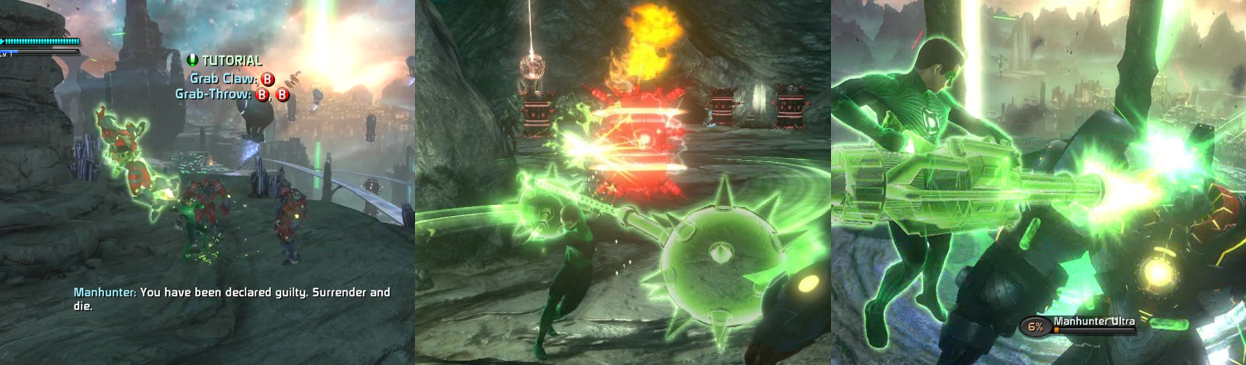
Movie Night [MK Day]: Mortal Kombat: Annihilation


This image has an empty alt attribute; its file name is mortalmonday.png

To celebrate the simultaneous worldwide release of Mortal Kombat (Midway, 1992) on home consoles, 13 September 1993 was dubbed “Mortal Monday”. Mortal Kombat’s move to home consoles impacted not only the ongoing “Console War” between SEGA and Nintendo but also videogames forever thanks to its controversial violence and I think that it’s only fitting that we continue celebrating this influential fighting series every September 13th.


Released: 21 September 1997
Director: John R. Leonetti
Distributor: New Line Cinema
Budget: $30 million
Stars: Robin Shou, Talisa Soto, Brian Thompson, James Remar, Sandra Hess, Lynn Red Williams, Musetta Vander, and Reiner Schöne

The Plot:
Despite Liu Kang’s (Shou) victory in the Mortal Kombat tournament, Outworld emperor Shao Kahn (Thompson) bends the Elder Gods’ sacred rules and assaults Earthrealm. With Lord Rayden (Remar) weakened, Liu Kang and his friends have seven days to recruit new allies and learn the key to stopping Kahn’s invasion before all of Earthrealm is annihilated.

The Background:
As I’ve touched on before, competitive fighting games were all the rage in the nineties thanks to the many iterations of Street Fighter II: The World Warrior (Capcom, 1991). To compete with this title, developers Ed Boon and John Tobias, inspired by movies like Enter the Dragon (Clouse, 1973), Bloodsport (Arnold, 1988), and Big Trouble in Little China (Carpenter, 1986), created a tournament fighter that changed the genre thanks to its ultra-violent content. It was producer Lawrence Kasanoff who saw Mortal Kombat’s potential as a multimedia franchise and it was thanks to him, and director Paul W. S. Anderson, that we got the cult hit Mortal Kombat (ibid, 1995), which was both surprisingly profitable, widely recognised as one of the best videogame adaptations, and a principal influence on my PhD thesis. Unfortunately, you can’t talk about Mortal Kombat without mentioning its universally derided sequel. Rather than smartly infuse the relatively simply videogame lore with filmic inspirations, Kasanoff aimed to go bigger and more spectacular, stuffing the script with as many characters and references to the source material as possible in an effort to cater exclusively to Mortal Kombat’s growing fanbase. Paul W. S. Anderson passed on the director’s chair and only two members of the original cast returned for the sequel, which was full of cringe-worthy performances and terribly rendered CGI as New Line Cinema didn’t actually release the finished version of the film. This was reflected in the film’s dismal $51.3 million box office gross and scathing critical reception; everything from the confused narrative, underwhelming fight scenes, and the laughably bad acting has been highlighted as a negative, and rightfully so. Despite the film’s universally negative reception, Kasanoff’s multimedia ventures continued with the live-action prequel, Mortal Kombat: Conquest (1998 and 1999) but, while New Line Cinema initially had plans for a third film, the teases for it were cut from Annihilation and it remained in Development Hell for decades until the franchise was finally rebooted in 2021.

The Review:
I was such a huge fan of the original Mortal Kombat movie as a kid, and even now I still regard it as probably the best live-action videogame adaptation ever made. That’s hard for me to say as I loathe what Anderson did to the Resident Evil franchise (Capcom/Various, 1996 to present) with his filmic endeavours (Anderson/Various, 2002 to 2016) but it’s true; I remember renting it as a kid, basing an entire birthday around watching it, and even the day I bought the VHS copy from a market stall. My anticipation for the sequel was so high and it seemed like we were waiting for so long for it to come out but, in reality, it was only a couple of years. When Mortal Kombat: Annihilation finally did come out, all I remember seeing of it was the poster and that was enough to get me excited as I was eager to see that cliff-hanger ending resolved, but I missed out on seeing it at the cinema as it wasn’t very easy to get to the cinema at the time, so I didn’t see it until it came out on VHS some time later. I don’t remember what I thought to the film as a kid; I was probably just super happy to see all my favourite Mortal Kombat characters brought to life and given more screen time, but I do have a vague memory of thinking it wasn’t as good as the original film and, as I’ve gotten older and rewatched and even academically studied the film, that opinion has only grown stronger.

Things are off to a bad start right from the opening and only get worse from there….

Mortal Kombat: Annihilation opens with a quick recap of the last film; scenes of Mortal Kombat’s best fights and memorable moments (purposely cut to excise the original actors from the footage) play over Rayden’s narration as he brings us up to speed and we’re brought back to the ending of the first movie, but with some noticeable and jarring changes. You’ll spot these immediately since James Remar sounds nothing like Christopher Lambert (still the quintessential Raiden for me and it baffles me that he hasn’t done more voice work for the character, at least) and definitely doesn’t look anything like him. Sporting an entirely new outfit and a far more obvious wig, Remar fails to convey the same enigmatic presence as his predecessor but it doesn’t end there; Liu Kang is also wearing a completely different outfit and both Johnny Cage (Chris Conrad) and Lieutenant Sonya Blade (Hess) have been completely recast. Even more egregious is that Cage has his trademark sunglasses back, despite the fact they were crushed by the monstrous Goro (Tom Woodruff, Jr./Kevin Michael Richardson) in a pretty memorable sequence in the last film. Still, none of that really compares to the absolutely atrocious visual effects slashing across the sky and the arrival of Outworld Emperor Shao Kahn. Originally portrayed as a gigantic semi-translucent, monstrous figure voiced by the immortal Frank Welker and bursting from the Temple of Light, Kahn is now a far less intimidating muscular brute garbed in a Halloween costume and surrounded by a gaggle of porn stars, Gladiators, and cos-players and immediately lacks all of the subtle menace and nuance of Cary-Hiroyuki Tagawa’s menacing Shang Tsung.

Liu Kang must go on a bizarre quest to rescue Kitana and find the power to defeat Shao Kahn.

Still, let’s continue on. Like the last film, our main character is Liu Kang (thankfully still portrayed by the endlessly likeable and charismatic Robin Shou, whose martial arts prowess is one of Annihilation’s few highlights even if his acting ability isn’t quite enough to carry this mess of a script), whose elation at having overcome his personal demons, avenged his brother, and safeguarded Earthrealm from Outworld is immediately cut short by Shao Kahn’s arrival. Although he learned to trust in Rayden in the last film, and that all the legends he grew up hearing about were true, despite his scepticism, Liu Kang is angered that their victory, which the Elder Gods decreed would keep Earthrealm safe from invasion for at least one generation, was all for nothing thanks to Shao Kahn finding a loophole in the rules. Liu Kang’s anger only increases when Cage is unceremoniously killed right before his eyes, and his first instinct is to avenge his fallen friend, only to be told that he’s “no match for Kahn” and must embark on a perilous journey of self-discovery to find the power necessary to overcome the Emperor. Rayden splits the heroes into teams for this mission, and Liu Kang’s demeanour (but not his crotch) is softened by the presence of the beautiful Kitana (Soto), with whom he had a flirtatious romance in the last film. Here, they are ready to take the next step in their relationship, but this is suddenly ripped away from Liu Kang when the Edenian princess is kidnapped by the returning Scorpion (J. J. Perry/Ed Boon). Fraught with guilt over failing to keep her safe, Liu Kang is guided towards the elusive Nightwolf (Litefoot), a Native American mystic who endeavours to teach him to harness his “Animality” by undergoing a series of tests designed to focus his mind, body, and spirit for his inevitable fight against Shao Kahn.

Sonya, angry at Cage’s death, reluctantly teams with Jax, the charismatic everyman with bionic arms!

Although she has a new face, wardrobe, and haircut, the first thing you’ll notice about Sonya here is that she’s reverted back to being an angry, embittered, distrustful, and overall unlikeable character. She’s absolutely devastated when Cage is murdered and desperate to make Shao Kahn pay, but blinded by her grief and rage so Rayden has her journey to some facility to reunite with her partner, Major Jackson “Jax” Briggs (Lynn red Williams). Initially, Sonya rejects this idea as she doesn’t want to lose anyone else she cares about, and she carries a chip on her shoulder throughout the film and basically has to learn the same lessons about trusting others as she did in the first movie. While Mortal Kombat: Annihilation is littered with chaotic and random fight scenes, at least Liu Kang and Rayden are focused on opposing Shao Kahn; Sonya has no chance against the Emperor but has no other clear antagonist to focus on since Kano (Trevor Goddard) is dead, meaning she’s forced to settle for “leftovers” like Cyrax (J. J. Perry) and Ermac (John Medlen). Thankfully, she’s partnered up with Jax; for a former American Football player and Gladiator, Williams does a really good job in this role and has a down-to-earth, relatable charisma to him. As an everyman character who has no idea what’s going on, he’s a natural conduit for exposition and it’s fun seeing him react to the bizarre events happening all around him. Jax’s “thing” in this movie is that he struggles with self-confidence; to that end, he underwent a surgical procedure to graft cybernetic prosthetics to his already muscular arms to give him a power boost. Jax’s arms are a valuable asset, saving his life and even allowing him to cause shockwaves by hitting the ground, but Rayden and the others teach him that they’re merely a tool and that his true power comes from within. Unlike Sonya, Jax ends up squaring off with a clear rival in the finale, the half-human centaur Motaro (Deron McBee) and, in the process, overcomes his insecurities and sheds his mechanical arms to deliver a pretty cathartic beatdown on Kahn’s monstrous minion.

The plot revolves around Kitana and Sindel, but the actors struggle to convey this drama.
While she was mostly relegated to an alluring figure and a secondary mentor in the first film, Kitana takes on a much larger role in the sequel. Although she only gets a couple of fight scenes and ends up locked in a cage for her man to come and rescue her, Kitana is right at the forefront of the plot since her mother, Queen Sindel (Vander), is the key to Shao Kahn’s illegal invasion. Stunned to find her mother alive (and in perfect physical health), Kitana is even more heartbroken to find that Sindel has been corrupted by Kahn’s influence and that her resurrection has allowed him to bring destruction to Earthrealm. Confused by this turn of events, Rayden consults with the Elder Gods who advise him that the love Kitana has for her mother can break Kahn’s spell, restore her, and undo the damage caused and he blindly follows their instructions, even sacrificing his status as a Thunder God (and debuting an absolutely dreadful new appearance in the process that is anything but Raiden) in order to reunite the two. Unfortunately, they’ve all been duped by the corrupt Elder God Shinnok (Schöne) and lured into a trap; Sindel laughs in her daughter’s face when she tries to profess her love for her and Rayden is left powerless, resulting in his death at Kahn’s hands and Kitana having to battle her mother in the finale. Unfortunately, neither Talisa Soto nor Musetta Vander have the acting ability to pull any of this off; both are obviously stunningly beautiful, but Kitana and Liu Kang have all the chemistry of a wet paper bag and Sindel is little more than a cackling pantomime villain. Remar also suffers in this regard; if he’s trying to channel Lambert’s stoic playfulness, he fails miserably and just seems bored and confused, even during his terribly shot fight against the Reptiles (Mark Caso, Paul Driver, and Sultan Uddin).
Though he cuts an intimidating figure, Shao Kahn is simply trying to please his overbearing father.

However, they’re all Oscar-winning actors compared to the absolutely dreadful Brian Thompson. I actually like Thompson; he always plays big, brutish thugs really well when he crops up in supporting roles but he has neither the size nor the charisma to impress as Annihilation’s lead antagonist. Essentially coming across as a poor man’s Kurgan (Clancy Brown; a fitting comparison, for sure), Shao Kahn is a loud, arrogant bully with an overdeveloped sense of grandeur and a taste of pomp and ceremony. Upon arriving on Earthrealm, he attempts to establish himself as a meaningful threat by surrounding himself with his generals and killing Cage, but is easily outmatched by Rayden. Indeed, Rayden is only stopped from killing Kahn right then and there because the Emperor takes Cage as a hostage, and Rayden is so stunned to see one of his chosen mortals killed that he doesn’t even make good on his promise to “take” Kahn’s generals from him. While the heroes go off on their confusing missions, Kahn returns to his throne room and is content to allow the seven-day merger of Outworld and Earthrealm to take place without his direct involvement. However, if his cheap plastic armour and rubbish skull helmet didn’t diminish Kahn’s threat enough, his contentious relationship with his father, Shinnok, certainly does. Chastised at every turn by the corrupt Elder God, Kahn quickly turns from a brutish tyrant to a meek child desperate to impress his father, and he absurdly takes his anger out on his generals at every opportunity. Even this doesn’t make sense; why kill your underlings when you’re in the middle of an invasion? And Kahn’s lashing out at Rain for failing to kill Kabal and Stryker is super weird considering Shinnok chewed him out for sparing Rayden. Imagine if Shinnok had just killed Kahn for that, as he does his general? Absolutely ridiculous! Completely devoted to his witch-like queen and confidant in his victory, Kahn allows his troops to wreak havoc across the globe (though we barely see any of this) and is fixated only on killing Rayden and conquering Earthrealm in order to earn his father’s respect. Where Shang Tsung was a scheming, charismatic sorcerer, Shao Kahn is little more than a thug with delusions of grandeur and it’s hard to picture anyone bending the knee to him since he exhibits little of the threat that Tsung did beyond his admittedly impressive physical stature.

The Nitty-Gritty:
Contrary to my usual everyday mindset, I don’t actually like to be too negative in my reviews, or when watching movies or playing videogames or whatever, and when discussing Mortal Kombat: Annihilation for my PhD thesis I tried to come at it with a positive perspective. Primarily, this involved praising it for capturing the madcap nonsense of the franchise’s latter-day releases, like Ultimate Mortal Kombat 3 (Midway Games, 1995) and its successor, Mortal Kombat Trilogy (ibid, 1996). These were fighters crammed full of characters, bonkers finishing moves, and which tried to mash together all the established lore and many of the contradictory characters, which made for a pretty chaotic gaming experience but one full of variety (even if many characters were just palette swaps and many of the violent finishing moves were pretty lazy). Still, if all you cared about was seeing your favourite Mortal Kombat characters in one game, these two titles had you covered and, in that respect, Mortal Kombat: Annihilation delivers in terms of fan service. The plot is also a pretty close approximation of Mortal Kombat 3’s (Midway, 1995), which depicted Kahn resurrecting Sindel and leading an illegal invasion of Earthrealm, and the iconic theme song by The Immortals is back and has even been tweaked to include the new characters seen in this film. Unfortunately, that’s about where the praise ends for, while Mortal Kombat: Annihilation does feature a bunch of characters, hardly any of them have any personality or nuance to them. Instead, basically every character that isn’t a lead protagonist or antagonist is treated as badly as Scorpion (Chris Casamassa) and Sub-Zero (François Petit) were in the first film. Rain (Tyrone Wiggins) is here, and even gets a few lines, but is he a conflicted Edenian prince with control of water and lightning? No, he’s just another ninja who gets smashed into a fiery pit for angering his master.

Almost every Mortal Kombat character is shoe-horned into the film whether it makes sense or not.

An extremely poor rendition of Baraka (Dennis Keiffer) randomly shows up, looking more like a guy in a rubbery Halloween costume than a vicious mutated cannibal, and Mileena (Dana Hee) even makes a brief appearance to wrestle around in the mud with Sonya but is she depicted as Kitana’s bloodthirsty clone or stepsister? Is she bollocks. Hell, Sonya even mistakes her for Kitana at first, which makes absolutely no sense as she doesn’t look anything like Kitana; maybe if she’d also been played by Talisa Soto, and Jade (Irina Pantaeva) and Baraka had been dropped from the script, Mileena could’ve played a bigger role but, as is, she’s just some hot chick in a magenta outfit for Sonya to fumble around with. This even carries over to the finale, when Sonya takes on Ermac (who has just one line and isn’t even named), who randomly splits into two (actually this is Noob Saibot (J. J. Perry), who also isn’t named and is given no context) to double-team her but why the hell should we care when we don’t even know who these masked morons are? Still, at least these losers feature onscreen; “two of Earth’s warriors, Kabal and Stryker” aren’t even given that luxury and this absolutely ugly looking CGI monstrosity gets way more screen time than it deserves. Sadly, this continues with some of my favourite Mortal Kombat characters. Sub-Zero (Keith Cooke) makes a dramatic return, now sporting his bad-ass eye scar and actually being the younger brother of the previous one. He comes sliding in to save Liu Kang from Smoke (Ridley Tsui), who’s actually a combination of Smoke and Sektor, and deliver some clunky exposition about how the cyborg was reprogrammed by Kahn to target Liu instead of him (as in Sub-Zero). Why was Smoke going after Sub-Zero? Does he have any relation to Cyrax? Was he Sub-Zero’s former friend turned into a cyborg against his will and did Sub-Zero even care that he just killed his friend? None of these questions are answered as the film pauses for a pretty awesome battle between Sub-Zero and Scorpion which, despite being something I and many Mortal Kombat fans missed from the first film, also makes little sense as there’s no reason given in the film for the animosity between the two beyond the filmic Scorpion being evil and Sub-Zero trying to protect Kitana. Even crazier is the part where, after losing Kitana to Scorpion, Sub-Zero delivers a heartfelt plea to Liu Kang that “[he] alone [is] not ready for what’s ahead” and then disappears from the film! I just…what?! You just said that Liu Kang needs allies but you couldn’t stick around to help? What could Sub-Zero possibly have to do that’s more important?!

Many of the characters are just there for the sake of it and make very little impact as a result.

This does lead Liu Kang to Nightwolf, but he’s another throwaway character; sure, he looks the part but all he does is speak in riddles, knock Liu Kang out with a tomahawk, and prattle on some trite about his “Animality”. It’s assumed that Jade killed Nightwolf while Liu Kang underwent his little nightmare sequence but who the hell knows, and why the fuck where there suddenly Reptiles waiting to attack the heroes after Jade betrayed them?! Nothing makes any sense, and it’s frustrating as all they had to do was have Kahn’s minions be Motaro, Sindel, Scorpion, Mileena, and Sheeva (Marjean Holden) and things could’ve been much more streamlined. Oh, Jesus…I haven’t even talked about Sheeva, have I? Rather than portray her using animatronics like with Goro, Sheeva is simply another pantomime villain with some prosthetic arms who plays next to no role in the movie and is unceremoniously killed off without even having a proper fight scene! There’s one very brief scene where she and Motaro get into it over who should replace Rain as Kahn’s right-hand man, hinting at the rivalry between their races, but Sheeva may as well not even be in the fuckin’ movie as she does absolutely nothing before being squashed by a cage! Motaro comes off a little better, but not by much; Deron McBee at least looks to be enjoying himself in the role, which requires little more than for him to stand around with his flex on and look tough, and the filmmakers actually did a decent job of rendering his horse-like lower half using clever shots, some practical effects, and CGI. He certainly comes off a lot better than whatever the fuck that demonic monster-thing is, and absolutely should have taken that creature’s place, but unfortunately has absolutely none of the screen presence or importance of Goro since he’s hardly in the movie and only seen as a relevant factor in the finale.

Liu Kang is ultimately able to best Shao Kahn and save Earthrealm once again.

So…okay….Mortal Kombat: Annihilation decides that the complex and bonkers lore of the videogame just isn’t enough for the big-screen and makes some changes. I can understand that; change is inevitable in the adaptation process, but apparently the simple concept of “good versus evil” wasn’t enough for this movie and they had to shoe-horn in this bat-shit crazy familial link between Rayden, Shao Kahn, and Shinnok that has never been seen before or since. Apparently, Rayden and Shao Kahn are brothers and, eons ago, they fought for Shinnok’s approval; Rayden won, but couldn’t kill his brother and both have held a grudge ever since. Shinnok sees both his sons as being weak; Rayden for valuing life and being compassionate and Kahn for not killing Rayden or being more forceful in his endeavours, but he favours Shao Kahn since he at least values strength and power over loyalty and empathy. This weird inclusion is treated like a big deal; Jax is especially perturbed by the revelation and the mortals are left investing their hopes in Liu Kang since Rayden’s trustworthiness is called into question. The film then asks that we give two shits when Shao Kahn murders this abomination of an adaptation of Rayden, but it all just falls completely flat and is meaningless since the entire film has been about getting Liu Kang ready to fight Kahn, not Rayden. When Liu Kang and the Emperor finally square off, it’s nowhere near the intense or engaging martial arts contest like Liu vs. Tsung; indeed, the focus on delivering high quality martial arts is noticeably lacking all throughout Mortal Kombat: Annihilation and, instead, Shao Kahn throws his weight (but not his hammer, because that would be too cool, I guess) around until Liu Kang finally taps into his Animality and transforms into, hands down, the worst CGI effect I think I have ever seen…only for Kahn to top it with his own monstrous transformation. The two butt-ugly affronts to eyesight slap each other about a bit before inexplicably transforming back and being forced to battle in Mortal Kombat (now altered to remove Kahn’s powers, something we didn’t see in the last film where powers were fair game…). The loss of his powers puts Kahn at an immediate and irreconcilable disadvantage and Liu Kang easily finishes him off; although Kahn is ripped apart when his stupid little dragon tattoo bursts to life upon his defeat, his death is a far cry from seeing Tsung impaled on those spikes. With Kahn defeated and Shinnok turned into Tetris (Alexey Pajitnov, 1984) blocks, Sindel returns to normal, Rayden is resurrected and promoted to an Elder God, and all of Earthrealm is restored. In fact, everything returns to normal…except for Johnny Cage, whose body I assume is just lying on the ground somewhere…but that’s okay because all of the heroes are some bullshit family now, I guess.

The Summary:
Mortal Kombat set the standard for videogame adaptations; by drawing from some of the best martial arts movies and focusing on the relationships between the characters and crafting a fun, action-packed fantasy adventure, it absolutely delivered as an entertaining adaptation even without the franchise’s trademark gore. All of that goodwill was obliterated in the sequel, which took everything that worked in the first film and threw it out the window. No, sorry, not out the window; they threw it right in the fuckin’ bin! The only saving graces are the soundtrack, a handful of decent fight scenes (anything involving Liu Kang, Scorpion, and Sub-Zero), and seeing pretty much every single Mortal Kombat character brought to life but the execution misses the mark on almost every level. The acting is bad, the script is bad, the line delivery is bad; the new actors are dreadful, the costumes (while technically better) look far more like cheap cos-play than a high-budget production, and the CGI is more than atrocious…it’s God-awful! As nonsensical as the Mortal Kombat videogames could get at the time (and even now…), nothing makes sense in Mortal Kombat: Annihilation; why were those spheres in those tunnels? Who built them? Why? Why didn’t they just die when riding them? When Baraka falls into those flames, why is it recycled footage of Rain’s death? Why is Baraka even there? Why didn’t Sub-Zero help Liu Kang? Why did Rayden and presumably all those other lives lost in the attempted merger come back to life but not Johnny Cage? Just….I mean, holy God it is hard to defend this movie! Yes, Robin Shou is great. Yes, seeing Scorpion and Sub-Zero fight is great. Yes, Jax is a standout character, Motaro looks pretty good, and the film does a decent job of translating the bat-shit insanity of Mortal Kombat Trilogy to the screen but there’s just no heart, no logic, no sense to anything. It’s just a mish-mash of generally poor fight scenes, rubbish visual effects, appalling acting and a mind fuck of ideas and visuals that more resembles a music video than a coherent movie. It’s got some charm, and is probably appealing to kids hyped up on sugar, but your life would probably benefit from never watching this one even if it was for free.

My Rating:

Rating: 1 out of 5.

Terrible

Am I being too harsh on Mortal Kombat: Annihilation? Do you have any fond memories of this film? What did you think to the new cast and how did they compare to their predecessors? Which of the film’s fights was your favourite, and with characters would you have liked to see more from? Do you think the film juggled its many characters well or would you have preferred to see the cast cut down a little bit? Would you have liked to see a direct follow-up to this film or were you happy with the reboot we got? How are you celebrating Mortal Kombat’s release today? Whatever you think about Mortal Kombat: Annihilation, write your thoughts below.

Back Issues [Sonic CDay]: Sonic the Hedgehog #25


Developed alongside the blockbuster Sonic the Hedgehog 2 (SEGA Technical Institute, 1992), Sonic the Hedgehog CD (Sonic Team, 1993) released on this day back in 1993. Expanding upon the Blue Blur’s debut title, Sonic CD introduced Metal Sonic (one of Sonic’s most popular and enduring rivals) and Amy Rose, and is considered by many to be one of the best of the classic Sonic titles.


Story Title: “Go Ahead…Mecha My Day!”
Published: August 1995
Writer: Mike Gallagher
Artist: Patrick Spaziante

The Background:
SEGA were quick to capitalise on Sonic’s popularity once he catapulted to mainstream success and helped them to usurp Nintendo’s position at the top of the videogame industry. Following Nintendo’s success with DiC, SEGA licensed a series of cartoons that were soon accompanied by a four-part miniseries published by Archie Comics. Archie’s Sonic the Hedgehog comics went on to become the longest-running videogame comic book ever and, amidst continuing the adventures of the Knothole Freedom Fighters, the Archie comics weaved in storylines, characters, and elements from the videogames, often changing them to fit their unique narrative. Although a mechanical version of Sonic had featured in Archie’s comics prior to this story (and many more would follow over the years), Sonic’s most recognisable robotic duplicate debuted in the comic’s twenty-fifth issue as part of a loose adaptation of Sonic CD and would go on to continuously plague the hedgehog and his allies even when IDW swept away Archie’s continuity in favour of their own.

The Review:
I didn’t grow up reading Archie’s Sonic the Hedgehog comics; as far as I know, there was no way for us to get hold of them here in the United Kingdom back in the day, so I’m not entirely sure I was even aware of them until late into my teens. I did watch Sonic the Hedgehog/SatAM (1993 to 1994) though and, like many kids from my generation I was, deeply invested in the series and frustrated when it ended on an unresolved cliff-hanger. Although the Archie comics never actually resolved this cliff-hanger and were more like a spin-off than a true continuation, they were the closest thing we’d ever get to an official follow-up to that successful cartoon and, in the years since, I’ve read through the entire Archie Comics run. It has its good points and many bad points, but I found myself enjoying it well enough, especially once they started to incorporate more elements from the source material and veer away from the comedic slapstick that muddled the narrative tone of the first fifty-or-so issues. I’ve already explored how awkward the incorporation of these videogame elements was to the series; the same was true of the UK’s Sonic the Comic (1993 to 2002) and is to be expected when you’ve gone off on your own pretty complex tangent and then have to shoe-horn in official canon into the narrative, but there’s an appeal to the series nonetheless thanks to nostalgia and my love for Sonic.

While Sonic tests Rotor’s new device, Dr. Robotnik plans to lure him into a deadly trap.

“Go Ahead…Mecha My Day!” (great pun, by the way) begins with Sonic impatiently enduring the hooking up of a video camera to his sneaker; developed by Knothole’s resident mechanic and tinkerer, Rotor the Walrus, the “Sonicam” sends a direct feed back to the Freedom Fighter’s computer so they can keep track of where Sonic is and any potential dangers they need to be aware of. Princess Sally Acorn, leader of the Knothole Freedom Fighters, is particularly pleased with this new technology given that a “new Zone portal” just opened up and is in need of exploration. Sally’s fears about this situation are well founded as it turns out that the Collision Chaos Zone is the creation of Mobius’s mad cybernetic dictator, Doctor Robotnik. However, while he looks like the SatAM Dr. Robotnik, at this point Archie’s version still has quite a bit of his bombastic and foolish variant from the Adventures of the Sonic the Hedgehog cartoon (1993); this means he breaks the fourth wall, chuckles maniacally to his bumbling Badniks, and lacks the grim menace of the SatAM version. However, there’s enough of that interpretation of the character in Dr. Robotnik to order his latest, most mysterious creation to kidnap Sonic’s number one fan, Amy Rose, and then issue a direct challenge to Sonic, daring him to test his speed and skill in his Collision Chaos Zone to rescue Amy. Naturally, Dr. Robotnik plans to stack the deck against Sonic by having his long-suffering, snivelling nephew and head minion, Snivley, struggle into an elaborate Robotnik costume and burn up the road behind Sonic to force him into an even deadlier trap.

Racing to save his friends, Sonic is confronted and challenged by his metallic doppelgänger.

Naturally, Sonic wants to leap into action right away; determined to prove himself and to rescue one of his greatest fans, he thinks nothing of jumping head-first into such an obvious trap, such is his confidence. However, Knothole is a democracy and, as a result, he’s forced to heed to Sally’s more level-headed orders; to get a better sense of what dangers lie ahead, Sally has Miles “Tails” Prower fly on ahead to scope out the area…and he’s immediately captured by Dr. Robotnik’s Swatbots. Fed up with waiting, Sonic races out to the Zone portal and, despite Dr. Robotnik struggling with his lines, is brought abreast of the escalating hostage situation; thanks to the Sonicam’s slow-motion function, Sally and Rotor are able to look in as Sonic races through the bizarre environment while Snively incinerates the path behind him, all to force Sonic into a confrontation with Mecha-Sonic (also referred to without the hyphen). Oddly, Mecha-Sonic’s dialogue seems to indicate that the two have met before, but this was the character’s first appearance; however, it wasn’t uncommon for the videogame’s events to happen off-panel and between stories throughout Archie’s run, even though that doesn’t really align with the narrative presented here, making this allusion confusing, at best. Anyway, Mecha-Sonic challenges his rival to prove his speed in a race through the Stardust Speedway Zone, with Tails and Amy as the prize and Snively pursuing them in Dr. Robotnik’s craft

Sonic’s speed is too much for Mecha-Sonic and Dr. Robotnik’s plot is easily foiled.

Of course, Sonic takes the bait and “engages” with Mecha-Sonic, much to Dr. Robotnik’s glee; while Amy wails at the engagement pun and Rotor scrambles to account for interference from the Stardust Speedway Zone, we’re treated to a nice two-page spread of the two rivals exchanging taunts and shoving past each other in a pretty neck-and-neck dash through the Zone, which is brought to life by the unrivalled Patrick “Spaz” Spaziante and is certainly faithful both to the level layout from the videogame and the anime sequences that accompanied it. However, Sonic has no idea that Dr. Robotnik has set up a failsafe at the finish line; a massive weighted door that will crush Sonic when he passes under it (which Dr. Robotnik demonstrates by crushing Crabmeat, though this doesn’t kill the woodland critter tapped within him since that wasn’t really a thing in this continuity). Although Sonic gains the lead, Mecha-Sonic uses holograms and environmental hazards to distract and trip him for an unfair advantage, meaning tensions are high as they race down the final stretch. Here, Sonic debuts his new “Figure Eight Super Peel-Out” for a burst of acceleration that pushes him into “warp speed” and Mecha-Sonic summarily melts itself in half by overexerting its thrusters. Sonic is even spared a gruesome end thanks to the timely intervention of Princess Sally but, when Dr. Robotnik throws a tantrum over the loss, volunteers to give the dictator a chance to squash him. When Sonic easily dodges out of the of the trap, he invites Dr. Robotnik to inspect the mechanism for faults and then encourages the reader (represented by a literal on-panel finger) to activate the trap and crush the cyborg madman beneath it. The comic the ends with Tails and Amy free, Dr. Robotnik squashed under his own trap, Mecha-Sonic left sparking on the racetrack, and the heroes celebrating the comic’s first twenty-five issues.

The Summary:
I went to great pains at the start of my review to try and prepare you for the fact that Archie’s Sonic comics weren’t exactly known for their 100% fidelity to the source material when they started adapting more elements from the videogames into their plot but, even considering that, “Go Ahead…Mecha My Day!” is even less of a Sonic CD adaptation than its Sonic the Comic counterpart. Both plucked only the most iconic elements of the videogame (Amy, Metal Sonic, and parts of the environments) and shoe-horned them into their unique narrative, choosing to focus more on the battle between Sonic and Metal Sonic than the time travel plot. While the Sonic the Comic adaptation benefitted slightly from being a multi-part story told over a few issues, both adaptations have about the same level of substance thanks to the first two parts of the story simply setting up for Sonic’s adventures on the Miracle Planet. This location doesn’t even appear here, however; instead, we get two of Sonic CD’s more recognisable areas (Collision Chaos and Stardust Speedway) but they’re presented as being “creations” of Dr. Robotnik, existing in another dimension, of sorts, rather than being on the Little Planet. The Time Stones are also completely absent, as are any elements of time travel or Dr. Robotnik’s plot to conquer the Little Planet, meaning the plot is all about the race between Sonic and “Mecha-Sonic” to rescue Amy (and Tails).

It’s a bit slapstick and barely has anything to do with Sonic CD but at least the art is nice.

Even when you get past the fact this this isn’t really an adaptation of Sonic CD, “Go Ahead…Mecha My Day!” is a bit weak overall; the story’s far too short, Dr. Robotnik lacks the menace of his SatAM counterpart, and there’s never really a sense of danger even when Mecha-Sonic makes its appearance. Like in the Sonic the Comic version, Mecha-Sonic can talk; here, it seems to have been programmed to ape Sonic’s snarky attitude as much as his speed as the two trade quips and grandeur during their confrontation. Though it demonstrates none of its videogame’s other powers, Mecha-Sonic is shown to be a wily antagonist and fully prepared to cheat to gain an advantage, but it’s ultimately handicapped by its mechanical construction and thus falls apart when it tries to match Sonic’s near-limitless speed. Still, the art used to render Mecha-Sonic and the race is impressive; Spaz was always Archie’s best artist when it came to Sonic and he does a great job on the title character, his robotic rival, and Dr. Robotnik. Given that it takes place in this quasi-SatAM continuity, the story also features appearances from the Knothole Freedom Fighters; Tails wasn’t yet the genius mechanic we know him today so Rotor fulfils that role and his Sonicam keeps them up to date with Sonic’s situation while Antoine D’Coolette is simply there to spout nonsense and oppose Sonic out of spite. Since she was always portrayed as Sonic’s equal in the field, it’s obviously Sally who drops in to lend a hand in the finale, emphasising the camaraderie that was so important to this interpretation of Sonic, though it’s made explicitly clear that he didn’t actually need any help. In the end, this was a decent enough story with lots of great art and fun, engaging action but it’s let down by its brevity, the awkward goofiness permeating throughout it, and the fact that it basically has nothing to do with Sonic CD beyond some extremely basic elements.

My Rating:

Rating: 3 out of 5.

Pretty Good

Have you ever read “Go Ahead…Mecha My Day!”, or any of Archie’s Sonic the Hedgehog comics? If so, what did you think of the story and the way its focus on the race between Sonic and Metal Sonic? Were you disappointed by the lack of any other elements from Sonic CD? Which of Archie’s original characters was your favourite and what did you think to their award-winning run? How are you celebrating Sonic CD’s anniversary this year? Whatever your thoughts on Sonic CD, or Sonic in general, feel free to leave a comment below.

Game Corner: Terminator 3: The Redemption (PlayStation 2)

Released: 9 September 2004
Developer: Paradigm Entertainment
Also Available For: GameCube and Xbox

The Background:
Perhaps unsurprisingly, the Terminator franchise (Various, 1984 to 2019) has a long history with videogame adaptations; every film in the franchise has been adapted to at least one videogame over the years and the series even crossed over with RoboCop (Verhoeven, 1987) back in the day. Since producers and movie studios bent over backwards to get a third film made (and since big-budget movies usually always had a videogame tie-in at the time), it’s perhaps also not much of a surprise that Terminator 3: Rise of the Machines (Mostow, 2003) was accompanied by not one, but three videogame adaptations courtesy of Atari. Paradigm Entertainment developed Terminator 3: The Redemption at the same time as Black Ops Entertainment was working on Terminator 3: Rise of the Machines (ibid, 2003) and used photographs of the film sets to help create their game world. Even after Terminator 3 failed to impress, Atari pushed forward with The Redemption and even gave Paradigm more time to work on the game, which the developers aimed to make as fast-paced and action-packed as they could to differentiate it from its counterparts. Judging from the reviews, this appears to have paid off as critics found the game an overall improvement over its predecessor; however, while reviews praised the game’s action-packed content and graphical appeal, its difficulty and linearity were criticised, and the general consensus was that the game was far more appealing as a rental rather than a purchase.

The Plot:
In the year 2032, humanity has been pushed to the brink of extinction in a war against the malevolent artificial intelligence known as Skynet. After John Connor, the leader of the human Resistance, is killed by a T-850, the Terminator is reprogrammed and sent back in time to protect John’s younger self from an all-new Terminator, the T-X/Terminatrix

Gameplay:
Unlike its predecessor, Terminator 3: The Redemption is a third-person action shooter with a focus on combat, both gun and melee, and chasing and driving sequences. Straight away, the contrast between the two games is thus evident; whereas Terminator 3: Rise of the Machines was a middle of the road first-person shooter that was top-heavy with its content, The Redemption has a far more balanced pace to its narrative and gameplay structure, though it still falls into the same traps of repeating gameplay loops over and over. Once again, you’re placed into the role of the reprogrammed T-850 from the film the game is based on and tasked with clearing a number of missions across four chapters, though this time you’re afforded unlimited ammunition by default and there’s no division between the shooting and melee sections. The game’s controls can be configured to your liking and this aspect is nicely weaved into the story; by default, the Terminator can take command of turrets and cannons or leap to other vehicles with Triangle (oddly labelled “acquire”), activate its trademark red-hued vision to identify allies and other targets for a limited time with Circle, grab enemies or put the brakes on its current vehicle with Square, and unleash a limited number of combos with X. Different combinations of X and Square will see you pull off various grabs, punches, and slams to the T-900s that cross your path. While I rarely found myself relying on the hand-to-hand combat, it’s a quick way to take out enemies compared to just blasting them and you’ll be using X to shoot, toss, and kick Terminators off your vehicle or into your line of fire when you’re at a turret. The Terminator can fire its current weapon with R1 and reload with R2 (though I found no practical use for this), L1 fires an alternate shot (usually allowing you to dual-wield or fire a charged plasma shot or missile), and, in an inexplicably confusing addition, L2 allows you to control the quips and one-liners the Terminator’s says by functioning as a dedicated “speak” button. Finally, the Select button switches between camera angles, pressing in the right stick allows you to switch targets, and you won’t need to worry about pressing a button to accelerate when in a vehicle as you simply use the left stick to move about.

Run around blasting Skynet’s forces or give chase on a variety of vehicles in this action-heavy title.

Terminator 3: The Redemption also includes a very rudimentary upgrade system; by destroying enemies and clearing missions, you’re awarded Terabytes (TB), and you’ll receive more TB for clearing missions quickly, something you can track with the game’s heads-up display (HUD). TB allows you to upgrade the Terminator’s recharge time (though I’m not sure what that means…) and the length, damage, and charge of its thermal vision, none of which I found to be particularly useful; TB also unlocks bonuses in the game’s ‘Extras’ menu. By pausing the game, you can review the Terminator’s combos, trade TB for other upgrades, and review your mission objectives, which are provided before the start of each chapter. Within the first few missions, though, you’ll have experienced everything The Redemption has to offer: typically, you’re tasked with following a linear path, gunning down the same mechanical enemies in waves either with your weapons, combos, or turrets. Then, you’ll either jump onto the back of a jeep or a Future Killer/FK Tank and chase down some kind of target, blasting at its engines and other enemies and “acquiring” replacement vehicles when your health is running low. Sometimes, these sections see the vehicle racing towards the screen and you blasting at pursuing enemies and switching lanes with the left stick but, generally, you’re bombing along through wrecked highways and streets. Next, you’ll be prompted to jump to a circling helicopter and blasting at targets with a mini gun or rocket launcher in a kind of auto/rail shooter section, and maybe you’ll be tasked with chasing down the T-X in a ridiculously outclassed vehicle with no indication of how far away it is except for an ever-decreasing reticule and a countdown showing you how close you are to imminent failure. These latter sections are by far the worst parts of the game; the T-X rockets away in a supped-up sports car, leaving you to dodge hazards and pursing police cars, taking shortcuts through dirt roads, fling over trains, and through power plants and scrapyards in a desperate bid to catch up only to be met with failure again and again because you snagged a part of the environment or couldn’t tell where you needed to go. Failure in a mission means restarted all over again from the beginning; there are no checkpoints here and the only way to replenish the Terminator’s health is to find “charge points”, which basically goes against my ingrained gaming experience that tells me to stay away from raging blasts of electrical current.

Some missions are needlessly frustrating and include an aggravating difficulty curve.

I opened this review by saying the game’s pace is improved over its predecessor and that is technically true; some missions are shorter or longer than others but it’s nowhere near as unbalanced as in the last game, but it’s still not great to experience. Often, your objectives are somewhat vague and it’s not clear that you are racing against a time limit or have a limited window of success; you’ll be racing along, taking ramps and desperately trying to stay on higher paths on your slippery FK Tank blasting at a Skynet carrier and then suddenly be met with a mission failure screen because it got “out of range”. Similarly, when John Connor and Kate Brewster drive a plane through aircraft hangers and runways trying to get to Crystal Peak, you need to fend off the T1 tanks and proto-FK drones (and, bizarrely, T-600s) attacking their craft and it can get very chaotic very quickly if you don’t keep an eye on the plane’s health bar. There are two missions where you’re racing around a cemetery in a hearse; one sees you driving around in a circuit shooting the T-X away when it attacks and trying to ram into a Special Weapons and Tactics (S.W.A.T.) van, which you do by taking alternate paths on the circuit. The other mission sees you driving along the freeway as the T-X drops onto the wrecked hearse; you need to shoot it with X and then use the brake, power slide (also Square), and environment to shake it off until the mission just ends. There’s also a couple of missions where you’re flying along on a hijacked FK Hover, frantically dodging pipes, pistons, and fans and shooting at bombs and other targets; you won’t know not to venture down the wrong path until you make a split-second decision to take a lower path only to be met with immediate failure as your temperature gets too high. Overall, the game is far more action-packed than its predecessor, with a lot more variety crammed into its gameplay, but it relies far too much on repeating the same gameplay loops and the difficulty of some missions is absolutely unforgiving; this may explain why The Redemption lacks the traditional difficulty settings as the game is already pretty tough to get through at times.

Graphics and Sound:  
Initially, I was again surprised by how good Terminator 3: The Redemption looks; since it retells the events prior to and during the film in its own way, it again relies on CG cutscenes to relay its story and, for the most part, these look pretty good. The game rarely uses the janky, marionette-like in-game graphics for cutscenes, which is good, and the CG scenes often recreate, recontextualise, or bleed into scenes from the movie, with The Redemption being much smarter about which movie clips it uses and when (it even includes the film’s actual ending this time), though again it does use these to skip over large parts of the story in different ways. For example we see a truncated version of the Terminator’s rescue of John and Kate at the vets, their visit to the cemetery, and Skynet’s rampage through Cyber Research Systems (CRS) but we don’t get to play these moments; instead, we’re dropped in after they’ve occurred, which is fine as the focus is generally on action-oriented gameplay but it again smacks of a rushed production as the game skips over plot points that were pivotal to the movie’s story. Additionally, The Redemption suffers a bit in the music and sound department; the iconic Terminator theme is largely absent, though the game makes a big show of including George Thorogood and the Destroyers’ “Bad to the Bone”, playing not just in the scene where the Terminator takes the stripper’s clothes but also over the end credits. While Arnold Schwarzenegger, Nick Stahl, and Kristanna Loken all provide what can generously be called their likenesses (the CG cutscenes do not do them justice at all), none of them return to voice their characters, with the Terminator’s Arnold soundalike sound particularly awful.

The game looks pretty good and does a better job of recreating, and deviating, from the film than its predecessor.

Otherwise, the in-game graphics are pretty good; once again, the highlights are the Future War sections, which are probably the best seen in the series at that point. You’ll battle and race through destroyed streets, airports, and buildings, passing the remains of the Hollywood sign, wrecked skyscrapers, and war-torn streets as dark (and, at one point, red) clouds loom ominously overheard lit up by lightning flashes. This is starkly contrasted by the mechanical precision of Skynet’s bases, such as the Time Displacement Chamber, which is now a heavily fortified complex full of tunnels, reactors, and sprawling corridors. Once the Terminator is sent back through time, you’ll spend a bit of time racing through the desert highways outside San Francisco, recreate the Terminator’s chase to and away from the T-X’s crane truck through the bustling city streets, battle through the airport to get John and Kate to safety, and again make your final stand at the Crystal Peak outpost. Similar to how the last game included a flashback to the Future War in the middle of the movie’s events, The Redemption briefly derails its story by having the T-X send the Terminator to an alternate future using a particle accelerator; in this even bleaker, more nightmarish timeline, John and Kate are dead and the Terminator must make its way back to the past by commandeering a gigantic FK Titan, rolling over T-900s and blasting towers and buildings with its cannons, before bringing down an equally huge aircraft carrier amidst the tumultuous skies. Sadly, as detailed and impressive as many of the game’s environments are, I did notice a fair amount of graphical pop-up and, of course, you have to deal with the PlayStation 2’s noticeable load times.

Enemies and Bosses:
As ever, you’ll be battling against the marauding forces of Skynet for the majority of The Redemption. T-900 endoskeletons, now redesigned into something a little more familiar to the classic Terminator design, litter the post-apocalyptic wasteland of the future; not only do they fire the iconic phase plasma rifles, but they can also crawl along the floor to grab at your feet after being separated from their torsos, though they’re noticeably much easier to destroy than in the last game. FK Hovers and FK Tanks also crop up, blasting at you incessantly, though you can commandeer the latter and make liberal use of turrets for the former, which is usually essential when Skynet’s forces attack in waves. When you travel to the past, you’ll have to contend with police cars and S.W.A.T. offers chasing and shooting at you, but these are brief distractions that only pop up in a couple of missions; as in the film, the Terminator is forbidden to kill these people but, unlike in the last game, it seems The Redemption is content to throw up a notification that you’ve not taken a human life rather than end your mission if you’ve been too trigger happy. CRS’s proto-Terminator machines also become an obstacle, with drones and those awesome T1 Tanks attacking you and your allies, and you’ll also need to fend off and destroy the vehicles that the T-X sends your way using its nanotechnology.

While the game shines in big, action-packed sequences, the T-X encounters are finnicky and unfulfilling.

As in the last game, however, boss battles are so few and far between in The Redemption that they may as well not even be a thing. Typically, you’ll need to chase after and destroy or disable a large target, be it a Skynet control module, an FK Bomber, or attacking the engines of a massive FK Carrier. Tougher machines more akin to the aerial Hunter Killers (HKs) also pop up here and there, requiring you to target their engines to bring them down, and larger mechs sporting plasma cannons and flamethrowers await on the FK Carrier but these are treated more like harder enemies rather than boss battles. There is a point where you need to take on an indestructible FK Guardian to return to the past, though you’re simply stomping around on your own Guardian and firing proximity beams at the machines to accomplish this. Your most persistent foe is, of course, the T-X, who you encounter multiple times but only face in a one-on-one situation in the finale. The first encounter sees you frantically taking every shortcut possible to try and intercept the T-X before it reaches John and Kate; then you’re fending off its nano-controlled vehicles to blow out the tyres on its crane truck, before desperately trying to blast it and the crane’s controls as it pursues you, which is an extremely finnicky mission. The T-X attacks Kate when she’s in a S.W.A.T. van and repeatedly jumps to your wrecked hearse during the cemetery missions but it’s easily fended off with a few shots and trips into a wall, before it attacks using a Harrier jet as John and Kate are escaping CRS. Here, it fires plasma blasts and a barrage of missiles but it’s not too taxing to shoot these out of the sky and blast away until it’s sent crashing out of the sky. Finally, the T-X endoskeleton and the battle-damaged T-850 square off at Crystal Peak; this time, though, the T-X is completely indestructible and your goal is to destroy the jeeps, helicopters, and tank guns it commands to attack John and Kate as they open blast doors. You can shoot the door panels to slow it down but, if it gets too close to them, it’ll fry them alive and any vehicles you don’t destroy will slow down their progress so you can’t make too many mistakes. Even if you succeed, you then need to blast at the guns it takes over to slow it down so you can slowly hobble over to it and finish it off in a cutscene, which can also be difficult as your only direction is “Acquire T-X”, which could literally mean anything.

Power-Ups and Bonuses:
Terminator 3: The Redemption is one of the strangest third-person games I’ve ever played. Your weapons have unlimited ammunition, so you never need to pick up ammo or ammo crates, and the only way you can heal is to find electrical charge points, so there are no fuel cells or health kits. Defeated enemies thus don’t drop anything and only award TB, but this also means that you can’t acquire or switch weapons as you play. Instead, the Terminator is given specific weapons for each mission, generally a phase plasma rifle in the Future War and a shotgun or machine gun in the past, though you also get to use a grenade launcher and chain gun. You can “acquire” vehicles and turrets, however, which sport more entertaining weaponry; TK Tanks haver laser cannons that also unleash an energy pulse, the more powerful (but also slipperier) TK Vipers have even more explosive armaments, and you can make liberal use of the gigantic cannons and turrets on the TK Carrier, TK Titan, and TK Bomber to absolutely demolish both enemies and the environment, which is where the game is at its most fun.

Additional Features:
As mentioned, playing through the story and acquiring TB will automatically unlock bonuses in the ‘Extras’ menu; these range from a few movie clips and pieces of concept art to a slow-mode, a useless instant death option and the absolutely game-breaking “deathstare” that destroys anything you target. You can also input some button codes while viewing the credits to unlock all of the game’s missions and chapters, grant yourself invincibility, and give yourself all upgrades; there’s no indication that these codes have worked, however, until you return to the main menu or load up a game and, while invincibility is helpful in the game’s tougher sections, it’s not going to help you if you’re too slow to chase down or destroy your targets. Strangely, The Redemption also includes a co-operative mode that changes the game into a two-player rail shooter, which is probably more fun than the standard gameplay to be honest. Otherwise, there’s nothing else on offer here; you can replay any mission from the main menu to earn extra points to unlock everything, but there are no other difficulty modes, there isn’t much to unlock, and the game can get so repetitive that it’s not really worth playing through again.

The Summary:
The difference between Terminator 3: The Redemption and Terminator 3: Rise of the Machines is like night and day; it’s clear that the game’s title has a double meaning, referring not just to the reprogrammed cyborg but also Atari’s attempts to make up for their last game and the developers definitely put a lot more effort into The Redemption’s gameplay and variety. I really appreciated the fast-paced, action-packed moments of The Redemption; the Terminator feels like an unstoppable force as it mows down Skynet’s mechanical minions and commandeers vehicles to lay waste to even more, and the game is at its best in big, action-oriented shooting sections. The addition of a melee system was nicely implemented in the rare cases when things get up close and personal, but could easily have been replaced by a one button counter system; similarly, I’m not sure what the purpose of the upgrade system was since it barely affected my gameplay experience. Sadly, it’s not perfect; the chase sequences were awful at times and the game really doesn’t make it clear what you’re supposed to do in a lot of its sections, resulting in unnecessary failure, made all the worse by the lack of checkpoints. In the end, it’s clearly the superior of the two PlayStation 2 Terminator 3 games but not by much; there’s still plenty here to turn you off and, again, there are far better third-person action/shooters out there. Ironically, I feel like a combination of both games could’ve resulted in something a bit more enjoyable; combined first-person sequences with third-person moments and the best parts of each game could’ve been the key but, instead, we’re left with two lacklustre tie-ins to an awful Terminator movie. If you put a gun to my head and made me pick which I prefer, it’d be this one, but I won’t be playing it ever again so that’s not much of a compliment.

My Rating:

Rating: 3 out of 5.

Pretty Good

Have you ever played Terminator 3: The Redemption? If so, did you prefer it compared to the previous adaptation? Which of the game’s missions was your favourite? Did you enjoy the fast-paced action of the game? Were you disappointed by the lack of weapons and bosses? Did you also struggle in the chase sequences? What did you think to the change in the story part-way through? Which parts of the game frustrated you the most? What’s your favourite Terminator videogame and how are you celebrating Judgement Day this year? Whatever your thoughts on Terminator 3, and the Terminator franchise, feel free to leave a reply down below or drop a comment on my social media.