

Released: 22 March 2002
Director: Guillermo del Toro
Distributor: New Line Cinema
Budget: $54 million
Stars: Wesley Snipes, Leonor Varela, Luke Goss, Ron Perlman, Norman Reedus, Kris Kristofferson, and Thomas Kretschmann
The Plot:
Half-human, half-vampire vampire hunter Blade (Snipes) is recruited by vampire overlord Eli Damaskinos (Kretschmann) to lead an elite vampire team against the genetically-engineered “Reapers”, led by Jared Nomak (Goss), who threaten the survival of both humans and vampires.
The Background:
Created by Marv Wolfman and Gene Colan, the extremely obscure, culturally problematic vampire hunter Eric Brooks/Blade debuted in the pages of The Tomb of Dracula and, as unlikely as it was, kick-started the modern superhero genre as we know it back in 1998. After years of development and rewrites, Blade (Norrington, 1998) was both a commercial and critical hit and virtually redefined star Wesley Snipes’ position in Hollywood. Plans for a sequel immediately made the rounds, with writer David S. Goyer initially wanting to feature Doctor Michael Morbius as a main villai. Though rights issues prevented that and director Stephen Norrington refused to return, the production scored noted auteur Guillermo del Toro. A noted comic book fan and desiring vampires to be scary once more, del Toro brought a visual language to the film that drew inspiration from various media sources and ensured the film’s visual effects would stand the test of time by incorporating traditional practical effects, bringing in Tippett Studio and XFX to achieve the best of both. Additionally, Snipes was excited to revisit the role, working hard to maintain his physique and given a lot of creative freedom regarding the character’s portrayal. Despite a worldwide box office return of $155 million, Blade II was met with mixed reviews that praised the gory action but questioned the mindless narrative. Of course, this wasn’t the end for Blade. It was followed by a widely–panned third film two years later, a short-lived TV show two years after that, and Snipes even surprisingly reprised the role in the Marvel Cinematic Universe ahead of a complete reboot.
The Review:
Blade II takes place some years after the first film (at least two, it seems) and opens with Blade giving a quick recap of his origins, powers, and mission statement while also clumsily retconning one of the most emotional moments of Blade. Attacked by Deacon Frost (Stephen Dorff) and left mortally wounded, Blade’s gruff mentor and surrogate father, Abraham Whistler (Kristofferson), demanded Blade leave him his gun so he could finish himself off and avoid turning into the thing they both hated, a blood-sucking vampire. However, it turns out that Whistler either didn’t kill himself or was found by another group of vampires or was potentially too late to stop the change or somehow revived and turned after killing himself as he was spirited away all over Europe. Kept alive in stasis and constantly moved around for reasons not explained here (or ever), the now vampiric Whistler eluded Blade during the time gap, but Blade II catches up with the stoic Dhampir finally locating his lost mentor. Once again, Blade can’t bring himself to finish Whistler off and instead chooses to take him back to his base, despite the inherent risk he poses to him and his new mechanic/armourer/lackey, Josh Fromeyer/Scud (Reedus). Yet, Blade isn’t blind to the possibility that Whistler is beyond salvation. He shoots Whistler up with a concentrated dose of his serum (the only thing keeping Blade’s “thirst” for blood at bay) and threatens to burn him to ash if he hasn’t gone “cold turkey” by the morning. Although Whistler appears to fully recover (except for his gammy leg), the question of his trustworthiness is raised multiple times throughout the film, with Scud and Blade’s newfound vampire allies both being aggressively suspicious of the grouchy old man’s true intentions. Yet, Whistler remains one of the few people Blade truly cares for. While I’m not a fan of undoing Whistler’s poignant death, he’s a great foil to the others, barks some amusing lines, and adds a great deal of emotional depth to Blade, a character largely known for hiding his humanity behind a grim-faced façade.
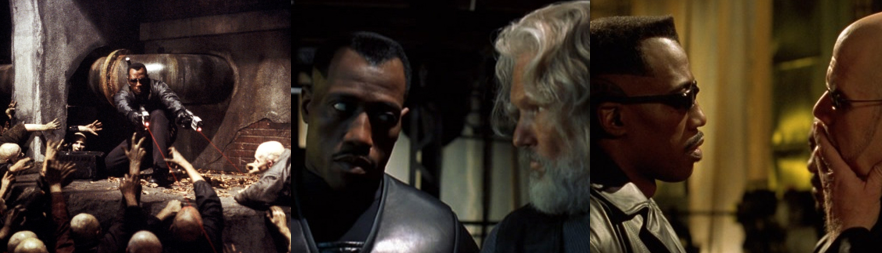
Still, Blade II gives the character (and Snipes) more screen time and more of a chance to showcase some emotional range. He says a lot with just a glance or some quick hand gestures but isn’t above mocking Scud’s reluctance to assist in the Reaper autopsy by calling him a “sissy” and seems to enjoy winding up the Bloodpack. In particular, Blade develops a quick rivalry with unashamed sadist Dieter Reinhardt (Perlman), humiliating the outspoken racist in front of his peers and engaging in a constant game of one-upmanship that naturally results in them coming to blows by the film’s end. A quiet, solitary individual, Blade lives only for his mission. He’s still at war with his base instincts, taking his aggression out on the creatures that created him, but embraces his animalistic side when near death to effortlessly dispatch Reinhardt’s goons. Blade’s physical prowess is at its peak here; Snipes excels in fight scenes, which showcase his dexterity and agility, and Blade easily manhandles and outfights multiple foes, even while unarmed. Gifted with all a vampire’s strengths but none of their weaknesses, Blade can afford to be cool and confident in battle, quickly healing from any wounds and taking the lead whenever their mission ventures into sunlight. When approached by Asad (Danny John-Jules) and Nyssa Damaskinos (Varela) and taken to Overlord Damaskinos with the promise of a truce, Blade goes along out of curiosity, his awesome trenchcoat packed full of explosives, and immediately recognises that getting into bed with the vampires to combat the Reapers will inevitable result in them being betrayed. However, he’s eager to delve deeper into the inner world of his enemy and learn more about them to fight them better, and constantly demonstrates that he can take out the Bloodpack, despite them training for two years specifically to fight him, thanks to his superior skills and fancy toys. Although Blade is initially incredulous about Nomak’s threat since the Reapers actively hunt vampires, he recognises their threat to humanity and the vampires must reluctantly defer to his orders since the best method of fighting the Reapers is to use ultraviolet light. While there’s no mention of what happened to Doctor Karen Jenson (N’Bushe Wright), Blade battles Nomak using a variation of the anticoagulant weapon she developed that finished off Frost, though he’s just as dependent on his serum as ever and it doesn’t appear to have been improved between movies.
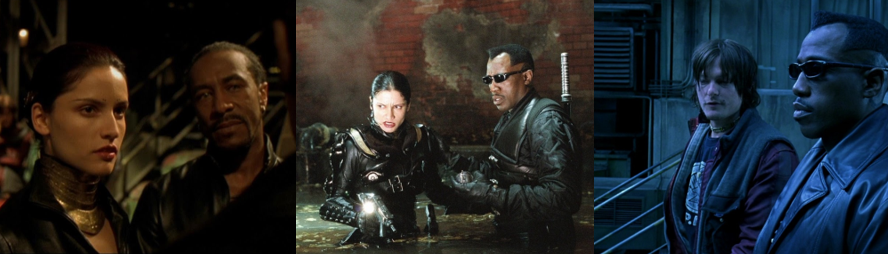
In her place, Blade has a new love interest: Nyssa. Nyssa delivers a unique insight into Blade, revealing that vampires think of him as a bogeyman, and she’s just as interested to see his world as he is to see hers. While most of the Bloodpack is antagonistic towards Blade and his allies, Nyssa respectfully defers to Blade’s orders while warning him not to interfere in vampire business since their mission is to target Reapers. As they encounter the voracious vampire variants, Blade constantly moves to either protect Nyssa or keep her from being burned up by sunlight. He could easily let her run into danger or be vaporised by Scud’s ultraviolet grenades, but time and again holds her back and orders her to seek cover. Indeed, he saves her life and showcases a honourable valour so often, even slitting his wrist to revitalise her after a Reaper attack, that Nyssa comes to greatly respect him as a warrior and equal. Just as Whistler worries Blade’s loyalties are becoming divided by Nyssa’s allure, so too are Nyssa’s loyalties to her family and her kind tested by the conflict she feels over the man painted as her hated enemy. These feelings are only exacerbated when it’s revealed that Damaskinos engineered the Reaper strain, even infecting his own son with it, and cares little for his children, firmly setting her against her father and her dishonourable species by the finale. Blade brushes off Whistler’s concerns, confident that he retains the upper hand, but Scud remains suspicious of Whistler, especially as the old man leaves his post and seems to have recovered unnaturally quickly. Scud, a pot-smoking rebel, appears to have no love for vampires and delights in pimping out Blade’s muscle car and cobbling together new tech for him, including a small bomb Blade implants on Reinhardt’s head and those ultraviolet grenades.
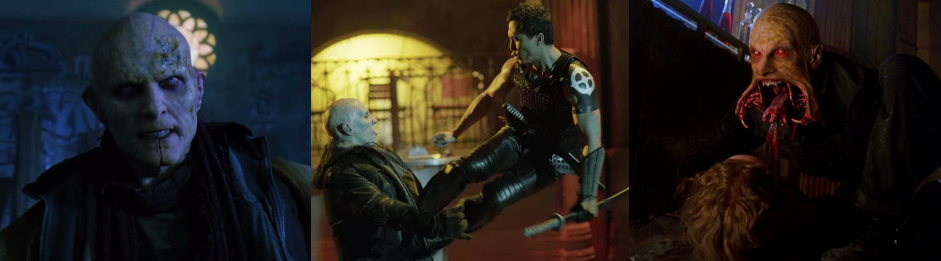
Although Asad and Nyssa seem excited (or, at least, intrigued) to be fighting alongside Blade, the same can’t be said for the rest of the Bloodpack. These colourful and largely one-dimensional, leather-clad vampires have spent the last two years training to hunt and kill Blade and, seeing him before them, struggle to not simply jump him. While mute swordsman Snowman (Donnie Yen) seems to at least respect Blade, Reinhardt doesn’t. He accosts Blade right away, comes close to shooting him in the vampire club, and is happy to leave him to fight legions of Reapers alone. Reinhardt’s hatred of Blade is matched by the pugnacious Chupa (Matt Schulze), who transitions his aggression towards Whistler when the old man’s brief desertion leads to the infection and slow, agonising death of his friend, Priest (Tony Curran). Although Priest immediately and painfully begins to mutate into a Reaper shortly after being bitten, the brutish Lighthammer (Daz Crawford) somehow resists turning for about a day. When he does, he blindsides Snowman with his massive battleaxe and ends up being incinerated by his lover, Verlain (Marit Velle Kile), who takes herself along with him. Though well-equipped, the Bloodpack are slow learners; despite seeing first-hand how ineffectual bullets (both regular and silver) and even blades are against the Reapers, they continue to waste ammo, presumably out of fear of roasting each other with their ultraviolet torches. The Reapers prove to be especially vicious and durable foes; essentially grotesque mutations of vampires, not unlike the goblin-esque Damaskinos, their hunger is likened to that of a crack addict, meaning they quickly spawn an aggressive army. Sporting superhuman strength, advanced healing, and a nigh-impenetrable skeletal structure, the Reapers leap at their prey and latch on with their horrifying split jaw, feeding and creating new minions for Nomak’s crusade against his father. Though they’re also destroyed by sunlight, the Reaper’s physiology is incredibly resilient and Nomak easily recovers from broken limbs and even a bullet to the head. Nomak demonstrates a reluctance to fight Blade, believing they have a common enemy and should be on the same side, but Blade vehemently rejects such a notion and chooses the devil he knows in opposing the new threat since, by and large, the Reapers are far more animalistic than the more sophisticated vampire nation.
The Nitty-Gritty:
Retaining the slick, gothic aesthetic of the first film, Blade II continues to marry leather fetish with a gritty, urban vibe, one bolstered by a surprising earworm of a soundtrack. I’m not really a hip-hop kinda guy but I can never get Massive Attack and Mos Def’s “I Against I” out of my head after watching Blade II. Having manipulated or forced their way into positions of political and social power, there are few resources the vampires don’t have, but only those under Damaskinos’ command enjoy these benefits. Indeed, the Bloodpack are disgusted by the ravers in the club since they’re not “Pure Bloods” and Priest would have happily killrf everyone there to weed out the Reapers. Indeed, one reason Blade’s so quick to join the Reaper hunt is to get a closer look at the high-level vampire hierarchy, quickly learning that fear of him has seen them be less open about marking their clubs and safe houses so as to avoid his attention. The juxtaposition between the elite and the lowers is best exhibited in Nomak’s grubby attire. He’s literally dressed like a vagrant, sporting haggard clothing throughout the film, in contrast to Damaskinos’ elaborate robes, the Bloodpack’s form-fitting leather, and Blade’s armoured attire. The Reapers also scurry about on all fours, often naked, appearing like goblins, shrieking and roaring and swarming their prey like wild animals. Though Nomak, as the carrier and progenitor of the virus, is the exception (essentially the reaper equivalent of a “Daywalker”), the Reapers lack the eloquence and sophistication of the vampire nation. For the most part, vampires keep their hunger in check unless angered or feeding, instead assuming a holier-than-thou allure and utilising their own language and writing. As such, even a brute like Lighthammer is disgusted by the Reapers, which are seen as base vermin, despite the creatures only existing because Damaskinos was trying to engineer Blade’s unique physiology to strengthen the vampire race even further.
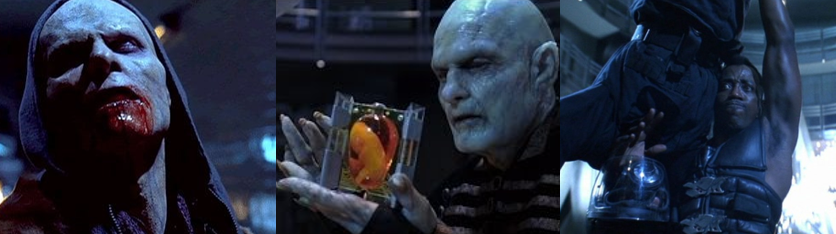
Naturally, Blade II is as impressively gory as the first movie, if not more so. The Reapers attack with a ravenous fury, causing arterial blood to splatter across walls and the creatures clutch and bite at their prey with an intensity that puts vampires to shame. The Reapers themselves are horrifically ghoulish creatures; hunched, spindly, and shrieking, they sport this awesomely gruesome split jaw and a probing tongue that rivals that of a Xenomorph. Even when dead, their bodies desperately try to feed; Preist’s severed head even appears to still be alive after he’s roasted, and the creatures think nothing of disembowelling themselves to escape. Vampires are largely ineffectual against Blade, despite their superior numbers and mostly being armed; thanks to his silver-tinted weapons and superior physical skill, Blade easily turns them to flaming ash with his signature sword, boomerang-like blades, and hefty rapid-fire pistol. Blade II ups the fight sequences from the previous film, showcasing Wesley Snipes’ impressive fighting prowess against multiple foes. Though there are a few questionable instances of CGI doubles (and shades!) involved here and there, the fights all have a raw brutality and are enjoyable to watch. The vampires are constantly overwhelmed by the Reapers and backed against the wall and the Reaper physiology means Nomak offers Blade a physical challenge not readily apparent by his dishevelled appearance. While most of the Bloodpack don’t get much character development, they do at least stand out with their signature weapons. Snowman, especially, makes an impression with his effortless swordsmanship, respectful demeanour, and focused intensity. Chuba hefts a massive machine gun and Lighthammer of course has his big-ass, caveman axe/hammer. While Reinhardt favours a simple shotgun, he takes a fascination with Blade’s sword. Avoiding its booby-trapped hilt, he relishes in brandishing the weapon before the captive Whistler and even claims it for himself when he believes Blade is dead, then tries to skewer him with it when he’s revived by the bloodpool and splits his ruthless rival in two with one simply swipe.
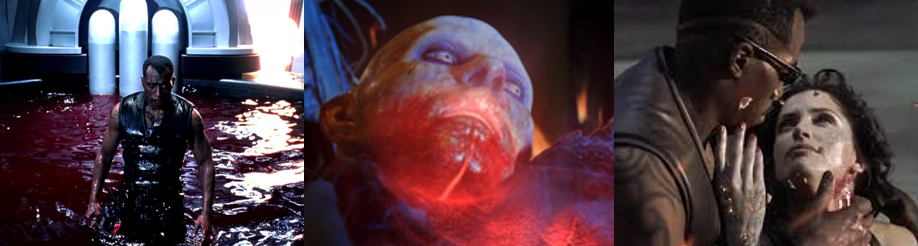
After wiping out most of the Reapers with Scud’s ultraviolet bomb and saving Nyssa’s life, Blade’s efforts are rewarded with an inevitable betrayal. Although Blade explosively reveals that he was well aware of Scud’s true allegiance to Damaskinos, the Daywalker is stunned by taser batons and taken to Damaskinos’ secret lair/laboratory. There, Blade once again endures having his life’s blood drained by the vampires to help them engineer a sunlight-resistant variant. However, Whistler escapes and frees the weakened Blade, getting him to a bloodpool to revive and empower him, leading to him easily making short work of Reinhardt. Thanks to the Reaper pheromones sampled by Nyssa, Nomak infiltrates the stronghold, intent on avenging himself on his father. Easily slaughtering Damaskinos’ guards, ripping open his blast doors, and penetrating his inner sanctum thanks to Nyssa turning on her father, Nomak confronts his father, seemingly looking for his approval. In desperation, Damaskinos tries to welcome his wayward son back and offer him a place at his side, only for Nomak to see through the deception and rip the ghoul’s throat out. He then attacks Nyssa before battling Blade once more, proving again to be the Daywalker’s physical equal. However, when Blade stabs Nomak through the heart, forcing his blade past his armoured ribs, the cursed deviant chooses to finish himself off, exploding in a burst of blue flame. Already feeling the Reaper strain threatening to destroy her personality, Nyssa requests that Blade allow her to die with dignity, as a vampire, by the rising sun. Out of respect and a genuine affection for her, Blade stoically agrees, embracing her as she turns to cinders. The film then ends with Blade making a special trip to London to track down Rush (Santiago Segura), a cowardly vampire who earlier led him to Whistler, ending the movie on an amusing note as he had previously promised to tie up that loose end.
The Summary:
Blade was a fantastic action/horror flick back in the day; simple, grounded, gory, and gritty, it was only letdown by some dodgy CGI in the finale. Blade II takes a much more action-orientated approach, increasing the threat against Blade, the fight scenes, and the cast of characters to great effect. I loved the twist of the vampires being so threatened by the Reapers that they were forced to turn to Blade for help, and the added swerve that it was all part of an elaborate deception to get their hands on the Daywalker and synthesise his blood. The Bloodpack, though largely underdeveloped, were surprisingly memorable through their aggression towards Blade, their signature weapons, and simply by being an elite vampire team forced to fight alongside their hated enemy. Wesley Snipes was peak Blade here, impressing in his trenchcoat, armour, grim façade, and slick fighting style. He exudes a cool, convincing authority while still being snarky and witty when necessary…or descending into full-blown animal fury. I loved the humanity Blade shows in his continued shame at relying on the serum, his respect and admiration for Nyssa, and his quest to retrieve Whistler and when reunited with him. Though, as I said, I don’t think it was necessary to bring Whistler back, Kris Kristofferson steals every scene he’s in as the cantankerous old man who’s had enough of this shit, but I wonder if the film might’ve been better swerved to have brought him back as or revealed him to be a vampire, just to add to Blade’s emotional journey. Nomak was a surprisingly effective bad guy; eloquent and expressing some relatable grievances, he and his Reaper kin represent a gruesome, monstrous threat that threatens even the all-powerful vampire nation. Honestly, Blade II is my favourite of the Snipes trilogy; it just as this cool allure to it that elevates it above the first film and stands it head-and-shoulders above the third, especially as it ups the obsession action films had with leather and sunglasses and infectious beats throughout the nineties. However, my personal bias isn’t enough to give it a full five stars. Tweaking a few things (the Whistler conundrum and the Bloodpack’s characterisation, as mentioned) would’ve changed that, but that doesn’t diminish my enjoyment of the film or the fact that I regularly choose to watch it over either of the others.
My Rating:
Great Stuff
Did you enjoy Blade II? Do you think it’s the best of the original three? What did you think to the Bloodpack and Blade’s rivalry with them? Were you annoyed that Whistler’s emotional death was undone? What did you think to the Reapers, and Nomak’s threat? Did you see Scud’s betrayal coming or did it take you by surprise? What Blade storylines do you enjoy? Whatever your thoughts on Blade II, feel free to share them below and go check out my other Blade content on the site.


3 thoughts on “Movie Night: Blade II”