Horror Prompts’ Gillian Church has created 28 single-word prompts and challenged writers to write a horror drabble for each. A drabble is a story of exactly 100 words, no more, no less (not counting the title).
Can you do it?
The Prompt: Balloon
The Submission: When Peter told me what that little shit Brody had done, my blood boiled. He’s a sweet, kind-hearted little boy who enjoys his drawing and doesn’t have a bad bone in his body so for that little shit to pick on him just because he’s a little small for his age…!
I knew Brody liked to play down by the old bridge. I wasn’t thinking; I just went there.
When Brody came along, picking his nose, a simple call and the allure of the balloon drew him closer.
He didn’t see the knife until it was stuck in his throat.
What did you think to the prompt for this week’s drabble challenge? Did you submit anything for it? Have you ever written any flash fiction before? I’d love to know what you think to my snippets and writing prompts, so feel free to sign up and let me know what you think below or leave a comment on my Instagram page. You can also follow Gillian Church to take part in her Weekly Writing Prompt challenge.
Back in February 1974, Spider-Man/Peter Parker faced a new enemy in the form of Frank Castle, the Punisher, a veteran of the Vietnam War turned bloodthirsty vigilante. The Punisher separated himself from other, traditional costumed heroes by his willingness to kill and uncompromising, suicidal one-man war on crime and what better way to celebrate the debut of this nuanced and complex character by dedicating every Tuesday of this month shining a spotlight on Marvel’s most notorious anti-hero?
Released: 21 November 2006 Originally Released: 16 April 2004 Director: Jonathan Hensleigh Distributor: Lions Gate Films Budget: $33 million Stars: Thomas Jane (also billed as “Tom Jane”), John Travolta, Will Patton, James Carpinello, Laura Harring, and Russell Andrews
The Plot: Frank Castle (Jane), an undercover agent for the Federal Bureau of Investigation (F.B.I.) and former Delta Force veteran, is left devastated and believed dead after crime boss Howard Saint (Travolta) orders the death of his entire family following Frank’s part in the death of his son, Bobby (Carpinello). Turning to alcohol and fuelled by rage, Frank embarks on a suicidal plan to destroy the Saint’s operation from within to punish them for their deeds.
The Background: While Marvel Comics has its fair share of bright-coloured do-gooders swinging or flying around and dispensing justice, they are also have their fair share of anti-heroes and one of their first, and most notorious, was the Punisher. As one of Marvel’s more “realistic” and low-key characters, it’s perhaps not surprising that the Punisher has seen his fair share of live-action adaptations over the years. While the first attempt at adapting the character was received rather poorly, by 2004 things had changed; superhero movies were now increasingly popular and profitable, with films like Spider-Man (Raimi, 2002) and X-Men (Singer, 2000) paving the way for the juggernaut that is the Marvel Cinematic Universe. Development of a new Punisher movie can be traced back to 2000, when Marvel made a long-term agreement with Artisan Entertainment to adapt fifteen of their characters into films and TV shows, and writer/director Jonathan Hensleigh came onboard with the specific intention to draw inspiration from seminal Punisher writers like Garth Ennis and Dan Abnett. Thomas Jane was producer Avi Arad’s first and only choice for the role and, though not a comic book fan, Jane soon threw himself into meticulous physical and mental preparation for the role. Unfortunately, Hensleigh was not afforded the same budget as other superhero films at the time, meaning he was forced to excise certain scenes from the film, which was an unfortunate financial and critical failure. This stalled plans for a direct sequel and Jane left the role after waiting three years for news of the follow-up, only for a completely unrelated reboot to be produced soon after! Still, I feel The Punisher’s negative reception is unwarranted; it was an instant favourite of mine upon first viewing and I went out of my way to purchase this “Extended Cut”, which added an animated prologue and an additional subplot, both of which add a great deal to what is, in my opinion, already a pretty poignant and bad-ass film.
The Review: After a short but incredibly effective title sequence set to Carlo Siliotto’s fantastic Punisher theme, “The Skull”, which is like a dirge of military horns, The Punisher immediately sets the stage for its events by opening not in New York City like in the comic books, but in the gorgeously alluring city of Tampa Bay, Florida. While I’m sure some purists lamented this choice at the time, I actually always really enjoyed it; it’s nice to see comic book movies mix the locations up a bit so that they’re not all set in the same damn high-rise cities and the film ends with Frank clearly heading off the New York to continue his work so it’s pretty clear to me that the intention was always to get to the big city in a follow-up movie.
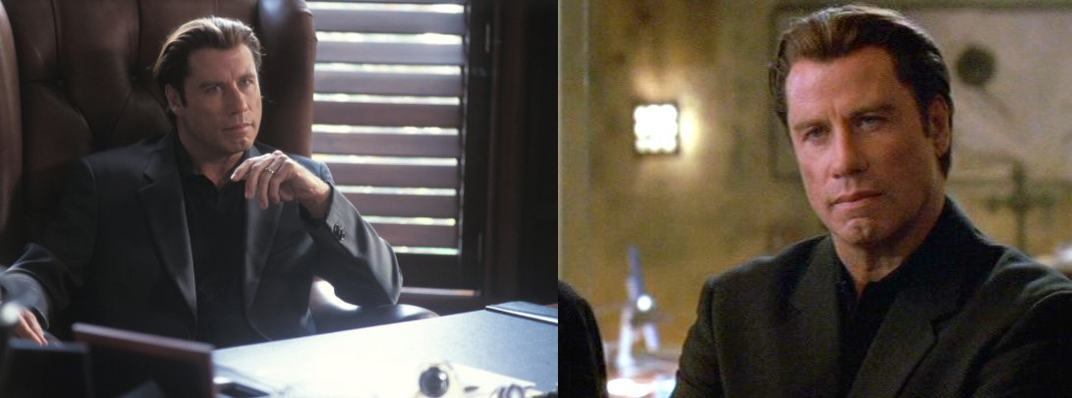
Ruthless mobster Howard Saint is driven to near madness by Castle’s vengeance.
As far as I am aware, Howard Saint has no basis in the source material but, for me, he’s an extremely effective antagonist in this interpretation of the Punisher. While I’m not a fan of John Travolta, he makes for a captivating and enigmatic villain; exuding confidence and authority, Howard clearly believes himself to be the most powerful man in the room and he lords his position as a money launderer and high-ranking mobster. Sharply dressed and living in luxury, it’s implied that he has worked his way up the ladder of success from nothing and he is clearly living his best life with expensive suits, jewellery, opulence, and accessories. In many way, even his wife, Livia (Harring), is another trophy to hang from his arm and he has kept himself in power by being both extremely reliable and extremely protective about his business, personal life, and family. Howard’s empire is vast and wealthy thanks to him funnelling Mike (Eduardo Yáñez and Joe Toro’s (Omar Avila) misbegotten funds through his legitimate business, such as his incredibly successful club, Saints & Sinners (whose unfortunately garish-looking sign looks like it was whipped up using WordArt). In an effort to impress his father with his business acumen and proactivity, Howard’s son, Bobby, agrees to finance an arms deal with the Saint’s lackey, Mickey Duka (Eddie Jemison), only for it to be part of an undercover bust in which Frank has been posing as Mickey’s contact. Frank’s assumed identity is killed in the ensuing conflict, thereby protecting him and his family from reprisals, but, unfortunately, Bobby is also killed by an errant shot, which greatly disappoints Frank as he was hoping for a bloodless end to the operation.
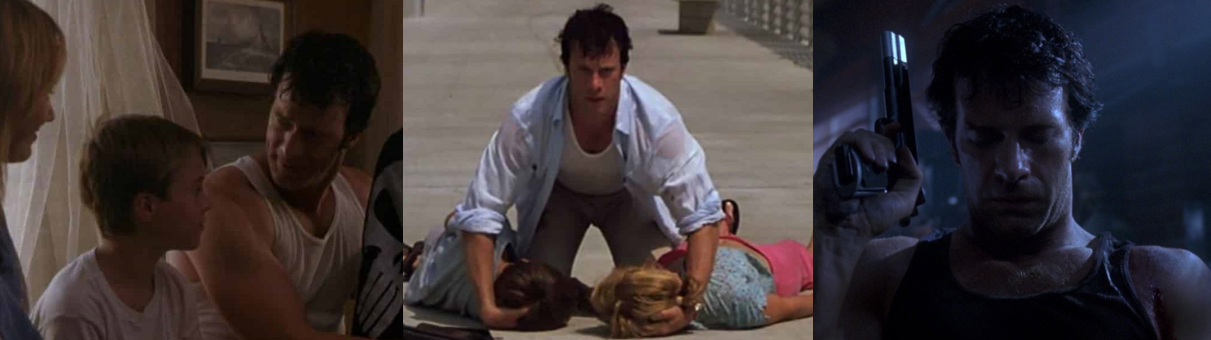
After his entire family is murdered, Frank becomes a hardened vigilante.
Frank, a former Marine, is heralded by his friends and colleagues as the “finest undercover op” in the F.B.I. However, as capable as he is and as legendary as his reputation is, Frank has grown weary of his time in conflict and around death and, with the conclusion of this particular bust, is planning on moving himself and his wife Maria (Samantha Mathis), and son Will (Marcus Johns) to London so he can take a much safer desk job and never have to worry about his identity or their safety being compromised. Unfortunately for Frank, Bobby’s death comes back to haunt him as both Howard and Livia are heartbroken to the point of fury; although Howard spares Mickey’s life, despite his part in Bobby’s death, he actively uses every resource at his disposal to learn Frank’s identity and, upon learning that Frank and his entire family are at a family reunion in Puerto Rico, Livia demands that the entire Castle line is executed as recompense. Accordingly, although Frank and his father, Frank Castle Sr. (the excellent Roy Scheider in one of his last roles) try to hold off Saint’s hitmen with their weapon proficiency, Frank is forced to watch every single member of his family be gunned down in cold blood. Maria and Will try to escape and are run down and killed, leaving Frank wounded and completely at the mercy of Bobby’s twin brother, John (also Carpinello), and Howard’s right-hand man, Quentin Glass (Patton), who beat him, shoot him, and leave him to die in an explosion.
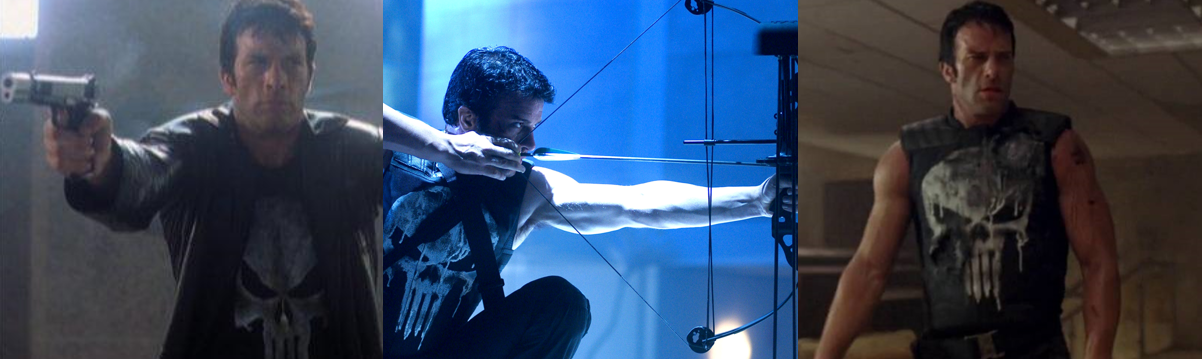
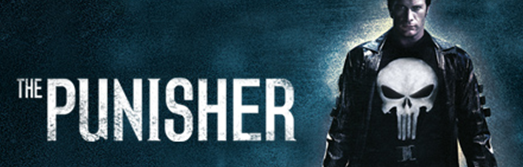
Thomas Jane is the Punisher and captures the character’s spirit amazingly.
While the Saints toast their victory, Frank somehow survives this onslaught; after being nursed back to health by a local medicine man, he returns to the scene of the massacre to acquire his father’s guns and a shirt baring a gruesome skull visage gifted to him by his son the day that he died and, with a grim glare and a stoic utterance (“God’s gonna sit this one out”), vows to have his revenge. He moves into a dilapidated apartment block and begins busying himself sprucing and armouring up an American muscle car, boobytrapping his apartment, cleaning and preparing his guns and drinking himself into a stupor with glass after glass of whiskey. Haunted by his family’s murder and suffering the weight of survivor’s guilt, something flips in Frank’s head and he enters into a cold-blooded, merciless vendetta not just to kill the Saints but to punish them. Although he doesn’t take the name “The Punisher” until the final moments of the film, Frank looks very much the part; unlike Dolph Lundgren, Thomas Jane spends the majority of the film decked out in his iconic skull-branded shirt and sporting a bad-ass leather trench coat and looks like Tim Bradstreet’s impressive artwork come to life. Add to that his physical stature and stern commitment to the role and you have probably one of the best, if not the best, portrayals of the character ever put to film and it still annoys me that Jane never got the chance to feature in a second feature-length Punisher film.
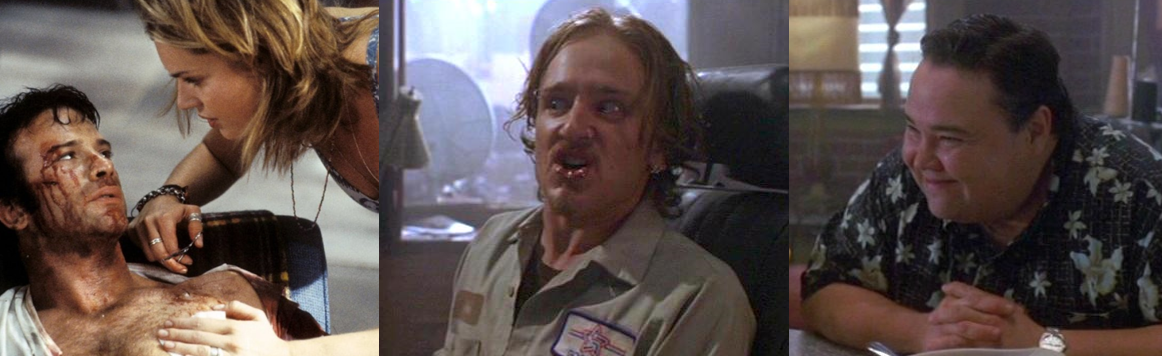
Frank attracts the attention of his misfit, but good-natured, neighbours.
While in the building, he attracts the interest and attention of his neighbours: Joan (Rebecca Romijn), Spacker Dave (Ben Foster), and Nathaniel Bumpo (John Pinette). While Dave and Bumpo basically act as the film’s comic relief (which they both perform admirably through great use of comedic timing, line delivery, and physical performance), Joan feels a great swell of pity and attraction towards Frank, especially after they learn about what happened to his family. Having suffered from a number of abusive relationships and alcohol problems, she is naturally attracted towards damaged people and has formed a kind of oddball surrogate family with Dave and Bumpo. Nevertheless, she attempts to reach what little remains of Frank’s humanity; seeing that he is on a self-destructive, potentially suicidal path, she stresses the importance of clinging on to good memories rather than letting the bad or dark ones tear him apart. While Frank is initially dismissive of his neighbours, he cannot in good conscience ignore their plight when they’re in danger and is mortified when Dave is tortured and mutilated by Quentin simply to hide Frank from Saint’s men. In that moment, Frank realises that there is life after tragedy and is touched by their loyalty to him, a veritable stranger, and thus gifts them with the Saint’s ill-begotten gains when he moves on at the end of the film out of his appreciation for their affection.
The Nitty-Gritty: Those who have seen the original theatrical cut of The Punisher will immediately notice the differences made to this extended version of the film as the opening is proceeded by an animated prologue that details Frank and Jimmy Weeks’ (Andrews) time as soldiers in Kuwait. While the original version of the film works without this and does allude to Frank’s time as a solider, it only adds to the emotional depth and complexity of the character to see some of the horrors he witnessed in combat. Specifically, we see how Frank openly defied his commanding officer, who wanted to execute some terrorist prisoners, and watched him die when one of the captives pulled a grenade for a suicide blast. This brief animated sequence also does a great job not only of showing that Frank was a veritable one-man army even back in those days but also of lending just a little more depth to Frank and Jimmy’s relationship as we see how Frank saved Jimmy’s life by single-handedly taking out a group of snipers and how Jimmy saved him, in turn, from an RPG attack.
Jimmy’s character is greatly expanded upon in this Extended Cut.
Also added to the film is a new sequence at the start where we see that John tries, unsuccessfully, to talk Bobby out of going along with Mickey’s arms deal, and a scene in the Toro’s casino where they detail some of their past and history with Howard and help him to get leverage on Jimmy by fixing the odds against him. Indeed, Jimmy benefits the most from the Extended Cut by virtue of a number of his excised scenes being restored to the film; this shows how Jimmy has a known and destructive gambling habit and makes it explicitly clear that Howard Saint was able to get the lead on Frank’s name and location by capitalising on Jimmy’s vices. Jimmy is understandably disturbed when Frank returns from the “dead” not just because his old friend turns out to be alive, as in the original cut, but also because he knows that he will eventually fall into Frank’s crosshairs. Indeed, while Frank is too preoccupied with his vendetta against the Saint’s to really socialise with Jimmy all that much, he immediately becomes suspicious of Jimmy’s involvement in his family’s murder when he notices that his friend has traded away his fancy new car and is missing the watch Frank gifted him after Kuwait. As a result, we get an extremely tense, volatile, and heart-wrenching confrontation between the two where Frank gives his old friend and comrade the chance to end his life by his own hand rather than be “punished”.
Castle enacts his revenge by manipulating Saint into killing his friend and wife.
For such a small, low budget film, The Punisher certainly packs a lot into its run time. I said when reviewed The Punisher (Goldblatt, 1989) that, compared to many colourful superheroes, the Punisher is probably one of the easiest to adapt as you simply give a decent actor a gun and a grim visage and do an eighties-style action film. This version of The Punisher, though, both escalates the stakes involved (killing Frank’s entire family rather than “just” his wife and kid/s) and really runs with the implications of Frank’s pseudonym: he’s not just clinically punishing the guilty by murdering them indiscriminately, he’s literally punishing the three people most directly responsible for his family’s murder by turning them against each other and destroying Howard’s operation from the inside out. He does this by coercing Mickey into divulging the Saint’s entire schedule (which is, admittedly conveniently, very predictable and routine), which allows him to make it seem as Livia and Quentin are having an affair and thus manipulates Howard into murdering his wife and his best friend.
Castle is an extremely adaptable and capable foe and expertly wields a range of firearms.
Of course, that’s not to say that The Punisher doesn’t have its fair share of fight fights and action/fighting scenes. The slaughter of the Castle’s is basically a prolonged execution full of big explosions, squibs, and guns going off all over the place that reminds me very much of a tamer version of the sort of gratuitous violence seen in RoboCop (Verhoeven, 1987). When Frank infiltrates Howard’s bank to disrupt his money laundering activities, the film takes on aspects of a traditional Western, with tense, prolonged shots of Frank and his adversaries getting ready to draw and shoot, and Frank’s final assault on Saints & Sinners sees him take on an entire room full of goons and mobsters with a variety of firearms while decked out in skull-stained body armour.
Hitmen Harry Heck and the Russian try, and fail, to stop Castle’s disruptive rampage.
Of course, there are two standout action sequences in The Punisher. Driven to frustration by Frank’s disruptive actions, Howard grows increasingly desperate to track down and stamp out the Punisher; to do this, he hires a couple of hitmen to do the job for him, both of whom unsuccessfully attempt put a stop to Frank’s vendetta. The first of these is Harry Heck (Mark Collie), a Memphis hitman who moonlights as a musician. After trying, fruitlessly, to intimidate Frank (who, by this point, as adopted a permanent “thousand-yard stare”) with a chilling song, Heck runs Frank off the road (sadly totally the proto-Battle Van before it really gets a chance to do anything, which may have been a budgetary thing) and taunts him while holding him at gunpoint only to wind up with a ballistic knife in his throat! Next, Howard brings in the Russian (Kevin Nash), a mute giant who is superhumanly strong and seemingly impervious to pain. This fight, which is almost an exact adaptation of a fight between the two from the 2001 “Welcome Back, Frank” (Ennis, et al) arc, is mostly played for laughs thanks to Bumpo’s opera playing over it and is much more comical compared to the otherwise gritty and grim tone of the film. Still, it’s incredibly enjoyable to see the Russian absolute decimate Frank and a great showcase of Frank’s tenacity, endurance, and adaptability as, although stabbed and brutalised from the assault, he continually finds new ways to try and hurt the behemoth before finally charging him on the stairs and breaking the giant’s neck.
After completing his mission, Frank heads out to hunt more criminals as the Punisher.
Still, a central aspect of the film is Frank’s emotional detachment and grim commitment to enacting his revenge. To pull off his complex plan, he feigns torturing Mickey and specifically targets Livia and Quintin; by following them and compiling a list of their habits, routines, and dirty little secrets, he’s easily able to predict where they’ll be and how best to turn Howard against them. Once he has manipulated Howard into giving in to his jealousy, rage, and the enraged monster dwelling just beneath his façade of respectability, Frank launches a direct assault against the remnants of Howard’s empire. Having lived his entire life by a strict code of honour and within the bounds of a lawfully just system, Frank sees his newfound vigilantism not as a simple matter of revenge but rather as a necessary action to ensure that those who do evil are punished for their misdeeds. As a result, he shows no mercy to John, whom he leaves helpless and holding an anti-personnel mine, and takes absolutely no pleasure in revealing what he has done to Howard. With Howard grovelling and bleeding at his feet, Frank nonchalantly ties him to a car and has him driven into a massive (and, sadly, poorly rendered) series of explosions to finally put an end to those who wronged him. With his mission complete, Frank prepares to end his own life but, at the last minute, stops when recalling a “good memory” of Maria. Although this scene is a bit confusing in the way it’s shot, the intention is made explicit with Frank’s closing narration: realising that there are more scumbags out there who need to be punished, he vows to wage war against them all as “The Punisher” until the day he dies.
The Summary: I’ve always been a fan of the Punisher. I love the concept of the Punisher as this merciless, unrelenting force fully committed to killing as many criminals as he can until he inevitably dies. It’s an incredibly simple, incredibly bleak, and incredibly realistic concept that Marvel Comics really need to put more effort into pushing as a stark contrast to other, more colourful and law-abiding superheroes. When I first watched The Punisher, I was immediately impressed by just how raw and emotional the film was; it wasn’t just another superhero film or even a bombastic action movie like its predecessor. It was a heart-breaking examination of a man who has literally lost everything, driven to the very brink of death, and come back with only one thought in mind: punishment. You could substitute the word “vengeance” or “punishment” there if you like but it doesn’t change the fact that The Punisher, to me, perfectly captures the uncompromising and gritty spirit of the source material and presents it in a fresh, new way by setting the film in Tampa rather than the traditional New York City. As I said, I’m not a Travolta fan but he really impressed me in this film; exuding power and total authority one moment and then descending into a maniacal rage the next, he gave a performance just shy of scenery chewing and was a perfect foil. The film is, honestly, full of great performances: Will Patton was fantastic as the subdued, sadistic Quentin Glass, Rebecca Romjin and Samantha Mathis did a great job as the film’s emotional anchors, even the guys playing the Toro brothers and guys like Mark Collie and Kevin Nash were clearly having a great time on set. Thomas Jane remains probably my favourite actor to portray the Punisher; not only does he look just like the comic book character, he has exactly the right level of physicality and acting ability to really own the role. It is, as I’ve said, a simple character in many ways but it does require a great deal of emotional range to properly portray the gamut of Frank’s turmoil and Jane did a spectacular job as this grim, haunted avenger who will stop at nothing to punish those responsible for his pain and The Punisher, especially this Extended Cut, remains probably my go-to recommendation for anyone looking to get an idea of what the character is all about.
My Rating:
⭐⭐⭐⭐⭐
Rating: 5 out of 5.
Fantastic
What did you think to the Extended Cut of The Punisher? Did you prefer to the theatrical version and how do you think it works as an adaptation of the character? What did you think to Thomas Jane’s performance in the film? Did you like the changes the film made to the source material or do you think it maybe changed a little too much? What did you think to the film’s action scenes and soundtrack? Did you enjoy the slapstick nature of the fight between the Punisher and the Russian or do you think it kind of went against the otherwise grim tone of the film? Which live-action portrayal of the Punisher is your favourite and why? How are you celebrating the Punisher’s debut this month? Whatever you think about The Punisher, feel free to write a comment below and be sure to check out for my review of the videogame tie-in to this film.
Horror Prompts’ Gillian Church has created 28 single-word prompts and challenged writers to write a horror drabble for each. A drabble is a story of exactly 100 words, no more, no less (not counting the title).
Can you do it?
The Prompt: Kiss
The Submission: The last thing I expect was Corey Trainor to show up outside my dorm room, but I wasn’t gonna complain!
He pushed past me, babbling something about having waited too long.
Like I cared! Corey was a dream! And here he was, in all his six-foot, shaggy-haired glory!
He grabbed me roughly and pulled me in for a kiss. I felt butterflies in my stomach; my lips were tingling!
Suddenly, Corey withered and decayed before my eyes; his skin turned to ash and he screamed a silent, agonised wail as he crumpled to dust.
“Too long! I waited too long!”
What did you think to the prompt for this week’s drabble challenge? Did you submit anything for it? Have you ever written any flash fiction before? I’d love to know what you think to my snippets and writing prompts, so feel free to sign up and let me know what you think below or leave a comment on my Instagram page. You can also follow Gillian Church to take part in her Weekly Writing Prompt challenge.
Horror Prompts’ Gillian Church has created 28 single-word prompts and challenged writers to write a horror drabble for each. A drabble is a story of exactly 100 words, no more, no less (not counting the title).
Can you do it?
The Prompt: Compressed
The Submission: I hated it down there. It was dark and dank and full of rats and creepy-crawlies, but the doctor made the rules.
“My specimens won’t take care of themselves,” he’d explained as he worked on his latest subject. “Now go dispose of that”.
The doctor kept the machine down there in the musty dark. It was rusted and stained with untold viscera.
I loaded the latest batch into the rancid contraption and pulled the lever. As the fleshy meat that had once been humans was squashed and compressed, I wondered when I would be fed to the machine so callously.
What did you think to the prompt for this week’s drabble challenge? Did you submit anything for it? Have you ever written any flash fiction before? I’d love to know what you think to my snippets and writing prompts, so feel free to sign up and let me know what you think below or leave a comment on my Instagram page. You can also follow Gillian Church to take part in her Weekly Writing Prompt challenge.
Released: 30 December 2000 Director: Kunihiko Yuyama and Masamitsu Hidaka Distributor: Warner Bros. Home Video Budget: Unknown Stars: Veronica Taylor, Dan Green, Rachael Lillis, Eric Stuart, Kerry Williams, Ikue Ōtani, Maddie Blaustein, and Ed Paul
The Plot: Having erased all traces of its origins and settled in a remote area of the Johto region, Mewtwo (Green) lives in peace with its fellow clones. However, when its creator, Giovanni (Paul), discovers its location, it’s up to Ash Ketchum (Taylor) and his friends to once again defend the troubled Psychic Pokémon and the mysterious healing properties of Mount Quena.
The Background: I’ve talked at length about the incredible influence Pokémon (Nintendo/Creatures/Game Freak, 1995 to present) had when it was first released and, indeed, the videogames were only a part of the brands appeal as kids became engrossed in every piece of Pokémon merchandise available, including the still-ongoing anime series (1997 to present). The brand reached a fever pitch with the release of the aptly-titled Pokémon: The First Movie: Mewtwo Strikes Back (Yuyama, 1998), which (perhaps unsurprisingly) proved to be a massive financial success despite the many changes made in the translation process. With Mewtwo being one of the franchise’s most popular characters, and considering Mewtwo Strikes Back’s success, it’s also perhaps unsurprising that Mewtwo received an hour-long special to tie up some loose ends from the first film. Released direct to video overseas, Mewtwo Returns was notable for including the “Uncut Story of Mewtwo’s Origin”, which was cut from the first film, and for attracting generally underwhelming reviews.
The Review: Mewtwo Returns begins with Mewtwo providing a recap of its origins and the events of Mewtwo Strikes Back, which establishes its character, the events of that film, and that it wiped the events of all characters present on its island at the film’s conclusion. Unfortunately, Mewtwo neglected to expand the reach of its mindwipe further afield and, as a result, Giovanni not only still remembers Mewtwo but has been actively hunting it ever since it escaped from him. Giovanni’s aide, 009/Domino (Williams), earns her master’s favour when she shows him satellite imagery of Mewtwo hiding out in a remote area of the Johto region. There, Mewtwo lives alongside the clones it produced in the first movie; although having learned a valuable lesson about the sanctity of all life, human and Pokémon alike, Mewtwo continues to question not just its place in the world but the place of its fellow Pokémon. Believing that they are outcasts, it firmly believes that they must live in secret if they are ever to live in peace and questions how it can judge concepts such as “beauty” given that it is a product of science.
After Pikachu is captured by Team Rocket, Ash and friends stumble upon Mewtwo’s sanctuary.
Coincidentally, as always, Ash, Brock (Stuart), Misty (Lillis), and Pikachu (Ōtani) just happen to be passing through that region of Johto on their way to Purity Canyon, a sight known for its refreshing and reinvigorating properties and tumultuous weather. Rushing to catch the last bus up the mountain pass (which allows for a funny gag where Brock uses his frying pain as a “drying pan”), the three catch the eye of their constant pursuers, Jesse (Lillis), James (Stuart), and Meowth (Green) of Team Rocket. After missing the bus and being kept from proceeding because of the weather, the three protagonists take shelter with Luna Carson (Amy Birnbaum), who blows their minds with how refreshing and delicious the water from Purity Canyon is (although, amusingly, Ash is unimpressed). In lieu of the bus (and since Misty is afraid of the Bug-type Pokémon the clear waters attract), the three plan to climb up Mt. Quena to proceed and, despite Luna’s reservations, they are only spurred to go through with the plan after being told of Clarity Lake and the specially-adapted Pokémon that live on the mountaintop. They’re unable to immediately proceed, however, thanks to the sudden arrival of naturalist Cullen Calix (Scottie Ray) and his assistant, Domino (the same Domino from Team Rocket who is in disguise); Luna is disheartened to hear that Cullen plans to investigate the lake’s regenerative properties, as this would potentially ruin the natural environment, but Team Rocket strike and kidnap Pikachu with an electricity-absorbing cable before any of this can come to pass. In their attempt to rescue Pikachu, the group are buffeted about by the violent storms and end up at Clarity Lake; Mewtwo is shocked to cross paths with them all again but, rather than being welcoming, demands that they all leave the area. Interestingly, although the clones appear to wish to rejoin the wider world, clone-Pikachu’s first instinct is to oppose Pikachu and force it out. While this would seem to align with Mewtwo’s overall wish for solitude, Mewtwo directly intercedes and prevents them from battling since they’ve already proven themselves to be equals, and everyone (especially Team Rocket) are confused by the presence of Mewtwo and its clones since they have no memory of the events of the first movie.
Mewtwo’s decision to submit to Giovanni to protect its clones almost costs it its life.
When Giovanni and his forces arrive, Mewtwo believes it’s better to simply flee Clarity Lake rather than engage in battle; clone-Pikachu rallies many of the clones in its absence (resulting in a ludicrous scene where Team Rocket, the protagonists, and all of their Pokémon are locked up in a cell) to go to war and Mewtwo struggles to reconcile its desire to protect them with the clones’ wish to be free. Thankfully, Giovanni’s arrival and subsequent attack against them galvanises not only Mewtwo’s resolve and its relationship with its clones but also forges an unlikely alliance between Team Rocket and the protagonists to fend off Giovanni and defend Clarity Lake. Although Mewtwo doesn’t wish to fight, clone-Pikachu and many of the other clones are only too eager to go to all-out war to defend their home, and their right to a peace existence. Clone-Pikachu, especially, believes that it is unfair for them to be forced to live like shadows when there’s a whole wide world out there and, since many of the other clones agree with this, a divide is created between them and Mewtwo since it simply wishes to be left and alone and they wish to be equals in the world. Mewtwo is adamant that they remain hidden so that they can live peacefully and, even in the face of Giovanni’s invasion, refuses to fight, a decision which very nearly costs it its life.
The Nitty-Gritty: It’s come up a few times but not only is Mewtwo my favourite Pokémon but Johto is my favourite Pokémon region so Mewtwo Returns automatically gets a bonus point or two from me before it even begins. Add to that the fact the film reuses the excellent musical score from the English dub of Mewtwo Strikes Back and I’m in my element. While the animation and presentation isn’t quite up to the same high-quality standards as the movie, for obvious reasons, Mewtwo Returns is still a cut above most regular episodes of the anime thanks to featuring music from the first movie and Mewtwo’s presence. Mewtwo’s demeanour is very similar to that from Mewtwo Strikes Back; although it is no longer actively seeking conflict, it steadfastly goes to extreme lengths to protect itself and its clones. The clones of Pikachu and Meowth question why Mewtwo went to the effort of saving a bus load of humans from a potential fatal crash off the cliff, believing that it felt compassion for the passengers, but Mewtwo reasonably asserts that it was simply trying to avoid more humans coming to the area and potentially disturbing their peace. Mewtwo feels as though it, and they, do not belong or deserve to belong anywhere in the world, despite clone-Meowth asserting that all creatures see the same moon and are thus equal.
Domino is a capable and pivotal member of Team Rocket and instrumental in Giovanni’s plan.
Unlike Jesse, James, and Meowth, Domino is portrayed as a capable and conniving member of Team Rocket; not only does she identify Mewtwo’s location, she successful fools all of the characters with her disguise as Cullen’s assistant and she commands the Team Rocket Combat Unit, a feat that Jesse, James, and Meowth are incredibly impressed by. Her reputation as the “Black Tulip” and authority make her a pivotal agent of Team Rocket; she’s embarrassed by the trio’s slapstick antics, is instrumental in Giovanni’s campaign against Mewtwo, and is absolutely reprehensible in her capture of the clones using her electricity-spitting tulips. It’s refreshing to see Giovanni playing such an integral role as the overall antagonist; a scheming, manipulative mastermind, Giovanni wields incredible power from behind the Team Rocket Combat Unit. He’s easily able to disable the clone Pokémon with red energy bolts, briefly capture them in special Team Rocket-branded PokéBalls, and is even able to force Mewtwo into submission by threatening the safety (and lives, in a surprising inclusion) of its clone Pokémon and the sanctity of Clarity Lake. Giovanni’s machinery threatens to bend Mewtwo to Giovanni’s will and almost kills it but, thanks to the intervention of a horde of Bug-type Pokémon (who show up to oppose the ridiculously fast construction of Giovanni’s base and his polluting of the lake) and the protagonists, and the restorative properties of Purity Lake, Mewtwo is saved from brainwashing and death and returns full force to enact its revenge.
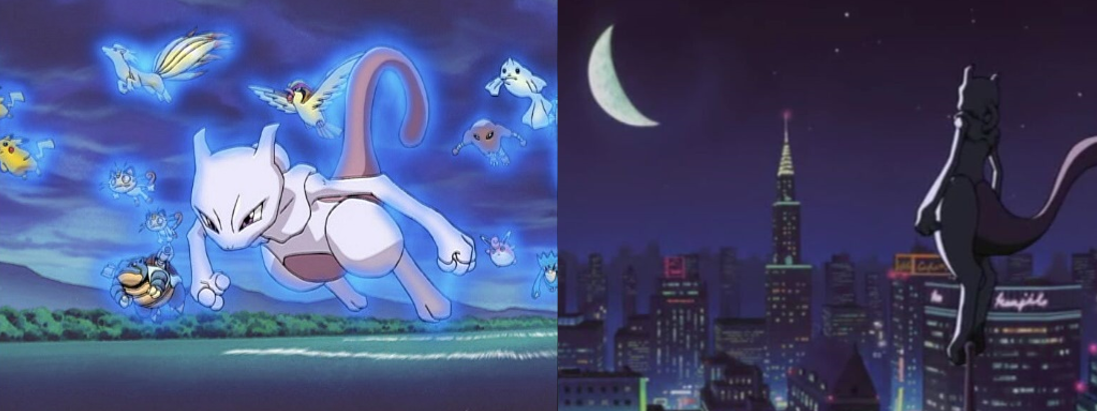
Revitalised by the water, Mewtwo defends his home and roams the world by moonlight.
In the end, Brock and Misty join forces with the clones and Bug-type Pokémon to cover Ash as he takes Mewtwo to safety; in the process, Mewtwo learns additional lessons about self-sacrifice and a being’s uniqueness. After recovering in the lake, Mewtwo sees a vision of Mew (Kōichi Yamadera) and finally realises that it is just as “real” as any other creature since the water’s properties have the same effect on it as they would any other creature. Using its incredible psychic powers, Mewtwo instantly puts an end to the conflict by transporting the entire lake underground and out of sight; it also erases the memories of Giovanni, Domino, and their forces but, at the insistence of the main characters, spares the others from the same treatment this time around so that they can remain friends and to ensure the legacy of its clone Pokémon. Having learned to embrace its identity and no longer ashamed of its past, Mewtwo allows its clones to go and find their rightful place in the world while it wanders alone (and wearing a bad-ass anime scarf) and always by moonlight.
The film also finally explores Mewtwo’s tragic origin.
Of course, it doesn’t end there as “The Uncut Story of Mewtwo’s Origin” is also included on the disc; this short prelude to Mewtwo Strikes Back follows Doctor Fuji (Jay Goede) and his team on an expedition to a dense jungle. Since the expedition is funded by Giovanni, Fuji has no choice but to create an all-powerful clone of Mew using a “fossil” recovered from some ancient ruins in order to learn the secret of restoring life. Fuji’s efforts result in the creation not only of a young Mewtwo (Stuart) but also clones of Bulbasaur (Tara Sands), Charmander (Michael Haigney), and Squirtle (Stuart). Communicating via telepathy as they sleep, Mewtwo, Bulbasaurtwo, Charmandertwo, and Squirtletwo meet Ambertwo (Williams), a young girl who was once Fuji’s daughter and who he is trying to resurrect through his cloning experiments. Obsessed with his desire to see Amber smile, and live, once again, Fuji is desperate to create a clone strong enough to survive the process so that he can recreate life; through Ambertwo, Mewtwo and the others experience a few of the basic beauties of life (the sun, wind, passage of time, and the moon) but, all too soon, the clones begin to degrade. Charmandertwo, Squirtletwo, and Bulbasaurtwo all disintegrate before their eyes; Mewtwo’s confusion turns to despair as the only friend it’s eve known turns to sparkling dust right in front of it as Ambertwo dies. Left alone and heartbroken, Mewtwo has only its tears (which Ambertwo says contain “life”). When its emotions threaten to destroy the lab, Fuji has no choice but to wipe its memories to subdue it and, in the empty void of its mind, Mewtwo is left with only its confusion and vague memories of feelings it doesn’t understand.
The Summary: Pokémon: Mewtwo Returns is a brisk and entertaining enough watch; clocking in at just over an hour, it’s obviously not going to measure up to the efforts of its feature-length cousins but it’s decent enough for fans of Mewtwo Strikes Back. By addressing the loose ends from the first movie, Mewtwo Returns allows us to see what happened to Mewtwo and its clones after they flew off to an uncertain future and, while it’s hardly full of action or a showcase of Mewtwo’s destructive potential, it’s a heart-warming enough tale about identity and our place in the world. The anime’s focus on having Mewtwo be this introspective character who questions its identity and right to exist is fascinating, in many ways, though it has to be said that maybe many of the character’s other aspects were downplayed in service of this goal. Sadly, the next time Mewtwo appeared it would be in a decidedly different form and we never followed up on its moonlight journey but, as a coda to Mewtwo Strikes Back, Mewtwo Returns is inoffensive enough. The fact that the DVD also contains Mewtwo’s heartbreakingly tragic origin story only adds to the film’s appeal and, were both of these to be included in re-releases of Mewtwo Strikes Back, you’d basically be left with the complete package for Mewtwo’s story in the anime. As it is, I guess it’s worth seeking out if you’re a die-hard Mewtwo and Pokémon fan but it’s not as accessible as other Pokémon media and probably not really worth going out of your way to get your hands on.
My Rating:
⭐⭐
Rating: 2 out of 5.
Could Be Better
What did you think of Pokémon: Mewtwo Returns? Did you enjoy seeing Mewtwo in action again or did you feel the feature was a missed opportunity to do more with the character? What did you think to Domino and Giovanni taking a more active role as a villain in the feature? How are you celebrating Mewtwo’s birthday this year? Whatever you think about Pokémon: Mewtwo Returns, Mewtwo, and Pokémon in general, leave your thoughts in the comments below.
Horror Prompts’ Gillian Church has created 28 single-word prompts and challenged writers to write a horror drabble for each. A drabble is a story of exactly 100 words, no more, no less (not counting the title).
Can you do it?
The Prompt: Honeymoon
The Submission: She wanted everything to be “perfect”, so I booked the bridal suite and every pamper session the hotel offered.
Of course, the first thing she did was criticise. The view wasn’t right, the bed sheets were slightly rumpled, there weren’t enough towels.
“Yes, dear,” I smiled and nodded. “Whatever you say, dear”.
I wasn’t mad. How could I be?
I drew her bath with enthusiasm and, when she stepped in, she didn’t even notice her camomile infusion was laced with sulphuric acid until I was holding her head under the bubbles.
Her choking screams were worth the burns I suffered.
What did you think to the prompt for this week’s drabble challenge? Did you submit anything for it? Have you ever written any flash fiction before? I’d love to know what you think to my snippets and writing prompts, so feel free to sign up and let me know what you think below or leave a comment on my Instagram page. You can also follow Gillian Church to take part in her Weekly Writing Prompt challenge.
Horror Prompts’ Gillian Church has created 28 single-word prompts and challenged writers to write a horror drabble for each. A drabble is a story of exactly 100 words, no more, no less (not counting the title).
Can you do it?
The Prompt: Luggage
The Submission: Last pickup of the day, an’ of course she wants t’go t’the friggin’ airport. I tell myself no worries, that I’ll get home an’ enjoy Marjorie’s patented meat-an’-‘tater pie with a hefty tip in my pocket.
The lady must be in a real hurry; she hopped right in the cab without so much as a “How-do-you do”.
I wuddn’t mind so much but the well-dressed cow’s got some hefty luggage for her trip, an’ o’course she don’t help lift it.
Luckily, she’s a quiet one, so the trip’s not wasted on gossip.
Huh… never noticed blood under me nails before.
What did you think to the prompt for this week’s drabble challenge? Did you submit anything for it? Have you ever written any flash fiction before? I’d love to know what you think to my snippets and writing prompts, so feel free to sign up and let me know what you think below or leave a comment on my Instagram page. You can also follow Gillian Church to take part in her Weekly Writing Prompt challenge.
Released: 18 February 2016 Developer: Arzest/Spike Chunsoft Also Available For: Arcade and Nintendo Wii U
The Background: Nintendo’s Super Mario and SEGA’s Sonic the Hedgehog went head to head as their respective company’s mascots during the “Console Wars” of the nineties, resulting in some of the greatest and most influential videogames of that generation, and both company’s went to great lengths to prove that their consoles were the superior. Ultimately, thanks to many expensive peripherals and an ever-changing marketplace, SEGA were forced to withdraw from the home console market and their supersonic mascot appeared on Nintendo consoles, leading to discussions of a long-awaited crossover began between Mario creator Shigeru Miyamoto and Sonic creator Yuji Naka. Surprisingly, the two were brought together in the spirit of friendly competition after SEGA was awarded the 2008 Beijing Olympic licence. Mario & Sonic at the Olympic Games (SEGA Sports R&D, 2007) followed as a result; though basically a series of mini games featuring Mario and Sonic characters taking part in Olympic events, the game was a commercial success and led to a series of annual titles being released in conjunction with a number of different Olympic events. This year, I finally got around to playing the 2016 edition of the game, which was set in Rio de Janeiro after they won the right to host the games that year so, since the Beijing Winter Olympic Games are set to kick off today, I figured this was an ideal time to leech off of that event and share my thoughts about this title.
The Plot: Players create a Mii character and choose to join either Sonic’s gym or Mario’s gym. Either choice sees them training with, and facing off against, familiar Mario and Sonic characters in a bid to win as many gold medals as possible over the seven days of the Olympic Games.
Gameplay: If you’ve played any of the Mario & Sonic videogames before, you’ll know exactly what to expect heading into Mario & Sonic at the Rio 2016 Olympic Games; essentially, despite the presence of a story mode, the game is a collection of Olympic-themed mini games that go out of their way to take advantage of every single button, gimmick, and control scheme offered by the Nintendo 3DS. The game features forty-one characters from the Mario and Sonic franchises but, this time around, not only are your character selections limited to certain events (Knuckles the Echidna can only take part in the Javelin Throw and Boxing events, for example, while Waluigi can only be used in the Long Jump and BMX events) and come with different stats to give them more emphasis on power, speed, stamina, and the like, but you don’t even get to play as any of your favourite characters in the game’s “Road to Rio” story mode!
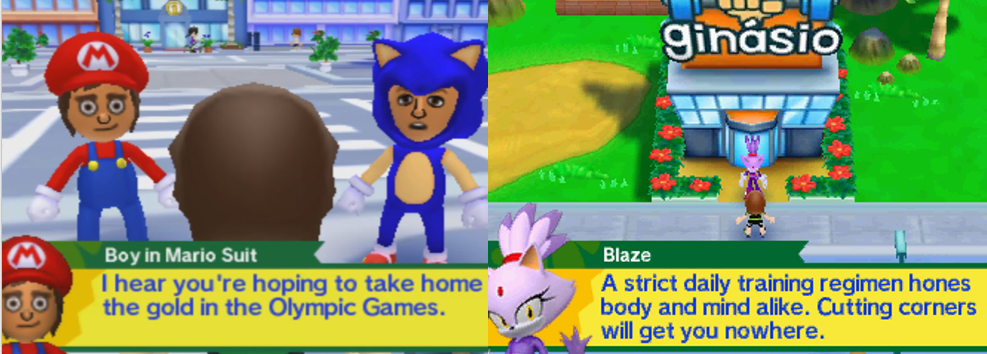
Pick between Mario’s Gym and Sonic’s Gym and train to level-up your Mii.
While you can select from the game’s many and varied events (each of which is accompanied by an easy, normal, and hard criteria to get bronze, silver, and gold medals, respectively, with different goals, scores, or times to hit for each) in the game’s single or multiplayer modes, the only way to unlock all of the game’s characters is to play through the story mode. Here, you take control of a Mii and play through seven days of the Olympic Games, visiting different towns in Rio and conversing with non-playable characters (NPCs) that include randomly generated Mii and Mario and Sonic characters. As is often the case, the story branches almost immediately as you’re asked to pick between Sonic’s Gym and Mario’s Gym; whichever you pick, you’ll be competing for gold medals against the opposing gym and can practise the game’s events to earn Training Points and level-up your Mii, which allows you to wear better costumes and increase your stats. The actual story itself is more basic than ever; Mario and Sonic’s Gyms are taking part in the Olympic Games in the spirit of friendly competition…and that’s about it. There are some subplots about Sonic and Mario being absent and Bowser being up to no good, but mainly it’s just a clunky narrative to let you experience the game’s events.
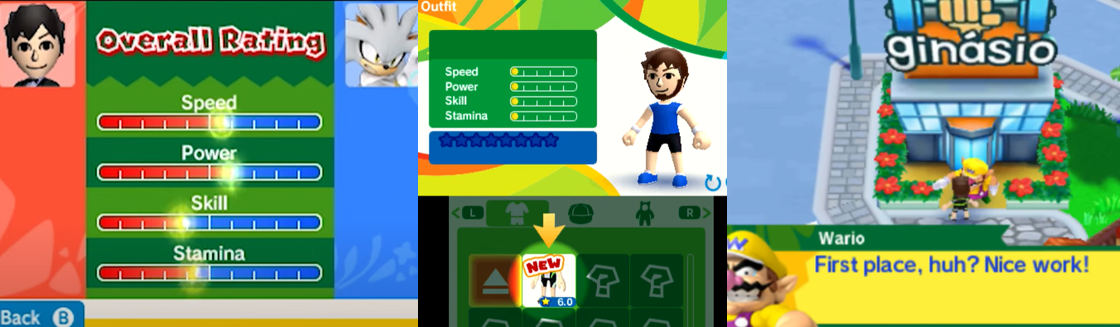
Levelling-up allows you to wear betteroutfits and improve your chances at getting gold medals.
Each location, and the bulk of the game’s action, takes place on the top screen of the 3DS; here, you navigate the largely empty and uninspiring overworld maps, interact with NPCs, and can see which day you’re playing, your current level, and how many apples and melons you have (which are needed to purchase new outfits and gear from the Yoshi NPCs located in each area). The bottom screen acts as a 2D map and allows you to manually save, view the stats of your current rival, view your stats and available gear, and change your Mii’s outfit whenever you like. Every day of the story mode is centred around you training to face a rival from the opposing gym; there are a number of smaller gyms (or “ginásios”) in each town (generally about four) where a character from your chosen side’s gym will challenge you to practise one of the game’s many events to earn apples and Training Points. As long as you finish between first and fourth, you’ll earn apples and Training Points, but the ginásio won’t be ticked off as complete unless you finish in first place (this is also the best way to earn the most rewards). You don’t actually have to beat the ginásios, however; you can tackle each day’s preliminary event and finals as is but you’ll dramatically increase your chances by beating ginásios and levelling-up so you can equip better gear to buff your stats.
You’ll need to make use of all the 3DS’s functions in order to complete each event.
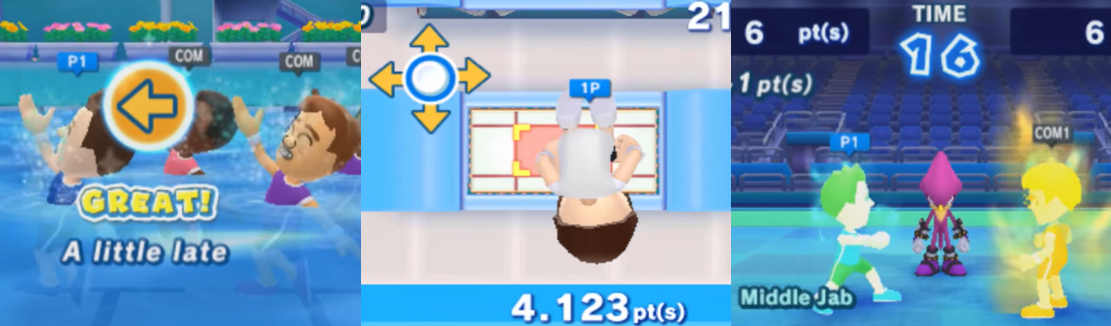
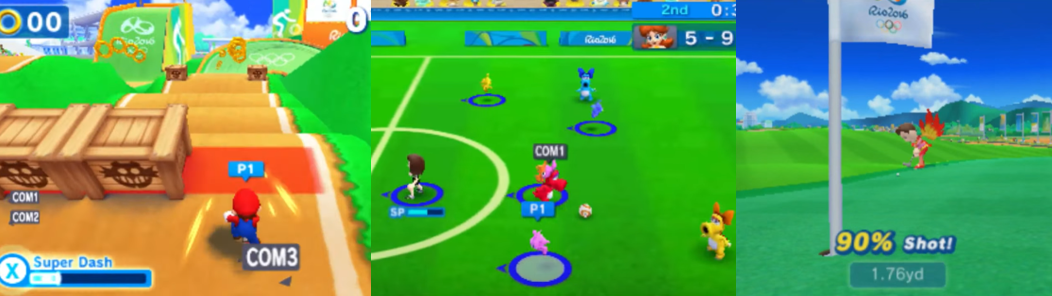
To clear each day, you first need to qualify in the prelims for that day’s event: on the first day in the Mario’s Gym story, for example, you’ll need to qualify in the 100m Hurdles event before you go up against your rival (and other Mii), Silver the Hedgehog, in the finals; on the fourth day of the Sonic’s Gym story, you’ll need to take on Bowser Jr. in the Equestrian event. The ginásio training sees you playing the game’s other events but, while you don’t necessarily need to come first in the ginásio events, you do need to finish first in the prelims and finals to progress the story. Once again, many of these events are needlessly frustrating; you’ll get a brief overview of what to do before an event but this often doesn’t really help prepare you as it’ll provide basic instructions and then the actual event will throw new inputs and requirements at you that aren’t mentioned in the overview. The game’s events mostly have you rapidly tapping buttons, pressing specific button combinations, shouting or blowing into the microphone (which continues to make me feel a little woozy…), moving the 3DS about like a moron, or using the stylus or circle pad. Some of these are quite simple (Synchronised Duet is a glorified rhythm game where you must press A in time to the beat and switch reticules with the directional pad (D-pad), while Trampoline has you jumping and pressing A when you hit the centre of the trampoline and aiming yourself with the circle pad) but others can be extremely aggravating (Hammer Throw sees you holding the L and R buttons, gyrating the 3DS, and releasing the buttons at the right moment, and you’ll need to awkwardly tilt the 3DS about to aim and use L or R to shoot in the Double Trap shooting event).
The onscreen prompts and clunky controls can make even the simplest events arduous.
While there are far less doubles games, these will still crop up; Platform Diving (Synchronized) sees you pressing A to dive at the same time as your partner without the aid of an onscreen countdown, Badminton (Doubles) has you sliding the stylus down the touch screen to smack the flashing shuttlecock, and Beach Volleyball sees you moving with the circle pad to the highlighted areas and pressing either A (or X for a super shot once your gauge is full) to hit the ball back and score a point. While the events seem to be a bit fairer compared to the last Mario & Sonic game I played, they’re still incredibly vague at times and come down to a question of timing or frantic button mashing rather than skill. The Kayak event, for example, requires you to set the 3DS down and frantically spin the circle pad like an absolute madman; you’ll need to stave off a fainting spell and consistently blow into the microphone while steering to boost pads in the Sailing – 470 (Pair) event, and you’ll need to draw neat circles to swim along in the Backstroke event (but, of course, the directions for this are on the top screen rather than the bottom where you’re drawing).
“Plus” events add new obstacles and success criteria and allow you to unlock new characters.
Overall, the games are once again very hit and miss: Handball isn’t too bad and has you touching the screen to block incoming shots; Rhythmic Gymnastics has you pressing or holding buttons in time with some familiar music tracks, and the BMX event has been slightly tweaked to make cycling and hitting boost jumps a little easier but it’s still a very clunky experience. New to this version of the game are “Plus” events; you can unlock additional characters by playing these in the story mode, and they’re basically slightly modified versions of the prelims/finals you’ll take on for that day. This could mean the presence of an additional gauge to fill to gain access to helpful items, extra obstacles from the Mario and Sonic franchises that you’ll have to watch out for, or slight changes to the gameplay mechanics to speed things up or make things a bit more manic. You can only challenge the secret characters to these Plus events by qualifying for the finals, but they add a little spice to things such as adding bingo-like tiles to Beach Volleyball for additional points or riding or ducking under waves caused by Thwomps in 100m Freestyle Swimming Plus. Unfortunately, though, while many of the camera angles and mechanics have been tweaked for the better compared to the last Mario & Sonic game I played, very few of the game’s events are actually fun to play and it kind of neuters the appeal of the crossover to not let you play as Mario and Sonic characters in Road to Rio.
Graphics and Sound: As a 3DS game, the graphics are decent enough for the most part; all of the Mario and Sonic characters look pretty good thanks to their cartoony aesthetic, but still only communicate using pantomime. This time around, the whole game is populated by Mii; even the crowd, when it is actually present, is mostly Mii this time but, once again, the game is very empty and not much to look at. The game’s locations are very sparse and all look the same, and the arenas are mostly lifeless. Similarly, the music isn’t much to shout about; there are some recognisable tunes here but mostly it’s just generic trumpets and fanfares. Cutscenes are even more basic than ever before, with still images being thrown at you for the opening scene, in-game graphics and text boxes used for dialogue and cinematics, and there are only a few very brief sound bites from the characters here and there, making for an overall very bland visual experience.
Enemies and Bosses: As is often the case with these games, your opponents are dictated by which character and event you wish to play; you won’t be able to pit Wario against Blaze the Cat in archery, for example, but you can pit Yoshi against Shadow the Hedgehog in football. You won’t really get to battle against Mario and Sonic characters in Road to Rio, though; mostly, you’re pitted against generic Mii and you’ll only ever get a sniff of facing someone recognisable when going up against an opponent from the opposite team or battling an unlockable character.
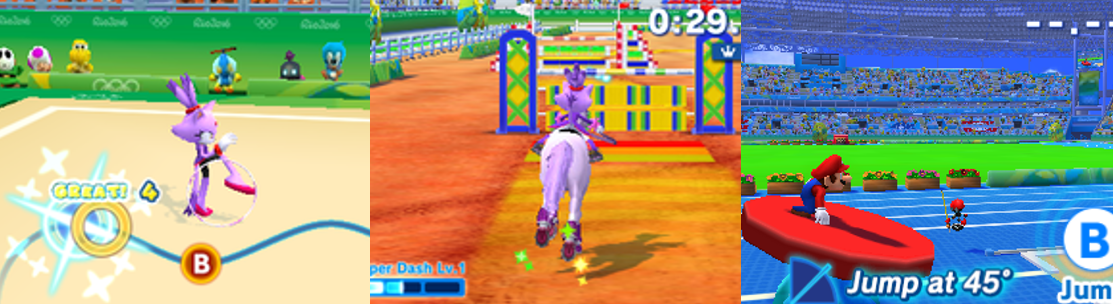
Familiar characters will challenge you in the prelims, finals, and Plus events.
One the first day, you’ll take on either Silver the Hedgehog in 100m Hurdles or Yoshi in the 100m event; Hurdles see you holding B to charge up, tapping A to run, and then timing presses of B to hop over the hurdles, while 100m features similar controls but has you pressing B near the end to shave a few seconds off your time. 100m Plus has you going up against Nabbit, grabbing items to reach the goal and pressing B for an additional burst, while 100m Hurdles Plus sees you challenging Diddy Kong in the event which is made trickier by the hurdles moving up and down. Day two is all about Table Tennis in the Mario story and Beach Volleyball in the Sonic path; Table Tennis has you moving with circle pad or D-Pad and smacking the ball back at the right time with ether A (for a fast shot), B (for a slower backspin), or X (for a super shot) to see who wins the best of three sets, while Beach Volleyball is a doubles event and it can be tricky angling your shots correctly. Table Tennis Plus pits you against Zazz and has you accumulating more points by hitting the ball onto coloured, numbered tiles, while Beach Volleyball Plus has you playing against Roy and trying to get a bingo score going on.
You’ll need to train up in order to help you best your rival, or hope that events aren’t too difficult to master.
Day three forces you to endure Archery against Birdo and Rhythmic Gymnastics against Blaze; while this latter isn’t too bad, Archery is a pain in the ass thanks to having to use the 3DS’ gyroscopic controls to aim and the wind throwing off your arrows. Archery Plus adds a whole mess of targets to hit to screw things up even more, while Rhythmic Gymnastics Plus sees you avoiding hazards to chain together combos for a higher score. On day four, you’ll have to take on Bowser Jr. in the Equestrian event (where you must press B to jump at the right time and stay on track to fill up your boost gauge) and Espio in the Long Jump (which sees you rapidly tap A to run up, press X for a super dash, and then press B at the right time leap ahead and judged on your furthest distance). You’ll then take on the oft-underused Doctor Eggman Nega in Long Jump Plus, which adds a giant spring to propel you further, and Larry in Equestrian Plus, where giant obstacles from the Mario and Sonic series are littered across the course.
Each story culminates in one of the more frustrating events, with Golf being particularly aggravating.
Day five is all about Javelin in Sonic’s story and BMX in Mario’s; Javelin is a bit of a frustrating event that sees you swiping the stylus across the touch screen like an idiot, then trying to match the angle on the top screen without crossing the foul line (which is stupidly easy to do). In BMX, you need to rapidly tap A to cycle while staying on track with the circle pad, and hit B to make jumps and build up your super boost. When you face Dry Bowser in Javelin Plus, you get to toss a whole bunch of Javelins but this is really more for show than anything else, while you’ll need to avoid obstacles ad perform tricks in BMX Plus to beat Wave the Swallow’s record. Things pick up in day six in Sonic’s story as you get to take part in Boxing; here, you press B and A to punch, guard with Y, and unleash a super punch with X and can use item boxes to help take down Zavok in Boxing Plus. In Mario’s story, you have to best the 100m Freestyle Swimming event by drawing circles at just the right speed and tapping the screen at just the right time to turn around, but the shit really hits the fan on day seven. Everything ramps up, with some of the most finnicky games and controls, and you’re forced to play football in Sonic’s story (which sees you awkwardly passing the ball, tackling opponents, and trying to get a shot in and just goes on forever) or golf in Mario’s story (easily the most complex event, with wind speeds, angles, environment hazards, and extremely unhelpful and unclear directions meaning I won more out of luck than anything else!)
Power-Ups and Bonuses: As a glorified collection of mini games, there’s not many power-ups on offer; some events have you rapidly tapping A to recover stamina, or touching dash panels for a boost, and many reward a perfect finish with a fancy special flourish but you’ll only really see in-game benefits when playing Plus events. You can however, find hidden chests all over the game’s many locations (some even hidden behind springs or pipes) that will reward you with additional gear or melons. Every time you finish between first or fourth (or use the daily log-in/step challenge), you’ll earn both Training Points and apples. Apples can be traded for a variety of outfits with one Yoshi, while more additional items can be bought from another with melons; these items include new golf clubs, horses, hula rings, and boxing gloves that afford you additional boosts and benefits in their respective events and you can equip and unequip them at any time. Your outfits are limited by your character’s current level; the higher your level, you more gear you can equip and the better your stats will be, and you can even save sets of clothing to tailor your Mii for different events (boosting your strength over speed, for example).
Additional Features: Mario & Sonic at the Rio 2016 Olympic Games offers many of the same incentives for repeated play as its predecessors; at the start of the game, you can set up your Mii, regional flag, the computer’s difficulty level, and Street Pass to get daily rewards as you walk around. Quick play allows you to take on the computer or up to three other plays in all of the game’s different events, if you fancy testing your skill against others, and you have two story paths to play through. However, while your level, items, and costumes will transfer across each story, you can’t replay previous parts of the story at will and will need to play through from the beginning if you missed any chests, costumes, instruments, or unlockable characters. There’s also an achievement list to compare against other plays, a random medley option to mix and match events, and a challenge mode to take on but, once you’ve played through even one of the Road to Rio stories you’ve basically seen everything the game has to offer.
The Summary: Mario & Sonic at the Rio 2016 Olympic Games improves on quite a few aspects of the last entry I played but still suffers from many of the same issues that have bogged down the series since day one. Essentially, it’s just a collection of Olympic-themed mini games involving some of gaming’s most iconic characters but with the weird twist that you really don’t get to play as any of these characters in the story mode. Road to Rio is so dumbed down and basic compared to the story modes in the other Mario & Sonic games I’ve played that it really makes playing even more of a chore. Couple that with the needlessly overcomplicated gameplay mechanics, vague tutorials, clunky camera and controls, and once again you’re left flailing around like an idiot as you desperately blow crafts along or try to match onscreen prompts. As a lifelong Sonic fan, I’m always happy to play one of his titles but these really aren’t games built for me…I actually struggle to think of anyone who would actually enjoy them, to be honest. There are far better party games and mini game collections out there, and definitely way better Mario and Sonic games, so it’s really more of an annoying novelty more than anything.
My Rating:
⭐⭐
Rating: 2 out of 5.
Could Be Better
Did you enjoy the 3DS version of Mario & Sonic at the Rio 2016 Olympic Games or did you prefer the Nintendo Wii version? How did you find the game’s motion controls, assortment of games, and story mode? Were you disappointed at the Mario and Sonic characters not being playable in Road to Rio? Do you agree that the concept is somewhat wasted on the Olympic Games or have you enjoyed the series so far? Which country are you pulling for in this year’s Olympic Games? Whatever your thoughts, feel free to sign up to leave a comment below, or leave a comment on my social media.
Horror Prompts’ Gillian Church has created 28 single-word prompts and challenged writers to write a horror drabble for each. A drabble is a story of exactly 100 words, no more, no less (not counting the title).
Can you do it?
The Prompt: Noise
The Submission: It’s the same fuckin’ thing every single fuckin’ day!
It doesn’t matter how many times I bang on the wall, or glare at them when they walk past, or even when I call the cops; every fuckin’ day the noise is constant!
Screaming, shouting, blaring all around me.
I can’t sleep. It’s like the walls are pounding from all the racket!
Can’t eat. I hear it even when I’m outside the house now!
I tried to drown it out, to convince others of it, but they wouldn’t listen.
How many more have to suffer? Why won’t the noise just stop?
What did you think to the prompt for this week’s drabble challenge? Did you submit anything for it? Have you ever written any flash fiction before? I’d love to know what you think to my snippets and writing prompts, so feel free to sign up and let me know what you think below or leave a comment on my Instagram page. You can also follow Gillian Church to take part in her Weekly Writing Prompt challenge.
Horror Prompts’ Gillian Church has created 28 single-word prompts and challenged writers to write a horror drabble for each. A drabble is a story of exactly 100 words, no more, no less (not counting the title).
Can you do it?
The Prompt: Candy
The Submission: I must’ve stood across the street from her house three, maybe four times a week. It was on my way home, and I always liked to stop by to see if I could catch a glimpse of her in her bedroom. Sometimes, she’d be drying her hair wearing only a towel, or lip synching to pop songs, or sitting on her bed and reading. She didn’t know I was there, of course; she never noticed me, even when I was right outside her house. Her name was Candy, and she definitely turned out to be as sweet as she looked.
What did you think to the prompt for this week’s drabble challenge? Did you submit anything for it? Have you ever written any flash fiction before? I’d love to know what you think to my snippets and writing prompts, so feel free to sign up and let me know what you think below or leave a comment on my Instagram page. You can also follow Gillian Church to take part in her Weekly Writing Prompt challenge.
















 Dr. K's Waiting Room
You must be logged in to post a comment.