Game Corner [Bat-Month]: Batman: Arkham Asylum (Xbox 360)


In the decades since his first dramatic appearance in the pages of Detective Comics, Bruce Wayne/Batman has become a mainstream, worldwide, pop culture icon. The brainchild of writer Bob Kane, Batman was brought to life by artist Bill Finger and has been a popular staple of DC Comics and countless movies, videogames, and cartoons over the years. Accordingly, September celebrates “Batman Day” and is just another perfect excuse to celebrate comic’s grim and broody vigilante and, this year, I’ll be dedicating every Wednesday to Gotham’s Dark Knight Detective.


Released: 25 August 2009
Developer: Rocksteady Studios
Also Available For: PC, PlayStation 3, PlayStation 4, Xbox One, Xbox Series S/X

The Background:
Ever since his debut in the pages of Detective Comics back in 1939, the Batman has been a popular staple of DC Comics and has appeared in numerous comic books, cartoons, live-action films and, of course, videogames. The first videogame adaptation of Batman was an isometric adventure game released in 1986 and, over the years, Batman has been placed into numerous different videogame genres, from beat-‘em-ups, sidescrolling brawlers, and adventure games, but it’s safe to say that there have been more than a few duds during that time. By 2009, Batman’s videogames had been very hit and miss but the character’s popularity had received a resurgence thanks to the recent success of The Dark Knight (Nolan, 2008). After Eidos Interactive bought the rights to make a Batman game, they turned to developers Rocksteady Studios after being impressed with their prototype for the title. Noted writer Paul Dini, who had spearheaded the popular DC Animated Universe (DCAU), was brought on to develop the game’s story and characterisations, which drew inspiration from some of Batman’s grittier and more grounded tales and included the vocal talents of Kevin Conroy and Mark Hamill to capitalise on their success in the DCAU. Rocksteady spent their time not only meticulously crafting a unique world that drew from Batman’s vast comic history to create a dark, claustrophobic game world, but also building an intuitive combat system and perfecting the depiction of Batman’s cape and gadgets to really encapsulate the feeling of being the Batman for the first time. The result was a game released to widespread critical acclaim; critics praised the game’s story and mechanics, and intricate marriage of combat and stealth and the game was later bolstered by some downloadable content (DLC), various re-releases and remasters, and kicked off one of the most celebrated and successful superhero videogame franchises ever seen.

The Plot:
After apprehending the Joker and bringing him to Arkham Asylum, Batman finds himself trapped on Arkham Island when the Clown Prince of Crime causes a mass breakout. With guards, doctors, and other innocents at risk, and hoards of his rogues and other rabid criminal thugs freely roaming the asylum, Batman has no choice but to use his skills and gadgets to fight back and uncover the true nature of the Joker’s plot.

Gameplay:
Batman: Arkham Asylum is a third-person, action/adventure game that takes place in a quasi-open world; though not as large as other open world videogames, such as those seen in the subsequent sequels, Arkham Asylum still presents Batman with a number of different locations and areas to explore on the grim, gothic island that houses Gotham City’s most depraved and dangerous criminal maniacs. While other Batman videogames often focused purely on mindless combat or poorly implemented his gadgets and skills, Arkham Asylum featured the most diverse and intuitive range of movement for the Caped Crusader that players had ever seen at that point. Although players cannot make Batman jump, they can hold down the A button to sprint and vault up/over walls and Batman will automatically hop across gaps and spread his elaborate cap to glide through the night air. Pressing the Right Bumper will see Batman grapple to nearby ledges and higher areas (usually stone gargoyles) to avoid enemies or reach new sections of the asylum. Holding the Right Trigger sees Batman drop into a crouch to stay hidden and sneak up on thugs while tapping the Left Trigger will see him tossing a quick Batarang to stun foes or activate switches (holding LT will allow you to better aim and direct this projectile) and you can select any of Batman’s gadgets using the directional pad (D-pad) to access his gadget wheel.
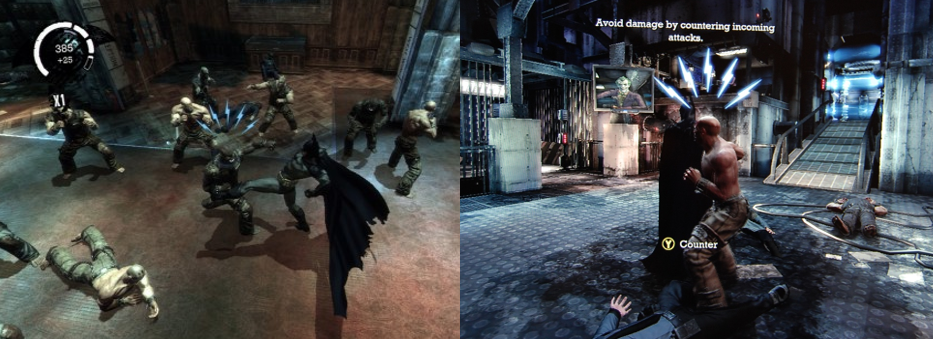
Combat is fast and fluid, allowing Batman to strike and counter with a deft swiftness.

Of course, one of the most prominent aspects of Arkham Asylum is the game’s unique combat system.; rather than simply mashing buttons, combat is a fluid and slick affair somewhat akin to a rhythm game. Pressing X will see Batman strike the enemy nearest to him; repeated presses begin a combo and you can stun enemies with Batman’s cape by pressing B or hop over them by tapping A. During combat, the camera automatically pans to show you the best view of your immediate area and any enemies around you and, when enemies try to strike at you, a “Counter” indicator will appear. When it does, tap Y and Batman will automatically counter the oncoming attack and, by successfully stringing together strikes and counters, you can build up bigger and more elaborate combos and fluidly take down multiple enemies at once. Once an enemy has been knocked down, or when sneaking up on them, you can press RT and Y to perform a takedown that will knock them out cold and, as you defeat enemies and uncover secrets, you’ll earn experience points (XP) which can be spent purchasing new takedowns and combat options when you level up.
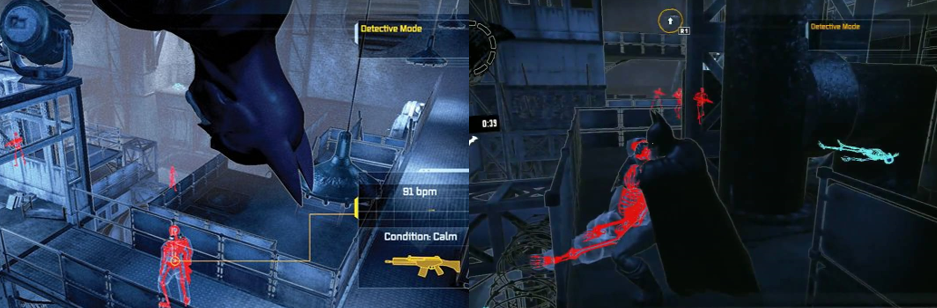
Batman’s Detective Mode is perfect for striking fear into armed thugs and taking them out silently.

Another important aspect of the game is stealth; utilising the “Predator” mechanic, Batman can sneak up on enemies and make use of high ledges to stalk rooms full of armed thugs and pick them off one at a time by utilising the infrared filter offered by his “Detective Mode”. This is activated by pressing the Left Bumper and will wash the environment in a grainy, black and white filter that highlights enemies by their body heat and shows their current condition. Using the shadows and your gadgets, you can drop down on enemies from above, sneak through grates, and set up traps to take them down and pick them off and their cohorts will react accordingly, becoming increasingly agitated and trigger happy as the section progresses. Batman is extremely vulnerable to sustained gunfire so it’s better to be patient and take down each enemy one at a time but you can grapple away to safety if you’re spotted and are even able to take down enemies while hanging from ledges or from afar with Batman’s many toys. Detective Mode also allows you to scan your environment; for the most part, this will be to solve riddles placed all over Arkham Asylum by Edward Nashton/Edward Nygma/The Riddler but, at various times during the game’s story, you’ll have to set up a crime scene to scan evidence and filter out aromas and other elements that will lead you to your next objective as long as you have Detective Mode activated. Although there is no onscreen map, you can view a comprehensive blueprint of Arkham Island by pressing the “Back” button. From here, you’ll see all of the unsolved riddles in the game and where your next objective is, as well as being able to enter any of the game’s environments to review the layout and any remaining secrets to be discovered.

The game world is constantly changing and you always need to find new ways to progress.

You can’t set up a waypoint and there’s only a few sections where you’re literally shown the way but, thankfully, Arkham Asylum isn’t too difficult to explore or navigate for the most part (though there some areas that are quite frustrating or mired in overly dark lighting). Batman: Arkham Asylum features not only a level-up system but also a progressively increasing difficulty curve; while the game’s “Hard” mode will obviously offer the most challenging experience (enemies are more aggressive and counter indicators are omitted entirely), the game world will constantly change as you progress through the story. New areas become accessible as you acquire and upgrade Batman’s many gadgets and areas that you’ve previously visited will become populated by snipers, maniacs, or over-run by Pamela Isley/Poison Ivy’s monstrous plants to keep the game feeling fresh and allowing your actions to actually have an impact on the environment. Backtracking is a prominent feature of the game as some areas will be locked off until you get a new gadget; other areas are locked off entirely, forcing you to use vents, grapples, or explode walls in order to progress and you’ll definitely need to explore every nook and cranny to solve all of the game’s riddles and collect all of the pickups. Although there is no manual save option, the game is extremely generous with checkpoints (which, thankfully, also appear mid-way through certain boss battles) and Batman’s health bar is replenished after successfully defeating enemies in combat, solves riddles, or finds secrets.

Graphics and Sound:
Even now, some fifteen years after its original release, Batman: Arkham Asylum is a visually impressive game. The entire game takes places in a single night, meaning the gothic, decrepit asylum is constantly bathed in an ominous, murky darkness that goes a long way to adding to the game’s claustrophobic and oppressive atmosphere. At times, the game is a little too dark and you’ll either be relying too much on Detective Mode or adjusting the brightness settings to get around but I can forgive this as the dark, moody aesthetic really encapsulates the nature of what it means to be Batman. Arkham Asylum is quite an elaborate environment for what amounts to a glorified sandbox; the prison/facility has been depicted in many different ways over the years but, here, it’s a gloomy, gothic prison confined to an island separated from the greater city. The island itself adds as the hub world, of sorts, and you can travel to different areas by passing through large, automated doors (that are clearly masking loading zones) or using Batman’s various gadgets and skills, and at each compass point you’ll find a different area to explore.

Environments are seeped in a dark, ominous aesthetic that adds to the claustrophobic atmosphere.

The island is home to a high-tech penitentiary, a dilapidated mansion, a dock, a hospital/morgue, a cemetery, and even has a large botanical garden to visit. Each area is suitable foreboding and shows signs of wear and tear (to say nothing of death and anarchy from the breakout of the inmates) and, despite the overwhelming use of blacks, greys, and darkness, stands out from each other through their unique layouts and gameplay mechanics. The island is also home to a vast network of sewers and caves; Batman has even set up a small Batcave on the island, where you’ll travel a few times to acquire upgrades, but these stone catacombs are by far the worst areas to explore in the game. The sewer system that Waylon Jones/Killer Croc has taken as his home isn’t too bad but the caves are dark and crumbling, meaning that your grapnel gun is all but useless and you’re forced to rely on Batman’s jumping skills. For the most part, these are serviceable, but the game’s focus is not on precision platforming so it can sometimes be a pain to get Batman (and the camera) pointed in the direction you need to go. When you later revisit these areas to mop up any unsolved riddles, it’s easy to get lost and confused and it’s a shame that the game doesn’t give you the option to fast exit an area or building from the map screen as there’s nothing worse than venturing deep into the catacombs and then struggling to find your way out.
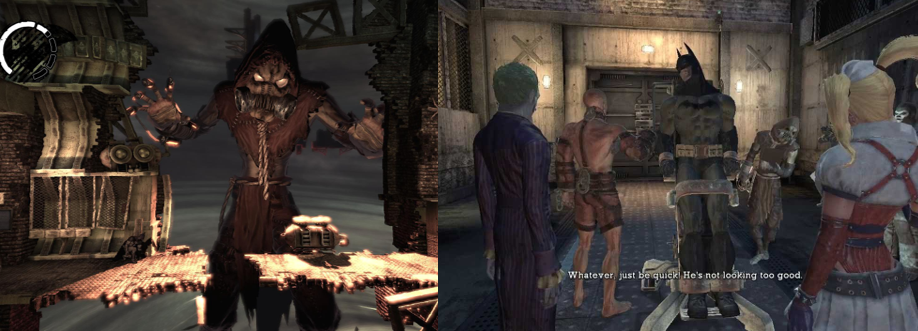
Your encounters with the Scarecrow will have you questioning the stability of the game!

While the game is tight as a drum in terms of its stability, there are noticeable times where you’ll have to sit and wait as the next section loads and it can sometimes be a little too easy to get caught on the environment or botch a ledge grab but these moments are few and far between. By far the game’s most impressive sections, though, are the nightmarish illusions and hallucinations brought about by exposure to Doctor Jonathan Crane/Scarecrow’s fear gas and toxins; these cause the game to warp, restricting your moment, perception, and controls, and transform the environment into a chilling recreation of Crime Alley or show Batman visions of his dead parents and allies. This leads to a series of really unique, 2.5D sections where you must navigate a disparate hellscape, avoiding the Scarecrow’s gaze and trying not to get too freaked out by his Freddy Krueger-like appearance or Batman’s character model briefly flashing to that of Scarecrow’s. Easily the most memorable moment of all of these sequences is the moment the game abruptly appears to crash and resets on you, only to restart with a recreation of the game’s opening cutscene with the Joker delivering a manic Batman to Arkham while his villains taunt and jeer at him.
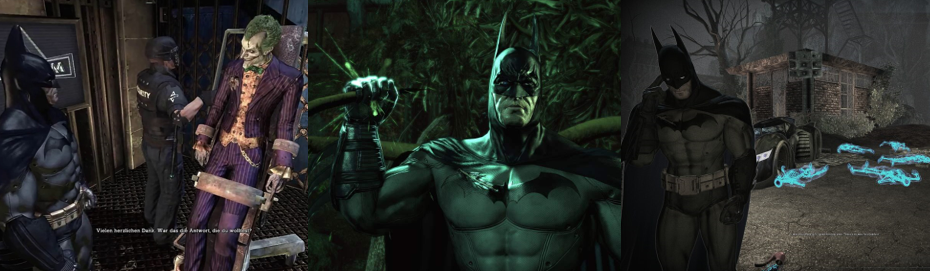
In-game graphics are top notch, with Batman’s suit progressively taking damage over time.

In terms of character models, Arkham Asylum also still holds up really well. While generic thugs and goons quickly get a bit repetitive, the game’s interpretations of Batman’s different rogues is very unique and compelling and the influence of the legendary artist Jim Lee is readily apparent in the appearance of Killer Croc, Doctor Harleen Quinzel/Harley Quinn, and Batman himself. Fittingly, Batman benefits the most from the game’s graphics; not only does Kevin Conroy deliver sterling work as always as the character but Batman’s suit will accrue damage as the story progresses, with rips, tears, bullet holes, and other bits of wear and tear showing up as you progress through the story. So strong are Arkham Asylum’s in-game graphics that they are generally the default for the game’s cutscenes; many times throughout the story, Batman will stop to converse with Barbara Gordon/Oracle to comment on and progress the plot and his current investigation but there are instances of higher quality cutscenes as well, which aren’t too far off from what is seen during gameplay. The game’s music is suitably brooding and gothic, picking up when enemies spot you or you’re in combat and being used very effectively to establish a foreboding mood to the game’s events. Finally, not only do the thugs and inmates constantly chat, banter, and taunt you but the game is frequently punctuated by announcements from the Joker. Like Conroy, Hamill excels in the role and adds a glorious entertaining dark humour to the events, stealing the show every time his voice is heard and, overall, music, sound effects, and visuals are all married perfectly to encapsulate the dark, moody atmosphere of the game and really add to the experience of being the Batman.

Enemies and Bosses:
Being that it’s home to the criminally insane, Arkham Asylum is populated by all kinds of maniacal inmates; however, as part of his elaborate plan, the Joker also struck when a number of Blackgate Penitentiary’s prisoners were on the island, and these are the thugs you’ll encounter the most. Generally, goons are spread across the hub world or waiting in corridors or large, open rooms and can either be engaged head-on or from the shadows if they have firearms. Enemies will attack as a group, meaning you’ll have to be constantly aware of incoming attacks, and will even grab items and objects to throw at you or use as makeshift weapons.
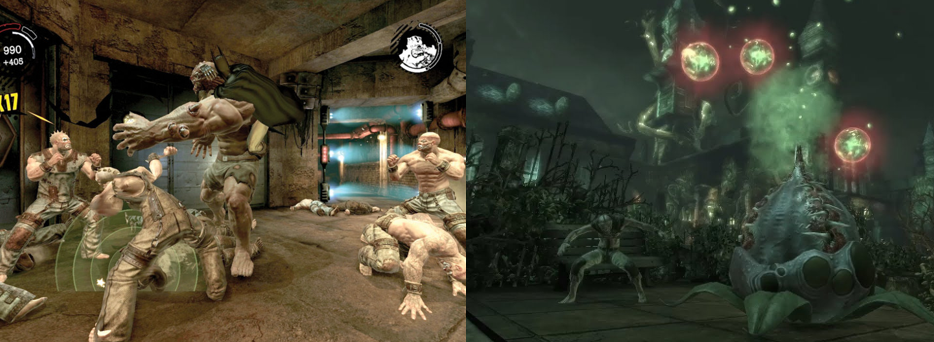
Eventually, more dangerous and monstrous enemies spread across the asylum.

As the story progresses, you’ll encounter more formidable enemies: snipers will take up positions above and must be taken out before they can put a bullet in you; inmates with knives must be stunned with your cape before you can attack them; those with electrical batons must by jumped over and attacked from behind; and crazed lunatics will leap at you and must be countered at the right time to stop them from pinning you down. You’ll also have to contend with those exposed to the Joker’s “TITAN” serum, which transforms them into monstrous, hulking beasts; these guys will charge at you, necessitating a quick toss of a Batarang and a dive out of the way to stun them so you can land a few shots and, eventually, hop on their back to whittle their health down and batter about any nearby enemies. Sometimes you’ll have to fight two of these at once, alongside a variety of other thugs, and you’ll also have to dispatch Ivy’s TITAN-infused plants, which spit out homing spores and must be slowly approached in order to destroy them.

Battles with Mr. Zsasz and Bane will teach you fundamental, life-saving tactics for later in the game.

The Joker’s plan also requires him to unleash a very specific number of Batman’s most notorious rogues, who you must take down in a series of encounters as boss battles. The first of these you’ll go up against is Victor Zsasz/Mister Zsasz in what is, essentially, a glorified tutorial to teach you about grappling from cover to cover to sneak up on an enemy. You’ll also encounter him later in the game in a similar situation designed to teach you how to use the reverse Batarang feature and, in both cases, you can easily take him down with no trouble at all as long as you’re not spotted. Similarly, though she’s a constant thorn in your side throughout the game, you can easily apprehend Harley Quinn after battling a short gauntlet of goons, which is only fitting considering that neither villain is much of a physical match for Batman. Bane, however, is. Like the TITAN goons, he must be stunned with a Batarang when he charges at you and battered with a quick combo to yank out the Venom pipes supplying his superhuman strength. However, as the fight progresses, goons will drop into the arena to distract you; again, like the TITANs, Bane can grab downed enemies and launch them at you as projectiles but he’ll also toss parts of the environment your way as well so it have to constantly be thinking on your feet and ready to dodge out of the way. As long as you can deal with the annoying goons, avoid Bane’s wild strikes and ground pound, and dodge out of his charges, he’s not especially difficult and battling him (and the TITANs) serves as great practise for the game’s final boss.
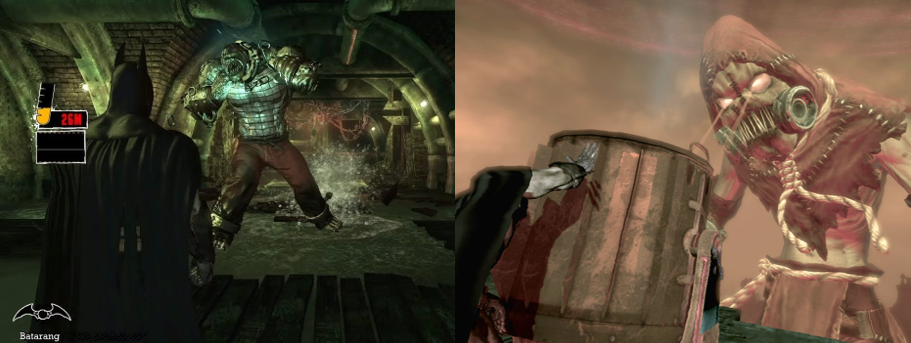
You’ll need patience, skill, and gadgets to conquer Killer Croc and the Scarecrow.

Before that, though, you’ll have to contend with Killer Croc in the sewers. Down here, you must slowly walk across wooden platforms to avoid attracting Croc’s attention; when he lunges out of the water, you must quickly toss a Batarang to subdue him and make a run for it when he starts smashing up the platforms. Eventually, you’ll avoid him and collect the samples Batman needs to synthesise an anti-virus for the TITAN formula and Croc will chase you down. This forces you to run towards the camera as quickly as possible and then detonate explosive charges before Croc can reach you to send him plummeting down a deep chasm. As mentioned before, you’ll also have to contend with the Scarecrow on no less than three occasions. Each time, you must navigate his hellscape using your stealth, gadgets, and jumping/shimmying skills to avoid being spotted but, as the encounters progress, you’ll also have to fend off waves of skeletons. In the final encounter, Scarecrow summons more of these enemies, including a TITAN variant, in three waves; after defeating each one, Batman activates a Bat-Signal and will eventually dispel and break free of the Scarecrow’s harrowing nightmares once and for all.

Sadly (or thankfully), the final boss isn’t anywhere near as interesting as the one with Poison Ivy.

By far the most frustrating boss battle of the game, though, is the one against Poison Ivy; encased in a monstrous man-eating plant, she sends out a bunch of tentacles that will choke the life out of you in seconds, commands besotted thugs and guards to attack you, and fires super-fast and painful bolts your way. To defeat her, you must avoid her attacks, defeat her goons, and toss a quick Batarang at her when she exposes herself while firing at you. When she collapses, you can use your explosive gel to damage the pod but this battle can get very harrowing on the game’s Hard difficulty. When you finally confront the Joker for the final showdown, he arranges a gaggle of thugs to greet you at the door, tries to kill you with an exploding television, forces you to fight a whole bunch of enemies and two TITANs at once, and then transforms himself into a TITAN monster for the finale. In this fight, you must avoid his claw swipes and then dispatch the goons that come into the arena, destroying exploding teeth and avoiding the electrified walls until it’s safe to pull the Joker down from his ledge and put a beating on him. Sadly, it’s not a very compelling final boss battle as it’s fundamentally the same as battling the TITANs and Bane, and it’s a bit of a missed opportunity to not have Batman undergo a similar transformation, but it’s decent enough for what it is and not too surprising that you wouldn’t fight the Joker one-on-one.

Power-Ups and Bonuses:
Batman: Arkham Asylum features a level-up progression system; every time you defeat enemies, solve riddles, or pick up Riddler Trophies and other items (like audio tapes and so forth), you’ll gain XP. When you level-up, you can spend the Skill Points you earn on improving Batman’s armour to give him more health, adding additional takedowns and combat moves to his repertoire, or upgrading his various gadgets to improve their range and efficiency. I recommend pacing these upgrades out (armour once, then a new takedown, armour again, maybe upgrade a gadget, and so forth) and fighting every enemy you see in order to upgrade Batman as fast as possibly. It’s very easy to fully upgrade Batman on even a casual playthrough on Hard mode, though, so it shouldn’t be too hard to get there. Along the way, Batman will acquire or construct new gadgets to help him progress. Explosive gel will allow him to knock enemies off balance or break through certain walls, the Line Launcher will allow him to cross chasms and gaps too wide to jump or glide across as long as there’s a solid wall behind and in front of him, the Sonic Batarang can be used to lure enemies away from each other or into a trap, the Ultra Batclaw allows Batman to tear down certain walls by tapping A after firing, and the Cryptographic Sequencer allows him to hack security panels by matching radiowaves with the analogue sticks to access Riddler Trophies, secret rooms, or open previously-inaccessible areas. The Batmobile and Batwing also make an appearance but you cannot utilise these in the game, unfortunately, but you can upgrade the Batarang to throw up to three at separate targets or be remote controlled (though this is also quite limited in its application).

Additional Features:
Batman: Arkham Asylum has forty-seven Achievements for you to earn, the majority of which are acquired simply by progressing through the story and clearing certain missions or defeating bosses. Some require you to defeat enemies in certain ways or rack up a certain combo score, others are tied to gliding consecutively or completing the game on each difficulty setting, but the majority are tied towards finding the Riddler Trophies, solving his riddles, and completing combat and predator challenges in the game’s “Challenge Mode”. To elaborate, the Riddler has hidden numerous glowing green trophies all across Arkham Island; some are hidden in plain view, others require your gadgets or a bit of exploration to find. Pretty much every single room or area of the island also has a number of riddles associated with it that you must solve by scanning parts of the environment; these are generally linked to Batman’s history or rogues and will unlock character biographies of guys like Harvey Dent/Two-Face and Arnold Wesker/The Ventriloquist. Every time you solve or find these, you’ll gain XP and get one step closer to 100% collection so it’s worth taking time to look for a small tea set or a plague dedicated to Martha and Tomas Wayne.
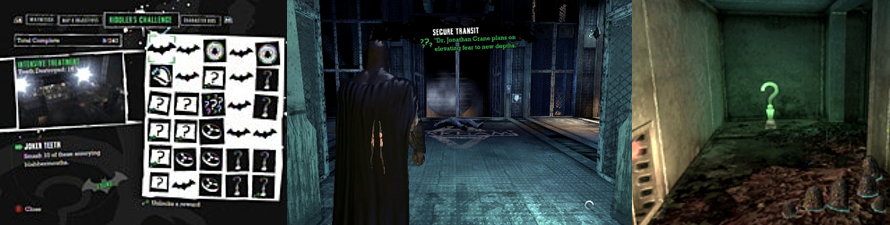
Riddles and secrets are scattered all over the damn place.

Additionally, there are stone monuments to Amadeus Arkham, the founder of the island and its facility, to be found and scanned to learn more about Arkham’s morbid history as well as audio tapes and maps to further flesh out the characters’ backstories and reveal the Riddler’s secrets. From the main menu, you’ll also see the option to take on Challenge Mode. These are specific, self-contained combat and predator sections based on encounters in the game and pit you against waves of increasingly difficult enemies and rooms full of thugs, respectively, and are unlocked by finding Riddler Trophies and solving riddles. When you take on a Challenge, you’ll either have to face a number of rounds against different enemies in different environments or pick off thugs from the shadows according to a number of requirements (such as using explosive gel or a vertical takedown). Each time you successfully meet these criteria, or rack up enough points, you’ll earn up to three medals, and eventually some Achievements, and can compete against friends and others using the online leaderboards. Sadly, though, unlike subsequent games in the series, there is no “New Game+” option, you only unlock one alternative outfit for completing the game and it’s restricted to the Challenge Mode, and the only DLC available is for additional Challenge maps. Those who have the PlayStation 3 or Return to Arkham (Rocksteady Studios/Virtuos Studios, 2016) versions (which I also do), though, can choose to play as the Joker in the Challenge Mode, which is pretty entertaining as he comes with his own unique and madcap fighting style and gadgets that separate him from the Batman.

The Summary:
I remember the first time I played Batman: Arkham Asylum when I first got it for the PlayStation 3 and being just blown away by how intricate, smooth, and impressive its controls, mechanics, and presentation were. Never before had a videogame offered such a range of versatility for Batman; rather than simply focusing on combat or one aspect of the character, Arkham Asylum really delved into what it means to be Batman and gave players the chance to experience each of those elements in a new, dynamic, and incredibly entertaining way. Combat is fluid and easy to master, stealth sections are exhilarating even when it can take a while to pick enemies off, and even the game’s more frustrating enemies or bosses are fun to encounter thanks to the overall aesthetic and top-notch presentation given to the game. It truly feels like a legitimate, authentic, heartfelt attempt to capture the “spirit” of being Batman and some of his most notorious villains. Restricting the action to Arkham Island may make the game much smaller and quaint compared to its successors but it adds to the claustrophobic tension that permeates the narrative and the desperate situation Batman finds himself in as he’s trapped on an island with no means of escape and duty-bound to hunt these criminals down. While the sequels may have expanded and improved upon literally aspect featured in this first game, as well as adding much more fan service and additional features, Batman: Arkham Asylum is still a really enjoyable experience and I had a blast playing through it again for this long-overdue review.

My Rating:

Rating: 4 out of 5.

Great Stuff

What did you think to Batman: Arkham Asylum? How do you feel it holds up compared to its sequels and other, similar videogames? Did you enjoy being restricted to the titular asylum or do you prefer the bigger, more open worlds of the later games? Which of Batman’s gadgets and rogues were your favourite to use or fight against and why? Did you ever find all of the Riddler’s trophies and secrets? Were you a fan of the game’s freeflowing combat system and the various gameplay options available to you? How are you planning on celebrating Batman Day this year and what is your favourite Batman videogame? Whatever your thoughts on Batman: Arkham Asylum, or Batman in general, please leave a comment below and check back in next Wednesday for my review of the sequel!

Author’s Spotlight: Kerry E.B. Black Interview

Kerry E.B. Black, author of Spring of Spirits, Carousel of Nightmares, and other short stories

1. First, introduce yourself a bit. What is your name (or pen name) and where are you from?

Hi. And thank you for conducting these interviews! My name is Kerry E.B. Black, and I am a writer living in the suburbs of Pittsburgh, PA USA.

2. Next, tell us a bit about your most recent work. Is this your first published book? What is it about and what genre would you classify it as?

My most recently published book is a YA paranormal thriller called Spring of Spirits. It’s the second in a series that follows Casey, a shy college freshman at Ol’NorEastern U, where an Autumn Equinox awakening ceremony changed the participants in subtle ways – and might have released something murderous.

The main character, Casey, bears a lot of burdens. Her home life leaves much to be desired, yet she does all she can to help there. She works and attends school. She’s a hard worker who also faced mental health issues. She’s someone to admire, truly.

3. Tell us a bit about your main character; what are they like, how did they come about, and what are some of their strengths and weaknesses?

How she came about? I have many friends in different special needs communities. They’ve served as partial models for Casey.

Later this year. I’m releasing a book of scary poetry called Poetic Nightmares (my already released collections of short scares are named Carousel of Nightmares, Herd of Mightmares, and Fairy Herds and Mythscapes). I adore reading and writing short fiction, with its encapsulated experiences. Often in my busy life, I haven’t enough time. So I appreciate intoxicating, brief interludes.

4. What was your hardest scene to write in this (or any) book?

I’m working on a novella that’s stymied me because I dread the latest scene. It’s set in the ambiguous past, when midwives and herbalists we’re persecuted as witches. This particular herbalist lead character has cerebral palsy – and a surprising relationship with another character in the story. I hope to finish it before the end of the year.

5. Did you go the traditional route when publishing your book or did you choose to self-publish?

I work with a dear woman named Deb Sanchez at Tree Shadow Press to publish most of my work. She’s a one woman hybrid press dynamo, and I love her!

Terry M. West curates a magazine called Weirdsmith, and I was honored to be a featured author for his volume five. Those two stories remain the goriest I’ve ever written. Otherwise, a number of amazing lit mags and anthologies have kindly published some of my stories.

6. What would you say is the most difficult part of your writing journey and what advice would you give to other writers?

Imposter Syndrome cripples. It kept me from writing for far too long. Life’s short, and tomorrow is not promised, or so common sense tells us. So, write if you want to, tell stories and leave a mark. Not everyone will enjoy your work, but don’t allow that to stop you. Write what you enjoy.

7. Do you want each book to stand on its own, or are you trying to build a body of work with connections between each book?

Good question. Many of my stories come from a shared universe. I sometimes have a character in a story refer to another character or experience from a different story, so although the stories stand alone, they often contain “Easter Eggs.”

8. What are some of your favourite authors and books and what inspired you to become a writer in the first place?

Some of my favorite authors include C.S. Lewis, Neil Gaiman, Shirley Jackson, Stephen King, Joe Hill, Alice Hoffman, Grady Hendrix, Gwendolyn Kiste, Edgar A. Poe, Holly Black, and Cynthia Pelayo. But there are so many more! I think my mom inspired me to write. I started early with ghost stories I’d write and illustrate and share with underclassmen at my elementary school. Through writing, I am marginally more eloquent than my normal, tongue-tied and awkward self.

9. What would you say has been the best way to market your books?

I am not sure about the best way to market my books. My Twitter following is largest, but I think I have more actual engagement on Instagram.

10. Are there any tropes, clichés, or writing styles that you dislike and, if so, what are they and why?

I am not a fan of erotica or extreme gore.

11. Do you read reviews of your book and, if so, how do you handle negative feedback?

I do read reviews and try to look at anything negative constructively. That’s not to say it doesn’t sting, but I try to turn it into a learning experience. As Hemingway explained, we’re all learning as we go. There’s something magical about always striving to be better.

12. What are some of your quirks as a writer? Do you like to plot everything out or do you prefer to just “wing it” and see where the story takes you? Do you listen to music when writing and, if so, what do you listen to?

I always know the beginning and the end of my stories. The action has to progress toward that conclusion. For longer works, I know plot points that must be reached. The business of getting there is often something of a mystery to me, though.

I don’t usually pay attention to the world around me when I write. I tune everything out by necessity, I suppose. My house is tiny and overly populated, and thus noisy and distracting.

13. What is the best advice you’ve ever had when it comes to writing and what advice would you give to new writers?

Join writing groups. Support your fellow writers and listen to their suggestions about your writing. Objective opinions are invaluable.

14. What’s next for you? Are you currently working on any new books or stories?

I am always writing. Even when I don’t write things down, my mind seizes and elaborates on ideas. I’ve that novella to complete. I use submission calls for publications I admire as muses for short works. I write a drabble weekly for https://www.carrotranch.com.

15. Finally, feel free to plug your social media, website, and links to Amazon, GoodReads, and other relevant sites below, and detail any current offers available for your book/s:

Thank you again for conducting this interview! I’ve boosted your offer of interviews on my Instagram (where I discovered it.)

If you’d like to be featured in an interview, please check out the interview submissions page to submit your answers.

Movie Night: Speed

Released: 10 June 1994
Director: Jan de Bont
Distributor: 20th Century Fox
Budget: $30 to 37 million
Stars: Keanu Reeves, Dennis Hopper, Sandra Bullock, Jeff Daniels, and Joe Morton

The Plot:
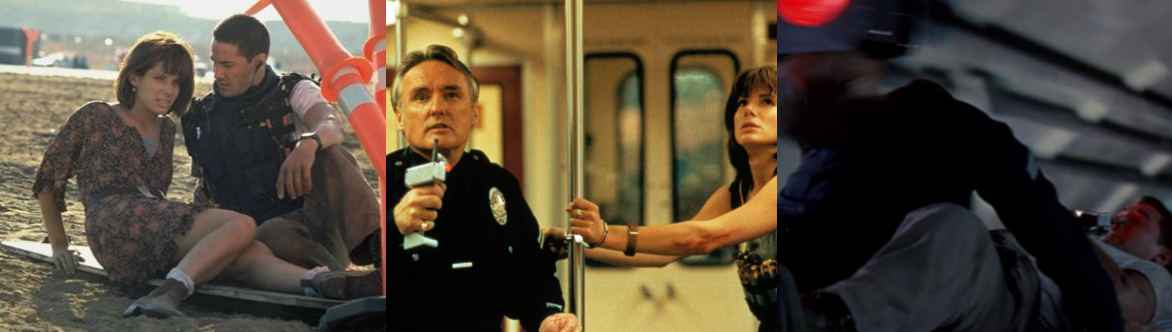
Los Angeles Special Weapons and Tactics (S.W.A.T.) specialist Jack Traven (Reeves) is sent to diffuse a bomb that revenge-driven extortionist Howard Payne (Hopper) has planted on a city bus. However, there’s a catch: passenger Anne Porter (Bullock) must keep the bus above fifty miles an hour or else the bomb will detonate!

The Background:
Speed was the brainchild of screenwriter Graham Yost, who was inspired by The Runaway Train (Konchalovsky, 1985) and thought the concept would be made more exciting if the train had a bomb on it and had to maintain a certain speed. Initially, the entire film was set on the bus and would culminate in a dramatic crash through the iconic Hollywood Sign but the ending was changed and the script was altered in order to sell the concept to 20th Century Fox, with Yost even working with Joss Whedon to refine the script’s dialogue and heavily alter Traven into a more earnest character. Reeves prepared for the role by shaving his head and incorporating his prior experiences on Point Break (Bigelow, 1991), and, after Halle Berry turned down the role of Annie, worked closely with Bullock to develop chemistry between their characters. Speed was a massive financial success; it made over $350 million at the box office and was widely praised for its action and intensity. While the sequel was a dismal critical and commercial failure, Speed remains one of the best action movies of the nineties and, considering that today is Keanu Reeves’ birthday, this seems like the perfect time to revisit the film.

The Review:
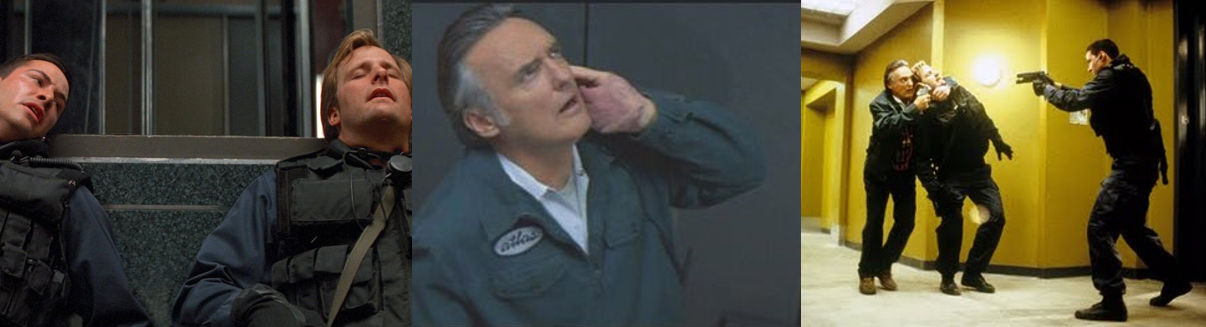
Speed begins not on a bus on the Los Angeles highway but in a large office skyscraper where a bunch of well-dressed, successful businesspeople find themselves trapped in a lift and held to ransom courtesy of a bomber we will later learn is named Howard Payne. For now, though, he’s just a maniacal madman who places a bomb on the lift and demands a $3 million ransom for the safety of his hostages, so the Los Angeles Police Department send in their S.W.A.T. team to try and free the hostages before the bomb can go off. The team is led by Lieutenant Herb “Mac” McMahon (Morton), who meticulously co-ordinates his guys with one primary goal in mind: the evacuation of the building’s occupants and the maintenance of protocol to avoid upsetting the bomber and unnecessarily losing lives.

Jack comes up with a unique solution when Harry is taken hostage by a mad bomber.

Jack Traven is a point man in Mac’s team; a bit of a wise-ass, Jack’s snark doesn’t float with Mac, who orders both him and his friend and fellow officer, Harry Temple (Daniels), to investigate the explosive device but strictly forbids them from interfering with it. While Jack remains professional enough to offer words of comfort to the trapped inhabitants, who have no idea of the predicament they’re in, Harry is the expert on explosives and Jack is far more likely to go with his gut instincts regarding the whole situation. Jack deduces that the bomber has every intention of blowing the lift whether he gets paid or not, and showcases his adaptability by rigging a nearby crane to take the weight of the lift, thereby ensuring the hostages’ safety when his hunch turns out to be right (though Payne only blows the lift because of Jack’s interference). Further deducing that their perpetrator is in the building, Jack sets out to track him down, with Harry reluctantly in tow; when Payne gets the drop on them, he takes Harry as a hostage and tries to use him as leverage to ensure his escape but Jack puts into motion his unique approach to such a situation and wounds Harry with a bullet to the leg and Payne appears to kill himself with a suicide vest. Unbeknownst to Jack, Payne survived the explosion and watches with glee as Jack and Harry are commended for their bravery and fortitude; Harry even gets a promotion to detective but warns Jack that they got lucky and that “luck runs out”.

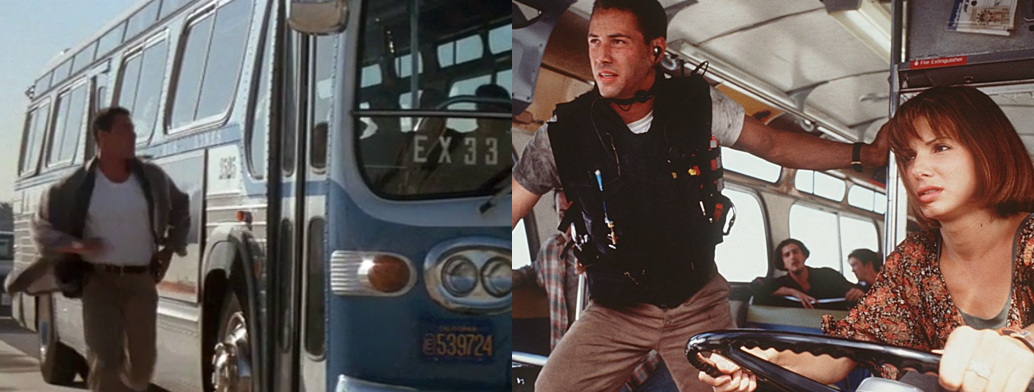
Jack leaps aboard the bus and finds an ally in the annoying Annie, who takes the wheel.

Pissed off that Jack’s interference cost him $3 million, the maniacal Payne strikes by blowing up a bus and its driver right in front of Jack; Payne then calls Jack from a nearby payphone and challenges him to stop him once more. This time, he’s placed his bomb on another bus that will explode once the vehicle goes over fifty miles an hour, and specifically declares his intention to set off the bomb if any passengers are evacuated or if he doesn’t get his ransom in about three hours’ time. Naturally, Jack races to locate the bus and this is when we’re introduced to easily the most annoying character in the film, Annie Porter, played by one of my least favourite actresses in all of cinema, Sandra Bullock. A loud and flighty character, Annie has been forced to take the bus since she lost her driving license on a speeding charge and is the first to actively speak up when Jack dramatically leaps his way aboard the bus. However, when the driver, Sam Silver (Hawthorne James), is injured by an errant gunshot, Annie finds herself in way over her head and taking a central role as the panic-stricken driver of the bus.

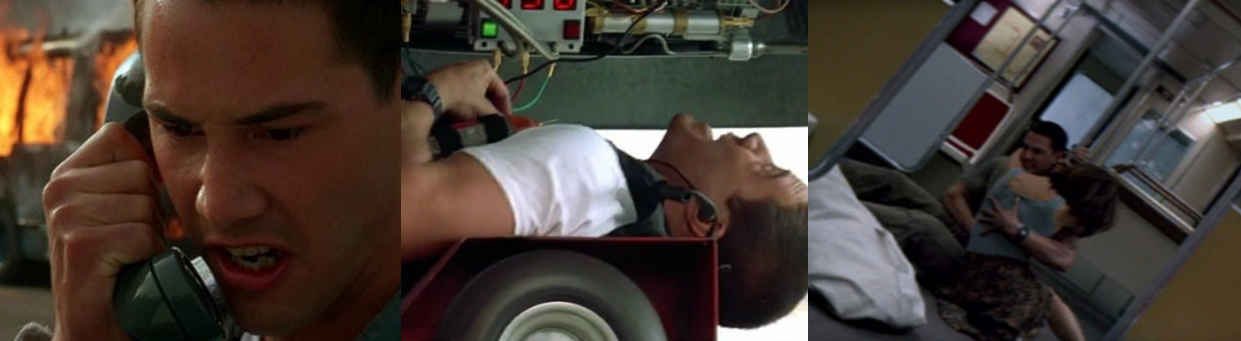
Jack is wracked with anger when Payne causes the deaths of a passenger and his close friend.

On the bus, Jack finds an assortment of normal, everyday Los Angeles citizens, including Doug Stephens (Alan Ruck), a tourist on his first visit to the city who offers wry commentary, and Helen (Beth Grant), a regular passenger whose utter terror results in her being another of Payne’s casualties. When he first boards the bus, Jack is first faced with Annie’s loudmouth but the situation unexpectedly escalates when Ray (Daniel Villarreal) pulls a gun on him and demands the bus be stopped. Thanks to Gigantor Ortiz (Carlos Carrasco), Ray is disarmed but Sam is shot in the process, meaning Annie has to take over and, while tensions inevitably flair between the frightened passengers, Jack is eventually able to calm them. He does an equally good job of offering encouragement and support to Annie while remaining focused and pragmatic about the entire situation. Thankfully, he has Harry on the line to offer his insight on the bomb, which is packed full of C4, flanked by a number of decoy wires, and wired into a regular gold wristwatch. Bothered by the unreliability of the timer and the unpredictability of the bomber’s methods, Harry conducts a thorough investigation not just into criminals but into former cops and uncovers the bomber’s identity as a former member of the Atlanta Police Department bomb squad. Unfortunately, Harry’s desperation to nail Payne and help his friend leads to his tragic and untimely death as Payne rigged his home with an explosive booby-trap that kills Harry and, in one of the film’s (and Keanu’s) most emotionally impactful scenes, sees Jack enraged into a frenzy and swearing to make the bomber pay for his actions.

The Nitty-Gritty:
Speed is an exercise in tension and excitement; since the bus is forced to stay in constant motion, and over fifty miles an hour, the sheer level of pressure faced by Jack is reflected in the pacing and frantic nature of the film. Even when the bus gains a police escort, they’re never far out of danger; first it’s the gunman, Ray, then Helen nearly blows the whole thing (literally) by trying to escape from the bus as Sam is safely unloaded in an act of faith on Payne’s part, and then they start to run out of road. Even when Jack directs Annie to circle the airport indefinitely, he has to worry about the bus’s severed fuel line and is constantly having to adapt to new problems on the fly.

Jack is more than physically capable of taking on Payne’s sadistic challenge

Thankfully, Jack is more than capable of meeting Payne’s challenge; a focused and driven individual with a strong moral compass, he isn’t afraid to leap head-first into action but is also switched on enough to consider all of his options, while still acting on instinct the vast majority of the time. He commandeers a civilian’s car in a desperate attempt to warn Sam about the danger on his bus and, when that fails, he dramatically leaps from the car and onto the bus despite the fact that both vehicles are travelling at well over fifty miles per hour. While on the bus, he is as honest and forthcoming with the passengers as possible while still doing everything he can to keep things under control and exudes a confidence that, for the most part, keeps the passengers calm. Disgusted at Payne’s lunacy, Jack walks a fine line between negotiating and satisfying the bomber while making it abundantly clear that he has a personal vendetta against Payne. Desperate to keep the passengers safe, Jack doesn’t hesitate to try and disarm the bomb from underneath the bus and, once he figures out how Payne is monitoring them, he comes up with a genius and often copied/parodied solution of looping Payne’s video feed, thus outsmarting his opponent and safely evacuating the passengers.

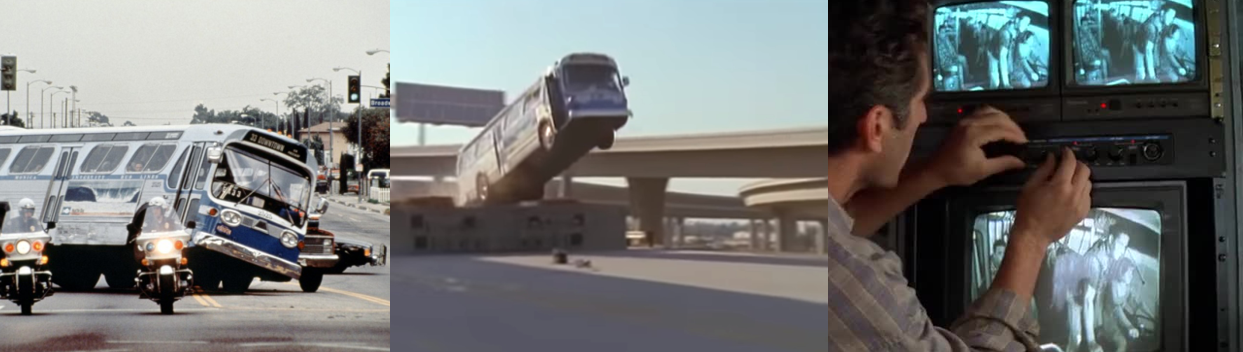
The bus makes for some of the film’s most tense and action-packed moments.

Of course, much of the film’s action revolves around the tension and drama on the bus; while Mac works to keep the roads clear and safe for Jack, Annie is forced to plough head-first through the dense Los Angeles traffic, make sudden and hard turns to avoid collisions, and, of course, to make a seemingly impossible leap to cross an unfinished freeway. While it’s perhaps a little unlikely that such a large and cumbersome vehicle would be able to make such a jump, especially with the added weight of all those passengers, it does make for a thrilling scene that’s one of the film’s most memorable moments. Once the bus hits the airport, it’s largely out of danger and Jack’s focus switches to figuring out how Payne can always know so much; after making the connection between Payne’s seemingly random “Wildcat” reference, Jack discovers that Payne has a camera rigged on the bus and has Mac commandeer Payne’s signal to loop the feed. It’s lucky, and seemingly unlikely, that Payne only had the one camera on the bus (and that he didn’t rig up a microphone or other device so he could hear what was going on as well) but, when he figures out that he’s been duped out of his money again, the mad bomber decides to take a more direct approach for the film’s finale.

The film ends with a showdown on, and on top of, a runaway subway train!

After Jack and Annie’s dramatic (and explosive) escape from the bus, Payne disguises himself as a police officer, abducts Annie, straps her into an explosive vest, and escapes into the subway with his money and his hostage. Having eliminated Jack’s “shoot the hostage” strategy, Payne hijacks a subway train, handcuffing Annie to the inside, and makes his getaway, but is driven into a psychotic rage when he discovers his ransom is rigged with paint that makes it worthless. Jack, ever the man of action, pursues and boards the train, drawing Payne into a confrontation on the train’s roof! Despite being Payne older, insane, and handicapped by his missing thumb, the mad bomber is initially able to overwhelm is younger, stronger foe thanks to the threat of the detonator in his hand. However, Jack is able to behead Payne using an overheard railway signal (delivering an odd quip about being taller in the process), ending his threat once and for all while keeping Annie safe. Thanks to Payne’s trigger finger, though, the train is left out of control; with no way to free Annie from her cuffs and few options left, Jack opts to speed the train up and send it crashing out onto Hollywood Boulevard. Unbelievably, the two are left unharmed beyond the few scrapes and cuts they picked up from escaping the bus, and the film closes with them finally acting on the middling amount of sexual tension they shared during the film’s chaotic events while a gaggle of spectators look on.

The Summary:
I hate to say it, but I’ve never really been that big a fan of Speed. The premise is certainly unique, and definitely ends up being much more than just “Die Hard (McTiernan, 1988) on a bus” thanks to the high-octane thrill of a bus that cannot slow down and the many different obstacles that get in the way of that premise. Where it excels is in the performances of Keanu Reeves and Dennis Hopper; whenever anyone tries to tell me that Keanu is “wooden”, I point them to his intense and emotional fit of rage at learning of his friend’s death and his performance is only bolstered by Hopper’s maniacal bomber. Hopper is as much of a highlight as the ever-escalating action on the bus, which ploughs through traffic, red lights, and even inexplicably leaps a gap in the freeway in a bid to stay over fifty mile an hour. Where the film slightly falls, for me, though is in the casting of Sandra Bullock and her ever-grating performance as the flustered Annie (who’s as much of a liability as she is an asset) and the ending, which attempts to out-do the intensity felt on the bus with a runaway subway train and maybe pushes its luck a little too far. It’s an oddly contradictory film as well, feeling both too long and yet well-paced at the same time, but it’s definitely an entertaining and intense spin on the action genre. Speed is worth your time for Reeves, Hopper, and the sequences on the bus alone and is a great showcase of Reeves’ range and capability as an actor and leading man.

My Rating:

Rating: 3 out of 5.

Pretty Good

Are you a fan of Speed? What did you think of the film’s premise and Keanu’s performance? Are you a fan of Sandra Bullock, or did she also bring the film down a notch for you? Did you enjoy the tense sequences on the bus and Dennis Hopper’s maniacal Howard Payne? How did you react when Harry met his untimely end? Would you have liked to see Keanu return in the sequel? How are you celebrating Keanu Reeves’ birthday today and what are some of your favourite roles of his? Whatever you think, go ahead and sign up to leave a comment down below or let me know on my social media.

Movie Night [Judgment Day]: Terminator 2: Judgment Day: Special Edition


“Three billion human lives ended on August 29th, 1997. The survivors of the nuclear fire called the war Judgment Day. They lived only to face a new nightmare: the war against the machines”.


Special Edition

Released: 29 October 2001
Originally Released: 3 July 1991
Director: James Cameron
Distributor:
Tri-Star Pictures
Budget:
$94 to 102 million
Stars:
Arnold Schwarzenegger, Linda Hamilton, Robert Patrick, Edward Furlong, and Joe Morton

The Plot:
After narrowly escaping a killer cyborg from a war-torn future, institutionalised Sarah Connor (Hamilton) is haunted by visions of nuclear war and estranged from her young son, John (Furlong). However, when Skynet sends back an advanced prototype T-1000 (Patrick) composed of liquid metal (or “mimetic polyalloy”) to kill John, Sarah must team with a reprogrammed T-800 (Schwarzenegger) to protect her son and try and prevent the near-extinction of the human race!

The Background:
Considering the financial success of The Terminator (Cameron, 1984), a sequel was all-but-inevitable but initially hampered by a number of technical issues, primarily the question of digital effects and a legal dispute regarding the franchise rights. Once these were resolved, Cameron, Schwarzenegger, and Hamilton reunited to collaborate on the natural next step in the narrative, which recast the T-800 as a protector figure. The sequel was afforded a budget fifteen times that of the original and was the most expensive film made at the time; it was also a ground-breaking film in the field of digital effects and continued to employ the services of the legendary Stan Winston for its complex practical, make-up, and model effects. Terminator 2: Judgment Day was a massive success; it received rave reviews at the time, made over $520 million at the box office, and has come to be widely regarded as one of the greatest science-fiction movies ever made, and one of the greatest movie sequels of all time. Fifteen minutes of additional footage were added to the film’s home release, a digitally remastered 3D version was released on 17 February 2017, and the film was accompanied by a slew of merchandise (such as action figures and videogames) as well as directly informing many of its sequels.

The Review:
Some ten years have passed since the events of the first film and much has changed in that time; first and foremost, Sarah successfully gave birth to John, the son of her protector from the future and the fated saviour of humanity in the war against the machines. However, having been imparted with knowledge of the future by Kyle Reese (Michael Biehn) in the first film and following her terrifying experience with the Terminator, Sarah has transformed from a helpless and confused waitress to a strong-willed woman of action and blinkered focus. We’re told by John that his childhood was one of rigorous training and preparation for his future role, which saw Sarah taking him out to Mexico and “shacking up” with as many men as she could in order to learn and impart skills and knowledge necessary to prepare John to be the future leader of humanity, which has driven a wedge between the two as John simply wants his mother’s love.

Burdened by knowledge, Sarah is driven half insane and is desperate to reunite with John.

The burden of knowledge has fractured Sarah’s mind, however; like Reese, she is tormented by dreams of the Future War and also nightmares showcasing (in graphic detail) the fiery destruction of the vast majority of the human race. In an effort to try and circumvent this future, she tried to destroy Skynet before it could be created and, as a result, was arrested and committed to a mental hospital, where Doctor Silberman (Earl Boen) worked somewhat unsuccessfully to help her through her trauma. A calculating and intelligent woman, Sarah attempts to feign compliance after her aggressive and distraught honesty led only to her being denied access to visitors and with no hope of ever escaping the institute. When Silberman sees through this deception, Sarah snaps and showcases her intense aggression, attacking Silberman and his staff without mercy since, to her, they’re already dead anyway. After learning that she’ll never be allowed to see John again, Sarah puts into a motion a plan to escape that goes surprisingly well until she comes face-to-face with the new Terminator and all of her fight and hostility is instantly replaced with a panicked terror; even after John assures her of the Terminator’s new mission, she remains cold and distrustful of her new ally throughout the film.

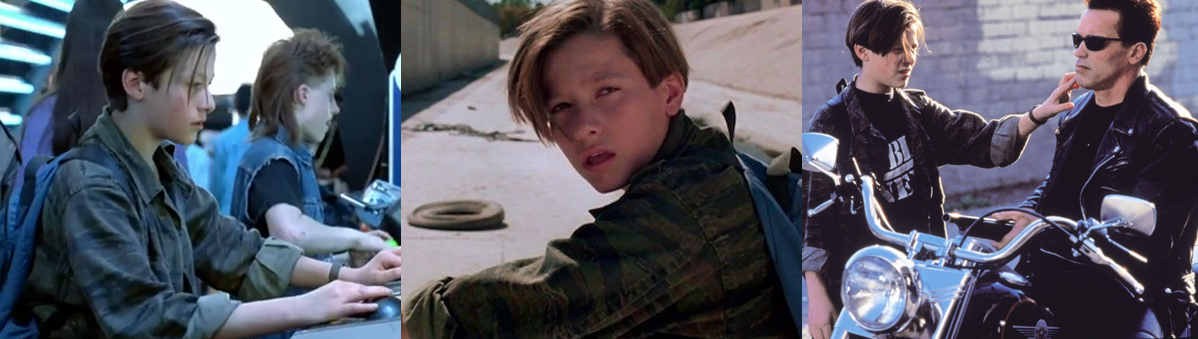
John starts the film as a delinquent who’s left guilt-ridden at confirmation of his mother’s tales.

At the start of the film, John is little more than a juvenile delinquent; frustrated by his mother’s harsh upbringing and subjecting him to a childhood that was anything but normal, he frequently defies his foster parents and is concerned more with ripping off cash machines using his hacking skills and spending stolen money in the arcades. Having grown up hearing all about his mother’s knowledge of the future and his destiny as the leader of the human resistance, John is well aware of the Terminator, Skynet, and the Future War but never actually believed in any of it. Consequently, he is both stunned, excited, and guilt-ridden when the Terminator arrives and confirms that everything Sarah told him was absolutely true. Determined to make amends for his lack of belief, John orders his protector to help him rescue her despite the obvious risks involved, and is heartbroken when Sarah rebukes his concerns and chastises him for putting himself at risk. Having grown up without a father, John has had to feel the anguish of his mother’s boyfriends and partners leaving over and over, leaving a void in his heart for a father figure that the Terminator fills with startling efficiency and, in the Terminator, John finds a friend, confidant, and partner with whom he can open up to, teach how to be hip and cool, and also the perfect weapon to assist in ensuring that the apocalyptic future never comes to pass.

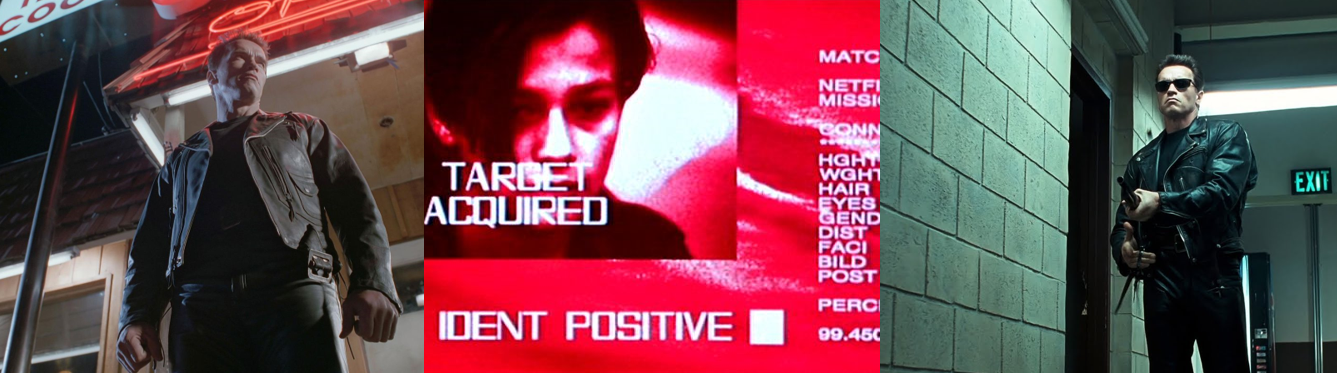
The Terminator makes a dramatic return, now a protector charged with securing humanity’s future.

Considering that the Terminator instantly became one of cinema’s most relentless and fearsome screen villains in the first film, the decision to turn that characterisation on its head and recast Schwarzenegger as a protector was an inspired move. Thematically, it works wonders for Sarah’s character arc; indeed, her cold-blooded focus on destroying Skynet makes her just as much of an uncompromising machine as her hated nemesis and one of the principal messages of Terminator 2 is that the titular machine ends up learning the value of human life and being more human than those who created Skynet in the first place. For the first twenty minutes or so, however, the film is shot in a way to suggest that the Terminator is the same emotionless killer from the first film, albeit now seen as this bad-ass villain who we can’t help but root for. It isn’t until the Terminator comes face-to-face with the T-1000 that we truly learn that this new T-800 is here to help John, rather than kill him. From that point on, the Terminator becomes a far chattier and more layered character than in the first film; it exposits information, unquestionably follows John’s orders even when it disagrees with the risk involved, and tirelessly works around the clock to keep him and his mother safe. Crucially, the Terminator is noted to be at an extreme disadvantage this time around; not only does the T-1000 have the same files and knowledge as the Terminator, it’s also faster and more advanced and a “far more effective killing machine”. This means that, for all the Terminator’s strength and capabilities, it’s rarely ever portrayed as being anything other than an inferior model. Like Reese, the Terminator is thus forced to flee more often than fighting and to adapt its tactics to utilise more than simple firearms to keep the T-1000 at bay, which goes a long way to furthering the Terminator’s new role as a vulnerable protagonist.

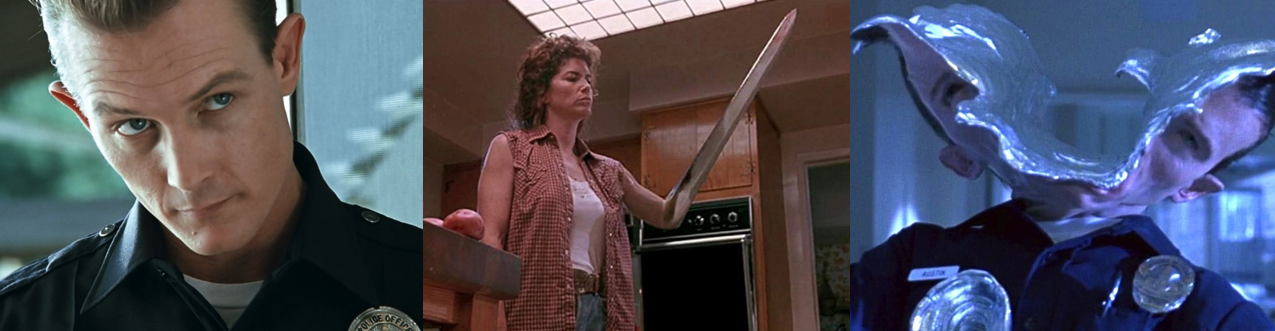
The T-1000 makes for an unnervingly human, relentless, and formidable villain.

In contrast, the T-1000 is so much more efficient that you would be forgiven for initially thinking that it was another slender human protector sent back to keep John from harm; effortlessly charming and deceptive, it can easily earn the trust of unassuming humans with its candid tones but, when that fails, it can shapeshift into a number of other forms to gain access to restricted areas, equipment, and weapons that the protagonists can’t. Once you set aside the pretty large plot hole of how a machine comprised entirely of liquid metal was able to make the trip back in time when the first film established that “nothing dead will go” through the Time Displacement Equipment, and the question of how it even operates if it’s entirely comprised of ever-changing atoms, the T-1000’s rules and limitations are surprisingly well thought out. It’s established that it can’t transform into guns or bombs because of the additional chemicals and parts that make those up, and than it can’t shapeshift into anything bigger or smaller than its default dimensions. This still makes it an extremely lethal killing machine, however, as it’s easily able to form knives and other bladed appendages out of its limbs, grow an additional arm to help fly a helicopter while reloading, and disguise itself as parts of the environment in order to assimilate additional organic data. As merciless and relentless as the original Terminator was, the T-1000 is made even more callous and terrifying through its nimble speed, its sheer tenacity, and the unsettling way it closes up wounds and returns to the fight within seconds of being downed.

Disgusted by the future his research threatens to bring, Dyson gives his life to prevent Skynet’s creation.

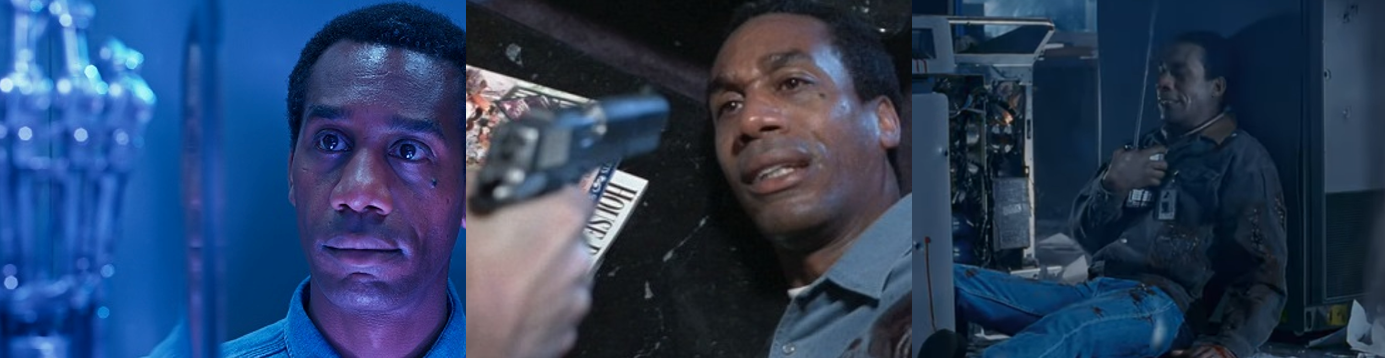
Although the T-1000 remains a constant threat in the film and is so significant as a danger that the Terminator transports its charges all the way to a desolate Mexican desert just to avoid the killer, Sarah’s obsession with preventing Judgement Day leads her to tracking down the man most directly responsible, Miles Dyson (Morton). A simple family man, Dyson has been led to a breakthrough in artificial intelligence and technology thanks to his research on the damaged CPU and severed arm of the original Terminator; these have allowed him to effectively begin the process of Skynet’s creation and unknowingly doom the world to near extinction, something that Sarah is so adamant about preventing that she very nearly kills him in cold blood. Thanks to seeing the monster she has become reflected in the eyes of Dyson and his family, she collapses into a mournful heap before she can go through with it, and Dyson is disgusted to learn where his research will lead. Immediately repentant, he agrees to get the group into the Cyberdyne building so that they can destroy all of his research; this is a poignant decision on his behalf as we clearly see how enthusiastic he was about his work and how he often prioritised it over his family life, however he becomes so willing to eradicate his research that he willingly sacrifices his life to ensure that Skynet can never be created.

The Nitty-Gritty:
It’s tough for me to decide which film I prefer out of The Terminator and Terminator 2: Judgment Day. As fantastic and influential and ambitious as the first film was, the sequel is bigger and better in every way; the score is more foreboding and haunting than ever as the T-1000’s droning theme raises the tension alongside the traditional Terminator theme to help punctuate the film’s many action scenes. Additionally, the special and practical effects are better than ever and the entire film just looks more expensive and of a higher quality; there’s something to be said for the gritty nature of the first film but it’s equally hard to deny the appeal of the sequel’s slick presentation.

The film’s practical effects are absolutely top-notch and deliver a disturbing vision of the future.

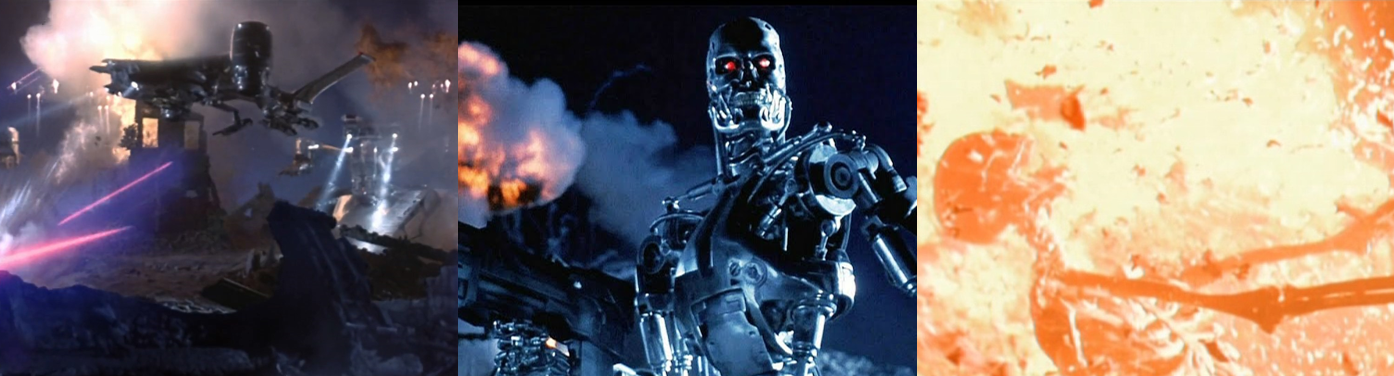
We see this immediately as the film opens on an incredible rendition of the Future War; we saw snippets of this conflict in the first film but, here, everything is so much bigger and more impressive. Even now, I find it difficult to believe that this is a complex combination of miniatures, models, and forced perspective to show Hunter-Killers and Terminators flawing, crawling, and marching along a field of skulls and wreckage and exchanging plasma fire with the Resistance fighters. This is the scene that made me want to see a whole movie set during the Future War and I still feel like this would have made for a more effective and fitting follow-up to the first two films; just imagine an army of CGI Arnolds marching through an apocalyptic wasteland while Brad Fiedel’s iconic, imposing score blares out? Similar effects are used to bring to life Sarah’s disturbing nightmares of nuclear holocaust; again realised using complex miniatures and puppets, these make for some of the most unsettling scenes of destruction in any film and remain as impactful as ever thanks to the sheer amount of time and effort than went into creation a realistic depiction of the end of the world.

A blend of CGI and practical effects help keep the T-1000 a timeless and terrifying screen villain.

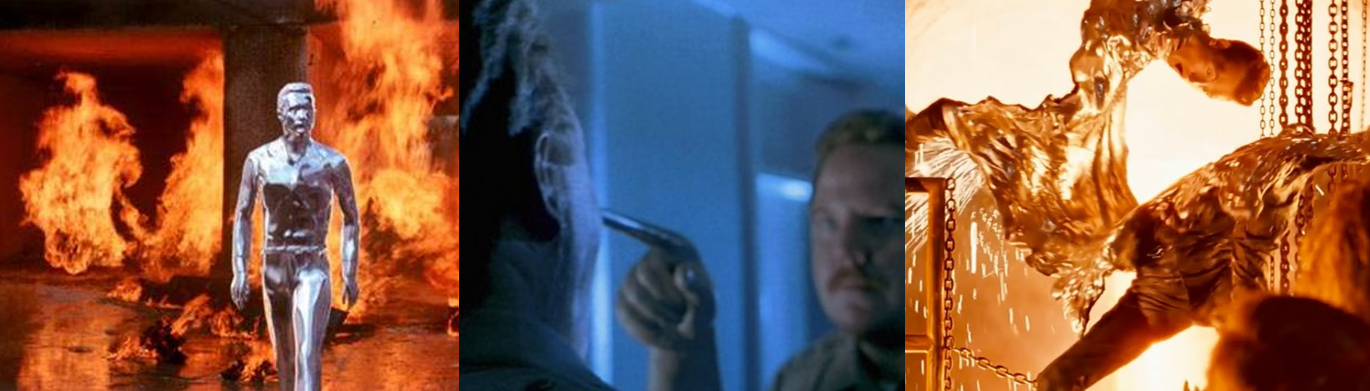
Of course, the true star of the show in terms of special effects is the T-1000; largely realised entirely through cutting edge CGI, the T-1000 is an unnerving screen villain that switches in a heartbeat from charming and affable to stoic and ruthless and we see in full detail how it is able to assume the form of those it touches and then dispose of the original with gruesome efficiency. I think what makes the T-1000 work so well is how often its more monstrous forms and sharp implements are represented using practical effects such as puppetry and animatronics that work wonderfully with the CGI effects (which still hold up to this day) so we can see the actor reacting to being shot and close range, cut to a squealing, twisted animatronic, and then marvel at the T-1000 zipping itself back together using CGI. Its abilities and aggression escalate as the film progresses, allowing it to start off largely employing subterfuge and then forming sword and claw-like appendages on its arms, being frozen into a fragile statue of pure disbelief at being bested, and finally being left as this wailing, grotesque mess of limbs and silvery innards before being sent crashing to the molten steel below. Considering that the T-1000 had been a great imitator of emotions and deception throughout the film, there’s something incredibly disturbing at seeing and hearing it thrash about in its death throws, screaming in agony and rage before finally melting away to nothingness with a look of undeniable anguish.

The special edition adds in a number of scenes that expand an already fantastic movie.

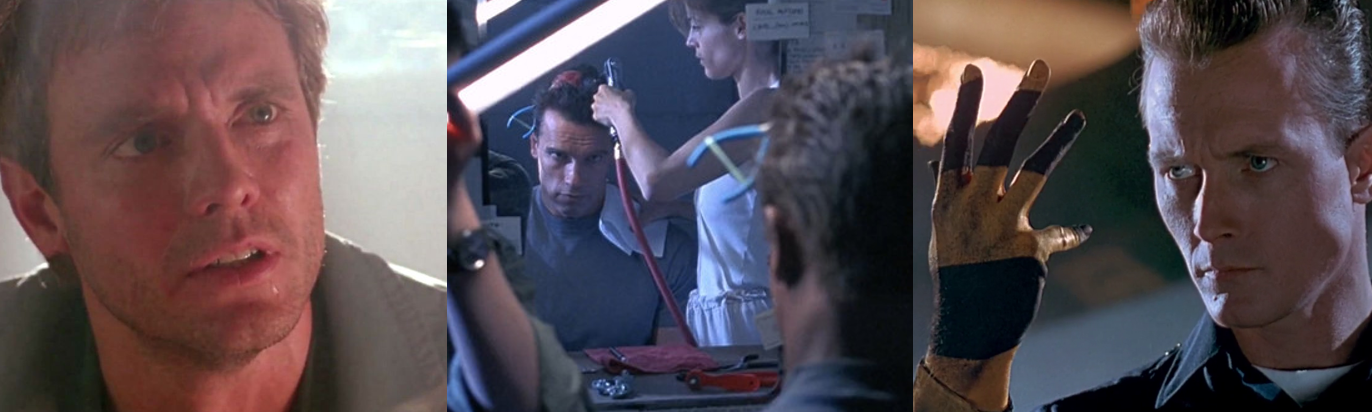
The Special Edition version of the film adds some additional footage that was cut from the theatrical version. This includes an earlier, short scene of Sarah’s nightmare of the inevitably nuclear war that consumes humanity and, as part of that, a sequence in which she is visited by Kyle Reese in a dream where he encourages her to get back into the fight and to protect John. As a big fan of Michael Biehn and Reese’s character, I enjoyed seeing this scene added back into the film; it also goes a long way to show just how deep Sarah’s fear and psychosis have progressed and lends some credibility to the argument that she’s been driven more than a little mad by her knowledge of the future and terror of the impending destruction of humanity. One of the longest and most impressive scenes reintegrated into the film is an alternative take on the Terminator’s reprogramming; in the theatrical version, the Terminator simply states that all of the T-800s are capable of growing beyond their programming but, here, Sarah and John have to open up the Terminator’s skull and extract its CPU so that it can learn to be more human. This is fantastically realised in a complex sequence involving a model of Schwarzenegger and Linda Hamilton’s twin sister, Leslie Hamilton Gearren, and features a tense confrontation between Sarah and John where he basically orders her to trust his instincts regarding the Terminator rather than destroying the CPU. Other scenes include a somewhat unnecessary shot of the T-1000 discovering that the Terminator tricked him and killing John’s dog, and an extended sequence near the end where, after being blown to pieces by the Terminator, it’s made more explicit that the T-1000 is malfunctioning. I’m a fan of this addition as well as it show just how traumatic being frozen and blasted into pieces was for the T-1000 and allows it to be a step slower and a bit more unreliable than usual; it may also go some way to explaining why it decided to try and intimidate Sarah into calling out to John rather than simply assuming her form as its shapeshifting abilities were clearly screwed up after reassembling itself.

The Terminator learns the value of human life and acts as a friend and father figure to John.

The extended scenes also add a lot more to the Terminator’s characterisation; a pivotal story arc of the film is the Terminator learning what it means to be human and taking on more normal mannerisms, such as smiling, quipping, and just considering the impact of mindlessly killing those in its path. When John first orders it not to kill, the Terminator is confused (disdainful, even) at the idea and is forced by its programming to simply follow John’s orders to the letter. It’s not until much later in the film, after it forms a bond with John, that the once terrifying killing machine understands why human lives are so valued and to be cherished. Until then, though, it takes its orders literally, resulting in scenes both amusing and bad-ass as it goes out of its way to wound or chase off the police with its weapons; seeing the Terminator as a straight “man” awkwardly trying to pass as normal makes for some of the film’s best and most amusing moments: its attempt at smiling is painful, the way it regards children is just fantastic, and it absolutely nails the nineties one-liners John teaches it to deliver some of Arnold’s most memorable quips. Even Sarah has to admit to being impressed with the machine’s absolutely devotion towards John; she even comes to trust it enough to leave John in its care as she goes off on her solo mission to kill Dyson and one of the most moving scenes in the entire franchise comes right at the end where she shakes the Terminator’s hand and gives it her respect.

The film culminates in a showdown wherein the Terminator sacrificing itself to prevent Judgement Day.

Indeed, the entire finale of the film makes for one of the most action-packed and emotionally charged I’ve ever seen, especially in a sci-fi action film; following the massive explosion at Cyberdyne and an absolutely incredible car chase that sees the protagonists desperately trying to out-run a helicopter and a truck full of liquid nitrogen, they’re forced into a final showdown at a steel mill. With Sarah wounded from a bullet to the leg and the Terminator’s human façade cracking from all the shots it has absorbed, they’re forced deeper into the red-hot facility when the T-1000 manages to recover from being frozen and blasted into pieces. We then get an absolutely brutal throwdown between the Terminator and the T-1000 in which no words are said and no sounds are heard except for the clang of metal on metal; here, we truly see how outclassed the Terminator is as the T-1000 effortlessly tosses it around and overwhelms it, smashing its face apart with a huge girder and then seemingly destroying it by impaling it on a spike. Thankfully, the Terminator comes with a back-up power source and it struggles back to “life”; despite missing an arm and being beaten all to hell, it manages to recover long enough to deliver the final blow to the T-1000, ending its threat forever, and their mission to destroy Skynet and prevent the future seems to have been accomplished after John tosses the first Terminator’s arm and CPU into the molten steel. However, the new Terminator still remains and John is absolutely distraught at the idea of his friend and father figure sacrificing itself to ensure the future; yet, despite his desperate pleas and orders, the Terminator’s destruction is the only way to end Skynet’s threat and so, after a heartfelt goodbye to them both, the Terminator is lowered to its demise in an absolutely heart-breaking sequence that sees this once relentless and remorseless killer cemented forever as one of cinema’s most beloved heroes.

The Summary:
It’s difficult to express in words how much I adore this film; I love the original, especially for how dark and gritty it is and how it’s much more like a horror film than a traditional sci-fi action flick but there’s no denying that Terminator 2: Judgment Day does everything bigger and better. The Terminator put Arnold Schwarzenegger on the map but its blockbuster sequel made him a mainstream star. After this, he would forever be cemented as the wise-cracking hero in action films for pretty much the remainder of his career as a film star. Not only that, Terminator 2 became the standard template for every subsequent movie in the franchise bar one; with the except of the under-rated Terminator Salvation (McG, 2009), all of the Terminator sequels and even the short-lived television series tried to emulate this film in some way, which has led only to a string of lacklustre productions as a result. Still, that doesn’t take away from how awesome Terminator 2 is; from Sarah’s physical and mental instability and transformation to the ruthless tenacity of the T-1000, to the incredible depiction of the Future War and the ground-breaking special and practical effects, Terminator 2 pretty much has it all. This extended version of the film remains the definitive version for me thanks to a much-appreciated cameo by Michael Biehn and expanding on scenes of our impending destruction and the two Terminators. Although it’s a longer movie at almost two-and-a-half hours, it’s an endlessly exhilarating experience from start to finish and I could honestly put Terminator 2 on every single day and never get bored; everything from the performances, the ominous score, and the explosive action is absolutely top-notch and it’s quite possibly the greatest film in the entire franchise and possibly Arnold’s career.

My Rating:

Rating: 5 out of 5.

Fantastic

What are your thoughts on Terminator 2: Judgment Day? How do you think it holds up today, especially compared to the first film and the other sequels? What did you think to Arnold Schwarzenegger’s performance in the film and did you enjoy seeing him cast as a protector this time around? What did you think to T-1000 and its abilities? Were you surprised to find the T-800 was the good guy this time and what did you think to the CGI and other special effects used to bring the T-1000 to life? How are you celebrating Judgement Day today? No matter what you think about Terminator 2, and the Terminator franchise, feel free to sign up and leave a reply down below.

Movie Night: Death Note 2: The Last Name

Released: 3 November 2006
Director: Shūsuke Kaneko
Distributor:
Warner Bros. Pictures
Budget: $20 million (estimated)
Stars:
Tatsuya Fujiwara, Kenichi Matsuyama, Erika Toda, Takeshi Kaga, Nana Katase, Shidou Nakamura, and Shinnosuke Ikehata

The Plot:
The battle of wits and wills between Light Yagami (Fujiwara) and the eccentric “L” (Matsuyama) is taken to the next level with Light joins a task force dedicated to stopping the murderous “Kira” but his delicate plot to advance his career as judge, jury, and execution with his mysterious Death Note is threatened when another killer notebook and Shinigami enter the playing field.

The Background:
Between 1 December 2003 and 15 May 2006, author Tsugumi Ohba and artist Takeshi Obata’s Death Note (or “DEATH NOTE” as it is stylised) was published in the pages of Weekly Shōnen Jump. Originating as a broad concept that saw Ohba visualising the panels in his downtime and Obata incorporating pacing and action into them, Death Note was incredibly successful and widely praised for its art, complex characters, and elaborate twists and turns. This popularity soon translated into an equally well-regarded anime that originally aired between 3 October 2006 and 26 June 2007 and was accompanied by two feature-length specials retelling the story with new footage in late-2007 and 2008, respectively. Director Shūsuke Kaneko didn’t take this task of creating a live-action adaptation lightly; he gambled on filming not one, but two movies back-to-back just to do the source material justice, and insisted on using computer effects to bring the Shinigami to life, which this time included the less mischievous and more good-natured Rem (Ikehata). Like its predecessor, Death Note 2: The Last Name topped the Japanese box office and received a limited overseas release, but far exceeded the first film’s box office with its worldwide gross of over $54 million. Critically, the film also performed notably better; reviews praised it as being stronger, delving much deeper into the characters, and greatly expanding the tension and intrigue between the two main characters. A somewhat divisive L-centric spin-off followed the film’s success, which later received a more direct miniseries and follow-up film in 2016 that also garnered mixed reactions.

The Review:
So, as mentioned in my review of the first film, I haven’t actually watched the original anime or read the Death Note manga, despite being tempted on many occasions to get into both. It’s definitely on my ever-expanding to-do list but, for now, I’m more than happy to call myself a fan of the franchise based on these two live-action adaptations. Again, I’m watching the original Japanese audio version with English subtitles, which isn’t my preferred way of watching Japanese media but it’s ever stunted my enjoyment of the film, and I distinctly remember first watching this sequel back-to-back with the first film years ago when they were included in a late-night double feature. And it’s a good job, too, for as good as Death Note was, it ends of a massive, tantalising cliff-hanger that cries out for further resolution, and much of that film was focused on establishing the rules of the killer notebook, the role of the Shinigami, and the degradation of Light Yagami’s morals. Beginning the last film as an intelligent, if overconfident, law student, Light quickly becomes intoxicated with the power of the Death Note; that many in the general public claim his actions as the murderous “Kira” as being the just work of God doesn’t help, and Light’s ego has become so immense that he’s willing to sacrifice friend, lover, and lawmen alike in order to keep himself from being exposed as the “God of the New World”.

Light is fully prepared to manipulate, and sacrifice, anyone to one-up L.

Death Note 2: The Last Name opens with a quick recap of the previous film and with Light having successfully manipulated events so that his girlfriend, Shiori Akino (Yuu Kashii), was killed in order to gain sympathy from his father, Detective Superintendent Souichirou Yagami (Kaga), and the task force he’s assembled to track Kira down under the supervision of the eccentric, renowned detective, L/ Ryuzaki. Playing the part of a victim of Kira’s brutal wrath, Light joins the team with the express intention of tracking down the man responsible for the deaths of his girlfriend and countless criminals, with none suspecting that he is the true culprit behind the mysterious deaths except for L. L has correctly deduced every piece of the puzzle and has all the evidence he needs, in theory, to pin Kira’s actions onto Light except for concrete proof and an explanation as to how he’s able to kill with just a glance. Because of this, Light is able to give L the run-around and stay one step ahead of him while secretly manipulating events with his Death Note to both take suspicion away from him and to learn L’s true name. Light could learn this simply enough by trading half of his lifespan for the Shinigami eyes, which would let her see the true name and remaining years of anyone he looks at, but e’s determined to usher in his new age and to outwit L with his mind. When another Kira (quickly dubbed “Kira II”) starts issuing threats and killing not just criminals but anyone who even dares publicly speak out against Kira, Light sees an opportunity to realise his goals by manipulating the new Kira to his advantage. So complete is Light’s arrogance that he even goes as far as to manipulate the film’s new Shinigami, Rem (Ikehata), to write new rules into the Death Note to bamboozle the Kira task force, and to surrender both his Death Note (and his memories of his actions as Kira) and himself to a period of isolation all to win L’s trust in order to learn his name and cement himself as the God of the New World.

Both Misa and Kiyomi are determined to continue what they see as Kira’s righteous crusade.

Young celebrity Misa Amane (Toda) is the new Kira in town thanks to acquiring her own Death Note. When she was just a schoolgirl, Misa came home to find her family slaughtered by a sadistic killer and became obsessed with Kira after her family’s killer fell victim to his judgement and she’s only too eager to continue his work, and publicly propose an alliance, as Kira II. While Light primarily targeted criminals, he was known for killing federal agents if they threatened to expose him, but Misa continues his work with a far more brutal flair, felling lawbreakers and lawgivers alike and even killing innocent people just because they speak out against Kira. Thanks to sacrificing half of her lifespan to acquire the Shinigami eyes, Misa is easily able to target and kill anyone and everyone who dares speak out against her hero; the eyes also allow her to deduce Kira’s true identity and seek Light out to forge an alliance, not just as co-Kira’s but also as lovers. Since Misa is absolutely besotted with him, Light is easily able to use her feelings and her naïvety with the Death Note to his advantage; Light agrees to the alliance simply to use Misa’s eyes to learn L’s true name but, sadly, Misa isn’t anywhere near as thorough as Light wen it comes to covering her tracks and ends up captured by L and his task force. With both of them having lost their memories as part of Light’s grand scheme, Misa’s Death Note falls to budding reporter and Kira supporter Kiyomi Takada (Katase); she’s also so pleased to have been chosen as Kira’s “partner” that she trades half her life for the eyes and kills indiscriminately to both continue his work and further her career, but is just as sloppy about covering her tracks and easily apprehended by the unmatched team of Light and L. This allows Light to regain his memories and, in a flash, sacrifice Kiyomi and pin all of Kira’s murders on her in a perfect loop; it also completes the puzzle for L and the task force as they touch the Death Note and become aware of the Shinigami, though this also raises the question of how they’re going to explain that literal Gods of Death and killer notebooks are behind the recent murder spree.

Even with two Shingami to contend with, Light’s main concern is learning L’s true name.

Speaking of which, Ryuk returns, still following Light around and offering commentary, taking amusement in his game of cat-and-mouse with L, and enjoying apples as and when. Thanks to Light having to constantly be on guard and hide his true intentions, Ryuk grows bored and frustrated, and basically disappears for a big chunk of the middle of the film after Light gives up the Death Note and his memories of it. There’s also a new Shinigami on the block, the androgynous Rem; this skeletal, far less mischievous Shinigami is Misa’s constant companion and is watching over her in place of her friend, the diminutive Shinigami Gelus, who had taken a shine to Misa and committed the cardinal sin of protecting her from an obsessive fan with his Death Note, thus dooming himself to oblivion. Unlike the cheeky and outspoken Ryuk, Rem is soft-spoken and fiercely loyal; she vows to punish anyone who threatens Misa and is even forced to turn herself to dust to save Misa’s life after Light manipulates events to put her in danger, which again adds credence to Light’s monstrous nature. The Shinigami are exposed to L and the task force, first through mentions dropped by Kira II, then by observing Kiyomi, and finally after touching the Death Note and conversing with Rem. Interestingly, while Light was stunned by Ryuk’s presence and Misa was awestruck by Rem’s, L initially reacts with a mixture of dear and incredulity. Once he accepts that the Shinigami are real, he’s satisfied that he’s finally wrapped up this strange case, which sees him reluctantly join forces with Light after his nagging suspicions cannot be proven and then subject both Light and Misa to near-torturous isolation in a bid to force a confession rom them. As ever, L’s deductive reasoning is almost supernatural; he’s able to correctly guess everything that’s happening, even without proof, as though he’s read ahead in the script, but even he can’t predict the lengths of Light’s depravity and it costs him dearly when his mentor and father-figure, Watari (Shunji Fujimura), falls victim to the Death Note after Misa is threatened.

The Nitty-Gritty:
Thanks to Light now being officially integrated onto the task force, there are far more face-to-face interactions between him and L this time around. The two play chess, literally and figuratively, against each other, with each throwing out accusations, explanations, and questions in a bid to outwit the other. Even if he couldn’t manipulate life and death with the Death Note, Light is extremely thorough at covering his tracks; he has not only won the support of his father and colleagues thanks to sacrificing Shiori but he has cold hard facts on his side since L cannot pin anything on him, nor explain how he could kill so many so easily as Kira. When Kira II surfaces, Light sees an opportunity to shunt suspicion from him completely and throws himself into the investigation after his sister and father almost fall victim to the new Kira’s wrath. Similarly, he orchestrates events to place Kiyomi into the firing line and, free from his memories of the Death Note, proves himself just as capable a detective as L by cobbling together graphs and data to pinpoint who these new Kiras are. When Light gives up his memories, we see him briefly return to his pre-Death Note character and get a sense of how deeply the book has corrupted his morals and intelligence; for a short time, we see how positive a force he could be, especially when he and L unite against the new Kiras, which only makes his devilish turn back to a callous puppet master all the more harrowing after he regains his memories and is revealed to have manipulate man and Death God alike to his own ends.

Light freely manipulates others, Death Gods, and even himself to outwit L.

The nature of the Death Note and the Shinigami realm is delved into a little more here; as before, the book is filled with rules regarding its use, though Misa and Kiyomi don’t utilise its true potential in the same way that Light did and are content to simply jot down names and cause their victims to die from heart attacks. We get to briefly see the Shinigami world, a desolate realm where the Gods of Death watch humans and live off the years of those they write in their notebooks. The Shinigami cannot use their Death Notes to prolong lives, however, and doing so causes them to turn to sand, as it does to Gelus and, eventually, Rem. As in the first film, the world is dividing in their opinion of Kira. Well, not quite divided, as Kiyomi’s research shows; not only does a sizable percentage of the country support Kira, prominent members of the government have also taken to praising the murderous vigilante. Even Kira’s strongest supporters are shocked, however, when they witness his brand of justice first-hand and when Kira II effectively holds a news station hostage to both deliver a warning to any who would dare oppose Kira in any way and to broadcast a series of live executions. Thankfully, Misa is so besotted with Light that she not only agrees to follow his every order and to kill anyone he asks but she also gives her Death Note to him in order to win his trust. Realising that he can use her to learn L’s new, Light reluctantly agrees to enter a relationship and partnership with her, though he cares little for her or the fact that she’s sacrificed half her life for him (she’s so devoted to Light that she does this again after regaining her memories since she’s forgotten L’s true name and lost the Shinigami eyes when she gave up her Death Note). When Misa resumes her killing spree, she immediately makes herself a target once more and, when the shrewd L is able to figure out that Kira has added fake rules to the Death Note, Light is forced to take even more extreme measures in order to protect himself, remembering his true callous nature and even writing his own father’s name in the Death Note.

In the end, Light is outsmarted but it’s a hollow victory for the doomed L.

Light’s obsession and delusions come full circle by the finale. He fully believes he’s a God now, and it’s hard to deny it given how he’s able to puppet people around with the Death Note, but he ultimately falls victim to his own arrogance and having vastly underestimated L’s deductive abilities. L tricks Light with a fake Death Note, and even fakes his own death at Light’s hands in order to learn the horrifying truth behind his duel identity, all to bring Light into the…well, the light… and expose him. With Light having hidden a piece of the Death Note in his watch and jotting down names with his own blood as and when people threaten to expose him, the game of one-upmanship between him and L escalates to the point where L is forced to his own name in the Death Note in order to circumnavigate his murder at a Kira’s hands and confront Light alongside a shame-filled Souichirou. Held at gunpoint and with nowhere left to run and no excuses left, Light refuses to bow acknowledge L’s intellectual superiority and spits criticism of his father’s broken system and the failure of the law to match the impact he had as Kira. After all his machinations and desperate attempts to cover his tracks, Light’s true nature as a reprehensible, egotistical, power-mad killer rise to the surface during this dramatic finale, which sees his sneaky watch destroyed and leaves him with a bullet in his leg. Raving about his destiny to be the saviour of a new, crime-free world, Light is so convinced of his superiority and Godhood that he outright demands that Ryuk kill everyone present and bend to his will and, in doing so, seals his fate. While the Shinigami will die if they protect humans, they are able to take lives using the Death Note and, similar to how Ryuk despaired of Light’s lack of humanity and compassion at the end of the last film, the Shinigami is somewhat disgusted to see the once intelligent and adaptable Light reduced to begging for supernatural help and writes his name instead. As Light enters his death throes and spits declarations of his he’ll be remembered as a hero, Ryuk solemnly informs him that Death Note users are doomed to limbo rather than going to Heaven or Hell. Sadly, there’s no way to save L; having arranged for his peaceful death, L quietly passes away a few days later after expressing his gratitude and appreciation to Souichirou. Though Souichirou condemns his son’s actions, the official word is that he died by Kira’s hands and that Kira’s reign of terror is finally over, leaving Light’s family mourning their loss, Misa with no memory of her love or the Death Note, and the cackling Ryuk free to cause further havoc as he sees fit.

The Summary:
It’s honestly a little tough for me to pick with is the better film between Death Note and Death Note 2: The Last Name. The first is maybe a little more cerebral in its focus on showing how the Death Note twists Light into this cruel and arrogant murderer, while the sequel is full of twists and turns and an escalating cat-and-mouse between L and Light. Ultimately, I’d highly advise watching both back-to-back as they’re clearly intended to be two parts of a larger whole. While the first film includes more variety in the use of the Death Note, the second really shows just how adapt Light is with the notebook since his would-be successors are sloppy and unimaginative. Both Misa and Kiyomi use the Death Note indiscriminately, lacking even Light’s skewed moral code, and think only in the short-term, giving up half their lives simply because it’s easier to use the Shinigami eyes than to figure out other ways of targeting and killing their victims. I enjoyed the addition of Rem and the brief glimpse into the Shinigami realm and life; she and Ryuk remain a captivating and visual highlight and its fun seeing the differences between the two, with Rem being more stoic and sombre and Ryuk being this cackling maniac at times. The true draw of the film is the intense back and forth between Light and L; it’s maddening seeing that L has figured everything out except for the means and I enjoyed seeing the strange friendship between the two, which is made all the more awkward as L is so peculiar and never truly gives up his suspicions about Light. The two are constantly one-upping each other, with Light seeming to be one step ahead of everyone, but seeing L sacrifice his own life in order to expose Light and watching Light descending into raving vitriol was a truly cathartic moment. While Light may have had a point about the unjust legal system, his superiority complex and sheer lack of empathy ultimately made him no better than his successors and worse than a literal Death God. This results in him become a tragic anti-hero of sorts who fully deserves to be brought down, but there’s little celebration surrounding Light’s death and, indeed, the film ends with the suggestion that Kira’s death has cause crime to increase once more, leaving the moral ambiguity of his actions up for debate.

My Rating:

Rating: 4 out of 5.

Great Stuff

What did you think to Death Note 2: The Last Name? If you’re a fan of the anime or manga, how did it work as an adaptation for you? What did you think to the changes made to the source material? What did you think to the new Kiras and how they differed from Light? Were you a fan of the cat-and-mouse game between Light and L? What did you think to Rem and Ryuk and the way they were manipulated by Light? How would you use a Death Note? Whatever your thoughts on Death Note, feel free to share them in the comments or on my social media.

Game Corner [Spidey Month]: Spider-Man (PlayStation 2)


Easily Marvel Comic’s most recognisable and popular superhero, unsuspecting teenage nerd Peter Parker was first bitten by a radioactive spider and learned the true meaning of power and responsibility in Amazing Fantasy #15, which was first published in August 1962. Since then, the Amazing Spider-Man has featured in numerous cartoons, live-action movies, videogames, action figures, and countless comic book titles and, in celebration of his debut and his very own day of celebration, I’ve been dedicating every Friday of August to talk about everyone’s favourite web-head!


Released: 16 April 2002
Developer: Treyarch
Also Available For: Game Boy Advance, GameCube, PC, and Xbox

The Background:
There was a time when it seemed like every single cinema release had to be accompanied by a videogame adaptation; big-budget movies, especially, were often released alongside a hastily created videogame tie-in that often failed to properly capture the spirit of the film they were based on. As the flagship character of Marvel Comics, Spider-Man has a long and varied history with videogame adaptations across a variety of platforms so it was perhaps no surprise that Sam Raimi’s 2002 live-action $825 million blockbuster would be accompanied by a videogame tie-in. To be fair, Spider-Man benefitted from that fact that it was developed by Treyarch, who had previously had success with the character; indeed, much of Spider-Man’s combat and level progression was based on Treyarch’s previous Spider-Man game. This was reflected in the game’s reception as Spider-Man became the fifteen highest-selling videogame of 2002 and enjoyed high scores across all platforms. While some reviews criticised the game’s claustrophobic indoor sections and short length, it was generally regarded as the best Spider-Man videogame at the time of release. I remember buying the game for the GameCube after seeing the movie, having been won over by the game’s trailer and the film itself, but being underwhelmed by it after playing it to completion so I’m curious to see how it holds up today after the success of Spider-Man’s subsequent videogames.

The Plot:
After being bitten by a genetically-enhanced arachnid, high school senior Peter Parker finds himself endowed with the proportional strength and agility of a spider, and, when his beloved Uncle Ben is killed due to his irresponsibility, Peter puts his spider powers to good use as a masked crimefighter. After failing to capture and study this “Spider-Man”, who overcomes a variety of costumed menaces and robots, Doctor Norman Osborn transforms himself into the web-slinger’s most dangerous threat yet: the maniacal Green Goblin!

Gameplay:
Spider-Man is a third-person action game with a primary focus on beat-‘em-up action but which also includes a fair amount of web-slinging and a little bit of awkward stealth and extremely simplistic puzzle solving. As you might expect, players assume command of Peter Parker; the game begins right after Uncle Ben has been shot and at the very beginning of his crimefighting career as Spider-Man, and players are given a number of standard options when it comes to combat: X lets you jump and you can press it again in mid-air for a double jump, while Square throws a punch and Circle unleashes a kick. You can mix and match these button inputs to execute quick combo attacks (which you can review from the pause menu), and pressing either button near certain objects will allow you to pick up and throw them at your enemies. Of course, it’s not all about beating up random thugs across the city; at any time, you can press R2 and Spider-Man will start slinging webs (yes, they just attach to nothing, get over it) and won’t stop until you press X or slam into a wall. You can hold down R2 to speed up your web-slinging, though this does limit your turning ability, and you can press R1 to quickly zip upwards or straight ahead on a web zip-line; you can also press L1 to lock onto enemies, which is super useful when you’re swinging around and asked to attack enemies in mid-air.

Spidey can use his webs to attack his enemies but, unlike in the film, is limited by web fluid.

Spider-Man will automatically save himself with his webs if you fall while traversing the city rooftops and will automatically climb walls when close to them, though you can press the left analogue stick to enter a crawling state and the camera does tend to get very jerky and annoying when you’re clambering around on walls and ceilings as your perspective can get turned around pretty easily. If you’ve played the fantastic Spider-Man (Neversoft, 2000), you’ll be immediately familiar not only with Spider-Man’s combat and web-slinging but also with his web-based attacks. Pressing Triangle sees Spidey shoot out a quick web, but holding it allows him to web enemies up; if you press up, down, left, or right on the left analogue stick (or directional pad, if that’s your preference), Spider-Man will send out a high-impact ball of webbing, yank his foe towards him, wrap his hands in webbing to increase his punching power, or create a web dome to shield himself and send enemies flying with a press of X. You can also switch to different control styles that see you utilise the other face buttons for these commands, but you’ll find that these web attacks consume your web fluid (represented as a blue bar under your life meter), which is very strange considering Spidey had organic webbing in the film. Spider-Man can also dodge incoming attacks by using the left stick in conjunction with X to hop out of danger, though I found this to be awkward at best and unreliable at worst, and you can even press in the right analogue stick to look around and set your target for a zip-line.

Web-slinging sections see you using the compass to chase villains, rescue civilians, and disarm bombs.

All of these controls and gameplay mechanics can be reviewed in an optional tutorial mode, where the legendary Bruce Campbell snarkily talks you through all of Spider-Man’s abilities, and you’ll find question mark hints occasionally dotted around levels to help you out as and when. Like the 2000 game, Spider-Man is basically divided into two distinct gameplay styles: one sees you out in the city, swinging about the place, and the other sees you confined inside buildings. When out in the city, you’ll need to make use of a compass to navigate towards your next objective or keep track of your current target; you need to use this in conjunction with a Height Meter that shows your position compared to that of your objective, which can be a very clunky system as it’s not always clear where you need to go. Basically, just follow the compass direction until it flashes white, and then try to orientate yourself up or down to get to where you need to go, but invariably your compass will be absent when inside buildings. When web-slinging around the city, you’ll be tasked with hunting down thugs and putting a beating on them until you find information on where you need to go, racing after a target as they fly away from you, hunting down bombs or taking out robotic drones (often against a tight time limit), rescuing civilians from harm, and using your webs to secure water towers, bridges, and other objects to stop them from hurting civilians. When trying to keep track of a specific target, you really need to make use of the lock-on feature or else it’s very easy to lose sight of them and thus fail the mission; I also found that spamming Triangle was the fastest way to actually attack enemies in mid-air, but of course this will drain your web fluid. Luckily, the pick-ups that refill your health and web fluid will respawn so you can swing back over and grab them if you need to, but this will cost you time and probably see you fail your objective. Checkpoints in Spider-Man are few and far between; you can only save your progress after completing a level and, if you die or fail your mission, you’ll have to restart from the beginning of the level, which can lead to you repeating frustrating sections again and again.

Spidey must crawl and fight around claustrophobic interiors using a clunky stealth mechanic.

When confined to the interior of buildings, the game introduces a clunky stealth element; when Spider-Man is in certain shadows, the face on his heads-up display will turn dark blue and he’ll be hidden from enemies. This is essential to safely sneaking past cameras and enemies in many levels; though you won’t fail the mission if you’re spotted, an alarm will be raised and mechanical Super Soldiers will relentlessly chase after you, forcing you to quickly zip away and find a shadowy area to wait out the alarm. One of the most common tasks when in these claustrophobic areas will be heading through or acquiring keys to unlock doors; these doors can be difficult to identify as the areas are so bland and boring, and the enemies holding the key tend to be a little tougher than the usual mooks. Other times, you’ll need to use X to activate consoles, sometimes in a certain order, acquire codes from active PCs, web-zip past steam vents or through laser trip wires, and zipping up into vents to awkwardly crawl around and progress further. These levels also have much more focus on grounded beat-‘em-up combat, but the game quickly emphasises that discretion is the better part of valour and you’ll be tasked with deactivating security walls and laser traps in order to progress a little safer. The game comes with a number of different difficulty modes that obviously make enemies tougher and increase the game’s challenge; completing the game on higher difficulties also allows you to unlock additional content, which can be further unlocked by acquiring points for your combat, stealth, and level-completion strategies.

Graphics and Sound:
Obviously, Spider-Man is a videogame tie-in that came out on the PlayStation 2, so you can’t expect super high-quality in-game or cutscene graphics. However, Spider-Man is reasonably impressive and I can see why people would have considered it the best Spider-Man videogame at the time; New York City is rendered as a large map and even subject to rain and lightning storms and rendered in both day and night-time depending on the level you’re playing. However, it’s not a sprawling open world with numerous side quests or non-playable characters to interact with; although you can see traffic moving down below, you can’t go down to street level and the city is basically completely lifeless save for thugs, bosses, and a few civilians in need of rescue.

Environments can be quite bland and lifeless but some shine through weather and lighting effects.

The interiors are where the game really fails to impress, however; you’ll explore such dynamic and exciting areas as…a bland warehouse, the sewers and subway tunnels, and the high-tech Oscorp building. This latter is easily the most visually impressive and interesting of all of the game’s environments, inside or out; while it is a bit confusing as every area looks grey and bland, it’s given some variety with some blinking lights, laser traps, and different rooms containing consoles and power generators. Another interesting area is a bank, though you’re only really in here for one boss battle, and you’ll even be treated to a very mediocre interpretation of the balloon parade from the film, which includes a single inflatable panda bear and a sequence where you crash down through skylights while battling the Green Goblin, and of course conclude the game in a showdown on the Queensboro Bridge.

Cinematics are quite blurry and the awkward in-game cutscenes are quite laughable.

While the game’s thugs and enemies aren’t much to shout about, being largely generic and unimpressive, Spider-Man is rendered quite well despite every character model appearing as a stiff mannequin. Spidey does little hops and flips when climbing over ledges, assumes comic-accurate poses when left idle, and even busts out fancy animations when web-slinging that closely emulate the film. The game uses both pre-rendered and in-game graphics for its cutscenes, with the pre-rendered ones obviously being the more impressive of the two; the in-game models don’t even move their mouths and the voice acting is more miss rather than hit. Tobey Maguire, especially, sounds more wooden and awkward than ever, especially when trying to deliver quips as Spider-Man, and the game is sadly completely lacking Danny Elfman’s awesome and iconic score. The music that does play during levels is generally suitable enough, if a bit generic, but it does clumsily and noticeably loop, which just screams of low production values, and of course you’ll be faced with the long load times symptomatic of that era of videogaming.

Enemies and Bosses:
Spider-Man is faced with a number of nameless, faceless, disposable goons as he swings around the city and tries to use his powers responsibly; at first, he’s tasked with tracking down Uncle Ben’s killer, who here is interpreted as part of the Skulls gang, so you’ll be beating up unscrupulous street thugs in the early going. Some of these have pistols to defend themselves with, and they’ll also put up a block to defend themselves against your attacks. These thugs get a reskin as guards working for Oscorp who must largely be avoided and webbed up to stop them from raising the alarm and bringing in the Super Soldier robots. Wile Osborn’s miniature Spider Slayers are annoying robotic enemies who zip around on claw-like lines and try to roast you alive, these Super Soldiers are a massive pain in the ass. They relentlessly hunt you down, blasting at you with explosive bolts that are near-impossible to avoid, and the levels can be so restrictive that you’re better off just restarting the level rather than trying to desperately find shadows to hide from them.

After tracking down his uncle’s killer, Spidey must avoid the Shocker’s blasts in the city sewers.

Spider-Man’s first mission is to hunt down Uncle Ben’s killer; after beating up a bunch of his fellow gang members, Spidey finally tracks him down and faces off with him, only to be blasted full-force in the face over and over by the murderer’s shotgun! The killer sets a precedent for the game’s boss battles in that he, like all of the other bosses, is spry and tough enough to shrug off, dodge, and no-sell all of your web attacks except for the web-hands, so you’re best bet is to zip up to the ceiling and stay out of his sight, blasting at him with your impact webbing or dropping down to deliver a beatdown when he’s suitably confused. After a quick side quest where you swing around towards red balloons to take snapshots of Spidey for the Daily Bugle, you’ll need to rescue security guards being threatened by Herman Schultz/The Shocker. Once they’re safe, you’ll pursue him into the sewers and subway tunnels, where he’ll send blasts of concussive sound at you that you’ll need to dodge using your web-zip; this isn’t too much of a challenge to overcome and, afterwards, you’ll get to face him in combat. The Shocker launches projectiles of sound at you and can protect himself with a devastating whirlwind of damaging soundwaves, but was actually easier for me to pummel into submission than Uncle Ben’s killer.

After making short work of the Vulture, you must defend and then subdue the maniacal Scorpion.

Spider-Man’s next test comes when Adrian Toomes/The Vulture robs a bank; Spider-Man first chases after the Vulture by progressing vertically up a tower that catches fire and sees you slipping through holes and under stairs to zip your way upwards, then you need to chase after him as he flies away through the city and puts citizens at risk. Finally, the two face off in the skies around the Chrysler Building as rain and lighting fill the arena; Spidey must fire webbing at the Vulture while avoiding his charges and attacks in order to force him to land so he can put a beating on him, making him the easiest boss of the game by far. Afterwards, Spidey crosses paths with MacDonald “Mac” Gargan/The Scorpion, who just randomly appears out of nowhere; at first, you’ll need to protect him from Oscorp’s miniature spider-bots but then he turns against you and forces you to fight him. This is quite a tough fight even on Easy mode as the Scorpion leaps and scrambles all over the place, blasting at you with his tail, and grappling with you whenever you get close to him. It’s best to keep your distance and fire off impact webbing from afar, and then dodge his attacks so you can hit a few combos on him and put him down. Fittingly, the Green Goblin is the game’s most recurring villain and, though you won’t encounter him face-to-face until you’re halfway through the game, he more than makes up for it in his appearances; the first time you face him, you need to avoid his glider attacks and missiles and rescue Mary Jane Watson from the aforementioned panda balloon before battling him head-on.

As annoying as Oscorp’s mech is, the Green Goblins persistence and aggression is even worse!

Whilst on his glider, the Green Goblin is basically a tougher version of the Vulture as he flies around tossing pumpkin bombs and firing bullets and missiles at you, forcing you to fire off your webbing or striking at him when he comes close. Afterwards, you’ll have to chase after him and web up parts of the environment that he damages, before forcing him through a skylight for some ground combat. These fights are easily the toughest of the game as the Green Goblin bombards you with pumpkin bombs, blinds you with flashbangs, and can easily choke the life out of you and snatch you out of the air. Your best bet is to stick near the respawning health power-up, dodge his combos and hit some of your own, and blast him with impact webbing whenever you can. Afterwards, you’ll be forced to swing across the city against a time limit disarming his bombs, which is an annoying mission thanks to the janky compass and drones flying around the city, then destroy fifty of his Razor Bats before taking a detour through Oscorp and battling a giant mech. Before you can attack this directly, you’ll need to desperately swing around the enclosed arena destroying shield generators and being pummelled by missile turrets, constantly spawning drones, and avoiding the mech’s gigantic laser. Thankfully, there’s plenty of pick-ups in the area and the mech goes down pretty easily with a few web shots once the shield is lowered. Afterwards, you’ll have to chase after the Green Goblin as he flies off with Mary Jane and tosses explosive traps in your way, before finally facing off with him on the Queensboro Bridge. After getting Mary Jane to safety, you then need to repeat the same tactics as in the first couple of fights against him but now in the same battle; swing around firing webs at him to ground him and then dodge his melee attacks to land a few combos, but watch out for his big bomb blast attack. By this point, you should know how to dodge and go grab a pick-up when needed, and I know I found finishing the Green Goblin off actually easier than the first fist fight with him. After you end him, Mary Jane awkwardly gives Spider-Man a big ol’ snog on top of his mask while they stand over the lifeless body of Peter’s best friend.

Power-Ups and Bonuses:
Unlike in pretty much every modern videogame, Spider-Man is not blessed with regenerating health; as a result, you’ll need to pick up red and red-and-blue Spider Icons to restore half or all of your health. Also, like in the 2000 game, Spider-Man can run out of web fluid so you’ll need to grab blue and blue-and-silver Spider Icons to refill this bar. As mentioned, I find this an odd inclusion as Spider-Man had unlimited organic webbing in the movie but I guess it makes sense to keep him from being too overpowered. Luckily, these restorative pick-ups respawn after a while so if you find yourself struggling against a particular boss, you can usually backtrack or swing back around to collect a pick-up and keep yourself from losing a life. If you search around your environments, you’ll also find gold Spider Icons that will unlock additional combos to add to your repertoire, but that’s about it in terms of power-ups; you don’t earn experience points and can’t upgrade any of Spider-Man’s abilities or pick up temporary power-ups, meaning you basically end the game exactly as you started it but with maybe a few additional combos.

Additional Features:
If you visit the game’s ‘Gallery’, you’ll be able to view movies and artwork for the game, and you’ll be able to revisit any level you’ve cleared from the main menu as you progress. As mentioned, you’ll receive points every time you clear a level; these are awarded for your combat variety, stealth, and the amount of damage you take. Once you hit a certain number of points, you’ll automatically unlock some additional content from daft stuff like big hands and feet and exaggerated ragdoll physics to skins for Spider-Man, such as his wrestler outfit and acclaimed artist Alex Ross’s rejected design for the movie suit. You can also unlock a Peter Parker skin and enter cheat codes to play as guys like the Shocker and other enemies, though they all play the same as Spider-Man and don’t change the story in any way.

There are a number of cheats and unlockables, including a fully playable Green Goblin!

However, if you beat the game on the “Hero” difficulty, you’ll unlock the ability to play as Harry Osborn under the guise of the Green Goblin! This eliminates the pre-rendered cutscenes and alters the plot somewhat as this story picks up after the conclusion of the game and sees Harry take up his father’s mantle to research his death, and gives you access to an entirely new set of abilities. The Green Goblin can’t web-sling or climb walls but, with a press of R2, you’ll hop onto his glider and can rocket around the place at will; you can fire bullets, missiles, and bombs while on the glider, but your weapons will overheat in time so you’ll need to wait for them to cool down. On the ground, the Green Goblin’s melee attacks are the same as Spider-Man’s but, in place of webs, you have access to pumpkin bombs and Razor Bats and can race around on rocket boots like a madman to send enemies flying! Honestly, this was an incredible addition to the game and is a great way to encourage a second playthrough that adds an extra layer of challenge to the game as the Green Goblin can’t hide in the shadows, but can jump on his glider to blast enemies with missiles even when inside the most claustrophobic environments!

The Summary:
I remember being so hyped for Spider-Man’s first big-screen adventure, and so won over by the trailer for the videogame that ran before the film, that I went out and bought this for the GameCube that same week (if not that same day). I also remember finishing it pretty quickly, and this second playthrough was no different; as is the case with almost every videogame tie-in to a movie, Spider-Man isn’t an especially long game; levels aren’t built to allow exploration and are incredibly linear, so all you’ll have to worry about is trying to cope with how bland and similar the areas can look in each level. There’s also not a huge amount really asked of you; maybe you need to activate a console here and there, or input a code to open a door, or rescue a civilian, but these instances are few and far between and the game soon falls back into a routine of either web-slinging or clunky stealth sections. “Clunky” is the best way to describe this game; Spider-Man controls like he thinks he should be using tank controls, the camera and mechanics make web-slinging and wall-crawling very cumbersome at times, and your combos and dodging abilities are severely limited, making everything quite basic and monotonous. This may explain the game’s short length, as it’s over before it can become truly mind-numbing, but some levels are more frustrating than others; the stealth system is poorly implemented and it’s disappointing to see Spider-Man restricted to claustrophobic interiors rather than free to swing around the city. Basically, the game is a reskin of the 2000 Spider-Man title but stripped back in terms of bonuses, unlockables, and variety; there’s some fun to be had here, mostly in how cheesy the dialogue and cutscenes are, but you’re not really missing much if you skip this one for one of the many other Spider-Man games available even on the PlayStation 2.

My Rating:

Rating: 2 out of 5.

Could Be Better

Have you ever played the videogame tie-in to Spider-Man? Which console did you buy it for and were you impressed with it back in the day? What did you think to the web-slinging and combat mechanics? Which of the enemies added to the game was your favourite and would you have liked to see the likes of the Vulture and the Scorpion in Raimi’s films? What did you think to the game’s stealth gameplay and the unlockables on offer? Which Spider-Man videogame or movie adaptation is your favourite? Sign up to leave a reply below or drop a comment on my social media to share your thoughts on Spider-Man.

Author’s Spotlight: Lynda McKinney Lambert Interview

Lynda McKinney Lambert, author of Songs for the Pilgrimage, First Snow, and others

– First, introduce yourself a bit. What is your name (or pen name) and where are you from?

Lynda McKinney Lambert, Ellwood City, Pennsylvania. I am a retired professor of Fine Art and Humanities, Geneva College, Beaver Falls, PA. I retired in 2007, after sight loss. I am currently writing full time, now that I am retired from my teaching career at the college. I balance my days between writing and making art in my studio though the use of adaptive technologies for the blind.

Next, tell us a bit about your most recent work. Is this your first published book? What is it about and what genre would you classify it as?

My newest book is Songs for the Pilgrimage (DLD Books, 2021). This is a collection of poetry, journal entries, reflections, and non-fiction memoirs. The work in this book spans a period of writing from 1988 to 2021. I began writing poetry while working on My BFA degree in painting in the mid to late 80s.

Eventually, I spent an entire year in 2020 reading through my journals from 1988 to 2020. I developed this book over the year of exploring my art and writing history through my journals and memories. Themes are travel, dance, music, art, history, nature, faith

Did you go the traditional route when publishing your book or did you choose to self-publish?

Three of my five published books were created by DLD Books, Denver, Colorado. The three books edited and designed by this team are:

Walking by Inner Vision: Stories & Poems, 2017
Star Signs: New and Selected Poems, 2019
Songs for the Pilgrimage, 2021.

My chapbook, First Snow, was published by Finishing Line Press and is a collection of thirty wintry-themed poems, 2020.

My first book is Concerti: Psalms for the Pilgrimage (Kota Press, 2002).

– What would you say is the most challenging part of your writing journey and what advice would you give to other writers?

My writing journey evolved naturally because I earned three degrees in Fine Art and English. My academic work was at different universities over eleven years, Writing papers and doing research is a significant part of that training. I loved writing about art, artists, art history, poetry, and poets.

As for advice, I’d say to cultivate patience. Never be in a rush to get your book done. Instead, allow the manuscript and your thoughts to mature during the writing process. Keep in mind that you want your collection of writings to be a cohesive body of work. I think of this as a work of art because it is art.

– What are some of your favourite authors and books and what inspired you to become a writer in the first place?

As I worked on my MA in English degree, my focus was poetry. My final project was focused on three poets who wrote during three different periods: John Donne, Willian Carlos Williams, Robert Bly,

I also studied the beat poets and abstract expressionist artists. My favorite art is German Expressionism and American Abstract Expressionists.

– Do you read reviews of your book and, if so, how do you handle negative feedback?

I don’t read reviews very often. I think the best reviews are by editors who specialize in non-fiction and poetry. I appreciate the honest and thoughtful consideration by people who have read my books. Unfortunately, negative remarks are typically left by people who are not knowledgeable about non-fiction, memoir, or art.

– What’s next for you? Are you currently working on any new books or stories?

I write a blog, Walking by Inner Vision. I published articles three mornings a week at 7 a.m. Monday is “Poem: From the Professor’s Journal.” That is a poem and the backstory of the poem Wednesday is “Garden Songs,” my little poems inspired by my gardens and nature. Friday is “The Evergreen Journal,” a series of memoirs. I’ll do fifty for this year. I think these will be collected and turned into a book in 2023.

– Finally, feel free to plug your social media, website, and links to Amazon, GoodReads, and other relevant sites below, and detail any current offers available for your book/s:

I invite visitors to stop by and let me know what you think about any comments or advice I have offered on this interview. Thank you for this opportunity to share my writing life with all of you today.

If you’d like to be featured in an interview, please check out the interview submissions page to submit your answers.

Back Issues [Sonic CDay]: The Sonic Terminator


Developed alongside the blockbuster Sonic the Hedgehog 2 (SEGA Technical Institute, 1992), Sonic the Hedgehog CD (Sonic Team, 1993) released on this day back in 1993. Expanding upon the Blue Blur’s debut title, Sonic CD introduced Metal Sonic (one of Sonic’s most popular and enduring rivals) and Amy Rose, and is considered by many to be one of the best of the classic Sonic titles.


Story Title: “The Sonic Terminator (Part 1 to 5)”
Published: 29 April 1994 to 24 June 1994
Writer: Nigel Kitching
Artist: Richard Elson

The Background:
After Sonic the Hedgehog catapulted to mainstream success and helped SEGA to usurp Nintendo’s position at the top of the videogame industry, SEGA were quick to capitalise on Sonic’s popularity not just with videogames but also a slew of merchandise, including cartoons and comic books. About six months after Archie Comics began publishing a weird amalgamation of the Adventures of Sonic the Hedgehog (1993 to 1996) and Sonic the Hedgehog/SatAM (1993 to 1994) cartoons, United Kingdom publisher Fleetway Editions Limited began publishing “Britain’s Official SEGA Comic”, Sonic the Comic (StC), a fortnightly publication that I collected diligently until its unfortunate end. Though pulling much of its lore from the now defunct Mobius and Doctor Ovi Kintobor storyline that was prevalent outside of Japan, StC was its own beast entirely and quickly veered away from the source material to recast Sonic the a mean-spirited leader of a gang of Freedom Fighters made up of both videogame characters and anthropomorphic characters adapted from the videogames. Like the Archie comics, StC often included a few very loose adaptations of the videogames, though these were often truncated or took the very basic idea of the source material and adapted it to fit with its noticeably different lore. Their adaptation of Sonic CD was no different, renaming Metal Sonic to Metallix and introducing one of the comic’s more dangerous and persistent secondary antagonists.

The Review:
“The Sonic Terminator” begins with the dramatic and violent death of Sonic the Hedgehog! Not to worry, though, this is simply a “practice robot” that was trashed by a blindly fast, electrically-charged figure that is kept in the shadows and only vaguely hinted at. Both Doctor Ivo Robotnik (who, at this point, was directly modelled on the character’s look from Adventures of Sonic the Hedgehog) and his assistant, Grimer, are pleased as punch with the results of this final test and prepare to send their new creation out to kill the real Sonic. Speaking of whom, Sonic is currently in the Emerald Hill Zone, where Robotnik’s Troopers (basically StC’s version of Swat-Bots in that they are humanoid robots that Sonic is able to smash without holding back as, unlike Badniks, they’re not powered by woodland critters) are arresting an entire village. Despite the concerns of his fellow Freedom Fighters (Porker Lewis, Johnny Lightfoot, Amy Rose, and Miles “Tails” Prower), Sonic rushes in to save the villagers and the entire gang winds up captured as a result, much to Johnny’s chagrin. Sonic, however, retains his steadfast cocky attitude; even when they come face-to-face with Trusk, the captain of the prison ship, and are told that they are being taken directly to Robotnik’s Badnik processing plant at the Veg-O-Fortress, Sonic simply yawns with boredom.

The first two issues are more concerned with a side plot involving the Sky Pirates.

This turns out to be because Sonic has some formidable backup on hand in the form of Captain Plunder and his Sky Pirates, a group of mercenaries and…well, pirates…who Sonic encountered in the Mystic Cave Zone in a previous issue. Thanks to Captain Plunder, Trusk is captured and the prisoners are freed but Porker accidentally lets slip to Filch the Poltergeist where Sonic’s cache of Chaos Emeralds is hidden and the pirates speed off the steal the booty. However, Sonic and the gang are easily able to follow them to North Cave and a fight breaks out; although Sonic is able to incapacitate most of Captain Plunder’s crew using his Super Spin Attack and both Amy and Tails are able to fight them off with their crossbow and a rock, respectively, Captain Plunder gets the upper hand when he takes Tails hostage. This, of course, earns Tails Sonic’s exasperated disdain (not only is StC-Sonic incredibly arrogant, pig-headed, and rude, he also has a tendency to insult his closest friends and constantly degrades Tails with the nickname “Pixel Brain”. It’s actually pretty fantastic to see him be such a snarky asshole all the time) and he is forced to allow Captain Plunder to take the six Chaos Emeralds.

Metallix is immediately established as a fearsome and merciless opponent.

Amusingly, however, rather than the evil energy of the Chaos Emeralds augmenting the Sky Pirates’ disreputable demeanours, they actually have the opposite effect since they absorb evil rather than radiate it and, as a result, Sonic is easily able to retrieve the gems from the now docile (and hippy-like) thieves. This happy ending, however, is mired in the dramatic reveal of StC’s version of Metal Sonic, Metallix, which attacks the Emerald Hill Zone with destructive energy blasts from its stomach laser and demands Sonic’s presence for “extermination”. “Part 3” of the story continues this threat and finally gets around to actually adapting the story of Sonic CD by having Metallix kidnap Amy to lure Sonic the Never Lake; although Sonic is busy playing Marxio Brothers, and despite his grouchy nature, he immediately rushes over to Never Lake and is shocked to find the forest that is usually growing there is gone and that the Miracle Planet has been transformed into a mechanical hellscape. After rescuing Amy from atop a steep column of rock, he snaps at her to cut out the hero worship and tell him what’s been going on. She manages to tell him that Dr. Robotnik has chained the Miracle Planet to Never Lake and transformed it into his newest base before any further exposition is rudely interrupted by Metallix.

Metallix takes Amy to the Miracle Planet and they are trapped there, cut off from greater Mobius.

Over the course of a few action-packed panels, a fight breaks out between Sonic and his unusually loquacious doppelgänger. Metallix tosses boulders at Sonic, all of which he is able to expertly hop over and burrow through, but he is surprised by the robot’s chest laser. The two them battle so fast and so aggressively that neither Amy, nor the reader, are able to make out the action. In the aftermath, Metallix emerges from the dust and smoke as the apparent victor before collapsing into shutdown. Sonic, battered and weary, still finds the energy to insult Amy but, while he appears to have defeated his robotic counterpart, Metallix hits him with a cheap shot and takes Amy to the Miracle Planet as “live bait” and the unimpressed Sonic races off in pursuit. By the time the Freedom Fighters arrive to help, they’re already too late as the Miracle Planet disappears before their eyes, trapping all on its surface in another dimension for an entire month. On the miniature world, Sonic quickly reunites with Amy (much to his dismay) in what appears to be the Bad Future of Metallic Madness. Both characters question how Dr. Robotnik was able to convert the Miracle Planet so quickly, given that the previous month showed no signs of his influence, but their conversation (and the prospect of them being marooned there for a month) is soon interrupted by Metallix. Uncharacteristically, Sonic chooses to flee rather than fight but, as Metallix charges its laser to kill Amy, he comes flying back in with a big Spin Attack after running around the entire planet in a few seconds. Metallix, however, is able to draw additional power from the mechanical surface of the planet; this allows him to erect an electrical shield and charge up a kill shot for his prey after Sonic trips on a loose cable.

Thanks to time travel shenanigans, Metallix is soundly defeated…for now..

Sonic and Amy are saved, however, by the sudden appearance by another Sonic, this one diminutive in stature and holding a grey stone. Sonic #1 is immediately suspicious of the newcomer but Sonic #2 forces him into an energy beam that turns him into a midget as well. Sonic #2 is able to tell Sonic #1 about the grey object he’s holding; it’s the Time Stone, a relic able to transport the holder back into the past and, while Sonic #2 distracts the recovered (and now, from their perspective, gigantic) Metallix, Sonic #1 races off to the past. Arriving in what appears to be Palmtree Panic before Dr. Robotnik polluted the Miracle Planet with his machinery, Sonic’s shock over the sudden disappearance of the Time Stone gives way to his awe at the presence of a massive piece of mechanical hardware. This is StC’s version of the Robot Transporter from the game, which is in the process of transforming and polluting the environment; thanks to having been shrunk, Sonic is easily able to hop inside of the machine and remove its power source, the Time Stone. Having destroyed the machine, Sonic uses the Time Stone to travel back to the present and, in the process, becomes Sonic #2 as he saves his past-self from Metallix, gifts him the Time Stone, and orders him to race off just as he was directed in order to continue the time loop. Although Metallix attacks Sonic with all its power, the environment begins to change around them as his actions in the past catch up to the present; as a result, not only is Dr. Robotnik’s influence erased from the Miracle Planet and Sonic returned to his normal height but Metallix is wiped from existence and the story ends with Sonic facing an entire month alone with Amy.

The Summary:
Now remember, I read Sonic the Comic religiously as a kid; for me, it was one of three influential factors into my fandom for Sonic (the others being the cartoons and, of course, the games themselves) so there is not only a lot of nostalgia there whenever I revisit the comic but quite a bit of bias as I was a big fan of the original stories StC told, its characterisations, and the way they included some elements from the videogames. As a result, I remember enjoying “The Sonic Terminator” as a kid but, as an adaptation of Sonic CD, it’s definitely lacking in many areas. Perhaps the biggest drawback to the story is that it spends two issues messing about with a side plot involving Captain Plunder. At the time, each story in StC was about five pages long so right away the writers have wasted ten pages of story on something that has nothing to do with Sonic CD, though it also appears as though the writers and artists had very little to work with when putting this story together.

Metallix steals the show and comes across as a formidable new villain for Sonic.

Indeed, they must have seen the opening video and maybe a few screenshots and had a rudimentary understanding of the game but there is next to nothing from Sonic CD included beyond the absolute bare minimum. There is only one Time Stone, for example; hardly any locations from the game are used, no enemies or Badniks beyond Metal Sonic appear, and Dr. Robotnik is practically non-existent for the entire story. One benefit of this, however, is that it means Metallix takes centre stage as the primary antagonist. Unlike other interpretations of Metal Sonic, Metallix is very chatty; it taunts Sonic, constantly calculates the odds of success and failure, and comes across as a very threatening and formidable foe not only in its array of attacks and blinding speed but also in its durability. It’s not often in StC that Sonic is unable to trash his robotic foes in one hit and Metallix was certainly the most persistent enemy he has encountered at this point. Even though this story seems to spell the end of the character, Metallix would return with a vengeance later down the line as part of the Brotherhood of Metallix and would be a formidable recurring adversary for Sonic, his friends, and even Dr. Robotnik.

The story’s art is incredible and elevates it despite lacking fidelity to Sonic CD.

What really makes “The Sonic Terminator” shine is the excellent artwork from the always incredible Richard Elson. Elson was to StC what Patrick “Spaz” Spaziante was to the Archie comics and he always delivered on portraying Sonic and the other characters in such a dynamic way. His rendition of Metal Sonic is fantastic and the way he conveys Sonic’s speed is brilliant, allowing for some action-packed panels that really sell the gruelling nature of Sonic’s clash against his doppelgänger. While there isn’t much for the other Freedom Fighters to do, this is at least in keeping with the solo nature of Sonic CD and, while the story isn’t a direct one-to-one adaptation of the source material, StC pretty much never did this when producing the few adaptations they did do over the years. As a result, “The Sonic Terminator” is a great story in the StC canon and perfectly sets Metallix up as a frightening adversary (and therefore a significant story in the large StC lore) but is maybe not so great for those expecting a more literal adaptation of Sonic CD.

My Rating:

Rating: 3 out of 5.

Pretty Good

Have you ever read “The Sonic Terminator”, or any issues of Sonic the Comic for that matter? If so, what did you think of the story and the way it introduced its version of Metal Sonic? Were you disappointed by how few elements from Sonic CD were present in the story or were you just happy to see Sonic and Metallix go at it? Which of StC’s original characters was your favourite and what did you think to Sonic’s characterisation? How are you celebrating Sonic CD’s anniversary this year? Whatever your thoughts on Sonic CD, or Sonic in general, feel free to leave a comment below.

Game Corner: Terminator 2: Judgment Day (Arcade)

Released: 31 October 1991
Developer: Midway
Also Available For: Commodore Amiga, Game Boy, Game Gear, Master System, Mega Drive, PC, Super Nintendo Entertainment System (SNES)

The Background:
Terminator 2: Judgment Day (Cameron, 1991) was a blockbuster critical and commercial success; the film made over $520 million at the box office against a $94 to 102 million budget and is widely regarded as one of the greatest science-fiction movies ever made, and one of the greatest movie sequels of all time. As is the case with most of the Terminator movies (Various, 1984 to 2019), the film was accompanied by a number of videogame adaptations. The most prominent of these, for me, was T2: The Arcade Game (Probe Software, 1991), which was one of the first games I ever owned for the SEGA Mega Drive back in the day. The game was the home console port of a light gun arcade cabinet developed by Midway, which I did play as a kid but more recently got the chance to play all the way through at an arcade near where I live. While I have fond memories of the Mega Drive game, the home console ports received mostly average reviews and it’s gratifying to see how successful the arcade cabinet was at the time.

The Plot:
In the nuclear wasteland of 2029, the human race has been driven to near extinction by Skynet, a malevolent artificial intelligence that relentlessly hunts humankind using cybernetic killers, the most prominent of which is their T-880 Terminator infiltrator. In an effort to preserve their victory, Skynet sends an advanced prototype T-1000 composed of liquid metal (or “mimetic polyalloy”) to kill young John Connor before he can grow up to lead the human resistance to victory and only a reprogrammed T-800 (or two, if you have a friend to play with) can protect him…and the future.

Gameplay:
Terminator 2: Judgment Day is a first-person light gun game in which you take on the role of a reprogrammed T-800, just like in the film it is based on, and work to safeguard the future of humanity by blasting everything you see onscreen before it can hit you. In the arcades, you do this by manipulating a big light gun that has two very simple functions: a trigger to shoot and a red button to launch either missiles or blast enemies with shotgun shells depending on the stage (or “Mission”) you’re playing. With your onscreen presence limited to a blue or red crosshair, you’ll have to keep a keen eye on the game’s heads-up display (HUD). Your character’s health is measured in the form of an energy bar running down the left (or right) side of the screen, your supply of missiles or shells is at the top alongside your current score and remaining credits, but the main bar to watch out for is the “Gunpower” meter.

Keep an eye on your Gunpower meter as it’ll drain pretty quick if you’re too trigger happy.

Unlike other light gun games, which have you shooting outside of the screen or pressing a pedal to reload your gun, there is no reload function in Terminator 2 and, instead, you can blast enemies for as long as your Gunpower meter stays full. Thus, if you’re too trigger happy and drain the meter, you’ll fire less and less shots at a far slower and less powerful rate until you give the meter a chance to refill or grab a power-up. Enemies are in high abundance in Terminator 2, way more than I remember from the Mega Drive version; the screen automatically scrolls to the right to pan across the stage but will lock into place quite often and force you to fend off waves of Terminators, Hunter-Killers (HKs), and other enemies, all of whom constantly fire missiles, plasma shots, and bullets at you. Sometimes, they’ll pop up in the foreground and try to fill you full of holes; others, they’ll toss pipe bombs or other such items at you which must be shot out of the air. In a lot of areas, you’ll find members of the human Resistance exchanging fire with Skynet’s forces, usually behind a destructible barricade. Take care when spraying the area with you fire, though, as this can cost you points and destroying barricades will only mean more shots come your way.

Gameplay gets very repetitive, and frustrating, very quickly.

Gameplay is extremely simple and full of intense, arcade shooting action but quickly becomes very monotonous as wave upon wave of enemies fills the screen. Things are shaken up a bit in certain missions, though; two missions see you having to protect John Connor while he’s in a vehicle. These vehicles take up a large portion of the screen and can be damaged by your fire, meaning it’s extremely easy to destroy the vehicle completely by accident and, if this happens, you’ll lose a massive chunk of health and have to restart from the very beginning, which is extremely annoying. When in the Cyberdyne Systems office building, you’ll be tasked with destroying everything you see to erase all evidence of their research into Skynet; thankfully, you can complete the mission without literally destroying very single piece of the environment but it pays to shoot at anything and everything you see to snag a hefty bonus score and beat out your partner.

Graphics and Sound:
Terminator 2: Judgment Day recreates the look and feel of the movie’s biggest action scenes through the use of digitised environments, graphics, and sprites. While they do appear quite pixelated and blurry at times, when playing the actual arcade cabinet you never need to worry about the graphical fidelity as there’s way too much happening onscreen at any one time to really nitpick. While the game’s use of still images and text for cutscenes isn’t really all that much to write home about, the game makes great use of the iconic Terminator theme and sound effects and is full of voice clips from the film (mainly from Arnold Schwarzenegger) and features digitised versions of the film’s key characters, all of whom lend their likenesses to the game with the exception of Linda Hamilton (though you’d never be able to tell).

The game faithfully recreates enemies and locations from the film and creates fitting new ones, too.

Despite being quite a short and repetitive title, Terminator 2 artificially extends its length by having you battle seemingly endless waves of enemies at any one time. Nowhere is this more apparent and monotonous than in the very first stage, which is set during the Future War seen in the opening of the film. The game faithfully recreates the desolate, bleak, post-apocalyptic future and even pulls from the flashbacks seen in the first film for its rendition of the Resistance base and the third mission, which sees your protecting John Connor from an aerial HK. The dark, desolate future soon gives way to the sleek, mechanical construct of Skynet’s main base and the glass-and-steel office building of Cyberdyne Systems as the game veers towards recreating notable action sequences from the film. This all culminates in a lovingly recreated version of the steel mill for the finale and every stage in the game is punctuated by destructible objects (which generally yield various power-ups) and big digitised renditions of enemies as they pop up in the foreground to attack you.

Enemies and Bosses:
Each mission of the game features a variety of enemies; in the first few missions, you’ll exclusively battle against Skynet’s forces, most commonly represented by the T-800 endoskeletons that wander around the war-torn future and blast at you with plasma rifles. T-800 infiltrator units (who are, oddly, dressed exactly like Arnold’s character in the film) can be found in the Resistance base and will take a few more hits to put down as you blast away their living tissue exteriors, and tougher gold variants of the endoskeletons will also appear near the end of this mission.

Enemies will be relentlessly filling the screen and bombarding you with shots to take your money.

You’ll also have to blow aerial HKs out of the sky and contend with snake-like Terminators and little floating orbs that crack open from egg-like shells and buzz around the screen. When you time travel to the past, though, you’ll mainly be met with armed SWAT teams and human scientists in haz-mat suits. These guys are all weaker than the Terminators you’ve fought but no less dangerous; they’ll hang on the outside of buildings firing at you, toss caustic acid in your face, and pop up in the foreground to try and end your mission as good as any machine and there’s a constant, inexhaustible supply of them at all times.

Skynet busts out their biggest and most powerful defences to sap your pocket money.

Each Mission of Terminator 2 culminates in some kind of big finale, generally against a boss but often having you protect John while he’s in a vehicle. At the end of the first Mission, you’ll have to battle a HK Tank which rolls along firing heavy weapons at you from its turret-like arms, “eyes”, and a little opening in its treadmill. Take note of these areas as this is where you should concentrate your fire to keep incoming attacks to a minimum and then put it down quickly; even after you blast off each appendage, though, the battle rages on as a slew of gold endoskeletons pours out so don’t let your guard down for a second. If you manage to defend John Connor from aerial HKs, you’ll battle another HK Tank before storming Skynet’s defence grid, which is a massive wall-like super computer that spits missiles and snake-Terminators from numerous different openings that you’ll need to destroy one by one to access the time displacement chamber.

The T-1000 is a gruelling battle that’ll physically wear you out with its longevity.

Surprisingly, there is no boss battle at the end of the Cyberdyne mission; instead, you simply dispatch wave upon wave of scientists and SWAT police while John steals the CPU and severed arm of the first Terminator. However, the game makes up for it with its most gruelling stages yet; first, you have to fend off the T-1000’s helicopter as it tries to ram into the van John and Sarah are escaping in. This is very tricky without another player as it’s far easier to have one person cover the left-side of the screen and another to cover the top but you only have a few seconds to blast the helicopter and the van is extremely fragile. Once you’re in the steel mill, the difficulty and frustration really ramp up as simply shooting the T-1000 isn’t enough; instead, you have to blast the liquid nitrogen tuck behind it in order to lower its temperature. This is much harder than I remember it being on the Mega Drive as the T-100 is super quick, rolling and “teleporting” around the screen with its liquid metal ability, and its temperate bar refills so fast that I can see kids wasting loads of their pocket money on this boss alone. When you finally get through this bit, you must fend the T-1000 off before it gets close enough to kill John; land enough shots and it’ll back up towards the molten steel, where you must grab a grenade launcher and bombard it with shots to eventually finish it off for good. Fail, and you have to restart all the way from the liquid nitrogen truck, which is more frustrating than you can possibly imagine.

Power-Ups and Bonuses:
As you strafe fire across the game’s various locations, you’ll notice a few little boxes appearing at the bottom of the screen. Be sure to shoot these as they contain all sorts of power-ups that will grant you a temporary shield, full power-up your Gunpower meter or your health (or both), a screen-clearing smart bomb, or even you additional missiles and shots to deal greater damage. When enemies pop up in front of you, try to aim for their heads as Terminators will sometimes spit out their CPU upon defeat, which will grant one of these random power-ups, and try to avoid hitting John and Sarah as they’ll often drop mini guns that will let you blast away at your enemies without fear of losing power.

Additional Features:
As an arcade title, there really isn’t much more on offer here than beating your high score and playing alongside a friend. I highly recommend having another player with you as this game is a long old slog and, if you’re playing with money or on home consoles, you can except to burn through a lot of credits very quickly as just beating the first Mission takes quite a bit of time and energy.

The Summary:
I remember having a blast with Terminator 2’s Mega Drive port. It was clunky to play with the Mega Drive’s controller (I had a Menacer, once, but it was pretty uncomfortable and unwieldy) but I remember being able to play through it without any real issues. When I saw it in my local arcade, it was a must-play title as I had fond memories of playing it as a kid but, while the original arcade cabinet does deliver (especially since the one I played was set to free play), it is a very monotonous and draining game to play. Even with a friend, this is no walk in the park as stages drag on and on and enemies are absolutely relentless; bosses are fine, they’re nice and big and should be a bullet-hell experience, but even regular stages can drag on for a long time thanks to the waves of enemies. The sections where you have to protect John’s vehicles are easily the worst and forcing you to repeat the entire final boss if you die is needlessly frustrating but, at the same time, Terminator 2 is an incredibly enjoyable experience and a faithful recreation of the film’s more action-packed moments. Just be sure to bring some water and settle in for a long-old haul with this one!

My Rating:

Rating: 3 out of 5.

Pretty Good

Have you every played the arcade version of Terminator 2: Judgment Day? How did you find it and where would you rate it against other, similar light gun games? How does it compare to other Terminator videogames? Did you ever own one of the many home consoles ports? If so, which was your favourite? How are you panning on celebrating Judgment Day this year? Whatever your thoughts, drop a comment below and check back in next Monday for more Terminator content!

Movie Night: Death Note (2006)

Released: 17 June 2006
Director: Shūsuke Kaneko
Distributor:
Warner Bros. Pictures
Budget: $20 million (estimated)
Stars:
Tatsuya Fujiwara, Kenichi Matsuyama, Yuu Kashii, Asaka Seto, Takeshi Kaga, and Shidou Nakamura

The Plot:
A battle between the world’s two greatest minds begins when Light Yagami (Fujiwara) finds the Death Note, a notebook with the power to kill, and decides to rid the world of criminals. Advised by the Shinigami, Ryuk (Nakamura), Light’s crusade to bring his own brand of justice to the world soon brings him into a game of cat and mouse with an eccentric detective known as “L” (Matsuyama).

The Background:
Death Note (or “DEATH NOTE” as it is stylised) began life as a manga created by author Tsugumi Ohba and illustrated by Takeshi Obata; starting out as a very broad and basic concept regarding Shinigami and strict rules, Ohba and Obata developed a system whereby both of them would draft and storyboards alongside their editor. Ohba would visualise the panels during his downtime and Obata would incorporate pacing and action into them, and was afforded a great deal of creative license when it came to his artwork. Originally published in Weekly Shōnen Jump between 1 December 2003 and 15 May 2006, Death Note was incredibly successful and widely praised for its art, compelling characters, and elaborate twists and turns. So popular was Death Note that was adapted into an equally well-regarded thirty-seven episode anime between 3 October 2006 and 26 June 2007, which received two feature-length specials retelling the anime’s story with new footage in late-2007 and 2008, respectively. Considering how popular both the manga and the anime are, it was perhaps inevitable that a live-action adaptation would follow; director Shūsuke Kaneko didn’t take this task lightly and even gambled on filming two movies back-to-back just to try and do the source material justice. To bring the Shinigami Ryuk to life, Kaneko chose to utilise computer effects so that audiences would be into him being a fantastical and artificial character, though insisted that the animators at Digital Frontier create him as though he were a man in a suit. After topping the Japanese box office, Death Note received a brief cinema release overseas alongside both subtitled and dubbed versions of the film, and eventually made over $31 million at the box office. The film was relatively well regarded by critics, with reviews praising it as a tense thriller and faithful adaptation and placing specific emphasis on the interplay between Light and L. The film was followed by a sequel, just as Kaneko intended, that proved to be even more successful and spawned not only a somewhat divisive L-centric spin-off but also a miniseries and follow-up film in 2016 that also garnered mixed reactions.

The Review:
So, I have to preface this review by saying that, as of this writing, I haven’t actually read the original Death Note manga or watched the anime series; I’ve been meaning to, but never seem to be able to find the time for either, which is a bit of a shame as I really dig the concept and the characters. Death Note (as in, this movie) was my introduction to the franchise; I remember it and its sequel randomly being on Film4, I believe it was, years and years ago when I was taking my undergraduate studies and I stayed up later then usual to watc  h them purely on the strength of the brief screen time Ryuk received in the promos. I was intrigued and have been a big fan of the franchise since…and I hope to one day get around to checking out the original source material. The second thing to note is that I’m watching the original Japanese audio with English subtitles; apparently, there is a dubbed version out there (and, honestly, I would prefer that) but that’s not included in my box set. The film is initially framed as a bit of a mystery, and out of sequence, showing the names of the Death Note’s victims onscreen before they collapse from a fatal heart attack before a gaggle of stunned onlookers, including the police, the press, and everyday civilians.

Disillusioned by the judicial system, Light judges those he deems guilty with the accursed Death Note.

The film follows university student Light Yagama, a young prodigy wo dreams of joining Japan’s National Police Agency and working alongside his father, Detective Superintendent Souichirou Yagami (Kaga). A highly intelligent young man, Light is something of a brash youth who believes he’s smart enough to justify skipping years of on-the-job experience and intuition. Strongly opposed to criminals and in favour of swift, uncompromising justice, Light hacks into the police database and is disheartened to see criminals slip through what he perceives as a broken system, one that he can strengthen and make more efficient. The Death Note gives him the power to do that; initially afraid of Ryuk and sceptical, he tests the books’ power and is stunned at first but soon gets into the habit of offing known criminals. Light’s crusade doesn’t simply stop at murders and rapists; he judges anyone and everyone for their crimes and targets corrupt politicians and, eventually, anyone who threatens to get in his way or expose him. Once the deaths become a regular thing, the press and public have a field day; dubbing the one responsible “Kira” (a Japanese approximation of the word “killer”), cults and online followings start to crop up praising Kira for doing God’s work and punishing the wicked, seeing him as a saviour and begging him to punish more evildoers. This goes both ways, though, as there are also those who see Kira as being just as bad, if not worse, than those he targets but his impact is widespread; bullies stop harassing students and wrongdoers are scared shitless, but even those who “praise” Kira are stunned when the vigilante force strikes down those who dare speak up against him in public. Without a doubt, the power of the Death Note and the fanatical nature of Kira’s followers inflates Light’s ego to breaking point; he sees himself as the saviour of the world, the divine hand of God, and as the only one capable of brining peace, order, and justice to an increasingly unfair world. For all his lofty talk, however, Light has a selfish, vindictive side to him that skews much of good his killings may do; he hopes to use the crisis as a means to fast track his appointment to the National Police Agency and goes to any means necessary to ensure he’s positioned as the only one capable of stopping the mysterious Kira.

The demonic Ryuk observes Light’s killing spree with mild amusement and curiosity.

Light’s constant companion on his descent into madness is Ryuk, a demonic Shinigami with a taste of apples and a mischievous nature. Having grown bored in the Shinigami realm, he drops the Death Note into the human world in hopes of some entertainment; the book itself contains instructions, purposely written in English as that’s the most common language on Earth, and a series of rules that dictate how the book works. Any name written in it will suffer a fatal heart attack within forty seconds unless the writer states otherwise; the writer must picture their victim when writing their name so as not to target those that share the same name, and the book’s power is virtually unlimited. Light spends great deal of time testing the limits and rules of the book (and wasting entire pages on just a few names), witnessing its effects first-hand and eventually detailing more complicated instructions, essentially playing God and manipulating those who would root him out or opposing him into bending to his will. Ryuk is, for the most part, nonplussed by all of this. Invisible to anyone who hasn’t touched the book (unless Light wishes another to see them), Ryuk is similarly incorporeal and is driven only to find some amusement; he makes no effort to assist in any way Light, preferring to remain neutral and throwing temper tantrums when Light ignores him and stops giving him apples to avoid suspicion. ; he offers commentary and is curious about Light’s motives and intentions, but is content to simply let events play out as they do. However, Light is able to manipulate even Ryuk into assisting him by denying him attention and apples unless he helps him locate the surveillance devices placed in his room and spot when people are following him. Ryuk exists by taking the years the Death Note’s victims would have lived were it not for their untimely deaths. Furthermore, if requested, the holder of the Death Note can also dramatically cut their lifespan in order to receive the Shinigami eyes, which allow them to perceive the world as Ryuk does and thus see the real name and lifespan of those around them, and they can also choose to cast away the book, which will cause them to lose all memory of it, though the power and allure of the Death Note prove as enticing and irresistible to Light as apples are to Ryuk.

Stumped by Kira’s mystery, the cops turn to the eccentric L, while Naomi conducts her own investigation.

Souichirou and his team work tireless to solve the mystery of Kira; Souichirou is (somehow) convinced that a singular individual is behind all the killings and his team pledge their unfaltering support to his efforts to bring Kira to justice. However, after hitting a wall in their investigation, they have no alternative but to turn to the mysterious, world-renowned detective known only as “L”. Initially, L contacts them through his assistant and father-figure, Watari (Shunji Fujimura), and appears as little more than a distorted voice on a laptop but turns out to actually a highly intelligent, if socially inept and quirky, young man named Ryûzaki, L’s powers of deduction border on the supernatural; he correctly surmises that Kira’s killings are the result of some malicious intent rather than mere coincidences, though is unable to figure out the cause of the murders since even he has no reason to believe that the Shinigami are real. An eccentric figure always seen sitting in odd positions and snacking on desserts or drinking sugary drinks, never blinking, and his mind constantly pondering the mystery of Kira, L produces complex charts and data to prove his theories that Kira is a single individual rather than a virus, and narrow down that he’s likely to be a university student judging by the time of the unexplained deaths. L also brings in agents from the Federal Bureau of Investigation (FBI); Light is annoyed to find agent Raye Iwamatsu (Shigeki Hosokawa) following him but this is where he really starts to get creative with the Death Note. Ralising that Raye can’t be the only FBI agent assigned to the Kira case, Light uses the Death Note to have him doom his colleagues by writing their name on pages of the book, thereby showing that his quest to usher in a new world now includes murdering even those who would uphold the law if they threaten his work. After witnessing his death, Raye’s fiancée, Naomi Misora (Seto), a former associate of L’s, is left devastated. She undertakes her own investigation and easily singles out and accuses Light using a false name as part of her quest for revenge against the man responsible for her beloved’s death. Kira’s impact on the world is staggering; far more people support his brutal methods than they do oppose them, but those that are against the wholesale murder of any and all criminals make valid points regarding due process and false accusations. One of the principal anti-Kira crowd is also Light’s girlfriend, Shiori Akino (Yuu Kashii), who dreams of being distract attorney and cannot sanction Kira’s particular brand of justice or Light’s support of him. Despite this, Light believes that she would understand that he was acting for the greater good and a higher cause and taking the action no one else could, so confident is he in his appeal and her love for him.

The Nitty-Gritty:
A principal theme in Death Note is that of obsession; once he sees the cult following building around Kira, Light becomes convinced that he’s at the forefront of a fundamental change in the history not just of Japan, but the entire world. Seeing himself as the God of Justice and fully believing that he’s the saviour the world needs, Light dreams of a world without crime, where the guilty and the evil are punished instantly and without compromise, and is so blinkered by his vision for this new world that he never even stops of consider the moral ramifications of his actions. Instead, he simply punishes those he deems guilty without hesitation but he more than meets his match in L; since L doesn’t know about the Death Note of the Shinigami, he’s somewhat on the backfoot when it comes t his adversary, but they’re actually on equal ground as Light is unable to simply strike L down because he doesn’t know the eccentric detective’s real name and doesn’t want to sacrifice his lifespan to learn it. L is able to use this to his advantage, sacrificing a death row convict, “Lind L. Taylor” (Matt Lagan), to learn more about Kira’s capabilities, a cold-blooded tactic that Souichirou cannot condone but he and his team are so baffled by Kira’s killings that they have no choice but to put their faith in the unorthodox L. Light’s reaction to L outsmarting him is outright insult; he’s clearly not used to being outsmarted or made a fool of, so he makes it his mission to figure out L’s true identity and prove his intellectual superiority, which thus becomes his new obsession throughout the film.

Light and L embark on a game of cat-and-mouse to try and expose each other.

Thus, a cat-and-mouse game between the two ensues; since Souichirou refuses to allow Light to get in one the case, seeing it as both a personal challenge and too dangerous for his smart but headstrong son, and Light is forced to alter his methods after L figures out that his killings align with his class schedule. After the FBI agents are killed, Souichirou loses the vast majority of his investigation team as many leave to protect themselves and their families and he all-but demands that L reveal himself since, up until that point, he’s remained safely hidden. Watari takes the remaining group to L’s hotel room and the unusual stealth forbids them from openly revealing their names going forward and shares his deductions about Kira’s ability to manipulate life and death, which are so on the money that he may as well have read the script. Through sheer reasoning, L figures out that Kira is someone who doesn’t like to lose, is immature, and who can dictate the time, place, and way a person dies as well as needing to know that person’s name and face; indeed, he knows everything but the who and how, which continue to elude him throughout the film. In this regard, the two are very similar; L is also quite immature and persistent, and Light would very much like to put an end t his rival but cannot without getting close enough to him to learn his real name. after narrowing down his chief suspects to Souichirou’s team and family, L has them isolate in the hotel room and places bugs and camera sin their homes to monitor their families, but Light is shrewd enough to not only discover this but also continue to murder as Kira using a miniature television hidden in a big bag of crisps. Like Naomi, L is convinced that Light is Kira and insists on monitoring him to prove that theory, even after there’s no evidence to support it; it’s intriguing to see everyone so close to nailing their man and yet lacking the crucial proof to pin him to the wall, and Light delights in outsmarting them all, even his father, at every turn.

Ultimately, Light proves a reprehensible monster who sacrifices his girlfriend to clear his name.

While Ryuk can appear overly cartoony at times, he’s an otherworldly being designed to be out of proportion and extreme in his movements and appearance. With his wide, manic eyes, devilish smile, and gothic attire, he certainly cuts an iconic figure, especially when flying about on his bat wings, and a big part of Death Note’s appeal for me is his appearance and the allure behind him and his kind. The other appealing factor is the battle of wits between Light and L; both are morally skewed individuals, willing to put others at risk to prove a point and succeed in their game, but only Light is willing to manipulate and sacrifice those nearest to him to get what he wants. At first, it seems as though the grief-stricken Naomi has taken Shiori hostage in order to force a confession from Light; L watches, fixated on figuring out how Light has been killing people as Kira, but Light pleads with Naomi and is left distraught when Shiori is short and killed while trying to escape from Naomi! With the police closing in and seeing that she’s killed an innocent girl apparently for no reason, Naomi shoots herself in the head and the anguished Light, seen as a sympathetic and wrong young man, is gratefully accepted by L onto Souichirou’s investigation team. However, Light reveals to the audience (and Ryuk) that he found out Naomi’s true name ahead of time and manipulated everything, forcing her to take a hostage and commit suicide in order to clear him from all suspicion and get his police career on track. Even Ryuk expresses disgust at Light’s lack of empathy and inhumanity after learning that he purposely wrote a companion piece for Shiori, thereby sacrificing her for his own ends, and the film ends not only with Light having degenerated into a old-blooded monster and the hint that L still has his suspicions about him, but also with young celebrity Misa Amane (Erika Toda) being saved from an obsessive fan by the appearance of a second Death Note!

The Summary:
Death Note is quite the oddity; the premise itself is both alluring and ludicrous and the leaps in logic are almost laughable at times. The very idea that L could figure out some kind of connection to a single individual screams of convenience and it almost feels like the narrative would’ve been served slightly better by not revealing that Light was behind all the murders, or quite how he was going about it (maybe paint Ryuk as the killer) until halfway through. However, a great deal of the film’s appeal is seeing Light operate undetected, jotting down names without anyone noticing and amassing this huge following and controversial discussion regarding Kira’s morals and methods, often acting in plain sight. I love how he’s easily whittled down to the top suspect and then has to change his methods and go to extremes to avoid being exposed and give L the run-around, and it’s fun seeing these two infallible and super intelligence individuals clash as they try to one up each other. Ryuk, and the very idea of a killer notebook, is an extremely appealing and interesting anti-hero; more of mischievous sprite than a malicious demon, it’s interesting seeing him follow Light around and question him and watching Light become as monstrous on the inside as Ryuk is on the outside. Death Note’s main hook is the game of cat-and-mouse between Light and L, which here primarily revolves around L desperately trying to prove that Light is Kira and Light outsmarting his rival and manipulating events to get his career and his desire to be the God of the New World underway. In this way, the film really excels; it can be a bit daft and cartoony at times, but for the most part everyone plays it completely straight and it ends up being a pretty tense, fantasy-laced thriller.

My Rating:

Rating: 4 out of 5.

Great Stuff

What did you think to the live-action adaptation of Death Note? If you’re a fan of the anime or manga, how did it work as an adaptation for you? What did you think to the changes made to the source material? Were you a fan of Light’s and where do you fall on the debate about his actions as Kira? What did you think to Ryuk and the concept of a killer notebook? Would you take advantage of such power? What did you think to L and his massive leaps in deductive logic? Whatever your thoughts on Death Note, feel free to share them in the comments or on my social media.