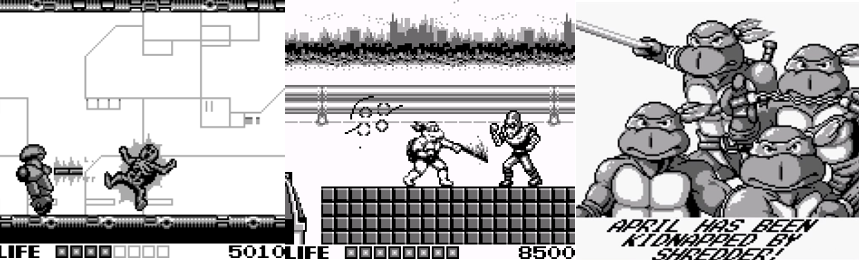
Game Corner [Turtle Tuesday]: TMNT: Tournament Fighters (Xbox Series X)


Ever since Kevin Eastman and Peter Laird’s Teenage Mutant Ninja Turtles (TMNT) first debuted, the franchise has enjoyed worldwide mainstream success thanks to action figures, cartoons, and videogames. Since I found some free time this December, I’ve been spotlighting four such videogames every Tuesday of this festival season.


GameCorner

Released: 30 August 2022
Originally Released: 4 September 1993 (Mega Drive / SNES) / February 1994 (NES)
Developer: Digital Eclipse
Original Developer: Konami
Also Available For: Mega Drive, Nintendo Entertainment System (NES), Nintendo Switch, PC, PlayStation 4, PlayStation 5, Super Nintendo Entertainment System (SNES), Xbox One, and Xbox Series S

The Background:
There was only one franchise that dominated childhoods back in the late-eighties and early-nineties and that was the Teenage Mutant Ninja Turtles (or Teenage Mutant Hero Turtles for Brits like me); beginning life as a violent pastiche of comic book tropes, the TMNT’s popularity exploded into the massively successful cartoon and action figures, live-action movie adaptations, and many videogames. Spearheaded by Konami, the TMNT were equally successful with their arcade beat-‘em-ups and their home console ports, but this was also a time when Capcom had changed the face of both arcades and the competitive fighting scene with the many iterations of Street Fighter II: The World Warrior (Capcom, 1991), which was great success on home consoles and inspired a slew of knock-offs looking to cash in on Capcom’s success. The TMNT were amongst these with this one-on-one tournament fighter, which released in slightly different versions across three platforms at the time; the games took inspiration from the cartoons, movies, and the Archie spin-off comics but, while the 16-bit titles aped the combos and special moves of Street Fighter II, the 8-bit version had more in common with the likes of Yie Ar Kung-Fu (Konami, 1984) due to the NES’s limitations. Of the three, the SNES version was positively received despite being a Street Fighter II knock-off, the Mega Drive version was criticised for its sluggish controls and lacklustre presentation, while the NES version was seen as ambitious but unsurprisingly limited. All three games were lost to the midst of time, available only through emulators or extortionately expensive physical copies until they were included in this Cowabunga Collection alongside a host of other games and quality of life features.

The Plot:
The Turtles and their allies take part in a one-on-one tournament. In the Mega Drive version, the heroes battle across the alien worlds of Dimension X to rescue Splinter from their archnemesis, Oroku Saki/The Shredder, and their evil clones; in the NES version, the Shredder challenges them to defeat his latest plot for world domination; and in the SNES version, the heroes battle on a fighting game show to prove their mettle and earn some cold, hard cash.

Gameplay:
Regardless of which version of Teenage Mutant Ninja Turtles: Tournament Fighters you choose to play, the game is a standard 2D, one-on-one fighting game, with the 16-but versions of the game heavily borrowing their controls, combat, and presentation from Street Fighter II. Each game comes with a different roster of fighters, with ten fighters selectable in the SNES version, eleven available in the Mega Drive version, and seven in the NES version. Each version of the game allows you to customise the gameplay in some way, such as setting the difficulty level of the game (which directly impacts the ending and bosses you face), changing the time limit and amount of rounds to win (with the games defaulting to the standard best of three rounds), setting the speed of the game, setting the amount of credits you have to continue laying upon defeat, and eve setting the strength of your character and your opponent to establish any handicaps. These features don’t carry across to every version of the game, and some are slightly altered (the SNES version represents difficulty on a zero to seven scale, for example, while the NES uses a simple Easy, Normal, and Hard designation), but these options are generally consistent to those seen in Street Fighter II.

Each game sees you pummelling foes with a variety of moves and special attacks.

Combat, however, is a slightly different story and varies somewhat between each version; while the SNES version benefits from the additional buttons and mimics the directional input and button presses of Street Fighter II to pull off special moves, the Mega Drive and NES versions are limited by their control scheme layouts and the general presentation of the game. Indeed, the SNES version is more like Super Street Fighter II Turbo (Capcom, 1994), running much faster at its maximum speed and aping similar button combinations, while the Mega Drive version is far slower and reminds me more of the original, somewhat clunky first release of Street Fighter II. The NES version, as mentioned, is more like Yie Ar Kung-Fu and features little in the way of complex button combinations and special moves due to the limitation of the NES hardware. In the SNES version, you have two different types of punches and kicks; A and X launch a “normal” punch and kick while B and Y throw “fierce” variants. You can press up on the directional pad (D-pad) to jump and launch flying kicks and punches; when up close to an enemy, you’ll grab them and toss them in a unique throw move and you’ll use directional inputs and button presses (down, diagonal down-right, right, X, for example) to pull off each character’s special moves. When not playing in the game’s story mode, you’ll gradually fill up a gauge underneath your life bar; when this is full, you can use another simple button combination to unleash a devastating “Ultimate-Attack” that, unlike your regular attacks, actually damages the opponent through their block (though if they attack you during it you’ll fail and it’ll deplete if you don’t use it in time). Much of this is true of the Mega Drive version, but with some notable differences; there’s no special attack gauge, for starters, and no “fierce” attacks, you simply use X to punch and A to kick, and press Y to pull off a taunt (that seems to have no function). To pull off stronger attacks, you need to press the D-pad towards the opponent and then press X or A; you can still grab and throw your foe but special moves seem a lot harder to pull off (not least because the button inputs are missing from the strategy guide) and the game’s sluggish pace makes combat inconsistent and frustrating. It’s still more complex that the NES version, though; here, X punches and A kicks and that’s about it; you can use directional inputs and button presses to pull off special moves, but they’re extremely basic and the TMNT don’t even fight with their signature weapons in this game! Each game features a stun mechanic like in Street Fighter II, though; deal enough damage in a string of attacks and your opponent will be momentarily dazed and wide open for another combo or throw.

Although it lacks Nintendo’s bonus stages, the Mega Drive version has instant replays…

Some versions of the game do allow you to alter the button layout if you’re not happy with the default, and all three versions allow you to block by holding back on the D-pad (a mechanic I’ve always found awkward in fighting games; I much prefer a dedicated block button) but the SNES version also allows you to flip away from incoming attacks but only the NES version allows you to run towards your opponent by double tapping the D-pad. Each version also comes with a few gameplay options; you can take on the story mode (where you’re limited to playing as the TMNT), with cutscenes and a map screen (in the Mega Drive version) furthering the narrative between each bout, battle against a friend (or against the computer in the NES version), watch or practice the game in the SNES and Mega Drive versions, or take on a standard tournament mode. This also differs greatly between each version, with the SNES version taking the form of a broadcast and game show and featuring pre- and post-match dialogue and even tossing in a bonus stage where you rack up extra points and gold by smashing open safes in a bid to help break up the monotony. Although this is absent from the Mega Drive version, whose tournament simply goes from one fight to the next, every match is followed by an instant replay), bonus stages do appear in the NES version; here you have to smash through walls in the dojo for extra points, and all three will tally up certain criteria (health remaining, time left, whether you took damage or not) when you’re victorious to add to your score and this is the only version of the game to feature a high score table.

Each version offers a pretty tough challenge even on the easiest difficulty.

Each game comes with a natural, steady, and expected difficulty curve that I find is typical of most fighting games but synonymous with Street Fighter II; your ability to succeed will depend on how adept you are at pulling off the awkward special attacks and combos, especially as special attacks and throws deal way more damage than your regular attacks. The enemy AI, even on the easiest settings, is incredibly cheap in all three versions; your opponent will block almost constantly, is consistently able to attack and throw you through your attack animations, and they’re far more aggressive and skilled than I was, meaning I either had to fight hard and fast or be on the defensive. The difficulty and gameplay sliders can help with this, especially in the Mega Drive version, which allows you to reduce the rounds to win to one and set your speed and power to give you an advantage. Since the SNES version is the fastest of the three, combat can move at a breakneck speed, with rounds turning out of your favour in the blink of an eye, and you’ll be immediately at a disadvantage as you need to play on at least difficulty level three to even battle to true final boss and see the game’s best ending. This is even more demanding in the Mega Drive version, where you need to play on level eight to get the true ending; this version is so hampered by its plodding speed that it’s easy to get trapped in an unbreakable combo string and stunned into oblivion by your hyper-aggressive opponents. The NES version can be both paradoxically difficult and easy at the same time; there’s little benefit from picking one fighter over another as they’re all so limited but some, like Hothead, make for bigger targets while others, like Casey Jones, appear to be more agile. Either way, the limitations of the hardware make this a mundane back and forth affair that’s more about who can grab the power-up first rather than requiring any in-depth skill like the SNES version.

Graphics and Sound:  
Obviously, all three games look and sound very different. Of the three, the SNES version is the clear winner in terms of overall presentation; the game features more sound bites, big, bright, and well animated sprites and backgrounds, and the music is clearer and has more kick to it. The emphasis on story and cutscenes means there’s far more opportunities for big, partially animated sprite art here, with April O’Neil reporting on and interviewing characters before and after bouts and every fight in story mode being proceeded by dialogue between the fighters and the TMNT travelling to each location via their signature blimp. The characters in this version are clearly modelled more like the cartoon, with a hint of the live-action influence here and there, and they’re all large and full of attack and reaction frames. Sadly, the same isn’t true of the Mega Drive version; even the title screen and character select screen aren’t as impressive, though the game does include more palette swaps and some different fighters compared to its SNES counterpart. Sprites are smaller, however, duller, and seem to be missing some animation frames; everyone seems far meaner and more surly, as well, making this a very gritty and moody experience that seems to owe more to the original Mirage Comics, but it’s pretty obvious even to a die-hard SEGA fan like me which version has the better overall presentation. Naturally, the NES version is the most inferior in terms of graphics, character, and stage selection; however, while the TMNT don’t sport their signature weapons, they do have their own unique green palettes to separate them and the character designs seem to be drawing more from the first live-action movie than anything else. You won’t find much in the way of animation and variety here but it’s pretty ambitious, really; sprites have some decent details and special attacks, but the game suffers from black bars eating up a lot of the player’s screen.
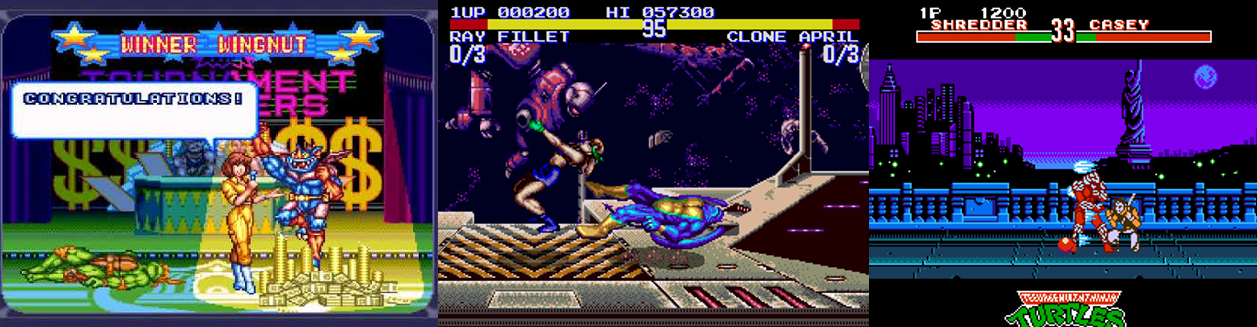
Presentation varies between the three, with the SNES being the clear superior.

Naturally, the stages you’ll fight in follow very much the same format; the SNES version features a variety of large and detailed environments set largely on Earth, with some even featuring destructible elements to smash your opponents into like in Street Fighter II. Also like in that game, you’ll see background characters and elements and characters cheering and watching the fight, including TMNT staples like Bebop and Rocksteady, Baxter Stockman in his fly form, and various Foot Soldiers. There’s always something going on in the SNES version, whether it’s a giant octopus, a band performing on stage, or a news report recording the action, and this version also includes better, more detailed and varied story cutscenes and even character bios in its attract mode. Comparatively, the Mega Drive version is an immediate disappointment; cutscenes are smaller and less interesting and the backgrounds, while surreal and often disturbing, are far more muted and feature almost no animation and absolutely no interactable elements. As this version of the game features a planet-hopping narrative, there are some bizarre stages to choose from, from an ice world complete with a submarine to an ocean planet with a sinking ship in the background, to the bleakness of the cosmic abyss, but it’s all so dull and lifeless even when there’s giant cycloptic magma creatures and dinosaurs looming in the background. Again, the NES version is hampered by its hardware and includes only four stages: the sewers, a subway station, the galley of a pirate ship, and the rooftops of New York City. This latter is the most impressive stage, showing the city and the Statue of Liberty at night and in all its 8-bit glory, and is preceded by a rare cutscene to set the stage for the final battle against the Shredder.

Enemies and Bosses:
As with all fighting games, every available character will eventually be your enemy at some point; button codes and the Cowabunga Collection’s enhancements allow you to play as the boss characters in the 16-bit versions of the game and the Mega Drive version even includes and practise mode to help you get to grips with your favourite character. Essentially, however, there’s minimal benefit to picking a certain character in each version of the game; all of them sport special moves that can match each other, with every character sporting projectiles, grabs, and powerful rushing or slamming attacks to deal heavy damage. However, there are some notable exceptions; as mentioned, Hothead is a unique character in the NES version, sporting a chunkier sprite and breathing fire, meaning his hit box is a little larger and the character is a little slower. In the Mega Drive version, Casey Jones can set bombs as traps, while characters like Chrome Dome and Krang can cover distances from a standstill with their extending arms and legs. Even on the easiest setting, the SNES version puts up quite a fight; I struggled against War in the first battle simply because of his ridiculous rolling throw and large swiping claws, and the Shredder proved quite formidable here thanks to his dashing uppercut, his flurry of punches, and his cheap tactics of spamming low kicks. The Rat King also proved a unique foe in this version as he relied more on wrestling moves, snatching you out of the air and grabbing you midway through your attacks to slam you to the ground, and you’ll really get a sense of how good or bad you are when you face off against your character in a mirror match.

You’ll need to challenge the game’s highest difficulties to achieve the best endings.

These are spiced up a bit in the Mega Drive version through the inclusion of evil clones, who sport a purple palette swap and constantly dog your progress throughout the game. The Mega Drive version also includes a unique character, Sisyphus, an alien beetle who spits a blue projectile at you and unleashes a rapid-fire horn attack. He’s not the only unique character, however; Ray Fillet, April O’Neil, and a Triceraton are also included in this version of the game, while Wingnut, Aska, and Armaggon round out the SNES roster, with each one bringing their own strengths and weaknesses. April was a surprisingly decent character to use as she has a very cheap crouching spam attack that’s great four countering the game’s aggressive enemies, but you can never count out the titular turtles, who can send ground sparks, spinning cyclones, and twirling kicks your way at any moment even in the NES version. Krang only appears as a boss in the Mega Drive version of the game; naturally, you battle him in the Technodrome as the penultimate boss and he’s able to extended his arms, slide at you with a kick, and fire missiles high and low from his robot body but his sprite just isn’t large or intimidating enough to evoke a sense of danger. Both 16-bit versions include the same final boss, Karai, who can only be fought on higher difficulty settings; on the SNES, you fight her on top of a speeding train, whereas you battle her in a traditional dojo on the Mega Drive. In both, she’s easily the most formidable fighter, which is accentuated on the SNES thanks to her larger sprite; she’s capable of crossing the screen with a devastating cartwheel kick, tossing out projectiles, diving from high above with flying kicks, and is overall a pretty tough customer thanks to her martial arts kicks and overly aggressive AI. Thanks to its limited roster, the Shredder is your final foe in the NES version of the game; fought on a rooftop like in the movie and original comic, Shredder again has a dashing uppercut, a flaming flurry of punches, and can send a ground shot your way but goes down just as easily as every other enemy in this version of the game.

Power-Ups and Bonuses:
As Tournament Fighters is styled heavily after Street Fighter II, for the most part, there aren’t any in-game power-ups for you to utilise. The SNES version includes that special gauge outside of the story mode, which is good for a dramatic finish, but this is completely absent from the Mega Drive version. The NES version, however, does feature a power-up; at some point in every battle, Splinter will drop a red ball into the arena, which you can collect by pressing down and X. While the exact button inputs aren’t explained, and it seems incredibly temperamental, you can then launch this ball at your enemy to deal massive (and, usually, decisive) damage and this will be your key to victory in almost every bout. Be warned, though, as your foe is also able to pick up the ball and you’ll lose it if you take too much damage.

Additional Features:
The additional features on offer differ somewhat between each version of Tournament Fighters but there is some overlap; each version includes a story and a tournament mode and allows players to go head-to-head, selecting their character, stage, and handicap modifiers as you’d expect from a one-on-one fighter. Each game includes a variety of endings depending on which character you play as and the difficulty you set the game to, encouraging multiple playthroughs if you can stand to tackle this game again. Of course, the Cowabunga Collection adds even more features to these games; you’ll get a generous 100G Achievement for completing each game, however, you need to beat each one of the higher/highest difficulty level and battle Karai for this to pop. You can also use the Left Bumper to rewind the gameplay and bring up save states and display options with the Right Bumper, which also allows you to look through the strategy guide for tips and move inputs, which is much appreciated. In addition to viewing each game’s box art and manuals, exploring their soundtracks, and switching between the American and Japanese versions, you can enhance each game in various ways: you can choose to play as the 16-bit bosses, access additional stages, increase the game’s speed, and enable extra lives, remove sprite and slowdown from the NES version and allow for Hothead versus Hothead fights if you wish.

The Summary:
Teenage Mutant Ninja Turtles: Tournament Fighters is a tough one for me. I’m really not the best at Street Fighter II and similar knock-off fighters; the button inputs and aggressive opponents always throw me off and playing these games is often more frustrating than fun. The TMNT aesthetic certainly suits the format; all of the character have unique attacks and represent both the cartoons, comics, toys, and movies from the time and anyone who’s ever played Street Fighter II, especially on home consoles, will be immediately familiar with the 16-but versions of the game. For me, the SNES version is the clear winner; not only does it look and sound the best of the three, it plays a lot better and there are far better opportunities for combos and special attacks. The story and tournament modes are also presented in a much more visually impressive way, the stages are livelier and more interesting, and the game is bolstered by the faster combat and fluid gameplay. It pains me to say it being a big SEGA fan, but the Mega Drive version just can’t compete with its SNES counterpart; everything’s smaller, grimier, and so slow and clunky. I actually prefer some of the roster here, having read a lot of the TMNT’s Archie Comics as a kid, but the gameplay and presentation lets these additions down considerably. Naturally, the NES version is the inferior of the three but, even so, it does a decent job with the limitations of its hardware. One-on-one fighters are never a good option on inferior hardware and the TMNT definitely benefitted more from their 8-bit sidescrolling adventures and brawlers, but there’s some ambitious elements here that make it an interesting option, at least, though it’s hard to believe anyone choosing to downgrade or settle for the NES version of the far superior SNES version. Overall, if you’re a fan of one-on-one fighters and Street Fighter II, you could do a lot worse than to give the SNES version of Tournament Fighters a whirl; the other two are worth a quick playthrough for a boost to your gamer score but I can’t see myself picking the Mega Drive or NES version on future playthroughs since the SNES version just leaves both in the dust with its superior options, gameplay, combat, and presentation.

Mega Drive Rating:

NES Rating:

SNES Rating:

Rating: 2 out of 5.

Rating: 1 out of 5.

Rating: 3 out of 5.

Could Be Better

Terrible

Pretty Good

What did you think to Teenage Mutant Ninja Turtles: Tournament Fighters? Which of the three did you own back in the day, or is your favourite to play in this collection? How do you think it compares to other one-on-one fighters, especially Street Fighter II? Which character was your favourite to play as in each version? Were you disappointed by the dip in graphical quality in the Mega Drive version? What did you think to the NES version and how it utilised the system’s limitations? Would you like to see another one-on-one tournament fighter from the TMNT? What did you think to the additional features added to the Cowabunga Collection? Whatever your thoughts on Tournament Fighters, go ahead and share them in the comments below.

Screen Time: The Guardians of the Galaxy Holiday Special

Air Date: 25 November 2022
Director:
James Gunn
Network:
Disney+
Stars: Chris Pratt, Dave Bautista, Vin Diesel, Bradley Cooper, Pom Klementieff, Sean Gunn, and Kevin Bacon

The Background:
Although one of Marvel’s more obscure properties, and having undergone many alterations over the years, the Guardians of the Galaxy proved to be a massive financial success when they made their live-action debut in the Marvel Cinematic Universe (MCU). With the property deemed to have strong franchise potential and integral to the MCU, a sequel was inevitably produced and went on to surpass the box office of the first film despite criticisms regarding its pace and tone. Although director James Gunn had plans for a third film, the team’s future was briefly thrown into doubt when Disney and Gunn parted ways after learning of some controversial tweets and comments he made in the past. After addressing and apologising for his comments, and following an outpouring of support from fans and stars alike, Gunn returned to Disney/Marvel and developed of the third film started up once more. Gunn and his stars also signed on to produce this holiday special for Disney+, which he planned to serve as an epilogue for Phase Four of the MCU after having worked on the concept for some years. Following delays due to COVID-19, the special finally released on Disney+ in December 2022 and was met with positive reviews; critics praised the heartfelt homage to Christmas specials of old and the light-hearted comedy on offer, though some questioned the motivation behind the special and the inclusion of Kevin Bacon despite Gunn stating that it would set up some key events for the team’s third movie.

The Plot:
With Peter Quill/Star-Lord (Pratt) still reeling from the death of Gamora (Zoe Saldaña) and the presence of her alternative self from a separate timeline, Mantis (Klementieff) and Drax the Destroyer (Bautista) head to Earth to bring Peter the greatest Christmas gift they can think of: his childhood icon, Kevin Bacon!

The Review:
The special opens with Kraglin Obfonteri (Gunn) shedding some light on young Peter’s (Luke Klein) childhood amongst the Ravagers to Mantis, Drax, and Nebula (Karen Gillan). As a boy, Peter was still very sentimental towards Earth (largely referred to as “Terra” out in the depths of space) and tried to teach Yondu Udonta (Michael Rooker) about its ways and traditions. Yondu, however, wasn’t just unimpressed at the idea of Christmas; he was enraged by it and forever ruined the festivities with his volatile temper. While Mantis is heart-broken at the story, Drax, in his usual boisterous fashion, finds Peter’s traumatic upbringing incredibly amusing, something even Nebula admonishes him for. The special does answer a lingering question I had about Taneleer Tivan/The Collector (Benicio del Toro), last seen as an illusion cast by the Mad Titan, Thanos (Josh Brolin), and presumed dead but he’s apparently still alive since he sold the entirety of Knowhere to the Guardians between movies. Because of this, the team has been too busy fixing the place up and restoring some kind of order and has been unable to indulge in festivities or even search for the elusive, alternative Gamora. Feeling a sense of obligation towards Peter, who’s revealed to be her half-brother since they’re both children of Ego the Living Planet (Kurt Russell), Mantis is spurred to give Peter the Christmas he missed out on as a child. Confiding in Drax, the only one who knows her secret, Mantis is elated when the muscled-bound buffoon suggests bringing Peter’s childhood hero to him as the ultimate Christmas gift and head to Earth to kidnap Kevin Bacon! Although their arrival initially causes a stir due to Drax forgetting to activate the ship’s cloaking device, the two easily blend in amidst the glitz, excess, and cosplayers of Hollywood, unwittingly earning themselves a decent wad of cash in the process as enthusiastic tourists clamour for selfies with their pair.

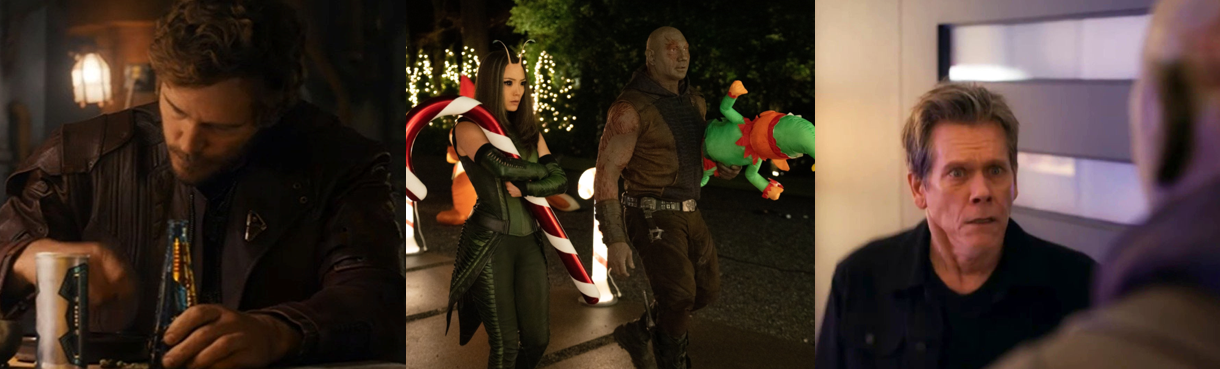
To cheer Peter up, Mantis and Drax head to Earth to kidnap Kevin Bacon!

After blowing all their dough on shots and revels, Mantis uses her empathic abilities to obtain a map to Kevin Bacon’s house, where the EE spokesman is relaxing in his spacious Hollywood home and awaiting the return of his family. Although he politely sends the two away when they come calling, they’re easily able to barge into his house and a frantic chase throughout Bacon’s abode ensues, with Mantis hopping from wall to wall like her namesake and things escalating when Bacon desperately asks the local cops for help, which thankfully ends without any bloodshed. This sequence also showcases Mantis’s fighting skill as she easily takes down the armed cops and renders them unconscious with her powers, showing that she’s more than just the team’s emotional, compassionate conscious. These same powers are used to quell Bacon’s fears and, at the lightest touch and softest suggestion, he become enthusiastic about accompanying the two and helping them deck their ship out with Christmas decorations. However, once he’s heading out into the big black and sharing stories of his career, Bacon unknowingly lets slip that he’s simply an actor rather than some world-renowned superhero, much to the disgust of Mantis and Drax, so Mantis coerces Bacon into believing he truly is a hero so as not to ruin Peter’s Christmas once more. Bacon then believes himself to be a World War Two soldier, adopting a…well, “Australian” accent would be generous…then briefly pretending to be Bruce Wayne/Batman before Mantis demands that he be himself but not “suck”. Thankfully, Bacon is just happy to be out in space and takes it all in his stride, and Peter is astounded to find that all of Knowhere has been decorated with Christmas lights, songs, decorations, and even a snow blower. Though touched by their efforts, Peter’s joy turns to horror when he discovers that his friends have kidnapped his childhood hero, regardless of how excited Kevin Bacon is to be there to celebrate Christmas with them. After demanding that Bacon be returned to normal, the actor’s enthusiasm turns to terror; however, after learning of how influential his career was to Peter’s life, Bacon has a change of heart and decides to stick around and help out.

The Summary:  
Naturally, given the title and when it released, Christmas is a central theme of The Guardians of the Galaxy Holiday Special; it’s bookended by the God-awful “Fairytale of New York” song by The Pogues, the traditional Marvel Studios logo is overlaid by soft snow fall and Christmas lights, and the special opens with an animated flashback showing young Peter’s failed attempts to explain the sentiment behind Christmas to Yondu. He’s not the only one in the depths of space who struggles with the concept; Bzermikitokolok (Rhett Miller) and his band (The Old 97’s) to interpret the season through song recast Santa Claus as a superpowered master burglar who shoots missiles and has a flamethrower, much to Peter’s dismay. Drax and Mantis are equally dumbfounded by Earth’s traditions but soon enjoy the taste of Earth liquor, the excitement of a bar, and delight in the festive decorations littered across Kevin Bacon’s lawn. Those who delight in the action-packed adventures of the Guardians may be disappointed to learn that the Holiday Special is much more of a character-driven pieces; Groot (Diesel) is little more than a cameo (and looks a lot like a man in a suit, an effect I approve of) and the special primarily follows Drax and Mantis, which is pretty delightful as these two don’t always get much to do and it’s cute to see them bicker and Mantis ultimately gifting him with an inflatable elf he had grown fond of on their journey. Also, the special shows that the team is now aided in their efforts by Cosmo the Spacedog (Maria Bakalova), a sentient dog that developed psionic powers after being shot into space by the Soviet Union and who has a strained relationship with Rocket Raccoon (Cooper), though she responds much better to doggy treats than criticism.

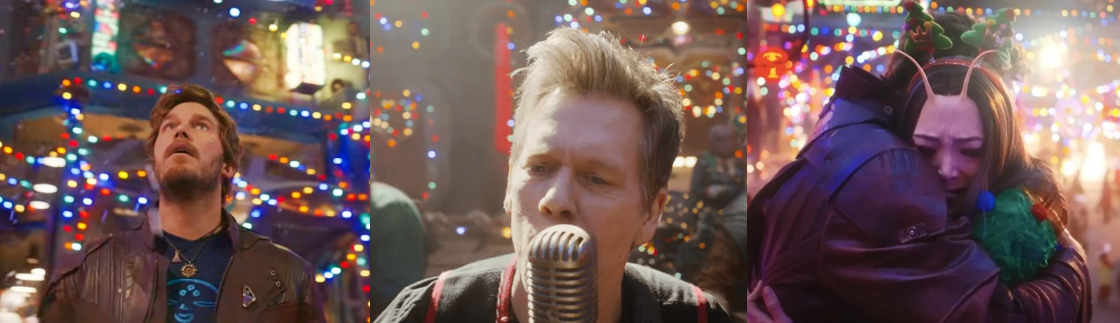
Ultimately Kevin Bacon brings the spirit of Christmas to Peter and the other Guardians.

Although Kevin Bacon is terrified by Mantis and Drax, and rightfully so, fearing at first an invasion of his home, then an attempt on his life by overly enthusiastic cosplayers, and finally overwhelmed by being surrounded by strange alien lifeforms, his excitement at being out in the galaxy comes through thanks to Mantis’s spell. Despite his fear, however, he is touched by Kraglin’s story of how much his movie roles impacted Peter’s life and he decides to stick around Knowhere for a bit, singing a song and helping to teach them about the true meaning of Christmas. While Bacon’s explains the virtues of family and goodwill so associated with the season, Peter encourages the others to open their gifts: Groot is delighted by his Game Boy and even Nebula gets into the spirit by gifting Rocket James Buchanan “Bucky” Barnes’ (Sebastian Stan) prosthetic arm! Thus, Kevin Bacon parts with the team on friendly terms, and even promises to be back for Easter, having brightened Peter’s life considerably with his generosity. Equally moved by the team’s effort, Peter reveals to Mantis that Yondu quickly came around to the spirit of Christmas after being amused by Peter’s gift (the first of many small toys for his control panel( and that he even gifted Peter his trademark blasters in return. Mantis’s revelation, however, trumps even that present and Peter is thrilled to learn that he has a sister, ending the special on a sweet note about family and goodwill and all that heart-warming Christmas spirit.

My Rating:

Rating: 3 out of 5.

Pretty Good

Did you enjoy The Guardians of the Galaxy Holiday Special? What did you think to the focus on Drax and Mantis and their efforts to cheer Peter up with a most unusual present? Did you enjoy Kevin Bacon’s role as a clueless, well-meaning celebrity? Would you have liked to see a little more action in it or were you happy with the traditional Christmas message it delivered? Where do you see the team going in the future? What’s your favourite Christmas special? Whatever your thoughts, feel free to share them below or on my social media.

Movie Night [Christmas Day]: Krampus

Released: 4 December 2015
Director: Michael Dougherty
Distributor: Universal Pictures
Budget: $15 million
Stars: Adam Scott, Emjay Anthony, Toni Collette, David Koechner, Krista Stadler, and Luke Hawker/Gideon Emery

The Plot:
Young Max Engel (Anthony) finally has enough of his dysfunctional family’s squabbling and loses his festive spirit, which incurs the wrath of Krampus (Hawker/Emery), a fearsome, horned demonic beast who lays siege to the neighbourhood and forces the family to band together to save one another from a monstrous fate.

The Background
Everyone knows about Santa Claus; jolly ol’ Saint Nic has been the good-natured mascot of the season for generations and is celebrated as a figure of generosity and joy for kids the world over. You may be less familiar with Father Christmas’s demonic counterpart, Krampus, however; a monstrous figure whose roots can be traced back to pre-Christian Alpine traditions, the horned demon delivers coal and misfortune to the naughty at Christmas time. After breathing new life into the Halloween season in Trick ‘r Treat (Dougherty, 2007), director Michael Dougherty turned his attention towards crafting a scary Christmas movie and became inspired by the legend of Krampus. Taking his cue from horror-holiday classic Gremlins (Dante, 1984), Dougherty sought to infuse his Christmas horror with both dark comedy and commentary on family troubles and consumerism during the festive times. A worldwide box office gross of over $61 million made Krampus a decent financial success, and reviews were generally quite positive, with the film being praised as a modern horror classic for the season.

The Review:
Krampus kicks off not by establishing a horrific or disturbing atmosphere, but by showing an amusing representation of the many and varied moods that surround the festive season; against the dulcet tones of Perry Como’s “It’s Beginning to Look a Lot Like Christmas”, shoppers rage and fight each other for presents and purchases, spend exorbitant amounts of money, and basically resemble little more than a manic hoard in their rush to fill the void of consumerism. Clerks and employees are largely apathetic and little more than zombies, completely worn out by their mundane profession and the madness of it all, and even the shopping mall Santa Claus is depicted as a lecherous and unsettling figure.

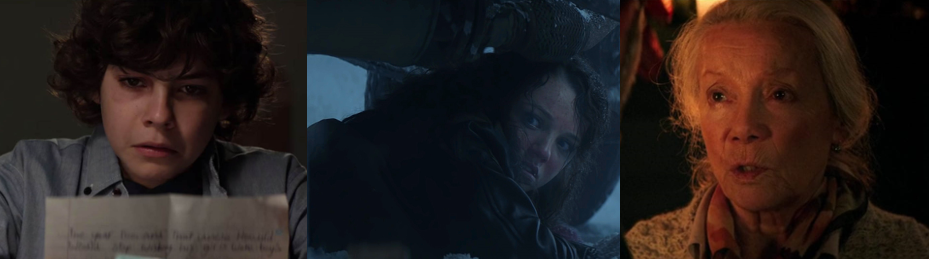
Despite Omi’s best efforts, Max loses his Christmas spirit thanks to his dysfunctional family.

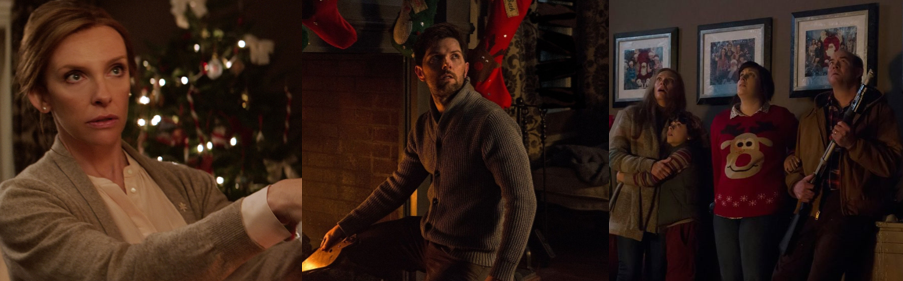
Amidst all of this is young Max, who gets into a fight in the middle of a Christmas recital because an older, bigger kid was bad-mouthing the spirit of Christmas. Although he’s old enough to know that Santa Claus isn’t actually real, he still believes in the season and wants to keep the dream alive for those younger than him who deserve to find out naturally, rather than from some man-spirited kid, and is enthusiastic to watch A Charlie Brown Christmas (Melendez, 1965) as is his family’s tradition. His teenage sister, Beth (Stefania LaVie Owen), is far less passionate about the spirit of Christmas, or anything for that matter; disinterested in playing nice for the season, or the turmoil in her family, she’s far more concerned with texting and seeing her boyfriend, Derek (Leith Towers), though she does try to keep Max from lashing out when his cousins mock his letter to Santa over Christmas dinner. Of all of the family, only Omi Engel (Stadler) shares Max’s appreciation for the spirit of Christmas; dutifully baking cookies and helping to wrap presents, she encourages him to keep the magic alive. Warm and friendly, she spends the majority of the film speaking in German, which is a neat twist, and all of her immediate family understand her despite talking to her in English, which really adds a flavour to her character as a wise and loving patriarch. Rather than add to the stress of the season, Omi is a calm and reliable anchor who also carries the burden of a past experience with the horrific demon who comes knocking mid-way through the film.

Sarah is just barely holding everything together amidst the chaos of her family.

Sarah (Collette) is very much a mother, and a woman, nearing the end of her tether. Like a lot of mothers around this time of year, she’s feeling the stress of having to try and keep her dysfunctional family together and increasingly exasperated by all the little issues that keep cropping up; she just wants a nice, quiet, uneventful family Christmas but Max’s behaviour throws a spanner in the works and Beth’s attitude towards her in-laws coming to stay only adds fuel to the fire. Although her husband, Tom (Scott), is sympathetic and supportive, he’s not exactly an assertive force in the family, meaning that Sarah carries a lot of the burden on her shoulders. Her stress is only exacerbated when her sister, Linda (Allison Tolman), arrives with her massive troupe: abrasive husband Howard (Koechner), sluggish Howie Jr. (Maverick Flack), sporty sisters Stevie (Lolo Owen) and Jordan (Queenie Samuel), and baby Chrissie (Sage Hunefeld). The differences between the two families couldn’t be more apparent: where Tom is pretty easy-going and attentive and content to be more of a number cruncher, Howard is a loud, proud, all-American hunter and avid sports fan; where Max is friendly and chatty, Howie Jr. is a slob-like mute. Though both Sarah and Linda try to cope with their dysfunctional families as best as they can, things are even more strained when Linda brings along grouchy Aunt Dorothy (Conchata Ferrell), a rude crank who isn’t afraid to speak her mind and criticise Sarah’s house, kids, or attempts to try and mix up the usual Christmas menu.

It doesn’t take long for horrific events to descend upon the town, and the family.

Despite Tom and Omi’s best efforts to keep Max’s spirits up, the mockery of his cousins is the last straw and, disillusioned, he rips up his letter to Santa Claus and tosses it into the frigid night air after ranting at his family for ruining Christmas. Almost immediately, bad things begin to happen; first, an ominous dark storm sweeps over the entire town, then the family wakes up on Christmas Eve to find a blizzard has buried them in show and cut off their heat and power. The first signs of something truly creepy come when Max spots a mysterious snowman in their front yard and a massive sack full of Christmas presents is delivered to their house. Already struggling because of the political, financial, and familial attitudes between their two groups, the sudden weather and power outage only further escalates the tensions in the house; this pales in comparison to the fate of poor, cute Beth, however, as she spots a demonic, hooded figure out in the blizzard and is promptly spirited away by the howling creature when she braves the storm to check on Derek.

The Nitty-Gritty:
Although the families find themselves trapped, freezing, and increasingly at risk, there is room for some much-needed bonding; Sarah and Tom share a quiet moment where they reflect on how stale their marriage has become, Sarah also reconnects with Linda over their shared memories of their deceased mother, and, in a twisted way, Max’s Christmas wish comes true as the families are forced to set aside their petty squabbles and work together to fend off Krampus’s minions. Even Scott and Howard find some common ground, despite one being a pacifist and the other being a gun-toting activist; when Howard is injured while they’re out searching for Beth, he hands his shotgun to Tom and finally offers him his respect as a provider and protector of his family. Although the film is largely bloodless (and there’s a case to be made that none of the main characters actually die) and the horror is offset by dark comedy and a biting wit, this serves to make the relationships between the characters all the more real and relatable. None of them are perfect, and their relationships with each other are severely strained (either explicitly or inexplicitly), but they find common ground in their crisis as they are all bound together by their fear and the need to survive.

Krampus is a scene-stealing, grotesque, nightmarish perversion of jolly ol’ Saint Nic.

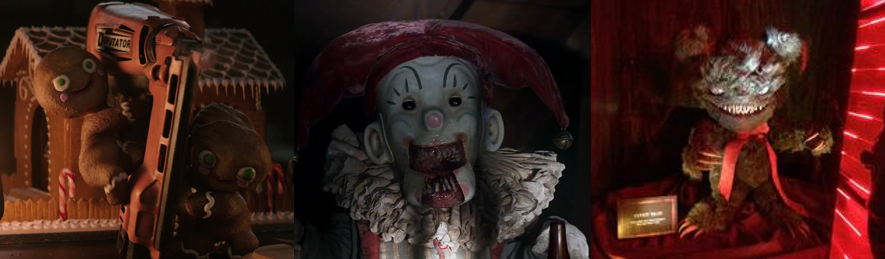
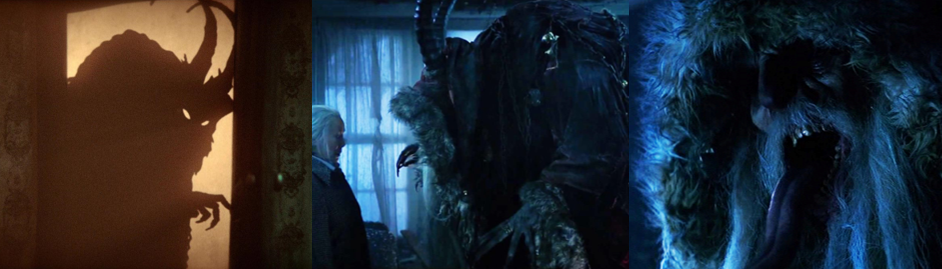
Krampus employs a number of horrific minions to do its dirty work, ranging from vicious little gingerbread men, bloodthirsty toys, a demonic jack-in-the-box (Brett Beattie), and even cackling, perverted versions of Santa’s elves. Krampus’s minions may be cute and ridiculous but they’re incredible vicious and cruel, snaking down through the chimney on iron hooks and dragging the family away one-by-one. Krampus brings a number of these to life using digital effects, as is to be expected, but excels in its use of traditional, practical effects for many of its monstrosities, such as the aforementioned jack-in-the-box, which swallows Jordan whole up in the attic. Of course, the clear highlight is the titular creature itself, a cloven-hooved horror that appears as a nightmarish version of Santa Claus, Krampus sports a twisted, screaming face mask, devil-like horns, and long, talon-like hands. A lumbering, monstrous creature, Krampus isn’t onscreen for long, but its presence is felt throughout the film; when it does appear, it’s a heart-stopping and frightening experience as it looms over its prey and regards them silently or emits an animalistic growl. Its backstory is related by Omi, who recounts how she had a similar crisis of faith at Christmas time as a girl and evoked Krampus’s wrath, which left all of her family dragged to Hell and her as the sole survivor. This is related to the viewer as a fantastically gothic and Tim Burton-esque animated segue, and really helps to sell the mythology and horror of Krampus, who punishes the naughty and those who’ve lost hope at Christmas, and it’s pretty clear that Krampus’s minions take a perverse pleasure in tormenting their victims.

Krampus culminates in a surprisingly bleak ending that punishes Max’s loss of Christmas spirit.

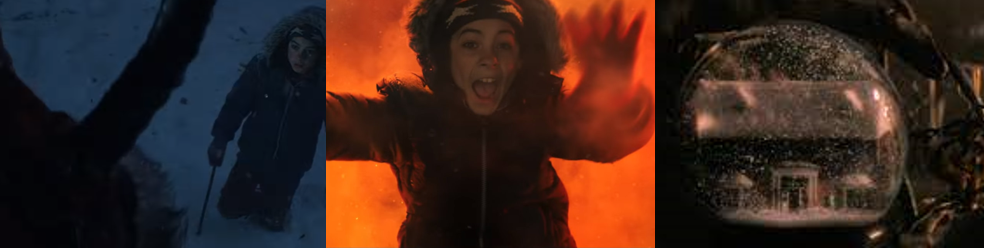
While Howard is all gung-ho about fighting back, Tom maintains that the family needs to stay warm and come up with a practical plan to get all of them to safety using a nearby snowplough; this is scuppered, to say the least, then Krampus’s minions attack in full force, driving the survivors to fight back but eventually forcing them out into the blizzard while Omi stays behind to face her nightmare head-on when Krampus arrives in person. Omi’s attempts to appease the beast are met with failure, and Max is soon left all alone when his remaining family members are yanked beneath the snow one by one. While this is quite the abrupt ending for these characters, I’m okay with it as it leads into one of the best scenes of the film; not content with emerging from the chimney like a lumbering devil, Krampus prepares to toss Max’s family into a hellish pit when the boy rejects Krampus’s attempts to leave him behind, as it did Omi all those years ago. Despite Max angrily taking back his wish, and desperately pleading that all he wanted was for his family to be happy at Christmas like they used to be, Krampus simply mocks his tears and, rather than sparing the boy and undoing its evils, drops him into the pit with a vindictive chuckle. Max awakens the next morning to find his family restored, happy and healthy, but any hopes that his ordeal was some horrible nightmare are quickly dashed when he finds a parting gift from Krampus, and the camera pulls back to reveal that Max and his entire family have been trapped within the purgatory of a miscellaneous snow globe in Krampus’s terrifying workshop.

The Summary:
Krampus is a delightfully devilish little Christmas treat. It hits many of the same notes as you’d expect from a Christmas film (consumerism destroying the spirit of Christmas, dysfunctional families struggling to co-exist during the holiday season, and a festive wish gone awry) but puts a haunting twist on it all with some of the most unique monsters brought to life on film. I find the idea of Krampus (a beast I had never heard of until this film) to be incredibly appealing, and the creature’s design and characterisation are worth the price of admission alone. Sadly, it’s not on screen as often as I would like, but the film is littered with some appealing performances by a variety of veteran and character actors; even the kids do a stellar job and, some dodgy CGI aside, the film is really engaging from start to finish. Obviously, one of the things people remember most about Krampus is the incredibly bleak and dark ending, which sees the family presumably forced to relive Christmas morning over and over in a never-ending purgatory, but this, to me, is the perfect way to end the film. Some biting wit and dark comedy ease much of the film’s horror, but it’s still there thanks to some dark and creative shots in the snow-strewn streets and the way Krampus is framed as this monstrous devil, and the downer ending is like the cherry on top of an excellently crafted modern horror classic that’s well worth putting on to add a bit of spice to your Christmas viewing.

My Rating:

Rating: 4 out of 5.

Great Stuff

Are you a fan of Krampus? Where does it rank for you against other horror Christmas movies? Were you familiar with the Krampus figure before this movie and what do you think of there being this dark opposite of Santa Claus? Were you a fan of the film’s special effects and would you have liked to see more of the titular beast? What did you think to the bleak ending? What are your plans for Christmas Day today? Whatever your thoughts, sign up to comment down or leave a reply on my social media and have a great Christmas!

Game Corner: Soviet Strike (PlayStation)

Released: 31 October 1996
Developer: Electronic Arts
Also Available For: PlayStation Network and SEGA Saturn

The Background:
The Gulf War had finally ended by March 1991 after nearly six months of bloodshed that left thousands dead, though the conflict was clearly an influence on developer Mike Posehn when he built upon the air rescue mechanics of Choplifter (Dan Gorlin, 1982) to create Desert Strike: Return to the Gulf (Electronic Arts, 1992). Focusing on nonlinear, mission-based gameplay and eschewing typical videogame mechanics, Desert Strike became one of the Mega Drive’s top titles; its two sequels introduced new vehicles and environments while retaining the core gameplay mechanics but were similarly praised despite criticisms about the formula becoming stale. By 1996, the videogame industry was moving away from traditional 2D graphics and into the third dimension; the battle for supremacy between SEGA and Nintendo was upended by a new contender, Sony’s PlayStation, and the Strike series found a new home there after development of a 3DO continuation stalled. Reportedly, Mike Posehn assisted in the game’s early development before a larger team took over, redesigning the 16-bit graphics and environments into something altogether more lifelike by superimposing real-world topography onto polygonal maps. To better map out the game’s new perspective and approach, the team built replicas of their maps out of plywood and was the first game in the series to feature full motion video (FMV). Soviet Strike has been received rather fairly; reviews praise the graphical leap forward, the FMV sequences, and the gameplay and mechanics. While the difficulty, perspective, and some aspects of the presentation were also criticised, Soviet Strike was followed by a fifth and final entry the following year and even made it onto the PlayStation Store in 2009.

The Plot:
After the disintegration of the Soviet Union, former KGB Chairman Uri Vatsiznov (a.k.a. the Shadowman) seeks to fill the power vacuum and spark an international war. Only STRIKE, a special covert operations unit, has the weaponry and capability of opposing Shadowman, and the player must once again pilot an Apache helicopter to fight back against Shadowman and his nefarious comrades.

Gameplay:
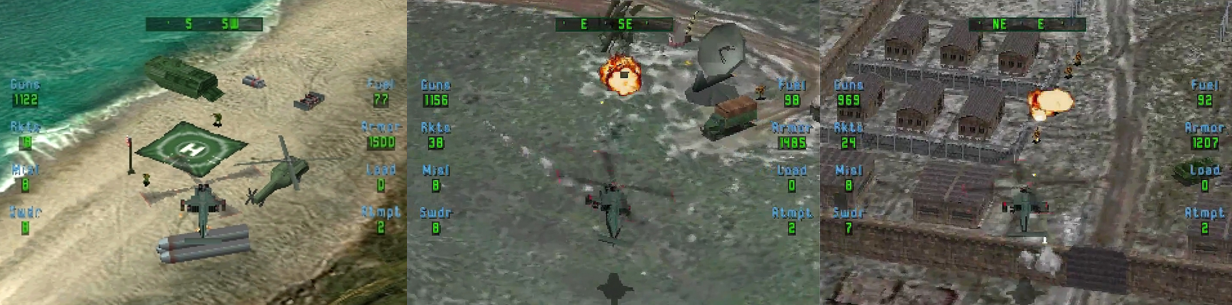
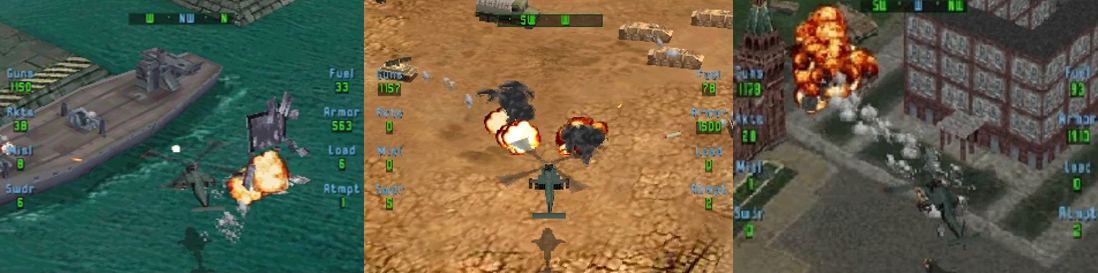
Unlike its predecessors, which opted for an isometric perspective to create the illusion of being 3D in a largely 2D era of gaming, Soviet Strike switches to a top-down perspective, with the camera placed above and slightly behind the player’s fully armed chopper. The game does offer the option to switch your viewpoint using the ‘Select’ button, but all this seemed to do was swing the camera back around to its default position in the rare instances where it gets twisted around by the in-game action. Thanks to the additional buttons and movement options offered by the PlayStation’s graphical superiority, Soviet Strike both plays very similar to its predecessors but also expands the controls somewhat: the game offers four different button layouts, but the default is more than adequate, allowing you to fire your Hellfires with Circle, chaingun with X, and your Hydra Rockets with Square and adding a fourth, more powerful missile – one assigned to your wingtip – with Triangle. The previous games allowed you to “jink” but I found little use for this ability; here, it’s mapped to L1 and R1 and is very useful for “sidestepping” out of the way of incoming fire. L2 allows you to drop whatever cargo you’re carrying (though this was only necessary in one mission so could’ve just been an automatic function to discourage you from accidentally destroying vital cargo), R2 changes the heads-up display to remove the ammo, fuel, and armour so you just have the compass or remove everything entirely to more closely resemble the 16-bit games, and you can pause the game and review the map and current objectives with the Start button.

The PlayStation’s power offers a new perspective and enhanced presentation to the classic gameplay.

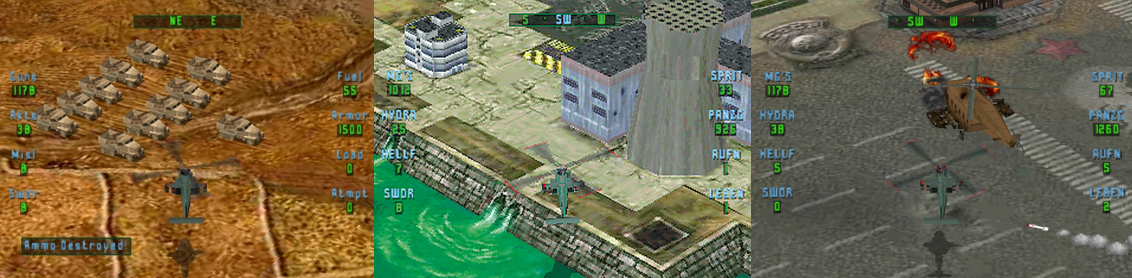
The map is now far more realistic than in the previous games and took me a little while to adjust to but is actually more useful than ever; at times, you’ll get onscreen notifications about mission objectives and can view these by pressing start, but you can also cycle through your mission objectives, enemies, and notable resources and have each highlighted on the map to make plotting an optimal route even easier. You can read up on each mission, enemy, and resource, review the status of your current objectives, and get a better sense of the story from this screen as well, though there’s still no way to manually quit the game without failing the mission and being forced back to home base. Although Soviet Strike doesn’t offer analogue support and you can’t select a co-pilot this time around, you can customise your chopper with a number of loadouts: you can balance your ammo across all weapons, focus on your missiles, or even head into battle with just your chaingun; you can also customise your wingtip loadout to give you the powerful sidewinder missiles, additional fuel, or disrupt the enemy’s radar. As ever, you’ll automatically winch up resources (fuel, ammo, and armour), targets (prisoners of war (POWs), enemy commanders, scientists, and the like), and cargo (nuclear cores and missiles) just by flying over them, though I found the new perspective made it a little tricky to properly target these, and the game completely goes away with the building collision seen in its predecessors; now, you’ll automatically fly over any structures in your way, which is helpful for maintaining your armour though at the cost of a level of realism. As ever, you’re given three lives (known as “attempts”) to complete each of the five campaigns and must complete a variety of missions within each campaign; the scoring system has been done away with, however, but, while the password system returns, you can manually save after completing each campaign.

Mission objectives are more of the same, though with a greater focus on action and destruction.

Strangely, considering the additional power of the PlayStation compared to 16-bit consoles, Soviet Strike doesn’t include any other vehicles or gameplay modes other than the main chopper, meaning that the variety on offer is more akin to Desert Strike than its sequels. Additionally, the missions you’re tasked with completing are extremely familiar to those from previous games and range from destroying radar sites to reduce the number of onscreen enemies, rescuing POWs and other targets and dropping them off at one of five different landing zones (necessitating a bit of back-and-forth traversal as you can only carry six passengers at a time), destroying enemy buildings and airfields, and disabling enemy ships. If you fail any one of these missions, either by being too trigger happy or not being fast enough to destroy or rescue certain targets, the entire campaign is scrubbed and you must return to base to try all over again from the beginning, though you’re often asked “only” to rescue a certain number of targets rather than all of them. As you progress through the game, some objectives will be hidden from you or unavailable until you complete others or pick up key intel, and the game maps are generally arranged in such a way to promote successive progression from one objective to the next. Things soon get quite nuanced as you must rescue an agent before he’s gunned down by a firing squad, drop him off and defend his position as he sets charges, enters a nuclear plant, or calls in an airstrike, dispose of nuclear missiles by dropping them into the sea, fend off a landing assault and, in the third campaign, destroy waves of different enemy tanks and vehicles as they move to converge on a number of different target sites. Enemies will now target friendlies this time around, destroying your resources and attacking villages and such, and you’ll sometimes be notified of additional side missions as you go, though you can ignore all of these without punishment if you wish. By the time you reach the fifth and final mission, things become extremely delicate; you must defend key targets from enemy attacks, rescue government officials before they’re killed, hunt down and destroy a number of bomb trucks before they destroy the city bridges, and defend your co-pilot as she races around the city to get a dignitary to an airport, all of which can get quite stressful as you have to redo the entire campaign from the start if you fail at any point.

Graphics and Sound:  
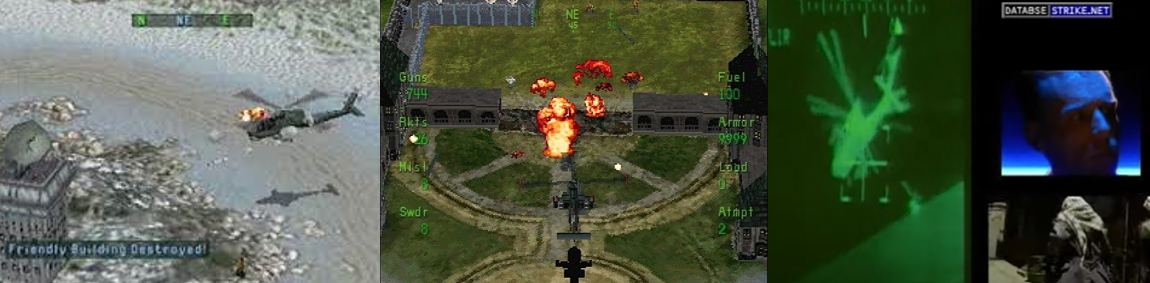
Naturally, Soviet Strike is a step up from its predecessors; almost everything is rendered in the finest polygonal graphics the PlayStation has to offer and given a gloss of realism that was ambitiously attempted in the 16-bit titles but not fully realised until the jump to 32-bits. Your helicopter is a fully functioning 3D model, one that easily and smoothly cuts through the air and can “jink” aside from incoming fire; it even starts to smoke when you take enough damage and will burst apart in a ball of fire when being shot down. Enemy vehicles are similarly rendered, appearing to be faster and more versatile as a result, and you’ll encounter the same level of fun detail applied to the various structure sin each environment; drilling rigs, chemical plants, power stations, and the glory of the Kremlin are all brought to life as well defined 3D models, most of which can be destroyed either as part of your mission, to uncover resources and targets, or to cost you your chance at completing the campaign. Although everything has been given a bit more substance and appeal through the shift to a fully 3D perspective, the overall presentation remains very similar to its predecessors, and you won’t really find anything new on offer here in terms of visual variety. Generally, though, everything runs very smoothly; the load times are pretty fast and I noticed very little slowdown during my playthrough, though there were instances of texture warping and screen tearing at times as was common in many PlayStation titles.

Soviet Strike is bolstered by in-game music, 3D models, and cheesy FMV sequences.

Despite the power of the PlayStation, however, the game is still limited to five campaigns and five locations, without any additional gameplay mechanics or options afforded to the player. Similar to how the first game was restricted to the desert, Soviet Strike sets all of its action in various locations in Soviet Russia, though there is some visual variety on offer; you start off in a rural area surrounded by snowy mountains, venture to a heavily fortified dock and sea, attack airfields in a frozen wasteland, and even venture into the desert once more, now far more interesting to look at thanks to the rocky terrain. You’ll also visit Transylvania, complete with wolf howls, radioactive dumping grounds, and suitably gothic aesthetics, and the bustling cityscape of the Kremlin for the final mission. There are a few fun things to spot here and there, from moose to people sunbathing on the beach and friendly villages, all of which can be destroyed. The game also includes in-game music for the first time; it’s nothing spectacular and simply comprised of thumping beats, but its greatly appreciated. There’s also a fair amount of voice work on offer as your co-pilot and passengers offer advice, praise, and reprimands, and the game’s story is entirely related through choppy, frantic FMV sequences that are full of the cheese and over-the-top acting you’d expect from this era of gaming.

Enemies and Bosses:
Although coated with a fancy new 3D coat of paint, most of the enemies you’ll encounter throughout Soviet Strike are largely and functionally the same as those from previous games. The game offers gun-toting soldiers and their rocket launcher variants, who can hide in towers, bunkers, and stream from armoured vehicles to attack the targets you’re trying to rescue, as well as various jeeps and tanks that roll around the map. Anti-aircraft turrets and cannons are also commonplace and should be targeted as soon as possible, though you’ll obviously want to avoid or take out the enemy’s larger missile-firing ordinance as soon as you can. Some campaigns see snowmobiles, jet skis, and Hind helicopters join the fray, as well as amphibious tanks and some enemy placements being hidden in buildings. It’s important not to fire away willy-nilly; not only to do risk expending your limited ammunition but you could also hit a vital target and cost yourself the mission if you’re not too careful, and the game’s new perspective can make hitting enemies a little tougher this time around so it’s always a good idea to make use of the “jink” function and to take cover behind buildings wherever possible.

Waves of enemies, armoured tanks, and escort/defense missions take the place of boss battles.

As before, Soviet Strike doesn’t feature any traditional boss battles; instead, you’ll need to do your fare share of retrieving, defending, and destroying targets. At first, this isn’t too much of a stretch as long as you don’t accidentally destroy the villa you need to be infiltrating in the first campaign but every time you need to defend a target you’ll be faced with waves of tanks. Enemies even spawn in to attack the scientists who are key to preparing a salt mine and deactivating a nuclear core in the Transylvania campaign, but the biggest test here is airlifting eleven of them out of an incoming blast zone with no onscreen time and the landing zone being a fair distance away, meaning it can be pretty hairy making the round trip to get everyone to safety. The second campaign sees you sinking enemy submarines, cargo ships, and a large, heavily defended carrier, some of which must be destroyed before they can escape which can be easier said than done if you’re running low on resources. Similarly, the third campaign can be quite the endurance as you must destroy waves of incoming enemy vehicles before they can destroy friendly settlements; ammo and other resources are scattered about but these are some of the game’s deadliest enemy vehicles and they advance in large groups, meaning it’s easy to cut get down by the crossfire. While flying about the Kremlin, you’ll need to be quick on the controls to keep the government officials from being killed and stop the bomber trucks from destroying the city bridges, but it’s the escort mission that can prove the most trying. Luckily, there’s a backup vehicle on hand if the enemy (or you, accidentally) destroys the limo, but the vehicle’s driving is so erratic, and the number of tanks and enemy vehicles so numerous, that it can be easy to lose track of your target and fail to protect it. Finally, you’ll need to be both aggressive and mindful when luring out and capturing the elusive Shadowman; you need to take him alive so you have to sink his escape boat and hold fire long enough to retrieve him, which can be difficult given how many hits some of these more heavily-armoured enemy vehicles can take.

Power-Ups and Bonuses:
Sadly, there really isn’t anything new on offer here that hasn’t been seen in previous Strike videogames. You start off with a set amount of ammo, fuel, and armour and these can all be replenished by finding various crates and resources across the game’s environments, all helpfully indicated on your map. You’ll very rarely find an extra life and maybe a brief upgrade to some of your arsenal, but what you see is basically what you get; beyond the different loadouts on offer, which basically amount to different difficulty settings for the game, there’s nothing different here at all and actually less than was seen in the last two games as you can’t switch to other vehicles this time around.

Additional Features:
Without a high score table, the only real reasons to play through Soviet Strike again would be to test out different loadouts, find faster and more efficient ways to complete each campaign, and maybe seek out some of the optional side missions to see how (or even if) they impact the story. There isn’t anything to unlock after finishing the game, though you can read STRIKE files on the main menu for some added context and make use to the passwords to jump ahead to later campaigns if you like. There are also, thankfully, some useful passwords on offer here; you can grant yourself stronger weapons, unlimited fuel, invincibility, extra lives, or even infinite ammo, fuel, and lives to make even the toughest campaigns a little easier. You can input these cheats in conjunction with level passwords as well, which is even more helpful, though none of these will help you if you kill or destroy the wrong target. Apparently, the SEGA Saturn version is actually superior in a number of ways and offers a few extra features so it might be worth checking that version of the game for a comparison.

The Summary:
If there’s one thing holding Soviet Strike back, it’s the sharp difficulty curve; for me, all of the Strike games have been pretty difficult and demand a lot from the player, giving such a small window for error and forcing you to return to base if you fail even one of your objectives. Thus, you’re forced to play perfectly right away, each and every time, and the game encourages trial and error and replaying each campaign until you find an optimal solution that allows you to make the best use of your resources to take out targets and rescue others without losing your pitiful number of lives. This is true of the Strike games I’ve played before but is somehow more palpable here, with the game throwing a whole mess of targets at you in the second campaign that will test the limits of your ammo conservation and patience in navigating the many onscreen hazards. Thankfully, the game’s passwords mean you can tip the odds in your favour, but even infinite fuel, ammo, and lives don’t amount to much if your allies are killed by enemy fire or your won trigger finger. Soviet Strike seems to veer more towards action than its predecessors; there’s far more resources available to you one each map and firefights and explosions are so much more action-packed and pronounced thanks to the 3D graphics, which makes the game very enjoyable, but it’s frustrating when you painstakingly airlift scientists to safety only to have them wiped out because you were busy with another objective and didn’t realise they were being picked off. The lack of additional vehicles and restricting the action to Russia, however varied the game’s maps may be, is also a shame but my overall experience with Soviet Strike was largely positive and I could see myself revisiting it for more polygonal action in the future.

My Rating:

Rating: 4 out of 5.

Great Stuff

Was Soviet Strike included in your PlayStation library back in the day? How do you think it compares to the previous games in the series? What did you think to the new perspective and 3D models? Were you disappointed by the lack of extra vehicles and being stuck in Russia or did you enjoy the new loadouts and combat options? Which of the campaigns and missions was the hardest for you to complete? Whatever you think about Soviet Strike, feel free share them below or comment on my social media and check in next Saturday for my review of the final entry in the series.

Movie Night [Doomsday]: Sunshine


Over the years, there have been many theories about when the world will end but one of the more prevalent was the mistaken belief that doomsday would befall us on December 21st 2012 based on the Mayan calendar ending on this day. Of course, not only did this not happen but it wasn’t even based on any actual fact to begin with but, nevertheless, doomsday scenarios have been an enduring genre in fiction so I figured today was a good day to explore this popular concept.


Released: 6 April 2007
Director: Danny Boyle
Distributor:
Fox Searchlight Pictures
Budget:
$40 million
Stars:
Cillian Murphy, Chris Evans, Cliff Curtis, Rose Byrne, Michelle Yeoh, Hiroyuki Sanada, and Mark Strong

The Plot:
In the year 2057, the Sun is dying thanks to a destructive Q-Ball. In a desperate attempt to ignite it, a crew of scientists and astronauts is sent on a last-ditch effort to deliver a nuclear device into the star.

The Background:
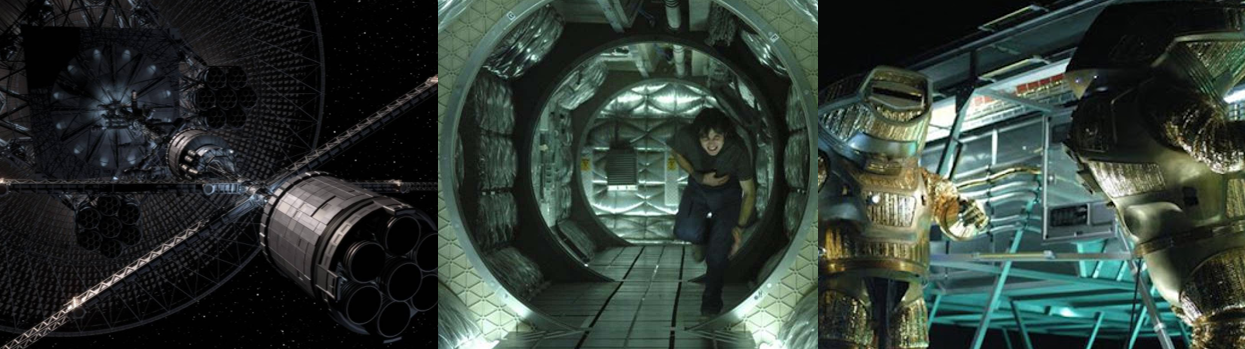
By 2007, British director and producer Danny Boyle had made a name for himself, most notably with the critically-acclaimed Trainspotting (ibid, 1996) and the post-apocalyptic zombie horror 28 Days Later (ibid, 2002), when he was presented with the concept for what would become Sunshine. The script, as conceived by writer Alex Garland, was funded partially by Fox Searchlight and numerous outside investors, which afforded Boyle a great deal of creative freedom. Boyle and Garland worked on the script for a year and consulted with one of my favourite scientific personalities, Doctor Brian Cox, regarding the scientific accuracy of the concept, who dismissed criticisms of the film’s science in favour of creative license. Boyle assembled an ensemble cast of international characters to show all of mankind uniting in the face of their destruction, and consulted with the National Aeronautics and Space Administration (NASA) regarding the technology and presentation of the interior and exterior of the ship. Sadly, Sunshine’s $32 million worldwide gross made it a box office disappointment and the film was met with mixed reviews that mostly focused on the abrupt twist towards slasher movie territory for the ending. Personally, I found Sunshine to be one of the most poignant and underappreciated science-fiction movies ever made and am glad to see that it has developed something of a cult following since its release, and it’s my pleasure to revisit it for this review.

The Review:
Sunshine begins with Doctor Robert Capa (Murphy) outlining the basic premise and some of the history of the film; the Sun is dying due to unknown reasons, pushing mankind to the brink of extinction due to the Earth slowly freezing over. Seven years before the start of the movie, Icarus was sent on a mission to restart the Sun but was mysteriously lost before it could deliver its payload; Capa and the rest of his crew have spent the last sixteen months travelling towards the Sun aboard Icarus II carrying a “stellar bomb” with a mass equivalent to Manhattan Island in a last ditch effort to “create a star within a star”. The eight-person crew is an interesting mixture of personalities, nationalities, faiths, and specialisms, with each member having a specific field and function on the ship, while also operating not in a democracy but based on who is the most qualified and informed to make certain decisions.

Capa and Mace have a tumultuous relationship that leads to disagreements and conflict.

Capa is the genius behind both the stellar bomb and the mission to restart the Sun; a physicist who is something of a quiet outsider, Capa finds his nights haunted by horrifying nightmares of him falling, screaming, towards the surface of the Sun and his days preoccupied with checking and double-checking his calculations and simulations for the stellar bomb. Essentially, Capa is worried that the bomb won’t actually do the job since it’s obviously untested; the simulations are often inconclusive, meaning that he is working somewhat on faith in the scientific accuracy of the bomb’s payload, and thus he agrees that it is only logical for the Icarus II to intercept Icarus I and retrieve its bomb to double their chances. Capa is a humble man just trying to do the best job he can who fills his messages back to his family with reassurances, but comes into frequent conflict with the ship’s engineer, Mace (Evans), a rugged and confrontational individual who isn’t afraid to call others out on their mistakes and often lets his emotions get the better of him. As hot-headed and blunt as he can be, though, Mace is absolutely devoted to the mission, to the point where he is willing to sacrifice his life (and considers all of their lives expendable) in service of completing the mission and saving the world. Still, he is an abrasive and hypocritical character; tensions between him and Capa rise after they get into a fight over the communications system and, while they share an awkward apology over the matter, Mace continues to antagonise Capa, volunteering him for a dangerous mission to repair the ship’s damaged solar panels and then later blaming him for endangering the crew despite all projections suggesting that the risk was worthwhile.

Corazon keeps everyone alive and Cassie is the heart of the crew, but there isn’t much for them to do.

The crew are kept fed and breathing thanks to the efforts of biologist Corazon (Yeoh), who maintains the ship’s “oxygen garden”, and the ship is kept on track thanks to the efforts of pilot Cassie (Byrne). These two are the only female members aboard Icarus II and prove to be two of the more emotionally stable amongst the crewmembers; of the two, though, Corazon is probably the least developed and interesting. Although she’s the first to suggest that they need to trim their numbers in order to maximise their resources and reach the payload destination, Corazon doesn’t really have much of a presence or much to do beyond caring for the plants; she’s thus naturally horrified when the oxygen garden is destroyed, and unceremoniously murdered while trying to salvage some life from the torched garden. Cassie is far more prominent, but not by much; she also suffers from nightmares of the Sun and is very much the heart of the crew and the one who maintains the most humanity throughout the mission. She clearly cares about the entire crew, even an asshole like Mace, and has an obvious affection for Capa (though their relationship stays plutonic and professional throughout the film), and refuses to participate in their vote about killing one of their own to conserve their oxygen supply later in the film. Ultimately, however, Cassie really doesn’t have too much of an impact on the film beyond being a source of emotional support for Capa and a representative of the humanity the crew struggles to maintain out in the void, and push Capa towards seeing the mission through to its conclusion, even at the cost of their lives.

Harvey fails to live up to Kaneda’s example, while Pinbacker lost faith in the mission entirely.

Icarus II is captained by Kaneda (Sanada), a stoic and practical man without ego who is happy to defer to the expertise of the other crew members when it comes to certain decisions. Fully aware of the magnitude and risks of the mission, he appears to be a well-respected authority figure who does a decent job of keeping everyone focused and on track with the mission; when they enter the communications “dead zone” seven days early, he emphasises that it’s not something for them to get worked up about since they were fully prepared for the resulting communications blackout, and when they discover Icarus I he leaves the decision regarding docking with it to Capa, recognising that he’s the most qualified man to make that risk assessment. While maintaining a professionalism at all times, Kaneda grows concerned about their mission the closer they get to the Sun since Icarus I disappeared at around the same point as they find themselves at the start of the movie and he pours over Captain Pinbacker’s (Strong) video logs for some answer to what happened to the ship. Interestingly, when the Icarus II is damaged due to a misalignment of the shields, it’s Kaneda who volunteers to head out on a space walk to repair the damage, which isn’t something I would expect from the ship’s captain. Unfortunately, this proves to be a fatal decision as Kaneda is unable to make it back to safety and is incinerated by the Sun’s rays, which greatly affects the moral of the crew and the stability of their mission. With Kaneda gone, the chain of command falls to the far less respected and far more ineffectual Harvey (Troy Garity), a communications officer whose job is made completely redundant when the ship loses its communications antenna. Harvey struggles to make competent decisions and to be a rallying force; he also ends up suffering a horrific fate during a dangerous space jump between the two ships, which sees him floating off into the empty void and choking/freezing to death in the vacuum.

Just as Trey is consumed by guilt, Searle and Pinbacker are obsessed with the allure of the Sun.

Searle (Curtis) acts as the ship’s doctor and psychologist; a clinical and pragmatic man, he helps to maintain crew moral and mental health aboard the ship, which grows increasingly strained due to the seriousness of the mission and the isolation of being so far away from loved ones. These issues are primarily embodied by Mace, who exhibits violent and aggressive behaviour towards Capa on a number of occasions, but also by Trey (Benedict Wong), the ship’s navigator, who falls into a suicidal depression after endangering the mission due to a miscalculation. Searle attempts to maintain order on the ship through counselling but, as rational as he is, he has grown obsessed with the power, magnitude, and beauty of the Sun; he regularly sits in the observation room to view the Sun without protective filters and it’s here that we get the first hints towards the Sun as this overwhelming, almost God-like force that has a significant impact on each member of the crew. Both Capa and Cassie admit to having recurring nightmares about the surface of the Sun, and we later find that Pinbacker has taken Searle’s fascination with the Sun’s astounding force to dangerous and destructive levels. Forced to board Icarus I when the oxygen garden is destroyed by Trey’s mishap, the crew find a dead and lifeless ship; the remains of the crew sit immolated in the observation room and the payload has been sabotaged, but the ship hides an even more destructive secret. Pinbacker, a scarred and burned mess of a man, has managed to survive in orbit around the Sun over the last seven years; driven to insanity by the Sun, which he believes “speaks” to him and which he worships as a God, Pinbacker stows aboard Icarus II and sets about sabotaging the ship and murdering the crew since he believes that humanity is destined to meet their extinction at the hands of his God.

The Nitty-Gritty:
One thing I’ve always enjoyed about Sunshine is the bleak atmosphere of the film; like many doomsday scenarios, this is a story where, on paper, everything should have gone exactly as planned but, thanks to a minor miscalculation and an unforeseen element of danger, the entire mission is put into jeopardy and all of the crew become fatally endangered. It’s something about these films that I’ve always found incredibly appealing on an emotional level; Icarus II is literally the last chance for humanity as the last remnants of the Earth’s resources have been put into constructing the ship and its payload, so they cannot afford to fail, and the crew largely accept the very real possibility that they might not make it back from their mission or even succeed since the stellar bomb’s success is entirely theoretical. This bleak tone is perfectly reflected in the film’s presentation and the presence (or absence) of sound; exterior sound is notably more muted than in many sci-fi films, which is very much appreciated, and much of the events are punctuated by light, ambient sounds and a building score courtesy of Underworld and John Murphy. This culminates in the film’s most emotional and impactful orchestral number, “Sunshine (Adagio in D Minor)”, a poignant and stirring tune that has since been used in many other films and trailers and never fails to get an emotional response from me; most notably, it definitely makes Kaneda’s death, and the dramatic finale of the film, all the more impactful.

All of Sunshine‘s technology and equipment is very practical and grounded in reality.

Sunshine was easily Danny Boyle’s most ambitious and effects-heavy film to date, and something of a dramatic departure for him, and yet does a wonderful job of keeping things grounded in a scientific basis thanks to utilising practical effects wherever possible to bolster the CGI shots. Both Icarus and Icarus II are extremely functional in their design; essentially long, cylindrical missiles, the ships are designed to be as narrow and efficient as humanly possible. Every part of the interior has a purpose and the ships are protected from the Sun’s intense heat and deadly radiation by a massive set of solar panels that act as both shields and a power source for the ship. Naturally, being a science-fiction film, some creative liberties have been taken place regarding the ships’ realism; computer panels and monitors have pretty futuristic touchscreens and sport very sci-fi graphics on them but they’re probably not a million miles away from where technology would be at this point, the interiors are far larger and more accommodating than real-life space stations and shuttles, and feature a number of creature comforts for the crew. This includes the viewing room, where crewmen such as Searle and Pinbacker can view the Sun at varying degrees of intensity, a beautiful oxygen garden, where Corazon monitors the plants and natural habitat that sustains Icarus II’s oxygen and life support systems, and a “holodeck”, of sorts, where crewmen are advised to spend their downtime in order to stave off the mental toll of being adrift in the vast emptiness of space. Unlike a lot of sci-fi films, Sunshine’s space suits choose to be bulky and practical rather than sleek and sexy; comprised of a startling golden material and featuring bulbous helmets to reflect and filter out the harsh sunlight, the suits appear cumbersome but also realistic, and the frustration Capa feels when trying to manoeuvre in the suit towards the finale is one of the most relatable and agonising moments of the film thanks to how perfectly Murphy captures the character’s frustration at simply getting up after a trip.

The void of space holds many dangers, none more threatening than the looming and destructive Sun.

I find it disappointing that some regard Sunshine unfavourably; the film is a bleak, atmospheric mediation on humanity’s last, desperate attempt at saving themselves from extinction and a visually impressive piece of cinema. I love the depiction of the Sun as this all-encompassing, awe-inspiring entity; the power of its mere presence has a profound effect on every character and it constantly looms in the background of the endless void as this necessary, but destructive, force (the Sun even appears to “roar” when seen in full view or overwhelming its victims). The crew’s mission is one that requires them to journey closer to Sol than anyone has ever been before and jump start it back to life with the largest nuclear payload ever devised but, while the Sun is dying and is the key to humanity’s survival, it is also extremely harmful to the ship and her crew. The slightest shift, the smallest miscalculation, is all it takes for the ship to be damaged and the oxygen garden to be destroyed, jeopardising the crew, the mission, and our entire world and, in their dying moments, many characters choose to have the Sun envelop them, as if sacrificing themselves to Pinbacker’s God. I’ve heard that many were put off by the suddenly tonal shift at the end of the film, and I guess I can understand that to a degree; Sunshine starts out as something of a run-of-the-mill, space-based drama that focuses on character interactions and conflicts, but escalates when the crew stumble upon Icarus I and Icarus II is damaged trying to intercept it.

Although Pinbacker causes many deaths, Capa is able to complete the mission at the cost of his life.

Upon boarding Icarus I, the film takes a sharp turn towards a surreal, horrifying slasher, which appears to have put a lot of people off but I think actually adds to the tension and appeal of the film’s final act. At first, it seems as though the Icarus II computer itself (Chipo Chung) is sabotaging the mission; it constantly overrides Cassie’s manual control, leading to the destruction of the oxygen garden and Kaneda’s death, and then reports that they have too many crew members aboard the ship. However, Mace discovers that Pinbacker and his crew chose to abandon their mission due to the futility to challenging “God”, and Capa is horrified to find that Pinbacker is their mysterious extra crew member. A broken, fanatical man, Pinbacker is covered in severe burns and driven by murderous intent; constantly filmed using an unsettling and disturbing “shaky cam” style that makes him appear as little more than a monstrous entity (or an embodiment of the Sun itself), Pinbacker stalks Icarus II with an electric knife, directly killing Corazon and indirectly causing Mace to slowly and painfully freeze to death in an unsuccessful attempt to undo his sabotage. With no choice left, Capa is forced to disengage the stellar bomb from Icarus II and manually operate the device to complete the mission; he manages to fend off Pinbacker, despite suffering a deep cut, by ripping the scarred tissue from the former captain’s arm in a sickening scene and enjoys one moment of blissful serenity as he is caught between the blast of the bomb and the surface of the Sun before the star finally flares back to life and promises salvation for the remainder of humanity.

The Summary:
Sunshine may be one of the most intense and bleak science-fiction events I’ve ever experienced. I find myself continuously fascinated by the film’s visuals, soundtrack, and atmosphere; there’s just something about it that leaves an indelible impression upon me and I always find myself getting drawn into its grim depiction of humanity’s last chance at survival. While some characters are more one-dimensional and noticeably less memorable than others, I was impressed by all of the performances in the film, though Cillian Murphy and Chris Evans are the obvious standouts. Their differing personalities make for much of the dramatic conflicts between the characters, but it’s fascinating seeing the other characters be influenced by the increasingly dire nature of their mission, to say nothing of the Sun. The idea of the Sun slowly dying out and freezing the Earth is pretty terrifying, as is the nigh-impossibility of mounting a mission to restart it; it’s inspirational seeing a diverse collection of scientific minds and skills coming together to fulfil this mission, and their willingness to sacrifice themselves is as tragic as their many moments of conflict and the mistakes that threaten disaster for the mission. The late introduction of a murderous fanatic completely changes the tone and direction of the finale, but I think delivers some of the film’s most startling message: in the face of extinction, every person reacts differently, and Pinbacker completely gives himself over to the inevitability of humanity’s destruction and is as devoted to ensuring this as the Icarus II crew is to preventing it. An insane, homicidal maniac, Pinbacker is horrifically presented as being a monstrous force, as though the Sun itself (or whatever is eating it up) has taken physical form to destroy our last chance of survival, and ensures that the finale takes a dramatic and heart-wrenching turn as the crew is whittled down one by one and Capa is left to make the ultimate sacrifice. Overall, I find Sunshine to be as powerful and influential an experience as the Sun is presented in the film; I’m obviously no scientist but I see it as one of the most realistic and scientifically accurate depictions of a doomsday scenario and I never fail to be left an emotional wreck by the tragedy that befalls the characters. It’s maybe not for everyone, and possibly a little too slow and tonally confused at times, but I’ll never get sick of singing its praises and think that it’s definitely well worth your time if you’re in the mood for an intelligent and poignant sci-fi tale that’s laced with a little horror and a lot of introspective discussion on how much we take our most inexhaustible power source for granted.

My Rating:

Rating: 5 out of 5.

Fantastic

Are you a fan of Sunshine? How do you feel it compares to other disaster films? Were you a fan of the concept or did you find the idea of the Sun dying a little unbelievable? Which of the characters was your favourite and what did you think to Cillian Murphy and Chris Evans’s performances? Did you like that Danny Boyle imbued the Sun with a form of malevolence and what did you think to the tonal shift towards a slasher horror for the final act? How important is scientific accuracy and realism to you in disaster films like this? How are you celebrating the end of the world today? Whatever you think about Sunshine, disaster films, and overblown predictions of the end of the world, sign up to drop your thoughts down below or leave a comment on my social media.

Game Corner [Turtle Tuesday]: TMNT II: Back from the Sewers (Xbox Series X)


Ever since Kevin Eastman and Peter Laird’s Teenage Mutant Ninja Turtles (TMNT) first debuted, the franchise has enjoyed worldwide mainstream success thanks to action figures, cartoons, and videogames. Since I found some free time this December, I decided to spotlight four such videogames every Tuesday of this festival season.


GameCorner

Released: 30 August 2022
Originally Released: 15 November 1991
Developer: Digital Eclipse
Original Developer: Konami
Also Available For: Game Boy, Nintendo Switch, PC, PlayStation 4, PlayStation 5, Xbox One, Xbox Series S

The Background:
In the late-eighties and early-nineties, you’d be hard pressed to find a franchise more popular than Teenage Mutant Ninja Turtles. Known as Teenage Mutant Hero Turtles here in the United Kingdom, the original dark and violent comic books exploded into an incredibly successful cartoon and extensive toy line, and a slew of videogame outings courtesy of developer Konami. Konami’s efforts helped to make the NES a household name here in the UK, produced two of the most beloved titles for arcades and home consoles, and also extended to three handheld titles for Nintendo’s super successful portable, the Game Boy. Building upon the standards set by its predecessor, Back from the Sewers improved upon the visuals despite the obvious limitations of the Game Boy hardware and expanded the gameplay options available to bring the sub-series more in line with its bigger, better 16-bit counterparts. Since a complete physical version of the game is still ridiculously expensive for the quality of the game, I was still glad to see Back from the Sewers included in the 2022 Cowabunga Collection alongside a host of other TMNT games and quality of life features.

The Plot:
The TMNT’s archnemesis, Oroku Saki/The Shredder, returns, now bolstered by the forces of the sinister Krang and kidnaps April O’Neil to get his revenge on the foursome.

Gameplay:
Like its predecessor, Back from the Sewers is a simple sidescrolling action game rather than a traditional arcade style beat-‘em-up. After selecting from three difficulty levels (Easy, Normal, or Hard), you pick one of the four turtles and battle your way from the left side of the screen to right across six stages (referred to as “Acts”). Again, the Game Boy’s limited colour palette means that the turtles are only distinguished by their individual weapons, but they again have different strengths and weaknesses: Leonardo is a bit of an all-rounder, for example, with Raphael having a fast attack but a terrible range. Sadly, the shuriken projectiles are gone; they’re replaced by a sliding kick that I only found a handful of uses for as it often leaves you open to enemy attacks, but you can toss shuriken when using ladders. The buttons have been remapped, with A allowing you to jump (holding it again allows you to get some extra height with a reanimated somersault) and X performing your attack; you can pull off a jumping attack by pressing X in mid-air and the game still allows you to hit back or destroy most incoming projectiles with your attack. Screen transitions are much more involved this time and initiated by climbing ladders but you’ll also clamber along pipes to cross gaps and there is a lot more emphasis on vertical traversal, with you hopping up and down girders and platforms using up and down on the directional pad and A.

The graphics and gameplay have been overhauled to more closely resemble the arcade titles.

The essential gameplay remains mostly unchanged; the screen and hardware limitations mean things are still very restrictive but there are far more influences from the TMNT’s arcade titles (the Foot jump up from manholes and you can fall down the holes, for example). The most obvious of these is in Act 2, which sees you racing along a bridge on a rocket-powered skateboard attacking enemies and dodging barrels, and Act 6, which recreates the classic Sewer Surfin’ level, to say nothing of the inclusion of not one but two traditional elevator sequences in Act 3 and 6. There are also some additional gameplay elements here, such as a race away from a rolling boulder in Act 4, mines being scattered across the ground, bursts of flames and machine gun fire, and jumping to a series of floating platforms in Act 5. Levels are a bit longer and more involved but the game loves to artificially up the difficulty by swarming you with an endless barrage of Mousers and bug ‘bots; these fuckers will pop out from holes in the caves and sewers and from mechanical ports and it can be extremely frustrating trying to fend them all off and back jumps in Act 3’s construction sites. Some stages seem to be on a loop as well, though I think this is just a consequence of the limited hardware, and you’ll still have to avoid the same obstacles like falling hazards and electrical bolts. As before, you can pick a different character between stages and if your health is drained; each turtle has their own health bar, any damage you take carries over to the next Act, and any captured turtle can be rescued in bonus games, with these now taking place upon completion of an Act and seeing you chasing around an enclosed arena to refill your health as much as possible in a short time limit.

Graphics and Sound:
Although Back from the Sewers is still handicapped by the Game Boy’s hardware, it’s an obvious graphic step up over its predecessor right from the start, where it ambitiously recreates the cartoon’s iconic opening sequence, and the game even includes some limited sound bites to punctuate the action. The game’s overall presentation is far more akin to the cartoon than many other TMNT titles as it not only basis its story art on the cartoon but even includes level intros and a pause screen that mimic the show’s episode titles. All of the sprites and environments have been overhauled and are all the better for it; the TMNT are bigger and more detailed, with Leonardo and Raphael now carrying two weapons each and all four having a more detailed idle animation. Although the sprites appear a bit stiffer and more clunky than other TMNT titles, they pull an amusing panic face when running from the aforementioned rock and will be left charred when caught in flames and explosions.

Sprites and environments have been greatly improved, despite the Game Boy’s limitations.

Similarly, the game’s environments are far more detailed than those seen in the previous game; this is evident from the opening Act, which actually provides a level of depth and visual interest to the sewers despite the lack of moving water. This extends to the streets as well, where vehicles and there’s an attempt to showcase some depth to the backgrounds can be seen, and in the overhauled Technodrome which now sports many of the same hazards and features as the arcade versions. While there are only a handful of unique environments, such as a cave and an overused construction site, there is much more to spot in the background, from Splinter working in a pizza parlour, Foot Soldiers hiding behind cover and sliding at you, chain link fences and cityscapes, and holes in the environment leading to sewers and such, though the caves can be a bit of a mess. There are far more enemies onscreen at any one time thanks to those damnable Mouser holes and turrets, and you’ll still get an annoying beep when your health is low, and the ending is even sparser than in the first game. On the plus side, the music is much more varied and there are some fun in-game cinematics, such as Splinter piloting the turtle blimp, and options to move around in a wider area like in the arcade titles once you’re descending down the stairwell.

Enemies and Bosses:
Surprising no one, you’ll primarily be battling against the Shredder’s inexhaustible army of robotic Foot Soldiers; they’ll jump in at you but actually managed to land a hit or two this time with their sliding kicks, dynamite, large projectiles, standing on each other’s shoulders, and firing bazookas at you. As indicated, the Mousers and bug ‘bots return; they might not bite your hand anymore but they are absolutely relentless, spawning so fast and so frequently that it’s hard to fend them off and progress through some stages. Roadkill Rodneys are also back, now firing laser bolts, and the game even includes a handful of mini bosses this time around; a swarm of Foot Soldiers, a Pizza Monster in the sewers, Baxter Stockman’s fly form on a rooftop, and the Game Boy debut of the Rock Warriors in General Traag and Granitor.

Boss are greater in number, strength, and visual appeal this time around.

Each Act naturally concludes with a boss battle; each sports a life bar but they’re all just variations on the boss battles we saw in the last game. Once again, your first test is against Rocksteady; this time, he jumps about while Foot Soldiers drop objects from the windows above and shoots deflectable bullets at you, pausing to laugh and leaving himself open for your attacks. Bebop (and his ridiculously disproportinate head) awaits at the end of the bridge stage, firing out a spread of diamond projectiles and knocking you silly with an uppercut when he’s not hopping all over the place. Krang makes a rare appearance in his little walker at the end of Act 3, stomping about firing rings and raining bombs on the arena, and leaping overhead to try and crush you in a nigh-unavoidable attack. You’ll have rematch with the Shredder at the end of Act 4; this time, he fires an energy wave at you that you can jump over but not duck under, dives at you with a flying kick, and runs from one side of the screen to the other, meaning you’re basically guaranteed to take damage as the window of opportunity to dodge and counterattack is so small. Granitor confronts you in Act 5, rolling about the place and roasting you with his flamethrower, but the additional movement options afforded in this arena help to make this more manageable. When you get to the Technodrome in Act 6, you’ll have to battle General Traag to get inside the machine in a conflict made more troublesome by the 2D pane and the treadmill under foot. The Shredder mutates into his Super Shredder form for the penultimate boss, plodding about and swiping at you, teleporting about the place, and confusing you with a bevvy of duplicates to try and land a sneak attack. Finally, you’ll take on Krang’s android body in the finale; this time, Krang is nice and big and is able to stun you with a ground-shaking stomp, however he’s far weaker than in the last game and much easier to defeat than either of the Shredder fights in this game since you can just jump kick him and run underneath him when he’s jumping in for an attack.

Power-Ups and Bonuses:
As in the last game, your only pick-ups are the odd slice of pizza; these are sometimes carried by enemies and sometimes found floating around the environment, generally before a boss battle, but are noticeably rare and still the only power-up available.

Additional Features:
Back from the Sewers trumps its Game Boy predecessor by including three difficult levels, but it’s still very limited in terms of in-game options. Luckily, the Cowabunga Collection awards a 70G Achievement for completing the game, offers a strategy guide to help with the game’s trickier sections, lets you view the game’s box art and manuals, includes both the Japanese and American versions, and offers various borders and display options (including an LCD display to recreate the Game Boy’s headache-inducing screen). The game also allows you to rewind the game with the Left Bumper and access save states using Right Bumper and you can take advantage of the enhancements to jump to any level you wish and enable infinite lives without fear of missing out on your Achievement.

The Summary:
Undoubtably,Teenage Mutant Ninja Turtles II: Back from the Sewers is a vast improvement over the TMNT’s previous Game Boy title. If the first one was a pretty basic proof of concept, this sequel takes the capabilities of the handheld system and uses them to its advantage to produce a title that’s still very restricted by its hardware but much more akin to a 2D version of its arcade counterparts. While the sprites and animations are still a bit stiff and limited, they’re far more detailed, as are the backgrounds, and I loved how the game included versions of the sidescrolling chase sequences from the arcade games. Placing the bonus game sat the end of Acts was a nice way to break up the monotony and I enjoyed the improved music, cutscenes, and the expanded length; tossing in a few mini bosses also helped and it was just great to have so much to se happening around you. Unfortunately, it’s still not perfect; I don’t mind the loss of a turtle as a life system but the endless swarm of Mousers and bug ‘bots was needlessly frustrating and some of the bosses were almost impossible without full health. The strange loop system and slide kick were also odd inclusions, but the overall presentation was much improved and far more fitting for the license and the standards set by its technically superior counterparts. There are still better games on the Game Boy, and better TMNT videogames, however, but this one is a little bit more worth your time compared to its predecessor.

My Rating:

Rating: 2 out of 5.

Could Be Better

Was Teenage Mutant Ninja Turtles II: Back from the Sewers included in your Game Boy library back in the day? How do you think it compares to the last TMNT Game Boy game? What did you think to the additional elements included from the arcade titles? Were you a fan of the overhauled sprites and backgrounds, and which character was your favourite? What did you think to those Mouser holes and the addition of mini bosses? Do you have any fond memories of the Game Boy? Whatever your thoughts, you can share the, in the comments section below or you can join the discussion on my social media.

Movie Night [Christmas Countdown]: Gremlins

Released: 8 June 1984
Director: Joe Dante
Distributor: 20th Century Fox
Budget: $11 million
Stars: Zach Galligan, Phoebe Cates, Howie Mandel, and Hoyt Axton

The Plot:
Struggling inventor Randall “Rand” Peltzer (Axton) purchases a mysterious, cute little creature known as a “Mogwai” as a Christmas present for his son, Billy (Galligan). The creature, nicknamed “Gizmo” (Mandel) comes with a strict set of rules that see it react in pain to bright light, multiply when exposed to water, and its mischievous progeny metamorphose into mean-spirited, destructive, aggressive little monsters that wreak havoc on Billy’s hometown on Christmas Eve.

The Background:
Produced at a time when blending horror and comedy was quickly becoming a popular trend in media and fiction, Gremlins was the brainchild of Chris Columbus, who was inspired to write a spec script after being creeped out by the sounds of mice in his attic. The concept has its roots in both Chinese mythology and Second World War propaganda warning of potentially faulty or sabotaged machinery, and the script was never intended to be a film but was pushed into production after Steven Spielberg became excited enough by the concept to buy the script. Joe Dante was brought in to direct and worked closely with Spielberg to design the look of Gizmo and the Gremlins, who were brought to life using puppets and animatronics designed by Chris Walas. The script was initially much darker, and Spielberg nixed the idea that Gizmo would transform into a villainous Gremlin, though the final film remained violent and disturbing enough to help forever change the way that films were rated. While the more violent aspects upset many parents, Gremlins was a massive hit; it made over $212 million at the box office and has been widely praised for its biting dark comedy and special effects. The film was succeeded by a great deal of merchandise, videogames, and a much more light-hearted sequel, as well as kicking off a trend towards vicious little creatures in horror cinema. Another of the formative films of my youth, Gremlins has long been a favourite of mine; it’s a staple of every Christmas, and I’m keen to see how the long-awaited third entry turns out.

The Review:
Gremlins begins framed as a story told to us by Rand, though his narration simply bookends the film to add to its whimsical nature as a kind of suburban legend, or campfire story, told to caution the viewer of the dangers of meddling with the unknown. Rand is an inventory, specialising in all kinds of wacky household doohickeys that are targeted at making life easier for the lazy and the dim-witted. A running gag in the film is the unreliability of his inventions, such as an orange juicer maker that explodes in Billy’s face, a remote phone (what a crazy idea!), and the Peltzer Smokeless Ashtray that produces a great deal of smoke! His pride and joy is the Bathroom Buddy, an all-in-one bathroom assistant that actually is pretty neat, but constantly malfunctions, usually right when he’s trying to sell it. Rand means well, and his heart’s definitely in the right place, and his passion and enthusiasm for science and inventions is certainly admirable but, sadly, he really hasn’t seen much in the way of success with his patents and is therefore heavily motivated to make up for his failures as a salesman and a businessman by getting his son a gift to truly make his Christmas.

As his father’s inventions are unreliable, Billy is forced to set aside his dreams to support his family.

After trawling the streets with no luck, Rand finds himself on the imposing streets of Chinatown, where a young boy (John Louie) leads him to the dingy, treasure trove of his grandfather, Mister Wing (Keye Luke). Mr. Wing’s shop is full of curios and antiques, and Rand is taken by the old man’s offerings, but is immediately besotted by a curious, singing creature unlike anything he’s ever seen before. Despite Rand slapping down $200 for the Mogwai, Mr. Wing refuses to part with the critter since it “requires much responsibility”. His grandson, however, slips Rand the Mogwai behind his grandfather’s back, desperate for the money to help the struggling shop, and emphasises the importance of following three rules to care for the creature: Don’t get him wet, keep him out of the sunlight, and never feed him after midnight. Off screen, Rand dubs the chirpy critter Gizmo and triumphantly returns home as a boisterous and much-loved figure to his wife, Lynn (Frances Lee McCain), and son Billy. While Lynn is a stay-at-home-mum and fills her days either struggling with Rand’s inventions or cooking, Billy is a hard-working lad in his early twenties (maybe?) A gifted artist, Billy works a full-time job as a bank clerk and is practically supporting his entire family with his meagre income; while the likes of Gerald Hopkins (Judge Reinhold) are far more successful and dynamic and local elderly miser Mrs. Ruby Deagle (Polly Holliday) constantly cause him headaches, Billy longs for more but is incredibly loyal to his family and willing to sacrifice his own dreams in order to support them.

Both Murray and Kate have their quirks, but at least Kate is quite the cutie.

It’s not all bad, though; Billy has a rambunctious dog, Barney (Mushroom), a loving family an supportive friends, such as local boy Pete Fountaine (Corey Feldman), who shares Billy’s love of comic books and is equally overworked as a Christmas tree delivery boy, and his neighbour, Murray Futterman (Dick Miller). A former World War Two veteran and fierce patriot, Murray likes a bit of a drink and tends to go off on rants about the unreliability of “Goddamn foreign cars” and other items produced outside of the United States, but also tells Bully a harrowing story about how “Gremlins” sabotaged bombers and other vehicles during the war. Billy largely ignores Murray’s ramblings, and many of his other issues, to instead focus on pining after Kate Beringer (Cates), his beautiful co-worker who also works a double shift at a local bar. Although Gerald arrogantly tries to win Kate over with his wealth and higher class of lifestyle, she is far from impressed with his bravado and is as smitten with Billy as he is with her. Kate also campaigns against Mrs. Deagle’s attempts to strip their sleepy little own of its most sentimental landmarks, and is hiding a bizarre childhood trauma that keeps her from celebrating Christmas.

The Mogwai may look cute but they’re mischievous little critters, except for the adorable Gizmo.

All of these character’s lives are forever changed when Billy excitedly opens his father’s present and is met by the cute little Gizmo. A strange little creature, Gizmo is inquisitive and adorable and surprisingly intelligent; he sings a little tune and purrs when he’s happy, plays with toys and musical instruments, and can even read comics and play videogames. Gizmo develops a fascination with television, and becomes particularly inspired by the racing classic To Please a Lady (Brown, 1950) and its depiction of fast cars and romance, and can even communicate using simple, childish words. Billy and Gizmo form an immediate bond and Gizmo delights in experiencing the delights of the modern world, but is mindful and responsible enough to be fully aware of the rules he must abide by to stay safe. When Billy enters a room that’s fully lit, Gizmo squeals “Bright light! Bright light”, he dutifully sleeps by Billy and Barney’s side rather than eating after midnight, and stays far away from water at all times because the last thing he wants is to get hurt or die…or worse. As capable as Gizmo is, however, he’s subject to the mishaps of the ignorant and, when Pete accidentally spills water on him, the Mogwai reacts in a violent and disturbing way that Billy certainly wasn’t expecting: a handful of smaller, equally cute but far more mischievous and ill-tempered Mogwai pop out from Gizmo’s back and, all of a sudden, Billy’s new pet becomes a litter of ill-behaved critters.

Cruel and vicious, Stripe desires only to lead his fellow Gremlins on a merry jaunt to cause chaos.

While Rand sees a potential business opportunity in marketing the Mogwai as a hot new family pet, Billy takes one of the batch to Pete’s science teacher, Roy Hanson (Glynn Turman), who immediately experiments on it and produces even more of the Mogwai and is far less mindful of the rules. Unlike Gizmo, the other Mogwai are loud and demanding and mean-spirited, hogging all the toys and being disruptive; they’re led by “Stripe” (Frank Welker), a cruel and vindictive little critter who easily manipulates events to ensure that he and his fellow Mogwai are fed after midnight. The result is Billy waking to find them all encased in disgusting cocoons, and Gizmo distraught at how quickly things have gone south, things go from bad to worse for him, and the entire town, when the cocoons hatch and aggressive, vicious little demons emerge. These Gremlins, led by Stripe, quickly spread across town and cause all manner of havoc from shorting out traffic lights, causing fires and explosions, and even resulting in some violent deaths as they send Mrs. Deagle flying out of a window! Stripe delights not just in causing mayhem but in torturing poor Gizmo, and leads the Gremlins on a merry jaunt to find more havoc, food, and water to increase their numbers and keep the party going.

The Nitty-Gritty:
Gremlins starts off as a quirky little family movie about a struggling family in a nice little town where the wealthy oppress the working class and the character’s main concerns are trying to provide for their loved ones and mustering the courage to ask out the pretty girl. Even when Gizmo arrives in Billy’s life, things don’t really change all that much right away; he treats the Mogwai as a friend and a pet but life carries on as normal and it’s only when Gizmo is exposed to water that things take a dramatic turn sideways. The Gremlins really shake up the film and turn it more into a dark comedy as the vicious little creatures turn the town into an absolute disaster area; the once quiet and peaceful streets are soon strewn with debris, burned out cars, exploded shop windows, and people fleeing in panic and terror as the Gremlins spread anarchy in their search for food, entertainment, and procreation.

The Gremlins cause havoc across town, attacking and even killing people simply for fun!

The Gremlins are impish, wicked little monsters who delight in causing trouble, pain, and destruction all over town. Although mischievous as Mogwai, they completely lose all their inhibitions as Gremlins and become obsessed with playing cruel pranks, gorging themselves, and reproducing at every opportunity. They’re also incredibly dangerous; Mrs. Deagle might have been a miserly old bat who deserved some comeuppance but they send her blasting out of a window at high speed to a cruelly amusing death, they string up Barney and leave him to freeze in the cold before Billy rescues him, and there’s a particularly harrowing scene where Lynn is attacked by a Gremlin hiding in the Christmas tree! Stripe is the clear alpha, directing the others in cutting the power to Billy’s clock so they can metamorphose and fleeing to the local swimming pool at the Young Men’s Christian Association (YMCA), where he savagely attacks Billy by clawing his chest before jumping in the pool and birthing a veritable army of Gremlins! While he delights in causing misery, Stripe is much more composed and sadistic than his brothers, best seen when they take over Kate’s bar and they’re all causing trouble, but he’s sat playing poker and executes a fellow Gremlin for daring to beat him. The Gremlins’ greatest strengths are their nimble size, sheer numbers, and vicious nature, but they’re quite fragile and easily bested if caught unawares; Lynn takes advantage of this to mince, stab, and explode the little monsters when they wreck her kitchen.

Extremely expressive puppets and animatronics bring the film’s unique creatures to life.

The Mogwai and Gremlins are brought to life through the finest puppetry and animatronics of yesteryear; incredibly expressive and capable of a range of motion (and emotion), the puppets do a fantastic job of showcasing a great deal of personality. With his wide eyes, expressive ears, and adorable little paws and chubby, fluffy body, Gizmo is easily one of cinema’s cutest and iconic little critters ever. His fellow Mogwai all look very similar to him, but are notably distinctive; they not only act very different but have different markings, with Stripe being the obvious standout. Two Mogwai at Mr. Hanson’s lab are particularly adorable as the knock on the walls of a box and they’re all just the cutest as they play with toys and games (even when Stripe is spitting orange goo at Gizmo). Gizmo obviously has the most personality and cuteness appeal; he looks absolutely terrified when the Gremlins are torturing him, which is almost as heart-breaking as his blubbering after he cuts his head and needs a bandage and his dismay at having given birth to his mischievous progeny. Although just a short little critter, Gizmo is determined to put an end to the Gremlins’ reign of terror and helps lead Billy to where Stripe and the others are hiding out. This culminates in him getting behind the wheel of a Barbie car and racing to save Billy before Stripe and shoot him and ultimately delivering the coup de grâce to his tormentor even while putting himself at risk.

With the town in disarray, Billy and Gizmo defeat Stripe and bid a tearful farewell to each other…

The Gremlins swarm across the town, leaving it in ruins, before settling down at the cinema to watch Snow White and the Seven Dwarfs (Hand, et al, 1937) . Even as Gremlins, their needs are incredibly juvenile; they like to dress up and cause disruption, attacking Santa Claus’s and even ploughing through Murray’s house in his beloved Kentucky Harvester, but are equally as happy to sit with a load of snacks and watch movies. Billy takes advantage of this weakness, however, to break open a gas pipe and essentially set a bomb that blows all of the Gremlins to kingdom come…with the exception of Stripe, who was out gathering snacks. Billy, Kate, and Gizmo pursue him to a local toy shop, where Stripe arms himself with a crossbow, a chainsaw(!), and even a gun to find Billy off. Thanks to Kate breaking into the security office and flicking on the lights, and the timely intervention of Gizmo, Billy is saved and Stripe is reduced to a quivering, disgusting mess of goo right in the middle of trying to spawn a new batch of Gremlins. In the aftermath, the Peltzer’s nurse their wounds and the town tries to recover from their long, dark night, something Mr. Wing is far from impressed by. He chastises Rand’s foolishness and arrogance and reclaims Gizmo, but notes that Billy has the potential to be a suitable guardian in time, and heads back to his little shop after allowing Gizmo a heart-breaking goodbye to his newfound friend.  

The Summary:
Gremlins is not only another of those movies that shaped my childhood, and my love of quirky horror stories, but it’s also essential viewing at Christmas time for me. It might be an odd, violent little dark comedy by the end, but my God is it an absolute Christmas, and cinematic, classic. The practical effects are superb and still hold up to this day thanks to being timeless and irreplaceable puppets and animatronics. Gizmo remains one of the cutest little critters to grace our screens, and the Gremlins are some of the cruellest little mischief-makers ever seen and it’s not hard to see why so many other films tried to emulate the viciousness and comedy of these demonic little buggers. One of the things I love the most about Gremlins is the mystery surrounding the titular creatures; we never really know or ever find out where the Mogwai come from, why they are this way, and I’ve always enjoyed how everyday, suburban life was completely disrupted by this mysterious creature from an unknown oriental background. I loved how Gizmo was fully aware of the danger he poses to others, but still delighted in enjoying himself and playing and befriending Billy, and all of the performances are really strong throughout. Rand and Billy and the others hear the rules but don’t really understand them; they respect them enough to actually follow them, though, and it’s only through a mishap that Gizmo is exposed to water. Once the Gremlins emerge, we’re treated to one of the most unique Christmas movies ever made as these vicious monsters ransack the town, spoiling the holiday cheer more than Mrs. Deagle ever could and leaving a lasting impact as some of cinema’s most wicked critters.  

My Rating:

Rating: 5 out of 5.

Fantastic

What do you think to Gremlins? Is it a Christmas tradition of yours or do you prefer another Christmas movie; if so, what is it? What did you think to the puppets and animatronics? Did you find Kate’s Christmas story an odd inclusion? Would you have liked to see Gizmo turn into a Gremlin as originally intended? Which of the Gremlins knock-offs was your favourite? Whatever your thoughts on Gremlins, sign up to leave a comment below or drop a reply on my social media, and be sure to check in next Sunday for another Christmas movie review!

Mini Game Corner: Urban Strike: The Sequel to Jungle Strike (Mega Drive)

Released: 4 March 1994
Developer: Granite Bay Software
Also Available For: Game Gear, Game Boy, Super Nintendo Entertainment System (SNES)

A Brief Background:
After the conclusion of the the Gulf War, Mike Posehn took the air rescue mechanics of Choplifter (Dan Gorlin, 1982) and expanded upon them to create Desert Strike: Return to the Gulf, a nonlinear, mission-based military title that placed players in a sandbox environment and did away with typical videogame mechanics like bosses and power-ups. When Desert Strike proved successful, producer Scott Berfield, game director John Manley, and associate producer Tony Barnes created a sequel that built upon the core mechanics of the original with new locations and vehicles. Jungle Strike: The Sequel to Desert Strike (High Score Productions/Granite Bay Software, 1993) was also was well received, despite criticisms of its difficulty curve, and a third entry was produced for the following year. Moving away from real-world conflicts and taking a slightly more futuristic slant, Urban Strike continued to refine the gameplay mechanics of the series while also mixing things up with sections that took place on foot, however many reviews reportedly found that the gameplay wasn’t innovative or different enough to be as interesting or engaging as it once was. Contemporary reviews echo this sentiment, criticising the game’s difficulty though none of this kept the series from continuing on for a couple more entries.

First Impressions:
Like the first two games, Urban Strike is a top-down, isometric shooter, now set in the far-flung future of 2001 and primarily playing in control of a Mohican helicopter to undertake some familiar missions across a variety of maps now exclusively based in the United States of America. As ever, you can customise your control scheme to your liking – the default settings see A fire your Hellfire missiles, B fire your Hydra Rockets, and C fire your chain gun – but the game now supports the Mega Drive’s six-button controller, which is super useful for the new drop feature that lets you dispose of cargo or smart bombs at the touch of a button. You can again choose to control your helicopter either with or without momentum to increase or decrease the realism of the gameplay, and select from various co-pilots, with some being more accurate or trigger happy and some missing in action and in need of rescue. So far, it’s all very familiar but, like Jungle Strike, you now have the option of taking the controls of two other vehicles: the much larger Blackhawk helicopter (which lakes Hellfire missiles and seems a bit slower but can hold twenty passengers rather than the usual six, making it perfect for the game’s many rescue missions) and the Ground Assault Vehicle (GAV), a heavily armoured transport that might be slow as all Hell but it can take a beating and deliver massive damage. While the game technically only has five campaigns, this number is increased by the newest gameplay feature, which sees you abandoning your vehicle and exploring labyrinthine facilities on foot!

The developers attempted to spice things up with new vehicles and even some on-foot sections.

Unfortunately, the grid-like control pattern makes these sections rather awkward; you’re also limited to your MX9 machine gun and have far less armour since your only protection is a flack vest, and the zoomed in isometric perspective causes the game’s otherwise impressive presentation to suffer in these rare sections. Luckily, opportunities to switch to other vehicles are much more frequent than in Jungle Strike, though I can’t say I was too impressed by the new vehicles on offer here. Similarly, your missions in each campaign are painfully similar to what’s come before; you start off in Hawaii (with three lives by default and again without any in-game music accompanying the action) and are tasked with destroying radar sites and stealth ships, rescuing Green Berets, and blowing up a bridge. Objectives also include transporting telescope mirrors to a barge, which means your winch is taken up carrying the object; if you press a button to drop your cargo, it’ll be lost, so I’m not really sure why this function was included (if you could drop it, pick up an ally, and then grab the object again it would make much more sense). The first map is pretty open and linear, with an abundance of fuel, armour, and ammo crates to be found; those you rescue will also repair some of your armour when you drop them off, which is helpful, though it’s still advised that you plan on optimal route to avoid running out of ammo or blowing up from lack of fuel. If you’re down in this manner, you’ll respawn with twenty-five units of fuel and full armour but you’ll get full fuel if you’re destroyed be enemy fire (though your weapons can only be replenished by ammo crates, so be careful not to accidentally destroy them!)

Graphically, the game impresses, but it’s gameplay has become quite repetitive by now.

From the pause menu, you can again see a pretty useful map of the area and cycle between mission objectives, notable highlights, and review your mission and current status. If you destroy the wrong targets or fail to rescue or secure others in time, you’ll be forced to return to base to restart from the beginning, so there’s again a fair amount of trial and error required to properly progress. Campaigns also include some hidden side missions, such as rescuing innocents from shark attacks and such, which will net you bonus points. While the first campaign is pretty simple stuff even without the helpful ten lives cheat code, campaign two takes its queue from the final level of Desert Strike and has you securing heavily-defended oil rigs, rescuing survivors from a sinking cruise ship (you’ll definitely need the Blackhawk for that one!), and securing a friendly Russian submarine. It’s a slightly tougher mission, made all the more challenging by the fact that some of your missions won’t appear on the game map until you complete earlier ones; you can’t swing by the cruise ship or fend off the gunboats by the submarine, for example, until you’ve secured the drilling platforms. Things get a bit tougher when you head inside an aircraft hanger and must navigate the maze, taking out turret columns and destroying fighter jets before activating a beacon. You’re then given 120 seconds to escape, but there’s no onscreen countdown, which is super annoying, and additional enemies pop up to obstruct you as you race for the exit ladder.

My Progression:
I believe this is my first time playing Urban Strike, but I went into it with a pretty fair idea of what to expect based on the last two games. Sadly, while the title screen is much improved and the explosion effects look a lot better this time around, things haven’t really progressed all that much; the graphics still have a fun, pseudo-3D feel but the cutscenes contain less animations than before and it feels like a bit of a step back from Jungle Strike in terms of variety and accessibility. Once again, there are no real bosses to speak of but you’ll counter more formidable and tougher enemy ships and helicopters as you progress; later missions have you commandeering a GAV to take out the heavily-armed militia or targeting bad guy Malone’s henchman as they speed away in cars, but you’ll face a similar assortment of turrets, jeeps, soldiers, and tank-like enemies as in the previous games.

Despite what the reviews said, I found to be just as tough as the first game!

While the on-foot sections are a bit ugly, the environments continue to be a vast improvement over Desert Strike, overall; the desert still crops up, naturally, but Urban Strike boasts cities, jungles, and even a pretty fun recreation of Las Vegas. Rendered in the black of night, the city is lit up by gunfire and explosions as much as the garish neon signs and let down only by the tedious objective of flying all over, avoiding enemy fire, to destroy a whole bunch of radar sites. After that, you’ll be struggling with your ammo as you’re forced to clear the Las Vegas Strip of enemies, and this mission proved to be too much for me in the end. But, truthfully, I’d tapped out in the previous mission; after destroying a bunch of guard towers and rescuing a bunch of prisoners of war in Mexico, the game required me to hack into the Gav to take control of one but, no matter what I tried, I kept picking the wrong fuse and was forced to abandon the mission. As before, the game is password-based; you get passwords to jump ahead to later campaigns, which is how I played the Las Vegas campaign, but you can’t input the ten lives code and then jump to a later level, and in-game extra lives are pretty scarce, so the difficulty curve was noticeably more like Desert Strike than Jungle Strike for me. It’s interesting for me, then, to learn that many reviews thought Urban Strike the easiest of the series so far; the missions are a little more tedious, often requiring you to rescue multiple targets, fend off waves of soldiers, or carry multiple objects from one point of the map to the other, which can be a drain on your resources. As ever, it’s thus important to plan your route and conserve your better weapons for when needed, but the shift towards more monotonous missions and the unsightly and awkward on-foot missions seems to have made the admittedly repetitive gameplay loop less exciting rather than injecting some variety to the formula.

So, again, I wasn’t quite able to finish Urban Strike; I did a lot better than with Desert Strike but I found the game to be a bit tougher than Jungle Strike, though I was surprised that I was even able to clear the second game. Although it’s just more of the same, with little in the way of gameplay or graphical progress or innovation, Urban Strike is still a really good game; the game is probably the smoothest of the three classics and the maps are all very distinct and much more interesting than being stuck in the desert but feel less visually interesting than in Jungle Strike. The two new vehicles area bit easier to control than those in the second game, but the Blackhawk is a bit too similar to the Mohican to really stand out and I really didn’t enjoy the on-foot sections, which were clunky and relied too much on maxes. Combat and gameplay are largely as exciting as ever, with lots to blow up and discover in each campaign; enemy fire can still destroy buildings and such, which is great, and it can be fun planning an optimal route to complete missions faster but, overall, this was just more of the same with little to really make it stand out from or surpass Jungle Strike.Still, I’d love to hear your thoughts on Urban Strike down in the comments or on my social media so please feel free to share your memories and opinions and check back in next Saturday for my thoughts on the fourth game in the franchise.

Wrestling Recap: Whipwreck vs. Sandman vs. Austin (December to Dismember ’95)

The Date: 9 December 1995
The Venue: ECW Arena; Philadelphia, Pennsylvania
The Commentary: Joey Styles
The Referee: Jim Molineaux
The Stakes: Three-way dance for the ECW World Heavyweight Championship

The Build-Up:
Back in the days when the then-World Wrestling Federation (WWF) and World Championship Wrestling (WCW) would trade shots at each other on television, go head-to-head in a vicious ratings war, and poach talent on a weekly basis, it was hard for other wrestling promotions to stand out against the “Big Boys” but Extreme Championship Wrestling (ECW) certainly did its best to offer a different brand of sports entertainment. First founded as Eastern Championship Wrestling in 1992, the company was re-branded by one of wrestling’s greatest minds, managers, and promoters, Paul Heyman, in 1993. While ECW soon came to be known for its violent and controversial matches and content, the promotion placed just as much focus on delivering pure wrestling and was instrumental in inspiring the WWF’s “Attitude Era” and giving future wrestling stars and Hall of Famers a stage to hone their characters and craft. By 1995, ECW had established a cult following with the rabid Philadelphia crowd at the ECW Arena but they were some years away from negotiating a deal to air their first pay-per-view, Barely Legal; instead, ECW hosted non-televised supercard events such as this one from the ECW Arena. The primary storyline heading into December to Dismember revolved around ECW’s ultimate underdog and unlikely champion, Mikey Whipwreck, defending the belt against the man he beat for it, ECW’s rough-and-ready Sandman, and a man who would go on the achieve phenomenal wrestling success, “Superstar” Steve Austin. Prior to this event, Austin had interjecting himself into the rivalry between the Sandman and Mikey, directly aiding Mikey’s championship victory by distracting the Sandman and then attacking the beer-swilling former champion and taking his place in the previous month’s event, November to Remember, thus necessitating this three-way dance for the championship.

The Match:
ECW was basically a non-factor for me as a fledgling wrestling fan back in the day. I could barely watch WWF or WCW programming at the time and have absolutely no idea what channel, if any, ECW was broadcast on over here in the United Kingdom so my awareness of the company only really came as more of their guys showed up in the WWF. Tazz, the Dudley Boyz, Raven and the like brought with them some ECW history but I only really became exposed to it after it was absorbed by the WWF in 2001. Even now, my ECW experience is sporadic and limited so it’s quite exciting to be dipping my toe into wrestling’s first real hardcore alternative. Another thing to not here is the difference between a three-way dance (or “triangle” match) and a traditional triple threat match; for one thing, it’s contested under elimination rules and, for another, this particular match started out with Austin and Mikey going at it for a good ten minutes before the Sandman came to the ring. Austin started out by goading Mikey and patronising him with little pats to his chest and head. Mikey responded with an aggressive tie-up and then a disrespectful slap to Austin’s jaw, which Austin answered with a handshake. A headlock takedown saw Mikey being ground down by Austin’s superior strength; when Mikey finally got in some offense, sadly it was nothing more exciting than a series of headlocks and takedowns of his own. Just as the crowd grew noticeably restless, Austin turned things up a notch with a shoulder block and a series of chops to Mikey’s chest in the corner; a gut kick left Mikey helpless as Austin choked him against the ropes but Austin absolutely lost it when Mikey tried to grab a handful of his tights off a sunset flip! As he beat on the champion mercilessly, the Sandman (apparently dressed in his pyjamas?) sauntered out with smoke, a beer, his ECW World Tag Team Championship around his waist, and with his valet, Woman, carrying his trademark Singapore cane.

After being decimated, Mikey was eliminated following a Stun Gun, guaranteeing a new champion.

Austin was so distracted with goading in the Sandman that he got caught with a big spinning heel kick from Mikey off the top rope before being dumped to the outside with a clothesline. Austin responded by whipping Mikey into the steel barricade and driving him head-first into the concrete with a piledriver on the outside and the match effectively stopped for a few minutes as the Sandman took his sweet time getting into the ring. Once he did, the two immediately exchanged clubbing blows; they got so into it that, again, they forgot all about Mikey, who took the Sandman down with a top-rope hurricanrana. Austin was able to counter another into a two count but ended up spilling to the outside off an Irish whip thanks to the Sandman pulling on the top rope. Mikey then took both off his challengers out with a big senton to the outside then tossed them both into the ring and started slugging it out with both of them, dropping them with dual low blows but missing a springboard attack. With Austin and the Sandman staggering off a couple of eye pokes, Mikey scored a near fall off a crossbody pin on the Sandman but Austin was right on him, beating him down in the corner and landing another piledriver on the champion. Reeling, Mikey was easy prey for the Stun Gun and, thanks to knocking the Sandman off the ring apron, the champion was subsequently eliminated from the match, ending his title reign to the delight of the crowd (though they may have been applauding/respecting his effort?) The match continued with the Sandman pulling Austin to the outside to bash him off (and into) the guard rail; however, the Superstar shoved him off and then brained him with a steel chair handed to him from a crowd member, only to be dumped unceremoniously over the guard rail and into the crowd and hit with the timekeeper’s table!

Austin paid for his hubris and Sandman captured the belt thanks to some brass knuckles.

Whatever the Sandman planned to do with that table didn’t come to pass as Austin kinda,,,bumped into him…sending him, and the table, tumbling over the guard rail. Austin then slammed a half-unfolded steel chair over the Sandman’s head and tried to hit the Stun Gun on the guard rail; the Sandman blocked it with his arm, however, legitimately breaking his hand in the process, and floored Austin with a chair shot to the head. Though favouring his hand, the Sandman managed to slam Austin to the concrete and even went smashing head-first through the table before being choked by some wiring. Back in the ring, Austin hit that running knee strike against the ropes he always liked to do and got a close two count; he followed up with a clumsy face-first suplex before stealing the Sandman’s beer from Woman and disparagingly spitting beer in his opponent’s face while stomping at him. As Austin posed on the ropes with his beer, Woman revived the Sandman with some beer, allowing him to briefly “Hulk Up” before being struck with brass knuckles from Austin’s trunks. Somehow, the Sandman got his foot on the ropes; as Austin argued with the referee, the Sandman was able to crack him across the back of the head with the brass knuckles and score the three count, capturing his second ECW World Heavyweight Championship, despite Austin’s foot also being on the ropes. There’s not a lot to say about this match, really; it was weird seeing Austin actually wrestling and not just brawling! Joey Styles even advised against Austin slugging it out with the Sandman since he’s clearly outmatched and suggests out-wrestling him instead, something I don’t think I’ve ever seen Austin do before thanks to his neck injury changing him from a technician into a brawler. It’s also interesting seeing the similarities between Austin’s later “Stone Cold” character and the Sandman but this wasn’t the most exciting match ever; the early going was very slow, with Mikey looking like a bit of a chump, and there was a distinct lack of energy throughout the match even before the Sandman broke his hand, resulting in a pretty anti-climactic end for me.

The Aftermath:
This would basically be the end of Steve Austin’s brief stint in ECW; he made his WWF debut as the Ringmaster about ten days after December to Dismember and wouldn’t have any dealings with ECW until 2001, when he chose to side with the ECW/WCW alliance against the WWF. Despite his injury, the Sandman would continue to wrestle; however, his second championship reign came to an end when he was defeated by Raven at the end of January. Mikey Whipwreck’s championship success continued, however, with him capturing both the ECW Television Championship and the ECW Tag Team Championship (with assistance from Cactus Jack) at ECW’s next supercard event, Holiday Hell: The New York Invasion. This would be the only December to Dismember event held by the original ECW; the evet wouldn’t be included in their annual pay-per-view calendars going forward and was largely dropped in favour of the aforementioned Holiday Hell. The December to Dismember brand would be revived in 2006, however; following a resurgence in ECW popularity, World Wrestling Entertainment (WWE) revived ECW as a third brand, one that promised to be a showcase of new and old talent but which quickly became an embarrassing sideshow. To make matters worse, the 2006 December to Dismember pay-per-view is widely regarded as one of the worst events in wrestling history; it was so poorly booked and received that it soured relations between WWE chairman Vince McMahon and Paul Heyman for some time and the WWE’s ECW brand never received another solo pay-per-view before being cancelled on February 16, 2010.
My Rating:

Rating: 2 out of 5.

Could Be Better

What did you think to the three-way dance between Mikey Whipwreck, Steve Austin, and the Sandman? Who did you want to see win the match at the time? What did you think to Mikey as a World Champion? Were you impressed by Steve Austin back in the day? Did you use to watch ECW and, if so, who were some of your favourite wrestlers and what were some of your favourite matches and moments? Were you disappointed by the WWE’s revival of the company in 2006? Would you like to see the December to Dismember event make a comeback? Whatever your thoughts, feel free to leave them below or drop a comment on my social media.

Game Corner [Turtle Tuesday]: TMNT: Fall of the Foot Clan (Xbox Series X)


Ever since Kevin Eastman and Peter Laird’s Teenage Mutant Ninja Turtles (TMNT) first debuted, the franchise has enjoyed worldwide mainstream success thanks to action figures, cartoons, and videogames. Since I found some free time this December, I’ve decided to spotlight four such videogames every Tuesday of this festival season.


GameCorner

Released: 30 August 2022
Originally Released: 3 August 1990
Developer: Digital Eclipse
Original Developer: Konami
Also Available For: Game Boy, Nintendo Switch, PC, PlayStation 4, PlayStation 5, Xbox One, Xbox Series S

The Background:
Back in the late-eighties and early-nineties, it was tough to find a franchise more popular than Teenage Mutant Ninja Turtles (or Teenage Mutant Hero Turtles as we knew them in the UK); the Teenage Mutant Ninja Turtles (1987 to 1996) cartoon and extensive toy line saw the “Heroes in a Half-Shell” dominate an entire generation. The TMNT were also prominent videogame characters thanks to the efforts of Konami, which saw them help to make the NES a household name here in the UK and produce two of the most beloved arcade games that also impressed on home consoles back in the day. Not content with their arcade and 8- and 16-bit titles, Konami also produced three handheld titles for Nintendo’s ground-breaking portable console, the Game Boy. Limited by the Game Boy hardware, Fall of the Foot Clan was obviously lacking in many areas and struggled to live up to the standards of its technically superior predecessors, though it was still praised for its ambitious attempt to give fans a portable TMNT experience. With a complete version of the title being pretty expensive for what it is, it was very much appreciated to see it included in the 2022 Cowabunga Collection alongside a host of other TMNT games and quality of life features.

The Plot:
When their archnemesis, Oroku Saki/The Shredder, kidnaps April O’Neil, the TMNT emerge from the sewers to take on the Shredder’s Foot Clan once more.

Gameplay:
Unlike most TMNT videogames at the time, Fall of the Foot Clan is a pretty simplistic sidescrolling action game; you pick from one of the four turtles and travel from left to right across five stages attack enemies with their signature weapons. The TMNT are even more indistinguishable from each other thanks to the Game Boy’s non-existent limited colour palette but are, as ever, identified by their weapons and the reach offered to them. Raphael gets up close and personal with foes with his sai, for example, while Donatello is afforded a greater reach with his longer bo staff, however this is so far the only TMNT game I’ve played that allows you to throw shuriken by default (and an infinite number to boot), thereby affording even the most limited ninja turtle a projectile attack. The controls are as simple as you could want; you press X to jump (and holding the button sees you jumping higher into a somersault) and A to attack. You can attack in mid-air and press down and A to toss your shuriken, but a big mechanic in this game is the ability to swat away most incoming projectiles with your attack, which is almost mandatory given the much smaller screen size of the Game Boy.

A basic sidescroller that mixes up its gameplay with bonus games and mild platforming.

Gameplay is very restrictive and doesn’t really ask all that much of you other than to continue to the right, slashing at enemies as they jump at you, and avoiding the odd level hazard, such as falling blocks, bouncing balls, electrifying obstacles, and spiked ceilings. Here and there you’ll get the option to hop up to a higher level or wade through sewer water; you can destroy barriers to reach bosses, hop on and rush underneath pistons, jump over fire pits, and leap from log to log over a raging river. If your turtle runs out of health, they’ll be “captured” and you’ll have to pick another to tackle the stage again, though you’ll helpfully be placed at the start of the boss battle if you reached that point when you died. One mechanic Fall of the Foot Clan incorporates that separates it from pretty much all of the classic TMNT games is the presence of hidden bonus areas in every stage; these aren’t immediately obvious (though the strategy guide clearly highlights them for your benefit) and allow you to restore your health by guessing the number Master Splinter has in mind, fighting with Krang by eradicating as many stars as possible, or partaking in a bit of target shooting. You’re generally given a few chances to succeed at these but they’re not particularly inspired or fun or easy, though I appreciate the attempt to mix the simplistic gameplay up a bit with these little distractions.

Graphics and Sound:
Naturally, you need to keep expectations low here; not only is Fall of the Foot Clan a Game Boy title, it’s an early game Boy title so it plays things very safe and doesn’t try to throw too much at the player or tax the game engine. The result is enemies leaping at you largely one at a time and barely launching an attack before you take them out in one hit and keeping the amount of onscreen action to a minimum, but there are a surprising number of little details that certainly make it somewhat ambitious. The TMNT don’t have idle animations and Leonardo and Raphael only have one weapon each rather than the usual two, but their weapons move as they walk, and Raphael and Michelangelo even twirl theirs as they plod along. When ensnared by a Roadkill Rodney, you’ll even see your turtle’s skeleton as they’re shocked and they get crushed by pistons and weights as well, all of which are nice little touches I wouldn’t really expect from such a limited title.

Though basic, the graphics and presentation are ambitious at times.

Environments aren’t really anything to shout about; stages are pretty long, consisting of a few different screens and transitioning from different areas as you progress, but there isn’t a great deal of detail in the background in environments like the Technodrome. At the same time, the streets have a bit going on, with graffiti and posters on the walls behind you, and you’re even able to hit a parking meter to use it as a projectile at one point. I also liked seeing the mountains in the background of Stage 4 but easily the most visually interesting stage is Stage 3, which sees you jumping across the backs of trucks and vehicles down a speeding highway. Sprites are all nice and big and certainly capture the essence of the cartoon; the Foot even drive past in a jeep at one point and the classic TMNT theme plays, with the rest of the chip tune soundtrack being very fitting to the franchise and the action. The game’s story is as basic as you could want and is told using some basic text under pretty decent sprite art recreating scenes from the cartoon. Unfortunately, the ending falls a little flat, with the Technodrome just disappearing from frame and the epilogue consisting of a bunch of text, and you’ll be assaulted be an incessant beeping when your health is low, which is always a pain.

Enemies and Bosses:
You’ll never believe it but you’ll primarily be fighting off an endless supply of Foot Soldiers on your short journey; they’ll come jumping in and be reduced to a little explosion before even getting a chance to attack, but they’re capable of tossing darts and bricks at you but are largely disposable. Generic enemies like bats, fish, and anthropomorphic fireballs are also a problem, but the classic TMNT enemies like Mousers and Roadkill Rodneys are also present and capable of chomping on your hand and electrocuting you, respectively. Each stage naturally culminates in a boss battle against five of the TMNT’s most recognisable and popular villains, each of which is afforded a life bar.

Classic TMNT enemies are recreated in the Game Boy’s limited hardware.

The first boss you’ll battle is Rocksteady, who simply wanders across the screen blasting at you from his rifle; Bebop ups the ante by rushing at you in a charge, punching you up close, and firing rings from his pistol, but it’s not exactly a stretch to hop over them, swipe them with your weapon, or toss a shuriken their way. Baxter Stockman attacks in his fly form at the end of the all-too-brief Stage 4; he hovers overhead, firing projectiles at you, and swooping down in a dive, but again you can just jump over him and attack without too much difficulty. In a change of pace, the Shredder is encountered as a penultimate boss rather than the final battle; he can be a bit tricky if you go in with low health, advancing towards you and swiping with his katana before teleporting to safety after. This means that Krang is the game’s final challenge; he emerges in his android body from a transport wall and stomps about, completely immune to your shuriken and trying to kick you in the face. While he’s quite a large target and he likes to jump about, you can again jump over him and attack him and whittle his health down if you stay in a good rhythm.

Power-Ups and Bonuses:
As ever, the TMNT can restore their health by picking up the odd slice of pizza; these are sometimes dropped by enemies and sometimes found floating around the environment, occasionally before a boss battle, but are noticeably infrequent and are the only power-up you’ll find in the game.

Additional Features:
Unlike most TMNT videogames, there’s no two-player option here. In fact, there aren’t any options to speak of in the base game, not even a difficulty mode or any sound options. Thankfully, the Cowabunga Collection remedies that, awarding you a 70G Achievement for completing the game and allowing you to view the game’s box art and manuals, switch between the Japanese and American version, and apply various borders and display options (including an LCD display to recreate the feeling of playing on the Game Boy’s eye-watering screen). The enhancements not only allow you to remove slowdown and sprite flicker, rewind the game with the Left Bumper and access save states using Right Bumper, but you can also choose to practice the bonus games if you want to bump up your health in your next playthrough.

The Summary:
I don’t like to throw too much shade at Game Boy titles, especially early ones, but Teenage Mutant Ninja Turtles: Fall of the Foot Clan really isn’t all that impressive or fun to play through. There are some ambitious and admirable elements here and there, don’t get me wrong; the odd bit of animation, the ability to throw shuriken, the attempt at variety in the stages are all positives and I liked how it did the best it could with the hardware limitations to adapt the aesthetic of the cartoon. However, there’s no denying that this is a far too simple effort to really give it too high a score, especially compared not only to the obviously better arcade and home console TMNT games but also the later Game Boy titles. This feels like a proof of concept to show that a simple sidescrolling action game can be cobbled together with the license rather than an attempt to really try anything too innovative with the platform. Throwing in bonus games was a nice, if frustrating, touch and there was even some call-backs to the superior arcade titles here and there, but the TMNT would definitely be represented far better in subsequent Game Boy games and I can’t see myself going back to this one over the other TMNT games included in the Cowabunga Collection.

My Rating:

Rating: 1 out of 5.

Terrible

Did you have Teenage Mutant Ninja Turtles: Fall of the Foot Clan in your Game Boy library back in the day? What did you think to gameplay and presentation of the game, especially regarding its simple sidescrolling format? Which of the characters was your favourite to play as and which boss was the most exciting for you? Were you able to beat the bonus games? What did you think to the additional features added to the Cowabunga Collection? What’s your favourite Game Boy title? I have a comments section down below where you can share your opinions on the TMNT’s Game Boy debut, or you can start the discussion on my social media.