Back Issues [A-Day]: Civil War #1-7


In September 1963 the legendary Stan Lee and Jack Kirby assembled Earth’s mightiest heroes, the Avengers, who formed the backbone of the Marvel Cinematic Universe and become an unbelievably popular franchise.


Story Title: “Civil War” (Part 1 to 7)
Published: 3 May 2006 (cover-dated: July 2006) to 21 February 2007 (cover dated: January 2007)

Writer: Mark Millar
Artist: Steve McNiven

Quick Facts:
Although formed as an answer to the Justice League of America and depicted as Earth’s mightiest heroes, the Avengers faced their greatest test in 2004/2005 when the team infamously disassembled following some devastating losses. This laid the foundation for the “Civil War” event, a sprawling, widely criticised story that pit heroes against each other over disagreements about governmental registration. The event had long-lasting consequences and directly inspired cartoons, films, and videogames despite being a contentious story.

The Review:
One of Marvel’s most controversial events begins in Stamford, Connecticut where celebrity superheroes the New Warriors (Dwayne Taylor/Night Thrasher, Namorita Prentiss, Robbie Baldwin/Speedball, and Zachary Smith, Jr./ Microbe) prepare to storm a house where supervillains Joss Shappe/Speedfreek, Kateri Deseronto/Coldheart, Ralph Roberts/Cobalt Man, and Robert Hunter/Nitro have taken shelter after escaping from Ryker’s Island Penitentiary. Although Microbo is unsure of their chances, Speedball confidently rallies the team to boost their ratings and reputation. Any plans go awry when the New Warriors are spotted, forcing them to charge in blindly, surprisingly holding their own against most of the villains despite the youngsters being seen as second-rate. However, when Namorita tackles Nitro, he maliciously detonates, apparently killing the New Warriors, a bus load of children, and an estimated 800 or 900 others in the immediate area (which is also decimated) live on camera. Captain Steve Rogers/Captain America, Anthony “Tony” Stark/Iron Man, and the X-Men (begrudgingly supervised by the gigantic Sentinels) arrive to help with the rescue effort, with Iron Man chastising the New Warriors for being so reckless and Doctor William “Bill” Foster/Goliath morbidly predicting that the event will be the final straw that turns the public against superhumans. While the subject is debated on television, Stark is personally blamed by a grieving mother as he bankrolls the Avengers and thus puts kids in danger by encouraging them to act outside the law. Very quickly, the media debates whether superhumans should be registered to hold them accountable for their actions, and resentment grows for even celebrated superheroes like Johnny Storm/The Human Torch, who’s brutally attacked outside a nightclub.

Following a tragedy, Marvel’s heroes disagree about the issue of superhuman registration.

The Avengers, New Avengers, X-Men, and the Fantastic Four gather at the Baxter Building to discuss the issue, which basically amounts to forcing super-powered individuals to register their identity and powers with the government or be arrested. While Luke Cage/Power Man sees it as an attempt to shut them down and Eli Bradley/Patriot suggests they go on strike, Iron Man is all for them being better trained and equipped and held accountable for their actions. Sam Wilson/The Falcon is aghast at the idea of giving up their costumes to become “super-cops”, while Doctor Hank Pym/Yellowjacket agrees with the proposal, reasoning that their masks have caused the public to lose faith in them. While James “Logan” Howlett/Wolverine detests the idea and Peter Parker/Spider-Man suggests some would rather quit than give up their anonymity, Susan Storm/The Invisible Woman counters that being public superheroes isn’t that bad, and Danny Rand/Daredevil believes that, either way, things are changing for them. Aboard a Helicarrier, acting head of the Strategic Hazard Intervention Espionage Logistics Directorate (S.H.I.E.L.D.) Maria Hill asks Cap for his opinion and he begrudgingly states he thinks it’ll divide the superhero community, especially the street-level heroes, and lead to civil war. When Maria demands that Cap set an example and arrest his fellow heroes if they step out of line, he vehemently refuses, believing superheroes should be above regular politics. Tired of masked vigilantes running amok, Maria orders her specially trained anti-superhuman response unit to subdue Cap, who easily fights them off and escapes, becoming a fugitive in the process. Doctor Stephen Strange’s concerns are only aggravated when Uatu the Watcher silently appears and Iron Man, Doctor Reed Richards/Mister Fantastic, and Yellowjacket side with the government and push for the Superhuman Registration Act (SRA). Despite being on the run, Cap continues to round up supervillains and recruits others to his cause, while Iron Man and his cohorts officially defend against supervillain attacks, rebuilding public confidence and vowing to bring Cap in (ostensibly to talk him around), and Mr. Fantastic shuns his wife’s concerns to eagerly construct an elaborate prison for any who refuse the SRA, regardless of who they are.

Both sides build teams for their causes, leading to some dramatic moments and fights between them.

When the SRA becomes law, unregistered heroes like Patriot and the other Young Avengers are aggressively hounded by S.H.I.E.L.D., who ironically cause a great deal of property damage non-lethally apprehending them. Undercover as a S.H.I.E.L.D. agent, Cap rescues the Young Avengers and brings them to Resistance headquarters, where they plan to hide while Nick Fury sets up new secret identities for them. They’re as stunned as thousands of others when Stark has Spider-Man publicly reveal his identity in support of the SRA, though this isn’t enough to convince T’Challa/The Black Panther to buy into Reed’s pitch for a fifty state super police force. Dr. Strange similarly refuses to be a part of it by proxy and Emma Frost/The White Queen firmly declines to have the X-Men get involved as Mutants have faced persecution their whole lives and been shunned when they face similar issues. Hidden behind their bizarre new identities, Cap and his “Secret Avengers” lament all the good they’re now denied from doing (like answering “Make a Wish” requests) because of the SRA yet assist with a petrochemical fire, only for it to be an elaborate trap. Iron Man and his supporters subdue Billy Kaplan/Wiccan and Tyrone Johnson/Cloak to keep Cap from escaping and offer Cap amnesty again. Although Spidey insists that registration is the best way to fight the real bad guys, Cap dismisses him for endangering his loved ones and tricks Iron Man into thinking he’s willing to hear him out, short-circuiting his armour and starting a scuffle. Spidey’s fancy Iron Spider suit buys Stark enough time to reboot and out-fight Cap by analysing his attack patterns. When Hercules Panhellenios rushes in to help, the fight’s interrupted by what appears to be Thor Odinson, returned from the dead, who physically decimates the Secret Avengers just as Iron Man blasts them with a debilitating audio burst.

Goliath’s death sees Spidey rebel against Stark, who’s actively hunting his allies.

Hercules disables the device, allowing the Falcon to fly the beaten, bloody Cap to safety, though everyone’s aghast when Thor suddenly kills Goliath with a lightning blast! Protected by the Invisible Woman, the survivors flee via Cloak’s teleporting cape and Iron Man’s supporters are left horrified that his Thor clone would be so reckless, with Spider-Man and Yellowjacket questioning their decisions while the injured Cap refuses to abandon his principles even as some of his supporters leave in the fallout. Though remorseful, Stark and Reed also stick to their guns, even after Sue leaves her husband to join the Secret Avengers with Johnny. As more of their people are defecting or disappearing by the day, Stark and Reed coerce supervillain team the Thunderbolts (including Lester/Bullseye, MacDonald “Mac” Gargan/Venom, and Tony Masters/Taskmaster) into temporarily bolstering their forces. S.H.I.E.L.D.’s increased street presence curtails crime rates, but they struggle to apprehend the wayward heroes, even with guys like Kyle Richmond/Nighthawk joining the cause (and receiving full pardons and a wage). However, when he learns of Stark’s high-tech prison in the Negative Zone, Spidey finally snaps and turns on Iron Man, disagreeing with his morals, lashing out when Stark chastises him, and forcing Maria (against Stark’s orders) to send the Thunderbolts after him. Attacked by Jody Putt/Jester and Steven Levins/Jack O’Lantern in the sewers, the battered Spidey is saved by Frank Castle/The Punisher, who executes his attackers and brings the grievously wounded Peter to the Secret Avengers. Despite all the good the SRA is doing, even Reed questions the process, especially after Daredevil is arrested, though Stark remains adamant that they’re doing the right thing and even offers Daredevil a team of his own if he registers, which does little to improve the vigilante’s opinion of him. While Pym and Maria train pro-SRA agents in Arizona, vetoing potential team members for each state and assigning codenames to others, Reed reprograms “Thor” and Iron Man celebrates the positive impact the SRA has had on crime, all unaware that the Punisher is covertly infiltrating the Baxter Building.

Cap reluctantly surrenders, outlawing many heroes and changing Marvel for many years.

Inside, the Punisher relays details of the Negative Zone prison to Cap. With Spider-Man recovered and back on side, Cap uses the Punisher’s intel to discuss plans to storm the Negative Zone prison. However, Cap brutally beats the Punisher when he guns down David Kivlin/The Plunderer and Matthew Gilden/Goldbug, villains who sought refuge with the Secret Avengers, expelling him from the team in disgust. After Stark pacifies the public by memorialising the Stanford victims, the Secret Avengers (aided by the Black Panther) break into the Negative Zone prison, where they’re immediately confronted by Iron Man and his supporters thanks to a tipoff from Grer Nelson/Tigra. However, Cap anticipated this and had shapeshifter Teddy Altman/Hulkling impersonate Yellowjacket, allowing them to free the prisoners and igniting a brawl. Despite the Black Panther’s best efforts, Maria has S.H.I.E.L.D. shut down the Negative Zone portals, forcing Cloak to teleport everyone to the skies above New York City. Iron Man immediately orders an evacuation but continues the fight, which sees Spidey take it to Mr. Fantastic, the Thunderbolts gang up on Cap, and Namor bring the Atlanteans to tip the balance for the Secret Avengers. Iron Man calls in “Thor” and their new recruits to even the odds, but Hercules avenges his friend by destroying the Thor cyborg and Taskmaster gets crushed when he guns down Reed in front of Sue. His armour compromised by the Vision, Iron Man is easily overpowered by Cap, who’s jumped by civilians and emergency workers. Realising the damage they’ve caused with their petty squabble, a repentant Cap dramatically stands down, orders his troops to stop fighting, and surrenders to the authorities. In the aftermath, the 50 State Initiative places government-controlled superhero teams in every state (to unanimous public approval). Stark is promoted to S.H.I.E.L.D. Director and Sue reluctantly returns to a remorseful Reed, while Cap is locked up and the Secret Avengers go deeper underground, with the Punisher retrieving his mask and Spider-Man returning to his black costume…

Final Thoughts: 
This was my first time reading Civil War, an event I followed through websites and such at the time but had little interest in even after the blockbuster quasi-adaptation came out as I disliked the entire concept. Not the idea of superheroes fighting against each other; I don’t mind that. I disliked seeing the Marvel heroes so easily and aggressively divided by the core issue and how out of character everyone acted throughout it. It doesn’t help that the art isn’t that great either, with Spider-Man looking especially odd, or that these seven issues were accompanied by numerous tie-ins that filled in some gaps. For example, Spidey’s change of heart is largely glossed over here and is presumably fleshed out in a tie-in comic. Similarly, the Thunderbolts don’t get much to do and the New Warriors are all presumed dead here, and you’d never know that blind Matt Murdock wasn’t Daredevil or exactly what happens in the Negative Zone or with the X-Men if you just stick to the main story. Yet, paradoxically, that’s exactly what I’d suggest you do as Civil War isn’t exactly Marvel’s finest hour and I can’t imagine any of the supplementary materials helps with that. The whole event is based on shock value, from the New Warriors’ recklessness killing nearly 1000 people to Peter dramatically unmasking to seeing superheroes hunted and arrested, to seeing the Avengers turn on each other. It’s all framed as being a shocking event but so much of it just falls flat because of the aforementioned poor characterisations of many of the key players.

The poor characterisations really ruin this already questionable event for me.

Spider-Man is a great example. Initially, as expected, he’s against the SRA because exposing his identity would compromise his loved ones. The very idea of outing himself flies in the face of his “power/responsibility” manta, and yet Stark convinces Peter to do it! I believe it’s explained in a tie-in issue that Peter was convinced by assurances that his family would be protected, he would be looked after, and by the conviction of his mentor, but none of that makes it any better. Spidey should’ve been a non-factor in the story, taking neither side like the X-Men and doing his own thing, but that doesn’t shock as much as seeing him unmask on live television, does it? This is the story that introduced me to Maria Hill and I’ve hated her ever since. She’s a condescending, arrogant bitch who clearly hates superheroes and vigilantes and resents playing second fiddle to them. While she and S.H.I.E.L.D. justify their actions as being the best, most sensible option, they completely disregard all the good these heroes have done and dispassionately lock them up, only to happily work with murderers and psychopaths like the Thunderbolts! Iron Man is the absolute worst example of character assassination here, being a despicable, unlikable, selfish asshole that soured his character for years. I do understand his motivations and, in his own way, he is right: superheroes should be held accountable for their actions. But the way he goes about it is all wrong. He turns against his friends and peers, happily hunting them down and locking them up, talking down to them with his pleas for amnesty and holier-than-thou attitude. Him and Reed are at their most self-absorbed and egotistical here, shunning family and friends just to appease the public and completely destroying their legacies.

Civil War ends up being a messy, unappealing drama full of stubborn fools and bad decisions.

To be fair, while I’m Team Cap all the way, it’s not like Cap is much better. Like Stark, he’s a stubborn, prideful man who quickly loses sight of the big issue and focuses more on building his numbers and besting Team Stark over anything else. It’s funny because I always imagined Steve would be pro-registration and Stark would be against it, but it’s more impactful seeing Cap reject boneheaded governmental mandates. Cap is right that superpowered individuals shouldn’t be forced to reveal their identities and he immediately looks better because he’s not locking people up, working with supervillains, or acting like a complete dickhead like Stark, but he lets his principles blind him. If Cap had parlayed with Iron Man, attempted a compromise, things might’ve deescalated faster. Instead, his first reaction is to lash out and form an army to fight against the SRA rather than attempting to appeal to reason, escalating the conflict into a massive brawl that causes further damage. Civil War seems to be another attempt by Marvel to deconstruct their heroes and the status quo, which is always divisive as it goes against everything you expect from these characters. The fallout, especially, had huge ramifications for the likes of Cap and Spidey, so say nothing of the 50 State Initiative and the eventually evolution of the Thunderbolts. I appreciate the effort to try something different, but everything feels very rushed and poorly executed. I kept wondering if certain characters (Stark, especially) had been replaced by Skrulls or something but, while this was true for some, it wasn’t for others, meaning Marvel had to scramble to find ways to walk back all the stupid decisions made here. I’d say Civil War is a pivotal story in Marvel’s long history, but I’m glad that it’s long been resolved and much of its events were undone as I’ve ever enjoyed it.

My Rating:

Rating: 3 out of 5.

Pretty Good

Did you enjoy Civil War? Were you on Team Cap or Team Stark? Were you shocked when Peter unmasked and Goliath was killed? Did you ever read all the tie-in comics? Who do you think acted the most out of character here? What are some of your favourite Avengers stories or moments and how are you celebrating their debut? Let me know your thoughts on Civil War and the Avengers below, and support me on Ko-Fi for more Avengers content.

Back Issues [Spider-Man Day]: The Amazing Spider-Man #2


Easily Marvel Comics’ most recognisable superhero, unsuspecting teenager Peter Parker was bitten by a radioactive spider in August 1962. To coincide with his day of celebration, I’m dedicating some time to everyone’s favourite web-head!


Story Titles: “Duel to the Death with the Vulture!”
“The Uncanny Threat of the Terrible Tinkerer!”

Published: 12 February 1963 (cover-dated: May 1963)
Writer: Stan Lee – Artist: Steve Ditko

Quick Facts:
Disregarding the 1963 villain of the same name, Adrian Toomes/The Vulture joined Spider-Man’s colourful rogues’ gallery in this issue. Redesigned by Steve Ditko, the Vulture’s been a persistent threat despite being one of Spidey’s less intimidating foes. Phineas Mason/The Tinkerer also debuted in this issue as an aged super genius who was later suspected to be an alien! Both characters appeared in Spider-Man: Homecoming (Watts, 2017), with Michael Keaton making as lasting impression as a far more intimidating and sympathetic incarnation of the Vulture.

The Review:
When “Duel to the Death with the Vulture!” begins, the titular avian crook has been terrorising New York City for days, swooping on unsuspecting yuppies and swiping their valuables, amazing onlookers as he appears to be a gigantic bird rather than a man. Cantankerous editor J. Jonah Jameson hears about the Vulture and sees dollar signs, demanding the next issue of Now Magazine be devoted to the bizarre thief and be accompanied be a decent picture. Hearing of this, Peter first hits upon the idea of taking pictures of supervillains (and his wall-crawling alter ego) to earn some extra cash and is delighted when his doting Aunt May gifts him his Uncle Ben’s old miniature camera. Spider-Man doesn’t have to wait long to get his first chance at snapping pictures of the Vulture as Toomes hears of a consignment of diamonds being moved across town, meaning he soon flies past the young adventurer. Deciding to toy with the public and the police, the Vulture delivers cryptic messages to the media and the cops to have them puzzle out how his wings work and how he plans to pull off the heist and even reacts in a microsecond when Spidey positions himself for a shot. Taken by surprise, Spidey’s easily knocked out with a single kick and dumped into a water tower, where the panicked youth leaps to safety when his web shooters inconveniently run dry. Learning from this, Peter cobbles together an all-purpose belt to carry extra web cartridges and house his camera while his pictures develop, which impress Jonah and sees him promise to pay Peter for photos of Spider-Man (though Peter refuses credi for his shots).

Though initially bested by the Vulture, Spidey sciences his way past the devious old coot.

While everyone gathers to watch the diamonds be moved, and wonders how the Vulture plans to steal them, Peter quietly switches to Spider-Man while the Vulture acts on his threats by attacking not from above…but below! Toomes pops from a manhole, steals the diamonds, and escapes to the skies via the subway, with Spider-Man in hot pursuit. Despite his superhuman speed and uncanny spider-sense, the Vulture easily loops around Spidey and knocks him from a rooftop, only to have his ankle snapped by the wall-crawler’s web. Spidey then activates a miniature “anti-magnetic inverter” device he whipped up after noticing how quiet the Vulture’s flight was and surmising that he flies via magnetic power. This disrupts the Vulture’s wings and causing them to plummet from the sky, allowing Spidey to swing to safety and Toomes to slowly crash to a nearby rooftop for the cops to pick up. Spider-Man snaps some pictures and again amazes the cigar-chomping Jameson, making both characters happy as Jameson gets his exclusive and Peter gets a wad of cash to help pay the bills and treat his Aunt May. As for the Vulture? Well, he’s left to stew in a prison cell, swearing to develop a better means of flight to get revenge on Spider-Man. “The Uncanny Threat of the Terrible Tinkerer!” sees Peter in his element, the science laboratory at Midtown High, much to the amusement of his disinterested and mean-spirited classmates, Elizabeth “Liz” Allen and Eugene “Flash” Thompson. Flash mocks Peter when he’s offered the chance to work with the famed Professor Cobbwell over the weekend, gladly heading to the Tinkerer Repair Shop to pick up some extra equipment for the famous electronics expert. Although unnerved by the miserly old Tinkerer and the strange feeling that something’s not right there, Peter chalks it up to paranoia, completely unaware that the aged Tinkerer is working with a bizarre, bug-like alien in his basement! Unbeknownst to Dr. Cobbwell, the alien makes some “special” modifications to his radio for the low cost of a dime, amazing Peter so much that he’s still thinking about it while working in Dr. Cobbwell’s lab.

Spider-Man’s amazed to find the Tinkerer aiding with an alien invasion!

Realising that the professor’s radio is emitting the same odd electrical impulses he sensed at the Tinkerer’s, Peter investigates swings back to investigate. Inside, he follows his spider-sense to the basement and discovers that the seemingly innocent old man working alongside aliens, using similar radio transmitters to gauge the strengths and weaknesses of the planet before launching a full-scale attack! When he’s discovered, Spider-Man amazes the aliens with his amazing wall-crawling, agility, and super strength, easily throwing off multiple attackers, though he’s downed by a shot from the Tinkerer’s laser blaster. Trapped inside an unbreakable “restisto-glass” enclosure, Spider-Man faces a quick (and possibly painful) death by poisonous gas. Thanks to his ridiculously diverse web-shooters, Spider-Man fires a super-thin strand of webbing through a tiny air hole in the enclosure, snagging the control panel and setting himself free. A single punch from Spider-Man sends the aliens crashing against said console, causing it to overload and burst into flames and making them scatter without the Tinkerer. Spider-Man tackles the traitorous old man and tries to haul him from the burning building, only for the aged conspirator to squirm free from the web-slinger’s grasp and forcing Spider-Man to flee before he’s choked or burned to death. When spotted fleeing the burning building, Spider-Man’s naturally blamed for the blaze, though the entire experience is enough for the aliens to remotely destroy their surveillance equipment and flee the Earth, vowing never to return. Peter returns to Dr. Cobbwell’s lab, satisfied that the radio is harmless, and listens attentively as the excited professor shares that he spotted a spaceship flying into the atmosphere, before convincing himself that he imagined the whole thing. While he struggles with what he saw, Peter ponders the lifelike mask he pulled from the Tinkerer’s face, equally baffled by the entire adventure (and rightfully so!)

Final Thoughts: 
I’ve never been a big fan of the Vulture, and his first appearance did little to change that opinion. Unlike some of Spider-Man’s other colourful villains, who at least get a little backstory in their debut stories if not a half-assed origin, we never even learn the Vulture’s identity, much less how he invented his bird-themed suit or magnetically powered wings. Ironically, the Vulture flies around with his face completely exposed yet nobody recognises him (though, to be fair, he’s said to be moving very swiftly and no one’s gotten a clear shot at him). Still, there’s very little going for the Vulture beyond his ability to fly as deftly as his namesake. The Vulture is just a colourful, outlandish crook who steals from the rich for his own benefit. We don’t know what he’s doing with the money except hording it and learn only that the Vulture feels so empowered by his flight suit that he decides to taunt the cops like he’s Edward Nygma/The Riddler! The Vulture does this simply for the thrill and to outsmart everyone around him, delighting in outmanoeuvring Spider-Man and even besting the web-slinger with ludicrous ease! Of course, the Vulture’s arrogance proves his undoing as science whiz Peter correctly guesses that Toomes is using magnetic power to fly and easily disrupts his wings, making the Vulture’s first appearance wholly unsatisfying as even his crazy gimmick isn’t all that impressive.

Despite some impressive or fantastical gimmicks, neither elderly villain makes a great first impression.

Still, the Vulture’s story is almost ground-breaking compared to the Tinkerer’s weird-ass debut! I can’t be sure but I’m almost certain this is the first time Spider-Man has ever encountered or dealt with aliens and it’s as jarring as you might think! I have no idea who or what these aliens are, where they come from, or what their capabilities are beyond being advanced enough to mess about with radios to gather intel ahead of their invasion. It’s heavily implied that the Tinkerer is one of their kind in disguise, though this is largely left ambiguous. Still, he’s certainly in league with them, providing them more radios to set up as surveillance devices. The alien plot is so out of left field it’s almost comical and the way the story just casually breezes past it is laughable, with both Peter and Dr. Cobbwell wondering if they imagined the whole thing. This is certainly a case where these pages would’ve been better served extending the Vulture’s tale. The Tinkerer could’ve easily been looped into the story, working alongside Toomes as an armourer and engineer who designed and maintained his flight suit. This would’ve been far more enjoyable than randomly sticking aliens in there and asking us to accept it and would’ve better positioned as a lackey rather than some alien mastermind. I did like seeing Peter first getting the idea to take pictures for J. Jonah Jameson to profit from his alter ego, and him fashioning his utility belt and using science to defeat the Vulture, but these stories were pretty dire, even for such low-tier Spider-Man villains.  

My Rating:

Rating: 3 out of 5.

Pretty Good

Did you enjoy the debut of the Vulture and the Tinkerer? Are you a fan of either villain and, if so, what are some of your favourite moments and stories of theirs? Do you think the aliens were an odd choice for Spider-Man or did you like how crazy they were? Were you surprised to see the Vulture get the drop on Spidey so easily? How are you celebrating the web-slinger today? Drop your thoughts on the Vulture and the Tinkerer in the comments, support me on Ko-Fi, and go check out my other Spider-Man content.
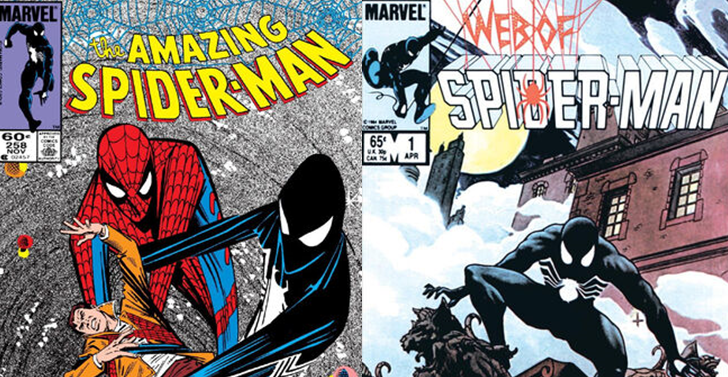
Back Issues [Spidey Month]: The Amazing Spider-Man #258 / Web of Spider-Man #1


Easily Marvel Comic’s most recognisable and popular superhero, unsuspecting teenage nerd Peter Parker was first bitten by a radioactive spider and learned the true meaning of power and responsibility in Amazing Fantasy #15, which was first published in August 1962. Since then, the Amazing Spider-Man has featured in numerous cartoons, live-action movies, videogames, action figures, and countless comic book titles and, in celebration of his debut and his very own day of celebration, I’m dedicating every Tuesday of August to talk about everyone’s favourite web-head!


Story Title: “The Sinister Secret of Spider-Man’s New Costume!”
Published: 31 July 1984 (cover-dated November 1984)
Writer: Tom DeFalco
Artist: Ron Frenz

Story Title: “’Til Death Do Us Part!”
Published: April 1985
Writer: Louise Simonson
Artist: Greg LaRocque

The Background:
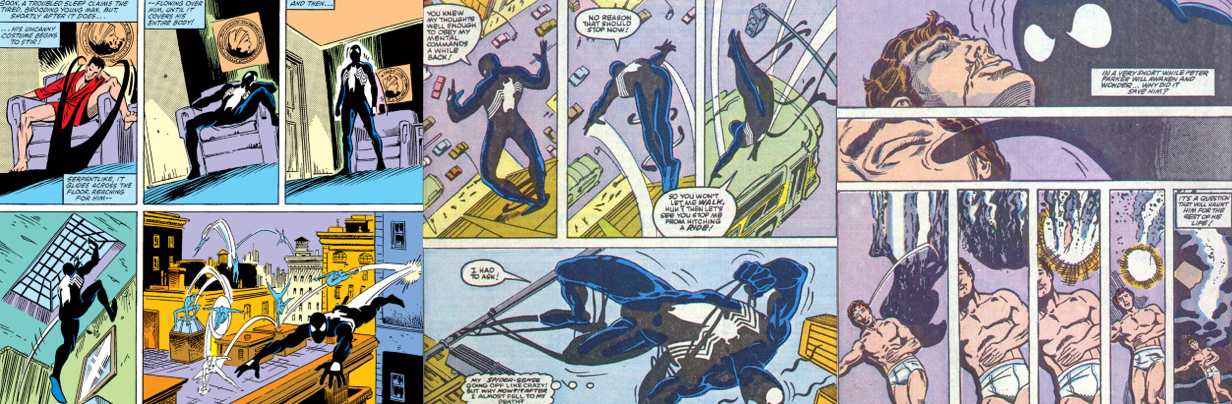
Considering Spider-Man’s debut almost didn’t happen, it’s pretty ironic that Stan Lee and Steve Ditko’s angst-ridden teenage superhero went on to become the flagship character of Marvel Comics. Over the years, Spider-Man has been at the forefront of some of Marvel’s most celebrated, and notorious, stories and the troubled wall-crawler is often depicted battling his own personal woes as often (if not more so) as his colourful rogues gallery. In 1982, an illustration from reader Randy Schueller that depicted Spider-Man in a smooth, black outfit with a large red spider motif across his chest caught the eye of Marvel Comics’ editor-in-chief Jim Shooter. After Marvel purchased the concept for a mere $200, writer Tom DeFalco and artist Ron Frenz conceived the costume being a living organism; Spidey’s new black suit debuted without explanation in The Amazing Spider-Man #252 before Marvel Super Heroes Secret Wars #8 revealed that the web-slinger acquired the suit during the “Secret Wars” event. Over the next year or so, Spidey revelled in the costume’s unique and helpful ability to form both clothing and organic webbing until these two issues revealed the costume’s true nature as a symbiote. Of course, this directly led to the debut one of Spidey’s most iconic enemies (and one of Marvel’s most popular anti-heroes), Eddie Brock/Venom, but Spidey’s issues with the black suit have been adapted into cartoons, movies, and videogames and it remains one of his most iconic alternative outfits.

The Review:
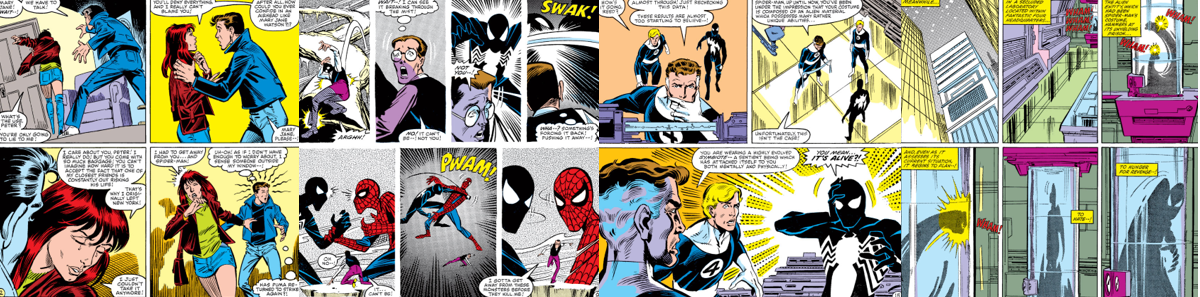
“The Sinister Secret of Spider-Man’s New Costume!” begins with Peter Parker, still reeling from defeat at the hands of crime boss Silvio Manfredi/Silvermane and the man-beast Thomas Fireheart/Puma, facing the shock of his life when he returns to his apartment and his former flame and close friend Mary Jane Watson/M. J. reveals that she knows he’s secretly Spider-Man! Peter’s naturally gobsmacked by this but M. J. doesn’t give him a chance to explain…or, as she puts it, to “lie to [her]”. Indeed, Peter’s shock is so total that he’s too distracted to hear that M. J. originally left New York City a while back because of this knowledge; not only did it hurt her that he didn’t trust an “airhead” like her with his greatest secret, but she couldn’t stand the thought of him constantly risking his life. Whatever chance Peter might’ve had of explaining things or perhaps retaining his secret identity then goes completely out of the window when Felicia Hardy/The Black Cat leaps in through his window looking for a fun night swinging through the city. M. J.’s heartache is only exacerbated by the Black Cat’s appearance, and she leaves in floods of tears, and Peter’s so distraught that he takes his anger out on the Black Cat, chastising her for bursting in unannounced. Naturally, the Black Cat’s none too pleased to be yelled at so she goes to leave, but they’re both startled when a strand of webbing instinctively and involuntarily shoots from Peter’s jacket to keep her from leaving. While the Black Cat takes this to mean that Peter truly loves her since he “didn’t even try to stop [M. J.]” when she left, Peter’s too surprised by the alien costume’s mysterious nature to deny her embrace. Later, after unsuccessfully trying to call M. J., the overwhelmed Peter succumbs to exhaustion. However, while he sleeps, the alien costume slinks across his apartment, attaches itself to him, and takes his slumbering body out on a joyride across the rooftops of the city.

Peter’s personal strife is compounded by the news that his alien suit is a living organism!

As he sleeps, Peter endures a horrific nightmare in which he finds himself (in his classic bookworm appearance) hounded by the ominous alien costume. Just as it closes in on him, his classic red and blue duds step in to battle the alien, with the screaming Peter literally caught in the middle! Peter awakens to find he’s missed an entire day and unnerved by his alien attire. To try and get some answers, he swings over to the Baxter Building to take up Doctor Reed Richards/Mister Fantastic on a previous offer to examine the suit. Following a series of intensive experiments on the gamut of the costume’s capabilities (producing organic webbing, assuming different appearances, and flowing on and off him at his mental command), Reed drops the bombshell that the costume isn’t just some amazing piece of advanced alien technology, but actually a living being that’s physically and mentally attached itself to the web-slinger! Spider-Man’s astonishment turns to horror when he tries to remove the suit at Reed’s suggestion, only to find it painfully attempting to permanently graft itself to him! With Spider-Man at risk of being crushed to death, Reed grabs his handy-dandy sonic cannon and blasts the alien, forcing it off of Spider-Man long enough for him to safely contain it. However, this does leave Spider-Man in just his underwear so, to preserve his secret identity and allow him to return home, Johnny Storm/The Human Torch provides him with a spare Fantastic Four uniform and a paper bag to cover his head, leading to him facing public humiliation when he steps in to help the police with a robbery. However, Peter’s pride and his shock at the revelation that his alien suit was a symbiote all along are pushed aside when a remorseful M. J. shows up to talk, though he’s unaware that the enraged symbiote lusts for revenge inside its cell…

Spidey’s so horrified by the symbiote suit that he barely notices the attacking Vulturions.

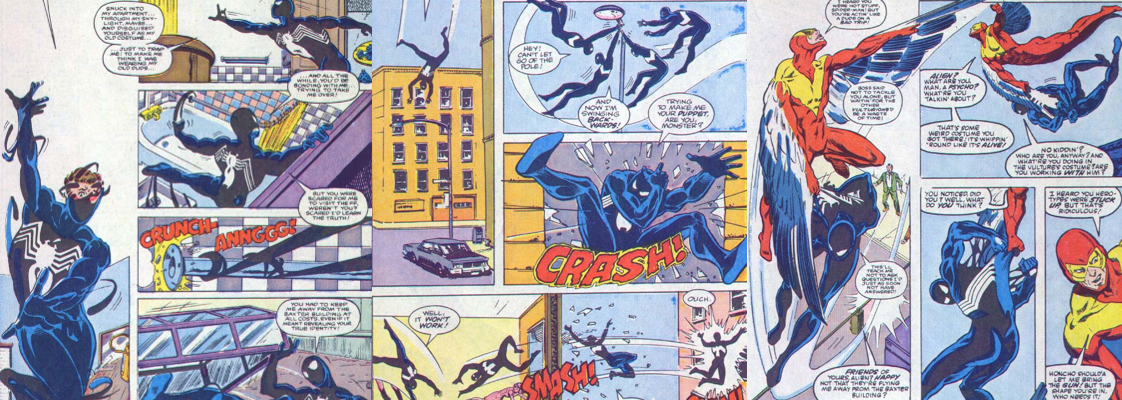
Peter returned to his traditional red and blue costume following this and incurred the anger and disappointment of his beloved Aunt May when he dropped out of his graduate studies in the time between The Amazing Spider-Man #258 and Web of Spider-Man #1. It was also during this time period that the symbiote managed to escape from its confinement and make its way back to Peter’s apartment, which is why “’Til Death Do Us Part!” begins with the alien costume lurking in Peter’s wardrobe. Peter’s so distracted by his recent breakup with the Black Cat and recapping how Reed revealed the costume’s true nature as a “symbiot” and helped rid him of it that he doesn’t even notice the parasitic alien attaching itself to his costume until it’s too late! Horrified, Spider-Man desperately flees his apartment and tries to get back to the Baxter Building, but the symbiote fights him the entire way; it sends out tendrils to ground him, throws off his webbing, detaches itself from walls, and forces him to do its bidding like a puppet. Refusing to obey his commands and sending him into a panic, the symbiote negates Peter’s spider sense and does everything it can to keep him grounded, and Spidey’s so caught up trying to fight off the alien and keep his cool that he doesn’t notice the Vulturions circling overhead. Comprised of hoodlums Gripes, Pigeon, Sugar Face, and Honcho, the Vulturions are a gang of low-level punks given a chance at stepping up their game when they repurpose Adrian Toomes/The Vulture’s technology and suits to their own ends. Their leader, Honcho, warned them about taking on Spider-Man alone and drawing undue attention to themselves, but Gripes can’t help but snag the writhing, babbling web-head when he spots him struggling with the symbiote during a scouting mission.

Spidey risks his life to rid himself of the symbiote, whose last act is to drag him to safety!

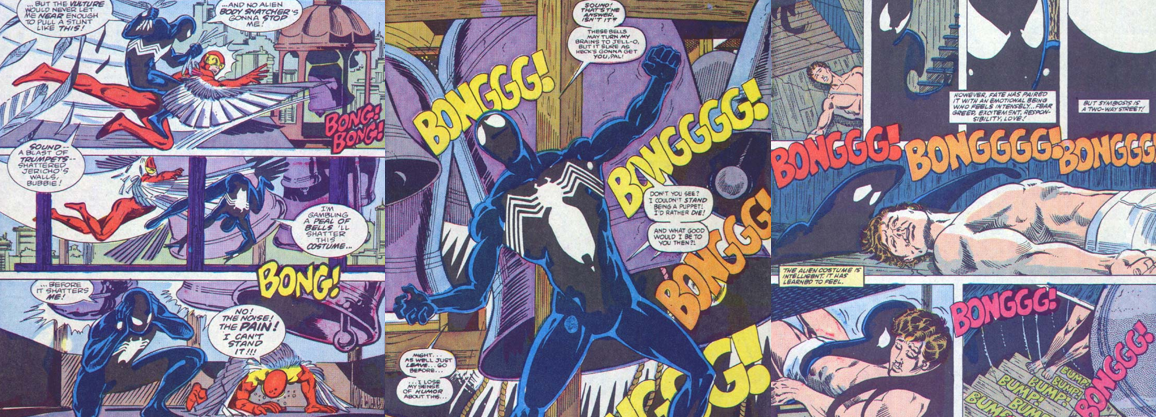
Spider-Man barely even acknowledges the presence of the Vulturions; even when he’s caught in Gripes’ talons, he rages and struggles against the symbiote. Gripes’ confusion at Spider-Man’s bizarre behaviour turns to horror when the symbiote’s tendrils lash out and attack him, and Spidey’s forced to use his own strength to fight off Gripes, Sugar Face, and Pigeon, sending the three plummeting into the sea and commandeering Honcho as a more reliable means of traversal. Realising that he might not make it to the Baxter Building in time to use Reed’s sonic blaster, Spider-Man redirects Honcho to a nearby bell tower. The loud ringing is already sending the symbiote into a frenzy but it’s in absolute agony when Spidey crashes into the tower and forces it to endure the ringing up close. The noise is apparently so loud that it threatens to kill Spider-Man as well; with his strength fading, Peter can’t help but think of his loved ones and all the people he’s leaving behind as he feels his life ebb away. The noise is so great that the symbiote is forced from Peter’s unconscious body; however, as the “emotionless being” slinks away, it can’t help but feel an obligation towards its former host. Chalked up to emotions inherited from its time joined with Peter, the symbiote pulls Peter to safety. It tentatively, lovingly, touches his face with a tendril one last time before promptly evaporating into dust, apparently destroyed from the cacophony of the bells and the exertion of saving Peter’s life.

The Summary:
If you’re a fan of Venom and Peter’s time in the black costume, these two stories are essential reading to understanding the complex relationship between Spider-Man and the symbiote. Unlike in other media (at least as far as I can remember), the symbiote didn’t actually negatively affect Peter’s mood or mannerisms; he didn’t go all emo or become aggressive, and I don’t think it really enhanced his strength or natural abilities beyond acting as infinite webbing and responding to his mental commands. Consequently, I believe that The Amazing Spider-Man #258 is the first time that the symbiote shows any signs of aggression or independent thought. Of course, it can be argued that the symbiote is simply reacting due to the massive revelations and pressure that bombard Peter in this story. Just the idea that M. J. knows his secret identity would be shocking enough, but quickly follow that with the Black Cat’s arrival and a bit of a love spat between the two and it’s no wonder that Peter’s emotions are all over the place. M. J.’s revelation would, of course, lead to her opening up to Peter about her own traumatic past and helped to not only flesh her out as something more than a gorgeous party animal but also galvanise their relationship, but here it’s a real curveball since Peter’s secret identity was such a sacred element to the character and not too many people were aware of it. Thus, finding out that M. J. had always known of his dual identity really helped her to stand out against Peter’s other love interests, even the likes of the Black Cat.

Spidey’s costume woes lead to the debut of the Bombastic Bag-Man!

As ever with Spider-Man stories, we get some drama and interludes to break up the action; the first story is broken up with interludes that show the Puma, in his public identity as a successful businessman, brooding over in New Mexico, hungry for his next encounter with Spider-Man, and Roderick Kingsley/Hobgoblin being recruited into Richard Fisk/The Rose’s campaign against Spider-Man, as well as hints towards M. J. having secrets of her own. The second story is largely concerned with establishing the Vulturions, painting them as thugs who mug old ladies in public and who have a contentious relationship with their boss because of this, and Peter’s recent falling out with Aunt May over his studies. Naturally, there are also some fun cameos from Mr. Fantastic and the Human Torch since Spidey needs the Fantastic Four’s help in figuring out what’s happening with his suit. I liked that Reed already strongly suspected that the suit was a living organism but still conducted a series of tests to be both absolutely sure and to satisfy his scientific curiosity. It’s lucky that Spider-Man has such a healthy relationship with the Fantastic Four as they’re the only ones with the technology and capability to study and contain the symbiote, but it’s doubly lucky for us as The Amazing Spider-Man #258 fetaures the debut of the Bombastic Bag-Man! Stuck in Fantastic Four suit with a paper bag over his head and a “Kick Me!” sign taped to his back, Spidey is humiliated before the press and public as part of a prank by the Human Torch, which makes for one of the best aspects of these two issues. It’s a rare moment of levity, especially considering not just all the personal strife Peter goes through here but also the startling revelation that his once seemingly amazing alien costume is actual a living, breathing organism that’s attempting to permanently bond with the web-slinger!

Peter’s natural reaction is to assume the symbiote is malicious, despite having no evidence of this.

This aspect is treated as a horrifying prospect as the symbiote is described as a “parasite” and Reed’s first advice to Spider-Man is to rid himself of it before the bonding process becomes permanent. It’s only natural, then, that the symbiote reacts to defend itself, refusing to budge from Spider-Man’s body and even causing him physical harm. There’s actually no suggestion or evidence to suggest that the symbiote has malicious intentions; Spider-Man reacts out of sheer panic and horror and Reed doesn’t hesitate to contain the creature and it’s only then that it becomes malevolent since it doesn’t appreciate being spurned. When it returns in Web of Spider-Man #1, notice how it doesn’t do anything aggressive except try to bond with him again; it only lashes out and takes control of Peter when he reacts in horror and tries to force it off, and there’s even a suggestion that it takes control of his sleeping body not to cause him harm but because it delights in his superhuman abilities. Still, Peter’s first instinct is to get rid of it and he’s so determined to do this that he even states he’d be willing to die than be a slave, again without any real evidence that the symbiosis would be anything malicious. To that end, he uses the ringing of the bell tower to drive the creature from his body and presumably destroy it but is rendered unconscious by the effort and completely misses the tragic truth of the symbiote. While the dialogue boxes hint that it’s an amoral creature, the symbiote sacrifices itself to get Peter to safety not just because of the emotions it learned of while bonded to him, but out of what is very clearly shown to be true love for Peter and his welfare. This aspect is expanded upon when the symbiote later returns with a vengeance as Venom, but it’s portrayed really well here and actually paints Peter (and Reed) in a bit of a bad light since his knee-jerk assumption was that the symbiote meant him harm but there’s nothing to say that’s the case. Because of this, these two issues are a really great launching pad for those wishing to get into reading some Venom stories; they contain some of the most iconic symbiote imagery (such as Peter’s nightmare and the bell tower sequence) and go a long way to giving the symbiote some characterisation long before it talks.

My Rating:

Rating: 4 out of 5.

Great Stuff

Have you ever read these two iconic Spider-Man stories? If so, what did you think to them and where would you rank the black costume era amongst Spider-Man’s many other stories and moments? What did you think to the black costume at the time and were you surprised to find that it was alive? Do you think Peter reacted poorly to this knowledge and that he should’ve tried to understand the symbiote’s true intentions? What did you think to the revelation that Mary Jane knew of Peter’s dual identity? How are you celebrating Spider-Man this month? Whatever your thoughts on Spider-Man and the symbiote, share them below and be sure to check out my other Spider-Man Month content!

Game Corner [Spidey Month]: Spider-Man (PlayStation 2)


Easily Marvel Comic’s most recognisable and popular superhero, unsuspecting teenage nerd Peter Parker was first bitten by a radioactive spider and learned the true meaning of power and responsibility in Amazing Fantasy #15, which was first published in August 1962. Since then, the Amazing Spider-Man has featured in numerous cartoons, live-action movies, videogames, action figures, and countless comic book titles and, in celebration of his debut and his very own day of celebration, I’ve been dedicating every Friday of August to talk about everyone’s favourite web-head!


Released: 16 April 2002
Developer: Treyarch
Also Available For: Game Boy Advance, GameCube, PC, and Xbox

The Background:
There was a time when it seemed like every single cinema release had to be accompanied by a videogame adaptation; big-budget movies, especially, were often released alongside a hastily created videogame tie-in that often failed to properly capture the spirit of the film they were based on. As the flagship character of Marvel Comics, Spider-Man has a long and varied history with videogame adaptations across a variety of platforms so it was perhaps no surprise that Sam Raimi’s 2002 live-action $825 million blockbuster would be accompanied by a videogame tie-in. To be fair, Spider-Man benefitted from that fact that it was developed by Treyarch, who had previously had success with the character; indeed, much of Spider-Man’s combat and level progression was based on Treyarch’s previous Spider-Man game. This was reflected in the game’s reception as Spider-Man became the fifteen highest-selling videogame of 2002 and enjoyed high scores across all platforms. While some reviews criticised the game’s claustrophobic indoor sections and short length, it was generally regarded as the best Spider-Man videogame at the time of release. I remember buying the game for the GameCube after seeing the movie, having been won over by the game’s trailer and the film itself, but being underwhelmed by it after playing it to completion so I’m curious to see how it holds up today after the success of Spider-Man’s subsequent videogames.

The Plot:
After being bitten by a genetically-enhanced arachnid, high school senior Peter Parker finds himself endowed with the proportional strength and agility of a spider, and, when his beloved Uncle Ben is killed due to his irresponsibility, Peter puts his spider powers to good use as a masked crimefighter. After failing to capture and study this “Spider-Man”, who overcomes a variety of costumed menaces and robots, Doctor Norman Osborn transforms himself into the web-slinger’s most dangerous threat yet: the maniacal Green Goblin!

Gameplay:
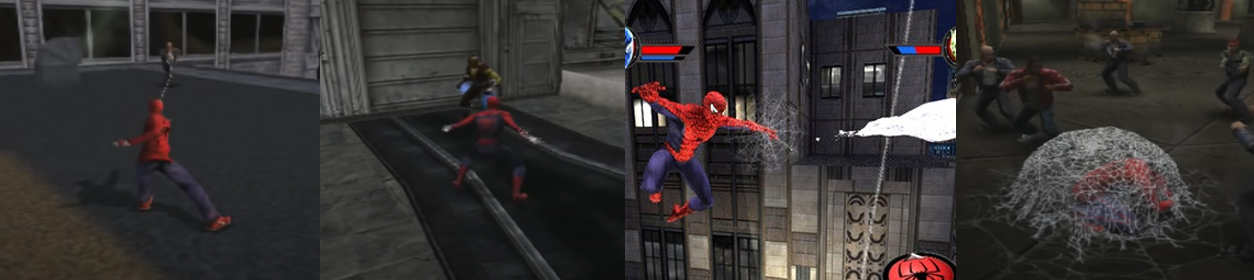
Spider-Man is a third-person action game with a primary focus on beat-‘em-up action but which also includes a fair amount of web-slinging and a little bit of awkward stealth and extremely simplistic puzzle solving. As you might expect, players assume command of Peter Parker; the game begins right after Uncle Ben has been shot and at the very beginning of his crimefighting career as Spider-Man, and players are given a number of standard options when it comes to combat: X lets you jump and you can press it again in mid-air for a double jump, while Square throws a punch and Circle unleashes a kick. You can mix and match these button inputs to execute quick combo attacks (which you can review from the pause menu), and pressing either button near certain objects will allow you to pick up and throw them at your enemies. Of course, it’s not all about beating up random thugs across the city; at any time, you can press R2 and Spider-Man will start slinging webs (yes, they just attach to nothing, get over it) and won’t stop until you press X or slam into a wall. You can hold down R2 to speed up your web-slinging, though this does limit your turning ability, and you can press R1 to quickly zip upwards or straight ahead on a web zip-line; you can also press L1 to lock onto enemies, which is super useful when you’re swinging around and asked to attack enemies in mid-air.

Spidey can use his webs to attack his enemies but, unlike in the film, is limited by web fluid.

Spider-Man will automatically save himself with his webs if you fall while traversing the city rooftops and will automatically climb walls when close to them, though you can press the left analogue stick to enter a crawling state and the camera does tend to get very jerky and annoying when you’re clambering around on walls and ceilings as your perspective can get turned around pretty easily. If you’ve played the fantastic Spider-Man (Neversoft, 2000), you’ll be immediately familiar not only with Spider-Man’s combat and web-slinging but also with his web-based attacks. Pressing Triangle sees Spidey shoot out a quick web, but holding it allows him to web enemies up; if you press up, down, left, or right on the left analogue stick (or directional pad, if that’s your preference), Spider-Man will send out a high-impact ball of webbing, yank his foe towards him, wrap his hands in webbing to increase his punching power, or create a web dome to shield himself and send enemies flying with a press of X. You can also switch to different control styles that see you utilise the other face buttons for these commands, but you’ll find that these web attacks consume your web fluid (represented as a blue bar under your life meter), which is very strange considering Spidey had organic webbing in the film. Spider-Man can also dodge incoming attacks by using the left stick in conjunction with X to hop out of danger, though I found this to be awkward at best and unreliable at worst, and you can even press in the right analogue stick to look around and set your target for a zip-line.

Web-slinging sections see you using the compass to chase villains, rescue civilians, and disarm bombs.

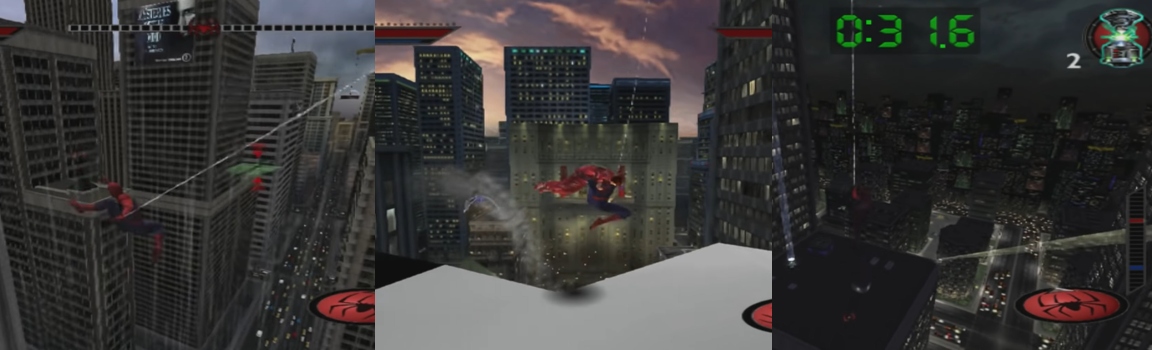
All of these controls and gameplay mechanics can be reviewed in an optional tutorial mode, where the legendary Bruce Campbell snarkily talks you through all of Spider-Man’s abilities, and you’ll find question mark hints occasionally dotted around levels to help you out as and when. Like the 2000 game, Spider-Man is basically divided into two distinct gameplay styles: one sees you out in the city, swinging about the place, and the other sees you confined inside buildings. When out in the city, you’ll need to make use of a compass to navigate towards your next objective or keep track of your current target; you need to use this in conjunction with a Height Meter that shows your position compared to that of your objective, which can be a very clunky system as it’s not always clear where you need to go. Basically, just follow the compass direction until it flashes white, and then try to orientate yourself up or down to get to where you need to go, but invariably your compass will be absent when inside buildings. When web-slinging around the city, you’ll be tasked with hunting down thugs and putting a beating on them until you find information on where you need to go, racing after a target as they fly away from you, hunting down bombs or taking out robotic drones (often against a tight time limit), rescuing civilians from harm, and using your webs to secure water towers, bridges, and other objects to stop them from hurting civilians. When trying to keep track of a specific target, you really need to make use of the lock-on feature or else it’s very easy to lose sight of them and thus fail the mission; I also found that spamming Triangle was the fastest way to actually attack enemies in mid-air, but of course this will drain your web fluid. Luckily, the pick-ups that refill your health and web fluid will respawn so you can swing back over and grab them if you need to, but this will cost you time and probably see you fail your objective. Checkpoints in Spider-Man are few and far between; you can only save your progress after completing a level and, if you die or fail your mission, you’ll have to restart from the beginning of the level, which can lead to you repeating frustrating sections again and again.

Spidey must crawl and fight around claustrophobic interiors using a clunky stealth mechanic.

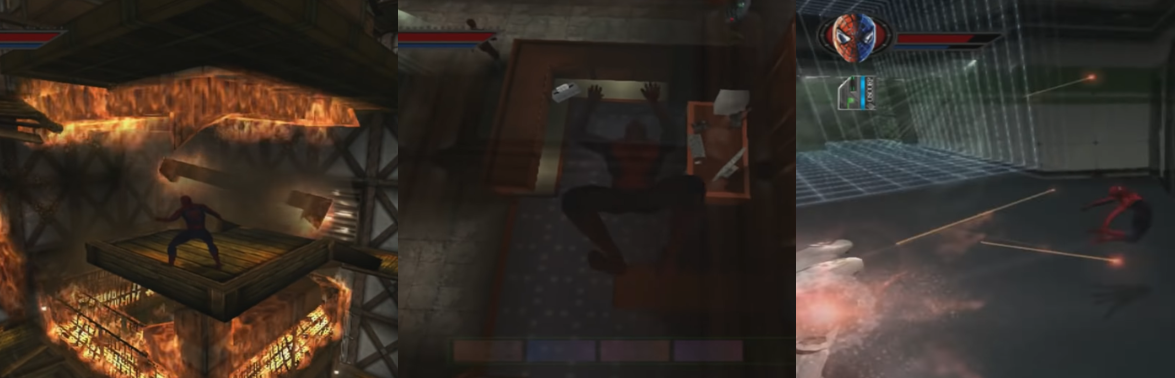
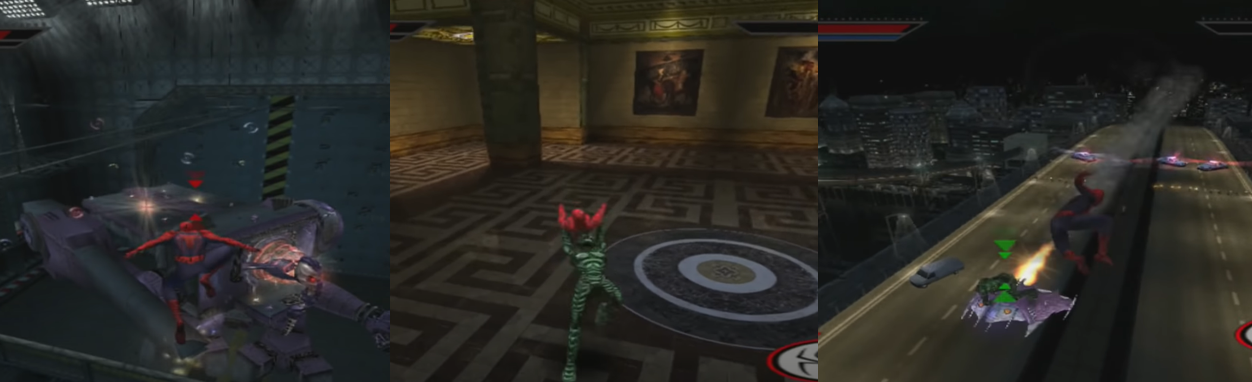
When confined to the interior of buildings, the game introduces a clunky stealth element; when Spider-Man is in certain shadows, the face on his heads-up display will turn dark blue and he’ll be hidden from enemies. This is essential to safely sneaking past cameras and enemies in many levels; though you won’t fail the mission if you’re spotted, an alarm will be raised and mechanical Super Soldiers will relentlessly chase after you, forcing you to quickly zip away and find a shadowy area to wait out the alarm. One of the most common tasks when in these claustrophobic areas will be heading through or acquiring keys to unlock doors; these doors can be difficult to identify as the areas are so bland and boring, and the enemies holding the key tend to be a little tougher than the usual mooks. Other times, you’ll need to use X to activate consoles, sometimes in a certain order, acquire codes from active PCs, web-zip past steam vents or through laser trip wires, and zipping up into vents to awkwardly crawl around and progress further. These levels also have much more focus on grounded beat-‘em-up combat, but the game quickly emphasises that discretion is the better part of valour and you’ll be tasked with deactivating security walls and laser traps in order to progress a little safer. The game comes with a number of different difficulty modes that obviously make enemies tougher and increase the game’s challenge; completing the game on higher difficulties also allows you to unlock additional content, which can be further unlocked by acquiring points for your combat, stealth, and level-completion strategies.

Graphics and Sound:
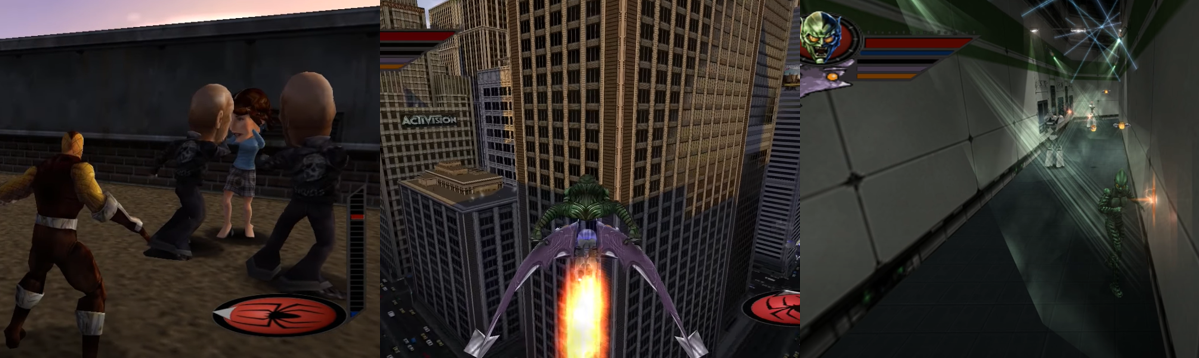
Obviously, Spider-Man is a videogame tie-in that came out on the PlayStation 2, so you can’t expect super high-quality in-game or cutscene graphics. However, Spider-Man is reasonably impressive and I can see why people would have considered it the best Spider-Man videogame at the time; New York City is rendered as a large map and even subject to rain and lightning storms and rendered in both day and night-time depending on the level you’re playing. However, it’s not a sprawling open world with numerous side quests or non-playable characters to interact with; although you can see traffic moving down below, you can’t go down to street level and the city is basically completely lifeless save for thugs, bosses, and a few civilians in need of rescue.

Environments can be quite bland and lifeless but some shine through weather and lighting effects.

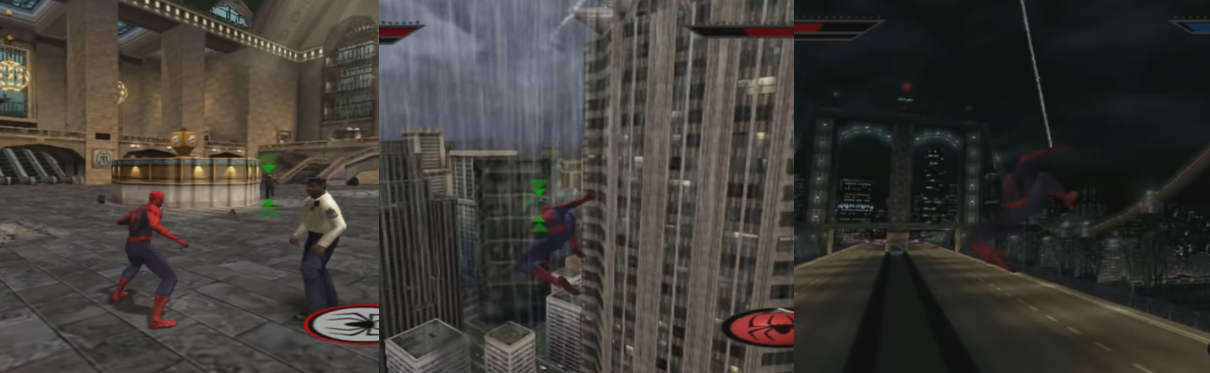
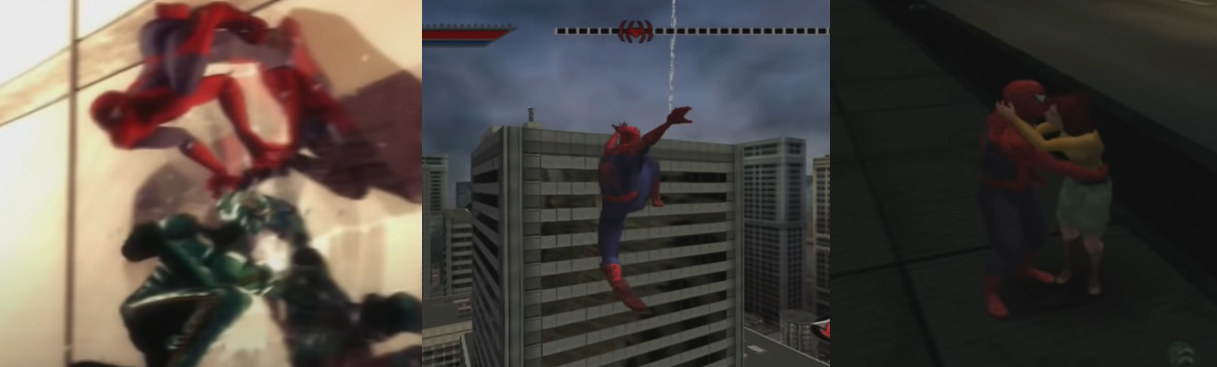
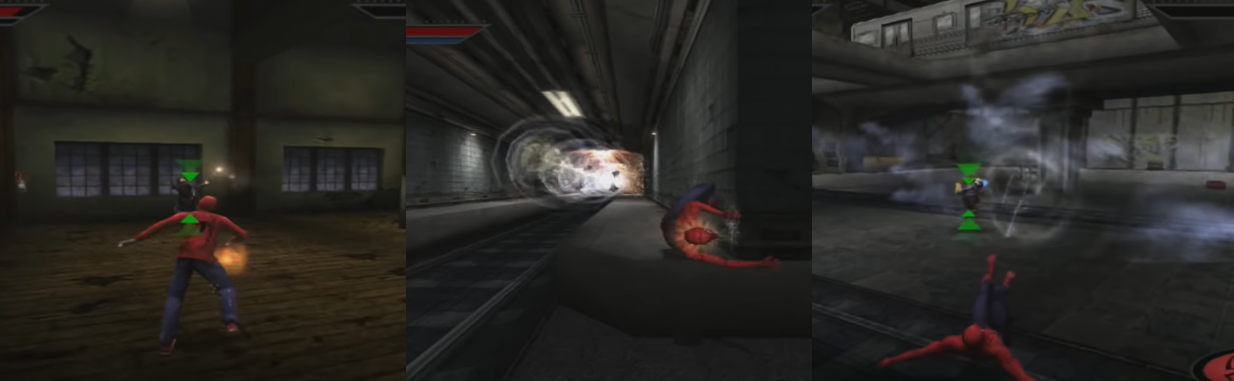
The interiors are where the game really fails to impress, however; you’ll explore such dynamic and exciting areas as…a bland warehouse, the sewers and subway tunnels, and the high-tech Oscorp building. This latter is easily the most visually impressive and interesting of all of the game’s environments, inside or out; while it is a bit confusing as every area looks grey and bland, it’s given some variety with some blinking lights, laser traps, and different rooms containing consoles and power generators. Another interesting area is a bank, though you’re only really in here for one boss battle, and you’ll even be treated to a very mediocre interpretation of the balloon parade from the film, which includes a single inflatable panda bear and a sequence where you crash down through skylights while battling the Green Goblin, and of course conclude the game in a showdown on the Queensboro Bridge.

Cinematics are quite blurry and the awkward in-game cutscenes are quite laughable.

While the game’s thugs and enemies aren’t much to shout about, being largely generic and unimpressive, Spider-Man is rendered quite well despite every character model appearing as a stiff mannequin. Spidey does little hops and flips when climbing over ledges, assumes comic-accurate poses when left idle, and even busts out fancy animations when web-slinging that closely emulate the film. The game uses both pre-rendered and in-game graphics for its cutscenes, with the pre-rendered ones obviously being the more impressive of the two; the in-game models don’t even move their mouths and the voice acting is more miss rather than hit. Tobey Maguire, especially, sounds more wooden and awkward than ever, especially when trying to deliver quips as Spider-Man, and the game is sadly completely lacking Danny Elfman’s awesome and iconic score. The music that does play during levels is generally suitable enough, if a bit generic, but it does clumsily and noticeably loop, which just screams of low production values, and of course you’ll be faced with the long load times symptomatic of that era of videogaming.

Enemies and Bosses:
Spider-Man is faced with a number of nameless, faceless, disposable goons as he swings around the city and tries to use his powers responsibly; at first, he’s tasked with tracking down Uncle Ben’s killer, who here is interpreted as part of the Skulls gang, so you’ll be beating up unscrupulous street thugs in the early going. Some of these have pistols to defend themselves with, and they’ll also put up a block to defend themselves against your attacks. These thugs get a reskin as guards working for Oscorp who must largely be avoided and webbed up to stop them from raising the alarm and bringing in the Super Soldier robots. Wile Osborn’s miniature Spider Slayers are annoying robotic enemies who zip around on claw-like lines and try to roast you alive, these Super Soldiers are a massive pain in the ass. They relentlessly hunt you down, blasting at you with explosive bolts that are near-impossible to avoid, and the levels can be so restrictive that you’re better off just restarting the level rather than trying to desperately find shadows to hide from them.

After tracking down his uncle’s killer, Spidey must avoid the Shocker’s blasts in the city sewers.

Spider-Man’s first mission is to hunt down Uncle Ben’s killer; after beating up a bunch of his fellow gang members, Spidey finally tracks him down and faces off with him, only to be blasted full-force in the face over and over by the murderer’s shotgun! The killer sets a precedent for the game’s boss battles in that he, like all of the other bosses, is spry and tough enough to shrug off, dodge, and no-sell all of your web attacks except for the web-hands, so you’re best bet is to zip up to the ceiling and stay out of his sight, blasting at him with your impact webbing or dropping down to deliver a beatdown when he’s suitably confused. After a quick side quest where you swing around towards red balloons to take snapshots of Spidey for the Daily Bugle, you’ll need to rescue security guards being threatened by Herman Schultz/The Shocker. Once they’re safe, you’ll pursue him into the sewers and subway tunnels, where he’ll send blasts of concussive sound at you that you’ll need to dodge using your web-zip; this isn’t too much of a challenge to overcome and, afterwards, you’ll get to face him in combat. The Shocker launches projectiles of sound at you and can protect himself with a devastating whirlwind of damaging soundwaves, but was actually easier for me to pummel into submission than Uncle Ben’s killer.

After making short work of the Vulture, you must defend and then subdue the maniacal Scorpion.

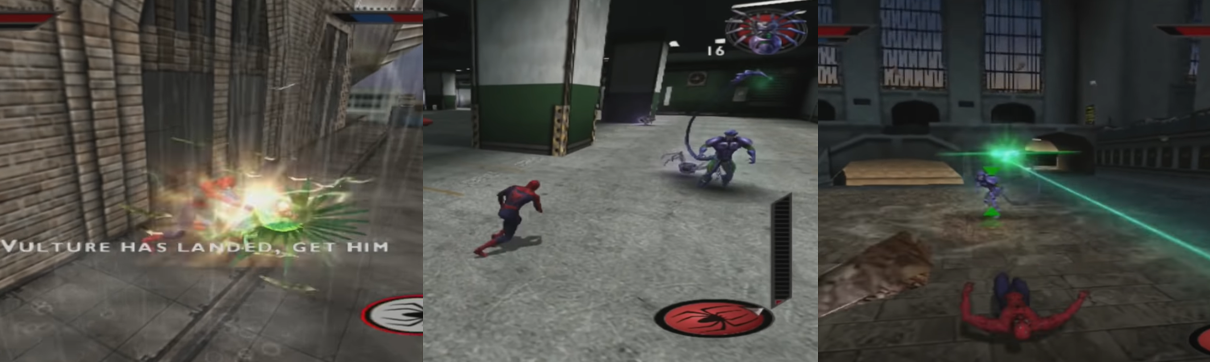
Spider-Man’s next test comes when Adrian Toomes/The Vulture robs a bank; Spider-Man first chases after the Vulture by progressing vertically up a tower that catches fire and sees you slipping through holes and under stairs to zip your way upwards, then you need to chase after him as he flies away through the city and puts citizens at risk. Finally, the two face off in the skies around the Chrysler Building as rain and lighting fill the arena; Spidey must fire webbing at the Vulture while avoiding his charges and attacks in order to force him to land so he can put a beating on him, making him the easiest boss of the game by far. Afterwards, Spidey crosses paths with MacDonald “Mac” Gargan/The Scorpion, who just randomly appears out of nowhere; at first, you’ll need to protect him from Oscorp’s miniature spider-bots but then he turns against you and forces you to fight him. This is quite a tough fight even on Easy mode as the Scorpion leaps and scrambles all over the place, blasting at you with his tail, and grappling with you whenever you get close to him. It’s best to keep your distance and fire off impact webbing from afar, and then dodge his attacks so you can hit a few combos on him and put him down. Fittingly, the Green Goblin is the game’s most recurring villain and, though you won’t encounter him face-to-face until you’re halfway through the game, he more than makes up for it in his appearances; the first time you face him, you need to avoid his glider attacks and missiles and rescue Mary Jane Watson from the aforementioned panda balloon before battling him head-on.

As annoying as Oscorp’s mech is, the Green Goblins persistence and aggression is even worse!

Whilst on his glider, the Green Goblin is basically a tougher version of the Vulture as he flies around tossing pumpkin bombs and firing bullets and missiles at you, forcing you to fire off your webbing or striking at him when he comes close. Afterwards, you’ll have to chase after him and web up parts of the environment that he damages, before forcing him through a skylight for some ground combat. These fights are easily the toughest of the game as the Green Goblin bombards you with pumpkin bombs, blinds you with flashbangs, and can easily choke the life out of you and snatch you out of the air. Your best bet is to stick near the respawning health power-up, dodge his combos and hit some of your own, and blast him with impact webbing whenever you can. Afterwards, you’ll be forced to swing across the city against a time limit disarming his bombs, which is an annoying mission thanks to the janky compass and drones flying around the city, then destroy fifty of his Razor Bats before taking a detour through Oscorp and battling a giant mech. Before you can attack this directly, you’ll need to desperately swing around the enclosed arena destroying shield generators and being pummelled by missile turrets, constantly spawning drones, and avoiding the mech’s gigantic laser. Thankfully, there’s plenty of pick-ups in the area and the mech goes down pretty easily with a few web shots once the shield is lowered. Afterwards, you’ll have to chase after the Green Goblin as he flies off with Mary Jane and tosses explosive traps in your way, before finally facing off with him on the Queensboro Bridge. After getting Mary Jane to safety, you then need to repeat the same tactics as in the first couple of fights against him but now in the same battle; swing around firing webs at him to ground him and then dodge his melee attacks to land a few combos, but watch out for his big bomb blast attack. By this point, you should know how to dodge and go grab a pick-up when needed, and I know I found finishing the Green Goblin off actually easier than the first fist fight with him. After you end him, Mary Jane awkwardly gives Spider-Man a big ol’ snog on top of his mask while they stand over the lifeless body of Peter’s best friend.

Power-Ups and Bonuses:
Unlike in pretty much every modern videogame, Spider-Man is not blessed with regenerating health; as a result, you’ll need to pick up red and red-and-blue Spider Icons to restore half or all of your health. Also, like in the 2000 game, Spider-Man can run out of web fluid so you’ll need to grab blue and blue-and-silver Spider Icons to refill this bar. As mentioned, I find this an odd inclusion as Spider-Man had unlimited organic webbing in the movie but I guess it makes sense to keep him from being too overpowered. Luckily, these restorative pick-ups respawn after a while so if you find yourself struggling against a particular boss, you can usually backtrack or swing back around to collect a pick-up and keep yourself from losing a life. If you search around your environments, you’ll also find gold Spider Icons that will unlock additional combos to add to your repertoire, but that’s about it in terms of power-ups; you don’t earn experience points and can’t upgrade any of Spider-Man’s abilities or pick up temporary power-ups, meaning you basically end the game exactly as you started it but with maybe a few additional combos.

Additional Features:
If you visit the game’s ‘Gallery’, you’ll be able to view movies and artwork for the game, and you’ll be able to revisit any level you’ve cleared from the main menu as you progress. As mentioned, you’ll receive points every time you clear a level; these are awarded for your combat variety, stealth, and the amount of damage you take. Once you hit a certain number of points, you’ll automatically unlock some additional content from daft stuff like big hands and feet and exaggerated ragdoll physics to skins for Spider-Man, such as his wrestler outfit and acclaimed artist Alex Ross’s rejected design for the movie suit. You can also unlock a Peter Parker skin and enter cheat codes to play as guys like the Shocker and other enemies, though they all play the same as Spider-Man and don’t change the story in any way.

There are a number of cheats and unlockables, including a fully playable Green Goblin!

However, if you beat the game on the “Hero” difficulty, you’ll unlock the ability to play as Harry Osborn under the guise of the Green Goblin! This eliminates the pre-rendered cutscenes and alters the plot somewhat as this story picks up after the conclusion of the game and sees Harry take up his father’s mantle to research his death, and gives you access to an entirely new set of abilities. The Green Goblin can’t web-sling or climb walls but, with a press of R2, you’ll hop onto his glider and can rocket around the place at will; you can fire bullets, missiles, and bombs while on the glider, but your weapons will overheat in time so you’ll need to wait for them to cool down. On the ground, the Green Goblin’s melee attacks are the same as Spider-Man’s but, in place of webs, you have access to pumpkin bombs and Razor Bats and can race around on rocket boots like a madman to send enemies flying! Honestly, this was an incredible addition to the game and is a great way to encourage a second playthrough that adds an extra layer of challenge to the game as the Green Goblin can’t hide in the shadows, but can jump on his glider to blast enemies with missiles even when inside the most claustrophobic environments!

The Summary:
I remember being so hyped for Spider-Man’s first big-screen adventure, and so won over by the trailer for the videogame that ran before the film, that I went out and bought this for the GameCube that same week (if not that same day). I also remember finishing it pretty quickly, and this second playthrough was no different; as is the case with almost every videogame tie-in to a movie, Spider-Man isn’t an especially long game; levels aren’t built to allow exploration and are incredibly linear, so all you’ll have to worry about is trying to cope with how bland and similar the areas can look in each level. There’s also not a huge amount really asked of you; maybe you need to activate a console here and there, or input a code to open a door, or rescue a civilian, but these instances are few and far between and the game soon falls back into a routine of either web-slinging or clunky stealth sections. “Clunky” is the best way to describe this game; Spider-Man controls like he thinks he should be using tank controls, the camera and mechanics make web-slinging and wall-crawling very cumbersome at times, and your combos and dodging abilities are severely limited, making everything quite basic and monotonous. This may explain the game’s short length, as it’s over before it can become truly mind-numbing, but some levels are more frustrating than others; the stealth system is poorly implemented and it’s disappointing to see Spider-Man restricted to claustrophobic interiors rather than free to swing around the city. Basically, the game is a reskin of the 2000 Spider-Man title but stripped back in terms of bonuses, unlockables, and variety; there’s some fun to be had here, mostly in how cheesy the dialogue and cutscenes are, but you’re not really missing much if you skip this one for one of the many other Spider-Man games available even on the PlayStation 2.

My Rating:

Rating: 2 out of 5.

Could Be Better

Have you ever played the videogame tie-in to Spider-Man? Which console did you buy it for and were you impressed with it back in the day? What did you think to the web-slinging and combat mechanics? Which of the enemies added to the game was your favourite and would you have liked to see the likes of the Vulture and the Scorpion in Raimi’s films? What did you think to the game’s stealth gameplay and the unlockables on offer? Which Spider-Man videogame or movie adaptation is your favourite? Sign up to leave a reply below or drop a comment on my social media to share your thoughts on Spider-Man.

Game Corner [Spidey Month]: Spider-Man: Shattered Dimensions (Xbox 360)


Easily Marvel Comic’s most recognisable and popular superhero, unsuspecting teenage nerd Peter Parker was first bitten by a radioactive spider and learned the true meaning of power and responsibility in Amazing Fantasy #15, which was first published in August 1962. Since then, the Amazing Spider-Man has featured in numerous cartoons, live-action movies, videogames, action figures, and countless comic book titles and, in celebration of his debut and his very own day of celebration, I’ll be dedicating every Friday of August to talk about everyone’s favourite web-head!


Released: 7 September 2010
Developer: Beenox
Also Available For: Nintendo DS, Nintendo Wii, PC, and PlayStation 3

The Background:
Eager to capitalise on his success with the Fantastic Four, Marvel Comics editor and head writer Stan Lee conceived of Peter Parker/Spider-Man alongside Steve Ditko and the troubled teenage superhero first appeared in the pages of Amazing Fantasy #15. A near-instant hit, Spider-Man quickly made the leap to cartoons, films, action figures, and a number of videogames as well as seeing numerous other incarnations in the pages of Marvel Comics. In 2010, developers Beenox brought together four distinct versions of Spider-Man, each with their own aesthetic design and playstyle, for Activision’s next Spider-Man game. The developers sought to have the bosses of the game be just as distinct, as well as including some first-person sequences to break up the action and employing the talents of many notable Spider-Man voice actors to pay homage to the character’s long history. Although the game received mostly positive reviews, in addition to some downloadable content (DLC), it was eventually de-listed after Activision lost the Spider-Man license.

The Plot:
During a fight between Spider-Man and Quentin Beck/Mysterio, the mythical Tablet of Order and Chaos is shattered into fragments, causing chaos throughout the multiverse and falling into the hands of some of Spidey’s most notorious foes. To retrieve the pieces of the Tablet, Cassandra Webb/Madame Web unites four versions of Spider-Man from across the multiverse: the classic “Amazing” Spider-Man, the grim and stoic Spider-Man Noir, Miguel O’Hara of the futuristic 2099, and the black-suited teenaged “Ultimate” Spider-Man.

Gameplay:
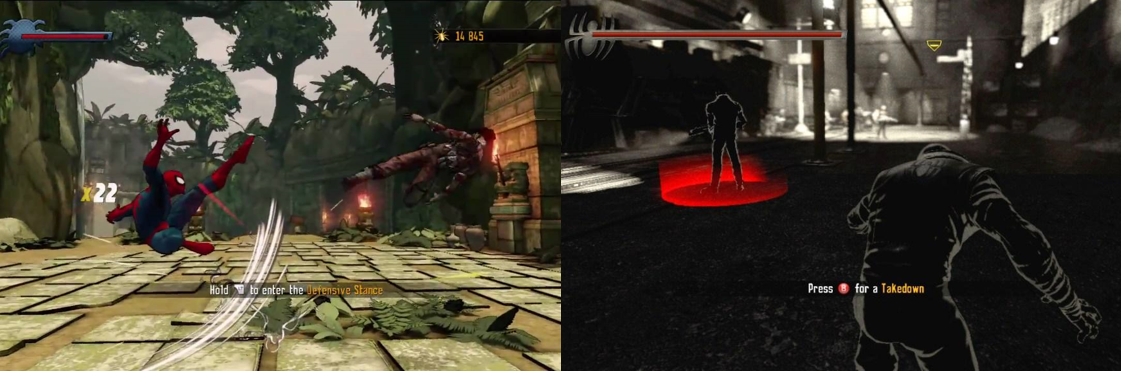
Spider-Man: Shattered Dimensions is a linear, mission-based third-person action title that has players battle a number of Spider-Man’s most iconic foes as four distinctively different versions of Spider-Man, each with their own unique appearance, levels, and personality. While some Spider-Men have slightly different abilities, combat styles, and gameplay, there are many fundamental gameplay mechanics which the four Spider-Men share: they all jump with A (and tapping A again in mid-air will perform a double jump), can land a fast strike with X and a strong attack with Y (and holding down either button performs a charge attack and an air launcher, respectively), and web or grab objects and enemies with B and you can mix and match these attack commands to string together a few basic combos. Naturally, you can web-sling by holding the Right Trigger; release the trigger and hold it again to perform successive web-slings or tap RT to perform a super handy web-zip to quickly dash to perches and platforms. Tapping the Right Bumper sees you fire off a quick web shot (which I found to be largely useless), you can press up on the directional pad to enable the spider-sense (which acts almost exactly like the “Detective Mode” from the Batman: Arkham videogames (Rocksteady Studios/Various, 2009 to 2015) and allows you to see through walls and obstacles to highlight enemies and collectibles), and you can also hold the Left Trigger to enter an “Evasive Stance” that lets you dodge and roll away from enemy attacks.

While the Amazing Spider-Man takes the direct approach, his Noir counterpart sticks to the shadows.

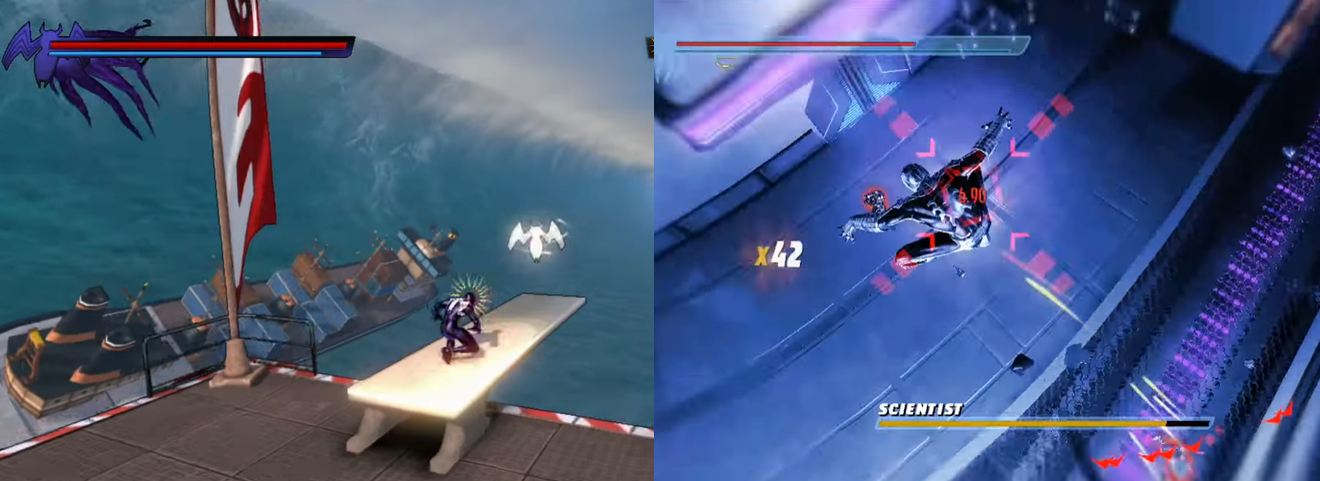
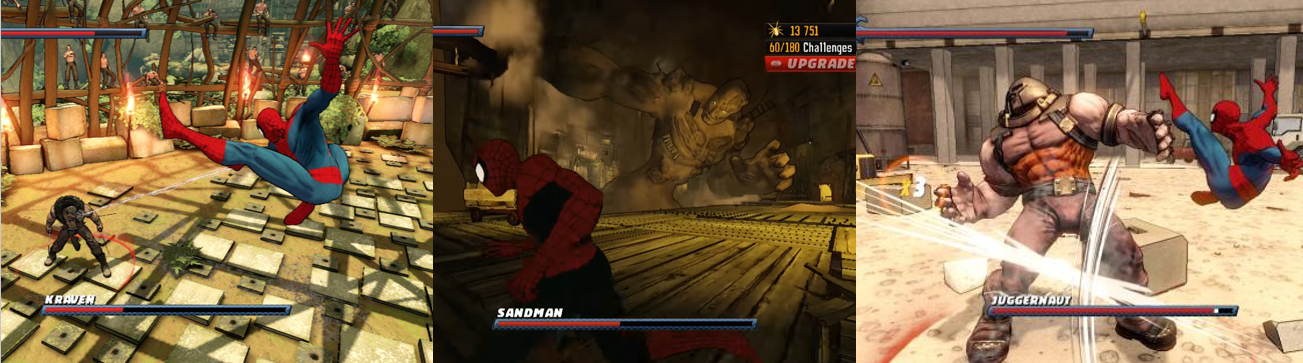
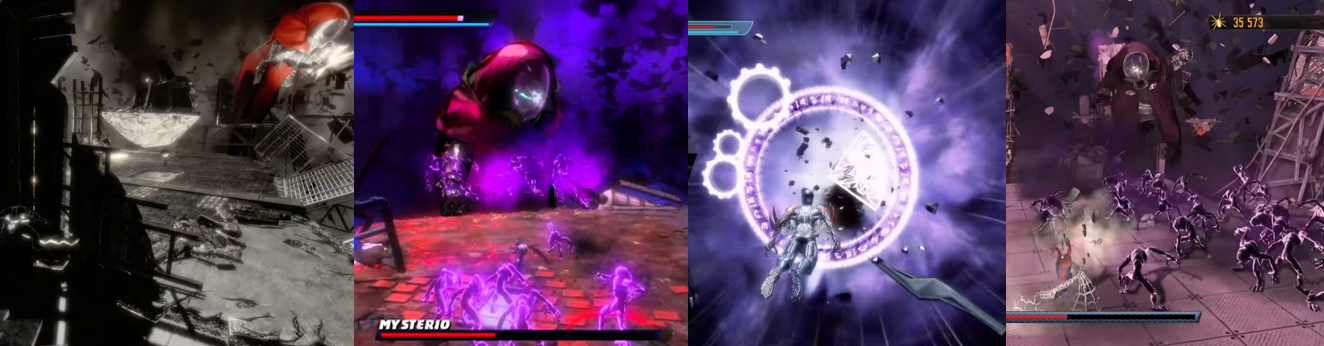
Each Spider-Man has a few different options available to them that make their gameplay a little different; the Amazing variant is a pretty standard Spider-Man with no additional abilities whose gameplay consists of a mixture of combat, web-slinging, and wall-crawling with some very light puzzle-solving thrown in for good measure. His Noir counterpart may not have any additional abilities but he plays considerably different from his mulitversal allies; for one thing, Spider-Man Noir’s world is rendered entirely in the moody black-and-white of the 1930s and, for another, he’s far more reliant on stealth. Again, like the Batman: Arkham games, Spider-Man Noir has to stick to the shadows and avoid spotlights and being spotted by gangsters, who will fill him full of lead if they spot him and briefly hunt him down unless you flee to the shadows. This means you have to stay up high, out of the way, and in the darkness, sneaking up on enemies or taking them down from a variety of positions with the B button. Spider-Man Noir does also get to engage enemies in direct combat but only in specifically designed sections; most of your time will be spent webbing up gangsters from the shadows, which is pretty fun but nowhere near as challenging or varied as in the Batman: Arkham games as Spider-Man Noir doesn’t have any gadgets or options to distract or toy with his prey.

Ultimate Spider-Man and Spider-Man 2099 have special abilities that are unique to them.

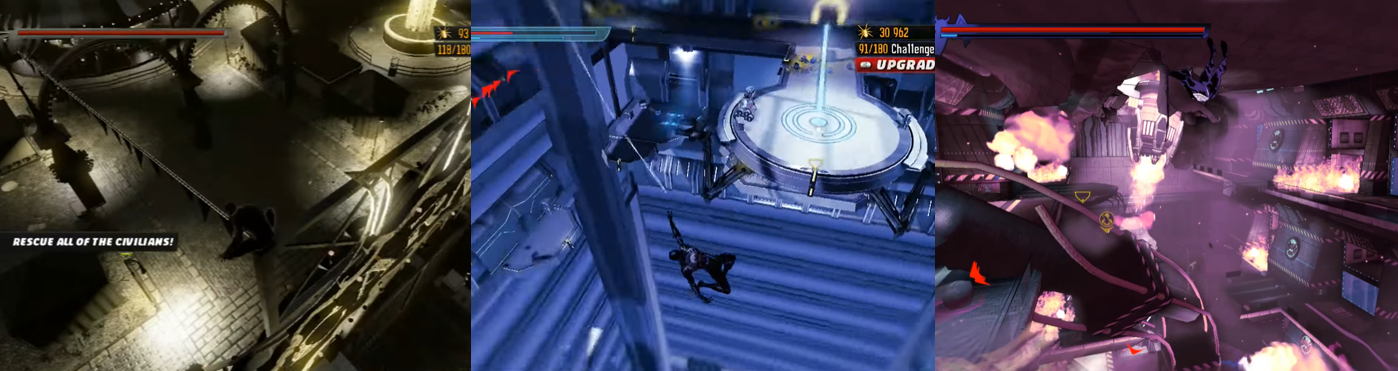
Both Spider-Man 2099 and Ultimate Spider-Man make use of the Left Bumper; since he’s wearing the bestial black suit, Ultimate Spider-Man can build up a “Rage” meter by attacking enemies and, when it’s full, pressing LB sees him fly into a rage and attack enemies faster and with more powerful tendril attacks. In this regard, Ultimate Spider-Man seems to be more geared towards combat but, in practise, I found his gameplay mostly the same to his Amazing counterpart but with the added bonus of a useful attack buff. Spider-Man 2099 can utilise LB to activate his “Accelerated Vision”, which briefly slows down time and allows him to better dodge and react to incoming attacks and obstacles, and this meter will automatically refills over time. Spider-Man 2099 also has to endure a number of freefall sections that see you holding A to dive faster towards a target and use B to grab them and X to punch them all while avoiding debris and other obstacles.

Annoying first-person segments and rescue missions mix up the gameplay.

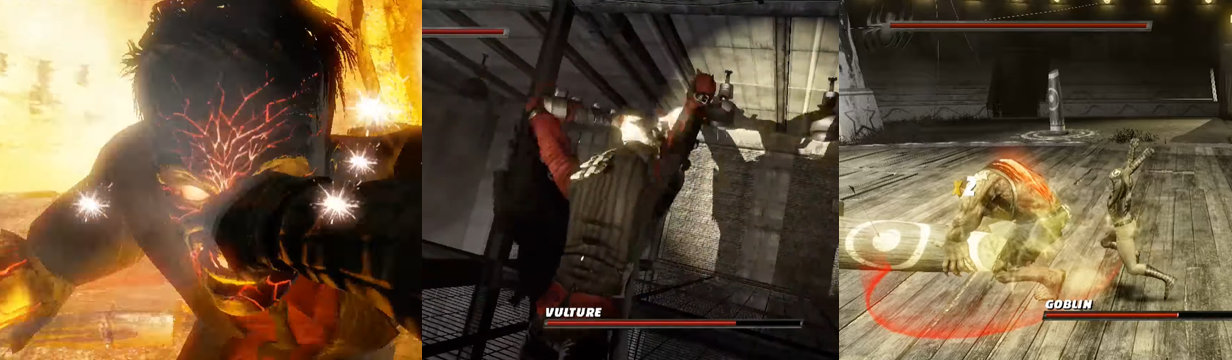
Other than that, the four Spider-Men share the remaining gameplay mechanics: this means you’ll be mashing B on certain walls and objects to rip them down or toss them at enemies and bosses, rescuing and protecting civilians and scientists by fending off enemies, swinging over to them, picking them up with B, and carrying them to a safety point; and taking part in some awkward first-person punching sequences. These appear during the majority of the game’s boss battles and see you using the two analogue sticks to punch or dodge, which is an interesting mechanic to add in but ultimately seems like something that could have been restricted to just the Amazing Spider-Man to help him stand out from the others. Other challenges include web-slinging away from danger (sometimes towards the camera, which can be very disorientating), web-zipping to enemies perched above, destroying certain objects, or activating or deactivating generators. Each level generally repeats these sections at least three times; if you have to rescue three civilians in the early part of a level, you can bet that you’ll be rescuing five a little later on, for example.

The game’s not especially difficult but can be long and tedious at times.

When not in combat or an action situation, each Spider-Man’s health will slowly regenerate, though you can also replenish it with Gold Spider Emblems scattered throughout each level. Occasionally, you’ll find water, acid, or electrified pits that will cause an instant respawn; other times, if you fall or fail a web-sling, you can recover with RT to save yourself. Spider-Man: Shattered Dimensions has three difficulty settings (Easy, Normal, and Hard), though the game isn’t massively difficult on Normal. Hard mode obviously results in more durable and aggressive enemies, and mixes up their placement and how many hits will defeat a boss, but there are many checkpoints and respawn points sprinkled through the game’s levels, which can get quite long and tedious as you progress. Additionally, like many Spider-Man videogames, mechanics such as wall-crawling and web-slinging can get a bit janky in Spider-Man: Shattered Dimensions thanks to the controls bugging out when on walls and ceilings and the camera proving unreliable and jerky at times.

Graphics and Sound:
Spider-Man: Shattered Dimension’s levels are entirely linear; there’s no free roaming or overworld to be found here, which is fine as that can be a little daunting, and instead you’ll explore a variety of levels that can be both large and intimidating and narrow and claustrophobic. When in wider, more open areas, your options for exploration are largely limited by walls (both visible and invisible) and gameplay objectives that constantly push you forwards. Still, there are at least a wide variety of locations on offer; you’ll scale Osborn Tower in the city, a disused desert mine, a ruin-filled jungle, and a hydroelectric dam amongst others. Primarily, the game leans towards a vibrant, quasi-cel-shaded style, especially for the Amazing and Ultimate Spider-Men, though not to the extent where it looks like ugly 2D characters monstrously rendered in 3D as in other games.

The game is full of visual variety in its levels, graphics, and characters.

Where the game really shines, though, are in the Noir and 2099 levels; the Noir levels are rendered entirely in monochrome, with sporadic use of colour only appearing when using the spider-sense. The heavy shadows and stark contrast of white on black immediately makes these sections stand out not just from the rest of the game but also its closest competitors, the Batman: Arkham titles, and reminds more of MadWorld (PlatinumGames, 2009) and Frank Miller’s Sin City comics and films (ibid, 1991 to 2002; ibid and Rodriguez, 2005; 2014). Similarly, the 2099 levels are an explosion of futuristic neon and technology; indeed, I found the 2009 levels to be a bit of a sensory overload and a bit difficult to digest, making it tricky to know where I was supposed to go since every level was so bustling with lights, metal, and colours. Still, it’s a great way to make each Spider-Man’s locations even more visually distinct from each other, though there was maybe a missed opportunity to mix things up a bit later in the game to have, say, Spider-Man Noir in the 2099 world.

The graphics hold up really well but it’s the voice work that really makes the game shine.

While the game’s music isn’t much more than the standard superhero fare of rousing horns and tunes, the voice acting is absolutely top notch! Each Spider-Man is voiced by a notable and popular Spidey voice actor from his many cartoons, which saw not only Dan Gilvezan’s return to the character after a twenty-five year absence but also the return of Christopher Daniel Bares, who voiced the Spider-Man I grew up with in the nineties cartoon. Neil Patrick Harris is easily the best of the four, though; he always makes for a fun and fitting Spider-Man and his delivery really sells the character’s many quips and witticisms. Stan Lee narrates the start and end of each chapter and Nolan North even reprises his role as Wade W. Wilson/Deadpool, who steals the show in his oil rig-turned-reality show by constantly berating and taunting Ultimate Spider-Man and breaking the fourth wall at every opportunity. The in-game graphics are brilliant; levels and enemies are as visually distinct as the four Spider-Man and the game runs very fast and smooth (when the camera isn’t freaking out on you). The cutscenes are equally impressive, if a bit inconsistent as they’re comprised of the in-game graphics, higher quality cinematics, and partially animated sequences, but they tell the story well enough and are always fun to watch.

Enemies and Bosses:
There are a number of goons to pit your spider-powers against in Spider-Man: Shattered Dimensions but, for the most part, once you’ve faced the first wave of enemies in the first level, you’ll encounter the same troupes again and again but in new skins. You’ll find regular enemies who come at you with their fists and melee weapons (baseball bats and swords and such), gun-toting enemies who either chip away at your health or blast you full of holes when playing as Spider-Man Noir, shield-carrying enemies who you must zip towards and hop over with A to attack from behind, and larger enemies who will put up a block that you need to break with your air launcher attack. Other enemies include smaller versions or duplicates of the level’s main foe that can generally be taken out in one or two hits but swarm all over you, larger enemies that toss out grenades or seeking rockets, and all manner of zombies and genetically-engineered monstrosities. One aspect I really enjoyed was that enemies can actually attack and harm each other, which is incredibly helpful when swarmed by foes, and you can also throw objects such as barrels and flaming debris at enemies to help whittle them (or, at least, their health) down.

The Amazing Spider-Man battles Kraven, the Sandman, and the Juggernaut for the Tablet pieces.

Each level is structured around locating, pursuing, and/or confronting one of Spider-Man’s villains and retrieving a piece of the Tablet from them; thus, each level concludes in a boss battle but you’ll actually battle each boss a number of times throughout each level. The first boss the Amazing Spider-Man comes up against is Sergei Kravinoff/Kraven the Hunter, who leads you on a merry jaunt through the jungle, shoots at you through his sniper rifle, and initially battles you inside of a caged arena. Here, you’ll need to dodge and evade his jumping strikes and counterattack in response, web-zip to the convenient columns to avoid the floor spikes, and finish him off with some first-person punching. In the second battle, he’s much stronger and faster thanks to the Tablet fragment but the strategy remains the same; take advantage of the spawning columns to avoid his attacks and strike as and when you can but don’t linger in one area for too long or he’ll knock your ass down. Later, you’ll have to pursue Flint Marko/The Sandman through an abandoned mine, using your web pull to drench his raging sand tornado and battle his gigantic form within the mine itself. Here, you must trick him into slamming his fists into water carts to muddy them up and make them vulnerable, then toss barrels at his face to defeat him. Afterwards, he draws you within his chaotic sandstorm and his personality begins to unravel; you must web-zip around the floating debris avoiding his giant fists and tossing water barrels at his face so you can deal some real damage and put him down once and for all. Finally, you’ll battle and purse Cain Marko/The Juggernaut in a construction site, through the city, and in the wreckage of Osborn Tower; initially, you simply have to avoid his charge attack to cause him to ram into specific towers and beat on him when he’s lodged in the ground, but his later empowered form sees him add a whole bunch of annoying ground pounds and smashes to his repertoire. Still, as long as you dodge away and stay away from his powerful grapple moves, it’s not too difficult to avoid his attacks and projectiles and put a big beating on him when prompted.  

Spider-Man Noir’s bosses can be a bit tricky, confusing, and mundane, respectively.

In the train yard, Spider-Man Noir follows Joseph Lorenzini/Hammerhead and it’s in the first fight against him that you might hit a considerable difficulty wall; Hammerhead uses a huge Gatling gun to keep you at bay whenever his lights (or the spotlights in the arena) spot even the slightest part of you. After taking cover behind walls, you must wait for Hammerhead to rotate away and run around behind him, staying wide and in the shadows, and press B when prompted to put a beating on him but the game doesn’t make this very clear and Hammerhead spots you way too easily. In the second fight, you have to avoid his machine gun fire and toss barrels at him to force him to blow up a piece of machinery with his rocket launcher, then zip up to the higher platform as he fires wildly into the fog to do big damage with a takedown, and then avoid his head-on charge to finish him off. Later, Spider-Man Noir pursues Adrian Toomes/The Vulture through the grimy streets and confronts him in a large warehouse; the Vulture is another annoying and confusing boss as he darts around slicing at you and tossing knives and you’re encouraged to use the spotlights to blind him and deal big damage but it’s unnecessarily random and difficult to get him into position to actually utilise this mechanic. When powered by the Tablet fragment, the Vulture’s claws and bite need to be avoided in first-person and then you go through the previous battle again but this time he also tosses Molotov cocktails at you (which you can cause him to drop to damage him instead). Finally, Spider-Man Noir tracks Norman Osborn/The Goblin to a warped fairground and has a number of first-person encounters with him before finally facing him inside the circus tent. The Goblin isn’t really all that, though; simply web towards him and jump over him to attack the glowing weak spot on his back, then zip up to higher ground when the lights go out to hit a takedown, before fending off his goons (or causing the Goblin to attack them himself) and avoiding the swipes from his column and pummel him when he’s stuck in the ground.
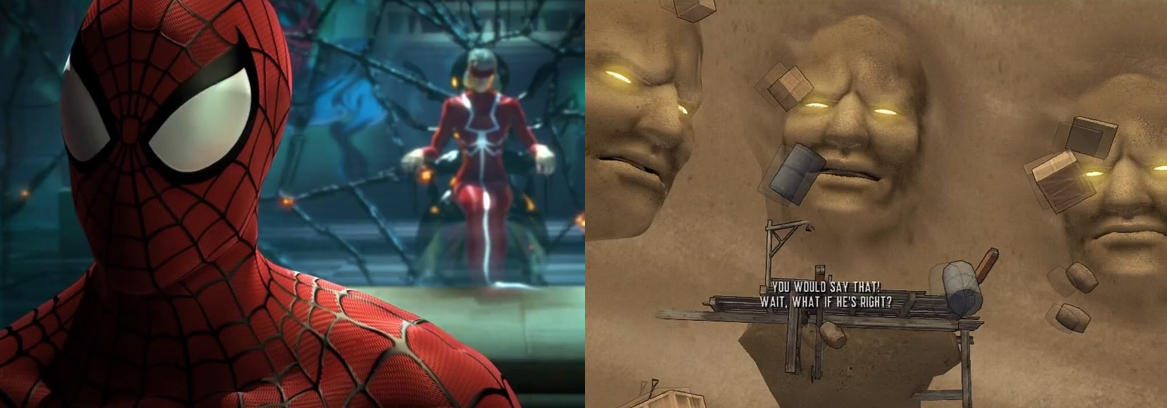
Ultimate Spider-Man’s bosses were probably the most fun and varied for me.

Ultimate Spider-Man’s first foe is Max Dillon/Electro, who he battles and pursues through a hydroelectric power plant to a huge dam; the first fight is quite annoying as Electro blasts at you with a huge laser and protects himself with an electrical field but the second bout is initially quite confusing as Electro teleports across generators and shields himself from your attacks. Soon, he drops to the floor and sends electrical blasts your way, but these leave him exhausted and vulnerable to your attacks. After fending off his electrical minions and draining his health, he’ll use the Tablet fragment to grow to gigantic properties and become invulnerable, similar to the Sandman fight. To defeat this giant Electro, you need to use your webbing on his hands to cause him to damage the dam behind him while avoiding his laser beams. When the fight switches to the other side of the dam, you’ll need to survive against the enemies he spawns and avoid his fists on an increasingly-small platform until prompted to web his head so the breached dam can finish him. While on the oil rig, Spider-Man is forced to take part in Deadpool’s warped reality show; this inevitably leads to a showdown between them that sees Deadpool teleporting around, slicing at you with his swords, and shooting at you all while his devoted fanboys rush in to join the fight. When he’s standing with a B prompt above his head, don’t web-zip over to him or else he’ll just teleport away; instead, rush over and approach from the ground to best him. After outrunning a tidal wave, you’ll battle him inside a caged arena, where he uses the Tablet to duplicate himself and rains explosive punching bags between rounds. However, simply evade these, and his attacks, and target each of his duplicates in turn and he’ll soon go down, but the final battle against Carnage is particularly striking since the creature has ransacked the Triskelion and corrupted its inhabitants into bloodthirsty monsters! In the first fight against Carnage, it leaps about the remains and wreckage of Quinjets and Helicarriers swiping and skewering you with spikes, but is perfectly susceptible to your attacks and can be dealt big damage by web-zipping it into the conveniently-placed furnaces nearby. In the second phase, Carnage encases itself in a bulbous, tentacled shield that some mechs will destroy with flamethrowers; this leads to a first-person sequence and Carnage blasting spikes, maniacally hopping around the place, and it draining your health to replenish its own if it gets hold of you!
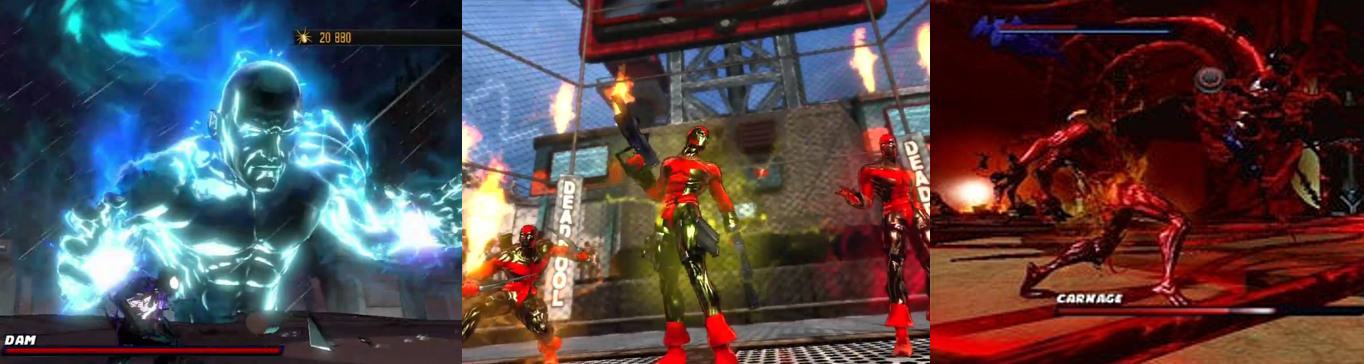
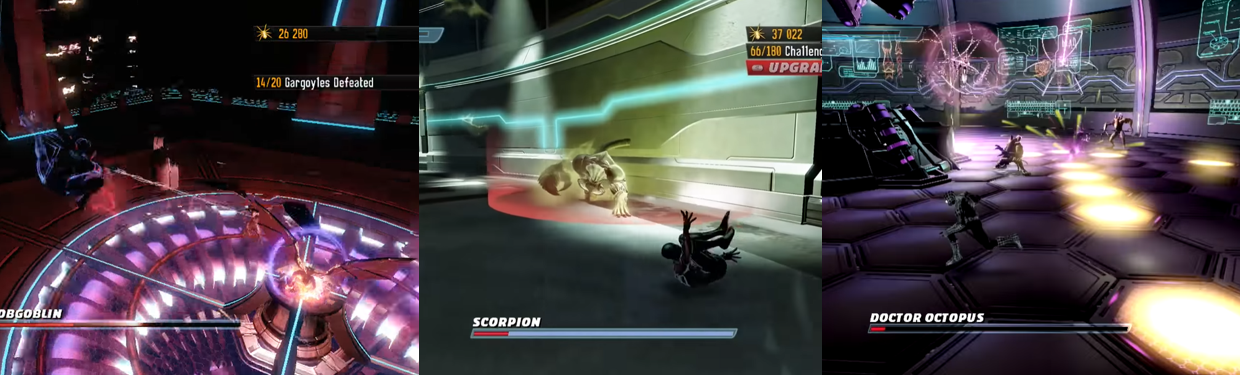
Spider-Man 2099’s bosses tend to be very samey, tedious, and chaotic.

Spider-Man 2099 first butts heads with the Hobgoblin during a freefall sequence that sees you pummelling him and smashing him through obstacles. When you hit the ground, Hobgoblin hovers out of reach and tosses pumpkin bombs at you that you must grab with your webs and throw back at him to down him for a beating. After being empowered by the Tablet, the Hobgoblin conjures gargoyles to distract you and adds a bombardment of bombs to his arsenal, but the strategy remains the same; he’s just faster and more aggressive and you have to finish him off with a mid-air, first-person pummelling. O’Hara’s second boss is Kron Stone/The Scorpion, who leaves explosive, acidic eggs and spawns smaller versions of himself; the Scorpion initially charges at you and tries to smash you with his tail, but if you evade these attacks he’s left vulnerable to a beating and you can easily toss his eggs at him when he takes the high ground to spit acid at you and use B to beat him down. When powered by the Tablet, things are mostly the same but there’s also a large pit in middle of the room that Scorpion pounces at you in and fills with acid; however, throwing eggs at him will cause him to take a dip and be left wide open for a beating. Finally, O’Hara has to fight through Doctor Serena Patel/Doctor Octopus’ elaborate facility, avoiding her mechanical arms in freefall and trashing her gigantic Mecharms before confronting her at the heart of the complex. Here, you need to web pull three generators to lower her shield while avoiding her lasers, then jump over her energy shockwaves to do damage on her. When she powers up, she scuttles around fully shielded and firing lasers across the ground, but you can easily trick her into offing her own minions and defeat her by tossing their explosive cores at her.

All four Spider-Man take it in turns to whittle down and defeat Mysterio in the finale.

Once all of the bosses are beaten, the levels cleared, and the Tablets recovered, all four Spider-Man are thrown into a dimension of pure chaos as Mysterio uses the completed Tablet to become a gigantic, all-powerful God. First, you have to web-zip across floating, fragment platforms as Spider-Man Noir; there are no enemies to fight but you must make sure to avoid the light or else Mysterio will fire projectiles your way, and then simply press B when prompted to web pull his head into a rock. Ultimate Spider-Man then has to fend off a whole bunch of illusionary goons and then destroy the floating orbs after they’ve conjured an illusionary version of a boss, which hurts Mysterio, before quickly web-zipping across the wreckage when Mysterio destroys your platform and then hitting another web pull. Spider-Man 2099 has the easiest time in this fight as you simply have to freefall past Mysterio’s projectiles and magic obstacles to grab and pummel him, but the Amazing Spider-Man has to endure a gruelling gauntlet against a whole bunch of monsters while avoiding Mysterio’s projectiles. Once the enemies are cleared away, you can use the web pull to send a rock flying at Mysterio and must then web-zip to another, smaller platform and repeat the process until he’s downed for one last smash of his helmet to defeat his aspirations for good.

Power-Ups and Bonuses:
As you explore the various levels in Spider-Man: Shattered Dimensions, you may be disappointed to find that there aren’t any power-ups to find beyond the odd health-restoring Gold Spider Emblem. However, every level contains a number of challenges that make up the “Web of Destiny”; while most of these are unavoidable and story-based, many others are optional an easily missed unless you check the Web in each level. You may have to complete certain sections under a time limit, defeat certain enemies in certain ways, or perform certain moves a number of times in order to clear the challenges but the reward is some extra “Spider Essence”.

Collecting Spider Essence allows you to upgrade your abilities and unlock new costumes.

As you clear defeat enemies and bosses, clear levels, and complete these challenges, you’ll be awarded with Spider Essence, which essentially acts as a combination of currency and experience points and can be spent upgrading your health and regenerative capabilities, and unlocking new costumes and attacks, all of which make the game even easier and more chaotic as you plough through enemies with a longer health bar and additional strikes. You can also acquire additional Spider Essence by finding Silver Spider Tokens and Hidden Spiders in every level, which also count towards completing the Web of Destiny, so it pays to give each area a quick scan with your spider-sense for any collectibles.

Additional Features:
Spider-Man: Shattered Dimensions has forty-two Achievements on offer, with the vast majority of them popping as you play through the story and take down the game’s villains. There are also Achievements for completing the Web of Destiny, unlocking all the upgrades, and finding every Spider Token and Hidden Spider, which adds some replayability to the game. Other Achievements pop when you defeat up to five-hundred enemies, complete the game on each difficulty (which are stackable), maintain Ultimate Spider-Man’s Rage mode for a full minute, and perform a combo of up to two-hundred hits but there aren’t too many fun or quirky ones that ask you to go off the beaten track. Otherwise, that’s about it; you receive either a Bronze, Silver, or Gold Medal and unlock character models and concept art after clearing levels and there were some additional costumes for those who pre-ordered the game back in the day but there’s not really anything else to come back to besides any Achievements you missed. It might have been nice to include a boss rush or a survival mode, or as mentioned earlier mix and match the Spider-Man in a free play mode, but the Web of Destiny will keep you pretty busy for a few hours, I’m sure.

The Summary:
I’ve wanted to play Spider-Man: Shattered Dimensions for years; sadly, I missed out on it when it first released, and the game has become very expensive and hard to come by since then. Thankfully, I was able to snap it up and finally get to grips with it and it was actually a pretty good way to spend a few hours. It’s not especially long or difficult, at least not on Normal mode, and can probably be finished in a day if you play non-stop from morning the late evening but there’s a fair amount to come back to once you’re done. Fittingly, the four Spider-Men are the main highlight of the game; each one looks, sounds, and plays a little differently from the other and it’s fun to go nuts with Ultimate Spider-Man’s rage and then stealthily stalk gangster as Spider-Man Noir. Splitting the game into individual levels helps to keep things interesting and fun, but levels do tend to drag on and enemy and boss variety doesn’t really hold up under close scrutiny. Most of the bosses boil down to winning one of those annoying first-person sequences, pursuing them through the level, battling their first form (usually with hit-and-run tactics, using their own attacks against them, or taking advantage of them getting stuck) and then fighting their Tablet form, which is either a giant version of the boss or a faster, more powerful version. A janky camera and awkward wall-crawling and web-slinging can make the game frustrating but these are recurring concerns in Spider-Man videogames and, overall, I found the game to be pretty fun and entertaining for the voice acting and visual variety alone.

My Rating:

Rating: 3 out of 5.

Pretty Good

Have you played Spider-Man: Shattered Dimensions? If so, what did you think to it? Which of the four Spider-Men was your favourite? What did you think to the way the game handled the four Spider-Men and the different playstyles? Which level and boss battle was your favourite (or most frustrating)? Are you a fan of Spider-Man teaming up with his multiversal incarnations?? Which Spider-Man videogame is your favourite? Whatever you think, sign up and leave a comment or let me know on my social media and check in next Friday for more from Spider-Man Month.