Back Issues [A-Day]: Civil War #1-7


In September 1963 the legendary Stan Lee and Jack Kirby assembled Earth’s mightiest heroes, the Avengers, who formed the backbone of the Marvel Cinematic Universe and become an unbelievably popular franchise.


Story Title: “Civil War” (Part 1 to 7)
Published: 3 May 2006 (cover-dated: July 2006) to 21 February 2007 (cover dated: January 2007)

Writer: Mark Millar
Artist: Steve McNiven

Quick Facts:
Although formed as an answer to the Justice League of America and depicted as Earth’s mightiest heroes, the Avengers faced their greatest test in 2004/2005 when the team infamously disassembled following some devastating losses. This laid the foundation for the “Civil War” event, a sprawling, widely criticised story that pit heroes against each other over disagreements about governmental registration. The event had long-lasting consequences and directly inspired cartoons, films, and videogames despite being a contentious story.

The Review:
One of Marvel’s most controversial events begins in Stamford, Connecticut where celebrity superheroes the New Warriors (Dwayne Taylor/Night Thrasher, Namorita Prentiss, Robbie Baldwin/Speedball, and Zachary Smith, Jr./ Microbe) prepare to storm a house where supervillains Joss Shappe/Speedfreek, Kateri Deseronto/Coldheart, Ralph Roberts/Cobalt Man, and Robert Hunter/Nitro have taken shelter after escaping from Ryker’s Island Penitentiary. Although Microbo is unsure of their chances, Speedball confidently rallies the team to boost their ratings and reputation. Any plans go awry when the New Warriors are spotted, forcing them to charge in blindly, surprisingly holding their own against most of the villains despite the youngsters being seen as second-rate. However, when Namorita tackles Nitro, he maliciously detonates, apparently killing the New Warriors, a bus load of children, and an estimated 800 or 900 others in the immediate area (which is also decimated) live on camera. Captain Steve Rogers/Captain America, Anthony “Tony” Stark/Iron Man, and the X-Men (begrudgingly supervised by the gigantic Sentinels) arrive to help with the rescue effort, with Iron Man chastising the New Warriors for being so reckless and Doctor William “Bill” Foster/Goliath morbidly predicting that the event will be the final straw that turns the public against superhumans. While the subject is debated on television, Stark is personally blamed by a grieving mother as he bankrolls the Avengers and thus puts kids in danger by encouraging them to act outside the law. Very quickly, the media debates whether superhumans should be registered to hold them accountable for their actions, and resentment grows for even celebrated superheroes like Johnny Storm/The Human Torch, who’s brutally attacked outside a nightclub.

Following a tragedy, Marvel’s heroes disagree about the issue of superhuman registration.

The Avengers, New Avengers, X-Men, and the Fantastic Four gather at the Baxter Building to discuss the issue, which basically amounts to forcing super-powered individuals to register their identity and powers with the government or be arrested. While Luke Cage/Power Man sees it as an attempt to shut them down and Eli Bradley/Patriot suggests they go on strike, Iron Man is all for them being better trained and equipped and held accountable for their actions. Sam Wilson/The Falcon is aghast at the idea of giving up their costumes to become “super-cops”, while Doctor Hank Pym/Yellowjacket agrees with the proposal, reasoning that their masks have caused the public to lose faith in them. While James “Logan” Howlett/Wolverine detests the idea and Peter Parker/Spider-Man suggests some would rather quit than give up their anonymity, Susan Storm/The Invisible Woman counters that being public superheroes isn’t that bad, and Danny Rand/Daredevil believes that, either way, things are changing for them. Aboard a Helicarrier, acting head of the Strategic Hazard Intervention Espionage Logistics Directorate (S.H.I.E.L.D.) Maria Hill asks Cap for his opinion and he begrudgingly states he thinks it’ll divide the superhero community, especially the street-level heroes, and lead to civil war. When Maria demands that Cap set an example and arrest his fellow heroes if they step out of line, he vehemently refuses, believing superheroes should be above regular politics. Tired of masked vigilantes running amok, Maria orders her specially trained anti-superhuman response unit to subdue Cap, who easily fights them off and escapes, becoming a fugitive in the process. Doctor Stephen Strange’s concerns are only aggravated when Uatu the Watcher silently appears and Iron Man, Doctor Reed Richards/Mister Fantastic, and Yellowjacket side with the government and push for the Superhuman Registration Act (SRA). Despite being on the run, Cap continues to round up supervillains and recruits others to his cause, while Iron Man and his cohorts officially defend against supervillain attacks, rebuilding public confidence and vowing to bring Cap in (ostensibly to talk him around), and Mr. Fantastic shuns his wife’s concerns to eagerly construct an elaborate prison for any who refuse the SRA, regardless of who they are.

Both sides build teams for their causes, leading to some dramatic moments and fights between them.

When the SRA becomes law, unregistered heroes like Patriot and the other Young Avengers are aggressively hounded by S.H.I.E.L.D., who ironically cause a great deal of property damage non-lethally apprehending them. Undercover as a S.H.I.E.L.D. agent, Cap rescues the Young Avengers and brings them to Resistance headquarters, where they plan to hide while Nick Fury sets up new secret identities for them. They’re as stunned as thousands of others when Stark has Spider-Man publicly reveal his identity in support of the SRA, though this isn’t enough to convince T’Challa/The Black Panther to buy into Reed’s pitch for a fifty state super police force. Dr. Strange similarly refuses to be a part of it by proxy and Emma Frost/The White Queen firmly declines to have the X-Men get involved as Mutants have faced persecution their whole lives and been shunned when they face similar issues. Hidden behind their bizarre new identities, Cap and his “Secret Avengers” lament all the good they’re now denied from doing (like answering “Make a Wish” requests) because of the SRA yet assist with a petrochemical fire, only for it to be an elaborate trap. Iron Man and his supporters subdue Billy Kaplan/Wiccan and Tyrone Johnson/Cloak to keep Cap from escaping and offer Cap amnesty again. Although Spidey insists that registration is the best way to fight the real bad guys, Cap dismisses him for endangering his loved ones and tricks Iron Man into thinking he’s willing to hear him out, short-circuiting his armour and starting a scuffle. Spidey’s fancy Iron Spider suit buys Stark enough time to reboot and out-fight Cap by analysing his attack patterns. When Hercules Panhellenios rushes in to help, the fight’s interrupted by what appears to be Thor Odinson, returned from the dead, who physically decimates the Secret Avengers just as Iron Man blasts them with a debilitating audio burst.

Goliath’s death sees Spidey rebel against Stark, who’s actively hunting his allies.

Hercules disables the device, allowing the Falcon to fly the beaten, bloody Cap to safety, though everyone’s aghast when Thor suddenly kills Goliath with a lightning blast! Protected by the Invisible Woman, the survivors flee via Cloak’s teleporting cape and Iron Man’s supporters are left horrified that his Thor clone would be so reckless, with Spider-Man and Yellowjacket questioning their decisions while the injured Cap refuses to abandon his principles even as some of his supporters leave in the fallout. Though remorseful, Stark and Reed also stick to their guns, even after Sue leaves her husband to join the Secret Avengers with Johnny. As more of their people are defecting or disappearing by the day, Stark and Reed coerce supervillain team the Thunderbolts (including Lester/Bullseye, MacDonald “Mac” Gargan/Venom, and Tony Masters/Taskmaster) into temporarily bolstering their forces. S.H.I.E.L.D.’s increased street presence curtails crime rates, but they struggle to apprehend the wayward heroes, even with guys like Kyle Richmond/Nighthawk joining the cause (and receiving full pardons and a wage). However, when he learns of Stark’s high-tech prison in the Negative Zone, Spidey finally snaps and turns on Iron Man, disagreeing with his morals, lashing out when Stark chastises him, and forcing Maria (against Stark’s orders) to send the Thunderbolts after him. Attacked by Jody Putt/Jester and Steven Levins/Jack O’Lantern in the sewers, the battered Spidey is saved by Frank Castle/The Punisher, who executes his attackers and brings the grievously wounded Peter to the Secret Avengers. Despite all the good the SRA is doing, even Reed questions the process, especially after Daredevil is arrested, though Stark remains adamant that they’re doing the right thing and even offers Daredevil a team of his own if he registers, which does little to improve the vigilante’s opinion of him. While Pym and Maria train pro-SRA agents in Arizona, vetoing potential team members for each state and assigning codenames to others, Reed reprograms “Thor” and Iron Man celebrates the positive impact the SRA has had on crime, all unaware that the Punisher is covertly infiltrating the Baxter Building.

Cap reluctantly surrenders, outlawing many heroes and changing Marvel for many years.

Inside, the Punisher relays details of the Negative Zone prison to Cap. With Spider-Man recovered and back on side, Cap uses the Punisher’s intel to discuss plans to storm the Negative Zone prison. However, Cap brutally beats the Punisher when he guns down David Kivlin/The Plunderer and Matthew Gilden/Goldbug, villains who sought refuge with the Secret Avengers, expelling him from the team in disgust. After Stark pacifies the public by memorialising the Stanford victims, the Secret Avengers (aided by the Black Panther) break into the Negative Zone prison, where they’re immediately confronted by Iron Man and his supporters thanks to a tipoff from Grer Nelson/Tigra. However, Cap anticipated this and had shapeshifter Teddy Altman/Hulkling impersonate Yellowjacket, allowing them to free the prisoners and igniting a brawl. Despite the Black Panther’s best efforts, Maria has S.H.I.E.L.D. shut down the Negative Zone portals, forcing Cloak to teleport everyone to the skies above New York City. Iron Man immediately orders an evacuation but continues the fight, which sees Spidey take it to Mr. Fantastic, the Thunderbolts gang up on Cap, and Namor bring the Atlanteans to tip the balance for the Secret Avengers. Iron Man calls in “Thor” and their new recruits to even the odds, but Hercules avenges his friend by destroying the Thor cyborg and Taskmaster gets crushed when he guns down Reed in front of Sue. His armour compromised by the Vision, Iron Man is easily overpowered by Cap, who’s jumped by civilians and emergency workers. Realising the damage they’ve caused with their petty squabble, a repentant Cap dramatically stands down, orders his troops to stop fighting, and surrenders to the authorities. In the aftermath, the 50 State Initiative places government-controlled superhero teams in every state (to unanimous public approval). Stark is promoted to S.H.I.E.L.D. Director and Sue reluctantly returns to a remorseful Reed, while Cap is locked up and the Secret Avengers go deeper underground, with the Punisher retrieving his mask and Spider-Man returning to his black costume…

Final Thoughts: 
This was my first time reading Civil War, an event I followed through websites and such at the time but had little interest in even after the blockbuster quasi-adaptation came out as I disliked the entire concept. Not the idea of superheroes fighting against each other; I don’t mind that. I disliked seeing the Marvel heroes so easily and aggressively divided by the core issue and how out of character everyone acted throughout it. It doesn’t help that the art isn’t that great either, with Spider-Man looking especially odd, or that these seven issues were accompanied by numerous tie-ins that filled in some gaps. For example, Spidey’s change of heart is largely glossed over here and is presumably fleshed out in a tie-in comic. Similarly, the Thunderbolts don’t get much to do and the New Warriors are all presumed dead here, and you’d never know that blind Matt Murdock wasn’t Daredevil or exactly what happens in the Negative Zone or with the X-Men if you just stick to the main story. Yet, paradoxically, that’s exactly what I’d suggest you do as Civil War isn’t exactly Marvel’s finest hour and I can’t imagine any of the supplementary materials helps with that. The whole event is based on shock value, from the New Warriors’ recklessness killing nearly 1000 people to Peter dramatically unmasking to seeing superheroes hunted and arrested, to seeing the Avengers turn on each other. It’s all framed as being a shocking event but so much of it just falls flat because of the aforementioned poor characterisations of many of the key players.

The poor characterisations really ruin this already questionable event for me.

Spider-Man is a great example. Initially, as expected, he’s against the SRA because exposing his identity would compromise his loved ones. The very idea of outing himself flies in the face of his “power/responsibility” manta, and yet Stark convinces Peter to do it! I believe it’s explained in a tie-in issue that Peter was convinced by assurances that his family would be protected, he would be looked after, and by the conviction of his mentor, but none of that makes it any better. Spidey should’ve been a non-factor in the story, taking neither side like the X-Men and doing his own thing, but that doesn’t shock as much as seeing him unmask on live television, does it? This is the story that introduced me to Maria Hill and I’ve hated her ever since. She’s a condescending, arrogant bitch who clearly hates superheroes and vigilantes and resents playing second fiddle to them. While she and S.H.I.E.L.D. justify their actions as being the best, most sensible option, they completely disregard all the good these heroes have done and dispassionately lock them up, only to happily work with murderers and psychopaths like the Thunderbolts! Iron Man is the absolute worst example of character assassination here, being a despicable, unlikable, selfish asshole that soured his character for years. I do understand his motivations and, in his own way, he is right: superheroes should be held accountable for their actions. But the way he goes about it is all wrong. He turns against his friends and peers, happily hunting them down and locking them up, talking down to them with his pleas for amnesty and holier-than-thou attitude. Him and Reed are at their most self-absorbed and egotistical here, shunning family and friends just to appease the public and completely destroying their legacies.

Civil War ends up being a messy, unappealing drama full of stubborn fools and bad decisions.

To be fair, while I’m Team Cap all the way, it’s not like Cap is much better. Like Stark, he’s a stubborn, prideful man who quickly loses sight of the big issue and focuses more on building his numbers and besting Team Stark over anything else. It’s funny because I always imagined Steve would be pro-registration and Stark would be against it, but it’s more impactful seeing Cap reject boneheaded governmental mandates. Cap is right that superpowered individuals shouldn’t be forced to reveal their identities and he immediately looks better because he’s not locking people up, working with supervillains, or acting like a complete dickhead like Stark, but he lets his principles blind him. If Cap had parlayed with Iron Man, attempted a compromise, things might’ve deescalated faster. Instead, his first reaction is to lash out and form an army to fight against the SRA rather than attempting to appeal to reason, escalating the conflict into a massive brawl that causes further damage. Civil War seems to be another attempt by Marvel to deconstruct their heroes and the status quo, which is always divisive as it goes against everything you expect from these characters. The fallout, especially, had huge ramifications for the likes of Cap and Spidey, so say nothing of the 50 State Initiative and the eventually evolution of the Thunderbolts. I appreciate the effort to try something different, but everything feels very rushed and poorly executed. I kept wondering if certain characters (Stark, especially) had been replaced by Skrulls or something but, while this was true for some, it wasn’t for others, meaning Marvel had to scramble to find ways to walk back all the stupid decisions made here. I’d say Civil War is a pivotal story in Marvel’s long history, but I’m glad that it’s long been resolved and much of its events were undone as I’ve ever enjoyed it.

My Rating:

Rating: 3 out of 5.

Pretty Good

Did you enjoy Civil War? Were you on Team Cap or Team Stark? Were you shocked when Peter unmasked and Goliath was killed? Did you ever read all the tie-in comics? Who do you think acted the most out of character here? What are some of your favourite Avengers stories or moments and how are you celebrating their debut? Let me know your thoughts on Civil War and the Avengers below, and support me on Ko-Fi for more Avengers content.

Movie Night: Thunderbolts* / The New Avengers

Released: 2 May 2025
Director: Jake Schreier
Distributor: Walt Disney Studios Motion Pictures
Budget: $180 million
Stars: Florence Pugh, Lewis Pullman, Sebastian Stan, David Harbour, Wyatt Russell, and Julia Louis-Dreyfus

The Plot:
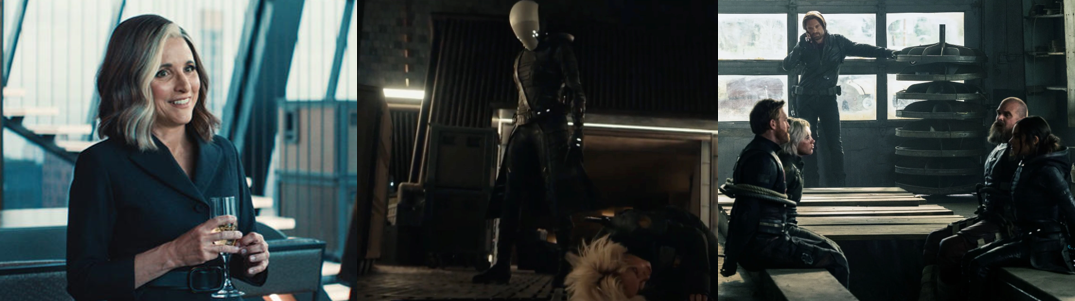
When Contessa Valentina Allegra de Fontaine (Louis-Dreyfus) seeks to erase the evidence of her malicious experiments, she unwittingly assembles a rag-tag team of losers and mercenaries, led by Yelena Belova (Push), to stand against her and her secret superpowered agent…

The Background:
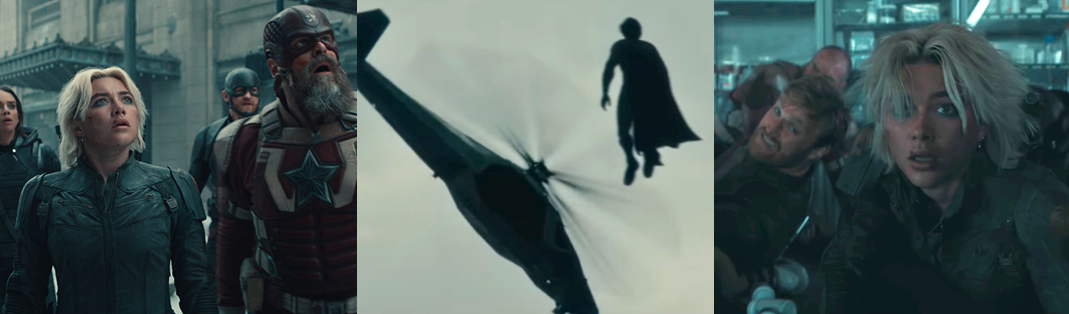
Back in the nineties, Marvel Comics were not just in a financial state but the “Onslaught Saga” led to some of their most popular characters being presumed dead for a while. In their place, Peter David created an all-new superhero team, the Thunderbolts, who debuted in 1997 as typically excessive heroes who were secretly the villainous Masters of Evil in disguise. The idea of bringing this concept to the blockbuster Marvel Cinematic Universe (MCU) can be traced back to the production of Guardians of the Galaxy (Gunn, 2014) when director James Gunn expressed interest in a big-screen adaptation. Although the idea was shelved when Warner Bros. produced a similar concept, it regained steam when MCU projects teased Valentina assembling a team of anti-heroes and soon evolved into a starring vehicle for Florence Pugh. Once officially announced, a tumultuous development began as rumours and script rewrites did the rounds, drastically altering key plot points and surprisingly offing one of the main cast for shock value. Writer Eric Pearson was keen to introduce Robert “Bob” Reynolds, arguably Marvel’s most notable Clark Kent/Kal-El/Superman proxy, to tackle mental health issues like depression and addiction, with Lewis Pullman cast after scheduling conflicts forced Steven Yeun to back out. Much speculation surrounded the mysterious asterisk in the film’s title, which quickly saw Marvel re-branding the film to The New Avengers shortly after its release, as was always intended. While this bold decision divided some fans, Thunderbolts* was met with widespread critical acclaim and made over $382 million at the box office. Reviews praised the misfit action, Pugh’s elevation to a lead role, its exploration of depression, and the mixture of action and comedy, though many were dissatisfied with the unceremonious showing for Olga Kurylenko’s Antonia Dreykov/Taskmaster.

The Review:
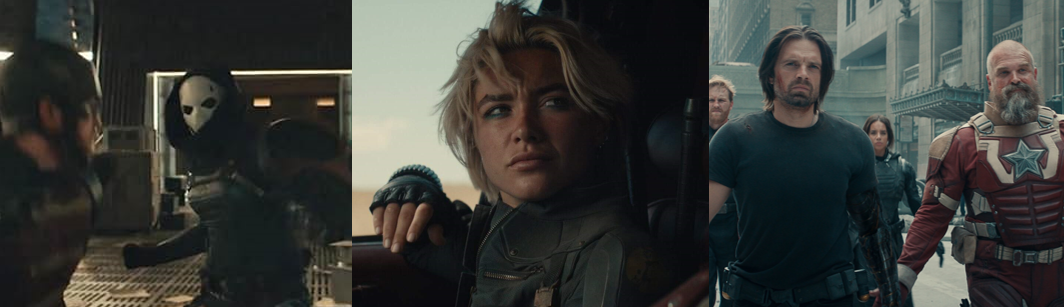
Although the marketing for Thunderbolts* had me believe that Junior Congressman and ex-Winter Soldier James Buchanan “Bucky” Barnes (Stan) was the central character in this film, I was surprised and delighted to find that former Black Widow Yelena Belova takes the lead. In many ways, Thunderbolts* is as much a sequel to Black Widow (Shortland, 2021) as it is a continuation of The Falcon and the Winter Soldier (Skogland, 2021), reuniting Yelena with her eccentric and overbearing super soldier surrogate father, Alexei Shostakov/The Red Guardian (Harbour), delving a little more into Yelena’s backstory courtesy of some traumatic visits to a nightmare dimension known as the “void”, while also significantly building upon the character of disgraced military veteran and former Captain America turned hot-headed mercenary, John Walker/U.S. Agent (Russell). Still grieving the loss of her surrogate sister, Natasha Romanoff/Black Widow (Scarlett Johansson), Yelena begins the film in a place of apathy. Yelena now works as a black ops agent for Valentina, the director of the Central Intelligence Agency (CIA) who’s currently under heavy investigation regarding all her shady experiments and dealings. However, despite throwing herself into her work and being an accomplished assassin, Yelena is unfulfilled and bored with the day-to-day mediocrity of her assignments. Feeling directionless and empty, she attempts to find some direction by talking through her feelings with Alexei, a disgraced and overweight former Soviet hero who’s left living in squalor and running a limo driving service. Despite his significant fall from grace and his boisterous personality, Alexei emphasises that the greatest calling he ever had was being an adored hero and encourages Yelena to step out of her comfort zone and take on a more public, heroic role like her late sister. Though hesitant, Yelena decides to give it a shot, if only to change her daily routine, and Valentina agrees to reassign her if she completes one last job. Namely, the infiltration of a secret underground O.X.E. facility that’s in danger of being robbed (and thus exposing Valentina’s dirty secrets) by Ava Starr/Ghost (Hannah John-Kamen), a tortured soul who can become intangible for short bursts.

Although Taskmaster’s screen time gets cut short, Pugh steals the show with her layered performance.

However, when Yelena accesses the facility, she’s blindsided by Walker, who’s been contracted to kill her. Walker’s then attacked by master fighter Taskmaster, who’s been hired to kill him, and a four-way melee kicks off as they try to take each other out. Though Yelena immediately sees they’ve all been double-crossed, it takes the sudden, dramatic, and down-right insulting execution of Taskmaster for the fighting to stop. Well, that and the strange appearance of the anxious, confused, and seemingly harmless Bob after he was accidentally released from stasis. Though the pig-headed Walker is reluctant to believe Valentina would turn on him, he’s forced to begrudgingly work with the others to escape the facility, which first threatens to incinerate them and then trap them forever. Despite none of them having the powers or equipment to scale the impossibly large shaft, Bob suggests they clamber up back-to-back and, despite Walker’s selfish arrogance, the group fumbles their way to the surface. Unfortunately, Valentina’s long-suffering assistant, Mel (Geraldine Viswanathan), alerts her boss to their actions – and Bob’s presence – meaning the group are met by a heavily armed response team. Thanks to masquerading as Valentina’s goon squad, the group slip past the barricade, but the grateful and kind-hearted Bob decides to risk his life by covering their escape, resulting in him being peppered by bullets. Instead of dying, he emerges unscathed, blasts into the sky, and crashes to the ground with a massive explosion, inadvertently giving his newfound acquaintances the chance to escape and placing him in Valentina’s excited hands. Thanks to having chauffeured Valentina and Mel, Alexei races to retrieve them and excitedly encourages them to stick together as a team, accidentally nicknamed “Thunderbolts” after a passing mention of Yelena’s school sports team, though the group are less than enthusiastic about working together and are visibly disgusted at having had to rely on each other for so long.

Emotionally damaged Bob turns out to be perhaps the greatest threat the world has ever known…

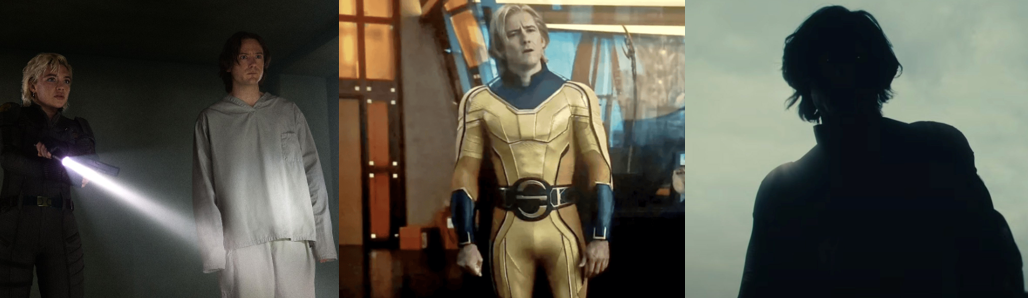
While all this is going on, Bucky seeks to uncover concrete evidence to expose and impeach Valentina, working his charm on Mel to get the inside track and racing to rescue the group when Alexei’s limo is attacked. Despite Alexei’s joy at meeting a Soviet hero and fellow super soldier, Bucky takes no chances and binds the group, seeking to have them testify against Valentina, but is forced to cut them loose and join forces with them when Mel corroborates their wild claims about Bob. As indicated by paperwork found in the facility, the seemingly unassuming Bob is actually a neurotic and emotionally unstable drug addict and survivor of horrific childhood abuse who, in a desperate attempt to feel powerful and significant, signed up to one of Valentina’s secret drug trials. While all the other subjects died, Bob became a full-blown indestructible superman, capable of flight and exhibiting awesome psychic powers, though his dark side also received a superhuman boost. With a touch, or at his command, Bob sends targets to the void, a dark dimension where they relive their most painful memories. However, Valentina brainwashes Bob with platitudes and strokes his fragile ego, promising to make him the world’s mightiest superhero in the absence of the Avengers and having him become the Sentry. While Bob is reluctant to turn on his newfound friends, he embraces the chance to be more than an insignificant nobody, but quickly becomes drunk on his power, rejecting Valentina’s orders and seeking to take the world for himself. While Mel puts the Sentry down with a kill switch, this merely suppresses Bob’s neurotic (but nonetheless harmless) personality and unleashes his dark side, the Void, who impassively terrorises New York City to plunge humanity into a glorious nothingness. Despite being powerless against the Sentry and going their separate ways, the chaos inspires the reluctant Thunderbolts to save civilians and rally against the Void, with Yelena desperate to appeal to Bob’s humanity by willingly returning to the void and facing his dark past.

While Valentina is a deplorable puppet master, the misfit team is their own worst enemy.

Although Valentina is gleefully presented as a despicable and thoroughly unlikeable villain, I do think she suffered from not featuring more prominently in previous Marvel movies as a dark counterpart to Nick Fury (Samuel L. Jackson). Luckily, the titular Thunderbolts are all largely dislikeable or morally dubious characters and their bickering and in-fighting means they’re their own worst enemies. Indeed, it’s only the fact that they have a common enemy that the group sets aside their egos and dislike of each other to even work together, though Bucky and Alexei go a long way to galvanising the team. Still, “dysfunctional” is putting it mildly when it comes to these guys, especially considering how abrasive and unlikeable Walker is. His temper and arrogance paint him as a typical jock, but he undergoes a surprising redemption arc throughout as he tries to atone for his past and turn his life around. Though sadly not featured as prominently as she should be, Ghost seems to carry some guilt about murdering Taskmaster and, despite frequently clashing with Walker, sticks with the group simply because she’s lived so much of her life alone. As Alexei observes, Yelena feels the same emptiness lifted thanks to the team’s presence. Despite them constantly butting heads, she takes a leadership role and is constantly the voice of reason amongst them, pushing them to focus on their true enemy and to do some good for a change. Naturally, Alexei enjoys the chance to be a hero once more and Harbour’s enthusiastic and bombastic energy really cements Thunderbolts* as one of the best MCU movies of the modern era. Finally, there’s Bucky, a guy who seems uncomfortable in his political role and who immediately reverts to type the first chance he gets. Without a doubt, though, this is Bob’s show as, through him, the MCU tackles the serious and soul-crushing weight of abuse and depression and forces it to the forefront as he discovers, masters, and then loses himself to his incredible powers.

The Nitty-Gritty:
Unfortunately, despite the film’s marketing, Taskmaster really got the shaft here, she appeared onscreen for one fight, gets one line, and then is suddenly executed with little to no fanfare. Yelena basically shrugs it off since she’s so impassive and Taskmaster is barely brought up afterwards, which is a shame as her new suit was cool and I would’ve liked to see her character get a shot at redemption. They could’ve at least had her live until the team escaped the facility, perhaps have Bob accidentally obliterate her in his first unexpected show of power. Similarly, I’m not sure what the benefit of having Bucky be a congressman was if it was going to be dropped immediately. Nothing he did tied into that role and he could’ve worked Mel and helped his fellow congressman (Wendell Pierce) without having a political role. While it was also a shame we never got to see how the others fared in the void, it did provide some additional tragedy to Yelena (who was forced to see her fellow Black Widow recruits tortured and killed during her training) and touched upon the shame that fuels Walker and explains his brash personality. The void truly shines when exploring Bob’s traumatic past, however, as Yelena witnesses Bob’s father emotionally and physically abuse him, his drug addict mother shun him, and briefly witnesses his own struggles with addiction. When in his default personality, Bob talks about how he sometimes has highs and then suffers crushing lows that drove him towards drink and meth but also, seemingly to the point where he didn’t care if he lived or died. This led him to Valentina’s “Sentry Project”, which remarkably made him everything she hoped for, but also empowered his dark thoughts and made him extremely emotionally unstable. Seeing Bob wallow in his childhood bedroom (the quietest, nicest room in the void as long as you don’t mind seeing and hearing your parents fight and belittle you) was heart wrenching and Pullman really ran the gamut of emotions in his portrayal of Bob.

Amidst the action and banter, there’s a chilling and emotional exploration of depression.

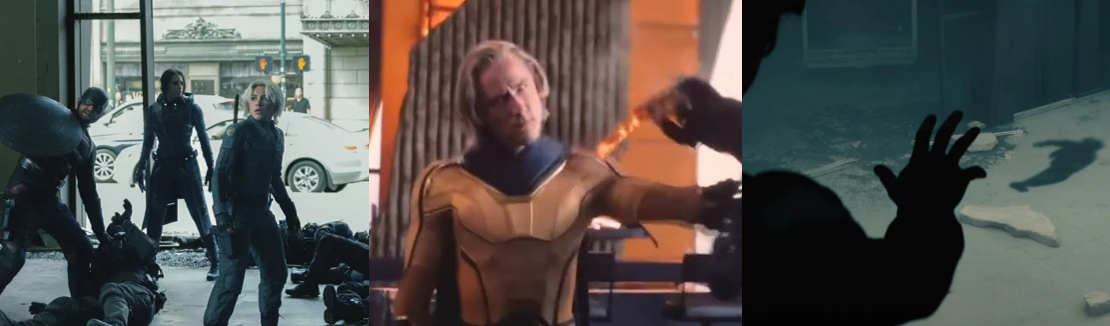
This culminates in a spectacular (if brief) display of power from the Sentry in the former Avengers Tower. Garbed in a golden outfit and showcasing superhuman speed and strength, the Sentry easily overpowers his friends, with even the super soldiers barely making Bob flinch and him overwhelming them all while appearing bored. His transformation into the Void is equally impressive, with Pullman being enveloped in darkness. He speaks in a hushed, impassive tone, with only his silvery eyes glittering from the darkness, and sends targets to the void with a wave of his hand in a chilling visual. While much of Thunderbolts* revolves around the rag-tag team trying to co-exist without killing each other, the group finds a common language in combat. Despite them all pretty much just punching and shooting, each brings something a little different, such as Walker wielding his shield, Bucky utilising his mechanical arm, and Ghost phasing in and out of reality. Although Walker scoffs at Yelena taking charge of the group and a combination of bad luck and miscommunication means their plans often fail or quickly fall apart, the group fights well together. Crucially, when the Void envelops the city, these largely selfish anti-heroes don’t hesitate to jump in and save who they can, leading the crowd to safety and earning their appreciation, much to Alexei’s delight and the others’ surprise. Action-packed moments like Bucky’s Terminator 2: Judgment Day (Cameron,1991) style motorcycle intervention, the team storming Valentia’s tower, and their ill-fated showdown with the Sentry are juxtaposed with some fun humour and banter and some poignant moments, particularly between the grieving and emotional Yelena and Alexei. Angry at her “father” for not staying in touch more and still struggling after Natasha’s death, Yelena breaks down in Alexei’s arms at how lonely she is and he does his best to comfort he, just as Yelena finds a kindred spirit in Bob, whom she senses is both lonely and damaged and in need to help and reassurance.

These unlikely heroes step up to meet the challenge when the Void engulfs the city in darkness.

This, as much as her inherent heroic nature, is what drives Yelena to stop running from the Void and willingly return to his dark dimension. There, she ignores her own traumatic past and desperately searches for Bob, eager to appeal to his reason, and discovers the sheer depth of his emotional trauma. Having resigned himself to the void and feeling as powerless to fight it as he was to stand up to his parents, Bob is reluctant to stand against his dark side and, though bolstered by Yelena’s genuine concern, is touched when the rest of the team brave their nightmares to reunite with them. At Yelena’s suggestion, Bob brings them to the worst “room” in the void, the place where he was transformed into a superhuman, and the team discovers that the effect on his psyche was near instantaneous. They also encounter the Void, a spiteful and all-powerful force that belittles Bob, tortures his friends, and maliciously mocks Bob’s insecurities. When Bob lashes out in anger, attacking the Void and mercilessly beating him, Yelena sees that this threatens to erase his compassionate side altogether and, despite the environment itself trying to stop her, she rushes not to stop or kill Bob, but to embrace him. The others do the same, embracing their damaged comrade and affirming their belief in him and their showcase of affection is enough to quiet the Void, returning everyone lost to the darkness and leaving Bob seemingly with no memory of what happened (and, sadly, no longer wearing his awesome Sentry suit). In the aftermath, the group seeks retribution upon Valentina, only to be blindsided when she leads them into a press conference and introduces them as the New Avengers. Though Valentina’s dismayed when the group begrudgingly accept the moniker (and when Yelena asserts dominance over her), she accepts the compromise as it means she can remain in a position of power. Unfortunately, the credits and post-credit scenes immediately deride the unlikely new Avengers, with headlines and news stories questioning them and even Sam Wilson/Captain America (Anthony Mackie) said to be suing them over the name! Still, the team relishes the chance to prove their credentials when they receive word of a strange, extradimensional craft entering Earth’s atmosphere…

The Summary:
I purposely avoiding using any spoiler warnings for this film, and including both titles, since Marvel Studios let the cat out of the bag just a few days after its release. While I was surprised to see the team be revealed as the New Avengers, it was a pretty fun way to end the movie, though I do wonder how prominent the team will be in the sixth phase of the MCU considering how packed the slate is. Regardless, Thunderbolts* was a surprisingly good time. I say “surprisingly” as the team has very little to do with their comic book counterparts and I wasn’t expecting all that much of it, especially after we had two similarly themed DC movies, but it turned out to be very entertaining and surprisingly touching. As a deconstruction of mental illness, Thunderbolts* (more specifically Lewis Pullman) knocks it out of the park, with Bob perfectly encapsulating the insecurities, incredible highs, and soul-destroying lows of depression. While he’s apathetic as the Sentry, Bob is chillingly impassive as the Void and so powerful that he completely neuters his more reasonable side. I also loved how Yelena came to the forefront here as a leader and her own search for meaning, and the evolution of her relationship with Alexei. While it was a damn shame Taskmaster got shafted, I would’ve liked to see Valentina used more leading up to the film, and I was hoping for more Bucky, I really enjoyed the dysfunctional team dynamic and how even an asshole like U.S. Agent could turn his life around with the right motivation. Thunderbolts* was a definitely step in the right direction for the MCU and I’m excited to see how its events will impact future MCU movies, especially regarding the Sentry, and I would absolutely say it’s a must-see for fans of this sprawling cinematic universe.

My Rating:

Rating: 4 out of 5.

Great Stuff

What did you think to Thunderbolts* and the surprise reveal of the film’s true nature? Were you disappointed that a more comic accurate team wasn’t used? What did you think of the unceremonious execution of Taskmaster? Were you impressed by the Sentry and the film’s discussion of mental health? What do you hope is next for the team in the MCU? Tell me your rating of Thunderbolts* in the comments, support me on Ko-Fi, and go check out my other Marvel content.