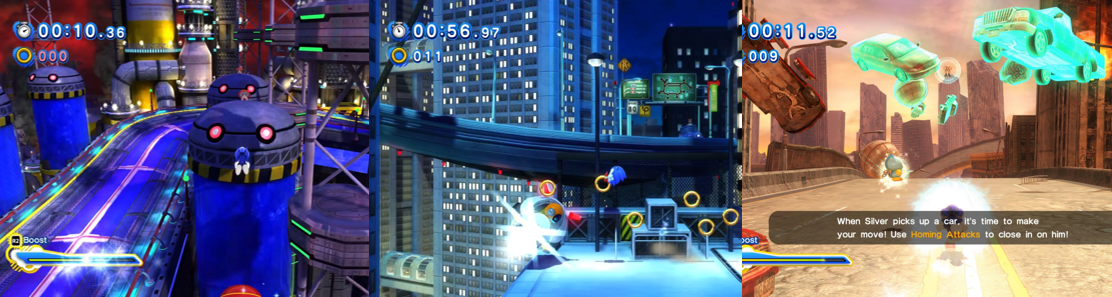
Back Issues & Knuckles: Sonic the Hedgehog: Triple Trouble


When Sonic the Hedgehog 3 (SEGA Technical Institute, 1994) released on this day in 1994, gamers were introduced to Knuckles the Echidna. Takashi Yuda’s mischievous, dreadlocked antagonist is my favourite of Sonic’s supporting cast so excuse me while I celebrate his debut throughout February.


Published: 3 August 1995 (cover-dated: October 1995)

Story Title: “Tttriple Tttrouble!!!” (includes “Part II: Zone Sweet Zone!”, “Part III: Echidnapped!”, and “Part IV: Blue Blur vs. Rough and Red!”)
Writer: Mike Gallagher
Artist: Dave Manak

Story Title: “Submersible Rehearsal”
Writer: Mike Gallagher
Artist: Art Mawhinney

Story Title: “First Contact”
Writers: Ken Penders
Artist: Jon D’Agostino

Quick Facts:
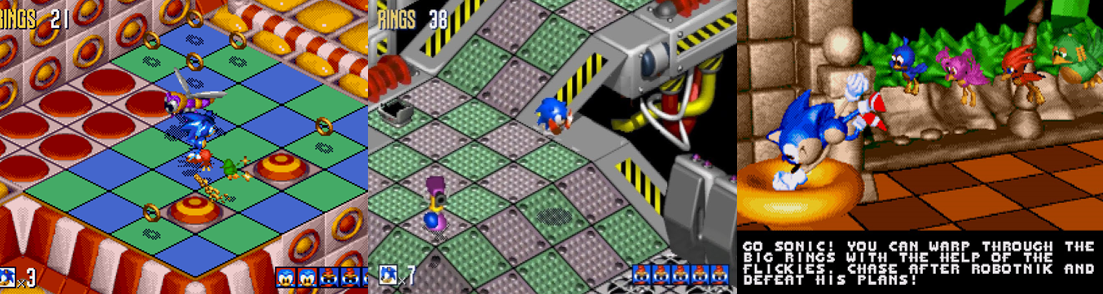
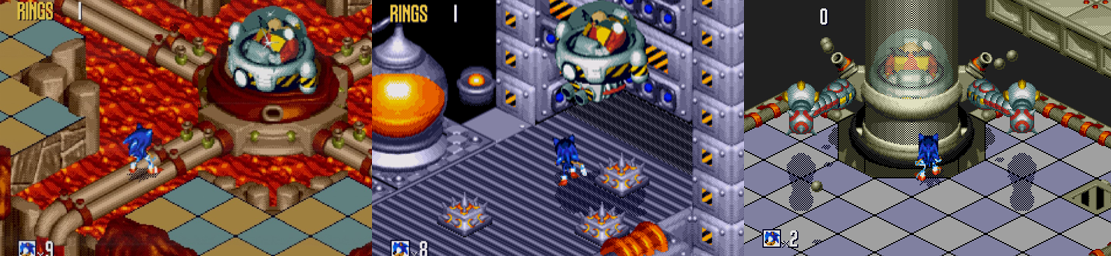
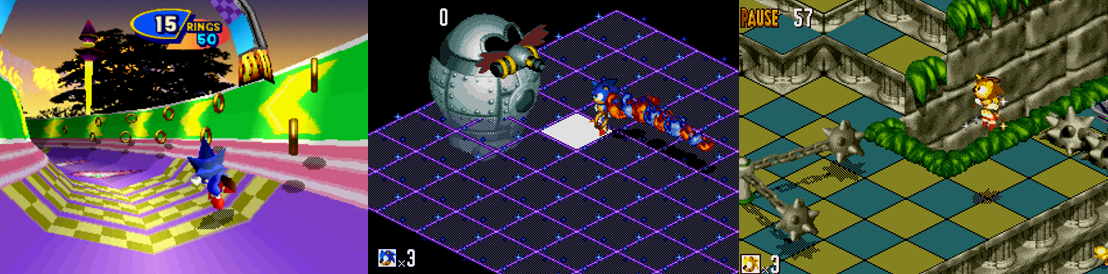
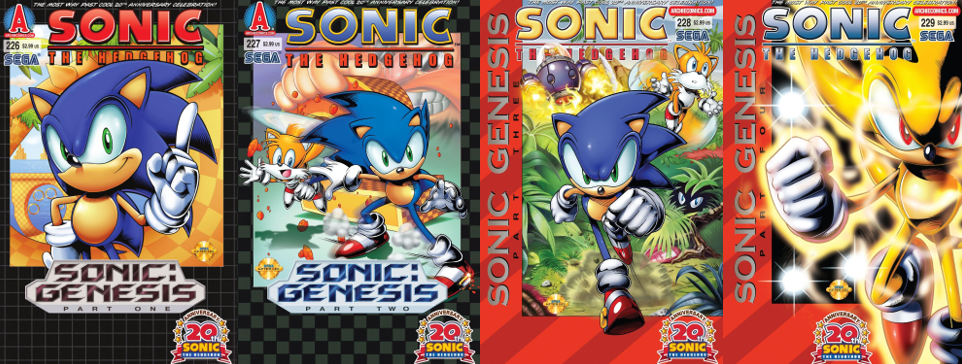
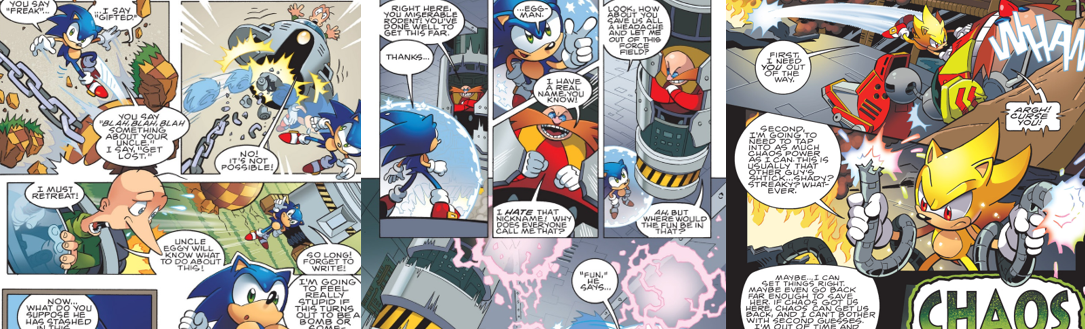
Following their initial four-part miniseries, Archie Comics began the longest-running videogame comic book and capitalised on Sonic’s popularity with a popular Knuckles the Echidna companion series. Before that convoluted lore and a bitter lawsuit forever changed Sonic’s comic books, Knuckles featured in this loose adaptation of the largely under-rated Sonic the Hedgehog: Triple Trouble (Aspect, 1994).

The Review:
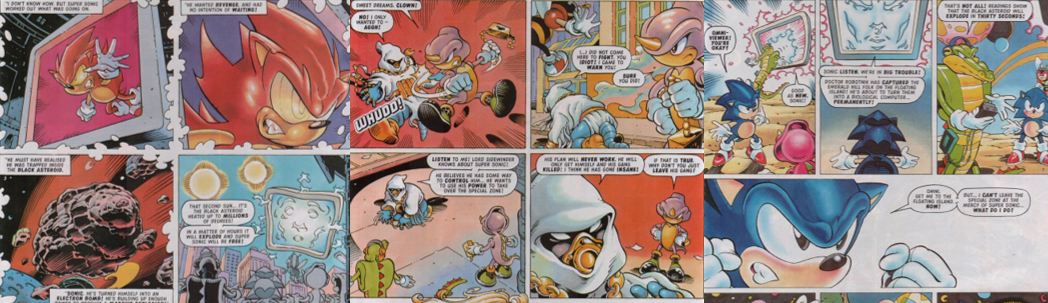
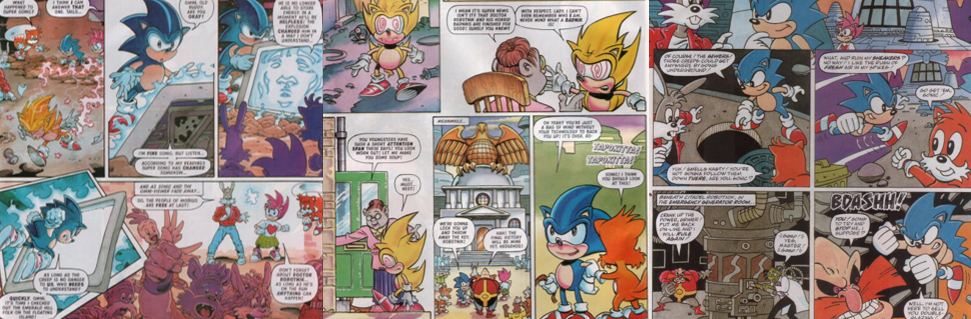
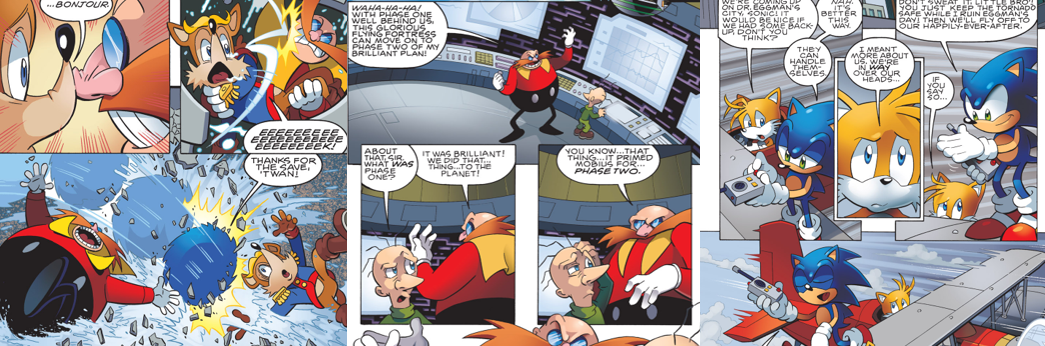
Not unlike its videogame source material, “Tttriple Tttrouble!!!” sees ruthless cybernetic dictator Doctor Ivo Robotnik in possession of a Chaos Emerald. Rather than having one of five after his experiments scatter the others across the planet, Dr. Robotnik has one of many Chaos Emeralds, though this is sufficient to power his “mega-engine” and pollute the entire planet Mobius. However, this plan gets dashed due to an oversight by his robotic assistant, Crabmeat, who miscalibrated the machine. The imbalance causes an explosion that breaks the Chaos Emerald in two and rockets each part into orbit, prompting Dr. Robotnik to call “Bounty Hunters ‘Я’ Us” to hire a bounty hunter to retrieve the gems (again, not a million miles away from the videogame). While making a messy chili dog snack (or four…), Sonic is brought to the Freedom Fighters’ control room, where their resident mechanic and scientist, Rotor the Walrus, has detected the erratic energy signature of a Chaos Emerald. The three then watch as the Chaos Emerald shard crashes into the Great Forest, its unstable “magic” creating a “new Zone” (apparently, this is how the game’s environments are integrated into Archie lore). Excited to explore a new area, Sonic speeds off, refusing to wait for Rotor’s analysis and unaware that he’s being stalked by a mysterious, wolf-like figure. Meanwhile, Knuckles finds a rare moment of relaxation under the sun interrupted by the other Chaos Emerald shard, which streaks overhead and crashes into Mount Osohai, the Floating Island’s unconquerable mountain range. Undeterred, Knuckles glides over and is stunned to see the shard burrowing into the mountain, then ends up unconscious and plummeting to certain doom after being struck by a piece of rock.

While recovering a Chaos Emerald shard, Sonic is blindsided by Nack the Weasel.

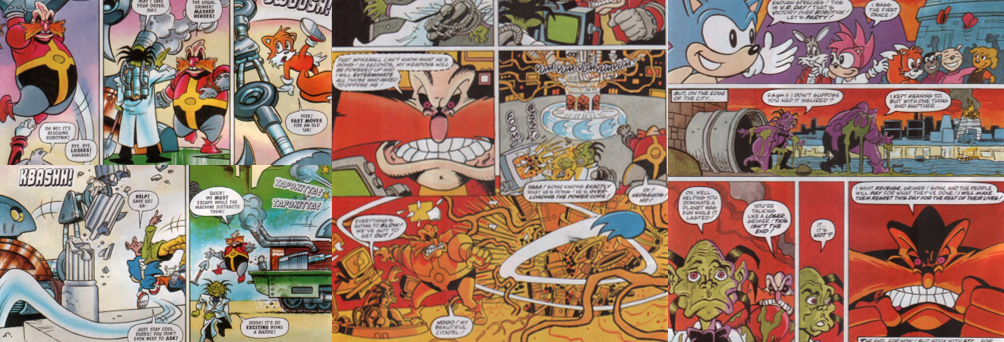
When Sonic arrives at the crash site in the Great Forest, he’s greeted by a bizarre, fairground like portal leading to “Triple Trouble”. Naturally, he enters without a thought, completely oblivious to his mysterious stalker, whom Dr. Robotnik orders (via “2-way, 3-D holo-wrist radio”) to follow. Exasperated by the rotund dictator’s blustering, the mercenary mutes his employer and heads into the Zone in his sky-cycle, which has been programmed to mimic Sonic’s moves! In a change of pace for most Archie adaptations, we get to see Sonic racing through Triple Trouble’s Zones, but this is reduced to a simple montage of panels that literally just show him bouncing, running, snowboarding, or adventuring across the game’s locations before bopping Dr. Robotnik on the head and reaching the exit. There are no battles against Dr. Robotnik’s enlarged Badniks, none of the game’s power-ups (except the snowboard), and the comic just blasts through them all rather than taking place in one or two of the game’s locations. The snowboard panel is essentially a rip-off of the game’s artwork, there’s no explanation as to how or why Dr. Robotnik or his Badniks are there, and the Chaos Emerald shard is bizarrely housed within a futuristic chamber, which Sonic races into to deactivate before the Zone presumably closes behind him. However, as soon as Sonic retrieves the shard, he’s blasted by his stalker, the infamous bounty hunter Fang the Sniper Jet the Jerboa Nack the Weasel! With Sonic successfully captured, Nack demands Dr. Robotnik pay him double the price to retrieve the other half of the Chaos Emerald and the tyrant, eager to mount Sonic’s head on his wall, begrudgingly agrees.

Despite a disagreement between Sonic and Knuckles, the Floating Island is saved.

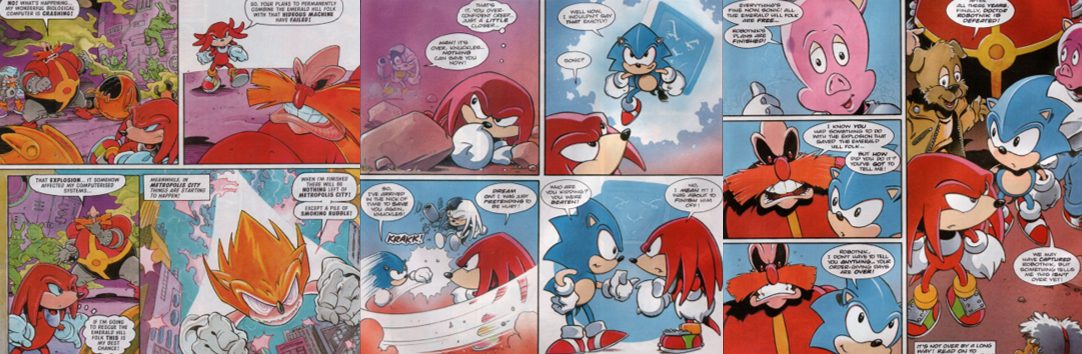
Oblivious to Nack’s impending arrival, Knuckles wakes in a hidden cave and is cared for by the Ancient Walkers, mute, masked, enigmatic figures from echidna lore. Astonished, Knuckles interprets their cave drawings as a warning that the Emerald shard will cause Floating Island to explode if it reaches the island’s Chaos Emerald power source. Returned to the surface, Knuckles spots and summarily knocks out the passing Nack, unaware that he’s just knocked Sonic into a lake. This wakes Sonic and, pissed at being blindsided, he bursts from the water looking for payback and immediately assumes that Knuckles attacked him. Attacking without thinking, Sonic is easily overpowered by his super strong rival, who’s driven into a fury after Sonic kicks him in the nose. Going “Hyper-Knuckles” (which sees Knuckles turning his fists into buzzsaws rather than adopting a Super form), Knuckles sends Sonic flying with a haymaker, leading to them flying at each other in a rage. Their scuffle ends, however, when they recognise Dr. Robotnik’s voice coming from Nack’s communicator (…despite him muting it earlier…) This clears up the misunderstanding and sees Sonic direct Knuckles to puppet Nack’s unconscious, battered body to deceive Dr. Robotnik. Retrieving Nack’s Emerald shard, Sonic joins Knuckles in intercepting the other half in the island’s crystalline Chaos Chamber, where they just barely reunite the two in time to save the island. The two frenemies almost come to blows again when the restored Chaos Emerald mysteriously vanishes but part on mostly friendly terms, unaware that the Chaos Emerald teleported into the possession of the mysterious Ancient Walkers.

Tails and Knuckles embark on separate adventures largely disconnected from the source material.

While I’m here, I may as well go over the other  stories also included in this 48-page special. The first is a solo adventure for Sonic’s two-tailed buddy, Miles “Tails” Prower, which features his Sea Fox submarine from Triple Trouble and laid the groundwork for Archie’s Tails-centric miniseries. Unfortunately, “Submersible Rehearsal” takes place in the waters near Knothole Village rather than, say, Tidal Plant Zone and sees Tails confront an enlarged Octobot rather than one of Triple Trouble’s bosses. Though amazed by the Sea Fox built for him by Rotor, Tails is outraged to learn that Princess Sally Acorn has forbidden him from taking it out to sea because of concerns about his age. However, Tails improvises when an injured sea gull washes up warning that Dr. Robotnik is rebuilding his “submerged, waterproof robot maker”, draining the oil from the bird into his tank and setting off to help. When Tails finds the underwater facility guarded by Octobot, he doesn’t hesitate to ram to mechanic cephalopod, rescuing the marine life it held captive before destroying the roboticizer with the Sea Fox’s missiles, making an enemy of the besmirched Octobot in the process. The second story sees Knuckles once again tested by the mysterious Archimedes on the Floating Island, making this story even less connected to Triple Trouble. In fact, “First Contact” has more in common with Sonic & Knuckles (SEGA, 1994) as Archimedes sends one of Dr. Robotnik’s Fire Breath units after him and then makes him battle a Hey-Ho. At first, these robots see Knuckles believe “Archimedes” is Dr. Robotnik pulling another trick, but a plunge into the Chaos Chamber sees Archimedes dispel these accusations and aggravate Knuckles with cryptic taunts about his hot-headed nature. Challenged to solve Archimedes’ puzzle, Knuckles later contemplates the lesson with his friend, rocker Vector the Crocodile, and the mystery of who or what Archimedes is and what he wants.

Final Thoughts: 
As always, Archie’s adaptation of a videogame leaves a lot to be desired and takes the barebones, basic suggestion of the source material and reconfigures it into one-and-a-half semi-original stories set within their convoluted canon. I tried really hard to cut this 48-page special some slack, especially the main story, as it almost mirrored the videogame in a dysfunctional way but then it completely dropped the ball. Although I’ve read all the Archie Sonic comics, I don’t recall it being established that the game’s Zones spring out of thin air (or “magic”), though even if that was established it’s a pretty stupid idea. Mobius is a planet, for God’s sake! You just have the Zones be places in the world, which is what Archie usually does, so this weird-ass funfair-like portal…thing…was ridiculous. It also appears to be temporary, as Sonic must race to the Chaos Emerald Chamber and “shut [it] down” with a lever. How that lever, the chamber, and the technology surrounding it appeared is anyone’s guess (more “magic”, I suppose) but it’s nowhere near as ludicrous as Triple Trouble’s Zones conveniently having Badniks, traps, and even Dr. Robotnik in them. Normally, I complain that these adaptations are limited to a single, barely recognisable location from the videogames but this time, I’m complaining because Triple Trouble’s Zones are reduced to a montage. Sure, it emulates the 2D action of the videogame but it’s very lazy. Why not have Dr. Robotnik’s “secret lab” be in Robotnik Winter Zone or Atomic Destroyer Zone, the Emerald shard land in Great Turquoise Zone or Meta Jungura Zone, “Submersible Rehearsal” set in Tidal Plant Zone and “First Contact” be reconfigured into having Knuckles be tested in Sunset Park Zone? There’s really no excuse for these stories not to be set in the game’s locations and it’s kind of insulting that they’re limited to Knothole and the Floating Island.

Sadly, though it comes close, the comic is a poor representation of the videogame.

As ever, the art is passable, resembling the main Sonic comics and the cartoons that inspired them, except for “First Contact”, which sees Knuckles rendered painfully off-model and Hey-Ho looking like its melting! I can’t say I was massively blown away by the Ancient Walkers, who didn’t seem necessary to the story, but I did like the introduction of Nack the Weasel. It took a little too long for him to be revealed and it’s a shame to reduce him to Dr. Robotnik’s lackey, but it’s a role that suits him and he’s always been a visually interesting character. Although we never get to see what his sky-cycle is capable of, it’s not insignificant that he got the drop on Sonic and was well on his way to succeeding when Knuckles clobbered him. I quite enjoyed the fight between Sonic and Knuckles, which is thematically similar to the videogame and sees them go at it with a bit more gusto than in previous encounters. I do think this special issue suffers from not devoting its entire length to the source material to depict a literal three-way chase for the Chaos Emerald (or its shards, or whatever!) between Sonic, the opportunistic Nack, Knuckles, and Dr. Robotnik. Had Archie done this, we could’ve seen at least three or four locations from the game in more detail, seen Sonic battle Dr. Robotnik’s giant Badniks, and had a more action-packed adventure rather than a middling story that essentially acts as a shameless advertisement for the game. Ultimately, this was a very frustrating issue to read as it came so close to being at least tolerable and was very promising but, once again, the covert is the best thing about this special (aside from Nack) and the backup stories aren’t really worth your time unless you’re really invested in Ken Penders’ awful plans for Knuckles and getting a prelude to Tails’ later solo adventure.

My Rating:

Rating: 2 out of 5.

Could Be Better

Did you enjoy Nack’s debut in Archie’s Sonic comics? Were you also disappointed by how poorly this adaptation represented Triple Trouble? Did you enjoy the fight between Sonic and Knuckles? How interested were you in the riddle of Archimedes? Did you enjoy Archie’s Knuckles lore or did you find it to be overly complicated? How are you celebrating Knuckles this month? Let me know your thoughts on Archie’s Triple Trouble adaptation in the comments and donate to my Ko-Fi if you want to see more of Knuckles’ Archie adventures on the site.

Movie Night: Pokémon: Lucario and the Mystery of Mew

Released: 16 July 2005
Director: Kunihiko Yuyama
Distributor: Toho

Budget: Unknown
Box Office: ¥4.3 billion
Rotten Tomatoes Score: 81%

Quick Facts:
An instant phenomenon, Pokémon (Nintendo/Creatures/Game Freak, 1995 to present) dominated playgrounds with videogames, trading cards, and an ongoing anime series (1997 to present). This led to the successful first feature film, which spawned a slew of sequels. By 2005, these were being released straight to video outside of Japan but continued to feature popular Pokémon like Mew, who famously birthed Mewtwo on this day.

The Review:
Taking place during the Advanced Battle portion of the anime series (2004 to 2005) and featuring Pokémon from the upcoming Diamond and Pearl releases (Game Freak, 2006), Lucario and the Mystery of Mew opens in the distant past of the Kanto region. At this time, the beautiful Cameron Palace was caught in the middle of a brutal war was fought between two, heavily armoured Pokémon armies. This impending danger is discovered by the titular Lucario (Sean Schemmel), a stoic and proud Fighting/Steel-Type Pokémon who wields incredible power through its “Aura” abilities. Focusing its power through a nearby crystalline formation, Lucario warns its master – “Aura Guardian” Sir Aran (Jason Griffith) – of the danger before being attacked and temporarily blinded by two Houndoom (Koichi Sakaguchi). Although Lucario fends off the Pokémon, he’s stunned when Sir Aran abandons Queen Rin (Bella Hudson) and the castle. When the aghast Lucario pursues, Sir Aran traps it within a magical staff, leaving it feeling hurt and betrayed. History, however, remembers Sir Aran very differently as it’s said he travelled to the nearby “Tree of Beginning” and ended the conflict between the Pokémon armies, restoring peace to the land. Sir Aran’s so well-renowned that Cameron Palace holds an annual festival to celebrate its hero, one that aspiring Pokémon Master Ash Ketchum (Veronica Taylor) and his friends just so happen to be present for. Ash, Brock (Eric Stuart), May (Veronica Taylor), Max (Amy Birnbaum), and (reluctantly) Pikachu (Ikue Ōtani) dress in period-appropriate outfits for the occasion and Ash (garbed in an outfit resembling Sir Aran’s) conveniently wins the annual Pokémon tournament to be crowned “Aura Champion”. Though he’s annoyed to miss out on the dancing and revelry, Ash is amazed by an ancient staff he’s gifted and the whispers he can hear emanating from it and is absolutely gob-smacked when Lucario is unexpectedly released from it.

Betrayed by its master, Lucario struggles to trust humans and their intentions.

Still partially blinded and confused from the time dilation, Lucario initially mistakes Ash for Sir Aran and flees, amazed to find that hundreds of years have passed, but is calmed by Lady Ilene (Bella Hudson), who recognises it from legend. Lucario’s awakened just in time as a mischievous Mew (Satomi Kōrogi) has been masquerading as various Pokémon (including the legendary Ho-Oh) during the festivities and playing with Pikachu and other Pokémon, unaware that world-renowned record breaker and part-time Pokémon trainer Kidd Summers (Rebecca Soler) is hoping to track it to the fabled Tree of Beginning. A miscommunication sees her Weavile (Eric Stuart) get a little rough with Mew, Pikachu, and Team Rocket’s outspoken mascot, Meowth (Maddie Blaustein), leading Mew to teleport itself, Meowth, and the injured Pikachu to the Tree of Beginning to heal. When Max informs the others, Kidd eagerly joins them in journeying to the Tree of Beginning (much to Brock’s delight) and Lucario obediently agrees to lead them, though it’s fraught with scepticism about human nature. The journey sees Lucario learn of Ash and Pikachu’s friendship and remember happier times with Sir Aran, where its master taught him to hone his Aura to attack and communicate. Somewhat uptight and reserved, Lucario struggled to let its guard down even when encouraged by its master and lashes out whenever Ash and the others invite it to bathe or share food, believing humans cannot be trusted. Local “time flowers” only further sour its mood as he’s reminded of Sir Aran’s treachery and it eventually comes to blows with Ash, believing Ash would abandon his so-called friend just as easily. Max helps make peace with some chocolate and Ash later tearfully apologises, aware that he’s on edge with worry about his lost friend.

The mischievous Mew accidentally endangers our heroes when they venture to the Tree of Beginning.

While Meowth enjoys hanging out with Mew at the Tree of Beginning, Pikachu is equally eager to reunite with Ash but compelled to stay by Mew, who wants to keep playing. When Ash and the others – included Meowth’s Team Rocket cohorts James (Eric Stuart) and Jessie (Rachael Lillis) – reach the Tree of Beginning, they’re violently attacked by its three guardians, the legendary Regice (Kunihiro Kawamoto), Recirock (Eiji Miyashita), and Registeel (Atsushi Kakehashi), mindless near-automatons who attack both groups and drive them further into the Tree of Beginning. Within, the humans are attacked by “antibodies” that resemble fossil Pokémon and swallow them as a defensive measure, shrugging off their attempts to fight back and leaving any Pokémon unharmed in favour of consuming their human companions. This leaves Pikachu so distraught when Ash seemingly dies (…again) that Mew reluctantly uses its incredible powers to converse with the Tree of Beginning and restore those it absorbed, quelling the Regis and reuniting the trainers with their Pokémon. The antibody subplot was a touch unnecessary, I feel, and distracted from the inclusion of the Regis, who were enough of a threat by themselves since even Lucario couldn’t hold them off. While the Tree of Beginning makes for an interesting natural maze and beautiful background, it gets very samey and the film even drops the ball on finally paying off the Ho-Oh tease from the anime’s first episode. I’m also not sure if this Mew is supposed to be the same one from the first movie and it’s a little lacklustre having the main plot be kicked off because the cheeky little kitty wanted to play with its new friends. This means May and Max don’t get much to do beyond berating Ash or helping to melt Lucario’s heart, though Kidd makes for a fun temporary addition to the cast as she’s a pioneer with all kinds of nifty gadgets that are sadly wasted on this adventure.

When restoring Ash imperils Mew, Lucario makes the ultimate sacrifice to reunite with Sir Aran.

There is no central antagonist in Lucario and the Mystery of Mew. The antibodies and Regis are simply defending the Tree of Beginning, which has a symbiotic relationship with Mew and threatens to degenerate after the effort of restoring everyone drains Mew’s life force. Determined to save Mew using the Tree of Beginning’s fabled regenerative powers, our heroes journey to the tree’s heart and find Sir Aran’s gloves resting on a pulsating crystalline structure containing his frozen corpse. A nearby time flower reveals that Sir Aran shunned Lucario to keep it from following him to the Tree of Beginning, where Sir Aran sacrificed his life using his Aura to stop the warring Pokémon. Galvanised and guilt-ridden by this revelation, Lucario attempts to use its own Aura to restore Mew and thus save the Tree of Beginning, only to find it lacks the strength. However, Ash conveniently has the same Aura potential as Sir Aran so he slips on the hero’s gloves and helps boost Lucario’s power, somehow just willing himself to generate Aura without any training or knowledge of how to do so. Of course, the plan works and all is restored, but the effort proves fatal to Lucario. A time flower shows Sir Aran’s last moments, where he tearfully wishes his Pokémon well and hoped to be reunited with it someday and Lucario weeps, acknowledging Sir Aran as his friend and saying its farewells before dissipating into energy sparkles and reuniting with his friend in death. Exiting into the fresh air, Ash promises to also keep them both close by and Kidd vows to never reveal the Tree of Beginning’s location to keep it safe from tourists. Lucario is also immortalised alongside Sir Aran at Cameron Palace and Mew even gains a new playmate: a Bonsly (Eric Stuart) May befriended on the journey.

Final Thoughts:
I had high hopes for Lucario and the Mystery of Mew. I liked Lucario and even used one on my Diamond team back in the day, though it ended up being far from the dark counterpart to Mewtwo I imagined it to be. It’s kind of weird seeing a Fighting/Steel-Type Pokémon have telepathic powers but the movie kinda explains it through its “Aura” gimmick, a semi-psychic power that makes this Lucario exceptional and which Ash also conveniently has. I don’t think this was necessary; I think his physical resemblance to Sir Aran would’ve been enough and he (and the others) could’ve just given Lucario emotional support in the finale rather than seeing Ash emit an Aura Sphere out of nowhere. If you’re looking for spectacular Pokémon battles, you won’t find them here as Ash has one of his weakest teams ever and this film is more focused on exploring Lucario’s lost faith in humanity and realising that its friend didn’t betray him after all. I do wonder if the film might’ve been improved by having Kidd be an antagonist looking to capture Mew or gain control of the Tree of Beginning as the film suffers somewhat without a villain. The Regis are painfully wasted, leading only to chase scenes, though the antibodies offer some of the more harrowing moments where characters, believing they’re about to die, release their Pokémon (Ash even tells Pikachu he loves it before being devoured). I was disappointed to see that Ho-Oh was simply Mew in disguise, however, and had no relevance to the plot and that Mew didn’t get more significance until its life was suddenly in danger. In the end, Lucario and the Mystery of Mew was a decent, somewhat emotional adventure with some relevant lessons to teach about human nature and such, but it’s a somewhat by-the-numbers Pokémon feature that I don’t think really lived up to its full potential.

My Rating:

Rating: 3 out of 5.

Pretty Good

Are you a fan of Lucario and the Mystery of Mew? Did you guess that Sir Aran hadn’t really betrayed Lucario? Were you also unimpressed that Ash could wield Aura? Do you think the film squandered the potential of the Regis and Mew? Were you disappointed that Ho-Oh didn’t factor into the plot? Which Pokémon feature film is your favourite? Whatever your thoughts, leave them in the comments below and donate to my Ko-Fi to suggest more Pokémon content for the site.

Back Issues & Knuckles: Sonic & Knuckles


When Sonic the Hedgehog 3 (SEGA Technical Institute, 1994) released on this day in 1994, gamers were introduced to Knuckles the Echidna. Takashi Yuda’s mischievous, dreadlocked antagonist is my favourite of Sonic’s supporting cast so excuse me while I celebrate his debut throughout February.


Published: 11 May 1995 (cover-dated: August 1995)

Story Title: “Panic in the Sky” (Part 1 and 2)
Writers: Mike Kanterovich and Ken Penders
Artists: Art Mawhinney and Dave Manak

Story Title: “Fire Drill”
Writers: Ken Penders
Artist: Jon D’Agostino

Story Title: “Lord of the Floating Island”
Writers: Ken Penders
Artist: Harvey Mercadoocasio

Quick Facts:
Following an initial four-part miniseries, Archie Comics started the longest-running videogame comic book and capitalised on Sonic’s popularity with a popular Knuckles the Echidna companion series that eventually became tarnished by convoluted lore and a bitter lawsuit that forever changed Sonic’s comic books.

The Review:
The two-part story “Panic in the Sky”, which acts as the centrepiece to this 48-page special, sees the legendary Floating Island (as it was then known) sending the locals in a panic when it descends below the clouds and passes over the Western Coast of Mobius (as Sonic’s world was once called). Naturally, the Knothole Freedom Fighters (engineer Rotor the Walrus, semi-Roboticized Bunny Rabbot, cowardly Antoine D’Coolette, and fearless leader Princess Sally Acorn) are bemused and alarmed by the floating continent, which is heading straight for Knothole Village. When Sally wonders how the island floats (odd, considering a later retcon reveals she knew Knuckles as a child), Sonic and his enthusiastic two-tailed fox pal, Miles “Tails” Prower, fill the gang in on their earlier adventure to the Floating Island and their encounter with Knuckles. Although Sonic left on friendly terms with the echidna, he and Sally ponder Knuckles’ true allegiance and she orders Antoine to investigate any potential threat posed by the island. Sonic’s alarmed when their “turbo-prop” biplane is suddenly attacked by heavy artillery now installed around the island and orders Antoine to fly to safety while he and Tails parachute down to see what’s going on. After being knocked loopy by a pendulum in a vague allusion to the Mushroom Hill Zone, Sonic’s attacked by the axe-wielding Hey-Ho, though a single hit is enough to destroy what’s presented as a mini boss in the videogame. Sonic then runs right into a trap and finds himself hanging on for dear life. He’s therefore glad when Knuckles shows up, only to find the echidna is unimpressed with “trespassers [turning his] home into a war zone” and ready to send Sonic plummeting to his doom.

The hot-headed Knuckles makes a desperate gamble to safeguard his island.

Luckily, Tails is on hand to help but, in his haste, his rock misses its target and both Sonic and Knuckles fell into an underground cavern, eventually ending up on a slab of rock floating in a lava stream (like in Lava Reef Zone). Before the two can come to blows or be boiled alive, Tails swoops in for the save and Sonic makes Knuckles realise that the Floating Island has been hijacked. Angered and concerned, Knuckles leads Sonic and Tails (via “zoot chute”) to the Chaos Chamber, a crystalline cavern that houses the Chaos Emerald that keeps the island aloft. When Knuckles investigates a strange device siphoning power from the gem, he gets a nasty shock that doubles when Mobius’s devious, semi-cybernetic dictator, Doctor Ivo Robotnik, appears (via hologram projection) to spill his latest plot. After discovering the Floating Island, Dr. Robotnik began surreptitiously turning it into his personal battleship, installing engines, a command centre, and weaponry, all powered by the Chaos Emerald and with the purpose of annihilating Knothole Village. Distraught that he was easily duped into fighting Sonic and Tails rather than spotting the takeover, Knuckles smashes the Chaos Emerald, causing the Floating Island to drop from the sky! Panicked, Dr. Robotnik quickly ejects, though his hopes of seeing Knothole decimated by the falling island are dashed when Knuckles busts out a spare Emerald to keep his home aloft (only to later reveal he smashed the spare and replaced it with the original in a double bluff). Though he vows to use better judgement next time, Knuckles refuses Sonic’s offer to join the Freedom Fighters, with Sonic musing that Knuckles is apparently destined to be a loner.

Ever wondered what Knuckles does in his day-to-day? Yeah, me neither…

Accordingly, the rest of the special is taken up with two solo stories for Knuckles. The first, “Fire Drill”, sees Knuckles investigating an explosion at the beach (which borders Sandopolis Zone), finding only a crater and footprints in the sand leading to a nearby bush. Leaping into action, Knuckles is left angered and humiliated when whoever it is disappears and, eager to get his mitts on whoever’s messing with him, Knuckles glides over to the only place they could’ve gone: the ruins of the Sandopolis Zone. Assuming only Sonic could evade him so fast, Knuckles braves his fear of the dark to enter the temple ruins and is further enraged when he’s buried beneath falling debris. Blundering into the maze-like temple, Knuckles barely avoids being skewered by an axe and finds a room full of strange hieroglyphics that momentarily puzzles him before sand pours in. Knuckles easily leaps to safety and smashes his way out of the temple, following “Sonic’s” footprints to the island’s edge and, bizarrely, assuming the hedgehog ran to his death, completely oblivious to the shadowy figure (later revealed to be the fire ant Archimedes putting the young guardian through his paces). “Lord of the Floating Island” closes the special and sees Knuckles rescuing Benjy the Kangaroo during a particularly wild storm as part of his duty to safeguard the island’s other inhabitants. Though grateful, the youngster asks his protector to “bring back the sky”, learning about eclipses from Knuckles before being air-lifted out of the path of a pack of dingoes rattled by the chaotic weather. Although Benjy’s scared by the harsh winds, the weather calms as the eclipse passes and Knuckles returns the youngster to his mother, happy to “protect and serve” his floating home and all its inhabitants.

Final Thoughts: 
Considering how rushed and short Knuckles’ introduction into Archie’s Sonic the Hedgehog comics was, Sonic & Knuckles was ideally placed to deliver a more comprehensive adaptation of Sonic 3 or the titular videogame (SEGA, 1994), perhaps something again to the French adaptation published in the year prior to this special. Instead, as Archie (and Fleetway, to be fair) often did, the publisher spread elements of Sonic 3 & Knuckles across multiple stories and specials, meaning the best thing about this one-off comic is the cover, which promises a far more enjoyable story than anything contained in its pages. Like Knuckles’ debut story, “Panic in the Sky” takes place almost entirely in one location, which can only be generously described as the Mushroom Hill Zone. Sure, Sonic hops to some giant mushrooms, flies through the sky using a pendulum, and fights Hey-Ho, but there’s basically no substance to any of this and comic does an awful job of bringing this colourful location to life. I again have to assume that Archie’s writers and artists only had access to very limited materials when producing these stories as everything’s presented out of context or radically altered, such as the lava flow and the “Emerald Chamber”, neither of which evoke the same feeling of grandeur as Lava Reef Zone of the Hidden Palace Zone. Dr. Robotnik’s plot to weaponise the Floating Island is an interesting one but it’s ridiculous that Knuckles prioritises attacking Sonic and Tails over wondering why the stars have changed position and his island is so wildly off course! Rather than Sonic and Tails enduring a hazardous trek across Sonic & Knuckles’ recognisable locations, struggling to talk sense into Knuckles and racing to prevent the launch of the Death Egg, we get a nothing burger of a rematch between Sonic and Knuckles and a lame-ass, childishly simple solution to Dr. Robotnik’s plot.

Sadly, the special fails to deliver an enjoyable or visually appealing adaptation of the videogame.

Incredibly, rather than devote all 48 pages to adapting Sonic & Knuckles, Archie’s one-off special wastes the rest of its pages on meaningless solo stories for Knuckles. On the one hand, I don’t mind this as Knuckles was still new to readers (and gamers) at the time and “Fire Drill” does at least take place in Sandopolis Zone. On the other hand, he’s not fighting any of the Badniks or mini bosses from the videogame or exploring its locations in interesting ways. The Sandopolis Zone temple is a far cry from the haunted pyramid of the videogame, which would’ve made for an awesome setting for a story, and “Fire Drill” seems more concerned with introducing some mystery around Knuckles and his shadowy stalker. “Lord of the Floating Island” is, in a word, ridiculous. All this story tells us is that Knuckles is committed to safeguarding the island, which we already knew, and that Archie Comics decided that the Floating Island should have a bunch of other anthropomorphic inhabitants on it rather than Knuckles literally living in isolation. This would be fine if he were doing something interesting, but all he does is save Benjy, recap Dr. Robotnik’s threat, and teach him/us about eclipses. While the art in “Panic in the Sky” is in-line with Archie’s Sonic publication and mirrors the 1993/1994 Sonic the Hedgehog cartoon on which it’s partially based, the other two stories are awful. Knuckles, especially, looks disgustingly off model and his gliding is constantly depicted as flying, which was a common mistake. I appreciated seeing his climbing and super strength on show, but none of the stories are particularly impressive showcases for Knuckles and the entire special feels like a waste of time as the main story is essentially a repeat of Knuckles’ debut story and the other two are a waste of time.

My Rating:

Rating: 1 out of 5.

Terrible

Were you also disappointed by Sonic & Knuckles, its atrocious art, its pointless stories, and its less than half-assed attempts to adapt the videogame? Perhaps you enjoyed this era in the Archie comics and would like tot ell me why when everything is so cheaply done? Which of Archie’s Knuckles stories and/or characters was your favourite and why? Are you celebrating Knuckles’ debut this month? Comment below with your thoughts and support me on Ko-Fi for more Knuckles content!

Movie Night [Sci-Fanuary]: The Running Man (2025)


January celebrates two notable dates in science-fiction history: “National Science Fiction Day” on January 2 to coincide with the birth of world renowned sci-fi writer Isaac Asimov, and 12 January being when Arthur C. Clarke’s HAL 9000 was created. Accordingly, I dedicate January to celebrating sci-fi in all its forms.


Released: 14 November 2025
Director: Edgar Wright
Distributor: Paramount Pictures

Budget: $110 million
Box Office: $68.6 million
Rotten Tomatoes Scores: 63% / 78%

Quick Facts:
Famed as the undisputed king of the horror novel, Stephen King also adopted the pseudonym Richard Bachman to publish additional books like The Running Man (1982), which became a celebrated Arnold Schwarzenegger vehicle in 1987. Director Edgar Wright saw the chance to remake the story as a passion project and aimed to stick closer to the source material. Wright and star Glen Powell thus ensured that Ben Richards would be portrayed as an “Everyman” rather than an action hero, while Industrial Light & Magic contributed to the visual effects and Schwarzenegger gave Powell his “full blessing”.

The Review:
As a lifelong Arnold Schwarzenegger fan, I’m obviously a big fan of The Running Man (Glaser, 1987). However, that movie isn’t very faithful to the original novella, though the basics are still there. Despite how poor many remakes of classic eighties films can be, I was therefore very excited about this new adaptation, which sticks much closer to the book and thus stands apart from the previous film. As in the 1987 movie and the book, The Running Man is set in a dystopian near future where the United States has become an authoritarian police state that placates its population with non-stop, often lethal gameshows on “FreeVee”. While the top 1% live in lavish luxury in massive hi-tech skyscrapers and barely pay attention in their self-driving cars, working class Joes like Ben Richards (Glen Powell) live in squalor in the slums of Co-Op City. While FreeVee broadcasts game shows where the desperate dregs of society risk their lives for cash, civilians are constantly monitored, tracked, and abused by the corporate media networks who have usurped regular government. In this world, healthcare is all-but inaccessible to Richards, who’s forced to work menial, high-risk and low-pay jobs just to get by while his wife, Sheila Richards (Jayme Lawson), works around the clock as a waitress, forced to endure lewd remarks and patrons just to help cover their bills. For Richards, life is made doubly hard as he’s been blacklisted for his insubordinate attitude, which manifests as a sarcastic, biting wit, spontaneous anger at injustice, and him daring to care about the health and safety of his co-workers. Time and again, Richards has been punished for sticking his neck out for others, finally losing his most recent job for speaking out about the poor radiation controls that threaten to make the workers sterile.

Desperate, rage-filled Richards risks his life in a violent reality show to better provide for his family.

At his wit’s end, with his toddler daughter Cathy Richards (Alyssa and Sienna Benn) suffering from the flu, Richards is forced to try out for one of the network’s game shows, confident that he can earn enough money on one of the less dangerous shows to at least get Cathy some decent medicine. Richards excels at the physical and mental tests he’s put through, showing himself to be a physically capable, resourceful, and intelligent contestant, though his rage and misanthropy at years of being downtrodden see him forced to sign-up to the network’s most dangerous show: The Running Man. Though reluctant as no contestant has ever survived, Richards is ultimately convinced to sign on after meeting slick producer Dan Killian (Josh Brolin), who takes a shine to Richards’ blue-collar background and outspoken nature and even gives him an advance to coerce him. Naturally, Sheila is horrified to learn that Richards will be hunted across the world for the next thirty days, earning cash for each day he survives, each “Hunter” he kills, and constantly at risk of being exposed by bloodthirsty civilians looking to be rewarded for snitching. Though won over by Killian’s silver tongue, Richards is immediately screwed when Running Man host, Bobby Thompson/Bobby T (Colman Domingo), brands him a dangerous criminal and broadcasts falsified information about him and his fellow runners, Jenni Laughlin (Katy O’Brian) and Tim Jansky (Martin Herlihy). Taking advantage of the $1,000 bursary and twelve-hour head start, Richards takes Killian’s advice to “stick with his people” to heart and immediately heads to underground forger Molie Jernigan (William H. Macy) to get some fake identification and supplies. Richards hides in a seedy hotel, following the show’s rules by sending in increasingly frustrated and angered videos of his progress, which are eventually also doctored to portray him as a psychopath when really he’s trying to warn the public about various injustices perpetrated by the network.

While on the run, Richards becomes the unwitting “initiator” of a much-needed revolution.

While Richards is impressively cut here, he’s not a man-mountain like Arnold and gets beaten, bloodied, dirty, and exhausted from constantly being on the run and fighting for his life. Glen Powell makes for a fantastic “Everyman” figure and perfectly captures Ben’s manic energy and tumultuous emotions, with him openly resisting being branded as a martyr by similarly downtrodden folks like Bradley Throckmorton (Daniel Ezra) and Elton Parrakis (Michael Cera) and wishing only to ensure his family’s safety. While Jansky and Laughlin don’t last long, burning through their cash or being far too public, Richards keeps his head down and is aided by Co-Op’s underclass, who reveal the true extent of the network’s propaganda and lies as they’re actively poisoning or killing the populace and either ignoring it or making a show of it. Throckmorton, who anonymously posts videos warning of this, smuggles Richards to Derry, Maine, where he’s further aided by Parrakis, an extreme anti-network activist who believes Richards can spark a violent resistance. The public soon favour Richards, spray-painting “Richards Lives” messages and cheering him as he gets closer to victory, though Elton’s dementia-addled mother (Sandra Dickinson) scuppers the plan to shelter Ben in their fortified home and transport him to a secret underground bunker to wait out the remaining time. While reluctant to be the figurehead of a revolution and alarmed at how crazed some of his allies are, Richards is disgusted by the foul treatment they’ve suffered and enraged when they are executed by association, driving him to embrace his role as a social anarchistic and take unsuspecting citizen Amelia Williams (Emilia Jones) hostage in the finale to show the world just how corrupt the network is.

Directed by Killian, Richards is relentlessly hounded by the sadistic McCone and his Hunters.

Rather than being hunted by colourful and outlandish, muscled-up “Stalkers”, Richards is constantly hounded by the Hunters, an elite group of network assassins led by the mysterious Chief Evan McCone (Lee Pace), the masked icon of The Running Man. While Killian assures Richards that his tapes can’t be traced in the interest of fairness, Richards quickly learns this is a lie (not that the network needs the extra edge as they have eyes and ears everywhere). Despite his best efforts, Richards barely gets a moment to rest as the Hunters advance on each of his locations, haunting Ben’s dreams with paranoid nightmares of himself and his friends and family being slaughtered. Thanks to his quick thinking and wariness, Richards escapes death each time but often by sheer luck, as McCone almost ends him with an errant grenade and Throckmorton’s car is shot up as he smuggles Ben out of Boston. Often disguised as civilians, the Hunters deploy floating cameras to record their kills, waiting for Killian’s cue to make each execution public. When Richards proves as resourceful and stubborn as Killian hoped, Bobby T is forced to spin a narrative of the Hunters being patriotic family men slaughtered by a desperate criminal, which encourages the more susceptible and trigger-happy civilians to target Richards. These antagonists play a much lesser role than in the 1987 film though, as The Running Man takes a page out of King’s book by focusing more on Richards, his desperate attempts to survive, and the social injustices he uncovers. Parrakis jumps at the chance to fry the network’s goons and bludgeon them with his boobytraps, while Richards refuses to play Killian’s game and execute the helpless Frank (Karl Glusman). McCone is a relentless tool of the network, dispassionately torturing and killing his way to his target, whom he grows increasingly frustrated with as Richards refuses to die and is favoured by Killian, who actively protects Ben at times to further boost his ratings.

Outspoken Richards defies the odds and not only survives, but inspires the people to revolt.

This comes to a head when the injured and desperate Richards forces Amelia to drive him to an airfield, bluffing his way onto a jet by claiming to have a powerful explosive. Killian humours Richards, ordering McCone to unmask and stand down so Richards can board the plane before revealing that they’re aware of his bluff. Incredibly, Killian offers Richards the chance to replace McCone and become the star of an all-new show, pitching him a redemption arc so he can cash-in on his newfound superstardom. To motivate Richards to kill McCone and the flight crew, Killian shows him footage of McCone and the other Hunters murdering Ben’s family, driving Richards into an uncontrollable rage that sees him kill the crew and get into a brutal, bloody brawl with McCone, who’s revealed to be a former runner from the show’s first season who took a similar deal after surviving for twenty-nine days. Though grievously wounded, Richards is aided by Amelia after she’s horrified to learn the truth about the network. Ben allows to escape with the only parachute and, facing either being shot down or remote piloted by Killian, tries again to warn the public about the network but is replaced by another incriminating deepfake and seemingly killed. I was honestly shocked that the film retained even this much of the book’s ending, which has unnerving parallels to 9/11, but honestly somewhat disappointed that they didn’t go all-in with a bleak ending that nevertheless inspired true change for this totalitarian world. Still, encouraged by Throckmorton, the public refuse to believe their saviour has died and pro-Richards rallies increase in volume and violence, with even Bobby T walking away from Killian after witnessing the raucous crowd. Emboldened by Richards and the ever-increasing evidence of network deception, the public finally come together in a violent rebellion that sees them trash the Running Man set and Richards, alive and well, publicly execute Killian before reuniting with his family, who also survive in this version of the story.

The Summary:
I had a good feeling about The Running Man from the moment I saw the first trailer. I could tell right away that it was going to be very different to the 1987 film and closer to the source material, and it absolutely was, almost to its detriment at times. Unlike the 1987 film, this version suffers a bit with some pacing issues. Some parts are a bit rushed, then it slows down a bit, then some obvious re-recording of lines is looped in, which can be a bit distracting. However, this was still an enjoyable romp that’s very different from Edgar Wright’s usual work. Glen Powell excelled in the lead role, conveying the perfect balance of manic energy, heart, and underdog (and physical!) appeal that make Richards a fun character to root for. He’s desperate to save his family and wary of helping others but is a decent man deep down who reluctantly inspires a revolution. While the Hunters can’t hold a candle to the 1987 Stalkers, I liked that Richards was constantly looking over his shoulder and against the odds when McCone zeroed in on him. While Killian and Bobby T are somewhat underutilised, this Running Man is firmly focused on Richards and his fight for survival in a hazardous and untrustworthy authoritarian dystopia, and it’s endlessly entertaining and harrowing to watch him narrowly avoid death by the skin of his teeth. I was amazed that the ending stuck so close to the book and somewhat relieved that the film opted for a happier ending, despite how much of a gut punch a bleak ending would’ve been after some of the comical action that had preceded it. Ultimately, The Running Man is a very different beast from its predecessor with a slightly different agenda but, by sticking closer to the source material and delivering explosive action and thought-provoking satire, it more than stands on its own two feet as an entertaining film rather than being derivative or inferior.

My Rating:

Rating: 4 out of 5.

Great Stuff

Did you enjoy this adaptation of The Running Man? Are you glad that it stuck closer to the book or do you prefer the colourful excess of the 1987 film? Did you enjoy Glen Powell’s portrayal of Richards as a down-trodden everyman? Were you disappointed that McCone and Killian didn’t play a larger role, or did you prefer the focus on inspiring a revolution? Does it disturb you that dystopian futures are essentially now our reality? Which Stephen King book is your favourite and how are you celebrating sci-fi this month? Let me know your thoughts in the comments and donate to my Ko-Fi to fund more reviews like this.

Back Issues [Sci-Fanuary]: The Fly: Outbreak #1-5


January celebrates two notable dates in science-fiction history: “National Science Fiction Day” on January 2 to coincide with the birth of world renowned sci-fi writer Isaac Asimov, and 12 January being when Arthur C. Clarke’s HAL 9000 was created. Accordingly, I dedicate January to celebrating sci-fi in all its forms.


Writers: Brandon Seifert and Denton J. Tipton – Artists: mention3 and David Stoupakis

Story Title: “The Book of Transgenesis”
Published:
March 2015

Story Title: “Quarantine”
Published:
April 2015

Story Title: “Metamorphosis”
Published:
May 2015

Story Title: “All Hell Breaks Loose”
Published:
June 2015

Story Title: “The Book of Revelation”
Published: July 2015

Quick Facts:
Published by IDW Comics, this five-issue miniseries does what director David Cronenberg and star Jeff Goldblum could not by continuing the lauded world of The Fly (1986) and its under-rated sequel, and impressed with its respect to the source material and atmospheric artwork.

The Review:
The Fly: Outbreak picks up some years after The Fly II (Walas, 1989) to find Martin Brundle now a certified PhD and still working on his father’s Telepods. Specifically, Martin has been trying to cure (or at least regress) the fly genes he transferred into his devious adopted father, Doctor Anton Bartok. Despite his genius, Martin is frustrated by failure and intimate probing from his assistant, Noelani Tanaka, who questions why he doesn’t want to have children. This sore subject rears its head later that night while Martin’s celebrating his anniversary with his wife, Beth Logan, who attempts to spice things up with sadomasochistic sex toys. Martin angrily stops this bizarre sexy time when Beth refuses to use protection but, while he insists he’s trying to protect her from his “buggy genes”, Beth takes this as a rejection and bitterly criticises him for putting barriers between them. To make things worse, Martin’s experiments “upregulated” Bartok’s insect genes, transforming him into a monstrous (if strangely beautiful) winged man-bug that rampages through the facility. Though he rejects Bartok as his father, Martin insists on confronting him, using a handy-dandy translator pad to communicate with the mutated industrialist. When Martin’s efforts to reason with the Bartockfly fail and result in bystanders being either melted by its “vomit drop” or sprayed with strange spores, Martin flees, resulting in Bartock being gunned down and Martin being covered in spores. Exposed to an unknown transgenic disease, the Army places Martin, Noelani, and the others under quarantine on North Brother Island for observation. Though Doctor Mayweather and Major Vurvin allow Martin to research the disease, the whole thing is classified so he must hack the computer system to give Beth an update.

When Bartock infects a bunch of people, a guilt-ridden Martin desperately searches for a cure.

Although Martin could reproduce the gene swapping solution from The Fly II, he refuses to sacrifice another healthy soul and largely blames himself for the infection (as do the other patients). After nine days processing everything, Noelani finally confronts Martin and he explains that he assumes the disease will manifest similar to how his father mutated. Indeed, over several days, the infected sprout coarse hairs and become euphoric, manic, and increasingly sexual alongside developing superhuman strength, stamina, and an inflated, erratic self-esteem. When Noelani interrupts Martin’s latest call to Beth (where she whips out a vibrator and starts making a show of herself!), Martin is horrified when she comes on to him and reveals she’s been infected. When he rejects her, Noelani spitefully manhandles him, berating Martin for ignoring her, forcing him to subdue her with an electric shock. Beth keeps her libido in check long enough to be devastated when a guilt-ridden Martin tells her he must focus on finding a viable cure, eventually administrating lithium pills to Noelani to calm her “unipolar mania”. Haunted by dreams of his failure, the city being overrun by Brundleflys, and the personification of his guilt and inner demons (the “Martinfly”), Martin works tirelessly, berating himself for his lack of answers and the rapidly degenerating infected. Martin’s horrified to witness this as an outsider, seeing the likes of Doctor Ross brutalise themselves rather than transform into an inhuman fly-thing, and begrudgingly taking them off their medication so the infected won’t be rational enough to take such drastic measures. When Martin refuses to use the gene swap cure or let the infected commit suicide, the increasingly spiteful Noelani gives him a first-hand instruction on fly anatomy and mating rituals and…somehow…inadvertently gives Martin the solution he’s been searching for.

When the fly-things go on a rampage, Beth tries to help but Noelani has other ideas.

However, when Martin advises using the bodies of organ donors as donor material, Dr. Mayweather and Major Vurvin immediately shoot the suggestion down since thousands of people are waiting for those healthy organs. They also angrily chastise Martin and his father for being irresponsible mad scientists who tainted science with their reckless, crackpot ideas. Although it goes against their every instinct, Dr. Mayweather and Major Vurvin order the infected to be destroyed before they can reach their final forms, only for them to hatch from their cocoons. Drinking himself into a stupor, a depressed and remorseful Martin watches as soldiers are attacked by the fly-things, which resemble the Bartockfly and easily dispose of the troops with their superior strength, wings, and acidic spit. Martin’s stunned when Beth arrives to help disguised herself as a solder, only for Martin’s nightmare to become reality as the fly-things escape the facility. Although Martin begs Beth not to shoot the fly-things (reasoning that they’ll eventually die anyway) as they were once human, she ignores him since she was the one who activated Martin’s gene swap programme and is just as guilty of mutating Bartock as he is. When they reach the dock, Martin refuses to leave and their argument about this exacerbates when Noelani (now a surprisingly loquacious and attractive alien-like humanoid) asks them to get her to the mainland. When Martin convinces her that she could be “patient zero” of a wider fly epidemic, Noelani threatens to first shoot and then melt Martin if he doesn’t perform the gene swap on her. When Martin refuses, Noelani threatens Beth and, consumed by guilt for ignoring his wife and causing Noelani’s condition, Martin acts as her donor and fires up the Telepods.

Noelani manipulates Martin and Beth to finally be recognised for her genius.

Noelani emerges whole and human while Martin regresses to the monstrous Martinfly, now psychotic and intelligent enough to speak. Martinfly immediately scoops up Noelani and considers ripping her limb from limb or digesting her a piece at a time. Amazed to find he can fly, Martinfly soars into the sky and sees the chaos he’s causes. Noelani successfully appeals to Martin’s humanity and he lets her go to help, ripping apart the fly-things and even saving Dr. Maywather. However, his animalistic side soon takes hold, pushing Noelani to encourage Beth to destroy him before it’s too late since Martin “likes being a monster” and no one would ever volunteer to restore him. Martinfly returns to the Teleport lab with one of the fly-things, now determined to perfect the breed, much like his father tried to do, by splicing Noelani and the creature into one. Beth saves Noelani and traps Martinfly in a Telepod before freeing the fly-thing, gunning it down and trusting Noelani to do the same for her after she voluntarily enters the other Telepod. Emerging as a glorious Fly Queen, Beth is horrified to find the restored Martin fatally impaled in the Telepod. Beth realises all-too late that Noelani was somehow responsible for this and takes a shot to the head. As he apparently dies, Martin provides Noelani with the key to solving the outbreak (“[using] fresh organs in place of living people”), finally acknowledging her as he passes. Several years later, Noelani has earned her doctorate and apparently become a principal figurehead of Bartock Industries, twisting Martin’s creed (“Words are just words. Actions are what count”) into her mission statement. It’s also shown that she has one of the fly-things in captivity, though there’s no hint as to why.

Final Thoughts: 
Considering how big a fan I am of the entire Fly concept, especially the remake and its sequel, I was massively disappointed by The Fly: Outbreak. On paper, the idea has a lot of promise, especially as the films never delivered on the idea of a fully grown, human/fly hybrid with wings and all that. To be fair, this was never the intention as the creatures were grotesque abominations, but there’s still an appeal in seeing a more fully formed hybrid. I also liked the idea of Martin being wracked by guilt for the state he left Bartock in and wishing to cure his surrogate father, despite his monstrous actions, without sacrificing another healthy life. This guilt consumes Martin as he knows that Bartock is suffering because of his genes, the same warped DNA that keeps him from impregnating his wife and spawning another genetic anomaly. This could’ve been a very harrowing character arc for Martin as he embraces his monstrous side once more and finally purges himself of his curse, and his guilt, to lead a normal, happy life and the ghost of this idea is peppered throughout the story, but it takes a backseat to Martin’s marital issues. While Martin and Beth had a very passionate relationship in The Fly II, I (like Noelani) never pegged her for a closeted sexual predator! Beth is so fucking horny that she disregards Martin’s concerns about contraceptives, decides the best way to take her husband’s mind off his guilt and the rapidly declining state of the infected is to play with herself over a video call, and routinely snaps at him for caring more about her safety (and his work) than her libido. It’s a very strange decision to characterise Beth this way and I’m not sure I like it as she wasn’t this sexually aggressive in The Fly II, so it feels odd. I think it would’ve been far more fitting to have her be upset because she wants children and Martin’s reluctant rather than having her strap him down and stuff a ball gag in his mouth!

Some bizarre characterisations and atrocious artwork make this an incoherent and ugly read.

This might not have been so bad if the artwork was coherent. While “mention3” and David Stoupakis do an excellent job capturing the likenesses of Eric Stoltz, Daphne Zuniga, and Lee Richardson, most other characters are hidden behind ironically bug-like gas masks and others appear like lifeless marionettes. Again, this might’ve been acceptable if either artist could draw a background! Almost every panel is framed against indistinct darkness or a murky mess of blacks, greys, and greens, making it very difficult to decipher where the characters are. The Telepod lab, for example, appears to exist in a misty void, the facility is a foggy mess, and the grounds look like they’re in the midst of an atomic explosion! It’s truly a horrendous comic to look at and I really struggled to get a sense of the space and time passing, especially in “Metamorphosis”, where the story bounces from place to place and apparently ahead in time without warning. The art is much better when depicting the fly-things but even they are a mess at times, often appearing blurred and warped so it’s hard to make out individual features. Oddly, despite Martin comparing the infected to his father, these fly-things are strong, healthy, and far more beautiful than Brundlefly and Martinfly. They can think and talk with far more logic and intelligence than they displayed during their metamorphosis, fly, and rip limbs and heads off with ease. The fly-things appears more like aliens, depicted as beautiful, elegant humanoid creatures rather than misshapen atrocities, assumedly because the disease somehow improved the mutation process (though it’s hard to tell as Martin offhandedly suggests the fly-things have a short lifespan). The image of a swarm of fly-things descending on the military should have been a powerful and horrifying visual but, instead, it’s a nightmarish blur of colours and nonsense and barely a footnote in the story since it’s more concerned with the quarantine procedure and Noelani’s ambitions.

It’s honestly difficult to tell what’s happening in this disappointing mess of a story.

I could forgive all of this if The Fly: Outbreak stuck the landing, but it really doesn’t. Things made a twisted sense right up to “The Book of Revelation”, where it all goes downhill. Noelani threatening Martin and Beth eats a lot of panels and Martin’s transformation back into Martinfly isn’t as exciting as it could’ve been as, for some inexplicably reason, he can talk but loses his humanity and compassion. While I liked the call-back to Brundlefly’s insane plot to create the “ultimate family”, it wasn’t worth tarnishing Martin’s characterisation, especially as he was seen as virtuous (if more aggressive) when he first became Martinfly. Again, maybe I could forgive this is the rest of the finale made sense, but it really doesn’t. Beth becomes a gorgeous Fly Queen (despite Bartock being horrifically mutated by the same gene swap process) only to immediately be executed by Noelani. Martin returns to normal but is somehow impaled on…something…inside the Telepod. Beth accuses Noelani of this but it’s not clear how she would’ve done it, or even why. Martin apparently dies and gives Noelani to chance to cure the others, but it’s implied she imprisoned the fly-things instead? It’s a really confusing and messy end that drags the entire story down and I still don’t understand why the fly-things turned out how they did or what the hell was going on with the ending, or Noelani. Sadly, The Fly: Outbreak is not a story I’d recommend unless you really hated Martin and Beth and want to see them bastardised and tarnished by this incoherent, ugly mess. This could’ve been a fun story of a Brundlefly outbreak and Martin having to reconcile his guilt and his mutation to get some closure. But, instead, it’s a confusing, hideously realised story that disappointed me in basically every aspect.

My Rating:

Rating: 1 out of 5.

Terrible

Do you think I was too harsh on The Fly: Outbreak or do you agree that it’s an ugly, incoherent mess? Were you also disturbed by Martin and Beth’s relationship woes? Did you also find the fly-things oddly designed or did you like seeing them flying about? Can you explain to me what the hell happened in the ending? Would you like to see more comic books continuing the Fly story? How are you celebrating sci-fi this month? Like the review and leave a comment below, check out my other sci-fi content, and donate to my Ko-Fi to support more reviews like this.

Back Issues [Sci-Fanuary]: Detective Comics #225-226


January celebrates two notable dates in science-fiction history: “National Science Fiction Day” on January 2 to coincide with the birth of world renowned sci-fi writer Isaac Asimov, and 12 January being when Arthur C. Clarke’s HAL 9000 was created. Accordingly, I dedicate January to celebrating sci-fi in all its forms.


Story Title: “The Strange Experiment of Dr. Erdel”
Published: November 1955
Writers: Joseph Samachson and Jack Miller
Artist: Joe Certa

Story Title: “The Case of the Magic Baseball”
Published: December 1955
Writer: Jack Miller
Artist: Joe Certa

Quick Facts:
Largely known as the “soul” of DC’s premier superhero team, the Justice League of America (JLA), the ridiculously overpowered (and yet strangely vulnerable) J’onn J’onzz debuted in Detective Comics courtesy of former research scientist Joseph Samachson. Though typically at the forefront of JLA-centric stories, J’onn is one of DC’s most underappreciated heroes, despite his prominence in various animated and television ventures.

The Review:
Our first introduction to J’onn J’onzz, the shapeshifting “Manhunter from Mars”, begins in the fittingly high-tech (for the time) observatory of “famous scientist” Professor Mark Erdel. Professor Erdel has just completed his greatest creation yet: a “robot brain” he hopes will allow him to explore the mysteries of the cosmos and other dimensions. Professor Erdel eagerly activates the machine and sets off a cacophony of lights and electrical energy, though even he isn’t sure if the machine is reaching into “space—time–or the fourth dimensions!” Presently, the professor’s musings are answered as a strange alien being appears courtesy of his awesome machine: a muscular, green-skinned figure in a blue cape and matching boots. Identifying himself as J’onn J’onzz, the enigmatic figure boasts incredible psychic powers, which he uses to read Professor Erdel’s mind and quickly learn our language. However, J’onn opts to simply ask how he’s been transported from “the fourth planet from the Sun” and is impressed by the professor’s ingenuity. However, J’onn asks to be returned home forthwith, only to learn that it could take Professor Erdel “weeks–months—even years!” to “change the thinking plot of the brain” and return J’onn to Mars. Still, J’onn doesn’t seem too upset and quickly decides to adapt his appearance fit in for his extended stay, warping his flesh and attire with his “chameleon-like powers” to resemble a common Earthman. Professor Erdel’s so amazed by this, and his visitor, that he suddenly suffers a debilitating heart attack. Although J’onn believes Martian “Xymo serum” could cure the professor, he never gets the chance to retrieve it as Professor Erdel is too weak to do anything but apologise for stranding J’onn on Earth before he dies.

Stranded on Earth, Martian J’onn J’onnz decides to play detective to pass the time.

Realising he’s stuck on Earth for the foreseeable future as it will take his people years or centuries to complete their interstellar “Star-Ride” experiments, J’onn throws on a hat and coat and explores his new home. J’onn visits the seashore to use his incredible mental powers to extract gold particles from the sea to fund his travels around the world (since I guess he can’t fly just yet?) in an incorporeal form, marvelling at our skyscrapers, monuments to war, and “ancient-wheeled vehicles”, concepts and technology that Mars has abandoned for a thousand years. Becoming visible, J’onn reflects on humanity’s crime epidemic (another concept Mars made obsolete through “enlightened science”) and decides to help, visiting the local police station as “John Jones” and requesting to become a police detective. This goes ridiculously well as, after a few off-panel meetings, J’onn is immediately hired by the “Chief of Detectives”! It’s not clear what qualifies J’onn to be a detective, and the story doesn’t even show him fabricating documents or using his mental powers to convince the cops to accept him. In fact, J’onn’s more concerned with people smoking cigarettes since fire is his one weakness. J’onn “J’onz’s” first case sees him use his intangibility to pass through a wall and apprehend some gunmen and get the drop on trigger-happy Tom Taylor. J’onn’s lieutenant then tasks him with watching star baseball pitcher “Big” Bob Michaels, fresh out of prison and seemingly a target for mobsters seeking to ruin his chances at a comeback. Hanging around outside Bob’s apartment, J’onn uses his telepathy to listen in as Bob receives a threatening phone call from the Devon mob warning him to purposely lose his upcoming game or have his career ruined before it can properly begin.

J’onn telekinetically aids a star pitcher from being abused by devious mobsters.

To his credit, the defiant Bob refuses to go along with this demand as he’s determined to rebuild his life. Pondering Bob’s fate, J’onn uses his uncanny powers to take a mental peek into the future and predicts victory for Bob and his team, the Flamingos, if the star pitcher goes unmolested. Eager to see this vision become reality, J’onn attends the big game between the Flamingos and the Wonders, where Bob attracts much media attention. Devon and his mobster buddies also attend the game, relishing Bob’s obvious discomfort and confident that he’ll play ball (no pun intended). Watching on, J’onn employs “a little Martian molecular hypnosis” (what we’d now just call telekinesis) to aid Bob, snagging the baseball in mid-air and driving it straight into the catcher’s mitt for a strike. Each time the nervous Bob pitches, J’onn pushes the ball to the catcher, much to the delight of the crowd and the irritation of the mob, who suspect that Bob is double-crossing them by playing to win. When Bob steps up to bat, J’onn again intervenes and ensures he hits a spectacular home run, securing a dramatic victory for the Flamingos. Enraged, the mobsters reach for their guns and prepare to make Bob pay for his insolence with his life, only to be tripped by the invisible Martian Manhunter. Detective John Jones then apprehends the Devon mob, who are summarily charged with attempted bribery and blackmail.

Final Thoughts: 
Like many readers, I’m sure, I haven’t read any of the Martian Manhunter’s solo adventures prior to these issues. There’s a good reason for this as many of J’onn’s solo ventures typically die out as the character is historically unsustainable in his own book and works far better as the heart and soul of the JLA. With the JLA, the Martian Manhunter is a keen mind, a moral compass, and a powerhouse when needed, bringing an outsider’s perspective to the team and carrying a great deal of emotion after losing his home world. Naturally, his debut stories came five years before the first appearance of the JLA so you don’t see any of that here, but that’s not all that’s missing. J’onn’s world is said to be very much alive and so technologically and intellectually advanced that they’ve abolished all war, evolved beyond our “primitive” means of transportation, and have eradicated crime. Oddly, J’onn laments that his people won’t be able to rescue him for years or even centuries as they haven’t mastered space travel yet, which seems to go against how amazingly advanced J’onn makes Mars out to be. Additionally, J’onn is a super nice guy and ridiculously understanding, barely sparing any time mourning his fate or being separated from his world. Indeed, he’s impressed by Professor Erdel and intrigued by his new home and doesn’t seem put out at all by being trapped on Earth.

Although a visually fun character, J’onn’s debut fails to do him justice.

The Martian Manhunter is certainly a powerful character, even in his debut issues, though his abilities are mostly limited to mental powers and intangibility. J’onn can render himself invisible and intangible at will, with no apparent limitation on how long he can stay in this state. Although now known for being a shapeshifter, the Martian Manhunter only uses this ability once to assume a human guise, a form he basically sticks to for the rest of these two stories. If this ability has more possibilities, we don’t see them here, meaning you’d be forgiven for thinking these were bog-standard detective stories at first glance. The Martian Manhunter makes great use of his invisibility and intangibility to surprise goons and helps Bob Michaels out with his telekinesis, but I don’t get why he didn’t just go to the Devon mob directly and proactively stop them. This might’ve given the story a chance to showcase J’onn’s weakness to fire, which he talks about, but we never see. Or, perhaps, showcased his shapeshifting powers to bee effect as he could’ve impersonated someone. There’s also no sense that the Martian Manhunter can fly or has superhuman strength and speed, though personally I don’t mind this so much as I think it’s better when J’onn’s powers are focused on his mental abilities. Still, these are awful stories to read that completely fail to take advantage of their unique premise or the incredible abilities of the Manhunter from Mars.

My Rating:

Rating: 1 out of 5.

Terrible

Did you enjoy the Martian Manhunter’s first appearance? Do you agree that his incredible powers were misrepresented here? Were you surprised to find Mars is still populated at this point? What are some of your favourite J’onn J’onzz moments and sci-fi comics? Agree or disagree with me in the comments and donate to my Ko-Fi to suggest other Martian Manhunter stories for me to review.

Game Corner [Sci-Fanuary]: Mega Man 10 (Xbox Series X)


January celebrates two notable dates in science-fiction history: “National Science Fiction Day” on January 2 to coincide with the birth of world renowned sci-fi writer Isaac Asimov, and 12 January being when Arthur C. Clarke’s HAL 9000 was created. Accordingly, I dedicate January to celebrating sci-fi in all its forms.


Released: 8 August 2017
Originally Released: 1 March 2010
Developer: Inti Creates / Capcom
Metacritic Scores: 81 / 8.3

Also Available For: Nintendo Switch, Nintendo Wii, PlayStation 3, PlayStation 4, PlayStation 5, Xbox 360, Xbox One, Xbox Series S

Quick Facts:
In 2008, Mega Man godfather Keiji Inafune and Inti Creates returned the series to its 8-bit roots with a throwback title lauded for its old-school aesthetics and notorious for its abhorrent difficulty. Sales impressed enough for a sequel, which continued the 8-bit aesthetic but included an “Easy Mode” to make it more accessible. Alongside the returning Proto Man, Mega Man 10 added rival robot Bass in additional updates alongside new stages based on the Game Boy titles, and this downloadable content (DLC) was included in the second Legacy Collection. Mega Man 10 was well received and praised for its gameplay and accessibility, stage design and music, and how it improved on the previous game, though it was criticised for being too familiar and too short by some.

Gameplay and Power-Ups:
Like its predecessor, Mega Man 10 is a throwback to the 8-bit glory days of the Blue Bomber, though without all the distracting sprite flickering and slowdown. You battle eight initial stages and their “Robot Masters”, acquiring their “Special Weapons” before tackling Doctor Albert Wily’s latest death trap lair. Mega Man still sports a very stripped back arsenal, unable to slide, charge his shot, or gain additional armour as these abilities are divided between the other playable characters. All three have the same basic controls which, by default, see you firing your currently equipped weapon with X, unleashing a rapid-fire attack with B, and jumping with X or Y. Jumps are noticeably floaty when underwater or in space and players still replenish health and Special Weapon ammo by collecting capsules. While you can switch between Mega Man’s Special Weapons from the “View” menu, the Left and Right Bumpers allow for quick switching again and you can now save and visit the shop at Doctor Thomas Light’s lab from the stage select screen and after clearing every level (even Dr. Wily’s stages). You spend the screws you’ve collected on special items, such as restorative Tanks, 1-ups (both also found in stages) and helpers like Beat and Eddie (who save you from bottomless pits or dish out goodies, respectively). You also grab single-use items that protect you from spikes or double the damage you take, and an item that automatically refills whichever Special Weapon has the least ammo. The shop is much cheaper than in Mega Man 9 (though I was playing on “Easy Mode”) but also somewhat redundant as Mega Man 10 is noticeably easier. When in the “View” menu, you can activate your Tanks to refill your health and/or ammo and call upon Mega Man’s robotic canine companion Rush to spring you to higher ground or carry you across pits (until you hit a wall or the meter runs dry).

Each character sports unique abilities to alter the game’s thankfully less taxing challenge.

You can pick between Mega Man, Proto Man, and Bass from the start. Proto Man reflects projectiles with his shield, has a charged shot, and slides to avoid damage while Bass fires in all directions (when standing still), dashes, and combines with his robot dog, Treble, to don powerful armour. Bass is the weakest, however, and only Mega Man uses the returning Special Weapons from the Game Boy-inspired games. Special Weapons have little functionality outside of boss battles (I mainly used the Commando Bomb to destroy certain walls) but they make fighting Robot Masters a joke if you attack with the right ones. As ever, their abilities will be familiar to long-time players: the Chill Spike fires a freezing shot that leaves icicles on the ground for a short time, the Wheel Cutter sends buzzsaws travelling across every surface, and the Commando Bomb explodes and sends shockwaves on impact. The Triple Blade is a useful three-way shot, the Rebound Striker bounces about hitting anything in its path, and the Water Shield protects you and fires in a spiral spread. The Thunder Wool was probably the most troublesome Special Weapon as the thundercloud can be easily dissipated by enemies before it fires its lightning bolt. Some Special Weapons drain faster than others, though “Easy Mode” features a handy additional power-ups that fully restores your health and ammo. “Easy Mode” also reduces the damage you take and adds floating platforms over pits and some spike beds, greatly reducing the difficulty. Blade Man’s stage features see-saw-like platforms that carry you over spikes and pits, the time bomb platforms from Mega Man 6 (Capcom, 1993) return to help (and hinder if you linger too long), and you’ll run on treadmills in Sheep Man’s stage to temporarily activate platforms.

Alongside returning hazards and mechanics, some fun new gimmicks keep things fresh.

All the usual hazards return, including insta-death spikes, pits, flames, and slippery surfaces. Conveyor belts push you towards spiked walls in Solar Man’s stage, giant bubbles carry you to the same hazard in Pump Man’s stage, and shifting sand threatens to consume you in Commando Man’s stage. You must dodge or hop to speeding, kamikaze trucks in Nitro Man’s stage, drop down a few spike-lined shafts, and be sure not to linger when on Chill Man’s destructible ice cubes. Disappearing and reappearing blocks also show up (though you can usually use Rush Jet to bypass them), as do ladders and moving platforms. Sheep Man’s cyberspace-like stage features tetrominoes that disappear when you touch them (often dropping you to spikes or pits), Commando Man’s stage also features a unique sandstorm that pushes you along (and to your death if you’re not careful), and Pump Man’s stage sees you traversing pipes, having your jumps screwed up by falling water, and struggling against the flow of the murky underwater sections. Solar Man’s garish stage is more vertical, introducing fireball hazards from the walls and ceilings, and Dr. Wily’s fortress recycles most gimmicks to test everything you’ve learned. Dr. Wily’s tetrominoes and destructible blocks often lead to goodies, if you dare take the risk, and his third stage features a unique rising platform section where you must hop to pressure pads on either side to navigate insta-death spike fields. The see-saw platforms are underwater, where your jumps are floatier and you’re at greater risk of hitting insta-death spikes. When you climb ladders in his lair, enemies and hazards are placed to knock you off, though there are no horizontal autoscrollers or anxiety-inducing chase sequences to worry about here. Even the Legacy Collection 2’s janky-ass “save state” feature (which simply saves everything you’ve collected and returns you to your last checkpoint) is tolerable as Mega Man 10 is so much easier than the last game, meaning things are challenging but not frustrating and I enjoyed the chance to “get good” at the trickier sections. Die-hards can make things harder for themselves with “Normal Mode” or using Bass or Proto Man, but I’ll take a more relaxed “Easy Mode” any day over being needlessly stressed.

Presentation:
Like Mega Man 9, Mega Man 10 continues to ape the old-school 8-bit aesthetic of the NES games, though it seems the developers took more inspiration from the lauded Mega Man 2 (Capcom, 1988) this time. The sprites, especially in cutscenes, seem more basic than Mega Man 9’s and far closer to Mega Man 2’s. This doesn’t stop Mega Man 10 including nice, chunky, partially animated sprite art alongside its sprite-based cutscenes, though, with the story depicting Mega Man’s “sister”, Roll, getting sick and Dr. Wily first helping, then betraying, the heroes (only to be in their debt when he also gets sick). Mega Man’s sprite is otherwise unchanged from before, only blinking when idle and changing colour with Special Weapons, and still dramatically exploding upon death. He demonstrates each Special Weapon more thoroughly, however, the stage intros are a bit more detailed than before, and Proto Man even appears on the title screen. Mega Man 10 continues to showcase some super catchy chip tunes, nicely translates Bass from a 16-bit character to a chibi 8-bit anti-hero, and recreates the limitations of the NES even when it doesn’t have to (like placing larger bosses against a plain background, for example). Mega Man 10 is one of the rare Mega Man games to include five stages to Dr. Wily’s fortress rather than the usual four, thankfully separating the final battle against him to a unique area, one set about his ominous space station. Dr. Wily’s fortress is also bigger and more impressive than ever, the weapon select screen has been overhauled from the last game, and stages seem to be more detailed and varied compared to Mega Man 8, while still very much staying true to the simplicity of the NES titles.

The throwback graphics and quirky new stages shine all the brighter this time around.

Chill Man’s stage is full of gleaming, slippery surfaces and features looming, frozen pyramids in the background, which turns to night and is beset by a thick snowstorm. Nitro Man’s stage boasts the twinkling night sky and a futuristic city background and is apparently set on a bustling highway as aggressive trucks speed from both sides. Commando Man’s stage initially echoes Pharaoh Man’s stage from Mega Man 4 (Capcom, 1991), starting as a scorching desert, though it quickly becomes clear the sand is littered with mines and plagued by sandstorms. Blade Man’s stage is a medieval castle, with cannons visible on the outer walls and banners, columns, and gaping windows set into the brickwork. Strike Man’s stage was the most impressive and unique as it’s set in a football stadium. You start on the pitch, with empty seats in the background, and battle past the surprisingly aggressive lockers, hop to basketball hoop platforms, and blast rocket-powered footballs to reach higher ground (or pass under them when they sport spikes). Sheep Man’s stage was a bit of a mess with its constantly shifting, cyberspace-like foreground, but I enjoyed the PC desktop theme seen throughout, especially in the Pointan enemies. Pump Man’s stage seems to be a cistern or dank sewer, featuring murky water and lots of pipes to jump to. Haiker N’s clog some of these and the underwater current can mess with your movements. Solar Man’s stage was by far the most garish, featuring a vivid and ugly red backdrop to a mechanical foreground beset by spinning gears, glowing pipes, and lava. The exterior to Dr. Wily’s fortress is drenched by an all-too-brief downpour and the inside is a mechanical hellhole that features previous gimmicks. As ever, these are the last visually interesting stages as it’s all just a mess of mechanical bits and bobs and unnecessarily loud colours, but stage five does feature a unique layout where the entire background is upside down due to the gravity. Oddly, there’s no gravity based gimmick here, though your jumps are floaty and the final battle does see the Earth hanging upside down for a fun visual.

Enemies and Bosses:
The hard-hat-wearing Metalls return with three variants: the regular spread shot Metall, ones that fly using propeller hats, and Numetall variants that spit sticky goo. The machine gun-wielding Sniper Joe from Mega Man 9 returns, still hiding behind his shield and jumping to fake you out, as do the jet-powered Shield Attackers. The floating Suzys are also back, as are Mega Man 2’s Molmoles (both are great for “farming” resources), Shrimparages, and annoying Sprinklans (which reflect your regular shot). New enemies include a fireball spitting robotic antlion hidden in Commando Man’s desert, a sound wave-firing totem pole found in Sheep Man’s stages and baseball throwing Mecha Pitchans in Strike Man’s stake. Sentient axes try to hack you in Blade Man’s stage, snowman-like Kaoa Geenos toss their heads in Chill Man’s stage, and heavily armoured Oshitsu Osarettsus await in Nitro Man’s stage. We’ve got weird robotic brains that link to turrets or little tanks, searchlight robots that screw with the direction of conveyor belts, floating and stationary cannons, mechanical flowers than unleash a charged laser blast, and relatively harmless cubes that multiply when hit. There are four mini bosses to encounter here, with two being recycled in Dr. Wily’s fortress. You battle a mechanical goalpost twice in Strike Man’s stage, riding its heavy fists to blast its head while avoiding being electrocuted, and hop to Tricastle’s spiked platforms to blast its eyes in Blade Man’s stage. Fenix and Suzak appear twice and are fought in tandem, with the robo-birds taking turns spitting flames and darting from side to side, as does the Octobulb. This is a pretty unique fight as you must run on a treadmill to power-up blocks to hop to so you can blast its lightbulb-like head, though you must be wary of its minions and the sparks it sends around the arena when the power runs out.

Though uninspired, the new Special Weapons make mincemeat out of the Robot Masters.

As always, Mega Man 10 can be made more challenging depending on the order you fight the Robot Masters, though many are so ridiculously easy that you can decimate them in a few hits with the right Special Weapon (on “Easy Mode”, anyway). I fought Chill Man first, who is weak to Solar Blaze, but your regular Mega Buster will do just fine. He leaps about firing his Chill Spike, which either freezes you or forms spikes if it misses. While this Special Weapons doesn’t travel too far, it’s more than enough to cool down Nitro Man, who races back and forth on his motorcycle and tosses his gear-like Wheel Cutter, which travels across the floor and up walls. This makes short work of Commando Man, a bulky sprite who stomps around firing his Commando Bomb at the walls or floor to cause a shockwave. While Blade Man impresses by clinging to surfaces, flinging his Triple Blade and darting at you like a missile, the Commando Bomb is all-but-guaranteed to hit him no matter how nimble he is. The Triple Shot is so overpowered against Strike Man that he barely got a chance to move, let along toss his ricocheting Rebound Striker shot! And good thing, too, as these balls can be troublesome to avoid as they careen off every surface, a mechanic that’s perfect for the bizarre Sheep Man. Sheep Man transforms into four storm clouds to fire lightning bolts and bursts with electricity when on the ground, but you won’t have to worry about picking which cloud hides the real Sheep Man if you toss a few Rebound Strikers. Although Pump Man is weak to the Thunder Wool, his Water Sheild and large hit box mean the attack can be dispelled before it can properly fire. Luckily, Pump Man simply hops about and fires an easily avoided spiral in mid-air, meaning you can just unload with the Mega Buster’s autofire mode. Like Strike Man, Solar Man was a joke with the Water Shield, which shreds him before he can even think about unleashing Solar Blaze. As always, each Robot Master is fought again in Dr. Wily’s castle.

Despite one tedious boss fight, even the endgame is far more forgiving compared to the previous game.

Dr. Wily’s stage also features three simulators that unleash drone mimics of nine former Robot Masters to try your new Special Weapons on, alongside a new version of the Yellow Devil. The “Block Devil” slowly assembles from the blocks surrounding you, which can be tricky to dodge and are immune to all damage. Once formed, it floats up and down and fires a big plasma shot from its central core, which must be hit with either Rebound Striker or Thunder Wool. This battle is more tedious than challenging since it involves a lot of waiting around for the Block Devil to assemble and disassemble. The Crab Puncher prior to it is much more interesting, being a big, cartoonish robot crab that shields its vulnerable eyestalks with its pincers (which can also be destroyed) and spits froth-like projectiles. The Commando Bomb and Thunder Wool work well here but you can also use the floating, spiked platforms to blast its weak spots. When you reach Dr. Wily’s fourth stage, you face a two-phase battle against his large, intimidating, skull-faced pirate ship-like craft. Though it sports a large hit box and fires homing missiles from its back, you can hop to the gigantic missiles that fire from its mouth to unload on the skull-like face with Solar Blaze. After enough hits, Dr. Wily’s cockpit is exposed and the ship regenerates its health, now flying overhead and firing spiral projectiles and devastating lightning bolts. These are easily avoided, however, and the Water Shield deals big damage to the cockpit (though Triple Blade also works). After beating it, you stock up on resources and head to Dr. Wily’s space station for the final showdown, thankfully one of the easiest of any Mega Man game I’ve played! The feverish Dr. Wily attacks in his UFO-like capsule alongside an obvious decoy, both firing plasma orbs, sending shockwaves across the ground, or firing a larger projectile between them. Though they teleport away pretty quickly, the lower gravity gives you the edge you need to get high enough to attack with the Chill Spike.

Additional Features:
In the original release of Mega Man 10, there were twelve Achievements up for grabs, but Legacy Collection 2 features only three (with you earning one for beating the game with each character). You get additional Achievements by taking on Legacy Collection 2’s “Challenges”, however, which remix stages and hazards from the four games and present time trials and boss rushes that I had no interest in trying to beat. Legacy Collection 2 also includes borders, filters, a music player, sound test, and extra armour to reduce the damage you take. There are additional challenges in Mega Man 10 as well, from simple stuff like running ahead, climbing ladders, and defeating bosses to trickier objectives like avoiding damage, dying, or playing without your helmet. You can make the game harder with “Normal Mode”, tackle it as either Bass or Proto Man, and play three “Special Stages” based on three of the Game Boy games. These act as a coda to the main game, charting Mega Man’s escape from Dr. Wily’s exploding space station, and see you acquiring Special Weapons from those games (the explosive Ballade Cracker, the Mirror Buster energy shield, and the arcing Screw Crusher) and using them against the so-called “Mega Man Killers”, Enker, Punk, and Ballade.

Final Thoughts:
Given how much I struggled with Mega Man 9, I wasn’t optimistic about Mega Man 10. Even when I saw the “Easy Mode”, I had my doubts as Capcom’s definition of “easy” differs greatly from mine. However, I was pleasantly surprised to find that Mega Man 10 is challenging, but not impossible, and vastly more enjoyable as a result. Every complaint I had about Mega Man 9 has been addressed, with the game offering more chances to save, use the shop (which is much cheaper), and being much fairer with its obstacles. Things can get rough, of course, thanks to the knock back and many bottomless pits and insta-death spikes, but it never had me tearing my hair out even if there weren’t any “Easy Mode” safety nets nearby. Although the Special Weapons continue to find their most use against Robot Masters and once again fail to be very imaginative, I liked that Mega Man, Proto Man, and Bass all played differently (though it might’ve been nice to swap between them at will). Mega Man 10 looked, played, and “felt” far more akin to Mega Man 2, rivalling that game with its soundtrack and level variety at times. While Solar Man’s stage is an eyesore, I liked Strike Man’s stadium-themed stage and Blade Man’s medieval castle. I was happy to see Rush Jet once again be a viable way to bypass obstacles, and that some stages featured alternative paths, and that the final boss was split into separate sections to make it less aggravating. The Robot Masters were as colourful and lively as ever, if far weaker than usual, though Dr. Wily’s defenders left a lost to be desired. Still, I had a lot more fun with Mega Man 10 than I was expecting as the difficulty curve is far more manageable this time around, making it a worthy successor to the NES classics.

My Rating:

Rating: 4 out of 5.

Great Stuff

Do you agree that Mega Man 10 is superior to its predecessor, or did you find it too easy? Which character was your favourite to play as and what did you think of Mega Man’s new Special Weapons? Were you also glad to see the save function and shop be more accessible? Did you ever beat the game on “Normal Mode” and best the returning Game Boy bosses? Which sci-fi videogames are you playing this month? Use the comments section below to talk to me about Mega Man 10 and donate to my Ko-Fi to suggest more Mega Man content for the site.

Mini Game Corner [Sci-Fanuary]: Strider (Mega Drive)


January celebrates two notable dates in science-fiction history: “National Science Fiction Day” on January 2 to coincide with the birth of world renowned sci-fi writer Isaac Asimov, and 12 January being when Arthur C. Clarke’s HAL 9000 was created. Accordingly, I dedicate January to celebrating sci-fi in all its forms.


Released: 29 September 1990
Developer: Capcom
MobyGames Score: 7.6

Also Available For: Arcade, Amiga, Amstrad CPC, Atari ST, Commodore 64, Master System, MS-DOS, Nintendo Entertainment System (NES), Nintendo Switch, Nintendo Wii (Virtual Console), PC, PC Engine.TurboGrafx-16, PlayStation, SEGA Mega Drive Mini, ZX Spectrum

Quick Facts:
Back when arcade machines were at their peak, Capcom were one of the premier names thanks, in no small part, to Street Fighter II: The World Warrior (1991). With Capcom’s popular and varied efforts cementing their legacy, they teamed with manga studio Moto Kikaku on the arcade Strider, its solid (if forgotten) NES port, and a manga adaptation. Director Kouichi “Isuke” Yotsui capitalised on the ninja fad of the era with Strider Hiryu, best known for his acrobatics and climbing abilities. This Mega Drive port was praised for sticking closely to its arcade roots, though Strider was largely relegated to cameo appearances even after a warmly received 2014 reboot.

The Review:
Essentially a remake and reimagining of the original arcade game, its ports, and its sequels, Strider is a 2D arcade-style hack-and-slash title. Players guide top assassin Strider Hiryu through five stages (set in the far-flung future of 2048) to assassinate Grandmaster Meio, who has established a dictatorial rule with his robots and cyborgs. Though he lacks any idle poses or victory animations, Strider is a visually impressive character, sporting a purple/blue/silver attire, a shock of red hair, and somersaulting about with his floaty jumps. Gameplay options are a simple as you could want, with Strider performing his aforementioned jump with either A or C and slashing enemies with his sword with B. You can crouch and attack, attack in mid-air, and press A and C or C and B together to performing a leaping attack. Strider clings to walls and ceilings with a pair of hooks to clamber up surfaces and shimmy over enemies. Pressing down and either A or C sees Strider slide under hazards, projectiles, and some enemies (though I always took damage if I hit an enemy) and you can extend the reach and power of your sword attacks with certain pick-ups. Others grant you an extra life or make you temporarily invincible (both of which you’ll desperately need!), restore some or all of your health or extend your health bar, or award points. You earn extra lives with a high score and you’ll get some temporary help from robot allies if you’re lucky. The Dipodal Saucer may weaken your energy bar, but it attacks with electrical blasts when you slash your sword to attack other enemies, the Terapodal Robo-panther fights alongside you on the ground, and the Hawk Robot circles above striking nearby enemies. You often grab these items by destroying robot drones and they nearly always land in precarious positions, meaning you’re likely to injure yourself grabbing them!

Run, jump, slash, and climb through and past enemies and obstacles alike.

Strider offers three difficulty settings and allows players to set the number of lives they start with. Each stage contains a few different areas to battle through, with the game being surprisingly generous with its checkpoints, and betrays its arcade roots by pitting you against a timer. This refills when you defeat mini bosses, but it can be quite tight to reach each checkpoint with the many hazards and projectiles in each screen. Strider may be nimble but he’s a very big, often slow target and it’s extremely easy to be hit in mid-jump or when sliding under projectiles. It doesn’t help that the enemies flood the screen, constantly respawning and swarming you, or that this slows the action with sprite flickering, screen tearing, and stuttering as the game loads each area. While fun to control on the ground and often tasked with outrunning explosions and other hazards, leaping across chasms or hopping to moving platforms, Strider is very finnicky when affixed to walls and ceilings. His controls go a bit wonky, he hangs there as an obvious target, and it’s very easy to simply slip or be knocked down one of the game’s many bottomless pits. Some stages feature a gravity gimmick, forcing you to battle on the ceiling and turning the sky into a hazard. Others have you hopping to flying platforms and hanging beneath them to avoid bombs dropped by the Ballrog battleship. Drill-like spikes, piranha-infested waters, unreliable springy platforms, explosive munitions, spiked walls, and hidden boosters that send you flying into the abyss are commonplace, so you must constantly be vigilant. While each stage is quite large and varied, they’re also paradoxically short and there are no bonus games to mix up the action, such as a sidescrolling shooter where you get to control Strider’s awesome, high-tech glider. Instead, you must settle for some bonus points at the end of the stage.

If there’s one thing Strider has going for it, it’s some bizarre and challenging bosses.

Although Strider often struggles with all the action and many enemies sport basic attack animations, the game throws loads of enemies in your path and they’re all annoying! From swarms of seemingly never-ending drones to cybernetic soldiers carrying pulse rifles, to spider-like robots and chicken-like mech walkers, the game’s enemies are relentless, constantly respawning and filling the screen with projectiles. You’ll also encounter many mini bosses and peculiar large mechanical guardians, with many littering the screen with flames or projectiles upon defeat. Stage 1 pits you against a theatrical wrestler who blocks your sword and judo tosses you overhead, a security robot traps you in an enclosed space and fires lasers that ricochet off every surface. A gaggle of onlookers turns out to be a large, sickle-wielding robot centipede whose back you must jump and cling to to pummel its head! Stage 2 has you battle a giant (but limited) mechanical ape (who bursts into hazardous flames upon defeat), desperately landing hits as he fires homing missiles, darts offscreen, and take out three kung-fu ladies to gain control of the Ballrog. While on the battleship, you’re sent flying around an antigravity chamber attacking the floating central control sphere, which is protected by smaller spheres and often sees you take damage without even realising it. A titanic mechanical dinosaur awaits in the jungle, which taxes the Mega Drive hardware and sees you using the high ground to attack its head and avoid its spiral flame shot and extendable claws. Most bosses return for a gauntlet in the final stage, with you battle the floating sphere, security robot, the mechanical ape (alongside constantly respawning but largely harmless Tyrannosaurs rexes), and the robot dinosaur (this time forced to time your jumps since there’s no platform). After besting the flying gunner again and being carried across a void by the robot centipede (and then destroying it again), you finally confront the grandmaster. This cloaked nuisance floats around an antenna, with a bottomless pit below and various projectiles to dodge. Luckily, you can grab some health here and there’s a chance you can stun-lock the grandmaster to make short work of him, but it’s pretty challenging since Strider’s such a huge target.

While visually impressive, Strider is handicapped by staying too close to its arcade origins.

While Strider initially impresses, with Strider slicing apart the title screen background, there is no pre-game story cutscene or context to be found. Interludes pop up between stages, featuring the bad guys mocking you and praising Grandmaster Meio, but the game’s surprisingly light on story considering how rich its visuals are. Indeed, while the music didn’t exactly wow me and many backgrounds were disappointingly sparse, resembling the plain voids often seen in Master System titles, there’s a fair bit happening in every stage. You start off in the vaguely-Russian city of Kazufa, battling past the twinkling city lights, searchlights, and towering, Byzantine-esque buildings which hide futuristic weapons factories. There are always platforms to hop to, cling to, or pull yourself up m, with many being slanted and sporting hordes of mechanical enemies. Turrets line the walls and ceilings, drones hover from above, and giant gears turn platforms as you progress. Stage 2 places you in the frigid Siberian mountains, where wolves and an avalanche force you into a robot factory, where large dynamos flash intermittently to turn everything black and fill the screen with lightning bolts. Upon scaling the mountain, Strider finds himself on the heavily armed, steampunk-esque Ballrog battleship, whose outer hull is defending but turrets and a massive, tank-like cannon that sends you flying it you don’t quickly destroy it. Strider must smash his way inside, running and then frantically wall jumping to avoid being crushed, before making his way to the control cockpit. Stage 4 takes a bizarre detour into the Amazon jungle, where Tarzan-like natives toss boomerang-like projectiles, swarm from bendy branches, and friggin’ dinosaurs stomp past! You can hop on the backs of Brachiosaurus to fend off flocks of Pterodactyls and avoid being torn apart in the dangerous waters below. As if that fever dream wasn’t surreal enough, the game ends with you storming the grandmaster’s main base on “The Third Moon”, a space station teeming with deadly hazards, defences, and sending you reeling with its gravity gimmick. You’ll hop to giant satellite dishes, desperately cling to slanted platforms, be jostled about in another antigravity chamber, and end up clambering up an antenna to face the big bad himself. The game’s ending is barely worth it, with Strider looking upon the destruction he’s caused and flying off victorious past an enemy roll call as the credits play, with the game offering no high score table for your efforts.

Final Thoughts:
I was really excited to get my hands on Strider, a very affordable and often visually impressive early title for the Mega Drive, primarily because of how cool the title character looks somersaulting about and slashing foes with his giant sword. Unfortunately, the game sticks a little too close to its arcade roots, throwing a timer, hordes of nigh-endless enemies, and a slew of unfair pitfalls and hazards at you. With limited lives and no continues, you’re probably better off taking advantage of some of the push button codes or even modern ports of the game, which include rewinds and save states. Still, I was impressed by Strider in a lot of ways. Strider looks great, the foregrounds, especially, are incredibly detailed and varied, and I enjoyed the cyberpunk aesthetic that permeates every area (except for that random jaunt into a prehistoric jungle…I don’t know what that was about!) Unfortunately, the game might be a little too ambitious as the Mega Drive struggles to render everything at an acceptable speed and consistency, slowing the action and assaulting you with flickering and stuttering. I loved the giant and creative mini bosses, but they were painfully limited and artificially made more challenging by restricting you to tight corridors where Strider’s hit box works against him. power-ups were few and far between and it’s way too easy to take damage when slicing through enemies, severely limiting the action. This means you can neither blast through the game at high speed or afford to take your time, as the clock and the enemies are always against you. I enjoyed the stage variety, though, and gimmicks like the exploding floors and walls, but many of the backgrounds were far too basic for a 16-bit behemoth like the Mega Drive. Honestly, you’re probably better off emulating the arcade version as at least then I assume you can keep pumping in coins to push through tougher sections, but this home console port is a little too unforgiving to be as enjoyable as it could be.

My Rating:

Rating: 3 out of 5.

Pretty Good

Did you ever play the Mega Drive version of Strider? Were you impressed by how close it was to the arcade version? What did you think to Strider’s appearance and sword attack? Which of the game’s bosses did you find the most ludicrous? Did you manage to clear the game legitimately? What are some of your favourite sci-fi-orientated videogames? Whatever your experiences with Strider, feel free to share them below, check out my other sci-fi and retrogaming content, and donate to my Ko-Fi to suggest other games for me to review.

Game Corner [Sci-Fanuary]: Perfect Dark (Xbox Series X)


January celebrates two notable dates in science-fiction history: “National Science Fiction Day” on January 2 to coincide with the birth of world renowned sci-fi writer Isaac Asimov, and 12 January being when Arthur C. Clarke’s HAL 9000 was created. Accordingly, I dedicate January to celebrating sci-fi in all its forms.


Released: 4 August 2015
Originally Released: 22 May 2000
Developer: Rare
Metacritic Scores: 97 / 8.3

Also Available For: Nintendo 64, Nintendo Switch, Nintendo Switch 2, Xbox 360, Xbox One, Xbox Series S

Quick Facts:
One of the biggest UK-based videogame developers, Rare cemented their legacy with the classic first-person shooter (FPS) GoldenEye 007 (1997) but lost the James Bond license to Electronic Arts (EA). Taking inspiration from science-fiction movies and television shows, Rare crafted an original sci-fi shooter that vastly improved upon GoldenEye 007’s game engine and mechanics. Perfect Dark’s development was tumultuous and taxed the Nintendo 64 hardware, resulting in plans to incorporate the Game Boy Camera and Transfer Pak being scrapped. Perfect Dark was met with critical acclaim, though a spin-off was cancelled and the game’s prequel was universally derided.

Gameplay and Power-Ups:
As the spiritual successor to one of the greatest first-person shooters ever made, it should be no surprise that Perfect Dark focuses on gun combat, stealth, and accomplishing various objectives across its nine missions. While the game allows two players to play solo simultaneously with one of its controller settings, allowing one to move and interact and the other to aim and shoot, Perfect Dark also offers co-operative play and “counter-operative” play, in which players actively try to interfere with each other in a single playthrough. “Perfect” Agent Joanna Dark is a spy working for the Carrington Institute, allowing GoldenEye 007’s mechanics to be expanded upon and refined. Though you can change the controller setup, I always found the “classic” controls to be the best so I was interacting with the environment (opening doors, activating consoles, and such) with A, cycling through weapons with B and Y, manually reloading with X, and using the Right Bumper to switch to my weapon’s secondary function. The Left Trigger aims, the Right Trigger fires, and I crouched behind cover (crates, desks, and such) by pressing in the left stick. You can also toggle a few options from the menu (such as the crosshair, auto aim, and the blood), create and name multiple save files, and pick from three difficulty settings. As in GoldenEye 007, these not only increase the intelligence and durability of enemies but also add additional objectives to each mission to provide a greater challenge. Upon clearing a mission, you’re presented with your performance, which tracks how long you took, your accuracy, your kills, and other stats and also displays any cheats you unlocked. As Perfect Dark is a more futuristic setting than GoldenEye 007, Joanna utilises shields to extend her health, slows time with the “Combat Boost” item, and utilises gadgets like infrared goggles and various scanners to detect objectives. However, like Bond, Joanna fails missions if she destroys key equipment or kills too many innocents, so you can’t be too trigger happy.

Joanna utilises some familiar, and alien, weapons to complete objectives and clear missions.

Anyone who’s played GoldeneEye 007 may be familiar with some of Joanna’s weapons. The standard issue Falcon 2 isn’t a million miles away from the Walther PP7 or the DD44 Dostovei, the DY357 Magnum is functionally identical to Bond’s Cougar Magnum, the super powerful RC-P120 is essentially an upgraded RC-P90, and Joanna also utilises grenades and various mines. Joanna also gains a wrist laser, a hunting knife, and utilises a sniper rifle in the second mission, alongside blasting enemies with a high-powered shotgun and blowing attack choppers out of the sky with a rocket launcher. There are plenty of new toys to play with as well, such as a wrist-mounted crossbow, a gun that masquerades as a laptop, the super fun Cyclone machine gun, and high-powered assault rifles that seem ripped right out of Aliens (Cameron, 1986). Thanks to its sci-fi narrative, players also wield various alien weaponry, such as the super slick Maian firearms and the more destructive weapons used by the vicious Skedar. These include the sniper-like FarSight XR-20 with its infrared mode and wall piercing rounds, the rapid-fire Callisto NTG, and the grinder-like Mauler. Every weapon has two functions, with the primary fire being a standard shot and the secondary varying between weapons. While most pistols have a melee function, Joanna can punch out or disarm targets, kill or subdue, or switch to a weapon’s explosive shot. This makes your Dragon a grenade launcher or allows you to toss it as an explosive, lets you deploy the Laptop Gun as a sentry or expel an entire Cyclone clip, has the MagSec 4 fire a three-burst round, and sees some weapons to lock-on to targets. The RC-P120 comes with a limited cloak, the shotgun can be switched to a double shot, and the K7 Avenger can highlight nearby threats. It’s fun discovering each weapon’s secondary mode and you can hold multiple weapons at once, and even bring up a weapon wheel, though your arsenal switches out between missions and some unlockable weapons don’t have secondary modes. Joanna can also utilise explosive crates and barrels, hoverbikes, and even turrets to help take out or bypass enemies, though sometimes you’ll need a stealthier approach. At least two missions (on “Agent” difficulty) require you to change into an outfit and hold off from killing to infiltrate areas, which is fun even with the time limit, and you must sometimes bring explosive crates to cracked walls to progress.

Even simple missions have multiple objectives and some obtuse puzzles to solve.

Some missions see you escorting a non-playable character (NPC), like the sentient laptop Doctor Caroll, or pushing the unconscious Maian “Elvis” to safety in Area 51. Elvis fights alongside you numerous times, gleefully taking out enemies from afar and up close and activating alien technology to open new paths for you. Joanna also works alongside Jonathan Steinberg of the Central Intelligence Agency (CIA) at one point and has to get the United States President to safety more than once. Thankfully, these NPC allies are more capable and durable than Natalya Simonova and are often protected by shields. Your objectives change depending on the difficulty you’re playing, but generally you must reach certain areas (lifts, rooms, etc), disable security systems (either manually, with a device or by decoding a password, or by coercing nearby NPCs), obtain items (key cards, evidence, disguises, prototype weapons, etc), and reach the exit. Sometimes, you’re given or must obtain a weapon that must be saved to complete your objectives, such as tossing a timed mine to detach a spacecraft from Air Force One or affixing target amplifiers to the correct Skedar ruins. Other times, you must reprogram service robots, capture (non-lethally subdue) or eliminate specific targets, such as the President’s clone or malicious dataDyne Corporation executive Cassandra De Vries. You must go to infrared to cover Elvis as he activates teleportals on an alien ship, switch to the CamSpy to photograph targets or listen in on meetings, rescue hostages when the Skedar infiltrate the Carrington Institute, and eliminate the monstrous aliens to gain control of their attack ship. By far the worst mission, for me, has always been “Chicago – Stealth”, which sees you recover your equipment, create a division by setting a taxi to explode, avoiding an indestructible drone, and sneaking into the G5 building before the guards lock the doors. You must also prepare your escape route, place a tracking device, and avoid killing the undercover CIA agents. “Crash Site – Confrontation” is also tricky as it’s a very wide, open area full of enemies, turrets, and cliffs you can fall down. While the radar helps, it’s easy to get lost or accidentally kill the wrong President, and tricky to find your way at times. “Skedar Ruins – Battle Shrine” can also be needlessly obtuse at times with its narrow passages, dark, maze-like interiors, and randomly generating which ruins must be targeted each playthrough.

Presentation:
Everything that made GoldenEye 007 an instant classic returns in Perfect Dark, but amplified and refined thanks to the game utilising the Nintendo 64 Expansion Pak. While characters’ mouths don’t move in cutscenes, all cutscenes are fully voiced and there’s a greater emphasis on narrative here, with some missions being interrupted by cutscenes to change the environment and objectives. While Joanna isn’t nearly as iconic as Bond, she’s a decent character, with some wit and snark about her, though she’s outshined by the smart-mouthed Elvis whenever they’re paired together. While it might not seem like a big deal now, Perfect Dark has so many fun little touches that make it and impressive game, such as Joanna visibly (and uniquely) reloading each weapon, her vision going blurry when hit by melee attacks, and her talking and reacting to events and NPCs as you play. Enemies are more expressive than ever, shouting when they spot you, jumping for cover, limping and screaming and running when shot at, and not only even surrendering but also double crossing you at times! You can disable the blood but you really shouldn’t as blood now splatters on the environment and enemy bodies even stay on the ground, allowing you to easily see where you’ve been. Enemies also punch and kick up close, rush to alarms, sometimes utilise a cloak or shield, and non-lethal NPCs sometimes betray you when you coerce them. Glass shatters when you shoot it, areas are sometimes plunged into darkness, and environments are littered with little touches, from wine cellars, pictures, desks, and consoles to bizarre alien architecture and sprawling, futuristic laboratories. Unlike GoldeneEye 007, which sometimes struggled when too much was happening, Perfect Dark is slick and stable no matter how many enemies are coming for you and the textures (while retaining that signature blocky aesthetic) are more detailed and varied than ever, with Joanna and her enemies switching up their outfits and weapons each mission.

The game improves everything over its predecessor to be, perhaps, the greatest FPS on the N64.

Perfect Dark also boasts a hub world, the Carrington Institute, where you can freely explore the controls, chat with NPCs, and even test your shooting skills at the range. This area is repurposed for one of the game’s final missions, which is a great touch as it’s quite harrowing seeing the normally serene hallways crawling with Skedar. Joanna’s assignment starts simple enough with her infiltrating the towering dataDyne skyscraper, an area you must first descend into and then escort Dr. Carrol through after liberating him from the shiny, high-tech (if repetitive) labs beneath the structure. After that, Joanna takes out snipers and eliminates dataDyne soldiers who’ve captured Daniel Carrington at his villa, exploring his luxurious abode and reactivating the wind generator. While Perfect Dark owes a lot of its visual identity to Blade Runner (Scott, 1982), this is most keenly felt in “Chicago – Stealth” where you’re on the rainswept streets of a cyberpunk city filled with skyscrapers and dingy alleyways. The interior of the G5 building isn’t much to shout about but things pick up when you infiltrate Area 51, with you bypassing the outer defences and taking a freight elevator down to the futuristic lab where scientists are preparing to eviscerate Elvis. Joanna also explores a couple of snowy environments that put GoldeneEye 007’s “Surface” missions to shame, with “Crash Site – Confrontation” being an intimidatingly large map filled with smouldering debris from the crashed Air Force One and alien ships. Air Force One recalls GoldenEye 007’s claustrophobic “Train” mission but hides some fun nooks and crannies to explore, alongside a tense escort mission as you get the President to his escape pod. Once the alien plot really kicks in, you’ll be exploring the sprawling ocean vessel Pelagic II before forming a brief and ill-fated partnership with Cassandra aboard the Skedar attack ship. This sees you running around the ominous, threatening alien craft with few resources but soon backed up by Maian reinforcements. Finally, you explore some ruins on the Skedar home world, a surprisingly restricted, arid landscape full of ancient structures and canyons, where cloaked Skedar roam and their hidden army awaits in an alien lab.  

Enemies and Bosses:
Joanna’s primary opposition throughout the game, even when the Skedar come to the forefront, are the various soldiers of the malicious dataDyna Corporation. These come in a few different forms and wield various weapons, such as regular infantryman carrying CMP-150s, masked shock troopers using Dragons, and green-clad troopers. Cassandra is protected by female, shotgun-wielding bodyguards and snipers patrol the rooftops of Carrington’s villa. G5’s various guards are functionally similar, though many give you the run around with their cloaking devices or are quick to sound alarms when they spot you. DY357 Magnum-carrying Federal agents appear in “Chicago – Stealth” alongside a high-powered, shielded drone that’ll gun you down on sight, while Area 51 is protected by various troopers carrying MagSecs, grenades, and SuperDragons. You must also contend with technicians who try to drug you, corrupted Secret Servicemen who riddle you with Cyclone bullets on Air Force One, and towering, blonde-haired brutes who are actually Skedar in disguise! The Skedar come two forms: a smaller, less threatening minion and the larger, much more vicious warriors. While the smaller Skedar appear in packs, the larger ones can be cloaked and carry the devastating Reaper and Slayer, as well as biting and slashing up close. Still, most enemies can be put down with a few good shots, or immediately with a bullet to the head, but you must always be wary of enemies appearing from previously locked doors, taking cover behind barricades, tossing grenades, or swarming from thin air when alarms are raised.

Just about the only area the game doesn’t shine is the lack of bosses, where the Skedar king stands alone.

Like GoldenEye 007, there aren’t really any traditional bosses in Perfect Dark, with some exceptions. When playing “dataDyne Central – Extraction” on “Special” or “Perfect” Agent, you must grab a rocket launcher to blow an attack chopper out of the skies before it cuts you (and/or Dr. Carrol) to shreds. G5’s robot drones can also cause a headache as, while the drones in “Crash Site – Confrontation” can be destroyed (unlike the one in “Chicago – Stealth”), their laser cannons are tough to avoid and you must be quick (or discover the higher path) lest the President is executed. Turrets also appear (though less frequently than in GoldenEye 007) and you’ll run into the corrupt Trent Easton a couple of times (though he ultimately dies in a cutscene). The Skedar that patrol “Attack Ship – Covert Assault” are particularly difficult to deal with as you don’t have a gun or much ammo, forcing you to rely on your knife or fists. Cassandra’s bodyguards must all be eliminated to clear the final part of the first mission, and the towering blonde men could be said to be mini bosses despite how easily they go down. Indeed, the only true boss is the Skedar king fought at the end of the game. After escaping the labyrinthine caves and eliminating his secret army, you battle the king in a throne room of sorts, dodging his rockets and projectiles and taking out any minions he spawns. You’ll quickly see that the king is protected by an impenetrable shield; however, you can significantly weaken this with a charged shot from the Mauler. This sees the king take a few seconds to regenerate, in which you must fire another charged shot at the spiked obelisk behind him. Repeat this enough times, chipping away at the ruin, and a cutscene eventually plays in which the Skedar king is crushed and the day is saved. Three more Skedar kings appear in a bonus mission where you play as a Maian soldier; though these can be fought more traditionally, they’re by no means less lethal.

Additional Features:
There is loads to unlock in Perfect Dark and loads of replay value packed into the game. Every mission hides a mysterious piece of cheese that, while useless, is fun to spot. You can tackle every mission on different difficulties to challenge yourself, visit different areas, and accomplish different, more difficult objectives. You can play the main campaign alongside (or against) a friend and explore the Carrington Institute hub world and take on a series of tutorial training scenarios that not only teach you the basics and complexities of the controls but also unlocks a virtual reality duelling simulator where you engage in firefights with various characters. There’s also a shooting range where you’ll unlock classic GoldenEye 007 weapons if you achieve a “gold” rating and, like in that game, clearing missions with fast times on various difficulties unlocks some fun cheats. These grant you invincibility, extra shields, unlimited ammo, and all guns but also enlarge characters’ heads, speed up your punches, shrink characters, and allow you to play as Elvis! Clearing the game on each difficulty unlocks bonus missions, such as another visit to the dataDyne tower, this time as Mr. Blonde (in possession of a limited cloak) to apprehend Cassandra, a return to the Skedar home world (as and alongside Maians) to defeat three more Skedar kings, and another mission where Elvis battles through the G5 building. This version of the game also comes with twenty Achievements, with three earned by beating all three difficulty settings, one for clearing the first mission, one for completing one mission in co-op and another for clearing a mission in counter-operative mode, and another for killing enemies in various ways. You’ll also get Achievements for destroying Carrington’s wine collection, destroying five security cameras, and earning all the leaderboard crowns. Additionally, Rare Replay (Rare, 2015) features bonus materials related to the game and you can create save states when playing on the Nintendo Switch.

Unlock extra modes, classic guns and cheats, or tackle the addictive deathmatch simulator!

Like GoldenEye 007, Perfect Dark also boasts a multiplayer deathmatch mode, the “Combat Simulator”, though again this is vastly improved! Now, you can not only select a character to play as but can also customise them to your liking, setting up weapon load outs (or choosing from a preset list) and setting kill, time, or score limits, handicaps, and even the music. There are loads of game options to pick from, such as a standard free-for-all and team-based deathmatches, one-hit kills, slow or fast movement, disabling the radar and/or auto aim, and highlighting players or items. You can play a couple of “capture the flag” variants where you either claim a briefcase or capture an enemy base, score points by hacking terminals, or pursue a randomly selected target. There are sixteen maps to play on once you’ve unlocked them all, with all but three reusing and recycling assets from the main game. Honestly, you won’t be playing on any of these maps as the classic GoldenEye 007 “Facility” map has been recreated as “Felicity” and is the only map you’ll ever need (though two other classic arenas are also available). At the end of each round, all players receive some stats showing how well they played and are given a ranking that either commends them or chastises them for “camping” or playing dishonourably. Perhaps the best aspect of the Combat Simulator is that you don’t need friends to play as you can customise “Simulants” of various difficulties to play alongside or against you, changing their behaviour and weapons to suit your gameplay. There are also thirty challenges to complete in this mode, with you awarded up to three stars for completing them, which task you with playing each loadout against different Simulants with different weapon sets and rules. This sees you playing king of the hill with only pistols, using cloaking devices and N-Grenades, fighting in slow motion, or desperately trying to keep hold of the briefcase while one-hit kills are enabled. I wasted so much time on this mode back on the Nintendo 64 and it’s honestly such a blast to play that it baffles me more online only, asymmetrical games didn’t include this for offline single player.

Final Thoughts:
As a massive fan of GoldenEye 007 as a kid (and to this day), I naturally snapped up Perfect Dark for the Nintendo 64 and played it to death. I marvelled at how visually superior it was to is predecessor, how the controls and gunplay were refined and enhanced, and at how much more lively and interesting enemies and environments were. I loved how packed full of little details and content the game was, from the co-op and counter-operative modes, to the unlockable cheats and weapons, to the incredibly addictive Combat Simulator and it’s other challenges. Decades later, I jumped at the chance to experience the game in high definition as part of Rare Replay and I wasn’t disappointed. The graphics and gameplay had only been enhanced further, resulting in a slick, smooth game that makes shooting baddies and saving aliens a blast. However, Perfect Dark has some flaws. The improved graphics highlight the odd textures, some areas are either too dark or you’re blinded by lights, and some missions can be needlessly challenging since the objectives are so obtuse. I’ve never been a big fan of Joanna either and find her a bit obnoxious and annoying, but the main reason Perfect Dark loses out on a perfect score is simply that it isn’t GoldenEye 007 and I always found myself choosing that game over this one because of how powerful nostalgia is. That’s definitely unfair as Perfect Dark is a five-star game, but I’ve always felt a touch of sadness that it wasn’t a true GoldenEye 007 sequel. Still, this is a fantastic FPS game and perhaps the best FPS on the Nintendo 64. The sheer amount of unlockables and options make it well worth the money and it’s one of the few games that really got the most out of the console. While it’s a shame it released too late in the day to make as big an impression as GoldenEye 007, I always enjoy revisiting it and have a greater appreciation for it now than I did as a teenager.

My Rating:

Rating: 4 out of 5.

Great Stuff

Were you a fan of Perfect Dark? Do you agree that it’s better than GoldenEye 007 in every way except for nostalgia? What did you think to Joanna’s character and the improved graphics? Were you a fan of the bonkers sci-fi plot or did you find it a bit out of left field? Which mission and/or weapon was your most or least favourite? ere you a fan of the Combat Simulator? Would you like to see more of Perfect Dark and what are some of your favourite sci-fi-orientated videogames? Tell me what you think about Perfect Dark in the comments, then check out my other sci-fi content, and support me on Ko-Fi if you want me to play more Perfect Dark videogames.

Wrestling Recap: Royal Rumble 1995

The Date: 22 January 1995
The Venue: USF Sun Dome; Tampa, Florida
The Commentary: Vince McMahon and Jerry “The King” Lawler
Dave Meltzer’s Rating: 3.5

The Stipulation: Thirty man over the top rope battle royale for a WrestleMania XI WWF Championship match
Notable Competitors: “The Heart Break Kid” Shawn Michaels (Winner/#1/Most Eliminations), Crush (#30), and Dick Murdoch (Surprise Return)

The Build-Up:
Debuting in 1988, Pat Patterson’s Royal Rumble concept became a staple of the then-World Wrestling Federation (WWF), though even this crucial event had an uphill battle in 1995, a notoriously troublesome year for the WWF. There were few major storylines heading into the Royal Rumble beyond Pamela Anderson promising to accompany the winner at WrestleMania XI, though HBK and the British Bulldog continued their rivalry in the match, a star-making performance for the unruly Shawn Michaels.

The Match:
In keeping with her promise to be present at WrestleMania XI, Baywatch (1989 to 1990; 1991 to 2001) star Pamela Anderson came out and sat at ringside of the 1995 Royal Rumble match, which saw HBK saunter out at number one and pander to the crowd. Unfortunately for the cocksure Michaels, the British Bulldog came out at number two and they immediately rekindled their rivalry from the past year. The British Bulldog showcased his power early, easily dominating HBK but opting to throw him around the ring and put a beating on Shawn rather than tossing him over the ropes with a military press. Elu Blu interrupted their brawl (to no fanfare), leading the rivals to unwittingly team up to attack the big man, though they struggled to heft Eli over the ropes. Duke “The Dumpster” Drose allowed HBK and the Bulldog to split off against their larger foes, with Drose squeezing HBK with a bearhug an Eli beating the Bulldog down in the far corner. “Gigolo” Jimmy Del Ray was out next and immediately targeted the Dumpster, causing Eli and Drose to batter him in the corner while HBK returned to attacking the Bulldog. When HBK randomly went for Del Ray, HBK almost got muscled out of the ring, only to come back with a diving double axe handle to the Bulldog. Sione was next in the ring, replacing the eliminated Jimmy Del Ray, and the competitors were left to wander about until Doctor Tom Prichard came out to avenge his partner, Jimmy Del Ray. This saw him hammer away on Eli as HBK slipped out of Sione’s press, the Dumpster struggled with the Bulldog in a corner, and Doink the Clown entered the fray. Doink immediately targeted Sione, leading Eli to join the Wild Samoan in beating down the clown as HBK choked Drose on the ropes.

A bunch of nobodies and man mountains plodded about the ring in this tedious match.

Kwang was next out as the competitors continued to race to the ring in record time, leading to more mindless brawling before Royal Rumble veteran Rick “The Model” Martel joined the action. Kwang almost got HBK a couple of times, and Owen Hart was attacked by his brother, Bret “The Hitman” Hart, on the outside on his way to the ring. Timothy Well sprinted past the downed Owen, only to be quickly tossed out by the Bulldog. HBK eliminated Drose and Prichard, Sione threw out Martel, Kwang blasted Doink off the ring apron with a martial arts kick, before Eli took himself and Kwang out of the match with a big clothesline. Bushwacker Luke was almost immediately tossed out by Shawn Michaels so he could get back into it with the British Bulldog, choking and stomping on Davey Boy Smith and taking a stalling suplex for his trouble. Eli’s brother, Jacob Blu, went after both men with some big shots but his exuberance cost him when HBK sent him tumbling out. The Bulldog tried to muscle HBK from the ring, but Shawn grabbed the ropes for dear life and gained a reprieve when King Kong Bundy plodded out to clumsily manhandle the Bulldog. HBK tried to help Bundy eject his rival but resorted to attacking the brute when his failed. Bundy then swiftly sent Mo flying over the top seconds after he entered the ring. With HBK and the Bulldog unable to lift Bundy’s bulk, Mabel came in to try his luck, eventually (and clumsily) muscling Bundy out with a bit of help from HBK, who then made short work of Bushwhacker Butch seconds later. Mabel immediately asserted himself by working with the Bulldog to try and eliminate HBK, only for Lex Luger to easily throw the big man from the ring. Despite tossing Shawn Michaels around with ease, Luger also struggled to get him out, even with the Bulldog’s assistance, as Mantaur lumbered into the match. Mantaur instantly decimated the Bulldog as HBK and Luger continued to battle, though Davey Boy got some help from Luger when HBK split off to get into it with Aldo Montoya.

Shawn and the Bulldog went the distance, with HBK winning the match in controversial fashion.

Henry O. Godwinn (who Vince laughably labelled a “favourite” to win) threw his name in the hat as the action slowed to a crawl once more with more mindless brawling and time wasting. Billy Gunn sprinted to the ring and went right for Mantaur but couldn’t get the big goof out and even his brother, Bart Gunn, couldn’t do much when he popped out next. Bob Backlund was also attacked by Bret Hart on the outside and was quickly dumped by Luger when he finally got in the ring. Steven Dunn entered as the competitors continued to mess about, fighting Godwinn before Dick Murdoch returned to the WWF and Adam Bomb popped in as Mantaur crushed Luger in a corner before Lex muscled him from the ring as Fatu and Billy Gunn busied themselves in a corner. Crush rounded out the entrants and immediately helped Murdoch dump the Smoking Gunns (who were randomly grappling near the ropes), Montoya tossed Wells soon after and, after what felt like an ice age of relentlessly pounding and choking in the various corners, Crush tossed Adam out. HBK finally got rid of Montoya and Crush got rid of Fatu after the Samoan spent some time working him over. Murdoch then impressed with a dropkick to Godwinn but ended up tumbling out when the hog farmer reversed his aeroplane spin, though Luger bested Godwinn soon after. Luger desperately fought against Crush and HBK, who formed a fragile alliance against the big man and the Bulldog, one that resulted in Luger taking a tumble (courtesy of Michaels) while hammering on Crush in the corner. HBK further convinced Crush to work over the British Bulldog, only for Crush to turn on Shawn and threaten to launch him out and the Bulldog to send Crush flying from the ring with a clothesline. Thus, HBK and the Bulldog continued from where they started, much to the delight of the raucous crowd. Although the exhausted Bulldog easily overpowered HBK and seemed to have it won following another clothesline over the ropes, Shawn held on (barely avoiding touching the floor with both feet) and blindsided Bulldog during his celebration, becoming the first man to win the Royal Rumble from number one.
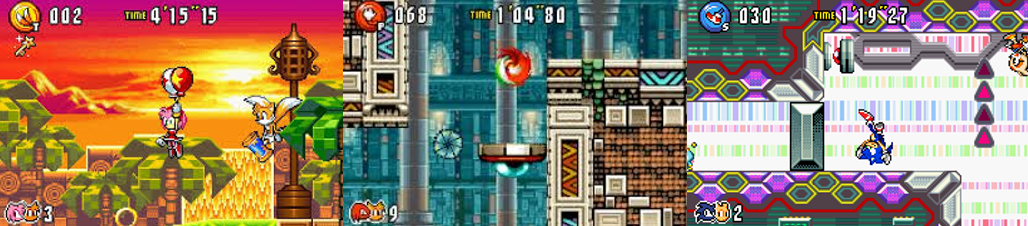
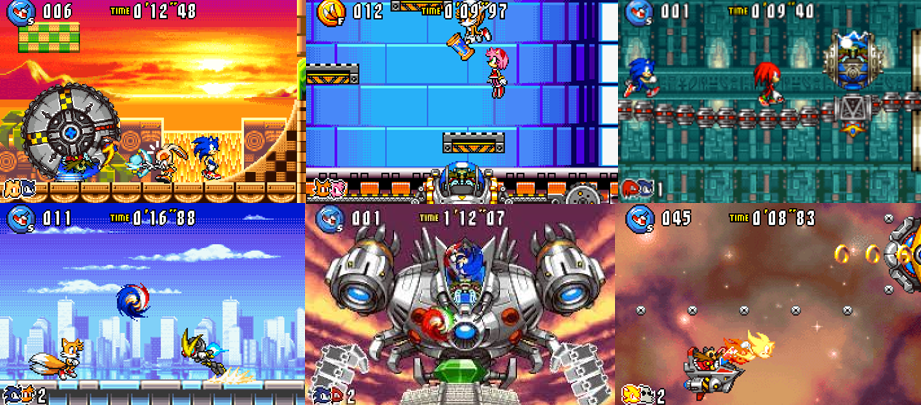

The Aftermath:
This as easily one of the worst Royal Rumble matches I’ve ever seen. There were hardly any viable competitors in the match, with the entrants mostly being nobodies or disposable bodies to plod around the ring and drag things out. It didn’t help that the wrestlers were coming out every minute or so, causing the ring to fill up with bodies and leaving the competitors with little to do but stomp around and gingerly brawl near the ropes and in the corners. After his historic win, Shawn Michaels went on to face his former bodyguard, Diesel, at WrestleMania XI in a losing effort; Diesel even convinced Pamela Anderson to ditch Shawn at the event! Still, HBK spent most of 1995 as the Intercontinental Champion and repeated his Royal Rumble victory the following year, finally capturing his first WWF Championship at WrestleMania XII. WrestleMania XI also saw the British Bulldog and Lex Luger teamup to defeat the Blu Brothers and Bret Hart settle his differences with Bob Backlund. Owen Hart, the Smoking Gunns, and King Kong Bundy all made it onto WrestleMania XI as well, though the less said about Bundy’s match against the Undertaker, the better!

My Rating:

Rating: 1 out of 5.

Terrible

Did you enjoy the 1995 Royal Rumble match? If so…why? Who was your pick to win at the time? Which of the entrants do you think was most out of place? Were you surprised to see Dick Murdoch return or do you have no idea who he is? Were you impressed that Shawn (and the Bulldog) lasted the entire match? Which Royal Rumble match is your favourite and who’s your pick to win this year? Whatever you think of this awful Royal Rumble match, like the review and leave a comment and then donate to my Ko-Fi to suggest another Royal Rumble match for me to review.