
Game Corner: Star Wars: The Force Unleashed II (Xbox 360)

GameCorner
SWFU2Logo

Released: October 2010
Developer: LucasArts
Also Available For: iOS, Nintendo DS, PlayStation 3, Nintendo Wii, and PC

The Background:
Despite its flaws, Star Wars: The Force Unleashed (ibid, 2008) was a commercial success; as a result, LucasArts rushed into production with a sequel to what was, at the time, the official bridge between the events of Star Wars: Episode III: Revenge of the Sith (Lucas, 2005), and Star Wars: Episode IV: A New Hope (ibid, 1977). My experience with The Force Unleashed was mired by the game’s dodgy camera, wonky physics, and repetitive levels and combat. When the game shined, it shined pretty brightly but even its best moments couldn’t overshadow the flaws in the engine and execution. The story, while interesting, had a few issues as well (even more so considering the games have long since been rendered non-canon by Disney), and was pretty well wrapped up with Darth Vader’s turncoat secret apprentice, Starkiller, dying a martyr to inspire and rabble the Rebel Alliance. But the franchise made money so, armed with the lamest excuse possible, LucasArts came back with this sequel but does it improve on its predecessor’s failings or is it more of the same?

The Plot:
After multiple failures, Darth Vader has finally perfected a clone of his secret apprentice, Starkiller. However, haunted by the memories, feelings, and motivations of his predecessor, the clone sets out to uncover the truth of his identity and reconnect with his lost love, Juno Eclipse.

Gameplay:
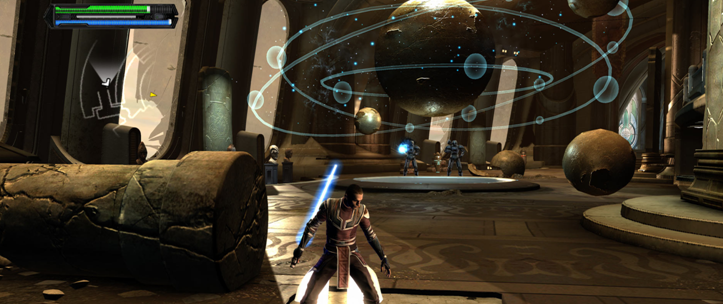
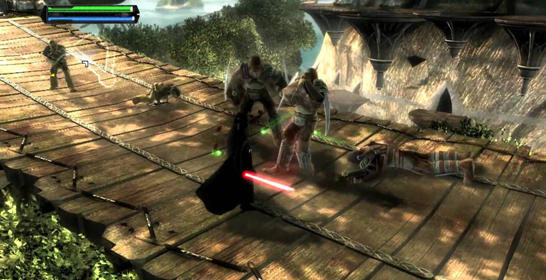
Like its predecessor, Star Wars: The Force Unleashed II is a third-person action title in which the player controls a clone of Vader’s secret apprentice, Starkiller. If you thought Starkiller was a damaged, edgy character torn between his divided loyalties, this clone ramps it up to eleven as duplicating Starkiller’s prowess with the Force also meant duplicating his memories and emotions. Nowhere is this more evident in the fact that Starkiller now wields duel lightsabers, holding them both behind him like an absolute bad-ass. As a result, the already frenetic combat of the original is dialled up in this sequel; whereas you could just mash away at the X button in The Force Awakens to cut down foes, it was also encouraged that you time your strikes to unleash an impressive flurry of damaging attacks. Here, though, the combo system is literally as simple as successively hitting X to turn Starkiller into a laser-sword blur of blades and attacks; regular enemies no longer have their own health bars, meaning you’re literally encouraged to just mash away until they’re defeated.

SWFU2Force
Starkiller’s Force powers are back, stronger than ever.

Most of Starkiller’s basic Force abilities make a return; you can fry Stromtroopers with Force Lightning, push or toss them (and objects) with Force Push and Force Grip, or blast them away with Force Repulse. The game also places far more emphasis on pressing Y or O during a lightsaber combo to deal additional damage with Force Lightning or Force Push, which is extremely useful for clearing out waves of enemies or dealing additional lightning damage. While the life-sapping Force Shield is absent, Starkiller can now use a Mind Trick to convince his enemies to turn on their comrades or leap to their deaths which, while handy (and pretty much mandatory in the game’s final battle against Vader), can be clunky; I found it either wore off too fast or enemies just shrugged it off when I applied it. as you cut down enemies, you’ll build up a meter in the bottom left of the screen; once fully charged, pressing down the two analogue sticks will send Starkiller into a “Force Rage”, which increases his attack power and resistance to injure for as long as the meter lasts (which, to be fair, is quite a while). As you cut down enemies, you’ll earn points that can be used to upgrade each of Starkiller’s abilities, similar to the last game but much simpler and more streamlined. Gone are the multiple of combos you had to purchase and you have no need to buy new Force abilities as Starkiller either remembers them or learns them as he progresses, meaning its far easier to power-up Starkiller’s abilities.

SWFU2Grip
The Force Grip is now, thankfully, much easier to pull off.

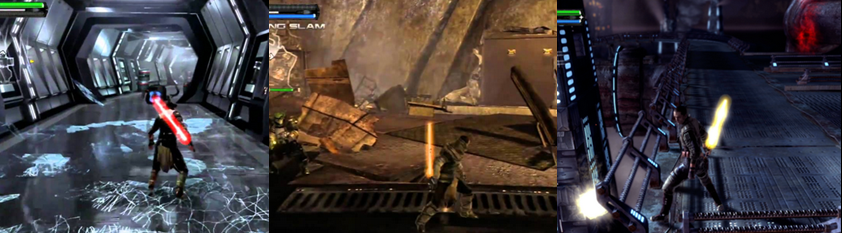
Also like in the first game, you can acquire crystals to customise the appearance and abilities of Starkiller’s lightsabers; you can mix and match the different blades for added effects and bonuses, though, unfortunately, there’s no way to customise your favourite blade colour with your preferred buff. While Force abilities are still a vital part of the game, and the combat system, I found they were mostly relegated to opening doors (which I still find difficult due to the game’s physics and hit detection) and tossing objects. Thankfully, gripping TIE Fighters and lobbing various bits of the environment at your enemies is much easier here; in the original, it felt like I was always fighting to get a grip on passing TIE Fighters and that they would just go flying wherever they wanted but, here, the system is much improved.
SWFU2Grapple
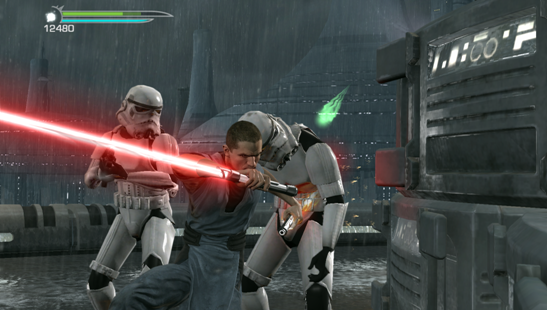
Grapple enemies to deliver massive damage.

Yet, for the most part, the game’s combat is focused almost exclusively on lightsaber combat. Perhaps because the clone is so emotionally unstable, combat is fast, brutal, and frenetic; Starkiller can grapple his foes to deliver either an instant kill or massive damage; he also lops off Stromtrooper’s heads and limbs this time around and can once again leave enemies open to a devastating parry with a well-timed press of the block button. Starkiller can still hurl his lightsabers at his enemies to cut them down from a distance, too, but I actually found myself using this far less in combat as it leaves Starkiller vulnerable as he waits for his weapons to return; instead, the game mostly focuses on using this ability to cut down platforms.
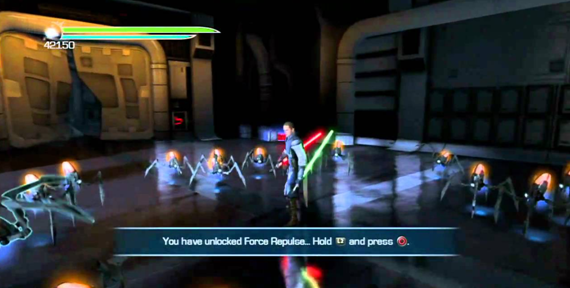
SWFU2Enemies
Don’t let enemies overwhelm you or you’ll have a bad time.

In addition to attacking with more power and proficiency than before, Starkiller also seems to be noticeably tougher; he can still lose health rapidly when pinned down or subjected to multiple attacks but his new combat style allows him to quickly cut down those before him to refill his health and force meter. You’ll need these skills as well as the game’s enemies seem much tougher and smarter this time around; snipers blast at you from the high ground in the distance or behind waves of regular Stromtroopers, who hunker down behind cover or buzz around on jetpacks. Even the bog-standard Stromtroopers can take a beating as well, meaning you should always go for overkill when engaging with hallways filled with enemies. Speaking of which, while the game is far more linear in its environments and level layout than its predecessor, I find it amusing, then, that the game ditches a traditional map and, instead, allows you to “sense” the way you need to do with the directional-pad as it’s highly unlikely that you’ll get lost in the game’s straight-forward environments. You’ll still be tasked with performing some mandatory platforming; Starkiller can double jump and dash on the ground and in the air to cross gaps but, more often that not, you’ll probably have to use the Force in some way to create makeshift bridges.
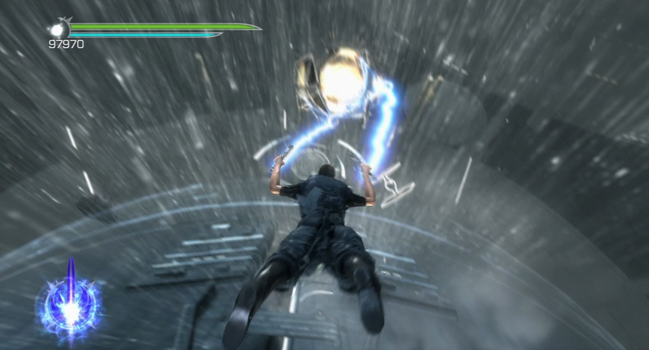
SWFU2Freefall
The Force Unleashed II loves these free-fall sections.

While platforming is light, it is mostly okay; Starkiller is nowhere near as slippery and janky as before and the game’s engine doesn’t seem to be struggling to render everything this time around, meaning you’re far less likely to slip or glitch off a ledge. The game does suddenly through a whole mess of tricky platforming at you when you storm Kamino’s cloning facilities in the final chapter, however, so it’s best you work on perfecting those jumps. Also as before, you’ll be tasked with performing a number of quick-time events (QTEs), especially against largely enemies and during boss battles. While these aren’t anything too complex beyond either pressing or mashing a button (or two buttons) at the right time, I found that the QTE indicators were harder to spot on the screen as they often appear at the edges of the display. There are also numerous moments where Starkiller dives through the air at high speed, dodging obstacles or blasting them (or enemies) with his Force abilities; while these are fun and exhilarating, the game maybe uses them a few too many times. Luckily, the poorly-conceived Star Destroyer section of the original is turned on its head here where Starkiller has to clear a path for a ship that is crashing through Kamino’s atmosphere, which is much improved.

SWFU2Glitch
My game glitched out on me, wouldn’t load this boss, and then crashed.

Luckily, the game’s stability has been noticeably improved over its predecessor; enemies no longer turn into stupid ragdolls when you defeat them or toss them around and I encountered far less glitches and issues with jumping or interacting with the environment. However, I did experience a few issues with slowdown, stuttering, and instances where the game didn’t load in the required environment or boss battle. This may have been because of the condition of my game disc, however as, after I cleaned it, the game continued to run fine but it was noticeable.

SWFU2Length
Before you know it, you’re facing off with Darth Vader and the game is over.

What really lets the game down, though, is its length and variety; I was annoyed that you revisited the same levels in The Force Unleashed and that, while the game evoked the spirit and aesthetic of Star Wars, it didn’t really do much to show us more of this sprawling, multi-cultural galaxy. For the sequel, you’ll battle through hallways-upon-hallways in many grey-coloured environments, whether it’s on a starship or the facilities on Kamino. The game tries to mix it up with some puzzle elements involving you powering up doors and visiting Cato Neimoidia (which is little more than a reskinned Geonosis) and briefly stopping by Dagobah but the majority of your time is spent exploring very similar-looking environments. Additionally, the game seems much shorter than its predecessor; I blew through the main story on the “Medium” difficulty and only missed one lightsaber crystal and with only a few Force abilities left to upgrade (easily remedied with a quick replay of some of the game’s other levels). The game’s length is so noticeably short, and its environment so conspicuously limited, that it almost feels like an extended add-on to the first game, like they took an idea for downloadable content (DLC) for The Force Awakens and simply padded it out to fill four to six hours of repetitive combat and gameplay.

Graphics and Sound:
Graphically, The Force Unleashed II isn’t much of an improvement over its predecessor, either; the cutscenes are of about the same quality and the in-game graphics only seem like they have been slightly tweaked and improved. I’ll give it this, though: the game really knows how to render the interior of a starship and the storm-swept landscape of Kamino; while this may mean that the game’s overall stability and quality is noticeably improved as the game isn’t trying to render or process loads of different elements all at once, it does make for a far blander and less interesting aesthetic experience as the game never reaches the heights of the original’s run through the Death Star laser cannon.
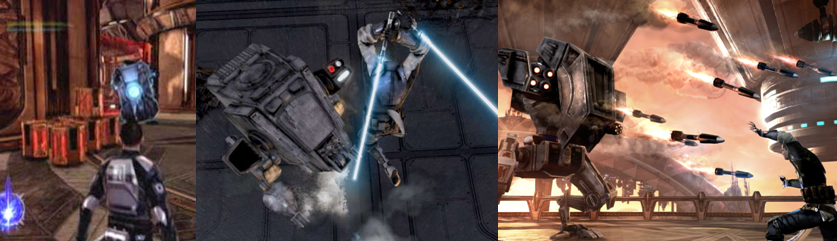
SWFU2QTEs
The game looks pretty decent, for the most part.

Once again, one of the best elements of the game is the incorporation of John Williams’ iconic Star Wars tracks. While you don’t get the same exhilaration as cutting down Wookies as Darth Vader while the Imperial March plays, the use of familiar Star Wars tracks once again works extremely well with the game’s visual fidelity to the movies to make it feel as though the game and its characters are deeply entrenched in Star Wars lore.

Enemies and Bosses:
For the majority of The Force Unleashed II, you’ll be cutting your way through swathes of Stromtroopers; we’ve got the generic minions, sniper and jetpack-wearing variants, and staff-wielding Riot Troopers. Despite the ease at which you can cut through these guys (the jetpackers, especially, go down much easier than in the first game), it does feel as though their intelligence, durability, and aggressiveness has been tweaked slightly to make them a bit more of a threat. Thankfully, the annoying Purge Troopers are no longer present; in there place, are a series of robotic enemies. The large variants wield shields that you must wrench off them with the Force and can attack with explosives, flamethrowers, or even carbonite sprays. You’ll also battle AT-MPs and AT-STs, both of which require to you reflect missiles back at them and, like these larger robots, can be destroying using QTEs.
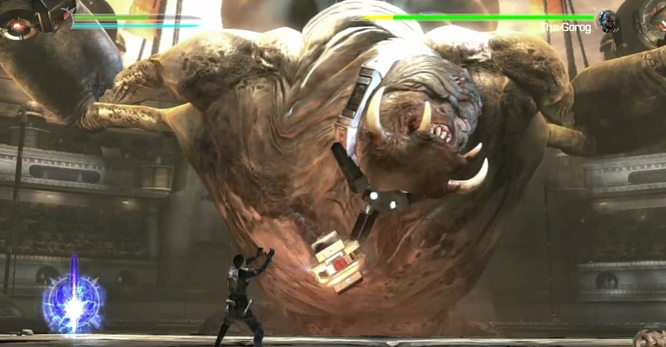
SWFU2Gorog
The battle against the Gorog just keeps going on and on!

The game also brings back Force-sensitive and lightsaber-wielding foes, who are resistant to your lightsaber attacks and Force abilities, respectively, though the new grapple move is very useful for breaking through their guard. You’ll also battle spider-like terror droids (who can swarm you in an instant and must be destroyed en masse with Force Repulse) and enemies who are invisible and intangible until you stun them with Force Lightning, but, beyond Stormtrooper and droid variants, that’s about it for the game’s enemies. The Force Unleashed II is also a little thin on the ground when it comes to its bosses; at one point, it seems like the game is building up to a battle against Boba Fett but this never actually occurs, which is a shame. While the first game had far more boss encounters, though they were generally all variations on the same thing but, here, there are as few bosses as there are levels. The game tries to make up for it by making the few boss battles you do have to contend with last a long time; when battling the gigantic Rancor-eating Gorog, for example, you’ll have to dodge its massive claws, charge up its shackles with Force Lightning before attacking them with your lightsaber, and then mash the B button to Force Push the creature back into its restraints. Once you sap its health, you’ll then have to blast it with Force Lightning and attack it (and a few waves of Stromtroopers) from a higher gantry in order to sever the structure holding it in place and then you’ll dive after it at high speed, zapping and slashing at it before it can crush your ally, all of which can be an extremely exhaustive experience.

SWFU2Vader3
Eventually, the battle is decided by a QTE.

This exhaustion continues with the final bout against Darth Vader; unlike in the first game, where you could choose to battle Vader to the death or take on the Emperor at the end, The Force Unleashed II ends on an annoying multi-stage duel with the Dark Lord himself. Being so thoroughly bested by his apprentice in the first game must have really pissed Vader off, too, as he’s much more of a threat in this sequel; your Force abilities are all but useless against Vader here, requiring you to unleash your best combos against him on the rare occasions when his guard his down. Like the final duel of Star Wars: Episode I: The Phantom Menace (ibid, 1999) and the battle between Yoda (Frank Oz) and Palpatine (Ian McDiarmid) in Revenge of the Sith, this finale takes place on a vertical plane, with Starkiller and Vader having to leap to platforms across a bottomless chasm deep in Kamino’s cloning facilities. As the fight progresses, you’ll have to send debris and objects back at Vader to damage him and then use your Mind Trick to convince flawed Starkiller clones to distract and damage Vader enough for you to really open up on him. Finally, the fight ends out on a rain-soaking landing platform, similar to the fight between Obi-Wan Kenobi (Ewan McGregor) and Jango Fett (Temuera Morrison), where your Force Range will be fully powered and you’ll have to win a few QTEs to finally best Vader in combat and be able to, once again, choose between a Light Side ending and a Dark Side ending.

Power-Ups and Bonuses:
as in the first game, you can pick up Jedi and Sith Holocrons hidden throughout every level; these will either give you a bunch of additional points to upgrade Starkiller’s abilities or provide you with a crystal to customise your lightsaber. These Holocrons are far easier to spot than in the first game and there’s even two additional variants, green and blue, which expand Starkiller’s health and Force meter respectively. While you can no longer acquire in-game buffs that make you invincible or the like, the different lightsaber crystals allow you to drain health from enemies, increase the replenishment of your health or Force meter, or earn more points from combat. You can also customise the lightsaber to deal additional lightning damage, possibly set enemies on fire, or even have a chance to disintegrate them entirely with the mythical Darksaber. As you play through the game, you’ll unlock additional costumes for Starkiller; you can also unlock further costumes by succeeding in the game’s “Challenge” mode and, if you have a save file from The Force Unleashed on your hard drive, you’ll gain access to three additional costumes (including the awesome Sith Stalker costume).

Additional Features:
As in the first game, you can unlock concept art and data files by playing the game; you can also input various cheat codes that allow you to save you having to unlock costumes and skins such as Boba Fett, though most of the game’s best costumes are restricted to DLC. Also present is the aforementioned “Challenge” mode; as you play the game, you’ll unlock new maps and challenges to take on in this mode, which generally require you to survive against waves of enemies while staying on a platform or collecting Holocrons, all against a clock. Depending on how well you do, you’ll receive either a bronze, silver, or gold medal and unlock additional costumes. DLC is far less extensive in this game; unlike the first, there is only one additional mission available in DLC. This non-canon extension of the game’s Dark Side ending sees players assume the role of the dark clone of Starkiller, who is sent to kill Princess Leia (who has become a Jedi in this timeline) during the Battle of Endor and winds up drop-kicking Ewoks and killing both Han Solo and Chewbacca for good measure.

SWFU2Conclusion

The Summary:
For everything Star Wars: The Force Unleashed II improves from its predecessor, it has a near-equal number of failings as well. The game is far simpler; the interfaces are cleaner and easier to navigate, the plot is much more simplifier, and the combat has boiled down to a simply button masher. While this makes the game fast-paced, frenetic fun at times, it comes at the cost of the game’s length, difficulty, and replayability; the environments are even more limited than its predecessor, the plot is paper thin is the bare minimum excuse to produce a sequel, and it largely adds little to the first game or the overall Star Wars lore. Unfortunately, there’s probably less appeal in The Force Unleashed II than in the original; at least in that game, we got to see some familiar characters return and the formation of the Rebel Alliance be fleshed out but, here, we’re not really learning anything new. All this sequel shows us is that it was foolish for players to be emotionally invested in Starkiller and his new allies as even PROXY, who was clearly destroyed in the original, returns here (adding nothing to the narrative) and Juno, for all the importance the game places on her in Starkiller’s life, is little more than a damsel in distress and is never interacted with until the last moments of the game. Overall, The Force Unleashed II is far less frustrating than its predecessor but still an average gameplay experience. The developers definitely tidied up the combat and the physics but it doesn’t change the fact that this sequel is little more than an shameless cash-in n the success of The Force Unleashed. Were this game’s story condensed into a piece of DLC and its improvements and tweaks placed into The Force Unleashed, we could probably have had a really good Star Wars game but, instead, we got two lacklustre titles that, for all their potential, fail to really provide a coherent gameplay experience between them.

My Rating:

Rating: 2 out of 5.

Could Be Better

What did you think abouy Star Wars: The Force Unleashed II? Did you consider it to be superior to its predecessor or were you just as unimpressed with the game’s length and variety as I was? What is your favourite Star Wars videogame (or movie, or show, or book, or whatever), if any? Either way, drop a comment below and let me know.


Back Issues: WildStorm’s Resident Evil #5

BackIssues

So it’s probably old news by now but we finally saw the release of the Resident Evil 3 remake (Capcom, 2020) recently and, to mark the occasion, I’ve been taking a look back at Resident Evil: The Official Comic Magazine, a five-issue comic book released by WildStorm back in 1998 to 1999. If you’ve stuck with me through it all, well done; if not, you can read up on my thoughts on issue one, two, three, and four easily enough.

ResEvComic5Logo

Issue five, published in February 1999, would be the last issue in this series and, honestly, it probably couldn’t have come at a better time. Rather than choose to be a by the numbers adaptation of the first two videogames, WildStorm mostly opted to tell side stories, interludes, and recaps of Resident Evil (ibid, 1996) and Resident Evil 2 (ibid, 1998). While this worked to begin with and nicely fleshed out some of the Resident Evil lore, choosing to be an anthology series rather than focusing on the events of the videogames has produces more misses than hits in retrospect.

ResEvComic5Tyrant
Dexter stumbles across a freakin’ Tyrant!

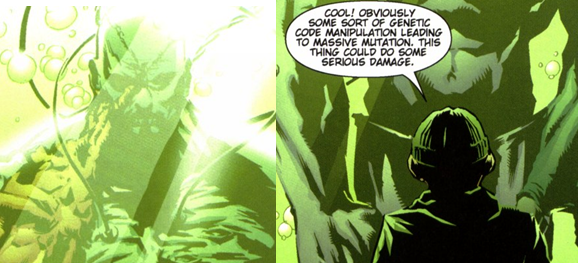
This final issue begins with “…And the Last Shall Be First” (Oprisko, et al), a story in which a teenage boy, Dexter Whitlam, pushed to the edge by schoolyard bullies, steals and injects himself with a vial of G-Virus in order to exact revenge upon his tormentors. Desperate for revenge against his bullies, Dexter stumbles across an Umbrella facility where a Tyrant is being held in stasis; it was at this point that I was hoping Dexter would release the bio-organic weapon (BOW) so that we could finally see it wreck some serious havoc as, up to this point, BOWs like the Tyrant had been given the shaft by WildStorm.

ResEvComicRevenge
G-Dexter enacts a bloody revenge.

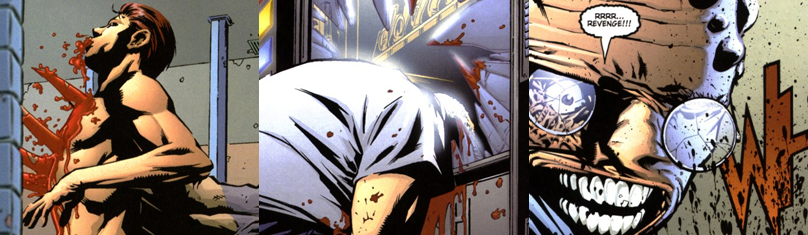
Instead, though, Dexter steals a G-Virus sample (I guess Umbrella were planning on experimenting on the Tyrant with it?) and, while he initially plans to create his own BOW, he is driven to injecting himself and transforms into a “G”-like monster. G-Dexter hunts down and kills his tormentors but is subdued by Mr. Venk, an Umbrella operative, and taken to an Umbrella facility where, inexplicably, his G-infection is apparently cured. Reverted back to normal, he is offered the chance to join Umbrella and put his intellect to their use.

ResEvComic5Umbrella
Dexter is one of the few people to recover from the G-Virus.

It’s kind of sad that “…And the Last Shall Be First” is the only time a G-infected human is given a chance to do anything of note as, even in issue two’s direct adaptation of Resident Evil 2, “G” was taken out like a bitch. Here, we finally see what “G” is capable of as G-Dexter slashes fools up with his claws and mutilates his bullies with extreme prejudice. Unfortunately, though, it seems like a wasted effort as it’s not like this is the origin of a character we know from the videogames; had the story been tweaked and reworked slightly, it could have given us an interesting glimpse into William Birkin’s childhood but, alas, we’re left with the potential of “G” being wasted on a random original character who, honestly, isn’t all that compelling; it’s the same “nerd bullied to the brink” story you’ve seen a hundred times before…but with the G-Virus involved.

ResEvComic5Claire
Turns out it’s a prequel to Claire’s story…

The next side story, “Emmy’s Bloody Spoon” (Adams, et al), follows another couple, Deb and Terry, who decide to take their honeymoon in Raccoon City, of all places. They make a pit stop at a diner which, wouldn’t you know it, comes under siege from a zombie attack. Despite the best efforts of the little old lady behind the counter, they’re all massacred by a lone zombie, who is interrupted by the arrival of Claire Redfield. So, what we have here is a brief prelude to the start of Claire’s story in Resident Evil 2, showing how the diner came to be infected when she rocked up in town. The story ends the moment Claire arrives, though, and therefore doesn’t really tell us anything we really needed to know at that point as WildStorm were showing us the rate of infection in Raccoon City back in issue two so, other than filling in a very small hole in the overarching Resident Evil story, this feels, again, like wasted potential as they could have used these pages to tell a short story about Claire and Sherry after Resident Evil 2, or expand upon their time in Raccoon City but, instead, we get this…

ResEvComic5Kane
A threatening Tyrant, that makes a change!

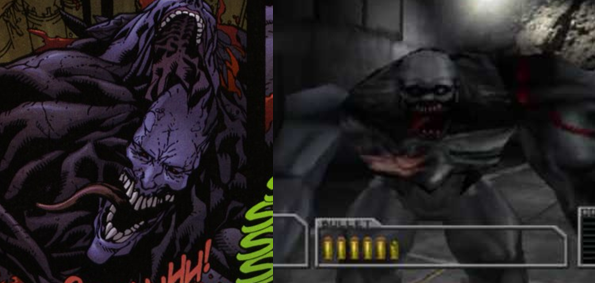
The issue ends with the conclusion of the three-issue story WildStorm have been telling about Chris Redfield, Jill Valentine, and Barry Burton trying to locate Umbrella’s European headquarters. “Kane & Abe” (ibid) opens by pretty much skipped over exactly how the three avoided being eaten by their attackers in the last issue’s conclusion and jumps right into Chris and Barry loading up on weapons to go find Jill. Jill stumbles upon Abe, an Umbrella scientist, and Kane, a massive Tyrant-like BOW that Jill is unable to stop with just her pistol, which is a nice change of pace considering how easily “G”, Mr. X, and a Tyrant were taken care of without any real effort in previous issues). Abe sets off the obligatory self-destruct and disappears, leaving Jill, Chris, and Barry to subdue Kane long enough to make their dramatic escape just as the castle explodes. The issue then ends with Claire and Leon S. Kennedy just happening upon the three like it was nothing, finally bringing an end to Claire’s long search for her brother.

ResEvComic5KaneHypnos
There’s a *slight* resemblance here…

Once again, WildStorm foreshadows Resident Evil – Code: Veronica (Capcom Production Studio 4, 2000) through the Gothic aesthetic of the German castle, European setting, and the reunion of the Redfields. The BOW the protagonists tangle with is also very similar to the Hypnos Tyrant from Resident Evil: Survivor (TOSE, 2000), of all things, and the action-orientated nature of their battle through the castle is more than reminiscent of the gameplay changes first seen in and Resident Evil 4 (Capcom Production Studio 4, 2005).

ResEvComic5Rush
The story rushes to an unsatisfying conclusion.

However, this was a very rushed conclusion to a three-part story; entire plot points and sequences are ignored and the story just jumps from one thing to the next with little in between to fill in the gaps. It’s almost as if WildStorm shouldn’t have wasted time in the last issue recreating the game’s laborious puzzles and, instead, focused on moving the narrative along in an interesting and action-orientated way.

ResEvComic5Art
There’s some great, gory art in these comics.

In the end, Resident Evil: The Official Comic Magazine ended with a bit of a whimper. They didn’t do a proper adaptation of a Resident Evil videogame until issue two, didn’t start a multi-part story until issue three, and most of the stories they did tell, while interesting, were pretty forgettable and inconsequential in the grand scheme of things. I applaud their efforts to tie each story together in subtle ways, and to refer to the events of the videogames; the artwork was strikingly gory and consistently good all the way through each of the five issues and they made an effort to adapt all the different nuances of the videogames, from the characters to the story, the creatures, and even the puzzles. While some of these land better (and are more suitable) than others, at least they gave it a fair shake of the stick and tried to expand upon what was, at the time, only a two game franchise.

ResEvComic5Restricted
It’s like Capcom restriced the stories WildStorm could tell…

Reading back these issues, it almost seems as though Capcom restricted the type of stories WildStorm were allowed to tell as, rather than go into detail about what the survivors did before, between, and after Resident Evil and Resident Evil 2, the writers dance and skirt around the issue, throwing as much smoke and mirrors (or, more appropriately, blood and guts) at the reader as they can to disguise the fact that they haven’t actually expanded upon these characters much at all…possibly because they weren’t allowed to given that Capcom had a couple of sequels and spin-offs in the works.

ResEvComicStories
There was a lot of potential in expanding upon these characters.

They tried to expand upon side characters like Ada’s boyfriend John and inject William Birkin with a bit more menace but both of these efforts were pretty much ignored and retconned by Capcom in subsequent sequels. With that in mind, it seems all the more sensible to me to have used these issues to tell adaptations of the first two videogames alongside one or two interludes and side stories per issue. Show a little more of Albert Wesker’s mindset, delve deeper into Chief Irons’ corruption, maybe just do a story the follows Mr. X bludgeoning its way through the Raccoon City police station. But to waste pages and effort on telling us what happened before Claire arrived at that diner seems like a waste of time to me, especially when you’re giving the shaft to the Lickers and BOWs like “G”.

ResEvComics
Sadly, WildStorm’s Resident Evil comics are now hard to come by.

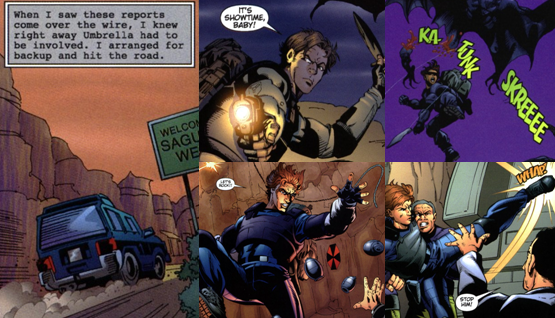
WildStorm would revisit the Resident Evil franchise a couple more times over the years; they told the story of the hitherto-unknown Special Tactics and Rescue Service (S.T.A.R.S.) Charlie team in the four-issue Resident Evil: Fire & Ice series, published in 2000 and 2001. This comic featured many of the same writers and artists as Resident Evil: The Official Comic Magazine and even returned some of the original characters and places to the lore, like Patrick Brady from issue two and Saguaro Wells from issue four. They also published a prequel to Resident Evil 5 (Capcom, 2009) between 2009 and 2011 and, while they collected each of these different publications into trade paperbacks, they are all long out of print. Overall, Resident Evil: The Official Comic Magazine was a pretty enjoyable experience but it had the potential to be so much more; it could have used its artists and writers to bring the videogames to life in a new way for comic readers and given fans of the videogames a lovely piece of ancillary media to collect. Instead, it’s more of a forgettable tie-in that peaks with the second issue, though it would be nice to see the collection get a reprint at some point.

My Rating:

Rating: 2 out of 5.

Could Be Better

Did you ever read any of the Resident Evil comics published by WildStorm? Would you be interested in the series receiving a reprint as the collection is currently out of print? Do you have a favourite piece of ancillary Resident Evil media? Drop a comment down below and stay in touch for more content and articles.

Game Corner: Star Wars: The Force Unleashed (Xbox 360)

GameCorner
SWTFULogo

Released: September 2008
Developer: LucasArts
Also Available For: iOS, J2ME, N-Gage, Nintendo DS, PlayStation 2, PlayStation 3, PlayStation Portable, Nintendo Wii, PC, and Mac

The Background:
Before Disney bought the entire Star Wars (Various, 1977 to present) franchise and decided to reboot it with a bunch of questionable sequels, George Lucas was still firmly behind the wheel of his signature series. Development of a new Star Wars videogame began in 2004, around the time that Lucas was finishing up Star Wars: Episode III: Revenge of the Sith (ibid, 2005), and, eventually, the developers decided to work in close collaboration with Lucas in bridging the gap between that film and the seminal Star Wars: Episode IV: A New Hope (ibid, 1977). The decision was made to introduce the idea that Darth Vader had secretly been training an apprentice, known as “Starkiller”, to not only hunt down and destroy any remaining Jedi but also to assist him in overthrowing Emperor Palpatine. In service of this, Vader would use Starkiller to form the fledging Rebel Alliance, thereby effectively creating his own downfall. While these events would later be rendered non-canon after the Disney buyout, for a time they stood as the established origins of the Rebel Alliance. Personally, I haven’t really enjoyed a Star Wars videogame since Star Wars: Rogue Squadron (Factor 5/LucasArts, 1998) and have only dipped in and out of subsequent titles as the franchise has dabbled in almost every conceivably genre. I’d heard, however, that The Force Unleashed was a pretty decent title, if mired by some frustrating controls and gameplay elements. Nevertheless, distrustful of Electronic Arts and their shameless loot crates and being unwilling (read: poor) to shell out for Star Wars Jedi: Fallen Order (Respawn Entertainment, 2019) yet having a Star Wars itch, I decided to take the plunge with The Force Unleashed and see if it holds up after all this time.

The Plot:
During his mission to hunt down and destroy the remaining Jedi, Darth Vader stumbles upon the son of a Jedi, whom he takes as a secret apprentice. Trained in the Dark Side of the Force, Vader’s secret assassin, Starkiller, is sent out into the galaxy to purge the Jedi and lay the foundations for Vader’s coup against the Emperor.

Gameplay:
Star Wars: The Force Unleashed is, like many Star Wars videogames, a third-person action title in which the player controls Starkiller, a troubled and damaged young man who is strong with the Force and well-trained in the Sith arts. As a result, Starkiller wields a lightsaber and can use the Force in a variety of ways to strike down those before him. Combat is largely built around the execution of combos that string together successful lightsaber strikes with Force abilities. Starkiller can blast foes with Force Lightning, push or toss them (and objects) with Force Push and Force Grip, blast them away with Force Repulse, or envelop himself in a life-sapping Force Shield. As he cuts down Jedi and Stormtroopers alike, he earns experience points which can be used to unlock additional combos and improves his abilities. Luckily, there’s no crafting system and the skill tree is ridiculously easy; you can acquire crystals that will allow you to customise the look and abilities of Starkiller’s lightsaber and can improve the strength of his various attacks or regenerative abilities by spending Force Points.

SWTFUCrLightsaber
Starkiller holds his lightsaber like an absolute bad-ass.

Speaking of Starkiller’s lightsaber, you know he’s a bad-ass not just because he has a no-nonsense buzzcut or a near-permanent scowl but also because he holds his lightsaber backwards! What a rebel! Holding down L2 will allow Starkiller to block incoming blaster fire and attacks (and pressing it at the right moment will also allow him to parry), though he can also automatically send bolts back to his foes as he runs along. Lightsaber combat is simple and fluid; hitting X at the right moment will initiate a fancy flourish that can be chained with subsequent attacks to deal massive damage, and Starkiller can even hurl his lightsaber like a boomerang to take out ranged foes and charge it with his Force Lightning to electrocute his enemies. It’s not all combat and tossing fools to their death with the Force, though; you’ll have your reaction time tested in more than a few quick-time events (QTEs) and Starkiller generally navigates through a limited number of largely limited, if relatively-well-realised environments, jumping and dashing his way to a series of objectives. There’s some light platforming here that requires the use of a double jump and dash, and a few extremely basic puzzles that pretty much always boil down to using the Force to move something to either cross a gap or open a door (or, sometimes, both!)

SWTFUStarDestroyer
While impressive, this part is a pain in the ass.

While Starkiller controls very well, what will mess you up is the game’s wonky physics engine, unreliable camera, and janky controls; I struggled endlessly with the Force Grip, which either allowed me to suspend objects uselessly in mid air or sent them careening futilely against a wall and, as many have commented. This becomes a massive source of frustration during what should have been the game’s crowning achievement: pulling a Star Destroyer from the sky. While pulling the ship down wasn’t actually that difficult (though it is frustrating having to angle it into the right position), it’s the wave-upon-wave of TIE Fighters that make this so aggravating. Starkiller can’t deflect TIE Fighter fire and the only way to destroy them is to grab them with the Force and, I swear, it’s damn near impossible to get a grip on them.

SWTFULevels
Levels are very Star Wars but not very inspiring.

Compounding the matter is the fact that Starkiller is actually quite weak; you can upgrade his health and Force meter and the damage he can receive and dish out, but he bounces around the place like a puppet when he’s blasted with heavy weaponry and sometimes takes so long to jump back up that he can get blasted to death with very little effort. As a result, you’ll be constantly jumping and dashing about cutting down the regular Stromtroopers to refill your health and allow you to pummel away at the game’s tougher enemies. While the game is a decent length and tells a pretty engaging story about Starkiller’s eventual redemption and sacrifice, the level variety leaves a lot to be desired. Every environment feels very Star Wars and you’ll battle through a TIE Fighter factory, the woodlands of Kashyyyk, and even through the Death Star itself but the problem is that you basically revisit the same environments twice over. You begin the game as a fully-powered Vader slaughtering Wookies on Kashyyyk and later revisit this planet as Starkiller; Starkiller journeys to Raxus Prime to assassinate a Jedi and later returns there to rescue key figures of the Rebellion. Other environments, like Tatooine and Coruscant, appear as downloadable content (DLC) but it would have really helped to increase the game’s visual variety to have these levels be a part of the main story.

Graphics and Sound:
Graphically, the game is…okay. The computer-generated cutscenes are well-produced but, while the in-game graphics do a serviceable enough job of rendering the game’s handful of levels and environments, they don’t make for very attractive in-game cutscenes. It also seems like the developers were desperate to cram as many different physics engines into the game as possible, from Havok to Euphoria, in order to make the game “state of the art”. However, while the enemies have relatively decent levels of intelligence (Stormtroopers just blast away but the Purge Troopers and Felucian’s systematically attack you with blocks and co-ordinated attacks) and the environments are largely intractable and destructible, the game is riddled with rag-doll physics, glitchy platforms (Starkiller is just as likely to slide off a ledge as he is to land on it), and dodgy graphical elements (the backgrounds are teeming with life and action but then some barriers and trees just disintegrate into dust and fade away).

SWTFUMusic
You’ll really feel as though you are Darth Vader…for about ten minutes.

Yet, the game is filled with familiar Star Wars music and compositions based upon the works of the great John Williams. There’s something incredibly empowering about cutting Wookies down as Darth Vader while the iconic Imperial March plays and the music definitely lends a level of professionalism and quality to the game that is, generally, matched by the game’s recognisable environments.

Enemies and Bosses:
The Force Unleashed is filled with all manner of enemies; while you’ll wade through legions of Stormtroopers who go down with relative ease, you’ll also come up against some of the Empire’s more advanced troops who make use of cloaking technology, gatling guns, blast you with concussive bolts from jetpacks, or erect Force-resistant shields. Then there are the enemies who use energy shields or weapons to block and parry your attacks, the likes of the Purge Troopers who grapple Starkiller and want nothing more than to bash his brains in, or the always-annoying Sniper Troopers who pick you off from a distance. Starkiller will also battle Force-sensitive enemies, like the Felucians, or those like the Emperor’s Royal Guard who wield lightsaber-like staffs and weapons and require you to break through their defences to land a combo.

SWTFUBigEnemies
Larger enemies require a bit more strategy.

Sometimes you’ll have to target a specific enemy in order to “demoralise” the other troops; this is essential as, when your enemies are bolstered by these bastards, they can kill you in short order. Starkiller will also frequently come up against AT-STs and Rancors as well; these larger enemies are often flanked by waves of smaller enemies and can whittle your health down to nothing in no time with their powerful attacks so you’ll have to make use of Starkiller’s ranged Force abilities and combos and then win at a QTE to put them down for good.

SWTFUSarlaac
One boss battle takes place right next to a Sarlacc pit!

As for boss battles, these are pretty much all against Jedi, Sith, or similarly-Force-empowered individuals. While each of these encounters is largely the same (block or parry attacks while you wait for an opening, cut down cannon fodder to refill your health, use your Force powers to throw objects at the boss, and win a QTE), each takes place with slightly different environmental and additional hazards. You’ll duel with Shaak Ti beside a Sarlacc pit, for example, have to contend with Maris Brood’s Bull Rancor, and will have to battle simulations of not only the Jedi you’ve defeated before but also a recreation of Darth Maul when facing off with Starkiller’s droid, PROXY.

SWTFUSEmperor
The Emperor will try your patience.

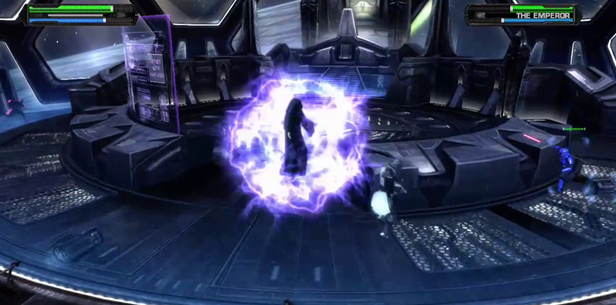
The finale of the game obviously sees you butting heads with Starkiller’s former master, Darth Vader; this is a three (or four, depending on your choice) stage fight that begins in a narrow hallway, progresses to a room where the floor is (almost literally) lava, and ends in the Emperor’s observation deck. Ironically, I found Vader to be less challenging than some of the game’s other bosses as, while he has a powerful Force blast and will choke you out of the air, it’s not actually too difficult to weather his attacks and wail on him with your best combos. After besting Vader, you’re presented with a choice to finish him off in a battle to the death (thus earning the Dark Side ending) or going one-on-one with the Emperor to achieve the Light Side ending. Rather than attacking with a lightsaber, Palpatine uses his Force Lightning to roast you alive, shields himself from your attacks, and throws lightning-charged objects at you (that also explode). This battle is more annoying than difficult as, with careful timing, you can bounce Palpatine’s lightning back at him and whittle him away with your combos as long as you can avoid or block his other attacks.

Power-Ups and Bonuses:
As mentioned, you can acquire, upgrade, and purchase new combos and abilities as you play through the game and level up; by the time you confront the Emperor, you can take quite a bit of punishment, your Force meter will refill faster, and your attacks will dish out far more damage thanks not just to being upgraded but also to the new combos available to you.

SWTFUUpgrades
Upgrade your abilities with Force points.

As you explore your environment, you can also pick up Jedi Holocrons, which will refill your health and Force meter, award Jedi points, and yield other awards (like new lightsaber crystals). With the right lightsaber crystal, your lightsaber can deal more damage or suck health from your opponents, and you’ll also unlock additional artwork, costumes, and other bonuses by finding all of the Holocrons. Starkiller can also increase his odds with one-time buffs by picking up Sith Holocrons; these will grant you with limited invincibility, refill your meters, bestow you with an aura that will drain the health from enemies, or give you an unlimited Force meter for a brief time. Against some of the game’s tougher enemies and mini bosses, these can be essential so make the effort to pick them up and take out the more annoying enemies.

Additional Features:
As mentioned, you can unlock a bunch of concept art and data files by playing the game and collecting Jedi Holocrons. There are also a large number of additional costumes available for use; none of these offer any benefit beyond being cosmetic changes but they do allow you to play as other Star Wars characters, including Obi-Wan Kenobi and even C-3PO! There are three DLC missions you can also play if you bought the extra content (or the Ultimate Sith Edition); one sees Starkiller undergo a series of trials in the Jedi Temple on Coruscant while the other two take place on Tatooine and Hoth and present an alternative scenario where Starkiller replaced Vader as the Emperor’s assassin and battles some familiar faces. As standard, there are a number of Achievements to unlock; most of these are earned through regular play, while other require you to kill a certain number of enemies in different ways or play on higher difficulty settings.

SWTFUConclusion

The Summary:
Star Wars: The Force Unleashed is, ultimately, an average experience; the combat is fast and frenetic and it’s fun to fry Stormtroopers with Force Lightning or cut AT-STs in half but the game quickly runs out of depth and steam and it isn’t long before you’ve experienced everything it has to offer. Starkiller was an interesting protagonist but the story of his redemption is, honestly, nothing we’ve never seen before in Star Wars movies or other media. It doesn’t help that he has to constantly travel through the same environments, fighting variations of the same enemies, and battling against some really dodgy physics and a camera that just loves to get stuck behind objects or jitter about the place at crucial moments. The game’s more frustrating elements really hamper the thrill of fighting through the Death Star laser cannon; battling Jedi and the iconic Sith duo is fun but also a laborious experience that generally comes down to dodging an attack and just mashing away at X like a madman until you win. Despite the fact that the game carries a large degree of sensory fidelity to the Star Wars movies and offers perhaps the best lightsaber combat I’ve experienced so far, it seems to be lacking a real polish to bring together is disparate elements into a cohesive and consistently engaging experience.

My Rating:

Rating: 2 out of 5.

Could Be Better

What were your thoughts on Star Wars: The Force Unleashed? Did you also struggle with the game’s wonky physics, camera, and controls or do you consider it to not actually be that bad? What is your favourite Star Wars videogame (or movie, or show, or book, or whatever), if any? Either way, leave a comment below and let me know.

Game Corner: Doom 64 (Xbox One)

GameCorner
Doom64Logo

Released: March 2020
Originally Released: April 1997
Developer: Nightdive Studios
Original Developer: Midway Games
Also Available For: Nintenfdo 64, Nintendo Switch, PC, and PlayStation 4

The Background:
Everyone knows Doom (id Software, 1993), right? The gory, action-packed first-person shooter (FPS) that has seemingly been ported to every console and format known to man and pretty much thrust the FPS genre into the mainstream? Well, if you don’t, then I envy your naivety. Doom was not only the first in a still-ongoing series of fantastic FPS games, it also kick-started a slew of brilliant FPS titles on the PC and home consoles, as well as popularising online “Deathmatches” against other human players.

Doom64Ports
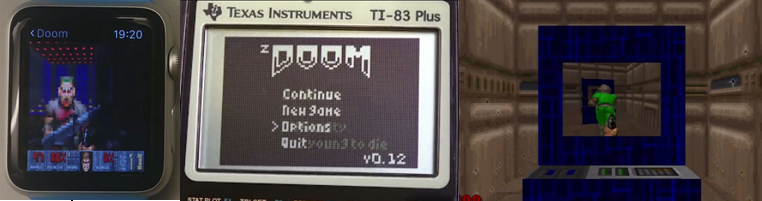
Doom has been run on nearly every device, including in Doom itself!

In keeping with the fact that Doom has appeared on nearly every piece of hardware available, id Software drafted Midway Games to work on a port for the under-rated Nintendo 64. However, rather than being a straight-up, by-the-numbers conversion of Doom, Doom 64 featured entirely new levels, redesigned weapons, some new enemies, and a greater emphasis on exploration. With the release of Doom: Eternal (ibid, 2020), a game largely inspired by and related to Doom 64, Doom 64 finally saw a wider re-release on modern consoles, bringing this oft-forgotten Doom title back into the spotlight. But does it hold up to the original Doom and its sequel, Doom II: Hell on Earth (ibid, 1994), or was it better left forgotten?

The Plot:
After thwarting Hell’s attempt at invading Mars and Earth, the hard-as-nails Doom Marine (or “Doomguy”) is once again forced to take up arms and journey to space stations and through Hell itself, slaughtering demons in a head-on collision with the Mother Demon herself.

Gameplay:
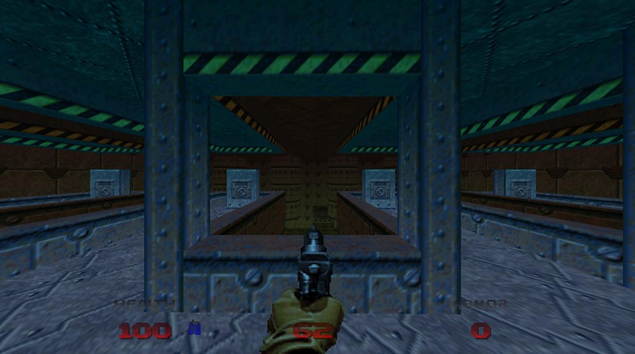
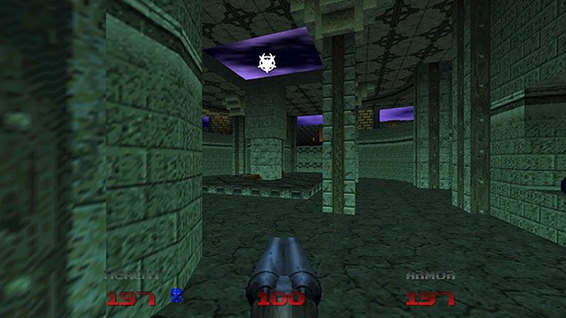
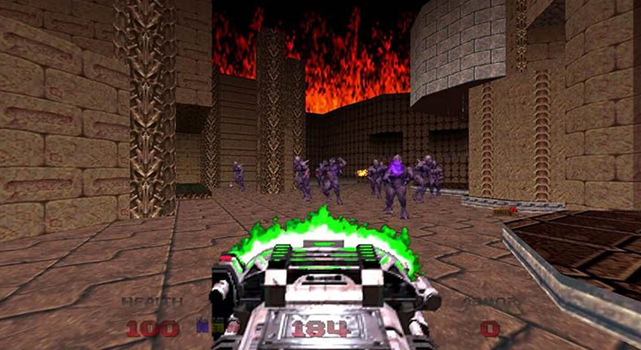
As you should probably be aware, Doom 64 is a traditional Doom FPS through-and-through; as in the classic Doom, you control the Doomguy, a silent, no-nonsense marine who enjoys nothing more than blasting demons with a shotgun or skewing them into bloody sushi with a chainsaw. Unlike modern FPS games, aiming and precise camera control are not necessary in Doom 64; you can more left, right, straight ahead, and backwards, and those are the only directions you can shoot in. There’s also no crosshair or aiming recital; you simply point your weapon in the direction of your target, shoot, and let the game’s auto aim direct your shot.

Doom64Controls
Combat is generally as simple as: Point and shoot!

This is helpful when faced with swarms of enemies and it keeps the action fast and frantic but it can make picking off demons from a distance a bit trickier; I prefer to clear out rooms and areas first so I can explore unimpeded and this often meant to would blast at enemies hiding above or below the game’s maze-like stages. As the game seems to want you to engage demons at point-blank range, the auto aim doesn’t always shoot at enemies up above or below, making this technique tricky, to say the least. As you explore the game’s massive thirty-odd stages, you’ll be tasked with finding a number of coloured keys to open doors and progress further towards the stage exit. Generally, you’ll need three of these (blue, red, and yellow) to progress, but not always, and you’ll also find secret areas and rooms hidden behind seemingly innocuous walls.

Doom64Maze
Stages can be frustratingly confusing and maze-like at times.

While this is par for the course with Doom videogames, I don’t remember it being this necessary or difficult in Doom or Doom II; it doesn’t help that every one of Doom 64’s stages is labyrinthine in nature. This is fine in small doses but I found myself wandering around in circles in every other stage, desperately trying to figure out where to go next, and was forced to turn to a guide more than once just to find the next key…only to find it seemingly led to a dead-end room. There are a lot of hidden weapons and rooms in Doom 64 and this extends to certain switches and doors; more than once, you’ll have to press a certain switch, or switches in certain combinations, or stand in a certain place or race to a lowered platform or opened passageway before they close. I don’t mind this in principle but, more often than not, I would activate a switch and open a door or lower a platform that is outside of your viewpoint, meaning I would struggle to see where I had to go at the best of times.

Doom64DemonKey
You should definitely make sure you get the three Demon Keys.

Additionally, in certain stages, you can find three Demon Keys; these artefacts can only be acquired after solving some of the game’s trickier puzzles but, with them, you can upgrade the firepower and effectiveness of the game’s ultimate weapon, the “Unmaker”, and will greatly increase your chances at defeating the game’s final boss. Ultimately, Doom 64 offers a classic dose of Doom that will be new for many players, even those more than familiar with the first two games. However, I found my enjoyment of the ripping and tearing soured somewhat by the over-emphasis on exploration and puzzle solving; I find these elements ill-fitting in FPS games at the best of times and they feel especially out of place in a Doom game and incorporated simply to mix things up for those who have played Doom and Doom II to death.

Graphics and Sound:
Graphically, Doom 64 looks and feels like a classic Doom title; stages are build out of three-dimensional polygons and the game’s wide variety of enemies are rendered using 2D sprites. Enemies are largely and diverse but, as always with classic Doom games, they suffer from this 2D rendering; there are very few frames of animation, meaning enemies can appear a bit jerky and pixelated. Thankfully, this doesn’t stop the blood and gore and the game’s creepy, supernatural aesthetic remaining in full force. Pentagrams, fire, and blood are everywhere, lending a creepy ambiance and horror to the game that is punctuated by the ominous (yet rocking) soundtrack that is pure Doom through and through.

Doom64HUD
Doom 64 sadly omits the classic Doom HUD.

Sadly, however, Doom 64 omits Doom’s trademark heads-up display (HUD); rather than seeing a pixelated representation of the Doomguy react in pain when hurt or grin sadistically when acquiring new weapons, you simply have numbers showing your health, armour, and ammo status. However, the game’s weapons did receive a new coat of paint and it’s always nice seeing Doomguy slot a fresh shell into the super shotgun before blasting a Cacodemon to pieces.

Enemies and Bosses:
Doom 64 features all the classic Doom enemies: you’ll battle shotgun-toting zombies, fireball-spewing Imps, and the lumbering Bull Demons. There’s even a new enemy exclusive to this version, the Nightmare Imp, which is just a faster, more translucent version of the regular Imp but it’s nice to see some exclusivity to this version.

Doom64PainElemental
I absolutely hate these bloody things!

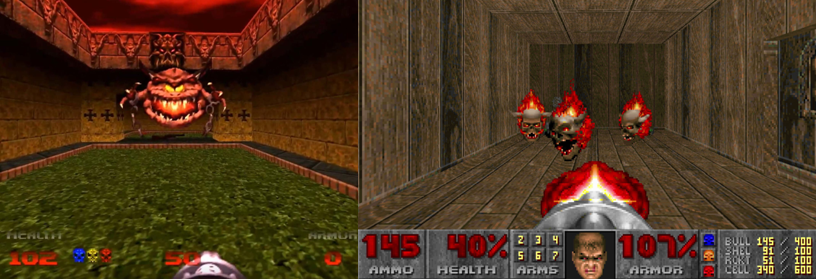
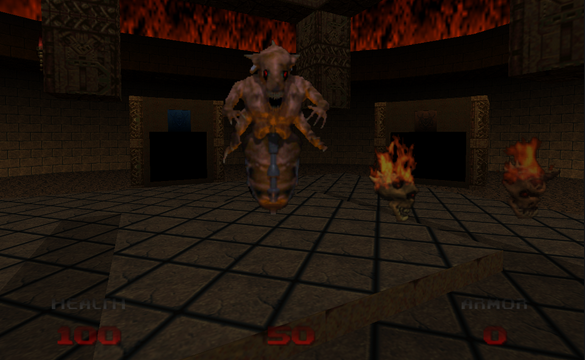
Doomguy also battles some more testing enemies, like the big-ass Hell Knight; the worst of which, for me, are the Pain Elementals. These disgusting, blob-like bastards spew the always-annoying flaming skulls known as Lost Souls, which quickly swarm you and drain your health in no time. Seriously, I would rather run in circles like a madman shooting rockets at a slew of Mancubuses or Barons of Hell than take on a handful of these bastards!

Doom64Mother
Before you face the Mother, you’ll endure an army of demons!

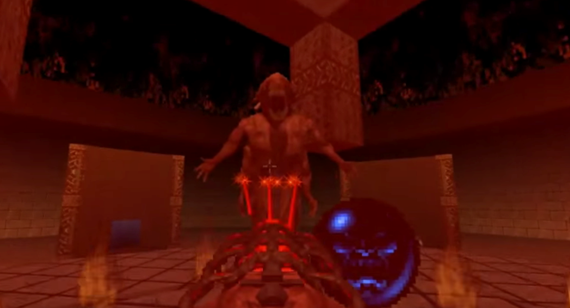
Speaking of which, you’ll often have to battle a rocket-firing Baron of Hell, Mancubus, or Arachnotron as bosses as you progress through the game’s stages but, once you’ve bested them, they’ll crop up in later stages, sometimes in twos or massive groups. In the game’s final level, “The Absolution”, you’ll have to battle through a slaughter of an endurance against an entire army of the game’s enemies, including these bosses, before you can face the Mother Demon…unless you have the three Demon Keys.

Doom64Mother2
Even with the fully-powered Unmaker, the Mother is no cake-walk.

With these, you can close up the portals these enemies spew from and battle the Mother Demon with more of your health and ammo. With these artefacts, the Unmaker will be fully powered, allowing you to make short work of this final boss but, even still, she’s no cake-walk and, without the artefacts, it’s next to impossible to reach the Mother Demon with a decent amount of health, armour, or ammo.

Power-Ups and Bonuses:
You begin the game with a simple pistol and the Doomguy’s patented right hand. As you explore your surroundings (or kill certain enemies), you’ll acquire ammo and additional weapons, including the shotgun, super shotgun, the chaingun, a plasma cannon, and a rocket launcher. Doom’s signature weapon, the BFG-9000, can also be found either in secret areas or in later stages of the game; this baby can be charged up and unleash an energy blast that disintegrates all onscreen enemies and makes short work of the game’s bosses. The game’s most powerful weapon, however, is the Unmaker, a demonic weapon that must be powered up with the three Demon Keys in order to cut through enemies and bosses. Ammo for this weapon, and the BFG-9000, is relatively scarce, however, so it’s advisable to only use it when absolutely necessary.

Doom64BFG
Charge up the BFG-9000 to make short work of demon scum!

Thankfully, you can still grab a chainsaw (this time, it has two blades!) to rip and tear demons into bloody pieces, which won’t cost you any ammo at all. As you explore the stages, you’ll find medikits to restore your health, various armours to increase your resistance to attack, increase your maximum and health and armour points with smaller items, and view any unexplored areas on the game’s awkward map screen. You can also grab the Berserk item to be fully healed and enter a state of rage where the damage you deal with your fists is increased exponentially, pick up a radiation shield so you can walk through lava or radioactive waste, or grab the Supercharge and Megasphere to boost your health and/or armour to their fullest, attain partial invisibility or limited invincibility, or grab a backpack to increase the amount of ammo you can hold.

Additional Features:
Doom 64 features four difficulty settings, each of which affects your health, armour, ammo, and the frequency and aggressiveness of the game’s enemies. There are numerous secrets to be found in each stage, one of which is so well hidden that you’ll be destroying certain explosive barrels in a specific order in order to reach the super secret level, “Heretic”. Once you beat either this stage, or the entire game on any difficulty, you’ll unlock “The Lost Levels”, six additional stages that take the Doomguy back to hell to confront the Mother Demon’s sister (and which form the basis of a link to Doom: Eternal). In addition to this, there are a number of pretty simple Achievements to get on the Xbox One version and, as always, some passwords and cheat codes to make the game more interesting or allow you to warp to the challenging “Fun” stages (however, it is notable that you won’t get an Achievement if you have a cheat code activated).

Doom64Conclusion

The Summary:
Doom 64 is a classic Doom experience first and foremost. At its core, its as bloody and action-packed as the classic Doom and its sequel but, because of its additional features and skewed focus, feels like a fresh experience and an entirely new game rather than a straight-up port. Unfortunately, it can’t be denied that the game’s reliance on maze-like stages, exploration, and keys to progress make the game more frustrating than it needed to be. When I’m playing Doom, I like to blast through demons in a largely linear environment; I don’t really play to think, if that makes sense, and I was forced to a guide more often than I would like for a Doom title. Yet, the game is at its best when you’re fully locked and loaded and faced with a hoard of flesh-eating demons just begging to be blown to bloody chunks.

My Rating:

Rating: 2 out of 5.

Could Be Better

What are your thoughts on Doom 64? Did you play the original release on the Nintendo 64 or did you play it as part of Doom: Eternal? Which Doom is your favourite? Whatever your thoughts on Doom, or FPS games in general, leave a comment below.

Back Issues: WildStorm’s Resident Evil #4

BackIssues

The release of the Resident Evil 3 remake (Capcom, 2020) is still a big enough news item for me to continue my retrospective on Resident Evil: The Official Comic Magazine, a comic book released by WildStorm back in 1998 to 1999 that ran for five issues and covered events between, during, and after Resident Evil (ibid, 1996) and Resident Evil 2 (ibid, 1998).

ResEvComic4Logo

Issue one recapped and filled in events from the first game, while issue two focused entirely on covering the events of the second. The third issue oddly introduced supernatural elements to the lore and began a three-issue arc that would continue in issue four, released in December 1998.

ResEvComic4Leon
Leon shows up to save the day.

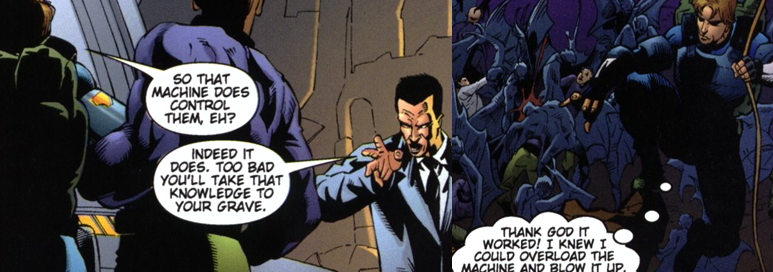
The issue’s first story, “Night Stalkers” (Oprisko, et al), revolves around giant, man-bat creatures created by Umbrella’s G-Virus attacking and small Nevada town. Their bite infects a young boy, turning him into a zombie, but their true purpose is to spirit townsfolk away to a hidden Umbrella lab, where the lunatic scientist Dr Callos, can turn them into more bat-men. Luckily, Leon S. Kennedy rocks up to investigate and, after a brief scuffle, is captured by the man-bats and taken to Dr Callos’ laboratory. Leon manages to overload the machine Callos has been using to control the man-bats and they turn on their creator, ripping him to shreds while Leon makes his escape and the air force move in to eradicate the lab.

ResEvComic4Bat0
A similar creature would appear in Resident Evil Zero.

This was a slightly better attempt at mixing the supernatural with Resident Evil as, unlike last issue’s “Wolf Hunt” (Adams, et al), “Night Stalkers” shows these vampire-like creatures to be products of Umbrella’s G-Virus rather than anything mythical. Once again, the comic oddly foreshadows Resident Evil Zero (Capcom, 2002), which featured a giant infected bat as a boss battle, though that was noticeably less humanoid than the man-bats featured here.

ResEvComic4Res4
Much of this story foreshadow’s Resident Evil 4.

Without really knowing it, this story also provides a bit of a glimpse into Leon’s life between Resident Evil 2 and Resident Evil 4 (Capcom Production Studio 4, 2005); Leon even arrives in a small town using a little jeep, very much like the opening of Resident Evil 4, and is both decidedly more capable and written as more of an action hero as in that game . It’s not really revealed who he’s working for here; he wears a modified version of his riot gear but, judging from his rescuers, appears to work for the United States government.

ResEvComic4MrX
Mr. X makes his grand entrance.

“Special Delivery” (Mostman, et al) makes a minor attempt to address a concern I had with issue two’s adaptation of Resident Evil 2 as it follows two Umbrella helicopter pilots as the fly around delivering Umbrella’s bio-organic weapons (BOWs) to specific areas. Their first drop-off is Mr. X, whom they dump right on top of the Raccoon City police station; though this is the only time he is featured in the story, it’s interesting to see behind the scenes of his delivery as, in the game, he just comes crashing in with a bang.

ResEvComic4BOWs
The pilots are carrying some deadly cargo…

The pilots then drop off a massive man-eating plant, similar to Plant 42, at a chemical warehouse and a Tyrant at a mineshaft working to synthesise anti-viral agents. Just as they’re about to make their last delivery, though, Umbrella’s deceitful nature kicks in and a canister activates, releasing a squid-like BOW on the chopper that promptly kills them in brutal fashion. Side stories like this are a great use of this comic as it allows us to see a version of events we’re normally not privy to in the videogames; Resident Evil, especially the earlier titles, was always ore about reacting to the events and trying to survive through them rather than worry about the hows and the whys. That came through the files and notes and was generally revealed the deeper you got into the games but, around this time, all we really had to go on about Umbrella were documents found strewn around the game’s environments, biased third-party information, and the drudgery that was Resident Evil: Survivor (TOSE, 2000).

ResEvComic4Chris
Of course Chris can pilot the plane safely!

The issue ends with a continuation of last issue’s “Dead Air” (Adams, et al), “Zombies Abroad” (ibid), which begins by solving the pesky problem of safely landing the zombie-infested plane that Chris Redfield, Jill Valentine, and Barry Burton are in. Luckily, Chris is able to do this without any real issue and the rest of the zombies are subdued (thanks to Barry using a make-shift flamethrower, which seems incredibly dangerous in a pressurised aircraft…) before they can infect other passengers).

ResEvComic4Europe
Jill, Barry, and Chris kill their way across Europe.

After landing, the three do a whistle-stop tour of some of England’s most iconic landmarks in search of Umbrella’s European headquarters and find nothing but zombies. The story then just jump cuts to France and becomes an action-packed montage of the three blowing zombies away outside the Eiffel Tower, in the Louvre, and in the Netherlands until they reach a castle in Germany.

ResEvComic4Puzzles
The three solve some puzzles to find clues and hidden areas.

Here, the story slows way down and pulls inspiration from the investigatory and puzzle-solving elements of the videogames; Jill finds a mysterious photograph, Chris discovers a hidden passageway after fiddling with a suit of armour, and Barry finds a hidden note after playing an organ in a near-exact recreation of many of the arbitrary puzzles of the first videogame.

ResEvComic4Zombies
Boy, you said it, Chris!

The story ends on another cliffhanger, with each of our three heroes left in a face of jeopardy. I’m at odds with this one; on the one hand, it’s fun to see these three working together and blowing away zombies but, on the other, there’s a few questions raised. Like, when did the Tyrant-Virus (T-Virus) spread to Europe? Up until this point, it’s only infected small, mid-western towns and areas in America. When was the T-Virus released? If Umbrella’s headquarters weren’t in any of the places the three visited, it’s a bit weird that they’d encounter so many zombies.

ResEvComic4Pacing
It’s a bit late in the game to be focusing on puzzles…

Also, while it’s nice to see the comic really go all-in with adapting the game’s puzzles, I’m not entirely sure if it works for a comic book. Comic books are generally all about frenetic action and, so far, these Resident Evil comics have always had a good balance between gory fire fights and nods to the game’s slower mechanics. I kind of feel like they could have used an entire issue to tell a slow story where we follow a lone character investigating their surroundings, finding clues and maybe solving some puzzles while building threat and looming tension as we see zombies or BOWs closing in on them but suddenly juxtaposing seven pages of zombies getting their heads blown off with elaborate puzzles in a Gothic setting just feels a bit odd here.

ResEvComic4Interlude
The potential is there but I’m not sure the execution was right…

Other than a few additional pieces of artwork from Carlos D’Anda, that’s about it for this issue. At this point, the formula is starting to wear a little thin; it really does feel like WildStorm would have been better off doing maybe three full issues adapting the first game, then three more focusing on the second game, with one side story or interlude in each to help flesh out the Resident Evil lore. They seem, instead, to have been aiming for an anthology-based title but I’m not sure it’s really paying off as we’re only four issues in and they already seem to be struggling for content and story ideas. As there wasn’t much to go on at this point apart from the characterisations and documents we see in the videogames, it might have been smarter to stick to being a straight-up adaptation rather than try and cobble together new content out of, effectively, nothing.

My Rating:

Rating: 2 out of 5.

Could Be Better

Did you ever read the Resident Evil comics published by WildStorm? Would you be interested in the series receiving a reprint as the collection is currently out of print? Do you have a favourite piece of ancillary Resident Evil media? Drop a comment below and come back next Tuesday for my rundown of issue five.

10 FTW: Dark Doppelgängers

10FTW

If there’s one thing any hero can count on it’s that, at some point in their illustrious career, they’re going to have to face off against themselves. Sometimes, like with the classic Demon in a Bottle (Michelinie, et al, 1979) this is a metaphorical battle against their own inner demons and foibles but. More often than not, it’s a literal battle against an evil version of the themselves. Sometimes they’re from another world or a parallel dimension, perhaps they’ve used stolen technology or been cloned from the hero; other times, they are of the same race or seek to replicate the hero’s powers and usurp them. Whatever the case, I’ve always enjoyed a good doppelgänger, generally because they’re just like the hero but dark and edgy or more violent and, being as I grew up in the nineties, I like that kind of stuff. An evil version of a hero can help to elevate the hero by allowing them to overcome their failings and, sometimes, will even edge out of villain territory and become either a full-fledged hero in their own right or a line-towing anti-hero. In either case, today I’m going to run through ten of my favourite dark doppelgängers; evil versions of heroes who are just cool through and through.

10DarkLink
10 Dark Link / Shadow Link

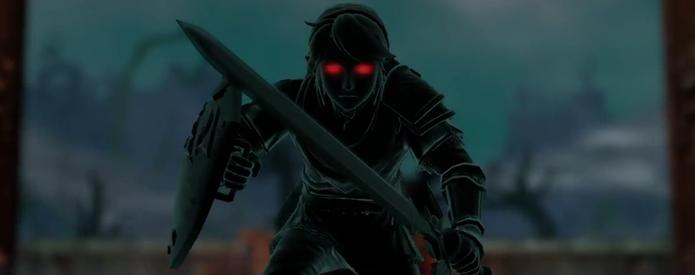
First appearing in Zelda II: The Adventure of Link (Nintendo EAD, 1987) this shadowy version of the heroic Link gets the number ten spot purely because he isn’t really much more than a glorified henchmen for main series villain, Ganon. In true Peter Pan (Barrie, 1902) fashion, Dark Link often takes the form of a pitch-black shadow or a dark, distorted reflection and is able to perfectly mirror all of Link’s attacks and abilities. In recent years, he’s appeared more as a phantom and been given more definition but he’s generally relegated to being a sub-boss for a game’s dungeon and never the true threat to the land of Hyrule.

9Wario
9 Wario

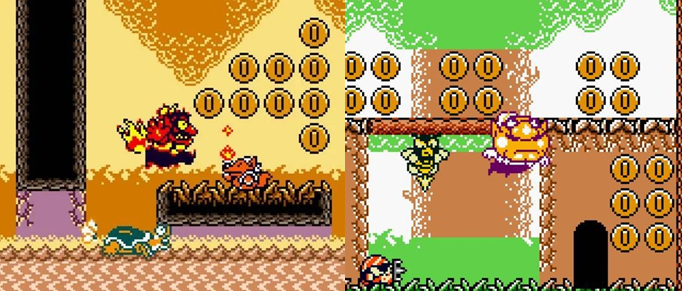
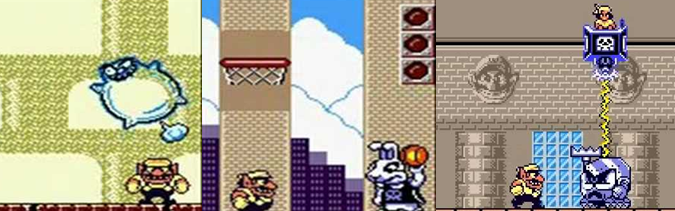
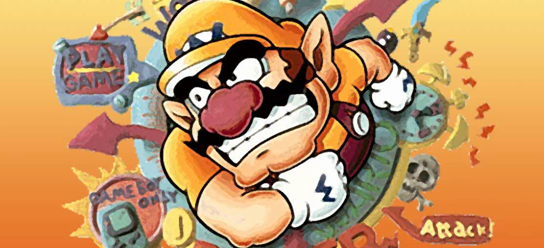
Debuting in Super Mario Land 2: 6 Golden Coins (Nintendo R&D1, 1992), this bloated, disgusting, twisted version of Mario is everything Nintendo’s cute and cuddly mascot isn’t: he’s rude, crude, mad, bad, and dangerous. Where Mario jumps on blocks and Koopa heads to save a delightful Princess, Wario barges through walls and tosses his enemies at each other to steal, loot, or recover treasure. Wario even has his own version of Luigi, Waluigi (who exists more for the sake of existing, I would argue) but, while he crashed onto the scene in a big way by taking over Mario’s castle, Wario has softened over the years. He’s transitioned from an anti-hero and begrudging ally to simply a master of ceremonies as Nintendo moved him away from being the star of his own series of unique games and more towards party games and mini games.

8 Black Adam

Created by Otto Binder and C. C. Beck, Teth-Adam was originally gifted the magical powers of the wizard Shazam and chosen to be his champion, Mighty Adam. After being bewitched and corrupted, however, Adam was stripped of his powers and withered away to dust but, centuries later, was reborn when his ancestor, Theo Adam kills Billy Batson’s parents to lay claim to Adam’s power. Black Adam possesses all of the same powers as Captain Marvel/Shazam but is also gifted with a pronounced mean streak and tactical genius; he briefly reformed for a time, even joining the Justice Society of America and building a family of his own, but his quick temper and deep-seated contempt for humanity generally always drives him into a murderous rampage that few heroes can hope to oppose.

7Janus
7 Alec Trevelyan / Janus

Appearing in what is still probably the best James Bond film ever made, GoldenEye (Campbell, 1995), Alec Trevelyan (masterfully portrayed by Sean Bean) was one of MI6’s top 00 agents. However, wanting revenge against the British government for the death of his family and comrades during World War Two, Trevelyan faked his death and formed a criminal organisation named after his new alias, Janus. Trevelyan makes the list because he’s everything James Bond (Pierce Brosnan) was but twisted towards villainy; he and Bond were close friends and partners and his “death” weighed heavily on Bond’s conscious for nine years, making his betrayal even more sickening. In facing Trevelyan, Bond not only faces his biggest regret and mistake but also himself and what he could easily become if the fates were different.

6Slash
6 Slash

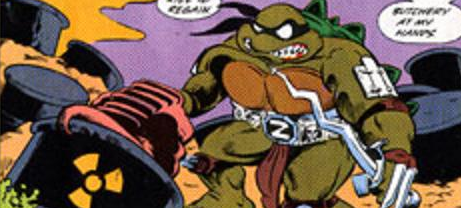
First appearing in ‘Slash, the Evil Turtle from Dimension X’ (Wolf, et al, 1990), Slash was originally an evil violent mirror of the heroic Teenage Mutant Ninja Turtles who often appeared in Turtles videogames and merchandise as a sub-boss for the Turtles to fight. For me, his most iconic look is when he’s sporting a black bandana, some spiked apparel, razor-sharp, jagged blades, and a heavy, armour-plated, spiked shell. Slash’s look and characterisation have changed significantly over the years as he’s gone from a somewhat-eloquent villain, to a rampaging monster, to an ally of the Turtles depending on which version you’re reading or watching.

5TheMaster
5 The Master

Originally (and, perhaps, most famously) portrayed by Roger Delgado, the Master was a renegade Time Lord who rebelled against his overbearing masters to freely wander through time and space. While this closely mirrors the story of his childhood friend, the Doctor (Various), the Master was the Doctor’s exact opposite: evil where the Doctor was good, malicious where the Doctor was kind, and wanted nothing more than to extend his lifespan, conquer other races, and destroy (or break) his oldest rival. Though sporting a deadly laser screwdriver and able to hypnotise others, the Master gets the number five spot simply because he’s been overplayed to death in recent years. Time and time again we’ve witnessed the Master at the end of his regeneration cycle, or destroyed forever, only for yet another incarnation to appear and wreck more havoc. He’s even redeemed himself and turned good before, and yet still returns to his wicked ways to plague the Doctor even when his threat should long have ended.

4 Metal Sonic

Speeding onto the scene in Sonic the Hedgehog CD (SEGA, 1993), Metal Sonic stands head-and-shoulders above all over robot copies of Sonic the Hedgehog simply by virtue of his simplistic, bad-ass design. A fan favourite for years, Metal Sonic has made numerous appearances in multiple Sonic the Hedgehog (Sonic Team/Various, 1991 to present) videogames, comic books, and other media. Sporting a sleek, aerodynamic design, chrome plating, and a massive jet engine on his back, Metal Sonic did something no one had done at the time of his debut and not only matched Sonic’s speed, but outmatched it on more than one occasion. While Sonic CD is far from my favourite Sonic title, it’s hard to downplay the iconic race against Metal Sonic in Stardust Speedway or his impact on the franchise.

3ReverseFlash
3 Reverse-Flash

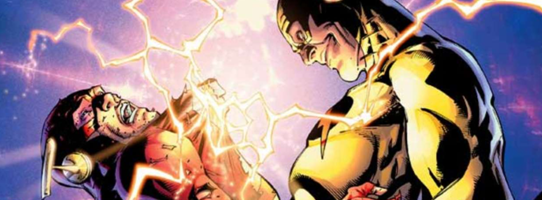
Versions of the Reverse-Flash have plagued DC Comics’ speedsters over the years, most notably Edward Clariss (The Rival), Eobard Thawne (Reverse-Flash), and Hunter Zolomon (Professor Zoom). Sporting a yellow variant of the classic Flash suit and shooting off sparks of red lightning, the Reverse-Flash is generally characterised as using his powers to torture the Flash out of a twisted desire to make him a better hero. Reverse-Flash’s threat is increased by his tendency to travel through time, evading death and plaguing different generations of the Flash; Professor Zoom was even able to manipulate the Speed Force to jump through time and appear to be faster than the Flash. Reverse-Flash has also been the cause of numerous agonies in the lives of multiple Flashes; he’s killed or threatened those closest to him (including Barry Allen’s mother) and delights in bringing the Flash to the brink of his moral code.

2JudgeDeath
2 Judge Death

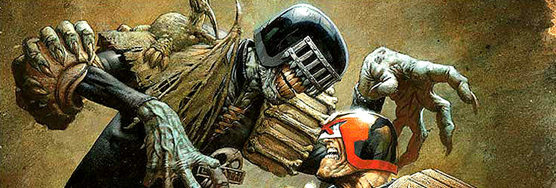
Hailing from an alternate dimension where life itself is a crime (as crimes are only committed by the living), Judge Death is the dark counterpart to no-nonsense lawman Judge Dredd. First appearing in 1980 and created by John Wagner and Brian Bolland, Judge Death assumes the appearance of the Grim Reaper and uses his demonic powers to kill with a touch. Rocking a metal design (recently evoked by the Batman-Who-Laughs, another contender for this list), Judge Death takes Dredd’s uncompromising enforcement of the law and ramps it up to eleven. Alongside his fellow Dark Judges, he once slaughtered over sixty million citizens of Mega City One and, despite his corporeal form being destroyed or trapped, has returned time and time again to bring judgement upon the living.

1 Venom

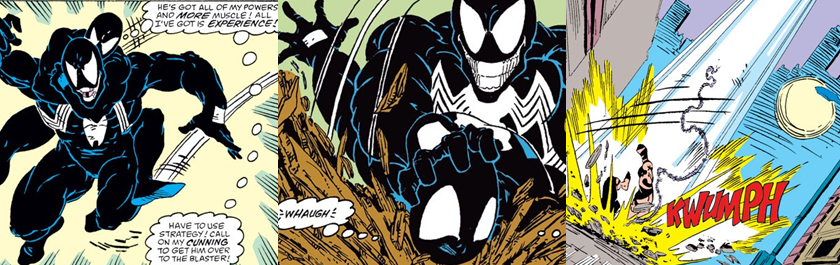
Perhaps the most popular (or, at least, mainstream) of all dark doppelgängers is the alien symbiote who, when bonded to Eddie Brock (or others), is known as Venom. Created by David Michelinie and Todd McFarlane, Venom began life as a black alien costume that absorbed Spider-Man’s powers and abilities and sought to permanently bond with him. When Spidey rejected it, it turned to Brock and, through their mutual hatred of Spider-Man, Venom was born. Sporting a super simple design (pitch-black with a white spider logo, emotionless white eyes, deadly fangs and claws, and a long, drooling tongue), Venom plagued Spidey for years. Immune to Spidey’s Spider-Sense and sporting all his powers, but double the strength and viciousness, Venom has evolved from a sadistic villain, to an anti-hero, to all-out hero over the years but, thanks to their equally violent offspring, has been the source of much death and woe to Spider-Man since day one.

0CrimeSyndicate

What dark doppelgänger is your favourite? Were there any I missed off this list, or do you, perhaps, feel the evil copy is a played out trope? Drop a line in the comments and pop back for more lists and articles.

Game Corner: Wario Land II (Nintendo 3DS)

GameCorner
WarioLand2Logo

Released: 2012
Originally Released: February 1999
Original Developer: Nintendo R&D1
Also Available For: Game Boy Color

The Background:
Super Mario Land 2: 6 Golden Coins (Nintendo R&D1, 1992) didn’t just blow its predecessor out of the water in terms of graphical and gameplay improvements, it also introduced the gaming world to one of my favourite characters of all time Wario, Mario’s evil doppelgänger, for the first time. While it would be some time before Wario made the jump to a main Nintendo console, and before he was relegated to simple mini games and cameo appearances, Mario’s evil twin thrived on Nintendo’s handhelds. First, he usurped the Super Mario Land franchise with Wario Land: Super Mario Land 3 (ibid, 1994), which led to a slew of sequels on Nintendo’s handheld systems.

The Plot:
After besting Captain Syrup and her Black Sugar Pirates, Wario is rudely awakened one day to find his castle has been flooded and ransacked by Syrup and her goons; enraged, he sets off to recover his loot and get his revenge.

Gameplay:
Wario Land II is a sidescrolling, 2D action/platformer; players control Wario as he journeys across a variety of worlds, collecting Yellow Coins and dispatching enemies with Wario’s patented Dash Attack and Ground Pound. Wario controls almost exactly as he did in the last game; he can jump on most enemies to stun them so he can pick them up and throw them, or just barge them with his Dash Attack. However, the knockback from enemy attacks is a considerable frustration; not only do you lose vital Coins, you also bounce back quite a way, which can be extremely annoying and lead you to drop to lower levels. What sets Wario Land II apart from its predecessor, and other Mario videogames, is Wario’s inability to die; when hurt by enemies or traps, Wario will lose some of the Coins he has gathered or be transformed into one of a number of different forms.

WarioLand2Forms
Rather than dying, Wario is transformed, allowing access to new areas.

These transformations are essential to navigating the different worlds Wario travels to and uncovering Wario Land II’s numerous secrets; hidden in every world is a piece of treasure, which Wario must earn by matching panels. As with its predecessor, finding the doors to these treasure rooms is no easy feat and Wario must navigate through some tricky puzzles and traps in order to find every piece. Once a world is completed, the player can also earn a Picture Piece to complete a map to the pirate’s treasure by completing a number-matching game. Wario Land utilised a map hub world similar to Super Mario Land 2 but Wario Land II is far more linear…or so it would seem. In actuality, there are many branching paths the player can take as they play; even inaction at the start of the game will lead Wario to different worlds and treasures. Once you finish the game, you gain access to the Treasure Map, which details all the different paths, allowing you the chance to recover the entirety of Wario’s missing loot and reach the true finale.

Graphics and Sound:
Wario Land II represents a time far removed from the basic, unremarkable presentation of Super Mario Land (ibid, 1989); characters and levels are brought to life through large, charming sprites that are a far cry from the first game’s monochrome offerings.

WarioLand2Graphics
Everything looks and sounds pitch-perfect here.

There are a lot of familiar sounds here that return from Wario Land, all of which add to the quirky, slightly off-kilter nature of Wario and his world. Nintendo walked a fine line between familiar and unique but executed this perfectly so that playing Wario Land II is unlike playing any other Mario title from that era and yet recognisable enough so that anyone who played its predecessor will feel right at home with familiar sights and sounds.

Enemies and Bosses:
Many of Wario Land’s generic enemies return here (such as the boomerang-wielding D.D and the Pirate Gooms) but there’s plenty of new and unique baddies to encounter; there’s a little mole cook who will fatten Wario up, pirate pecans who spit fish at you, zombies, and a fishing penguin who lures you in with fake Coins.

WarioLand2Bosses
Wario Land II has some weird-ass bosses on offer.

As for bosses, Wario Land II doesn’t disappoint and continues the tradition Super Mario Land 2 started with having big, oddball bosses; Wario will face off against the likes of a giant snake, a basketball-throwing rabbit, a giant dinosaur-like bird, and Captain Syrup herself. Though they can usually be defeated with a few well-placed bops to the head, each boss has a specific attack pattern and various phases; many will blast Wario out of the boss room entirely, forcing you to trek back around and start again or require a certain method to injure them (like dunking them through a basketball hoop or blasting lava at them).

Power-Ups and Bonuses:
In Wario Land, Wario controlled very similar to Mario; when hit, he reverted to a smaller form and he collected Power Up Pots to can new abilities. As mentioned above, though, Wario Land II ditches the traditional power-ups in favour of some truly weird transformations.

WarioLand2Conditions
Each transformation has its own benefits.

Certain enemy attacks will trigger a transformation in Wario that is necessary to reach other areas of each world and hidden secrets; Wario transforms into a burning ball of fire when set alight, becomes a zombie to drop to lower levels, or swells up to balloon-like proportions to reach higher levels, amongst other transformations. Part of Wario Land II’s gameplay is figuring out which enemies trigger a transformation and how to use that transformation in each area. It’s only by utilising all the tools at Wario’s disposal that players will be able to conquer each world, all the different branching paths, and access the secret final chapter, which is a time attack challenge through Syrup Castle.

Additional Features:
Collecting all the treasures in the game and completing the Picture Piece map doesn’t just allow you access to Syrup Castle, though; it also unlocks Flagman D-D, a remake of the Game & Watch mini game Flagman (Nintendo, 1980). This inclusion, and Wario Land II’s increased use of mini games compared to its predecessor, could be said to foreshadow Wario’s later preference towards mini games rather than fun little action platformers like this.

WarioLand2Conclusion

The Summary:
Wario Land II takes everything you knew from its predecessor and changes it just enough to deliver a unique gaming experience; appearing far more linear, the game hides many secrets and branching paths in a far more subtle way compared to Wario Land, meaning the no two players will have the same gameplay experience. Fittingly, Wario feels heavy and cumbersome; unlike Mario, he’s not build for precision platforming, which may be why Wario Land II substitutes such gameplay for simple puzzles, mazes, and alternative routes accessed by Wario’s transformations. Yet, at the same time, there seems to be a slight lack of polish to Wario Land II that can make some sections and bosses battles needlessly frustrating. However, the unique aspect of being immortal and changing forms to reach new areas, coupled with the chirpy tunes and big, quirky sprites make this a joy to play as no challenge presented by Wario Land II ever feels game-breaking or impossible.

My Rating:

Rating: 3 out of 5.

Pretty Good

What are your memories of Wario Land II, if any? Do you like Wario and, like me, wish he would return to a more prominent position? What was your favourite of the Super Mario titles on the original Game Boy? Leave a comment below and share your thoughts.

Back Issues: WildStorm’s Resident Evil #3

BackIssues

I’m still riding the coat-tails of the Resident Evil 3 remake (Capcom, 2020) with my retrospective on Resident Evil: The Official Comic Magazine, a five-issue comic book released by WildStorm back in 1998 to 1999 that filled in events between, during, and after Resident Evil (ibid, 1996) and Resident Evil 2 (ibid, 1998) to flesh out the Resident Evil lore outside of the videogames.

ResEv2Comic3Logo

We’ve already seen how issue one used four stories to tell a recap of Resident Evil and interludes between that game and its sequel, and how issue two reduced the stories within to three while expanding the page count and revolving entirely around the events of the sequel. Issue three, released in September 1998, keeps the three-story format but also reverts to telling interludes and side stories to the main series videogames.

ResEvComic3Wolf2
A wolf-like creature has been killing students.

The first story, “Wolf Hunt” (Adams, et al) takes place before the events of Resident Evil and revolves around Jill Valentine going undercover at Racoon City College after some particularly gruesome murders take place there. Barry Burton accompanies her as back-up and she is soon attacked by a wolf-like creature. She immediately kills it and the story ends with the strong implication that it was actually a werewolf.

ResEvComic3Wolf
Turns out it was a werewolf…apparently?

This was basically a nothing story and really didn’t add much to Jill or Barry’s backstories or personalities beyond showing them working together before resident Evil. It s interesting to see Albert Wesker giving them orders and showing life in the Special Tactics and Rescue Service (S.T.A.R.S.) before the Tyrant-Virus (T-Virus) outbreak but, ultimately, it could have just been any story and supernatural elements shouldn’t really be involved with Resident Evil.

ResEvComic3G-Eel
The G-infected eel is quite the persistant beast.

WildStorm finally introduce the Licker in the second story, “Danger Island” (Oprisko, et al), in which a couple find their island vacation ruined when a capsule containing the creatures breaks open on the island, releasing both them and the G-Virus upon the populace. Stan and Leslie (the aforementioned couple) soon find themselves beset upon by all manner of gigantic mutated creatures mutated by the G-Virus, in particular a massive eel that ensures that the Lickers don’t get a chance to actually do anything.

ResEvComic3Birkin
Birkin, of all people, arrives to silence their victory.

Stan is eventually able to kill the eel and, though he and Leslie are injured, they survive (using herbs to ease their wounds) and manage to call for help, only for William Birkin to show up and (it’s strongly implied) execute them to keep Umbrella’s secrets. This story focused more on the variety of mutated bio-organic weapons (BOWs) players can encounter in the Resident Evil videogames. There’s only one zombie, shown very briefly, ensuring that the story can focus entirely on the G-eel that relentlessly pursues Stan and Leslie. It’s a shame that the Lickers weren’t given more focus as the story could easily have been about them hunting prey using the island’s forestry as camouflage but it did provide a bit of a look at Birkin’s despicable character (even if he wasn’t really much of a hands-on kinda guy in the videogames).

ResEvComic3TeamEurope
Jill, Chris, and Barry prepare to head to London.

The issue ends with “Dead Air” (Adams, et al) which is not only the first in a multi-part story (a first for the comic) but also a direct sequel to side stories seen in the last two issues. This story sees Chris Redfield, Barry Burton, and Jill (looking a lot like Chris’s sister, Claire, for some reason), travel to London after the events of the first game. This is interesting as, while other stories and the videogames had eluded to Chris travelling to Europe to investigate Umbrella further, I don’t believe it was ever stated that he went with his old partners, at least not before Resident Evil 5 (Capcom, 2009).

ResEvComic3Pilot
Jill beats the infected pilot to death!

As you might expect, a T-Virus outbreak occurs once they’re in the air, forcing the characters to have to battle them without their usual weapons. Amidst the outbreak and the desperate situation, Jill realises that she’s beaten the infected pilot into mush, leaving the plane hurtling through the air in a downward spiral.

ResEvComic3Plane
Surprisingly, Resident Evil hasn’t had much plane action.

This story opts for the more close-quarters combat players can come to expect from Resident Evil’s claustrophobic environments but we’ve yet to actually battle an outbreak on a plane before; there was that outbreak on the narrow cabins of the train in Resident Evil Zero (Capcom, 2002) but the closest the series has come to exploring an airborne outbreak was in the opening scenes of Resident Evil: Degeneration (Kamiya, 2008), which is a bit surprising really.

ResEvComic3Plane2
Imagine equipping THAT to your inventory!

After issue two only included a brief artist’s gallery, issue three features another interview with Resident Evil producer Shinji Mikami, though it’s decidedly less interesting as the last one as he mainly dodges questions about Resident Evil sequels and talks about his childhood. In the end, issue three is a lot weaker than issue two but, between “Danger Island” and “Dead Air”, there’s some decent action/horror to experience here. Starting a multi-part story on issue three rather and issue one was an…interesting idea as, usually, continuous stores are used by comics to entice readers into buying the next issue. I guess the strength of the Resident Evil brand was enough that WildStorm felt they could wait a few issues before trying to do sequential stories.

My Rating:

Rating: 3 out of 5.

Pretty Good

Did you ever read the Resident Evil comics published by WildStorm? Would you be interested in the series receiving a reprint as the collection is currently out of print? Do you have a favourite piece of ancillary Resident Evil media? Drop a comment below and come back next Tuesday for my rundown of issue four.

Game Corner: Sonic the Hedgehog: Triple Trouble (Nintendo 3DS)

GameCorner
SonicTripleTroubleLogo

Released: March 2012
Originally Released: November 1994
Developer: M2
Original Developer: Aspect
Also Available For: Game Gear, Gamecube, and PlayStation 2

The Background:
A lot of people forget that, alongside Sonic the Hedgehog’s iconic and much-lauded Mega Drive titles, SEGA also released a fair few Sonic videogames for their 8-bit consoles. The 8-bit versions of Sonic the Hedgehog (Ancient, 1991) and Sonic the Hedgehog 2 (Aspect, 1992) differed considerably from the 16-bit counterparts, featuring entirely different Zones, gameplay gimmicks, and features. While Sonic 2 had almost nothing in common with its bigger, better brother, Sonic the Hedgehog Chaos (ibid, 1993) represented Aspect’s first real attempt at a completely original Sonic title. Released in Japan as Sonic & Tails, Sonic Chaos was a major step up from the first 8-bit Sonic, featuring a playable version of Miles “Tails” Prower, bigger and better graphics, and many other upgrades that left its 8-bit predecessors in the dust. After SEGA switched their focus entirely to the Mega Drive, Triple Trouble and all subsequent 8-bit Sonic titles were released exclusively on the Game Gear.

The Plot:
The diabolical Doctor Eggman scatters the Chaos Emeralds across the world but secures one for himself and tricks Sonic’s friendly rival, Knuckles the Echidna, into tracking the remaining gems. However, Nack the Weasel (known as Fang the Sniper in Japan) is hording the Emeralds inside the Special Stages, resulting in Sonic and Tails facing all three in their quest to recover the Chaos Emeralds.

Gameplay:
Like its predecessors, Triple Trouble is a sidescrolling, 2D platformer based on speed. Of all the 8-bit Sonic titles, this is easily the biggest and the fastest; players can choose to play as either Sonic or Tails and journey through the game’s six Zones and each plays a little differently.

Run or fly through Zones as Sonic or Tails and tackle a variety of Special Stages.

Both characters can run, jump, and spin as normal and enter a Spindash by pressing down and A; pressing up and A as Sonic allows him to perform the Strike Dash, a version of the Peel-Out, to blast ahead at full speed. Tails, however, flies instead of performing a Strike Dash and, unlike in Sonic Chaos, Tails can actually access the Special Stages and collect the Chaos Emeralds. Speaking of which, like all 8-bit Sonic titles, Triple Trouble features a unique way of accessing the Special Stages; players must first collect fifty Golden Rings, locate and smash open a Chaos Emerald monitor, then enter the sparkling warp to challenge Nack for a Chaos Emerald. Like Sonic Chaos, each Special Stage offers a different challenge, including bouncing around collecting Rings, piloting the Tornado bi-plane, or navigating a maze.

SonicTripleTroubleNack
Nack acts like a tough guy but is really a pushover.

At the end of each Special Stage, they then battle against Nack, who shows up sporadically throughout Triple Trouble to cause Sonic or Tails headaches, similar to Knuckles in Sonic 3. Despite his cool and unique character design, Nack is more a buffoon and an annoyance than an actual challenge, however. Triple Trouble’s Zones borrow heavily from other Sonic titles and yet still manage to stay relatively unique; Tidal Plant Zone has more than a passing resemblance to Sonic the Hedgehog CD (ibid, 1993)’s Tidal Tempest, for example, and Atomic Destroyer Zone is like a combination of Sonic & Knuckles’ (SEGA Technical Institute, 1994) Death Egg Zone and 8-bit Sonic 2’s Scrambled Egg Zone thanks to its abundance of maze-like tubes. Oddly, Triple Trouble features a large number, and dependence upon, springs; the first Zone, Great Turquoise Zone, is chock full of them (they’re on the trees, the ground, and even the Badniks!) and one of the main things you’ll find yourself doing when playing Triple Trouble is bouncing around on springs and other bouncy hazards, fighting with the stiff controls to get Sonic or Tails back on track. Being that it’s an 8-bit title, Triple Trouble lacks some of the polish of its 16-bit counterparts but, saying that, its 8-bit predecessors felt a bit easier to handle. Here, Sonic jutters along, refusing to change direction mid-air, and feels sluggish and weighed down, making precise platforming difficult. This is a bit of an issue when trying to explore Zones for those elusive Chaos Emerald monitors and when tackling the Special Stages but, for a simple pick-up-and-play title, isn’t a major handicap, especially as there’s not much in the way of bottomless pits or cheap deaths.

Graphics and Sound:
As mentioned before, Triple Trouble is probably the best looking 8-bit Sonic title. The sprites are large and full of character and the Zones and environments are bright and lively. Of all the 8-bit Sonic titles, this comes the closest to matching its 16-bit counterparts, particularly by evoking the same sense of fun and adventure found in Sonic 3.

SonicTripleTroubleZones
You may recognise Triple Trouble‘s aesthetic.

What lets the game down, however, is the sound. As it was originally developed for the Game Gear, sounds are muddy and distorted, as though they’re playing underwater. The game’s music is catchy enough and fits perfectly but collecting Rings or smashing Badniks lacks the usual oomph I expect from a Sonic title.

Enemies and Bosses:
Triple Trouble features the usual mechanised enemies we’ve all come to expect from a Sonic title, especially one from his heyday; Badniks range from robotic snails with springs on their shells to exploding penguins. Most are easily destroyed by simply spinning into them but there’s a fair few Badniks here that cannot be destroyed, which prove especially annoying when you run face-first into them and then stutter down to a lower level thanks to the game’s janky knock-back feature.

Bosses aren’t lacking in variety, although Dr. Eggman ends up being a bit of a pushover.

Like in the 8-bit Sonic 2 and Sonic Chaos, bosses consist, for the most part, of giant Badniks (such as a giant flying turtles and a bomb-spewing, rocket-powered penguin). However, Sonic and Tails also have to battle Knuckles, who fires bombs and rockets from a cute little vehicle, Nack (who bounces around in a funky spring-loaded contraption), Metal Sonic (in a variation of the iconic battle from Sonic CD), and, of course, Doctor Eggman. Sonic or Tails won’t battle Eggman until the game’s finale, however. This boss battle has three stages but there isn’t much to it; you simply ram his machine until it explodes and transitions to the next phase and, in the final stage (which is eerily reminiscent of the final bosses from the first two 8-bit Sonic titles), you dodge some lightning and smash him as he cycles around a tube.

Power-Ups and Bonuses:
Like all Sonic titles, Sonic and Tails can smash monitors to aid their progress; they can get an extra ten Rings, a speed boost from the Power Sneakers, an invincibility, hit a checkpoint, or gain extra lives as standard but can also access some additional items.

Triple Trouble has some fun, unique power-ups, including Tails’s cute little submarine!

There’s a snowboard that lets Sonic cut through the Robotnik Winter Zone with ease, Propeller Shoes that allow him to navigate underwater, Rocket Shoes to allow him to burn through the sky, and a Pogo Spring because…there aren’t enough springs in the game already. These last two popped up in Sonic Chaos as well but it’s nice to see them return here and it’s a welcome change to the usual shield power-ups. Sonic doesn’t get all the toys, though, as Tails can jump into the Sea Fox to navigate through Tidal Plant Zone without the need for air bubbles. Since he doesn’t need to Rocket Shoes, he can also grab the Hyper Heli-Tails to increase the duration of his flying ability. Additionally, players won’t lose all of their Rings when hit; instead, they’ll only lose thirty Rings, which makes playing through Triple Trouble much easier compared to the first to 8-bit Sonic titles where Sonic couldn’t even collect the Rings he lost.

Additional Features:
There isn’t much else in Triple Trouble; obviously, as with the majority of Sonic titles, the ultimate goal is to collect all of the Chaos Emeralds to receive the game’s best ending but this doesn’t offer any reward other than not being told to “Try again”. There’s no Super Sonic here, no two player mode, and you cannot unlock Knuckles or anything like that. It’s a very simple, one-player experience with the minimum of effort being asked of you. The Virtual Console version, however, offers a few extra features; you can create a save point (which is quite handy if you need to stop playing but you only get one save), change the aspect ratio of the display, and fiddle about with a few other minor settings but that’s about it. For such an ambitious 8-bit Sonic title, it remains as bare bones as all 8-bit Sonic videogames were back in the day.

SonicTripleTroubleSummary

The Summary:
Sonic the Hedgehog: Triple Trouble is decent enough, for the most part; Zones are bright, vibrant, and easy to blast through, Sonic has never looked better in 8-bit, and there’s a decent amount of variety and challenge on offer. However, for as much as Triple Trouble outpaces its 8-bit predecessors, it’s still an 8-bit title; the controls are clunky and unresponsive, the knock-back from damage is a pain in the ass, and sound effects are distorted. Similar to the Game Gear version of Sonic 2, the screen is zoomed in quite a bit as well, which means you’re never quite sure what you’re running into. Overall, I enjoyed the game; it was probably the best 8-bit Sonic game of the bunch, but it’s still far from perfect. I loved Nack and how he was worked into the game, even if he was, technically, just a rip off of Knuckles, and it’s a shame that he hasn’t been brought back in a similarly high profile role. Honestly, I’d love to see this game get a proper, Sonic Mania (PagodaWest Games/Headcannon, 2017) style remake (alongside, or as part of, it’s other 8-bit brothers) but it seems like SEGA and Sonic Team and happy to let their 8-bit/handheld Sonic titles fade into obscurity, which is a shame really.

My Rating:

Rating: 3 out of 5.

Pretty Good

What were your experiences with Triple Trouble? Do you also long for Nack’s return to the franchise? What did you think of Sonic’s other 8-bit outings? Drop a line in the comments to let me know.
Back Issues: WildStorm’s Resident Evil #2

BackIssues

This month is all about the Resident Evil 3 remake (Capcom, 2020) and, as such, I’m taking a look back at the official Resident Evil comic released by WildStorm back in 1998 to 1999. The five-issue Resident Evil: The Official Comic Magazine mostly filled in events between, during, and after Resident Evil (ibid, 1996) and Resident Evil 2 (ibid, 1998) to flesh out the Resident Evil lore outside of the videogames.
ResiEvComic2Logo

Issue two, released in June 1998, features only three stories compared to the four of issue one but has more pages devoted to each one). From this issue, the comics also start to use the God-awful American variant of the classic Resident Evil title font, most likely as this issue is more focused on events surrounding the second videogame.

ResiEvComic2Adaptation
Issue two includes an adaptation of Resident Evil 2.

Another major change is that this issue actually includes a straight-up adaptation of Resident Evil 2, including dialogue lifted straight from the videogame. Whereas the closest issue one got was a recap on the first game, “A New Chapter of Evil” (Adams, et al) details pretty much the entirety of Leon S. Kennedy and Claire Redfield’s stories, picking up with them being separated on the streets of Raccoon City and following both on their journey through the Raccoon City police station and the Umbrella facility beneath the city streets.

ResiEvComic2Leon
Leon’s story gets some fair representation here.

As in the game, the story jumps back and forth between the two but, ostensibly, the plot remains the same just without any Lickers: Leon makes it to the police station, where he meets and is eventually attacked by Marvin. After catching up with Claire, he bumps into Ada Wong and is shot by Annette Birkin after having a run-in with a G monster. Patched up by Ada, Leon dispatches of a giant mutated alligator and they descend into the Umbrella facility. Ada betrays Leon and falls to her death while trying to steal the G-Virus, leaving him with little time to escape the facility.

ResiEvComic2MrX
And that’s seriously all for Mr.X…

As all this is going on, Claire (who begins the story packing a lot more heat than her videogame counterpart) has an extremely brief and uneventful run-in with Mr. X. seriously, she takes him out with just “five rounds”, off panel, and he never appears again. It’s like the writers only played snippets of Claire’s story.

ResiEvComic2Birkin
“G” goes down like a bitch every time.

Anyway, Claire meets Annette’s daughter, Sherry, and they witness the corrupt Police Chief Irons be killed by Sherry’s father, William, who has mutated into “G”. Claire dispatches “G” (once again with laughable ease) and comforts Sherry after her mother is killed. They hook back up with Leon and, after finally doing away with “G”’s final form, they escape the facility just as it self-destructs.

ResEv2Comic2GZoo
“G” infects the animals in the city zoo.

As an adaptation of Resident Evil 2, “A New Chapter of Evil” is both extensive and rushed; loads of Claire’s story is skipped entirely, with Mr. X practically being a non-player, and the threat posed by “G” is almost completely non-existent as the characters defeat it while barely breaking a sweat. Hell, it takes Leon more effort to kill the alligator than “G”! Yet, as a quick run through of the game’s major story events, this is serviceable enough, though it feels as though the issue would have benefitted greatly from devoting its entire page count to their adaptation rather than twenty-odd pages. “Mutant Menagerie” (Oprisko, et al) briefly shows how Birkin was driven to infect himself with the G-Virus after being gunned down for his research samples. Mutating into “G”, all he can think of is to infect as many hosts as possible, which leads him to the Raccoon City Zoo.

ResEv2Comic2Patrick
Patrick is successful…or so it seems!

This is bad news for the on-shift security guard Patrick Brady, who soon finds himself fighting to survive with limited ammunition and resources against infected tigers, pandas, snakes, apes, and prairie dogs. After he realises that he’s all alone, he fights through the zoo and its infected creatures to overload the zoo’s power generator and keep the animals from escaping. Though seemingly successful, he passes out from fatigue while one last prairie dog looms in for a snack.

ResEv2Comic2ZooOutbreak
A zoo was similarly infected in Outbreak: File #2.

This story does a pretty good job of relating the desperation that accompanies Resident Evil videogames; Patrick doesn’t have a lot at his disposal and is up against the odds, much like the player often is. He also is forced to battle through hordes of enemies to reach an elaborate objective, which is pretty much par for the course of all Resident Evil titles. Interestingly enough, one of the scenarios in Resident Evil Outbreak: File #2 (Capcom, 2004) saw characters dealing with a wide variety of infected creatures at the Racoon City zoo, though I would be surprised if that game took any inspiration from this particular story.

ResEv2Comic2TyrantRoaches
This issue really downplays the threat of the Tyant to an absurd degree.

The final story, “Lock Down” (Oprisko, et al) follows Barry Burton about a week after the events of Resident Evil; traumatised by what he experienced, Barry opts to visit a psychiatrist but, wouldn’t you know it, the building is suddenly infested with zombies! Swiping an access key, Barry is handed a map and instructions by a dying guard and is forced to battle his way through not only zombies but a Tyrant in order to piece together a bomb that will destroy the building. Funnily enough, Barry struggles more with giant mutant cockroaches than the Tyrant and he is able to leap to safety as the building explodes.

ResEv2Comic2Mission
All he’s missing is an Item Box…

If the first story was an adaptation of Resident Evil 2’s plot, the second adapted the survival/horror gameplay, this last story goes all-in with representing the arduous side missions and tasks players must complete while battling mutated creatures and monsters. Barry must search the building using a map to find the three bomb parts, even blasting a zombie apart to get a key to open a locker for one piece, and then assemble the bomb before escaping to safety.

ResEv2Comic2Characterisation
This comic fleshed out Barry’s character before the games did.

It’s interesting how the first issue was basically an anthology comic of side stories and companion pieces to the first two Resident Evil videogames and it isn’t until the second that WildStorm produced a more traditional adaptation of the source material. That being said, while “Lock Down” does wonders for fleshing out Barry’s personality (he has a snarky, gritty action-hero attitude that wouldn’t really be seen for some time), the clear standout of this issue is “A New Chapter of Evil”. A lot of this is due to my personal bias for Resident Evil 2 but I feel it’s a stronger statement to feature an adaptation of the videogame alongside smaller side stories rather than just filling the pages with recaps or interludes.

My Rating:

Rating: 4 out of 5.

Great Stuff

Did you ever read the Resident Evil comics published by WildStorm? Would you be interested in the series receiving a reprint as the collection is currently out of print? Do you have a favourite piece of ancillary Resident Evil media? Drop a comment below and come back next Tuesday for my rundown of issue three.