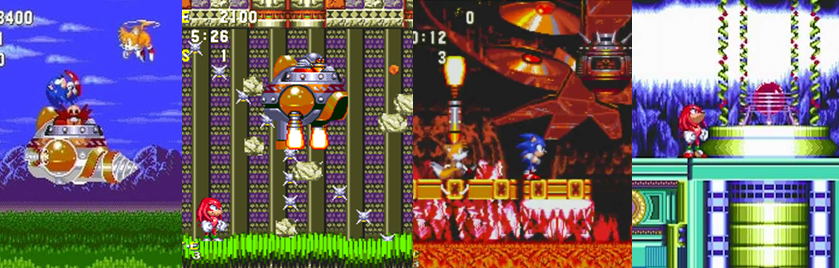
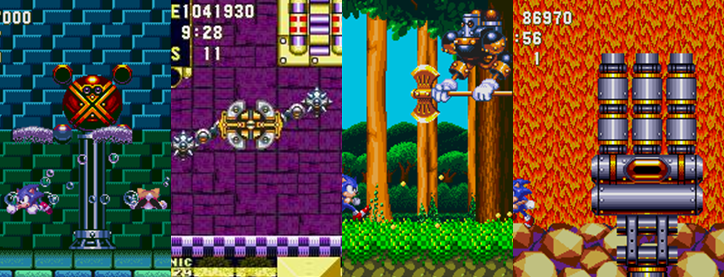
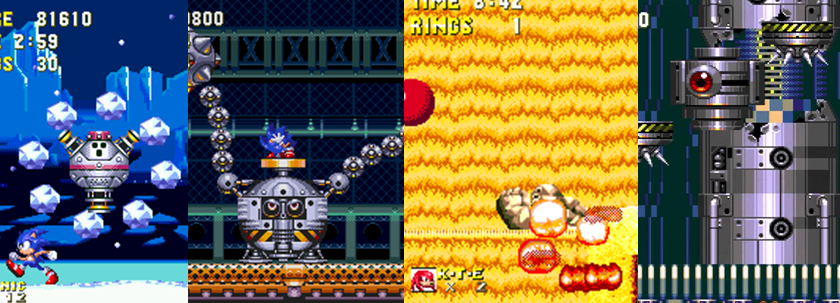
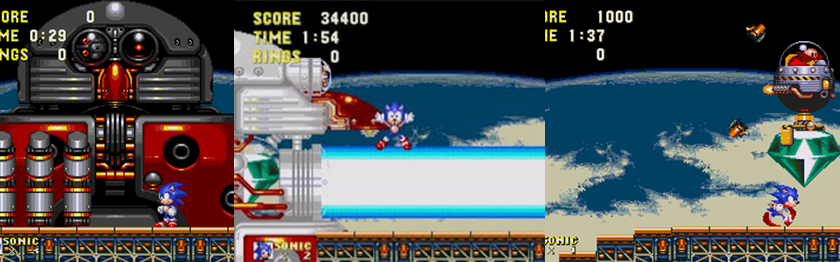
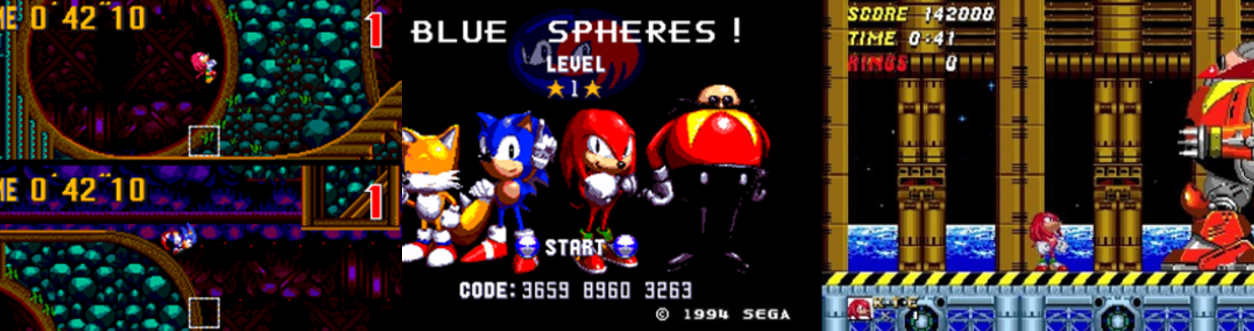
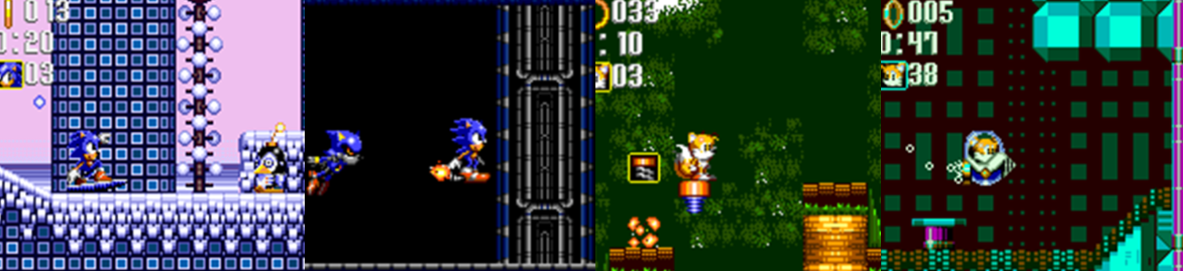
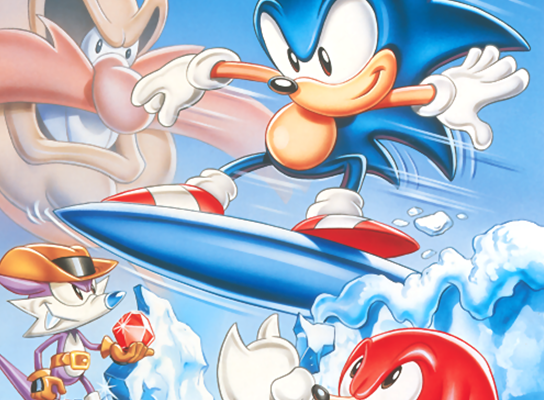
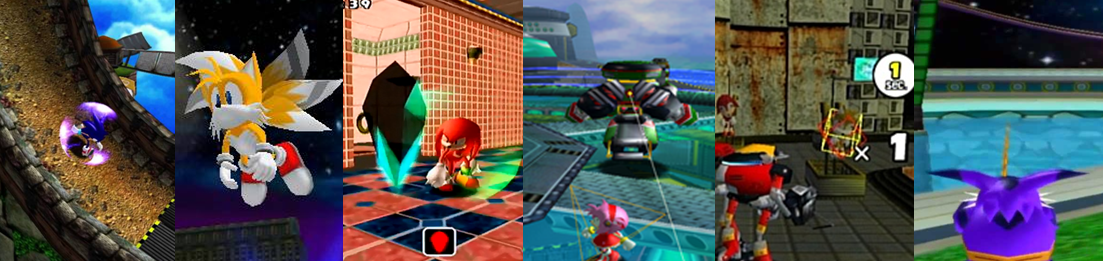
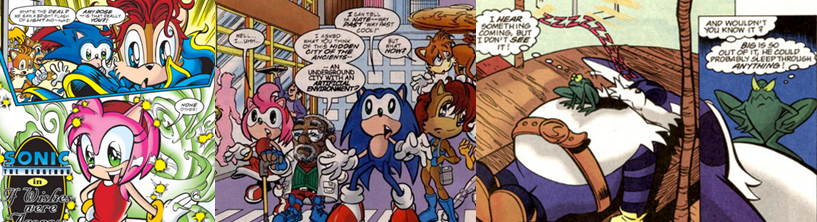
New Sonic Adventures was a series of sprite comics I made between 2002 and 2006 and published online using Tripod and Angelfire sites. As a life-long fan of the Sonic the Hedgehog franchise, I had always yearned to tell my own Sonic stories and to present my own version of events surrounding Sonic and his ever-growing cast of characters. As a child, this was realised through numerous crude-to-mediocre drawings and comics but, after seeing the wide variety of sprite comics out there, I eventually turned to using sprites to realise my vision. Making a sprite comic isn’t easy, and I learned more tricks and became better at it with each comic I made. My earliest attempts were hampered by my limited knowledge of picture software and limited tools. As a result, I would type up scripts in Word and then use Paint to put everything together.
My first comic was restricted by the fact that I was new to the process, young, and stupid (I didn’t even know about the transparency function in Paint, meaning that I had to fill in the blank white spaces around every sprite!) However, as I progressed, the process became faster and easier and I ended up using Word tools and Jasc Paint Shop Pro to create more complex effects and flourishes to subsequent entries. I also started to piece together my own backgrounds and sprite art; as new Sonic characters were being introduced faster than the sprite community was willing to create new sheets of sprites, I would be forced to create sprite characters from very limited work available in order to progress my narrative. What began as quite a simple concept that sought to mash together all aspects of Sonic’s complex different interpretations soon spiralled out of control into an entirely different interpretation of the character, one that became far removed from the source material despite my initial aims to be more true to it than other adaptations. My comics became influenced by anime (particularly Dragonball Zand the first Pokémon movie), movies (theMatrix trilogy and Star Wars saga, for instance), and other sources to eventually take on a life all of its own.
Eventually, as time wore on and my priorities turned elsewhere, I drew my series to a close with one final comic. However, I had ideas mapped out for a whole series of spin-offs and continuations and even completed two whole parts and a sizeable third of a whole new entry in the series, including a website and commentary, but never finished the project or made it available online as I focused on my academic achievements. Still, I was able to finish the series with a conclusion and even revisited my first two entries and applied some of my more advanced techniques to make them more professional and presentable and to address some continuity issues in those early entries. Although I don’t promote the series at all any more, I’d still like to use this page to showcase what was once a big project in my life.
The first entry in the series, Battle for the Chaos Emeralds, provides a unique origin for Doctor Ivo “Eggman” Robotnik and, drawing from Sonic the Hedgehog, Sonic the Hedgehog 2, Sonic the Hedgehog 3, and Sonic & Knuckles, tells the first adventure of Sonic and Tails as they meet Knuckles for the first time and team up to stop Robotnik from turning his Death Egg against their home. Some time later, I produced a revamp of this comic with the Remastered Emerald Edition, in which I applied my now-well-crafted sprite comic techniques and made the comic far more presentable.
This was followed by the four-part Time Stone Saga, which was inspired by Sonic the Hedgehog CD,Knuckles’ Chaotix, Sonic 3D: Flickie’s Island, Sonic the Hedgehog: Triple Trouble,Sonic Advance, and Sonic Advance 2. This comic saw me switch to using the Advance sprites for the main characters, which were much easier to edit and allowed for far more emotions and actions, and utilise a sequential narrative format that saw Sonic, Tails, Knuckles, and their friends split up into four separate quests to retrieve the legendary Time Stones before Robotnik can use their power for evil. Again, I later revamped all four parts with the Remastered Time Stone Edition, which, again, corrected many of my earlier errors and also provided additional material.
The third entry, Perfect Chaos, was where my series really started evolving into its own entity as I mashed together the narratives of Sonic Adventureand Sonic Adventure 2 to introduce Shadow to the series. Faced with the team-up between Robotnik, Metal Sonic, and Shadow, Sonic and his friends must attempt to stop them from resurrecting an ancient evil, Chaos, and destroying the world.
I then returned to the sequential format with the four-part Chaos Ring Saga, which is where the Dragonball Z influences really start taking prominence. After learning of the ancient Chaos Rings, Robotnik seeks to gather them and regain control over the planet with their power. Sonic, Tails, and Knuckles race to find them first and awaken their latent Chaos Emerald powers before running a deadly gauntlet of Robotnik’s most fearsome creations.
The five-part Sonic Heroes saga sought to return the series to a more simplistic, less-convoluted narrative that was closer to the videogame source material. In this loose adaptation of the titular videogame, Team Sonic, Team Rose, Team Chaotix, and Team dark are each lured into a trap by Robotnik that sees them come face-to-face with the deranged robotic menace, Metal Sonic.
Sonic Battle: Metal Ragnorak continues and ultimately concludes this narrative; inspired by Sonic Battle and Sonic Advance 3, with strong influences of the Matrix trilogy, Sonic is forced into a final confrontation with his metallic doppelgänger that sees an army of Metal Sonics lay siege to his home and the fate of the planet placed in an intense confrontation between Super Metal Sonic and Super Sonic.
Finally, the series draws to a close with Sonic: Liberty where, in true Return of the Jedifashion, Eggman has rebuilt his Death Egg satellite and is preparing to transform the entire planet into a mechanical monstrosity. Faced with this world-ending threat, Sonic, Tails, and Knuckles must align with some unlikely allies to realise their destiny and end Robotnik’s threat once and for all.
But it doesn’t end there! A series of spin-offs expand the series beyond the main entries and bring life to this unique Sonic continuity:
After being introduced in Perfect Chaos, the backstory and continued adventures of Shadow are explored in the Tales of Shadow series: Chaos Control explores how Shadow first came to be in ancient times and his first confrontation with the unstoppable Chaos; Marooned details how Shadow has been operating between the events of Battle for the Chaos Emeralds and the Time Stone Saga to orchestrate some key events in the series; The Return of Chaos details the discovery and devastating first appearance of the mysterious Gizoid, Emerl, and sees the immortal Shadow team up with his biomechanical clone to tackle the renewed threat of Chaos and its disastrous confrontation with Emerl; finally, Residual Chaos sees Shadow battle the merciless Wechidna and tells the final tragic story in Shadow’s life.
Probably the comic I’m least proud of, Chaotix: Roots explores the origins and first meetings of the Chaotix Detective Agency as Vector, Espio, Mighty, and Charmy team-up with Ray to escape the clutches of a renegade bounty hunter.
Finally, Sonic Battle: I, Metal tells the story of the series up to the point of Sonic Battle: Metal Ragnorak entirely from the perspective of Metal Sonic, allowing for not only a unique take on the events that have transpired but also an in-depth look into exactly how Metal Sonic gained sentience and formulated a complex plan to finally gain the power needed to face his biological counterpart equally.
If you’d like to learn more about sprite comics, or even create your own, try visiting websites like the Spriter’s Resource or the Shyguy Kingdom. I’m not sure how active the community is any more; back when I first started, it was really vocal, busy, and rampant but progress on new sprites and sprite projects seemed to die out over time. However, the resources are out there if you look hard enough.
Released: October 2012 Originally Released: June 2001 Developer: Sonic Team USA Also Available For: Dreamcast, GameCube, PC, PlayStation 3
The Background: After Sonic Adventure(Sonic Team, 1998) finally brought Sonic into the third dimension and proved to be a rousing success, despite a few flaws, Sonic Team passed development of the sequel over to their US branch. Drawing inspiration from their surroundings, the team infused the sequel with a much greater focus on action, speed, and realism than before, making the game feel decidedly more “Western” than its predecessor. Ironically, Sonic Adventure 2 actually dialled down on the “adventure” aspects of its predecessor but featured, perhaps, the darkest and most science-fiction-orientated story in the series thus far, a decision that would impact the franchise, for better or for worse, for years to come. I’ve talked about Sonic Adventure more than once in the past but, despite it being one of my favourites in the Sonic the Hedgehog(1991 to present) franchise, I actually played its sequel first. I never owned a Dreamcast as a kid as I hedged my bets on the Nintendo 64 so, when I decided to get a GameCube, one of the first two games I got was Sonic Adventure 2: Battle (Sonic Team USA, 2002) and it actually took me a while to acclimatise to Sonic Adventure’s radically different gameplay and presentation when I bought Sonic Adventure DX: Director’s Cut (Sonic Team, 2003). However, while Sonic fans (notoriously one of the worst fanbases in all of fandom) have recently turned on this game in favour of, of all things, SONIC THE HEDGEHOG (ibid, 2006), it’s always been a favourite of mine, to the point where I’ve bought it on GameCube, PlayStation 3, and, now, the Xbox 360 version for Xbox One.
The Plot: Sonic the Hedgehog finds himself a fugitive on the run from the Guardian Units of Nations (G.U.N.) after security footage appears to show him stealing a Chaos Emerald from a G.U.N. facility. In actuality, the culprit is the mysterious Shadow the Hedgehog, the self-proclaimed “ultimate lifeform” who has been released by Sonic’s long-term nemesis, Doctor Eggman, to help the mad scientist harness the power of the long-defunct Space Colony ARK and hold the world the ransom.
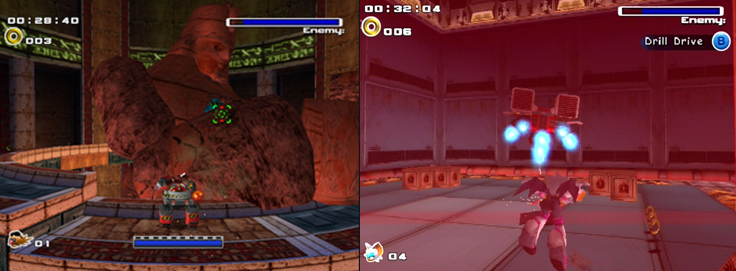
Gameplay: Sonic Adventure 2 is a 3D action platformer first and foremost that, like its predecessor, divides its core gameplay into a series of distinct gameplay mechanics. Unfortunately, while Sonic Adventure offered six unique playable characters, each with their own distinct style of play, Sonic Adventure 2 features six playable characters who share gameplay styles with their counterparts. As soon as you begin the game, you’re given the option not to select a character but to select a story; if you pick the “Hero” story, you’ll play through the game’s story from the perspective of Sonic, Miles “Tails” Prower, Knuckles the Echidna, and Amy Rose but, when you pick the “Dark” story, you’ll witness the events from the perspective of newcomers Shadow and Rouge the Bat and, for the first time in the series, Dr. Eggman! Whichever story you pick, you’ll play through the narrative, switching back and forth between the hero- and dark-side characters as the narrative directs.
The game’s three playstyles are spread between the six characters.
If you’ve played Sonic Adventure, you’ll be immediately familiar with the three playstyles of this sequel: Sonic and Shadow play at high speeds, racing through stages that are designed like fast-paced rollercoasters, Knuckles and Rouge glide, climb, and dig as they explore for shards of the Master Emerald, and Tails and Eggman stomp around in massive mechs, blasting robots with their weaponry. The developers lost the slower pace of Amy and Big’s gameplay and the races that Tails had to complete in the original and focused on these three distinct playstyles, which was good for those who disliked the slower, less exciting gameplay of the last game, but not so good when it comes to character variety.
The Hero and Dark characters are functionally identical to control.
Essentially, there’s very little difference between Sonic and Shadow, Knuckles and Rouge, or Tails and Eggman; they get to explore different stages (or, at least, different versions of stages) and obviously look and sound different, with different objectives, but they share the same basic move set. Both Sonic and Shadow can fly along rows of Golden Rings using the Light Speed Dash (which, thankfully, no longer needs to be charged) and use the Homing Attack to smash robots, Knuckles and Rouge explore their stages in the same way and attack enemies with either punches or kicks, and Tails and Eggman can both hover and lock on to multiple enemies at once. It’s fun experiencing the story from the bad guys’ perspective for a change but it’s a bit of a shame that the characters don’t have more to distinguish them from their counterparts.
Shadow was a dark, edgy character in a dark, edgy story.
The game’s narrative is perhaps the most elaborate yet; after releasing Shadow, Eggman teams up with him and Rouge to gather the Chaos Emeralds and power up the long-abandoned Space Colony ARK. Eggman’s grandfather, Professor Gerald Robotnik, created the ARK fifty years ago and designed Shadow to be the ultimate lifeform; using a Chaos Emerald, Shadow can instantly teleport great distances at high speeds, making him more than a match for Sonic, and Eggman uses his abilities to threaten the entire world with the ARK’s Eclipse Cannon. Shadow, in his debut appearance, would go on to become one of the series’ most recognisable characters, for better or for worse, and has, arguably, never been characterised better than he was here: haunted by fractured memories of his time on the ARK, Shadow has his own agenda for revenge against the world but ultimately his story becomes one of redemption. At the same time, the story is as ridiculous as ever; to stop Eggman from stealing the Master Emerald, Knuckles willingly smashes it into pieces, which is probably the most arbitrary reason to recreate his gameplay from the last game that I could think of. I would have much preferred Knuckles and Rouge’s stages to involve searching for different items or treasures each time rather than search for the pieces of the Master Emerald yet again. Similarly, for some reason I’ll never understand, everyone in the game mistakes Shadow for Sonic and vice versa; even characters like Amy Rose and Eggman think Shadow is Sonic despite the fact that they couldn’t look more different if they tried.
Sonic Adventure 2 introducing grinding to the series and it’s stuck around ever since.
For the first time in Sonic’s long history, SEGA actually incorporated some prominent product placement into Sonic Adventure 2; billboards for Soap shoes were everywhere in the original and Sonic’s iconic shoes were redesigned in conjunction with this brand to allow him to grind on rails. Shadow can also grind and, while this mechanic is more prevalent in some stages than others, it’s not as obtrusive as you might think. It’s pretty simple to pull off, to; you leap onto a rail, ideally with some momentum behind you, and hold down B to crouch and gain speed; in later stages, you’ll have to pull off jumps to other rails but it’s a very fun, fast-paced experience. Rather than expanding and refining the hub world concept of Sonic Adventure, Sonic Adventure 2’s story plays out one scene and stage after another. If you lose all your lives or choose to quit, you can access a stage from a simple map screen; from here, you can replay stages under different criteria in an extension of Sonic Adventure’s “Mission” mode. Completing each mission and successfully obtaining an A-rank on each nets you both an Achievements and a pretty cool unlockable stage…but considering how hard it is to even get an A-rank in the game, it’s going to take a lot of your skill and patience to achieve this goal. Unlike other Sonic videogames, rankings in Sonic Adventure 2 aren’t just based on how fast you clear a stage; you also need to be holding a certain number of Golden Rings and have accumulated a high enough score to earn the best rank. You can build your score by destroying enemies, jumping through hoops, racking up combination bonuses in the shooter stages, not using hints in the treasure hunting stages, and pulling off tricks in the running stages using the game’s new grinding mechanic.
Stage gimmicks can be frustrating at times.
Each stage is filled with multiple paths, some of them only accessible using some of the game’s hidden power-ups. If you want to get the best time, score, and rank when playing, you’ll have to take advantage of these alternate routes, which can be difficult. While the game’s controls are decent and improved for the better over its predecessor, the camera can still be jerky at the worst of times, characters have a tendency to slip off platforms and ledges to their deaths down the game’s many (many!) bottomless pits, annoying stage hazards (floors that fall or crumble beneath you, weights that squash you, and even airlocks that flush you out into space!) crop up in every stage, and enemies just love leaping out in your face at a moment’s notice. While Knuckles and Rouge are limited to finding one Emerald shard at a time (unless you’ve played enough to take an educated guess about where to look) and their later space stages can be frustrating, Eggman and Tails don’t have to worry about racing against a time limit like E-102γ “Gamma” did (though it is odd to see Tails stuck inside a mech). Also, when playing as Sonic and Shadow, you’ll often perform a somersault, usually to your death, when you mean to perform the Light Dash since they’re both mapped to the same button, which can be frustrating at times.
Graphics and Sound: While it looks, feels, and sounds very similar to Sonic Adventure, Sonic Adventure 2 is quite a step up in terms of graphics. While Sonic and Shadow’s stages aren’t as large or as varied as before, they’re tight, focused, and full of impressive set pieces. In City Escape, for example, you end up being chased by a huge truck that is determined to run you down which is a thrill later surpassed by the excitement of grinding at high speeds through space as you make your way down and through the Space Colony ARK.
Each stage has its own gimmicks and is packed with little details and cameos.
You’ll also swing, race, and grind through high-speed jungles, explored flooded mines, haunted mountain tops, and even traverse what is basically a 3D recreation of the Death Egg Zone when racing through Crazy Gadget. Each stage is like a short burst of action-orientated fun, featuring different gameplay gimmicks and little details that make them fun to playthrough regardless of which story you’re playing. While Sonic and Shadow’s stages are all about high-octane speed, Knuckles and Rouge’s emphasise exploration and Tails and Eggman’s are also far slower , allowing you to really take in the little details of your surroundings and encouraging exploration.
The game’s soundtrack is top notch.
Sonic Adventure 2 also has one of the best soundtracks in the entire franchise; while Sonic Adventure remixed, borrowed, or leaned heavily into traditional Sonic themes alongside incorporating punk rock, rap, and other genres for character’s themes, Sonic Adventure 2 doubles down on the rocking tunes and is all the better for it. Featuring three of Crush 40’s best tracks (“Live and Learn”, “Escape from the City”, and a remix of Sonic’s theme song, “It Doesn’t Matter”), each character’s stages is accompanied by a theme befitting that character (Sonic is mostly rock, Rouge is jazz-inspired, Knuckles is rap, Shadow’s is techno-inspired, for example) and helps infuse the stages and the otherwise-similar-playing characters with a real life, energy, and distinctive personality.
Lip synching has been vastly improved, though the script and delivery is still a bit janky at times.
Once again, the game features an abundance of voice acting; luckily, the lip synching is vastly improved here, meaning that the cutscenes are far less ridiculous to sit through. Unfortunately, the script and delivery still flounders somewhat and the game’s music tends to drown out the character’s words or the characters often talk over each other due to the translated dialogue taking longer to say than the original Japanese. Despite that, though, many of the voice actors from the last game return here and put in some of their best performances; Ryan Drummond will always be my favourite voice for Sonic and both the late, great Deem Bristow and David Humphrey set the standard for Dr. Eggman and Shadow, respectively, that have continued to be emulated to this day.
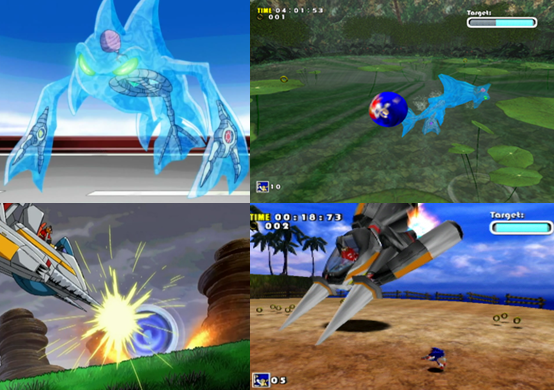
Enemies and Bosses: Sonic Adventure featured some of the most unique designs, and redesigns, of the entire series. Eggman’s Badniks were recreated in all their 3D glory and full of character and quirky personality and Chaos was a breath of fresh air in a series that mostly relied on robotic creatures. Sonic Adventure 2, however, drops the ball quite significantly in this arena; every character battles the same, generic G.U.N. robots throughout every stage. Some stages do feature a few of Eggman’s Badniks but they don’t crop up often enough. Instead, you’re faced with these dull, lifeless cookie-cutter robots that aren’t really much to write home about. That is, of course, until you make it into outer space and on to the Space Colony ARK. Here, you’ll encounter the most annoying enemies in the game: the Artificial Chaos. These watery monstrosities resemble Chaos and have robotic enhancements and, while they’re easily dispatched with a solid shot to their metallic “head”, they can deal serious damage with their elongated limbs and laser blasts, making them extremely irritating enemies to come up against regardless of which character you’re playing as.
Bosses that aren’t generic G.U.N. mechs are few and far between.
For the most part, Sonic Adventure 2’s boss battles are as lacklustre as the enemies you’ll fight thanks, largely, to them being comprised of G.U.N. mechs. Yet, while none of G.U.N.s creations can match up to the quirkiness of Eggman’s mechs from he previous games or the likes of the gigantic golem that defends his pyramid base, they’re just different enough to show that G.U.N. is capable of putting some effort into their creations.
You’ll have to face your rival in a couple of battles as well.
The rest of the time, you’ll be battling against your rival in fights somewhat similar to the battle between Sonic, Tails, and Knuckles in the last game; the mechanics have been expanded upon somewhat here, though, in that your enemy puts up a bit more of a fight, taking (and dishing out) decidedly more damage as you battle but the real threat in most of these battles will come from the size of the stage you battle on (or in) and how easy it is for you to fall to your death.
The Biolizard is easily the game’s most frustrating boss.
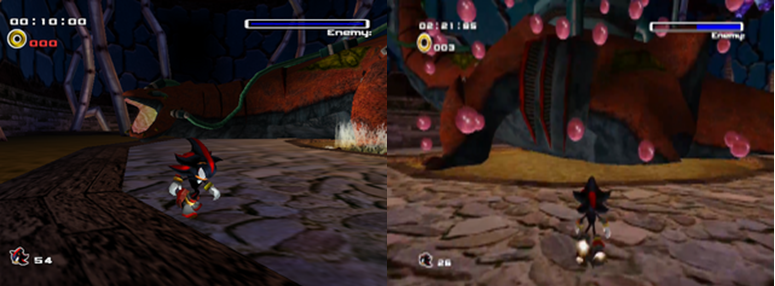
Once you defeat Sonic and Shadow for good at the end of both stories, you’ll play through the “Last Story” and battle the game’s most frustrating and annoying boss, the Biolizard. This Shadow-exclusive battle pits you against a massive lizard-like creature that chases you with its gaping mouth or tries to smack you with its tail. When it stops its attack, you can grind up a rail to attack its sole weak point (the life support system on its back) and, as you deal damage, it starts to spit energy blasts at you that you must either try to jump over or somersault under to avoid losing Rings. To make matters worse, you can instantly be sucked to your death if you land in the water between the stage platform and it spawns these really infuriating homing orbs that you must try to avoiding while using the Homing Attack to hit the life support system. Its final attack is easily the worst; this sees you flung helplessly into the air and all you can do is encircle the creature, hope and try to avoid the projectiles, and slowly edge your way closer to deliver the final blow.
You’ll battle the final boss as both Super Sonic and Super Shadow.
Once defeated, the creature uses Chaos Control to attach itself to the ARK and force it towards the Earth, becoming the game’s final boss, the “Finalhazard”. Sonic and Shadow power-up to their Super forms and battle the creature in space in a fight that, fundamentally, resembles that finale against Perfect Chaos. Super Sonic and Super Shadow have to dash into the pulsating boils that act as the creature’s sole weak point but are constantly swatted away by projectiles and erratic laser blasts. Also, like Perfect Chaos, this final boss is more annoying than challenging as you not only have to try and weave through its defences and hope your attack does damage, you’ll also be fighting against two time limits: linger too long and the Finalhazard will successfully drag the ARK to Earth and you also have to land your attack before you run out of Rings. Your allies often shout at you to “switch characters” when your Rings are running low but, even after all these years, the only way I could switch characters was to hit the creature’s weak spot so that advice is basically useless. As before, you don’t get to play as the Super forms in the main game but this finale does culminate in Shadow giving his life to save the planet, completing his character arc of redemption. Of course, Shadow was too popular to stay dead and SEGA brought him back in the very next game and have bungled fleshing out his character and backstory ever since. But, in this one defining moment, this angst-ridden, haunted little black hedgehog won over a significant portion of the fanbase and still remains a popular character to this day.
Power-Ups and Bonuses: While Sonic Adventure 2 doesn’t feature as many “adventure” elements as its predecessor, you can still acquire power-ups and additional bonuses in each stage: Sonic and Shadow can grab shoes that allow them to Light Speed Dash, rings that let them perform a flaming somersault, bounce, and/or turn enemies into toys that you can throw at other enemies. Knuckles and Rouge grab upgrades that let them dig to find goodies or breathe underwater without fear of drowning, and Tails and Eggman can upgrade their mechs to dish out more damage to enemies and hover across gaps and hazards. As is standard for Sonic titles, you can also acquire additional Golden Rings, health packs (for Tails and Eggman), extra lives, invincibility, and two types of shields (a regular shield and a Ring-attracting electric variant) by breaking or running into item capsules or passing checkpoints in a fast enough time. Additionally, like in Sonic Adventure, every time you beat a stage, boss, or mini game earns you a Sonic Emblem and collecting all of these and will earn you an Achievement and unlock a bonus stage.
Additional Features: From the game’s “Options” menu, you can choose different character-based themes and backgrounds for the game’s menu screens and even change the spoken dialogue to Japanese if you’re one “those” fans that simply must have the original Japanese dialogue playing during a game. As you might expect, you can also earn a few Achievements when playing the game; unfortunately, there’s not very many on offer here and they’re disappointingly simple to get…for the most part. As you destroy robots and explore the stages, you’ll find “Chaos Drives” and small animals; when you find a Chao box and smash it open, you’ll obtain a key and, after clearing the stage, will be warped to the Chao World where you can use the Chaos Drives and animals to raise and breed Chao to use in other mini games. The Chao Garden has been expanded somewhat; when you visit from the stage select screen, you can take your Chao to the Chao Kindergarten to purchase new items from the Black Market, leave them in the school to learn songs and tricks, rename them, or get review stats and health. Feeding them Chaos Drives, animals, and different fruits will raise their stats and, eventually, allow them to evolve into a stronger, more adult form. If you primarily used Hero characters when caring for your Chao, you’ll get an Angel Chao, while Dark characters birth a Devil Chao; both unlock an additional Chao Garden themed after Heaven or Hell, respectively.
Cheer your Chao on as they race or battle each other!
As your Chao’s stats increase, you can have them take part in the Chao Games, a series of races, fights, and mini games to earn you more Sonic Emblems and Achievements. However, as these mini games can be largely luck-based and involve you putting a lot of time and energy into grinding and search for more Chaos Drives, animals, and collecting Golden Rings to buy new items, it can be a very time-consuming process but it’s a nice break from the game’s fast-paced action. Just don’t expect a lot of depth from this mode. Unlike Sonic Adventure, which featured numerous mini games to break up each character’s story and provide a distraction from the main game, Sonic Adventure 2 only features two other playstyles: a boss rush and a janky little kart racer. In the Hero story, you (as Tails) have to race towards the President’s limo to track Eggman’s broadcast and, in the Dark story, you (as Rouge) chase after Tails to intercept him instead. Once you beat one of these stages, you’ll unlock the Kart Race mini game, where you can play as any of the six main characters in short races made incredibly difficult by the game’s stiff, unresponsive controls.
Collect every Emblem to unlock Green Hill Zone!
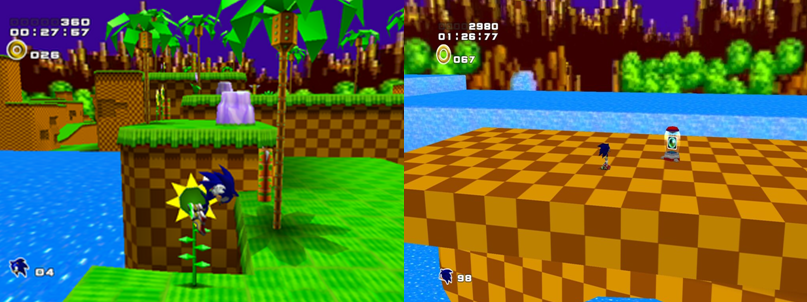
After clearing both stories, you’ll unlock the “Last Story” mode when you play as each of the six playable characters and race to stop the ARK from destroying the world. This culminates in a space battle where you switch between Super Sonic and Super Shadow and take it in turns to ram head-first into the gigantic lizard-like creature known as the Biohazard. Defeating it earns you the game’s true earning, and an Achievement, but not much else; however, if you manage to complete each of the game’s stages with an A-rank, you’ll unlock one of the coolest rewards in the series: a fully 3D recreation of Green Hill Zone! Unfortunately, you can only play this stage as Sonic and I’ve never actually experienced this as it is way too hard to earn those A-ranks and I just couldn’t do it no matter how hard I tried. Also new to the game is the multiplayer mode where you and one friend can pick between the game’s playable characters and race or battle against them in a series of stages from the main story. If you purchase the game’s downloadable content, you’ll unlock extra stages and characters for use in this mode; these were all available by default in the GameCube port but it’s still fun to play as Metal Sonic, Tikal, and Chaos in the game’s multiplayer. It’s just a shame that, like in the Sonic Adventure ports, Sonic Team decided to leave out certain playable characters and features from the original Dreamcast version (meaning Big the Cat is relegated to mere blink-and-you’ll-miss-it cameos in each stage and certain cutscenes, which is a real shame and a massive downgrade from his last appearance).
The Summary: Sonic Adventure 2 takes everything that worked in Sonic Adventure and improves upon it; it trims out a lot of the fat and extraneous elements and focuses on the three, distinct, most enjoyable playstyles of the last game, expanding upon them and improving them to make for a much tighter, more responsive and action-orientated experience. While I do miss some of the things this game dropped (the hub worlds and the diverse characters), I do enjoy the many improvements and innovations that debuted in this game. Making the Light Speed Dash a one-button action was a must, expanding Sonic’s world and lore to include more sci-fi elements helped take the series in a different direction and allowed SEGA to actually tell pretty complex and mature stories in their videogames. While I like the simplicity of the early Sonic titles, I expect a bit more bang for my buck with Sonic’s 3D adventures and Sonic Adventure 2 definitely delivers in that regard, introducing one of the more multifaceted and edgy characters to the series and allowing us to experience events from the bad guys’ perspective for the first time. For many years, Sonic Adventure 2 was the gold standard for the series for many; as SEGA experimenting with different genres and tossed more and more characters and roadblocks into their most popular franchise, fans were clamouring for a return to the Adventure-style formula and the type of gameplay and story of Sonic Adventure 2. While Sonic fans may have lost their mind and turned against this game in recent years, it still holds a special place in my heart; it’s not perfect, obviously, but it’s still fast-paced, high-octane fun and I never fail to have a good time every time I fire it up.
My Rating:
⭐⭐⭐⭐
Rating: 4 out of 5.
Great Stuff
What did you think about Sonic Adventure 2? Which of the two Adventure games is your favourite? Which console did you first play Sonic Adventure 2 on? What did you think about the game’s Light and Dark story options, and playing as the villains for the first time? What are your thoughts on Shadow the Hedgehog, his debut, characterisation, and legacy? Does Sonic Adventure 2 still hold up in your view or do you prefer a different Sonic title? Whatever your thoughts on Sonic Adventure 2, and the Sonic series and characters in general, drop your thoughts below and share them with me.
A Brief Background: I may have mentioned this before but, back in the early-nineties, SEGA’s super-speedy blue hedgehog of a mascot was on something of a roll; Sonic the Hedgehog(Sonic Team, 1991) had finally swayed videogame fans away from the Nintendo Entertainment System then, after the unforgettable and highly marketed release of Sonic the Hedgehog 2(SEGA Technical Institute, 1992), Sonic’s status as a cultural icon was cemented. It was amidst the wave of Sonic’s incredible popularity that SEGA decided to develop a Sonic title for the arcades, most likely as the arcade scene was still a popular way of enjoying videogames even with the Console War right on the horizon. Although it wasn’t the first time SEGA tried to get a Sonic arcade game off the ground, SEGASonic the Hedgehog is, perhaps, the most infamous. Featuring the debut of Mighty the Armadillo and Ray the Flying Squirrel (two characters that were long-forgotten by SEGA until very recently) and forgoing Sonic’s trademark speed, SEGASonic used a trackball to control its three playable characters and was pretty much exclusively released in Japan. I actually got to play the game at SEGA World in London years and years ago, back when that was a thing, but the game has never been officially released or ported to other consoles since quietly disappearing from the arcade scene.
First Impressions: SEGASonic makes an immediate impression simply through its bright, colourful graphics; the game features a charming cartoon-like aesthetic, featuring some extremely expressive and amusing animations and facial expressions from Sonic and his two friends. Captured by Doctor Eggman and forced to escape from his hazardous island, players are tasked with battling the game’s awkward trackball controls and navigating seven isometric levels.
Sonic, Mighty, and Ray must escape Eggman’s island.
Generally, players are chased by some kind of hazard (a wall of fire or a drilling machine, for example), must dodge past some kind of blockage (a cage, crumbling paths, or spiked walls and the like), and clamber across monkey bars to escape danger. Sonic, Mighty, and Ray all pretty much control exactly the same; no one character is faster than the other, they all have a Spin Attack, and the only real difference between them is the way they animate when performing certain actions (Ray uses his prehensile tail to climb, for example). Each character has a health bar, in a change for the series, which can be refilled by collecting the familiar Golden Rings generously scattered across the game’s maps, all while being chased by Doctor Eggman.
My Progression: Unfortunately, as SEGASonic hasn’t been re-released or ported to home consoles, the only way to play the game now is using a ROM and an emulator. Equally unfortunate is the fact that the ROM I have for this game is very finicky and prone to crashing; as a result, I didn’t manage to get too far in the game before the emulator crashed and kicked me out of the game. I’m pretty certain that I managed to clear at least one level when I played the game at SEGA World but, on this playthrough, my ROM conked out on me shortly after clearing Trap Tower. I probably will reload my save state and go back to the game at some point to try and get a bit more playtime out of it but, as much as I love the obscurity and visual presentation of the game, the controls make it quite difficult to play (or, at least, play well).
I love SEGASonic the Hedgehog; I would be so happy is SEGA got off their asses and made a real effort to put together a real, HD-quality port of the title that integrates modern analogue controls in place of the trackball. It, like Knuckles’ Chaotix (SEGA, 1995), is criminally under-rated, under-looked, and under-valued for its appeal and, considering SEGA loves to port and re-release their classic titles, it literally boggles my mind that we haven’t seen anything from this game in decades. The only thing holding it back from a full-blown replay is the dodgy controls (well, that and that unreliability of the ROM I have…); even when using a trackball, the game is difficult to control but, with analogue controls better and more sensitive than ever, I could see this game being a nice distracting for an hour or so if SEGA were to spruce it up and re-release it.
What do you think of SEGASonic the Hedgehog? What was your favourite of Sonic’s short-lived arcade games? Did you ever go to SEGA World in London? Share your thoughts in the comments.
Released: March 2012 Originally Released: November 1994 Developer: M2 Original Developer: Aspect Also Available For: Game Gear, Gamecube, and PlayStation 2
The Background: A lot of people forget that, alongside Sonic the Hedgehog’s iconic and much-lauded Mega Drive titles, SEGA also released a fair few Sonic videogames for their 8-bit consoles. The 8-bit versions of Sonic the Hedgehog(Ancient, 1991) and Sonic the Hedgehog 2 (Aspect, 1992) differed considerably from the 16-bit counterparts, featuring entirely different Zones, gameplay gimmicks, and features. While Sonic 2 had almost nothing in common with its bigger, better brother, Sonic the Hedgehog Chaos (ibid, 1993) represented Aspect’s first real attempt at a completely original Sonic title. Released in Japan as Sonic & Tails, Sonic Chaos was a major step up from the first 8-bit Sonic, featuring a playable version of Miles “Tails” Prower, bigger and better graphics, and many other upgrades that left its 8-bit predecessors in the dust. After SEGA switched their focus entirely to the Mega Drive, Triple Trouble and all subsequent 8-bit Sonic titles were released exclusively on the Game Gear.
The Plot: The diabolical Doctor Eggman scatters the Chaos Emeralds across the world but secures one for himself and tricks Sonic’s friendly rival, Knuckles the Echidna, into tracking the remaining gems. However, Nack the Weasel (known as Fang the Sniper in Japan) is hording the Emeralds inside the Special Stages, resulting in Sonic and Tails facing all three in their quest to recover the Chaos Emeralds.
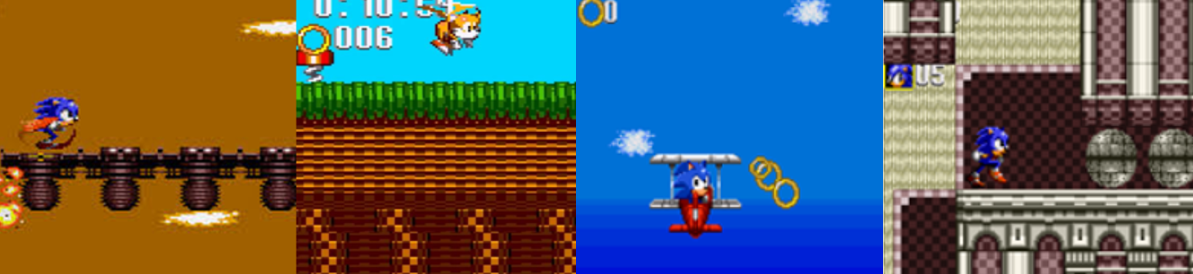
Gameplay: Like its predecessors, Triple Trouble is a sidescrolling, 2D platformer based on speed. Of all the 8-bit Sonic titles, this is easily the biggest and the fastest; players can choose to play as either Sonic or Tails and journey through the game’s six Zones and each plays a little differently.
Run or fly through Zones as Sonic or Tailsand tackle a variety of Special Stages.
Both characters can run, jump, and spin as normal and enter a Spindash by pressing down and A; pressing up and A as Sonic allows him to perform the Strike Dash, a version of the Peel-Out, to blast ahead at full speed. Tails, however, flies instead of performing a Strike Dash and, unlike in Sonic Chaos, Tails can actually access the Special Stages and collect the Chaos Emeralds. Speaking of which, like all 8-bit Sonic titles, Triple Trouble features a unique way of accessing the Special Stages; players must first collect fifty Golden Rings, locate and smash open a Chaos Emerald monitor, then enter the sparkling warp to challenge Nack for a Chaos Emerald. Like Sonic Chaos, each Special Stage offers a different challenge, including bouncing around collecting Rings, piloting the Tornado bi-plane, or navigating a maze.
Nack acts like a tough guy but is really a pushover.
At the end of each Special Stage, they then battle against Nack, who shows up sporadically throughout Triple Trouble to cause Sonic or Tails headaches, similar to Knuckles in Sonic 3. Despite his cool and unique character design, Nack is more a buffoon and an annoyance than an actual challenge, however. Triple Trouble’s Zones borrow heavily from other Sonic titles and yet still manage to stay relatively unique; Tidal Plant Zone has more than a passing resemblance to Sonic the Hedgehog CD(ibid, 1993)’s Tidal Tempest, for example, and Atomic Destroyer Zone is like a combination of Sonic & Knuckles’(SEGA Technical Institute, 1994) Death Egg Zone and 8-bit Sonic 2’s Scrambled Egg Zone thanks to its abundance of maze-like tubes. Oddly, Triple Trouble features a large number, and dependence upon, springs; the first Zone, Great Turquoise Zone, is chock full of them (they’re on the trees, the ground, and even the Badniks!) and one of the main things you’ll find yourself doing when playing Triple Trouble is bouncing around on springs and other bouncy hazards, fighting with the stiff controls to get Sonic or Tails back on track. Being that it’s an 8-bit title, Triple Trouble lacks some of the polish of its 16-bit counterparts but, saying that, its 8-bit predecessors felt a bit easier to handle. Here, Sonic jutters along, refusing to change direction mid-air, and feels sluggish and weighed down, making precise platforming difficult. This is a bit of an issue when trying to explore Zones for those elusive Chaos Emerald monitors and when tackling the Special Stages but, for a simple pick-up-and-play title, isn’t a major handicap, especially as there’s not much in the way of bottomless pits or cheap deaths.
Graphics and Sound: As mentioned before, Triple Trouble is probably the best looking 8-bit Sonic title. The sprites are large and full of character and the Zones and environments are bright and lively. Of all the 8-bit Sonic titles, this comes the closest to matching its 16-bit counterparts, particularly by evoking the same sense of fun and adventure found in Sonic 3.
You may recognise Triple Trouble‘s aesthetic.
What lets the game down, however, is the sound. As it was originally developed for the Game Gear, sounds are muddy and distorted, as though they’re playing underwater. The game’s music is catchy enough and fits perfectly but collecting Rings or smashing Badniks lacks the usual oomph I expect from a Sonic title.
Enemies and Bosses: Triple Trouble features the usual mechanised enemies we’ve all come to expect from a Sonic title, especially one from his heyday; Badniks range from robotic snails with springs on their shells to exploding penguins. Most are easily destroyed by simply spinning into them but there’s a fair few Badniks here that cannot be destroyed, which prove especially annoying when you run face-first into them and then stutter down to a lower level thanks to the game’s janky knock-back feature.
Bosses aren’t lacking in variety, although Dr. Eggman ends up being a bit of a pushover.
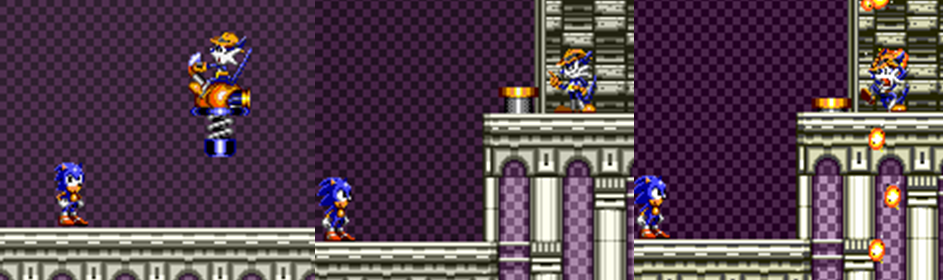
Like in the 8-bit Sonic 2 and Sonic Chaos, bosses consist, for the most part, of giant Badniks (such as a giant flying turtles and a bomb-spewing, rocket-powered penguin). However, Sonic and Tails also have to battle Knuckles, who fires bombs and rockets from a cute little vehicle, Nack (who bounces around in a funky spring-loaded contraption), Metal Sonic (in a variation of the iconic battle from Sonic CD), and, of course, Doctor Eggman. Sonic or Tails won’t battle Eggman until the game’s finale, however. This boss battle has three stages but there isn’t much to it; you simply ram his machine until it explodes and transitions to the next phase and, in the final stage (which is eerily reminiscent of the final bosses from the first two 8-bit Sonic titles), you dodge some lightning and smash him as he cycles around a tube.
Power-Ups and Bonuses: Like all Sonic titles, Sonic and Tails can smash monitors to aid their progress; they can get an extra ten Rings, a speed boost from the Power Sneakers, an invincibility, hit a checkpoint, or gain extra lives as standard but can also access some additional items.
Triple Trouble has some fun, unique power-ups, including Tails’s cute little submarine!
There’s a snowboard that lets Sonic cut through the Robotnik Winter Zone with ease, Propeller Shoes that allow him to navigate underwater, Rocket Shoes to allow him to burn through the sky, and a Pogo Spring because…there aren’t enough springs in the game already. These last two popped up in Sonic Chaos as well but it’s nice to see them return here and it’s a welcome change to the usual shield power-ups. Sonic doesn’t get all the toys, though, as Tails can jump into the Sea Fox to navigate through Tidal Plant Zone without the need for air bubbles. Since he doesn’t need to Rocket Shoes, he can also grab the Hyper Heli-Tails to increase the duration of his flying ability. Additionally, players won’t lose all of their Rings when hit; instead, they’ll only lose thirty Rings, which makes playing through Triple Trouble much easier compared to the first to 8-bit Sonic titles where Sonic couldn’t even collect the Rings he lost.
Additional Features: There isn’t much else in Triple Trouble; obviously, as with the majority of Sonic titles, the ultimate goal is to collect all of the Chaos Emeralds to receive the game’s best ending but this doesn’t offer any reward other than not being told to “Try again”. There’s no Super Sonic here, no two player mode, and you cannot unlock Knuckles or anything like that. It’s a very simple, one-player experience with the minimum of effort being asked of you. The Virtual Console version, however, offers a few extra features; you can create a save point (which is quite handy if you need to stop playing but you only get one save), change the aspect ratio of the display, and fiddle about with a few other minor settings but that’s about it. For such an ambitious 8-bit Sonic title, it remains as bare bones as all 8-bit Sonic videogames were back in the day.
The Summary: Sonic the Hedgehog: Triple Trouble is decent enough, for the most part; Zones are bright, vibrant, and easy to blast through, Sonic has never looked better in 8-bit, and there’s a decent amount of variety and challenge on offer. However, for as much as Triple Trouble outpaces its 8-bit predecessors, it’s still an 8-bit title; the controls are clunky and unresponsive, the knock-back from damage is a pain in the ass, and sound effects are distorted. Similar to the Game Gear version of Sonic 2, the screen is zoomed in quite a bit as well, which means you’re never quite sure what you’re running into. Overall, I enjoyed the game; it was probably the best 8-bit Sonic game of the bunch, but it’s still far from perfect. I loved Nack and how he was worked into the game, even if he was, technically, just a rip off of Knuckles, and it’s a shame that he hasn’t been brought back in a similarly high profile role. Honestly, I’d love to see this game get a proper, Sonic Mania (PagodaWest Games/Headcannon, 2017) style remake (alongside, or as part of, it’s other 8-bit brothers) but it seems like SEGA and Sonic Team and happy to let their 8-bit/handheld Sonic titles fade into obscurity, which is a shame really.
My Rating:
⭐⭐⭐
Rating: 3 out of 5.
Pretty Good
What were your experiences with Triple Trouble? Do you also long for Nack’s return to the franchise? What did you think of Sonic’s other 8-bit outings? Drop a line in the comments to let me know.
One of the great things about adaptations, and adaptation studies, is that they both:
“[continue] to expand and become more inclusive […] it is increasingly difficult to determine a cohesive theory that accounts for the division between adaptation and other intertextual modes: allusions, plagiarisms, remakes, sequels, homages, mash-ups, appropriations, and the list goes on” (Dicecco, 2015: 161)
This quote sums up perfectly what makes adaptation studies so interesting; adaptations can be anything and are restricted only by the scope of your imagination and your commitment to researching the links between media.
While researching the theories of Nico Dicecco (and his contemporaries) during my PhD, I chose to focus on the adaptation of videogames into movies, television shows, cartoons, and comic books. This was primarily because it’s a lot easier to talk about media that is adapted into film and there hadn’t really been any serious research into videogame adaptations at that time. I’ve previously talked about how my studies into the Sonic the Hedgehog (Sonic Team/Various, 1991 to present) franchise revealed that Sonic the Hedgehog Spinball (Polygames/SEGA Technical Institute, 1993) heavily influenced multiple Sonic adaptations over the years but there has been another Sonic videogame that has made multiple jumps to other media.
Today, I’m once again returning to one of my favourite Sonic videogames, Sonic Adventure (Sonic Team, 1998), Sonic’s first real foray into 3D gameplay and a title that focused on multiple characters and gameplay mechanics, a far deeper narrative than the franchise had experienced in a videogame before, and functioned as both a consolidation of Sonic’s competing iterations and a “soft reboot” for the franchise, due its use of “slight changes to be made without having to completely scrap the franchise and start over” (Bancroft, 2015).
I can’t praise this game’s variety enough!
Coming after a long absence from a main series Sonic title (and at a time when SEGA were almost haemorrhaging money thanks to failures like the Mega-CD and SEGA 32X), Sonic Adventure became “the best-selling Dreamcast game of all time, with almost two and a half million copies sold”. (Pétronille and Audureau, 2012: 70). It reinvigorated the Sonic franchise in a way that I think has been forgotten over time; while the game may have had its flaws, it successfully revitalised Sonic and led to a string of successful sequels and follow-ups. While these weren’t enough to curb SEGA’s financial woes, the success and impact of Sonic Adventure led to a shift in Sonic’s gameplay, narrative, and aesthetic direction; rather than racing along a 2D plane, players now ran along at break-neck speeds in fully 3D environments that were designed more like rollercoasters. Sonic was now “Taller, slimmer and somehow spikier”, his friendliness replaced with “an anime-style cool” (Jones, et al, 2011: 31), and his narrative was far darker and more mature than his bright, psychedelic 2D titles. Perhaps the most significant impact of Sonic Adventure came through Sonic Team eventually stripping away all other playstyles to focus purely on Sonic’s speed, an aspect that largely led to the development of the Boost-orientated gameplay of modern Sonic titles.
Surely this can’t be a coincidence?
One thing to note before I delve into the main focus of this article is how the adaptation process appears to have worked both ways with Sonic Adventure. Many elements from Sonic the Hedgehog: The Movie(Ikegami, 1996) are recognisable in Sonic Adventure, such as Tails’ workshop on South Island, the appearance of cities and structures that mirror those of our world, and a lot of Doctor Robotnik’s (Edwin Neal) personality and technology. For me, the Sonic OVA is clearly a precursor to Sonic Adventure’s attempt to leave behind Mobius and show him as an adventure-seeking teenager in a world not too dissimilar to our own (though I still pray for the day when his characterisation matches the snarky attitude of his OVA counterpart). Sonic Adventure didn’t just impact Sonic’s videogames, however; by 1999, Archie’s Sonic the Hedgehog comic books had developed into a continuation of the fan favourite Sonic the Hedgehog (1993 to 1995, more commonly referred to as “SatAM”) cartoon, infusing characters and events from the videogames into its narrative. With this in mind (and, possibly, in keeping with SEGA’s desire to create a homogeneous version of Sonic), it was inevitable that Sonic Adventure would feature in these comics before long.
Robo-Robotnik soon replaced his organic counterpart as “the Eggman”.
Sonic Adventures’ influence began slowly but, in keeping with the increasingly-convoluted narrative of the comics at the time, was complex to the nth degree. First, the Archie team crafted an elaborate story to explain why Sonic now looked like his Sonic Adventure counterpart: ‘Retro Activity’ (Bollers, et al, 1999) not only showed how Sonic transformed from his pudgy, classic look to this edgier aesthetic by racing against a destructive energy beam so fast that he cycled through his various Super forms, but it told this story backwards! If you thought that was bad, though, the lengths they went to to explain Robotnik’s transformation into his Sonic Adventure counterpart, Doctor Eggman, were even worse! So, in ‘Endgame, Part 4: For Whom the Bell Tolls’ (ibid, 1998), Sonic finally destroyed Robotnik forever in a fight to the death involving his latest doomsday weapon, the Ultimate Annihilator. However, it is dramatically revealed in ‘I Am the Eggman!’ (ibid, 1999) that Robotnik has returned…in the form of his fully-robotic, alternate-universe counterpart, Robo-Robotnik. Though seemingly destroyed in that story, the issue ends with Robo-Robotnik downloading his consciousness into a body that is identical to his Sonic Adventure design; “Eggman” (for a long time “The Eggman”) would quickly become a derogatory nickname used to describe Robotnik until the madness was smoothed over by massive continuity changes much later down the line. The Sonic Adventure tie-in officially began with ‘The Discovery: A Sonic Adventure Tie-In’ (ibid), in which Sonic and the Knothole Freedom Fighters first learn about the “hidden city of the ancients”. Robotnik also learns of an ancient beast known as “Perfect Chaos” hidden within not the Master Emerald (…as that was where Mammoth Mogul was imprisoned) but the “Black Emerald”. Unearthing the Black Emerald in the Mysterious Cat Country, Robotnik discovers that it is severely depowered and promptly leads and assault on Floating Island to smash the Master Emerald in order to repower the Black Emerald.
Two issues in and I’ve already lost the plot!
After being denied the chance to accompany the Freedom Fighters, Amy Rose uses the magical “Ring of Acorns” wish herself into a more mature body in the follow-up story, ‘If Wishes Were Acorns’ (ibid), one that (you guessed it) is identical to her Sonic Adventure appearance. The Freedom Fighters then travel to the hidden city, which is located beneath an island (that is an almost exact replica of the OVA’s South Island) and accessed via a Mystic Ruins mine cart. A back-up story, ‘Swallowing Trouble’ (Penders, et al, 1999), introduces Archie’s readers to Big the Cat; his peaceful existence is disrupted when Froggy (who articulates through thought bubbles) swallows a piece of Chaos, grows a tail, and is promptly kidnapped by E-102γ (also known simply as “Gamma”). In the next issue, ‘City of Dreams’ (Bollers, et al, 1999) shows Sonic and friends exploring the hidden city, which is Station Square from the videogame and populated entirely by humans (who are different from “Overlanders”, the mostly-extinct human-like species that once waged war on Mobius), and sustained by an “artificial environment” (…that includes a sky, apparently).
Things pick up with this Sonic’s battle against Chaos 0.
While they end the story making good progress in establishing diplomatic relations with the humans, the two back-up stories show Robotnik sending his E-series robots out to find more Master Emerald fragments to empower Chaos and Amy rescuing an injured bird from ZERO. Interestingly, while Archie bent over backwards to explain the characters new look, they simply have Amy’s Piko-Piko Hammer appear out of thin air with no explanation; even she is shocked to see it! Things finally pick up in the next issue’s ‘Night of Chaos!’ (ibid), which recreates (with amazing fidelity) the first encounter and battle between Sonic and Chaos 0. The back-up stories introduce Tikal to the story, as she relates to Knuckles her history (meeting and befriending Chaos and the destruction of her tribe when her father, Pachamac, tried to forcibly take the seven Chaos Emeralds from its shrine), how Robotnik finalised Chaos’ 0 form by infusing it with Froggy, and recreates the beginning of Gamma’s story by showing it pass a training drill and release Amy and her bird friend (here clearly identified as a Flicky) after overcoming its programming and gaining a modicum of sentience.
Archie recreated Perfect Chaos’ birth in stunning detail.
Archie followed this up with a 48-page ‘Super Sonic Special’ that rapidly told Sonic Adventure’s familiar story beats: Sonic, Miles “Tails” Prower, and Knuckles battle Chaos 2 and 4 after Robotnik feeds it shards of the Master Emerald; Big, Sonic, Tails, and Knuckles end up on the Egg Carrier; there’s a tussle with Gamma (where Amy spares it from destruction) and they fight Chaos 6, destroying the Egg Carrier in the process. The adaptation continues in the next regular issue; in here, Knuckles discovers “the Eggman” unconscious in the Mystic Ruins and Chaos, still alive, blasts through the land as a tornado, absorbing the six Super Emeralds, and transforms into Perfect Chaos, flooding Station Square (and attaching itself to the Power Siphon that control’s the city’s environment) exactly as it does in the opening and Super Sonic story of Sonic Adventure. Perfect Chaos destroys the Egg Carrier then, after learning a bit more from Tikal, Sonic uses the Emerald’s to transform into Super Sonic and engage Perfect Chaos. It’s around about at this point that the story stops creating its own dialogue and starts lifting lines directly from Sonic Adventure but, considering the quality of Archie’s writing back then, I would necessarily say that this is a bad thing. The story finally comes to a conclusion in issue 84’s ‘Perfect Chaos’ (Penders, et al, 1999), in which Super Sonic struggles to subdue Perfect Chaos while Knuckles overcomes his fear of water and uses his immense strength to restart the city’s power generator (tapping into his latent Emerald powers for the first time, which would later significantly change his appearance and powers). This, coupled with Super Sonic’s attack, is enough to revert Perfect Chaos back to Chaos 0. At peace once more, Chaos and Tikal return “to the Zone [where they] belong” and the threat is finally ended (…once again glossing over the untold death and destruction in Station Square).
Archie lore was dense enough before they wedged in Sonic Adventure.
Archie’s Sonic Adventure adaptation is one of the few times they actually crafted a long-running narrative out of a videogame story; normally, they just produced one-shots or sort stories that briefly (and very loosely and awkwardly) spliced the game’s story into their own convoluted narrative. The incorporation of Sonic Adventure’s narrative was especially difficult given that several key elements had to be changed due to them clashing with Archie’s lore; Chaos’ origin and imprisonment, for one, and the weird way they introduced Station Square for another, to say nothing of how the entire Echidna backstory struggled to fit in with the messed up narrative crafted by the notorious Ken Penders. Nevertheless, this was, perhaps, the closest Archie Comics got to a straight-up, beat-by-beat adaptation of a videogame; they made it easier on themselves in the future by generally just adapting the opening portions of a game and leaving a dialogue box that said something like “Play the game to find out the rest” and then vaguely referring to the game’s events in subsequent stories. Here, though, we got lines from the game, locations, notable boss battles, and hit almost every story beat from the game no matter how at odds it was with the world Archie had created for their version of Sonic.
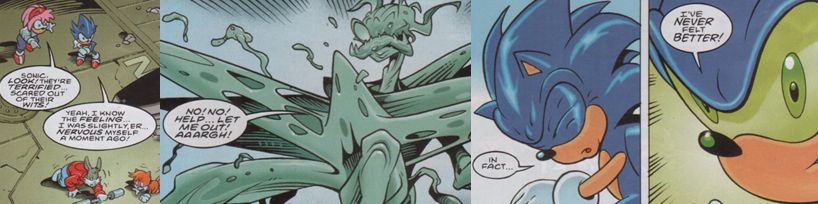
Chaos cripples with its fear aura and alters Sonic’s look.
Over here in the United Kingdom, Fleetway’s Sonic the Comic (1993 to 2002, referred to as “StC”) was a little late to the party with their Sonic Adventure adaptation; like Archie, Fleetway had established their own, separate lore for Sonic and his friends, one that “felt” closer to the videogames but was still distinctly separate from it. Previously, their adaptations of Sonic videogames had tended to be multi-part stories that took the game’s characters and the vague outline of its plot and applied them to their unique narrative and Sonic Adventure was no different. The arc began in issue 175’s ‘The Coming of Chaos!’ (Kitching , et al, 2000), in which Sonic and his friends race out to confront StC’s version of Chaos 0 in Metropolis City Zone. This battle, which is a truncated version of the first boss fight with Chaos 0, showcases that StC’s Chaos exudes an aura that cripples its foes with feelings of utter dread. Headstrong and arrogant as always, Sonic attacks Chaos head-on regardless and manages to fend it off but is left with glowing green eyes and jagged spikes. In the following issue, it is revealed that Robotnik’s assistant, Grimer, unleashed Chaos in the hopes of destroying Sonic and his friends and shaking Robotnik out of the slump he had found himself in after multiple defeats. However, Robotnik reveals that Chaos is truly uncontrollable and that, by setting it free, Grimer has “doomed the entire planet”.
Defeating Chaos extracts a heavy price.
Meanwhile, Sonic’s tech buddy Porker Lewis arrives; he’s (somehow) discovered that it’s made up of Chaos energy and has whipped up a device to defeat it but Sonic, already weakened from his earlier tussle with the creature, is unable to fight through its fear-inducing aura to complete the process. Luckily, Johnny Lightfoot steps in to lend a hand but, while he succeeds and Chaos is seemingly defeated, he dies in the process! Yep, a kids comic actually killed off a beloved, long-time character and not just any kids comic, a Sonic comic! Up until this point, death had largely been a stranger to StC’s stories; characters were used as batteries for Robotnik’s Badniks or turned to stone, or trapped for all eternity (…for a while), but they had never died before! StC hammered home that Johnny was actually, really, 100% dead in the following issue, where the guilt and shame of having recklessly led his friends into danger causes Sonic to quit the entire thing. However, Chaos reappears the Floating Island’s Emerald Chamber, now able to talk and state its intentions: it claims ownership of the Chaos Emeralds and desires to absorb their power. Knuckles is left with no choice but the jettison the Emeralds in the following story, ‘Splash-Down!’ (ibid), which causes the Floating Island to crash and sink into the sea. There’s an interesting wrinkle here where Knuckles, despondent at his actions, resigns himself to facing the same fate as his ancestral home and has to be coerced by Amy (and a good knock on the head) to avoid killing himself.
Tikal raised new questions about StC-Knuckles…
Also in this story, rather than going through a whole complicated mess involving robotic counterparts and body swapping, Robotnik simply…puts on a jacket so he resembles his Sonic Adventure design. I find this doubly amusing and ironic considering the lengths StC went to to show Robotnik transforming from his classic design to his Adventures of Sonic the Hedgehog (1993) look. Oh, and Sonic just…comes back at the end of the story, ready to jump into the fray once more. In the next issue’s story, ‘Out of Time!’ (Kitching, et al, 2000), Porker continues to obsess over Sonic’s green eyes and the Chaos energy he apparently absorbed from battling Chaos. This turns out to be a pretty big deal as Sonic is the only one who can see Tikal when she suddenly appears and promptly zaps him 8,000 years into the past. This (and the subsequent issue) is also where StC loops Sonic Adventure’s lore into their own narrative regarding Knuckles’ past; we learn not only that Knuckles existed in the distant past (a plot thread that wouldn’t be resolved until StC was continued online) but also that the extra-dimensional Drakon Empire (who had previously attempted to invade Mobius) were involved in Chaos’ origin. After defeating a Drakon Prosecutor, revealing the heavily-armoured warriors to be mutated fish in armoured shells, Sonic chats with Tikal’s father, “Pochacamac”, who reveals that the Echidnas stole the seven Chaos Emeralds (and the Master Emerald) from the Drakon Empire after they invaded the Echidna’s sacred Emerald Mines and infused the gems with their patented Chaos energy.
StC gave Chaos a completely new origin.
During a battle with Drakon Prosecutors in which a stray energy blasts hits the Emeralds and causes their powers to surge out of control, the Drakon Sonic had previously defeated is released from its prison and fuses with the Emeralds to transform into Chaos. Sonic attempts to get revenge for Johnny in the following issue but is transported back to the future in order to weaken Chaos enough for past Knuckles to do…something to imprison Chaos. Sonic returns to the present just as Chaos arrives at Robotnik’s mountaintop fortress, where Robotnik gathered the Chaos Emeralds in order to lure it in…though he does this merely to have a front row seat to the end of not only Sonic and his friends, but the entire world. All hope seems lost in ‘Perfect Chaos!’ (ibid) when Chaos absorbs the power of the Chaos Emeralds and transforms into Perfect Chaos (which actually more closely resembles Chaos 6) until a severely weakened and dying Super Sonic arrives. How, I gave Archie flack for how complicated some of their stories were so I guess it’s only fair to deviate here to explain this a bit. In StC, Sonic absorbed a huge amount of Chaos energy a long time ago; this lay dormant in him for years and, whenever under extreme stress or driven to severe rage, he would transform into Super Sonic. StC Super Sonic was an uncontrollable, rage-filled, super-powered demon with maniacal eyes who could shoot energy blasts, fly at incredible speeds, and was all-but-invulnerable. However, Sonic’s friends eventually found a way to separate Super Sonic from him and imprisoned the demon within a time dilation of sorts. Super Sonic did eventually escape but the effort drained his power so much that he eventually lost his memory and became a confused, but harmless, individual.
Chaos, and Super Sonic, are both defeated, ending both the story and StC.
Sonic’s fears regarding his demonic counterpart are realised in the finale of the Sonic Adventure arc, ‘Point of no Return!’ (ibid), in which Super successfully drains Perfect Chaos of all its energy and regresses it back to a harmless Drakon fish. The Chaos energy returns Super’s memories and powers and he attacks everyone, intending to kill them all, and begins to drain the life energy out of Sonic. However, Super’s friend, Ebony, uses her magical powers to fuse Super and Sonic back into one being again. Grimer quits Robotnik’s employ, disgusted at his lackadaisical attitude to what looked to be the end of the world, and the story ends with Sonic and his friends triumphant. Sadly, the Sonic Adventure arc would be the last time StC ran original Sonic stories in their comics; for a while, the comics had consistently largely of reprints of old stories, even though the writers could have done what Archie did and used the extra pages to tell back-up tales to expand the story rather than rushing through everything in the main Sonic strips.
StC didn’t really give these guys anything to do in this arc…
Compared to the Archie adaptation, StC’s interpretation of Sonic Adventure is not only rushed but has some pretty weak connections to its source material. The characters never visit any of the locations from the game, Chaos is significantly different (though, in some ways, better; its “fear aura” was a nice inclusion with a lot of potential), Big is reduced to a throwaway, one panel cameo, Gamma doesn’t appear at all, and neither Tails or Amy have anything near the significance of the roles they played in the game. While Knuckles plays a vital part, he’s far more hands-off than in Archie (and the videogame), and Robotnik barely features at all (though this does make sense considering where the character was, mentally, at the time). If Fleetway had been able to use every page of their issues to tell this story, it probably would have landed much better; while I don’t doubt that they still would have sought to slot Sonic Adventure’s canon into their own as best as they could, at least e could have seen a five page back-up story featuring Knuckles, or Big, or anyone. Instead, it’s a very poor effort; StC did a pretty good job of telling stories heavily influenced by the videogames in the past but, by the point, the comic was on its last legs so I guess we were lucky to get anything.
Sonic X weaved the game’s story into its lore and mixed it up a bit.
Chaos would go on to sporadically appear in Archie Comics as it continued on, even when the license switched over to IDW Publishing, but it also notably appeared in Sonic X (2003 to 2006) when the anime did its own six-part adaptation of Sonic Adventure. Before I get into that, though, I just want to briefly mention Sonic Underground (1999), the oft-lambasted follow-up to SatAM that, for all its faults, at least featured Knuckles (Brian Drummond). There’s a couple of points in the series where characters refer to “Chaos” as being the destructor of Mobius and, in ‘New Echidna in Town’ (Boreal, et al, 1999) Chaos Energy transforms Dingo (Peter Wilds) into a mindless beast, Chaos Dingo, who takes on a malleable form. While this link to Sonic Adventure is tenuous at best (made all the more so by Sonic Underground’s dramatic departure from all Sonic lore), it’s still an interesting connection to make. Despite looking fantastic due to its anime aesthetic, Sonic X was a bit of a disappointment when it first started for a variety of reasons: Sonic (Jason Griffith) is largely lethargic, preferring to spend his days taking naps or smelling flowers, and all of his iconic friends are pushed to the side to make way for Chris Thorndyke (Michael Sinterniklaas) and a host of other human characters forced into the show when Sonic and the others are transported from their world to Earth. However, for me at least, things started to pick up near the end of the first season and with the episode ‘Pure Chaos’ (Kamegaki, 2004), which kick-started the Sonic Adventure saga with Froggy swallowing a Chaos Emerald, Dr. Eggman (Mike Pollock) launching the Egg Carrier, and Sonic and Knuckles (Dan Green) battling Chaos 1 and 2. Straight away, Sonic X is ahead of the curve simply by including Big in a role more suited to his videogame story and, like Archie, the series sticks quite close to the source material.
Sonic X featured almost all of Sonic Adventure‘s bosses.
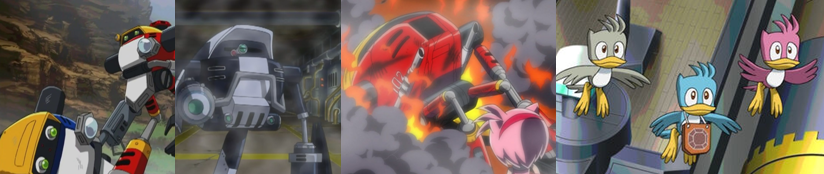
The adaptation continued in the following episode, ‘A Chaotic Day’ (Kamegaki, 2004), which focuses a bit more on Knuckles’ side of the story, detailing how Chaos broke out of the Master Emerald and his search for its shards, which also brings him into contact with Tikal (Rebecca Honig). Sonic and Tails (Amy Palant) then battle both Chaos 4 at Eggman (in the Egg Hornet) at the Mystic Ruins (in what is a pretty faithful adaptation of the same boss battles from Sonic Adventure) before pursing Eggman to his Egg Carrier. They crash, as in the game, and Amy (Lisa Ortiz) and Cheese the Rabbit (Rebecca Honig) are attacked by ZERO, who kidnaps Amy and the birdie, Lily (Sayaka Aoki). Amy and Gamma’s (Andrew Rannells) stories are the primary focus for the next episode, ‘A Robot Rebels’ (Kamegaki, 2004), in which Gamma kidnaps Froggy right after Chris helps Big to rescue him and he subsequently frees Amy after suffering a bit of a short circuit at the sight of Lily just like in the videogame. Similarly, Amy convinces Sonic to spare Gamma and Knuckles recovers the last piece of the Master Emerald in the following episode, and, though Eggman successfully uses Froggy’s tail and Chaos Emerald to transform Chaos into Chaos 6, Sonic and Knuckles (randomly sporting his Shovel Claws) defeat it. The episode ends with the finale of Tails’ story, in which Eggman launches a missile at Station Square and he must gather his courage and self-sufficiency in order to disarm it (though he doesn’t battle the Egg Walker).
Gamma’s tear-jerking story is told from start to finish.
‘Revenge of the Robot’ (ibid) primarily wraps up Sonic and Gamma’s stories from the game: Gamma travels through the locations of Sonic Adventure deactivating its robotic brethren and freeing the Flicky’s trapped within (which is considerably easier than in the videogame) and eventually destroys itself and its older “brother”, E-101β “Kai” (Andrew Rannells) to reunite with its Flicky family. While Sonic does go on to defeat Eggman and his Egg Viper, Chaos obtains all seven Chaos Emeralds, transforms into Perfect Chaos, and floods Station Square in the final episode of the saga, ‘Flood Fight’ (Kamegaki, 2004). Up until this point, Chris’s involvement (and the involvement of his extended family and friends) was largely painless and unobtrusive. The changes this, however, as the destruction brought upon Station Square has a significant impact on the lives of Sonic’s new human friends and, wouldn’t you know it, it is Chris who supplies with the last Chaos Emerald he needs to transform into Super Sonic. Unlike in the videogame and the Archie Comics adaptation, Super Sonic defeats Perfect Chaos with hardly any issue at all in Sonic X; while Perfect Chaos had never looked bigger or badder, resembling more a water-based version of Biollante, and packs some serious firepower, it is defeated and reverted back in Chaos 0 with very little effort. To be fair, though, Sonic X’s Super Sonic was always far more powerful than his other incarnations, being more of a God-mode than a power-up. Still, Chaos is defeated and returns to the Master Emerald with Tikal, at peace once more. Station Square is left in ruins and, while the anime also glosses over the death and destruction the flood must have caused, subsequent episodes dealt with (or, at least, referenced) the restoration process.
Sonic X told the entire game’s story, giving everyone their due.
Like the other adaptations of Sonic Adventure discussed here, Sonic X incorporates the game’s narrative into its own unique lore but, in a twist, includes characters like Cream and Rouge the Bat (Kathleen Delaney) who debuted after Sonic Adventure. However, even these videogame characters have smaller roles than Chris and his cohorts; given that Chris was obsessed with following Sonic everywhere and putting himself in danger, this isn’t too surprising but, honestly, their inclusion and involvement is no more or less, better or worse, than those of the Archie and StC extended cast. However, Sonic X’s Sonic Adventure saga is easily the closest, most faithful adaptation of the source material of these three; Archie Comics came close bit their impenetrable lore meant that too many compromises had to be made. Both comic adaptations focused more on Chaos than other bosses and events, but Sonic X includes almost everything from the videogame, giving plenty of time to each of the game’s six characters and adapting their stories with a high degree of fidelity. It even streamlined and improved the story in many ways, such as having characters team up against Chaos’s various forms and improving the appearance of Perfect Chaos.
Sonic Adventure told a complex, interweaving Sonic story for the first time.
Sonic Adventure has been a rich source of adaptation, second only to Sonic Spinball. Aside from the more direct adaptations I’ve talked about here, stages, bosses, and narrative themes from the game cropped up in many subsequent Sonic titles. Unlike Sonic Spinball, I feel like this is probably because of the game’s story; this was the first time Sonic and his friends and enemies had a real voice in the videogames and the first time Sonic Team tried to tell a deep, overarching story. Add to that the influence that Sonic Adventure’s gameplay and aesthetic choices had on Sonic’s canon and future release and it’s not hard to see why. The only thing that hampered each of these adaptations was their attempts to shoe-horn the videogame narrative into their existing lore, rather than using the general story and themes of the game and threading it through in a more natural way. While Archie Comics and StC had good reasons for this, Sonic X had every opportunity right from the beginning of its run to properly prepare and lay the groundwork for its eventual videogame adaptations and, instead, it was happy to waste time focusing on Chris, his idiotic behaviour, and having Sonic be this bland, lethargic goody-too-shoes rather than a snarky, hyperactive adventurer.
Which of these three Sonic Adventure adaptations was your favourite? How did you find Archie’s writing at the time? Do you remember Sonic the Comic? What were your thoughts on Sonic X and Chris? Drop a line below and stick around for more articles in the future.
The Background: It was 2011 and SEGA were eager to celebrate the 20th anniversary of their iconic videogame mascot; after years of disconnect and complex additions to what had begun as a simple, one-button videogame, it’s fair to say that there was some…confusion regarding Sonic’s past, canon, and timeline. SEGA initially opted for a soft reboot, of sorts, with Sonic Adventure (Sonic Team, 1998), which clearly depicted Sonic and his cast of characters redesigned into a slightly older, more anime-inspired aesthetics in a world similar to ours, inhabited by both humans and anthropomorphic characters, and with a tenuous connection to the previous videogames. However, very quickly, this fell apart a bit as Sonic videogames became both incredibly dense and complex or laughably simple, especially in their narratives. After years of fans wanting a return to the traditional, 2D gameplay of the past, Sonic Team opted for a title that would combine not only the tried-and-true 2D gameplay of the past with the fast-paced 3D gameplay of what was, at the time, the present but also bring together two different generations of Sonic for the first time.
The Plot: While celebrating Sonic’s birthday, Sonic and his friends are scattered through time by Doctor Eggman’s ferocious, mysterious beast, the Time Eater. Teaming up with a past version of himself, Sonic races through from his past to rescue his friends, retrieve the Chaos Emeralds, and put a stop to the Time Eater’s rampage.
Gameplay and Power-Ups: Sonic Generations takes the fast-paced, “Boost”-centric formula of Sonic Unleashed and Sonic Colours and further refines it, offering both 3D and 2.5D, high-speed action stages as players race through some of the most iconic stages (or “Zones”) in Sonic’s history. While Sonic remains the only playable character, there are now two of him: the “Classic” Sonic (who plays exclusively in 2.5D) and the “Modern” Sonic (who plays in 3D and 2.5D). There are nine Zones to playthrough in Sonic Generations, each with two levels (or “Acts”): Act One is exclusive to Classic Sonic and Act Two is tackled by Modern Sonic. Although you’ll pot a timer in the to-left of the screen, there are no time outs here’ instead, you get a letter grade a points for finishing Acts as fast as possible. You’ll want to stick to the higher paths, where available, and utilise rails, pulleys, and other shortcuts to cut down your time, but you’re basically guaranteed an “S” rank if you finish an Act without losing a life. Unsurprisingly, Golden Rings are your life source, protecting you from most attacks and granting an extra life for every increment of 100 you collect. Golden Rings also fuel Modern Sonic’s “Boost” gauge (which is also filled by performing tricks off ramps and bashing Badniks), allowing him to blast ahead at high-speeds and plough through any enemies and destructible objects in his way. While both Sonics have unique gameplay mechanics, they share some common controls: you jump with A or X, pressing it again in mid-air to attack nearby enemies or hit targets with Sonic’s Homing Attack. While this is exclusive to Modern Sonic, you can unlock the ability (or “Skill”) for Classic Sonic, too, and it becomes mandatory in the 3DS version. B sees you crouching to fit through small gaps, Y activates any Skills you have equipped, and the Right Trigger either blasts Modern Sonic off or quickly performs Classic Sonic’s Spin Dash. When Boosting, you can hold the Left and Right Triggers to drift and use the Left and Right Bumpers to quick step. As Modern Sonic, you can press B in mid-air to perform a stomp, wall jump off specific surfaces, and dash along a line of Rings by pressing Y.
Both Sonics have distinctive playstyles, though gimmicks are recycled and shared between both.
These controls are largely mirrored on the Nintendo 3DS, with players jumping and using the Homing Attack with A or B and Boosting with Y, though there’s no quick Spin Dash for Classic Sonic. Classic Sonic’s taught the Homing Attack early on, though he doesn’t really need it and ends up playing as a slower, clunkier version of his counterpart. While it might seem like Modern Sonic has more tricks at his disposal, each Sonic can be assigned Skills, unlocked by collecting Red Star Rings, completing additional Challenges, and spending points in the Skill Shop. Each Skill has a point value, and you can assign as many as you like to each Sonic until you hit the point cap of 100. A bunch of these are shared between both Sonics, giving each the ability to begin an Act with ten Rings, granting an additional extra life, giving them more movement options when underwater, and eliminating the recovery time after taking a hit. Classic Sonic can equip one of the elemental shields from Sonic the Hedgehog 3(SEGA Technical Institute, 1994), gaining a bounce, flame burst, and double jump and being able to breathe underwater, resist flames, and attract Rings, respectively. He can also equip the “Twin Spin Attack” (or “Insta-Shield”) from Sonic 3, start with a temporary invincibility, extend the Spin Dash, turn enemies into Rings, and even hop on a skateboard. Some of these abilities are available in Zones as well, such as the speed up and invincibility and skateboard, though you’re more likely to smash Ring monitors. Modern Sonic can also be assigned Skills to allow him to blast off at the start of an Act, perform faster Homing Attacks and wall jumps, and increase the length of his Boost gauge. When playing Planet Wisp or Tropical Resort, you’ll utilise the returning Wisps, with Classic Sonic using the Pink Wisp and Red Wisp to race across walls and ceilings and turn gears or burst through the sky and Modern Sonic rocketing up Dr. Eggman’s factory and smashing through barriers or ricocheting about with the Cyan Laser. Acts also contain the usual gimmicks and hazards, such as springs, spikes, flame bursts, ramps, and rails. You can jump through boost rings to blast through the air, fly off ramps to perform tricks and fill your Boost gauge, repeatedly hit bouncy springs to get higher, and even run on those awful Marble Garden Zone platforms to reach higher areas in Sky Sanctuary. When underwater, you’ll need air bubbles to keep from drowning; when leaping to platforms, you must watch for bottomless pits; and you’ll often press switches to activate or move platforms and blocks.
Sonic’s greatest hits and misses are revisited in each Zone and Challenge.
Interestingly, the Nintendo 3DS’s bottom screen is only used to track your progress in an Act, display the boss’s health bar, and to navigate the sparse hub world. Sonic Generations takes place in a simple hub world called “White Space”, a disappointingly barren void where stages from Sonic’s past have been dumped by the Time Eater. These are arranged in three areas corresponding to an era of Sonic’s history and guarded by a Boss Battle. To progress through the game’s brief and simple story, you must complete each Act to partially restore colour and life to the White Space, then acquire a Chaos Emerald from a Rival and Boss Battle. By and large, the game’s Acts aren’t particularly challenging, though there are some unfair bottomless pits and each Sonic seems to have lead in their sneakers, which can make precision platforming slippery and frustratingly difficult. The difficulty comes in the lengthy and haphazard variety of gameplay mechanics seen in the later, modern levels; unsurprisingly, Crisis City stands out as one of the game’s more frustrating stages thanks to the fire traps, lava pits, bottomless pits, and that Goddamn flaming tornado! The Nintendo 3DS version sees you flying through Mushroom Hill using propeller plants, bouncing around Casino Night, and racing from a destructive orca in Emerald Coast, though the additional Challenges are missing from the Xbox 360 version. Here, after clearing each area, you’ll unlock five additional Challenges for each Sonic; you’re required to clear at least one of these for each Zone to gain a Boss Key, battle the boss, and progress to the next area. These Challenges are considerably varied and can be anything from racing against a ghostly doppelgänger to finding Chao, to completing a stage with only one Ring. Sometimes, you’ll also race against, or team up with, one of Sonic’s friends; you’ll use Mile “Tails” Prower to hover over obstacles and gaps, knock musical notes back to Vector the Crocodile, and clear walls of flame with Blaze the Cat, for example. While you may call upon Sonic’s friends with Y in these Challenges, you’ll never control any character other than the two Sonics, which is quite disappointing. These Challenges can be frustrating but clearing them is the only way to completely restore each area and also unlock additional Skills, artwork, music, and character profiles in the Collection Room.
Presentation: Graphically, Sonic Generations is still one of the brightest, most vibrant Sonic 3D titles ever made. Classic Sonic, especially, looks and animates really well and every stage is packed full of life, colour, and little details that will be recognisable to any Sonic fan. Both Sonics have idle poses and celebrate or lament their letter grade after each Act, though, strangely, Classic Sonic is completely mute. This means that Modern Sonic gets all he puns and one-liners and voice clips, while Classic Sonic simply pantomimes his feelings and relies on Classic Tails to talk for him. Sonic’s friends appear as non-playable characters (NPCs) in White Space, offering encouragement and hints after being restored to guide you towards Red Star Rings. White Space is very annoying for such a simple hub world, with the game forcing you to take boost pads, loops, and springs to reach Challenges (though you can cycle through Acts, at least). I’m glad the game isn’t bogged down by a huge open world, but White Space feels very cheap and half-assed at times, despite some fun Easter Eggs. Sonic Generations takes the original 2D and 3D environments and gives them an eye-catching visual makeover, though the screen’s a bit too zoomed in at times for Classic Sonic and it’s easy to just blast off into the void as Modern Sonic. Perhaps the pinnacle of Sonic Generations’ graphical achievement, though, is in the fantastically updated battle against Perfect Chaos, who has been turned from a choppy, flappy-mouthed monstrosity into a genuinely terrifying, bio-organic creature. However, when playing the Xbox 360, I did notice some blurriness to the images, some frame rate issues, and the game crashed on me three or four times, which was odd. It’s obviously graphically superior to the 3DS version, which offers the same headache as all 3DS titles and is extremely basic at times. You cans ee this in Mushroom Hill, which looks strangely bland, the cutscenes (which are simple 3D models with dialogue boxes), and the reduced Zone count.
A generational adventure that lovingly recreates Sonic’s classic stages.
Each of the game’s Zones are beautifully rendered and expanded upon with gameplay gimmicks from other games and even little extra things, like a celebration taking place in Rooftop Run and getting to visit Hidden Palace in Sky Sanctuary. While there are some obvious choices (Green Hill and Chemical Plant have since been overused to death), there are some odd inclusions, like Speed Highway from Sonic Adventure (I would have picked maybe Ice Cap or Red Mountain), and some disappointments, like Seaside Hill from Sonic Heroes (Sonic Team USA, 2003). I’m honestly surprised that Sonic Team didn’t include Casino Park instead, though I would’ve liked to see them mix it up with Egg Fleet or Frog Forest. There’s some real depth to the environments, with Chemical Plant’s factory exploding in the background, the Death Egg rising in Sky Sanctuary, and desolation as far as the eye can see in Crisis City. Things can be a bit cluttered at times and it’s not always clear which winding path you can take and which is part of the background, but I loved how faithfully Sonic Generations recreated each area and the little twists they toss in. Classic Sonic’s Seaside Hill is largely underwater, for example; the infamous truck wrecks the environment and rockets after you across walls in City Escape; and Dr. Eggman airship hounding you in Rooftop Run. The Nintendo 3DS version oddly adapts Zones from Sonic’s main console games rather than his handheld ventures, with the exception of Water Palace (and, I guess, Tropical resort), which was an odd choice and results in some janky, bland stages that are actually inferior to their Nintendo DS predecessors since the action’s limited to one screen. The Xbox 360 version features some really well done CG cutscenes; it’s just a shame that the game’s story is so criminally short that we don’t see more of these. When you free Sonic’s friends, they’ll make a comment while Sonic just stands there like a tool rather than properly interact with them. As for sound, Sonic Generations has you covered! Every area features a unique, remixed version of its original track and each Act has a different version to differentiate the two. On the Xbox 360, you can also unlock additional music tracks, including some great remixes by the likes of Cash Cash and Crush 40, and play these on any Stage, allowing for a lot of variety in the music you hear as you play.
Enemies and Bosses: Given that it features stages from three eras of Sonic’s history, Sonic Generations also includes many recognisable Badniks and enemies from each time period being represented. You’ll smash apart the likes of Moto Bugs, Buzz Bombers, Crabmeats, Spinys, and Egg Robos from the classic games, with Egg Robos sporting missile barrages and giant Badniks even chasing you at certain points. Moving into the modern era, you’ll bop Eggpawns, Cop Speeders, robots from the Guardian Unit of Nations (G.U.N.), and flaming Iblis creatures. While most slow and easy to attack, they can still surprise you with bolts of energy or other attacks, such as the construction Egg Pawns on Planet Wisp tossing their pickaxes. Enemies are largely there to be bothersome, with the cannons surrounding Rooftop Run’s clock tower being particularly aggravating and the Egg Pawns in the barrel store being notably cheeky. Enemies also act as “bridges” between platforms, rails, and other areas, allowing you to Homing Attack or bop them to reach higher paths, cross lava, or avoid spike pits. The Nintendo 3DS version features a handful of unique enemies due to its different Zone selections, such as those mushroom-tossing moles, axe-wielding Egg Pawns, and even a massive Egg pawn that wrecks the ruins of Water Palace. Spikes are annoyingly commonplace, often waiting right where you land, as are crushing hazards, moving blocks, flame bursts, and missiles from the walls and ceilings. You’re chased by a gigantic truck in City Escape, one that now sports giant buzzsaws, have debris flung at you by a flaming tornado in Crisis City (which also whisks away the environment and the end goal for Classic Sonic!), and must watch for crumbling platforms when bouncy from clouds in Sky Sanctuary. Spiked obstacles also appear on rails, mines litter the ground, and you must quick step left and right to avoid being blasted by Dr. Eggman’s drones and airship. While warning signs alert you to bottomless pits, it’s very easy to plummet down them when moving so fast, or to clip through the environment, and Sonic can be quite slippery, which doesn’t help when trying to make trickier jumps.
Iconic bosses get a massive upgrade, adding extra gimmicks and attacks to their arsenals.
Six classic bosses return and are remixed in each version of Sonic Generations. On the Xbox 360, Classic Sonic first fights the Death Egg Robot on a narrow platform, dodging its extending, drill-like arms and running under it when it jumps to ram its butt. The fight the switches to a recreation of the Death Egg Zone and the mech exclusively attacks from the background, forcing you to lure it to attack bombs with its arms so you can run up and ram its head. The fight with Perfect Chaos is now a whole stage as you dodge its tentacles and jump on crumbling platforms to reach it, hitting springs and pulleys and blasting across the water on boost pads to race up its body. Perfect Chaos spawns twisters, fires energy beams, and unleashes its massive mouth laser, before erupting water geysers. This forces you to precariously hop to platforms, battling the awkward camera to land the final blow. The Egg Dragoon sees you blasting through a circular tunnel avoiding its freeze bolts and missiles and hopping to rails to ram the cockpit. When on a 2.5D plane, you must hang back and jump over shots then quickly wall jump up its arms, avoiding a downward shot, before diving after the falling mech, avoiding its drill arms to target its body. On the Nintendo 3DS, you battle one of my favourite bosses, the Big Arms, now avoiding its arm slams and palm slaps, then, oddly, battle the Biolizard. This is an annoying fight as you must awkwardly run from its gaping mouth or thrashing tail, grinding up to its core, avoiding high and low shots and bouncing off orbs to smack its core. Finally, you battle the Egg Emperor in an autorunner, desperately avoiding its energy waves, dodging its charge, and taking out the cannons to smack his big, stupid face.

Best Sonic’s rivals to power-up and battle the aggravating Time Eater with two Super Sonics!
You’ll also compete against some of Sonic’s rivals in both versions, with the Xbox 360 fights yielding Chaos Emeralds. You’ll once again race across Stardust Speedway against Metal Sonic, hopping over its torpedo dash and avoiding its lasers and the debris it tosses at you to give it a smack. You’ll across the walkways of the Space Colony ARK against Shadow the Hedgehog, chasing down purple energy orbs to power-up and blast meteorites at him in a battle that’s ridiculously easy if you can speed after him fast enough. Finally, you return to Crisis City to battle Silver the Hedgehog, avoiding his telekinetic waves and targeting the debris he flings at you to wallop him, before scrambling over a huge wave of junk and racing towards the camera to finish him off. This rival fights are significantly downplayed on the Nintendo 3DS as you don’t fight Silver and both are reduced to races, with you hopping over obstacles and slowing Metal Sonic or Shadow with some lucky shots and desperately trying to avoid Shadow’s boost and Chaos Spear. Unfortunately, Sonic Generations and its bosses arefurther let down by the final battle with the Time Eater. Despite an impressive, ominous score, the unique design of both the creature and the bizarre vortex you battle it in. Despite the joy of seeing Classic and Modern Sonic turn Super Sonic to battle two versions of Dr. Eggman, this fight is a confusing mess. You hold down RT to charge head-first through a time/space distortion, dodging pieces of the Zones and the Time Eater’s arms and lasers, to ram its core. You can press Y to switch to the outside of the vortex and press X to fire the other Sonic to destroy incoming projectiles, all while Sonic’s friends constantly shout “advice”. You can barely see Golden Rings until they’ve flown past you, you have no idea if you’re holding or mashing buttons, and defeating this monstrosity is much easier on the Nintendo 3DS. You battle it on a 2.5D plane, with no attacks at your disposal and simply dodging its lasers and arm swipe until its core is exposed, then race towards it on a 3D plane. This can be tricky as it’s not easy to dodge its hand claps and it’s easy to run out of Rings, but at least you’re not bombarded by repetitive voice clips, and you can land hits a lot easier.
Additional Features: There are forty-nine Achievements to earn in Sonic Generations, with one popping every time you clear both Acts in each area and defeat a rival and boss. Every Act as at least one Achievement tied to it (normally something involving going a specific route and collecting a specific Red Star Ring before completing the stage), you’ll get Achievements for performing tricks, acquiring Skills, and unlocking all collectibles. Every Act has five Red Star Rings to find, with each one unlocking artwork, music, and other extras; you’ll also get an Achievement if you find them all. As you complete Acts, Challenges, and collect Red Star Rings, you’ll unlock additional music tracks, cutscenes, artwork, and little character trophies that can all be viewed in a little gallery/museum at the far left of White Space. If you explore the Green Hill hub, you’ll find a SEGA Mega Drive and, for 7777 points, you can purchase a Mega Drive controller to play a port of the original Sonic the Hedgehog(Sonic Team, 1991)! You can also challenge the rivals and bosses on “Hard” mode (though there’s no Achievement for this), upload your fastest times to an online leaderboard, and play a pinball table themed on Casino Night Zone if you snagged the DLC. On the Xbox 360, you acquire the seven Chaos Emeralds by playing the main story, unlocking Super Sonic for the finale and as a 100-point Skill for both Sonics, but play Special Stages on the Nintendo 3DS. These are modelled after Sonic Heroes’ pipes, with you collecting orbs to power-up your boost and avoiding spiked mines in super easy challenges. You can also download additional missions using the handheld’s “StreetPass” feature, play an online versus mode (that appears to be a head-to-head race), customise a profile card, and play a time attack mode, though the Nintendo 3DS lacks the Skills and Red Star Rings of its counterpart.
The Summary: When I first played Sonic Generations on the PlayStation 3, I remember it being a fantastic experience; it was fun, fast paced, and chock full of nostalgia and little bits of fan service. Aside from the final boss, I had a blast breezing through everything the game had to offer and lamented the lack of follow-up downloadable content from Sonic Team, hence my excitement for the later remaster. I was therefore super exited to revisit Sonic Generations on the Xbox 360 and snag the Nintendo 3DS version, only to be put off by how zoomed in the camera was for the 2.5D sections. Nevertheless, I ploughed ahead, happy to be revisiting this slice of nostalgia and, very quickly, found myself quite frustrated by a lot of little things. The sheer uselessness of the regular jump both Sonics have, their tendency to spontaneously slip off platforms, the frustrating nature of a lot of the Challenges and, of course, the massive letdown of the final boss. All these years later and I’m still disappointed that the story wasn’t a bit more grandiose given that this was a celebration of Sonic’s 20th anniversary. White Space feels so empty and lifeless, the lack of other playable characters and extra stages was disappointing, and the barebones nature of the title makes it feels cheap and rushed at times. The Nintendo 3DS version is even more barebones, lacking so many features, characters, and even having a reduced Zone count, with the only consolation being simplistic Special Stags. Not adapting Zones from Sonic’s handheld past was a huge mistake, the Zones we do get are largely empty, and both Sonics play too similar for the game to compete with Sonic’s Nintendo DS library. Yet, by and large, Sonic Generations is still an enjoyable experience. I fear this playthrough may have been soured by me rushed through it as quickly as possible rather than taking my time and losing myself to the nostalgia. If you can do that, there’s a lot to like here from a visual and aural perspective, as well as the game being a fun, if all too brief, break-neck action romp through some of Sonic’s most iconic areas.
Nintendo 3DS Rating:
Xbox 360 Rating:
⭐⭐
Rating: 2 out of 5.
⭐⭐⭐
Rating: 3 out of 5.
Could Be Better
Pretty Good
What did you think of Sonic Generations? Do you think it still holds up or, like me, do think that it was lacking in content and features? What did you think to the Zones featured in the game and the remixed boss battles? Were you disappointed by the lack of other playable characters? Which Challenge was the hardest for you and why was it Vector’s? What was your favourite Classic and/or Modern Sonic videogame? Share your thoughts in the comments, support me on Ko-Fi, and go check out my other Sonic content.
Sonic Mania (PagodaWest Games/Headcannon, 2017) was a hit, there’s no doubt about it; within a year, the game sold over one million copies. A physical edition, Sonic Mania Plus, was later released in 2018 featuring all the updates and downloadable content (DLC), and some nifty extras like a reversible sleeve that featured classic nineties-inspired artwork. In addition, Sonic Mania Adventures (2018) had a nice little five episode run online alongside a few bonus episodes along the way to keep the game alive in the minds of fans and the general public. However, since Sonic Mania released, we’ve heard very little about a sequel; in 2018, Takashi Iizuka stated that a sequel was not likely to happen as “it feels like we did everything we could for the Sonic Mania project”. With 2020 being touted as the “Year of Sonic” and some major announcements planned to take place in the run up to Sonic’s 30th anniversary, I think it’s only fair to hope that Sonic Mania 2 is on the cards for a 2021 release.
With that in mind, or just for a laugh, today I’m going to talk about a few key features I’d like to see in a potential Sonic Mania sequel…
Less Classic Zones
Don’t get me wrong, I love a good HD reimaging of Sonic’s classic Zones as much as the next person but, if SEGA have proven anything about their understanding of Sonic it’s recent years, it’s that they rely way too much on the same familiar Zones. Sonic Mania, admittedly, mixed it up a bit with the likes of Flying Battery Zone and Oil Ocean Zone but we still saw yet another rendition of both Green Hill and Chemical Plant Zone, which both featured heavily in Sonic Forces (Sonic Team, 2017) and that released in the same year! Regardless, I would still like to see some classic Zones make a comeback but SEGA really need to start taking some chances; why not use Emerald Hill Zone, or combine it with Hill Top or Aquatic Ruin Zone, for the traditional grassy-fun opening level? Why not use Scrap Brain Zone instead of Chemical Plant, or bring back Ice Cap and Marble Garden Zone? One of the things I did like about Sonic Mania, which also cropped up in Sonic Generations(ibid, 2011), was the use of gameplay gimmicks being incorporated into other Sonic Zones and I feel like this would be a great way to go in Sonic Mania 2. If you’re going to do Scrap Brain Zone, for example, throw in some of the steam-based mechanics from Metropolis Zone; if you’re bringing back Spring Yard Zone, toss in some of the pinball mechanics from Toxic Caves; if you’re making new Zones (and you absolutely should), splice in the dreaded barrel from Casino Night or the light-based mechanics from Sandopolis Zone. There are so many great levels and gimmicks from the last thirty-five years of Sonic’s life and returning again and again to Green Hill and Chemical Plant would be very disappointing, even if those Zones were mixed up with new mechanics. Go new, or outside the box, to show some real narrative and aesthetic growth.
Don’t Drop DLC Characters
Okay, I know I’m in the minority with this one but I like Sonic’s extended cast of characters; they’re fun and colourful and each one has a unique gimmick that has been either poorly utilised, undervalued, or simply slapped onto Sonic either through his base moveset or through the use of Wisps. Why include Tails as a playable character when Sonic can “Hover!!” Sonic Mania did a great thing by finally (finally) bringing back Mighty the Armadillo and Ray the Flying Squirrel; not only did they come back but they were far more than Sonic reskins and their individual abilities and personalities really came through thanks to their unique gameplay mechanics and Sonic Mania’s gorgeous sprite animation. For Sonic Mania 2, they absolutely should include both of these characters right off the bat. It really irks me when DLC characters are still DLC in a sequel. Maybe have them unlocked along the way after defeating bosses, like in Sonic Advance 2(Dimps/Sonic Team, 2002). In fact, I would look to the Sonic Advanceseries (ibid, 2001 to 2004) for a lot of inspiration for a Sonic Mania sequel in two very specific ways. First of all, Amy Rose should definitely be a playable character. She apparently missed out on being included in the first game because “she’s the only one without a kind of gameplay-oriented “power”” but she did show up in Sonic Mania Adventures and, honestly, it is a crime that she wasn’t included in Sonic Mania not just because six playable characters makes a lot more sense than five but also because she’s just as much a part of Sonic’s history as Metal Sonic and he was included.
Team moves have promise that Sonic Mania 2 could expand upon.
Amy should feature in much the same way she played in Sonic Advance but tweaked slightly; have her hop by default and twirl around in a Spin Attack with her Piko-PIko Hammer when you press the button again, similar to Sonic’s Insta-Shield. Holding down and X would see her rev up on the spot, like in Sonic Advance but, when the button is released, she should blast away swinging her hammer to attack enemies. I’d like to see Amy be a bit more floaty, kind of like Princess Peach in Super Mario Bros. 2(Nintendo EAD, 1988), to basically make her an “easy mode” character for younger players and to compensate for her moving slower and jumping lower. Secondly, Sonic Mania 2 should really capitalise on its expanded roster to build upon the team-based gameplay seen in Knuckles’ Chaotix(SEGA, 1995), Sonic Advance 3 (specifically), and Sonic the Hedgehog 4: Episode II (Dimps/Sonic Team, 2012). This means that not only would we finally be able to play as Sonic and Knuckles, or Knuckles and Tails, but we’d also be able to team up any two characters for co-operative play and to utilise some unique co-op mechanics. For example, playing co-op with Tails would be pretty much the same for every character (Tails can carry his partner while flying or swimming) but teaming with Knuckles would see characters jump onto his back to glide across gaps and use his immense strength to bash through walls. Teaming with Sonic could involve the use of a faster speed dash or a general increase in speed and jumping power, which would be great for Knuckles and Amy. Mighty, meanwhile, could jump ahead of his partner to shield them with his shell and use his slam to break through areas of the ground, while Ray could use his bushy tail to swat his partner up in the air and help them swing across vines and ledges. Given that multiple different character variations were included as part of Sonic Mania Plus’s “Encore Mode”, I would definitely include this co-op gameplay right from the off, if only to add some variety to the gameplay and to, hopefully, refine and perfect this mechanic, which has always had a lot of potential but never quite been that great in execution.
Add MORE Playable Characters
So I think I’ve made a convincing argument that Amy, at the very least, needs to be a playable character in Sonic Mania 2 but why stop there? The one thing SEGA should not take away from Sonic Mania is that players only want to play as Sonic; the developers definitely should totally use the sequel as a means to bring in some more classic Sonic characters like Metal Sonic (most likely only available until after completing the main story mode), Espio the Chameleon, and Vector the Crocodile as DLC. Espio and Vector looked so wacky and had some unique twists to their gameplay in Knuckles’ Chaotix that I would love to see turn up again, like Epsio’s Spinning Top Attack and Vector’s weird cartwheel-spin-thing. Let’s take this further, though, and have Espio incorporate the wall-jumps from Knuckles’ Chaotix and, by holding X alone, turn invisible/translucent for a brief period while Vector could gobble up enemies and spit them out as a projectile like Yoshi, perhaps. Teaming with Vector would see him launch the player in an arc, while Espio would toss them upwards, in a variation of the “Hold!” team-ups from Knuckles’ Chaotix.
Charmy’s tiny size makes him perfect as a Cheese-like projectile.
You could make a case for also including Charmy Bee but I always found is tiny (miniscule, even) size in Knuckles’ Chaotix a bit of an issue; I would either redesign him to be about the size of Tails or relegate him to a power-up that can be obtained by breaking a Monitor. He could then buzz around the player and automatically attack nearby enemies, similar to Cheese in the Sonic Advance games, until the player takes a hit. As for Metal Sonic, I would have him be a faster, slippery variation of Sonic but with a couple of changes; pressing A to jump and then A again could see him blast off a magnetic pulse that attracts nearby Golden Rings and destroys any Badniks onscreen (it would be useless against bosses, however). Pressing down and A would see him charge up his booster and blast forward in a variation of the modern Boost mechanic, smashing through enemies as he goes, and teaming with Metal could see him form a brief barrier that protects the player and deflects projectiles. As a bonus, I would also like to see SEGA delve into the obscure and resurrect the Feel, the rabbit character that was the original concept for Sonic. Feel would basically play exactly like Ristar only he’d use his stretchy ears to grab and attack enemies rather than his hands; he could also use his ears as a kind of charged pounce when teaming with him.
Bigger, Better Boss Battles
One thing I liked about Sonic Mania was the variety in the boss battles; similar to those seen in Sonic the Hedgehog CD(SEGA, 1993), boss battles were generally big, varied, and with specific tricks being required to beat them. I mean, we even had a mini game borrowed from Dr. Robotnik’s Mean Bean Machine (Compile/SEGA, 1993), which I really did not expect! In Sonic Mania 2, I’d like to see more of the same but with a greater focus on Doctor Eggman; the Hard-Boiled Heavies were fun but it didn’t really feel like we battled against Eggman enough in the first game. Given that the Heavies seem to have been a one-and-done deal, I don’t expect to see them return in the sequel; instead, I’m hoping we’ll see Eggman hop into some massive, mental mechas. Without one exception, however; I’d like to see Sonic Mania 2 take some more inspiration from Sonic the Hedgehog: Triple Trouble(Aspect, 1994) and feature Bean, Bark, and Nack/Fang as sub-bosses who hound the player constantly throughout the game. It was great to see them appear in the first game but, this time, I’d like to see them get a bigger spotlight for a change (if not as sub-bosses then, at the very least, as rivals to contend with in Special Stages for the Chaos Emeralds).
Mix Up the Special Stages
Speaking of Special Stages, and Triple Trouble, I’d like to see Sonic Mania 2 mix up the format for each Special Stage; the half-pipe, rotating maze, and races against UFOs are great but, sometimes, it feels like SEGA fall back on these classic tropes way too often rather than try something new. No two Special Stages were the same in Sonic’s Game Gear outings and I’d like to see that format return; perhaps one stage is a rotating maze, another is a variation of the half-pipe in a race against Fang, another is the Blue Sphere stage, or Sonic is racing on Rocket Boots. This is also a great opportunity to weave in gameplay mechanics form other Zones and spin-off games, like snowboarding or, perhaps, even a mini game inspired by the Sonic Drift (SEGA/Arc System Works, 1994 to 1995) videogames. Either way, I feel that including Bean, Bark, and Fang as a team of mercenaries either working for Eggman or as wild cards after the Chaos Emeralds means that they should be involved in Special Stages, at the very least, and not sticking to one standard for the Special Stages would add a bit more variety and challenge to acquiring Chaos Emeralds.
Incorporate Animation
One of the biggest disappointments of Sonic Mania Plus for me was that the Sonic Mania Adventures shorts weren’t included in the bonus features; to be fair, they hadn’t finished making them when the game released but, still, it felt like a missed opportunity to not include them and like the definitive collection of all Sonic Mania materials wasn’t quite as “definitive” as it could have been. Going forward, I’d really like to see the developers use this animation style to tell the game’s story in the same way Sonic CD used anime sequences. As much as I love Sonic Mania’s sprite animations, the opening, ending, act transitions (which should be included after every Zone right off the bat this time), and interludes should all use animated cutscenes. I wouldn’t use any voice acting, though; just rely on music, sound effects, and grunts rather than ruin the mystique.
More Content
I loved Sonic Mania and the extra features included in Plus really added to the experience but it definitely felt like the developers could do even more; “Encore Mode” was great, for example, but there weren’t any Achievements tied to it, which kind of takes away some of the incentive to play the mode. Obviously they’ll want to keep something back for DLC but, for starters, Sonic Mania needs to be, at least, twice as big as its predecessor; that might mean adding more Zones, or more Acts to Zones, and including features like day, night, and seasonal cycles/variants to the Zones. Maybe they game will utilise a similar time/space hopping mechanic to Sonic CD and allow us to travel to different time point sin certain Zones so we could finally play Wood Zone while playing Metropolis Zone. The Time Trials are an obvious inclusion and allowing us to replay the Special Stages and mini games was great but maybe the developers could include a Challenge Mode that has players play Zones in reverse, or forced to collect a certain number of Rings or destroy a number of enemies; perhaps take inspiration from the bonus missions in Sonic Generations where other characters challenge the player to a race or something as simple as a boss rush mode. Either way, this would add a nice extra layer of replayability to the game and open up the options for some more Achievements to be added.
Personally, I feel like if SEGA don’t produce a Sonic Mania sequel then they’re fools; the first game was everything long-time fans have been clamouring and begging for for years and it did really well. To not capitalise on that success is crazy to me; we should have seen similar follow-ups to other iconic SEGA franchises, and a Sonic Mania 2, long before now but, instead, we’re left with Sonic’s mobile titles while we wait for the inevitable next 2.5/3D Sonic game to cause division within the fanbase.
Leave a comment below with your thoughts on Sonic Mania? Would you like to see a sequel? Do you think we’ll even ever get a sequel? And what else do you think SEGA have in store for Sonic 2021?
Released: February 2020 Director: Jeff Fowler Distributor: Paramount Pictures Budget: $81 to 95 million Stars: James Marsden, Ben Schwartz, Tika Sumpter, and Jim Carrey
The Plot: Small town cop Tom Wachowski’s (Marsden) life is turned upside down when Sonic (Schwartz), a superfast hedgehog with an insatiable curiosity and the means to travel between worlds, is targeted by the megalomaniacal Doctor IvoRobotnik (Carry).
The Background: Back in the nineties, in the middle of the escalating Console War between Nintendo and SEGA, the videogame industry was changed forever when Yuji Naka and Naoto Ohshima dreamed up the idea of the superfast hedgehog that would become their mascot and most profitable franchise for years to come.Sonic has seen his fair share of adaptations; he’s been a hot air balloon, on t-shirts, featured in comic books, and has, most prominently, had more than a handful of ventures into animation. Every time Sonic is adapted from one form of media to another (and, it seems, almost every time a new Sonic videogame is released) something is altered, however subtly, about his appearance, backstory, or mannerisms, making for one of the most iconic and, yet, convoluted videogame mascots ever made.Aside from the gorgeous original video animation (OVA), Sonic the Hedgehog: The Movie (Ikegami, 1996), Sonic has had to settle for cameos in movies until now. After a disastrous first trailer and initial design that saw Sonic look like some weird mutant human/monster hybrid thing, Jeff Fowler and Paramount delayed Sonic the Hedgehog to redesign the titular hedgehog for his first big screen, live-action debut.
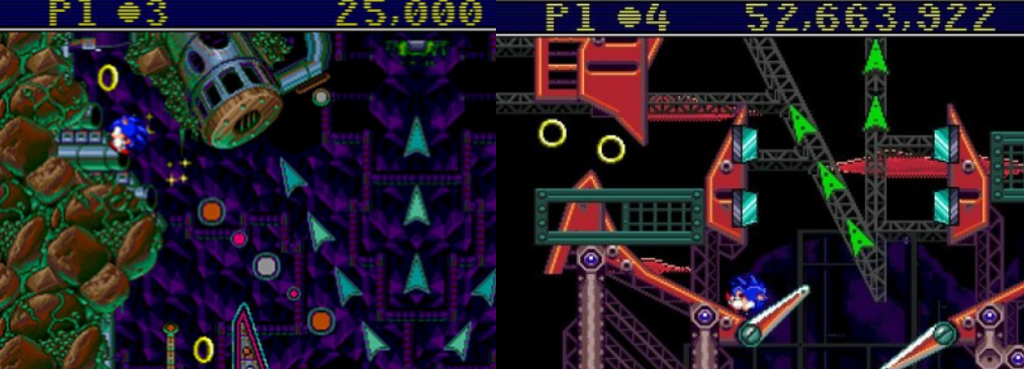
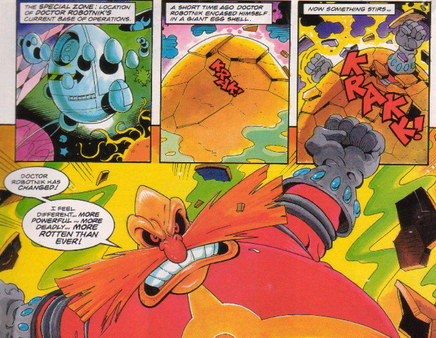
The Review: Raised in secret on a far away world, Sonic is forced to flee his home through the use of dimensional Golden Rings; arriving in Green Hills, Montana, where he spends the next ten years living in isolation out of the fear that his super speed will draw attention to him and force him to flee once again.
Sonic accidentally draws attention to himself…
Sonic spends most of his time observing Tom Wachowski and his wife, Maddie (Sumpter), and longing to be a part of society and make a real friend. When his speed powers unintentionally cause a massive blackout in Green Hills, the US military bring in Doctor Robotnik to investigate the disturbance.
Nothing like a good, old-fashioned road trip with a twist!
Spooked by the incident, Sonic reluctantly decides to leave his home but accidentally drops his bag of Golden Rings through a dimensional portal, where they land in San Francisco. Unable to find his way there, Sonic and Tom team up on a road trip to retrieve the Rings, all the while being pursued by Robotnik and his deadly robotic drones.Going into Sonic the Hedgehog, I wasn’t expecting anything more complicated than a by-the-numbers family-friendly kid’s movie; I was unimpressed that Paramount opted for a live-action/CGI hybrid film rather than a full-on CGI movie in the style of a Disney/Pixar production (or the amazing CGI cutscenes of modern Sonic videogames) and, upon seeing Sonic’s ruinous first design, I was ready to write the entire movie off, which was rather distressing for me given that I have been a life-long Sonic fan.Instead, Sonic the Hedgehog is a really fun (and funny) little romp; Sonic’s characterisation has been tweaked slightly and, rather than the “hedgehog with attitude” or the cocky, confidant superhero of the videogames, he is a lonely, curious, hyperactive little creature who longs to belong in a world and is struggling to control his great speed and with his desire to use his powers for a greater purpose.
Sonic’s human cast does a far better job than I expected.
His interactions with Tom are charming and whimsical. Marsden is no stranger to films or roles such as this and, yet, he is the perfect actor to portray an everyman character who longs for a greater challenge beyond his mundane, everyday life. To my great surprise and delight, the two quickly form an odd couple friendship that grows throughout the film and there isn’t one of those clichéd moments where they argue and fall out and have to rebuild their friendship.
Jim Carrey steals every scene he’s in, it’s fantastic!
Surprising no one, the real star of the show here is Doctor Robotnik; Jim Carrey is back at his scenery-chewing, maniacal best as he perfectly encapsulates the Doctor’s madcap, zany megalomania and slowly degenerates further and further into both madness and a more recognisable version of his videogame counterpart. Do I think he would have been just as good in a fat suit and acting alongside a cast of CGI characters? Sure, but that doesn’t stop his performance being a delight.Sonic the Hedgehog is part comedy, part road trip, part quasi-sci-fi/fantasy action; Sonic himself provides much of the jokes and action, but Carrey is no slouch in either department either thanks to his wacky personality and his incredibly adaptable machines.As with all Sonic adaptations, Sonic the Hedgehog weaves in numerous references to the source material; there’s a loving recreation of the character’s traditional home, South Island, nods to iconic Zone names, and even a few musical cues from the videogames. Arguably, the film could have gone further with these and weaved iconic boss themes into a motif for Robotnik but it definitely feels as though the movie was concentrating on establishing a new version of Sonic and bringing in additional videogame elements in a future sequel.
Sonic’s redesign looks great.
As it stands, though, Sonic the Hedgehog was a surprisingly good time; all the characters were fun and enjoyable and the film avoided a lot of the clichés that movies of this type often fall back on. It may not be the best videogame adaptation but it’s more than a worthy successor to Pokémon: Detective Pikachu (Letterman, 2019) despite featuring only one fully-realised CGI character largely through its whimsical charm and is surprising amount of restraint as it focuses on telling its own unique Sonic story rather than overloading the film with elements from the videogames.
The Nitty-Gritty: As with most Sonic adaptations, Sonic the Hedgehog feels the need to include, and place special emphasis on, the Golden Rings that form the life energy of the videogames. Rather than being the source of Sonic’s power, or a power boost for him, here they act as dimensional gateways, which isn’t a million miles away from the function the Big Rings perform in Sonic videogames.
There’s some charming humour at work here…
Going into the film, I was concerned that they were pushing the Rings as Sonic’s “super power” rather than his super speed but, luckily, that wasn’t actually the case. Instead, Sonic’s speed seems to have some mystery behind it. His childhood guardian, Longclaw (Donna Jay Fulks) seems to be hiding, and protecting, Sonic not just because of the power of the Rings (which seem to be her possession rather than his) but also because of his speed, which (alongside the way his super speed is presented as a quasi-power-up at dramatic times) makes me think we might see a connection between Sonic’s speed and the Chaos Emeralds in a future sequel.
Robotnik only has time for machines…
Speaking of future sequels, and Longclaw, perhaps the biggest surprise for me was that, in the opening moments, Sonic and Longclaw are attacked by a group of masked echidnas after they spot Sonic using his super speed. This was a fun and unexpected inclusion and raises a lot of questions for future sequels, especially with Robotnik being marooned on a mushroom-filled planet and vowing revenge.Unfortunately, I had the big mid-credits reveal spoiled thanks to Twitter but, suffice it to say, Sonic’s long-time friend Miles “Tails” Prower (Colleen Villard) shows up looking for Sonic, setting up both futurefilms and spin-offs in this world.
The Summary: Sonic the Hedgehog was way better than it had any right to be. The overhaul of Sonic’s design alone makes the film worth the price of admission but, alongside that and some clever references to the videogames, the film is a fun, charming little family action/comedy that brings a new dimension to Sonic’s character and lore.Sonic and Jim Carrey are the clear stars of the show but there’s plenty here to enjoy. I feel that, if we do get a sequel, we will see the filmmakers take things a little further and delve a little deeper into Sonic’s more familiar mythology now that they’ve established their version of the character and I am honestly looking forward to seeing this version of Sonic (and, especially, Robotnik) return in the future.
Among many things, adaptations can be described as being:
“An acknowledged transposition of a recognizable other work or works […] A creative and an interpretive act of appropriation/salvaging [or] An extended intertextual engagement with the adapted work” (Hutcheon, 2006: 80).
The great thing about adaptation is that it can be literally anything; it’s restricted only by the scope of your imagination and your commitment to researching the links between media. When I studied the writing of Linda Hutcheon (and many others like her) as part of my PhD, I chose to focus on the adaptation of videogames into movies, television shows, cartoons, and comic books.
There were two reasons for this: a) Because it’s a lot easier to talk about media adaptations like these and b) Because there hadn’t really been any real, serious research into videogames as adaptations. During my studies, though, I came across a curious statistic: of all the videogames that make up the entirety of the Sonic the Hedgehog (Sonic Team/Various, 1991 to present) franchise, there is one that stands out as having had the most adaptations and it’s probably not one you were expecting…
Today, we’re talking about Sonic the Hedgehog Spinball(Polygames/SEGA Technical Institute, 1993), a spin-off of the main Sonic the Hedgehog franchise. Spinball was the first Sonic title to truly embrace the pinball-like gameplay mechanics of the series popularised by the Spring Yard and Casino Night Zones.
Rather than being a fast-paced action/platformer, Sonic Spinball sees Sonic’s running speed scaled back and his bouncing speed boosted up as he trades running through loops for being flicked about inside a giant, pinball-like fortress created by Doctor Ivo Robotnik (now more commonly referred to as Doctor Eggman). Robotnik’s Veg-O-Fortress is made up of four stages, each one containing numerous Chaos Emeralds (unlike most Sonic games, Spinball’s multiple Emeralds are all blue). Using the flippers and a variety of gameplay gimmicks, Sonic must retrieve the Emeralds and battle the mad Doctor himself in a number of massive and increasingly difficult boss battles. In the Bonus Stages, Sonic operates an actual pinball and attempts to free his friends from Robotnik’s capsules. Other than that, the game offered little despite having some funky tunes and a charming aesthetic; the controls were clunky (Sonic feels unnaturally heavy and awkward), the stages were large and vibrant but it was often difficult to tell where you needed to go or what you had to do, and there’s very little incentive to play again except to beat your high score. Yet, Sonic the Hedgehog Spinball has been adapted into other media and forms more times than any other Sonic title; right off the bat, the game was ported to the Master System and Game Gear, for one thing, but, more than that, the game formed the basis of plots for Sonic’s cartoons, comic books, and other ancillary media.
Just controlling Sonic in this spin-off title can be a chore.
At the time, Sonic was in the middle of his first (and, arguably, most prominent) surge in popularity; bundling Sonic the Hedgehog(Sonic Team, 1991) with the Mega Drive saw the console sell over fifteen million units during its American debut (Pétronille and Audureau, 2012: 39) and catapulted SEGA’s speedy mascot to the stratosphere. SEGA immediately followed this up with Sonic the Hedgehog 2(SEGA Technical Institute, 1992) and, just like that, Sonic was everywhere. Not content with a gigantic Sonic balloon in the Macy’s Day parade, SEGA capitalised on Sonic’s popularity; Sonic appeared on every piece of merchandise imaginable and that, of course, included cartoons. Nintendo had seen significant success in this area in the past and, seeking to usurp their rival once more, SEGA turned to DiC Entertainment. The concept was spearheaded by producer Robby London, who recognised Sonic’s charisma and appeal but struggled with the “elusive and impenetrable” story of the videogames (Jones, et al, quoting London, 2011: 29). This isn’t particularly surprising as, while Sonic typically has an extremely simple premise (hedgehog hero destroys robots to save woodland friends), differences between the Japanese and American versions saw dramatically different versions of Sonic presented across the world.
Spinball included a lot of influences from SatAM.
Regardless, after bringing in Jaleel White to voice the character, DiC produced a pilot episode that was largely comprised of slapstick comedy and was deemed to be unsuitable for ABC’s Saturday morning slot. Undeterred, DiC made the extraordinary decision to instead produce two Sonic cartoons: one for weekdays and one for Saturday morning. This is how we ended up with Adventures of Sonic the Hedgehog (1993) and Sonic the Hedgehog (1993 to 1995, more commonly referred to as “SatAM”) airing simultaneously; one emphasised slapstick comedy and the other was decidedly much darker and serious in tone. For a time, these two cartoons were often closely associated with each other; this was mainly due to the Archie Comics series in the US initially mixing characters and concepts from both shows together rather than picking one as its basis (eventually, however, they settled on SatAM) but this can also be seen in Sonic Spinball. Sonic not only encounters Cluck, Doctor Robotnik’s (Jim Cummings) mechanical pet that briefly appeared in both SatAM and Archie’s comics, in the Toxic Caves, but must also free Princess Sally (Kath Soucie), Bunnie Rabbot (Christine Cavanaugh), Rotor (Mark Ballou), and Antoine Depardieu (Rob Paulsen) during the game’s Bonus Stages.
I still have no idea how the hell Robotnik did this!
This would be the first and only time SatAM’s characters would appear in a Sonic videogame; given that, unlike Dr. Robotnik’s Mean Bean Machine (Compile/SEGA Technical Institute, 1994), Spinball appeared to be a straight forward spin-off of the main Sonic series, their inclusion only served to further muddy the waters as to the coherency of SEGA’s flagship franchise. To further confuse matters, it was the Adventures depiction of Robotnik (Long John Baldry), rather than SatAM’s, who appeared on the cover art for Spinball’s Game Gear port. Indeed, while Archie eventually restructured its Sonic comics into a continuation of SatAM, it was Adventures’ Robotnik who seeped into other Sonic media and became the default depiction of the dastardly Doctor in storybooks and comics for many years. This was most prominently seen (at least in the UK) in Sonic the Comic (1993 to 2002, referred to as “StC”) where, in issue twenty-two, Doctor Robotnik inexplicably transformed from the rotund antagonist seen in the videogames into “that weed from the rubbish cartoon series” (Fielding, 1995: 32; Kitching, et al, 1994: 1 to 7). While SatAM is often lauded as a significant influence to many for its darker, more adult themes, Adventures is often overlooked for its fidelity to the wacky nature of the videogames due to its childish humour. Of the two, only Adventures incorporated the game’s iconic theme song and more accurately depicted certain gameplay mechanics, such as Special Stages, Golden Rings, and Chaos Emeralds. Yet, don’t let that fool you: Adventures is a full-on acid trip most of the time and, despite pulling some inspiration for the source material, only ever adapted the plot of one videogame: Sonic the Hedgehog Spinball.
Robotnik’s plans often involve an impractical, giant pinball machine.
‘Attack on Pinball Fortress’ (Butterworth, 1993) saw Sonic, Miles “Tails” Prower (Christopher Welch) join forces with Sergeant Doberman (Phil Hayes) and one of Adventures’ more amusing reoccurring characters, Wes Weasely (Michael Donovan), when Robotnik threatens Mobius with a gigantic Stupidity Ray housed within his Pinball Fortress. When the group infiltrates the Pinball Fortress, they are knocked about by giant flippers and into other gigantic recreations of cliché pinball machines before they encounter Boss Scorpion, a massive robotic scorpion that Robotnik uses to try and thwart the heroes. Obviously, this fails and it isn’t long before the robot is devoured by lava and Robotnik’s plot is thwarted. As an adaptation of Sonic Spinball, ‘Attack on Pinball Fortress’ is very bare-bones; it’s almost as if the writer, Bob Forward, was given a few pieces of concept art and nothing more as the episode has next to nothing to do with the videogame beyond the vague concept of a pinball-themed fortress and a giant scorpion. Yet, as basic an adaptation as ‘Attack on Pinball Fortress’ is, it’s got nothing on ‘Game Guy’ (Myrick, 1994), an episode of SatAM that sees Sonic trapped within a pinball-themed game right at the conclusion of the episode, which mostly concerns Sonic and Sally being at odds over the appearance of another Freedom Fighter, Ari (Dorian Harewood). Ari betrays Sonic but, when Robotnik nearly uses his giant pinball table to suck Sonic into the Void, he sacrifices his freedom to not only save Sonic but lead the Freedom Fighters towards other allies. Literally the only thing in ‘Game Guy’ that comes from Sonic Spinball is the giant pinball-themed trap that Robotnik nearly bests Sonic with, but then this was par for the course for SatAM, which was concerned more with environmental messages than adapting plots from the videogames.
Archie Comics sure loved their puns…
Things begin to look up, however, in ‘The Spin Doctor!’ (Gallagher, et al, 1994), the official Sonic Spinball adaptation featured in issue six of Archie’s Sonic the Hedgehog. Here, Sonic and the Freedom Fighters lead a random assault on Robotnik’s factory, only to be informed (via a hand-written note) that he has moved his base to Mount Mobius. Racing there without hesitation, Sonic finds the Veg-O-Fortress and is immediately attacked by (you guessed it) giant pinball flippers and bounced across lava. Racing up the pinball tracks and into the fortress, Sonic battles both Scorpius and Rexxon in the Toxic Caves, defeating them with ease. Sonic then ends up in the Lava Powerhouse, where Hip and Hop help lead him to a bunch of captive Mobians but giant plants force Sonic into a final Showdown…which consists entirely of Robotnik launching him out of the fortress using a giant spring. ‘The Spin Doctor!’ is little more than a glorified advertisement for Sonic Spinball; there’s just enough of the game’s premise, first stage, and other recognisable elements to inspire young kids to buy and play the game but not much else that directly links to it. Archie had a habit of doing adaptations of this kind; typically, they would produce a story that ended with the instruction to readers to play the videogame to find out the rest, despite the games and the comics being wildly inconsistent and at odds with each other. Other times, like this, they would attempt a very loose adaptation but be more concerned with servicing their own, unique narrative over anything.
There’s not much to link this to the game….
Elements of this story were relegated to extremely minor roles or cameos; Scorpius, Hip, and Hop (two characters that serve only to launch Sonic into the Lava Powerhouse in the videogame) were amongst them but, while Mount Mobius did show up (and erupt) in the ‘Heart of the Hedgehog’ two-parter (Fingeroth, et al, 2000), the Veg-O-Fortress never appeared again. Finally, there’s ‘Spinball Wizard’ Millar, et al, 1996) from StC. In this story, Tails, disheartened at his lack of fan mail, attempts to drum up some support by cleaning up the Casino Night Zone and ends up being captured in Robotnik’s Spinball Murder Machine which is, wouldn’t you know it, a giant pinball table. Rushing to the rescue, Sonic is bounced around by flippers and seemingly defeated until Tails manages to free himself and use Robotnik’s “Hedgehog-crushing super pinball” (literally just a giant pinball…) to destroy the generator that powers the machine. And…that’s it. I mean, I gave Archie some flack over their adaptation but ‘Spinball Wizard’ is only very, very loosely drawing from Sonic Spinball; you could even argue it’s simply adapting elements of Casino Night Zone into its plot but I’m including it simply for the name of Robotnik’s machine. To be fair, StC was often fast and loose with its adaptations as well; they also favoured their own unique narrative over being slavish recreations of their source material. But we’re not quite done yet because a rollercoaster at Alton Towers was once rebranded as Sonic Spinball between 2010 and 2015. As you might have guessed, the rollercoaster has a pinball theme and, as part of its Sonic rebrand, featured red and blue tracks, songs from the videogames, and even commentary from Roger Craig Smith, Sonic’s current voice actor. So, just what was it about Sonic the Hedgehog Spinball that meant it formed the basis of so many adaptations? It was, even at the time, only ever an average title and far from the rich narrative resource as Sonic the Hedgehog CD(Sonic Team, 1993) or Sonic the Hedgehog 3 (Sonic Team/SEGA Technical Institute, 1993) yet these two latter videogames were only given the most basic of lip service and SatAM and didn’t factor into Adventures at all.
Spinball surprisingly cropped up in many adaptations.
Perhaps it was the simplicity of the concept: Sonic bounces around like a pinball in comics and cartoons anyway, so maybe it’s easier to literally stick him into a giant pinball machine than have him race a robotic version of himself or go head-to-head with Knuckles the Echidna? Other anime and cartoons managed to include these two elements, however, and quite successfully in some cases, so it does remain a source of wonder (if not outright confusion) that Sonic Spinball, of all Sonic games available at the time, should be returned to and adapted so often. A large part of the explanation probably can be traced back to Sonic’s growing popularity at the time; Sonic Team USA had invested a considerable amount of time, effort, and money into rebranding Sonic for his US debut and crafting an entirely unique backstory that was completely different to the one found in Japan (and quite separate from the one in the UK, as well). Sonic Team, SEGA, and DiC seemed to see Sonic Spinball as a natural bridge between the videogames and the cartoons; they were certainly enthusiastic about the tie-in enough to insert their cartoon characters into the videogame and onto the art work (Hazeldine, 2014: 35). Perhaps there was no need to mine other Sonic titles; Sonic’s popularity didn’t begin to wane until the end of 1996 and, by then, both cartoons had finished producing new episodes, Archie’s comics and StC were content with forging their own narratives, and Sonic was firmly established as a successful and popular videogame icon in the cultural consciousness. Sonic X (2003 to 2006) would later produce surprisingly faithful adaptations of both Sonic Adventure(Sonic Team, 1998) and Sonic Adventure 2 (Sonic Team USA, 2001), while also loosely adapting Sonic Battle (Sonic Team, 2004) and appropriating many elements from Sonic Heroes (Sonic Team USA, 2003) and Shadow the Hedgehog (SEGA Studio USA, 2005). These all saw adaptations in Archie’s comics and StC (except for the latter four, at least officially, as StC had ceased publication by that point) but no other Sonic the Hedgehog videogame can boast as many adaptations as Sonic the Hedgehog Spinball, a largely average and arguably insignificant spin-off that nevertheless defined the golden age of Sonic across all forms of media.
Sonic Spinball even made it to the real world!
What do you think about Sonic Spinball and its adaptations? Can you think of any other videogames that received undue attention in other media? Leave a comment below and join me next time for more interplay.
Sonic the Hedgehog has a long history with spin-off titles; I have been putting off an article going into the multiple adaptations of Sonic the Hedgehog: Spinball (SEGA Technical Institute, 1993), which really emphasised the pinball-like gameplay mechanics of Sonic the Hedgehog (Sonic Team, 1991) and its sequel, Sonic the Hedgehog 2(SEGA Technical Institute, 1992). However, the most frequently revisited sub-genre for SEGA’s speedy mascot has to be racing games; Sonic first took to racing against his friend and rivals in Sonic Drift (SEGA/Arc System Works, 1994), a kart racer exclusive to both SEGA’s handheld Game Gear and the Japan and clearly created as an alternative to Super Mario Kart (Nintendo EAD, 1992). Perhaps the most well-known Sonic racing title, however, was Sonic R (Sonic Team/Traveller’s Tales, 1997), Sonic’s first foray in 3D videogames and something of a cult classic to this day thanks, largely, to its iconic and cheesy soundtrack.
The All-Stars racers were a lot of fun to mess around with.
Sonic R stands out amongst other Sonic racers because it was the first title of its kind to have all characters (with the exception of Amy Rose and Doctor Eggman) racing on foot. While they briefly revisited this gameplay troupe in the Sonic Rivals videogames (Backbone Entertainment/SEGA Studio USA, 2006 to 2007), SEGA have since abandoned this gameplay feature entirely in favour of attempting to reap some of the success of Nintendo’s Mario Kart series (Nintendo EAD, et al, 1992 to present). Indeed, so influential was the original Mario Kart that virtually every videogame mascot (and those from other media) have featured in go-kart racers but, of them all, the most consistent rival to Nintendo’s portly plumber has, as always, been Sonic the Hedgehog. After a brief stint experimenting with airboards in the Sonic Riders series (Sonic Team/Now Production, 2006 to 2010), SEGA, most likely inspired by the success of Mario Kart Wii (Nintendo EAD, 2008), released Sonic & Sega All-Stars Racing (Sumo Digital, 2010), which saw Sonic and his friends race against other iconic SEGA mascots in what was, for me, quite an enjoyable little title.
Fans expected Sonic R 2 and who could blame them after this?
The follow-up, Sonic & All-Stars Racing Transformed (ibid, 2012) introduced a unique gameplay mechanic where the karts would transform into planes or boats, which mixed things up a bit, but locking additional characters and content behind stars rather than allowing players to buy them with points made this entry lag a little behind its predecessor, for me. Then, SEGA brought out their finest marketing trolls when it came to advertising their newest racing title, dusting off the old font style to tease the release of Team Sonic Racing (ibid, 2019), which did away with all of the other SEGA characters and additional bonus racers like Danica Patrick and focused solely on fifteen members of Sonic’s expansive cast. Team Sonic Racing also did away with the transforming gimmick so, immediately, seems like quite a step back from its predecessors; however, there are some other options available in the title that help to make it an enjoyable romp.
Pick your character, pick your team.
First of all, Team Sonic Racing is built entirely around the concept of racing as a (you guessed it) team; the team-focused gameplay and storyline is thrust so much to the forefront that it almost feels like a quasi follow-up to Sonic Heroes (Sonic Team USA, 2003). Anyway, the basic idea is that you get to pick from one of five teams (Team Sonic, Team Rose, Team Vector, Team Dark, and Team Eggman), each of which is made up of a ‘speed’, ‘technique’, and ‘power’ character; each racing class has different advantages that affect the way you race (‘technique’ karts can drive off the course without slowing down, for example). You’ll race as the character and racing class you selected but, as you race, must be mindful of the progress of your teammates; if they’re lagging behind, you can create a slipstream for them to coast along for a boost or send them weapons or items (SEGA once again revisits the concepts of Wisps for this) to help get them to the front. The goal is to finish the race as a team, which will increase your score, awarded points, and standing in GP races.
Skim along a teammate’s slipstream for a quick boost.
Before going into Team Sonic Racing, this team-based mechanic bothered me; I thought you’d have to swap between racers or would be forced to always race as a team or would be unfairly judged if your teammates ended up too fair behind. Luckily, these fears were largely abated once I started racing; not only is there an option outside of the Team Adventure story mode to race solo like in the All-Star racers, it isn’t massively difficult to boost your teammates up to your level, especially if you send any Wisps you don’t need or accept any item boxes when they’re sent to you.
Team Ultimates have nothing on the old All-Star moves…
Doing so, and performing successfully drifts and tricks, will fill up your ‘Ultimate’ meter; once full, you can execute ‘Ultimate Power’ at the push of a button to gain a massive speed boost and invincibility. This is very similar to the All-Star moves of the game’s predecessors but with one massive downgrade; all Ultimate moves look and feel the same, with the only real difference being the music the plays as you perform them. No longer does Sonic transform into Super Sonic or anything cool like that. While this was massively disappointing, the game slightly makes up for it with the variety in the weapons available. Previously, the All-Star racing games used quite generic items like missiles and the like; while I’m not fan of the Wisps (they really feel like they’ve outstayed their welcome at this point), their inclusion does help add some visual variety and a unique spin on traditional kart racing weapons.
Race as a Chao…everyone loves Chao…
Also in Team Sonic Racing’s favour is the ability to customise each kart; you can pick from different paint jobs, stickers, and horns in addition to attaching different Performance Parts that will modify the kart’s handling, acceleration, and top speed, amongst other attributes. Unfortunately, the best of these parts are the ‘Legendary’ Performance Parts, which turn your kart into a sexy all-gold style…meaning any paint jobs and aesthetic changes you made will be over-ridden. Another downside to the title is the lack of characters; Sonic & All-Stars Racing Transformed featured over twenty characters from across the entirety of SEGA’s legacy so stepping that down to just fifteen (one of which is, oddly, four Chaos stuffed into a massive Chao-themed kart rather than, oh, I don’t know, Cream the Rabbit!) is quite the downgrade. In addition, you cannot mix up the teams; you can’t pick Sonic as your speed racer, Rouge the Bat as your technique racer, and Vector the Crocodile as your power racer. If you pick Sonic, you’re stuck with Team Sonic, which seems like a massive missed opportunity that only really makes sense from a narrative perspective.
Watch some static cutscenes in the story mode…
Speaking of which, one thing Team Sonic Racing has over the majority of Sonic racers is a full-on story mode; Sonic and his friends are drawn into an elaborate racing tournament organised by Dodon Pa, whom many of them suspect being Eggman in disguise. Through a series of races and working together ( not just within their teams but with the other teams in the spirit of friendly competition), they eventually uncover a plot by Eggman to manipulate the racer’s ‘power of teamwork’ into a doomsday weapon. Okay, so it’s not really the most original or well-told or engaging narrative and it’s told largely through obnoxious dialogue in barely-animated story sequences (I’m not going to call them cutscenes because…well, they’re not) but Team Adventure does provide just enough incentive to get you playing and earning points to buy Mod Pods and upgrade your karts.
Delight in having just enough time to complete these missions!
While Team Adventure does offer a lot of gameplay variety, this is also to its detriment; you won’t just be racing against other characters, you’ll also have to break targets, collect Golden Rings, destroy Eggpawns, compete in GPs, and perform a variety of other in-race tasks to earn stars and keys that will both progress the story, unlock more of each map, allow access to other and better Performance Parts and, of course, earn you some Achievements. The problem is, however, that the error margin in some of these missions is extremely tight; you’re given just enough time to hit the required goal (a Silver medal) and I found myself having to play some missions over and over and over again trying to get reach the minimum requirement. I don’t think I’ve managed to get a single Platinum medal yet (and have no plans to attempt this, least of all for every damn mission!) and only lucked into a handful of Gold medals. Maybe I just suck (and that s most likely the case) but Sumo gave very little leeway when creating these missions; time just runs out way to fast, forcing you to start all over again, and there’s no indication when you’ve completed in-race objectives (like destroying five Eggpawns in a race; there’s no notification to let you know you’ve done this until after the race is over).
Oh good, Ocean Palace is back…again…
Outside of the story mode, there’s the usual racing affair; you can complete against others either locally or online (I’ve yet to do either) across a variety of game modes. There are also some really nice race tracks on offer here; once again, they’re largely pulled or inspired from Sonic Heroes (I’ll never fully understand why Sumo can’t seem to get past adapting levels from that game into race tracks…) but there’s some catchy tunes accompanying each race (featuring a title song by Crush 40 and tunes inspired by Sonic R), tracks can be mirrored to add a new twist and, while karts don’t transform, there are some alternative paths you can take by performing tricks off of ramps.
A fun enough game but lacking in content and replayability.
In the end, Team Sonic Racing is a decent racing title and certainly in the same spirit as its predecessors but, with a lacklustre roster, too few gameplay options, and very little incentive to play once you’ve blasted the story mode and unlocked a decent amount of Performance Parts, I struggle to really recommend this over the All-Star racing titles. I enjoyed it as it was simple to play, for the most part, and was a Sonic title but some frustrating mission requirements, the lack of real All-Star moves, and no additional characters to unlock or purchase really brought the whole experience down for me. I’d say it’s fun enough to waste a few hours on but it’s not going to keep you engaged much beyond that, which is a bit of a shame.
You must be logged in to post a comment.