Game Corner: The Simpsons (PlayStation 3)

Released: 8 February 2012
Originally Released: 4 March 1991
Developer: Backbone Entertainment
Original Developer: Konami
Also Available For: Arcade, Commodore 64, MS-DOS, Xbox 360

The Background:
The Simpsons began life as a series of short cartoons created by Matt Groening for The Tracey Ullman Show, with Groening hastily naming each of the family members after himself and his own family and the characters coloured yellow by colourist Georgie Peluse simply because it was deemed amusing. In 1989, Groening was approached by a team of production companies to produce a series of half-hour episodes focusing on his dysfunctional family for the Fox Broadcasting Company. Groening jumped at the chance to produce an alternative to the “mainstream trash” that was currently airing and The Simpsons eventually premiered in late 1989. The show became a multimedia juggernaut after “Bartmania” gripped the nation; in addition to the long-running series, The Simpsons featured in every piece of merchandise imaginable, from action figures and comics to videogames. While the majority of these early videogames are notoriously poor, one stood out for its high quality graphics and addictive beat-‘em-up gameplay and that was the arcade game produced by Konami. It was surprising how well the developers adapted the Simpsons concept to a sidescrolling beat-‘em-up however, while the game was somewhat restricted by the relatively short run of the show at the time, what really gave the game its prestige was its obscurity. I’ve been lucky enough to play this out in the wild over the years so, naturally, I jumped at the chance to get it when it was finally re-released on the PlayStation Network in 2012; sadly, the game has since been delisted, meaning there is no easily accessible way to play this classic beat-‘em-up title, but Whacking Day seems like a great excuse to revisit it nonetheless.

The Plot:
Whilst out shopping, the Simpsons accidentally bump into Waylon Smithers as he is stealing a giant diamond for his employer, the greedy and malicious Charles Montgomery Burns. When the diamond lands in Maggie’s mouth, Smithers kidnaps her and the Simpsons are forced to pursue him to rescue her.

Gameplay:
The Simpsons is a 2D, sidescrolling beat-‘em-up in which up to four players travel from the left side of the screen to the right through a variety of familiar Simpsons locations while pummelling wave-upon-wave of goons and other assorted enemies. Unlike some four-player beat-‘em-ups, any player can select any character and you’ll even be able to pull off unique double team moves with each member of the Simpsons family. There are four characters to choose from (Bart, Homer, Marge, and Lisa) and, though each one controls exactly the same, it does seem as though each one has slightly different pros and cons and each one attacks in a slightly different way.

Gameplay is incredibly simple, utlising only two buttons and a variety of attack animations.

For example, Bart and Lisa are smaller and faster, making it easier to manoeuvre around the screen and to avoid enemy attacks, while Homer and Marge are much taller and slower. Bart glides along on his skateboard, which he also uses to attack enemies; Lisa skips around using a skipping rope (which she also uses to attack); Homer attacks with his fists (and seems to have the shortest range as a result); and Marge whacks enemies with her vacuum cleaner, giving her the longest reach but a slightly slower attack than, say, Bart or Lisa. Gameplay couldn’t be simpler: you just move to the right and attack enemies until you reach the end of the stage where you’ll battle a boss. There are no special moves or complicated button presses and combos to worry about here; X jumps and Square attacks and that’s pretty much it. You can perform jumping attacks and each character has a unique combo attack (Bart whirls around like a spinning top and Homer flails his fists in a frenzy, for example) that is performed by simply mashing X but you can’t grab or throw enemies and there’s no dash function but you can pick up and throw items and objects at enemies.

Gameplay is briefly broken up by some good, old-fashioned button mashing.

While 99% of the game is a mindless, monotonous beat-‘em-up, The Simpsons livens things up not just with its bright, cartoony graphics, quirky features, and sound bites but also through its level variety and a couple of Bonus Stages. The first of these has you mashing buttons to pump up a balloon and the second has you doing the same thing to slap your character back to consciousness. It’s not much, and the computer-controlled opponents are ridiculously hard to beat, but it helps to break things up a little bit. The quirkiness of the game helps with that, too. Since the game was made so early in The Simpsons’ lifespan, much of the show’s characterisations and format had yet to be properly established. As a result, Smithers is a maniacal villain and many of the obscure and fleeting inclusions from the show (such as the bear, Homer’s dreamland, Princess Kashmir, and Professor Werner von Brawn) are much more prominent over characters like Abe Simpson, Milhouse Van Houton, and Otto Mann (who all show up in brief cameos to drop off weapons or health items) and some (like Kent Brockman) are missing entirely in favour of numerous cameos by Groening’s rabbit, Binky. Still, similar to Teenage Mutant Ninja Turtles (Konami, 1989), cartoony slapstick and a vibrant aesthetic keep the game enjoyable to look at and play: characters will fly at the screen when smacked by doors, use speech bubbles to shout at you to wriggle the joystick when enemies grab them, and the game does a decent job of recreating certain locations from the show even if some are a little more obscure than others (such as Krustyland and Springfield Butte).

Graphics and Sound:
The Simpsons is a bright, vivid, and lively beat-‘em-up full of big, colourful sprites, cartoony effects, and a decent amount of detail packed into every animation and location. Each character has several frames of animation, even when standing idle; they’ll quickly grow impatient with you if you leave them too long and often speak using both sound bites and word balloons. Additionally, when attacking or being attacked, each character has many frames of animation that allows them to attack in a flurry, be sent tumbling backwards, or return to life in the guise of a superhero.

The game’s selection of Simpsons locations is a little questionable at times.

Considering, as I mentioned before, how early into the show’s run the game was produced, stage variety is commendable…if a bit wacky, at times. Stage one is, naturally, the streets of Springfield but, while you’ll pass by the Noiseland Arcade and the Rusty Barnacle, other prominent locations from the iconic Simpsons introduction and various episodes are missing. Similarly, Krustyland is quite different to how it appears in the show and appears to be more like an amusement part, Moe’s Tavern is greatly expanded into something more like a casino and a strip club, and Springfield Butte appears to only be included because a handful of early Simpsons episodes occasionally ventured into the wilderness outside of the town. Things get really surreal when you visit Dreamland on stage six, which features all kinds of weird background elements and brief inclusions of what I would consider to be more prominent Simpsons landmarks (like the school and the Simpsons’ home).

Motion comic-like cutscenes and in-game graphics recreate the look and feel of the show.

While many of the stages are quite short and relatively barren, the game packs in a bunch of cameos and little details here and there: Howie walks out of the arcade (and will smash you into the screen if you get too close); frogs hop around in the cemetery; and various supporting characters (from Sherri and Terri to the original design for Sideshow Bob and even obscure characters like Doctor Marvin Monroe) show up to drop off health or power-ups. The Simpsons does a great job of recreating the look and feel of the early episodes of the show and this is helped all the more with the game’s commendable recreation of the iconic Simpsons introduction (which includes a brief rundown on each playable character) and theme tune. The game’s plot, such as it is, is told through the use of both motion comic-like cutscenes and in-game graphics, with a few sound bites thrown in here and there. This allows for a surprising amount of non-playable characters (NPCs) to briefly appear onscreen at once and a few amusing little animated sequences to play out, such as your characters getting swept over a waterfall, Smithers blowing himself up, and Maggie placing her dummy into the unconscious mouth of Mr. Burns.

Enemies and Bosses:
As you embark on your journey, you’ll battle against a seemingly endless wave of men in suits whose sole mission in life is to pummel you to death. Some of these also throw their hats at you or wield brooms or other weapons; they’re also capable of grabbing you to drain your health and get progressively aggressive as the game goes on. You’ll also battle fatter enemies, who can attack in teacups or throw boulders at you, and enemies will drop from trees dressed as ghosts and toss bombs at you in the cemetery. There are also a handful of unique and quirky enemies to contend with, some of which act as mini bosses of sorts: in stage one, for example, you’ll have to fight past a fireman, Binky and fake Krusty the Clown’s regularly crop up in Krustyland, zombies burst out from the cemetery grounds, you’ll encounter Bigfoot a number of times at Springfield Butte, and Channel 6 even has you fighting ninjas and a laser-spewing robot!

The first two bosses ask little more from you that a bit of dodging and relentless attacking.

Easily the most surreal enemies are found in Dreamland; here, you’ll encounter anthropomorphic donuts and saxophones, Marge heads made of clouds, and nuclear technicians who continue to attack you even after you knock their heads off! As mentioned, most of the game’s stages end with a battle against a gigantic boss; these are generally pretty easy and all come down to a simple case of dodging and piling on the attacks. The first boss, Professor Werner von Brawn, fills most of the screen and attacks with punches and belly flops (but his trunks have a nasty tendency to fall down, leaving him vulnerable to your attacks) while the second boss is a gigantic Krusty balloon that tries to slap at you and rains bombs down onto the arena.  In each case, though, victory comes from simply utilising any weapons dropped off before the fight, using your jumping attacks, and relentlessly pounding away until they are defeated.

Later bosses mix up their attacks and get a bit of back-up to make things a little more challenging.

Stage three doesn’t actually have a proper boss battle but, at the end of Moe’s Tavern, you’ll have to fight a cracked-up DJ who punches at you and breathes fire! However, his tendency to stop and taunt makes him an easy fight, as is the giant fake bear that awaits you at the end of Springfield Butte. The hardest thing about this boss is that it surprises you by bursting out of a cave, which can cause you to get hit by logs, and boulders rain down into the area, which can be annoying. Similarly, the large Kabuki Warrior who awaits you at the end of the Channel 6 stage is made more cumbersome by his long reach (thanks to his spear) and the fact that he conjures a ninja or two to distract you during the fight. Dreamland, however, ends with a particularly annoying and tough boss battle against a huge anthropomorphic bowling bowl that attacks in four different phases: in the first, it simple rolls and bounces around; in the second, it grows arms to bounce higher; the third sees it grow legs and shoot bowling pin missiles; and the fourth and final phase sees it grow one large, stretchy arm to swipe at you. It’s quite a laborious boss battle, especially considering that every boss before this was relatively short and simple, but is just a taste of things to come.

A tough battle against Smithers and Mr. Burns awaits you at the finale of the game.

When you reach the Springfield Nuclear Power Plant, you’ll simply walk right through the stage and into Mr. Burns’ office for the final battle, which is preceded by a fight against Smithers. Smithers attacks with his cape and maniacally dashes around the office tossing bombs at you. Thankfully, you can throw some of these back at him and he goes down relatively quickly as long as you can get near him and avoid being chargrilled by his bombs and death animation. Defeat him, though, and Mr. Burns bursts through the wall in his mech suit for another four-phase boss fight. At first, Burns attacks with retractable pincer-like arms and spits out the odd nuclear bomb, then he rises up onto treadmill-like feet and starts shooting missiles at you. In his third phase, he switches to a hovercraft-like base and adds a spiked rod attack and, in the fourth phase, having had his exosuit smashed off throughout the fight, Burns simply resorts to bouncing around the screen and scattering bombs everywhere. This is definitely a fight made easier with another player or in Free Play mode as Burns is a damage sponge and can easily smack the life out of you in just a few hits.

Power-Ups and Bonuses:
As in any self-respecting beat-‘em-up, the Simpsons have a variety of options when it comes to restoring their health; NPCs will drop off burgers, hot dogs, donuts, pie, and roast chickens and you can also shake apples from trees, each of which will allow you to keep fighting a little longer. Some of these can also be found right before boss areas so, if you’re low on health, it’s worth picking them up. Similarly, you’ll find and be gifted a variety of weapons throughout each stage; one of the most prominent is the slingshot, which allows you to fire a limited number of projectiles at your enemies, but you can also grab bowling balls, a hammer, bar stools, brooms, bottles, drink cups, and even Snowball II, Santa’s Little Helper, and the original design of the Space Mutants to launch at enemies.

Additional Features:
The Simpsons has twelve Trophies for you to earn, each of them actually requiring a bit of skill and effort on your part as they task you with reaching certain stages, acquiring a certain number of points in specific game modes, or teaming up with other plays on- or offline. The difficulty of these varies quite a bit; it’s not much to ask you to finish the game four times, once with each character, but finishing the game in thirty minutes or less or on the “Expert” difficulty with limited continues is a bit of a tall order. When playing this version of the game, you are presented with a variety of gameplay options. You can choose to play in “Free Play” mode (which gives you unlimited continues), “Survival” mode (which gives you one life an no continues), “Team Quarters” (where you share forty continues), and “Quarters” mode (which gives you ten continues).

The Japanese version of the game adds a couple of extra features here and there to spice things up.

You can then select between Easy, Normal, Hard, and Expert difficulty modes (with enemies increasing in number and difficulty the higher the setting), select any stage you like (though, as I finished this game a long time ago, this may need to be unlocked so I forget if it’s available right from the start), view characters and artwork in the gallery, apply different borders and screen settings, and have access to a sound test. You can also choose to play the Japanese version of the game, which differs somewhat from the worldwide release. For one thing, it adds the nuclear bomb item to certain stages, which allows you to clear the screen of enemies. It also allows you to use weapons in mid-air, ups the power of the slingshot, adds a “Vital Bonus” score at the end of every stage, allows you to increase your health beyond its limit, and adds a number of different enemy, item, and NPC placements within every stage which can help mix up subsequent playthroughs.

The Summary:
The Simpsons is not an especially deep or feature-laden arcade title; the lack of special moves, relative emptiness of the stages, the enemy variety, and the short length of the game all, arguably, make it somewhat inferior to other arcade beat-‘em-ups released around the same time. Yet, thanks to its colourful graphics, quirky animations, and simple pick-up-and-play formula, it’s a classic of its genre through and through and easily one of the most enjoyable beat-‘em-ups out there. Of course, much of its appeal comes from nostalgia and its rarity but none of that detracts from the fact that it’s a blast to play and never outstays its welcome. A sidescrolling beat-‘em-up may not necessarily be the first genre that springs to mind when you think of The Simpsons but it works really well here; even though the show was still in its early days, the game does a great job of capturing the spirit of The Simpsons and including a number of cameos and call-backs to the show. It’s a shame that The Simpsons wasn’t more commercial available through ports to home consoles and that this particular version has been delisted from online stores as it’s a great way to waste an hour or so and the additional features and options help to spice the experience up. It was a great little package for a long-forgotten game and I can only hope that, one day, it’ll reappear on the Xbox so I can experience it all over again.

My Rating:

Rating: 3 out of 5.

Pretty Good

Are you a fan of The Simpsons? Have you have played this game out in the wild or did you first experience it through emulation or the PlayStation and Xbox ports? Which of the playable characters was your favourite? How do you feel the game holds up today, especially compared to other beat-‘em-ups? Would you like the see the game re-released again or do you think it’s better left in obscurity? What is your favourite Simpsons game? Do you have a favourite character, episode, or moment from the show? How are you celebrating Whacking Day today? Whatever your thoughts on the world’s most famous yellow family, feel free to leave a comment below and be sure to check back in for more Simpsons content!

Game Corner: Resident Evil: Operation Raccoon City (Xbox 360)

Released: 20 March 2002
Developer: Slant Six Games/Capcom
Also Available For: PC and PlayStation 3

The Background:
By 2012, the Resident Evil series (Capcom/Various, 1996 to present) had undergone many changes since debuting as a cheesy survival/horror title hampered by “tank controls”; Resident Evil 4 (Capcom Production Studio 4, 2005) famously switched the game to a more action-orientated, over-the-shoulder third-person perspective, which had been expanded upon greatly in Resident Evil 5 (Capcom, 2005) and would basically transform the series into an action-heavy shooter by Resident Evil 6 (ibid, 2012). In the midst of this transition into a more action-orientated franchise, developers Slant Six Games worked alongside Capcom on a spin-off, a squad-based shooter that reinterpreted events from the franchise’s early days. Despite selling over two million copies and being considered by Capcom to be a success, the game was met with mixed reviews perhaps in a reflection of the backlash against Resident Evil’s new direction; some praised the gameplay and mechanics while others criticised it as being inferior to other, similar videogames.

The Plot:
In a retelling of the events before and during the zombie outbreak in Raccoon City, an Umbrella Security Service (USS) strike team, under the command of HUNK, attempts to secure the G-Virus sample from Doctor William Birkin. However, they are soon forced to battle against Umbrella Biohazard Countermeasure Service (UBCS) mercenaries, flesh-eating reanimated corpses,  and the malevolent Umbrella Corporation’s many Bio-Organic Weapons (B.O.W.s), and faced with death and betrayal that cause them to question their orders.

Gameplay:
Resident Evil: Operation Raccoon City is a third-person, squad-based shooter in which players can pick from six members of the Umbrella Security Service (U.S.S.) Delta team (known as “Wolfpack”): Vector, Lupo, Beltway, Spectre, Bertha, and Four Eyes. Once you’ve selected your character, you must then select three others to assist you in the game’s missions to be controlled either by other human players using the game’s online function or assigned to the relatively competent A.I. No matter which character you select, the controls remain the same and will be instantly recognisable to players of similar third-person shooters: press in the left stick to run and then press A to dive ahead, press the Right Trigger to fire and the Left Trigger to aim, B executes a melee attack, you can switch weapons with the Left Bumper, toss grenades and other explosives with the Right Bumper, and press X to reload. The directional pad (D-Pad) also factors into gameplay; you can select from the different grenades available by pressing right, use a First Aid Spray by pressing left, use an Antiviral Spray by pressing down, and toggle through various vision modes by pressing up.

Each character has different abilities that can be used to give you an edge in combat.

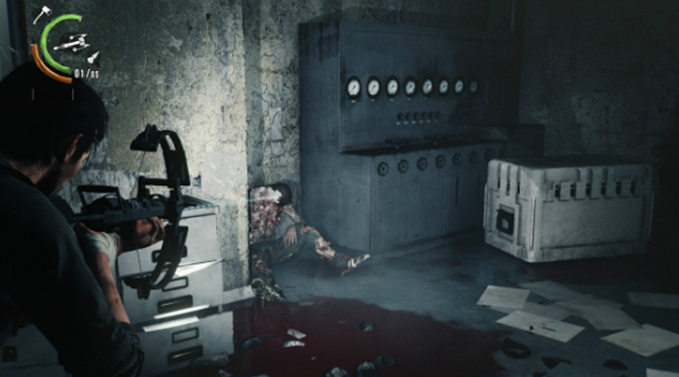
Each character does, however, have access to several different abilities, which you can activate with Y for a variety of temporary effects. Vector specialises in reconnaissance and moves much faster, can become undetectable to enemy radar, mimic other characters, and become completely invisible; Lupo focus more on combat and is able to wear stronger body armour, reload faster, and utilise more versatile ammunition; Beltway is the explosive expert and is able to better resist explosions, disarm mines and traps, and utilise a wider variety of explosives; Spectre is all about detection and mapping and is able to expand upon the mini map and detect nearby items and enemies using different vision modes; Bertha is the team’s medic and can carry more healing items, use them more effectively, and reduce the amount of damage taken; and Four Eyes, being more of a virologist, can carry more Antiviral Sprays, detect infected individuals, and both infect and command infected targets. Similar to the more action-orientated Resident Evil titles, much of the game is focused more on combat rather than exploration and puzzle solving; as a result, you will automatically snap to cover when you’re near walls, barriers, or other objects and must often clear a room of enemies in order to progress. The game is surprisingly dark, however, so I recommend increasing the “Gamma” settings in the options to bring a bit of illumination to the darker areas, though the use of darkness is used to create a sense of ambience and dread to the proceedings.

The better you play, the more XP you’ll get and the faster you can upgrade weapons and abilities.

As you defeat enemies, find Raccoon City Mascots and data, destroy well-hidden security cameras, pick up Intel and send it using laptops, and complete missions, you’ll gain experience points (XP); XP is then used to purchase new weapons and unlock and upgrade each character’s Passive and Active abilities. While any character can use any of the weapons you unlock, once again you can only carry two weapons at a time, so you’ll most likely be dropping weapons and liberating new ones from your defeated foes, and you’ll need a great deal of XP to unlock and upgrade everything the game has to offer for its six characters. As is the standard for Resident Evil titles, you can pick up First Aid Sprays to fully refill your health and use green herbs to restore a little bit of health; if you come across a green herb, though, it cannot be stored in your inventory. Unlike most other Resident Evil videogames, though, you can actually become infected with the Tyrant Virus (T-Virus) and, unless you use an Antiviral Spray, will become a zombie and attack your team mates after a short period of time. Additionally, you can be afflicted with a “bleeding” status that will attract (and spawn in) all nearby enemies (though you can also inflict this status on human enemies to zombies attack them as well). Note, however, that while you can pick up First Aid Sprays, Antiviral Sprays, and additional weapons and explosives, you’ll lose all your new held items if you die during a mission.

Take advantage of the stashes of ammo to help stave off the swarms of zombies.

The A.I. is relatively competent in a firefight; if they get downed during combat, you can press A to revive them but you may find that they often wander around aimlessly and tend to shoot through doors and walls before enemies even spawn in. Your mission objectives generally involve holding out against wave upon wave of enemies, reaching a specific destination, and clearing out all enemies but you’ll also be tasked with destroying or locating certain items and objects. Other times, generally during boss battles, you’ll have to hold out until doors are opened, or open them yourself, and the battle becomes much more about survival as you desperately try to stay alive while a seemingly endless wave of enemies attack you. Despite the fact that the environments are littered with an abundance of ammo creates and plenty of ammo and weapons, it’s easy to be overwhelmed, which can lead to some frustrating moments that are probably made a lot easier when playing with another human.

Graphics and Sound:
Resident Evil: Operation Racoon City mostly holds up pretty well; thanks to many of the characters having their faces obscured by helmets and masks, the character models largely avoid resembling action figures and, when popular and recognisable Resident Evil characters do appear, they shine all the better for it. However, I did notice quite a few instances of slowdown and jitteriness when there were a lot of enemies and characters onscreen at any one time and more than a few clipping errors where characters would walk through parts of the environment.

Gore and creepy, recognisable locations are plentiful, if a bit dark at times.

The game’s environments are decent enough; they’re dark and creepy and fully of the usual Resident Evil ambiance, featuring flickering lights, blood trails, and an abundance of gore to punctuate the game’s action-orientated approach. There are a lot of little details here and there (though the dark lightning can make a lot of them difficult to make out) and, once you finally escape from the drab, grey corridors, you’ll get to fight through the ravaged streets of Raccoon City (which was a notable highlight). Other environments include the dark, maze-like offices of City Hall, a creepy cemetery, as well as recognisable locations from Resident Evil 2 (ibid, 1998) and Resident Evil 3: Nemesis (ibid, 1999) such as the police station (including Chief Irons’ office) and the prerequisite Umbrella laboratories and facilities. Despite the presence of a number of high-quality cinematics, the game’s cutscenes largely utilise the in-game graphics, primarily to ensure that your chosen character and team mates are properly loaded into each scene. This adds a degree of variety and replayability to the game as different characters have different dialogue in cutscenes, though it does seem as though the game recycles a lot of sounds from Resident Evil 5.

Enemies and Bosses:
As you might expect, one of the most common enemies you’ll encounter in Resident Evil: Operation Raccoon City are zombies; zombies are slow, shambling corpses who go down quite easily but generally attack in large groups and will lunge and grab at you to try and take a bite out of you. In these situations, you can frantically wiggle the left stick to try and shake them off and you better make sure you do this as they can infect you or cause you to bleed otherwise. Dead bodies in the nearby area will often pop up as surprise zombies, who can also power-up and return to life as the much faster, tougher, and more aggressive Crimson Heads so make sure you take them out with a good old head shot before they get the chance to do this. Similarly, you’ll also encounter the odd Cerberus; these infected dogs like to pounce at you out of nowhere to give you a good scare and you’ll also have to shake off their bite and have a good aim to take them out because of how fast they can be. You’ll also come up against spider-like Parasites that quickly scuttle across the environment and can also be difficult to hit. These become doubly annoying when they join with a zombie as not only will Parasite Zombies be faster and more dangerous thanks to the Parasite’s extra limbs but you’ll also have to kill the Parasite after taking out the zombie host.

Lickers and Hunters are as formidable a threat as ever thanks to their superior strength.

You’ll also come up against some of Resident Evil’s most notorious B.O.W.s, such as the Lickers and the Hunters; Lickers scramble all over the walls and ceilings, popping out from vents and grabbing at you with their long tongues. Fast and difficult to hit, it’s best to target their exposed brains but they can easily overwhelm with their sheer numbers and ferocity. Similarly, Hunters will often drop from the sky in torpedo-like capsules and attack with an unmatched viciousness; leaping and charging across the place, they attack with large, deadly claws and take a great deal of punishment before going down so you’ll definitely need your more powerful weapons to make short work of them. Apparently because B.O.W.s aren’t interesting and dangerous enough, you’ll have toe exchange gunfire with a variety of living, human enemies; soldiers from the Umbrella Biohazard Countermeasure Service (U.B.C.S.) will fire at you from behind cover and other barricades, often to provide support for series staples such as Leon S. Kennedy and Claire Redfield, and are surprisingly durable and difficult to spot. You’re encouraged to inflict them with the bleeding status to send nearby zombies into a frenzy and tear them apart but this can just as easily be bad news for you, too, as the U.B.C.S.’ bullets can cause you to bleed and the final mission of the game is notably frustrating because you end up caught in a crossfire between the well-equipped U.B.C.S. and an endless swarm of zombies.

Keep your distance from the invincible “G” to avoid his swings and hold him at bay.

If you’ve played Resident Evil 2 and 3, you’ll instantly recognise the bosses and larger B.O.W.s included in the game; given that your first mission is to retrieve the Golgotha Virus (G-Virus) samples from Birkin’s laboratory, the first boss you’ll encounter is Birkin in his monstrous “G” form. “G” can’t be killed, however, making this a tense chase down a very narrow corridor as you desperately avoid “G”’s wild swings and slow him down by shooting nearby explosive barrels and pipes. If you linger around too long or get too close to him, it’s stupidly easy to get caught up and glitched on his hit box and the nearby environment so just turn around and run and save your ammo and efforts for when the game tells you to hold him at bay.

Mr. X is bad enough by itself but is accompanied by other enemies and another Tyrant!

Another recognisable B.O.W. you’ll encounter more than once is the T-103 Tyrant known as Mr. X; this massive, hulking figure has a tendency to attack and damage other B.O.W.s in its path and can be briefly controlled by Four Eyes but, for the most part, is indestructible when you first encounter it, leaving you to desperately run around taking out zombies and Parasites as you retrieve key cards to escape the area. In a later mission, two of the damn things attack you at once and you must take them out in order to progress. They’re incredibly strong, leaping and charging at you, pounding you into the ground and squeezing the life out of you with each so it’s best to keep your distance, focus on one at a time, and always aim for the head. One of the most troublesome and frustrating missions of the game sees you staving off wave after wave of zombies and U.B.C.S. soldiers while trying to bring down the Nemesis-T Type, an intimidating creature by itself without all the additional enemies swarming the area. After numerous deaths and failures, I found it was much easy to quickly take out any nearby zombies, grab some restorative sprays, and camp out by the ammo crate and take pot shots at Nemesis until it finally dropped to the ground, taking advantage of the explosive barrels wherever possible. Even then, it can rear up and keep ticking along, all while you’re getting shot to shit and desperately trying to bring it down so you can inject it with the NE-α parasite.

Concentrate your fire on the Super Tyrant’s exposed heart to take it out quickly.

As in Resident Evil 2, you’ll have to do battle with Mr. X’s final form onboard an elevator; again, like Nemesis, the Super Tyrant is powerful and formidable enough without the battle being made more strenuous by the presence of Lickers, flame jets, and being a gauntlet that you must complete without any checkpoints mid-way through. To take out the Super Tyrant, it’s best to camp out by the ammo crate, stay away from it, and shoot at its exposed heart with everything you’ve got. If it’s close enough to the elevator edge, you can knock it off pretty quickly in the first phase of the battle and, as long as you can pick off the Lickers and avoid being roasted alive, you can repeat this strategy for the second phase of the fight where the B.O.W. is much faster and more aggressive.

Claire, Leon, and swarms of soldiers and zombies await you in the final mission of the game.

In a change of pace, however, the final challenges of the game have you taking on Claire and Leon in separate missions; Claire awaits you in an infested train yard and likes to take pot shots at you with a grenade launcher but tags out before you get to make her pay for her insolence. When you get to the end of the train yard, Leon camps out up top and snipes at you while being protected by U.B.C.S. soldiers behind a fortified barricade and zombies roam the immediate area. This, without a doubt, was the toughest and most frustrating part of the game at that point and, in the end, I was reduced to simply tanking damage and running the barricade to reach the ladder and trigger the cutscene that led to the game’s final mission. Here, you’re given two options: one sees you spare Leon and the other sees you kill him as per your orders. If you kill him, you’ll have to take out a couple of your team mates before you can get to Leon, who blasts at you from behind cover and can cut you down with ease unless you bring along or get your hands on the sniper rifle. If you spare him, it’s the same thing but, this time, you’re defending him from your team mates and it’s a far easier fight but, if you want to get all of the game’s Achievements, you’ll need to slog through this final mission at least twice.

Power-Ups and Bonuses:
As mentioned above, you have a variety of restorative items available to you in the game; green herbs offer a quick, one use pick-me-up, First Aid Sprays can be stocked and refill more of your health, and Antiviral Sprays will cure you from infection if needed. Unlike a lot of third-person shooters, your health won’t replenish over time so it’s best to keep a First Aid Spray in your inventory and to keep your team mates nearby so they can revive you as checkpoints are often lacking mid-way through the more frustrating missions.

Use XP to purchase new weapons and be sure to shoot open weapon crates whenever you see them.

Each character has a variety of unique Passive and Active abilities; Active abilities also come with a cooldown period so you can’t spam their use over and over and some are, honestly, more useful than others; the mechanics are definitely geared towards human players working together and using each character’s abilities to the best of their advantage and you’ll be grinding and replaying missions quite a bit to unlock everything and make life easier for yourself. Of course, the main power-ups you’ll pick up are the wide variety of weapons; pistols, shotguns, assault rifles, sniper rifles, and heavier weapons like grenade and rocket launchers are all available if you have enough XP but you’ll also be able to liberate them from dead U.B.C.S. soldiers and grab better weapons from weapon creates scattered throughout the environments (you’ll need to shoot the locks off these first, though). You’ll also be able to use familiar weapons from the franchise, such as the Samurai Edge and Barry Burton’s magnum, and three different types of grenades (frag, flashbang, and incendiary). Thankfully, you don’t need to use XP to upgrade the proficiency of the weapons and, once you unlock them, any character can use them but you’ll still need a lot of XP to unlock everything.

Additional Features:
Resident Evil: Operation Raccoon City has fifty Achievements for you to earn; many of these are tied to simply clearing the single player missions but you’ll also get Achievements for purchasing weapons and upgrades, healing a certain amount of times, and killing a certain amount of enemies. Some are much trickier to get and require you to finish he game on harder difficulty modes, purchase and upgrade every ability, and kill enemies in specific ways.

There’s a fair amount of multiplayer and DLC options available if you want more content.

Many of the rest are tied towards the game’s many multiplayer modes; the game’s single player campaign can be played in co-op and it also features a variety of competitive modes, from traditional deathmatches to a survival mode and one that has you searching out G-Virus samples, and the Xbox 360 version also has an exclusive “Nemesis Mode” that allows one player to take control of the Nemesis and hunt down and kill the other players. Unfortunately, I never got to experience any of Operation Racoon City’s multiplayer options as they game cannot be played locally, which is always frustrating and mind-boggling for me, meaning I couldn’t even 100% all of the Achievements even if I wanted to. Operation Raccoon City isn’t an especially long game (I finished it on “Normal” mode in around eight hours), even in its most frustrating moments, but you can extend the game’s playtime by purchasing the “Spec Ops” downloadable content (DLC), which adds six more playable characters, a number of additional campaigns and Achievements, and more recognisable characters from the series to expand upon the game’s unique retelling of the second and third games.

The Summary:
Resident Evil: Operation Raccoon City is a decent enough title for a spin-off of the main series; it takes many familiar characters and concepts from the franchise and reimagines them, fully embracing its more action-orientated mechanics and being a relatively inoffensive third-person shooter. It’s not much compared to the Gears of War franchise (Various, 2006 to present) and lacks a lot of the appeal of main series titles like Resident Evil 4 but, had Capcom kept the more action-orientated, third-person mechanics confined to a side series such as this, Resident Evil 6 might have turned out a little less disappointing. However as great as it is to battle the franchise’s gruesome B.O.W.s with more freedom and more detailed graphics compared to the original PlayStation releases, Operation Raccoon City has a lot of flaws and bugs and frustrating parts that really drag it down; the clipping and frame rate issues were noticeable, the lack of checkpoints and losing all of your inventory after dying can make bosses and the survival missions needlessly exasperating, and the sudden, anti-climactic end of the game really derails what little story is on offer. Overall, it’s a decent enough experience that should satisfy fans of the series, especially the more action-heavy titles like Resident Evil 5, but fans of third-person shooters can definitely find better options on the market.

My Rating:

Rating: 2 out of 5.

Could Be Better

What did you think to Resident Evil: Operation Raccoon City and how do you think it holds up as a third-person shooter and spin-off of the main series? Which of the playable characters was your preferred choice? What did you think to the game’s minor retelling of the main story and the encounters with recognisable Resident Evil characters and monsters? Did you choose to kill or defend Leon at the conclusion of the game? Did you ever play the game’s multiplayer and, if so, what was it like? Which Resident Evil videogame, character, monster, or spin-off is your favourite, and would you like to see a return to the more action-orientated style the games adopted during this time? Whatever you think, feel free to leave your thoughts down below.

Game Corner [Alien Day]: Aliens: Colonial Marines: Limited Edition (Xbox 360)


Audiences were first introduced to the horrific, biomechanical Xenomorphs in the classic science-fiction horror film Alien (Scott, 1979), a tense and suspense-filled monster film that kick-started an entire franchise. In that film, and much of the subsequent Alien media, an unsuspecting cargo crew investigates a beacon on the barren world of LV-426 and, as a result, the 26th of April is widely celebrated as “Alien Day”, a day to celebrate one of the greatest sci-fi/horror franchises ever created.


Released: 12 February 2013
Developer: Gearbox Software
Also Available For: PC and PlayStation 3

The Background:
Hooo boy, where to start with this one? So, if you’ve played games, follow games news, or watch online reviews or videos about games the chances are that, at some point, you’ve come across people talking about Aliens: Colonial Marines, a first-person shooter (FPS) that was heavily pushed as being the official, direct sequel to Aliens. Though originally conceived of by Gearbox Software, multiple development studios worked on the game between 2007 and its eventual release in 2013 since Gearbox was busy dividing their attentions between multiple other titles at the same time. This, perhaps inevitably, led to some disagreements regarding the design and direction of the game. Further compounding matters was the fact that Gearbox were dissatisfied with TimeGate Studio’s work on the PlayStation 3 version and, having already delayed the game significantly by this point, were forced to work against a strict deadline to finish the game for its intended release date. Interestingly, Aliens: Colonial Marines actually sold really well upon its release (perhaps because of the strength of the Aliens franchise) but was the subject of widespread scathing criticism; critics were unimpressed with the graphics, bugs and glitches, poor textures and lighting effects, and its lack of continuity to the Alien franchise. While there were some who praised the game’s aesthetics and features, others criticised the intelligence of the game’s enemies, which had been corrupted and neutered thanks to a simple typing error in the game’s code. For my part, I’d heard all the horror stories surrounding this game and was still intrigued; being a big Aliens fan, and considering the game is dirt cheap and easy to come by, I figured it couldn’t really be as bad as I was being told, especially since I’d heard similar stories about Aliens vs. Predator (Rebellion Developments, 2010) and found that to be nowhere near as bad as I had been led to believe. Not perfect, for sure, but then again I’m not the biggest fan of FPS games so my expectations are quite low by default.

The Plot:
Seventeen weeks after the events of Aliens, the Sephora receives a distress call from the Sulaco, which has inexplicably returned to orbit around LV-426. Corporal Christopher Winter is amongst the Colonial Marines sent to investigate the ship, discovering that it (and the planet below) is infested with Xenomorphs that have wiped out an entire regiment of Marines and that the malicious Weyland-Yutani corporation have once again secretly been plotting to acquire the creatures for their bio-weapons division.

Gameplay:
Aliens: Colonial Marines is, like many titles in the franchise, a first-person shooter that is, for the most part, very similar to the Marine portions seen in Aliens vs. Predator and other FPS games. In a refreshing change of pace, you play as a character who isn’t silent for a change; Winter, like many of his fellow Marines, may look and sound like your typical overly-macho jarhead but it’s nice to actually have an FPS protagonist who isn’t as silent as a graveyard and can actually, properly interact with the game’s other characters.

Blast those Xeno bugs to mush with your FPS skills.

As you might expect, all the typical FPS clichés are present and accounted for: you can carry two weapons at a time, changing between them with the Y button, in addition to a limited number of explosives (frag grenades, firebombs, and claymores, specifically) and a pistol with unlimited ammo, both of which can be accessed by pressing right or left on the directional paid (D-pad). You can jump with A (though, thankfully, there isn’t really much in the way of platforming sections), crouch with B (doing so behind boxes or other parts of the environment to avoid incoming fire), sprint for a short burst by pressing in the left analogue stick, and execute a melee attack (generally bashing enemies with the butt of your weapon) by pressing in the right analogue stick. If Xenomorphs or Facehuggers pin you down, you’ll have to mash X to fight them off and may be reduced to your pistol for a few moments as you struggle to your feet; you can also shoot at explosive canisters to take out multiple enemies at once, which is always handy.

Don’t use the weapon wheel in the middle of combat or you might end up skewered!

Holding down the Y button will bring up the game’s weapon wheel; from here, you can equip different weapons as you collect or unlock them, which is useful but this weapon wheel doesn’t pause the game so, if you need to switch out our Assault Rifle for the Pulse Rifle in the middle of a skirmish, the chances are that you’re going to get injured or killed so it’s best to switch your weapons in safe areas. Most weapons have a secondary fire function as well, ranging from an explosive short or flame burst to a paralysing effect to your shots, and you can toggle your torch (or “flashlight” for you Americans) by pressing down on the D-pad. You’ll want this flashlight activated at all times since Aliens: Colonial Marines is a very dark game and you’ll need all the light you can get in some areas. I knew about this ahead of time and also cranked up the in-game brightness but, honestly, I actually didn’t mind the game’s darker areas and moments as they are all highly reminiscent of the source material and really added to the game’s fidelity to the movies and the sense of mounting dread and tension since you can never really tell what’s lurking around the next corner. Thankfully, you can whip out the franchise’s iconic motion tracker by pressing LB and a mini tracker will beep and appear onscreen when enemies are near. Neither are massively accurate and you can’t shoot and use the main tracker at the same time but it’s a welcome addition and better than nothing since the tracker also points you in the direction of your objective and notable characters/objects.

Gameplay occassionally slows down to have you defending barricades or using stealth.

The game features a relatively simple heads-up display (HUD) which tracks your armour, health, ammo, and experience points (EXP). Each time you kill an enemy or find a collectable, you’ll gain EXP and can spend these points on a variety of upgrades for each of your weapons. Your health is measured in three sections and will automatically refill in each section; however, should you lose a section of health, the only way to refill it is to grab one of the Med-Packs scattered across the game’s locations. Ammo, new weapons, and armour are relatively plentiful, often found stashed in the game’s quieter rooms or dropped by human enemies. The game also features some pretty generous checkpoints and, upon reloading a save, you’ll be gifted with full armour and health, which is always appreciated. The bulk of Colonial Marines’ gameplay is centred around exploring familiar environments from the first two movies, blasting a variety of Xenomorphs and human enemies as they rush at you, and some very basic missions. You’ll be cutting open sealed doors with your blowtorch, interacting with switches and consoles, finding flight recorders, taking out Weyland-Yutani scientists before they can activate alarms and set off poisonous gas, rescuing other Marines and personnel, and generally trying to survive and get to the bottom of Weyland-Yutani’s questionable schemes. Despite the game’s dark areas and the repetitiveness of many of the corridors and locations you find yourself in, the game is quite linear so you won’t find yourself getting lost that often but you can always refresh yourself on your current objectives by pressing the ‘Back’ button and just follow nearby non-playable characters (NPCs) if you get a bit stuck.

Set up and disable sentry guns to help tip the odds in your favour.

Occasionally, you’ll be charged with defending an NPC or holding out against wave upon wave of Xenomorphs as your fellow Marines attempt to cut through doors, signal for help, or start up the iconic Aliens dropship. These sections can be rather tense and frustrating since, while NPCs are helpful and will shoot at enemies (and make for great bait), they aren’t the most reliable computer-controlled allies I’ve ever had and it can be tricky to get a good shot at the agile and stealthy Xenomorphs. Often, you’ll also be tasked with grabbing and setting up an auto-turret in these situations, which can be extremely helpful, but you’ll also have to watch out for these turrets as Weyland-Yutani mercenaries have set them up to fire on you, requiring a bit of subterfuge as you take the long way around to disable the sentry guns. Aliens: Colonial Marines’ main campaign is divided into missions; as you complete each mission, you’ll be awarded with more EXP and given the option to continue or back out, allowing you to play in brief bursts if you desire. The game’s action is further broken up by a handful of instances where you must climb into the iconic Powerloader to open up a blast door and battle a particularly frustrating boss and, of course, numerous interruptions to the flow of the gameplay. These generally take the form of platforms collapsing beneath you, parts of the environment randomly exploding, or the risk of explosive decompression; in each instance, you’ll be forced to wait for the game to return control to you and then continue on though, thankfully, there are no disorientating moments where your senses are thrown off by concussive explosions.

I encountered few, if any, glitches in the A.I. of the bog standard enemies…

Overall, the game isn’t especially difficult; there are four difficulty options available and I finished a playthrough on “Soldier” (or “Normal” for us normal people) in about eight hours. As you might expect, the game lags a little thanks to its long loads times; many of these are unsubtly masked by long, drawn out periods of dialogue between characters or doors that need cutting open but you’ll also notice it whenever you die and reload a checkpoint. Considering all the horror stories I heard about the game’s buggy A.I., I found the enemies to be quite relentless and formidable; I never had any instance where enemies harmlessly ran against walls, got stuck against the environment, or passed right by me that weren’t intentional and I actually found myself dying quite a bit when the Xenomorphs attacked as a group (oddly, I found I accrued more deaths on the game’s easy mode…), though there were instances where the game’s dodgy coding could be exploited to my benefit.

Graphics and Sound:
Aliens: Colonial Marines’ attention to detail is impressive, to be honest; every area looks and feels exactly as it did in Aliens or has been modelled to closely mimic James Cameron’s lived-in aesthetic. As you explore the Sulaco, you’ll find acid burns, claw marks, blood stains, and smashed lighting and other objects all over the place, which really adds to the immersion and the tension. You can even spot the lower half of Bishop (Lance Henriksen) in the Sulaco’s landing bay, alongside numerous Xenomorph husks, bloodied corpses, and dead Facehuggers. However, I will admit that I noticed some poorly-rendered textures, odd graphical hiccups, and that some of the voices would get cut off or be muted during dialogue.

The attention to detail is top notch but Hadley’s Hope is looking a little too intact…

In many ways, this attention to detail actually backfires somewhat as you progress through the game; as ridiculous as it is to conveniently be exploring the Sulaco, I can just about forgive it thanks to the very basic explanation the game provides. What I can’t quite forgive, though, is the fact that, after crash-landing on LV-426, you end up exploring Hadley’s Hope, the colony that was not only the primary setting for Aliens but was also completely obliterated by a nuclear explosion at the end of that film. Here, though, the colony is in exactly the same shape as it was at the start of Aliens; it looks exactly the same as it did when the Marines explored it in the movie, all the consoles work (to an extent) and all the movie’s locations are intact and recreated. You even come across Hudson’s (Bill Paxton) corpse, the medical bay, the area where the Marines set up their turrets, and explore the sewers, all of which show no signs of being vaporised as they surely would have been. This is great in terms of recreating the familiar locations of the movie but not so great when you stop and consider that the colony should have been reduced to a smouldering, highly radioactive crater. You also get to explore the derelict Engineer ship from Alien; similar to Alien Trilogy (Probe Entertainment, 1996), the ship has been quarantined by Weyland-Yutani and they have been investigating it, putting up floodlights and scaffolding and what-not in an attempt to harvest the Xenomorph eggs. This means, of course, that you also get to visit the massive egg chamber and the decaying remains of the Space Jockey from that film, which is always a delight, and I could have sworn that I spied the floating mapping device the protagonists used in Prometheus (Scott, 2012). Although all of the Marines resemble little more than action figures, the Xenomorphs come off looking much better; I always find it odd how games of this generation can render alien monstrosities so well but struggle with human likenesses.

Humans might look like garbage but the aliens look really good, at least.

While the game’s environments are dark, moody, and atmospheric, this all adds to the immersion and the tension since Xenomorphs can pop out from grates or smash through windows and doors at a moment’s notice, which really helps to keep you on your toes. Even the sewer section is made more exhilarating by the dank aesthetic, the presence of numerous, dried out Xenomorph husks, and the fact that you are stripped of all your weapons and must stealthy make your way through to avoid detection. Like many FPS titles, the majority of the game’s cutscenes are rendered using in-game graphics and without deviating from the first-person perspective, meaning full-motion cinematic cutscenes are few and far between. In terms of sound design, though, Aliens: Colonial Marines knocks it out of the park since everything is ripped straight out of Aliens; that means the familiar beep of the motion tracker, the recognisable bursts of the Pulse Rifle, the high-pitched squeals and growls of the Xenomorphs, and even the sounds of the computers and environment are all present and accounted for. Additionally, not only does Lance Henriksen return as Bishop but the developers somehow convinced Michael Biehn to return as Corporal Dwayne Hicks which, while welcome, makes absolutely no sense even in the game and seems to be based purely on the fact that the third movie is so unfairly hated.

Enemies and Bosses:
You’ll never believe this but the most common enemy you’ll encounter in Aliens: Colonial Marines are the Xenomorphs! The regular drones are modelled after those seen in Cameron’s film, sporting ridged skulls and clambering all over walls and ceilings. These guys will pop out from vents, grates, and even from behind doors, slashing and clawing at you, leaping at you, and trying to pin you down to take a bite out of you. Thankfully, though, like in Aliens, these bugs are easily dispatched (and will often blow into chunks) with a few shots and are most dangerous when attacking in groups or from the shadows; while they do bleed acid blood and melt away upon defeat, this doesn’t seem to damage you (or, if it does, I didn’t really notice).

You’ll come up against a few new types of Xenomorph in this game.

There are also a couple of Xenomorph variants to contend with as well, such as the Lurker Xenomorph, which is more akin to the one seen in Alien; this smooth-skulled bastard creeps around and attacks from the darkness before darting out of sight, making it a particularly bothersome enemy. You’ll also come across a number of eggs scattered throughout the game’s environments; you should shoot these on sight with your pistol and be aware of Facehuggers in the immediate area, which are small and particularly difficult to get a good shot at. In the sewers, you’ll encounter the Boiler variants; these are heavily-degraded husks whose senses have been dulled by radiation poisoning and remain completely still until they hear movement. You must sneak past them, stand completely still if they hobble near you, and then activate a series of switches to lure them towards noises, whereupon they explode in a shower of acid. You’ll also have to contend with the Spitter Xenomorphs, which spit acid at you from a distance to whittle down your armour and health, and combinations of each Xenomorph type at various points. You’ll also have to contend with some human opposition as Weyland-Yutani send in a bunch of heavily-armed mercenaries to take you out and secure their investment. These assholes dart around, use cover, and fire at you with the same weapons available to you, packing Pulse Rifles, shotguns, tossing grenades, and even wielding Smart Guns and heavier armour. Thankfully, they go down just as easily as the Xenomorphs and any nearby aliens will also attack these humans, which is helpful, but the mercenaries are a constant source of frustration as they tend to blast you with a shotgun from behind when you least expect it.

The Raven makes for a persistant and frustrating boss.

Aliens: Colonial Marines only features four boss encounters (each of these uses the term loosely since you aren’t given the luxury of a health bar to check your progress) but each one is a little different and frustrating in its own way. The first boss you’ll have to contend with is the Raven, a large, Praetorian-like alien that appears to have burst out of Hudson’s chest. This thing is all-but-invincible and must be evaded and ran from when you first encounter it as you don’t have any of your weapons. Eventually, after darting through the sewers, dodging its wild swipes from floor grates, and racing across the barren wasteland of LV-426 while numerous drones try to cut you to ribbons, you make a final stand against it in the iconic Powerloader for, perhaps, one of the worst and most annoying boss fights ever. The Powerloader is slow and clunky and it’s never made entirely clear what you have to do or if your hits are even landing, not to mention the fact that your turning circle is abysmal and Xenomorphs swarm at you to whittle your health down. In the end, the best thing to do is concentrate on the Raven, whacking it with your left claw repeatedly and try to get it to glitch against the environment in a corner; land a few hits and then try using your right claw to choke it until, eventually (seemingly randomly), a cutscene will play out where Winter breaks the fucking thing in two.

Work your way past the APC’s heavy artillery in order to take it out of commission.

The next boss sees you taking on an Armoured Personnel Carrier (APC) that is manned, and protected, by Weyland-Yutani mercenaries. Like the Raven, this thing is completely bulletproof and will cut you in half, or blow you to pieces, in seconds with not only its heavy weaponry but also the firepower of the minions which protect it. I found this section particularly trying since you’re exposed in the open a lot, despite the abundance of cover (bullets and explosions can be seen to penetrate much of the cover anyway) and it’s really easy to get caught in a crossfire. It’s best to find a good vantage point, drive the APC back by shooting the nearby fuel tanks, and pick off the mercenaries (particularly the flamethrower and RPG-wielding assholes) to clear the way to the crane controls and crush the APC once and for all.

Luckily, you can use a game bug to make the Crusher far less threatening.

The third boss is the Crusher Xenomorph, a gigantic bull-like variant with a huge, armour-plated head that charges at everything head-first and will crush you under its elephantine feet. As if that wasn’t bad enough, swarms of Xenomorphs fill the area to distract you, making it hard to get a good shot at the Crusher but, luckily, you can again glitch the boss to make things a bit easier. When you enter the area where the boss spawns, head to the barricade on the left and hop on the crates and then on top of the barricade. The Crusher will stand completely still by the APC and no Xenomorphs will spawn in, allowing you to fire at it with your explosive shots and either significantly wound it or kill it outright to make the fight ten times easier.

It all ends with a game of hide and seek with the Alien Queen.

Finally, as you might expect, you must face off with a Xenomorph Queen. This gigantic bitch is completely bulletproof and you won’t be able to deal any damage to her at all; instead, you must use the conveniently-placed environment to hide and avoid her claws, tail, and sight, working your way around the hanger and towards a series of switches. You must then activate each switch to prime a cargo launcher, rushing back to cover and grabbing the respawning armour if she hits you and trying to not get sucked out into the atmosphere at the same time. Once the cargo launcher is fully primed, simply stand behind it and wait for her to get in front of it and activate it and that’s it. Of all the parts of the game, and the many battles I’ve had against Xenomorph Queens, this was by far the easiest and is simply a question of patience.

Power-Ups and Bonuses:
Naturally, as both a FPS title and an Aliens game, you can acquire numerous weapons and items to increase your odds against the Xenomorph hordes. When you spot a weapon, ammo, or item, though, it’s not enough to just walk over to it; you actually have to press X to pick them up so make sure you do this or you could enter the next fire fight shorthanded! Winter begins the game with a handy stock of frag grenades, the iconic Pulse Rifle, a service pistol, and a shotgun for close-quarters combat. You can also acquire a number of other weapons as well though, including the Assault Rifle and Submachine Gun, the sniper rifle-like Battle Rifle, and the tactical shotgun. Each one comes with different ammo capacities, firepower, and accessories to purchase and equip with your EXP. These include increasing your ammo capacity, adding laser sights, or underbarrel grenade launchers and flamethrowers. It’s a good idea to swap out for a different weapon when you find a quiet moment in order to preserve your more powerful weapons, though this can result in your shots being a bit less effective and a bit more haphazard depending on which weapon you select.

Grab the Smart Gun and dice those Xenos up with auto aiming and auto tracking!

You can also find three super weapons scattered throughout the campaign, generally right before a story-based objective; these include the Smart Gun (which automatically targets and tracks nearby enemies), the Incinerator Unit (a flamethrower perfect for setting alight groups of enemies), and the RPG Launcher to take out anti-aircraft guns. When you grab each of these weapons, you’ll still keep your existing weapons but won’t be able to use them unless you drop your current weapon; none of them can be reloaded either so choose your shots wisely. Finally, you can also pick up six Legendary Weapons throughout the campaign; once you find them, they are all added to your inventory for regular use (with two exceptions) and, while you can’t modify or upgrade them and they take their own unique ammo type, they generally tend to be a bit more powerful than the standard weapons. You’ll find such memorable weapons as Hicks’ shotgun, Scott Gorman’s (William Hope) pistol, Hudson’s Pulse Rifle, and Jenette Vasquez’s (Jenette Goldstein) Smart Gun; finding all six will net you a cheeky Achievement but, luckily, they’re all pretty much sitting out in the open so it’s not hard to miss them.

Additional Features:
Speaking of which, Aliens: Colonial Marines includes sixty Achievements, fifty of which in the main game and ten more made available through downloadable content (DLC). The majority of these are tied to story progression and the game’s multi-player but you’ll also net them for finding various goodies in the campaign (including a number of dog tags and audio files, the six Legendary Weapons, the head of Rebecca “Newt” Jordan’s (Carrie Henn) doll Casey, and even a stash of Xenomorph eggs painted up like literal Easter Eggs), completing missions under various time limits and restrictions, and for beating the game’s higher difficulty settings.

Pick up the game’s DLC for more multiplayer maps and a whole new solo campaign.

As alluded to above, Aliens: Colonial Marines features a multiplayer component; one allows for two players to play through the main campaign in co-op, which is achieved through a split screen, and the other is a typical deathmatch mode that, for some reason, cannot be played locally. Here, you can customise your Marine and Xenomorph’s appearance (unlocking additional attire, weapons, and attacks through successful play) and take part in various team-based missions across a variety of the game’s maps. Additionally, there’s a pretty decent amount of DLC available as well, including additional map packs for the multiplayer mode and an entirely new single player campaign, “Stasis Interrupted”, which explores the fourteen week gap between the end of Aliens and the start of Colonial Marines. This campaign sees you controlling a new Marine character, features a bunch of additional Achievements, and even has the player journeying to Fiorina “Fury” 161 in a desperate attempt to rescue Ellen Ripley (Sigourney Weaver). Finally, if you own the “Limited Edition” of the game as I (and, I’m sure, many) do, you’ll gain access to a number of classic characters and weapons from the Alien franchise, and some additional customisation options, to use in the multiplayer mode.

The Summary:
Once again, it turns out that all of the horror stories and negativity I’d heard about a game is nowhere  near the truth; sure, Aliens: Colonial Marines is by no means a perfect game but it’s far from the unplayable wreck I was led to believe it was. Instead, it’s a pretty by the numbers FPS title, offering little new or innovative from the genre, but elevated above much of its competition by a fantastic use of the Alien license. The game’s attention to detail is staggering and this very well may be the best one-to-one adaptation of Aliens ever; everything from the sounds, the weapons, and the environments is all ripped straight from Aliens and the game goes out of its way to recreate the look and feel of the film through the use of atmospheric lighting and almost slavish fidelity. It’s just a shame, then, that the developers didn’t think a little harder about the game’s narrative aspects in relation to its source material; as a midquel between the second and third movies, the game makes little sense, favouring fidelity and fan service over a coherent and consistent plot, which honestly drags the game down more than the minor graphical and A.I. bugs (of which I saw very little in the game’s basic enemies).

My Rating:

Rating: 2 out of 5.

Could Be Better

What did you think about Aliens: Colonial Marines? Did you find it to be a broken mess of the game like so many others or did you, like me, find it to be a perfectly serviceable FPS title? What did you think to the game’s story and the way it brought Hicks back? Did you encounter any odd glitches or game-breaking moments? If so, what were they and how often did they crop up? Which of the Alien movies or videogames is your favourite and why and how are you celebrating Alien Day this year? Whatever your thoughts, stay frosty and drop a comment below!

Game Corner: Taz in Escape from Mars (Mega Drive)

Released: August 1994
Developer: HeadGames
Also Available For: Game Gear and Master System

The Background:
Following his debut in “Devil May Hare” (McKimson, 1954) as a dim-witted and voracious foil to Bugs Bunny (Mel Blanc), my absolute favourite Looney Tunes (1930 to present) character, the Tasmanian Devil (or simply “Taz”), became a recurring character in subsequent Looney Tunes cartoons before graduating to his very own show, Taz-Mania (1991 to 1995), as part of the Looney Tunes renaissance of the nineties. Although technically not tied into that cartoon or a sequel to Taz-Mania (Recreational Brainware/Various, 1992), and a fundamentally very different game altogether, Taz in Escape from Mars is emblematic of the character’s enduring popularity. Unlike the previous title, which I was inspired to play after enjoying the Master System version, Taz in Escape from Mars has always been a daunting prospect for me; the game’s reputation is somewhat mixed and I remember it being a tough experience the few times I borrowed it as a kid. However, given my love for the character, I was looking forward to sitting down and actually putting some real time into the game and seeing if I could overcome it after all these years.

The Plot:
Having amassed a collection of strange and wondrous alien creatures, Marvin the Martian comes to Earth to kidnap the insatiable Taz and cage him in a special zoo on Mars. Unimpressed at his predicament, Taz breaks free and goes on a rampage in a desperate attempt to return home.

Gameplay:
Like its predecessor, Taz in Escape from Mars (or Escape from Mars Starring Taz, as the title screen states) is a 2D, sidescrolling action/platformer which places you in the role of Taz, the ravenous Tasmanian Devil of Looney Tunes fame. Despite sharing many of the same sprites and fundamental mechanics as that game, however, Escape from Mars is a much bigger and more entertaining adventure with more interesting and varied mechanics, a faster pace, and much more freedom of movement (you can now freely move the screen’s camera up and down, for example).

Taz’s spin is a lot more versatile this time around and allows him to reach new areas.

As before Taz can pick up and use objects and use levers and other mechanisms with A, spin like a tornado with B, and jump with C. Unlike in the last game, Taz cannot defeat enemies or damage bosses by jumping on them but his spin attack is much faster and more useful this time around as you can use it to bounce Taz up narrow walls to reach higher areas. You can also hold down the B button to race across certain surfaces, including walls and ceilings, and to break through certain walls to avoid attacks and progress further.

Taz can temporarily grow or shrink in size in order to force his way onwards.

Taz, though still lacking in jumping and walking frames, also moves much faster and the controls, in general, are much tighter and more responsive. Best of all, Escape from Mars appears to be completely free of bottomless pits and instant death traps and has far more variety in the presence of teleporters, grow rays, and shrinking potions. When temporarily super-sized, Taz loses his spin attack but is invulnerable and can stomp his enemies into dust and, while shrunk, he can fit through smaller passageways (though he cannot attack or pick up items of food). Taz can also use his spin attack to tunnel through the dirt in Moleworld and you’ll notice that the game’s worlds and enemies are much more vivid, wacky, and memorable this time around.

A number of new mechanics and gimmicks help make the game bigger and more varied.

Not only is there more depth to the game’s environments, there are more interesting gimmicks in place, such as moving and temporary platforms, floating platforms, using mushrooms to ascend around spiked mazes, and jumping from cow to cow in the Mexican desert to say nothing of encountering more Looney Tunes characters, such as the Roadrunner and Yosemite Sam. You can also use Taz’s spin to go up and down spiral staircases in the Haunted Castle, traverse environments on floating cubes, and there are even some gravity-based mechanics at work in Marvin’s House. Taz can even enter an alien device and be duplicated a few times in this level and you’ll need to hop onto the doppelgänger’s head to reach higher areas. Having said that, though, the game manages to balance out all the improvements it makes on its predecessor with some annoying enemy and hazard placements (there are now two types of bombs, for example, that Taz will happily gobble down and get blown up for his troubles); some enemies, like the aforementioned Yosemite Sam, can’t be defeated and will attack you relentlessly. It can also be frustrating to enter the background through doorways only to instantly get stuck or become lost as you either can’t see where you need to go or there is nowhere to go, making the mechanic a bit pointless. By far the most annoying gimmick in the game are the lasers that instantly turn you to ash in Marvin’s House; you’ll have to desperately float and flail about using the gravity mechanics and attacking the laser generators from precariously small platforms in the hopes of reaching (and eating) the coveted exit sign.

Graphics and Sound:
Taz in Escape from Mars takes the charming, cartoony aesthetic from the previous game and expands upon it in every way. Taz’s sprite remains mostly the same except for a new coat of paint, which is a little disappointing as his jump is still lacking in frames and the developers didn’t even program him a new idle animation. They seem to have tried to make up for this by expanding and shrinking him, which is pretty neat, but these mechanics aren’t seen very often (I only grew big once in the entire game) so it would have been nice to see Taz’s sprites and range of motion expanded a bit more alongside his speed and abilities.

Levels are packed full with details and wacky cameos from Looney Tunes characters.

Taking Taz off-world, though, vastly improves the appeal of the game’s environments; big, colourful, and full of wacky enemies and elements, Escape from Mars’ levels are far more unique and appealing as Taz hops from planet to planet in an effort to get home. Taz’s journey takes him from Marvin’s zoo on Mars, to the purple sands of Moleworld, where he’ll be pursued by a giant drilling machine in a desperate auto-scrolling chase that is easily one of the more frustrating and nerve-wracking parts of the game. Planet X is one of the game’s more distinct locations; an alien, mushroom-filled world that features spiked walls and more than a few of those never-ending water slides that require you to jump off at the right moment to progress further. Eventually, Taz makes it back to Earth, specifically Mexico, where he has to jump across a stampede and then navigate through the maze-like city while bandits shoot at him, before ending up in what initially appears to be a quite out of place castle but soon transforms into a mad scientist’s dungeon.

Cutscenes make far better use of the in-game sprites and graphics and fit the game’s aesthetic.

Unlike the previous game, Escape from Mars skips using dialogue and awkwardly-drawn panels for its story and, instead, relies far more on in-game graphics and pantomime, which is all of great benefit as everything has a more cohesive and appealing aesthetic as a result. The music and sound effects are also much improved but, while you’re no longer bombarded with annoying sounds and weirdly-composed tunes, neither are anything particularly catchy or memorable, which is a bit of a shame as that was another area that needed much improvement.

Enemies and Bosses:
Another area where Escape from Mars out-does Taz-Mania is in the variety and appeal of its enemies; while no characters from Taz’s cartoon appear apart from Taz himself, the game makes up for this by swapping out bats and weird rock monsters for a handful of crazy alien foes who explode in a swirl of smoke when hit with Taz’s spin.

Escape from Mars is full of wacky alien enemies to help mix things up.

Marvin’s zoo and house, especially, are populated by weird alien frog-like creatures, robots, and his oft-seen minions, the Instant Martians, and his dog, K-9. You’ll also battle a variety of bandits, weird alien snails, raging bulls, and come across Yosemite Sam both in a gun-firing rage and protected by suits of armour. Witch Hazel even makes an appearance in the Haunted Castle, and what appear to be semi-cybernetic moles will blast at you with electrical bolts on Moleworld, and even Roadrunner and Wile E. Coyote will damage you if you slip off your stampeding convoy.

Bosses are much bigger and more complex so you’ll need to use Taz’s new abilities to their fullest.

It’s all very surreal and this is reflected in the game’s bosses, which are much bigger and require a bit more that just spinning into (and jumping on to) them this time around. The first boss is a massive alien elephant thing that swings its trunk at you in a clockwise and anti-clockwise motion and spits spiked balls into the arena. Thankfully, as I mentioned, Taz’s spin will now carry him along walls and ceilings, which allows you to avoid damage and ricochet into the creature’s antenna-like eyes when they briefly appear in order to damage it. The second boss is a giant drilling machine which attacks you in free fall. Using small and otherwise precarious platforms, you must dodge its laser-like whip and missile attacks and spin into the pilot when he pops out from the cockpit. Thankfully, if you fall from your platform, the battle simply continues and I strongly recommend landing on a bigger platform to give yourself more freedom of movement.

It’s tricky to hit the worm’s tail but it’s even harder to time your jumps over Toto.

On Planet X, you’ll battle a gigantic worm-like creature than bursts out from the walls of the arena but sports a big, flashing weak spot on its rear end. Spin into this and you’ll destroy each segment of the worm, making it faster and more aggressive as the fight goes on until only the head remains for the final blow. Things take a bit of a turn for the worst in Mexico, however, where you’ll battle the posturing Toro the Bull; Toro charges at you in a rage and will send you flying into the air with its horns before stopping and posing but don’t think that this is your window to attack! Instead, you have to stand in place while Toro charges his attack and then dash away from him and jump over him right at the last minute so that he runs head-first into the walls of the arena, which can be really difficult to do as he moves very quickly and tends to simply stop right before the wall.

You’ll need to think outside the box and switch bodies with Gossamer to take it out!

Easily the most confusing and annoying boss comes at the end of the Haunted Castle, however. Here, you are charged at and punched by the big red furry monster Gossamer while a mad scientist blasts at you with laser bolts. Gossamer is completely invulnerable except for in the eyes; you must spin into its eyes a few times until it’s stunned and, hopefully, get it to collapse into one of the seats in the background. Once it’s sat down, dash over to the other seat and pull the lever and you’ll swap bodies with Gossamer, which will allow you to destroy the laser device and end this perplexing boss battle.

Marvin attacks in his giant mech and requires some tricky jumps to hit his weak spot.

The finale sees you taking on Marvin the Martian in a giant mech made in his image. The mech stamps around the arena and tries to kick at you but it also likes to stop and dance about with one of its massive feet. This is one of the trickier bosses as you must quickly jump up the platforms on its feet and legs and then launch a spin attack at the yellow plume on the “head” of the mech in order to damage it. Do this enough times and Marvin’s mech will collapse in a heap and Taz will finally be able to return to his peaceful life back in Tasmania.
Power-Ups and Bonuses:
As in Taz-Mania, Taz will automatically eat any items he comes across and you can blast them away with his spin attack. This means that he will explode if he eats bombs but will regain health if he eats junk food or first-aid kits and earn an extra life by chomping down on Taz icons. This time around, there seems to be a lot less health and far more bombs so, while there are a lot more opportunities to go blasting ahead, be sure to be mindful of your surroundings or you might miss some health when you need it the most. Also, don’t eat the cakes as they contain sticks of dynamite!

In addition to his fire breath, Taz can now spit rocks as well.

Taz can still breathe fire but, this time around, he has to gobble a can of gasoline rather than eating chili peppers. He can also eat boxes of rocks and spit a limited number of rocks at enemies as well, which is useful for taking out goofy aliens from afar and these projectile-based attacks are the only way of defeating some enemies, though there is no longer an invincibility star this time around.

Additional Features:
Unlike Taz-Mania, there are no difficulty options in Escape from Mars; what you see is what you get and you’ll just have to deal with it. However, like the last game, you can take advantage of a few cheats by holding A and B on controller one and B and C on controller two when on the SEGA logo screen. If you did it right, you’ll hear a bark and, when you pause the game and press A, a debug menu will appear that allows you to refill your health, skip to any level in the game, and activate “XY” mode that lets you move Taz around the level freely.

The Summary:
Taz in Escape from Mars is an improvement on its predecessor in almost every way; the core mechanics remain the same but expands upon them in just enough ways to make it a far more enjoyable experience. It’s funny because I distinctly remember this game being incredibly difficult back in the day but it was actually a lot more accessible than Taz-Mania, affording Taz a few new abilities and a greater range of movement and dramatically improving upon the level and enemy variety. Best of all, the game features no cheap deaths, bottomless pits, or instant death traps but it is populated by far more enemies and hazards. Sadly, a lot of the issues of the last game are still present and even made worse; sure, Taz is faster and more capable but he’s still a big, lumbering goof and levels might be more vibrant and interesting but they can still be frustrating and the music is still a let-down. Ultimately, Escape from Mars is a decent enough cartoony platformer to waste an hour or so on but it’s still a step behind other 16-bit games of the same genre and ends up being, in my opinion, about as enjoyable as its predecessor even with all the much-appreciated improvements.

My Rating:

Rating: 3 out of 5.

Pretty Good

Were you a fan of Taz in Escape from Mars? How do you think it compared to Taz-Mania and other 16-bit platformers? Were you a fan of Taz’s expanded moveset and the wackier levels and enemies of the game or were you disappointed to see the concept veer away from the Taz-Mania cartoon? Which Looney Tunes character and which of the old Looney Tunes videogames is your favourite? No matter what you think, leave a comment down below and let me know.

Game Corner: Taz-Mania (Mega Drive)

Released: July 1992
Developer: Recreational Brainware
Also Available For: Game Boy, Game Gear, Master System, Super Nintendo Entertainment System (SNES)

The Background:
My absolute favourite Looney Tunes (1930 to present) character, the Tasmanian Devil (or simply “Taz”) first debuted in “Devil May Hare” (McKimson, 1954) as a dim-witted and voracious foil to Bugs Bunny (Mel Blanc). In the early- to mid-nineties, the Warner Bros. cartoons were undergoing something of a renaissance thanks to shows like Tiny Toon Adventures (1990 to 1992) and Animaniacs (1995 to 1998) and Taz became part of this resurgence in popularity when he graduated to his very own cartoon, Taz-Mania (1991 to 1995). To tie into this, several videogame adaptations of the show were produced; while the SNES version, which was more of a pseudo-3D endless runner, was unfavourably received, the Mega Drive title (which, like the others, was a traditional 2D sidescroller) was received very well. Since the Master System version (Technical Wave, 1992) was one of the first videogame cartridges I ever owned and one of my favourite action/platformers, I decided to pick up the Mega Drive version and see how the technically superior title holds up against others of its genre.

The Plot:
After being told a tale of a giant seabird that laid massive eggs capable of feeding an entire family for over a year, the ravenous and greedy Taz sets out in search of the Lost Valley and its legendary giant bird in hopes of satisfying his endless appetite.

Gameplay:
Taz-Mania is a 2D, sidescrolling action/platformer which has you guiding Taz across a number of locations (though, primarily, through jungles and Aztec ruins). While a variety of enemies populate Taz-Mania’s levels, your biggest enemies will be the controls and the numerous bottomless pits and instant death traps. Taz, though big and colourful and occasionally full of life, is a slow and clumsy character to play as; his jump is awkward, he can’t crouch or look up or down, and his hit box is ridiculously large at times.

Taz spins like a tornado and spits fire but has a large hit box and tends to destroy his own power-ups.

Thankfully, you can get Taz to move his big, useless butt by sending him into his trademark tornado spin; however, while this is great for blasting away most enemies, it also knocks away health and other power-ups when they’re onscreen. You can use the spin in mid-air for a boost but it’s a bit finicky and the game is structured less around letting you blast ahead at full speed and more around awkwardly jumping to platforms, working your way up or across, and making blind jumps across bottomless pits. Taz also has an “Action” button that will let you carry certain items to reach higher areas, activate switches, and breathe fire after eating chilli pepeprs, and can also defeat some enemies and damage bosses by jumping on their heads. Unfortunately, you’ll be spending most of your time struggling with the game’s sluggish controls and annoying platforming elements; in the Badlands, for example, you have to jump from jets of water to reach the exit but, if your jump is a little off (which happens more often than not thanks to Taz’s jumping being a bit stilted and floaty), you’ll get damaged by the water and the knockback will most likely send you falling to your death. Similarly, when you reach the Jungle, you’ll have to make blind jumps to platforms you can’t even see in order to progress and either fall to your death or jump right onto an enemy for your trouble.

Gameplay is slowed to a crawl as you pull levers and try to figure out annoying lift puzzles.

Taz-Mania is much more of a thinking game than the Master System version, which I remember being more of a standard, cutesy platformer; in the Acme Factory, you have to jump up conveyor belts and dodge lasers to pull a series of switches and keep a deadly robot from being assembled. Pull the wrong switches, though, and you’ll be chargrilled as punishment, which is a pretty fast way to burn through your lives. Later, in the Mines, you’ll need to use similar levers to activate lifts to reach new areas; unfortunately, some of these are booby trapped and will send you falling to your death while others are suspended precariously over a bed of instant death spikes or missing entirely (which will also cause you to die immediately). In the Ruins level, you’ll have to make some very tricky and awkward jumps between platforms and if you’re not absolutely pixel-perfect, you’ll simply pass right through your intended target as though it were intangible!

While hopping from logs isn’t too bad, the mine cart section is an absolute nightmare!

More than once, you’ll be tasked with jumping from log to log to cross some rapids; thankfully, you won’t instantly die if you fall or land in the water but you will be bounced out at the cost of some health. These aren’t particularly difficult sections but they become more troublesome when you have to move Taz up and down to the foreground and background, which makes positioning his exact landing point difficult to judge, and when you have to struggle upstream and avoid flying over the edge of a waterfall. By far the most frustrating and unfair section of the game, though, is when you must jump into a runaway mine cart; you can speed up and slow down by pressing left or right and press A to raise the cart up and avoid crashing headfirst into a bumper, but you also have to be careful not to collide with the ceiling, enemies, or to fall off the broken tracks. One mistake and you instantly lose a life, which is ridiculously unreasonable and makes the presence of a life bar almost completely redundant.

Graphics and Sound:
If there’s one thing Taz-Mania has going for it, it’s the graphics; sprites are big, cartoony, and colourful and the entire game evokes the look and feel of the cartoon. While the music and sound effects are extremely grating and poorly realised, it’s fun seeing Taz fly into an impatient rage when left idle and the little quirks he has here and there, such as eating the “S” in the opening SEGA logo.

Levels are colourful but not very varied and lacking in depth and complexity.

Sadly, this doesn’t really shine through all of the time and, for the most part, Taz is a very static and awkward character sprite. Similarly, the game’s backgrounds and levels aren’t all that interesting to look at; this game released almost a year after Sonic the Hedgehog (Sonic Team, 1991) and in the same year as Sonic the Hedgehog 2 (SEGA Technical Institute, 1992) so there’s really no excuse for the environments being so bland and basic. Occasionally, you’ll see some foreground effects and have to pass through certain walls to reach new or secret areas but, for the most part, there’s not really a lot on offer in terms of variety as the game spends way too much time in barren wastelands and jungles.

Taz-Mania really should have relied on in-game sprites for its story and cutscenes.

By far the most visually interesting levels are the Acme Warehouse and the Iceland, a stage you only visit once yet you’re forced to endure the drab, dark mine and confusing mess of the Jungle for what feels like an eternity. Taz-Mania employs some very simple motion comic-like cutscenes and text to tell its story that, while featuring bigger sprites and including a handful of cameos from the show, featured extremely limited animation and it feels like they could have been swapped out for in-game graphics and sprites like the game’s ending.

Enemies and Bosses:
Taz’s journey is obstructed by a handful of enemies, such as bats, frogs, crabs, and anthropomorphic stone heads and man-eating plants that try to take a bite out of you. Your most persistent and annoying obstacle (apart from the controls) will be the abundance of instant death traps and hazards such as pistols, fans, jets of flame, and bombs that dog you at every turn. In Iceland, you’ll also want to avoid landing in the freezing water as you’ll be frozen into a block of ice that will slowly drain your health unless you mash buttons to escape.

A couple of Taz’s adversaries from the cartoon show up as bosses, which is nice to see.

Fans of the cartoon may be slightly disappointed by how few characters carry over into the videogame and, yet, a handful of them do appear. In many levels, you’ll encounter a number of spear-wielding Bushrats, for example, and the first boss you battle is against Bull Gator and Axl in their trademark jeep. If you’ve played Sonic 2, it’s basically the same thing as the Emerald Hill Zone boss; simply hop over it to avoid being crushed and bounce or spin into the truck a few times and they’ll be done. Similarly, at the end of the Jungle level, you’ll encounter Francis X. Bushlad, a red-headed archer who simply shoots arrows at you in a predictable pattern and is easily bested by hopping on his head or spinning into him after jumping over his projectiles.

Taz also battles a giant plant and a stone version of himself.

You’ll also battle against a giant, man-eating plant that the instruction manual encourages you to throw a bag of “No Weed” at but I’m pretty certain I defeated it by simply spinning into it without much trouble at all. In the Ruins stage, one of the many Taz statues will come to life and you’ll have to fight a stone doppelgänger of Taz, who has all the same moves and abilities as you and is thus ridiculously easy to take out by jumping over his spin attacks and hitting him with your own when he’s standing still.

A giant seabird fiercely protects her egg in the finale but a few smacks to the head will dissuade her.

The finale of the game sees you navigating through a stone maze of sorts and then walking, almost completely unopposed, to the giant egg that is Taz’s goal. The egg is, of course, guarded by a giant seabird that attacks you with its humongous wings and talons, both of which are surprisingly easy to avoid. When the bird’s head pops into frame, simply spin into it a few times and you’ll win the day…only to be denied your dinner as the egg hatches and the hatchling mistakes Taz for its mother and amusingly chases him back home.

Power-Ups and Bonuses:
One thing Taz is known for is his insatiable appetite and, as a result, he’ll automatically pick up and eat objects and enemies that he comes across. This, however, can be detrimental to your health as Taz will swallow bombs if you’re not careful and get blown up in classic Looney Tunes fashion.

Aside from the bombs, you should eat everything you come across for health, points, and power-ups.

However, the rest of the time, Taz will eat all kinds of food, such as roast chicken, fruit, and water bottles but he’ll also eat smaller enemies to refill his health; you can also eat Taz icons for an extra life and a Star for a brief period of invincibility, though I found very few of these in my playthrough. Furthermore, as mentioned, you can eat chilli peppers to spit fire by pressing A for a short time.

Additional Features:
Taz-Mania comes with three different difficulty settings, Practice, Easy, and Hard but you won’t get to experience the full game on Practice and will receive the greatest challenge on Hard. If the game is too easy for you (which, honestly, it probably won’t be given how frustrating and unfair some parts of the game are), you can activate a number of…somewhat useful cheats by holding A, B, and C on both controllers on the title screen and pressing Start. After that, you can pause the game at any time and press A to refill your health, B to become permanently invincible, and A, B, and C to skip to the next level. The invincibility isn’t actually that helpful, though, as you need to activate it every time you die or start a new level and certain hazards (such as ingesting bombs and landing in water) will still damage you and all the invincibility in the world won’t protect you from an instant death trap.

The Summary:
I really enjoyed the Master System version of Taz-Mania; it was bright, simple fun and I was excited to finally get my hands on the Mega Drive version after being won over by screenshots of the game for most of my life. Unfortunately, Taz-Mania definitely looks a lot better than it plays and shines much more in still shots than it does in motion. The sprites, especially Taz, are great, very fitting, and cartoony but are noticeably lacking in animation frames and just a sense of character. Taz is one of animation, and Looney Tunes’, most expressive and bombastic characters but he’s depressingly pedestrian here. The emphasis on platforming, blind jumps, and unfair deaths instead of fast-paced action and adventure in the style of Sonic also seems to have been a mistake and, for all its colourful, cartoony appeal, Taz-Mania was an underwhelming and disappointing experience for me, especially compared to the technically inferior Master System version.

My Rating:

Rating: 2 out of 5.

Could Be Better

Were you a fan of Taz-Mania? How do you think it holds up today? Did the game’s controls, difficulty, and more finicky moments turn you off or is it one of your favourite 16-bit titles? Are you a fan of Taz and his cartoon? If not, which Looney Tunes character is your favourite and, by the same token, which Looney Tunes videogame is your favourite? Whatever your thoughts on Taz-Mania, feel free to leave a comment down below and be sure to check out my review of the follow-up!

Game Corner [Mario Month]: Super Mario Galaxy (Nintendo Switch)


So, for no better reason than “Mar.10” resembling Mario’s name, March 10th is widely regarded as being “Mario Day”, a day to celebrate Nintendo’s portly plumber, an overalls-wearing mascot who literally changed the videogame industry forever and shaped the home console market of the nineties. To commemorate Mario Day this year, March has been “Mario Month” as I have celebrated everyone’s favourite Koopa-flattening plumber on each Wednesday of the month.


Released: 18 September 2020
Originally Released: 1 November 2007
Developer: Nintendo
Original Developer: Nintendo EAD Tokyo
Also Available For: Nintendo Wii and Nvidia Shield

The Background:
The concept of Super Mario Galaxy’s gameplay finds its genesis in Super Mario 128, a tech demo designed to showcase the power of Nintendo’s GameCube compared to the Nintendo 64 and other consoles at the time. Specifically, it was the concept of running, jumping, and exploring shifting, spherical bodies that caught Mario creator Shigeru Miyamoto’s imagination and many of the game’s concepts and ideas were thought up before Nintendo Wii was even developed, including new gameplay mechanics such as adding a spin attack to Mario’s arsenal to make it easier to attack enemies on spherical, 3D plane. After tweaking the gameplay to make things a bit more challenging for players, the team worked on implementing unique ways to take advantage of Mario’s space-based adventure, including gravity-based mechanics, new transformations and ways to play, and focusing on making the game fun to play rather than simply rushing to finish it. Super Mario Galaxy was a critical and commercial success, selling over 350,000 units in Japan during its first week alone and over 12.80 million copies worldwide by March 2020. The game also won, or was nominated for, numerous gaming awards and received an equally-well-received sequel in 2020. While that game wasn’t included in Super Mario 3D All-Stars (Nintendo, 2020) for the Nintendo Switch, Super Mario Galaxy was, meaning that I recently finally got the chance to play this game through, my to my delight.

The Plot:
All of the Mushroom Kingdom has gathered together for the centennial Star Festival. Unfortunately, the diabolical Bowser, King of the Koopas, gatecrashes the celebrations and kidnaps not just Princess Peach but her entire castle, hurtling them into outer space! Guided by Rosalina and the Lumas, Mario resolves to explore the entire galaxy, collecting both Power Stars and Grand Stars to power Rosalina’s Comet Observatory and rescue Princess Peach.

Gameplay:
Super Mario Galaxy is a 3D action/platformer that brings back many of Mario’s controls and abilities from Super Mario 64 (Nintendo EAD, 1996); not longer hampered by a water-spewing jetpack, Mario is, thankfully, once again able to backflip and long jump in addition to using his patented triple jump, side jump, and wall kicks to navigate the game’s many and varied Galaxies.

Mario has a few new tricks up his sleeve that change the way you play.

Mario can still hop on the heads of his enemies to dispatch them or use his ample rump to squash them flat but, in the absence of his punching attacks, players can now use the touch screen to gather and launch “Star Bits” at the screen to attack enemies, destroy certain objects, and reveal Yellow Coins. This allows a second player to work alongside Mario in a pretty lacklustre implementation of a two-player co-op mode but, thankfully, Mario is gifted with a new spin attack that allows him to take out enemies and helicopter his way across tricky gaps. As in the previous 3D Mario games, Super Mario Galaxy is structured around a central hub world (in this case Rosalina’s “Comet Observatory”) from which you can enter the game’s forty-two different stages (referred to as “Galaxies”) from different areas in the hub world. Each Galaxy has anywhere from one to six different missions, the completion of which awards you with a Power Star; once you collect sixty Power Stars, you’ll be able to access the game’s final Galaxy and battle Bowser, but you’ll need all 120 to see the game’s true ending.

There are many Galaxies and missions to complete, with additional challenges on offer.

It may seem, on the surface, that Super Mario Galaxy has far too many stages on offer but not all of the Galaxies are accessible right from the start or even while you’re visiting that Galaxy. Other areas of the Comet Observatory will open up as you collect Power Stars, with numerous small, more challenging Galaxies cropping up along the way and Mario’s skills being tested by a series of “Prankster Comets”. These see you return to previous Galaxies to earn a new Power Star with only one sliver of health, racing against Mario’s doppelgänger, “Cosmic Mario”, completing the Galaxy within a time limit, and contending with much faster enemies and obstacles. Furthermore, Galaxies are actually quite small in a lot of ways and tackled in sections; you’ll be dropped into a Galaxy and be tasked with navigating spheres, jumping to platforms, and blasting across the area using Launch Stars, with each mission allowing you, and tasking you, to access different areas of the Galaxy to mix up the stage each time you visit. Super Mario Galaxy’s main selling point is its use of gravity- and space-based stages; almost every planet, block, or platform you stand on has its own gravitational force, allowing you to run all around it without fear of falling to your death and you can easily jump to another traversable body and get sucked into its gravity to make platforming a simple but, eventually, challenging affair as you’ll have to use all of Mario’s skills to jump and navigate across Galaxies without being sucked into a black hole and to his death.

Ride the air currents with a Floaty Fluff or put Mario’s Olympic skills to good use when on ice.

Gravity also comes into play in other ways, such as hitting clock-like arrows to change its direction or navigating across walls, blocks, and platforms while the gravity shifts in different directions. You’ll also be required to perform specific tasks or do some extremely light puzzle solving to cross the Galaxy or access the Power Star. This includes pounding on switches, collecting five yellow Star Chips to assemble a Launch Star, directing Banzai Bills or tossing Bob-ombs to blow up cages, hopping up or across temporary platforms, collecting five Silver Stars, finding Star Bunnies, racing against certain enemies or a time limit, or using a Koopa shell or manta ray to dart through rings underwater or through a water slide. Other times, the environment will assemble itself around you or become intangible thanks to a ghostly light, which will test your reaction times as much as your patience, or Mario will have to run over flip switches to progress, collect a Key, or grab a ? Coin to spawn musical notes to collect. You’ll also have to grab on to a Floaty Fluff to float across air currents, rotate Bolt Lifts by running on them to reach platforms, hitch a ride in a bubble, awkwardly run across (or skate by pressing Y) icy platforms, smash coconuts to damage certain enemies, hit levers, or fling Mario across the arena using sticky Sling Pods.

Many classic Mario staples make a welcome return in Super Mario Galaxy.

Some of the game’s more troublesome sections come from the inclusion of blue Pull Stars; you need to tap the screen to draw Mario towards these little bastards, holding down to keep him hovering there and releasing it at the right moment to slingshot across the area, usually while in a race, against a time limit, or avoiding a load of obstacles. By far the most frustrating gameplay element, though, are the missions that require you to hop onto a Star Ball and navigate mini golf-like obstacle courses full of hazards and platforms to roll off. Though Mario can jump when on the Star Ball, you are forced to use the Nintendo Switch’s lousy gyroscopic controls to roll him about, which is needlessly annoying since I found it extremely difficult to hold the machine in a way that actually made Mario move where I wanted him to and, often, Mario simply rolled wherever he wanted, often to his death. Similar to its predecessors, Mario’s health is again measured with a pie chart but, this time around, Mario can only take three hits before he’ll lose a life. Mario can still replenish his health by collecting Yellow Coins, though, and a number of checkpoints appear in the game’s Galaxies (though I found there was no onscreen indication of when you had passed one of these checkpoints) which means you won’t always have to restart the Galaxy from the very beginning. Extra lives are extremely plentiful, however, with 1-Up Mushrooms placed helpfully in or near the game’s trickier sections and Mario can earn an extra life for every fifty Coins and/or Star Bits he collects and, later in the game, Princess Peach will gift you with five extra lives via a Toad courier.It’s highly advisable to collect every Star Bit you see as hungry Lumas will appear within the Galaxies and in the Comet Observatory and feeding them is the only way to unlock all of the game’s Galaxies. You can keep track of your progress by speaking to various non-playable characters (NPCs), such as Rosalina, the Toads, and the Lumas and a map of the Comet Observatory shows you which Galaxies you need to revisit by use of a little crown to indicate when a Galaxy has been completed. Finally, unlike its predecessor, Super Mario Galaxy not only returns to the kind of stage variety we saw in Super Mario 64 but also brings back classic 2D Mario staples such as warp pipes and ? Blocks.

Graphics and Sound:
If there’s one area that Super Mario Galaxy excels in it’s presentation; the game is absolutely gorgeous, popping with colour and variety and oozing a cartoonish charm at every turn. It retains the cute, cuddly, almost action figure aesthetic of Super Mario Sunshine but improves upon it immensely, with all of the game’s environments brought to life through a fantastic use of colour, lighting, music, and intractable elements. Each Galaxy is populated by a variety of NPCs, including Toads, Lumas, Honeybees, Gearmos, and Penguins, all of whom each talk to you through speech bubbles or can be spoken to for hints or more useful rewards like Power Stars. Toads and Lumas also begin to populate the Comet Observatory as you progress, which really helps to bring some life to the hub world, which disappointingly otherwise takes more inspiration from Princess Peach’s Castle in Super Mario 64 than the lively Delfino Plaza.
Super Mario Galaxy‘s stages are full of colour, challenge, and variety.
Thankfully, Super Mario Galaxy is almost the exact opposite of Super Mario Sunshine when it comes to level and gameplay variety. Each of the game’s Galaxies is unique in its presentation, with Mario visiting Galaxies of ice, lava, water, sand battleships, beachfronts, and toy-strewn bedrooms. In the Ghostly Galaxy, you’ll explore a haunted mansion that is reminiscent of both Big Boo’s Mansion from Super Mario 64 and the titular mansion of Luigi’s Mansion (ibid, 2001), explore sunken pirate ships, clamber up honey-drenched walls, race across stony platforms to avoid being sucked into deadly quicksand, and blast out from an active volcano, with every Galaxy and Star mission being an energetic and fun, yet challenging, burst of action and, at times, intensity. Perhaps best of all, Super Mario Galaxy brings back a lot of classic Mario tunes and sound effects to really bring the title back to its roots. Rather than using full blown voice acting, the game opts for speech bubbles, brief voice clips, and a heavy use of gibberish and pantomime for the few instances of dialogue. Cutscenes are also heavily reduced compared to its predecessor, with the opening cinematic split across a brief tutorial and the game opting to tell the story of Rosalina and the Luma’s through an adorable children’s book.

Enemies and Bosses:
Many of Mario’s recognisable enemies make their return in Super Mario Galaxy, with each one being slightly tweaked to accommodate Mario’s new mechanics. You can jump on Goombas to dispatch them, which will produce a Coin, but if you spin into them and kick them away you can get Star Bits, for example, adding a little strategy to how you play. Bullet Bills are often fired at you from the cannons of Bowser’s many battleships, you’ll need to toss Bob-ombs to destroy garbage or break open cages, Bloopers patrol beneath the waves, and Chomps freely roll around various Galaxies looking to take a bite out of you. Boos also make a return, now being completely immune to all of Mario’s attacks and only vulnerable to beams of light, and you’ll also encounter old favourites such as Koopas, Pokeys, Wrigglers, Twomps, Piranha Plants, and Magikoopas (who conjure fireballs your way and teleport to avoid your attacks).

Enemies old and new provide a minor nuisance to Mario’s galaxy-spanning quest.

New enemies include the bomb-throwing Cluckbooms, explosive Bomb Boos, electrified jellyfish, and easily-dispatched bugs. Just as Gombeetle’s protect themselves from your Star Bits and standard jump attacks with an armoured shell, Crabber’s can only be attacked from their exposed rear and you’ll need to use your spin attack to put out Lil’ Cinder’s flames before you can dispatch them. Mandibugs will charge at you with their pincer-like jaws, Micro Mecha-Bower’s try to roast your behind, and Monty Moles like to burrow under the dirt to catch you off guard but, while your butt stomp will serve you well in taking care of these enemies, you’ll need to use your spin attack to push the members of the Topman tribe into electrified walls to end their threat.

Run around the Dino Piranha to whack its tail but watch out for the flames!

You’ll battle sixteen bosses throughout the course of Super Mario Galaxy, with eight of them needing to be fought more than once. The first boss you’ll have to contend with is the Dino Piranha, a large, aggressive, and hungry variant of Petey Piranha. This boss stomps around a small sphere trying to trample you to death and can only be defeated by hitting its rock-encrusted tail with a spin attack. Later in the game you battle a far more formidable version of this boss, the Fiery Dino Piranha, in the Melting Molten Galaxy. Though the strategy remains the same, this battle is much more difficult by the fact that the Fiery Dino Piranha’s tail becomes engulfed in flames and the boss’s ability to spit fireballs out at you.

Use Mario’s spin attack to knock King Kaliente’s shots back at him.

Another boss you’ll go up against twice is King Kaliente, a gigantic octopus that emerges from lava to shoot flaming projectiles at you; unfortunately for him, though, he also spits out a coconut, which you can hit with your spin attack to damage him. He crops up again in Bower Jr’s Lava Reactor with the battle being made more difficult by the fact that you’re now stood on a series of small platforms that sink into lava and King Kaliente’s more frequent and aggressive attacks (though, again, the strategy remains the same; you should also be prepared to parry coconuts with the boss since it likes to knock them away as the fight progresses).

Major Burrows and Bouldergeist require a little more strategy on your part.

Major Burrows and Bouldergeist are also fought twice across the course of the game, with the battle being much tougher the second time around. Major Burrows is, basically, a giant Monty Mole and is only vulnerable when he pops up from the ground; once he does, you can perform a ground pound to scare him completely out of his hole and then attack him as he runs around the spherical stage. Bouldergeist is, by comparison, much tougher since the only way you can break off his rock-like hide is to trick Bomb Boos into colliding with him. Once his exterior is smashed, Mario must then swing a Bomb Boo into Bouldergeist’s exposed core using his spin attack but before it explodes in his face, all of which is made much more troublesome by Bouldergeist’s desire to pummel you with his hands, smash you with boulders, and erect destructible rocky walls to box you in.

Super Mario Galaxy features some big, colourful, and unique bosses battles.

Interestingly, the boss you’ll encounter the most isn’t Bowser; it’s Topmaniac, the gigantic leader of the Topman tribe who is easily disposed of by jumping on its head to get rid of its spikes and then using your spin attack to bash it into the electrified walls of the arena. The game’s bosses are all quite large, memorable affairs though: you’ll need to lure Bullet Bills over Megaleg’s legs to destroy the cages on its head; navigate icy platforms and use wall jumps to reach Baron Burr and thaw him out with Mario’s spin attack; dispatch waves of Mandibugs to ground pound the large Stink Bug Parent; you’ll need to use similar tactics (in conjunction with Banandelions and Mario’s Bee power-up) to defeat the bomb-dropping Bugaboom; fire yourself at Tarantox’s glowing red boils with Sling Pods; and fire Koopa shells at the skeletal remains of Kingfin as it swims through the dark waters.

You’ll face Bowser three times, with the final fight being a three stage boss battle.

Despite his prominence in the last game and frequent appearances throughout Super Mario Galaxy, you’ll only battle Bowser Jr the one time; Bowser Jr shoots cannonballs at you from his flying pirate ship and can only be damaged by throwing Koopa shells at him. This gets very intense during the final stages as Bowser Jr also starts firing Banzai Bills at you, meaning there are a lot of projectiles and hazards to watch out for at the same time. In comparison, you’ll fight Kamella three times, with each battle having a very similar strategy to fighting Bowser Jr; Kamella conjures both fireballs and green shells that you can throw at her, though she also summons Magikoopas, wandering fireballs, and teleports about the arena to make it harder for you to hit her. As in Super Mario 64,you’ll also battle Bowser three times throughout the game, with your strategy to defeating him remaining relatively unchanged in each bout. Bowser likes to generate shockwaves across the small spherical planet you fight him on and must be lured into pounding through a sheet of glass to set his tail on fire; as he flees in pain, you can hit him with your spin attack, which can be hard to do as Bowser slides all over the sphere in an erratic pattern on the back of his shell. When you encounter Bowser again, he’ll perform his own spinning attack and launch numerous fireballs your way but it’s the finale battle of the game where Bowser is at his most formidable. This is a three phase boss battle that first sees Mario having to time his spin attack just right to hit Bowser out of the rocky exterior he has protected himself with, desperately outrun Bowser’s powerful spinning attack, and puts your jumping and reaction skills to the test avoiding the many shockwaves and fireballs that Bowser fills the small arena with. As long as you keep your wits about you and watch Bowser’s frenzied spinning, charging, and jumping attacks, these battles mainly come down to a question of properly timing your spin attack to put en end to Bowser’s latest threat.

Power-Ups and Bonuses:
As in all Mario games, you can collect Yellow Coins in each Galaxy; you no longer need to worry about collecting a hundred of these for a hidden Power Star, or any Red Coins (which is a blessing after Super Mario Sunshine’s massive overuse of the concept), but you will get an extra life for every fifty Coins you collect. The game’s big, new feature is the Star Bit mechanic, which allows you to fire at enemies and objects on the screen; it’s advisable to frantically swipe at any and all Star Bits you see to add to your grand total and collect extra lives but don’t get so distracted to you lose focus on what you’re doing! At various points throughout the game, you’ll find or be given the opportunity to purchase a Life Mushroom, which will double Mario’s health meter; if you spot one of these, grab it as you’ll probably need it for an upcoming boss battle or tricky section. Mario also has a number of transformations this time around, some which are familiar, some which are new, but none of which are as prominent as you might expect. You can grab a Rainbow Star to briefly become invincible, allowing you to run through enemies and hazards without fear, for example, but this only lasts for a short period of time.

Grab a power-up to temporarily gain access to some new, and familiar, abilities.

Other temporary power-ups include the returning Fire Flower (which allows you to shoot fireballs and defrost snowmen), the Ice Flower (which allows you to walk across water and wall jump up waterfalls using ice platforms), and the Red Star (which allows Mario to fly unimpeded like an upgraded version of the Wing Cap). It’s a shame that these power-ups are so limited in their appearances and use, to be honest, as it would be fun to revisit the game’s Galaxies and explore them using Flying Mario or open new areas as Fire Mario, for example. Mario has other, less temporary power-ups at his disposal as well: the Bee Mushroom allows him to fly for a short time by tapping or holding A and to climb up honey-covered walls; the Boo Mushroom transforms Mario into a Boo, which allows him to float indefinitely and pass through certain walls by becoming temporarily incorporeal; and the Spring Mushroom allows Mario to bounce extremely high into the air with a well-timed press of the A button. Each of these transformations will be lost if Mario touches water or an enemy and, of the three, Bee Mario is the most often used and Spring Mario is easily the most unwieldy thanks to Mario bouncing all over the place, but none of them are as prominent as power-ups in previous Mario titles such as the Wing Cap and Raccoon Mario (which both feature on the front covers of their respective games).

Additional Features:
As in its predecessors, Super Mario Galaxy requires you to collect a number of special objects to progress further. There are 120 Power Stars to be found in the game, including Grand Stars to be won from boss battles, and rarer Green and Red Power Stars found in hidden Galaxies or from finding Mario’s brother, Luigi, in specific areas of each Galaxy. You only need sixty Power Stars to battle the final boss but, once you finish the game, a new Galaxy will appear and you’ll be tasked with collecting the remaining Power Stars to see the game’s true ending. This new Galaxy introduces you to the Purple Comet mechanic; when the Purple Comet is in orbit around a Galaxy, you’ll have to collect one hundred Purple Coins to earn a Power Star. This can be quite frustrating and troublesome as you’re often racing against a time limit, which continues to count down even after the Power Star spawns, with Luigi’s Purple Coin mission being easily the most maddening trial of them all since it forces you to run across disappearing and rotating platforms over an endless void and against a time limit. If you’ve missed any of the other Prankster Comet Stars, you’ll have to chat to a Luma in the Comet Observatory to put them in orbit and collect any you’re missing.

Collect all 120 Stars to play through the entire game again as Luigi and earn that elusive 121st Star.

Once you have all 120, you then have to go through the game’s gruelling final Galaxy and battle Bowser again in order to see an additional cutscene and unlock Luigi as a playable character! Yes, finally, after the lacklustre rewards of the last two games you actually get something substantial for all your hard work. You can switch to Luigi when accessing your saved file, which will begin a new game from the start as Luigi, who jumps higher and further than his stoutly brother. Sadly, though, you must then play through the entire game all over again, collecting the same 120 Power Stars as Luigi, in order to access the game’s final final Galaxy and claim the elusive 121st Power Star by collecting another one hundred Purple Coins during the Star Festival celebrations. I don’t mean to complain about this since I have been waiting to play as Luigi, and get a decent completion reward, since Super Mario 64 but, as much as I enjoyed the game, it’s a bit much to ask players to do everything all over again as Luigi since you’re pretty exhausted after getting the first 120 Stars.

The Summary:
Super Mario Galaxy was an incredibly enjoyable experience; right from the start, as soon as I experimented with Mario’s controls, I knew that I would prefer this game over Super Mario Sunshine. It plays much more like Super Mario 64, returning a lot of Mario’s abilities and controls from that game, which makes platforming and gameplay all the better. Add to that the game’s fantastic presentation, use of classic Mario elements, and unique setting and you have an extremely grandiose and accessible Mario adventure. While it was disappointing to see Mario still confined to a hub world and acquiring Power Stars on a mission-by-mission basis, and the game was maddeningly frustrating at times, Super Mario Galaxy does some pretty impressive things with its unique concept. Through clever use of its gravity mechanics, a rising level of challenge, and being packed full of bright, colourful environments, characters, and content, there’s certainly a lot more on offer in Super Mario Galaxy than in its predecessors and the game is presented in a way that encourages short bursts of gameplay, making it a perfect title to play on the go or in your down time.

My Rating:

Rating: 4 out of 5.

Great Stuff

What did you think of Super Mario Galaxy? Did you play the original Wii version and, if so, how do you find the Switch remaster holds up? Were you a fan of the game’s space- and gravity-orientated gameplay or do you feel like the concept was a bit outlandish even for Mario? What did you think to the game’s level of challenge? Which Power Star did you struggle the most with, which Galaxy was your favourite, and what did you think of the new characters the game introduced? Did you ever finish the game as Luigi and get all 121 Power Stars? Either way, I’d love to hear your thoughts and memories of Super Mario Galaxy, and your feedback regarding Mario Month, in the comments below.

Game Corner [Mario Month]: Super Mario Sunshine (Nintendo Switch)


So, for no better reason than “Mar.10” resembling Mario’s name, March 10th is widely regarded as being “Mario Day”, a day to celebrate Nintendo’s portly plumber, an overalls-wearing mascot who literally changed the videogame industry forever and shaped the home console market of the nineties. To commemorate Mario Day this year, I’ve made March “Mario Month” and am spending each Wednesday talking about everyone’s favourite Koopa-flattening plumber.


Released: 18 September 2020
Originally Released: 19 July 2002
Developer: Nintendo EAD
Also Available For: Nintendo GameCube

The Background:
After the success of Super Mario 64 (ibid, 1996), a sequel had been in development for several years; however, despite a title apparently in line to be released in the early days of the Nintendo GameCube’s release, Nintendo opted to focus on Mario’s brother, Luigi, for the GameCube’s launch. Beginning life as a tech demo tentatively titled Super Mario 128, Super Mario Sunshine was retooled to both expand upon the mechanics and gameplay of its predecessor and to have Mario utilise a water pump as both a weapon and to navigate his environment. Upon release, the game garnered widespread critical acclaim for its presentation, music, and gameplay, though some did criticise the game’s camera and more frustrating moments. For my part, I had been attempting to buy a copy of the game for many years, having only found it to be extortionately expensive for such an old title, so I was delighted when the title was included in Super Mario 3D All-Stars (Nintendo, 2020) for the Nintendo Switch, which is the version I’ll be looking at today.

The Plot:
Mario arrives at Isle Delfino for a vacation with Princess Peach, her long-time steward Toadsworth, and several other Toads. However, upon arrival, they find that the once-pristine island has been polluted and plastered with graffiti and Mario, as the prime suspect, is charged with cleaning up the graffiti, recovering the missing Shine Sprites, and uncovering the mystery of his shadowy doppelgänger.

Gameplay:
Like Super Mario 64, Super Mario Sunshine is a 3D action/platformer. However, while Super Mario 64 had you leaping through magical paintings inside of Princess Peach’s castle, Mario finds himself jumping and hopping around the tropical island resort of Isle Delfino and its surrounding areas. While, at first, it seems as though Mario retains all of his abilities from Super Mario 64, this isn’t actually the case; Mario can still run, jump, double-, and triple-jump, wall jump, and perform a sideways jump to reach higher areas but he can no longer duck, crawl, long jump, or perform a backwards somersault. This is massively problematic coming into this game right after playing Super Mario 64 as you don’t realise how helpful those abilities are until they’re missing.

Use F.L.U.D.D. to attack enemies and hover to out-of-reach areas.

Also, Mario can no longer punch or kick enemies. He can still perform a running dive (and can now use this to slide away like a rocket if he dives onto wet ground) and a ground pound, which is useful, but his primary mode of attack and manoeuvring is to utilise Professor E. Gadd’s Flash Liquidizer Ultra Dousing Device (“F.L.U.D.D.”), a water-blasting jetpack, of sorts, that not only allows Mario to clean up toxic waste, sludge, and graffiti but also to blast at enemies to stun them or topple them over and hover short distances. Mario gains a slight amount of height the longer you hold the jump button to help him reach higher areas but it’s an awkward and cumbersome system, one that makes platforming and jumping far more frustrating than it needs to be as Mario tends to spiral off like a madman, spewing water everywhere, or fall just short or reaching far away (or high up) platforms thanks to F.L.U.D.D.’s limited tank and the game’s bothersome controls.

Shadow Mario has framed Mario and spread goop and graffiti throughout Isle Delfino.

Since Isle Delfino has been polluted and graffitied by “Shadow Mario”, and the population holds Mario himself responsible, you’ll be spending a lot of your time spraying your environment with water. Entering any of the many (many) bodies of water allows Mario to not only swim and dive but also refill F.L.U.D.D. Even when F.L.U.D.D. is full, though, you can’t just spray until the tank is empty; instead, your water will sputter out after a short time whenever you try to spray stuff for a long time. If you get muck on you, you can wash it off in water or by wriggling the control stick, which can also double as a whirlwind-like jump that I, honestly, found little use for.

This time, there’s no reprieve in water or from Coins other than the common yellow variants.

As in Super Mario 64, Mario has a health meter, this time measured by a glowing sun. While health can be replenished by collecting Yellow Coins, you’ll no longer instantly regain health by entering water, though you can keep yourself from drowning by collecting Coins and sucking in air bubbles. Also, while you’ll still find Red and Blue Coins in the game’s various stages, these won’t refill your health, though Mario is far less likely to plummet to his doom this time around since there is always a massive body of water to break his fall. Rather than being confined to a castle, Mario has the run of Isle Delfino, a bright and lively seaside port town that is populated by Piantas (goofy little characters who offer vague hints and task you with bringing them fruit) and a few of Peach’s Toads. Still, the general premise is the same; explore a hub world and enter into one of the game’s eight stages, seven of which featuring eight missions (known as “Episodes”) that allow Mario to recover one of Isle Delfino’s 120 Shine Sprites.

Shine missions range from the easy, to the lazy, to the maddeningly annoying!

Mario can, again, also find Shines in the hub world and by collecting 100 Coins in each of the stages (and easily keep track of any missing Shines using the map/totals screen) but, unlike in Super Mario 64, each Shine can only be obtained in its corresponding Episode (the Red Coins, for example, don’t appear in every Episode) and you’re still unceremoniously spat out of the current stage every time you collect a Shine (even a 100 Coin Shine), all of which means that, while each stage changes in various ways from Episode to Episode, there’s a lot less freedom and choice to how you recover the Shines. To recover the Shines, you’ll be tasked with performing such familiar tasks as defeating bosses, collecting eight Red Coins, or racing against another character. Each Episode also has you chasing after Shadow Mario, spraying him as you go until he yields a Shine, while some have you collecting another eight Red Coins in a startling example of laziness on the developers’ part. Other times, you’ll be running around in circles desperately trying to figure out what you need to do; each Episode opens with a short cutscene to help guide you in how to obtain its Shine but a lot of the time it’s very difficult to figure out what you need to do. Other times, you’ll be racing or collecting Red Coins against a time limit, returning to previous stages with new upgrades and abilities to get missing Shines or be tasked with performing needlessly difficult tasks, such as rolling watermelons to a pier or surfing on a Blooper without touching anything as you’ll have to start all over again or lose a life, respectively!

The damn obstacle course stages can go burn in a fiery pit!

While the game is much prettier and far more aesthetically pleasing than Super Mario 64, the same blocky visuals make an unwelcome return in the game’s many obstacle course stages; these hidden areas are found in each stage and see Shadow Mario steal away F.L.U.D.D., leaving you to run and jump across various moving, rotating, and temporary platforms without the aid of your water jet or Mario’s more useful jumping skills from the previous game. Generally, you can find at least one, if not two, 1-Up Mushrooms in these secret stages and you are going to need them as, while the game’s camera allows for full 360 degree control and is much improved over the last game’s camera, it’s still sometimes painfully difficult to get a decent angle, to say nothing of Mario’s continued slipperiness and instability (seriously, it’s like he doesn’t even try to stay on or hang from ledges!) Add to that the fact that you’ll have to frantically run around long rotating platforms, try not to slide off of cog-like blocks, and be reliant on Piantas throwing you to far away or high up platforms in these stages and it all amounts to the game’s most frustrating moments by far.

While the game is gorgeous to look at, I wasn’t exactly blown away with the stage variety.

While Isle Delfino is a much livelier and visually interesting environment, with lots to see, do, and find compared to Peach’s Castle, the variety in the game’s stages leaves a lot to be desired. It sounds stupid but the game really does rely way too much on F.L.U.D.D. and its tropical island theme; this means that every stage is full of water and such clichés as beach fronts, theme parks, and ports. While it’s nice that you’re far less likely to fall down a bottomless pit and that you can see the other stages way off in the distance, it got pretty tiresome and boring quite quickly as all of the game’s stages felt far too visually similar. Super Mario 64 was full of stage variety; one minute you’d be exploring sunken depths or sliding about in an ice and snow world, the next you’d be flying through the clouds or exploring a gas-filled maze. While some Episodes in Super Mario Sunshine inject some variety, with a haunted hotel being the focus for most of Sirena Beach and Pianta Village featuring a distinct (if frustrating) cage maze beneath it, I never got the same feeling of diversity while playing through the game and, when it did try something new, it was often frustrating shit like clambering up temporary platforms, trying to not slide off of moving and twisting fairground rides, or shooting yourself into the air using spontaneous sandscastles.

Graphics and Sound:
If there’s one thing Super Mario Sunshine has going for it, it’s its bright, colourful, and attractive graphics and presentation. In keeping with the tropical theme of the game, Mario is wearing a short-sleeved shirt and will not only doze off when left idle but also wipe sweat from his brow when in the shade. He, and all of the game’s characters, also have a plastic, action figure-like quality to them and are far more expressive thanks to the game’s greater processing power. While I grew tired of the tropical theme pretty quickly, the developers definitely went all-in with it; the water effects are amazing, with waves rippling, rising, and falling in the many instances of sea, and the lighting effects really make it feel as though you’re caught in the unrelenting heat of tropical sunshine.

Some Episodes spice things up but the game’s aesthetic doesn’t really alter until the final stage!

Each of the game’s worlds, and the hub world, are populated by Pinatas, all of whom have funny little reactions to being squirted or jumping on and offer vague hints to your goal for that Episode, which really helps to make the place feel alive compared to Peach’s Castle, which was basically deserted. Though each stage doesn’t really deviate from the overall tropical theme, there are some distinctions to help them stand out; you’ll be traversing ropes and running up a hill in Bianco Hills, fly on the back of a stone bird through the skies of Gelato Beach, and dive into the polluted depths of Noki Bay, with different Episodes offering slightly different variations on each stage in an attempt to spice things up. Things don’t really become visually different until you reach the eighth and final stage, Corona Mountain, which is a volcano full of instant death spikes and lava and awkward boat steering sections. The game relates its incredibly basic story with beautiful, fully voiced cutscenes. While Mario still only communicates through pantomime and characters use the tried-and-tested speech bubbles outside of the cutscenes, it’s refreshing to see Mario embracing full motion cutscenes for a change. As for its soundtrack, long-time series composer Koji Kondo and Shinobu Tanaka largely eschew the traditional Mario themes for an appropriately tropical theme which, while fitting for the game’s aesthetic, wasn’t quite as memorable to me as Super Mario 64’s music.

Enemies and Bosses:
Despite taking place in an entirely new environment, Super Mario Sunshine sees the return of a number of Mario’s traditional enemies, though many have undergone a slight aesthetic change to better fit in with their tropical locations. This means you’ll be coming across Bob-ombs, Boos, Bullet Bills, and Piranha Plants but you won’t just be able to smack them or jump on the to take them out this time. Instead, you generally must make use of F.L.U.D.D. to clean them off, whittle them down, expose them, or stun them to toss them at other enemies. You’ll also come across a number of new enemies as you explore Isle Delfino’s sun-drenched locations, many of which are rather troublesome to take care of: Chain Chomplets must be doused with water until they cool off and then ricocheted into water to dispose of them; Cataquacks will fling you into the air when you get near and must be stunned with water so you can butt stomp them; and the Electrokoopas will throw their electrifying shell at you and are only vulnerable for a short time. By far one of the worst obstacles, though, are the swirling clouds that appear in various Episodes; these will dart at you and are very difficult to dodge, meaning you’ll probably be knocked out of the air mid-jump or sent plummeting off a high ledge to have to climb all the way back up again.

Petey Piranha and Glooper Blooper pop up for a couple of boss battles.

Super Mario Sunshine features far more bosses than its predecessor; some of these are more like mini bosses, such as the aforementioned chases against Shadow Mario, the Piranha Plants made of sludge that need water sprayed into their mouths until they are defeated in order to open up new areas, and the Monty Moles who incessantly shoot Bob-ombs and Bullet Bills at you from cannons. Twice in the game you’ll have to contend with Petey Piranha and Glooper Blooper in Bianco Hills and Rico Harbour, respectively. The first time you battle Petey, it’s in an enclosed area and he shoots gunk at you that spawns enemies or headbutts you if you get too close. The second time, he’s flying around Biano Hills and must be shot out of the sky but, in both battles, you must frantically squirt water into his mouth to make him reel over and vulnerable to a ground pound. Glooper Blooper, meanwhile, sits there spitting ink at you and trying to squash you with its tentacles; you must ground pound all (or most) of his tentacles to give yourself enough time to pull out the cork stuck in his mouth and send him flying away (though you can make this easier by pulling off his tentacles in the same way).

Wiggler and King Boo return, bigger and badder than ever!

As in Super Mario 64, you’ll also battle Wiggler and King Boo; this time around, Wiggler is a far more troublesome foe as he stomps around Gelato Beach in random patterns and can only be toppled over by causing sandcastles to spring up beneath his feet, leaving him open for a ground pound or three. King Boo is also far more formidable; this time, you have to content with three spinning rings and a roulette, which will see enemies, Coins, and fruit tossed into the arena. The only way to damage this King Boo is to grab a spicy red pepper, toss it at him, and then toss a different fruit at him three times, which isn’t immediately obvious when you first drop into the arena.

Phantamanta and Eely-Mouth can be frustrating boss battles.

Two of the game’s more unique, if frustrating and troublesome, bosses, for me, were Sirena Beach’s Phantamanta and Noki Bay’s Eely-Mouth. The Phantamanta is little more than a shadow that glides over the sandy beaches and resort leaving icky sludge in its wake; spraying it with water is the key to defeating it but, every time you do, it splits into smaller and smaller parts which, combined with the life-sapping sludge, can make this a tricky battle. Eely-Mouth is a giant eel fought in the dark depths of Noki Bay; Mario dons a diver’s suit for this battle, which means you are constantly fighting with the controls as Mario bops and hovers and darts all over the place seemingly at random, slowly drowning as time passing, and you’re desperately left trying to clean the eel’s foul, rotten teeth with F.L.U.D.D. to unearth a golden tooth that is your true goal without drowning or being eaten up.

Bowser might be gigantic but the biggest hazard is the precarious nature of the boss arena.

Though a prominent force throughout the game, you never actually battle Shadow Mario in a boss battle; after being revealed to be Bowser Jr in disguise, you take on a giant mechanical version of Bowser in Pinna Park. In this battle, you’re forced into a rollercoaster and must shoot rockets at Mecha Bowser while also blasting Bullet Bills out of the sky. While this is good practice for a particularly annoying timed Shine mission that has you shooting balloons with just as little control, the rollercoaster’s constant speed and spinning means getting a clear shot is easier said than done and that’s without factoring in Mecha Bowser’s fire breath. After finally getting through the treacherous Coronoa Mountain, you’ll go head-to-head with Bowser once more; this time, he’s grown to giant size and is sitting inside of a jacuzzi tub full of caustic water. Bowser tries to fry you with his fire breath and burn you with the acid-like sludge while Bowser Jr shoots homing Bullet Bills at you. The only way to win this battle is to use F.L.U.D.D.’s rocket nozzle to perform five rocket-powered ground pounds at the five spokes of the arena. However, while this eventually leads to Bowser’s defeat, it causes the already-unstable arena to further crumble and the two dragon-turtle’s attacks to increase in speed. Still, probably the hardest thing about this boss battle is not slipping or tumbling from the arena and to your death.

Power-Ups and Bonuses:
Although Mario can still collect 1-Up Mushrooms for extra lives, Yellow Coins for health, and both Red and Blue Coins for Shines, there are no invincibility power-ups to be found this time around and, after swapping flowers and capes for special caps in Super Mario 64, Super Mario Sunshine primarily revolves around you making good use of F.L.U.D.D. to traverse the game’s various tropical environments. Though versatile, F.L.U.D.D. is largely more of a pain in the ass than an asset thanks to some awkward controls and mechanics at times. However, you can acquire a couple of additional nozzles to make things a bit easier; the rocket nozzle allows you to charge up and release a burst of water to go flying high into the sky and the turbo nozzle allows you to blast away across both land and water, both of which are incredibly useful for reaching new areas and out of reach or temporary Blue Coins.

Yoshi finally gets his time in the sun (…literally) but be sure to keep him away from water!

After being relegated to an after-game cameo in Super Mario 64, clearing the fourth Episode of Pinna Park will see Yoshi eggs appear in each of Super Mario Sunshine’s stages (with the exception of Corona Mountain) and the hub world. If you bring the egg the fruit it asks for, it will hatch and you’ll finally be able to ride either a pink, orange, or purple Yoshi! Yoshi can eat up fruits and certain enemies with his long tongue, use his flutter jump to reach platforms, and each Yoshi can create goopy platforms of a different nature (ascending, stationary, and forward-moving, respectively). As great as it is to actually be able to ride on Yoshi, though, there are some drawbacks; the first is that you can’t ride the traditional green Yoshi, then there’s the fact that he can’t spit fireballs and his supply of fruit drains over time, and, of course, the glaring flaw that your Yoshi will explode when it comes into contact with water, which is particularly frustrating when trying to reach a secret Shine in Delfino Plaza.

Additional Features:
Similar to how Mario’s brother was left with a purely solo adventure for his GameCube outing, this is once again a solo adventure for Mario; even after clearing the game, you can’t unlock any additional characters to play as, which is a real shame considering we missed out on playing as Luigi in Super Mario 64. If you talk to the various Pinatas in the game’s Episodes after collecting enough Shines, they’ll eventually gift you a pair of sunglasses that slightly darken the game’s presentation. After clearing the game for the first time, you can pair these with a super snazzy Hawaiian shirt (though neither of these can be worn outside of the Episode you are playing, unfortunately). Clearing the game once also allows you to return to the Delfino Airstrip to collect eight Red Coins for another Shine. While that’s slightly more than in Super Mario 64, it’s still a bit disappointing; once again, you don’t need all 120 Shines to clear the game but having them all slightly changes the ending you get. However, obtaining them all is no mean feat; I finished the game with 90 Shines, which was all eight stage-based Shines, all 100 Coin Shines, and a handful found around the hub world but, to get them all, you’re going to need to find all of those Blue Coins and secret stages, which can be needlessly frustrating.

The Summary:
I was super excited to finally play Super Mario Sunshine; I missed out on it back when I was playing the GameCube on the regular and have been putting off getting it for ages (literally years). The bright, colourful graphics and my fond memories of Super Mario 64 really appealed to me and fuelled my desire to finally get my hands on this game. Yet, despite a promising start, I was left disappointed. There’s a lot to see and do and to like; the graphics are gorgeous, the F.L.U.D.D. concept is interesting (if flawed), and it’s great to be able to ride Yoshi again but there are so many frustrating elements to the game that really let it down. There’s very little stage variety, too many missions per stage (with too many repeating, such as the Red Coin challenges), too much water for my liking (no matter how fitting it is for the game’s setting), and just far too many instances where you slip or fall from platforms, ledges, or ceilings or fail to make jumps because of an awkward camera angle or Mario just deciding to miss or fall. The secret obstacle course stages are an absolute ball ache and, just as the game seems to be getting interesting, it’s over in uncharacteristically anticlimactic fashion, leaving me feeling disheartened and drained rather than encouraged to hunt down the last few Shines.

My Rating:

Rating: 2 out of 5.

Could Be Better

What are your thoughts on Super Mario Sunshine? Did you play it on the GameCube back in the day or, like me, did you first experience it on the Nintendo Switch? What did you think to F.L.U.D.D. and the game’s tropical island setting? Were you also frustrated by the controls, mechanics, and over-reliance on the setting or did you, perhaps, enjoy the different direction the game took and the challenge it offered? Were you glad to be riding Yoshi again and did you manage to find all 120 Shines? What other setting would you like to see Mario placed into? Whatever your thoughts, drop a comment below and pop back next Wednesday for the final instalment of Mario Month!

Game Corner: Star Wars Jedi: Fallen Order (Xbox One)

GameCorner

Released: 15 November 2019
Developer: Respawn Entertainment
Also Available For: PC, Playstation 4, PlayStation 5, Stadia, Xbox Series X

The Background:
In 2013, Disney paid a paltry $4 billion for Lucasfilm Ltd and thus added the influential and immensely popular Star Wars franchise (Various, 1977 to present) to their ever-growing itinerary of properties and licenses. In addition to producing numerous films and television projects to expand and continue the franchise, Disney also sought to cash in on their purchase through videogames and quickly struck up a collaboration with Electronic Arts (EA) in order to facilitate this. After their attempts to revive the Star Wars: Battlefront series (Pandemic Studios, 2004 to 2005) were met with criticism and controversy, the pressure was on the studio to repair their damaged reputation with fans and gamers. Thus, in collaboration with Lucasfilm and drawing inspiration from the “Metroidvania” style of exploration and combat, EA turned to Respawn Entertainment to further (and officially) expand on the twenty year gap between the end of Star Wars: Episode III: Revenge of the Sith (Lucas, 2005) and the beginning of Star Wars: Episode IV: A New Hope (ibid, 1977). This approach appears to have paid off as Star Wars Jedi: Fallen Order was largely praised and sold over ten million units by 31 March 2020 and a sequel is rumoured to be in development.

The Plot:
Five years after the Great Jedi Purge, former Jedi apprentice Cal Kestis is hunted by the Galactic Empire’s Inquisitors, led by the mysterious and malevolent Second Sister, and he soon finds himself travelling with a rag-tag crew of misfits to secure a Jedi Holocron that names potential Force-sensitive children.

Gameplay:
Star Wars Jedi: Fallen Order is an action/adventure videogame with a heavy emphasis on backtracking, story, and learning and upgrading Force abilities using Skill Points earned from battle and finding secrets, similar to a role-playing game. Players take control of former Jedi apprentice Cal Kestis, a young man who has suppressed his connection to the Force and must rediscover his abilities through the course of his journey. However, the emphasis on exploration and searching through long-defunct Jedi Temples and the general thrust of the gameplay reminded me much more of the likes of Tomb Raider (Crystal Dynamics, 2013) than the Star Wars: The Force Unleashed videogames (LucasArts/Various, 2008/2010).

Cal’s lightsaber combat is comprised of quick attacks and well-timed parries.

Cal has a range of abilities that are simple to learn but can take some time to master; he can jump with a press of the A button, evade with B, and sprint ahead by pressing in the left analogue stick. Although his Force abilities are quite light to begin with, they can be upgraded with Skill Points and you’ll be using the Force to push, pull, slow down, and freeze enemies and objects with the Right and Left Triggers. The Force also comes into play with your lightsaber attacks, allowing you to press Y to pull off stronger attacks in conjunction with mashing X as long as your Force Meter is full. Similar to the Force Unleashed games, lightsaber combat is pretty simple, for the most part; you simply hit X to unleash a number of combos and mix your attacks up with Force manoeuvres and evades to avoid taking damage and deliver a swift kick or counterattack. Key to lightsaber combat is the game’s block and parry system; you can hold down the Left Bumper to automatically block incoming attacks but, with a well-timed press of LB, you’ll reflect blaster bolts back at your enemies and parry incoming melee attacks. This will leave your foe vulnerable and allow you to follow up with an attack of your own in a system that reminded me of the Batman: Arkham games (Rocksteady Studios/Various, 2009 to 2015) but it’s not quite the same in that, despite being attuned to the Force, there’s much less indication of when to parry and combat can get a bit hectic.

Wall run, slide, and swing your way across the galaxy’s dingiest corridors and environments.

You can target an enemy by pressing in the right analogue stick but this only really helps in one-on-one situations; when groups of enemies attack you, you better be prepared to be attacked from behind and off-camera quite often even after acquiring a double-bladed lightsaber to help deal with multiple enemies. As you cut down enemies, you’ll build up your Force Meter but the only way to restore your health is to press up on the directional pad (D-Pad) to have your cute little droid companion, BD-1, administer you with a Stim Canister or find a special glowing meditation circle. Here, you can save your game, spend Skill Points, and choose to completely refill your health and Stim Canisters (though every enemy you’ve killed will respawn once you leave the circle). Like The Legend of Zelda: Breath of the Wild (Nintendo NPD, 2017), climbing is an important mechanic in Jedi: Fallen Order; however, unlike in that game, Cal isn’t hampered by a stamina meter and you can even set up the option to auto-climb climbable surfaces from the game’s settings. Anytime you see vines or serrated surfaces or a splash of white paint on a ledge, you can usually climb up it with LT, jumping up and across to cover a greater distance (though, thanks to the game’s janky camera and perspective, you’re just as likely to leap into the void). You can also run along walls, slide down…slides…and swing from ropes, chains, and vines, and you will also eventually learn to bring these to you with the Force to swing about like Peter Parker/Spider-Man but, again, the game’s camera and wonky physics often cause you to fly past your target or ragdoll down a bottomless pit. Jedi: Fallen Order takes Cal on a journey back and forth across a whole five planets (not counting the areas you can’t revisit from Cal’s ship, the Stinger Mantis). Once Cal leaves Bracca, the salvage planet he has been hiding out on, he travels to Zeffo and begins his quest to reconnect with the Force and recover a Jedi Holocron from a vault hidden on the planet. This quest takes him to recognisable worlds from the Star Wars saga, such as Dathomir and Kashyyyk, and worlds I’m unfamiliar with, each one with their own visual style and with secrets to uncover and enemies to fight.

Cal’s reawakened Force abilities will allow him to access new shortcuts and paths.

Unfortunately, the game loves to lock areas off from you and to send you all over the place to learn new abilities just to replay through entire sections all over again to progress further. Don’t get me wrong, I get it and I don’t mind a bit of backtracking and the “Metroidvania” style of videogames but Jedi: Fallen Order really takes the piss with it. So, you’ll visit, say, Dathomir and be able to progress to a certain point but you’ll have to come back once you’ve learned the Jedi Flip to jump further. Similarly, the Force Push will allow you to break through certain walls and doors to explore further but the problem is that, despite the planets each looking and feeling different, many of them are occupied by the Empire and have a lot of similar-looking grey corridors and areas and, despite an abundance of meditation rings, there’s no fast travel system on each world so it’s pretty easy to get lost and turned around. You can create shortcuts and are provided with a map but, honestly, it’s not that helpful as I found it really difficult to see how the different levels of each environment connected and could have really done with an onscreen mini map to help with this.

The game slows to a crawl whenever you’re forced to figure out its annoying puzzles.

Gameplay isn’t all combat or exploration; Jedi: Fallen Order is also very heavy on the puzzles, particularly involving giant spheres. Unlike in some Star Wars games, you can’t actually freely manipulate objects with the Force; you simply freeze them in place or push them forwards, which is not helpful at all when you’re moving spheres. At one point, Cal is captured by the bounty hunter Null Chance and stripped of his lightsaber and BD-1, meaning you have to rely on your awkward Force powers to power up generators and rescue your little droid pal. The game often encourages you to ask BD-1 for a hint but these are generally very vague and unhelpful; he does, however, help you out by “splicing” open doors and crates for you to create shortcuts and unlock additional items; you can also use him to travel across zip wires, which is especially useful once you upgrade him with a motor, and have him scan enemies so you can better prepare from future encounters. Occasionally, you’ll be asked to perform a couple of button mashing quick-time events (QTEs), usually in boss battles, but you can helpfully turn these off from the settings if you’re not into that and they’re nowhere near as abundant as in the Force Unleashed games. There are also four different difficulty levels to choose from, with each one altering the aggressiveness of enemies and the parry system, but there are no Achievements tied to them so you may as well play on the easiest mode. Finally, while you spend a lot of time on a ship, there’s no space combat in Jedi: Fallen Order but you do get to take the controls of an All-Terrain Armoured Transport (AT-AT). You might think this would be pretty cool but it’s not that great and all too brief; the controls are a bit clunky (which I guess makes sense given the AT-AT’s size) and all the weapons come with a cooldown period so you can’t just mindlessly blast away.

Graphics and Sound:
Heading into Jedi: Fallen Order, I’d heard that it was a highly detailed and photorealistic game and one of the best games of its generation and, at first, this definitely seemed to be the case; Cal looks startling like his voice actor and likeness, Cameron Monaghan, and all of the game’s worlds and environments are full of little details such as weather effects, ships and monsters in the background, and have that lived-in aesthetic that permeates a lot of Star Wars lore.

Worlds appear vast and full of details but it’s easy to get lost thanks to the bland colour scheme.

Ships, characters, and technology are startlingly close to the source material; the many different Stormtroopers and the new Inquisitors all look exactly as you’d expect and the Stormtroopers even share some amusing dialogue that helps to humanise them beyond being mere cannon fodder. Droids, especially, look fantastic, and the game does a decent job of distinguishing its different worlds…again, until the Empire’s influence creeps into the environment. Grey is the order of the day here and, while each of the Imperial outposts and locations differs, it’s easy to get them mixed up and to get a bit lost when revisiting worlds.

The high quality cutscees are not reflective of the in-game graphics or the game’s stability.

Sadly, outside of the high-quality cinematics, things start to take a bit of a drop; the in-game graphics see a significant dip in quality, resulting in character models becoming noticeably low resolution. The crew of the Mantis ends up being comprised of several different races and characters, each of whom are very distinct and well-rounded in their own way, but they end up just standing around like action figures outside of cutscenes. Worst of all, the game is plagued by long load times, graphical pop up, and a whole bevvy of glitches; characters and enemies will blink in and out of existence, slide along as if on ice, ragdoll all over the place, and I even had the game crash on me on more than one occasion (usually when planning my next hyperspace jump). Honestly, it might be the most bug-filled videogame I’ve ever played; textures sometimes take a long time to load, the frame rate stutters when there’s a lot happening onscreen, voices, music, and sound effects would frequently cut off or out entirely and, honestly, I expected a lot more from a triple-A title such as this and it really lets the game down and makes it almost unplayable at certain points.

Enemies and Bosses:
As is the case in pretty much every Star Wars videogame, your primary enemies will be the Empire’s finest Stormtroopers. Regular ‘Troopers will blast at you from afar and try to bash your head in with the butt of their rifles but are notoriously bad shots and easily offed with a single swing of your lightsaber (but you can’t dismember them, unfortunately). Very soon, you’ll encounter Scout Troopers wielding electrified staffs that will require you to parry their attacks, ‘Troopers with flamethrowers, and ‘Troopers with heavy machine guns and small shields, though it’s pretty simple to reflect their shots back at them despite their rapid fire. You’ll also come up against the much more competent Purge Troopers; these black-clad bastards make Jedi hunting their speciality and wield a variety of lightsaber-rebelling weaponry, including electrostaffs and electrohammers. Faster and much more aggressive, they’re also capable of negating or recovering from your Jedi attacks so you’ll have to weaken them a bit before tossing them off a cliff and breaking through their guard so you can deliver a swift finishing blow. Similarly, the Nightbrothers await you on Dathomir and will attack you with magically-charged clubs and arrows but the strategy remains, largely the same. Later, you’re attack by undead Nightsisters who swarm and grab at you but are easily cut down with your double-blade dlightsaber.

You’ll also have to contend with droids and bounty hunters as the game progresses.

Each world you visit is also home to a number of creatures; Bog Rats headbutt and charge at you, Scazz’s pop out of burrow holes to attack (often shoving you off a cliff in the process), Phillaks bash you with their horned heads and will kick you with their hooves; and Mykals will swoop at you from above. You’ll also encounter some larger, more formidable enemies, with even bigger and more aggressive variants of these popping up from time to time; Oggdos will try to suck you into their jaws with their sticky tongues, Wyyyschokks pounce out of nowhere and try to either bite your face off or tie you up in their webbing, and Nydaks will thrash at you with their powerful claws. With a lot of these creatures, it’s best to wait for them to glow red and dodge out of the way and then follow up with a quick combo or to hang back and let them attack any nearby Stormtroopers to level the playing field somewhat. Compounding matters are the presence of the Empire’s Security Droids; while the astromech droids can be simply sliced in two, you’ll need to dish out quite a bit of lightsaber damage to take out their bigger cousins but, with a later upgrade, you can have BD-01 hack the droids so that they’ll attack enemies on your behalf. You can also do this with the Probe Droids that hover throughout later areas of the game’s worlds; these little buggers float just out of reach until they’re damaged enough and then they’ll charge at you in a suicide run! Later, you’ll also find a number of bounty hunters are suddenly waiting for you when you revisit worlds; these range from jetpack-wearing Boba Fett wannabes, shield-wielding mercenaries, and large battle droids and will often attack in pairs but are, in actual fact, some of the more interesting and entertaining battles in the game.

AT-STs are ridiculously easy to take down compared to Dathomir’s resident giant bat.

Bosses are a bit of a mixed bag, to be honest. You’ll have to contend with a number of large ships and creatures but some are more like underwhelming mini bosses; an attack ship blasts at you at the beginning of the game and forces you to dash between cover to avoid being blasted to pieces and, later, you’ll trade shots with a shuttlecraft while piloting your AT-AT. You’ll also have to fight against All-Terrain Scout Transports (AT-STs) more than once but, unlike in most Star Wars games, these are stupidly easy to take down as you can reflect their blaster bolts, easily jump over or reflect back their electrical bombs, and just hack away at their legs or cockpit until they go down (but remember to kill the pilot afterwards or you’re likely to be shot in the back). On Dathomir, you’ll also have to fight a giant bat, the Gorgara, in the game’s most unique battle; this thing stamps around the arena to produce shockwaves and screeches at you as you attack its wings. It’s also stupidly persistent, cashing you up a wall as you frantically climb away, before you end up having to free fall through the air, cling on to it with LT, and smash it into a series of structures until it finally goes down.

You’ll fight with the Second Sister multiple times but can only defeat her in the finale.

The game’s primary antagonist, the Second Sister, is yet another Darth Vader wannabe, one who draws more than a little inspiration from Kylo Ren, and you’ll battle her on numerous occasions throughout the game’s story. However, in each battle, there’s no point in trying to defeat her as she’s not only more powerful than you and incredibly aggressive, but the game is programmed in such a way where the point is that you’re not supposed to win; you simply have to knock her health down enough until a cutscene plays, which gets really old after a while. Eventually, you will battle her in a proper, no-holds-barred boss battle right at the end of the game; she’s faster and more aggressive than ever, tossing flashbangs and dashing around the arena, but isn’t too difficult to best if you watch her attacks, dodge, and parry properly.

Jedi boss battles are few and far between and not too challenging if you dodge and parry properly.

You’ll also engage with the Ninth Sister, a ridiculous and cartoony-looking member of the Second Sister’s group; after quite an intense chase sequence on Kashyyyk, you’ll fight her one-on-one in a battle that sees you parrying her lightsaber attacks and leaping over the shockwaves she produces. The fight is also split into stages that are separated by QTEs and cutscenes, which can get a bit distracting. Later, on Dathomir, you’ll also have to battle the fallen Jedi, Taron Malicos; Malicos dual-wields his lightsabers, tosses boulders at you, and leaps in to attack. The gorgeous Nightsister Merrin helps even the odds in this battle, however, allowing you to easily break his block and cut him down with your more powerful attacks so neither of these battles are particularly difficult.

Darth Vader makes a surprise and mostly unwelcome appearance to usurp the game’s antagonist.

After defeating the Second Sister, Darth Vader comes in and kills her with absolutely no effort at all and completely robs her of any menace and steals the show for the last part of the game. You can battle with Vader but, again, it’s a fruitless endeavour and basically an interactive cutscene prior to you having to madly escape from the Fortress Inquisitorius as Vader tears it apart with his Force abilities. It’s an intense end to the game, one that sees you having to quickly jump across floating platforms and run across walls as Vader pursues you, but it’s a bit of a shame that the game spends so much time building up the backstory between the Second Sister and Cal’s crewmate, Cere, only to have Vader come in and undo it all with his presence.

Power-Ups and Bonuses:
As you defeat enemies and scan your environment, you’ll acquire Skill Points that can be used to purchase new Force abilities; you’ll unlock more as you play through the game’s story mode and also be able to upgrade existing ones to extend your health, Force Meter, increase the range and power of your push, and learn new combat moves that see you throwing your lightsaber or performing more powerful melee attacks. Be warned, though, as these will expend your Force Meter but you can extend this, and your health, by finding “essences” hidden throughout the game’s environments. Similarly, BD-1 can scan enemies, plants, and other notable parts of the environment to add to your various databases and earn you more Skill Points and Achievements so, if you see him hop off your shoulders, be sure to stop and let him scan whatever’s caught his attention. This will also allow you to grow plants in the Mantis’s terrarium and open up better crates to acquire more Stim Canisters and find new materials for your outfit, lightsaber, BD-1 himself, and ship. Each of these can be customised with a variety of colour schemes; for BD-1 and the Mantis, this is sadly just a series of palette swaps and, unlike the Force Unleashed games, Cal’s wardrobe is depressingly light on options. Cal’s under outfit can be customised with a handful of colours and you can choose to garb him in different poncho designs or a jacket but none of them are that interesting and this feature disappointingly lacks options for other skins or recognisable clothing from the saga. Similarly, the various elements of Cal’s lightsaber can be customised to your liking; you can change the blade’s colour (initially, you can only pick from three colours but you unlock more later, though the options are still surprisingly limited) and equip different materials for the hilt and switch and such but, honestly, you rarely notice these changes when playing the game and they add nothing to your attack power or prowess.

Additional Features:
Star Wars Jedi: Fallen Order has thirty-nine Achievements for you to earn; most of them are tied to the main story campaign and unlocking the Skill Tree and, as a result, are quite time consuming to achieve. You also get Achievements for parrying attacks, taking out certain monsters, offing enemies in certain ways, and scanning everything in sight and opening every chest. Others are slightly more obscure, requiring you to kick a Phillak after it’s kicked you, defeat a Stormtrooper with their own slowed blaster bolt, cut out an Oggdo’s tongue when it grabs you, and recruit an elusive animal on Zeffo to join your crew. After you finish the game, you’ll unlock “New Journey+” mode which, as you might expect, carries over most of your unlocks for your next playthrough; you also unlock a bad-ass Inquistor outfit and red lightsaber for Cal and gain access to “Meditation Training” from save points. These are kind of like the challenge maps in the Arkham games and allow you to take on a pre-set or customised series of challenges against a variety of enemies but, while you can use this as a good excuse to quickly mop up any combat-related Achievements you’re missing, there aren’t any Achievements specifically tied to these modes, which is a bit of a missed opportunity and, while you can return to your save file to mop up anything you’re missing, the New Journey+ cosmetics can’t be used in your old save file.

The Summary:
Star Wars Jedi: Fallen Order has a lot going for it; it may be, on many levels, the best and most impressive Star Wars game I’ve ever played thanks to how large and fitting its scope is compared to the movies. The attention to detail is impressive and the sense of immersion is fantastic; the decision to slowly integrate Cal into the ongoing battle against the Empire helps to keep things grounded and build up towards the more elaborate and intense moments as Cal’s skills in the Force are reawakened. Unfortunately, it’s also a glitchy, bug-filled mess of a game full of graphical errors, instabilities, and frustrating moments that, in just as many ways, place it on exactly the same level as the Force Unleashed games. Add to that the abundance of backtracking and how poor the map and level layouts are and Jedi: Fallen Order is a chore to get through sometimes. When the game shines, it shines brightly but, at the same time, the good moments only serve to highlight how disappointing the game’s flaws are. I feel like a bit more cohesion, a bit more focus on travelling to distinct worlds or ships, and a bit more time testing would have greatly benefitted the game but the lack of unlockables and customisation features, combined with the unpredictability of the game’s performance, result in an underwhelming experience overall.

My Rating:

Rating: 2 out of 5.

Could Be Better

Are you a fan of Star Wars Jedi: Fallen Order? Do you feel EA redeemed themselves or were you also put off by the amount of bugs and glitches in the game? Perhaps you played on an Xbox Series X or PlayStation 5 and never encountered these issues; if so, what are your thoughts on the game’s stability and performance? Were you a fan of the new characters introuced in the game and, if so, which was your favourite and why? What did you think to the Second Sister and Darth Vader’s sudden appearance at the end of the game? Were you also disappointed by the customisation options available or did you enjoy cobbling together your own unique lightsaber? Which Star Wars videogame is your favourite? No matter what you think about Star Wars Jedi: Fallen Order, and Star Wars videogames in general, drop a comment down below and check back in for more Star Wars content in the near future.

Game Corner [Mario Month]: Super Mario 64 (Nintendo Switch)


So, for no better reason than “Mar.10” resembling Mario’s name, March 10th is widely regarded as being “Mario Day”, a day to celebrate Nintendo’s portly plumber, an overalls-wearing mascot who literally changed the videogame industry forever and shaped the home console market of the nineties. To commemorate Mario Day this year, I’ve made March “Mario Month” and am spending each Wednesday talking about everyone’s favourite Koopa-flattening plumber.


Released: 18 September 2020
Originally Released: 23 June 1996
Developer: Nintendo
Original Developer: Nintendo EAD
Also Available For: Nintendo 64, Nintendo DS (Remake), Nintendo Wii (Virtual Console)

The Background:
By the end of 1983, the videogame industry was dead after crumbling under the weight of countless overpriced consoles and poor quality titles. From the ashes, Nintendo stepped in and pretty much single-handedly rebuilt the industry with the release of the Nintendo Family Computer (Famicom)/Nintendo Entertainment System (NES), a machine marketed not as another home videogame console but as a more market-friendly “Entertainment System”. The videogame industry was resurrected from the dead with the NES and the blockbuster success of Super Mario Bros. (Nintendo EAD, 1985) and given a massive kick into overdrive following the release of the SEGA Mega Drive and Sonic the Hedgehog (Sonic Team, 1991). The “Console Wars” of the mid-nineties resulted in some of the greatest 8- and 16-bit releases, a series of videogames that defined an entire generation, and ensured that videogames were big business once more. Very quickly, though, the story became about which developer could be the more innovative than the other and who would crack 3D gaming first. SEGA attempted to break into the 32-bit arena with a series of expensive add-ons for the Mega Drive while Nintendo played the long game, discussing various CD-based options with both Sony and Panasonic and inadvertently creating one of the industry’s biggest gaming powerhouses, the PlayStation, when talks with Sony fell apart. Initially developed as the “Ultra 64”, the Nintendo 64 was Nintendo’s first fully-3D home console and was officially announced to the world on 24 November 1995; although the console favoured more expensive and limited cartridges over CD-ROMS, this dramatically sped up the load times of its titles and helped to reduce piracy. The console also utilised a unique (and massively under-rated) controller that included an analogue stick for full 3600 movement and could be fitted with Rumble and Memory Paks, and the system launched a number of first- and third-party titles that would be exclusive to the console. One such title was, of course, Super Mario 64. Developed over the course of three years, Super Mario 64 sought to showcase exactly what the Nintendo 64 was capable of by offering large, open 3D worlds that allowed for exploration, experimentation, and offered a diverse field of view. The game was a massive critical and financial success and is still the best-selling Nintendo 64 videogame of all time; just as Super Mario Bros. had set the standard for 2D sidescrolling platformers back in the day, so too did Super Mario 64 set the standard for 3D platformers in this new era of gaming. The game was later ported to the Nintendo DS in what is, in my view, the definitive version of the game thanks to the additional elements it provides but it was also included in Super Mario 3D All-Stars (Nintendo, 2020) for the Nintendo Switch, which is the version I’ll be looking at today.

The Plot:
Princess Toadstool (finally referred to as “Peach” for the first time outside of Japan) invites Mario to her castle with the promise of cake but, when he arrives, he finds that the diabolical Bowser, King of the Koopas, has kidnapped the Princess and hidden the castle’s Power Stars within a series of paintings throughout the castle. Never one to back down from a challenge, and motivated by the promise of a sweet treat, Mario leaps into the castle’s magical paintings to retrieve the Stars and rescue Peach and the castle’s Toad guards from Bowser’s clutches.

Gameplay:
I think it’s safe to say that everyone who owned a Nintendo 64 back in the day also owned Super Mario 64; it was the first (and, for a long time, the only) Nintendo 64 title I had when I got the console and all of my friends had it, too. Thanks to the realities of life, it was also the first Nintendo home console I owned and the first main-line Mario game I had ever owned and, honestly, it was a pretty great way to experience of Mario’s unique world and cast of characters (not to mention mind-boggling through its crisp 3D models and tight controls). Super Mario 64 is a 3D action/platformer in which you play as the titular Mario. The game takes place entirely within Princess Peach’s Castle and the grounds outside of it; within the castle are a series of magical paintings that lead Mario to a total of fifteen Courses, each with six mission-based Power Stars to collect and one hidden Star. You can also find a number of additional secret Stars in other paintings and mini Courses scattered throughout the castle and you’ll need to collect a certain amount in order to open doors to more Courses. Once you have enough Stars, however, Courses can be attempted in any order you wish but you may be limited in what you can do if you haven’t unlocked the game’s three cap-based power-ups and you’ll need a boss key to access the castle’s upper and lower areas, plus at least seventy Power Stars to battle the final boss and all 120 to see the game through to 100% completion.

Peach’s Castle is the game’s hub world, with Stars hidden in paintings and needed to open doors.

When you enter a Course, you must select a Star Mission to tackle; at first, you’ll only be told of the first mission but, once you’re in the Course, you can generally attempt to obtain any Star you wish (with some exceptions). This means that you can free the Chain-Chomp instead of racing Koopa the Quick, for example. Each Star comes with a vague hint about how to acquire it (“Lil’ Penguin Lost” or “Shining Atop the Pyramid”) but it’s not always massively clear what you have to do to obtain these Stars, encouraging exploration and experimentation (or a quick Google search). Collecting one hundred Yellow Coins in every Course will also award you with a Power Star and, sometimes, you’ll have to revisit secret Courses to obtain another Star you may have missed but, generally, the Star Missions are quite similar across all courses (battle a boss, find five secret areas, utilise a cap, scale to the top, etc). As in his 2D outings, Mario’s primary form of traversal and attacking is his ability to jump but this ability has been expanded exponentially to allow for a far more diverse means of movement and to showcase the capabilities of the Nintendo 64. Pressing jump once will see Mario perform a hop; press it again and he will jump higher, and press it a third time while running and Mario will somersault even higher, allowing him to reach out-of-reach ledges with ease. If you press the R button while running and then press jump, Mario will throw himself forwards to cover faster distances in one dramatic leap, which is great for reaching faraway platforms or navigating Mario at a faster pace. It doesn’t end there, either; Mario gains momentum as he runs and jumps, meaning if you jump onto an enemy’s head while running, you’ll get a boost upwards and jump further.

You’re required to fulfil certain objectives to acquire each Course’s Stars.

Mario can also perform a wall kick to scale vertical shafts quickly but not, it has to be said, with a great deal of ease; as will come up numerous times in this review, the wall kick is somewhat hampered by the game’s janky camera and how difficult it can be to properly judge your perspective and alignment to certain walls and objects. When you can pull it off though (which, to be fair, is more often than not and can be perfected with practise), it’s a nifty little trick that you can combine with long jumps and triple jumps to move Mario’s pudgy behind at a break-neck pace. For what I believe is a first in the series, Mario can also perform a series of melee attacks to fend off his foes. Pressing the attack button once will see him perform a punch but press it twice more and he’ll perform another punch followed by a big ol’ kick to send enemies flying. You can also perform a sweep kick while crouching, a jump kick, and a diving attack by running, jumping, and hitting the attack button, a ground-pound (where Mario will flatten enemies with his butt), and also pick up certain blocks and even enemies to toss them at other enemies. It’s quite a deep control scheme, to be honest, offering a range of smooth and crisp combat and movement options; you can run Mario in any direction at full speed and, with a twitch of the analogue stick and a press of the jump button, side-flip around to get the drop on enemies, wall kick your way up to otherwise inaccessible areas, or backflip your way to another Power Star with ease.

Mario visibly shows the affects of low health but it’s easily replenished through a variety of means.

Mario can also grab onto ledges to save himself from accidental falls and pull himself up from tricky jumps; however, this isn’t as reliable as you might think and it’s just as easy to bounce head-first off of a platform or ledge and fall to your death or go careening down a bottomless pit or into a river of butt-burning lava. Similarly, the game’s camera can sometimes get stuck behind other objects, which can cause it (and Mario) to freak out a bit; Mario also stutters and jitters if positioned too close to an edge and will most likely fall to his death if you don’t quickly tap that jump button. Thankfully, Mario is far more durable than in the majority of Mario videogames; he has a life bar (represented be a colourful pie chart) that loses a segment each time he takes a hit or other damage. Once all segments are drained, Mario loses a life and is unceremoniously spat out of the Course he was in and will have to attempt the Course over from the beginning. Luckily, Mario can refill his health by running through spinning Hearts dotted around each Course, collecting Coins, or taking a dip in water and is only dependant on Mushrooms to gain an extra life. Take care when swimming, however, as Mario’s health will slowly deplete and he’ll eventually drown unless you collect Coins or suck in an air bubble and he’s also not capable of surviving being sucked into quicksand. Compounding matters is the fact that certain enemies and hazards will cause Mario’s iconic cap to fly off; if you lose your cap, be sure to collect it as quickly as possible as you’ll take double damage without it!

Graphics and Sound:
Even now, after the release of so many technically superior 3D action/platformers, Super Mario 64 holds up ridiculously well. It’s a testament to how diligently Shigeru Miyamoto and his team worked to showcase the power and capability of the Nintendo 64 as character models still look spot on to this day, seamlessly retaining their quality and stability (unless you move Mario too far away from the camera, of course), and the game is just as silky smooth as ever. Sure, Bowser doesn’t look so great these days (and he, along with all of the character models, were vastly improved in the DS remake) but it’s cute to see all of Mario’s eccentricities, from his enthusiastic shouts when he hops around, his triumphant cry of “Her-r-re we go-o-o!” whenever he grabs a Star, and the way he falls into a mumbling sleep when he’s left idle for a short time.

In most Courses, you’re only one stupid mistake away from plummeting to your death.

Having said that, though, there are some issues that are more noticeable with the benefit of hindsight. The game’s Courses vary wildly in their scope and quality; the first, Bob-omb Battlefield, is basically a tutorial area where you’ll quickly get to grips with the game’s controls and mechanics. As user friendly as you could like, Bob-omb Battlefield features some basic enemies and hazards and is completely devoid of bottomless pits, something the vast majority of the game’s other Course cannot say. Courses like Whomp’s Fortress, Cool, Cool Mountain, and Tall, Tall Mountain are all much more limited in their scope, substituting a quasi-sandbox arena for vertically-themed stages that hover over a bottomless pit, meaning you’re always one stupid mistake away from falling to your death. Things don’t get really frustrating, however, until you reach the game’s final Courses; Tick Tock Clock and Rainbow Ride suspend you over a vast, empty void that will truly test your skill and patience thanks to the game’s dodgy camera and some very tricky and frustrating platforming elements. Other stages, like Jolly Roger Bay and Hazy Maze Cave, also feature an abundance of water; this isn’t a massive issue as Mario is quite a capable swimmer but he’s not exactly a fast swimmer and the game’s controls noticeably lag when he’s under water. Combine this with the aforementioned camera troubles and how easy it is for the camera to get stuck behind objects and these Courses can be difficult to navigate. The camera is serviceable for the most part, to be fair, and automatically and diligently following Mario around to provide the optimal viewpoint but Nintendo really should have integrated full 3600 camera control into the Switch version to correct this one glaring flaw.

There’s both variety and a lack of variety in Super Mario 64‘s Courses…

Still, the game offers a fair amount of variety in its Courses; Big Boo’s Haunt and Lethal Lava Land are standouts for me thanks to their unique mechanics and visual presentation but, at the same time, it lacks variety in a number of other instances. For example, Jolly Roger Bay and Dire, Dire Docks are essentially the same stage with the same music and, as much as I like Snowman’s Land, did we really need two snow/ice-themed stages? Plus, playing the game now, it’s really hard not to notice how basic a lot of the stage geometry is; everything is very angular and blocky, which isn’t surprising given it was a Nintendo 64 launch title, but it’s one of the many reasons why I prefer Banjo-Kazooie (Rare, 1998) since it improved and expanded upon everything Super Mario 64 pioneered. The game only really has a handful of cutscenes, all of which are rendered using the in-game graphics and are simply there to establish the game’s simple plot, relay that you’ve opened up new areas or discovered a Star, and convey the game’s ending. These are accompanied by a few instances of voice acting from Peach as Mario, Bowser, and other enemies are limited to a few sound bites, grunts, and yelps, which adds to the game’s cartoonish charm. Finally, Super Mario 64 is bolstered by a bombastic and catchy soundtrack from long-time Mario and Nintendo composer Koji Kondo; a lot of the tracks are re-used on multiple Courses but they’re so fitting and memorable that I can forgive it and if you don’t find yourself humming along to the main castle theme then you honestly have no soul.

Enemies and Bosses:
If I’m being brutally honest, Super Mario 64 doesn’t feature much in the way of enemy variety; within the first handful of Courses, you’ll have encountered pretty much all of the enemies and hazards the game has to offer but, to be fair, these are all used sparingly and to great effect. They’re generally present to cause you some issues when trying to jump and clamber up to new areas rather than being formidable challenges in their own right; you’re far more likely to get bumped off a ledge and to your death rather than beaten to a pulp by these enemies. You’ll come up against classic Mario enemies such as Goombas (who now hop up in alarm and charge at you head-first when you cross their eye line), Bob-ombs (who chase you relentlessly as their fuse ominously burns down before exploding in a shower of Coins), Boos (who turn incorporeal when you face them so you’ll have to sneak up on them from behind or perform a backflip into a ground-pound), Koopas (give them a thump to ride their shell like a skateboard), and Shy Guys (annoying little bastards that buzz all around you shooting fireballs your way and send Mario into a whirlwind spin if he jumps on them). Each of these has been brought to life with a snazzy 3D makeover that imbues them with simple, but charming, attack and movement patterns and characteristics.

The strategy for beating these two will serve you well for the remainder of the game’s bosses.

You’ll also come up against some new enemies; Amps will spin around in a tight circle and electrocute Mario if he touches them, Bubba will swallow him whole if he enters the water while exploring the “Tiny” side of Tiny-Huge Island, three different varieties of Bullies will try to knock Mario off platforms and to his death, Chuckyas and Heave-Hos will also try to throw Mario to his doom, and Klepto and Ukkiki will steal Mario’s cap if given half a chance. You’ll also have to sneak up on the sleeping Piranha Plants to knock them out without getting bitten and watch out for that Goddamn piano in Big Boo’s Haunt as it’ll randomly spring to life to scare the piss out of you! Not every Course in Super Mario 64 has a boss battle but nine out of fourteen isn’t bad. The first one you come across, King Bob-omb, teaches you the fundamental mechanics Mario will need to defeat not only Chuckyas but also Bowser himself as you’ll have to run around the King to grab him from behind and then throw him three times without being thrown off the top of his mountain to defeat him. The second boss, the Whomp King, is even easier to defeat; simply run beneath him or dodge out of the way when he tries to squash you and ground-pound his back three times and he’ll burst into pieces to award you a Star.

Bosses might be big and talk a good game but they go down pretty easily.

In Big Boo’s Haunt, you’ll do battle with three Big Boos but, despite their intimidating size, they’re as easily dispatched as any other Boo with the only troublesome one being the Big Boo you battle on the balcony at the top of the haunted house because of the risk of falling. You’ll also encounter a large variant of the Mr. I enemy in this Course but, again, it’s defeated in exactly the same way as any other Mr. I (simply run around it until it gets dizzy and explodes). You’ll also encounter larger variants of existing enemies in Lethal Lava Land and Snowman’s Land, in this case the Bullies; again, though, the hardest thing about fighting these guys is making sure you don’t accidentally slip off the small platform you fight them on or let them push you into the molten lava or freezing water, respectively. Finally, you’ll have to do battle with the Eyerock inside the pyramid in Shifting Sand Land and a Wiggler on Tiny-Huge Island; the Eyerock is probably the most challenging boss before the final battle with Bowser as it constantly shields its one (well, two really) weak point (the eye) in its rock-like fists, tries to squash you at every opportunity, and can easily shove you off the platform and to your death (luckily, though, you’ll restart right before this battle if you immediately enter the painting again). The Wrigger is pretty much the same basic deal as the Whomp King; although he looks intimidating due to his size, he only looks big because you’re small and you simply ground-pound him three times to take him out, making sure to dodge him as he wriggles around the arena faster and faster with each hit.

Bowser isn’t messing around in the third and final fight and throws everything he has at Mario!

The game’s true boss is, of course, Bowser, Mario’s long-time enemy and most persistent foe. You’ll battle Bowser three times and each time you must have the correct number of Stars to access a troublesome mini Course that leads to the Warp Pipe into Bower’s arena. Each time you face Bowser, the general strategy is the same; avoid his attacks and run around him to grab his tail, then rotate the analogue stick to swing him around and then press the attack button to send him flying into one of the many bombs that line the outskirts of each arena. The first time you face Bowser, he’s pretty weak; he’ll stomp around in a circle, slowly spitting fireballs at you, and isn’t much of a threat as long as you don’t run into him, get hit by his burning flames, or fall off the platform and you’ll only have to toss him into a bomb once to take him out, making him functionally weaker than King Bob-omb. The second battle ramps things up a bit; Bowser can still be defeated with one bomb but he’ll now jump up and come crashing down on the platform, tilting it into a steep angle that will send you sliding into a bomb yourself or down to the fiery depths below. Bowser also now teleports across the arena if you get too close to him to prolong the battle and will tilt the stage each time he leaps up to the arena from a missed throw so make sure your accuracy is on point when you send him flying. The final battle is where Bowser really brings his A game; the music is far more ominous and foreboding and Bowser can now charge at you, spit a slew of fireballs onto the arena (including blue ones that bounce all over the place) and produce shockwaves that must be jumped over every time he lands from a jump. To make matters worse, Bowser must now be thrown three times before he is defeated and, after taking two hits, will stomp around the arena in a tantrum, causing parts of it break off until it resembles a Star and limiting your options for escape and movement. It’s not all bad, though; some of Bowser’s flames will produce Coins to replenish your health and, technically, the strategy remains the same; as with every Bowser battle, it’s just a question of patience and getting your shot lined up to throw him into the final bomb and finally get your cake!

Power-Ups and Bonuses:
Although Mario can still collect a 1-Up Mushroom for an instant extra life and three different types of Coins (Gold, Red, and Blue, each offering different increments to your total Coin count), no other traditional Mario power-ups are present and unlike in other Mario videogames where Mario would collect a Super Mushroom to grow bigger and gain an extra hit or a Fire Flower to throw fireballs at enemies, Super Mario 64 takes inspiration from Super Mario Land 2: 6 Golden Coins (Nintendo R&D1, 1992) and Wario Land: Super Mario Land 3 (ibid, 1994) by giving Mario access to three different caps to aid his progress.

Soar through the sky, pass through walls, or become invincible with Mario’s special caps.

The Wing Cap gives Mario the ability to fly after performing a triple jump or being shot out of a cannon; by diving and pulling up, you can fly higher and further but just make sure you land before it wears off or you’ll suffer a damaging fall. The Vanish Cap turns Mario invisible and incorporeal, allowing him to walk through enemies and wired cages and the Metal Cap allows Mario to walk underwater and renders him functionally invincible at the cost of his speed and more elaborate jumping mechanics. Each cap must be activated by ground-pounding giant switches inside three different hidden mini Courses and are essential to collecting all 120 Power Stars but, it has to be said, their use is surprisingly sparse and you’ll be relying on Mario’s base moveset for the vast majority of the castle’s challenges.

Additional Features:
As big and involving as Super Mario 64 is, there’s sadly not a whole lot of replay value to be had especially compared to the DS remake, which featured four playable characters, additional Courses and Stars, and mini games to pass the time. You can mess around with Mario’s big, goofy 3D face on the title screen, stretching and distorting it at your leisure, which is a nice touch, and the game also allows you to have four different save files and to erase or copy each one, allowing for multiple playthroughs. Additionally, while you only need seventy Stars to take on the final battle against Bowser and clear the game, you won’t get 100% completion unless you collect all 120 Stars. This is easier said than done, especially on Courses like Wet-Dry World, Tall, Tall Mountain, and Rainbow Ride which have lots of difficult platforming sections, bottomless pits, and barely enough Coins for you to get those hidden one hundred Stars. You’ll also need to search the castle thoroughly for hidden Courses (like the Princess’s secret slide), talk to the Toads scattered throughout the castle, and catch Mips the Rabbit to find some hidden Stars.

Find all 120 Stars and you’ll get…very little of value, to be honest…

Stars are also obtained by finding eight Red Coins in the cap and Bowser stages and other hidden Courses around the castle; luckily, you can track your progress from the pause menu and from the file selection screen so you always know where you might have missed a Star or two. Sadly, though, finding all 120 Stars doesn’t really offer much in terms of a reward. If you defeat Bowser with all 120, he’ll have some slightly different dialogue to acknowledge your efforts and, after reloading your completed save file, you’ll find you now have access to a cannon on the castle grounds. Use this to blast yourself onto the castle rooftop and you’ll find Yoshi, who has a special thank you message from the developers and awards you with one hundred lives before buggering off. Unfortunately, though, this is completely redundant as you’ve beaten the game and acquired every Star so there’s no real incentive to explore the completed Courses again with your abundance of lives. Perhaps it would have been better to have Yoshi be accessible from a new save file, or even placed within Courses to offer a new Star challenge. Hell, I would have even accepted a ‘New Game+’ mode where the entire game is mirrored but, instead, you get a tantalising cameo and a whole shit load of extra lives that are basically pointless as you’re more likely to just start a new game from scratch than to go back through stages you’ve already completed to 100%.

The Summary:
Super Mario 64 is still an absolutely gorgeous and incredibly fun gaming experience; even now, some twenty-three years after its release, it still holds up remarkable well as one of the tightest, slickest, and most engaging 3D platformers ever. While the likes of Banjo-Kazooie and Sonic Adventure (Sonic Team, 1998) are technically far superior games, Super Mario 64 set a standard for all 3D platformers to strive to achieve and which many failed to match. It cannot be denied, however, that the game does still have some lingering issues; the camera, for all its diversity, is the most glaring and Mario’s tendency to get a bit stuck on platform edges or to hug walls when standing too close to them as well as his willingness to just slip to his death can all lead to some frustratingly unfair deaths and game overs but, for the most part, all of the game’s shortcomings can be overcome with the right degree of patience, skill, and experience. Once you master the game’s simple controls and mechanics, you can perform all kinds of nifty tricks and feats to aid your progress and you’ll find that the game has given you more than enough tools to find all 120 Stars if you’re skilled enough. With its stunning, colourful visuals, tight and responsive controls, catchy music, and addictive gameplay that is easy to learn and master, Super Mario 64 is positively brimming with gameplay variety. There’s always a new area to unlock and explore, new Courses and hidden Stars to discover, and the attention to detail is staggering for a Nintendo 64 launch title. My only regret is that Nintendo didn’t add in a widescreen feature or patch in that two player co-op mode they had planned or even the ability to play as Luigi after finding all 120 Stars in the Switch version but none of that diminishes the fundamental appeal of Super Mario 64.

My Rating:

Rating: 5 out of 5.

Fantastic

Did you play Super Mario 64 back in the day? Was it your first game for the Nintendo 64 or did you pick it up later? Perhaps you first experienced it on the Nintendo DS; if so, which version of the game do you think is the best? Which of the game’s Power Stars, Courses, enemies, or bosses caused you the most (or the least) hassle? Do you think Yoshi and his one hundred lives was a good enough reward or would you have liked to see something else; if so, what? What are your fondest memories of the Nintendo 64? Perhaps you hated the system; if so, why (and what’s wrong with you?) Whatever you think, comment below and let me know and don’t forget to come back next week for more Mario content.

Game Corner: Scott Pilgrim vs. The World: The Game: Complete Edition (Xbox One)

Released: 14 January 2021
Originally Released: 10 August 2010
Developers: Ubisoft Montreal and Ubisoft Chengdu
Also Available For: PlayStation 3 and Xbox 360 (Original); Amazon Luna, Nintendo Switch, PC, PlayStation 4, PlayStation 5, Stadia, Xbox Series X (Complete)

The Background:
Like many people, I’m sure, I first became aware of Scott Pilgrim upon the release of the frankly incredible movie adaptation, Scott Pilgrim vs. The World (Wright, 2010), but this unique and surreal concept first began life as a series of graphic novels created by Brain Lee O’Malley and published between August 2004 and July 2010. Inspired by pop culture and, specifically, the Plumtree song “Scott Pilgrim”, O’Malley sought to create a shōnen-style comic book series and was surprised to find that his original run of black-and-white publications became an award-winning series and inspired a critically (if not financially) successful live-action adaptation. Although initially released around the same time as the movie, Scott Pilgrim vs. The World: The Game actually has more in common with the source material than the movie; boasting retro-style graphics, gameplay, and music, the game was developed in close collaboration with both O’Malley and director Edgar Wright and, despite being generally well received and one of my favourite titles on the PlayStation 3, the game was delisted from online stores due to licensing issues. However, to coincide with the game’s tenth anniversary, O’Malley and Wright appealed to Ubisoft to bring the game back and it was finally re-released, alongside all of the downloadable content (DLC) and some additional features, and a limited number of physical copies was even produced for the Switch version.

The Plot:
Scott Pilgrim is the lazy, selfish, and obnoxious bass player of the band Sex Bob-Omb. He’s also in love with a girl, Ramona Flowers. However, Ramona comes with some unique baggage: Her seven evil exes have joined forces and are gunning for Scott, who must team up with Ramona and a host of his other friends to battle their way through the snow-filled streets of Toronto and the surreal world beyond Canada’s borders in order to prove his love for her.

Gameplay:
Scott Pilgrim vs. The World: The Game: Complete Edition is a 2D, sidescrolling beat-‘em-up very much in the style of classic beat-‘em-ups like Double Dragon (Technōs Japan, 1987) and River City Ransom (ibid/Various, 1989). The basic thrust of the game has you picking from one of three different difficulty settings (‘Average Joe’, ‘Rough & Rough’, or ‘Supreme Master’) and six playable characters from the Scott Pilgrim comics (Scott himself, Ramona Flowers, Steven Stills, Kim Pine, Knives Chau, and Wallace Wells (the latter two who were originally only available as DLC)) and making your way from the left side of the screen to the right while beating up a variety of enemies and goons.

Each character shares basic attacks but has their own specials and unique animations.

Accordingly, Scott Pilgrim’s controls are pretty basic: you attack with fast punches with X, stronger kicks with Y, hold B to block, and press RB for a Super Attack and LB to call in a “striker” (one of three other characters who will perform an attack to help level the playing field when things get rough). These attacks and controls are standard across all of the playable characters but each has their own unique attacks and Super Attacks that can be learned by defeating enemies, gaining experience points (XP), and levelling up. This will allow you to perform dash and ground attacks, evade incoming attacks, grapple and throw enemies, and perform more versatile mid-air attacks using directional inputs in conjunction with button presses. You can also pick up weapons and objects (and enemies) with X and defeating enemies concurrently will eventually see your character glow gold and earn both increased speed and the ability to pull off a massive combo attack on multiple enemies by mashing X or Y. The game does include a level cap, however, meaning that I had unlocked the entirety of Scott’s moveset by the time I hit Level 16, but it does allow for two players or more to team up for a combined attack when playing in co-op mode.

Call upon strikers and purchase food to even the playing field and increase your stats.

Each character has set number of Hit Points (HP) and Gut Points (GP); as you take damage, your HP will drain and, when you perform Super Attacks and call in strikers, your GP will drain. When you lose all of your HP, you can mash the A button to trade in your remaining GP for additional HP and stay in the fight a little longer or have another player revive you at the cost of some coins. Every enemy you defeat will drop a number of coins that you can spend in a variety of shops and fast food joints to purchase items that increase your stats (such as your maximum HP and GP, attack and defence power, or provide an XP boost), earn you an extra life, or restore your HP and/or GP. Some food items can even be taken to go and will automatically restore a portion of your health once you’re defeated, which can be extremely useful when tackling the game’s tougher stages and bosses but you can only carry one item in your inventory at a time and some of these items carry a hefty price tag so you may have to replay some of the earlier and easier stages a few times to get the cash you need.

Take a trip through Subspace for a helpful shortcut and to stock up on coins.

Rather than following the plot of the movie, which was a truncated (if admirably faithful) version of the source material, Scott Pilgrim recreates the plot of the graphic novels as closely as is possible for a sidescrolling beat-‘em-up. The game’s stages are quite long and varied and feature at least two distinct sections that you can jump to at any time from the overworld map screen once you clear a stage, which can be easier said than done if you’re under-levelled and underpowered. Keep an eye out for portals to the mysterious Subspace, though; these are usually marked by star graffiti or symbols and will transport you to a weird, glitchy area full of flying piggy banks and curiously familiar blocks that can be smashed to stock up on coins and provide much needed shortcuts around tougher areas of the game. While mindless beat-em-up brawling is largely the aim of the game, there are a number of hazards and obstacles that you’ll have to watch out for as you play Scott Pilgrim: buses and traffic will occasionally pummel you in the streets; you can fall down holes and breakable floor boards; spiked pits and large rolling balls and boulders and bursts of flame are just begging to sap your HP; and you’ll even be asked to take part in a snowball fight or run for your life as a massive robot destroys the fire escape beneath your feet.

Scott Pilgrim‘s difficulty ramps up quite quickly and is notably inconsistent at times.

While you can change the game’s difficulty settings whenever you like and still continue with your existing progress for the character you’re playing as, each character represents a separate playthrough of the main campaign, meaning that if you clear the game with Scott, you have to start right from the beginning when you first select, say, Wallace. And make no mistake about it, Scott Pilgrim is an incredibly tough game even on the easiest setting. Once you’ve managed to level up and purchase all the upgrades to max out your stats, the game becomes much easier (almost too easy, in fact) but, especially in the early going, it can be a bit of a frustrating slog. Enemies dish out and take a fair amount of damage, often blocking or punching through your attacks, and will not only overwhelm you from every angle and pummel you with weapons, they also occasionally dog pile you when you’re knocked down and burst out of the environment for a surprise attack. Luckily, environmental hazards will damage your enemies as much as they do you and you should use this to your advantage but it can get incredibly frustrating when enemies get cheap hits in on you or when the game asks you to avoid seemingly endless waves of cannonballs.

Graphics and Sound:
Scott Pilgrim vs. The World: The Game: Complete Edition utilises a distinctly retro aesthetic that’s not quite 8- or 16-bit as you/we might remember it but is identifiably paying homage to games of that era in its presentation. The game is more concerned with bringing the art style of the graphic novels to life, resulting in some nice, big, cartoony graphics full of lively animations and some colourful, dynamic environments. Sadly, though, I did notice a couple of odd glitches; sometimes, you can’t enter doors and need to backtrack a bit before the game decides to let you enter and, similarly, I sometimes had trouble picking up weapons and, especially, the extra life you get after defeating the second boss.

Scott Pilgrim‘s stages mix the mundane with the surreal, just like the source material.

The game’s locations are ripped straight from the source material and feature such mundane environments as the snow-swept streets of Toronto, the energetic dance floors of a couple of clubs, and a particularly colourful Halloween party. However, Scott Pilgrim’s appeal has always been in its unique blending of the everyday with the surreal and, accordingly, you’ll visit a movie set and encounter both green screen effects and a temple clearly modelled after Indiana Jones and the Temple of Doom (Spielberg, 1984), battle a giant anime-style robot, and visit both a dojo full of ninjas and a graveyard populated by zombies.

The game features numerous references and homages to other videogames and franchises.

The homages don’t end there, either, as the game is full of references to the Super Mario series (Nintendo/Various, 1983 to present): the character select screen is ripped straight out of Super Mario Bros. 2 (Nintendo R&D4, 1988), the overworld is almost exactly like the one in Super Mario Bros. 3 (Nintendo EAD, 1988), and you’ll smash blocks and collect coins just like in the Mario games. There are also references to the Mega Man franchise (Capcom/Various, 1987 to present) in the way you exit each stage, how certain bosses die, and, especially, in the game’s finale. You’re also tasked with destroying a car like in Street Fighter II: The World Warrior (Capcom, 1991) for bonus coins at one point, attacking little gnomes like in Golden Axe (SEGA, 1989), the pause menu music sounds like it was ripped right out of Battletoads (Rare, 1991), and one of the final boss battles is more than a little similar to Safer-Sephiroth from Final Fantasy VII (Square, 1997).

Motion comic-like cutscenes emulate the source material and advance the plot.

Scott Pilgrim’s environments are full of life and little details; you’ll see snow, wind, and rain affect the background, a wide variety of non-playable characters (NPCs) populate each area and even react when you try and attack them, other characters from the graphic novels appear in supporting and background roles (usually in the game’s many different shops), and you’ll see many different animals and little details in the background to distract you. The game also forgoes relying on text or speech bubbles to convey its story and, instead, utilises little partially animated cutscenes modelled after the graphic novel to show story and stage progression. One of the most appealing aspects of the game, though, is its retro-inspired soundtrack; Anamanaguchi, a notable chip-tune pop/rock group, provided the game’s energetic and catchy tunes and they really help to sell the idea of the game being a throwback to retro beat-‘em-ups and arcade games.

Enemies and Bosses:
As you battle your way from the streets of Toronto and across town to defeat each of Ramona’s seven evil exes, you’ll also have to wade through a number of nameless, faceless street thugs. These guys like to attack as a group and are fully capable of grabbing, using, and throwing weapons and many of the bigger or more rotund of their number can absorb a great deal of punishment. Some even have an annoying tendency to burst out from the background or attack you from off-screen and hoards of their number can await you on your journey, making crowd control a key aspect to master when playing Scott Pilgrim.

Enemies quickly escalate to the bizarre, such as men in dinosaur suits, ninjas, zombies, and robots!

When fighting your way to Lucas Lee, you’ll have to content with some of the game’s most annoying enemies: paparazzi can stun you almost into a near-inescapable loop with their camera flashes, guys in alien costumes blast at you, and others dress up in dinosaur outfits to chargrill you and charge at you in a rage. Muggers await you on the tram and will cause you to drop coins when they hit you, ninjas teleport into battle wielding swords and tossing fireballs at you, bats and dogs will swarm you at the most inopportune moments, and you’ll even have to battle zombies and a number of robots as you continue to progress. Generally, it helps to have some kind of weapon (preferably a sword or baton) at hand to help even the odds as Scott Pilgrim’s enemies can be particularly frustrating and cheap at times.

While Matthew Patel can be a bit tricky, Lucas Lee was an absolute joke of a boss battle.

Of course, the aim of the game is to defeat Ramona’s seven evil exes, meaning that at least seven boss battles await you in the game. The first of her evil exes, Matthew Patel, launches fireballs at you and summons little Demon Hipster Chicks to distract you and fire at you, occasionally shielding himself in a beam of light while they rotate around him. Still, he’s not too difficult to defeat if you take the demons out with your jumping attacks, avoid or block his attacks, and keep the pressure on him. Lucas Lee is even easier, though; you can pummel him with almost no resistance for the first part of the fight before he calls in a couple of goons for support and starts attacking you with (and on) his skateboard.

Get past the tag team of Envy and Lynette and you face a tough, multi-stage fight against Todd Ingram.

Things take a dramatic left turn when you battle your way to Todd Ingram, though. Not only do you have to run a gruelling gauntlet through his club (watching out for screaming fans of his band, Clash at Demonhead, while you’re at it), but you’ll also have to fight the tag team of Envy Adams and Lynette Guycott first. While Lynette’s bionic arm and tendency to teleport about make her a pain, it’s Envy that will cause you the most trouble as she launches kicks and dives at you with a frustrating aggression. Defeat either one of them and you’ll be blasted through the walls by the power of Todd’s guitar; you then have to smash through walls before the sound wave hits you (which is really hard to do without being hurt or dying when you’re under-levelled), defeat him in the easiest recreation of Guitar Hero (Harmonix, 2005) ever (you literally just press one button), before battling him one-on-one in the alleyway all with no checkpoints. Todd is able to use his vegan powers to choke you in mid-air, telekinetically throw objects and debris at you, and erect a shield but his most powerful attack sees him transform into a bulging monstrosity like something out of Akira (Otomo, 1982 to 1990; 1988) that sees him stretch one muscular arm across the entire screen. Dodge this, though, and the vegan police will weaken Todd, leaving him vulnerable for your attacks, but this is undoubtedly where the game’s difficulty suddenly ramps up and you’ll probably be desperate for the extra life Todd leaves behind upon defeat.

Roxy and the Twins are easily bested with nearby weapons, though the mech can be troublesome.

The third boss, Roxy Richter, wields a particularly impressive and long-reaching whip-like sword and also favours teleporting about the screen when you battle her but, luckily, you can grab a large mallet right before this fight and pummel her into submission without her even landing a hit if you’re quick enough. Ramona’s fourth evil exes, Kyle and Ken Katayanagi, put up a bit more of a fight purely by being more annoying. First, you have to defeat their little robot minion (which is easy enough); then you have to frantically scale a fire escape while their giant robot attacks you, before battling their gigantic Voltron rip-off on a rooftop. The robot will try to smash and squeeze you with its hands, bombard you with missiles, burn you with flames, and zap you with a huge energy beam but it’s pretty easy to dodge and avoid all of these attacks and take out its hands one at a time. The Twins then flee to the Dragon’s Den, a short stage full of annoying hazards, and battle you two-on-one in the gothic basement of this level. However, if you grab a baton before entering the boss area and attack quickly enough, you can whittle them down before the fight has even begun and dispatch them easily enough before they can deal any real damage.

After overcoming Scott’s shadow, you’ll finally face Gideon Graves, the game’s toughest challenge yet.

After this, you’ll enter the park and fight through a zombie-filled graveyard; zombies are quite difficult to take out as they keep getting up from your attacks and swarm the screen but you can instantly defeat them by tossing or forcing them into the open graves that are dotted throughout the stage. At the end of the level, you’ll battle Nega Scott, a dark doppelgänger of Scott Pilgrim who throws fireballs at you and darts around the screen hitting hard and fast. Thanks to how quick, aggressive, and powerful Nega Scott is, this can be one of the more challenging boss battles as he actually puts up a worthy fight rather than being cheap or unfair. Defeat Nega Scott, and you face the game’s toughest challenge yet; a gruelling fight through the Chaos Theatre that sees you taking on waves of enemies on a descending elevator against a time limit before battling Ramona’s final evil ex and the mastermind behind the game’s events: Gideon Graves. Graves is a three stage boss battle: in his first form, he assumes a muscular form and attacks with punches, rains comets down upon you, or tries to crush you with a huge meteor. He can also become invulnerable for a short period of time but, if you grab a baton or similar weapon, you can easily catch him in a damage loop and whittle his health down.

Graves transforms into a gigantic eldritch horror before finally facing you one-on-one.

In his second form, Gideon transforms into a gigantic, Lovecraftian nightmare that you battle from a small rocky platform. Make sure you grab the Power of Love sword before this fight as it’ll deal heavy damage against Gideon and is instrumental in allowing you to actually overcome this monstrosity. Gideon attacks by punching you, electrocuting you, destroying the platform you’re on, and sending screaming skulls your way but I found the best strategy was to stay down at the bottom of the screen, just far enough away to avoid being electrocuted, and just frantically mash the X button to damage him with the sword’s energy beams. Once he’s defeated, you then have to fight through his underground lab, which is full of robots, turrets, laser traps, and clones of Ramona that wield electrical batons. Make sure you grab one of these before facing Gideon in his final form, which sees him swiping at you with a sword, creating pixelated waves that you must jump over, and dashing about the place in a frenzy. He can take a lot of damage but, again, you can trap him in a cycle with your weapon to help whittle his health down. Once defeated, it’ll turn out that this was merely a robot and you’ll be asked to deliver the final blow to the true Gideon before being treated to your character’s unique ending.

Power-Ups and Bonuses:
Unfortunately, if you want to recover your HP or GP in Scott Pilgrim, you’re going to have to pay for it; there are no health-restoring pick-ups or temporary power-ups to be found in the game’s stages and, instead, you’ll have to spend your hard-earned coins in the game’s money shops to heal up and improve your states. Prices vary across the board but it’s recommended that you save your cash up to pay off Scott’s late fees at the No Account video store in the first stage as this will allow you to buy extra lives much cheaper than in Wallace’s secret shop. You can buy a variety of junk food, drinks, and other food to restore HP, GP, or both; some of these can be taken to go to automatically restore some of your HP upon defeat and it’s definitely worth having at least one in your inventory for the game’s tougher bosses.

Buy items and food to increase your stats and health and wallop enemies with nearby weapons.

You should also take full advantage of the weapons the game has to offer; you can grab baseball bats, snowballs, batons, swords, and other items to even the odds stacked against you but be warned as these will break after a time and, if you throw them at an enemy, you can also be hurt when the weapon bounces back. Each character starts the game with the minimum amount of HP, GP, and some basic attacks and moves; as you earn XP, you’ll automatically unlock new moves to use, which you can view at any time from the pause menu. From here, you can also see your character’s current level and stats and it’s recommended that you purchase items (books, videos, clothes, and such) to boost these stats wherever possible as the game’s difficulty becomes much more manageable when your damage output, defensive abilities, and HP and GP are increased to maximum.

Additional Features:
Disappointingly, Scott Pilgrim vs. The World: The Game: Complete Edition has only nineteen Achievements on offer, all of which are exactly the same as those that were on offer in the original game. It’s a shame that the developers didn’t take the opportunity to add a few more to the game, meaning you’re left with Achievements that demand little from you than clearing it with Scott, Wallace, or on the hardest difficulty, eating every food item, or defeating two-hundred enemies with weapons. Some, such as the online-based Achievements, may cause you a bit of bother but you can make others easier to nab by inputting some cheeky codes to give you the Power of Love sword or award you fifty coins to stockpile coins easily.

There’s a fair amount of extra modes but few (if any) Achievements tied to them.

While you still need to put in a code to access the game’s blood mode and the sound test on the overworld map, you no longer need to do this to unlock the game’s other modes; there’s a boss rush, a survival mode, and you can play a bit of dodge ball and a battle royale if you like (though there are no Achievements tied to these modes). You can also play online with up to three other players, change the colour palette of your character, and even unlock Nega Scott as an additional character after beating the game with the four main characters. After you defeat Lucas Lee, you’ll also see Knives’ father, Mr. Chau, lingering around the world map; select him and you’ll battle him in a particularly annoying fight that sees you lose even if you have extra lives available to you. Defeat him, though, and he’ll be unlocked as a striker for your use, which is necessary to obtain all of the game’s Achievements.

The Summary:
I’m a big fan of Scott Pilgrim; I loved the movie and the graphic novels (particularly the swanky hardback, full colour versions that were released later on) and got a lot of enjoyment out of the game when I played it back on the PlayStation 3 and was very excited to see the game come back to modern consoles. More of these delisted titles need to make a comeback, in my opinion, as there’s some great games out there that are sadly no longer available. Scott Pilgrim vs. The World: The Game: Complete Edition is, without a doubt, the definitive version of the game; featuring all the DLC and much more stable online connectivity, the game continues to impress with its retro-style graphics and music and the versatility of its combat, which helps to keep the game fresh and interesting rather than monotonous. Sadly, it’s brought down somewhat by its more frustrating moments; the difficulty curve is a bit steep and inconsistent, wildly varying from stage to stage and boss to boss. It’s enjoyable and fun to keep playing but, until you level and power up, you may be struggling a bit and be forced to stock up on lives and health-restoring items in order to progress. It may also be a lot easier to get through with other players by your side but, either way, I would highly recommended this game and you should definitely get it before it disappears forever again (just be prepared to fight for your survival on more than one occasion).

My Rating:

Rating: 4 out of 5.

Great Stuff

Did you purchase Scott Pilgrim vs. The World: The Game: Complete Edition? If so, what did you think of it and how do you think it holds up after all this time? Did you ever play the original version of the game and, if so, were you excited to see it re-released? Which of the playable characters, stages, and bosses was your favourite? Did you also struggle a bit with the game’s difficulty curve? Would you have liked to see more content and Achievements included in the Complete Edition? Are you a fan of Scott Pilgrim; if so, what was your introduction to the story and which of the graphic novel’s adaptations do you like the most? Whatever you think about Scott Pilgrim vs. The World: The Game: Complete Edition, or Scott Pilgrim in general, drop a comment down below.