Game Corner: WWE Legends of WrestleMania (Xbox 360)

Released: 20 March 2009
Developer: Yuke’s
Also Available For: Mobile and PlayStation 3

The Background:
On March 31st, 1985, Vince McMahon changed the face of the wrestling landscape forever by bringing together the biggest names in wrestling (alongside a number of celebrity guests) for the very first WrestleMania, a pay-per-view extravaganza that became the hottest event of the calendar year for World Wrestling Entertainment (WWE). The WWE has a long and storied history with videogames that can be traced all the way back to the very first videogame ever produced baring the initials of their previous moniker of the World Wrestling Federation (WWF), MicroLeague Wrestling (MicroLeague/Various, 1987). A number of releases made their way to various home consoles and even arcades over the years, with the format slowly evolving to include more and more wrestlers and match types, but the WWE’s foray into digital entertainment largely hit its stride in the late-nineties when Asmik Ace Entertainment, AKI Corporation, and THQ joined forces to produce popular titles for the Nintendo 64 and Yuke’s took their first tentative steps into the SmackDown sub-series (2000 to 2003). Many of the games produced during this time and by these developers are considered to be some of the best wrestling games ever made and, by 2009, the WWE was represented by the multi-platform SmackDown vs. Raw series (Yuke’s, 2004 to 2011), a series which was largely regarded as mostly hit and miss in terms of value for money and year-on-year improvements. Still, the series was profitable enough to convince Yuke’s to attempt a few additional WWE videogames, with Legends of WrestleMania being one of them; pushed intro production to coincide with WrestleMania 25, and focused far more on nostalgia and giving players the chance to relive and redefine some of the company’s biggest moments, Legends of WrestleMania was met with largely lacklustre reviews that took issue with its presentation and control mechanics.

The Plot:
Take control of a WWE Legend and relive some of the biggest WrestleMania moments of all time, such as Hulk Hogan’s legendary clash with Andre the Giant and Bret “Hitman” Hart’s bloody showdown with “Stone Cold” Steve Austin, or rewrite and redefine history by playing these matches, and others that never took place, from the perspective of the loser (or another WWE superstar).

Gameplay:
WWE Legends of WrestleMania is a wrestling title that gives players the chance to select from a roster of thirty-eight WWE Legends and pit them against each other in a series of matches, many of which will be immediately familiar to fans of the WWE or anyone who’s played one of Yuke’s WWE videogames before. Unlike many of the SmackDown! videogames, the focus here is much more on fast-paced, arcade-style action rather than simulating a real-life wrestling match, which has both positive and negative impacts on the gameplay. Players can move their Legend using either the left analogue stick or the directional pad (D-pad); having grown up playing the likes of WWF No Mercy (Asmik Ace Entertainment/AKI Corporation, 2000), I generally prefer to use the D-pad for these games (and most fighting games) as it feels more intuitive, but there’s little benefits from favouring one or the other. You can double tap towards or away from your opponent to run, but I had extremely minimal success with this; in most WWE games, running is mapped to one of the shoulder buttons, making it quick and easy to use, but that’s not that case here so the majority of my matches were slower, clunkier affairs as a result.
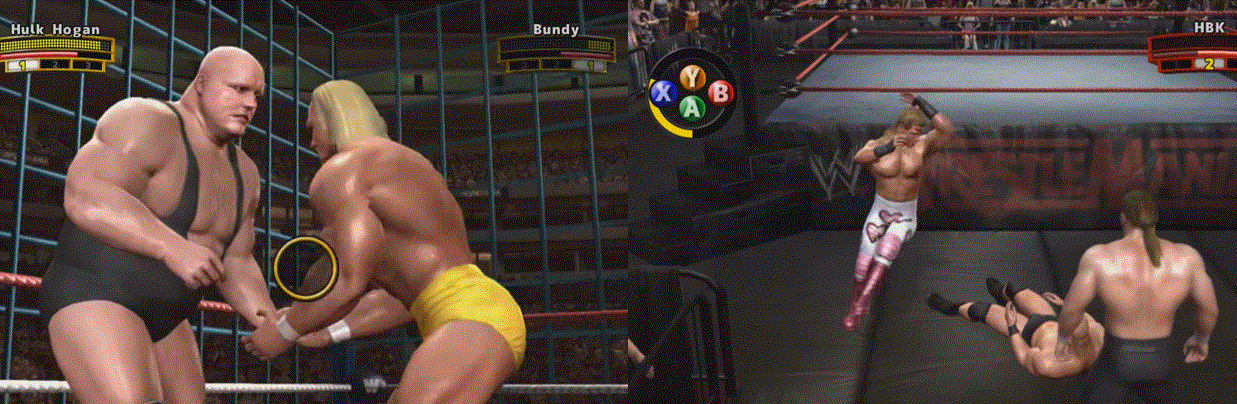
Gameplay is heavily based around QTEs and button mashing.

You can throw a strike at your opponent with X; land a few in quick succession to perform a simple combo or hold X to charge up a powerful strike, with both knocking them to the mat and leaving them prone for a leg or elbow drop or other ground-based offense. Grappling is performed with A; again, you can either tap it for a quick, weak grapple, or hold it for a stronger grapple, and use a directional input in conjunction with A to perform different moves (though your move pool is quite limited). As you attack and mix up your offense, you’ll build up a “Chain Meter”; as it reaches three different levels, you’ll gain access to more powerful grapples, with your finisher being unlocked at Level 3 and performed by pressing X and A together. Successfully landing attacks drains your opponent’s health meter and weakens them for either a pin or submission; submission moves are generally locked in when the opponent’s on the mat and see you mashing buttons to wear your opponent down, or you can pin them with B. If either of these things happen to you, you’ll need to mash buttons or full a circular meter to hit a small target in order to stave of the attack or kick out of the pin attempt.
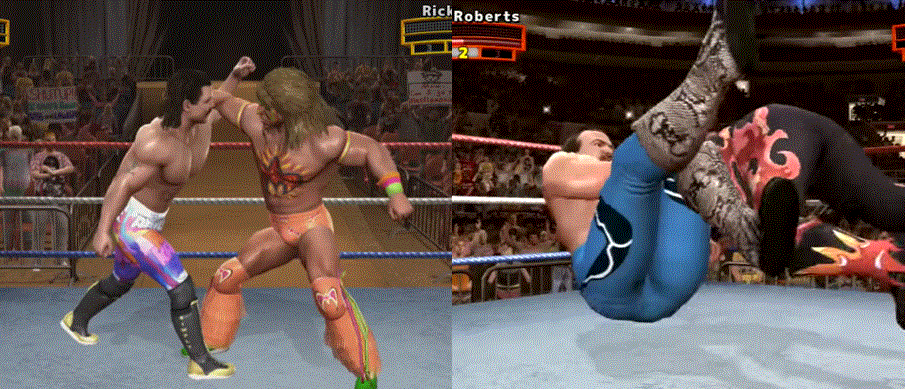
While reversals can be tricky to pull off, finishers are a matter of hitting onscreen button prompts.

You’ll need to mix and match your offense in order to build up your Chain Meter (though simply mashing X can work just as well), and you can sacrifice a chunk of it by taunting with B and Y and gaining temporary buffs. This can all be a little clunky but it generally works quite well; what doesn’t work quite as well is the game’s reversal system. Rather than map counters to a shoulder button, WWE Legends of WrestleMania has them performed by pressing away from your opponent and Y or holding Y to block. I found this to be incredibly unreliable, as my Legend would often just step backwards or even run away, and I really don’t understand why this wasn’t just mapped to the Right Bumper. Unlike the majority of other wrestling games, WWE Legends of WrestleMania heavily relies on button mashing, button inputs, and quick-time events (QTES); you can’t even Irish Whip your opponent without a QTE flashing on the screen and many of the event matches in the WrestleMania Tour mode start, or are punctuated by, QTE sequences that see you mashing or hitting buttons in a test of strength, chain grapple, and other similar sequences. This also extends to the finishers; after pressing X and A, you’ll need to hit the QTE prompts to land your finisher sequence and do the maximum amount of damage, which is certainly unique but it comes at the cost of severely limiting the amount of finishers available in create-a-wrestler mode
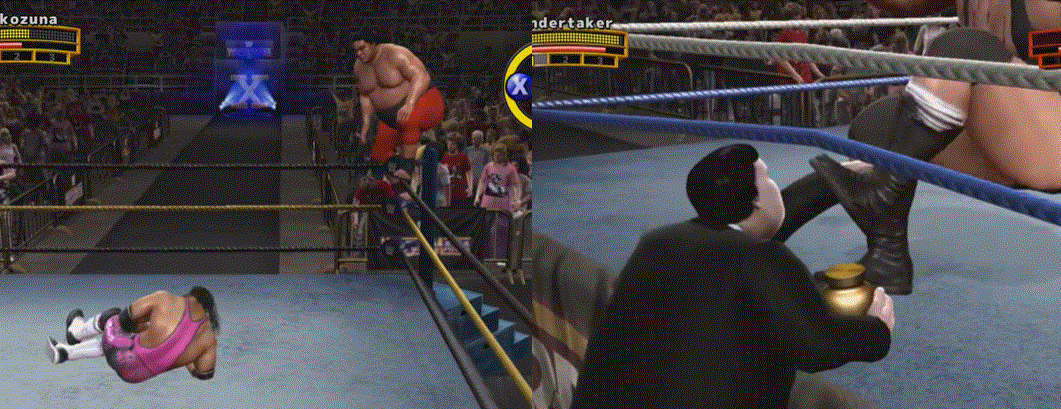
There’s not much to differentiate the wrestlers but managers add a little spice to the matches.

Contrary to other wrestling videogames; there isn’t really a weight class or detection system in WWE Legends of WrestleMania; playing as King Kong Bundy is largely the same as playing as Shawn Michaels, but there are some notable exceptions. For example, while Mr. Perfect can body slam and lift the likes of Yokozuna without issue, some Legends are noticeably more nimble than others and some superheavyweights struggle with climbing cage walls and are limited in their aerial offense. Some wrestling games like to lump their roster into categories and assign them abilities that play to their strengths, but that isn’t the case here so the majority of the roster’s differences are reflected in their move pool: Jimmy “Superfly” Snuka isn’t going to be quite as technically adept as Ric Flair but it’s not as though the Undertaker exhibits any supernatural abilities that other big men, such as the Big Boss Man, have. One major aspect of the game is the presence of managers; the likes of Paul Bearer and “The Mouth of the South” Jimmy Hart can accompany Legends to the ring and can interfere on your behalf at the cost of your current Chain Level, which makes them super useful when they’re in your corner and quite the hindrance when they’re in your opponent’s.
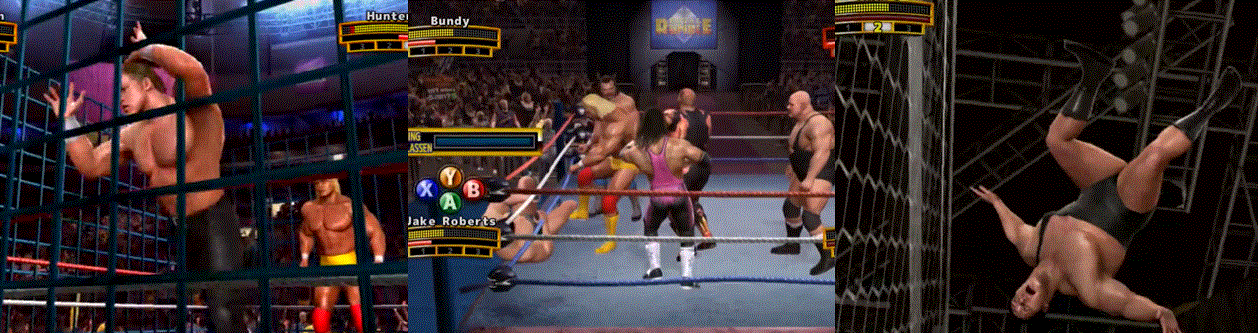
All the standard match types are available, with plenty of button mashing and QTEs sprinkled about.

Wrestling matches have all the standard options you might expect; you can set the difficulty level of the CPU in the options, manipulating the computer’s use of strikes and reversals and such, and customise win conditions (such as turning pin falls and disqualifications on or off and changing the amount of time you can spend outside of the ring). There’s also a number of additional match types on offer that will be recognisable to fans of wrestling games, with most featuring a twist in the game’s new engine and mechanics that mostly boil down to button mashing. You’ll need to mash buttons to either escape from, or prevent your opponent from escaping, a cage or break up a pin fall in a tag team match, for example. Similarly, you’ll find finishers disabled in the Royal Rumble match (there aren’t even special Royal Rumble finishers like in other games) and you’ll instead have to mash buttons to try and force your opponent out of the ring or save yourself from elimination. These components are less prominent in Hell in a Cell and ladder matches, however; you can start Hell in a Cell on top of the structure, which is a nice touch, and can throw your opponent through the cage wall or down to the ring using environmental grapples. Ladder matches are actually much more enjoyable than in other wrestling games I’ve played; you pick up a ladder (or any weapon) by double tapping B and a helpful glowing target shows you where to set it up and climbing and retrieving a championship belt is quite simple compared to other wrestling titles. Retrieving a weapon from under the ring can be a little trickier, though, as can utilising the ringside area or battling into the crowd or up the aisleway, as it requires you to hit A in specific areas around the arena, which can be difficult thanks to the janky controls. You’ll also find such staples as Iron Man matches and Last Man Standing matches on offer here, which are fun ways of mixing up the gameplay, but there’s nothing to really set the game’s matches or gameplay apart from other wrestling titles and very few of these appear in WrestleMania Tour.
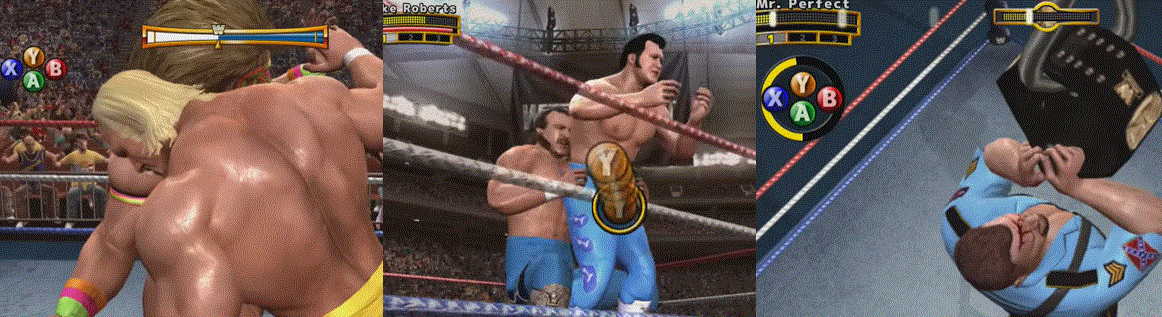
WrestleMania Tour sees your reliving, rewriting, and redefining classic matches.

Speaking of which, you’ll be given three single-player options here: “Relive” (where you recreate specific WrestleMania matches), “Rewrite” (where you tackle other WrestleMania matches from the perspective of the historical loser), and “Redefine” (which features unique “dream matches”). Each of these matches is proceeded by a short hype package that features clips from real-life wrestlers and the matches and feud between the competitors, and you’ll be given a series of optional objectives to fulfil in order to earn points. These range from performing a certain number of attacks, grapples, counters, and finishers, winning the match, performing taunts, winning pre-match sequences, and more specific environmental situations (such as winning Chain Grapple sequences, slamming your opponent through an announce table, or grappling up near the entrance). Earning points fills a meter and, once it fills high enough, you’ll earn a medal that will award you with unlockable match types, attires, and more. There’s nothing to gain from playing WrestleMania Tour on anything other than the easiest difficulty, with the computer’s abilities completely neutered in your favour, beyond personal pride so you may as well manipulate the game’s settings to make things easier for you. This mode is also probably the best part of the game as it lets you recreate some iconic WrestleMania moments and matches, and meeting the objectives can be fun, but things quickly get quite frustrating if you’re trying to earn all the medals and monotony sets in quite fast as there’s not much variety in terms of the match types (there are no multi-man matches in this mode, for example) beyond the odd cage or ladder match and you can completely ignore the objectives if you like since winning is all that really matters.

Graphics and Sound:
Wrestling games can be a bit hit and miss when it comes to their graphics, especially with their in-game character models. WWE Legends of WrestleMania favours a slightly exaggerated, action figure-like aesthetic for its Legends, which is typically common when bringing the WWE’s old school superstars to life, and for the most part this actually looks a lot better than in some of the SmackDown! titles. This is primarily because WWE Legends of WrestleMania is largely consistent with its presentation, rather than fluctuating wildly between hyper realistic and massively off-model. Notably, however, you won’t find any female Legends or superstars on offer here, and there’s no on-screen referee either, which is a pretty big step back for me.
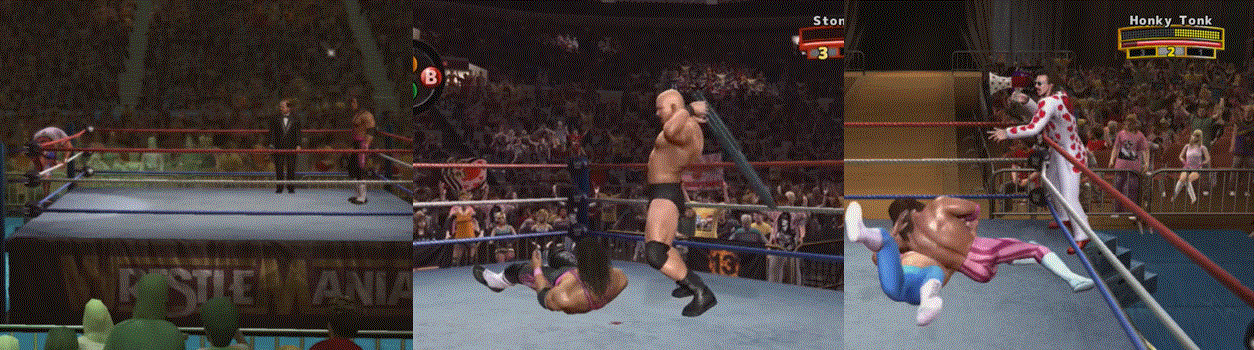
While character models look pretty good, the camera and arenas leave a lot to be desired.

The number of arenas on offer isn’t exactly much to shout about either. There’s very little variety on offer as you can only fight in WrestleMania arenas; there is a Royal Rumble arena, however, (and ironically you can only ever fight a Royal Rumble match in this arena) but there’s no Raw, SmackDown!, or other pay-per-view arenas on offer. The crowds are as sub-standard as ever, sporting signs and attire tied to their favourite superstars and parting to allow you to fight over the barricade (though essentially acting as barriers to keep you enclosed), but entrances have been a bit neutered. The game does offer the old-school gondola entrances, which is kind of cool, and recreates the old-school name plates and presentation of the pre- and early-“Attitude Era” of the WWE. Unfortunately, however, the presentation does take a bit of getting used to; the camera is very zoomed in, meaning that your Legends take up a lot of screen space and this can make it a little difficult to be fully aware of your surroundings. The camera is prone to wild swings and odd positioning, which is very annoying, and there’s a noticeable delay between button presses and executing grapples, making for a much more deliberate and slower pace to the game. Though I eventually learned to live with these niggling problems, it did take me a while to adjust to the presentation and gameplay style of the game.

Video clips add some historical context but the commentary continues to be mundane and predictable.

The inclusion of video clips and real-world footage adds to the drama and intrigue of the WrestleMania Tour mode, but these are nothing you haven’t really seen before in a wrestling title. The same goes for the entrance videos and music, which is all pretty much as you’d expect (with a few inconsistencies here and there, such as the Big Boss Man utilising his Attitude Era theme), and this extends to the in-game commentary. Provided by the legendary duo of Jim Ross and Jerry “The King” Lawler, the commentary is basically exactly the same as in the SmackDown! series, though there are some specific new sound clips added in to refer to the game’s roster and the rivalries on offer in WrestleMania Tour. I don’t play these games for in-depth commentary or crowd reactions but even I was astounded by how cheap and lazy these aspects were here. The same can be said of the create-a-wrestler options, which offers clothing, body, and hair options all ripped straight from the SmackDown! games but actually have less to offer in some respects: there’s less naming options available, less moves, less finishers, and even less clothing options as everything is geared towards meeting the old-school aesthetic and altered gameplay mechanics of the title.

Enemies and Bosses:
Being a wrestling title, every single in-game Legend is potentially your enemy; however, as mentioned, it’s not really necessary to play as or fight against each of the game’s roster in order to learn their strengths and weaknesses. Once you’ve played as and against a couple of the Legends, you’ve pretty much experienced all of the variety the game’s conflicts have to offer; your biggest hurdle will be getting the timing of the weird reversal system down, but you can circumnavigate this by just attacking your opponent head-on with strikes and landing strong grapples as and when they unlock. Guys like Bam Bam Bigelow might look big and intimidating, and the Honky Tonk Man might be the ultimate opportunist, but it’s not like you have to worry about character-specific abilities so what works against one will work against all as long as you can hit the QTE prompts when your opponent does get the drop on you.
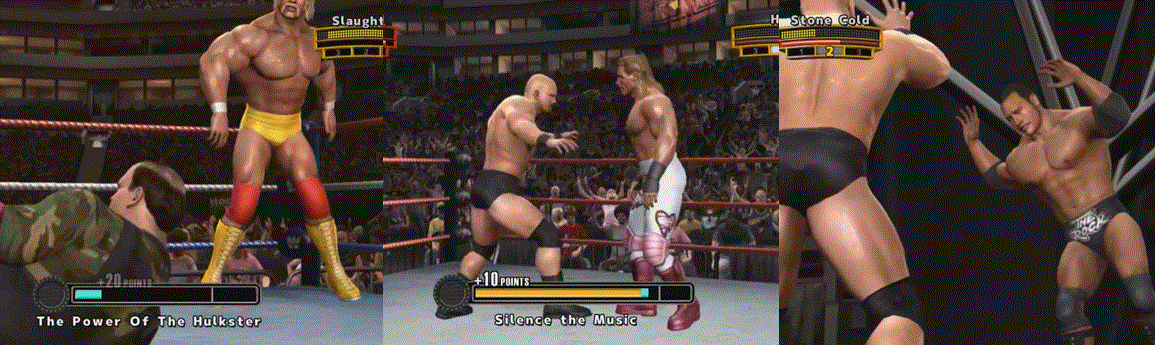
Meeting objectives is pretty simple until Steve Austin butts heads with the Rock.

In the Relive portion of WrestleMania Tour, you’ll have to battle against specific opponents in recreations or classic WrestleMania matches; this means you’re forced into assuming the role of the historical victor, or loser, of specific matches. One of the most recurring playable characters in this mode is, of course, Hulk Hogan, who must take on King Kong Bundy in a steel cage, and Andre the Giant and the Ultimate Warrior in recreations of their iconic matches. As long as you win your matches, you’re fine, but you’ll need to meet a certain amount of objectives to earn your medal; this includes stuff like kicking out of a pin attempt, causing the opponent to bleed, or winning with a specific move. As you play through these matches, the amount and difficulty of the objectives will increase; I first noticed them becoming more complex in the classic clash between Steve Austin and Bret Hart, which requires you to attack Austin’s leg five times, fight into the crowd, utilise a steel chair, and win with the Sharpshooter but the difficulty severely ramps up for Relive’s final match. This is a recreation of Austin’s WrestleMania XV bout against the Rock; to achieve this medal, you need to meet every single objective, which can be extremely laborious as one of your objectives is reversing the Rock Bottom, to say nothing of all of the many environmental grapples you need to hit on the outside of the ring. I definitely recommend turning the game’s difficulty level and sliders all the way down in your favour and making liberal use of the health regeneration taunt to increase your chances in this match.
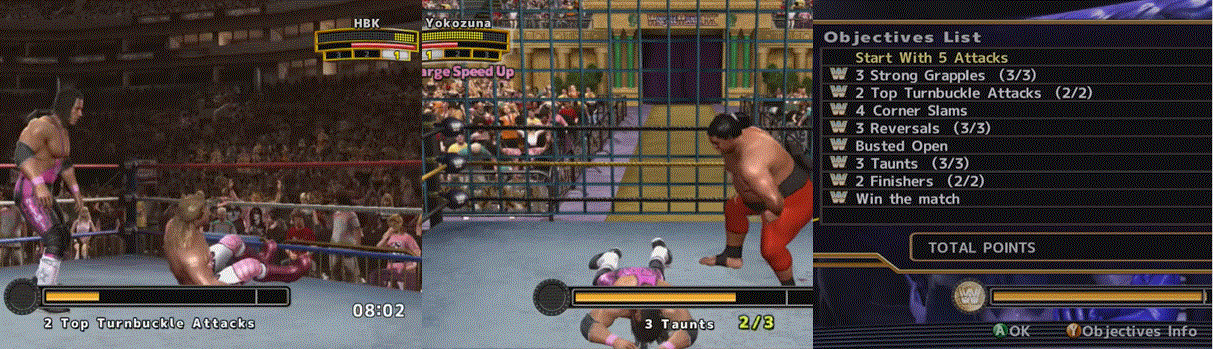
Objectives get even simpler in Rewrite and Redefine, meaning the medals are pretty simple to earn.

In Rewrite, you tackle different WrestleMania matches in the role of the historical loser and must fulfil different objectives in order to change history. Since you’re rewriting the outcome of these matches, these objectives are far less demanding and start off as simple stuff like performing and reversing grapples, taunting, and hitting a finisher and don’t really get more complex than landing more attacks, performing more taunts, maybe making the opponent bleed, and performing multiple finishers and reversals. Honestly, these matches were an absolute breeze, with even Bret and Shawn’s infamous WrestleMania XII Iron Man match providing little challenge beyond a ten-minute time limit. This carries over to Redefine, though the matches and competitors at least have a little more variety; here, you can pick which Legends you want to play as and will witness the likes of Andre and Giant and Big John Studd in a Hell in a Cell match and Mr. Perfect and the Big Boss Man in a ladder match. Redefine culminates with a dead simple no disqualification match between the Undertaker and King Kong Bundy that might have a lot of objectives but they’re nothing compared to the Austin/Rock match (boiling down to stuff like hitting five moves in a row at the start, two top rope moves, three reversals and taunts, and two finishers, which is still laborious but nowhere near as frustrating as in that aforementioned match).

Power-Ups and Bonuses:
There are a few options available to you during matches to help turn the tide in your favour; you can toss your opponent to the outside of the ring and interact with the steel steps, announce tables, and barricades to deal more damage to your opponent and, when your opponent is positioned correctly, pull weapons out from under the ring to bust them open or beat them down. When near the aisleway, you can clunkily force them up to the entrance way where there are often other environmental grapple points on offer that let you choke your opponent with wires, toss them into the stage dressing, and even make use of a drum kit but there’s no backstage brawling here. As your Chain Meter builds up, you gain access to taunts that can provide you with temporary buffs; these include regenerating your health, upping your speed and durability, and making reversals easier to pull off for a limited time. Managers can also provide many of the same temporary buffs and also attack or distract your opponent to give you the edge in matches, though utilising these will cost you part of your meter so you’re often asked to pick between receiving a temporary buff or earning your finisher.

Additional Features:
There are a mere nineteen Achievements on offer in WWE Legends of WrestleMania, which is astoundingly low for a wrestling title. Achievements are primarily tied to obtaining medals in WrestleMania Tour or making and using a created wrestler but you can also earn them by winning matches using only grapples or with other specific moves. Sadly, in a game featuring so many WWE Legends, there aren’t more fun or notable Achievements; for example, you can use Hogan to slam Andre all you like in the WrestleMania III arena but it won’t pop a “Unstoppable Force” Achievement. As you play, however, your win/loss record and other statistics are recorded in the “Hall of Fame”, which is good for the statisticians out there, but there’s no way to compete for championships outside of the WrestleMania Tour mode, no create-a-pay-per-view mode, general manager mode, or even WWE Universe mode so you’re basically limited to exhibition matches and the WrestleMania Tour. Well, not entirely; there is also the “Legend Killer” mode. Here, you use a created wrestler to take on six tiers, comprised of ten back-to-back singles matches and culminating in a showdown with one of six WrestleMania Legends. You’ll earn experience points (EXP) by winning matches, and even more for mixing and matching your gameplay style as you play, which you can spend upgrading your created wrestler’s attributes and earning more Achievements. The create-a-wrestler mode is basically the same as in the SmackDown! series, including many of the same hair and clothing options as in those games and you can also fully customise their entrance or even create a tag team, though there’s very little incentive without a Universe mode. While there’s no downloadable content on offer here, you can transfer basically the entire male roster of WWE SmackDown vs. Raw 2009 (Yuke’s, 2008) if you have a save file for that game on your system, which greatly expands the amount of moves and finishers available to you. While this is a cool feature, and something I wish WWE games would implement more often, it doesn’t equate to much more than adding modern superstars to the roster (which really doesn’t mean all that much as you can’t play as them in WrestleMania Tour).

The Summary:
I do enjoy a bit of a wrestling title, and quickly and easily nabbing a few Achievements, and as a big wrestling fan I enjoy revisiting some of the classic wrestlers of the past but WWE Legends of WrestleMania is a quite a bare-bones title. You can see everything the game has to offer in an hour or so and plough through the main story campaign in an afternoon; the Legend Killer mode might take a little longer but it’s hardly going to take up all your time and attention like a General Manager or Universe mode. The gameplay is a bit jarring at first thanks to the odd camera perspective and the plodding, clunky, QTE-heavy nature of the mechanics, but pretty easy to master and, before long, you’ll be winning matches in no time at all, meaning the game quickly gets boring. Yes, there’s a few other match types on offer but there’s little incentive to play these as you can’t compete for belts and I can’t imagine it’s that much fun to play against other human opponents, either. The create-a-wrestler is more lacklustre than ever and there’s a strange lack of focus on guys like the Undertaker, and some notable omissions from the roster (neither Kane nor Mankind are available, for example), though the ability to transfer the roster from WWE SmackDown vs. Raw 2009 is a neat touch. Ultimately, it’s not bad if you pick it up cheap but probably not really worth keeping in your collection once you’ve mined all of the Achievements. I appreciate the developers trying something a little different but this clearly isn’t a Triple-A title and is really only for fans of the rock ‘n’ wrestling era of the then-WWF. If you’re really in the mood for an arcade style wrestling game from around this time, you’d potentially be better off playing something like WWE All Stars (THQ San Diego, 2011).

My Rating:

Rating: 2 out of 5.

Could Be Better

Are you a fan of WWE Legends of WrestleMania? Did you like that the developers actually tried to do something a little different with this release or did the dumbed down gameplay put you off? Which of WrestleMania Tour’s matches was your favourite and did you ever achieve Legend Killer status? What did you think to the finisher system and the abundance of QTEs? How did you find the create-a-wrestler mode and were you disappointed by the lack of WWE Universe in this title? Were there any classic WWE superstars you felt were missing from the game and which of the available Legends was your go-to character? How are you celebrating WrestleMania’s anniversary this year and what’s your favourite WrestleMania moment? Drop your thoughts below by signing up or leave a comment on my social media to let me know what you think about WWE Legends of WrestleMania and check back for more wrestling content throughout the year.


Mini Game Corner [Mario Month]: Super Mario Land 2: 6 Golden Coins (Nintendo 3DS)


So, for no better reason than “Mar.10” resembling Mario’s name, March 10th is widely regarded as being “Mario Day”, a day to celebrate Nintendo’s portly plumber, an overalls-wearing mascot who literally changed the videogame industry forever and shaped the home console market of the nineties. To commemorate Mario Day this year, March is once again “Mario Month” and I am spending every Thursday of this month celebrating everyone’s favourite Koopa-flattening plumber.


Released: 29 September 2011
Originally Released: 21 October 1992
Original Developer: Nintendo R&D1
Also Available For: Game Boy

A Brief Background:
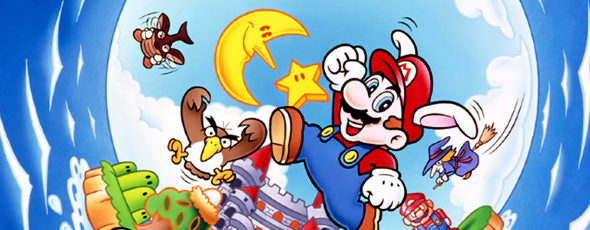
After Super Mario Land (ibid, 1989), a launch title for Nintendo’s influential Game Boy handheld console, sold over 18 million copies, and given the rising success of the Super Mario franchise, a sequel was all-but-inevitable. Spearheaded once again by Gunpei Yokoi, the man behind the Game Boy, development of the sequel began in November 1991 and was eventually geared towards capturing the same feel and tone as Super Mario World (Nintendo EAD, 1990). Super Mario Land 2: 6 Golden Coins continued the trend of the Mario Land sub-series of introducing new antagonists into the franchise with the creation of my favourite Mario character, Wario. Mario’s evil doppelgänger was created by director Hiroji Kiyotake and born out of the development team’s disdain for working on a franchise they didn’t help create; nevertheless, Wario not only subsequently took over the Mario Land series and became a popular character in his own right but Super Mario Land 2: 6 Golden Coins was released to rave reviews, sold over 11 million copies, is largely considered one of the best Game Boy titles, and was eventually released on the Nintendo 3DS Virtual Console, which is the version I’ll be looking at today.

The Review:
Super Mario Land 2: 6 Golden Coins is a 2D, sidescrolling action/platformer; rather than the linear format of the previous title, the sequel incorporates a world map similar to the ones seen in Super Mario Bros. 3 (ibid, 1988) and Super Mario World and allows players to pick and choose the stages they challenge once they get past the opening tutorial level. While Super Mario Land was an extremely basic and simplistic title, Super Mario Land 2 looks and feels much more like its later 8- and 16-bit counterparts thanks to much bigger, far more detailed graphics, an overworld map, and has far more to do and see throughout the game (the game is so much bigger than its predecessor that it includes a battery back-up save feature, allowing you to have three different save files at once). Functionally, though, Mario controls exactly the same; players can run by holding B, jump with A, and perform a spinning jump by holding down on the directional pad (D-pad) while jumping, which allows Mario to smash or pop goodies out of blocks when standing on top of them. Mario is a little more slippery this time around but it’s nowhere near as bad as in Super Mario Bros. (ibid, 1983) and he has just enough weight to him to make him crisp and responsive. As you should expect from a Mario title, Mario can grab a Super Mushroom to become Super Mario; this allows him to take a hit without dying, destroy certain blocks, and perform the spin jump. You can also grab an “M” bag to earn more Coins and a Star to become invincible; while you can still die from bottomless pits and certain hazards, defeating five enemies in a row (and every one thereafter) will also award you with an extra life in this form.

Gameplay is mixed up with some quirky mechanics sprinkled throughout.

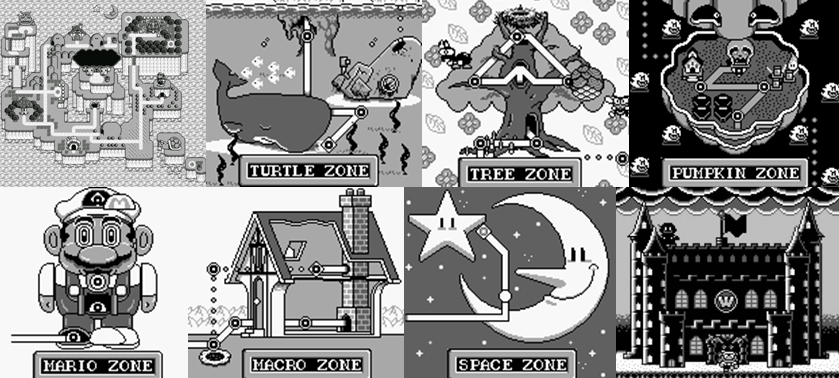
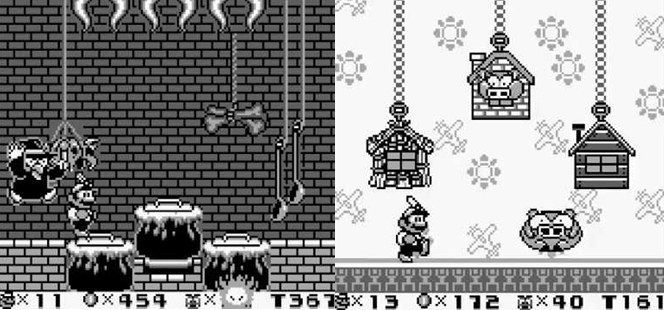
While he no longer has his cool little vehicles from the last game, Mario does get some cool power-ups this time around: the bouncy Superball is gone, replaced with the traditional Fire Flower (which, honestly, is the power-up you should favour at every opportunity) and Mario can now grab a Carrot to become Bunny Mario. This gives him bunny ears and allows you to float through the air by rapidly tapping A, though Mario descends slowly over time so it’s best to get a good run up or jump from a high ledge. Sadly, there are no vehicles to pilot this time around so players must rapidly tap A to swim when under water rather than piloting a submarine. You won’t have to try too hard to find and accumulate extra lives, though, as you can earn them by collecting Hearts (found in blocks and/or won in bonus stages), defeating 100 enemies (helpfully tracked in the game’s heads-up display (HUD)), or defeating five enemies in a row while invincible. Of course, you’ll have to contend with a time limit and many bottomless pits along the way but you can hit bells part-way through stages to create a checkpoint in case the worst happens. For the most part, the game controls and plays like a traditional Mario title; this means you’ll be doing a lot of jumping, travelling through pipes, and hopping on enemy’s heads. Gameplay is mixed up a bit, though, by frequent instances of water (though mostly in the Turtle Zone), forcing you to jump across platforms above an endless void (particularly seen in Tree Zone, which also has you using sticky sap to avoid spikes and pits), or navigate disappearing/reappearing blocks in Pumpkin Zone. You’ll also ride on a fair amount of moving platforms or cross vast chasms in bubbles but probably the most unique Zone is Space Zone, which features both an autoscrolling section, a unique sprite for Mario, and much lighter gravity that allows you to jump far higher and stay in the air indefinitely by holding down A.

Super Mario Land 2 is much bigger and better than its predecessor.

Super Mario Land 2 is divided into six stages, now called “Zones”, each of which has at least one “Special Area” that can be accessed by finding a hidden exit within one of the Zone’s stages. You’ll also be able to visit a couple of different courses and areas from the overworld to grab a healthy supply of Coins, stock up on power-ups or extra lives, and access other Zones. Zones can be tackled in any order but, since some have more stages and are more difficult than others, you might want to plan out your gameplay accordingly and tackle some of the shorter, easier stages first. After clearing each of the six Zones, you’ll acquire one of the titular Golden Coins; get all six and you can enter the game’s final area, which is devoid of enemies but full of traps and tricky obstacles and leads directly to the final confrontation with Wario. Compared to its predecessor, Super Mario Land 2 is a quantum leap forward in terms of graphics and presentation; it’s still a basic title (it is a Game Boy game, after all) but sprites and backgrounds are so much bigger, far more detailed, and world’s beyond the simplistic aesthetic of the first game. It’s actually mind boggling to me how much of an improvement the game is in such a short space of time; the first game was like a super scaled down version of Super Mario Bros. and it worked for what it was but this is like a small-scale version of Super Mario Bros. 3 or Super Mario World, featuring far more stages, much more variety, and is far bigger, allowing players to pick and choose the order of the Zones and how they play, with many of the mechanics and features of this game bleeding over into Wario’s spin-offs.

The graphics are much bigger and more detailed, with variety and fun being the order of the day.

While Super Mario Land 2 doesn’t really feature a scoring system, Coins still serve a purpose in that Mario can use them in certain areas of the overworld to buy extra lives and power-ups. If you exit each stage using the upper exit, you’ll get to play either a claw machine or a circuit mini game that can also net you these same rewards, allowing you to earn many extra lives very quickly. Unlike the previous game, though, there’s no harder game mode to be unlocked; once you’ve beaten the game, all that’s left to do is reload your save file to find any hidden exists and areas you’ve missed or start the game over from the beginning again. When playing the 3DS version of the game, you can, of course, make liberal use of the save state feature to make the game an absolute breeze, which is always  a helpful and appreciated feature. Bigger sprites means bigger hit boxes, which can be an issue, and the game does noticeably slow down when there are a lot of sprites onscreen at once (which isn’t something I can say for the first game) but I can forgive that for the sheer amount of detail and variety on offer. In Super Mario Land, background details were sparse and limited but, here, each Zone feels big, unique, and full of quirky little gimmicks and elements. Turtle Zone sees you exploring a submarine before venturing into the belly of a giant whale, for example, while Macro Zone has you travelling through a house from the garden to the inside and up to the bedroom/library all while shrunk down to a size that makes everyday household objects seem far bigger. Pumpkin Zone also stands out, being the now-traditional haunted house/Boo stage of the game and featuring a lot of clever lighting and graphical details. Even the overworld is bustling with life; you see a dark, ominous storm cloud over Wario’s Castle (and Wario himself pacing along the rooftop), the water surrounding the land constantly shifts, and Mario can even get literally sucked into some of the Zones. The game’s music is also much improved, featuring a catchy main theme, unique tunes for the Zones and boss battles, and just being much more memorable and lively compared to its predecessor.

Some bosses require a little more strategy to take them down.

Super Mario Land 2 also features a wide assortment of enemies, including (as you might expect) the return of several series staples such as Goombas (who also come in a winged variant), Boos, Koopa Troopas (whose shells you can now use to smash blocks and defeat enemies like in the main games), Piranha Plants, Bullet Bills, and Cheep Cheeps. You’ll also encounter some new enemies, some more interesting than others: Antotto is literally just an ant, for example, but Bomubomu is a pig that fires cannonballs at you! Some of the game’s most unique enemies appear in Mario Zone and Pumpkin Zone, including J-son (whose oddly familiar hockey mask has a knife sticking out of it!), a clown-faced Jack-in-the-Box, and Kurokyura the Vampire (who throws bats (or “Minikyura” at you). You’ll also encounter a weird cow/fish hybrid in Tree Zone, an indestructible, boxing-glove-wearing shark in Turtle Zone, and giant, fireball-spewing piranha status in Wario’s Castle. Six Zones means, of course, that Mario has to defeat six bosses to retrieve the six Golden Coins and confront Wario. While there is no “instant kill” switch as seen in the previous game, none of these bosses really pose that much of a threat as long as you are packing the Fire Flower, which makes most of them an absolute joke. The first boss I fought was Turtle Zone’s Pako, a giant octopus that spits its smaller, invulnerable offspring (“Poko”) out at you as it swims across the arena. Despite taking place underwater, which limits your mobility, you can simply spam fireballs at it or bounce on its bulbous head three times without too much difficulty. Next, I took on Tree Zone’s Big Bird, which you battle in its nest at the top of the tree. As its sole method of attack is to swoop down at you, this one is also easily cheesed with the Fire Flower but it’s equally pretty simple to just jump on its head. I then fought the Witch in the final area of the Pumpkin Zone; this boss can actually be quite tricky as the Witch teleports about the screen throwing fireballs at you, which can ignite under her cauldrons and send you up into the spikes in the ceiling. I found the best strategy was to stay in the middle of the screen and spam fireballs but you can easily anticipate where she’s going to teleport in so you can jump on her head.

Wario pulls out all the stops for the game’s final, three phase boss battle.

In Mario Zone, you’ll battle the Three Little Pigs, who come at you one at a time using rolling and bouncing attacks. I can’t say too much about this one as I just tossed fireballs at them relentlessly and bounced on their heads to beat them in seconds but I can’t imagine them causing you too much trouble. Macro Zone has you battling a Sewer Rat that darts in and out from pipes and clambers all over the walls and ceilings of the arena to drop down on you; this one can be tricky because of how fast the boss is but, again, the Fire Flower will make short work of it. Finally, in Space Zone, I took on a familiar face as Tatanga, the final boss of the first game, returns for a rematch. As this battle takes place in the low gravity of the Moon, it can be tricky to dodge between Tatanga’s two energy bolts, each of which has a different attack pattern, and his tendency to stay on the top corners of the screen makes using your fireballs much more difficult. Thankfully, he also tries to dive bomb you, leaving him wide open for attack, and he’s far weaker than in the last game, going down in just three hits like every other boss in the game. Similarly, the final battle against Wario is a much grander and elaborate fair than the final boss of Super Mario Land; as if running the gauntlet of Wario’s many traps and hazards and battling multiple floating Wario faces wasn’t enough, Wario (here a much bigger, monstrous figure than usually depicted) has three phases to his boss battle. In the first, he charges and stomps around the throne room trying to squash you and causing crystal balls to fall from the ceiling. Next, he grabs a Carrot to become Bunny Wario and takes refuge at the top of the screen before dropping down onto you and, finally, he becomes Fire Wario and launches fireballs at you while also jumping at you. While you have to take on all three phases one after the other, you can grab power-ups between each one and, again, Wario is defeated in three hits each time so, while this is easily the longest and most involved boss battle in the game, it’s no mean feat.

The Summary:
Super Mario Land 2: 6 Golden Coins is a fantastic little game; it never fails to impress me how much bigger and better it is compared to its predecessor, which looks like a Game & Watch title in comparison. Super Mario Land 2 is much more like the later 8-bit Mario titles in its detail, variety, and scope, making for a game that takes up much more of your time and is thus far more enjoyable on those long car journeys. Everything from the sprites, backgrounds, and music has been brought up a notch and the game is really showing the power and potential of the Game Boy to emulate its bigger, home console counterparts. Add to that the fact that Super Mario Land 2 was one of the first Game Boy titles I owned and that it introduced my favourite Mario character, Wario, and you have a game that not only holds up really well as a solid Mario/Game Boy title but also a game that is very close to my heart. I’ve always had more affinity and appreciation from Mario’s handheld adventures and Super Mario Land 2 is largely to thank for that.

My Rating:

Rating: 4 out of 5.

Great Stuff

Did you ever play Super Mario Land 2: 6 Golden Coins on the old Game Boy brick? How do you feel it compares to the original and other Mario titles from the time? Are you a fan of Wario and would you like to see him return to prominence in the franchise? What are some of your memories/experiences with the Game Boy? Whatever your thoughts on the Game Boy and Mario’s handheld adventures, feel free to leave a comment below.

Mini Game Corner [Mario Month]: Super Mario Land (Nintendo 3DS)


So, for no better reason than “Mar.10” resembling Mario’s name, March 10th is widely regarded as being “Mario Day”, a day to celebrate Nintendo’s portly plumber, an overalls-wearing mascot who literally changed the videogame industry forever and shaped the home console market of the nineties. To commemorate Mario Day this year, March is once again “Mario Month” and I am spending every Thursday of this month celebrating everyone’s favourite Koopa-flattening plumber.


Released: 2011
Originally Released: 21 April 1989
Original Developer: Nintendo R&D1
Also Available For: Game Boy

A Brief Background:
In 1989, Nintendo were preparing to release their handheld console, the Game Boy, a machine that would go on to pretty much define portable gaming. To coincide with this release, they needed fun, appealing titles to attract players and Super Mario was the obvious candidate given how well Super Mario Bros. (Nintendo EAD, 1985) had sold some years prior. The first game in the series not to feature the input of Mario’s creator, Shigeru Miyamoto, the game was also significantly shorter and smaller than its home console counterpart. While this has been reflected in reviews, Super Mario Land sold over 18 million copies, kickstarting an entire sub-series for Nintendo’s portly plumber that was exclusive to its handheld devices. Naturally, it was eventually ported to the Nintendo 3DS Virtual Console with some minor revisions, which is the version I’ll be looking at today.

The Review:
Though functionally the same game as Super Mario Bros., there’s plenty of differences between that game and its handheld counterpart to help Super Mario Land stand out…and not all of them are good, to be honest. Like its bigger brother, Super Mario Land is a 2D sidescrolling platformer in which players control Mario as he runs, jumps, and blasts his way through four distinct Kingdoms. While the game sacrifices a lot in terms of length and graphical quality, Mario actually controls far better in his Game Boy debut than in his more famous title; for one thing, he’s far less slippery, which is a Godsend as it’s much harder to slip and randomly fall off platforms down a bottomless pits and to your death. Mario can still jump, bouncing off enemies’ heads and gaining more height and momentum as he does so and from running by holding down the B button, and he feels like he has a bit more weight to him; not enough to make him plummet like a rock like some of his contemporaries but also not so little that he goes flying off the screen. The game is simplicity in itself; you start on the left side of the screen and run and jump to the right, taking out enemies, collecting Coins for points and extra lives, and taking your chances down the game’s various pipes to find hidden areas full of these aforementioned Coins. As in pretty much all Mario games, and most videogames at the time, you’re also racing against a time limit and can protect yourself from death by bashing blocks to randomly unearth a collectable Super Mushroom, which will transform you into Super Mario.

Despite its understandable simplicity, the game’s Kingdoms are distinct and varied.

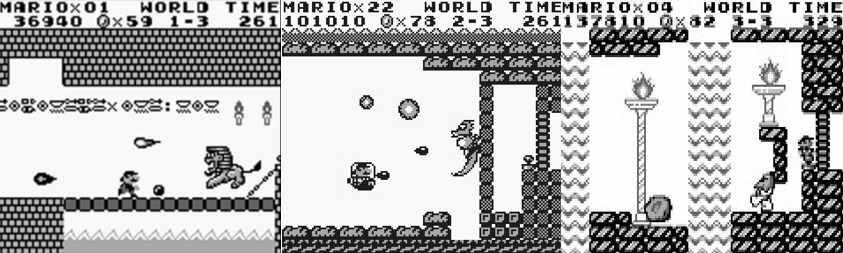
While Super Mario Land has only four stages, referred to as “Kingdoms”, it mixes up its gameplay significantly from other Mario games of the time with the inclusion of two autoscrolling shooter stages; one has you piloting the “Marine Pop”, the other the “Sky Pop”, a cute little submarine and bi-plane, respectively. While autoscrolling stages can be a pain in the ass, and it easy to get crushed to death if you don’t blast blocks quickly enough, these are actually quite fun and it’s just a shame that the developers didn’t program a couple more stages like these in there to help keep things interesting. Additionally, rather than jump atop a flagpole at the end of each Kingdom, Mario exits each stage by entering a doorway; if you direct him to the top exit, you’ll be taken to a Bonus Game where you can earn anywhere between one and three extra lives or a power-up by stopping the fast-moving ladders. Extra lives are rather plentiful overall, to be honest, meaning you generally have an abundance of chances to tackle the games more troublesome and difficult sections, which usually involve making a few tricky jumps over an endless void, jumping to moving platforms, and using rolling boulders to safely cross spiked platforms.

Mario’s new vehicles really help to spice up Mario’s classic platforming action.


As you explore and bop blocks through the game’s Kingdoms, you’ll collect a number of Coins; collect one hundred and you’ll be awarded with an extra life, which can also be found sporadically throughout the game (this time in the form of a heart). Mario’s chief power-up in this game is the Superball, which allows him to toss a projectile similar to the Fire Flower but with the added bonus of the Superball bouncing around the screen to damage multiple enemies and even collect Coins, though you can only ever throw  one at a time. If you take a hit while holding a Superball, you’ll revert right back to little Mario, but you can also grab Stars for a temporary period of invincibility. Unlike other Mario games of the time, you cannot play as Luigi or any character other than Mario; as a result, the primary additional features you’ll find in this game are the aforementioned autoscrolling and bonus stages. However, after you beat the game for the first time, you’ll unlock a “Hard Mode” that adds additional enemies to the game’s Kingdoms and, after clearing that mode, you’ll unlock a stage select feature. Otherwise, the 3DS version also allows you to create one save state to dramatically reduce the game’s difficulty and challenge (I remember owning this game as a kid and never being able to clear the Easton Kingdom but, thanks to the 3DS’s save feature, I beat the game in about an hour without really trying that hard).

The game renders its many familiar and unique enemies as best as possible.

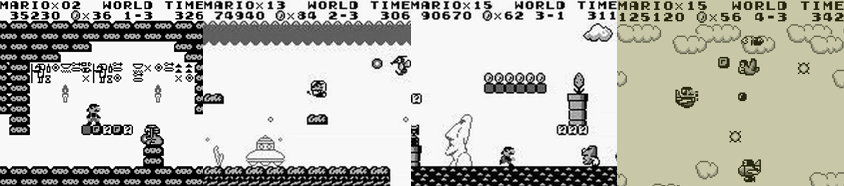
Given that it was a launch title for the Game Boy, a handheld console not exactly known for being the most powerful or graphically interesting amongst its peers despite its immense popularity, it’s important to set your expectations quite low for Super Mario Land. Graphics are painfully simple and monochromatic, with Mario helpfully standing out thanks to his iconic cap and moustache as, without these, he may as well have just been Mr. Game & Watch. The game’s enemies, for all their variety, don’t exactly fare much better but, thankfully, the bosses are much bigger and more indicative of the superior sequel. Similarly, while each of the game’s four Kingdoms feels distinct, they’re not exactly teeming with detail; most opt for a plain, empty background with some simple elements (pyramids, mountains, clouds, Easter Island-like heads and the like) and an abundance of blocks, platforms, and pipes. As you progress through each Kingdom, the stages take on more distinctive and detailed environments, such as exploring inside a pyramid, with hieroglyphics etched into the background layer, or traversing the block-and-platform-ample mountaintops of the Chai Kingdom. The game also separates itself from its bigger brother by having a mostly unique soundtrack; some familiar Mario tunes are present but, for the most part, Hirokazu Tanaka’s music is distinctive enough if a little off-brand for what the franchise was known for at the time. Super Mario Land also features around thirty different enemies, most of which are distinct to each of the game’s four Kingdoms and many of which return from, or are directly inspired by, enemies encountered in the bigger, better Mario titles. As such, you’ll be stomping on Goomba heads, blasting Piranha Plants as they pop out of pipes, and knocking Bullet Bills out of the air but will run into a devious little trap after smacking a Koopa Trooper as their shells now explode a few seconds after they are defeated!

Bosses might look tough but they’re easy to get past if you don’t feel like fighting them.

As mentioned, each Kingdom features their own distinct enemies: you’ll encounter spear-throwing Bunbuns and fireball-spitting Gaos in the Birabuto Kingdom; a variety of skeletal fish and fireball-spitting aquatic enemies in the Muda Kingdom; spiders and sentiment rocks and Easter Island heads in the Easton Kingdom; and zombie-like Pionpi, deadly chickens, and relentless bi-planes in the Chai Kingdom. Each Kingdom concludes in a boss battle that is, in essence, the same as battling Bowser in Super Mario Bros. but much more varied: you’ll encounter a fireball-spitting, jumping sphinx-like lion, a large, fireball-spewing seahorse, and a rock-throwing sentient Easter Island head rock monster. Regardless of the arena or differing environment or the attacks the bosses use, your tactics pretty much stay the same until the final showdown with Tatanga: avoid their projectiles and either blast at them with Superballs or dodge behind them to take them out with a switch at the cost of some bonus points. You’ll battle Tatanga in the Sky Pop but, before you can fight him, you’ll have to take out Biokinton, a chicken-throwing cloud that bounces around the screen. Afterwards, Tatanga rises into the sky, incessantly firing cannonballs from his Pagosu warship. While easily the toughest boss of the game, Tatanga’s shots are easy to avoid once you spot their pattern and, while he can absorb more shots than his counterparts, he still goes down fairly easily to allow Mario to literally rocket away with the true Princess Daisy.

The Summary:
It’s easy to forget about Super Mario Land; not only is its sequel worlds better in every way but so is the far more memorable and popular Super Mario Bros. It’s a great little burst of fun and a decent enough distraction for short car journeys but it’s not really got much to it, even for a Game Boy launch title or a product of its time. Still, this was the first Mario title I ever played so I have a decent amount of nostalgia for it and finally beating it after all these years was cathartic, though I’d still rather play the sequel of one of Wario’s many spin-offs on the same console.

My Rating:

Rating: 2 out of 5.

Could Be Better

What are your memories of Super Mario Land, if any? How do you feel it holds up compared to Super Mario Bros. or the other Mario Game Boy titles? What was your first ever Game Boy title and which is your favourite? Whatever your thoughts on Super Mario Land, Mario, and or the Game Boy in general, feel free to leave a comment below.

Game Corner [Mario Month]: Super Mario Odyssey (Nintendo Switch)


So, for no better reason than “Mar.10” resembling Mario’s name, March 10th is widely regarded as being “Mario Day”, a day to celebrate Nintendo’s portly plumber, an overalls-wearing mascot who literally changed the videogame industry forever and shaped the home console market of the nineties. To commemorate Mario Day this year, March is once again “Mario Month” and I am spending every Thursday of this month celebrating everyone’s favourite Koopa-flattening plumber.


Released: 27 October 2017
Developer: Nintendo EPD

The Background:
After the videogame industry crumbled under the weight of numerous overpriced consoles and lacklustre titles, Nintendo basically single-handedly rebuilt the industry with the blockbuster success of Super Mario Bros. (Nintendo EAD, 1985) and, following the “Console Wars” of the mid-nineties, Nintendo and their portly plumber continued to be an innovative and reliable staple of the videogame industry. On 3 March 2017, Nintendo struck again with their first high-definition console, the Nintendo Switch, an inventive little machine that could be played on the go or “docked” to play on televisions, with gamers using detachable “Joy-Cons” (with the usual motion control trappings Nintendo is now known for) to play. Accompanying this new console was an all-new Mario title, one that was aimed squarely on Mario’s long-term fans and would emphasise dense, open-world exploration over linear gameplay. To mix things up, producer Yoshiaki Koizumi aimed to have the player travel across multiple worlds (known as “Kingdoms”) and collect Power Moons instead of Power Stars, and to bolster Mario’s move set with Cappy, a mechanic specifically designed to incorporate the Switch’s unique control schemes. Upon release, Super Mario Odyssey received critical acclaim as critics lauded the game’s addictive gameplay, and originality, and it became a best-seller for Nintendo’s powerful little system.

The Plot:
Bowser, the King of the Koopas, has once again kidnapped Princess Peach and his underlings, the Broodals, have laid waste to the Bonneteer’s Cap Kingdom. Mario teams up with a Bonneteer, Cappy, a sentient hat who joins him on his quest to power up the Odyssey airship and chase after Bowser before he can force Peach into marriage!

Gameplay:
Super Mario Odyssey is a 3D, semi-open world action/adventure with a heavy emphasis on platforming, exploration, and performing elaborate jump tricks to progress further and track down the game’s 880 (!) Power Moons. Although you only need 124 to finish the main story, and 500 to unlock every Kingdom in the game, you’ll quickly find that collecting Power Moons becomes an addictive and fun-filled adventure as you spend another ten, twenty, thirty minutes scouring the latest Kingdom for one more Power Moon. If you’ve played any of Mario’s 3D adventures before, you’ll be instantly familiar with Mario’s controls; for me, the game clearly draws inspiration from Mario’s moveset from Super Mario 64 (Nintendo EAD, 1996) and Super Mario Galaxy (Nintendo EAD Tokyo, 2007) and Mario features all of his athletic abilities from those games. Players press A or B to jump; pressing either button in consecutive order will see Mario perform a triple jump to reach higher platforms, and he can crouch with ZL to enter small spaces or perform a backflip by pressing B. If you press ZL and B while running, you’ll fly ahead with a long jump, and pressing ZL and Y in mid-air will see him dive ahead. You can also perform a ground pound to flatten enemies or uncover secrets by jumping and pressing ZL (you can even press B as Mario hits the ground to spring up for a boost jump), perform side jumps, wall jumps, pick up and throw items, and swim through water by tapping B. While you can rotate the left stick to spin around and knock back enemies, you’ll notice that Mario can no longer punch or kick enemies; instead, you need to hop on their heads to defeat them or press X/Y/flick the Joy-Con to toss Cappy at enemies.

In addition to his athletic abilities, Mario can now possess enemies using his cap!

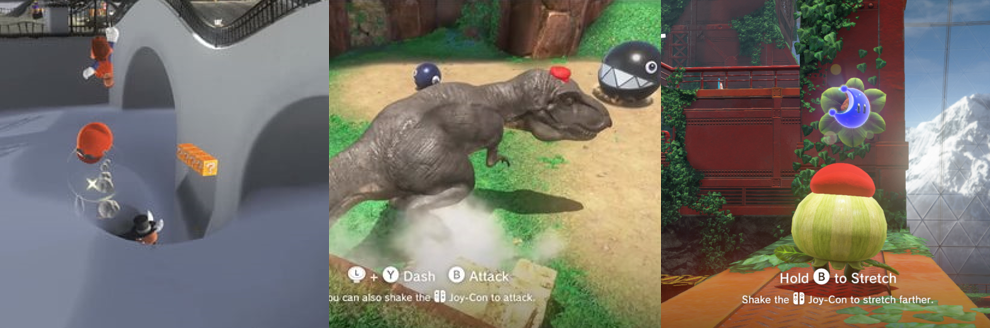
This will allow you “capture” certain enemies; sometimes, you’ll need to knock a hat or other headwear off their heads first, and not every enemy can be captured (and you can sometimes capture inanimate objects such as boulders and trees), but this is the game’s big new mechanic. Cappy can be used to uproot posts, collect Golden Coins, activate switches, clear away poisonous gunk, open doors, smash and hit brick blocks and ? blocks, and extend Mario’s jumps by holding Y to spin it in place. However, you can capture Goombas to walk along slippery surfaces without fear (and even stack them up to reach higher areas), frogs to leap to higher platforms, a fireball to safely pass through lava, and capture a spark pylon to travel across powerlines as a bolt of electricity. You can even capture bigger creatures, such as Chain Chomps that let you bash through blocks and a Tyrannosaurus rex to barge across the landscape (though this latter puts a great strain on Cappy). Capturing Bullet Bills lets you fly across the Kingdom for a short time, as do Paragoobas (though you need to tap B to keep these aloft), while Glydons let you glide across the landscape, Cheep Cheeps let you swim without far of drowning, and Uproots let you extend up to new areas. Moe-Eyes are slow but let you see hidden platforms, Wigglers let you stretch across gaps like a xylophone, Gushens let you blast up and across the area with temporary jets of water, and you can capture Hammer Bros, Yoshi, and even Bowser in the finale! You can press ZL at any time to return to normal, and often get a jump boost at the same time, and the enemy will temporarily remain nearby if you need to capture it again, but the capture mechanic really helps to expand your abilities and is essential to solving puzzles, reaching new areas, and finding more Power Moons so be sure to toss Cappy at everything you see.

Use the map’s warps to quick travel and help hunt down those many, varied, and elusive Power Moons.

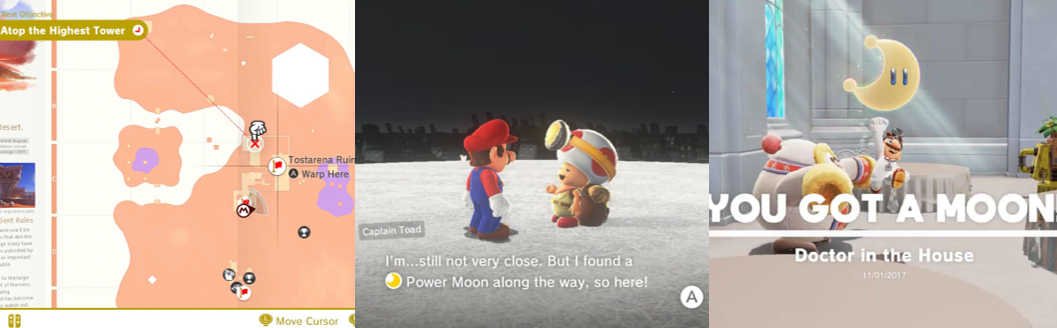
Once again, Mario’s health is measured by a pie chart; you’ll need to collect Power Moons or life hearts to replenish Mario’ health, and can temporarily extend it up to six hearts like in Super Mario Galaxy, and you can open up the map screen with the – button to read up on the Kingdom and warp around the map to the checkpoint flags you’ve activated. Mario can take three hits before failing, but the life system has been abandoned. When you fall, land in instant-death gunk, or lose all your health, Mario will lose a number of his accumulated Coins and respawn back at the last checkpoint flag. Coins are also used as in-game currency and can be spent at shops in each Kingdom to purchase additional hearts, Power Moons, and outfits for Mario to wear; each Kingdom also has its own unique currency in the form of Purple Coins that can be used to buy regional outfits, stickers, and souvenirs. If you’re having a hard time with the game, you can activate “Assist Mode” to have arrows guide you along and bounce you back after a fall, but the game really isn’t too difficult for the most part so you shouldn’t really need this as various non-playable characters (NPCs), menu screens, Cappy, and tutorials are available to keep you on track. When you reach a Kingdom, you’ll be encouraged to explore high and low for Power Moons, which you can collect multiples of without having to restart the Kingdom. Some of these are hiding in plain sight, others require a bit of wall jumping or platforming, others need you to race across or up temporary platforms (sometimes without the benefit of Cappy) against a time limit, and others are hidden underneath bridges, behind walls, or even underground and require a ground pound to spit out. You’ll also come across rabbits that need to be caught, find Captain Toad hiding out in each Kingdom, race against Koopas, open chests (sometimes having to open them in the right order), destroy blocks or pillars, enter pipes and cross spinning or moving platforms, blossom flowers, herd sheep, pace walk across arrows, and complete picture puzzles to collect additional Power Moons.

Power Moons are everywhere, and many require you to go old-school to track them down!

Power Moons can also be bought, assembled by collecting Moon Pieces, spawned by collecting musical notes against a time limit, navigating mazes, finding hidden areas using Cappy, activating scarecrows to take on timed platforming challenges, rocketing up to new areas, playing a Slots game, and clearing away snow, gunk, or enemies and blast open cages to find even more Power Moons. “P” switches will activate temporary platforms or bridges, the Switch will rumble when you’re over secrets to indicate a ground pound, and you’ll need to capture and stack up multiple Goombas to activate pressure pads. Sometimes a vulture will steal Cappy from you, meaning you’ll need to chase after it and lure it near to columns that you can raise up by ground pounding a neighbouring column to knock Cappy loose. You’ll also need to plant seeds to grow vines to reach new areas, enter pictures to warp to secret, far away areas of the game’s Kingdoms, and capture puzzle pieces to solve puzzles. Thankfully, there are no sections of the game that require the use of the Switch’s motion controls; you can even turn these off at the main menu, and the motion controls are nicely focused on giving the console a shake to boost Mario’s speed or attacks in certain situations. The story also quickly offers the choice to travel to different Kingdoms and back so you can explore and play the game at your own pace. The hunt for Power Moons will be where you’ll find the bulk of the game’s variety, as you’ll often have to capture a variety of enemies or objects or use your jumping abilities in interesting ways to clamber over the environment and find hidden areas. You can even enter the iconic Mario pipes and pop out in 2D areas that harken back to Mario’s 8-bit routes and see you hopping onto or over enemies and fireballs, traversing ledges and girders, and collecting Coins and Power Moons and bringing you out to new areas.

Graphics and Sound:
Super Mario Odyssey is easily the most colourful, charming, and graphically advanced Super Mario title I’ve played so far. As is always the case, cutscenes play out using a mixture of gibberish, limited sound bites, and subtitles but the body language of Mario, Bowser, and Peach make these perfectly adorable and there’s very little, if any, distinction between the in-game graphics and the few cinematic sequences. While there are some noticeable loading times, especially when travelling between worlds in the story mode, most of these seem to be purposely implemented as an excuse to have Cappy give players a quick rundown on Mario’s abilities as you can eventually skip these sequences with the + button. Mario, especially, looks at his very best; his cap lifts off his head when he jumps, he gets covered in ash when burned, and has a number of idle animations (falling asleep in most Kingdoms, sweating in others, or shivering when cold) and is full of life and charm, which is good as he’s the only character you’ll be playing as this time around. For a sentient cap, Cappy is surprisingly full of life as well; occasionally, he’ll hop off your head to deliver hints and his big, cartoonish eyes make him very expressive.

Each Kingdom is brought to life in stunning detail and has lots to see and do.

As you might expect from a Super Mario title, the game is full of unique and interesting locations to visit; you start off in the Cap Kingdom, which has been covered in ash from Bowser’s attacks and is full of large hat-like structures and a thick fog that masks a death pit. You’ll then travel to thirteen additional Kingdoms, each one sporting their own unique trappings, currency, and Power Moon designs; you’ll hop around waterfalls and prehistoric terrain in the Cascade Kingdom, cross a vast, scorching desert in the Sand Kingdom, and explore the depths of the coral-like Lake Kingdom in your search for Power Moons. In the Wooded Kingdom, you’ll find a great forest, dark undergrowth, and an overgrown factory while poisonous lakes and large tropical trees await you in the Lost Kingdom. You can also briefly travel to the upper atmosphere above the clouds in the Cloud Kingdom and battle Bowser’s vicious dragon in the medieval ruins of the Ruined Kingdom, brave an aggressive blizzard in the Snow Kingdom, and explore the beach at the Seaside Kingdom. Upon first visiting many of the Kingdoms, you’ll find the region in a state of chaos that must be addressed by defeating a boss; this will calm the blizzard in Snow Kingdom, for example, and restore power to Metro Kingdom.

The game’s visual style and presentation is top-notch and full of humour and colour.

Metro Kingdom is probably the area most familiar to people since it featured heavily in the game’s advertising; New Donk City is a massive city full of skyscrapers, construction sites, realistic NPCs, and numerous references to the Super Mario franchise and, more specifically, the Donkey Kong franchise (Nintendo R&D1/Various, 1981 to present). Not only does Pauline make a long-awaited return to the series but you can even race across an expanded 2D section that is a fantastic call-back to Donkey Kong (Nintendo R&D1, 1981) and many of the street names, business, and billboards directly reference characters or locations from the franchise. The Luncheon Kingdom is probably the game’s quirkiest area as it’s populated by anthropomorphic cutlery and a veritable explosion of vivid colours and giant foods, while Bower’s Kingdom is fittingly the largest and most dangerous area in the game and draws its aesthetic inspiration from Japanese temples. The finale takes place in the Moon Kingdom, where gravity is much lighter and allows you to jump much higher and fall much slower; while the surface of the Moon is a barren wasteland, you’ll find an ornate church there and battle your way through a lava-and-trap-filled cavern to reach your final confrontation with Bowser. After besting the Koopa King, you get to travel to the Mushroom Kingdom, which is both a loving recreation and an extension of the same area from Super Mario 64, featuring paintings, Toads galore, and even Power Stars replacing the Power Moons. Each area is further bolstered by remixes and recreations of classic Super Mario tracks, and even a catchy vocal tune, “Jump Up Super Star!”, by Kate Higgins.

Enemies and Bosses:
Long-time fans of the series can rejoice here as many of Mario’s most famous enemies make a return in Super Mario Odyssey, and can even be controlled thanks to Cappy; you’ll bounce off Goombas and Paragoombas, stretch across gaps as Wiggler, smash trough blocks with Chain Chomps, barge through obstacles as Chargin’ Chuck, and hop on Koopa Troopas and use their shells to smash apart blocks. There are also some new enemies to be found here, such as the Trapbeetle (which captures Cappy when he’s thrown at him and charges at you, but you can use this to clear blocks from your path), the Stairface Ogre (who tries to squash you with a giant mallet but leaves itself vulnerable and allows you to reach higher ledges), Sherms (tanks that are great fun to take control of), Pokios (needle-nosed birds that let you awkwardly climb up and across the walls of Bowser’s Kingdom), and Chinchos (mummy-like creatures that Cappy simply passes tough harmlessly). Many of these can be captured and used to your advantage, but many more will also respawn, especially if you need to capture them to progress, and while they’re all pretty goofy and simple to get around, you’ll also find them placed in precarious positions or in large numbers as the game progresses, which helps keep the game’s difficulty nicely balanced. To restore each Kingdom or solve problems for the NPCs, you’ll have to battle a few bosses; defeating these earns you a “Multi Moon” that counts as three Power Moons. Although each Kingdom features at least one boss, the game does reuse and recycle these for other Kingdoms and boss rushes, the most obvious cases being that of the Broodals.

You’ll battle the Broodals on multiple occasions, with the bouts being a bit tougher the next time around.

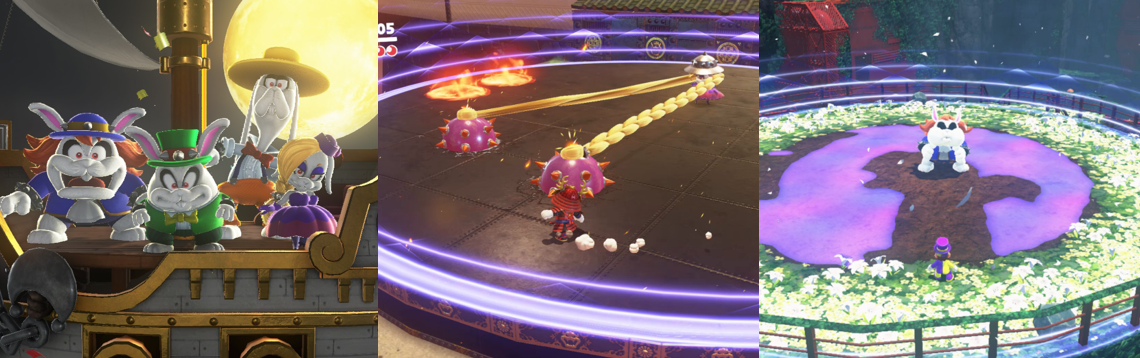
These mean little bunnies replace Bowser’s usual Koopalings and are each fought at three separate points throughout the game, with the battles getting tougher each time. Topper bounces around and is protected by his green top hats; you must throw Cappy at him to knock these off and avoid being hit by them as they ricochet around so you can bounce on his head. As the fight progresses, more hats come into play and Topper swings them around to try and hit you as well. Harriet’s head is protected by a spiked helmet and she tosses explosive maces at you that you can hit away with Cappy, but they leave temporary flaming puddle son the floor. When she tries to crush you with the maces on her pigtails, you can smack these back to stun her, and you can also knock her out of the air when she withdraws into her helmet by hitting the bombs she drops. Spewart protects himself by spraying poison gunk all over the place, but you can use Cappy to clean it up and stun him, and to knock him away when he retreats into his hat and leave a trail of the muck in his wake. Rango tosses his sawblade-like hat at you from afar, but you can flip them over with Cappy and use them as a trampoline to twirl onto his head; as the fight progresses, Rango tosses more hats and also hops around trying to hit you, and you’ll have to battle each of the Broodals again in Bowser’s Kingdom and in succession in a gruelling gauntlet on the Dark Side of the Moon Kingdom.

You’ll need to make use of Cappy’s capture abilities to take out the game’s large, colourful bosses.

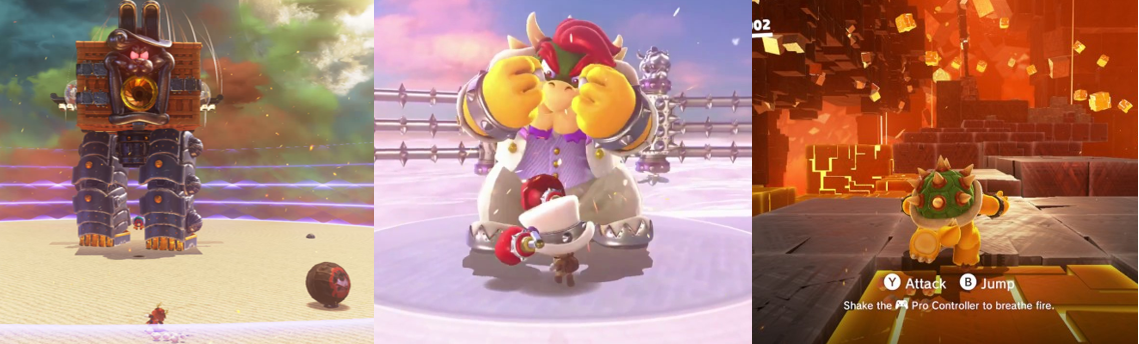
You’ll encounter the Broodals’ mother, Madame Broode, in the Cascade Kingdom; this rotund bunny sends her golden Chain Chompkin after you, but you can easily avoid it, knock its hat off, and capture it to launch it back at her. Although she tries to swipe at you, and more hats are added to later bouts, it’s pretty easy to stay out of her way and knock her on her ass. In the Sand Kingdom, you’ll find Knucklotec, a statue-like head who tries to crush you with its fists. However, you can trick it into hitting ice so you can capture its fist and fly it right into its face, but you’ll have to watch out for the projectiles it shoots out to protect itself. Torkdrift, a large UFO, awaits in the Wooded Kingdom; luckily, there are Uproots nearby for you to capture and stretch up into Torkdrift’s glass underbelly, but you’ll have to dodge the shockwaves it sends out and the flaming lasers it fires, and smash through thick blocks to flip it over and deliver additional damage to it. After unsuccessfully trying to attack Bowser’s airship, you’ll fall into the Ruined Kingdom and face off with the Ruined Dragon, a massive beast that sends out rings of lightning; when it collapses from exhaustion, you have a brief window of opportunity to hop onto its head, remove the stakes from its skull, and ground pound its weak spot but its attacks will become more aggressive and harder to dodge as the fight goes on.

Bosses become very creative, and are made tougher when you fight them again in the Mushroom Kingdom.

The latter Kingdoms offer some of the more interesting boss battles; Metro Kingdom’s Mechwiggler clambers about on the side of a building firing energy bolts at you and charging at you through portals, but you can pilot a Sherm to blast its glowing weak spots and deal big damage to it, and you’ll have to battle two at once in the Mushroom Kingdom rematch. Similarly, you’ll need to capture a Gushen to chase after and defeat the Seaside Kingdom boss, Mollusque-Lanceur, a giant octopus that floats around the beach (or above the clouds in the rematch) firing torpedos and spiked bombs. However, he’s vulnerable on his head so you can jet after him with Y and gush water down onto him with B once you’re hovering over him. In the Luncheon Kingdom, you’ll do battle with Cookatiel in a giant stew pot; Cookatiel spits vegetables as projectiles, but also spews up a stream of vomit that you can travel up as a fireball to bounce on his head. Each of these bosses is fought again by jumping into paintings in the Mushroom Kingdom, and the battles are made harder by the presence of additional enemies and hazards, less health items, bottomless spits, and more aggressive attacks from the bosses.

Topple the Broodals’ mech, then put a beating on Bowser and take control of the Koopa King to save the day.

Before you can finally face off against Bowser, you’ll have to battle the Broodals once again, this time in a giant mech! To defeat the RoboBrood, you’ll need to avoid the bombs it throws out and capture a Pokio to hit them back at its feet, toppling it over and leaving it vulnerable for you to fling yourself up and attack each of the Broodals’ pods. The RoboBrood becomes temporarily invincible after each pod is destroyed, targets you more directly, and it gets harder to scale it with each hit as well. Bowser himself is also fought twice, once in the Cloud Kingdom and again in the Moon Kingdom (and a third time at the end of the super-hard Darker Side of the Moon Kingdom). Both times, you must toss Cappy at his top hat to flip it over and take possession of it; you must then hop over the shockwaves caused by his jumps, avoid or punch away the rocks he throws at you, and put a beating on him when he’s stunned. As the fight progresses, Bowser jumps faster, throws more projectiles, defends himself from your punches and tries to swipe at you with his tail, and spews out flames in anger, but he’s not particularly difficult to best in the main encounters. After defeating him, you’ll need to capture him to use his massive claws to escape, which is pretty fun (if harrowing because of the temporary platforms).

Power-Ups and Bonuses:
Mario’s primary power-up is his ability to capture enemies and other objects with Cappy; this allows you to leap higher, protects you from lava, activates switches, allows you to flip, fly, or travel to new areas, and is crucial to solving some of the game’s puzzles and tracking down the Power Moons. There are, however, other power-ups you can find in each Kingdom; bubbles will restore your air meter when swimming, Life-Up Hearts temporarily add three extra hits to your life meter, Keys unlock additional Power Moons, scooters and catapults will allow you to travel quickly across areas, and Rocket Flowers let Mario blast ahead, and up sharp inclines, with a burst of speed but at the cost of his manoeuvrability.

Purchase collectibles and new outfits using your Coins.

Although there are no extra life mushrooms, cap power-ups, leaves, or invincibilities in the game, you can capture Yoshi in the Mushroom Kingdom and use his flutter jump and long tongue to eat fruit, and you can also spend your Coins on stickers to adorn the Odyssey with, souvenirs to fill it with, and outfits to change Mario’s appearance. Each Kingdom has one door that is blocked to you unless you buy and wear the regional outfit, but otherwise these are purely cosmetic items to wear. However, the range of them is quite impressive: you can dress up as Doctor Mario, Luigi, Waluigi, Wario, and even Diddy Kong; wear Mario’s Hawaiian shirt, his spacesuit, and even be rendered as his polygonal model from Super Mario 64 or in blocky 8-bits. You can dress up in the Broodals’ outfits, wear Peach’s wedding dress, and even mix and match the head wear with the clothing to create bizarre combinations. Sadly, though, these are simply costumes rather than new skins and the only character you’ll ever play as is Mario, which is a shame considering Luigi was playable in Super Mario Galaxy.

Additional Features:
With nearly 900 Power Moons to collect, you’ll never be short on things to do in Super Mario Odyssey. After you defeat Bowser, you can travel to the Mushroom Kingdom to find more Power Moons (this time rendered as Power Stars), rebattle the game’s bosses, and be awarded additional Power Moons for completing Toadette’s objectives. You can also return to the previous Kingdoms to track down Princess Peach for another Power Moon and break open Moon Rocks and access tough platforming or puzzle sections for additional Power Moons, and cause even more Power Moons to be spread across each Kingdom. You can keep track of these in the – menu by reviewing your lists, and once you have powered up the Odyssey with 250 and then 500 Power Moons, you’ll unlock two new areas of the Moon Kingdom.

There’s still lots to do, find, and challenge yourself with after beating the main story.

Dark Side has you scaling a tower and battling the Broodals in a tough gauntlet with no checkpoints or health power-ups between or during the bout, and the Darker Side is home to the game’s most challenging, and frustrating, course as you must cross lava, avoiding spikes, fireballs, and all manner of hazards and obstacles in a true test of you skills. Furthermore, players can find Luigi in each Kingdom and take on the Balloon World mini game, which is basically an online version of hide-and-seek and has you racing to locate balloons and comparing your time and scores with other players. The game can also be played in a rudimentary two-player mode where one player controls Mario and the other controls a captured enemy, and you can also use Amiibos and the Switch’s snapshot feature to find additional hints or unlock costumes, respectively.

The Summary:
I was actually very surprised by how much I enjoyed Super Mario Odyssey. I had heard so much about the game since it first released, all of it nothing but praise, and it was getting to the point where the game felt a little overhyped to me. Once I got a Nintendo Switch, I knew that the game was going to be a must-have for my collection, but I was a little apprehensive as I have a bit of an odd relationship with Super Mario games. However, it didn’t take long for my worries to be completely set aside; Super Mario Odyssey harkens back to the days when games could be played in fun-filled little bursts and its addictive gameplay and eye-catching visuals make it a title that’s simple to pick up and hard as hell to put down. The game gets progressively more challenging as you progress and visit new Kingdoms, but it’s never unfair or punishing and any mishaps you might make simply come down to a mistake on your part rather than due to a janky camera or controls. Mario’s athletic prowess and the additional abilities afforded to him by Cappy mean that there is always another way, or multiple ways, to accomplish tasks, explore further, or obtain Power Moons and the sheer amount of options available to you is impressive, but never too daunting. Colourful, endlessly entertaining, and fun from start to finish, Super Mario Odyssey is a fantastic entry in the franchise; I loved the call-backs to Super Mario 64, particularly the rendition of the Mushroom Kingdom, and all the outfits available to you (though it was disappointing to only be able to play as Mario again). The Kingdoms were all fun and unique areas, finding Power Moons was a great little distraction, and the bosses were enjoyable little challenges that never outstayed their welcome. There’s something on offer here for players of all skill levels, from beginners to advanced players who fancy tackling the super-tough optional areas, and I found myself having a great time from start to finish.

My Rating:

Rating: 5 out of 5.

Fantastic

Have you every played Super Mario Odyssey ? If so, did you enjoy it and how do you think it compares to other 3D Mario titles? Which of the game’s Kingdoms was your favourite? What did you think to Cappy and the capture mechanic, and which enemy was your favourite to take possession of? Did you enjoy collecting Power Moons or were you a bit overwhelmed by the sheer amount to find? What did you think to the game’s bosses and the Broodals? Did you ever best the Dark and Darker Side of the Moon Kingdom? Which outfit was your favourite and would you have liked to see skins or other playabale characters? Whatever your thoughts on the Mario’s cap-based adventure, feel free to sign up and leave a comment below or leave a comment on my social media.

Game Corner [Zelda Day]: The Legend of Zelda: Link’s Awakening (Nintendo Switch)


On 21 February 1986, The Legend of Zelda (Nintendo EAD, 1986) was first released in Japan. The creation of legendary game designer Shigeru Miyamoto and Takashi Tezuka, The Legend of Zelda launched one of Nintendo’s most popular franchises, with its silent protagonist, Link, and his vast fantasy world of sword and sorcery not only enduring over time but constantly evolving and improving as the series progressed.


Released: 20 September 2019
Originally Released: 6 June 1993
Developer: Grezzo
Original Developer: Nintendo EAD
Also Available For: Game Boy, Game Boy Color, Nintendo 3DS Virtual Console (Original/DX release)

The Background:
As some of you may be aware, my very first introduction to the Legend of Zelda series (Nintendo EAD/Various, 1986) was with The Legend of Zelda: Link’s Awakening (ibid, 1993) on the original Game Boy. Beginning as an unsanctioned side project of programmer Kazuaki Morita and evolving from a desire to port the incredibly successful Legend of Zelda: A Link to the Past (ibid, 1991), it was genuinely impressive how the developers were able to cram so much into such a small cartridge. Link’s Awakening was critically acclaimed and is widely considered to be one of the best Game Boy titles ever released. The game received a slightly enhanced colour upgrade on the Game Boy Color in 1998, which was also received very well, but I was stunned when Nintendo announced an all-new, high definition remake for the Switch in 2019 as the game always felt like more of a cult favourite compared to other mainstream Zelda titles. The Switch remake of Link’s Awakening was spearheaded by Grezzo, the development team who had ported and enhanced Zelda’s Nintendo 64 efforts to the Nintendo 3DS, and the team immediately sought to separate the game from other Zelda titles by not only returning to the classic top-down perspective but adopting a quasi-isometric, diorama-inspired look that made the entire game appear to be constructed out of plasticine figures. Upon release, Link’s Awakening was met with glowing reviews as critics praised the visual presentation, music, and quality of life improvements; it was also the fastest-selling Switch game of 2019 and scored very highly across the board, assuring that Link’s Awakening was finally recognised as one of the best Zelda titles out there.

The Plot:
After defeating the dark wizard Ganon and rescuing Princess Zelda, Link embarks on a quest across the sea in search of enlightenment and ends up caught in a terrible storm and washing up on the shores of the mysterious Koholint Island. Link finds the island tormented by monsters who are the creation of the malevolent “Shadow Nightmares”, a dark entity who will do anything to keep the legendary Wind Fish from waking. However, Link takes up his sword and shield to oppose Nightmare, only to discover that not everything is as it seems on the all-too-familiar Koholint Island…

Gameplay:
The Legend of Zelda: Link’s Awakening is a top-down (well, more like a slightly isometric) action/adventure role-playing title in which players are placed into the familiar green hat and tunic of Link, the long-running protagonist of the series. As is the case in many Zelda titles, you can customise Link’s name at the file select screen; you get three save files (and a temporary autosave file) that you can personalise, and characters will refer to you by that name throughout the story. For those keeping track, this is the same Link who starred in A Link to the Past, making Link’s Awakening one of the rare Zelda titles to feature the same Link, and which possibly explains the many similarities between the two titles. Link begins the game with three hearts representing his health and stripped of his sword, shield, and all of his recognisable weapons but is quickly provided with his trusty shield, with is mapped to the ZR button and allows him to block incoming attacks and push through certain enemies. You’re then tasked with using the shield to head down to the beach and retrieve your sword, which is mapped to the B button; you can tap B to swipe at enemies or hold the button to charge up Link’s trademark Spin Attack, which sees him spin around in a circle and damage any nearby enemies once the button is released. Link can also pick up and throw certain items and objects (such as Cukkos and, later, pots), using the A button but he’ll need to journey to a whopping nine dungeons to retrieve the rest of his gear and further explore the mysterious Koholint Island.

After acquiring his sword, Link sets out on a new adventure fill with hijinx and dangers.

Along the way, Link will encounter a number of non-playable characters (NPCs), most of whom offer hints about where to go next, ask for specific items to be brought to them as part of the elaborate trading sequence, or comment on the events happening in the game or on the island in general. Some will actually follow you around, which becomes necessary to enter specific dungeons; a blue-hued rooster will follow you and allow you to fly over gaps to reach the Eagle’s Tower, for example, a ghost will start to follow you and eventually gift you an empty bottle, and Link’s saviour, Marin, will accompany him to move a walrus out of the way and let him access Yarna Desert. Not all NPCs are entirely harmless, though; attack Cukkos or dogs and they’ll hit you back, you’ll need to use a Chain Chomp to navigate through the Gopongo Swamp, and the shopkeeper will electrocute you to death and you’ll be branded a “THIEF” for the rest of the game if you steal from him. As mentioned, Link’s health is measured in hearts; as you explore, you may find Heart Pieces hidden in caves, buried underground, under water, or generally strewn around the environment. Collect four of these, and your maximum health will be refilled, and you’ll automatically gain an extra heart after defeating each dungeon’s Nightmare boss. Unlike a number of other Zelda games, players don’t need to worry about a magic gauge in Link’s Awakening; instead, there’s a greater emphasis on collecting Rupees, the currency in the Zelda franchise, in order to purchase additional items, objects for the trading sequence, and even collectibles such as Heart Pieces. Rupees are primarily found by slashing grass, defeating enemies, digging in the ground, and opening treasure chests and Link appears to be able to hold 9999 Rupees, so you don’t need to worry about upgrading his wallet or anything. I tend to spend my time in Zelda games furiously swiping at grass and defeating onscreen enemies, so I’m used to collecting as many Rupees as possible, but other players may find it a bit tedious, though it’s absolutely necessary if you want to progress because you need the shovel and the bow in order to access later areas and you’ll never collect everything the game has to offer without paying money for some of them first.

Koholint Island is huge and full of pick-ups, warps, NPCs, and enemies.

You can jump to the equipment subscreen at any time with the + button; here, you can view key items you’ve collected and assign two items from your inventory to the X and Y buttons, save or load your game, or flick over to the map screen (which can also be accessed with -) to plot a route to your next destination. The map is initially shrouded in fog but more of it is revealed as you explore, and you can use pins in to set reminders for yourself; Link can also review “memories” from this screen, which allow you to re-read advice from the mysterious Owl and certain previous conversations so you know where you’ve been and get some idea of where to go next. The Owl will appear in key areas across the overworld offering hints and encouragement, and you can call Ulrira in Mabe Village for further hints, but you’re basically free to explore at your leisure. You won’t be able to access certain areas without weapons or items from dungeons, though, and generally you need to tackle the dungeons in a specific order so that you can access the next, but your journey across Koholint Island eventually gets easier as you defeat the Nightmare bosses. Initially, you won’t be able to lift rocks, clear gaps, or swim, for example, but you’ll acquire the tools necessary to overcome these obstacles in the dungeons; similarly, you can activate fast travel warp points and, later, learn a song for your ocarina that will enable you to use these freely.

Dungeons are filled with puzzles, some simple like pushing blocks and others more frustrating.

Still, the game doesn’t make too much of an effort to hold your hand and it can be tricky to figure out where to go next, meaning that you have to be a little proactive to figure things out and experiment a bit. This is especially true in the game’s dungeons, which can be quite labyrinthine and see you travelling between different floors and acquiring small keys to unlock doors. Each dungeon has a compass and a map that will greatly assist with your progress; these allow you to see all possible routes and even indicate when there’s a chest or item in a room, but they’re often locked behind a series of puzzles. These may be as simple as stepping or pushing a block on a switch, pulling a pulley, pushing blocks together, or defeating all onscreen enemies but they get tougher as the game progresses. Sometimes you’ll have to defeat enemies in a specific order, or guide a pathmaker around to create temporary paths, or pick up and throw a weighted ball into columns, or toss some chess pieces in just the right way so they land in specific spots (a very frustrating mechanic, for sure). Sometimes, rooms and hidden passageways are hidden behind breakable walls (which must be exploded with bombs) or rocks (which must be lifted up) both in dungeons and on the overworld; other times, you’ll need to hunt down specific items or work through a looping maze in the right order, and you can even increase the game’s challenge by playing in “Hero” mode from the file select screen (which sees you taking twice as much damage and losing the benefit of enemies dropping hearts).

Graphics and Sound:
Honestly, screenshots do not do this game justice; the plastic figurine look used to bring this world to life is absolutely amazing and I find it such an adorable, whimsical stylistic choice that really makes everything vivid and charming to behold. The soundtrack is equally imaginative, composed primarily of woodwind instruments and flutes and such, and adds a lot of appeal to the game and even features a bit of the classic chip-tune music in the credits, which was a nice touch. You know things are kicking up a notch after Link acquires his sword and Koji Kondo’s iconic Zelda theme kicks in, but each area is brought to life as much by the music as the attractive visual style of the game and all of the characters and models are full of visual quirks and charming little animations that just make the game a joy to play and look at.

The game’s visual style and variety is charming and gorgeous, and it even includes some anime cutscenes.

Koholint Island is quite a large area for Link to explore and full of many of the usual Zelda environments and trappings; he begins in a quiet little village and journeys to a desert, a crumbling tower, a boulder-strewn mountain top, and a desolate swamp while traversing a vast field peppered with enemies, obstacles, and such sights as a graveyard, bridges, a castle, and a foggy forest. Contrary to the original title, and other top-down Zelda titles at the time, the entire overworld is connected without any screen transitions unless you enter a building or cave, which really helps speed traversal up and makes the world feel interconnected and alive. Some NPCs will relocate as the story progresses, which is fun, and you’ll often be required to take the long way around to reach some of the dungeons (especially in the first instance), though the interiors of the dungeons are often somewhat interchangeable. This isn’t always the case, of course; Bottle Grotto (fittingly) contains a lot of bottles), Catfish’s Maw and Angler’s Tunnel veer more towards water elements and puzzles, and Turtle Rock features and abundance of lava, and you’ll notice more and more maze-like elements as the difficulty of the dungeons progresses. Every dungeon also features at least one 2.5D sidescrolling area that sees you using ladders, moving platforms, and the Roc’s Feather to hop around in short platforming sections and the game is opened and ended by some beautiful (if very brief) anime cutscenes, and while there is no voice acting, sound bites and voice clips accompany both Link’s attacks and reactions and the in-game text boxes.

Enemies and Bosses:
Koholint Island is inhabited by a number of recognisable Zelda enemies and traps that will constantly try to impede Link’s quest; you’ll encounter stone-spitting Octorocs, spider-like Tektites, and annoying Zora’s will pop out of water to fire projectiles at you. Zols often appear in dungeons, with the red variants multiplying with each hit, bat-like Keese and the snake-like Ropes often appear in caves, and you’ll even encounter a number of enemies that can’t be traditionally bested. Most of your enemies can be dispatched with just one swipe of your sword, but others require a bit more strategy: the Moblins and Darknuts will defend against your attacks with their shields and must be stunned by deflecting their sword swipes, Spiny Beetles and Helmasaurs must have their rocks and masks removed to better attack them, and the Pols Voice can’t be damaged by your sword at all. Oddly, Link’s Awakening contains a number of enemies from the Super Mario franchise (Various, 1983 to present): Thwomps, Bob-ombs, Goombas, and Shy Guys are all over the place, and you’ll even come across an evil version of Kirby!

A number of mini bosses must be defeated to activate warp points ad acquire new weapons.

Each dungeon, and certain other areas in the game, features at least one mini boss; defeating these will activate a warp point in the dungeon and often leads to you acquiring the weapon or item necessary to defeating the Nightmare boss. These range from larger versions of regular enemies, such as the Moblin Chief and Armos Knight, and familiar Zelda enemies like the Master Stalfos (who must be damaged with bombs when reduced to a pile of bones) and Gohma (who can only be damaged by firing arrows into their open eyes. The most recurring of these is the golem-like Hinox, which will grapple you or throw bombs your way, but are easily defeated with your trusty sword, and you’ll sometimes have to battle more than one in the later dungeons. Often, these require a little more strategy than the average enemy; you need to jump over the Spike Roller’s spiked pole to get to him, toss bombs into the Dodongo Snakes’ mouths, and can only defeat Rover by throwing its weighted ball back at it, but you’re usually rewarded with a life-restoring fairy for your efforts (to say nothing of the extra weapons).

After a simple first boss, you’ll need to use Link’s new weapons and be adaptable to triumph.

Each dungeon contains a magical instrument that is guarded by one of eight Nightmares; often, the key to defeating the Nightmare will lie in the weapon you acquire in that dungeon, and each one gets progressively difficult as you journey on. The first boss, Moldorm, is a walk in the park: this worm-like creature randomly pulsates around the enclosed arena and can only be hurt by hitting the glowing weak spot on its tail, which will send it into a frenzy and cause it to become more and more aggressive as the fight progresses. In the Bottle Grotto, you’ll battle the clown-like Genie, who tosses fireballs at you and hides in his bottle to avoid your attacks. You’ll need to grab the bottle and throw it against the wall to crack and, eventually break it, then swipe at Genie when it becomes corporeal to finish it off. The Slime Eye at the end of Key Cavern requires use of the Pegasus Boots to split it in two so you can swipe at its eye, but the two gooey monsters will drop down from the ceiling to either land on you or stun you with a shockwave, making them tricky to land a hit on at times. The fearsome Angler Fish is fought in a 2.5D perspective and underwater, meaning that your movements are as limited as your attack options; you’ll need to swim your way past the debris it drops from the ceiling, fending off its smaller minions as you try and swipe at the glowing tendril on its head.

Bosses get increasingly tougher as the game progresses but are generally not too challenging.

Probably one of the more difficult bosses for me was the Slime Eel; this fight is complicated by a mace-like tentacle in the middle of the stage that you must jump over as you try and snag the boss’s head with your hookshot and expose its weak spot. Facade can also be a bit tricky; this gigantic face leers at you from the floor and causes tiles and pots to fly at you from all around the room and can only be damaged by placing bombs on it while watching for the holes it causes to form in the arena. When you finally manage to reach the top of Eagle’s Tower (easily one of the game’s more obtuse and annoying dungeons), you’ll battle the Evil Eagle; this giant bird hovers just out of reach and tries to skewer you with feathers, charges at you with its beak, and flaps its wings to try and force you from the platform and to the spikes below. Thankfully, it’s easy enough to shield against his attacks and toss your boomerang up at him, or fire off arrows and swipe at him as he flies past trying to attack you. The final dungeon is guarded by  Hot Head, an anthropomorphic fireball that emerges from a lava pit to blast molten rock at you, and which can only be damaged with the Magic Rod. Once you’ve blasted away its outer shell, it’ll bounce all around the arena trying to pummel you to death, but is easily finished off if you keep your wits about you.

The game’s final boss assumes many forms, with some representing the game’s toughest challenge.

Once you’ve acquired all of the magical instruments, you can scale Mount Tamaranch to play the “Ballad of the Wind Fish” on your ocarina and gain access to the Wind Fish’s Egg; however, this final dungeon is a looping maze that you’ll never be able to navigate without completing the trading sequence and acquiring the magnifying glass to read a book in the Mabe Village library that has directions to the final boss. Shadow Nightmares is easily, and fittingly, the toughest boss in the game and boasts six distinct forms: the first is a giant Zol that bounces and materialises around the arena and can only be damaged by sprinkling Magic Powder on it. Next, the boss assumes the form of Araghim from A Link to the Past and is battled in very much the same way; Araghim teleports around and fires two types of projectiles at you, one that explodes in your face and one a fireball that can be smacked back to damage him. Afterwards, the boss becomes a shadow version of Moldorm, which is a bit of a let-down, but it more than makes up for it by assuming the form of Ganon! Hands down the hardest fight in the game, Ganon twirls his trident and fires flaming bats at you before tossing his trident your way, giving you a very limited window to loop around behind him or charge into him with your sword. The next form is simply a Lanmola that cannot be damaged by your sword but only needs to be hit once with another weapon to force the boss into its final, truest form: Dethl. A large, shadow, pulsating mass sporting two mace-like tentacles, Dethl isn’t really too difficult to defeat; simply jump over its arms and fire arrows into its big green eye when it opens and the Shadow Nightmares will finally be destroyed, the Wind Fish will awaken, and Koholint Island will disappear forever.

Power-Ups and Bonuses:
As mentioned, it doesn’t take too long for Link to reacquire his traditional sword and shield, and as you progress through the game’s dungeons you’ll acquire a number of recognisable weapons and items to add to Link’s arsenal, such as the Power Bracelet to lift items (and the Powerful Bracelet to lift even larger items), the hookshot to stun enemies from a distance and cross certain gaps using stones and other specific parts of the environment, bombs to blast open walls and defeat groups of enemies, bottles to store life-restoring fairies, and an ocarina that is useful for accessing certain areas, warping across the map, and accessing the final boss.

Link can acquire some familiar weapons and even pick-up temporary power-ups.

Other pivotal items include the shovel (which is necessary for digging up collectibles), the traditional boomerang (which can only be acquired through the trading sequence), and the bow (which must be purchased). Magic Powder allows you to damage certain enemies and light fires (but becomes completely redundant once you acquire the Magic Rod), you can fire bomb arrows by equipping the bow and the bombs at the same times, the Mirror Shield lets you reflect lasers and certain projectiles, and the Roc’s Feather allows you to jump. The Pegasus Boots let you charge ahead (and can be used in conjunction with the Roc’s Feather to clear longer gaps), the flippers let you swim and dive under water, and you can sometimes find Secret Medicine to restore your health upon death. Additionally, you’ll sometimes come across temporary power-ups: the Guardian Acorn and Piece of Power will temporarily reduce the amount of damage you take and increase your attack power, respectively, which can be super useful in certain situations.

Additional Features:
There are thirty-two pieces of heart to find scattered throughout Koholint Island’s overworld, which will increase your health up to twenty hearts; sometimes you’ll dig these up or knock them out of trees, other times you can buy or find them in hidden caves or under water and such, and other times you can play for them in mini games. These include a mechanical claw game and a fishing game, both found in Mabe Village and costing you some Rupees to play; manoeuvring the claw and landing a big fish can be a bit tricky, but it’ll grant you an extra bottle, Heart Piece, ammo and Rupees, items for the trading sequence and a number of Secret Seashells. There are fifty Secret Seashells to find, and it’s well worth your time seeking them out with your shovel, lifting rocks, and exploring with your different weapons and items as they can be cashed in at the Seashell Mansion to gift you with a sensor that alerts you when they’re closer and a more powerful sword that fires out an energy beam when your hearts are full. As alluded to, there’s a lengthy trading sequence that’s necessary to acquire the boomerang and navigate to the final boss; this sees you acquiring specific key items (such as bananas, a Yoshi doll, and a magnifying lens) and bringing them to specific NPCs to swap for another item, which is a fun little distraction that gives you an excuse to talk to as many characters as possible.

Search for Seashells, switch to a new tunic, and create your own dungeons!

There are also figurines to collect and place on certain stands in houses (though I was only able to find two) and the Color Dungeon from the GameBoy Color version is also present. This optional, additional dungeon can be missed but it’s well worth your time seeking out as, once you best its enemies and puzzles, and defeat the gigantic Hardhit Beetle, you’ll be able to pick from either a blue or red runic to increase your defence or attack power, respectively (personally, I chose the red tunic as I’m a more offensive player). Finally, there’s a new addition to the game in the form of Chamber Stones; these must be brought to Dampé, who will challenge you to create custom dungeons by mixing and matching rooms, puzzles, sub-bosses, and bosses from the game’s existing dungeons. Each time you beat a regular dungeon, and Dampé’s tutorials, you’ll gain additional Chamber Stones, +Effect Panels, and collectibles and it’s quite a fun little addition since you can create your own dungeons to play through and challenge others to complete.

The Summary:
Even after all this time, I still adore The Legend of Zelda: Link’s Awakening; it was the first Zelda game I ever played and owned, and I used to enjoy playing through it on the old GameBoy brick even before I picked up the Virtual Console version of the GameBoy Color deluxe version, so I was super excited to hear that it was being completely rebuilt for the Nintendo Switch. This new version is everything the original game was but rendered in such gorgeous detail that it’s so much more than just a throwback to a simpler time of Zelda videogames; the plastic figurine aesthetic is charming and whimsical and I’d love to see it evoked for future recreations of older Zelda titles, and it may very well be the most visually appealing game I’ve played on the Nintendo Switch so far (and yes, that includes it’s bigger and more expansive cousin). It’s amazing how big Link’s Awakening is; it definitely feels like there’s more in this version of the game, but the developers didn’t add any new dungeons or areas or anything (which is a bit of a shame, to be honest). It’s just that big of a game, which just makes the original seem even more impressive in hindsight. There’s loads to do and keep you busy here, from backtracking to previous areas, to hunting down collectibles, to completing the trading sequence and, of course, tackling the game’s dungeons, and the game is just the right level of challenge; some puzzles and dungeons are trickier and tougher than others, but that’s par for the course of a Zelda title. Honestly, it’s worth picking up for the gorgeous graphical style and music as much as the engaging, classic Zelda gameplay and I can only hope that Nintendo revisit some of Link’s earlier adventures in the same way going forward.

My Rating:

Rating: 5 out of 5.

Fantastic

Have you played this new version of The Legend of Zelda: Link’s Awakening? How do you feel it compares to the original and its colourised counterpart and where would you rank it amongst all the other Zelda titles, specifically the 2D adventures? Were you a fan of the more surreal narrative elements in the game, and the difficulty and challenge it offered? Which of the dungeons and Nightmares was your most, or least, favourite? Were you able to navigate the Wind Fish’s Egg without directions? Did you ever steal from the shopkeeper? Were you able to find all of the Secret Seashells? Which Zelda game is your favourite and how are you celebrating the franchise today? Whatever your thoughts on Link’s Awakening, sign up to leave a comment below, or let me know on my social media.

Game Corner [Punisher Month]: The Punisher (PlayStation 2)


Back in February 1974, Spider-Man/Peter Parker faced a new enemy in the form of Frank Castle, the Punisher, a veteran of the Vietnam War turned bloodthirsty vigilante. The Punisher separated himself from other, traditional costumed heroes by his willingness to kill and uncompromising, suicidal one-man war on crime and what better way to celebrate the debut of this nuanced and complex character by dedicating every Tuesday of this month shining a spotlight on Marvel’s most notorious anti-hero?


Released: 16 January 2005
Developer: Volition
Also Available For: Mobile, PC, and Xbox

The Background:
After his impressive debut in the pages of The Amazing Spider-Man #129, Frank Castle/The Punisher quickly became one of Marvel’s most popular anti-heroes thanks to his tragic backstory and unwavering commitment to the eradication of crime. The Punisher has also seen some success outside of the comic books, featuring in movies, cartoons, and a number of licensed videogames. Released to coincide with the 2004 movie of the same name, The Punisher was developed by Volition, a studio purchased by THQ in 2000 and perhaps best known at the time for their work on the Red Faction (ibid, 2001; 2002). Acting as a quasi-sequel to The Punisher (Hensleigh, 2004), The Punisher saw star Thomas Jane return to voice the role but incorporated its aesthetic presentation, storyline, and characters from the comics and was subjected to numerous edits and cuts to tone down its scene of explicit violence and gore and make it financially viable for release. While the game was met with mixed reviews, it sold around one million copies and was considered a success for Volition, who would go on to develop Saints Row (Volition, 2006).

The Plot:
Having dedicated his life to the eradication of crime after losing his family to mobsters, Frank Castle has been working his way through New York City’s underworld as the Punisher. Having carved his way through the low-level street gangs and the Yakuza, he allows himself to be captured and interrogated in order to get closer to the town’s newest head gangster, the mysterious “Jigsaw”, who has a personal grudge against the Punisher.

Gameplay:
The Punisher is a third-person action shooter in which you’re placed into the iconic trenchcoat, combat trousers, and skull-shirt of Frank Castle, the titular Punisher, as he mows his way through countless thugs, lowlifes, and criminals in a one-man war on crime. Although he can’t jump, the Punisher has a number of combat and movement options available to him: he can pick up and swap weapons with the Circle button (note that, while he can dual-wield weapons, he can only hold two types of weapons at once; a smaller weapon like a pistol and a bigger weapon like a shotgun), select between his weapons by pressing down on the directional pad, fire his weapons with R1, toss grenades and other such explosives with L1, and enter a more accurate aiming mode (which is further expanded when he has a sniper rifles) by pressing in the right analogue stick.

Frank’s methods of interrogation basically amount to brutal and sadistic torture.

The Punisher can also dive ahead with a press of R2, duck and crouch walk with L2, and grab thugs and use them as a human shield with X. In this position, or when up close to enemies, you can execute them with a quick kill by pressing Square. Enemies can also be interrogated by pressing X; in this mode, you’re ask to tilt or move the left analogue stick to keep a meter in the right area long enough to “break” your victim, which will award you with hints and Style Points. As you kill enemies, rack up kill combinations, and pull off successfully interrogations, you’ll earn Style Points that can be used to upgrade the Punisher’s various skills and attributes from the main menu in Frank’s apartment. As you encounter enemies and head into fire fights, you’ll notice glowing white Punisher skulls over the heads of certain enemies; once you’ve cleared the immediate area of all other enemies, these guys will give up and you’re tasked with performing a “Special Interrogation” using various parts of the environment (drills, furnaces, shark tanks, or dangling off a ledge, for example). Once you break them, they’ll often lead you to secret areas with new weapons or cause enemies ahead of you to stand down so you can progress easier. You can kill them, but it will cost you Style Points (which can be a little confusing as you’re otherwise rewarded for killing criminals; indeed, you can kill these guys normally after breaking them and not be penalised). Other times, you’ll see a glowing gold Punisher skull in the environment, which allows you to pull off a “Special Kill” (locking a scumbag in a coffin and tossing in a grenade, for example) for additional Style Points.

Enter Slaughter Mode to make short work of your enemies but watch your fire around friendlies!

Considering how linear the game is, it’s surprisingly easy to get lost as you’re often exploring dark, grey corridors and very bland environments; there’s no map or onscreen indication of where you need to go so it’s easy to get a bit turned around at times. Often, you’re joined by a partner character (Natalia Romanova/Black Widow, Nick Fury, and agents of the Strategic Hazard Intervention Espionage Logistics Directorate/S.H.I.E.L.D.) who cannot be harmed by either you or enemies and are, surprisingly, very useful and competent for computer-controlled characters. Occasionally, you’ll be asked with solving some very simple puzzles that amount to finding a key or pulling a lever, rescuing hostages, placing explosive charges, interacting with a hidden switch to open a door, or forcing certain enemies to open doors; it’s nothing massively taxing but, again, it can sometimes be confusing as to where you need to go. The Punisher is quite a durable character whose health is refilled as he breaks thugs through interrogations or talks to rescued innocents but it also regenerates when you press Triangle; this puts you into “Slaughter Mode”, which slows time down to a crawl, turns the screen black and white, and has you tossing throwing knives and performing instant kills as long as the meter lasts. This can be a great way of clearing out rooms filled with perps but, honestly, I generally tended to save it for boss battles as the game is pretty generous with its checkpoints and not especially difficult to get through and I found this mechanic to be quite disorientating. Most of my deaths and mission failures came from accidentally dropping from high ledges or killing innocents; occasionally, enemies will grab hostages and use them as human shields and, if you kill them, you’ll instantly fail the mission so be sure to use your more accurate aiming in this situations.

Graphics and Sound:
For a PlayStation 2 game, The Punisher is pretty decent to look at when you can actually see what’s onscreen. Character models are pretty good, if a bit blocky, but not much to shout about when it comes to enemy variety and aesthetic. Indeed, the character who looks the most dynamic and impressive is, fittingly, the Punisher himself. Decked out in a long trenchcoat, combat trousers, army boots, and skull shirt, the Punisher looks exactly like he stepped right out of the pages of a Garth Ennis comic book. Punisher even dons different outfits for different missions, including ditching the trenchcoat, decking himself out in war paint, and wearing prison clothes and, while he doesn’t have Thomas Jane’s likeness, he looks very much like his comic book counterpart.

Environments can be a bit boring and drab but there are a few that stand out as visually interesting.

Where the game falters, though, is in the level variety and presentation; you’ll skulk around seedy alleyways, dark corridors, and dingy crack houses, which aren’t massively impressive. Even areas like the chop shop, the zoo, and Fisk Industries’ skyscraper aren’t much to shout about as the game’s visuals are dulled with a dark, moody presentation that, while fitting, can make things visually very lifeless and boring. It’s not all bad, though; one mission takes place in a jungle, which helps to spice things up, as does battling through the research and development department of Stark Industries and a nightclub/bar, all of which bring some life and clarity to the action.

While many of its more brutal kills are censored, The Punisher is still a gloriously violent game.

As mentioned, the game’s more brutal and bloodier executions have, sadly, been censored; nevertheless, the game is extremely violent, with enemies spurting blood and being blasted to death as best as the PlayStation 2 can render. The Punisher’s interrogation sequences basically amount to a version of torture and see Frank beating, choking, kicking, or intimidating his victims or threatening this lives using various parts of the environment, which is all very fun to see and take part in and, while these are censored, the implication is still very clear to see.

While the CG cutscenes are a bit fuzzy, the in-game graphics are pretty decent and there’s some fun cameos.

The music isn’t really that interesting or memorable; the game doesn’t seem to pull any tracks or influence from the movie, which is a shame, but the voice acting is top notch. Thomas Jane was always a fantastic Punisher and he continues to narrate events around him, offering wry commentary, dry quips, threats, and conveying just the right amount of dread and anger in the title role. The few amount of CG cutscenes the game uses are decent enough but the icing on the cake were the appearances and cameos from some of Marvel’s more recognisable characters, such as Matt Murdock, Tony Stark/Iron Man, and Wilson Fisk/The Kingpin, which are fun hints at the wider Marvel universe that exists around The Punisher and the cries and screams of the goons you fight are satisfying to hear.
Enemies and Bosses:
As you might expect, the Punisher is confronted by a horde of nameless, faceless goons, thugs, and scumbags in his quest to destroy all crime. Enemies will react with fear and hostility at your presence, shoot at you from behind cover and doors, and throw weapons at you but, for the most part, are quite stupid and easily taken out even when they have the higher ground or the numbers advantage. As the story progresses, though, you’ll come up against more formidable enemies or enemies wielding more powerful weapons, such as shotguns, sniper rifles, and flamethrowers. Enemies will also fire rockets at you from helicopters, commandos don more protective armour to withstand your shots, and Yakuza will dog you at every turn in waves. Thankfully, you always have plenty of options available to take these guys out, from tossing them to giant snakes, smashing their faces into mounted guns, or simply blasting them away with your weapons and, while you’re often asked to hold out against a timer as an endless swarm of enemies rush at you, it’s never like you’re not capable of defending yourself.

Bushwacker gives you the slip more than once before you finally confront him head on.

In terms of bosses, The Punisher has an interesting variety both visually and in terms of how you fight them. The game’s first few missions see you busting up the Gnucci gang; when you get into a shootout with Bobby Gnucci, you need to make use of nearby cover to get a good bead on him to take him out with a headshot. Later, you’ll burst out of a coffin and gun down countless minions of the family and find yourself running around in circles in a confusing attic maze as enemies continuously spawn in and you desperately try to find take out Eddie Gnucci in one of the game’s more confusing and frustrating boss battles. One of the more elusive bosses in the game is Carl Burbank/Bushwacker, a muscle-bound freak with a gun for an arm who constantly dogs your progress and escapes your retribution until you finally confront him in the library at Ma Gnucci’s estate. Goons will continually spawn into this fight and, if you attack Bushwacker head-on, you’ll take massive damage so I found the best tactic was to do a continuous circuit of the library, shooting at Bushwacker as and when, and bust out the Slaughter Mode to bring him down. Afterwards, you are given four minutes to escape the estate as it burns down, shooting sprinklers on the ceiling to get through the flames and performing a Special Kill to make short work of Ma Gnucci.

Though seemingly impervious to pain, environmental hazards and flames will bring the Russian down.

At the end of the docks, you’ll have to grab a nearby rocket launcher to take out the tank that blocks your exit, which is pretty easy to do thanks to all of the handy-dandy containers that offer cover. Afterwards, the game recreates a classic scene from the movie and comics with a battle against the nigh-invulnerable Russian in Frank’s apartment; here, you must stay away from the Russian and stun him with nearby melee weapons, mount his back, and use the Special Interactions to best him. Later, you’ll battle him against around a missile silo; this time, you need to shoot the barrels he grabs before he can throw them at you and, when he comes down to your level, use your grenades, the explosive barrels, and the missile’s flame jet to put him down once and for all while dispatching the endless goons.
Bullseye is a slippery, tricky devil who eludes your attacks and keeps you on the move.

When you infiltrate Fisk Industries, you’ll encounter another elusive and annoying boss, Bullseye. This slippery devil will somersault about the place, tossing knives at you and only really taking damage when you land a headshot thanks to his fancy body armour. You’ll fight him again in an area of the skyscraper that is under construction, which makes it harder for you to get a clean shot thanks to all the walls and obstructions, before you have a finale showdown in Fisk’s penthouse where he pulls a gun out on you. In each of these three areas, you’ll find a weapons cache to keep your ammo topped up and I would recommend returning t it again and again to grab grenades to deal the most damage to Bullseye and knock him down so you can get a cleaner shot at his stupid head.

The finale sees you battling Jigsaw, who is in stolen Iron man tech, on the prison rooftop.

The finale of the game sees you facing off against Jigsaw (who, in a change to the source material, is revealed to be John Saint from the 2004 movie) who has donned stolen Iron Man armour. This is a two-stage boss battle; in the first stage, Jigsaw fires seeking missiles and repulsor blasts at you while hovering in the air and the only way to bring him down and damage him is to run underneath him and fire at his jetpack. Once he’s brought to ground level, he’ll chase after you and blast at you while goons spawn in to back him up. While you can shoot at him, it’s far easier to run to an area of the rooftop where the explosive mines (or “RAMs”) continually respawn; simply position yourself behind parts of the environment and toss these towards Jigsaw and remote detonate them and you’ll blow him away in no time at all.

Power-Ups and Bonuses:
The Punisher is afforded a great deal of weaponry for his crusade, most of it he liberates from defeated enemies or picks up from weapon caches in the environment. You’ll get access to a number of pistols (which Frank can dual-wield), revolvers, sub-machine guns, rifles, and shotguns and you can swap these out at any time when you see a weapon on the ground. You can also find and use flamethrowers (but be careful as flaming enemies can harm you as well) and a rocket launcher, which is perfect for bringing down helicopters, and a sniper rifle to take enemies out from a distance and defend your gondola in the jungle. Other time, you can acquire melee weapons to put a beatdown on your enemies.

Choose from a wide selection of weapons and use Skill Points to upgrade Frank’s abilities.

After clearing a mission, you’ll be awarded with both Medals and Style Points. You can spend these points upgrading a number of the Punisher’s skills and attributes from Frank’s apartment. You can upgrade Frank’s body armour to increase your resistance to damage, increase the duration of your Slaughter Mode, increase your clip capacity, and add a scope or grenade function to certain weapons. Thankfully, you don’t have to worry about upgrading every weapon individually so increasing your accuracy or ammo capacity will do this for every weapon by default.

Additional Features:
The Punisher offers three difficulty settings, which will increase the aggressiveness and durability of your enemies and also allow you to obtain different Medals and gameplay modes. You can earn Bronze, Silver, and Gold Medals in every mission, but Gold Medals are only available when playing on Hard Mode; however, every time you finish a mission, you’ll unlock an additional “Challenge Mode” that presents you with a specific objective to fulfil to unlock extra stuff. Sadly, there is no option to don a different skin or outfit when replaying missions but there are cheat codes to unlock alternative outfits, so that ’s something, at least.

Take on challenges and play on Hard Mode (or cheat…) to unlock additional modes, cheats, and costumes.

From Frank’s apartment, you can view all of the Punisher’s weapons (Thomas Jane even narrates what each weapon is capable of), enemy biographies, cutscenes, flashbacks (which are triggered and unlocked when interrogating certain enemies), and comic books covers (unlocked by clearing challenges). When playing on Hard Mode, you’ll also gain access to “Punishment Mode”, which has you holding out against waves of enemies to earn points and medals. Additionally, clearing Hard Mode will unlock cheats for you to use; you can also unlock these manually but, while it’s fun to run around without fear of harm, you won’t actually be able to progress through the story with these activated.

The Summary:
The Punisher is a pretty decent third-person shooter; considering it’s a licensed game, which are generally regarded as being terrible, it’s a pretty solid effort. I think choosing to veer more towards the source material than the movie was a good choice as it made it more appealing and fresh and, rather than going through the beats of the movie step by step, it crafts an entirely new adventure that is appealing to fans of the film, the comics, and this genre of videogame. It’s not perfect by any means; the censoring of the torture scenes is disappointing, environments are bland and dark and confusing, and certain sections can be frustrating at times but there is a lot of variety and mayhem on offer thanks to the wide array of weapons and kill options at your disposal. It’s probably the most accurate Punisher videogame we’re ever likely to get and has quite a lot of replay value thanks to the additional challenges and such. There might be better third-person shooters out there but The Punisher is definitely worth your time for the violence alone, to say nothing of the references to and cameos of other Marvel characters. Team this up with Deadpool (High Moon Studios, 2013) and X-Men Origins: Wolverine (Raven Software, 2009) and you have some of the best and most accurate videogame depictions of Marvel’s more violent characters.

My Rating:

Rating: 4 out of 5.

Great Stuff

Have you ever played The Punisher? If so, what did you think of it? Were you disappointed that it didn’t follow the movie closer, or have more ties to the movie, or did you enjoy that it was more in line with the source material? What did you think to the game’s violence, executions, and action? Which of the cameos and/or boss battles was your favourite and were there any you felt were missing from the game? Would you like the see the title remastered for modern consoles or do you think it’s best left as a relic of a bygone era? Which Punisher videogame, story, or adaptation is your favourite? Whatever you think about The Punisher, feel free to write a comment below and be sure to check out my other Punisher content.

Game Corner: Mario & Sonic at the Rio 2016 Olympic Games (Nintendo 3DS)

Released: 18 February 2016
Developer: Arzest/Spike Chunsoft
Also Available For: Arcade and Nintendo Wii U

The Background:
Nintendo’s Super Mario and SEGA’s Sonic the Hedgehog went head to head as their respective company’s mascots during the “Console Wars” of the nineties, resulting in some of the greatest and most influential videogames of that generation, and both company’s went to great lengths to prove that their consoles were the superior. Ultimately, thanks to many expensive peripherals and an ever-changing marketplace, SEGA were forced to withdraw from the home console market and their supersonic mascot appeared on Nintendo consoles, leading to discussions of a long-awaited crossover began between Mario creator Shigeru Miyamoto and Sonic creator Yuji Naka. Surprisingly, the two were brought together in the spirit of friendly competition after SEGA was awarded the 2008 Beijing Olympic licence. Mario & Sonic at the Olympic Games (SEGA Sports R&D, 2007) followed as a result; though basically a series of mini games featuring Mario and Sonic characters taking part in Olympic events, the game was a commercial success and led to a series of annual titles being released in conjunction with a number of different Olympic events. This year, I finally got around to playing the 2016 edition of the game, which was set in Rio de Janeiro after they won the right to host the games that year so, since the Beijing Winter Olympic Games are set to kick off today, I figured this was an ideal time to leech off of that event and share my thoughts about this title.

The Plot:
Players create a Mii character and choose to join either Sonic’s gym or Mario’s gym. Either choice sees them training with, and facing off against, familiar Mario and Sonic characters in a bid to win as many gold medals as possible over the seven days of the Olympic Games.

Gameplay:
If you’ve played any of the Mario & Sonic videogames before, you’ll know exactly what to expect heading into Mario & Sonic at the Rio 2016 Olympic Games; essentially, despite the presence of a story mode, the game is a collection of Olympic-themed mini games that go out of their way to take advantage of every single button, gimmick, and control scheme offered by the Nintendo 3DS. The game features forty-one characters from the Mario and Sonic franchises but, this time around, not only are your character selections limited to certain events (Knuckles the Echidna can only take part in the Javelin Throw and Boxing events, for example, while Waluigi can only be used in the Long Jump and BMX events) and come with different stats to give them more emphasis on power, speed, stamina, and the like, but you don’t even get to play as any of your favourite characters in the game’s “Road to Rio” story mode!

Pick between Mario’s Gym and Sonic’s Gym and train to level-up your Mii.

While you can select from the game’s many and varied events (each of which is accompanied by an easy, normal, and hard criteria to get bronze, silver, and gold medals, respectively, with different goals, scores, or times to hit for each) in the game’s single or multiplayer modes, the only way to unlock all of the game’s characters is to play through the story mode. Here, you take control of a Mii and play through seven days of the Olympic Games, visiting different towns in Rio and conversing with non-playable characters (NPCs) that include randomly generated Mii and Mario and Sonic characters. As is often the case, the story branches almost immediately as you’re asked to pick between Sonic’s Gym and Mario’s Gym; whichever you pick, you’ll be competing for gold medals against the opposing gym and can practise the game’s events to earn Training Points and level-up your Mii, which allows you to wear better costumes and increase your stats. The actual story itself is more basic than ever; Mario and Sonic’s Gyms are taking part in the Olympic Games in the spirit of friendly competition…and that’s about it. There are some subplots about Sonic and Mario being absent and Bowser being up to no good, but mainly it’s just a clunky narrative to let you experience the game’s events.

Levelling-up allows you to wear better outfits and improve your chances at getting gold medals.

Each location, and the bulk of the game’s action, takes place on the top screen of the 3DS; here, you navigate the largely empty and uninspiring overworld maps, interact with NPCs, and can see which day you’re playing, your current level, and how many apples and melons you have (which are needed to purchase new outfits and gear from the Yoshi NPCs located in each area). The bottom screen acts as a 2D map and allows you to manually save, view the stats of your current rival, view your stats and available gear, and change your Mii’s outfit whenever you like. Every day of the story mode is centred around you training to face a rival from the opposing gym; there are a number of smaller gyms (or “ginásios”) in each town (generally about four) where a character from your chosen side’s gym will challenge you to practise one of the game’s many events to earn apples and Training Points. As long as you finish between first and fourth, you’ll earn apples and Training Points, but the ginásio won’t be ticked off as complete unless you finish in first place (this is also the best way to earn the most rewards). You don’t actually have to beat the ginásios, however; you can tackle each day’s preliminary event and finals as is but you’ll dramatically increase your chances by beating ginásios and levelling-up so you can equip better gear to buff your stats.

You’ll need to make use of all the 3DS’s functions in order to complete each event.

To clear each day, you first need to qualify in the prelims for that day’s event: on the first day in the Mario’s Gym story, for example, you’ll need to qualify in the 100m Hurdles event before you go up against your rival (and other Mii), Silver the Hedgehog, in the finals; on the fourth day of the Sonic’s Gym story, you’ll need to take on Bowser Jr. in the Equestrian event. The ginásio training sees you playing the game’s other events but, while you don’t necessarily need to come first in the ginásio events, you do need to finish first in the prelims and finals to progress the story. Once again, many of these events are needlessly frustrating; you’ll get a brief overview of what to do before an event but this often doesn’t really help prepare you as it’ll provide basic instructions and then the actual event will throw new inputs and requirements at you that aren’t mentioned in the overview. The game’s events mostly have you rapidly tapping buttons, pressing specific button combinations, shouting or blowing into the microphone (which continues to make me feel a little woozy…), moving the 3DS about like a moron, or using the stylus or circle pad. Some of these are quite simple (Synchronised Duet is a glorified rhythm game where you must press A in time to the beat and switch reticules with the directional pad (D-pad), while Trampoline has you jumping and pressing A when you hit the centre of the trampoline and aiming yourself with the circle pad) but others can be extremely aggravating (Hammer Throw sees you holding the L and R buttons, gyrating the 3DS, and releasing the buttons at the right moment, and you’ll need to awkwardly tilt the 3DS about to aim and use L or R to shoot in the Double Trap shooting event).

The onscreen prompts and clunky controls can make even the simplest events arduous.

While there are far less doubles games, these will still crop up; Platform Diving (Synchronized) sees you pressing A to dive at the same time as your partner without the aid of an onscreen countdown, Badminton (Doubles) has you sliding the stylus down the touch screen to smack the flashing shuttlecock, and Beach Volleyball sees you moving with the circle pad to the highlighted areas and pressing either A (or X for a super shot once your gauge is full) to hit the ball back and score a point. While the events seem to be a bit fairer compared to the last Mario & Sonic game I played, they’re still incredibly vague at times and come down to a question of timing or frantic button mashing rather than skill. The Kayak event, for example, requires you to set the 3DS down and frantically spin the circle pad like an absolute madman; you’ll need to stave off a fainting spell and consistently blow into the microphone while steering to boost pads in the Sailing – 470 (Pair) event, and you’ll need to draw neat circles to swim along in the Backstroke event (but, of course, the directions for this are on the top screen rather than the bottom where you’re drawing).

“Plus” events add new obstacles and success criteria and allow you to unlock new characters.

Overall, the games are once again very hit and miss: Handball isn’t too bad and has you touching the screen to block incoming shots; Rhythmic Gymnastics has you pressing or holding buttons in time with some familiar music tracks, and the BMX event has been slightly tweaked to make cycling and hitting boost jumps a little easier but it’s still a very clunky experience. New to this version of the game are “Plus” events; you can unlock additional characters by playing these in the story mode, and they’re basically slightly modified versions of the prelims/finals you’ll take on for that day. This could mean the presence of an additional gauge to fill to gain access to helpful items, extra obstacles from the Mario and Sonic franchises that you’ll have to watch out for, or slight changes to the gameplay mechanics to speed things up or make things a bit more manic. You can only challenge the secret characters to these Plus events by qualifying for the finals, but they add a little spice to things such as adding bingo-like tiles to Beach Volleyball for additional points or riding or ducking under waves caused by Thwomps in 100m Freestyle Swimming Plus. Unfortunately, though, while many of the camera angles and mechanics have been tweaked for the better compared to the last Mario & Sonic game I played, very few of the game’s events are actually fun to play and it kind of neuters the appeal of the crossover to not let you play as Mario and Sonic characters in Road to Rio.

Graphics and Sound:
As a 3DS game, the graphics are decent enough for the most part; all of the Mario and Sonic characters look pretty good thanks to their cartoony aesthetic, but still only communicate using pantomime. This time around, the whole game is populated by Mii; even the crowd, when it is actually present, is mostly Mii this time but, once again, the game is very empty and not much to look at. The game’s locations are very sparse and all look the same, and the arenas are mostly lifeless. Similarly, the music isn’t much to shout about; there are some recognisable tunes here but mostly it’s just generic trumpets and fanfares. Cutscenes are even more basic than ever before, with still images being thrown at you for the opening scene, in-game graphics and text boxes used for dialogue and cinematics, and there are only a few very brief sound bites from the characters here and there, making for an overall very bland visual experience.

Enemies and Bosses:
As is often the case with these games, your opponents are dictated by which character and event you wish to play; you won’t be able to pit Wario against Blaze the Cat in archery, for example, but you can pit Yoshi against Shadow the Hedgehog in football. You won’t really get to battle against Mario and Sonic characters in Road to Rio, though; mostly, you’re pitted against generic Mii and you’ll only ever get a sniff of facing someone recognisable when going up against an opponent from the opposite team or battling an unlockable character.

Familiar characters will challenge you in the prelims, finals, and Plus events.

One the first day, you’ll take on either Silver the Hedgehog in 100m Hurdles or Yoshi in the 100m event; Hurdles see you holding B to charge up, tapping A to run, and then timing presses of B to hop over the hurdles, while 100m features similar controls but has you pressing B near the end to shave a few seconds off your time. 100m Plus has you going up against Nabbit, grabbing items to reach the goal and pressing B for an additional burst, while 100m Hurdles Plus sees you challenging Diddy Kong in the event which is made trickier by the hurdles moving up and down. Day two is all about Table Tennis in the Mario story and Beach Volleyball in the Sonic path; Table Tennis has you moving with circle pad or D-Pad and smacking the ball back at the right time with ether A (for a fast shot), B (for a slower backspin), or X (for a super shot) to see who wins the best of three sets, while Beach Volleyball is a doubles event and it can be tricky angling your shots correctly. Table Tennis Plus pits you against Zazz and has you accumulating more points by hitting the ball onto coloured, numbered tiles, while Beach Volleyball Plus has you playing against Roy and trying to get a bingo score going on.

You’ll need to train up in order to help you best your rival, or hope that events aren’t too difficult to master.

Day three forces you to endure Archery against Birdo and Rhythmic Gymnastics against Blaze; while this latter isn’t too bad, Archery is a pain in the ass thanks to having to use the 3DS’ gyroscopic controls to aim and the wind throwing off your arrows. Archery Plus adds a whole mess of targets to hit to screw things up even more, while Rhythmic Gymnastics Plus sees you avoiding hazards to chain together combos for a higher score. On day four, you’ll have to take on Bowser Jr. in the Equestrian event (where you must press B to jump at the right time and stay on track to fill up your boost gauge) and Espio in the Long Jump (which sees you rapidly tap A to run up, press X for a super dash, and then press B at the right time leap ahead and judged on your furthest distance). You’ll then take on the oft-underused Doctor Eggman Nega in Long Jump Plus, which adds a giant spring to propel you further, and Larry in Equestrian Plus, where giant obstacles from the Mario and Sonic series are littered across the course.

Each story culminates in one of the more frustrating events, with Golf being particularly aggravating.

Day five is all about Javelin in Sonic’s story and BMX in Mario’s; Javelin is a bit of a frustrating event that sees you swiping the stylus across the touch screen like an idiot, then trying to match the angle on the top screen without crossing the foul line (which is stupidly easy to do). In BMX, you need to rapidly tap A to cycle while staying on track with the circle pad, and hit B to make jumps and build up your super boost. When you face Dry Bowser in Javelin Plus, you get to toss a whole bunch of Javelins but this is really more for show than anything else, while you’ll need to avoid obstacles ad perform tricks in BMX Plus to beat Wave the Swallow’s record. Things pick up in day six in Sonic’s story as you get to take part in Boxing; here, you press B and A to punch, guard with Y, and unleash a super punch with X and can use item boxes to help take down Zavok in Boxing Plus. In Mario’s story, you have to best the 100m Freestyle Swimming event by drawing circles at just the right speed and tapping the screen at just the right time to turn around, but the shit really hits the fan on day seven. Everything ramps up, with some of the most finnicky games and controls, and you’re forced to play football in Sonic’s story (which sees you awkwardly passing the ball, tackling opponents, and trying to get a shot in and just goes on forever) or golf in Mario’s story (easily the most complex event, with wind speeds, angles, environment hazards, and extremely unhelpful and unclear directions meaning I won more out of luck than anything else!)

Power-Ups and Bonuses:
As a glorified collection of mini games, there’s not many power-ups on offer; some events have you rapidly tapping A to recover stamina, or touching dash panels for a boost, and many reward a perfect finish with a fancy special flourish but you’ll only really see in-game benefits when playing Plus events. You can however, find hidden chests all over the game’s many locations (some even hidden behind springs or pipes) that will reward you with additional gear or melons. Every time you finish between first or fourth (or use the daily log-in/step challenge), you’ll earn both Training Points and apples. Apples can be traded for a variety of outfits with one Yoshi, while more additional items can be bought from another with melons; these items include new golf clubs, horses, hula rings, and boxing gloves that afford you additional boosts and benefits in their respective events and you can equip and unequip them at any time. Your outfits are limited by your character’s current level; the higher your level, you more gear you can equip and the better your stats will be, and you can even save sets of clothing to tailor your Mii for different events (boosting your strength over speed, for example).

Additional Features:
Mario & Sonic at the Rio 2016 Olympic Games offers many of the same incentives for repeated play as its predecessors; at the start of the game, you can set up your Mii, regional flag, the computer’s difficulty level, and Street Pass to get daily rewards as you walk around. Quick play allows you to take on the computer or up to three other plays in all of the game’s different events, if you fancy testing your skill against others, and you have two story paths to play through. However, while your level, items, and costumes will transfer across each story, you can’t replay previous parts of the story at will and will need to play through from the beginning if you missed any chests, costumes, instruments, or unlockable characters. There’s also an achievement list to compare against other plays, a random medley option to mix and match events, and a challenge mode to take on but, once you’ve played through even one of the Road to Rio stories you’ve basically seen everything the game has to offer.

The Summary:
Mario & Sonic at the Rio 2016 Olympic Games improves on quite a few aspects of the last entry I played but still suffers from many of the same issues that have bogged down the series since day one. Essentially, it’s just a collection of Olympic-themed mini games involving some of gaming’s most iconic characters but with the weird twist that you really don’t get to play as any of these characters in the story mode. Road to Rio is so dumbed down and basic compared to the story modes in the other Mario & Sonic games I’ve played that it really makes playing even more of a chore. Couple that with the needlessly overcomplicated gameplay mechanics, vague tutorials, clunky camera and controls, and once again you’re left flailing around like an idiot as you desperately blow crafts along or try to match onscreen prompts. As a lifelong Sonic fan, I’m always happy to play one of his titles but these really aren’t games built for me…I actually struggle to think of anyone who would actually enjoy them, to be honest. There are far better party games and mini game collections out there, and definitely way better Mario and Sonic games, so it’s really more of an annoying novelty more than anything.

My Rating:

Rating: 2 out of 5.

Could Be Better

Did you enjoy the 3DS version of Mario & Sonic at the Rio 2016 Olympic Games or did you prefer the Nintendo Wii version? How did you find the game’s motion controls, assortment of games, and story mode? Were you disappointed at the Mario and Sonic characters not being playable in Road to Rio? Do you agree that the concept is somewhat wasted on the Olympic Games or have you enjoyed the series so far? Which country are you pulling for in this year’s Olympic Games? Whatever your thoughts, feel free to sign up to leave a comment below, or leave a comment on my social media.

Game Corner [Sonic 2sday]: Sonic the Hedgehog 2 (2007; Xbox One)


After the release of Sonic the Hedgehog (Sonic Team, 1991), Sonic had firmly established himself as the hot new icon on the block and catapulted SEGA to the forefront of the Console Wars. Anticipation was high for a sequel and, in keeping with their aggressive marketing strategies, SEGA dubbed November 24, 1992 as “Sonic 2sday”, a marketing stunt that not only heralded the worldwide release of the bigger, better sequel but changed the way the videogame industry went about releasing games for years to come.


GameCorner

Released: September 2007
Originally Released: November 1992
Developer: Sonic Team
Original Developer: SEGA Technical Institute
Also Available For: Gamecube, iPod, Mega Drive, Mobile, Nintendo 3DS, Nintendo DS, Nintendo Switch, Nintendo Wii, PC, PlayStation 2, PlayStation 3, PlayStation 4, PlayStation Portable, SEGA Saturn, Xbox, Xbox 360

The Background:
Sonic the Hedgehog was a massive success for SEGA; thanks to an aggressive marketing campaign and packing the game with their all-power 16-bit Mega Drive, SEGA saw sales of over 15 million copies upon its release. And yet all was not right at SEGA; Yuji Naka, the mastermind behind Sonic the Hedgehog, quit the company and was convinced to join the California-based SEGA Technical Institute. After bringing in many of his own Japanese staff, Naka began spearheading the creation of a sequel while an entirely separate, Japan-based team worked on Sonic the Hedgehog CD (SEGA, 1993). Debates could rage on for years about which of these two games would be the “true” follow-up to the original title, and many ideas and concepts were reused and reworked for each title but, as if the massive “2” in Sonic 2’s title wasn’t enough, it’s clear to me based on graphics alone that Sonic CD was always meant to take place shortly after the first game. Yet Sonic 2’s development was mired by an influx of ideas and concepts; another internal contest was held to design Sonic’s new sidekick, Miles “Tails” Prower, and many Zones were scrapped from the final game despite being relatively close to complete. The pressure was on to top their efforts with Sonic the Hedgehog but, thanks to improved graphics and gameplay and the efforts of SEGA’s aggressive marketing machine, Sonic 2 proved incredibly successful; 400,000 copies were sold in its first week alone and over 6 million units were sold during the Mega Drive’s lifespan. SEGA’s control of the home console market shot up by 40% as a result of Sonic 2 and the game was widely praised upon its release and is still held in high regard, with many claiming that it is the best in the series. For me, I first played Sonic on the Master System but, upon acquiring a Mega Drive, played Sonic 2 before the first game and, as a result, I do prefer it over the original because of its faster, tighter, far more accessible gameplay.

The Plot:
Doctor Eggman is back! This time, he’s set his sights on Westside Island, home of the fabled seven Chaos Emeralds. Eggman unleashes his robotic Badniks upon the island, polluting and destroying the environment to find the gems and power his ultimate weapon: the Death Egg! However, Sonic the Hedgehog is hot on his heels and this time he’s not alone…

Gameplay:
Like its predecessor, Sonic the Hedgehog 2 is a 2D, sidescrolling action platformer in which you travel eleven stages (known as “Zones”). Unlike the previous game, the majority of Sonic 2’s Zones are split into two “Acts” rather than three (though there is, oddly, one three-Act Zone and two one-Act Zones just to confuse things) and, this time, you’ll battle Eggman in one of his diabolical contraptions at the end of each second Act before facing him once and for all on the Death Egg. Essentially, everything that worked so well in the original game returns here, bigger, shinier, and much more refined; Sonic is faster than ever, now able to zip through every single Zone of the game at breakneck speed thanks not only to his new “Spin Dash” attack but also vastly improved level design that ditches the slower, more tedious elements on the first game and focuses on speed and split-second reactions. Improved obstacles and enemy placement also help speed up the game, as does the implementation of more loop-de-loop, slopes, the introduction of Möbius strips, and very little instances where the game grinds to a halt.

Help or hinder Sonic as Tails or simply choose to play solo with either character.

As before, you can still roll into a ball when you jump or press down while running to break monitors and smash apart Badniks. This time, though, you won’t do it alone; by default, the game has you take control of Sonic with the computer-controlled by his side but, by entering the “Options” menu, you can switch to playing alone as either character. When Tails is onscreen, though, a second player can join in at any time; Tails has all of Sonic’s abilities and essentially plays as a reskin as, though he is seen flying with his unique two tails, this isn’t a feature you can utilise in the game. When playing as Sonic and/with Tails, Tails can collect Golden Rings, destroy Badniks, and dish out damage to Eggman all while being functionally immortal and largely invulnerable. Attacks won’t damage Tails and the only way to lose him is to run so fast that he cannot keep up; unfortunately, second players can also screw you over by jumping onto temporary or crumbling platforms ahead of time, essentially sending you to your death.

It’s easy to get distacted by Casino Night Zone’s pinball-based mechanics and gimmicks.

Thankfully, Sonic is much faster this time around. Zones are bigger than ever, with more branching paths to take and areas to explore and, best of all, there’s no tedious pushing of switches or blocks to slow things down. Perhaps the slowest Zone is Mystic Cave Zone (which also features a notorious pit that you cannot escape from), which features far more platforming elements and instant-death traps compared to the game’s other Zones; Sonic will have to grab levers and pulleys to create bridges and avoid floating blocks in this Zone but it’s got nothing on the seriously gruelling platforming and obstacles in the increasingly maze-like Metropolis Zone but, for the most part, Sonic 2 hits the ground running and doesn’t stop. Sonic 2 introduces many firsts for the series; gone are the checkpoint-creating Lamposts of the first game, replaced with Starposts that perform exactly the same function but also double as the gateway to the game’s Special Stages (replacing the Giant Rings from the last game) when you pass them with fifty Rings or more. Be warned, though, after finishing or failing a Special Stage, you’ll be deposited back in the Zone with no Golden Rings to protect you (though the Zone’s Rings (and Badniks) will have respawned).  The pinball-like mechanics of Spring Yard Zone are expanded upon in Casino Night Zone, a giant, pinball-themed Zone filled with so many little score-increasing mini games and distractions that it’s easy to run out the ten minute time limit in this Zone alone.

Many of Sonic 2‘s elements became recurring themes in the franchise.

Another first is the inclusion of Sonic’s biplane, the Tornado, which mixes up the speed-based gameplay by having you ride atop the plane’s wings in Sky Chase Zone and, of course, the final showdown with Eggman on his space station. This latter element, clearly evoking imagery from the Star Wars trilogy (Various, 1977 to 1983), would become a recurring element in the franchise from this game onwards as subsequent games sought to either recreate the success of, or cash in on the nostalgia for, Sonic’s bigger, better sequel. As before, Sonic can collect Golden Rings to keep himself alive but, when submerged under water in Aquatic Ruins Zone or in toxic gunk in Chemical Plant Zone, will find himself under threat of drowning if he doesn’t escape to fresh air or find an air bubble before the all-too-familiar sinister countdown reaches its end. You’ll still gain points for collecting Rings, bashing Badniks, and clearing Acts and Zones as fast as possible but you no longer gain bonus points by jumping dramatically at the end of an Act. Thankfully, all the little niggling issues that slowed down and counted against the first game have been largely addressed and eliminated; there’s no real danger here of being unfairly squashed or glitching the game (unless you perform some very specific actions) and the only real issue the game has in this regard is that it’s sometimes very easier to run or fly so fast off the screen that the game struggles to catch up. there some instances where you’re forced to use a little more thought than just speeding ahead, though; Oil Ocean Zone, for example, requires you to think a bit before making jumps as you can easily end up trapped in the quicksand-like oil or getting turned around. Like the first game, Sonic 2 isn’t especially difficult game; there are no difficulty settings to choose from as, again, the game’s difficulty gradually increases as you progress from Zone to Zone. This time, there are seven Chaos Emeralds to collect; the now-iconic half-pipe Special Stages are arguably much easier (or, at least, more interesting) than those in the first game, and you get an actual, in-game reward for collecting these gems.

Graphics and Sound:
Sonic the Hedgehog 2 improves on its predecessor in every way: Sonic’s sprite is larger and now a vivid, eye-catching blue and Tails is visually very appealing thanks to his unique twin tails and cute appearance. Zones are as visually interesting and unique as ever; Emerald Hill Zone, while functionally similar to Green Hill Zone, has enough in it to separate it from its predecessor, such as coconut trees, Möbius strips, waterfalls, and underground areas. The game’s later Zones are some of the most iconic in the series; moving away from cliché element-themed platforming levels, you’ll roll around an industrial nightmare full of toxic waste in Chemical Plant Zone, frantically jump to escape from rising lava in Hill Top Zone (which improves upon Marble Zone’s lava gimmick in every way), and explore dark, dank caves in Mystic Cave Zone. Each Zone has different gimmicks to separate them not only from each other but those of the last game; Casino Night Zone is far less random than Spring Yard Zone, for example, with no bottomless spits to worry about and Metropolis Zone is nothing like Scrap Brain Zone beyond being the game’s toughest area to get through.

Each Zone has a variety of unique gimmicks to mix keep things interesting and exciting.

This is largely due to the Zone having three Acts, which means it soon outstays its welcome. Add to that and some annoying enemies and the Zones maze-like layout and you would have a fitting final Zone for the game if it wasn’t for Wing Fortress Zone. Taking place aboard Eggman’s vast airship, this Zone is your last chance to get any remaining Chaos Emeralds before the game’s final Zone and features a whole host of dangerous taps; for one thing, you can fall to your death at any moment, never mind precariously jumping from platforms and hooks and riding gusts of wind to progress further. Once again, there are no transitions or cutscenes or story included in the game until you clear Wing Fortress Zone, then a little cutscene plays showing how the player gets aboard the Death Egg and another shows how he escapes. Generally, though, the same obvious environmental message of the first game is repeated, but dialled up a notch as you end up in space! Both Sonic and Tails have idle animations this time around, giving them each their own distinct personalities, and the game’s soundtrack is, arguably, the best of the series. It’s everything the soundtrack was in the first game but far more bombastic and triumphant, far more foreboding and sinister, far more catchy and memorable.

Enemies and Bosses:
Once again, Sonic and Tails must do battle with Eggman’s Badniks; these cute-looking mechanical monsters are just as deadly as before but their danger increases as you progress further in the game. To start off with, it’s no bother at all to bounce off of Mashers and Buzzers just like in the first game but, soon, you’ll encounter Spinys and Flashers, both of which can throw up defences to sap your precious Rings. While their placement is generally much fairer in this game, you’ll still have to contend with Badniks like Grounder and Crawlton popping out to surprise you but the absolutely worst enemies in the game are found in Metropolis Zone. The mantis-like Slicer will toss its boomerang-like pincers at you and they’re a pain in the ass to dodge, to say nothing of Shellcracker’s massive spiked claw that will almost always catch you unawares or the self-destructive Asterons which always shoot out their damn spikes when you’re halfway up one of those corkscrews!

Dr. Eggman slowly steps up his game after a disappointing first few encounters.

As before, you’ll face Doctor Eggman numerous times throughout the game; this time, he attacks at the end of every second Act and each time he has a deadlier contraption to try and end your adventure with. If you thought the wrecking ball from the last game was easy, you’ll be begging for a challenge even half of that when you encounter Eggman for the first time at the end of Emerald Hill Zone. Rather than trying to squash or zap Sonic, Eggman instead casually drives towards him back and forth, leaving himself wide open for the attack and only being a problem when he detaches his drill appendage at the last second. This mockery of a boss battle is quickly forgotten when you take on Eggman in Chemical Plant Zone, however. Here, Eggman tries to drop sludge on your head, which isn’t as much of a problem as the temporary ground that borders the arena and it’s very easy to fall to your death after landing the killing blow or while trying to escape Eggman’s attacks. Thankfully, most of the game’s boss battles aren’t as tough; Aquatic Ruin Zone’s boss can be a chore because of the jumping involved and Casino Night Zone’s is quite tough if you struggle with Sonic’s perfectly-attuned momentum-based physics but you shouldn’t really encounter an issue until you reach the Oil Ocean and Metropolis Zone bosses; thanks to Eggman’s shielding and strategy, it can be tough to land hits on his Egg-O-Matic in these bosses but, if you have a second player alongside you as Tails, they’re a breeze.

After besting your robotic double, the gloves come off for the final showdown with Dr. Eggman!

Things really ramp up once you reach Death Egg Zone, though; no matter how you play the game, you’ll have to tackle this final Zone alone and with no Rings to help you. Unlike the first game, where the final boss was pathetically easy, Sonic 2 has you run a gauntlet as you must first take on the armour-plated Mecha Sonic (or “Silver Sonic” depending on your preference, and not to be confused with the far more recognisable Metal Sonic). Mecha Sonic is a dangerous foe thanks to its buzzsaw-like spikes and fast-paced attacks but, luckily, its attack pattern is easily memorised; it’ll stand there posing, allowing you to hit it, then charge across the screen before either rolling at you or jumping over you. it can also shoot out its spines in a spread but, if you’re quick and smart enough, you can trash this dubious doppelgänger in no time. Once you do, though, you’ll find Eggman leaping into a massive robotic suit, the lazily named “Death Egg Robot”, which takes a whopping twelve hits to put down. Thankfully, again, this boss battle is very predictable; Eggman stomps towards you, allowing you to get a few hits in (as long as you’re careful to avoid his spike arms), then flies off-screen. A targeting reticule will appear and follow you around; simply wait in one of the far corners charging your Spin Dash and blast away when Eggman comes crashing down. Stay at the far end of where you end up to avoid his rocket-powered arms and repeat until he goes down. I wouldn’t recommend getting trapped behind him as he drops egg bombs that are difficult to avoid and you can also land a hit when he comes crash down from the ceiling if you’re fast enough. All in all, though, it’s a far more dramatic, taxing, and entertaining last boss than the one from the first game with some kick-ass music to boot.

Power-Ups and Bonuses:
As before, numerous computer monitors are scattered throughout the game’s Zones to help tip the odds in your favour. Breaking these open will award you with exactly the same rewards as the first game (ten extra Rings, a shield, an extra life, a speed up, or an invincibility) with the only difference being their appearance, sound effects, and the music that plays when you acquire them. Sadly, the only new power-up to be found is exclusive to the game’s two-player mode, which is a bit disappointing considering every other aspect of the first game was expanded and improved upon.

Additional Features:
As you might expect, this version of Sonic 2 comes with a handful of Achievements for you to earn. If you’ve played Sonic 2, or any Sonic game, before, these aren’t exactly difficult to get and include standard fare such as reaching certain Zones, collecting all the Chaos Emeralds, and completing the game though the online and time limit-specific Achievements may be trickier to accomplish depending on your skill level (finishing Chemical Plant Zone, Act 1, in under forty-five seconds is no joke!) As in the first game, players can access Special Stages to try and earn one of the Chaos Emeralds. This time, you must pass by a Starpost with at least fifty Rings to challenge for an Emerald, making the process a hell of a lot faster and easier. Additionally, the God-awful, head-trippy rotating mazes of the first game are gone as you now race down a half-pipe, collecting Rings and avoiding bombs. While these Special Stages are much better, they can be more difficult as it’s hard to know what is coming up without a lot of trial and error, you must collect a certain amount of Rings to qualify for an Emerald, and the delay between your jumps and Tails’ can cost you precious Rings if you’re not careful. Special Stages start off deceptively easy but, by the time you go for that damn fourth Chaos Emerald, you’ll start to notice how fast and unrelenting they can be; the seventh and final Emerald is, fittingly, the most difficult to get because it barely has enough Rings to hit the target.

Collect all seven Chaos Emeralds to transform into Super Sonic and get the game’s best ending.

Luckily, you can cheese save states to make this so much easier than it was on the original hardware. Collect all seven Chaos Emeralds, though, and rather than jus earning a slightly different ending, you’ll be awarded with the ability to turn into the Super Saiyan-like Super Sonic. “Simply” collect all seven Chaos Emeralds, collect fifty Rings, and jump and you’ll transform into this super-fast golden upgrade of Sonic that has a constant speed up and invincibility. Don’t get too cocky, though, as you can still drown and be crushed and your Rings will slowly be lost over time; once they run out, the transformation ends so be sure to collect all the Rings you can to keep the form up as long as possible. The addition of Tails also means that Sonic 2 has a multiplayer component; not only can a second player play alongside you in the main game but you can also race against a friend in a woefully-realised split screen mode. While the screen is awfully crushed and you can only pick from four Zones, this mode was decent enough back in the day; it’s fun to blast ahead and leave your friend in the dirt only for them to smash a monitor and have you both switch places. Sadly, while this version of Sonic 2 won’t allow you to enter the iconic cheat codes and doesn’t feature any of the tweaks, upgrades, and additions for the far superior mobile port, a save state system and online leaderboards are included and, best of all, if you also purchase Sonic & Knuckles (SEGA Technical Institute, 1994), you’ll gain the ability to play as Knuckles the Echidna. Be warned, though; while Knuckles’ abilities mean there’s much more room for exploration, his rubbish jump makes battling certain bosses (particularly the Death Egg Robot) far more challenging.

The Summary:
As great as Sonic the Hedgehog was, it’s nothing compared to Sonic the Hedgehog 2. Bigger, bolder, faster, and better in every way, Sonic 2 is the quintessential example of how not only to do a sequel title right but how to do a Sonic title right. While the first game laid the foundation, Sonic 2 set the standard that subsequent games in the franchise tried to hold themselves up against (or surpass, with mixed results). Sonic 2 introduced numerous elements than immediately became staples of the series; add to that the fascination with all the content that was cut from the game and you have a title that continues to be relevant and influential even now, nearly thirty years after its release. While I, personally, prefer the next game in the series, Sonic 2 is still a highly regarded entry in the franchise for me and I’d always pick to play it over the first game if given a choice.

My Rating:

Rating: 5 out of 5.

Fantastic

What did you think about Sonic the Hedgehog 2? Where does it rate against the other games in the franchise for you? Which Zone is your favourite? Were you the younger sibling always being forced to play as Tails or were you the older sibling who got the privilege of playing as Sonic? Would you like to see a spruced up version of the game released one day, with all the cut content restored as originally conceived? Perhaps you think Sonic 2 doesn’t live up to the hype and prefer a different game in the series; if so why, and what is it? How are you celebrating “Sonic 2sday” this year? Whatever your thoughts on Sonic 2, and Sonic in general, drop a comment below.

Game Corner [Mickey Mouse Day]: World of Illusion Starring Mickey Mouse and Donald Duck (Mega Drive)


It’s November 18th, which means that it’s Mickey Mouse Day! Disney’s beloved mascot first debuted in Steamboat Willie (Disney and Disney, 1928) and has since become one of the most recognisable and influential cartoon characters in the world, the face of an entire multimedia conglomerate, and one of the most enduring and popular characters of all time, featuring in a variety of cartoons, videogames, and other merchandise.


GameCorner

Released: 14 December 1992
Developer: SEGA AM7
Also Available For: Mega Drive Mini

The Background:
As I’ve talked about a few times in the past, videogames based on popular Disney characters and licenses had quite the reputation back in the nineties and resulted in some of the best 8- and 16-bit action/platformers of the era. As Disney’s loveable and successful mascot, Mickey Mouse was obviously at the forefront of this but Disney’s foul-tempered fowl, Donald Duck, had his fair share of pixelated adventures over the years as well and what better way to guarantee a success than to team these two popular characters up in their own fantasy adventure. Taking inspiration from a variety of Disney’s animated feature films, most prominently Alice in Wonderland (Geronimi, Jackson, and Luske, 1951) and Snow White and the Seven Dwarfs (Hand, et al, 1937), and, despite how easy the game was, it was both reviewed very well at the time of release and fondly remembered years later.

The Plot:
While practising for their magic show, Mickey and Donald discover a magical box that sucks them into a bizarre magical world. Now, the two must join forces to travel across five treacherous fantasy worlds, defeat the evil Magic Master, and return home safely.

Gameplay:
World of Illusion Starring Mickey Mouse and Donald Duck is a 2D action/platformer in which, as you might be able to guess, players can pick between playing as Mickey or Donald or team up to play as both in simultaneous play. Whichever character you select, the game’s controls are basically the same and can be customised from the main “Options” menu; you can jump, hold down a button to dash ahead, and press down on the directional pad to duck. Although you cannot defeat enemies by jumping on their heads as is the standard of the majority of 2D platformers, Mickey and Donald can attack enemies with a swipe of their magician’s capes.

Attack with your magical cape and lend a hand to your partner to get through tight spots.

The cape produces a small flurry of magical sparkles, which can stun enemies if it grazes them or if they need more than one hit to defeat, and defeated enemies will be transformed into harmless forms (such as flowers or butterflies) when hit. There are actually some notable gameplay differences between Mickey and Donald as well; Mickey is able to crawl through small gaps but Donald gets his wide load stuck and will need pulling through with Mickey’s help. This means that, when playing as Donald alone, you’ll explore different levels compared to Mickey, which encourages at least two playthroughs of the game in order to see everything it has to offer. Additionally, when playing with a friend, you can help them out further by dropping a rope so they can reach higher level.

While not especially difficult, there are some annoying moments you’ll have to deal with.

Mickey and Donald’s vitality is measured in magical playing cards; you begin the game with five cards, meaning you can take five hits before you lose one of your three “Tries”. You can, however, pick up Candy and Cake to restore one of all of your cards and are gifted with unlimited continues. However, when you lose all of your Tries and choose to continue, you’ll have to restart from the very first part of the level you were last on. When playing with a friend, you’ll share a stock of six Tries; when your partner loses a Try, you can expend one to revive them and, when you only have one left, the last player to die can choose to continue solo.

Some tricky jumps are made clunky thanks to the game’s extremely slow pace.

World of Illusion isn’t an especially long game; there are only five levels to venture through, with each one split into smaller sub-sections and with some minor puzzles and hidden paths or areas that you can find by exploring a bit. While these generally just lead you towards Candy or other power-ups, other times you’ll find short sub-areas to playthrough for similar bonuses. Each level only has a handful of enemies and none of them are particularly menacing but they do respawn if you end up having to backtrack and can cause you to fall down a bottomless pit if you’re hit mid-jump thanks to a bit of knockback damage. The game is also extremely slow; the dash function helps with that but, still, Mickey and Donald move painfully slowly and the game is more about taking your time and enjoying the moment rather than blasting through at breakneck speed, which is fine but it does feel like playing underwater sometimes since everything’s so sluggish.

Donald has his own unique levels and hazards to contend with.

Your main concern in most levels will be dealing with the game’s platforming sections; mostly, this involves reaching the exit on the far right of the screen but other times you’ll be hopping from spider’s webs and web lines, floating leaves or clouds, and other similar platforms. These will invariably be large, small, moving, or even temporary; even solid ground isn’t safe in this respect as you’ll have to contend with floorboards cracking under your feet and dropping you to your death. Levels also contain a number of helpful gimmicks as well, though, such as see-saws, flowers, staples, and bottle corks that fling and spring you higher and further up the level and towards the goal.

Graphics and Sound:
Like all of the 2D Disney videogames, World of Illusion features large, colourful, and charming cartoony graphics. Mickey and Donald both have amusing edge and idle animations and little reactions that perfectly capture their distinct personalities. There’s also a very small number of voice clips in the game; Mickey and Donald will yelp and squeal when attacked and give a cry of “Alakazam!” when performing their magic tricks, which is a lot of fun.

The game definitely looks the part but can be a bit muted and empty at times.

Enemies are similarly colourful and instantly recognisable from Disney’s classic animated films, such as Alice in Wonderland. The game also draws aesthetic influences form Pinocchio (Sharpsteen, Luske, et al, 1940) and The Little Mermaid (Clements and Musker, 1989), with all three films (and others) likewise evoked in the levels you’ll journey through. However, while levels are bright and very fitting, they’re every short and also very bland and empty in a lot of ways. Levels can be a bit inconsistent like that; the chocolate-and-sweetie-filled level is bursting with colour and sometimes there’s large trees or vines or other elements in the foreground or little details in the background, but other times they’re just very barren a bit muted.

The story is told using a fairytale book and in-game sprites with brief dialogue boxes.

The game’s story is told through text in a storybook that can be skipped through, or entirely, at will; while these are only accompanied by static images, the supplementary music (and the music of the entire game) is suitably jaunty and uplifting (if nothing spectacular). After defeating the game’s bosses, a similar cutscene will play in which the characters learn their new magic and, at a few points, the game will use the in-game sprites and a speech box to convey dialogue. As is the case for many 2D videogames from this era, the cutscenes are most impressive for the opening (which pans through the theatre’s backstage area) and the ending (which differs for each character and in which the two perform their magic show before an auditorium full of Disney cameos) before heading off through the forest as the credits roll.

Enemies and Bosses:
While they draw inspiration from many of Disney’s most celebrated animated features, World of Illusion’s enemies aren’t really anything to shout or worry about. You’ll take on armoured bugs, avoid literal tiger sharks, swipe at carnivorous starfish, toy bi-planes, and spiders but none of them are really a threat as they come at you quite slowly and make for large targets. Eventually, you’ll have to contend with wild lightning striking at the ground and conjuring little flaming imps and come up against some more colourful and zany opponents, such as anthropomorphic biscuit men, sharks wielding saws, and rose-throwing playing cards from Alice in Wonderland.

While the spider boss couldn’t be simpler, the little dragons can be a bit tricky to land a hit on.

Each of the game’s levels culminates in a battle against a boss. The first of these is a giant spider that crawls down and across the webbing that is spreading across the background of the boss arena; sometimes it’ll crawl down harmlessly on the other side of the web and taunt you but, for the most part, it’s pretty easy to edge out of the way and swipe at it with your cape. The second boss you’ll face is a series of small dragons that resemble the one from The Sword in the Stone (Reitherman, 1963) or Pete’s Dragon (Chaffey, 1977); these little buggers will pop out from blocks, hop around, and spit fireballs at you but, again, it’s not exactly difficult to avoid them and it helps that they attack one at a time.

The sharks speed and unpredictability, and Mim’s erratic flight, make for challenging boss fights.

At the bottom of the sea, you’ll battle against a giant shark that rushes at you ominously beneath the floorboards of a sunken ship. When it charges towards you, jaws snapping, or leaps out from the ground to pounce at you, this is your moment to quickly attack and hop out of danger, but the shark’s speed and unpredictability actually makes this a somewhat challenging bout. Next, you’ll battle against Madam Mim, which was an amusing and entertaining surprise Mim flies about just above you on her broomstick and tosses flames down to the floor. You can easily jump up to attack her, though, and she stupidly drops down to the ground to taunt you, leaving herself wide open to reprisals in the process.

The Magic Master might be big and ugly but he’s sadly as simple as any of the other bosses.

Finally, you’ll take on not the anthropomorphic cloud beast seen in the game’s cover art but the Magic Master, who is a gigantic background sprite and greatly resembles Mickey’s long-time nemesis, Pete. Taking place up in the clouds, this battle features randomly rising and falling columns that you can use to get close to the Magic Master’s big ol’ head and swipe at him with your cape. The boss conjures smaller, ghost-lime doubles of himself that resemble the Grim Reaper and float around the arena for a bit to damage you but, otherwise, is a bit of a pushover (especially if you have full health, which you probably will as there’s a number of health-restoring items on the way to the final confrontation).

Power-Ups and Bonuses:
There aren’t too many power-ups to pick up in World of Illusion; as I mentioned before, Candy and Cake will partially or full refill your health but you can also earn yourself an extra Try by either finding a magician’s hat or collecting fifty-two playing cards. You can also occasionally find a firework that will shower the screen in explosions and destroy all onscreen enemies or a Silver Card for a brief period of invincibility.

Mickey and Donald learn new magic tricks to help them progress through the game.

After defeating each of the bosses, Mickey and Donald will learn a new magical ability to help them progress in the next level. The first of these is a magic carpet, which you can cause to ascend by tapping the jump button and ride through the skies avoiding tornados and buzzards. Next, you’ll get a magic bubble that allows you to slo-oo-wly navigate the underwater stage, again by tapping the jump button. The next spell allows you to teleport across the library when you’re shrunk down and is probably the least interesting of all of the magic tricks. Finally you’ll be able to cause specific playing card enemies to arrange themselves into platforms and bridges to help you get through the iconic garden and dining hall from Alice in Wonderland. All of these are performed in specific circumstances rather than at will and don’t really afford you any useful in-game benefits beyond allowing you to get to the end of the level you’re on, though.

Additional Features:
That’s about it for World of Illusion. The game uses a password feature that allows you to warp to later levels as either Mickey, Donald, or both if you have to suddenly top playing but that’s about it. I’m a bit confused as to why the game has this password system, though, as it’s not exactly difficult and easy to fly through it in about a hour or so.

The Summary:
World of Illusion Starring Mickey Mouse and Donald Duck certainly looks and sounds the part of a typical 1990s D16-bit Disney videogame; it’s bright, fun, and full of gorgeously animated sprites and instantly recognisable Disney characters and locations. Mickey and Donald are always two of the most versatile characters in videogames, I find, and excel when dropped into fantastical environments and tasked with getting through them using a number of gimmicks; while the attack range of their magic capes leaves a lot to be desired, I enjoyed the magical spin on their arsenal and, especially, the flying carpet sections of the game. Sadly, though, it’s just a bit too short and bland in a lot of ways; two of the five bosses are just generic, large creatures and the game is just way too slow and sluggish through and through rather than being action-packed and entertaining. It’s a decent way to send an hour or so and fun to be able to team up with a friend for simultaneously play; it’s pretty cool how you get a slightly different experience when playing as each character but it’s lacking in a lot of content and options, some of which (such as score and certain gimmicks) actually featured in Castle of Illusion Starring Mickey Mouse (SEGA AM7, 199) which released three years earlier and stuff like that does bring the score down a little bit for me despite how striking the game’s presentation is.

My Rating:

Rating: 3 out of 5.

Pretty Good

What did you think about World of Illusion? Where does it sit in your hierarchy of 16-bit Disney games? Which of the 16-bit Disney was your favourite, or least favourite, and who is your favourite Disney character? How are you celebrating Mickey Mouse Day today? Whatever your thoughts on World of Illusion, and Disney and Mickey games in general, drop a comment below and share your thoughts and have a great Mickey Mouse Day!

Game Corner: SEGA’s Mega Machine

SEGA’s Mega Machine

On 29 October 1988, SEGA released the 16-bit Mega Drive (known as the SEGA Genesis in North America); far superior to Nintendo’s 8-bit Nintendo Entertainment System (NES), and bolstered by both an aggressive marketing campaign and the eventual release of Sonic the Hedgehog (Sonic Team, 1991), this release kicked off the “Console Wars” of the mid-nineties and changed the face of home consoles forever. This year, to celebrate this momentous occasion, I’m going to share some of my memories of this sleek, beautiful machine and the impact it had on my childhood. I was just a kid, something like six or eight, when I had what I am pretty sure was my first ever home console (and videogame) experience; I remember being at my aunt’s house and being introduced to the SEGA Master System II and, more specifically, Sonic the Hedgehog for the first time when I sat down to fumble my way through Sonic the Hedgehog’s (Ancient, 1991) Green Hill Zone. The colours, the sounds, and the user-friendly nature of the system clearly struck a chord with me and it wasn’t long (it was probably my birthday that same year) before my parents gifted me that very same machine and, as I recall, three titles: Spider-Man (Technopop, 1991), Trivial Pursuit: Genius Edition (Domark, 1992), and the aforementioned Sonic built-into the machine.

The Master System II served me well until I got a convertor unit for the Mega Drive.

For a long time, probably something like two or maybe even three years, the Master System more than met my demands. I amassed a pretty decent library considering money was a bit tight back in those days and wasted many hours playing a variety of 8-bit titles. One memory that sticks out for me in particular was when I had a friend come over to play games (this was, of course, back in the days when kids mostly only owned one machine so you had to actually go around someone’s house to play other consoles and games) and he was struggling to get past the Green Hill Zone boss. I took the controller from him and reached the last Zone of the game for the first time, which was quite the achievement for me at the time; though I distinctly recall not actually completing Sonic that day, I did eventually, and many times over. Another memory for me was when I discovered the elaborate method of activating Sonic the Hedgehog 2’s (Aspect, 1992) level select and actually being able to bypass the God-awful Sky High Zone. My love for videogames had well and truly began. I played the NES at a friend’s house, the PC at another friend’s, and enjoyed a handful of ZX Spectrum, MSX, and Amiga titles while routinely playing the Master System, reading Sonic the Comic (Fleetway, 1993 to 2002), and watching the likes of Captain N: The Game Master (1989 to 1991), Adventures of Sonic the Hedgehog (1993 to 1996), and GamesMaster (1992 to 1998).

The article I most attribute for selling me on the Mega Drive.

I bought videogame magazines from car boot sales, drooled over Master System games in the local game’s shop, and doodled pictures of Sonic and his friends at every opportunity. Then, one fateful day, I became aware of another SEGA console; one with far more detailed graphics, bigger, better games, and, more importantly, more Sonic titles. I can’t be exactly sure when I first became aware of the Mega Drive but I distinctly recall owning issue two of Mega (Future Publishing/Maverick Magazines, 1992 to 1995) which had a whole article devoted to the upcoming (or recently released) Sonic the Hedgehog 2 (SEGA Technical Institute, 1992). I was awe-struck; the sprites were so big and colourful, the graphics so crisp and detailed. Unlike in the 8-bit Sonic 2, Miles “Tails” Prower was actually a playable character…and he followed Sonic around onscreen, too! I’m sure I must have seen other photos, articles, and gameplay footage of the Mega Drive across the other magazines and shows I watched but this particular issue of Mega really sticks out in my mind; I read that article over and over, each time more and more attracted to the power and superior graphics of the Mega Drive.

The Mega Drive was for sharing back when I first got it but that was fine by me.

Another memory I distinctly have is pointing the machine out to my parents in an Argos catalogue and trying to explain the benefits of upgrading to SEGA’s newer, sexier console. As I said, money was tight back then for us; we weren’t exactly poor and destitute but we also weren’t rolling in disposable income so I’m sure the decision to buy a Mega Drive didn’t come easily for my parents. Thankfully, however, unlike a lot of parents these days, mine were cleaver and, that Christmas, I received the coveted SEGA Mega Drive and two games (Michael Jackson’s Moonwalker (SEGA, 1990) and my equally-coveted Sonic 2) on one proviso: it was to be a joint present for me to share with my older sister. I’m pretty sure that that gorgeous black machine, with its two control pads and those two fantastic games, was the only present either of us got that year, as well, but I didn’t care: I had it and that’s all that mattered. In 1983, an influx of home consoles, poorly-made titles, and a vastly oversaturated market caused the videogame industry to crash in spectacular fashion; what had once been a booming, attractive business had crumbled under the weight of expectation, success, and a market inundated with machines and titles that retailers just couldn’t sell. A few years later, the industry began to recover thanks to the release of the Nintendo Family Computer (Famicom); known as the NES outside of Japan, the machine was marketed not as a home videogame console but more as an “Entertainment System” (it wasn’t a “home console”, it was a “control deck” and the cartridges were “Game Paks” rather than “videogames”) to give it a better chance at selling in toy shops.

Super Mario Bros. catapulted Nintendo to mainstream success as the home console market leader.

Thanks to a lack of competition and the blockbuster success of Super Mario Bros. (Nintendo EAD, 1985), 30% of American households owned the NES by 1990 and Nintendo absolutely dominated the slowly re-emerging videogame market after the NES sold over 35 million units in the United States, a number that was far beyond those of other consoles and computers. Videogames were back, and more popular than ever, thanks to Nintendo’s efforts and high quality titles, and the industry once again became lucrative and profitably so, naturally, others wanted in on the action. Enter SEGA; formally one of the top five arcade game manufactures in the US, the videogame crash and a decline in the popularity of arcades had seriously hurt the company and led to its purchase by Bally Manufacturing and an eventual restructure towards the home console market with the SG-1000, a precursor to my beloved Master System. Though the console sold well in Japan, it barely made a dent thanks to Nintendo’s stranglehold on the market so, amidst growing competition, SEGA’s research and development team, led by Masami Ishikawa decided that the only way for SEGA to remain competitive was to incorporate a 16-bit microprocessor by adapting their successful SEGA System 16 arcade board into the architecture for a new home console. Mitsushige Shiraiwa led the team that designed the Mega Drive, drawing inspiration from audiophile equipment and automobiles, and the machine was purposely designed to appeal to gamers of all ages, rather than just children like Nintendo’s console.

Aggressive marketing and strong third party support also helped give SEGA the edge.

To impress customers with the system’s power, “16-bit” was slapped right onto the console itself in impressive, striking gold yet, despite shipping 400,000 units in its first year and producing a number of additional peripherals, the console’s launch was overshadowed by the released of Super Mario Bros. 3 (Nintendo EAD, 1988) and the system was unable to surpass the NES in terms of sales or popularity. For the Mega Drive’s release in North America, the system was rebranded as the “Genesis” and SEGA of America CEO Michael Katz spearheaded an aggressive marketing campaign to sell the power and superiority of the console compared to the NES. While the Genesis certainly did do what Nintendo didn’t, it still wasn’t enough to topple or compete with NES or their podgy little plumber. Thus, when Tom Kalinske replaced Katz as CEO, he developed a four-point plan that involved cutting the console’s price, create a U.S.-based team to develop games specifically for the American market, continue and expand their aggressive advertising campaigns, and bundle copies of the Genesis with the one game exclusively developed to overtake Mario once and for all: Sonic the Hedgehog. For a time, this plan worked wonderfully; bundling Sonic in with the Mega Drive gave SEGA the edge it needed as gamers who had been anticipating the release of Nintendo’s own 16-bit console, the Super Nintendo Entertainment System (SNES), bought a Mega Drive instead just to play Sonic. Sonic’s popularity also led to the Mega Drive outselling the SNES during the 1991 holiday season and, but 1992, SEGA had wrestling 65% of the market away from Nintendo and overtaken Nintendo as the home console market leader for the first time since 1985.

Had SEGA focused on the Mega-CD, things might’ve been very different for them.

With a focus more on arcade-quality titles, a willingness to consider a greater variety of genres and videogames compared to Nintendo, and Sonic’s explosive popularity as not just a videogame icon but a mainstream icon, SEGA seemed unstoppable. A sleeker, more streamlined version of the Mega Drive released in 1993 and the company even produced a special convertor unit that would allow gamers (such as myself) to play their Master System cartridges on the 16-bit console. SEGA were ahead of the times in many ways; unlike Nintendo, they released Mortal Kombat (Midway, 1993) with its signature blood and Fatalities intact through use of a special code, showing the machine (and the company) to be the more mature and “edgier” of the two, and SEGA soon began to experiment in both CD-based games and 32-bit graphics with the Mega/SEGA-CD and Mega/SEGA-32X add-ons. Unfortunately, despite showcasing some impressive graphics, CD-quality sound, and the sheer potential of these peripherals, producing such expensive add-ons to prolong the Mega Drive’s lifespan ultimately proved financially disastrous for SEGA. When research SEGA and their tumultuous history for my PhD thesis, I was disappointed to see how the company squandered all their success with blunder after blunder in this way. To me, they had the right idea with the Mega-CD and should have stuck with that. Had SEGA simply made the little-known SEGA Multi-Mega the standard and ditched all plans for both the 32X and the SEGA Saturn, producing all the games that released for those console (and the Mega-CD) as CD-based games, the company may have fared better heading into the sixth generation of gaming. I don’t know if would have been enough to make the Dreamcast more competitive but SEGA would definitely have been in a much better financial position without wasting all that money making expensive add-ons and inferior consoles.

My Mega Drive collection is still a work in progress but has always had some quality titles.

Still, it is what it is and, for many years, even when I owned a Nintendo 64, I still returned to the Master System and the Mega Drive. My library of Mega Drive games grew respectfully as I continued to indulge my love of colourful, action-packed action/platformers like Rocket Knight Adventures (Konami, 1993), Marko’s Magic Football (Domark, 1994), The Revenge of Shinobi (SEGA, 1989) and, of course, every Sonic title released for the console. However, to say that I was a fan of Sonic was an understatement; I remember incurring the wrath of my mother for not pausing Sonic 2 right as I beat the game for the first time to go for dinner and I must have played that game endlessly, rejoicing every time I got to play as Sonic and someone else got to play as Tails for a change. I distinctly remember getting Sonic & Knuckles (SEGA Technical Institute, 1994) for a birthday and that I got the game before I owned Sonic the Hedgehog 3 (ibid). I’m not sure exactly how that happened but I remember being fascinated by Sonic & Knuckles’ unique “lock-on” technology and being able to play as Knuckles the Echidna in Sonic 2. Some time later, while at a game’s shop in Northampton, I picked up an unboxed copy of Sonic 3 for £9 and, after reading a guide in Sonic the Comic that showcased the awesomeness of Super Sonic, Hyper Sonic, and the Doomsday Zone, eventually made it my top priority to unlock these forms and reach this final Zone in a precursor to my newfound desire to obtain as many Achievements as possible.

The Mega Drive was pretty great for multiplayer experiences, too.

It wasn’t just about Sonic, though; the Mega Drive was a great two-player console and I lost a lot of hours playing T2: The Arcade Game (Probe Software, 1991), Captain America and the Avengers (Data East, 1992), and Mortal Kombat 3 (Midway Games/Sculptured Software, 1995) even while I was playing the likes of WCW vs. nWo: World Tour (Asmik Ace Entertainment/AKI Corporation, 1997) and Quake 64 (Midway Games, 1998). While not every title I played or owned for the Mega Drive was a smash hit, I still managed to find plenty to love thanks to the eye-catching graphics, catchy tunes, generally tight controls and gameplay, and the sheer attractiveness of those black boxes and cartridges. I even got a lot of enjoyment out of games that were short-lived in my collection, like Cosmic Spacehead (Codemasters, 1993) and The Aquatic Games Starring James Pond and the Aquabats (Millennium Interactive, 1992), even though they may not have necessarily been the easiest or most suitable games for my tastes at the time. Sadly, as I mentioned, money was always an issue in keeping me from having a truly expansive Mega Drive library; I borrowed a few titles I never actually owned, like Taz in Escape from Mars (HeadGames, 1994) and Street Fighter II’: Special Champion Edition (Capcom, 1993) but, while I played the likes of Golden Axe (SEGA, 1988) and Zool: Ninja of the Nth Dimension (Gremlin Graphics, 1992) on the Amiga, I never actually owned them for the Mega Drive back in the day.

My original mega Drive still sits proudly in the actual, physical game corner.

Thus, once we tore down our unused garage and had a little log cabin built and my dream of having an actual, physical game corner quickly became a reality, I knew what my first priority would be: to build a respectable library of physical, complete Mega Drive games to play at my leisure. It’s an expensive and long-winded process thanks to the fact that complete versions of Mega Drive games can be quite expensive but it’s a much easier prospect than collecting for Nintendo’s 8-, 16-, and 64-bit consoles as Nintendo favoured flimsy cardboard boxes for their games so the only Mega Drive game you really have to worry about having a battered or ripped box is Sonic & Knuckles. I first made my steps towards building this library when I finally bought a boxed and complete version of Sonic 3 a few years ago and, since then, the collection has grown slowly, but steadily. I’m prepared to play the long game when it comes to completing my collection as, while my Odroid console is great for emulating thousands of games and there’s plenty of ports or collections of classic Mega Drive titles available for modern consoles, there’s nothing quite like seeing a shelving unit full of those gorgeous, bulky, black or blue boxes and slotting a physical cartridge into that very same Mega Drive my parents gifted me all those years ago.

What are your memories of the SEGA Mega Drive? When did you first play or own one and which model did you have? Perhaps you preferred Nintendo’s consoles; if so, why and share your memories of those days? Do you also believe that SEGA might still be something of a competitor in the home console industry had they avoided the 32X and the Saturn or do you think their downfall was inevitable given how crowded and competitive the home console market became? What are some of your favourite Mega Drive titles? How are you celebrating this momentous day today? No matter what your thoughts, please feel free to share your opinions and memories of the Mega Drive and this era of gaming below.