Back Issues [National Superhero Day]: Marvels


In 1995, Marvel Comics created “National Superhero Day” and, in the process, provided comics and superhero fans the world over with a great excuse to celebrate their favourite characters and publications.

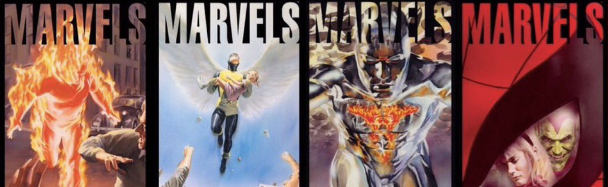
Story Titles: “A Time of Marvels”, “Monsters”, “Judgment Day”, and “The Day She Died”
Published: 9 November 1993 (cover-dated: January 1994) to 22 March 1994 (cover-dated: April 1994)
Writer: Kurt Busiek
Artist: Alex Ross

The Background:
In 1939, pulp-magazine publisher Martin Goodman created Timely Productions, expanding his reach into the increasingly popular medium of comic books. Timely’s first publication, Marvel Comics #1, was spearheaded by the first appearances of Jim Hammond/The Human Torch and Prince Namor McKenzie/The Sub-Mariner, and went on to sell over 900,000 copies. This success was followed by Captain America Comics #1 selling over a million copies just two years later, the same year that Goodman’s wife’s sixteen-year-old cousin, Stanley Lieber, was named interim editor under the pseudonym “Stan Lee”. Though superheroes declined in popularity after the Second World War, Goodman continued to publish Westerns, horror, and war comics under Atlas Comics before rebranding to Marvel Comics in 1961. Stan Lee and Jack Kirby then ushered in the “Marvel Age” of comics with the Fantastic Four, kick-starting a slew of costumed superheroes and Marvel’s distinct narrative style. These colourful heroes caught the eye of artist Alex Ross from an early age; known for his startlingly photorealistic artwork, Ross later cemented his position in the industry with Kingdom Come (Waid, et al, 1996). However, his big break came when he teamed with writer Kurt Busiek to produce this four-issue miniseries that reframed many of Marvel’s most iconic moments through the eyes of a common man. Marvels was an award-winning, widely praised miniseries that inspired a much grimmer counterpart story in 1995, a follow-up series in 2008 (though Alex Ross did not return), and a sister-series in 2021.

The Review:
Marvels followers budding photographer Phil Sheldon who, at the beginning of the story in 1939, is eager to go to Europe and make a name for himself as a war photographer. While his friend and fellow cub reporter, a youthful J. Jonah Jameson, scoffs at the futility of the war, he shares his own lofty aspirations of one day owning the Daily Bugle and making his own headlines. While Jameson heads off to cover a labour dispute, Sheldon attends a press conference hosted by noted scientist Phineas T. Horton, who unveils his revolutionary “synthetic man”, a robotic creation indistinguishable from the real thing except that it bursts into flame when exposed to oxygen. While the reporters initially mock the demonstration as an elaborate hoax, they react in horror when this “Human Torch” moves and appears sentient. Subsequent sensationalist headlines – the “power of the press”, as Sheldon puts it –   slander Professor Horton and see him bury his creation lest it prove to be a danger. While shopping for a gift for his betrothed, Doris Jacquet, Sheldon rushes to investigate a disturbance, hopeful for the big break that’ll get him shipped to Europe, only to the find the Human Torch running amok through the streets of New York City. While the ridiculously fickle New Yorkers brush the event off as an elaborate prank, Sheldon is shaken by his second sight of the flaming man and is therefore the only person to take reports of a “Sub-Mareener” seriously. Over the next few panels, both the Human Torch and the Sub-Mariner raise the ire of everyday folk with their antics, but they captivate Sheldon, who turns down the chance to cover to war to stay and follow these ever-prominent “Marvels”. As awe-struck as he is by such costumed super-men, Sheldon can’t help but question what their presence means for mankind, who suddenly seem secondary in the evolutionary chain. Thus, when the Human Torch and the Sub-Mariner inevitably come to blows in what’s likened to a battle between Gods, Sheldon shares the same fear as his fellow citizens, despite protests from the likes of officer Betty Dean, who vouches for Namor’s character.
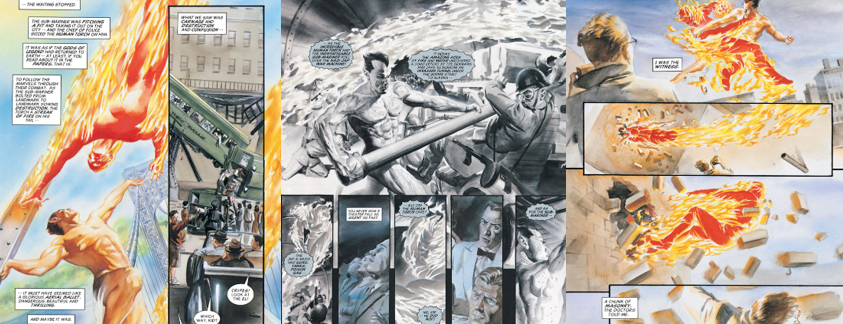
Photographer Phil Sheldon witnesses the terrifying and awesome debut of the “Marvels”.

As the two titans battle, hijacking the airwaves and causing a great deal of property damage, Sheldon is angered at them for making humanity feel so helpless. The conflict is ultimately resolved by Officer Dean, who cools the differences between the two, though Sheldon echoes the same bitterness of his peers at both superhumans escaping any punishment for their actions. In the face of his helplessness, and intuiting that such occurrences will only escalate, Sheldon reluctantly suggests pushing back the wedding and, resenting him, Doris opts to call the whole thing off until he feels more like a “man”. By winter, the press was alive with reports of Captain Steve Rogers/Captain America’s colourful adventures; kids and adults alike revelled in his Axis-smashing antics. While at the cinema, Sheldon’s musings that Cap is so accepted because he’s not perceived as a threat are given further credence when the entire audience (him included) applaud news reports of the Human Torch and the Sub-Mariner teaming up to battle the Nazis. Just like that, the Marvels are celebrated, national heroes; the public debates which of them is better and stronger and Sheldon’s perspective has changed enough to rekindle his relationship with Doris. His elevation is short-lived, however, when it’s suddenly reported that Namor has turned on the Allies and waging his own war against America, a war that sees him flood New York with a catastrophic tidal wave! The Human Torch confronts him and Sheldon’s right there to snap some pix, now revelling in witnessing such a titanic clash, only to be injured by flying debris and lose an eye in the process. Surprisingly, he feels no ill will towards the Marvels and instead chooses to focus on the bigger picture – the war and his impending wedding, specifically. After the wedding, Sheldon finally gets to cover the war in Europe and is right there when Cap, the Human Torch, Namor, and the rest of their superpowered Invaders, storm a Nazi compound, noting in a letter to Doris that the Marvels aren’t some temporary fad; they’re here to stay.
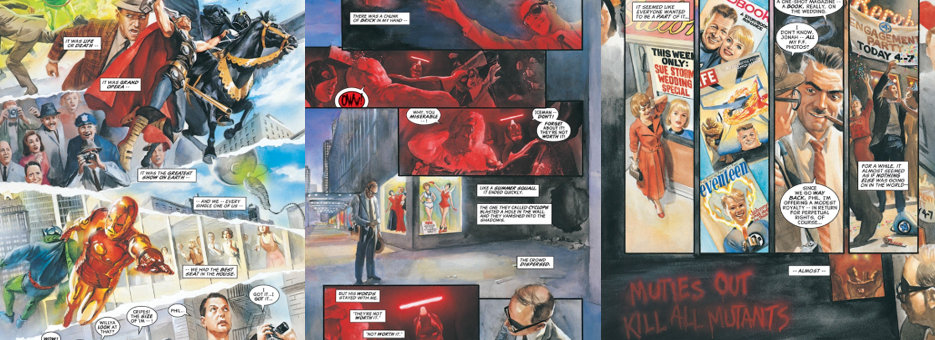
While the Avengers and Fantastic Four are celebrated, even Sheldon hates and fears Mutants.

Some decades later, an older and more experienced Sheldon is convinced to cover a battle between the Avengers and the Masters of Evil. Cap has just returned from his icy sabbatical, inspiring the awe and admiration of Sheldon and the public. By this time, sights such as Anthony “Tony” Stark/Iron Man, Thor Odinson, and Doctor Hank Pym/Giant-Man cutting through the city skyline and dwarfing mere mortals are commonplace but no less impressive. Sheldon hopes to publish a book of his photos of their heroics, convincing his publisher to take a shot on the idea based on how inspirational Marvels like the Fantastic Four are. While mulling over his opening text, Sheldon’s swept up by an angry mob who descend upon the X-Men, convinced that the Mutant teenagers tried to kill an innocent construction worker. Sharing the sentiment that the Mutants are dangerous killers, Sheldon literally casts the first stone, left shaken by the words of Scott “Slim” Summers/Cyclops (“They’re not worth it”) and pondering why Mutants illicit such hatred and distrust compared to the other Marvels. He concludes it’s because Mutants are genetically predisposed to be the next step in human evolution, thereby conjuring fears of death and redundancy in everyday folk. Ruminating these matters at home with his kids (who idolise the Marvels), Sheldon is gifted a writing assignment covering an art exhibition hosted by blind sculptress Alicia Masters. He’s also right there for when Doctor Reed Richards/Mister Fantastic announces his engagement to Susan Storm/The Invisible Girl, landing Sheldon another book deal with Jameson for every photo he takes of the colourful couple and landing him on the guest list for the wedding. With major shake-ups occurring in the Avenger’s roster and the likes of Matt Murdock/Daredevil making a splash downtown, to say nothing of the wedding drama, Sheldon almost forgets about the Mutant problem…save for the abundance of anti-Mutant graffiti plastered around town.
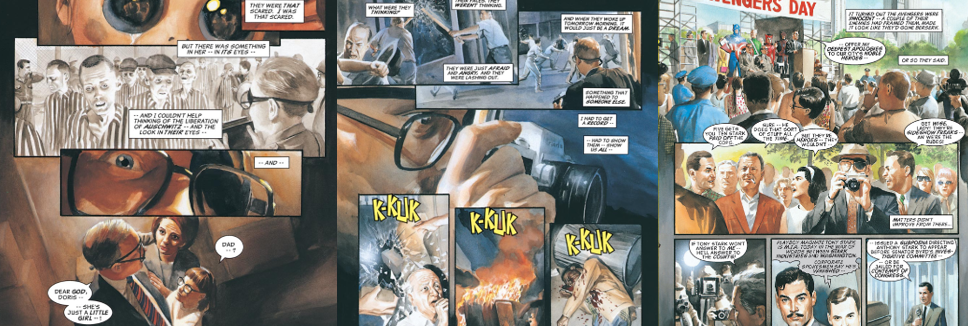
Sheldon sees the worst of humanity when the Mutant problem escalates into all-out paranoia.

Sheldon’s stunned when he returns to his quiet suburb and finds an angry mob literally grabbing pitchforks to hunt down a Mutant in the area. His first thought is his family but Sheldon’s shocked to come home and find his children sheltering a Mutant child, Maggie, a frightened little girl who’s the anthesis of everything Sheldon had so firmly believed about her species. Suddenly likening the persecution of the Mutants to the horrors of Auschwitz, Sheldon resolves to protect the girl from their friends and neighbours, who wouldn’t think twice to burn their house down to get to her. While his family keep Maggie safe, Sheldon reads up on Mutants and tries to find some way to help her, only to be met with dead ends and realise that the government wants to lock them up, at best, and execute them, at worst. Sheldon realises that the X-Men could help but falters, worrying they would remember him as another angry human, and meanders through even Reed and Sue’s wedding, his thoughts so preoccupied by Maggie’s fate. His concerns are only exacerbated when a television debate between Professor Charles Xavier/Professor X and Bolivar Trask sees the unveiling of his Mutant-hunting Sentinel machines and the outing of Professor X as a Mutant. Driven into a frenzy by fear, hated, and paranoia, an all-out riot breaks out. Sheldon’s right there, recording evidence of man’s inhumanity to man, as the monstrous Sentinels fly overhead, and is distraught to return home and find Maggie left to keep them safe and unable to comfort his kids when they worry about her safety. Within a mere two months, the fickle public begin to turn on the Marvels, holding them accountable for their actions and questioning their methods. Their primary target is Tony Stark, who bankrolls the Avengers and pays Iron Man to be his personal bodyguard, and the Avengers, who had recently been framed by evil doppelgängers. Disturbed by how sordid the Marvels have become, Sheldon throws himself into his work, determined to keep his family fed and sheltered, but unwittingly drives a wedge between him and Doris and the girls.
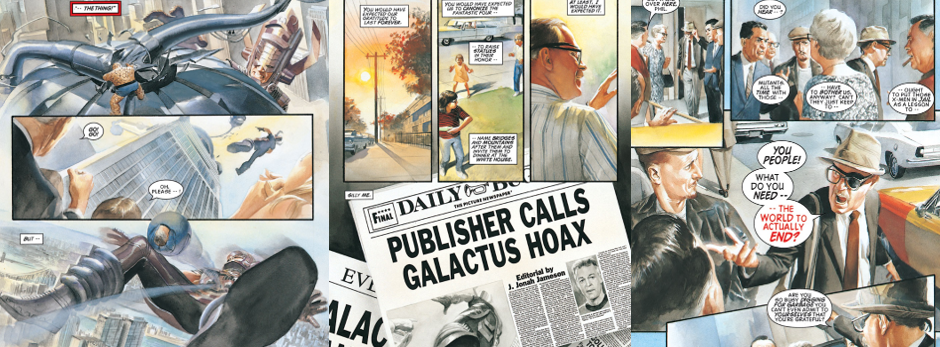
Sheldon’s incensed when the public slanders the Marvels even after they defeat Galactus.

The Marvels’ bad press is only escalated by Jameson’s personal vendetta against Peter Parker/Spider-Man and Sheldon comes to question his perception of the Marvels once more. However, he and the entire city are horror-struck when the skies burst into flames, asteroids fill the horizon, and a mysterious “Silver Surfer” arrives, seemingly heralding the onset of judgement day. Once again, despite their distrust and slander, the people must put their faith in the Marvels and be mere spectators as the Fantastic Four raced to confront the Silver Surfer, only to be dwarfed by the might and terror of the titanic Galactus! To the stunned horror of the public, the Fantastic Four lose the battle and none of their other defenders appear to help, leaving them to contemplate their end and watch, helplessly, as Galactus constructs an elaborate device around the Baxter Building. The people celebrate as the Fantastic Four and the Silver Surfer attack Galactus in full force, but Sheldon decides to leave the scene and be with his family, realising that the Marvels could fail and that he would rather be with his loved ones at the end. Luckily for him, and everyone, the Fantastic Four fend Galactus off with the Ultimate Nullifier but, rather than being celebrated as heroes, the team – and all Marvels – are further slandered by Jameson’s derogatory headlines. Sheldon’s protests fall on deaf ears and even he’s disgusted to find teenage photographer Peter Parker gleefully selling incriminating photos of Spider-Man to Jameson. His contempt for the public reaches a boiling point as Sheldon heads to cover a battle between the X-Men and Count Luchino Nefaria, snapping at them for slandering the very people, even Mutants, who save their lives. Still, by the 1970s, the public turn to his book of photographs for comfort after the Avengers are stuck in another galaxy determining the fate of all reality, begrudgingly guilty for questioning their methods. Now feeling his age, Sheldon takes on an assistant, Marcia Hardesty, though even this can’t help lighten his increasingly sour mood as he repeatedly sees the Marvels questioned, persecuted, and smeared by the courts, the public, and Jameson.
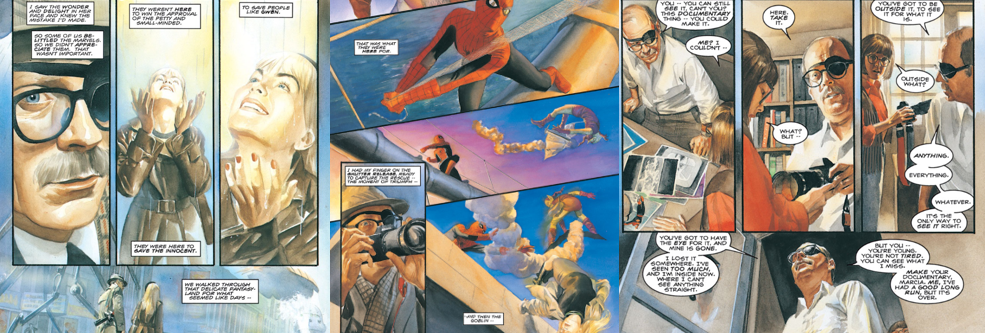
Sheldon ultimately decides to leave the awe and drama of the Marvels behind.

After the Fantastic Four again fend off Galactus, Sheldon desperately tries to turn opinion in favour of the Marvels, only to be dismissed as an overworked old man. Sheldon resolves to use his skills as a reporter to clear Spider-Man of Captain George Stacy’s death, interviewing a bystander who unashamedly blames Stacy’s death on Spider-Man. Sheldon’s as sceptical as the cops he meets with; however, while they have evidence that suggests Doctor Otto Octavius/Doctor Octopus caused Stacy’s death, they can’t prove anything without questioning Spidey. Confident that the underappreciated Marvels will handle a crisis happening at the Sun, Sheldon interviews some more people, all of whom believe Spidey’s a menace, and even questions Jameson, revealing the cantankerous publisher feels inadequate against such Marvels and is therefore determined to besmirch them, guilty or not. Jameson’s attitude makes Sheldon seriously consider an offer to write for the Daily Globe and he takes the first boat to Ryker’s Island to talk with the captive Dr. Octopus, only to find the stubborn scientist unwilling to co-operate with his inquiries. With no roads left, Sheldon visits Stacy’s daughter, Gwen, finding that, while she did initially blame Spider-Man, she no longer does. Reinvigorated, Sheldon regularly meets with Gwen; she’s with him when Namor invades New York with an army of mechanical attack craft. Rather than being terrified, Gwen marvels at their beauty and Sheldon realises that lives like hers are what the Marvels are fighting for and resolves to rework his new book into championing the heroes, flaws and all. Sheldon’s conviction turns to dread when he goes to Gwen’s to pick up some of her father’s journals and witnesses her being kidnapped by Norman Osborn/The Green Goblin. Sheldon follows in a taxi and witnesses the brutal battle between Spidey and the Goblin, sure that good would triumph over evil, and is crushed when Gwen’s knocked from the bridge and dies when Spidey tries to save her. Angered that Gwen’s death is buried under Jameson’s anti-Spidey campaign and left disillusioned by the Marvel’s failure, Sheldon loses interest in his book and grows resentful of the world moving on without a care. However, he realises that Marcia still sees the good in the Marvels and ultimately hands the assignment to her, retiring to be with his family and leaving the Marvels behind.

The Summary:
I’ve long criticised the hypocrisy of Marvel Comics’ everyday citizens. The people, especially New Yorkers, are a fickle and judgemental bunch, easily swayed by a few headlines and news reports. They can literally be dodging Galactus’ footsteps one day and then will laugh it off as a hoax the next. They can witness Spider-Man saving people from a burning building and yet fully believe Jameson’s claims that the wall-crawler started the blaze. They’ll come out in droves to cheer the wedding of Reed and Sue and applaud the star-spangled heroics of Captain America, but hurl bricks at Mutants and accuse them of all sorts in the same breath. They are a terrible, unappreciative, unreliable bunch of ingrates who don’t appreciate that these heroes put their lives on the line to save not just them, but the entire world and even the whole universe! Marvels is a perfect examination of this phenomena, with our equally culpable main character witnessing first-hand as Joe Public fear the likes of the Human Torch and the Sub-Mariner because they’re “different” and then cheer them on when they fight to defend America’s interests. Much of the public’s fickle nature isn’t just because of Jameson’s outrageous headlines, either; people, even Sheldon, feared the Marvels in the 1930s simply because of the existential threat they presented. This evolved and escalated once Mutants came along, with the species inarguably representing the next step in humanity’s inevitable extinction and thus causing the public to hate and fear them out of paranoia of being replaced (or the simple fear of death). Yet, Marvel’s civilians can never be appeased; they even turn on celebrated heroes like the Avengers for “abandoning” them and treat many of the Marvels as disposable celebrities. Their everyday, awesome feats lose their grandeur for many, who just become inconvenienced by their battles, and public opinion wildly fluctuates throughout the decades represented here as a result, even spilling over into paranoid violence when Mutants and shapeshifters become commonplace.
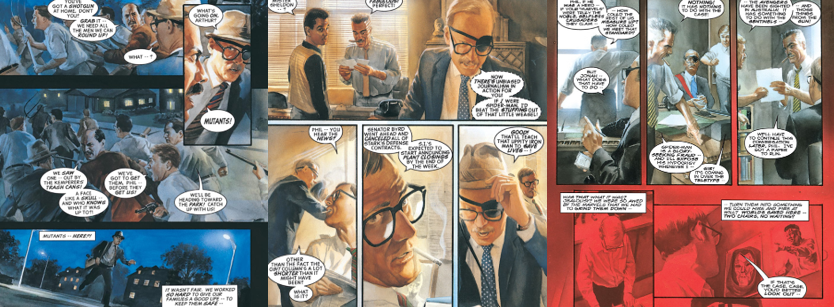
Flawed photographer Sheldon finds his awe of the Marvels tested over time.

At the heart of it all is flawed photographer Phil Sheldon. Phil’s a complex character, for sure, echoing the awe and fear of his peers at the sight of the Marvels and feeling small, insignificant, against these God-like figures. His opinion regarding the Marvels fluctuates throughout the story, with him praising and celebrating them during their “Golden Age” and profiting from their antics, never losing his faith in their good deeds even when it costs him an eye. Yet, like the public, Sheldon hates and fears Mutants. Unlike the average Joe, Sheldon contemplates why this is and realises he doesn’t really know, beyond that aforementioned existential dread. When he discovers Maggie hiding in his house, fully accepted by his well-meaning kids, he finally realises that he’s as guilty of persecution as the Nazis he once so heartily rallied against and privately defends Mutantkind. His perception changed for the better, Sheldon comes to see the worst in humanity: while they accuse Mutants of being dangerous, he sees only heroes trying to defend the innocent and angry mobs tearing their neighbourhoods apart out of sheer paranoia. Haunted my Maggie’s unresolved fate, time and weariness with the public’s everchanging opinions takes its toll on Sheldon. He remains in awe of the Marvels but focuses on them so much that he neglects his family, desperate to figure out what it is about them that distracts him so much. When Galactus arrives and the end of the world seems nigh, Sheldon realises that none of that matters; all that matters is being with the ones you love. This attitude leads into him becoming very short-tempered when people question or slander the Marvels, snapping at the unappreciative public for not realising that they owe their lives to the same people they’re dragging over the coals. Unfortunately, Sheldon lives long enough to see the best and worst of both humanity and the Marvels, realising with gut-wrenching finality that these “Gods” are as flawed as the everyday man. He comes to put all his faith in Gwen’s innocence and is thus heartbroken when Spider-Man fails to save her, but comes to see that his time with the Marvels has come to an end and that it’s time to let those concerns go to focus on what really matters.
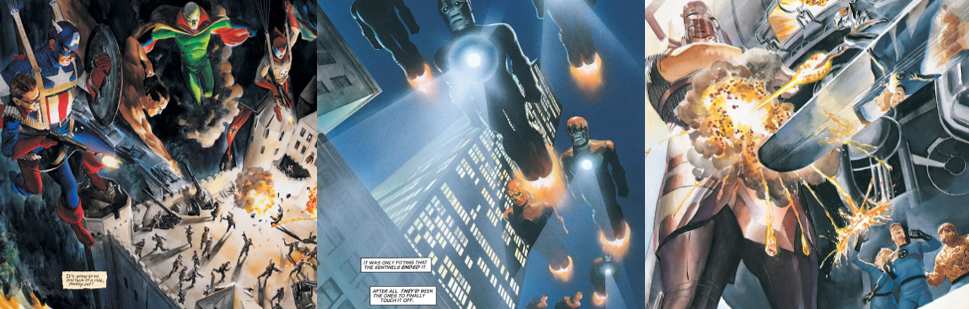
Alex Ross’s beautiful artwork brings some of Marvel’s most epic moments to glorious life.

Of course, what really makes Marvels shine is Alex Ross’s frankly gorgeous artwork. Every panel is painstakingly hand-drawn and painted to bring these colourful, outlandish superheroes to life. Unlike many of his peers, especially later in life, Alex Ross doesn’t try to reinvent these characters or make them more “realistic”; he simply presents photorealistic interpretations of their classic costumes, with the sole exception that he depicts Namor as being completely naked. This can be hit and miss; Spider-Man, for example, looks phenomenal under Ross’s penmanship but Thor and Iron Man struggle somewhat with their more outlandish designs. Still, Ross delivers some gorgeous full-page spreads, recreating Reed and Sue’s wedding, showing the battles between Namor and the Human Torch, and bringing these incredible moments to life from a street level perspective. Nowhere is this represented better than in Galactus’s arrival. Despite being faithful to Jack Kirby’s original design, Galactus cuts an intimidating and awe-inspiring figure here, towering over skyscrapers and constantly framed as though a Titan has risen from the Earth. While the story primarily focuses on Sheldon’s family life during this bout, the glimpses of the Fantastic Four and the Silver Surfer’s battle against Galactus deliver a sense of scale and realism not often seen in comics. This is further echoed in the coming of the Sentinels and Spider-Man’s battle with the Green Goblin, events where Sheldon is merely a bystander amongst the faceless masses watching history unfold, powerless to intervene. Ross fills every panel with little cameos and an amazing attention to detail, basing many characters’ likenesses off real-world celebrities and figures, and his work really makes you appreciate the craft and effort put into every panel, no matter how small. Marvels is a dramatic and compelling distillation of the first thirty-years-or-so of Marvel Comics, linking major events on a realistic timeline and giving us a glimpse at how these heroes, Gods, and villains are perceived by the common man. It’s a startlingly bleak tale at times, criticising our hypocrisy and inclination towards hatred and violence, but also an uplifting story. Sheldon, and many characters, celebrate and are inspired by the Marvels, championing them even when a small, volatile minority try to slander them. It’s the perfect snapshot of what life in Marvel’s New York City can be like and a great way to witness such iconic moments from a street-level perspective.

My Rating:

Rating: 4 out of 5.

Great Stuff

Have you ever read Marvels? If so, what did you think to it? Are you a fan of Alex Ross’s artwork? What did you think to the presentation of Marvel’s fickle public? Did you relate to Sheldon as a protagonist and enjoy his growth throughout the series? Which “Marvel” is your favourite? How are you celebrating National Superhero Day today? Whatever your thoughts, leave a comment below and be sure to check out my other superhero and comic book content.


Game Corner: Marvel: Ultimate Alliance 3: The Black Order (Nintendo Switch)

Released: 19 July 2019
Developer: Team Ninja

The Background:
For decades, few videogame publishers were as synonymous with Marvel Comics as Activision, who produced adaptations Marvel’s most popular properties. While some were better than others, Activision’s efforts were largely praised, especially after they partnered with Raven Software on the X-Men Legends games (2004; 2005). Activision and Raven Software expanded their scope to the rest of the Marvel universe with Marvel: Ultimate Alliance (2006), a largely successful team-based brawer praised for improving upon its predecessors. Though now delisted, it was followed by a sequel three years later, courtesy of Vicarious Visions, which tweaked the gameplay with team-based attacks to encourage experimentation. Though Marvel: Ultimate Alliance 2 (2009) was praised for its branching storyline, the stripped down roleplaying mechanics were criticised. While it was also delisted in 2020, fans were clamouring for a follow-up and, just ten years later, Team Ninja stepped in to work alongside Marvel in reviving the franchise. Seeking to place additional emphasis on combat, the developers explored the cosmic scope of the Marvel universe by including the Infinity Stones and lesser-known characters and chose to make the title a Nintendo Switch exclusive after developing a close relationship with Nintendo. Although Marvel: Ultimate Alliance 3: The Black Order was the sixth best-selling game in its first week and was later bolstered by extensive downloadable content (DLC), it was met with mixed reviews that praised the colourful action but criticised its lack of innovation.

The Plot:
While battling Nebula and Ronan the Accuser, the Guardians of the Galaxy stumble upon a plot by the mad titan, Thanos, to collect the six Infinity Stones. Although they scatter the Stones, Thanos’s acolytes, the Black Order, pursue the gems, prompting an alliance of Earth’s mightiest heroes to retrieve them first.

Gameplay and Power-Ups:
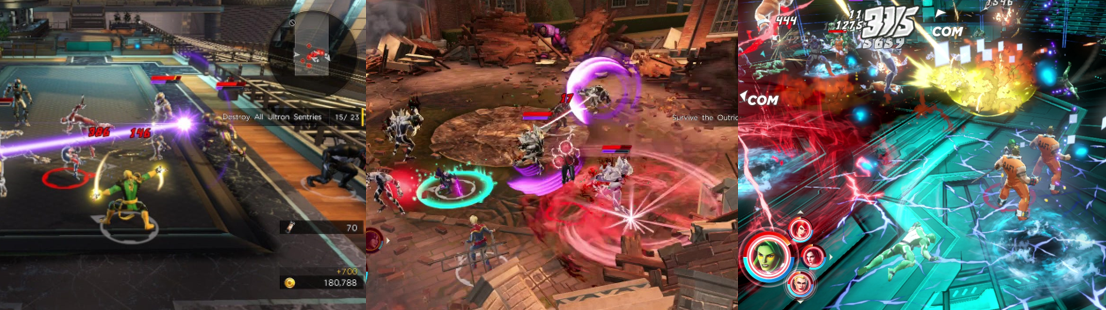
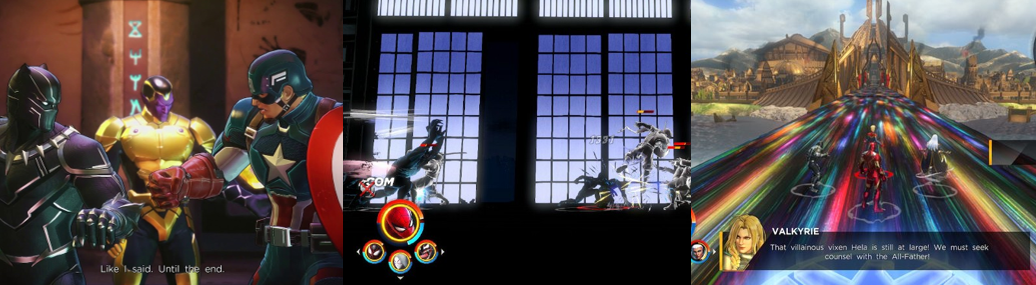
Like its predecessors, Marvel: Ultimate Alliance 3: The Black Order is a team-based action role-playing game in which players assemble a squad of four heroes from across the Marvel universe to battle various nefarious baddies, primarily the titular Black Order, who are hunting the six all-powerful Infinity Stones on behalf of their master, Thanos. The game offers five save slots, two initial difficulty levels, and a base roster of thirty-six playable characters, with many being encountered as you play through the story and joining your alliance either after fighting alongside you or being freed from some kind of mind control. Marvel: Ultimate Alliance 3 offers three controller configurations, thankfully none of which involve motion controls, and allows you to toggle overlays, notifications, tips, and other onscreen elements from the “Settings” menu. These include altering the camera placement, which enables a lock-on feature by pressing in the right stick, though the camera generally remains more focused on whichever character you’re controlling rather than offering a bird’s eye view as in the last two games. Although you can fight alongside friends either locally or online, you switch between your teammates with the directional pad (D-pad) when playing alone and your computer-controlled partners are very useful in a fight, attacking, enabling team attacks, and reviving defeated characters without any input from you. Pressing A sees you interact with the environment to activate consoles, pick up or move certain objects, and talk to other characters. You jump with B, executing a double jump, swinging from webs, or flying depending on which character you’re playing as, and throw light attacks with X and heavy attacks with Y. These can be strung together to perform basic combos and you can also perform a mid-air attack and throw objects (like bombs and missiles) by pressing Y. You block incoming attacks by holding the Z trigger and tap it to dodge, and collect glowing red orbs from defeated enemies or smashed crates to restore health, blue orbs to refill your Energy Point (EP) gauge, and credits to spend on upgrades.

Combat is thick, fast, chaotic, and constant thanks to loads of enemies and character abilities.

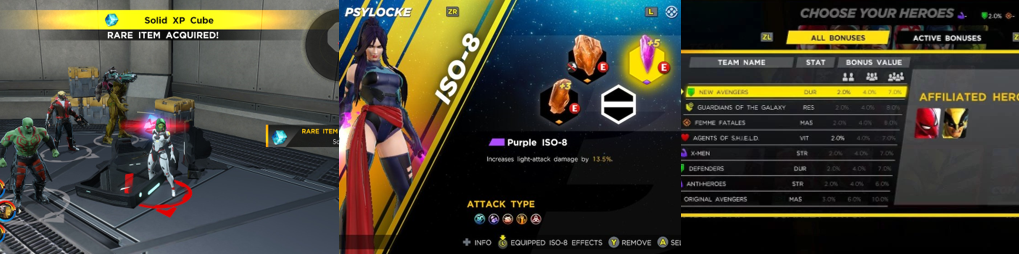
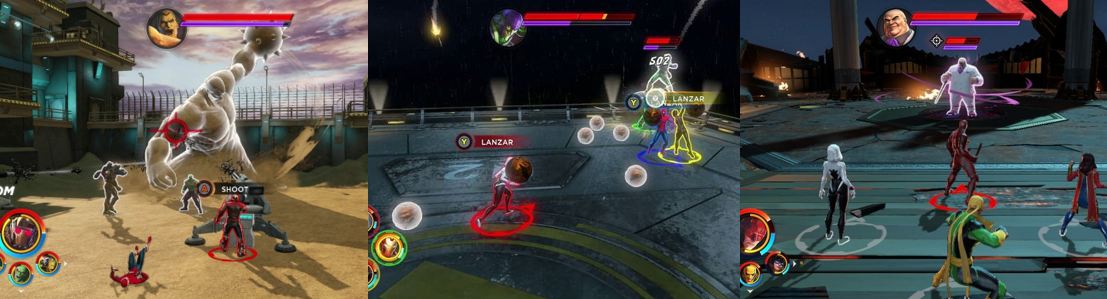
As in the last two games, each character has specific abilities tied to their superpowers or superhero traits. You activate these by holding the Right trigger and selecting an icon using the D-pad; using Abilities drains your EP, however, and each Ability comes with a different cost. However, these attacks allow you to stun, stagger or deal elemental damage to enemies using Peter Parker/Spider-Man’s webs, Thor Odinson’s lightning, and Doctor Robert Bruce Banner/The Hulk’s incredible strength. Many characters have projectile attacks in their arsenal, such as Wade Wilson/Deadpool firing guns and Scott “Slim” Summers/Cyclops blasting his eye beams, while others cause splash damage or specific buffs, like Piotr Rasputin/Colossus being able to reflect projectiles and Wanda Maximoff/The Scarlet Witch healing her allies. Some, like James “Logan” Howlett/Wolverine, have passive abilities that allow them to automatically regenerate health as they walk around; others, like Johnny Blaze/Ghost Rider and Ororo Munroe/Storm, specifically deal in elemental damage. Character’s Abilities can also be mixed and matched by holding ZR and pressing one of the face buttons (or pressing A when prompted); this sees two characters attack in a combo for additional damage. As you dish out and take damage, you’ll also build the Extreme (EX) Gauge). Once full, you can press L and R up to three times to have two to four of your teammates perform a devastating combination attack that’s great against bosses. While the various cannon fodder you fight are easily dispatched, larger commanders and bosses need their “stun” meter drained before you can really put a beating on them and others (and certain treasure chests) require specific combination attacks to breach their shields. Defeating enemies sees your characters gain experience points (XP) to level-up, increasing their statistics (attack, defence, etc), though you can also use the various Orbs you find to manually level-up. Each character’s special Abilities can also be further enhanced using Ability Orbs and credits, reducing the EP cost and increasing their damage, among other benefits. You can also earn “Team Bonuses” depending on your team selection: pick a group of X-Men, for example, and your strength or resistance stat will increase, while picking characters of royalty ups your maximum energy stat.

Search for chests to gain currency and other expendables to upgrade and buff your alliance.

Although you can’t equip gear to your characters, the boss battle against the Destroyer armour sees you temporarily empowered by Asgardian magic and you can eventually equip your team with “ISO-8” crystals, coloured stones that enhance their attack power, resistance to elements, or critical hit ratio, among others. You can further upgrade these with credits and ISO-8 capsules, though some of the rarer ones will also debuff you (for example, your attack my increase but your defence will decrease accordingly). You’ll also inevitably gain access to the Strategic Hazard Intervention Espionage Logistics Directorate (S.H.I.E.L.D.) Lab, which acts as the game’s skill tree. By spending credits and Enhancement Points (EP), you can further increase your team’s overall attack, defence, resistance, vitality, and such and even unlock additional ISO-8 slots (with more being earned by levelling-up). You can also enter the S.H.I.E.L.D. Depot from the main menu to purchase additional costumes and social icons by spending S.H.I.E.L.D. Tokens. Marvel: Ultimate Alliance 3 is pretty forgiving (on the “Friendly” difficulty, at least), with multiple checkpoints in each area. When you activate a S.H.I.E.L.D. checkpoint, your team is fully healed, and you can swap or enhance them if you wish. If a teammate is defeated, you can hold A to revive them, but I wouldn’t recommend it unless you absolutely have to. Not only are revives limited, but downed characters will eventually return to full health even before you reach a checkpoint so it’s not worth risking another character taking damage by healing a partner. Exploration generally leads you to treasure chests or special walls that require a special combination attack to open, or to a “Rift” challenge that takes you away from the main game to tackle a special challenge (usually a boss rematch or enemy gauntlet) for extra rewards. Your path is incredibly linear most of the time, hence why there’s no map, and the game’s primary focus is on chaotic combat and visually manic team-based attacks. Unlike in the last two games, you can no longer grapple or throw enemies (though you can still send them flying off certain platforms) and there are no character-specific team-up moves, meaning the action can quickly get quite tiresome.

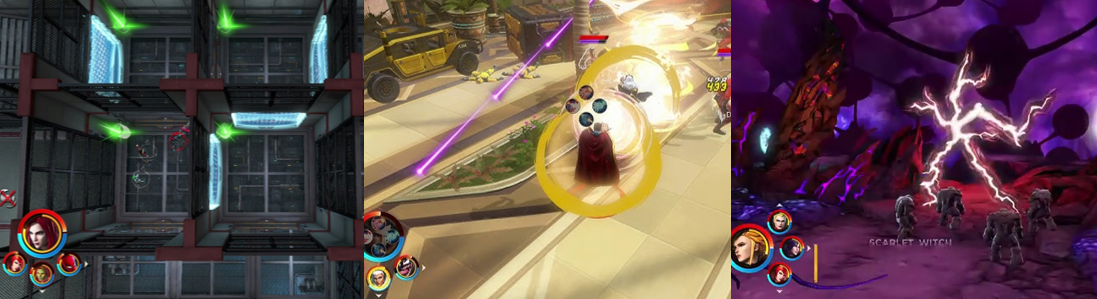
Sadly, puzzles are practically non-existent, with only Rifts offering additional challenges.

Because of its focus on hectic combat, there’s even less room for puzzles than there is for exploration in Marvel: Ultimate Alliance 3. Puzzles boil down to activating a console to open a door or making a platform move and that’s it. Sometimes, you’ll hold A to move a block and avoid lasers or cannons, but mostly you’ll be timing jumps between said lasers to progress and simply hurling missiles at those cannons. Sometimes, you’ll rotate statues or press switches to progress; others, you’ll be avoiding toxic ooze in Hel or solving door puzzles at the Raft or in Avengers Tower. After hopping across the rooftops of New York City, you’ll infiltrate the heavily fortified fortress of the Hand, dealing with ninjas that drop from the sky and hidden arrow hazards. When in Wakanda, Advanced Idea Mechanics (A.I.M.) corrupt T’Challa/The Black Panther’s defences, leading to an exasperating section where you must avoid snipers and being roasted by a giant panther statue’s energy blast. When transported to the Dark Dimension, you must use portals to reach new areas and defeat waves of demonic enemies to lower magical barriers and progress. Some attacks also screw up your controls or temporarily freeze you; some enemies are best defeated by tossing explosives at them; and many missions have an additional character fighting alongside you who’s often unlocked afterwards. However, a lot of the additional features of the previous games are missing; you can talk to other characters, but there are no dialogue options or character-specific interactions. There are no trivia quizzes, no optional side missions beyond the Rifts, and no character specific challenges to unlock extra stuff for each character. There aren’t even hub areas, in the traditional sense, with characters just appearing around S.H.I.E.L.D. checkpoints at times, though you can destroy a fair bit of the environment, and some encounters have you fleeing towards the camera as bosses chase you or present you with unwinnable battles.

Presentation:
Whereas the last two games primarily based their aesthetics on the comics books, especially the Ultimate comic line, Marvel: Ultimate Alliance 3 adheres very closely to the Marvel Cinematic Universe (MCU), especially in the visuals of its locations. I was hard pressed, for example, to tell the difference between Asgard here and the Asgard to the MCU, with both the golden city and the rainbow bridge, the Bifrost, appearing almost exactly as they’re depicted in the films. The same is true for Wakanda, the Dark Dimension, and Knowhere, all of which are virtually indistinguishable from how they appear in the MCU. There are some differences, of course: Taneleer Tivan/The Collector’s museum, for example, uses coloured cube cages and Wakanda leans much more into traditional architecture than the pseudo-futuristic science of the films (likely because Black Panther (Coogler, 2018) released a year before this game was made). Xavier’s School for the Gifted is lifted almost exactly from the 20th Century Fox X-Men movies (Various, 2000 to 2020), however, including a hedge maze, 1:1 Cerebro room, and basketball court that doubles as a landing pad for the Blackbird. While the Dark Dimension and the cosmic mind trip that is Sanctuary also heavily borrow from the bizarre cosmic imagery of the MCU, the Raft and Avengers Tower are much more akin to their comic book counterparts, though they’re comparatively bland locations, lacking fun areas like the Danger Room or Wakanda’s Necropolis (though you do pass through Anthony “Tony” Stark/Iron Man’s Hall of Armours in the tower). Although you only make a brief stop in Attilan to try and get help from the Inhumans, the architecture is far more visually interesting than that awful television show, seemingly being comprised of Celestial technology, and I enjoyed the ominous gothic presentation of Hel, with its restless Viking warriors and damaging sludge. Unfortunately, Marvel: Ultimate Alliance 3 continues the trend of having disappointingly bland and forgettable music, opting for generic themes for each location, event, and character that are lost amidst the constant fighting.

A visually impressive brawler that takes obvious inspiration from the MCU films.

The game also opts for an almost cel-shaded, action figure-like aesthetic for its colourful cast of characters. While many again both look and sound like their MCU counterparts, there are some exceptions: Peter Quill/Star-Lord, for example, looks nothing like Chris Pratt and the X-Men are far closer to the comic books than Fox’s films. Despite you assembling a custom team of heroes, cutscenes depict either everyone or characters specific to the location you’re in (the corrupted Doctor Stephen Strange in the Dark Dimension, for example) as they’re better suited to advance the plot against the local baddies. With the game shifting to a more third-person perspective, you’re closer than ever to the action and can see more of the environment than in the previous games. However, this comes with some drawbacks: mainly, there are far less opportunities or incentives to explore. Second, environments are painfully linear, with dead ends or locked doors barring your progress. Third, and most frustrating, is the camera, which easily loses track of your opponent/s and often lumbers you with wireframe representations when the foreground blocks the view. Thankfully, you won’t be falling down pits and rarely have to worry about onscreen hazards, but it can be aggravating trying to figure out which platforms and crates can be jumped on and which can’t. Marvel: Ultimate Alliance 3 offers a diverse cast of characters, each with their own idle poses and quips, though these do inevitably repeat. The game’s also surprisingly light on Easter Eggs: you’ll spot Deadpool singing away as he makes tacos in the X-Mansion, but not much else, and there are no optional missions or choices to encourage replaying missions. It’s a far cry from the first game, where there was always something to collect or an additional character to help out. Instead, it’s basically all combat, all the time in Marvel: Ultimate Alliance 3. Luckily, the game looks pretty good (everything’s very colourful and true to its inspirations) and performs really well, though there are some long load screens and it is annoying being forced to continue your game every time you challenge a Rift.

Enemies and Bosses:
All the usual suspects appear here as disposable cannon fodder for you to endlessly beat up, with many of the game’s goons sharing traits across the various locations. You’ll encounter Kree, Ultron Drones, agents of A.I.M., and Doombats who all pack various energy blasters. Ultron’s clones are the worst for this, relentlessly firing energy blasts and crashing through windows. The Raft’s unscrupulous prisoners attack in large groups, as do the restless Viking warriors who populate Hel, tossing axes from afar and luring you into toxic goop. Gargoyle-like Fire Demons also dwell here, offering a greater challenge with their swoop attack and fire breath, not unlike the monstrous Outriders and Mindless Ones who make up Thanos and the dread Dormammu’s forces, respectively. Alpha Primitives, Hydra goons, and towering Sentinels also appear, with the latter firing huge energy blasts from the palms and best attacked by throwing their explosive energy cores back at them. No matter where you are and what enemies you fight, more powerful commanders will also appear. Larger, tougher, and sporting a stun meter, these commanders should be your top priority as they’ll charge across the screen, cause shockwaves, and generally offer a far greater challenge even when you’re at a higher level. These minions often fight alongside their masters, generally so you can recover some health and EP to better damage the bosses, and will endlessly spawn in one of the additional modes unless you destroy their teleporters. Some of the game’s challenges or story-based missions charge you with defeating a certain number of enemies to progress. Other times, bosses appear in these waves, and you must occasionally flee or purposely lose some fights. This happens when Cain Marko/The Juggernaut comes tearing through the X-Mansion, for example, and in early encounters with the Black Order, who cannot be beaten or will chase you, raining lightning or other attacks from the sky and across the ground.

Few bosses require more than just hit-and-run tactics, even when augmented by an Infinity Stone.

There are loads of bosses to fight in Marvel: Ultimate Alliance 3, with some returning from the previous games, some teaming up, some having a couple of phases, and all boiling down to whittling down their stun bar, unleashing an EX attack and/or your most powerful Abilities, and avoiding damage until you can repeat this. The first ones you’ll face are Nebula and Ronan the Accuser, who often appear as a duo in optional challenges. Nebula is faster and more nimble, wielding blades where Ronan uses a massive warhammer. Both set a standard all bosses follow, which is that they’ll use either a jumping slam or an explosion of energy (or both) to send you flying. While quelling the riot in the Raft, you’ll encounter a version of the Sinister Six, with some unique variations to each battle. Flint Marko/The Sandman, for example, flings waves of sand and erupts his big sand fist from the ground as a large sand creature. You must use A to mount the nearby cannons and unload on him to chip away at his stun meter. Maxwell “Max” Dillon fights alongside Eddie Brock/Venom, raining lighting and electrocuting you with bursts of electricity, before he’s eaten by Venom and starts busting out electrically-enhanced symbiote powers. Venom joins the team after this fight and is tested against Quentin Beck, who first brainwashes Mile Morales/Spider-Man, Gwen Stacy/Spider-Woman, and Kamala Khan/Ms. Marvel to fight you and then unleashes a poisonous mist, teleports about, and confuses you with duplicates, Doctor Otto Octavious/Dr. Octopus is fought in a two-stage fight where you must first avoid his tentacles and scurry charge and then attack each arm to stun him. Finally, you’ll battle Norman Osborn/The Green Goblin for the Time Stone. The Green Goblin swoops overhead and lingers slightly out of reach, peppering the arena with his pumpkin bombs, charging at you, and freezing time to bombard you. He’s noticeably weak to his pumpkin bombs, however, so try and toss them at him before they explode in your face! After battling into the Hand’s fortress, you must first free Elektra Natchios from the Hand’s influence and then face Lester/Bullseye and Wilson Fisk/The Kingpin in separate fights. You must take out the ninjas feeding Elektra power, avoid Bulleye’s spread of razor sharp and explosive cards, and dodge the furniture and massive energy beam thrown by the Power Stone-enhanced Kingpin. The Kingpin also charges like a rhino, leaps at you to cause shockwaves, and even rips up stone columns to use as melee weapons!

Gigantic bosses and the quirkier villains help mix-up the otherwise tedious combat.

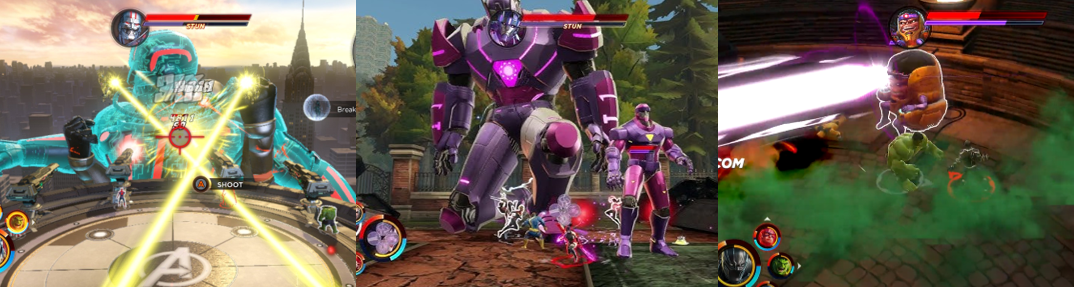
Avengers Tower is then attacked by Ultron and his drones, who assist him in battle. Not that he needs it as the Mind Stone allows Ultron to mess up your controls, to say nothing of his signature face and palm beams. Ultron then grows to gigantic proportions, sweeping the area with his eyebeams before Clint Barton/Hawkeye intervenes and Ultron merges with Ultimo. This is the first giant boss battle in the game and sees you blasting Ultimo with cannons and avoiding his massive swipes. The Infinity Sentinel is comparatively smaller, but no less dangerous thanks to its own face beam and missiles. Though you can damage it with Sentinel cores, it’s finished in a cutscene by Erik “Magnus” Lehnsherr/Magneto, who then tosses debris and throws you off balance with magnetic pulses while Juggernaut pummels you and Raven Darkholme/Mystique tosses daggers. After surviving Mystique’s Danger Room trials, you face Magneto, now even tougher thanks to the Power Stone, before being chased away and banished to the Dark Dimension by the Black Order. There, you battle past Loki Laufeyson (who boasts elemental attacks and duplication tricks) to eventually face the dread Dormammu, who wields the Reality Stone and is the second giant boss. You must subdue his minions and avoid his flame bursts, whittling down his magical barrier either directly or be destroying three nearby orbs, all while dodging his giant fists and ground spikes. The brief fight with Maximus Boltagon is far easier, even though the mad Inhuman carries a massive energy cannon and you must take cover in Thane’s energy bubble to avoid Maximus’s barrage of lasers. Ulysses Klaue/Klaw awaits in Wakanda and his sound-based energy blasts and waves must be overcome to rescue and recruit James Buchanan “Bucky” Barnes/The Winter Soldier. You then fight past A.I.M. to confront their master, George Tarleton/Mental Organism Designed Only for Killing (MODOK), who uses the Soul Stone to turn the Dora Milaje against you and attacks with a slew of appendages, from buzzsaw arms, poison gas, failing tentacles, and his signature forehead blast.

Battles with the empowered Black Order, Thanos, and Thane offer some of the most enjoyable challenges.

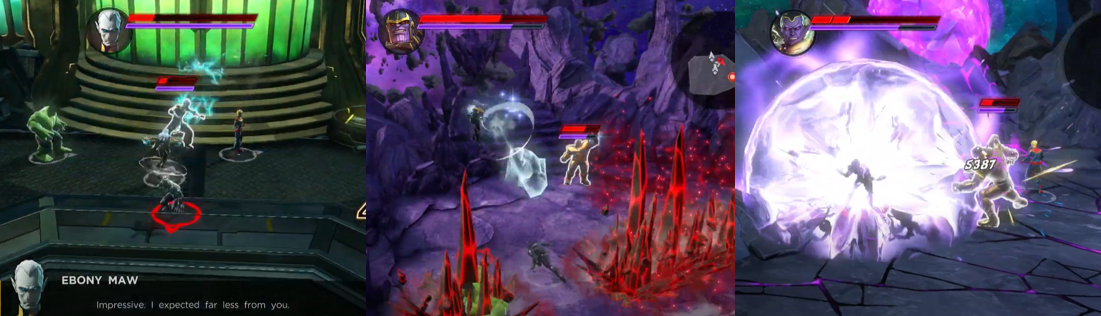
Though your goal in Hel is to confront Hela, you’ll actually battle the fire demon, Surtur, in another giant boss battle. This was a bit of a difficulty spike for me as Surtur’s flaming sword has a long reach and he causes the ground to erupt in flames, to say nothing of stun locking you with repeat sword strikes! Best him and Hela sets Johann Schmidt/The Red Skull on you, with the Nazi madman firing a powerful revolver and sapping your health with his “Dust of Death”. Hela gives the Red Skull a boost, protecting him with a shield and allowing him to fire a Bifrost-like laser, before placing his consciousness into the Destroyer armour. Though bolstered by Hydra forces and boasting a sweeping face beam, you can get a power-up from glowing crystals to overcome this destructive force. Finally, you venture to Knowhere and must run the Black Order gauntlet to retrieve the Infinity Stones, with checkpoints between each fight. Ebony Maw is first, firing a spread of projectiles and rocks and using the Soul Stone to create portals to trip you up. Supergiant tosses dark spheres and a golden homing shot that messes up your controls, though you can toss explosive cores from her minions to deal big damage. Cull Obsidian infuses his battleaxe with the Power Stone, sending out waves of purple energy and massive purple shockwaves, though he’s far slower and also susceptible to the nearby bombs. Corvus Glaive is much faster, landing multiple hits with his lance and using the Reality Stone to spring spikes form the ground and conjure duplicates who fill the arena with energy waves that can stun lock you. Finally, Proxima Midnight takes her fellow’s teleportation trick to the next level with the Space Stone and fills the arena with lightning bolts and strikes. All these powers are then recycled when you face Thanos, who gathers the six Infinity Stones into the Infinity Gauntlet to rain meteors, teleport, mess up your controls, freeze time, and fire his signature eyebeams. Thanos then joins you to battle Thane, who usurps him and boasts similar powers, though also upgraded by the Infinity Armour. Thane exhibits superhuman speed, traps you in a cube, fills the arena with portals and flames, and explodes in fury, though both battles were fun challenges rather than impossible tasks.

Additional Features:
Unlike in the previous two games, you won’t be finding data logs, action figures, or meeting certain requirements to unlock new attacks or costumes. You just fight over and over, earning whatever you need to unlock, buy, or upgrade whatever you wish and finding some concept art in treasure chests. A far harder (but more rewarding) “Superior” difficulty unlocks upon clearing the game alongside an additional “Nightmare” mode, accessible via the “Curse of the Vampire” campaign. You also unlock Thanos and can freely replay any mission on any difficulty (though you must start a new save to play on “Superior”) to grind and enhance your characters and ISO-8. Dimensional Rifts transport you to special challenges (not unlike the S.H.I.E.L.D. Simulator discs from the first game) that are often rematches with bosses or gauntlet challenges, though far tougher and gifting better rewards if you succeed. There are also three additional modes; however, though you can play a taster of each, you must purchase the expansion pass to fully unlock them. “Curse of the Vampire” adds vampiric enemies to the main story in “Nightmare” mode and offers a “Gauntlet” mode where you battle waves of enemies and bosses against both a time limit and a range of debuffs (including limited health restoration and draining EP). You can also tackle an “Endless” mode that’s pretty self-explanatory, and unlock additional characters like Frank Castle/The Punisher and Eric Brooks/Bladeif you buy the DLC. “Rise of the Phoenix” sees you form a four-person team and go head-to-head with a friend or the computer in three-round Danger Room scenarios. These see you tackling bosses again or wiping out hordes of enemies, awarding additional buffs and effects if you meet certain criteria (such as using any Ability or Synergy attack four times). You can only tackle the first challenge without the DLC, so I didn’t get very far, but this could be a fun distraction for those looking to test their skills against a friend. “Shadow of Doom” adds an epilogue story campaign that sees you return to Wakanda to oppose Doctor Victor Von Doom’s invasion. Dr. Doom’s Doombots endlessly spawn unless you destroy their teleporters, and you even battle the arrogant dictator in the recycled Necropolis, with him teleporting, firing lasers form his palms, and having his health restored by his Doombots. You’ll add Marvel’s First Family to your roster (alongside an alternative Thanos and other characters) by buying the expansion pass and battle Annihilus, a gigantic Celestial, and even “God Emperor” Doom!

The Summary:
I quite enjoyed the first two Ultimate Alliance games. They were mindless and largely repetitive, but I liked the large cast of characters and all the different references and locations from the comic books. Still, I put off Marvel: Ultimate Alliance 3: The Black Order for some time, mainly because I was annoyed by it being a Nintendo Switch exclusive; however it turned out to be a decent enough brawler. Despite the different development team, a few tweaks, and an apparent disconnection from the previous games, Marvel: Ultimate Alliance 3 offers a lot of the same gameplay and enjoyment as its predecessors, which is great for long-time fans of the franchise. Unfortunately, it doesn’t improve on these elements in a meaningful way and actually removes some content that I found enjoyable from the last two. There are no optional missions, for example, no alternative endings, no choices, and no character-specific challenges beyond fighting and levelling-up. I found this made the tedious combat even more aggravating after a while as I wasn’t being rewarded with gear or costumes or anything other than stat boosts. Even the skill tree was limited since you must grind to acquire enough credits and expendables to enhance your team, and I found the ISO-8 mode to be more confusing than engaging. The game also does little to improve the boss battles. Very few were very innovative or required more of you than to strike fast, avoid shockwaves and projectiles, and unleash your Extreme attack. The giant bosses were more of a challenge and I liked the final fight against Thanos and Thane, but I was hoping for a bit more complexity, especially given the possibilities offered by the Infinity Stones. There is a fun selection of characters, but they don’t offer much more than what we saw in the last two games and actually offer less as there are no character-specific team-up moves. While I enjoyed the visual influence from the MCU and the variety, I feel like Marvel: Ultimate Alliance 3 played things a little too safe by relying so heavily on combat and not mixing up the gameplay with a few other puzzles and challenges. Overall, it’s a good enough game and a worthy entry in the series, but it’s a shame that the developers didn’t try to be a bit more innovative and offer some more incentive to keep slogging away in endless fights.

My Rating:

Rating: 3 out of 5.

Pretty Good

Did you enjoy Marvel: Ultimate Alliance 3: The Black Order? How do you think it holds up against the previous two games? Which characters did you choose for your team? Were you disappointed that the combat was so similar to the last two games and the bosses so repetitive? Did you ever conquer all the Rift challenges? What did you think to the MCU influences and the final battle with Thanos and Thane? Did you ever play through the DLC? Would you like to see another Ultimate Alliance game? Whatever your thoughts, leave a comment below, support me on Ko-Fi, and go check out my other superhero content across the site.

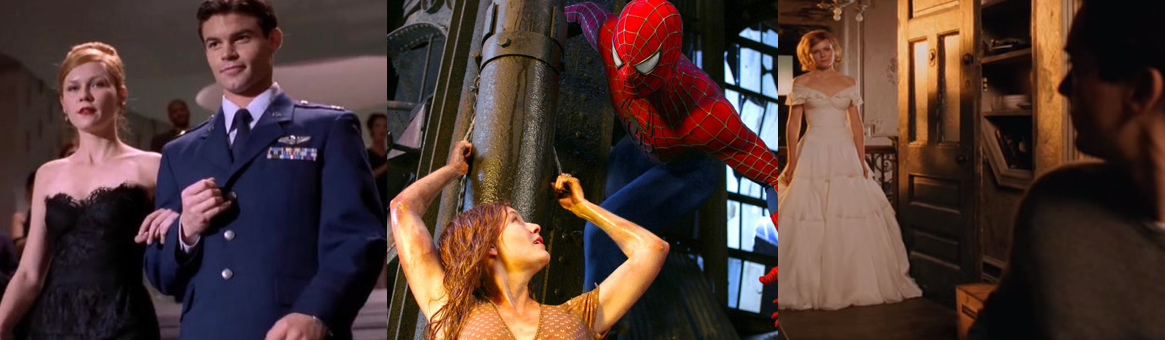
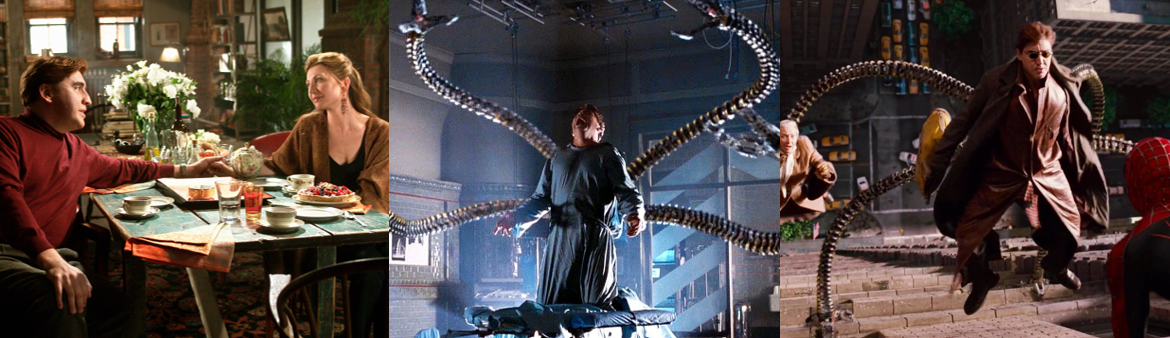
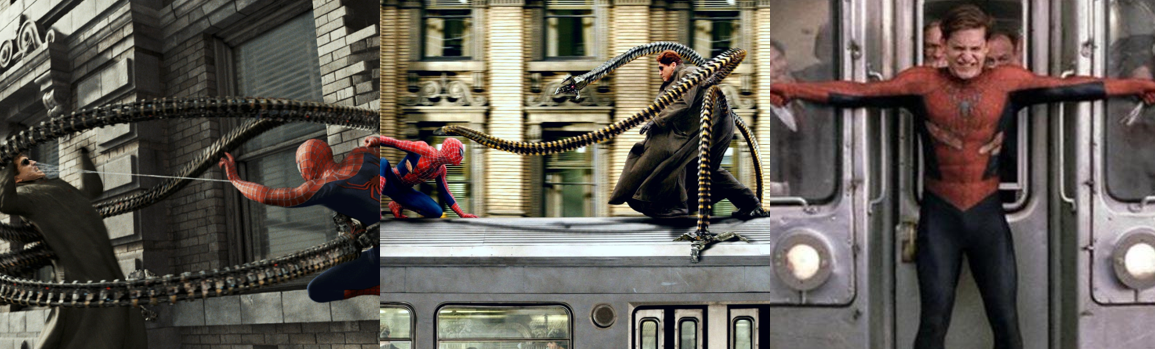
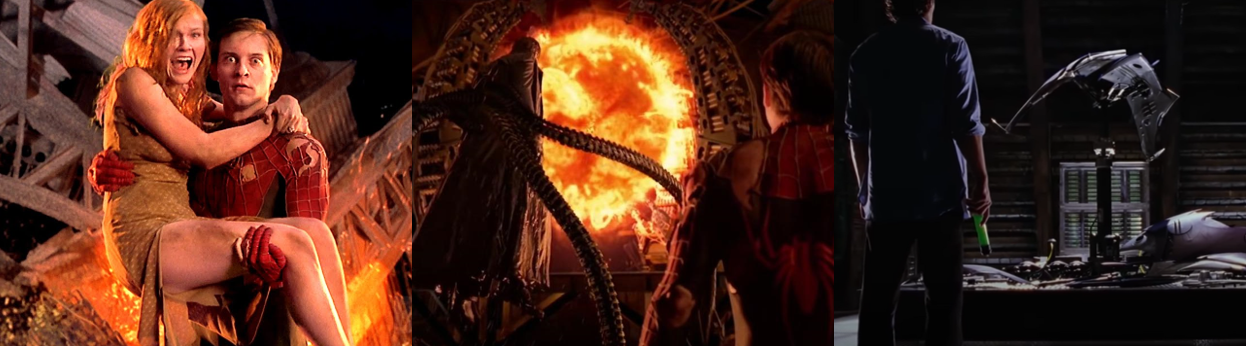
Game Corner [Spidey Month]: Spider-Man 2 (PlayStation 2)


Easily Marvel Comics’ most recognisable and popular superhero, unsuspecting teenage nerd Peter Parker was first bitten by a radioactive spider and learned the true meaning of power and responsibility in Amazing Fantasy #15, which was first published in August 1962. Since then, the Amazing Spider-Man has featured in numerous cartoons, live-action movies, videogames, action figures, and countless comic book titles and, in celebration of his debut and his very own day of celebration, I’ve been dedicating every Saturday of August to talk about everyone’s favourite web-head!


Released: 28 June 2004
Developer: Treyarch
Also Available For: Game Boy Advance, GameCube, Mac-OS X, N-Gage, Nintendo DS, PC, PlayStation Portable, and Xbox

The Background:
Back in the day, it seemed like every single cinema release was accompanied by a videogame adaptation, whether they warranted it or not. Naturally, considering his popularity, Spider-Man has a long and varied history with videogame adaptations across numerous platforms, and developers Treyarch began development of a tie-in to Spider-Man 2 (Raimi, 2004) soon after the success of the first movie. No strangers to the wall-crawler, Treyarch sought to dramatically improve upon their previous efforts by incorporating a large populated recreation of New York City, expanding on the film’s story, and placing a heavy emphasis on Spider-Man’s web-slinging. The new system, which utilised ray casting to automatically map infinite points where players could attach webs to swing from, was developed by designer Jamie Fristrom and has long been the subject of praise amongst fans of the videogame, and the character. Indeed, Spider-Man 2 has been met with a surprising amount of positivity for a videogame tie-in; while some of the more repetitive aspects were criticised, reviews praised the combat and controls, seamless open world and mission variety, presentation, and even the minigames. Even in the face of its bigger, more graphically impressive successors, Spider-Man 2 is often lauded as one of the character’s greatest videogame outings; the praise for this game is so great that I was actually a little intimidated to try it out for this review, which is my first time actually playing it.

The Plot:
Two years after the events of the first game, Peter Parker is struggling with his personal life and his responsibilities as the superhero Spider-Man. Unable to ignore the threat posed by criminals and supervillains alike, Peter’s social life begins to suffer, but his powers are put to the ultimate test when renowned scientist Doctor Otto Octavius becomes a four-limbed madman and threatens the entire city!

Gameplay:
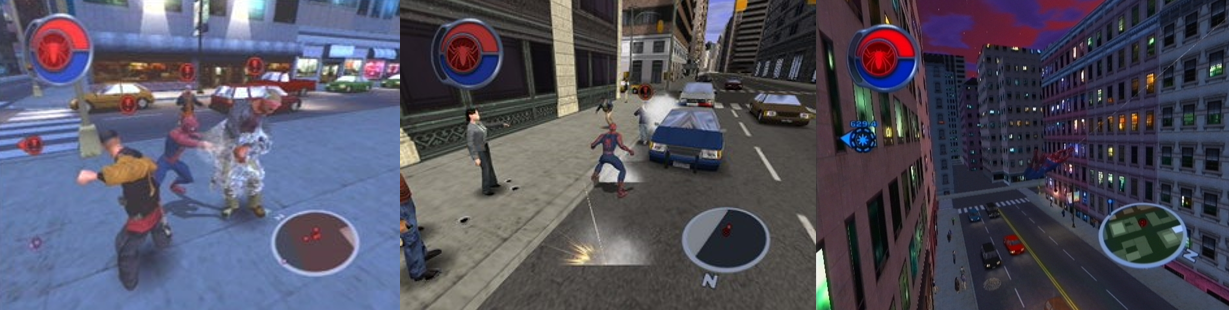
In a change of pace from its predecessor, and basically every Spider-Man title released up until that point, Spider-Man 2 is an open-world adventure in which you’re given free reign to use all of Spider-Man’s amazing abilities throughout one of the largest and most faithful digital recreations of New York City ever seen at that time. Unlike the previous game, which was basically a reskinned version of Neversoft’s fun but limited 2000 adaptation of the web-slinger, Spider-Man is hardly ever trapped in an enclosed environment and thus a primary focus of Spider-Man 2 is on swinging around the city, stopping random crimes and helping non-playable characters (NPCs) with various issues. Thankfully, Spider-Man is more than equipped to handle everything the game has to throw at him, and the controls and combat options have been revised to accommodate this new focus. Spider-Man can attack enemies or interact with objects and NPCs with the Square button; successive presses in conjunction with directional inputs and the Triangle and Circle button will see him pull off combos, often involving webbing and tossing his enemies, and you’ll awkwardly home in on the nearest enemy when in air combat as well. You can stick to walls by pressing Circle, which is also used to evade incoming attacks and bullets whenever Spider-Man’s spider sense goes off (as indicated by his glowing head); this also fills up your “Spider Reflexes” meter and allows you to execute a counter attack but I found evading (and the combat in general) to be a little clunky and haphazard at times, especially as even New York’s most common thugs can take quite a beating and even block against your attacks. Triangle shoots a web; holding the button will temporarily tie enemies up, pressing up and Triangle fires a ball of impact webbing, and you can even use your webs to disarm foes, though it’s next to useless against most bosses and mechanical enemies. Spider-Man jumps with X; pressing it twice performs a double jump and you can hold the button to charge a big jump and executing a jump at the apex of a web sling is crucial to covering vast distances when swinging about. Holding down L2 sees Spidey spring or get a boost to his swing, Triangle (and in conjunction with Circle) will allow you to pick up injured NPCs or grapple thugs, and you can press down to lock-on to nearby targets.

Combat is much improved but the highlight of the game was the ground-breaking web-slinging.

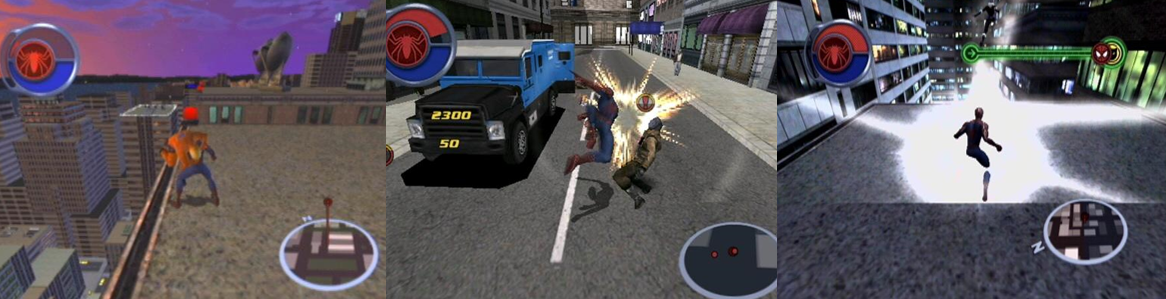
Once the aforementioned meter has a bit of blue in it, you can press L1 to activate your Spider Reflexes, which effectively functions as a form of bullet time, slowing down the action until the meter depletes or you press L1 again and allowing you to better dodge and attack enemies. The meat and potatoes of the game, though, is in the web-slinging; the game offers two options for this, “Easy Swinging” and “Normal Swinging”, with the latter requiring more input from the player to direct Spider-Man’s swings. Either way, R2 sees you throwing a web and swinging through the city but, unlike in every other Spider-Man game before this, you can only web-sling when there are buildings or suitable purchase holds nearby. This means you’ll see Spider-Man veer to the left or right as he shoots webs at the nearest building and allows for the most realistic and innovative web-slinging ever seen. Spider-Man can also eventually web-zip by pressing L2 and R2 together to quickly cover flat distances and you can easily speed through the skyscrapers by attaching to buildings and gaining extra height with your jumps, though you can’t clamber up your web as you swing as in other games, which can make chasing through the city a bit frustrating at times. Equally annoying are the number of dead ends and the various heights of the city’s buildings, which can interrupt your flow; thankfully, the onscreen mini map is a great help for getting around and spotting crimes in progress, side missions, and directing you towards your next story-based objective. You can review these at any time from the pause menu and expand the map out by pressing ‘Select’; this displays the current time and all landmarks and places of note, but sadly doesn’t include the option to place waypoints so you still have to manually read the map and follow the onscreen indicators to get to objectives. Spider-Man 2 is split into chapters, beginning with a simple and in-depth tutorial where Bruce Campbell’s disembodied and snarky voice teaches you the fundamentals of gameplay. To progress through the story, you need to complete story-based objectives; generally, this amounts to following the compass to a certain place in the city to advance the story or confront a boss, but you’ll also need to earn “Hero Points” and acquire new abilities from the various shops dotted across the city.

There’s always someone in peril, or a crime to stop, or a race to be had.

Hero Points are earned from stopping crimes, rescuing civilians, completing time trial races, and other similar distractions; it’s a bit annoying that the game effectively grinds to a halt while you work to obtain the required Hero Points, but you get a fair amount for each side quest you complete and it’s not as if you’re short on things to do. It seems someone’s being mugged or needs help every thirty seconds, and you’ll often stop a burglary only for a child to lose their balloon across the street or an armoured car be attacked a block over. Sometimes, you’ll help an NPC only to be jumped by a gang of thugs in a sneak attack; other times, criminals will hijack vehicles to make a quick getaway and you’ll need to chase them down and land on top of the car, which can be tricky unless you lock-on to it. Once on the roof, you need to pound away with Square and dodge their bullets with Circle until they’re forced out for a fistfight and, as the story progresses, you’ll find burglars and shoot outs often culminating in one of these chase sequences. You’ll also run into Felicia Hardy/Black Cat numerous times throughout the story; each time you do you need to chase after her as she leaps and grapnels around the city, which can be aggravating as she makes erratic turns and it’s difficult to stay on the rooftops. Similarly, you’ll need to chase after Dr. Octopus when he makes an escape in a helicopter and can take on timed challenges where you must race through rings, and the game’s pretty unforgiving, slapping you with failure if you even remotely fall behind or stay too far. More often than not, you’ll face a timer as you race to story-based locations, with the final race to Dr. Ock’s lair being the tightest of them all, or be asked to deliver pizzas and swing over to specific points on the map or skyscrapers to automatically take pictures, or will have to quickly crawl up buildings to rescue civilians in danger or falling, or quickly take injured civilians to the hospital. There’s quite a lot to do in this regard, and it’s fun to pop over to the Daily Bugle and change to Peter Parker in the men’s toilets, but the variety of these side missions soon wears thin as you repeat the same cycle of requests over and over but with more enemies or a tighter time limit.

Graphics and Sound:  
It’s obvious that a lot more time and effort went into Spider-Man 2 compared to its predecessor; most videogame tie-ins suffer from a rushed development schedule, and this is often reflected in their length, variety, and presentation but Spider-Man 2 does pretty well in all three regards. Spider-Man’s character model is much improved compared to the last game, with far more animations when he’s web-slinging and battering crooks on the streets; Spidey even runs along buildings when he swings close, can perform a variety of mid-air tricks with well-timed jumps, and NPCs will even automatically dodge out his way and throw insults at him when he runs or swings through the streets. Sadly, the enemy models and NPCs don’t fare nearly as well; you’ll see the same polygonal faces and voices repeated over and over, but it’s hard to begrudge this as this was symptomatic of the games of this era. What I can’t defend, however, is the soundtrack and voice acting; once again, the game opts for a soundalike to Danny Elfman’s iconic Spider-Man score that just doesn’t work as well and suffers from awkward looping or disappears entirely for no reason. Only a handful of the movie’s actors returned to voice their polygonal counterparts as well; while Alfred Molina continues to shine as Dr. Octopus, both Tobey Maguire and Kirsten Dunst sound bored to death recording their lines, though I did enjoy that Spider-Man throws quips and monologues to himself as you play. When the character models are used for in-game cutscenes, the game also falls apart under close scrutiny, though the higher quality cinematics fare much better, despite the rubbery appearance of the models, and I liked how the film’s events were recreated but also altered and expanded upon here, even if sub-plots like Peter losing his powers were dropped.

It’s lucky for the ropey cutscenes and voices that the digital recreation of New York is so good.

Naturally, the game’s biggest selling point is the sprawling and bustling recreation of New York; all the landmarks you associate with the city are present and accounted for, alongside recreations of locations from the films such as Peter’s apartment, the Daily Bugle building, Dr. Octopus’s pier lair, and the pizza parlour (though relocated and redesigned here). Not only can you web-sling across the city without any noticeable slowdown or load times, the game also includes a day and night cycle and the story is geared towards pushing you to visiting new areas, such as Roosevelt Island, the Statue of Liberty (accessible only by hitching a ride on a helicopter or using Mysterio’s UFO-like drones), Central Park, and Oscorp. 90% of the game takes place outside amidst the city skyscrapers; traffic and pedestrians mingle around down below, crime is rampant, and the enemies you encounter even change as the story progresses. While you can only enter a handful of buildings, those that you can offer some rewards, such as interacting with the Daily Bugle staff for tasks or purchasing upgrades. The handful of other times you’re forced into a warehouse or an open-air stadium, it’s for a close-quarters boss battle or to take on one of Mysterio’s challenges, meaning the only interior of any real note is Mysterio’s madcap “funhouse” that sees you venturing into a hall of mirrors and through upside-down environments. The thrill of swinging through New York is definitely palpable but I’d be lying if it doesn’t lose its appeal pretty soon; with no options for fast travel and only one real collectible on offer, there’s not really much to see beyond the digital recreation of the city or to do beyond stopping the same crimes over and over.

Enemies and Bosses:
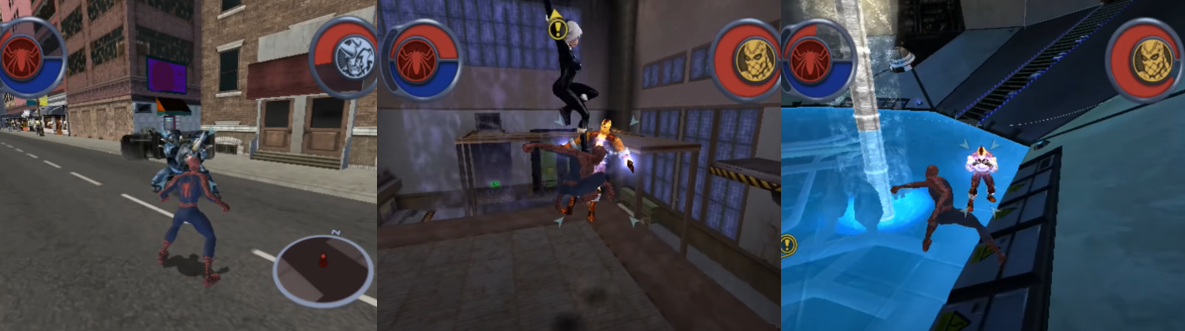
As you swing about the city in your colourful underoos, a gaggle of the dregs of society will inevitably crawl out of the woodwork to cause trouble in the streets. New York is rife with purse snatchers, bank robbers, and armed gangs who love to rob armoured cars and get into shoot-outs with the cops or hijack passing cars and you’ll get to beat the ever-loving piss out of them all multiple times. Most enemies you encounter will simply try to bash your head in, but others have crowbars and bats or can guard against your attacks, requiring you to execute a counter after dodging their attacks. The worst are those armed with guns as Spider-Man doesn’t do too well when riddled with bullets, so it’s best to either disarm them, web them up, or try to take them out early, which can be easier said than done when you’re literally surrounded by enemies on all sides. Eventually, New York will also be attacked by Mysterio’s robotic drones, which fly about the place and blast at you with lasers; these can be tricky to hit as mid-air combat is actually less refined than in the previous game in many ways, though that weird homing function comes in handy here. Herman Schutlz/The Shocker’s goons also end up terrorising the citizens as well, firing high velocity blasts to send you flying, and all of the game’s enemies except the robots can take quite a beating before they go down. You’ll also have to contend with three mech-wearing goons in one particular mission that sees Spidey and Black Cat gate-crash an auction. This mission is one of the game’s toughest, on paper, due to the sheer number of bullets, enemies, and explosions happening all around you but an easy way to get past it is to simply swing about back and forth overhead; eventually, the mechs will take each other and most of the other enemies out, leaving you to pick up the scraps.

After tangling with the Rhino, Black Cat lends a hand in two annoying battles with the Shocker.

Disappointingly, though, Spider-Man 2 only contains four actual bosses, but you’ll face some of them more than once, at least. The first one you battle is Aleksei Sytsevich/The Rhino as he’s in the middle of a bit of thievery; the Rhino is too powerful to take on head-first so you need to rapidly tap Circle to avoid his swings or dodge his charge, both of which will leave him dizzy and vulnerable to a good pummelling. Instead of fighting Black Cat, you’ll chase her across the city (so many times that it got legitimately annoying for me) to encounters with the Shocker, who you’ll battle twice alongside Black Cat. The first fight takes place inside a warehouse and sees the Shocker blasting himself about the place, constantly staying on the move and making himself a difficult and annoying target. When you do get close to him, you only have time to rattle off a quick combo before you need to get the hell away from him to avoid his huge concussive blast, which sends you flying. The Shocker’s blasts are also used to keep you at bay, he shrugs off your webbing, and is joined by some goons in this fight, which quickly becomes laborious because of the hit and run tactics. Sadly, you’re forced to repeat these in the second encounter, which takes place in an even smaller, enclosed arena where the Shocker is protected by a shield. You need to head up top, dodging his blasts when your spider sense goes off, and activate whatever console is opposite from the one Black Cat is at to lower his shield. These weird blasts of water (or energy, I couldn’t tell) form platforms in the middle of the arena, giving the Shocker the high ground, but the same strategy as before is needed to whittle his health down. Eventually, Black Cat will shut his shield down for good, meaning you’re on the home stretch, but she doesn’t really seem to actively do damage to him when she’s attacking him.

Mysterio’s “tests” prove to be frustrating test of your patience.

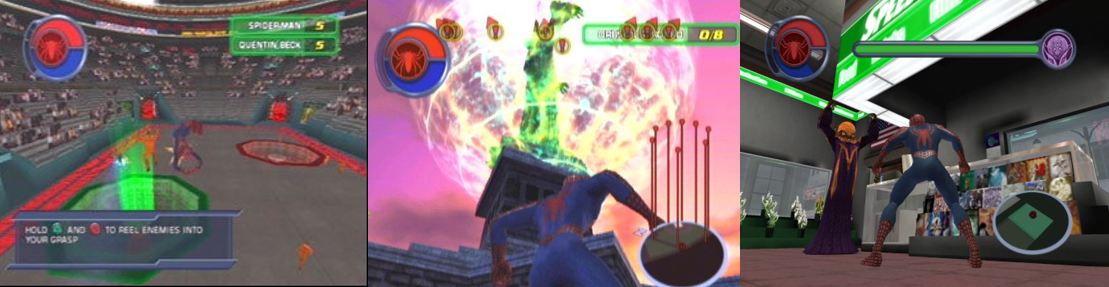
Easily the game’s more persistent enemy is Mysterio; when you first face him as plain old Quentin Beck, he challenges you to a series of “games” in an effort to prove Spidey’s a fraud, which involves you grabbing and tossing goons into green highlighted pits faster than him in a game of human basketball and then clambering about on elevated, moving, and twisting platforms trying not to get hit by his laser cannon. The second time, he swarms New York with his UFO-like drones and takes hostages at a theatre; this was an annoying section as you have to fend off his drones, watch out for a flaming floor, and battle a brief time limit to rescue everyone there but it’s nothing compared to when he encases the Statue of Liberty in an elaborate mechanical construction to resemble an alien attack. I was tearing my hair out at the finnicky controls as I webbed my way over the Lady Liberty and fell countless times into the water to be washed ashore and have to start all over, and near enough lost my rag when tasked with destroying the eight orbs surrounding Mysterio’s machine to expose the “brain”. Eventually, I was somehow able to gain enough height to get up there and take them all out and then get up to where the brain is before the orbs could respawn and dispel the illusion, but it was a pain in my ass, for sure. Afterwards, you track Mysterio to his apartment and hidden funhouse lair, where you have to fend off a swarm of twisted Spider-Man clones to find a hidden exit in his hall of mirrors and shut down his hologram. Finally, Mysterio shows up in the flesh later in the game to rob a deli; this was actually really amusing as the game loads in this ridiculously long and layered health bar and makes it seem like it’s going to be this long and epic showdown but all you have to do is punch him once and Mysterio folds like a paper plane.

Thanks to his thrashing limbs and raging machine, Doc Ock proves an aggravating and formidable foe.

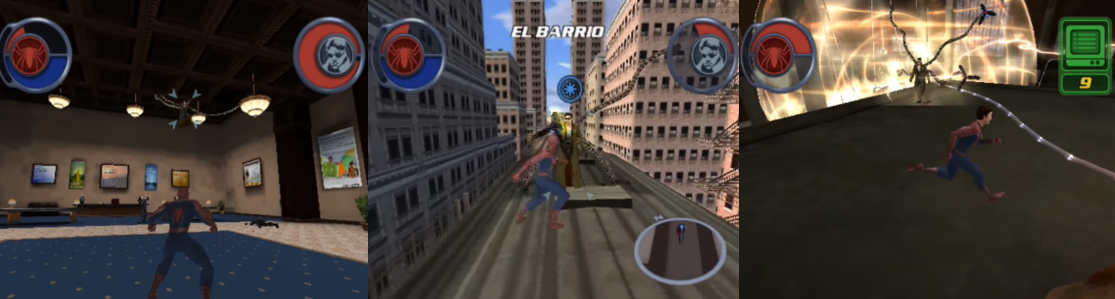
Finally, there’s the main man himself, Dr. Octopus, who you encounter four times throughout the game. The first encounter is during the mishap with his fusion experiment and is one of the most frustrating parts of this or any other game; the reactor is going crazy, sending out intermittent energy bolts that you must dodge the second your spider sense goes off as these pulsating waves of energy that not only do massive damage (three hits is usually enough to kill you) but send you flying across the screen! Through a combination of luck, timing, and the patience of a saint, you need to dodge past all this shit and hit four consoles to power the machine down, but this almost had me rage-quitting right then and there. Next, you’ll fight Dr. Octopus and his grenade launching goons at the bank, which establishes the strategy you’ll need to best him in all encounters; you need to dodge his tentacles and then quickly fire a web to pin each one down and leave him vulnerable to attack, but this is very hard to do and he’s easily able to grab you, slam you about, toss you around, and beat you to death in just a few hits. After chasing his helicopter and rescuing Aunt May from the train tracks, you’ll battle Doc Ock on the roof of a train just like in the film…eventually, because first you need to battle the game’s controls and camera to actually get on the damn train! Here, it’s more of the same and actually a little easier than the last encounter except for the fact that Doc Ock can toss you off the train if he grabs you. Finally, it’s the worst of both worlds at his pier lair as Doc Ock relentlessly chases you, protected by a shield generated from his rampaging machine and able to spam-beat you to death in the blink of an eye if you don’t constantly keep moving, dodging, and webbing him up. You need to deactivate nine consoles scattered about the lair, with one high above and one down below near the instant-death water, all while avoiding the electrical bolts, the thankfully less damaging but no less annoying energy waves, and Doc Ock himself. Once you finally take care of that, you’ll go one-on-one with him again where you’ll need to be super fast on the dodge and webs to stop his relentless thrashing tentacles and avoid being tossed into the aforementioned water, but once you land a good few combos he finally goes down for good.

Power-Ups and Bonuses:
In the spirit of the movie upon which it is based, Spider-Man has an infinite supply of webbing in Spider-Man 2 so you never need to worry about collecting extra web cartridges, though the game does lack some of the fancier web-based moves potentially as a result of this. Every time you defeat a wave of enemies in side missions, they’ll drop some health to fully restore your health bar, but these won’t be present in boss encounters, which can make them all the more frustrating. Additionally, while there are “secrets” to be found around the city, they simply grant a few more Hero Points so there’s no pick-ups to boost Spidey’s abilities. Instead, you’ll gain new buffs, tricks, combos, and such by spending Hero Points in the many shops scattered around the city; these increase the speed of your swing, add fancy moves to your jumps, and add a little more flourish to your combos but I found little use for most of them and got along pretty well just mashing Square and peppering in the odd Circle and Triangle here and there.

Additional Features:
As mentioned, there are many secrets dotted around the city; these are pretty hard to find, and I only stumbled upon three or four by chance but they do allow access to a couple of new moves. There are also some races and timed challenges you can take on for more points, and which probably count towards you achieving the list of “Awards” offered by the game (though most of these are story-based). Although there are some options available to you to change the game’s display, sound, and control scheme, there are no difficulty settings here, no costumes to unlock (though you do get to play as Peter and unmasked Spidey in the story), and no additional characters or modes to unlock or play as even using cheats. The best on offer here is a code to award you a bunch of Hero Points and upgrades, making this a significant step down not just from the last game but Neversoft’s previous efforts with their many additional costumes and modes. However, after you clear the game, you’re dropped back into a free roaming mode and are free to stop crimes until the end of time across the city; you can also purchase access to the Battle Arena where you can not only battle the game’s bosses in endurance fights but also face off with a secret additional boss, Calypso Ezili/Calypso, though I’ll leave it up to you to decide if this is actually worth your time.

The Summary:
All I’ve heard since 2004 is how great Spider-Man 2 is; it either tops or is included in so many “best of” lists for videogame tie-ins and superhero videogames that I knew I had to get it once I started building my PlayStation 2 library, even though I am primarily against videogame tie-ins unless I’m trying to increase my Gamer Score. The difference between this and the last game, and other Spider-Man games before it, is immediate and reinforced throughout; the sheer size of New York City and the number of crimes to stop is very impressive for the time and never before has a videogame so perfectly captured the rush of being Marvel’s famous web-slinger. The drama and crime even interrupts the story on numerous occasions, really throwing you into Spidey’s troubled shoes, and the web-swinging mechanics definitely live up to all the hype. The versatility and accessibility of swinging through the city was unparalleled at the time and perfectly recreates the speed and exhilaration of the web-slinging seen in Sam Raimi’s films. Sadly, the combat doesn’t really live up to this, being clunky and oddly unbalanced at times even when you manage to land a dodge and a counter. Naturally, character models and cutscenes haven’t aged too well, but I can forgive that; what I can’t forgive is how empty, repetitive, and frustrating parts of the game can feel. It’s great having all of New York to explore, but there’s not a lot to see and you’ll be stopping the same crimes over and over, which can get very old very quickly. I would’ve liked to see comic book covers and other collectibles scattered about to unlock costumes and concept art, but there’s none of that here, meaning there’s little incentive to explore. The few bosses there are can also be annoying; I got so sick of chasing after Black Cat, being tossed about like a ragdoll by the Shocker and Dr. Octopus’s bloody machine, and being mullered by bullets, to say nothing of that God-awful encounter with Mysterio at the Statue of Liberty. The game was also a lot shorter than I was expecting, with the gameplay padded out by the story forcing you to acquire Hero Points to load in the next chase, battle, or cutscene, and I found myself just feeling relieved when the game was over. Overall, I can certainly see why the game was so beloved at the time and is so highly regarded; it still holds up pretty well, despite some obvious flaws, and was the most immersive Spider-Man game at the time, but it’s obviously been overshadowed by better, more polished Spidey title sin the years since.

My Rating:

Rating: 3 out of 5.

Pretty Good

Have you ever played this beloved tie-in game? What did you think to the open-world gameplay and web-slinging mechanics back in the day? Do you think Spider-Man 2 still holds up today or were you also frustrated by some of its more tedious features? What did you think to the battles against Mysterio, the chases against Black Cat, and the encounters with the Shocker? Were you disappointed by the lack of unlockables and additional gameplay options? Which Spider-Man videogame or movie adaptation is your favourite? Head down below to share your thoughts and memories of Spider-Man 2.

Movie Night [Spidey Month]: Spider-Man 2.1


Easily Marvel Comics’ most recognisable and popular superhero, unsuspecting teenage nerd Peter Parker was first bitten by a radioactive spider and learned the true meaning of power and responsibility in Amazing Fantasy #15, August 1962. Since then, the Amazing Spider-Man has featured in numerous cartoons, live-action movies, videogames, action figures, and countless comic book titles and, in celebration of his debut and his very own day of celebration, I’ve been dedicating every Saturday of August to talk about everyone’s favourite web-head!


Released: 17 April 2007
Originally Released: 30 June 2004
Director: Sam Raimi
Distributor: Sony Pictures Releasing
Budget: $200 million
Stars: Tobey Maguire, Alfred Molina, Kirsten Dunst, James Franco, J. K. Simmons, and Rosemary Harris

The Plot:
Although he has saved countless lives as Spider-Man, Peter Parker’s (Maguire) personal life is falling apart due to his double life. Lovesick for Mary Jane Watson (Dunst) and tormented with guilt, Peter’s powers begin to fail him just as he faces his greatest challenge yet when renowned scientist Doctor Otto Octavius (Molina) becomes a four-limbed madman following a freak accident. When “Doctor Octopus” endangers lives, Peter is forced to reconcile his two lives in order to save the city, and the woman he loves, once again.

The Background:
Fittingly, given that his debut issue became one of Marvel’s best selling titles at the time, Spider-Man became so popular that he was ideally placed as Marvel Comics’ flagship character; the wall-crawler starred in numerous team-up titles, videogames, cartoons, and even a live-action series in the seventies, but his cinematic debut was constantly delayed by script and legal issues. Thankfully, director Sam Raimi and Sony Pictures Entertainment finally brought the character to life in Spider-Man (Raimi, 2002), which was an incredible critical and commercial success, but, while a big-budget sequel was almost immediately greenlit by the studio, Spider-Man 2 nearly underwent a major recast after star Tobey Maguire suffered a back injury. Although Jake Gyllenhaal was pegged to replace Maguire in the title role, Tobey recovered and returned to the franchise, which saw him go up against Alfred Molina as Doc Ock. A big fan of the comic books, Molina was excited to win the role and threw himself into it, relishing the chance to play a sympathetic villain with a sardonic sense of humour and even naming and playing pranks with his four prosthetic limbs on set.

After decades of legal issues, Spider-Man’s big-screen debut was a massive success.

Doc Ock’s arms were created by Edge FX and were a mixture of practical puppetry and visual effects. To improve upon the first film’s web-slinging antics, a specially-constructed “Spydercam” was employed to zip through the city and more accurately create the illusion of speed and excitement throughout the entire film, rather than just the final swing sequence. Following a number of script ideas, Raimi worked closely with the screenwriters to alter Doc Ock into a more sympathetic figure and to incorporate elements from the classic “Spider-Man No More!” (Lee, et al, 1967) story. Considering that Spider-Man 2 is often regarded as one of the greatest superhero movies ever made, and far exceeded its predecessor in terms of storytelling and visual effects, the film actually made less than the first at the box office (though a $789 million worldwide gross is anything but a failure!) Critics heaped praise upon the film; Molina, especially, was highlighted for his magnetic performance and the engaging plot regarding Peter’s personal drama was praised as much as the visual effects. Still consistently cited as one of the best sequels and superhero films ever, Spider-Man 2 was followed not just by a videogame adaptation and a third instalment, but was also re-released on home media (with twenty minutes of additional footage and some alternate cuts incorporated into the film) close to the Spider-Man 3’s (Raimi, 2007) release and Molina would later reprise his iconic role in the Marvel Cinematic Universe.

The Review:
While I remember there being a great deal of hype surrounding Spider-Man, I actually don’t remember the same being true for the sequel; this isn’t to say that it wasn’t massively anticipated by many, myself included, I just can’t really remember it as much as I was a little older and distracted by other concerns at the time. I know the initial trailer hit pretty hard, and it was exciting to see Doc Ock being brought to life, especially as he’s always been my favourite classic Spider-Man foe. Growing up reading the limited comics I had access to and watching the Spider-Man cartoon (1994 to 1998), I’d actually had little exposure to Norman Osborn/The Green Goblin, and it wasn’t until Raimi’s first movie that I fully understood how big an impact Osborn had had on Spidey’s life. Consequently, though, I had always seen the calculating, ruthless Doc Ock as Spidey’s greatest villain; he handed the wall-crawler his first defeat, brought together the Sinister Six, and always seemed to crop up in the comics and videogames I was exposed to (potentially because Osborn was dead at that point). Still, back then, superhero movies were really starting to break through to the mainstream, and Spider-Man 2 was an exciting prospect given how well the first one had gone down, and the film immediately recaptures the feel and atmosphere of the last movie by once again utilising the great Danny Elfman for the opening title sequence (and even catching viewers up to speed using paintings by the amazing Alex Ross to recap key moments of the last movie).

Burdened by the weight of his responsibilities and the stress of his life, Peter’s powers begin to fail him.

As in the first movie, Spider-Man 2 opens with a bit of narration from Peter Parker, who’s in a pretty bad place here; having chosen to walk away from M. J. and live a life of responsibility, forsaking his own selfish needs in order to honour the memory of his beloved Uncle Ben (Cliff Robertson), Peter is tormented by M. J.’s vacant, staring visage from atop a giant billboard and pines for her every day, martyring himself for the choice he was forced to make. No longer living in his childhood home in Queens with his doting Aunt May (Harris), Peter lives in a crummy little apartment in the middle of the city that is cramped, dirty, falling apart, and right next to the train line. The door sticks, there’s a communal bathroom, and he’s constantly hounded by his landlord, Mr. Ditkovitch (Elya Baskin) for rent, which he can barely afford to pay as he has recently lost his job as a pizza delivery boy and is constantly being shafted on payment for his photos of Spider-Man (and other notable events in the city) by Daily Bugle editor-in-chief J. Jonah Jameson (Simmons). While Peter was often angst-ridden and burdened by bad luck (“Parker Luck”, as he called it) in the comics, the whole world is out to get him here; he can’t keep up with his college assignments, people are constantly barging into him, he’s cockblocked by an obnoxious usher (Bruce Campbell), and he can’t even walk out of a supply cupboard without stuff falling on him. The amount of hardship he faces in this one movie is almost absurd, and is equalled only by his desperate pining for M. J.; he desperately wants to tell her the truth but can’t risk endangering her life, and is equally unable to quell Harry Osborn’s (Franco) hatred of Spider-Man to preserve Norman’s memory. Peter’s also still carrying the guilt of having indirectly caused Uncle Ben’s death, and it’s only after sharing this with Aunt May that his outlook begins to change. And just in time, too, as all this stress is not only causing a rift between him and the few friends he has but also cancelling out his spider-powers. Since Tobey has organic webbing, this is an interesting way to do the old “run out of web fluid in mid-air/mid-fight” trope, but the depiction is quite inconsistent; potentially an allegory for sexual inadequacy and clearly a manifestation of his troubles, Peter’s powers only short out when the script says so, meaning he’s denied even the freedom offered from retreating to web-slinging.

Though she has a hunky astronaut, M. J. can’t deny her feelings and chooses Peter after learning the truth.

Just as Peter pines after M. J. on a daily basis, almost to an uncomfortable degree, so too is M. J. constantly distracted by him; Harry claims that she is “waiting for [him]”, but, regardless of his love for her, Peter continues to keep her at arm’s length and to avoid discussing his feelings for her. Although she’s clearly still in love with him, M. J. is doing a far better job of moving on (or, at least, hiding) from those feelings; she not only has a billboard but has landed her dream job with a part in The Importance of Being Earnest, A Trivial Comedy for Serious People (Wilde, 1895) and even gotten herself a ruggedly handsome astronaut (of all things), Colonel John Jameson (Daniel Gillies). John is barely a character at all and simply there to deliver another gut punch to Peter; M. J. clearly isn’t that into him, despite accepting his proposal, as she’s constantly yearning for Peter and waiting for him to admit his feelings for her. However, she’s also increasingly frustrated by Peter; despite him claiming to be her greatest friend and confidante, he’s been absent and unreliable, and she’s driven to the edge when he breaks his promise to see her play. Otto offers Peter some advice in trying to explain things to M. J., which leads to him awkwardly blurting out random poetry excerpts to her, and he inadvertently ends up alienating her so much that she’s fully prepared to settle for John, even briefly entertaining the idea that she was wrong about Peter and that John is Spider-Man. All of M. J.’s frustrations and concerns are completely swept away once she sees the truth she’s known all along and Peter clearly explains that he can’t risk being with her because of his responsibilities, but she ultimately chooses to face those dangers with him so that they don’t have to deny themselves. M. J. is a bit underwhelming here, to be honest; I’ve never really been a big fan of Dunst in the role and, while she has a feisty side, the script doesn’t really do her character any favours. It gets a bit worse in hindsight as she blows up at Peter in the next film for kissing a girl but she’s here making out with (and presumably having sex with) her hunky boyfriend, while trying to coax the truth out of Peter instead of just demanding that he be honest with her. She also ends up as a screaming hostage once more, and it’s telling that even Aunt May has more fight in her when captured by Doc Ock than the object of Peter’s affections.

Harry, consumed with vengeance, is stunned to discover Peter and Spider-Man are one and the same!

Peter’s life is further complicated by his strained relationship with Harry; despite struggling through school in the first film, Harry has done pretty well for himself in the intervening time, becoming head of special projects as OsCorp and funding Otto’s fusion research in a bid to live up to (and surpass) his father’s lofty ambitions. However, having seen Spider-Man with his father’s body at the conclusion of the first film, Harry assumes that Spidey killed his dad and has been harbouring a deep-seated vendetta against the wall-crawler ever since. Even when Spider-Man saves his life, Harry isn’t swayed in his opinion, and his lust for revenge even drives him to turn against Peter in a bitter, drunken rage in one of the film’s most dramatic and upsetting moments. An extended scene included in this version sheds a little more light on Harry’s mindset, as he believes that Peter either knows who Spider-Man is or is protecting him from reprisals since he earns money from the masked vigilante, and he compares his desire to see Spider-Man dead to the bloodlust Peter must feel towards the man who killed Uncle Ben, thus painting Harry as a dark mirror of the titular hero. Frustration and grief get the better of Harry after Otto’s experiment is a disaster, and he unleashes a vicious, heart-breaking tirade against his best friend for choosing his livelihood over his best friend. Harry’s obsession only grows when Spider-Man is believed to have quit after his discarded costume is discovered, and he’s so consumed by vengeance that he partners with Doc Ock to draw Spider-Man out by having him target Peter in exchange for supplying the mad scientist with the Tridium he needs to complete his fusion experiment. With Spider-Man helpless before him, Harry prepares to deliver the killing blow and is stunned into a near maddening disbelief to find his best friend behind the mask, shattering his perception of reality and the people around him and leaving him susceptible to the manipulative influence of his father’s vengeful spirit.

A science experiment gone awry transforms kindly Dr. Octavius into the twisted, sardonic Doc Ock.

Of course, Spidey’s most tangible threat in the film is Doc Ock himself; beginning as a kindly mentor and hero of Peter’s, Otto is a far cry from the malicious, power-hungry mad scientist from the comic books. Although initially reluctant to interrupt his work by entertaining Peter’s questions, especially given he’s aware of Peter’s assumed laziness, Otto quickly finds a kinship with Peter based on their mutual appreciation for science. A likable, fatherly figure, Otto is absolutely besotted with his beloved wife, Rosie (Donna Murphy), and emphasises to Peter the importance of using his great potential and intelligence for the good of mankind. Despite his unparalleled scientific mind, Otto is also a romantic at heart and encourages Peter not to bottle up his love and emotions lest they make him sick, though both he and Rosie stress that love requires a lot of hard work from both parties. Otto’s life work is to provide the world with clean, renewable energy using a Tridium-based fusion reaction; Otto is so convinced of the safety and importance of his experiment that he generates an artificial sun in the middle of New York City, confidant that his four mechanical limbs will allow him to stabilise the resultant reaction and give him his moment of glory. Of course, everything goes hideously wrong when his machinery malfunctions, which not only results in Rosie being killed but Otto’s mechanical appendages being fused to his spinal column. Awakening in a confused state, Otto finds himself susceptible to the arms’ artificial intelligence after his inhibitor chip is destroyed; as they’re programmed to create and stabilise the experiment, the arms influence him towards robbing banks and committing crimes to rebuild the reactor at an abandoned pier rather than drown himself in the river in his grief. Christened Doctor Octopus (“Doc Ock”) by Jameson, Otto becomes a twisted, power-hungry maniac who completely abandons all of his former principals and puts innocent lives in danger thanks to the influence of his arms. He not only tries to kill a train-load of New Yorkers but even takes Aunt May and M. J. as hostages and battles Spider-Man with a devious glee, constantly frustrated by the web-slinger’s interference and determined to kill him so he can be left in peace. Doc Ock’s story is functionally similar to that of Norman’s in the first film (both were mentor and father figures turned to evil by science), but the execution is unique enough to stand out from his predecessor; he stomps around in broad daylight, his identity is never in question, and his ultimate goal isn’t to prove his physical superiority, but to prove his intellectual superiority and complete his life’s work by any means necessary.

While Jonah delights in Spidey’s misfortune, Aunt May and Ursula offer Peter some much-needed support.

As haunted by M. J. and his many doubts and problems Peter is, his guilt over indirectly causing Uncle Ben’s death basically dictates his entire life. The only reason he’s denying his true feelings is because his interpretation of Ben’s final teaching was that he had an obligation to put his powers to good use, a life lesson that is reinforced by Otto and his position of scientific acumen. However, all of the stress caused by his conflicting duality sends Peter’s power son the fritz; his webs stop firing, he can’t always stay stuck to walls, and he begins wearing his glasses again as his eyesight fails. Concerned for his physical welfare, he consults a doctor, who offers the prognosis that the issue is psychological rather than physical, and, with the weight of the world pressing down upon him thanks to Jameson’s smear campaign, Peter rejects his responsibilities in a dream-like conversation with his uncle’s spirit. Upon being brought Spider-Man’s discarded suit, Jameson is overjoyed that his efforts to besmirch and belittle the wall-crawler have met with success, but he’s forced to admit that Spider-Man was a hero when Doc Ock kidnaps M. J., thus leaving John distraught, though Peter delights in upstaging the cantankerous editor once he gets his shit together. He’s helped in this regard by an honest exchange with Aunt May; given that the film takes place on the two year anniversary of Ben’s death, May is in a fragile place, which is only exacerbated by her inability to keep up the payments on their family home. Burdened by his guilt, Peter shares a version of the truth of that fateful day to her; though initially horrified, she forgives him and stresses the importance of doing the right thing. It’s heavily implied in this exchange that May is aware of Peter’s dual nature and, though neither explicitly admit it, he’s relieved that her encounter with Doc Ock and subsequent rescue from Spider-Man has turned her opinions on the web-spinner around. After giving up his suit, Peter applies himself fully to his social life and academic work, finally earning him the praise of his teacher, Doctor Curt Connors (Dylan Baker), and he later finds some support in Ursula (Mageina Tovah), the daughter of his landlord, who clearly has a crush on him and brings him a moment of quiet reprieve in a moment of absolute despair. This extended cut adds a few additional scenes, most of which are alternate takes and longer sequences that don’t really add too much to the existing story, though one of the most notable additions is a hilarious scene where Jameson hops around his office garbed in Spider-Man’s discarded suit and a discussion between M. J. and her friend where it’s revealed she accepts John’s proposal primarily because of her father’s abusive nature.

The Nitty-Gritty:
Given that it’s a Spider-Man movie, Spider-Man 2 is primarily focused on exploring themes of guilt and the weight of responsibility; Peter drives himself into the ground trying to save everyone he can and live up to his uncle’s expectations, to the point where he neglects his life outside of the costume. Not only is he failing at school and to make money, he’s letting everyone around him down, which only adds to his feelings of despair; his friends are starting to resent and distrust him because of his absent nature and, while he’s desperate to do more and to apply himself better, he can’t shake the call to action. Even something as simple as delivering pizzas or getting to the play is interrupted by a disturbance of some kind, whether it’s kids playing in the street or a high-speed car chase, and Peter doesn’t even let himself relax when he’s in his crummy apartment as he sits there tuning into the police radio band to find ways for him to help. This ever-mounting struggle to find the right balance between his wants and his responsibilities is the primary cause for his failing powers; losing his webs, wall-crawling, spider-sense, and strength only adds to Peter’s confusion and frustration as the freedom afforded to him by being Spider-Man also becomes a closed door. Once he decides to quit, that weight is immediately lifted but his brief moment of happiness is shattered when he’s unable to save a life from a house fire, thus hammering home that he is capable of great things and thus must exercise great responsibility.

Both Spider-Man and Doc Ock look fantastic, and Ock’s arms make for exciting fight sequences.

Surprisingly, Tobey’s spider-suit is basically the same design as before; normally, superhero sequels go out of their way to change the character’s costume to make more toys but, aside from popping a little more and a few tweaks to the mask, muscle suit, and other minor details, it remains consistent with the first film. Thanks to the movie not having to spend an hour or so setting up Peter’s origin, we get much more Spider-Man action here and the aforementioned Spydercam really delivers some dynamic web-slinging shots. As ever, Peter has an annoying tendency to lose or remove his mask so that we don’t miss out on the emotional impact scenes and events have on him; this is, as always, hit or miss as Tobey favours a vacant, doe-eyed stare throughout most of the film and the regularity that he is unmasked gets ridiculous at times, regardless of how dramatic or thematically relevant these scenes are. While audiences will forever decry the Green Goblin’s outfit in the last film, I don’t think I’ve ever seen anyone complain about Doc Ock’s depiction here; garbed in a trench coat, hat, and glasses, Doc Ock cuts a simple but intimidating figure and it really is impressive how Molina projects the weight and movement of his mechanical limbs. The arms are extremely versatile, able to stretch out and grab things in their claws, light Ock’s cigar, and even sporting a nasty looking spear-like appendage. While Otto can control and influence the arms, the destruction of the inhibitor chip allows them to act independently of him, but their goal is not only to create and sustain a fusion reaction but also to protect Ock at all costs. Swinging and whipping everywhere, the tentacles cause Spider-Man a great deal of difficulty in getting to Doc Ock and make him a constant threat as they can perform multiple tasks and endanger many lives all at once. One of their most memorable sequences is when they lash out while Otto is unconscious, slaughtering the doctors that try to remove them in scenes that harken back to Raimi’s time as a horror filmmaker as we see fingernails being ripped off and screaming bodies being tossed all over the place. Indeed, Rosie’s horrific death (though not seen onscreen it’s pretty clear she was practically decapitated) and many shots of the arms are created using practical effects, puppetry, and first-person perspectives just like those seen in his Evil Dead films (Raimi, 1981 to 1992) and their threat is matched by Otto’s obsession with holding “the power of the sun in the palm of [his] hand”.

Spider-Man and Doc Ock’s battles are a spectacle, and Spidey performs incredible feats to save lives.

The versatility of Doc Ock’s arms really do make for some of the best fight sequences in any Spider-Man film; despite the armaments and manoeuvrability of the Green Goblin’s glider, Spider-Man’s fights never really kicked into that higher gear as the filmmakers were still working out how to create the special effects necessary to shoot these sequences (something that the third film greatly improved upon), but Spider-Man 2 more than makes up for this with scenes depicting Spider-Man and Doc Ock battling up the sides of buildings and on top of a speeding train. While it’s true that any one of Spidey’s repeated blows to the non-superpowered Doc Ock should have immediately ended the multi-limbed menace, I can forgive this as it’s really exciting to see Spidey have to dodge and flip around the tentacles and fight through them while on the side of a building or whipping around a bank. I can also forgive the convenience of Doc Ock robbing the same bank that Peter and May happen to be at because it leads to him clambering up the sides of buildings with May and his bags of loot, tossing better (and more sadistic) quips than Spider-Man himself, and showing just how dangerous and adaptable his mechanical limbs are as they can hoist him up, absorb impact damage, and deflect Spidey’s blows at every turn. Obviously, the most thrilling action scene is the train sequence, which sees Spider-Man first using his webs to save the civilians Doc Ock causally tosses away, battling him on the exterior of the speeding train carriages, and then using all of his fantastic strength to literally force the out of control train to a stop. Full disclosure, though…I’ve always found this sequence to be a little over the top; the physics and logistics of it seem a little outside of Spider-Man’s range and more like something Clark Kent/Superman would do, but it undeniably makes for a brilliantly dramatic sequence as it shows that Peter will literally push himself to exhaustion and beyond his limits to save lives. The passengers are so grateful to him that they promise not to share that they’ve seen his face, moved by how young and brave he is, and Spidey only adds to his heroic card by basically trading his life for theirs when Doc Ock returns for him.

Thanks to Ock’s sacrifice, the city is saved, but Harry poses a looming threat…

After having a taste of happiness, Peter begins to believe that he can finally offer M. J. his true feelings but, after realising that he can’t deny the great responsibility bestowed upon him, he’s forced to walk this suggestion back and once again pretend that he’s not in love with her. However, his spider powers truly return in full force after Doc Ock inexplicably kidnaps M. J. to force Peter to lure Spider-Man out for a final confrontation. As many have mentioned, it’s damn lucky that Peter is Spider-Man and that his spider-sense kicked in at that exact moment or else Doc Ock’s errant taxicab would have squashed them both and Harry would’ve indirectly killed his two best friends. When he discovers that Peter and Spider-Man are one and the same, Harry is stunned, to say the least, and heartbroken by the belief that his best friend apparently killed his father. However, Peter manages to convince Harry to reveal Doc Ock’s location in order to rescue M. J. by stressing that there’s more at stake than their personal problems (though a quick “No, he was a madman who tried to kill me” might’ve gone a long way…) Thus, once again, Spider-Man has to save M. J. from a supervillain, though she’s much sassier here than last time, where she was little more than a screaming wreck. Enraged at Doc Ock’s actions, which not only threaten the entire city but have put first Aunt May and then M. J. in the line of fire, Spidey delivers a massive beatdown, once again taxing himself to the limits to shield M. J. from a falling girder and finally revealed the truth to her after removing his mask again. To be fair, this time Peter voluntarily unmasks in a desperate attempt to appeal to Otto’s humanity; thoroughly beaten, Otto snaps out of his insanity upon seeing the face of his protégé and surrogate son and realises that his arms have perverted everything he once stood for. With the fusion reaction threatening to suck the city into it like an artificial black hole, Otto exerts all of his willpower and humanity in a tragic sacrificial effort to drown the artificial sun and redeem himself, once again delivering a startling message of the dangers of scientific exploration and arrogance to Peter. Despite coming to terms with the fact that he can never be with M. J. as he’ll always be Spider-Man, Peter is delighted when she ditches John at the altar to be with him and triumphantly swings off to attend to an emergency with M. J.’s blessing. However, unbeknownst to either of them, Harry is tormented by a vision of his dead father and stunned to stumble upon a hidden laboratory containing a cache of Norman’s Green Goblin apparel, and potentially the means to exact his revenge against his former friend…

The Summary:
Even today, after all the Spider-Man films we’ve had over the years, Spider-Man 2 remains a highly praised entry in the franchise and has long been the gold standard that all other Spider-Man films are measured by. It’s really not too hard to see why; like all great sequels, Spider-Man 2 takes everything that worked in the first film and provides not only more of the best aspects but improves upon them at every turn. The interpersonal drama is heightened, the action and fight sequences are much more exciting and visually impressive, and Spider-Man’s web-slinging is a sight to behold thanks to the innovative camera techniques pioneered in this film. While some of the performances still leave a lot to be desired, the visual spectacle more than makes up for it and Alfred Molina’s brilliantly nuanced portrayal of Doctor Octopus carries the acting quality to a new level, allowing Tobey Maguire to focus on embodying Peter’s utter despair and anguish. Most importantly, Spider-Man 2 does a wonderful job of balancing all of its narrative elements; Peter’s struggles with his dual life and his failing powers are perfectly juxtaposed with Doc Ock’s menace, and it never feels like there’s too much going on. I’d argue that the only main character to suffer is Mary Jane, simply because I would prefer to see more agency from her, but I loved seeing Harry’s obsession send him into a downward spiral of revenge that parallels Otto’s degradation from kindly father figure to sadistic, megalomaniacal villain. If you’re going to watch Spider-Man 2, be sure to pop in this extended version as the few extra minutes add a little more spice to the sauce, so to speak, and the film remains as entertaining as ever, even in the face of the more visually impressive and narratively faithful Marvel Studios movies. My only regret is that some of the lingering plot points were poorly addressed in the third film, but that definitely doesn’t diminish Spider-Man 2’s appeal and it remains in the top tier of the web-slinger’s live-action films to this day.  

My Rating:

Rating: 5 out of 5.

Fantastic

Are you a fan of Spider-Man 2? Where does it rank for you against the many other Spider-Man movies? Did you enjoy the extended sequences offered in this version of the movie? What did you think to Peter’s many struggles in the film and which of the fight sequences was your favourite? Were you a fan of Alfred Molina’s portrayal of Doc Ock and were you excited to see him return to the role? What did you think to Harry’s character development and were you excited at the prospect of him taking up his father’s legacy in the third film? Do you think the film still holds up or do you prefer other filmic interpretations of the character? Whatever your opinion on Spider-Man 2, leave a comment and thanks for joining me for Spider-Man Month!

Back Issues [Spider-Man Day]: The Amazing Spider-Man #3


Easily Marvel Comics’ most recognisable and popular superhero, unsuspecting teenage nerd Peter Parker was first bitten by a radioactive spider and learned the true meaning of power and responsibility in Amazing Fantasy #15, published in August 1962. Since then, the Amazing Spider-Man has featured in numerous cartoons, live-action movies, videogames, action figures, and countless comic book titles and, following this celebration of his debut, I’ll be dedicating every Saturday of August to talk about everyone’s favourite web-head!


Story Title: “Spider-Man Versus Doctor Octopus”
Published: 9 April 1963 (cover-dated July 1963)
Writers: Stan Lee and Steve Ditko
Artist: Steve Ditko

The Background:
After achieving incredible success with the Fantastic Four, Marvel Comics editor and head writer Stan Lee sought to capitalise on this with a teenaged superhero for younger readers to identify with. Inspired by a fly climbing up his office wall, Lee created Spider-Man (emphasis on the hyphen) and turned to artist Steve Ditko to settle on the character’s final design. Although Marvel publisher Martin Goodman disliked the concept and relegated the story to the final issue of Amazing Fantasy #15, the comic was one of Marvel’s best selling titles at the time and Spider-Man’s popularity led to him getting his own solo title barely a year later. Undeniably, Spider-Man has since fought some of the greatest and most memorable villains in comicdom, with many of Spidey’s most famous being co-created by Stan Lee. Three issues into The Amazing Spider-Man, Lee dreamed up a new supervillain for the webslinger, a crazed scientist with four mechanical arms grafted to his body simply out of a desire to offer something new and randomly settling on an octopus for inspiration. Since his debut in this issue, Doctor Otto Octavius has become one of Spidey’s most notorious and formidable villains; he not only handed Spider-Man his first defeat, but formed a cabal of villains to hound the web-slinger, almost married his beloved Aunt May, and even once switched bodies with Peter to become the “Superior Spider-Man”. Doc Ock has also been a recurring villain outside of the comics, often acting as a final boss or prominent antagonist in numerous Spider-Man videogames, and being a central villain in Spider-Man cartoons, to say nothing of Alfred Molina’s much-praised turn as the character in live-action.

The Review:
“Spider-Man Versus Doctor Octopus” begins with a pretty typical night in New York City; three mooks are wheeling a giant, cast-iron safe through a warehouse and in the process of stealing the vault when they’re startled by the appearance of everyone’s friendly, neighbourhood Spider-Man! As he was prone to doing from time to time, Spider-Man startles the crooks by projecting his spider-symbol onto the wall to put the wind up them and then makes short work of the three with his incredible spider strength. As Spidey waits for New York’s finest to show up and deal with the thieves, Spidey muses about how he’s run out of real competition and longs for an opponent who can actually put up a fight against his superhuman strength, a wish that he’s soon going to regret as, at that moment on the outskirts of the city, one of his greatest foes is about to be created! The scene shifts to an atomic research centre where genius nuclear physicist Doctor Otto Octavius has made a name for himself not just through his ground-breaking research but also in the development and utilisation of a unique mechanical harness which effectively grants him four additional, robotic arms that allow him to perform experiments no other scientist could dream of from a position of complete safety. While his peers have given him the nickname “Doctor Octopus” and regard him with a mixture of awe and ridicule, Otto is concerned only with his work and, early on, already shows signs of mania as he relishes in the benefits of his arms, which have made him the master of radiation.

Doc Ock’s mechanical arms allow him to manhandle Spider-Man and seize a nuclear facility.

However, tragedy strikes the workaholic scientist when the facility randomly explodes, leaving him not only permanently brain damaged (though we have no basis for comparison between this pre-accident personality and his post-accident one as they both seem very similar) but also fuses his mechanical arms to his body from the “radiation”. When Otto awakens, he’s eager to return to his work and, when the doctors insist that he lay down and rest, assumes that they’re jealous of him and actively keeping him from his research. His desire to escape is realised by his arms, which now obey his mental commands rather than being manually operated, and he basks in his newfound physical abilities. Naturally, cantankerous Daily Bugle editor, J. Jonah Jameson, wants pictures of the injured scientist yesterday so budding freelance photographer Peter Parker heads off to get the photos no-one can as Spider-Man. However, when he crawls his way up to Otto’s room, he’s stunned to see that the scientist, now embracing his nickname of Dr. Octopus, has gone mad with power and taken a few hostages so he can whip up some experiments. Spider-Man swings in to save the day, but Doc Ock is unimpressed by his quips and spider strength and even gives the web-head the shock of his life when he snaps his webbing, overwhelms him with his many arms (bitch slapping him in the process) and tosses him from the room like he was nothing. The shock of suffering his first real, unequivocal defeat runs deep for Peter, who suffers a crisis of confidence that leaves him powerless to stop Doc Ock from returning to the atomic research centre and easily taking command of the “brain centre”, granting him untold (if vague) power.

Peter bounces back from his defeat to out-think and defeat his multi-armed new foe.

To demonstrate his superiority, Doctor Octopus destroys part of the facility and rebuilds it to his specifications, setting up electronic barriers and barricades to create an impenetrable fortress; though it’s unclear what his ultimate goal is, it’s enough to put the wind up “the foremost brains of the nation’s armed forces”. Stuck in a deep depression, Peter feels lost and helpless, sleepwalking his way through school and envious of Johnny Storm/The Human Torch’s powers and confidence. However, Johnny’s address to the school makes Peter realise that defeat is inevitable and that the key is to never give up, which Peter takes to heart and finds his passion once more. Ready and raring for round two, Spidey easily infiltrates Doc Ock’s fortress, dodging his many traps and hazards thanks to his superhuman reflexes and spider sense, and dodging the mad scientist’s electronic eyes long enough to use his brains not brawn to whip his own scientific solution to his multi-armed foe. Confident of his unmatched power, Doc Ock opts to attack Spider-Man directly and is impressed when the web-slinger disables two of his arms with a chemical concoction that fuses them together. However, Doc Ock remains a deadly threat thanks to his flailing arms and surprising speed so, rather than trying to fight them off or fight through them, Spidey allows himself to be lured closer to his foe and relies on his superhuman strength and durability to withstand Doc Ock’s assault and lay him out with a single, well-timed knockout punch. Relieved to have ended the threat, Spidey takes no chances and thoroughly webs the dangerous madman up for the military police to find, then drops by Johnny Storm’s hotel room to thank him for his help, leaving the flaming teenager baffled since he has no idea what Spidey’s talking about.

The Summary:
Interestingly enough, “Spider-Man Versus Doctor Octopus” was actually the first Spider-Man story I ever read as a kid (or, at least, it’s the one I have any memory of reading first) and, as a result I grew up perceiving Doctor Octopus, rather than the likes of Norman Osborn/The Green Goblin, as Spider-Man’s greatest nemesis. Revisiting the story now, I’m actually surprised at how enjoyable it is; Marvel Comics from the sixties can be a bit hit and miss, bogged down by dated dialogue and traditions or full of bizarre and off-putting artwork, but “Spider-Man Versus Doctor Octopus” is actually a pretty simple and effective story that shows Spidey dealing with the shock of being so handily defeated. Though often a conflicted and heavily burdened character beneath the mask, one of Spider-Man’s greatest assets has always been his unmatched physical confidence and love of aggravating his opponents with quips and jokes so to see him overpowered, smacked about like he was nothing, and cast aside like a mere annoyance was pretty startling at the time. It’s no surprise that Peter takes the defeat to heart, and he even contemplates ending his superhero career since his confidence has been shaken so badly, and it’s only through a conveniently relatable speech from fellow superhero the Human Torch that he’s able to find the motivation to suit back up for the rematch. I also enjoyed that his solution was to use his own scientific acumen as much as his incredible spider strength to best his new foe as it’s always cathartic when the very thing his peers mock him for contributes to him defeating a supervillain.

Doc Ock’s goals may be vague, but his intelligence is more than a match for Spider-Man!

Of course, the standout of the story is Doc Ock himself and much of the story revolves around him and his mad ambitions for power. We don’t really learn anything about Doc Ock except that he’s a genius scientific mind and the accident has driven him to the point of obsessive madness; we never get a sense of who he is before the accident to compare with how it affects his mind and it’s not made clear what his endgame is in taking over the atomic research centre beyond the ambiguous threat of him having access to the strange and dangerous power of nuclear energy and radiation which was rampant in comics at the time. Radiation is such a mysterious and powerful element that it not only granted Spider-Man his powers, but also fused the mechanical arms to Otto’s body and drove him mad with the physical abilities they afford him; responding to his mental commands, the arms can extend, allow him to clamber up walls, easily manhandle his foes, and allow him to perform multiple tasks at once through sheer force of will. The arms are so versatile, dexterous, and powerful that they can even hold back Spider-Man’s superhuman strength, strike fast enough to test even his vaulted spider sense, and can break his webbing with ease. However, behind the arms, Doc Ock is simply a man; one filled with a burning desire for power and determined to prove his superiority by any means, but a man nonetheless, and nowhere is this more evident than in the ease at which Spidey punches him out once he gets close enough. Consequently, Doc Ock is a supervillain who relies on his genius, fractured intellect and his formidable arms rather than having an inherent superhuman durability, which contrasts his daunting threat with an emotional and physical vulnerability to create a villain who is visually interesting and fully capable of out-thinking and out-fighting Spider-Man.

My Rating:

Rating: 4 out of 5.

Great Stuff

What are your thoughts on Doctor Octopus’s first appearance? Were you a fan of the villain and his unique powers or did you find him to be a bit shallow and ridiculous? What did you think to Spidey’s defeat and crisis of confidence and his solution to besting Doc Ock? Were you a fan of the Human Torch’s cameo or did you think it was a bit forced? What are some of your favourite Doc Ock stories and moments? How are you celebrating Spider-Man Day today? Whatever your thoughts on Spider-Man and Doctor Octopus, leave them below and be sure to stick around for more Spider-Man content!

Game Corner [Spidey Month]: Spider-Man: Shattered Dimensions (Xbox 360)


Easily Marvel Comic’s most recognisable and popular superhero, unsuspecting teenage nerd Peter Parker was first bitten by a radioactive spider and learned the true meaning of power and responsibility in Amazing Fantasy #15, which was first published in August 1962. Since then, the Amazing Spider-Man has featured in numerous cartoons, live-action movies, videogames, action figures, and countless comic book titles and, in celebration of his debut and his very own day of celebration, I’ll be dedicating every Friday of August to talk about everyone’s favourite web-head!


Released: 7 September 2010
Developer: Beenox
Also Available For: Nintendo DS, Nintendo Wii, PC, and PlayStation 3

The Background:
Eager to capitalise on his success with the Fantastic Four, Marvel Comics editor and head writer Stan Lee conceived of Peter Parker/Spider-Man alongside Steve Ditko and the troubled teenage superhero first appeared in the pages of Amazing Fantasy #15. A near-instant hit, Spider-Man quickly made the leap to cartoons, films, action figures, and a number of videogames as well as seeing numerous other incarnations in the pages of Marvel Comics. In 2010, developers Beenox brought together four distinct versions of Spider-Man, each with their own aesthetic design and playstyle, for Activision’s next Spider-Man game. The developers sought to have the bosses of the game be just as distinct, as well as including some first-person sequences to break up the action and employing the talents of many notable Spider-Man voice actors to pay homage to the character’s long history. Although the game received mostly positive reviews, in addition to some downloadable content (DLC), it was eventually de-listed after Activision lost the Spider-Man license.

The Plot:
During a fight between Spider-Man and Quentin Beck/Mysterio, the mythical Tablet of Order and Chaos is shattered into fragments, causing chaos throughout the multiverse and falling into the hands of some of Spidey’s most notorious foes. To retrieve the pieces of the Tablet, Cassandra Webb/Madame Web unites four versions of Spider-Man from across the multiverse: the classic “Amazing” Spider-Man, the grim and stoic Spider-Man Noir, Miguel O’Hara of the futuristic 2099, and the black-suited teenaged “Ultimate” Spider-Man.

Gameplay:
Spider-Man: Shattered Dimensions is a linear, mission-based third-person action title that has players battle a number of Spider-Man’s most iconic foes as four distinctively different versions of Spider-Man, each with their own unique appearance, levels, and personality. While some Spider-Men have slightly different abilities, combat styles, and gameplay, there are many fundamental gameplay mechanics which the four Spider-Men share: they all jump with A (and tapping A again in mid-air will perform a double jump), can land a fast strike with X and a strong attack with Y (and holding down either button performs a charge attack and an air launcher, respectively), and web or grab objects and enemies with B and you can mix and match these attack commands to string together a few basic combos. Naturally, you can web-sling by holding the Right Trigger; release the trigger and hold it again to perform successive web-slings or tap RT to perform a super handy web-zip to quickly dash to perches and platforms. Tapping the Right Bumper sees you fire off a quick web shot (which I found to be largely useless), you can press up on the directional pad to enable the spider-sense (which acts almost exactly like the “Detective Mode” from the Batman: Arkham videogames (Rocksteady Studios/Various, 2009 to 2015) and allows you to see through walls and obstacles to highlight enemies and collectibles), and you can also hold the Left Trigger to enter an “Evasive Stance” that lets you dodge and roll away from enemy attacks.

While the Amazing Spider-Man takes the direct approach, his Noir counterpart sticks to the shadows.

Each Spider-Man has a few different options available to them that make their gameplay a little different; the Amazing variant is a pretty standard Spider-Man with no additional abilities whose gameplay consists of a mixture of combat, web-slinging, and wall-crawling with some very light puzzle-solving thrown in for good measure. His Noir counterpart may not have any additional abilities but he plays considerably different from his mulitversal allies; for one thing, Spider-Man Noir’s world is rendered entirely in the moody black-and-white of the 1930s and, for another, he’s far more reliant on stealth. Again, like the Batman: Arkham games, Spider-Man Noir has to stick to the shadows and avoid spotlights and being spotted by gangsters, who will fill him full of lead if they spot him and briefly hunt him down unless you flee to the shadows. This means you have to stay up high, out of the way, and in the darkness, sneaking up on enemies or taking them down from a variety of positions with the B button. Spider-Man Noir does also get to engage enemies in direct combat but only in specifically designed sections; most of your time will be spent webbing up gangsters from the shadows, which is pretty fun but nowhere near as challenging or varied as in the Batman: Arkham games as Spider-Man Noir doesn’t have any gadgets or options to distract or toy with his prey.

Ultimate Spider-Man and Spider-Man 2099 have special abilities that are unique to them.

Both Spider-Man 2099 and Ultimate Spider-Man make use of the Left Bumper; since he’s wearing the bestial black suit, Ultimate Spider-Man can build up a “Rage” meter by attacking enemies and, when it’s full, pressing LB sees him fly into a rage and attack enemies faster and with more powerful tendril attacks. In this regard, Ultimate Spider-Man seems to be more geared towards combat but, in practise, I found his gameplay mostly the same to his Amazing counterpart but with the added bonus of a useful attack buff. Spider-Man 2099 can utilise LB to activate his “Accelerated Vision”, which briefly slows down time and allows him to better dodge and react to incoming attacks and obstacles, and this meter will automatically refills over time. Spider-Man 2099 also has to endure a number of freefall sections that see you holding A to dive faster towards a target and use B to grab them and X to punch them all while avoiding debris and other obstacles.

Annoying first-person segments and rescue missions mix up the gameplay.

Other than that, the four Spider-Men share the remaining gameplay mechanics: this means you’ll be mashing B on certain walls and objects to rip them down or toss them at enemies and bosses, rescuing and protecting civilians and scientists by fending off enemies, swinging over to them, picking them up with B, and carrying them to a safety point; and taking part in some awkward first-person punching sequences. These appear during the majority of the game’s boss battles and see you using the two analogue sticks to punch or dodge, which is an interesting mechanic to add in but ultimately seems like something that could have been restricted to just the Amazing Spider-Man to help him stand out from the others. Other challenges include web-slinging away from danger (sometimes towards the camera, which can be very disorientating), web-zipping to enemies perched above, destroying certain objects, or activating or deactivating generators. Each level generally repeats these sections at least three times; if you have to rescue three civilians in the early part of a level, you can bet that you’ll be rescuing five a little later on, for example.

The game’s not especially difficult but can be long and tedious at times.

When not in combat or an action situation, each Spider-Man’s health will slowly regenerate, though you can also replenish it with Gold Spider Emblems scattered throughout each level. Occasionally, you’ll find water, acid, or electrified pits that will cause an instant respawn; other times, if you fall or fail a web-sling, you can recover with RT to save yourself. Spider-Man: Shattered Dimensions has three difficulty settings (Easy, Normal, and Hard), though the game isn’t massively difficult on Normal. Hard mode obviously results in more durable and aggressive enemies, and mixes up their placement and how many hits will defeat a boss, but there are many checkpoints and respawn points sprinkled through the game’s levels, which can get quite long and tedious as you progress. Additionally, like many Spider-Man videogames, mechanics such as wall-crawling and web-slinging can get a bit janky in Spider-Man: Shattered Dimensions thanks to the controls bugging out when on walls and ceilings and the camera proving unreliable and jerky at times.

Graphics and Sound:
Spider-Man: Shattered Dimension’s levels are entirely linear; there’s no free roaming or overworld to be found here, which is fine as that can be a little daunting, and instead you’ll explore a variety of levels that can be both large and intimidating and narrow and claustrophobic. When in wider, more open areas, your options for exploration are largely limited by walls (both visible and invisible) and gameplay objectives that constantly push you forwards. Still, there are at least a wide variety of locations on offer; you’ll scale Osborn Tower in the city, a disused desert mine, a ruin-filled jungle, and a hydroelectric dam amongst others. Primarily, the game leans towards a vibrant, quasi-cel-shaded style, especially for the Amazing and Ultimate Spider-Men, though not to the extent where it looks like ugly 2D characters monstrously rendered in 3D as in other games.

The game is full of visual variety in its levels, graphics, and characters.

Where the game really shines, though, are in the Noir and 2099 levels; the Noir levels are rendered entirely in monochrome, with sporadic use of colour only appearing when using the spider-sense. The heavy shadows and stark contrast of white on black immediately makes these sections stand out not just from the rest of the game but also its closest competitors, the Batman: Arkham titles, and reminds more of MadWorld (PlatinumGames, 2009) and Frank Miller’s Sin City comics and films (ibid, 1991 to 2002; ibid and Rodriguez, 2005; 2014). Similarly, the 2099 levels are an explosion of futuristic neon and technology; indeed, I found the 2009 levels to be a bit of a sensory overload and a bit difficult to digest, making it tricky to know where I was supposed to go since every level was so bustling with lights, metal, and colours. Still, it’s a great way to make each Spider-Man’s locations even more visually distinct from each other, though there was maybe a missed opportunity to mix things up a bit later in the game to have, say, Spider-Man Noir in the 2099 world.

The graphics hold up really well but it’s the voice work that really makes the game shine.

While the game’s music isn’t much more than the standard superhero fare of rousing horns and tunes, the voice acting is absolutely top notch! Each Spider-Man is voiced by a notable and popular Spidey voice actor from his many cartoons, which saw not only Dan Gilvezan’s return to the character after a twenty-five year absence but also the return of Christopher Daniel Bares, who voiced the Spider-Man I grew up with in the nineties cartoon. Neil Patrick Harris is easily the best of the four, though; he always makes for a fun and fitting Spider-Man and his delivery really sells the character’s many quips and witticisms. Stan Lee narrates the start and end of each chapter and Nolan North even reprises his role as Wade W. Wilson/Deadpool, who steals the show in his oil rig-turned-reality show by constantly berating and taunting Ultimate Spider-Man and breaking the fourth wall at every opportunity. The in-game graphics are brilliant; levels and enemies are as visually distinct as the four Spider-Man and the game runs very fast and smooth (when the camera isn’t freaking out on you). The cutscenes are equally impressive, if a bit inconsistent as they’re comprised of the in-game graphics, higher quality cinematics, and partially animated sequences, but they tell the story well enough and are always fun to watch.

Enemies and Bosses:
There are a number of goons to pit your spider-powers against in Spider-Man: Shattered Dimensions but, for the most part, once you’ve faced the first wave of enemies in the first level, you’ll encounter the same troupes again and again but in new skins. You’ll find regular enemies who come at you with their fists and melee weapons (baseball bats and swords and such), gun-toting enemies who either chip away at your health or blast you full of holes when playing as Spider-Man Noir, shield-carrying enemies who you must zip towards and hop over with A to attack from behind, and larger enemies who will put up a block that you need to break with your air launcher attack. Other enemies include smaller versions or duplicates of the level’s main foe that can generally be taken out in one or two hits but swarm all over you, larger enemies that toss out grenades or seeking rockets, and all manner of zombies and genetically-engineered monstrosities. One aspect I really enjoyed was that enemies can actually attack and harm each other, which is incredibly helpful when swarmed by foes, and you can also throw objects such as barrels and flaming debris at enemies to help whittle them (or, at least, their health) down.

The Amazing Spider-Man battles Kraven, the Sandman, and the Juggernaut for the Tablet pieces.

Each level is structured around locating, pursuing, and/or confronting one of Spider-Man’s villains and retrieving a piece of the Tablet from them; thus, each level concludes in a boss battle but you’ll actually battle each boss a number of times throughout each level. The first boss the Amazing Spider-Man comes up against is Sergei Kravinoff/Kraven the Hunter, who leads you on a merry jaunt through the jungle, shoots at you through his sniper rifle, and initially battles you inside of a caged arena. Here, you’ll need to dodge and evade his jumping strikes and counterattack in response, web-zip to the convenient columns to avoid the floor spikes, and finish him off with some first-person punching. In the second battle, he’s much stronger and faster thanks to the Tablet fragment but the strategy remains the same; take advantage of the spawning columns to avoid his attacks and strike as and when you can but don’t linger in one area for too long or he’ll knock your ass down. Later, you’ll have to pursue Flint Marko/The Sandman through an abandoned mine, using your web pull to drench his raging sand tornado and battle his gigantic form within the mine itself. Here, you must trick him into slamming his fists into water carts to muddy them up and make them vulnerable, then toss barrels at his face to defeat him. Afterwards, he draws you within his chaotic sandstorm and his personality begins to unravel; you must web-zip around the floating debris avoiding his giant fists and tossing water barrels at his face so you can deal some real damage and put him down once and for all. Finally, you’ll battle and purse Cain Marko/The Juggernaut in a construction site, through the city, and in the wreckage of Osborn Tower; initially, you simply have to avoid his charge attack to cause him to ram into specific towers and beat on him when he’s lodged in the ground, but his later empowered form sees him add a whole bunch of annoying ground pounds and smashes to his repertoire. Still, as long as you dodge away and stay away from his powerful grapple moves, it’s not too difficult to avoid his attacks and projectiles and put a big beating on him when prompted.  

Spider-Man Noir’s bosses can be a bit tricky, confusing, and mundane, respectively.

In the train yard, Spider-Man Noir follows Joseph Lorenzini/Hammerhead and it’s in the first fight against him that you might hit a considerable difficulty wall; Hammerhead uses a huge Gatling gun to keep you at bay whenever his lights (or the spotlights in the arena) spot even the slightest part of you. After taking cover behind walls, you must wait for Hammerhead to rotate away and run around behind him, staying wide and in the shadows, and press B when prompted to put a beating on him but the game doesn’t make this very clear and Hammerhead spots you way too easily. In the second fight, you have to avoid his machine gun fire and toss barrels at him to force him to blow up a piece of machinery with his rocket launcher, then zip up to the higher platform as he fires wildly into the fog to do big damage with a takedown, and then avoid his head-on charge to finish him off. Later, Spider-Man Noir pursues Adrian Toomes/The Vulture through the grimy streets and confronts him in a large warehouse; the Vulture is another annoying and confusing boss as he darts around slicing at you and tossing knives and you’re encouraged to use the spotlights to blind him and deal big damage but it’s unnecessarily random and difficult to get him into position to actually utilise this mechanic. When powered by the Tablet fragment, the Vulture’s claws and bite need to be avoided in first-person and then you go through the previous battle again but this time he also tosses Molotov cocktails at you (which you can cause him to drop to damage him instead). Finally, Spider-Man Noir tracks Norman Osborn/The Goblin to a warped fairground and has a number of first-person encounters with him before finally facing him inside the circus tent. The Goblin isn’t really all that, though; simply web towards him and jump over him to attack the glowing weak spot on his back, then zip up to higher ground when the lights go out to hit a takedown, before fending off his goons (or causing the Goblin to attack them himself) and avoiding the swipes from his column and pummel him when he’s stuck in the ground.

Ultimate Spider-Man’s bosses were probably the most fun and varied for me.

Ultimate Spider-Man’s first foe is Max Dillon/Electro, who he battles and pursues through a hydroelectric power plant to a huge dam; the first fight is quite annoying as Electro blasts at you with a huge laser and protects himself with an electrical field but the second bout is initially quite confusing as Electro teleports across generators and shields himself from your attacks. Soon, he drops to the floor and sends electrical blasts your way, but these leave him exhausted and vulnerable to your attacks. After fending off his electrical minions and draining his health, he’ll use the Tablet fragment to grow to gigantic properties and become invulnerable, similar to the Sandman fight. To defeat this giant Electro, you need to use your webbing on his hands to cause him to damage the dam behind him while avoiding his laser beams. When the fight switches to the other side of the dam, you’ll need to survive against the enemies he spawns and avoid his fists on an increasingly-small platform until prompted to web his head so the breached dam can finish him. While on the oil rig, Spider-Man is forced to take part in Deadpool’s warped reality show; this inevitably leads to a showdown between them that sees Deadpool teleporting around, slicing at you with his swords, and shooting at you all while his devoted fanboys rush in to join the fight. When he’s standing with a B prompt above his head, don’t web-zip over to him or else he’ll just teleport away; instead, rush over and approach from the ground to best him. After outrunning a tidal wave, you’ll battle him inside a caged arena, where he uses the Tablet to duplicate himself and rains explosive punching bags between rounds. However, simply evade these, and his attacks, and target each of his duplicates in turn and he’ll soon go down, but the final battle against Carnage is particularly striking since the creature has ransacked the Triskelion and corrupted its inhabitants into bloodthirsty monsters! In the first fight against Carnage, it leaps about the remains and wreckage of Quinjets and Helicarriers swiping and skewering you with spikes, but is perfectly susceptible to your attacks and can be dealt big damage by web-zipping it into the conveniently-placed furnaces nearby. In the second phase, Carnage encases itself in a bulbous, tentacled shield that some mechs will destroy with flamethrowers; this leads to a first-person sequence and Carnage blasting spikes, maniacally hopping around the place, and it draining your health to replenish its own if it gets hold of you!

Spider-Man 2099’s bosses tend to be very samey, tedious, and chaotic.

Spider-Man 2099 first butts heads with the Hobgoblin during a freefall sequence that sees you pummelling him and smashing him through obstacles. When you hit the ground, Hobgoblin hovers out of reach and tosses pumpkin bombs at you that you must grab with your webs and throw back at him to down him for a beating. After being empowered by the Tablet, the Hobgoblin conjures gargoyles to distract you and adds a bombardment of bombs to his arsenal, but the strategy remains the same; he’s just faster and more aggressive and you have to finish him off with a mid-air, first-person pummelling. O’Hara’s second boss is Kron Stone/The Scorpion, who leaves explosive, acidic eggs and spawns smaller versions of himself; the Scorpion initially charges at you and tries to smash you with his tail, but if you evade these attacks he’s left vulnerable to a beating and you can easily toss his eggs at him when he takes the high ground to spit acid at you and use B to beat him down. When powered by the Tablet, things are mostly the same but there’s also a large pit in middle of the room that Scorpion pounces at you in and fills with acid; however, throwing eggs at him will cause him to take a dip and be left wide open for a beating. Finally, O’Hara has to fight through Doctor Serena Patel/Doctor Octopus’ elaborate facility, avoiding her mechanical arms in freefall and trashing her gigantic Mecharms before confronting her at the heart of the complex. Here, you need to web pull three generators to lower her shield while avoiding her lasers, then jump over her energy shockwaves to do damage on her. When she powers up, she scuttles around fully shielded and firing lasers across the ground, but you can easily trick her into offing her own minions and defeat her by tossing their explosive cores at her.

All four Spider-Man take it in turns to whittle down and defeat Mysterio in the finale.

Once all of the bosses are beaten, the levels cleared, and the Tablets recovered, all four Spider-Man are thrown into a dimension of pure chaos as Mysterio uses the completed Tablet to become a gigantic, all-powerful God. First, you have to web-zip across floating, fragment platforms as Spider-Man Noir; there are no enemies to fight but you must make sure to avoid the light or else Mysterio will fire projectiles your way, and then simply press B when prompted to web pull his head into a rock. Ultimate Spider-Man then has to fend off a whole bunch of illusionary goons and then destroy the floating orbs after they’ve conjured an illusionary version of a boss, which hurts Mysterio, before quickly web-zipping across the wreckage when Mysterio destroys your platform and then hitting another web pull. Spider-Man 2099 has the easiest time in this fight as you simply have to freefall past Mysterio’s projectiles and magic obstacles to grab and pummel him, but the Amazing Spider-Man has to endure a gruelling gauntlet against a whole bunch of monsters while avoiding Mysterio’s projectiles. Once the enemies are cleared away, you can use the web pull to send a rock flying at Mysterio and must then web-zip to another, smaller platform and repeat the process until he’s downed for one last smash of his helmet to defeat his aspirations for good.

Power-Ups and Bonuses:
As you explore the various levels in Spider-Man: Shattered Dimensions, you may be disappointed to find that there aren’t any power-ups to find beyond the odd health-restoring Gold Spider Emblem. However, every level contains a number of challenges that make up the “Web of Destiny”; while most of these are unavoidable and story-based, many others are optional an easily missed unless you check the Web in each level. You may have to complete certain sections under a time limit, defeat certain enemies in certain ways, or perform certain moves a number of times in order to clear the challenges but the reward is some extra “Spider Essence”.

Collecting Spider Essence allows you to upgrade your abilities and unlock new costumes.

As you clear defeat enemies and bosses, clear levels, and complete these challenges, you’ll be awarded with Spider Essence, which essentially acts as a combination of currency and experience points and can be spent upgrading your health and regenerative capabilities, and unlocking new costumes and attacks, all of which make the game even easier and more chaotic as you plough through enemies with a longer health bar and additional strikes. You can also acquire additional Spider Essence by finding Silver Spider Tokens and Hidden Spiders in every level, which also count towards completing the Web of Destiny, so it pays to give each area a quick scan with your spider-sense for any collectibles.

Additional Features:
Spider-Man: Shattered Dimensions has forty-two Achievements on offer, with the vast majority of them popping as you play through the story and take down the game’s villains. There are also Achievements for completing the Web of Destiny, unlocking all the upgrades, and finding every Spider Token and Hidden Spider, which adds some replayability to the game. Other Achievements pop when you defeat up to five-hundred enemies, complete the game on each difficulty (which are stackable), maintain Ultimate Spider-Man’s Rage mode for a full minute, and perform a combo of up to two-hundred hits but there aren’t too many fun or quirky ones that ask you to go off the beaten track. Otherwise, that’s about it; you receive either a Bronze, Silver, or Gold Medal and unlock character models and concept art after clearing levels and there were some additional costumes for those who pre-ordered the game back in the day but there’s not really anything else to come back to besides any Achievements you missed. It might have been nice to include a boss rush or a survival mode, or as mentioned earlier mix and match the Spider-Man in a free play mode, but the Web of Destiny will keep you pretty busy for a few hours, I’m sure.

The Summary:
I’ve wanted to play Spider-Man: Shattered Dimensions for years; sadly, I missed out on it when it first released, and the game has become very expensive and hard to come by since then. Thankfully, I was able to snap it up and finally get to grips with it and it was actually a pretty good way to spend a few hours. It’s not especially long or difficult, at least not on Normal mode, and can probably be finished in a day if you play non-stop from morning the late evening but there’s a fair amount to come back to once you’re done. Fittingly, the four Spider-Men are the main highlight of the game; each one looks, sounds, and plays a little differently from the other and it’s fun to go nuts with Ultimate Spider-Man’s rage and then stealthily stalk gangster as Spider-Man Noir. Splitting the game into individual levels helps to keep things interesting and fun, but levels do tend to drag on and enemy and boss variety doesn’t really hold up under close scrutiny. Most of the bosses boil down to winning one of those annoying first-person sequences, pursuing them through the level, battling their first form (usually with hit-and-run tactics, using their own attacks against them, or taking advantage of them getting stuck) and then fighting their Tablet form, which is either a giant version of the boss or a faster, more powerful version. A janky camera and awkward wall-crawling and web-slinging can make the game frustrating but these are recurring concerns in Spider-Man videogames and, overall, I found the game to be pretty fun and entertaining for the voice acting and visual variety alone.

My Rating:

Rating: 3 out of 5.

Pretty Good

Have you played Spider-Man: Shattered Dimensions? If so, what did you think to it? Which of the four Spider-Men was your favourite? What did you think to the way the game handled the four Spider-Men and the different playstyles? Which level and boss battle was your favourite (or most frustrating)? Are you a fan of Spider-Man teaming up with his multiversal incarnations?? Which Spider-Man videogame is your favourite? Whatever you think, sign up and leave a comment or let me know on my social media and check in next Friday for more from Spider-Man Month.

Movie Night: Spider-Man: No Way Home

Released: 17 December 2021
Director: Jon Watts
Distributor: Sony Pictures Releasing
Budget: $200 million
Stars: Tom Holland, Zendaya, Jacob Batalon, Willem Dafoe, Alfred Molina, Jamie Foxx, and Benedict Cumberbatch

The Plot:
After having his secret identity publicly outed, Peter Parker/Spider-Man (Holland) finds himself branded a murderer and requests Doctor Stephen Strange (Cumberbatch) cast a spell to make everyone forget his identity. However, when the spell is corrupted, reality is fractured and Peter is beset by foes from across the multiverse seeking to avenge themselves against Spider-Man, no matter what world he’s from!

The Background:
Following the massive success of the original Spider-Man trilogy (Raimi, 2000 to 2007) and the largely mediocre reception of the poorly-timed reboot films, Marvel Studios were finally able to achieve the impossible when they reached an agreement to include a new version of the iconic web-slinger in their interconnected Marvel Cinematic Universe (MCU). Tom Holland took on the role of a young, fresh-faced take on the character and debuted in spectacular fashion in Captain America: Civil War (Russo and Russo, 2016) before spinning off (no pun intended) into the incredibly successful Spider-Man: Homecoming (Watts, 2017). Spider-Man: Far From Home’s (ibid, 2019) impressive $1.132 million box office proved that the MCU could sustain the success it had amassed even after the cataclysmic events of Avengers: Endgame (Russo and Russo, 2019) but development of a third outing for the character was initially stalled when financial disputes threatened to see the character once again pulled from Marvel’s control. After these issues were resolved, and following a delay due to the Covid-19 pandemic, production finally got underway in late-2020 and, almost immediately, rumours began circulating regarding the possible return of actors from the previous Spider-Man franchises. These were only exacerbated when Benedict Cumberbatch was confirmed to reprise his role as Dr. Strange, a character who was already scheduled to have his own multiversal adventure, and when the long-awaited trailer was finally released following a leak, confirming that Alfred Molina would be returning as Doctor Otto Octavius/Doctor Octopus thanks to digital de-aging. Finally, after months of speculation and wild fan rumours, the film’s final trailers confirmed that this story would tackle Spider-Man’s varied cinematic multiverse and the film received an official release date. Thanks to bringing together elements from across Spider-Man’s cinematic legacy, Spider-Man: No Way Home was met by unanimous praise; critics lauded the performances and heart of the film, in addition to atmosphere and chemistry between the actors, and the film made a mammoth $1.916 billion at the box office.

The Review:
I feel it’s only fair to emphasise here that I simply cannot find the language to talk about this film without using spoilers. If the title and various warnings aren’t enough for you, then this text should be: here be spoilers, and I’m not planning on holding back as I feel the movie deserves to be discussed in detail and the only way to do that is to talk about spoilers. Also, I was initially torn when it came to this film; the build up to it saw some really toxic opinions and members of the fandom rear their ugly heads, and the marketing has been a bit all over the place. Sony showed a surprising amount of restraint with their trailers, and maybe held them off a little too long, but it definitely built up a great deal of hype and intrigue surrounding it and it felt good to be excited and curious about a movie for a change. Having said that, though…be better, people, come on. If you have a favourite Spider-Man, that’s great, but don’t rag on people for having a different opinion. Spider-Man is really lucky as he has had so many adaptations and so much representation, so many live-action portrayals, and all of them have been extremely accurate to the source material and exciting outings in their own right, so maybe just be thankful that the web-head gets so much love and is so popular rather than being ungrateful or attacking others for their opinions?

Jameson’s smear campaign spells personal trouble for Spider-Man and his friends.

Spider-Man: No Way Home picks up immediately where Spider-Man: Far From Home left off, with blustering, loud-mouthing online personality J. Jonah Jameson (J. K. Simmons) gleefully broadcasting edited footage sent to him by Quentin Beck/Mysterio (Jake Gyllenhaal) that not only implicates Peter as a murderer but also outs his secret identity to the entire world. Naturally, this sends New York City into a bit of an uproar and, pretty much immediately, both Spider-Man and his new girlfriend Michelle Jones-Watson/M. J. (Zendaya) are swamped by a mob that is split between worshipping and condemning Spider-Man, paparazzi looking to get a sound bite, and cops seeking to question Peter’s involvement in Beck’s death. Despite his best efforts to escape the chaos, and to break the news to his beloved Aunt May (Marisa Tomei) and his begrudging friend and handler, Harold “Happy” Hogan (Jon Favreau), Peter and his friends and family are soon apprehended by the Department of Damage Control (DODC), which has now extended its scope into being a federal agency responsible for such matters. Although M. J. and May remain tight-lipped on the matter, Peter’s bungling but loyal friend Ned Leeds (Batalon) and Peter himself don’t exactly help his case, and Peter is left overwhelmed by the barrage of accusations and the public’s awareness of his true identity. Any legal ramifications concerning these matters are quickly swept under the table, however; although Happy and May recently ended their fling (much to Happy’s dismay), the Parkers are given sanctuary at Happy’s secure apartment and an especially good blind lawyer is able to ensure that the charges against Peter are dropped. However, public opinion remains divided; since the world considers Mysterio a hero, many people condemn Spider-Man (which isn’t helped by Jameson’s continuing smear campaign against Peter) and Peter is treated with both awe, fear, and adulation by his fellow pupils. Thankfully, he has M. J. and Ned there to support him through it; despite the revelation uprooting their lives and thrusting them into the spotlight as well, they remain his loyal and understanding companions, which is always sweet to see. While Peter appreciates this, and could probably have adjusted to the major changes in his life with their support, his guilt and shame are magnified when neither her, Ned, or M. J. are able to successfully get into college.

Peter turns to Dr. Strange for help, but muddles the spell and causes reality to fracture as a result.

Because of the media storm and controversy surrounding Peter, no college wants to risk being associated with any of them, and Peter is guilt-ridden at having cost his loved ones the chance of realising their dreams. Yet, even though this has happened, M. J. and Ned still take it on the chin and remain optimistic (or, at least, put on a brave face, in M. J.’s case) and neither of them blame Peter for this, but it does little to alleviate his guilt. Desperate for a solution, Peter seeks out the council of Dr. Strange (who, it is amusingly revealed, is no longer the Sorcerer Supreme thanks to being snapped away for five years; Wong (Benedict Wong) has assumed the position instead, which could potentially be explored to greater humourous effect in Strange’s upcoming movie). Although Wong cautions against it, Dr. Strange offers to cast a complicated and dangerous spell that will erase the knowledge of Peter’s secret identity from everyone in the world; however, Peter starts to panic mid-way through the spell and requests that May, M. J., Ned, and Happy be exempt from the erasure, which causes Strange to lose control of the spell and contain it within a jewel least it wreak havoc upon the world…and the multiverse. The relationship between Dr. Strange and Peter is notably different to what we saw between Peter and Tony Stark/Iron Man (Robert Downey, Jr); Strange isn’t a mentor to Peter, he’s more like a work associate, and he’s willing to help the kid out because of his efforts at restoring half the population, but he’s easily frustrated by Peter’s naivety and ignorance, especially when it comes to the world of magic, and angered that Peter risked tampering with the fabric of reality before properly exploring all of the real-world options available to him or learning to adapt to the changes in his life.

Molina makes a triumphant return as the crazed Doc Ock, who’s intrigued by the MCU.

Determined to make up for this, Peter tracks down a college professor to plead M. J. and Ned’s case, only to suddenly be attacked by a face very familiar to us but completely alien to him as Dr. Octopus attacks the Queensboro Bridge in a confused rage, ranting at Peter and demanding to know what happened to his “machine”. Though confused by the villain’s sudden appearance, Spider-Man holds his own in impressive fashion thanks to the advanced technology and gadgets built into his Iron Spider costume, saving lives while fending off Doc Ock’s mechanical arms; his genius mind addled by the corrupting influence of his mechanical tentacles, Doc Ock is intrigued by the Iron Spider’s nanotechnology but startled to find a very different face behind the mask. His confusion soon turns to manic frustration when Peter is able to use the suit’s nanotech to take control of Doc Ock’s arms and render him helpless, and Octavius’s rage is only incensed further when he suddenly finds himself a prisoner in a dark catacomb beneath Dr. Strange’s Sanctum Sanctorum. Although dismissive of the idea of magic and vehemently rejecting the idea that he needs help or to be fixed, Doc Ock is intrigued to see the evidence of a multiverse surrounding him; not only has he met the MCU version of Peter and M. J., but he shares his prison with Doctor Curt Connors/The Lizard (Rhys Ifans), a monstrous creature Dr. Strange was able to subdue offscreen and who is very clearly from another reality. Ock’s curiosity is only piqued further when he and Peter catch a fleeting glimpse of another Spider-foe Octavius knows all-too-well, Doctor Norman Osbourn/The Green Goblin (Dafoe), before being imprisoned.

Peter finds a number of monstrous, and maniacal, villains have crossed over into the MCU.

Angered at the incursions that have slipped into their world because of Peter’s ignorance, Dr. Strange demands that he and his friends “Scooby-Doo this shit!” and round up the visitors so they can be sent home; he grants Peter a magically-charged gadget that allows him to shoot a web that instantly teleports the villains to the prison, and Peter is forced to turn his suit inside-out after it gets ruined by paint thrown by a mob. Although he initially heads out to track down the Green Goblin, Peter instead finds Max Dillon/Electro (Foxx), who draws power from electricity lines to regain his physical form and alter the nature of his powers. Disorientated at having being violently ripped from his reality, Electro lashes out in anger, and Peter is only saved by the timely intervention of Flint Marko/The Sandman (Thomas Hayden Church), who helps Peter subdue and capture Electro. However, upon realising that he’s trapped on another world, the Sandman also grows antagonistic and winds up confined as a result, and Peter learns from each of them the nature of their personalities, their worlds, and their fates: Green Goblin, Doc Ock, and Electro are all fated to die in battle with Spider-Man, and returning them home would seal that fate, and that’s something Peter cannot, in good conscience, allow.

The Green Goblin quickly re-establishes himself as Peter’s greatest threat.

This brings him into conflict with Dr. Strange, who is determined to activate the jewel and send the visitors back home regardless since he’s weighing the fate and stability of the entire multiverse rather than the lives of a few villains. When Peter tries to take the jewel from him, a bit of a scuffle ensues in which we see Peter is able to control his body even while forced into his astral force thanks to this spider-sense, and his knowledge of geometry also allows him to figure out the mirror dimensions, web up Strange, and leave him stranded there while he works to cure the villains. While he has good intentions, and his friends and family support his efforts, and he is even able to convince the villains to trust him to help keep them alive, Peter underestimates the depths of Norman’s psychosis. Rendered a meek, bewildered scientist who is lost and in pain, Norman willingly works alongside Peter to help fix Doc Ock, returning the tentacled menace to his more good-natured self, but Norman’s dark half, the Green Goblin, soon resurfaces to throw Peter’s entire plan out the window. I got a real kick out of seeing Norman and Otto being familiar with each other, and the Lizard and Electro also having a familiarity with each other, it really helped to flesh out their respective worlds and deliver exposition regarding the characters to those who might not be familiar with them. While it’s disappointing that the Sandman was rendered entirely in his sand form for 90% of the movie, and the Lizard was basically a non-factor (there’s even a moment where he is simply confined to a van and forgotten about until the film’s big climax needs to happen), both Doc Ock and the Green Goblin play significant roles in the story. The Goblin wraps the remains of his God-awful suit in a tatter cloak and Dafoe’s demented facial expressions get to shine trough as he operates entirely unmasked throughout the film; he’s also far more vicious and deadly than ever before, cackling in Peter’s face and taunting him at every turn. While all of these returning actors slipped back into their roles perfectly (and even got a chance at redemption, in Electro’s case), Dafoe steals the show ones again as a maniacal and vicious villain who simply wants to cause Peter pain, no matter which Peter it is!

The Nitty-Gritty :
When I first heard that Tom Holland’s third solo movie was going to delve into the multiverse, I have to admit that I was disappointed and annoyed; I enjoyed Spider-Man: Into the Spider-Verse (Persichetti, Ramsey, and Rothman, 2018) but even with that film I questioned the logic of confusing matters with multidimensional shenanigans. The MCU definitely seems to be gearing towards exploring the multiverse, but I expected this to be confined to Dr. Strange’s solo films and worried that bringing in faces from the Sam Raimi and Marc Webb films would just be pandering and confusing. Not only that, but I’m of the firm belief that every role can be recast: Dafoe, Simmons, and Molina were all fantastic in their previous iterations but who’s to say that another actor wouldn’t be just as good, if not better? I expected this third Spider-Man movie would be the perfect excuse to finally bring the Sinister Six to life using the villains already established in the MCU: Adrian Toomes/The Vulture (Michael Keaton), Herman Schultz/The Shocker (Bokeem Woodbine), Mac Gargan/The Scorpion (Michael Mando), and even Mysterio (he was the master of illusions, after all) could all have returned and joined forces with two new villains (ideally an all-new Doc Ock) to collect a bounty on Spider-Man. Hell, I was more excited at the prospect of Charlie Cox returning as Matt Murdock/Daredevil or Spider-Man being forced to go on the run and teaming up with the Netflix Defenders than complicating things with multiverse hijinks, and I still maintain that it makes zero sense to have Eddie Brock/Venom (Tom Hardy) exist in a separate universe when it would have been far simpler to have him be based in San Francisco but still exist in the MCU (like how other MCU heroes and movies take place in different cities but those characters don’t have to be transported through time and space to interact).

Spider-Man butts heads with Dr. Strange regarding how to deal with the villains.

And yet….man, was it a thrill to see Alfred Molina return in the role! Bringing back these iconic actors in their most famous villain roles might be unapologetic fan service but it was fan service executed almost to perfection. I say “almost” as we were one villain short from an iteration of the Sinister Six; Eddie doesn’t show up into the mid-credits scene and he is teleported back where he came from without having any impact on the movie (though he does leave a part of himself behind…) and there was no secret sixth villain added to the roster. However, that’s not to say that the five villains we did get were disappointing…far from it! Since the MCU is different to where he came from, Electro is able to not only reconstitute his body, but also alters his powers; the addition of an Arc Reactor only pushes his powers even further, allowing him to resemble his traditional comic book appearance far closer than in his original iteration. The Sandman may be in sand form for the majority of the film, but he remains an emotionally conflicted character; at first, he helps Peter, and even tries to talk sense into some of the villains, but the idea of being kept from his home world and his daughter pushes him against the web-slinger out of pure self-preservation. This motivation is the driving force behind many of the villains, as they have either accepted their monstrous new powers or have no wish to be sent away to die. In the case of Doc Ock and the Lizard, this is due to technology or mutation clouding their judgement; when Peter repairs the inhibitor chip on Ock’s neck, he becomes much more agreeable and even helps Peter to hold off the villains in the finale, and when the Lizard ingests the cure and returns to his human form, he returns to his more docile personality.

Peter is devastated by loss and pushed to the edge by the Green Goblin.

The same is also true of the Green Goblin, however Norman’s psychosis is far more manipulative, calculating, and violent. He has no desire to return home to meet his end and absolutely brutalises Peter to keep him from trying to cure him; the Goblin quickly re-establishes himself as Peter’s most dangerous and notorious foe not only by swaying the other villains into turning on Peter, but delivering a massive beatdown on him that leaves him helpless to keep his Aunt May from harm. Although Peter manages to shield May from the Goblin’s pumpkin bomb, the glider blindsides her and leaves her with a fatal wound, and she tragically dies in his arms, leaving him heartbroken and with her final words of encouragement ringing in his ears: “With great power, there must also come great responsibility.” May’s death devastates Peter, and drives him into a quest for revenge against the Goblin; no longer merely satisfied to cure or help the villains, he wishes nothing less than the Goblin’s death at his hands, and it’s a true moment of despair for the young Avenger. No Way Home really puts Peter through the wringer, pushing his morals and optimistic outlook to breaking point, and really burdens him with the guilt of having indirectly caused his mother-figure’s death by trying to help the villains rather than allowing them to return home and potentially die as fated.

Spider-Man gets some unexpected help to fend off the combined threat of these multiversal villains.

Desperate to find Peter and give their support, M. J. and Ned mess about with one of Dr. Strange’s sling-rings and discover the presence of two more familiar faces who slipped through the dimensional barriers and are determined to help and let me tell you…I have never seen a cinema explode into rapturous applause before but my screening blew the roof off when Andrew Garfield and Tobey Maguire made their long-awaited, and long-rumoured, return to their famous roles. Both arrived due to Strange’s spell and have been trying to track down MCU-Peter, and both have arrived from later in their careers, finally giving us a coda to their stories: Webb-Peter reveals that he struggled to cope after failing to save Gwen Stacy (Emma Stone), and almost lost himself to his rage at one point, and that he has thrown himself into his duties as Spider-Man to cope. Raimi-Peter is noticeably older, but still in good shape, and, though haunted by his failures and losses, maintains that he and M. J. (Kirsten Dunst) found a way to carry on). The scenes with the three Peters are an obvious highlight and they share some fantastic line sand banter together; Webb-Peter is elated to have found “brothers” and they work together to synthesise cures for the villains based on their previous experiences and scientific acumen. They also share stories of their adventures and powers, with Webb-Peter and MCU-Peter both being astounded (and a little disturbed) by Raimi-Peter’s organic webbing, Raimi-Peter extending a much-needed pep talk to Webb-Peter, and both Webb- and Raimi-Peter being impressed by MCU-Peter’s space adventures. Seeing them work together, offering MCU-Peter support and understanding, is fantastic as Webb-Peter delivers an emotional soliloquy about his failures (and gets to make amends for it by catching M. J. in a truly emotional moment) and Raimi-Peter relates the messages passed on to him by his beloved Uncle Ben (Cliff Robertson), and MCU-Peter is even able to help them get past being solo heroes and work together using his experiences of teamwork as an Avenger.

The multiversal breach rages out of control, leading to Peter making a selfless sacrifice…

With three Spider-Man working together, the Lizard, the Sandman, and Electro are all subdued and returned to their human forms, presumably alleviating them of their madness and violent tendencies, in a mind-blowing final confrontation around the Statue of Liberty (which is being refurbished to hold Captain America’s shield aloft). Despite the best efforts of his alternative counterparts, though, MCU-Peter is driven into a rage and attacks the Green Goblin mercilessly and even prepares to deliver a fatal blow with his own glider, only for Raimi-Peter to intervene (and get stabbed in the back for his efforts). Ultimately, MCU-Peter delivers a cure, rather than a kill, to his newest foe and Norman is left an emotional and remorseful wreck, though this pales in comparison to the threat unleashed by one of his pumpkin bombs as Strange’s spell is blown free and miscellaneous, vaguely-defined villains and intruders from all across the multiverse threaten to converge on the MCU. Dr. Strange struggles to contain the spell and, determined to make amends for his previous mistake, MCU-Peter decides to make the ultimate sacrifice and has Strange cast a new spell that will make everyone, everywhere, forget all about Peter Parker. He thanks his counterparts for their help and bids an emotional farewell to M. J. and Ned, promising to find them and rekindle their friendship/relationship after the spell is cast, but hesitates upon seeing how happy and better off M. J. and Ned are without him in their lives. Ultimately, Peter chooses to leave them be and fashions a new, 100% comic accurate costume for himself using his counterparts’ suits as inspiration and finally gets his big, triumphant final swing as he begins a new life safe in the knowledge that no one knows his true identity any more…and that he’s not alone in the vast, dangerous multiverse.

The Summary:
After viewing that first trailer and seeing Doc Ock show up once again, my mind was pretty much blown when it came to this movie. It raised so many questions, many of them being concerns that Tom’s third solo outing would get overwhelmed or bogged down by multiverse shenanigans and blatant fan service. Subsequent trailers helped shed a bit more light on the film, and I began to calm down a bit and predict that these returning characters wouldn’t be as integral to the narrative as many were making out. This turned out to be true, to a degree; the villains are definitely a big part of the film, but Spider-Man: No Way Home still does a fantastic job of focusing on Peter, his relationships, his growth, and his identity crisis. Could we have seen a grittier, more grounded film that dealt with him being on the run and learning to adapt to his tumultuous new public life? For sure, yes, and I would also argue that many of these villains could have been recast and reimagined as MCU characters and it would have worked just as well, but again there is such a thrill to be had at seeing these actors return to their iconic roles and, in many cases, reinvigorate their characters with the benefit of hindsight. I loved that Peter’s focus was on others the entire time; his selflessness is a driving force of his character, and every decision he makes is to try and benefit either his friends or family or to save lives. This is motivated by his guilt, of course, as they would only be in danger because of him, and he remains a flawed character trying to make amends for his mistakes, which is the quintessential essence of Spider-Man for me. More than any other Spider-Man, MCU-Peter tries to help even the most villainous characters rather than condemn them to death, it was truly heart-breaking to see him o devastated by Aunt May’s death that he was willing to cross that line. Of course, the undisputable highlight is seeing Tom Holland share the screen with Tobey Maguire and Andrew Garfield; while it’s painfully obvious that all three actors weren’t on set or in the studio at the same time for every shot (whether due to Covid or scheduling), it’s still a blast to see them interacting, hearing those iconic themes, and seeing them in action. Once I accepted that No Way Home was going to be a multiverse adventure, my hope was that the film would go all-out to deliver on its potential…and I’m happy to say that it went above and beyond! Action-packed, emotional, and amusing throughout, Spider-Man: No Way Home may very well be in the top-tier of Spider-Man adventures and I am very excited to see where Peter’s journey takes him now that his status quo has been so dramatically changed.
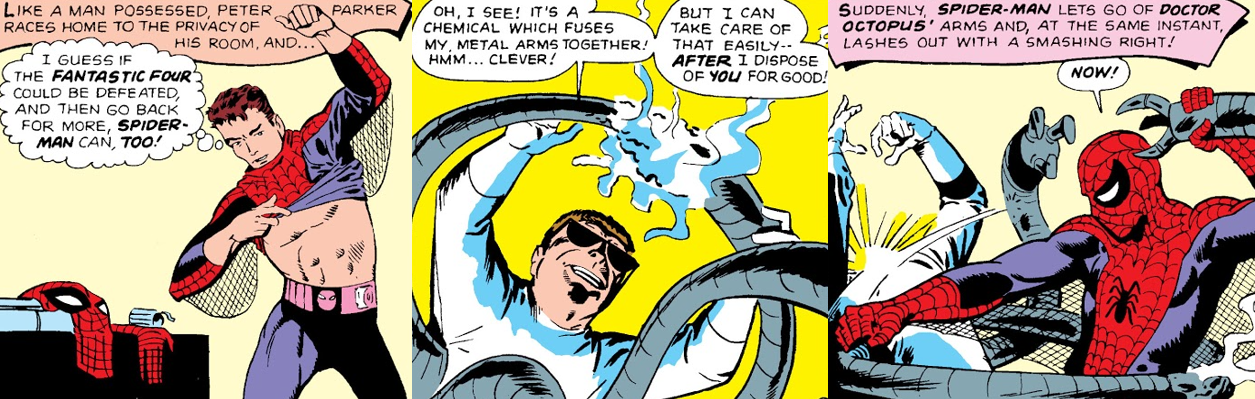
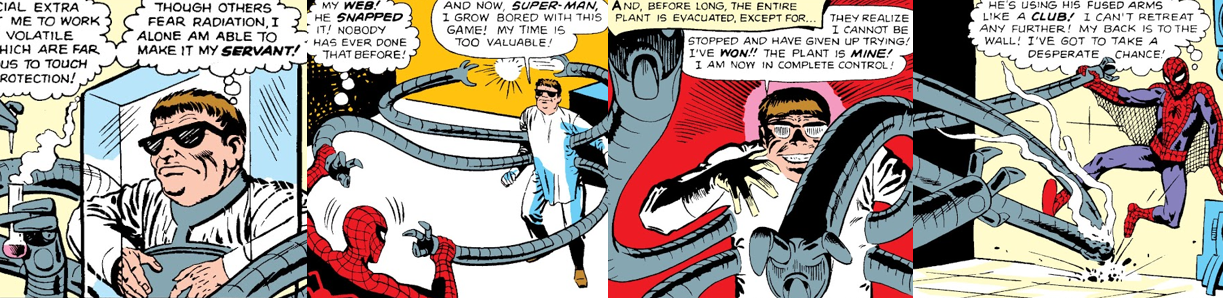
My Rating:

Rating: 5 out of 5.

Fantastic

Have you seen Spider-Man: No Way Home? Were you excited at the idea of iconic Spider-Man villains making their return or do you think that the multiverse stuff should stay in the Dr. Strange movies? What did you think to the way the film handled the public’s knowledge of Spider-Man’s identity and would you have preferred to see this explored a little more in-depth? Which of the returning villains was your favourite, and how excited were you to see Tobey Maguire and Andrew Garfield return (and Charlie Cox finally be incorporated into the movies)? Were you disappointed that we came so close to the Sinister Six and that Venom didn’t have a role in the film? Where do you see the MCU-Spider-Man’s story going from here? Whatever your thoughts on Spider-Man: No Way Home, leave a comment below.

Back Issues [Multiverse Madness]: Superman vs. The Amazing Spider-Man


In September 1961, DC Comics published a little story called “Flash of Two Worlds” (Fox, et al), a landmark story that featured in The Flash #123 and brought together two generations of the Flash: the Golden Age Jay Garrick and the Silver Age Barry Allen. In the process, DC Comics created the concept of the multiverse, the idea that DC Comics continuity was comprised of an infinite number of parallel universes that allowed any and all stories and characters to exist and, more importantly, interact and I’ve been celebrating this ground-breaking concept every Sunday of September!


Story Title: “The Battle of the Century!” (Includes four chapters: “A Dual of Titans”, “When Heroes Clash!”, “The Call of Battle!”, and “The Doomsday Decision”)
Published: March 1976
Writer: Gerry Conway
Artists: Ross Andru and Dick Giordano

The Background:
Despite the fact that the two companies were both producing colourful, superpowered costumed heroes in a cut-throat industry, relations between DC Comics and Marvel Comics have been surprisingly collaborative and amicable over the years (they’ve certainly been more civil with each other than many of the toxic fans” I see arguing on social media every day…) Sure, there’s been lawsuits and underhanded tactics from both companies, but not only were the legendary Stan Lee and the disreputable sham Bob Kane actually good friends but the two companies both borrowed from and inspired each other and they’ve even collaborated on numerous joint publications in the past. The idea of pitting Clark Kent/Superman against Peter Parker/Spider-Man was first suggested by author and literary agent David Obst, who pitched the idea to Marvel Comics publisher Stan Lee and DC Comics editorial director Carmine Infantino as a live-action feature film. Writer Gerry Conway and artist Ross Andru, two of the few who had worked on both characters in the past, were brought in to bring the concept to life, which was treated as more of a fantasy tale (despite the fact that DC had introduced the concept of the “Multiverse” over a decade previously). The comic, which generally sells for quite a high price these days, wouldn’t be the last time Superman and Spider-Man (or DC and Marvel, for that matter) crossed paths as the two would collaborate on a number of inter-company crossovers during the eighties and nineties.

The Review:
Our story begins with just another normal, boring day in Metropolis as a gigantic mechanical construct is tearing its way through the city. Even Superman laments the frequency of such events but is unable to see who is controlling the robot thanks to it being lined with lead and is equally unable to stop it thanks to its incredible strength, an “inertia ray”, and gravity beams being emitted from its mechanical feet that crush Superman with “ten times the gravity of Krypton”. All of this means that Superman is smashed through the nearby buildings (which are, we later learn, conveniently empty despite the fact that the robot is rampaging through downtown Metropolis with reckless abandon and Superman even has to save innocent civilians from falling debris) and is unable to keep the robot from stealing a computer console from Scientific and Technological Advanced Research Laboratories (S.T.A.R. Labs). Indeed, Superman is so distracted with trying to retrieve this from the robot’s head that he completely misses that the mastermind directing the machine’s attack was none other than Lex Luthor himself!

Superman tracks Luthor down, gets his ass kicked again, and rescues Luthor from certain death.

Superman returns to his civilian life as Clark Kent, reporter for the Daily Planet (owned by Galaxy Communications at the time), who avoids one of Steve Lombard’s mean and unprofessional pranks thanks to his super powers, gets chewed out by his boss, Morgan Edge, for not covering the attack (quite why Edge chooses to target Clark over Lois Lane or Lombard is beyond me), and realises from watching the footage back that he can track the robot’s obvious trail of destruction and gigantic footprints to Metropolis Bay There, beneath the water, he immediately discovers (and is attacked by) a walking undersea laboratory. Inside the lab, Superman confronts Luthor and after trying, and failing, to convince him to renounce his evil ways and rekindle heir former friendship, is attacked by a series of high-intensity laser beams. Though he’s able to dart through them, one blasts him into his eyes and, thanks to essentially being red sun radiation (which weakens Superman), dazes him and causes him to wreck Luthor’s lab. Luthor manages to spirit away the programming circuit he stole from S.T.A.R. Labs but ends up being apprehended by Superman after almost drowning to death.

Spider-Man almost immediately tracks Doc Ock down and puts him out for the count for the cops.

The story then switches to New York City right as Spider-Man is swinging in to take care of a handful of crooks who are in the middle of robbing the Metropolitan Museum. Of course Spidey easily trounces the crooks with his spider-powers but things quickly escalate when the mastermind behind the plan, Doctor Otto Octavius/Doctor Octopus, suddenly attacks with his mechanical limbs and, thanks to the element of surprise (and a good old whack to the back of the head), is able to temporarily knock Spider-Man unconscious and escape in his ridiculous looking “Flying Octopus” craft with boxes and boxes of loot. After fleeing from the police (who naturally assume Spider-Man to have been involved in the robbery), Spidey (as Peter Parker, obviously) presents the photographs of the entire event to his boss, J. Jonah Jameson, but earns the cantankerous editor’s wrath when Jameson prints the shots unseen and is left with nothing but a blurry, instinct picture on page one of his newspaper, the Daily Bugle. When his spider-sense suddenly alerts him to a passing blimp overhead, Peter ditches Mary Jane Watson and heads off to investigate as Spider-Man only to discover (after having to think on the fly thanks to his web fluid having run dry) that the blimp was disguising Doc Ock and his flying machine. The ensuing fight wrecks the blimp, causing it (and them) to crash into the Central Park reservoir and, with one swift punch to the jaw, Spidey successfully apprehends Doc Ock and heads off to try and smooth things over with Mary Jane.

Mere hours after being locked in an escape proof prison, Luthor escapes and takes Doc Ock with him.

As luck (or fate, or simple plot convenience) would have it, both Lex Luthor and Doc Ock end up being shipped off to “Federal Maximum-X Security Penitentiary Number One, the most “escape proof” prison in the world” out in New Mexico and the two immediately bond over their respective losses and enemies and agree to join forces upon escape. Though Doc Ock is sceptical of their chances, Luthor quickly uses a number of small, high-tech devices hidden under a layer of fake skin to disrupt the prison’s security cameras and guards and allow Doc Ock to regain control of his mechanical limbs and literally carry them both to safety within just a few hours of Luthor’s arrival, The story proper begins with Clark, Lois, and other members of the Daily Planet staff attending the world news conference in New York; as you might expect, Peter is also there and, after being berated by Jameson, snaps at his boss and quits his job, shocking (but also impressing) Mary Jane with his sudden outburst. Meanwhile, Clark is stunned to hear that Edge doesn’t want him covering the news conference and, again, alludes to his temptation to replace Clark with a more well-known newscaster. Frustrated that Clark is happy to roll over and allow himself to be forced out of the “biggest story of his career”, Lois storms off in anger at his cowardice and her inability to truly hate him since he’s so charming and likeable. In true Lois Lane fashion, she risks her life climbing up a scaffold to get some better pictures (because Jimmy Olsen couldn’t make the trip, apparently) and nearly falls to her death when she’s saved by Peter. They bond over their respective professional accomplishments, much to Mary Jane’s displeasure, but Peter is left flabbergasted when Superman suddenly swoops in and seemingly vaporises them both right before his eyes!

When reason doesn’t work, Superman nearly kills Spider-Man before the web-slinger calms down.

Clark also witnesses this event and is equally stunned and changes to Superman to investigate while Peter frantically switches to Spider-Man using the staircase (because, in a cute moment, the convention doesn’t have traditional phone booths). The two superheroes instantly run into each other in the skies above the building and come to blows (Superman having assumed, as many often do, that Spidey is connected to his doppelgänger). Although Superman immediately begins to be the voice of reason, Luthor and Doc Ock (who were behind the fake Superman; Luthor’s even still wearing the costume and has the lifelike mask nearby!) decide to escalate their conflict by surreptitiously blasting Spider-Man with red sun radiation to power him up for the fight. Thanks to the red sun radiation, his anger at being pushed around, and believing the Superman has captured or killed the woman he loves, Spider-Man attacks relentlessly; his strength knocks Superman off balance and his fury causes him to stubbornly refuse to listen to reason, all of which makes Superman mad enough to throw a killing blow at Spidey’s head. At the very last second, Superman is able to pull his punch but the resulting “wind-blast” sends Spider-Man flying through buildings and across the city. Disgusted at having nearly killed a man, Superman tries one more time to get Spidey to listen to reason and, when the red sun radiation wears off and amusingly leads to Spidey simply hurting his fists on Superman’s steel-hard body, Spider-Man finally relents. After comparing notes, they quickly bury their issues and agree to work together to uncover the truth about what happened but the proof of the pudding is clear: Spider-Man dominated the fight between the two and had Superman reeling throughout.

Lex Luthor and Doc Ock appropriate the Injustice Gang’s satellite to hold the world to ransom.

Following the “energy residue” of the imposter to the Penn Central railroad yard, Superman shows that he hasn’t quite shaken off the dickish ways of his sixties incarnation by allowing Spider-Man to go in first and run a gauntlet of traps and hazards before he (as in Superman) just ploughs right in there and they both confront the combined might and intelligence of Luthor and Doc Ock. Revealing that Lois and Mary Jane have simply been taken captive to lure the two heroes into a trap, the villains quickly vanish, having been mere projections all along (which you’d think Superman and Spider-Man would be able to register with their enhanced sense but apparently not…), and nearly manage to kill Spidey with a booby trapped computer console before Superman intervenes. Superman then rebuilds the wrecked computer at super speed and down to the smallest detail, apparently somehow managing to repair and restore the destroyed files that would have been on it in the process, which leads the two to Mount Kilimanjaro. There, a local nomadic Masai tribe lead them to another of Luthor’s secret bases. After battling and defeating a superpowered tribesman (who also wields a sword charged with red sun radiation), the two discover that Luthor and Doc Ock have headed to the upper atmosphere and the abandoned satellite headquarters of the Injustice Gang. There, Lois and Mary Jane are held hostage and are privy to the supervillains’ mad scheme: using the programming circuit he stole from S.T.A.R. Labs, Luthor is able to disrupt and hijack Comlab (a massive, missile-like communications tower in orbit) and cause it to fire a “high-intensity laser probe” into the Earth’s atmosphere and hold the world to ransom or face untold death and destruction from the violent storms the laser causes.

Thanks to Spidey, Otto turns on Luthor, Superman stops a deadly tidal wave, and the heroes triumph.

Superman and Spider-Man (piloting a shuttle of his own with surprising efficiency) head up to stop them but are immediately overwhelmed by Luthor’s lasers and captured. Although they catch their foes off-guard by feigning helplessness, Superman and Spider-Man are thrown off balance when Luthor suddenly shuts off the satellite’s artificial gravity (quite how this would affect Superman is beyond me…), which allows the villains to topple the costumed heroes with a humiliating ease. Quickly recovering, the two turn the tide when Superman is able to get close enough to Doc Ock to…remove his glasses! Distracted by recovering his comrade’s glasses, Luthor is unable to defend himself against Spider-Man, and Spidey is able to turn Doc Ock against Luthor by appealing to his greed because, after all, what use is money if Luthor plans to decimate the world? Although this is enough to disable to destructive laser and cause the two villains to come to blows, Superman must still take care of a gigantic tidal wave that threatens to engulf the entire United States! Of course, Superman is able to dispel the wave by flying at it at super speed and, with the villains subdued and the threat ended, Superman and Spider-Man part as allies and return to their respective lives, with both men able to win over (and back) their employers with their exclusive insight into this one of a kind team up.

The Summary:
I grew up reading Superman, Batman, and Spider-Man stories from the 1970s so, for me, Superman vs. The Amazing Spider-Man feels like a very familiar and nostalgic little tale. The artwork and characterisations are representative of this era; both the main characters and their villains pop out nicely, with Luthor being more of the scheming supervillain rather than a manipulative businessman. While Spider-Man is just as troubled by his angst and anxieties and spouts the usual quips and puns that were “hip” at the time, Superman is far from an unstoppable demigod while still having one foot in the ridiculously overpowered nature of his Golden Age counterpart. If you’re a fan of Lois and Mary Jane then this isn’t the comic for you; the two barely factor into the plot at all and, arguably, could have been excised completely and the villains’ scheme would have carried on largely unchanged. Similarly, characters like Jameson, Morgan, and Lombard are mainly just there for comic relief or to flesh out and contrast the normal, everyday lives of our two heroes. This is a bit of a missed opportunity, in many ways, as we’re denied a meeting between Jameson and Clark’s usual boss, Perry White, or even a sub-plot where Lois and Mary Jane have to work together to either escape or help stop the villains. Maybe if the story hadn’t suddenly veered off to waste time on the Marais tribe or wasted pages recapping the origins and powers of the heroes and villains we could have seen more of these interactions or had Spider-Man visit Metropolis.

The fight between Superman and Spider-Man, brief as it is, is the main appeal of the comic.

Still, the comic is called Superman vs. The Amazing Spider-Man and we definitely do get that; the two fight for about twelve pages and it’s a fairly evenly matched affair thanks to Spidey being supped-up by Luthor’s special red sun ray. Superman, ever the Boy Scout, spends most of the fight reeling from Spidey’s surprising strength and trying to calm the web-slinger down and, every time he tries to fight back, Spider-Man is right there to shut him down and press the attack. In fact, Superman only throws one punch in the entire fight but it’s enough to send Spidey flying with “the force of a compact hurricane”. Interestingly, there’s a lot of subtext that can be gleaned from this bout; Spidey, representing Marvel Comics, is the young, hot-tempered upstart who hits first and asks questions later and Superman, representing DC Comics, is the older, more level-headed veteran who seeks to resolve conflict peacefully but will strike back if pushed too far. Naturally, the two pool their respective talents far more than they clash and, after resolving their issues, never come to blows or conflict again. I suppose it’s nice that there wasn’t a lame excuse for them to fight again, like hypnotism or whatever, but the actual inciting incident is pretty paper thin (even though he saw “Superman” vaporise Mary Jane and Lois, Peter knows Superman by reputation so you’d think he’d hesitate to suddenly think he’d gone rogue) and I would have liked to see a bit more of how their different approaches to situations clash. We only really got to see this once when they reached the rail yard and it seemed petty and mean on Superman’s part to send Spidey in alone when he (again, as in Superman) could just burst in there without issue. It’s a good job that the clash and interactions between the two heroes pays off as the supervillain team up is a bit lacklustre; Doc Ock is reduced to a mere common criminal and a henchman here, having no real agency and playing very little role in the story other than giving Luthor someone to talk and boast to and acting as Luthor’s muscle. It’s a shame as Doc Ock is one of Spidey’s most devious, intelligent, and imposing villains but he may as well not be in the story at all since everything (from the prison escape, to framing Superman, to the red sun ray, and the orbiting satellite/laser plot) is Luthor’s plan and Lex may as well have teamed up with Flint Marko/The Sandman for all the use Octavius’s arms and demented genius were.

Sadly, the potential of this team is never realised as Doc Ock is reduced to being Luthor’s henchman.

As a result, Luthor comes out of this looking like a scheming, diabolical madman who is happy to threaten and kill millions for a measly ten billion dollars; his genius allows him to create all kinds of fantastic technology and even duplicate red sun radiation to weaken Superman but, in the end, he’s undone because Spidey was able to manipulate Octavius to turn against him. Overall, it’s a decent enough story; well drawn and full of big, action-packed panels when the two heroes clash and take on their foes but the main appeal of Superman vs. The Amazing Spider-Man is, unsurprisingly, in seeing two of Marvel’s premier superheroes butting heads and joining forces. In that regard, the story works but just barely; it reads like a typical, run of the mill Superman story from the time just with a guest appearance by Spider-Man and some of his supporting characters. When the Marvel characters do appear, they’re written exactly as you’d expect from that era as well and no one side really looks better or dominates the other…unless you look at the subtext at work. Superman and Spider-Man appear to be evenly matched in their fight but Spider-Man is clearly the aggressor; Luthor outshines Doc Ock at every turn, relegating him to being a mere henchman, so I guess everything just about evens out on both sides but I can’t help but feel like the story was lacking a little. It would have been nice to see Spidey in Metropolis, more interactions between the two in and out of costume, and the two having to deal with their counterpart’s villains in a more interesting way than flailing around on a space station but there’s an appeal to Superman vs. The Amazing Spider-Man, if only because of the comic’s rarity and the chance to see these two heroes, and worlds, collide for a change so it’s probably worth seeking out for the sheer spectacle of it if nothing else.

My Rating:

Rating: 3 out of 5.

Pretty Good

Have you ever read Superman vs. The Amazing Spider-Man? If so, what did you think to it? Do you own a copy of the original comic or do you remember reading it when it was first published? Were you also disappointed that the comic didn’t make better use of its concept, supporting characters, and villains or were you happy with the story we got? Which of the two heroes, and publishers, was/is your preference? Do you enjoy all comic books and superheroes equally or are you one of those toxic fans who actively hates other characters and companies? Would you like to see DC and Marvel collaborate again in the future and, if so, what stories would you like to see? Whatever your thoughts on Superman vs. The Amazing Spider-Man, and comic book crossovers of this kind, drop a comment down below and check out my other multiverse reviews.

Game Corner [Spidey Month]: Spider-Man: The Video Game (Arcade)


Easily Marvel Comics’ most recognisable and popular superhero, unsuspecting teenage nerd Peter Parker was first bitten by a radioactive spider and learned the true meaning of power and responsibility in Amazing Fantasy #15, which was first published in August 1962. Since then, the Amazing Spider-Man has featured in numerous cartoons, live-action movies, videogames, action figures, and countless comic book titles and, in celebration of his debut and his very own day of celebration, I’ve been dedicating every Wednesday to talk about everyone’s favourite web-head!


Released: 1991
Developer: SEGA

The Background:
Having achieved success with the creation of the Fantastic Four, Marvel Comics editor and head writer, the immortal Stan Lee, was searching for another title to match the success of Marvel’s first family. Inspired by a spider climbing up a wall, influenced by pulp vigilante the Spider, eager to capitalise on the surge in teenage demand for comic books, and working alongside artist Steve Ditko, Lee conceived of Spider-Man and was granted permission to feature the teenage superhero in the final issue of Amazing Fantasy. Marvel publisher Martin Goodman was shocked to find that Amazing Fantasy #15 was one of the publication’s highest-selling comics and a solo Spider-Man series soon followed, with Spidey quickly becoming Marvel’s most popular comic book character. Since then, Spider-Man has seen success in numerous other media; in 1967, he featured in a self-titled animated series, he famously appeared as a guest character on The Electric Company (1971 to 1977) and starred in his own live-action series in 1978, and heavily influenced my childhood through the fantastic Spider-Man cartoon (1994 to 1998) before eventually featuring in a number of live-action films. Furthermore, Spider-Man has also featured in numerous videogames, the first of which was the aggravating Spider-Man (Parker Brothers, 1982) for the Atari 2600. Before debuting in arcades, the majority of Spidey’s videogame efforts were sidescrolling action/platformers but this was the early nineties and button-mashing beat-‘em-ups were all the rage thanks to titles like Double Dragon (Technōs Japan, 1987), Final Fight (Capcom, 1989), and The Simpsons (Konami, 1991) so Spidey’s arcade debut naturally came in the form of a sidescrolling beat-‘em-up.

The Plot:
Wilson Fisk, the Kingpin of Crime in New York City, has sent his minions out into the city to retrieve a mystical artefact and only Spider-Man and his allies (Prince Namor McKenzie/The Sub-Mariner, Clint Barton/Hawkeye, and Felicia Hardy/Black Cat) can hope to defeat some of Spidey’s most powerful and iconic villains and oppose the Kingpin’s plans for domination.

Gameplay:
Spider-Man: The Video Game is a fairly standard sidescrolling beat-‘em-up in which players can pick from one of four characters (Spider-Man (obviously), Sub-Mariner, Hawkeye, and Black Cat) and make their way from the left side of the screen to the right beating up wave-upon-wave of nameless thugs. The game allows any player to select any character and allows for up to four players to play simultaneously, which is always an appreciated feature of such titles.

Each character is sluggish and gameplay is shaken up by some ugly platforming sections.

Upon selecting your character, you’re dropped into the streets of New York and quickly learn that the game is quite limited in terms of the moves available to you. Each character controls in exactly the same way, with a few subtle differences: Spidey and Black Cat can swing from webs/lines to attack enemies (if you can pull off the attack, which kind of requires a very specific combination of jumping and attacking) and each has a slightly different jumping attack (Namor dives fist-first down into enemies, for example) and melee attacks (Black Cat is much more about the fancy kicks than Hawkeye). While you can perform a signature special attack (shooting webs or arrows, for example) at the cost of some health points, each character is just as sluggish and apathetic as the next thanks to a lack of a dash function. However, after beating up a few thugs and taking out a sub-boss, the game suddenly shifts to an entirely different perspective; the camera zooms out and the game becomes more of an action/platformer as your character must scale a vertical and horizontal map taking out more goons as they go. In this zoomed out mode, your characters are no longer able to perform melee attacks and must rely on their projectile attacks: Spidey shoots webs, Hawkeye shoots arrows, Black Cat attacks with a grapple hook, and Namor….shoots lightning…? Spidey and Black Cat can also scale and climb walls to navigate these areas faster and Hawkeye and Namor can hang on to overhead platforms to shoot at enemies but it’s a bit weird that you’re not given full access to each character’s abilities in this mode.

Your health drains constantly and players are rated after each stage.

Unlike many videogames and beat-‘em-ups, inserting coins not only allows you to continue from death but also boosts your health, which is represented by a series of numbers under your character’s name. Your health numbers also double as a time limit as they’re constantly ticking down and this is quite a unique and clever way to get kids to waste their hard-earned pocket money as, while you can find health (in the form of hearts) strewn around the game’s stages at various points, you’ll quickly be pummelled into submission by the game’s enemies and forced to drop more coins to pump up your health and continue on a little further. Sadly, in a marketplace crowded by fantastic beat-‘em-ups, Spider-Man: The Video game fails to stand out in a lot of ways; you can attack and destroy parts of the environment but there’s not much motivation to do this as there are no weapons to find and use and no items to pick up to increase your score. Your score isn’t even displayed onscreen as you play, for God’s sake, which is really unusual, despite the fact that your progress is rated at the end of each stage. Instead, the game’s primary selling point appears to be exclusively the Spider-Man brand and the odd inclusion of action/platforming sections.

Graphics and Sound:
For the most part, Spider-Man: The Video Game looks serviceable enough; sprites are large and colourful but, like the backgrounds, are a little lacking in variety and detail. None of the playable characters have an idle animation, which lets the game down somewhat, and Spider-Man, especially, just looks bored and depressed as he plods around at a sluggish speed. When the game zooms out for its platforming sections, sprites take on a largely pixelated appearance but the backgrounds become much bigger and more detailed. Stages initially seem quite short as you come up against your first sub-boss in almost no time at all and, after defeating them, you’re tasked with climbing up to the rooftops of New York’s skyscrapers and the stages really open up.

Platforming sections expand the game, with “Latvelia” being the most visually interesting.

As you attack enemies, and are attacked, big comic book-style sound effects appear onscreen (as is pretty standard for comic book beat-‘em-ups) but I found sprites go a bit transparent when they pass over other sprites and graphics (though this could be due to emulation issues rather than a flaw of the title itself). The game does feature some limited voice acting but, despite featuring a female voice (who just loves to cry out “Spider-Man!” every time you insert a coin), no female voice work accompanies Black Cat. This isn’t necessarily a bad thing as the male voice acting is the same for every character and hardly of a high standard and when you realise that Namor and Black Cat’s attacks are accompanied by some really weird sound effects that make them sound like they’re drowning or a robot, respectively. As you might expect, comic book-style cutscenes tell the game’s story; these take the form of still images with some accompanying text (though these don’t change depending on your character and mostly just feature Spidey by himself) and in-game cutscenes with some fitting word balloons. Finally, while the game’s stages are fairly standard (the streets, the rooftops, flying through the skies, construction sites and the like), they don’t really stand out much until you crash-land into the hellscape of “Latvelia” and the game suddenly busts out some decent fire effects. Finally, the game’s music, while interesting and serviceable enough, doesn’t really feel very unique to the Spider-Man brand or compared to other beat-‘em-ups.

Enemies and Bosses:
The majority of the enemies you’ll encounter throughout your journey are literally nameless, faceless goons; weird kabuki-mask-wearing, purple-spandex-clad thugs are the order of the day here but they are soon joined by such cliché beat-‘em-up enemies as martial artists (who can duck your attacks), rotund enemies (who can belly flop you), and robots (which shoot projectiles). Spider-Man: The Video Game honestly doesn’t have much going for it in terms of enemy variety; you’ll fight the same enemies over and over and only encounter some weird and memorable foes with you reach “Latvelia” and encounter some weird ape-like monstrosities. However, Spider-Man: The Video Game is absolutely loaded with some of Spidey’s most iconic villains; after only a couple of minutes into the first stage, you’ll encounter Mac Gargan/Scorpion and, just as you’re getting into that fight, a massive containment unit opens up and Eddie Brock/Venom emerges.

You’ll face Spidey’s most iconic foes while swarms of enemies pile in on the action!

Although Scorpion soon runs off after a few hits, you’ll have to endure a handicap situation for a while as enemies spawn in, Venom teleports around the arena and chokes you with their goo, and Scorpion attacks you relentlessly. Once you whittle down Venom’s health, they use a mysterious artefact to grow to monstrous size and you’ll have to chase them to the rooftops for another encounter. This becomes the basic set-up for the majority of the game’s sub-bosses and bosses; you’ll fight them at one point and then have to give chase and battle them again in a slightly different situation after navigating the game’s zoomed out sections. You’ll battle Dr. Curt Connors/The Lizard (who has a nasty tendency to chomp down on your crotch), Flint Marko/Sandman, and Venom in a pretty standard beat-‘em-up format where you’ll be confined to an arena and have to fend off waves of additional enemies. Each boss reappears for a rematch later in the game but the strategy remains largely the same; keep your distance and land attacks while dispatching their support and things only really get hairy when Venom spawns a bunch of symbiote clones to fight alongside them!

While Kingpin is a marginal threat, Electro and Doc Ock really get the shaft!

Boss battles are mixed up a bit when you take on Norman Osborn/Green Goblin and Jason Macendale/Hobgoblin; while you’ll battle the Green Goblin on the ground, dodging his weird glowing hand attack, these two bosses stand out by taking to their iconic gliders and rushing at you from the air while tossing pumpkin bombs at you. These can be troublesome encounters as it’s difficult to judge where the Goblins are positioned to land your attacks or to successfully hit them with your jump attacks. Plus, when you battle Hobgoblin, you’re limited to your zoom-out attacks and will have to blast him with your projectiles and destroy large cannons to make things easier. You’ll also do battle with the Kingpin in a standard beat-‘em-up encounter; Kingpin’s attacks are limited to headbutts, swipes, and a shoulder barge, making him little more than an inconvenience than a formidable boss fight even in his second phase. Still, at least he actually gets a proper boss fight; Max Dillon/Electro and perhaps Spidey’s most famous foe, Dr. Otto Octavius/Doctor Octopus are relegated to mere semi-sub-bosses who randomly appear as you’re navigating the game’s later platform stages and they’re little more than a joke as you can easily damage boost through their attacks and pummel them into submission.

Doctor Doom is the game’s final boss and takes numerous forms.

After defeating the Kingpin, though, Dr. Victor Von Doom/Doctor Doom randomly appears to claim the mysterious artefact and reveal himself to be the game’s true big bad. When you reach Doom’s Castle, you’ll have to dodge mines and battle through the game’s previous sub-bosses and bosses to confront Doctor Doom…only to find you’ve battled a Doombot all along! However, when you finally do get your hands on the real Doctor Doom, the fight is still little more than a standard affair once you take out Doom’s nifty floating battle craft: Doom is fast and slippery but doesn’t attack with magical bolts until the final confrontation and even then he’s not much more of a threat than the likes of the Sandman or the Lizard.

Power-Ups and Bonuses:
As mentioned, there’s pretty much nothing on offer to spice up your gameplay in Spider-Man: The Video Game. You can’t pick up and use weapons or power-ups and the only thing for you to pick up is hearts to increase your health, making gameplay decidedly more repetitive and monotonous compared to other beat-‘em-ups.

Additional Features:
Again, there’s basically nothing here (as is pretty much the standard for most arcade games). However, the fact that you can select any character to play as and play with up to four players, each who accumulate their own separate score at the end of each stage, does add some replay value (if you have friends to play with, of course…)

The Summary:
Spider-Man: The Video Game is a decent enough beat-‘em-up; it’s bright and colourful and includes all of Spider-Man’s most iconic villains but it doesn’t really offer a whole hell of a lot when it comes to gameplay or variety. Beat-‘em-ups are generally quite monotonous as a rule but they usually compensate for this with kick-ass music, detailed sprites, and some cool weapons and super moves; Spider-Man: The Video Game has none of these attributes, meaning it’s a step behind other arcade titles released at the same time and even ones released years prior. The game’s unique selling point of having action/platforming sections incorporated into the usual beat-‘em-up formula is interesting but its execution is flawed thanks to the graphics taking a hit. Throw in an odd assortment of playable characters (I get why Black Cat is there but why are Namor and Hawkeye here?), some repetitive boss battles, and disappointing use of some of Spidey’s more visually striking foes and you have a gameplay experience that is fun enough (and probably better alongside friends) but hardly worth choosing over the likes of Final Fight or even Double Dragon. Put it this way: X-Men (Konami, 1992) released the very next year and is everything Spider-Man: The Video Game wishes it could be; hell, even Captain America and the Avengers (Data East, 1991) offers more in terms of gameplay variety and character abilities despite being graphically less impressive and that’s really saying something.

My Rating:

Rating: 2 out of 5.

Could Be Better

Did you ever play Spider-Man: The Video Game out in the wild? Which character did you pick, or get lumbered with, and which did you think was the best or the worst? What did you think of the game’s unique incorporation of platforming elements and the way it handled Spidey’s villains? Which characters do you think would have been more suitable to play in place of Namor and Hawkeye? Which Spider-Man videogame, or arcade beat-’em-up, is your favourite? Whatever you think, feel free to drop a comment below and be sure to check out my other Spider-Man content.