Movie Night [Sci-Fanuary]: Edge of Tomorrow


January celebrates two notable dates in science-fiction history, “National Science Fiction Day” on January 2 and Arthur C. Clarke’s HAL 9000’s birthday on January 12. Accordingly, I’m dedicating January to celebrating sci-fi with an event I call “Sci-Fanuary”.


Released: 6 June 2014
Director: Doug Liman
Distributor: Warner Bros. Pictures
Budget: $178 million
Stars: Tom Cruise, Emily Blunt, Bill Paxton, Noah Taylor, and Brendan Gleeson

The Plot:
When public affairs officer Major William Cage (Cruise) unexpectedly gains the ability to reset time after his death in battle against the aggressive alien “Mimics”, he teams up with the heroic Sergeant Rita Vrataski (Blunt) to defeat the invaders.

The Background:
In 2004, Hiroshi Sakurazaka and Yoshitoshi Abe collaborated on the spectacularly named “light novelAll You Need Is Kill, the story of soldier Keiji Kiriya, who’s caught in a time loop that allows him to improve his fighting skills against invading aliens. Nominated for the 2005 Seiun Awards, All You Need Is Kill caught the attention of producer Erwin Stoff, who optioned the rights to create a live-action adaptation. Despite being intimidated by the source material, writer Dante Harper produced a screenplay that was listed as one of the best unproduced works doing the rounds. After Brad Pitt declined the lead role, Tom Cruise joined the project, and the script underwent additional rewrites after he and Emily Blunt were cast, with writer Christopher McQuarrie and director Doug Liman struggling to produce a satisfactory ending. The cast and crew spent an unexpected three months filming the complex, action-heavy beach assault on a large soundstage surrounded by green screens. The UDF exosuits were designed by Oliver Scholl, Pierre Bohanna, and Kate Hawley and modelled after real-world exoskeletons and built as largely practical suits that bruised and battered the stars. In contrast, the Mimics were digital creatures courtesy of Sony Pictures Imageworks; the designers worked hard to make them an otherworldly mess of dangerous tentacles that had a tangible reality to their otherwise fantastical appearance. Despite a worldwide box office of just over $370 million and largely positive reviews that praised the direction and execution, and the time loop twist, Liman and Warner Bros. were left so disappointed by the film’s reception that they pushed to re-brand the film to the clever tag line, “Live. Die. Repeat”. Indeed, while some found the film tedious and strangely limited in its scope, Edge of Tomorrow is widely branded as an under-rated sci-fi romp. Though talks of a sequel have done the rounds since its release, it seems we’re more likely to get a TV spin-off than a direct follow-up any time soon.

The Review:
So, two caveats before we get into this film: one, I’ve never read All You Need Is Kill (though my fondness for this movie makes me want to sit down with it some day) and two…I absolutely cannot stand Tom Cruise. I don’t care how many of his own stunts he does or about his weird personal life; I’ve just never bought into him as an actor and find his characters very bland and unlikeable. Thankfully, Cage is written to be pretty unlikeable. A smarmy, confident, well-dressed spokesperson, he’s effectively become the face of the UDF’s counterattack against the Mimics, frequently appearing on television and in interviews to encourage viewers to join the military, hyping up the combat prowess of the armoured exosuits worn by their soldiers, and painting Vrataski (the so-called “Angel of Verdun”) as a heroic symbol. In Edge of Tomorrow, humanity was completely caught off-guard when a seemingly innocent meteor landed in Germany, only to spew out a legion of weird, tentacle-like aliens that swiftly overtook most of continental Europe. Because of their uncanny ability to seemingly anticipate their enemy’s actions, the aliens are dubbed “Mimics” (an odd name considering they don’t physically or strategically mimic anything about us) and, in the space of just five years, were seemingly set to destroy all human life. That was, until, the Battle of Verdun, where Vrataski scored a major victory, one which galvanised humanity to push towards total victory. Unfortunately for many of their troops, the UDF still employ trench warfare, literally dropping their soldiers into enemy territory and leading to mass slaughter in most cases, keeping humanity on the razor’s edge of extinction.

The time loop and brutal training transform the once-cowardly Cage into a battle-hardened soldier.

This, as much as anything else, is why Cage would rather be anywhere else but on the front line. A former advertising guru, he adapted his skills to promoting the war effort, receiving a complimentary military rank, and has successfully hidden his abject cowardice and combat inexperience behind his silver tongue. However, when he’s called to meet with grizzled veteran General Brigham (Gleeson), Cage is aghast to learn he’s been ordered to join the next push into Europe as a war correspondent. Desperate to avoid the danger, death, and bloodshed, he begs, bargains, and eventually tries to blackmail his way out of the assignment, only to be arrested, stripped of his rank, and branded a deserter (“Rail-roaded”, as he calls it) and dumped into the judgemental and unsympathetic care of Master Sergeant Farell’s (Paxton) J-Squad. Despite desperately trying to explain his situation, Cage is met by nothing but sarcasm, mockery, and aggression from his newfound peers and, before long, is strapped into an exosuit and violently dropped into battle with little to no combat training. The beachfront assault is not a battle, it’s a massacre. Cage’s entire battalion is killed and he comes face-to-face with a large, voracious Mimic, barely able to defend himself. Out of desperation, he blows the “Alpha” to pieces with a Claymore mine and is drenched in its caustic blood. He then suddenly finds himself waking up 24-hours earlier, being given the same impassioned speech by Farell, suffering the same abuse from J-Squad, and dying in battle once again, only to begin the day anew each time.

J-Squad are unimpressed by Cage’s attitude, inexperience, and increasing mania.

Confused and disorientated, Cage initially believes he’s suffering some kind of déjà vu or nightmare, or that he’s losing his mind. This latter explanation is what the other characters default to whenever he tries to warn them of the mission’s impending failure. No matter now many times he repeats Farell’s words or rattles off his knowledge of J-Squad – Griff (Kick Gurry), Kuntz (Dragomir Mrsic), Nance (Charlotte Riley), Skinner (Jonas Armstrong), Ford (Franz Drameh), Takeda (Masayoshi Haneda), and Kimmel (Tony Way) – they simply think he’s losing his mind. Eventually, during his many repeats of the same day, Cage’s knowledge of each increases; though this happens offscreen, we learn a bit more about each of them from his exposition as he tries to earn their trust. Ford, for example, is using his dead best friend’s name and sending his payment to his family. Mostly, Cage simply earns their ire; they’re annoyed at being saddled by him, his incompetence, and personally insulted by him being a deserter and they even attack him when his subsequent absences see them being punished by Farrel. Played by the late, great Bill Paxton with a delicious, scenery-chewing charisma, Farrel appears to be a man completely consumed by the fire and glory of war. However, unlike Brigham, Farrel isn’t all talk and bluster and eagerly joins his men in battle, relishing the taste of combat. Cage’s eventual combat prowess is more to do with memory, tough training, and a constant cycle of failure than him being mentored by J-Squad. They essentially leave him to fend for himself at the beginning, and are therefore stunned when he suddenly exhibits near-superhuman deftness and ability on the battlefield. Later, when he convinces them to heed his warnings, they’re shocked to learn how insurmountable the Mimic’s power is but readily follow him into a final assault on the Louvre Pyramid, giving their lives to his cause and even sacrificing themselves to cover his infiltration. However, as persuasive as Cage’s parlour tricks and knowledge are, they’re primarily convinced by him having the seal of approval of the near-mythical Vrataski, who backs Cage’s claims and emboldens their fighting spirit.

Constantly frustrated by Cage’s inexperience, Vrataski works hard to train him for combat.

Vrataski is a tough, no-nonsense soldier equally dubbed the “Full Metal Bitch”. Extremely adept with her exosuit, Vrataski also employs a massive, anime-styled sword (fashioned from a helicopter blade) and inspires awe in her fellow soldiers. However, Vrataski is also cold and stoic, rarely showing her emotions or letting them rule her actions, to the point where she’s largely impassive when her fellow soldiers die in battle. Behind this façade, she hides a deep pain at having watched so many of her loved ones die and failed to end the Mimic threat when she had the chance. When Cage unexpectedly saves her in battle thanks to his foresight, she orders him to find her when he wakes up and reveals that her victory at Verdun (and her entire reputation) is thanks to her also having previously acquired the Alpha’s time-manipulating blood. Working with Doctor Noah Carter (Taylor), Vrataski learned that the Alpha’s death triggers the gigantic “brain” of the Mimic hoard, the “Omega”, to reset the day, allowing the Mimics to counteract accordingly. The longer one has the power, the more the Mimics become aware of them and the closer the protagonists get to learning the Omega’s location. Vrataski therefore forces Cage to train again and again, executing him to restart the day whenever he’s incapacitated or killed, to turn him into her proxy. Vrataski is constantly exasperated by Cage’s inexperience, questions, and cowardice and delights in abusing him, barking orders and forcing him to step up and find a viable route off the beach to find the Omega. Similar to J-Squad, Cage eventually learns a bit about Vrataski and bonds with her, to the point where he becomes despondent at having watched her repeatedly die and their continued failures to make real headway.

The Mimics are an ugly, aggressive alien race that can somehow create time loops.

A bunch of veterans and barflies speculate on the reason the Mimics have come to Earth, but Edge of Tomorrow largely leaves the explanation vague. They’re described as a “perfect”, planet-conquering hive mind, a near-exhaustible army even without accounting for their time-bending powers. The actual creatures are somewhat generic; they’re perfectly monstrous and disturbingly Lovecraftian, but we never really get a decent look at them and they often resemble a blurry mishmash of nanobots rather than living beings. They’re often hiding, either under the sand, ground, or elsewhere, and burst up to strike, skewering prey with their tentacles, firing energy bolts, or manhandling soldiers with their superior speed and strength. Even the regular grunts are extremely durable, often tanking multiple shots or moving too fast to be hit, and it was only through blind luck that Cage killed the Alpha in the first place. The Mimics are controlled by the Omega, with the Alpha overseeing the invasion and signalling for a reset upon its death, with all the aliens retaining the knowledge of each day, as Cage does. The longer he has the power, the more aware of his presence they become; the infected begin to see visions of the Omega, something the big brain uses to lure the soldiers into a trap. Indeed, Dr. Carter suggests that the Omega allowed the victory at Verdun as part of a grander plan to wipe out humanity, making them an almost invincible force. So powerful is the threat of extinction that the UDF’s only thought is to counterattack with everything they have. At one point, Cage and Vrataski infiltrate Brigham’s office, using Cage’s foresight to finally convince him to hand over Dr. Carter’s experimental transponder to learn the Omega’s true location, only for Bingham to immediately order even Vrataski’s arrest and forcing the two to reset to simply steal it. Cage’s power is constantly at risk since he must die to reset the day; it cannot be passed on but can be lost via a blood transfusion, which is what cost Vrataski the power. This eventually strips the ability from Cage, forcing him and Vrataski to recruit J-Squad for one last, desperate mission to destroy the Omega in Paris.

The Nitty-Gritty:
At first glance, Edge of Tomorrow is simply another generic, sci-fi war film with many of the tropes you’d expect from the genre. You’ve got the gruff, uncompromising General; the tough, but somewhat fair, Drill Sergeant; and a squad of ground-level troops simply trying to defend their world. J-Squad are sadly one-dimensional, despite Cage spitting facts and exposition about them, but are at least visually distinct. Griff is constantly walking around in a pink bath robe, for example, Kuntz “doesn’t talk much”, and Kimmel literally goes into battle balls out. Though as thirsty for combat as their Master Sergeant and far better trained than Cage, J-Squad is as doomed to failure as every UDF campaign and we witness their hubris, downfall, and deaths numerous times as Cage lives, dies, and repeats his time loop over and over. Though they give him nothing but abuse, they show respect for and surprise regarding his combat prowess in different time loops when this cowardly, pathetic deserter is suddenly blasting around at speed and picking off Mimics with uncanny precision thanks to Vrataski’s brutal training. Vrataski is a loner by nature, training by herself in a mechanical simulator and fighting solo on the battlefield regardless of how many troops follow her. She often dies alone in battle as well and constantly keeps Cage at arm’s length, hiding injuries and insisting on pushing onwards even when he begs her to stop because she won’t make it. Her stubbornness is her greatest strength and she impresses this fighting spirit upon Cage, eventually transforming him into a more hardened soldier over who-knows-how-many time loops.

Cage’s repeated experiences improve his skills but burden him with knowledge.

As someone who dislikes Tom Cruise, I get a perverse pleasure out of seeing him die over and ever. He gets skewered, eaten, shot, and blown up multiple times throughout the film, suffering broken limbs, a shattered spine, and being crushed under vehicles. With each loop, he gets a little better, pushing further along the ill-fated beach assault and committing to memory the movements of the Mimics, exactly as a videogame player gets better through trial and error. We’re never given an exactly tally of how many times Cage relives the day, but he sometimes burns through days in quick succession, such as when he’s blindsided by threats or struggles with his combat training, much to his frustration. A series of montages show him failing time and again, but also his progression; once a lumbering liability who couldn’t disengage the safety on his weapons, he graduates to sprinting with an uncanny deftness and blasting Mimics with his shoulder cannons, saving those who despise him and pushing further into France. Much of Cage’s experiences aren’t shown to us, however. Edge of Tomorrow cleverly frames some of his and Vrataski’s excursions as his first experiences, only to reveal that he’s been at that same barn before and even learned to fly a helicopter. These sequences are all very gritty and realistic, with the beach assault resembling equally doomed real-life military campaigns and the UDF’s weaponry being surprisingly low-tech, save for the exosuits. These are surprisingly practical effects, with some CGI enhancements, and effectively make even a novice like Cage a super soldier, though we don’t see their full potential until Cage masters their functions. The Mimics, by comparison, are entirely CGI but they work well as an unknowable, monstrous “Other” for humanity to rally against, even if I find their design visually confusing. Cage eventually becomes burdened by knowledge; tortured by Vrataski’s repeated deaths and the virtual hopelessness of the situation, he deserts the campaign entirely at one point, only to be branded a coward. When he learns that the Omega is setting a trap for them to regain its power, Cage goes for the transponder to try and change the future, only to end up losing his powers and being given one last try to get the job done.

Stripped of his powers, Cage heads a final assault that results in the dawn of a new day.

Having been wounded and saved by a blood transfusion, Cage escapes military custody with Vrataski and the two enlist the help of J-Squad in defying orders and flying a night-time assault on the Louvre, the true location of the Omega. Essentially a suicide mission for all involved, this murkily shot mess of a sequence sees all of J-Squad heroically perish to cover their insertion into the iconic pyramid, leaving Cage and Vrataski the last survivors (ironically, Cage survives events in this sequence that would’ve surely reset his day previously). Cornered by the Alpha and realising victory will cost their lives, Vrataski finally expresses her regret and not getting the time to know Cage better, giving him an awkward kiss before sacrificing herself in the “fiery crucible” of combat against the Alpha, unaware that she and Cage have basically lived a lifetime by this point. Left alone with only a gun and a belt full of grenades and his harsh training, Cage plunges into the water’s beneath the Louvre to blow the Omega to kingdom come, only to be mortally wounded by the Alpha. However, he manages to pull the pins with his last act, destroying the Omega and earning himself another drenching in alien blood. This time, Cage awakens a few days earlier to find a strange energy pulse from the Louvre has mortally disabled all Mimics, effectively ending the threat overnight. He’s amazed to find J-Squad all alive and well, the war finally over, and himself restored to his previous life. Naturally, his first thought is to visit Vrataski, grinning like a moron when she greets him with her usual barking wit.

The Summary:
Edge of Tomorrow is a surprisingly good time. Like I say, I’m not a fan of Tom Cruise but he’s actually pretty enjoyable here. Seeing him play a slimy, cowardly, untrained soldier who gets repeatedly killed brought a lot of joy to me as a sycophant and I enjoyed watching him improve with every failure, getting more and more combat proficient and transforming into a soldier on par with Vrataski. This is masterfully conveyed not just through the physical representation of his abilities and proficiency with the exosuit (he demands additional rounds, forgoes his helmet, and show a veteran familiarity with its functions) but also in him assuming the same “thousand-yard stare” as Vrataski, becoming numb to the bloodshed and death over time. Yet, he retains a humanity that wasn’t immediately apparent thanks to his selfish nature. He genuinely wants to find a way to save everyone in his battalion and is frustrated to lose even a single one of them. Emily Blunt was stunning as Vrataski, embodying the stern, brutal efficiency of a battle-hardened soldier. I loved that she constantly pushed Cage, forcing him to think like her, and how she cooled over time to show a vulnerability beneath her façade. The Mimics were generic, but serviceable; they’re weird, bio-mechanical octopus things who want only conquest and human blood and that’s all you really need. The twist is their weird ability to control time, which is kind of swept under the rung and has a few logistical holes in it, but it makes them a unique and insurmountable foe. Character actors like Bill Paxton and Brendan Gleeson steal every scene there in and lend Edge of Tomorrow some legitimacy, and I liked the bleak, brutal nature of the combat (even if it was largely bloodless). In the end, I think Edge of Tomorrow is an under-rated alien invasion flick; there’s a lot to like here, especially with the time loop gimmick, and I always enjoy giving it a watch, even if it can be a bit generic visually.

My Rating:

Rating: 4 out of 5.

Great Stuff

Did you enjoy Edge of Tomorrow? If you’ve read All You Need Is Kill, how do you think the film works as an adaptation? What did you think to Tom Cruise’s performance? Did you also enjoy seeing him fail and die time and again and get a little better with each reset? What did you think to Emily Blunt and the depiction of the Mimics? Do you think the film needs a sequel? Is there a day in your life you’d like to relive over and over? Whatever your thoughts, drop them in the comments and go check out my other sci-fi content.
Movie Night [Sci-Fanuary]: Starship Troopers


January celebrates two notable dates in science-fiction history, “National Science Fiction Day” on January 2 and Arthur C. Clarke’s HAL 9000’s birthday on January 12. Accordingly, I’m dedicating January to celebrating sci-fi with an event I call “Sci-Fanuary”.


Released: 7 November 1997
Director: Paul Verhoeven
Distributor: TriStar Pictures
Budget: $100 to 110 million
Stars: Casper Van Dien, Denise Richards, Neil Patrick Harris, Dina Meyer, Clancy Brown, and Michael Ironside

The Plot:
In the 23rd century, mankind wars with the “Bugs” of Klendathu. Youngsters Johnny Rico (Van Dien), Carmen Ibanez (Richards), and Carl Jenkins (Harris) enthusiastically join the fight, only to find war is not the glamourous affair portrayed by the media.

The Background:
First published as a two-part serial in The Magazine of Fantasy & Science Fiction as Starship Soldier, Robert A. Heinlein’s 1959 pro-military sci-fi tale of humanity’s war against arachnid aliens was just the inspiration writer Ed Neumeier and producer Jon Davison needed to sell their similarly-themed concept to TriStar Pictures. TriStar were far more receptive to their pitch for Bug Hunt at Outpost 7 once it was pitched as an adaptation of Starship Troopers and the Outpost 7 concept was tweaked to accommodate Heinlein’s work. Neumeier and Davison quickly recruited and reunited with Paul Verhoeven to direct based on his predication towards satirical subtext. Though production slowed in the mid-nineties, the ensuing effects tests finally convinced the studio to get the project moving in collaboration with other studios. Despite Neumeier’s attempts to remain faithful to the source material, Verhoeven introduced satirical elements regarding the media, military, and politics and removed the trooper’s power armour to put them at a greater disadvantage. While Phil Tippett and his studio created the practical and visual effects for the film and Verhoeven meticulously drafted detailed storyboards, Verhoeven purposely cast young, beautiful actors to evoke Nazi propaganda films. The cast endured combat training in harsh weather conditions to prepare for the film, which initially debuted at number one at the box office, though it barely cleared $120 million in profit. Reviews were mixed or largely negative upon release, with many missing the satirical elements and criticising its characterisations. Positive reviews praised the action and effects, and its violent content, and it has gone on to be regarded as an increasingly relevant cult classic that led to numerous divisive direct-to-DVD sequels, videogames, and a surprisingly well regarded CGI cartoon.

The Review:
Starship Troopers doesn’t pull any punches, even from the start. The movie opens with a platoon of gung-ho soldiers from the Mobile Infantry (MI) division of the United Citizen Federation (UCF) charging into battle with the Arachnids (derisively referred to as “Bugs”) on their hostile home world, Klendathu. Joined by a FedNet correspondent (Gregg Travis) who exposits the danger of both the Bugs and their world and boisterously hails the bravery and righteousness of the UCF’s troopers (before being summarily devoured by an Arachnid), the infantry immediately realise that all their training and heavy machine guns are largely superfluous against the Arachnid threat. Slaughtered and torn to pieces, the troopers are left bloodied, with Private John Rico seemingly left for dead following a brutal wound to the leg. The story then dramatically jumps to one year prior, when Rico was a fresh-faced, lovelorn senior trying to steal a kiss from (and seal the deal with) his beautiful, determined, but somewhat nauseous girlfriend, Carmen Ibanez. Alongside their friend and budding psychic, Carl Jenkins, and Rico’s jump ball teammate, Isabelle “Dizzy” Flores (Meyer), they are three young, sexy kids taught from an early age by the likes of seasoned veteran Jean Rasczak (Ironside) of the sanctity of enlisting. Those who enlist and complete their federal service are awarded “citizenship”, gaining such perks as the right to vote and have children, while ordinary “civilians” have little influence in the body politic. Though talented on the field and boasting a stronger stomach than his beau, Rico is completely naïve to the dangers of enlistment, repeatedly knocks back Dizzy’s affections, and is ruled by his heart when it comes to his decisions. Thus, he clashes with both his parents (Christopher Curry and Lenore Kasdorf) and rival player Zander Barcalow (Patrick Muldoon) when it comes to his life choices and Carmen.

Enlistment tests our three young leads in different, often painful ways.

Indeed, swayed by the perceived honour that’s associated with Citizenship and desperate to stay close to Carmen, whose top grades make her a shoe-in for the fleet academy, Rico disregards his parents’ very real concerns that he’s signing up to get himself hurt or killed for a girl and readily enlists. Since he doesn’t have the grades to be a pilot like Carmen or the psychic aptitude to be part of the overly fascist military intelligence division like Karl, Rico’s assigned to tough, no-nonsense (and scene-stealing) drill sergeant Zim (Brown) and immediately thrown in the deep end. Alongside his new best friend, wisecracking Ace Levy (Jake Busey), Rico is subjected to harsh physical tests, constant berating from Zim, and resentment towards Dizzy when she follows in his footsteps. His placement in the Mobile Infantry ironically means Rico’s further away from Carmen, who takes to flying like a duck to water and finds herself under Zander’s tutelage, quickly gaining a reputation as a fearless and unconventional pilot. Still, Rico’s physicality and natural charisma serve him well until he makes a critical error during a live-fire exercise and causes the death of fellow cadet Breckinridge (Eric Bruskotter). Although Zim vouches for Rico’s potential and he takes his ten lashes, Carmen’s ending of their relationship and Breckinridge’s death weigh heavily on Rico and cause him to quit. However, right as he’s about to make amends with his parents, his home of Buenos Aires is obliterated by a Bug Meteor, sparking all-out war and Rico’s return to combat to get a measure of revenge. This leads to the opening assault on Klendathu as a direct counterattack, a siege that leads to thousands of deaths as the Bugs blast ships from orbit and slaughter the ground troops.

Rico, Ace, and Dizzy join Rasczak’s Roughnecks on the frontline of the conflict.

Though listed among the dead, Rico survives thanks to the intervention of Rasczak, commander of “Rasczak’s Roughnecks”, an elite infantry squadron who absorb Rico, Dizzy, and Ace into their ranks. Rasczak demands only the finest work from his troopers and orders them to shoot anyone, even their own people, if it means sparing them a more gruesome fate. Impressed by Rico’s valour, Rasczak quickly promotes him to Corporal after his football skills and natural leadership take down a particularly dangerous Tanker Bug. While associating with Rasczak’s Roughnecks, Rico finally sees what’s been in front of him and gives in to Dizzy’s affections, though their tryst is short-lived as the group is ordered to investigate a distress call from Planet P. There, they discover a ravaged UCF outpost and General Owen (Marshall Bell) driven to the brink of madness after witnessing the Bugs sucking the brains out of their prey. The squad realises all-too-late that the distress call was a trap and are besieged by Bugs in a gory slaughter that leaves Rasczak mortally wounded. After Rico mercy kills him and assumes command of the survivors (now renamed “Rico’s Roughnecks”), he’s embittered when his order to carpet bomb P is countermanded and yet duty-bound to return to P when ordered by Jenkins, now a high-ranking colonel, to flesh out the rumoured “Brain Bug” residing there. While Carmen is aghast at Carl’s callous nature, especially after Dizzy’s death, he justifies his decisions as the natural fallout of war. His ultimate goal is to capture the Brain Bug and thereby learn more about the Arachnid’s nature to better fight them, though this goal requires the sacrifice of hundreds and even thousands of lives both in the Mobile Infantry and the fleet. The relationship between the three is strained as a result; fleet and infantry don’t mix as it is (since “MI does the dyin’, fleet just does the flyin’”) and the increasing incompetency of the revolving door of UCF officers doesn’t help matters. Still, the allure of combat remains; Rico readily accepts his mission, even if it’s potentially a one-way trip, and even Zim “busts [his] ass down to Private” to get back on the front line.

The Bugs represent a monstrous, alien force but is man the true enemy in this interstellar war…?

On the surface, the Arachnids are a perfectly horrific and monstrous alien threat. They’re gigantic spider- and bug-like aliens that attack in swarms, slicing limbs, gobbling up their prey, and even spitting fire and firing plasma from their rears. They’re an uncivilised and obviously non-human alien species, one apparently capable of blasting asteroids from orbit towards Earth, and they’re incredibly resilient. Not only are their larger variants armour-plated, not only can they burrow underground and fly, but even their spider-like drones continue to be a threat after their limbs are blown off. Indeed, it takes almost an entire clip just to put one down, and that’s when the troopers are aiming at centre mass, and even then there are hundreds more to take the place of their fallen. Starship Troopers does suggest, more than once, that the Bugs aren’t the aggressors in this fight, however. There’s an off-hand suggestion that they were riled by humans venturing into their airspace, and that the UCF is seeking to colonise the Bug world for their resources, and even the implication that the Buenos Aires attack was perpetrated by the UCF. Such discourse is quickly dismissed, however, especially be the impassioned troopers, who believe wholeheartedly in slaughtering every Bug they encounter. They certainly have their work cut out for them, something not helped by the UCF’s bizarre insistence on relying on ground troops rather than orbital bombardment, the Bugs’ sheer numbers, and the fact every battle takes place on alien worlds. Analogous to the futility and ill-conceived strategies used in the Vietnam War, the Bugs overwhelm the heavily armed but poorly protected troopers, making mincemeat out of them and even sucking out their brains as an act of intimidation. The UCF itself is an aggressive force that controls all the media, society, and strategy regarding the Bugs. They make enlistment to look as attractive as possible to bolster their numbers and it takes the entire movie for them to develop better weapons and defences towards their warmongering efforts. Though Rico clashes with Zim and Zander and even Carl, the various divisions are portrayed as united against the Bugs. This hatred has torn down social and gender inequalities and given humanity a common enemy to rally against, even if it means sacrificing certain freedoms (or their lives).

The Nitty-Gritty:
Starship Troopers was a pretty big deal in my social circle back in the day and a regular watch at sleepovers, mainly for the action and gore. Yet, despite my love for the film and the science-fiction genre, I’ve never gotten around to reading the original book. From what I gather, there are many differences between the two, particularly regarding gender, politics, and the portrayal of the military (who utilise mech suits in the source material). The film instead opts to focus on satire; dark, bleak, biting satire as only Paul Verhoeven can deliver. Taking his portrayal of the media in RoboCop (ibid, 1987) and cranking it up the eleven, Verhoeven presents the UCF-controlled media as a constant recruitment drive. Every bad decision from the various Sky Marshalls is twisted into a propaganda piece designed to encourage viewers to enlist to stamp out the Bug threat. Unedited footage from doomed frontline assaults is aired alongside pro-military advertising specifically targeted at children (portraying killing Bugs as fun and necessary), those who showcase psychic potential, and anyone curious to “know more” about the ongoing campaign. The hypocrisy of the broadcasts is staggering, and anyone who dares question the stratocratic regime is seen as being somehow “lesser”. Rico’s father openly criticises Rasczak’s teachings, preferring Rico apply to Harvard than go to war, and is ridiculed by his son as a result. Rasczak is seen as a heroic, aspirational figure, one responsible for saving many lives and killing many Bugs, who believes in the sanctity of aggressive force as a decisive factor in any conflict. This is again bolstered by the media, which teaches the best ways to kill a Bug, showcases the gruesome experiments performed on the Brain Bug, and highlights the gung-ho attitude of Rico’s Roughnecks as a means to coerce anyone watching into enlisting and following in their footsteps, regardless of the thousands already dead and the untold numbers sporting artificial limbs as a result of enlisting.

While the effects and gore still hold up, our three leads seem a bit miscast in their roles.

As enjoyable as Starship Troopers’ satire of the military, politics, and futility of war is, it’s equally enjoyable at a far more primal level. Just as the media glamorises war, the horrifically one-sided battles between the MI and the Arachnids is as gory and brutal as you could ask for from Verhoeven. Largely portrayed as swarming, voracious CGI bug, the Arachnids make for fearsome alien foes, sporting sharpened limbs, large mouths, and capable of slaughtering our naïve young troopers in numerous creative ways. They’ll dice you up, eat you whole, immolate you, and suck your brains from your skull, clambering over your bloodied remains to take out your friends as they go. Even the mighty fleet is of little consequence to them and the MI’s rifles are so ineffectual that it often takes some creative physical feats (or a well-aimed nuke) to thin out the Bugs’ numbers. Although there are no humanoid aliens like in the book, the Bugs have a decent amount of variety and their effects hold up pretty well thanks to the film using model shots and animatronics alongside the CGI. Unfortunately, Starship Troopers is a little let down by its young, sexy main cast. This in itself is a creative way to further emphasise that these kids have no idea what they’re signing up for, but Denise Richards is such a blank, vacant void that I’m totally on side with Rico’s mum in thinking she’s a bit of a bimbo. Dizzy, despite her clingy obsession with Rico, is a far more attractive prospect. Ballsy, fearless, and capable, she’s much more Rico’s equal and it’s a shame he’s so late coming to that realisation. I don’t mind Casper Van Dien here and he has an undeniable physical appeal and charisma, but he seems a little out of his depth as a leading man. Similarly, as much as I love Neil Patrick Harris, he seems a little miscast. Thankfully, Clancy Brown, Dean Norris, and the immortal Michael Ironside lend some much-appreciated gravitas to proceedings and command the screen every time they appear.

The MI captures a Brain Bug, seemingly turning the tide in humanity’s favour.

So, yeah, it turns out the assault on Klendathu was doomed to fail. The UCF bit off way more than it could chew and were forced to refocus on targeting the neighbouring worlds, like P. After they finally hooking up, Rico is devastated when Dizzy is mortally wounded on P. However, her death galvanises his belief in the UCF and the virtues of Citizenship and he completes his transformation into a devout, battle-hardened copy of Rasczak (even copying his idol’s mannerisms and declarations when commanding his Roughnecks). While many of Rico’s troopers were killed so Carl could get evidence of a Brain Bug, he doesn’t hesitate to return with the surviving troopers and a contingent of “kids” fresh from the academy to flush out and capture the grotesque Bug commander. During the assault, Carmen and Zander are shot down and presumably killed; though Sugar Watkins (Seth Gilliam) offers to lead a rescue party, Rico stoically orders to stay on mission. Luckily for him, Carmen and Zader are captured and brought to the slobbering, larvae-like Brain Bug, which slurps out Zander’s brains and is only stopped from doing the same to Carmen thanks to Rico’s timely intervention. Despite Carl’s earlier stoicism regarding their lives, he subtly influenced Rico, using his psychic powers to nudge him in Carmen’s direction so she could be rescued. Though Sugar heroically sacrificing himself (literally going down fighting) to cover their escape, they make it out injured but alive and are stunned to see that the Brain Bug was captured, offscreen and through means unknown, by none other than Zim, now a private under Rico’s command. Carl arrives and “mind melds” with the Brain Bug and announces that it’s afraid, to the uproarious delight of the solders, and the Bug is taken to be probed and dissected to learn how to better battle the creatures. The film ends with Carl declaring that, one day, everyone will forget that it was a lone infantryman who turned the tide of the war, delivering a soliloquy that sells the MI as the most important division of the war effort, and the three reaffirming their friendship. We also get one final propaganda piece touting humanity’s inevitable victory over their monstrous alien foe, which is presented as a stirring piece selling the military as brave, conquering heroes but is, again, a ridiculous satirical misrepresentation of the bloody truth of their lives.

The Summary:
As mentioned, Starship Troopers was a constant favourite when I was a kid. As teenagers, we loved the film for its gore, monstrous aliens, and because we got to see Dina Meyer’s boobs. I grew up on Paul Verhoeven’s movies so I was well into the splattergore on show here, the bloody action, and his ludicrous satire of the media, politics, and military. These elements are what really help Starship Troopers stand the test of time; as media and the government become more controlling, oppressive, and hypocritical, it’s hard to not see our modern times reflected in this sci-fi classic. The effects hold up really well, too, again thanks to using practical effects wherever possible and focusing on strong, bloody, uncompromising scenes of brutality even as they exist side-by-side with amusing moments, such as Zim nailing Ace’s hand to a wall with a knife just to prove a point. The only real downside for me are the three main actors: they’re all perfectly fine and portraying them as naïve, fresh-faced youngsters makes sense in the narrative, but I do think they’re a little miscast at times and not quite up to the task of carrying the film. Veteran actors and the satirical subtext counterbalance this, but all the gore and brain sucking in the world can’t get me invested in Denise Richards’ lifeless performance. Still, Starship Troopers is as appealing to me now as it was when I was a teenager. It’s crazy to me that it didn’t get stronger sequels as there was real franchise potential here. What I really like about this film is how layered the subtext and satire is, allowing for numerous critical and academic interpretations and discussions on what on the surface appears to be a mindless sci-fi action flick but is actually a compelling commentary on the glamorised portrayal of fruitless warfare.

My Rating:

Rating: 4 out of 5.

Great Stuff

Did you enjoy Starship Troopers? Have you ever read the book and, if so, how do you think the film works as an adaptation? Do you agree that the three main actors were a little out of place in the film? What did you think to the Bugs and their capabilities? Were you a fan of the satirical subtext woven throughout the movie? What did you think to the subsequent movies and spinoffs, and would you like to see another big-budget entry in the franchise? Whatever your thoughts on Starship Troopers, feel free to leave a comment below and be sure to check out my other sci-fi content across the site.

Movie Night: Sonic the Hedgehog 3

Released: 20 December 2024
Director: Jeff Fowler
Distributor: Paramount Pictures
Budget: $122 million
Stars: Ben Schwartz, Keanu Reeves, Jim Carrey, Colleen O’Shaughnessey, Idris Elba, and James Marsden

The Plot:
When a mysterious black hedgehog known as Shadow (Reeves) escapes from captivity and goes on a rampage, Sonic the Hedgehog (Schwartz) and his friends – Miles “Tails” Prower (O’Shaughnessey) and Knuckles the Echidna (Elba) – must team up with their old foe, Doctor Ivo Robotnik (Carrey), against a common enemy.

The Background:
As a key player in the aggressive Console War between Nintendo and SEGA, Sonic had quite the life outside of the videogames, starring in many comic books and cartoons. The idea of a Sonic the Hedgehog movie had been doing the rounds since 1993 but, thanks to legal and creative issues, the best we got was the gorgeous original video animation (OVA), Sonic the Hedgehog: The Movie (Ikegami, 1996). That all changed once Paramount Pictures acquired the franchise rights and produced a live-action/CGI hybrid movie that first horrified and then impressed audiences, A critical and commercial success, Sonic the Hedgehog (Fowler, 2020) repeated this feat with a hugely profitable and well-regarded sequel that, surprisingly, saw star Jim Carrey reprise his role and added more elements from the videogames to the formula. This success saw Knuckles branch out into his own solo series (to mixed reviews) alongside development of a third film. Although he teased his retirement from acting, Carrey was convinced to return by a 24-carat script and the chance to play a dual role. Taking inspiration from Sonic Adventure 2 (Sonic Team USA, 2001) and Shadow the Hedgehog (SEGA Studios USA, 2005), the filmmakers cast Keanu Reeves as the popular anti-hero, who was teased at the end of the last film, and worked hard to both capture the spirit of his videogame counterpart and deliver something new to the character. To make up for unfortunate delays, multiple special effects studios worked simultaneously on the film’s effects and Sonic the Hedgehog 3 released to widespread acclaim. Reviews praised both Reeves and Carrey as the standout stars, alongside the humour and surprising gravitas, though the supporting cast were criticised. Still, Sonic the Hedgehog 3 made more than $210 million at the box office and hopes were high for a fourth entry and additional spin-offs.

The Review:
If there are two things I’ve never been shy about, it’s my love for the Sonic the Hedgehog franchise and my dismay that his big-screen adventures haven’t been all-CGI animated affairs. Yet, despite this (and the notorious reputation movie adaptations of videogames have), the live-action/CGI hybrid Sonic adventures have actually been pretty good. Blending elements of Sonic’s long defunct, Western canon with more modern elements of his lore, the films recast Sonic as an adventurous and enthusiastic, high-speed hero from another world. After coming to Earth and living alone, desperate for friends and acceptance, Sonic has found a surrogate family alongside Tails, Knuckles (fresh off his solo series), and their human family, Tom (Marsden) and Maddie Wachowski (Tika Sumpter). On the anniversary of Sonic’s b-Earth-day, Sonic and Tom reflect on the hedgehog’s journey, how he found friends and a place in the world despite experiencing great pain as a child and being separated from his parental figure. Having formed a brotherhood during their last adventure, the trio (colloquially known as “Team Sonic”) perfectly complement each other’s abilities: Sonic’s the leader, Knuckles is the muscle, and Tails is the gadget guy. Though they banter at times and Knuckles is often the butt of many jokes due to his thick-headedness, the three vowed to never again use the Master Emerald lest its power threaten the world and are depicted as a tight-knit group of friends. Team Sonic are also closely affiliated with the Guardian Units of Nations (G.U.N.), a military division established to monitor and respond to alien threats, with the three now regarded as trusted allies of the G.U.N. overseer, Commander Walters (Butler). Unlike in Sonic Adventure 2, where Sonic was targeted by G.U.N. because they ridiculously mistook him for Shadow, G.U.N. Director Rockwell (Krysten Ritter) is dispatched to recruit Team Sonic’s aid, a task she performs reluctantly as she’s suspicious and distrustful of the “aliens”.

Overwhelmed by Shadow’s speed and power, Team Sonic are forced to join forces with Dr. Robotnik.

Though Team Sonic and the Wachowskis enjoy their peaceful downtime, they jump at the chance for some action (Team Sonic at the beginning and the Wachowskis later, when the boys ask for their help infiltrating the G.U.N. headquarters). However, while Knuckles is eager to test his mettle against the new hedgehog, Sonic calls for cooler heads, despite the chaos and destruction Shadow unleashes upon the city. Angered and suspicious of the “colourful bunch” since they arrived in a G.U.N. helicopter and Shadow’s vendetta is primarily against G.U.N., the enraged hedgehog refuses to listen to reason and easily trounces the three with his impressive physical strength and powers of teleportation. As if that wasn’t bad enough, Shadow’s rocket boots and natural Chaos Energy make him more than a match for Sonic, resulting in a resounding defeat for the trio. After learning of Shadow’s tragic origins from Commander Walters, the three are suddenly attacked by Dr. Robotnik’s egg drones, only to learn from the doctor’s long-suffering right-hand man, Agent Stone (Lee Majdoub), that the increasingly manic (and finally overweight) Dr. Robotnik is not only alive but not behind the attack. Incensed to learn that his machines have been hijacked, Dr. Robotnik begrudgingly agrees to a short-lived team up to track down their common foe. Naturally suspicious of the mad scientist, Sonic keeps a close eye on the maniacal doctor and shares his regret for Shadow’s pain. Their conversation leads Dr. Robotnik to “trauma dump” to his foe and reveal that he also had a tragic childhood filled with bad choices and a lack of parental figures, echoing the main theme of the film (essentially, don’t let your past/pain define you). Equally, discussions with Tails regarding the nature of Team Sonic’s relationship leads Agent Stone to question his devotion to Dr. Robotnik, who routinely humiliates and belittles Stone despite his clear awe and loyalty. We don’t get too much additional insight into Knuckles and he remains and arrogant and proud warrior who takes things far too literally. However, Knuckles proves to be an extremely loyal friend; even when an emotional Sonic is ready to go to blows with Knuckles, Rad Red takes the high road and falls back on the trust he placed in his family.

Desperate to connect with the family he never had, Dr. Robotnik teams up with his maniacal grandfather.

The team up between Team Sonic and Dr. Robotnik is tenuous, at best, given the doctor’s past actions and unstable disposition, but it quickly falls apart when they explore the G.U.N. facility where Shadow was once experimented on. There, the bald lunatic is surprised to meet his long-lost grandfather, Professor Gerald Robotnik (Carrey), an equally devious and intelligent scientist who once ran tests on Shadow and who has returned after fifty years in prison to enact revenge through the angst-ridden hedgehog. Playing dual roles really allows Jim Carrey’s natural, madcap comedy stylings to take centre stage here. Both Robotniks are very similar, sharing an eccentric and dark sense of humour and a desire to vent their personal frustrations upon not just their enemies, but the entire world. Elated to finally meet a member of his family, Dr. Robotnik abandons his newfound allies and devotes himself to Gerald’s cause, using the power of virtual reality and amusing montages to bond with his elder and feel a sense of belonging so strong that he angrily rebukes and dismisses Agent Stone when he raises concerns about Gerald’s intentions. While Dr. Robotnik employs a few mechanical aids throughout the film, they’re secondary to the duo’s more threatening objective: the Eclipse Cannon, a world-ending space station Gerald built for G.U.N. back in the day. Perfectly matched in their mania, genius, and physical abilities, the Robotniks are also cunning and spiteful. While infiltrating the G.U.N. headquarters, Dr. Robotnik tests his laser-reflective clothing by threatening his grandfather’s life, much to Gerald’s respect. Though distrustful of Shadow, Dr. Robotnik relishes the chance to have the power to prove his superiority over the world and his fleet-footed foe, a mad desire that sees him finally donning a game accurate outfit and standing beside his grandfather on the Eclipse Cannon. Unfortunately for the pining doctor, Gerald’s ambitions extend far beyond subjugating the world. Intent on eradicating all human life, including his own, Gerald’s mad plans clash with Dr. Robotnik’s desire to rule, turning the crazed scientist into a reluctant ally for the final act.

Consumed by anger, Shadow vents his wrath upon the world to avenge his lost friend.

Of course, the central antagonist the entire film revolves around is Shadow, a dark and brooding hedgehog from beyond the stars who’s focused only on revenge. While the trailers made it seem like Keanu was phoning in his performance, his growling delivery is pitch-perfect for the enraged anti-hero and he perfectly captures Shadow’s pain and rage. Falling to Earth over fifty years ago and subjected to years of experiments to harness his powerful (but unstable) Chaos Energy, Shadow was treated as a mere lab rat and shown none of the warmth and affection that shaped Sonic into a self-serving hero. Shadow’s only friend was Maria (Alyla Browne), Gerald’s well-meaning granddaughter who bonded with Shadow, giving him someone to care about. After realising Shadow’s powers were too dangerous to contain, G.U.N. sought to keep him in stasis and, during an escape attempt, Maria was accidentally killed, fuelling Shadow’s rage. Shadow’s so consumed by his anger and pain that he attacks G.U.N. and anyone who gets in his way on sight. Thus, when he sees Commander Walters, Shadow doesn’t hesitate to strike to retrieve one of the Eclipse Cannon’s keycards. Unfortunately, Shadow actually attacked Tom in disguise, causing him to not only question his vendetta but enrage Sonic, who abandons his family to extract a measure of revenge from his dark doppelgänger. Although you might not be surprised to learn that Tom isn’t killed, it is touch and go for a moment and the risk against him is great considering the destruction Shadow causes when unloading on G.U.N.’s soldiers. Unlike in the videogames, Shadow doesn’t need a Chaos Emerald to teleport or reach blinding speeds; equally, he’s specifically said to be from the stars, rather than a result of Gerald’s experiments. Yet, he’s just as angry and misguided as in the source material, and equally unstoppable. Even Team Sonic’s combined might cannot match with Shadow’s powers, making him an incredible formidable foe.

The Nitty-Gritty:
Sonic the Hedgehog 3 is a story about choices; specifically, the choices we make that shape us. Sonic chose not to let his pain rule his heart and to be a selfless hero, whereas Shadow is consumed by his grief and is turning his rage upon the world he believes wronged him. Similarly, years of rejection and abandonment issues shaped Dr. Robotnik into a spiteful and malicious supervillain, just as decades in prison and the loss of his granddaughter twisted Gerald into a crazed madman ready to destroy himself alongside the world. Sonic, Tails, and Knuckles are depicted as brothers as much as friends and teammates; together, they’re their greatest source of power and inspiration. While this doesn’t give them the edge against Shadow, their combined abilities and resourcefulness see them explore other options to subdue their foe. It’s therefore incredible tense and heartbreaking when Sonic, consumed by anger and a lust for revenge after Shadow hurts Tom, is ready to fight Knuckles to learn the location of the Master Emerald. Tails, in particular, is distraught by Sonic’s emotional state and his refusal to listen to reason, just as Knuckles is angered that his friend would abandon his morals and their vow. Yet, Knuckles refuses to betray their bond, even if Sonic is ready to, and Sonic’s subsequent efforts to beat Shadow into submission as Super Sonic serve as a character test for the misguided hero. Indeed, during their fight, Shadow not only riles Sonic up more and transforms into his own Super form, he also spits Sonic’s rage in his face and draws comparisons between them. Despite Sonic rejecting the notion that he’s anything like his destructive foe, he’s forced to face reality when he remembers Tom’s words and teachings and, thankfully, lets go of his rage to find common ground with Shadow. Similarly, Sonic learns there’s more to Dr. Robotnik than just a crazed supervillain during their short-lived team up. Much of Dr. Robotnik’s lust for power comes from not having strong moral influences and a resentment towards the world though, ultimately, all three learn to set aside their personal grievances to protect the world.

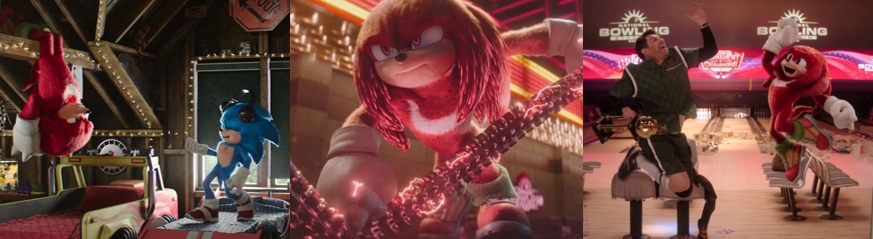
Shadow’s power makes him a formidable threat, even to Super Sonic!

Like its predecessors, Sonic the Hedgehog 3 is full of colourful, fast-paced action and adventure. Sonic, Tails, Knuckles, and Shadow all sport poses, lines, and abilities from the videogames, with Shadow riding through Tokyo on a motorcycle while blasting at Sonic with a laser pistol and many of his dramatic, angst-filled poses being ripped right out of Sonic Adventure 2 and Shadow the Hedgehog. It’s a joy to see and witnessing Shadow’s raw power is endlessly exciting; he zips about, blasting foes with kicks and punches, and laying waste to everyone. Equally, Team Sonic continue to impress: Sonic defies all laws of physics, Spin Dashing and blasting around at incredible speeds, Tails keeps pace with his helicopter blade tails, and Knuckles easily hefts around objects as though they were weightless. Of the three, Sonic has the best chance of fighting Shadow thanks to Knuckles’ hot-headedness and Tails’ comparative fragility. However, it takes all three (and Tom and Maddie utilising holographic disguises) to breach G.U.N.’s headquarters. After Tom is left fighting for his life, we see the triumphant and dramatic return of Super Sonic; however, Shadow’s power is so immense that he blasts the Chaos Emeralds from his foe with one blow and absorbs them in turn. The battle between Super Sonic and Super Shadow sees them literally tear up the landscape, causing volcanoes to erupt and them to battle across the globe and eventual on the surface of the Moon! Setting aside everyone’s ability to breathe in space, these are some of the film’s most exhilarating moments and seeing Super Sonic and Super Shadow team up to stop the Eclipse Cannon was an exciting finale. Although the Biolizard and Finalhazard don’t appear, there was a cute reference to it and other Easter Eggs for eagle-eyed fans. The Eclipse Cannon console is modelled after a Mega Drive, for example, Dr. Robotnik’s ring tone is Paul Shortino’s “E.G.G.M.A.N”, a hard rock cover of “Live and Learn” plays when Super Sonic and Super Shadow team up, and Team Sonic regroup in a super fun Chao Garden restaurant!

Unexpected alliances and sacrifices see Team Sonic save the world from destruction.

One of the best aspects of Sonic the Hedgehog 3 is how it focuses more on the videogame characters and yet still finds a way to keep Tom and Maddie relevant. They’re there to reinforce the familial bond that separates Sonic from Shadow and contrast the Robotniks’ volatile and twisted relationship. While Director Rockwell added little to the plot and could’ve easily been supplanted with Commander Walters and another fight against Shadow, the infiltration of G.U.N. headquarters was a fun sequence that culminated in the Eclipse Cannon dramatically launching from the River Thames! After being reminded of everything he’s lost, the enraged Shadow powers up the cannon and battles with Super Sonic before realising that he’s been walking the wrong path, one that would dishonour Maria’s memory rather than avenge her. Similarly, Dr. Robotnik is aghast to learn of his grandfather’s suicidal plot and battles him aboard the Eclipse Cannon, matching his nanotech against Gerald’s, and only coming out victorious thanks to a last-minute save from Tails and Knuckles. Thus, with the world in peril from the Eclipse Cannon’s devastating death beam, Super Sonic and Super Shadow block its path while Dr. Robotnik, Tails, and Knuckles fight to redirect the space station, saving the world but blasting half of the Moon! The effort drains the Chaos Energy from Sonic and sees him plummet through the atmosphere; bravely, Tails and Knuckles follow and succeed in saving him. Unfortunately, the Eclipse Cannon’s core overloads and the only ones capable of sparing the Earth from a cataclysmic event are Dr. Robotnik and Shadow. While Super Shadow expends the last of his energy pushing the space station as far away from the Earth as possible, Dr. Robotnik fights to stabilise the core. After delivering a heartfelt message to Agent Stone and thanking him for his loyalty and friendship, Dr. Robotnik and Shadow are seemingly vaporised when the Eclipse Cannon explodes. After making amends with his friends, Sonic returns to his family, grateful for their love and friendship, only to be attacked by a robotic doppelgänger (and a hoard – or “brotherhood” – of the machines) on the outskirts of New York City. Thankfully, he’s saved by a mysterious pink hedgehog and the post-credits reveal that Shadow survived the explosion, setting up further adventures.

The Summary:
Sonic the Hedgehog 3 is a rare gem, for sure. Not only is it an enjoyable movie adaptation of a videogame franchise, but it’s also an entertaining third entry in a film series, and the first time Jim Carrey’s ever portrayed a character three times, making it incredibly rare in the grand scheme of Hollywood. Naturally, given the source material, the film is a tad darker than its predecessors; Shadow alone is a grim, edgy figure, to say nothing of his tragic backstory. There’s far more action and peril this time around and the world is not only endangered, but humanity faces global annihilation from Gerald’s insane plot. Still, there’s a lot of fun, colourful action and humour at work here, including Jim Carrey’s physical comedy, references for the fans, and topical gags for mainstream audiences. Jim Carrey steals the show, throwing his all into both Robotniks, devouring the scenery, and commanding the screen whenever he’s present. I loved the energy and enthusiasm he brought to both roles and it was an inspired decision to expand Gerald’s character into an even darker and more insane mirror of his grandson. However, it’s Shadow that’s the star of the show here. Keanu Reeves perfectly captured Shadow’s angst and pain and flawlessly brought the misguided and outraged anti-hero to life. I enjoyed the tweaks to his backstory and the parallels between him, Sonic, and Dr. Robotnik that reinforced the film’s themes of family, choices, and overcoming grief. Add to that some enjoyable references to the videogames, particularly Shadow’s outings, and some fun gags and you have a hugely enjoyable adventure that successfully appeals to kids, adults, game fans, and mainstream audiences.

My Rating:

Rating: 4 out of 5.

Great Stuff

Did you enjoy Sonic the Hedgehog 3? How do you feel it holds up compared to the previous films? Did you enjoy the addition of Shadow and the changes made to his backstory? What did you think of Jim Carrey’s dual performance as Dr. Robotnik and Gerald? Did you enjoy the fight between Super Sonic and Super Shadow and the many references to the videogames? Where do you see the films going from here and are there any Sonic games or characters you’d like to see make an appearance in the future? To share your thoughts on Sonic the Hedgehog 3, leave a comment below and be sure to check out my other Sonic content on the site!

Movie Night [Christmas Day]: Die Hard 2

Released: 4 July 1990
Director: Renny Harlin
Distributor: 20th Century Fox
Budget: $60 to 70 million
Stars: Bruce Willis, William Sadler, Fred Thompson, John Amos, Art Evans, and Bonnie Bedelia

The Plot:
While waiting at Dulles Airport to pick up his wife, Holly Gennero-McClane (Bedelia), Lieutenant John McClane (Willis) is embroiled in a complex cat-and-mouse plot by disgraced Colonel William Stuart (Sadler) to hijack the planes and liberate a corrupt foreign military leader.

The Background
Roderick Thorp published a follow-up to his 1966 thriller, The Detective, in 1979, to decent reviews. Accordingly, an adaptation of Nothing Lasts Forever did the rounds before being retooled by struggling screenwriter Jeb Stuart. Stuart reimagined Thorp’s aging Detective Joe Leland into a flawed everyman, a role so expertly portrayed by Bruce Willis that it changed the perception of action heroes forever. Despite garnering mixed reviews, Die Hard’s (McTiernan, 1988) $140-odd million box office made it a a massive financial success that revitalised 20th Century Fox and redefined the action hero stereotype. For the sequel, the filmmakers turned not to Thorp’s writing but to Walter Wager’s 58 Minutes (1987), a thriller in which a police officer has less than an hour to stop terrorists who have hijacked an airport. Inspired by the Iran/Contra affair, Steven E. de Souza helped rework the concept into a Die Hard sequel, which saw star Bruce Willis return to the tune of $7.5 million and producer Joel Silver removed after his spending ballooned the budget. Also marketed with the subtitle Die Harder, Die Hard 2 was the first film to digitally compose live-action footage with a traditional matte painting, which was used for the final runway scene. With a box office of $240 million, Die Hard 2 exceeded expectations and held the largest pre-opening record for six years, though reviews were mixed. Even positive reviews noted issues with the plot and it was dubbed another disappointing sequel of the era that failed to capture the magic of the first film. Still, there are some who claim it to be an under-rated entry and the box office success alone was enough to justify a third entry some five years later.

The Review:
Die Hard 2 immediately expands the focus of its action by pivoting away from a claustrophobic, confined location and dropping grizzled, promoted cop John McClane into a bustling airport over the holiday season. In Die Hard, McClane was burned out, irritable, and desperately trying to win back his estranged wife. His personal issues were compounded by the terrorists who took over Nakatomi Plaza and he vented his anger and frustration on them with sharp-tongued relish. In Die Hard 2, things are going much better for McClane: he’s looking a little less haggard, he’s been promoted and has transferred to the Los Angeles Police Department, and he and Holly are back together. Unfortunately, while they might be on much better terms, they’re still apart as Holly’s flying in to spend Christmas with him, the kids, and her family. Still, they remain in contact through the miracle of airphones and McClane’s excited to meet her at Dulles Airport. Things get off to a shaky start for McClane, however; bad luck seems to follow him around, even when things are going well, as he’s unceremoniously towed by Sergeant Vito Lorenzo (Robert Costanzo) for illegally parking outside the building. McClane’s appeals fall on deaf ears as, in a taste of the disregard McClane’s later shown, Vito’s unimpressed by his rank and stature. To make matters worse, it was his mother-in-law’s car! Still, a $40 fine is the least of McClane’s worries when he wanders through the airport and not only bumps into a strangely familiar face and spots a handful of guys acting very suspiciously. Attentive and curious, McClane observes as the men covertly talk, sync their watches, and Sergeant Oswald Cochrane (John Costelloe) and Miller (Vondie Curtis-Hall) slip into a restricted baggage sorting area. Interestingly, McClane’s first thought isn’t to investigate himself but to instead alert the airport police. However, when he’s greeted by Vito’s smarmy grin, he realises they’ll never take him seriously and follows the two alone. When confronted by McClane, the two open fire and a brief fracas ensues that leaves Cochrane dead, McClane in custody, and Miller alive to tell the tale to his commander, shamed military veteran Colonel William Stuart (the man McClane had bumped into earlier).

Met with opposition at every turn, McClane faces another Christmas ruined by a new terrorist plot.

After McClane verifies his identity, he’s brought to Captain Carmine Lorenzo (Dennis Franz), who just so happens to be Vito’s brother and who’s not only dismissive of McClane’s reputation, but personally offended by his presence and his attitude. Consequently, Carmine angrily rebukes McClane’s suspicions that the two men were anything more than simple luggage thieves and has him removed from his office. Stubborn and unimpressed by Carmine’s failure to take the situation seriously, McClane takes matters into his own hands and faxes a copy of Cochrane’s fingerprints to his old friend, Sergeant Al Powell (Reginald VelJohnson), who reveals that they’re fake. Based on this, and the men’s weapons, and the impending arrival of the crooked General Ramon Esperanza (Franco Nero), McClane realises that something bad is about to go down and forces his way into the airport control tower to warn Carmine and air traffic controller Ed Trudeau (Thompson) that a group of mercenaries are obviously planning something. While Trudeau seems to take the threat seriously, especially when the tower starts losing power and access to their systems, Carmine refuses to entertain any of McClane’s warnings, believing he’s an overhyped, out of his depth cop trying to steal the spotlight. McClane is unceremoniously booted from the tower and accosted by keen reporter Samantha Coleman (Sheila McCarthy), who name-drops Colonel Stuart and puts the final pieces of the puzzle together for McClane. Unlike in the last film, McClane is surrounded by potential allies but constantly met with antagonism, resentment, and dismissal. No one takes his warnings seriously, causing not only the tower to be compromised when Colonel Stuart hijacks their systems, but also many deaths when Carmine’s crack troops are gunned down by Colonel Stuart’s men (leaving airport chief engineer Leslie Barnes (Evans) wounded) and Stuart brings down an aeroplane in retaliation. Although McClane desperately tries to provide a warning to the doomed aircraft, he ultimately fails and those deaths weigh heavily on his troubled conscience throughout the film. While Trudeau shows some compassion to McClane following this, he continues to be met with hostility from the airport staff and from no-nonsense Major Grant (Amos), who arrives with a bunch of troopers to take control of the situation and, like Carmine, immediately butts heads with McClane, who’s seen as a dangerous loose cannon despite his best efforts to help.

McClane’s reputation and aggressive demeanour mean he’s as short on allies as he is time.

Luckily, McClane does have some allies amongst all these hot-headed egos. While Powell is sadly relegated to a cameo, he does confirm McClane’s suspicions that something’s amiss at Dulles. Barnes proves extremely helpful in offering alternative ways to signal the aircraft, though Colonel Stuart angrily retaliates each time or has set up contingencies for these. Barnes is also the one who clues McClane in that Colonel Stuart’s men are using a coded frequency (though he’s unable to break it) and who re-routes the emergency beacon to covertly communicate with the pilots. While racing to find solutions and workarounds to Colonel Stuart’s plot, McClane ends up in a network of access tunnels beneath the runway and bumps into Marvin (Tom Bower), a quirky janitor with racks upon racks of blueprints who helps McClane get to different areas of the airport, try new ways of signalling the planes, and locate Colonel Stuart’s outpost at a nearby church. Marvin also retrieves the coat and pre-coded walkie-talkie of one of Stuart’s men, allowing McClane to listen in and retort to Stuart directly. This gives McClane the chance to vent his anger on the man responsible for ruining his latest Christmas, though Colonel Stuart isn’t easily baited and out-thinks McClane at every turn. While Major Grant and McClane clash, McClane earns his begrudging respect after he helps storm Colonel Stuart’s church, raiding their operation and driving off Stuart’s men. This resolution is short-lived, however, when McClane realises he and Major Grant’s men were firing blanks the entire time. While Carmine again refuses to believe McClane’s claims, he’s forced to realise they’ve all been duped when McClane dramatically opens fire on Carmine (somehow not being gunned down by the cops present) to demonstrate his point and Carmine finally comes on side, giving McClane clearance to intercept the villains. While McClane treats Coleman with about as much respect as Colonel Stuart and has no time for her sniffing around for a story, she proves somewhat useful first in identifying Stuart and then in joining him in intercepting Stuart’s Boeing 747, giving McClane the chance to dramatically tackle the bad guys and end their plot.

Holly’s safety means McClane has a personal stake in the film’s events.

While Holly returns, she’s far less of a factor and has far less agency this time around. She’s stuck in the air, as far out of McClane’s reach as before, but with even less control over her situation. While she communicates with McClane using an airphone, she has no idea why her landing has been delayed and only becomes concerned about the situation after the returning Dick Thornburg (William Atherton) points out the circling aircraft in the nearby skies. As obnoxious and grating as ever, Thornburg feels slighted and threatened by Holly since a right-hook to his jaw knocked out two of his teeth after he endangered her children in the last movie, leading him to take out a restraining order against her. While this earns Holly the admiration of Connie (Karla Tamburrell), an air hostess equally repulsed by Thornburg, Holly’s forced to endure his presence as the situation worsens. Ever the opportunist, Thornburg patches into the cockpit radio and learns of the situation, then remotely forces his way on-air to report on the situation live, selfishly thinking only of his career and not the panic it causes those waiting at Dulles Airport. As perceptive and feisty as her husband, Holly not only catches on that their situation is going to become a real problem due to lack of fuel but also retaliates against Thornburg once more by subduing him with a fellow passenger’s taser. Still, while Holly doesn’t get much else to do, it’s the drive to save her from plummeting to a fiery death that pushes McClane on downside. His personal stake in the events sees him aggressively interject himself into the situation and causes as much of the animosity he receives as his smart mouth, though McClane excels in a pressure situation and simply forces himself to fight harder or find other ways around problems, even if it means pissing off those in authority. The subtext of Die Hard 2 is lesser than the first, with more generic masculine and pseduo-sexual connotations, but the premise of this stubborn, determined “Everyman” fighting against the odds to save the woman he loves is strong, though I would’ve liked to see Holly have a more active role in the main plot.

Colonel Stuart enacts a diabolical plan to liberate his anti-communist idol.

This time, McClane is up against an opponent just as intelligent, ruthless, and heavily armed as Hans Gruber (Alan Rickman) but one with the added benefit of a lifetime of military service and equally well-trained, incredibly loyal followers. A former Special Forces officer and one time student of Major Grant, the anti-communist Colonel Stuart strongly supported General Esperanza and even funded his operation, being dishonourably discharged and disgraced as a consequence. After fleeing the United States prior to his court martial, Colonel Stuart and the imprisoned General Esperanza plotted an elaborate scheme to hijack Dulles Airport, intercept Esperanza’s plan, and abscond to safety in a Boeing 747. A stoic, calculating martial arts expert, Colonel Stuart plans everything to the smallest detail, easily infiltrating Dulles Airport and hijacking their communications and power array and duplicating much of their control room in a nearby church. From here, Colonel Stuart and his men easily dupe the aircraft into thinking ground control is experiencing nothing more than heavy weather and effectively holds all incoming aircraft hostage, crashing them without a second’s thought whenever and reprisals are attempted. Though he doesn’t hesitate to take lives, even those of his men, Colonel Stuart reprimands Trudeau and McClane for not obeying his instructions and forcing his hand, indicating that he’s trying to rescue his beloved General with as little bloodshed as possible. His patience with McClane quickly wears thin, however, especially when John intercepts Esperanza’s aircraft and nearly brings him into custody. Aggravated that one stubborn cop could cause his meticulous plan so much trouble, Colonel Stuart has his men open fire on the craft and tosses a bunch of grenades in to take out McClane but is forced to flee when McClane miraculously survives thanks to his quick thinking. Colonel Stuart’s men are fiercely loyal; while they briefly hesitate upon being ordered to trick an aircraft into crashing, they obey his every word without question out of fear of his reprisals. Colonel Stuart’s joined by Major Grant, a deceptive and equally ruthless military man who slits newcomer Telford’s (Patrick O’Neal) throat just for not being “one of them” and aids in duping McClane to cover their escape. When push comes to shove, Colonel Stuart finally gets his hands dirty in a one-on-one fight with McClane, being far more physically capable than Gruber. He’s also much more in control of his emotions and motivated not by greed, but by a warped sense of patriotism and pride.

The Nitty-Gritty:
Die Hard is a Christmas movie. I don’t care what you say or think; it just is. Die Hard 2 is also a Christmas movie, but the season is far less of a factor in the plot. Seasonal jingles aren’t as prominent in Michael Kamen’s score and Christmas trappings aren’t as easily noticeable thanks to how bustling Dulles Airport is, but the entire crux of the plot is Holly coming home for Christmas and half the reason the weather is so bad is because we’re deep into the festive season. McClane does note that his bad luck constantly ruins the season for him, but this seems more emblematic of him than of the festive period. Indeed, Major Grant notes that McClane is in the “wrong place at the wrong time” during one of the many tirades launched against him for trying to help, and the situation only escalates as things spiral out of control. McClane is in a slightly better position this time around, though; he’s wearing shoes, for starters, is fully armed, and has more resources at his disposal to try and help. Unfortunately, he’s constantly hampered by those around him. Since Carmine doesn’t take his concerns seriously, Trudeau doesn’t prepare the control tower for a possible hijacking; since doors are constantly shut in his face, McClane can’t share his insight or opinion on the situation; and since Colonel Stuart is so resourceful and intelligent, the odds are stacked against him in a far greater way than before. This time, McClane battles to save not just his and Holly’s lives, but the lives of all the people on the planes unable to land because of Colonel Stuart. McClane might be selfishly driven to intervene to ensure Holly’s safety but he doesn’t just sit back and do nothing when Stuart hijacks a British airliner. He runs out onto the landing strip and desperately tries to do something, though this is of little comfort when his efforts inevitably fail. While Die Hard 2 is therefore more of a typical action/thriller and less of a tale of reclaiming masculinity and enforcing masculine power like the first film, some aspects of this still remain. Half the reason Vito, Carmine, and Major Grant clash with McClane is because they view him as a threat to their authority and masculinity. McClane is a loose cannon who shouts his opinion and acts impulsively, with little respect for local authority and the chain of command, which especially irks Carmine and equally annoys Major Grant, who believes McClane’s interference is doing more harm than good.

Aside from some explosive moments, McClane is largely a gunfighter this time around.

Ironically, even if McClane approached these figures with a more reasonable and respectful tone, it probably wouldn’t have helped since McClane is something of a celebrity now after his actions in Die Hard. This, and departmental xenophobia, are equally strong reasons for them to dislike McClane and dismiss his concerns, only to begrudgingly realise that he’s been the only one making sense the entire time, which is frustrating but still an improvement over the bungling police presence in the last film. While thematically and narratively very similar to Die Hard, Die Hard 2 broadens its scope for action set pieces; there are more characters involved so more opportunities for big shoot outs, with McClane even engaging in a snowmobile chase near the climax. However, I’ve never thought of Die Hard 2 as being “bigger” or “better” than the first one in terms of its action. It’s often far more explosive, that’s for sure; the plane crash is a notable set piece, as is the destruction of General Esperanza’s plane. However, it’s pretty obvious both are model and composite shots, making them ironically less impressive than McClane’s leap from the exploding Nakatomi helipad. McClane doesn’t get as many opportunities to throw hands this time; he always has his pistol and ammo on him, so he’s more apt to just gun down his foes with a wry remark, meaning we see less of McClane’s physical tenacity. However, this is supplanted by his “die hard” nature; he’s a stubborn cockroach of a man who won’t quit and keeps fighting even when met with a hail of gunfire. Ironically, he’s far less banged up and bloody than in the first film despite the greater odds against him and McClane’s resourceful nature comes not from finding innovative ways to kill his enemies but from finding creative ways to save lives, galvanising McClane into a more broadly heroic character. That’s not to say Die Hard 2 is tame, by any means: plenty of guys are executed by gunshot to the head, people are strangled, have their throat cut, and are riddled with bullets or blown to pieces. But it does feel far less personal this time around; before, McClane was desperately picking Gruber’s men off one by one but Colonel Stuart has far more men with far less memorable characteristics, so it just feels more generic when they’re killed rather than a rousing victory for our lone hero like before.

Though he’s no match for Stuart, McClane gets the last laugh and rescues his wife once again.

McClane is against a ticking clock throughout Die Hard 2. He only has ninety minutes before Holly’s plane runs out of fuel so he does everything he can to restore communications with the planes and find a way to negotiate her safety. He experiences ups and downs in this endeavour as Barnes does manage to contact the pilots, but McClane is intercepted by Colonel Stuart and his men before he can barter Esperanza’s life for Holly’s. The wounded General Esperanza escapes but things start to look up with Major Grant comes along and leads an all-out assault on Colonel Stuart’s church base, only to dupe McClane and the others with blanks and betray them to aid Stuart and Esperanza’s escape. With time running out and Holly’s plane preparing for an emergency landing, McClane finally gets the assistance he’s been demanding the entire movie and has Coleman’s pilot chase after the escaping villains. With no way to block the larger aircraft, McClane is forced to make a desperate drop to the wing on their Boeing 747 to try and stop them. Unlike the first movie, which ended with a tense showdown akin to an Old West duel between the exhausted McClane and the smug Gruber, Die Hard 2’s climax centres around bare-knuckle fistfights on the wing of a speeding aircraft trying to take off. Major Grant is the first to head out to put a beating on the outmatched McClane. However, thanks to his tenacity and resourcefulness, McClane manages to trip Major Grant and send him into a jet engine, splattering him across the plane and further screwing up Esperanza’s attempts to get off the ground. Thus, Colonel Stuart takes matters into his own hands and beats the shit out of McClane in a way Gruber could only dream of, finally kicking him to the speeding runway below. Returning inside to celebrate with his men, Colonel Stuart is completely oblivious to the fact that McClane opened the plane’s fuel valve. Bloodied and beaten, McClane delivers his “Yippie-ki-yay, Mister Falcon motherfucker!” catchphrase and tosses his lighter at the fuel trial, which naturally defies all physics and logic to burn into the plane and explode it in mid-air. As an added bonus, the flame trail and burning wreckage act as a marker for the planes to use to make a safe landing, reuniting McClane and Holly once more and bringing their latest Christmas drama to a close.

The Summary:
Die Hard is a Christmas tradition for me. I watch it every year and every year I enjoy it as much as the last time I watched it. Die Hard 2 also makes the Christmas watch list, but I’d be lying if I said I looked forward to it as much as the first movie. It’s not that it’s bad, really, just not as enjoyable or memorable as the first film. The atmosphere is both familiar and yet different, which is what you want from a sequel but something just feels off. Narrative beats, returning characters, and a sense of repetition help thematically link it to the first movie while also expanding upon the characters and setting. John McClane is far less beaten down than before, but no less tenacious; however, his character is noticeably different, largely because of the supporting cast. He’s face-to-face with the same type of bureaucrats who got in his way last time and we live his frustration with their dismissive attitude and his desperate attempts to do something while they sit around, stubbornly refusing to believe him due to their slighted pride. McClane is as resourceful and enjoyable as ever, delivering some wry quips and surviving some unbelievable situations, but he’s recast as a more typical heroic figure this time. Die Hard 2 isn’t just about saving a handful of hostages; it’s about saving thousands of lives from Colonel Stuart’s reprisals. It’s not about reclaiming masculinity; it’s about reinforcing it and a clash of “Alpha Male” figures and egos. Colonel Stuart exemplifies this; unlike Gruber, he’s a physical and intellectual challenge for McClane, after all. Oddly, despite its greater scope, I find Die Hard 2’s action to be lacking compared to the first. Things don’t feel as intimate and personal and a lot of the impact is dulled, as though everyone’s just going through the motions despite some enjoyable performances. In the end, I still watch Die Hard 2 at Christmas and still enjoy it, but I would much rather watch Die Hard twice or skip to one of the other sequels as they delivered a new challenge for McClane in a far more unique way than what we see here.

My Rating:

Rating: 4 out of 5.

Great Stuff

Are you a fan of Die Hard 2? How do you think it compares to the first films? What did you think to Colonel Stuart and his cold-hearted depiction? Did you like seeing McClane face new challenges, especially following his infamy from the first movie? Were you also disappointed by the action sequences? Is Die Hard 2 on your Christmas watch list? What are your plans for Christmas Day today? Whatever your thoughts, feel free to comment down before and have a great Christmas!

Movie Night: Kraven the Hunter

Released: 13 December 2024
Director: J. C. Chandor
Distributor: Sony Pictures Releasing
Budget: $110 to 130 million
Stars: Aaron Taylor-Johnson, Ariana DeBose, Alessandro Nivola, Fred Hechinger, and Russell Crowe

The Plot:
Saved from death as a boy by a voodoo serum, Sergei Kravinoff (Taylor-Johnson) hunts wrongdoers as “Kraven the Hunter”. However, when his past comes back to haunt him, Kraven must fight to rescue his cowardly younger brother, Dmitri (Hechinger), from a maniacal, half-human, wannabe mobster.

The Background:
Following the phenomenal success of Sam Raimi’s Spider-Man trilogy (2000 to 2007) and the sadly mediocre reception of Marc Webb’s reboot films, Marvel Studios finally achieved the impossible by striking a deal to include the iconic wall-crawler in their Marvel Cinematic Universe (MCU). After seeing the incredible success of Spider-Man: Homecoming (Watts, 2017), Sony were excited enough to greenlight a bunch of spin-offs that would focus on Spidey’s villains and side characters. After Venom (Fleischer, 2018) made bank, Sony not only signed off on a very profitable (if critically maligned) sequel, but also, inexplicably, solo projects for Roy Thomas and Gil Kane’sLiving Vampire”, Doctor Michael Morbius, Denny O’Neil John Romita Jr.’s, Cassandra Webb/Madame Web, and Stan Lee and Steve Ditko’s Sergei Kravinoff/Kraven the Hunter, a character best known for his memorable (if temporary) death in the celebrated “Kraven’s Last Hunt” (DeMatteis, et al, 1987) arc. Although a prominent villain in videogames and the 1990’s Spider-Man cartoon, Kraven’s journey to the silver screen was fraught with years of stop/start efforts. After committing to the idea of their own adjacent series of interconnected Spider-Man movies, production of a solo Kraven film began in earnest in August 2018. Screenwriter Richard Wenk shared that his screenplay was heavily influenced by “Kraven’s Last Hunt” and that he was experimenting with different directions for the character depending on Peter Parker/Spider-Man’s inclusion, all while MCU creators pitched including Kraven in their films. Aaron Taylor-Johnson joined the project and underwent an intense training regime to prepare for the title role, attracted to the film for its deeply interpersonal story. After a number of delays, Kraven the Hunter finally released to universally negative reviews and, as of this writing, the film hasn’t even made $30 million at the box office. Critics tore apart the obvious dubbing of scenes, the disastrous execution, and the tiresome concept of a Spider-Man-less Spider-Man movie. Though director J. C. Chandor was hopeful of a sequel and Taylor-Johnson was contracted for additional appearances, those hopes seem dashed not only by the film’s poor reception but Sony’s announcement that they’ll be refocusing their Spider-Man efforts.

The Review:
It’s baffling to me that Sony just forgot how to make decent Spider-Man movies. Apart from their animated ventures, all their Spider-Man spin-offs have been mediocre to terrible and completely directionless. I can almost understand making standalone Venom movies and it was surprising how well they worked without Spider-Man, but was anyone asking for solo movies for Spidey’s low tier villains and supporting characters? Maybe if there had some kind of plan, like linking all these spin-offs into a coherent, adjacent universe or bringing back Andrew Garfield for a series of showdowns with these characters then maybe, maybe, things would’ve been different. Instead, we live in a world where Sony legitimately thought people would pay to see Kraven the Hunter, of all people. To be fair, Aaron Taylor-Johnson certainly looks the part. He’s ripped and exudes a rugged charisma that certainly catches the eye and his Russian accent and dialect is commendable. He’s easily the best part of this film but that’s a bittersweet compliment as he’s completely wasted here instead of being put to better use in a film that’s not completely forgettable ten minutes in, let alone by the end. Kraven the Hunter opens with Kraven a fully-fledged manhunter; he infiltrates a Russian prison to assassinate crime lord and poacher Seymon Chorney (Yuri Kolokolnikov), an act that kicks off the central conflict of the movie. The film then jumps back in time sixteen years to introduce us to a young Sergei (Levi Miller) and Dmitri (Billy Barratt) and set up their shared and individual issues with their father, kingpin and avid game hunter Nikolai Kravinoff (Crowe).

Following a vicious attack and mystical serum, Kraven becomes a renowned manhunter.

This extended flashback establishes that the Kravinoff boys fear and loathe their authoritarian father, who believes in survival of the fittest and refuses to show or tolerate any weakness in either himself, his vaguely defined criminal organisation, and his two boys. Resentful towards Nikolai for his treatment of their mother (Masha Vasyukova), who was mentally unwell and took her own life, the young Kravinoffs are nevertheless powerless to defy their father’s will and forced to accompany him to Tanzania for a hunting trip. While Nikolai favours Sergei, he’s critical and dismissive towards his bastard child, Dmitri, whom Sergei tries to defend at all costs. This drive sees Sergei leap to Dmitri’s defence when a gigantic lion approaches them in the wilds. Hesitating to shoot, Sergei is mauled and hauled away by the beast, leaving Dmitri in hysterics and Sergei close to death. Luckily for him, young Calypso Ezili (Diaana Babnicova) just happened to be vacationing in the area, coincidentally learned from her grandmother’s (Susan Aderin) tarot cards about Sergei’s fate, and carries a helpful voodoo serum which, coupled with the lion’s blood, not only saves Sergei’s life but bestows him with vaguely mystical animal powers. After fully recovering and lashing out at his father’s abhorrent ways, Sergei packs up and leaves, strangely leaving Dmitri behind, fleeing to his mother’s sanctuary (essentially a spherical greenhouse) in the far reaches of Russia. There, Sergei learns the extent of his new abilities: he’s fast like a cheetah, climbs skyscrapers and trees like an ape, is soft footed like a deer (to the extent that he apparently negates people’s peripheral vision), has eyes like a hawk, and superhuman hearing and durability. These gifts allow him to build a reputation as the world’s greatest hunter and he carves a name for himself as “Kraven”, hunting down crime lords like his father (but, oddly, not his father) and local poachers. In all that time, no one has ever pieced together that Kraven is Sergei Kravinoff and his name has become legend. He travels the world with his unseen pilot (whose scenes were clearly left on the cutting room floor) ticking names off his list. However, he riles up the criminal underworld when he kills Chorney as it leaves a power vacuum that both Nikolai and would-be kingpin Aleksei Sytsevich/The Rhino (Nivola) are eager to fill.

Kraven’s family issues see him make unlikely and underutilised allies.

As mentioned, I don’t get why Sergei left Dmitri behind. The boy lived in constant fear of his father and was desperate to earn his approval and respect, an uphill battle he was seemingly doomed to never win, even with his “chameleon” like talent to mimic voices and lovely singing voice. It seems like it would’ve made more sense for Sergei to take Dmitri and for him to be his pilot but, instead, Dmitri ends up kidnapped by the Rhino and held to ransom, forcing Sergei to reunite with Nikolai and begrudgingly work alongside his estranged father to rescue his troublesome little brother. Despite being renowned as the greatest hunter in the world, it takes Kraven sixteen years to track down the now adult Calypso (DeBose), now a lawyer living in London and jaded by the bureaucratic justice system. Though initially hesitant because of Kraven’s violent lifestyle, Calypso reluctantly agrees to help him track down the Rhino and warns him against pursuing dangerous crime lords, a caution that comes true when Dmitri is kidnapped and Calypso is also targeted by the Rhino in a bid to flush Kraven out. If there’s supposed to be a romantic subplot between Kraven and Calypso, this also seems to have been cut from the film. Calypso certainly looks the part and there are glimpses of chemistry between her and Kraven, but so much of her dialogue is clearly redubbed through ADR and it’s not only jarring but leaves much of her performance flat as a result. She just about manages to prove her worth, however, and she’s never held hostage like Dmitri. She also has contacts who provide Kraven with leads (even if they’re false ones courtesy of the Rhino’s slick henchman, “The Foreigner” (Christopher Abbott), a superhuman mercenary with unexplained hypnotic powers), and even saves Kraven’s life when he’s drugged and brought to the brink of death once more.

Aside form Nikolai, the film’s villains are bizarre and dull, poorly characterisaed antagonists.

Despite years of mistreatment, resentment, and hatred towards his father, Kraven purposely leaves Nikolai off his list because, for all his flaws, the crime lord is still the hunter’s father. Kraven reunites with his father and brother once a year for Dmitri’s birthday, growing more and more troubled by his brother’s obsession with pleasing the old man, and rebukes Nikolai when he refuses to pay Dmitri’s ransom to avoid showing weakness. Taking matters into his own hands, Kraven tracks down the Rhino and runs into the Foreigner, a mysterious assassin who, honestly, could’ve easily been cut from the film or supplanted with someone else. While we learn of his personal grudge against Kraven, we never learn the Foreigner’s real name, how he got his strange powers, or even what the extent of them are. He easily subdues and murders anyone in his path until he reaches Kraven, who he decides to drug, cripple, and beat up rather than go for a quick kill, which costs the Foreigner his life. Compounding matters is the use of the Rhino, of all people, as the film’s main antagonist. Reimagined as a neurotic, semi-maniacal would-be crime lord who craves attention and a “partner” to elevate him up the ranks, the Rhino is a strange, cartoonish villain just as apt to make bizarre noises as he is to monologue about his aspirations. After being disregarded by Nikolai for his physical weaknesses and needy demeanour, the Rhino turned to Doctor Miles Warren for both a cure for his condition and a means to become stronger. The result was some unexplained genetic tampering that turned Sytsevich’s skin into an impenetrable hide and bestowed him with incredible strength, much like his namesake, but also causes him such agony that he medically keeps the transformation at bay. Instead, he orchestrates a convoluted plot involving kidnapping and murder to try and fill the void left by Chorney and make a name for himself as the man who killed Kraven, or coerce the Kravinoffs into joining forces. This latter scheme is mirrored by Nikolai, who desires to rule the criminal underworld with his sons, leading to what’s essentially a war between rival mob gangs in a bid for greater glory. However, if you ask me, reimagining the Rhino into this role is a poor fit. I would’ve preferred to see Alonzo Lincoln/Tombstone in this role, with the Rhino replacing the Foreigner as his muscle/henchman, and possible have rewritten the script to weave Dr. Warren into the narrative more explicitly, but what do I know?

The Nitty-Gritty:
Kraven the Hunter is, fundamentally (somewhere beneath all the mess), a story about a son escaping the shadow of his abusive and totalitarian father. While part of young Sergei enjoyed his father’s approval, he was nevertheless disgusted by Nikolai’s treatment of Dmitri and his penchant for big game hunting. Having grown up emotionally and physically abused by his father, and having witnessed his brother get the same treatment or worse, Kraven is determined to not become the same kind of man as his father. To a degree, he accomplishes this (he becomes a morally grey vigilante, of sorts, rather than a ruthless crime boss) but his affinity for violence and desire to be seen as the Alpha Male among his peers echoes his father’s teachings. Naturally, Kraven rejects these comparisons and believes he’s doing good by taking out poachers and mob bosses, but his path inevitably intersects with Nikolai once more and he’s clearly disturbed by his similarities to his father. Dmitri couldn’t be more different from both men; he craves the approval Nikali shows Sergei and does everything he can to appease his father. Dmitri’s talents are in entertaining and mimicry rather than physical feats, wowing the patrons of his club with his pitch-perfect vocal talents and even earning a modicum of respect from his father, who appreciates Nikolai’s Tony Bennett impersonation. Despite a lifetime of abuse and mistreatment, and being beaten and having a finger cut off, Dmitri refuses to succumb to the Rhino’s torture or sell out his family to the irrational wannabe, though he’s stunned to learn that his brother is the fabled Hunter, which only adds to his insecurities and desire to carve his own legacy by the film’s end. Despite featuring many names associated with Spider-Man, Kraven the Hunter is very light on Spider-Man elements: the Daily Bugle appears a couple of times, Dr. Warren is name dropped, and it’s revealed that Kraven has an inexplicable and convenient and never explained fear of spiders. However, there’s no indication that a Spider-Man exists in this world or if it’s even connected to Sony’s other spin-off films.

Sadly, all the bloody violence and delicious abs in the world can’t excuse the poor CGI and editing.

While Kraven the Hunter is often a mess of clunky, clearly rerecorded dialogue and overdone clichés, the action on display is pretty good at times. The film is, sadly, populated with some of the worst CGI animals I’ve ever seen; the gigantic lion and the leopard that attack Kraven at different points are the worst offenders by far. When Kraven leaps into action, the violence is fast, bloody, and brutal, with him stabbing foes, slicing their throats open, and clamping bear traps to their heads! At one point, he sets traps for his pursuers that sees one guy get ripped in half crotch first, another take a machete to the head, and blood splattering across a bleak Russian forest. Kraven beats guys to death with his bare hands, easily breaks bones and manhandles multiple, even armed foes, and his skilled with knives, blades, and spears is readily apparent. Believing it dishonourable to use firearms and any weapons not made of the land or meticulously crafted, Kraven keeps a cache of blades and weapons at his sanctuary and on his person, subduing targets with blow darts and poisons and easily clambering up sheer surfaces with an animal grace. I’m not the biggest fan of or expert on Kraven but I do believe he’s often imbued with animal senses, spirits, and ferocity and that’s on full display here. Kraven often gallops about on all fours, tackles jeeps like a rhino, clings to purchases like a monkey, and has senses so keen that he can hear, smell, and see things no normal human could. This all adds to his abilities as a manhunter and in a fight, with him being swift enough to avoid gun fire and carpet bombs, durable enough to take a beating, and apparently strong enough to survive being buried under a bunch of stones and debris. Somehow, he’s so fleet footed that he can remain completely undetected even when standing right behind his foes and his eyes often glow an ethereal orange to show he can see in the dark or across vast distances. He’s not completely invulnerable, however. He succumbs to the Foreigner’s poison like any other man and is beaten close to death by the malicious mercenary, his life only spared by the timely intervention of Calypso. Dmitri also proves to be a vulnerability, one the Rhino doesn’t hesitate to exploit, and Kraven’s emotions often get the better of him where his brother and family are concerned.

A lacklustre showdown with a ridiculous villain leaves Kraven set for a sequel that’ll never happen.

Despite Kraven’s lauded and feared reputation, he struggles to piece together the paper-thin plot taking place around him and needs Calypso and the intel offered by his dying targets to figure out what the hell’s going on. Already angered that security footage that identifies him is doing the rounds, Kraven’s desire to shut down those actively seeking him out is exacerbated when Nikolai’s life of crime seemingly causes Dmitri’s kidnapping by would-be rival kingpin, the Rhino. When Dmitri and Kraven shoot down the Rhino’s offer to join forces, the Rhino organises a strike against Kraven on his home turf, a ridiculously poorly thought-out operation that leaves all his ill-equipped troops dead and Sytsevic forced to allow his transformation to take full effect. Transforming into a hulking man-rhino that, despite being comic accurate, looks laughably cartoonish, the Rhino fights Kraven amidst a buffalo stampede. Thanks to his impenetrable skin and augmented strength, the Rhino easily shrugs off Kraven’s blows and knives and pummels the Hunter, beating the piss out of him and looking to throttle him to death. However, Kraven spots the medicine line on the Rhino’s thick hide and rams a role into his stomach, then has the stampede trample the weak-ass villain to death. Although Kraven talks Dmitri out of executing the Rhino, Kraven has not hesitation about confronting his father, who released the video footage to coerce his estranged son into eliminating his competition, a revelation that leaves Nikolai being mauled by a wild bear courtesy of Kraven. The film then ends with Kraven being aghast to learn Dmitri has taken control of their father’s operation and undergone some “unorthodox” surgery of his own to assume the face of anyone he wishes at will. How Dr. Warren did this isn’t explained and quite how the Chameleon thinks he’ll fool anyone with his short stature is beyond me. I think a better reveal would’ve been that Dmitri was posing as Nikolai and was a bad guy all along, manipulating events to seize power and using fake masks and practical augmentations rather than what I assume is either a nanotech or some vague bioengineered tampering to steal people’s identities. Oh, and Kraven gets his signature jacket, made out of the hide of the lion he failed to kill, as a parting gift from his father.

The Summary:
I wasn’t expecting much, if anything, from Kraven the Hunter. I’m really not a fan of the character and would have little interest if he showed up in a Spider-Man movie, so giving him a solo film seems moronic and pointless to me. Luckily, I can say that I enjoyed Kraven the Hunter more than Morbius or Madame Web, but not by much and that’s hardly a high bar to clear and the film’s flaws mean it’s still not getting higher than a generous two-star rating. This rating is based purely on Aaron Taylor-Johnson’s performance, which I did enjoy, and the brutal, bloody action sequences, which give the film an edge sadly not afforded to the Venom movies as swearing and strong, bloody violence would tip them into 18-rated affairs. Aaron Taylor-Johnson does look great in the role, and I did enjoy the depiction of Kraven’s powers; it seemed a lot of his actions and stunts were practical, too, which was appreciated. However, it made the poor CGI stand out even more. I obviously don’t expect the actors to be wrestling with real lions and such but surely CGI has progressed to the point where they can be rendered more convincingly? The Rhino suffers greatly from this, too. Clearly a rushed, last-minute inclusion, the Rhino is so awful here and looks so janky that I honestly prefer the mech-suit version we got previously; at least that’s somewhat believable! Add in pointless characters like the Foreigner, a strange and ill-fitting interpretation of the Rhino, and some horrendous and distracting ADR, and you have a film that feels like it was butchered by the budget and the editing process. It feels like many scenes were left on the cutting room floor, especially those featuring Calypso and Kraven’s life between hunts, making for an awkwardly paced and disjointed affair. It’s also disappointing that it’s not made clear where Kraven the Hunter fits in Sony’s spin-off films, if anywhere. However, even if the film had been better in these regards, I would still be unimpressed and annoyed at the idea of giving Kraven a solo movie. And, if it had been a Spider-Man film featuring Kraven, I would’ve been equally disappointed as I just don’t care about the character. Thus, Kraven the Hunter was doomed to fail for me and I cannot understand, for the life of me, who this mess was made for.

My Rating:

Rating: 2 out of 5.

Could Be Better

Did you enjoy Kraven the Hunter? If so…what’s the matter with you? What did you think to Aaron Taylor-Johnson’s performance and the depiction of Kraven’s powers? Do you agree that the film felt rush, especially regarding Dmitri’s story arc? What did you think to the Rhino and his eventual full reveal? Did you also think that the film felt butchered in the editing room? Are you a fan of the character in general (and, if so, again…why?) and would you like to see Kraven return in some capacity? What Spider-Man villain would you like to see get a standalone movie? I’d love to know your opinions of Kraven the Hunter, so leave them below and be sure to check out my other Spider-Man and Marvel content.
Back Issues [Sonic2sDay]: The Nameless Zone


After the release of Sonic the Hedgehog (Sonic Team, 1991), Sonic was established as the hottest videogame icon. In anticipation for the sequel, SEGA dubbed November 24, 1992 as “Sonic 2sday”. Accordingly, this seems like a great excuse to celebrate Sonic’s faithful sidekick, Miles “Tails” Prower, who debuted in that title.


Story Title: “The Nameless Zone” (Parts 1 and 2)
Published: 25 December 1993 to 8 January 1994
Writer: Nigel Kitching
Artist: Dave Windett

The Background:
Sonic the Hedgehog was a huge success for SEGA. Thanks to an aggressive marketing campaign and being included with the all-powerful 16-bit Mega Drive, Sonic sold over 15 million copies upon release. After a tumultuous development, Sonic the Hedgehog 2 (SEGA Technical Institute, 1992) surpassed its predecessor by a country mile! 400,000 copies were sold in its first week alone, 6 million units during the Mega Drive’s lifespan, and the game increased SEGA’s control of the home console market by 40%. Widely praised and highly regarded, Sonic 2 also debuted a kid sidekick for Sonic. The result of an internal contest, Miles “Tails” Prower was created by Yasushi Yamaguchi, modelled after the mythical kitsune, and greatly admired his super-fast hero. Well regarded as a popular staple in the Sonic franchise, Tails has the distinction of being one of the few of Sonic’s supporting cast to star in his own divisive solo outings and he was also the first to get his own solo stories in Sonic’s comic book adventures. The first of these was this two-part adventure that featured in Sonic the Comic (StC), a fortnightly comic book published in the United Kingdom that pulled much of its lore from the now defunct Mobius and Doctor Ovi Kintobor storyline. Tails’ adventures in StC cast him as an unlikely hero in a fantasy setting where he struggled to live up to the reputation he’d made for himself, and his adventures continued to feature in StC even as it transitioned to a fan-made digital format.

The Review:
Remember that flashback Tails had in Sonic Adventure (Sonic Team, 1998)? You know, the one where he sees Sonic running past and chases after him, all excited and happy? Well, “The Nameless Zone” begins with a similar scene of Tails chasing after Sonic only it’s very different. In case you forgot or didn’t know, StC-Sonic was a bit of a dick; he truly did have an attitude and he constantly berated his friends, especially Tails. Frequently referring to the young fox as “pixel brain” and chastising him, it’s a wonder Tails bothered to put up with it for so long. Sonic’s no different here; he’s in such a hurry that the last thing he needs is Tails shadowing him and slowing him down. Thus, the super-fast hedgehog speeds off, ordering Tails to stay out of his way, and leaving the young fox cub dejected. He’s so upset at not being able to prove himself to his hero that he’s completely blindsided when a mystical portal opens behind him and a mysterious voice beckons him from beyond, using his real name and calling for his aid. Tails immediately recognises the portal, and the voice, and his heart sinks ever further. Unable to escape his fate, he begrudgingly enters the portal and returns to the titular “Nameless Zone”, a fantasy realm adjacent to Mobius where Tails grew up. Tails is shocked to be greeted by the Enchanter Kings, the two rulers of the sword-and-sorcery world who have reached out to him on the mistaken belief that he’s become a great hero in his absence. They believe this because Tails foolishly wrote letters to his family in which he took credit for Sonic’s heroic acts, spinning a yarn in which Sonic is his sidekick and he, not the Blue Blur, is the true hero of Mobius. Realising that his exaggerated claims have landed him in hot water, Tails tries to explain the situation only for the Enchanter Kings to brush it off as false modesty.

Believed to be a legendary hero, Tails is forced to defend his estranged home from a demonic creature.

They present Tails with an enchanted set of nifty battle armour that’s magically designed to be near weightless when worn. Despite his protests, Tails is fitted with the armour and the Enchanter Kings prepare him to put his legendary heroism to the test to defend their kingdom. The test? Well, it’s none other than a monstrous, demonic creature known as Trogg who has crossed the dimensional bridge to the Nameless Zone from his realm, the “Land Beyond”, and demanded to face their champion in mortal combat. Trogg desires nothing less than to invade the Nameless Zone with his berserker army and is unimpressed with the “shrimp” heralded as their champion. His protests falling on deaf ears, Tails has no choice but to take up his sword and meet Trogg on the bridge. When Trogg demands that Tails take his “best shot”, Tails bravely swings his sword in a clumsy effort and gets a kick to the chest (although it looks like it hits him in the balls!) for his efforts. Seeing his ultimate victory within reach, Trogg goes for the killing blow; however, it turns out Tails’ swing weakened the rope holding up the bridge. The rope snaps, collapsing the structure, and the two take a plummet. Trogg instinctively grabs the flailing rope and assumes that Tails has perished, only to be stunned when Tails flies to safety. Trogg is then forced to surrender to avoid a plunge into the abyss, much to the elation of the fox people. Luckily, Tails is spared any further awkwardness as the portal back to Mobius begins to fade so he quickly hops back through, his armour magically detaching since it cannot exist outside of the Nameless Zone. Back on Mobius, Sonic praises Tails for staying out of his way but, when questioned, Tails chooses not to reveal what he’s been up to, a plot point that would be revisited in Tails’ subsequent adventures in his home realm.

The Summary:
This was a short and relatively inoffensive side story for Sonic’s oft-bullied sidekick. There’s not much to it and we get only the barest glimpse into Tails’ backstory, which is as far removed from the source material as Sonic’s was in these comics. There was a belief back then that Tails originated from a distant Zone and came to the Emerald Hill Zone after being bullied for his twin tails, mistakenly believing the Zone contained actual emeralds and seeking to make his fortune. While later issues would show some of this, including Tails being bullied, learning he can fly, and his first meeting with Sonic where the hot-headed hero rescued him from drowning in a bog, we get none of it here and very little detail into Tails’ family life or even the nature of the Nameless Zone. It’s a fantasy realm populated exclusively by foxes and under constant threat from the goblins and monsters that lurk in the Land Beyond, with Trogg as the neighbouring realm’s horrific figurehead. While interdimensional and inti-Zone travel had been established in Sonic the Comic by this point, it was always conveyed through traditional means, such as using Starposts or Big Rings. Here, Tails is called from a magical portal, one with a finite lifespan. Indeed, it’s said at the end of the story that Tails risks being trapped there forever if he doesn’t leave right away, making me wonder how he even left in the first place. The story makes it seem like the Enchanter Kings conjure the portal, so perhaps they did this for him back in the day, or maybe the portals just open randomly (or predictably), allowing for brief travel. It’s also not clear if the Nameless Zone is even on Mobius as it appears to be an alternative dimension, not unlike the comic’s depiction of the Special Stages, though one more aesthetically similar to Sonic the Comic’s Golden Axe (Various, 1989 to 2008) adaptations.

Tails’ wish to be seen as a hero is granted, much to his embarrassment.

Indeed, it’s clear that this is a realm of fantasy and magic. The Enchanter Kings charm Tails’ armour and the backgrounds are all very Tolkien-esque in their depictions, to say nothing of the griffin-like Trogg. Of course, the primary humour in this story is the Enchanter King’s belief that Tails is a legendary hero. Thanks to his frequent letters home in which he takes credit not just for Sonic’s heroics but also details how he defeated Doctor Ivo Robotnik, Tails is lauded throughout the Nameless Zone as a near-mythical champion and therefore the only person their monarchs can turn to when Trogg comes calling. Tails’ awkwardness at this hero worship is hilariously British; he repeatedly tries to politely explain the situation, only to be labelled as modest and pushed into battle. It’s a fun juxtaposition as he starts the story desperate to prove himself to his hero and is suddenly thrust into a life-or-death battle he’s not prepared for and met with the kind of adulation normally reserved for Sonic. He’s extremely embarrassed by this, but more because he’s made a rod for his own back with his tall tales and is now forced to face a monstrous opponent who could easily cut him down. Still, despite the situation, Tails doesn’t back down from the fight. He could’ve easily fled or flown away at any time but he chooses to walk onto the bridge, sword in hand, and meet Trogg and give it his all to live up to his reputation and defend his estranged people. Luckily for him, Trogg is overconfident and insolent; he constantly mocks Tails and toys with him, hesitating just long enough to be undone by a frayed rope. Tails’ natural ability to fly ensures his victory and sees Trogg surrender, and he luckily scarpers before people start asking too many questions. The art was colourful and fun, but the story’s too brief to really rate much higher; it’s definitely a weird little side story for Tails and leaves a lot of questions unanswered. However, this would be the first of many returns to the Nameless Zone for the young fox and the start of him living this secret life as a celebrated hero to rival Sonic, a plot thread only a few choice people become aware of.

My Rating:

Rating: 2 out of 5.

Could Be Better

What did you think to Tails’ first solo story in Sonic the Comic? Were you surprised to find he came from a fantasy realm? What did you think to the twist that he’s secretly a hero in his homeland? Would you have liked to see more of his past explored her? What did you think to Trogg and his overconfidence? Which of Tails’ solo stories is your favourite? How are you celebrating Tails and “Sonic 2sday” this year? Whatever your opinion on Tails, or Sonic 2 in general, drop a comment below and go check out my other Sonic content.
Screen Time [JLA Day]: Justice League: Secret Origins


To celebrate the release of Justice League (Snyder/Whedon, 2017), DC Comics named November 18 “Justice League Day”. Setting aside all the drama surrounding that movie, this provides a perfect excuse to spotlight DC’s premier superhero team, which set the standard for super teams in comics by bringing together DC’s most powerful heroes.


“Secret Origins”

Air Date: 17 November 2001
Director: Dan Riba and Butch Lukic
Original Network: Cartoon Network
Stars: George Newbern, Kevin Conroy, Susan Eisenberg, Phil LaMarr, Michael Rosenbaum, Maria Canals-Barrera, Carl Lumbly, and Kevin Michael Richardson

The Background:
In 1992, hot off the success of Tim Burton’s gothic Batman movies, Bruce Timm and Paul Dini produced one of the most lauded cartoons of an entire generation with Batman: The Animated Series (1992 to 1995). The award-winning animated series was soon accompanied by one of the greatest adaptations of Clark Kent/Superman’s adventures, and it wasn’t long after that The New Batman Adventures (1997 to 1999) and Superman: The Animated Series (1996 to 2000) were crossing over. Superman also introduced a number of additional superheroes into the celebrated DC Animated Universe (DCAU), colourful faces familiar to comics readers who would be pushed to the forefront when Dini and Timm collaborated on the illustrious Justice League animated series (2001 to 2004). The late, great Kevin Conroy (for many the definitive Bruce Wayne/Batman) returned to voice the Dark Knight, though George Newbern replaced Tim Daly as the Man of Steel, and the show came to define the values and appeal of the titular team. Starting with a bang with a three-episode arc that was later collected as a feature-length presentation, Justice League expanded its lore and roster evermore in its sister-series and has been widely praised for its mature themes, relatable characters, and for setting a new standard for animated adaptations, to the point that DC’s later animated ventures are often directly compared to the DCAU.

The Plot:
When the alien invaders who decimated Mars attack the Earth, the planet’s greatest superheroes are called together for the first time by Martian survivor J’onn J’onnz (Lumbly) to combat the threat.

The Review:
The DCAU started as a very grounded affair. Batman: The Animated Series largely stuck to street-level or city-wide disturbances, focusing on Batman villains who were crazed, yes, but largely human. There were obviously exceptions, but things rarely got too fantastical. That changed when Superman: The Animated Series was confirmed to take place in the same continuity; suddenly, Batman existed alongside aliens, magic, and other supernatural threats far beyond his mortal limits. Yet, even then, Superman: The Animated Series focused more on the titular Man of Steel and his exploits; when costumed heroes did appear, it was more of a spotlight or a cameo, a glimpse into an even bigger world. I say all this as “Secret Origins” wisely starts off from Batman’s perspective, with him investigating a series security breaches in WayneTech’s global deep space monitoring network and finding the culprits are guilty of more than simple corporate espionage. Confronting the facility staff as they attach an alien device to a satellite dish, Batman is stunned to find the employees not only speaking an alien language but exhibiting superhuman strength and an unnerving ability to reconstitute broken limbs. Stubborn as ever, Batman refuses Superman’s help when he stops by, only to end up aiding the Man of Steel when he’s half-crippled by what appears to be a psychic attack. Though Batman scoffs at the idea of calling for Superman’s help with his signal watch, he pockets the device and continues his investigation over the next six months, undeterred despite his enemy being far outside of his weight class. However, when checking out a Metropolis warehouse, Batman discovers more scientists, this time encased in disgusting, egg-like pods, held in stasis so the alien invaders can better assume their identities. When he’s attacked by an alien guard dog, Batman’s forced to signal Superman for help but even the Man of Steel is seemingly powerless when a series of meteors crash to Earth and birth gigantic, tripod-like alien walkers that decimate the world’s major cities.

When invaders attack, Earth’s heroes are forced to work together (and with J’onn) to fight back.

Despite throwing his best punches, Superman barely slows the destructive walkers, but another psychic barrage clues him in on the key to fending off the invaders. Closely followed by Batman, who’s no match even in his kitted-out Batplane, the World’s Finest find a strange alien humanoid held in captivity in an alien base. Freeing the visitor, they learn that he is J’onn J’onnz, the last survivor of Mars, and that he was attempting to communicate to Superman on a mental level. Though naturally distrustful, even after J’onn assumes a more human guise, Batman listens intently as J’onn relates how the once-peaceful Martian civilization was decimated by the relentless, gloop-like invaders. They destroyed all trace of J’onn’s people, committing mass genocide and even stealing their shape-shifting powers, and were only stopped when J’onn himself led a final, desperate attack on their underground stronghold and paralysed them with a nerve gas. Though he sealed the invaders away and kept watch for 500 years, J’onn was in a hibernation cycle when two astronauts accidentally opened the tomb, reawakening the invaders and turning their aggression towards Earth. Desperate to ensure that another civilisation doesn’t suffer as his did, J’onn escaped and tried to warn the Earth, only to be captured and studied. Luckily, he retained enough of his power to call out not just to Superman, but to Wally West/The Flash (Rosenbaum), John Stewart/Green Lantern (LaMarr), and Shayera Hol/Hawkgirl (Canals-Barrera), who all join the fight and take down a contingent of the alien walkers. Their efforts are further aided by Princess Diana of Themyscira/Wonder Woman (Eisenberg), a “rookie” hero (as John puts it) who abandons her island paradise to aid mankind. Though new to the hero game, Wonder Woman makes an immediate impression, deflecting incoming fire with her wrist guards and showcasing superhuman strength and flight, aiding Hawkgirl and taking down the walkers as forcefully as Superman. Still, distrust is rife amongst the fledgling Justice League; not only are they wary of J’onn but Diana’s expertise is called into question, and the group initially struggles to gel. John immediately takes charge, barking orders and dividing the group into teams to gain intel on the walkers, only to be lumbered with the childish Flash and left chastising Wally for his reckless nature. Such recklessness is echoed in both Hawkgirl and Wonder Woman, whose first instinct is to fight and cause them to blindly charge into ambushes and traps as a result. Superman is constantly trying to help everyone and therefore lets his guard down. Apparently somewhat complacent since he’s largely invulnerable, Superman’s easily subdued by the invaders’ powerful tech.

The fledgling Justice League ultimately triumph over the invaders and become a cohesive unit.

Although they’re unsure about J’onn, he proves to be dependable and is extremely capable in a fight. Boasting psychic powers, he can also fly, turn invisible and intangible, and exhibits superhuman strength on par with his peers. He also holds the key to shutting down one of the invaders’ drilling facility, working alongside Wonder Woman and Batman to steal the ion crystal, only for Batman to be left behind and seemingly gunned down. As the only member of the team without superpowers, Batman is at a physical disadvantage, but he does his best. He has his toys, of course, but his greatest asset is his mind. He colludes with J’onn to fake his death, an act that galvanises the team to work harder in rescuing Superman and Hawkgirl, and which deceives the invaders and their overseer, the Imperium (Richardson), a Lovecraftian, tentacled nightmare that delights in torturing J’onn before his newfound allies. The Imperium realises all-too late that Batman has survived as the Dark Knight sabotages the ion crystal, reversing its polarity and dispelling the polluting cloud that’s blanketed the Earth since the invaders arrived. It’s also Batman who deduces that the invaders are vulnerable to sunlight, a weakness the team quickly takes advantage of by ripping holes in the alien craft, killing the creatures without a second’s hesitation. Though they have no name, the alien invaders are a formidable force; they use shape-shifting abilities stolen from the Martians to impersonate public figures and even the heroes, laying the groundwork for their forces to arrive. They also wield laser blasters and are fully malleable, pulling themselves back together or reforming after taking damage. Most notably, they attack humanity using tripod-like walkers ripped right out of The War of the Worlds (Wells, 1898) just as the Imperium’s arrival is ripped from Independence Day (Emmerich, 1996). Their numbers and advanced alien tech make them more than a match for each of the team individually, even overpowered members like Superman and J’onn, but, once the disparate heroes start working together, the invaders are summarily driven off and Earth gains a powerful group of protectors.

The Summary:
“Secret Origins” has quite a mountain to climb. Sure, while DCAU viewers would’ve been well acquainted with Batman and Superman and have some knowledge of the Flash and the Green Lantern Corps, Wally, John, Shayera, and Diana are essentially brand-new characters in this sprawling continuity. Rather than spending time delving into the background of each of these new heroes, “Secret Origins” spends more time focusing on introducing J’onn and Wonder Woman, assuming the audiences will remember lore about the Flash and the Green Lantern Corps from Superman: The Animated Series and simply dropping Hawkgirl in our laps. I think this was a good approach; I liked that the first part was essentially another Batman/Superman team-up as it showcased neither man could fight off the invaders alone and that the two together wouldn’t be enough, either. This greatly aided in establishing the invaders as a true threat; they easily manhandled Batman, forcing him to ask Superman for aid, and Superman was distracted by J’onn’s attempts to communicate and unprepared to face a physical challenge. J’onn is depicted as a suitably tragic figure, one who’s seen his whole world die at the hands of these invaders and who is determined to prevent it happening again. J’onn even apologises for humanity’s violent nature and defends the very people who treated him so poorly when he arrived. He finds a kindred spirit in Superman and a surrogate family in the Justice League, who eventually accept him as one of them through his courageous actions. This arc is echoed in Wonder Woman, who renounces her place in paradise out of curiosity to explore “Man’s World” and a sense of duty to defend the planet from its aggressors. However, as she’s new to the superhero lark, she’s initially treated with contempt by the strait-laced John Stewart. A gruff military man who focuses solely on the job, John has no time for the Flash’s games and is dismissive of Diana for being a “rookie”. The others are much more accepting and even John is turned around after seeing the fantastic abilities Wonder Woman brings to the table.

Heroes old and new must learn to fight together to defend the Earth.

The dynamic between the fledgling Justice League is at the forefront of “Secret Origins”. J’onn calls them together to defend the planet but none of them have any experience working together. Sure, Batman and Superman have teamed up, but they didn’t exactly like it or make a habit of it. Indeed, the only one with a sense of teamwork is John and even he’s bad at it, ordering the heroes around like he’s king shit and simply expecting them to fall in line or work together without laying the groundwork first. Egos and personalities clash throughout, with Batman being his usual pig-headed self, Hawkgirl charging into conflict, and the Flash toying with his foes, seemingly oblivious to the stakes. Even Superman struggles with the team dynamic, feeling obligated to help everyone and being blindsided as a result, and consequently sees the value in bringing the team together as a permanent fixture. Superman’s focus is on solving all the world’s problems, so much so that he doesn’t even suspect he’s being manipulated by the invaders to weaken Earth’s defences. The invaders are relentless and extremely aggressive, laying waste to cities with little resistance, but are both formidable and extremely vulnerable. Even Batman takes them out with enough effort and their machines are brought down by the heroes, but their sheer numbers and tenacity mean they can easily subdue even the Justice League. It isn’t until they underestimate Batman and their weakness is exposed that they show any signs of fear, with the Imperium desperately fleeing once its exposed to sunlight, only for Wonder Woman and Hawkgirl to violently bring down its escape craft and send the rest of its kind scurrying back to the depths of space. Again, it’s a very War of the Worlds-like ending and perhaps a little too contrived and nonsensical for the invaders to have such a glaring weakness, but it’s used to emphasise the team coming together as a unified force, so I’ll allow it. Ultimately this was a great introduction to the DCAU Justice League. “Secret Origins” established their different and conflicting personalities and how their various powers and abilities will work going forward, emphasising that they all have a part to play, and showed that there are some threats that require a whole group of special heroes to oppose it.

My Rating:

Rating: 4 out of 5.

Great Stuff

What did you think to “Secret Origins”? Did you enjoy seeing these heroes come together? What did you think to threat they faced? Would you have liked to get a little more insight into the Flash and Hawkgirl? Are you a fan of J’onn J’onnz? What are some of your favourite Justice League episodes? Feel free to use the comment section below to share your opinions and be sure to check out my other Justice League content across the site.

Movie Night: Venom: The Last Dance

Released: 25 October 2024
Director: Kelly Marcel
Distributor:
Sony Pictures Releasing
Budget: $120 million
Stars:
Tom Hardy, Chiwetel Ejiofor, Juno Temple, Clark Backo, and Stephen Graham

The Plot:
Now a fugitive wanted for murder, Eddie Brock/Venom (Hardy) go on the run while being hounded by the vindictive General Rex Strickland (Ejiofor) while evading a monstrous being sent to hunt them by the ancient symbiote god, Knull (Andy Serkis).

The Background:
Fist appearing as simply a black costume acquired by Peter Parker/Spider-Man on an alien world, Venom would later take on a whole new lease of life when he bonded with the unhinged Eddie Brock to antagonise Spider-Man. Since then, Spidey’s dark doppelgänger has become a popular anti-hero and one of Spider-Man’s most recognisable foes. Venom’s popularity led to them appearing in videogames and cartoons prior to being shoe-horned into Spider-Man 3 (Raimi, 2008), though the idea of doing a live-action Venom film had circulated since 1997. This finally came to pass when Tom Hardy took on the role in a commercially successful solo film that, despite mixed reviews, led to an equally successful sequel in 2021 that was received a bit more favourably. With Hardy having signed on for three films from the start, a third was never in doubt, with Hardy and Venom: Let There Be Carnage director Andy Serkis both expressing interest in crossing over with Sony’s other Marvel films and the Marvel Cinematic Universe (MCU). Tom Holland was even open to appearing in a cameo but, in the end, writer Kelly Marcel took over as director and favouring the introduction of Knull, who she hoped would return as a prominent supervillain in later films. Although Serkis was unable to return to direct, he took on the Knull role and Hardy returned for a cool $20 million payday. The casting of Chiwetel Ejiofor and Rhys Ifans confused some and the trailers led to speculation about Venom’s place in the MCU, a sneaky tactic from Sony that no doubt contributed to the film’s box office of over $430 million. Reviews remained mixed, however, with many praising Hardy’s performance and the dynamic between Eddie and the symbiote while criticising the moronic plot and squandering his talents. Despite this, and the narrative presented in the film, Hardy remained open to the possibility of returning in some capacity later down the road.

The Review:
If you told me that we’d get an entire trilogy of Venom movies that didn’t involve Spider-Man, the guy who Venom owes their entire existence to, I’d say you were crazy. But then I’d remember that this is Sony we’re talking about, and this is exactly the kind of nonsense they’d sign off on these days. Yeah, spoilers: no version of Spider-Man appears in Venom: The Last Dance, despite the movie making the ridiculous decision to revisit one of the most pointless post-credits scenes in all of superhero cinema by showing Eddie at a bar in Mexico in the Marvel Cinematic Universe. He’s then unceremoniously transported back to his world not by a magical portal created by Doctor Stephen Strange, but seemingly by a similar portal generated by Knull, the long-imprisoned creator of the symbiotes who sits entombed in a dark prison in a far away galaxy. Once back in his world, Eddie is ravaged by a combination of a drunken headache, a hangover, and a migraine caused by the teleportation that renders him a confused, fatigued, and ultimately bizarre character for the duration of the film. As much as I love Tom Hardy, his portrayal of Eddie has always irked me. Once again, he adopts a weird accent, and he plays Eddie with this weird, twitchy, socially inept awkwardness that makes many scenes (particularly in this movie) difficult to watch. Despite once being a ballsy, confident reporter who took on mega-corporations without fear, Eddie is a paranoid, largely clueless, and often bumbling figure who constantly bickers with his dark passenger. The banter between Eddie and the symbiote is one of the highlights, as ever, and is put to greater effect here through the second act’s “road trip” format as the two randomly decide the best way to avoid the authorities is to head to New York City. However, the symbiote is a growling, gruff character who’s difficult to understand and continues to be childish and unreasonable at times. Impulsive and reckless where Eddie is measured and reserved, the symbiote still desires to bite off heads as a “lethal protector” while Eddie prefer to lay low, meaning their ideals continue to clash in a way that irks me as a Venom fan since the whole point is that they’re supposed to be united in their cause.

Hounded and branded a murderer, Eddie and the symbiote go on the run and reflect on their lives.

Still, it makes for some amusing moments, such as the symbiote impulsively knocked people out (much to Eddie’s dismay) to steal their clothes and his immediate addiction to gambling when they make a pit stop in Las Vegas. Eddie’s easily at his lowest point here. Thanks to the events of the last movie, he’s been branded a murderer and forced to go on the run, separating him from his lost love, Anne Weying (Michelle Williams), who’s sadly absent in this film. After being spotted on CCTV cameras, Eddie attracts the attention of General Rex Strickland, who mobilises his forces to capture Eddie on sight. At first, this is seemingly to arrest him for the murder of Detective Patrick Mulligan (Graham) and others, but in actual fact Strickland oversees both the decommissioning of Area 51 and the symbiote research centre, Area 55, located beneath it. Thus, his mission is more to obtain symbiote samples, if not entire symbiotes, for the “Imperium”, a shadowy government organisation that’s running vague experiments on the symbiotes. Once Strickland learns there’s more to Eddie than he expected, he puts together a crack squad to capture the symbiote and kill Eddie but doesn’t reckon with the two’s abilities and is driven into a vengeful rage when his men are killed in the act. Eddie’s stunned and bewildered to learn that the two of them now carry a “codex” after the symbiote resurrecting Eddie in the climax of Venom. This one-of-a-kind McGuffin is the key to releasing Knull from his prison, and therefore means the two are also hounded by the monstrous Xenophage. This insectile beast can instantly detect the codex whenever Venom fully transforms, meaning much of the film focuses on Eddie as it’s too dangerous for him to fully let Venom out. Unless they happen upon kindly shopkeeper Mrs. Chen (Peggy Lu) in Las Vegas. Then it’s perfectly fine for Venom to overtake Eddie and engaging in a dance sequence with Mrs. Chen to the tunes of ABBA. Except it’s not as, predictably, the Xenophage shows up, wrecks the hotel, and Eddie is both captured and consequently separated from the symbiote. Thus, we’re denied a lot of true Venom action, leaving the symbiote little more than a floating, frothing head, unless the film decides it needs to suspend what little logic it has for an action scene.

Teddy is fascinated by the symbiotes and determined to study them, no matter the risk.

Eddie and the symbiote are taken to Area 55, an underground laboratory where the United States military and a band of scientists – led by Doctor Teddy Payne (Temple) and Sadie Christmas (Backo) – research the symbiotes that landed in the first movie. Unlike the experiments performed by the Life Foundation, these seem to be largely unobtrusive and benign; Teddy is in awe of the alien lifeforms and wishes only to understand and communicate with them. Even Strickland doesn’t want to destroy them, only Venom (and that’s for personal reasons), and this strange turn of event sis only further compounded by the revelation that the symbiotes aren’t actually evil. Instead, they were fleeing from Knull’s wrath and came to Earth looking for safe haven. Quite how we’re supposed to believe this when every symbiote we’ve seen up to this point, including Venom, has been sadistic and violent and wished to either eat humans or drain their bodies completely is beyond me. such concerns are further compounded by the bizarre backstory given to Teddy. As a girl (Brooke Carter), Teddy and her brother (Fflyn Edwards) were inexplicably struck by lightning, which killed him but somehow left her with only a lame arm. since then, she’s dedicated herself to living her brother’s dream of investigating life beyond our world and is fascinated by the symbiotes. It’s thanks to Teddy that Mulligan’s life is saved as she bonds him with a symbiote and learns of Knull’s threat; yet, despite being explicitly told that the only way to stop Knull is for either Eddie or Venom to die, she vehemently opposes Strickland’s offensive against Venom since it would deprive her research. While Teddy is shoe-horned in and a poor substitute for Anne, she at least has some agency and a character arc. Sadie is just kind of there; her “thing” is she likes Christmas and is named Christmas and that’s about it. Then, in the final act, she suddenly gains prominence when a symbiote latches onto her and creates Lasher, who aids Venom in their battle with the Xenophages, while Mulligan and his symbiote are unceremoniously consumed before they can help. This bugged me as I would’ve preferred to see Eddie, Anne, and Mulligan (and maybe Teddy and Strickland) fight together with symbiote partners, but it’s doubly odd as the first movie established that a true symbiosis is very rare and yet Sadie shows no signs of being consumed by her symbiote.

Strickland’s bias almost leads to ruin when the Xenophage’s attack on Knull’s orders.

In place of Venom’s more familiar supporting cast, Eddie stumbles upon hippie Martin Moon (Rhys Ifans) and his family – equally hippie wife Nova (Alanna Ubach), his enthusiastic but scared son Lef (Dash McCloud), and his apathetic daughter Echo (Hala Finley) – who are on a road trip to Area 51 to realise Martin’s lifelong dream of seeing an alien. Though Eddie’s reluctantly to tag along with the Moons, the symbiote insists and, while enduring their cringey singing and crackpot quirks, the two dwell on how they’ve been denied a normal life. Again, I feel like it would’ve made much more sense for Anne and Doctor Dan Lewis (Reid Scott) to have maybe seen or sensed Venom’s danger on the news and come out to help him, especially as the Moons keep sneaking back into the plot simply to put some innocents in peril. What’s really weird is that Reid Scott does feature in a cameo as the shadowy head of Imperium, a man who authorises Strickland’s employment of “The Six”, which you’d think would be a troop of symbiote-infused soldiers but is simply just another strike team. Like Martin, Strickland is shameless stunt cast with an actor known for their previous Marvel work simply to trick people into thinking Venom: The Last Dance is somehow tied to the MCU’s Multiverse Saga. While it technically is, the casting amounts to a bait and switch and nothing more, though Chiwetel Ejiofor was enjoyably charismatic in the role. In contrast, Knull is a complete waste of time. Aside from dumping a bunch of clunky exposition in our laps at the start, he does nothing but send Xenophages after Venom. Why he can’t conjure a portal to release him from his prison is beyond me, and we never see him and Venom interact, meaning it’s up to the scary and surprisingly gory Xenophages to carry the main threat. This would be fine (and admittedly spares us the same nonsensical symbiote-on-symbiote action of the last two films), but the Xenophages are functionally invincible. They immediately heal from all wounds and devour their foes and are extremely aggressive, but immediately lose interest once they can’t see the codex, making them dangerous but also paradoxically dumb.

The Nitty-Gritty:
Venom: The Last Dance feels tonally confused. Like its predecessors, it lacks the gore and violence I’d expect from a Venom movie and tries to make up for it with a few s-bombs and even an unexpected “motherfucker!” from Martin. It also delivers some startling gore in depicting the Xenophages’ preferred method of attack, which is to eat their victims whole and spewy their bloody remains from vents on their back! Venom bites the heads off a few bad guys but is again a far cry from the “lethal protector” they wish to be, and I know from the comics. In this instance, it makes sense since Eddie’s on the run, but he makes some baffling decisions in trying to evade Strickland. He wanders around in plain view, constantly being spotted by CCTV, has a good old time in Las Vegas, and his end goal is to go to New York and blackmail a former editor into helping him. The middle part tries to be a road trip movie, but it doesn’t really work; the Moons quickly outstay their welcome and it’s ridiculously convenient that they’re heading towards where all the action’s about to take place. This is why I think Anne and Dan would’ve made just as much sense, if not more. It’s also odd that Eddie mentions he and the symbiote have only been bonded for a year. I find it difficult to believe that these three films take place over a single year and, if that is the case, that’s even more disappointing. The film also squanders any potential from the ending of the last movie; we never see Venom interact with Tom Holland’s Spider-Man and his jaunt into the MCU is nonsensical, at best. I’ve always hated the idea that these films take place in a separate universe when it would’ve been so easy for Sony and Disney to collaborate on a more cohesive spin-off series. They don’t even take place in the same universe as other Sony-Marvel films, or previous Spider-Man continuities, meaning any hope of a Venom/Spider-Man interaction is tossed out the window in favour of him easily evading the Xenophage and never even seeing Knull.

Venom moments are few and far between thanks to annoying side characters clogging up the runtime.

It’s a shame as the film does look really good. The symbiotes held captive at Area 55 look a little dodgy but, when they bond to a host, they look fantastic. Venom, especially, looks amazing whenever they full transform. I love how slick and oozing the symbiote skin is, how they have this impossible, exaggerated teeth, and the way their bodies are all distinct and unearthly. Mulligan’s symbiote, for example, is like water and radiates an awesome presence that rightfully captivates Teddy’s imagination and Strickland’s distrust. Lasher also stands out in the finale, simply because they adopt a Christmas tree colour pattern and are so prominent in fending off the Xenophages. Venom’s abilities are displayed quite well; Eddie makes a crack about the symbiote’s inability to fly so it attaches them to an aircraft to jet him along at supersonic speeds, which was fun. It also jumps to other animals, such as a fish, frog and, most prominently, a horse. However, this sequence is simply a retread of the motorcycle chase from the first movie, which also gets a callback in the finale. Because of this, and Venom simply taunting, manhandling, and beheading some Mexican lowlifes, Venom: The Last Dance doesn’t really gives us anything new in terms of Venom’s portrayal. The symbiote does show fear at the mere mention of Knull; it’s not really clear why but it does establish that Knull is this awesome threat. Sadly, while Knull cuts an intimidating figure with his emo hair, massive sword, and swirling prison of darkness, he’s essentially a non-factor. The Xenophages are the main threat, which again is at odds with the trailer, which suggested that the symbiote’s people were invading Earth. This plot point seems to have been dropped, along with any notion of Strickland employing symbiote soldiers, to tell a far more basic story. There are some decent moments between Eddie and the symbiote where they reaffirm their bond and their desire to live in peace, but they spend so much time at odds or goofing off or being forcibly separated that it falls a bit flat for me.

The symbiote makes the ultimate sacrifice to save its adopted world, though Knull survives the conflict…

Thanks to Eddie defending himself and the initial Xenophage, Strickland pursues Venom relentlessly, ultimately taking them by surprise after a Xenophage attack, separating Eddie from the symbiote, and bringing them to Area 55. Having learned from Mulligan’s symbiote about Knull’s threat and the codex, Strickland is happy to execute Eddie for the greater good, only for the Xenophage to track the two to the bae after the symbiote rebonds with Eddie to save him from a gunshot wound. In the battle, Mulligan is killed and the symbiotes are released, bonding with Sadie and other nearby scientists to assist Venom. This was odd as everyone knows how dangerous the codex is so I would’ve assumed at least some of his brethren would see the value in killing Venom over sacrificing themselves to save them. Regardless, more and more Xenophages arrive, slaughtering the symbiotes and their hosts, wrecking Area 51, and putting the Moons in mortal danger. Luckily, Venom and the symbiotes are on hand to save them, with Lasher chastising Strickland’s reckless use of a rocket launcher and finally convincing them that they’re all on the same side. However, no matter how many bullets and blade can stop the Xenophages, which simply stitch themselves back together, devour Sadie’s symbiote, and mortally wound Strickland. Pinned down with no way to win, Eddie and the symbiote realise that the only way to stop the Xenophages is to sacrifice themselves. Thus, Venom leads the Xenophages to the gigantic acid tanks Strickland was using to decommission Area 51, absorbing the Xenophages into their body and forcibly dragged them into position. Despite being prepared to die alongside his friend, Eddie is aghast when the symbiote spits him out and shields him from the acid shower and the resultant explosion that destroys the entire base. Thanks to having obtained a symbiote, Teddy rushes herself and Sadie to safety as Agony and can only watch as Strickland, the Xenophages, and the Venom symbiote are destroyed. In the aftermath, Eddie finally makes it to New York, now a free man, and gazes upon the Statue of Liberty while remembering the symbiote, unaware that Knull is still waiting in the dark void and determined to enact some kind of vague revenge. Oh, and a piece of Venom also survived. Not to mention the piece he left in the MCU, meaning there are ways for Venom to return and completely squander what’s sold as an emotional ending.

The Summary:
Honestly, I didn’t expect Venom The Last Dance to involve Spider-Man. Even if it had, I probably wouldn’t have been happy or impressed that it took three movies to see what should’ve been done in the first film. For me, the Venom movies should’ve been a two-part affair: one involving Spider-Man and the other involving Cletus Kasady/Carnage. Bringing in a more modern antagonist like Knull was a good idea on paper, but the movie doesn’t commit to it. Like, why not have Knull come to Earth leading a symbiote/monster army and have Venom team up with Anne, Mulligan, and other symbiotes to fight them off? The Xenophages were horrific alien creatures, sure, but they’re simply ravenous beasts. We never see Venom tangle with their master and that’s a huge missed opportunity, as is the chance to up the stakes with a world-ending threat. Instead, we have a much more reserved film, one that tries to explore the relationship between Eddie and the symbiote but instead meanders along, squandering any potential it might’ve had. The Imperium plot point goes nowhere, Area 55 is a cauldron of contradictions, and I didn’t really care about Teddy or her confusing characterisation. It’s disappointing that this series ends on such a flat note; it does nothing to earn its sombre conclusion, and I just feel robbed of what I really wanted to see from these characters. I like Tom Hardy, but his portrayal of Eddie is so weird and all over the place, the actual Venom action is disappointingly light, and it just feels like everyone’s going through the motions because they’re contractually obligated to. Add to that the fact that the film’s another example of Sony blatantly lying to audiences with its trailers and trying to trick people into thinking it’s something it’s not and you have an uninspiring end to a franchise that somehow worked when it never should’ve. I can only hope that we get a proper, accurate, and definitive version of Venom sometime in the future… though I’m also happy to let the character lie dormant for about ten years after these efforts.

My Rating:

Rating: 2 out of 5.

Could Be Better

Have you seen Venom: The Last Dance? If so, what did you think to it? Were you disappointed that Venom couldn’t fully transform or did you enjoy the new spin on their relationship? What did you think to new characters like Teddy and Strickland replacing Anne and Dan? Were you also annoyed that there wasn’t a showdown between Venom and Knull? Which of the other symbiotes was your favourite? What are some of your favourite Venom and/or Knull stories from the comics? Leave your thoughts on Venom: The Last Dance down below and go check out my other Venom content.
Movie Night: The Crow: Salvation

Released: 23 January 2000
Director: Bharat Nalluri
Distributor: Dimension Films
Budget: $10 million (estimated)
Stars: Eric Mabius, Kirsten Dunst, Fred Ward, Grant Shaud, Tim DeKay, and Jodi Lyn O’Keefe

The Plot:
Alex Corvis (Mabius), wrongly executed for killing his girlfriend, Lauren Randell (O’Keefe), is resurrected by a supernatural crow to uncover the truth alongside her grieving sister, Erin (Dunst).

The Background:
The creation of James O’Barr as a means to cope with losing his fiancée, The Crow started out as a comic book published by Caliber Comics in 1989 and quickly became an underground success. With dark comic book narratives gaining popularity in Hollywood, the concept was adapted into a critically and commercially successful film despite the tragic on-set death of star Brandon Lee. Regarded as a cult hitThe Crow (Proyas, 1994) spawned numerous sequels; The Crow: City of Angels (Pope, 1996) released just two years later as a direct response to the original’s financial success. Studio meddling contributed to The Crow: City of Angels’ dismal box office and the film was (rightfully) slandered by negative reviews. Undeterred, series producers Edward R. Pressman and Jeff Most sought to continue the franchise, initially tapping rock star Rob Zombie to helm a more horror-centric approach. This clashed with the producers’ vision for the franchise, leading to frustrations and Zombie’s eventual departure, leading to Most shifting focus towards a younger avatar for the Crow mantle. Eric Mabius – who had auditioned for the lead in the first film – this finally got his chance to play the role. Released straight to video, The Crow: Salvation received lukewarm reviews, with most only able to praise it for being slightly better than the previous film. The dialogue, cheap presentation, and bland, charisma-less cast were all criticised, though some regard it as an under-rated entry. Ultimately, the film’s poor reception did little to sour the studio on producing another entry five years later, a film so reviled that it cast the franchise into Development Hell for nearly twenty years.

The Review:
I’ve been a big fan of The Crow since I was a kid and randomly discovered it recorded on one of our VHS tapes. I remember, at the time, a fair bit of intrigue surrounding The Crow: City of Angels; still photos mis-sold the film as a bad-ass action/revenge film, but it turned out to be an ugly mess that I struggled to comprehend, let alone enjoy. Still, I was intrigued by the third movie, which I’d heard was slightly better, so I picked it up on DVD a long time ago, watched it maybe two times, and then promptly discarded it simply because there was no need to clog my collection up with such sub-par movies. The film begins with young Alex Corvis a state-wide figure of controversy; having already been tried and convicted for murder, the braying, judgemental masses call gleefully for his execution, which has been held off for three years so he can be old enough to suffer his punishment. Though he’s maintained his innocence the entire time, pinning the blame on a mysterious man with a scarred forearm, the public and even the prison guards regard him as a reprehensible monster, largely because his victim suffered fifty-three stab wounds during the assault. Before he even returns as an undead wraith, Alex carries a tremendous amount of guilt and self-loathing for not only failing to protect Lauren but also failing to find her true murderer, powerful emotions that fuel his later thirst for revenge. Though he tries to maintain his composure, his resolve falters as he’s strapped to an electric chair, fitted with a gruesome helmet, and forced before not just the judgemental eyes of those in attendance – including Lauren’s younger sister and her father, Nathan (William Atherton) – but also (unbeknownst to him) the corrupt cops who screwed him over and, to his anger and horror, the scarred forearm that has tormented his days.

Youngster Alex returns from the grave to uncover the true culprit behind his girlfriend’s murder.

Unlike his predecessors, Alex gets no time to rest; moments after he’s unceremoniously wheeled into the morgue, a supernatural crow brings him back to life and he’s stripping the gloopy remains of his flesh from his face. I quite liked this aspect, that the helmet he wore scarred his face into the familiar Crow look, and it makes for a gruesome, gory sequence. Through Alex’s escape from prison, we witness him discovering his newfound powers: the crow seems to communicate or at least “push” him towards his goal, he sees visions through tactile contact, and his wounds almost instantly heal. This youngster revels in these abilities with a cocksure bravado but also demonstrates the truly bizarre ability to turn into a crow at will! As before, Alex and Lauren’s relationship is primarily related through flashbacks; amidst the usual lovey-dovey moments (though the inclusion of the “Only forever?” line is a nice touch), we see them arguing, Lauren acting erratically, and Alex’s frustration with her. This is all part of the mystery surrounding her death and makes up the evidence against him, but the crow leads him to the cops who testified against him. Lamenting his newfound unlife, Alex heads out with his literal kill list to discover the true murderer’s identity. Shown to be a more spiritual and reflective character, Alex is prone to waxing lyrical on the divine and Biblical rather than quoting Poe, which just comes across as shamelessly imitating Brandon Lee. I don’t mind Eric Mabius but he’s painfully generic; I appreciate that he has his own visual style, one spruced up when he acquires an overcoat, but he doesn’t cut an intimidating figure. Instead, he’s just a screwed up kid looking to confront those who wronged him, using Lauren’s murder weapon, no less. No one recognises him because of the scarring and Alex doesn’t immediately identify himself, making him more of an anonymous avenger at times. The only one who believed in his innocence is his lawyer, Peter Walsh (Grant Shaud). Peter vows to find the true culprit and is accosted by Detective Vincent Erlich (Dale Midkiff), one of the corrupt cops, when Alex starts ticking names off his list. Peter’s astonished when Alex appears to him and asks him to investigate Nathan’s dealings with the cops and a recurring company name, D.E.R.T., which directly leads to both Peter’s murder and Nathan to kill himself out of remorse.

Distraught Erin eventually supports Alex’s crusade against the corrupt cops.

While we don’t really learn anything about Lauren apart from seeing her as a sweet, playful girl, she gets a proxy in Erin. Much younger and expressing her grief through her hatred of Alex, Erin is confused and lost and initially hostile towards him until he brings her proof that her father was doing business with corrupt Detectives Madden (Bruce McCarty), Martin Toomey (Tim DeKay), Erlich, Stanley Roberts (Walton Goggins), and Phillip Dutton (Bill Mondy). Like Alex, Erin carries a great deal of guilt and pain, not just at because she’s lost her sister but also because she pointed them in the direction of where she might be when they came looking for her. When these emotions overwhelm her and make her wish she were dead, Alex forces Erin to experience Lauren’s terror and ordeal at the hands of the cops to show her what a fighter her sister was even as she was being stabbed to death, all to teach the distraught Erin that “life is worth living”. The dirty cops launder money through a strip club and engage in drug dealing and, when Lauren witnessed Roberts murder a man in cold blood, he and his cohorts went after her to silence her. When their base instincts took over, they all joined in with the stabbing and the killing after she dared to fight back. This is an interesting twist on the concept and allows The Crow: Salvation to stand out from its predecessors and presents us with morally corrupt lawmen whose testimony trumped that of a young, troubled kid. Alex’s first target is the sleazy Dutton, who delights in using his authority to sexually accost young, intoxicated women. Erlich takes a more authoritative role in the group, informing them of Dutton’s death, but his only defining character trait is his tendency to pull pranks on the group. Of them all, Roberts stands out the most thanks to being played with a squirmy glee by Walton Goggins. When he realises he’s next on the list, he accosts witness Tommy Leonard (David Stevens) and his family, killing him since he refuses to believe Alex has returned.

The Nitty-Gritty:
One of the main issues with The Crow: Salvation is similar to what dragged down the first sequel; while it’s shot far better and I’m not feeling nauseous due to disturbing mustard mist, everything just looks very cheap. The framing of shots, the quality of the film, even the crow’s-eye view scenes are all very direct-to-video and the movie even has the gall to recycle shots from the first film to imply it takes place in the same city. Structurally, it sticks very close to the same formula as the last two films; Alex really has no reason to work his way up the food chain of forgettable corrupt cops and could just go right to the source, but then the movie’s runtime would be much shorter and the filmmakers couldn’t rehash what worked so well in the original film. While interiors are perfectly serviceable, if unusually claustrophobic (again, seeming more like a television production), exteriors are painfully bland. The movie returns to the dump where Lauren died a few times and it’s a dull, lifeless location. The film lacks the gothic identity of even the second movie which, for all its obscuring fog and shadows, at least tried for a distinct visual identity. It doesn’t help that Alex is decked out not in leather and straps but his prison jumpsuit. Yeah, the coat helps but he looks like a kid playing dress-up, desperately trying to emulate Brandon Lee’s performance and failing miserably. Alex easily overpowers his victims; safe and even revelling in his invincibility, Alex freely stabs himself and walks into gun shots. He even blasts himself through the mouth to intimidate his prey, gleefully ending them out of frustration at their instance that there is no scarred man. Sadly, Alex’s mission is tainted by the budget; he tries to look badass by walking away from an explosion (that also destroys a police helicopter), but it’s painfully brought to life through dodgy rear projection.

The budget, visuals, and performances aren’t up to the task of equalling the gothic, moody first film.

Alex executes Dutton via gunshot to the head, drives Erlich into a bus and blows him up, and adds a twist to his venge-filled killings by using Lauren’s murder weapon, even inflicting the same fifty-three stab wounds and carving Lauren’s pet-name for Erin (“Daisy”) into Dutton’s forehead. He also continues the traditional of leaving the crow’s symbol and encourages a young stripper (Noname Jane) to give up her life of drugs and debauchery. Alex’s infiltration of the Key Club sees him first scurrying about the rafters to avoid a hail of gunfire and then forcing the gaggle of corrupt cops to expend all their bullets, though it does result in Roberts taking a pipe through the back, and Toomey being blown to pieces. The mystery of the true killer is built up right from the opening credits, where we see his trademark forearm scar, as well as his knowledge of/fascination with the supernatural crow in his macabre embalming hobby. All throughout the film, Alex is haunted by the image of that zig-zag scar and frustrated by his victims refusing to give him a name. Instead, they insist, even in the face of their death, that Corvis made the whole thing up. Even if he didn’t immediately reveal that he’s as corrupt as his detectives, you’d probably guess that Captain John L. Book is the true culprit simply because he’s played by the immortal Fred Ward. A gruff, uncompromising figure, Book exudes authority and elevates even this drab material just by Ward’s screen presence. Having “studied [the crow] phenomenon before”, Book is the only one not surprised to learn Alex has returned from the dead to seek revenge and is learned enough to know that Alex’s mission will be complete and his powers lost once he finds the man with the scar. Thus, he sets a trap at the Key Club, implanting the scar into Peter’s severed arm and tricking Alex into thinking he’s got his man.

Alex ultimately finds his man and avenges his losses in this cheap, dull imitation.

The fulfilment of his mission sends Alex into a disorientated daze; haunted by visions of Lauren, he loses his grip on reality and struggles to reacclimatising to feeling the pain of his wounds. When he returns to Peter’s office and finds Erin missing and that the Book is the man he’s been looking for, Alex immediately heads to the police station to confront him. However, despite knowing that he has a loose end to tie up and still being accompanied by the crow, Alex remains mortal and is brutally stabbed by Book. As he dies (again), Book taunts him and makes him doubt his innocence, twisting his memories and trying to ensure he doesn’t return anew. Erin, tied up and with her lips sewn shut (!), is forced to watch as Book, his unnamed woman (Kelly Haren), and Madden prepare to stuff and mount his corpse. However, the crow brings Alex Erin’s locket, reviving Alex, restoring his powers, and reminding him of the truth. Although Alex shrugs off Madden’s bullets, the crooked cop and the secretary have better luck by attacking the crow, whose pain Alex can feel, and he’s so distracted offing them that Book escapes with Erin in tow. When Erin stabs him and flees, Book is reduced to a crazed maniac in his pursuit of her, though Alex easily catches up to them. Finally getting his hands on his man, Alex takes Book to the electric chair and delivers a melancholy soliloquy regarding the painlessly of electrocution and revealing that it’s actually pure agony. Still, Book remains defiant to the end; cursing them both, he mocks Alex and Lauren’s relationship and vows to return to get his revenge. In the end, it’s Erin who pulls the lever and the two watch on as Book is incinerated by electricity. After finally witnessing Book’s prolonged and painful death, Alex bids farewell to Erin, returning him to happier times with Lauren and renewing the girl’s belief in life…and love.

The Summary:
The Crow: Salvation proves, beyond a shadow of a doubt, that the original film was lightning in a bottle. By moving so far away from a serious theatrical production and reducing the concept to a direct-to-DVD release, the movie dilutes and disrespects both the source material and the original film. It’s a shame because there are some good elements here. I like that the avatar is completely new, a younger character who exhibits different abilities and a different perspective on the powers. Alex isn’t a cool rockstar or an amateur magician/trained mechanic; he’s just a kid who’s been dealt a bad hand and now has the power to avenge himself. I liked the whodunit mystery and the suggestion that Alex might actually have been guilty; in some ways, I wonder if this might’ve been a better twist ending since it was obvious Fred Ward was the culprit once he appeared onscreen. I liked that Alex was going after corrupt cops, people in positions of trust and authority who abused their power, and that I could actually see what the hell was happening this time around. Sadly, the execution and performances are severely lacking; Fred Ward, William Atherton, and Walton Goggins are the only memorable or commendable performances. Kirsten Dunst is pretty, but woeful as an overly dramatic wreck, and Eric Mabius just doesn’t have the screen charisma or acting ability to captivate in the role. The film is also really cheap, using obvious jump cuts, recycled footage, and awful visual effects. To make matters worse, it’s still too similar to the original, repeating many of the same story beats and action moments but without the budget, passion, or care exhibited in the gothic cult classic. The Crow: Salvation just comes across as a cheap, bland cash-grab, one doomed to fail no matter what they did. However, for having actors who didn’t make me want to pull my teeth out and being visually more coherent than the last film, it gets one extra star but it’s ultimately a forgettable film that even die-hard Crow fans will have a hard time connecting with.

My Rating:

Rating: 2 out of 5.

Could Be Better

Did you enjoy The Crow: Salvation? If so…why? Do you think it was better, overall, than the second film? What did you think to Eric Mabius’s performance and Alex as a younger avatar? Did you guess who the true killer was or was the reveal a surprise to you? What did you think to the antagonists being corrupt cops? Were you disappointed by the low-budget production values? Which of The Crow’s sequels was your favourite, if any, and would you like the see the character return in some form or another in the future? How are you celebrating Devil’s Night tonight? Whatever you think about The Crow: Salvation, join the discussion below and check out my other Crow content on the site..

Movie Night: Spawn

Released: 1 August 1997
Director: Mark A.Z. Dippé
Distributor: New Line Cinema / Todd McFarlane Entertainment
Budget: $40 to 45 million
Stars: Michael Jai White, John Leguizamo, Martin Sheen, Melinda Clarke, and Nicol Williamson

The Plot:
United States Marine Force Recon Lieutenant Colonel and Central Intelligence Agency (CIA) operative Al Simmons (White) is betrayed and murdered by his employer, Jason Wynn (Sheen), and his enforcer, Jessica Priest (Clarke). After agreeing to lead Hell’s armies, Simmons returns heavily-scarred and bound to a symbiotic suit, but determined to avenge himself.

The Background:
After cutting his teeth in the comic book industry with Coyote, avid artist Todd McFarlane made a name for himself by revitalising The Amazing Spider-Man with his signature art style. However, McFarlane grew dissatisfied with his lack of creative control at Marvel and formed his own independent comic book publisher, Image Comics, alongside other Marvel creatives, in 1992. At the forefront of this was Spawn, a hellborn anti-hero first sketched by McFarlane as a teenager. Spawn #1 was an immediate hit; its 1.7 million sales set records and made it the most successful creator-owned comic of all-time. Naturally, Hollywood was eager to capitalise on this success, with McFarlane eventually selling the rights to New Line Cinema for a mere $1 in exchange for creative input and merchandising rights. New Line president Michael De Luca, himself a comic book fan, was eager to remain true to the source material while reaching a wider audience with a PG-13 rating and brought in Alan B. McElroy to pen the script. Attracted to Simmons’ tragic backstory, martial artist-turned-actor Michael Jai White eagerly signed on, enduring hours in the make-up chair and stuck in uncomfortable prosthetics. He didn’t suffer alone though as co-star John Leguizamo suffered from claustrophobia and heat exhaustion to be transformed into the Violator’s diminutive Clown form. Most of the film’s budget was naturally spent on digital effects, courtesy of Industrial Light & Magic, which included a digital rendition of Hell, digitally bringing Spawn’s living cape to life, and the creation of both an animatronic and CGI representation of the Violator’s true, demonic form. Unfortunately, a box office return of just over $87 million meant Spawn failed to match the success of the comic book. The movie was widely panned, criticised for its muddled plot and overreliance on special effects, though Leguizamo’s performance and some visual aspects have been praised. Michael Jai White was dissatisfied with the film, and a sequel was quickly halted. Since then, rumours of a reboot have persisted, with McFarlane constantly claiming that an R-rated reimagining is in the works, only to run into dead ends each time.

The Review:
Spawn immediately gets off to a bit of a bad start by presenting a chronological tale. One of the appeals of the original comic was its disjointed narrative; Simmons was dumped on Earth with fragmented memories and slowly pieced together his background over many issues. Hell, new revelations were being revealed and retconned in years after he first appeared, which added extra layers to his character and tragedy. Instead, Spawn spends some time with Simmons, a callous and deathly efficient CIA operative who meticulously and ruthlessly eliminates his targets. However, Simmons isn’t some cold-hearted killing machine; he has a conscience and is enraged when his latest mission causes the deaths of innocent bystanders. Later flashbacks show that his beloved wife, Wanda Blake (Theresa Randle), feared his life as a glorified assassin was slowly stripping him of his humanity and this, coupled with Director Jason Wynn’s increasing disregard for collateral damage, drives Simmons to bluntly state his intentions to resign his commission. While his rival, the sadistic Jessica Priest, scoffs at this and mocks Al’s decision, Wynn seemingly accepts his resignation on the condition that he completes one last mission for A-6, the counterterrorism offshoot of the CIA that Wynn commands. This mission sees Simmons sent to North Korea to destroy an extremely dangerous biological weapon. However, he finds the facility has already been rigged to blow and is blindsided by Wynn and Priest. Wounded and doused in flammable liquid, Simmons is helpless to keep the two from blowing the factory and spreading their pathogen to a nearby town, infecting and killing thousands to engineer “Heat-16”, a particularly aggressive virus that Wynn plots to use to manipulate the world’s governments into bowing to his every whim.

Assassin with a conscience Al Simmons is resurrected as a warrior for Hell.

In a flash of burning fire, Simmons awakens in a dank, filthy alley – Rat City – wracked with pain and covered in horrendous burns. Here, he’s immediately accosted by young Zack (Miko Hughes) and the mysterious Nicholas Cogliostro (Nicol Williamson). Confused and disoriented, Simmons heads home, only to discover that five years have passed and that Wanda is now married to his best friend, Terry Fitzgerald (Sweeney), who now acts as A-6 public relations correspondent. Wanda and Terry also have a young daughter, Cyan (Sydni Beaudoin), and have found a happiness that no longer includes Al. Tormented by heartbreak and agony, Simmons is hounded by the rancid Clown (Leguizamo), who delights in Al’s pain and takes great pleasure in jogging his memory by transporting him to his gravesite. Simmons learns he was burned alive and blown up by Wynn and, for his many murderous actions, sent to Hell. There, the gigantic demon, Malebolgia (Frank Welker), promised to “let [him] see Wanda again” if he agreed to lead Hell’s armies against the forces of Heaven. Desperate to be reunited with his love, Simmons readily agreed, only to miss out on five years and be bonded to a symbiotic, “Necroplasmic” armour. This painfully emerges from his scarified skin and sprouts chains, a ridiculously large CGI cape, and heals any wounds near instantly. Dubbed “Spawn”, Simmons is left festering with rage at Wynn’s betrayal and immediately arms himself to get revenge, despite Cogliostro warning that giving in to anger and Hell’s whims will only make things worse for him (and, indeed, the entire world). True to the source material, Simmons struggles to reconcile his newfound life. He angrily rejects Zack and Cogliostro (while also being disgusted by the Clown) and even accuses Terry of betraying him, only to eventually learn that he’s part of a far bigger (and unnecessarily convoluted) plot by Hell to bolster their forces. Michael Jai White does a decent enough job in the title role; he certainly looks the part, especially in his comic accurate suit. However, his line deliveries often leave a lot to be desired and the nature of the suit means he gets few opportunities to show off his fighting prowess, so Spawn’s fantastical abilities are often disregarded in favour of simple gunfights.

Spawn struggles to reconcile his past with his new cursed destiny.

Although he prefers to work alone in his vendetta, Spawn has some allies to both steer him in the right direction and appeal to what’s left of his humanity. Zack, a homeless child left scrounging through rubbish for rotting food alongside his abrasive father, Glen (Michael Papajohn), immediately offers Simmons aid and tries to befriend him. While Spawn repeatedly rebukes him, he defends Zack when Glen gets a bit too handsy and eventually opens up to the boy, entrusting him to care for his dog, Spaz, and is guilt-ridden when his battle with the Clown’s true demonic form, the Violator, causes Glen’s death (among others). Spawn is mentored by vague former Arthurian Knight turned Hellspawn, Cogliostro, a wise (if cryptic) old man who pleads with Simmons to let go of his anger, and his former life, and embrace his new destiny as Spawn, while also turning that hell-born power against his demonic creators. While he mainly observes and offers ambiguous advice, Cogliostro has enough Necroplasm left to conjure a sword and even fights alongside Spawn in the finale. Pained to see Wanda, Terry, and Cyan as a loving, happy family, Simmons largely distances himself from them both because of his horrific appearance and because he’s determined to kill Wynn. Still, he befriends Cyan, finding her sympathetic to his plight, and Terry aids him by association by using his high-ranking position to earn Wynn’s trust and obtain incriminating evidence regarding his Heat-16 plot. Still, Simmons is haunted by memories of and his love for Wanda; flashbacks portray them as a loving couple, and he literally sells his soul just to see her again. However, as attractive as Melinda Clarke is, she’s easily the weakest part of the film. In the five-year time skip, Wanda has been advocating to help the children affected by the incident in North Korea, but her address is so dry and her delivery so robotic that it impacts her relationships with other characters. Sydni Beaudoin is similarly cringe-worthy as Cyan but I can forgive a young child for struggling and, ironically, the relationship between Wanda and Cyan was the only one I believed in. She has little onscreen chemistry with Al or Terry, meaning the core emotional hook of Spawn’s journey fell flat for me and left me with an angry, stubborn soldier wielding incredible powers.

The forces of Hell hatch a convoluted plan to commit mass genocide.

Spawn’s target is Jason Wynn, the gruff, boisterous director of A-6 with designs for world domination. He colludes with the Clown to kill off Simmons, his best operative, and create Heat-16, a pathogen he uses to strong-arm governments into joining his “consortium” but which Hell plans to unleash to wipe the Earth clear for conquest. At Clown’s suggestion, Wynn has a heart monitor installed, ensuring that he cannot be assassinated without unleashing the virus, though he’s unaware that the Clown is purposely riling Spawn up specifically so that he’ll kill Wynn and set off the bomb. Why, exactly the Clown doesn’t kill Wynn or set off the bomb himself is beyond me but Wynn, for all his authority and intellect, unquestionably follows Hell’s orders, believing he’ll rule the world for his obedience. He’s joined by Priest, a highly killed assassin in her own right, but she’s quickly felled by Spawn when she defends Wynn. Thus, Spawn’s greatest physical challenge is the Clown, a belligerent and vile creature who constantly badgers Spawn, spitting threats that Simmons laughs off until the squat antagonist transforms into a towering, slobbering demon and attacks him in Rat City. Seemingly able to teleport and showcasing superior physical strength and durability, the Violator easily trounces Spawn, leaving him impaled on a railing, and promises to kill him if he ever steps out of line. The Clown is jealous of Spawn’s high standing in Hell’s army and wishes to prove himself superior in Malebolgia’s eyes, though acquiesces to his demonic overlord’s orders out of fear of reprisal, which only fuels his antagonistic relationship with Simmons. Leguizamo is the film’s highlight, relishing the Clown’s sadistic, spiteful demeanour with a devilish glee and chewing the scenery at every opportunity. Malebolgia is correctly positioned as the mastermind behind the film’s events, but has little direct influence on Earth; instead, he acts through the Clown, who in turn manipulates Wynn. While the Violator is the Devil’s primary agent on Earth, Simmons openly opposes and rejects Malebolgia. However, it takes him some time to realise that, while he thinks he’s acting independently in targeting Wynn, he’s actually playing right into Malebolgia’s hands and needs to choose a different path to make the most of his hell-given powers.

The Nitty-Gritty:
If, for some reason, you’re confused by Spawn’s premise, the movie has you covered. The unnecessarily mysterious Cogliostro is on hand to provide both an opening and closing narration, interludes, and even describe what’s happening onscreen at various points. Then, he and the Clown and even the Devil himself, constantly reiterate both the plot, the details of Spawn’s powers, and the deal Simmons made to be returned from the underworld. After a while, it feels a bit like padding and gets quite insulting. After all, the premise is extremely simple (former soldier is betrayed, murdered, sent to Hell, and returns with funky powers) so it baffles me that we need so much exposition. The film’s pacing is woefully disjointed; I can’t help but think the narrative would’ve been better served by telling the story out of sequence, like The Crow (Proyas, 1994). Skipping Cogliostro’s obnoxious narration and opening with Simmons awakening in Rat City, only to be tormented by fragmented memories of his former life and then experiencing more complete flashbacks as the film progresses, would’ve better captured the mystery so prevalent in the source material. The film is also shot like a music video; while the kinetic editing calms for exposition, the camera is all over the place during action scenes. Insufferable jump cuts and a barrage of demonic imagery are thrown at the viewer for scene transitions or tossed in whenever we need another reminder of what happened to Simmons and what his motivations are. Characters also not only routinely narrate their actions, but Terry even interacts with a touchscreen computer that helpfully displays and announces his surreptitious actions. Some scenes also appear to be missing from the final film, resulting in Spawn speeding through Cogliostro’s training without so much as a montage and Wynn inexplicably sporting a broken wrist for the finale.

Occasionally, the film brings McFarlane’s art to life with striking visual fidelity.

It’s a shame as there are some instances where the film really impresses, at least visually. Rat City is suitably desolate, rainswept, and gothic, perfectly capturing Spawn’s unkempt dwellings from the comic books. Spawn himself also looks fantastic and, thankfully, spends most of the film garbed in his slick, sticky armour. While he looks best when his glaring mask envelops his scarified face, the make-up effects used to bring Al’s burns to life are very impressive and make the actor barely recognisable. Unfortunately, as good as Spawn’s suit looks, its abilities aren’t featured all that much. Mostly, he sprouts spikes and chains as a defensive measure and his cape is entirely absent except in dire emergencies or to give us bad-ass (if dated) shots of Spawn brooding or sweeping into action. There are a few offhand warnings that draining his power will kill Spawn, but no visual indicator of how limited his abilities are like in the comics. Simmons breezes through Cogliostro’s training and quickly masters the suit, conjuring solid armour during his explosive motorcycle chase with the Clown rather than the suit instinctively hiding him or flying him from danger. When in Hell, Spawn unleashes a barrage of Necroplasmic lasers to eliminate most of Malebolgia’s forces and even uses eye beams to extract Wynn’s heart monitor, but it appears the effects budget ran out at this point as these are poorly executed. Similarly, Hell itself is an unsightly mishmash of flaming rocks, lava plumes, screaming Hellspawn hoards, and an absolutely abhorrent CGI rendition of Malebolgia that apparently replaced a far more impressive puppet. The Devil’s mouth doesn’t even move, for God’s sake, and the film just looks like an early PlayStation cutscene whenever the action shifts to Hell. Again, it’s a shame as the Violator looks fantastic (thanks, in part, to also having an animatronic counterpart). The Clown’s transformation is suitably gruesome and it’s clear more time, effort, and money went into animating the Violator, which looks like Todd McFarlane’s artwork come to life. Sadly, he’s only onscreen for one brief fight scene in the alley, a confusing acid trip of a Hell fight, and a surprise jump scare at the end.

Though triumphant, Spawn’s victory is tainted by some ugly-ass CGI.

So, yeah… Hell’s plot was to recruit Simmons before “the other side” since he somehow has the largest kill count in human history and is the perfect candidate to lead Malebolgia’s armies. Malebolgia then immediately ensured Spawn would defy him by screwing him over, then had Clown manipulate Wynn into creating a genocidal pathogen that they want Spawn to unleash by taking his revenge, for some reason. It’s all a bit confusing, needlessly so, but the thrust is that they’re trying to foster Spawn’s hatred and anger and strip him of his morality and humanity. Although he tethers on the edge of fulfilling this destiny, Spawn is pulled back from the brink by Cogliostro, Zack, and the happiness Wanda and Terry have found with Cyan. Still, his love for Wanda is so strong that he speeds to her house to save her from the Clown, who shows up with Wynn to take the Fitzgeralds hostage. There, Wynn threatens Wanda at knifepoint to force Simmons into reaffirming his allegiance to Hell and stabs her when he hesitates, causing Spawn to fly into a rage. Despite having seen the love of his life killed, Spawn opts not to kill Wynn and simply removes and destroys his heart monitor, ending his threat. However, it turns out to have been another double cross as the Clown was masquerading as Wanda and gleefully pulls Spawn and Cogliostro into Hell for a big, blurry CGI fight scene. There, the two Hellspawn fend off the Violator and Spawn finally rejects Malebolgia, eradicating most of his army and fleeing in a burst of Necroplasm, only for the Violator to appear one last time to try and bite Spawn’s head off. However, thanks to Cogliostro’s training, Spawn skewers the Violator and then beheads him with his chains, reducing the Clown to “a little head” and sending him back to Hell. Finally accepting that his old life is gone, Spawn seemingly agrees to take up Cogliostro’s fight, returning to Rat City and watching over the city like a dark protector, ready to oppose Hell should it ever try to resurface.

The Summary:
My first introduction to Spawn was when I was a pre-teen; a friend of mine randomly had a Violator action figure and the design obviously stuck with me because I recognised it in the Spawn trailer and was super excited to see the film at the cinema at the time. I remember enjoying the film as a kid and, for the longest time, I had a soft spot for it due to my deep love for the character, but Spawn hasn’t aged well at all. The visual effects are all over the place (and, I suspect, too ambitious even at the time), presenting a cartoonish version of Hell and a horrendous representation of Malebolgia that drags the film down considerably. This is juxtaposed with a fantastic recreation of Spawn’s suit and an impressive CGI and animatronic Violator. I can even defend Spawn’s terrible CGI cape, but none of these aspects make up for the shoddy CGI elsewhere. Even if the effects were up to scratch, the pacing and narrative is all over the place. Often resembling a frantic music video, Spawn is an almost insulting barrage of visuals and exposition that spells everything out to the audience like they’re children. The performances are similarly disjointed: John Leguizamo is the obvious standout, embodying the role with a rancid glee, and Martin Sheen desperately tries to elevate the material. But Michael Jai White falters as a leading man and Theresa Randle fails to impress as Wanda. I just didn’t buy into their chemistry or their relationship, which is the entire crux of Spawn’s motivation. It’s a shame as the film is a pretty accurate adaptation of at least the early days of the comic book and occasionally brings Todd McFarlane’s artwork to life with impressive fidelity. The rocking soundtrack fits with the quasi-gothic/urban setting and I enjoyed seeing Spawn in action but seeing him rely on toothless gunfire and stumble through what should be emotionally impactful moments hurts my enjoyment. In the end, it’s a decent effort but relies too much on nonsensical, explosive action, terribly dated CGI, and frantic, disjointed editing, bombarding the audience with clunky exposition and failing to hold together under close (or even cursory) scrutiny.

My Rating:

Rating: 2 out of 5.

Could Be Better

What did you think to Spawn? Were you a fan of the character back in the day? Did the constant exposition and barrage of visuals also put you off? Were you also disappointed by some of the performances? Do you think the plot was needlessly convoluted and muddied? What did you think to Spawn’s suit, the Violator effect, and John Leguizamo’s turn as the Clown? Do you think we’ll see a live-action reboot before the heat death of the universe? Whatever you think about Spawn share your thoughts in the comments and take a look at my other Spawn content.