
When Sonic the Hedgehog 3 (SEGA Technical Institute, 1994) released on this day in 1994, gamers were introduced to Knuckles the Echidna. Takashi Yuda’s mischievous, dreadlocked antagonist is my favourite of Sonic’s supporting cast so excuse me while I celebrate his debut throughout February.
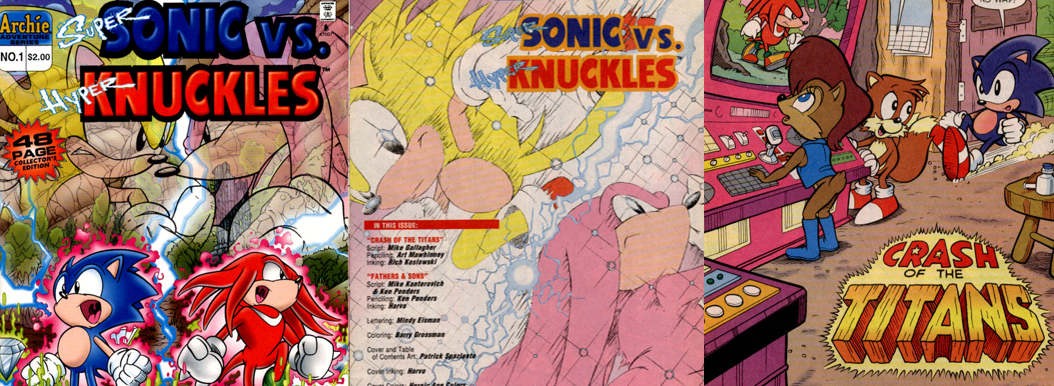
Story Title: “Crash of the Titans” (Part I to IV)
Writer: Mike Gallagher
Artist: Art Mawhinney
Story Title: “Fathers and Sons”
Writers: Mike Kanterovich and Ken Penders
Artist: Ken Penders
Quick Facts:
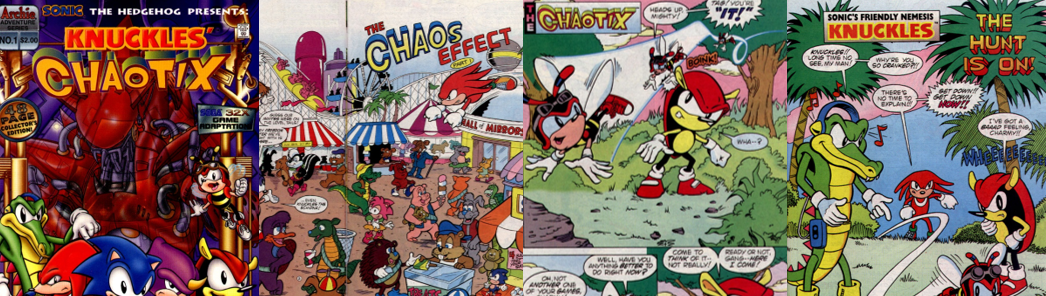
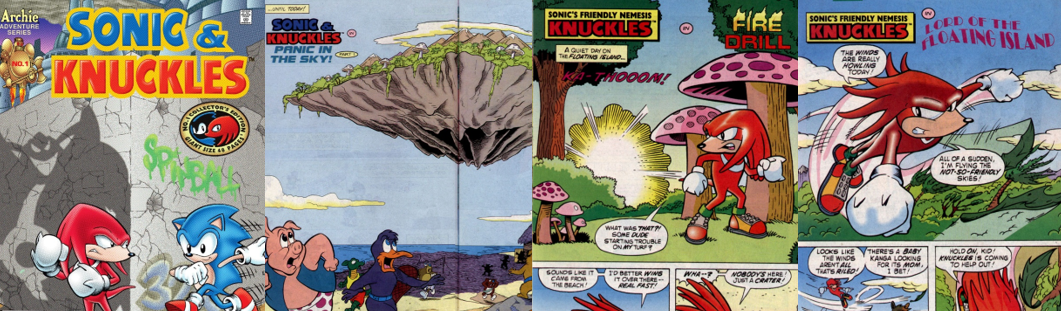
Following an initial four-part miniseries, Archie Comics’ Sonic comic books became the longest-running videogame comic book in history. As proven by cartoons like Sonic the Hedgehog/SatAM (1993 to 1994), Sonic was extremely popular at the time, so Archie branched out with a Knuckles the Echidna companion series that eventually became bogged down by convoluted lore. Before a bitter lawsuit forever changed Sonic’s comic books, Knuckles famously matched his rival in every way, including getting his own impressive “Super” form.
The Review:
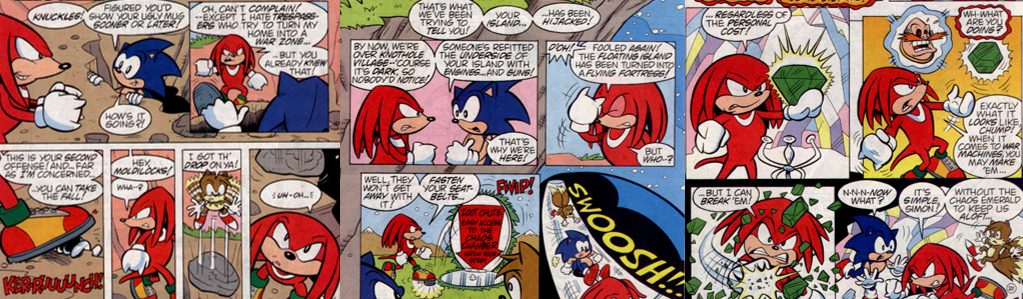
“Crash of the Titans” sees stubborn loner Knuckles the Echidna make an unexpected appearance in the Great Forest just outside of Knothole Village, the home of the Freedom Fighters. When intrepid leader Princess Sally Acorn and enthusiastic sidekick Miles “Tails” Prower spot Knuckles stomping around, they call in Sonic the Hedgehog. Despite always parting on friendly terms with Knuckles in the past, Sonic and the others are suspicious of their visitor, especially as he never leaves the Floating Island he’s duty-bound to protect. Sonic’s suspicions become full-blown paranoia when Knuckles heads towards Robotropolis, the mechanical, polluted capital of Mobius’s semi-cybernetic dictator, Doctor Ivo Robotnik. Assuming Knuckles is out to cut a deal with Dr. Robotnik, Sonic races off, barely acknowledging Sally’s order that he simply talk to the echidna. When the story shifts to Knuckles, we learn that he’s disgusted by the environmentally destructive ways of “landlubbers” and why he’s come to the surface. After witnessing a Chaos Emerald be split in two in the Triple Trouble special (Gallagher, et al, 1995), Knuckles became concerned about his floating home, which was once held aloft by a dozen Chaos Emeralds and now relies on only one. Determined to keep the island from falling, Knuckles consults the legendary Book of Myths and discovers a link between the Chaos Emeralds and the Magic Rings found within “Zones” (in Archie’s comics, Zones are temporary, semi-magic dimensions that spawn from Chaos energy). Knuckles also learns that Magic Rings sporadically appear at the fabled “Lake of Rings”. However, Knuckles assumes that the Lake of Rings must be in Robotropolis due to the high radiation generated by the mechanical hellscape and left the island under the care of his super strong ally, Mighty the Armadillo, to investigate. Instead of a mystical lake, Knuckles finds a polluted, desolate grotto on the city outskirts, one that was apparently once closely monitored, and is suddenly blindsided by the hot-headed Sonic.
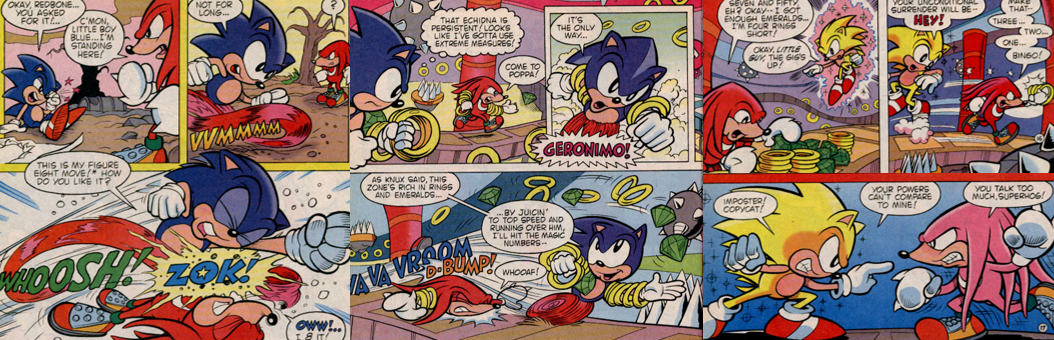
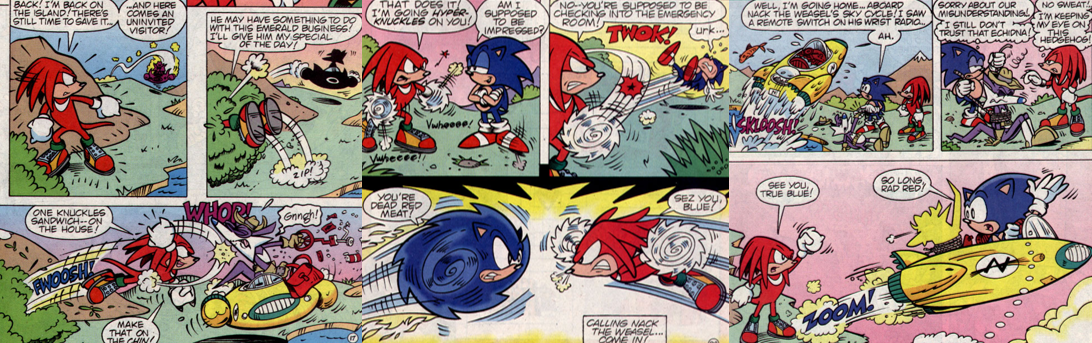
After landing the first hit, Sonic speed reads Sally’s declaration for a parlay but, naturally, Knuckles isn’t interested and the two go at it. Sonic smacks Knuckles with his signature Figure Eight but finds himself running right into a tree when Knuckles yanks on a nearby root. Though temporarily stuck, Sonic uproots the tree and collapses it onto Knuckles, forcing Princess Sally to intervene to keep the landscape from being damaged. While her presence quells the fighting, Sonic and Knuckles continue to bicker, but Sally ignores them as her portable computer companion, Nicole, detects vast radiation coming from where the tree was standing, discovering the entrance to an unknown, hazardous Zone swimming with Magic Rings and Chaos Emeralds! Eager to get what he came for, Knuckles dives in, prompting Sally to offhandedly comment that Knuckles “hasn’t changed since [they spent] summers together”. Stunned by the revelation that Sally has known Knuckles all this time, Sonic pauses his pursuit to question the princess, only to be dismissed and sent after the echidna, the matter shelved in favour of some dubious flirting. Sonic enters the chaotic, hazardous Zone (a mishmash of Badniks, spikes, and other vaguely recognisable videogame elements) to find Knuckles snagging the Magic Rings and making a run for a Chaos Emerald. Thanks to his superior speed, Sonic easily snags fifty Magic Rings and seven Chaos Emeralds, transforming into Super Sonic, a golden, super-powered form that makes him functionally invincible. While Super Sonic is busy bragging, Knuckles quickly collects enough Magic Rings to trigger his own transformation, a burning pink form he dubs “Hyper Knuckles”.
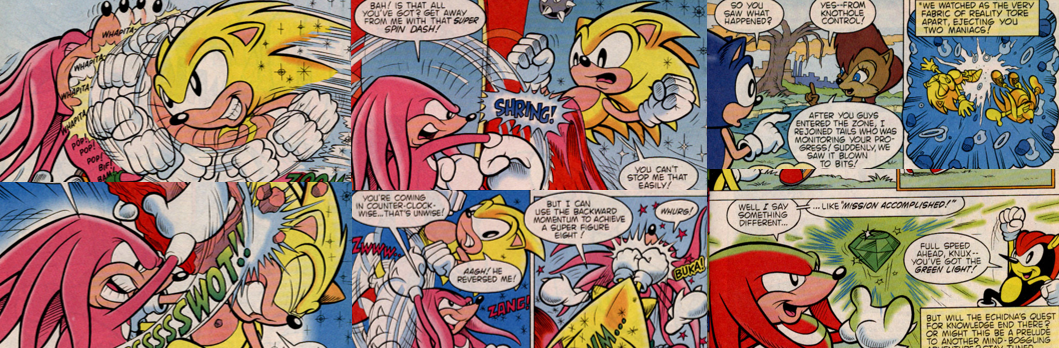
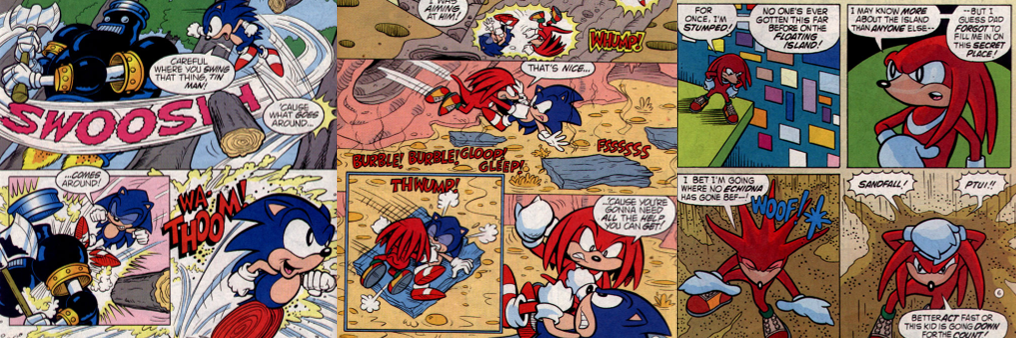
Angered by the gimmick infringement, Super Sonic quickly learns that Hyper Knuckles’ strength has been increased “a thousandfold” when he takes an uppercut. However, Super Sonic immediately answers back by demonstrating that he’s now “a thousand times faster than before” with some rapid punches to Hyper Knuckles’ snout. Hyper Knuckles retaliates by smashing a chunk off the Zone and bashing Super Sonic over the head, amazed at how fast Super Sonic recovers but refusing to back down. The two super-powered rivals fly at each other, brutally grappling in an impressive two-page spread before Hyper Knuckles easily deflects Super Sonic’s Super Spin Dash (which is oddly drawn to be the Figure Eight) and snatches his golden-hued rival out of mid-air with his superior strength. However, Super Sonic pivots, using the “backward momentum” to propel himself at Hyper Knuckles with a Super Figure Eight, only for Hyper Knuckles to immediately recover, spin his spiked fists like wheels, and launch a flying kick to Super Sonic’s nose! With both combatants enraged, the two clash with such incredible force that they literally bend time and space and disrupt the integrity of the Zone. The unstable energies are so powerful they cause the Zone to explode, triggering an earthquake so massive that Dr. Robotnik picks it up on his sensors. The explosion obliterates the Zone, drains Sonic and Knuckles of their Super forms, and returns the exhausted, disorientated Sonic to the Lake of Rings. Princess Sally confirms that the Zone and all its Magic Rings and Chaos Emeralds were destroyed, revealing that she saw everything using the seemingly inoperable camera setup nearby. She then gives Sonic a lift back to Knothole but refuses to elaborate on her past with Knuckles. As for Rad Red, he returns to the Floating Island with a brand-new Chaos Emerald in hand, his epic fight with Super Sonic apparently having made waves amongst its residents.
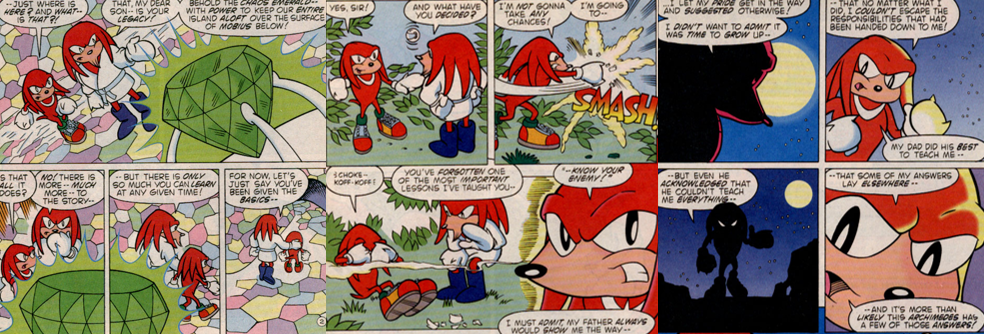
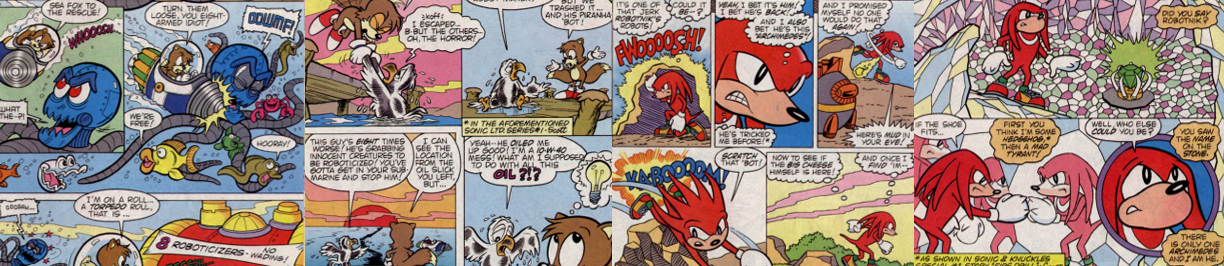
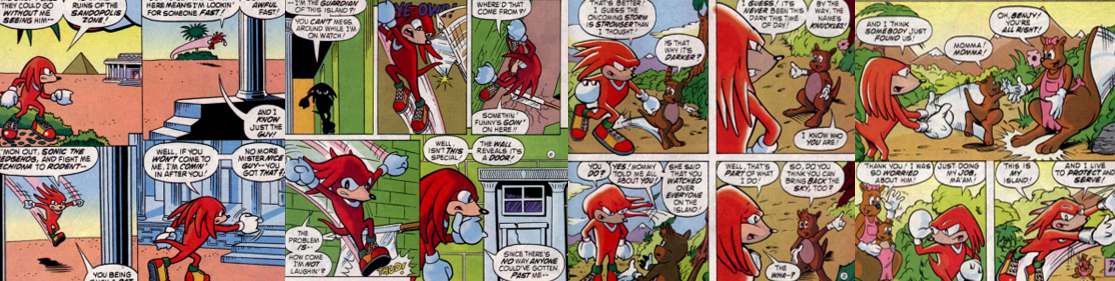
Of course, it wouldn’t be an Archie Sonic special without a backup story. Super Sonic vs. Hyper Knuckles opts not to feature an additional story focusing on the two Super-powered forms and instead continues Ken Penders’ convoluted backstory for Knuckles with a flashback to his youth. “Fathers and Sons” shows that young Knuckles grew up alongside his father, Locke, who taught him his duties as a future guardian of the Floating Island. Locke reveals that this responsibility is passed down through the generations and takes Knuckles to the Chaos Chamber for the first time, revealing that the island is held aloft by a Chaos Emerald and emphasising Knuckles’ duty to protect it. This flashback is revealed to be the ruminations of the troubled Knuckles in the present day as he ponders the puzzle of the mysterious “Archimedes”, a disembodied voice who’s been testing him over the last few months and recently kidnapped his allies, the Chaotix. After dismissing the idea that Archimedes is his father testing his mettle, Knuckles recalls his father’s teachings, which stressed analysing a situation before deciding the best course of action and understanding an enemy before attacking. Knuckles also remembered how his father disappeared into the “Forbidden Zone”, passing his duties as guardian to his son, and his run-ins with Sonic, Dr. Robotnik, and the Chaotix. Realising that he’s let his pride get in the way and that he still needs to grow up to be the guardian his father always wanted, Knuckles vows to track down Archimedes, get the answers he’s seeking, and rescue his friends to make his father proud.
Final Thoughts:
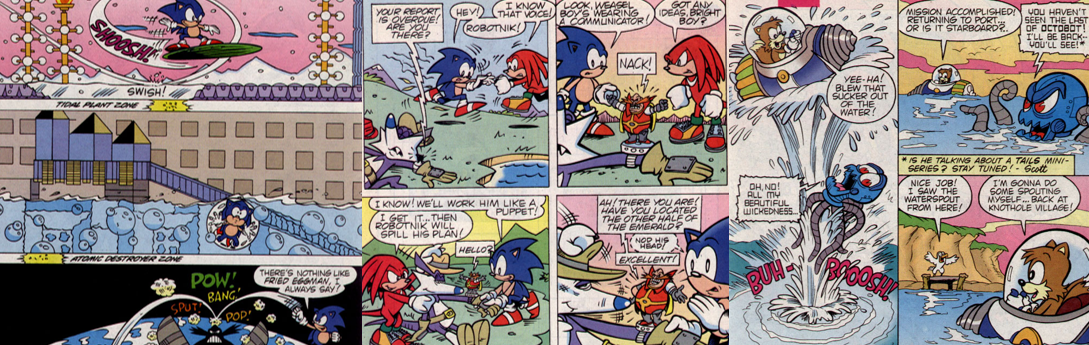
Super Sonic vs. Hyper Knuckles is a lot better than some of the other 48-page Archie Comics specials I’ve read, but not by much. The main story is showcased far better than some of Archie’s other videogame adaptations, taking up most of the pages and thankfully limiting the backup stories to one ugly, but ultimately forgettable footnote in Penders’ weird Knuckles canon. “Crash of the Titans” retains the distinctly “SatAM” style rendering of its characters but still laces that more serious tone with puns and daft moments, like Tails and Dr. Robotnik breaking the fourth wall, the Book of Myths being hidden in a tree trunk, and Princess Sally’s letter. The story is another example of Archie’s writers awkwardly trying to mash videogame elements with their largely disconnected canon, placing videogame mechanics like traps, spikes, Magical Rings, and Chaos Emeralds in unstable, interdimensional Zones that randomly appear throughout Mobius. I’ve never been a big fan of this and much prefer it when the comics simply adapt the game Zones into locations within the comic’s world, which seems like a far easier solution. They could still have had Rings and Chaos Emeralds in Special Stages/Zones to include fantastical elements, which is something the Fleetway comics did to really well. As presented here, the Zone is kind of baffling. I don’t get why it’s populated by Dr. Robotnik’s Badniks and traps or why Archie’s Sonic comics had so many damn Chaos Emeralds floating around. I guess they figured the many Chaos Emeralds included in Sonic’s games were all different sets, but that doesn’t explain why they’re all green. Archie also deviates from SatAM by changing the nature of the Magic Rings. In SatAM, the Power Rings were invented by Sonic’s Uncle Chuck, spawning from a machine installed at the Lake of Rings every twenty-four hours, temporarily boosted Sonic’s speed and power, and could also be used as a power source. Here, they’re much closer to their videogame counterparts and simply facilitate a Super transformation.
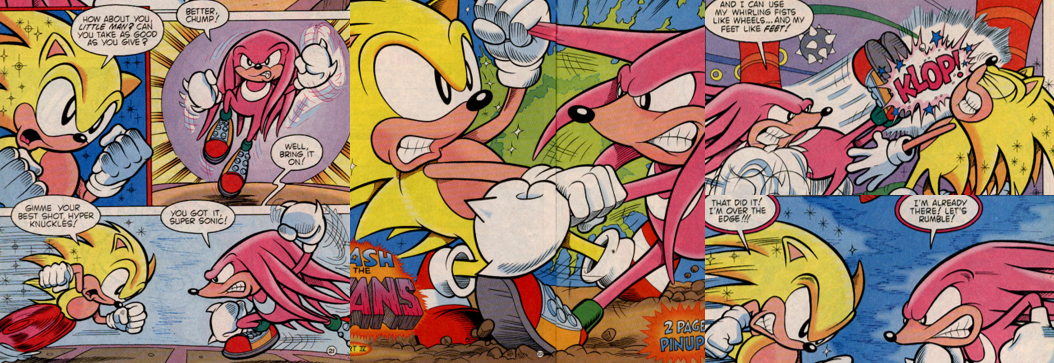
Technically, “Crash of the Titans” is a very barebones story. It’s simply another chapter in the rivalry between Sonic and Knuckles, one given extra spice by the revelation that Sally and Knuckles grew up together and Sonic’s many dubious run-ins with the hot-headed echidna. Accordingly, Sonic doesn’t hesitate to attack, suspicious as he is of his untrustworthy rival, and the two finally have a more physical fight that’s given time to breathe with the additional pages and panels. “Crash of the Titans” emphasises that Sonic and Knuckles are as bad as each other and evenly matched: both are stubborn, prideful, and occasionally reckless, letting their emotions get the better of them, and Sonic’s pure speed is perfectly matched by Knuckles’ brawn. Even Sonic’s hitherto-unique ability to turn Super is matched by Knuckles, who debuts his Hyper Knuckles form and proves every bit Super Sonic’s equal. The battle between Super Sonic and Hyper Knuckles was really well executed, being a colourful, engaging brawl that saw the two bust out some unique moves, such as Knuckles spinning his fists for added momentum and Super Sonic super-charging his Figure Eight. As they’re both functionally invulnerable, the stakes are minimal during this fight and there could never have been a clear winner, hence the destruction of the Zone, which only further reinforced how evenly matched the two were. Still, I think it might’ve helped differentiate the two if Sonic had been reckless and irresponsible and Knuckles had been trying to avoid a confrontation and talk sense into his rival, only to be pushed to the edge and fight back, if only to show that Knuckles is the more mature of the two. The backup story is barely worth mentioning but, again, I would’ve preferred to see this ditched to perhaps see Super Sonic and Hyper Knuckles set aside their differences to battle Dr. Robotnik (or one of his creations). Still, Super Sonic vs. Hyper Knuckles was an enjoyable, if mindless special that delivered exactly what it promised and upped the ante for future conflicts between the two rivals.
My Rating:
Pretty Good
Did you enjoy the clash between Super Sonic and Hyper Knuckles? What did you think to Hyper Knuckles’ first appearance in Archie’s Sonic comics? Did you enjoy his Archie Comics changed the lore of the Chaos Emeralds, Rings, and Zones? Would you have liked to se the two team up against a common enemy? Which of Archie’s Knuckles stories and/or characters was your favourite and how are you celebrating Knuckles’ debut? Use the comments below to share your thoughts and donate to my Ko-Fi to suggest more Knuckles content for the site.














 Dr. K's Waiting Room
You must be logged in to post a comment.