Movie Night [Halloween]: John Carpenter’s Halloween


Starting life as the ancient Celtic festival of Samhain, when people would light bonfires and wear costumes to ward off ghosts, Halloween is largely associated not just with ghosts, ghouls, and confectionery but also a long-running series of horror movies. Beginning with John Carpenter’s Halloween (Carpenter, 1978), the franchise is largely credited with birthing the “slasher” sub-genre of horror films and has endured numerous remakes and reboots and is one of the most influential films in all of horror.


Released: 25 October 1978
Director:
John Carpenter
Distributor:
Compass International Pictures/Aquarius Releasing
Budget:
$325,000
Stars:
Jamie Lee Curtis, Nancy Kyes, P.J. Soles, Donald Pleasence, and Nick Castle

The Plot:
After murdering his sister on Halloween night, Michael Myers (Castle) escapes from a sanatorium to stalk babysitter Laurie Strode (Curtis) and her friends while his doctor, Sam Loomis (Pleasence), desperately tries to hunt him down before he can kill again.

The Background:
After being impressed with his work on Assault on Precinct 13 (ibid, 1976), producer Moustapha Akkad sought out writer/director John Carpenter to work on an idea he had for a horror film that revolved around a psychotic killer who stalked babysitters. It was Carpenter, however, who conceived of the idea to set the film on Halloween night and collaborated with long-term friend and colleague Debra Hill on refining the script. Although the film’s low budget meant that Carpenter was unable to attract veteran horror actors Peter Cushing or Christopher Lee, he was able to cast accomplished actor Donald Pleasence, who was the highest paid actor in the film. Michael Myers’ iconic, expressionless mask was the work of Tommy Lee Wallace, who famously altered a mask of Captain James T. Kirk (William Shatner) and Carpenter himself wrote the iconic score, which convinced producers of the film’s potential. This paid off at the time as a worldwide gross of over $63 million made Halloween one of the most successful independent films ever made, although Halloween was largely dismissed upon release for its graphic content and macabre narrative. Although movies like Black Christmas (Clark, 1974) laid the foundation for the “slasher” sub-genre, Halloween is now regarded as one of the most influential slasher movies and one of the greatest horror films ever made thanks to popularising the clichés of this popular sub-genre.

The Review:
Halloween has, perhaps, one of the most iconic and chilling openings in all of horror cinema; shot entirely from a first-person perspective, the film builds a great deal of tension as we follow an unseen character on a tour of the Myers house and brutally stab Judith Myers (Sandy Johnson) to death. It’s quite a long sequence but it effectively establishes a foreboding and unsettling ambience as the anticipation build and builds to a gruesome finale and, right as we’ve taken in the sight of Judith being stabbed to death, it’s dramatically revealed that the perpetrator was small child with an inhuman, unflinching look etched on his features. The randomness and brutality of this opening act is all the explanation we really need for Michael Myers in this first movie, where he’s portrayed more as a force of nature (evil in the shape of a man) than an actual person.

Loomis is horrified when Michael gets loose and determined to track him down.

Of course, nobody sells the horror and menace of Michael Myers more than his doctor, Sam Loomis, who is vehemently opposed to Myers being transferred from his facility and of the unwavering opinion that Michael is evil incarnate and a significant threat to all of those around him. Having worked with Michael over the course of fifteen years (eight spent trying to reach him and another seven spent committed to keeping him locked away), nobody knows Michael (whom Loomis refers to as “It” rather than “him”) better than Loomis and he is horrified to find that Michael has managed to escape. Fully aware that Michael will head straight to Haddonfield to kill again, Loomis’s first priority is to illicit the help of Sheriff Leigh Brackett (Charles Cyphers) but, while the Sheriff indulges Loomis, he remains incredulous since they find little evidence of Michael’s presence, all of which simply gives Loomis further excuse to exposit the danger that Michael poses through a series of outbursts.
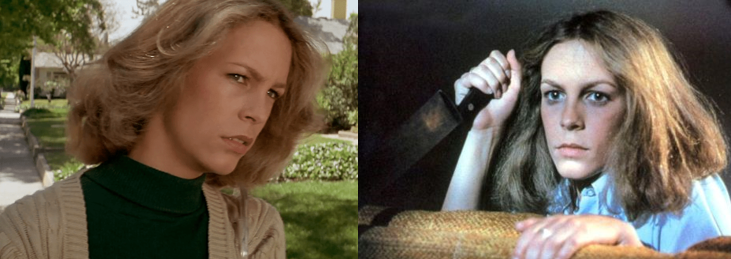
Laurie might be quite unremarkable to begin with but she proves herself capable by the finale.

As one of the original “Final Girls” of slasher cinema, Laurie is, honestly, not all that spectacular a character but that’s kind of the point. The main crux of Halloween’s horror is that it takes place in a normal, everyday, boring suburban environment filled with normal, unextraordinary people and Laurie pretty much embodies that. Sure, she smokes a little weed at one point and has the hots for the elusive Ben Tramer but she’s a much more responsible and level-headed young woman than her friends Annie Brackett (Kyes) and Lynda Van Der Klok (Soles); she’s generally more of a bookworm and takes her duties as a babysitter much more seriously than  her friends and seems much less interesting as a result. However, as unremarkable as she seems at first, Laurie really comes into her own once all of her friends are dead and she’s left at the mercy of Michael Myers; here, she really comes into her own as she’s the only one of Michael’s victims to have the gumption to actually fight back as, while she does become an emotional wreck at times, her quick thinking and adaptability are key factors in keeping her alive.
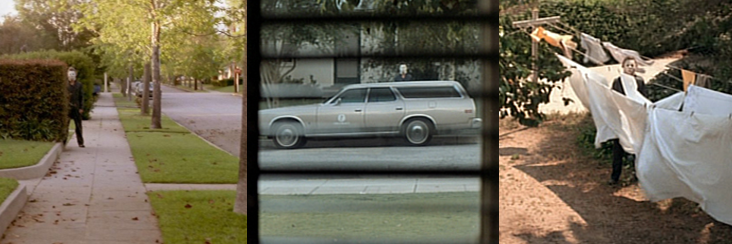
Michael stalks Laurie throughout the day, seemingly appearing and disappearing at will.

Like Laurie, Annie and Lynda also do a bit of babysitting to help supplement their income; however, unlike her, they generally use this as a good excuse to hook up with their boyfriends and pay the price as a result. Annie, the Sheriff’s daughter, is the clumsier and ineffective of the three as she spills butter all over herself and is happy to simply let Lindsey Wallace (Kyle Richards) watch The Thing from Another World (Nyby, 1951), but is a bit of a rebel as she smokes pot behind her Dad’s back. Lynda, meanwhile, is a total rebel and a complete airhead as she cuts out the middleman completely and simply spends her night have sex with Bob Simms (John Michael Graham) and spouting her catchphrase, “Totally!”, at every opportunity. Each of them fall victim to Michael Myers in some way, shape, or form; Myers’ reputation in Haddonfield has become something of a neighbourhood legend as the kids believe his house is haunted and taunt Tommy Doyle (Brian Andrews) over his fear of the “bogeyman”, but very few seem to be aware of what happened all those years ago and even fewer mention Michael by name. He spends the entirety of his day first making his way down to Haddonfield (inexplicably fully able to drive, despite fifteen years in confinement), acquiring his now-iconic mask, and stalking Laurie. While Tommy runs across Michael at one point, the only one of the girls to constantly stop Michael stalking them is Laurie, who is disturbed at his ability to seemingly appear and disappear at will, but his presence is quickly felt by all three girls when night falls and he begins his killing spree in earnest.

The Nitty-Gritty:
Of course, one of the most horrifying and memorable aspects of Halloween is John Carpenter’s iconic score; a simple few notes of a piano are enough to send a chill down the spine as Michael suddenly appears onscreen or looms into view, always seen from a distance, the neck down, or bathed in shadow with only his mask standing out against the pitch darkness of night. It’s a fantastically simple and effective score that is perfectly used to build a sense of dread and tension and, by the conclusion, ramps up significantly to reflect Laurie’s growing fear and desperation as she frantically tries to escape from Michael’s wrath. Of course, few films are perfect and Halloween has a few dodgy moments; as chilling and effective as the opening shot is, the angle and perspective of the young Michael’s attack is a bit awkward (it looks like he stabs Judith in the stomach or leg but the blood is splashed over her ample bosom) and Haddonfield is very green for October.
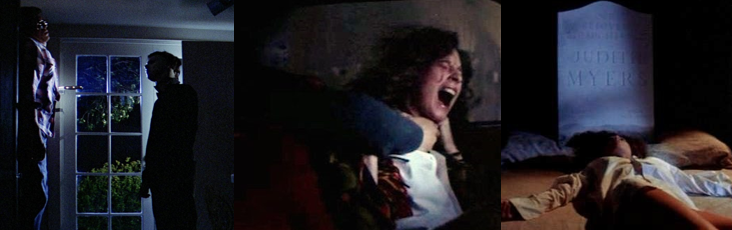
Halloween is surprisingly light on kills and favours mounting tension over gory effects.

Compared to many of its sequels and contemporaries, Halloween is also relatively light on the gore; Michael wields a massive kitchen knife, which he uses to cut Annie’s throat and stab Bob through the stomach, but he also heavily relies on his brute strength to choke, strangle, and manhandle his victims. The body count and use of gore is quite low and limited but it actually adds to the film’s terror since it’s all very subdued and realistic rather than relying on gruesome and over the top effects. Michael is the forefather of all the hulking, masked, silent killers who came after him; while Leatherface (Gunnar Hansen) proceeded him, he was a far more mentally unbalanced and animalistic killer, whereas Michael is like a force of nature. Eerily silent and ominous, he stands perfectly still and watches his prey with all the patience in the world and every movement is premeditated and efficient, almost like a machine; at the same time, he exhibits a curious nature, cocking his head like a dog as he watches Bob choke to death on his own blood, and slowly, deliberately turning his head towards Laurie after sitting bolt upright from her assault. Seemingly impervious to pain, inexhaustible, and possessing superhuman strength (he’s able to life Paul clear off the floor with one arm), Michael is easily able to overwhelm his prey by taking them completely by surprise. He’s even got a flair for the dramatic and likes to toy with them as he dresses up like a ghost to get close to Lynda and goes to the trouble of stealing his sister’s gravestone and laying Annie’s corpse out before it for Laurie to stumble across (he also leaves the bodies of her other friends for her to find, which became a recurring trope in the finale of slasher films for years to come).

Though resembling a man, Michael’s exact nature (and ultimate fate) is left ambiguous.

According to Loomis, Michael is more like an animal, an inhuman perversion of a man, and we see this on numerous occasions, such as the revelation that Michael has been eating dogs for sustenance and the fact that that he’s fully capable of recovering from a coat hanger to the eye and being stabbed within a few seconds. Indeed, the only real proof we have that Michael even is a man is the fact that…well, he clearly is and he is heard breathing, which only adds to his horror as he simply stands, breathing deeply and heavily, and watches his prey. Loomis’s evaluation of Michael is that, somehow, all traces of emotion and empathy and humanity were stripped away and all that is left is pure malice and evil (showcased best not in the fact that he kills teenagers without a thought but also that he commits the ultimate sin by killing a dog!) Michael spends the entire film hidden behind an unsettling, expressionless mask; though we do get to see him unmasked for the briefest moment, it’s not an especially pretty sight and he quickly covers his face up again to reassume his true guise. The question of Michael’s supernatural nature is left ambiguous; he gets stunned and reacts to pain a few times and seems to be finished off by Loomis’ gunshots but, when he goes to check on him, Myers has mysteriously vanished and the film ends with his fate and true nature left uncertain.

The Summary:
Halloween is a classic piece of horror cinema that has stood the test of time purely through a masterful execution of its simple premise, an alluring and disturbing villain, and a chilling score. Michael’s evil is pure and uncomplicated in this original film; he is simply an inexorable and unrelenting force of nature who completely lacks anything in the way of humanity and empathy and lives only to kill. Michael’ motivations are a mystery, despite the theories and beliefs of Loomis, and are have little meaning anyway once his killing spree begins. While some of the performances are a little janky in retrospect, the film is elevated by Pleasance’s presence; he brings a real gravitas to the film and does a fantastic job of selling Michael’s threat and walks a fine line between paranoia and madness as his desperation to stop Michael, and warn others of his danger, becomes a frantic obsession. Halloween proves that slasher films don’t need to be complicated by complex lore or problematic conspiracies and supernatural events and can be as simple as a masked madman slowly stalking and murdering teenage girls while shrugging off physical pain and, arguably, the Halloween franchise peaked with this influential original for that fact alone. The legacy and influence of Halloween cannot be understated as, without it, the slasher genre and popularity of masked, silent killers would arguably be very different or non-existent. It’s slower, measured pace and lack of gruesome gore may not be for everyone but Halloween set the standard for the genre, establishing all the now-cliché tropes, and changed the horror genre forever and, while subsequent sequels and a myriad of reboots and one of the most screwed up timelines in all of cinema can’t change how influential John Carpenter’s seminal original was.

My Rating:

Rating: 4 out of 5.

Great Stuff

What are your thoughts on the original Halloween? Do you think it still holds up today, especially compared to its sequels and all the other horror franchises it inspired? What did you think to Michael Myers’ portrayal in this film; did the vague descriptions of his motivations work for you or do you prefer horror villains to have a more tangible backstory? Which of the girls was your favourite and what did you think of Laurie as the final survivor? Did the emphasis on tension work for you or would you have preferred to see more gore? What did you think to Dr. Sam Loomis and his unique relationship with Michael? Which of the Halloween films is your favourite and why? How are you celebrating Halloween this year? Whatever your thoughts on Halloween, and the Halloween franchise, drop a comment below and have a spook-tacular Halloween!


Back Issues: The Crow

Story Title: “Inertia”, “Pain”, “Fear”, “Irony”, and “Despair”
Published:
January 1989; February 1989 to May 1989
Writer/Artist:
James O’Barr (as “J. O’Barr”)

The Background:
The Crow began life as a comic book published by Caliber Comics in 1989, with the title character’s first appearance being a short prequel tale, “Inertia”, which was published in Caliber Presents #1 (January 1989). The comic book was the creation of writer and artist James O’Barr as a way of coping with the pain and loss he felt after losing his fiancée to a drunk driver. Although it took O’Barr nearly ten years to find a publisher, The Crow became an underground success thanks to its bleak tone, striking black and white artistic style, and emotional narrative. Wildly regarded as one of the most unique and poignant tales in the industry, the comic book achieved even greater mainstream success with the release of a suitably bleak 1994 feature film adaptation. Although The Crow (Proyas, 1994) was a cult hit, its sequels were disappointingly lacklustre; nevertheless, the original comic remains a highly regarded masterpiece and was succeeded by a number of spin-offs and subsequent stories.

The Review:
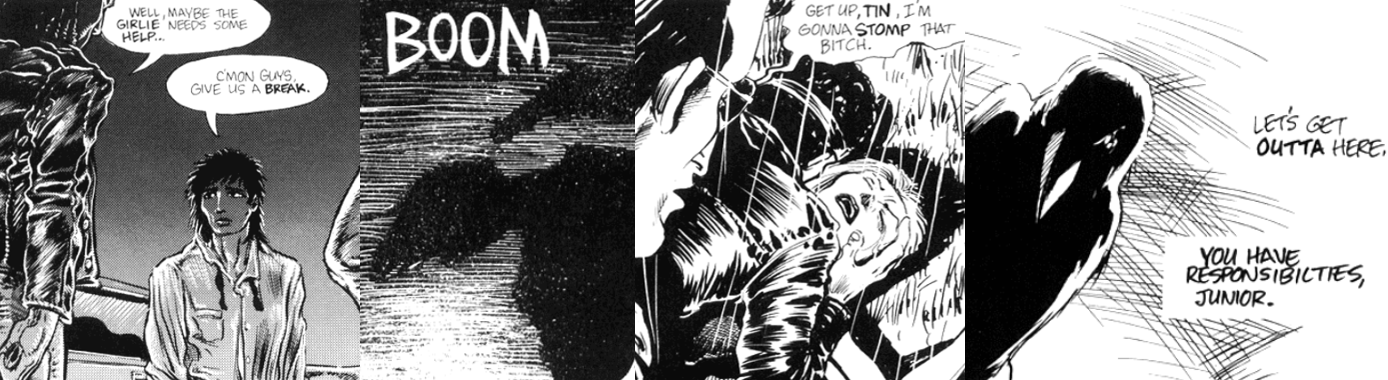
I first became aware of The Crow in very much the same way as I’m sure a lot of people did: by watching the first movie, which immediately captivated me and made me curious enough to seek out the original comic book. The story begins in the grimy, dangerous streets of Detroit, where gangs and crime and vice run rampant; the first thing we see is small-time thug Jones Transfer, a muscle-bound skinhead desperate for a fix of cocaine and having just swiped a Toshiba cassette player. His exhilaration turns to horror, and then anger, when a large, shadowy figure draped in a long black trench coat and with a face painted into the image of irony (a perpetually smiling clown-like face that is decidedly at odds with his generally more stoic and column appearance). Completely unfazed by Jones’s switchblade, even after it’s stabbed into his shoulder, the clown-faced mystery man demands to know the whereabouts of another local thug, T-Bird, and his cronies (Tom Tom, Top Dollar, Fun Boy, and Tin Tin). Jones is terrified to see the ghostly figure remove the switchblade, lap blood from the blade, and reveal that he tortured Jones’s friend and associate, Shelby the Giant, by clipping off his fingers one by one until he gave up everything he knew. Convinced, and desperate to save his own miserable life, Jones reveals that where each of the ghost-man’s targets can be found throughout the city, and is left alive to tell the thugs that he (as in, the painted-up vigilante) is coming for them.

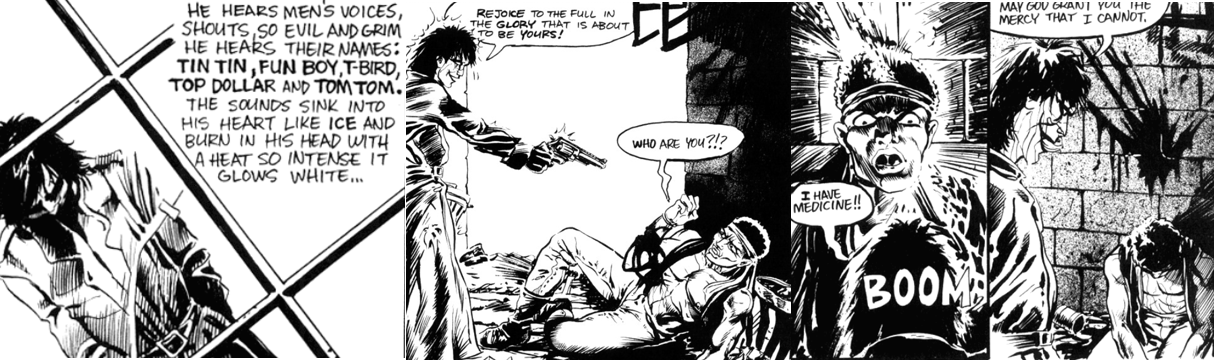
Tormented by his fragmented memories, the Crow executes his first victim.

When the story proper begins, both the art and the presentation has shifted somewhat; text boxes allow us into the mind of the ghost-faced vigilante, now identified as “The Crow”, who stalks through the murky city streets and broods in an abandoned house outside of the city, constantly reliving the memory of a girl being attacked, though he cannot remember the exact specifics. All he can think about are the names of those responsible, and we transition over to find one of them Tin Tin, testing out a gun on a hapless pedestrian. He guns down the seller, and the little punk who arranged the sale, caring only about sending a message to Top Dollar’s would-be competition and little for the innocent woman’s cat, Gabriel, who would be left homeless as a result of his actions.  Thankfully, we don’t have to wait long for Tin Tin to pay for his reprehensible nature as the Crow immediately confronts him down a dark alley; showing no fear and completely no-selling an errant shot to the head, the Crow downs Tin Tim with a bullet to the wrist and, after bombarding Tin Tin with nonsensical religious statements, triggers his victims memory by detailing his part in attacked a man and a girl on a cold October night. Although Tin Tin begs for his life, pinning the blame entirely on T-Bird and the drugs they were on, the Crow, wracked with fragmented memories of happier times, shows no mercy and blows the asshole’s head clean off.

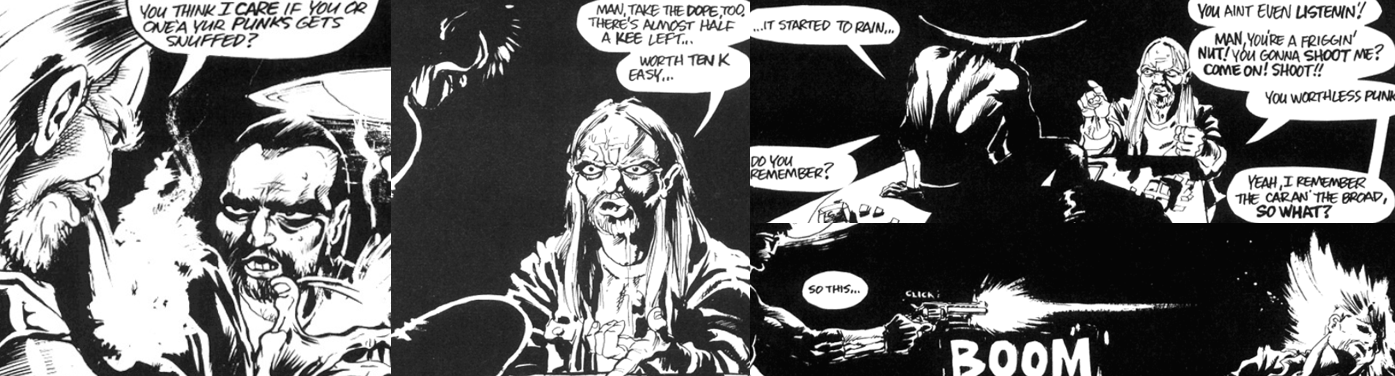
The Crow wastes no time in dispatching the top player in town.

The Crow ties a shotgun shell into his hair to indicate that the first of his victims has fallen, and Tin Tin’s death causes some concern amongst his shit-kicking associates; Top Dollar, the self-styled head honcho of the neighbourhood, is unconcerned, however. He doesn’t give two shits what the street punks think about it, or that Tin Tin got killed, and vehemently asserts that he owns the dope, the neighbourhood, and that “[his] word is the law!” Top Dollar is quickly convinced to give a shit, however, when the Crow gate-crashes the meeting and guns down everyone there. Some of the punks are sporting bulletproof vests, but the Crow is as unfazed by this as he is by their wild bullets, which strike him and draw blood but do not drop him, and simply executes them with a shot to the head while preaching a sermon on their evil ways. In the end, only Top Dollar is left; he attempts to barter for his life with money and drugs, but the Crow ignores him and simply stoically tells his story of a man, a woman, and a 1971 Plymouth on a rainy night. the second Top Dollar admits to remembering what the Crow is talking about amidst his angered ranting, the Crow executes him with two shots to the head. That’s right, in the original comic book, the Crow went pretty much directly to the top of the pecking order and then worked his way down, rather than working his way up the chain of command in the gang responsible for his suffering, showing him to be slightly more efficient and direct than his filmic counterpart.

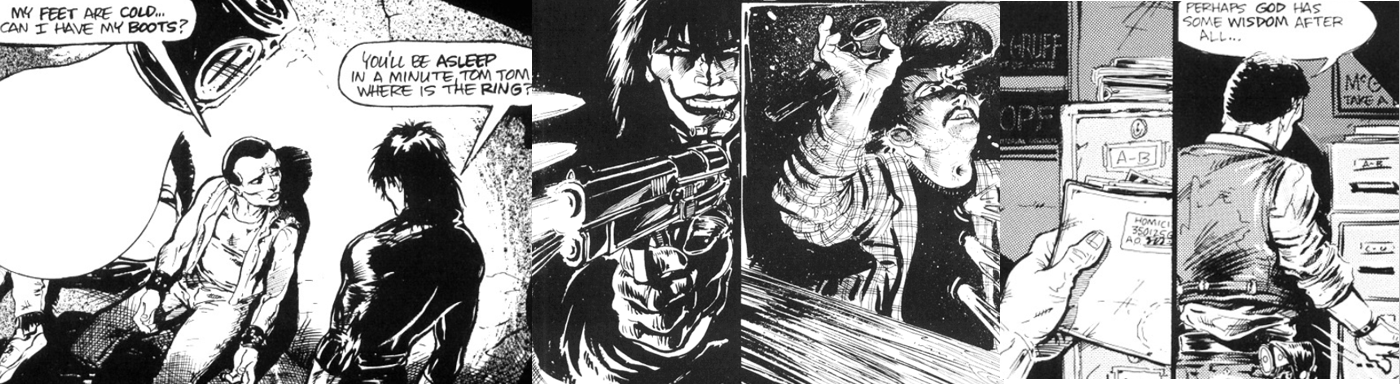
The Crow retrieves Shelly’s engagement ring and catches the attention of the local cops.

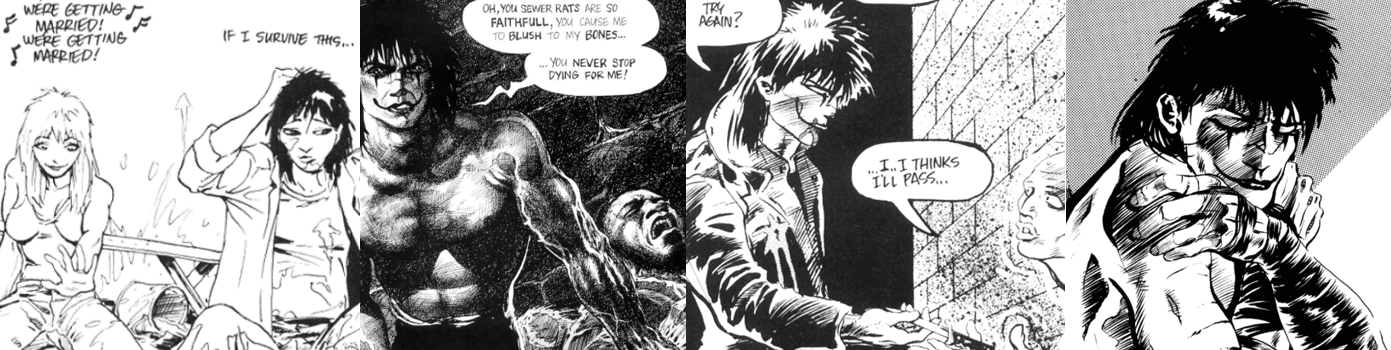
Those that were concerned about Gabriel’s welfare can rejoice as the Crow takes the fluffy white cat in brings her (Gabriel is initially thought to be a boy but is later revealed to be a girl, and pregnant to boot) back to their old home, where he presents the cat as a gift to his lost love. This triggers a cute flashback to when the fresh-faced, unscarred and far less tortured Crow (then known as Eric) proposed to his beautiful girlfriend Shelly, during a playful bout of painting their home. Later, as Christmas closes in, Gabriel triggers another memory of when Eric surprised Shelly with the news that he had secured the house for them, leading to the Crow lamenting that the cat “[makes him] smile too much”. The Crow then arms himself with a samurai sword and heads out to confront Tom Tom, beheading his punk-ass friend Skank before taunting the gun-toting thug with the iconic gag about Jesus Christ being “put up for the night” at a hotel. Shrouded in darkness, Tom Tom has no chance to land a shot quickly has his legs literally taken out from under him with one swipe of the Crow’s sword. Bleeding out, and suffering from shock, Tom Tom seems mildly repentant for his part in Eric and Shelly’s murder and tells the Crow where he can find Shelly’s engagement ring. This leads the Crow to Gideon Resale, a pawn shop in a seedier part of town, where he calmly confronts the grouchy owner, stabbing him through the hand and forcing him to hand over a box full of rings. After locating Shelly’s ring and taking it for himself, the Crow executes Gideon, loads himself up with armaments from his shop, and sets it ablaze using a makeshift kerosene bomb. Young police officer Albrect attempts to interrupt the Crow, but is suitably intimidated by the vigilante’s stoic demeanour and conviction, bringing the Crow to the attention of the police for the first time. Based on Albrect’s description of the Crow, Sergeant Hook figures out that he’s Eric returned from the grave pretty much right away since, as we later find out, he visited Eric in hospital after he was attacked and offered his condolences. Hook was shocked when Eric utters his dying words: “The crow said don’t look!!” and is later less than impressed to find that the Crow has left him the pregnant, flea-ridden Gabriel to look after.

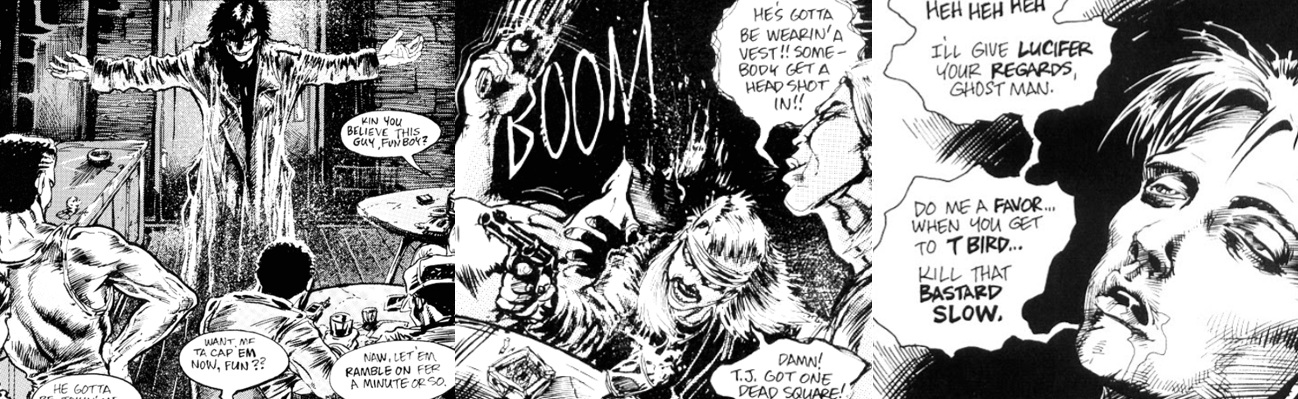
The Crow wades through Fun Boy’s goons and grants him a merciful death for his honesty and help.

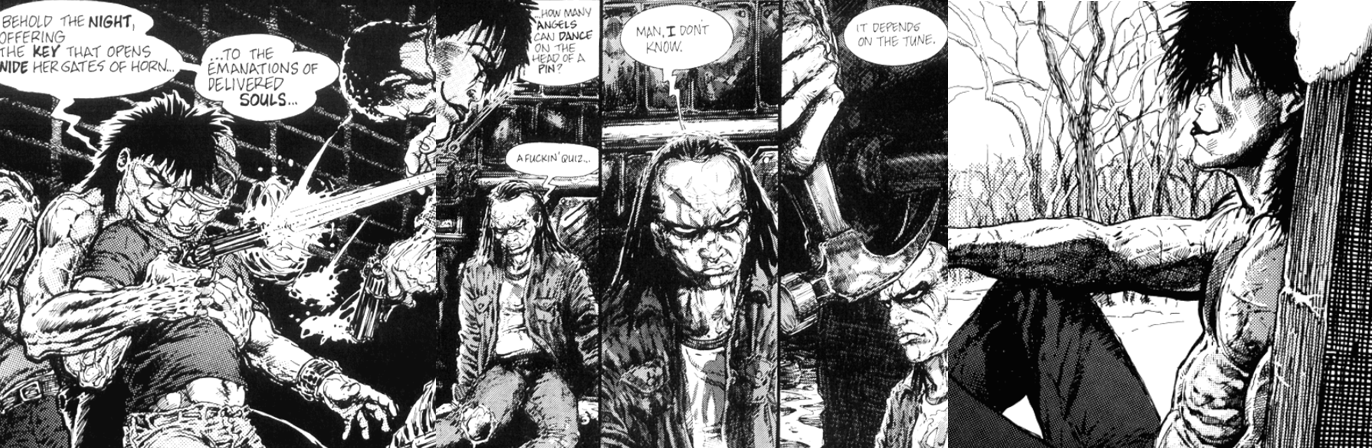
On his way to confront Fun Boy, Crow comes across a young girl, Sherri, whose mother is one of the punk’s concubines. Feeling a connection with the girl’s innocence, the Crow gifts her with Shelly’s engagement ring, much to the girl’s emotional appreciation, and promises to return her mother to her. Later, before bringing his vengeance to an end, the Crow bids a heartfelt farewell to Sherri and promises her that things in her life will one day get better, or at the very least she will find serenity in the afterlife. Barging in on Fun Boy and Sherri’s mother in bed, the Crow demands that she leave and compels her to do better by her daughter with the memorable “Mother is the name for God” line, before getting into it with Fun Boy. Unlike his film counterpart, who was a wacked out junkie, the comic book Fun Boy is far more defiant and integral to the plot; he talks snark to the Crow and agrees to gather the rest of the gang together in a bar for a big gun fight. After intimidating the hugs with his loquaciousness, the Crow dispatches them in a blood-soaked battle that sees him burying an axe in one guy’s neck and gunning them all down with two pistols without missing a single shot, all while shrugging off any bullets that happen to hit or graze him until only Fun Boy is left. Unlike his associates, he doesn’t beg or plead or even repent for his actions; instead, he owns his reprehensible actions and even admits to perpetrating even worse acts against his fellow man. Tired of all the killing and vengeance, the Crow demands that Fun Boy go and get T-Bird so that they can finish this where it all started, at the side of a road outside of town where Eric and Shelly were tortured and killed. In return for Fun Boy’s assistance, the Crow promises him a quick, clean death, but makes no such promises for T-Bird, the man who pulled the trigger on himself and his lover.

Eric and Shelly are brutally murdered by a gang of coked up assholes.

After following the Crow’s vicious and bloody path of vengeance throughout the story and being treated to brief flashbacks and memories of Eric and Shelly’s lives together, the final chapter shows us exactly what happened to the two on that fateful night. After proposing to Shelly, Eric takes her on a night out to celebrate but, on their way home, their car suddenly breaks down. As Eric is attempting to fix it, T-Bird and his cronies, completely off their heads on cocaine, alcohol, and other drugs, randomly happen to drive past them and, spotting Shelly, decide to circle back and harass them. Eric has Shelly lock herself in the car and attempts to reason with the gang and, for his efforts, is violently shot in the bac of the head by T-Bird. The bullet blows part of his skull off (giving him the scar over his nose and the one glazed over eye we’ve seen him sport throughout the book as the Crow) but doesn’t actually kill him. Even when T-Bird follows this up with a second, direct shot that briefly sets Eric’s hair on fire, Eric still doesn’t die; instead, he’s left helpless and paralysed on the cold, wet road and forced to watch as Shelly is beaten and raped by the gang before being killed by T-Bird. As Eric lies there, mortally wounded and barely clinging to life, he is berated by a vision of the crow, who begs him not to look and urges him to give up the mortal coil so that he can have his revenge.

The Crow destroys T-Bird’s crew and finally completes his mission of revenge.

After burning his house down and leaving Albrect a note to look after Sherri, the Crow heads to the final showdown at a dilapidated house in the city after Fun Boy was unable to convince T-Bird and the others of the Crow’s threat. Still, the Crow remains true to his word and allows the junkie to kill himself with a lethal dose of morphine, before pumping a dose of the drug directly into his heart, killing a number of T-Bird’s cronies (with the exception of Two-Tone, whom he allows to live), and finally confronting T-Bird himself by stowing away in the back seat of his car. The Crow endures a bombardment of bullets from T-Bird’s gang before brutalising them with his superior strength and turning their weapons against each other, butchering them all in violent fashion and even walking away from a bullet shot through his neck at point-blank range. Terrified by the Crow’s manic violence, T-Bird races away in his blood-soaked and ends up crashing at the exact location where he killed Eric and Shelly; suffering from two broken legs, T-Bird remains defiant to the end and the comic cuts away as the Crow approaches his helpless foe with nothing more than a hammer in hand. The story ends with the Crow resting at a cemetery, having succeeded in avenging himself and his lover, and allowing himself to be spirited back to the afterlife by memories of himself and Shelly as the crow lies overhead.

The Summary:
Each chapter of the story is preceded by a quotation or a short poem that sets up the theme of the chapter, and the entire book, be it “Pain” or “Night”. Flashbacks to Eric’s journey to the afterlife, or his far happier life, are rendered in a far different visual style; these are beautiful, soft paintings rather than harsh pen strokes of black and white and, from the very first interlude, set the tragic tone for the entire story. “Shattered in the Head” appears to show Eric in a dream-like memory of riding a train but is, in actuality, a representation of his journey to the afterlife; he sees a beautiful white horse get tangled up in barbed wire, suffering in agony as it bleeds to death, which is an obvious parallel to how Shelly died. Just like in that instance, Eric was helpless to do anything to help and powerless to do anything but look on in horror, something which the Crow admonishes him for as the skeletal train conductor as for his ticket (an obvious representation of the Grim Reaper or, more specifically, Charon, with the train being an interpretation of the ferry he uses to take souls to the realm of the dead). Another interlude shows the Crow performing Kata-like dances while brooding over pictures of his former life and being tormented by memories of Shelly’s dead; we also see that the Crow regularly engages in self-harm, cutting and scarring his arms and wrapping them up in black tape in an attempt to either commit suicide and return to his love or feel something, anything, other than his eternal emotional torment.

Eric is guided by a snarky, supernatural crow that keeps him focused on his violent mission.

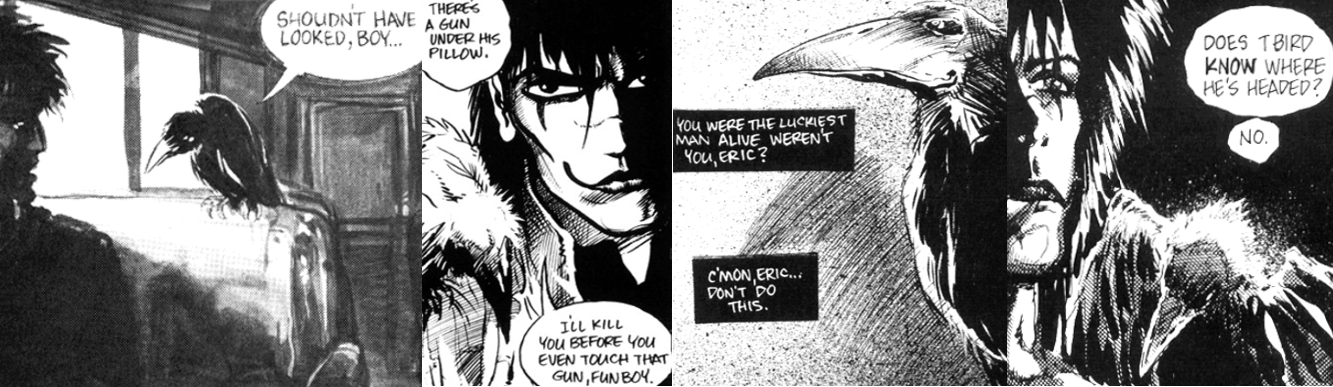
Unlike in the film, only Eric can see the crow; it advises him here and there throughout his mission but noticeably disappears between panels, indicating that it’s much more of a supernatural entity. It also has far less play then in the film; there, it was a mysterious guide and commonly seen at Eric’s side but, here, it appears sporadically and directly communicates with him, chastising him for constantly tormenting himself with memories of his past and distracting himself from his vengeance. In one of the interludes, the Crow chastises Eric for losing himself to the throes of passion with Shelly in what appears to be the closest representation of his paradise, before the conductor (now dressed as a Skull Cowboy) violently shoots Shelly in the head and forces him out of his heaven. In another, the crow scolds Eric for juicing up on Fun Boy’s drugs and reliving sexual memories of him and Sherry; while the crow is overly blunt and direct, it’s clear that it cares about Eric, his feelings, and his need for revenge and just wants to keep Eric on track rather than constantly dwelling on the past. After Eric is shot and left for dead, the crow immediately appears before him and its first advice is to turn away from the horrors being performed by his killers; it tries to comfort him by telling him that it wasn’t his fault and then chastises him for clinging to life, eager to give Eric the power to avenge himself on his killers.

The Crow is a tortured, tragic, invincible figure who is the embodiment of vengeance and fury.

The Crow’s mission is fuelled by rage and a lingering sense for brutal justice; there’s very little “heroic” about the Crow in that he’s acting solely to appease his need for vengeance rather than for the benefit of others. However, he remains a tortured and vulnerable character; he has no desire to hurt Albrect or those who aren’t on his list and shows a great deal of love for Sherri. At the heart of his motivation is, of course, Shelly; he curses a God who would allow someone as beautiful and innocent as Shelly to be molested and murdered in such a violent fashion, and who would allow him to suffer so badly by association, and regards the scum he guns down and brutalises as being little more than vermin deserving of punishment. Eloquent and largely impassive, the Crow is prone to bouts of intense rage and emotion when avenging himself; thanks to being undead, he has nothing to fear and willingly walks into gunfire and knives without hesitation. Although the comic doesn’t actually go into detail in explaining exactly what Eric has become, how he was resurrected, or the extent of his powers, it’s largely inconsequential to the story; all you need to know is that he is retribution personified on what he sees as a Holy mission to purge the city of undesirable sinners. The Crow remains a powerful, intense, and brutal tale of revenge and love; it’s far from a traditional comic book story and is more akin to a Gothic mediation on loss and chaotic emotion, and is bolstered by some great use of shadows and pen work. The black-and-white art style makes the story as beautiful as it is violent and it remains a passionate, tragic story to this day; it’s made even more enjoyable for fans of the movie as the film directly lifted entire scenes and dialogue from the original comics and perfectly captured, and expanded upon, the atmosphere of this dark, gritty story that I would definitely recommend everyone check out.

My Rating:

Rating: 5 out of 5.

Fantastic

Have you ever read The Crow? What did you think to the story, artwork, and the narrative structure? How did you feel about Eric and Shelly’s plight, their love story, and their deaths as the motivation for the Crow’s mission? What did you think to the Crow; did his loquacious nature annoy you or did you find him intimidating and compelling, and do you think he was overpowered? Were you a fan of the interludes, poetry, and symbolism employed throughout the comic? Which of The Crow’s follow-ups was your favourite and how were you introduced to the franchise? How are you celebrating Devil’s Night tonight? Whatever you think about The Crow, leave a comment on my social media or sign up to reply down below.

Game Corner: SEGA’s Mega Machine

SEGA’s Mega Machine

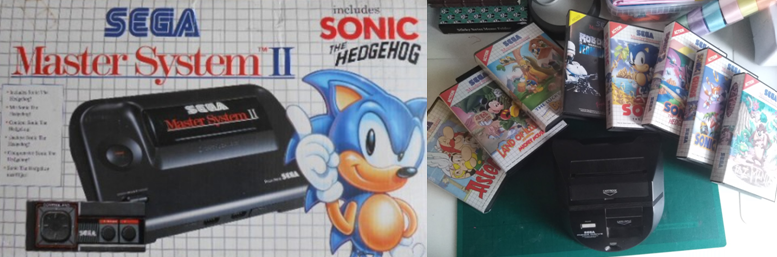
On 29 October 1988, SEGA released the 16-bit Mega Drive (known as the SEGA Genesis in North America); far superior to Nintendo’s 8-bit Nintendo Entertainment System (NES), and bolstered by both an aggressive marketing campaign and the eventual release of Sonic the Hedgehog (Sonic Team, 1991), this release kicked off the “Console Wars” of the mid-nineties and changed the face of home consoles forever. This year, to celebrate this momentous occasion, I’m going to share some of my memories of this sleek, beautiful machine and the impact it had on my childhood. I was just a kid, something like six or eight, when I had what I am pretty sure was my first ever home console (and videogame) experience; I remember being at my aunt’s house and being introduced to the SEGA Master System II and, more specifically, Sonic the Hedgehog for the first time when I sat down to fumble my way through Sonic the Hedgehog’s (Ancient, 1991) Green Hill Zone. The colours, the sounds, and the user-friendly nature of the system clearly struck a chord with me and it wasn’t long (it was probably my birthday that same year) before my parents gifted me that very same machine and, as I recall, three titles: Spider-Man (Technopop, 1991), Trivial Pursuit: Genius Edition (Domark, 1992), and the aforementioned Sonic built-into the machine.

The Master System II served me well until I got a convertor unit for the Mega Drive.

For a long time, probably something like two or maybe even three years, the Master System more than met my demands. I amassed a pretty decent library considering money was a bit tight back in those days and wasted many hours playing a variety of 8-bit titles. One memory that sticks out for me in particular was when I had a friend come over to play games (this was, of course, back in the days when kids mostly only owned one machine so you had to actually go around someone’s house to play other consoles and games) and he was struggling to get past the Green Hill Zone boss. I took the controller from him and reached the last Zone of the game for the first time, which was quite the achievement for me at the time; though I distinctly recall not actually completing Sonic that day, I did eventually, and many times over. Another memory for me was when I discovered the elaborate method of activating Sonic the Hedgehog 2’s (Aspect, 1992) level select and actually being able to bypass the God-awful Sky High Zone. My love for videogames had well and truly began. I played the NES at a friend’s house, the PC at another friend’s, and enjoyed a handful of ZX Spectrum, MSX, and Amiga titles while routinely playing the Master System, reading Sonic the Comic (Fleetway, 1993 to 2002), and watching the likes of Captain N: The Game Master (1989 to 1991), Adventures of Sonic the Hedgehog (1993 to 1996), and GamesMaster (1992 to 1998).

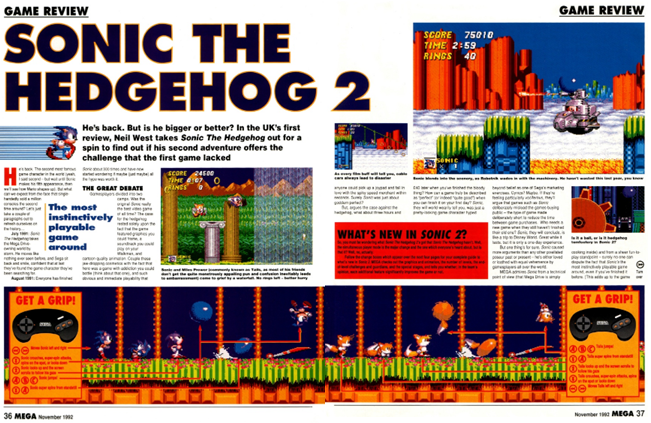
The article I most attribute for selling me on the Mega Drive.

I bought videogame magazines from car boot sales, drooled over Master System games in the local game’s shop, and doodled pictures of Sonic and his friends at every opportunity. Then, one fateful day, I became aware of another SEGA console; one with far more detailed graphics, bigger, better games, and, more importantly, more Sonic titles. I can’t be exactly sure when I first became aware of the Mega Drive but I distinctly recall owning issue two of Mega (Future Publishing/Maverick Magazines, 1992 to 1995) which had a whole article devoted to the upcoming (or recently released) Sonic the Hedgehog 2 (SEGA Technical Institute, 1992). I was awe-struck; the sprites were so big and colourful, the graphics so crisp and detailed. Unlike in the 8-bit Sonic 2, Miles “Tails” Prower was actually a playable character…and he followed Sonic around onscreen, too! I’m sure I must have seen other photos, articles, and gameplay footage of the Mega Drive across the other magazines and shows I watched but this particular issue of Mega really sticks out in my mind; I read that article over and over, each time more and more attracted to the power and superior graphics of the Mega Drive.

The Mega Drive was for sharing back when I first got it but that was fine by me.

Another memory I distinctly have is pointing the machine out to my parents in an Argos catalogue and trying to explain the benefits of upgrading to SEGA’s newer, sexier console. As I said, money was tight back then for us; we weren’t exactly poor and destitute but we also weren’t rolling in disposable income so I’m sure the decision to buy a Mega Drive didn’t come easily for my parents. Thankfully, however, unlike a lot of parents these days, mine were cleaver and, that Christmas, I received the coveted SEGA Mega Drive and two games (Michael Jackson’s Moonwalker (SEGA, 1990) and my equally-coveted Sonic 2) on one proviso: it was to be a joint present for me to share with my older sister. I’m pretty sure that that gorgeous black machine, with its two control pads and those two fantastic games, was the only present either of us got that year, as well, but I didn’t care: I had it and that’s all that mattered. In 1983, an influx of home consoles, poorly-made titles, and a vastly oversaturated market caused the videogame industry to crash in spectacular fashion; what had once been a booming, attractive business had crumbled under the weight of expectation, success, and a market inundated with machines and titles that retailers just couldn’t sell. A few years later, the industry began to recover thanks to the release of the Nintendo Family Computer (Famicom); known as the NES outside of Japan, the machine was marketed not as a home videogame console but more as an “Entertainment System” (it wasn’t a “home console”, it was a “control deck” and the cartridges were “Game Paks” rather than “videogames”) to give it a better chance at selling in toy shops.

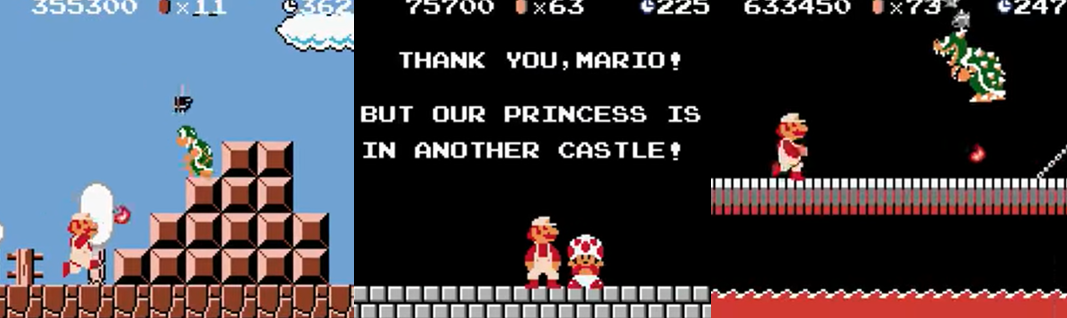
Super Mario Bros. catapulted Nintendo to mainstream success as the home console market leader.

Thanks to a lack of competition and the blockbuster success of Super Mario Bros. (Nintendo EAD, 1985), 30% of American households owned the NES by 1990 and Nintendo absolutely dominated the slowly re-emerging videogame market after the NES sold over 35 million units in the United States, a number that was far beyond those of other consoles and computers. Videogames were back, and more popular than ever, thanks to Nintendo’s efforts and high quality titles, and the industry once again became lucrative and profitably so, naturally, others wanted in on the action. Enter SEGA; formally one of the top five arcade game manufactures in the US, the videogame crash and a decline in the popularity of arcades had seriously hurt the company and led to its purchase by Bally Manufacturing and an eventual restructure towards the home console market with the SG-1000, a precursor to my beloved Master System. Though the console sold well in Japan, it barely made a dent thanks to Nintendo’s stranglehold on the market so, amidst growing competition, SEGA’s research and development team, led by Masami Ishikawa decided that the only way for SEGA to remain competitive was to incorporate a 16-bit microprocessor by adapting their successful SEGA System 16 arcade board into the architecture for a new home console. Mitsushige Shiraiwa led the team that designed the Mega Drive, drawing inspiration from audiophile equipment and automobiles, and the machine was purposely designed to appeal to gamers of all ages, rather than just children like Nintendo’s console.

Aggressive marketing and strong third party support also helped give SEGA the edge.

To impress customers with the system’s power, “16-bit” was slapped right onto the console itself in impressive, striking gold yet, despite shipping 400,000 units in its first year and producing a number of additional peripherals, the console’s launch was overshadowed by the released of Super Mario Bros. 3 (Nintendo EAD, 1988) and the system was unable to surpass the NES in terms of sales or popularity. For the Mega Drive’s release in North America, the system was rebranded as the “Genesis” and SEGA of America CEO Michael Katz spearheaded an aggressive marketing campaign to sell the power and superiority of the console compared to the NES. While the Genesis certainly did do what Nintendo didn’t, it still wasn’t enough to topple or compete with NES or their podgy little plumber. Thus, when Tom Kalinske replaced Katz as CEO, he developed a four-point plan that involved cutting the console’s price, create a U.S.-based team to develop games specifically for the American market, continue and expand their aggressive advertising campaigns, and bundle copies of the Genesis with the one game exclusively developed to overtake Mario once and for all: Sonic the Hedgehog. For a time, this plan worked wonderfully; bundling Sonic in with the Mega Drive gave SEGA the edge it needed as gamers who had been anticipating the release of Nintendo’s own 16-bit console, the Super Nintendo Entertainment System (SNES), bought a Mega Drive instead just to play Sonic. Sonic’s popularity also led to the Mega Drive outselling the SNES during the 1991 holiday season and, but 1992, SEGA had wrestling 65% of the market away from Nintendo and overtaken Nintendo as the home console market leader for the first time since 1985.

Had SEGA focused on the Mega-CD, things might’ve been very different for them.

With a focus more on arcade-quality titles, a willingness to consider a greater variety of genres and videogames compared to Nintendo, and Sonic’s explosive popularity as not just a videogame icon but a mainstream icon, SEGA seemed unstoppable. A sleeker, more streamlined version of the Mega Drive released in 1993 and the company even produced a special convertor unit that would allow gamers (such as myself) to play their Master System cartridges on the 16-bit console. SEGA were ahead of the times in many ways; unlike Nintendo, they released Mortal Kombat (Midway, 1993) with its signature blood and Fatalities intact through use of a special code, showing the machine (and the company) to be the more mature and “edgier” of the two, and SEGA soon began to experiment in both CD-based games and 32-bit graphics with the Mega/SEGA-CD and Mega/SEGA-32X add-ons. Unfortunately, despite showcasing some impressive graphics, CD-quality sound, and the sheer potential of these peripherals, producing such expensive add-ons to prolong the Mega Drive’s lifespan ultimately proved financially disastrous for SEGA. When research SEGA and their tumultuous history for my PhD thesis, I was disappointed to see how the company squandered all their success with blunder after blunder in this way. To me, they had the right idea with the Mega-CD and should have stuck with that. Had SEGA simply made the little-known SEGA Multi-Mega the standard and ditched all plans for both the 32X and the SEGA Saturn, producing all the games that released for those console (and the Mega-CD) as CD-based games, the company may have fared better heading into the sixth generation of gaming. I don’t know if would have been enough to make the Dreamcast more competitive but SEGA would definitely have been in a much better financial position without wasting all that money making expensive add-ons and inferior consoles.

My Mega Drive collection is still a work in progress but has always had some quality titles.

Still, it is what it is and, for many years, even when I owned a Nintendo 64, I still returned to the Master System and the Mega Drive. My library of Mega Drive games grew respectfully as I continued to indulge my love of colourful, action-packed action/platformers like Rocket Knight Adventures (Konami, 1993), Marko’s Magic Football (Domark, 1994), The Revenge of Shinobi (SEGA, 1989) and, of course, every Sonic title released for the console. However, to say that I was a fan of Sonic was an understatement; I remember incurring the wrath of my mother for not pausing Sonic 2 right as I beat the game for the first time to go for dinner and I must have played that game endlessly, rejoicing every time I got to play as Sonic and someone else got to play as Tails for a change. I distinctly remember getting Sonic & Knuckles (SEGA Technical Institute, 1994) for a birthday and that I got the game before I owned Sonic the Hedgehog 3 (ibid). I’m not sure exactly how that happened but I remember being fascinated by Sonic & Knuckles’ unique “lock-on” technology and being able to play as Knuckles the Echidna in Sonic 2. Some time later, while at a game’s shop in Northampton, I picked up an unboxed copy of Sonic 3 for £9 and, after reading a guide in Sonic the Comic that showcased the awesomeness of Super Sonic, Hyper Sonic, and the Doomsday Zone, eventually made it my top priority to unlock these forms and reach this final Zone in a precursor to my newfound desire to obtain as many Achievements as possible.

The Mega Drive was pretty great for multiplayer experiences, too.

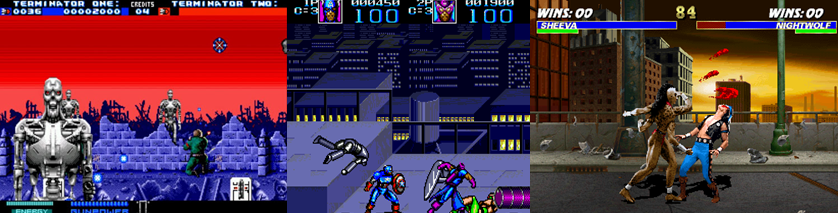
It wasn’t just about Sonic, though; the Mega Drive was a great two-player console and I lost a lot of hours playing T2: The Arcade Game (Probe Software, 1991), Captain America and the Avengers (Data East, 1992), and Mortal Kombat 3 (Midway Games/Sculptured Software, 1995) even while I was playing the likes of WCW vs. nWo: World Tour (Asmik Ace Entertainment/AKI Corporation, 1997) and Quake 64 (Midway Games, 1998). While not every title I played or owned for the Mega Drive was a smash hit, I still managed to find plenty to love thanks to the eye-catching graphics, catchy tunes, generally tight controls and gameplay, and the sheer attractiveness of those black boxes and cartridges. I even got a lot of enjoyment out of games that were short-lived in my collection, like Cosmic Spacehead (Codemasters, 1993) and The Aquatic Games Starring James Pond and the Aquabats (Millennium Interactive, 1992), even though they may not have necessarily been the easiest or most suitable games for my tastes at the time. Sadly, as I mentioned, money was always an issue in keeping me from having a truly expansive Mega Drive library; I borrowed a few titles I never actually owned, like Taz in Escape from Mars (HeadGames, 1994) and Street Fighter II’: Special Champion Edition (Capcom, 1993) but, while I played the likes of Golden Axe (SEGA, 1988) and Zool: Ninja of the Nth Dimension (Gremlin Graphics, 1992) on the Amiga, I never actually owned them for the Mega Drive back in the day.

My original mega Drive still sits proudly in the actual, physical game corner.

Thus, once we tore down our unused garage and had a little log cabin built and my dream of having an actual, physical game corner quickly became a reality, I knew what my first priority would be: to build a respectable library of physical, complete Mega Drive games to play at my leisure. It’s an expensive and long-winded process thanks to the fact that complete versions of Mega Drive games can be quite expensive but it’s a much easier prospect than collecting for Nintendo’s 8-, 16-, and 64-bit consoles as Nintendo favoured flimsy cardboard boxes for their games so the only Mega Drive game you really have to worry about having a battered or ripped box is Sonic & Knuckles. I first made my steps towards building this library when I finally bought a boxed and complete version of Sonic 3 a few years ago and, since then, the collection has grown slowly, but steadily. I’m prepared to play the long game when it comes to completing my collection as, while my Odroid console is great for emulating thousands of games and there’s plenty of ports or collections of classic Mega Drive titles available for modern consoles, there’s nothing quite like seeing a shelving unit full of those gorgeous, bulky, black or blue boxes and slotting a physical cartridge into that very same Mega Drive my parents gifted me all those years ago.

What are your memories of the SEGA Mega Drive? When did you first play or own one and which model did you have? Perhaps you preferred Nintendo’s consoles; if so, why and share your memories of those days? Do you also believe that SEGA might still be something of a competitor in the home console industry had they avoided the 32X and the Saturn or do you think their downfall was inevitable given how crowded and competitive the home console market became? What are some of your favourite Mega Drive titles? How are you celebrating this momentous day today? No matter what your thoughts, please feel free to share your opinions and memories of the Mega Drive and this era of gaming below.

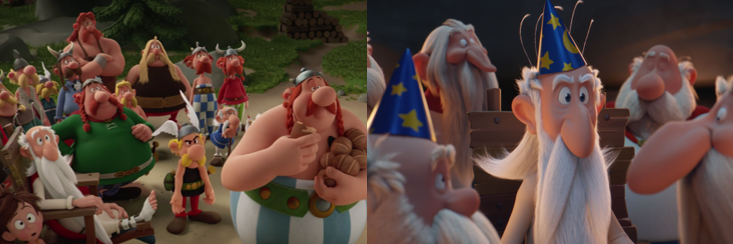
Movie Night [Asterix Anniversary]: Asterix: The Secret of the Magic Potion


Asterix the Gaul (and his best friend Obelix) first debuted on 29 October 1959 as a serial in the French/Belgium magazine Pilote. Since then, the plucky Gauls have gone on to have many adventures in comic books, videogames, and feature-length productions and Asterix himself has become a popular and enduring character in his native France and around the world as Asterix’s stories have been translated into over a hundred languages across the world. I may be a day early in celebrating this anniversary as it coincides with the release of the SEGA Mega Drive but I’ll take any excuse to talk about Asterix’s amusing escapades.


Released: 5 December 2018
Director:
Louis Clichy and Alexandre Astier
Distributor:
Société Nouvelle de Distribution/Altitude
Budget:
Unknown
Stars:
Ken Kramer, C. Ernst Harth, John Innes, Fleur Delahunty, and Michael Shepherd

The Plot:
In 50 B.C. ancient France (then known as Gaul), has been entirely conquered by Julius Caesar (Mark Oliver) and his army of Romans…except for one small village of indomitable Gauls given superhuman strength by the druid Getafix’s (Innes). However, when Getafix starts to worry about his mortality, he embarks on a quest across Gaul, accompanied by the village’s most powerful warriors, Asterix (Kramer) and Obelix (Harth), in search of an heir.

The Background:
Asterix was created by writer René Goscinny and artist Albert Uderzo in 1959 and first appeared in Pilote before being collected into a single volume. Since then, the duo produced volumes on an annual basis until 1997, when Goscinny tragically died; after continuing solo for a while, Uderzo eventually signed the rights over to a new generation of creators so that Asterix’s stories could continue. Since then, Asterix has been an incredibly popular character the world over, selling nearly 400 million books and has been adapted into a series of animated, and live-action, features. The first, Astérix the Gaul (Goossens, 1967), was produced with Goscinny and Uderzo’s input and the two were heavily involved in subsequent productions. Nine animated features were produced between 1967 and 2014, where the animation made the jump from 2D to 3D with Asterix: The Mansions of the Gods (Clichy and Astier, 2014), which was France’s highest-grossing animated film of that year. Asterix: The Secret of the Magic Potion followed about four years later; based on an original story by Astier, the film made over $2 million on its opening night and eventually grossed over $46 million.

The Review:
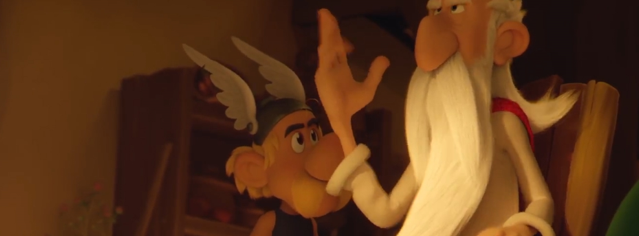
Asterix: The Secret of the Magic Potion begins with Getafix out in the forest cutting ingredients for his magic potion with a golden sickle; he’s a sprightly, lively old man, hopping and jumping all over the place and handling his sickle with an effortless pizazz. Unfortunately, his luck runs out and he takes a particularly nasty fall from a treetop. Having seriously injured his ankle, Getafix is despondent and angry at his stumble and decides to search out a young successor in order to pass down his greatest secret; since the secret can only be passed from one druid to another, this means Getafix must leave the village to seek out his heir. Getafix’s decision to seek out an heir worries both Asterix and the village chief, Vitalstatistix (Don Brown), as they’re concerned that Getafix is giving up too easily and that a new druid will misuse the magic potion. To allay their fears, Getafix suggests that Asterix and Obelix accompany him to ensure that his chosen successor uses the magic potion as wisely as he and that their village can continue to resist the Roman invasion.

Getafix’s injury causes him to a crisis of confidence, much to Asterix’s chagrin.

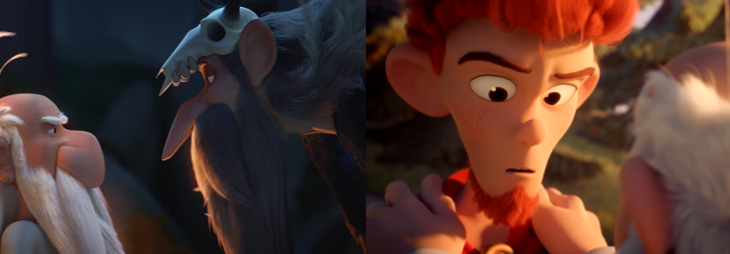
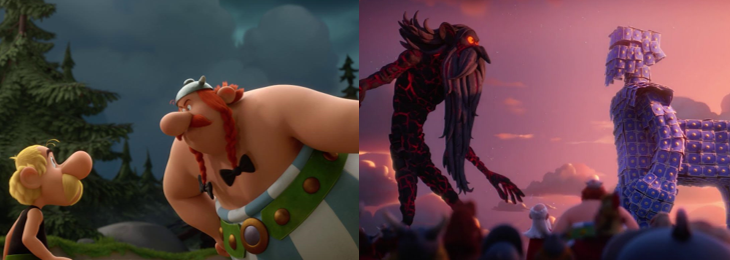
Getafix’s mission is opposed by the malevolent druid Demonix (Shephard), a practitioner of forbidden magic who greatly resembles Prolix from Asterix and the Soothsayer (Goscinny and Uderzo, 1972) and is capable of conjuring will-o’-the-wisps to hypnotise and manipulate others. His power is so frightful that he’s even able to freeze the mighty Obelix in his tracks like a statue Demonix is disgusted that Getafix has wasted his magic potion on his village and wishes to take the secret from himself to satisfy his desires for power and glory. To facilitate this, he strikes a deal with Caesar that will see him manipulate the promising young druid Cholerix (Michael Adamthwaite) in order to learn the secret of the magic potion. After forcing Cholerix to mage the potion, Demonix augments it further and consumes it, becoming a super-powered sorcerer and threatening not only the Gauls but the Romans as well with his vast powers.

Demonix’s plot to learn Getafix’s secret sees him manipulate the young druid Cholerix.

Getafix is dismayed to find that all the young druids he meets are either charlatans or incompetents and, as a result, he’s excited at the potential Cholerix. Although Cholerix initially rejects Demonix’s advice, he falters when standing before his peers and potential mentor and decides to conjure Demonix’s useless spell and, in the process, impresses Getafix. However, Cholerix is almost immediately dismayed at Getafix’s choice as he knows he basically deceived the druid and is forced to brew up the magic potion before Demonix’s eyes in order to save the village from being destroyed by the Romans.

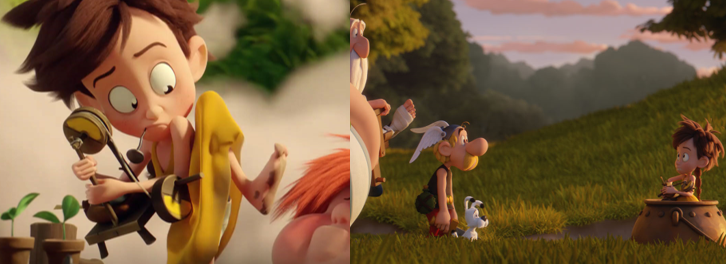
Pectin impresses with her curiosity, gumption, and inventiveness.

Asterix is enraged to discover that a young girl from the village, Pectin (Delahunty), has stowed away in Getafix’s cauldron; despite women being forbidden from the Forest of the Carnutes, Getafix is impressed with Pectin’s ingenuity and craftsmanship and allows her to accompany him to the druids’ gathering in disguise as a boy. Her presence and curiosity is the perfect way to coax exposition out of the druids (in the form of a traditional, hand-drawn animation) regarding Getafix’s past with Demonix and she proves instrumental in thwarting Deominx after he consumes his augmented magic potion, proving herself to, potentially, be worthy of taking Getafix’s place someday.

The Nitty-Gritty:
Asterix: The Secret of the Magic Potion is full of little gags and slapstick comedy, mainly revolving around fights and the physical pratfalls the many characters get into; the routine of village life and the Roman garrisons is amusingly introduced to the tunes of Dead or Alive’s ‘You Spin Me Round (Like a Record)’, with characters performing their everyday actions in tune to the beat of the song. As is the case with many Asterix stories, there’s an ongoing rivalry and animosity between Unhygienix (Jason Simpson) and Fulliautomatix (Scott McNeil), a gang of pirates continuously run afoul of the Gauls even when they’re safely out at sea, the Romans are generally portrayed as being reluctant warriors who are in fear of the Gauls’ strength, and the Gauls using chickens to fly in and attack the Romans. There’s also a running gag in the film that the druids can speak and understand the snorts and grunts of boars; indeed, boars themselves play quite a large role in this animated and are far more prominent than they usually are, getting into all kinds of scrapes and hijinks similar to Scrat from the Ice Age films (Various, 2002 to present).

As there are a lot of characters in the film, some inevitably get reduced to mere comic relief.

There’s a great number of characters in the film, more so than usual since Gettafix’s search takes him all over Gaul. However, all the village men (except for Cacofonix (Cownden)), decide to follow along with the quest to add some additional comic relief to the film through their tendency to argue and brawl with each other at the slightest provocation. Although the village is left only in the care of the women and Getafix’s limited magic potion reserves, the Gaulish women are, as always, more than capable of holding their own against the Roman forces, who are ordered to attack again and again to exhaust their reserves. The druids also get a lot of play in the film; their gathering is little more than a piss-up and the druids misunderstand the boar’s message and think Getafix has just brought them all together for a big party and Getafix is stunned to discover that the druids’ age-old traditions of passing information only through word of mouth has given way to “crib notes”.

Rather than focus on Asterix and Obelix, the film is much more about Getafix and a group effort.

When Getafix’s search initially proves fruitless, Asterix loses his temper; he’s annoyed that Getafix has let such a simple stumble throw him so completely and, in an amusing outburst, hands his helmet, dagger, magic potion, and status as the village’s top warrior over to Geriatrix (Ron Halder) in order to make his point and storms away. This does, however, allow him to stumble upon Demonix’s plot to collaborate with the Romans but he basically disappears from a big chunk of the film after he’s helplessly bound and gagged. Even when he’s rescued, he’s just one part of an unsuccessful team effort between the Romans and the Gauls to take down the gigantic, invincible, and super-strong Demonix and, in the end, it is Getafix’s resourcefulness and magic that saves the day. It’s a bit unusual to watch an Asterix film where Asterix ends up having such a small role but the bulk of the story revolves around Getafix and his shaken self-confidence so I guess it makes sense but Asterix and the Big Fight (Grimond/Weiss, 1989) was a very Getafix-heavy film and that still placed Asterix in a prominent role in its narrative.

The Summary:
Asterix: The Secret of the Magic Potion is a very fun and entertaining little romp. While I preferred the traditional, 2D animation of the previous films, the computer-generated characters are gorgeous to look at, full of life and little details and character quirks that really make them lively and amusing. It’s not one of the more action-packed Asterix stories, and it’s a little disappointing how small a role Asterix and, especially, Obelix play in the plot but it’s got a lot of funny little moments and gags peppered throughout it and really captures the quirky spirit of the comic books. As a lifelong Asterix fan, it’s heart-warming to see the character is still so popular and beloved that he continues to be relevant in a crowded genre and there’s clearly been a lot of care and attention put into bringing these unique and memorable characters to life. The story is pure Asterix and feels reminiscent of many of the books but also manages to stand out on its own merits through its distinctive visual and narrative flair and I’d say it’s definitely worth a watch for fans of the source material and should keep both kids and parents sufficiently amused with its wackier moments.

My Rating:

Rating: 3 out of 5.

Pretty Good

Have you seen Asterix: The Secret of the Magic Potion? If so, what did you think to it? Are you a fan of the CGI Asterix films or do you prefer the traditional, 2D animated features? Which character, book, or movie is your favourite? How are you celebrating Asterix and Obelix’s birthday this year? Whatever your thoughts on Asterix, feel free to leave a comment below.

Movie Night: Wonder Woman 1984

Released: 16 December 2020
Director: Patty Jenkins
Distributor:
Warner Bros. Pictures
Budget:
$200 million
Stars:
Gal Gadot, Chris Pine, Kristen Wiig, Pedro Pascal, and Connie Nielsen

The Plot:
Decades after losing her former love, Steve Trevor (Pine), during the First World War, Princess Diana of Themyscira (Gadot) works at the Smithsonian Institution while covertly helping others in her guise as Wonder Woman. After befriending shy geologist and cryptozoologist Barbara Ann Minerva (Wiig), both Diana and her friend find themselves forever changed when business tycoon Maxwell Lorenzano/Max Lord acquires a mystical artefact, the “Dreamstone”, and begins bringing people’s deepest wishes to life.

The Background:
Following her creation by psychologist William Moulton Marston, Wonder Woman has been a firm staple of DC Comics and an influential feminist icon. Wonder Woman achieved mainstream success as a pop culture icon following Lynda Carter’s portrayal of the character in the 1970s and she finally proved to be a massive critical and commercial box office success with the release of Wonder Woman (ibid, 2017). Although the DC Extended Universe (DCEU) was in flux following the poor reception of Justice League (Whedon/Snyder, 2017), production of a Wonder Woman sequel was officially announced in 2017, with both stars Gadot and Pine and director Jenkins set to return. Rather than produce a direct sequel,Wonder Woman 1984 (or simply WW84) jumped ahead to another unexplored period in the character’s long history, the 1980s, to capitalise on the recent interest in the decade. The film’s release was hampered by the COVID-19 pandemic but WW84 finally saw the light of day at the end of 2020, where it was met with a lukewarm and underwhelming critical response. This, coupled with its limited release, meant the film massively underperformed and brought in only $166.4 million at the box office; however, while many criticised certain narrative elements of the film, Gadot’s performance was praised as a highlight and a third entry in the franchise is was greenlit soon after the film’s release.

The Review:
Like the first film, WW84 begins with Diana narrating a flashback to her childhood where, as a girl (Lilly Aspell) on the island of Themyscira, she competes in a gruelling obstacle course. Although she’s able to hold her own for the most part, she is knocked from her horse at a crucial moment and, in order to catch up, opts to take a shortcut and, as a result, is penalised and reprimanded by her aunt and mentor, Antiope (Robin Wright), who teaches her a valuable lesson that forms the basis for the film’s main theme: that she must be honest and true to herself and that she must have patience in order to succeed in life.

Despite claiming to have left the man’s world, Diana is covertly saving lives in 1984.

Despite claiming to have walked away from man’s world for a hundred years after Steve Trevor’s death, Diana is living and working in Washington, D.C. and we’re reintroduced to her as she performs various heroic deeds as Wonder Woman in an amusingly edited montage that is both bright and vibrant thanks to the excess of the eighties and comically exaggerated in a way that recalls Superman (Donner, 1978). Although Diana makes an effort to destroy security cameras and move quickly to largely avoid being seen, she does appear in full costume in the middle of a shopping mall in front of numerous witnesses, though the film does make a point to show that her identity is unknown. Still, regardless of the continuity blip this causes (it’s hard to imagine Bruce Wayne/Batman (Ben Affleck) wouldn’t have been somewhat aware of Diana before he first encountered her judging by this film’s events), it’s a fun and exciting way to be reintroduce to Diana that is immediately offset by the emotion of seeing that she’s largely closed off from the wider world.

The insecure and shy Barbara instantly idolises Diana.

Thanks to brief shots of photographs in her apartment, we see that Diana continued to maintain a friendship with Etta Candy (Lucy Davis) and ties with Steve Trevor but is, otherwise, quite a lonely individual. In this regard, she meets a kindred spirit in Barbara Minerva, a quirky, social inept, and insecure geologist who is largely ignored by her co-workers and those around her. Barbara is excited when Diana actually gives her the time of day and the two bond over their interest in history; the two quickly form a friendship, filling the gaps in each other’s lives, and Barbara comes to idolise Diana for being everything she wishes to be.

Max Lord is a charismatic con man obsessed with obtaining power and the Dreamstone.

After foiling a robbery in the film’s opening, Barbara is asked to examine an artefact that was recovered, which claims to be a wish-granted stone, the Dreamstone. Although both are sceptical about this, the stone’s powers turn out to be genuine when Barbara wishes to “be like” Diana and wakes up the next day to find herself suddenly noticed by others, slipping into sexier clothing, and her fortunes generally turning for the better. Sadly, however, her insecurities remain the same and she is easily tricked by the film’s main antagonist is Max Lord, into allowing him to steal the stone for himself. Lord, a prominent figure in DC Comics and, here, is portrayed as a charismatic and silver-tongued oil tycoon and enigmatic television personality who appears to be another corporate, suit-wearing industrialist. Behind his public façade, however, is a is a con man whose oil business is slowly falling apart around him, whose debts are being called in, and who desperately wishes to make his son, Alistair (Lucian Perez) proud of him.

Diana unwittingly wishes Steve back to life and the two pick up right where they left off.

Another consequence of Barbara’s wish is that she develops superhuman strength and agility, just like Diana has, while Lord does the natural thing and wishes to embody its powers, thus turning his fortunes around overnight. The stone’s powers also have a startling affect on Diana when she unknowingly wishes for Steve Trevor to be resurrected; the stone accomplishes this by having his spirit inhabit the body of another man (Kristoffer Polaha). Overjoyed at being reunited with him, Diana and Steve immediately pick up where they left off and, despite how awkward it is for Diana to be taking advantage of a random stranger, this allows the film to present the reverse of the first movie’s concept. Now, Steve is the fish out of water, confused and puzzled by “the future” he has returned to, and it is Diana who has to guide him through navigating the world and the garish style of the eighties.

The Dreamstone’s powers come at a price, weakening the character’s physical and mental health.

Perturbed by the stone’s powers, Diana and Steve set out to investigate it; while Barbara begins to revel in her newfound confidence, abilities, and popularity, possessing the stone’s powers turn Lord into an influential, Donald Trump-like figure and Diana is horrified to discover that the Dreamstone is a construct of the Gods, specifically Mendacius, the “Duke of Deception”. Like all good things, the stone’s powers come at a cost; Diana finds her superhuman abilities beginning to wane, Max’s mind and body starts to deteriorate from the immense power, and Barbara slowly loses her humanity until she eventually transforms entirely into the cat-like Cheetah. The only way to reverse the damage is for them tor enounce their wishes, something none of them are willing to do at first since it would mean losing everything they have desired for so long

The Nitty-Gritty:
WW84 is a much more character-driven film that it’s predecessor; much of the runtime is spent exploring Diana and Steve’s renewed relationship, acclimatising him to the then-modern world, and rekindling their passion. Thankfully, Gadot and Pine still make for a charismatic and engaging duo and the two gel really well together as equals but it can’t be denied that things would have been much less awkward if the stone had literally returned Steve to life rather than having him possess an unassuming stranger’s body Quantum Leap (1989 to 1993) style.

Diana is forced to let Steve go once again in order to put a stop to Lord’s carnage.

Still, on the one hand, spending so much time on Diana and Steve’s relationship does help to further develop her character; she’s clearly still grieving his loss, even after all these years, and doesn’t have much of a social life, though she still uses her abilities to help others as covertly as possible. She forms a real bond with Barbara, perhaps the first real friendship she’s had in some time, and is elated to be reunited with Steve. Her character arc in this film is learning to rediscover her humanity, somewhat, and to let go of the past, something we know from Batman v Superman: Dawn of Justice (Snyder, 2016) that she doesn’t really do after these events but it’s still wonderfully realised here as Diana applies the lesson she learned as a child to her current situation and, however reluctantly, renounces her wish to regain her strength and put the world to rights after Lord’s actions cause worldwide upheaval.

When the action does kick in, it’s exhilarating and thrilling.

This has a detrimental effect on Lord, who begins to suffer more and more physical pain and consequences for playing Wishmaster (Kurtzman, 1997); driven to desperation, he finds himself unable to stop granting wishes and tries to restore himself by absorbing the energy of others, plunging the world into chaos in the process. Ultimately, rather than engaging him in a fist fight, Diana is able to convince him to renounce his abilities after forcing him to relive his own unhappy childhood and reconnect with his son. That’s not to say that WW84 doesn’t have its fair share of action; the opening sequence in the mall is a lot of fun and Diana’s attempt to chase down Max Lord in Egypt seems to be a homage to the seventies show, and Diana’s lasso-based fight scene in the White House was very thrilling, but the scene-stealing sequence is the moment when Diana dramatically swings her way through the storm-swept sky by lassoing onto lighting!

Diana dons ceremonial armour to battle Cheetah in the film’s finale.

Diana’s journey in WW84 is one of gaining strength from these decisions; she demonstrates the ability to turn a jet invisible, acquires the golden armour of Asteria (Lynda Carter), and gains the ability to fly (to the stirring chords of “Adagio in D Minor”) after renouncing her wish and regaining her full powers. This comes in handy for her big showdown with Cheetah; earlier, Cheetah had been able to defeat Diana since her powers were fading, which helped to showcase Barbara as a physical threat to Diana. Drunk on the power and freedom offered by the stone’s powers, Barbara becomes a formidable and fierce adversary and a far cry from the meek character she was at the start of the film. Unfortunately, Cheetah kind of lets the film down a bit in the effects department; even though her fight with Diana takes place in the murkiness of night, the CGI is quite wonky, which is a shame as the practical effects look pretty good. Still, it’s a thrilling climax to the film, which even goes a long way to showing Diana’s compassion as she chooses to save Barbara and even Max rather than just kill them.

The Summary:
Wonder Woman 1984 is a curious film; rather than being bigger and better than the original, it opts to tell a more dramatic, character-based story that focuses more on Diana coping with her grief and loss and learning to let go of the past rather than being a bombastic, action-packed sequel. This is pretty good for Diana’s character development; it’s clear that she is overjoyed to have Steve returned to her and torn between wanting to be with him even if it means leaving the world to its fate and seeing her step into the role of a full-blown hero and saviour is very gratifying. The twist of Steve being the fish out of water this time around was interesting but, at the same time, could potentially have been handled differently or excised entirely in some ways, and I was surprised to find that Barbara’s “geeky, quirky, obsessed” character cliché wasn’t as annoying or aggravating as in other superhero films; it’s perfectly suited to Wiig’s strengths and she pulled off the character’s descent into villainy really well. Thanks to his charisma and magnetism, Pascal successfully walked the fine line between being a scenery chewing character and a cartoonish villain and it was great to see Pine and Gadot’s chemistry back in action. My only real gripes with the film were its length (and even that wasn’t that big a deal as I was interested throughout) and some continuity hiccups with the larger DCEU but, considering the mess the DCEU has become since then, I think I can forgive it and would say WW84 manages to be just as enjoyable as the first film while still mixing things up with its presentation and narrative.

My Rating:

Rating: 4 out of 5.

Great Stuff

What are your thoughts on Wonder Woman 1984? How do you feel it compared to the first film and were you disappointed by it? Were you happy to see Chris Pine return and what did you think to Diana’s character arc in this film? Were you a fan of Max Lord and Cheetah? What are your thoughts on WW84’s placement in the wider DCEU?What are some of your favourite Wonder Woman stories, characters, and moments? How are did you celebrate Wonder Woman Day this year? Whatever your thoughts on Wonder Woman, drop a comment down below.

Game Corner: The Evil Within 2 (Xbox One)

Released: 13 October 2017
Developer: Tango Gameworks
Also Available For: PC and PlayStation 4

The Background:
After a long and illustrious career at Capcom in which he created and spearheaded the Resident Evil franchise (Capcom/Various, 1996 to present), Shinji Mikami left to help found Tango Gameworks in a bid to develop new properties and titles, such as The Evil Within (Tango Gameworks, 2014). Although critical reception of the game was somewhat mixed, The Evil Within sold well enough to justify a sequel, which began development shortly after Mikami’s team had finished up working on the first game’s downloadable content (DLC). In response to some of the criticisms regarding the first game’s convoluted plot, the team sought to make The Evil Within 2 more comprehensible while also placing greater emphasis on psychological horror elements. Despite a much shorter production period and some notable technical hiccups, The Evil Within 2 fared much better with critics than its predecessor and was generally regarded to be an improvement over the original.

The Plot.
Three years after the events of the first game, Sebastian Castellanos has left the Krimson City Police Department and continues to be haunted by his experiences. Driving to alcoholism by the death of his child, Lily, and the break-up of his marriage, he reluctantly agrees to re-enter the nightmarish world that plagues his dreams when it is revealed that Lily was actually being used as the Core for a new STEM system.

Gameplay:
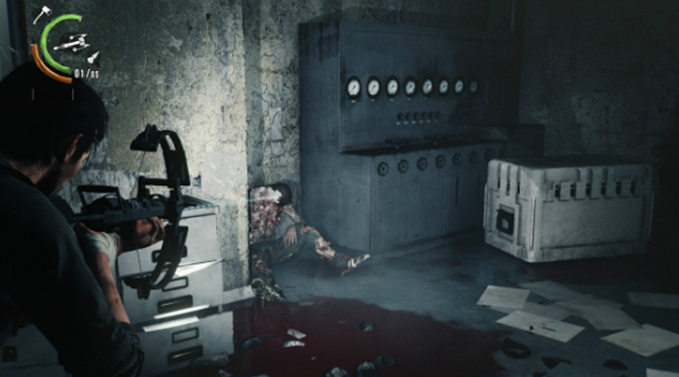
The Evil Within 2 is, fundamentally, extremely similar to the first game but also noticeably different in many ways. Where the first game really emphasised a twisted, nightmarish world where anything was possible and that was populated by a variety of gruesome creatures and restricted your resources to keep you constantly fighting for survival, The Evil Within 2 is much more linear and action-orientated title. The difficulty setting you pick for your playthrough will determine how much ammo and damage you can take, which is pretty standard, but even on the “Normal” difficulty, “Survival”, there’s quite a bit of ammo, crafting items, and opportunities to replenish your health through the game, certainly more than in the first game.

The game’s controls are largely the same as before but tweaked for the better.

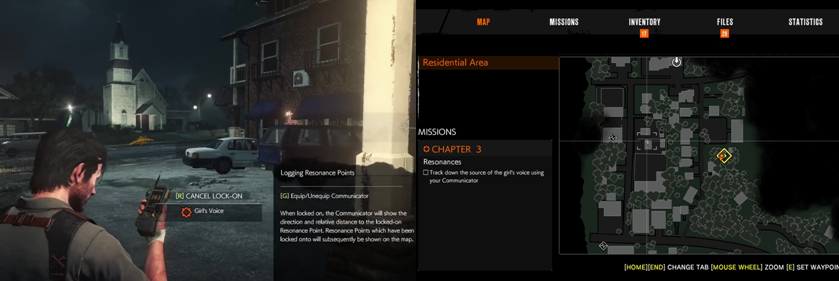
Control wise, however, the game is basically exactly the same; you can aim your weapon with LT, shoot with RT, and reload with X, and interact with your environment with A but, this time around, your melee attack is also mapped to RT and Y brings out your Communicator, which allows you to lock on to signals and help lead you towards objectives and objects of interest. Thankfully, you no longer need to worry about burning bodies so, rather than tossing matches with B, B activates your flashlight (Sebastian is no longer hampered by a large lantern this time around), though you can still sprint by pressing in the left analogue stick.

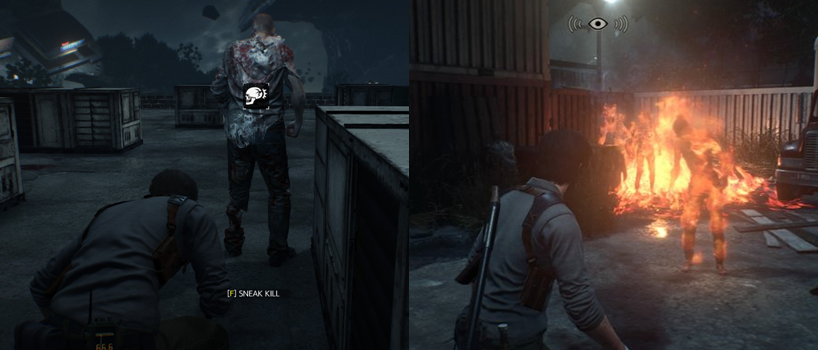
Stay low and sneak around to avoid detection and perform an instant kill move.

Like before, stealth and taking cover is a big part of the gameplay; you can snap to nearby cover by pressing the Right Bumper and shift from cover to cover by pressing up on the left stick. Pressing in the right analogue stick will see you crouch down and sneak around and, when enemies are nearby, you’ll again see the return of the eye-themed “Enemy Alertness” icon that will help you to know when you’ve been spotted. This time around, though, it is much easier to spring away from enemies and out of sight to keep them from pursuing you and there are far ore opportunities for you to sneak up behind enemies and perform a one-hit Sneak Kill, and you’re also given the option to enable or disable an “aim assist” that is super helpful in targeting enemies but combat is much more fluid and far less awkward this time around even without this.

Save areas have now been expanded into two locations to allow you to heal up and upgrade you attributes.

Interestingly, the game also offers the option to enable a first-person perspective; I didn’t play with this as first-person games aren’t really my thing but there was a point in the story that forced you into this perspective and it’s unusual to see this feature included in a game, so it’s interesting, if nothing else. There are far opportunities available to you to heal and craft resources; by exploring your environments, you’ll find Weapons Parts, gunpowder, fuses, and other items that can all be used in workbenches in “Safe Houses” to craft ammo and upgrade your weapons. In these Safe Houses, you’ll usually find similar resources to top up your inventory and will always find a coffee maker, which will fully refill your health with one soothing sip. You can’t abuse this mechanic, however, as it takes time for the machine to refill but you can warp through a cracked mirror like in the last game. This takes you to Sebastian’s office, where you can view documents, slides, access another workbench, and upgrade Sebastian’s other abilities (such as health and stealth) using the torture chair from the last game. In both Safe Houses and Sebastian’s office, you’ll find a terminal for you to insert your Communicator and save but, like before, the game is pretty generous with autosave points.

The addition of a Communicator, map, and waypoints makes navigation a breeze this time around.

The Communicator is a pretty big addition to the game and, yet, paradoxically not that integral at the same time. At a number of key moments in the story, you’ll have to hold X to tune into a frequency that will lead you to your next story-based objective and Sebastian will often stop (or continue walking) to chat with the game’s various non-playable characters (NPCs) and expand the story. Perhaps the best addition to the game is the inclusion of a map, which is accessed from the inventory menu; from here, you can see a simple to understand layout of the immediate area, key locations like Safe Houses, and set up a waypoint marker that allows you to easily navigate towards any location. It’s amazing how much of a difference this makes, though it is slightly unnecessary as the game is far more linear than the first game despite the fact that you’re often exploring much larger and more open areas this time around.

Access your weapons on the fly without fear of attack and chat with NPCs for side quests and exposition.

The heads-up display (HUD) remains very similar to the last game and is noticeably sparse to help with your immersion in the game but, this time, you can completely disable it (and all onscreen indicators) from the game’s settings. When you access the “Arsenal Menu” with the Left Bumper, the game actually pauses to allow you to time to select weapons or map them to the directional pad for quick access, which is super helpful. Later on, you can also craft ammo on the go from this menu as well, though it costs you more Weapon Parts to do this on the go as opposed to at a workbench. When talking to NPCs, you’ll often be given a number of different dialogue options that allow you to learn a bit more about these characters, the world around them, and activate side missions. Thankfully, you can skip through or ignore these entirely if you want and the game’s plot and ending don’t really change based on your choices.

Puzzles are few and far between and extremely simple, even when compared to the first game.

The first game was often littered with traps, many of which would kill you in a heartbeat, but the same isn’t true for The Evil Within 2. There are only a handful of moments where explosive trap wires will dog your progress (this time around, you can’t disable them and must simply duck under them or trick enemies into tripping them on your behalf) and absolutely no instant death traps, which is nice but also removes a lot of the tension and trial and error. The most consistent trap you’ll have to navigate is a series of electrified wires that require you to duck under and inch around to reach your target but one area that did slightly stand out was when you were forced to don a gas mask and forgo the use of your firearms to avoid causing a fatal explosion. There are also a few more instances where you’ll be asked to mask buttons (usually just A) to open doors, pull levers, or turn cranks or rotate the analogue sticks to line up frequency waves to open doors but puzzles are generally extremely simple (even more so than the last game) and boil down to maybe finding a key, flicking switches in the correct order, using a door’s markings to decode a cipher, or shooting a Shock Bolt at a fuse box to open a door.

The game is much more linear but there are still opportunities for exploration..

Gameplay is broken up a little bit but has far less variety than in the first game; alongside the aforementioned brief first-person sequence, there is one moment where you and Esmeralda Torres have to hold out against waves of enemies but you’re never asked to take the controls of a mounted machine gun or battle enemies on a moving vehicle or distract larger enemies with bodies this time around. Instead, the emphasis is largely more on exploration; there are numerous instances where you must access a computer and travel through “The Marrow” (which is a sparse, poor attempt at masking a loading screen) to access an underground bunker and different areas of the town of Unity and you’re generally given free reign to explore, which can lead to you partially completing side quests without realising it. As you explore, you’ll get notified whenever your Communicator picks up a signal, which can lead you to viewing “Residual Memories” to understand a bit more about STEM, Mobius, and Unity and the usual documents, newspaper clippings, and diaries will also help flesh things out but it can’t be denied that the story is much less complex this time around.

Graphics and Sound:
Honestly, The Evil Within 2 doesn’t look that much different to its predecessor; character models are really well done and lifelike (though Sebastian remains a visually uninspiring character) but, despite areas being much bigger, the game’s environments lack much of the foreboding atmosphere and horrific imagery of the first game.

While surreal imagery is still prominent, it’s not as visually interesting or macabre as before.

Unity is quite an uninspiring town; though the influence of the game’s first antagonist, Stefano Valentini, is often felt through the presence of disturbing pictures, a giant camera eye lens in the sky, and murdered Mobius agents frozen in time and staged as “art”, the more bizarre aspects of STEM (twisted hallways, crumbling cities and landscapes, and macabre, nightmarish locations) are downplayed in favour of more sterile locations. The game progressively gets more warped and strange as you progress, though, and by the time you reach the final chapter you’ll be wandering around Unity as it collapses around or and through a desolate limbo trying to rescue Sebastian’s wife but I have to say that I miss the emphasis on gore and disgusting, disconcerting imagery over The Evil Within 2’s more subdued and cerebral presentation.

Graphically, the game doesn’t seem much better than its predecessor and is arguably worse in a lot of ways.

The enemies also suffer a bit because of this; before, they were twisted, terrifying creatures that drew inspiration from a wide variety of media and came in all different variants but here they’re mainly just moaning zombies or flaming brutes. That’s not to say that there aren’t some disturbing enemies and locations in the game (the Obscura and Anima are two of the more horrific enemies and the stronghold of the game’s true antagonist, Father Theodore Wallace, is like a Lovecraftian cathedral) but the problem is that they’re just not as prevalent or as immediately creepy as in the last game. It’s telling, to me, that the finale sees Sebastian forced to relive a few key encounters from the first game and seeing the return of the Keeper enemy only served to reinforce how the sequel’s creature designs are somewhat lacking compared to the original. Add to that the fact that I glitched through some steps once, that there was occasionally a delay in textures loading and graphics popping up around me, and the fact that the game flat out soft locked on me once right before I was about he save and The Evil Within 2 seems like a bit of a step back in terms of its presentation despite appearing to be bigger and the gameplay largely being much more fluid and enjoyable.

Enemies and Bosses:
The enemies in The Evil Within 2 are known as “The Lost” and, as mentioned previously, are far less visually interesting than in the last game, where the looked like weird Cenobite/zombie hybrids that had crawled out of some nightmarish fever dream. Shambling, zombie-like creatures, the Lost shuffle about and are generally found tearing into corpses, wandering around, or rising from apparent death. They were charge at you if they spot you, throw you to the ground, attack with knifes or axes, and like to try and take a bite out of your neck but, as also mentioned, it’s pretty easy to outrun them, stealth kill them, and take out large numbers using explosive barrels, setting fire to oil pools, or electrocuting them by shooting Shock Bolts into pools of water.

Enemies, while still horrific at times, seem much more generic and predictable compared to their predecessors.

While many of the game’s creatures leave a lot to be desire, there are some interesting and disturbing enemies on offer here: Spawn are gruesome, scuttling corpses that leap at you with their huge jaws full of sharp fangs; Hysterics attack you with knives; the bulbous Glutton creatures will explode when they reach you or are attacked; and the Disciples cause additional damage thanks to their flaming bodies. You’ll also occasionally be tormented by the onryō-like Anima who, similar to Ruvik in the last game, appears every now and then and is completely immune to your attacks; she also drains your health if she gets close to you and forces you to crouch and dash through an ever-shifting maze and you’ll also have to sneak around the glob-like Watcher at one point (or risk trying to kill it by shooting it in the face).

The monstrous Guardian is a nightmareish mish-mash of linbs and giggling heads with a buzz saw for a hand!

Similar to the last game, the game only really features a handful of bosses, many of which function more like sub bosses and return as regular enemies after being defeated. The first of these you’ll encounter is the abominable Guardian, a gruesome miss-match or bodies and limbs that wields a buzz saw for a hand and pursues you relentlessly at the beginning of the game. Later, you’ll be forced to battle one outside of Cit Hall but, while there’s lots of ammo, health, and places to get a reprieve nearby, you can also dart down an alley way and cause it to be damage by trap wire traps as you escape into the building through a side door. Similarly, you’ll battle the flamethrower-wielding Harbinger first as a boss (where you can shoot at the fuel tank on its back to disable its weapon and set it alight and use nearby levers to douse its flames with the sprinklers overheard) and then as regular enemies out in the streets.

It’s a shame more of the game’s enemies aren’t as disturbing as these bosses…

The aforementioned Obscura also appears more than once; this demonic creature is one of the game’s most striking and memorable monsters in the game and resembles a weird, mangled corpse with an old style camera for a head! It scuttles about on the ceiling in the first encounter and you’re forced to hold it off and survive while waiting for an emitter machine to activate and, if you’re caught in its camera flash, time will slow to a crawl, allowing it to grab at you and attack you. Later, you’ll also encounter the monstrous Effigy, which merges with a nearby telephone pole and tries to smash you with both the pole and its claw-like hands.

After getting past Stefano, you’ll be tasked with fending off some familiar faces from the first game.

When you finally confront Stefano, the battle is one of the more subdued in the game in its first phase, which sees him teleport around his gallery in a puff of smoke and slashing at you with his knife. Once enough damage has been done to him, though, he’ll distort the area into a hellscape and get backup from his gigantic camera eye. Later, during your pursuit of Theodore, you’ll be forced to battle the chainsaw-wielding berserker (more of an interactive cutscene where you simple press A to slice him in two), three of the Keepers (easily dispatched with your more powerful weapons), and even Laura from the first game. This latter battle takes place in the furnace as before but, by that point, you’ll have access to a flamethrower than can make short work of her, too.

Myra’s horrific final form is a much more difficult finale compared to the simplistic battle against Ruvik.

Battling the Effigy is basically a taster of the game’s final battle against Sebastian’s corrupted with, Myra, who transforms into a similar gigantic creature for the finale. Unlike the final fight against Ruvik, this actually requires you to use your own weapons and ammo and a far greater degree of skill as you have to dodge her massive arms and shoot at her stomach to expose her first weak spot. Destroy this and you’ll have to stomp a load of spiders (which will drop ammo and resources) before blasting her arm fro her torso. When this severed limb grabs you, you’ll have to shoot its glowing stump in slow motion before blasting the glowing weak spot in her head. Compared to Ruvik, it’s a much tougher and more involved boss battle but, even then, the game drags out its ending to an uncomfortable degree, featuring a number of long-winded cutscenes and even a brief sequence where you take control of Juli Kidman to shoot down some Mobius agents.

Power-Ups and Bonuses:
Like before, The Evil Within 2’s locations contain a great deal of resources for you to find by interacting with the environment and smashing wooden crates. Syringes and medical kits will restore your health and you can also find ammo, new weapons in special cases, and both the returning Green Gel and the brand new Red Gel. These can also be earned when, soon into the game, a shooting gallery becomes accessible from Sebastian’s office that places you in a simplisic recreation of areas from the first game and tasks you with hitting high scores to earn Green Gel, Weapon Parts, and other resources. Sebastian’s office also allows you to sit in the familiar torture chair and use your Green Gel to upgrade his abilities; this will increase your maximum health and stamina, your ability to recover both of these, and a number of new abilities. For example, you can upgrade to break free of an enemy’s grip with a bottle if you have one in your inventory, dodge out of the way of enemy attacks, perform Sneak Kills under cover of your Smoke Bolts, or Ambush Kills by stealthily approaching from cover. The Red Gel is used in this skill tree to unlock additional skill levels, which seems a little pointless but it gives you something else to look out for, I guess.

Weapons can be upgraded at workbenches at the cost of Weapon Parts.

From the chair, you can also use the keys you find by smashing special statues to once again open up lockers for additional resources. Many of the weapons Sebastian has access to return, or are very similar, to those from the previous game; he carries a knife for melee combat but can instantly kill enemies if he grabs a one-use axe or distract them by throwing bottles, which can now be stacked in your inventory. Very soon, you’ll get hold of a handgun and, in time, acquire such familiar weapons as a shotgun, sniper rifle (which I had very little use for), assault rifle, and the returning crossbow (now called the Warden Crossbow and capable of firing only explosive, smoke, shock, freeze, or harpoon rounds). Later, you’ll also grab a flamethrower and, after completing the game, gain access to the magnum but you can also find better versions of the handgun and shotgun by exploring your environments. Each weapon can be upgraded from a workbench using Weapon Parts; this allows you to increase their ammo capacity, firepower, and reloaded rate, among others, and this skill tree is similarly expanded with High Grade Weapon Parts. You can also find ammo pouches of certain corpses to increase your ammo capacity and, while pipebombs are missing, the Warden Crossbow is much more accurate and wieldy this time around.

Additional Features:
There are fifty-one Achievements available in The Evil Within 2, the majority of which are earned by simply playing through and completing chapters of the story mode. You’ll also earn Achievements for defeating a certain number of enemies (both in general and in certain ways, like with Stealth Kills and your crossbow bolts), upgrading weapons, and finding collectibles. There are a number of special items you can find that will appear in Sebastian’s office, which are tied to Achievements, and you’ll also earn them for clearing certain sections in certain ways, which will require you to reload a previous save point to pop them in one go.

A few unlockables and bonus content add a little replay value but there’s no additional story DLC this time.

Right off the bat, there are free difficulty levels to choose from; when you clear the game, you’ll unlock another, access to the magnum, 40,000 Green Gel points, and a number of skins for Sebastian (which, while nothing too groundbreaking, help to mix up subsequent playthroughs). By signing up for a Bethesda account, and depending on how you purchase the game, you can also access additional perks, such as the “Last Chance Pack” code, which adds a bunch of bonus items to your inventory but, most usefully, the ability to toggle on one-hit kills, infinite stamina, and infinite health. As you’re not penalised for using these “cheats”, the game is made a complete cakewalk with these activated and means you can stack Achievements by just ploughing through on the hardest difficulty without fear of being killed. Also accessible after clearing the game is “New Game Plus”, which carries over all of your upgrades and unlocks and skins and such to a new save file. Unfortunately, you can’t upscale the difficulty when playing New Game Plus and must, instead, start a new file to play on a harder difficulty. There is also no other downloadable content to expand the game’s story or add in new modes like in the last game, no unlockable rocket launcher, and, worst of all, you can no longer freely jump to the game’s chapters, which means that you’ll have to play through the game from the start to mop up any missing Achievements.

The Summary:
In many ways, I preferred The Evil Within 2 over the original; just the inclusion of a map and waypoint system makes it a much more user-friendly experience and the combat has been tweaked just enough so that you’re not hesitating to engage with enemies. The story, which focuses much more on Sebastian and makes him a far more proactive figure, is also far less convoluted (at least until the ending) and the options available for combat make it much more interesting to play. However, it’s undeniably a much more linear game despite how big the locations are and lacks a lot of the features that make The Evil Within interesting and horrific; enemies and environments are rather drab and uninspired, the puzzles are simple and barely a factor, gameplay variety leaves a lot to be desired, and it’s just far less disturbing than the original. Interestingly, while I found the first game frustrating at times, I didn’t consider it to be so hard that it needed cheats for infinite health and stamina and, while I appreciated these inclusions, making it so that you can finish the game and get all the Achievements with these activated really renders any tension redundant and I simply ran around melee attacking enemies and killing them in one hit to complete alleviate the survival aspects of the game as much as the developers eliminated the horror elements by toning down the macabre, disturbing visuals.

My Rating:

Rating: 3 out of 5.

Pretty Good

What did you think to The Evil Within 2? Do you think it was better, worse, or just as good as the original? What did you think to the change in presentation, mechanics, and tone? Were you disappointed with the enemy designs and presentation like I was or did you find it just as disturbing as before? What did you think to the story and the new antagonists? Did you play the game with the cheats activated; if not, what did you think to the game’s difficulty? Would you like to see another entry in this franchise or do you think it’s best left alone now? Whatever your thoughts on The Evil Within games, feel free to drop a comment below.

Movie Night: Venom: Let There Be Carnage

Released: 15 October 2021
Director: Andy Serkis
Distributor:
Sony Pictures Releasing
Budget: $110 million
Stars:
Tom Hardy, Woody Harrelson, Michelle Williams, Naomie Harris, and Stephen Graham

The Plot:
After the events of Venom (Fleischer, 2018), investigative journalist Eddie Brock’s (Hardy) struggles to co-exist with the alien symbiote Venom. Their lives are further complicated when serial killer Cletus Kasady (Harrelson) gains his own symbiote and begins a reign of terror as the maniacal Carnage.

The Background:
Originally depicted as a simple black costume acquired by Peter Parker/Spider-Man on an alien world, Venom eventually became their own character when the costume was revealed to be alive and bonded with the unhinged Eddie Brock to torment Spider-Man. Since their debut, Spidey-Man’s dark doppelgänger has become one of Marvel Comics’ most popular anti-heroes and one of Spider-Man’s most recognisable foes. So popular are Venom that they’ve made regular appearances in Spider-Man videogames and cartoons and were awkwardly shoe-horned into Spider-Man 3 (Raimi, 2008) for an impressive, if rushed, big-screen debut. Although the idea of a live-action Venom film had been doing the rounds in Hollywood since 1997, the idea only gained significant momentum after this film and eventually culminated in the frankly unprecedented casting of Tom Hardy in the title role for what became a commercially successful solo film despite mixed reviews and questions as to its relations to the Marvel Cinematic Universe. Development of a sequel began in 2019; although Ruben Fleischer was unable to return, Andy Serkis took over directing duties and worked closely with Hardy to develop the film’s script. Although popular Venom antagonist Carnage was nixed as the main antagonist of the first film, Woody Harrelson appeared as the character’s human host as a tease for the sequel and took a gamble by signing on for the sequel before a script was even written. Although Venom: Let There Be Carnage was delayed several times due to the COVID-19 pandemic, Serkis aimed to use the additional time to help spruce up the film’s visual effects and Hardy confirmed that he was signed on for a third film. Upon release, Venom: Let There Be Carnage was met with mostly positive reviews that praised the madcap nature of the relationship between Eddie and Venom. Though some criticised the film’s over-the-top moments, Let There Be Carnage eventually grossed over $500 million worldwide, more than justifying a third entry in 2024.

The Review:
After coming to terms with his newfound relationship with the alien symbiote known as Venom, Eddie Brock ended Venom in a pretty good place: he was determined to get back to written journalism,  and win back the heart of his old flame, Anne Weying (Williams), and reached a compromise with the symbiote where the creature would be allowed to live within Eddie’s body on the provision that it only attacked, killed, and, crucially, ate bad guys. Venom: Let There Be Carnage walks the characters back a little bit and finds the two not operating as a lethal protector, but once again largely at odds with each other.

Eddie is burdened by Venom’s constant need to feed and desire to take out bad guys.

This is primarily because Eddie has been placating the symbiote with chocolate and live chickens rather than letting it ate the brains of bad guys; frustrated at being held back by Eddie’s morals, the symbiote frequently lashes out at him and demands to be let loose, but Eddie continues to exert his control over the alien parasite to avoid attracting undue attention. This gives the movie a very prominent “odd couple”/“buddy cop” feeling as Venom is basically an oversized toddler who just wants to go out and have a good time and doesn’t see why they have to hide themselves. A constant, nagging voice in Eddie’s head, Venom continually tries to give Eddie advice and push him into giving into his violent urges, which weighs heavily on Eddie; he seems to be absolutely burdened by the responsibility of housing and pacifying Venom, who represents his inner desires that he suppresses in order to live a simple life out of the spotlight. Venom resents Eddie’s hesitation in holding them back and wants to be out there, stalking bad guys and letting itself loose, rather than being cooped up in Eddie’s body and apartment. Still, Eddie’s concerns are largely validated; Detective Patrick Mulligan (Graham) is incredibly suspicious of Eddie, not just because he always happens to be in the wrong place at the wrong time and the unexplained events of the first film, but also because he’s the only person that notorious serial killer Cletus Kasady will talk to and Mulligan believes that Eddie is holding back information purely to bolster his own journalistic career.

Mulligan’s convinced Eddie’s holding out on him, while Eddie laments losing Anne.

Still a far cry from having his own, regular journalism show on television, Eddie endures Cletus’s repeated requests to talk to him primarily to help get his life back on track and to bring some relief to the families of Kasady’s victims. However, he comes across as being a selfish, self-serving reporter since to reveal the truth to Mulligan would mean his imprisonment, at best, and him and the symbiote being shipped off to some governmental facility somewhere. Venom’s near-perfect visual recall and artistic ability help Eddie to identify where Cletus has buried a number of his victims, instantly making Eddie an overnight celebrity and condemning Kasady to a lethal injection. Eddie’s exhilaration at his career turnaround is short-lived, however, when Anne reveals that she’s now engaged to the kindly Doctor Dan Lewis (Reid Scott); heartbroken at having lost his former love, tensions between Eddie and Venom finally come to boiling point, resulting in an amusing physical confrontation between the two that sees the symbiote separating itself from Eddie and heading out to live its own life. This results in a pretty amusing little side story where Venom jumps between multiple, unsuitable hosts, using them up one at a time as it tours through the colourful city streets and seeks out enjoyment. Being separated from Eddie causes Venom to slowly starve and realise how much it took Eddie for granted, while Eddie’s life generally improves without the symbiote weighing him down. This is where Anne plays her most prominent role; she doesn’t have as much to do as in the first film but makes for a great mediator between Edie and Venom, interjecting in their domestic dispute to bring them back together and force them to admit how much they need each other.   

Kasady and Shriek’s relationship is taken to the next level when he obtains his own symbiote.

The two are soon forced to make amends, however, when Kasady suddenly sprouts a symbiote of his own; an absolutely crackpot murderer, Kasady feels a connection with Eddie due to believing them to be very similar people, with comparable backgrounds. Heavily abused as a child and with a long history of violence, Cletus is seemingly out of his mind and completely unremorseful of his actions, which have condemned him to death. During his final interview with Eddie, Kasady suddenly snaps and takes a bite out of Eddie’s hand, consuming a part of the symbiote which violently bubbles to the surface while he’s receiving his lethal injection. Dubbing himself Carnage, Kasady goes on an absolute rampage throughout the prison, killing several guards and breaking free of his confinement; he quickly comes to an understanding with his newfound alien partner that sees them joining forces to destroy their “father” and to reunite Kasady with his old girlfriend, Frances Barrison/Shriek (Harris), a Mutant sporting an ear-piercing scream who was the one source of light in Kasady’s life as a child. Of course, like Venom in the first movie (and also this one), Carnage is somewhat hampered by the film’s 15 rating; in the comics, Kasady is one of the most extreme and brutal villains from the “Dark Age” of comic books, slicing and dicing people on a whim and causing… well, carnage…with no rhyme or reason and entirely for the thrill of it. The entire point of the character was to be a more extreme version of Venom so that the symbiote could shift into more of an anti-hero role but, in the movies, Eddie is a far more stable and much nicer guy than his comic book counterpart, and Venom repeatedly states its desire to protect people from bad guys, meaning that the two are already much softer than in the comics. Still, Kasady remains as nutty as his comic book counterpart, but also far more focused; he genuinely loves Frances and wants to not only reunite with her for a killing spree but also protect her from harm, a weakness not shared by his Marvel Comics incarnation. His motivation for targeting Eddie also stems from a need to feel a genuine connection with someone, which is a far cry from just desiring senseless slaughter, but the abilities of the symbiote certainly dial all of Kasady’s worst impulses up to eleven. While bloodshed is kept to a minimum and there’s little in the way of the slasher-villain antics of his comic book counterpart, Carnage quickly amasses a pretty impressive body count and certain looks completely unhinged thanks to some top-notch CGI and being augmented to be larger and more unhinged than its “father”. With Carnage going on a tear and endangering lives, Eddie and Venom are reunited by Anne and forced to once again realise that they need each other to survive and to be special, and come together once more to confront their progeny and establish themselves as a lethal protector.

The Nitty-Gritty:
Director Andy Serkis definitely ups the ante in terms of the film’s presentation and the balance between action and humour; flashbacks to Kasady’s past are rendered using both younger actors an crudely-drawn animations to depict some of the younger Kasady’s more violent acts, which all helps to add to the character’s unhinged state of mind. The banter and dialogue between Eddie and Venom is one of the highlights of the film; Venom is constantly popping out and threatening to eat people’s heads or berating Eddie for being “weak”, and its tentacles are often whipping around mashing together food or causing mischief, which was very amusing. Thanks to having spent the majority of Venom’s runtime establishing Eddie and Venom as characters, Venom: Let There Be Carnage doesn’t have to worry about being shackled by the restraints of an origin story for them and we get to see Venom in all their glory pretty soon into the movie, which is great but does result in a bit of a rushed beginning to the film where it seems like it’s going to be a mindless, jump-cut-heavy action film but, thankfully, Serkis soon gets the film’s pacing under control and focus on the evolving dynamic between Eddie and Venom.

The conflict between Eddie and Venom forms a central element of the film’s plot.

Since we know who these characters are, much of the time spent with them is focused on showing how tension between the two are growing. This is primarily so that Eddie can lose his “powers” midway through the film and the two can relearn just how dependant they are on each other, but also allows the film the time to flesh out Kasady’s character and backstory, something he sorely needed. I actually disliked how Kasady was just tacked onto the end of Venom as a mid-credits teaser; it kind of came out of nowhere and probably left a lot of audiences unfamiliar with the characters confused as to why Woody Harrelson was sitting in a cell and sporting a bizarre wig. Personally, I would have had a recurring element of Venom be Eddie trying to gain an audience with Kasady in order to turn his career around, and only be granted this by the end, just to help foreshadow their meeting a bit but Venom: Let There Be Carnage definitely makes up for this. Harrelson seems to be having the time of his life, chewing the scenery and stealing the show as the unhinged Kasady, a madman who writes postcards and letters in a bizarre script and brags about how many people he’s killed. He was a psychopath even before acquiring his symbiote, and joining with Carnage simple allows his sordid ambitions to be completely free from any mortal restraints.

The effects do a great job of bringing Venom and Carnage to life and making them visually distinct.

The relationship between Kasady and Carnage is as different from the comics as the one between Eddie and Venom, too; in the comics, Kasady and his symbiote form a perfect union, a symbiosis so complete that they refer to themselves as “I” instead of “we” and the symbiote even merged with Kasady’s blood, making them functionally inseparable. Here, the two converse independently like Eddie and Venom and come to a mutually beneficial arrangement very quickly, meaning that there is no conflict between the two like there is between Eddie and Venom, which allows the character to fulfil its criteria of being the most violent impulses of Venom dialled up to eleven and completely off the hook. Carnage’s threat is also accentuated by the fact that its actually bigger and much more versatile than Venom, which is also a welcome change; unlike Carlton Drake/Riot (Riz Ahmed) in the last film, Carnage is so much more visually distinct, being red, rippling with tentacles and malice, and sporting so many different abilities that even Venom is hesitant to go head-to-head with it because of how violent and dangerous the “red [ones]” can be. This results in some far more impressive and visually interesting action and fight scenes; indeed, Venom looks better than ever, all glossy and shiny and ferocious, and the effects used to bring the symbiote and its tentacles to life look much more impressive this time around. Carnage, especially, looks fantastic; I love how its so visually distinct from Venom, which really helps make their fight scenes easier to follow and far more vicious than in the last film; Kasady’s transformations are disturbing and violent as well, and just about the only thing I disliked about Carnage was that its voice was a little low (I always imagined Carnage to just shriek like a madman).

The Summary:
My expectations for Venom: Let There Be Carnage were quite low, to be honest; I enjoyed Venom but I think it was a major misstep to do the character’s story without involving some version of Spider-Man. The film just about pulled it off, but I still feel like critical elements of the character were (and continue to be) missing as a result; still, it was a pretty decent, if somewhat flawed, little action piece that was only hampered by its rating. I knew all along that Venom: Let There Be Carnage wouldn’t be rated any higher than a 15 as it just makes business sense to help it make the most money it possibly can, so I was fully prepared to see a more neutered version of Carnage but I was pleasantly surprised by how much I enjoyed this film. The odd couple dynamic between Eddie and Venom was brilliant, as was their banter and their tumultuous relationship in general, and it’s great seeing Tom Hardy’s physicality and dedication to these characters on show. The special effects were far better this time around as well; I may not like that Venom is lacking their iconic spider-symbol, but they look phenomenal here and there are far more scenes and action sequences of Venom this time around, which I greatly appreciate as a long-time fan of the character. Woody Harrelson absolutely stole the show as Cletus Kasady and Carnage, though; sure, the character is notably altered and he’s not tearing hapless innocents apart with reckless abandon, but I think this is the closest and most accurate portrayal of the character that we’re ever likely to get and they did a great job of accentuating Kasady’s madness and the ferocious nature of his symbiote. In the end, I expected Venom: Let There Be Carnage to be little more than just more of the same of the last film but it ended up being so much more and something far closer to the Venom I grew up reading in Marvel Comics.

My Rating:

Rating: 4 out of 5.

Great Stuff

Have you seen Venom: Let There Be Carnage? If so, what did you think to it? Did you like the relationship between Eddie Brock and Venom and their odd couple dynamic? What were your thoughts on Celetus Kasady and Carnage? Were you happy with the action and pace of the film and how do you feel it compares to the first movie? What did you think to the mid-credits teaser and where would you like to see the character go in the future? What are some of your favourite Venom and/or Carnage stories from the comics? Sign up to leave your thoughts on Venom: Let There Be Carnage down below or comment on my social media with your opinions.

Movie Night: The Hallow

Released: 10 July 2015
Director: Corin Hardy
Distributor: Entertainment One
Budget: Unknown
Stars: Joseph Mawle, Bojana Novakovic, Michael McElhatton, and Michael Smiley

The Plot:
British conservationist Adam Hitchens (Mawle) has moved to a remote Irish village with his wife, Claire (Novakovic), and baby boy Finn. However, despite the cold and aggressive warnings of local villagers like Colm Donnelly (McElhatton), Adam continually ventures into a dense and feared forest, discovering both a strange fungal infection and a number of demonic creatures intent on stealing their baby.

The Background:
Written alongside co-producer Felipe Marino, The Hallow is the creation of English director Corin Hardy, who wished to pay tribute to, and touch upon, numerous elements of the horror genre (from body horrors to creature features) to create a dark fairytale that was inspired by the darker elements of Irish fiction and lore. Produced on a limited budget, and favouring traditional, practical effects over an abundance of computer-generated effects, The Hallow premiered at the 2015 Sundance Film Festival and garnered quite a positive reception for its dark atmosphere and impressive creature effects.

The Review:
The Hallow is like a love letter to a bygone era of horror cinema in that it uses a shoe-string budget wisely, utilising dark, moody lighting, creepy, dilapidated sets and forests, and a generally foreboding sense of dread to build tension and leave the audience hankering for answers. Focusing on only two characters (and their little boy) helps to keep the film from getting too bloated with unnecessary characters who exist purely to be killed; indeed, The Hallow’s body count and gore factor are both quite low as the film is more about trying to figure out exactly what it is out in those decrepit woods that is causing such horrific events to happen. The locals view the woods with dread and fear, believing a supernatural force dwells within that takes great offense to disturbance of its natural habitat and strikes back with a wicked vengeance, stealing children in the dead of night.

Atmosphere and dread are key aspects of The Hallow‘s terror.

While all the locals share this sentiment, none exemplify it more than the closest thing the film has to a human antagonist, Colm, whose daughter was a victim of the woods and the entity that dwells within (known in local folklore as the titular Hallow). As such, Colm, exhibits a paranoid, aggressive demeanour around Adam and Claire, entering their house and walking onto their property in a threatening manner in an attempt to warn them off but never quite explaining what it is that has him so deathly afraid until it is too late. Adam and Claire as surprisingly unremarkable characters, however this isn’t actually meant as a criticism; the whole point of these two is that they are perfectly normal individuals who are menaced by an increasingly malevolent series of events. At first, they believe it’s the work of the locals but they soon find that the Hallow is just as incensed by their presence and that their lives are in genuine danger.

The Hallow’s influence strikes both subtley and with malicious intent.

Their relationship is relatively stable throughout all of this; despite having made a big life change and moving from the bustling streets of London and into the middle of nowhere, they’re still very much a team and clearly still enamoured by each other. The events of the film test their sanity and relationship, however, when the malicious fungus of the forest begins to spread not only through their house but also through Adam in the form of a particularly cringe-inducing attack. As Adam’s behaviour becomes more erratic and his body horrifically mutates from the fungus’ influence, Claire comes to fear him as much as the demonic faerie-like creatures that make up the Hallow; through it all, her primary concern is the welfare of Finn, the Hitchens’ helpless little baby who becomes the target of the Hallow’s wrath. To that end, she runs head-first into the dangers of the woods without a second’s hesitation to retrieve the boy and is genuinely torn between her love for Adam and her devotion to her baby when the increasingly-infected Adam suggests that Finn has been replaced with a Hallow-born changeling.

The Hallow‘s practical creature effects are used sparingly and to great impact.

The horror of The Hallow is in taking a perfectly normal couple in an isolated, rural environment surrounded by superstitions and hostility and bombarding them with increasingly supernatural and horrific events. The idea here is that this could happen anywhere as foreboding, ominous woods and forests are scattered all over the United Kingdom’s more rustic landscapes and myths and tales of local folklore and horrors still permeate to this day, forming the basis of many popular fairytales and nursery rhymes. As a result, the horror is more of a creepy, unsettling vibe; jump scares are used sparingly and to great effect and the creature effects are effectively hidden through clever lighting and camera tricks. When the Hallow do appear onscreen, they look gruesome and realistic as a result of the film’s practical approach and, even better, while competing theories of their origins are presented (one a more supernatural perspective and the other more scientific), no concrete explanation of their origins, motivations, or nature is really given, meaning they are all the more terrifying for their mystery as much as their ruthlessness.

The Nitty-Gritty:
Like any good, classic horror film, much of The Hallow’s action and horror takes place in the unsettling dead of night; light harms these creatures, so they only emerge when it is dark and constantly stick to the shadows, meaning we rarely get a good look at them in the film’s early going. Though Adam is able to fire up a generator, this is only a temporary solution and the Hallow are smart enough to cut their lights and means of communication (not that it would do much good as the locals are too afraid and too prejudiced against the outsiders to offer much in the way of support).

Body horror is a large part of The Hallow‘s terror.

Infected by the fungus quite early into the Hallow’s move against his family, much of the second act of the film revolves around Adam struggling against the fungus’ influence to fight off the Hallow and keep his wife and child safe. This becomes increasingly difficult as the fungus warps his mind and senses as much as his body, making him more aggressive, paranoid, and animalistic as its effects spread. These manifest themselves in a variety of gruesome ways, from warping his eye and causing disgusting tendrils to emerge from his body to having him see his son as a horrific creature rather than a bawling baby.

The Hallow are vicious, territorial little creatures that are the subject of local folklore.

As the damage to his body intensifies, Adam eventually succumbs to the fungus and is able to walk freely among the Hallow in a bid to find his real son; on the cusp of being completely taken over, he appears to become the film’s true antagonistic force (especially when he lights a scythe on fire and begins a relentless pursuit of Claire and Finn) but ultimately sacrifices his humanity and his life to rescue his son and expose the Hallow’s deception. The main selling point of The Hallow, like any good creature feature, is, of course, the titular creatures; strange, malformed goblin-like monstrosities, the Hallow were once human (possibly all once human children) who were infected by the malevolent fungus that dwells within the woods and, over time, horrifically transformed into twisted, cannibalistic monsters who can only exist in darkness and ferociously lash out at any who desecrate their land. Thanks to their abhorrence to sunlight (and to iron) and habit of stealing children, the Hallow are viewed as a very real superstition by the locals, something that is left largely uncertain by the film’s ambiguous approach, all of which helps to increase the horror of the Hallow through the fact that they are both plausible and also unquantifiable.

The Summary:
The Hallow is a very intense, atmospheric piece of horror; what little budget the film had has clearly been put to good use, allowing the plot to focus only on a handful of characters to ensure the best performances. Rife with feelings of escalating dread and isolation, the film is just as much about sickening body horror as it is its terrifying creatures, striking a good balance between superstition and the supernatural and a more tangible, recognisable threat. One of the best aspects of the film is how it doesn’t concern itself with being pretentious or overly artsy; instead, its focus is on atmosphere and terror, using its malicious little creatures sparingly and to great effect to punctuate its subtle horrors.

My Rating:

Rating: 3 out of 5.

Pretty Good

Have you ever seen The Hallow? If so, what did you think of it? What are some of your favourite low budget horror titles? Can you think of any other fairytales or bits of folklore that would make (or have made) for terrifying horror films? What are some of your favourite films (or instances) of body horror or featuring malicious little creatures? No matter what you think or what examples you have, feel free to write a comment below.

Game Corner: Saw (Xbox 360)

Released: October 2009
Developer: Zombie Studios
Also Available For: PC and PlayStation 3

The Background:
In 2004, writer Leigh Wannell and director James Wan brought us Saw, a psychological horror film in which two men find themselves trapped in a grimy bathroom, victims of the twisted John Kramer, also known as the Jigsaw Killer (Tobin Bell), and forced to play a demented game of survival where one must die or both must cut through their feet to escape their shackles. Saw was a surprise success; produced on a budget of $1.2 million, it grossed over $100 million at the box office, making it (at the time) the most profitable horror film in about eight years and kick-starting not only an ongoing horror franchise but also inspiring a whole other sub-genre of horror cinema, the “torture porn” genre. By 2009, Saw’s success had translated into six sequels that continued the story, each of varying quality. This, apparently, was the perfect time to capitalise on the franchise’s success with a puzzle-based, quasi-survival/horror videogame. While the game was initially announced in 2006, development stalled somewhat despite the creators of the franchise working closely on the game’s narrative, aesthetics, and gameplay elements. Konami eventually took over the production of the game, viewing it as a potential spiritual successor to their Silent Hill (Various, 1999 to 2012) franchise; however, while the game did well enough to get a sequel in 2010, it received little more than average to mediocre reviews at the time of release.

The Plot:
Disgraced police detective David Tapp, who ran afoul of Jigsaw in the first Saw movie, finds himself trapped in a former mental asylum at the mercy of the Jigsaw Killer. Forced to confront his mistakes and the demons of his past, he must solve a series of gruesome traps and puzzles in an attempt to earn his freedom.

Gameplay:
Saw is a third-person action/puzzle game with an emphasis on puzzle-solving, collecting items, and evading or smartly dispatching of a few foes similar to other survival/horror titles. Players are put into the shoes of a familiar character from the franchise who looks and acts absolutely nothing like the character as portrayed by Danny Glover; here, Tapp is far from the broken, semi-insane former cop with a  grouchy voice thanks to a scar across his throat and is, instead, more like a desperate, guilt-ridden cop.

Former detective Tapp finds himself trapped in one of Jigsaw’s demented “games”.

The game’s story is pretty standard Saw fare; Tapp must try to survive the asylum, which is filled with traps and other victims looking to kill him, solving puzzles and freeing victims chosen specifically to test Tapp’s morals and conscious. Unlike in the movies, though, you must past these tests and free these victims; they then promptly flee through means apparently unavailable to you and you continue on, learning a bit more about Tapp’s character and backstory as you go through Jigsaw’s cryptic taunts, audio tapes, and various documents and clippings found strewn throughout the asylum. However, while this does a lot to flesh out the Saw world beyond the movies and the game does a decent job at recreating the aesthetics of its source material, it’s tough to really enjoy it since Tapp controls like a lump of clay; slow, sluggish, and awkward, your options for exploration and combat are made needlessly complicated thanks to the game’s janky, tank-like controls (Tapp literally walks in reverse when you could back on the analogue stick) that see you jogging around the asylum at a listless pace as though the ground is made of sticky mud. Collision issues will see you sometimes clip into the environment or clip onto of it (the closest Tapp ever gets to jumping) and it can be difficult to navigate thanks to the grey, nondescript surroundings and next-to-useless map.

If you have to choose a light source, always choose the flashlight!

In true Saw fashion, your field of view is limited thanks to ambient, broken lighting, dark corners, and the asylum being little more than a blood, trap, and debris-strewn environment. To help with your navigation, you can acquire three different times to light your way; a lighter (which lights the immediate area a little bit, can cause certain barrels to explode, and goes out when you move too fast), a camera (which illuminates the immediate area in a burst of light but for such a brief period that it’s next to useless), and a flashlight (easily the best source of light as it lights up the largest area and is far more reliable). You can to manually activate these with the Y button, and have to do so every time you restart from a death, but often automatically lose them as the story progresses. Although Jigsaw saved him from the bullet that clearly killed him in the first movie, Tapp must still be feeling the effects as he’s quite a fragile man. A few blows from enemies will send him crumbling to the floor like a ragdoll, you need to constantly be alert from shards of broken glass that will drain your health, and he constantly runs afoul of Jigsaw’s many booby traps scattered throughout the asylum. If you don’t disarm the traps, you’ll get your head blown off, and if you can’t keep your balance you’ll plunge to your death at numerous points.

Combat is something you’ll come to dread in Saw thanks to the game’s sluggish controls.

Luckily, there’s a generous autosave feature and you can simply retry from your last checkpoint and Tapp can pick up bandages, a sewing kit, or bottles of water, or water fountains to instantly refill his health or carry around five syringes to heal your wounds. Combat, however, is a diabolical affair; luckily, there aren’t many enemies to engage with and they usually come at you one at a time because Tapp is a poor fighter in every sense of the word. Tapp can punch with his fists, swing destructible weapons, or shoot at enemies with limited ammo, or lure his enemies into traps to dispatch of them but you better be well prepared for when enemies come at you as they generally attack faster than you can “block” or “dodge” and faster than you cans wing, too. It also doesn’t help that the camera zooms in and kind of freaks out a bit when enemies appear, making it way too easy for you to get trapped in the environment or stuck behind a door or some piece of scenery. Most enemies go down pretty easily, which is helpful, and you can knock them down to finish them off or use the proximity alarms on their collars to blow their heads off but, more often than not, you’ll be trying to land a few strikes as quickly as possible and then backing away to clear some room. Often, I found fleeing from enemies caused them to either stand around aimlessly or despawn completely, which can be helpful, and you’ll often come across a number of enemies fighting with each other so you can sneak past or take care of whoever’s left.

Tapp must endure horrific injuries and situations to progress further.

In place of fighting hoards of enemies, you’ll be tasked with exploring your surroundings (carefully, to Jigsaw’s many instant-death traps), solving a few rudimentary puzzles before tackling Jigsaw’s more gruesome “games”. These range from shoving your hand into barrels of acid or toilet bowls fill of syringes to grab keys, attaching different-sized gears to access better weapons, pressing A, X, B, and Y at the right time or aligning certain screws to unlock doors and such, and (my personal favourite) aligning pipes to stop Tapp being gassed to death. Most of the time, solving these leads you to items and things of interest but you’ll also have to endure a few timed puzzles to progress further; these involve moving racks of pig carcasses before you freeze to death, shutting off steam valves, finding fuses to open doors of shut off electrified floors, bashing down weak walls and slipping through, trying not to get crushed to death, and rewiring fuse boxes.

Saw‘s puzzles are so commonplace that they quickly outstay their welcome.

While many of these puzzles are found throughout the game, some see you battling against the clock; linger too long and you’ll be caught in an explosion, which does help add to the tension and immersion of the videogame but the puzzles are always the same at varying levels of difficulty, meaning it all gets very monotonous very quickly. You’ll also often be tasked with using and exploring your environment to find clues, such as codes and keys for doors or other items to unlock sealed doors, which is very much in keeping with the movies but, again, these generally amount to you visiting a new area (that looks strikingly similar to other areas of the game), maybe navigating a few traps or variations of these same puzzles, dispatching the odd enemy or two, and then getting back to where you need to be. It’s not massively difficult since you pretty much see everything the game has to offer within the first hour or so and it’s not too difficult to find your way around, which is helpful as the game’s map is absolutely rubbish.

Graphics and Sound:
While Saw does a pretty good job of emulating the dismal, gritty, dank visual style of many of the Saw movies, in particular the first three films, and the environments look suitably “lived-in” and dangerous, the game really doesn’t look all that great. Character models are hopelessly low quality, using none of the voices or likenesses of any of the actors save for Tobin Bell, and resemble little more than flailing puppets at times. Cutscenes are little more than simplistic cutaways from the main action and all utilise the in-game graphics and models which, while giving the game come consistency and, again, aligning very closely with the fast-paced, frantic cuts of the movies, serve to only emphasise how lacklustre and mediocre the game looks.

As great as it is to see, and hear, Tobin Bell, Saw‘s graphics aren’t up to much.

Where the game excels, as with the movies, is in its depiction of graphic and gruesome death traps and the gravelly, alluring tones of Tobin Bell’s Jigsaw. Thanks to Bell providing near-constant commentary throughout the game, there’s a continual feeling of dread and suspense as you wonder what is waiting around the next corner or in the next area. While many of the puzzles do outstay their welcome, they’re always punctuated by Bell’s distinct voice and his presence definitely elevates the quality of the game…but not quite enough to ignore its many failings.

Enemies and Bosses:
Tapp isn’t alone in the asylum; he’s been trapped with other victims of Jigsaw’s game, all of whom have been told their only way to freedom is to kill Tapp and retrieve a key from his body. These enemies are few and far between but do have some variations; some have the reverse bear trap on their head, some have metal boxes over their heads, others wield weapons, some have explosives attached to their wrists or shotgun neck braces on that will explode you if you don’t keep your distance, and some toss Molotov cocktails at you. the fact that they can easily attack you without mercy and either kill you outright or knock you to your death makes even the game’s standard enemies a tough obstacle to overcome as you need to be well-prepared before engaging in combat, which helps make every enemy a meaningful encounter but also frustrating thanks to the game’s janky camera, collision detection, and combat controls.

The Pighead fight is the closest thing Saw gets to a traditional “boss” battle.

In terms of actual bosses, though, Saw only really has one encounter that could be deemed as a true “Boss battle”; as you progress through the story, you’ll catch sight of the infamous Pighead, an apprentice of Jigsaw, who haunts the asylum, trapping others in death traps and stacking the odds against Tapp. Eventually, you’ll have to battle the Pig head to get a key to progress; armed with a nail bat, Pighead can be a formidable foe but it’s just as easy to rush past him and lure him into a metal cage, lock him in, and then activate a switch to fry his ass alive. In place of traditional boss battles, each chapter of the game ends with Tapp having to same Jigsaw’s victims from death traps; the first of these is another familiar name (though not a familiar face), Amanda Young, and straight away this trap sets the tone for how annoying Saw can be. Amanda and Tapp are both strapped into a machine and the player must cause red or blue antidotes to correctly drop to the left and right, respectively, using the shoulder buttons. This can be a tedious task as it’s not very clear how to do this and you only get about three chances to make a mistake before you fail and must retry from the beginning. The trap’s difficulty spikes in the second stage where you’ll have to sometimes guide two blues and two reds to the same pathway, which means a lot of forward planning and trial and error.

Many of the games are simply harder versions of Saw‘s regular puzzles.

To rescue Melissa Sing, you’ll have to solve three magnetic maze puzzles before she’s chopped to pieces. If you had one of these games as a kid, this trap isn’t too difficult, especially compared to the previous two traps, but it can be tricky to find a safe path to the spiral symbol that is your goal as it’s often not possible to avoid moving over an x strike and speeding up the threat to Melissa’s life. Three of the victims require you to solve increasingly-difficult variations on common puzzles found throughout the game; the gear puzzle, the fuse box puzzle, and the pipe dial puzzles. How difficult you find these traps will depend on your skill at solving these different puzzles but the ones found in these traps are of considerable difficulty, at times, thanks to being much more complex than those you’ll find elsewhere in the game. While they aren’t massively difficult, it can be tricky to remember the order and sequence needed to quickly solve each part and move on to the next mini game before time runs out; it also doesn’t help that the game constantly cuts away from the mini game so you can see the victim suffering further or edging closer to death the longer you take.

The final test is a question of matching images, which are always randomised for extra frustration.

The final victim can only be freed by matching up items on television screens; shotgun shells must match with a shotgun, for example, and a severed foot with a saw. While this isn’t as difficult or as stress-inducing as some of the other traps, it is frustrating as you only get some many chances to make mistakes and the images are randomised with each retry, making it a tedious game of trail, error, and luck as you’re all-but-guaranteed to make at least one mistake when solving this puzzle. Once you complete this test, though, the final test is yours as you must choose between two doors, “Freedom” and “Truth”, with each one leading to a suitably bleak ending for Tapp and the game in general.

Power-Ups and Bonuses:
Tapp certainly has the odds against him; in keeping with the game’s close adherence to the source material, you won’t find anything helpful like shields or speed-ups here. Instead, you must explore and solve puzzles and search everywhere for health-restoring items or weapons. Though he can bash enemy’s heads in with his bare fists, Tapp isn’t much of a pugilist so it’s best to grab one of the many weapons found throughout he asylum; you can grab steel pipes, crowbars, shovels, bottles (and use your lighter to create a Molotov cocktail and set enemies alight), table legs, hatchets, mannequin arms, and nail bats to break and bludgeon over your enemy’s skulls.

Use a gun, a variety of bombs, or re-wire Jigsaw’s traps to tip the odds in your favour.

These weapons will break apart the more you use them but, luckily, there’s often another weapon nearby or to be retrieved from a downed enemy. You can also obtain a revolver at a couple of points; you only get six shots, though, so it’s best to sue this weapon wisely as it’ll pretty much kill any enemy (bar Pighead) in one shot. You’re also able to cobble together traps of your own to stun, gas, and explode enemies though I found this more cumbersome and annoying than useful; it’s far more useful to simply rearm one of Jigsaw’s existing traps to blow or fry enemies away quickly and efficiently.

Additional Features:
Saw comes with forty-six Achievements for you to earn; many of these are can’t be missed as long as you complete the game’s story mode while others require you to defeat a certain number of enemies, use every weapon in the game, and unlock a certain number of doors. They’re not especially difficult to get in one playthrough and you can always load up a previous chapter to get any you’ve missed by killing the same enemy over and over again. Although Saw comes with two difficulty modes, there’s no real reason to play the harder difficulty as there’s no Achievement tied to it. You can also go into the “Features” menu to view character, environment, prop, and trap concept art, if you like that sort of thing, but that’s about it.

The Summary:
I am a big fan of the Saw franchise; I find the character of Jigsaw intriguing and fascinating because of how skewed and warped his motivations and philosophies are and the gruesome death traps make for some of the most horrific pieces of horror cinema in recent memory. Sadly, while Saw does go to a great deal of effort to match and recreate the look, feel, and atmosphere of the movies it is based on and part of, it fails to really hold the attention for too long. The game is average, at best, and a frustrating mess at worst; with a dodgy camera, janky controls, wonky physics, and a piss-poor combat system, Saw could have been a tense and atmospheric survival/horror game with a focus on numerous increasingly tough, imaginative puzzles but is, instead, an uninspiring experience that is over pretty quickly, adds little to the lore, and requires very little from you other than battling past the game’s screwy controls and mastering a handful of different puzzles until you reach which depressing ending you choose to indulge.

My Rating:

Rating: 1 out of 5.

Terrible

Did you ever play Saw; if so…why, and what did you think of it? Did you struggle with the game’s presentation and gameplay or did you actually enjoy it for what it was? Are you a fan of the Saw franchise? Which of the films do you think is the best, or how would you rank the movies? Whatever you think about Saw, drop a comment below.

Movie Night: Rambo

Released: 25 January 2008
Director: Sylvester Stallone
Distributor: Lionsgate and the Weinstein Company
Budget: $50 million
Stars: Sylvester Stallone, Julie Benz, Paul Schulze, Graham McTavish, and Maung Maung Khin

The Plot:
Twenty years after the events of the third film. Vietnam War veteran John J. Rambo (Stallone) has retired from the civilised world and is working as a snake catcher and boat driver in Thailand. However, when missionaries who hired Rambo’s services are taken hostage by the sadistic forces of Major Pa Tee Tint (Khin), Rambo reluctantly tags along with a group of mercenaries on a desperate rescue mission.

The Background:
After Rambo III (MacDonald, 1988) underperformed at the box office, the Rambo franchise lay dormant for the better part of two decades as star and creative force Stallone struggled to find a good excuse to revisit the character. After being inspired by the atrocities in Burma, Stallone was initially reluctant to direct the film himself but became excited when he decided to direct it from Rambo’s skewed perspective. The confusingly-titled movie’s unimpressive $113.2 million box office was accompanied by mixed reviews that criticised the excessive violence while praising the long-awaited return of the beloved character. Undeterred, Stallone began work on a follow-up soon after Rambo’s release that, after numerous revisions and alterations, was pretty much universally lambasted by even the character’s original creator when it eventually released.

The Review:
One of the complaints I had about Rambo III was that it really didn’t spent much time at all exploring Rambo’s newfound life away from war; we got the briefest glimpse at his time in Thailand but we never got to see in any real detail how he had adjusted to this life or what his mindset was. Rambo, to its credit, does not make the same mistake; when we re-join Rambo, now much older and more stoic and jaded than ever, he’s still in Thailand but now working as a snake catcher and offering boat trips. We follow him throughout a typical day, witnessing him applying his unique survival skills in a far more practical way as he catches fish with his trademark bow and rounds up snakes with an experienced efficiency.

Rambo has turned his back on the outside world and has no interest in reconnecting to society.

In Rambo III, Colonel Samuel Sam Trautman (Richard Crenna, sadly missing from this film due to his untimely death) all but accused Rambo of hiding and denying himself in Thailand and, while that may have been true, it’s far more prevalent here. When missionary Michael Burnett (Schulze) attempts to hire Rambo’s boat, Rambo vehemently and aggressively turns him down; fully aware of the atrocities occurring in Burma, he bluntly recommends that the missionaries avoid the area entirely and return home unless they plan to bring weapons and it’s pretty clear from his dismissive “Fuck the world” that he’s largely turned his back on the outside world.

The missionaries grossly underestimate the cruelty of Tint and his army.

Full of optimism and blind faith, the missionaries attempt to bring medical aid, religion, and serenity to the troubled villagers but grossly underestimate the cruelty and violence of Burma, especially Tint and his army. When the Burmese attack the village with mortars and gunfire, villagers are literally blown to shreds by the explosions, kids are shot, and limbs are hacked off mercilessly and the missionaries, woefully unequipped and overwhelmed by the violence, are summarily taken captive. It’s a brutal, unrelenting show of force and viciousness and far beyond anything seen in the previous films; indeed, it’s as though Rambo’s version of the world has come to life before our eyes and the missionaries are left petrified prisoners of war at the limited mercy of Tint and his army.

Tint is easily the cruellest and most sadistic of all of the franchise’s villains.

The cruelty of Tint and the Burmese junta army is a significant part of the film and is, literally, the first thing we see; Tint has his soldiers force villagers to cross a swamp-like river filled with mines and guns down any that survive the trip purely for his own amusement. Similarly, he orders his men to pillage the villages, taking their sons and forcing them into joining his army, taking their women to be sex slaves, and threatening to destroy the villages if they try to retaliate or aid the Karen rebels. Of all the villains and villainous forces seen in the Rambo films, Tint and the Burmese are easily the worst and most despicable since we not only see the aftermath of their actions but actually see them exercising their sadistic will in full force not just on the innocent villages but also on the missionaries.

In the end, Rambo can’t fight what’s in his blood and gears up to join the rescue mission.

Still haunted by his life experiences, Rambo has returned to his belief that “nothing ever changes” but, despite his bitter and cynical attitude, he is talked into helping the missionaries by Michael’s fiancée, Sarah Miller (Benz), and even refuses to accept any payment based entirely on her plea to the dim recesses of his humanity. Later, after dropping the missionaries off, we see that Rambo is still tormented by nightmares of his experiences and the events of the previous films, and Trautman’s words regarding his true nature and coming “full circle”. Unlike the previous films, Rambo isn’t alone this time around; although he disapproves of the idea of mercenaries, he’s unable to deny that “war is in [his] blood” and agrees to not only ferry them on a rescue mission but also to tag along despite the objections of Lewis (McTavish).

Only a couple of the mercenaries get a chance to stand out but they’re all fully capable soldiers.

Of all the mercenaries, it’s Lewis who is the most outspoken and aggressive; frustrated at the idealism of the missionaries and taking an instant dislike to the country and Rambo, Lewis is a tough, overly-macho, and outspoken asshole who’s only really in it for the money. He’s the most prominent of the group, though School Boy (Matthew Marsden) attempts to keep the peace and acts as the group’s sniper, Reese/Tombstone (Jake La Botz) acts as the explosive expert, and En-Joo (Tim Kang) also manage to stand out amongst the volatile group. For all their equipment and vigour, they are left stunned by Rambo’s prowess at killing and guerrilla tactics; having drastically underestimated him as merely the “boat man”, they are suitably convinced to allow him to tag along after seeing his proficiency with a bow.

The Nitty-Gritty:
Rambo is like an amalgamation of the previous three movies as it is dominated by the bleak cruelty of the first film, features a similar gritty approach to its violence as the second film, and concludes with an over the top bloodbath that surpasses even the ludicrous third film. Like its predecessors, Rambo builds towards its action and violence over time but does a much better job of exploring Rambo’s psyche than the last two films; older, world-weary, and bitter, Rambo is a blunt, pragmatic, and realistic instrument who hasn’t lost any of his skill and efficiency over the years. Well versed in the harsh nature of the world, especially Burma, he isn’t afraid to gun down pirates when negotiations fail and his knowledge of guerrilla warfare and the area gives him the edge over the younger mercenaries.

Rambo impresses with his unquenchable aggression and proficiency with a bow.

The presence of a diverse team of combatants allows for much more variety in the film’s action sequences, though guerrilla tactics are still very much the order of the day thanks to Tint’s superior forces. No doubt due to Stallone’s advancing age and sharing double duties as director and star, sharing the action amongst his younger companions also allows the film to stand out from its predecessors, which were largely focused on one man waging war against insurmountable odds. Rambo’s experience and unique set of skills are still able to shine through, though, since he uses both (in co-ordination with his knowledge of the country) to lead a successful rescue of the missionaries under cover of darkness using little more than stealth, grit, and determination.

With the mercenaries held by Tint, Rambo leaps into action using a huge machine gun.

Interestingly, the added numbers also end up being a hindrance for Rambo as, while they offer backup and cover fire and play their part in the rescue, many of them are summarily captured by Tint’s soldiers. While Rambo was captured in the previous films, he largely only had to worry about getting himself out of danger but, this time, he has to consider the lives of many people and, as a result, is somewhat handicapped in a way he might not have been had in gone in to rescue the missionaries alone. Indeed, Rambo proves the advantages of his age and experience as he completely avoids capture this time around and is able to take on Tint’s entire army with only Sarah, School Boy, and a massive machine gun at his disposal!

Tint meets a fittingly gruesome end at Rambo’s hands.

While Tint is a reprehensible antagonist, he doesn’t actually pose a physical threat to Rambo or the mercs; instead, Tint’s threat comes from the fact that he has an entire army of loyal, equally sadistic soldiers at his beck and call and, protected by these numbers, he feels free to exercise his will and indulge his every desire, however despicable and cruel those may be. His preference to watch or to mercilessly beat his captives means that, rather than facing off with Rambo in hand-to-hand combat, Tint directs his forces to do his fighting for him, leading to countless Burmese soldiers being cut to ribbons by Rambo (who has mounted a massive machine gun) and his allies. When the Karen rebels also join the fight, Tint sees defeat at hand and decides to save his own hide and, for his cowardice, is summarily disembowelled by Rambo, putting an end to his reign of tyranny.

Contrary to the usual anti-war sentiment, Rambo‘s message is that violence is always the answer!

Of course, one of the most notable things about Rambo is its depiction of absolutely brutal and gratuitous violence and gore. Rather than being slowed by age, Rambo appears to be more dangerous and lethal than ever as he is now able to rip a man’s throat out with his bare hands and the film is littered with similarly gruesome imagery: heads and limbs are blown and cut off, kids are shown with their legs missing, Tint’s pigs feast on human flesh, Lewis ends up with his leg shredded into little more than meat and bone by an errant mine (but loses none of his aggressive defiance despite the agonising pain), and Rambo detonates a dormant bomb with the impact of a small nuclear explosion! This all culminates in the finale, where Rambo literally guns down hundreds of men with his machine gun, reducing them to dismembered corpses. Even Michael, pushed to his very limits by the violence he has seen and abuse he has suffered, ends up going against his morals and beats a man to death with a rock and, in the end, the message seems to be that uncompromising, brutal violence truly does solve the world’s problems rather than messages of peace and blind optimism.

The Summary:
Rambo is an uncompromisingly brutal and bleak piece of cinema with a rather grim and ghastly message; the previous Rambo films basically came down to the simple and enduring premise that war is Hell but, in Rambo, war is the solution rather than the problem. While the missionaries wish the spread a message of peace, their mission would have ended with death and rape had Rambo not been on hand to execute the pirates and, were it not for the intervention of Rambo and the mercenaries, all of the missionaries would doubtless have ended up tortured and beheaded. The violent excess in Rambo compared to even Rambo III is impressive in its gratuity and yet, while Rambo’s methods and perspective on the world turn out to be true and the only productive solution to the conflict, there’s a definite sense that such violence is wholly abhorrent and only necessary because of the way the world is at times. I like the concept of Rambo being this lone wolf who gets sucked into greater conflicts and brings his unique skills and point of view to different scenarios, and the finale of him finally returning home to his father (which, I feel, is a far more fitting end than the shit-storm of the fifth movie), but I feel the decidedly anti-war message that was prevalent in the first film and felt throughout its sequels has been lost somewhat in the indulgence of excess though, if you look hard enough, traces of it are still there behind all the gratuitous and entertaining violence.

My Rating:

Rating: 3 out of 5.

Pretty Good

What did you think to Rambo? How do you feel it holds up, especially compared to the previous films? Were you as confused by the film’s title as I was or did you appreciate the simplicity of it? What did you think to Rambo’s characterisation in the film and his motivation for helping the missionaries? Were you a fan of the gratuitous violence on display in the film and what was your interpretation of it all, in the end? Do you think that this works better as a finale for the character or were you excited to see more from Rambo? Which Rambo film is your favourite? Whatever your thoughts, drop a comment below and click here for my review of the fifth film.