Movie Night [F4iday]: The Fantastic Four


In November of 1961, readers of Marvel Comics readers witnessed four intrepid explorers be forever changed by mysterious cosmic rays. On that day, they became known as the Fantastic Four, Marvel’s “First Family” of superheroes, and went on to be the first of many colourful superheroes for Marvel Comics as well as feature in numerous cartoons, videogames, and live-action movies. This year, I’m dedicating every Friday in November to commemorating the debut of Marvel’s most famous dysfunctional family.

Released: Never (initially scheduled for 19 January 1994)
Director: Oley Sassone
Distributor:
New Horizons Pictures
Budget: $1 million
Stars:
Alex Hyde-White, Rebecca Staab, Jay Underwood, Michael Bailey Smith/Carl Ciarfalio, and Joseph Culp

The Plot:
While in college, genius scientist Reed Richards (Hyde-White) experiments on a passing comet but a mishap results in the apparent death of his friend, Victor Von Doom (Culp). Years later, Reed recruits Benjamin Grimm (Smith), Susan Storm (Staab), and her hot-shot younger brother Johnny (Underwood) to continue the experiment, only to be bombarded with cosmic rays and gain extraordinary abilities they must then put to the test when Victor returns bent on revenge as the maniacal Doctor Doom.

The Background:
Although the process behind the creation of the Fantastic Four is a little more confusing the most other comic book heroes (they were either the result of Marvel Comics head honcho Martin Goodman tasking Stan Lee to create a team of superheroes to rival DC Comics’ Justice League of America or Jack Kirby came up with the concept himself, basing them on his Challengers of the Unknown), both Stan Lee and Jack Kirby undoubtedly created Marvel’s First Family. Unlike other superhero teams, the Fantastic Four aimed to be more relatable by leaning towards a family dynamic that caused them to bicker with each other as much as their enemies no matter how wacky their adventures got. Although I didn’t care much for their debut issue, the Fantastic Four have been a consistent staple of Marvel Comics ever since their introduction and have featured prominently in cartoons, but it was German producer Bernd Eichinger who first set in motion plans for a live-action adaptation. Although Eichinger was able to acquire the rights for a “not enormous” amount since Marvel’s lawyers practically gave away the license, budget problems hit the production almost immediately. Desperate, he turned to notorious low-budget producer Roger Corman, who arranged a pitiful $1 million for the film. Within less than a month, the film was cast, shot, and completed, resulting in a number of rushed and subpar special effects but also a legitimately impressive practical suit for the Thing. However, as soon as the film was finished, Marvel executive Avi Arad shut the production down, paid back the money spent, and confiscated the film’s negatives to avoid the brand being diluted and cheapened by the film’s release. Although Eichinger would go on to eventually produce live-action versions of the comic book characters that actually saw the light of day, the closest that The Fantastic Four has come to being released is through bootlegs and a documentary detailing the strange events surrounding the film. Those that have seen the film generally report it being pretty terrible, though others enjoy film’s the B-movie appeal and even consider it a surprisingly faithful attempt at an adaptation considering the budget and effects of the time.

The Review:
I’m gonna kick this off with a quick disclaimer that should probably be obvious, but I think it’s worth saying: the video quality of this film sucks, quite frankly. Because it never got an official release, we never even got a VHS release of the film let alone a 8K, HD Blu-ray digital transfer so I don’t exactly have much choice but to pull pictures from very low quality bootleg versions of the film. Secondly, there’s no official way of seeing this; it can be watched online for free on many streaming and video platforms but I’m not going to include any links to that. I honestly would love to see the film be dusted off and officially released some day; I find it just astounding that it’s never happened, especially as we’ve seen official releases of other, equally awful Marvel movies from the nineties but, until that happens, this is the best version that I could find to view so we’re all just gonna have to deal with it.
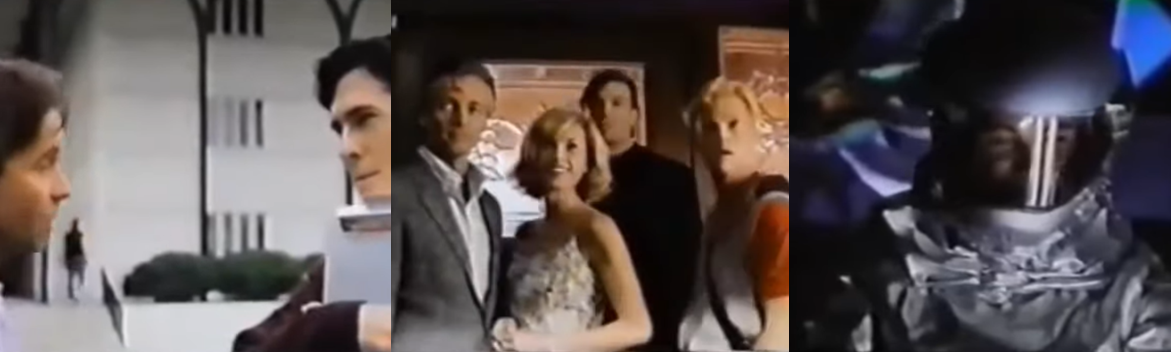
After his initial experiment results in Victor’s death, Reed assembles a rag-tag crew for a space mission.

The film begins with Reed Richards, Ben Grimm, and Victor Von Doom as college students, where they learn of an incoming comet, dubbed “Colossus”, that promises to unlock the mysteries of faster-than-light travel. Reed and Victor have spent the last four years been working on a machine to run experiments on this comet, though Reed is concerned that Victor’s calculations fail to consider velocity variations that could jeopardise the entire project. Although Reed insists on running a simulation to ensure everything goes safely, Victor pushes the experiment forward due to the limited window they have to observe Colossus, and his arrogance and recklessness cause their machine to overload and strike Victor with bolts of electricity that, despite Ben’s best efforts, apparently leave Victor dead. By the time Colossus rolls around ten years later, Reed has finalised the construction of an experimental spacecraft that Ben is all-too eager to pilot. Reed first met Sue (Mercedes McNab) and Johnny (Phillip Van Dyke) when they were children at the boarding house he stayed at in college; even though she was little more than a pre-teen, Sue had a major crush on Reed, which makes it frankly a little disturbing that they develop a mutual attraction when they reunite some ten years later when she’s all grown up. However, the oddities don’t end there as Ben makes the decision to draft the grown-up Sue and Johnny to fill out the crew of Reed’s spacecraft despite the fact that the Storms are not trained, qualified, or in any way suitable to undertake such a mission (Hell, I’d argue that Reed isn’t qualified to go into space based on what we’ve seen so far). Even Reed points out what a daft decision this is but Ben insists on bringing them along simply because of their familiarity with the project, and Reed’s doubts are apparently immediately quashed as soon as he sees how grown-up Sue has become, and the group are subsequently dubbed the Fantastic Four by the Storm’s matriarch, May (Annie Gagen). Reed feels a tremendous amount of guilt over Victor’s death and wishes to see their research come to fruition to honour his friend’s memory, which is all the motivation the others need to sign on to the mission.
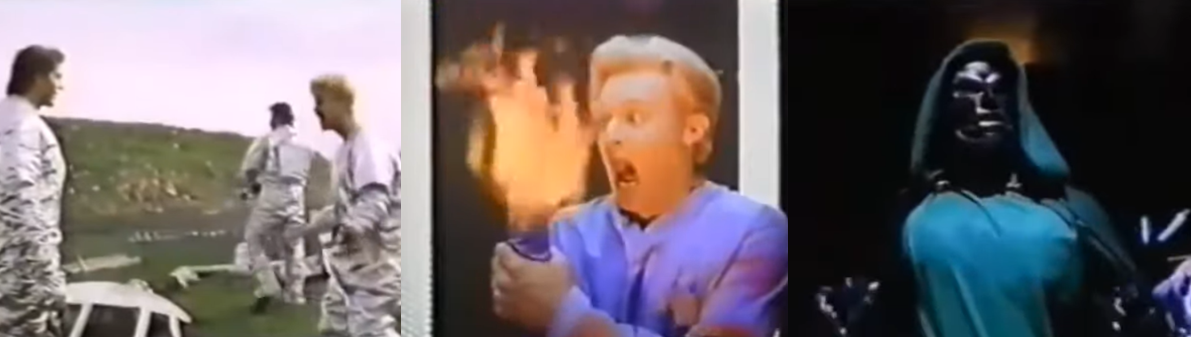
The four gain fantastic powers and catch the attention of the bombastic Dr. Doom.

However, disaster strikes when the four are on the mission and, though they survive, they are forever changed by strange and powerful cosmic rays; these changes are gradual and reveal themselves shortly after the four inexplicably survive their shuttle crashing back to Earth and are rendered in the most underwhelming and preposterous way imaginable. Johnny discovers his flame power by sneezing, Sue is initially entirely invisible, and Reed find that he can stretch a bit when he saves her from impaling herself on a piece of the space shuttle. For some reason, Ben’s more gruesome and noticeable mutation doesn’t occur until later that evening, and of course sees him transformed into a rock-like creature. While Reed is insistent that he can find a scientific explanation for their predicament, and both Sue and Johnny react in fear and disbelief at their newfound powers, poor Ben is left distraught by his monstrous appearance. The four are taken into military custody and, in scenes that I guess could be best described as “amusing”, quickly learn control over their abilities (in this iteration, Johnny literally activates his flame by saying “Flame on!” rather than this simply being his catchphrase), and quickly realise that they’re being detained by an unknown party posing as the military. Of course, this turns out to be Victor, who it turns out, actually survived his ordeal, albeit with horrific burns. After being spirited to safety back to Latveria by his fellow countrymen and donning ceremonial armour, Dr. Doom spents the next ten years establishing himself as Latveria’s ruling despot and sets his sights on acquiring the diamond that is so crucial to Reed’s experiments, which he plans to use to power a laser cannon capable of destroying New York City. For much of the film, Dr. Doom remains elusive, ominous, and cloaked in shadow, and primarily operates through two Latverian henchmen, and he watches with glee as the four are left to die in space after his inaction sees their mission compromised. Although initially angered to find that they have survived, he arranges for his men to capture the group under the guise of he military in order to learn more about their powers, and theorises that the cosmic energy of Colossus could bestow similar superhuman abilities to himself.
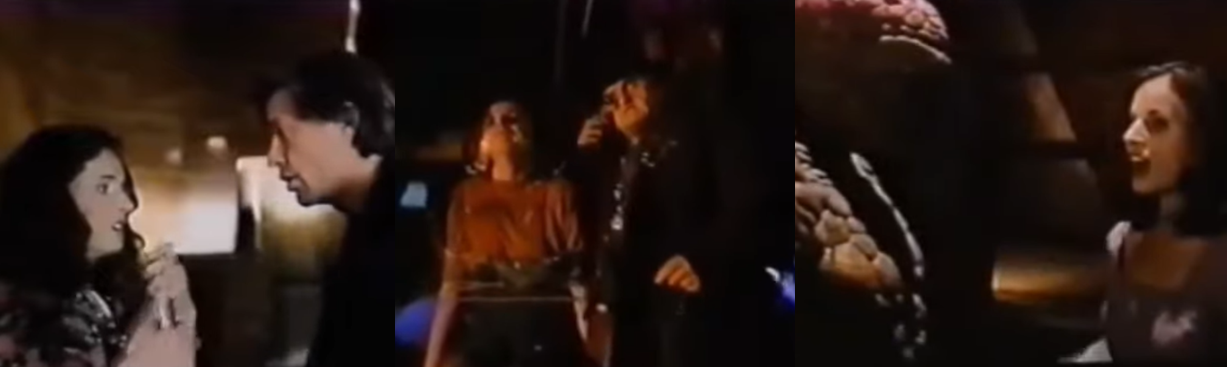
The Jeweler takes a shine to Alicia, but she only has eyes for Ben no matter his appearance.

While you’d think that Dr. Doom would be enough of a threat for the Fantastic Four, the film also includes an additional villain, the Jeweler (Ian Trigger), a troll-like man who lives in the sewers and underground tunnels of the city and steals the gem to gift to blind artist Alicia Masters (Kat Green) in a desperate bid to win her over. Ben had (literally) bumped into Alicia before his ill-fated space excursion and became immediately infatuated, and comes across her again after she has been kidnapped by the bizarre, Leprechaun-like creature and Ben has fallen among the Jeweler’s kind after being left despondent by his new rocky disposition. The Jeweler actually proves pivotal to the film’s plot since he steals Reed’s diamond and replaces it with a fake, which is influential in causing the group being bombarded by cosmic rays and gaining their powers, but honestly could have easily been dropped from the film entirely as Dr. Doom could have been the one to swap out the diamond and more time could have then been devoted to building a more natural a poignant romance between Alicia and the Thing rather than them suddenly declaring their love for each other and wasting time on a nonsensical twist where Ben reverts to his human form for absolutely no reason at all.

The Nitty-Gritty:
It’s hard to really tell what The Fantastic Four is going for in terms of its tone; Reed is the straight man, mostly serious and taking the scientific route, which makes perfect sense and is generally conveyed quite well, but the remainder of the film has this odd, camp tone that makes it more cartoony than even the group’s animated endeavours. If I had to make a comparison to another art form, I would say the closest parallel is a pantomime; nowhere is this more evident than in Dr. Doom’s bombastic and over the top line delivery. Joseph Culp massively exaggerates every movement, no matter how small, and seems to be basing his portrayal of the character more on Dark Helmet (Ric Moranis) than Darth Vader (David Prose/James Earl Jones), resulting in a maniacal and overstated performance that would be out of place even on a stage.
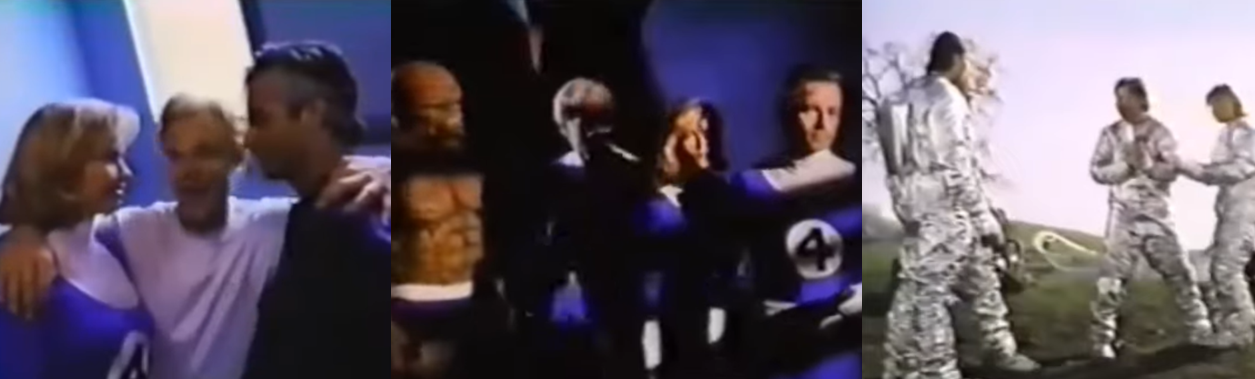
While the team’s costumes are incredibly accurate, their personalities are a bit hit and miss.

Although Reed postulates a link between their powers and their personality quirks (Reed’s always stretching himself too thin, Sue gets shy around him, Johnny (apparently) as a fiery temperament, and Ben’s always favoured brute strength over his mind), and Reed and Ben are generally pretty close approximations of their comic book characters, Sue and Johnny leave a lot to be desired. Sue’s personality seems to be based more on her earlier, less progressive characterisation; she’s infatuated with Reed and a bit bossy towards Johnny, but is far from the capable and independent matriarch of the group that I prefer to see. Similarly, while Johnny is a bit temperamental and impulsive, he’s world’s away from the arrogant little brat of the comic books and has virtually none of the usual banter you’d expect with Ben and the others, coming across more like a shadow of his egotistical and conceited comic book counterpart. However, considering the extremely low budget of the film, it’s impressive that the filmmakers went out of their way to faithfully recreate the blue-and-white spandex costumes from the comics; however, in the context of the film, it really doesn’t make all that much sense for them to even wear the outfits. It’s not like they’re modified versions of their spacesuits or anything; Sue simply designs them their costumes so that they can live up to their “Fantastic Four” moniker and put their powers to use as superheroes.
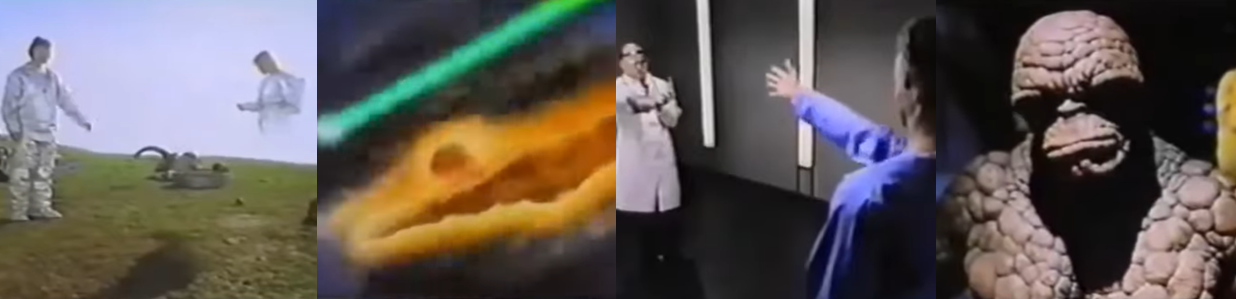
With the exception of the Thing, all of the film’s special effects are atrociously low budget.

It’s a shame, then, that the special effects are so hokey; even the bolts of lightning that strike Victor are cartoonish and amateurish, and the film makes heavy use of stock footage and interior shots to mask the shuttle’s launch (and doesn’t even show its return to Earth, to say nothing of the ridiculous and obscure lightshow used to simulate the cosmic storm and the cheap-ass edits employed to save money on filming actual fight scenes). Sue’s invisibility is realised using age-old camera tricks that were pioneered in The Invisible Man (Whale, 1933) and, apparently, the filmmakers were incapable of improving up in the forty-odd-years since that film’s release, Reed’s elasticity is ludicrously rendered using floppy and awkward appendages and poorly-concealed camera trickery, and Johnny’s flame powers are generally brought to life using obvious animation techniques. While this does eventually result in an ambitious fully animated rendition of the Human Torch, it also has the effect of turning the film into a 1930s cartoon for the finale, and it’s astounding to me that the filmmakers were able to do such a great job on the Thing’s suit and yet make such a hack job of the Human Torch. Brought to life through an impressive practical suit and animatronic head, the Thing genuinely looks of the same quality as the efforts of Jim Henson and his studio around the same time and, sure, he might look a little rubbery and awkward at times, but it’s clearly the best and most impressive aspect of this mess of a film. Unfortunately, the same really can’t be said for Dr. Doom; while I can’t fault the accuracy and fidelity of Doom’s armour and overall appearance, he appears more plasticky and clunky than metallic and menacing.
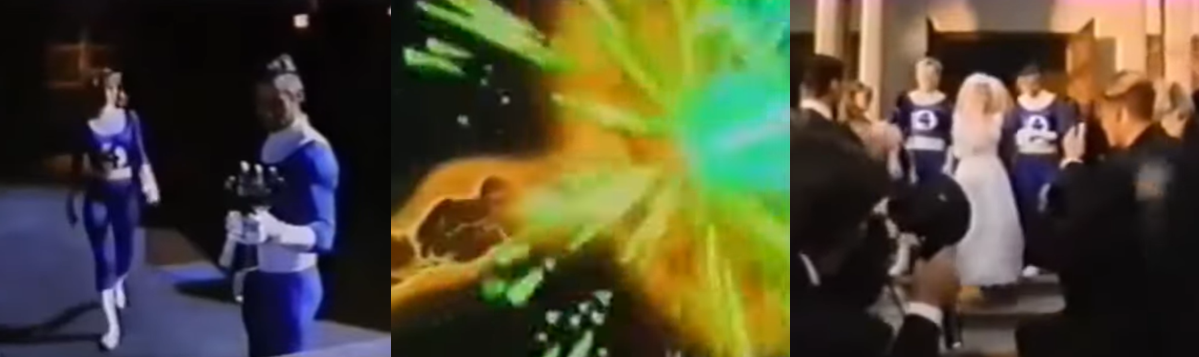
After defeating Dr. Doom and saving New York, Reed and Sue marry so this mess can finally end.

Although Ben sees himself as a grotesque freak of nature, he quickly overcomes his self-loathing after Alicia declares her love for him and he rejoins the team just in time for them to take the hastily-introduced Fantasi-Car back to Dr. Doom’s castle to put a stop to his plot. When Reed found the time to build this vehicle is beyond me, and seeing it struggle to life as an obvious model effect that would make Gerry Anderson blush is almost as absurd as the clumsy fight between the Thing and Dr. Doom in the finale. After the four throw every cheap, Halloween-store effect in the book at Dr. Doom’s disposable forces, and with the Human Torch out matching cartoon blasts with Dr. Doom’s laser in space (because he can totally breathe in space, apparently…), Reed confronts his old friend and goads him into a final confrontation. However, this is far from the epic showdown you might expect; rather than being a technologically gifted sorcerer, Dr. Doom is just an egomaniac in a suit of plastic armour, so he has none of the magical abilities and weaponry that make him such a formidable foe. Plus, Reed easily overpowers him with Dr. Doom’s greatest and most persistent weakness…really obvious, weak-ass stretchy punches to the face. This results in Dr. Doom taking a tumble over the castle wall and, despite Reed’s best efforts, falling to his apparent death, only for his severed gauntlet to inexplicably come to life to hilariously sow the seeds for a sequel! In the aftermath of the team’s victory, the Fantastic Four become celebrities, and Reed and Sue consummate their inappropriate and unsettling romance by hastening into marriage and driving off to a happy ending with Reed’s ludicrous stretchy arm waving goodbye to their guests to finally bring this car crash to an end.
The Summary:
I mean, what can you say about The Fantastic Four? I like to think I’m generally quite positive and forgiving in my reviews and always try to look for something constructive to say, but it’s not that easy with this mess of a film. I guess you could say that it was an ambitious project given how miniscule the budget was; the Fantastic Four is, by its very nature, a difficult property to bring to life in live-action even in modern times and needs a sizeable budget to do it justice, and $1 million was never going to cut it. You know it’s bad when The Punisher (Goldblatt, 1989) had more money behind it than Marvel’s premier superhero team, and it definitely shows in the presentation, direction, and acting displayed here. The whole film feels cheap and hokey, with the filmmakers apparently leaning into the campier aspects of the source material and having everyone act either too subdued or massively over the top, making for quite an inconsistent watch. Obviously, the special effects are a constant source of derision and ridicule, and rightfully so. However, it is impressive that they were able to cobble together such a remarkable Thing suit and produce comic accurate looks for the team and their main adversary….it’s just a shame that the rest of the effects can’t live up to these “standards” (and I use the word very loosely). Honestly, I don’t think that a bigger budget would have really helped this film all that much as the actors and script are incredible lacklustre; Dr. Doom is often a megalomaniacal and over the top villain, of course, and the Thing is probably the best and most accurate interpretation of his comic book counterpart, but everything feels so dumbed down and the line deliveries are so foolish that it’s not hard to see why this film got canned. Having said that, though, I still feel an official release is long overdue as they could make some money off a home media release rather than nothing at all by leaving it to gather dust. But, there again, maybe that’s for the best.

My Rating:

Rating: 1 out of 5.

Terrible

Have you ever watched this unreleased film? Would you like to see this film get an official release some day? What did you think to the Thing’s practical suit and the other special effects in the film? Did you also find the Reed/Sue romance a little unsettling in this version of the story? What did you think to Dr. Doom’s portrayal and appearance? What are some of your favourite stories involving the team? How are you celebrating the debut of Marvel’s First Family this month? Whatever you think about the Fantastic Four, leave a comment down below.

Movie Night [Godzilla Day]: Shin Godzilla


Toho’s famous atomic beast, and easily the most recognisable kaiju in the entire world, Gojira first emerged from the waters of outside of Japan to wreck the city of Tokyo on this day all the way back in 1954. In 2016, the day was declared “Godzilla Day” and, as a result, I am also appropriating November 3rd to shine a spotlight on the undisputed King of the Monsters.


Released: 25 July 2016
Director: Hideaki Anno and Shinji Higuchi
Distributor: Toho Pictures
Budget: $15 million
Stars: Hiroki Hasegawa, Yutaka Takenouchi, Satomi Ishihara, Mikako Ichikawa, Ren Ôsugi, and Mansai Nomura

The Plot:
When the gigantic, atomically-charged Godzilla (Nomura) wrecks the Kamata district of Tokyo, the Japanese government, military, and scientific communities debate endlessly about how combat the threat. Their procrastination costs countless lives and proves futile when Godzilla spontaneously evolves and threatens all Japan!

The Background:
When Gojira (more popularly known worldwide as Godzilla) made its big-screen debut in Godzilla (Honda, 1954), it represented very real lingering fears regarding the threat and consequences of nuclear war. Since then, the titanic monster has appeared in numerous films and been depicted as both a saviour and destroyer of Japan, a protector and an unrelenting force of nature that has become an iconic figure in pop culture over its many decades of cinema. While Godzilla’s first big-budget American debut didn’t quite land as well as producers Toho had expected, the success of the 2014 version inspired the studio to resurrect their famous monster after some twelve years in hibernation. Unrelated to the many Godzilla movies that had come before it, and the ongoing Legendary Pictures films, the film redesigned Godzilla into a terrifying new form, one that would dwarf all previous iterations of the character, and sought to use the creature as a terrifying allegory not just to the threat of nuclear disaster but also natural disasters such as tsunamis and earthquakes while at the same time providing a realistic critique on the ineffectiveness of governments to respond to such devastation events.

The Review:
I am a pretty big fan of the Godzilla franchise; thanks to a massive marathon that was on television years ago when I was a kid, I can comfortably say that I have seen pretty much every single one of Godzilla’s big screen ventures with the exception of maybe a handful of the early ones. One thing I’ve learned about watching Godzilla films is that they are just as much about procrastination and long-winded side plots as they are about massive kaiju levelling cities and kicking seven bells out of each other. Usually, Godzilla movies involve a side plot revolving around a plucky Japanese report (or two) and/or military figures and scientists; sometimes, they even involve bizarre concepts like time travel and aliens but no matter what type of side plot they choose to employ it all comes down to one word: filler.

A very different Godzilla takes everybody by surprise when it suddenly rampages through Tokyo.

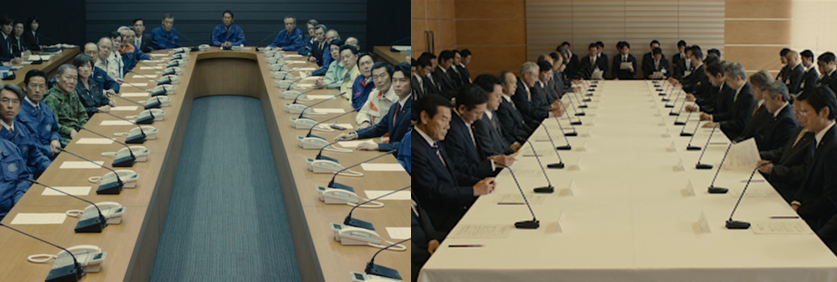
Shin Godzilla is rather unique in its use of filler in that the vast majority of its runtime is devoted not to the titular creature but to the seemingly endless debates and meetings within the Japanese governmental body. Prime Minister Seiji Okochi (Ôsugi) and his cabinet are understandably caught completely off-guard when what appears to be an underwater volcano or similar, relatively simple natural disaster floods the Tokyo Bay Aqua-Line turns out to be a gigantic quadrupedal creature that flops and flails its way through the Kamata district of Tokyo, leaving buildings destroyed and countless people homeless, injured, or dead, before promptly disappearing back to the sea. Initially, Okochi’s closest advisors and endless swarm of fellow politicians and officials are dismissively of young Deputy Chief Cabinet Secretary Rando Yaguchi’s (Hasegawa) instance that the initial phenomena could be a giant creature and that ignorance costs them precious response time and the lives of many. To solve the problem, the government decides to debate the matter, jumping from political opinions, to military options, to the baffled assumptions and confusion of scientists in a desperate bid to agree upon the correct and most appropriate course of action.

The governmental bodies are startlingly inefficient and eat up a lot of screen time.

Eventually, the United States begins to show an interest when the creature’s radioactivity is discovered to be a very real threat and sends Kayoko Ann Patterson (Ishihara) as their representative to help aid the Japanese government in discovering the creature’s origins. This, of course, leads to yet more debate and procrastination; there was seriously an extended sequence in the film’s first ten minutes or so that saw the P.M. ferried from one meeting to the next and to the next as meetings were organised and adjourned faster than any military action could be agreed upon, and these debates were focused on (almost to the point of parody) at the expense of any other onscreen action. I get it; the idea is to convey that the government is absolutely ineffectual, powerless, and ignorant when it comes to massive disasters. They would rather debate the matter in a committee, lying to the public to calm any discontent and lingering fear over organising any kind of actual military action to avoid causing unnecessary collateral damage. Placing a destructive force like Godzilla into the modern world, where policy and procedure and semantics are often more important than any actual action, makes for a startlingly effective allegory for the ineptitude of the world’s governmental bodies (and politics in general) but it doesn’t necessarily equate to a particularly exciting or engaging Godzilla movie. Characters appear and disappear on a whim and it doesn’t help that very few of them have a chance to stand out thanks to Japan’s strict code of honour and professionalism meaning that people spend more time changing into appropriate outfits, being respectful, and mulling over treaties and documents than actually showcasing any real personality.

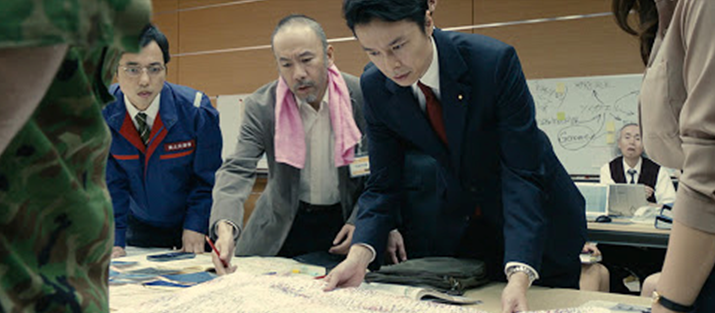
Thanks to the chaos, destruction, and death, Yaguchi steps into the role of a leader and commander.

The P.M. is hesitant to make any rash decisions out of fear of injuring innocents or causing undue damage, which costs the military perhaps their best chance at destroying the creature before it evolves into its bipedal form and, ultimately, his procrastination and hesitancy costs him his own life and those of his closest advisors. This allows for Yaguchi to eventually step into the role of the lead character after he manages to formulate one last desperate bid to subdue the creature with a coagulating agent. He is able to reach this conclusion thanks to intelligence provided by Patterson, a smarmy and self-aggrandising character with aspirations on becoming the President of the United States. When the many older interchangeable politicians eventually fail to agree on a viable plan of action (or die thanks to their incompetence), the film’s focus falls back onto these younger characters and a gaggle of misfits and scientists, a handful of whom are able to showcase a little more personality beyond spouting nonsense, such as Hiromi Ogashira (Ichikawa), whose pragmatic nature helps her to stand out in a sea of stuffy politicians.

The Nitty-Gritty:
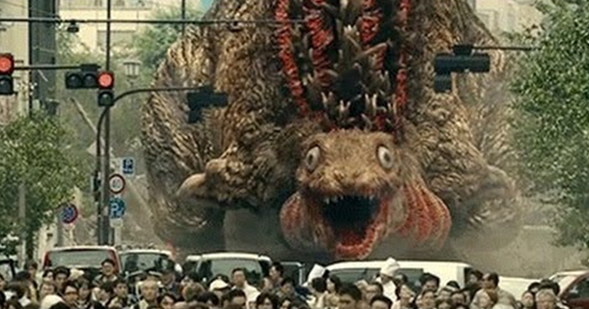
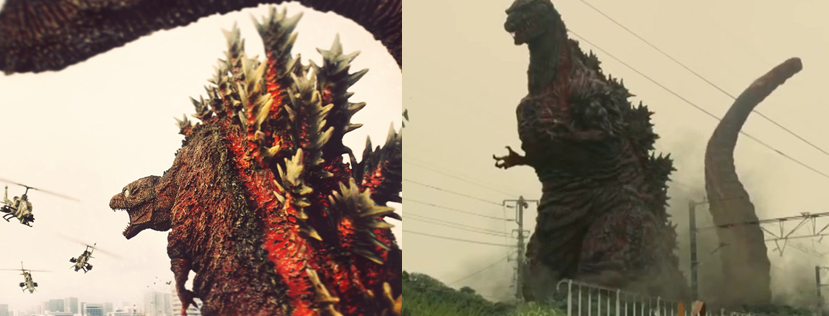
Amidst all of this pointless, senseless, endless political debate, there actually is a few appearances of Godzilla to be found here and in forms that we haven’t really ever seen before. Sadly, though, there’s a strange hypocritical attitude towards Godzilla in this film; on the one hand, it’s clearly this unstoppable force of nature that threatens Japan and is apparently resistant to all forms of military reprisal and, on the other, the film mocks its name and even the very idea of it as a creature. Sure, a kaiju wrecking downtown Tokyo is an outlandish concept and one that is laughable in its ridiculousness, but in the context of the film it’s actually happening so it kind of feels like mocking the word “tsunami” after the weather formation has decimated an entire city. When it first emerges on land, Godzilla is this strange, floppy beast that lumbers around on four rudimentary flipper-like legs. Though the effects look really good, especially compared to the suits worn in some of the early films (which, to be fair, have their charm and the model and design work used to realise them is admirable), this first form looks really weird and it’s mainly because of Godzilla’s weird, floppy head and unblinking, gawping eyes.

Godzilla appears in many different forms, each one bigger and more menacing than the last!

Biologically, it makes a lot of sense of Godzilla to begin in this form, which is much more marine-like and hampered by an overactive metabolism that causes it to soon overheat and retreat to the sea but, in execution, it just looks very goofy and unsettling and I’m not entirely certain why the filmmakers chose to not have the creature blink. Godzilla’s big thing in this film is its ability to evolve; soon into its crawling rampage, it attempts to transform into a bipedal form and, when it finally re-emerges from the sea, it has assumed an upright form that is largely familiar to any Godzilla fan…but dramatically larger and far more menacing than any other Godzilla seen before it. With rudimentary dinosaur-like arms (which are weaker and more useless than any previous Godzilla, being little more than static claw-like appendages for the most part), massive chunky legs, and an ostentatiously-large tail, this Godzilla sports jagged teeth, a rock-like hide, and small, piercing eyes (that still don’t blink; I’m sorry to harp on about it but I don’t really get that choice) in addition to his iconic roar.

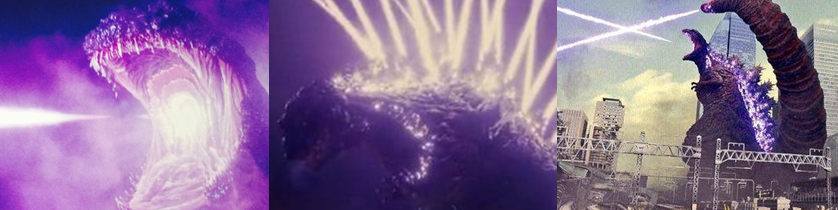
Godzilla displays more destructive and versatile attacks than ever to lay waste to Tokyo and the military.

Completely resistant to all forms of attack, this Godzilla also boasts the most powerful and destructive version of its atomic breath yet; beginning as a plume of fire, it quickly becomes a devastating purple ray of death that fires from the creature’s gruesome split-jaw. Later, when the American’s actually manage to damage the creature, it starts spewing lasers from its back/fins and even from its tail, making it probably the most diverse and powerful of any Godzilla before despite the fact that it likes to just stand around as still as a statue or plodding slowly forwards with little to no purpose. Eventually, when all other conventional weapons have failed, Yaguchi spearheads a ludicrous plan to stave off an impending nuclear assault by launching a focused and co-ordinated attack on the creature’s head and legs and bury it under collapsing skyscrapers so a series of cranes can inject a coagulating agent into its mouth that, after the deaths of many and even more destruction, eventually manages to literally freeze Godzilla in place. Luckily, its radioactive half-life is conveniently discovered to be surprisingly short, meaning Tokyo can be reconstructed without fear of millions dying from radiation sickness. I find this extremely unlikely and actually quite odd; I would have expected Godzilla’s radioactivity to have been far more devastating in this film considering the climate at the time) but, instead, the creature is anti-climactically stopped just as its rampage was kicking up a notch and the film abruptly ends having wasted far too much of its run time on pointless and frankly boring political discussions.

The Summary:
One of the issues I had with Godzilla (Edwards, 2014) was that the film spent way too much of its time teasing the titular creature and cutting away from Godzilla’s rampage; I got why, as it was a great way to introduce new audiences to the character and to build suspense but, for those of us who are big Godzilla fans, we want to see the actual creature in action not spend all of our time with the human characters. This is, however, the price one must pay for being a Godzilla fan; human characters and side plots always exist in these films and distract from the kaiju action. It makes sense as you want to have characters you can relate to and root for and it helps put the film’s devastation and themes into context but it doesn’t change the fact that the kaiju action is what makes these films so enjoyable. And, in that respect, Shin Godzilla fails quite spectacularly; Godzilla has never looked more terrifying or displayed such incredible power and yet it’s largely just a massive, shambling slab of meat that barely moves and reacts to being attacked not because it’s in pain or enraged but more because that’s what the plot expects it to do. The film just spends way too much time focusing on its critique of government, politics, and red tape than it does actually focusing on Godzilla’s presence and threat, which is a shame as there was so much potential for a big-budget, traditional kaiju film but Shin Godzilla doesn’t really impress much beyond its commendable effects.

My Rating:

Rating: 3 out of 5.

Pretty Good

What did you think of Shin Godzilla? How did you feel about its pacing and focus? Did you like Godzilla’s redesign or do you feel it strayed a bit too far from its traditional appearance? Were you also disappointed by the film’s lack of focus on Godzilla and commentary on politics or do you feel it did a good job of shaking up the traditional Godzilla formula? What is your favourite Godzilla movie and why? How are you celebrating Godzilla Day this year? Whatever your thoughts on Shin Godzilla, or Godzilla and kaiju films in general, feel free to leave a comment below.
Whispers from the Black

There is darkness in the world, darkness in our hearts, and darkness lurking at the very edge of the imagination.

But what if that darkness were somehow alive?

What if, from this twisted Black, came the faintest call?

And what if we could hear those WHISPERS FROM THE BLACK?

Volume Two Available Now!

The twisted Black speaks again in low whispers, forgotten as nightmares or daydreams, offering ten horror shorts!

Available on Amazon

Volume One Available Now!

A collection of five short horror tales from the mind of DR. STUART KNOTT, step into the fetid darkness and bear witness to:


Game Corner [Day of the Dead]: The House of the Dead: Remake (Xbox Series X)


The Day of the Dead (or Dia de los Muertos) is a traditional Latin American holiday on which, every November 1st, the lives of deceased loved ones are celebrated with food, drink, parties, and a great deal of masquerade involving the calacas and calaveras (skeletons and skulls). For me, this seems like the perfect excuse to look back on the long-running and ever-changing zombie genre that was largely popularised by director George A. Romero, which I devoted a great deal of my PhD thesis towards and which has often been used as a parallel to various aspects of society and culture.  


Released: 27 April 2022
Originally Released: 13 September 1996
Developer: MegaPixel Studio S.A.
Original Developer: SEGA AM1
Also Available For: Google Stadia, Nintendo Switch, PlayStation 4, Xbox Series S, Xbox One (Remake); Arcade, PC, and SEGA Saturn (Original Release)

The Background:
The influence of renowned horror writer and director George A. Romero cannot be understated; not only did he forever change the concept of zombies from their origins as voodoo slaves to the shambling undead we know and love today, but his zombie movies had a profound influence on videogames. The Resident Evil franchise (Various, 1996 to present) was directly inspired by (and constantly paid homage to) Romero’s films, and his influence can be equally felt in the popular light-gun title The House of the Dead. Originally built using the same game engine as Virtua Cop (SEGA AM2, 1994), The House of the Dead was put together over the course of a year and three months by a team that couldn’t speak a word of English. Initially, the developers wanted to include more complex branching paths, but these ideas had to be dropped due to time constraints; to save time, the enemy designs skipped the rough sketch phase and went straight from the initial idea to the design drawing stage, though the developers were able to anticipate the game’s violence would need to be toned down overseas and so included the option to change the blood colour. The initial arcade version of the game was a critical and commercial hit and the SEGA Saturn port was generally well regarded in turn, thus kick-starting a pretty successful series of follow-ups despite two widely derided live-action adaptations. In April 2021, a remake of the original game was announced for the current generation of consoles that included updated visuals and controls, a new “Horde Mode” that increases the number of onscreen enemies, and other additional features. While the Nintendo Switch version received mixed reviews, critical feedback for the Xbox One/Series version of the game was largely positive, with reviews praising the horror presentation and nostalgia offered by the title despite the lack of a physical light-gun accessory.

The Plot:
After renowned biochemist and geneticist Doctor Curien becomes obsessed with discovering the nature of life and death, his experiments at the Curien Mansion take a gruesome turn. After government agent Thomas Rogan receives a distress call from his fiancée, Sophie Richards, from the Curien Mansion, he and his partner, “G”, fly out to investigate only to find the mansion overrun with Curien’s undead creatures!

Gameplay:
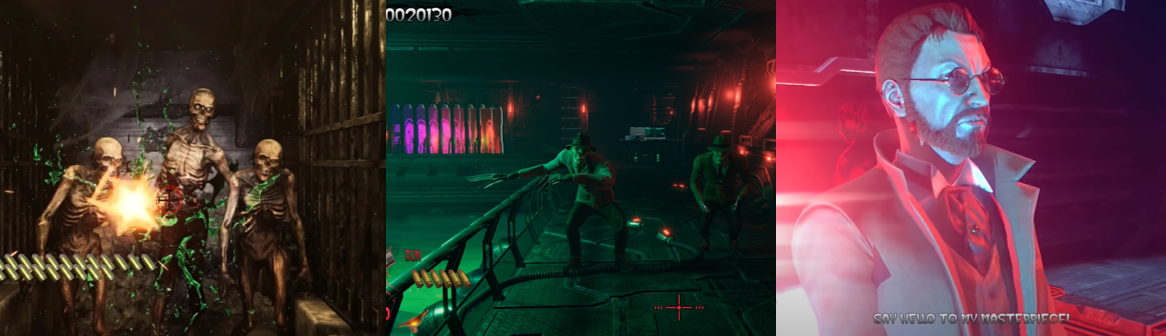
The House of the Dead: Remake is a first-person rail shooter in which players step into the role of two government agents, Thomas Rogan and “G”, and blast their way through hoards of zombies and other demonic creatures across four chapters. While you never have to worry about moving your character, as you traverse a set path at all times with few deviations, you can direct an aiming reticule using the left stick and automatically centre it with the X button. Otherwise, though, your controls are nice and simple: The Right Trigger and A button lets you fire, the Left Trigger and B button lets you reload, Y activates a torch (or “flashlight” for your Americans), and that’s basically it. You can go into the options and set up an auto reload function (though I find manually reloading is far more intuitive) as well as set a variety of other gameplay and aesthetic effects (such as changing the colour of your reticule and the level of aiming assistance you receive). You can also switch between your different weapons using left and right on the directional pad, though you’ll have to go to some effort to actually unlock additional weapons to use; they’re found in weapon crates scattered throughout each chapter, but these are only accessible by saving scientists from zombies and other life-threatening situations, which can be easier said that done when you have a trigger finger as itchy as mine gets in games such as this.

Mow down hoards of the undead but be careful not to kill any innocent scientists!

The game comes with two playable modes: “Original” and “Hoard”, with each one sporting four difficulty levels, the option to switch to a “Classic” and “Modern” scoring system, and allowing solo, co-operative play, or competitive play. The main different between original and Hoard is that there are loads more enemies in Hoard mode, making for a much more frenetic and action-packed experience. While the different difficulty levels make enemies tougher and more resilient, the “Arcade” option imposes health and credit limits; in this mode, you still get three health bars (represented as these glowing jugs) but each hit fully depletes one of them rather than dealing half damage as on the easier difficulties and, when you lose a life, you have a limited number of credits available to continue playing. You can use your points to buy more credits, but these cost about 5000 points a piece so you can easily run out in a playthrough, but the “modern” scoring system earns you extra points for successive kills without missing or being hit. Some enemies can block your shots with their arms or weapons, meaning you either need to time your shot to hit their weak spot or blast away their weapon or limbs to take them out but, while you can shoot their heads off, some will continue to attack regardless. All of them lumber towards you until you put them down but will slash and bite at you up close, and they even throw projectiles, barrels, and bladed weapons from a distance and have a tendency to pop out of nowhere so you need to be quick on the trigger, but not so quick that you shoot the scientists and cost yourself some health and points. At times, levels will split into multiple paths, but it’s not always clear how you take these routes; sometimes you need to shoot a button or blast away a door, debris, or trap door, but other times you need to shoot specific enemies, save certain scientists, or even let yourself get hit to drop down to a new area, which encourages experimentation and multiple playthroughs.

Graphics and Sound:  
Rail shooters don’t tend to be the most graphically intense games, in my experience; generally, the action is far too fast and frenetic to worry about the presentation as you’re constantly on the move and being swung about the place by the auto movement, but The House of the Dead: Remake looks and sounds really, really good. There’s a fantastic B-movie-level menace to everything, from the mansion’s grounds to the gothic interior, the rancid sewers, and Dr. Curien’s high-tech laboratory. The exteriors are bathed in a red glow or the darkness of night, while the interior as full of little touches, from suits or armour to wrecked paintings, and decorations that you can destroy at will. As you explore, you can blast crates and barrels to find the odd health pick-up or score bonus, but you’ll also activate new paths in the same manner, calling elevators, dropping through trap doors, and wading through water depending on your actions, which will then lead you to disgusting sewers, narrow corridors, billiard rooms, and stone hallways not unlike a medieval castle.

Blast your way through a gothic mansion and high-tech lab all while the fantastically cheesy plot unfolds.

Eventually, you’ll reach Dr. Curien’s laboratory, where blast doors block your path and require key cards to open, high-tech computers and monitors are everywhere, and tougher enemies are stored in glass tanks or scrambling about on the ceiling. Enemies can also come crashing through doors and windows, pop out from electrical barriers, and will blast into chunks when you shoot them, losing limbs and heads and having their skeleton and guts exposed as they take damage. The music is all very suitable for the action and the aesthetic, being an adrenaline-pumping mixture of rock and synth, and the satisfaction gained from hearing zombies groan in pain as you put them down or hearing your bullets clang against metal or tear apart a false door or chandelier is pretty fulfilling. The voice acting is hilariously bad, of course, but that’s all part of the charm of the game’s B-movie presentation; both Rogan and “G” have different dialogue and grunts as you play, which is a nice touch, and the line delivery is suitably over the top to immerse you in the atmosphere (there’s even some typos in the subtitles which, intentional or not, I found amusing).  

Enemies and Bosses:
Dr. Curien’s mansion has primarily been overrun by zombies; these shambling, bloody ghouls will stumble towards you, throw knives or axes from a distance, or pop up right in your face to scratch and bite at you, but they can be blasted apart and put down into a rapidly bubbling pool of viscera pretty quickly. Bats, weird winged dogs, vicious worms, spiders, and even mutated monkeys are all commonplace enemies too, but it’s the various zombie variants who’ll give you the most trouble. Larger, more rotund zombies will throw barrels at you or charge at you with a chainsaw in hand, slimy decomposing corpses pop out of the sewers or drop from above, suited zombies scamper about with knives, and hulking brutes wield massive sledgehammers or balls on chains that you need to shoot out of the air. Similarly, the Borg-like cybernetic zombies fire claw projectiles at your face, a pale variant attacks with a laser knife, and you’ll even encounter bigger zombies covered in iron armour that can resist your bullets.

Dr. Curien’s most monstrous creations await you at the end of each chapter.

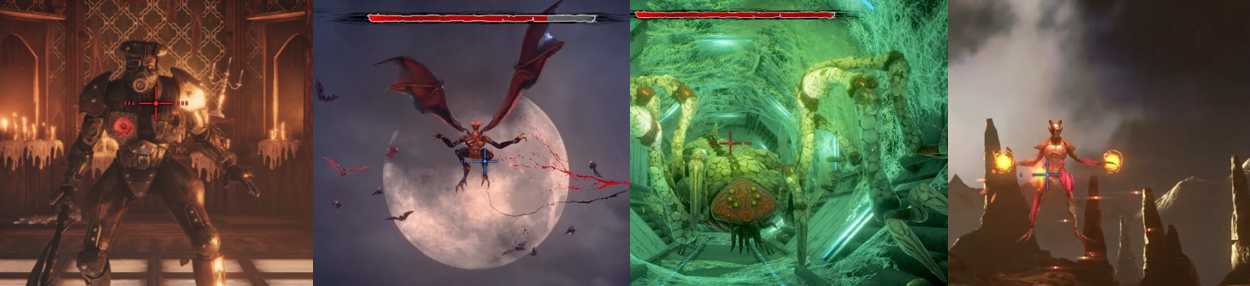
Each chapter ends in a battle against one of Dr. Curien’s more powerful creations, with two of these returning as sub-bosses in the final chapter. The first you’ll battle is Type-27 (or “Chariot”), a large, rotting humanoid garbed in heavy armour and swinging a bardiche. Chariot relentlessly shuffles towards you, looking to maim you with his weapon, but can be forced back by shooting at the weak spot on his breastplate. After enough hits, he’ll burst free of his armour and you can start blasting his decomposing flesh to put him down for good but he can also defend against your shots by covering up with his armour and limbs. Type-041 (or “The Hanged Man”) is much trickier to defeat; this bat-like creature hovers above the rooftops sending bats to attack you, which you must shoot out of the sky and then desperately try and get a good shot at the weak point on his chest as he darts about the night sky and closes in on you for a close range attack. This fight goes on a bit as, when weakened, the Hanged Man will fly away and then force you to a different section of the rooftop, where he repeatedly dives at you to attack, which also leaves him wide open for your shots. Type 6803 (“Hermit”) is a far easier fight; this giant spider-like creature climbs towards you up a cobwebbed tunnel and you must shoot it in the face to force it back. When you follow it, it backs up and fires projectiles from its egg sack and then protects its head as it scurries towards you, but it’s pretty simple to blast it in the face once its exposed. Finally, after dispatching Chariot and the Hanged Man once more, you’ll face Dr. Curien’s greatest creation: Type-0, AKA “Magician”. This synthetic humanoid floats around the arena, quickly darting all over the place and making itself a difficult target, while tossing flaming projectiles at you that can be difficult to shoot down. Covered in an armoured hide, its only weak spots are the exposed flesh dotted around its body, mainly on the legs, and it can summon a rain of projectiles that you need to shoot down and also zoom up close to land a swiping attack, making it easily the toughest boss in the game simply because just landing a hit can be difficult due to its speed and small weak point.

Power-Ups and Bonuses:
As you play through the game’s four chapters, you’ll find scientists being chased, threatened, or otherwise endangered by Dr. Curien’s creatures. Saving them nets you a score bonus and eventually leads to you unlocking new weapons, but they will also often gift you some health, which can either replenish or increase your health, so it’s worth taking the time to save them. Shooting crates and barrels may also reveal health power-ups and other objects, like coins and golden frogs, which add to your score tally. Sadly, the only way to actually access new weapons is to save as many scientists as you can, which will unlock the weapon crates found in each chapter and gift you far better weapons, such as the assault rifle and grenade launcher, as well as a crossbow and the pitter.

Additional Features:
There are forty-one Achievements to earn here, with five being earned simply by beating the game on any difficulty setting. There are three endings to earn as well, with four Achievements tied to them, and these are gained by finishing the game with a certain number of points rather than on different difficulty settings. There is an Achievement for beating the game’s “Arcade” mode, but not the “Hoard” mode, and others for playing with a friend, killing a certain number of enemies, rescuing and killing scientists, and unlocking every weapon. In addition to “busy work” Achievements (like finding every alternative path or picking up every item you see in one playthrough), there are some more obscure and inventive ones, such as blasting enemies over a wall or juggling a zombie with your assault rifle. As you play through the game and encounter enemies, they’ll be added to the creature gallery, which allows you to view their character models, bio, and weak spots. After beating the game for the first time, you can replay any chapter at will (meaning you can just jump to chapter four to beat “Arcade” mode for an easy Achievement), and you can also play alongside a friend, register your high score on the leaderboard, and even input cheat codes on the main menu to unlock infinite ammo, all weapons, one-hit kills, a free-play option and, eventually, invincibility but, while you’ll still be able to get Achievements with these cheats activated, they’ll only take effect once you’ve earned a certain number of Achievements.

The Summary:
The House of the Dead: Remake is a fun, frantic, blood-soaked shoot-‘em-up that’s packed full of gore, action, and fun gameplay. I really enjoyed the presentation, the call-backs to B-movies and zombie classics, and the fast-paced shooting that had me mowing down zombies without a second’s thought and desperately trying not to hit any innocent scientists. Sadly, though, the game is very short; “Hoard” mode really doesn’t add all that much except a whole bunch of additional enemies to fill full of holes and, while it’s fun discovering new paths and burning through the game in repeated playthroughs trying to save everyone you find, it’s not always clear which route you need to take or when these are even available to you. The content is also lacking a bit; it would’ve been nice to have Achievements specifically tied to “Hoard” mode or to have the option to play the original arcade release, or to have included the other arcade titles in with the package as it’s not exactly a lengthy or deeply complex game. Overall, it’s a great way to spend a few hours of your time but the novelty soon wears off; I used to have The House of the Dead: Overkill – Extended Cut (Headstrong Games, 2011) on the PlayStation 3 and I think I remember that having a lot more going for it in terms of length, variety, and unlockable content but if you’re itching for a bit of simple, arcade, zombie-blasting action then The House of the Dead: Remake has you more than covered.

My Rating:

Rating: 3 out of 5.

Pretty Good

Did you enjoy The House of the Dead: Remake? How do you think it compares to the original game, or other titles in the franchise? Did you ever discover al the different paths and save all those scientists? What did you think to the variety and gameplay options, and did you think there was anything lacking in the game? Which of the bosses was your favourite and what did you think to the B-movie presentation of the game? What is your favourite House of the Dead game, or other zombie videogame? How are you celebrating the Day of the Dead today? Whatever your thoughts on The House of the Dead: Remake, and zombies in general, feel free to either sign up and leave a comment below or leave your thoughts on my social media.

Movie Night [Halloween]: Halloween II (1981)


Starting life as the ancient Celtic festival of Samhain, when people would light bonfires and wear costumes to ward off ghosts, Halloween is largely associated not just with ghosts, ghouls, and confectionery but also a long-running series of horror movies. Beginning with John Carpenter’s Halloween (Carpenter, 1978), the franchise is largely credited with birthing the “slasher” sub-genre of horror films and has endured numerous remakes and reboots and is one of the most influential films in all of horror.


Released: 30 October 1981
Director:
Rick Rosenthal
Distributor:
Universal Pictures
Budget:
$2.5 million
Stars:
Jamie Lee Curtis, Donald Pleasence, Lance Guest, Ana Alicia, Nancy Stephens, Hunter von Leerand Dick Warlock

The Plot:
Mere hours after narrowly surviving an attack by the merciless Michael Myers (Warlock), Laurie Strode (Curtis) has been taken to Haddonfield Memorial Hospital to recover from her injuries. However, desperate to put an end to the missing killer, Michael’s psychiatrist, Doctor Sam Loomis (Pleasence), tries to track Myers down and, in the process, discovers a horrifying motive behind the Shape’s murderous rage.

The Background:
Although largely dismissed upon release, John Carpenter’s Halloween was a financial success; its final box office gross of over $63 million against a paltry $300,000 to 325,000 budget made it one of the most successful independent films ever made and the film not only popularised the clichés of the slasher sub-genre but came to be regarded as one of the most influential movies of its kind and one of the greatest horror films of all time. This success meant that a sequel was all-but-inevitable but writer/director John Carpenter was, initially, less than enthusiastic at the prospect of a follow-up and, though he returned to write and produce Halloween II, he declined the director’s chair and struggled to formulate a compelling story, which led to a plot twist that he later came to regret. Although many of the cast returned from the first film, stuntman Dick Warlock replaced Nick Castle as Michael Myers/The Shape and was forced to wear a mask that had noticeably aged since the first film. Afforded a much bigger budget, on Carpenter’s suggestion the sequel also contained far more blood and gore compared to the first film, which irked director Rick Rosenthal. Critics also took issue with the rampant violence, though Halloween II was still a financial success; it made over $25 million and became the second-highest grossing horror film of 1981, and Myers’ popularity would ensure his eventual return to the franchise after a failed effort to turn Halloween into an anthology series.

The Review:
Any true horror fan will tell you how influential John Carpenter’s Halloween was on the genre; thanks to Halloween and the relentless, emotionless void that was Michael Myers, an entire sub-genre of horror swept cinemas throughout the 1980s and directly led to the creation of similarly-themed films such as the Friday the 13th franchise (Various, 1981 to 2009). It’s not for everyone, and fans of faster, more visceral modern horrors may struggle to adapt to Halloween’s slow pace and the sheer randomness of Michael’s actions, but it was truly a benchmark moment for the horror genre. I can’t rightly say that I’ve ever seen Halloween II held in such high regard, however, and for the longest time it was one of the franchise’s many sequels that eluded me until I finally picked up the then-complete series boxset.

Halloween II picks up right where the first film left off and deals with the aftermath of Michael’s rampage.

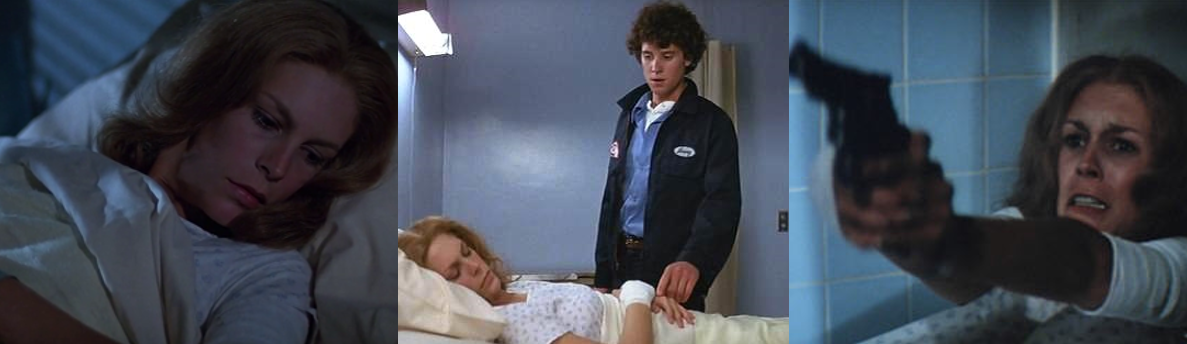
Halloween II begins by basically repeating the finale of the first film, picking up right as Myers attacks Laurie and is shot off a balcony by Loomis, with three noticeable changes: the first is the replacement of Carpenter’s iconic score over the finale’s recreation (which doesn’t kick in until the opening credits roll, and even then it’s a bit of a funky remix, which definitely robs the ending of its haunting power), the second is how poor the video transfer is on the 2004 DVD release I’m watching, and the third is that the film continues going after Loomis sees the Michael’s body has disappeared. In an attempt to recreate the memorable first-person opening of the first film, Halloween II then follows Michael through his eyes as he wanders around in the shadows of Haddonfield with the only sounds being his heavy breathing and Loomis’ near-maniacal screams that he “shot him six times!!” Much of the original film’s suspense was built around keeping Michael elusive and mysterious; he was seen stalking his prey from a car, peeking around corners, and in fleetingly appearances that definitely lent a lot of credibility to his allure as being pure evil. In Halloween II, this is completely thrown out of the window as, within about fifteen minutes, we’ve seen Michael walking around in the darkness, stealing a kitchen knife, and offing a random bystander in her home (with more blood appearing in this one kill than almost the entirety of the first film).

Laurie is rendered a bedridden victim for most of the film and only gains agency by the finale.

Injured, exhausted, and suffering from shock, Laurie is strapped to a gurney and taken to Haddonfield Memorial Hospital, where she attracts the affections of paramedic Jimmy (Guest); considering the murder spree that just befell the town, the hospital is basically empty and staffed primarily by strict head nurse nurse Virginia Alves (Gloria Gifford), the promiscuous nurse Karen Bailey (Pamela Susan Shoop), and the crude-tongued staff paramedic Budd Scarlotti (Leo Rossi), so Jimmy definitely stands out as the more stable and kind-hearted of the hospital’s staff. However, he’s also a largely bland and one-dimensional character whose single defining trait is that he has a thing for Laurie; traumatised by her experiences, Laurie fears being put to sleep and is shocked to learn from Jimmy that her attacker was local bogeyman Michael Myers. Although bedridden for the majority of the film, and with much of her personality stripped away because of the trauma she suffered, we learn a little more about Laurie’s past in this film through her dreams, where it’s revealed that she was adopted and that she visited young Michael (Adam Gunn) while he was locked up. Realising that Michael will come for her, Laurie feigns a reaction to her medication and outwits the Shape, becoming a little more reminiscent of her adaptable and competent self about an hour or so into the movie, though her injuries and shock preclude her from being as capable as she was in the first film.

Loomis is driven to near-madness in his desperate search for his murderous former patient.

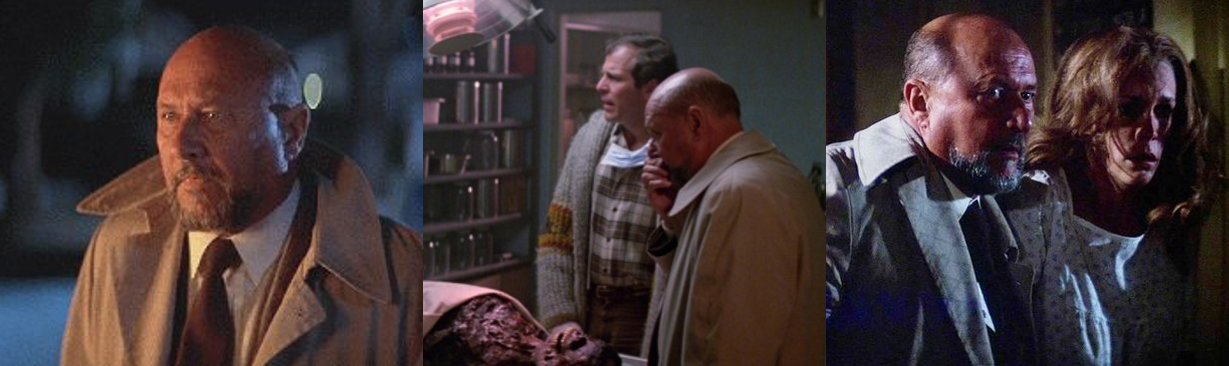
While Laurie recuperates from her injuries, Loomis continues his desperate search for his murderous patient; he finds Sheriff Leigh Brackett (Charles Cyphers), his reluctant ally from the first film, increasingly disgruntled with his’ abrasive demeanour but, already blaming Loomis for Michael’s escape, the sheriff abandons the crusade completely when he finds his daughter, Annie (Nancy Loomis), dead at Michael’s hands. He’s replaced by the much more reciprocal Deputy Gary Hunt (von Leer), who orders the town’s police to continue the search for Michael, accompanies Loomis throughout much of his search, and even disperses an unruly mob who descend upon the old Myers’ house (though he largely fulfils the same role as Brackett from the first film as a sceptical sounding board for Loomis’ horror stories about Michael). However, there’s no question that Loomis has been driven to near-madness by his pursuit of Michael and the fact that the Shape absorbed six shots to the heart; this causes Loomis to become wild and paranoid during the search and, when he spots young Ben Tramer (Jack Verbois) dressed as Michael and walking through the street, he crazily chases after him with a gun and indirectly causes the young man’s sudden and explosive death! Considering the media circus surrounding Michael’s actions, and Loomis’ increasing obsession with the killer, the sanatorium orders Marion Chambers (Stephens) and a United States Marshal to escort him back to the facility to limit their association with the murders, though Loomis is able to overpower them both with his trusted revolver and hasten his return to Laurie’s aid for the finale.

The Nitty-Gritty:
I think one thing that definitely holds Halloween II back is how redundant a lot of it is; I can just about forgive the film opening with a recap of the first film, since it had been about three years since the last film and home video wasn’t exactly prevalent back then, but so much of the opening is just going through the same motions as in Carpenter’s original: Loomis is desperate to find and kill Michael, just as in the first film, and even delivers his famous speeches about Michael’s evil and patience almost word-for-word as in the last film, and the gaggle of interesting and colourful (if a bit underdeveloped) babysitters from the last film are replaced by bland paramedics and a number of nurses and hospital staff. While the film is definitely bloodier and a bit more explicit in its shocks compared to the original, it feels largely toothless because, rather than slowly build up to the reveal of Michael or see him lurking in the background, he just appears in a jump scare.

Halloween II added the infamous twist that Laurie and Michael were siblings.

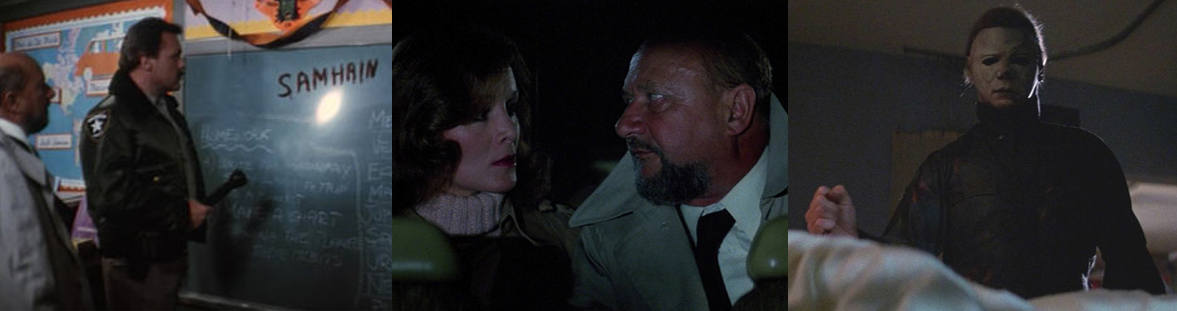
It’s therefore understandable that many bemoan Halloween II for destroying much of Michael’s mystique by providing him with a janky motive; while trying to track down Michael, Loomis discovers that the Shape randomly broke into the local school and scrawled the word “Samhain” on a wall, which I honestly feel would have been enough of a mysterious addition to allow audiences to speculate on the potential supernatural abilities afforded to the masked killer but the series wouldn’t circle back around to that for another few films so Carpenter instead shoe-horned in a familial connection between Michael and Laurie. Until Marion informs him that Laurie is Michael’s younger sister, who was put up for adoption after his psychotic break as a child, Loomis was completely unaware of this fact and, upon learning it, realises that Laurie was no random or coincidental target. Instead, the implication is that Michael is compelled (possibly by supernatural forces) to murder his teenaged siblings on and/or around Halloween, which is still a frightening concept but nowhere near as interesting as a young boy just snapping one day, biding his time for years as little more than a vegetable, and then exhibiting superhuman strength and tenacity in a random killing spree. Also, it doesn’t really explain why he didn’t just attack Laurie right away; after all, he didn’t kill his sister’s boyfriend as a boy, so it doesn’t make much sense for him to slaughter Laurie’s friends in his pursuit of her. Still, to play Devil’s advocate for a second, not every horror villain suffers from having clear cut motivations and backstories; it can help to make them a bit more sympathetic and to lend an additional layer of horror and madness to their motives, but I do think that expanding upon Michael’s motivations in this way diluted some of his horror. Yes, he’ll still kill you if you get in his way, but as long as you’re not related to him in some way, you’re probably okay, which makes him less a force of pure evil and more a focused maniac with a specific target in mind.

Michael’s body count is far higher, and bloodier, and yet somehow far more underwhelming.

Halloween II not only ups the nudity and sexual content compared to the first film, it also ups violence, gore, and kill count from the first film, so it’s only fair that I talk about the kills on display in the film: Michael stabs a woman in the chest with a knife, delivers a sickening hammer shot to the head of security guard Bernard Garrett (Cliff Emmich), strangles Bud with a piece of wire while he’s tending to the hydrotherapy pool’s temperature controls, and then drowns Karen in the boiling hot water of that same pool in perhaps the film’s most horrifying and gruesome kill (but which, again, hearken back to Michael’s famous bedsheet kills from the first film). Michael also offs a doctor and a nurse with a syringe (with one stabbed in the aforementioned doctor’s eye!), goes to the ridiculous effort of draining Virginia of her life’s blood using surgical equipment, and impales another nurse through the back with a scalpel right before Laurie’s eyes, easily hoisting his victim up with one arm in the process. Unfortunately, Michael’s iconic mask, with its dark eyes and expressionless visage, leaves a lot to be desired; rather than create a new mask that actually resembled the one from the first film, the filmmaker used the same exact mask, which is noticeably aged and looks cheap and ugly as a result. While I appreciate the variety in Michael’s weaponry in this film, he only uses his trademark kitchen knife the one time and spends the majority of the film wandering the darkened hallways of a deserted hospital with a piddling little scalpel that is nowhere near as horrifying as a big, sharp knife.

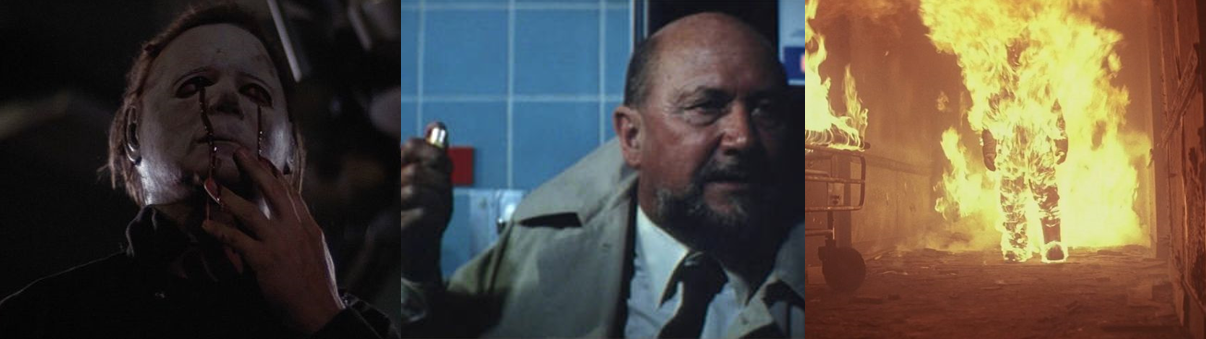
Loomis sacrifices himself to see Michael’s reign of terror end in a blazing inferno.

Having tracked his long-lost sister to the hospital, Michael leaves a trail of bodies in his wake that is far more gruesome and creative than the comparatively tame body count and murders from the last film though, sadly, Jimmy escapes his grasp (however, he does appear to be dead after foolishly slipping on a pool of blood). As Michael prowls around the hospital, Laurie’s sole objective is to escape, so she stumbles and crawls around the place, hides, and generally spends most of the finale desperately fleeing from her relentless pursuer. While I won’t lie and say that Laurie was the most compelling and interesting character in the first film (she was basically a kind-hearted, if bland, bookworm), Halloween II doesn’t do her character too many favours and basically just paints her as a helpless victim for the entirety of its runtime. Luckily for Laurie, Loomis once again arrives in the nick of time to save her; however, as has been established throughout the movie, mere bullets can’t stop Michael and the Shape is able to shake off Loomis’ shots, stabs his former doctor, and corners the two in an operating theatre. Here, Laurie gets a very brief moment to be a proactive protagonist as she demonstrates her uncanny aim by shooting out Michael’s eyes (something every subsequent film has simply ignored), leaving him blind and swinging his “deadly” scalpel wildly. Loomis fills the room with flammable gas and orders Laurie to run before setting off his lighter, immolating himself and his disturbed patient in a massive explosion. Although Michael emerges from the blaze engulfed in flames, he quickly collapses to the ground and burns to death before Laurie’s eyes, finally ending his threat once and for all (or for about seven years…).

The Summary:
It’s tough to really find anything positive to say about Halloween II; yes, the gore and the nudity are a bit more pronounced and Michael is the same relentless killer he’s always been, but the whole film seems like such a waste of time and potential. It spends so much of its runtime trying to recreate or repeat the story beats of the first film that the pace meanders as a result; Michael wanders all over town, slowly making his way to the hospital, simply to add to the body count when we know he could easily just drive there. Setting much of the film in the hospital could have been a good way to make it visually distinct from its predecessors but the hospital is so barren and lifeless and full of throwaway, nothing characters that I just find myself bored watching it. Donald Pleasance remains a highlight, of course, but so much of his dialogue is lifted from the first film’s script that it feels like we’re just going over the same information again and again, though I did enjoy seeing how traumatised by Michael’s killing spree the doctor has become and the culmination of his guilt around the horrific events his patient has wrought (what better way to go out than in a literal blaze of glory?) The twist of Michael being Laurie’s brother was clunky, at best, and would go on to largely dominate the series for some time; I’m largely numb to it at this point and don’t really mind it all that much, but again the potential of this reveal is completely squandered and poorly implemented here (it would be incorporated far better in some of the sequels, and even then it could never have the impact the filmmakers intended because of the studio’s reluctance to end their profitable franchise). Overall, I feel like Halloween II really isn’t worth your time; you can just as easily skip from this film to one of the many sequels thanks to the numerous reboots that have diluted this franchise and it definitely feels as though this was thrown together simply because slasher films had become popular after the success of Halloween, resulting in a by-the-numbers slasher that lacked all of the nuance and subtle horror of the original.

My Rating:

Rating: 2 out of 5.

Could Be Better

Are you a fan of Halloween II? What did you think to the twist that Michael and Laurie were siblings? Do you like horror villains to have clear motivations or do you prefer them to be more ambiguous? Which of the kills was your favourite and what did you think to the new characters? What did you think to Loomis’ maniacal obsession and his ultimate sacrifice? Do you think the series should have ended here or is one of the subsequent films a favourite of yours? How are you celebrating Halloween this year? Whatever your thoughts on Halloween, and the Halloween franchise, sign up to drop a comment below, or leave a comment on my social media, and have a spook-tacular Halloween!

Movie Night: The Crow (1994)

Released: 13 May 1994
Director:
Alex Proyas
Distributor:
Miramax Films
Budget:
$23 million
Stars:
Brandon Lee, David Patrick Kelly, Rochelle Davis, Ernie Hudson, and Michael Wincott

The Plot:
Musician Eric Draven (Lee) and his fiancée, Shelly Webster (Sofia Shinas), are brutally murdered by “T-Bird” (Kelly) and his gang of thugs. One year later, a mysterious and supernatural crow brings Eric back to life; painting himself up as a tragic masquerade and bestowed with invincibility, Eric sets out to avenge their deaths using his newfound abilities.

The Background:
The Crow began life as a comic book published by Caliber Comics in 1989 and created, written, and illustrated by James O’Barr. The character, named simply “Eric” in the comic, was a tragic figure modelled after prominent rock musicians, prone to quoting a variety of scripture, and who engaged in the brutal slaying of those who killed him and his fiancée as a reaction to the pain and loss O’Barr felt after losing his own fiancée to a drunk driver. Thanks to its bleak tone, striking black and white artistic style, and emotional narrative, The Crow became an underground success and, with dark comic book narratives quickly gaining popularity in Hollywood, was adapted into a feature film in 1994. Of course, you can’t talk about The Crow without mentioning star Brandon Lee’s tragic and untimely death after accidentally being shot with a real bullet. The film, which was already mostly complete, was finished through a combination of stunt doubles, stand-ins, and some digital trickery and released to both unanimous critical acclaim and was a surprise box office hit, grossing over $50 million in total. While the  subsequent sequels failed to capture the magic of this first film, The Crow inspired not only a darker look for legendary wrestler Sting but also became a cult hit and is one of my favourite movies period so, with tonight being “Devil’s Night”, what better way to celebrate than by revisiting this classic film?

The Review:
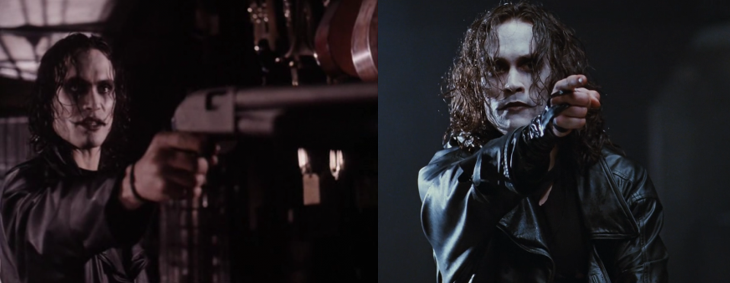
The bleakness and darkness of The Crow’s world is dropped in our laps as soon as the film begins as it opens with Eric already dead and Shelly in critical condition. Considering that Eric spends the entire film as a reborn revenant, it’s oddly fitting that, when we first meet him, Eric is little more than a lifeless corpse on the cold, rainswept pavement. Eric’s return from the grave is a harrowing, disturbing process not just for him but for the audience as well as he literally claws and crawls his way out of his grave and, disorientated and in shock, stumbles his way back to his apartment only to be immediately bombarded with memories of his former life. These brief flashes to happier times with Shelly are juxtaposed with the violent and disturbing memories of the brutal attack the two of them endured at the hands of T-Bird and his motley crew; Eric’s agony at reliving events both good and bad send him into an anguished fury and, very quickly, in the space of just a few minutes, we learn not only that Eric is now able to immediately heal from all physical wounds but are instantly committed to seeing through his burning desire for revenge alongside him, so tangible is Lee’s performance at showcasing Eric’s torment during this deeply affecting and unpleasant sequence.

Guided by the crow, Eric enacts brutal and fitting revenge against his targets.

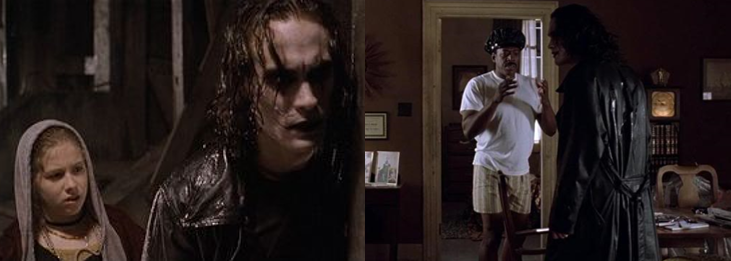
In the comic, Eric and Shelly were attacked at the side of the road and it was a very random, brutal affair but, in the film, they’re specifically targeted after angering the gang and Eric’s suffering is magnified significantly as he is stabbed, beaten, shot, and unceremoniously throw to his death. After his return, Eric is guided on his journey by a mysterious and supernatural crow (ironically, no crows actually appear in the film and the filmmakers used ravens instead) but, unlike in the comics, Eric never actually refers to himself as the Crow in the film. Instead, Eric explicitly uses his real name so that his victims know exactly who it is who is coming for them. His vengeance comes in systematic fashion as he targets each of those responsible for his suffering one at a time, hunting them down thanks to his ability to see through the crow’s eyes and forcing each of them to not only remember him and Shelly but also making them pay in fitting fashion; “Tin-Tin” (Laurence Mason), for example, favours knives as his weapon of choice so Eric stabs him, off screen, through “all his major organs in alphabetical order” and, similarly, he kills “Funboy” (Michael Massee) by subjecting him to a lethal overdose of heroin.

Eric’s mission means he can’t fully indulge in reconnecting with allies and loved ones.

Although he is an extremely tormented individual and has chosen to commit himself fully to his mission rather than attempt to reconnect to his previous life, Eric isn’t alone in his quest for revenge. While alive, he and Shelly befriended and often took care of Sarah (Davis), a streetwise young girl whose mother, Darla (Anna Levine), is unfit to care for her since she’s dependent on substances and used as a plaything by Funboy. Left alone and devastated by her friends’ deaths, Sarah was comforted by Sergeant Albrecht (Hudson), a jaded cop who was first on the scene at Eric’s apartment and whose tendency to stick his nose where it doesn’t belong causes friction between him and Detective Torres (Marco Rodríguez). Both characters eventually, inevitably, cross paths with Eric during his crusade and offer an emotional link to a life that is now haunting the reborn rock star like a bad dream; Albrecht provides Eric with the memories of Shelly’s prolonged death and sympathises with his plight and Sarah represents Eric’s one remaining link to the happier times in his life. Eric is forced to keep Sarah away since his return was predicated on seeking vengeance rather than reuniting with her but, in the end, their fates converge for the finale and allow Eric to bring closure to his life and death, with even the crow favouring Sarah throughout the film.

Top Dollar retains his sadistic edge despite appearing disgruntled with the routine of his life.

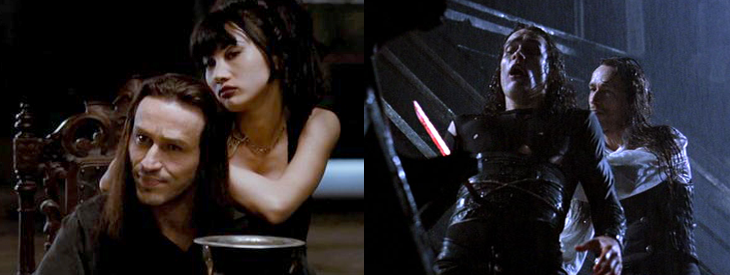
The town’s violent criminal element have taken to ritualistically committing arson attacks throughout the city on October 30th, which has become known as “Devil’s Night” as a result. The head honcho of these attacks is “Top Dollar” (Wincott), a charismatic and mystifying gang leader with delusions of grandeur and an unhealthy and disturbingly close relationship with his stepsister, Myca (Bai Ling). A sadistic and perverse individual, there’s a lingering sense of dissatisfaction and humanity to Top Dollar’s character as, while he happily kills and orders annual destruction and anarchy, he seems disgruntled with the routine and predictability of his life and even expresses genuine regret at the pain and suffering Eric and Shelly had to endure. Ultimately, though, he is a slave to the life he lives and, while he may be discontented and bored with how mundane things have become and is largely dispassionate and stoic even when Eric actively disrupts his operation, he remains resolute in keeping his position of power and influence in the city. As a result, Top Dollar is more than happy to kill anyone who gets in his way and even kidnaps Sarah in a bid to lure Eric into a confrontation whereby his powers can be stripped away, starting an annoying trend in the Crow movies. The film greatly expands his role compared to his comic counterpart, who was more of a throwaway goon, but Wincott shines as the gravely-voiced kingpin and the restructured hierarchy of the gang really helps to escalate the action and emotion behind Eric’s crusade.

There’s a certain catharsis to be gained from Eric’s stoic execution of the sleazy T-Bird.

One of the things I love about The Crow is that there are no corporate, suit-wearing bad guys as the antagonists are generally street-level thugs; Top Dollar and his aid, Grange (Tony Todd in a disappointingly small role), are the sole exceptions to this rule and I can forgive it as they’re not businessmen by any means and it’s implied that they were just street punks at one time and are now simply at the top of the criminal food chain thanks to their power and influence. Indeed, unlike in the comic, Eric has no interest in actively pursuing or killing Top Dollar since he wasn’t present during his and Shelly’s deaths and he only targets the gang leader when he kidnaps Sarah in a bid to steal the crow’s powers. As a result, for much of the film’s runtime, the principal antagonist and the primary target of Eric’s vengeance is Top Dollar’s main street thug, T-Bird, just as it was in the comic. A sleazy, arrogant punk, T-Bird takes a perverse pleasure in unquestionably executing Top Dollar’s every order but prefers to be the more hands-off compared his little gang of thugs. He directs his crew with a simple high-pitched whistle, often while quoting Satanic scripture, and his power and authority out on the streets are never in question. Though he often intimidates and bosses around “Skank” (Angel David), the comic relief of the film and the most cowardly and immature of the gang, T-Bird is reduced to a blubbering wreck when enduring Eric’s wrath and seeing his calm, controlled demeanour break is almost as fitting an end for the character as his explosive death. This scene, which was one of a handful shot using a body double for Brandon Lee, actually benefits from Eric’s silence; rather than explain himself as he did with his other victims, Eric simply allows T-Bird to come to the horrifying realisation that his actions have come back to haunt him, making or an emotionally charged scene that really hammers home how unheroic Eric’s vendetta is.

The Nitty-Gritty:
The city itself is also a prominent character in the film; constantly blanketed in rainfall and violence, it is a bleak, desolate, and ominous place and, to add to its foreboding atmosphere, there are very few scenes that take place during the day or in locations that aren’t squalid or ransacked. The Crow’s soundtrack also plays a vital role in setting the tone and atmosphere of the film; alongside a gloomy, emotional score by Graeme Revell, The Crow includes some fantastic heavy metal tracks from the likes of The Cure and Nine Inch Nails, all of which tie into Eric’s career as a musician and the film’s character. Indeed, if there’s a downside to the film, it’s that some of its effects haven’t aged too well; the scene where Eric holds his hand up so that Funboy can see his bullet wound heal is a noticeably poor effect by today’s standards but, for the most part, the employment of more practical effects and camera trickery hold up well enough.

An enigmatic and unpredictable character, Eric is driven by great loss and a lust for revenge.

Eric is an enigmatic and unpredictable character, made even more captivating by Lee’s enthralling performance. In the comic, Eric was a sombre, stoic character who was fond of quoting literature, poetry, and speaking in riddles and, while that is still true of his live-action counterpart, Lee’s Eric is imbued with a justifiable anger and, at times, a sarcastic snark. Sporting an alluring smile (that’s more of a sneer) and an effortless confidence, Eric fully believes in the righteousness of his mission (as he tells Albrecht: “They’re all dead. They just don’t know it yet”) and is brutally efficient at carrying it out, though he still takes the time to taunt and toy with his victims as they did to him. His quotation of Edgar Allen Poe’s The Raven when violently confronting Gideon (Jon Polito) is a notable highlight, as is his rant to Funboy about Jesus Christ, both of which capture the melancholy personality of his comic book counterpart, and is contrasted by his apathetic, silent execution of T-Bird. Eric often revels in his powers, willingly goading his targets into trying to stab or shoot him and then laughing at their terrified reaction to his superhuman healing. Similarly, he often gets so caught up in the fury and pain of his death that he takes a perverse pleasure in toying and murdering his killers, particularly Tin-Tin and Skank, often punctuating their deaths with a crow motif either in blood or fire. Still, his many flashbacks show that he was a carefree and fun-loving bloke while he was a live so he’s also notably appalled at himself and what he has become; this is best seen when, after killing T-Bird and believing that his mission is completed, he removes Tin-Tin’s jacket and tosses it away in disgust.

Despite being stripped of his powers, Eric triumphs and reunites with Shelly in the afterlife.

After his painfully and harrowing rebirth, Eric’s life became consumed with revenge and the desire to return to the grave and be reunited with Shelly after avenging their deaths; however, along the way, he not only indulges in a series of escalating violent acts (culminating in an action-packed shoot out between himself and Top Dollar’s fellow gang members and a sword fight against Top Dollar himself on the roof of a church) but also impacts and improves the lives of his allies. For example, while dispensing justice to Funboy, he conveys to Darla the seriousness of her responsibilities as a mother, thus helping to repair her relationship with Sarah. However, this is also seen in the film’s finale, where Albrecht provides Eric with back-up for his showdown with Top Dollar, Myca, and Grange. Despite the fact that he keeps getting into trouble for acting outside of his pay grade, Albrecht feels he owes it to Eric to help him out and ends up being instrumental in assisting Eric in saving Sarah after Grange shoots the crow and robs Eric of his invincibility. This was a new element that wasn’t in the original comic book and it carried over into the subsequent sequels but it works in service of the film’s larger narrative because, in the end, Eric must confront Top Dollar as a mere mortal man with nothing left but his rage and uncompromising determination. Thanks to the rain, even Eric’s face paint is washed away during this final confrontation and, after enduring a mortal wound, he subjects Top Dollar to the many hours of suffering and pain Shelly was forced to endure because of his orders and dispatches him in brutal fashion by impaling him on one of the church’s stone gargoyles.

The Summary:
Even now, nearly thirty years after I first saw the film, The Crow remains one of my favourite movies of all time. Honestly, I actually prefer it to the comic book thanks to the alterations to the source material improving upon the hierarchy of the villains and making Eric an even more relatable and tragic character. The desolate, violent, and bleak presentation of the film, the city, and the plot were a profound influence on me and, despite a few dodgy effects here and there, The Crow has a real timeless quality. I am continuously astounded at how badly Hollywood managed to screw up the sequels as it seems like such a simple formula to recreate, but The Crow really was lightning in a bottle as it not only captured the spirit of the source material but enhanced it with some fantastic and memorable performances. It’s absolutely tragic that this film saw the untimely death of Brandon Lee; his performance is captivating and full of life, action, and a multitude of complex emotions (from stoic conviction, to subdued melancholy, to unhinged anger) and it’s a real shame that he never got the chance to show the full extent of his range and ability over a long and illustrious career. Yet, his legacy lives on in the enduring strength and appeal of The Crow, which greatly contributed to comic book movies being seen as a serious and worthwhile sub-genre of cinema and whose iconography has left a lasting impression.

My Rating:

Rating: 5 out of 5.

Fantastic

What are your thoughts on The Crow? What did you think to Brandon Lee’s portrayal and do you think he would have had a promising career had his tragic death not occurred? How did you feel it compared to the comic book? Were you a fan of the changes the filmmakers made to the source material (such as the removal of Eric’s powers for the finale) or would you like to see a remake that was closer to the original comic book? Were you a fan of the soundtrack; if so, which track was your favourite? Which of The Crow’s sequels was your favourite, if any, and would you like the see the character return in some form or another in the future? How are you celebrating Devil’s Night tonight? Whatever you think about The Crow, go ahead and leave a comment down below or start the discussion on my social media.

Mini Game Corner [Asterix Anniversary]: Astérix (Arcade)


Asterix the Gaul (and his best friend Obelix) first debuted on 29 October 1959 as a serial in the French/Belgium magazine Pilote. Since then, the plucky Gauls have gone on to have many adventures in comic books, videogames, and feature-length productions and Asterix himself has become a popular and enduring character in his native France and around the world as Asterix’s stories have been translated into over a hundred languages across the world. I may be a day early in celebrating this anniversary as it coincides with the release of the SEGA Mega Drive but I’ll take any excuse to talk about Asterix’s amusing escapades.


Released: 1992
Developer: Konami

A Brief Background:
It wasn’t long before the French comic book series Asterix made the jump off the panels and into other media; the first Asterix book was adapted into a feature-length animation in 1967 and Asterix cartoons and live-action films have been pretty consistent over the years. Similarly, there have been numerous Asterix videogames; the first was released for the Atari 2600 in 1983 and I had a lot of fun growing up playing Astérix (SEGA, 1991) on the Master System. One of my absolute favourites to play whenever I spotted it in seaside arcades was this cracking, colourful arcade title from Konami, one of the most prominent developers in the industry at the time. Sadly, Astérix was never ported to home console ports, but the game is fondly regarded as one of the most fun-filled, action-packed arcade titles, and it received something of a spiritual sequel in 2021.

First Impressions:
Astérix is a super colourful, super vibrant sidescrolling beat-‘em-up in which players can freely choose to play as either Asterix or Obelix (or team up as both) and journey across seven stages, each one lovingly recreated from some of the tenacious Gaul’s most memorable adventures, ploughing through Romans and collecting their helmets to score points. Controls couldn’t be simpler; you move with the joystick, attack with one button, and jump with another. Both Asterix and Obelix can dash, perform a running and jumping attack, and will slap Roman’s silly, or kick or toss them away, when they get up close and personal.

Journey through some memorable locations bashing Romans all over the ancient world.

The differences between the two characters are largely negligible; Asterix is smaller and slightly more agile, but Obelix doesn’t exactly seem slowed down by his girth. One difference between the two you’ll immediately notice is that Obelix begins with a menhir in hand, as is his trade, which appears to be the one instance in the game where you can wield a weapon (albeit temporarily). Both characters will also receive a brief power-up when loyal puppy Dogmatix wanders onto the screen with either a gourd of magic potion for Asterix or a crispy roast boar for Obelix; collecting either will send them into a brief frenzy that sees them immune to all attacks and taking out every onscreen enemy in short fashion, though this is only for a very short time. Players can restore their health by eating fruit or stealing a kiss from Panacea, who wanders to and fro in each stage, and swing from vines to take out enemies. You get two lives per credit and, while there’s no time limit, Cacophonix’s musical notes will damage you if you linger too long. Perhaps the oddest thing about Astérix, though, is that you do not have unlimited continues; even if you input ninety-nine credits, you’ll eventually run out of chances to spawn back in and be left with nothing else but your high score and beginning the game all over again.

The game is absolutely gorgeous and perfectly captures the look and humour of the comics.

As fulfilling and entertaining as the beat-‘em-up gameplay is in Astérix, however, the game excels in its visual presentation; more so than any other 2D Astérix videogame, this sadly forgotten arcade title pops with bright, cartoony graphics that are ripped straight from the original comic books. Sprites are large, fantastically detailed, and full of fun little animations; Romans can be rapidly slapped across the face, slammed by their ankles, and twirled around in the air just like in the comics, a bunch of cartoony sound effects punctuate the action, and there’s even a little bit of voice acting and onscreen text (in both English and French) to help tell the story. Stages are proceeded by both sprite-based cutscenes and comic book panels to track the pair’s journey to Rome, and you’ll be able to play a chariot race as a bonus stage for extra points. While enemy variety quickly begins to suffer (you’ll see the same Roman infantry and generals in every stage), they’re all exactly as they appear in the comics and can even be seen hiding in tree stumps and riding horses. Each stage also includes additional hazards and enemies, such as rolling rocks, mischievous Egyptians, and disreputable pirates; you’ll also battle a boss at the end of each stage, with a group of Roman’s gathered into the tortoise formation awaiting you at the end of the first stage and the mind-controlling Iris opposing you in Egypt,

My Progression:
I’ve played Astérix before, both in the wild as a child and thanks to the gift of emulation, and have always been thoroughly impressed with its graphics, gameplay, and fidelity to the quirky humour and adventures of the source material. The attention to detail here is astounding, even compared to other licensed videogames from the time, and it pleases me no end to see these fun-filled and colourful characters brought to life so well. While I’ve always enjoyed the platforming and puzzle-based mechanics of many Astérix videogames, the concept lends itself incredibly well to the simplicity of a sidescrolling beat-‘em-up and the game’s stages are packed full of gorgeous sprite work, things to see and interact with, and short enough to play through in action-packed bursts.

While there’s loads of locations, I wasn’t able to actually finish the game due to the credit system.

Having said that, though, Astérix is stunted somewhat by the fact that you cannot simply feed coins into it until you plough through to the ending. I can’t recall ever playing an arcade title that restricts you in such a way, meaning that even when you emulate the game you can’t just blindly charge ahead and just press a button to jump back into the action. Instead, your continues are strangely limited, which unfortunately limits your progress in a way that I have never encountered in an arcade title before, and that means that I rarely manage to get past (or even to) the pirate ship stage. On this particularly playthrough, I struggled to make it through Egypt before losing all my chances, which was a shame as I was hoping that the different ROM files I had available would allow me to just carry on like normal. However, if you are able to best the ever-increasing waves of cartoony and bombastic enemies thrown your way, you’ll eventually battle across the high seas in boats, zip through the air on a magic carpet, race along in a mine cart, and finally find yourself battling the game’s toughest enemies in Julius Caesar’s Colosseum.

Astérix is a quality sidescrolling beat-‘em-up that you may never have played, or even heard of. Sadly, this is one of a number of arcade-exclusive titles that never saw the jump to home consoles, and that’s a crying shame as this would’ve been a blast to play in the 16-bit era. While the game doesn’t really offer anything beyond the stand two-button combat you’d expect from an arcade title and is seemingly lacking in a few areas (a life-draining special attack and weapons amongst them), it excels in its absolutely gorgeous visual presentation to perfectly capture the look, feel, and humour of the source material. It’s just a shame that I can’t just keep pumping in credits to charge on through to the ending, but I always enjoy loading this one up when I have some time to kill. Have you ever played Astérix’s arcade adventure? If so, how do you think it compares to other Asterix videogames and beat-‘em-ups of the time? How far have you been able to make it in the game, and which of the stages was your favourite to play through? Which character, book, or movie is your favourite? How are you celebrating Asterix and Obelix’s birthday this year? Whatever your memories or opinions of Asterix, feel free to sign up and drop them below or leave a comment on my social media.

Wrestling Recap: Mysterio Jr. vs. Guerrero (Halloween Havoc ’97)

The Date: 26 October 1997
The Venue: MGM Grand Garden Arena; Paradise, Nevada
The Commentary: Tony Schiavone, Bobby “The Brain” Heenan, and “The American Dream” Dusty Rhodes
The Referee: Billy Silverman
The Stakes: Singles match for the WCW Crusierweight Championship with Mysterio Jr.’s mask also on the line

The Build-Up:
One of the many aspects that helped propel World Championship Wrestling (WCW) to the top of the wrestling ratings war back in the day was their exhilarating cruiserweight division. Although the company sold itself as being “where the big boys play” and featured a who’s who of heavyweight talent, both in and out of their super-popular New World Order (nWo) stable, WCW also separated itself from the competition by snapping up and showcasing smaller, more agile and physically talented cruiserweights on a weekly basis. Spearheaded by WCW figurehead Eric Bischoff, the cruiserweight division introduced lucha libre wrestling to mainstream audiences and gave stars like “Lionheart” Chris Jericho, Juventud Guerrera, Ultimo Dragon, and Psicosis a platform to shine with their fast-paced, high-risk offense. Two of WCW’s biggest cruiserweight stars were future World Champions Eddie Guerrero and Rey Mysterio Jr.; both had cut their teeth in Extreme Championship Wrestling (ECW) prior to being snapped up by WCW and both had their roots in Mexican wrestling, with Eddie coming from the prestigious Guerrero family and Rey being the nephew of the legendary luchadore Rey Misterio. After losing the WCW United States Championship, Eddie Guerrero turned heel and set his sights on the WCW Cruiserweight Championship, a belt he captured the previous month from Chris Jericho, crossing paths with Rey Mysterio Jr. for the first time on an episode of WCW Monday Nitro in the process. Since Mysterio won that match, he had a legitimate claim to challenging for the Cruiserweight Championship, something that Guerrero attempted to proactively get ahead of by taunting Mysterio and attacking him while in the guise of a masked luchador. After Mysterio pinned Guerrero again and unmasked him, Guerrero was humiliated and incensed and demanded that Rey unmask (the greatest dishonour to befall a luchador) if he failed to win the title at Halloween Havoc, going so far as to steal Rey’s mask during a match against Dean Malenko on Nitro and costing him that match. The initial plan was for Rey to lose this match as Bischoff believed that he would have a better time getting over and selling if his face were exposed; Rey, however, fought against this decision and emphasised the importance of a mask in lucha libre. Although he managed to convince Bischoff, Rey would eventually be unmasked a couple of years later, a decision Bischoff later admitted to regretting since he underestimated how important the mask’s iconography was to Mysterio, his fanbase, and his heritage.

The Match:
Since I didn’t grow up being able to watch WCW, I’m not massively familiar with much of their product, especially the peak of their cruiserweight division. I first encountered stars like Jericho, Dean Malenko, Guerrero, and Billy Kidman while watching the World Wrestling Federation (WWF) and World Wrestling Entertainment (WWE) programming, where many of these smaller performers were already mid-card talents if not flirting with the main event. When the WWE first resurrected the cruiserweight division, officially adopting the term and making their inferior light-heavyweight division defunct, in the early-2000s, I was an avid watcher of SmackDown! and delighted in the high-flying action, which greatly contributed to separating the Blue Brand from the more over-the-top Raw. This was also my first introduction to Rey Mysterio, who returned to his masked persona after stupidly being stripped of it in 1999, and I was right there for his initial feuds and his efforts as part of the fabled “SmackDown! Six”. All this is to say that it’s always a delight to go back and revisit early matches in both wrestler’s careers, especially in WCW, and it’s fascinating to see the longevity Rey Mysterio has had in the industry and the consistent popularity of the late, great Eddie Guerrero. In a precursor to his later elaborate superhero-themed attires, Mysterio wrestled this match garbed in what is clearly a homage to pulp hero Kit Walker/The Phantom, an iconic, purple-themed body suit that really helped him stand out amongst his peers. Playing the part of the arrogant, sneering heel, Guerrero sauntered to the ring, bombarded by boos and chants of “Eddie Sucks!”, and carrying the belt that was Mysterio’s goal; the commentators, however, raised the question of how important winning the belt is for Mysterio compared to retaining his mask and his honour and made no bones about hyping this contest as the most important match of Mysterio’s career.

Guerrrero focused on Mysterio’s back, forcing the challenger to desperately try and fight back.

Things got off to a fast-paced, action-packed start right after the bell rang and Guerrero spat taunts in Mysterio’s masked face; Rey bounced off the ropes into a flipping arm drag, flipped Guerrero clear across the ring with his feet, and took the champion to the outside with a running crossbody attack. Mysterio looked to follow up with a somersault manoeuvre over the ropes, but Guerrero had it scouted and tripped Rey on the apron, sending him spilling to the outside, where Guerrero quickly pressed his advantage by running Mysterio shoulder-first into the steel steps at ringside. Eddie’s trademark somersault over the top rope delivered more pain to his challenger, with the champion’s early focus squarely on Mysterio’s back and ribs, which he followed up with a hard knife-edge chop and a European uppercut to Mysterio, who was little more than a ragdoll at this point in the match. Although Mysterio tried to build some momentum with an Irish whip reversal and a dropkick, Guerrero beautifully countered a handspring attack into a back body drop, which he followed with a vertical suplex and the first pin attempt of the match. After Mysterio kicked out at two, Guerrero planted him with his trademark tilt-a-whirl backbreaker to deliver more damage to Mysterio’s back, but the champion became visibly frustrated when he failed to score a three count on the following pin attempt. So annoyed was Guerrero that he started to pull at Rey’s mask, earning him the referee’s admonishment, and then locked in an abdominal stretch to further punish Mysterio’s back while also clawing at his mask. Guerrero then delivered another big backbreaker for another two count before trying to force Mysterio’s shoulders to the mat, to no avail. To make matters worse for the hot-headed champion, Mysterio was able to hop to his feet, springboard of the ropes, and hit a gorgeously smooth DDT to buy himself some much-needed time to recuperate. Both competitors showcased their speed following this; Mysterio dropkicked Guerrero to the outside and managed to adjust his momentum in mid-air when he saw Eddie slide back into the ring as he (as in Rey) was going for another high-flying manoeuvre before Guerrero returned the favour and sent Rey to the outside with a dropkick through the ropes.

Mysterio’s high-flying offense and a last-second counter saw him capture the championship.

Guerrero then viciously whipped Mysterio sternum-first into the barricade before dumping him into the ring and locking in first a Camel Clutch and then the Gory Special. Guerrero shut down Rey’s attempts at a comeback with an elevated backbreaker (that I recognise as A-Train’s Train Wreck) and another submission designed to punish his back and ribs before putting a beating on Mysterio in the ring corner. Mysterio valiantly fought back and caused Guerrero to slide crotch-first into the ring post before taking him down with a huge top-rope crossbod, flipping out of another tilt-a-whirl attempt, and surprising the champion with a hurricanrana pin for a close near fall. Guerrero attempted to regain his momentum and ended up being flung outside with a 619-like headscissor takedown from Mysterio, which Rey followed with a somersault headscissor takedown over the ropes. Eddie again kicked out from a corkscrew attack thanks to Mysterio’s exhausted, lackadaisical cover and then absolutely planted Mysterio with a massive powerbomb. Incensed that Rey again kicked out at two, Guerrero ran him into the corner but ended up eating a flapjack and a spinning heel kick. Mysterio went for his signature springboard hurricanrana pin and ate a somewhat sloppy backbreaker for his troubles and landed in prime position for Guerrero’s patented Frog Splash. Although Mysterio rolled out of the way, Guerrero adjusted his trajectory to roll through; Guerrero then attempted to hit an avalanche Crucifix Powerbomb but Mysterio countered into his hurricanrana pin to finally score the three count, with Guerrero briefly jumping him during his celebration. Overall, an intense and fast-paced match with both men delivering some slick manoeuvres; Guerrero played the wily heel, targeting Mysterio’s back and putting him in the underdog position so the fans could rally behind him and Mysterio shined with his innovative and high-risk high-flying offense. It’s only a short match, clocking in at around fifteen minutes, but they crammed a lot into it, and the commentators did a great job of selling Eddie’s mean streak and Rey’s never-say-die attitude.

The Aftermath:
This was far from the last time Rey Mysterio Jr. and Eddie Guerrero crossed paths; in fact, they had a rematch about fifteen days later on an episode of WCW Monday Nitro that saw Guerrero regain the WCW Cruiserweight Championship. They also fought at World War 3 at the end of November 1997, with Guerrero coming out on top, though both men moved on to separate storylines by the time Starrcade came around. Rey Mysterio Jr. wouldn’t recapture the WCW Cruiserweight Championship until early 1998 in another disappointingly short reign, and he fought with Guerrero again later in 1998 when Eddie attempted to induct Rey into his stable, the Latino World Order (lWo), before they joined forces for the first time as part of the Filthy Animals. They wouldn’t interact again until Mysterio was signed by the WWE in 2002 and they were involved in a series of tag team matches as part of the aforementioned SmackDown! Six; although Rey Mysterio and Edge feuded with Eddie and his nephew, Chavo, during this time, he and Eddie would come together as a tag team in 2005, culminating in an opening match at WWE WrestleMania 21 that pitted the two against each other while they were the WWE Tag Team Champions. After losing the belts the following month, Guerrero turned on Mysterio and the two reignited their feud, which eventually grew to encompass ridiculous soap opera aspects such as battling in a ladder match for custody of Rey’s son, Dominik. Following Guerrero’s tragic and untimely passing on 13 November 2005, Rey Mysterio was given a massive push towards the main event, capturing his first World Championship; though his championship reign was soured by poor booking decisions, Mysterio continued to honour the memory and legacy of one of his best friends and greatest rivals and Guerrero’s impact on the business was not only revered in his WWE Hall of Fame induction but continued tributes and celebrations decades after his passing. Additionally, Rey Mysterio Jr. and Eddie Guerrero’s Halloween Havoc match is widely regarded as one of their finest matches, one of WCW’s greatest cruiserweight bouts, and one of the best cruiserweight matches on American soil; it was such a memorable contest between them that it was recreated in the Showcase mode of WWE 2K22 (Visual Concepts, 2022) to allow fans to play it for themselves.

My Rating:

Rating: 5 out of 5.

Fantastic

Are you a fan of Rey Mysterio Jr.’s match against Eddie Guerrero at Halloween Havoc? Do you agree that it’s one of their best matches, and the best cruiserweight matches, or do you perhaps think it’s over-rated and prefer a different bout of theirs? Were you a fan of either man during their WCW days? Which of their matches and moments was your favourite and were you a fan of the WCW cruiserweight division back in the day? What’s your favourite Halloween Havoc match or event? Whatever your thoughts on Rey Mysterio, Eddie Guerrero, the cruiserweights, and Halloween Havoc, I’d love to see them in the comments below.

Movie Night: Black Adam

Released: 21 October 2022
Director: Jaume Collet-Serra
Distributor:
Warner Bros. Pictures
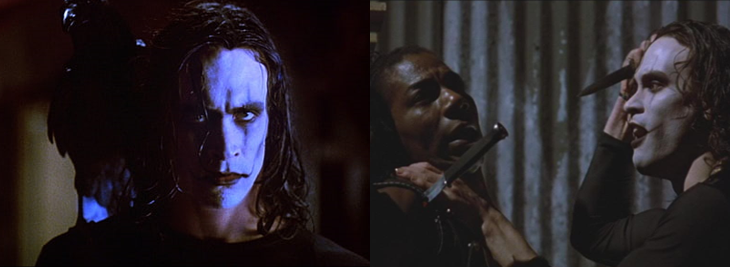
Budget: $195 to 200 million
Stars:
Dwayne Johnson, Marwan Kenzari, Sarah Shahi, Bodhi Sabongui, Aldis Hodge, Noah Centineo, Quintessa Swindell, and Pierce Brosnan

The Plot:
After nearly five thousand years of imprisonment, Teth-Adam (Johnson), an ancient magical champion said to have liberated Kahndaq, is unleashed into modern times. His brutal form of justice attracts the attention of the Justice Society of America (JSA), who try to stop his rampage and bring him into custody whilee investigating a centuries-old evil force whose power matches that of Teth-Adam.

The Background:
Following the incredible success of Clark Kent/Superman and Bruce Wayne/Batman, Fawcett Publications looked to get in on the superhero craze. While the initial plan was for a team of heroes, Ralph Daigh combined them into one superpowered entity to directly oppose Superman. Originally dubbed “Captain Thunder”, trademark issues led to artist Pete Costanza suggesting the name “Captain Marvelous”, soon shortened to Captain Marvel, and the character proved a big success. Captain Marvel soon became a franchise all unto himself after sharing his powers with a colourful extended family and, about six years after his debut, he and his Marvel Family met their dark opposite in the form of Black Adam, a corrupted version of the Big Red Cheese. Although Black Adam only appeared once in Fawcett’s original run, he saw a new lease of life after the publisher was absorbed into DC Comics, becoming a complex anti-hero often as reprehensible as the villains he opposed. Ranked as one of comics most interesting anti-heroes, Black Adam has featured in animated ventures but this live-action adaptation has spent nearly twenty years in Development Hell. Dwayne “The Rock” Johnson has been attached to the role since the project first stumbled to life in 2006 and, given Johnson’s prominence in Hollywood, the decision was made early on to keep Black Adam separated from Shazam! (Sandberg, 2019) in order to best capitalise on his star power before an inevitable confrontation with Billy Batson/Shazam (Asher Angel/Zachary Levi). Initial plans to feature Black Adam in The Suicide Squad (Gunn, 2021) were scrapped in favour of pitting him against the JSA. Johnson was keen to play up the character’s no-nonsense nature and went all-in with marketing Black Adam as a game-changer in the DC Extended Universe. After numerous delays due to the COVID-19 pandemic, Black Adam finally released to mixed reviews; the film did pretty well with a $393.5 million box office but, while many praised The Rock’s performance and the implications Black Adam has on the future of the DC Extended Universe (DCEU), others took issue with the film’s conflated plot and pacing, though all involved (and especially Johnson) were adamant that Black Adam represented a new phase of the DCEU.

The Review:
What a strange, long, and winding road this film has been on; it’s been in production for so long that I was starting to wonder if it would ever come out, especially after the character failed to appear in Shazam! I kinda get why he didn’t; it’s possible that the Rock’s star power would’ve dwarfed that movie’s heart-warming, handholding introduction to this side of the DCEU and people always complain that superhero films rely on the dark doppelgänger trope too much, which I get, but I think the contrast between Black Adam and Captain Marvel helps to elevate the latter into a more wholesome hero. Black Adam also would’ve been a great fit for either of the Suicide Squad films, especially the God-awful first one, but I do understand the idea of capitalising on the Rock’s star power to give him his own feature film, even if I don’t fully agree with it or his insistence on hyping up a clash between him and Superman (Henry Cavill) rather than him and Shazam, which would be my first choice, but maybe all three could meet up in a future movie, that would be a happy compromise. I am pretty familiar with Black Adam, though; I’ve read a bunch of his stories, especially during his time on the JSA, and really dig his no-nonsense attitude and the complex relationship he has with Captain Marvel, which is aways one clash of ideals away from degenerating into all-out war. I also really hope that the Rock is committed enough to the role that he sticks around for a bit; obviously, Dwayne Johnson is a massive Hollywood star and is in high demand so I do wonder about his longevity in the DCEU, especially considering how quickly Ben Affleck burned out (and I was worried that he would when he was cast), but he’s pursued the role for a good ten years and really threw himself into the marketing so I’m hoping he gets to reappear a few more times, though I do somewhat disagree with the idea of rebuilding the DCEU entirely around a character like Black Adam instead of, say, Superman. Black Adam gets off to a shaky start, with a ten-to-fifteen-minute opening and narration that rushes through the titular anti-hero’s origins in ancient Kahndaq and sets up the McGuffin that much of the film’s plot revolves around. Centuries ago, a tyrant named Ahk-Ton (Kenzari) enslaved Kahndaq and forced its people to dig for a rare and incredibly powerful mineral known as “Eternium”, the only material powerful enough to force the Crown of Sabbac, an item powerful by six demonic entities from what can only be described as Hell.

Awakened in modern times, Teth-Adam’s violent ways earn him the adulation of the oppressed Kahndaq.

Kahndaq’s spirit was well and truly broken but one boy, Hurut (Jalon Christian), dared to try and inspire an uprising. For this, he was sentenced to public execution but, at the last second, was spirited away to the Rock of Eternity and infused with the stamina of Shu, the speed of Horus, the strength of Amon, the wisdom of Zehuti, the power of Aten, and the courage of Mehen by the Council of Wizards. The legend becomes sketchy after the defeat of Ahk-Ton, but Kahndaq has revered their Champion ever since, with great statues erected celebrating their saviour; in modern day Kahndaq, their symbolism has all but faded thanks to the oppression of Intergang, a mercenary military force that has imposed martial law throughout the city and is seeking to strip it of all its natural resources. With Kahndaq virtually a police state, young Amon Tomaz (Sabongui) echoes the rebellious spirit of Hurut in his desire to fight back against their oppressors, but his mother, Adrianna (Shahi), is more concerned with keeping him safe from reprisals and tracking down the legendary and forgotten Crown of Sabbac to keep it out of Intergang’s hands. Here efforts lead her, her bumbling technician brother Karim (Mo Amer), and Ishmael Gregor (Kenzari) to a mountain where they successfully recover the crown but, after being accosted by Intergang’s forces, Adrianna speaks the magical word of Shazam to awaken the Champion from his long slumber. Thus, Teth-Adam arrives, garbed in a form-fitting black suit and sporting both the Wizard’s (Djimon Hounsou) lightning symbol and a hooded cape and immediately dispatches the Intergang thugs without mercy or quarter. His superhuman speed, strength, and command over lightning make him virtually indestructible to all man-made weapons; his skin is only pierced by Eternium, and his powers even allow him to cauterise and recover from wounds in moments. Bulletproof and capable of reducing a man to a chargrilled skeleton or a pile of ashes with a single bolt of lightning, Teth-Adam lays wastes to the armed thugs but, in the chaos, notably makes the effort to save Adrianna from being crushed by a falling boulder. A stoic, grim-faced man, Teth-Adam tears through Intergang with ease, mocking their “weak magic”, catching bullets, and swatting aside missiles like they were nothing. When he’s injured by an Eternium blast, Adrianna and Karim take him back to their flat to recuperate; there, he quickly learns English (how is never explained but I’ll assume it was through the wisdom of Zehuti) and is accosted by Amon, who very much fills a similar role to Frederick “Freddy” Freeman (Jack Dylan Grazer) in Shazam; he’s an absolute superhero nut, with posters and comics and action figures of all of DC’s heroes plastered around his bedroom, and enthusiastically runs down the gamut of Teth-Adam’s powers and tries to teach him to embrace his role as a superhero, somewhat similar to young John Connor’s (Eddie Furlong) relationship with the Terminator (Arnold Schwarzenegger). However, Teth-Adam has about as much interest in being a hero as he does using doors or being polite; he simply floats and flies around, barging through walls, spouting his dogma regarding lethal force to Amon, and rejecting claims that he’s Kahndaq’s fabled Champion. Despite this, he does have something of a moral code; when Intergang arrive looking for the crown and put Amon in danger, Teth-Adam continues his merciless slaughter, amusingly struggling to deliver the-ass one-liner Amon taught him as he kills people too quickly for such traditions and attracting the attention of Amanda Waller (Viola Davis).

Black Adam’s rampage brings him into conflict with the morally-righteous Justice Society.

Oddly, Waller’s first port of call isn’t the Suicide Squad or the Justice League, but Carter Hall/Hawkman (Hodge) of the JSA; it seems Waller has been reconfigured into a character more akin to Nick Fury (Samuel L. Jackson), someone who recruits and directs a variety of metahumans, which I find is an ill-fitting role for her and I would’ve preferred to see her interaction with Hawkman tweaked or removed entirely and saved her appearance for when they bring the depowered Teth-Adam into custody later in the film. Regardless, Hawkman recruits his old friend and team mate Hector Hall/Doctor Fate (Brosnan) and two rookie metahumans, Albert “Al” Rothstein/Atom Smasher (Centineo) and Maxine Hunkel/Cyclone (Swindell), to intercept and subdue Teth-Adam in Kahndaq. I really like the inclusion of the JSA here; it’s fitting, given that Black Adam spent some time with the team in the comics, and helps to open up the DC Universe to new heroes and stories, while also not overshadowing Teth-Adam with more recognisable heroes. Unfortunately, we don’t learn a great deal about them; Atom Smasher and Cyclone are relatively one-dimensional, despite a budding attraction, Al’s need to consume food to maintain his size-changing abilities and desire to live up to his uncle’s (Henry Winkler) legacy and a brief mention of Cyclone’s traumatic background. Similarly, there’s a history and a strong bond between Hawkman and the mysterious Dr. Fate that is only briefly touched upon; we learn nothing about their origins, the nature of their powers, or even their limits. Dr. Fate is able to see visions of the future through his magical, alien helmet and conjures doubles of himself, mystical barriers, and crystalline weapons and Hawkman clearly has some form of superhuman durability since he can go toe-to-toe with Teth-Adam, as well as sporting his trademark wings and mace, but Black Adam doesn’t waste any time digging into the depths of the JSA’s background. Instead, they’re there as a peacekeeping force, one who strive to set an example to the world and their peers by upholding justice and sparing lives, rather than taking them. This not only contrasts with Teth-Adam’s more totalitarian methods and leads to many a conflict, both physical and philosophical, with the team (especially the proud and hot-headed Hawkman) but also raises the ire of Adrianna and Kahndaq. After decades of oppression and being left to fend for themselves, she and her fellow countrymen reject the JSA’s involvement and holier-than-thou attitude, especially as Hawkman’s temper and Atom Smasher’s inexperience leads to more damage to their country. Indeed, Kahndaq openly cheers for Teth-Adam, revering him as their Champion and approving of his more direct, lethal measures, a feeling Adrianna also shares despite her wishes to spare Amon from inflicting violence upon others. Teth-Adam is doing what needs to be done and actually fighting back against the likes of Intergang, whereas the JSA and the wider world simply ignored Kahndaq’s problems, thus casting the JSA in an interestingly villainous role as they go to great lengths to try and end Teth-Adam’s rampage before his rage gets out of control.

Despite their technology, and being possessed by a demonic force, Intergang is little threat to Teth-Adam.

Their justification comes from having access to ancient texts that detail that Teth-Adam isn’t as righteous as Kahndaq believes; it turns out that, while Hurut was celebrated as Kahndaq’s Champion (Uli Latukefu), Teth-Adam and his wife, Shiruta (Odelya Halevi), paid the price with their lives. When Hurut shared his powers with his father to spare his life, he left himself vulnerable and was killed by Ahk-Ton’s assassins, driving Teth-Adam into a murderous rage so severe that the Wizard was forced to imprison him to contain his power and anger. Now unleashed into the world, the JSA bsaelieves that it’s only a matter of time before history repeats itself and, when Hawkman’s attempts to instil qualities of mercy into Teth-Adam fail (despite almost all of DC’s superheroes having a notable body count), the JSA attempt to force him into submission or to speak his magic word so he can be delivered into Waller’s custody. Ultimately, it’s Teth-Adam’s rage that sees him willing return to his mortal form (Benjamin Patterson) and be taken into custody after he accidentally injures Amon with his powers. With Teth-Adam left in suspended animation and unable to speak his magic word, the JSA believe they’ve accomplished their mission but a greater threat emerges from their conflict with Intergang. While Intergang aren’t really much to shout about, being simply a military force to intimidates Kahndaq’s citizenship, they do inexplicably wield Eternium weapons and hoverbikes, though none of this really matter sin the face of Teth-Adam’s awesome power. They’re the very definition of nameless, faceless, disposable goons for Teth-Adam to tear through; I quickly lost count of how many he turns to ash and bones and the film makes his toying with their lives into a bit of a gag. Intergang also disappear for the film’s final act, their threat and control over Kahndaq forgotten in favour of the power of the Crown of Sabbac, a power that Ishmael craves so badly that he not only aligned with Intergang, but betrayed Adrianna, shot Karim (though, thankfully, he doesn’t kill him as Karim is one of the film’s comedic highlights), and purposely put Amon in danger all to claim the crown for himself and to make Teth-Adam so bad that he would kill him. Sadly, for all the gravitas Pierce Brosnan brings to the film and the awesome, charismatic presence of The Rock, Ishmael ends up being a pretty weak villain; I literally forgot he was even in it for big chunks of the movie, and you can see his heel turn coming a mile away. His transformation into a literal devil for the finale isn’t exactly inspiring either, and his final confrontation with Teth-Adam is very similar to the ending of Shazam!, though the primary focus of Black Adam is on exploring Teth-Adam’s morality and methods and this is a very interesting and entertaining aspect of the film so I can ignore the lame villain, though I do think the film would’ve benefitted from someone like Arnold Vosloo in the role instead.

The Nitty-Gritty:
It’s these themes of morality that form the heart of Black Adam; having witnessed the enslavement and subjugation of his people, the death of his beloved wife and child, and the hypocrisy of the Wizard and the Gods, Teth-Adam has been left a cold, emotionless, rage-filled force of nature. This is a very different role for The Rock, one that downplays his usual affable nature in favour of a more stoic demeanour, one that showcases a different side of his charisma. He still has a presence and a biting wit, but it’s one seeped in rage and tragedy; initially, Teth-Adam was a mere powerless slave, one who tried to keep his son from speaking of rebellion, but he was driven into a fury after losing everything and has no qualms about lashing out at those who seek to harm or oppress others. His no-nonsense morality most notably conflicts with Hawkman, who believes heroes shouldn’t kill and tries to emphasise the benefits of sparing lives as it allows one to learn information about their enemy or objective. Teth-Adam is much more direct; even when he begrudgingly teams up with the JSA to rescue Amon, he just flies off and storms Ahk-Ton’s ruins, completely ignoring Hawkman’s plan of attack, an approach that works perfectly well for him as he’s functionally invulnerable. There are some interesting dichotomies at work in Black Adam; Hawkman coms across as a bit of a hypocrite because, while he’s all about saving lives, he does put people in danger with his insistence on beating Teth-Adam into submission and there’s a grey question mark hovering over the JSA’s moral high ground since they only came to Kahndaq’s aid once a superhuman presence emerged there. Similarly, Teth-Adam never harms or kills innocent people; he might claim to have no interest or care for the lives of mortals, but he repeatedly goes out of his way to help Adrianna and Amon and only kills Intergang’s mercenaries, something that the people of Kahndaq naturally cheer for as they just want to be free of their oppressors.

The film looks amazing and is full of fun action scenes, despite some dodgy CGI shots.

Visually, Black Adam is quite the spectacle; the whole movie is shot beautifully, and the costume design is absolutely on-point. The Rock looks like a walking mountain of ashen black in his comic-accurate costume and even the always-ridiculous Hawkman ends up being realised very well onscreen, though I could’ve done without the nanotechnology that allows his helmet to magically form over his head and his wings to fold away. Dr. Fate looks magnificent, if a little rubbery at times since he’s a mostly CGI creation, but the effects fall apart a little when bringing the gigantic Atom Smasher and the wind-bending Cyclone to life; I applaud the filmmakers for choosing such effects-heavy characters but I do think the film might’ve benefitted from picking less visually demanding characters since Atom Smasher doesn’t really get a lot of play (and is portrayed as a bit of a buffoon) and Cyclone just dances around in slow motion whipping up projectiles and dirt. There’s a surprising amount of slow motion here, almost Zack Snyder levels of the effect, as Black Adam goes out of its way to emphasise Teth-Adam’s incredible superhuman speed; for the most part, it works, though some parts that are clearly supposed to be dramatic can come off as a little hokey thanks to The Rock’s grimacing or screaming face lunging at the camera in su-u-per sl-lo-ow mo-tion. Mostly, though, the effects are pretty good; the sequence where the JSA’s futuristic place takes off is a bit over the top and the final form of Sabbac is disappointingly underwhelming, but Teth-Adam’s many fight scenes against Intergang and the JSA work really well. Similar to some surprisingly violent scenes in Shazam!, there’s a level of violence in Black Adam that nicely skirts the limits of what’s acceptable for a 12A film; while there’s no gore or blood splattering everywhere, Teth-Adam rams grenades in people’s mouths, causes aircraft to collide in mid-air, and indiscriminately blasts at his enemies with his lightning and comically sends them flying into the sea or across the screen. Charbroiled skeletons, ashes, and even severed limbs are all over the film as Teth-Adam tears through his opponents without remorse, culminating in a pretty gruesome end for Sabbac when Teth-Adam rips him in two, spilling not blood but molten lava.

While Teth-Adam ultimately chooses to defend the world, the question of his morality is left up in the air…

All throughout the movie, Dr. Fate is haunted by a vision of the future in which the world is reduced to a burning cinder, presumably because of Teth-Adam’s rage, and his good friend Hawkman is killed in conflict. When Teth-Adam finally surrenders and his threat is naturalised, Dr. Fate is disturbed to find his vision remains unchanged; this is because they were too slow to realise that Ishmael’s plan all along was to die at Teth-Adam’s hands so he could meet the six demons of Sabbac in Hell and become their demonic champion. Imbued with their demonic power, Ishmael returns to life as Sabbac, a literal horned demon with a pentagram carved into his chest and with designs of claiming his birth right as Kahndaq’s true ruler (since he’s the last living descendant of Ahk-Ton). Thanks to the demons’ powers, Sabbac sports all the same abilities as Teth-Adam but wielding fire instead of lightning; Ishmael’s humanity is completely consumed by this underwhelming CGI form, which has little motivation other than death and destruction. Although they’re able to battle Teth-Adam and even Sabbac on equal ground thanks to their superhuman powers, the JSA are no match for either of them; in a bid to change the future and save his friend’s life, Dr. Fate willingly meets Sabbac head on and sacrifices himself to free Teth-Adam from his confinement and convince him to live up to Hurut’s example by becoming the world’s saviour. What follows is a pretty intense brawl between Sabbac and Teth-Adam; since both are capable of hurting the other, and yet are also equally matched, there’s a degree of uncertainty about the battle but, thanks to Dr. Fate’s words, Teth-Adam learns to co-operate with the JSA, setting aside his differences with Hawkman long enough for the latter to use Dr. Fate’s helmet to distract Sabbac and allow Teth-Adam to deliver not only his one-liner but a killing blow to the raging demon. In the aftermath, a begrudging respect between Teth-Adam and the JSA is acknowledged, though Hawkman warns him not to step out of line, and Teth-Adam adamantly rejects Kahndaq’s throne and vows to instead be the country’s protector. A mid-credits scene then sees Amanda Waller also warning Teth-Adam, now rechristened as “Black Adam”, against stepping out of Kahndaq; she even calls in a favour and sends Superman to have a chat with him, returning not only Henry Cavill to the DC Universe but also John Williams’ iconic theme, and setting the stage for a showdown between the two that would never happen.

The Summary:
Truthfully, I was unsure about Black Adam; I still maintain that it’s a little self-indulgent to give him his own solo movie simply because of The Rock’s star power and he’s a strange character to rebuild the mess that is the DCEU around since there’s only so much you can do with him. However, I am a big fan of the character, and The Rock, and was excited by the trailers and the hype surrounding the film, and to see the JSA and Pierce Brosnan in a superhero film. Despite a troublesome start, which rushes through what seems like a whole movie’s worth of story, Black Adam soon found its groove and settled into an enjoyable action romp designed to showcase a meaner side of The Rock, who is clearly enjoying himself in revelling in Teth-Adam’s power. I enjoyed the complexity of Teth-Adam’s character; he’s burdened by loss and rage and not only feels like he has no place in the world but also that he’s unworthy of his powers since his first instinct is the hurt and kill others. The entire film is geared around showing him that he can just as easily b the saviour of humanity, but there’s still a question about his motivations by the finale; he seems content to remain in Kahndaq as its defender, but there’s literally nothing stopping him going out and enforcing his will in the wider world. The JSA came off really well; while we don’t learn much about them and I think I would’ve preferred Atom Smasher and Cyclone to be a little more experienced, they added some visual variety to the fight sequences and nicely opened up the DCEU to new superpowered characters, as well as helping to set an example for the violent anti-hero. While the villains weren’t much of a threat, or very interesting even when turned into a literal demon, but I can overlook that (and some of the wonkier CGI) because of The Rock’s undeniable charisma. The jury’s out on what’s next for Black Adam and how his presence will really affect the hierarchy of the DC Universe, but this was an entertaining spectacle that I enjoyed far more than I expected to.

My Rating:

Rating: 3 out of 5.

Pretty Good

Did you enjoy Black Adam? Do you think the character deserved his own solo movie, one that skipped over his relationship with Shazam? What did you think to The Rock’s portrayal of the character, his violent tendencies, and the realisation of his powers and costume? Were you also disappointed by the villains? What did you think to the JSA? Would you have liked to learn more about them, and which member of the team was your favourite? What did you think to Henry Cavill’s long-awaited return to the DCEU and where do you think Black Adam will go next? Whatever your opinions on Black Adam, feel free to share your thoughts down below or leave a comment on my social media.

Game Corner: Quake (Xbox Series X)

Released: 19 August 2021
Originally Released: 22 June 1996
Developer: Nightdive Studios
Original Developer: id Software
Also Available For: Amiga, Linux, MS-DOS, Nintendo 64, Nintendo Switch, PC, PlayStation 4, PlayStation 5, SEGA Saturn, Xbox One, Xbox Series S

The Background:
Following the unprecedented success of Doom (id Software, 1993), first-person, PC-based shooters were suddenly all the rage and the pioneers of the genre, unquestionably, were developers id Software. Having capitalised on Doom’s success, and the wave of knock-offs, with a sequel, expansions, and ports, id Software drafted in Doom creator John Romero to create a successor series based on the original Doom engine. After his pitch for a third-person melee title was turned down, tensions were raised between Romero and id Software that ultimately led to his departure. Originally intended to feature a Thor-like character, Aztec elements, and even role-playing mechanics, Quake eventually took the form of a more action-orientated follow-up to the Doom games and was bolstered by a sinister soundtrack from Trent Reznor of Nine Inch Nails fame. For my part, I played a decent amount of Quake on PC as a kid and, based on my enjoyment of Duke Nukem 3D (3D Realms, 1996), I picked up the Nintendo 64 port back in the day, something which earned me a great deal of flack from my friends. Regardless, Quake is very highly regarded, especially on the PC, kick-started a popular sub-series of first-person shooters (FPS), and surprisingly received a remaster for modern consoles in August of 2021 that I decided to snap up since I was signed up to Game Pass Ultimate at the time.

The Plot:
When the military’s experiments with teleportation technology result in the creation of an inter-dimensional portal known as the “Slipgate”, humanity find itself threatened by the demonic beings code-naked “Quake”. After “Operation Counterstrike” is slaughtered, a sole surviving Marine is left to gather the four magic runes that are the key to stopping the enemy and ending their invasion of Earth.

Gameplay:
Quake is a first-person shooter (FPS) in which players are placed into the role of a hardened, nameless Marine and traverse a number of dark, demon environments battling all kinds of monsters and ghouls. If you’ve ever played Doom or any of its classic sequels, you’ll be immediately familiar with Quake’s gameplay and presentation but there are a few things that make Quake stand out from its predecessor. First of all, the player is able to actually aim their crosshair, allowing for full 3600 field of view and making it easier than ever to blast enemies no matter where they’re hiding. The rest of the game’s controls are standard fair but are also fully customisable from the main options menu; when I played the game, I mapped jump to A, shoot to the Right Trigger, and the ability to quickly switch between weapons to X and B. This remaster of Quake adds a weapon wheel to the game, which I mapped to the Right Bumper but never actually used, and you can also assign buttons to have you dive and rise when swimming or use the Anti-Grav Belt to fly. You can also customise various display options while you’re at it, which allows you to change the size of the crosshair and the presentation of the heads-up display (HUD), but I left most of these alone. When in the pause menu, you can also use the Left Bumper and Right Bumper to quick load and quick save the game, which is super useful.

Explore dark, terrifying environments in search of keys to find the exit.

Like in Doom, your primary objective when playing Quake is to fight your way to the Slipgate exit. This sees you traversing a number of dark, ominous environments and taking out a whole mess of demons and monsters while collecting gold and silver keys (known as Keycards, Keys, and Runekeys depending on the theme of the level) to open doors and progress throughout the area. You’ll also be pressing in buttons and switches by walking into them to lower drawbridges, creating bridges, or otherwise opening up tunnels or doors so you can progress a little further. One thing you’ll probably notice right away is that Quake lacks any kind of map system but, for the most part, it doesn’t really need it; while many levels are somewhat maze-like and a handful are specifically constructed to be more labyrinthine than others, overall the environments are much smaller and easier to find your way around than in its sister-series and you’ll often find arrows, Slipgates, and gates to help you get to where you need to go. Exploration is often rewarded with secret areas containing armour, health, and other power-ups and the game’s difficulty is entirely up to you as you can select different difficulty settings from the main menu (ranging from “Easy” to “Nightmare”); in this remaster, you can also select whichever level you want to start from right from the start but this won’t count towards you unlocking the game’s many completion Achievements. Selecting higher difficulty settings will naturally increase the amount of enemies, their aggression, and how much damage they dish out, which can mean the difference between dispatching a boss with one move or with three.

Press switches, swim through water, and watch out for death traps as you explore.

When you start a new game, you are dropped into a small hub world from which you can also choose from different difficulty paths and jump into the next mission and you’ll need to make liberal use of the manual save system because, when you die, you’ll have to restart the last mission right from the start without any of the weapons you picked up before and during your last run. It doesn’t take long before you’ve experienced basically everything that Quake has to offer; dark military bases, bloodstained castles, and Hellish dimensions are the order of the day and you’ll find yourself taking a dip in water to reach new sections in each area, dodging balls of molten rock, and being surprised when the floor suddenly collapses beneath you and drops you into either a pit of lava for an instant death or a body of slime that slowly saps your health. Gameplay gets mixed up a little bit the further you progress, though, allowing you to hop between stationary and moving platforms or rising and falling columns of rock, riding in boats, elevators, and lifts, and blasting you around the place in air tubes. Occasionally, you’ll be faced with slightly more ambiguous puzzles that have you pushing barely-visible buttons, shooting or pressing and number of Quake pads to complete a sequence and open a new area, and dodging a variety of environmental hazards. Levels will contain crushing weights, electrical traps, rapid-firing nail guns, spears, and other death traps that you’ll often have to either run through as fast as you can, jumping madly to try and keep damage to a minimum, or carefully make your way through the trap to avoid being crushed into a bloody paste.

Graphics and Sound:
Unlike Doom or the vast majority of Duke Nukem 3D, Quake’s enemies are entirely rendered as 3D character models. This gives them a much more solid and weighty appearance and means that enemies now lumber about as jerkily-animated 3D models rather than clumsily stumbling about the place as jerkily-animated 2D sprites. Still, they do explode into bloody, meaty chunks when defeated and their bodies drop to the floor and stay there, which is super useful for retracing your steps. The main character is primarily represented as one of many floating guns and a grimacing face on the HUD that reacts when you’re attacked and becomes more bloodied and dishevelled as your health drops, but you will get to see the Marine in full during the handful of brief third-person cutscenes that punctuate the end of each of the game’s episodes.

Dark, ominous hallways, medieval ruins, and pixelated Hellish surroundings are the order of the day.

Environments are dark, foreboding, and full of Lovecraftian and Satanic imagery. You’ll navigate through futuristic military bases of rusted metal, grey stone castles full of spikes and drawbridges, and volcanic levels full of demonic ruins. While the game retains that old-school, pixelated graphical sheen that was the order of the day for videogames at the time, the textures and game stability are undoubtedly the best they’ve ever been and, while you’ll see a lot of the game’s architecture and layouts repeated, they’re often mixed up enough to make each level distinct from others. You’ll see blinking control panels, pools of blood, dank sewers filled with zombies, blast through graveyards and catacombs, and explore high-tech military installations overrun with all manner of beasts. When you finish each episode or defeat one of the game’s handful of bosses, you’ll be met with a bit of text to help give some context to the game but much of Quake’s horror and tension comes from the fantastic soundtrack, which manages to be both fittingly ominous and rocking at the same time. Levels are also made all the more terrifying by the screams and roars of enemies and the sounds of more monsters teleporting in, all of which helps to keep the adrenaline constantly pumping as you bolt through pitch-black tunnels and explore caverns barely lit by flickering candles.

Enemies and Bosses:
Contrary to other FPS videogames, Quake doesn’t actually feature that many boss battles; instead, you’ll generally have to collect keys to open exits and battle through hordes of enemies in order to finish most episodes. Enemies are visually very interesting and range from zombies (who throw chunks of bloody meat at you and can only be put down for good with your heavier ordinance), gun-toting Marines possessed by Quake’s evil, and sword-swinging knights. One of the most recurring (and annoying) enemies in the game is the Ogre, a chainsaw-wielding monstrosity that has a tendency to shoot grenades right in your face! You’ll also come across Death Knights, who fire flaming bolts at you in addition to wildly swinging at you with their swords, the floating, leech-like Scrags, piranha-like fish and eels in some bodies of water, Rottweilers, and vicious Fiends (who leap at you and swipe at you with their claws).

You’ll need to employ speed and strategy to take down Cthon and avoid Vore’s seeking explosives.

That’s not to say that boss battles don’t exist in Quake, however; at the end of the first episode, you’ll have to battle the mighty Cthon, a gigantic beast made entirely of lava and resembling Satan Himself. Cthon is entirely immune to all of your weapons and can only be defeated by running up to the upper path and pressing two buttons to lower two columns either side of him. You then race back to the start of the enclosed arena and press a third button to activate a bolt of electricity that either blows Cthon into chunks or sends him back to his lava pit for you to repeat the sequence on higher difficulty levels. At the end of the second mission, you’ll encounter the disgusting Vore enemy for the first time; this spider-like monstrosity scuttles around trying to slice you with its limbs and shoots heat-seeking spiked balls that explode on contact, meaning you have to constantly stay on the move and dodge behind walls and cover to avoid taking damage. After clearing this mission, Vores will appear sporadically as regular enemies but this can actually be to your benefit; when large groups of enemies gather, you can race/strafe around in a circle and cause them to attack and damage each other, which is super helpful.

The recurring Shamblers are far more dangerous than their eldritch creator.

Another boss-like enemy that becomes a recurring foe is the horrific Shambler, a massive beast that stomps around the environment blasting a bolt of lightning at you and trying to pummel you with its huge claws. After taking out the first with your best weapons, these bastards will teleport in or appear at the most inappropriate moments and often guard the keys you need to collect to progress and can even appear in groups of two or alongside Vores and other enemies. Both Shamblers and Vores populate the final mission of the main game, which sees you confronting the leader of these enemies, code-named “Quake” but in actuality the “Black Goat of the Woods with a Thousand Young” herself, Shub-Niggurath. You’ll have to settle for battling those enemies, though, as Shub-Niggurath is little more than a screaming, pulsating mound of flesh in the middle of a lava pit and, while she’s immune to your weapons, defeating Shub-Niggurath is ridiculously easy; simply wait for the spiked ball that’s circling the arena to enter the demonic Old One and then jump into the Slipgate. This will see your character teleport inside Shub-Niggurath, who simply explodes in a burst of chunky pieces.

A host of new maps, enemies, weapons, and challenging bosses await in the additional missions.

Thankfully, this remaster of Quake comes with four additional mission packs that include not only all-new maps but also additional enemies, such as Gremlins (essentially a reskin of the Fiends), nail-shooting, cybernetic scorpions known as Centroids, sentient swords, Grim Reaper-like Wraths, and a number of additional bosses. The first is the cybernetic Armagon, who fires lasers, rockets, and shockwaves at you in a claustrophobic arena. Luckily, you can take cover behind the many columns and take advantage of the weapons and power-ups strewn around, and he actually goes down pretty easily on the easiest difficulty as a result. Far more troublesome is the multi-armed, Grim Reaper-esque Overlord; this robed mage teleports around an arena full of Wraths and nail traps, hacking at you with its axes and firing a homing ball at you much like the Vores. Other additional bosses include Hephaestus, (a smaller, weaker version of Cthon), a Mummy (which is functionally the same as a zombie but does (and takes) greater damage), and three Guardians (Aztec and Egyptian warriors and blast at you with their staffs and spawn in more minions the more damage you inflict). After battling through longer, far more dangerous levels filled with a variety of the game’s enemies that will test your mettle to the limit, you’ll eventually face off against a monstrous dragon in an arena filled with lava and narrow rock pathways. The dragon flies overheard in a circular motion and spits fireballs and energy blasts at you, but you’re completely safe as long as you stay out of its sight, follow it from behind, and don’t slip into the lava. The arena is full of some of the game’s most powerful weapons but, even so, the dragon can absorb a great deal of punishment and can be tricky to hit while safely circling the arena. After you do bring it down, you’ll have to unload the remainder of your weapons on the Quake Temporal Energy Convertor (while, again, being careful not to slip into the lava beneath it) to finally put a stop to the demons’ invasion of Earth.

Power-Ups and Bonuses:
Being an FPS title, your most recurring power-up will be the large amount of weapons and ammo made available to you as you play through Quake’s missions. Unlike other FPS protagonists, the Marine has no unarmed combat mode and, instead, swings a pretty useless bloodied axe at enemies when no other weapons are available; you’ll also be happy to learn that there are no pistols or small firearms here and that your default weakest weapon is a good, old-fashioned shotgun. You can also grab heavier ordinance, such as grenade and rocket launchers, but the signature weapon of the game is undoubtedly the rapid-fire Nailgun. Furthermore, you can also pick up upgrades to these weapons, such as a double-barrelled shotgun (my preferred weapon of choice) and the Super Nailgun, and the game’s super weapon, the Thunderbolt, a futuristic-looking firearm that blasts enemies with a bolt of lightning.

In addition to a slew of devastating weapons, you can also grab temporary power-ups.

You’ll find more weapons in the additional mission packs, such as the lightning-spewing Mjölnir of Norse legend, a multi-grenade and rocket launcher, a proximity mine launcher, a laser cannon (that shoots high-intensity laser blasts that ricochet all over the environment and can damage even you), a grapple gun and throwing star, and further upgrades to the Nailgun and Thunderbolt that spit out lava nails and a burst of energy, respectively. In addition to health packs and armour, you can also find a number of temporary power-ups: the aforementioned Anti-Grav Belt allows you to moon jump to higher areas, the wetsuit and biosuit allow you to traverse water and slime without fear of drowning or taking damage, respectively, and you can grab Quad Damage to deal four times as much damage for a limited time. You can also pick up the Pentagram of Protection and Ring of Shadows to become temporarily invulnerable and invisible, respectively (although enemies will still attack you if you fire on them while invisible), and there are even more opportunities to increase your defence and attack in the additional mission packs. You can even grab the Horn of Conjuring to summon a random monster to fight by your side, and there are also other power-ups that are exclusive to the multiplayer deathmatch modes, such as the Rune and Vengeance Sphere.

Additional Features:
Quake comes loaded with thirty-five Achievements for you to earn, with the vast majority of these being tied to completing the game’s single player campaign and finding secret exits. In fact, there is only one Achievement reserved for multiplayer, which is good news for me, though you will have to take on the game’s more challenging difficulty modes in order to get 100% completion. Additionally, you can’t just load up the final levels of the game and beat them to pop the Achievements; you actually need to play through the entire game to earn them, and you’ll find that there are a couple of quirky ones that have you killing a Shambler with only an axe or before it can fire its lightning attack, and causing enemies to kill each other. As mentioned, the game comes with a multiplayer component that allows you to play on- and offline against a friend or other players in standard deathmatches, such as free-for-all and team play, and you can even play alone against computer-controlled ‘bots that you can set to different difficulty levels. As I also detailed, the game comes with four additional mission packs to play through that seriously up the game’s difficulty; new enemies, weapons, power-ups and bosses have been added and maps and textures have been redesigned to create entirely new levels so you can keep fragging demon scum to your heart’s content. Finally, you can also download the Nintendo 64 port, though unlike the other mission packs there are no Achievements tied to this version of the game (which is basically just a stripped down version of the base game).

The Summary:
For over twenty years, my friends have ragged on me because I once owned the Nintendo 64 version of Quake. I didn’t have it for long but, for whatever reason, it was enough to become a recurring joke between us and I have shunned the series ever since in favour of Duke Nukem 3D and a cursory relationship with the Doom franchise. When I heard that there was a remaster of Quake, I was both surprised and sceptical but, against my better judgement, I took advantage of it being free on Game Pass and downloaded it mainly to snag the game’s Achievements and up my Gamer Score. However, I found myself really enjoying the game, far more than I remember in the past. Thanks to a dark, foreboding atmosphere, a fittingly ominous soundtrack, and some disturbing visuals and enemies, Quake is a tense and action-packed experience. The controls are tight and intuitive; blasting demons has arguably never felt more gratifying and, despite a few annoying instances where the floor suddenly collapsed into lava or I was unexpectedly overwhelmed by a horde of enemies, I found the game to be an enjoyable and intense ride. Although the game has a serious lack of boss battles, the ones it does have generally require more from you than just mindlessly blasting away, and though the environments can be dark and confusing at times, they’re not brain-bending mazes and it’s pretty simple to plough your way through to the exit in short bursts. Overall, I’d actually say I rate this higher than the original Doom since Quake definitely improves upon the game engine of its predecessor and delivers one of the most horrific and bloodthirsty shooters in the process.

My Rating:

Rating: 4 out of 5.

Great Stuff

Are you a fan of the original Quake? How do you think it compares to other FPS titles of that time? What did you think to the game’s enemies, aesthetic, and soundtrack? Were you a fan of the focus on medieval and Lovecraftian horrors and what did you think to the battle against Shub-Niggurath? Which of the game’s weapons and expansion packs was your favourite and what did you think to Quake’s multiplayer options? Which game in the Quake franchise is your favourite and would you like to see a new game on modern hardware? Have you ever had your friends take the piss out of you for owning a game before? What horror-theme videogames are you playing this October in anticipation of Halloween? Whatever your thoughts on Quake, sign up and drop a comment below or comment on my social media.