Game Corner: Sonic Generations (Nintendo 3DS / Xbox 360)

SonicGenerationsLogo

Released: 1 November 2011
Developer: Sonic Team
Also Available For: PlayStation 3, PC, Xbox One, and Xbox Series S/S

The Background:
It’s been said time and again, but Sonic had a tumultuous transition to 3D. While Sonic Adventure (Sonic Team, 1998) is generally regarded as a classic, it had a few issues that took SEGA some time to iron out in Sonic’s subsequent 3D titles. Despite some bizarre claims to the contrary, Sonic the Hedgehog (ibid, 2006) was a diabolical low point for the franchise. Sonic Team were desperate to make up for this with Sonic Unleashed (ibid, 2008), a critical and commercial success that saw the 3D games utilise a brand-new game engine to propel Sonic at breakneck speeds. This was further refined in Sonic Colours (ibid, 2010), another successful entry that but the franchise in a good position for its 20th anniversary. Sonic Generations was specifically developed as a love letter for long-time fans, with Sonic Team focusing exclusively on high-definition consoles and the unique 3D features of the Nintendo 3DS. The developers sought to recreate only the most popular and iconic stages from Sonic’s past and to make the game accessible to players of all ages, bolstering the release with a limited edition version and a touch of downloadable content (DLC). regarded as one of the best of Sonic’s 3D efforts, Sonic Generations was widely praised, despite its short length, for its colourful visuals and fast-paced gameplay; though the 3DS version was largely seen as inferior to the main console releases. regardless, Sonic Generations was a strong seller for SEGA thanks to being backwards compatible with new hardware and even got a whole new lease of life in 2024 with an equally celebrated . Shadow the Hedgehog-themed remaster.

The Background:
It was 2011 and SEGA were eager to celebrate the 20th anniversary of their iconic videogame mascot; after years of disconnect and complex additions to what had begun as a simple, one-button videogame, it’s fair to say that there was some…confusion regarding Sonic’s past, canon, and timeline. SEGA initially opted for a soft reboot, of sorts, with Sonic Adventure (Sonic Team, 1998), which clearly depicted Sonic and his cast of characters redesigned into a slightly older, more anime-inspired aesthetics in a world similar to ours, inhabited by both humans and anthropomorphic characters, and with a tenuous connection to the previous videogames. However, very quickly, this fell apart a bit as Sonic videogames became both incredibly dense and complex or laughably simple, especially in their narratives. After years of fans wanting a return to the traditional, 2D gameplay of the past, Sonic Team opted for a title that would combine not only the tried-and-true 2D gameplay of the past with the fast-paced 3D gameplay of what was, at the time, the present but also bring together two different generations of Sonic for the first time.

The Plot:
While celebrating Sonic’s birthday, Sonic and his friends are scattered through time by Doctor Eggman’s ferocious, mysterious beast, the Time Eater. Teaming up with a past version of himself, Sonic races through from his past to rescue his friends, retrieve the Chaos Emeralds, and put a stop to the Time Eater’s rampage.

Gameplay and Power-Ups:
Sonic Generations takes the fast-paced, “Boost”-centric formula of Sonic Unleashed and Sonic Colours and further refines it, offering both 3D and 2.5D, high-speed action stages as players race through some of the most iconic stages (or “Zones”) in Sonic’s history. While Sonic remains the only playable character, there are now two of him: the “Classic” Sonic (who plays exclusively in 2.5D) and the “Modern” Sonic (who plays in 3D and 2.5D). There are nine Zones to playthrough in Sonic Generations, each with two levels (or “Acts”): Act One is exclusive to Classic Sonic and Act Two is tackled by Modern Sonic. Although you’ll pot a timer in the to-left of the screen, there are no time outs here’ instead, you get a letter grade a points for finishing Acts as fast as possible. You’ll want to stick to the higher paths, where available, and utilise rails, pulleys, and other shortcuts to cut down your time, but you’re basically guaranteed an “S” rank if you finish an Act without losing a life. Unsurprisingly, Golden Rings are your life source, protecting you from most attacks and granting an extra life for every increment of 100 you collect. Golden Rings also fuel Modern Sonic’s “Boost” gauge (which is also filled by performing tricks off ramps and bashing Badniks), allowing him to blast ahead at high-speeds and plough through any enemies and destructible objects in his way. While both Sonics have unique gameplay mechanics, they share some common controls: you jump with A or X, pressing it again in mid-air to attack nearby enemies or hit targets with Sonic’s Homing Attack. While this is exclusive to Modern Sonic, you can unlock the ability (or “Skill”) for Classic Sonic, too, and it becomes mandatory in the 3DS version. B sees you crouching to fit through small gaps, Y activates any Skills you have equipped, and the Right Trigger either blasts Modern Sonic off or quickly performs Classic Sonic’s Spin Dash. When Boosting, you can hold the Left and Right Triggers to drift and use the Left and Right Bumpers to quick step. As Modern Sonic, you can press B in mid-air to perform a stomp, wall jump off specific surfaces, and dash along a line of Rings by pressing Y.
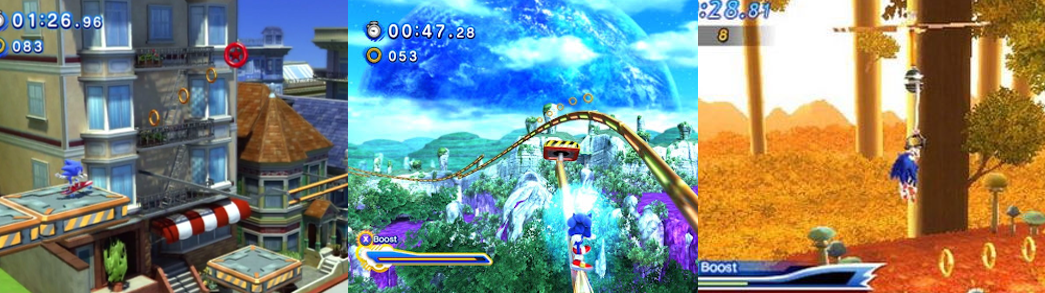
Both Sonics have distinctive playstyles, though gimmicks are recycled and shared between both.

These controls are largely mirrored on the Nintendo 3DS, with players jumping and using the Homing Attack with A or B and Boosting with Y, though there’s no quick Spin Dash for Classic Sonic. Classic Sonic’s taught the Homing Attack early on, though he doesn’t really need it and ends up playing as a slower, clunkier version of his counterpart. While it might seem like Modern Sonic has more tricks at his disposal, each Sonic can be assigned Skills, unlocked by collecting Red Star Rings, completing additional Challenges, and spending points in the Skill Shop. Each Skill has a point value, and you can assign as many as you like to each Sonic until you hit the point cap of 100. A bunch of these are shared between both Sonics, giving each the ability to begin an Act with ten Rings, granting an additional extra life, giving them more movement options when underwater, and eliminating the recovery time after taking a hit. Classic Sonic can equip one of the elemental shields from Sonic the Hedgehog 3(SEGA Technical Institute, 1994), gaining a bounce, flame burst, and double jump and being able to breathe underwater, resist flames, and attract Rings, respectively. He can also equip the “Twin Spin Attack” (or “Insta-Shield”) from Sonic 3, start with a temporary invincibility, extend the Spin Dash, turn enemies into Rings, and even hop on a skateboard. Some of these abilities are available in Zones as well, such as the speed up and invincibility and skateboard, though you’re more likely to smash Ring monitors. Modern Sonic can also be assigned Skills to allow him to blast off at the start of an Act, perform faster Homing Attacks and wall jumps, and increase the length of his Boost gauge. When playing Planet Wisp or Tropical Resort, you’ll utilise the returning Wisps, with Classic Sonic using the Pink Wisp and Red Wisp to race across walls and ceilings and turn gears or burst through the sky and Modern Sonic rocketing up Dr. Eggman’s factory and smashing through barriers or ricocheting about with the Cyan Laser. Acts also contain the usual gimmicks and hazards, such as springs, spikes, flame bursts, ramps, and rails. You can jump through boost rings to blast through the air, fly off ramps to perform tricks and fill your Boost gauge, repeatedly hit bouncy springs to get higher, and even run on those awful Marble Garden Zone platforms to reach higher areas in Sky Sanctuary. When underwater, you’ll need air bubbles to keep from drowning; when leaping to platforms, you must watch for bottomless pits; and you’ll often press switches to activate or move platforms and blocks.

Sonic’s greatest hits and misses are revisited in each Zone and Challenge.

Interestingly, the Nintendo 3DS’s bottom screen is only used to track your progress in an Act, display the boss’s health bar, and to navigate the sparse hub world. Sonic Generations takes place in a simple hub world called “White Space”, a disappointingly barren void where stages from Sonic’s past have been dumped by the Time Eater. These are arranged in three areas corresponding to an era of Sonic’s history and guarded by a Boss Battle. To progress through the game’s brief and simple story, you must complete each Act to partially restore colour and life to the White Space, then acquire a Chaos Emerald from a Rival and Boss Battle. By and large, the game’s Acts aren’t particularly challenging, though there are some unfair bottomless pits and each Sonic seems to have lead in their sneakers, which can make precision platforming slippery and frustratingly difficult. The difficulty comes in the lengthy and haphazard variety of gameplay mechanics seen in the later, modern levels; unsurprisingly, Crisis City stands out as one of the game’s more frustrating stages thanks to the fire traps, lava pits, bottomless pits, and that Goddamn flaming tornado! The Nintendo 3DS version sees you flying through Mushroom Hill using propeller plants, bouncing around Casino Night, and racing from a destructive orca in Emerald Coast, though the additional Challenges are missing from the Xbox 360 version. Here, after clearing each area, you’ll unlock five additional Challenges for each Sonic; you’re required to clear at least one of these for each Zone to gain a Boss Key, battle the boss, and progress to the next area. These Challenges are considerably varied and can be anything from racing against a ghostly doppelgänger to finding Chao, to completing a stage with only one Ring. Sometimes, you’ll also race against, or team up with, one of Sonic’s friends; you’ll use Mile “Tails” Prower to hover over obstacles and gaps, knock musical notes back to Vector the Crocodile, and clear walls of flame with Blaze the Cat, for example. While you may call upon Sonic’s friends with Y in these Challenges, you’ll never control any character other than the two Sonics, which is quite disappointing. These Challenges can be frustrating but clearing them is the only way to completely restore each area and also unlock additional Skills, artwork, music, and character profiles in the Collection Room.

Presentation:
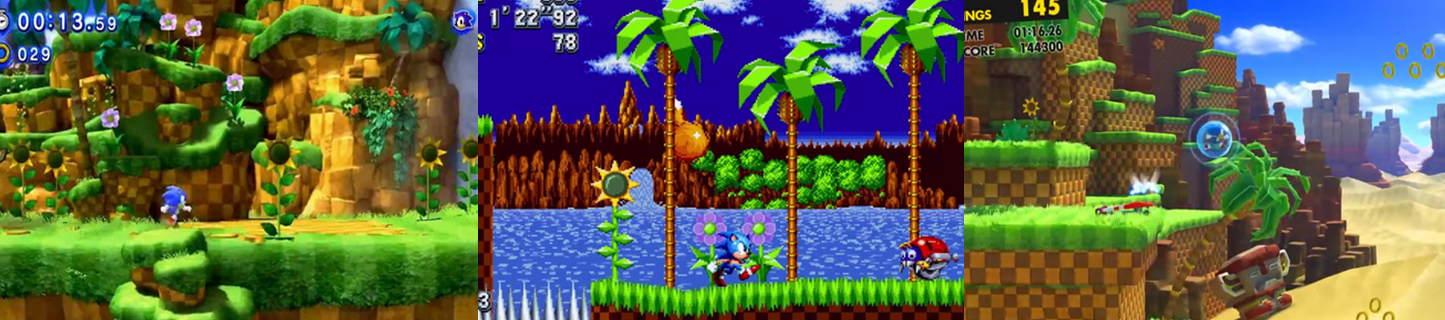
Graphically, Sonic Generations is still one of the brightest, most vibrant Sonic 3D titles ever made. Classic Sonic, especially, looks and animates really well and every stage is packed full of life, colour, and little details that will be recognisable to any Sonic fan. Both Sonics have idle poses and celebrate or lament their letter grade after each Act, though, strangely, Classic Sonic is completely mute. This means that Modern Sonic gets all he puns and one-liners and voice clips, while Classic Sonic simply pantomimes his feelings and relies on Classic Tails to talk for him. Sonic’s friends appear as non-playable characters (NPCs) in White Space, offering encouragement and hints after being restored to guide you towards Red Star Rings. White Space is very annoying for such a simple hub world, with the game forcing you to take boost pads, loops, and springs to reach Challenges (though you can cycle through Acts, at least). I’m glad the game isn’t bogged down by a huge open world, but White Space feels very cheap and half-assed at times, despite some fun Easter Eggs. Sonic Generations takes the original 2D and 3D environments and gives them an eye-catching visual makeover, though the screen’s a bit too zoomed in at times for Classic Sonic and it’s easy to just blast off into the void as Modern Sonic. Perhaps the pinnacle of Sonic Generations’ graphical achievement, though, is in the fantastically updated battle against Perfect Chaos, who has been turned from a choppy, flappy-mouthed monstrosity into a genuinely terrifying, bio-organic creature. However, when playing the Xbox 360, I did notice some blurriness to the images, some frame rate issues, and the game crashed on me three or four times, which was odd. It’s obviously graphically superior to the 3DS version, which offers the same headache as all 3DS titles and is extremely basic at times. You cans ee this in Mushroom Hill, which looks strangely bland, the cutscenes (which are simple 3D models with dialogue boxes), and the reduced Zone count.

A generational adventure that lovingly recreates Sonic’s classic stages.

Each of the game’s Zones are beautifully rendered and expanded upon with gameplay gimmicks from other games and even little extra things, like a celebration taking place in Rooftop Run and getting to visit Hidden Palace in Sky Sanctuary. While there are some obvious choices (Green Hill and Chemical Plant have since been overused to death), there are some odd inclusions, like Speed Highway from Sonic Adventure (I would have picked maybe Ice Cap or Red Mountain), and some disappointments, like Seaside Hill from Sonic Heroes (Sonic Team USA, 2003). I’m honestly surprised that Sonic Team didn’t include Casino Park instead, though I would’ve liked to see them mix it up with Egg Fleet or Frog Forest. There’s some real depth to the environments, with Chemical Plant’s factory exploding in the background, the Death Egg rising in Sky Sanctuary, and desolation as far as the eye can see in Crisis City. Things can be a bit cluttered at times and it’s not always clear which winding path you can take and which is part of the background, but I loved how faithfully Sonic Generations recreated each area and the little twists they toss in. Classic Sonic’s Seaside Hill is largely underwater, for example; the infamous truck wrecks the environment and rockets after you across walls in City Escape; and Dr. Eggman airship hounding you in Rooftop Run. The Nintendo 3DS version oddly adapts Zones from Sonic’s main console games rather than his handheld ventures, with the exception of Water Palace (and, I guess, Tropical resort), which was an odd choice and results in some janky, bland stages that are actually inferior to their Nintendo DS predecessors since the action’s limited to one screen. The Xbox 360 version features some really well done CG cutscenes; it’s just a shame that the game’s story is so criminally short that we don’t see more of these. When you free Sonic’s friends, they’ll make a comment while Sonic just stands there like a tool rather than properly interact with them. As for sound, Sonic Generations has you covered! Every area features a unique, remixed version of its original track and each Act has a different version to differentiate the two. On the Xbox 360, you can also unlock additional music tracks, including some great remixes by the likes of Cash Cash and Crush 40, and play these on any Stage, allowing for a lot of variety in the music you hear as you play.

Enemies and Bosses:
Given that it features stages from three eras of Sonic’s history, Sonic Generations also includes many recognisable Badniks and enemies from each time period being represented. You’ll smash apart the likes of Moto Bugs, Buzz Bombers, Crabmeats, Spinys, and Egg Robos from the classic games, with Egg Robos sporting missile barrages and giant Badniks even chasing you at certain points. Moving into the modern era, you’ll bop Eggpawns, Cop Speeders, robots from the Guardian Unit of Nations (G.U.N.), and flaming Iblis creatures. While most slow and easy to attack, they can still surprise you with bolts of energy or other attacks, such as the construction Egg Pawns on Planet Wisp tossing their pickaxes. Enemies are largely there to be bothersome, with the cannons surrounding Rooftop Run’s clock tower being particularly aggravating and the Egg Pawns in the barrel store being notably cheeky. Enemies also act as “bridges” between platforms, rails, and other areas, allowing you to Homing Attack or bop them to reach higher paths, cross lava, or avoid spike pits. The Nintendo 3DS version features a handful of unique enemies due to its different Zone selections, such as those mushroom-tossing moles, axe-wielding Egg Pawns, and even a massive Egg pawn that wrecks the ruins of Water Palace. Spikes are annoyingly commonplace, often waiting right where you land, as are crushing hazards, moving blocks, flame bursts, and missiles from the walls and ceilings. You’re chased by a gigantic truck in City Escape, one that now sports giant buzzsaws, have debris flung at you by a flaming tornado in Crisis City (which also whisks away the environment and the end goal for Classic Sonic!), and must watch for crumbling platforms when bouncy from clouds in Sky Sanctuary. Spiked obstacles also appear on rails, mines litter the ground, and you must quick step left and right to avoid being blasted by Dr. Eggman’s drones and airship. While warning signs alert you to bottomless pits, it’s very easy to plummet down them when moving so fast, or to clip through the environment, and Sonic can be quite slippery, which doesn’t help when trying to make trickier jumps.

Iconic bosses get a massive upgrade, adding extra gimmicks and attacks to their arsenals.

Six classic bosses return and are remixed in each version of Sonic Generations. On the Xbox 360, Classic Sonic first fights the Death Egg Robot on a narrow platform, dodging its extending, drill-like arms and running under it when it jumps to ram its butt. The fight the switches to a recreation of the Death Egg Zone and the mech exclusively attacks from the background, forcing you to lure it to attack bombs with its arms so you can run up and ram its head. The fight with Perfect Chaos is now a whole stage as you dodge its tentacles and jump on crumbling platforms to reach it, hitting springs and pulleys and blasting across the water on boost pads to race up its body. Perfect Chaos spawns twisters, fires energy beams, and unleashes its massive mouth laser, before erupting water geysers. This forces you to precariously hop to platforms, battling the awkward camera to land the final blow. The Egg Dragoon sees you blasting through a circular tunnel avoiding its freeze bolts and missiles and hopping to rails to ram the cockpit. When on a 2.5D plane, you must hang back and jump over shots then quickly wall jump up its arms, avoiding a downward shot, before diving after the falling mech, avoiding its drill arms to target its body. On the Nintendo 3DS, you battle one of my favourite bosses, the Big Arms, now avoiding its arm slams and palm slaps, then, oddly, battle the Biolizard. This is an annoying fight as you must awkwardly run from its gaping mouth or thrashing tail, grinding up to its core, avoiding high and low shots and bouncing off orbs to smack its core. Finally, you battle the Egg Emperor in an autorunner, desperately avoiding its energy waves, dodging its charge, and taking out the cannons to smack his big, stupid face.
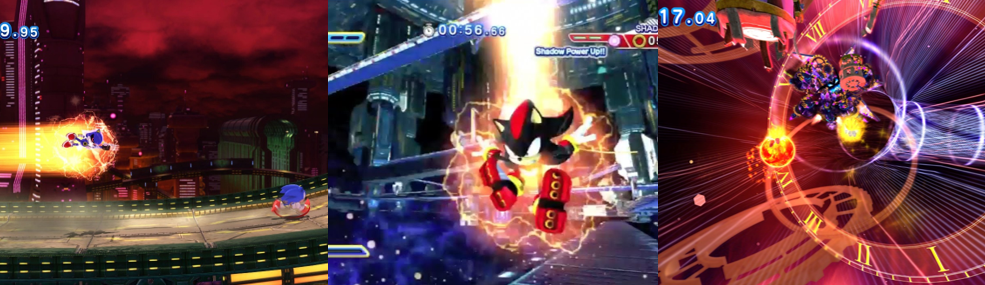
Best Sonic’s rivals to power-up and battle the aggravating Time Eater with two Super Sonics!

You’ll also compete against some of Sonic’s rivals in both versions, with the Xbox 360 fights yielding Chaos Emeralds. You’ll once again race across Stardust Speedway against Metal Sonic, hopping over its torpedo dash and avoiding its lasers and the debris it tosses at you to give it a smack. You’ll across the walkways of the Space Colony ARK against Shadow the Hedgehog, chasing down purple energy orbs to power-up and blast meteorites at him in a battle that’s ridiculously easy if you can speed after him fast enough. Finally, you return to Crisis City to battle Silver the Hedgehog, avoiding his telekinetic waves and targeting the debris he flings at you to wallop him, before scrambling over a huge wave of junk and racing towards the camera to finish him off. This rival fights are significantly downplayed on the Nintendo 3DS as you don’t fight Silver and both are reduced to races, with you hopping over obstacles and slowing Metal Sonic or Shadow with some lucky shots and desperately trying to avoid Shadow’s boost and Chaos Spear. Unfortunately, Sonic Generations and its bosses arefurther let down by the final battle with the Time Eater. Despite an impressive, ominous score, the unique design of both the creature and the bizarre vortex you battle it in. Despite the joy of seeing Classic and Modern Sonic turn Super Sonic to battle two versions of Dr. Eggman, this fight is a confusing mess. You hold down RT to charge head-first through a time/space distortion, dodging pieces of the Zones and the Time Eater’s arms and lasers, to ram its core. You can press Y to switch to the outside of the vortex and press X to fire the other Sonic to destroy incoming projectiles, all while Sonic’s friends constantly shout “advice”. You can barely see Golden Rings until they’ve flown past you, you have no idea if you’re holding or mashing buttons, and defeating this monstrosity is much easier on the Nintendo 3DS. You battle it on a 2.5D plane, with no attacks at your disposal and simply dodging its lasers and arm swipe until its core is exposed, then race towards it on a 3D plane. This can be tricky as it’s not easy to dodge its hand claps and it’s easy to run out of Rings, but at least you’re not bombarded by repetitive voice clips, and you can land hits a lot easier.

Additional Features:
There are forty-nine Achievements to earn in Sonic Generations, with one popping every time you clear both Acts in each area and defeat a rival and boss. Every Act as at least one Achievement tied to it (normally something involving going a specific route and collecting a specific Red Star Ring before completing the stage), you’ll get Achievements for performing tricks, acquiring Skills, and unlocking all collectibles. Every Act has five Red Star Rings to find, with each one unlocking artwork, music, and other extras; you’ll also get an Achievement if you find them all. As you complete Acts, Challenges, and collect Red Star Rings, you’ll unlock additional music tracks, cutscenes, artwork, and little character trophies that can all be viewed in a little gallery/museum at the far left of White Space. If you explore the Green Hill hub, you’ll find a SEGA Mega Drive and, for 7777 points, you can purchase a Mega Drive controller to play a port of the original Sonic the Hedgehog(Sonic Team, 1991)! You can also challenge the rivals and bosses on “Hard” mode (though there’s no Achievement for this), upload your fastest times to an online leaderboard, and play a pinball table themed on Casino Night Zone if you snagged the DLC. On the Xbox 360, you acquire the seven Chaos Emeralds by playing the main story, unlocking Super Sonic for the finale and as a 100-point Skill for both Sonics, but play Special Stages on the Nintendo 3DS. These are modelled after Sonic Heroes’ pipes, with you collecting orbs to power-up your boost and avoiding spiked mines in super easy challenges. You can also download additional missions using the handheld’s “StreetPass” feature, play an online versus mode (that appears to be a head-to-head race), customise a profile card, and play a time attack mode, though the Nintendo 3DS lacks the Skills and Red Star Rings of its counterpart.  

The Summary:
When I first played Sonic Generations on the PlayStation 3, I remember it being a fantastic experience; it was fun, fast paced, and chock full of nostalgia and little bits of fan service. Aside from the final boss, I had a blast breezing through everything the game had to offer and lamented the lack of follow-up downloadable content from Sonic Team, hence my excitement for the later remaster. I was therefore super exited to revisit Sonic Generations on the Xbox 360 and snag the Nintendo 3DS version, only to be put off by how zoomed in the camera was for the 2.5D sections. Nevertheless, I ploughed ahead, happy to be revisiting this slice of nostalgia and, very quickly, found myself quite frustrated by a lot of little things. The sheer uselessness of the regular jump both Sonics have, their tendency to spontaneously slip off platforms, the frustrating nature of a lot of the Challenges and, of course, the massive letdown of the final boss. All these years later and I’m still disappointed that the story wasn’t a bit more grandiose given that this was a celebration of Sonic’s 20th anniversary. White Space feels so empty and lifeless, the lack of other playable characters and extra stages was disappointing, and the barebones nature of the title makes it feels cheap and rushed at times. The Nintendo 3DS version is even more barebones, lacking so many features, characters, and even having a reduced Zone count, with the only consolation being simplistic Special Stags. Not adapting Zones from Sonic’s handheld past was a huge mistake, the Zones we do get are largely empty, and both Sonics play too similar for the game to compete with Sonic’s Nintendo DS library. Yet, by and large, Sonic Generations is still an enjoyable experience. I fear this playthrough may have been soured by me rushed through it as quickly as possible rather than taking my time and losing myself to the nostalgia. If you can do that, there’s a lot to like here from a visual and aural perspective, as well as the game being a fun, if all too brief, break-neck action romp through some of Sonic’s most iconic areas.

Nintendo 3DS Rating:

Xbox 360 Rating:

Rating: 2 out of 5.

Rating: 3 out of 5.

Could Be Better

Pretty Good

What did you think of Sonic Generations? Do you think it still holds up or, like me, do think that it was lacking in content and features? What did you think to the Zones featured in the game and the remixed boss battles? Were you disappointed by the lack of other playable characters? Which Challenge was the hardest for you and why was it Vector’s? What was your favourite Classic and/or Modern Sonic videogame? Share your thoughts in the comments, support me on Ko-Fi, and go check out my other Sonic content.


Game Corner: Deadpool (Xbox One)

GameCorner
DeadpoolGameLogo

Note: Those who actually read my blog with any regularity will notice that I am starting a different format with Game Corner with this review.

Released: November 2015
Originally Released: June 2013
Developer: High Moon Studios
Also Available For: Xbox 360, PlayStation 3, PlayStation 4, and PC

The Background:
First announced at the 2012 San Diego Comic Con, Deadpool was published by Activision who, at the time, held the rights for all videogames based on Marvel Comics properties. It was developed by High Moon Studios, who were primarily known for their work on a number of Transformers videogames released between 2010 and 2012; they would also go on to work on a couple of Call of Duty titles in 2016 and 2019 despite the fact that, after completing work on Deadpool, around forty of High Moon’s employees were unceremoniously fired by Activision. The game is, obviously, based on the Marvel Comics character of the same name; created in 1991 by Fabian Nicieza and Rob Liefeld, the “Merc With a Mouth” has gone on to become one of Marvel’s most popular and enduring anti-heroes whose use of violence, fourth-wall breaks, and crude humour has made him a consistent fan favourite. Deadpool received mixed reviews upon release and was soon removed from all circulation after Activision lost the Marvel license; once the Ryan Reynolds-starring movie came out in 2016, however, the videogame was re-released for Xbox One and PlayStation 4…before again being dropped due to licensing issues, meaning that the only way to play it now is to pick up a second hand copy.

The Plot:
Bored in his crummy apartment, Deadpool calls up High Moon Studios and threatens them to produce a videogame based on his specifications and soon finds himself embroiled in a battle against Mister Sinister.

Gameplay:
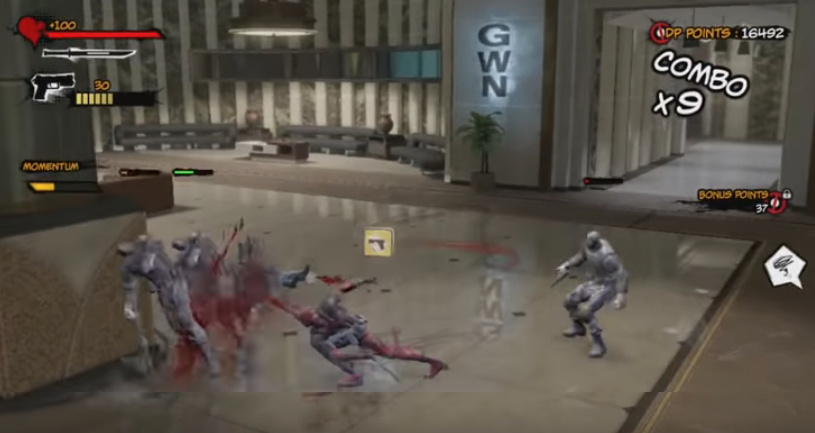
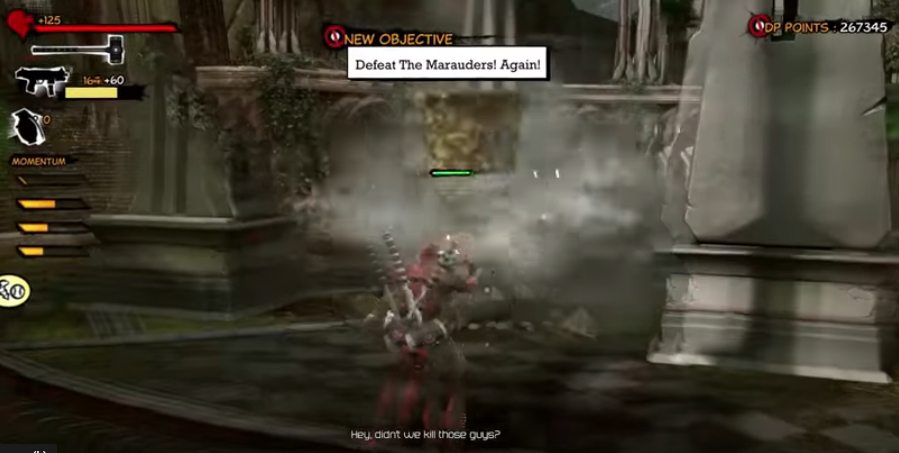
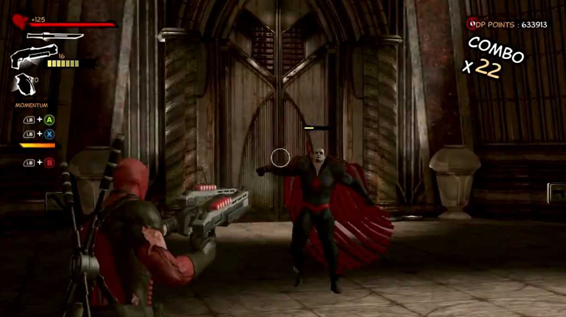
Deadpool is a third-person, hack-and-slash action shooter with some elements of stealth and platforming. Ostensibly taking its cues from the God of War (SIE Santa Monica Studio/Various, 2005 to present) and Devil May Cry (Capcom/Ninja Theory, 2001 to present) franchises, players must use a variety of melee weapons (swords, sais, and mallets, all double-wielded) to hack apart enemies while also employing firearms (pistols, machines guns, and shotguns…also all duel-wielded) and grenades to blow apart anyone who gets in their way. Deadpool is also equipped with a teleporter to travel short distances or dodge and counter enemy attacks and is tasked with performing some rudimentary platforming across gaps and floating platforms. Deadpool’s teleporter can be upgraded to assist with this and he can also wall jump, clamber up certain ledges, and teleport back to safety if he falls down a bottomless pit.

DeadpoolGameCombat
Cut through enemies to earn experience points.

There are, occasionally, sections of the game where Deadpool must perform a stealth kill; creeping up behind unsuspecting enemies, Deadpool can use any one of his weapons to execute his target in brutal fashion. Attacking enemies builds up Deadpool’s momentum and, by pressing two buttons together and either holding or mashing a button, Deadpool will unleash a super move to dispatch his foes. Attacking also employs a combo system; racking up a chain of combos awards Deadpool greater bonuses in the form of Deadpool Points (or “DP”), which can be spent upgraded Deadpool’s weaponry and basic stats (such as health and ammo). Deadpool is gifted with a generous healing factor; he can take a lot of punishment, and accrue damage to his costume and person but, if you duck away from the chaos for a few seconds, his health will automatically regenerate. If his health is depleted, you can restart from the last checkpoint, but you can also recover health by eating tacos.

DeadpoolGameVariety
The game always finds weird ways to keeps things entertaining.

There are a few more ludicrous moments in the game as well, such as when Deadpool’s head is twisted on backwards and he must chase his dog to recover his missing arm all while battling reversed controls. There are also moments where you blast enemies with laser cannons, take control of Rogue after she absorbs too much of Deadpool’s powers and personality, and classic 2D gameplay interludes that help to keep the game fun and interesting.

Graphics and Sound:
The jump to Xbox One hasn’t really done much to improve Deadpool’s aesthetics; the strongest element of Deadpool’s graphical presentation is in the character designs and the over-the-top, gore-filled anarchy of the game’s combat but environments leave a lot to be desired.

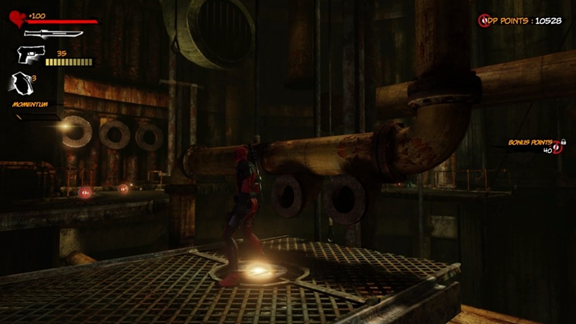
DeadpoolGameLevels
Deadpool‘s environments can be disappointingly bland.

While Deadpool’s apartment is full of character and some fun little things to interact with, you’ll quickly find yourself hacking your way through such exciting locations as…an office building, a sewer, and a prison. Deadpool does visit Genosha, which is an iconic Marvel location, and there’s a fun sequence where Deadpool embarks on a spirit quest, but none of the game’s environments are that lively or interesting to look at.

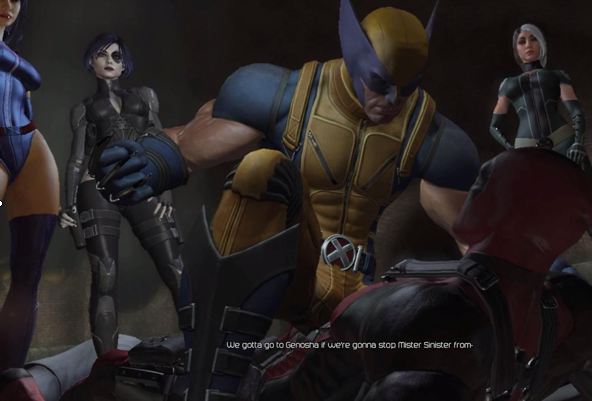
DeadpoolGameCharacters
Deadpool‘s character designs are top notch.

The game’s characters, however, look great; even the enemies and non-playable characters (NPCs) are all rendered in a gloriously over-the-top fashion that evokes Liefeld’s, shall we saw “trademark”, artistic style. Characters are all impossible muscles, jiggling boobs, or massive tanks and they animate with a charm and character matched only by the game’s on-point script. Sound design is where Deadpool really excels; while gunshots and sword slashes aren’t anything to write home about, the game is almost constantly narrated by Deadpool and his three competing personalities, voiced by the always-amazing Nolan North. Deadpool will quip, break the fourth wall, and comment on everything from the game’s design, his relationship with other characters (especially Mister Sinister, Wolverine, Rogue, and Cable), and, thanks to the work of former Deadpool writer Daniel Way, he is perhaps the most accurate recreation of the infamous anti-hero outside of the movies.

Enemies and Bosses:
Deadpool cuts his way through a whole mess of nameless, faceless goons in his quest to take out Mister Sinister; there’s the standard, everyday grunts who offer little in the way of resistance but then you’ll also have to contend with enemies who will buff their cohorts with shields or attack bonuses. However, things quickly ramp up once Deadpool starts battling Sinister’s clones. Cloned from some of Marvel’s most famous X-Men, Deadpool battles knock-off versions of Lady Deathstrike and Gambit while also having to content with the likes of Arclight, Blockbuster, and Vertigo. Each of these offers a different challenge that forces you to use different methods of attack: the Gambit clones, for example, rush at Deadpool and explode (all while constantly, hilarious, babbling “Mon amie!” over and over), meaning it’s better to take them out from a distance; the Deathstrikes and other sword-wielding enemies require you to mix up Deadpool’s light and heavy attacks to break their shielding, and the bigger enemies can only be put down by using Deadpool’s speed and more powerful attacks.

DeadpoolGameBosses
Deadpool‘s bosses can be tricky, if predictable.

Bosses are a slightly different breed; Vertigo will mess up your display and Blockbuster must be dodged, countered, and stunned before your attacks will do any damage. There’s no battles against massive Sentinels, unfortunately, and, quite often, a lot of Deadpool’s boss battles either boil down to a hit-and-run while taking out hordes of regular enemies, punishing endurance battles against waves of opponents, or a simple quick-time event.
DeadpoolGameSinister
Sinister doesn’t pose much of a threat.

Even the final battle against Mister Sinister isn’t all that thrilling; he simply attacks alongside copies (or clones) of himself and, as long as you keep your distance enough to keep your health regenerating and pick up the ammo strewn around the arena, it isn’t all that difficult. The endurance gauntlet that precedes it that sees wave upon wave of enemies relentlessly whittle your health down and then forces you to battle Arclight, Vertigo, and Blockbuster all at the same time is actually a lot harder than this final battle.

Power-Ups and Bonuses:
Deadpool comes equipped, by default, with his trademark double pistols and double swords; as you earn DP, you can purchase additional weaponry that can then be upgraded even further. This will allow your weapons to deal more damage, reward more DP, or make your enemies bleed so they die even faster. Some of the bigger enemies also drop massive laser cannons or grenade launchers that deal maximum damage but, as far as power-ups go, that’s about it. Deadpool will only get stronger and more powerful if you work to accumulate DP and spend it on upgrading his skills; once you have, though, you can unleash more of his special attacks and increase your odds in battle with more options. There are also occasions where Deadpool teams up with Cable, who will blast at enemies and help clear them out but, in terms of actual, acquirable power-ups that aid your gameplay, that’s about it.

Additional Features:
Deadpool is a single-player only experience; you’ve got the main story campaign, with three difficulty modes, a Challenge mode, and some character biographies and that’s about it. In the Challenges, you’ll be…challenged…with battling waves of enemies and graded on your performance; this, and replaying previous levels, is a great way to grind DP to upgrade your weapons and skills but it doesn’t really translate into actual, in-game rewards. There are no costumes, skins, or bonuses to unlock or earn here; it’s simply play, play some more, and work towards getting those Achievements. Speaking of which, there are obviously some Achievements to get in Deadpool; some are stupidly easy as the game literally just awards you two right off the bat but others are tied into more specific things, like interacting with NPCs, clearing sections in certain ways, repeatedly slapping Wolverine in the face, or surviving the sewer slide without injury. Some of the trickier ones will require a bit more of your time and patience but, if you just want to rack up a bunch of easy Achievements like I do, Deadpool has you covered.

DeadpoolGameSummary

The Summary:
There’s a lot to like in Deadpool; the action is fun and fast, the characters and writing are crude and amusing, and the gore and violence is a blast to take part in. However, the game does suffer from a jerky camera (you can lock it on to a target but I found that more difficult that it should be), some frustrating platforming sections, some bland environments, and some really annoying enemies. Perhaps the worst thing about Deadpool was the glitchy frame rate; I don’t know if it’s just my version and maybe my disc was a bit smudged or scratched but I constantly found the game would pause and stutter even when there were no enemies onscreen. This meant a lot of missed jumps, broken combos, and just a generally annoying experience, like I was fighting against the game most of the time. Overall, though, I think there’s enough here for fans of hack-and-slash, third-person action shooters and definitely enough for Deadpool fans. If you’ve never really had any exposure to Deadpool before than this game is a great introduction; once you learn to be patient with the game and enjoy its eccentricities, it’s a real blast to play through.

My Rating:

Rating: 3 out of 5.

Pretty Good

What did you think about Deadpool? Did you play it when it first came out or were you like me and hunted down a copy later on? Did you have any issues with the game bugging out on you? Leave a comment below and let me know what you though, and your feedback on my new format for Game Corner.

Movie Night: Pokémon: Mewtwo Strikes Back – Evolution

MewtwoEvolutionLogo

Released: July 2019
Director: Kunihiko Yuyama and Motonori Sakakibara
Distributor: Toho
Budget: $27 million
Stars: Sarah Natochenny, Michele Knotz, Bill Rogers, Ikue Ōtani, James Carter Cathcart, Michele Knotz, Dan Green, and Kōichi Yamadera

The Plot:
Cloned from the genetic material of the rarest Pokémon of all, Mew (Yamadera), and enraged at his mistreatment at the hands of humans, the Psychic Pokémon Mewtwo (Green) lures Ash Ketchum (Natochenny) and his friends to its island to witness its plan to enact revenge against all humanity.

The Background:
No doubt you are familiar with Pokémon (Nintendo/Creatures/Game Freak, 1995 to present), a role-playing videogame for Nintendo’s Game Boy and handheld consoles that, with no exaggeration, took the world by storm back in the late nineties. Everyone who was anyone rushed out to buy a copy of Pokémon: Blue Version or Pokémon: Red Version (ibid) back when they first released and, before long, kids everywhere were hooked on the seemingly never-ending stream of multimedia merchandise released by Nintendo. Chief amongst these was the still-ongoing Pokémon (1997 to present) anime series which, while somewhat removed from its videogame source material, nonetheless enthralled kids everywhere and, perhaps inevitably, led to the production of a feature-length animated movie, Pokémon the First Movie: Mewtwo Strikes Back (Yuyama, 1998). Then, for whatever reason, the decision was made, in the midst of a soft reboot to the Pokémon film series and anime alike, to remake this iconic movie entirely through the use of computer-generated imagery (CGI), resulting in this modern twist on what is, in my opinion, still the best Pokémon movie ever made thanks, largely, to the power of nostalgia.

The Review:
Basically, Evolution is exactly the same story as its predecessor but with a few noticeable changes; the most obvious is, of course, the CGI animation but other things, such as dialogue changes, narrative changes, and changes to the music, all help to freshen up the original movie. The opening scenes are largely the same (but, once again, the film skips the prologue that sees Mewtwo make friends with other clones who heartbreakingly die right before his eyes) as Mewtwo is cloned from a single cell of Mew and, unimpressed with the motivations behind his creation, destroys the facility in which it was created and kills all the scientists who birthed it.

MewtwoEvolutionRevenge
Mewtwo swears revemge against humanity.

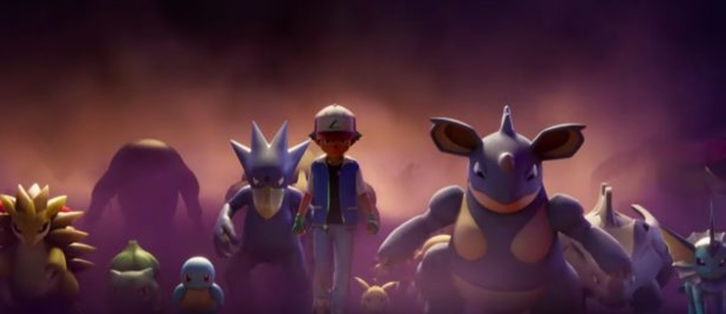
Summarily manipulated by Giovanni (Ted Lewis), the evil leader of Team Rocket and the mastermind behind its creation, Mewtwo’s rage against humanity leads it to organise a Pokémon tournament in order to build an army of clone Pokémon to “strike back” against the world that treated him so badly. In the middle of their journey through Kanto, Ash, Brock (Rogers), Misty (Knotz), and Pikachu (Ōtani) receive an invitation to Mewtwo’s island and, after braving a storm it created, immediately take umbrage to Mewtwo’s twisted world view and rally a group of trainers, their Pokémon, and even their long-time enemies from Team Rocket, Jesse (Knotz), James (Cathcart), and Meowth (ibid), in opposing Mewtwo’s plans.

MewtwoEvolutionOppose
Ash vehemently opposes Mewtwo’s plans.

Let me state first of all that, unapologetically, I absolutely love Pokémon the First Movie; I still remember going out of my way to purchase a bootleg VHS tape of the film back in the day before finally getting a legitimate copy from a car boot sale. As much as I’ve enjoyed subsequent Pokémon movies, nothing beats the nostalgia of revisiting the original film. It may have some flaws, largely based around the numerous changes made when dubbing the film into English that made Mewtwo far less sympathetic, but I will defend it to this day simply because it came right at the peak of Pokémon’s popularity for me; Pokémon: Gold Version and Pokémon: Silver Version (Game Freak, 1999) were due to be released around that time and the hype was real concerning brand new Pokémon, to say nothing of finally seeing Mewtwo in all its glory (it had been teased in several episodes of the anime prior to the movie’s release), much less going head-to-head with Mew, which was the most elusive of game secrets at the time due to their being no legitimate way to catch it outside of Japan.

The Nitty-Gritty:
Thankfully, Evolution doesn’t really alter that much from the original film, meaning that the only thing you’re really missing out on is the gorgeous anime aesthetic from the original. The CGI looks good on the Pokémon but the human models look a little…off, like they’re made of plastic, which gets a bit distracting at times.

MewtwoEvolutionBattles
A lot of the battles have been improved and expanded upon.

Additionally, there were a few odd choices made here; dialogue is altered significantly, to the point where it feels much closer to the original Japanese dialogue (if that makes sense) but then, about halfway through, the dialogue changes and is almost exactly the same as in the original film (Mewtwo’s closing monologue, for example, is pretty much word-for-word). There’s also the criminal decision to supplant the original dub score with a new one (those who preferred the Japanese score will likely be thankful for this, however) and completely remove Blessid Union of Souls’ ‘Brother My Brother’ from the epic final clash.

MewtwoEvolutionTears
Ash’s sacrifice still hits in the feels…

One change I did appreciate, however, was the complete remove of the “tears of life” sub-plot; in the original, Ash and the others are fed a nonsense story about Pokémon tears being able to restore the dead to life, which was completely missing from the original Japanese version. While this did bring a lot more context to Ash’s resurrection in the film’s climax, it never sat well with me in the original as it always felt wedged in there.

MewtwoEvolutionChanges
Evolution features some welcome alterations to the original.

Similarly, Mewtwo’s mechanical suit gets on hell of a bad-ass upgrade, Team Rocket’s amusingly ridiculous disguise as Viking sailors, of all things, is removed completely (and for the better), and minor niggles like Pokémon being referred to incorrectly have been addressed. There are also some improvements made through this remake, as well; the ambiguity surrounding Mewtwo’s motivations that was explicit in the original Japanese release is far more prevalent here than in the original dub, for one thing. Some of the battles also receive a makeover, such as Ash’s initial battle during the iconic Pokémon theme song and the battles between the cloned start Pokémon and their biological counterparts.

MewtwoEvolutionSUmamry

The Summary:
In the end, Pokémon: Mewtwo Strikes Back – Evolution is a nice little update to a childhood favourite; it adds in a lot of subtle story beats that were missing, beefs up some of the battles and content, and adds a fresh coat of paint to a classic. Yet, at the same time, it feels incredibly redundant; beyond the CGI overhaul and a few of these alterations, there’s not much new happening here and, considering the fact that the Pokémon movies are completely removed from the anime, it feels a bit weird to have this suddenly released upon us. A big factor into my final score comes down to my unconditional love for the original movie but even I kind of feel like much of the same could have been accomplished by releasing a high-definition, digitally remastered version of the original movie with all of the cut content restored alongside the recording of a new dub and the option to watch in the original Japanese.

My Rating:

Rating: 4 out of 5.

Great Stuff

What did you think of Pokémon: Mewtwo Strikes Back – Evolution? Do you think it is a good tribute to Pokémon the First Movie: Mewtwo Strikes Back or do you, perhaps, not share my fondness for that movie? Whatever the case, feel free to share your Pokémon thoughts and memories in the comments.

Game Corner: Zool: Ninja of the “Nth” Dimension (Mega Drive)

GameCorner
ZoolLogo

That’s right; we’re back in the nineties with another bright, colourful action/platformer. This time we’re looking at one of many attempts by the Amiga to copy SEGA’s success with Sonic the Hedgehog (Sonic Team, 1991), Zool: Ninja of the “Nth” Dimension (Gremlin Graphics, 1992), which was ported to the Mega Drive by Electronic Arts. Given that it released about a year after Sonic, and about a month before Sonic the Hedgehog 2 (Sonic Team, 1992), Zool was one of the first videogames to ape Sonic’s success and even beat the franchise to the punch in some ways. Hell, just look at his eyes; they’re almost exactly the same style as Sonic’s!

ZoolStory
Zool used cutscenes and comics to tell its story.

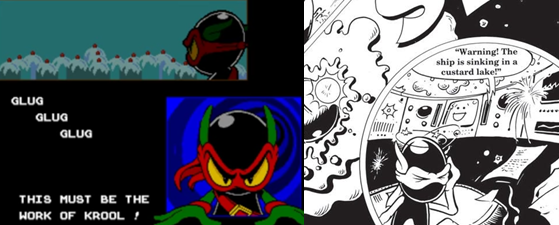
One of the main things that sets Zool apart from Sonic is its use of text-and-picture cutscenes in the game’s opening and ending to tell its story; this story was also elaborated on through a charming little comic included in the game’s manual. It would be some years before Sonic videogames even used in-game sprite animations to convey their story, much less text-and-picture cutscenes.

ZoolChupa
I’d rather have a packet of Love Hearts…

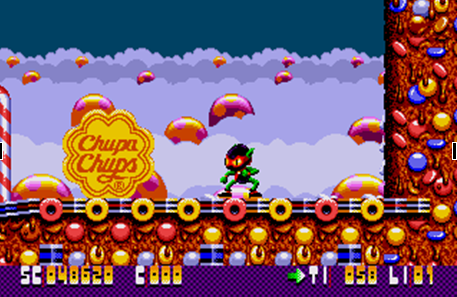
As we saw in Cool Spot (Virgin Games, 1993), Zool also includes some rather unsubtle product placement; the entire first World is littered with Chupa Chups, quite possibly the most generic lollipop sweet there is. Quite how Zool contributed to the sale and advertisement of Chupa Chups is beyond me but perhaps it was this advertising revenue that allowed the videogame to be ported not only to the Mega Drive but also to MS-DOS (where it would later be surpassed by the far superior Jazz Jackrabbit (Epic MegaGames, 1994)), Game Boy, Game Gear, Master System, SNES, and even the Atari ST.

ZoolWorlds
Zool‘s Levels are certainly vibrant.
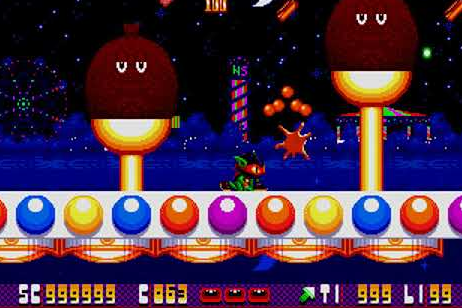
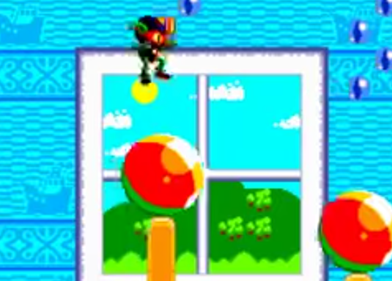
But let’s start from the top; upon beginning the game, players are immediately tossed into an absolute blast of bright, vibrant colours and catchy, rock/electronic music. Zool, a little gremlin ninja thing from the “Nth dimension”, must jump, blast, and spin his way across seven equally animated and colourful Worlds (each with four Levels), defeating the minions of Krool in an effort to return to his home dimension.

ZoolAttacks
Blast, spin, and slide your way to victory.

Despite wielding energy sticks on the game’s box art, Zool’s primary form of attack is to blast enemies with energy projectiles; however, unlike other sidescrolling shooters, Zool can only fire projectiles in the direction he is facing. Zool can also perform a spinning top attack when jumping to attack airborne enemies or break certain level obstacles or, thankfully, simply jump on enemies to defeat them. Zool can also scale walls by either climbing or jumping up them, slide under spikes and through narrow gaps, and fire projectiles whilst ducking.

ZoolMaze
Zool darts around maze-like Levels at break-neck speed!

Arguably, Zool plays a lot faster that Sonic, however the game lacks some of the polish of SEGA’s iconic platformer; controlling Zool is like skating on ice on the Moon as Zool darts across Levels and soars through the air seemingly in defiance of gravity. While this doesn’t stop the game from being extremely fun to play or make navigating Levels that difficult, it can make some of the game’s attempts at precision platforming trickier.

ZoolGoal
You have to collect items and find a coin to clear Levels.

What does get in the way of navigation is the game’s primary gameplay mechanic; in order to clear a Level, Zool must collect a certain number of items. These change as Zool visits new Worlds (being anything from various fruits to CDs and bath toys) and the number you must collect depends on the difficulty you set the game to. Once Zool has collected enough items, he must follow an extremely vague arrow in the game’s HUD to reach a coin and be spirited away to the next Level or World.

ZoolHidden
Blast walls to reach hidden routes.

Zool must do all of this while battling against not only respawning enemies and level obstacles such as spikes and disappearing platforms but also while traversing the game’s maze-like Levels. Some Levels are considerably more labyrinthine than others, to be fair, and sometimes the game cheekily hides your route behind a wall that must be blasted open…though, as there’s no visual distinction between walls, it’s easy to miss these routes entirely.

ZoolBosses
Truly the stuff of nightmares!

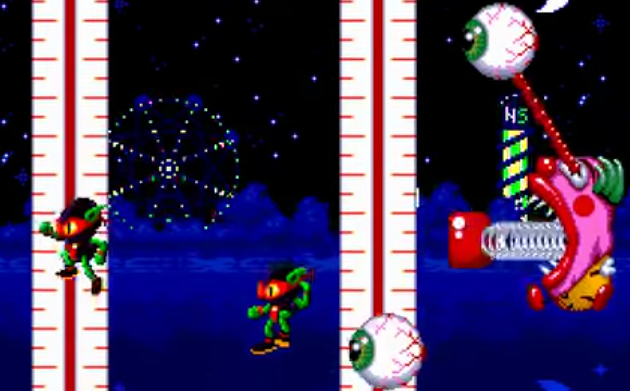
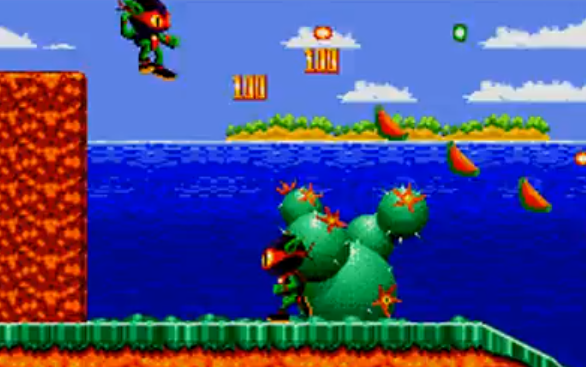
Zool’s enemies are as wacky and outrageous as the game’s Worlds; Zool must contend with the likes of anthropomorphic jelly, killer violins, floating screws, projectile-spitting liquorice treats, and evil fruit (the implication being that sweets are good and veggies are bad…which I can get behind). To clear each World, Zool must also battle equally weird and wild bosses, such as a giant cactus and a screaming pink head with a spring-loaded boxing glove for a tongue!

ZoolPowerUp
Double Zool’s shot with power-ups!

Luckily, Zool has plenty of things to assist him in his mission; Zool has an energy bar and can take three hits before losing a life, can blast various checkpoints to respawn at a number of different points throughout a Level, and can collect numerous power-ups that increase his jump height, give him a shadow to double his firepower, increase his time, destroy all onscreen enemies, or make him invincible.

ZoolSecret
Some hidden mini games add some spice.

There are a few hidden secrets to be found in Zool as well; when I played the Master System version, I distinctly remember accidentally finding a warp point that simply took me straight to the game’s ending. There’s also some mini games and arcade games that can be played by doing certain actions in some Levels to add a little intrigue and variety to the proceedings.

ZoolControls
Platforming can get tricky.

Zool isn’t especially difficult, even on its hardest difficulty setting; 1 Ups are scattered across Levels (sometimes extremely liberally) to increase your chances, enemies often drop health, and the bosses have very simple attack patterns. However, there are some frustrating elements; the time limit, for one, and having to collect enough items to access the exit point, for another. While there are no bottomless pits, there are some frustrating platforming sections that require Zool to jump to very small, disappearing platforms and, if you fall, it can be a chore to get back up, especially as the enemies will respawn.

ZoolEnding
Turns out it was all for nothing and the REAL battle is still going on!

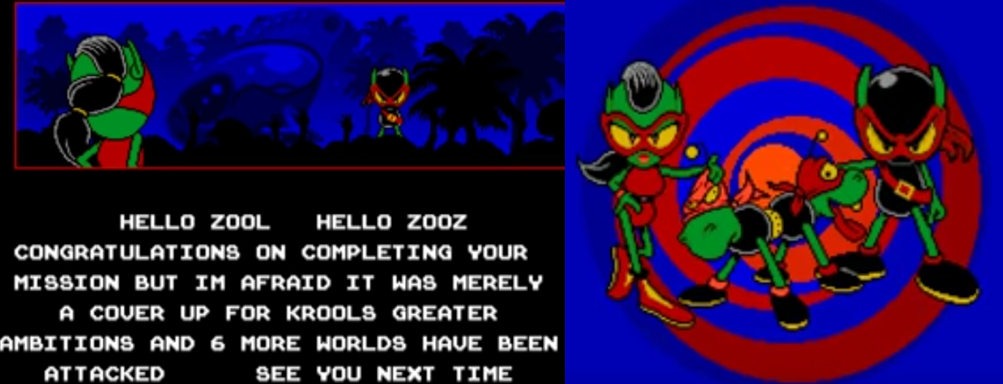
Perhaps the biggest letdown of Zool, though, is the ending; after defeating the final boss, Zool successful escapes back to the Nth dimension where he is greeted by Zooz, his female companion. Although she congratulates Zool, she reveals that Krool has invaded another handful of worlds, essentially making the ending a giant tease for its sequel, Zool 2 (The Warp Factory, 1993). This might be fine but, unfortunately, Zool 2 never received a port to the Mega Drive, all but forcing players to invest in an Amiga or other such console to play the sequel. I did own Zool 2 back when I had an Amiga and remember it being a pretty fine little game in its own right; this time, players can select between Zool and Zooz, with each character playing slightly differently (Zooz had a whip…) and being able to take alternative routes through Levels. It’s a shame that Zool 2 didn’t get the same cross-platform release but I guess that does go some way to making Zool the unofficial mascot of the Amiga. Unfortunately, despite these two titles, the myriad number of ports Zool received, and even a couple of young adult novels, Zool has pretty much faded into obscurity. Quickly surpassed by Sonic 2 and other similar action/platformers, Zool never quite managed to outshine Sonic like the Amiga probably hoped he would. Zool’s time in the sun was very brief and it’s a shame, really, as, despite the game’s slippery controls, the character has a unique design and his games were extremely bright, energetic fun with some nice levels of animation. When it comes to a re-release, port, or HD remaster, I’d like to say “never say never” as even the similarly-themed, arguable more obscure Superfrog (Team17, 1993) got a nifty HD version in 2016 but it does seem like Zool’s brief flirtation with fame has long since passed.

My Rating:

Rating: 4 out of 5.

Great Stuff

Do you remember Zool? If so, which version did you play? If you haven’t, I urge you to track down a copy and give it a whirl but, either way, let me know your thoughts in the comments below.

Mini Game Corner: Mighty Morphin Power Rangers (Mega Drive)

MMPRLogo

Released: 1994
Developer: Banpresto/Nova
Also Available For: Super Nintendo Entertainment System, Game Boy, Game Gear, and Mega CD

The Background:
If you were a kid back in the early nineties, right after you finished up being obsessed with what we in the UK know as Teenage Mutant Hero Turtles (1987 to 1996), and before Pokémon (1997 to present) took my generation by storm, you were all about Mighty Morphin Power Rangers (1993 to 1996). Cobbled together from stock footage from the Japanese tokusatsu series Gosei Sentai Dairanger (1993 to 1994) and Ninja Sentai Kakuranger (1994 to 1995), Power Rangers focused on five teens “with attitude” (despite the fact they were a bunch of geeky do-gooders who couldn’t break a rule if they were held at gunpoint) imbued with superhuman powers and abilities. Harnessing the power of the dinosaurs, they could transform into martial arts superheroes and conjure giant mechs to battle against the forces of evil. To say Power Rangers was a cultural phenomenon would be an understatement; parents were outraged at the glorification of violence but we headed out in our droves to buy every bit of Power Rangers merchandise we could, from t-shirts to action figures. Given its dominion over the playground and the airwaves, you know that this also meant the franchise received its own multi-platform videogame that I’m sure hapless kids everywhere begged their parents to buy for them.

The Review:
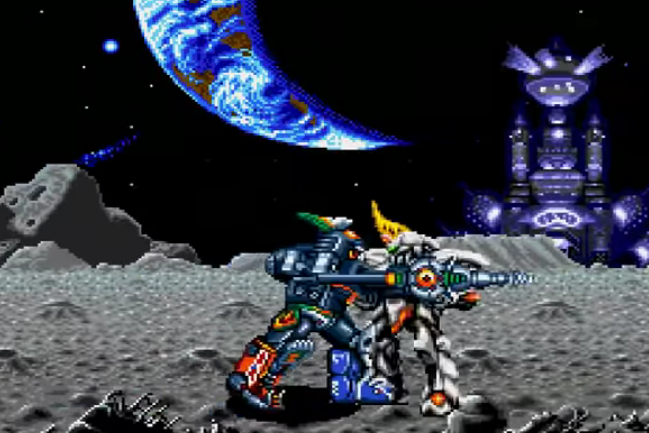
Mighty Morphin Power Rangers is a simple 2D fighting game; you can choose to battle head-to-head with a friend or take on the game’s Scenario Mode, where you’ll battle one of Rita’s minions in a format that will be more than familiar to anyone who has played a Street Fighter (Capcom, 1987 to present) videogame. However, Street Fighter II: The World Warrior (ibid, 1991) this is not; first of all, you’re (unsurprisingly) limited to only six playable characters (the titular Power Rangers). Each plays largely the same and the variations come only in their special attacks and weapons; the Red Ranger wields a sword but the Black Ranger has an axe, for example. After you face, and defeat, the evil Green Ranger (in my opinion, the greatest Power Ranger of all time), he becomes a playable character as well. There’s one main difference between playing as the Green Ranger compared to the other Rangers, though, and that’s in the game’s other battle mode. Once you defeat Rita’s monster, she’ll make it grow (as she is wont to do…) and the Rangers summon the Megazord to battle it. The Green Ranger, however, summons the Dragonzord but it basically amounts to the same thing: smash the buttons until you whittle away the enemy’s health bar and win.

MMPRFinal
The game’s literally over in less than an hour. It’s sad.

If you’re looking for depth…well, there isn’t any. Power Rangers the game has about as much depth and variety as Power Rangers the television show. I literally sat there, mashing buttons and hardly even trying, and never lost a single round. When I fought the Green Ranger as the Black Ranger, I did one whirlwind attack with Zack’s blade and won without Tommy landing a single hit! The game is also pathetically short; you always battle the monster on the same stage for the first fight but, once you’ve battled all five of Rita’s minions, the game is over and you’ve pretty much done everything Power Rangers has to offer in less than an hour. Unless you suck at videogames, but I’d wager even if that is the case you could beat Power Rangers without a great deal of difficulty.

MMPRGreen
Once you go Green you never go back…


Graphically, there’s not much to write home about; the sprites themselves are colourful and large and surprisingly detailed but not very animated. The backgrounds are even worse, being largely barren and devoid of life or character, and severely lacking in variety. It’s pretty much the same story for the game’s sound, too; there’s a noticeably bad rendition of the iconic Power Rangers theme and some shitty voice samples but the in-game sounds are muted and dull. Characters grunt and yelp a bit and Zords thud about but it all sounds so half-assed and a far cry from the loud, impactful sounds the Mega Drive is capable of producing. There are some nice cutscenes between battles that tell the story and evoke the same spirit as the television show but they don’t really contain much in the way of animation, meaning the game is outclassed by even some Master System titles in that regard.

MMPREnemies
Get used to seeing this same stage over and over…

As I mentioned above, the game has only five enemies to battle against. Sure, you face each one in two different types of battle but, if you’ve ever seen Power Rangers, you’ll know that doesn’t really mean much as the monster’s second form is literally just a bigger version of its first form. Goldar makes an appearance (he was the only monster I actually recognised…) but there’s no Putty Patrol to wade through and no Lord Zedd as the game is only pulling its inspiration from the first series of the show. Similarly, there aren’t any beyond the different weapons and abilities of the Power Rangers. The only thing to unlock here is the Green Ranger, which is the second battle and, once you have him, you’ll never pick another character because Tommy is the best character. Finally, you can battle against a friend but, honestly, I can’t see why you’d even bother.

MMPRSummary

The Summary:
Mighty Morphin Power Rangers may have been a cultural phenomenon but this videogame outing is a dreadful experience; the controls are sluggish, the battles are ridiculously easy, and the game is just boring from start to finish. I wouldn’t even recommend this to die-hard Power Rangers fans as there are far better Power Rangers videogames available; the game’s counterpart on the SNES, for example, or the one based on the movie. Either way, just don’t even give this the light of day and stick to playing Street Fighter II because the only thing “mighty” about this game is how bad it is.

My Rating:

Rating: 1 out of 5.

Terrible

Did you watch Power Rangers when it first aired? Who was your favourite Ranger and why was it the Green/White Ranger? Do you think I was too harsh on the Mega Drive videogame, or have a favourite Power Rangers videogame? Let me know in the comments.

Talking Movies: The Invisible Man (2020)

Talking Movies
InvisibleManLogo

Released: March 2020
Director: Leigh Whannell
Distributor: Universal Pictures
Budget: $7 million
Stars: Elisabeth Moss, Aldis Hodge, Storm Reid, Harriet Dyer, Michael Dorman, and Oliver Jackson-Cohen.

The Plot:
After finally leaving her long-term abusive boyfriend, Adrian Griffin (Jackson-Cohen), Cecilia Kass (Moss) finds herself unable to shake his oppressive presence when, following his apparent suicide, she suspects that he is still stalking her.

The Background:
Remember The Mummy (Kurtzman, 2017)? Well, that was supposed to be the latest attempt by Universal Pictures to launch the “Dark Universe”, a series of interconnected horror/action/science-fiction movies that would bring together the classic Universal Monsters for the first time in decades. However, The Mummy tanked and Universal were forced to change their tactics and focus, instead, on standalone stories that reimagined their horror classics. Personally, I didn’t find it to be that and a movie and the cast that Universal had assembled for their dark Universe was very impressive and promising. Veering away from the Johnny Depp-starring vehicle, Universal instead turned to Leigh Whannell to create a modern take on The Invisible Man (Wells, 1897) that bypassed the classic Universal horror of the same name (Whale, 1933) and, instead, concerned itself more with being an intense thriller with elements of sci-fi and horror mixed in.

The Review:
One day, after years of being trapped under the thumb of her sociopathic, controlling boyfriend Adrian, Cecilia decides to creep out in the dead of night after drugging him; as she’s being picked up by her sister, Emily (Dyer), Adrian tries to attack her but his threat seems to be over when, two weeks later, it is revealed that he killed himself.

InvisibleManCast
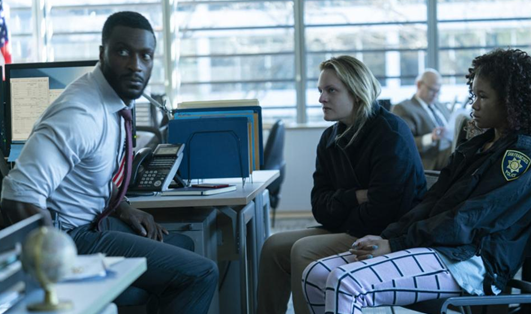
Despite its flaws, you can’t fault (most of) the cast.

Cecilia has hidden herself away from Adrian and the world by moving in with her friend, James (Hodge) and his teenage daughter, Sydney (Reid). After Adrian’s lawyer brother, Tom (Dorman), reveals that Adrian left Cecelia $5 million, she finally begins to turn her life around. However, she soon begins to feel Adrian’s presence looming over her everyday life; after years of abusive and mistreatment, her fears are dismissed as paranoia and shock but, before long, things start to happen that can’t be explained away and Cee begins to suspect that her former lover, a world leader in optics, has faked his death, discovered a way to make himself invisible, and is stalking her, destroying her relationships and life bit by bit to force her to return to him.

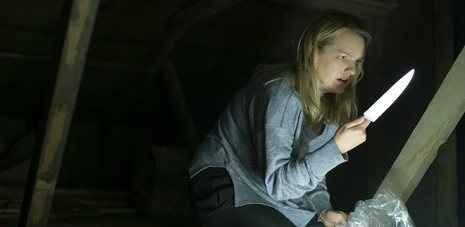
InvisibleManTramua
Strange events start haunting Cecelia.

What separates The Invisible Man from other adaptations is its singular focus on the victim, rather than the titular antagonist; normally, Invisible Man stories and their contemporaries revolve entirely around a man who turns himself invisible and is slowly consumed by its intoxicating effects. Here, though, we follow Cee as she succumbs to fear and hysteria, not only from the threat of an actual invisible man, but also the lingering effects of her toxic relationship with Adrian. There aren’t enough words to describe how great Elisabeth Moss is at portraying a woman who is struggling to return to normal, everyday life and is clearly traumatised by her abusive boyfriend and also seemingly haunted by his continuing presence.

InvisibleManTom
This guy’s definitely…in the movie…

Surrounding her is a similarly decent cast; Hodge and Reid have great rapport with Moss and you definitely believe in their platonic, yet loving, relationship. There’s some friction between Cee and Emily that goes back to their childhood, but it’s not really expanded upon and takes a backseat to the more pressing concerns about Cee’s mental health, and there isn’t much for Tom to really do except exist as another victim of Adrian’s destructive behaviour.

InvisibleManTension
The Invisible Man really excels at building tension.

Ostensibly, The Invisible Man is a tense thriller; there’s some really unique framing choices and camera work at use here to make you feel on edge and uncomfortable at all times, as though there really is another, unseen man present in most scenes. Whannell favours building tension over a high body count and this keeps the film on a razor’s edge; once the pace picks up, things get even more intense as we follow the deterioration of Cee’s mental health…but it’s far from perfect. As a big fan of The Invisible Man, I wasn’t really expecting this to be a character study of the trauma victims of abusive relationships can suffer through. To be fair, judging from the trailers, I was expecting little more than a jump-scare thriller, so it was surprising to find the film had so much meat on its bones but I have some issues with its execution and pacing that spoiled the experience for me.

The Nitty-Gritty:
First of all, there is and invisible man in this movie; the trailers made this pretty explicit but the film does a really good job of making you question whether it’s a ghost, an invisible man, or just all in Cee’s head. However, I feel this is a bit disingenuous; I went into it expecting an invisible man and wanting to “see” an invisible man, so to constantly beat around the bush was a bit frustrating.

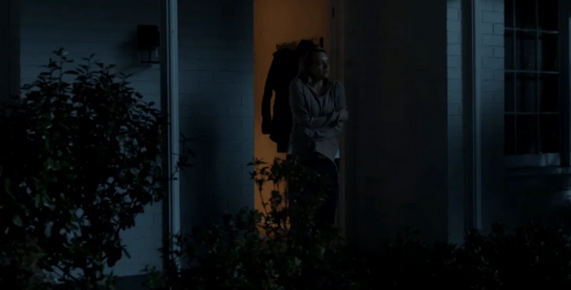
InvisibleManMadness
Here it’s the victim who struggles with her sanity…

We don’t ever really get much of a sense of who Adrian really is; he’s talked about at length but there’s not much time spent on why he was so abusive to Cee or what drove him to form such destructive relationships with people. It saps him of some of his menace and makes him, instead, he’s just a silent stalker who dispatches those in his way with little effort. It turns out that Adrian developed a special suit comprised of loads of little cameras that allows him to appear invisible; this is a change of pace as, usually, invisible men take a serum that renders them invisible but, while the suit may be more “realistic”, it carries exactly the same issues as a serum does…and even a few more. For example, the suit completely covers Adrian, so how does he see out of it? Its skin-tight surface is covered with plastic and cameras so, surely, he would make quite a bit of noise when he moved and, if he somehow didn’t, his muffled breathing would be hard to disguise.

InvisibleManPacing
I had some issues with the film’s pacing…

Also, somehow, Adrian appears to be superhumanly strong; he can lift Cee with one hand, toss her across rooms, and beat men to death, or close to it, without much problem. I don’t really see how his fancy suit helps him do that, even though it does make for some impressive action and kill scenes in the film’s final act. The big twist turns out to be that Tom is in on it all too; Cee remains steadfast that Adrian put Tom up to it, however, and takes it upon herself to kill Adrian herself (cloaked in his same suit) to finally gain some catharsis but it’s left ambiguous as to whether Adrian did actually stalk Cee while invisible or if it was always Tom…or the both of them. And yet I find it hard to really care as neither man is Claude Rains (hell, they’re not even Kevin Bacon!) and reducing the invisible man to a silent killer sucks a lot of the charm and menace out of the normally talkative antagonist.

InvisibleManConclusion

The Summary:
The Invisible Man is one hell of a tense, nail-biting thriller; the film does a masterful job of building tension and suspense and Elisabeth Moss puts in a great performance as an emotionally-scarred victim but, in the end, I just couldn’t really get into it. Despite the film’s interesting take on the classic Invisible Man formula, we’re left with a poorly-defined villain and some forgettable supporting characters; the all the tension and build in the world can’t overcome the fact that The Invisible Man overstays its welcome for way too long (the film doesn’t seem to know how, or when, to end and drags on and on) and sacrifices too much of the original source material and concept to tell an otherwise moving story of a victim of abuse.

My Rating:

Rating: 2 out of 5.

Could Be Better

Game Corner: Sonic Mania 2 Wish List

GameCorner
SonicMania2SonicMania

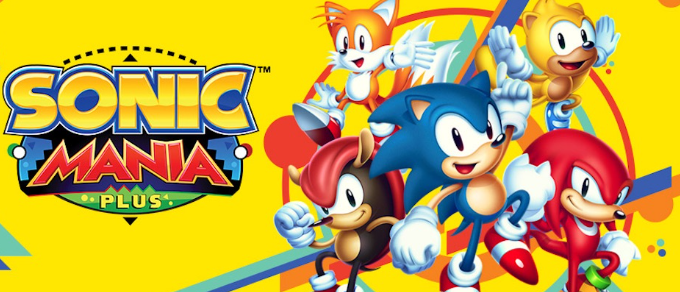
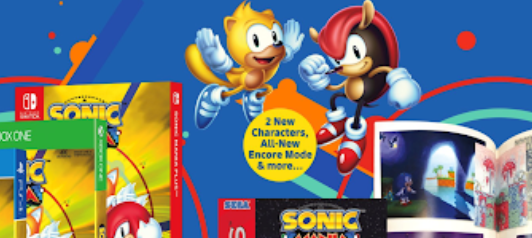
Sonic Mania (PagodaWest Games/Headcannon, 2017) was a hit, there’s no doubt about it; within a year, the game sold over one million copies. A physical edition, Sonic Mania Plus, was later released in 2018 featuring all the updates and downloadable content (DLC), and some nifty extras like a reversible sleeve that featured classic nineties-inspired artwork. In addition, Sonic Mania Adventures (2018) had a nice little five episode run online alongside a few bonus episodes along the way to keep the game alive in the minds of fans and the general public. However, since Sonic Mania released, we’ve heard very little about a sequel; in 2018, Takashi Iizuka stated that a sequel was not likely to happen as “it feels like we did everything we could for the Sonic Mania project”. With 2020 being touted as the “Year of Sonic” and some major announcements planned to take place in the run up to Sonic’s 30th anniversary, I think it’s only fair to hope that Sonic Mania 2 is on the cards for a 2021 release.

With that in mind, or just for a laugh, today I’m going to talk about a few key features I’d like to see in a potential Sonic Mania sequel…

SonicMania2GreenHill
Less Classic Zones

Don’t get me wrong, I love a good HD reimaging of Sonic’s classic Zones as much as the next person but, if SEGA have proven anything about their understanding of Sonic it’s recent years, it’s that they rely way too much on the same familiar Zones. Sonic Mania, admittedly, mixed it up a bit with the likes of Flying Battery Zone and Oil Ocean Zone but we still saw yet another rendition of both Green Hill and Chemical Plant Zone, which both featured heavily in Sonic Forces (Sonic Team, 2017) and that released in the same year! Regardless, I would still like to see some classic Zones make a comeback but SEGA really need to start taking some chances; why not use Emerald Hill Zone, or combine it with Hill Top or Aquatic Ruin Zone, for the traditional grassy-fun opening level? Why not use Scrap Brain Zone instead of Chemical Plant, or bring back Ice Cap and Marble Garden Zone? One of the things I did like about Sonic Mania, which also cropped up in Sonic Generations (ibid, 2011), was the use of gameplay gimmicks being incorporated into other Sonic Zones and I feel like this would be a great way to go in Sonic Mania 2. If you’re going to do Scrap Brain Zone, for example, throw in some of the steam-based mechanics from Metropolis Zone; if you’re bringing back Spring Yard Zone, toss in some of the pinball mechanics from Toxic Caves; if you’re making new Zones (and you absolutely should), splice in the dreaded barrel from Casino Night or the light-based mechanics from Sandopolis Zone. There are so many great levels and gimmicks from the last thirty-five years of Sonic’s life and returning again and again to Green Hill and Chemical Plant would be very disappointing, even if those Zones were mixed up with new mechanics. Go new, or outside the box, to show some real narrative and aesthetic growth.

SonicMania2DLC
Don’t Drop DLC Characters

Okay, I know I’m in the minority with this one but I like Sonic’s extended cast of characters; they’re fun and colourful and each one has a unique gimmick that has been either poorly utilised, undervalued, or simply slapped onto Sonic either through his base moveset or through the use of Wisps. Why include Tails as a playable character when Sonic can “Hover!!Sonic Mania did a great thing by finally (finally) bringing back Mighty the Armadillo and Ray the Flying Squirrel; not only did they come back but they were far more than Sonic reskins and their individual abilities and personalities really came through thanks to their unique gameplay mechanics and Sonic Mania’s gorgeous sprite animation. For Sonic Mania 2, they absolutely should include both of these characters right off the bat. It really irks me when DLC characters are still DLC in a sequel. Maybe have them unlocked along the way after defeating bosses, like in Sonic Advance 2 (Dimps/Sonic Team, 2002). In fact, I would look to the Sonic Advance series (ibid, 2001 to 2004) for a lot of inspiration for a Sonic Mania sequel in two very specific ways. First of all, Amy Rose should definitely be a playable character. She apparently missed out on being included in the first game because “she’s the only one without a kind of gameplay-oriented “power”” but she did show up in Sonic Mania Adventures and, honestly, it is a crime that she wasn’t included in Sonic Mania not just because six playable characters makes a lot more sense than five but also because she’s just as much a part of Sonic’s history as Metal Sonic and he was included.

SonicMania2Teams
Team moves have promise that Sonic Mania 2 could expand upon.

Amy should feature in much the same way she played in Sonic Advance but tweaked slightly; have her hop by default and twirl around in a Spin Attack with her Piko-PIko Hammer when you press the button again, similar to Sonic’s Insta-Shield. Holding down and X would see her rev up on the spot, like in Sonic Advance but, when the button is released, she should blast away swinging her hammer to attack enemies. I’d like to see Amy be a bit more floaty, kind of like Princess Peach in Super Mario Bros. 2 (Nintendo EAD, 1988), to basically make her an “easy mode” character for younger players and to compensate for her moving slower and jumping lower. Secondly, Sonic Mania 2 should really capitalise on its expanded roster to build upon the team-based gameplay seen in Knuckles’ Chaotix (SEGA, 1995), Sonic Advance 3 (specifically), and Sonic the Hedgehog 4: Episode II (Dimps/Sonic Team, 2012). This means that not only would we finally be able to play as Sonic and Knuckles, or Knuckles and Tails, but we’d also be able to team up any two characters for co-operative play and to utilise some unique co-op mechanics. For example, playing co-op with Tails would be pretty much the same for every character (Tails can carry his partner while flying or swimming) but teaming with Knuckles would see characters jump onto his back to glide across gaps and use his immense strength to bash through walls. Teaming with Sonic could involve the use of a faster speed dash or a general increase in speed and jumping power, which would be great for Knuckles and Amy. Mighty, meanwhile, could jump ahead of his partner to shield them with his shell and use his slam to break through areas of the ground, while Ray could use his bushy tail to swat his partner up in the air and help them swing across vines and ledges. Given that multiple different character variations were included as part of Sonic Mania Plus’s “Encore Mode”, I would definitely include this co-op gameplay right from the off, if only to add some variety to the gameplay and to, hopefully, refine and perfect this mechanic, which has always had a lot of potential but never quite been that great in execution.

SonicMania2NewCharacters
Add MORE Playable Characters

So I think I’ve made a convincing argument that Amy, at the very least, needs to be a playable character in Sonic Mania 2 but why stop there? The one thing SEGA should not take away from Sonic Mania is that players only want to play as Sonic; the developers definitely should totally use the sequel as a means to bring in some more classic Sonic characters like Metal Sonic (most likely only available until after completing the main story mode), Espio the Chameleon, and Vector the Crocodile as DLC. Espio and Vector looked so wacky and had some unique twists to their gameplay in Knuckles’ Chaotix that I would love to see turn up again, like Epsio’s Spinning Top Attack and Vector’s weird cartwheel-spin-thing. Let’s take this further, though, and have Espio incorporate the wall-jumps from Knuckles’ Chaotix and, by holding X alone, turn invisible/translucent for a brief period while Vector could gobble up enemies and spit them out as a projectile like Yoshi, perhaps. Teaming with Vector would see him launch the player in an arc, while Espio would toss them upwards, in a variation of the “Hold!” team-ups from Knuckles’ Chaotix.

SonicMania2Charmy
Charmy’s tiny size makes him perfect as a Cheese-like projectile.

You could make a case for also including Charmy Bee but I always found is tiny (miniscule, even) size in Knuckles’ Chaotix a bit of an issue; I would either redesign him to be about the size of Tails or relegate him to a power-up that can be obtained by breaking a Monitor. He could then buzz around the player and automatically attack nearby enemies, similar to Cheese in the Sonic Advance games, until the player takes a hit. As for Metal Sonic, I would have him be a faster, slippery variation of Sonic but with a couple of changes; pressing A to jump and then A again could see him blast off a magnetic pulse that attracts nearby Golden Rings and destroys any Badniks onscreen (it would be useless against bosses, however). Pressing down and A would see him charge up his booster and blast forward in a variation of the modern Boost mechanic, smashing through enemies as he goes, and teaming with Metal could see him form a brief barrier that protects the player and deflects projectiles. As a bonus, I would also like to see SEGA delve into the obscure and resurrect the Feel, the rabbit character that was the original concept for Sonic. Feel would basically play exactly like Ristar only he’d use his stretchy ears to grab and attack enemies rather than his hands; he could also use his ears as a kind of charged pounce when teaming with him.

SonicMania2Heavies
Bigger, Better Boss Battles

One thing I liked about Sonic Mania was the variety in the boss battles; similar to those seen in Sonic the Hedgehog CD (SEGA, 1993), boss battles were generally big, varied, and with specific tricks being required to beat them. I mean, we even had a mini game borrowed from Dr. Robotnik’s Mean Bean Machine (Compile/SEGA, 1993), which I really did not expect! In Sonic Mania 2, I’d like to see more of the same but with a greater focus on Doctor Eggman; the Hard-Boiled Heavies were fun but it didn’t really feel like we battled against Eggman enough in the first game. Given that the Heavies seem to have been a one-and-done deal, I don’t expect to see them return in the sequel; instead, I’m hoping we’ll see Eggman hop into some massive, mental mechas. Without one exception, however; I’d like to see Sonic Mania 2 take some more inspiration from Sonic the Hedgehog: Triple Trouble (Aspect, 1994) and feature Bean, Bark, and Nack/Fang as sub-bosses who hound the player constantly throughout the game. It was great to see them appear in the first game but, this time, I’d like to see them get a bigger spotlight for a change (if not as sub-bosses then, at the very least, as rivals to contend with in Special Stages for the Chaos Emeralds).

SonicMania2SpecialStages
Mix Up the Special Stages

Speaking of Special Stages, and Triple Trouble, I’d like to see Sonic Mania 2 mix up the format for each Special Stage; the half-pipe, rotating maze, and races against UFOs are great but, sometimes, it feels like SEGA fall back on these classic tropes way too often rather than try something new. No two Special Stages were the same in Sonic’s Game Gear outings and I’d like to see that format return; perhaps one stage is a rotating maze, another is a variation of the half-pipe in a race against Fang, another is the Blue Sphere stage, or Sonic is racing on Rocket Boots. This is also a great opportunity to weave in gameplay mechanics form other Zones and spin-off games, like snowboarding or, perhaps, even a mini game inspired by the Sonic Drift (SEGA/Arc System Works, 1994 to 1995) videogames. Either way, I feel that including Bean, Bark, and Fang as a team of mercenaries either working for Eggman or as wild cards after the Chaos Emeralds means that they should be involved in Special Stages, at the very least, and not sticking to one standard for the Special Stages would add a bit more variety and challenge to acquiring Chaos Emeralds.

SonicMania2Animation
Incorporate Animation

One of the biggest disappointments of Sonic Mania Plus for me was that the Sonic Mania Adventures shorts weren’t included in the bonus features; to be fair, they hadn’t finished making them when the game released but, still, it felt like a missed opportunity to not include them and like the definitive collection of all Sonic Mania materials wasn’t quite as “definitive” as it could have been. Going forward, I’d really like to see the developers use this animation style to tell the game’s story in the same way Sonic CD used anime sequences. As much as I love Sonic Mania’s sprite animations, the opening, ending, act transitions (which should be included after every Zone right off the bat this time), and interludes should all use animated cutscenes. I wouldn’t use any voice acting, though; just rely on music, sound effects, and grunts rather than ruin the mystique.

SonicMania2Content
More Content

I loved Sonic Mania and the extra features included in Plus really added to the experience but it definitely felt like the developers could do even more; “Encore Mode” was great, for example, but there weren’t any Achievements tied to it, which kind of takes away some of the incentive to play the mode. Obviously they’ll want to keep something back for DLC but, for starters, Sonic Mania needs to be, at least, twice as big as its predecessor; that might mean adding more Zones, or more Acts to Zones, and including features like day, night, and seasonal cycles/variants to the Zones. Maybe they game will utilise a similar time/space hopping mechanic to Sonic CD and allow us to travel to different time point sin certain Zones so we could finally play Wood Zone while playing Metropolis Zone. The Time Trials are an obvious inclusion and allowing us to replay the Special Stages and mini games was great but maybe the developers could include a Challenge Mode that has players play Zones in reverse, or forced to collect a certain number of Rings or destroy a number of enemies; perhaps take inspiration from the bonus missions in Sonic Generations where other characters challenge the player to a race or something as simple as a boss rush mode. Either way, this would add a nice extra layer of replayability to the game and open up the options for some more Achievements to be added.

SonicMania2Conclusion

Personally, I feel like if SEGA don’t produce a Sonic Mania sequel then they’re fools; the first game was everything long-time fans have been clamouring and begging for for years and it did really well. To not capitalise on that success is crazy to me; we should have seen similar follow-ups to other iconic SEGA franchises, and a Sonic Mania 2, long before now but, instead, we’re left with Sonic’s mobile titles while we wait for the inevitable next 2.5/3D Sonic game to cause division within the fanbase.

Leave a comment below with your thoughts on Sonic Mania? Would you like to see a sequel? Do you think we’ll even ever get a sequel? And what else do you think SEGA have in store for Sonic 2021?

10 FTW: Batsuits

10FTW

So, disappointingly, Ben Affleck is officially, 100% out as Batman. Despite my reservations about him being cast in the role, he delivered a really impressive performance as a tortured, grizzled Bruce Wayne who was driven to extremes after two decades of fighting an unwinnable war against crime in Gotham City. However, due to a multitude of reasons, Affleck is gone and, instead, The Batman (Reeves, 2021) will star Robert Pattinson in the title role as a younger Batman in his first years of activity. As with pretty much all Batman casting, this has caused some interesting ripples throughout the fandom but these discussions were only exacerbated when Reeves teased the first look at Pattinson’s Batsuit.

While this is obviously far from the clearest view, and leaked set images are showing either a much less refined stunt suit or lacking the filter of editing and post-production, there are some interesting choices at work here, such as Wayne apparently melting down the gun that killed his parents to form the symbol of his Batsuit. In any event, this seems like an appropriate time to take a look at some Batsuits from days gone by and talk about what makes them so iconic.

Batsuits10Knightfall
10 Knightfall (Batman #500)

I am pretty certain I am in the minority here but I really dig the armoured suit that Jean-Paul valley put together during the Knightfall (Dixon, et al, 1993 to 1994) storyline. Initially, Valley just augmented the existing Batsuit with some wicked mechanical claws that could shoot out Bat-Shurikens, a grappling hook and, apparently, a laser but, for his big rematch against Bane, Valley decided to go the whole hog and produce an entirely armoured ensemble that enabled him to best Bane easily. As the Knightfall arc progressed, the suit took on a darker, far more menacing look as it changed from blue to red; Valley also became increasingly dependent upon the suit as his madness progressed, refusing to take it off and using it in increasingly violent (and fatal) ways. Eventually, however, the suit proved Valley’s undoing as he was unable to squeeze through the narrow tunnel Bruce Wayne lured him into, which finally forced him to remove the suit and begin a difficult road to redemption. What I like about this suit, though, is how futuristic and dangerous it looks; it’s got an aerodynamic flair, has all these neat gadgets and upgrades, and makes Batman look like a cold-blooded figure who takes no prisoners, which is exactly what Valley embodied. The suit rarely makes much of an appearance these days, though it did appear as a skin in Batman: Arkham Origins (WB Games Montréal, 2013) and informed Valley’s subsequent appearances as Azrael over the years.

Batsuits9ZurEnArrh
9 Zur-En-Arrh (Batman #113; Batman #678)

Sometimes, you just need a completely bat-shit-crazy (pun intended) Batsuit and they don’t get much weirder than this one (well, maybe the Rainbow Batman…). First appearing wayyy back in 1958, the Batman of Zur-En-Arrh was an alien who, inspired by Batman, fought giant robots. Then, in the midst of the dreadful Batman R.I.P. (Morrison, et al, 2008) storyline, “writer” (I hesitate to call him that as his writing is atrocious and obnoxiously dense) Grant Morrison resurrected the Zur-En-Arrh concept as a “backup personality” Bruce implanted within himself that would kick in should he ever be psychologically compromised. What I love about this costume is the gaudy, outlandish, outrageousness of it; it’s all a mish-mash of reds, purples, and yellows the likes of which we haven’t seen clash since Alan Scott! Add to this the ruthlessness and unhinged nature of Morrison’s interpretation and you have one mental Batsuit that makes pummelling thugs into submission in Batman: Arkham Knight (Rocksteady Studios, 2015) all the more satisfying.

Batsuits8Beyond
8 Batman Beyond

After wrapping up their excellent Batman: The Animated Series (Various, 1992 to 1999), Bruce Timm and Paul Dini decided to try something a little new with their animated ventures with Batman Beyond (ibid, 1999 to 2001). Batman Beyond took place quite far into the future and focused on a teenaged Batman, Terry McGinnis, who donned this futuristic Batsuit. There’s a lot to like about this Batsuit; first, there’s the trademark Dini/Timm simplicity. Second, there’s the fact that the cowl covers the entirety of Terry’s head; I’ve never really understood why Batman (and other, similarly-masked superheroes) feel the need to expose their jaw and mouth to the world so it’s great to see it obscured here. Then there’s all the futuristic modifications in the suit; it has jet boots, can glide, can turn invisible, and has all kinds of nifty gadgets to give Terry the edge in battling crime in Neo-Gotham. Since its debut, the Batman Beyond suit has cropped up more than once in comics, videogames, and other cartoons; Kate Kane, the modern Batwoman, also wears a costume that’s almost exactly identical.

Batsuits7Gaslight
7 Gotham by Gaslight

Retroactively labelled as one of the first ‘Elseworlds’ stories created by DC Comics, Gotham by Gaslight (Augustyn, et al, 1989) presents Bruce Wayne/Batman as existing in the 19th century and engrossed in the hunt for Jack the Ripper. As such, this Batsuit has a heavy steampunk-vibe to it (and I do love me some steampunk). Like other Batsuits on this list, the Gaslight suit works because of how simple and effective it is; this is a Batman that cannot rely on futuristic tech or fancy gadgets and is, instead, simply a very focused and highly trained man in a heavy, fit-for-purpose suit. The high collar, large pouches, and heavy-duty, militaristic feel given off this suit are fantastic and it’s probably one of the closest examples of what a realistic Batsuit would look like. In addition to being featured in a pretty decent animated film, this suit seems to have inspired Pattinson’s Batsuit, as well as the suit seen in the “Knightmare” scene in Batman v Superman: Dawn of Justice (Snyder, 2016).

Batsuits6Denny
6 1970’s Batsuit

As great as the fantastically camp Batman (Various, 1966 to 1968) television series was, and how scarily accurate it was as an adaptation of the happy-go-lucky Batman of the 1960s, it was to the benefit of everyone when editor Julius Schwartz, writer Dennis O’Neil, and artist Neal Adams decided to take Batman back to his roots as a serious, crimefighting detective in the seventies. During this run, Batman stories shed all the extraneous baggage of Bruce’s past; Dick Grayson went off the college, Bruce moved into a penthouse apartment for a time, the Joker became a serious threat once again, and Bruce matched wits with iconic villains like Ra’s al Ghul. Ostensibly similar in many ways to his previous attire, this Batsuit featured the iconic pill-like compartments on the belt and ditched the small ears and stocky aesthetic for longer ears and a far more muscular, refined physique. While the blue and grey colour scheme had long been a staple of Batman, it was under this run that it gained prominence as the definitive look for the more solemn crimefighting detective.

Batsuits5Armour
5 Bat-Armour

Over the years, Batman has donned many armoured suits to take down his more powerful foes but none are as iconic or as memorable as the armoured suit from The Dark Knight Returns (Miller, et al, 1986). Built specifically with the purpose of battling Superman, this suit is a hulking machine that is powered directly by Gotham’s electricity supply. Despite lacking an iconic bat symbol, this armoured suit means nothing except business; with spiked boots, massive gauntlets, and a plethora of gadgets and weapons, this armour is more than capable of subduing the Man of Steel. This suit was famously recreated in stunning detail for a similar fight scene in Batman v Superman: Dawn of Justice, as well as obviously featuring prominently in the Dark Knight Returns’ animated films (Oliva, 2012; 2013) but pretty much every armoured Batsuit can trace its origins and aesthetic inspiration back to this iconic garb.

4 Thomas Wayne (Flashpoint #1)

After a momentary bout of uncharacteristic selfishness, Barry Allen/The Flash decided to run back in time and save his mother’s life; this one act, somehow, created an alternative timeline that was the focus of Flashpoint (Johns, et al, 2011). In this timeline, it was Bruce who died in Crime Alley rather than his parents, leaving his mother, Martha, a psychotic wreck as the Joker and his father, Thomas, as a far darker, more ruthless version of Batman. What I like about this suit is how it dramatically changes the Batsuit with only a few tweaks: the cowl has smaller ears, the eye lenses are blood red, the shoulder pads end in sharp spikes, a blood-red circle replaces the iconic yellow oval, and Thomas sports a matching blood-red utility belt and two gun holsters. That’s right, this is a Batman who revisits the character’s pulp roots and wields not one…but two pistols! Just upon first sight you can tell that this is not quite the Batman you know and love; similar to the Batsuit Jason Todd wore in the Battle for the Cowl (Daniel, et al, 2009) arc, this suit delivers a twisted, darker version of Batman and was, thankfully, also included as a DLC skin in Batman: Arkham Knight.

Batsuits3TroikaBurton
3 Troika (Batman #515) / Burton

After finally reclaiming the mantle of the bat at the conclusion of the entire Knightfall saga, Bruce debuted a new Batsuit that drew heavy inspiration from Batman (Burton, 1989) in that, rather than being blue and grey, it was black and grey and comprised of heavy, sturdier Kevlar. This, for me, was a fantastic addition as, as much as I enjoyed the ‘60s show and liked the traditional blue and grey Batsuit, I much prefer an all-black or black and grey aesthetic, largely because I grew up with Burton’s Batman movies. As great as the Batman suit is, however, and as faithful as the Troika (Moench, et al, 1995) suit is to that movie, I much prefer the more armoured look Michael Keaton sported in Batman Returns (Burton, 1992). Either way, the change from blue to black was largely permanent as most Batsuits kept this colour scheme going forward and, for me, the only thing that stops this suit from being higher on the list is that it retains the yellow oval…which I’m not really a fan of.

2 Year One (Batman #404)

As lauded as The Dark Knight Returns is, I honestly feel that it is a chore to read; the art style is dodgy, the writing is dense and almost impenetrable, and, for all the work it does to present a grizzled, serious Batman, over the years I’ve come to find it doesn’t really live up to all its hype. Give me Batman: Year One (Miller, et al, 1987) any day. Presented as the first year of Bruce’s time as Batman, this Batsuit is, again, effective in its simplicity; sporting a black cowl, grey suit, and big, practical, militaristic pouches, this suit is the definitive “first time” Batsuit. Best of all, this suit ditches the yellow oval for a simple black bat chest logo, which was always and forever be my preference; I get that the embalm is double-shielded to draw enemy fire to his chest and away from his other, more vulnerable parts (…except his crotch, it seems) but I’ve never really liked the use of yellow or bright colors in Batman’s everyday attire.

Batsuits1Hush
1 Jim Lee’s Batsuit

I think that a lot of the appeal of Batman’s outfit, as featured in stories like Hush (Joeb, et al, 2002 to 2003), is simply that it is drawn by Jim Lee, who even made the gaudy, over-complicated ‘New 52’ suits look appealing. Lee’s Batsuit incorporates some of the best parts of its predecessors on this list: it’s got the shorter ears, a massive black bat on the chest, it’s got a blue/grey/black-on-grey colour scheme, and sometimes it’s got the big, practical pouches and other times it has the pellets. Lee’s suit has a little bit of everything in it and is, far and away, one of the most definitive renditions of Batman’s attire ever put to page. It doesn’t seek to reinvent the wheel like the ‘Rebirth’ outfit or over-complicated the suit with unnecessary lines and augmentations; instead it’s simply a purpose-built, form-fitting Batsuit that’s the jack-of-all-trades for Bruce’s nightly jaunts.

BatsuitsConclusion

What Batsuits do you like? Do you have any guilty pleasures? What do you think of Robert Pattinson’s Batsuit so far? Sound off below and come back again for more lists and articles.

Movie Night: Sonic the Hedgehog (2020)

SonicMovieLogo

Released: February 2020
Director: Jeff Fowler
Distributor: Paramount Pictures
Budget: $81 to 95 million
Stars: James Marsden, Ben Schwartz, Tika Sumpter, and Jim Carrey

The Plot:
Small town cop Tom Wachowski’s (Marsden) life is turned upside down when Sonic (Schwartz), a superfast hedgehog with an insatiable curiosity and the means to travel between worlds, is targeted by the megalomaniacal Doctor IvoRobotnik (Carry).

The Background:
Back in the nineties, in the middle of the escalating Console War between Nintendo and SEGA, the videogame industry was changed forever when Yuji Naka and Naoto Ohshima dreamed up the idea of the superfast hedgehog that would become their mascot and most profitable franchise for years to come. Sonic has seen his fair share of adaptations; he’s been a hot air balloon, on t-shirts, featured in comic books, and has, most prominently, had more than a handful of ventures into animation. Every time Sonic is adapted from one form of media to another (and, it seems, almost every time a new Sonic videogame is released) something is altered, however subtly, about his appearance, backstory, or mannerisms, making for one of the most iconic and, yet, convoluted videogame mascots ever made. Aside from the gorgeous original video animation (OVA), Sonic the Hedgehog: The Movie (Ikegami, 1996), Sonic has had to settle for cameos in movies until now. After a disastrous first trailer and initial design that saw Sonic look like some weird mutant human/monster hybrid thing, Jeff Fowler and Paramount delayed Sonic the Hedgehog to redesign the titular hedgehog for his first big screen, live-action debut.

The Review:
Raised in secret on a far away world, Sonic is forced to flee his home through the use of dimensional Golden Rings; arriving in Green Hills, Montana, where he spends the next ten years living in isolation out of the fear that his super speed will draw attention to him and force him to flee once again.

SonicMovieBlackout
Sonic accidentally draws attention to himself…

Sonic spends most of his time observing Tom Wachowski and his wife, Maddie (Sumpter), and longing to be a part of society and make a real friend. When his speed powers unintentionally cause a massive blackout in Green Hills, the US military bring in Doctor Robotnik to investigate the disturbance.

SonicMovieRoadTrip
Nothing like a good, old-fashioned road trip with a twist!

Spooked by the incident, Sonic reluctantly decides to leave his home but accidentally drops his bag of Golden Rings through a dimensional portal, where they land in San Francisco. Unable to find his way there, Sonic and Tom team up on a road trip to retrieve the Rings, all the while being pursued by Robotnik and his deadly robotic drones. Going into Sonic the Hedgehog, I wasn’t expecting anything more complicated than a by-the-numbers family-friendly kid’s movie; I was unimpressed that Paramount opted for a live-action/CGI hybrid film rather than a full-on CGI movie in the style of a Disney/Pixar production (or the amazing CGI cutscenes of modern Sonic videogames) and, upon seeing Sonic’s ruinous first design, I was ready to write the entire movie off, which was rather distressing for me given that I have been a life-long Sonic fan. Instead, Sonic the Hedgehog is a really fun (and funny) little romp; Sonic’s characterisation has been tweaked slightly and, rather than the “hedgehog with attitude” or the cocky, confidant superhero of the videogames, he is a lonely, curious, hyperactive little creature who longs to belong in a world and is struggling to control his great speed and with his desire to use his powers for a greater purpose.

SonicMovieHumans
Sonic’s human cast does a far better job than I expected.

His interactions with Tom are charming and whimsical. Marsden is no stranger to films or roles such as this and, yet, he is the perfect actor to portray an everyman character who longs for a greater challenge beyond his mundane, everyday life. To my great surprise and delight, the two quickly form an odd couple friendship that grows throughout the film and there isn’t one of those clichéd moments where they argue and fall out and have to rebuild their friendship.

SonicMovieRobotnik
Jim Carrey steals every scene he’s in, it’s fantastic!

Surprising no one, the real star of the show here is Doctor Robotnik; Jim Carrey is back at his scenery-chewing, maniacal best as he perfectly encapsulates the Doctor’s madcap, zany megalomania and slowly degenerates further and further into both madness and a more recognisable version of his videogame counterpart. Do I think he would have been just as good in a fat suit and acting alongside a cast of CGI characters? Sure, but that doesn’t stop his performance being a delight. Sonic the Hedgehog is part comedy, part road trip, part quasi-sci-fi/fantasy action; Sonic himself provides much of the jokes and action, but Carrey is no slouch in either department either thanks to his wacky personality and his incredibly adaptable machines. As with all Sonic adaptations, Sonic the Hedgehog weaves in numerous references to the source material; there’s a loving recreation of the character’s traditional home, South Island, nods to iconic Zone names, and even a few musical cues from the videogames. Arguably, the film could have gone further with these and weaved iconic boss themes into a motif for Robotnik but it definitely feels as though the movie was concentrating on establishing a new version of Sonic and bringing in additional videogame elements in a future sequel.

SonicMovieSonic
Sonic’s redesign looks great.

As it stands, though, Sonic the Hedgehog was a surprisingly good time; all the characters were fun and enjoyable and the film avoided a lot of the clichés that movies of this type often fall back on. It may not be the best videogame adaptation but it’s more than a worthy successor to Pokémon: Detective Pikachu (Letterman, 2019) despite featuring only one fully-realised CGI character largely through its whimsical charm and is surprising amount of restraint as it focuses on telling its own unique Sonic story rather than overloading the film with elements from the videogames.

The Nitty-Gritty:
As with most Sonic adaptations, Sonic the Hedgehog feels the need to include, and place special emphasis on, the Golden Rings that form the life energy of the videogames. Rather than being the source of Sonic’s power, or a power boost for him, here they act as dimensional gateways, which isn’t a million miles away from the function the Big Rings perform in Sonic videogames.

SonicMovieGags
There’s some charming humour at work here…

Going into the film, I was concerned that they were pushing the Rings as Sonic’s “super power” rather than his super speed but, luckily, that wasn’t actually the case. Instead, Sonic’s speed seems to have some mystery behind it. His childhood guardian, Longclaw (Donna Jay Fulks) seems to be hiding, and protecting, Sonic not just because of the power of the Rings (which seem to be her possession rather than his) but also because of his speed, which (alongside the way his super speed is presented as a quasi-power-up at dramatic times) makes me think we might see a connection between Sonic’s speed and the Chaos Emeralds in a future sequel.

SonicMovieRobotnik2
Robotnik only has time for machines…

Speaking of future sequels, and Longclaw, perhaps the biggest surprise for me was that, in the opening moments, Sonic and Longclaw are attacked by a group of masked echidnas after they spot Sonic using his super speed. This was a fun and unexpected inclusion and raises a lot of questions for future sequels, especially with Robotnik being marooned on a mushroom-filled planet and vowing revenge. Unfortunately, I had the big mid-credits reveal spoiled thanks to Twitter but, suffice it to say, Sonic’s long-time friend Miles “Tails” Prower (Colleen Villard) shows up looking for Sonic, setting up both future films and spin-offs in this world.

SonicMovieSummary


The Summary:
Sonic the Hedgehog was way better than it had any right to be. The overhaul of Sonic’s design alone makes the film worth the price of admission but, alongside that and some clever references to the videogames, the film is a fun, charming little family action/comedy that brings a new dimension to Sonic’s character and lore. Sonic and Jim Carrey are the clear stars of the show but there’s plenty here to enjoy. I feel that, if we do get a sequel, we will see the filmmakers take things a little further and delve a little deeper into Sonic’s more familiar mythology now that they’ve established their version of the character and I am honestly looking forward to seeing this version of Sonic (and, especially, Robotnik) return in the future.

My Rating:

Rating: 3 out of 5.

Pretty Good

Movie Night: Birds of Prey (and the Fantabulous Emancipation of One Harley Quinn)

BOPLogo

Released: February 2020
Director: Cathy Yan
Distributor: Warner Bros. Pictures
Budget: $82 to 100 million
Stars: Margot Robbie, Mary Elizabeth Winstead, Jurnee Smollett-Bell, Rosie Perez, Chris Messina, and Ewan McGregor

The Plot:
After separating from the Joker (Jared Leto), Harley Quinn (Robbie) incurs the wrath of the sadistic Roman Sionis/Black Mask (McGregor) and must team up with a rag-tag group of women who have also become targets of Sionis.

The Background:
Let’s not mince words: Suicide Squad (Ayer, 2016) was a bad film. It had so much potential and squandered it through sloppy editing and a questionable plot. However, two of the stand outs from that God-awful movie were Floyd Lawton/Deadshot (Will Smith) and Margot Robbie’s scene-stealing performance as Harley Quinn. Given the character’s cult-like following and increase in popularity, her return seemed all-but-inevitable but, in the odd, shifting, uncertain climate that surrounds the DC Extended Universe (DCEU) it was never a guarantee. However, Robbie, apparently, took it upon herself to put together a film that is not just a solo outing for Quinn but also provides a look at some of DC’s most iconic and bad-ass female characters. The result is a film as much about female empowerment and establishing your own legacy independent of others (especially abusive partners or male patriarchs) that takes everything that was good about Suicide Squad, sprinkles in more than a liberal borrowing from other violent, curse-filled superhero outings (like the Deadpool (Various, 2016 to present) films), and results in a pretty decent inclusion in an extended universe that seems to be increasingly losing sight of its direction.

The Review:
After being rescued by the Joker at the end of Suicide Squad, Harley Quinn has been unceremoniously dumped by the Clown Prince of Crime. Her first reaction to this is to, smartly, tell no one so she can continue to enjoy the fruits of being Joker’s main squeeze, which allows her to live a life of debauchery, drinking, and buying hyenas. However, once word gets out about the break-up, it becomes open season on Harley not in the least because Roman Sionis wastes no time in wanting to lay claim to her unique abilities. In the midst of fighting for her life, Harley runs into Cassandra Cain (Basco), a pick-pocket who picks the wrong pocket when she lifts a diamond out of the pocket of Roman’s top henchman, Victor Zsasz (Messina).

BOPBirds
To say these women mean business is an understatement…

Desperate to lay claim to the diamond in order to consolidate his stranglehold on Gotham’s criminal underworld, Sionis puts a hit out on Cassandra and, in trying to recover the diamond and buy her freedom, Harley crosses paths with disgraced and undervalued Gotham City Police Detective Renee Montoya (Perez), the vengeance-seeking, crossbow-wielding assassin Helena Bertinelli/Huntress (Winstead), and Dinah Lance/Black Canary (Smollet-Bell), a singer from Roman’s club with more than a few hidden abilities. First off, this is largely Margot’s show; she narrates the film, controls the narrative and timeline through some amusing fourth wall breaks, and is the central, strongest character in the film. Perfectly encapsulating Harley’s many and varied (and chaotic) character and personality quirks, Margot cements that she was the perfect choice to play this character and more than capable of standing on her own.

BOPTeam
The titular Birds help flesh out Harley’s character.

However, as we saw in Suicide Squad, Harley works best when bouncing and playing off of other characters, especially ones who are snarkier, more serious, or more sadistic than she is. Birds of Prey gives Harley a lot of these characters to work with and each one helps flesh her out in different ways: Cassandra helps her explore her protective, maternal side; Canary gives her a peer on equal footing as a fighter and a smart-talker; Huntress sets a standard off no-nonsense bad-assary that Harley wants to live up to; and Montoya gives her a foil, of sorts, to clash ideals with.

BOPSionis
McGregor is clearly revelling in his role as Black Mask…

And yet, amongst all these strong-willed women, is perhaps the most atrocious antagonist in the DCEU yet played with delightful glee by old Obi-Wan himself, Ewan McGregor. Black Mask seems like a simple, one-note sadist but, actually, he has a few layers to him that may not be immediately noticeable as, unlike most characters, he doesn’t really get a flashback or onscreen text to go through his backstory. Roman flip-flops alarmingly between a charismatic smooth-talker and an unhinged psychopath and Ewan is clearly having the time of his life in the role. Apparently, there’s been a lot of negativity surrounding Birds of Prey and it’s even had a slight title change (to Harley Quinn: Birds of Prey) to try and better capitalise on Harley’s popularity but I don’t really get why anyone wouldn’t like this movie. It’s fun, with some really brilliant (and vicious) action sequences, and is basically Deadpool but with some kick-ass women taking centre stage.

BOPMargot
Not really sure how anyone could miss that Harley was in this movie…

Maybe people are having issue with the film’s portrayal of strong, independent women but…it’s Birds of Prey, a superhero group founded by, and exclusively comprised of, women! People have also been criticising the title; apparently, some didn’t realise Harley Quinn was in this movie? Which is just…mind-blowing to me as she’s been central to all of the marketing I’ve seen (and there’s been a lot of marketing for this movie). Saying that, though, the title is a little misleading; it’s only really Birds of Prey by the conclusion and it may have been better to just title it The Fantabulous Emancipation of One Harley Quinn but none of that should stop you, or anyone else, checking this one out because it’s one hell of a good time.

The Summary:
Normally, I talk about some spoilers in my review (which I unhide when the film comes out on DVD) but there really isn’t much to spoil in Birds of Prey; it’s just a fun, entertaining, kick-ass little film that’s got a lot of action and humour in it and it really doesn’t deserve all the vitriol it’s been getting. Everyone looks like they’re having a blast throughout this movie and like they’re really happy to be there and the film does a pretty good job of giving everyone a chance to shine. I guess I can understand Cassandra Cain fans being a bit disappointed, though, as she is a far cry from her comic book counterpart but, overall, Birds of Prey has way more hits than misses (Cassandra is, in my view, the only real miss of the film) and I would say it is definitely worth your time and money.

My Rating:

Rating: 3 out of 5.

Pretty Good