Game Corner [Crossover Crisis]: Injustice: Gods Among Us (Xbox 360)


In April 1985, the first issue of the ground-breaking Crisis on Infinite Earths (Wolfman, et al, 1986) released and saw the temporary destruction of the “Multiverse”. To celebrate this momentous event, I’m discussing multiversal crossovers all throughout April in an event I dubbed “Crossover Crisis”.


Released: 16 April 2013
Developer: NetherRealm Studios
Also Available For: Arcade, Mobile, PC, PlayStation 3, PlayStation 4, PlayStation 5, PlayStation Vita, Xbox One and Xbox Series One X/S (Backwards Compatible), Wii U

The Background:
When it was first released, Mortal Kombat (Midway, 1992) was a phenomenal success for Midway because of its focus on gore and violence, and it offered some real competition for Street Fighter II: The World Warrior (Capcom, 1991) in arcades and on home consoles. For a time, the series seemed unstoppable during the 2D era of gaming but struggled to find a footing in the emerging 3D fighter arena and Mortal Kombat seemed to be in jeopardy after Midway went bankrupt in 2010. The main reason for this was the poor reception of Mortal Kombat vs. DC Universe (Midway Games, 2008), the first collaboration between Midway’s Mortal Kombat and the DC Comics characters owned by Warner Bros. Interactive, which was hampered by age-related restrictions. Luckily, Warner Bros. Interactive stepped in and the team, now rebranded to NetherRealm Studios, immediately set about getting their violent franchise back on track; Mortal Kombat (NetherRealm Studios, 2011) was subsequently very well-received for its “back to basics” approach and, bolstered by the reboot’s success and eager to take advantage of the vast library of characters of their parent company, NetherRealm Studios sought to expand upon the game’s mechanics with a new, all-DC brawler. Although the game wasn’t as bloody and violent as its sister series, Injustice: Gods Among Us was a massive critical and commercial success that was followed up by not only a bunch of additional fighters and skins added as downloadable content (DLC) but also a sequel in 2017 and a critically-acclaimed comic book series.

The Plot:
In an alternate reality, Clark Kent/Superman has become a tyrant and established a new world order after the Joker tricked him into killing Lois Lane before destroying Metropolis with a nuclear bomb. In an effort to stop him, Bruce Wayne/Batman summons counterparts of the Justice League’s members from another universe to join his insurgency and end the totalitarian regime that threatens to subjugate the entire world.

Gameplay:
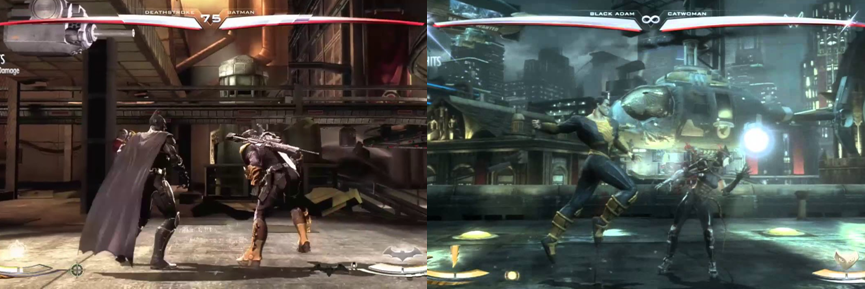
Just like Mortal Kombat, Injustice: Gods Among Us is a 2.5D fighting game; however, this time you’re able to select one of twenty-four characters from the DC Universe and battle it out in the game’s single-player story mode, one-on-one against another player or computer-controlled opponent (both on- and offline), tackle numerous arcade-style ladders, or take on character-specific missions in Scientific and Technological Advanced Research Laboratories (S.T.A.R. Labs) training scenarios. Just as you’d expect from a Mortal Kombat videogame, Injustice’s fights take place in a best-of-three format (although there are no longer announcements or screen text between each round) and against a time limit, though you can alter these settings (and many others, such as the game’s difficulty) to your heart’s desire in the game’s options to suit your playstyle. If you’ve played the Mortal Kombat reboot then you’ll be immediately familiar with this game’s fighting mechanics and controls, although there are subtle differences: X, Y, and A are assigned to light, medium, and heavy strikes, for example, and may be either punches, kicks, or weapon-based melee attacks depending on which character you’re playing as. You can still grapple and throw your opponent with the Left Bumper (or X and Y and a directional input), dash towards or away from the opponent with a double tap of the directional pad (D-Pad), but now you must hold back on the D-Pad while standing or crouching to block, which can make blocking a bit trickier as sometimes you’ll simply walk or dash backwards when trying to block. If your opponent is crouch-blocking, you can land an attack by pressing towards and A for an Overhead Attack, and string together light, medium, and heavy attacks with directional inputs and your various special moves to pull off quick and easy combos.

Attack with strikes, grapples, and combos to pummel a number of DC’s most recognisable characters.

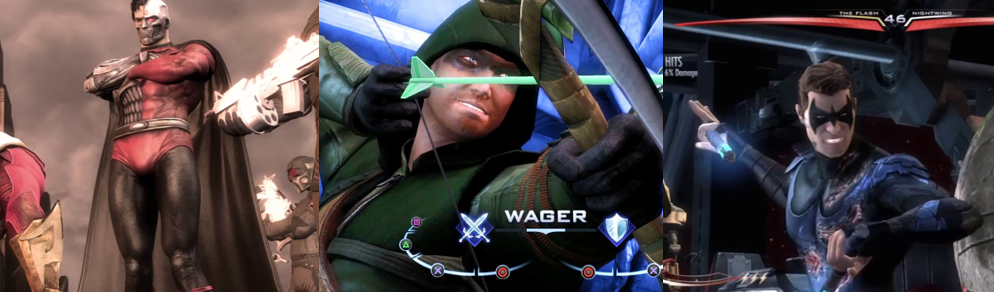
As is the standard for NetherRealm Studios’ releases these days, you can practise the game’s controls and mechanics as often as you like and take part in a very user-friendly tutorial to learn the basics of the game’s simple, but increasingly complex, fighting mechanics. You can also view your character’s moves, combos, special attacks, and “Character Power” from the pause menu at any time, allowing you to also see a range of information (such as where and how to pull of certain moves, the damage they inflict, and frame data). Each character has a range of special attacks that are unique to them; these mostly consist of certain projectiles or grapples and strikes but can also include various buffs for your character or to slow down your opponent. Each character also has a specific Character Power that is performed by pressing B; this sees Batman summon and attack with a swarm of bats, Oliver Queen/Green Arrow fire different trick arrows at his opponent, Doctor Harleen Quinzel/Harley Quinn gain various random buffs, and allows characters like Diana Prince/Wonder Woman and Rachel Roth/Raven to switch between different fighting styles and thus access different special attacks. While some Character Powers have a cool-down period, others don’t, but they can also be detrimental to you; for example, Slade Wilson/Deathstroke can briefly give his shots perfect aim but, once the Character Power is expended, he’ll miss every shot until it refills. Another new addition to the game is the annoying “Wager” system; when the Super Meter is filled up by two bars, you can press towards and RT when blocking an attack to play a quick mini game where you and your opponent select how much of your Super Meter to gamble. If you win, you’ll regain some health; if you lose, the opponent regains health; and if you tie then you both lose. Personally, if find these “Clash Breakers” even more annoying than the usual “Breakers” seen in the modern Mortal Kombat games as I never win them and they generally just unnecessarily prolong a fight (and, even worse, there’s no option to turn them off).

Different characters attack and interact in different ways according to their strengths.

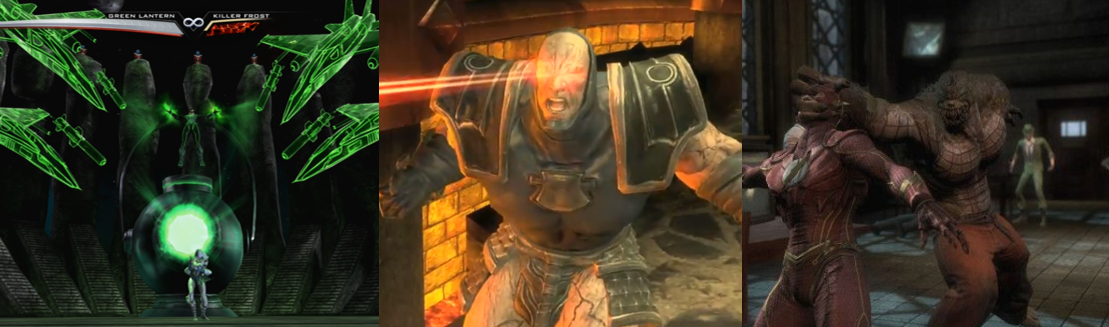
In a bridge between the differing character movesets of Mortal Kombat and the “Variation” mechanic seen in Mortal Kombat X (NetherRealm Studios, 2013), Injustice features a limited “Class” system whereby characters are split into two camps: Gadget- or Power-class characters. Gadget characters are generally smaller, faster, and rely on various tricks and weapons in fights while Power-class characters are typically bigger, often slower, and rely more on brute strength. One of the main ways you’ll notice the difference between playing as, say, Barry Allen/The Flash and Cyrus Gold/Solomon Grundy is that they interact with the game’s fighting stages in different ways. As in Mortal Kombat X, you can press the Right Bumper when indicated to use (or attack your opponent with) various environmental hazards, such as firing missiles at them or knocking them into the background. But, whereas Superman will wrench a car out of the air and slam it on his opponent, someone like Dick Grayson/Nightwing will rig the same car to explode or somersault off the environment to get behind their foe rather than try to crush them with a wall. As you might naturally expect, there are no Fatalities or gruesome finishing moves in Injustice (not even “Heroic Brutalities”). However, when your Super Meter is full, you can still press LT and RT together to pull off a devastating Super Move; while you won’t see bones breaking and organs shattering like in Mortal Kombat’s X-Ray Moves, it’s still pretty fun to see Hal Jordan/Green Lantern transport his opponent to Oa to pummel them with his constructs, Ares shower his foe with arrows and stamp on them while grown to gigantic proportions, Arthur Curry/Aquaman force his enemy into the jaws of a ferocious shark, and Bane demolish his opposition with a series of throws and grapples, culminating in his iconic backbreaker.

In addition to powerful Super moves, you can bash your foe into new areas using stage transitions.

Another way the game separates itself from Mortal Kombat is stage transitions; when near the far edge of certain stages, you can hold back and A to wallop your opponent through the wall or off into the background where they’ll be smashed up, down, or across to an entirely new area of the stage which often allows more stage interactions and new stage transitions available for your use. You might wonder exactly how someone like Louise Lincoln/Killer Frost can survive being blasting through the brick walls of Wayne Manor or go toe-to-toe with the likes of Doomsday but the game’s entertaining story mode explains that, on this alternative world, the tyrant-like Superman has developed special pills that bestow superhuman strength and dexterity to his generals. As is also the standard in NetherRealm’s titles, the story mode is broken down into twelve character-specific chapters, which is again a great way to experience a wide variety of the game’s roster (though Batman does feature as a playable character in two chapters, which seems a bit lazy). You can replay any chapter and fight you’ve cleared at any time, which is great, and skip through the cutscenes after they’ve loaded a bit, and the story mode isn’t all constant fighting either as you’re asked to pull off a handful of quick-time events (QTEs) at various points, such as blasting cars with Superman’s heat vision. The story is a fairly standard multiverse tale of the main canon heroes fighting against their corrupted or misled counterparts but it’s pretty fun and easy to blast through in no time at all.

Fight to earn XP and level-up, unlock additional perks and modes, and take on a series of challenges.

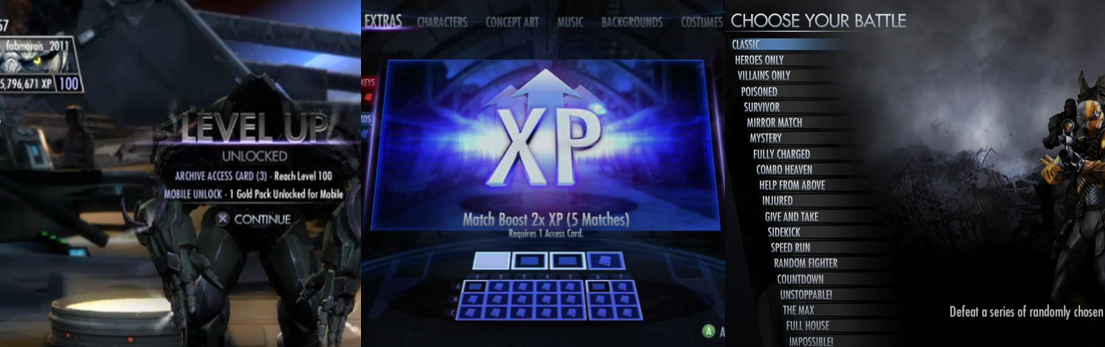
Every time you win a fight, you’ll earn experience points (XP) that will eventually level-up your character profile. This, and performing a certain number of specific attacks, playing through the story mode, and tackling the game’s other modes and mechanics, unlocks icons and backgrounds for your profile card as well as additional skins in certain circumstances. You’ll also be awarded “Armour Keys” and “Access Cards” to spend in the “Archives”, which allows you to unlock concept art, music, more skins, and certain boosts that will increase how much XP you earn, to name just one example. Like in Mortal Kombat, you can also take on ten opponents in arcade ladders in the “Battle” mode; these range from the basic tournament-style ladder to specific challenges against heroes, villains, or battling while poisoned, injured, or with certain buffs (such as a constantly full Super Meter or health falling from the sky). We’d see a similar system be incorporated into the “Towers” modes in later Mortal Kombat games and similar scenarios exist here, such as a survival mode, battling two opponents, or being forced to fight against the computer set to the hardest difficulty.

Graphics and Sound:
Like its violent sister-series, Injustice looks fantastic; there’s almost no difference between the high-quality story mode cutscenes and the in-fight graphics (which, again, makes it all the more frustrating that NetherRealm Studios insist on having character’s endings represented by partially-animated artwork and voiceovers), though it has to be said that the graphics are much more palatable when in a violent fight. I say this purely because I am not a big fan of some of Injustice’s character designs: The Flash looks a bit too “busy”, for example, and Batman’s suit (and cowl, especially) look really janky to me, though I love the representation of Green Lantern and Thaal Sinestro.

In addition to various intros, outros, and Wager dialogue, characters also take on battle damage.

Each character gets a nice little fitting intro and outro for each fight and, between rounds, will perform and quip a variety of taunts to the opponent. In a nice little touch, different character skins get different intros and outros; when playing as the evil Superman, for example, he enters and exits the fight differently to his more heroic counterpart. When playing as different skins, like John Stewart or Hank Henshaw/Cyborg Superman, you’ll also be treated to slightly different dialogue and animations, which is a much-appreciated touch on the developer’s part. Although there aren’t any character-specific interactions in the intros, there are during the Wager cutscenes and, even better, both characters and the arenas will accrue battle damage as the fight progresses! This means that you’ll not only see Selina Kyle/Catwoman’s cat suit rip and her skin be blemished by bruises and blood but arenas will degenerate or change around you the more damage you dish out, which can also allow different intractable options to become available to you.

Stages include a range of recognisable DC locations and take damage as you fight.

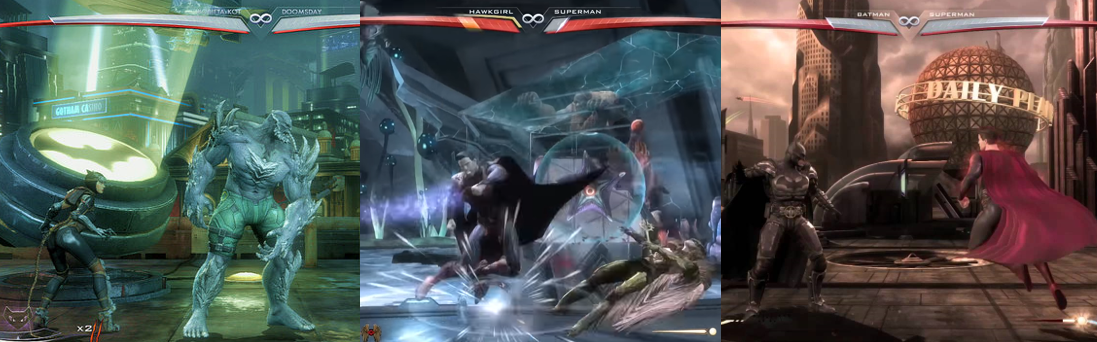
Speaking of the stages, Injustice really goes above and beyond to make the best use of the DC license; while it’s a little disappointing to see Arkham Asylum and Wayne Manor feature twice in the game, they are made distinctive by having Joker-ised and night-time variants, respectively (and also being clearly modelled after, and featuring cameos by, the Batman: Arkham (Rocksteady Studios/Various, 2009 to 2015) videogames and villains). Additionally, the use of stage transitions really helps to add a whole new dimension to combat, with some stages featuring more than others (or even none at all), to help ensure that every fight can be a little different. Stages also feature a bevy of other little cameos and DC references, such as the Fortress of Solitude being clearly modelled after Superman (Donner, 1978) while also featuring a portal to the Phantom Zone and a cameo from Starro the Conqueror. Similarly, J’onn J’onnz/Martian Manhunter floats in the background of the Watchtower space station, Floyd Lawton/Deadshot is just hanging out at Stryker’s prison, and Amazons are preparing a boat to launch on Themyscira. Every single stage has a number of intractable elements and changes as you fight, cause damage, or smash foes around, with Gotham City being my favourite as you can battle on the roof with the Bat-Signal and then down to the grimy streets below and then blast your foe back up to the roof using a nearby truck!

Enemies and Bosses:
Injustice helpfully separates its character-selection screen into heroes (on the left) and villains (on the right) but, despite their different alignments (and that their loyalties change due to the multiverse shenanigans of the story), every single one of them will be an enemy of yours at some point as you play through the story, Battles, S.T.A.R. Labs missions, and on- or offline. Consequently, it’s worth keeping track of which character suits your playstyle as some have easier combos and special moves to pull off compared to others, or more useful Super Moves and Character Powers.

Play as, and against, the game’s characters to learn their strengths, weaknesses, and skills.

Additionally, the Class system should also be factored in; Lex Luthor, Doomsday, and Solomon Gundy may be powerful and capable of gaining armour to tank through attacks but they’re also a lot slower on their feet and with their jumps. Superman and Shiera Hall/Hawkgirl are much faster Power-class characters but can also have their own drawbacks at times depending on your playstyle (Superman’s Character Power, for example, simply powers up his attacks rather than being a more offensive move like, say, Areas being able to conjure massive magical weapons). Personally, I tend to lean more towards Gadget-based characters, like Nightwing (who can switch between using quick batons or a longer bo staff to attack) or Green Arrow (whose arrows and bow allow for both ranged attacks and blindingly fast melee attacks).

Take on the corrupted Superman and banish him to the Phantom Zone for his crimes!

Unlike Mortal Kombat, Injustice doesn’t really feature any secret or hidden fights or unplayable sub-bosses or boss characters; the story mode and basic arcade ladder culminates in a battle against the corrupted Superman that is a far fairer and more competitive fight compared to the finales of NetherRealm’s recent Mortal Kombat games. While Superman is definitely a bit more of an aggressive foe, even on the game’s easiest difficulty, he doesn’t gain inexplicable armour, can be stunned, and doesn’t deal ungodly amounts of damage or spam his attacks like a cheap bitch. Additionally, he doesn’t transform into some monstrous final form and, instead, the final battle is a far better use of the skills you’ve built up through regular gameplay rather than forcing you to resort to cheap tactics and tricks.

Power-Ups and Bonuses:
Because it lacks a “Test Your Luck” mode and “Kombat Kodes” for multiplayer fights, there aren’t really any in-game power-ups available to you outside of the various status effects seen in the Battle mode. As before, though, some characters can gain in-game buffs with their special attacks and Character Powers: Lex Luthor, for example, can erect a shield, Doomsday can cover himself in impenetrable armour for a brief period, and Solomon Grundy slows time down and drains his opponent’s health with his swamp gas. However, you’ll earn yourself additional XP if you mix up your fighting style and take advantage of stage interactions and transitions, which will allow you to unlock further customisation options for your profile card, and you can also earn additional skins and rewards by playing and linking up to the mobile version of the game.

Additional Features:
There are fifty Achievements up for grabs in Injustice, with three of which being directly tied to the story mode (50- and 100% completion and succeeding at all of the QTE mini games). Others are tied to the game’s online modes, levelling-up to specific levels, customising your profile card, and finishing Classic Battle with one (and every) character. There are also some character-specific Achievements on offer, including performing every character’s Super Move or a ten-hit combat and winning a fight using only arrows as Green Arrow, or landing at least twelve shots without missing as Deathstroke. Batman is the only character to have two specific Achievements tied to him, though, as you’ll get some G for winning a match using all of his special moves and his Super Moves and for defeating every villain as him. Another standard of NetherRealm Studios is their addition of further skins and characters through DLC; you can get skins to play as John Stewart, Cyborg Superman, and the Flashpoint (Johns, et al, 2011) Batman, among others, and they’re all easily applicable when selecting a character (no need for extraneous “Gear” here).

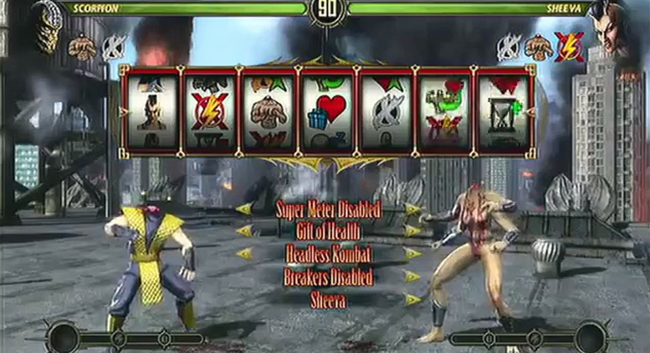
Injustice included some surprising DLC fighters; even Scorpion showed up!

While the game’s DLC characters have no additional Achievements tied to them, Injustice included some fun and interesting extra fighters; Lobo, General Dru-Zod (who also sports his Man of Steel (Snyder, 2013) look as a skin), Barbara Gordon/Batgirl, Zatanna Zatara, and the Martian Manhunter were all great choices to add to the roster and it was nice to see NetherRealm Studios exercise a little restraint and not overload the DLC with additional Batman characters. By far the most exciting DLC fighter was the inclusion of Scorpion, who sports a Jim Lee redesign and began a trend of DC and Mortal Kombat characters appearing in each other’s games. When you’ve had enough of the story mode and regular battle options, you can take the fight online in a series of matches; here; you can participate in ranked and unranked fights and “King of the Hill” tournaments where you watch other players fight until it’s your turn and bet on who’s going to win. The S.T.A.R. Labs missions will also keep us offline, solo players occupied for some time; these are expanded upon when you download the DLC fighters, which is much appreciated and, similar to Mortal Kombat’s “Challenge Tower” mode, basically serve as extended tutorials for each of the game’s characters. You’ll take on ten character-specific missions, with each one getting a little bit of text and maybe a picture to set the context of the mission, and these range from performing certain combos or attacks, winning fights, or completing tricky challenges (such as guiding Catwoman’s cat through laser trip wires, avoiding damage or debris, or racing against Superman).

The Summary:
Injustice: Gods Among Us is a far better marriage of Mortal Kombat and DC Comics than Mortal Kombat vs. DC Universe and a fantastic expansion of the gameplay mechanics and features NetherRealm Studios revitalised their violent fighting game series with in Mortal Kombat (2009). While Injustice is obviously not as gory or violent as its sister-series, that doesn’t make it any less fun and it’s still a very brutal fighter; the Super Moves, especially, and certain character’s outros (such as the Joker’s) are definitely in the Mortal Kombat mould. With gorgeous in-game graphics, a fantastic amount of variety thanks to all of the character’s different special attacks and gameplay mechanics and the stage transitions, and a simple to learn, easy to master fighting system, Injustice is an extremely enjoyable game for anyone who’s a fan of either franchise or fighting games in general. The story is a breeze to get through (thought it is essentially every basic multiverse story ever told in comics) and nicely varied with some QTE sequences; the S.T.A.R. Labs missions and different arcade ladders are much more enjoyable and challenging than in its sister-series and there are plenty of character options, variety, and unlockables to keep you busy. Best of all, the game isn’t bogged down by endless grinding to unlock Gear, skins, or other perks and is a much more user-friendly and accessible fighting game, and overall experience, than its sequel.

My Rating:

Rating: 4 out of 5.

Great Stuff

Were you a fan of Injustice: Gods Among Us? What did you think to it as a blend of Mortal Kombat and DC Comics? What were your thoughts on the game’s story and its depiction of a parallel world terrorised by a corrupted Superman? Which of the game’s fighters was your favourite and why? Did you buy the base game and all the DLC packs separately or did you pick up the Ultimate Edition when it released later? What did you think to the additional DLC characters and skins? Were there any characters or features missing from the game for you? Which DC Comics videogame, movie, comic, or other piece of media is your favourite? Are you a fan of multiverse stories and crossovers? Whatever you think about Injustice, leave a comment down below and be sure to check back in next Wednesday for more Crossover Crisis content!

Game Corner: WWE Legends of WrestleMania (Xbox 360)

Released: 20 March 2009
Developer: Yuke’s
Also Available For: Mobile and PlayStation 3

The Background:
On March 31st, 1985, Vince McMahon changed the face of the wrestling landscape forever by bringing together the biggest names in wrestling (alongside a number of celebrity guests) for the very first WrestleMania, a pay-per-view extravaganza that became the hottest event of the calendar year for World Wrestling Entertainment (WWE). The WWE has a long and storied history with videogames that can be traced all the way back to the very first videogame ever produced baring the initials of their previous moniker of the World Wrestling Federation (WWF), MicroLeague Wrestling (MicroLeague/Various, 1987). A number of releases made their way to various home consoles and even arcades over the years, with the format slowly evolving to include more and more wrestlers and match types, but the WWE’s foray into digital entertainment largely hit its stride in the late-nineties when Asmik Ace Entertainment, AKI Corporation, and THQ joined forces to produce popular titles for the Nintendo 64 and Yuke’s took their first tentative steps into the SmackDown sub-series (2000 to 2003). Many of the games produced during this time and by these developers are considered to be some of the best wrestling games ever made and, by 2009, the WWE was represented by the multi-platform SmackDown vs. Raw series (Yuke’s, 2004 to 2011), a series which was largely regarded as mostly hit and miss in terms of value for money and year-on-year improvements. Still, the series was profitable enough to convince Yuke’s to attempt a few additional WWE videogames, with Legends of WrestleMania being one of them; pushed intro production to coincide with WrestleMania 25, and focused far more on nostalgia and giving players the chance to relive and redefine some of the company’s biggest moments, Legends of WrestleMania was met with largely lacklustre reviews that took issue with its presentation and control mechanics.

The Plot:
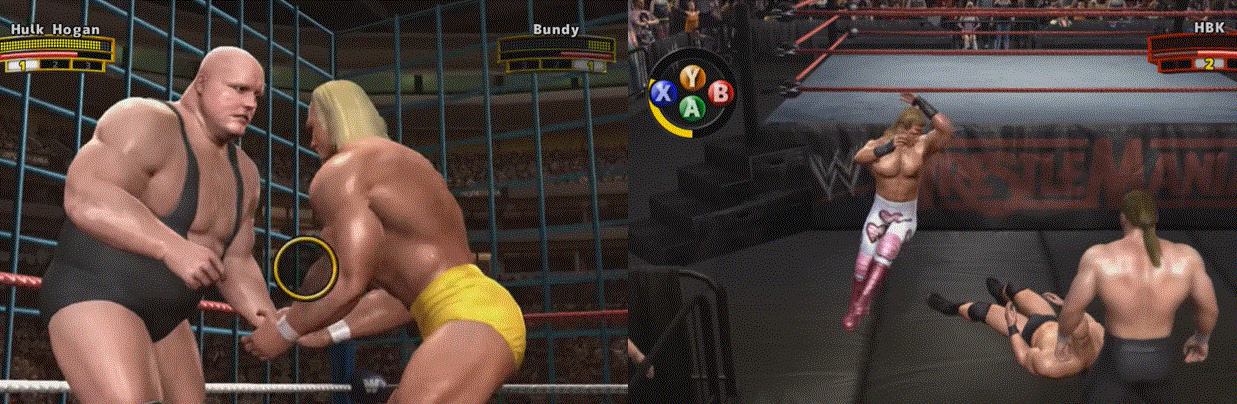
Take control of a WWE Legend and relive some of the biggest WrestleMania moments of all time, such as Hulk Hogan’s legendary clash with Andre the Giant and Bret “Hitman” Hart’s bloody showdown with “Stone Cold” Steve Austin, or rewrite and redefine history by playing these matches, and others that never took place, from the perspective of the loser (or another WWE superstar).

Gameplay:
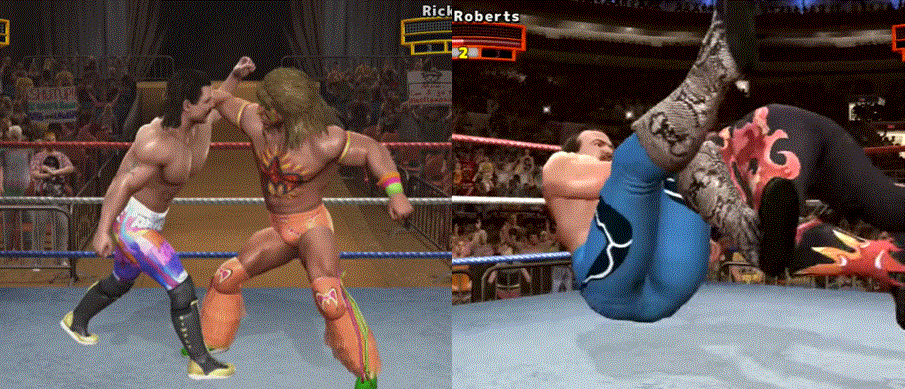
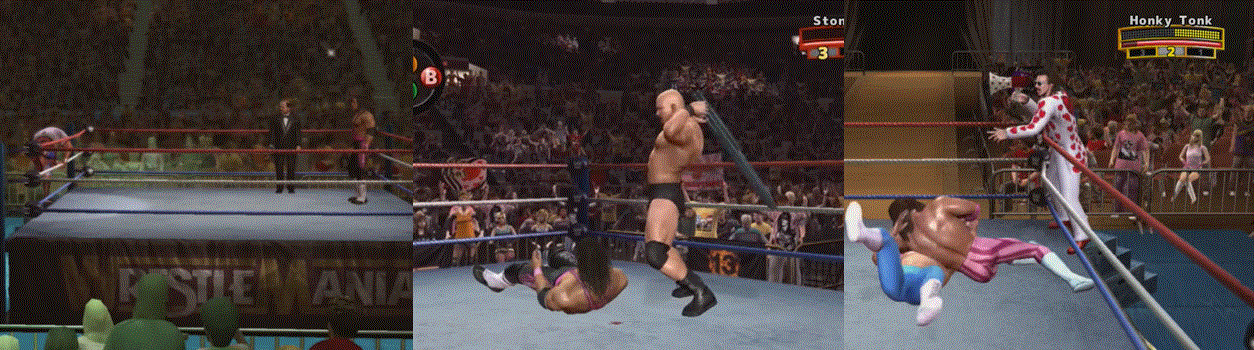
WWE Legends of WrestleMania is a wrestling title that gives players the chance to select from a roster of thirty-eight WWE Legends and pit them against each other in a series of matches, many of which will be immediately familiar to fans of the WWE or anyone who’s played one of Yuke’s WWE videogames before. Unlike many of the SmackDown! videogames, the focus here is much more on fast-paced, arcade-style action rather than simulating a real-life wrestling match, which has both positive and negative impacts on the gameplay. Players can move their Legend using either the left analogue stick or the directional pad (D-pad); having grown up playing the likes of WWF No Mercy (Asmik Ace Entertainment/AKI Corporation, 2000), I generally prefer to use the D-pad for these games (and most fighting games) as it feels more intuitive, but there’s little benefits from favouring one or the other. You can double tap towards or away from your opponent to run, but I had extremely minimal success with this; in most WWE games, running is mapped to one of the shoulder buttons, making it quick and easy to use, but that’s not that case here so the majority of my matches were slower, clunkier affairs as a result.

Gameplay is heavily based around QTEs and button mashing.

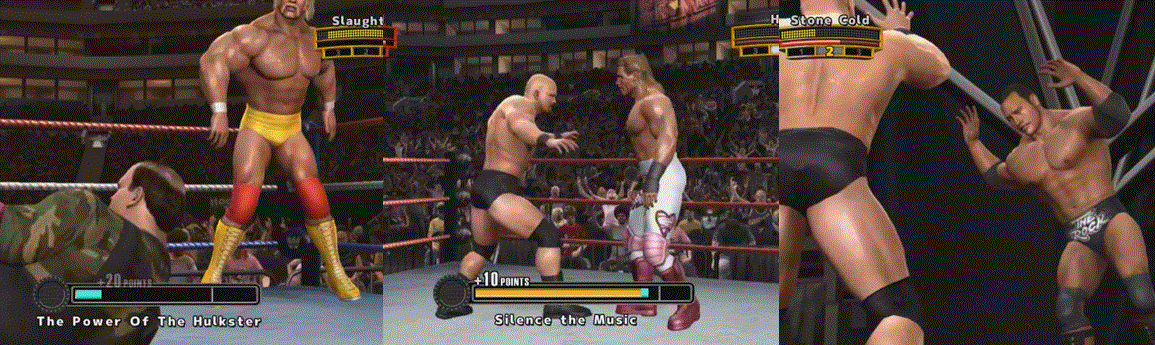
You can throw a strike at your opponent with X; land a few in quick succession to perform a simple combo or hold X to charge up a powerful strike, with both knocking them to the mat and leaving them prone for a leg or elbow drop or other ground-based offense. Grappling is performed with A; again, you can either tap it for a quick, weak grapple, or hold it for a stronger grapple, and use a directional input in conjunction with A to perform different moves (though your move pool is quite limited). As you attack and mix up your offense, you’ll build up a “Chain Meter”; as it reaches three different levels, you’ll gain access to more powerful grapples, with your finisher being unlocked at Level 3 and performed by pressing X and A together. Successfully landing attacks drains your opponent’s health meter and weakens them for either a pin or submission; submission moves are generally locked in when the opponent’s on the mat and see you mashing buttons to wear your opponent down, or you can pin them with B. If either of these things happen to you, you’ll need to mash buttons or full a circular meter to hit a small target in order to stave of the attack or kick out of the pin attempt.

While reversals can be tricky to pull off, finishers are a matter of hitting onscreen button prompts.

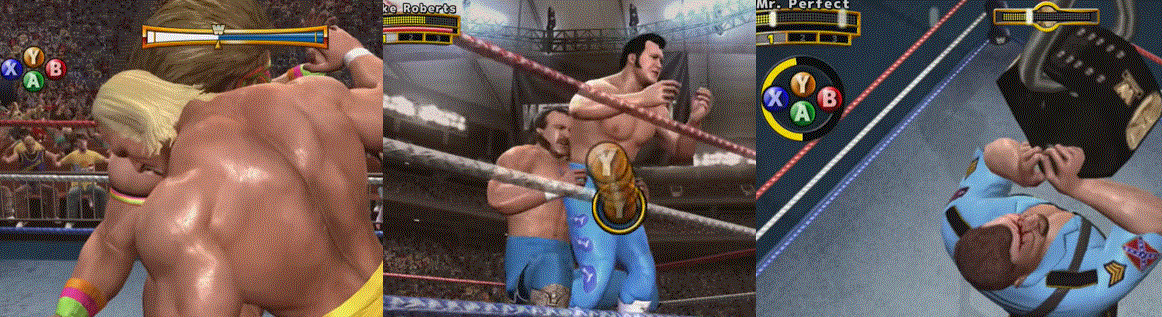
You’ll need to mix and match your offense in order to build up your Chain Meter (though simply mashing X can work just as well), and you can sacrifice a chunk of it by taunting with B and Y and gaining temporary buffs. This can all be a little clunky but it generally works quite well; what doesn’t work quite as well is the game’s reversal system. Rather than map counters to a shoulder button, WWE Legends of WrestleMania has them performed by pressing away from your opponent and Y or holding Y to block. I found this to be incredibly unreliable, as my Legend would often just step backwards or even run away, and I really don’t understand why this wasn’t just mapped to the Right Bumper. Unlike the majority of other wrestling games, WWE Legends of WrestleMania heavily relies on button mashing, button inputs, and quick-time events (QTES); you can’t even Irish Whip your opponent without a QTE flashing on the screen and many of the event matches in the WrestleMania Tour mode start, or are punctuated by, QTE sequences that see you mashing or hitting buttons in a test of strength, chain grapple, and other similar sequences. This also extends to the finishers; after pressing X and A, you’ll need to hit the QTE prompts to land your finisher sequence and do the maximum amount of damage, which is certainly unique but it comes at the cost of severely limiting the amount of finishers available in create-a-wrestler mode

There’s not much to differentiate the wrestlers but managers add a little spice to the matches.

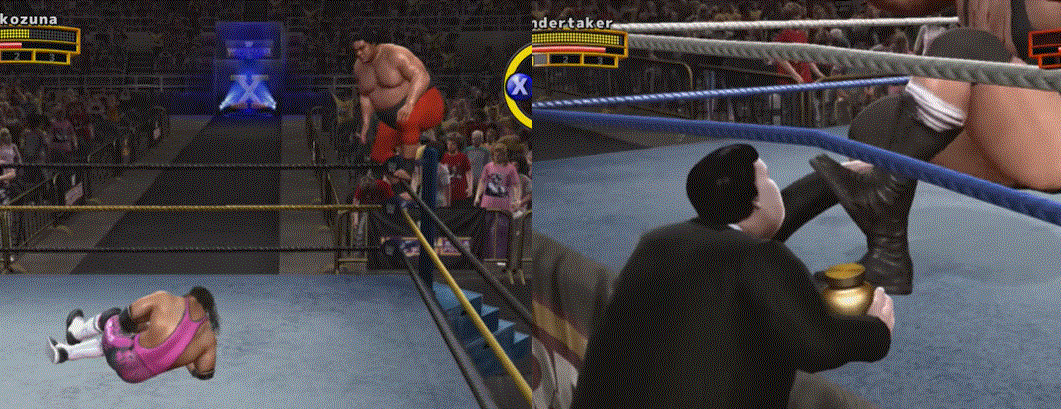
Contrary to other wrestling videogames; there isn’t really a weight class or detection system in WWE Legends of WrestleMania; playing as King Kong Bundy is largely the same as playing as Shawn Michaels, but there are some notable exceptions. For example, while Mr. Perfect can body slam and lift the likes of Yokozuna without issue, some Legends are noticeably more nimble than others and some superheavyweights struggle with climbing cage walls and are limited in their aerial offense. Some wrestling games like to lump their roster into categories and assign them abilities that play to their strengths, but that isn’t the case here so the majority of the roster’s differences are reflected in their move pool: Jimmy “Superfly” Snuka isn’t going to be quite as technically adept as Ric Flair but it’s not as though the Undertaker exhibits any supernatural abilities that other big men, such as the Big Boss Man, have. One major aspect of the game is the presence of managers; the likes of Paul Bearer and “The Mouth of the South” Jimmy Hart can accompany Legends to the ring and can interfere on your behalf at the cost of your current Chain Level, which makes them super useful when they’re in your corner and quite the hindrance when they’re in your opponent’s.

All the standard match types are available, with plenty of button mashing and QTEs sprinkled about.

Wrestling matches have all the standard options you might expect; you can set the difficulty level of the CPU in the options, manipulating the computer’s use of strikes and reversals and such, and customise win conditions (such as turning pin falls and disqualifications on or off and changing the amount of time you can spend outside of the ring). There’s also a number of additional match types on offer that will be recognisable to fans of wrestling games, with most featuring a twist in the game’s new engine and mechanics that mostly boil down to button mashing. You’ll need to mash buttons to either escape from, or prevent your opponent from escaping, a cage or break up a pin fall in a tag team match, for example. Similarly, you’ll find finishers disabled in the Royal Rumble match (there aren’t even special Royal Rumble finishers like in other games) and you’ll instead have to mash buttons to try and force your opponent out of the ring or save yourself from elimination. These components are less prominent in Hell in a Cell and ladder matches, however; you can start Hell in a Cell on top of the structure, which is a nice touch, and can throw your opponent through the cage wall or down to the ring using environmental grapples. Ladder matches are actually much more enjoyable than in other wrestling games I’ve played; you pick up a ladder (or any weapon) by double tapping B and a helpful glowing target shows you where to set it up and climbing and retrieving a championship belt is quite simple compared to other wrestling titles. Retrieving a weapon from under the ring can be a little trickier, though, as can utilising the ringside area or battling into the crowd or up the aisleway, as it requires you to hit A in specific areas around the arena, which can be difficult thanks to the janky controls. You’ll also find such staples as Iron Man matches and Last Man Standing matches on offer here, which are fun ways of mixing up the gameplay, but there’s nothing to really set the game’s matches or gameplay apart from other wrestling titles and very few of these appear in WrestleMania Tour.

WrestleMania Tour sees your reliving, rewriting, and redefining classic matches.

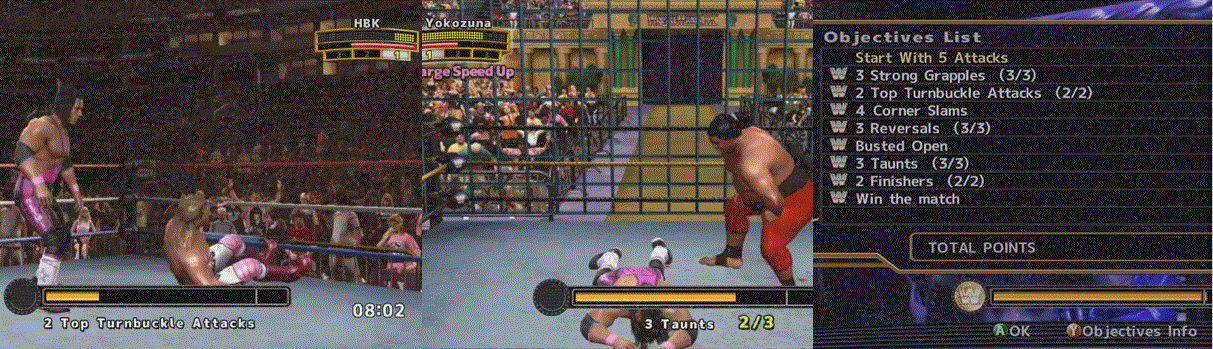
Speaking of which, you’ll be given three single-player options here: “Relive” (where you recreate specific WrestleMania matches), “Rewrite” (where you tackle other WrestleMania matches from the perspective of the historical loser), and “Redefine” (which features unique “dream matches”). Each of these matches is proceeded by a short hype package that features clips from real-life wrestlers and the matches and feud between the competitors, and you’ll be given a series of optional objectives to fulfil in order to earn points. These range from performing a certain number of attacks, grapples, counters, and finishers, winning the match, performing taunts, winning pre-match sequences, and more specific environmental situations (such as winning Chain Grapple sequences, slamming your opponent through an announce table, or grappling up near the entrance). Earning points fills a meter and, once it fills high enough, you’ll earn a medal that will award you with unlockable match types, attires, and more. There’s nothing to gain from playing WrestleMania Tour on anything other than the easiest difficulty, with the computer’s abilities completely neutered in your favour, beyond personal pride so you may as well manipulate the game’s settings to make things easier for you. This mode is also probably the best part of the game as it lets you recreate some iconic WrestleMania moments and matches, and meeting the objectives can be fun, but things quickly get quite frustrating if you’re trying to earn all the medals and monotony sets in quite fast as there’s not much variety in terms of the match types (there are no multi-man matches in this mode, for example) beyond the odd cage or ladder match and you can completely ignore the objectives if you like since winning is all that really matters.

Graphics and Sound:
Wrestling games can be a bit hit and miss when it comes to their graphics, especially with their in-game character models. WWE Legends of WrestleMania favours a slightly exaggerated, action figure-like aesthetic for its Legends, which is typically common when bringing the WWE’s old school superstars to life, and for the most part this actually looks a lot better than in some of the SmackDown! titles. This is primarily because WWE Legends of WrestleMania is largely consistent with its presentation, rather than fluctuating wildly between hyper realistic and massively off-model. Notably, however, you won’t find any female Legends or superstars on offer here, and there’s no on-screen referee either, which is a pretty big step back for me.

While character models look pretty good, the camera and arenas leave a lot to be desired.

The number of arenas on offer isn’t exactly much to shout about either. There’s very little variety on offer as you can only fight in WrestleMania arenas; there is a Royal Rumble arena, however, (and ironically you can only ever fight a Royal Rumble match in this arena) but there’s no Raw, SmackDown!, or other pay-per-view arenas on offer. The crowds are as sub-standard as ever, sporting signs and attire tied to their favourite superstars and parting to allow you to fight over the barricade (though essentially acting as barriers to keep you enclosed), but entrances have been a bit neutered. The game does offer the old-school gondola entrances, which is kind of cool, and recreates the old-school name plates and presentation of the pre- and early-“Attitude Era” of the WWE. Unfortunately, however, the presentation does take a bit of getting used to; the camera is very zoomed in, meaning that your Legends take up a lot of screen space and this can make it a little difficult to be fully aware of your surroundings. The camera is prone to wild swings and odd positioning, which is very annoying, and there’s a noticeable delay between button presses and executing grapples, making for a much more deliberate and slower pace to the game. Though I eventually learned to live with these niggling problems, it did take me a while to adjust to the presentation and gameplay style of the game.

Video clips add some historical context but the commentary continues to be mundane and predictable.

The inclusion of video clips and real-world footage adds to the drama and intrigue of the WrestleMania Tour mode, but these are nothing you haven’t really seen before in a wrestling title. The same goes for the entrance videos and music, which is all pretty much as you’d expect (with a few inconsistencies here and there, such as the Big Boss Man utilising his Attitude Era theme), and this extends to the in-game commentary. Provided by the legendary duo of Jim Ross and Jerry “The King” Lawler, the commentary is basically exactly the same as in the SmackDown! series, though there are some specific new sound clips added in to refer to the game’s roster and the rivalries on offer in WrestleMania Tour. I don’t play these games for in-depth commentary or crowd reactions but even I was astounded by how cheap and lazy these aspects were here. The same can be said of the create-a-wrestler options, which offers clothing, body, and hair options all ripped straight from the SmackDown! games but actually have less to offer in some respects: there’s less naming options available, less moves, less finishers, and even less clothing options as everything is geared towards meeting the old-school aesthetic and altered gameplay mechanics of the title.

Enemies and Bosses:
Being a wrestling title, every single in-game Legend is potentially your enemy; however, as mentioned, it’s not really necessary to play as or fight against each of the game’s roster in order to learn their strengths and weaknesses. Once you’ve played as and against a couple of the Legends, you’ve pretty much experienced all of the variety the game’s conflicts have to offer; your biggest hurdle will be getting the timing of the weird reversal system down, but you can circumnavigate this by just attacking your opponent head-on with strikes and landing strong grapples as and when they unlock. Guys like Bam Bam Bigelow might look big and intimidating, and the Honky Tonk Man might be the ultimate opportunist, but it’s not like you have to worry about character-specific abilities so what works against one will work against all as long as you can hit the QTE prompts when your opponent does get the drop on you.

Meeting objectives is pretty simple until Steve Austin butts heads with the Rock.

In the Relive portion of WrestleMania Tour, you’ll have to battle against specific opponents in recreations or classic WrestleMania matches; this means you’re forced into assuming the role of the historical victor, or loser, of specific matches. One of the most recurring playable characters in this mode is, of course, Hulk Hogan, who must take on King Kong Bundy in a steel cage, and Andre the Giant and the Ultimate Warrior in recreations of their iconic matches. As long as you win your matches, you’re fine, but you’ll need to meet a certain amount of objectives to earn your medal; this includes stuff like kicking out of a pin attempt, causing the opponent to bleed, or winning with a specific move. As you play through these matches, the amount and difficulty of the objectives will increase; I first noticed them becoming more complex in the classic clash between Steve Austin and Bret Hart, which requires you to attack Austin’s leg five times, fight into the crowd, utilise a steel chair, and win with the Sharpshooter but the difficulty severely ramps up for Relive’s final match. This is a recreation of Austin’s WrestleMania XV bout against the Rock; to achieve this medal, you need to meet every single objective, which can be extremely laborious as one of your objectives is reversing the Rock Bottom, to say nothing of all of the many environmental grapples you need to hit on the outside of the ring. I definitely recommend turning the game’s difficulty level and sliders all the way down in your favour and making liberal use of the health regeneration taunt to increase your chances in this match.

Objectives get even simpler in Rewrite and Redefine, meaning the medals are pretty simple to earn.

In Rewrite, you tackle different WrestleMania matches in the role of the historical loser and must fulfil different objectives in order to change history. Since you’re rewriting the outcome of these matches, these objectives are far less demanding and start off as simple stuff like performing and reversing grapples, taunting, and hitting a finisher and don’t really get more complex than landing more attacks, performing more taunts, maybe making the opponent bleed, and performing multiple finishers and reversals. Honestly, these matches were an absolute breeze, with even Bret and Shawn’s infamous WrestleMania XII Iron Man match providing little challenge beyond a ten-minute time limit. This carries over to Redefine, though the matches and competitors at least have a little more variety; here, you can pick which Legends you want to play as and will witness the likes of Andre and Giant and Big John Studd in a Hell in a Cell match and Mr. Perfect and the Big Boss Man in a ladder match. Redefine culminates with a dead simple no disqualification match between the Undertaker and King Kong Bundy that might have a lot of objectives but they’re nothing compared to the Austin/Rock match (boiling down to stuff like hitting five moves in a row at the start, two top rope moves, three reversals and taunts, and two finishers, which is still laborious but nowhere near as frustrating as in that aforementioned match).

Power-Ups and Bonuses:
There are a few options available to you during matches to help turn the tide in your favour; you can toss your opponent to the outside of the ring and interact with the steel steps, announce tables, and barricades to deal more damage to your opponent and, when your opponent is positioned correctly, pull weapons out from under the ring to bust them open or beat them down. When near the aisleway, you can clunkily force them up to the entrance way where there are often other environmental grapple points on offer that let you choke your opponent with wires, toss them into the stage dressing, and even make use of a drum kit but there’s no backstage brawling here. As your Chain Meter builds up, you gain access to taunts that can provide you with temporary buffs; these include regenerating your health, upping your speed and durability, and making reversals easier to pull off for a limited time. Managers can also provide many of the same temporary buffs and also attack or distract your opponent to give you the edge in matches, though utilising these will cost you part of your meter so you’re often asked to pick between receiving a temporary buff or earning your finisher.

Additional Features:
There are a mere nineteen Achievements on offer in WWE Legends of WrestleMania, which is astoundingly low for a wrestling title. Achievements are primarily tied to obtaining medals in WrestleMania Tour or making and using a created wrestler but you can also earn them by winning matches using only grapples or with other specific moves. Sadly, in a game featuring so many WWE Legends, there aren’t more fun or notable Achievements; for example, you can use Hogan to slam Andre all you like in the WrestleMania III arena but it won’t pop a “Unstoppable Force” Achievement. As you play, however, your win/loss record and other statistics are recorded in the “Hall of Fame”, which is good for the statisticians out there, but there’s no way to compete for championships outside of the WrestleMania Tour mode, no create-a-pay-per-view mode, general manager mode, or even WWE Universe mode so you’re basically limited to exhibition matches and the WrestleMania Tour. Well, not entirely; there is also the “Legend Killer” mode. Here, you use a created wrestler to take on six tiers, comprised of ten back-to-back singles matches and culminating in a showdown with one of six WrestleMania Legends. You’ll earn experience points (EXP) by winning matches, and even more for mixing and matching your gameplay style as you play, which you can spend upgrading your created wrestler’s attributes and earning more Achievements. The create-a-wrestler mode is basically the same as in the SmackDown! series, including many of the same hair and clothing options as in those games and you can also fully customise their entrance or even create a tag team, though there’s very little incentive without a Universe mode. While there’s no downloadable content on offer here, you can transfer basically the entire male roster of WWE SmackDown vs. Raw 2009 (Yuke’s, 2008) if you have a save file for that game on your system, which greatly expands the amount of moves and finishers available to you. While this is a cool feature, and something I wish WWE games would implement more often, it doesn’t equate to much more than adding modern superstars to the roster (which really doesn’t mean all that much as you can’t play as them in WrestleMania Tour).

The Summary:
I do enjoy a bit of a wrestling title, and quickly and easily nabbing a few Achievements, and as a big wrestling fan I enjoy revisiting some of the classic wrestlers of the past but WWE Legends of WrestleMania is a quite a bare-bones title. You can see everything the game has to offer in an hour or so and plough through the main story campaign in an afternoon; the Legend Killer mode might take a little longer but it’s hardly going to take up all your time and attention like a General Manager or Universe mode. The gameplay is a bit jarring at first thanks to the odd camera perspective and the plodding, clunky, QTE-heavy nature of the mechanics, but pretty easy to master and, before long, you’ll be winning matches in no time at all, meaning the game quickly gets boring. Yes, there’s a few other match types on offer but there’s little incentive to play these as you can’t compete for belts and I can’t imagine it’s that much fun to play against other human opponents, either. The create-a-wrestler is more lacklustre than ever and there’s a strange lack of focus on guys like the Undertaker, and some notable omissions from the roster (neither Kane nor Mankind are available, for example), though the ability to transfer the roster from WWE SmackDown vs. Raw 2009 is a neat touch. Ultimately, it’s not bad if you pick it up cheap but probably not really worth keeping in your collection once you’ve mined all of the Achievements. I appreciate the developers trying something a little different but this clearly isn’t a Triple-A title and is really only for fans of the rock ‘n’ wrestling era of the then-WWF. If you’re really in the mood for an arcade style wrestling game from around this time, you’d potentially be better off playing something like WWE All Stars (THQ San Diego, 2011).

My Rating:

Rating: 2 out of 5.

Could Be Better

Are you a fan of WWE Legends of WrestleMania? Did you like that the developers actually tried to do something a little different with this release or did the dumbed down gameplay put you off? Which of WrestleMania Tour’s matches was your favourite and did you ever achieve Legend Killer status? What did you think to the finisher system and the abundance of QTEs? How did you find the create-a-wrestler mode and were you disappointed by the lack of WWE Universe in this title? Were there any classic WWE superstars you felt were missing from the game and which of the available Legends was your go-to character? How are you celebrating WrestleMania’s anniversary this year and what’s your favourite WrestleMania moment? Drop your thoughts below by signing up or leave a comment on my social media to let me know what you think about WWE Legends of WrestleMania and check back for more wrestling content throughout the year.

Game Corner: Saw (Xbox 360)

Released: October 2009
Developer: Zombie Studios
Also Available For: PC and PlayStation 3

The Background:
In 2004, writer Leigh Wannell and director James Wan brought us Saw, a psychological horror film in which two men find themselves trapped in a grimy bathroom, victims of the twisted John Kramer, also known as the Jigsaw Killer (Tobin Bell), and forced to play a demented game of survival where one must die or both must cut through their feet to escape their shackles. Saw was a surprise success; produced on a budget of $1.2 million, it grossed over $100 million at the box office, making it (at the time) the most profitable horror film in about eight years and kick-starting not only an ongoing horror franchise but also inspiring a whole other sub-genre of horror cinema, the “torture porn” genre. By 2009, Saw’s success had translated into six sequels that continued the story, each of varying quality. This, apparently, was the perfect time to capitalise on the franchise’s success with a puzzle-based, quasi-survival/horror videogame. While the game was initially announced in 2006, development stalled somewhat despite the creators of the franchise working closely on the game’s narrative, aesthetics, and gameplay elements. Konami eventually took over the production of the game, viewing it as a potential spiritual successor to their Silent Hill (Various, 1999 to 2012) franchise; however, while the game did well enough to get a sequel in 2010, it received little more than average to mediocre reviews at the time of release.

The Plot:
Disgraced police detective David Tapp, who ran afoul of Jigsaw in the first Saw movie, finds himself trapped in a former mental asylum at the mercy of the Jigsaw Killer. Forced to confront his mistakes and the demons of his past, he must solve a series of gruesome traps and puzzles in an attempt to earn his freedom.

Gameplay:
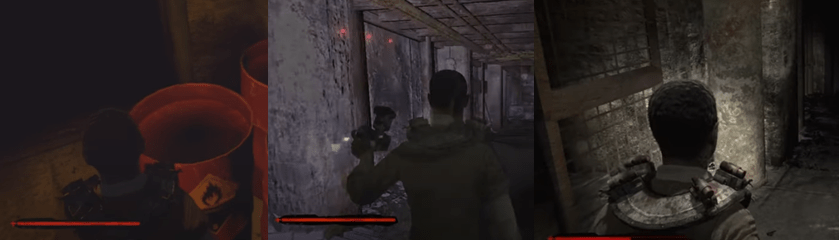
Saw is a third-person action/puzzle game with an emphasis on puzzle-solving, collecting items, and evading or smartly dispatching of a few foes similar to other survival/horror titles. Players are put into the shoes of a familiar character from the franchise who looks and acts absolutely nothing like the character as portrayed by Danny Glover; here, Tapp is far from the broken, semi-insane former cop with a  grouchy voice thanks to a scar across his throat and is, instead, more like a desperate, guilt-ridden cop.

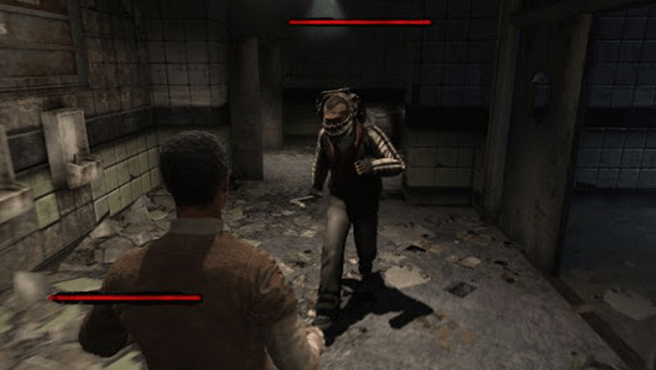
Former detective Tapp finds himself trapped in one of Jigsaw’s demented “games”.

The game’s story is pretty standard Saw fare; Tapp must try to survive the asylum, which is filled with traps and other victims looking to kill him, solving puzzles and freeing victims chosen specifically to test Tapp’s morals and conscious. Unlike in the movies, though, you must past these tests and free these victims; they then promptly flee through means apparently unavailable to you and you continue on, learning a bit more about Tapp’s character and backstory as you go through Jigsaw’s cryptic taunts, audio tapes, and various documents and clippings found strewn throughout the asylum. However, while this does a lot to flesh out the Saw world beyond the movies and the game does a decent job at recreating the aesthetics of its source material, it’s tough to really enjoy it since Tapp controls like a lump of clay; slow, sluggish, and awkward, your options for exploration and combat are made needlessly complicated thanks to the game’s janky, tank-like controls (Tapp literally walks in reverse when you could back on the analogue stick) that see you jogging around the asylum at a listless pace as though the ground is made of sticky mud. Collision issues will see you sometimes clip into the environment or clip onto of it (the closest Tapp ever gets to jumping) and it can be difficult to navigate thanks to the grey, nondescript surroundings and next-to-useless map.

If you have to choose a light source, always choose the flashlight!

In true Saw fashion, your field of view is limited thanks to ambient, broken lighting, dark corners, and the asylum being little more than a blood, trap, and debris-strewn environment. To help with your navigation, you can acquire three different times to light your way; a lighter (which lights the immediate area a little bit, can cause certain barrels to explode, and goes out when you move too fast), a camera (which illuminates the immediate area in a burst of light but for such a brief period that it’s next to useless), and a flashlight (easily the best source of light as it lights up the largest area and is far more reliable). You can to manually activate these with the Y button, and have to do so every time you restart from a death, but often automatically lose them as the story progresses. Although Jigsaw saved him from the bullet that clearly killed him in the first movie, Tapp must still be feeling the effects as he’s quite a fragile man. A few blows from enemies will send him crumbling to the floor like a ragdoll, you need to constantly be alert from shards of broken glass that will drain your health, and he constantly runs afoul of Jigsaw’s many booby traps scattered throughout the asylum. If you don’t disarm the traps, you’ll get your head blown off, and if you can’t keep your balance you’ll plunge to your death at numerous points.

Combat is something you’ll come to dread in Saw thanks to the game’s sluggish controls.

Luckily, there’s a generous autosave feature and you can simply retry from your last checkpoint and Tapp can pick up bandages, a sewing kit, or bottles of water, or water fountains to instantly refill his health or carry around five syringes to heal your wounds. Combat, however, is a diabolical affair; luckily, there aren’t many enemies to engage with and they usually come at you one at a time because Tapp is a poor fighter in every sense of the word. Tapp can punch with his fists, swing destructible weapons, or shoot at enemies with limited ammo, or lure his enemies into traps to dispatch of them but you better be well prepared for when enemies come at you as they generally attack faster than you can “block” or “dodge” and faster than you cans wing, too. It also doesn’t help that the camera zooms in and kind of freaks out a bit when enemies appear, making it way too easy for you to get trapped in the environment or stuck behind a door or some piece of scenery. Most enemies go down pretty easily, which is helpful, and you can knock them down to finish them off or use the proximity alarms on their collars to blow their heads off but, more often than not, you’ll be trying to land a few strikes as quickly as possible and then backing away to clear some room. Often, I found fleeing from enemies caused them to either stand around aimlessly or despawn completely, which can be helpful, and you’ll often come across a number of enemies fighting with each other so you can sneak past or take care of whoever’s left.

Tapp must endure horrific injuries and situations to progress further.

In place of fighting hoards of enemies, you’ll be tasked with exploring your surroundings (carefully, to Jigsaw’s many instant-death traps), solving a few rudimentary puzzles before tackling Jigsaw’s more gruesome “games”. These range from shoving your hand into barrels of acid or toilet bowls fill of syringes to grab keys, attaching different-sized gears to access better weapons, pressing A, X, B, and Y at the right time or aligning certain screws to unlock doors and such, and (my personal favourite) aligning pipes to stop Tapp being gassed to death. Most of the time, solving these leads you to items and things of interest but you’ll also have to endure a few timed puzzles to progress further; these involve moving racks of pig carcasses before you freeze to death, shutting off steam valves, finding fuses to open doors of shut off electrified floors, bashing down weak walls and slipping through, trying not to get crushed to death, and rewiring fuse boxes.

Saw‘s puzzles are so commonplace that they quickly outstay their welcome.

While many of these puzzles are found throughout the game, some see you battling against the clock; linger too long and you’ll be caught in an explosion, which does help add to the tension and immersion of the videogame but the puzzles are always the same at varying levels of difficulty, meaning it all gets very monotonous very quickly. You’ll also often be tasked with using and exploring your environment to find clues, such as codes and keys for doors or other items to unlock sealed doors, which is very much in keeping with the movies but, again, these generally amount to you visiting a new area (that looks strikingly similar to other areas of the game), maybe navigating a few traps or variations of these same puzzles, dispatching the odd enemy or two, and then getting back to where you need to be. It’s not massively difficult since you pretty much see everything the game has to offer within the first hour or so and it’s not too difficult to find your way around, which is helpful as the game’s map is absolutely rubbish.

Graphics and Sound:
While Saw does a pretty good job of emulating the dismal, gritty, dank visual style of many of the Saw movies, in particular the first three films, and the environments look suitably “lived-in” and dangerous, the game really doesn’t look all that great. Character models are hopelessly low quality, using none of the voices or likenesses of any of the actors save for Tobin Bell, and resemble little more than flailing puppets at times. Cutscenes are little more than simplistic cutaways from the main action and all utilise the in-game graphics and models which, while giving the game come consistency and, again, aligning very closely with the fast-paced, frantic cuts of the movies, serve to only emphasise how lacklustre and mediocre the game looks.

As great as it is to see, and hear, Tobin Bell, Saw‘s graphics aren’t up to much.

Where the game excels, as with the movies, is in its depiction of graphic and gruesome death traps and the gravelly, alluring tones of Tobin Bell’s Jigsaw. Thanks to Bell providing near-constant commentary throughout the game, there’s a continual feeling of dread and suspense as you wonder what is waiting around the next corner or in the next area. While many of the puzzles do outstay their welcome, they’re always punctuated by Bell’s distinct voice and his presence definitely elevates the quality of the game…but not quite enough to ignore its many failings.

Enemies and Bosses:
Tapp isn’t alone in the asylum; he’s been trapped with other victims of Jigsaw’s game, all of whom have been told their only way to freedom is to kill Tapp and retrieve a key from his body. These enemies are few and far between but do have some variations; some have the reverse bear trap on their head, some have metal boxes over their heads, others wield weapons, some have explosives attached to their wrists or shotgun neck braces on that will explode you if you don’t keep your distance, and some toss Molotov cocktails at you. the fact that they can easily attack you without mercy and either kill you outright or knock you to your death makes even the game’s standard enemies a tough obstacle to overcome as you need to be well-prepared before engaging in combat, which helps make every enemy a meaningful encounter but also frustrating thanks to the game’s janky camera, collision detection, and combat controls.

The Pighead fight is the closest thing Saw gets to a traditional “boss” battle.

In terms of actual bosses, though, Saw only really has one encounter that could be deemed as a true “Boss battle”; as you progress through the story, you’ll catch sight of the infamous Pighead, an apprentice of Jigsaw, who haunts the asylum, trapping others in death traps and stacking the odds against Tapp. Eventually, you’ll have to battle the Pig head to get a key to progress; armed with a nail bat, Pighead can be a formidable foe but it’s just as easy to rush past him and lure him into a metal cage, lock him in, and then activate a switch to fry his ass alive. In place of traditional boss battles, each chapter of the game ends with Tapp having to same Jigsaw’s victims from death traps; the first of these is another familiar name (though not a familiar face), Amanda Young, and straight away this trap sets the tone for how annoying Saw can be. Amanda and Tapp are both strapped into a machine and the player must cause red or blue antidotes to correctly drop to the left and right, respectively, using the shoulder buttons. This can be a tedious task as it’s not very clear how to do this and you only get about three chances to make a mistake before you fail and must retry from the beginning. The trap’s difficulty spikes in the second stage where you’ll have to sometimes guide two blues and two reds to the same pathway, which means a lot of forward planning and trial and error.

Many of the games are simply harder versions of Saw‘s regular puzzles.

To rescue Melissa Sing, you’ll have to solve three magnetic maze puzzles before she’s chopped to pieces. If you had one of these games as a kid, this trap isn’t too difficult, especially compared to the previous two traps, but it can be tricky to find a safe path to the spiral symbol that is your goal as it’s often not possible to avoid moving over an x strike and speeding up the threat to Melissa’s life. Three of the victims require you to solve increasingly-difficult variations on common puzzles found throughout the game; the gear puzzle, the fuse box puzzle, and the pipe dial puzzles. How difficult you find these traps will depend on your skill at solving these different puzzles but the ones found in these traps are of considerable difficulty, at times, thanks to being much more complex than those you’ll find elsewhere in the game. While they aren’t massively difficult, it can be tricky to remember the order and sequence needed to quickly solve each part and move on to the next mini game before time runs out; it also doesn’t help that the game constantly cuts away from the mini game so you can see the victim suffering further or edging closer to death the longer you take.

The final test is a question of matching images, which are always randomised for extra frustration.

The final victim can only be freed by matching up items on television screens; shotgun shells must match with a shotgun, for example, and a severed foot with a saw. While this isn’t as difficult or as stress-inducing as some of the other traps, it is frustrating as you only get some many chances to make mistakes and the images are randomised with each retry, making it a tedious game of trail, error, and luck as you’re all-but-guaranteed to make at least one mistake when solving this puzzle. Once you complete this test, though, the final test is yours as you must choose between two doors, “Freedom” and “Truth”, with each one leading to a suitably bleak ending for Tapp and the game in general.

Power-Ups and Bonuses:
Tapp certainly has the odds against him; in keeping with the game’s close adherence to the source material, you won’t find anything helpful like shields or speed-ups here. Instead, you must explore and solve puzzles and search everywhere for health-restoring items or weapons. Though he can bash enemy’s heads in with his bare fists, Tapp isn’t much of a pugilist so it’s best to grab one of the many weapons found throughout he asylum; you can grab steel pipes, crowbars, shovels, bottles (and use your lighter to create a Molotov cocktail and set enemies alight), table legs, hatchets, mannequin arms, and nail bats to break and bludgeon over your enemy’s skulls.

Use a gun, a variety of bombs, or re-wire Jigsaw’s traps to tip the odds in your favour.

These weapons will break apart the more you use them but, luckily, there’s often another weapon nearby or to be retrieved from a downed enemy. You can also obtain a revolver at a couple of points; you only get six shots, though, so it’s best to sue this weapon wisely as it’ll pretty much kill any enemy (bar Pighead) in one shot. You’re also able to cobble together traps of your own to stun, gas, and explode enemies though I found this more cumbersome and annoying than useful; it’s far more useful to simply rearm one of Jigsaw’s existing traps to blow or fry enemies away quickly and efficiently.

Additional Features:
Saw comes with forty-six Achievements for you to earn; many of these are can’t be missed as long as you complete the game’s story mode while others require you to defeat a certain number of enemies, use every weapon in the game, and unlock a certain number of doors. They’re not especially difficult to get in one playthrough and you can always load up a previous chapter to get any you’ve missed by killing the same enemy over and over again. Although Saw comes with two difficulty modes, there’s no real reason to play the harder difficulty as there’s no Achievement tied to it. You can also go into the “Features” menu to view character, environment, prop, and trap concept art, if you like that sort of thing, but that’s about it.

The Summary:
I am a big fan of the Saw franchise; I find the character of Jigsaw intriguing and fascinating because of how skewed and warped his motivations and philosophies are and the gruesome death traps make for some of the most horrific pieces of horror cinema in recent memory. Sadly, while Saw does go to a great deal of effort to match and recreate the look, feel, and atmosphere of the movies it is based on and part of, it fails to really hold the attention for too long. The game is average, at best, and a frustrating mess at worst; with a dodgy camera, janky controls, wonky physics, and a piss-poor combat system, Saw could have been a tense and atmospheric survival/horror game with a focus on numerous increasingly tough, imaginative puzzles but is, instead, an uninspiring experience that is over pretty quickly, adds little to the lore, and requires very little from you other than battling past the game’s screwy controls and mastering a handful of different puzzles until you reach which depressing ending you choose to indulge.

My Rating:

Rating: 1 out of 5.

Terrible

Did you ever play Saw; if so…why, and what did you think of it? Did you struggle with the game’s presentation and gameplay or did you actually enjoy it for what it was? Are you a fan of the Saw franchise? Which of the films do you think is the best, or how would you rank the movies? Whatever you think about Saw, drop a comment below.

Game Corner [MK Month]: Mortal Kombat: Komplete Edition (Xbox 360)


To celebrate the simultaneous worldwide release of Mortal Kombat (Midway, 1992) on home consoles, today, 13 September 1993, was dubbed “Mortal Monday”. Mortal Kombat’s move to home consoles impacted not only the ongoing “Console War” between SEGA and Nintendo but also videogames forever thanks to its controversial violence. Fittingly, to commemorate this game-changing event, I’m dedicating every Monday of September to celebrating the Mortal Kombat franchise.


Released: 28 February 2012
Originally Released: 19 April 2011
Developer: NetherRealm Studios
Also Available For: PC, PlayStation 3, and PlayStation Vita

The Background:
Thanks, primarily, to its focus on gore and violence and unique digitised graphics, Mortal Kombat (Midway, 1992) was a phenomenal success for Midway and offered some real competition for Street Fighter II: The World Warrior (Capcom, 1991) in arcades and on home consoles. However, while the series seemed unstoppable during the 2D era of gaming, Mortal Kombat struggled to find a footing in the emerging 3D fighter arena and, thanks to the poor reception of Mortal Kombat vs. DC Universe (Midway Games, 2008), was in serious jeopardy after Midway went bankrupt in 2010. Luckily, Warner Bros. Interactive stepped in and the team, now rebranded to NetherRealm Studios, immediately set about getting their violent franchise back on track.

As good as some of the 3D games were, the series floundered compared to its former glory.

Simply called Mortal Kombat, the ninth entry in the franchise sought to return the series to its mature, bloody roots and was developed with a very “back to basics” approach in mind. Some of the more ridiculous elements from the series were removed and the game was developed to be both accessible through its fighting mechanics and technically impressive with its physics and gore. Although this once again stirred controversy, the game was incredibly well-received and its sales were enough to cover the costs of Midway’s acquisition. So popular and critically lauded was Mortal Kombat (2009) that the team were able to offer a number of additional fighters and skins in the form of downloadable content (DLC) and re-release the game with all these extra inclusions and this Komplete Edition was equally well-received upon release, effectively bringing new life into what looked to be a dead franchise.

The Plot:
Faced with defeat and Shao Kahn’s ultimate victory after the malevolent emperor lays claim to a God-like power, Raiden sends a message back through time to his younger self warning him of the coming events. This leads to a divergent timeline in which Raiden desperately attempts to interpret this grim warning of death and destruction whilst also coaching the Earthrealm warriors through slightly altered versions of events from the first three videogames.

Gameplay:
Like basically every single 3D Mortal Kombat title, Mortal Kombat: Komplete Edition is a 2.5D fighting game in which players pick from one of thirty-two characters and battle through the game’s single-player story mode, fight either one-on-one or two-on-two against another player or computer-controlled opponent, battle their way through an arcade ladder, or take on a series of increasingly difficult challenges and mini games based on your ability to follow an eyeball or mash buttons. Fights are preset to take place in a best-of-three format and against a time limit but you can alter these settings (and many others, including the difficulty of the game) from the game’s main menu to speed up gameplay or make it more accessible.

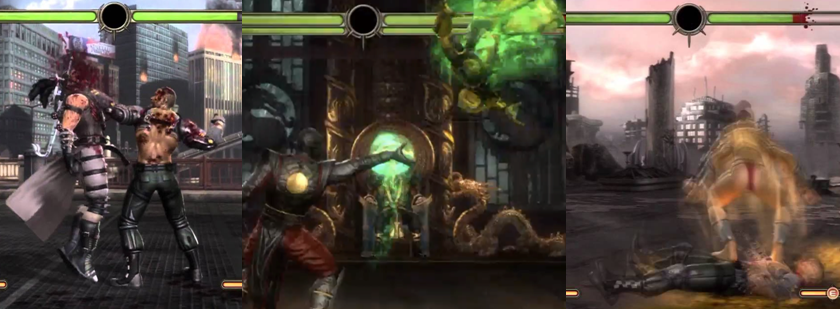
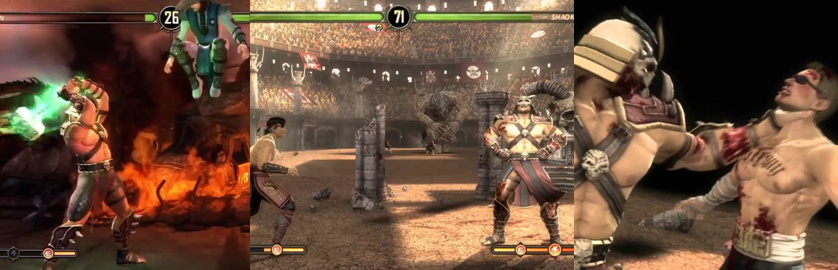
Pummel opponents with a simple, but surprisingly deep, array of combos and attacks.

Unlike the 3D Mortal Kombat fighters that preceeded it, which featured two different fighting styles and a weapon style for each character, Mortal Kombat goes back to its roots with simple, but surprisingly complex, fighting mechanics. You can attack your opponent with punches using X or Y, kicks with A or B, throw (more of a grapple, really) them with RB, and block incoming attacks by holding RT. You can also dash towards and away from your opponent, jump in or crouch down to attack or avoid projectiles, and string together combos by quickly pressing the attack buttons alongside directional inputs. The game includes a tutorial mode that teaches you all of the basics of the game’s combat, which is more complex depending on how skilled you are and which character you play as.

The game’s unique X-Ray feature allows you to see, in graphic detail, the damage your attacks inflict.

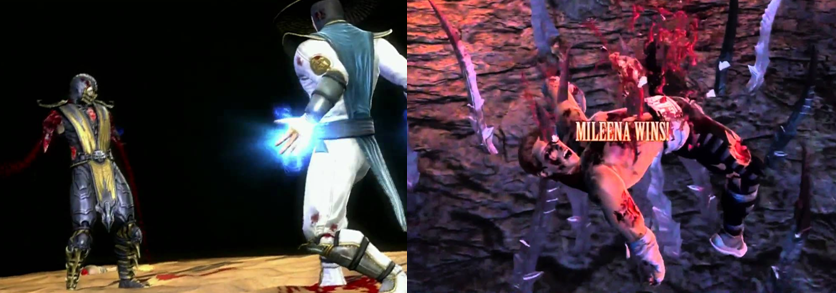
Each character comes loaded with their own unique special moves that you can perform using simple button and directional inputs (back, back, A, for example, or left, down, right, X); these can be stringed together with combos and enhanced with a well-timed press of RT when your “Super Meter” has reached the first tier. This will add a bit more impact and flair to your special move but, if you let the meter fill to the next tier (by landing special moves or taking damage), you’ll be able to pull off a “Breaker”, which will interrupt the opponent’s combo or attack if you manage to press RT and a direction at the right time. When the meter fills completely, you can blow the whole thing by pressing RT and LT at the same time to pull off a spectacularly gruesome “X-Ray” move that will see your character dealing massive damage with bone-breaking attacks. Be wary, though, as sometimes you need to be in a specific situation to pull these off; Cyber Sub-Zero’s X-Ray, for example, is performed in mid-air and Johnny Cage’s only works as a parry to incoming attacks.

Finish off your opponent by performing a Fatality and leaving them a dismembered, mutilated mess.

As you might expect, X-Rays are only outdone by the series’ trademark Fatalities; at the end of the deciding round (usually round two), you’ll be ordered to finish your opponent and given a very brief window of opportunity to stand in a specific spot and enter another button combination to tear your opponent to pieces, usually resulting in them being dismembered or beheaded or blown to shreds. Every character has at least two Fatalities available to them (in addition to a “Stage Fatality” that sees you ending your opponent using the environment in specific stages) but some have a third based on their classic Fatalities from the first game. One of the benefits to owning the Komplete Edition is that every Fatality is available right from the start, though you can still purchase them using the Koins you earn from fights in the game’s Krypt and can practice them to your heart’s content in the Fatality Tutorial. If you feel more like humiliating your opponent, though, you can choose to pull off a Babality instead, which will see you reduce your opponent to a crying infant. While these aren’t as horrific or entertaining as the gory Fatalities, you are awarded more Koins for pulling these off so there is an incentive to finishing your opponent as the more Koins you have, the more bonus content you can unlock in the Krypt. Noticeably, though, I found that combos, special moves, and especially finishing moves were actually harder to pull off here than I remember in the PlayStation 3 version and subsequent Mortal Kombat titles; often, my character would jump or dash when I pressed left or right and some of the button inputs are more difficult to pull off compared to later games because they require you to input more directional commands and even press up (which, to pull off, you need to hold down RB).

Team up with another player, or go it alone, to form a tag team and pull off tag team moves.

Unlike its subsequent titles, you don’t need to worry about amassing a bunch of different currency or unlocking a bunch of extraneous gear for your characters. Every time you perform certain combos, win fights, or complete challenges, you’ll earn Koins that can be spent in the Krypt to unlock concept art and such. When you complete the sole arcade ladder included in the game (which, despite having different difficulty settings, always has you fighting ten opponents), you’ll unlock your character’s ending and an alternate costume (though, again, these are all accessible right from the start in the Komplete Edition but still need to be unlocked/purchased to earn an Achievement). One thing that does separate Mortal Kombat from its successors is the inclusion of an optional tag mode; this allows you to tag between two fighters with a press of LB and even pull off tag team assist moves and have another player fight alongside you. You can even take on the arcade ladder in this mode, unlocking two endings for the price of one, and, while I usually dislike tag or team fighters, I give this one a pass as it’s an optional gameplay mode and not forced upon you.

The story mode contains familiar elements but also new events that changed the franchise’s direction.

Of course, one of the primary attractions of Mortal Kombat is its single player story mode that picks up right after the ending of Mortal Kombat: Armageddon (Midway Games, 2006) and sees you playing through an altered version of the first three games as the series goes back to its roots and, for the first time, details these events in a coherent and decisive way. The story is split into chapters, with each chapter dedicated to one of the Earthrealm warriors as they battle against the forces of Outworld (and even their own teammates at times). This is a great way to allow you to familiarise yourself with the vast majority of the game’s fighters and their unique combos and special moves and a great way to make some headway towards the game’s Achievements, though you cannot perform Fatalities or Babalities when playing the story mode. At times, you’ll also be tasked with fighting two opponents by yourself, which can be a bit unfair since you’re only given a single character and life bar and the game’s difficulty can be frustratingly unreasonable as the computer-controlled characters love to block and jump-kick you out of the air or pull off a devastating combo or X-Ray attack when you least expect it.

Graphics and Sound:
When I first played Mortal Kombat, it was a very impressive title and the most graphically advanced of the series up to that point. looking back at it now, it’s obviously not going to look as good as, say, Mortal Kombat 11 (NetherRealm Studios, 2019) but it still holds up really well, I think. Some character models (like Liu Kang, especially) are a little off but there’s very little distinction between the in-game graphics and those featured in the story mode’s cutscenes and characters are full of life and little quirks, like Reptile being hunched over and slobbering, the females all having amusing jiggle physics, and Kabal adjusting his breathing apparatus between rounds. Sadly, the developers chose to forgo full motion CGI cutscenes for the characters’ endings and, instead, utilise a motion comic-like aesthetic and voice over, which is a bit of a letdown considering how good the cutscenes are in the game.

The game recreates classic stages, including some of my favourites from Mortal Kombat 3.

Still, Mortal Kombat more than makes up for this with the variety and detail of its stages; while you can’t interact with your environment like in later games or smash your opponent into new areas, the game features lovingly realised recreations of stages from the first three games. You’ll battle in Shang Tsung’s courtyard while monks cheer you on, above a spike-filled pit while fighters can be seen battling in the background, and in Shao Kahn’s arena and throne room as he launches jeers and praise your way. One of my favourite Mortal Kombat games is Mortal Kombat 3 (Midway, 1995) and I’m happy to say that a lot of that game’s stages feature here as well, meaning you’ll not only once again battle in the city streets and in the subway but also on a rooftop while the city is being attacked and destroyed by dragons and other monstrosities in the background.

Stages come to life for certain Fatalities and characters shine in the story mode.

There’s loads of little details in the backgrounds of stages to liven things up and catch your attention; you’ll see random fighters and captives going at it, traffic and trains flying past, trees roaring at you, sacrificial rituals being performed, and even spot a few Easter Eggs and cameos if you look hard enough. Many of these come to the forefront when you perform a Stage Fatality, which sees you leaving your opponent in the middle of the road to be decapitated by an oncoming car, splattered against a subway train, careening down to a spiked pit, dunked into acid, or having their face melted off by the molten lava of the NetherRealm. Equally welcome are the many remixes of classic Mortal Kombat tracks, which do a great job of setting the mood and ambience for each stage, and the quality of the voice acting in the story mode’s cutscenes (with Johnny Cage being a particular highlight).

X-Rays display damage in graphic detail and characters carry the scars of battle as fights progress.

Such gruesome features are, obviously, a highlight of Mortal Kombat and only further emphasised through the game’s unique X-Ray mechanic. When you pull off your character’s X-Ray move, the game goes to great lengths to show the damage and brutality of your attacks on your opponent, meaning you’ll see ribs splinter, organs burst, and blood spew like a geyser. Even better, when characters take damage or are splattered by viscera this is reflected in their character models; as a result, at the end of a particularly gruelling fight, you’ll see that your character has bruises and cuts and that your clothes are torn and ripped (resulting in Scorpion’s exposed skull being visible, for example). Things only escalate when you pull off your character’s Fatality moves; while not as elaborate or horrific as those seen in subsequent Mortal Kombat games, these were easily the most realistic and gruesome seen in the series at the time. Perhaps inevitably, given how big the roster is, some are better than others but it’s fantastic seeing Noob Saibot literally tear his opponent in two, Scorpion melt his foe with his classic “Toasty!” Fatality, or seeing your battered opponent dismembered in a shower of guts and gore. Skin is peeled and melted away from the bone, limbs and heads are torn off with reckless abandon, and bodies are mutilated with a simple effectiveness that is the perfect way to put the exclamation point on a particularly gruelling fight.

Enemies and Bosses:
Being that it’s a fighting game, every character will be your enemy at some point and you’ll inevitably be forced to do battle with (and against) all of them at least once when you play through the story mode or take on the arcade ladder and Challenge Tower. Naturally, every character controls and fights a little differently; some are better suited to projectile-based attacks, others can snatch opponents out of the air with mid-air grabs, while others can turn invisible, intangible, or teleport across the arena to avoid attacks and land blows from behind. Therefore, you’re better off playing through the story mode and getting an idea of how many of the game’s characters play to see who works best for you; some characters, for example, might have trickier combos or special moves, while others might have parry attacks to help you interrupt combos and incoming attacks, but generally I find that you can usually find some simple combos and special moves that you can easily master for every character (and, if you ever need help, you can easily view your character’s moves from the pause menu at any time).

Experiment and gain experience fighting with, and against, each fighter to prepare yourself.

Again, it’s perhaps inevitable that some characters are more capable (or broken) than others: Kabal, for example, boasts a rush move that leaves your opponent spinning on the spot and open for an attack alongside two really good ranged attacks; Sub-Zero can, as always, freeze his opponent in a variety of ways; Shang Tsung is able to restore a little bit of health with his Soul Steal ability and even briefly morph into other fighters, giving him access to their specials and X-Rays at the same time; Noob Saibot can use portals to teleport behind you; and characters like Quan Chi and Sheeva can leap off the screen and come crashing down on your head. Then you get a guy like Kano, who can perform really useful cannonball rolls and air grabs but these can be tricky to pull off; similarly, Jax has a lot of grapple moves at his command but they require you to get quite close to your opponent so there’s some risk involved there. Other characters like Sindel are afforded great range thanks to her versatile and hip-like hair, and Ermac and the aforementioned Quan Chi can use their telekinesis and hypnotism, respectively, to disorient their opponent.

Goro and Kintaro pose a significant threat thanks to their sheer power and ability to tank your attacks.

When playing through the game’s story mode and the arcade ladder, you’ll also battle against a handful of unplayable boss characters. Two of the most prominent are Goro and Kintaro, massive four-armed half human dragons who can blast you with devastating fireballs, crush you from above, and deliver massive damage with just a few swings of their arms. These guys are made even more tank-like by their annoying ability to gain armour, rendering them largely immune to your attacks, shrugging off your offense, and being able to absorb a great deal of punishment. For these guys, I tend to favour leaping in with a jump-kick, landing a quick combo, and then hopping out of harm’s way; this is essential as it’ll help you to avoid the shockwaves of their ground attacks and gives you the chance to kick them out of the air and avoid their projectiles and X-Ray moves. Things get even more difficult, though, in the story mode and Challenge Tower missions that force you to battle both Shokan warriors in a one-on-two tag battle but, with clever use of your enhanced special moves and quick combos, they’re not too difficult to put down.

Stay far away from Shao Kahn and strike with projectiles or when he’s taunting.

The shit really hits the fan when you face off against Shao Kahn, however. Like Goro and Kintaro, Shao Kahn can tank your attacks with armour, spams his devastating moves like a newbie, and is capable of absorbing a great deal of punishment even on the game’s easiest setting. Shao Kahn will toss a spear at you, charge at you with his spiked shoulder, and wallop you with his devastating hammer, which can leave you dizzy and vulnerable and mean your health bar will be drained to nothing in just a few hits (or, like with the Shokan, basically instantly drained if he lands his X-Ray attack). However, Shao Kahn is also an egotistical blowhard and will often stop to taunt or laugh at you, leaving him wide open for a combo, X-Ray, or enhanced special. By far the easiest solution to defeating Shao Kahn, though, is to keep your distance at the far side of the screen and just spam your projectile attack, hitting an enhanced special as and when they’re available, and just staying the hell away from him. It’s cheap, and not very satisfying, but no cheaper than Shao Kahn and it gets the job done.

Four super tough secret fighters await you in the arcade ladder and will truly test your skills.

When playing through the single-player arcade ladder with more than one round activated, and after fulfilling certain conditions, you’ll also get the chance to battle against four hidden fighters. These guys are palette swapped variants of Reptile, Noob Saibot, Smoke, and Jade that, like in the first two games, boast the special moves of characters like Sub-Zero, Scorpion, Kitana, and Mileena and can only be fought against if you fight on specific stages and meet specific criteria (not blocking, winning rounds without taking damage, performing Fatalities, and so forth). The effort you have to go to, and the luck required, to even face these hidden fighters is matched only by their sheer difficulty; Noob Saibot and Smoke, especially, are lighting fast, love to block (even more so than your usual opponents), can tank your attacks even better than Shao Kahn, and will devastate you with their enhanced special moves. Sadly, even to this day, I’ve been unable to access the fight against Jade but I imagine she’s no walk in the park either after I was thoroughly trounced by Noob Saibot.

Power-Ups and Bonuses:
Since it lacks many of the features and customisation options of its successors, there’s not really a lot of in-game power-ups on offer in Mortal Kombat; some characters, like Noob Saibot and Quan Chi, can buff themselves and debuff their opponents with some of their special moves, which adds an extra wrinkle to the gameplay, but the main way that you’ll see power-ups granted to you is if you play the “Test Your Luck” mode or during the versus screen for a two-player fighter. Here, each player can press buttons on their controller to input a variety of “Kombat Codes” (which can be unlocked in the Krypt or found online) to change the parameters of the fight; this means you can disable blocking, power bars, throws, and specials or even fight without arms or heads!

Test Your Luck offers a great deal of entertainment and variety to the usual fights.

Similarly, in Test Your Luck, you’ll randomly be forced to fight with a variety of different effects in play, many of which are similar to those activated by the Kombat Codes. This means you can end up fighting with reduced health, upside down, as zombies, without arms or heads, or in pitch black while flames burst from the floor. It’s honestly one of the most entertaining additional modes in the game and really helps to spice up two-player fights as you never know what sort of effects are going to be activated, meaning that even seasoned players can be thrown off their game by the mode’s many different effects.

Additional Features:
As alluded to above, Mortal Kombat comes with fifty Achievements for you to earn; two of these are awarded just for playing through the story mode but you’ll get three more for beating the arcade mode once, with every fighter, and with a tag team. Other Achievements include performing every character’s X-Ray, Fatality, and forwards and backwards throw, unlocking every alternate costume, and spilling 10,000 pints of blood, all of which are pretty easy to do as you play through story mode and the arcade ladder. Some are tied to the game’s online modes, though, and are thus trickier to obtain now but by far the worse Achievements are ‘My Kung Fu is Strong’ and ‘My Kung Fu is Stronger’, which require to you gain mastery of first one and then every fighter in the game, which basically equates to many hundreds of hours of gameplay and is, frankly, pretty ridiculous.

The Challenge Tower hosts a wide variety of increasingly difficult challenges.

Unlike NetherRealm Studios’ later efforts, Mortal Kombat is actually quite light on additional gameplay modes; you can battle against other players online in ‘King of the Hill’ matches and the like but, rather than taking on ever-changing arcade towers, Mortal Kombat offers only the one Challenge Tower. This is a series of fights that begins as an extended tutorial and soon evolves into a variety of unique and increasingly difficult tasks; although you can skip the challenges by spending some Koins, you’ll need to best them all to unlock a super sexy alternate skin for Mileena and obtain 100% completion but this is easier said than done. Challenges range from simply defeating an opponent, completing a mini game, or taking part in a more unique task such as using (or spamming) a character’s projectile attack to take out waves of enemies. You’ll face off against a number of opponents not seen in the playable roster, which adds a bit of variety to the proceedings, but things quickly become increasingly difficult, frustrating, and down-right insane as you’ll eventually be asked to battle incredibly powerful versions of the likes of Goro, Kintaro, and Shao Kahn in a gauntlet and with only a single life bar, which frankly just isn’t worth the aggravation.

Complete mini games, spend your Koins in the Krypt, and view stats and models in the Nekropolis.

Outside of this mode, you can also take on classic Mortal Kombat mini games like “Test Your Might” as well as the very similar “Test Your Strike”. Both to these will see you mashing buttons until a bar fills up and then pressing LT or RT at just the right moment to smash a variety of materials. These start off easy enough but soon become incredible difficult and you’ll find yourself furiously mashing away only to fail at the last second when the bar dips too low. There’s also the “Test Your Sight” mini game, which sees you picking which cup hides a severed eyeball and is, comparatively, far less aggravating but, to complete all of these challenges and get 100% completion, you’ll need to play through the Challenge Tower. Then there’s the Krypt; unlike the elaborate, third-person quasi-adventure mode of later games, the Krypt here is a first-person jaunt through four nightmarish landscapes littered with gravestones, bodies, and tortured souls for you to free at the cost of some Koins. This will unlock concept art, renders, Fatality and Babality inputs, Kombat Codes, and alternate costumes, all of which you can view in the Gallery within the game’s Nekropolis. The Nekropolis also allows you to view the stats for each fighter (including total play time, blood spilt, Fatalities performed, and such), their endings, and their models. You can even apply various stages of battle damage to each model, which is kind of cool, and will gain a special item for each character when you complete the arcade ladder with them or unlock their alternate costume from the Krypt.

All four DLC fighters are included as standard but have no extra costumes or Achievements.
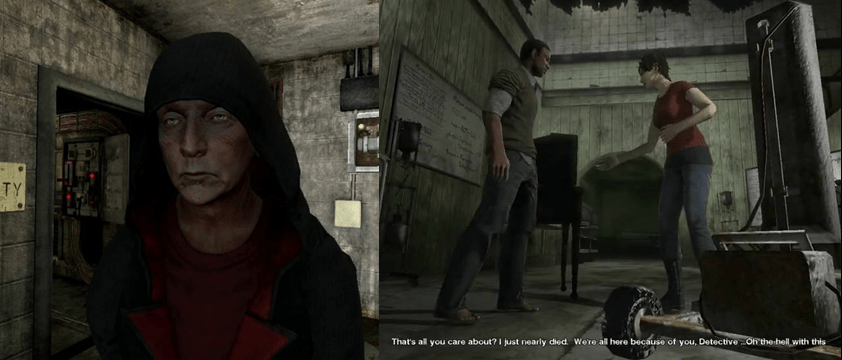
In the regular version of Mortal Kombat, you would unlock two additional fighters (Quan Chi and Cyber Sub-Zero) by completing the story mode but both of these are included right off the bat in the Komplete Edition. The inclusion of a cybernetic variant for Sub-Zero was interesting at the time but, sadly, was quickly undone in the very next game, as were many of the major ramifications of Mortal Kombat’s story. Finally, there’s the inclusion of every single downloadable fighter (apart from the PlayStation 3-exclusive Kratos); Mortal Kombat had some interesting DLC at the time, which included classic costumes (and Fatalities) for the likes of Sub-Zero and Scorpion, a brand new character based on a rumoured secret fighter, Skarlet, a surprise addition in the form of Kenshi, and one of my favourite ninja characters, Rain. It also set the trend for NetherRealm Studios’ later games by including a guest fighter from outside of the franchise, in this case Freddy Krueger from the Nightmare on Elm Street films (Various, 1984 to 2010). Sadly, however, none of the guest fighters speak (not even Freddy, despite the fact that Robert Englund provided the grunts and vocals for the character and his penchant for dark humour) or have alternate costumes and there are no additional Achievements tied to their inclusion; the Komplete Edition doesn’t even expand/update the player select screen to include them, which is a bit of a shame.

The Summary:
I have very fond memories of playing Mortal Kombat on the PlayStation 3; the fantastic retelling of the first three games was a great way to continue the franchise’s convoluted story while also streamlining it and making it cohesive for a change and the emphasis on unrepentant gore and violent combat was just the kick up the ass the series needed after getting sidetracked with all kinds of needless gimmicks. I remember the game being easy to pick up and play, with a surprising amount of depth to it, and offering a decent challenge the more you played and the more you tried to progress. Coming back to it with the Komplete Edition, much of my opinion remain the same; combat is fast and fluid, Fatalities and X-Rays are gruesome to behold and satisfying to watch, and the story does a great job of setting the stage for a new generation of fighters and new stories to be told.

While frustrating at times, Mortal Kombat did wonders for the series and finally got it back on track.

Sadly, though, there were some things that soured the experience for me: it’s clear that NetherRealm Studios refined the engine and the mechanics in the next game as the button inputs can be really finicky and aggravating at times; stages are nice and detailed but also lack an interactive elements outside of Stage Fatalities (even Mortal Kombat 3 let you smash your opponent into new areas); bosses like Goro, Kintaro, and Shao Kahn are super cheap and ridiculously annoying at times; and the computer just blocks way too often even on the easiest difficulty. This wouldn’t be so bad but you’re at risk of being hit with a Goddamn Breaker if you attack while they’re blocking; add to that the frustrating parry mechanics of guys like Liu Kang and Cyber Sub-Zero, Mileena and Noob Saibot’s overpowered teleport attacks, and the game not properly registering my inputs and it was needlessly exasperating at times. There’s still a lot to like here and it’s definitely worth your time but it clearly set the groundwork for bigger and better things in the far superior sequel, in my opinion.

My Rating:

Rating: 3 out of 5.

Pretty Good

What are your thoughts on the Komplete Edition of Mortal Kombat? Did you hold out for this version of the game or did you just get the base version and buy the DLC later? Were you a fan of how the game went back to basics and explored the roots of the series in a coherent and decisive way or would you have preferred to see the game try something truly new? Which fighter in the game (or the franchise) is your favourite and why? What did you think to the DLC characters and the game’s X-Rays and Fatalities? What did you think to the online options and the different towers the game had to offer? Which Mortal Kombat game, movie, comic, or other piece of media is your favourite? How are you celebrating Mortal Monday today? Whatever your thoughts on Mortal Kombat, leave a comment down below and check back in next Monday for more Mortal Kombat content.

Game Corner [Sonic CDay]: Sonic the Hedgehog CD (Xbox One)


Sonic the Hedgehog CD (Sonic Team, 1993) released on this day back in 1993. Produced alongside the blockbuster Sonic the Hedgehog 2 (SEGA Technical Institute, 1992), Sonic CD expanded upon the Blue Blur’s original debut title with lush graphics, a time travel mechanic, gorgeous anime cutscenes, and introduced players to Metal Sonic (one of Sonic’s most popular and enduring rivals) and Amy Rose. Considered by many to be one of the best of the classic Sonic titles, Sonic CD might not be one of my favourites but it’s still a classic in it’s own right and it’s worth looking back on today of all days.


Released: 14 December 2011
Originally Released: 23 September 1993
Developer: Christian Whitehead
Original Developer: Sonic Team
Also Available For: GameCube, Mega-CD, PC, PlayStation 2, SEGA Mega Drive Mini II (Original); Mobile, PlayStation 3, PlayStation 4, PlayStation 5, Xbox 360, Xbox Series S/X (Remaster)

The Background:
Sonic the Hedgehog (Sonic Team, 1991) was specifically created and marketed as SEGA’s Nintendo-beater and, thanks to selling over 15 million copies, succeeded in its goal. Naturally, SEGA were eager to produce a sequel but, rather than create one game, they ended up making two! With Sonic creator Yuji Naka having moved to America to work on Sonic 2, Sonic’s designer, Naoto Oshima, spearheaded an entirely separate title built on the bones of the first game that would be exclusive to SEGA’s ill-fated CD add-on for the Mega Drive.

Sonic CD is largely known as one of the best Sonic games and was made widely available in 2011.

With Sonic 2 more focused on speed, Oshima placed Sonic CD’s focus more on platforming and exploration with its speed-based time travel mechanic (which was cut from Sonic 2) and included gorgeous anime cutscenes from Toei Animation (which would later be the basis for the feature-length original video animation). Artist Kazuyuki Hoshino designed Sonic’s metallic doppelgänger and biggest fan, Amy Rose (though that character actually debuted, in a slightly different form, in a 1992 manga), both of which were as pivotal to the game as the time travel elements. Despite the game’s U.S. release being delayed for an entirely new soundtrack, Sonic CD was met with widespread critical acclaim but, for many such as myself, the game was somewhat elusive since no one I knew had a Mega-CD and it just wasn’t the same playing the PC version. I first played the game properly when it was included in Sonic Gems Collection (Sonic Team, 2005) but jumped at the chance to play the HD remaster when it first dropped on the PlayStation 3. Developed by Christian Whitehead, this new version of the game was widely available, included Achievement support, numerous bug fixes, and a whole host of new elements that make it the definitive version of this cult classic entry in the franchise.

The Plot:
When the mysterious Little Planet has makes its annual appearance, Sonic travels to Never Lake but finds the planet has been overtaken by Doctor Eggman’s Badniks! When Sonic’s number one fan, Amy Rose, is kidnapped by his robotic doppelgänger, Metal Sonic, Sonic must race across time itself to keep Eggman from polluting the past, recover the seven Time Stones, and ensure a good future for Little Planet!

Gameplay:
Sonic CD is a 2D, sidescrolling action platformer that once again sees you guiding the titular blue hedgehog across seven stages (known as “Zones”), each split into three parts (simply called “Zone 1” to “Zone 3” rather than being called “Acts”). At the end of each third Act, Sonic must battle Eggman in one of his contraptions but there’s quite a twist this time around. This time, as well as passing Lampposts to create a checkpoint, Sonic will also run past special signposts; once one of these has been triggered, Sonic will begin to sparkle as he runs and, if he builds up enough uninterrupted speed, he will travel to the past or the future depending on which post he activated. While the general layout of the Zone remains the same in the past, present, and future, there are numerous aesthetic and difficulty differences in each one. The past is generally much more lush and vibrant, lacking many of Eggman’s traps and Badniks; the present is a standard-fare Sonic stage; and the future is a pollution and hazard-infested mechanical hell. When in the past, Sonic must search high and low for a Robot Transporter and a holographic projection of Metal Sonic; destroying both in Zone 1 and 2 ensures that Zone 3 earns a good future, which strips it of all Badniks and hazards and even makes the boss battles noticeably easier.

Sonic CD‘s biggest gimmick is the speed-based time travel mechanic.

If you’ve played the first Sonic game then you’ll be immediately familiar with Sonic’s controls and physics. Sonic’s speed, jumping power, and abilities all carry over, making him as tight and responsive as ever, but he is afforded two new abilities. One is a variation on the Sonic 2 Spin Dash (it’s not quite as useful or as fast as in that game, though) and the other is Sonic’s Super Peel-Out manoeuvre, which sees Sonic rev up his legs until they become little more than a blurry figure eight and then rocket ahead at full speed, which is perfect for the few instances where you have the room to travel fast enough to time travel. Sadly, there’s not always the opportunity to do this; like in the first game, Sonic has to earn his breakneck speeds and, all too often, you’ll go running or rolling ahead in a blur of spikes only to slam head-first into a wall, a pit, a bumper, or poorly-placed enemies and hazards. This makes the time travel much harder to pull off than it needs to be as you’ll constantly be fighting to find a long enough stretch of ground or the right opportunity to build up your speed only to accidentally screw up the attempt at the last minute. Similarly, there’s a much greater emphasis on exploration and platforming this time around; every Zone feels like a mixture of speed, loops, and obstacles and the level design is questionable at best and haphazard at worst, with Golden Rings floating inside of the environment and your progress to the many alternate paths either blocked or protected by dead-ends and endless loops. As a result, when you travel back to the past, it can be extremely difficult to navigate through the Zones to find the Robot Transporters and projectors even in the more linear Zones; the bigger, more complicated Zones like Wacky Workbench and Metallic Madness make it nearly impossible to do without a guide or copious amounts of trial and error.

There’s still plenty of opportunities to be bounced around despite the many stage hazards.

Still, speed is a prominent factor in the game; thanks to the Super Peel-Out and new gameplay mechanics, Sonic is much faster than he was in the first game and is still bounced all over the place like a pinball in Zones like Collision Chaos. Indeed, there are technically two ways to play; the slow, methodical Sonic CD way which has you hunting down objects in the past or the faster, more Sonic 2 way which has you racing through Zones as fast as possible and completing them holding fifty Rings or more to enter the game’s Special Stages. Once again, Golden Rings act as your protection from damage; they’ll scatter everywhere when you’re hit and, as always, Sonic is in danger of drowning when underwater in the distinctly Labyrinth Zone-like Tidal Tempest but, thankfully, you don’t seem to spend anywhere near as much time underwater in this Zone. As is to be expected, every Zone has different gimmicks (such as moving or crumbling platforms, tubes, conveyor belts, bumpers, and the like) but these actually change when you travel through time, meaning different routes become accessible in each time period. Zones also take on more and more gimmicks (most of them very dangerous) as you progress but even the first Zone, Palmtree Panic, is crammed full of different ways to navigate. As a result, you’ll be bouncing all over the place in Wacky Workbench but fighting against treadmills and cogs in Quartz Quadrant, racing along tunnels and vast stretches of ground in Stardust Speedway, and dodging spikes, buzzsaws, and a bevy of hazards in Metallic Madness (which also features a unique shrinking mechanic). Thankfully, bottomless pits are a rarity in Sonic CD but crushing weights, sudden spikes, electrified coils, and falling boulders and stalactites more than make up for that! Also, Sonic CD is as difficult as you make it be; if you choose not to try and take the higher, easier, and faster routes or purposely visit the bad futures, then you’re going to have a much tougher time of it than if you actively try and create a good future. This places much more emphasis on your actions actually having consequences as, normally, you only restore (or fail) the world when you lose all of your lives or fail to collect all the jewels but, in Sonic CD, you can actively affect and improve each Zone on a case-by-case basis by collecting the Time Stones or destroying Eggman’s machinery in the past.

Graphics and Sound:
Thanks to the graphical enhancements of the Mega-CD, Sonic CD may very well be one of the most visually striking and vibrant games in the franchise, especially amongst the classic titles. Every Zone is awash with colour and life and full of little details and background elements; every time you travel to the past or future, the Zone gets a complete facelift and takes a much more verdant or ominous light depending on how well you play which really adds to the replayability of the game as every Zone has, essentially, four parts to it (past, present, good future, and bad future) that all present a different aesthetic and challenge while still maintaining the basic structure of the Zone.

Zones are packed full of details and vibrant colours but can look a little busy at times.

Zones have a real depth to them, allowing you to see into the distance and take in just how badly Eggman has affected each environment. You might see a vast sea full of ruins in the past of Palmtree Panic but all you’ll see is pollution and machinery in the bad future; similarly, Tidal Tempest is an unblemished cave in the past but has been transformed into a mechanical base in the future. Zones are also full of interesting and unique graphical mechanics, such as the pseudo-3D ramp at the start of Palmtree Panic, the Mode-7-like Special Stages, how a certain tube in Palmtree Panic will send Sonic smashing through the background and leave a Sonic-shaped hole in his wake, and the way graphics change size as you bounce and run all over the place. Unfortunately, though, I often find Sonic CD’s Zones to be a little too busy; there’s a lot going in the background and foreground, a lot of competing, clashing colours (especially in the garish pink of Collision Chaos), and it can be difficult to keep track of where you are and what’s going on sometimes.

The power of the Mega-CD makes for some gorgeous and well-animated sprites.

The sprites have, however, benefitted greatly from the graphical upgrade; Sonic has more animation frames and a more dynamic moveset and seems far more lively and energetic despite the majority of his assets being lifted from the first game. Sonic also speaks a little bit, shouting out “Yes!” when he grabs and extra life and “I’m outta here!” when left idle for a few minutes (which causes an instant game over). Other sounds, however, are not quite as appreciated, such as the sound Sonic makes when he jumps (which is decidedly squeakier and much more annoying and it also bugs me when it is recycled in both fan-made and official Sonic games). The bosses, too, are bigger and more elaborate than in the first game, requiring actual strategy on your part to defeat and even Amy Rose gets a lot of personality as she follows Sonic around like a love-sick puppy, desperately trying to hug him while love hearts adorably fly from her head.

The anime sequences really bolster the game’s appeal and capture Sonic’s essence.

Of course, you can’t talk about Sonic CD without mentioning the anime cutscenes and the soundtrack. The opening and ending of the game features gorgeously animated anime sequences that showcase Sonic at his best, in my opinion; I loved that these were expanded upon in Sonic the Hedgehog (Ikegami, 1999) and I would absolutely be over the moon if they were brought back for future Sonic games. Sonic CD’s soundtrack is also one of the most beloved and contested in the franchise; many prefer the original Japanese soundtrack and, while that is good, it’s much more peppy and vibrant and happy-go-lucky than Spencer Nilsen’s version for the U.S. As a result, while I prefer some tracks from the Japanese soundtrack, overall I prefer the U.S. one; the invincibility music is better, the boss theme is better, and the U.S. soundtrack is much more in the style of rock and metal than anything else, which I prefer.

Enemies and Bosses:
Once again, Sonic must contend with Eggman’s Badniks; unlike in the majority of the classic Sonic titles, Badniks don’t drop cute woodland critters and, instead, blossom flowers upon defeat (again tying into the game’s overall theme of restoring Little Planet to health) and, honestly, they’re far less prominent than in other 2D Sonic titles. Indeed, Sonic CD’s Badniks mainly exist to screw up your run-up to a time travel attempt and cost you your hard-earned Rings right before the goal and they’re probably some of the most unremarkable in the original games. Eggman’s theme this time around is definitely geared more towards bugs than anything else as needle-nosed Mozzietrons try to skewer you from above, Arachnisprings jump out at you, Damsiltron and Buzz Bomber 2s hover overhead and take shots at you, and Poghoppers bounce around the place on their springy bases. Probably the worst enemies are the Snail-Spikers due to their spikes, Motherbombs (which are invulnerable to your attacks and explode into a shower of projectiles), and the Flashers, which must be hit at just the right time to avoid taking damage from their laser beams. Your main opponent, though, will be the abundance of spikes, springs, bumpers, and other obstacles that mess up your momentum and cost you valuable Rings.

The first boss is, quite possibly, the easiest of any of the classic Sonic videogames.

The bosses, though, are a completely different story. Sonic CD features some of the biggest and most unique and interesting boss battles of all the classic games and, while each boss only takes three hits to defeat, they all require different strategies on your part and are affected by whether you battle them in a good or bad future. The first time you battle Eggman, he’s inside of his EGG-HVC-001 mech, which is either a striking pink or an ominous red and sports spikes on the feet. Eggman protects himself from attacks with two bumpers but, after a couple of hits/bounces, these will break off and allow you to land the decisive blow. It’s, quite possibly, the easiest first boss in any Sonic game as even Sonic 2’s Eggmobile took eight hits to defeat.

Bosses require a bit of strategy on your part but are extremely fragile once you get your hits in.

In Collision Chaos, Eggman hides at the top of a giant pinball table and drops weighted balls down at you that can force you to drop down to the lowest level or into some annoyingly-placed spikes. The whole battle is structured very similar to the Star Light and Casino Night Zones and is a clear precursor to Sonic the Hedgehog Spinball (SEGA Technical Institute, 1993) in that players must make use of the flippers to bounce Sonic up each level of the arena, ricocheting off of bumpers and such to ram into Eggman’s machine three times. Your enjoyment of this boss may vary as it all depends on how well you get on with the pinball-based Zones and mechanics of Sonic games; for me, this meant it was quite an annoying boss as it can be tricky to get the angle of your trajectory right to go where you need to. At the end of Tidal Tempest Zone 3, you’ll have to chase Eggman around a short maze similar to the end of Labyrinth Zone; unlike in that encounter, though, this time it’s a simple loop that repeats until you land a few hits and you don’t need to worry about spikes or other hazards. Also, after Eggman flees, he floods the area and surrounds his craft with air bubbles and shoots projectiles at you; in order to finish Eggman off, Sonic has to suck up a couple of the bubbles to make a gap in his defences, which is certainly a unique spin on Sonic’s notorious underwater mechanics.

Compared to some of the other bosses, the final battle is a walk in the park!

Probably one of the more frustrating bosses is encountered in Quartz Quadrant; here, Eggman hides behind a giant piston and Sonic is forced to perpetually run on a treadmill lest he be skewered by spikes on the far left of the arena. Unlike the other Eggman bosses in Sonic CD, this boss isn’t about attacking but surviving as Eggman drops bombs onto you, which must be avoided, and you have to wait for the friction of the treadmill to destroy Eggman’s machine and defeat him. Because of how difficult it can be to maintain your speed and footing when avoiding the bombs and their projectiles, this can be a particularly challenging boss for your patience, if nothing else. In comparison, the final boss is a fairly anti-climatic and simple affair; Eggman surrounds his craft with four blades and hovers in a slow pattern around the arena, shooting them at you or occasionally spinning your way. However, it’s ridiculously easy to attack between the blades and, each time you land a hit, he loses one of them so, even though he speeds up and becomes more erratic, he’s made more vulnerable to attack and, honestly, this final boss is easier than the one in the first game!

The race against Metal Sonic might be Sonic CD‘s most iconic, and annoying, boss battle.

Of course, the most iconic boss battle of Sonic CD comes in Stardust Speedway where you’re forced to race against Metal Sonic! This is a thrilling, if frustrating, experience as Eggman flies along behind you firing an instant-death laser and it can be difficult to get up a good run of speed because, again, of spikes, obstacles, and sudden drops or edges in the path. Metal Sonic is completely invulnerable to harm and will charge at you full-speed or electrify its body, which is helpful for breaking spikes and clearing a path for you. Because of the way the screen is locked, though, this isn’t quite the fast-paced experience it’s often thought and interpreted as and is, instead, a strangely-paced, annoying affair that generally comes down more to luck than anything else. The best thing to do is to stay ahead where you can, jump over Metal Sonic, and then blast past it at every opportunity so that you’re on the right side of that wall when it comes crashing down.

Power-Ups and Bonuses:
As is the standard for most Sonic games, a number of power-up monitors are scattered throughout the game’s Zones. Unfortunately, though, there are no new or exclusive items to be found in Sonic CD; instead, you’ll have to make do with either ten Rings, a shield that protects you from damage for one hit, an extra life, speed-up shoes, or a brief invincibility just like in the first two games.

Additional Features:
Sonic CD has twelve Achievements for you to earn, some of which are pretty simple; you’d be hard-pressed to play through the game without travelling through time, for example, and you’re guaranteed to get a hug from Amy after defeating Metal Sonic. Others, though, are a bit trickier, requiring you to collect two hundred Rings rather than the usual one hundred, or to find the upper goal signpost in Collision Chaos 2 and a hidden angel statue in Wacky Workbench. Probably the most troublesome Achievements, though, involve beating Metal Sonic without being hit and destroying all of the Robot Transporter and holograms in the past.

Conquer the seven psychedelic Special Stages to get the Time Stones and the best ending.

As in the first game, finishing every Zone except the third with fifty Rings or more allows you to enter a Special Stage by jumping through a Giant Ring. These Special Stages are much more elaborate than in the first game, though, and arguably a bit more forgiving than in the second; here, you must race around a flat area against a tight time limit, avoiding water and other obstacles as you hunt down and destroy a number of UFOs. If you land on water, or similar surfaces, your time will drain exponentially so be sure to avoid these at all costs but don’t go too fast on the booster pads as it can be very difficult to make tight turns. As you destroy UFOs, you can earn Rings and even a time bonus, which is helpful, but while fans can be used to float into UFOs, spiked grates will cost you valuable time. Depth perception is a real issue here as you have to be very precise with your jumps but, if you see your time is about to run about (when it hits, say, ten seconds), you can pause and quit to the main menu and then retry the Special Stage from your save slot, meaning you basically have unlimited tries at each Special Stage and can easily grab all seven Time Stones and get the best ending.

The Xbox Live version of the game includes a host of bonus features, including a playable Tails!

I mentioned before that this was the definitive version of the game and it’s true; you can pick from a variety of display options in the menu, choose between the U.S. and Japanese soundtracks (but can’t mix and match, unfortunately), choose which Spin Dash you want (I recommend the superior Sonic 2 one), and have access to four save slots. Unfortunately, these don’t work like in Sonic the Hedgehog 3 (SEGA Technical Institute, 1994), meaning you can’t pick and choose a Zone to replay, which is disappointing. You can, however, unlock a stage select, D.A. Garden (basically a sound test which you can also use to enter a variety of cheats, though Achievements can’t be earned this way), and “Visual Mode” (a gallery for viewing the anime scenes) by completing the “Time Attack” mode fast enough. Perhaps the most notable addition to this version of the game is that you unlock Miles “Tails” Prower after beating the game in any way; Tails controls exactly like he did in Sonic 3, meaning he can fly and swim, but Achievements are disabled when playing as Tails as it’d be too easy to get around Sonic CD’s more annoying level layouts.

The Summary:
Sonic CD is an absolutely gorgeous game; it took everything that worked about the first game and expanded upon it wonderfully, bringing a much greater sense of speed and liveliness to the core gameplay and really utilising the power of the Mega-CD to its fullest with its anime sequences, animations, music, and unique time travel mechanic. Yet, as much as I love how visually appealing the game is, I find it lacking in a lot of ways; it’s frustrating at times, the level layouts are massively annoying for a game whose main mechanic is based on speed, and the amount of exploration and trial-and-error needed can get annoying at times. Still, I love how every boss battle is unique and how your actions have actual, visible consequences as you play; it really invites multiple playthroughs to see what each Zone looks like in different situations but, similar to the first game, I find myself less excited to replay Sonic CD and more aggravated as it can be a chore at times. When it shines, it shines brightly and I’d love to see more of this style of 2D Sonic in the future but its more irritating features and mechanics definitely need polishing up first.

My Rating:

Rating: 4 out of 5.

Great Stuff

Did you enjoy Sonic CD? Did you own this, and a Mega-CD, back in the day or did you first experience it on PC or through some other port? What did you think to the game’s presentation and which of the two soundtracks is your favourite? Were you a fan of the level layouts and time travel gimmick or, like me, do you think they could have been better implemented? Which of the game’s Zones and bosses is your favourite? Are you a fan of Metal Sonic and Amy Rose? How are you celebrating Sonic CD’s anniversary this year? Whatever your thoughts on Sonic CD, or Sonic in general, feel free to leave a comment below.

Game Corner: Resident Evil: Operation Raccoon City (Xbox 360)

Released: 20 March 2002
Developer: Slant Six Games/Capcom
Also Available For: PC and PlayStation 3

The Background:
By 2012, the Resident Evil series (Capcom/Various, 1996 to present) had undergone many changes since debuting as a cheesy survival/horror title hampered by “tank controls”; Resident Evil 4 (Capcom Production Studio 4, 2005) famously switched the game to a more action-orientated, over-the-shoulder third-person perspective, which had been expanded upon greatly in Resident Evil 5 (Capcom, 2005) and would basically transform the series into an action-heavy shooter by Resident Evil 6 (ibid, 2012). In the midst of this transition into a more action-orientated franchise, developers Slant Six Games worked alongside Capcom on a spin-off, a squad-based shooter that reinterpreted events from the franchise’s early days. Despite selling over two million copies and being considered by Capcom to be a success, the game was met with mixed reviews perhaps in a reflection of the backlash against Resident Evil’s new direction; some praised the gameplay and mechanics while others criticised it as being inferior to other, similar videogames.

The Plot:
In a retelling of the events before and during the zombie outbreak in Raccoon City, an Umbrella Security Service (USS) strike team, under the command of HUNK, attempts to secure the G-Virus sample from Doctor William Birkin. However, they are soon forced to battle against Umbrella Biohazard Countermeasure Service (UBCS) mercenaries, flesh-eating reanimated corpses,  and the malevolent Umbrella Corporation’s many Bio-Organic Weapons (B.O.W.s), and faced with death and betrayal that cause them to question their orders.

Gameplay:
Resident Evil: Operation Raccoon City is a third-person, squad-based shooter in which players can pick from six members of the Umbrella Security Service (U.S.S.) Delta team (known as “Wolfpack”): Vector, Lupo, Beltway, Spectre, Bertha, and Four Eyes. Once you’ve selected your character, you must then select three others to assist you in the game’s missions to be controlled either by other human players using the game’s online function or assigned to the relatively competent A.I. No matter which character you select, the controls remain the same and will be instantly recognisable to players of similar third-person shooters: press in the left stick to run and then press A to dive ahead, press the Right Trigger to fire and the Left Trigger to aim, B executes a melee attack, you can switch weapons with the Left Bumper, toss grenades and other explosives with the Right Bumper, and press X to reload. The directional pad (D-Pad) also factors into gameplay; you can select from the different grenades available by pressing right, use a First Aid Spray by pressing left, use an Antiviral Spray by pressing down, and toggle through various vision modes by pressing up.

Each character has different abilities that can be used to give you an edge in combat.

Each character does, however, have access to several different abilities, which you can activate with Y for a variety of temporary effects. Vector specialises in reconnaissance and moves much faster, can become undetectable to enemy radar, mimic other characters, and become completely invisible; Lupo focus more on combat and is able to wear stronger body armour, reload faster, and utilise more versatile ammunition; Beltway is the explosive expert and is able to better resist explosions, disarm mines and traps, and utilise a wider variety of explosives; Spectre is all about detection and mapping and is able to expand upon the mini map and detect nearby items and enemies using different vision modes; Bertha is the team’s medic and can carry more healing items, use them more effectively, and reduce the amount of damage taken; and Four Eyes, being more of a virologist, can carry more Antiviral Sprays, detect infected individuals, and both infect and command infected targets. Similar to the more action-orientated Resident Evil titles, much of the game is focused more on combat rather than exploration and puzzle solving; as a result, you will automatically snap to cover when you’re near walls, barriers, or other objects and must often clear a room of enemies in order to progress. The game is surprisingly dark, however, so I recommend increasing the “Gamma” settings in the options to bring a bit of illumination to the darker areas, though the use of darkness is used to create a sense of ambience and dread to the proceedings.

The better you play, the more XP you’ll get and the faster you can upgrade weapons and abilities.

As you defeat enemies, find Raccoon City Mascots and data, destroy well-hidden security cameras, pick up Intel and send it using laptops, and complete missions, you’ll gain experience points (XP); XP is then used to purchase new weapons and unlock and upgrade each character’s Passive and Active abilities. While any character can use any of the weapons you unlock, once again you can only carry two weapons at a time, so you’ll most likely be dropping weapons and liberating new ones from your defeated foes, and you’ll need a great deal of XP to unlock and upgrade everything the game has to offer for its six characters. As is the standard for Resident Evil titles, you can pick up First Aid Sprays to fully refill your health and use green herbs to restore a little bit of health; if you come across a green herb, though, it cannot be stored in your inventory. Unlike most other Resident Evil videogames, though, you can actually become infected with the Tyrant Virus (T-Virus) and, unless you use an Antiviral Spray, will become a zombie and attack your team mates after a short period of time. Additionally, you can be afflicted with a “bleeding” status that will attract (and spawn in) all nearby enemies (though you can also inflict this status on human enemies to zombies attack them as well). Note, however, that while you can pick up First Aid Sprays, Antiviral Sprays, and additional weapons and explosives, you’ll lose all your new held items if you die during a mission.

Take advantage of the stashes of ammo to help stave off the swarms of zombies.

The A.I. is relatively competent in a firefight; if they get downed during combat, you can press A to revive them but you may find that they often wander around aimlessly and tend to shoot through doors and walls before enemies even spawn in. Your mission objectives generally involve holding out against wave upon wave of enemies, reaching a specific destination, and clearing out all enemies but you’ll also be tasked with destroying or locating certain items and objects. Other times, generally during boss battles, you’ll have to hold out until doors are opened, or open them yourself, and the battle becomes much more about survival as you desperately try to stay alive while a seemingly endless wave of enemies attack you. Despite the fact that the environments are littered with an abundance of ammo creates and plenty of ammo and weapons, it’s easy to be overwhelmed, which can lead to some frustrating moments that are probably made a lot easier when playing with another human.

Graphics and Sound:
Resident Evil: Operation Racoon City mostly holds up pretty well; thanks to many of the characters having their faces obscured by helmets and masks, the character models largely avoid resembling action figures and, when popular and recognisable Resident Evil characters do appear, they shine all the better for it. However, I did notice quite a few instances of slowdown and jitteriness when there were a lot of enemies and characters onscreen at any one time and more than a few clipping errors where characters would walk through parts of the environment.

Gore and creepy, recognisable locations are plentiful, if a bit dark at times.

The game’s environments are decent enough; they’re dark and creepy and fully of the usual Resident Evil ambiance, featuring flickering lights, blood trails, and an abundance of gore to punctuate the game’s action-orientated approach. There are a lot of little details here and there (though the dark lightning can make a lot of them difficult to make out) and, once you finally escape from the drab, grey corridors, you’ll get to fight through the ravaged streets of Raccoon City (which was a notable highlight). Other environments include the dark, maze-like offices of City Hall, a creepy cemetery, as well as recognisable locations from Resident Evil 2 (ibid, 1998) and Resident Evil 3: Nemesis (ibid, 1999) such as the police station (including Chief Irons’ office) and the prerequisite Umbrella laboratories and facilities. Despite the presence of a number of high-quality cinematics, the game’s cutscenes largely utilise the in-game graphics, primarily to ensure that your chosen character and team mates are properly loaded into each scene. This adds a degree of variety and replayability to the game as different characters have different dialogue in cutscenes, though it does seem as though the game recycles a lot of sounds from Resident Evil 5.

Enemies and Bosses:
As you might expect, one of the most common enemies you’ll encounter in Resident Evil: Operation Raccoon City are zombies; zombies are slow, shambling corpses who go down quite easily but generally attack in large groups and will lunge and grab at you to try and take a bite out of you. In these situations, you can frantically wiggle the left stick to try and shake them off and you better make sure you do this as they can infect you or cause you to bleed otherwise. Dead bodies in the nearby area will often pop up as surprise zombies, who can also power-up and return to life as the much faster, tougher, and more aggressive Crimson Heads so make sure you take them out with a good old head shot before they get the chance to do this. Similarly, you’ll also encounter the odd Cerberus; these infected dogs like to pounce at you out of nowhere to give you a good scare and you’ll also have to shake off their bite and have a good aim to take them out because of how fast they can be. You’ll also come up against spider-like Parasites that quickly scuttle across the environment and can also be difficult to hit. These become doubly annoying when they join with a zombie as not only will Parasite Zombies be faster and more dangerous thanks to the Parasite’s extra limbs but you’ll also have to kill the Parasite after taking out the zombie host.

Lickers and Hunters are as formidable a threat as ever thanks to their superior strength.

You’ll also come up against some of Resident Evil’s most notorious B.O.W.s, such as the Lickers and the Hunters; Lickers scramble all over the walls and ceilings, popping out from vents and grabbing at you with their long tongues. Fast and difficult to hit, it’s best to target their exposed brains but they can easily overwhelm with their sheer numbers and ferocity. Similarly, Hunters will often drop from the sky in torpedo-like capsules and attack with an unmatched viciousness; leaping and charging across the place, they attack with large, deadly claws and take a great deal of punishment before going down so you’ll definitely need your more powerful weapons to make short work of them. Apparently because B.O.W.s aren’t interesting and dangerous enough, you’ll have toe exchange gunfire with a variety of living, human enemies; soldiers from the Umbrella Biohazard Countermeasure Service (U.B.C.S.) will fire at you from behind cover and other barricades, often to provide support for series staples such as Leon S. Kennedy and Claire Redfield, and are surprisingly durable and difficult to spot. You’re encouraged to inflict them with the bleeding status to send nearby zombies into a frenzy and tear them apart but this can just as easily be bad news for you, too, as the U.B.C.S.’ bullets can cause you to bleed and the final mission of the game is notably frustrating because you end up caught in a crossfire between the well-equipped U.B.C.S. and an endless swarm of zombies.

Keep your distance from the invincible “G” to avoid his swings and hold him at bay.

If you’ve played Resident Evil 2 and 3, you’ll instantly recognise the bosses and larger B.O.W.s included in the game; given that your first mission is to retrieve the Golgotha Virus (G-Virus) samples from Birkin’s laboratory, the first boss you’ll encounter is Birkin in his monstrous “G” form. “G” can’t be killed, however, making this a tense chase down a very narrow corridor as you desperately avoid “G”’s wild swings and slow him down by shooting nearby explosive barrels and pipes. If you linger around too long or get too close to him, it’s stupidly easy to get caught up and glitched on his hit box and the nearby environment so just turn around and run and save your ammo and efforts for when the game tells you to hold him at bay.

Mr. X is bad enough by itself but is accompanied by other enemies and another Tyrant!

Another recognisable B.O.W. you’ll encounter more than once is the T-103 Tyrant known as Mr. X; this massive, hulking figure has a tendency to attack and damage other B.O.W.s in its path and can be briefly controlled by Four Eyes but, for the most part, is indestructible when you first encounter it, leaving you to desperately run around taking out zombies and Parasites as you retrieve key cards to escape the area. In a later mission, two of the damn things attack you at once and you must take them out in order to progress. They’re incredibly strong, leaping and charging at you, pounding you into the ground and squeezing the life out of you with each so it’s best to keep your distance, focus on one at a time, and always aim for the head. One of the most troublesome and frustrating missions of the game sees you staving off wave after wave of zombies and U.B.C.S. soldiers while trying to bring down the Nemesis-T Type, an intimidating creature by itself without all the additional enemies swarming the area. After numerous deaths and failures, I found it was much easy to quickly take out any nearby zombies, grab some restorative sprays, and camp out by the ammo crate and take pot shots at Nemesis until it finally dropped to the ground, taking advantage of the explosive barrels wherever possible. Even then, it can rear up and keep ticking along, all while you’re getting shot to shit and desperately trying to bring it down so you can inject it with the NE-α parasite.

Concentrate your fire on the Super Tyrant’s exposed heart to take it out quickly.

As in Resident Evil 2, you’ll have to do battle with Mr. X’s final form onboard an elevator; again, like Nemesis, the Super Tyrant is powerful and formidable enough without the battle being made more strenuous by the presence of Lickers, flame jets, and being a gauntlet that you must complete without any checkpoints mid-way through. To take out the Super Tyrant, it’s best to camp out by the ammo crate, stay away from it, and shoot at its exposed heart with everything you’ve got. If it’s close enough to the elevator edge, you can knock it off pretty quickly in the first phase of the battle and, as long as you can pick off the Lickers and avoid being roasted alive, you can repeat this strategy for the second phase of the fight where the B.O.W. is much faster and more aggressive.

Claire, Leon, and swarms of soldiers and zombies await you in the final mission of the game.

In a change of pace, however, the final challenges of the game have you taking on Claire and Leon in separate missions; Claire awaits you in an infested train yard and likes to take pot shots at you with a grenade launcher but tags out before you get to make her pay for her insolence. When you get to the end of the train yard, Leon camps out up top and snipes at you while being protected by U.B.C.S. soldiers behind a fortified barricade and zombies roam the immediate area. This, without a doubt, was the toughest and most frustrating part of the game at that point and, in the end, I was reduced to simply tanking damage and running the barricade to reach the ladder and trigger the cutscene that led to the game’s final mission. Here, you’re given two options: one sees you spare Leon and the other sees you kill him as per your orders. If you kill him, you’ll have to take out a couple of your team mates before you can get to Leon, who blasts at you from behind cover and can cut you down with ease unless you bring along or get your hands on the sniper rifle. If you spare him, it’s the same thing but, this time, you’re defending him from your team mates and it’s a far easier fight but, if you want to get all of the game’s Achievements, you’ll need to slog through this final mission at least twice.

Power-Ups and Bonuses:
As mentioned above, you have a variety of restorative items available to you in the game; green herbs offer a quick, one use pick-me-up, First Aid Sprays can be stocked and refill more of your health, and Antiviral Sprays will cure you from infection if needed. Unlike a lot of third-person shooters, your health won’t replenish over time so it’s best to keep a First Aid Spray in your inventory and to keep your team mates nearby so they can revive you as checkpoints are often lacking mid-way through the more frustrating missions.

Use XP to purchase new weapons and be sure to shoot open weapon crates whenever you see them.

Each character has a variety of unique Passive and Active abilities; Active abilities also come with a cooldown period so you can’t spam their use over and over and some are, honestly, more useful than others; the mechanics are definitely geared towards human players working together and using each character’s abilities to the best of their advantage and you’ll be grinding and replaying missions quite a bit to unlock everything and make life easier for yourself. Of course, the main power-ups you’ll pick up are the wide variety of weapons; pistols, shotguns, assault rifles, sniper rifles, and heavier weapons like grenade and rocket launchers are all available if you have enough XP but you’ll also be able to liberate them from dead U.B.C.S. soldiers and grab better weapons from weapon creates scattered throughout the environments (you’ll need to shoot the locks off these first, though). You’ll also be able to use familiar weapons from the franchise, such as the Samurai Edge and Barry Burton’s magnum, and three different types of grenades (frag, flashbang, and incendiary). Thankfully, you don’t need to use XP to upgrade the proficiency of the weapons and, once you unlock them, any character can use them but you’ll still need a lot of XP to unlock everything.

Additional Features:
Resident Evil: Operation Raccoon City has fifty Achievements for you to earn; many of these are tied to simply clearing the single player missions but you’ll also get Achievements for purchasing weapons and upgrades, healing a certain amount of times, and killing a certain amount of enemies. Some are much trickier to get and require you to finish he game on harder difficulty modes, purchase and upgrade every ability, and kill enemies in specific ways.

There’s a fair amount of multiplayer and DLC options available if you want more content.

Many of the rest are tied towards the game’s many multiplayer modes; the game’s single player campaign can be played in co-op and it also features a variety of competitive modes, from traditional deathmatches to a survival mode and one that has you searching out G-Virus samples, and the Xbox 360 version also has an exclusive “Nemesis Mode” that allows one player to take control of the Nemesis and hunt down and kill the other players. Unfortunately, I never got to experience any of Operation Racoon City’s multiplayer options as they game cannot be played locally, which is always frustrating and mind-boggling for me, meaning I couldn’t even 100% all of the Achievements even if I wanted to. Operation Raccoon City isn’t an especially long game (I finished it on “Normal” mode in around eight hours), even in its most frustrating moments, but you can extend the game’s playtime by purchasing the “Spec Ops” downloadable content (DLC), which adds six more playable characters, a number of additional campaigns and Achievements, and more recognisable characters from the series to expand upon the game’s unique retelling of the second and third games.

The Summary:
Resident Evil: Operation Raccoon City is a decent enough title for a spin-off of the main series; it takes many familiar characters and concepts from the franchise and reimagines them, fully embracing its more action-orientated mechanics and being a relatively inoffensive third-person shooter. It’s not much compared to the Gears of War franchise (Various, 2006 to present) and lacks a lot of the appeal of main series titles like Resident Evil 4 but, had Capcom kept the more action-orientated, third-person mechanics confined to a side series such as this, Resident Evil 6 might have turned out a little less disappointing. However as great as it is to battle the franchise’s gruesome B.O.W.s with more freedom and more detailed graphics compared to the original PlayStation releases, Operation Raccoon City has a lot of flaws and bugs and frustrating parts that really drag it down; the clipping and frame rate issues were noticeable, the lack of checkpoints and losing all of your inventory after dying can make bosses and the survival missions needlessly exasperating, and the sudden, anti-climactic end of the game really derails what little story is on offer. Overall, it’s a decent enough experience that should satisfy fans of the series, especially the more action-heavy titles like Resident Evil 5, but fans of third-person shooters can definitely find better options on the market.

My Rating:

Rating: 2 out of 5.

Could Be Better

What did you think to Resident Evil: Operation Raccoon City and how do you think it holds up as a third-person shooter and spin-off of the main series? Which of the playable characters was your preferred choice? What did you think to the game’s minor retelling of the main story and the encounters with recognisable Resident Evil characters and monsters? Did you choose to kill or defend Leon at the conclusion of the game? Did you ever play the game’s multiplayer and, if so, what was it like? Which Resident Evil videogame, character, monster, or spin-off is your favourite, and would you like to see a return to the more action-orientated style the games adopted during this time? Whatever you think, feel free to leave your thoughts down below.

Game Corner [Alien Day]: Aliens: Colonial Marines: Limited Edition (Xbox 360)


Audiences were first introduced to the horrific, biomechanical Xenomorphs in the classic science-fiction horror film Alien (Scott, 1979), a tense and suspense-filled monster film that kick-started an entire franchise. In that film, and much of the subsequent Alien media, an unsuspecting cargo crew investigates a beacon on the barren world of LV-426 and, as a result, the 26th of April is widely celebrated as “Alien Day”, a day to celebrate one of the greatest sci-fi/horror franchises ever created.


Released: 12 February 2013
Developer: Gearbox Software
Also Available For: PC and PlayStation 3

The Background:
Hooo boy, where to start with this one? So, if you’ve played games, follow games news, or watch online reviews or videos about games the chances are that, at some point, you’ve come across people talking about Aliens: Colonial Marines, a first-person shooter (FPS) that was heavily pushed as being the official, direct sequel to Aliens. Though originally conceived of by Gearbox Software, multiple development studios worked on the game between 2007 and its eventual release in 2013 since Gearbox was busy dividing their attentions between multiple other titles at the same time. This, perhaps inevitably, led to some disagreements regarding the design and direction of the game. Further compounding matters was the fact that Gearbox were dissatisfied with TimeGate Studio’s work on the PlayStation 3 version and, having already delayed the game significantly by this point, were forced to work against a strict deadline to finish the game for its intended release date. Interestingly, Aliens: Colonial Marines actually sold really well upon its release (perhaps because of the strength of the Aliens franchise) but was the subject of widespread scathing criticism; critics were unimpressed with the graphics, bugs and glitches, poor textures and lighting effects, and its lack of continuity to the Alien franchise. While there were some who praised the game’s aesthetics and features, others criticised the intelligence of the game’s enemies, which had been corrupted and neutered thanks to a simple typing error in the game’s code. For my part, I’d heard all the horror stories surrounding this game and was still intrigued; being a big Aliens fan, and considering the game is dirt cheap and easy to come by, I figured it couldn’t really be as bad as I was being told, especially since I’d heard similar stories about Aliens vs. Predator (Rebellion Developments, 2010) and found that to be nowhere near as bad as I had been led to believe. Not perfect, for sure, but then again I’m not the biggest fan of FPS games so my expectations are quite low by default.

The Plot:
Seventeen weeks after the events of Aliens, the Sephora receives a distress call from the Sulaco, which has inexplicably returned to orbit around LV-426. Corporal Christopher Winter is amongst the Colonial Marines sent to investigate the ship, discovering that it (and the planet below) is infested with Xenomorphs that have wiped out an entire regiment of Marines and that the malicious Weyland-Yutani corporation have once again secretly been plotting to acquire the creatures for their bio-weapons division.

Gameplay:
Aliens: Colonial Marines is, like many titles in the franchise, a first-person shooter that is, for the most part, very similar to the Marine portions seen in Aliens vs. Predator and other FPS games. In a refreshing change of pace, you play as a character who isn’t silent for a change; Winter, like many of his fellow Marines, may look and sound like your typical overly-macho jarhead but it’s nice to actually have an FPS protagonist who isn’t as silent as a graveyard and can actually, properly interact with the game’s other characters.

Blast those Xeno bugs to mush with your FPS skills.

As you might expect, all the typical FPS clichés are present and accounted for: you can carry two weapons at a time, changing between them with the Y button, in addition to a limited number of explosives (frag grenades, firebombs, and claymores, specifically) and a pistol with unlimited ammo, both of which can be accessed by pressing right or left on the directional paid (D-pad). You can jump with A (though, thankfully, there isn’t really much in the way of platforming sections), crouch with B (doing so behind boxes or other parts of the environment to avoid incoming fire), sprint for a short burst by pressing in the left analogue stick, and execute a melee attack (generally bashing enemies with the butt of your weapon) by pressing in the right analogue stick. If Xenomorphs or Facehuggers pin you down, you’ll have to mash X to fight them off and may be reduced to your pistol for a few moments as you struggle to your feet; you can also shoot at explosive canisters to take out multiple enemies at once, which is always handy.

Don’t use the weapon wheel in the middle of combat or you might end up skewered!

Holding down the Y button will bring up the game’s weapon wheel; from here, you can equip different weapons as you collect or unlock them, which is useful but this weapon wheel doesn’t pause the game so, if you need to switch out our Assault Rifle for the Pulse Rifle in the middle of a skirmish, the chances are that you’re going to get injured or killed so it’s best to switch your weapons in safe areas. Most weapons have a secondary fire function as well, ranging from an explosive short or flame burst to a paralysing effect to your shots, and you can toggle your torch (or “flashlight” for you Americans) by pressing down on the D-pad. You’ll want this flashlight activated at all times since Aliens: Colonial Marines is a very dark game and you’ll need all the light you can get in some areas. I knew about this ahead of time and also cranked up the in-game brightness but, honestly, I actually didn’t mind the game’s darker areas and moments as they are all highly reminiscent of the source material and really added to the game’s fidelity to the movies and the sense of mounting dread and tension since you can never really tell what’s lurking around the next corner. Thankfully, you can whip out the franchise’s iconic motion tracker by pressing LB and a mini tracker will beep and appear onscreen when enemies are near. Neither are massively accurate and you can’t shoot and use the main tracker at the same time but it’s a welcome addition and better than nothing since the tracker also points you in the direction of your objective and notable characters/objects.

Gameplay occassionally slows down to have you defending barricades or using stealth.

The game features a relatively simple heads-up display (HUD) which tracks your armour, health, ammo, and experience points (EXP). Each time you kill an enemy or find a collectable, you’ll gain EXP and can spend these points on a variety of upgrades for each of your weapons. Your health is measured in three sections and will automatically refill in each section; however, should you lose a section of health, the only way to refill it is to grab one of the Med-Packs scattered across the game’s locations. Ammo, new weapons, and armour are relatively plentiful, often found stashed in the game’s quieter rooms or dropped by human enemies. The game also features some pretty generous checkpoints and, upon reloading a save, you’ll be gifted with full armour and health, which is always appreciated. The bulk of Colonial Marines’ gameplay is centred around exploring familiar environments from the first two movies, blasting a variety of Xenomorphs and human enemies as they rush at you, and some very basic missions. You’ll be cutting open sealed doors with your blowtorch, interacting with switches and consoles, finding flight recorders, taking out Weyland-Yutani scientists before they can activate alarms and set off poisonous gas, rescuing other Marines and personnel, and generally trying to survive and get to the bottom of Weyland-Yutani’s questionable schemes. Despite the game’s dark areas and the repetitiveness of many of the corridors and locations you find yourself in, the game is quite linear so you won’t find yourself getting lost that often but you can always refresh yourself on your current objectives by pressing the ‘Back’ button and just follow nearby non-playable characters (NPCs) if you get a bit stuck.

Set up and disable sentry guns to help tip the odds in your favour.

Occasionally, you’ll be charged with defending an NPC or holding out against wave upon wave of Xenomorphs as your fellow Marines attempt to cut through doors, signal for help, or start up the iconic Aliens dropship. These sections can be rather tense and frustrating since, while NPCs are helpful and will shoot at enemies (and make for great bait), they aren’t the most reliable computer-controlled allies I’ve ever had and it can be tricky to get a good shot at the agile and stealthy Xenomorphs. Often, you’ll also be tasked with grabbing and setting up an auto-turret in these situations, which can be extremely helpful, but you’ll also have to watch out for these turrets as Weyland-Yutani mercenaries have set them up to fire on you, requiring a bit of subterfuge as you take the long way around to disable the sentry guns. Aliens: Colonial Marines’ main campaign is divided into missions; as you complete each mission, you’ll be awarded with more EXP and given the option to continue or back out, allowing you to play in brief bursts if you desire. The game’s action is further broken up by a handful of instances where you must climb into the iconic Powerloader to open up a blast door and battle a particularly frustrating boss and, of course, numerous interruptions to the flow of the gameplay. These generally take the form of platforms collapsing beneath you, parts of the environment randomly exploding, or the risk of explosive decompression; in each instance, you’ll be forced to wait for the game to return control to you and then continue on though, thankfully, there are no disorientating moments where your senses are thrown off by concussive explosions.

I encountered few, if any, glitches in the A.I. of the bog standard enemies…

Overall, the game isn’t especially difficult; there are four difficulty options available and I finished a playthrough on “Soldier” (or “Normal” for us normal people) in about eight hours. As you might expect, the game lags a little thanks to its long loads times; many of these are unsubtly masked by long, drawn out periods of dialogue between characters or doors that need cutting open but you’ll also notice it whenever you die and reload a checkpoint. Considering all the horror stories I heard about the game’s buggy A.I., I found the enemies to be quite relentless and formidable; I never had any instance where enemies harmlessly ran against walls, got stuck against the environment, or passed right by me that weren’t intentional and I actually found myself dying quite a bit when the Xenomorphs attacked as a group (oddly, I found I accrued more deaths on the game’s easy mode…), though there were instances where the game’s dodgy coding could be exploited to my benefit.

Graphics and Sound:
Aliens: Colonial Marines’ attention to detail is impressive, to be honest; every area looks and feels exactly as it did in Aliens or has been modelled to closely mimic James Cameron’s lived-in aesthetic. As you explore the Sulaco, you’ll find acid burns, claw marks, blood stains, and smashed lighting and other objects all over the place, which really adds to the immersion and the tension. You can even spot the lower half of Bishop (Lance Henriksen) in the Sulaco’s landing bay, alongside numerous Xenomorph husks, bloodied corpses, and dead Facehuggers. However, I will admit that I noticed some poorly-rendered textures, odd graphical hiccups, and that some of the voices would get cut off or be muted during dialogue.

The attention to detail is top notch but Hadley’s Hope is looking a little too intact…

In many ways, this attention to detail actually backfires somewhat as you progress through the game; as ridiculous as it is to conveniently be exploring the Sulaco, I can just about forgive it thanks to the very basic explanation the game provides. What I can’t quite forgive, though, is the fact that, after crash-landing on LV-426, you end up exploring Hadley’s Hope, the colony that was not only the primary setting for Aliens but was also completely obliterated by a nuclear explosion at the end of that film. Here, though, the colony is in exactly the same shape as it was at the start of Aliens; it looks exactly the same as it did when the Marines explored it in the movie, all the consoles work (to an extent) and all the movie’s locations are intact and recreated. You even come across Hudson’s (Bill Paxton) corpse, the medical bay, the area where the Marines set up their turrets, and explore the sewers, all of which show no signs of being vaporised as they surely would have been. This is great in terms of recreating the familiar locations of the movie but not so great when you stop and consider that the colony should have been reduced to a smouldering, highly radioactive crater. You also get to explore the derelict Engineer ship from Alien; similar to Alien Trilogy (Probe Entertainment, 1996), the ship has been quarantined by Weyland-Yutani and they have been investigating it, putting up floodlights and scaffolding and what-not in an attempt to harvest the Xenomorph eggs. This means, of course, that you also get to visit the massive egg chamber and the decaying remains of the Space Jockey from that film, which is always a delight, and I could have sworn that I spied the floating mapping device the protagonists used in Prometheus (Scott, 2012). Although all of the Marines resemble little more than action figures, the Xenomorphs come off looking much better; I always find it odd how games of this generation can render alien monstrosities so well but struggle with human likenesses.

Humans might look like garbage but the aliens look really good, at least.

While the game’s environments are dark, moody, and atmospheric, this all adds to the immersion and the tension since Xenomorphs can pop out from grates or smash through windows and doors at a moment’s notice, which really helps to keep you on your toes. Even the sewer section is made more exhilarating by the dank aesthetic, the presence of numerous, dried out Xenomorph husks, and the fact that you are stripped of all your weapons and must stealthy make your way through to avoid detection. Like many FPS titles, the majority of the game’s cutscenes are rendered using in-game graphics and without deviating from the first-person perspective, meaning full-motion cinematic cutscenes are few and far between. In terms of sound design, though, Aliens: Colonial Marines knocks it out of the park since everything is ripped straight out of Aliens; that means the familiar beep of the motion tracker, the recognisable bursts of the Pulse Rifle, the high-pitched squeals and growls of the Xenomorphs, and even the sounds of the computers and environment are all present and accounted for. Additionally, not only does Lance Henriksen return as Bishop but the developers somehow convinced Michael Biehn to return as Corporal Dwayne Hicks which, while welcome, makes absolutely no sense even in the game and seems to be based purely on the fact that the third movie is so unfairly hated.

Enemies and Bosses:
You’ll never believe this but the most common enemy you’ll encounter in Aliens: Colonial Marines are the Xenomorphs! The regular drones are modelled after those seen in Cameron’s film, sporting ridged skulls and clambering all over walls and ceilings. These guys will pop out from vents, grates, and even from behind doors, slashing and clawing at you, leaping at you, and trying to pin you down to take a bite out of you. Thankfully, though, like in Aliens, these bugs are easily dispatched (and will often blow into chunks) with a few shots and are most dangerous when attacking in groups or from the shadows; while they do bleed acid blood and melt away upon defeat, this doesn’t seem to damage you (or, if it does, I didn’t really notice).

You’ll come up against a few new types of Xenomorph in this game.

There are also a couple of Xenomorph variants to contend with as well, such as the Lurker Xenomorph, which is more akin to the one seen in Alien; this smooth-skulled bastard creeps around and attacks from the darkness before darting out of sight, making it a particularly bothersome enemy. You’ll also come across a number of eggs scattered throughout the game’s environments; you should shoot these on sight with your pistol and be aware of Facehuggers in the immediate area, which are small and particularly difficult to get a good shot at. In the sewers, you’ll encounter the Boiler variants; these are heavily-degraded husks whose senses have been dulled by radiation poisoning and remain completely still until they hear movement. You must sneak past them, stand completely still if they hobble near you, and then activate a series of switches to lure them towards noises, whereupon they explode in a shower of acid. You’ll also have to contend with the Spitter Xenomorphs, which spit acid at you from a distance to whittle down your armour and health, and combinations of each Xenomorph type at various points. You’ll also have to contend with some human opposition as Weyland-Yutani send in a bunch of heavily-armed mercenaries to take you out and secure their investment. These assholes dart around, use cover, and fire at you with the same weapons available to you, packing Pulse Rifles, shotguns, tossing grenades, and even wielding Smart Guns and heavier armour. Thankfully, they go down just as easily as the Xenomorphs and any nearby aliens will also attack these humans, which is helpful, but the mercenaries are a constant source of frustration as they tend to blast you with a shotgun from behind when you least expect it.
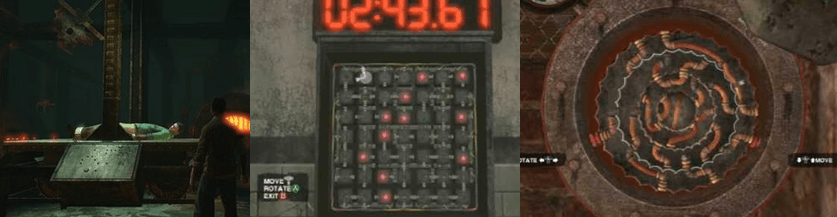
The Raven makes for a persistant and frustrating boss.

Aliens: Colonial Marines only features four boss encounters (each of these uses the term loosely since you aren’t given the luxury of a health bar to check your progress) but each one is a little different and frustrating in its own way. The first boss you’ll have to contend with is the Raven, a large, Praetorian-like alien that appears to have burst out of Hudson’s chest. This thing is all-but-invincible and must be evaded and ran from when you first encounter it as you don’t have any of your weapons. Eventually, after darting through the sewers, dodging its wild swipes from floor grates, and racing across the barren wasteland of LV-426 while numerous drones try to cut you to ribbons, you make a final stand against it in the iconic Powerloader for, perhaps, one of the worst and most annoying boss fights ever. The Powerloader is slow and clunky and it’s never made entirely clear what you have to do or if your hits are even landing, not to mention the fact that your turning circle is abysmal and Xenomorphs swarm at you to whittle your health down. In the end, the best thing to do is concentrate on the Raven, whacking it with your left claw repeatedly and try to get it to glitch against the environment in a corner; land a few hits and then try using your right claw to choke it until, eventually (seemingly randomly), a cutscene will play out where Winter breaks the fucking thing in two.

Work your way past the APC’s heavy artillery in order to take it out of commission.

The next boss sees you taking on an Armoured Personnel Carrier (APC) that is manned, and protected, by Weyland-Yutani mercenaries. Like the Raven, this thing is completely bulletproof and will cut you in half, or blow you to pieces, in seconds with not only its heavy weaponry but also the firepower of the minions which protect it. I found this section particularly trying since you’re exposed in the open a lot, despite the abundance of cover (bullets and explosions can be seen to penetrate much of the cover anyway) and it’s really easy to get caught in a crossfire. It’s best to find a good vantage point, drive the APC back by shooting the nearby fuel tanks, and pick off the mercenaries (particularly the flamethrower and RPG-wielding assholes) to clear the way to the crane controls and crush the APC once and for all.

Luckily, you can use a game bug to make the Crusher far less threatening.

The third boss is the Crusher Xenomorph, a gigantic bull-like variant with a huge, armour-plated head that charges at everything head-first and will crush you under its elephantine feet. As if that wasn’t bad enough, swarms of Xenomorphs fill the area to distract you, making it hard to get a good shot at the Crusher but, luckily, you can again glitch the boss to make things a bit easier. When you enter the area where the boss spawns, head to the barricade on the left and hop on the crates and then on top of the barricade. The Crusher will stand completely still by the APC and no Xenomorphs will spawn in, allowing you to fire at it with your explosive shots and either significantly wound it or kill it outright to make the fight ten times easier.

It all ends with a game of hide and seek with the Alien Queen.

Finally, as you might expect, you must face off with a Xenomorph Queen. This gigantic bitch is completely bulletproof and you won’t be able to deal any damage to her at all; instead, you must use the conveniently-placed environment to hide and avoid her claws, tail, and sight, working your way around the hanger and towards a series of switches. You must then activate each switch to prime a cargo launcher, rushing back to cover and grabbing the respawning armour if she hits you and trying to not get sucked out into the atmosphere at the same time. Once the cargo launcher is fully primed, simply stand behind it and wait for her to get in front of it and activate it and that’s it. Of all the parts of the game, and the many battles I’ve had against Xenomorph Queens, this was by far the easiest and is simply a question of patience.

Power-Ups and Bonuses:
Naturally, as both a FPS title and an Aliens game, you can acquire numerous weapons and items to increase your odds against the Xenomorph hordes. When you spot a weapon, ammo, or item, though, it’s not enough to just walk over to it; you actually have to press X to pick them up so make sure you do this or you could enter the next fire fight shorthanded! Winter begins the game with a handy stock of frag grenades, the iconic Pulse Rifle, a service pistol, and a shotgun for close-quarters combat. You can also acquire a number of other weapons as well though, including the Assault Rifle and Submachine Gun, the sniper rifle-like Battle Rifle, and the tactical shotgun. Each one comes with different ammo capacities, firepower, and accessories to purchase and equip with your EXP. These include increasing your ammo capacity, adding laser sights, or underbarrel grenade launchers and flamethrowers. It’s a good idea to swap out for a different weapon when you find a quiet moment in order to preserve your more powerful weapons, though this can result in your shots being a bit less effective and a bit more haphazard depending on which weapon you select.

Grab the Smart Gun and dice those Xenos up with auto aiming and auto tracking!

You can also find three super weapons scattered throughout the campaign, generally right before a story-based objective; these include the Smart Gun (which automatically targets and tracks nearby enemies), the Incinerator Unit (a flamethrower perfect for setting alight groups of enemies), and the RPG Launcher to take out anti-aircraft guns. When you grab each of these weapons, you’ll still keep your existing weapons but won’t be able to use them unless you drop your current weapon; none of them can be reloaded either so choose your shots wisely. Finally, you can also pick up six Legendary Weapons throughout the campaign; once you find them, they are all added to your inventory for regular use (with two exceptions) and, while you can’t modify or upgrade them and they take their own unique ammo type, they generally tend to be a bit more powerful than the standard weapons. You’ll find such memorable weapons as Hicks’ shotgun, Scott Gorman’s (William Hope) pistol, Hudson’s Pulse Rifle, and Jenette Vasquez’s (Jenette Goldstein) Smart Gun; finding all six will net you a cheeky Achievement but, luckily, they’re all pretty much sitting out in the open so it’s not hard to miss them.

Additional Features:
Speaking of which, Aliens: Colonial Marines includes sixty Achievements, fifty of which in the main game and ten more made available through downloadable content (DLC). The majority of these are tied to story progression and the game’s multi-player but you’ll also net them for finding various goodies in the campaign (including a number of dog tags and audio files, the six Legendary Weapons, the head of Rebecca “Newt” Jordan’s (Carrie Henn) doll Casey, and even a stash of Xenomorph eggs painted up like literal Easter Eggs), completing missions under various time limits and restrictions, and for beating the game’s higher difficulty settings.

Pick up the game’s DLC for more multiplayer maps and a whole new solo campaign.

As alluded to above, Aliens: Colonial Marines features a multiplayer component; one allows for two players to play through the main campaign in co-op, which is achieved through a split screen, and the other is a typical deathmatch mode that, for some reason, cannot be played locally. Here, you can customise your Marine and Xenomorph’s appearance (unlocking additional attire, weapons, and attacks through successful play) and take part in various team-based missions across a variety of the game’s maps. Additionally, there’s a pretty decent amount of DLC available as well, including additional map packs for the multiplayer mode and an entirely new single player campaign, “Stasis Interrupted”, which explores the fourteen week gap between the end of Aliens and the start of Colonial Marines. This campaign sees you controlling a new Marine character, features a bunch of additional Achievements, and even has the player journeying to Fiorina “Fury” 161 in a desperate attempt to rescue Ellen Ripley (Sigourney Weaver). Finally, if you own the “Limited Edition” of the game as I (and, I’m sure, many) do, you’ll gain access to a number of classic characters and weapons from the Alien franchise, and some additional customisation options, to use in the multiplayer mode.

The Summary:
Once again, it turns out that all of the horror stories and negativity I’d heard about a game is nowhere  near the truth; sure, Aliens: Colonial Marines is by no means a perfect game but it’s far from the unplayable wreck I was led to believe it was. Instead, it’s a pretty by the numbers FPS title, offering little new or innovative from the genre, but elevated above much of its competition by a fantastic use of the Alien license. The game’s attention to detail is staggering and this very well may be the best one-to-one adaptation of Aliens ever; everything from the sounds, the weapons, and the environments is all ripped straight from Aliens and the game goes out of its way to recreate the look and feel of the film through the use of atmospheric lighting and almost slavish fidelity. It’s just a shame, then, that the developers didn’t think a little harder about the game’s narrative aspects in relation to its source material; as a midquel between the second and third movies, the game makes little sense, favouring fidelity and fan service over a coherent and consistent plot, which honestly drags the game down more than the minor graphical and A.I. bugs (of which I saw very little in the game’s basic enemies).

My Rating:

Rating: 2 out of 5.

Could Be Better

What did you think about Aliens: Colonial Marines? Did you find it to be a broken mess of the game like so many others or did you, like me, find it to be a perfectly serviceable FPS title? What did you think to the game’s story and the way it brought Hicks back? Did you encounter any odd glitches or game-breaking moments? If so, what were they and how often did they crop up? Which of the Alien movies or videogames is your favourite and why and how are you celebrating Alien Day this year? Whatever your thoughts, stay frosty and drop a comment below!

Game Corner: Call of Duty: Black Ops (Xbox 360)

CODBLOPSLogo

Released: 2010
Developer: Treyarch
Also Available For: Nintendo DS, Nintendo Wii, PC, PlayStation 3

The Background:
It’s the final week of “CoD Month” here on my site. So far, I’ve played all three titles in the Call of Duty: Modern Warfare Trilogy (Infinity Ward/Sledgehammer Games, 2016), Call of Duty 3 (Treyarch, 2006), and Call of Duty: World at War (ibid, 2008) and I’ve been less than impressed with what I’ve seen so far. For the longest time, I’ve never been much of a fan of the Call of Duty titles (Various, 2003 to present), mainly because I don’t really get on with first-person shooters (FPS) at the best of times. The perspective can be difficult to judge, enemies shoot at you from nowhere, and I just find them (especially military shooters) quite generic and uniform and, so far, the Call of Duty games I’ve played haven’t done much to change my views. World at War was probably the one I enjoyed the most and, it turned out, spawned a spin-off series for the Call of Duty franchise that continued with this title. Black Ops was another title that happened to come with the Xbox 360 I bought a while back and I’ve heard a lot of positive things about this title, especially, among all the Call of Duty games. So, one last time, I sat down to plough through one more Call of Duty game simply for the Achievements and to see if my personal bias could be swayed.

The Plot:
Sixteen years after the events of World at War, the United States and the Soviet Union are locked in a “Cold War” that moved warfare away from the trenches and towards more clandestine operations. Black Ops revolves around the discovery of “Nova-6”, a deadly chemical weapon that is in the hands of several Russian sleeper agents placed across the globe, and the race against time to locate, isolate, and destroy it before it can kill millions.

Gameplay:
Call of Duty: Black Ops is a first-person shooter that sees you in the role of SAD/SOG operative Captain Alex Mason; unlike the other Call of Duty games I’ve played so far, you primarily control Mason throughout the game’s campaign but, at various times, you’ll also play as CIA paramilitary operations officer Jason Hudson. Also in a change from the previous Call of Duty titles I’ve played, Black Ops’ protagonists are actually vocal, talking during gameplay and in cutscenes, which is a nice change of pace.

CODBLOPSControls
Call of Duty‘s control scheme was pretty standard by this point.

When it comes to the controls, you know the story by this point and nothing is really different here: you reload with X, jump with A (still as useless as ever unless you’re vaulting over walls), switch weapons with Y, and sprint for a bit by holding in the left analogue stick. Grenades and other explosives are tossed with the Left and Right Buttons, you aim and shoot with the Left and Right Triggers, respectively, and can shoot wildly from the hop or try to be a bit more accurate but pulling on the Left Trigger to aim down your sights. Pressing B allows you to assume one of three stances: standing, crouching, or prone, each of which alters your aim and ability to be stealthy or open to enemy fire.

CODBLOPSHealth
There’s no regenerating your haz-mat suit so stay out of gunfire!

Health still automatically replenishes when you avoid enemy fire, and you still get a generous amount of checkpoints to help you reload when you’re inevitably blown up by a random grenade but Black Ops mixes things up a bit by having a few missions where your health “bar” doesn’t really mean shit: the first is when you pilot vehicles (such as the Mi-24 Hind attack helicopter and an attack boat) and the vehicle’s damage doesn’t auto-repair and the second is when you (as Hudson) must walk through a cloud of Nova-6 in a haz-mat suit. As you take damage, the suit cracks and doesn’t auto-heal so you’re at risk of being exposed to the deadly nerve agent if you linger too long or rely on the traditional auto-heal mechanics, which is actually a nice touch and harkens back to FPS games of old where auto-healing wasn’t a thing.

CODBLOPSMason
Mason’s plight is a central part of the game’s narrative.

A helpful mini map is located at the top left of your heads-up display (HUD); this shows your location, the location of your allies, enemies, and the direction of your objective. Maybe I’m just used to them by this point but I actually found this mini map quite useful as it actually gives you a far better idea of the layout of your current area and where you need to go. As always, the game isn’t all just mindless shooting; in fact, story plays a major role in Black Ops. Having a vocal protagonist really helps with this and Mason is right in the middle of the Russian’s plot to gas their Capitalist enemies as he was captured and brainwashed by the Soviets; the narrative is framed by several cutscenes wherein Mason is interrogated by US personnel regarding his actions and the action frequently cuts away to more of these scenes. Sadly, these cutscenes can’t always be skipped; sometimes, you’re able to skip them by holding the A button but you’ll have to sit through a fair few which is annoying on repeated playthroughs.

CODBLOPSVehicles
Black Ops also sees you piloting helicopters and driving attack boats.

Also breaking up the action are a variety of other gameplay sections; there’s the vehicle-based ones I mentioned above which are basically similar to the tank- and helicopter-based missions of previous games but actually much more enjoyable. When controlling the Hind, you both pilot the craft and shoot with a machine gun and missiles; while it’s quite difficult to manoeuvre and get a good bead on targets (especially other helicopters), it’s still quite fun to be up in the air and have a greater field of view. The boat mission is pretty much exactly the same as a tank-based mission from World at War except you’re on a boat, in the water, and it’s night-time in the jungle; the boat is still a bit slippery and awkward to control but it’s fun just wrecking shit up with its armaments.

CODBLOPSInfiltrate
Guide your ground team from the air and then infiltrate with stealth.

One mission also sees you inside of an SR-71A aircraft; from here, you’ll use a thermal radar to direct your ground forces and then switch down to them to clear out the opposition. Once the mission switches to the ground proper, you’ll have to rappel down to a facility and utilise the same stealth tactics seen in the previous games to progress further. Stealth also plays a big part in another mission where you must first avoid an overhead helicopter, silently dispatch of two guards, and then infiltrate a Soviet missile based while wearing their uniforms. As dark and grave as World at War was, Black Ops is even more so. The game opens with Mason escaping from a desolate Soviet prison where he reconnects with Viktor Reznov from the previous game; Reznov’s edict is literally burned into Mason’s mind as he finds himself compelled to assassinate a number of Axis scientists throughout the game’s narrative. Oh, and did I mention that you end up going to Vietnam? Well…you do. Similar to how the Japanese elements made the last game more brutal and affecting, seeing the Viet-Cong charge blindly into gunfire and try to slice your throat out is legitimately jarring, almost as much as them capturing Mason and his comrades and forcing them to play Russian Roulette!

Graphics and Sound:
Building upon the level of detail seen in World at War, Black Ops is probably the darkest, grittiest, and most detailed of the series thus far (at least, of the ones that I’ve played). Character models continue to be the weakest aspect but it’s easily forgiven when you realise how detailed and elaborate many of the game’s locations are: the Vorkuta Gulag isn’t just a desolate, rust-filled prison; it’s a desolate, rust-filled prison in the middle of a snow-swept landscape that is perfect for a high-speed motorcycle escape to a train. Khe Sanh, and Vietnam in general, is rendered with a horrifically affecting realism that really captures the humid and horrific conditions of that particular conflict and stands in start contrast to the dark urban landscapes you run through in Kowloon City.

The game’s attention to detail and voice cast is just as good as ever.

Voice work is even more important than ever to Black Ops because it actually features a speaking protagonist; Sam Worthington (remember when he was a thing?) takes centre stage as the tortured and haunted Mason, Gary Oldman returns as the revolutionary Reznov, and even Ed fuckin’ Harris shows up to voice Hudson. I also took much greater note of the music in this Call of Duty title; there’s a foreboding, heavy feel to the tunes of this game alongside the traditional stirring military melodies and, in true Apocalypse Now (Coppola, 1979) fashion, the troops stationed in Vietnam like to blast the Rolling Stones’ “Sympathy for the Devil” at full volume in their base camp and when blowing enemy encampments to smithereens.

Enemies and Bosses:
Like World at War, Call of Duty: Black Ops has far more enemy variety than in the previous titles. Rather than simply gunning down Nazis, you’ll mostly be clashing with Soviets, Vietnamese, and even British Commandos. As always, these enemies are formidable thanks to their flagrant use of cover, melee, and explosives to whittle your health to nothing in no time at all.

CODBLOPSFinale
Storm the Rusalka to end the threat of Nova-6.

While bosses aren’t really a thing in Black Ops, when flying the Hind, you’ll come up against a couple of enemy attack choppers that must be destroyed before you can progress and, when in your attack boat, you’ll specifically have to trade shots with another boat to complete the mission. When joining the assault on the Rusalka, you’ll have to provide cover fire from your attack chopper and also bring down another enemy Hind, before eventually confronting and killing Nikita Dragovich, one of the key minds behind Nova-6, in a quick-time event.

Power-Ups and Bonuses:
As with other games in the series, Black Ops is going for realism over the more flamboyant aspects of other FPS titles so the closest thing you’ll get to upgrades is when you are able to call in air strikes, take control of armoured vehicles, or happen across an armoury.

CODBLOPSWeapons
Blow enemies into flaming chunks or cut them down with duel pistols.

Despite this, and the setting of the game, Black Ops has some pretty nifty weapons on hand for you to use; though you’re still limited to only having two at a time, some of the stand-outs for me were the Franchi SPAS-12, a pump-action shotgun that can also fire incendiary rounds, the Python (a high impact .357 Magnum), and the Beretta Model 682, all of which are great for close-quarters dismemberment. You can also grab a crossbow (that can also fire explosive arrows) and a couple of nifty grenade and rocket launchers, like the “China Lake” and the M72 LAW, and even duel-wield pistols and smaller submachine guns at various points.

Additional Features:
As with the other Call of Duty titles, you can choose to play on a number of different difficulty settings and earn a fair amount of Achievements. These are generally earned after clearing missions in the main solo campaign but also pop with when find all of the Intel hidden throughout the game, complete certain missions with certain weapons, kill a certain amount of enemies in certain ways, or slaughter some poor, innocent test monkeys as quickly as possible. Multiplayer returns in Black Ops but, this time, you’re able to set-up a multiplayer match against computer-controlled opponents, meaning I was actually able to experience a Call of Duty free-for-all deathmatch for the first time. When in this mode, you can select or create a class where you customise your weapon loadouts, perks, and other aesthetics, which is a nice touch, and you can tweak the level of difficulty of your computer-controlled foes but I was absolutely owned by the computer even on the easiest setting and found it was little more than a standard deathmatch.
CODBLOPSZombies
The “Zombies” modes continue to be a lot of fun.

Returning from World at War is the “Zombies” sub-game wherein you must try to survive for as long as possible against endless waves of zombies in a variety of maps; one of these has you playing as John F. Kennedy, Richard Nixon, Robert McNamara, and Fidel Castro in a fantastic piece of ridiculousness that is massively at odds with Call of Duty’s more serious tone…and I love it! The more zombies you kill, the more points you earn to spend on fortifying your defences, unlocking new areas, or accessing better weapons but the best part about the “Zombies” mode in this game is the inclusion of Dead Ops Arcade, a top-down arcade title that plays very similar to Smash TV (Williams, 1990) and Dead Nation (Housemarque/Climax Studios, 2010) and was honestly the most fun I’ve had playing a Call of Duty title.

CODBLOPSBanner

The Summary:
Call of Duty: Black Ops was far more enjoyable for me than any of the Modern Warfare titles and a fine follow-up to World at War but I still find myself largely unimpressed. If anything, it’s annoying that it took this long for the series to feature a speaking protagonist right from the get-go but, while the game is better for it, I didn’t find Mason particularly compelling; you can see the big twist in his narrative coming a mile away (thanks in no small part to the constant cutscenes that jerk you abruptly from the gameplay to slap you in the face with the twist before it’s revealed), it’s outrageous to me that he was allowed back into active service after the big reveal, and the idea of chemical attacks or sleeper agents isn’t exactly new by any stretch of the imagination. Still, by taking everything that worked in the Modern Warfare games and in World at War and applying them in a more intimate story with greater stakes, Black Ops actually worked for me on a level the other Call of Duty titles didn’t. It helped a lot that areas were far more recognisable, varied, and interesting, that the locations were unique and engaging, and that the developers included Dead Ops Arcade and so many recognisable political figures happily blowing holes in zombies.

My Rating:

Rating: 3 out of 5.

Pretty Good

What did you think of Call of Duty: World at War? Where does it rank for you compared to the other Call of Duty titles? Do you think I have committed the ultimate sacrilege by besmirching the good name of the Call of Duty franchise or do you agree that the series is somewhat over-rated and stagnated? Whatever you think, please do leave a comment below and come back for more content and reviews in the near future.

Game Corner: Call of Duty: World at War (Xbox 360)

CODWaWLogo

Released: 2008
Developer: Treyarch
Also Available For: Nintendo Wii, PC, PlayStation 3

The Background:
At this point, I have played four Call of Duty (Various, 2003 to present) titles and I have to say that, so far, I am less than impressed with any of them, and the series in general. Before I played Call of Duty: Modern Warfare Trilogy (Infinity Ward/Sledgehammer Games, 2016), I had little to no interest in Activision’s long-running franchise (that kicked off its first spin-off with this title) primarily because I don’t really like military-style shooters and my love for first-person games died out shortly after Perfect Dark (Rare, 2000). Admittedly, a lot of this is due to my personal bias against being shot in the back or by enemies I can’t see, struggling with the perspective and the controls, and generally just finding first-person shooters (FPS) difficult to navigate at the best of times. However, when I bought my Xbox 360, it came with a couple of Call of Duty titles, one of which was this one and, since I’m doing “CoD Month” on my blog for January and I would hate to waste the G associated with the game, I sat down and rushed through it mainly to see if my bias against the series was justified and to obtain a few extra Achievements.
The Plot:
Despite Call of Duty 4: Modern Warfare (Treyarch, 2007) bringing the series into the then-modern day, World at War returns the plot to World War Two, specifically focusing on the Pacific and Eastern Front skirmishes between the Allied Forces of the United States and Europe against the Axis Powers of Japan, the Soviet Union, and Nazi Germany.

Gameplay:
Call of Duty: World at War is a first-person shooter that casts you in the role of Private/ Private First Class C. Miller of the United States Marine Corps’ 1st Marine Division, Private Dimitri Petrenko, and Petty Officer Locke. While each character’s narrative sees them fulfilling different objectives in different parts of the world (or at different parts of the same location), each controls exactly the same and just like the characters in Call of Duty 4: Modern Warfare. The A button lets you jump and vault over walls, Y switches weapons, X reloads, and pressing in on the left analogue stick sees you break out into a finite sprint.

CODWaWControls
The controls are exactly as established in the Modern Warfare trilogy.

Pressing the B button allows you to either crouch, go prone, or stand to avoid or engage with enemy gunfire while pressing in the right analogue stick allows you to melee kill enemy soldiers. You can toss a variety of grenades and other explosives with the Left and Right Buttons and aim and shoot with the Left and Right Triggers, respectively. Again, you can either shoot somewhat wildly from the hip or snap to the nearest target and aim down the sights of your gun by pulling on the Left Trigger and, similar to Call of Duty 3 (Treyarch, 2006) this can be problematic as you’re aiming without the assistance of modern technology such as laser sighting. As is largely the standard for FPS titles, your health will automatically recover once you avoid damage for a few seconds; the more damage you incur, the longer it will take to replenish. There are a number of checkpoints in the game for when you do inevitably die, though, and there’s plenty of cover for you to duck behind but you have to keep your wits about you as your enemies won’t hesitate to throw a grenade at you or come charging at you head-first with their bayonet drawn.

CODWaWMissions
The action is broken up by some intense missions involving assassination and dog-fighting.

A helpful radar/mini map combination sits in the bottom left of your heads-up display (HUD); this shows you the location of your allies, enemies, and a star marking your objective. Should you forget your objectives, you can bring them up at any time by pausing the game, which you may have to do from time to time as the game can be both painfully linear and frustratingly unclear at times; if you miss a vague order from one of your team mates, you may find yourself shredded to pieces or blow up before you even know what it is you’re supposed to be doing or where you’re meant to be aiming or directing your air strike. Gameplay is broken up a bit through the use of vehicle sections: as Miller, you’ll call in air strikes and jump on a small tank-like vehicle and use remote-controlled rocket strikes to destroy enemy tanks; Petrenko meets up with Sergeant Viktor Reznov in Stalingrad (who promptly wastes a lot of your time lecturing you about the finer arts of sniping and the evils of General Heinrich Amsel) and is tasked with performing a tricky assassination; and Locke later pilots a PBY Catalina flying boat to shoot down Japanese planes and ships.

CODWaWDark
World at War is probably the darkest of the Call of Duty‘s I’ve played.

Overall, the game is far more intense and gritty than the other titles I’ve played; for one thing, the Japanese troops you encounter are far more sadistic and aggressive than those of previous titles, leaping up from hidden bunkers, charging at you head-first, and even detonating themselves and your own dead comrades. Similar to the controversial airport mission in Call of Duty: Modern Warfare 2 (ibid, 2009), you’ll also accompany Reznov to Berlin and murder a whole bunch of injured and surrendering German soldiers, which is a bit disturbing. A similar event occurs at Shuri Castle, where Japanese troops appear to surrender and instead assassinate one of your team mates with grenades!

Graphics and Sound:
Call of Duty: World at War is the best of both worlds in this regards as it takes the classic World War Two setting of the original games and applies the modern coat of paint the series had received in Call of Duty 4; this means, again, that locations are recreated with a fantastic level of detail and, thanks to the fact that we travel to more exotic locations (Makin Island, Peleliu, Okinawa, and the Reichstag among others), actually make this game far more visually interesting than its predecessors.

CODWaWGore
Gore is plentiful in World at War.

While character models are still the weakest part of the game, they’re largely garbed in elaborate camouflage outfits or rugged guerrilla outfits that, again, help them to stand out compared to their more uniformed Nazi counterparts but also against their environments. Also, unlike previous games in the series thus far, enemies can be dismembered by your shots; arms and legs will blow off, chests will be blown apart, and large pools of blood accompany the many dead bodies you’ll leave in your wake. Again, though, locations, weapons, and vehicles still have the same high level of attention to detail I’ve come to associate with these games that really emphasises how desolate and horrific the Second World War was.
CODWaWVA
Gary Oldman reassumes his famous Russian accent to bring Reznov to life.

Call of Duty: World at World really brings the big guns to its vocal performances thanks to the inclusion of Gary Oldman as Reznov and Kiefer Sutherland as Corporal Roebuck. Of all the Call of Duty titles I’ve played so far, I had the least amount of issues with World at War’s dialogue; it wasn’t fully of overly macho “Hoo-rah!” or military slang like the Modern Warfare games but also wasn’t repetitive and annoying like in Call of Duty 3, though it still sticks to the stirring military tunes that pepper these games.

Enemies and Bosses:
Call of Duty: World at War has far more variety in the types of enemies you’ll encounter than the other Call of Duty games I’ve played in that you’ll battle both Japanese troops and Nazis this time around. Generally, the enemies you come up against are just as wily as ever; hiding behind cover, tossing grenades at you, and bashing you with their weapons whenever you get close but the Japanese troops are on another level entirely. The Japanese are aggressive, suicidal maniacs who burst out from hidden bunkers in the fields, clamber up and snipe at you from trees, charge at you head-first screaming “Banzai!” and trying to skewer you, or simply blow themselves up to kill you and your comrades. They also don’t hesitate to rush at you in waves upon waves, clambering over their fallen brethren to get to you, and force you into a quick-time event whenever they try and grapple with you.

CODWaWReichstag
The game’s final mission sees you storming the Reichstag.

As always, you won’t really come up against boss battles in the traditional sense. You’ll need to make use of air strikes and heavier weaponry to take out tanks and enemy placements and protect some naval ships from kamikaze pilots, which is about as deep as that gets, and the game’s final mission sees you (as Petrenko) storming the Reichstag in a bid to liberate it from Nazi control. This was easily one of the most frustrating and tiresome missions in the game as you have to disable some anti-tank guns, wipe out the ground forces who pop up out of nowhere, have the high ground, and throw grenades at you, and then try to not get crushed by a falling column or roasted alive by a flamethrower-wielding Nazi.

Power-Ups and Bonuses:
Call of Duty has always placed a greater emphasis on realism compared to other FPS games and, as a result, your power-ups are largely limited to the lovingly-recreated weaponry and vehicles made available to you. As always, you’re limited to holding only two weapons at a time, some more suitable than others. Given the setting of the game, you’ll often find yourself running through and clearing out trenches, so you might need to Trench Gun or the shotgun to make bloody corpses of your opposition. The Panzerschreck is perfect for taking out tanks and enemy aircraft and you can make use of Molotov Cocktails and flamethrowers to roast your enemies alive if you’re feeling particularly sadistic.

CODWaWTank
Jump in the tank and wreck some Nazi shit!

You also get to jump into a flame tank and use its cannon to blast Nazi bunkers, tanks, and towers while roasting soldiers with its flamethrower and pilot a PBY-5A Catalina aircraft to shoot down Japanese fighters. One thing I did like about this mission was that you had to constantly switch from the front, back, and side turrets as the mission progressed and you really got a sense of the claustrophobic space in this small aircraft but actually shooting at and hitting your targets (especially the planes) as a tall order thanks to the game’s less-than-helpful aiming reticule.

Additional Features:
Call of Duty: World at War features a number of different difficulty settings for you to play on, each one affecting the challenge in different ways, in addition to a number of Achievements. The majority of these can’t be missed as they’re tied to story progression but others will have you performing more specific tasks, like air bombing a certain number of enemies, burning soldiers out of trees, or completing a sniper assassination with a handgun. If you explore your environment well enough, you’ll also find Death Cards attached to makeshift graves; find all of these and you’ll get another Achievement and special gameplay options for the game’s co-operative mode. As with its predecessors, World at War features a multiplayer component that I wasn’t able to fully explore since I don’t have Xbox Gold. It also features a co-operative mode, however, that allows two players to player through the main campaign at the same time, which is a nice touch and I wonder why this wasn’t incorporated until the fifth game in the series. Brand new to the series, though, is the game’s “Nazi Zombies” mode in which up to four players are forced to survive against endless waves of Nazi zombies in a variety of maps. The more zombies you kill, the more points you earn to spend on fortifying your defences, unlocking new areas, or accessing better weapons. While an interesting mode to include, I can’t say that it hooked me too much as you have to play and grind quite a bit to get the most out of it but it’s a nice breath of fresh air after the game’s more sombre main campaign and I wonder how I would feel about an entire Call of Duty game in this vein.

CODWaWBanner

The Summary:
Of all the Call of Duty games I’ve played so far, World at War is probably the best but that’s still not really saying much. The game makes use of all the improvements brought to the series in Call of Duty 4 and applies them to a truly horrific time in the Second World War, offering a greater visual variety to the locations and enemies you’ll encounter. The inclusion of a couch co-op mode and the zombie survival game is a nice touch and I felt this did a much better job at presenting an appealing, intuitive, and coherent military shooter than Call of Duty 3 but, at the same time, it’s still not very innovative. There’s an “x factor” that is just missing for me, mainly because of how bland even this game’s more exotic locations appear. The zombie mode had more promise as it was skewing towards the ridiculous; I get that Call of Duty is a far more serious FPS title, though, but, for me, it’s just not as much fun as other FPS games.

My Rating:

Rating: 2 out of 5.

Could Be Better

What did you think of Call of Duty: World at War? Where does it rank for you compared to the other Call of Duty titles? Do you think I have committed the ultimate sacrilege by besmirching the good name of the Call of Duty franchise or do you agree that the series is somewhat over-rated and stagnated? Whatever you think, please do leave a comment below and come back next Wednesday for the last Call of Duty review of “CoD Month”.

Game Corner: Call of Duty 3: Gold Edition (Xbox 360)

COD3Logo

Released: 2006
Developer: Treyarch
Also Available For: Nintendo Wii, PlayStation 2, PlayStation 3, Xbox

The Background:
I know what you’re thinking: Why am I playing Call of Duty 3 when I haven’t played the first two? Well, it’s firstly because, to my great shame, I have to admit that I am not really a fan of the Call of Duty franchise (Various, 2003 to present), which has endured through multiple releases, spin-offs, and other related media over the years and collectively sold over 250 million copies. This is mainly due to two things: I’m not much for military-style shooters and my love for first-person games died out shortly after the release of Perfect Dark (Rare, 2000). A lot of this is due to my personal distaste for being shot in the back or by enemies I can’t see, struggling with the perspective and the controls, and generally just finding first-person shooters (FPS) difficult to navigate at the best of times. Also, a while ago I was gifted a copy of Call of Duty 3: Gold Edition for Xbox 360 and, having recently burned through the Call of Duty: Modern Warfare Trilogy (Infinity Ward/Sledgehammer Games, 2016) set that came with my console (and since it is “CoD Month” here on my site), I figured I’d pop the disc in and give it a go if only to see if my bias against the series was justified and to obtain a bunch of Achievements.

The Plot:
Like the first two Call of Duty titles, Call of Duty 3 takes place during World War Two, specifically in 1944 and featuring missions relating to the Battle of Normandy that have you taking control of various silent protagonists that make up the Allied Forces of the United States, Britain, Canada, and Poland.

Gameplay:
Call of Duty 3 is a first-person shooter whose narrative is split between four different silent protagonists: Private Nichols of the American 29th Infantry Division, Sergeant James Doyle of the British Special Air Service (S.A.S.), Private Cole of the 4th Canadian (Armored) Division, and Corporal “Bohater” Wojciech of the Polish 1st Armored Division. While their mission objectives, weaponry, and resources differ, each character basically controls in the same way: you jump with the A button (an action that is largely useless), view distant targets through your binoculars by holding in the left analogue stick, switch weapons with Y, and reload with X.

COD3Controls
The lack of a run option really hurts the pacing of the game.

By pressing B, players can either crouch, go prone, or stand upright and each of these stances will affect your speed, aim, and level of stealth. When standing upright, for example, you’re more likely to be hit by incoming gunfire so it’s best to crouch behind cover or go prone to be largely undetectable to the Nazis. Unlike in subsequent Call of Duty titles, there’s no option to dash here, which is a major drawback when trying to navigate through heavy gunfire or keep up with your squad, so I’m glad that the developers fixed this in the game’s sequel. Pressing in the right analogue stick allows you to melee enemies and you can toss grenades or smoke bombs with either the Left and Right Buttons, respectively. Aiming and shooting is performed the Left and Right Triggers and you can choose to either shoot from the hip or aim down the sights of your gun with the Left Trigger. Given that the game’s setting and weapons are far more antiquated than those in later Call of Duty titles, this can be problematic as you don’t have the aid of a laser sight and the in-game reticule is largely useless, meaning that it can be difficult to get a good shot at your target, especially when they’re effectively camouflaged by the drab environments.

COD3Ambush
Be sure to find some cover to avoid Nazi gunfire.

As is largely the genre standard these days, you can recover your health by ducking behind cover and avoiding damage for a few seconds; you have to be mindful of your surroundings, though, as enemies are known to lob grenades at you and pop up out of nowhere to riddle you with bullets. The game also has an annoying tendency to endlessly spawn enemies into its environments until you reach specific points or objectives, so my usual tactic of clearing an area from a safe distance was largely ineffectual in this particular game. To help you head in the right direction, a compass sits in the bottom left of your heads-up display (HUD); this displays your allies, any enemies in the area, and a star marking your objective. Sadly, though, there’s no mini map and the compass doesn’t really take into account floors or layers, meaning it’s easy to get a bit lost and confused about how to progress (here’s a hint: try using your melee attack to break wood panels). Also, your objectives are only really accessible by pressing Select and they can often be a little too vague at times.

COD3Vehicles
The tank missions are quite fun…the jeep missions are not.

Gameplay is broken up a bit through the use of driving and tank sections; as Doyle, you’ll have to drive your team mates around in a jeep, avoiding Nazi soldiers, barricades, and tanks as you smash through gates and across fields and, as Bohater, you’ll get to control a tank, blasting at other tanks and soldiers. While the tank sections are fun, the jeep driving sections are not; the game defaults to a first-person view (which you can thankfully change by pressing in the right analogue stuck), the controls are both loose and slippery and clunky and stiff at the same time, and the compass is more of a hindrance than a help, especially in the mission where you drive around rescuing Maquis fighters. While stealth is an option in the game, it’s nowhere near as prominent as it would become in later Call of Duty titles. At the same time, the game features more quick-time events (QTEs) as Nazis will sometimes leap out at you and you’ll be forced to mash the shoulder buttons and then press a button to fend them off. The game is also a lot tougher than its successors, featuring far fewer checkpoints and much more durable enemies; these Nazis take a lot of bullets to put down, even on the game’s easier settings, making tasks such as holding out against their vast and infinitely-spawning forces a tall order in later sections of the game.

Graphics and Sound:
Despite rendering many of its locations with an impressive level of detail, Call of Duty 3 definitely shows its age even compared to its immediate follow-up. Character models are off, resembling action figures more than human beings, and the overall presentation of the game’s menus and various screens is bland and leaves a lot to be desired. A lot of this is exacerbated though the game’s use of in-game cutscenes, all of which are completely unskippable, which, while good for character and plot development, really don’t do the in-game graphics any favours. I found a couple of amusing glitches at times, too, that betray the age of the game, such as Nazis running through mid-air, spazzing out half-in-and-out of walls, and blinking in and out of existence. Luckily, though, when playing the game proper, locations, weapons, and vehicles all still look pretty impressive. There’s a definite attention to detail in all of the environments and the way the weapons look and feel to really recreate the feeling of war-torn Europe during the height of the Nazi regime.

COD3Cutscenes
Unskippable cutscenes are the order to the day here.

I’m even far more understanding of the long reload times for certain weapons as it adds to the aesthetic of the period the game is recreating, though it’s still way too easy to get turned around or lost and overwhelmed by the ceaseless German troops that swarm every area. Call of Duty 3 mostly makes use of period-fitting music and rousing military tunes to really set the tone for the game’s setting. Much of this is rendered mute during gameplay, however, when all you will hear is gunfire, explosions, and the inane dialogue of your team mates. There’s not a lot of variety here, sadly, as you’ll hear the same shouts of “Move, move, move!” and “Germans in the open!” and “Outta here!” over and over again, to say nothing of the constant repeated yells from your Nazi foes. During cutscenes, it doesn’t get much better, with the Nazis constantly being referred to as “Jerry” (I get this was a popular slang term for them but having every single character refer to them in this way every single time got old really fast) and a great deal of xenophobia and paranoia on display from your team mates. While this is, again, probably very true to the way things were during World War Two, and it does serve as a character arc for one of your team mates, it’s more annoying than anything and I would have loved to have to option to skip these cutscenes.

Enemies and Bosses:
When you play Call of Duty 3, you’re playing to cut down Nazi scum left, right, and center with no remorse or hesitation. There are literally no other enemies to encounter here, no other members of the Axis Powers to go up against; it’s just hate-filled Nazis from start to finish. Most of these are little more than cannon fodder to your superior weaponry and skills but their sheer numbers and nigh-unstoppable movement can still cut you to ribbons in seconds. This is aided by their ability to hide behind cover, jump out at you without warning, toss a Stielhandgranate at you, or bash at you with the butt of their rifles.

COD3Nazis
Nazis just keep coming in nigh-unstoppable waves until you hit certain points.

Ordinarily, I like to clear areas of all enemies to make for easier progression but Call of Duty 3 doesn’t always let you do that as Nazis continually spawn in until you reach certain parts of the map; at the same time, though, if you spot a Nazi sniper or manning a machine gun, it’s best to take those guys out quickly or you won’t last long. Call of Duty 3 doesn’t feature bosses in the traditional sense; perhaps the closest thing the game has to an actual boss is when you (as Bohater) have to awkwardly navigate your tank through a small village while exchanging shells with Richter, a Nazi tank ace known as the “Black Baron”. The rest of the time, you’ll be holding out against superior numbers, desperately trying to survive, plant explosives, or call in an air strike to fend off the Nazi invasion.

Power-Ups and Bonuses:
Due to Call of Duty placing a greater emphasis on realism compared to other FPS titles, there aren’t really any power-ups or bonuses to be found in Call of Duty 3 beyond the large array of weaponry made available to you. You’ll be wielding all kinds of World War Two-style guns and rifles, many of which I found burn through their ammo quite quickly and have small capacities, meaning you’ll be liberating fallen Nazis of their hardware as-and-when required. You can only hold two weapons at a time, though, and it seems a lot of the opposition’s munitions are inferior to yours, so it becomes a question of strategy: do you grab a German rifle and risk being caught in a long reload cycle or do you stick with your American-made hardware and hope you have enough ammo? While there are vehicles to make use of, you’re relegated purely to driving duties when inside the jeep, which is a real shame as I much prefer shooting than driving. Luckily, Bohater and his tank are on hand to make up for that but, unfortunately, the game’s controls and environments are largely too clunky and awkward to really enjoy either experience.

Additional Features:
Call of Duty 3 features a number of different difficulty levels that increase, or decrease, the game’s challenge and, of course, a bunch of Achievements. You’ll get a fair few of these simply by playing through the game’s main single-player campaign but others require you to fulfil certain tasks, such as throwing five grenades back at your enemies, driving off a ramp while in your jeep, avoiding damage, or using only German weapons. Given that is an FPS title, Call of Duty 3 also includes a multiplayer component but, unfortunately, it’s only available to those with Xbox Gold so I wasn’t able to see if it’s still active. From what I can gather, though, it sounds like the standard player vs. player death match you can find in any other FPS title, though it seems like an odd decision to not include a split-screen multiplayer mode that you can play offline as well. If you have the Gold Edition of the game, it also comes with five free extra maps for this mode and a bonus DVD with making of features and interviews, if you like that sort of thing.

COD3Banner

The Summary:
I’ll admit, it’s hard for me to get excited or interested in a Call of Duty title; they’re just not that interesting to me and all I wanted to do was burn through and grab the Achievements and call it a day but…man, Call of Duty 3 is not very good at all. It’s so weird how the very next game in the series is leaps and bounds above this one in terms of presentation, options, and accessibility. Obviously, you have to cut it some slack as it’s quite an old game now but, still…I found nothing in Call of Duty 3 that improved my view on the franchise and was more frustrated than anything thanks to the unskippable cutscenes, dodgy vehicle controls, near-useless compass/map system, constantly respawning enemies and graphical glitches, and the sheer mind-numbing repetitiveness of the game’s dialogue and gameplay and I can’t say I’m interested in seeing what the previous two titles were like after slogging through this mess.

My Rating:

Rating: 1 out of 5.

Terrible

What did you think of Call of Duty 3? Where does it stand in your ranking of the Call of Duty titles? Do you think I have committed the ultimate sacrilege by besmirching the good name of the Call of Duty franchise or do you agree that the series is somewhat over-rated and stagnated? Whatever you think, drop a comment below and be sure to check back next week for another Call of Duty review.