Game Corner: Marvel: Ultimate Alliance 3: The Black Order (Nintendo Switch)

Released: 19 July 2019
Developer: Team Ninja

The Background:
For decades, few videogame publishers were as synonymous with Marvel Comics as Activision, who produced adaptations Marvel’s most popular properties. While some were better than others, Activision’s efforts were largely praised, especially after they partnered with Raven Software on the X-Men Legends games (2004; 2005). Activision and Raven Software expanded their scope to the rest of the Marvel universe with Marvel: Ultimate Alliance (2006), a largely successful team-based brawer praised for improving upon its predecessors. Though now delisted, it was followed by a sequel three years later, courtesy of Vicarious Visions, which tweaked the gameplay with team-based attacks to encourage experimentation. Though Marvel: Ultimate Alliance 2 (2009) was praised for its branching storyline, the stripped down roleplaying mechanics were criticised. While it was also delisted in 2020, fans were clamouring for a follow-up and, just ten years later, Team Ninja stepped in to work alongside Marvel in reviving the franchise. Seeking to place additional emphasis on combat, the developers explored the cosmic scope of the Marvel universe by including the Infinity Stones and lesser-known characters and chose to make the title a Nintendo Switch exclusive after developing a close relationship with Nintendo. Although Marvel: Ultimate Alliance 3: The Black Order was the sixth best-selling game in its first week and was later bolstered by extensive downloadable content (DLC), it was met with mixed reviews that praised the colourful action but criticised its lack of innovation.

The Plot:
While battling Nebula and Ronan the Accuser, the Guardians of the Galaxy stumble upon a plot by the mad titan, Thanos, to collect the six Infinity Stones. Although they scatter the Stones, Thanos’s acolytes, the Black Order, pursue the gems, prompting an alliance of Earth’s mightiest heroes to retrieve them first.

Gameplay and Power-Ups:
Like its predecessors, Marvel: Ultimate Alliance 3: The Black Order is a team-based action role-playing game in which players assemble a squad of four heroes from across the Marvel universe to battle various nefarious baddies, primarily the titular Black Order, who are hunting the six all-powerful Infinity Stones on behalf of their master, Thanos. The game offers five save slots, two initial difficulty levels, and a base roster of thirty-six playable characters, with many being encountered as you play through the story and joining your alliance either after fighting alongside you or being freed from some kind of mind control. Marvel: Ultimate Alliance 3 offers three controller configurations, thankfully none of which involve motion controls, and allows you to toggle overlays, notifications, tips, and other onscreen elements from the “Settings” menu. These include altering the camera placement, which enables a lock-on feature by pressing in the right stick, though the camera generally remains more focused on whichever character you’re controlling rather than offering a bird’s eye view as in the last two games. Although you can fight alongside friends either locally or online, you switch between your teammates with the directional pad (D-pad) when playing alone and your computer-controlled partners are very useful in a fight, attacking, enabling team attacks, and reviving defeated characters without any input from you. Pressing A sees you interact with the environment to activate consoles, pick up or move certain objects, and talk to other characters. You jump with B, executing a double jump, swinging from webs, or flying depending on which character you’re playing as, and throw light attacks with X and heavy attacks with Y. These can be strung together to perform basic combos and you can also perform a mid-air attack and throw objects (like bombs and missiles) by pressing Y. You block incoming attacks by holding the Z trigger and tap it to dodge, and collect glowing red orbs from defeated enemies or smashed crates to restore health, blue orbs to refill your Energy Point (EP) gauge, and credits to spend on upgrades.
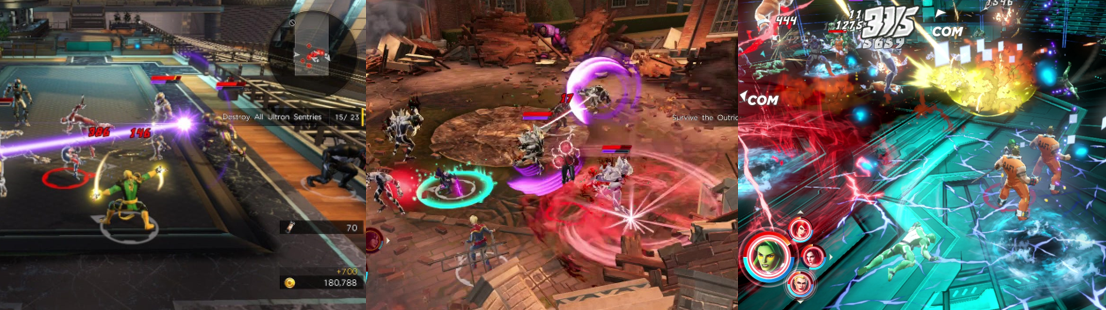
Combat is thick, fast, chaotic, and constant thanks to loads of enemies and character abilities.

As in the last two games, each character has specific abilities tied to their superpowers or superhero traits. You activate these by holding the Right trigger and selecting an icon using the D-pad; using Abilities drains your EP, however, and each Ability comes with a different cost. However, these attacks allow you to stun, stagger or deal elemental damage to enemies using Peter Parker/Spider-Man’s webs, Thor Odinson’s lightning, and Doctor Robert Bruce Banner/The Hulk’s incredible strength. Many characters have projectile attacks in their arsenal, such as Wade Wilson/Deadpool firing guns and Scott “Slim” Summers/Cyclops blasting his eye beams, while others cause splash damage or specific buffs, like Piotr Rasputin/Colossus being able to reflect projectiles and Wanda Maximoff/The Scarlet Witch healing her allies. Some, like James “Logan” Howlett/Wolverine, have passive abilities that allow them to automatically regenerate health as they walk around; others, like Johnny Blaze/Ghost Rider and Ororo Munroe/Storm, specifically deal in elemental damage. Character’s Abilities can also be mixed and matched by holding ZR and pressing one of the face buttons (or pressing A when prompted); this sees two characters attack in a combo for additional damage. As you dish out and take damage, you’ll also build the Extreme (EX) Gauge). Once full, you can press L and R up to three times to have two to four of your teammates perform a devastating combination attack that’s great against bosses. While the various cannon fodder you fight are easily dispatched, larger commanders and bosses need their “stun” meter drained before you can really put a beating on them and others (and certain treasure chests) require specific combination attacks to breach their shields. Defeating enemies sees your characters gain experience points (XP) to level-up, increasing their statistics (attack, defence, etc), though you can also use the various Orbs you find to manually level-up. Each character’s special Abilities can also be further enhanced using Ability Orbs and credits, reducing the EP cost and increasing their damage, among other benefits. You can also earn “Team Bonuses” depending on your team selection: pick a group of X-Men, for example, and your strength or resistance stat will increase, while picking characters of royalty ups your maximum energy stat.
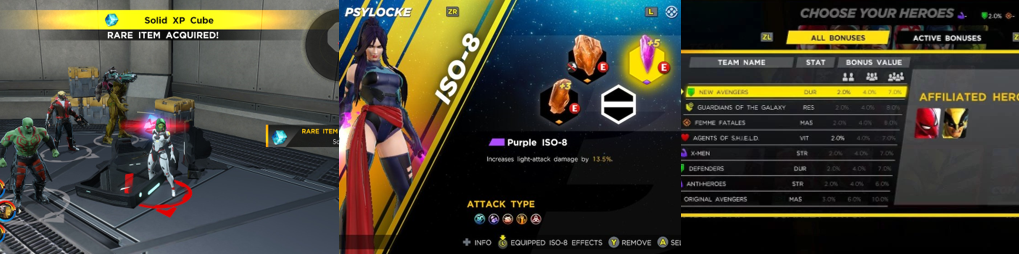
Search for chests to gain currency and other expendables to upgrade and buff your alliance.

Although you can’t equip gear to your characters, the boss battle against the Destroyer armour sees you temporarily empowered by Asgardian magic and you can eventually equip your team with “ISO-8” crystals, coloured stones that enhance their attack power, resistance to elements, or critical hit ratio, among others. You can further upgrade these with credits and ISO-8 capsules, though some of the rarer ones will also debuff you (for example, your attack my increase but your defence will decrease accordingly). You’ll also inevitably gain access to the Strategic Hazard Intervention Espionage Logistics Directorate (S.H.I.E.L.D.) Lab, which acts as the game’s skill tree. By spending credits and Enhancement Points (EP), you can further increase your team’s overall attack, defence, resistance, vitality, and such and even unlock additional ISO-8 slots (with more being earned by levelling-up). You can also enter the S.H.I.E.L.D. Depot from the main menu to purchase additional costumes and social icons by spending S.H.I.E.L.D. Tokens. Marvel: Ultimate Alliance 3 is pretty forgiving (on the “Friendly” difficulty, at least), with multiple checkpoints in each area. When you activate a S.H.I.E.L.D. checkpoint, your team is fully healed, and you can swap or enhance them if you wish. If a teammate is defeated, you can hold A to revive them, but I wouldn’t recommend it unless you absolutely have to. Not only are revives limited, but downed characters will eventually return to full health even before you reach a checkpoint so it’s not worth risking another character taking damage by healing a partner. Exploration generally leads you to treasure chests or special walls that require a special combination attack to open, or to a “Rift” challenge that takes you away from the main game to tackle a special challenge (usually a boss rematch or enemy gauntlet) for extra rewards. Your path is incredibly linear most of the time, hence why there’s no map, and the game’s primary focus is on chaotic combat and visually manic team-based attacks. Unlike in the last two games, you can no longer grapple or throw enemies (though you can still send them flying off certain platforms) and there are no character-specific team-up moves, meaning the action can quickly get quite tiresome.
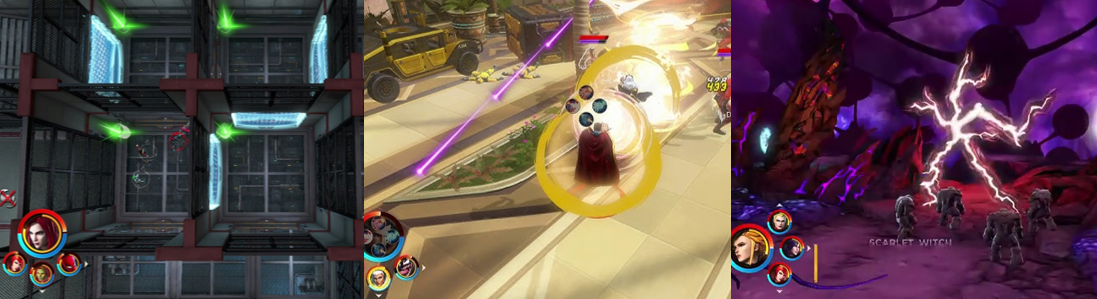
Sadly, puzzles are practically non-existent, with only Rifts offering additional challenges.

Because of its focus on hectic combat, there’s even less room for puzzles than there is for exploration in Marvel: Ultimate Alliance 3. Puzzles boil down to activating a console to open a door or making a platform move and that’s it. Sometimes, you’ll hold A to move a block and avoid lasers or cannons, but mostly you’ll be timing jumps between said lasers to progress and simply hurling missiles at those cannons. Sometimes, you’ll rotate statues or press switches to progress; others, you’ll be avoiding toxic ooze in Hel or solving door puzzles at the Raft or in Avengers Tower. After hopping across the rooftops of New York City, you’ll infiltrate the heavily fortified fortress of the Hand, dealing with ninjas that drop from the sky and hidden arrow hazards. When in Wakanda, Advanced Idea Mechanics (A.I.M.) corrupt T’Challa/The Black Panther’s defences, leading to an exasperating section where you must avoid snipers and being roasted by a giant panther statue’s energy blast. When transported to the Dark Dimension, you must use portals to reach new areas and defeat waves of demonic enemies to lower magical barriers and progress. Some attacks also screw up your controls or temporarily freeze you; some enemies are best defeated by tossing explosives at them; and many missions have an additional character fighting alongside you who’s often unlocked afterwards. However, a lot of the additional features of the previous games are missing; you can talk to other characters, but there are no dialogue options or character-specific interactions. There are no trivia quizzes, no optional side missions beyond the Rifts, and no character specific challenges to unlock extra stuff for each character. There aren’t even hub areas, in the traditional sense, with characters just appearing around S.H.I.E.L.D. checkpoints at times, though you can destroy a fair bit of the environment, and some encounters have you fleeing towards the camera as bosses chase you or present you with unwinnable battles.

Presentation:
Whereas the last two games primarily based their aesthetics on the comics books, especially the Ultimate comic line, Marvel: Ultimate Alliance 3 adheres very closely to the Marvel Cinematic Universe (MCU), especially in the visuals of its locations. I was hard pressed, for example, to tell the difference between Asgard here and the Asgard to the MCU, with both the golden city and the rainbow bridge, the Bifrost, appearing almost exactly as they’re depicted in the films. The same is true for Wakanda, the Dark Dimension, and Knowhere, all of which are virtually indistinguishable from how they appear in the MCU. There are some differences, of course: Taneleer Tivan/The Collector’s museum, for example, uses coloured cube cages and Wakanda leans much more into traditional architecture than the pseudo-futuristic science of the films (likely because Black Panther (Coogler, 2018) released a year before this game was made). Xavier’s School for the Gifted is lifted almost exactly from the 20th Century Fox X-Men movies (Various, 2000 to 2020), however, including a hedge maze, 1:1 Cerebro room, and basketball court that doubles as a landing pad for the Blackbird. While the Dark Dimension and the cosmic mind trip that is Sanctuary also heavily borrow from the bizarre cosmic imagery of the MCU, the Raft and Avengers Tower are much more akin to their comic book counterparts, though they’re comparatively bland locations, lacking fun areas like the Danger Room or Wakanda’s Necropolis (though you do pass through Anthony “Tony” Stark/Iron Man’s Hall of Armours in the tower). Although you only make a brief stop in Attilan to try and get help from the Inhumans, the architecture is far more visually interesting than that awful television show, seemingly being comprised of Celestial technology, and I enjoyed the ominous gothic presentation of Hel, with its restless Viking warriors and damaging sludge. Unfortunately, Marvel: Ultimate Alliance 3 continues the trend of having disappointingly bland and forgettable music, opting for generic themes for each location, event, and character that are lost amidst the constant fighting.
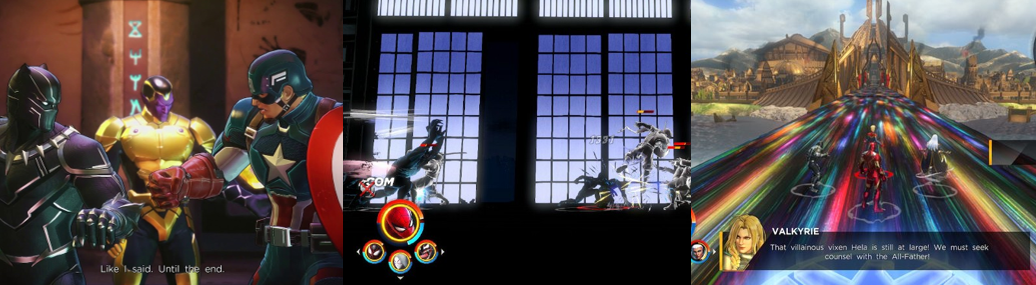
A visually impressive brawler that takes obvious inspiration from the MCU films.

The game also opts for an almost cel-shaded, action figure-like aesthetic for its colourful cast of characters. While many again both look and sound like their MCU counterparts, there are some exceptions: Peter Quill/Star-Lord, for example, looks nothing like Chris Pratt and the X-Men are far closer to the comic books than Fox’s films. Despite you assembling a custom team of heroes, cutscenes depict either everyone or characters specific to the location you’re in (the corrupted Doctor Stephen Strange in the Dark Dimension, for example) as they’re better suited to advance the plot against the local baddies. With the game shifting to a more third-person perspective, you’re closer than ever to the action and can see more of the environment than in the previous games. However, this comes with some drawbacks: mainly, there are far less opportunities or incentives to explore. Second, environments are painfully linear, with dead ends or locked doors barring your progress. Third, and most frustrating, is the camera, which easily loses track of your opponent/s and often lumbers you with wireframe representations when the foreground blocks the view. Thankfully, you won’t be falling down pits and rarely have to worry about onscreen hazards, but it can be aggravating trying to figure out which platforms and crates can be jumped on and which can’t. Marvel: Ultimate Alliance 3 offers a diverse cast of characters, each with their own idle poses and quips, though these do inevitably repeat. The game’s also surprisingly light on Easter Eggs: you’ll spot Deadpool singing away as he makes tacos in the X-Mansion, but not much else, and there are no optional missions or choices to encourage replaying missions. It’s a far cry from the first game, where there was always something to collect or an additional character to help out. Instead, it’s basically all combat, all the time in Marvel: Ultimate Alliance 3. Luckily, the game looks pretty good (everything’s very colourful and true to its inspirations) and performs really well, though there are some long load screens and it is annoying being forced to continue your game every time you challenge a Rift.

Enemies and Bosses:
All the usual suspects appear here as disposable cannon fodder for you to endlessly beat up, with many of the game’s goons sharing traits across the various locations. You’ll encounter Kree, Ultron Drones, agents of A.I.M., and Doombats who all pack various energy blasters. Ultron’s clones are the worst for this, relentlessly firing energy blasts and crashing through windows. The Raft’s unscrupulous prisoners attack in large groups, as do the restless Viking warriors who populate Hel, tossing axes from afar and luring you into toxic goop. Gargoyle-like Fire Demons also dwell here, offering a greater challenge with their swoop attack and fire breath, not unlike the monstrous Outriders and Mindless Ones who make up Thanos and the dread Dormammu’s forces, respectively. Alpha Primitives, Hydra goons, and towering Sentinels also appear, with the latter firing huge energy blasts from the palms and best attacked by throwing their explosive energy cores back at them. No matter where you are and what enemies you fight, more powerful commanders will also appear. Larger, tougher, and sporting a stun meter, these commanders should be your top priority as they’ll charge across the screen, cause shockwaves, and generally offer a far greater challenge even when you’re at a higher level. These minions often fight alongside their masters, generally so you can recover some health and EP to better damage the bosses, and will endlessly spawn in one of the additional modes unless you destroy their teleporters. Some of the game’s challenges or story-based missions charge you with defeating a certain number of enemies to progress. Other times, bosses appear in these waves, and you must occasionally flee or purposely lose some fights. This happens when Cain Marko/The Juggernaut comes tearing through the X-Mansion, for example, and in early encounters with the Black Order, who cannot be beaten or will chase you, raining lightning or other attacks from the sky and across the ground.
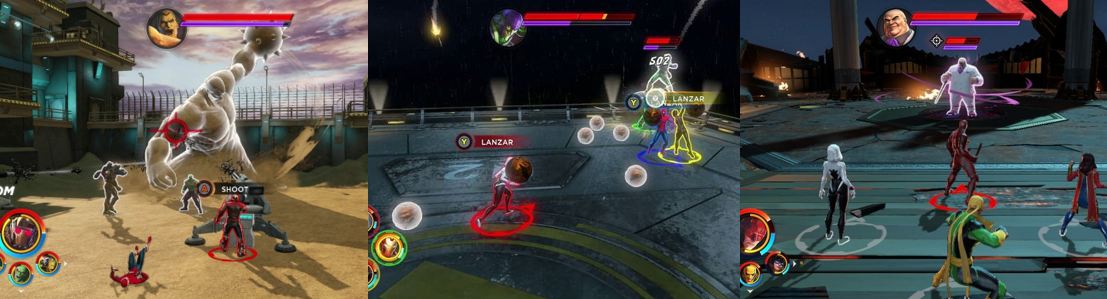
Few bosses require more than just hit-and-run tactics, even when augmented by an Infinity Stone.

There are loads of bosses to fight in Marvel: Ultimate Alliance 3, with some returning from the previous games, some teaming up, some having a couple of phases, and all boiling down to whittling down their stun bar, unleashing an EX attack and/or your most powerful Abilities, and avoiding damage until you can repeat this. The first ones you’ll face are Nebula and Ronan the Accuser, who often appear as a duo in optional challenges. Nebula is faster and more nimble, wielding blades where Ronan uses a massive warhammer. Both set a standard all bosses follow, which is that they’ll use either a jumping slam or an explosion of energy (or both) to send you flying. While quelling the riot in the Raft, you’ll encounter a version of the Sinister Six, with some unique variations to each battle. Flint Marko/The Sandman, for example, flings waves of sand and erupts his big sand fist from the ground as a large sand creature. You must use A to mount the nearby cannons and unload on him to chip away at his stun meter. Maxwell “Max” Dillon fights alongside Eddie Brock/Venom, raining lighting and electrocuting you with bursts of electricity, before he’s eaten by Venom and starts busting out electrically-enhanced symbiote powers. Venom joins the team after this fight and is tested against Quentin Beck, who first brainwashes Mile Morales/Spider-Man, Gwen Stacy/Spider-Woman, and Kamala Khan/Ms. Marvel to fight you and then unleashes a poisonous mist, teleports about, and confuses you with duplicates, Doctor Otto Octavious/Dr. Octopus is fought in a two-stage fight where you must first avoid his tentacles and scurry charge and then attack each arm to stun him. Finally, you’ll battle Norman Osborn/The Green Goblin for the Time Stone. The Green Goblin swoops overhead and lingers slightly out of reach, peppering the arena with his pumpkin bombs, charging at you, and freezing time to bombard you. He’s noticeably weak to his pumpkin bombs, however, so try and toss them at him before they explode in your face! After battling into the Hand’s fortress, you must first free Elektra Natchios from the Hand’s influence and then face Lester/Bullseye and Wilson Fisk/The Kingpin in separate fights. You must take out the ninjas feeding Elektra power, avoid Bulleye’s spread of razor sharp and explosive cards, and dodge the furniture and massive energy beam thrown by the Power Stone-enhanced Kingpin. The Kingpin also charges like a rhino, leaps at you to cause shockwaves, and even rips up stone columns to use as melee weapons!
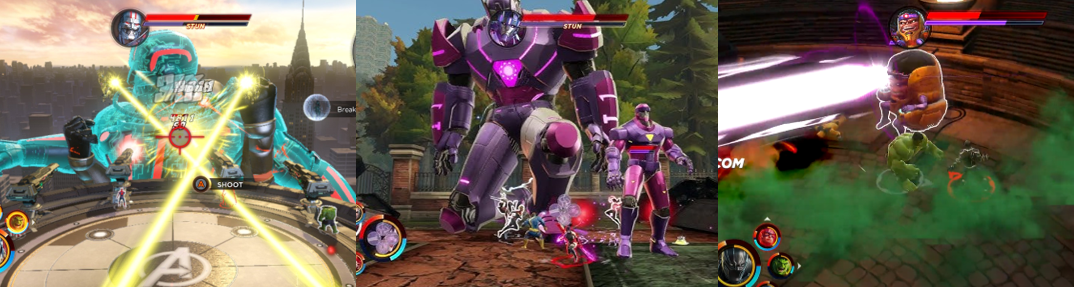
Gigantic bosses and the quirkier villains help mix-up the otherwise tedious combat.

Avengers Tower is then attacked by Ultron and his drones, who assist him in battle. Not that he needs it as the Mind Stone allows Ultron to mess up your controls, to say nothing of his signature face and palm beams. Ultron then grows to gigantic proportions, sweeping the area with his eyebeams before Clint Barton/Hawkeye intervenes and Ultron merges with Ultimo. This is the first giant boss battle in the game and sees you blasting Ultimo with cannons and avoiding his massive swipes. The Infinity Sentinel is comparatively smaller, but no less dangerous thanks to its own face beam and missiles. Though you can damage it with Sentinel cores, it’s finished in a cutscene by Erik “Magnus” Lehnsherr/Magneto, who then tosses debris and throws you off balance with magnetic pulses while Juggernaut pummels you and Raven Darkholme/Mystique tosses daggers. After surviving Mystique’s Danger Room trials, you face Magneto, now even tougher thanks to the Power Stone, before being chased away and banished to the Dark Dimension by the Black Order. There, you battle past Loki Laufeyson (who boasts elemental attacks and duplication tricks) to eventually face the dread Dormammu, who wields the Reality Stone and is the second giant boss. You must subdue his minions and avoid his flame bursts, whittling down his magical barrier either directly or be destroying three nearby orbs, all while dodging his giant fists and ground spikes. The brief fight with Maximus Boltagon is far easier, even though the mad Inhuman carries a massive energy cannon and you must take cover in Thane’s energy bubble to avoid Maximus’s barrage of lasers. Ulysses Klaue/Klaw awaits in Wakanda and his sound-based energy blasts and waves must be overcome to rescue and recruit James Buchanan “Bucky” Barnes/The Winter Soldier. You then fight past A.I.M. to confront their master, George Tarleton/Mental Organism Designed Only for Killing (MODOK), who uses the Soul Stone to turn the Dora Milaje against you and attacks with a slew of appendages, from buzzsaw arms, poison gas, failing tentacles, and his signature forehead blast.
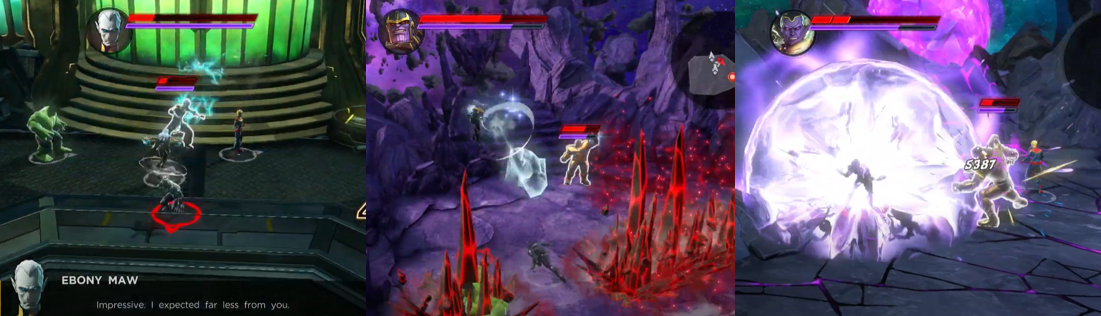
Battles with the empowered Black Order, Thanos, and Thane offer some of the most enjoyable challenges.

Though your goal in Hel is to confront Hela, you’ll actually battle the fire demon, Surtur, in another giant boss battle. This was a bit of a difficulty spike for me as Surtur’s flaming sword has a long reach and he causes the ground to erupt in flames, to say nothing of stun locking you with repeat sword strikes! Best him and Hela sets Johann Schmidt/The Red Skull on you, with the Nazi madman firing a powerful revolver and sapping your health with his “Dust of Death”. Hela gives the Red Skull a boost, protecting him with a shield and allowing him to fire a Bifrost-like laser, before placing his consciousness into the Destroyer armour. Though bolstered by Hydra forces and boasting a sweeping face beam, you can get a power-up from glowing crystals to overcome this destructive force. Finally, you venture to Knowhere and must run the Black Order gauntlet to retrieve the Infinity Stones, with checkpoints between each fight. Ebony Maw is first, firing a spread of projectiles and rocks and using the Soul Stone to create portals to trip you up. Supergiant tosses dark spheres and a golden homing shot that messes up your controls, though you can toss explosive cores from her minions to deal big damage. Cull Obsidian infuses his battleaxe with the Power Stone, sending out waves of purple energy and massive purple shockwaves, though he’s far slower and also susceptible to the nearby bombs. Corvus Glaive is much faster, landing multiple hits with his lance and using the Reality Stone to spring spikes form the ground and conjure duplicates who fill the arena with energy waves that can stun lock you. Finally, Proxima Midnight takes her fellow’s teleportation trick to the next level with the Space Stone and fills the arena with lightning bolts and strikes. All these powers are then recycled when you face Thanos, who gathers the six Infinity Stones into the Infinity Gauntlet to rain meteors, teleport, mess up your controls, freeze time, and fire his signature eyebeams. Thanos then joins you to battle Thane, who usurps him and boasts similar powers, though also upgraded by the Infinity Armour. Thane exhibits superhuman speed, traps you in a cube, fills the arena with portals and flames, and explodes in fury, though both battles were fun challenges rather than impossible tasks.

Additional Features:
Unlike in the previous two games, you won’t be finding data logs, action figures, or meeting certain requirements to unlock new attacks or costumes. You just fight over and over, earning whatever you need to unlock, buy, or upgrade whatever you wish and finding some concept art in treasure chests. A far harder (but more rewarding) “Superior” difficulty unlocks upon clearing the game alongside an additional “Nightmare” mode, accessible via the “Curse of the Vampire” campaign. You also unlock Thanos and can freely replay any mission on any difficulty (though you must start a new save to play on “Superior”) to grind and enhance your characters and ISO-8. Dimensional Rifts transport you to special challenges (not unlike the S.H.I.E.L.D. Simulator discs from the first game) that are often rematches with bosses or gauntlet challenges, though far tougher and gifting better rewards if you succeed. There are also three additional modes; however, though you can play a taster of each, you must purchase the expansion pass to fully unlock them. “Curse of the Vampire” adds vampiric enemies to the main story in “Nightmare” mode and offers a “Gauntlet” mode where you battle waves of enemies and bosses against both a time limit and a range of debuffs (including limited health restoration and draining EP). You can also tackle an “Endless” mode that’s pretty self-explanatory, and unlock additional characters like Frank Castle/The Punisher and Eric Brooks/Bladeif you buy the DLC. “Rise of the Phoenix” sees you form a four-person team and go head-to-head with a friend or the computer in three-round Danger Room scenarios. These see you tackling bosses again or wiping out hordes of enemies, awarding additional buffs and effects if you meet certain criteria (such as using any Ability or Synergy attack four times). You can only tackle the first challenge without the DLC, so I didn’t get very far, but this could be a fun distraction for those looking to test their skills against a friend. “Shadow of Doom” adds an epilogue story campaign that sees you return to Wakanda to oppose Doctor Victor Von Doom’s invasion. Dr. Doom’s Doombots endlessly spawn unless you destroy their teleporters, and you even battle the arrogant dictator in the recycled Necropolis, with him teleporting, firing lasers form his palms, and having his health restored by his Doombots. You’ll add Marvel’s First Family to your roster (alongside an alternative Thanos and other characters) by buying the expansion pass and battle Annihilus, a gigantic Celestial, and even “God Emperor” Doom!
The Summary:
I quite enjoyed the first two Ultimate Alliance games. They were mindless and largely repetitive, but I liked the large cast of characters and all the different references and locations from the comic books. Still, I put off Marvel: Ultimate Alliance 3: The Black Order for some time, mainly because I was annoyed by it being a Nintendo Switch exclusive; however it turned out to be a decent enough brawler. Despite the different development team, a few tweaks, and an apparent disconnection from the previous games, Marvel: Ultimate Alliance 3 offers a lot of the same gameplay and enjoyment as its predecessors, which is great for long-time fans of the franchise. Unfortunately, it doesn’t improve on these elements in a meaningful way and actually removes some content that I found enjoyable from the last two. There are no optional missions, for example, no alternative endings, no choices, and no character-specific challenges beyond fighting and levelling-up. I found this made the tedious combat even more aggravating after a while as I wasn’t being rewarded with gear or costumes or anything other than stat boosts. Even the skill tree was limited since you must grind to acquire enough credits and expendables to enhance your team, and I found the ISO-8 mode to be more confusing than engaging. The game also does little to improve the boss battles. Very few were very innovative or required more of you than to strike fast, avoid shockwaves and projectiles, and unleash your Extreme attack. The giant bosses were more of a challenge and I liked the final fight against Thanos and Thane, but I was hoping for a bit more complexity, especially given the possibilities offered by the Infinity Stones. There is a fun selection of characters, but they don’t offer much more than what we saw in the last two games and actually offer less as there are no character-specific team-up moves. While I enjoyed the visual influence from the MCU and the variety, I feel like Marvel: Ultimate Alliance 3 played things a little too safe by relying so heavily on combat and not mixing up the gameplay with a few other puzzles and challenges. Overall, it’s a good enough game and a worthy entry in the series, but it’s a shame that the developers didn’t try to be a bit more innovative and offer some more incentive to keep slogging away in endless fights.

My Rating:

Rating: 3 out of 5.

Pretty Good

Did you enjoy Marvel: Ultimate Alliance 3: The Black Order? How do you think it holds up against the previous two games? Which characters did you choose for your team? Were you disappointed that the combat was so similar to the last two games and the bosses so repetitive? Did you ever conquer all the Rift challenges? What did you think to the MCU influences and the final battle with Thanos and Thane? Did you ever play through the DLC? Would you like to see another Ultimate Alliance game? Whatever your thoughts, leave a comment below, support me on Ko-Fi, and go check out my other superhero content across the site.

Movie Night: Spider-Man: Across the Spider-Verse

This review has been supported by Chiara Cooper.
If you’d like to support the site, you can do so at my Ko-Fi page.

Released: 2 June 2023
Director:
Joaquim Dos Santos, Kemp Powers, and Justin K. Thompson
Distributor:
Sony Pictures Releasing
Budget:
$100 million
Stars:
Shameik Moore, Hailee Steinfeld, Oscar Isaac, Jason Schwartzman, Jake Johnson, Daniel Kaluuya, and Brian Tyree Henry

The Plot:
Miles Morales/Spider-Man (Moore) is at a crossroads in life when his multi-dimensional friend and crush Gwen Stacy/Spider-Woman (Steinfeld) re-appears, now part of a sprawling society of Spider-People led by Miguel O’Hara/Spider-Man 2099 (Isaac). However, Miles is forced to pick between his world and his family when Doctor Jonathan Ohnn/The Spot (Schwartzman) threatens both, bringing him into conflict with the Spider-Society.

The Background:
Back in 2011, writer Brian Michael Bendis made the bold decision to kill off Peter Parker/Spider-Man in the pages of Ultimate Spider-Man (2000 to 2011) and replace him with a younger character, Miles Morales, an African American youth of Puerto Rican descent. Though this caused much controversy at the time. Miles quickly became a popular character and branched out into cartoons, videogames, and even the mainstream Marvel continuity (“Earth-616”). After the poor reception of The Amazing Spider-Man 2 (Webb, 2014) saw Spider-Man incorporated into the Marvel Cinematic Universe (MCU), Sony pushed forward with Spider-Man-adacent films separate from the MCU, including the visually spectacular Spider-Man: Into the Spider-Verse (Persichetti, Ramsey, and Rothman, 2018), a Miles-centric story that became a critical and commercial success. Production of a sequel began immedately after the release of the first film and the plan was always to expand upon the multiverse concept in the sequel, which would necessitate splitting the sequel into two parts. The film greatly built upon the concept of multiple Spider-People, writers Phil Lord and Christopher Miller were encouraged by infamous Spider-Man producer Avi Arad to include the Spot as an antagonist, and different art and animation styles were painstakingly incorporated to make each character unique. After being delayed due to the COVID-19 pandemic, Spider-Man: Across the Spider-Verse opened to a massive $563.1 million worldwide gross and universal praise; critics loved the visuals and action-packed adventure and the road seems clear for subsequent sequels and spin-offs.

The Review:
It’s probably not too surprising to say that I really enjoyed Spider-Man: Into the Spider-Verse. While I don’t always agree or like that a street level superhero like Spider-Man is so often at the epicentre of massive multiversal stories, it was a breath of fresh air as both a superhero and animated film. The visual storytelling on offer was nothing short of spectacular and I think it went a long way to cementing in the minds of the mainstream audience that there is more than one Spider-Man out there. That groundwork is taken to the nth dimension in the highly anticipated sequel, which picks up with Miles just over a year after the last movie and finds him a little older, a lot more confident with his spider powers and unique abilities (such as his electrical “venom sting” and camouflage ability), and generally pretty beloved by the citizens of New York City. He has a working relationship with his father, soon-to-be Captain Jefferson Morales (Henry), who remains ignorant of his son’s dual identity, and has made a name for himself as the heroic friendly neighbourhood Spider-Man. Unfortunately, as is often the case for Spider-Man, this success doesn’t translate to every aspect of his life; despite his high grades, his absence from school has been noted and he’s under pressure to take his first tentative steps into adulthood, something made all the more difficult for him not just because of his responsibilities as Spider-Man but his guilt about lying to his parents about his extracurricular activities and the smothering he receives from his doting mother, Rio Morales (Luna Lauren Vélez), who struggles as much as Jefferson with how quickly Miles is growing and the fear of losing him to the wider world.

Miles and Gwen reconnect, only for him to realise the multiverse harbours great hardship.

Because of this, Miles feels very alone; while his roommate (and only friend), Ganke Lee (Peter Sohn) knows his secret identity, he’s mainly just a cameo and refuses to be Miles’ “guy in the chair” and, since Miles doesn’t dare reveal himself to his parents, he’s left pining for Gwen and internalising a lot of his issues, particularly his grief for his beloved uncle, Aaron Davis/The Prowler (Mahershala Ali),. His only true freedoms come from his artwork and his web-slinging; Spider-Man offers Miles a freedom unlike anything else and allows his confident, snarky attitude to rise to the forefront, but this ends up biting him the ass when he treats newly turned supervillain the Spot like an afterthought, causing the former physicist to exponentially increase his power to avenge himself on Spider-Man. Miles initially thinks very little to the Spot, especially when Gwen suddenly reappears in his life; the film’s opening delves much deeper into Gwen’s own tragic backstory, which saw her isolate herself from others after the death of her best friend, Peter Parker (Jack Quaid), after he’d transformed himself into a lizard-man. Since her father, Captain George Stacy (Shea Whigham) blames Spider-Woman for Peter’s death, Gwen is similarly unable to properly open up to her dad and, when he first meets Spider-Man 2099 and the enigmatic Jessica Drew/Spider-Woman (Issa Rae), she’s granted an opportunity to leave her world behind rather than face her pain. Although it’s fairly clear that Gwen has missed Miles as much as he has her, she remains guarded; her duties to the Spider-Society dictate that she has to keep her distance from Miles, but she can’t help reconnecting with him since he’s the only friend she has in the entire multiverse, despite all the new allies she’s made. Her affection for him drives her to hide the Spider-Society’s true purpose from him since he’s destined to rise through horrible tragedy, yet she can’t help but admire his enthusiasm and desire to do the right thing, saving everyone whenever possible, even in the face of overwhelming odds.

Miles’s disregard of the Spot is nothing compared to the wrath of the ruthless Spider-Man 2099.

This is just one of many reasons why Miles follows Gwen through an interdimensional portal to Earth-50101, where they encounter the free-spirited and confident Pavitr Prabhakar/Spider-Man India (Karan Soni). Joined by Gwen’s fellow Spider-Society member, the anarchist and anti-authoritarian Hobart “Hobie” Brown/Spider-Punk (Kaluuya), the four team up to tackle the Spot once more after he escapes, realises the vast potential of his organic dimensional portals, and seeks to add to his power by absorbing energy from particle accelerators across the multiverse. While the Spot might be a deranged, deluded villain who struggles with his often-unpredictable powers, his confidence and mania grow alongside his powers, transforming him into a nightmarish creature capable of ripping entire timelines to shreds. A strange bond links him to Miles, allowing the young Spider-Man to see glimpses of the future and act accordingly; however, this is the catalyst that brings him under the scrutiny of Spider-Man 2099 since Miles interfered with a “canon event”, a life-altering moment in Pavitr’s destiny that was fated to make him a greater hero. The consequence of altering this sees Pavitr’s world threatened by a raging black hole, something Spider-Man 2099 has witnessed happen first-hand after he innocently replaced a version of himself and was forced to watch his surrogate family and timelines vaporise before his eyes as a result. Thanks to his connection to the Spot, Miles realises that his father’s death is set to be his canon event and his natural instinct is to save him, only to be imprisoned and threatened by Spider-Man 2099 and the majority of the Spider-Society since they cannot allow one life to threaten the delicate tapestry of the titular Spider-Verse. A stoic, aggressive, and driven individual, Spider-Man 2099 is absolutely relentless in his pursuit of Miles; he has no compunction about ordering the entire Spider-Society to pursue him when he escapes and tries to break him, mentally and physically, rather than allow him to risk his entire world. His ruthless pursuit casts Spider-Man 2099 as much of a villain as the Spot; though he maintains that he’s doing what’s necessary to keep the multiverse stable, his actions have caused great personal tragedy for countless Spider-People, though many of his followers (including Miles’ mentor, Peter B. Parker (Johnson), and Gwen) are strangely onboard with Miguel’s methods since it’s deemed necessary to birth greater heroes.

The Nitty-Gritty:
This questionable morality is as much at the heart of Spider-Man: Across the Spider-Verse as its ruminations of life, responsibility, and adulthood. The film is surprisingly complex in its portrayal of Miles’ relationship to his parents; both feel they’re losing him since he’s becoming a young adult and are frustrated by his obvious lies, and Miles equally is torn between wanting to share himself with them and the fear that they won’t understand. Gwen witnessed this rejection first-hand when her father initially reacted in horror at finding out Spider-Woman was his daughter and was inspired by Miles to return to her father and reconcile with him since she’s tired of running from her path and feeling alone and is struggling with her actions since joining the Spider-Society. Both Miles and Gwen feel alone and like they have no one to confide in, but only Miles feels ostracised from everyone; his friends, family, and even the wider Spider-Verse since Gwen is cagey about their recruitment specifics, and he seems to be the only Spider-Man not part of the team. This is because he hasn’t had his canon event yet, but the film’s a little iffy on that: here, it seems to be the death of a police captain that spurs the Spider-People on, yet Miles lashes out at the various Spider-People for letting down the teachings of their uncles and both Miles and Gwen already suffered tragic losses that you’d think would be catalyst enough for their growth as heroes. I do think that the reveal of the Spider-Society’s true purpose should’ve been handled differently as it’s weird to me that so many Peter Parkers were willing to let even one person die, no matter the stakes, and I wonder if it would’ve been better to reveal that Spider-Man 2099 had been deceiving all of them.

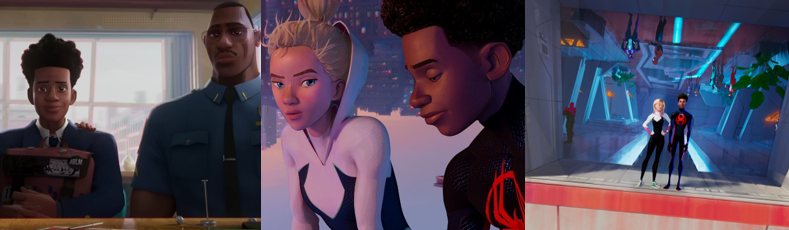
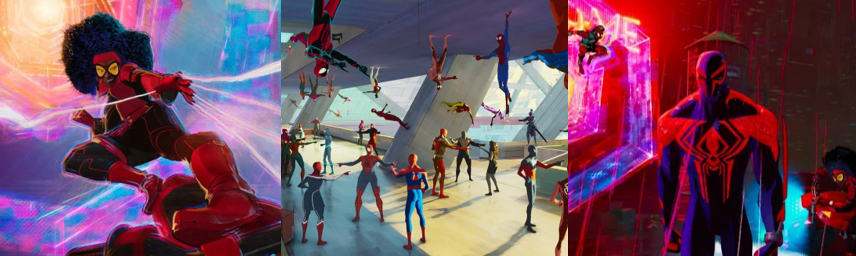
The film’s stunning visuals allow each Spdier-Person to stand out amidst various bizarre universes.

As intense and thought-provoking as the character interactions and themes of the movie are, Spider-Man: Across the Spider-Verse excels in its visuals. The film takes the unique frame rate and cartoonish, comic book-stylings of the first movie and ups the ante to make every Spider-Person feel unique. Gwen’s world is rendered very differently from Miles’s, being mostly pastels and having an almost brushstroke effect; Spider-Punk animates jerkily, like a living piece of Sex Pistols artwork, and the attention to detail in the animation, background details, and little things like thought boxes and sound effects popping up onscreen really add to the exhilarating, pop art appeal of the film. There are some gorgeous shots here, too, such as when Miles and Gwen sit upside down and gaze upon the inverted city, rain and night effects are used for fantastic dramatic detail, and I especially enjoyed how 2099 was brought to life as a sprawling, high-tech utopia above ground and a dark, depressing, neon-spawned underbelly below. This translates into the web-slinging, which is easily the best we’ve ever seen from a Spider-Man movie since the action is only limited to the animator’s imagination. All the Spider-People web-sling and fight differently, with the pregnant Jessica Drew doing her best Akira (Otomo, 1988) on her motorcycle and spewing webs from her fingertips, Spider-Punk leaping into battle with a guitar, and Pavitr incorporating a little wooden accessory into his webbing. For me, the standout in this regard was Spider-Man 2099; as morally reprehensible and ruthless as he appears, his fighting style and web-slinging are a force to be reckoned with. Utilising energy webs and sporting both talons, fangs, and bladed appendages alongside his bad-ass suit, Spider-Man 2099 is more feral than the other Spider-People and carves a swath of destruction in his pursuit of and attack upon Miles. Although clearly outmatched, Miles manages to elude and survive even Spider-Man 2099 thanks to being an “anomaly”; the spider that bit him wasn’t even from his Earth, making him unpredictable (and, for Miguel, potentially dangerous) and accounting for his ability to fend off multiple, more experienced Spider-People and exercise a moral integrity that’s sadly abandoned many of his counterparts.

An exhilarating cliff-hanger sees Miles’ attempts to save his dad, and his world, in jeopardy.

This all comes to a head when Miles frantically uses Spider-Man 2099’s elaborate, spider-based machine to return home, desperate to save his father’s life and keep his world from being consumed by the Spot’s wrath, only to find that he’s been deposited on the wrong Earth. This is quite the twist for both Miles and Gwen, who followed him to try and help, and doubly so since Miles actually found the courage to reveal his dual identity to his mother, only to be stunned to find that his uncle is alive and well in this world, which lacks a Spider-Man since its spider bit him instead. Here, Miles finds himself strung up and held at the mercy of his uncle and his Earth-42 counterpart (Jharrel Jerome), a bad kid who has taken up the mantle of the Prowler. With Spider-Man 2099 and his lieutenants scouring the multiverse to find Miles and keep him from saving his father’s life, Gwen reconciles with her father and recruits her own band of Spider-People to help Miles and end the film on a massive and exhilarating cliff-hanger. I can’t say that I saw this twist ending coming at all; the film is so enjoyable to watch that I would’ve happily sat through another hour of it, and things were really ramping up at the end so it’s exciting to imagine where the next part will go and seeing Miles reunite with his friends from the first movie. The entire film is stuffed with cameos from Spider-People from all across the multiverse, including live-action cameos from the likes of Andrew Garfield and Donald Glover (as an alternative version of the Prowler), persistent voice cameos from J.K. Simmons as J. Jonah Jameson (proving beyond a shadow of a doubt that J.K. just is Jonah in every dimension), and references to both past and current versions of Spider-Man (the recent multiverse shenanigans of the Marvel Cinematic Universe are mentioned at one point). It never feels glorified or out of place, to be fair, and it’s fun spotting and following some of these background Spider-People, though again I do find it odd that so many subscribe to Spider-Man 2099’s logic. There was a point where Miguel is seen injecting himself with something, and Miles points out how he’s more like a vampire than a spider, so I wonder if this’ll factor into the next film, perhaps revealing that Miguel is actually his brother, Gabriel, or someone like Morlun. There’s also the threat of the Spot to wrap up, too; I liked how he was driven to prove himself, just like Mils, but went to destructive extremes and I’m sure that’ll result in a spectacular final showdown involving more than a few Spider-People!

The Summary:
I was blown away by Spider-Man: Across the Spider-Verse. I expected it to be a visual treat but it overdelivered in this regard; I loved how all the Spider-People looked and felt very different, even if just in small ways, to really emphasise that all these different versions are just as valid and “real” as the other. You could spend hours going through every frame looking for cameos and little details, like frames of animation and visual quirks, and still not catalogue everything on offer here; at times it’s almost underwhelming, but it results in easily the best visually impressive Spider-Man action we’ve ever seen in cinema. At then, alongside all that, there’s a really heartfelt and relatable story of a kid trying to find his place in the world, somewhere to belong, and mature into adulthood. I really felt for both Miles and Gwen here and enjoyed how they had such a strong connection together, and it was harrowing seeing him being excluded from even her world because of things he wasn’t yet experienced enough to understand. I loved how Spider-Man 2099 was so tortured by his mistakes that he’s hell-bent on ensuring that no other worlds die because of a Spider-Person’s selfishness; it made his motivations very understandable and contributed to his manic aggression, but also made for a compelling antagonistic character. The Spot may be a joke, but he becomes a force to be reckoned with throughout the movie and I’m excited to see how he’ll be brought down and the further clash of webs and ideals between the various Spider-People. While I took issue with so many Peters and Peter proxies signing up to Miguel’s harsh philosophy, it doesn’t take away from how stunning this movie is as a piece of art. Spider-Man: Across the Spider-Verse has raised the bar not just for Spider-Man movies, but for the animation genre itself and, while I would still like to step away from multiverse shenanigans in Spider-Man movies, it’s hard to deny how incredible impressive and well-executed this film is.

My Rating:

Rating: 5 out of 5.

Fantastic

Did you enjoy Spider-Man: Across the Spider-Verse? What did you think of the different animation styles of the various Spider-People? Which of the alternative Spider-Man was your favourite? What did you think to Miles’ struggles? Do you agree with Spider-Man 2099 or do you think that the other Spider-People are betraying the core concepts of their characters? What other Spider-People would you like to see in the next film? Whatever your opinions on Across the Spider-Verse, go ahead and drop them in the comments and be sure to check out my other Spider-Man content across the site!

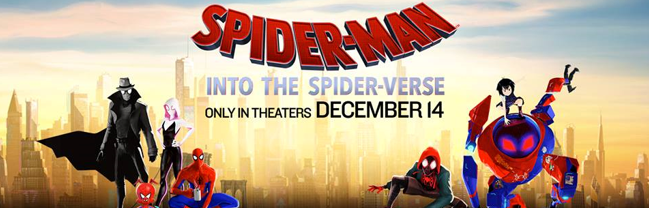
Movie Night [Spidey Month]: Spider-Man: Into the Spider-Verse


Easily Marvel Comics’ most recognisable and popular superhero, unsuspecting teenage nerd Peter Parker was first bitten by a radioactive spider and learned the true meaning of power and responsibility in Amazing Fantasy #15, which was first published in August 1962. Since then, the Amazing Spider-Man has featured in numerous cartoons, live-action movies, videogames, action figures, and countless comic book titles and, in celebration of his debut and his very own day of celebration, I’ve been dedicating every Wednesday to talk about everyone’s favourite web-head!


Released: 14 December 2018
Director:
Bob Persichetti, Peter Ramsey, and Rodney Rothman
Distributor:
Sony Pictures Releasing
Budget:
$90 million
Stars:
Shameik Moore, Jake Johnson, Hailee Steinfeld, Mahershala Ali, John Mulaney, Kimiko Glenn, Nicolas Cage, and Liev Schreiber

The Plot:
After being bitten by a radioactive spider and gaining the proportionate strength and agility of the arachnid, Miles Morales (Moore) finds himself caught up in an elaborate plot by Wilson Fisk/The Kingpin (Schreiber) to cross dimensions. In the process, Miles is mentored by, and joins forces with, other incarnations of Spider-Man from across the multiverse while stull struggling to carve out his own identity in the role.

The Background:
In 2011, writer Brian Michael Bendis decided to kill off Peter Parker/Spider-Man and replace him with a younger character in the pages of Ultimate Spider-Man (2000 to 2011), Miles Morales, an African American youth of Puerto Rican descent, a decision which created much controversy at the time. Miles, however, soon became a popular character and appeared not just in cartoons and other merchandise but also the mainstream Marvel continuity (“Earth-616”). After the poor reception of The Amazing Spider-Man 2 (Webb, 2014) led to Spider-Man finally being incorporated into the Marvel Cinematic Universe (MCU), Sony were determined to continue producing Spider-Man films and spin-offs separate from the MCU. Writers Phil Lord and Rodney Rothman chose to focus their efforts on Miles since he hadn’t yet featured in a film and, to further separate the project, it included not only Spider-People from across the multiverse but also a distinct and intricate animation style that was as vital to the story as the music and dialogue. Spider-Man: Into the Spider-Verse received unanimous praise upon release and made over $375 million at the box office, won numerous awards, and is highly regarded as one of the best and most unique Spider-Man movies ever made. Its massive success meant that both a sequel and a spin-off were soon announced and no doubt contributed heavily to Miles’ continued popularity.

The Review:
First and foremost, Spider-Man: Into the Spider-Verse is Miles Morales’ story, even amidst all the chaos and multiverse madness permeating the plot; unlike the traditional Peter Parker, Miles’ parents are still alive and, while he struggles to adjust to boarding school and to make new friends, he’s nowhere near the social outcast Peter is often portrayed as during his teenage years. A big fan of music (though he is amusingly poor at reciting lyrics) and with an artistic flair, Miles is a slightly rebellious and resentful youth who struggles to live up to the expectations of his father, Jefferson Davis (Brian Tyree Henry), a police officer who regards Spider-Man (Chris Pine) as a menace and delights in embarrassing his son at his new school with typical dad humour. A somewhat streetwise kid who was a popular figure at his old school, Miles is largely an outsider at his more officious and pretentious boarding school; he’s uncomfortable in the mandatory uniform, feels like he doesn’t really fit in, and is intentionally trying to sabotage his future there so he can go back to his old school and his old friends. Believing that his father doesn’t really understand him or his dreams, Miles has a far closer relationship with his uncle, Aaron Davis (Ali), who encourages his penchant for street art and actually takes the time to connect with him on a more peer-to-peer level. To Jefferson’s chagrin, Miles idolises his uncle, who indirectly leads to him gaining his spider powers.

Miles’ struggles with his spider powers are directly paralleled to the onset of puberty.

Already somewhat uncomfortable in his new environment, Miles’ newfound spider powers (which are explicitly compared to the onset of puberty) only increase his agitation; he struggles to adapt to and master his abilities, gaining a far louder and more noticeable internal monologue and accidentally attaching himself to Gwen Stacy’s (Steinfeld) hair in an awkward attempt to flirt with her. Interestingly, Miles’ exploration of his abilities is a source of as much entertainment and amusement as it is an integral part of Miles’ character development; throughout the film, Miles struggles to master his powers, which seem to trigger unconsciously or involuntarily, and a massive part of Into the Spider-Verse revolves around Miles living up to the lofty expectations now placed upon him by his amazing new abilities.

In Miles’ world, Peter is a competent, renowned, and experienced superhero.

Miles lives in an alternative world that isn’t quite Earth-616 or the Ultimate universe; it’s one that draws inspiration from all over Spider-Man’s various adaptations and interpretations but one where Spider-Man is a renowned and experienced superhero. Carrying himself with the confidence of a veteran of many battles, life lessons, successes, and failures, this Spider-Man is, honestly, uncharacteristically competent in a lot of ways (he’s still married to Mary Jane Watson (Zoë Kravitz), has the full support of his beloved Aunt May Parker (Lily Tomlin), and even has a Spider-Cave full of different Spider-Suits, for God’s sake). During an intense battle with the monstrous and demonic Norman Osborn/Green Goblin (Jorma Taccone) and the slick and efficient Prowler, Peter is shocked to meet Miles, someone who shares his abilities, and vows to train him and give him the opportunities he never had when he was first starting out, such is his commitment to using great power with great responsibility.

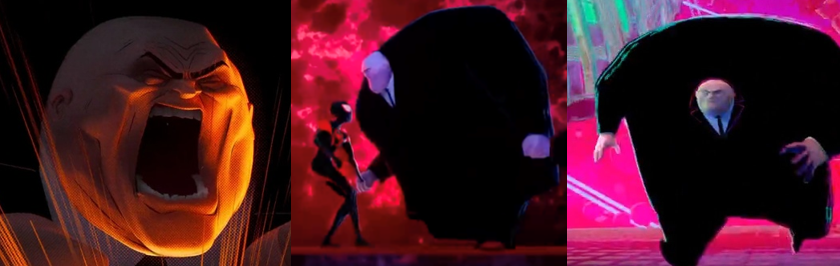
Kingpin may look ridiculous but he’s a formidable threat who killed Peter with his bare hands!

Sadly, and unexpectedly, Peter is killed right before Miles’ eyes by the Kingpin; Fisk, who blames Spider-Man for exposing his criminal deeds to the world and thus driving away his wife and son, has built a gigantic Super-Collider which he plans to use to rip a hole between dimensions and retrieve his family from another time and place. When Peter costs him this opportunity, Fisk beats him to death in a brutal and surprising scene and spends the remainder of the movie desperately trying to track down and reacquire the USB flash drive that allows the collider to work. Like Green Goblin, Fisk is a comically exaggerated version of himself, even compared to the creative flair of some comic book artists, but as preposterously absurd as Kingpin looks, his threat has, arguably, never been more tangible and brutal than in Into the Spider-Verse. Exuding unmatched power, wealth, and authority, he commands some of Spider-Man’s most notorious foes with a cold menace and is more than happy to get his hands dirty in his desperate attempt to be reunited with his family.

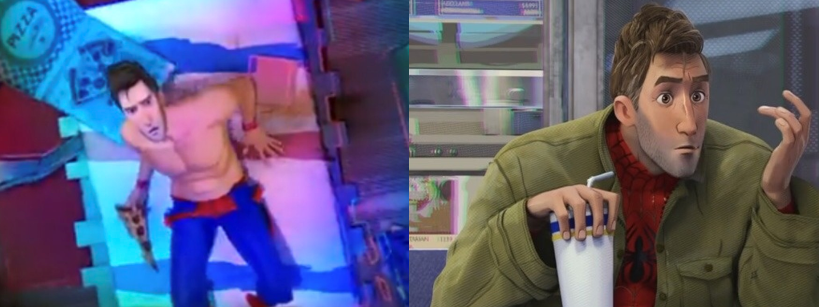
Peter B is an out of shape, world-weary version of Spider-Man who’s far from his prime.

Shaken by Peter’s death, and overwhelmed by the immense responsibility now in his hands, Miles is shocked to meet an alternative version of Peter, Peter B. Parker (Johnson), who arrived during the brief period that the Super-Collider was active. Unlike his counterpart from Miles’ world, Peter B is an out of shape, jaded, wreck of a man who has lost his way, and everything near to him, and yet, despite his crushing losses, obvious depression, and having grown weary of the power and responsibility that comes from being Spider-Man, Peter B still continues to be Spider-Man and does his best to tutor Miles in coming to grips with his powers. He’s obviously not as effective or competent a mentor than his counterpart promised to be but he does what he can regardless and is fully willing to put his life on the line to allow his fellow Spider-People to return home.

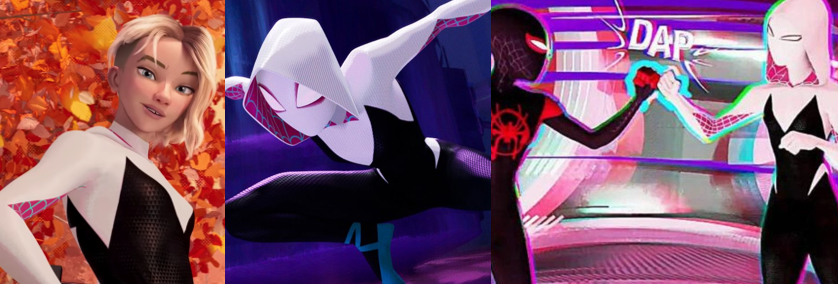
Thanks to her friendship with Miles, Gwen learns to open herself up to others once again.

Speaking of which, Miles is also joined by a whole host of unexpected Spider-People; the first one he meets is Spider-Woman, Gwen Stacy, although he is unaware of her true identity at the time. A vastly different version of the traditional Gwen, Spider-Woman gained her powers in Peter’s place in her world and is a tough, sarcastic character who, while having a soft spot for Miles, is reluctant to open herself up to him, or anyone else, for fear of losing them. In a film arguably crowded by Spider-People, Gwen stands out by being one of the more recognisable and fleshed out characters and is, basically, a tertiary protagonist as her growing friendship with Miles is a major part of her (and his) character development. Sadly, the same can’t really be said about the rest of the Spider-Crew; Peni Parker/SP//dr (Glenn) is perhaps the least developed and expendable of the group. While she is rendered in an outstanding anime aesthetic and has a heart-warming bond with her spider mech, she’s largely inconsequential to the story and could have been spliced out with any other version of Spider-Man. Spider-Noir (Cage) and Peter Porker/Spider-Ham (Mulaney) manage to stand out a little better thanks to being rendered in monochrome and talking like a thirties gangster or being a literal cartoon character, respectively, but we don’t really learn a great deal about them and they’re mainly there to emphasise that every universe has a Spider-Man and that Spidey’s legacy and ideals are carried by a variety of characters all throughout time and space, which all directly ties into Miles’ character arc of growing into, and finally accepting, his role as Spider-Man.

The Nitty-Gritty:
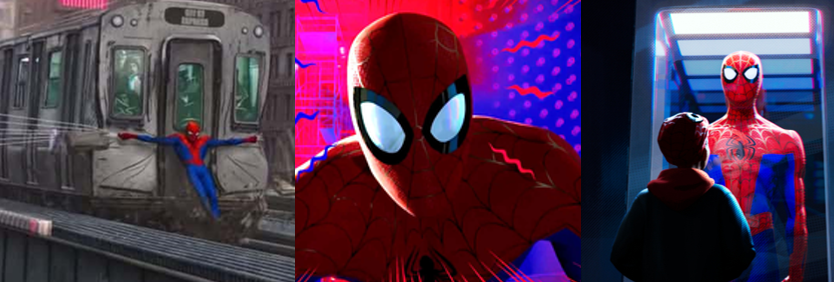
Spider-Man: Into the Spider-Verse immediately sets itself apart from other Spider-Man movies not just by focusing on Miles as its main character and its cross-dimensional subplot but also by virtue of being an animated movie. Truthfully, animation suits Spider-Man down to the ground as, often, some of the more exhilarating sequences in Spider-Man movies are the computer-generated fight scenes and web-slinging moments and Into the Spider-Verse definitely uses its medium to its full advantage, featuring a unique aesthetic, comic book-like sound effects for emphasis, and even varying the frame rate to emphasise the differences between the various Spider-People and Miles’ comparative inexperienced compared to them. Humour is an important element of the film; Into the Spider-Verse is full of amusing lines, sight gags, and comedic moments that come naturally and are incredibly amusing thanks to some effortless and believable line delivery from the likes of Moore, Pine, and Johnson (Spider-Man’s quips during tough situations and battles are a notable highlight). Characters have an easy banter and sass to them that allows even the least developed of them to appear far more nuanced in the short space of time they have to shine and humour is emphasised through Miles’ inexperience with his powers, wry commentary on his increasingly chaotic situation, and the frantic nature of the action scenes and character beats.

Action and fights are colourful and frantic, ensuring no two fights are the same.

Speaking of action, Into the Spider-Verse is crammed full of some of the most impressive, intense, and frenzied action scenes in any Spider-Man movie; the freedom offered by relying on animation allows for some of the most diverse and varied web-slinging as each Spider-Person swings, fights, and moves differently. The use of music and onomatopoeia emphasises the action, which is fast-paced, memorable, and impactful thanks to the film showcasing a wide variety of Spider-Man’s rogues gallery, which includes the likes of the Green Goblin, Lonnie Lincoln/Tombstone (Marvin “Krondon” Jones III), and Mac Gargan/The Scorpion (Joaquín Cosio).

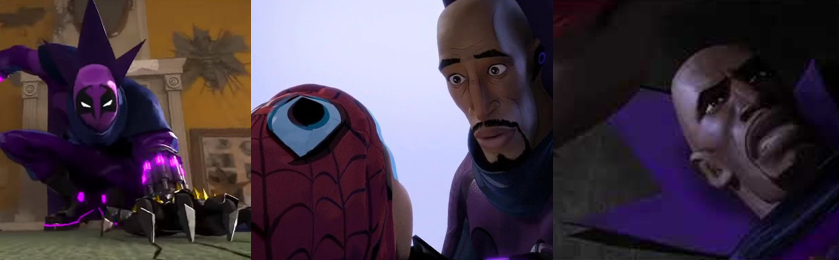
Though a vicious mercenary, Aaron’s hesitation to kill Miles costs him his life.

Apart from Fisk, though, the most prominent villains of the film are Doctor Olivia Octavius/Doctor Octopus (Kathryn Hahn) and the Prowler; while Doc Ock is a sadistic and formidable, half-crazed scientist, it is the Prowler who has the most emotional significance to both the plot and to Miles. Constantly accompanied by an ominous, animalistic theme, the Prowler is portrayed as Fisk’s top mercenary; a brutal and vicious, cat-like fighter in a sophisticated suit of armour, Prowler stops at nothing to hunt down Fisk’s missing USB drive. Miles is absolutely devastated to find that the one person he thought he could rely on in the whole world, his Uncle Aaron, turns out to be the Prowler and even more crushed when, upon discovering Miles’ identity, Aaron chooses to spare his nephew and is executed by the Kingpin as a result and dies in Miles’ arms while urging him to continue on as a hero.

Miles finally embraces his role as Spider-Man, defeats Kingpin, and returns his new friends home.

In the end, against all the odds and his own doubts and inexperience, Miles customises one of Peter’s suits (crafting an absolutely bad-ass variant in the process) and fully embraces his role as Spider-Man to confront the Kingpin and put an end to his destructive scheme. It’s a real coming of age moment for Miles, who previously could only look up in awe at Spider-Man’s legacy, and allows him to not only finally live up to the lofty expectations placed upon him by his father and the various Spider-People but also repair his relationship with his father (and his father’s opinion of Spider-Man) through his actions. With the Spider-People returned home, Miles becomes the one true Spider-Man of his world, gaining lifelong friends and a renewed sense of responsibility, confidence, and identity in the process. It’s a strikingly effective story largely thanks to how relatable and complex Miles is portrayed throughout the film, being a rebellious and well-meaning kid who is simply struggling to find his place in an ever-changing world.

The Summary:
If I’m being completely honest, I’m not really a fan of how often a street-level superhero like Spider-Man gets caught up in multiversal misadventures and meets alternative versions of himself; just like how I’m often a bit perturbed by how often Bruce Wayne/Batman has to put up with the same events, I feel like Spider-Man works better as a more grounded hero who only occasionally dabbles in cosmic-level events. To that end, I feel like Into the Spider-Verse would have been just as appealing to me, if not more so, had the multiverse elements been dropped; Peter B could have just been the version of Spider-Man in Miles’ world, Gwen could have been the same or swapped out with Cindy Moon/Silk, and the other Spider-People could have been replaced by, say, Ben Reilly or Kaine Parker and the idea of a multiverse of Spider-Man could maybe have been saved for the next movie. However, having said that, that doesn’t mean I’m not a huge fan of Into the Spider-Verse as it is; make no mistakes about it, this is a fantastic movie from start to finish, with an extremely appealing aesthetic identity and some absolutely fantastic action. It also carries a very emotional heart to its story, which is one of identity, legacy, and expectation; a coming of age story that follows a young, emotional kid who is struggling to live up to the role his mentors expect of him, Into the Spider-Verse says a lot about not only the nature of Spider-Man but also the struggles of youth and puberty. I’m glad Into the Spider-Verse did so well and I’m genuinely looking forward to the sequel delivering more of the same high-octane action and heartfelt emotion, visual flair, as well as introducing more Spider-People and, hopefully, expanding upon the brief cameo from one of my favourite Spider-Man, Miguel O’Hara/Spider-Man 2099 (Oscar Isaac).

My Rating:

Rating: 5 out of 5.

Fantastic

What are your thoughts on Spider-Man: Into the Spider-Verse? Where does it rank among the various other Spider-Man movies for you and what did you think of the artistic style and focus on Miles Morales and the other Spider-People? Which of the alternative Spider-Man was your favourite? Would you have liked to see one, or more, get a bigger role and if so, which one? What other alterative version of Spider-Man would you like to see show up in the sequel? Are you a fan of Spider-Man always having adventures with alternate versions of himself or would you prefer to see him tackling more street-level threats? Are you a fan of Miles, and what did you think to Peter’s death both in Ultimate Spider-Man and in Into the Spider-Verse? Whatever your opinion on Into the Spider-Verse, go ahead and drop a reply down in the comments and be sure to check back in next Wednesday as Spider-Man Month continues!

10 FTW: Comic Book Crossovers We Need To See

If there’s one thing comic books allow, it’s the grandiose crossover between characters. Ever since Barry Allen met Jay Garrick all the way back in 1961 and introduced the idea of multiple parallel universes, comic book characters have existed in both isolated shared universes and travelled across a near infinite multiverse. However, while it’s relatively common to see Bruce Wayne/Batman and Clark Kent/Superman interact with the Justice League or the Teen Titans, or to have Peter Parker/Spider-Man randomly join forces with the Fantastic Four or the X-Men, we’ve also seen the characters of DC and Marvel Comics interact with each other. We’ve seen Superman and Batman both cross paths with Spider-Man, the X-Men team with the New Teen Titans, and both publishers’ greatest heroes go head-to-head in the epic DC Versus Marvel Comics (Marz and David, et al, 1996) crossover.

10FTWCrossoversWeird
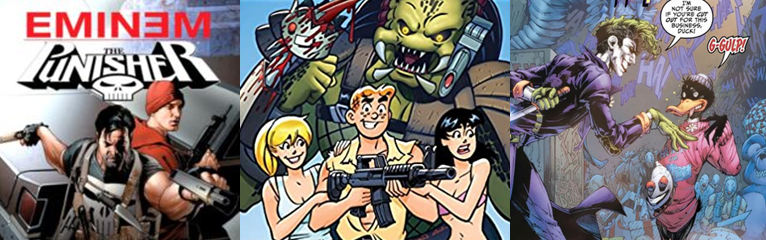
There have been some weird crossovers in comics.

In addition, Dark Horse Comics snapped up multiple science-fiction and horror film franchises, giving us crossovers such as RoboCop Versus The Terminator (Miller, et al, 1992) and a whole slew of Aliens vs. Predator (Various, 1989 to present) comics. It doesn’t end there, either; we’ve seen Batman cross paths with Judge Dredd on multiple times and Frank Castle/The Punisher team up with not only Eminem but also pop up in Archie Comics, and it was thanks to such comic book crossovers that we finally got to see the three-way mash-up between Freddy Kruger, Jason Voorhees, and Ash Williams! Yet, as many and varied and seemingly limitless as these crossovers can be, it seems like we’ve missed out on a few seemingly-obvious crossovers. Maybe it’s because of licensing issues or the fact that DC and Marvel Comics don’t tend to do a lot of business together lately, but, either way, I figured I’d talk about ten crossovers I’d love to see in comic books.

10FTWCrossoversJSWM
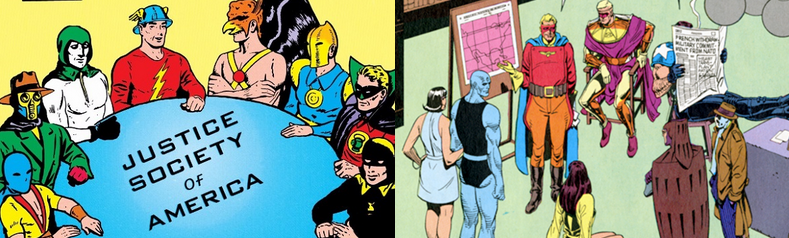
10 Justice Society/Watchmen

After DC Comics finally put an end to the largely-awful New 52 run, they teased Alan Moore’s seminal work, Watchmen (ibid, et al, 1986 to 1987), becoming part of DC canon when Edward Blake/The Comedian’s iconic smiley-face button turned up in the Batcave. Cue the extremely delayed publication schedule of Doomsday Clock (Johns, et al, 2017 to 2019), a storyline that revealed that Doctor Jon Osterman/Doctor Manhattan had been influencing DC canon for decades. While this, obviously, brought the characters of Watchmen (or, at least, versions of them) into conflict with Superman, Batman, and other versions of the Justice League, it’s the older, more seasoned members of the Justice Society of America (JSA) I’d like to see have extended interactions with the Crimebusters. The JSA were at their peak around the time of World War Two, meaning they are decidedly more optimistic and pragmatic about their approach to crimefighting. The Crimebusters, meanwhile, existed in a largely dystopian version of the 1980s that was pretty bleak and constantly on the verge of another World War, meaning this team up could produce an interesting clash of styles and philosophies that would probably be more in keeping with Moore’s more reflective text rather than an all-out brawl. Plus, who doesn’t want to see who would win a battle between Jim Corrigan/The Spectre and Doctor Manhattan?

10FTWCrossoversPulp
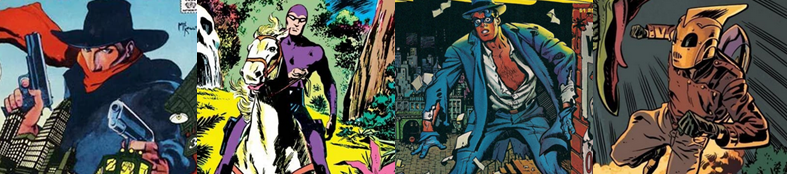
9 Pulp Heroes United

Before Batman and Superman, there were the pulp heroes of the 1930s to 1950s. Names like the Phantom, the Shadow, the Spirit, the Rocketeer, and Green Hornet may have faded from mainstream relevance in recent years, but they live on thanks to publications from Dynamite Comics and crossovers with DC Comics. Speaking of Dynamite Comics, they came very close to this crossover with their Masks (Various, 2014 to 2016) series, which saw the Shadow teaming up with the Green Hornet and Kato, a version of Zorro, and the Spider but this crossover has so much potential to really pay homage to the heroes of yesteryear. Ideally, such a comprehensive team up would be similar to The League of Extraordinary Gentlemen (Moore, et al, 1999 to 2019) in its scope and legacy; hell, I’d even have the Phantom, the Shadow, the Spirit, the Rocketeer, Green Hornet and Kato, Zorro, Doc Savage, the Lone Ranger and Tonto, and the rest of their ilk butting heads with the Martians from The War of the Worlds (Wells, 1897) at the turn of the century. A proper sepia-toned, steampunk-filled piece that sees these wildly different pulp heroes begrudgingly working together to save the world could be a great way to thrust these overlooked classic heroes back into the spotlight.

10FTWCrossoversRHWS
8 Red Hood/Winter Soldier

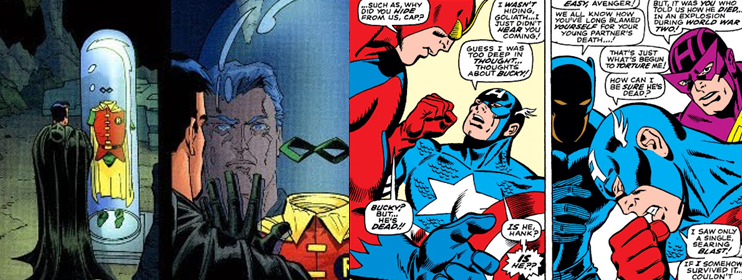
If the comic industry was like it was back in the mid-nineties, we would surely have already seen this crossover, which is as obvious and as fitting as the team up between the Punisher and Jean-Paul Valley/Azrael during his brief tenure as Batman. Speaking of which, a team up between Jason Todd/Red Hood and the Punisher is just as enticing but, in terms of thematically complimentary characters, you’re hard pressed to find two more fitting that Jason Todd and Bucky Barnes. Both characters were well-known sidekicks to greater heroes whose deaths shaped, influenced, and affected their mentors for years, and both even returned to life as violent, broken anti-heroes around the same time.

10FTWCrossoversJTBB
Jason and Bucky’s deaths weighed heavily on Bat and Cap for years.

Yet, while Bucky has gone on to not only redeem himself and assume the mantle of Captain America (and is largely far more mainstream thanks to his prominent inclusion in the Marvel Cinematic Universe), Jason Todd has floundered a little bit. It didn’t help that Jason’s resurrection was directly tied to DC’s latest reality-shattering Crisis for years (even though there have since been far less convoluted explanations, and he really should have been Hush all along) but, even ignoring that, Jason’s place is skewed as one minute he’s a sadistic killer, then he’s a violent anti-hero, then he’s wearing the Bat embalm and is an accepted (however begrudgingly) member of the Bat Family. However, both characters have carved a name out for themselves as being willing to go to any lengths to punish the guilty; each has blood on their hands, a butt load of emotional and personal issues, and a degree of augmented strength, speed, and skill thanks to their training or resurrection. While both are similar, Bucky is far more likely to be the bigger man and take the more moral ground, which would be more than enough to emphasise the differences between the two (provided Jason feels like being more antagonistic in this theoretical crossover).

10FTWCrossoversRCJD3
7 Judge Dredd/RoboCop

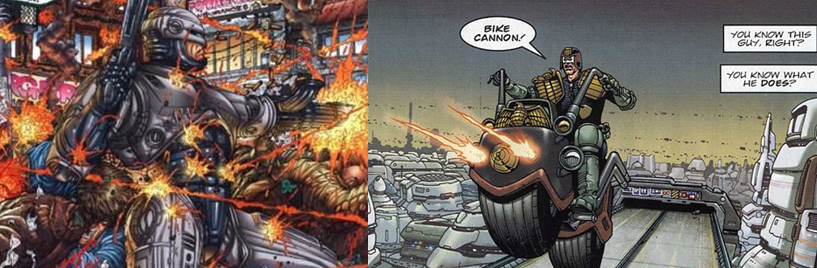
It’s no secret that RoboCop exists almost solely because of Judge Dredd; without 2000 A.D.’s no-nonsense lawman, we’d likely never have seen the excellently gore-and-satire-filled sci-fi action that is RoboCop (Verhoeven, 1987). While Batman has had more than a few run-ins with Judge Dredd, Detroit’s resident cyborg supercop has yet to meet his cinematic counterpart. The story is so simple is basically writes itself; you could have RoboCop awakened from suspended animation or reactivated after decades of being offline in the war-ravaged dystopia of Mega City One and briefly come into conflict with Dredd. I’d wager that RoboCop would be the more likely of the two to be more morally inclined; RoboCop generally operates based on very specific, law-abiding directives (or, depending on the version, his own conscience) that justify violence in service of protecting the innocent. Dredd, meanwhile, is just as likely to arrest victims of crimes as those who perpetrate them and is generally more an example of totalitarianism and uncompromising brutality in the name of the “law!” Yet, just as Dredd and Batman were able to work together despite coming to blows over their methods and philosophies, these two would make quite the formidable team once they’d ironed out their differences…though RoboCop may need an upgrade or two to survive in the future.

10FTWCrossoversDPTM
6 Deadpool/The Mask

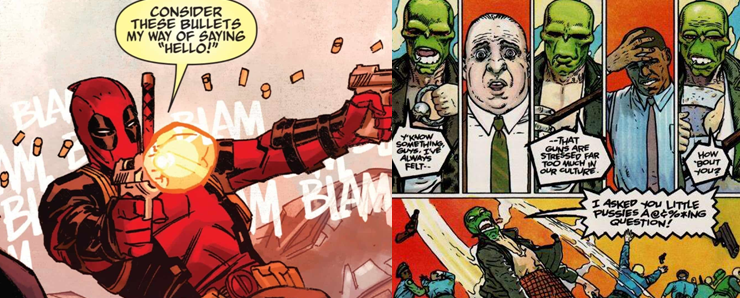
DC Comics have had many crossovers with Dark Horse over the years, resulting in numerous interactions between DC’s finest and the Xenomorphs, Predators, and Terminators. Similarly, both companies worked together on a number of crossovers revolving around the violent, big-headed cartoon anti-hero “the Mask”. It stands to reason, then, that if the Joker acquiring the magical mask and gaining its powers is a natural fit, a crossover between the near limitless power of the mask and everyone’s favourite fourth-wall breaking Mutant, Wade Wilson/Deadpool, would be just as fitting. Both characters are known for their over-the-top, cartoony violence, springing weapons out of thin air, directly addressing the reader, and busting heads with a maniacal glee. Hell, DC and Dark Horse had Lobo team up with “Big-Head” and even acquire the mask in another crossover and, given Lobo’s similarities to Deadpool, it wouldn’t bee too hard to imagine a crossover between these two being little more than a non-stop bloodbath as they tried in vain to damage each other, before Deadpool inevitably acquires the mask for himself and, in all likelihood, reduces all of conscious reality to a cheesy puff.

10FTWCrossoversRvTvAvP
5 RoboCop vs. Terminator vs. Aliens vs. Predator

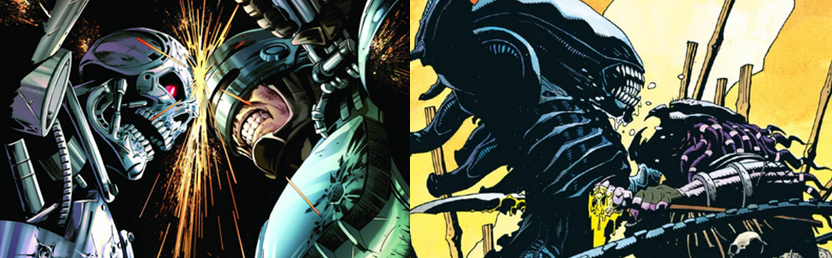
Speaking of Dark Horse Comics, they really have brought us some great crossovers over the years; RoboCop Versus The Terminator and Aliens vs. Predator were natural stories to present in comics, videogames, and toys that were (arguably) too big for movies. They also merged three of these franchises together in Aliens versus Predator versus The Terminator (Schultz, et al, 20000), though that story was more a sequel to Alien: Resurrection (Jeunet, 1997) and a continuation of the Aliens vs. Predator comics than anything to do with the Terminator (Various, 1984 to 2019) films. Instead, this four-way crossover would give Dark Horse a chance to take the time-hopping, action-packed story of RoboCop Versus The Terminator and merge it with their complex Aliens vs. Predator comics. RoboCop would probably be best served as the central character of the story; a member of the human resistance could travel back in time to try and eliminate RoboCop, only to run into a T-800 right as Predators come to clean up a Xenomorph outbreak in Detroit. A time dilation could transport them to the war-ravaged future, where RoboCop could team up with a reprogrammed T-800 (or John Connor) against the aliens, or perhaps the future war would be changed by the reverse-engineering or Predator technology. There’s a lot of potential in this crossover but, for me, it only really works if you include RoboCop. Without him, you end up with a poorly-executed concept like Aliens versus Predator versus The Terminator, which really didn’t utilise the Terminator franchise enough. But imagine a Terminator/Xenomorph (or Predator) hybrid exchanging plasma blasts with a Predator-tech-upgraded RoboCop and tell me that doesn’t sound cool!

10FTWCrossoversHBJC
4 Hellboy/Constantine

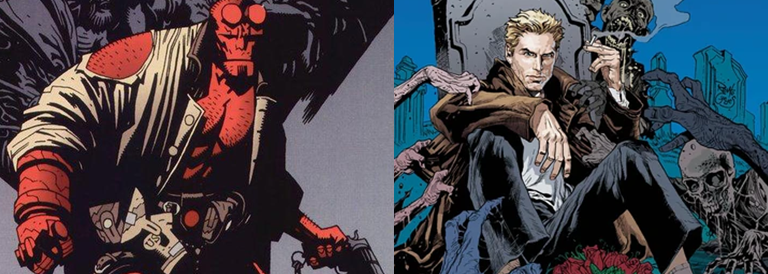
We’re scaling back a bit with this one. Honestly, I am very surprised we’ve never seen these two team up before, especially considering the amicable relationship DC and Dark Horse Comics have had over the years. Hell, we did get a brief team up between Hellboy and Batman but, arguably, this is the far more fitting choice. In this concept, I would go with the idea that John Constantine and Hellboy co-exist in the same world and have them cross paths when investigating the same supernatural threat or mystery. Obviously, they’d have to fight before teaming up (or, perhaps, they’d just rub each other the wrong way after being forced to team up), but can you imagine the quips and taunts and insults Constantine would have for Hellboy all throughout this crossover? Toss in guys like Swamp Thing and Etrigan, or even the Justice League Dark and the rest of Hellboy’s buddies (and absolutely have Mike Mignola provide his distinctive art style to the piece alongside co-authoring the story with either Grant Morrison or Neil Gaiman) and you could have a very dark, moody, and entertaining paranormal crossover.

10FTWCrossoversBGSG
3 Batgirl/Spider-Gwen

This one is more of a light-hearted pick but there’s nothing wrong with a bit of unapologetic fun amidst all the big action set pieces and violent action. After her debut in the “Spider-Verse” (Slott, et al, 2014 to 2015) storyline and prominent inclusion in Spider-Man: Into the Spider-Verse (Persichetti, Ramsey, and Rothman, 2018), this alternative version of Gwen Stacy has gained quite the fan following over the years and has become firmly entrenched in Marvel canon as Ghost-Spider. Meanwhile, since the New 52, DC have returned Barbara Gordon to the role of Batgirl; this wasn’t without some controversy as, for years, Barbara had operated just fine as a paraplegic and the Batgirl mantle had been assumed by other, far more suitable candidates. Yet, DC have continued unabated, largely changing Barbara from a smart and capable tech and information wizard, to a far more catty, athletic, and socially-conscious young lady. Despite this, this has the potential to be a really fun crossover between these two; while Babs should really be the older and more mature of the two, they’re both around the same age these days (somewhere between fifteen and twenty-one, depending on DC and Marvel’s sliding timelines), meaning there would be a lot of common ground between the two. No doubt they would have plenty to say about each other’s costumes, hair, and ex boyfriends (throw Nightwing in there and have that cause a bit of tension between the two) and I would even have them team up against C-list villains, like the Vulture, Chameleon, Shocker, Mad Hatter, or Killer Moth, just to keep the focus on fast-paced, witty action rather than getting all sour and bleak.

10FTWCrossoversSM2099BB
2 Spider-Man 2099/Batman Beyond

I know what you’re thinking: Shouldn’t this be a crossover between Batman Beyond (1999 to 2001) and Spider-Man Unlimited (1999 to 2001), considering both cartoons aired at the same time and both characters wore similar, futuristic costumes? Well, you might be right, but Spider-Man Unlimited really should have been based on the initial Spider-Man 2099 (Various, 1992 to 1996) comics as that cartoon is largely remembered for being a poor follow-up to the superior Spider-Man (1994 to 1998) animated series and for featuring a pretty neat new costume for Spidey. Instead, I’d go with Spidey’s futuristic counterpart, Miguel O’Hara, who is more famous for operating in an alternative future of Marvel Comics. Again, the easiest way for him to interact with Terry McGinnis would be to have them exist in the same world but there’s a bit of an issue with that: Batman Beyond was set in 2039 when Terry was sixteen. The Justice League Unlimited (2004 to 2006) episode “Epilogue” (Riba, 2005) jumps to fifteen years later and Terry is a thirty-one-year-old Batman but the story would probably need some kind of time travel plot to bring these characters together at their peak.

10FTWCrossoversSM2099BB2
Both characters come from similar futuristic worlds.

Luckily, neither character is no stranger to time-hopping adventures; perhaps the best way to do this would be to have two similar villains in each world experimenting with time/reality-bending technology and cause a dilation that threatens to merge both timelines unless Miguel and Terry can stop them. I’d even have them both swap places; have Miguel wake up one morning in Neo-Gotham, running into the aged, grouchy Bruce Wayne (Kevin Conroy) and battling some of Terry’s foes, while Terry randomly finds himself dumped in Nueva York and running afoul of Alchemax. After two issues of them exploring each other’s world, the third issue would be the obligatory fight between the two before they agree to team up for the fourth and final issue and sort out the problem. Both characters’ futuristic costumes have very similar traits and exist in visually interesting futuristic worlds, making a potential clash and eventual team up between them an exciting prospect for the art work and banter alone.

10FTWCrossoversDetective
1 Batman/The Crow

Easily the top choice for me, and the genesis of this list, I literally cannot shake how perfect a crossover between Batman and Eric Draven/The Crow would be. Neither are strangers to inter-company crossovers but, while the Crow has had to settle for teaming up with the likes of Razor, The X-Files (1993 to 2018), and Hack/Slash (Seeley/Various, et al, 2014 to 2018), Batman has met Al Simmons/Spawn, Spider-Man, Judge Dredd, and even Elmer Fudd and the Teenage Mutant Ninja Turtles. Yet, this crossover provides the opportunity to get Batman back to the gritty, noir-inspired style of stories like The Long Halloween (Loeb, et al, 1996 to 1997) utilising an art style that is part Dave McKean and part James O’Barr. As for the plot, I’d have Eric return to his undead life once again after it is revealed that there was another figure pulling the strings of Top Dollar’s gang. This would, of course, bring Eric to Gotham City, where he’d start killing members of this extended gang of thugs with his usual brand of violence and poetic justice. Naturally, this would lead him into conflict with Batman but, rather than the two descending into a poorly written, childish brawl as in Spawn/Batman (Miller and McFarlane, 1994), it would probably be better to focus on Batman’s detective skills as he investigates Eric’s murder, those behind the murder, and Eric’s violent actions on the streets of Gotham. In fact, I probably would only have the two interact right at the conclusion of the story, just as Eric is about to kill his final target; they could have a discussion on morality and the meaning of justice but, ultimately, Eric would fulfil his mission and return to the grave regardless of Batman’s protestations, leaving Batman to ponder the line between justice and vengeance.

10FTWCrossoversEnd

What comic book crossover would you like to see? Which comic book crossover has been your favourite, or most reviled? Whatever you think about comic book crossovers, leave a comment below.