Game Corner: Mario & Sonic at the Olympic Games Tokyo 2020 (Nintendo Switch)

Released: 1 September 2019
Developer: 
SEGA
Also Available For: Arcade and Mobile

The Background:
Super Mario and Sonic the Hedgehog engaged in a fierce “Console War” during the nineties as Nintendo and SEGA battled to be the top dog of the videogame industry. In the end, thanks largely to wasting money on expensive peripherals and the pressures of an ever-changing marketplace, SEGA withdrew from the home console market. On the plus side, their supersonic mascot appeared on his rival’s consoles, prompting discussions of a long-awaited crossover began between their respective creators, Shigeru Miyamoto and Yuji Naka. Surprisingly, the two came together in the spirit of friendly competition once SEGA obtained the 2008 Beijing Olympic licence. Essentially a collection of Olympic-themed mini games, Mario & Sonic at the Olympic Games (SEGA Sports R&D, 2007) saw Mario and Sonic characters co-existing for the first time and its commercial success led to subsequent titles releasing annually to promote different Olympic events across the world. This year, to coincide with the Special Olympics World Winter Games, I’m looking at the 2020 iteration (and currently last) of the series. Released following a significant gap between entries and the first to appear on the Nintendo Switch, the game including story elements and events that incorporated sprites from both franchise’s classic 2D games. Retaining its branding despite the delay to the Olympic games, Mario & Sonic at the Olympic Games Tokyo 2020 attracted mixed reviews that praised the nostalgic feel of the 2D mini games but criticised the tedious story mode and limited options.

The Plot:
When Bowser, King of the Koopas, and Doctor Eggman are trapped inside an 8-bit videogame console alongside Super Mario and Sonic the Hedgehog, Luigi, Miles “Tails” Prower, and all their extended supporting characters must compete in the Tokyo 2020 Olympic games to free them.

Gameplay and Power-Ups:
If you’re familiar with the Mario & Sonic series of Olympic game tie-ins, you probably won’t be surprised to learn that Mario & Sonic at the Olympic Games Tokyo 2020 is a collection of Olympic-themed minigames starring the biggest names from both franchises. As ever, Mario and Sonic’s worlds are mashed together with our own, allowing these anthropomorphic and comical characters to wander around real-world locations (courtesy of not one but two overworld maps) and learn interesting facts about both franchises, the Olympic games, and Tokyo. You start the game by selecting your region, being bombarded by pop-up notifications that tell you basic stuff like what the sound settings do, and customising your player profile, assigning icons and such. From there, you have a few gameplay choices: you can jump into a quick game solo or against other players, picking from every event as they’re all unlocked from the start and setting the difficulty of each, or tackle the game’s story mode. Regardless of which option you pick, your gameplay experience will change depending on which character you play as. While the Story Mode forces you to play as certain characters, you can pick almost any character for any event in Quick Match, but you’ll need to consider their capabilities. These are pretty simple: some characters are faster, some are all-rounders, some do better with Super Moves. It doesn’t get more complicated than that and I’m not sure how much of a factor they are as basically every game comes down to how fast you can tap buttons or work the various controls. There are thirty-two characters to choose from, though twelve are only selectable in certain events (like Jet for Football and Ludwig for Fencing) and, when playing the 2D-styled “Dream Events”, your choices are limited to just eight characters.
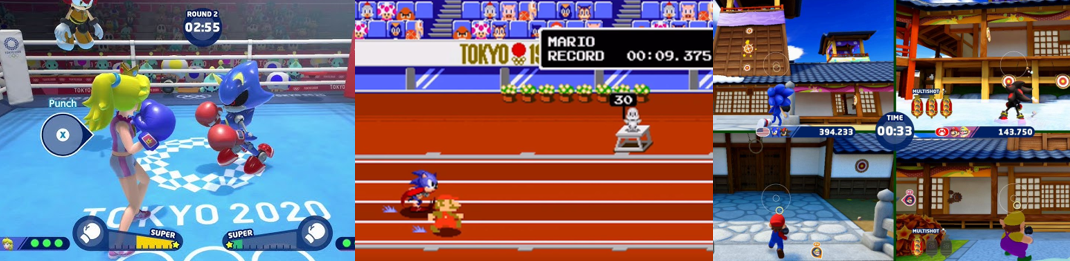
Up to four players can tackle the game’s 3D, nostalgic 2D, and chaotic “Dream” events.

There are twenty-one Olympic events to play, ten 2D Events set during the 1964 Olympic games, and three special challenge “Dream Events”. You’ll get a chance to review the controls and success criteria prior to each event, though it’s worth pressing X during one of the many introductory scenes or after pausing to review any additional controls. Players can choose from three different ways to play, including flailing around with the motion controls or using the buttons like a normal person, though some events (like the Discus Throw and Javelin Throw) force you to use motion controls to angle your shot, making them some of the more aggravating events. Generally, you can hold the Right trigger or A at the start of an event to build power and must tap A to run or move. B is usually reserved for jumping while R or A execute a Super Move (such as a burst of speed or dancing flourish). The simplest events, like the 100m Race and 110m Hurdles, have you tapping A to run to the finish line, with players hitting B at the right time to clear hurdles and gain a boost in the latter. Most events have a foul line that will disqualify you if you cross it, some of the trickier ones have an optional practice mode beforehand, and your objective is to win every event to set a best time (or break a World Record) and earn gold medals or the top spot on the podium. If you fail an event three times in the Story Mode, you can choose to skip the event, progressing the story with no consequences, something I eventually did quite often when the events became too laborious or finnicky. I was fine with the challenge offered by, say, the Long Jump where you tap A to run, hold B to adjust your jump angle, and complete a series of button presses akin to a quick-time event (QTE), even if it took some practice. Similarly, Sport Climbing was tricky but not too taxing. You press the Left trigger and R at the start to latch on, aim your jump with the left and right control sticks, and hop to hand-holds against a time limit, avoiding spiked balls and replenishing your stamina with hearts. I also had a fair bit of fun in Boxing and Fencing, where you must time button presses and build combos, guarding against incoming attacks and frantically tapping A (in the latter) to avoid being counted out.
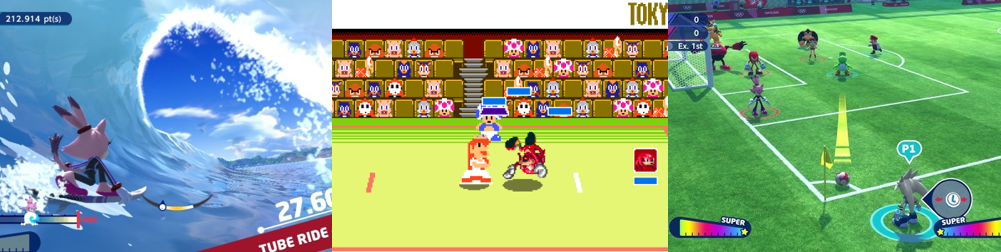
Skill and character choices can help with the game’s harder events, which include team-based sports.

Things took a turn whenever the events became a bit more complicated, however. It’s not too difficult timing your button presses in the Triple Jump event or pulling off gnarly tricks in the Surfing – Shortboard and Skateboarding – Park events, but you need to be on point to win those gold medals as a poor score will cost you and you often have to complete a few rounds to win, making it even more annoying. Archery was a similar issue; here, you have to think about the wind direction, the distance of the targets, and the angle of your shot. It’s a far cry from Shooting – Trap, where you just pick a square and hit a button to shoot clay discs. The Judo event also caused me a lot of headaches; you have to mess about trying to keep your balance to toss the opponent, which I just couldn’t figure out. I didn’t mind completing increasing difficult QTEs in the 10m Platform and Vault events, but tilting the left stick to match your partner’s strokes in Canoe Double (C-2) 1000m and frantically rotating the control stick to chase to the goal in Kayak (K-1) 1000m was a pain in the ass. You even play team games, like Volleyball, Football, and Rugby Sevens. I couldn’t figure out the Volleyball event; no matter how well I timed my presses of A and B and how often I hit the ball over the net, I couldn’t score a point. Rugby Sevens was a touch more enjoyable; here, you press A to pass and score a try, B to evade, and race around a pitch tackling other players and scoring a conversion by timing a press of X as a meter goes back and forth. And then there’s the aforementioned Discus Throw and Javelin, where I could just about figure out the motion controls in practice and then kept screwing up my throws when it came time to compete. If the option had been there to just use the left stick to direct my shot, it would’ve been far more enjoyable!
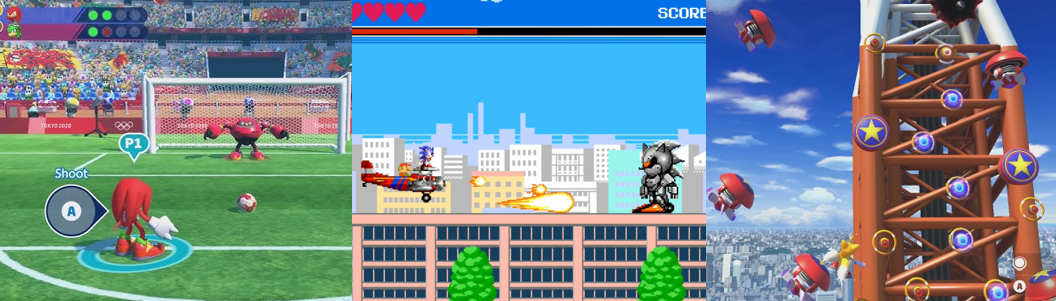
The minigames are some of the best parts of the game, often outshining the main Olympic events!

When playing Story Mode, you’ll alternate between moving Luigi around the 3D world of the 2020 Olympic games and Mario around the 2D world of the 1964 Olympic games, with Tails and Sonic following each. You’ll chat with other characters and non-playable characters (NPCs) like Toads and Omachao to obtain passes to other areas and compete in additional events and find glowing tickets to learn fun facts. For such small overworld maps, there’s a hell of a lot of backtracking and dialogue to skip through, and it quickly gets a bit tedious slogging through the twenty-chapter story to reunite the two groups. Occasionally, characters will ask you to complete one of ten minigames to advance the plot; these are then unlocked for free play in the Game Room. These minigames are some of the best parts of Mario & Sonic at the Olympic Games Tokyo 2020 and see you flying through the Tokyo skies in a sidescrolling shooter like in Sky Chase Zone, chasing down a bullet train, painstakingly searching Shibuya’s Hachiko Square for specific characters in a game of Where’s Wally?, and chasing down (and attacking) Dr. Eggman’s taxi in what’s somewhat similar to Rad Racer (Square, 1987). You’ll be bouncing on Cheep-Cheeps as you chase after Bowser’s river boat, sneaking through a museum, avoiding Koopas and other Mario enemies as you collect keys, and desperately trying not to fall as you scale Tokyo Tower. Other times, you’ll be beating up waves of Shy Guys or shooting Egg Pawns before they throw spiked balls at you, both options that are far more enjoyable than the game’s odd depiction of Badminton that’s essentially just a rhythm game, just press the button when prompted, using the left stick to aim your shot, and your character moves by themselves (though I found the doubles partner screwed up more than I did). You’ll also dash around an obstacle course in Equestrian – Jumping, building speed to jump fences and puddles, knock a ball back and forth in table tennis until you can hit your Super Shot, and throw hands and feet in Karate – Kumite, toppling your opponent to earn extra points. Most of the events are pretty fun but some of them are way too short and others outstay their welcome very quickly. It’s also pointless trying to master the difficult ones as you can just skip them in Story Mode, unless you’re aiming for 100% completion.

Presentation:
In keeping with the tradition of this spin-off series, Mario & Sonic at the Olympic Games Tokyo 2020 is a bit of a mixed bag in this area. None of the familiar tunes from either franchise appear, leaving the game to plod along on the strength of a weak-ass, generic soundtrack that barely eases the pain of a failure. Things start off strong with a beautiful pre-rendered cutscene that showcases many of the new and returning events and shows these two franchises co-existing side y side, a visual that never gets old even if I’ll never forgive either company for not doing a more suitable crossover. It’s a bit downhill from there, though, as prerendered cutscenes are eschewed in favour of partially animated 2.5D models, endless dialogue boxes, and a parade of pop-ups. The 2D sprites and environments ease this pain a bit, but the developers limited themselves by using the sprites from Mario’s debut title, meaning he and his fellow characters have very few frames of animation. Sonic and his cohorts fare slightly better in this regard but the aesthetic is all over the place since Knuckles the Echidna’s sprites are obviously more detailed than Sonics, leading to some weird moments when the sprites are awkwardly depicted holding items. It even looks weird when they celebrate their victories or react to their failures since the developers didn’t create any new animations, so you’re left with Sonic looking annoyed and Mario flipping on his ass. Overall, I did enjoy the 2D environments and events, though; they reminded me of the many 8-bit sports games on the Nintendo Entertainment System (NES). I would’ve liked to see some 16-bit ones thrown in, even if just as additional “Dream Events”, but these retro-styled sections were the best parts of the game, despite my complaints.
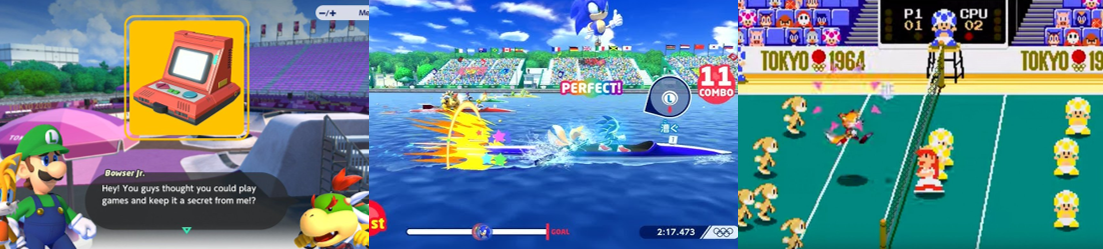
The limited 3D visuals are decent but it’s the retro-styled aesthetic that really impresses.

The 3D sections hold up well, for the most part, but aren’t that dissimilar from what we’ve seen in the previous Mario & Sonic titles. You can hold B to run and characters are far more animated in 3D, spouting gibberish and sound bites and even wearing different outfits for every event. Strangely, every area felt very bland and empty, despite often being populated by at least a handful of NPCs. Eventually, larger crowds of Sonic’s Animal Friends, Chao, Shy Guys, and Toads fill certain areas and populate the stands, but they don’t help to make the areas feel very lively. Still, you’ll see NPCs like Charmy Bee and Lakitu serving as referees and other side characters operating cameras; these NPCs even get in on the action in the atrocious Marathon event. The 2D sections sported an announcer I either missed or ignored in the 3D parts and characters all gain a suitably dramatic glow and flourish when executing Super Moves. However, while event locations and interiors are far more interesting to look at, the game’s let down by its painfully bland overworlds. You can visit many real-world locations in 1964 and 2020, seeing planes fly overhead and learning their history, but it’s all stuck on a rather uninspired overworld map. This is especially disappointing considering how interactive and varied previous overworlds in the series have been, and the fact that you visit these areas time and again to find passes or charge this magical battery created by Doctor Eggman Nega. Many of the minigames again steal the show in terms of visuals, incorporating additional sprites to serve their needs and being visually akin to lost titles from Nintendo’s 8-bit heyday, which only adds to their replay factor. The game also performs really well; I noticed no slowdown or texture warping or anything like that. However, there are a lot of menus to navigate, lots of instructional text to read, and replaying events after a loss can be tedious as you have to skip a bunch of introductory scenes.

Enemies and Bosses:
As you might imagine, every character in Mario & Sonic at the Olympic Games Tokyo 2020 is your enemy at some point though, luckily for you, there’s very little to distinguish them. Computer-controlled opponents have the same abilities as you, charging power, getting a starting boost, and attacking and defending just as you would. Their individual classes do become a factor, however (you may struggle to win a race against Shadow the Hedgehog when playing as Wario, for example), though you can certainly overcome these if you mash buttons faster enough or don’t screw up when playing the event. I did notice some characters seemed to be unfairly good at some events; Vector the Crocodile never struggled to toss his discus, for example, and I could never hope to match Bowser Jr. in the Javelin Throw. Admittedly, the fact that I struggled with these events probably has a lot to do with that. however, I did notice my opponents would charge their Power Gauge much faster than me, or would sprint past me at the last minute even if I had a commanding lead. The general advice here is to simply do better the next time around, something that’s easier said than done when you have to restart a Table Tennis match after playing to deuce and match point for God-knows how many rounds! Unlike in some of the previous Mario & Sonic titles, there are few examples of what could loosely be called “boss battles” here. It’s generally seen as a big deal when you challenge Dr. Eggman or Bowser, but then a lot of those events aren’t that difficult to win…to start with… Bosses (and Badniks) do appear in the Tokyo Sky Flight minigame, however, including Mecha Sonic and a variation on the classic Egg Wrecker fight, which were fun inclusions.
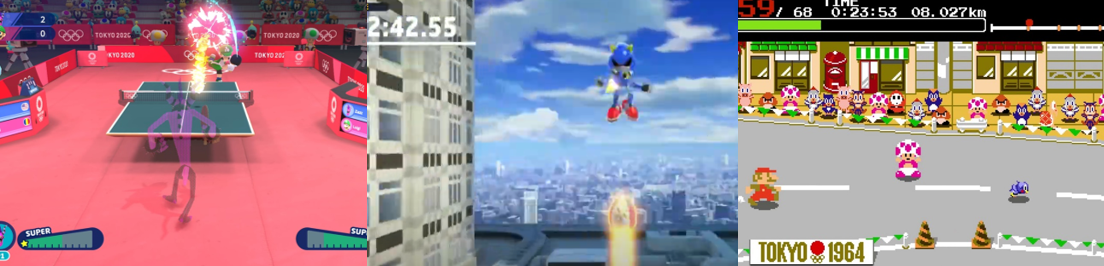
A handful of quasi-boss battles and harder events test your skills…and patience…

There are some exceptions, however. The Metropolitan Goal Kick minigame, for example, has you tackling Egg Pawns to grab a rugby ball and then timing a button press to kick it up the length of the Metropolitan Government Building and deal damage to Metal Sonic. As far as I could see, Eggrobos only appear in the Volleyball event, while you must tackle Boom Booms in Rugby Sevens and score penalties against Egg Pawns in Football. The twelve guest characters can only be challenged or controlled in specific events, as well, and you must best them (or skip the event) in Story Mode to unlock them. This means you’ll only see Zavok and Zazz of the Deadly Six in Boxing and Table Tennis, respectively, Diddy Kong only appears in Rugby Sevens, while Eggman Nega and Rosalina must be challenged in games of Karate – Kumite and Surfing, respectively. Depending on your level of skill, these can be difficult events; it took me a couple of tries to clear the Sport Climbing event and unlock Rouge the Bat, for example. When playing Story Mode, other playable characters challenge you to events before helping you or joining your team, meaning you must best Knuckles and Shadow in a game of Badminton (Doubles) and win a canoe race against Wario and Waluigi to gain their help. You must also defeat Bowser’s Koopalings to charge up that stupid battery and deal with Bowser, Dr. Eggman, and their minions stealing your gold medals in 1964. Both baddies challenge you to various events, with Dr. Eggman easily being overtaking in a straight-up race or in the Vault event. Once you reach the final chapter, you must pick to play as either Mario or Sonic and race Bowser in the dread Marathon. In this event, you must tap A to run, which depletes your stamina. Hitting other runners, the walls, swarms of bees, or puddles also depletes your stamina and will eventually knock you over, costing you valuable time. You can grab water with B and ride slipstreams to regain stamina, charging up for a boost or using boost pads, but this is a hell of a final ask that I ended up skipping as I never had enough stamina to beat Bowser to the finish.

Additional Features:
There are 122 pieces of trivia to find in Mario & Sonic at the Olympic Games Tokyo 2020, spread out across both 1964 and 2020. You’ll get trivia by inspecting glowing tickets and talking to other characters, who’ll either ask a question or offer titbits about the characters, the Olympic games, and Tokyo. These are all saved in the Trivia section so you can re-read them if you wish or see which ones you’re missing. There are also eighty hidden “Challenges” to complete, with the obscured list available from the main menu. These are mainly tied to setting new World Records, finishing events on the hardest difficulty, scoring a set number of points, and clearing Story Mode. Finishing the Story Mode, you’re returned to the overworld upon loading your file, now able to replay all previous events and take on additional challenges in the “Dream Events”. Though there are only three of these, they’re pretty enjoyable and interesting, featuring additional power-ups and gameplay mechanics that make them perfect for multiplayer games. Dream Racing sees you racing through a mainly half-pipe-like course, performing tricks and hopping rails not unlike in the Sonic Riders series (Sonic Team/Now Production, 2006 to 2010) and attacking with items similar to the Mario Kart series (Various, 1992 to present). Dream Shooting sees you running around, awkwardly aiming your weapon with motion controls, and blasting targets, grabbing multi-shots and shooting down gliders in an arena shooter that reminds me of the Splatoon games (Various, 2015 to 2022). Finally, in Dream Karate, you attack with combos, kicks, and throws to toss your foes around and colour the floor panels, grabbing springs and Super Stars for temporary buffs. Beyond that, you can challenge the computer on harder difficulties, aim to get gold medals and break World Records, and play alongside up to four players…if you can find anyone to play with.
The Summary:
As a lifelong Sonic fan (and a pretty big fan of the Super Mario games), I’m basically obligated to pick up the Mario & Sonic games whenever they release. I believe I’ve played all of them, but only on portable devices, which I think made the already aggravating gameplay all the more vexing. Free from the restrictions of the small size of Nintendo DS and 3DS screens, Mario & Sonic at the Olympic Games Tokyo 2020 is easily the most visually impressive of all the Mario & Sonic games I’ve played, offering relatively attractive 3D models and worlds that show a decent amount of personality. I can never shake the feeling like these games are just soulless cash grabs, however, and that’s reflected in how empty a lot of the arenas seem, despite the NPC crowds. Mario & Sonic at the Olympic Games Tokyo 2020 impresses with its nostalgic 2D sections, which harken back to the NES days and capture a lot of the magic of Nintendo’s 8-bit glory days. While the sprites are fun to see, they’re extremely limited and a bit difficult on the eyes because of the mishmash of 8- and 16-bit sprites. I was glad to see the game allowed for traditional controls, though the forced motion controls for some events were more jarring as a result; however, it’s a bit disappointing that so many of the events play the same. Thankfully, the various minigames offered a great distraction from the main events, which were either too short or too annoying. I honestly could’ve done with a few more of these minigames, and the “Dream Events”, as there wasn’t enough of these to offset the more annoying Olympic events. With a half-assed approach to cutscenes and some of the dullest unlockables in all of videogaming, Mario & Sonic at the Olympic Games Tokyo 2020 does little to shake the franchise’s stigma of being a collection of nonsense minigames, even with its few good points. It’s easily the best of the series I’ve played, but that’s not a very high bar and I remain bitter that we never got a more traditional crossover between the two nineties icons.

My Rating:

Rating: 3 out of 5.

Pretty Good

Did you enjoy Mario & Sonic at the Olympic Games Tokyo 2020? Did you also play without the motion controls? What did you think to the 2D sections and events? Were the minigames also the best part for you, or did you prefer a different Olympic event? Would you like to see more games in the series, or a proper crossover between Mario and Sonic? Which country are you rooting for in the Special Olympics World Winter Games this year? Whatever your thoughts, leave a comment below, support me on Ko-Fi, and go check out my other content for both franchises!

Movie Night: Sonic the Hedgehog 3

Released: 20 December 2024
Director: Jeff Fowler
Distributor: Paramount Pictures
Budget: $122 million
Stars: Ben Schwartz, Keanu Reeves, Jim Carrey, Colleen O’Shaughnessey, Idris Elba, and James Marsden

The Plot:
When a mysterious black hedgehog known as Shadow (Reeves) escapes from captivity and goes on a rampage, Sonic the Hedgehog (Schwartz) and his friends – Miles “Tails” Prower (O’Shaughnessey) and Knuckles the Echidna (Elba) – must team up with their old foe, Doctor Ivo Robotnik (Carrey), against a common enemy.

The Background:
As a key player in the aggressive Console War between Nintendo and SEGA, Sonic had quite the life outside of the videogames, starring in many comic books and cartoons. The idea of a Sonic the Hedgehog movie had been doing the rounds since 1993 but, thanks to legal and creative issues, the best we got was the gorgeous original video animation (OVA), Sonic the Hedgehog: The Movie (Ikegami, 1996). That all changed once Paramount Pictures acquired the franchise rights and produced a live-action/CGI hybrid movie that first horrified and then impressed audiences, A critical and commercial success, Sonic the Hedgehog (Fowler, 2020) repeated this feat with a hugely profitable and well-regarded sequel that, surprisingly, saw star Jim Carrey reprise his role and added more elements from the videogames to the formula. This success saw Knuckles branch out into his own solo series (to mixed reviews) alongside development of a third film. Although he teased his retirement from acting, Carrey was convinced to return by a 24-carat script and the chance to play a dual role. Taking inspiration from Sonic Adventure 2 (Sonic Team USA, 2001) and Shadow the Hedgehog (SEGA Studios USA, 2005), the filmmakers cast Keanu Reeves as the popular anti-hero, who was teased at the end of the last film, and worked hard to both capture the spirit of his videogame counterpart and deliver something new to the character. To make up for unfortunate delays, multiple special effects studios worked simultaneously on the film’s effects and Sonic the Hedgehog 3 released to widespread acclaim. Reviews praised both Reeves and Carrey as the standout stars, alongside the humour and surprising gravitas, though the supporting cast were criticised. Still, Sonic the Hedgehog 3 made more than $210 million at the box office and hopes were high for a fourth entry and additional spin-offs.

The Review:
If there are two things I’ve never been shy about, it’s my love for the Sonic the Hedgehog franchise and my dismay that his big-screen adventures haven’t been all-CGI animated affairs. Yet, despite this (and the notorious reputation movie adaptations of videogames have), the live-action/CGI hybrid Sonic adventures have actually been pretty good. Blending elements of Sonic’s long defunct, Western canon with more modern elements of his lore, the films recast Sonic as an adventurous and enthusiastic, high-speed hero from another world. After coming to Earth and living alone, desperate for friends and acceptance, Sonic has found a surrogate family alongside Tails, Knuckles (fresh off his solo series), and their human family, Tom (Marsden) and Maddie Wachowski (Tika Sumpter). On the anniversary of Sonic’s b-Earth-day, Sonic and Tom reflect on the hedgehog’s journey, how he found friends and a place in the world despite experiencing great pain as a child and being separated from his parental figure. Having formed a brotherhood during their last adventure, the trio (colloquially known as “Team Sonic”) perfectly complement each other’s abilities: Sonic’s the leader, Knuckles is the muscle, and Tails is the gadget guy. Though they banter at times and Knuckles is often the butt of many jokes due to his thick-headedness, the three vowed to never again use the Master Emerald lest its power threaten the world and are depicted as a tight-knit group of friends. Team Sonic are also closely affiliated with the Guardian Units of Nations (G.U.N.), a military division established to monitor and respond to alien threats, with the three now regarded as trusted allies of the G.U.N. overseer, Commander Walters (Butler). Unlike in Sonic Adventure 2, where Sonic was targeted by G.U.N. because they ridiculously mistook him for Shadow, G.U.N. Director Rockwell (Krysten Ritter) is dispatched to recruit Team Sonic’s aid, a task she performs reluctantly as she’s suspicious and distrustful of the “aliens”.

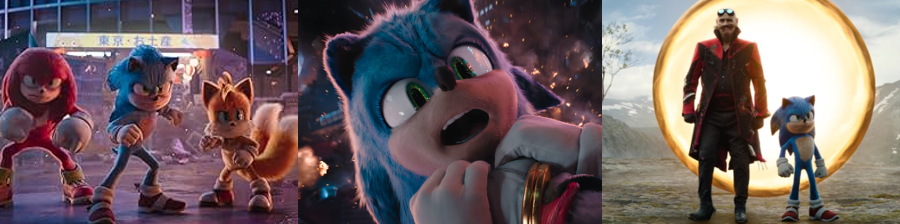
Overwhelmed by Shadow’s speed and power, Team Sonic are forced to join forces with Dr. Robotnik.

Though Team Sonic and the Wachowskis enjoy their peaceful downtime, they jump at the chance for some action (Team Sonic at the beginning and the Wachowskis later, when the boys ask for their help infiltrating the G.U.N. headquarters). However, while Knuckles is eager to test his mettle against the new hedgehog, Sonic calls for cooler heads, despite the chaos and destruction Shadow unleashes upon the city. Angered and suspicious of the “colourful bunch” since they arrived in a G.U.N. helicopter and Shadow’s vendetta is primarily against G.U.N., the enraged hedgehog refuses to listen to reason and easily trounces the three with his impressive physical strength and powers of teleportation. As if that wasn’t bad enough, Shadow’s rocket boots and natural Chaos Energy make him more than a match for Sonic, resulting in a resounding defeat for the trio. After learning of Shadow’s tragic origins from Commander Walters, the three are suddenly attacked by Dr. Robotnik’s egg drones, only to learn from the doctor’s long-suffering right-hand man, Agent Stone (Lee Majdoub), that the increasingly manic (and finally overweight) Dr. Robotnik is not only alive but not behind the attack. Incensed to learn that his machines have been hijacked, Dr. Robotnik begrudgingly agrees to a short-lived team up to track down their common foe. Naturally suspicious of the mad scientist, Sonic keeps a close eye on the maniacal doctor and shares his regret for Shadow’s pain. Their conversation leads Dr. Robotnik to “trauma dump” to his foe and reveal that he also had a tragic childhood filled with bad choices and a lack of parental figures, echoing the main theme of the film (essentially, don’t let your past/pain define you). Equally, discussions with Tails regarding the nature of Team Sonic’s relationship leads Agent Stone to question his devotion to Dr. Robotnik, who routinely humiliates and belittles Stone despite his clear awe and loyalty. We don’t get too much additional insight into Knuckles and he remains and arrogant and proud warrior who takes things far too literally. However, Knuckles proves to be an extremely loyal friend; even when an emotional Sonic is ready to go to blows with Knuckles, Rad Red takes the high road and falls back on the trust he placed in his family.

Desperate to connect with the family he never had, Dr. Robotnik teams up with his maniacal grandfather.

The team up between Team Sonic and Dr. Robotnik is tenuous, at best, given the doctor’s past actions and unstable disposition, but it quickly falls apart when they explore the G.U.N. facility where Shadow was once experimented on. There, the bald lunatic is surprised to meet his long-lost grandfather, Professor Gerald Robotnik (Carrey), an equally devious and intelligent scientist who once ran tests on Shadow and who has returned after fifty years in prison to enact revenge through the angst-ridden hedgehog. Playing dual roles really allows Jim Carrey’s natural, madcap comedy stylings to take centre stage here. Both Robotniks are very similar, sharing an eccentric and dark sense of humour and a desire to vent their personal frustrations upon not just their enemies, but the entire world. Elated to finally meet a member of his family, Dr. Robotnik abandons his newfound allies and devotes himself to Gerald’s cause, using the power of virtual reality and amusing montages to bond with his elder and feel a sense of belonging so strong that he angrily rebukes and dismisses Agent Stone when he raises concerns about Gerald’s intentions. While Dr. Robotnik employs a few mechanical aids throughout the film, they’re secondary to the duo’s more threatening objective: the Eclipse Cannon, a world-ending space station Gerald built for G.U.N. back in the day. Perfectly matched in their mania, genius, and physical abilities, the Robotniks are also cunning and spiteful. While infiltrating the G.U.N. headquarters, Dr. Robotnik tests his laser-reflective clothing by threatening his grandfather’s life, much to Gerald’s respect. Though distrustful of Shadow, Dr. Robotnik relishes the chance to have the power to prove his superiority over the world and his fleet-footed foe, a mad desire that sees him finally donning a game accurate outfit and standing beside his grandfather on the Eclipse Cannon. Unfortunately for the pining doctor, Gerald’s ambitions extend far beyond subjugating the world. Intent on eradicating all human life, including his own, Gerald’s mad plans clash with Dr. Robotnik’s desire to rule, turning the crazed scientist into a reluctant ally for the final act.

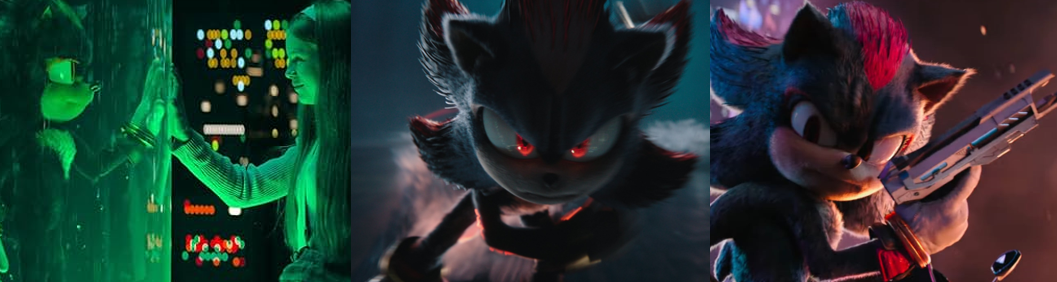
Consumed by anger, Shadow vents his wrath upon the world to avenge his lost friend.

Of course, the central antagonist the entire film revolves around is Shadow, a dark and brooding hedgehog from beyond the stars who’s focused only on revenge. While the trailers made it seem like Keanu was phoning in his performance, his growling delivery is pitch-perfect for the enraged anti-hero and he perfectly captures Shadow’s pain and rage. Falling to Earth over fifty years ago and subjected to years of experiments to harness his powerful (but unstable) Chaos Energy, Shadow was treated as a mere lab rat and shown none of the warmth and affection that shaped Sonic into a self-serving hero. Shadow’s only friend was Maria (Alyla Browne), Gerald’s well-meaning granddaughter who bonded with Shadow, giving him someone to care about. After realising Shadow’s powers were too dangerous to contain, G.U.N. sought to keep him in stasis and, during an escape attempt, Maria was accidentally killed, fuelling Shadow’s rage. Shadow’s so consumed by his anger and pain that he attacks G.U.N. and anyone who gets in his way on sight. Thus, when he sees Commander Walters, Shadow doesn’t hesitate to strike to retrieve one of the Eclipse Cannon’s keycards. Unfortunately, Shadow actually attacked Tom in disguise, causing him to not only question his vendetta but enrage Sonic, who abandons his family to extract a measure of revenge from his dark doppelgänger. Although you might not be surprised to learn that Tom isn’t killed, it is touch and go for a moment and the risk against him is great considering the destruction Shadow causes when unloading on G.U.N.’s soldiers. Unlike in the videogames, Shadow doesn’t need a Chaos Emerald to teleport or reach blinding speeds; equally, he’s specifically said to be from the stars, rather than a result of Gerald’s experiments. Yet, he’s just as angry and misguided as in the source material, and equally unstoppable. Even Team Sonic’s combined might cannot match with Shadow’s powers, making him an incredible formidable foe.

The Nitty-Gritty:
Sonic the Hedgehog 3 is a story about choices; specifically, the choices we make that shape us. Sonic chose not to let his pain rule his heart and to be a selfless hero, whereas Shadow is consumed by his grief and is turning his rage upon the world he believes wronged him. Similarly, years of rejection and abandonment issues shaped Dr. Robotnik into a spiteful and malicious supervillain, just as decades in prison and the loss of his granddaughter twisted Gerald into a crazed madman ready to destroy himself alongside the world. Sonic, Tails, and Knuckles are depicted as brothers as much as friends and teammates; together, they’re their greatest source of power and inspiration. While this doesn’t give them the edge against Shadow, their combined abilities and resourcefulness see them explore other options to subdue their foe. It’s therefore incredible tense and heartbreaking when Sonic, consumed by anger and a lust for revenge after Shadow hurts Tom, is ready to fight Knuckles to learn the location of the Master Emerald. Tails, in particular, is distraught by Sonic’s emotional state and his refusal to listen to reason, just as Knuckles is angered that his friend would abandon his morals and their vow. Yet, Knuckles refuses to betray their bond, even if Sonic is ready to, and Sonic’s subsequent efforts to beat Shadow into submission as Super Sonic serve as a character test for the misguided hero. Indeed, during their fight, Shadow not only riles Sonic up more and transforms into his own Super form, he also spits Sonic’s rage in his face and draws comparisons between them. Despite Sonic rejecting the notion that he’s anything like his destructive foe, he’s forced to face reality when he remembers Tom’s words and teachings and, thankfully, lets go of his rage to find common ground with Shadow. Similarly, Sonic learns there’s more to Dr. Robotnik than just a crazed supervillain during their short-lived team up. Much of Dr. Robotnik’s lust for power comes from not having strong moral influences and a resentment towards the world though, ultimately, all three learn to set aside their personal grievances to protect the world.

Shadow’s power makes him a formidable threat, even to Super Sonic!

Like its predecessors, Sonic the Hedgehog 3 is full of colourful, fast-paced action and adventure. Sonic, Tails, Knuckles, and Shadow all sport poses, lines, and abilities from the videogames, with Shadow riding through Tokyo on a motorcycle while blasting at Sonic with a laser pistol and many of his dramatic, angst-filled poses being ripped right out of Sonic Adventure 2 and Shadow the Hedgehog. It’s a joy to see and witnessing Shadow’s raw power is endlessly exciting; he zips about, blasting foes with kicks and punches, and laying waste to everyone. Equally, Team Sonic continue to impress: Sonic defies all laws of physics, Spin Dashing and blasting around at incredible speeds, Tails keeps pace with his helicopter blade tails, and Knuckles easily hefts around objects as though they were weightless. Of the three, Sonic has the best chance of fighting Shadow thanks to Knuckles’ hot-headedness and Tails’ comparative fragility. However, it takes all three (and Tom and Maddie utilising holographic disguises) to breach G.U.N.’s headquarters. After Tom is left fighting for his life, we see the triumphant and dramatic return of Super Sonic; however, Shadow’s power is so immense that he blasts the Chaos Emeralds from his foe with one blow and absorbs them in turn. The battle between Super Sonic and Super Shadow sees them literally tear up the landscape, causing volcanoes to erupt and them to battle across the globe and eventual on the surface of the Moon! Setting aside everyone’s ability to breathe in space, these are some of the film’s most exhilarating moments and seeing Super Sonic and Super Shadow team up to stop the Eclipse Cannon was an exciting finale. Although the Biolizard and Finalhazard don’t appear, there was a cute reference to it and other Easter Eggs for eagle-eyed fans. The Eclipse Cannon console is modelled after a Mega Drive, for example, Dr. Robotnik’s ring tone is Paul Shortino’s “E.G.G.M.A.N”, a hard rock cover of “Live and Learn” plays when Super Sonic and Super Shadow team up, and Team Sonic regroup in a super fun Chao Garden restaurant!

Unexpected alliances and sacrifices see Team Sonic save the world from destruction.

One of the best aspects of Sonic the Hedgehog 3 is how it focuses more on the videogame characters and yet still finds a way to keep Tom and Maddie relevant. They’re there to reinforce the familial bond that separates Sonic from Shadow and contrast the Robotniks’ volatile and twisted relationship. While Director Rockwell added little to the plot and could’ve easily been supplanted with Commander Walters and another fight against Shadow, the infiltration of G.U.N. headquarters was a fun sequence that culminated in the Eclipse Cannon dramatically launching from the River Thames! After being reminded of everything he’s lost, the enraged Shadow powers up the cannon and battles with Super Sonic before realising that he’s been walking the wrong path, one that would dishonour Maria’s memory rather than avenge her. Similarly, Dr. Robotnik is aghast to learn of his grandfather’s suicidal plot and battles him aboard the Eclipse Cannon, matching his nanotech against Gerald’s, and only coming out victorious thanks to a last-minute save from Tails and Knuckles. Thus, with the world in peril from the Eclipse Cannon’s devastating death beam, Super Sonic and Super Shadow block its path while Dr. Robotnik, Tails, and Knuckles fight to redirect the space station, saving the world but blasting half of the Moon! The effort drains the Chaos Energy from Sonic and sees him plummet through the atmosphere; bravely, Tails and Knuckles follow and succeed in saving him. Unfortunately, the Eclipse Cannon’s core overloads and the only ones capable of sparing the Earth from a cataclysmic event are Dr. Robotnik and Shadow. While Super Shadow expends the last of his energy pushing the space station as far away from the Earth as possible, Dr. Robotnik fights to stabilise the core. After delivering a heartfelt message to Agent Stone and thanking him for his loyalty and friendship, Dr. Robotnik and Shadow are seemingly vaporised when the Eclipse Cannon explodes. After making amends with his friends, Sonic returns to his family, grateful for their love and friendship, only to be attacked by a robotic doppelgänger (and a hoard – or “brotherhood” – of the machines) on the outskirts of New York City. Thankfully, he’s saved by a mysterious pink hedgehog and the post-credits reveal that Shadow survived the explosion, setting up further adventures.

The Summary:
Sonic the Hedgehog 3 is a rare gem, for sure. Not only is it an enjoyable movie adaptation of a videogame franchise, but it’s also an entertaining third entry in a film series, and the first time Jim Carrey’s ever portrayed a character three times, making it incredibly rare in the grand scheme of Hollywood. Naturally, given the source material, the film is a tad darker than its predecessors; Shadow alone is a grim, edgy figure, to say nothing of his tragic backstory. There’s far more action and peril this time around and the world is not only endangered, but humanity faces global annihilation from Gerald’s insane plot. Still, there’s a lot of fun, colourful action and humour at work here, including Jim Carrey’s physical comedy, references for the fans, and topical gags for mainstream audiences. Jim Carrey steals the show, throwing his all into both Robotniks, devouring the scenery, and commanding the screen whenever he’s present. I loved the energy and enthusiasm he brought to both roles and it was an inspired decision to expand Gerald’s character into an even darker and more insane mirror of his grandson. However, it’s Shadow that’s the star of the show here. Keanu Reeves perfectly captured Shadow’s angst and pain and flawlessly brought the misguided and outraged anti-hero to life. I enjoyed the tweaks to his backstory and the parallels between him, Sonic, and Dr. Robotnik that reinforced the film’s themes of family, choices, and overcoming grief. Add to that some enjoyable references to the videogames, particularly Shadow’s outings, and some fun gags and you have a hugely enjoyable adventure that successfully appeals to kids, adults, game fans, and mainstream audiences.

My Rating:

Rating: 4 out of 5.

Great Stuff

Did you enjoy Sonic the Hedgehog 3? How do you feel it holds up compared to the previous films? Did you enjoy the addition of Shadow and the changes made to his backstory? What did you think of Jim Carrey’s dual performance as Dr. Robotnik and Gerald? Did you enjoy the fight between Super Sonic and Super Shadow and the many references to the videogames? Where do you see the films going from here and are there any Sonic games or characters you’d like to see make an appearance in the future? To share your thoughts on Sonic the Hedgehog 3, leave a comment below and be sure to check out my other Sonic content on the site!

Game Corner [Sonic Month]: Sonic the Hedgehog (2006; Xbox 360)


Sonic the Hedgehog was first introduced to gamers worldwide on this day back in 1991 and, since then, has become not only SEGA’s most enduring and popular character but also a beloved videogame icon and, in keeping with tradition, I have been dedicating the entire month to celebrating SEGA’s supersonic mascot.


This review has been supported by Chiara Cooper.
If you’d like to support the site, you can do so at my Ko-Fi page.

GameCorner

Released: 14 November 2006
Developer: Sonic Team
Also Available For: PlayStation 3

The Background:
It always surprises me how often I see people online touting the myth that Sonic the Hedgehog (henceforth Sonic ’06) is some under-rated classic and worthy of your time and attention but this really isn’t the case. As a life-long Sonic fan, I first played it on the PlayStation 3 and, while I enjoyed the cutscenes and the soundtrack, I was unimpressed with the many glitches, load times, and dreadful gameplay experience and haven’t returned to it since finishing the main campaigns some seventeen years ago. Sonic ’06’s development is an interesting story; intended to celebrate the franchise’s fifteenth anniversary, Sonic co-creator Yuji Naka was eager to reinvent Sonic for the then-current generation of high-definition consoles and even had the game take the simple title of Sonic the Hedgehog to indicate its status as a series reboot (despite its numerous narrative ties to previous Sonic games). Tools like the Havok engine allowed the developers to use new lighting options, a day and night system, and craft a far more realistic setting for Sonic and his friends, who were redesigned to better fit in with this aesthetic. Two characters whose gameplay greatly benefitted from the Havok physics engine were Shadow the Hedgehog, who was able to drive and pilot a variety of vehicles, and newcomer Silver the Hedgehog, whose telekinetic powers gave him more options for interacting with the environments. It wasn’t long, however, before Sonic ’06 ran into problems; Naka left the project, and Sonic Team, to form his own company, developing the cutscenes proved problematic, and the development team was split in two to develop a concurrent Nintendo Wii-exclusive Sonic title. Despite impressing with some pre-release footage, Sonic ’06 was met with universal derision upon release; while the graphics and music were seen as somewhat impressive, the level design and camera were heavily criticised, as was the awkward romance between Sonic and Princess Elise, and the game is generally seen as the worst in the franchise. Although it received a fair amount of downloadable content (DLC) following its release, Sonic ’06 was one of many sub-par Sonic games de-listed from online marketplaces for the longest time, and SEGA scrambled to make good on their next mainline Sonic title, which was the shot in the arm the franchise desperately needed after this travesty of a game.

The Plot:
Doctor Eggman kidnaps Princess Elise of Soleanna to harness the destructive “Flames of Disaster” within her, and only Sonic the Hedgehog can save her from his clutches. However, his quest is obstructed by the mysterious Silver the Hedgehog, who has travelled back in time to stop a disaster he believes Sonic causes, while Shadow the Hedgehog works to uncover the truth behind the evil spirit Mephiles, who has stolen his form.

Gameplay:
Sonic ’06 is a third-person, action/adventure platformer that divides its gameplay between three different main playable characters, three main story episodes, and largely attempts to focus on speed or action but also muddies its concept with janky physics, puzzle solving, and exploring a large hub world. Clearly taking inspiration from Sonic Adventure (Sonic Team, 1998), the game’s characters will wander around the large, mostly barren castle town of Soleanna, chatting to eerily lifelike non-playable characters (NPC) for hints or side missions when not taking on one of the nine main action stages. Also like in Sonic Adventure, you can only play as Sonic to start with and will unlock Shadow and Silver’s stories as you progress and encounter them and you’ll occasionally get to play as other characters during action stages and in the hub world as the story dictates, though this time you do get a rudimentary (often useless) compass to guide you around Soleanna and its other areas.

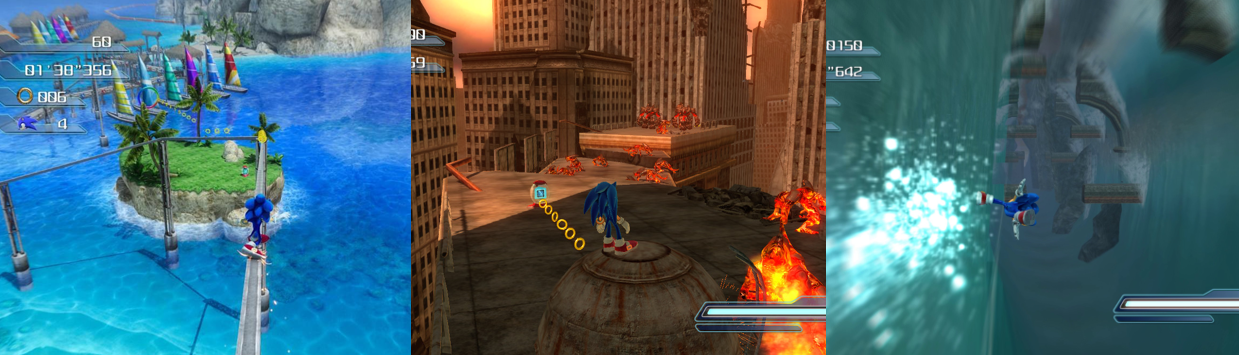
Run, grind, and spin about as Sonic but good luck controlling him in the awful Mach Speed sections.

Across the game’s three main characters and nine total playable characters, the controls are largely the same but each one has different abilities and play styles. Pressing A lets you jump or interact with characters, X will perform a special action, and you can use the Right Trigger to activate certain character abilities as dictated by a power meter that builds up as you defeat enemies (or stays constantly full if playing as Sonic). Sonic is, naturally, geared more towards speed; pressing A in mid-air will allow him to dash forwards towards the nearest enemy, spring, or other interactable object with the Homing Attack. Tapping X performs this super janky sweep kick and slide that allows you to slip under certain walls and often leaves you sliding about on your ass like an idiot, but holding X lets you charge up and release a Spin Dash. It’s worth noting that you cannot defeat enemies just by pressing A; even though Sonic’s in a ball as normal, this won’t inflict any damage and will cause you to lose Golden Rings, the life source of your characters. Sonic’s stages are full of dash pads, springs, loops, and other gimmicks designed to get him moving as fast as the sluggish game engine and messed up camera will allow; often, you’ll be battered about like a pinball and it’s usually better to simply relinquish control of Sonic or make very small inputs to the control stick or else you could miss a jump pad or just randomly fall through the environment. Sometimes, you’ll be told to “Jump!” and have to press A to hop from wall to wall to progress; other times, you can take a short cut on a rail, and you’ll soon acquire upgrades that let you dash along a trail of Rings with X (if the game actually registers your inputs) and perform a bounce move to gain extra height on your jump, along with other far more broken mechanics I’ll talk about later. Speaking of broke, though… Sonic has a unique gameplay feature wherein some stages will require him to “Speed up!” in a “Mach Speed” section. Here, Sonic will blast ahead at the speed of sound (or the closest approximation this sluggish engine allows), barely giving you any time to react to incoming obstacles and enemies. You’ll need to jump way ahead of time to clear these hazards, and sometimes the controls and camera will force you to run towards the screen or at an angle, practically guaranteeing that you’ll take damage, fall through the environment, or just be sent spiralling to your death. As a precursor to the later “Boost” mechanic, these are some broken, glitchy, messed up sections that can burn through your lives faster than the shit-ass collision detection and are easily one of the worst parts of Sonic’s gameplay.

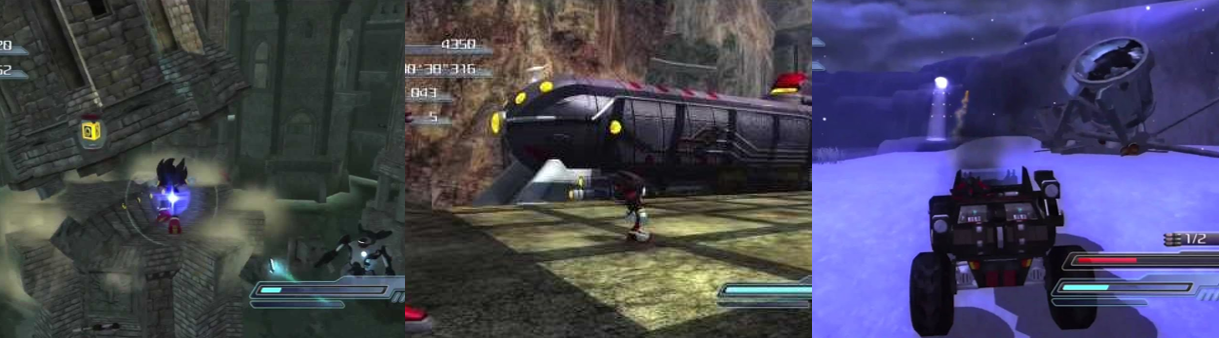
Shadow’s geared more towards awkward combat and janky vehicle gameplay.

After clearing Sonic’s episode, I played Shadow’s story, which is kind of akin to the hard mode of the game (outside of the DLC). Shadow plays a lot like Sonic; he’s fast, performs a Homing Attack and Spin Dash, hops on the same rails and boost pads and uses the same gimmicks as Sonic, such as flying on an eagle and riding water currents. Unlike Sonic, Shadow’s gameplay is geared more towards activating switches, destroying stuff, and combat; kind of like in the under-rated Shadow the Hedgehog (SEGA Studios USA, 2005), Shadow can perform the Chaos Spear in mid-air by pressing X (or holding X to charge it up), which will stun nearby enemies, and you can mash A after a Homing Attack to do a little combo. More often than not, this will either miss or see you attacking thin air; while this often still damages enemies, so broken is this game, it usually leaves you vulnerable. Shadow can also perform the Light Speed Dash and he also has a meter that builds up as he defeats enemies; once full, he can pull off a “Chaos Boost” with RT that smashes certain rocks and seems to increase his attack power (but not his durability), and this can be upgraded with Memory Shards you purchase from shops. Although Shadow doesn’t pick up and use guns and weapons like in his solo title, he can hop into a number of vehicles; you’ll take the controls of buggies, motorcycles, hovercrafts, and gliders either as an option or by choice in order to progress. You can press Y to hop in and out, A to accelerate, X to reverse, and use the vehicle’s weapons with RT, though you can’t be too trigger happy as weapons will need to cool down or reload over time. When in the hang glider, the game switches to a kind of auto scrolling shooter and has you blasting enemies and obstacles and dodging hazards to not get hurt; the hovercraft allows you safe passage over quicksand and instant death water, but they can both be tricky to control and it’s not always clear where you need to go, with Dusty Desert requiring you to pass through a series of stone columns to open a door. Other vehicles, like the buggy and motorcycle, are more optional and often ill advised; it’s better not to have to contend with the buggy’s janky collision detection and tumbling physics in Crisis City but the motorcycle can help you to catch up to Dr. Eggman’s speeding train…if you can control its breakneck speed, of course!

Silver’s far slower and has to endure frustrating platforming and puzzles.

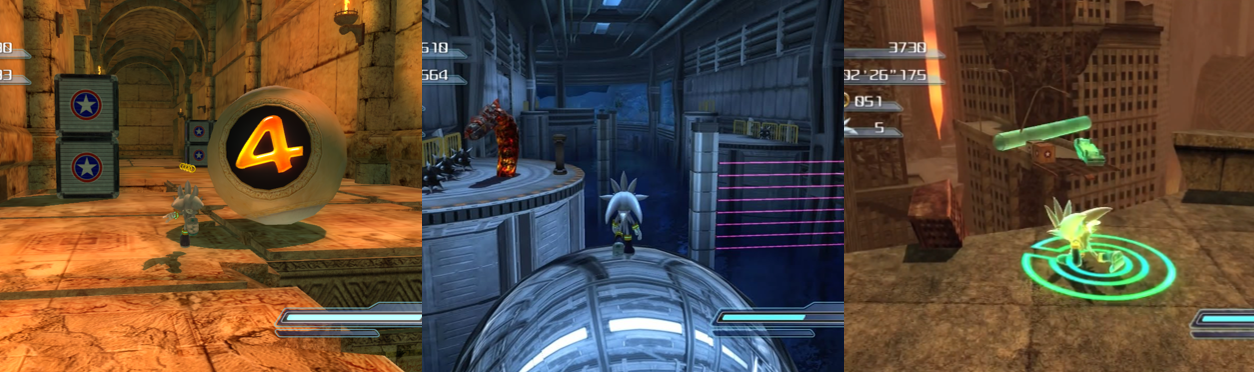
Last of all, I played as newcomer Silver, who’s this naïve little telekinetic hedgehog from a wrecked future who’s come back in time to kill Sonic. He’s basically Future Trunks but far more gullible. Of the three main characters, Silver is the slowest; he trots along like he has rocks in his boots and can neither Spin Dash or roll into a ball when jumping, though he can still bounce on springs and be propelled along (and through the environment…) by dash pads. His gameplay is significantly different thanks to his telekinesis, which allows him to float by holding A, grab incoming projectiles or nearby crates and objects with RT, and hurl them back at enemies or towards destructible targets with X. These powers are tied to his meter, which refills automatically as long as you’re not jumping, and Silver can also create paths, construct bridges, or turn girders and such into springs to progress onwards by holding RT on special glowing circular spots. Silver’s gameplay is much slower and more deliberate and more focused on exploration, platforming, and puzzle solving; side quests see him navigating through rings in platforming challenges, for example, or moving or tossing objects with his mental powers, and action stages are reconfigured to allow him to charge certain platforms to spring himself upwards, carry him across gaps, balance weights with boxes, or guide large balls of magnesium through laser traps. One of his most frustrating gimmicks crops up in Dusty Desert; here, you must use Silver’s telekinetic push (which can be used with a tap or charge of X) to knock giant billiard balls into holes within ten moves. Later, you have to hit one such ball down a narrow, winding corridor trying to avoid holes and such, which can be very tricky, and Silver’s piss-poor jump and expendable meter can make platforming across temporary and sliding platforms a chore in later stages.

You can briefly also control a bunch of slippery supporting characters who can break the game.

As you play through each episode, you’ll get the chance to switch to one of the other three playable characters mid-way through certain action stages as their paths cross, and each character is supported by two allies who occasionally follow them across Soleanna and throughout the action stages. Sonic teams up with Miles “Tails” Prower and Knuckles the Echidna, Shadow is joined by Rouge the Bat and E-123Ω “Omega”, and Silver falls in with Amy Rose and is supported by Blaze the Cat. Each of these has their own unique playstyles, though some are shared. Knuckles and Rouge can both glide and climb walls (though good luck detaching from some walls and fighting against the camera, which tends to freak out while following you) and can attack with punches and kicks (though not with their glide…), Tails can toss Dummy Ring Boxes at enemies with X and “snipe” at them by holding the button, which Rouge can also do with her bombs (though she can also place these on walls). Tails can also fly for a short time and will get a boost by flying through mid-air rings like in Sonic Adventure, while Omega can float along and awkwardly boost up to platforms with his jetpack, target multiple enemies by holding X or perform a big power shot by pressing X in mid-air. Amy uses her signature Pike-Piko Hammer to smash enemies, but its range is so short and broken that it’s hard to avoid taking damage; she also has a pretty broken double jump but is largely a shadow of her former Sonic Adventure self. Blaze is also pretty broken; she has this homing tornado attack that sees her just dart about like she’s possessed and can also perform a flaming twirl; she’s okay as long as you keep the reigns tight with her but she (and all of these “amigos”) are very slippery and unwieldy. Generally, you switch to them to platform across a small area, take out enemies, and hit switches but you’ll also switch to controlling them in the hub world for side quests and take on easily the most frustrating stages in the game in the final chapter. When playing as Sonic, you’ll also have to carry Princess Elise to safety a few times; in these stages, she’s constantly in your arms but you can still perform a version of your Homing Attack and she’ll even shield you from quicksand and water when you hold RT, though this is dependent on your meter.

Graphics and Sound:  
One of the best things Sonic ’06 has going for it is it’s awesome soundtrack; Sonic games have always had great soundtracks but, ever since the pop/punk-rock direction of Sonic Adventure, the 3D games just went from strength to strength during this time. The main theme, “His World”, is a suitably catchy tune from  Ali Tabatabaee and Matty Lewis of Zebrahead, while long-time Sonic collaborators Crush 40 performed an awesome cover of “All Hail Shadow” as Shadow’s theme. Even Silver’s disco-infused jive, “Dreams of an Absolution”, is pretty great and there’s even a sappy lyrical cover of Dreams Come True’s “Sweet Sweet Sweet” by Akon included. While the hub worlds don’t exactly impress in the music department, the action stages and boss battles all fare pretty well, with the music (like much of the game’s presentation) again harkening back to Sonic Adventure. Where the game falters, however, is in the voice acting; once again, the Sonic X (2003 to 2005) cast return and, once again, I remain unimpressed by Jason Griffith’s stilted, unenthusiastic portrayal of the character. Every word out of his mouth is lacking in emotion or passion and just sounds like someone reading a script, and Amy Palant is at her most grating as Tails but, to be fair, the script is absolutely awful at times with such cringe-worthy lines as “It looks like the princess has been moved to another location”, words not matching the subtitles, and even a botched take included. Thankfully, Mike Pollock is still great as Dr. Eggman and even Dan Green does a decent, if over the top, job as the unnecessarily dark Mephiles.

Despite the high-quality cinematics and music, this game is a laggy, buggy, glitched mess.

Graphically, the game is an equally mixed back; the high-quality cinematics are fantastic and another of the game’s few highlights, showcasing Sonic and his friends and enemies in all their glory. The cutscenes that use the in-game engine, however, aren’t quite as impressive; characters plod about like puppets, the physics are as all over the place as during gameplay, and there’s a distinct lack of polish to these. The NPCs are even worse, flailing their arms about and yapping their mouths just to say “Thank you” and very few of them make an impression beyond the agonising load times. Any time you want to start a side quest, you need to talk to an NPC; accept their mission and you get a load screen, then the NPC says something like “Go for it!” and you get another load screen. Clear or fail the mission and you get another load screen, then another dialogue box, then the results screen…and then another load screen. Loading screens even interrupt the action stages as well, with new areas needing to be loaded in mid-way through and this can even screw up your run as you can be dropped into the action without warning, which can cause you to miss dash pads or get hit by enemies. While the gameplay is generally okay, the controls, overall, are as slippery and finnicky as the camera; the camera never seems to be where you want it, freaks out for no reason, and is a constant source of frustration but sometimes the game just won’t register your inputs, or randomly decides it doesn’t need any inputs…until it does…or you just run head-first into an obstacle or through the environment and to your death. There are times where characters glitch out, erratically flailing all over the place, times when you can walk on vertical surfaces or ceilings, and times when the ground suddenly loses its collision detection. Collision detection, on the whole, is broken to all hell in Sonic ’06; you’ll pass right through objects, enemies can fire at you through walls and doors, and the entire game’s performance suffers as bad as an 8-bit title sometimes when too much is happening on screen.

Stages are varied, but nothing new and basically rip-offs from Sonic Adventure.

Sonic ’06 is also a bit weird in terms of its environments; taking the real-world-meets-fantasy premise of Sonic Adventure and really running with it, the game takes place in a castle town that’s similar to Venice or Europe but, while Soleanna looks pretty, it’s very lifeless and there’s not much to see or do. Action stages are accessed using mirror gates, which is a step down from Sonic Adventure, and many are just poor recreations of gimmicks from that game; we’ve got a beach (complete with killer whale), a snowy mountain (complete with snowboarding section and giant snowball), a volcano level (which includes a frustrating light puzzle that you’ll be doing at least three times), and even the Egg Carrier shows up again (though you don’t get to visit it here). You’ll also cross a desert (complete with instant death, barely tangible quicksand), a swamp-like jungle filled with ruins and featuring springboard lilies and turtles to ride, and storm through Dr. Eggman’s underwater base, which is full of annoying bubbles of magnesium and glass doors but does have some interesting visuals in its aquarium motif. Two of the worst stages in the game are Kingdom Valley, a ruined castle-like environment full of water and collapsing columns, and Crisis City, an apocalyptic city full of fire traps and besieged by a raging tornado. For the most part, the visuals actually aren’t too bad; the level of detail in Crisis City’s destruction is a stark contrast to the bright, cheery joy of Wave Ocean, and there are a few unique gimmicks in each stage; sometimes you’ll be jumping over mace-filled sand waves, or springing from ropes, or racing across the surface of the water desperately hoping that the game will stay stable, but mostly you’re just charging to the finish, ranking be damned, and trying not to die.

Enemies and Bosses:
For the most part, Sonic ’06 does away with the traditional Badniks and replaces them with very Sonic X-esque mechs; these military-style robots drop from the sky and hobble about shooting missiles, bullets, and plasma shots at you and, upon destruction, will fill your meter and award you points for your score ranking. Some hover in the air shooting lasers, some are smaller and more akin to Badniks and can be destroyed by targeting their leader, and some are much bigger, shooting their arms at you and requiring that you knock them down to target their power core. As the story progresses (or sooner, depending on who you play as), you’ll also battle Iblis Monsters that are very similar to the Black Arms from Shadow the Hedgehog; there’s leaping and fire-breathing lizards, flaming bats that swoop down at you, big projectile-spitting worms that burst up from the ground at the worst moments, and large magma-like titans who hurl rocks at you. Sonic and Shadow can chain together successive Homing Attacks to get past all of these, each of which slows the action down with a life bar, but Silver and Tails and the like will have to resort to throwing stuff at them. For the most part, they’re just obstacles, as annoying and inconvenient as the spikes and spike walls and flame plumes, but they’re incredibly generic for Sonic enemies and get repetitive very quickly.

Dr. Eggman’s contraptions are sadly few and far between, and quite repetitive.

There are eleven bosses in Sonic ’06; three are fought by all three main characters in slightly different locations in the story, two are rival battles, four are exclusive fights, and one is, obviously the final boss. First, let’s talk about Dr. Eggman’s massive mechanical monstrosities, the Egg-Cerberus and the Egg-Genesis, though neither are much of a threat. The Egg-Cerberus races around the arena smashing down columns and towers, occasionally pouncing at you, and emitting a destructive shockwave that you need to jump over. Sonic and Shadow must avoid these attacks and then grind up the robot dog’s tail to Homing Attack the control antenna on its head, then you need to awkwardly direct the machine to run into a wall to damage itself. When you’ve dealt enough damage, it’ll jump to the background and let Egg Gunners shoot at you before trying to squash you, and the fight is made trickier with Shadow as he has that janky melee function. The Egg-Genesis is much easier by comparison; this floating battleship fires missiles, Egg Fliers, and Egg Gunners at you and can only be damaged by attacking the glowing core underneath it (as Sonic) or by sending missiles and objects flying at its arms and core as Silver, Omega also battles this boss in the DLC, though this is even easier thanks to his greater arsenal of weapons, however you do have to be careful to avoid its high-powered homing laser attack and its suicide run when it’s health is drained. The only time you’ll battle Dr. Eggman one-on-one is in Sonic’s story in a variation of the Egg Viper boss from Sonic Adventure; floating amongst the clouds outside the crumbling Egg Carrier, Dr. Eggman will attack you from the Egg-Wyvern, swooping by and firing projectiles at you, blasting a big homing shot, and destroying your platforms with its harpoons. When it swoops over the gantry, you need to quickly Homing Attack the antenna and try and cause it to fly into some debris; Dr. Eggman will then send out some pods you can attack to hit him directly but, again, he’ll try and obliterate you with a suicide run near the end so be on your toes.

Iblis comes in many monstrous, frustrating forms, though Mephiles is ridiculously easy.

Another recurring boss is the flaming demon who has ravaged the future, Iblis. Essentially the fire counterpart to Chaos, this mindless beast is encountered in three different forms, with Silver having to battle two that are exclusive to him. Sonic and Shadow will battle Iblis’s second form inside a volcano after clearing Flame Core; this is a slow and boring battle that can get very annoying as you basically have a few rock platforms to jump to and Iblis will routinely cause more to drop from the ceiling while also destroying some in its attempts to attack you, which almost always manages to hurt you. Hop over the platforms to one of the three orbs and wait for Iblis to prep for its jump, dodging any flaming projectiles it sends your way. When it’s about to jump, activate the orb with a Homing Attack and Iblis will get stuck, allowing you to attack its weak spot on its head, and then the whole thing repeats with Iblis’s attacks becoming more aggressive and it even trying to ram you for the final hit. Silver battles Iblis’s first and third form at the start and end of his story and on a 2.5D pane; in the first encounter, Iblis blasts flaming rocks at you and tries to crush you with entire buildings, but you can simply avoid these attacks and telekinetically toss its projectiles back at it to break away its rocky outer shell. The last battle is a bit trickier; Iblis is constantly moves towards you, again raining projectiles across a small stone platform that it will chip away at until it’s completely destroyed. Iblis also sends out flaming shockwaves that you either need to jump over or stand under and conjures a massive flaming comet to throw at you. However, don’t be intimidated by its size; simply catch it with your telekinesis and send it back to the creature along with any other projectiles you can; eventually, it’ll collapse near your platform and you can float over to use the psychokinesis pad to deal big damage. Shadow also gets two exclusive battles against Iblis’s other half, Mephiles; in the first fight, you need to continuously attack his mini shades until you can perform a Chaos Boost, which will draw him out from your shadow and allow you to land Homing and melee attacks. After enough damage is dealt, you’ll switch to Omega and finish him off with the robot’s massive cannons, but you won’t have any help in the second battle. This time, Mephiles is protected by a shield and conjures large, laser-firing shadow monsters that you must defeat to build up your meter. Activating Chaos Boost again draws Mephiles out so you can attack him, though he darts about to make himself a harder target, commands his shades to swarm you, and fires a massive energy ball at you before forcing you to chain together Homing Attacks to reach him for the final hit.

After struggling through the rival fights, all three hedgehogs power-up to defeat Solaris.

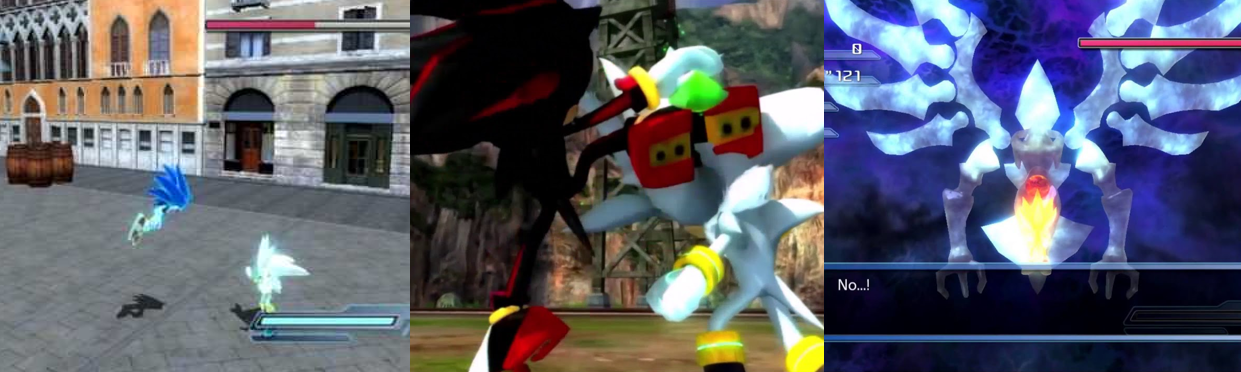
Like in Sonic Adventure, you’ll also have to take on rival battles against Sonic, Silver, and Shadow. The first of these is probably Sonic ’06’s most infamous legacy; when you face Silver in Soleanna, he’ll throw shit at you and, if you attack him directly or even face him, he’ll grab you with his telekinesis and send you flying with a cry of “It’s no use! Ta-ake this!” Literally nine times out of then, you’ll get locked in a vicious cycle where he does this over and over either until you’re dead or you have to restart as you keep collecting one Ring upon damage, but you can get around this. Basically, you need to grab some Rings and run around and far away like an idiot; you won’t be able to see Silver because the camera is awful but, eventually, you’ll here him cry “How about this!”, which is when he gathers up projectiles to throw at you; this is your chance to attack him but for God’s sake dash away immediately after or else he’ll grab you. This is slightly harder with Shadow as you can’t easily chain Homing Attacks, meaning you’ll end up attacking the air instead of escaping, and Silver tends to blast you upwards as well. When playing as Silver, these battles are much easier but can still be annoying; both Sonic and Shadow can attack from afar with their Homing Attacks and you’ll have to run around like a moron waiting for projectiles to pop back in for you to throw at them. If you’re able to keep from rage quitting when playing through the ridiculously hard final stage, with its instant-death time rips and wonky physics, you’ll take on Solaris in the final battle. Here, Super Sonic, Super Shadow, and Super Silver have to take it in turns to attack the raging Sun God; you can switch between them with Y (the other two will “collect Rings” in the mean time so you shouldn’t ever run out of power) and attack with X (Super Sonic charges ahead, Super Shadow launches and charges Chaos Spear, and Super Silver captures projectiles with LT and tosses them at Solaris). It’s not massively clear (ironically, unlike other Sonic games, the supporting cast doesn’t give you clear direction) but, to start with, you need to destroy Solaris’s arm with Super Silver, then the other arm with Super Shadow, and finish it off with Super Sonic all while it throws projectiles and screen-filling lasers at you. In its second phase, Solaris is much more aggressive but it’s pretty simple to stay out of range of its lasers and switch to whichever hedgehog it’s not shielding against to defeat (and probably for an S-Rank as well).

Power-Ups and Bonuses:
As in pretty much every Sonic game, Golden Rings are your life source; as long as you have at least one, you’ll survive most attacks and, with a hundred, you’ll earn an extra life. As ever, you’ll also find Item Boxes strewn around the action stages that’ll grant you a speed-up (practically a death sentence with this game’s wonky physics!), the rare invincibility, an extra life (which annoyingly won’t respawn if you die after a checkpoint), a bunch of rings (either five, ten, or twenty), or fill your meter so you can perform Chaos Boost or telekinesis. You’ll also spot rainbow rings around the place, which will give you a score boost and act as shortcuts, and there are a decent number of checkpoints (though sporadically; some stages need more, some don’t need any). When you finish a mission or action stage, you’ll receive a ranking based on your score, time, and performance; the higher your ranking, the more Rings you earn and can then spend at shops around Soleanna. This allows you to buy upgrades for Sonic, Shadow, and Silver, such as the Light Speed Dash, bounce, and Chaos Boost, but you’ll also be able to perform more powerful attacks as Shadow and Silver to stun nearby enemies. Sonic’s upgrades take the form of gems and change the colour of his shoes; you can switch between these with the directional pad and activate them with RT for some truly bizarre and game-breaking effects. Sonic can toss an emerald and teleport to it, stop in mid-air to charge his Homing Attack, blast ahead with Mach Speed at any time, shrink, create a magnetic shield to attract Rings, and whip up a tornado to deal damage though, honestly, I never used any of these and found most of them were either useless or didn’t work as intended.

Additional Features:
There are twenty-three Achievements up for grabs in Sonic ’06 and they’re all pretty rubbish. You get an Achievement for clearing each episode, and then finishing the last story, and another three Achievements for fully upgrading each of the three playable characters. You’ll also get Achievements for finishing the story on Hard mode, completing every side mission (easily accessible from the main menu, thankfully), and for finding and earning every Silver and Gold Medal in the game, meaning you need to complete every mission and stage with an S-Rank. Silver Medals are scattered throughout the stages and Gold Medals are awarded for clearing stages and, as I said, getting S-Ranks so good luck in obtaining all of them with this dodgy game! Sonic ’06 was also bolstered by some DLC, which includes an even harder difficulty setting, a boss rush, and the “Team Attack Amigo” pack. This is somewhat similar to the last stage of the game and has you playing through short sections of the main story as the supporting characters (Tails, Rouge, etc), culminating in a boss fight against the Egg-Genesis as Omega.  You’ll also unlock a sound test and movie theatre and can play a rudimentary multiplayer mode similar to the one seen in Sonic Adventure 2 (Sonic Team USA, 2001) in which two players either work together to find Chaos Emeralds or race against each other, but I can’t imagine anyone wanting to play this mess of a game with you.

The Summary:
This is the first time I’ve played Sonic the Hedgehog (2006) since I first finished it on the PlayStation 3 and there’s a damn good reason for that. Yes, surprise surprise, I do not hold Sonic ’06 in high esteem; for me, this is one of the absolute worst Sonic games ever made, and one of the worst videogames ever made, and nothing and no one will ever convince me otherwise. The potential is there, and that actually makes things worse; the high-quality cutscenes, the soundtrack, even some of the new characters and concepts are all very appealing. The call-backs to Sonic Adventure are fun…on paper, but the whole game feels like a downgrade and a poor imitation of that far superior and varied classic 3D Sonic title. But what really kills the game is the gameplay; Sonic ’06 is just all over the place, juggling too much and stretching itself too thin, and the game engine cannot handle it. Slowdown, glitches, and diabolical hit detection combined with ridiculous load times and an absolutely atrocious camera are enough to drag this game down but when you factor in the almost unplayable Mach Speed sections, the janky vehicle combat, and Silver’s slow, frustrating gameplay then you hardly have a winning formula. I give the game props for having other characters be playable, even in supporting roles, but they’re poorly implemented and it’s a missed opportunity to not allow the “Amigos” to be playable in every stage and mission. A lack of boss variety, unclear objectives, and some game-breaking shit like the Silver boss and Sonic’s upgrades only exacerbate the game’s issues; the side missions basically amount to defeating enemies or passing through rings and there’s just not much on offer to keep you coming back. Sonic ’06 is more than a slog; it’s like stumbling through quicksand and it throws some ludicrous roadblocks in your way, from racing to stop or destroy a train to desperately trying to dodge instant-kill hazards. To me, there’s little saving grace to this game; it certainly wasn’t the big reboot or return to form the franchise needed and was, instead, a slap in the face to gamers everywhere and a massively rush, missed opportunity for SEGA’s high-speed mascot.

My Rating:

Rating: 1 out of 5.

Terrible

Can you think of anything good about Sonic ’06 that isn’t the soundtrack or cutscenes? What did you think to Silver and the three different gameplay styles on offer? Which was your favourite and did you enjoy playing as the likes of Tails and such? What did you think to the story, Mephiles, and the never-ending quest to rescue Princess Elise? Did you ever find all the Medals? What’s your favourite Sonic game, good or bad? How are you celebrating Sonic’s anniversary today? Whatever your thoughts on Sonic ’06, share them down below or start the discussion on my social media.

Game Corner: Sonic Generations (Nintendo 3DS / Xbox 360)

SonicGenerationsLogo

Released: 1 November 2011
Developer: Sonic Team
Also Available For: PlayStation 3, PC, Xbox One, and Xbox Series S/S

The Background:
It’s been said time and again, but Sonic had a tumultuous transition to 3D. While Sonic Adventure (Sonic Team, 1998) is generally regarded as a classic, it had a few issues that took SEGA some time to iron out in Sonic’s subsequent 3D titles. Despite some bizarre claims to the contrary, Sonic the Hedgehog (ibid, 2006) was a diabolical low point for the franchise. Sonic Team were desperate to make up for this with Sonic Unleashed (ibid, 2008), a critical and commercial success that saw the 3D games utilise a brand-new game engine to propel Sonic at breakneck speeds. This was further refined in Sonic Colours (ibid, 2010), another successful entry that but the franchise in a good position for its 20th anniversary. Sonic Generations was specifically developed as a love letter for long-time fans, with Sonic Team focusing exclusively on high-definition consoles and the unique 3D features of the Nintendo 3DS. The developers sought to recreate only the most popular and iconic stages from Sonic’s past and to make the game accessible to players of all ages, bolstering the release with a limited edition version and a touch of downloadable content (DLC). regarded as one of the best of Sonic’s 3D efforts, Sonic Generations was widely praised, despite its short length, for its colourful visuals and fast-paced gameplay; though the 3DS version was largely seen as inferior to the main console releases. regardless, Sonic Generations was a strong seller for SEGA thanks to being backwards compatible with new hardware and even got a whole new lease of life in 2024 with an equally celebrated . Shadow the Hedgehog-themed remaster.

The Background:
It was 2011 and SEGA were eager to celebrate the 20th anniversary of their iconic videogame mascot; after years of disconnect and complex additions to what had begun as a simple, one-button videogame, it’s fair to say that there was some…confusion regarding Sonic’s past, canon, and timeline. SEGA initially opted for a soft reboot, of sorts, with Sonic Adventure (Sonic Team, 1998), which clearly depicted Sonic and his cast of characters redesigned into a slightly older, more anime-inspired aesthetics in a world similar to ours, inhabited by both humans and anthropomorphic characters, and with a tenuous connection to the previous videogames. However, very quickly, this fell apart a bit as Sonic videogames became both incredibly dense and complex or laughably simple, especially in their narratives. After years of fans wanting a return to the traditional, 2D gameplay of the past, Sonic Team opted for a title that would combine not only the tried-and-true 2D gameplay of the past with the fast-paced 3D gameplay of what was, at the time, the present but also bring together two different generations of Sonic for the first time.

The Plot:
While celebrating Sonic’s birthday, Sonic and his friends are scattered through time by Doctor Eggman’s ferocious, mysterious beast, the Time Eater. Teaming up with a past version of himself, Sonic races through from his past to rescue his friends, retrieve the Chaos Emeralds, and put a stop to the Time Eater’s rampage.

Gameplay and Power-Ups:
Sonic Generations takes the fast-paced, “Boost”-centric formula of Sonic Unleashed and Sonic Colours and further refines it, offering both 3D and 2.5D, high-speed action stages as players race through some of the most iconic stages (or “Zones”) in Sonic’s history. While Sonic remains the only playable character, there are now two of him: the “Classic” Sonic (who plays exclusively in 2.5D) and the “Modern” Sonic (who plays in 3D and 2.5D). There are nine Zones to playthrough in Sonic Generations, each with two levels (or “Acts”): Act One is exclusive to Classic Sonic and Act Two is tackled by Modern Sonic. Although you’ll pot a timer in the to-left of the screen, there are no time outs here’ instead, you get a letter grade a points for finishing Acts as fast as possible. You’ll want to stick to the higher paths, where available, and utilise rails, pulleys, and other shortcuts to cut down your time, but you’re basically guaranteed an “S” rank if you finish an Act without losing a life. Unsurprisingly, Golden Rings are your life source, protecting you from most attacks and granting an extra life for every increment of 100 you collect. Golden Rings also fuel Modern Sonic’s “Boost” gauge (which is also filled by performing tricks off ramps and bashing Badniks), allowing him to blast ahead at high-speeds and plough through any enemies and destructible objects in his way. While both Sonics have unique gameplay mechanics, they share some common controls: you jump with A or X, pressing it again in mid-air to attack nearby enemies or hit targets with Sonic’s Homing Attack. While this is exclusive to Modern Sonic, you can unlock the ability (or “Skill”) for Classic Sonic, too, and it becomes mandatory in the 3DS version. B sees you crouching to fit through small gaps, Y activates any Skills you have equipped, and the Right Trigger either blasts Modern Sonic off or quickly performs Classic Sonic’s Spin Dash. When Boosting, you can hold the Left and Right Triggers to drift and use the Left and Right Bumpers to quick step. As Modern Sonic, you can press B in mid-air to perform a stomp, wall jump off specific surfaces, and dash along a line of Rings by pressing Y.

Both Sonics have distinctive playstyles, though gimmicks are recycled and shared between both.

These controls are largely mirrored on the Nintendo 3DS, with players jumping and using the Homing Attack with A or B and Boosting with Y, though there’s no quick Spin Dash for Classic Sonic. Classic Sonic’s taught the Homing Attack early on, though he doesn’t really need it and ends up playing as a slower, clunkier version of his counterpart. While it might seem like Modern Sonic has more tricks at his disposal, each Sonic can be assigned Skills, unlocked by collecting Red Star Rings, completing additional Challenges, and spending points in the Skill Shop. Each Skill has a point value, and you can assign as many as you like to each Sonic until you hit the point cap of 100. A bunch of these are shared between both Sonics, giving each the ability to begin an Act with ten Rings, granting an additional extra life, giving them more movement options when underwater, and eliminating the recovery time after taking a hit. Classic Sonic can equip one of the elemental shields from Sonic the Hedgehog 3(SEGA Technical Institute, 1994), gaining a bounce, flame burst, and double jump and being able to breathe underwater, resist flames, and attract Rings, respectively. He can also equip the “Twin Spin Attack” (or “Insta-Shield”) from Sonic 3, start with a temporary invincibility, extend the Spin Dash, turn enemies into Rings, and even hop on a skateboard. Some of these abilities are available in Zones as well, such as the speed up and invincibility and skateboard, though you’re more likely to smash Ring monitors. Modern Sonic can also be assigned Skills to allow him to blast off at the start of an Act, perform faster Homing Attacks and wall jumps, and increase the length of his Boost gauge. When playing Planet Wisp or Tropical Resort, you’ll utilise the returning Wisps, with Classic Sonic using the Pink Wisp and Red Wisp to race across walls and ceilings and turn gears or burst through the sky and Modern Sonic rocketing up Dr. Eggman’s factory and smashing through barriers or ricocheting about with the Cyan Laser. Acts also contain the usual gimmicks and hazards, such as springs, spikes, flame bursts, ramps, and rails. You can jump through boost rings to blast through the air, fly off ramps to perform tricks and fill your Boost gauge, repeatedly hit bouncy springs to get higher, and even run on those awful Marble Garden Zone platforms to reach higher areas in Sky Sanctuary. When underwater, you’ll need air bubbles to keep from drowning; when leaping to platforms, you must watch for bottomless pits; and you’ll often press switches to activate or move platforms and blocks.

Sonic’s greatest hits and misses are revisited in each Zone and Challenge.

Interestingly, the Nintendo 3DS’s bottom screen is only used to track your progress in an Act, display the boss’s health bar, and to navigate the sparse hub world. Sonic Generations takes place in a simple hub world called “White Space”, a disappointingly barren void where stages from Sonic’s past have been dumped by the Time Eater. These are arranged in three areas corresponding to an era of Sonic’s history and guarded by a Boss Battle. To progress through the game’s brief and simple story, you must complete each Act to partially restore colour and life to the White Space, then acquire a Chaos Emerald from a Rival and Boss Battle. By and large, the game’s Acts aren’t particularly challenging, though there are some unfair bottomless pits and each Sonic seems to have lead in their sneakers, which can make precision platforming slippery and frustratingly difficult. The difficulty comes in the lengthy and haphazard variety of gameplay mechanics seen in the later, modern levels; unsurprisingly, Crisis City stands out as one of the game’s more frustrating stages thanks to the fire traps, lava pits, bottomless pits, and that Goddamn flaming tornado! The Nintendo 3DS version sees you flying through Mushroom Hill using propeller plants, bouncing around Casino Night, and racing from a destructive orca in Emerald Coast, though the additional Challenges are missing from the Xbox 360 version. Here, after clearing each area, you’ll unlock five additional Challenges for each Sonic; you’re required to clear at least one of these for each Zone to gain a Boss Key, battle the boss, and progress to the next area. These Challenges are considerably varied and can be anything from racing against a ghostly doppelgänger to finding Chao, to completing a stage with only one Ring. Sometimes, you’ll also race against, or team up with, one of Sonic’s friends; you’ll use Mile “Tails” Prower to hover over obstacles and gaps, knock musical notes back to Vector the Crocodile, and clear walls of flame with Blaze the Cat, for example. While you may call upon Sonic’s friends with Y in these Challenges, you’ll never control any character other than the two Sonics, which is quite disappointing. These Challenges can be frustrating but clearing them is the only way to completely restore each area and also unlock additional Skills, artwork, music, and character profiles in the Collection Room.

Presentation:
Graphically, Sonic Generations is still one of the brightest, most vibrant Sonic 3D titles ever made. Classic Sonic, especially, looks and animates really well and every stage is packed full of life, colour, and little details that will be recognisable to any Sonic fan. Both Sonics have idle poses and celebrate or lament their letter grade after each Act, though, strangely, Classic Sonic is completely mute. This means that Modern Sonic gets all he puns and one-liners and voice clips, while Classic Sonic simply pantomimes his feelings and relies on Classic Tails to talk for him. Sonic’s friends appear as non-playable characters (NPCs) in White Space, offering encouragement and hints after being restored to guide you towards Red Star Rings. White Space is very annoying for such a simple hub world, with the game forcing you to take boost pads, loops, and springs to reach Challenges (though you can cycle through Acts, at least). I’m glad the game isn’t bogged down by a huge open world, but White Space feels very cheap and half-assed at times, despite some fun Easter Eggs. Sonic Generations takes the original 2D and 3D environments and gives them an eye-catching visual makeover, though the screen’s a bit too zoomed in at times for Classic Sonic and it’s easy to just blast off into the void as Modern Sonic. Perhaps the pinnacle of Sonic Generations’ graphical achievement, though, is in the fantastically updated battle against Perfect Chaos, who has been turned from a choppy, flappy-mouthed monstrosity into a genuinely terrifying, bio-organic creature. However, when playing the Xbox 360, I did notice some blurriness to the images, some frame rate issues, and the game crashed on me three or four times, which was odd. It’s obviously graphically superior to the 3DS version, which offers the same headache as all 3DS titles and is extremely basic at times. You cans ee this in Mushroom Hill, which looks strangely bland, the cutscenes (which are simple 3D models with dialogue boxes), and the reduced Zone count.

A generational adventure that lovingly recreates Sonic’s classic stages.

Each of the game’s Zones are beautifully rendered and expanded upon with gameplay gimmicks from other games and even little extra things, like a celebration taking place in Rooftop Run and getting to visit Hidden Palace in Sky Sanctuary. While there are some obvious choices (Green Hill and Chemical Plant have since been overused to death), there are some odd inclusions, like Speed Highway from Sonic Adventure (I would have picked maybe Ice Cap or Red Mountain), and some disappointments, like Seaside Hill from Sonic Heroes (Sonic Team USA, 2003). I’m honestly surprised that Sonic Team didn’t include Casino Park instead, though I would’ve liked to see them mix it up with Egg Fleet or Frog Forest. There’s some real depth to the environments, with Chemical Plant’s factory exploding in the background, the Death Egg rising in Sky Sanctuary, and desolation as far as the eye can see in Crisis City. Things can be a bit cluttered at times and it’s not always clear which winding path you can take and which is part of the background, but I loved how faithfully Sonic Generations recreated each area and the little twists they toss in. Classic Sonic’s Seaside Hill is largely underwater, for example; the infamous truck wrecks the environment and rockets after you across walls in City Escape; and Dr. Eggman airship hounding you in Rooftop Run. The Nintendo 3DS version oddly adapts Zones from Sonic’s main console games rather than his handheld ventures, with the exception of Water Palace (and, I guess, Tropical resort), which was an odd choice and results in some janky, bland stages that are actually inferior to their Nintendo DS predecessors since the action’s limited to one screen. The Xbox 360 version features some really well done CG cutscenes; it’s just a shame that the game’s story is so criminally short that we don’t see more of these. When you free Sonic’s friends, they’ll make a comment while Sonic just stands there like a tool rather than properly interact with them. As for sound, Sonic Generations has you covered! Every area features a unique, remixed version of its original track and each Act has a different version to differentiate the two. On the Xbox 360, you can also unlock additional music tracks, including some great remixes by the likes of Cash Cash and Crush 40, and play these on any Stage, allowing for a lot of variety in the music you hear as you play.

Enemies and Bosses:
Given that it features stages from three eras of Sonic’s history, Sonic Generations also includes many recognisable Badniks and enemies from each time period being represented. You’ll smash apart the likes of Moto Bugs, Buzz Bombers, Crabmeats, Spinys, and Egg Robos from the classic games, with Egg Robos sporting missile barrages and giant Badniks even chasing you at certain points. Moving into the modern era, you’ll bop Eggpawns, Cop Speeders, robots from the Guardian Unit of Nations (G.U.N.), and flaming Iblis creatures. While most slow and easy to attack, they can still surprise you with bolts of energy or other attacks, such as the construction Egg Pawns on Planet Wisp tossing their pickaxes. Enemies are largely there to be bothersome, with the cannons surrounding Rooftop Run’s clock tower being particularly aggravating and the Egg Pawns in the barrel store being notably cheeky. Enemies also act as “bridges” between platforms, rails, and other areas, allowing you to Homing Attack or bop them to reach higher paths, cross lava, or avoid spike pits. The Nintendo 3DS version features a handful of unique enemies due to its different Zone selections, such as those mushroom-tossing moles, axe-wielding Egg Pawns, and even a massive Egg pawn that wrecks the ruins of Water Palace. Spikes are annoyingly commonplace, often waiting right where you land, as are crushing hazards, moving blocks, flame bursts, and missiles from the walls and ceilings. You’re chased by a gigantic truck in City Escape, one that now sports giant buzzsaws, have debris flung at you by a flaming tornado in Crisis City (which also whisks away the environment and the end goal for Classic Sonic!), and must watch for crumbling platforms when bouncy from clouds in Sky Sanctuary. Spiked obstacles also appear on rails, mines litter the ground, and you must quick step left and right to avoid being blasted by Dr. Eggman’s drones and airship. While warning signs alert you to bottomless pits, it’s very easy to plummet down them when moving so fast, or to clip through the environment, and Sonic can be quite slippery, which doesn’t help when trying to make trickier jumps.

Iconic bosses get a massive upgrade, adding extra gimmicks and attacks to their arsenals.

Six classic bosses return and are remixed in each version of Sonic Generations. On the Xbox 360, Classic Sonic first fights the Death Egg Robot on a narrow platform, dodging its extending, drill-like arms and running under it when it jumps to ram its butt. The fight the switches to a recreation of the Death Egg Zone and the mech exclusively attacks from the background, forcing you to lure it to attack bombs with its arms so you can run up and ram its head. The fight with Perfect Chaos is now a whole stage as you dodge its tentacles and jump on crumbling platforms to reach it, hitting springs and pulleys and blasting across the water on boost pads to race up its body. Perfect Chaos spawns twisters, fires energy beams, and unleashes its massive mouth laser, before erupting water geysers. This forces you to precariously hop to platforms, battling the awkward camera to land the final blow. The Egg Dragoon sees you blasting through a circular tunnel avoiding its freeze bolts and missiles and hopping to rails to ram the cockpit. When on a 2.5D plane, you must hang back and jump over shots then quickly wall jump up its arms, avoiding a downward shot, before diving after the falling mech, avoiding its drill arms to target its body. On the Nintendo 3DS, you battle one of my favourite bosses, the Big Arms, now avoiding its arm slams and palm slaps, then, oddly, battle the Biolizard. This is an annoying fight as you must awkwardly run from its gaping mouth or thrashing tail, grinding up to its core, avoiding high and low shots and bouncing off orbs to smack its core. Finally, you battle the Egg Emperor in an autorunner, desperately avoiding its energy waves, dodging its charge, and taking out the cannons to smack his big, stupid face.

Best Sonic’s rivals to power-up and battle the aggravating Time Eater with two Super Sonics!

You’ll also compete against some of Sonic’s rivals in both versions, with the Xbox 360 fights yielding Chaos Emeralds. You’ll once again race across Stardust Speedway against Metal Sonic, hopping over its torpedo dash and avoiding its lasers and the debris it tosses at you to give it a smack. You’ll across the walkways of the Space Colony ARK against Shadow the Hedgehog, chasing down purple energy orbs to power-up and blast meteorites at him in a battle that’s ridiculously easy if you can speed after him fast enough. Finally, you return to Crisis City to battle Silver the Hedgehog, avoiding his telekinetic waves and targeting the debris he flings at you to wallop him, before scrambling over a huge wave of junk and racing towards the camera to finish him off. This rival fights are significantly downplayed on the Nintendo 3DS as you don’t fight Silver and both are reduced to races, with you hopping over obstacles and slowing Metal Sonic or Shadow with some lucky shots and desperately trying to avoid Shadow’s boost and Chaos Spear. Unfortunately, Sonic Generations and its bosses arefurther let down by the final battle with the Time Eater. Despite an impressive, ominous score, the unique design of both the creature and the bizarre vortex you battle it in. Despite the joy of seeing Classic and Modern Sonic turn Super Sonic to battle two versions of Dr. Eggman, this fight is a confusing mess. You hold down RT to charge head-first through a time/space distortion, dodging pieces of the Zones and the Time Eater’s arms and lasers, to ram its core. You can press Y to switch to the outside of the vortex and press X to fire the other Sonic to destroy incoming projectiles, all while Sonic’s friends constantly shout “advice”. You can barely see Golden Rings until they’ve flown past you, you have no idea if you’re holding or mashing buttons, and defeating this monstrosity is much easier on the Nintendo 3DS. You battle it on a 2.5D plane, with no attacks at your disposal and simply dodging its lasers and arm swipe until its core is exposed, then race towards it on a 3D plane. This can be tricky as it’s not easy to dodge its hand claps and it’s easy to run out of Rings, but at least you’re not bombarded by repetitive voice clips, and you can land hits a lot easier.

Additional Features:
There are forty-nine Achievements to earn in Sonic Generations, with one popping every time you clear both Acts in each area and defeat a rival and boss. Every Act as at least one Achievement tied to it (normally something involving going a specific route and collecting a specific Red Star Ring before completing the stage), you’ll get Achievements for performing tricks, acquiring Skills, and unlocking all collectibles. Every Act has five Red Star Rings to find, with each one unlocking artwork, music, and other extras; you’ll also get an Achievement if you find them all. As you complete Acts, Challenges, and collect Red Star Rings, you’ll unlock additional music tracks, cutscenes, artwork, and little character trophies that can all be viewed in a little gallery/museum at the far left of White Space. If you explore the Green Hill hub, you’ll find a SEGA Mega Drive and, for 7777 points, you can purchase a Mega Drive controller to play a port of the original Sonic the Hedgehog(Sonic Team, 1991)! You can also challenge the rivals and bosses on “Hard” mode (though there’s no Achievement for this), upload your fastest times to an online leaderboard, and play a pinball table themed on Casino Night Zone if you snagged the DLC. On the Xbox 360, you acquire the seven Chaos Emeralds by playing the main story, unlocking Super Sonic for the finale and as a 100-point Skill for both Sonics, but play Special Stages on the Nintendo 3DS. These are modelled after Sonic Heroes’ pipes, with you collecting orbs to power-up your boost and avoiding spiked mines in super easy challenges. You can also download additional missions using the handheld’s “StreetPass” feature, play an online versus mode (that appears to be a head-to-head race), customise a profile card, and play a time attack mode, though the Nintendo 3DS lacks the Skills and Red Star Rings of its counterpart.  

The Summary:
When I first played Sonic Generations on the PlayStation 3, I remember it being a fantastic experience; it was fun, fast paced, and chock full of nostalgia and little bits of fan service. Aside from the final boss, I had a blast breezing through everything the game had to offer and lamented the lack of follow-up downloadable content from Sonic Team, hence my excitement for the later remaster. I was therefore super exited to revisit Sonic Generations on the Xbox 360 and snag the Nintendo 3DS version, only to be put off by how zoomed in the camera was for the 2.5D sections. Nevertheless, I ploughed ahead, happy to be revisiting this slice of nostalgia and, very quickly, found myself quite frustrated by a lot of little things. The sheer uselessness of the regular jump both Sonics have, their tendency to spontaneously slip off platforms, the frustrating nature of a lot of the Challenges and, of course, the massive letdown of the final boss. All these years later and I’m still disappointed that the story wasn’t a bit more grandiose given that this was a celebration of Sonic’s 20th anniversary. White Space feels so empty and lifeless, the lack of other playable characters and extra stages was disappointing, and the barebones nature of the title makes it feels cheap and rushed at times. The Nintendo 3DS version is even more barebones, lacking so many features, characters, and even having a reduced Zone count, with the only consolation being simplistic Special Stags. Not adapting Zones from Sonic’s handheld past was a huge mistake, the Zones we do get are largely empty, and both Sonics play too similar for the game to compete with Sonic’s Nintendo DS library. Yet, by and large, Sonic Generations is still an enjoyable experience. I fear this playthrough may have been soured by me rushed through it as quickly as possible rather than taking my time and losing myself to the nostalgia. If you can do that, there’s a lot to like here from a visual and aural perspective, as well as the game being a fun, if all too brief, break-neck action romp through some of Sonic’s most iconic areas.

Nintendo 3DS Rating:

Xbox 360 Rating:

Rating: 2 out of 5.

Rating: 3 out of 5.

Could Be Better

Pretty Good

What did you think of Sonic Generations? Do you think it still holds up or, like me, do think that it was lacking in content and features? What did you think to the Zones featured in the game and the remixed boss battles? Were you disappointed by the lack of other playable characters? Which Challenge was the hardest for you and why was it Vector’s? What was your favourite Classic and/or Modern Sonic videogame? Share your thoughts in the comments, support me on Ko-Fi, and go check out my other Sonic content.