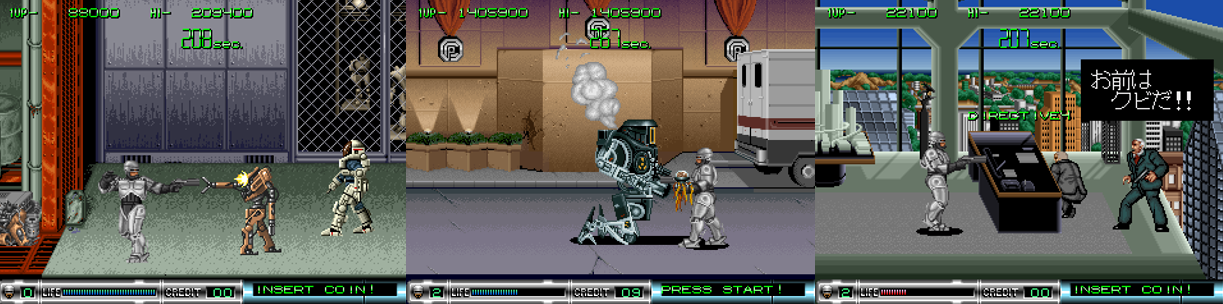
Game Corner: RoboCop: Rogue City (Xbox Series X)

Released: 02 November 2023
Developer: Teyon
Also Available For: PC, PlayStation 4, PlayStation 5, Xbox One, Xbox Series S

The Background:
Although RoboCop’s (Verhoeven, 1987) surprising success saw it followed by big screen sequels, a cartoon, and a live-action television show, these were largely met with mixed to negative reviews. While the R-rated franchise all-but flopped as a kids’ cartoon, RoboCop did fairly well in arcades back in the day. Unfortunately, the videogame adaptation of RoboCop 3 (Dekker, 1993) performed about as well as its source material. RoboCop fared better when battling another iconic cyborg, something only further evidenced when an attempt to reinvigorate the cyborg cop on then-modern consoles flopped hard back in 2003. The near universal negative reception for Titus Interactive Studio’s RoboCop meant players had to wait twenty years for another first-person shooter (FPS) adaptation of the franchise, one courtesy of Teyon, the developers behind Terminator: Resistance (2019), the first halfway decent Terminator videogame in ten years (at the time). For RoboCop: Rogue City, Teyon worked closely with Metro-Goldwyn-Mayer and publisher Nacon to ensure the game was faithful to the original film and captured the dark satire of the franchise, even bringing back Peter Weller to reprise his iconic role. In contrast to fast-paced FPS titles, director Piotr Latocha lobbied to recreate Weller’s robotic, methodical movements and emphasise RoboCop’s “Prime Directives” as much as action-packed shooting. Reaching 435,000 players in its first two weeks, RoboCop: Rogue City received mostly positive reviews that praised the fidelity to the movies and layered gameplay mechanics, while criticising the pacing and noticeable glitches.

The Plot:
Transformed into a cybernetic police officer after being murdered on the job, Alex Murphy/RoboCop finds his efforts to police the increasingly lawless streets of Detroit compounded by a plot by megacorporation Omni Consumer Products (OCP) to mass produce cyborg cops.

Gameplay and Power-Ups:
RoboCop: Rogue City is an FPS title in which players assume the role of the titular cyborg police officer and play through a mission-based narrative that includes gunfights, a smidgen of detective work, and a dash of role-playing elements. There are four difficulty settings to pick from the outset and a fifth unlocked once you clear the game, with enemies being tougher and dishing out more damage on the higher difficulties. Players can also pick between two control schemes, but I stuck with the default settings that saw me aiming with the Left Trigger, shooting with the Right Trigger, and punching thugs in the face with the Right Bumper. X reloads your weapon and is used to interact with the environment, with players holding X to open doors and OCP supply crates and pressing it to talk to non-playable characters (NPCs) or pick up ammo, various incriminating evidence, and supplies like OCP Recovery Charges. You hold B to restore your health with these, storing three at the start and eventually carrying up to five once you’ve upgraded RoboCop’s skill tree. Similarly, you can interact with fuse boxes to restore RoboCop’s health. Also, once you’ve unlocked the correct upgrade, you can dash at enemies with A and engage a temporary shield to reduce incoming damage with B. X also grabs and throws objects at enemies; everything from computer monitors to chairs, tables, motorbikes, and sledgehammers can be grabbed and tossed, which is a lot of fun. Naturally, you can grab and toss scumbags as well! RoboCop is armed with his signature Auto 9 (which has infinite ammo), can pick up one additional weapon, and you switch between the two with Y. You can press in the left stick to change RoboCop’s clunky walk to an ungainly trot and the right stick to activate a night vision filter, though I found this wasn’t utilised much and an infrared mode would’ve been far better. The directional pad changes the firing mode of your weapon with up, activates a disabling shockwave (with the right upgrade) with down, and brings up either your “Skills” or inventory menu with left and right, respectively.
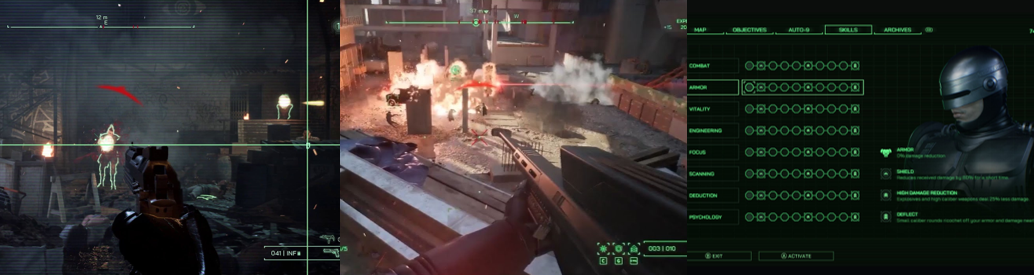
Blow away street scrum with RoboCop’s array of weapons and upgrade his Skills for more options.

A great deal of RoboCop: Rogue City focuses on shooting, with players blasting punks in the face (or crotch) and splattering their brains across the walls or dismembering their limbs. RoboCop can grab a handful of largely generic additional weapons to help with this, liberating them from enemies or grabbing them from nearby caches. You can grab another pistol and a high-impact .50 Cal that would make Dirty Harry smirk, two combat shotguns that are awesome for close-quarters combat, a couple of submachine guns and assault rifles that can fire a bit wildly, and heavy-duty machine guns lifted from turrets. RoboCop also gets a sniper rifle, the Cobra Assault Cannon from the first film, a rocket launcher, and a grenade launcher, with these latter four being some of the most powerful weapons. That power comes with a trade-off, though, such as low ammunition and long reload times. RoboCop always has his trusty Auto 9, however, which can eventually be upgraded with computer chips. These come in different configurations and can even be spliced together to create newer, more powerful chips. When applied to the Auto 9 motherboard, they increase the gun’s ammo capacity, reload speed, damage, spread, and armour piercing ability to make the Auto 9 even more formidable. RoboCop’s dash ability allows him to charge into enemies and his shockwave can be upgraded to cause damage rather than just stun. You can also shoot explosive barrels, mines, gas cannisters, motorbikes, and vehicles to take out large groups of enemies with explosions and many of these can be thrown for the same effect (though be careful as you’ll also take damage from the explosion, especially if your barrel is shot when you’re carrying it!) Sometimes, you can shoot parts of the environment to get an edge in gun fights, such as dropping scrap metal onto enemies, and RoboCop will occasionally be backed up by fellow police officers. Anne Lewis, rookie Ulysses Washington, and even an Enforcement Droid-209 (ED-209) will provide cover fire in certain missions. When fighting alongside the ED-209 or the Special Weapons and Tactics (SWAT) team, you’ll engage in an “Efficiency Test” and be challenged to get more kills that your rivals to gain more XP in your post-mission evaluation.
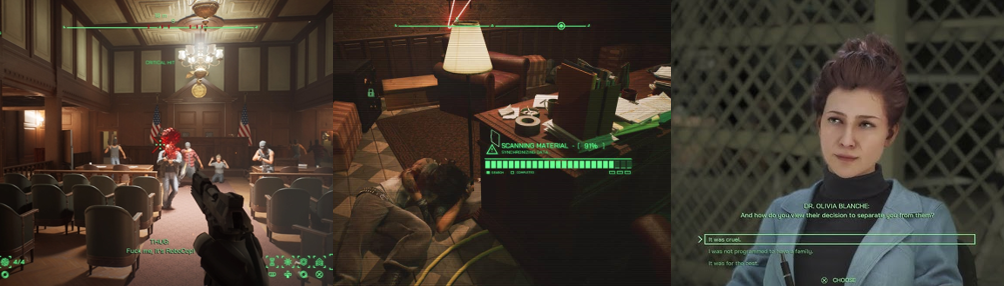
Rescue hostage, scan clues, and choose responses wisely to earn XP and improve your reputation.

Many times in your adventure, you’ll be asked to “breach” doors or walls, causing RoboCop to burst through and take out any enemies on the other side in a slow-motion sequence. These sections often involve hostages, who’ll be executed if you’re not quick enough, which will cost you in your post-mission evaluation. Despite being bulletproof and an unstoppable cyborg cop, RoboCop isn’t invincible and his health drops as he sustains gunfire or is hit by grenades and rockets. Thankfully, there are many checkpoints in RoboCop: Rogue City and, as you gun down punks, collect evidence (documents, drugs, stolen items, and such), and enforce the law throughout Detroit, you’ll earn experience points (XP). When you get enough XP (or find OCP Skill Disks), you’ll gain a “Skill Point” to upgrade RoboCop’s eight skills. This not only unlocks the dash, shockwave, and shield abilities but also allows RoboCop to enter a “bullet time” mode by holding the Left Bumper, hack enemy turrets, decrease the damage he receives, automatically reload upon connecting with a punch, ricochet shots off specific panels, and automatically regenerate health over time. RoboCop must also solve crimes and you must thus upgrade his “Scanning” and “Deduction” skills to help with this. By holding LT, RoboCop scans the environment for clues and these upgrades make this easier and faster. They also increase the XP you gain and mark important locations and items on your map, a generally useful overview of the immediate area that’s largely superfluous since there’s a helpful onscreen compass on the heads-up display (HUD) and an objective list in the pause screen. Upgrading RoboCop’s “Engineering” skill allows him to open locked safes and better scan the environment to complete optional objectives. However, this isn’t a requirement and you can often find alternative means, such as picking up a manual, to accomplish the same task. Players are also given dialogue options when talking with certain NPCs and picking different answers changes RoboCop’s relationships with these characters, altering the ending depending on his political stance, his leniency towards informants, his conduct towards Washington, and the answers he gives psychologist Doctor Olivia Blanche. Upgrading your “Psychology” skill helps with these moments, allowing you to earn more XP, though there’s little benefit to picking the “right” answer beyond seeing different reactions.
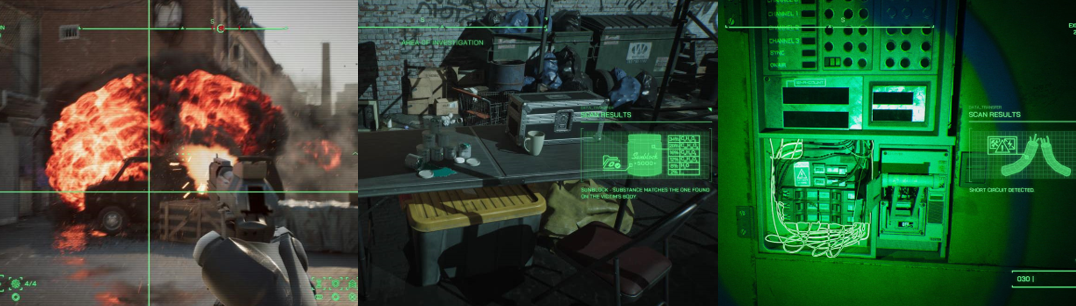
RoboCop’s primary objectives are accompanied by secondary and menial tasks.

It’s actually comical how many menial tasks the cops stationed at Metro West give RoboCop to do. When Lewis is shot, RoboCop’s asked to gather signatures for a get-well card; when the line of civilians coming in to complain gets unwieldy, RoboCop is asked to help with their problems; and, when a fellow cop is found dead, RoboCop helps Officer Cecil place a memorial photo on the wall. RoboCop can choose to aid or scupper Washington’s career, assist or derail reporter Samantha Ortiz, has regular briefings with the cantankerous Sergeant Warren Reed, and will be clearing out lockers, testing weapons at the shooting range, and fixing power outages throughout the station. When on the streets, RoboCop has a primary objective tied to that mission (investigating an arcade that sells drugs on the side, checking out a familiar steel mill, confronting OCP executive Max Becker regarding his cyborgs, and more) alongside numerous secondary objectives. You can issue tickets to cars illegally parked and to graffiti artists (who’ll spraypaint colourful anti-RoboCop graffiti in retaliation), and help solve a murder tied to a seemingly faulty MagnaVolt car security system. RoboCop visits apartment buildings to deliver bad news and goes to see Lewis when she’s in her coma, works with Washington to locate a missing cat, investigates a potentially shady garage, begrudgingly assists Nuke addict “Pickles” in a video store, defuses in a hostage situation at the courthouse that’s eerily reminiscent of the first movie, and delves into a malicious “Afterlife” facility to uncover OCP’s latest crazy scheme. All throughout the game, RoboCop experiences glitches courtesy of main bad Wendell Antonowsky, who screws up RoboCop’s programming with a chip. This sees the environment change around you; enemies appear and disappear and you’ll flashback to Murphy’s death and his family home as RoboCop struggles to get his shit together. All these disparate plot threads come together in the game’s final missions, where Detroit descends into all-out chaos and you must revisit every location and NPC you’ve encountered previously to help save them from fires or from the gangs running rampant in the streets.

Presentation:
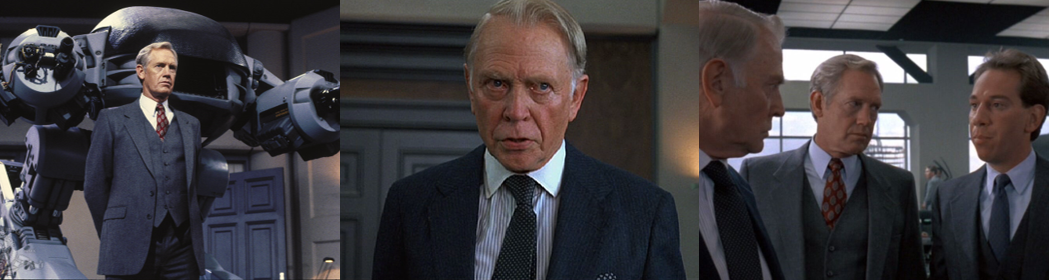
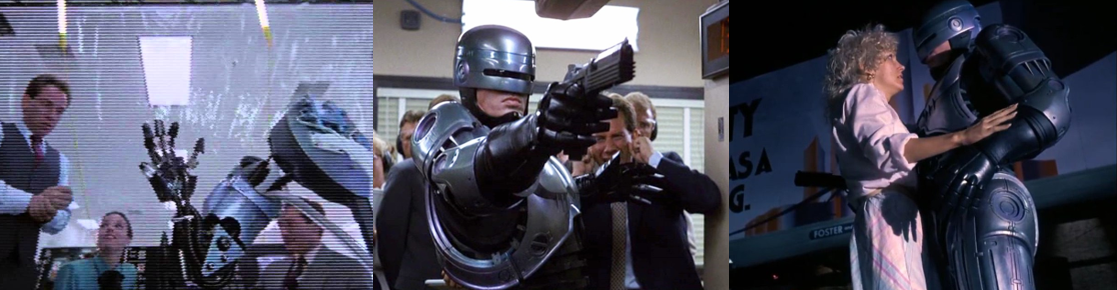
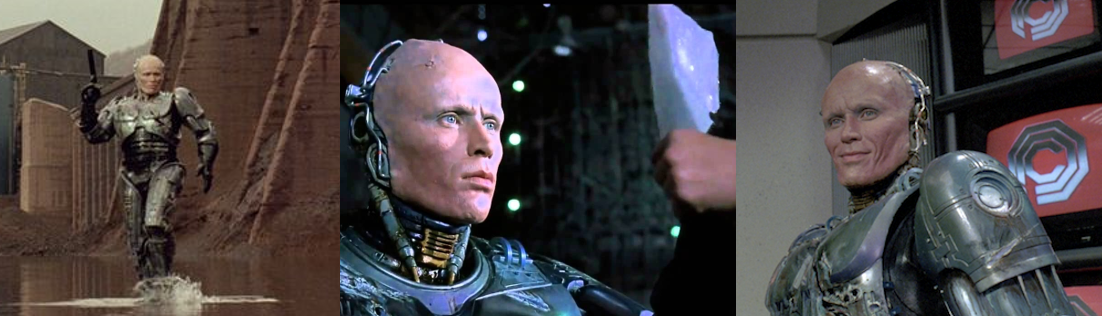
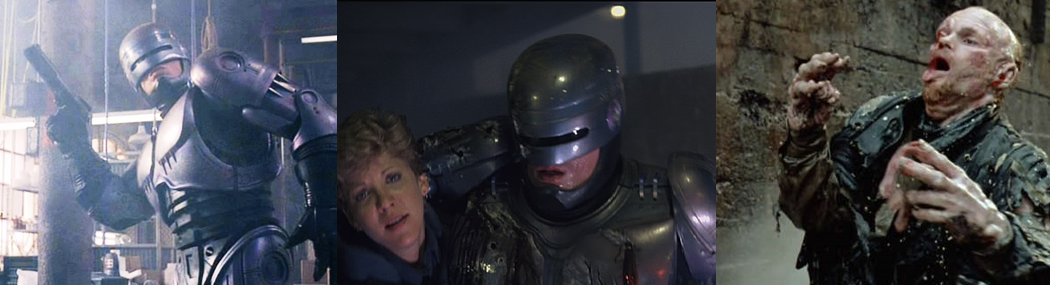
Without a doubt, RoboCop: Rogue City is the best looking RoboCop game we’ve ever had (so far, anyway). It shouldn’t be surprising given Teyon’s attention to detail in Terminator: Resistance, but the game recreates the visuals and atmosphere of the first two movies with an impressive fidelity. The game is bookended by Media Break segments hosted by Casey Wong (who also appears on various radios found throughout the game) that recapture the dark satire of the first film and the likenesses of Peter Weller, Nancy Allen, Robert DoQui, and Dan O’Herlihy bring returning characters to life. The game reminds me of Ghostbusters: The Video Game (Terminal Reality, 2009) in that it primarily evokes the first movie while acting as a follow-up to RoboCop 2 (Kershner, 1990) and a prelude to RoboCop 3. Thus, Metro West is ripped straight from the first movie (including the check-in desk, locker room, RoboCop’s maintenance area, the shooting range, and the garage) and the cops all wear the same uniforms featured in that movie. RoboCop is also modelled after his chrome silver look rather than his glistening steel blue and the game revisits key locations from the first movie, including the steel mill where Murphy was executed and the OCP headquarters, which includes the cylindrical lifts and an exact recreation of the board room. References to RoboCop 2 are included, however: players collect Nuke for XP, a standee of RoboCop 2 appears during Becker’s presentation, and the Urban Enforcement Droids (UEDs) are modelled after one of OCP’s failed RoboCop 2 experiments. This all gives the game a great deal of legitimacy as an official continuation of the original movies, something only bolstered by Weller reprising his role and little touches, such as RoboCop occasionally twirling his gun and incorporating Basil Poledouris’ iconic RoboCop theme throughout the action. While it’s great to have Weller back, though, I was a little disappointed by how…robotic…his performance was, even more than usual, as though he phoned it in a bit during the recordings.
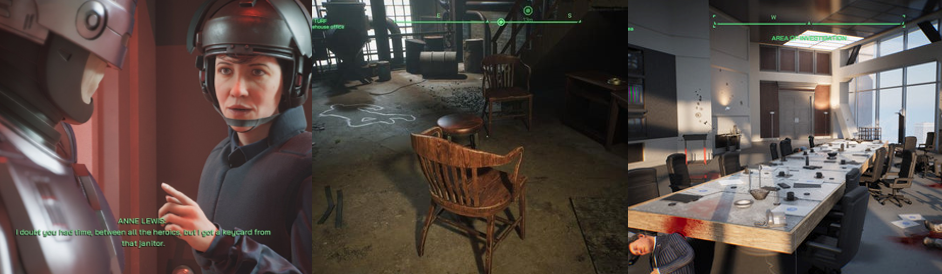
Despite some visual hiccups, the game recreates many recognisable elements in impressive detail.

When out on a mission, RoboCop finds himself on the mean streets of Detroit, a restricted sandbox-like environment with a few locations you can enter and elements you can interact with. You’ll revisit the same area multiple times, but it does change as you progress, shown in day, at night, and in the midst of a full-scale riot that sees the streets filled with punks, fires raging, and chaos everywhere. You’ll pop into a few buildings to talk to NPCs, solve crimes, or gather evidence, occasionally engaging in a violent shoot out, though most of this takes place either away from the city centre or in specific buildings, such as a hidden drug lab in the arcade. RoboCop ventures into the Channel 9 building when the “Torch Heads” hijack their broadcast, investigates the steel mill where he died (recreating the area where Murphy was gunned down and the pool where he confronted Clarence Boddicker), glitches out in an abandoned shopping mall (causing mannequins to disturbingly shift about), and assists prison guards during a chaotic riot at the city prison. When the action kicks in, you’ll find much of the environment is destructible. Glass shatters, monitors explode, and walls break apart from bullets and explosions. You can use the environment for cover (though high-calibre weapons will quickly destroy these) and blood, bodies, and evidence are scattered everywhere. Unfortunately, there are some negatives to the presentation: RoboCop has no reflection or physical model, textures tend to warp or struggle to load, and there are obvious parts where the game drags out elevator rides or dialogue exchanges to load the next part. Paradoxically, RoboCop: Rogue City impresses in the endgame when every enemy you’ve encountered (including an ED-209) roams the anarchic city streets causing chaos with no visible slowdown or performance issues.

Enemies and Bosses:
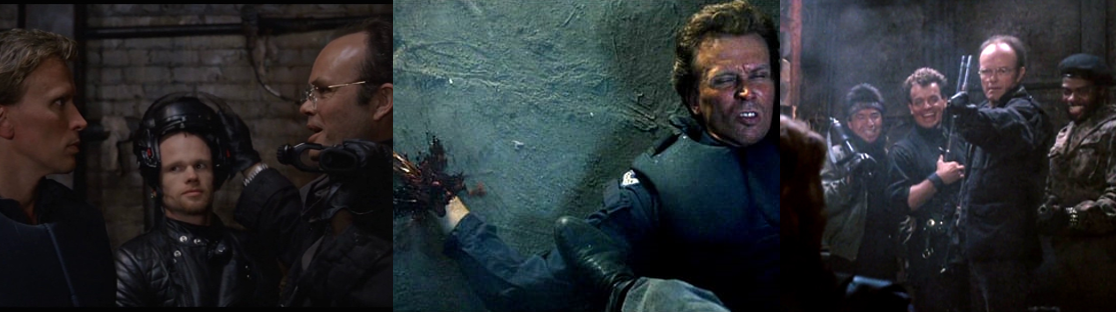
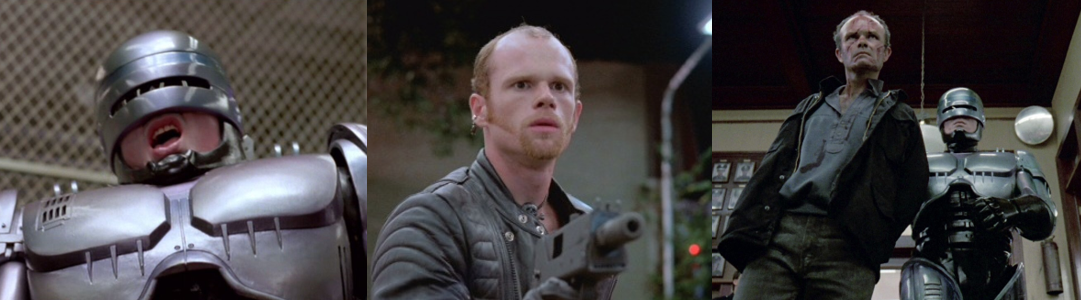
There are two main gangs in RoboCop: Rogue City: The Torch Heads and the “Street Vultures”. You’ll encounter both in different missions and gun down many of their disposable members, all of whom scream in agony when you blast off their limbs and yet never hesitate to engage RoboCop when he appears. They wield various weapons, from pistols to machine guns, which you can acquire after putting them down, and often attack in large groups in restrictive corridors. Enemies will take cover and run about, certain variants will call for backup, and many toss grenades. Luckily, you can shoot these as they’re being prepped or are in mid-air to take out large groups, but you must aim for the legs when rushed by goons in body armour and carrying sledgehammers. The Street Vultures tend to ride around on motorcycles, crashing into you and shooting at you, though you can explode their rides to thin out their numbers. The goons get a new coat of paint during the prison riot, arming themselves with shotguns and more powerful weapons, and they’ll often take hostages or assume sniping positions on rooftops. You must also watch for suicidal punks who rush you with lit gas cannisters and, as you progress, you’ll clash with Antonowsky’s more formidable mercenaries. These guys are more heavily armoured, shielding themselves from headshots and carrying stronger assault rifles, sniper rifles, and even the Cobra Assault Cannon. Bolstered by tougher commanders, these mercs can be tough to deal with in large groups as they’ll shrug off your punch and even explosions, though all the enemies you encounter are surprisingly resilient when shot. RoboCop also tangles with Becker’s UEDs, relentless cyborgs cobbled together from stolen bodies that constantly shoot out you, pour from doors, and even try to skewer you with a charge! If you blow off their heads, they’ll become confused and attack their allies, which is helpful. It’s also advisable to upgrade RoboCop’s “Engineering” skill to hack enemy turrets as they’ll catch you in a crossfire and cut you down.
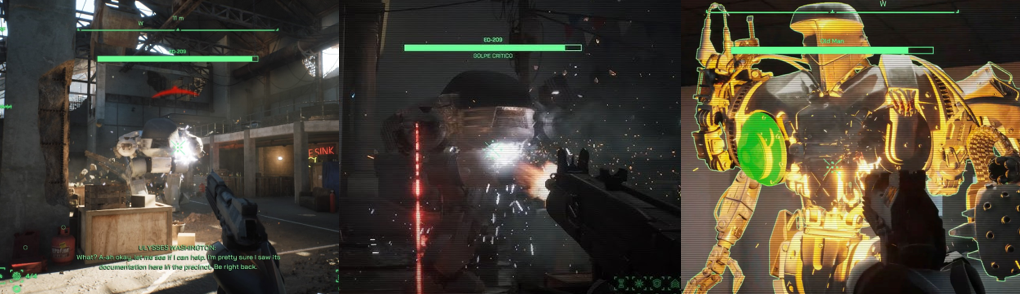
After destroying a bunch of ED-209s, players ultimately (and surprisingly) re-enact the finale of RoboCop 2.

You’ll often fend off waves of enemies, sometimes combinations of them, forcing you to think more strategically, take cover, and utilise RoboCop’s abilities to survive. Becker tests his UEDs against RoboCop, forcing you to battle waves of the inferior cyborgs in an enclosed space. You’ll also take on a legion of them when they go rogue during Becker’s EXPO presentation, with their forces bolstered by an ED-209! Later, heavily armed mercenaries and UEDs block your path to apprehending Antonowsky, and every enemy you’ve faced takes to the streets for a riot in the endgame. However, there are a handful of more traditional boss battles, with you battling ED-209 on multiple occasions. Each fight takes place in different locations but the strategy remains the same: stay on the move, grab nearby weapons and explosives to use against the machine, and take advantage of any like OCP Recovery Charges you find. ED-209 is slow and a big target but incredible powerful; it fires a machine gun arm and rockets, which you can anticipate by the laser sight, and is only vulnerable by targeting the “mouth” on its “head”. When battling ED-209 at the EXPO and on the streets, you can make short work of them with the rocket launcher and, especially, the Cobra Assault Cannon. While Antonowsky is disappointingly taken care of in a cutscene, the game ends with a surprising recreation of RoboCop 2’s finale as RoboCop battles the “Old Man”, who died earlier in the game but has his brain/consciousness implanted into RoboCop 2! RoboCop 2 is a multi-stage boss with no checkpoints between phases and is a massive difficulty spike. The only way to damage it is by targeting the Nuke cover on its chest; there are very few OCP Recovery Charges and additional weapons to aid you and the cyborg is heavily armed. It fires its machine gun attachment (smacking you clear across the room with a punch from it), fires rockets that drop the fight to lower floors, charges at you, grabs you and shoves a taser attachment in your face, and represents the game’s toughest challenge, not least because it can only be damaged in the final phase when the Old Man’s face pops out from its head.

Additional Features:
Players can snag twenty-seven Achievements in RoboCop: Rogue City, earning nine simply by completing the game as they pop when you finish each mission (and the entire game). You also get Achievements for shooting an enemy in the groin, hacking a turret, adding a chip to the Auto 9, and fully upgrading one (but not all) of RoboCop’s Skills. You must search around a bit for a couple of Achievements, which are tied to hidden rooms or require you to find a manual (or upgrade RoboCop’s “Engineering” skill) to access hidden areas. You get another Achievement for receiving an A grade, one for blowing up a moving motorbike, and another for solving a murder. Despite the game having multiple difficulty settings, there are no Achievements for clearing the game on the harder settings, so just play on “Easy” and enjoy the ride. The hardest Achievements, for me, are scoring 250 points on the shooting range (I barely hit the 200 mark) and clearing out Becker’s UEDs in under ten minutes, a mission you should be able to retry at your leisure if you can find the right save file. Clearing the game unlocks “New Game Plus”, where all your upgrades and such carry over, and “There Will be Trouble” mode that makes enemies tougher. Another playthrough is advised if you want to see the different ways the game can turn out in the end, such as who gets voted as mayor, what happens to Washington, and RoboCop’s quest for basic human rights. Otherwise, there are the nine Skills to upgrade (which probably will require multiple playthroughs) and numerous optional objectives to complete, though the only reward for this is XP to boost those same Skills.
The Summary:
Without a doubt, RoboCop: Rogue City is the best RoboCop game I’ve ever played. The first-person shooter genre is a perfect fit for RoboCop, a traditionally clunky character who doesn’t fit into the traditional action/platformer genre. Despite some struggles with loading textures and everyone resembling lifeless puppets at times, the game looks and performs really well, something only bolstered by its visual fidelity to the movies, especially the first one. I was glad to see RoboCop 2 referenced during the game as well, though I do feel the balance between the two could’ve been better, and even the teaser for RoboCop 3 as the game leads right into the start of that movie. While I would’ve liked to see better variety in RoboCop’s weapons and the ability to use his data spike as an attack, the Auto 9 was satisfying to use. Heads pop off, blood splatters everywhere, and the shooting action is fun and engaging as the environment and bosses take battle damage and you cause carnage in the pursuit of justice. Speaking of which, I enjoyed patrolling the streets and enforcing the law; though it was a bit weird seeing RoboCop’s peers as him to help with menial tasks, it tied into the overarching idea that he’s accepted as a human and fellow officer by his peers. While Wendell Antonowsky was a bit of a weak main villain and the RoboCop 2 fight came out of nowhere, I enjoyed the further exploration of RoboCop’s humanity and the different missions, both big and small, presented to the player. It’s a bit shallow at times, lacking a lot of replay value and bonus content, but RoboCop: Rogue City is a very enjoyable celebration of the first film, and the franchise overall, that finally allows players to experience what it means to be the cyborg law enforcer.

My Rating:

Rating: 4 out of 5.

Great Stuff

Did you enjoy RoboCop: Rogue City? Were you disappointed by the lack of boss battles or did you enjoy tackling the many ED-209s? What did you think to the different tasks RoboCop was asked to help with? Did you every fully upgrade RoboCop’s Skills? What did you think to the visual fidelity to the first movie? Which RoboCop movie and/or videogame is your favourite? Drop your thoughts the comments and go check out my other RoboCop reviews across the site!

Movie Night [RoboCop Day]: RoboCop (2014)


To celebrate the release of this very movie on home media, June 3rd was declared “RoboCop Day” in the city of Detroit, providing the perfect excuse to celebrate RoboCop each year.


Released: 5 November 2014
Director: José Padilha
Distributor: Sony Pictures Releasing
Budget: $100 to 130 million
Stars: Joel Kinnaman, Michael Keaton, Gary Oldman, Jackie Earle Haley, and Abbie Cornish

The Plot:
Wounded by a car bomb, top cop Alex Murphy (Kinnaman) is transformed into a cyborg enforcer, or “RoboCop”, by Doctor Dennett Norton (Oldman) in a bid for OmniCorp CEO Raymond Sellers (Keaton) to bypass governmental law forbidding him to sell his militarised technology on American soil.

The Background:
In 1987, director Paul Verhoeven took Edward Neumeier and Michael Miner’s satirical commentary on 1980s commercialisation and media and gave us RoboCop, a modest critical and commercial success. RoboCop 2 (Kershner, 1990) released to mixed reviews and a lower box office but the franchise was essentially killed off with RoboCop 3 (Dekker, 1993), a universally panned, kid friendly affront to the violent satire of the first film. While RoboCop limped along in cartoons, toys, and low budget, made-for-television affairs, talks of a remake began circulating back in 2005/2006. Darren Aronofsky was initially tapped to direct but financial concerns saw the project repeatedly stall, leading to José Padilha taking his place and desiring a new, contemporary direction for the concept. Although Michael Fassbender and Russell Crowe were courted, Joel Kinnaman won the lead and the project immediately came under scrutiny when numerous media outlets criticised the new design for the title character, which was more akin to the Bat-suit featured in the Dark Knight trilogy (Nolan, 2004 to 2007). Padilha was said to be frustrated by the project and studio interference and, though RoboCop performed surprisingly well at the box office, reviews were largely unimpressed. Judged as inferior to the original, RoboCop as criticised for its dumbed-down take and uninspired execution. Though some praised the cast and the ambition on offer, plans for a sequel were cancelled in favour of a legacy sequel, which also soon fizzled out in favour of a proposed streaming series.

The Review:
The world of RoboCop is strikingly similar to ours, like in the original movie, though set a little further in the “near future”. In this depiction of 2028, OmniCorp is making headlines with their robotic peacekeeping corps, led by tactician Rick Mattox (Haley), which have been successfully sold to and utilised by the United States military in numerous overseas ventures. Made up of drones, humanoid robots (EM-208s), and larger Enforcement Droid-209/ED-209 automations, these efficient and pragmatic robots are reported to have spared countless American lives and been instrumental in “pacifying” foreign markets. At least, this is what the extremely biased, right-wing, ultra patriot Pat Novak (Samuel L. Jackson) regularly touts on his Novak Element television show. Far from the breezy, light-hearted nature of Media Break, The Novak Element aggressively criticises Senator Hubert Dreyfus (Zach Grenier), whose bill forbids the use of drones and robots on American soil, and champions OmniCorp CEO Raymond Sellers as a “true patriot” who’s being held back from bringing the same peace and prosperity to the American people. Dreyfus’s objections are pretty simple: a robot cannot be held accountable and feels no emotion about life, and is therefore unqualified to take a life. While this is a commendable moral position to take, it is interesting, confusing, and hypocritical that Dreyfus is seemingly unconcerned about the lives taken by the EM-208s, however this is a recurring element in this version of RoboCop. Novak repeatedly shuts down any discussions that go against his pig-headed beliefs, Sellers is sold as a visionary who’s protecting America’s interests, but the primary concern of everyone (even if their opinions differ) is on safeguarding American lives and championing the United States as the greatest country in the world. However, the American public is split right down the middle when it comes to having robot peacekeepers walking their streets, largely because they (like Dreyfus) don’t agree that an automaton should have the power to end an American’s life.

Murphy’s distraught when he’s transformed into a cyborg cop to appease a greedy CEO.

Despite OmniCorp making huge profits from their overseas ventures and the prosthetic research conducted by their chief scientist, Dr. Norton, Sellers is frustrated by Dreyfus’s bill and eager to capture a majority stakehold on domestic soil. Thus, to circumnavigate the specific wording of Dreyfus’ bill, Sellers brings in Dr. Norton and Tom Pope (Jay Baruchel) and Liz Kline (Jennifer Ehle), OmniCorp’s heads of marketing and legal affairs, respectively, to cook up a new “product” by placing a man inside a machine and therefore appease concerns. Although OmniCorp have a range of critically injured candidates and amputees to choose from, Dr. Norton rejects them on the basis that they lack the psychological strength to endure what’s essentially a horrendous full body prosthesis. Lucky for them, the perfect candidate lands in their laps when driven and determined cop Alex Murphy is horrifically injured in a car bomb courtesy of notorious drug dealer Antoine Vallon (Patrick Garrow). Like in the original film, we spend a bit of time with Murphy prior to his accident to get a sense of his character and learn that he detests crooked cops and is fixated on bringing down Vallon, even if it means going against the orders of his commanding officer, Karen Dean (Marianne Jean-Baptiste). Suspecting that Vallon has eyes and ears within the Detroit police department, Murphy limits his trust to his partner, Jack Lewis (Michael K. Williams) and is devastated when their unauthorised undercover operation ends with Lewis in hospital from a gunshot. Unlike in the original film, we see Murphy interacting with his wife and son, Clara (Cornish) and son David (John Paul Ruttan), seeing that Murphy’s a doting father and still has a close relationship with Clara, even if it seems strained by his work. Clara’s thus devastated to learn of Murphy’s critical condition, which would leave him deaf, partially blind, paralysed, and maimed, and covered in severe burns. It’s therefore out of sheer love and desperation (and a little coercion from OmniCorp) that Clara consents to have Murphy transformed into a cyborg, with Dr. Norton personally overseeing Murphy’s recovery. In easily the film’s most horrific scene, Murphy is horrified to learn what he’s become and almost demands to be put out of his misery, but Dr. Norton convinces him to keep going, if only for the sake of his family.

Murphy struggles to adjust to his newfound life, which brings him much pain and heartache.

This version of RoboCop delves a lot deeper into the emotional and psychological turmoil faced by Murphy after his transformation. Stripped of 98% of his human anatomy and understandably distressed by his somewhat monstrous appearance, Murphy demands to never again be seen without his suit and battles depression, doubt, and sly persecution from Mattox, who scoffs at the idea of compromising a machine’s efficiency with organics and a conscience. Despite Dr. Norton’s pride in his work and faith in Murphy’s abilities, it turns out Mattox is right: murphy’s human instincts make him dramatically less efficient than the EM-208s. Unimpressed by what he sees as RoboCop’s “imperfections”, Sellers demands a workaround so he can sell RoboCop as a sleek, sexy, impressive product and Dr. Norton’s therefore forced to implant a new chip into Murphy’s brain. Now, when his visor goes down, RoboCop’s artificial intelligence takes over, though Murphy believes he’s in full control, thus appeasing Sellers and completely undermining the entire point of the project since it’s still a machine pulling the trigger. Then, to make matters even more laughable, Dr. Norton and his team decide the best time to upload the entire criminal database and internet access into RoboCop is right before his public unveiling, causing Murphy to have a seizure and forcing Dr. Norton to intervene again. This time, Murphy is practically lobotomized and little more than a cold, calculating machine with a human face (…and hand). Effectively reduced to the pragmatic, directive-compelled RoboCop of the first film, Murphy ignores social graces and his family in favour of hunting down Detroit’s most wanted. However, when Clara begs Murphy to come home and assuage David’s anxieties, Murphy’s human nature overrides his programming and drives him to get back on mission. Specifically, he accesses CCTV and other archives to not only uncover corruption in the police department that extends to Chief Dean, but also solve his own murder and finally bring Vallon to justice, though this defiance naturally leads him on to a collision course with OmniCorp.

While Vallon is forgettable, Sellers and Mattox are bolstered by strong performances.

Far from a scheming conglomerate full of well-dressed executives looking to profit from Detroit’s misery, the new Omni-Consumer Products (OCP) is largely embodied by Raymond Sellers. A visionary entrepreneur, Sellers is a silver-tongued salesman who arrogantly ignores focus group feedback and pushes his own agenda for RoboCop, reasoning that people don’t know what they want until they get it and that simply placing a man in a machine and removing his humanity will silence his doubters and increase OmniCorp’s profits. Played with the perfect balance of charisma, smarm, and slimy superiority, Keaton presents Sellers as an industrious and charitable businessman who’s genuinely offering people a second chance through Dr. Norton’s robotics work and safeguarding American lives with his machines. However, behind all that is a corporate magnate who cares only about increasing his already considerable wealth. He makes promises to Clara that Murphy will be returned to them and then denies her access to him, threatening legal action if she speaks out; he disregards Dr. Norton’s frankly genius work and putting a career cop inside a machine in favour of stripping away Murphy’s instincts; and doesn’t hesitate to order RoboCop’s destruction once he’s outlived his usefulness. Indeed, when Murphy regains his humanity, Sellers simply spins a story about how Murphy’s suffered a psychotic break and his machine programming has turned him into a killer, despite such a story only working against the deployment of automations in the streets! While Sellers is eventually forced to get more hands on when he basically kidnaps Clara and David, Mattox isn’t afraid to test himself and his EM-208s against RoboCop. Derogatorily referring to Murphy as “Tin Man” and openly criticising him at every turn, Mattox relishes proving his superiority over RoboCop but is ultimately and ironically, undone by Murphy’s very human ally, Lewis. I enjoyed Mattox far more than Vallon, a crime boss who’s infiltrated the police department and whose grudge against Murphy causes RoboCop’s creation. A far cry from the wicked Clarence Boddicker (Kurtwood Smith), Vallon is basically an afterthought. There’s almost no catharsis when RoboCop catches up with him and I would’ve much preferred Mattox being given an expanded role as the one who injured Murphy to kick-start Sellers’ scheme.

The Nitty-Gritty:
Though RoboCop also has a distinctly loud and on-the-nose political agenda, it focuses all its satire into Pat Novak. RoboCop comments upon America’s perceived superiority over the rest of the world, the media’s flagrant bias towards far-right thinking, and touches upon prejudices. These are largely embodied by Mattox, who’s the only one who voices criticism of RoboCop, but also extends towards the foreign nations brought under heel by OmniCorp’s technology. RoboCop has always juggled themes of “man vs. machine” and questions regarding the human soul, and these elements return in this remake, where Murphy’s adjustment to his transformation is at the forefront. Unlike in the original films, where it’s ambiguous how much of Murphy is alive or just memories in RoboCop, this film explicitly states that Murphy is still alive and functioning, just without his biological body. His brain is now partially cybernetic, giving him unprecedented access to criminal databases, CCTV, and augmenting his strength and reflexes, but he’s not a “ghost in the machine”: he’s Alex Murphy with a full body prosthesis. Thus, Murphy reluctantly agrees to test his newfound cybernetic armour against the EM-208s and to reunite with his family, though he remains incredibly self-conscious and uncomfortable with his appearance. Although this RoboCop isn’t bound by directives, he can be remotely shut down and even have his will suppressed through procedures and programming, turning him into a stoic robot who effortlessly hunts down criminals. Yet, Murphy’s humanity and emotions are powerful enough to break this programming, reasserting his personality and compelling him to avenge his woes upon Vallon and confront the corruption in the police department. Despite him callously ignoring them, Clara and David remain devoted to Murphy and are distraught by OmniCorp’s lies. Placing additional emphasis on Murphy’s family was a nice touch, though he keeps his distance even before Dr. Norton suppresses his emotions simply because he’s uncomfortable in his new body and would much prefer to be dead. It isn’t until the finale, after reaffirming his humanity, that Murphy comes to accept his new life and be more comfortable around his loved ones.

The film relies more on slick visuals and emotional drama than over-the-top gore and action.

If you’re hoping for the same action-packed gore and gleeful cussing of the original, then I’m afraid you’ll be disappointed by this distinctly toothless remake. Murphy is caught in a car bomb rather than shot to pieces and RoboCop primarily fires a high-powered taser gun rather than blowing limbs off. RoboCop’s biggest action scenes also take place either in a virtual simulation or against automatons, severely reducing the film’s body count until Lewis joins him in busting up Vallon’s operation. On the plus side, RoboCop’s suit looks fantastic. While, at times, the illusion is lost, particularly when Sellers demands a black paint job, the initial suit is an impressive modern reimagining of the original. I particularly like the futuristic visor and the depiction of RoboCop’s helmet, which was the one inconsistency in the previous films, and Kinnaman’s movement in the suit. While he’s not as stiff and robotic as Peter Weller, Kinnaman still echoes some of that performance, especially when Murphy first wakes up and acclimatises to the suit. Once the AI takes over, RoboCop moves with a beautiful, fluid grace that shows the ghost of what this film wanted to be. While RoboCop rides around on an awesome motorcycle and sports an influx of visual aids, his black suit is really unfitting and makes him look ridiculously generic. He just looks like Christian Bale’s Bruce Wayne/Batman a lot of the time, which in turn makes the suit look fake and plastic-y. RoboCop does boast some impressive visual effects, however. The EM-208s look amazing, especially marching through the streets and when sparring with RoboCop, and the prosthetics seen in Dr. Norton’s lab are really well realised. The most impressive effect is saved for the unsettling scene where Murphy sees the full extent of his injuries, which have left him simply the remains of a head, a set of lungs, and a single hand. While the ED-209s lack the personality and clunky build of the original, they’re still an impressive walking tank and it was fun to see a troop of them in action overseas, and standing in RoboCop’s way in the finale. Sadly, RoboCop plays it far too safe regarding its action, sucking out all the gory fun and replacing it with a dull pace that really causes the film to drag. It doesn’t even use Basil Poledouris’ iconic score, save for the opening titles, favouring music by Pedro Bromfman that’s as generic and forgettable as the rest of the film.

Murphy ultimately overcomes not his programming and OmniCorp’s robots to assert himself.

After Murphy’s breakdown sees Dr. Norton suppress his emotions, RoboCop becomes a hit with consumers and the public, finally giving Sellers the sway to challenge the Dreyfus Act. However, when Clara gets through to Murphy and his humanity forces its way back into the spotlight, Sellers cuts his ties with the project and orders Mattox to destroy RoboCop, ready to sell the idea that Murphy suffered a psychotic break and died from a seizure. To keep Clara from publicly criticising OmniCorp, Sellers brings her and David in to the deliver the news, confident that he’s swayed Dr. Norton by promising to further fund his research, only for the remorseful doctor to betray him, remove Mattox’s ability to shut Murphy down, and reveal the truth to Clara. While Murphy is furious at Dr. Norton for having lied to him, he forces his way past ED-209s and Mattox himself, suffering tremendous damage in the process thanks to Mattox’s superior firepower. Thanks to the intervention of his fellow officers, particularly Lewis, RoboCop reaches the rooftop, where Sellers is preparing to escape (while still playing the benevolent role with Clara and David). Unfortunately, Murphy’s programming won’t allow him to arrest or harm Sellers, who openly taunts him, threatening to kill Murphy and his family and pointing out that Murphy can’t do anything to stop him since he’s “just a robot”. Despite the incredible pain and the forcefulness of his programming, Murphy asserts enough will to fatally shoot Sellers at the same time as the devious executive shoots him. It’s a very different ending to the original, where Murphy confidently confronted OCP’s executives and asserted himself. Here, Murphys “dead or alive, you’re coming with me” line barely makes any sense and, since he’s only kept from acting because of Mattox’s special wrist bands. It might’ve been better if Clara or David had rushed Sellers to rip this from him and give Murphy the chance to fire. Regardless, Murphy is repaired and placed back in a more fitting suit, now having accepted himself and ready to embrace his newfound life. Pat Novak, however, is incensed that a “Motherf*****” like Dr. Norton is walking free after he spoke out against OmniCorp to keep the Dreyfus Act alive, though he remains adamant in his belief that America is the greatest country in the world and that, one day, her citizens will see sense and allow robots to keep the peace through good, old fashioned fascist oppression.

The Summary:
I’ve been a fan of RoboCop since I was a little kid, when I first saw the movie and was wowed by its over-the-top gore and fantastical main character. As big a fan as I am of the sequel, even I have to admit that the franchise basically peaked with the first movie and it’s been downhill ever since. Thus, I was somewhat curious when the remake was announced and went to see it opening week simply because I’d never had the chance to see a RoboCop film in the cinema before. Unfortunately, RoboCop is as disappointing now as it was back then. The thing about remakes is, you kinda need to do something different with the concept to make it stand out, otherwise it just feels like a needless rehash. RoboCop tries to do something different by focusing more on Murphy, his struggle to adapt to his new life, and his family turmoil, but it’s lost beneath a middling plot, forgettable characters, and a truly uninspired design for the character. It’s such a shame as the suit does look good and Kinnaman moves really well in it, but then they paint it black and it becomes the most generic thing I’ve ever seen. As if lacking the gratuitous violence, blood, and cursing wasn’t bad enough, RoboCop is almost completely devoid of satire save for Pat Novak and the underlying hypocrisy of OmniCorp’s motivations. Admittedly, these elements have a scary relevance in modern times, where bias right-wing media spreads fear and hatred, but all the elements that made RoboCop fun have been as stripped away as Murphy’s body. I didn’t mind the deeper dive into Murphy’s acclimation to his new abilities, but the pacing flip-flopped all over the place between his emotions (or lack thereof). It’s almost criminal how unfulfilling Murphy’s vendetta against Vallon was and how wasted Mattox was by comparison. Hayley and Keaton stole the show here, playing their roles with joyful relish, but Kinnaman is no Peter Weller and this is no RoboCop. As a standalone sci-fi concept, it’s decent enough, but it’s called RoboCop and fails to be anything but a surface level rehash of the original film, with none of the fun or enjoyable elements to make it an instant classic or anything more than a footnote in the history of sub-par remakes.

My Rating:

Rating: 2 out of 5.

Could Be Better

Did you enjoy the RoboCop remake? Were you disappointed by how toothless it was? What did you think to the focus on Murphy’s emotional struggle and his family? Did you also find the film dragged or did you enjoy the slick action? What did you think to the new suit and RoboCop having a human hand? Which RoboCop movie is your favourite? How are you celebrating RoboCop Day today? Whatever you think about the RoboCop remake, feel free to drop your thoughts below, support me on Ko-Fi, and be sure to check out my other RoboCop content!

Mini Game Corner: RoboCop 3 (Mega Drive)

Released: 1993
Developer: Digital Image Design
Also Available For: Amiga, Atari ST, Commodore 64, DOS, Game Gear, Master System, Nintendo Entertainment System (NES), Super Entertainment System (SNES), ZX Spectrum

A Brief Background:
Director Paul Verhoeven’s RoboCop (1987) proved profitable enough to earn a sequel, one that was unfairly met with mixed reviews. Both RoboCop and RoboCop 2 (Kershner, 1990) were accompanied by videogame adaptations courtesy of Ocean Software, a British developer known for adapting film and television franchises, and Data East. While RoboCop 3 (Dekker, 1993) was a critical and commercial bomb, it also received a handful of tie-in videogames. Unlike the other versions of the game, which were again published by Ocean Software, the Mega Drive version was developed by Digital Image Design, who had only one game under their belt at the time. RoboCop 3’s delayed production also meant that many played the game before seeing the movie. Not that it mattered since Orion Pictures kept the specifics of RoboCop 3’s plot a secret, so the developers had to make educated guesses based on rumours and production stills, leading to them wasting weeks of time creating motorcycle sequences that weren’t included in the movie. Although the Amiga and ZX Spectrum versions of the game have been praised for their cinematic atmosphere and gameplay mechanics, the SNES and Mega Drive versions were criticised for their unfair difficulty, uninspired environments, and crude graphics, and the game was ultimately labelled as being one of the worst videogame outings for the famous cyborg cop.

First Impressions:
Similar to the first two RoboCop arcade games, RoboCop 3 is a sidescrolling shooter with some minor platforming mechanics. Players must lug RoboCop’s notoriously bulky ass across six levels filled with street punks and robotic enemies all looking to turn him into scrap metal. Like all the best Mega Drive games, RoboCop 3 allows you to set your life count (between one and three), the amount of continues you have (between none and two), and the game’s difficult (Easy, Medium, or Hard; I opted to try out the Easy mode for this play session), but there are there’s no option to disable the in-game timer. By default, A allows you to switch between RoboCop’s different weapons (acquired from item drops during gameplay), B fires his current weapon, and C allows him to jump. These controls didn’t work for me so I took advantage of the customisation options to change them to something that actually makes sense: A to fire, B to jump, and C to change weapons. I should also note that you can hold the fire button to continuously shoot, but this will burn through your ammo pretty quickly (when you run out completely, you’re left relying on RoboCop’s weak-ass punches until you grab some ammo), and you can also shoot upwards, diagonally, and while crouching and jumping. Although the options also include a music and sound effects test, the iconic RoboCop theme is missing and, in its place, are a series of generic, cyberpunk-style rock tunes.

RoboCop is beset by tough enemies and tricky platforming sections that his bulky frame struggles with.

Although we’re treated to a big, detailed graphic of RoboCop and the RoboCop 3 logo, there’s no story graphics or even text here; we’re simply dropped right onto the streets of Detroit, which actually makes a pretty good first impression. You can see the city in the background, RoboCop’s police cruiser, dilapidated buildings (with eviction notices slapped onto them), flickering lampposts, and even signs advertising the impending arrival of Delta City. RoboCop also looks pretty good, far better than the generic and uninspiring enemies he faces, though he has no idle poses and remains an unwieldy and bulky character. You’ll need to make use of the various crates piled about to take cover and avoid incoming fire, but enemies can simply walk and shoot right through them and it’s almost impossible to avoid taking a bullet or rocket to the face as RoboCop is so chunky, meaning you’re liable to see him downed in a dramatic explosion if you’re not careful. RoboCop can pick up a couple of additional ammo types as he goes, including a helpful three-way shot and a powerful laser (that even alters his sprite to include his new gun arm attachment from the movie), and replenish his health using rare pick-ups, but you’ll have to be careful of stage hazards. Falling wrecking balls and bottomless pits are abound and RoboCop’s platforming skills leave a lot to be desired. There’s only one checkpoint in the stage, meaning you have to be really on the ball hopping to small moving platforms and taking out the bullet-sponge tanks and drones that patrol the streets and skies above.

My Progression:
I’d heard RoboCop 3 was a difficult game but I didn’t really have many expectations; I vaguely remember playing an polygonal, first-person shooter version of the game on the Amiga (I think…) and enjoying the arcade versions of the previous two adaptations, but there’s one advantage to playing games like those: emulation generally allows you infinite chances to succeed. Mega Drive games don’t always have this luxury and RoboCop 3 is one of those titles where the only cheat available is a level skip, so I decided to go into it with as much of a pure experience as I could and ended up getting quickly frustrated. I really don’t understand why developers had such a problem making RoboCop videogames back in the day; Contra (Konami, 1985) would’ve been a good source of inspiration, hell they could’ve just copied from Turrican (Factor 5/Various, 1990) and been on the right track. Instead, we got these awkward, aggravating platforming/shooter mash-ups that just didn’t work with a character as ungainly as RoboCop. RoboCop Versus The Terminator (Virgin Games USA/Various, 1994) remains the best of the bunch so far and even that game plods along thanks to how unwieldy RoboCop can be. Here, he has no chance against the barrage of enemies (with more appearing on harder difficulties) and you can’t afford to waste too much time as there’s a damn timer ticking down overhead!

Some vague movie references and a top-down shooting section help bolster the mediocre gameplay.

So, no, I didn’t even get past the first stage. With a great deal of patience and abuse of save states, I reached the first boss with full health and armed with RoboCop’s three-way shot and laser, but I stood little chance against the wave-upon-wave of rocket launcher-toting baddies since they attacked from both sides and RoboCop’s crouch is next to useless for avoiding incoming fire. I’ll admit that I kind of rushed a bit and lost patience with the game a lot faster than normal just because of how cheap some of the platforming and challenges were, but I had to tap out in the end as I just couldn’t be bothered to fight my way back to that part. It’s a bit of a shame as the game looks pretty decent; there’s a lovely, detailed graphic of RoboCop on fire and the Enforcement Droid-209 (ED-209) when you die (that even includes a voice sample) and there’s some visual promise to the game, and playthroughs of the game show that it can easily be beaten in less than fifteen minutes if you’re able to stick with it. Looking ahead, there’s more voice samples (all of them from the first movie) and RoboCop fights up and across rooftops, battles waves of Rehab mercenaries alongside a reprogrammed ED-209 (Nikko Halloran even pops in for a cameo), acquires a flame burst, and even encounters a gigantic robotic Satan in a parking garage! Other movie locations include the church (where RoboCop must find keys to open doors and fight the agile robot ninja Otomo in the sewers) and the Omni-Consumer Productions (OCP) tower, where players must defeat two Otomos to finish the game and finally earn some story text. The gameplay is even broken up by some fun-looking, bullet hell overhead shooter sections where RoboCop flies above the city streets in his jetpack blasting at demonic-looking robots and drones, but I honestly can’t be bothered to fire up this drek of a game to try and play them.

I admit that I probably didn’t give RoboCop 3 a fair shake of the stick. Since a boxed, complete version of the game can fetch quite a high price, I settled for emulating the game, but I couldn’t be bothered to hook a second controller up to my Raspberry Pi to input the level select code and I kept accidentally overwriting my save state, so I grew very frustrated with the game myself very quickly. But as I say, even when I reached the first enemy swarm that masqueraded as a boss battle, I couldn’t beat it even with full health, though I’d wager that I might be able to get a little further now that I know what to expect from the game. However, I have no desire to; there are far better similar games on the Mega Drive, the RoboCop arcade games are a much better use of your time, and there’s no way you’d ever pick this game over RoboCop Versus The Terminator. But maybe my opinion doesn’t count as I gave up too quickly. Maybe you actually enjoyed this game. Maybe there are some positives that I missed, or I just didn’t connect with it like you did. If so, I’d love to hear about it. tell me your experiences of RoboCop 3, or RoboCop games in general, in the comments and go check out my other RoboCop reviews across the site!

Movie Night [RoboCop Day]: RoboCop 3


To celebrate the release of the dismal RoboCop (Padilha, 2014) on home media, June 3rd was declared “RoboCop Day” in the city of Detroit. While that movie wasn’t too impressive and had nothing on the original RoboCop (Verhoeven, 1987), this does give us the perfect excuse to talk, and celebrate, all things RoboCop on a specific day each year.


Released: 5 November 1993
Director: Fred Dekker
Distributor: Orion Pictures / Columbia Pictures
Budget: $22 million
Stars: Robert Burke, John Castle, Remy Ryan, Bruce Locke, CCH Pounder, Jill Hennessy, and Nancy Allen

The Plot:
Cyborg law enforcer RoboCop (Burke) is torn between upholding his pre-programmed directives and assisting desperate civilians when Paul McDaggett (Castle) and his violent militia aggressively evict people on behalf of Omni Consumer Products (OCP) to begin construction of Delta City.

The Background:
In 1987, director Paul Verhoeven turned Edward Neumeier and Michael Miner’s satirical take on 1980s commercialisation and media into RoboCop. A modest critical and commercial hit, RoboCop was followed by a sequel in 1990. Unfortunately, not only was Frank Miller’s script judged “unfilmable” (though many aspects were later repurposed into a comic book and this third entry), but Irvin Kershner’s RoboCop 2 was met with mixed reviews and a reduced box office. Miller returned to write the third film and was again frustrated by the lack of influence he had on the production; he concluded that the only way to circumvent this was to become a director. Although RoboCop’s supporting cast returned for the third film (despite some reservations), star Peter Weller declined to appear in favour of joining the cast of Naked Lunch (Cronenberg, 1991). He was replaced by Robert Burke, who struggled with the impressive Robo-Suit since he was taller than his predecessor and the costume wasn’t altered to accommodate this. Although RoboCop 3 was completed by 1992, the film’s release was delayed almost an entire year due to Orion Pictures going bankrupt and to increase its odds at the box office. Consequently, not only was the plot revealed by the tie-in videogame ahead of schedule, RoboCop 3 also failed to reach $50 million at the box office. RoboCop 3 was also subjected to scathing reviews; critics targeted the film’s tone, derivative plot, and mindless narrative, and very few have anything positive to say about this toned-down entry in the series. Ironically, RoboCop continued to be marketed as a family-friendly franchise going forward and it would take over five years for anything even remotely resembling the violent satire of the original to be evoked in a new production.

The Review:
It goes without saying that RoboCop has earned its place as a classic sci-fi action flick; it’s perfect blend of social satire, gory violence, and endlessly entertaining action was expertly balanced with some top-notch special effects and a poignant message about humanity and identity. I might be alone in thinking this, but RoboCop 2 remains an under-rated entry in the franchise for me; sure, it regresses RoboCop’s character a bit and retreads some of the same narrative beats, but it’s still got that same tongue-in-cheek sense of humour and some impressive practical effects make it well worth a re-evaluation. Since both films were such a big part of my childhood, I remember being excited for a third entry and things get off to a decent enough start in RoboCop 3. Detroit is worse than ever now that OCP has finally started breaking ground on Delta City, with eviction notices being served to the poorest and most destitute areas of the city like Cadillac Heights, demolition crews flooding the streets with the homeless, and fascist ex-military Urban Rehabilitators (or “Rehabs”) forcing people from the city or simply out-right executing them.

Sporting some new toys, RoboCop protects the innocent despite being surprisingly fragile here.

When we’re first introduced to RoboCop, we’re once again back to square one. While RoboCop still retains some aspects of his former personality and exhibits human compulsions such as loyalty and independence, he’s still bound by his four Prime Directives and subject to the whims of his creators. He’s packing some new toys this time around, most prominently his new arm cannon that lets him blast perps with a machine gun, fire rockets, and blast out a flamethrower, but he later also makes use of a prototype flight pack that also doubles as a recharge point for him. All these bells and whistles are great, but they don’t make up for the fact that Peter Weller has been replaced by the far less capable Robert Burke. Burke does a decent job emulating Weller’s performance but it’s just not the same, especially in his stilted delivery. While RoboCop is tended to by newcomer Doctor Marie Lazarus (Hennessy), his independence riles up the OCP’s newest representative, Jeffrey Fleck (Bradley Whitford), a leering, slimy corporate stooge who’s so frustrated by RoboCop’s humanity that he orders his emotions be circumvented with a special chip. Luckily, Dr. Lazarus recognises that RoboCop’s instincts and Murphy’s lingering personality are essential to the cyborg’s humanity and destroys the chip, allowing RoboCop to continue his duties. This does, however, bring him into further conflict with OCP’s more totalitarian methods; the Rehabs conflict with RoboCop’s Prime Directives but, in the end, his morals and humanity win out and he chooses to defend the helpless and homeless from McDaggett, a choice that leaves him severely damaged and branded a murderous fugitive by OCP’s PR team. RoboCop ends up in a hell of a state; a single blast from McDaggett’s grenade launcher is enough to almost do him in and leaves him in the struggling hands of the city’s destitute, who are led by feisty and outspoken Bertha (Pounder).

Although his partner dies, RoboCop is supported by some new allies, including an affectionate little girl.

Things don’t go so well for Robo’s long-time friend and partner, Anne Lewis (Allen). Both Dr. Lazarus and Lewis care for RoboCop; they’re the closest things he has to friends and can tell that he’s clearly conflicted regarding OCP’s “urban rehabilitation” project, which brings up painful memories of his former wife and child. Although she’s able to hold her own against the “splatter punks” at the start of the film, Lewis makes the rookie mistake of forgetting her body armour when she rushes to help RoboCop track down the resistance. Out of loyalty to her partner and seeing the state of the displaced residents of Cadillac Heights, Lewis joins RoboCop in opposing McDaggett and is summarily gunned down for her troubles, dying in RoboCop’s arms. Though he inexplicably forgets this promise to avenge her, RoboCop immediately storms the Rehab base after being repaired by Dr. Lazarus, unopposed by Sergeant Warren Reed (Robert DoQui) and his fellow officers despite the warrant for his arrest, to confront McDaggett, only to learn that Coontz (Stephen Root), a disgruntled member of Bertha’s resistance, has sold them out to McDaggett. RoboCop arrives too late to help, leaving Bertha and most of her followers dead, and both Dr. Lazarus and young orphan girl Nikko Halloran (Ryan) taken as hostages. Yes, inexplicably RoboCop, the all-action cyborg who made his name blasting would-be rapists in the dick, is saddled with a bright-eyed kid who’s conveniently a genius hacker capable of reprogramming an Enforcement Droid-209 (ED-209) and who helps RoboCop rekindle his paternal instincts. After being separated from her parents, who are subsequently executed, Nikko is taken in by Bertha and the resistance and encourages them to shelter RoboCop after he’s damaged defending them. Although they’re woefully under-equipped, outgunned, and forced to hide out in the sewers, the resistance is surprisingly capable; they boobytrap manholes to keep out unwanted visitors, use gadgets to change traffic lights and cover their escape, and it only takes about four of them to carry RoboCop into their hidden base whereas it took a dozen or so men in the last film. Although Nikko is a tech-savvy Robo fan and Moreno (Daniel von Bargen) repairs RoboCop’s body work, the resistance have no hope of repairing the cyborg so Nikko goes to Dr. Lazarus for help.

Desperate to get Delta City underway, the CEO turns to the ruthless McDaggett and the Kanemitsu Corporation.

Although OCP are making major progress preparing Detroit for aggressive renovation, the malevolent company is deep in the red; close to bankruptcy and being bought out by the Japan-based Kanemitsu Corporation, the new OCP Chief Executive Officer (CEO) (Rip Torn) and returning aide Donald Johnson (Felton Perry) have no choice but to rely on McDaggett and his Rehabs. Thanks to OCP controlling the media, the Rehabs are sold as a gentle, peacekeeping force who have people’s best interest at heart but the truth couldn’t be more different. McDaggett and his mercenaries are cruel and violent and tear through Cadillac Heights like a bull in a China shop. McDaggett is easily the best part of the film, chewing the scenery at every opportunity, calling everybody “chum” with a snarky sneer, ruthlessly waging war against the destitute civilians, and exhibiting an open prejudice against RoboCop and the idea of him being assigned to the Rehabs. When Nikko broadcasts the truth about McDaggett to the world, OCP’s stock plunges and, unwilling to shoulder the blame or listen to the CEO’s blustering threats, McDaggett plots to recruit the city’s police force in stamping out the resistance once and for all. However, when Reed and the other cops give up their badges and pensions rather than compromise their moral integrity, McDaggett is just as happy to arm the splatter punks, leading to an all-out war on the streets pitting the cops and the resistance against McDaggett’s forces. Unable to make good on their debts and promises, OCP lose all favour with the Kanemitsu Corporation, who send their unnervingly human “Otomo” androids (Locke) to make up for the CEO’s blunders. As you might expect from Japanese-manufactured product, the Otomos are far more versatile and capable than RoboCop, who looks like a tinker toy in comparison. Although silent and stoic, the Otomos are not only more outwardly human (one even smokes!) but they’re more agile, adaptable, and mobile, meaning they’re easily able to best RoboCop in combat and re-endanger his life with just a few blows and only losing out to him due to Robo packing superior firepower.

The Nitty-Gritty:
RoboCop 3 once again retreads the same ground as the last two movies when it comes to RoboCop’s story arc. Still lacking the fully human personality he fought so hard to regain at the end of the first film, RoboCop is again portrayed as struggling to discover and showcase his humanity due to his stringent programming and directives. Although it’s been very well established that he’s just as human as he is a machine, and everyone in the precinct openly and affectionately refers to him as “Murphy”, RoboCop’s emotions are again questioned by OCP, who seek to suppress them to make him a cold, calculating machine. More than ever before, RoboCop openly defies his creators despite the conflict this causes his system; perhaps it’s his defiance of Directive Four (“Never oppose an OCP officer”) which explains why RoboCop is so damn weak in this film. It seems he’s constantly on the brink of death and is easily disabled by shots he would previously shrug off, though this frustrating element does add to his vulnerability as a character. This is further emphasised in his empathy for the resistance, particularly Nikko, who forms a fast bond with RoboCop out of sheer awe (she is a proper techno-geek, after all) and he awkwardly rediscovers his former paternal instincts through his relationship with her. Again, it ties into an exploration of RoboCop’s vulnerable humanity (and is certainly less questionable that the weird sequence where Dr Lazarus purges RoboCop’s Prime Directives…again…and it seems to imply he has romantic feelings for the women in his life) but it just doesn’t fit the tone of the franchise. Maybe the filmmakers wanted to appeal to the little kids who had inexplicably latched onto the character, maybe they wanted to emulate Terminator 2: Judgment Day (Cameron, 1991) but, whatever their reasons, all they ended up doing was subjecting audiences to an annoying little brat who’s too smart for her own good.

Despite some ambitious ideas, RoboCop 3 fails to impress with its toothless violence and weak effects.

And it’s a shame as RoboCop 3 has a few redeemable elements to it. Basil Poledouris returns with his rousing score and the suit looks better than ever, especially RoboCop’s fancy new arm attachment that he sadly doesn’t use often enough (probably because it’s ridiculously overpowered and that doesn’t fit the theme of the movie for fragile old RoboCop). The city is even more dangerous and depressing as ever; described as a “warzone”, riots and violence run rampant from all sides, leading to the police department and oppressed citizens joining forces to fight back against the tyrannical OCP. While the film definitely veers more towards family friendly content, RoboCop 3 continues to be violent and full of social satire; in this case, it’s a commentary on how big corporations can control the media to twist the narrative in their favour and the juxtaposition of the Rehabs’ squeaky-clean public face with the brutal reality of their actions. This is best evidenced not just in the returning Media Break sections but also in the amusing animated advertisement for “Johnny Rehab” apparel that seems to be a commentary on R-rated movies like RoboCop being sold to children as toys. Although ED-209 makes a reappearance here, it’s little more than a cameo that further demeans the unreliable ‘droid and we’re denied a rematch between it and RoboCop. Thanks to spending most of the movie close to death, RoboCop can’t simply gun down his enemies like usual, meaning anticipation is high for his battle against Otomo. Unfortunately, as great and under-rated as Bruce Locke is, this fight is hampered by the slow, sluggish RoboCop, who lacks the reflexes and range of movement necessary to match his faster, more competent rival. Luckily for RoboCop, the Otomos prove as weak as he is in this movie and are easily dispatched, but these fights are definitely a far cry from the cyborg-on-cyborg action from the aforementioned Terminator 2. RoboCop 3 tries to make up for it with RoboCop’s new jet-pack attachment, which allows him to swoop in and save the day in the final act, but sadly this only appears very briefly and the composite effect used to bring it to the screen is pretty poor, which is a shame considering how cool the idea of a flying RoboCop is and how good the fire stunt on RoboCop was in the opening scenes.

After aiding his allies, RoboCop rescues his friends and OCP is finally brought to its knees.

After being slandered in the media, RoboCop is branded a fugitive, allowing McDaggett to fulfil his ambition of destroying the cyborg officer, which both he and the CEO believes will dishearten the resistance and allow them to sweep through Cadillac Heights and salvage their reputation. When Johnson suggests recruiting the city’s cops to join the effort, Reed and the others walk out and add their numbers to the resistance, co-ordinating the rag-tag rebels in standing against the Rehabs and the crazed splatter punks. Although RoboCop loses his chance at nailing McDaggett following a comical car chase in a pimped out lowrider, McDaggatt gets the last laugh by massacring the resistance base and even betrays the CEO after colluding with Kanemitsu (Mako) to level Cadillac Heights to make room for their own designs for the city. After barely besting Otomo and levelling the playing field for the cops and resistance, RoboCop storms into the OCP tower to confront McDaggett. Though two Otomos attack him, Nikko is able to reprogram the two androids into targeting each other using her magic laptop. Despite him having gone “war wacky” and craving all-out conflict, McDaggett is incensed by this as the Otomos are rigged to self-destruct, spelling doom for everyone in the tower. Luckily, RoboCop latches onto his jet-pack and flies Dr. Lazarus and Nikko to safety, leaving McDaggett and everyone in the building to perish in the blast. In the aftermath, a humbled Kanemitsu bows to RoboCop out of respect and summarily fires the CEO for his incompetence since OCP’s stock is in the toilet and RoboCop resolves to return to duty policing the streets, now once again free from his restrictive Prime Directives and able to think for himself.

The Summary:
How the mighty have fallen! RoboCop 3 is such a massive disappointment because it comes so close to being a halfway decent entry in the franchise but fumbles its execution in almost every way possible. The score is back, the suit still looks amazing, and I really enjoy RoboCop’s new toys and gadgets, but the man in the suit is an uninspiring void who tries far too hard to emulate Peter Weller’s incomparable performance rather than putting his own stamp on the iconic cyborg. I enjoy the central premise of the film, which sees a desperate OCP using all their resources (and brutal violence) to speed up their development plans for Detroit, but any intrigue this plot may have is quashed by some strange attempts at humour. RoboCop 3 feels like a pale imitation of the previous films; it tries to be comparably violent but it’s a toothless execution, and any attempts at satire and social commentary land flat as it feels like everyone’s just phoning it in. It’s a shame as Lewis’s death is actually quite emotional, but the new cast just isn’t as inspiring or memorable; Nikko, especially, stands out as a particularly grating inclusion, one that showed just how far the franchise had fallen into impotency since the uncompromising first film. There is some decent action and special effects sequences, but they’re juxtaposed with RoboCop’s clunky ineffectiveness in a straight-up fight and some awful composite effects that really have me longing for the stop-motion techniques of the last two films. One saving grace is John Castle, who really hams it up as the despicable McDaggett, but even his performance can’t excuse Rip Torn’s bombastic turn as the CEO, which lacks any of the subtlety we saw from previous OCP executives. Ultimately, RoboCop 3 is a film geared more towards kids and young teenagers, those who aren’t quite old enough to watch the first two films but want to dip their toe in the franchise. Even so, I’d recommend simply waiting until they’re old enough to watch the first movie, or bite the bullet and show them that film ahead of time, and just skip this one completely as there’s very little on offer here beyond RoboCop’s new toys.

My Rating:

Rating: 1 out of 5.

Terrible

Did you enjoy RoboCop 3? Were you disappointed by the more toothless approach the film took? What did you think to RoboCop opposing his creators to defend the city’s oppressed citizens? Were you also annoyed to see him partner with a child? What did you think to the Otomos and RoboCop’s new toys? Which RoboCop movie is your favourite? How are you celebrating RoboCop Day today? Whatever you think about RoboCop 3, feel free to drop your thoughts below or leave a comment on my social media and be sure to check out my other RoboCop content!

Game Corner: RoboCop 2 (Arcade)

This review has been supported by Chiara Cooper.
If you’d like to support the site, you can do so at my Ko-Fi page.

GameCorner

Released: 1991
Developer: Data East
Also Available For: Amiga, Amstrad GX4000, Atari ST, Commodore 64, Game Boy, Nintendo Entertainment System (NES), ZX Spectrum

The Background:
In 1987, director Paul Verhoeven brought us RoboCop, a delightfully over-the-top sci-fi classic punctuated by copious amounts of gore and offering a tongue-in-cheek analysis of corporations and the media. The film was profitable enough to earn a sequel, which faced a tumultuous production, grossed noticeably less at the box office, and was met with mixed reviews. Regardless, RoboCop 2 (Kershner, 1990) remains an under-rated film in my opinion and, like its predecessor, was followed by comic books and a videogame adaptation publisher by Ocean Software, a British company known for making videogame adaptations of numerous film and television franchises, and developed by Data East, a Japanese arcade developer. The game saw the return of numerous gameplay mechanics from its predecessor, and was also released on multiple platforms, with some notable differences being present in the Japanese arcade release. While the Amiga port was praised for its presentation and the ZX Spectrum version was lauded for its replayability, the arcade version was criticised as being unoriginal and graphically inferior to its predecessor.

The Plot:
Detroit is being over-run by gangs, crime, and corruption thanks to the machinations of Omni-Consumer Products (OCP) and only cybernetic police officer RoboCop can hope to maintain law and order on the city streets.

Gameplay:
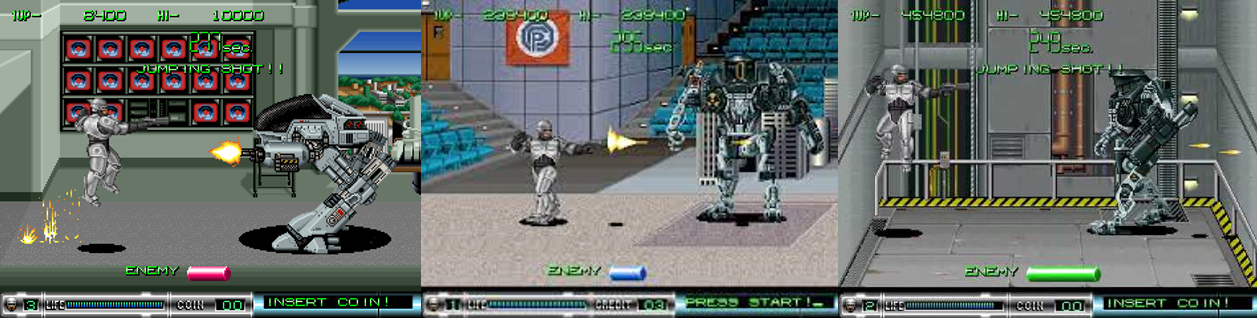
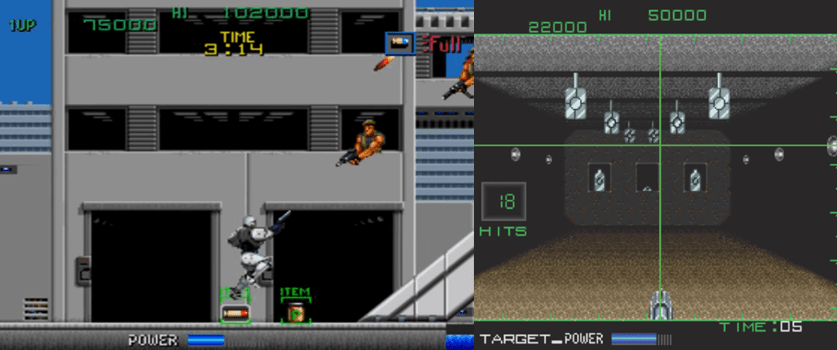
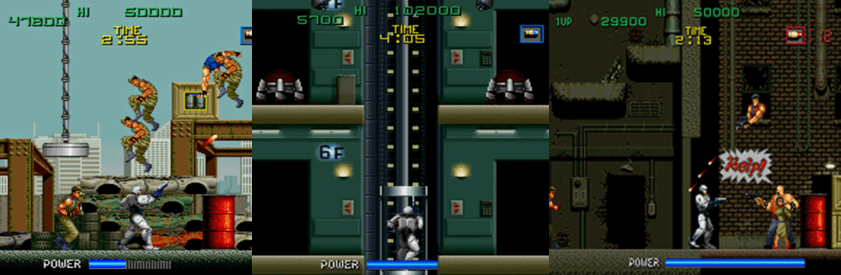
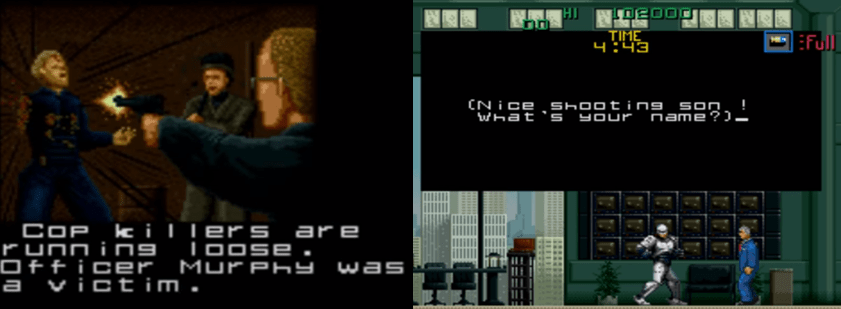
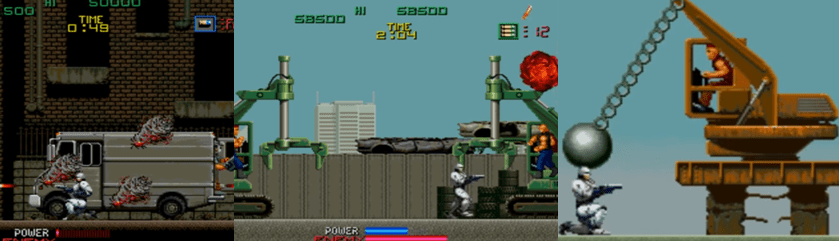
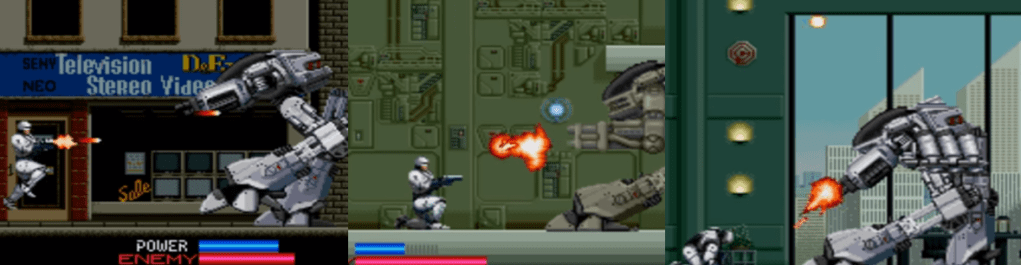
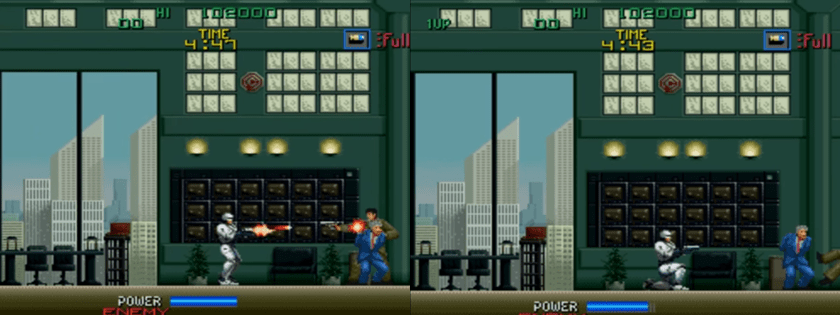
Like its predecessor, RoboCop 2 is a 2D, sidescrolling action shoot-‘em-up in which players once again assume control of Alex Murphy, cybernetic police officer RoboCop, and are tasked with cleaning up the streets of Detroit. Much like every RoboCop title I’ve ever played, RoboCop remains a sluggish, clunky, and awkward playable character. The controls couldn’t be simpler; you move RoboCop left and right with the joystick and can fire his iconic Auto 9 either directly ahead or directly behind him, allowing you to blast at enemies quickly and efficiently (though I did have some trouble remembering which button corresponded to which direction, and you can’t just hold down the fire button like in other run-and-gun games). RoboCop can’t duck but he can still haul his metal butt into the air to jump; thankfully, you won’t be required to do any kind of platforming and this is purely to allow you to hit certain bosses in their weak point with a “Jumping Shot” since you can’t aim your Auto 9 in any direction but the one you’re facing.

RoboCop must blast away thugs both horizontally and vertically, and chase them down on his bike.

You’ll have to contend with quite a few onscreen enemies at once, as well as a time limit, but each credit you enter will give you two lives and RoboCop is far more durable this time around. When enemies get up close, RoboCop will unleash a few piston-like punches and toss them away, which is super useful not just for clearing enemies off you but also dealing damage as enemies can take quite a few shots before going down but seem weaker to your melee attacks. You won’t really have to worry about anything except battling your way ever onwards, no matter how different the environment around you gets; you’ll occasionally get to fire at barrels or crates for power-ups or smash through pipes and doors, but I found these often just blinked out of existence rather than exploding. Gameplay is mixed up a little bit with a brief instance where you must frantically mash the fire button and waggle the joystick to overpower a car and, more consistently, when the perspective shifts to a vertical shooter and you have to pick off goons when they pop out from behind columns like a shooting range and in first-person bonus stages where you’re riding on a motorcycle or in a car for a bit of rail shooting.

Graphics and Sound:
One area where RoboCop really takes a hit is in the sprite work; sure, RoboCop and the enemies he encounters are much bigger and more detailed than in the last game, but they’re lacking in personality and animations. There might be a few voice samples from the films included but RoboCop doesn’t have an idle animation anymore; he just stands there like a statue until you get him plodding along. He’ll twirl and holster his Auto 9 after clearing a stage, which is all very well and good but, ironically, he only seems at his most alive when he’s being knocked down or killed. He scrambles to his feet and is rendered a smouldering mess of limbs upon death, which is a nice touch, but sadly this kind of detail is missing from his active sprite.

Sprites and environments are big, detailed, and accurate but lack animation and personality at times.

Thankfully, the recognisable bosses and areas from the movies fare much better in this respect; you start off on the graffiti-stained wreckage of the Detroit streets, passing behind wrecked cars and battling through the arcade past arcade machines and an air hockey table and into the Nuke production factory, and eventually end up at the OCP building. Like the gun shop and the Nuke factory, this area is ripped straight from the movie (it even has the little model of Delta City in the background) and you’ll battle through its hallways, up a lift, and fall from the rooftop to the streets below just like in the movie’s finale. Various pixelated shots from the movie are incorporated into the game’s opening sequence and the title screen, though the ending is related using only simple text; however, if you’re playing the Japanese version of the game, you’ll be treated to a pixel-art recreation of the first film that plays before and during a whole new opening stage that recreates RoboCop’s showdown at OCP headquarters from the end of that movie.

Enemies and Bosses:
Detroit’s finest scumbags are out in force in RoboCop 2; these mohawk-wearing punks initially attack with knives and guns but are soon busting out axes and large mallets to pummel you with. They’ll also race around on motorcycles, sport some nifty karate moves, and whip out heavier ordinance when you reach the gun shop. Soon, you’ll match wits with OCPs security droids, have arcade machines tossed at you, and be shot at by laser rifles and rocket launchers. Punks will also take shots at you from the backs of vans and from helicopters in the rail shooter sections, and you’ll find the enemies get mixed and matched as you reach the end of the game.

Despite Cain having a gang of thugs in the movie, they don’t really show up as the game’s bosses.

Each stage ends in a boss battle that’s made all the more tedious by the fact that each once can absorb a great deal of damage before being put down. Even the first stage boss, which is just a frog-footed motorcycle thug swinging a chainsaw around, doesn’t go down easy, and things quickly escalate when you come across a goon in a mechanised suit. This bugger flies around dropping mines everywhere and blasting at you with a machine gun and missile launcher, and even crops up again later in the game for a rematch; be sure to shoot at the pilot when he ejects, if only for a bit of catharsis. In the Nuke factory, you’ll encounter some mutated enemies clearly inspired by the first film’s “Melting Man” effect, and even battle a monstrous version of Catzo after dunking him in a vat of the stuff. You’ll also have to contend with a massive hopping cannon than leaps about the place blasting at you with its main weapon, tosses grenades at your head, and fires a machine gun at you. While you won’t take damage if you touch it and the main cannon can be put out of commission, it’ll become more erratic and aggressive when near defeat.

Battle ED-209 and then take on your would-be replacement in a multi-stage battle!
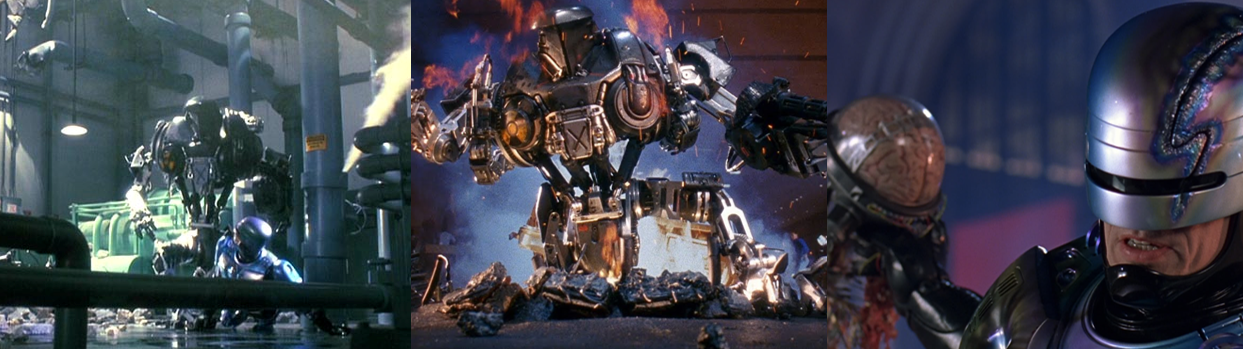
When you get to the OCP building, you’ll finally face off against one of the franchise’s most memorable foes, the Enforcement Droid 209/ED-209. Of course, you initially battle against this in the prelude in the Japanese version, but both battles are the same; you must avoid ED-209’s machine gun fire and missiles and shoot at its big domed head with your jumping shot. This is all you really need to worry about as ED-209 doesn’t really move that much or have other attacks but, while you’ll employ the same strategy against RoboCain, you’ll find this final boss much more formidable and mobile. First, the battle against RoboCain takes place over three phases; in each phase, RoboCain gains more health and adds additional attacks to its arsenal. At first, RoboCain plods about blasting at you with its machine gun arm and swiping at you with its metallic talon, then it gains its extending arm attack and flails its arms around like a whirlwind, and then it attacks with its electrical claw up close and fries homing missiles at you. When you crash to the ground outside the OCP building, RoboCain will lose some of its armaments the more your pour on the attacks, eventually crumbling to its knees and leaving itself wide open for RoboCop to rip its brain out and end its threat once and for all.

Power-Ups and Bonuses:
Health is extremely scarce in RoboCop 2, but you can occasionally grab pills to refill your health bar. Your main in-game upgrade, however, will be the additional, extremely temporary weapons you can grab here and there as you battle through each stage. You can grab such state-of-the-art bang-bangs as the Cobra Assault Cannon, a mini gun, and a bazooka, all of which deal heavy damage but are only good for a few shots before you lose them, which is extremely disappointing.

Additional Features:
Your main reason to replay RoboCop 2 will, of course, be to beat your high score. However, the game can be played in two-player co-operative mode, with player two taking control of a blue chromed RoboCop for twice the action. As mentioned, the Japanese version also features an additional opening stage so it’s probably best to play that version of the game so you can wring a little more game time out of it.

The Summary:
RoboCop 2 is very similar to its predecessor in a lot of ways; it remains a simplistic, action-packing shoot-‘em-up with a little variety thanks to the first-person and vertical shooter sections. While RoboCop is far more durable this time around, so are his enemies and, although there’s far less onscreen hazards to have to worry about, RoboCop remains as unwieldy as ever. The game features some nice big, detailed sprites and environments that are ripped straight from the movie, but the lack of personality and animation frames makes it all the clunkier to play. It’s a decent enough way to spend about forty minutes of your life, but it really doesn’t bring anything new to the table and is, in a way, a little less appealing than the first game due to the lack of enemy variety and entertaining action sequences. RoboCop 2 just about saves itself with an impressive amount of attention to detail, especially in recreating the brawl between RoboCop and RoboCain, and the additions found in the Japanese version absolutely make that the definitive version of this game, but you’re not really missing out on much if you skip this one or only play about ten minutes of it.

My Rating:

Rating: 3 out of 5.

Pretty Good

Did you ever play RoboCop 2 in an arcade? Which RoboCop videogame is your favourite? Would you like to see a new RoboCop game; if so, what genre do you think would best fit the source material? Which RoboCop movie is your favourite? Either way, leave your thoughts about RoboCop 2 below, or drop a comment on my social media.

Movie Night [RoboCop Day]: RoboCop 2


To celebrate the release of the dismal RoboCop (Padilha, 2014) on home media, June 3rd was declared “RoboCop Day” in the city of Detroit. While that movie wasn’t too impressive and had nothing on the original RoboCop (Verhoeven, 1987), this does give us the perfect excuse to talk, and celebrate, all things RoboCop on a specific day each year.


This review has been supported by Chiara Cooper.
If you’d like to support the site, you can do so at my Ko-Fi page.

Released: 22 June 1990
Director: Irvin Kershner
Distributor:
Orion Pictures
Budget:
$20 to 30 million
Stars:
Peter Weller, Nancy Allen, Tom Noonan, Belinda Bauer, Gabriel Damon, and Daniel O’Herlihy

The Plot:
Former police officer-turned-cyborg law enforcer RoboCop (Weller) becomes embroiled in a scheme by Omni Consumer Products (OCP) to bankrupt and take over the city. Faced with an identity crisis, and interference by psychologist Doctor Juliette Faxx (Bauer), RoboCop also comes into conflict with a vicious gang of drug dealers, led by zealot Cain (Noonan), who are spreading a highly addictive drug throughout the city.

The Background:
In 1987, Edward Neumeier and Michael Miner crafted a satirical take on 1980s commercialisation and media that director Paul Verhoeven turned into RoboCop. A modest hit, RoboCop was met with generally positive reviews and the studio urged Neumeier and Miner to pen a sequel. Unfortunately, mounting deadlines, a writer’s strike, and a breach of contract meant that their tentative plans to have RoboCop battle the complex, satirical politics of the future in RoboCop 2: The Corporate Wars never came to pass. Instead, writing duties passed to noted comic book writer Frank Miller. Unfortunately, the gritty violence and scope of Miller’s script was deemed “unfilmable”, though he would cameo in the film and later turn his rejected ideas into a comic book. RoboCop 2’s production continued to be stressful. Producer Jon Davison was already against the idea of sequels, and struggled to secure a director for the project since Verhoeven was busy making Total Recall (ibid, 1990). The studio announced a release date before the story was completed, resulting in a rushed filming schedule. Even star Peter Weller was reluctant to return and critical of the script, but reportedly enjoyed the shoot and praised the director’s drive and enthusiasm. Both special-effects guru Phil Tippett and suit designer Rob Bottin returned to work on the sequel; Bottin gave the suit a sleek new colour scheme and made it much easier to put on and take off, drastically reducing Weller’s time in the make-up chair. RoboCop’s cybernetic antagonist was brought to life using tried-and-tested special-effects techniques such as animatronics, miniatures, and painstaking stop-motion; RoboCain even exuded emotion thanks to a rudimentary computer-generated face. Despite RoboCop infamously making an appearance at World Championship Wrestling’s (WCW) Capital Combat pay-per-view to promote the film, RoboCop 2’s worldwide gross of $45.7 million was noticeably less than its predecessor, and the film was met with mixed reviews. While some praised its allusions to classic sci-fi and horror classics and (like myself) consider it an under-rated entry, critics bemoaned its redundant plot, excessiveness, and the depiction of a child as a violent drug lord. Still, we did get the aforementioned comic book detailed Miller’s rejected ideas, a videogame adaptation, and (eventually) a third film that was way, way worse in almost every aspect.

The Review:
Picking up about a year after the first film, the first thing you might notice about RoboCop 2 is that RoboCop himself has taken a bit of a step back. In the first film, the bulk of the narrative was focused on RoboCop regaining his memories and his humanity, evolving from a preprogramed tool of the malevolent OCP and reclaiming his status as a free-thinking human. However, in RoboCop 2, much of his stoic, robotic demeanour has returned to the forefront; his partner and friend, officer Anne Lewis (Allen), still affectionately refers to him as “Murphy” and he continues to exhibit a modicum of personality in the way he confronts and addresses others, but it’s like he’s been factory reset to where he was about mid-way through RoboCop rather than being the confident, free-minded Murphy we saw at the conclusion of the last film. Haunted by Murphy’s feelings and memories, RoboCop has taken to passing by the home of his former wife and child, Ellen (Angie Bolling) and Jimmy (Clinton Austin Shirley), presumably out of the temptation to reveal himself to them, which results in Ellen being so emotionally tormented that she’s filing a lawsuit against OCP. Despite being fully accepted by Lewis, Sergeant Reed (Robert DoQui), and his fellow officers, all of whom treat him as Murphy reborn, OCP force (basically bullied) RoboCop into admitting that he’s unable to provide for his former family as a man and is “simply a machine”.

Still struggling with his humanity, RoboCop battles drug baron Cain, who’s transformed into a hulking cyborg!
Clearly heartbroken at having to admit this, he’s left with no choice but to lie to Ellen in order to spare her further grief and get OCP lawyer Holzang (Jeff McCarthy) off his back yet, despite his continuing struggles with his humanity, RoboCop continues to maintain order on the streets practically single-handedly. With the majority of the city’s cops on strike, RoboCop, Lewis, and a handful of uniformed officers find themselves continuously outnumbered and outgunned out on the violent city streets. Much of the violence is attributed to the spread of a highly addictive drug known as Nuke, which is manufactured and spread by the messianic Cain and his devoted followers (whom he refers to as his “flock”). Rather than simply being a gang of thugs and street punks, Cain’s inner circle is more like a cult; they hang on Cain’s every word, revere him as a leader and a father-figure, and are absolutely hooked on the “paradise” offered by Nuke. Cain is an enigmatic and alluring figure with a twisted sense of patriotism who exudes a subtle menace and showcases a sadistic streak when he’s wronged by others. Although he’s generally far more hands-off compared to Clarence Boddicker (Kurtwood Smith), he clearly takes a perverse pleasure in overseeing the torture, dismemberment, and punishment of his enemies and even forces Hob to observe this without filter. However, Cain gets a leg up on his predecessor when he’s subjected to the RoboCop 2 program after being critically injured by RoboCop. Although he doesn’t consent to this procedure, conniving psychologist Julia Faxx is completely on the money with her evaluation that Cain’s twisted mind makes him a perfect candidate to mentally survive the trauma of literally having his brain ripped from his body and placed into a massive mechanical, tank-like cybernetic body commonly dubbed “RoboCain”.

Hob usurps Cain’s position and plans to pay off the bankrupt city to spread his drugs unopposed.

Indeed, RoboCop 2 has a stringent anti-drug message as the super addictive Nuke is so sought after that Cain and his lead scientist, Frank (Frank Miller), produce it in vast quantities. Interestingly, though, very little time is spent explaining what Nuke’s effects (or side-effects) are; Cain suffers some unsettling effects as a result of a mix-up in the ingredients of the “Blue Velvet” variant, and users are said suffer painful withdrawal symptoms but it doesn’t seem to cause hallucinations or manic episodes. Instead, Nuke seems to induce a state of euphoria that becomes incredibly addictive to the user and people are literally fighting each other in the streets to fund their habit. Not that I’m saying it isn’t dangerous, of course, but we’re never actually shown that it is inherently dangerous, and more time is spent establishing that there’s a far more tangible danger in Detroit thanks to the police strike. Despite their loyalty to their enthralling leader, Cain’s followers are quick to write him off after he’s put in the hospital thanks to the ambitions of Hob (Damon), a spiteful delinquent who is very much Cain’s second-in-command and quickly usurps Cain’s position as Detroit’s top drug lord. He blackmails and manipulates Cain’s devoted lover, Angie (Galyn Görg), into falling in line by threatening to cut off her Nuke supply and seeks to broker a deal with the desperate and bankrupt mayor, Marvin Kuzak (Willard E. Pugh), that will allow him and his gang to manufacture and distribute Nuke without fear of prosecution in return for paying off the city’s debts to OCP. Thanks to being a child, RoboCop is unable to act against Hob, allowing the vicious little brat to continually evade reprisals and he gleefully oversees RoboCop’s dismemberment after the gang subdue the cyborg cop at their hideout. However, Hob’s ambition leads to him being caught in the crossfire when Faxx sends RoboCain to assassinate Mayor Kuzak and Hob, Angie, and many of their cohorts are killed by their former leader. Despite all of the pain and trauma Hob caused RoboCop, Murphy comforts the boy in his final moments and is deeply affected by the misguided youth’s death as Hob is around the same age as his own son.

Thanks to OCP, Detroit’s on the verge of chaos and RoboCop is left screwed up by conflicting directives.

OCP remains a malicious and vindictive corporate entity but, this time around, the Old Man (O’Herlihy) has fully embraced his role as the head of a malevolent organisation; he’s more than happy to inform Mayor Kuzak that the city has defaulted on their contract and is eager to seize control of all of Detroit so that he can finally build Delta City on its ruins. To facilitate this, OCP continue to make life difficult for the city’s police; after numerous threats, the majority of the cops are on strike after having their pensions and salaries cut by their employers, causing chaos in the streets and leaving Detroit ripe for the picking. The Old Man is joined by Donald Johnson (Felton Perry) and Holzang, who advise and support his ambitious corporate takeover of the city, but has many of his decisions influenced by Faxx, who gets close to the Old Man (much to Johnson’s chagrin) and convinces him to screw around with RoboCop’s directives and programming to neuter his threat. When OCP’s efforts to replace RoboCop with a newer, more efficient model are met with constant failure, Faxx jumps in and suggests screening criminals rather than police officers as candidates for the RoboCop 2 program. While the Old Man is happy to keep RoboCop off the streets or otherwise disabled in order to push the city further into OCP’s hands, Faxx seems to get off on manipulating others and weaselling her way into a position of trust and power. While she’s largely successful and appears to have wooed the Old Man with her allure and impressed him with RoboCain’s slaughter of many of OCP’s opposition, her luck runs out by the end as Holzang and Johnson convince the Old Man to make Faxx a scapegoat for the death, destruction, and bad press caused by RoboCain’s rampage. However, little of RoboCop’s focus in the film is on confronting or opposing OCP; Holzang is continually dismissive of RoboCop’s humanity and he is solely concerned with the cost of repairing him and sorting out possible lawsuits caused by his actions, and Faxx is instrumental in screwing RoboCop up with over 250 contradictory directives, but RoboCop’s focus is squarely on Cain and the Nuke problem rather on exposing his creators as an unscrupulous corporate powerhouse concerned only with their own agenda rather than actually helping others.

The Nitty-Gritty:
RoboCop 2 does a decent job of replicating the dark satire of the original through its frequent cutaways to commercials and news program Media Break, which still casually comments on miserable local and worldwide news like it’s no big deal. Although Bixby Snyder (S.D. Nemeth) is sadly missing, the film opens with a particularly lethal solution to car theft, sells OCP Communications as the “only choice” to avoid office workers committing suicide over missed deadlines, and there’s an amusing commercial for “Sunblock 5000”, a product that protects against the destroyed ozone layer but causes skin cancer with frequent use! Although Basil Poledouris’ iconic RoboCop theme is absent, Leonard Rosenman’s new score isn’t anything to sniff at, punctuating RoboCop’s slick shooting and the film’s action sequences with a rousing, almost militaristic fanfare. One thing I do like about RoboCop 2 is how comfortable everyone is with RoboCop; he gets some odd looks of fear and awe from criminals, children, and everyday citizens, but he’s mostly just become a part of the city since the first film. All of his fellow officers refer to him as Murphy and he rallies them in an all-out assault on Cain’s main facility regardless of their money woes purely through the authority and respect his very being commands amongst them.

RoboCop is brutalised by Cain’s men and sapped of his violent edge in accordance with Faxx’s design.

In many ways, RoboCop 2 retreads much of the same ground as the first film; RoboCop struggles with his memories of a life that, arguably, was never his to begin with and has taken to stalking Murphy’s wife and son since he can’t quite let go of the ghosts of his past. When out on duty, RoboCop is all business and his personal issues never impede his duties; he busts up a Nuke production factory, beats information out of crooked cop Duffy (Stephen Lee), and confronts Cain and his followers alone all because that’s what he’s duty-bound to do (and, arguably, because of his three prime directives). However, when at rest, he’s a broken, distracted, confused man-machine who desperately wants to rediscover the love and affection Murphy felt but can’t because he’s simply the leftover echo of Murphy’s life trapped in a largely cybernetic shell. After he’s brutalised by Cain’s men, RoboCop is once again left torn to shreds and barely clinging to life in a startling call-back to Murphy’s vile execution in the first film; this is the perfect opportunity for Faxx to step in and load a whole bunch of nonsense directives into RoboCop’s program based on “consumer feedback” that the cyborg cop is too violent. Interestingly, Johnson actively speaks out against this, and Faxx’s decision to search for potential RoboCop 2 candidates, but more because of the “corporate image problem” than any sense of duty towards Detroit’s safety. Although Murphy initially resists Faxx’s programming thanks to clinging to his former life, she’s able to bypass his opposition by spoon-feeding him instructions, resulting in a far more chirpy, affable version of the cyborg cop who’s more interested in pleasantries and the Miranda Rights than busting heads. This leads to a ludicrous detour from the main plot as RoboCop, now more inclined to speak out against smoking, bad language (which “makes for bad feelings”), and youth violence and delivering impassioned speeches rather than gunning down criminals with his Auto 9. This doesn’t last very long, however, as RoboCop uses the last vestiges of his free will to subject himself to a near-lethal dose of electricity to, once again, erase all of his directives and clear his head of Faxx’s interference.

The film is punctuated by some impressive animatronics and practical effects.

Although RoboCop 2 doesn’t feature such brutal scenes as a man being shot to death by a group of thugs, it’s still gloriously violent and gory in its own right, just in a slightly different way; as such, blood squibs burst with entertaining frequency, it’s fun seeing RoboCop manhandle Duffy in the arcade, and it’s always a thrill to see Peter Weller moving like a slick, efficient machine during RoboCop’s firefights. One of the more alarming scenes in the film comes when RoboCop is subjected to a horrific dismantling by Cain’s cultists, who blast off his hand and then drill through his joints to leave him a mangled mess. As traumatic as this is for Murphy, though, it’s nothing compared to the poor souls selected to undergo the RoboCop 2 program prior to Cain, who are all driven to suicidal insanity by their experience, with one cop left little more than a screaming skull beneath a cybernetic helmet! One scene that always landed with me as a kid was the shot of Cain’s brain and eyeballs suspended in a jar of liquid prior to his transformation, and the casual way his doctor and Faxx handle the drug lord’s facial remains, making for a disturbing scene. Effects-wise, things have been vastly improved this time around; RoboCop’s suit looks better than ever thanks to a shining coat of chrome-blue paint, and seeing him rendered a twitching, quivering mess of wires and armour is particularly harrowing thanks to a highly detailed animatronic puppet. RoboCain is a vast improvement over his spiritual predecessor, the Enforcement Droid-209/ED-209 (which, sadly, is reduced to a mere blink-and-you’ll-miss-it cameo), being bigger, more versatile, and far more dangerous and capable. A huge, lumbering machine, RoboCain is brought to life through a combination of miniatures, stop-motion, and practical animatronics and, while some of the shot composition hasn’t aged too well, it’s pretty bloody glorious to see this hulking cyborg gun people down with its machine gun arm and crush skulls with its claw-like hands!

After a brutal brawl, RoboCop exploits RoboCain’s dependency on Nuke to end his threat.

With OCP having all but eliminated their opposition and set to seize control over Detroit, manufacture more cyborg cops, and begin construction of Delta City, the climax naturally features a final confrontation between RoboCop and his would-be replacement. Unlike RoboCop, RoboCain doesn’t appear to retain very much of his humanity; after his transformation, Tom Noonan completely disappears from the film and is represented only by a 3D representation and his hulking robotic body, meaning RoboCain is a much more monstrous figure than Murphy and is motivated solely by his need to consume Nuke. Since RoboCain is bigger and far tougher than RoboCop, Murphy opts to bring a Cobra Assault Cannon with him to even the odds and take out some of Cain’s high-powered arsenal. Unlike the shambling ED-209, RoboCain features a massive machine gun arm (which doubles as an extendable battering ram), his own shoulder-mounted assault cannon, a laser cutter, and a number of claw-like appendages that allow him to scale walls, right himself when dropped, and afford him numerous options in combat. In comparison, RoboCop is as clunky as ever and is forced to rely more on his wiles than directly attacking RoboCain, since the former drug lord’s armour is much too tough to be damaged by RoboCop’s standard firearm or base strength. Thus, their battle sees them crashing through the floor, setting off gas lines, collapsing from a rooftop, and involves Lewis charging into RoboCain with an Armoured Personnel Carrier (APC), all of which barely fazes the enormous cyborg. However, RoboCain has one glaring weakness that RoboCop doesn’t share: his dependence on Nuke. RoboCop is able to use this addiction to distract his foe and rip through the plate armour on his back to wrench out Cain’s brain and smash it into mush, ending the would-be messiah’s threat once and for all and reclaiming his position as the city’s resident cyborg.

The Summary:
Even now, I genuinely feel lie RoboCop 2 is underserving of the dismissal it is often met with. While RoboCop might’ve been lightning in a bottle in many ways, I honestly think RoboCop 2 is a more than worthy follow-up as it does a decent job of replicating the mixture of satire, action, and metaphysical commentary of the original. While it’s admittedly disappointing that RoboCop’s character is walked back a bit and essentially undergoes exactly the same character arc (beginning as a stoic law enforcer, regaining his sense of self, and ridding himself of his directives) rather than starting off in the same place we left him, I found the further exploration of RoboCop’s humanity to be fascinating and heart-breaking. Here we have a cyborg police officer with the memories and feelings of a dead man, whom everyone treats as Murphy reborn, but the fundamental question of whether RoboCop actually is Murphy or if Murphy is just a ghost in the machine is endlessly intriguing to me and RoboCop 2 explores that in interesting ways. I also enjoyed RoboCop’s increased screen time, which made the film a bit more action-packed than the original, and the traumatic call-back to Murphy’s violent death in RoboCop’s dismantling, but what really impresses me about the film is the slugfest between RoboCop and his would-be successor. An under-rated triumph in practical effects filmmaking, an impressive mixture of animatronics, stop-motion, and traditional filmmaking techniques makes this sequence a thrilling and exciting climax and I am continually impressed with the RoboCain effects, which really up the ante as far as cyborg-on-cyborg action goes. For those who have slept on RoboCop 2, I definitely recommend looking at it again, as the Old Man would say, with “a fresh perspective” as it’s a more than worthy successor to the first film and, at the very least, isn’t handicapped by trying to appeal to a younger demographic like the third film.

My Rating:

Rating: 4 out of 5.

Great Stuff

Are you a fan of RoboCop 2? Would you agree that it’s under-rated or did it retread too much of the same ground for you? What did you think to RoboCop’s character arc, his struggles with his humanity, and the influx of crazy commands he receives? Did you enjoy seeing him tangle with a more competent cyborg opponent and what did you think to the effects this time around? Which RoboCop movie is your favourite? How are you celebrating RoboCop Day today? Whatever you think about RoboCop 2, feel free to drop your thoughts below or leave a comment on my social media.

Movie Night [RoboCop Day]: RoboCop: Director’s Cut


To celebrate the release of the dismal RoboCop (Padilha, 2014) on home media, June 3rd was declared “RoboCop Day” in the city of Detroit. While that movie wasn’t too impressive and had nothing on the original, this does give us the perfect excuse to talk, and celebrate, all things RoboCop on a specific day each year.


Director’s Cut

Released: 17 July 1987
Director: Paul Verhoeven
Distributor:
Orion Pictures
Budget:
$13.7 million
Stars:
Peter Weller, Kurtwood Smith, Ronny Cox, Nancy Allen, Miguel Ferrer, and Daniel O’Herlihy

The Plot:
In the not too distant future, crime and corruption are rampant in Detroit, where Omni Consumer Products (OCP) are actively trying to cause civil unrest in order to schedule construction of Delta City. Violence rules the streets thanks to the efforts of notorious criminal Clarence Boddicker (Smith). However, when police officer Alex Murphy (Weller) is ruthlessly murdered by Boddicker and his gang, OCP turn what’s left of Murphy into the ultimate crime-fighting cyborg, RoboCop.

The Background:
RoboCop was the brainchild of Universal Pictures junior story executive and aspiring screenwriter Edward Neumeier; inspired by science-fiction films, particularly Blade Runner (Scott, 1982), Neumeier eventually gained a partner in the form of aspiring director Michael Miner. Together, they crafted a satirical take on 1980s business culture, commercialisation, corporations, and the media with more than a little influence of Judge Dredd spliced into the mix. The script was eventually purchased by Orion Pictures but eventual director Paul Verhoeven initially passed on the project until he found a way to connect with the satire and the themes of identity and humanity. Orion originally wanted Arnold Schwarzenegger in the title role but Peter Weller was eventually cast thanks to his commitment to the part, lower salary, and good range of body language; Kurtwood Smith and Ronny Cox, by comparison, joined the film to shake off their type casting as “nice guys”. All of the work Weller did with Moni Yakim to develop RoboCop’s unique movements had to be scrapped in favour of slower, more deliberate movements once he put on the RoboCop suit. Designed by Rob Bottin, the expensive suit took six months to build from flexible foam latex, was supported by an internal harness during action-heavy scenes, and was one of the film’s most impressive practical effects alongside Phil Tippet’s monstrous Enforcement Droid-209 (ED-209), which was brought to life through both practical and laborious stop motion effects. Despite some difficulties with the film’s marketing, RoboCop was a modest hit for Orion; it made just over $53 million at the box office and was met with generally positive reviews. While filming was a gruelling experience for the director and main star, RoboCop went on to be an extremely influential movie, spawning a number of sequels, spin-offs, and ancillary media in the form of toys, cartoons, and videogames.

The Review:
RoboCop takes place in a semi-dystopian future that looks remarkably like the late eighties; in Detroit, crime and violence are so out of control that cops, understandably fed up of being killed on the streets, are close to going on strike! The very suggestion of leaving the already chaotic streets undefended angers Metro West Sergeant Reed (Robert DoQui), a hard taskmaster who delivers the iconic line: “We’re not plumbers! We’re police officers! And police officers don’t strike!” Still, Reed is exasperated by scumbag criminals and their equally sleazy lawyers who downplay the significance of crimes such as attempted murder, and the city cops certainly have the odds stacked against them; they’re under-staffed, under-paid, out-gunned, and out-numbered and their lot only gets worse day by day as OCP has made moves to privatise law enforcement in order to justify the construction of Delta City, a modern industrial utopia that is the lifelong dream of their chief executive officer, referred to simply as the Old Man (O’Herlihy).

OCP is determined to build Delta City, even if it means causing a crime wave and developing robots!

It is into this tumultuous situation that we are introduced to Murphy, a veteran officer transferring in from Metro South; partnered with the tough-as-nails Officer Anne Lewis (Allen), Murphy is just one of many officers moved over to more violent areas of the city at the direct order of OCP junior executive Bob Morton (Ferrer) specifically because they fit the physical and psychological profile for his RoboCop project. A devoted husband and father, Murphy is a simple family man and a good cop; he’s impressed with Lewis’ physicality and builds a fast rapport with her but their partnership is tragically cut short when they respond to reports of a robbery. OCP is the very definition of an untouchable, greedy, malevolent corporation; the very definition of eighties excess, even, as OCP has incredible influence across the city thanks to their power and military contracts. Comprised of a number of unscrupulous Board members who care only for profit and expanding their own ambitions, OCP have few qualms about sacrificing others in their quest for greater profits. After orchestrating the rising crime in the city, Senior President Richard “Dick” Jones (Cox) proudly unveils his mammoth ED-209 robot as the answer to “urban pacification”. Unlike in the later sequels, where the Old Man is seen as a strictly malicious figure, his motivations seem far more ambivalent here; while Jones is in league with Boddicker and actively murders those who get in his way, the Old Man seems to genuinely want to improve Detroit with the construction of Delta City. However, when ED-209 malfunctions and murders a junior executive, the Old Man’s focus is still, amusingly, more on the financial losses Dick’s “glitch” will cost the company.

Boddicker and his gang of sadists delight in torturing and blowing Murphy to pieces.

This violent incident sets the entire main plot in motion as, with Dick humiliated in front of the Board and the Old Man, Morton takes advantage of the situation to get approval for his RoboCop project, earning Dick’s ire in the process. Luckily for them, but not so much for Murphy, Boddicker and his gang (comprised of Emil Antonowsky (Paul McCrane), Leon Nash (Ray Wise), Joe Cox (Jesse D. Goins), and Steve Minh (Calvin Jung)), are in the middle of a desperate getaway after robbing a bank and Murphy and Lewis dutifully chase after them despite not having any back-up. Essentially a group of psychopaths and sadistic killers, Boddicker and his gang take immense pleasure in shooting it out with the cops and running rampant throughout the city and, while we don’t really learn a great deal about them, they are all very colourful, reprehensible, and larger than life villains thanks to being portrayed by some extremely talented character actors who all seem to be having the time of their lives in the roles. They delight in torturing and taunting Murphy, who is left defenceless and helpless when Lewis is cut off from him and, led by Boddicker, they systematically set about blowing him literally to shreds with their high-powered firearms in one of the most brutal and gut-wrenching scenes I’ve ever seen.

Murphy is reborn as RoboCop, a sleek and efficient cyborg cop with no memory of his former life.

With his hand and arm blasted off, Murphy is bombarded by a series of shotgun blasts and yet remains alive thanks to his body armour, until Boddicker executes him with a point-blank shot to the head. After a harrowing scene of Murphy’s death, he is subjected to a lengthy procedure by Morton’s team and reborn as RoboCop. We only see bits and pieces of this transition, and all from Murphy’s disjointed and fragmented perspective as he comes online in a cybernetic body and is unveiled in all his armoured glory. Sustained by a rudimentary paste and installed in the Metro West facility, RoboCop is a captivating and alluring presence for both criminals and cops alike. Bound by three “Prime Directives” (and a fourth, classified Directive), RoboCop is programmed to serve the public trust, protect the innocent, and uphold the law, something he does with an unmatched efficiency. After acing the shooting range with his rapid fire Auto-9, RoboCop hits the streets and immediately stops an armed robbery (arguably causing more damage to the store than the robber would have), saves the Mayor from a mad gunman, and saves a woman from a couple of rapist punks by shooting one in the dick and this is all within the first thirty minutes of the movie! Having lost his identity and memories during the process, RoboCop initially has no recollection of his former life as a human cop; however, Lewis’ suspicions are almost immediately raised when she sees RoboCop performing Murphy’s signature gun twirl.

Tormented by fragments of his past, RoboCop hunts down those responsible for his death.

While at rest, RoboCop is tormented by fragmented memories of his murder and his memories are triggered by Lewis, who is convinced that he is Murphy reborn, and Emil’s horror at also recognising one of Murphy’s iconic lines (“Dead or alive you’re coming with me!”) This drives RoboCop to investigate the name Lewis addressed him as, “Murphy”, and paying a visit to his now-abandoned family home, and realising his true origins. Determined to avenge himself on Boddicker, RoboCop tracks the crime boss to a cocaine factory and, though fully intending to beat Boddicker to death, arrests him in accordance with his third Directive: “Uphold the law”. Enraged at Morton’s arrogance and disrespect, Dick is even more incensed at RoboCop’s presence, which not only completely undermines his ED-209 proposal but also leads to Boddicker implicating Dick in his (as in Boddicker’s) desperate pleas for mercy. To that end, Dick arranges for Boddicker’s bail, orders him assassinate Morton, and then cripples RoboCop when the cyborg police officer finds himself unable to arrest him due to Director 4 (which prevents him from acting against an OCP employee). After narrowly surviving a shoot-out with ED-209, RoboCop is set upon by the city Special Weapons and Tactics (S.W.A.T.) team, led by Lieutenant Hedgecock (Michael Gregory), and once again shot to shit. Saved by Lewis, RoboCop struggles with disparate memories of his former life and soon finds himself facing off against his killers, now armed with high-grade military weaponry and set on killing him for good.

The Nitty-Gritty:
For me, you can’t talk about RoboCop without mentioning Basil Poledouris’ iconic and memorable score; a combination of synthesisers and traditional orchestra, the main theme manages to be rousing, heroic, and tragic all at once and perfectly encapsulates one of the main themes of the movie (that of machine and man working in harmony). Murphy’s violent death is punctuated only by his agonised screams and the sounds of guns being fired but, when RoboCop is blasted but Hedgecock’s men, the harrowing scene is accompanied by an poignant series of horns that really add to the tragedy and helplessness of the moment. Similarly, when RoboCop awakens from his dream and begins to piece together the fragments of his former life, it is accentuated by Poledouris’ rousing score that works perfectly with Weller’s unparalleled body language to really sell the RoboCop’s inner turmoil. One of the most entertain aspects of RoboCop are its many instances of social satire and commentary on consumerism, both of which are used to great comedic effect because they’re simultaneously ludicrous and played completely straight and treated so nonchalant by characters in the film. For example, the film is interspersed by regular cutaways to Media Break, a regular scheduled news program whose hosts, Casey Wong (Mario Machado) and Jess Perkins (Leeza Gibbons), deliver reports of nuclear discord in other countries, violence on the Detroit streets, and a whole host of grim news with an unabashed enthusiasm that borders on disinterest.

The film is littered with poignant themes about humanity, identity, and even a subtle Christ allegory.

Indeed, this is a fictional world where death and violence are commonplace and treated as simply routine, resulting in an amusingly blasé approach to the bleakness that grips both the city and are a great way to quickly inform the viewer of what’s happening in Detroit. Alongside these are a number of ridiculous commercials for things such as Yamaha-branded artificial hearts, the hilariously ostentatious 6000 SUX, and a bizarrely popular television show whose womanising main character (S. D. Nemeth) just loves proclaiming: “I’d buy that for a dollar!” There are many themes at work in RoboCop alongside this biting satire, the majority of which are masterfully conveyed through the simple use of music, body language, and subtlety. Yes, the idea of a hulking cybernetic cop blasting scumbags with a massive firearm isn’t exactly the definition of the word subtle but the core concepts of identity and humanity are especially poignant. One that you might not have picked up on is a sly Christ allegory; Murphy suffers and dies, is resurrected, and even walks across (well, technically through) water by the conclusion. You can argue that this is a bit of a reach but there’s definitely enough evidence to delve deeply into this reading and the very fact that this is the case shows that RoboCop isn’t just some mindless eighties action movie. The movie asks audiences to consider the question of whether Murphy’s soul lives on in RoboCop or whether he’s simply a machine with fragments of a dead man’s memories and whether having those lingering memories and feelings are enough to say that Murphy lives in in his new mechanical body. By the end of the film, of course, RoboCop has fully evolved away from his cold, efficient programming and has accepted his humanity; he ditches his visor and proudly proclaims his name to be “Murphy” and, though the status quo is largely reset by start of the sequel, that doesn’t undermine the triumph of this character arc here as RoboCop is able to reaffirm his humanity while making his murderers pay for their actions.

The effects, especially RoboCop’s suit, look great and still hold up today.

Of course, that’s not to undermine the action that is on display here; thanks to Weller’s slick, fluid movements, RoboCop is an efficient and impressive screen character, able to blast his foes through a series of swift movements often without even looking! Not only that, the film is hilariously violent, especially in this Director’s Cut, where scenes such as ED-209’s violent introduction, Murphy’s unsettling execution, and Boddicker’s cathartic death are all expanded upon in gruesome detail. Honestly, if you’re tired of today’s modern CGI effects, you could do a lot worse than to pop in RoboCop for some proper old school, practical effects; blood squibs are everywhere, animatronics, puppetry, and traditional stop motion techniques are used to fantastic effect to bring ED-209 to life and make for an effective and exciting clash between it and RoboCop, and that’s not forgetting the RoboCop suit itself. Excuse me while I gush for a minute but this suit is a thing of absolute beauty and totally sells the idea that this is a machine-man thanks to how layered and intricate it is, to say nothing of the iconic thomp-thomp-thomp footsteps he makes. When RoboCop removes his helmet and gazes upon the remains of his face, it’s an especially touching scene (even though he randomly loses his chin guard in the process) thanks, largely, to a combination of Weller’s powerfully understated performance and the fantastically realised special effects. Finally, there’s the “melting man” effect used to show Emil’s well-deserved death; bathed in toxic waste, his skin melts and leaves him a gaunt, agonised figure that injects a real horror into this bombastic sci-fi action piece.

The Summary:
RoboCop is another of the quintessential, formative movies of my childhood; I grew up watching this, and other similar sci-fi and action movies of the eighties, and it’s had a profound influence on my likes, personality, and academic decisions over time. A brisk, action-packed sci-fi classic with a number of poignant themes regarding humanity and the nature of the soul, RoboCop is so much more than just a mindless action film. Having lost his humanity and his memories during the process of being resurrected, RoboCop sets aside his stringent programming in order to piece together his former life. Lewis is fully accepting of him once she realises his true identity, standing by him as he faces off with Boddicker and his gang and the underpinning message of the film seems to be that humanity is not defined by ones physical trappings. At the same time, RoboCop is an endlessly entertaining commentary on the consumerism and excess of the eighties and is full of amusing social satire that is perfectly realised to avoid coming across as slapstick or a parody. Similarly, the film is chock full of blood, violence, and hard-hitting action and some of the most impressive and ambitious practical and special effects ever put to film. Honestly, I could talk about this film all day and never get bored, but suffice it to say that RoboCop is an absolute classic of its genre and it still holds up to this day.

My Rating:

Rating: 5 out of 5.

Fantastic

Are you a fan of RoboCop? Did you see the film when it first released or did you discover it on home video? Were you a fan of the film’s themes, social satire, and unapologetic violence? What did you think to the effects, particularly the RoboCop suit and ED-209? Which RoboCop movie is your favourite? How are you celebrating RoboCop Day today? Whatever you think about RoboCop, feel free to leave your thoughts in the comments below.

Game Corner [MK Month]: Mortal Kombat 11 Ultimate (Xbox One)


To celebrate the simultaneous worldwide release of Mortal Kombat (Midway, 1992) on home consoles, 13 September 1993 was dubbed “Mortal Monday”. Mortal Kombat’s move to home consoles impacted not only the ongoing “Console War” between SEGA and Nintendo but also videogames forever thanks to its controversial violence. Fittingly, to commemorate this game-changing event, I’ve been dedicating every Monday of September to celebrating the Mortal Kombat franchise.


Released: 17 November 2020
Originally Released: 23 April 2019
Developer: NetherRealm Studios
Also Available For: Nintendo Switch, PC, PlayStation 4, PlayStation 5, Stadia, Xbox Series X

The Background:
Mortal Kombat was a phenomenal success for Midway; thanks to its controversial violence and unique digitised graphics, the game stood out from the likes of Street Fighter II: The World Warrior (Capcom, 1991). While the franchise went from strength to strength during the 2D era of gaming, Mortal Kombat struggled to really stand out amidst a slew of revolutionary 3D fighters and, following the lacklustre release of Mortal Kombat vs. DC Universe (Midway Games, 2008), the series looked to be in serious trouble after Midway went bankrupt in 2010. Thankfully, Warner Bros. Interactive stepped in and the Mortal Kombat team was rebranded as NetherRealm Studios. Their first order of business was to get their violent franchise back on track, which they did with Mortal Kombat (NetherRealm Studios, 2009), a particularly well-received reboot of the surprisingly convoluted lore. This gritty, violent reboot again stirred controversy but sales of the game alone were enough to cover the costs of Midway’s acquisition and work on a follow-up soon began.

After the disappointing Mortal Kombat vs. DC Universe, Mortal Kombat made an impressive comeback.

Mortal Kombat X (ibid, 2015) instantly impressed and out-did its predecessor in every way, being both the most violent entry and having the biggest launch in the franchise’s long history at the time. Mortal Kombat X also scored very well and the success of the game earned it not just a host of additional downloadable content (DLC) but also an expanded version, Mortal Kombat XL, in 2016. Keen to capitalise on the good will they had earned back with these releases, NetherRealm announced the development of Mortal Kombat 11 at the Games Awards 2018, a game that saw the triumphant return of actor Cary-Hiroyuki Tagawa to the role of Shang Tsung and sold over eight million copies by October 2020. Like its predecessors, Mortal Kombat 11 received an expanded addition that included all of its DLC fighters and even additional story mode content and was met with favourable reviews, though some criticised the randomisation of the game’s unlockables and the overreliance on grinding, mechanics that, for me, affected the appeal of Injustice 2 (ibid, 2017).

The Plot:
After the defeat of Shinnok at the conclusion of Mortal Kombat X, Raiden has become corrupted by the Elder God’s amulet and, angered at the Thunder God’s repeatedly meddling in the fabric of space and time, the keeper of time (and Shinnok’s mother), Kronika, plots to rewrite history to erase Raiden from existence. With past versions of classic Mortal Kombat characters showing up all over the place, and Earthrealm’s most dangerous and long-dead enemies forging an alliance to usher in Kronika’s “New Era”, Earthrealm’s Special Forces and allies face a battle against time itself to keep the realms from being torn asunder.

Gameplay:
As you might expect by now, Mortal Kombat 11 Ultimate is a 2.5D fighting game in which players can pick from one of thirty-seven characters and battle through the game’s single-player story mode, fight one-on-one against another player or computer-controlled opponent, battle their way though a variety of arcade-style towers, or challenge other players to a variety on online battles. Battles take place in a best-of-three format and against a time limit, though you can alter these settings (and many others, including the difficulty of computer-controlled opponents) from the game’s comprehensive menu to speed up gameplay or make it more accessible.

One of the things I love about Mortal Kombat is that gameplay and combos are generally easy to pick up.

As in the other 3D Mortal Kombat fighters, fights in Mortal Kombat 11 are extremely accessible and easy to master. You can attack your opponent with punches with either X or Y, kicks with A or B, block with RT, throw (again, this is more like a grapple) with LB or X and Y and a directional input, and interact with the game’s environments when indicated with RB. You can also dash towards and away from your opponent, jump in or crouch down to attack or avoid projectiles, and string together combos by pressing the attack buttons and using directional inputs quickly. The game features a comprehensive tutorial mode that teaches you all of the basics and intricacies of the game’s combat, which gets deeper and more complex depending on your skill level and who you play as but is still extremely easy for even novice players to pick up and pull off a few simple combos.

In addition to trademark special moves, characters can also pull off gruesome Fatal Blows.

Each character also boasts a number of special moves, also pulled off by a few simple button and directional inputs (back, forward, X, for example, or forward, down, B); these can be stringed together with combos and augmented with a well-timed press of RB (this will, however, drain a meter at the bottom of the screen but this will quickly refill in time). Unlike in the last two games, though, you can no longer build your meter towards a gruesome X-Ray move; instead, when your health is sufficiently depleted, you’ll have the option of pulling off a “Fatal Blow” once per fight (not per round) to mash your opponent into mush. While these are suitably impressive, violent, and gory, I have to say that I miss being able to build up to and pull off a momentum-changing special move whenever I want rather than when I’m near death. While special moves are pretty easy to perform, you can review them at any time from the pause menu and even “tag” team so they appear onscreen for easy reference, but I would have liked the option to pick and choose which ones are displayed for quick reference.

Fatalities are more visceral and gory than ever and see you dismembering and eviscerating your opponent.

As horrific as the Fatal Blows can be, though, the real star of the show is, once again, the game’s Fatalities, the trademark of the franchise. At the end of the deciding round (usually round two), you’ll be told to “Finish Him!!” (or her…) and given a short period of time to stand in a specific spot and enter another button combination to tear your opponent to pieces, usually resulting in their guts, brains, and eyes bursting from their body or them being shredded and blown apart. Every character has three Fatalities available to them: one that is readily available, one that is locked and must be unlocked in the Krypt (or looked up online…), and one that is assigned to pulling off special Fatalities in certain stages (“Stage Fatalities”, like the classic uppercut into an acid pit) and you can also find (or purchase) “Easy Fatality Tokens” to pull them off more easily and practice them in the Fatality Tutorial.

There’s more than one way to finish your opponent, including a couple of non-lethal options.

Fatalities aren’t the only way to finish your opponent, though; by following a specific set of instructions during a fight (such as not blocking or hitting a certain number of moves and ending the decisive round with a specific attack), you can once again end your foe with a “Brutality” (although, as Factions are no longer included, Faction Kills are also not present this time). You can also pull off a non-lethal “Friendship” if you don’t wish to eviscerate your opponent and even replenish a small portion of their health by showing “Mercy” to allow the fight to continue a little longer. There are benefits to finishing off your opponent, though, as this will award you Hearts, one of four different forms of in-game currency, additional Koins (the primary form on in-game currency), and contribute to your player level and allow you to unlock additional bonuses.

Once again, it’s going to take a lot of grinding to earn enough to unlock everything in the game.

One of the biggest complaints I had about Injustice 2 was the sheer abundance of different in-game currencies and the unfortunate emphasis on grinding for levels and unlockables and the randomness of the game’s loot crates. Sadly, Mortal Kombat 11 carries a lot of this forward; there are numerous customisation options available to you, from backgrounds and icons for your gamer card to individual gear and skins for each character but pretty much all of them are locked behind the game’s time-consuming grinding system. You earn Koins, Soul Fragments, Hearts, and Time Crystals by playing every single one of the game’s modes; while each of these can be spent in the Krypt to unlock chests and release souls (which will net you additional currency, skins, gear, augments, and Konsumables), Time Crystals can be spent in the in-game shop but, as items in the shop at so expensive, you’re encouraged to spend real world money to unlock additional stuff.

Battle through Klassic and online towers to earn rewards, see character endings, and unlock gear.

Unfortunately, while each character has a whole load of gear and skins and customisation options available to them, these are locked behind grinding; you can find many of these in the Krypt but others are unlocked by playing story mode, completing the character tutorials, or besting the game’s many towers. As in the classic 2D games, you can once again pick between three different towers (Novice, Warrior, and Champion); which tower you pick determines the amount of fighters you’ll face and the degree of the rewards you’ll earn from completion. You can also take on the Endless tower to face and endless number of opponents until you quit or are defeated and the Survival tower in which the damage you receive from each fight carries over to the next. Similar to Mortal Kombat X and Injustice 2, you can also challenge a number of different online towers, the “Towers of Time”; these provide you with a variety of challenges but are only available for a set amount of time before they’re replaced with a fresh challenge. However, you even access this mode you first need to clear a number of tutorials first, which seemed a bit redundant, and you will need to pay and also perform certain tasks (such as a certain amount of attacks or specials) to complete each character’s specific tower and unlock more gear and skins for them.

Timelines collide in the story mode, which occassionally asks you to pick between two fighters.

A big part of the game is its story mode; once again, the story is broken down into twelve chapters, with each chapter assigned to at least one character but, every now and then, you’ll be given the option of picking between two characters. It doesn’t really matter which character you pick, though, as you don’t even need to tick off all of these options to 100% the story mode and it hardly affects the narrative at all. Despite the fact that you can’t finish off and kill your opponents, the story mode is a great way to earn Koins and gear and get to grips with each character; the story sees characters from the past return to life as Kronika attempts to rewrite history, which effectively undoes a lot of the development done to the series in Mortal Kombat X but it’s a good excuse to have classic characters return to the series. You can set the difficulty setting for the story mode whenever you like but there are no Achievements tied to beating it or any of the other mode son higher difficulties but you do generally earn better rewards for taking on more difficult challenges.

Graphics and Sound:
Mortal Kombat 11 looks fantastic; character faces still look a bit shiny and odd at times (particularly the females) but there’s even less distinction between the in-game graphics and the many cutscenes you’ll see as you play through the story. Every character is full of life and little quirks, such as Liu Kang constantly hopping from foot to foot in true Bruce Lee style, Kano nonchalantly spitting on the floor, and Skarlet cutting herself open. If the winning fighter is too close to their fallen foe when a round ends, they’ll back away with their own unique animation and voice clips and taunts can be heard throughout each fight as you pull of special moves, combos, and gain victories. Unfortunately, as always, the developers continue to render the character’s different endings using a motion comic aesthetic and voice over rather than utilise the full motion CGI cutscenes used to great effect in the game’s story, which continues to be a disappoint for me and I’ve never really understood this choice.

While environmental interactions seem limited, they’re still a great way to deal some damage.

Where Mortal Kombat 11 fails a little bit is in the stages; stages are a big part of any fighting game but especially Mortal Kombat and NetherRealm Studios’ recent efforts since they introduced the concept of interacting with various parts of the environment. This returns again, allowing you to skewer opponents with spears, throw bodies at them, wall run out of harms way, or toss or wield a variety of weapons (such as a chainsaw and a sledgehammer) to deal additional damage. These will often finally utilise the gruesome x-ray feature that was a big part of the last two games (which can also be triggered with certain special moves and augmented specials) but it feels as though there are a lot less opportunities to interact with the background and pull off Stage Fatalities than normal, making environments look and feel very alive but being disappointingly light on interactive elements despite all of the cameos and interesting elements at work in the background.

The game goes to great lengths to recreate iconic environments and locations from the first two games.

One thing I did like, though, was the return of some classic stages from past Mortal Kombat games, such as the courtyard and the dead pool; the best stage for this is, easily, the Retrocade stage, which randomly generates pixel-perfect recreations of classic Mortal Kombat stages complete with music. The game also goes above and beyond to recreate Shang Tsung’s island in immaculate detail in the Krypt; not only does it feature every stage from the first Mortal Kombat but it also recreates scenes and locations from the brilliant Mortal Kombat (Anderson, 1995) and cameos and references to numerous Mortal Kombat characters, which makes it a fantastic area to explore that is sadly let down by how confusing the Krypt’s map system is. Not only that but Cary-Hiroyuki Tagawa lends his voice and likeness to Tsung once again, adding his unmatched gravitas to the character, and you can even buy a skin pack that adds skins for Sonya Blade, Johnny Blaze, and Raiden that adds three more likenesses and voices from the film.

As gruesome and visceral as the Fatalities are, the Fatal Blows are gloriously rendered in macabre detail.

While the game does excel in its many cutscenes and does a great job of telling its story with just the right level of cheese and seriousness, the main draw of the game is in its violence and gore and Mortal Kombat 11 certainly delivers in that respect. Skin is literally peeled from the bones, eyeballs fly in geysers of blood, bodies are dismembered, split into pieces, dissolved, and shredded, and limbs are torn apart in a variety of ghastly ways and it’s always a joy to see the horrifying ways characters are going to mutilate their opponents. The Fatal Blows are sometimes just as good, if not better, as any of the game’s Fatalities, with characters being stabbed, shot, and blasted in ways that would surely kill them only for the characters to hop right back up afterwards. While character’s clothes and accessories don’t rip or tear during the fights, they do seem to get stained by blood at times and skin can be seen baring wounds and scars from battle.

Enemies and Bosses:
As a fighting game, every single character in Mortal Kombat 11 is your enemy and you’ll be forced to do battle with all of them at least once, at some point, as you play through the story mode and arcade towers. Because every character controls and fights a little differently, with some focusing on ranged attacks or brawling while others emphasis slow but hard-hitting attacks, it’s best to sample each for yourself and to get an idea of your favourite character’s different abilities and variations in order to achieve success. Also crucial is mastering a handful of the game’s combos; many are as simple as X, X, Y or X, Y, X but others require directional inputs, longer button presses, and the co-ordinated stringing together of frame-perfect attacks and special moves. Luckily, though, every character usually has one or two simple combos for you to master so it’s simple enough for players of any skill level to pick up and play.

Your attack strategy may have to change depending on who you are fighting or playing as.

Some characters, though, play a little differently to others and this affects not only how you play but also how you fight them. Shang Tsung, for example, can not only steal the soul of his opponent, which not only drains their health but also has him assume their form and moveset for a short period, but can also morph into various masked ninjas from the franchise; Shao Kahn primarily attacks with his massive hammer, which can make his attacks slower; Jax Briggs can charge up his metal arms with punches and other attacks, which allows him to pull off his projectile attacks; and Erron Black can whip out a shotgun, which allows him to fire at and melee attack his opponent but also needs reloading and to be manually put away. Other opponents can be a lot cheaper than others; Noob Saibot, for example, is always a bit of a pain because of his vast array of teleporting attacks and the same applies to Mileena, who’s capable of quickly teleporting about the place and launching sais at you. There are also some returning favourites you’ll have to watch out for, such as Sub-Zero’s ice ball, Scorpion’s kunai spear, and Liu Kang’s lightning quick kicks and fireballs but the new characters have their own tricks to watch out for, too. Geras, for example, loves to spam his little sand pit trap and Certrion will spawn elemental hazards out of thin air to trap and hurt you.

Cyrax and Sektor can only be fought in the story and you’ll face tough boss battles in the Towers.

When playing through the game’s story mode, you’ll also have to fight a couple of familiar faces in the form of Cyrax and Sektor. These cybernetic ninjas sadly don’t make the cut this time around so they essentially fill the role of mini bosses, in a way, despite appearing quite early on in the story mode. In addition, there will also be time sin the story (and in certain towers) where you have to face two opponents in a handicap match very similar to the “Endurance” matches from the first game, which see your opponents automatically tag into battle once their comrade has fallen while you’re forced to continue with whatever health you have left. When taking on the Towers of Time, you’ll get to battle against a character that has been augmented to “boss” status; this means that you can’t use Konsumables and that your opponent will be super tough, requiring multiple players to take on the challenge while its active to help bring them down and earn rewards.

After Kronika is defeated you must choose between facing Fire God Liu Kang or Shang Tsung.

When you play the story mode or battle through one of the other towers, your final opponent will be Kronika, an unplayable boss character who presents a unique challenge compared to the likes of Shinnok and Shao Kahn. The battle against Kronika takes place in one round but is split between three fights against her and three different locations and time periods, with each phase seeing you having to battle a randomly generated opponent. Unlike other characters, Kronika cannot be thrown, staggered, or hit with a Fatal Blow; when you try any of these attacks and certain combos, she’ll take damage but you won’t see the usual animations play out, which can leave you open to one of her devastating attacks. Kronika likes to teleport around the arena and summon energy balls and projectiles but her most lethal attack is a time warp that renders you helpless and drains a massive chunk of your health bar, which basically means that it’s best to reach her final phase with as much health as possible or else you have to replay the entire fight from the beginning. At the conclusion of the Aftermath story mode, you have the choice of facing either Shang Tsung (who has usurped Kronika’s powers) or “Fire God” Liu Kang (a merged form of Liu Kang and Raiden) as your final opponent. Unlike Kronika, though, these are standard battles and subject to all the normal gameplay mechanics, meaning you’re free to hit your Fatal Blows and augmented special moves and combos without fear of being left vulnerable. Indeed, as long as you’re proficient enough with a few combos and special moves, these fights should be noticeably easier than the one against Kronika though be wary as Shang Tsung and Liu Kang are also much more versatile in their attacks than Kronika, who favours bursts of temporal energy over combo strings.

Power-Ups and Bonuses:
Like in Injustice 2, each character has a number of gear that can be equipped but, thankfully, unlike in that game, these do not affect the character’s stats or abilities and are merely cosmetic. As you battle with your character, their gear will level up and unlock up to three augment slots and you can then equip augments to their gear to increase their special attacks, defence, and other attributes to make them more efficient. Similar to Mortal Kombat X, each character has a number of variations available to them but, this time, it’s up to you to equip and assign these variations to each character; these are limited to three slots, which allow you to assign different special moves and abilities to each character to differentiate them (you can have Scorpion, for example, focus on flame or kunai attacks, or mix and match them). You can also assign different intros and outros for each variation (once you unlock these) and tweak their artificial intelligence (A.I.) stats to make them more focused on reversals or brawling, for example, or a more balanced fighter when taking part in A.I. Battles.

Equip Konsumables and augments to give you buffs and power-ups and make Towers a little easier.

To help you clear these modes, you can choose to have the computer battle through each tower on your behalf and also use up to four Konsumables to tip the odds in your favour. These allow you to flick the right analogue stick and call upon assistance from other characters or effects (such as a brief acid rain, missiles, or similar projectiles) and/or earn additional rewards from battle or performing finishers. Other times, especially in the Towers of Time, your opponents will have access to similar Konsumables and augments, which essentially recreates the Test Your Luck feature from Mortal Kombat (2009), and you’ll again have the option of teaming up with others to take on super tough boss battles.Each time you take on a tower, you’ll be asked to take on a number of “Dragon Challenges”; these appear at the bottom of the screen and ask you to do such tasks as switching stance, ducking, jumping, or performing (or not performing) a certain number of actions throughout the fight and the more you complete, the more additional Koins you can earn so I recommend drawing the fight out so that you can pull off as many as possible.

Additional Features:
There are fifty-eight Achievements on offer in Mortal Kombat 11 and, unlike most games, most of these are tied to repetitive actions rather than playing though the story mode. You’ll earn an Achievement for pulling off a certain number of Fatalities and Brutalities, one for performing two Fatalities with every character who isn’t a DLC fighter (which is a good way to test out each fighter), using a certain number of Konsumables, and opening a certain number of chests in the Krypt, for example. You’ll also earn Achievements for clearing the Klassic Tower with first one and then ten characters (why not all of them is beyond me), running five miles in the Krypt, and for taking part in A.I. and online battles and clearing half of (and all) of the main story mode.

All of the DLC is included as standard but, sadly, there are no additional Achievements tied to these.

Sadly, however, the Achievements do not extend to any of the DLC fighters or story content; there are no Achievements to be earned from clearing Aftermath or specifically tied to any of the DLC fighters, which is a real shame when you’ve got RoboCop and the Terminator in your game and when you consider that Mortal Kombat XL had sixty Achievements to earn, with an extra thirteen added with its DLC fighters. On the one hand, this does mean that it’s a lot easier to get Achievements in Mortal Kombat 11 since there are far less devoted to online play but, on the other, I was disappointed that the Achievements didn’t encourage more replayability and variety; instead, it’s all repetitive actions and nonstop grinding and I’d be pretty pissed off to have paid £40-odd for the Aftermath DLC and all those fighter packs only to find that they don’t come with any extra Achievements.

Some familiar faces and movie icons feature as guest fighters…and also the Joker, who I could live without.

Speaking of which, Aftermath and all of the DLC fighter packs and skins are included in Mortal Kombat 11 Ultimate (…except for those released after the game) but you should be aware that your previous save data from the base Mortal Kombat 11 is not compatible with Ultimate. This means that you can play Aftermath right away, if you want, and thus complete the actual story since the main story just kind of ends unresolved. The additional fighters include the likes of Spawn, RoboCop, the Terminator, and even John Rambo (with Keith David, Peter Weller, and Sylvester Stallone all lending their voice talents (and likeness, in Rambo’s case) to the game. You can also play as returning characters such as Sindel, Fujin, and one of my favourites, Rain though I question the inclusion of the Joker as I really think Pennywise the Dancing Clown would have fit a lot better. There are also a number of cheeky DC Comics skins and gear to equip that turn Cassie Cage into Harley Quinn, Geras into Darkseid, Kitana into Catwoman, and Baraka into Killer Croc and you can even dress Jacqui Briggs up in Spawn’s costume.

The Krypt is full of Easter Eggs and references to both the 1995 movie and the franchise’s long histor.y

Aside from fighting, much your time is also spent exploring the Krypt and spending all of your hard-earned currency on skins, gear, augments, and the like. The Krypt is the biggest it has ever been, encompassing the entirety of Shang Tsung’s island and is full of treasure chests, death traps, and references to the videogames and movies. Unfortunately, though, as great as the Krypt is for Easter Eggs and such, it’s a bitch to navigate; you can create shortcuts by smashing through walls and pulling levers and such but the map is dreadful and it can be extremely difficult to get to where you need to be as it relies on an awkward coordinate system. It’s also ridiculously expensive to open the chests, which can lead to you spending over 10,000 Koins just for some useless icons and concept art and it’ll cost you 100 Soul Fragments and 250 Hearts every time you want to open one of those chests. There’s a lot to see and do, though, with new areas to stumble across and fun little Easter Eggs to find but, again, no Achievements really tied to this; when I find the statue of Reptile’s reptilian form from the movie or examine Drahmin’s mask or find Goro’s corpse, I’d expect at least a fun little 5G Achievement but…nope.

The Summary:
I knew that we would eventually be getting Mortal Kombat 11 Ultimate and specifically held off from purchasing the base game or Aftermath while waiting for this release, which bundles 99% of the game’s content all onto one disc (well…technically it’s two…) for you to play at your leisure (after the lengthy download and installation process, of course). In many ways, I wasn’t disappointed; Mortal Kombat has never looked better, with blood and guts and gore being rendered in exquisitely visceral detail and the recreation of Shang Tsung’s island for the Krypt is stunning, full of little details and references that really reward my many years of fandom. Equally, the story mode and fights are brought to life fantastically and the scaled back approach to gear and customisation is appreciated since it means I don’t have to worry about my character being underpowered if they look how I want.

Mortal Kombat has arguably never looked better but the emphasis on grinding lets the game down.

Unfortunately, though, there are a few things that let it down. The Fatal Blow system is great but seems catered more to new players and a defensive playstyle; tying so much of the game to online servers results in a lot of dodgy slowdown and loading on the menus at times; locking everything behind the towers and such is fine but forcing players to grind for in-game currency to spend on even challenging those towers is not; the handful of Achievements might be pretty simple to get but there’s not a lot of variety or fun to them; and I question some of the choices made for the roster. First of all…why thirty-seven fighters? Why not go all-in and bring it up to a nice, even forty? Where are Takeda Takahasi and Kung Jin, the actual descendant of the Great Kung Lao? They weren’t exactly my favourite characters from Mortal Kombat X but they were just as important to the “new generation” of fighters as Cassie and Jacqui but they’re missing yet that lumbering oaf Kotal Kahn is still there. In the end, there’s a lot of fun to be had in Mortal Kombat 11 but it’s notably more finite and time-consuming than in the last two Mortal Kombat games; it’s not as bad with the randomness and loot boxes as Injustice 2 but some of the better skins and gear and such is still annoying locked away and will take a lot of time and effort to unlock, which is especially aggravating when the game uses four different types of in-game currency and yet your options for actually purchasing new stuff in-game are severely limited.

My Rating:

Rating: 3 out of 5.

Pretty Good

What are your thoughts on Mortal Kombat 11: Ultimate? Did you wait for this version to come out or did you buy the base game and DLC separate? Either way, do you think there was enough value for your money or, like me, were you disappointed to find the DLC didn’t have any new Achievements to earn? Which fighter in the game (or the franchise) is your favourite and why? What did you think to the story mode and the use of competing timelines to bring back classic characters? Were there any characters or features missing from the game for you? What did you think to the online options and the different towers the game had to offer? Which Mortal Kombat game, movie, comic, or other piece of media is your favourite? Whatever your thoughts on Mortal Kombat 11, or Mortal Kombat in general, leave a comment down below.

Game Corner [RoboCop Day]: RoboCop (Arcade)


To celebrate the release of the dismal RoboCop (Padilha, 2014) on home media, June 3rd was declared “RoboCop Day” in the city of Detroit. While that movie wasn’t too impressive and had nothing on the original RoboCop (Verhoeven, 1987), this does give us the perfect excuse to talk, and celebrate, all things RoboCop on a specific day each year.


GameCorner

Released: 1988
Developer: Data East
Also Available For: Amiga, Amstrad CPC, Apple II, Atari ST, Commodore 64, Game Boy, MSX, Nintendo Entertainment System (NES), PC, Tandy Color Computer 3, ZX Spectrum

The Background:
In 1987, director Paul Verhoeven brought us RoboCop, a delightfully over-the-top science-fiction action film punctuated by copious amounts of gore, strong performances by all involved, a kick-ass score that alternated between synthesised and orchestral music, a unique perspective on themes of masculinity and humanity, and a tongue-in-cheek analysis of corporations and the power of deceptive media. Produced on a budget of a mere $13 million, the film grossed over $50 million of that in the United States alone, making it the fourteenth-highest grossing movie of that year, and eventually made over $50 million worldwide. This success, obviously, led to a number of sequels and spin-offs in other media and a slew of merchandising including comic books, action figures, and videogames. Ocean Software, a British software development company famous for purchasing the rights to make videogame adaptations of numerous film and television franchises, secured the RoboCop license and sub-licensed it to Data East, a Japanese developer known for creating arcade games, for the creation of a coin-op arcade adaptation of the sci-fi hit. Generally quite well-regarded amongst stiff arcade competition, the game’s various home console ports (also released by Ocean) received similarly-favourable reviews, with the game’s title theme later being licensed for use in a number of advertisements.

The Plot:
After police officer Alex Murphy is brutally gunned down, he is rebuilt by Omni-Consumer Products (OCP) as an unstoppable cybernetic cop and charged with bringing law and order to the streets of Detroit.

Gameplay:
RoboCop is a 2D, sidescrolling action shoot-‘em-up in which players are cast in the role of Alex Murphy, now reborn as a cybernetic police officer and tasked with cleaning up the streets of Detroit and the corruption within OCP. If you’ve ever played a game with RoboCop as a playable character before, you probably won’t be too surprised to find that Robo is a sluggish, clunky character to play as. Don’t get me wrong, I love me some RoboCop but the guy doesn’t really make for the most dynamic playable character and games often struggle as a result of his inherent weight and awkwardness. As a result, RoboCop plods along at a steady, but cumbersome pace, walloping thugs in the face and blasting at them with his iconic Auto 9, all while hopping around with one of the most unwieldy jumps in videogame history. Your choices for movement and attacking are extremely limited; RoboCop can go left or right, duck (though a lot of enemies shoot at you from above or from an angle, rendering this largely ineffectual), or awkwardly jump  around the place and that’s about it. RoboCop is one of those videogame characters who also suffers a bit from the inherent need for him to have a health bar; realistically, RoboCop should be able to shrug off the small arms fire and melee attacks he has to endure in this game but, in an effort to keep kids dropping their change into the arcade cabinet, RoboCop’s health will whittle down pretty quickly thanks to an abundance of enemies, most of which run face-first into him or swarm the screen.

Replenish RoboCop’s health with baby food or scoring well at the shooting range.

To further drain your pocket of change, each of the game’s nine stages comes with a time limit; thankfully, the stages are quite short so this doesn’t really become an issue until the game’s later levels where the screen is filled with so many enemies and onscreen hazards that the frame rate slows to a crawl and you’ll find yourself dying every few steps. Luckily, when you choose to continue, the game restarts you right where you fell, though this can lead to you quickly dying again soon after restarting as you can respawn right in the middle of a crossfire or at the feet of a boss. RoboCop can also replenish his health by finding jars of baby food sporadically throughout the game; these are few and far between, however, and you’ll generally take more damage (or die) trying to collect one and replenish your health. The damage you’ve taken carries over to the next stage, as well, for added cheapness but you can also replenish it by getting a decent high score in the handful of shooting range segments that mix up the gameplay.

RoboCop mixes things up with a few stage hazards and hostage situations.

As for the gameplay, it’s as basic as you could want; you simply guide RoboCop from the left to the right, or from the bottom to the top, taking out enemies, smashing crates, and battling a number of bosses as you go. There are also a couple of occasions where you’ll be dodging hazards, using elevators, or when enemies will take a hostage, similar to that iconic scene from the movie, and you must shoot quickly to rescue the victim. Generally speaking, you’ll be taking out enemies with RoboCop’s piston-like punches but, about halfway through most stages (and, later, right from the start of some), RoboCop will pull out his Auto 9 and the game becomes decidedly more like Contra (Konami, 1987). Now, you can blast enemies from afar with infinite ammo or pick up other, limited ammunition to make short work of Detroit’s loathsome scum. Oddly, RoboCop can’t shoot through the numerous crates that block his way and it can be a little tricky to get the right angled shot but it’s a fantastic moment when RoboCop finally pulls out that gun and you can start blasting away! The game isn’t especially difficult in the early going; as long as you’re quick to hit the attack button, you can take out most enemies before they drain your health away but, as you progress, more and more enemies and hazards begin to fill the screen, pretty much guaranteeing that you’re going to go down and have to put in another coin to continue. It’s a fun, action-packed game but there is a definite challenge there because of this; these days, thanks to emulators and ROMs, this isn’t really an issue and you can just continue as often as you like but the sheer number of enemies, hazards, and bullets can get frustrating and I can imagine kids wasting a lot of their money on this one back in the day.

Graphics and Sound:
RoboCop is a very attractive game with lots of big, expressive sprites and backgrounds. Oddly, unlike other RoboCop titles, Robo doesn’t have an idle animation, which is a bit of a shame, but he does dramatically pull out and holster his Auto 9 at various points; unfortunately, though, while RoboCop is a big and well-detailed sprite, he doesn’t really have too many frames of animation going on. This is the same for most of the game’s enemies, too, who are quite generic and exist mainly to tick a box; while many are modelled after the thugs seen in the film, they’re largely indistinguishable from each other. However, the game’s environments are quite large, considering how short most of them are, and detailed, ranging from the streets of Detroit to a steel mill and construction yard to the futuristic offices of OCP itself.

A few cutscenes do a good job of retelling the film’s plot.

A few static images are used to convey the game’s story, with a bit of text for good measure; it’s not much but it does the job and, as an added bonus, there’s even a couple of in-game cutscenes to advance the game’s plot and express the game’s ending. As you play, a fantastically catchy remix of Basil Poledouris’ iconic RoboCop theme plays pretty much non-stop; it is, thankfully, mixed up with a few other remixes of the film’s memorable tunes and never outstays its welcome. Even better, the game features numerous voice clips from the film to punctuate RoboCop’s war against crime and corruption and help to immerse yourself in the game’s simple, but entertaining, action.

Enemies and Bosses:
The streets of Detroit are filled with generic thugs and criminals, most of the them modelled after the gang seen in the movie; many of these will run face-first into you, causing you damage and killing themselves at the same time, or take shots at you from a distance or from windows above you. You’ll also come up against a few more formidable enemies who toss grenades at you, wield chainsaws, drive at you on motorcycles, or buzz around in jetpacks. Some are armed with flamethrowers or the Cobra Assault Cannon and you’ll also have to contend with sentry guns and spider-like robots which fill the screen with bullets in the OCP building.

Thugs will try to smash and crush you to pieces in heavy machinery.

These thugs will pose a greater threat when they double up as end of stage bosses; you’ll battle them in an armoured van and in construction vehicles that swing a wrecking ball or pincer-like clamps to cause massive damage. Sadly, there’s no real showdown with Clarence Boddicker; you do grab one particular boss (which I assume is meant to be Clarence) and force him to take you to Dick Jones but you never get that chance to enact vengeance on Clarence in the same way as Robo does in the film.

ED-209 gets bigger, badder, and tougher each time you face it!

By far the game’s most persistent boss is the unforgettable ED-209; this massive, tank-like machine greets you at the end of the first stage where it poses the first real challenge of the game but pales in comparison to the different-coloured variants you’ll encounter as you progress further. You’ll have to battle ED-209 five times in total (with one particular boss battle pitting you against two at the same time!) but, while ED-209’s attacks and aggression increases each time, the strategy remains the same: try your best to duck, jump, or stay away from ED-209’s shots and hit box and blast at its head until it is destroyed.

The game ends with you anti-climatically rescuing the President from Dick Jones.

When you finally reach the top floor of the OCP building, you’ll have to contend with the final ED-209 and, afterwards, recreate the ending of the movie by shooting Dick Jones and rescuing “the President”. The context of the videogame changes this scene slightly, making it seem as though you’re rescuing a helpless authority figure from a corrupt businessman (or possibly even the President of the United States) and it offers very little challenge (especially compared to fighting ED-209) but its fidelity to the source material is admirable, regardless.

Power-Ups and Bonuses:
Unlike many arcade titles at the time, RoboCop is surprisingly lacking in its power-ups; they’re pretty much limited to a handful of health-restoring items and a few different types of ammo for your Auto 9. You’ll pick up a double shot and a spread shot to help you clear the screen of enemies and do additional damage to bosses; even better is the ability to pick up the Cobra Assault Cannon for maximum damage. Be wary, though, as all of this ammunition is limited (with the Cobra, especially, being severely limited), so you can’t just mindlessly blast away like you can with the regular ammo and you’ll also lose these power-ups if you die.

Additional Features:
As an arcade game, the main aim of RoboCop (beyond completing the game) is to get your initials entered into the high score table, preferably at the top. Beyond this, there isn’t much else on offer here besides a turn-based two-player mode if you fancy playing alongside a friend.

The Summary:
RoboCop is a pretty simple, action-packing coin muncher of an arcade game. RoboCop is surprisingly fragile, dropping to his knees in the blink of an eye when faced with the game’s massive bosses or swarms of enemies, hazards, and bullets and, as always, he is a clunky and awkward character to play as. Yet, thanks to some large, detailed graphics, a catchy theme, and tight controls, there’s a lot to like about RoboCop. Taking inspiration from Contra was the right way to go as RoboCop excels when it is adapted into a run-and-gun shoot-‘em-up and, while these genres have been done better in other games and the movie might have benefitted from being an auto-scrolling first-person shooter rather than a sidescroller, that doesn’t change the fact that it’s a fun way to spend an hour or so of your life.

My Rating:

Rating: 3 out of 5.

Pretty Good

Did you ever play RoboCop in an arcade? Which RoboCop videogame is your favourite? Would you like to see a new RoboCop game; if so, what genre do you think would best fit the source material? Which RoboCop movie is your favourite? How are you celebrating RoboCop Day today? Whatever you think about RoboCop, feel free to leave your thoughts in the comments below.

10 FTW: Comic Book Crossovers We Need To See

If there’s one thing comic books allow, it’s the grandiose crossover between characters. Ever since Barry Allen met Jay Garrick all the way back in 1961 and introduced the idea of multiple parallel universes, comic book characters have existed in both isolated shared universes and travelled across a near infinite multiverse. However, while it’s relatively common to see Bruce Wayne/Batman and Clark Kent/Superman interact with the Justice League or the Teen Titans, or to have Peter Parker/Spider-Man randomly join forces with the Fantastic Four or the X-Men, we’ve also seen the characters of DC and Marvel Comics interact with each other. We’ve seen Superman and Batman both cross paths with Spider-Man, the X-Men team with the New Teen Titans, and both publishers’ greatest heroes go head-to-head in the epic DC Versus Marvel Comics (Marz and David, et al, 1996) crossover.

10FTWCrossoversWeird
There have been some weird crossovers in comics.

In addition, Dark Horse Comics snapped up multiple science-fiction and horror film franchises, giving us crossovers such as RoboCop Versus The Terminator (Miller, et al, 1992) and a whole slew of Aliens vs. Predator (Various, 1989 to present) comics. It doesn’t end there, either; we’ve seen Batman cross paths with Judge Dredd on multiple times and Frank Castle/The Punisher team up with not only Eminem but also pop up in Archie Comics, and it was thanks to such comic book crossovers that we finally got to see the three-way mash-up between Freddy Kruger, Jason Voorhees, and Ash Williams! Yet, as many and varied and seemingly limitless as these crossovers can be, it seems like we’ve missed out on a few seemingly-obvious crossovers. Maybe it’s because of licensing issues or the fact that DC and Marvel Comics don’t tend to do a lot of business together lately, but, either way, I figured I’d talk about ten crossovers I’d love to see in comic books.

10FTWCrossoversJSWM
10 Justice Society/Watchmen

After DC Comics finally put an end to the largely-awful New 52 run, they teased Alan Moore’s seminal work, Watchmen (ibid, et al, 1986 to 1987), becoming part of DC canon when Edward Blake/The Comedian’s iconic smiley-face button turned up in the Batcave. Cue the extremely delayed publication schedule of Doomsday Clock (Johns, et al, 2017 to 2019), a storyline that revealed that Doctor Jon Osterman/Doctor Manhattan had been influencing DC canon for decades. While this, obviously, brought the characters of Watchmen (or, at least, versions of them) into conflict with Superman, Batman, and other versions of the Justice League, it’s the older, more seasoned members of the Justice Society of America (JSA) I’d like to see have extended interactions with the Crimebusters. The JSA were at their peak around the time of World War Two, meaning they are decidedly more optimistic and pragmatic about their approach to crimefighting. The Crimebusters, meanwhile, existed in a largely dystopian version of the 1980s that was pretty bleak and constantly on the verge of another World War, meaning this team up could produce an interesting clash of styles and philosophies that would probably be more in keeping with Moore’s more reflective text rather than an all-out brawl. Plus, who doesn’t want to see who would win a battle between Jim Corrigan/The Spectre and Doctor Manhattan?

10FTWCrossoversPulp
9 Pulp Heroes United

Before Batman and Superman, there were the pulp heroes of the 1930s to 1950s. Names like the Phantom, the Shadow, the Spirit, the Rocketeer, and Green Hornet may have faded from mainstream relevance in recent years, but they live on thanks to publications from Dynamite Comics and crossovers with DC Comics. Speaking of Dynamite Comics, they came very close to this crossover with their Masks (Various, 2014 to 2016) series, which saw the Shadow teaming up with the Green Hornet and Kato, a version of Zorro, and the Spider but this crossover has so much potential to really pay homage to the heroes of yesteryear. Ideally, such a comprehensive team up would be similar to The League of Extraordinary Gentlemen (Moore, et al, 1999 to 2019) in its scope and legacy; hell, I’d even have the Phantom, the Shadow, the Spirit, the Rocketeer, Green Hornet and Kato, Zorro, Doc Savage, the Lone Ranger and Tonto, and the rest of their ilk butting heads with the Martians from The War of the Worlds (Wells, 1897) at the turn of the century. A proper sepia-toned, steampunk-filled piece that sees these wildly different pulp heroes begrudgingly working together to save the world could be a great way to thrust these overlooked classic heroes back into the spotlight.

10FTWCrossoversRHWS
8 Red Hood/Winter Soldier

If the comic industry was like it was back in the mid-nineties, we would surely have already seen this crossover, which is as obvious and as fitting as the team up between the Punisher and Jean-Paul Valley/Azrael during his brief tenure as Batman. Speaking of which, a team up between Jason Todd/Red Hood and the Punisher is just as enticing but, in terms of thematically complimentary characters, you’re hard pressed to find two more fitting that Jason Todd and Bucky Barnes. Both characters were well-known sidekicks to greater heroes whose deaths shaped, influenced, and affected their mentors for years, and both even returned to life as violent, broken anti-heroes around the same time.

10FTWCrossoversJTBB
Jason and Bucky’s deaths weighed heavily on Bat and Cap for years.

Yet, while Bucky has gone on to not only redeem himself and assume the mantle of Captain America (and is largely far more mainstream thanks to his prominent inclusion in the Marvel Cinematic Universe), Jason Todd has floundered a little bit. It didn’t help that Jason’s resurrection was directly tied to DC’s latest reality-shattering Crisis for years (even though there have since been far less convoluted explanations, and he really should have been Hush all along) but, even ignoring that, Jason’s place is skewed as one minute he’s a sadistic killer, then he’s a violent anti-hero, then he’s wearing the Bat embalm and is an accepted (however begrudgingly) member of the Bat Family. However, both characters have carved a name out for themselves as being willing to go to any lengths to punish the guilty; each has blood on their hands, a butt load of emotional and personal issues, and a degree of augmented strength, speed, and skill thanks to their training or resurrection. While both are similar, Bucky is far more likely to be the bigger man and take the more moral ground, which would be more than enough to emphasise the differences between the two (provided Jason feels like being more antagonistic in this theoretical crossover).

10FTWCrossoversRCJD3
7 Judge Dredd/RoboCop

It’s no secret that RoboCop exists almost solely because of Judge Dredd; without 2000 A.D.’s no-nonsense lawman, we’d likely never have seen the excellently gore-and-satire-filled sci-fi action that is RoboCop (Verhoeven, 1987). While Batman has had more than a few run-ins with Judge Dredd, Detroit’s resident cyborg supercop has yet to meet his cinematic counterpart. The story is so simple is basically writes itself; you could have RoboCop awakened from suspended animation or reactivated after decades of being offline in the war-ravaged dystopia of Mega City One and briefly come into conflict with Dredd. I’d wager that RoboCop would be the more likely of the two to be more morally inclined; RoboCop generally operates based on very specific, law-abiding directives (or, depending on the version, his own conscience) that justify violence in service of protecting the innocent. Dredd, meanwhile, is just as likely to arrest victims of crimes as those who perpetrate them and is generally more an example of totalitarianism and uncompromising brutality in the name of the “law!” Yet, just as Dredd and Batman were able to work together despite coming to blows over their methods and philosophies, these two would make quite the formidable team once they’d ironed out their differences…though RoboCop may need an upgrade or two to survive in the future.

10FTWCrossoversDPTM
6 Deadpool/The Mask

DC Comics have had many crossovers with Dark Horse over the years, resulting in numerous interactions between DC’s finest and the Xenomorphs, Predators, and Terminators. Similarly, both companies worked together on a number of crossovers revolving around the violent, big-headed cartoon anti-hero “the Mask”. It stands to reason, then, that if the Joker acquiring the magical mask and gaining its powers is a natural fit, a crossover between the near limitless power of the mask and everyone’s favourite fourth-wall breaking Mutant, Wade Wilson/Deadpool, would be just as fitting. Both characters are known for their over-the-top, cartoony violence, springing weapons out of thin air, directly addressing the reader, and busting heads with a maniacal glee. Hell, DC and Dark Horse had Lobo team up with “Big-Head” and even acquire the mask in another crossover and, given Lobo’s similarities to Deadpool, it wouldn’t bee too hard to imagine a crossover between these two being little more than a non-stop bloodbath as they tried in vain to damage each other, before Deadpool inevitably acquires the mask for himself and, in all likelihood, reduces all of conscious reality to a cheesy puff.

10FTWCrossoversRvTvAvP
5 RoboCop vs. Terminator vs. Aliens vs. Predator

Speaking of Dark Horse Comics, they really have brought us some great crossovers over the years; RoboCop Versus The Terminator and Aliens vs. Predator were natural stories to present in comics, videogames, and toys that were (arguably) too big for movies. They also merged three of these franchises together in Aliens versus Predator versus The Terminator (Schultz, et al, 20000), though that story was more a sequel to Alien: Resurrection (Jeunet, 1997) and a continuation of the Aliens vs. Predator comics than anything to do with the Terminator (Various, 1984 to 2019) films. Instead, this four-way crossover would give Dark Horse a chance to take the time-hopping, action-packed story of RoboCop Versus The Terminator and merge it with their complex Aliens vs. Predator comics. RoboCop would probably be best served as the central character of the story; a member of the human resistance could travel back in time to try and eliminate RoboCop, only to run into a T-800 right as Predators come to clean up a Xenomorph outbreak in Detroit. A time dilation could transport them to the war-ravaged future, where RoboCop could team up with a reprogrammed T-800 (or John Connor) against the aliens, or perhaps the future war would be changed by the reverse-engineering or Predator technology. There’s a lot of potential in this crossover but, for me, it only really works if you include RoboCop. Without him, you end up with a poorly-executed concept like Aliens versus Predator versus The Terminator, which really didn’t utilise the Terminator franchise enough. But imagine a Terminator/Xenomorph (or Predator) hybrid exchanging plasma blasts with a Predator-tech-upgraded RoboCop and tell me that doesn’t sound cool!

10FTWCrossoversHBJC
4 Hellboy/Constantine

We’re scaling back a bit with this one. Honestly, I am very surprised we’ve never seen these two team up before, especially considering the amicable relationship DC and Dark Horse Comics have had over the years. Hell, we did get a brief team up between Hellboy and Batman but, arguably, this is the far more fitting choice. In this concept, I would go with the idea that John Constantine and Hellboy co-exist in the same world and have them cross paths when investigating the same supernatural threat or mystery. Obviously, they’d have to fight before teaming up (or, perhaps, they’d just rub each other the wrong way after being forced to team up), but can you imagine the quips and taunts and insults Constantine would have for Hellboy all throughout this crossover? Toss in guys like Swamp Thing and Etrigan, or even the Justice League Dark and the rest of Hellboy’s buddies (and absolutely have Mike Mignola provide his distinctive art style to the piece alongside co-authoring the story with either Grant Morrison or Neil Gaiman) and you could have a very dark, moody, and entertaining paranormal crossover.

10FTWCrossoversBGSG
3 Batgirl/Spider-Gwen

This one is more of a light-hearted pick but there’s nothing wrong with a bit of unapologetic fun amidst all the big action set pieces and violent action. After her debut in the “Spider-Verse” (Slott, et al, 2014 to 2015) storyline and prominent inclusion in Spider-Man: Into the Spider-Verse (Persichetti, Ramsey, and Rothman, 2018), this alternative version of Gwen Stacy has gained quite the fan following over the years and has become firmly entrenched in Marvel canon as Ghost-Spider. Meanwhile, since the New 52, DC have returned Barbara Gordon to the role of Batgirl; this wasn’t without some controversy as, for years, Barbara had operated just fine as a paraplegic and the Batgirl mantle had been assumed by other, far more suitable candidates. Yet, DC have continued unabated, largely changing Barbara from a smart and capable tech and information wizard, to a far more catty, athletic, and socially-conscious young lady. Despite this, this has the potential to be a really fun crossover between these two; while Babs should really be the older and more mature of the two, they’re both around the same age these days (somewhere between fifteen and twenty-one, depending on DC and Marvel’s sliding timelines), meaning there would be a lot of common ground between the two. No doubt they would have plenty to say about each other’s costumes, hair, and ex boyfriends (throw Nightwing in there and have that cause a bit of tension between the two) and I would even have them team up against C-list villains, like the Vulture, Chameleon, Shocker, Mad Hatter, or Killer Moth, just to keep the focus on fast-paced, witty action rather than getting all sour and bleak.

10FTWCrossoversSM2099BB
2 Spider-Man 2099/Batman Beyond

I know what you’re thinking: Shouldn’t this be a crossover between Batman Beyond (1999 to 2001) and Spider-Man Unlimited (1999 to 2001), considering both cartoons aired at the same time and both characters wore similar, futuristic costumes? Well, you might be right, but Spider-Man Unlimited really should have been based on the initial Spider-Man 2099 (Various, 1992 to 1996) comics as that cartoon is largely remembered for being a poor follow-up to the superior Spider-Man (1994 to 1998) animated series and for featuring a pretty neat new costume for Spidey. Instead, I’d go with Spidey’s futuristic counterpart, Miguel O’Hara, who is more famous for operating in an alternative future of Marvel Comics. Again, the easiest way for him to interact with Terry McGinnis would be to have them exist in the same world but there’s a bit of an issue with that: Batman Beyond was set in 2039 when Terry was sixteen. The Justice League Unlimited (2004 to 2006) episode “Epilogue” (Riba, 2005) jumps to fifteen years later and Terry is a thirty-one-year-old Batman but the story would probably need some kind of time travel plot to bring these characters together at their peak.

10FTWCrossoversSM2099BB2
Both characters come from similar futuristic worlds.

Luckily, neither character is no stranger to time-hopping adventures; perhaps the best way to do this would be to have two similar villains in each world experimenting with time/reality-bending technology and cause a dilation that threatens to merge both timelines unless Miguel and Terry can stop them. I’d even have them both swap places; have Miguel wake up one morning in Neo-Gotham, running into the aged, grouchy Bruce Wayne (Kevin Conroy) and battling some of Terry’s foes, while Terry randomly finds himself dumped in Nueva York and running afoul of Alchemax. After two issues of them exploring each other’s world, the third issue would be the obligatory fight between the two before they agree to team up for the fourth and final issue and sort out the problem. Both characters’ futuristic costumes have very similar traits and exist in visually interesting futuristic worlds, making a potential clash and eventual team up between them an exciting prospect for the art work and banter alone.

10FTWCrossoversDetective
1 Batman/The Crow

Easily the top choice for me, and the genesis of this list, I literally cannot shake how perfect a crossover between Batman and Eric Draven/The Crow would be. Neither are strangers to inter-company crossovers but, while the Crow has had to settle for teaming up with the likes of Razor, The X-Files (1993 to 2018), and Hack/Slash (Seeley/Various, et al, 2014 to 2018), Batman has met Al Simmons/Spawn, Spider-Man, Judge Dredd, and even Elmer Fudd and the Teenage Mutant Ninja Turtles. Yet, this crossover provides the opportunity to get Batman back to the gritty, noir-inspired style of stories like The Long Halloween (Loeb, et al, 1996 to 1997) utilising an art style that is part Dave McKean and part James O’Barr. As for the plot, I’d have Eric return to his undead life once again after it is revealed that there was another figure pulling the strings of Top Dollar’s gang. This would, of course, bring Eric to Gotham City, where he’d start killing members of this extended gang of thugs with his usual brand of violence and poetic justice. Naturally, this would lead him into conflict with Batman but, rather than the two descending into a poorly written, childish brawl as in Spawn/Batman (Miller and McFarlane, 1994), it would probably be better to focus on Batman’s detective skills as he investigates Eric’s murder, those behind the murder, and Eric’s violent actions on the streets of Gotham. In fact, I probably would only have the two interact right at the conclusion of the story, just as Eric is about to kill his final target; they could have a discussion on morality and the meaning of justice but, ultimately, Eric would fulfil his mission and return to the grave regardless of Batman’s protestations, leaving Batman to ponder the line between justice and vengeance.

10FTWCrossoversEnd

What comic book crossover would you like to see? Which comic book crossover has been your favourite, or most reviled? Whatever you think about comic book crossovers, leave a comment below.