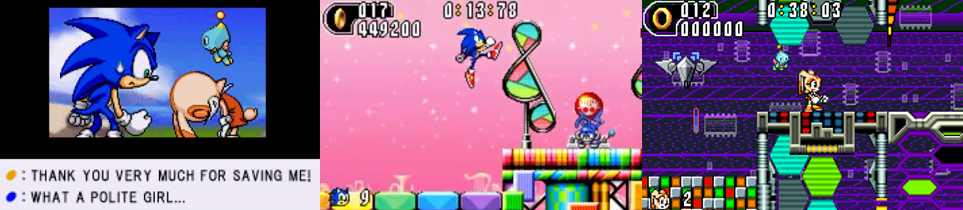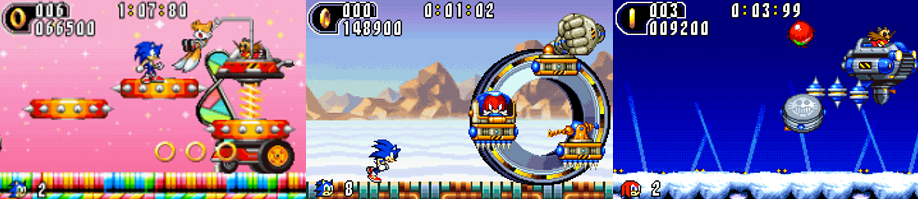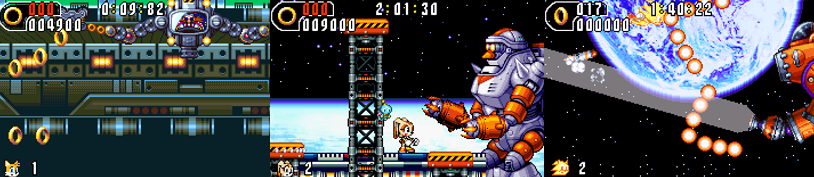
Game Corner [Sonic Month]: Sonic Rush Adventure (Nintendo DS)


Sonic the Hedgehog was first introduced to gamers worldwide on June 23 1991 and, since then, has become not only SEGA’s most enduring and popular character but also a beloved videogame icon. Thus, in keeping with tradition, I’m dedicating some time to celebrate SEGA’s supersonic mascot.


Released: 13 September 2007
Developer: Dimps / Sonic Team

The Background:
SEGA’s desperate desire to create a mascot to rival Super Mario paid off when Sonic the Hedgehog became a mainstream icon with Sonic the Hedgehog 2 (SEGA Technical Institute, 1992). Despite subsequent success with both 2D and 3D titles, costly business decisions forced SEGA to withdraw from console manufacture, bringing the original “Console War” to an anti-climatic end. Now focused on software development, the unthinkable happened when Sonic and SEGA-branded videogames appeared on Nintendo’s GameCube and Game Boy Advance. Alongside Dimps, Sonic Team created a trilogy of largely lauded 2D throwbacks for the handheld and this partnership extended to the more powerful, dual screen Nintendo DS with the widely praised Sonic Rush (Dimps/Sonic Team, 2005). Introducing series staple Blaze the Cat and pioneering the hotly-debated Boost gameplay, Sonic Rush impressed enough to warrant a sequel. Inspired by adventure narratives, director Sakae Osumi decided the sequel should be set on the high seas, with pirate antagonists, and the developers expanded on the Sonic Rush’s game engine to incorporate more 3D elements and more use of the touchscreen. Released after the universally panned Sonic the Hedgehog (Sonic Team, 2006), critics noted that Sonic Rush Adventure proved the brand was still viable and praised the eye-catching visuals, upbeat soundtrack, and touchscreen functionality for the boat racing sections. While the plot and material collecting were criticised and we never got a third game in this sub-series, its influence was felt in Dimps’ subsequent 3DS port of Sonic Colours (Sonic Team, 2010).

The Plot:
Stranded in Blaze’s world following a mysterious storm, Sonic and Tails team with Blaze and an energetic, wannabe sailor to explore the neighbouring islands and keep the lost Jeweled Scepter away from Captain Whisker and his robo-pirates.

Gameplay and Power-Ups:
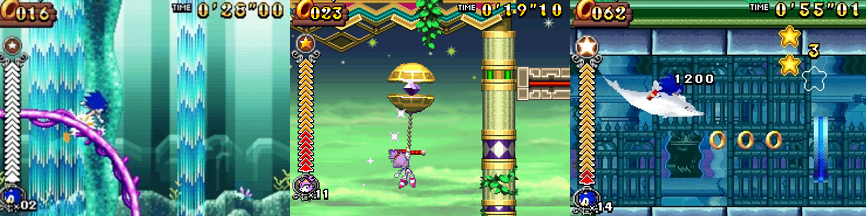
Like its predecessor, Sonic Rush Adventure is primarily a 2.5D action platformer focusing on high-speed platforming and Boost-based tricks. Initially, only Sonic is playable but, after clearing the third stage (known as a “Zone”), Blaze will be unlocked once again. While the game takes place on various islands, each Zone contains two stages (or “Acts”) and a third, dedicated boss battle against one of Doctor Eggman and Eggman Nega’s robotic giants (known as “Ghosts”). The game includes an “Options” menu where you can set the game to “Easy” or “Normal” mode to tweak the difficulty of bosses, toggle the ten-minute time limit on or off, and manually save your progress. Sonic Rush Adventure expands on the world map of its predecessor, allowing you to not only draw paths to other islands on the bottom screen but also enter buildings and talk with non-playable characters (NPCs). These allies give you hints, allow you to listen to the game’s soundtrack, offer additional missions to complete, and allow a stage and boss select so you can quickly retry completed Zones. Although Sonic and Blaze are still contrasting personalities, their controls and gameplay and essentially the same and as in Sonic Rush. Both jump with A or B, charge up a dash with down and A/B, and perform various mid-air tricks with A, B, and the Right trigger. You can use the directional pad in conjunction with these buttons to reach higher or further platforms, as well, though Blaze has the added benefit of her Burst Hover, which grants her a limited mid-air glide.

The core, Boost-paced gameplay remains unchanged but is bolstered by some new interactable elements.

In contrast, Sonic can home in on nearby targets and is much faster by default, though Blaze is also immune to fire. Both characters can grind on various rails, tapping B to pull off additional tricks. These tricks and smashing robots fill your “Tension Gauge” which, when partially or completely full, blasts you ahead with the Super Boost or Fire Boost when you hold down X or Y. This allows you to plough through Badniks and breakable walls and across gaps at high speed, completely invulnerable, though you need to be careful as it makes it much easier to miss ramps and other interactable objects that spring you across the environment. Golden Rings act as your life blood, protecting you from attacks and awarding you extra lives when you collect increments of 100, and you can snag all the usual power-ups (extra Rings, a barrier and magnetic shield, and a brief invincibility) alongside boosts to your Tension Gauge and top speed. Your Tension Gauge also gets a boost when you pass a checkpoint, and you’ll use loops, springs, and ramps to blast between both screens across the game’s colourful and distinct Zones. Similar to the last game, there are instances where you get additional gimmicks: Blizzard Peaks starts you on a snowboard for some high-octane grinding, Coral Cave sees you push and jump into large minecarts, and Pirates’ Island sees you riding a dolphin through rings in underwater tunnels. The hang glider reappears in Machine Labyrinth, now steam-powered and letting you Boost along, while catapults, cannons, and giant hooks and anchors carry you to higher platforms. Pirates’ Island includes a water cannon gimmick where you aim, fire, and grind along water streams, crystals allow you to float across deadly gaps in Sky Babylon, and the Haunted Ship’s cannons blast you through the sky, allowing you to press buttons to score points off rings. Occasionally, the game switches perspective, shrinking you to the background, bringing you to the foreground, and putting you in a third-person view as you switch tracks in a mine cart or grind across spiked vines.

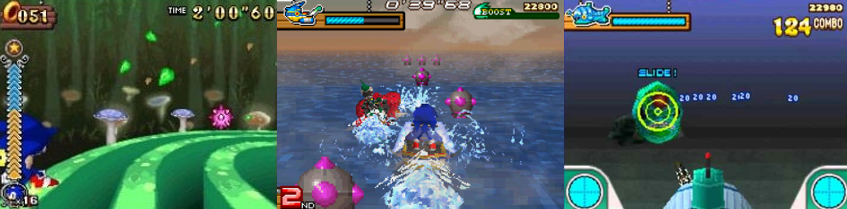
The touchscreen is wonderfully utilised in third-person and sea-based race sections.

The “adventure” aspect of the game comes into play in the overworld. You’ll travel across the sea to reach each island and challenge the game’s Zones, which you can only do with Tails’ various sea craft. After plotting a path, you’re placed on the bottom screen and use the stylus to control Sonic as he grabs Rings, performs tricks off ramps, and avoids enemies. In these sections, tricks and other actions are performed by swiping or tapping the screen, which builds your “Boost Gauge” and allows you to rocket ahead by double-tapping the screen or pressing the Left or Right triggers. Clearing Acts awards various materials and a letter grade; the higher your grade, the more materials you acquire. These can be brought to Tails to create newer, more diverse sea craft, such as a submarine and a hovercraft. As each craft needs specific materials to be built and further upgraded, you’ll be revisiting Zones again and again to “farm” for these materials. These can also be located on the sixteen Hidden Islands, which act as brief obstacle courses designed to test your skills and award materials, and you must do this to progress though the story. Sonic starts with the Wave Cyclone, a simple hoverbike, before Tails builds the Ocean Tornado, a sailboat you control and fire the weapons of (comprised of a gun turret, cannon, and flamethrower). The Aqua Blast hovercraft is similar to the Wave Cyclone but players must move it side to side to avoid rocks and other hazards and fire its laser cannon in either short or charged bursts. The last craft you get direct control of is the Deep Typhoon, a heavily armed submarine that sees you exploring the ocean’s depths, tapping commands similar to a quick-time event to lock-on to and destroy enemies and hazards, as indicated by a radar. Additional power-ups are also found in these stages to repair your craft or fill your Boost Gauge, and they certainly offer a fair bit of variety, though the grinding for materials can get tedious at times.

Presentation:
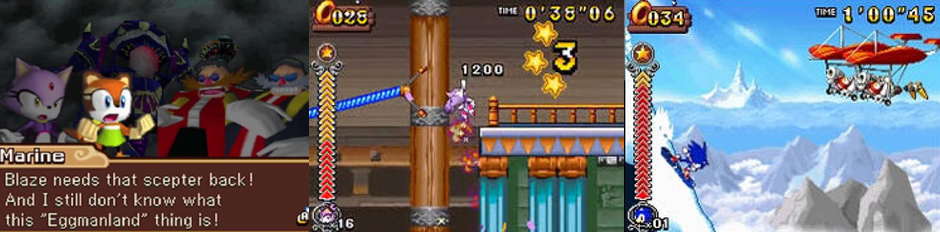
Like Sonic Rush, Sonic Rush Adventure utilises traditional sprite art for its backgrounds alongside polygonal assets. These are primarily seen in the character and enemy models but various interactive elements (such as drums and bouncy ropes and the end goal treasure chests) are 3D models as well. Sonic and Blaze’s models seem to be copied wholesale from the last game, sporting the same animations, playstyles, and voice clips as before and therefore being just as blocky and clunky. Again, I wonder if it might’ve been better to swap things around and have fully polygonal environments and sprites for the characters, though these models do look a lot better when the action switches to the touchscreen for the sea sections or brief third-person sequences. As you might expect from the title, Sonic Rush Adventure places more emphasis on the story, meaning more cutscenes using both 3D models and still images and more interactions with NPCs. The standout of these is the now sadly forgotten Marine, a plucky raccoon girl with a love for the sea and its craft and who hides incredible power behind her boisterous personality. Sporting a quirky Australian dialect, she furthers Blaze’s development from a stoic princess into a more laidback defender of her world and is a joy to talk with, as are the various amusing koalas who help you. Sonic Rush Adventure incorporates a more sea-faring flair to its soundtrack, peppering every stage with upbeat tunes that match the fast-paced gameplay. The opening theme, “A New Venture”, is infectious in its whimsy though it was surprising and a little disappointing to find the game didn’t include voice acting to go with its cutscenes and still relied on simple text. For most of its length, Sonic Rush Adventure focuses on two new antagonists, Captain Whisker and Johnny, and doesn’t reveal Dr, Eggman and Eggman Nega’s involvement until later, though I genuinely think it would’ve worked just as well, if not better, to omit the Eggmen entirely and focus on his pirate-theme doppelgänger and Sonic’s latest rival, just to mix things up a bit.

The game shines through its increased emphasis on story and a unique pirate-aesthetic.

Sonic Rush Adventure is one of the more visually unique Sonic games, especially in its environments. While Zones blast along a mile-a-minute and it’s easy to overshoot ramps or plummet down the many bottomless pits, the new, sea- and pirate-themed aesthetic really benefits the visuals. This is immediately apparent in the heads-up display, whose font is a far cry from the usual, generic lettering in other Sonic titles and more akin to the short-lived “Storybook” games on the Nintendo Wii. Things start pretty standard in Plant Kingdom (which features vines to swing from and grind on, bouncy mushrooms, and robotic dinosaurs) before delving into steampunk in Machine Labyrinth. Similar to Metropolis Zone, Machine Labyrinth features steam-based springs and winding tubes alongside the hang glider, pinwheels, and massive drums that pinball you about. Coral Cave is a coral spin on a mine, featuring crystalline coral, coral bridges, and a partially flooded grotto alongside abandoned mine carts and tracks and waterfalls. Similar to Pirates’ Island, you must pay attention to the top screen or you’ll get crushed by falling hazards that are used as platforms to higher areas, and giant anchors will swing you about, too. The Haunted Ship was probably my favourite Zone. Featuring a misty graveyard of wrecked ships in the background and seeing you dash up ropes and mainsails, you’ll explore the dishevelled interiors, bash robotic pirate ghosts, and blast between ships using massive cannons. You’ll also bounce up to higher areas using special ropes or be forcibly dragged up by barrels. Sky Babylon was also visually very interesting, sporting a green night-time sky and strange, neon-glowing ruins in a mish-mash of Marble Garden, Sky Sanctuary, Altitude Limit, and the Babylon Garden. Strange floating orbs drag you higher, destructible platforms drop you past flaming hazards and to the ever-present electrical bolt lurking below, and you explore both the background and foreground. Blizzard Peaks started strong with its snowboarding section, which allowed some fun grinding, and with its snowy slides and giant icicles that you must jump between. Pirates’ Island is, essentially, Sonic’s version of Venice, featuring stone buildings, flooded ruins, spring-loaded fountains, and helpful dolphins to navigate its waters. These environments and their gimmicks are all recycled for the Hidden Islands, and there’s even a degree of choice in which locations you visit depending on which ships you have.

Enemies and Bosses:
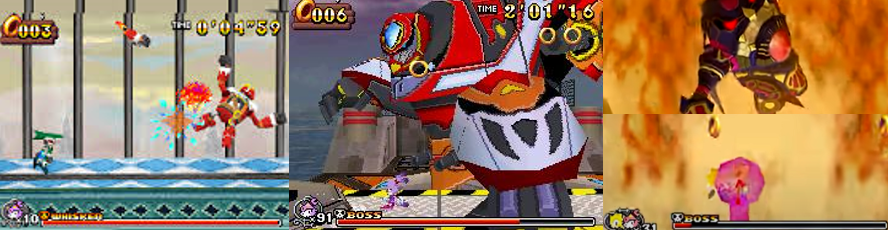
Sonic Rush Adventure bolsters its unique environments with a slew of all-new Badniks, each one the creation of the Dr. Eggman/Eggman Nega duo and in keeping with the nautical/pirate aesthetic of the game. The most persistent of these are the various “Kaizoku” Badniks that toss explosive barrels, glide around on hang gliders, fire small, shoulder-mounted cannons, hide in snowballs, or attack with a cutlass. The Kaizoku Hogan variant is a touch tougher than the usual Badniks, swinging a ball and chain and sporting a health bar. The Hover and Gunner variants fly about using jetpacks, and the Skeleton versions float around like wandering spirits and toss bone sat the player. These Badniks are bolstered by the “Shisaku-gata” series of mechanical miscreants who chuck spanners, hover using steam-powered jetpacks, and push you back with jets of steam. More traditionally designed Badniks also appear, such as the Barrier Angler (a robotic angler fish, which also has an electrical variant), the Jaws-like Nibbles, the Dive Bat (another of Dr. Eggman’s many bat-themed Badniks), and the Rabid Crab (which focus more on melee attacks than Crabmeat’s projectiles). The Triceratank charges you with its horn similar to the Rhinobot, Ptera swoop from the skies, Sky Moons fire projectiles while hovering in the path of your jumps, and steam-powered Bomb Ghosts wander the Haunted Ship ready to explode in your face! Each Zone ends in a boss battle against one of Dr. Eggman and Eggman Nega’s gigantic robot creations. Unlike in the last game, where you were restricted to either a platform or a ring, Sonic Rush Adventure features more variety to its boss battles. You’re still restricted to a set area, but the arena and boss strategies alter as the fight progresses, switching between the screens. Each also possesses a health bar, though you no longer have your allies cheering you on, and ends with a dramatic, slow-motion final blow against the mech.

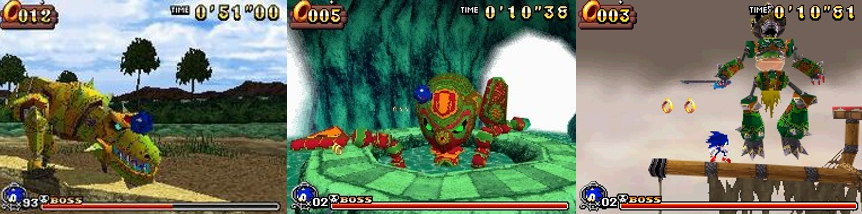
The massive bosses are far more visually interesting and complex than before.

The first boss you encounter is the Ghost Rex, a gigantic, robot Tyrannosaurus rex that stomps around in the background, stalks around your small stone platform, and tries to munch you with its powerful jaws. Dodge this attack to attack its head and repeatedly strike it when it tries to charge from either side of the platform and you’ll eventually fall to a cavern, where the Ghost Rex elongates its neck to try and crush you and cause shockwaves. The Ghost Pendulum is fought on a ring and stays out of reach and you must run around in a circle, striking its low-hanging fruit to smack them into it. As the fight progresses, more balls appear, with some sporting spikes and electrical barriers and the boss dropping to create shockwaves, which can all be tricky to avoid. The Ghost Kraken is also fought on a ring; it spins its tentacles to attack you, but you can smack these (especially the jewelled one) to damage it. It also tries to grab and slam you into the ground, forces you underwater, and spits ink to either stick you in place or obscure the screen. The Ghost Pirate awaits on the Haunted Ship, spewing fireballs and flaming vortexes and attacking with kicks and its cutlass. You must target the glowing red core, which eventually detaches and must be chased around to deal more damage, which can be tricky, especially if the ship’s swaying. The Ghost Whale is one of the most unique bosses as it’s fought on a rapidly deteriorating ice float. You must smack it when it charges to jump inside, where you have thirty seconds to battle to its inner core, destroying pods for more time and avoiding freezing hazards and ridable missiles.

Sadly, the new baddies are usurped by the Eggmen, who power-up to battle for the fate of both worlds.

The Ghost Condor was probably the toughest of the regular bosses for me. You’re running on a never-ending path on the bottom screen, avoiding mines, spiked platforms, and the boss’s charge. You must hit the green mines to fly up and smack the boss’s weak spot, landing on the platforms to deal additional damage, though the hazards, speed, and aggressiveness ramp up over time. Captain Whisker and Johnny first attack as a duo on a stage full of buzzsaw-spewing platforms. Captain Whisker fires his rocket arms and performs a ground pound to produce a shockwave and Johnny torpedoes at the player, and they have a team attack that must be repelled. Both must be defeated but this looks more intimidating than it is and it’s pretty easy to pepper them with hits. Captain Whisker then jumps into the Ghost Titan for a penultimate showdown not unlike the battleship bosses from the last game. You must hit its missiles to lower the shields on the cannons, then line up the aiming reticle to attack. The Ghost Titan also delivers a big punch, fires laser-guided flame blasts, litters your platform with bullets from its crotch, and spreads flames across the ground. Though there’s a lot happening at times this was a big, fun, boss made even more intimidating by it boxing you in with insta-kill lasers at the end. After collecting the seven Chaos and Sol Emeralds, you’ll battle the true final boss, the Egg Wizard, a super-powerful mech piloted by Dr. Eggman and Eggman Nega and wielding the fabled Jeweled Scepter. This is a three-phase battle that takes place from a top-down perspective in the molten core of Blaze’s world. You control Super Sonic and Burning Blaze, collecting Rings to sustain your transformation and switching between the two with R. In the first phase, you reflect boulders using Super Sonic’s A attack. You must then reflect the Egg Wizard’s fireballs and three flaming dragons to deal damage or switch to Burning Blaze and fire single or charged fireballs with A. Deal enough damage and the Egg Wizard regains some health and adds a targeted meteor, a flamethrower, and gigantic missiles that must be avoided or reflected to deliver the final blow. It’s not the hardest final boss but, with no checkpoints, few Rings, and many of the attacks stunning you, it can be a trifle aggravating to contend with.

Additional Features:
When exploring the seas of Blaze’s world, you’ll inevitable cross paths with Sonic’s latest rival, the arrogant robotic shark, Johnny. When you do, Johnny challenges you to the race, with the prize being a legendary Chaos Emeralds. These races take place on the Wave Cyclone and are thus performed using the touchscreen and stylus. Players can follow Johnny’s trail for a boost and must dodge his mines or they’ll suffer irreparable damage and lose. To stay ahead, you collect Rings and perform tricks off ramps to build and maintain your Boost Gauge, though you can replay each race as often as needed to score the Chaos Emeralds. Like before, Blaze doesn’t get Sol Emeralds from Special Stages like these. Instead, you talk to NPCs to take on various missions, with seven of the 100 available missions specifically relating to the Sol Emeralds. These are acquired by finding Hidden Islands or beating certain bosses again, and only by getting all seven of both will you unlock the game’s true ending. Other missions also challenge you to reach the goal within a certain time limit or while holding a set amount of Rings. You can also explore to find the sixteen Hidden Islands and replay previous Acts to get materials to build and upgrade your craft and score better rankings, and take on a time attack mode. Sonic Rush Adventure also includes a multiplayer component where players race against each other to finish Zones and defeat bosses the fastest, though I’ve never played this mode. Finally, there’s a sound test and movie viewer mode available and you can take on the bosses and Johnny’s race at any time by chatting to NPCs.

The Summary:
Sonic Rush was a fun, if barebones, return to form for Sonic, a natural progression of the Game Boy Advance titles and a nice taster of what the Nintendo DS could do with the franchise. Sonic Rish Adventure takes everything that worked and adds a bit more to it, expanding the narrative and the scope of both Sonic and Blaze’s world and delivering a fresh take on the usual, formulaic events by assuming a pirate aesthetic. I really enjoyed the sea-based sections, exploring the map and playing about with each craft. It was a fun use of the touchscreen that never outstayed its welcome, though it does get a touch tedious having to grind for materials. It might’ve been better if Tails built the ships as the story progressed and the materials were purely to upgrade each one to give you an edge in combat or against Johnny. The Zones were some of the most unique and visually interesting the series has ever seen, finally moving away from tried-and-tested tropes and embracing new aesthetics. The gameplay is fast-paced and fun, with lots happening at once and really gave me a sense of empowerment, though it’s still dogged by bottomless spits, insta-kill hazards, and unavoidable traps. Captain Whisker, Johnny, and Marine are some of the best new additions to the franchise and I’m honestly annoyed that they’ve never been seen again. I’ll reiterate that neither Eggman was necessary for this game, and it might’ve been better without them as Captain Whisker was a familiar enough threat given a quirky edge by being a pirate. It’s a shame that Sonic and Blaze’s gameplay was basically unchanged from Sonic Rush, with no new moves or abilities or playable characters added to the mix, but the 2.5D Boost gameplay was arguably better than it’s ever been here. It really feels like Sonic Rush Adventure filled in some of the blanks of the last game, adding more diversity and complexity to the boss battles, switching up the stage aesthetics, and placing more emphasis on the story. Add to that the fun sea mini games and races and opportunities for exploration and you have a really solid title that definitely deserves more love than it gets as I never see anyone talking about this one, and that’s a real shame.

My Rating:

Rating: 4 out of 5.

Great Stuff

Did you play Sonic Rush Adventure back in the day? What did you think to the new setting and the quirky new characters? Did you enjoy the pirate aesthetic to the stages and trying out new sea-based craft? What did you think to the grinding mechanic and the changes made to the boss battles? Did you ever defeat the Egg Wizard, and do you agree that Captain Whisker and Johnny were strong enough antagonists by themselves? Which of Sonic’s handheld adventures is your favourite and how are you celebrating him this month? I’d love to know what you think about Sonic Rush Adventure so leave a comment and be sure to check out my other Sonic content.

Game Corner [Sonic Month]: Sonic Advance 2 (Game Boy Advance)


Sonic the Hedgehog was first introduced to gamers worldwide on June 23 1991 and, since then, has become not only SEGA’s most enduring and popular character but also a beloved videogame icon. Thus, in keeping with tradition, I’m dedicating some time to celebrate SEGA’s supersonic mascot.


Released: 19 December 2002
Developer: Dimps / Sonic Team
Also Available For: Nintendo Wii U (Virtual Console, Japan only)

The Background:
After a lengthy development process and a conscious effort to create a mascot iconic enough to challenge Super Mario, SEGA’s initial success with Sonic the Hedgehog exploded into mainstream popularity with Sonic the Hedgehog 2 (SEGA Technical Institute, 1992). This was followed by the spectacular Sonic 3 & Knuckles (ibid, 1994) a game too big for one cartridge, but, oddly, one of the best Sonic games led only to many disappointing spin-offs. Following Sonic’s well received jump to 3D, numerous delays, blunders, and costly decisions saw SEGA withdraw from the “Console War”. Alongside ports of their games for other manufacturers, SEGA teamed with Dimps for Sonic Advance (2001), 2D throwback to the classic games that became a best-seller for the Game Boy Advance renowned for its visuals and gameplay. Having solidified SEGA ’s new relationship with Nintendo, development of a sequel was said to have started immediately following the first game. Sonic Advance 2 built upon the existing engine and sought to make a more action-orientated, faster title. The game saw the debut of a brand new character, Cream the Rabbit, who was specifically designed for younger players, and it also went a long way to popularising the “Boost” mechanics of later games. A commercial success, Sonic Advance 2 was praised for its cartoonish sprites, catchy soundtrack, and replay value. While its difficulty deterred some players, Sonic Advance 2 is largely regarded as one of the best Sonic titles and it was followed by a third game just two years later.

The Plot:
When Doctor Eggman vies for the legendary Chaos Emeralds and tricks Knuckles the Echidna into helping him, Sonic the Hedgehog and his friends – Miles “Tails” Prower, Amy Rose, and newcomer Cream the Rabbit – race to end his latest scheme for world domination.

Gameplay and Power-Ups:
Sonic Advance 2 takes the basic engine and core mechanics of the first game, which was already an interesting mash-up of the 2D and 3D gameplay, and expands upon them to create a high-octane, action-packed 2D sidescroller that puts a great deal of emphasis on blasting along at high speeds while holding right on the directional pad. The controls, already heavily borrowed from the 2D games, thus remain relatively unchanged: you can still jump with A, performing a Spin Attack in the process to bust Badniks and power-up pods, perform your character’s signature moves with B, and execute various mid-air “tricks” by pressing B or the Right trigger in mid-air off springs and ramps. Pressing up or down scrolls the screen vertically and pressing down and A charges a Spin Dash, allowing you to blast ahead (even as Amy this time). Although there are five playable characters to pick, each with their own special moves to slightly alter their gameplay, only Sonic is available at the start. The others are unlocked by playing the story mode and, in Amy’s case, by collecting all seven Chaos Emeralds with the four main characters. You play through seven main levels (referred to as “Zones”), each with two stages (or “Acts”) and a dedicated “Boss Attack” stage, with two additional Zones unlocked when certain criteria are met. As ever, Golden Rings are your lifeline; as long as you have at least one, you’ll survive enemy attacks. Every Act is played against a ten-minute time limit, with you losing a life once this expires, though you can disable this from the “Options” menu. You can also switch between “Easy” or “Normal” mode from this menu, though this simply reduces the hits that bosses take to defeat, and select different language options, something far more relevant this time since there are more cutscenes and text dialogue than before. As you might expect, you can also grab various power-ups as you play: you’ll get a 1-up (also from collecting 100 Rings), 5, 10, or a random number of Rings, a shield (and a magnetic variant to attract Rings), a temporary invincibility, and a new power-up that instantly puts you at maximum speed (though is, essentially, a variation on the classic speed up power-up).

Cream lends her game-breaking cuteness to the increased emphasis on speed and tricks.

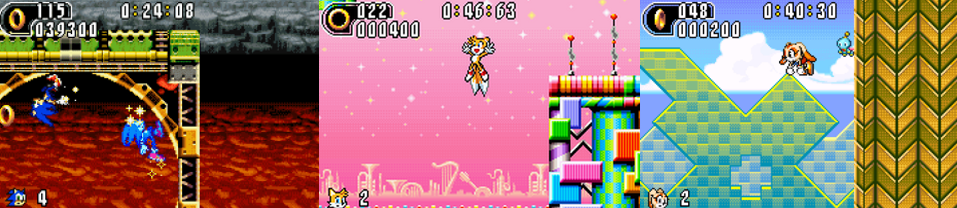
Much of this is carried over from Sonic Advance and the same is true of your character’s abilities. Each one plays a little differently, which can alter how difficult the game is. Tails and Cream, for example, can fly, easily avoiding the many pits that spell Sonic’s doom. Every returning character sports the same special moves as in Sonic Advance, with Sonic performing his Insta-Shield by pressing A twice, sliding ahead with B, and executing a fairly useless mid-air dash and Homing Attack when in mid-air. Sonic can also now bounce to the ground by pressing B in mid-air, similar to his bounce ability from Sonic Adventure 2 (Sonic Team USA, 2001) and almost as a precursor to the Drop Dash. Tails flies, as normal, and takes out enemies with a tail swipe with B, Knuckles glides and climbs walls and executes a three-punch combo with B and also now drills downwards when you press B in mid-air. Previously the most unique and difficult character to use, Amy now has a Spin Attack and Spin Dash just like her friends, meaning she’s a far more viable character this time (if you can unlock her!) She still swings her Piko-Piko Hammer with B, dives ahead, and uses it to attack aerial enemies. Every character can also grind on various rails, grab overhead poles, swing from vines and such, and blast ahead at break-neck speeds after building momentum. Flying off ramps sees you pull off mid-air tricks, which are essential to clear bottomless pits and reach higher areas and can spell your doom if you fail them. Since every character essentially adopts Sonic’s super-fast gameplay, there are far less opportunities to use their unique special moves beyond flying and gliding and each one loses a lot of their appeal as a result. There is a mild saving grace in newcomer Cream, however. Essentially the “Easy” mode character, Cream can fly like Tails (though seemingly for less time) and, crucially, fire her Chao companion, Cheese, like a homing shot with B. This absolutely decimates bosses and even surrounds her with a protective barrier when used on the ground, making Cheese the go-to choice for the game’s tougher Zones and bosses.

The fast-paced, action-orientated gameplay means bottomless pits and cheap deaths and commonplace.

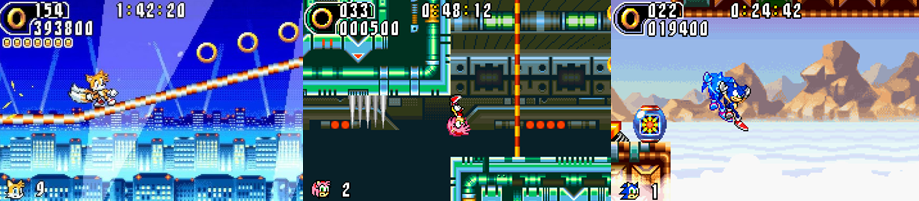
Sonic Advance 2 structures its Zones like high-speed races and obstacle courses; the “rollercoaster” aesthetic has never been truer than in this game as rails, ramps, loops, springs, and boost pads litter every environment. There is still the occasional instance of water, putting you at risk of drowning, though you’re far more likely to run across the water than sink into it. Moving and temporary platforms also still appear, often placed at the end of solid ground to screw up your jumps, as do slopes, poles, destructible elements, and bouncy surfaces. This latter gimmick is most prevalent in Music Plant, which has you bouncing around on keyboards and cymbals, while Hot Crater is more about overhead rails and annoying spikes. While things start familiar enough in Leaf Forest (functionally an amalgamation of the classic Green Hill Zone and Green Forest) and Ice Paradise is like a fancy do-over of the previous game’s Ice Mountain, things take a turn for the worst in Sky Canyon. Bottomless pits, poor hazard placement, and tricky jumps appear before this point, but Sky Canyon really ramps them up, hiding ramps and springs and platforms behind clouds and forcing you to make split-second decisions at high-speeds that will quickly drain your pathetic stock of lives. It’s very easy to miss jumps or overshoot your landing, or to plummet to your death since you often drop through rails rather than landing on them. This continues in Techno Base and Egg Utopia, which borrows gimmicks like the light-based bridges and topsy-turvy gravity from Sonic 3 & Knuckles’ Death Egg Zone and marries them with rails and pits, pits, pits! Sonic Advance 2 quickly conditions you to “hold right to win” with its emphasis on speed; Badniks are few and far between and everything is geared towards propelling you ahead at incredible speeds. It’s thus incredibly frustrating to settle into this mindless gameplay loop and fall down an endless chasm, get skewered by spikes, or miss a ramp or a rail and drop to your death.

Presentation:
If there’s one area where Sonic Advance 2 truly excels, it’s the visuals. Again, there’s a reason I used these sprites and backgrounds when made sprite comics; they’re so vivid and detailed and really bring the characters to life like never before in 2D. While Sonic Advance 2 features some recycled animations from the last game, every character has loads more frames of animation either in their poses, tricks, or when performing basic functions. Every main Act starts with your character taking their marks and getting ready to race ahead as a countdown ticks place, they’re followed by shadowy afterimages when at top speed, and their run cycles are vastly improved as the game ditches the classic “rubber band legs” animation to more closely emulate the 3D games of the time. This racing aesthetic continues when you finish an Act as you’re no longer passing a signpost or reaching a Goal Ring; instead, you run through a finish line and your character poses while running and your score is tallied. While the introductory cutscene is nothing special (and is actually worse than in Sonic Advance since it just focuses on the island, Sonic Advance 2 utilises a map screen for its stage select that’s almost an exact copy of Sonic Adventure 2’s, and includes bigger, more detailed and cartoonish sprite art for its cutscenes. As you clear Zones, Sonic rescues his friends, chatting with them and unlocking them to be played, though these cutscenes only appear when playing as Sonic and only once. Once you’ve cleared the game, you can’t view them again and the game is irrevocably changed. Cream is no longer held hostage when you fight the EggHammerTankII and Dr. Eggman pilots the Egg Saucer on subsequent playthroughs, as opposed to Knuckles. While the Game Boy Advance sound system is still grating, Sonic Advance 2 features far catchier tunes and more musical variety than its predecessor. Bosses and Acts have differing tracks and game’s more frustrating moments are somewhat alleviated by the jaunty music, with Ice Paradise being a particular highlight.

More story and detailed animations contrast with some garish environments.

Although Sonic Advance 2 doesn’t exactly break the mould with its Zone aesthetics, the presentation is far better than its predecessor. Sonic Advance had a rather blurry, pixelated, bland look that’s been completely overhauled into a smooth, sleek, almost plasticine-like aesthetic. Admittedly, this can make some of the foregrounds more generic and the Zones do suffer from being far more linear, with ramps and long raceways being predominant, but there’s no denying the graphical upgrade. Sonic Advance 2 also borrows more from Sonic Adventure 2 for its overall presentation, especially in Zones like Leaf Forest and Sky Canyon, with the latter basically being a 2D version of Rail Canyon. Given the game’s emphasis on speed, ramps, springs, loops, and boost pads are common gimmicks in each Zone, somewhat robbing them of their individuality, though unique gimmicks can still be found (however sporadically) amidst the cheap-ass pits and hazards. Hot Crater, a mechanical base built into a volcano, features overhead rails, a heat effect to the background, and hooks to fling yourself upwards. Music Plant is a garish slice of ridiculousness that looks like it’d fit right in in Zool: Ninja of the Nth Dimension (Gremlin Graphics, 1992) and begins an annoying trend in Sonic games of this era of featuring an overly kiddified level. Ice Paradise has a Christmas theme to its soundtrack, features a bustling city in the background, flurries of snow, and big neon signs, giving the impression of a ski slope. Sky Canyon is a mess of pits and vertical columns, featuring windmills, those fans from Starlight Zone, and balloons to carry you up. Techno Base is a mess of hexagons, lights, lines, and vulgar colours; it’s essentially a new version of Cosmic Angel Zone from Sonic Advance, though with digitized spikes and some pinball mechanics. Egg Utopia is essentially a 2D version of Final Rush/Final Chase mixed with the Death Egg Zone, featuring rails between different areas of the space station set against the background of space, a gravity gimmick that has you running on the ceiling, cannons, and spiked balls. This aesthetic is carried over to XX, which is simply an autorunner (like all the game’s bosses) gauntlet before the final showdown, while True Area 53 takes place in the void of space with the Earth in the background.

Enemies and Bosses:
No doubt due to the game’s focus on fast-paced action, Badniks are few and far between in Sonic Advance 2. The game would rather surprise you with spikes or bottomless pits than have you free critters from robotic shells, something further emphasised by the lack of capsules at the end of each Act. When Badniks do appear, they’re generally awfully placed to screw up your jumps or tricks and send you plummeting to your death, and they’re largely recycled throughout each Zone. Some of their designs may be familiar to long-time Sonic fans, though: the Geji-Geji aren’t too dissimilar from Caterkillers, the Circues are reminiscent of the monkey-like Kikis, Flickey is literally a robotic version of Flicky, and the Buzzers return wholesale from Sonic Advance. Kikis hide in trees and toss coconuts like in the 3D games and like their predecessor, Coconuts; Spinners return from the 3D games and can be bounced on to cross gaps; and little robot mice scurry about on the ground. Mechanical penguins launch themselves across the snow like Penguinators, clown-like robots swing their own Piko-Piko hammers, and large robotic hammerheads await in the waters at times. Each one releases a woodland critter and adds to your score tally, but they’re mainly there to get in your way and are such a non-factor that it’s easy to be blindsided by them. The E-100 “ZERO”-like Robot Guard also appears, relentlessly pursuing you in Special Stages, sapping your Rings and kicking you out of the stage if it touches you. Having somehow been tricked by Dr. Eggman, Knuckles is battles you in your first playthrough, piloting the Egg Saucer at the end of Sky Canyon, though his presence doesn’t change anything except the cockpit sprite.

The autorunning mechanic used in boss battles makes them needlessly annoying at times.

Therefore, you’ll be battling Dr. Eggman’s newest machines at the end of each Zone. Unlike in Sonic Advance, every single boss battle is an autoscroller that sees you constantly running on an endless loop, snagging Rings and timing attacks and compensating for the knockback and the tougher “pinch” mode, which can get so aggravating that it’s often easier just to cheese the bosses with Cream. Things start off familiar enough with the EggHammerTankII, an upgrade from Sonic Advance that also attacks with a giant hammer but this time it can extend its reach. While the hammer is a large hazard to avoid, this isn’t too tricky. The Egg Bomber Tank is a bit trickier as you can only attack its cannon in the first phase; the main body can only be attacked in the second phase, and both see you avoiding bouncing, explosive cannonballs. Though functionally simple, the autoscrolling gimmick makes the Egg Totem a bit difficult since it’s hard to get up to speed and hop to its spiked platforms to hit the cockpit. Each platform sprouts turrets that must be destroyed to clear the field of projectiles and they also move quiet erratically to screw up your jumps. The Aero Egg also causes problems as its bombs have wide splash damage and you can only attack it by bouncing off its tail platform (unless you just aggressively fire Cheese). Things can get very frustrating against the Egg Saucer as the laser cannon has a wide range and the robotic hand can instantly kill you with its slap attack! Your best bet is to take out the cannon and hang back, way back, running in whenever the cockpit spins into view.

You’ll need to overcome all the bosses again and get the Chaos Emeralds to fight the true final boss.

The Egg-Go-Round was much easier in comparison. This machine flies along on a rail and is protected by four platforms, two that sprout spikes and two that fire projectiles. It can be tricky avoiding these but it’s a hell of a lot easier to ram the cockpit than the Egg Saucer. The Egg Frog is a different matter entirely, though. This boss incorporates the Egg Utopia’s gravity gimmick, hopping to the floor and ceiling and dropping carpet bombs that are very difficult to avoid. While you can switch to the floor and ceiling by holding up and down, the Egg Frog’s hit box is so large and the window of opportunity so small to hit it that it’s better to just give up and use Cheese to decimate it. Similar to the last game, XX features a boss rush…but this time its against all the bosses you previously fought! Though they take less hits to defeat, the only checkpoint occurs after defeating the EggHammerTankII and this gruelling prospect means you’ll likely be low on lives and/or Rings by the time you reach the Super Eggrobo Z, a modified version of Sonic Advance’s true final boss. This giant mech takes up the entire right-side of the screen and fires its claw arms (which can be destroyed) and a sweeping laser from its eyes. Platforms will raise, allowing you to attack its main weak spot (the head) but also putting you at risk of being skewered or crushed against the ceiling spikes. After a few hits, the mech’s attacks increase but, again, you can make a joke of it by using Cream, destroying Dr. Eggman’s newest space station and treating you to a character-specific ending. However, this isn’t the true final boss. Collect all seven Chaos Emeralds with the four main characters and you’ll be taken to true Area 53 where, as Super Sonic, you battle perhaps Dr. Eggman’s most visually disappointing final mech ever, an unnamed, worm-like cannon. I’ve never battled this boss, but you’re limited, as ever, by your Ring count and must bash its missiles back at it, watching for the mech’s freeze ray and suck attack while also avoiding projectiles and dealing with its invisibility gimmick.

Additional Features:
Just like in the classic games, you can challenge Special Stages to collect the seven legendary Chaos Emeralds, which unlocks the game’s true final boss and ending. Unfortunately, if you thought Sonic Advance’s hidden springs were a pain in the ass, let me introduce you to the “Special Rings”. Seven of these are hidden in each of the main Acts and all seven must be collected to enter the Special Stage. If you lose a life in the Act, you’ll lose all the Special Rings you collected and you probably won’t be able to backtrack to get them, especially as Sonic, since many are hidden in hard-to-reach areas. If you somehow find them all, you’re taken to a large, pseudo-3D checkerboard arena and must race around collecting Rings, gaining multipliers and utilising boost pads, all while the Robot Guard chases after you. Because of how difficult the Special Rings are, I’ve never entered a single Special Stage and have therefore never collected even one Chaos Emerald, which is extremely frustrating as a life-long Sonic player. To make matters worse, you must beat every Special Stage with the four main characters to unlock Amy Rose, a needlessly obtuse criteria for a character who was available by default in the last game. Sonic Advance 2 also includes a time attack mode and a Tiny Chao Garden, where you raise and play with Chao and even transfer them to and from the 3D games, though you’ll only unlock this after collecting the seven Chaos Emeralds with a single character. Similarly, you can unlock a boss rush by beating the game with three characters and all seven Chaos Emeralds, which you’d think would invite replayability but instead makes me want to tear my hair out since entering the Special Stages is so ridiculously difficult. You can also play a single- or multi-pack multiplayer mode, racing to the finish or collecting Rings against other players and utilising the additional Attack, Brake, Confusion, and Warp power-ups to gain an advantage.

The Summary:
The visual upgrade between Sonic Advance and Sonic Advance 2 is as startling as the differences between the first two Sonic games. Where one was colourful and fun but handicapped by a slow, meandering pace, the sequel is both brighter, slicker, and much faster and more action-packed in its design. Sonic Advance 2 brings its characters to life like never before with some truly incredible, amusing, and charming sprite work. The animations are great, making the game resemble its 3D counterparts and a cartoon, and the upgrade to the environments makes everything pop so much more. Things are a little tame at times and the Zones can be annoyingly linear, but this ties into the focus on high-speed gameplay. Unfortunately, this approach does hamper the gameplay somewhat since everyone blasts ahead at full speed like Sonic, meaning their individual playstyles fall further to the wayside. This wouldn’t be so bad if the game didn’t throw bottomless pits, annoyingly placed enemies and hazards, and cheap deaths at you in a paper-thin attempt at increasing the game’s challenge. Pits definitely should appear in Sky Canyon and difficult sections should definitely appear by the end, but scattering them throughout every Zone really stunts my enjoyment as you must either memorise the Act layouts or have split-second reactions to make unfair jumps. While I enjoyed the bosses, the autoscrolling mechanic got old fast and I didn’t appreciate the boss gantlet in XX. I think the autoscrollers would’ve worked better if it had only be used, say, three times. I did like the emphasis on story and how the bosses changed because of it, but not that these changes were undone upon beating the game. It’s also maddening that the Special Stages, Amy Rose, and true final boss are all-but inaccessible thanks to the irritating Special Ring mechanic and the fact you need to get the Chaos Emeralds with every character. I liked Cream, she was cute and fun and made the bosses a joke, and the visuals still blow me away, but the difficulty curve is a nightmare. Because of all this, I can’t rate Sonic Advance 2 higher than the original, even if it is technically and visually a better game since my enjoyment is constantly soured by my inability to experience everything it has to offer.

My Rating:

Rating: 3 out of 5.

Pretty Good

Are you a fan of Sonic Advance 2? How do think it compares to the original and the third game? What did you think to Cream and her boss-breaking powers? Were you a fan of the increased emphasis on speed? What did you think to the reliance on bottomless pits and boost pads? Did you ever collect the Chaos Emeralds and unlock Amy…and, if so, how? Which of Sonic’s Game Boy Advance titles is your favourite and how are you celebrating Sonic’s anniversary this year? Whatever your thoughts on Sonic Advance 2, leave a comment below and go check out my other Sonic content!

Game Corner: Jurassic Park 2: The Chaos Continues (Xbox Series X)

Released: 22 November 2023
Originally Released: November 1994 (SNES), February 1995 (Game Boy)
Developer: Carbon Engine
Original Developers Ocean Software
Also Available For: Game Boy, Nintendo Switch, PlayStation 4, PlayStation 5, Super Nintendo Entertainment System (SNES), Xbox One, Xbox Series S

The Plot:
When BioSyn (or a power outage) cause trouble on Isla Nubar, the island site of Jurassic Park, palaeontologist Doctor Alan Grant either goes it alone or teams up with tactical sergeant Michael Wolfskin to subdue the genetically engineered dinosaurs and escape alive.

The Background:
Michael Crichton’s bestselling 1993 cautionary tale about a chaotic dinosaur theme became a blockbuster critical and commercial hit that spearheaded many now-standard CGI techniques. Alongside an aggressive merchandising campaign, Jurassic Park (Spielberg, 1993) was accompanied by toys, comics, and multiple videogame adaptations released on different consoles. While BlueSky Software developed the Mega Drive adaptations, Ocean Software handled Nintendo’s efforts after securing the license for an undisclosed six-figure sum. Their three releases received widespread praise and, while readers and audiences had to wait two years for Crichton and Spielberg to produce a sequel, gamers got a far faster turnaround when Ocean produced a standalone sequel just one year later. The Game Boy and SNES titles had slightly different stories and mechanics, and both received mixed reviews. While the SNES obviously had better graphics and sound, the simplicity of the Game Boy version was praised, especially compared to the high difficulty and awkward controls of the SNES version. Both games were basically lost media for decades until they were included in a modern re-release to celebrate the movie’s 30th anniversary, alongside modern quality of life features, to largely thankful and positive reviews.
Gameplay and Power-Ups:
Jurassic Park 2: The Chaos Continues is a sidescrolling shoot-‘em-up that acts as a non-canon continuation of the original movie and its videogame adaptations. While the SNES version is more obviously framed as a return to Isla Nubar thanks to the presence of Biosyn, both can be seen as re-dos of the movie and its videogames since they don’t stray too far from the gameplay mechanics previously seen. While only the SNES version offers different difficulty modes, both see you jumping with A (defying gravity with a higher jump the longer you press the button in the Game Boy version) and shooting with X. Y and B also shoot in the Game Boy version and both versions allow you to rapid fire by holding the button, though this will charge your cattle prod in the SNES version and deplete most of your ammo here, too, save for your weakest lethal weapon and cattle prod. In the Game Boy version, you can switch to grenades by pressing the ‘View’ button; you can’t move and throw them but you have an unlimited supply. You switch weapons with the Left and Right Bumpers in the SNES version, LB cycles through lethal ammo types (such as a machine gun and shotgun spread) while RB cycles through non-lethal options, like tranquilizer darts. All enemies disappear regardless of which ammo you use but there’s a counter that ticks down when you kill any dinosaur that’s not a Velociraptor or what could loosely be described as a boss. Kill too many dinosaurs and your game ends, so be sure to cycle back and forth between lethal and non-lethal options. This crutch isn’t present in the Game Boy version; it’s an all-out platform shooter as Dr. Grant blasts dinosaurs with his unlimited shotgun! Both games also allow you to crouch and shoot, shoot while jumping, and shoot upwards and diagonally, though you must collect ammo in the SNES version by pressing down on the ammo item. This is also how you’ll collect the rare first-aid kits lying about Isla Nublar. These, and the odd 1-up, are automatically collected in the Game Boy version, which also incorporates a scoring system, though only the SNES version allows for a two-player co-op mode.

Blast your way past dinosaurs, grabbing vines, racing a timer, and collecting key cards to progress.

While the Game Boy version uses a lives system, you only get one shot to beat the SNES version. If you’re killed, you restart the mission from the beginning, with no checkpoints or continues or passwords to help. Although the Game Boy version follows a linear narrative, tasking players with guiding Dr. Grant through four stages (called “Zones”) with two levels and a boss battle each, the SNES version lets you freely pick a mission. Each mission has two screens of action and ends in an “Emergency” mission, where you must run around the maze-like environment disarming bombs, tracking down a spy, powering up a generator, and similar tasks against a very tight time limit. The labyrinthine nature of the levels doesn’t help with this. You’ll climb up ladders and jump between them, desperately pressing up and down (when you can even see the arrows!) to enter doors or change screens, with no idea of where you’re going or where you’ve been. These timed missions were some of the worst parts of the SNES version as the enemies respawn when you switch screens and the human enemies can be particularly aggravating, meaning it’s very easy to get lost and then be pummelled to death by grenades. While some of the Game Boy version’s Zones have multiple paths, reached by either hopping up branches or platforms or taking moving platforms, the levels are understandably much smaller and far more linear. Sometimes, you’ll venture underwater, tapping A to swim and attacking prehistoric fish with your harpoon; others, you’ll jump between conveyor belts or over spiked pits. Thankfully, these and other pits aren’t typically insta-death hazards in either version, though your character takes fall damage in 16-bit and must deal with a rather large hit box in monochrome. While you use overhead vines and poles to cross gaps in the SNES version, you can’t move and shoot when up there. Conversely, the Game Boy version requires you to search for a set number of JP Magnetic Cards. The exit will only open when you find them all, as indicated on the heads-up display, so you may need to backtrack to find them. Most of them are just out in the open; others fall from the sky. Zone 3-2 has you searching for 54 cards, but they’re helpfully collected in groups so it’s not as intimidating as it first seems.

Don’t be fooled by the decent visuals: both games are tough and aggravating in different ways.

Stage hazards are also a concern in both versions. Flame bursts, loose electrical wires, steam vents, miniature exploding volcanoes, and falling boulders can sap your health if you’re not careful. Platforming is more of a priority in the Game Boy version and much simpler thanks to the chunky sprites and Dr. Grant’s floaty jump. On the SNES, it’s easy to fall through the environment, miss ladders, and drop into lava thanks to the annoying enemy hoards. You must navigate a volcanic maze to place a bomb then out-run the explosion, locate a wounded ally, shoot switches, and defend Gallimimus in the SNES version. When faced with a time limit, you’re better off eschewing non-lethal ammo and avoiding enemies wherever possible, especially if you’re not consulting a guide to navigate the looping mazes. The Game Boy version offers two bonus areas where you’re pursued by a Tyrannosaurs rex. It’s instant death if the T. rex touches you, so you must waddle away from her, hopping to platforms and structures and collecting the JP Magnetic Cards for an extra life. You’ll also be back on the rapids in the Game Boy version, where the water instantly kills you if you fall while jumping to wooden bridges but is no concern when you’re on a raft and blasting prehistoric fish. While you do race away from a T. rex at one point in the SNES version and the game also culminates in a vehicle section, this latter mechanic only appears if you’re playing on “Medium” or higher. This means that you’re stuck in a continuous loop of run-and-gun action and frantic races against the clock, desperately hoping the poisonous gas doesn’t sap your remaining health or you don’t miss any power supplies. At one point, you’re destroying giant fans to avoid being skewered; in another mission, you’re scaling a cliffside to repair an antenna. Other times, the ground crumbles beneath your feet, mines explode when you least expect it, or you must destroy boulders to progress, all while frantically hoping you haven’t doubled-back on yourself!

Presentation:
It’ll be no secret that the SNES version wins in this regard. However, the Game Boy version is pretty impressive considering the hardware, especially compared to the previous Jurassic Park game on the system. It begins with a nice pixel-art recreation of the big gates, the first Zone features Dr. Grant’s vehicle in the background, and there’s some decent sprite art introducing each Zone. Dr. Grant is a big, surprisingly animated sprite. While this means he has a large hit box, I enjoyed seeing him pump his shotgun with every shot and look around warily when left idle. Sadly, only the bosses match Dr. Grant’s quality in the Game Boy version, with regular enemies appearing disappointingly gaunt and basic. While the Game Boy version’s backgrounds and environments are obviously much more basic, they do a decent job of recreating the visuals from the film. I recognised the electrical fences, towers, and dinosaur paddocks and it was at least easy to see where I was and what I was doing. The SNES version nicely trumps the Mega Drive’s two sidescrolling run-and-gun efforts, featuring dense jungles, a touch of parallax scrolling in the valley, and more appealing sprite work. While the art direction does make Dr. Grant completely unrecognisable and I’m not sure what the purpose of mapping a dramatic pose to the Y button was, he has a lot of fun animations, particularly when climbing ladders or crossing vines. The dinosaurs also fare a lot better, making it even more of a shame that there isn’t a large variety of them and we simply get palette swaps of ‘raptors for the most part. While neither game uses the iconic Jurassic Park score, the Game Boy version includes some awesome arcade-style music and the SNES incorporates the dinosaur’s roars and noises from the movie. The bigger ones, like the T. rex and Triceratops, are also beautifully detailed (if off colour). The Game Boy version does okay when bringing to life larger dinosaurs for its boss battles, but its T. rex is incredibly ugly and its ‘raptors are strangely stretched.

While the SNES’s visuals are impressive, the Game Boy does pretty well despite its limitations.

While larger dinosaurs simply blink out of existence or explode in the SNES version, they feature defeated poses in the Game Boy version, which is a fun touch, alongside a health bar so you can actually tell that you’re hitting them, which is a real issue on the SNES. Unfortunately, both games suffer when it comes to their environments. Sticking very close to the same ideas as the previous 8- and 16-bit games, both versions see you exploring the jungle (with various parts of the park, such as the gigantic electric fences, in the background), caves, a valley, and various InGen facilities. These are painfully generic in both games but even more so in the Game Boy version, where the hardware can’t do much beyond render some giant trees. There are some unique aspects to this game, such as algae-infested waters and the aforementioned rapids, but even this latter inclusion is similar to what we saw in the previous games (including hungry Brachiosaurs). While the SNES obviously benefits from greater processing power, sporting none of the admittedly rare sprite flickering seen in its handheld counterpart, it does force you to venture through the same jungle environment again and again. The interior locations are also recycled far too often, becoming indistinguishable from each other no matter how many pipes and vats and generators the developers sneak in. I like the incubators and Jurassic Park signage seen in the backgrounds, and that we get to revisit the Gallimimus valley. However, this is a strictly on-foot section and lacks the fast-paced action of the same area in Jurassic Park: Rampage Edition (BlueSky Software, 1994). I’m not sure why every Jurassic Park game has to feature a volcano, but this might be the worse one yet. The lava seems very disconnected, and it lacks the detail of the misty jungle. The cliffsides were okay, especially when they sported snow and you could see into the horizon, but they were very samey, just like the interiors, with little indication of where you need to go. The SNES version is bolstered by an animated introduction that also features voice acting, though this detail is strangely missing from the ending.

Enemies and Bosses:
As I mentioned above, neither version of Jurassic Park 2 impresses with its dinosaur selection. Dilophosaurus returns as a common enemy, standing stationary and spitting in all directions, while giant wasps, Pterodactylus, Dimorphodon, and Pteranodon fill the skies across each game. The Pteranodons are particularly aggravating on the SNES, endlessly spawning around the cliffsides, while their larger mothers simply flap around near their nests posing little threat. While you can take out the Gallimimus on the SNES, you’re meant to avoid them and off BioSyn’s soldiers to save the creatures. While Compsognathus are a constant headache on the SNES, you’ll find weird-looking Archaeopteryx, Hypsilophodon, and Parasaurolophus on the Game Boy, with the former jumping at you for extra annoyance. The underwater sections see you blasting prehistoric fish, trilobites, and anemone while baby Triceratops occasionally appear on land. On the SNES, you’re primarily faced with Velociraptors and Oviraptors, which leap at you and often attack in groups. Coming in different colours and proving quite durable, the ‘raptors fiercely defend their nest, but I found it best to jump over them and keep the fire button held down. The SNES version features exclusive human enemies to contend with. Not only will workers toss wrenches at you, scientists whip out pistols, and suited BioSyn executives dog your progress, their soldiers will be a greater threat than the dinosaurs most times. While the basic grunts just run about or stand in place, others can shoot in all directions or toss grenades, which are a bitch to avoid! Their bazooka soldiers are easily dispatched by crouching and shooting, a tactic that will serve you well against their flamethrower units. However, these bastards have a long reach and can roast you when you’re on ladders or hanging from pipes, meaning it’s always a pain in the ass when humans show up.

Sadly, the SNES version favours human boss battles over dinosaur threats.

While BioSyn’s armoured troops only pack a pistol, they can move, fire in all directions, and crouch and shoot, which can be annoying. You’ll also have to battle a larger enemy commander twice; this muscle-bound boss packs a flamethrower/machine gun combo and tanks even your best shots. Your best bet is to lure him in, blast him with your strongest shots, and back away, chasing him when he retreats. BioSyn’s attack chopper carpet bombs the Gallimimus valley, eventually swinging a dinosaur cage at you and peppering the screen with bullets and bombs. If you’re playing on “Medium” or higher, you’ll attack BioSyn’s bomber from an Ingen helicopter, firing in different directions with the face buttons and targeting the plane’s mini gun and launchers. True to its name, the bomber drops bombs but also fires homing shots, two projectiles that are extremely hard to avoid since your chopper is such a large, unwieldy target. The SNES version mainly throws bigger or more aggressive regular dinosaurs at you as pseudo-bosses, such as the Triceratops that guards the final explosive and must be lured in to charge and fend off, preferably with your shotgun. The T. rex chases you at one point, with you only able to force her back with your shots and jump to safety at the end. If you play on at least “Medium”, you’ll battle the T. rex in a fight to the death. Though big and slow and limited to a simple bite, it takes a shit load of your strongest shots to put her down. She chases you to a precipice, which will sap your health if you drop, and you’re also battling a tight timer. You must switch to your strongest shot and target her head, either by jumping or shooting diagonally, forcing her back to create space and jumping away to avoid being eaten. Since the T. rex doesn’t register damage, you’ll only know you’ve won when she explodes (naturally), which took me a fair few tries.

The Game Boy version’s bosses may be simple, but they’re big and at least they’re there!

The Game Boy version features far more traditional boss battles, with you battling a larger dinosaur at the end of each Zone. The first boss you face is a mummy Triceratops that stomps back and forth across the screen. You must dive into one of the nearby holes, duck down, and toss grenades at her. When the platform in the hole rises, you must dash to the other one to continue the assault, easily avoiding damage for the most part if you keep your head down. The Pteranodon is a bit more of a threat. This giant, bat-like dinosaur swoops down from either side of the top of the screen, dropping a boulder that’s a pain to avoid unless you race to the opposite side of the screen. Her smaller minions will attack after, though they’re easily taken out as you’ve been blasting them since Zone 1-1. The Game Boy version does offer one unique boss battle, one that takes place underwater and sees you attacked by a “Cephalosaure”. This giant, spike-headed squid darts in like an arrow from each corner of the screen, proving a large target that can be difficult to avoid because of the awkward swimming controls. Smaller, snail-like enemies will swim down after each pass but this is quite easy to hit, especially if you stay away from the centre of the screen. Oddly, the Velociraptor is fought between Zone 4-1 and 4-2, charging, hopping, or prancing in from either side of the screen. You can use the small block platforms to jump over them and they’ll try and bite you up close, but they’re not too difficult to avoid. On two occasions, you’ll be pursued by the T. rex, which cannot be killed and will instantly kill you if you so much as graze her. You must run from her, hopping between wooden scaffolding and taking out Compys, but you get to face her one-on-one in a painfully bland final battle. The T. rex stomps back and forth, occasionally charging, and takes a bite out of you up close. Dimorphodon come in to distract you, but this is actually your opening to pummel away at the T. rex’s head until she collapses in defeat.

Additional Features:
While the Game Boy version is the only one with a score system and final score, there is no high score table and the SNES version is the only one with a two-player mode and different difficulty options. Both games end with lacklustre congratulatory text, but you’ll only battle the T. rex and BioSyn’s bomber by playing the SNES version of at least “Medium”. The Jurassic Park: Classic Game Collection includes fun extras like each game’s soundtrack, different filters and borders, and the life-saving rewind and save state feature that greatly eases the pain of the SNES version’s difficulty. This version of the collection also has fourteen Achievements for you to earn, with two earned for these games, specifically. You’ll get an Achievement for beating the SNES version on any difficulty, and another for being it on “Hard”, so I advise just playing on “Hard” to snag them both. You got one Achievement on the Game Boy version for defeating the Velociraptors and another for clearing the game, which is a touch disappointing as there’s no incentive to shoot every enemy or play with a friend.

The Summary:
I was optimistic about Jurassic Park 2: The Chaos Continues, especially the SNES version, as it was developed after five other videogame adaptations of the movie so surely the developers would’ve learned a few things about what works and what doesn’t. Technically, that is true as the game focuses much more on run-and-gun action, allowing you to blast dinosaurs and humans to your heart’s content while also encouraging you to merely stun most dinosaurs to maintain some semblance of preservation for the resurrected creatures. Visually, the game may be the best looking of the 16-bit Jurassic Park titles, but for some of the lacklustre backgrounds and the lack of originality in the locations. The gameplay loop does get frustrating very quickly, however. Even before mentioning the aggravating timed sections, including looping doors and paths without a map or any clear indication of where you need to go was a baffling and frustrating decision. Combined with the timed sections and you only getting one chance to beat the mission, this makes for a shameless handicap to force kids obsessed with the blockbuster movie to rent the game again and again. While the Game Boy version is more basic, smaller, and very less visually impressive, the music is fantastic and the simpler shoot-’em-up gameplay was far more appealing. I quite enjoyed searching for the JP Magnetic Cards and blasting the butt-ugly dinosaurs, though the hit boxes and mediocre levels did let it down, especially as the sprite work on the boss was pretty impressive. While there is a lot to like in each game, and some technical improvements that make them better than their predecessors, I think Jurassic Park 2 still misses the mark no matter which version you play. Neither offer anything new, especially compared to their predecessors or other similar games, and again just make me wish we’d had one ultimate 16-bit Jurassic Park release that had combined all the best elements from each game instead of leaving us with average tie-in games where we have to cherry pick the best parts.

Game Boy Rating:

Rating: 2 out of 5.

Could Be Better

SNES Rating:

Rating: 3 out of 5.

Pretty Good

What did you think to the Nintendo-exclusive Jurassic Park sequels? How do you think they compare to each other, and the previous Jurassic Park titles? Which of the two was your favourite and were you glad that they were ported to modern consoles? Were you also annoyed by the SNES version’s maze-like environments and the large hit boxes in the Game Boy version? What did you think to the Game Boy version’s bosses and the timed missions of the SNES version? Which Jurassic-inspired videogame is your favourite? How are you celebrating Dinosaur Day this year? Whatever your thoughts on these Jurassic Park videogame sequels, or dinosaurs in general, leave them below, support me on Ko-Fi, and check out my other dinosaur content!

Game Corner: Jurassic Park (Xbox Series X)

Released: 22 November 2023
Originally Released: June 1993 (NES), August 1993 (Game Boy), October 1993 (SNES)
Developer: Carbon Engine
Original Developers: Ocean Software (Game Boy / NES); Ocean of America (SNES)
Also Available For: Game Boy, Nintendo Entertainment System (NES), Nintendo Switch, PlayStation 4, PlayStation 5, Super Nintendo Entertainment System (SNES), Xbox One, Xbox Series S

The Plot:
When an act of sabotage releases the genetically engineered dinosaurs of theme park Jurassic Park, palaeontologist Doctor Alan Grant must fight to curb the outbreak and escape the island.

The Background:
In 1993, director Steven Spielberg took Michael Crichton’s bestselling cautionary tale about a dinosaur theme park thrown into chaos and gave us Jurassic Park, a critical and commercial blockbuster that pioneered many of the CGI techniques we still see in Hollywood. Bolstered by an aggressive merchandising campaign, Jurassic Park inspired a wave of toys, comics, and numerous videogames, with multiple adaptations releasing alongside the film. Although games were also published for SEGA’s consoles, having made a name for themselves with their arcade tie-ins to other film releases, Ocean Software made the Jurassic Park games for Nintendo’s consoles after securing the license for an undisclosed six-figure sum. The developers were provided with numerous resources from Universal Pictures to recreate the visuals and likenesses of the film, utilising the Super Nintendo’s “Super FX” chip and ambitious texture mapping techniques to create first-person sequences on the 16-bit console. All three versions received widespread praise for their graphics, with the SNES version impressing with its large scope, though its first-person sections were criticised and the Game Boy’s more simplistic nature was noted. After decades of being essentially lost media, these three games (and four others) finally came to modern gamers in celebration of the movie’s 30th anniversary, courtesy of Limited Run Games, alongside modern quality of life features, to largely thankful and positive reviews.
Gameplay and Power-Ups:
These three Jurassic Park adaptations have a lot in common. They’re all top-down adventures set on Isla Nublar during the events of the film; they all have you control Dr. Grant; and they all centre around a mad search for numerous Velociraptor eggs. The only thing that really separates them, on paper, is the hardware they’re on, hence why I’m lumping all three into one review. Unlike in the movie, where Dr. Grant can only run and use his dinosaur expertise to outthink the reborn creatures, players are armed in these games. Dr. Grant carries a firearm that fires an electrical taser shot to stun smaller dinosaurs in the Game Boy and NES titles but is largely ineffective against bigger dinosaurs. In the SNES version, this weapon pushes back and eventually subdues the Dilophosaurus but it’s far too weak against the hyper-aggressive Velociraptors. However, you must also use it to power-up gears to create bridges and open the park’s electrified fences. Dr. Grant can also jump but he’s hardly an athlete. He can barely hop over Compsognathus’, brambles, and electrified flooring but you won’t be jumping to platforms or anything. The controls change between games, but all three see you switching your shot with the Xbox’s ‘View’ button. Dr. Grant can pick up more formidable, but limited, ammunition strewn around the park, including a bola shot, near useless smoke grenades, a shotgun, and a grenade launcher. In the SNES version, you can carry two of these shots at once alongside your taser shot, and the ammo respawns when you enter the park’s  buildings. Search hard enough and you’ll also find health kits and extra lives and, exclusive to the NES version, a temporary invincibility. Be cautious when collecting items in the Game Boy and NES versions, however, as many of them are boobytrapped to blow up in your face. Players get points for every dinosaur they dispatch and earn extra lives with enough points, and you’re also given a handful of continues should you lose all your lives, though each game must be beaten in one sitting.

Remember when Dr. Grant collected eggs and shot grenades at dinosaurs? It’s all recreated here!

Dr. Grant’s goal is to search the island for numerous ‘raptor eggs. These are essential in the Game Boy and NES versions, to the point where you can’t access buildings or progress until you’ve found all in each area. Collecting them all in these versions spawns a key card, though it’s not always clear which door you need to take so you’ll need to experiment a bit, which is tricky as the enemies respawn in these versions. Enemies don’t respawn in the SNES version, but the map is far bigger and you’ll be backtracking more. The only consolation is that you don’t need the eggs to access buildings, but you will be hunting high and low for identification cards to access computer terminals and locked doors. These terminals appear in each version but they’re far more detailed and prominent on the SNES, where you need the correct access to reboot the park’s security systems, unlock specific gates, radio the boat and the mainland, and access the ‘raptor pen and infested nest. Each game tasks you with destroying this nest using a nerve gas bomb; there are three bombs and three nests in the Game Boy and NES version and one aggravating labyrinth and one bomb on the SNES, found on the lowest level of the docked ship. When playing on the Game Boy and NES, players also control a life raft, dodging Dilophosaurus spit and swimming Brachiosaurus, while SNES players must dodge stampeding Gallimimus and dash into alcoves to avoid being trampled by a gigantic Triceratops. The Game Boy and NES versions also task you with rescuing Lex and Tim Murphy from a herd of Triceratops and a voracious Tyrannosaurus rex, with the Lizard King popping up on the main map on the SNES and the kids reduced to mere cameos as just two of many annoying pop-ups that completely obscure the screen. If you lose a life, you thankfully respawn right where you fell with all your ammo and inventory intact, which is useful, though the lack of passwords makes me wonder how anyone beat the SNES version without save states.

Each version has mildly unique sections, but the FPS parts are the worst of them all.

While the Game Boy and NES versions are essentially mission-based games that task you with collecting eggs and key cards and surviving each location, they also include some maze-like elements. The buildings and caves loop and turn you about, throwing miniature volcanoes and electrical pylons in your way and timing your escape from the ‘raptor nests before your bomb takes you out. Though the SNES version encourages you to exit the nest as quickly as possible, you appear to have unlimited time to escape, which is good as the nest is easily the most confusing area in the game. And that’s saying a lot considering all the interior locations are frustrating mazes that, surprisingly, switch the game to a first-person shooter (FPS). Clearly designed to showcase the SNES’s Mode 7 feature, these sections are slow, tedious slogs around repetitive locations with no clear indication where you need to go. You’ll be hunting for batteries to power your night vision goggles, grabbing ID cards to open doors and access terminals, powering up a generator and fiddling with the park’s systems, and taking elevators to sub-levels to explore further. Eventually, you’ll activate the park’s motion sensors, finally giving that obnoxious circular sprite on the heads-up display a purpose, and gain additional security clearance. This means you go back and forth between utility sheds, the visitor’s centre, the ship, and the ‘raptor pen desperately trying to remember where you couldn’t access the first time around. One mission sees you either wiping out the Velociraptors or blocking their entry with a wooden box, while another tasks you with destroying all the dinosaurs that’ve infested the ship. You must clear each mission in the SNES version to proceed; even if you have the right ID card, the game blocks you if you haven’t finished a mission. Of course, there’s no way to track your progress; the computer terminals help to a degree, but it’s limited to listing your ID card inventory and security clearance level.

Presentation:
Obviously, we’re working on a sliding scale between these three games. The SNES version is going to look the best, the NES version is passable, and the Game Boy version is…let’s say “quaint”. The NES version doesn’t make the best first impression; you can argue that the large T. rex sprite art is ambitious, but it just looks ugly. Ironically, it fares better on the Game Boy, where my expectations are much lower, though only the SNES version includes a detailed title screen of the film’s logo. In the Game Boy and NES versions, Mr. D.N.A. gives you an overview of your objectives. This is absent in the SNES version, but large, annoying text boxes regularly pop up to give you hints and the game’s bookended by Mode 7 effects applied to the island. The Game Boy and NES versions have extremely jaunty and fun chip tune soundtracks that remind me of Ocean’s arcade efforts. The SNES version opts for more subdued, ambient tunes, the ominous sounds of dinosaurs, and a handful of sound bites, though none of the games use the film’s iconic soundtrack or dinosaur roars. The SNES also performs far better; unlike its inferior cousins, I saw no instances of screen tearing, sprite flickering, or slowdown. These issues were rife on the NES version and also cropped up on the Game Boy version when too much was happening at once, though all three have a problem with the sprites having large hit boxes.

Each game faithfully recreates the movie, but the SNES version is the obvious standout.

Isla Nubar is represented on a reduced scale in all three games but is still surprisingly recognisable in the Game Boy and NES versions. You’ll start outside the iconic park gates in all three and explore the lush grasslands and forests surrounding the visitor’s centre, venture into the ‘raptor pen, and explore the nearby caves. Unlike its cousins, the SNES version portrays Isla Nubar as one big world map, with forests, streams, buildings, and recognisable locations all on one big, interconnected map rather being separated by missions as in the other two games. On the NES, the landscape changes colour and layout with each mission, introducing different buildings, forests you can pass through, containment fences, and rugged, hazardous mountain peaks. On the SNES, you venture up a cliffside many times as you revisit the docked ship again and again, will drown if you fall in the water, and must power up gears to progress. The helipad is your goal in all three games, though it’s only a separate region on the SNES and this version is the only game to accurately recreate the visuals of the film. Without a doubt, the overworld graphics are the best part of this version, featuring lush vegetation and detailed and colourful sprites, though the Game Boy version does boast surprisingly detailed sprite art recreating events from the movie. The SNES banks heavily on its FPS sections which, in my opinion, was a mistake as the game slows to a crawl and the visuals look pixelated, ugly, and repetitive. While the game recreates recognisable interiors from the film, every corridor looks the same. Some are ugly and grey, some are bronze and have nautical trappings, some are a light blue, and others are pitch-black, but everything looks the same so it’s easy to get lost. The sub-levels of the ‘raptor pen were the best parts, though, as you can see foliage through the windows, but these sections were a chore to play through. I really wish the developers had limited themselves to two or three FPS sections and used a traditional sidescrolling platformer perspective, like the Mega Drive titles, for the others, just for some variety.

Enemies and Bosses:
Jurassic Park is as disappointingly light on dinosaurs, though most of the creatures showcased in the movie make an appearance in all three games and you can even view an encyclopaedia of the creatures on the Game Boy. As you collect eggs, you’ll be relentlessly attacked by tiny Compsognathus. These aren’t much of a threat, but they do get annoying, so it was satisfying turning them into puffs of smoke with the cattle prod in the SNES version. Meganeura, prehistoric dragonflies, also appear in the SNES version alongside the easily spooked Gallimimus, who stampede and whittle your health to nothing if you’re not careful. Pachycephalosaurus also appear exclusively in the SNES version, attacking with an annoying headbutt if you get too close, though you’ll only see the gigantic, swimming Brachiosaurus, wandering Dimetrodon, and leaping Ichthyosaurus in the Game Boy and NES versions. One of the most common enemies you’ll face across all three games is the Dilophosaurus, rancid creatures who spit from afar and lurk in the game’s butt-ugly FPS sections (where they, like the ‘raptors, explode when shot, no matter what ammo you use). Equally, you’ll battle more than a few Velociraptors in all three games. Incredibly aggressive and often striking in twos, these creatures burst from trees and bushes and stalk the corridors of the SNES’s FPS sections. While enemies respawn seemingly endlessly in the Game Boy and NES versions, they’ll be down for the count on the SNES, especially in the FPS sections, except for the Velociraptors. You must also be wary of brambles, rushing streams, electrical bolts, falling boulders, and erupting volcanos. Those annoying explosive boxes will be your biggest enemy in the Game Boy and NES versions, though, and really got to be a pain in the ass after the first few caught me off-guard.

The Game Boy and NES versions may have dull bosses, but at least they have boss battles.

Oddly, considering the Super Nintendo’s greater processing power and the impressive nature of its sprite work, bosses only appear in the Game Boy and NES versions and, even then, they’re not that impressive. You must rescue Tim from the stampeding Triceratops in both versions, weaving between the gigantic beasts and trying to avoid their huge hit boxes in sections that I have no idea how anyone beat back in the day. You must endure this section twice in both versions, with Tim’s lagging speed often costing you and the creatures appearing in specific, much more manageable sections on the SNES. When the T. rex appears here, your only option is to run or momentarily stun her with tranquilizer darts, though you’re more likely to be left squirming in her jaws if you try and fight her. In the NES version, you battle the T. rex directly twice. The first time, you must rescue Lex from her, and the second time you must rescue Lex and Tim, with both being rooted to the spot by fear and easily chomped by the Lizard King if you don’t catch her attention. The T. rex is impervious to damage unless her head is lowered, but you must be quick as she’ll stomp over and eat you (or one of the kids) whole otherwise, and her hit box is predicably large, so you’ll have a hard to avoiding being hit. In the Game Boy version, this fight is turned into a desperate dash to the left-side of the screen, though thankfully there’s no risk of being trampled and her bite is easy to avoid. You must push the T. rex back with some shots and then usher Lex towards the exit, desperately trying to not get caught on the boulders scattered across the path. There is no final battle against the T. rex in the Game Boy version, making the finale disappointingly anti-climactic compared to the NES version, and no bosses at all in the SNES version. The closest you get are the many encounters with the Velociraptors, who pounce from the bushes and prowl around the corridors of the game’s interiors, which is a shame as I would’ve loved to see a proper rendition of the T. rex fight.

Additional Features:
The NES version is the only one of the three to offer a two-player option (presumably with players taking it in turns between lives), though all three offer a high score table for you to try and get your name on. Each game ends in the most lacklustre way possible, with simple text congratulating you, though you get to wander around the credits in the lesser versions. The Jurassic Park: Classic Game Collection offers a few fun extras, such as each game’s soundtrack, various filters and borders, and a rewind and save state feature that makes each game, but especially the SNES game, much easier. Each game also comes with a map, which is super helpful until you play the SNES version, where the developers didn’t include maps for the FPS sections! The collection naturally has some Achievements for you to earn; fourteen in total, with two earned for each game included. While you obviously get an Achievement for beating each game, an additional Achievement is assigned to each and tied to different objectives. You get an Achievement for starting the generator in the Game Boy version, saving Lex from the T. Rex in the NES version, and finding all eighteen ‘raptor eggs in the SNES version.

The Summary:
I’ve long admired the SNES version of Jurassic Park. I believe I played a port of it on the Amiga as a kid and I’ve always been captivated by the overworld graphics. Truly, the game is gorgeous to behold, and the 16-bit recreation of the film’s visuals is incredibly impressive. The foliage, the buildings, and the dinosaur sprites, especially, are all visually appealing, let down only by the lack of John Williams’ iconic score. Well, that and the awful FPS sequences. Believe me, I get the appeal of showcasing the Super Nintendo’s processing power, but these sections are slow, ugly, and a chore to play. It might not’ve been so bad if you didn’t have to keep backtracking to these areas again and again, each time getting more confused about where you’ve been and where you’re going. The Game Boy and NES titles are much simpler in this regard, being simple mission-based games rather than an odd mixture of action and adventure like their SNES counterpart. Yet, while the NES version tries, the Game Boy struggles to replicate its cousins. Sprite flickering and screen tearing are real problems in both, but this genre didn’t translate well to the Game Boy. Perhaps switching to a sidescroller would’ve been better, though I did like the subtle differences in the T. rex boss fight and the sprite art between missions. The tedious collecting wore out its welcome very quickly in both versions and is only marginally better on the SNES, where you still need to find them all but have a bigger map to explore. The SNES version is let down by those annoying pop-up boxes, a lack of boss battles, and no password feature, meaning the sprawling adventure must be beaten in one sitting. This is a laborious task even with the Classic Game Collection’s save state feature, so I have no idea how players managed it back in the day. In the end, I’d say the only one worth playing is the SNES version based on the overworld’s eye-catching visuals but, realistically, the NES version is probably the easiest for repeat playthroughs. What we really needed was one version that incorporated the best of all three games but, as is, there’s some fun and frustration to be had regardless son which game you play.

Game Boy Rating:

Rating: 1 out of 5.

Terrible

NES Rating:

Rating: 2 out of 5.

Could Be Better

SNES Rating:

Rating: 3 out of 5.

Pretty Good

What did you think to the Jurassic Park videogames released for Nintendo’s consoles? How do you think they compare to SEGA’s releases, and to each other? Which of the three was your favourite to play and were you pleased to see them made available for modern consoles? What did you think to the FPS sections and the tedious egg hunting? Did you ever beat the SNES version back in the day and, if so, how? Which Jurassic-adjacent videogame is your favourite? How are you celebrating Dinosaur Day this year? Whatever your thoughts on Nintendo’s Jurassic Park videogames, and dinosaurs in general, leave them below, support me on Ko-Fi, and check out my other dinosaur content!

Game Corner: Marvel: Ultimate Alliance 3: The Black Order (Nintendo Switch)

Released: 19 July 2019
Developer: Team Ninja

The Background:
For decades, few videogame publishers were as synonymous with Marvel Comics as Activision, who produced adaptations Marvel’s most popular properties. While some were better than others, Activision’s efforts were largely praised, especially after they partnered with Raven Software on the X-Men Legends games (2004; 2005). Activision and Raven Software expanded their scope to the rest of the Marvel universe with Marvel: Ultimate Alliance (2006), a largely successful team-based brawer praised for improving upon its predecessors. Though now delisted, it was followed by a sequel three years later, courtesy of Vicarious Visions, which tweaked the gameplay with team-based attacks to encourage experimentation. Though Marvel: Ultimate Alliance 2 (2009) was praised for its branching storyline, the stripped down roleplaying mechanics were criticised. While it was also delisted in 2020, fans were clamouring for a follow-up and, just ten years later, Team Ninja stepped in to work alongside Marvel in reviving the franchise. Seeking to place additional emphasis on combat, the developers explored the cosmic scope of the Marvel universe by including the Infinity Stones and lesser-known characters and chose to make the title a Nintendo Switch exclusive after developing a close relationship with Nintendo. Although Marvel: Ultimate Alliance 3: The Black Order was the sixth best-selling game in its first week and was later bolstered by extensive downloadable content (DLC), it was met with mixed reviews that praised the colourful action but criticised its lack of innovation.

The Plot:
While battling Nebula and Ronan the Accuser, the Guardians of the Galaxy stumble upon a plot by the mad titan, Thanos, to collect the six Infinity Stones. Although they scatter the Stones, Thanos’s acolytes, the Black Order, pursue the gems, prompting an alliance of Earth’s mightiest heroes to retrieve them first.

Gameplay and Power-Ups:
Like its predecessors, Marvel: Ultimate Alliance 3: The Black Order is a team-based action role-playing game in which players assemble a squad of four heroes from across the Marvel universe to battle various nefarious baddies, primarily the titular Black Order, who are hunting the six all-powerful Infinity Stones on behalf of their master, Thanos. The game offers five save slots, two initial difficulty levels, and a base roster of thirty-six playable characters, with many being encountered as you play through the story and joining your alliance either after fighting alongside you or being freed from some kind of mind control. Marvel: Ultimate Alliance 3 offers three controller configurations, thankfully none of which involve motion controls, and allows you to toggle overlays, notifications, tips, and other onscreen elements from the “Settings” menu. These include altering the camera placement, which enables a lock-on feature by pressing in the right stick, though the camera generally remains more focused on whichever character you’re controlling rather than offering a bird’s eye view as in the last two games. Although you can fight alongside friends either locally or online, you switch between your teammates with the directional pad (D-pad) when playing alone and your computer-controlled partners are very useful in a fight, attacking, enabling team attacks, and reviving defeated characters without any input from you. Pressing A sees you interact with the environment to activate consoles, pick up or move certain objects, and talk to other characters. You jump with B, executing a double jump, swinging from webs, or flying depending on which character you’re playing as, and throw light attacks with X and heavy attacks with Y. These can be strung together to perform basic combos and you can also perform a mid-air attack and throw objects (like bombs and missiles) by pressing Y. You block incoming attacks by holding the Z trigger and tap it to dodge, and collect glowing red orbs from defeated enemies or smashed crates to restore health, blue orbs to refill your Energy Point (EP) gauge, and credits to spend on upgrades.

Combat is thick, fast, chaotic, and constant thanks to loads of enemies and character abilities.

As in the last two games, each character has specific abilities tied to their superpowers or superhero traits. You activate these by holding the Right trigger and selecting an icon using the D-pad; using Abilities drains your EP, however, and each Ability comes with a different cost. However, these attacks allow you to stun, stagger or deal elemental damage to enemies using Peter Parker/Spider-Man’s webs, Thor Odinson’s lightning, and Doctor Robert Bruce Banner/The Hulk’s incredible strength. Many characters have projectile attacks in their arsenal, such as Wade Wilson/Deadpool firing guns and Scott “Slim” Summers/Cyclops blasting his eye beams, while others cause splash damage or specific buffs, like Piotr Rasputin/Colossus being able to reflect projectiles and Wanda Maximoff/The Scarlet Witch healing her allies. Some, like James “Logan” Howlett/Wolverine, have passive abilities that allow them to automatically regenerate health as they walk around; others, like Johnny Blaze/Ghost Rider and Ororo Munroe/Storm, specifically deal in elemental damage. Character’s Abilities can also be mixed and matched by holding ZR and pressing one of the face buttons (or pressing A when prompted); this sees two characters attack in a combo for additional damage. As you dish out and take damage, you’ll also build the Extreme (EX) Gauge). Once full, you can press L and R up to three times to have two to four of your teammates perform a devastating combination attack that’s great against bosses. While the various cannon fodder you fight are easily dispatched, larger commanders and bosses need their “stun” meter drained before you can really put a beating on them and others (and certain treasure chests) require specific combination attacks to breach their shields. Defeating enemies sees your characters gain experience points (XP) to level-up, increasing their statistics (attack, defence, etc), though you can also use the various Orbs you find to manually level-up. Each character’s special Abilities can also be further enhanced using Ability Orbs and credits, reducing the EP cost and increasing their damage, among other benefits. You can also earn “Team Bonuses” depending on your team selection: pick a group of X-Men, for example, and your strength or resistance stat will increase, while picking characters of royalty ups your maximum energy stat.

Search for chests to gain currency and other expendables to upgrade and buff your alliance.

Although you can’t equip gear to your characters, the boss battle against the Destroyer armour sees you temporarily empowered by Asgardian magic and you can eventually equip your team with “ISO-8” crystals, coloured stones that enhance their attack power, resistance to elements, or critical hit ratio, among others. You can further upgrade these with credits and ISO-8 capsules, though some of the rarer ones will also debuff you (for example, your attack my increase but your defence will decrease accordingly). You’ll also inevitably gain access to the Strategic Hazard Intervention Espionage Logistics Directorate (S.H.I.E.L.D.) Lab, which acts as the game’s skill tree. By spending credits and Enhancement Points (EP), you can further increase your team’s overall attack, defence, resistance, vitality, and such and even unlock additional ISO-8 slots (with more being earned by levelling-up). You can also enter the S.H.I.E.L.D. Depot from the main menu to purchase additional costumes and social icons by spending S.H.I.E.L.D. Tokens. Marvel: Ultimate Alliance 3 is pretty forgiving (on the “Friendly” difficulty, at least), with multiple checkpoints in each area. When you activate a S.H.I.E.L.D. checkpoint, your team is fully healed, and you can swap or enhance them if you wish. If a teammate is defeated, you can hold A to revive them, but I wouldn’t recommend it unless you absolutely have to. Not only are revives limited, but downed characters will eventually return to full health even before you reach a checkpoint so it’s not worth risking another character taking damage by healing a partner. Exploration generally leads you to treasure chests or special walls that require a special combination attack to open, or to a “Rift” challenge that takes you away from the main game to tackle a special challenge (usually a boss rematch or enemy gauntlet) for extra rewards. Your path is incredibly linear most of the time, hence why there’s no map, and the game’s primary focus is on chaotic combat and visually manic team-based attacks. Unlike in the last two games, you can no longer grapple or throw enemies (though you can still send them flying off certain platforms) and there are no character-specific team-up moves, meaning the action can quickly get quite tiresome.

Sadly, puzzles are practically non-existent, with only Rifts offering additional challenges.

Because of its focus on hectic combat, there’s even less room for puzzles than there is for exploration in Marvel: Ultimate Alliance 3. Puzzles boil down to activating a console to open a door or making a platform move and that’s it. Sometimes, you’ll hold A to move a block and avoid lasers or cannons, but mostly you’ll be timing jumps between said lasers to progress and simply hurling missiles at those cannons. Sometimes, you’ll rotate statues or press switches to progress; others, you’ll be avoiding toxic ooze in Hel or solving door puzzles at the Raft or in Avengers Tower. After hopping across the rooftops of New York City, you’ll infiltrate the heavily fortified fortress of the Hand, dealing with ninjas that drop from the sky and hidden arrow hazards. When in Wakanda, Advanced Idea Mechanics (A.I.M.) corrupt T’Challa/The Black Panther’s defences, leading to an exasperating section where you must avoid snipers and being roasted by a giant panther statue’s energy blast. When transported to the Dark Dimension, you must use portals to reach new areas and defeat waves of demonic enemies to lower magical barriers and progress. Some attacks also screw up your controls or temporarily freeze you; some enemies are best defeated by tossing explosives at them; and many missions have an additional character fighting alongside you who’s often unlocked afterwards. However, a lot of the additional features of the previous games are missing; you can talk to other characters, but there are no dialogue options or character-specific interactions. There are no trivia quizzes, no optional side missions beyond the Rifts, and no character specific challenges to unlock extra stuff for each character. There aren’t even hub areas, in the traditional sense, with characters just appearing around S.H.I.E.L.D. checkpoints at times, though you can destroy a fair bit of the environment, and some encounters have you fleeing towards the camera as bosses chase you or present you with unwinnable battles.

Presentation:
Whereas the last two games primarily based their aesthetics on the comics books, especially the Ultimate comic line, Marvel: Ultimate Alliance 3 adheres very closely to the Marvel Cinematic Universe (MCU), especially in the visuals of its locations. I was hard pressed, for example, to tell the difference between Asgard here and the Asgard to the MCU, with both the golden city and the rainbow bridge, the Bifrost, appearing almost exactly as they’re depicted in the films. The same is true for Wakanda, the Dark Dimension, and Knowhere, all of which are virtually indistinguishable from how they appear in the MCU. There are some differences, of course: Taneleer Tivan/The Collector’s museum, for example, uses coloured cube cages and Wakanda leans much more into traditional architecture than the pseudo-futuristic science of the films (likely because Black Panther (Coogler, 2018) released a year before this game was made). Xavier’s School for the Gifted is lifted almost exactly from the 20th Century Fox X-Men movies (Various, 2000 to 2020), however, including a hedge maze, 1:1 Cerebro room, and basketball court that doubles as a landing pad for the Blackbird. While the Dark Dimension and the cosmic mind trip that is Sanctuary also heavily borrow from the bizarre cosmic imagery of the MCU, the Raft and Avengers Tower are much more akin to their comic book counterparts, though they’re comparatively bland locations, lacking fun areas like the Danger Room or Wakanda’s Necropolis (though you do pass through Anthony “Tony” Stark/Iron Man’s Hall of Armours in the tower). Although you only make a brief stop in Attilan to try and get help from the Inhumans, the architecture is far more visually interesting than that awful television show, seemingly being comprised of Celestial technology, and I enjoyed the ominous gothic presentation of Hel, with its restless Viking warriors and damaging sludge. Unfortunately, Marvel: Ultimate Alliance 3 continues the trend of having disappointingly bland and forgettable music, opting for generic themes for each location, event, and character that are lost amidst the constant fighting.

A visually impressive brawler that takes obvious inspiration from the MCU films.

The game also opts for an almost cel-shaded, action figure-like aesthetic for its colourful cast of characters. While many again both look and sound like their MCU counterparts, there are some exceptions: Peter Quill/Star-Lord, for example, looks nothing like Chris Pratt and the X-Men are far closer to the comic books than Fox’s films. Despite you assembling a custom team of heroes, cutscenes depict either everyone or characters specific to the location you’re in (the corrupted Doctor Stephen Strange in the Dark Dimension, for example) as they’re better suited to advance the plot against the local baddies. With the game shifting to a more third-person perspective, you’re closer than ever to the action and can see more of the environment than in the previous games. However, this comes with some drawbacks: mainly, there are far less opportunities or incentives to explore. Second, environments are painfully linear, with dead ends or locked doors barring your progress. Third, and most frustrating, is the camera, which easily loses track of your opponent/s and often lumbers you with wireframe representations when the foreground blocks the view. Thankfully, you won’t be falling down pits and rarely have to worry about onscreen hazards, but it can be aggravating trying to figure out which platforms and crates can be jumped on and which can’t. Marvel: Ultimate Alliance 3 offers a diverse cast of characters, each with their own idle poses and quips, though these do inevitably repeat. The game’s also surprisingly light on Easter Eggs: you’ll spot Deadpool singing away as he makes tacos in the X-Mansion, but not much else, and there are no optional missions or choices to encourage replaying missions. It’s a far cry from the first game, where there was always something to collect or an additional character to help out. Instead, it’s basically all combat, all the time in Marvel: Ultimate Alliance 3. Luckily, the game looks pretty good (everything’s very colourful and true to its inspirations) and performs really well, though there are some long load screens and it is annoying being forced to continue your game every time you challenge a Rift.

Enemies and Bosses:
All the usual suspects appear here as disposable cannon fodder for you to endlessly beat up, with many of the game’s goons sharing traits across the various locations. You’ll encounter Kree, Ultron Drones, agents of A.I.M., and Doombats who all pack various energy blasters. Ultron’s clones are the worst for this, relentlessly firing energy blasts and crashing through windows. The Raft’s unscrupulous prisoners attack in large groups, as do the restless Viking warriors who populate Hel, tossing axes from afar and luring you into toxic goop. Gargoyle-like Fire Demons also dwell here, offering a greater challenge with their swoop attack and fire breath, not unlike the monstrous Outriders and Mindless Ones who make up Thanos and the dread Dormammu’s forces, respectively. Alpha Primitives, Hydra goons, and towering Sentinels also appear, with the latter firing huge energy blasts from the palms and best attacked by throwing their explosive energy cores back at them. No matter where you are and what enemies you fight, more powerful commanders will also appear. Larger, tougher, and sporting a stun meter, these commanders should be your top priority as they’ll charge across the screen, cause shockwaves, and generally offer a far greater challenge even when you’re at a higher level. These minions often fight alongside their masters, generally so you can recover some health and EP to better damage the bosses, and will endlessly spawn in one of the additional modes unless you destroy their teleporters. Some of the game’s challenges or story-based missions charge you with defeating a certain number of enemies to progress. Other times, bosses appear in these waves, and you must occasionally flee or purposely lose some fights. This happens when Cain Marko/The Juggernaut comes tearing through the X-Mansion, for example, and in early encounters with the Black Order, who cannot be beaten or will chase you, raining lightning or other attacks from the sky and across the ground.
Few bosses require more than just hit-and-run tactics, even when augmented by an Infinity Stone.

There are loads of bosses to fight in Marvel: Ultimate Alliance 3, with some returning from the previous games, some teaming up, some having a couple of phases, and all boiling down to whittling down their stun bar, unleashing an EX attack and/or your most powerful Abilities, and avoiding damage until you can repeat this. The first ones you’ll face are Nebula and Ronan the Accuser, who often appear as a duo in optional challenges. Nebula is faster and more nimble, wielding blades where Ronan uses a massive warhammer. Both set a standard all bosses follow, which is that they’ll use either a jumping slam or an explosion of energy (or both) to send you flying. While quelling the riot in the Raft, you’ll encounter a version of the Sinister Six, with some unique variations to each battle. Flint Marko/The Sandman, for example, flings waves of sand and erupts his big sand fist from the ground as a large sand creature. You must use A to mount the nearby cannons and unload on him to chip away at his stun meter. Maxwell “Max” Dillon fights alongside Eddie Brock/Venom, raining lighting and electrocuting you with bursts of electricity, before he’s eaten by Venom and starts busting out electrically-enhanced symbiote powers. Venom joins the team after this fight and is tested against Quentin Beck, who first brainwashes Mile Morales/Spider-Man, Gwen Stacy/Spider-Woman, and Kamala Khan/Ms. Marvel to fight you and then unleashes a poisonous mist, teleports about, and confuses you with duplicates, Doctor Otto Octavious/Dr. Octopus is fought in a two-stage fight where you must first avoid his tentacles and scurry charge and then attack each arm to stun him. Finally, you’ll battle Norman Osborn/The Green Goblin for the Time Stone. The Green Goblin swoops overhead and lingers slightly out of reach, peppering the arena with his pumpkin bombs, charging at you, and freezing time to bombard you. He’s noticeably weak to his pumpkin bombs, however, so try and toss them at him before they explode in your face! After battling into the Hand’s fortress, you must first free Elektra Natchios from the Hand’s influence and then face Lester/Bullseye and Wilson Fisk/The Kingpin in separate fights. You must take out the ninjas feeding Elektra power, avoid Bulleye’s spread of razor sharp and explosive cards, and dodge the furniture and massive energy beam thrown by the Power Stone-enhanced Kingpin. The Kingpin also charges like a rhino, leaps at you to cause shockwaves, and even rips up stone columns to use as melee weapons!

Gigantic bosses and the quirkier villains help mix-up the otherwise tedious combat.

Avengers Tower is then attacked by Ultron and his drones, who assist him in battle. Not that he needs it as the Mind Stone allows Ultron to mess up your controls, to say nothing of his signature face and palm beams. Ultron then grows to gigantic proportions, sweeping the area with his eyebeams before Clint Barton/Hawkeye intervenes and Ultron merges with Ultimo. This is the first giant boss battle in the game and sees you blasting Ultimo with cannons and avoiding his massive swipes. The Infinity Sentinel is comparatively smaller, but no less dangerous thanks to its own face beam and missiles. Though you can damage it with Sentinel cores, it’s finished in a cutscene by Erik “Magnus” Lehnsherr/Magneto, who then tosses debris and throws you off balance with magnetic pulses while Juggernaut pummels you and Raven Darkholme/Mystique tosses daggers. After surviving Mystique’s Danger Room trials, you face Magneto, now even tougher thanks to the Power Stone, before being chased away and banished to the Dark Dimension by the Black Order. There, you battle past Loki Laufeyson (who boasts elemental attacks and duplication tricks) to eventually face the dread Dormammu, who wields the Reality Stone and is the second giant boss. You must subdue his minions and avoid his flame bursts, whittling down his magical barrier either directly or be destroying three nearby orbs, all while dodging his giant fists and ground spikes. The brief fight with Maximus Boltagon is far easier, even though the mad Inhuman carries a massive energy cannon and you must take cover in Thane’s energy bubble to avoid Maximus’s barrage of lasers. Ulysses Klaue/Klaw awaits in Wakanda and his sound-based energy blasts and waves must be overcome to rescue and recruit James Buchanan “Bucky” Barnes/The Winter Soldier. You then fight past A.I.M. to confront their master, George Tarleton/Mental Organism Designed Only for Killing (MODOK), who uses the Soul Stone to turn the Dora Milaje against you and attacks with a slew of appendages, from buzzsaw arms, poison gas, failing tentacles, and his signature forehead blast.

Battles with the empowered Black Order, Thanos, and Thane offer some of the most enjoyable challenges.

Though your goal in Hel is to confront Hela, you’ll actually battle the fire demon, Surtur, in another giant boss battle. This was a bit of a difficulty spike for me as Surtur’s flaming sword has a long reach and he causes the ground to erupt in flames, to say nothing of stun locking you with repeat sword strikes! Best him and Hela sets Johann Schmidt/The Red Skull on you, with the Nazi madman firing a powerful revolver and sapping your health with his “Dust of Death”. Hela gives the Red Skull a boost, protecting him with a shield and allowing him to fire a Bifrost-like laser, before placing his consciousness into the Destroyer armour. Though bolstered by Hydra forces and boasting a sweeping face beam, you can get a power-up from glowing crystals to overcome this destructive force. Finally, you venture to Knowhere and must run the Black Order gauntlet to retrieve the Infinity Stones, with checkpoints between each fight. Ebony Maw is first, firing a spread of projectiles and rocks and using the Soul Stone to create portals to trip you up. Supergiant tosses dark spheres and a golden homing shot that messes up your controls, though you can toss explosive cores from her minions to deal big damage. Cull Obsidian infuses his battleaxe with the Power Stone, sending out waves of purple energy and massive purple shockwaves, though he’s far slower and also susceptible to the nearby bombs. Corvus Glaive is much faster, landing multiple hits with his lance and using the Reality Stone to spring spikes form the ground and conjure duplicates who fill the arena with energy waves that can stun lock you. Finally, Proxima Midnight takes her fellow’s teleportation trick to the next level with the Space Stone and fills the arena with lightning bolts and strikes. All these powers are then recycled when you face Thanos, who gathers the six Infinity Stones into the Infinity Gauntlet to rain meteors, teleport, mess up your controls, freeze time, and fire his signature eyebeams. Thanos then joins you to battle Thane, who usurps him and boasts similar powers, though also upgraded by the Infinity Armour. Thane exhibits superhuman speed, traps you in a cube, fills the arena with portals and flames, and explodes in fury, though both battles were fun challenges rather than impossible tasks.

Additional Features:
Unlike in the previous two games, you won’t be finding data logs, action figures, or meeting certain requirements to unlock new attacks or costumes. You just fight over and over, earning whatever you need to unlock, buy, or upgrade whatever you wish and finding some concept art in treasure chests. A far harder (but more rewarding) “Superior” difficulty unlocks upon clearing the game alongside an additional “Nightmare” mode, accessible via the “Curse of the Vampire” campaign. You also unlock Thanos and can freely replay any mission on any difficulty (though you must start a new save to play on “Superior”) to grind and enhance your characters and ISO-8. Dimensional Rifts transport you to special challenges (not unlike the S.H.I.E.L.D. Simulator discs from the first game) that are often rematches with bosses or gauntlet challenges, though far tougher and gifting better rewards if you succeed. There are also three additional modes; however, though you can play a taster of each, you must purchase the expansion pass to fully unlock them. “Curse of the Vampire” adds vampiric enemies to the main story in “Nightmare” mode and offers a “Gauntlet” mode where you battle waves of enemies and bosses against both a time limit and a range of debuffs (including limited health restoration and draining EP). You can also tackle an “Endless” mode that’s pretty self-explanatory, and unlock additional characters like Frank Castle/The Punisher and Eric Brooks/Bladeif you buy the DLC. “Rise of the Phoenix” sees you form a four-person team and go head-to-head with a friend or the computer in three-round Danger Room scenarios. These see you tackling bosses again or wiping out hordes of enemies, awarding additional buffs and effects if you meet certain criteria (such as using any Ability or Synergy attack four times). You can only tackle the first challenge without the DLC, so I didn’t get very far, but this could be a fun distraction for those looking to test their skills against a friend. “Shadow of Doom” adds an epilogue story campaign that sees you return to Wakanda to oppose Doctor Victor Von Doom’s invasion. Dr. Doom’s Doombots endlessly spawn unless you destroy their teleporters, and you even battle the arrogant dictator in the recycled Necropolis, with him teleporting, firing lasers form his palms, and having his health restored by his Doombots. You’ll add Marvel’s First Family to your roster (alongside an alternative Thanos and other characters) by buying the expansion pass and battle Annihilus, a gigantic Celestial, and even “God Emperor” Doom!

The Summary:
I quite enjoyed the first two Ultimate Alliance games. They were mindless and largely repetitive, but I liked the large cast of characters and all the different references and locations from the comic books. Still, I put off Marvel: Ultimate Alliance 3: The Black Order for some time, mainly because I was annoyed by it being a Nintendo Switch exclusive; however it turned out to be a decent enough brawler. Despite the different development team, a few tweaks, and an apparent disconnection from the previous games, Marvel: Ultimate Alliance 3 offers a lot of the same gameplay and enjoyment as its predecessors, which is great for long-time fans of the franchise. Unfortunately, it doesn’t improve on these elements in a meaningful way and actually removes some content that I found enjoyable from the last two. There are no optional missions, for example, no alternative endings, no choices, and no character-specific challenges beyond fighting and levelling-up. I found this made the tedious combat even more aggravating after a while as I wasn’t being rewarded with gear or costumes or anything other than stat boosts. Even the skill tree was limited since you must grind to acquire enough credits and expendables to enhance your team, and I found the ISO-8 mode to be more confusing than engaging. The game also does little to improve the boss battles. Very few were very innovative or required more of you than to strike fast, avoid shockwaves and projectiles, and unleash your Extreme attack. The giant bosses were more of a challenge and I liked the final fight against Thanos and Thane, but I was hoping for a bit more complexity, especially given the possibilities offered by the Infinity Stones. There is a fun selection of characters, but they don’t offer much more than what we saw in the last two games and actually offer less as there are no character-specific team-up moves. While I enjoyed the visual influence from the MCU and the variety, I feel like Marvel: Ultimate Alliance 3 played things a little too safe by relying so heavily on combat and not mixing up the gameplay with a few other puzzles and challenges. Overall, it’s a good enough game and a worthy entry in the series, but it’s a shame that the developers didn’t try to be a bit more innovative and offer some more incentive to keep slogging away in endless fights.

My Rating:

Rating: 3 out of 5.

Pretty Good

Did you enjoy Marvel: Ultimate Alliance 3: The Black Order? How do you think it holds up against the previous two games? Which characters did you choose for your team? Were you disappointed that the combat was so similar to the last two games and the bosses so repetitive? Did you ever conquer all the Rift challenges? What did you think to the MCU influences and the final battle with Thanos and Thane? Did you ever play through the DLC? Would you like to see another Ultimate Alliance game? Whatever your thoughts, leave a comment below, support me on Ko-Fi, and go check out my other superhero content across the site.

Game Corner [Mario Month]: Super Mario Bros. Wonder (Nintendo Switch)


So, for no better reason than “Mar.10” resembling Mario’s name, March 10th is widely regarded as being “Mario Day”, a day to celebrate Nintendo’s portly plumber, an overalls-wearing mascot who literally changed the videogame industry forever and shaped the home console market of the nineties.


Released: 20 October 2023
Developer: Nintendo EPD

The Background:
Following the collapse of the videogame industry from a slew of overpriced consoles and mediocre titles, Nintendo revitalised the landscape with Super Mario Bros. (Nintendo EAD, 1985). Once the “Console Wars” of the mid-nineties ended, Nintendo and their famous mascot became an innovative and reliable staple of the videogame industry. After successfully transitioning into 3D gaming, Nintendo continued to pay homage to Mario’s 2D roots with hit 2.5D titles. Shiro Mouri, director of New Super Mario Bros. U Deluxe (Nintendo EAD, 2012), returned to develop Super Mario Bros. Wonder and he and his team worked without a deadline, allowing them far more freedom to develop new ideas. Producer Takashi Tezuka suggested implementing a gimmick that would alter the game’s locations in fun and wacky ways, birthing the “Wonder Flower” mechanic, and features and accessibility options were implemented to make the game appealing to players of all ages. A live commentary feature was scrapped early on, long-time Mario voice actor Charles Martinet was replaced for the first time following his retirement, and Mouri also personally lobbied for Princess Daisy to be included so girls (specifically his daughters) would have more playable options. Super Mario Bros. Wonder was met with widespread acclaim; critics adored the gameplay innovations and responsive controls, and it sold 4.3 million units in its first two weeks alone.

The Plot:
While visiting the Flower Kingdom, Mario and his friends are stunned when Bowser, King of the Koopas, steals the Wonder Flower, turns himself into a giant flying fortress, and wreaks havoc throughout the kingdom. Our heroes thus travel across this new land to gather the Royal Seeds and stop their nemesis.

Gameplay and Power-Ups:
Like its 2- and 2.5D predecessors, Super Mario Bros. Wonder is a 2.5D action platformer, albeit one that gives players twelve characters to pick from and offers four player co-op, both on- and offline. Players journey across the Flower Kingdom collecting golden Coins (100 of which will grant a 1-Up), stomping on Goombas, and leaping to flagpoles to clear the six main stages (known as “Worlds”) alongside Prince Florian, a caterpillar-like character who pops out when you’re idle and chimes in during cutscenes. Regardless of which character you select, they all control the same with the exception of Yoshi, who can flutter jump by holding A (giving you a bit more airtime to clear gaps) and eats enemies and spits them back out with B. Otherwise, you can pick from two control schemes and choose to play with or without motion controls. The setup I chose saw me jumping or swimming with A (holding it to jump higher), running and picking up certain objects (like Koopa shells) by holding B (releasing it to launch my item upwards or straight ahead), and ground pounding by pressing ZL in mid-air to squash enemies and break blocks. Y brought up an emoji wheel to communicate to other players and X either placed a standee (used to revive players in co-op) or spawned an item balloon when I had one saved up. Pressing R performed a spin jump and jumping against walls and vertical surfaces performed a wall jump. You can also hold down when on slopes to slide into enemies, and pressing the L and R triggers together in co-op sees you become a ghost to float around stages. Also, you can jump atop and ride Yoshi players in multiplayer and press B to perform your special attacks when you have a power-up item.

Mario and friends utilise new power-ups and the Wonder Flowers to explore this new kingdom.

As you might expect, grabbing a Super Mushroom allows your character to grow and take an extra hit and break certain blocks. Get hit when in your small form and you’ll lose a life, respawning either at the beginning of the stage or from the last checkpoint you touched. Touching a checkpoint automatically causes you to grow if you’re small, rare green mushrooms grant extra lives and Fire Flowers let you toss fireballs to defeat enemies and melt ice blocks. Blue Coins appear when you hit P Switches, POW blocks defeat all onscreen enemies and break all visible blocks, and Super Stars make you invincible for a short time and add a somersault to your jump. This is all very familiar but Super Mario Bros. Wonder does add in three new power-ups. The Bubble Flower sees you throw bubbles to trap and defeat enemies and make temporary platforms, the Drill Mushroom lets you dig into floors and ceilings to reach new areas, and the Elephant Fruit transforms you into a rotund elephant that smacks enemies with its trunk and sprays water to cause various effects whenever you enter a fountain. If you have one power-up active, you’ll store the next one as a bubble, which is very useful as an extra chance to bypass tricky areas, and you can even commandeer Lakitu’s cloud or ride Missile Megs and Ancient Dragons to clear gaps. Wonder Flowers are the game’s biggest new feature and temporarily alter the game’s environments or your character’s appearance to mix things up. You’ll see Warp Pipes come to life, adopt a top-down perspective, float around in zero gravity, race to collect Wonder Tokens, ride along stampeding enemies, get chased by King Boo, and even explore in near darkness when the Wonder Flower is collected. These also transform you into new forms, such as a Goomba (stunting your jump but allowing you to safely cross spikes), a Biyon (stretching your character considerably), a Hoppycat (increasing your jump height), a floating balloon, granting you the Metal Cap power-up, and allowing you to stick to walls and ceilings as a Wubba, amongst other effects. These effects are sometimes timed but will last until you find a Wonder Seed or clear the stage and really add to the visual variety and mix up the gameplay as you never know what effect the Wonder Flower will have.

You’ll need all your skills and the game’s Badges to find all the collectibles and stop Bowser.

Sadly, this variety doesn’t extend to the playable characters as much as I’d like. Luigi jumps higher and has less traction than the others, Toad seems to have floatier jumps, and the Yoshis and Nabbit are invulnerable to damage (but can still lose lives), but Princess “Peach” Toadstool doesn’t have her glide ability and I question the logic behind having three Toads and four Yoshis rather than putting in Wario and Waluigi. Still, the game does allow for some character customisation in the form of “Badges”, which are either bought using the new purple Flower Coins (with three 10-Flower Coins hidden in most stages) and by conquering bite-sized Badge Challenge levels. You can equip one Badge at a time and each one grants different buffs or abilities, such as allowing you to glide by holding R, adding to your wall jump, increasing your running or swimming speed, and allowing you to snag platforms with a vine. Other abilities are more passive, such as allowing you to sense nearby collectibles, giving you a one-time save from instant-death traps like pits and lava, or turning every power-up into a specific item. You can also earn “Expert” Badges that further increase your running speed and add a limited double jump, turn you invisible (actually more trouble than it’s worth), add a spring to your step for added jump height, or allow you to hear strange voices. While it’s fun challenging for and collecting the Badges, I stuck with the Parachute Cap for my entire playthrough bar one or two exceptions as it was far more useful to add a short glide to my arsenal than anything else. You can also spend your Flower Coins on new standees (which are randomised), 1-Ups, Wonder Seeds, and paying off the local Poplins to repair bridges or smash rocks to create shortcuts and open new areas on the overworld. Furthermore, if you search hard enough, you’ll not only uncover new stages to challenge but also meet Captain Toad, who’ll gift you some Flower Coins, alongside visiting the locals to get Wonder Seeds or be told of regional issues caused by Bowser’s influence.

There’s a lot of challenge and variety on offer thanks to the Wonder Flowers.

While Super Mario Bros. Wonder contains many of the same gimmicks and mechanics you’d expect from a Super Mario title (platforming, taking Warp Pipes, smashing blocks, climbing vines, sliding on ice, and dodging fireballs are all common tropes recreated here), the game is structured more like an obstacle course than ever before. You’ll be taking Warp Pipes to the foreground and background, pushing pipes and blocks to clear paths, entering doors and taking leaps of faith, hopping to moving, spinning, and temporary platforms, and dashing across zip lines to reach new areas. Like many Super Mario games, there are often hidden exits to find (generally by collecting or avoiding Wonder Flowers), you’ll need to face Boos to stop them in their tracks or lure them into the light to destroy them, and bottomless pits, boiling lava, and toxic gunk will instantly end your run if you’re not careful. You must also avoid giant spiked balls, lure Bulrushes and Konks into smashing through blocks, outrun shadowy enemies who relentlessly chase you, time your jumps to avoid being hit by Hoppycats, stay out of reach of Maw-Maws so they eat enemies instead of you, and hold B to unzip the background, unwrap Mumsys, and send Revvers dashing. Sometimes, you’ll grab keys to open doors; others, you’ll be climbing or shimmying across striped poles. Often, you’ll touch Wow Buds to spawn Coins or cause platforms to appear, move, or sway. Balloons must be popped, balloon-like enemies need to be carefully bounced across to clear gaps, and rhythm platforms and mushroom trampolines will have you timing your jumps to progress higher. You’ll also cross hazards in rolling wheels or on rafts made from dinosaur fossils, and transport to the clouds using Propeller Flowers. Timer Switches activate block platforms for a short time, Bowser’s ship fires from the background, you’ll ride an out-of-control avalanche, race against Wiggler, and battle through autoscrolling sections on Bower’s battleships, dodging Bullet Bills and flame bursts that’ll test your reaction times. The difficulty spike is pretty fair, and each stage has a star difficulty to alert you to the challenge on offer. Things never get too tricky and you can always purchase additional lives from the shop, though the game does ramp up as you progress and offer incredibly tough missions up in the Special World.

Presentation:
Super Mario Bros. Wonder is, in a word, gorgeous. 2.5D Mario has never looked or played better than here, with the game performing incredibly well throughout and the action never slowing down. It helps that most stages are bite-sized obstacle courses and that there’s a lot happening in every stage. Talking Flowers are everywhere, offering encouragement, calling for help, or commenting on the effects of Wonder Flowers. These, as mentioned, alter the stages so drastically that it’s almost like having two versions of most stages at times. They’ll be plunged into darkness, surreal colours bombard the player, and a kaleidoscope of bizarre and amusing effects spawn once you touch them, making for an enjoyable twist on the tried-and-tested formula. Mario and his friends might not play as differently as I’d like but they’re full of life and personality. Chattering through gibberish and pantomime movements, they hop and explore like never before, with caps flying off as you jump or fall or being swiped when you enter pipes. Your Elephant form squeezes through narrow passageways and Prince Florian pops out whenever you’re left idle or finish a stage. The game takes into account which character you’re playing as, too, with character-specific hidden blocks appearing in stages, personalised flags appearing at checkpoints and end goals, and the in-game text referring to whomever you’re controlling at that time. The music is as catchy and whimsical as ever; classic Super Mario tunes return, as you’d expect, as end of stage and power-up jingles but also for bonus stages and boss battles. The story is light-hearted and secondary to the action, for the most part, but just different enough to be unique. Peach isn’t a damsel in distress, for example, Bowser’s ominous ship form looms in the centre of the overworld, and you’re even actively searching for lost Poppins when you explore the Fungi Mines.

Mario has never looked better in this colourful, quirky adventure.

While Super Mario Bros. Wonder doesn’t break the mould that much when it comes to its stage designs, everything looks great and there are a lot of stages on offer in each World, with each sporting a unique and interconnected overworld. Things start relatively familiar in Pipe-Rock Plateau, where Warp Pipes are prevalent and you’ll be bouncing from Hoppos, before taking a turn for the surreal in Fluff-Puff Peaks. With the action mostly up in the clouds, you’ll be adding to your temporary platform in “Cruising with Linking Lifts” and slipping on icy platforms as you make way for Pokipedes on their set paths. Shining Falls adds an isometric aesthetic to its overworld and offers unique platforming challenges as the Hoppycats copy your jumps, the Anglefish fly from different directions, and you race along at high speeds on Zip Tracks. The Sunbaked Desert sees new stages appear from the arid sands as you explore or open by performing tasks on the overworld, and its stages have a tangible Arabian theme. You’ll be exploring a door maze in the Shova Mansion, gatecrashing the Ninji’s jump party, and exploring pyramid-like tombs for goodies. Things take an ominous turn in the Fungi Mines, where toxic clouds and goop lurk amongst haunted mansions and destructive rifts in the fabric of reality. The Deep Magma Bog overworld is not only the most menacing yet but also a maze of tunnels and paths. Its stages are volcano themed and feature dinosaur bones, fireballs, and flaming enemies who rush from the walls. As you explore the overworld, Kamek occasionally spawns huge Bowser-themed battleships not unlike those seen in Super Mario Bros. 3 (Nintendo EAD, 1988). Here, the game becomes an autoscrollers and you’re forced to avoid numerous hazards and destroy the central core, which doubles as a baddy maker. Finally, simple cutscenes and interactions with the locals pepper the action, with the game concluding with an all-out frenzy to get the highest score during the credits as recycled (now non-lethal) hazards fly past.

Enemies and Bosses:
Many of Mario’s most recognisable enemies make a return in Super Mario Bros. Wonder. Goombas will snooze in stages and wander or float about, Piranha Plants of various sizes pop up from pipes to bite you or spit fireballs, green and red Koopas trot about or flutter in the air, Bullet Bills blast across the screen, Boos shy away from your gaze, and Hammer Bros toss hammers in an annoying arc, as ever. Mechakoopas patrol Bowser’s battleships and castles, Pokeys wander the desert, Lakitus drop Spinys, Thwomps try to crush you, and Cheep Cheeps swim about underwater to get in your way. These are joined by some new enemies, with some offering different mechanics. The Babooms, for example, shoot fireworks that can be used to defeat enemies above you. Blewbirds fire their beaks, which then become platforms, Bloomps can be bounced on to clear gaps, Bulrushes can be ridden, and Wonder Hoppins can be tricked into smashing through the stage to make new paths. Mumsys must be unwrapped by grabbing their handle, Noknoks masquerade as doors, Renketsu Search Killers offer themselves as temporary, explosive platforms, and Skedaddlers spit seeds and run off with collectibles. Shovas push pipes and blocks about, Smogrins lurk near tricky jumps, you can swing across gaps by grabbing Tailys, and Wubbas will cut through sticky goo that slows you down. Spikes, flame bursts, electrical sparks, giant balls, toxic gunk, and crushing pistons are persistent hazards, with you often bouncing from enemies to avoid them or luring nearby foes into unwittingly aiding you.

The game’s disappointingly light on bosses but goes all-out for the finale.

Sadly, Super Mario. Bros Wonder is disappointingly light on unique boss battles, a trend I’ve noticed in a lot of 2- and 2.5D Mario adventures. While larger variants of certain enemies do exist (King Boo being the most memorable), they’re more like chase sections rather than boss battles. The Mecha Makers are close to a boss in that you have to avoid hazards on the conveyer belt and smash the big red button to down Bowser’s battleships, but that’s being generous. Since Bowser’s busy being a giant, living ship, you’ll instead battle Bowser Jr. to clear four of the six main Worlds and retrieve the Royal Seeds and remove Bowser’s defences. Each battle against Bowser Jr. is a two-stage affair, with the first simply having you avoid his shell spin, jumps, and occasional fireball. After one hit, he transforms into Wonder Bowser Jr. and alters the terrain and your abilities somewhat. In the first fight, either you or he will change size; in the second, the rising and falling platforms alternate between being ice or jelly; in the third, water floods the arena (either above or below); and, in the fourth, Wonder Bowser Jr. distracts you with clones and by having you fight in the dark. While these fights can be tricky without any power-ups on hand, it only takes a couple of hits to defeat Bowser’s kid and his attack pattern doesn’t change much. You never battle Kamek, which is a shame, and Bowser Jr. is ultimately done in for good in a cutscene, which is also disappointing. After braving Bowser’s Rage Stage, you’ll face off against Castle Bowser in a somewhat harrowing, multi-stage final fight. In each phase, Castle Bowser spawns more hands to rain flaming Piranha Plants or to try and slam you. You must time your jumps to gain a boost from the rhythm blocks to either dispose of the hands or smack the weak spot under his chin, which he shields with his extra hands. As the battle progresses, Castle Bowser retreats to the background and fires larger Piranha Plants that can be tricky to dodge, alternates the floor to screw up your jumps, and tosses big, spiked balls that bounce around the arena. Power-ups are occasionally deposited as well and, after enough hits, a big button appears on Castle Bowser’s head that you must propel up to to end to his latest mad scheme.

Additional Features:
As mentioned, there are three 10-Flower Coins to find the game’s main stages and you’re encouraged to snag the top of every flagpole. Like the collection of Wonder Seeds, these statistics are recorded on your save file, though they appear to have no other function other than bragging rights (and, in the case of Flower Coins, allowing you to buy items). You must search high and low for every Badge Challenge and hidden sage if you want to earn every Badge in the game and enough Wonder Seeds to progress through the story. You can easily review each stage from the main map and jump to any stage where it shows you’ve missed anything, though you’ll need a guide or to pay attention to the overworld to spot when stages have secret exits. Bonus levels appear that bombard you with Coins, you can take a break by searching for Flower Tokens or taking out enemies across various arenas, and you can hunt across each map in search of Captain Toad. Eventually, you’ll unlock the Special World, where ten additional, super tough stages await, each one themed after the main Worlds and remixing hazards and enemies in new, challenging ways. Clear them all and you’ll gain access to a new Poplin House and earn yourself a congratulatory message and the Sound Off? Badge, though personally I couldn’t even clear one of the Special World’s stage…so good luck to you! Finally, of course, you can tackle any of the game’s stages in multiplayer, vying for Coins, power-ups, and a high score at the end, though I wasn’t able to play this so I can’t say how good or bad it is.

The Summary:
While I usually prefer Mario’s 3D adventures due to his 2D outings being slippery and unfamiliar to my SEGA-hardened gaming skills, I’ve really enjoyed his 2.5D titles and was blown away by Super Mario Bros. Wonder. Visually, the game is such a treat to behold; I loved all the little, goofy details and the whimsical (yet familiar) nature of the Flower Kingdom. I loved the callbacks to Mario’s previous adventures, with some returning gimmicks and mechanics, and the new abilities were a real treat. While the Bubble and Elephant forms weren’t that special, the Wonder Flower mechanics really helped to inject new life into the tried-and-tested Mario formula. I loved how unpredictable it was, how it reimagined stages and decades old fixtures like Goombas and Warp Pipes in fun new ways, and how it bombarded you with such an array of visually interesting mechanics. The new Worlds were also very enjoyable; I liked how the stages were short obstacle courses that never outstayed their welcome. The level of challenge was just right, with the game being upfront about when things get trickier and the onus being on the player to have the right skills accumulated or Badges equipped. The Badge mechanic was a little wasted on me but may have more appeal in multiplayer, and I was disappointed by the poor variety of the boss battles. There really was no excuse not to have Kamek be a boss fight at least once and I do think the developers sell the franchise short by not doing more with the likes of King Boo. Similarly, the character selection could’ve been better; I don’t get why Wario and Waluigi are always shafted or why Peach and Princess Daisy don’t have unique attributes. These negatives are mere nit-picks, however, to the overall enjoyment and fun on offer in Super Mario Bros. Wonder. It really does feel like a brand-new addition to the classic games and I liked how it provided just enough of a spin on the usual formula to be a wholly unique and accessible experience.

My Rating:

Rating: 5 out of 5.

Fantastic

Did you enjoy Super Mario Bros. Wonder? How do you feel it compares to other Mario titles, specifically the previous 2.5D Super Mario games? Which of the playable characters was your go-to and were you disappointed that they didn’t have more unique playstyles? What did you think to the new power-ups and the Wonder Flower mechanic? Were you disappointed by the lack of variety in the boss battles? Did you ever conquer the Special World? How did you celebrate Mario’s birthday this year? Whatever your thoughts on Super Mario Bros. Wonder, feel free to share them below and be sure to check out my other Mario content!

Game Corner [Mario Month]: Super Mario RPG (Nintendo Switch)


So, for no better reason than “Mar.10” resembling Mario’s name, March 10th is widely regarded as being “Mario Day”, a day to celebrate Nintendo’s portly plumber, an overalls-wearing mascot who literally changed the videogame industry forever and shaped the home console market of the nineties.


Released: 17 November 2023
Originally Released: 9 March 1996
Developer: ArtePiazza
Original Developer: Square
Original Version Also Available For: Nintendo Wii, Nintendo Wii U, Super Nintendo Entertainment System (SNES) Classic Edition, SNES

The Background:
Shigeru Miyamoto’s portly plumber, Super Mario, took the gaming world by storm with Super Mario Bros. (Nintendo R&D4, 1985). All of a sudden, videogames were back in vogue following the infamous industry crash and all-out war was on the horizon as SEGA and Nintendo pitted their colourful characters against each other. If there’s one avenue where Mario always won out, though, it was his versatility. Mario has seen considerable success with even his spin-off games, so it was perhaps only a matter of time before he ventured into the role-playing game (RPG) arena. It was Miyamoto who wished to make a Mario-based RPG and, luckily, his desire coincided with RPG developer Square longing to make a bigger impact outside Japan. Initial meetings saw the developers decide upon an isometric, action-oriented RPG that incorporated 3D models and married Mario’s platforming gameplay with the turn-based gameplay mechanics made famous in Square’s Final Fantasy games (Various, 1987 to present). The result was Super Mario RPG: Legend of the Seven Stars, which became the third highest-selling game in Japan in 1996 and was met with rave reviews that praised the graphics and soundtrack, though the battle system was criticised for being simplistic. Still, the game gained a reputation as one of Mario’s finest adventures and its popularity led not just to spiritual successors and ports, but also to this modern remake. Developers ArtePlaza expanded upon the original game with new battle mechanics and updated visuals, and it was met by equally positive reviews for its faithful, but modernised, reimagining of the SNES classic.

The Plot:
After rescuing Princess “Peach” Toadstool from Bowser, King of the Koopas, Mario reluctantly joins forces with his enemy (and some new allies) when the Smithy Gang makes a play for the legendary Star Pieces.

Gameplay and Power-Ups:
As the title suggests, Super Mario RPG is an RPG in which you control, battle, and interact with various characters from the colourful Super Mario franchise. Primarily, you control Mario and navigate a cutesy isometric reimagining of the Mushroom Kingdom, chatting to various non-playable characters (NPCs) such as the many Toads that make up the kingdom’s citizenship, to sentient frogs, moles, and anthropomorphic weaponry. However, Mario is joined by up to four additional companions who can be freely swapped in and out of your party from either the battle screen or the main menu, accessed with +. Oddly, there are only five characters to pick from; six would’ve made more sense to me, then you’d have two physical specialists, two magic specialists, and two durable tanks. Mario must always be in your party and your party is limited to a maximum of three. Luckily, everyone receives experience points (EXP) from battles whether they’re active or not, and they’ll even be revived with a single health point (HP) upon victory if they’re defeated. The game’s controls are somewhat situational, as you’d expect from an RPG: you press A to interact with NPCs or confirm menu selections, whether in battle or a shop, while B lets Mario jump, either to (amusingly) prove his identity or hop to various platforms, or lets you defend in battle. Y opens the “Special” menu in battle, where you select a Special move to unleash, while X opens the “Item” menu and lets you select an item to use. Similarly, you can press Y or X in the overworld to select from restorative items. You can use the Left or Right triggers to toggle the dash, or set this from the main menu using +. From here, you can shuffle your party, review their Special moves, equip weapons, armour, and accessories, review story progress from the in-game journal, and check out the Monster List (essentially a bestiary). You can also adjust the battle mechanics and the game’s difficulty, an option immediately made available upon starting the game, though I found the game’s “Normal” mode to be pretty easy to plough through.

Use each character’s special moves, or pull off a team attack, to decimate enemies.

Though triggered by touching onscreen enemies (most of which respawn indefinitely or when you leave the screen), combat is turn-based like in traditional Final Fantasy RPGs. I thought I would gain a turn advantage by preemptively touching enemies but that doesn’t seem to be the case. Your level and “speed” stat seem to determine who strikes first, though I found you usually always get the first hit unless facing a “Special Enemy” or a boss. In battle, you pick a physical attack with A; an onscreen indicator prompts you to hit A again to deal additional damage and the timing is crucial to sweeping enemies as the extra hit can damage every foe. It’s equally important to tap A at the right time when being attacked as this will either reduce the damage dealt or negate it entirely. As mentioned, you can adopt a defensive stance with B; B also gives you the option of running from a battle, something also assisted by certain items (while others allow you to restart the fight if it’s going south). You can also use Special attacks with Y, however these consume Flower Points (FP). Each attack costs a different amount of FP (at least 2 FP and sometimes as much as 16 FP) and FP is shared amongst your entire Party. This means you really have to think about using the more powerful, costly Special attacks as you might run out of FP when you need to be healed or revived. Some enemies are weak to elemental attacks like fire and lightning, which is something to consider when picking Special attacks, and you can restore and even increase your FP with Honey Syrup and various flower-based items. As you deal damage, you’ll build both a combo meter and an “Action Gauge”. When this gauge is full, you can press – to pull off a team-based attack for big damage or call in Toad for helpful buffs. Additionally, as you attack and defeat enemies, you’ll earn similar buffs that up your attack, defence, or “luck” for that battle or restore your HP. However, simultaneously, you must be wary of status effects; enemies can put you to sleep, poison you, weaken your attack or defence while upping theirs, and turn you into mushrooms or scarecrows. While all these ailments are undone upon victory and some are only temporary, you can cure them using items or magic spells, and other items (such as the various bombs and even items that summon Yoshi) will aid you in attacking or neutralising enemies. However, defeat isn’t always a massive issue; checkpoints and manual save points are plentiful and the game’s very generous with its restorative buffs. Your HP and FP is occasionally fully restored after certain battles, too, and you can of course pay to stay at various inns to refill both.

Level-up to gain new Special attacks, search for secrets, and chat to NPCs for guidance.

Each character falls into a certain class: Mario is an all-rounder, for example, while Peach favours restorative magic and Bowser is a heavy-hitter. While you’ll mostly be hitting A at the right time to increase your attack power and radius, you’ll sometimes rotate the left stick or rapidly tap or even hold down A to charge a meter. Additionally, different character combinations result in different team-based attacks and it’s important to think about each character’s strengths and weaknesses, especially when levelling-up. After accumulating enough EXP, you’ll gain a level and can pick to buff either physical power and defence, your overall HP, or magic attack and defence. You can also equip weapons, armour, and accessories to boost these stats, and others; Mario gains hammers and Koopa shells, for example, while Mallow uses sticks and cymbals, and the timing of your button presses changes with each. Accessories can also negate status effects, too, protecting you from sleep or poison, or alerting you to hidden blocks in the overworld. While your inventory isn’t unlimited, any additional items you get but cannot carry are automatically transferred to Mario’s house to use later and winning battles also earns you Coins to spend in shops, though you can also get Coins from hitting blocks and items from treasure chests. Sometimes, after winning a fight, you’ll play a game where you must find Yoshi, which doubles (or costs you) the Coins or EXP you earn. Defeating Special Enemies and opening chests also awards Frog Coins to be spent elsewhere, and you can trade Coins for points or rarer items. It pays to chat to every NPC you encounter, too, as some will gift you items, flesh out the lore, offer aid, or point you in the right direction if you somehow get lost. This isn’t easy to do as not only do you have the journal, but the overworld map includes helpful flags to point you in the right direction. Sometimes, you must talk to specific NPCs to get key items, hit switches, or even use whirlpools to walk underwater to progress and you’ll occasionally find hidden paths or doors that lead to goodies, sometimes by entering a pipe like in a traditional Mario game.

Tricky platforming, some basic puzzles, and a few fun mini games help to offer some variety.

Yes, there are some simple puzzles to solve, such as pressing switches, navigating mazes, crossing invisible platforms, remembering codes, and rearranging paintings. In the platforming sections, you’ll use springs or flowers to jump higher and regularly hop up walls or across gaps or lava pits using moving, collapsing, or temporary platforms (and even Parakoopas). Thanks to the isometric angle and Mario’s slippery feet, this can be a bit tricky but, luckily, you’ll usually land on or in water and simply loop back to try again, and even hitting lava doesn’t doesn’t drain your HP. It can be difficult to judge the distance between gaps, though, and you’re often dodging Thwomps, fireballs, and other enemies while hopping to small square platforms, which can make these sections needlessly annoying. Easily the worst instance of this, for me, was when scaling the vines to reach Nimbus Land. You must angle yourself just right (and know to jump to spawn a hidden platform) to hop to the vines and it was very easy to slip off and have to start over. Similarly, in the end game, you must tackle four out of six obstacle courses to reach Exor, two are simple battle gauntlets, two are tricky platforming sections, and two are timed quizzes! The gameplay loop is further broken up by mini games: you’ll be careening around a minecart track like Indiana Jones, tumbling down a waterfall, racing against Yoshis in the Yoshi Derby, hopping on Goombas, playing tunes on tadpoles, jumping from rolling barrels amidst a raging river, and collecting beetles. Most of these mini games can be repaid (for a price) and will net you extra rewards (as well as the Coins you can grab along the way), and you’ll eventually access a casino and even a secret super boss! Additionally, certain story events and having specific characters in your party rotation will change the overworld and battle system. For example, when in Bowser’s Keep, having Bowser in your Party causes his minions to flee and Mallow’s royal heritage gains access to the hot springs in Nimbus Land.

Presentation:
I’ve only briefly played Super Mario RPG before, but I remember being a little put off by the original’s 3D-to-2D aesthetic, which made everything look a little unsightly and pixelated. That’s definitely not the case here, though! This slick remake has given everything a plasticine, diorama-like makeover that gives the impression of playing with chibi-style toys, not unlike the same aesthetic adopted by The Legend of Zelda: Link’s Awakening (Grezzo, 2019). The pre-rendered cutscenes are gorgeous; every character has a fun victory pose and does a little dance when they level-up and, while you can skip the team attack cutscenes, they look so good that I just let them play. While all the characters are lively, adorable, and animated, Mario naturally stands out from the bunch. Unlike the others, he can’t talk (not even gibberish), so he pantomimes every action, recapping the plot (sometimes too much) with an excitable enthusiasm, vehemently shaking his head at the suggestion that he’s one of Bowser’s minions, and consoling his friends (even Bowser) when they experience hardship. Bowser gets a lot of nuance here, too; he throws himself at obstacles and proudly boasts of his superiority but is humiliated at being kicked out of his keep. Our two original characters, Mallow and Geno, fare pretty well, too. Mallow starts out as clumsy and unsure of himself, but gains confidence thanks to Mario and discovering his true heritage while Geno (a puppet brought to life by a star) fights to repair Star Road with a passion, resulting in a bittersweet ending when the puppet returns to being just a toy. Equally, the game is bolstered by a jovial and familiar soundtrack. This version lets you pick from the classic soundtrack and the modern remix, with both being enjoyable, and I loved hearing familiar Final Fantasy sound effects and seeing fun Easter Eggs like a curtain that turns Mario 8-bit and references to other Nintendo properties.

While the game looks and sounds amazing, some environments were a little visually bland.

As great as the game looks and sounds, however, I was a bit let down by the environments. While the overworld map is large and varied, the actual locations you explore are a far cry from the fantastical whimsy of other Mario games. You spend a lot of time in grassy areas or underground caves, which is very familiar, or at cliffsides and near lakes, before exploring such exotic locations as…a mountain, a mine, and a haunted pirate ship (actually, that one’s not bad!) You’ll venture into the pyramid-like Belome Temple, the autumnal maze in Bean Valley, and the rocky innards of an active volcano, but it’s not all that memorable and seems incredibly safe. Things get visually interesting in Nimbus Land, Star Hill, and the Weapon’s World, but these are juxtaposed by Bowser’s uninspired keep, the relatively barren Booster Tower, and the dense Forest Maze. Many areas, such as the Kero Sewers, sea, and Pipe Vault are restrictive and linear thanks to the isometric aesthetic, looping or forcing you to solve a maze to progress, while others (Land’s End and Nimbus Castle, for example) are robbed of the scope that makes the various towns so much fun to explore. While Bowser’s Keep is simply the same lava and stone-filled castle you’d expect from the Koopa King, I liked that battles took place on the chandeliers and that there were more branching paths. The Weapon’s World and Factory stood out at the end just for offering some visual variety, with their cogs, conveyor belts, and ominous atmosphere, but I do think Super Mario RPG missed a trick in not making areas more distinct. Sure, some towns have been affected by the Smithy gang and will be restored to life and order by your actions, but why not make Mole Mountains an ice mountain with snow and such? Or do more with the water gimmick at the Seaside, perhaps have parts of Seaside Town underwater or flooded?

Enemies and Bosses:
A slew of Mario’s most recognisable enemies crop up all throughout Super Mario RPG, generally acting as disposable pawns to rack up for EXP: Goombas, Spikeys, Gobys, Shy Guys (and their many variants), Bob-ombs, Piranha Plants, Bloopers, Wigglers, Chain Chomps, Boos, Lakitus and various Koopas (from Sky Troopas to bulbous Heavy Troopas and Dry Bones) and even variants of Donkey Kong show up in some form or another and, generally, aren’t much of a threat. There are exceptions, though: you can encounter numerous enemies in one battle, and mixtures of them, and some (like Dry Bones) can only be defeated by Special attacks or are susceptible to elemental attacks. Other enemies include rats, various insects like stinger-firing Buzzers, tricky Crooks and Ninjas (who can teleport, often flee from battle, and (in the latter case) launch an attack upon defeat), Pandorite (sentient treasure chests that spit up enemies), anthropomorphic vegetables, puppets and jesters, and even giant crustaceans and reanimated mastodon bones. While some enemies (like the Orbisons) can recover their health and that of their allies and others (like Stumpets and Reachers) look intimidating, some (like Geckits) are just as likely to attack themselves and their allies as they are you. Sure, some enemies are larger or inflict status effects, but they’re mostly all a joke; you easily dispatch entire groups with well-timed presses of A and without even using Special attacks. Even larger, more formidable enemies are easily trounced if you keep your level and stats high and time your button presses. Hippopos, Doppels, and Corkpedites can easily have their elemental weaknesses exploited, though you will have to be wary of Special Enemies, variants of almost every enemy who hit harder and can take more damage and should be targeted first. Also, you’ll need to watch for certain powerful or unblockable attacks; kamikaze attacks, unavoidable boulders, large explosions, and gigantic lasers can decimate your party if you’re not careful. Thus, it pays to have plenty of restorative items or keep Peach or Mallow around to restore your life or get rid of annoying status effects.

While there are many bosses to fight, few pose a significant challenge.

Battles are frequent in Super Mario RPG but ridiculously simple; I trounced most enemies simply by tapping A, meaning combat gets quite tedious at times. Unfortunately, the combat loop isn’t changed much by the game’s bosses, despite how many you’ll encounter. Your first boss battle is, fittingly, against Bowser; taking place up on the chandeliers and with Peach held hostage, you simply target the chain holding Bowser aloft and you’ll come out victorious. Next, you’ll battle the Hammer Bros, who toss hammers and up their valour but aren’t much of a threat, and have your first encounter with Croco. Croco’s a little trickier as you must chase him through a looping maze, battling waves of disposable enemies before getting to him, where he’ll bite and toss explosives and enemies. When on the Sunken Ship, you’ll battle King Calamari, a giant Blooper whose tentacles burst through the floorboards and who spits ink at you. Birdo also makes an appearance, encountered at Nimbus Castle after shattering her egg; as is her nature, Birdo spits eggs but these can be attacked to deal damage to her. Bowser’s magical minion, Wizakoopa, also appears, brainwashed to oppose his master and summoning the powerful fire-breathing dragon Bahamutt, as well as boasting elemental spells. Other bizarre bosses include the multi-headed Pihana Plant Megasmilax, the dog-like Belome (who eats party members and spits up clones), the ambitious Punchinello (who tosses various Bob-ombs), and the deluded Booster, whose circus-themed minions kidnap Peach and force her into a wedding, leading you to defeat them and attack an elaborate wedding cake! You’ll also battle the trident-wielding pirate leader Johnny and the sultry Valentina, who relies on her bird-like minion Dodo in battle, with him pecking at and whisking away party members, while she relies on numerous magical spells.

The Smithy Gang is mostly a joke until the end game, when things get tougher.

Mario and their friends quest to recover the seven Star Pieces, with most being guarded by the Smithy Gang. This gaggle of anthropomorphic weapons thus represent the primary bosses of the game, with the pogo-sword-riding Mack being the first you encounter (once you dispatch his Bodyguards, of course). Bowyer represents one of the more unique boss battles as he’ll fire arrows that disable A, X, and Y inputs for a few turns, forcing you to utilise different attack strategies or even spend a few turns defending before you can attack again. Speardovich creates a double to aid him in battle while the ridiculous (but strangely familiar) Axem Rangers force you to battle them all at once, eventually bolstered by their airship, The Blade, and its super-powerful Breaker Beam. The opening chandelier battle is revisited in the end game where you battle the katana-wielding Boomer, who switches between blue and red forms, being weak to physical and magical attacks, respectively. In the Weapon’s World, you encounter the giant alarm clock Count Down; you can knock off its Ring-a-Dings and target its sand timer to neutralise it, but it’ll unleash different magical attacks depending what time its hands land on. You’ll also battle Cloaker and Domino, with one favouring physical attacks and the other magical, and both hopping into snake-lime mechs when their partner is defeated. Finally, the Smithy Gang’s factory is home to three armour-clad, axe-swinging administrators and the diminutive Factory Chief and the devastating Gunyolk, a tank-like cannon that also uses the Breaker Beam attack alongside powerful abilities like Electroshock and Fire Saber. The Smithy Gang are usually always accompanied by minions. In the Weapon’s World and Factory, Machine Made duplicates of some bosses appear as regular enemies alongside metallic variants of regular baddies, though it’s usually better to simply focus on the boss as this ends the bout.

The final slew of bosses caught me off-guard with their difficulty spike.

While most bosses don’t pose a problem, four stand out as surprisingly formidable. First is the Czar Dragon, a gigantic (if comical) dragon comprised of Lava Bubbles. The Czar Dragon bites, casts Flame Wall and Water Blast, and fires flaming projectiles, as well as protecting itself with Lava Bubbles. Defeating it sees it rise again as Zombone, which isn’t one-shotted by Pure Water like other undead enemies (though this item does cause it to attack itself) and has even more powerful attacks at the cost of being more vulnerable to Mario’s jump attacks and Mallow’s thunderbolts. Fittingly, given his high rank and him invading Bowser’s Keep, Exor was also a tough encounter. Fought on the keep roof, Exor cannot be harmed until you take out at least one of its eyes and even then it causes trouble with Venom Drool, Aurora Flash, and Lulla-Bye. Defeating him transports you to the Weapon’s World and a final showdown with Smithy, the Smithy Gang leader and the toughest fight yet. Smithy is fought in two phases: in the first phase, Smithy fires bullets, smacks you with his large sledgehammer, and crushes the party with a giant…well, crusher. A smelter also spawns Shypers to whittle your HP down, so it’s a good idea to have Peach on hand as many of Smithy’s attacks damage the entire party. With no weaknesses, Smithy is a tough fight if you’re ill-prepared and it only gets tougher when you drop to the basement and he transforms his head into various forms (a tank, a magician, a treasure chest, and a mask). Each has their own HP and is capable of dishing out status effects, instant-KO blasts, and healing him. You can target his body to help take the pressure off, but I say just go to town on his big stupid head, keep healing and reviving as needed, and use elemental attacks on the right heads to win. But, after all that, there’s an even more powerful optional boss you can take on!

Additional Features:
Considering this is an RPG, there isn’t really much to do in Super Mario RPG beyond the main story. The game is surprisingly linear, guiding you to each location with very few instances of backtracking, side quests, or fetch quests. When you are given a fetch quest, it’s generally something you do naturally. You’re given the item in one town and deliver in the next, rather than going back and forth like in other adventure games. Thus, when you beat the game and start a “Clear Data File”, you’re returned to Mario’s house before the final battle and can revisit every area but there are only a few final tasks to do. First, the Monster List needs to be completed (though this should be mostly full by this point) and you can freely listen to the game’s soundtrack. Next, you can challenge Bowser’s Keep again to acquire any additional weapons you missed when taking on the six obstacle courses. There are also 39 hidden treasure chests to find (greatly aided by equipping the Signal Ring) to snag every item in the game (though, again, this is somewhat pointless once you’ve cleared the main story). You can view the “Play Report” to see how well you did at the mini games and pay to take them on again to improve your score, stay at the luxurious Marrymore Hotel, complete a tedious guessing game to access the casino, and taken on tougher versions of the game’s bosses. Easily the most prominent additional challenge is the secret super boss, Culex. By purchasing expensive fireworks in Moleville and trading them for a special stone in the same town, you open a locked door in Monstro Town and take on the game’s toughest challenge, a 16-bit, cross-dimensional Final Fantasy being that boasts a new 3D form in this version and represents the greatest challenge on offer in the game.

The Summary:
I’ve long wanted to play through Super Mario RPG. Being a SEGA kid, my only avenues for this were emulation but, even when I got the SNES Classic and Nintendo Switch Online, I hesitated to start a game because of the time needed to complete an RPG. When this remake was announced, I knew the time had finally come to change that and I have to say that it was well worth the wait. Super Mario RPG is a gorgeous, fun, surprisingly engaging romp that brings Mario and his friends (and enemies) to life in a unique way. The new battle mechanics and accessibility on offer are fantastic, meaning you’re constantly rewarded during and after battles and there’s always something to see, either in the background or the character animations and interactions. The gameplay was simplicity itself, even by classic Final Fantasy standards. Turn-based RPGs are always my preferred style for the genre, and Super Mario RPG adopts these mechanics beautifully. Unfortunately, the game is extremely easy; I didn’t mind this as I wasn’t looking for an uphill battle, but things did get a bit tedious after a while. The incorporation of “traditional” platforming mechanics was also a bit clunky, as were some of the mini games. The isometric perspective and restrictions of the genre didn’t really lend themselves to these aspects, though I appreciated the attempt to mix up the gameplay loop. While I was disappointed by some of the environment, and that Luigi didn’t appear as a playable character and that more post-game content and side missions weren’t included in this version, I enjoyed my time with Super Mario RPG. Mallow and Geno quickly grew on me, I liked seeing Bowser teaming up with Mario and Peach given more agency, and I was a big fan of the boss designs (despite how easy they were), the graphics, and Mario’s jovial animations. In the end, if you have a kid who you want to introduce to the RPG genre, you could do a lot worse than Super Mario RPG. And, if you played the original as a kid, I’d wager this is just the right hit of nostalgia for you.

My Rating:

Rating: 4 out of 5.

Great Stuff

What did you think to the Switch remake of Super Mario RPG? Have you ever played the original and, if so, how does this compare to it? Which characters made it into your team and what did you think to the original characters created for this game? How did you get on with the simplistic battle mechanics and bosses and were you also annoyed by the awkward isometric platforming? Did you ever defeat Culex and complete the Monster List? Would you have liked to see other new features added to the game? Which Super Mario spin-off is your favourite and how are you celebrating Nintendo’s mascot this month? Feel free to share your memories and opinions of Super Mario RPG in the comments and please check out my other Mario content across the site!

Mini Game Corner [Mario Month]: Super Mario 64 DS (Nintendo DS)


So, for no better reason than “Mar.10” resembling Mario’s name, March 10th is widely regarded as being “Mario Day”, a day to celebrate Nintendo’s portly plumber, an overalls-wearing mascot who literally changed the videogame industry forever and shaped the home console market of the nineties.


Released: 21 November 2004
Originally Released: 23 June 1996
Developer: Nintendo EAD
Also Available For: Nintendo 64, Nintendo Switch, and Nintendo Wii (Virtual Console, original version only)

A Brief Background:
After rebuilding the videogame industry following its horrific crash in 1983, Nintendo embarked on a “Console War” with SEGA. Their two mascots – Super Mario and Sonic the Hedgehog – were at the forefront, creating celebrated 16-bit classics that defined a generation. By the end of the nineties, though, 2D graphics were out and the race was on to produce the first commercially viable 3D home consoles. While SEGA struggled to get started with expensive add-ons for the Mega Drive, Nintendo shunned CD-based technology in favour of traditional cartridges, and launched their Nintendo 64 console with Super Mario 64, a critical and financial success that set the standard for 3D platformers. In mid-2002, former Nintendo president Hiroshi Yamauchi proposed the idea of a dual-screen console, a portable system Nintendo hoped would propel them back to the top of the industry. An expanded version of Super Mario 64 was developed as a launch title for this new console, the Nintendo DS. Originally titled Super Mario 64 x4, the game featured graphical upgrades to the textures and character models and was a huge success, selling 11.06 million copies worldwide. It was also met with rave reviews that praised the addictive gameplay and additional characters but criticised the clunky control scheme.

The Review:
So, let’s address the elephant in the room first: why just a mini review for this remaster of Super Mario 64? Well, primarily it’s because much of the core gameplay, mechanics, and elements of the original game are retained here. The story is largely the same: Princess “Peach” Toadstool invites Mario, Luigi, and (strangely) Wario to her castle for cake but, when they disappear inside, Yoshi has to go rescue them. The gameplay loop is the same (enter magical paintings to be transported to action stages where you collect Power Stars to open new doors and access new areas of the castle), and everything I said about the original game in my initial review still stands here. Thus, I think it’s more productive to focus on what’s different about this version. Namely, the controls; while all four characters perform the same basic actions as Mario (though only he can wall jump), you now control them with the directional pad (D-pad) or, *shudder*, the touchscreen and stylus. This is problematic in many ways; Super Mario 64 DS is a fully 3D gaming world, and yet these controls make the characters clunky and tank-like. It’s also not helpful having to hold Y to dash, which can make performing long jumps or running attacks problematic as your fingers get in the way. If you play the game on the Nintendo 3DS, as I did for this playthrough, you can use the analogue stick but you don’t get true analogue control. Instead, the same janky tank controls are mapped to the stick, making the precision platforming, running, and combat mechanics much more of a chore to pull off in this version, which is a real shame. Although you have greater camera control with the Left bumper, touch screen, and X (which zooms out), the camera is still aggravating, regularly getting stuck on the environment or adopting a poor angle. However, I did like how the touchscreen displays a helpful map at all times and highlights any available Power Stars or character caps. One of the most noticeable changes to the gameplay is that Super Mario 64 DS now features 150 Power Stars rather than the original 120, and you now need 80 of them to access the final confrontation with Bowser, King of the Koopas. As I’ve 100% both this and the original version before, my goal for this playthrough was simply to reach that final fight, hence again why this is just a mini review as I didn’t strive for 100% completion.

You’ll need everyone’s unique powers and skills to hunt down a whopping 150 Power Stars!

Although each character has their own unique mechanics, attributes, power-ups, and controls a little differently, they all share a basic move set that’s immediately familiar to players of the original game. B allows them to jump; tapping it three times while running executes a triple jump to reach higher areas. Holding R and pressing B pulls off a backwards somersault and doing the same while running performs a long jump, while holding left or right on the control stick and pressing B executes a side jump. Tapping B also allows you to swim; you can hold the button for slower, more precise movement but keep in mind that some characters also swim faster than others. A allows you to talk with non-playable characters (NPCs), read signs for tips, pick up certain objects, and perform a melee attack. You tap A three times for a three-hit combo, press A when running for a dive, or hold R and press A for a sweeping kick. You can also jump and press R in mid-air to perform a ground pound to crush enemies, and simply hop on most enemies to defeat them or get a boost to higher levels. Your health is measured in a colourful pie chart that depletes as you take damage, get set on fire, or when underwater. You must collect coloured Coins or run through Hearts to replenish it or grab an air bubble or resurface when swimming. The basic gameplay structure remains unchanged except each level (or “Course”) has an additional mission, and some missions have been altered to take advantage of the new characters’ abilities. You’ll still be jumping to moving, spinning, and temporary platforms, activating switches, running up walls, utilising cannons, smashing blocks, pounding stakes, raising and lowering water, catching rabbits, climbing fences, defeating enemies, finding Red Coins, and speeding down slides on your butt to complete missions.

Alongside their shared skills, characters have unique abilities modelled after the original game’s caps.

The biggest change to the gameplay is the inclusion of three new characters. You begin controlling Yoshi, who swallows enemies with A, lays an egg with R, and tosses said egg with A (or simply spits the enemy out if you prefer). Yoshi also performs a “flutter” jump by holding B to give him a bit more airtime and temporarily breathes fire with a Power Flower, which is great for melting ice blocks. Luigi is the fastest, slipperiest of the characters; he also has a flutter jump but can spin in the air off a back somersault to cross wider gaps. Luigi can also briefly run across the surface of water and temporarily turn invisible when he grabs the Power Flower, effectively replacing the Vanish Cap from the original game. Wario is the smallest, stoutest, and slowest of the four but also the most powerful. He can break black blocks swing and throw opponents in Vs. Mode, and temporarily turn invincible when grabbing the Power Flower, meaning he replaces the Metal Cap. Mario has all his original abilities, including temporarily flying with the Wing Cap with a feather (which remains as awkward as ever) but he can now inflate like a balloon and float with the Power Flower. Although you must unlock Mario, Luigi, and Wario, you can assume their form and powers by defeating enemies who wear their caps or finding their caps in the Courses, though you’ll lose their abilities when you take damage. You can manually switch characters by visiting the switch room, which is located where the Princess’s Secret Slide was (and still is) but you can only battle Bowser as Mario. The Super Mushroom also makes a return here, briefly enlarging your character and allowing them to plough through enemies and obstacles and earn extra lives. You can also still ride discarded Koopa shells to speed around Courses, and all the character models and game textures have received a nice upgrade, making everything even more colourful and detailed even on the DS’s smaller screen.

Old bosses have received a graphical overhaul and been joined by new baddies and Courses.

While the same selection of Courses are present here, there are some new bonus areas to visit to find new Secret Stars or character portraits, which take you to new mini obstacle courses not unlike the Bowser Courses. These culminate in a boss battle against the three new bosses who guard the keys needed to rescue Mario, Luigi, and Wario. The first, Goomboss, is fought with Yoshi; this enlarged Goomba chases you around a tree stump platform. He gets faster as the fight progresses and can only be damaged by dashing behind him, swallowing his Goomba minions, and spitting them at him. Luigi is rescued by clearing a small looping carousel maze and battling King Boo, who’s the same as the Big Boo bosses except you sometimes use the giant mirror to spot him closing in. Finally, Wario’s key is guarded by Chief Chilly, a larger version of the Chilli Bully from Snowman’s Land and fought similar to other Bullies, but with the twist that the arena is super slippery, surrounded by burning cold ice water, and Chief Chilly destroys the stage as the fight progresses. All the previous bosses return, unchanged except for their new character models and altered dialogue depending on who you’re playing with, but there are now two battles against King Bob-omb, with the first one being fought with Yoshi and containing new mechanics. This time, King Bob-omb hurls his explosive minions at you and you must spit them back, which is kinda fun, though you can fight him in the same way as before (running behind him and tossing him) when playing as other characters or using their caps. Bowser’s battles are also the same, though slightly more challenging thanks to the clunky controls. You must best a dangerous obstacle course beforehand that’s now home to two hidden Power Stars before battling Bowser in borderless arenas. Bowser will stomp about, spitting fire (which homes in on you and rains from the sky in the final bout) and even tip or destroy the stage in later encounters. You defeat him by running behind him, grabbing his tail, and swinging him into one of the nearby mines. You’ll need to do this once in the first two fights and three times in the last to be victorious and see the slightly altered ending, where all the characters get cake.

There are more missions, more Power Stars, more rabbits, and even loads of unlockable mini games.

As mentioned, every Course now has eight Power Stars to collect rather than seven. You complete missions for seven of them but earn an eighth for collecting 100 Coins in every Course, and each Course has an additional mission tied to one of two new mechanics. One is the Star Switch, which causes a Power Star to temporarily spawn somewhere in the Course and gives you a short time limit to get to it, usually by platforming, wall jumping, or utilising the character’s Flower powers. The other is collecting five Silver Stars, smaller Stars dotted around Courses that fly out of you when hit and spawn a Power Star when collected. There are also a bunch of rabbits to catch in and outside Peach’s castle; seven for each character (as indicated by their colour) that appear when you’ve collected a certain number of Power Stars. Catching them doesn’t award you a Power Star like when you catch Mips in the original game, but instead unlocks mini games to play in the Rec Room. These are assorted button- and touchscreen-based distractions that see you matching pairs of cars, rubbing the screen to reveal Boos, touching the right character faces amidst a sea of others, bouncing Mario past Shy Guys, playing slot machines, launching balls, and shooting parachuting Bob-ombs from the sky. There are thirty-six mini games to unlock and play, with each one awarding you Power Stars as points, and they’re an interesting addition, though I didn’t spend much time on them. The squishy Mario face mechanic from the original game has been expanded to other characters and a limited drawing canvas, you now only get three save files instead of four, and while the cannon outside the castle does unlock after you get 150 Power Stars, it simply leads to a Wing Feather for Mario and another rabbit for Luigi. Courses have had some graphical updates as well: Coins are now 3D objects, Peach has a new hairstyle, Bob-omb Battlefield is noticeably more autumnal than before, Hazy Maze Cave’s toxic gas is a different colour and Dorrie now wears swimming goggles, and the secret Courses where you once activated the different caps are now just challenges for Power Stars. Everything looks far superior, despite the smaller screen size, and sounds way better, but issues from the original game still persist. The camera, obviously, is the main one, as is the character’s tendency to just randomly slip or detach from platforms. Finally, while you get more guidance this time around, it can still be difficult to know how to clear certain missions without consulting an online guide.

The Summary:  
I loved Super Mario 64. Like almost everyone back in the day, it was the first Nintendo 64 game I owned and I played it constantly, though I was never able to get all 120 Power Stars. Ironically, however, I was able to get all 150 Power Stars when I first owned Super Mario 64 DS. I sold the game back then, choosing the more traditional, refined, and enjoyable experience offered by New Super Mario Bros. (Nintendo EAD, 2006) but, after playing the Nintendo Switch port and realising the 3DS analogue stick could be used to play the game (and being a big fan of Wario), I felt compelled to revisit it. Sadly, the analogue stick didn’t help with the game’s clunky control scheme and the camera is just as bad as ever, so this is a bit of a step down compared to its Nintendo 64 predecessor despite all the extra features, but it’s still a really fun game. I think that’s a testament to just how well Super Mario 64 was made. It’s still a readily accessible and surprisingly deep 3D platformer with a lot of varied locations and missions to playthrough. This version of the game impresses with its graphical overhaul, new Courses and boss battles, and the three new characters. While I rarely played as Yoshi, I enjoyed running around as Luigi and Wario and the cap-swapping mechanic and I liked how they each took on the cap power-ups from the original game. It’s a shame the Bowser fights weren’t tweaked to utilise each character’s unique move set, but they get Courses and missions tailored to them, so I think it balances out. While I didn’t play the mini gams or the Vs. Mode, I had a lot of fun plugging away at this remake of a classic. I’d love to see this get a proper HD port to the Nintendo Switch, though, to further refine its niggling issues. Still, as is, this is a great way to revisit Super Mario 64 and well worth your time, if you can cope with the odd tank-like control scheme.

My Rating:

Rating: 4 out of 5.

Great Stuff

Was Super Mario 64 DS a part of your Nintendo DS library? What did you think to the new control scheme and visual overhaul? Which of the new characters and power-ups was your favourite? What did you think to the new missions, additional Power Stars and Courses, and the new bosses? Did you ever collect all 150 Power Stars? What other Nintendo 64 game do you think deserve a remaster? How are you celebrating Super Mario this month? Whatever you think, comment below and let me know and don’t forget to check out my other Mario content.

Game Corner [Mario Month]: Super Mario World 2: Yoshi’s Island (Nintendo Switch)


So, for no better reason than “Mar.10” resembling Mario’s name, March 10th is widely regarded as being “Mario Day”, a day to celebrate Nintendo’s portly plumber, an overalls-wearing mascot who literally changed the videogame industry forever and shaped the home console market of the nineties.


Released: 26 May 2023
Originally Released: 5 August 1995
Developer: Nintendo
Original Developer: Nintendo EAD
Also Available For: Game Boy Advance, Nintendo 3DS, Nintendo Wii, Nintendo Wii U, Super Nintendo Entertainment System (SNES) Classic Edition, SNES

The Background:
When the videogame industry collapsed under the weight of overpriced consoles and disappointing titles, Nintendo swooped in and revitalised the industry with the runaway success of Super Mario Bros. (Nintendo EAD, 1985). Despite a bizarre development, Super Mario Bros. 2 (Nintendo R&D4, 1986) was also a much praised best-seller, and Mario’s star rose further following the unique marketing strategy behind Super Mario Bros. 3 (ibid, 1988). This culminated in what many have deemed Mario’s greatest 2D outing, Super Mario World (Nintendo EAD, 1990), a title specifically designed to showcase the processing power of the SNES. The game also introduced one of Mario’s most popular supporting characters, Yoshi, who took the spotlight in Super Mario World’s sequel thanks to designer Shigefumi Hino. For this not-inconsiderable-task, Hino and his team opted to produce a more relaxed gameplay experience, doing away with the timer and a traditional health system and emphasising exploration. To further distinguish the game, the team introduced an egg-throwing mechanic and focused on a linear story to make the game more accessible to younger players. Artist Hisashi Nogami came up with the game’s distinctive colouring-book aesthetic, which was painstakingly brought to life by hand drawing every aspect. The game’s late release for the SNES also allowed the team to utilise everything the machine had to offer, including enlarging and rotating sprites and backgrounds. Yoshi’s Island proved a hit, eventually selling over 4 million units and being met with widespread acclaim. Reviews raved about the colourful graphics, the innovative gameplay, and the surprising scale of the title, and the game was largely cemented Yoshi’s legacy in Super Mario canon. The game was followed by a divisive sequel for the Nintendo 64, a couple of spin-off games, follow-ups for the Nintendo DS and 3DS, and many other Yoshi-centric games before being ported to multiple virtual consoles, including being made available for the Nintendo Switch Online service in 2023.

The Plot:
Years ago, Kamek attacked a stork delivering baby brothers Mario and Luigi. While Baby Luigi was kidnapped, Baby Mario fell onto the back of Yoshi, whose friends helped deliver him across Yoshi’s Island, conquering Kamek’s enlarged minions and confronting the Magikoopa – and his diminutive master, Baby Bowser – to rescue Baby Luigi.

Gameplay and Power-Ups:
Essentially, Yoshi’s Island is a 2D, sidescrolling action/platformer like its predecessor, but it’s also a very different gameplay experience for a typical Super Mario title. For starters, you play as one of many different-coloured Yoshi’s, each sporting the same moves and abilities, and Mario is simply a baby on your back who acts as your life meter. After starting the game and picking a save file, you can pick between two control schemes, though the default is perfectly acceptable. Yoshi jumps with the B button and holding it performs a little “flutter” by kicking his legs, giving him more airtime to reach platforms. You can chain these together when falling to extend your jump and press down in mid-air to perform a butt stomp to pound down switches and stakes, smash through the environment, and defeat enemies. Enemies are also defeated by simply jumping on them, or gobbling them up with Yoshi’s tongue. Pressing Y sees him swallow them and you can either press it again to spit them out or press down to turn them into an egg. You can store up to six eggs at a time and throw them by pressing A to bring up an aiming reticle, hold either the Left or Right bumper to steady the ever-moving crosshair, and press A again. Some enemies can’t be swallowed or turned into eggs; in the latter case, you simply spit them out again but, in the former, you use other means to defeat them. Yoshi can also get eggs from hitting blocks and Egg Plants and find them scattered around the game’s many colourful environments. Green-spotted eggs are the standard, but you can also use yellow-spotted eggs that cause enemies to drop Yellow Coins, red-spotted eggs cause them to drop two health-replenishing Stars, and Flashing Eggs cause them to drop Red Coins. This can be a bit cumbersome at times; Yoshi can only aim in an arc, so you must pause the reticle or ricochet your shot to hit your targets. However, it’s easy to get distracted with the aiming system and either take damage or fall to your death. Some enemies can even steal your eggs and, while you’re never short on replacement eggs, it can leave you vulnerable and restricted when you exhaust your supply.

Toss eggs, eat melons, or transform into various forms to progress through colourful Worlds.

Yoshi also gobbles different-coloured watermelons to gain temporary additional attacks. Green watermelons let you spit seeds, red watermelons let you breathe fire, and blue watermelons let you freeze enemies, all of which are quite powerful and often more useful alternatives to throwing eggs. Yoshi can also, oddly, briefly transform into vehicular forms, the most common being his helicopter form that sees him awkwardly fly about, avoiding enemies and collecting Coins and passing over large gaps to a Yoshi Block. Another common transformation is Yoshi’s Mole Tank that lets him automatically dig through dirt, but you’ll also become a missile-firing submarine, a small train capable of riding tracks set into the background, and a car to plough through enemies. Similarly, Yoshi pushes Chomp Rocks to decimate anything in his path and reach higher areas, and Baby Mario even briefly takes centre stage when you find a Super Star. This turns Yoshi into a giant egg and lets you control “Powerful Mario”, who’s invincible, floats using his cape, and dashes across spike beds and up walls and ceilings with Y, though you must grab more Super Stars to maintain the form. Finally, Yoshi can jump on a pair of skis in certain snow-themed Worlds, dashing down snow at high speeds and turning into an uncontrollable snowball if he hits an object. Additionally, Special Items are won by playing the game’s Bonus Challenges. Here, you can earn extra lives and special one-use items you can select from the pause menu. These include POW Blocks that turn all onscreen enemies into Stars, instant refills for your eggs, instantly grant you one of the three watermelon power-ups, reveal hidden items in the level, grant you Stars to refill your health, and transform all onscreen enemies into Winged Clouds, though you can’t use Special Items in boss battles.

Watch out for your bawling companion when you’re going for those enticing collectibles.

As mentioned, Baby Mario is Yoshi’s life meter; when Yoshi’s hit, Baby Mario floats away in a bubble, screaming his head off, and you have a few seconds to retrieve him before he’s carried away. This meter slowly refills after you save him and is replenished and boosted by collecting Stars, usually by breaking crates or shooting Winged Clouds. Enemies like the annoying Bandits, Fishing Lakitu, and propeller-powered Green Toadies can also steal Baby Mario, so you must take them out or avoid them, and you’ll want to save him as quickly as possible because that scream gets really annoying! Like previous Super Mario titles, Yoshi’s Island features a map system, but one laid out more like a storybook. There are six Worlds with eight core levels, including a mini boss fort and a boss castle, alongside two bonus levels for each World. Levels are generally just a few screens but can be quite long. I really felt like my playthrough dragged quite a bit as things can be quite slow and the map progression isn’t very exciting. Throughout each level, you can find Yellow Coins (100 grant an extra life), extra lives, floating 1-Ups, giant eggs to defeat all onscreen enemies, and Message Blocks for gameplay tips. There are thirty Stars to find, twenty red Coins, and five Flowers in each level. Sometimes these are carried by Fly Guys, sometimes you need a transformation, and sometimes Winged Clouds spawn them, but they’re often either out in the open, tucked away, or require some tricky platforming to snag. Getting them all nets you the best completion score for each level and unlocks the secret levels for each World. However, it’s not easy collecting everything as some stuff is cleverly hidden behind the foreground, requiring you to enter areas from different positions, or is just out of reach and requires some clever egg bouncing. Occasionally, you’ll find some helpful characters to give you an assist. The enthusiastic pup Poochy carries you over dangerous terrain, happily gobbling up any enemies in his path, Huffin Puffin’s chicks substitute for eggs, and large, amorphous ghosts indirectly aid you by carrying platforms through spiked passageways.

Despite its whimsical appearance, the game can be surprisingly long and challenging.

Considering it’s his home turf, Yoshi’s Island is a hazardous place for the friendly dinosaurs; areas are filled with bottomless pits, instant-death spikes and lava, haunted ruins, and small, but dangerous, enemies. While the game isn’t especially difficult, the challenge ramps up as the Worlds slowly become more like dangerous obstacle courses that will test your jumping, egg-shooting, and reaction times. Like Mario, Yoshi can be a little slippery; he makes for quite a big target and is completely vulnerable when aiming, too. Thus, it’s easy to get blindsided by enemies, especially those hiding in the background or constantly spawning from pipes. Yoshi uses hills, slopes, and hidden tunnels to get around, as well as various platforms; these rise, fall, move along a track, or require you to jump on each in turn, rotating in a wheel to progress. Sometimes you’ll be locked into a maze-like loop and need to find a key; sometimes you’ll hit Winged Clouds to create bridges or spawn vines to get higher. Other times, you’ll knock buckets into water or lava to progress, quickly hop between platforms while a Shark Chomp chases you, or be forced to stay on the move in autoscrolling sections (with some even forcing you to the left!) You’ll ride balloons, run and jump to timed destructible platforms, be flung across the screen by spinning logs, play Breakout (Atari, Inc., 1976) to destroy coloured blocks with your eggs, watch for Chomps flying from the background and creating bottomless pits, spring to higher areas, ride circles that change direction when you jump off them, and cross a chasm on a deflating giant balloon. Thankfully, you can pass through sparkling rings to create a checkpoint and lives are quite easy to build up, but things do get surprisingly challenging as the game progresses. Flipping spiked platforms, mazes of dark sewers and pipes, and claustrophobic quartz caves are juxtaposed with bright, cheery exteriors that also hide many dangers, the most annoying being the Fuzzies. These fluffy puffs fill the screen when they appear and touching them sends everything into a psychedelic haze and messes with your controls for a few seconds, meaning it’s even easier to slip or run off a platform to your doom.

Presentation:
Yoshi’s Island not only plays very differently to other Super Mario games, it also looks very different. The entire game is styled after a children’s colouring book, with pastels and crayon effects used in place of traditional coloured backgrounds, giving the entire game a whimsical feel that’s perfectly in keeping with the baby-centred focus and its status as a more child-friendly gameplay experience. The Yoshis are all very fun sprites; they do a little dance when idle and react comically when hurt or performing their flutter jump. Baby Mario is very animated when separated from Yoshi, bawling his head off in his bubble and encouraging you to retrieve him as quickly as possible, and the game’s cutscenes utilise a storybook aesthetic that makes it feel like you’re playing through a bedtime picture book. Every level pops with colour and environmental effects; sometimes it’s a bright sunny day, sometimes it’s the red hue of dusk, sometimes it’s a starry night, and you’ll see birds, mountains, giant flowers, waterfalls (and lavafalls), giant mushrooms, and thin trees in the foreground. There’s a lot of depth to each area; I particularly liked levels where Chomps fly at the screen and destroy the ground, and the many caves where little details are hidden way back, and you’ll often open up tunnels by leaping at walls or avoid leaping fish and water jets when paddling through or jumping over water. Blizzards are commonplace in World 5, often blanketing the screen as you ride ski lifts and melt ice blocks, and you’re forced to navigate labyrinthine forts and castles, taking different paths to find keys or get past spike beds. It’s all very colourful and playful, which is reflected in the infectious soundtrack and amusing Yoshi sounds peppered throughout the game. This lulls you into thinking it’s a simple kid’s platformer, making the sudden challenging sections even more jarring.

The game’s visual presentation is incredible, emphasising a vivid storybook aesthetic.

Yoshi’s Island was a late release for the SNES and, as such, effectively uses all the machine’s vaulted power. Parallax scrolling and sprite manipulation are abundant, with Kamek enlarging regular enemies and inanimate objects into large bosses and huge, amorphous enemies stretching and filling the screen at times. This is equally reflected in the giant eggs and transformation sequences, and the scaling all works beautifully to add to the depth of each level. Typically, levels will consist of some common themes, such as a grassy starting area, a cavernous second area, and a final area that takes place in the skies or over a pit. You’ll venture into many dark caves, where things are far more claustrophobic and maze-like, as well as sewers or areas were it’s so dark Yoshi is lit by a single light source. While the forts and castles can be quite samey, they do mix things up a bit by featuring dilapidated backgrounds and a spooky ambiance further emphasised by the resident Boos and ghosts. The grassier areas are where the game shines for me; I love seeing fields and mountains in the background and hopping to the precarious log platforms, or taking the smaller platforms on tracks, or interacting with the environment using Yoshi’s transformations. Everything’s so lively that it’s easy to be surprised by enemies that pop up from pipes, fly from above, or sneak in from the background. I also enjoyed how the time of day changed, when the game leaned into its dinosaur theme to show skeletal remains and tar-like dirt, and the impressive quasi-3D rotating map that wasn’t utilised enough for my liking.

Enemies and Bosses:
Although it takes a while to encounter them, some of Mario’s most famous enemies make an appearance in Yoshi’s Island. You’ll come across Koopa Troopers and their flying variants, the Para-Koopa, shy Boos who cover their faces when you look at them, disposable Goombas, the ever-annoying Lakitu (who tosses Spin Eggs at you), and ravenous piranha plants. The most prominent returning enemy are the Shy-Guys, who come in an assortment of colours and variations, such as hovering overhead and dropping bombs, turning giant spiked maces, fatter ones, and ones that run around on fire. Yoshi’s Island is home to some unique and annoying new enemies, too, such as Frog Pirates who’ll steal Baby Mario, somewhat familiar blue hedgehogs who defend themselves with their quills, tiny Mousers who steal your eggs, and large lava, ghost, and aquatic enemies who pop up from liquid or the walls. Some enemies are more annoying, like the inedible Ravens and the spiky Tap-Taps, while others are more tricky. Spookies can be ridden but can’t be defeated by jumping on them and will steal Baby Mario if they’re hiding a Bandit, one of the most annoying enemies in the game. Equally frustrating are the Grunts, whose spiked helmets must be knocked off to make them vulnerable, the Sluggers that deflect your projectiles, and the karate-and-ki-throwing Zeus Guys. Many enemies are small are relatively harmless, but there’s so many and they pop up so frequently that it’s easy to take a hit. Others, like the piranha plants and Blow Hards either pop up at the worst moments or are placed on walls, ceilings, and platforms when you’re trying to jump about or ride platforms. Others are very large and must be pelted with eggs to whittle them down or fend them off, and you’ll even get attacked by an enemy masquerading as a collectable Flower!

The gigantic bosses look intimidating but they’re mostly a cakewalk.

With the exception of World 6, each World boasts two bosses: a mini boss hiding in the World’s fort and the actual boss holed up in the World’s castle. Each time, Kamek enlarges a regular enemy or inanimate object, kicking off the fight, which typically involves a large but cumbersome and surprisingly limited enemy filling the screen and must be hit with eggs to defeat, with other smaller enemies or Egg Plants providing ammo. World 1 sees you battling Burt the Bashful and Salvo the Slime, which are both ridiculously easy. Simply hide in the ditches and fire eggs as Burt slowly bounces around, then pelt Salvo with eggs, shrinking him with each hit and gobbling his minions, easily avoiding the lava below. World 2 features fights against ghosts, the Bigger Boo and Roger the Potted Ghost, with the Bigger Boo requiring you to ricochet your eggs to damage him, becoming intangible, and accompanied by bat-like Fangs who act as ammo. Roger tries to push you back and spits homing blue flames but is super easy to defeat as you just need to push his plant pot until he topples over the edge. In World 3, you’ll be swallowed by a gigantic Frog Pirate and need to fire eggs at his dangling uvula, dodging his gastric acid and the gigantic enemies that also drop in, which is quite a visually fun fight. Afterwards, you battle the Naval Piranha, who’s a little tricker. You must jump when it lunges and eat the Nipper Spores, then quickly ricochet eggs to hit the target at its base, though you can apparently one-shot it before the fight even starts. World 4 sees you encounter a massive Milde who wanders back and forth, requiring you to butt stomp from above, splitting her into smaller Puchipuchi L and, finally, regular Mildes. Hookbill the Koopa had me confused for a bit; this enlarged Koopa slowly lumbers around and performs a belly flop, spitting out eggs whenever you jump on his shell, but is invulnerable until you hit his head. Hit him enough times and he’ll topple onto his shell, exposing his stomach for a butt stomp, which took me a while to figure out.

The final bosses require a little more strategy and offer a bit more challenge.

World 5’s Sluggy the Unshaven was also a bit troublesome. This ghost-like blob’s gelatinous skin sags when you shoot eggs at it, and it slowly tries to force you over the edge. However, if you target the same spot, you’ll deal damage and eventually defeat it by striking its heart. Raphael the Raven was also quite unique as he flings you to a small moon where he relentlessly chases you in a rotating circle and creates shockwaves. To damage him, you must butt stomp the wooden stakes so the opposite one pops out as he’s passing over it, which can be difficult to time due to the nauseating rotation. Finally, in World 7, the invincible Tap-Tap the Red Nose hops about until you destroy the coloured blocks and drop him in lava. Kamek then chases you through the castle, firing magical bolts and teleporting away, and you eventually battle his cantankerous master, Baby Bowser. Baby Bowser was a bit difficult to figure out, too. He toddles about in his playroom, causes big shockwaves with a belly flop, and swats Baby Mario away so he can ride Yoshi, but is completely invulnerable. Instead, you must cause your own shockwaves with a butt stomp, though Kamek embiggens the enraged turtle king for the true final battle. This takes place on the castle roof during a nighttime storm and sees Big Baby Bowser slowly stomp towards you from the background. You must dodge the rocks he rains down and his massive fireballs while simultaneously avoiding the gaps he creates in the ground and swallowing Baron von Zeppelins. You must use your eggs to blast him in the face, which can be tricky due to how far away he is. If he gets too close, he’ll instantly kill you so you must frantically target just the right place to deal damage and force him back. Repeat this seven times, being mindful of the crumbling ground as the fight progresses, and Baby Bowser finally goes down, allowing the Mario brothers to be safely delivered to their parents.

Additional Features:
When you complete each level, you can tackle a Bonus Challenge if the goal ring lands on a Flower or a Mini Battle by finding a hidden key and entering a locked shack. These see you tossing or popping balloons, matching cards, uncovering matching pairs, gathering Coins against a time limit, attacking enemies with watermelon seeds, and playing roulette and a slot machine. It’s a nice distraction to play these mini games and they award Special Items and a load of extra lives, especially by abusing the Nintendo Switch Online’s rewind and save state features, which make the game a breeze even with its lengthy playtime. Each World also contains two bonus levels, with the Extra levels unlocked when you score a perfect 100 on all the regular levels. These extra levels are shorter, contain no checkpoints, and generally revolve around a gimmick, such as Poochy, traversing Grinder-infested vines, tackling a confusing maze, and a ski run down a mountain in pursuit of Kamek. The game has three save files for multiple playthroughs and you can replay all previous levels with the exception of the opening tutorial-esque stage, though I’m not sure when or how the game saves (I assume it’s after you beat each level). There are no rewards for 100% completion, so you can’t pick which coloured Yoshi you ride or choose to carry Baby Luigi or anything, and there are no two-player options here beyond players taking turns to play.

The Summary:
This isn’t my first time playing Super Mario World 2: Yoshi’s Island. I’ve played it on emulators in the past as part of my fascination with the SNES library, but this is the first time I’ve completed the game. Yoshi’s Island definitely makes a strong visual impression; the story is at the forefront here, as are cute, colouring book graphics and whimsical, charming music. The sprites and environments are absolutely gorgeous and some of the best the SNES had to offer, boasting vivid areas, a greater level of detail and depth, and bundles of charm and life to every sprite. As annoying as Baby Mario’s screaming is, I liked the mechanic as a health meter and an incentive not to get hit, though it can be a mad scramble to rescue him that costs you life anyway. Unfortunately, I didn’t feel the same about Yoshi’s egg throwing; while he’s versatile enough, if as slippery as Mario, his egg-aiming and throwing gameplay can be cumbersome, especially when you’re on moving platforms or surrounded by enemies, making it difficult to make split second decisions. It worked in the boss battles, which were fun, and I really liked the enlarged sprites and technical tricks on show, though the bosses were generally a complete joke and I only really struggled with a few. The levels beforehand, though, can become surprisingly challenging. Bottomless pits and instant death traps increase, as do the moving and confusing gimmicks, and it’s often tempting to risk death to grab those elusive collectibles. Overall, this was enjoyable, but Yoshi’s Island is more fun to look at than play at times. It’s a bit slow and clunky, the levels can outlive their stay quite quickly, and there wasn’t as much variety in the Worlds as I would’ve liked or expected from a Super Mario title. Still, it’s something a little different and provides a unique, colourful twist on the usual Super Mario formula so I’d say it’s worth checking out, but I’d much rather play Super Mario World again than this.

My Rating:

Rating: 3 out of 5.

Pretty Good

Was Super Mario World 2: Yoshi’s Island in your SNES library back in the day? What did you think to the new gameplay mechanics and how do you think it compares to Super Mario World? Did you enjoy the colourful, colouring book presentation and the egg-based mechanics? Were you annoyed by Baby Mario’s screaming, and did you ever score 100 on every stage? Are you a fan of Yoshi and, if so, which of his games is your favourite? How are you celebrating Mario’s birthday this year? Whatever your thoughts on Super Mario World 2: Yoshi’s Island, feel free to share them below and be sure to check out my other Mario content!

Game Corner: Mario & Sonic at the Olympic Games Tokyo 2020 (Nintendo Switch)

Released: 1 September 2019
Developer: 
SEGA
Also Available For: Arcade and Mobile

The Background:
Super Mario and Sonic the Hedgehog engaged in a fierce “Console War” during the nineties as Nintendo and SEGA battled to be the top dog of the videogame industry. In the end, thanks largely to wasting money on expensive peripherals and the pressures of an ever-changing marketplace, SEGA withdrew from the home console market. On the plus side, their supersonic mascot appeared on his rival’s consoles, prompting discussions of a long-awaited crossover began between their respective creators, Shigeru Miyamoto and Yuji Naka. Surprisingly, the two came together in the spirit of friendly competition once SEGA obtained the 2008 Beijing Olympic licence. Essentially a collection of Olympic-themed mini games, Mario & Sonic at the Olympic Games (SEGA Sports R&D, 2007) saw Mario and Sonic characters co-existing for the first time and its commercial success led to subsequent titles releasing annually to promote different Olympic events across the world. This year, to coincide with the Special Olympics World Winter Games, I’m looking at the 2020 iteration (and currently last) of the series. Released following a significant gap between entries and the first to appear on the Nintendo Switch, the game including story elements and events that incorporated sprites from both franchise’s classic 2D games. Retaining its branding despite the delay to the Olympic games, Mario & Sonic at the Olympic Games Tokyo 2020 attracted mixed reviews that praised the nostalgic feel of the 2D mini games but criticised the tedious story mode and limited options.

The Plot:
When Bowser, King of the Koopas, and Doctor Eggman are trapped inside an 8-bit videogame console alongside Super Mario and Sonic the Hedgehog, Luigi, Miles “Tails” Prower, and all their extended supporting characters must compete in the Tokyo 2020 Olympic games to free them.

Gameplay and Power-Ups:
If you’re familiar with the Mario & Sonic series of Olympic game tie-ins, you probably won’t be surprised to learn that Mario & Sonic at the Olympic Games Tokyo 2020 is a collection of Olympic-themed minigames starring the biggest names from both franchises. As ever, Mario and Sonic’s worlds are mashed together with our own, allowing these anthropomorphic and comical characters to wander around real-world locations (courtesy of not one but two overworld maps) and learn interesting facts about both franchises, the Olympic games, and Tokyo. You start the game by selecting your region, being bombarded by pop-up notifications that tell you basic stuff like what the sound settings do, and customising your player profile, assigning icons and such. From there, you have a few gameplay choices: you can jump into a quick game solo or against other players, picking from every event as they’re all unlocked from the start and setting the difficulty of each, or tackle the game’s story mode. Regardless of which option you pick, your gameplay experience will change depending on which character you play as. While the Story Mode forces you to play as certain characters, you can pick almost any character for any event in Quick Match, but you’ll need to consider their capabilities. These are pretty simple: some characters are faster, some are all-rounders, some do better with Super Moves. It doesn’t get more complicated than that and I’m not sure how much of a factor they are as basically every game comes down to how fast you can tap buttons or work the various controls. There are thirty-two characters to choose from, though twelve are only selectable in certain events (like Jet for Football and Ludwig for Fencing) and, when playing the 2D-styled “Dream Events”, your choices are limited to just eight characters.

Up to four players can tackle the game’s 3D, nostalgic 2D, and chaotic “Dream” events.

There are twenty-one Olympic events to play, ten 2D Events set during the 1964 Olympic games, and three special challenge “Dream Events”. You’ll get a chance to review the controls and success criteria prior to each event, though it’s worth pressing X during one of the many introductory scenes or after pausing to review any additional controls. Players can choose from three different ways to play, including flailing around with the motion controls or using the buttons like a normal person, though some events (like the Discus Throw and Javelin Throw) force you to use motion controls to angle your shot, making them some of the more aggravating events. Generally, you can hold the Right trigger or A at the start of an event to build power and must tap A to run or move. B is usually reserved for jumping while R or A execute a Super Move (such as a burst of speed or dancing flourish). The simplest events, like the 100m Race and 110m Hurdles, have you tapping A to run to the finish line, with players hitting B at the right time to clear hurdles and gain a boost in the latter. Most events have a foul line that will disqualify you if you cross it, some of the trickier ones have an optional practice mode beforehand, and your objective is to win every event to set a best time (or break a World Record) and earn gold medals or the top spot on the podium. If you fail an event three times in the Story Mode, you can choose to skip the event, progressing the story with no consequences, something I eventually did quite often when the events became too laborious or finnicky. I was fine with the challenge offered by, say, the Long Jump where you tap A to run, hold B to adjust your jump angle, and complete a series of button presses akin to a quick-time event (QTE), even if it took some practice. Similarly, Sport Climbing was tricky but not too taxing. You press the Left trigger and R at the start to latch on, aim your jump with the left and right control sticks, and hop to hand-holds against a time limit, avoiding spiked balls and replenishing your stamina with hearts. I also had a fair bit of fun in Boxing and Fencing, where you must time button presses and build combos, guarding against incoming attacks and frantically tapping A (in the latter) to avoid being counted out.

Skill and character choices can help with the game’s harder events, which include team-based sports.

Things took a turn whenever the events became a bit more complicated, however. It’s not too difficult timing your button presses in the Triple Jump event or pulling off gnarly tricks in the Surfing – Shortboard and Skateboarding – Park events, but you need to be on point to win those gold medals as a poor score will cost you and you often have to complete a few rounds to win, making it even more annoying. Archery was a similar issue; here, you have to think about the wind direction, the distance of the targets, and the angle of your shot. It’s a far cry from Shooting – Trap, where you just pick a square and hit a button to shoot clay discs. The Judo event also caused me a lot of headaches; you have to mess about trying to keep your balance to toss the opponent, which I just couldn’t figure out. I didn’t mind completing increasing difficult QTEs in the 10m Platform and Vault events, but tilting the left stick to match your partner’s strokes in Canoe Double (C-2) 1000m and frantically rotating the control stick to chase to the goal in Kayak (K-1) 1000m was a pain in the ass. You even play team games, like Volleyball, Football, and Rugby Sevens. I couldn’t figure out the Volleyball event; no matter how well I timed my presses of A and B and how often I hit the ball over the net, I couldn’t score a point. Rugby Sevens was a touch more enjoyable; here, you press A to pass and score a try, B to evade, and race around a pitch tackling other players and scoring a conversion by timing a press of X as a meter goes back and forth. And then there’s the aforementioned Discus Throw and Javelin, where I could just about figure out the motion controls in practice and then kept screwing up my throws when it came time to compete. If the option had been there to just use the left stick to direct my shot, it would’ve been far more enjoyable!

The minigames are some of the best parts of the game, often outshining the main Olympic events!

When playing Story Mode, you’ll alternate between moving Luigi around the 3D world of the 2020 Olympic games and Mario around the 2D world of the 1964 Olympic games, with Tails and Sonic following each. You’ll chat with other characters and non-playable characters (NPCs) like Toads and Omachao to obtain passes to other areas and compete in additional events and find glowing tickets to learn fun facts. For such small overworld maps, there’s a hell of a lot of backtracking and dialogue to skip through, and it quickly gets a bit tedious slogging through the twenty-chapter story to reunite the two groups. Occasionally, characters will ask you to complete one of ten minigames to advance the plot; these are then unlocked for free play in the Game Room. These minigames are some of the best parts of Mario & Sonic at the Olympic Games Tokyo 2020 and see you flying through the Tokyo skies in a sidescrolling shooter like in Sky Chase Zone, chasing down a bullet train, painstakingly searching Shibuya’s Hachiko Square for specific characters in a game of Where’s Wally?, and chasing down (and attacking) Dr. Eggman’s taxi in what’s somewhat similar to Rad Racer (Square, 1987). You’ll be bouncing on Cheep-Cheeps as you chase after Bowser’s river boat, sneaking through a museum, avoiding Koopas and other Mario enemies as you collect keys, and desperately trying not to fall as you scale Tokyo Tower. Other times, you’ll be beating up waves of Shy Guys or shooting Egg Pawns before they throw spiked balls at you, both options that are far more enjoyable than the game’s odd depiction of Badminton that’s essentially just a rhythm game, just press the button when prompted, using the left stick to aim your shot, and your character moves by themselves (though I found the doubles partner screwed up more than I did). You’ll also dash around an obstacle course in Equestrian – Jumping, building speed to jump fences and puddles, knock a ball back and forth in table tennis until you can hit your Super Shot, and throw hands and feet in Karate – Kumite, toppling your opponent to earn extra points. Most of the events are pretty fun but some of them are way too short and others outstay their welcome very quickly. It’s also pointless trying to master the difficult ones as you can just skip them in Story Mode, unless you’re aiming for 100% completion.

Presentation:
In keeping with the tradition of this spin-off series, Mario & Sonic at the Olympic Games Tokyo 2020 is a bit of a mixed bag in this area. None of the familiar tunes from either franchise appear, leaving the game to plod along on the strength of a weak-ass, generic soundtrack that barely eases the pain of a failure. Things start off strong with a beautiful pre-rendered cutscene that showcases many of the new and returning events and shows these two franchises co-existing side y side, a visual that never gets old even if I’ll never forgive either company for not doing a more suitable crossover. It’s a bit downhill from there, though, as prerendered cutscenes are eschewed in favour of partially animated 2.5D models, endless dialogue boxes, and a parade of pop-ups. The 2D sprites and environments ease this pain a bit, but the developers limited themselves by using the sprites from Mario’s debut title, meaning he and his fellow characters have very few frames of animation. Sonic and his cohorts fare slightly better in this regard but the aesthetic is all over the place since Knuckles the Echidna’s sprites are obviously more detailed than Sonics, leading to some weird moments when the sprites are awkwardly depicted holding items. It even looks weird when they celebrate their victories or react to their failures since the developers didn’t create any new animations, so you’re left with Sonic looking annoyed and Mario flipping on his ass. Overall, I did enjoy the 2D environments and events, though; they reminded me of the many 8-bit sports games on the Nintendo Entertainment System (NES). I would’ve liked to see some 16-bit ones thrown in, even if just as additional “Dream Events”, but these retro-styled sections were the best parts of the game, despite my complaints.

The limited 3D visuals are decent but it’s the retro-styled aesthetic that really impresses.

The 3D sections hold up well, for the most part, but aren’t that dissimilar from what we’ve seen in the previous Mario & Sonic titles. You can hold B to run and characters are far more animated in 3D, spouting gibberish and sound bites and even wearing different outfits for every event. Strangely, every area felt very bland and empty, despite often being populated by at least a handful of NPCs. Eventually, larger crowds of Sonic’s Animal Friends, Chao, Shy Guys, and Toads fill certain areas and populate the stands, but they don’t help to make the areas feel very lively. Still, you’ll see NPCs like Charmy Bee and Lakitu serving as referees and other side characters operating cameras; these NPCs even get in on the action in the atrocious Marathon event. The 2D sections sported an announcer I either missed or ignored in the 3D parts and characters all gain a suitably dramatic glow and flourish when executing Super Moves. However, while event locations and interiors are far more interesting to look at, the game’s let down by its painfully bland overworlds. You can visit many real-world locations in 1964 and 2020, seeing planes fly overhead and learning their history, but it’s all stuck on a rather uninspired overworld map. This is especially disappointing considering how interactive and varied previous overworlds in the series have been, and the fact that you visit these areas time and again to find passes or charge this magical battery created by Doctor Eggman Nega. Many of the minigames again steal the show in terms of visuals, incorporating additional sprites to serve their needs and being visually akin to lost titles from Nintendo’s 8-bit heyday, which only adds to their replay factor. The game also performs really well; I noticed no slowdown or texture warping or anything like that. However, there are a lot of menus to navigate, lots of instructional text to read, and replaying events after a loss can be tedious as you have to skip a bunch of introductory scenes.

Enemies and Bosses:
As you might imagine, every character in Mario & Sonic at the Olympic Games Tokyo 2020 is your enemy at some point though, luckily for you, there’s very little to distinguish them. Computer-controlled opponents have the same abilities as you, charging power, getting a starting boost, and attacking and defending just as you would. Their individual classes do become a factor, however (you may struggle to win a race against Shadow the Hedgehog when playing as Wario, for example), though you can certainly overcome these if you mash buttons faster enough or don’t screw up when playing the event. I did notice some characters seemed to be unfairly good at some events; Vector the Crocodile never struggled to toss his discus, for example, and I could never hope to match Bowser Jr. in the Javelin Throw. Admittedly, the fact that I struggled with these events probably has a lot to do with that. however, I did notice my opponents would charge their Power Gauge much faster than me, or would sprint past me at the last minute even if I had a commanding lead. The general advice here is to simply do better the next time around, something that’s easier said than done when you have to restart a Table Tennis match after playing to deuce and match point for God-knows how many rounds! Unlike in some of the previous Mario & Sonic titles, there are few examples of what could loosely be called “boss battles” here. It’s generally seen as a big deal when you challenge Dr. Eggman or Bowser, but then a lot of those events aren’t that difficult to win…to start with… Bosses (and Badniks) do appear in the Tokyo Sky Flight minigame, however, including Mecha Sonic and a variation on the classic Egg Wrecker fight, which were fun inclusions.

A handful of quasi-boss battles and harder events test your skills…and patience…

There are some exceptions, however. The Metropolitan Goal Kick minigame, for example, has you tackling Egg Pawns to grab a rugby ball and then timing a button press to kick it up the length of the Metropolitan Government Building and deal damage to Metal Sonic. As far as I could see, Eggrobos only appear in the Volleyball event, while you must tackle Boom Booms in Rugby Sevens and score penalties against Egg Pawns in Football. The twelve guest characters can only be challenged or controlled in specific events, as well, and you must best them (or skip the event) in Story Mode to unlock them. This means you’ll only see Zavok and Zazz of the Deadly Six in Boxing and Table Tennis, respectively, Diddy Kong only appears in Rugby Sevens, while Eggman Nega and Rosalina must be challenged in games of Karate – Kumite and Surfing, respectively. Depending on your level of skill, these can be difficult events; it took me a couple of tries to clear the Sport Climbing event and unlock Rouge the Bat, for example. When playing Story Mode, other playable characters challenge you to events before helping you or joining your team, meaning you must best Knuckles and Shadow in a game of Badminton (Doubles) and win a canoe race against Wario and Waluigi to gain their help. You must also defeat Bowser’s Koopalings to charge up that stupid battery and deal with Bowser, Dr. Eggman, and their minions stealing your gold medals in 1964. Both baddies challenge you to various events, with Dr. Eggman easily being overtaking in a straight-up race or in the Vault event. Once you reach the final chapter, you must pick to play as either Mario or Sonic and race Bowser in the dread Marathon. In this event, you must tap A to run, which depletes your stamina. Hitting other runners, the walls, swarms of bees, or puddles also depletes your stamina and will eventually knock you over, costing you valuable time. You can grab water with B and ride slipstreams to regain stamina, charging up for a boost or using boost pads, but this is a hell of a final ask that I ended up skipping as I never had enough stamina to beat Bowser to the finish.

Additional Features:
There are 122 pieces of trivia to find in Mario & Sonic at the Olympic Games Tokyo 2020, spread out across both 1964 and 2020. You’ll get trivia by inspecting glowing tickets and talking to other characters, who’ll either ask a question or offer titbits about the characters, the Olympic games, and Tokyo. These are all saved in the Trivia section so you can re-read them if you wish or see which ones you’re missing. There are also eighty hidden “Challenges” to complete, with the obscured list available from the main menu. These are mainly tied to setting new World Records, finishing events on the hardest difficulty, scoring a set number of points, and clearing Story Mode. Finishing the Story Mode, you’re returned to the overworld upon loading your file, now able to replay all previous events and take on additional challenges in the “Dream Events”. Though there are only three of these, they’re pretty enjoyable and interesting, featuring additional power-ups and gameplay mechanics that make them perfect for multiplayer games. Dream Racing sees you racing through a mainly half-pipe-like course, performing tricks and hopping rails not unlike in the Sonic Riders series (Sonic Team/Now Production, 2006 to 2010) and attacking with items similar to the Mario Kart series (Various, 1992 to present). Dream Shooting sees you running around, awkwardly aiming your weapon with motion controls, and blasting targets, grabbing multi-shots and shooting down gliders in an arena shooter that reminds me of the Splatoon games (Various, 2015 to 2022). Finally, in Dream Karate, you attack with combos, kicks, and throws to toss your foes around and colour the floor panels, grabbing springs and Super Stars for temporary buffs. Beyond that, you can challenge the computer on harder difficulties, aim to get gold medals and break World Records, and play alongside up to four players…if you can find anyone to play with.

The Summary:
As a lifelong Sonic fan (and a pretty big fan of the Super Mario games), I’m basically obligated to pick up the Mario & Sonic games whenever they release. I believe I’ve played all of them, but only on portable devices, which I think made the already aggravating gameplay all the more vexing. Free from the restrictions of the small size of Nintendo DS and 3DS screens, Mario & Sonic at the Olympic Games Tokyo 2020 is easily the most visually impressive of all the Mario & Sonic games I’ve played, offering relatively attractive 3D models and worlds that show a decent amount of personality. I can never shake the feeling like these games are just soulless cash grabs, however, and that’s reflected in how empty a lot of the arenas seem, despite the NPC crowds. Mario & Sonic at the Olympic Games Tokyo 2020 impresses with its nostalgic 2D sections, which harken back to the NES days and capture a lot of the magic of Nintendo’s 8-bit glory days. While the sprites are fun to see, they’re extremely limited and a bit difficult on the eyes because of the mishmash of 8- and 16-bit sprites. I was glad to see the game allowed for traditional controls, though the forced motion controls for some events were more jarring as a result; however, it’s a bit disappointing that so many of the events play the same. Thankfully, the various minigames offered a great distraction from the main events, which were either too short or too annoying. I honestly could’ve done with a few more of these minigames, and the “Dream Events”, as there wasn’t enough of these to offset the more annoying Olympic events. With a half-assed approach to cutscenes and some of the dullest unlockables in all of videogaming, Mario & Sonic at the Olympic Games Tokyo 2020 does little to shake the franchise’s stigma of being a collection of nonsense minigames, even with its few good points. It’s easily the best of the series I’ve played, but that’s not a very high bar and I remain bitter that we never got a more traditional crossover between the two nineties icons.

My Rating:

Rating: 3 out of 5.

Pretty Good

Did you enjoy Mario & Sonic at the Olympic Games Tokyo 2020? Did you also play without the motion controls? What did you think to the 2D sections and events? Were the minigames also the best part for you, or did you prefer a different Olympic event? Would you like to see more games in the series, or a proper crossover between Mario and Sonic? Which country are you rooting for in the Special Olympics World Winter Games this year? Whatever your thoughts, leave a comment below, support me on Ko-Fi, and go check out my other content for both franchises!