Movie Night [Spidey Month]: The Amazing Spider-Man 2


Easily Marvel Comics’ most recognisable superhero, unsuspecting teenage nerd Peter Parker was bitten by a radioactive spider and learned the meaning of power and responsibility in August 1962. Since then, the Amazing Spider-Man has featured in cartoons, movies, videogames, and countless comic books. To coincide with his day of celebration, I’m dedicating every Monday of August to everyone’s favourite web-head!


Released: 2 May 2014
Director: Marc Webb
Distributor: Sony Pictures Releasing
Budget: $200 to 293 million
Stars: Andrew Garfield, Emma Stone, Jamie Foxx, Dane DeHaan, and Sally Field

The Plot:
Already struggling to keep his love Gwen Stacy (Stone) safe from his double life, Peter Parker/Spider-Man’s (Garfield) troubles are compounded when downtrodden electrical engineer Maxwell “Max” Dillon (Foxx) is transformed into pure electricity!

The Background:
Following his debut issue becoming a best selling title for Marvel Comics, Spider-Man became their flagship character and appeared in numerous videogames, cartoons, and even a live-action series. Despite script and legal issues infamously delaying Spidey’s big-screen debut, Sam Raimi’s one-two punch of Spider-Man (Raimi, 2002) and Spider-Man 2 (ibid, 2004) gave us not only critical and commercial hits but also one of the greatest superhero movies ever made, and even the divisive Spider-Man 3 (ibid, 2007) was a huge commercial success. Although Raimi’s plans for a sequel were scrapped in favour of a reboot, The Amazing Spider-Man (Webb, 2012) somewhat reinvented Spider-Man to tell an exciting, if familiar, new story. Its $758.7 million worldwide gross also meant it did well enough for Marc Webb to return for a sequel. The cast also returned, Spidey got a revamped costume, and Sony Pictures Imageworks outdid themselves with an impressive and complex action sequence in Times Square. Yet, The Amazing Spider-Man 2 was plagued by a troubled production that saw an entire character excised and a bloated script. As part of their ongoing plan for multiple Spider-Man spin-offs, Sony insisted on shoe-horning in as many Easter Eggs and as much sequel bait as possible, ignoring Marvel Cinematic Universe head honcho Kevin Feige’s notes and alienating many fans. The film grossed the least of any Spider-Man movie to date and has been ridiculed by critics for years. They tore apart the questionable reimagining of classic Spidey villain Electro, decried the nonsensical side plots, and lamented the overstuffed narrative. Still, Garfield continued to be praised in the lead role, the tragic ending was seen as a highlight, and both Garfield and co-star Jamie Foxx reprised and redeemed their roles about ten years later for the multiversal adventure Spider-Man: No Way Home (Watts, 2021).

The Review:
In a first for Spider-Man’s big-screen outings, The Amazing Spider-Man 2 skips the usual title sequence and jumps straight into expanding upon the fate of Peter’s parents, Doctor Richard Parker (Campbell Scott) and his wife, Mary (Embeth Davidtz). It’s revealed that Richard packed himself and his wife up and dropped young Peter (Max Charles) with his doting aunt, May Parker (Field), after being threatened by his former financial backer and partner, Norman Osborn (Chris Cooper). Although Doctor Curtis “Curt” Connors (Rhys Ifans) is briefly mentioned a few times, he’s missing from these extended flashbacks, which instead focus on Richard and Norman splicing human DNA with spiders so their incredible ability to “self-heal” will not only cure Norman of his terminal, genetic illness (“Retroviral Hyperplasia”), but also help those suffering from life-threatening diseases. Unfortunately, the illness not only deformed and agonised Norman, it also drove him to desperation, leading to him making shady deals with military backers. When Richard discovered how corrupt Norman and Oscorp had become, he sought to expose his wrongdoings and went on the run for Peter’s safety. It’s not clear why Oscorp wouldn’t (and apparently never thought to) target Peter at May’s and the film spends more time focusing on a tense and horrific mid-air confrontation between Richard and an Oscorp assassin (Demián Bichir) that leaves both Parkers dead. Still, Richard and Mary’s shady past and their connection to Oscorp is fed to us (and Peter) through breadcrumbs, revealing that Richard deeply regretted his work being perverted and secretly sought to keep Norman from using his research by infusing the genetically engineered spiders with his DNA, somewhat attributing Peter’s spider powers to his father. The loss of his parents still weighs heavily on Peter, who laments their absence at his graduation as much as his beloved Uncle Ben’s (Martin Sheen) and who confesses to old friend Harry Osborn (DeHaan) that he actively avoids thinking about his parents. When his curiosity leads him to investigate his father’s satchel, Peter seeks to discover more about his late father, leading to a sweet moment between him and May where she chastises his father and vehemently asserts her place as Peter’s mother. Indeed, Peter and May’s relationship continues to be a highlight, with her despairing of her nephew’s strange behaviour and absences but still showing him nothing but love and affection.
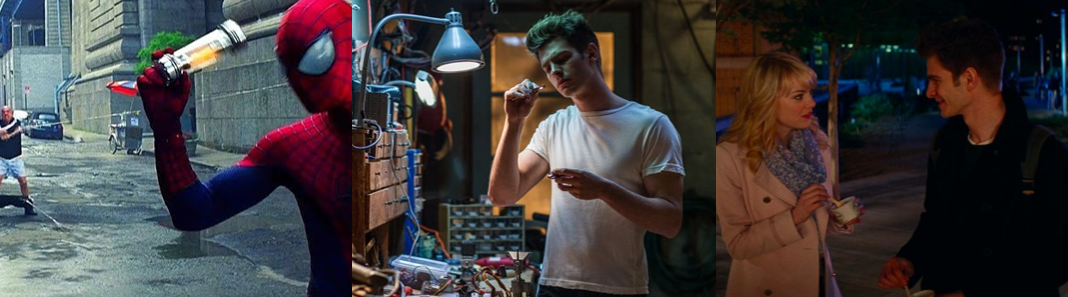
Peter’s haunted by the previous film and forced to keep Gwen at arm’s length to protect her.

Unfortunately, despite still revelling in his abilities as Spider-Man and enjoying his spark-filled relationship with the gorgeous Gwen Stacy, Peter is haunted by Gwen’s father, Captain George Stacy (Denis Leary), whose grim visage serves as a reminder of his promise to keep Gwen safe. Though he loves Gwen dearly and the two still have amazing screen chemistry, Peter’s burdened by guilt, agonised at the thought that he could endanger her. Although Gwen loves Peter and is willing to take the risk, she ultimately ends their relationship when she becomes sick of his flip-flopping. Heartbroken, Peter throws himself into his antics as Spider-Man, dividing public opinion as the Daily Bugle’s smear campaign paints Spider-Man as a menace despite many praising him. Still, try as he might, Peter can’t keep himself away from Gwen and watches over her in a way that could be creepy but comes across as sad and sweet. While Spider-Man saves lives, Gwen faces a dilemma when she’s offered a prestigious scholarship in London, one she’s excited to take despite her unresolved feelings for Peter. Peter’s stunned and equally torn between his love for her and wanting the best for her, meaning he doesn’t react well upon learning of her news and embarrasses Gwen prior to her interview for the scholarship. Ultimately, Gwen chooses to go, believing that’s better for them both, compelling Peter to finally confess (in elaborate fashion) his true feelings, and even his willingness to go to London with her. As much as I love Andrew and Emma’s onscreen banter and chemistry (their escape from Oscorp was a particular highlight), I do think the film suffers a bit from Peter immediately reneging on his promise at the end of the last film. The Amazing Spider-Man 2 may have benefitted from Peter and Gwen’s relationship being frosty and unresolved from the start to focus more on how Peter has to choose a difficult path since he doesn’t want to risk endangering or losing someone he loves, though this would make the first half of the film too similar to Spider-Man 2.
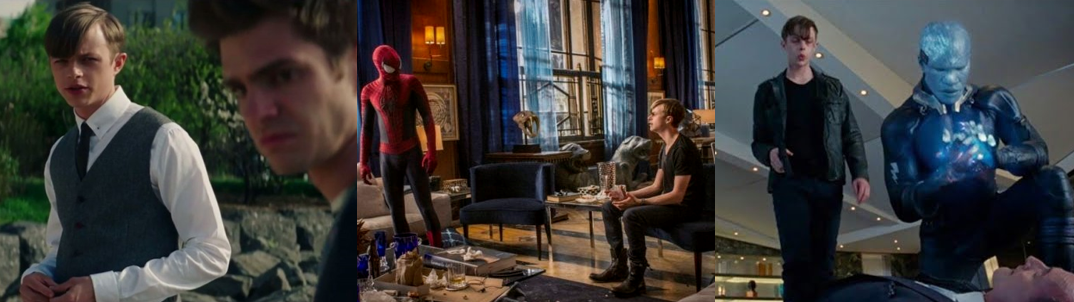
When Peter and Spidey refuse to help him, a desperate Harry turns to Electro.

Following Norman Osborn’s death, Peter’s compelled to reconnect with Harry Osborn, a hitherto-unknown childhood friend who was sent to boarding school at eleven and spent most of the intervening years travelling the world and resenting his father for sending him away. Thus, Harry is spiteful and dismissive of his father, and rightfully so as Norman spends his final hours spitting insults at his son and effectively cursing him with the same degenerative illness. In the aftermath, Harry (…somehow…) assumes control of Oscorp, riling up Vice President Donald Menken (Colm Feore) and revelling in flaunting his newfound power, appointing Norman’s secretary, Felicia Hardy (Felicity Jones), as his second-in-command. Though delighted to reunite with Peter, Harry’s clearly maladjusted and his erratic behaviour only spirals as his disease takes greater hold, giving him the shakes and strange lesions (despite Norman living many years with the illness). Desperate for a cure, Harry accesses Oscorp’s secure files and believes the answer lies in Spider-Man’s blood, begging and even offering to pay the web-slinger for a sample, only to be incensed when Spidey refuses out of fear for Harry’s safety. This, and Menken’s machinations, sends Harry over the edge and leads to him making a deal with Electro to access Oscorp’s secret basement of origins special projects laboratory, where he finds the means to first cure himself and then avenge himself against those who’ve wronged him. Overall, I liked DeHann’s depiction of Harry. He was a bit sullener and more vindictive and flaunted his authority compared to James Franco, and he presented an interesting dilemma for Peter, who wanted to help his friend but was worried about killing him or turning him into a monster like the Lizard. Harry’s vendetta against Spider-Man is a touch rushed and I think it would’ve been better for him to put two and two together when he first approached Peter for help, just to put a further spin on their relationship. It also would’ve benefited to save Harry’s descent into manic Green Goblin mode for a third film.
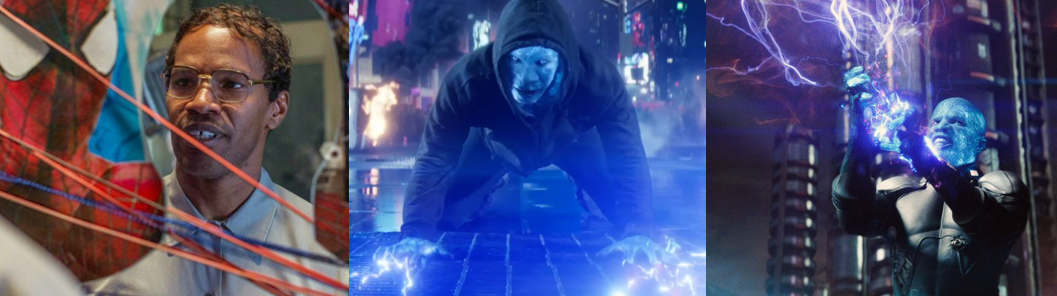
Spidey super fan Max is driven to rage and insanity upon becoming powerful enough to be noticed.

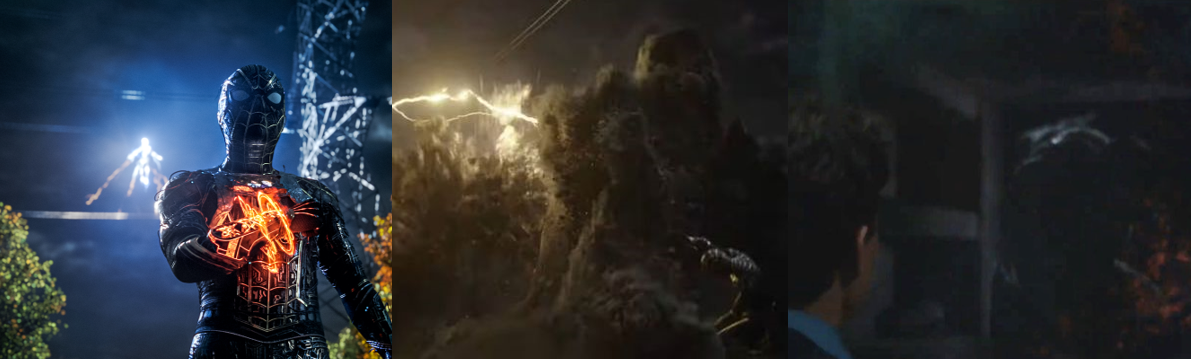
Rather than being a simple electrical engineer who turns to a crime after being zapped by lightning, The Amazing Spider-Man 2 recasts Electro as a hopeless outcast who’s socially awkward and bumbling. Pushed around and ignored by everyone, from pedestrians to his boss, Alistair Smythe (B. J. Novak), Max is a sad, worthless nobody who becomes enamoured by Spider-Man after Spidey saves his life and offers him encouragement. This leads to Max imagining  conversations between the two and describing the webslinger as his best friend since he was the first person to “see” and “need” him. This later extends to Gwen, who also shows kindness to Max where everyone else treats him like shit, with Smythe forcing him to fix a maintenance issue (on his birthday, no less!) and leading to Max falling into a vat of genetically engineered eels. These not only fix Max’s crooked teeth but also transform him into Electro, a man of first partial and then almost pure electricity, allowing him to see, sense, and control electrical currents. The experience leaves him disoriented, confused, and enraged, leading to him first accidentally and then purposely endangering others when cops fire at him, Spidey hesitates to remember him, and the newfound voices in his head compel him to lash out. Although subdued, Electro is tortured by the sadistic and overly theatrical Doctor Ashley Kafka (Marton Csokas), though Max invites the experience to test his power and is fuelled by the pain to accept Harry’s offer for a partnership and avenge himself on his captors. Once freed, Electro assumes a more menacing form and demeanour, having now mastered his powers to ensnare and kill with a flick of his hands and desperate not only to destroy Spider-Man after he “betrayed” him, but also to plunge the city into darkness so they can feel his pain. Although somewhat similar to the sympathetic angle applied to some of his predecessors in Raimi’s films (and a far more well-rounded character than the comic Electro, who was just a crook with powers who rarely reached his full potential), I do have an issue with depicted Max as the stereotypical outcast “geek”. It rarely works well and seems a waste of Jamie Foxx’s acting prowess, though I did like Electro’s obsession with being “seen” and his turn towards a crueller and more malicious demeanour after aligning with Harry.

The Nitty-Gritty:
The Amazing Spider-Man 2 benefits from a much more distinctive score, which is less a rehash of Danny Elfman’s work and more a stirring overture for the titular hero. Electro’s theme was particularly memorable; I loved how it incorporated the voices in Max’s head fuelling his rage. However, while the film treads less of the same ground as Raimi’s films compared to its predecessor, it does rehash some of the same beats concerning Richard and Mary from The Amazing Spider-Man. Sure, we learn a bit more about Richard’s relationship with Norman and that he had a weird subway lab that somehow still works after nearly fifteen years, but it still feels like the filmmakers are unsure of the endgame to this sub-plot (though, thankfully, they excised the nonsensical reveal that Richard was still alive, which would’ve tipped this already bloated plot into overdrive). The Amazing Spider-Man 2 touches upon themes of choices, not letting the past define you, and living each day rather than taking things for granted. Although Peter struggles with all of this, Gwen is all for it; her valedictorian speech is all about it and she urges Peter to stop letting her father’s death hold him back. Gwen’s adamant that they should embrace what they have, regardless of her father or the risk, and insists that she makes her own choices, even if it means she’s in danger. While there is a lot happening in the Amazing Spider-Man 2, I don’t think it’s not as badly paced as some would say. As much as I hate to say it, they made the right choice to cut Shailene Woodley as I’m not sure how she would’ve factored into the plot, though it was weird to include Felicia when she was just a secretary rather than a cat burglar. I also think it might’ve been better to end the story on a cliffhanger concerning Harry, not just because the finale with his Green Goblin is a bit rushed but also because we’d seen the Green Goblin done to death and I could’ve done without retreading that narrative (even if it was a little different here).
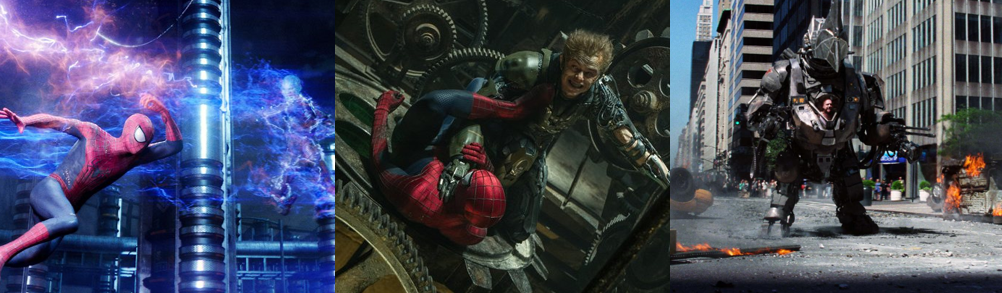
Despite some great effects and sequences, the film is bloated with characters and sub-plots.

The Amazing Spider-Man 2’s costume is, for my money, the best and most comic accurate depiction we’ve ever seen (though I miss the distinctiveness of the one from the last film). Harry’s final Green Goblin form is also more monstrous and closer to the comics, though still a bit lacking (and rushed) and we were denied a truly gruesome transformation sequence. The Amazing Spider-Man 2 ups the focus on action thanks to not having to waste an hour of its runtime redoing Spidey’s origin, giving us a handful of montages and fun action sequences that continue to showcase why Andrew Garfield is the best Spider-Man. There’s more emphasis on slow-mo sequences to show how Spider-Man reacts to danger and thinks about saving people. It’s used to great effect in the Times Square sequence, giving us a fantastic depiction of Spidey’s speed and strength alongside his compassionate nature as he first tries to appeal to Max’s reason. Electro is depicted as an unpredictable threat, especially when he first emerges since his powers are unstable. While it’s disappointing that he doesn’t resemble his mainstream comic counterpart, and that Max didn’t take on aspects of this design after being freed by Harry, Electro is very to his Ultimate comics counterpart and is depicted as both incredibly powerful and emotionally unstable. Electro can fly, dissolve bullets, and absorb and emit electricity, so Peter has to science up solutions to counteract and ultimately overload Electro’s powers. Although the first-person sequences are gone, Spider-Man’s web-slinging and Electro’s bolts all popped off the screen when viewed in 3D and I enjoyed the opening sequence where Spidey toys with the crazed Aleksei Sytsevich (Paul Giamatti). While Spidey maybe mocks the brutish mafia thug a bit too much and endangers a few lives, this was a great showcase of how Peter’s embraced his role as Spider-Man, something reinforced in the finale when Aleksei returns in a mechanised rhino suit…only for the film to end right before we get to see the fight! I really wish we’d gotten at least an animated rendition of Spidey’s battle with the Rhino in the credits as I loved the lumbering mech and its many weapons, and Giamatti’s scenery-chewing performance as Aleksei, though his return probably should’ve been left for a third film.
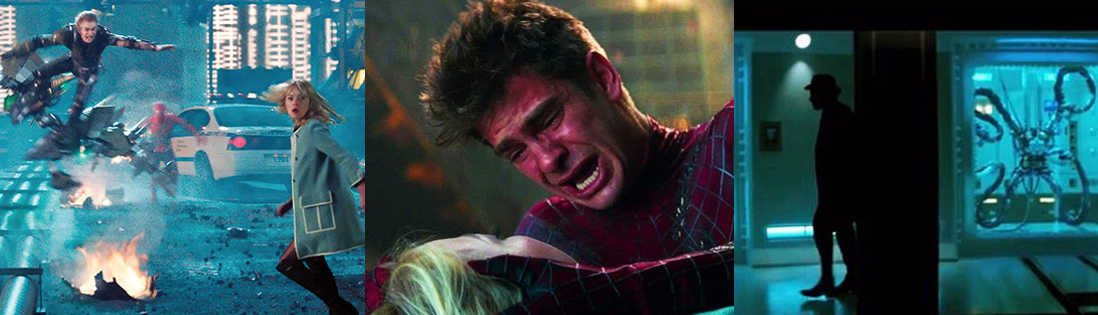
Harry’s revenge leaves Peter heartbroken, though sadly immune from future threats…

Desperate to avoid his father’s fate, Harry begs first Peter and then Spider-Man for help and is enraged when he’s denied, believing Spidey is a fraud despite him reasonably worrying about the effect his blood would have on the emotional Osborn. After being double-crossed by Menken, Harry begs Max to help him access Oscorp’s hidden bunker, where he forces Menken to inject him with a serum derived from Richard’s spiders, believing it to be a “cure”, only to be horrifically mutated as it both accelerates his condition and further alters him. Luckily, a convenient “healing” battlesuit keeps Harry from dying but the whole ordeal drives him as batty as Max, whose reward for helping is the freedom to absorb power from the electrical grid he created and was denied credit for to plunge the city into darkness and strike back at everyone who ignored him and idolised Spider-Man. Peter and Gwen’s reconciliation is interrupted by Electro’s revenge and Gwen insists on helping Spider-Man, putting herself in danger despite his protests. Spidey holds off Electro, done trying to reason with him, and risks his life grounding the misguided villain so Gwen can overload and seemingly destroy Electro. Their victory is short-lived, however, as the now demonic Harry swoops in on an Oscorp glider looking for revenge, figures out that Peter is Spider-Man, and spitefully threatens Gwen. This leads to a short and sadly rushed (but also brutal fight) between Spider-Man and the cackling Green Goblin that ultimately ends with Harry being knocked out and Gwen plummeting down a bell tower. Despite Peter’s best efforts and a heart wrenching image of him (and his webbing) reaching for her in freefall, Gwen suffers a similar (but far more horrific) fatal fall and Peter is left devastated. So much so that he spends five months so stricken by grief than he constantly visits Gwen’s graves and denounces Spide-Man. However, Peter suits up once more after a pep talk from Aunt May, reviewing Gwen’s speech about embracing life, and to confront the Rhino. Oh, and that mysterious gentleman (Michael Massee) also colludes with the incarcerated Harry to recruit a few individuals to use Oscorp’s secret projects to destroy Spider-Man.
The Summary:
I’ve always quite liked The Amazing Spider-Man 2. I remember liking it more than the first film when I first saw it and was glad to see it mostly leaning into new territory, though I could’ve done without the retread of the Osborn/Green Goblin plot. Still, the suit was fantastic and Andrew Garfield cemented his status as the best live-action Spider-Man in this film, still showcasing the wit, brains, and charisma I associate with the character. His chemistry with Emma Stone remains a highlight, though it does feel like the filmmakers walked back the ending of the last film after rushing to the rekindling of their romance. While I’m not a fan of the changes made to Electro’s personality, he grew on me as the film progressed, and I liked how he was desperate to be acknowledged and became obsessed with proving his worth and power. Dane DeHaan was a great Harry Osborn, though it’s weird that his illness is so advanced when it took decades for Norman to die, and his characterisation is a bit all over the place at times. While it’s utterly heartbreaking to witness Gwen’s death and Andrew sells it so well, I do think the Green Goblin, Rhino, and Gwen’s death should’ve been saved for a third film to devote the proper amount of screentime to those plots rather than rushing through them right at the end. There’s a lot happening in The Amazing Spider-Man 2 thanks to Sony’s obsession with bringing the Sinister Six to life and it definitely would’ve benefitted from a few more sub-plots being trimmed, but I still think it’s better than most people think. The exploration of guilt and grief is great, the effects and action are exhilarating, and it delivers a hell of a gut punch at the end, ultimately resulting in a film that’s still pretty decent despite some flaws.

My Rating:

Rating: 3 out of 5.

Pretty Good

Do you agree that The Amazing Spider-Man 2 isn’t as bad as its reputation? What did you think to Electro’s depiction and were you disappointed he didn’t resemble his classic look? Were you happy to see Peter don a more familiar suit? What did you think to the drama between him and Gwen and Harry’s depiction? Do you agree that there’s too much happening in the film? Would you have liked to see a third entry for these characters? How are you celebrating the wall-crawler this month? Whatever you think about The Amazing Spider-Man 2, leave a comment below, support me on Ko-Fi, and go check out my other Spider-Man reviews.

Back Issues [Spidey Month]: The Amazing Spider-Man #9


Easily Marvel Comics’ most recognisable superhero, unsuspecting teenage nerd Peter Parker was bitten by a radioactive spider and learned the meaning of power and responsibility in August 1962. Since then, the Amazing Spider-Man has featured in cartoons, movies, videogames, and countless comic books. To coincide with his day of celebration, I’m dedicating every Monday of August to everyone’s favourite web-head!


Story Title: “The Man Called Electro!”
Published: 12 November 1963 (cover-dated: February 1964)
Writer: Stan Lee
Artist: Steve Ditko

The Background:
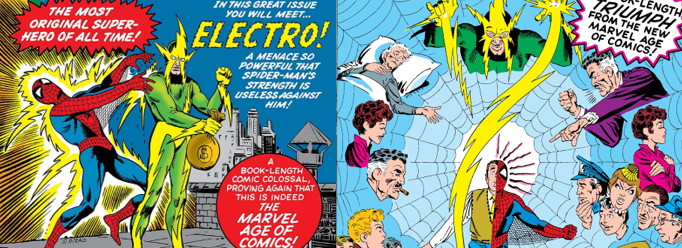
After his success with the Fantastic Four, Stan Lee (Marvel’s editor and head writer at the time) continued his winning streak with teenage superhero Peter Parker/Spider-Man, whose debut in Amazing Fantasy #5 was a best seller. To capitalise on his subsequent popularity, Marvel had Spider-Man headline other comics and match wits against some of comics’ most colourful and memorable villains. Former electrician turned supervillain crook Maxwell “Max” Dillon was transformed into Electro in this, the ninth issue of The Amazing Spider-Man, thanks to Stan Lee and Steve Ditko. Unlike most of Spider-Man’s villains, Electro was a simple man who turned to crime after his accident, relishing the incredible power bestowed upon him. While initially a small time nuisance, Electro became a founding member of the Sinister Six, received more than one power boost over the years, and even destroyed the Daily Bugle office building! Electro received a dramatic redesign in Marvel’s Ultimate comics, one that influenced his much-decried live-action debut in The Amazing Spider-Man 2 (Webb, 2014), and featured prominently as a low-level threat in various Spidey videogames and cartoons. Electro also got a notable redesign when he returned to live-action in 2021, got a significantly reworked backstory for his appearance in the 1990’s Spider-Man cartoon, and has secured his place as one of Spidey’s most recognisable villains.

The Review:
The first electrifying (heh) tale of Electro starts with a typical day in New York City for Spider-Man. To the amazement of the startled bystanders, the web-slinger is seen leaping from rooftop to rooftop presumably on a matter of life and death. As a bunch of crooks shoot it out with New York’s finest, the tense stalemate seems to end when Spidey swings overhead. However, both parties are stunned when the young superhero simply passes by without intervening. Arriving in Queens, Spider-Man races through the streets, changing to his civilian identity as he goes, and arrives at his childhood home, where his sickly Aunt May lies in bed. Peter dotes on his grateful old aunt, delivering her the medicine she so badly needs but, as she sleeps, worries over her frail condition and the severity off her illness. While the troubled youngster begins his nightly vigil, the man once known as Max Dillon garbs himself in a garish green and yellow costume and charges his incredible electrical powers in anticipation of his debut as Electro. Seeking to challenge himself, Electro targets an armoured car carrying a gold shipment. When the armed guards mock him, Electro proves his power by zapping their wrists with “electric shocks” and surrounding them with a ring of electricity, terrifying them into giving in to his demands for the gold. The next morning, Peter’s alarmed when the doctor tells him that Aunt May is worsening and must be admitted to hospital (though, naturally, the old dear is more concerned with Peter’s health). Peter’s so distracted by his aunt’s deteriorating condition that he appears aloof at school, ignoring his classmate’s taunting and giving Eugene “Flash” Thompson the cold shoulder when the arrogant knob tries to reach out to the troubled teenager. Peter’s mood lifts later that day when Aunt May’s condition improves, and when he finds Betty Brant sitting with his old aunt. Betty notes that Peter seems to be bottling up his emotions and putting on a calm façade and, when he swings around the city as Spider-Man, his inner monologue reveals a boy desperate to raise the cash needed for his aunt’s operation.   

Distracted by Aunt May’s health and Jonah’s headlines, Spidey is caught off-guard by Electro.

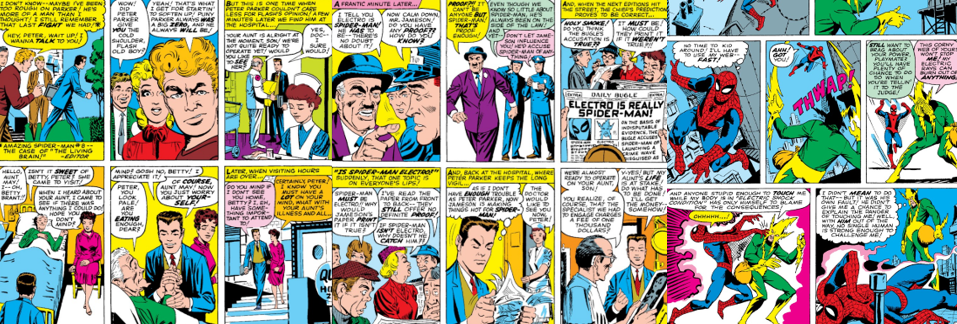
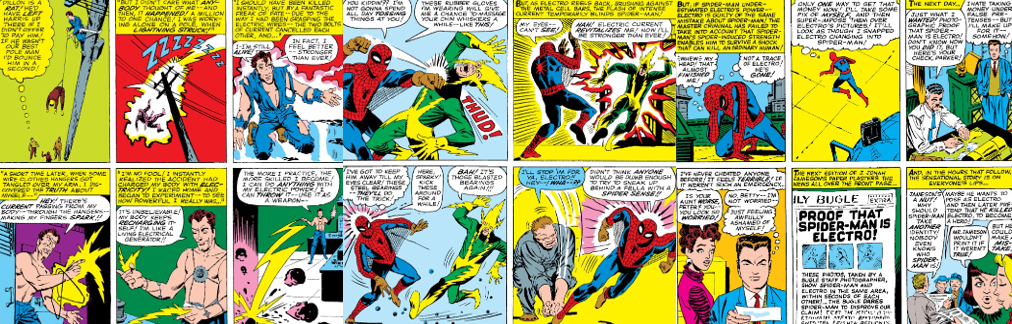
Peter’s issues only worsen as a rainstorm sweeps the city, ruining any chance of taking decent photos of Spider-Man and getting cash from his tight-fisted employer, J. Jonah Jameson. Speaking of the grouch, we jump to the next day to find Jonah getting some figures from the Forest Hills Bank, meaning he’s at ground zero when Electro attacks! Toying with the accountant and Jonah with his electrical bursts, Electro brazenly rips open the vault with his powers, grabs a bag of cash, and scales a building across the street thanks to magnetising his hands and feet! Naturally, Jonah sees this (and Electro’s familiarity with him and having spotted Spidey swinging past moments later) as proof that Electro is Spider-Man in disguise and immediately prints a scathing headline, and loudly shouts his accusations at anyone who’ll listen. Predictably, many New Yorkers believe Jonah’s claims despite the lack of proof, which only exacerbates the stress Peter feels about his aunt’s operation. After Jonah refuses Peter’s request for a loan, Peter realises he can cash in if he captures Electro and immediately swings out as Spider-Man in search of the crook. After a couple of false alarms, Spidey’s spider-sense alerts him to Electro’s presence and he finds him searching for a hidden safe using his bizarre powers. After snapping some pictures, Spidey leaps into action, barely dodging Electro’s bolts and temporarily blinding him with his webs. However, Spidey receives the shock of his life (literally) when he grabs Electro and is zapped by a burst of electricity so powerful that it knocks the youngster unconscious. When he recovers, Peter successfully dupes Jonah with doctored photographs, getting the money he needs but finding himself wracked by guilt and shame for stooping to such measures. Elated to have the “proof” he so desperately wanted, Jonah prints a story confirming that Spidey is Electro, shocking the civilians and taking the heat off the real Electro.

Unburdened by Aunt May’s condition, Spidey uses innovative methods to subdue the powerful Electro.

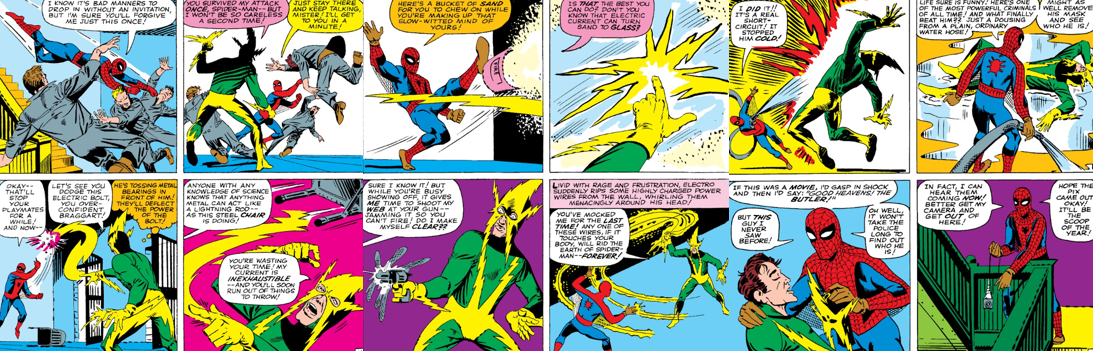
While gloating in his secret lair, Electro ruminates on his origin. Some time ago, Max Dillon, ordinary electric lineman, was a selfish ass who refused to help an endangered co-worker unless he was paid for his time. After rescuing his co-worker from a high-tension pole, fate saw Max struck by lightning; incredibly, rather than being killed, Max found himself transformed by the electricity. Realising he could generate and control the element, Max experimented with his powers, constructing a harness to perpetuate his electrical charge and learning to toss lightning bolts. Back in the present, Electro breaks some prisoners out of jail to recruit some muscle for his operation and, though he’s compelled to intervene when he learns of the jailbreak, Peter’s forced to stay at the hospital while Aunt May goes into the operating theatre. Though the prisoners refuse to listen to Electro’s warnings and clash with the guards and cops, Spider-Man’s absence only strengthens belief that he and Electro are the same man. Thankfully, Aunt May’s operation is a success, much to Peter’s relief. However, when he insists on taking pictures of the riot, Peter’s shocked when Betty accuses him of thrill seeking. Still, free from the worry about his aunt, Peter leaps into action as Spider-Man, much to Jonah’s chagrin, and slips on rubber gloves and shoes to negate Electro’s powers. After easily manhandling the violent inmates, Spidey tackles Electro, using his scientific know-how to redirect Electro’s lightning bolts with a steel chair and landing a solid left hook. After receiving a quick power boost, Electro grabs a discarded gun and demonstrates his awesome power by turning a flurry of sand Spidey kicks at him into glass! Even with his rubbers, Spidey finds Electro’s attacks too aggressive, forcing him to think on his feet and use a nearby water hose to short circuit Electro. Afterwards, Peter smugly downplays Jonah’s threats to fire and sue him for selling him fraudulent pictures by selling him pictures of the fight between Spidey and Electro. Additionally, not only is Aunt May still doing well but Peter and Betty resolve to work through their misunderstanding and explore their feelings for each other by the story’s end.

The Summary:
For a story titled “The Man Called Electro!”, Electro is more of a secondary concern here. Instead, the primary focus is on Aunt May’s mysterious and worrisome illness. It’s possible that a previous issue detailed exactly what was wrong with her, judging by Peter’s internal monologue, but she’s definitely in a bad state here. Aunt May’s so ill that Peter’s forced to ignore both regular street crime and a prison riot to bring her medicine and be by her side. However, he’s more disturbed by the depths he sinks to pay for her operation. After being surprised by Electro’s incredible power, Peter’s left without any photographs of the super-powered crook and forced to super-imposed himself over the pictures he does have, providing Jonah with “proof” that Spidey is Electro and leaving Peter filled with shame at being so deceitful. Sadly, this aspect isn’t explored beyond a few panels. On the one hand, I’m glad as I could easily see it leading to an unnecessary recap of Uncle Ben’s death. On the other hand, seeing Peter shun his responsibilities and forced down such a dark path could’ve made for good drama. It’s still here, obviously, as both Betty and even Flash note Peter’s changed demeanour, but I’ve seen Peter in similar situations before where he worried himself into a fever and was driven into a panic attack or blind rage from his various dramas. Jonah is on top form here, forcing misshapen jigsaw pieces to fit his narrative of Spider-Man turning to crime as Electro and publishing his wild claims without any proof. Not that half of New York requires proof, though, as the disturbingly fickle and easily swayed civilians find themselves doubting the web-slinger simply based on a sensationalist headline. This issue really hammers home how devoted Peter is to Aunt May and how much she cares for her nephew. While she mollycoddles him a little too much for his age and disregards her own health in favour of his, Peter ignores everything (from his studies to his responsibilities as Spider-Man, to his peers and even Betty) to care for her and to get her the help she needs, even if it is unclear what’s wrong with her and what operation she underwent (I assume it was something to do with her heart).

Though Electro uses his powers for petty crime, Peter’s forced to use dubious methods to raise funds.

These factors aid in Electro slipping under Spider-Man’s radar for a while. It’s only when the Daily Bugle prints scandalous headlines that Peter gets investing in tracking down the super-powered crook, and he ensures his aunt’s welfare before tackling Electro again. Electro has incredible power: he can super-charge his body to electrocute on contact, toss lightning bolts, magnetise his hands and feet to climb walls, and basically manipulate anything with an electrical current. Garbed in an elaborate costume that’s both ridiculous and iconic, Electro’s nearly inexhaustible powers means that, on paper, he should be a formidable foe. Indeed, Spider-Man’s reflexes barely avoid Electro’s attacks, which strike with (presumably) lightning-fast speed, and Spidey dons rubbers to protect against Electro’s current…and even then, he struggles to ward off Electro’s whip-like lightning in the finale. However, rather than being  a significant threat, Electro sticks to his working-class roots and resorts to petty crimes. Limiting himself to knocking off armoured vans and banks, Electro’s all about the cash, which he spends kitting out a vast lab to super-charge his body. It isn’t until he starts making headlines that Electro assembles a crew and, though he demonstrates his powers in the prison break, he doesn’t have a commanding enough presence to sway the inmates (at least, not until they turn to him for protection from Spider-Man). Most tellingly, after being defeated by a simple water hose, Electro is unmasked by the wall-crawler…who naturally has no idea who he is, setting up the long-running thread of Electro being a nobody with extraordinary powers that he doesn’t use to their full potential. However, he makes for a visually interesting villain, and I enjoyed the well-balanced focus on drama and action in this story, especially regarding Aunt May and Jonah. Though I would’ve liked to see Peter’s shame explored further, it was amusing seeing Jonah publicly humiliated and then readily accepted Peter’s next set of photos as real after being duped the first time. I also liked the suggestion that there’s more to Betty than we (and Peter) realises and that Spidey was forced to think on his feet to find was to counter and subdue Electro’s otherwise awesome powers.

My Rating:

Rating: 4 out of 5.

Great Stuff

Did you enjoy Electro’s debut story? Are you a fan of the villain and, if so, what are some of your favourite Electro moments and stories? Would you have also liked to see Peter’s shame explored in more detail? What did you think to Electro’s origins and the way he utilised his powers? Would you be so easily swayed by one of Jonah’s headlines? Where does Electro rank in your tier list of Spidey villains? Share your opinions on Electro in the comments, support me on Ko-Fi, and go check out my other Spider-Man content.

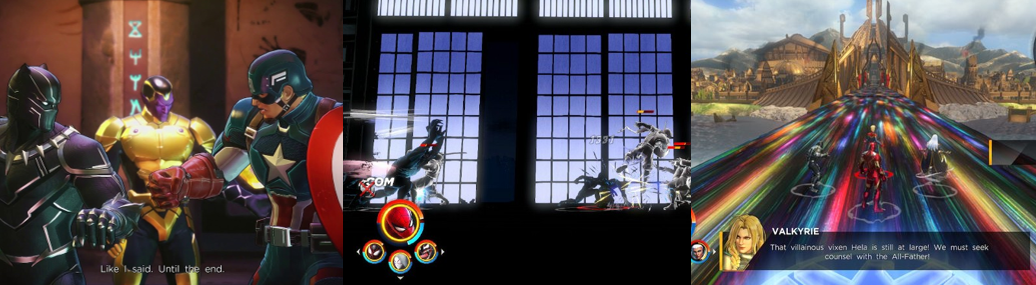
Game Corner: Marvel: Ultimate Alliance 3: The Black Order (Nintendo Switch)

Released: 19 July 2019
Developer: Team Ninja

The Background:
For decades, few videogame publishers were as synonymous with Marvel Comics as Activision, who produced adaptations Marvel’s most popular properties. While some were better than others, Activision’s efforts were largely praised, especially after they partnered with Raven Software on the X-Men Legends games (2004; 2005). Activision and Raven Software expanded their scope to the rest of the Marvel universe with Marvel: Ultimate Alliance (2006), a largely successful team-based brawer praised for improving upon its predecessors. Though now delisted, it was followed by a sequel three years later, courtesy of Vicarious Visions, which tweaked the gameplay with team-based attacks to encourage experimentation. Though Marvel: Ultimate Alliance 2 (2009) was praised for its branching storyline, the stripped down roleplaying mechanics were criticised. While it was also delisted in 2020, fans were clamouring for a follow-up and, just ten years later, Team Ninja stepped in to work alongside Marvel in reviving the franchise. Seeking to place additional emphasis on combat, the developers explored the cosmic scope of the Marvel universe by including the Infinity Stones and lesser-known characters and chose to make the title a Nintendo Switch exclusive after developing a close relationship with Nintendo. Although Marvel: Ultimate Alliance 3: The Black Order was the sixth best-selling game in its first week and was later bolstered by extensive downloadable content (DLC), it was met with mixed reviews that praised the colourful action but criticised its lack of innovation.

The Plot:
While battling Nebula and Ronan the Accuser, the Guardians of the Galaxy stumble upon a plot by the mad titan, Thanos, to collect the six Infinity Stones. Although they scatter the Stones, Thanos’s acolytes, the Black Order, pursue the gems, prompting an alliance of Earth’s mightiest heroes to retrieve them first.

Gameplay and Power-Ups:
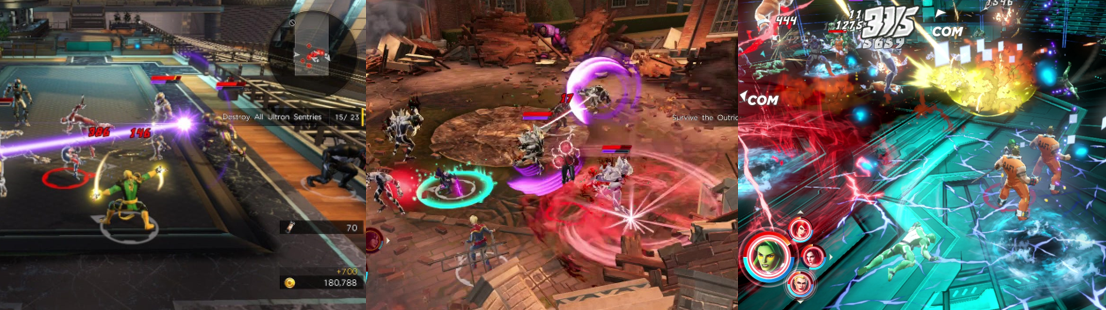
Like its predecessors, Marvel: Ultimate Alliance 3: The Black Order is a team-based action role-playing game in which players assemble a squad of four heroes from across the Marvel universe to battle various nefarious baddies, primarily the titular Black Order, who are hunting the six all-powerful Infinity Stones on behalf of their master, Thanos. The game offers five save slots, two initial difficulty levels, and a base roster of thirty-six playable characters, with many being encountered as you play through the story and joining your alliance either after fighting alongside you or being freed from some kind of mind control. Marvel: Ultimate Alliance 3 offers three controller configurations, thankfully none of which involve motion controls, and allows you to toggle overlays, notifications, tips, and other onscreen elements from the “Settings” menu. These include altering the camera placement, which enables a lock-on feature by pressing in the right stick, though the camera generally remains more focused on whichever character you’re controlling rather than offering a bird’s eye view as in the last two games. Although you can fight alongside friends either locally or online, you switch between your teammates with the directional pad (D-pad) when playing alone and your computer-controlled partners are very useful in a fight, attacking, enabling team attacks, and reviving defeated characters without any input from you. Pressing A sees you interact with the environment to activate consoles, pick up or move certain objects, and talk to other characters. You jump with B, executing a double jump, swinging from webs, or flying depending on which character you’re playing as, and throw light attacks with X and heavy attacks with Y. These can be strung together to perform basic combos and you can also perform a mid-air attack and throw objects (like bombs and missiles) by pressing Y. You block incoming attacks by holding the Z trigger and tap it to dodge, and collect glowing red orbs from defeated enemies or smashed crates to restore health, blue orbs to refill your Energy Point (EP) gauge, and credits to spend on upgrades.

Combat is thick, fast, chaotic, and constant thanks to loads of enemies and character abilities.

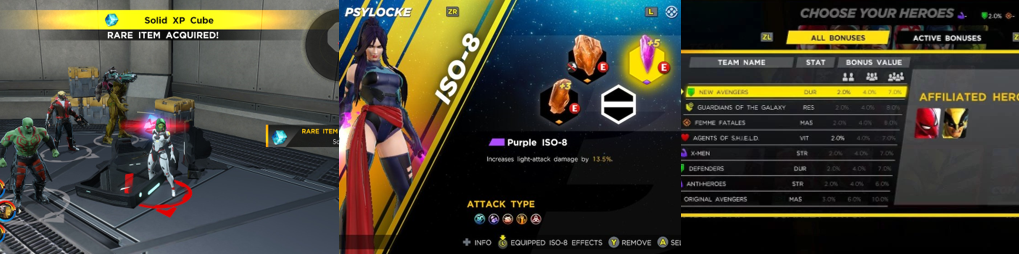
As in the last two games, each character has specific abilities tied to their superpowers or superhero traits. You activate these by holding the Right trigger and selecting an icon using the D-pad; using Abilities drains your EP, however, and each Ability comes with a different cost. However, these attacks allow you to stun, stagger or deal elemental damage to enemies using Peter Parker/Spider-Man’s webs, Thor Odinson’s lightning, and Doctor Robert Bruce Banner/The Hulk’s incredible strength. Many characters have projectile attacks in their arsenal, such as Wade Wilson/Deadpool firing guns and Scott “Slim” Summers/Cyclops blasting his eye beams, while others cause splash damage or specific buffs, like Piotr Rasputin/Colossus being able to reflect projectiles and Wanda Maximoff/The Scarlet Witch healing her allies. Some, like James “Logan” Howlett/Wolverine, have passive abilities that allow them to automatically regenerate health as they walk around; others, like Johnny Blaze/Ghost Rider and Ororo Munroe/Storm, specifically deal in elemental damage. Character’s Abilities can also be mixed and matched by holding ZR and pressing one of the face buttons (or pressing A when prompted); this sees two characters attack in a combo for additional damage. As you dish out and take damage, you’ll also build the Extreme (EX) Gauge). Once full, you can press L and R up to three times to have two to four of your teammates perform a devastating combination attack that’s great against bosses. While the various cannon fodder you fight are easily dispatched, larger commanders and bosses need their “stun” meter drained before you can really put a beating on them and others (and certain treasure chests) require specific combination attacks to breach their shields. Defeating enemies sees your characters gain experience points (XP) to level-up, increasing their statistics (attack, defence, etc), though you can also use the various Orbs you find to manually level-up. Each character’s special Abilities can also be further enhanced using Ability Orbs and credits, reducing the EP cost and increasing their damage, among other benefits. You can also earn “Team Bonuses” depending on your team selection: pick a group of X-Men, for example, and your strength or resistance stat will increase, while picking characters of royalty ups your maximum energy stat.

Search for chests to gain currency and other expendables to upgrade and buff your alliance.

Although you can’t equip gear to your characters, the boss battle against the Destroyer armour sees you temporarily empowered by Asgardian magic and you can eventually equip your team with “ISO-8” crystals, coloured stones that enhance their attack power, resistance to elements, or critical hit ratio, among others. You can further upgrade these with credits and ISO-8 capsules, though some of the rarer ones will also debuff you (for example, your attack my increase but your defence will decrease accordingly). You’ll also inevitably gain access to the Strategic Hazard Intervention Espionage Logistics Directorate (S.H.I.E.L.D.) Lab, which acts as the game’s skill tree. By spending credits and Enhancement Points (EP), you can further increase your team’s overall attack, defence, resistance, vitality, and such and even unlock additional ISO-8 slots (with more being earned by levelling-up). You can also enter the S.H.I.E.L.D. Depot from the main menu to purchase additional costumes and social icons by spending S.H.I.E.L.D. Tokens. Marvel: Ultimate Alliance 3 is pretty forgiving (on the “Friendly” difficulty, at least), with multiple checkpoints in each area. When you activate a S.H.I.E.L.D. checkpoint, your team is fully healed, and you can swap or enhance them if you wish. If a teammate is defeated, you can hold A to revive them, but I wouldn’t recommend it unless you absolutely have to. Not only are revives limited, but downed characters will eventually return to full health even before you reach a checkpoint so it’s not worth risking another character taking damage by healing a partner. Exploration generally leads you to treasure chests or special walls that require a special combination attack to open, or to a “Rift” challenge that takes you away from the main game to tackle a special challenge (usually a boss rematch or enemy gauntlet) for extra rewards. Your path is incredibly linear most of the time, hence why there’s no map, and the game’s primary focus is on chaotic combat and visually manic team-based attacks. Unlike in the last two games, you can no longer grapple or throw enemies (though you can still send them flying off certain platforms) and there are no character-specific team-up moves, meaning the action can quickly get quite tiresome.

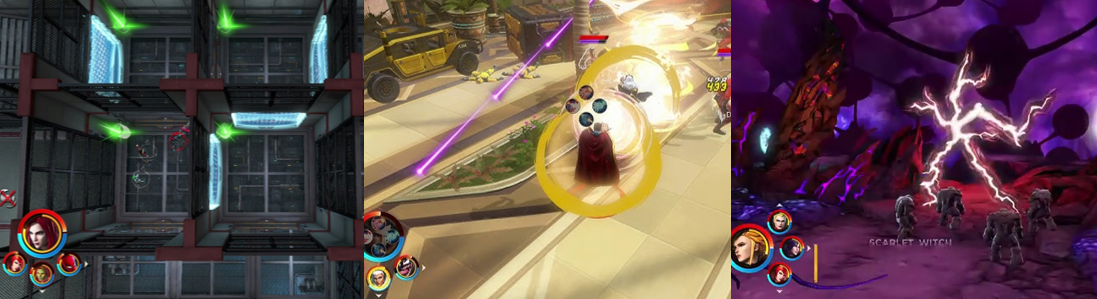
Sadly, puzzles are practically non-existent, with only Rifts offering additional challenges.

Because of its focus on hectic combat, there’s even less room for puzzles than there is for exploration in Marvel: Ultimate Alliance 3. Puzzles boil down to activating a console to open a door or making a platform move and that’s it. Sometimes, you’ll hold A to move a block and avoid lasers or cannons, but mostly you’ll be timing jumps between said lasers to progress and simply hurling missiles at those cannons. Sometimes, you’ll rotate statues or press switches to progress; others, you’ll be avoiding toxic ooze in Hel or solving door puzzles at the Raft or in Avengers Tower. After hopping across the rooftops of New York City, you’ll infiltrate the heavily fortified fortress of the Hand, dealing with ninjas that drop from the sky and hidden arrow hazards. When in Wakanda, Advanced Idea Mechanics (A.I.M.) corrupt T’Challa/The Black Panther’s defences, leading to an exasperating section where you must avoid snipers and being roasted by a giant panther statue’s energy blast. When transported to the Dark Dimension, you must use portals to reach new areas and defeat waves of demonic enemies to lower magical barriers and progress. Some attacks also screw up your controls or temporarily freeze you; some enemies are best defeated by tossing explosives at them; and many missions have an additional character fighting alongside you who’s often unlocked afterwards. However, a lot of the additional features of the previous games are missing; you can talk to other characters, but there are no dialogue options or character-specific interactions. There are no trivia quizzes, no optional side missions beyond the Rifts, and no character specific challenges to unlock extra stuff for each character. There aren’t even hub areas, in the traditional sense, with characters just appearing around S.H.I.E.L.D. checkpoints at times, though you can destroy a fair bit of the environment, and some encounters have you fleeing towards the camera as bosses chase you or present you with unwinnable battles.

Presentation:
Whereas the last two games primarily based their aesthetics on the comics books, especially the Ultimate comic line, Marvel: Ultimate Alliance 3 adheres very closely to the Marvel Cinematic Universe (MCU), especially in the visuals of its locations. I was hard pressed, for example, to tell the difference between Asgard here and the Asgard to the MCU, with both the golden city and the rainbow bridge, the Bifrost, appearing almost exactly as they’re depicted in the films. The same is true for Wakanda, the Dark Dimension, and Knowhere, all of which are virtually indistinguishable from how they appear in the MCU. There are some differences, of course: Taneleer Tivan/The Collector’s museum, for example, uses coloured cube cages and Wakanda leans much more into traditional architecture than the pseudo-futuristic science of the films (likely because Black Panther (Coogler, 2018) released a year before this game was made). Xavier’s School for the Gifted is lifted almost exactly from the 20th Century Fox X-Men movies (Various, 2000 to 2020), however, including a hedge maze, 1:1 Cerebro room, and basketball court that doubles as a landing pad for the Blackbird. While the Dark Dimension and the cosmic mind trip that is Sanctuary also heavily borrow from the bizarre cosmic imagery of the MCU, the Raft and Avengers Tower are much more akin to their comic book counterparts, though they’re comparatively bland locations, lacking fun areas like the Danger Room or Wakanda’s Necropolis (though you do pass through Anthony “Tony” Stark/Iron Man’s Hall of Armours in the tower). Although you only make a brief stop in Attilan to try and get help from the Inhumans, the architecture is far more visually interesting than that awful television show, seemingly being comprised of Celestial technology, and I enjoyed the ominous gothic presentation of Hel, with its restless Viking warriors and damaging sludge. Unfortunately, Marvel: Ultimate Alliance 3 continues the trend of having disappointingly bland and forgettable music, opting for generic themes for each location, event, and character that are lost amidst the constant fighting.

A visually impressive brawler that takes obvious inspiration from the MCU films.

The game also opts for an almost cel-shaded, action figure-like aesthetic for its colourful cast of characters. While many again both look and sound like their MCU counterparts, there are some exceptions: Peter Quill/Star-Lord, for example, looks nothing like Chris Pratt and the X-Men are far closer to the comic books than Fox’s films. Despite you assembling a custom team of heroes, cutscenes depict either everyone or characters specific to the location you’re in (the corrupted Doctor Stephen Strange in the Dark Dimension, for example) as they’re better suited to advance the plot against the local baddies. With the game shifting to a more third-person perspective, you’re closer than ever to the action and can see more of the environment than in the previous games. However, this comes with some drawbacks: mainly, there are far less opportunities or incentives to explore. Second, environments are painfully linear, with dead ends or locked doors barring your progress. Third, and most frustrating, is the camera, which easily loses track of your opponent/s and often lumbers you with wireframe representations when the foreground blocks the view. Thankfully, you won’t be falling down pits and rarely have to worry about onscreen hazards, but it can be aggravating trying to figure out which platforms and crates can be jumped on and which can’t. Marvel: Ultimate Alliance 3 offers a diverse cast of characters, each with their own idle poses and quips, though these do inevitably repeat. The game’s also surprisingly light on Easter Eggs: you’ll spot Deadpool singing away as he makes tacos in the X-Mansion, but not much else, and there are no optional missions or choices to encourage replaying missions. It’s a far cry from the first game, where there was always something to collect or an additional character to help out. Instead, it’s basically all combat, all the time in Marvel: Ultimate Alliance 3. Luckily, the game looks pretty good (everything’s very colourful and true to its inspirations) and performs really well, though there are some long load screens and it is annoying being forced to continue your game every time you challenge a Rift.

Enemies and Bosses:
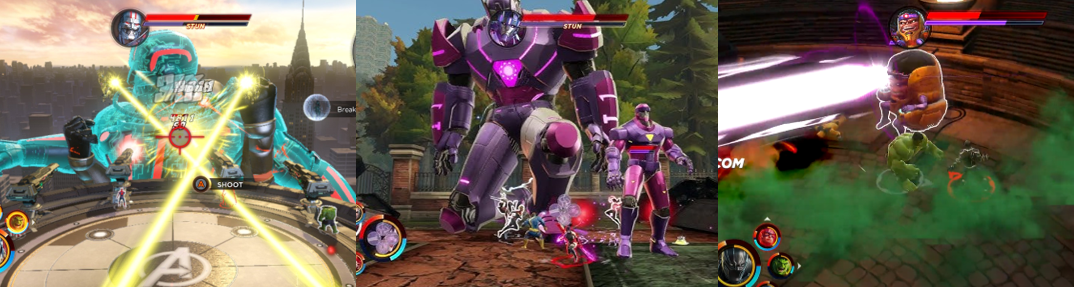
All the usual suspects appear here as disposable cannon fodder for you to endlessly beat up, with many of the game’s goons sharing traits across the various locations. You’ll encounter Kree, Ultron Drones, agents of A.I.M., and Doombats who all pack various energy blasters. Ultron’s clones are the worst for this, relentlessly firing energy blasts and crashing through windows. The Raft’s unscrupulous prisoners attack in large groups, as do the restless Viking warriors who populate Hel, tossing axes from afar and luring you into toxic goop. Gargoyle-like Fire Demons also dwell here, offering a greater challenge with their swoop attack and fire breath, not unlike the monstrous Outriders and Mindless Ones who make up Thanos and the dread Dormammu’s forces, respectively. Alpha Primitives, Hydra goons, and towering Sentinels also appear, with the latter firing huge energy blasts from the palms and best attacked by throwing their explosive energy cores back at them. No matter where you are and what enemies you fight, more powerful commanders will also appear. Larger, tougher, and sporting a stun meter, these commanders should be your top priority as they’ll charge across the screen, cause shockwaves, and generally offer a far greater challenge even when you’re at a higher level. These minions often fight alongside their masters, generally so you can recover some health and EP to better damage the bosses, and will endlessly spawn in one of the additional modes unless you destroy their teleporters. Some of the game’s challenges or story-based missions charge you with defeating a certain number of enemies to progress. Other times, bosses appear in these waves, and you must occasionally flee or purposely lose some fights. This happens when Cain Marko/The Juggernaut comes tearing through the X-Mansion, for example, and in early encounters with the Black Order, who cannot be beaten or will chase you, raining lightning or other attacks from the sky and across the ground.
Few bosses require more than just hit-and-run tactics, even when augmented by an Infinity Stone.

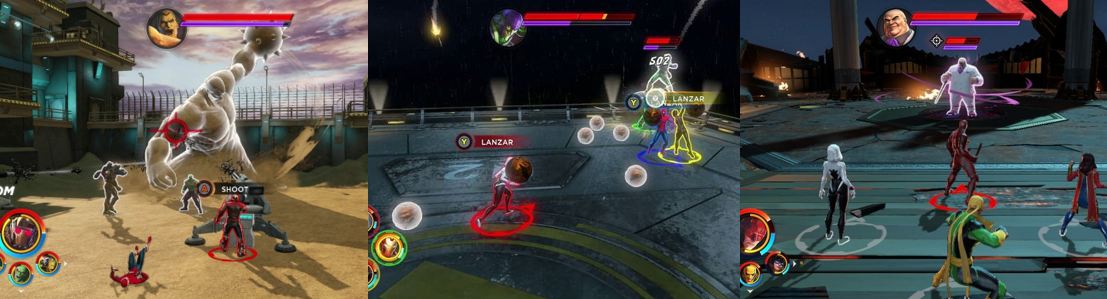
There are loads of bosses to fight in Marvel: Ultimate Alliance 3, with some returning from the previous games, some teaming up, some having a couple of phases, and all boiling down to whittling down their stun bar, unleashing an EX attack and/or your most powerful Abilities, and avoiding damage until you can repeat this. The first ones you’ll face are Nebula and Ronan the Accuser, who often appear as a duo in optional challenges. Nebula is faster and more nimble, wielding blades where Ronan uses a massive warhammer. Both set a standard all bosses follow, which is that they’ll use either a jumping slam or an explosion of energy (or both) to send you flying. While quelling the riot in the Raft, you’ll encounter a version of the Sinister Six, with some unique variations to each battle. Flint Marko/The Sandman, for example, flings waves of sand and erupts his big sand fist from the ground as a large sand creature. You must use A to mount the nearby cannons and unload on him to chip away at his stun meter. Maxwell “Max” Dillon fights alongside Eddie Brock/Venom, raining lighting and electrocuting you with bursts of electricity, before he’s eaten by Venom and starts busting out electrically-enhanced symbiote powers. Venom joins the team after this fight and is tested against Quentin Beck, who first brainwashes Mile Morales/Spider-Man, Gwen Stacy/Spider-Woman, and Kamala Khan/Ms. Marvel to fight you and then unleashes a poisonous mist, teleports about, and confuses you with duplicates, Doctor Otto Octavious/Dr. Octopus is fought in a two-stage fight where you must first avoid his tentacles and scurry charge and then attack each arm to stun him. Finally, you’ll battle Norman Osborn/The Green Goblin for the Time Stone. The Green Goblin swoops overhead and lingers slightly out of reach, peppering the arena with his pumpkin bombs, charging at you, and freezing time to bombard you. He’s noticeably weak to his pumpkin bombs, however, so try and toss them at him before they explode in your face! After battling into the Hand’s fortress, you must first free Elektra Natchios from the Hand’s influence and then face Lester/Bullseye and Wilson Fisk/The Kingpin in separate fights. You must take out the ninjas feeding Elektra power, avoid Bulleye’s spread of razor sharp and explosive cards, and dodge the furniture and massive energy beam thrown by the Power Stone-enhanced Kingpin. The Kingpin also charges like a rhino, leaps at you to cause shockwaves, and even rips up stone columns to use as melee weapons!

Gigantic bosses and the quirkier villains help mix-up the otherwise tedious combat.

Avengers Tower is then attacked by Ultron and his drones, who assist him in battle. Not that he needs it as the Mind Stone allows Ultron to mess up your controls, to say nothing of his signature face and palm beams. Ultron then grows to gigantic proportions, sweeping the area with his eyebeams before Clint Barton/Hawkeye intervenes and Ultron merges with Ultimo. This is the first giant boss battle in the game and sees you blasting Ultimo with cannons and avoiding his massive swipes. The Infinity Sentinel is comparatively smaller, but no less dangerous thanks to its own face beam and missiles. Though you can damage it with Sentinel cores, it’s finished in a cutscene by Erik “Magnus” Lehnsherr/Magneto, who then tosses debris and throws you off balance with magnetic pulses while Juggernaut pummels you and Raven Darkholme/Mystique tosses daggers. After surviving Mystique’s Danger Room trials, you face Magneto, now even tougher thanks to the Power Stone, before being chased away and banished to the Dark Dimension by the Black Order. There, you battle past Loki Laufeyson (who boasts elemental attacks and duplication tricks) to eventually face the dread Dormammu, who wields the Reality Stone and is the second giant boss. You must subdue his minions and avoid his flame bursts, whittling down his magical barrier either directly or be destroying three nearby orbs, all while dodging his giant fists and ground spikes. The brief fight with Maximus Boltagon is far easier, even though the mad Inhuman carries a massive energy cannon and you must take cover in Thane’s energy bubble to avoid Maximus’s barrage of lasers. Ulysses Klaue/Klaw awaits in Wakanda and his sound-based energy blasts and waves must be overcome to rescue and recruit James Buchanan “Bucky” Barnes/The Winter Soldier. You then fight past A.I.M. to confront their master, George Tarleton/Mental Organism Designed Only for Killing (MODOK), who uses the Soul Stone to turn the Dora Milaje against you and attacks with a slew of appendages, from buzzsaw arms, poison gas, failing tentacles, and his signature forehead blast.

Battles with the empowered Black Order, Thanos, and Thane offer some of the most enjoyable challenges.

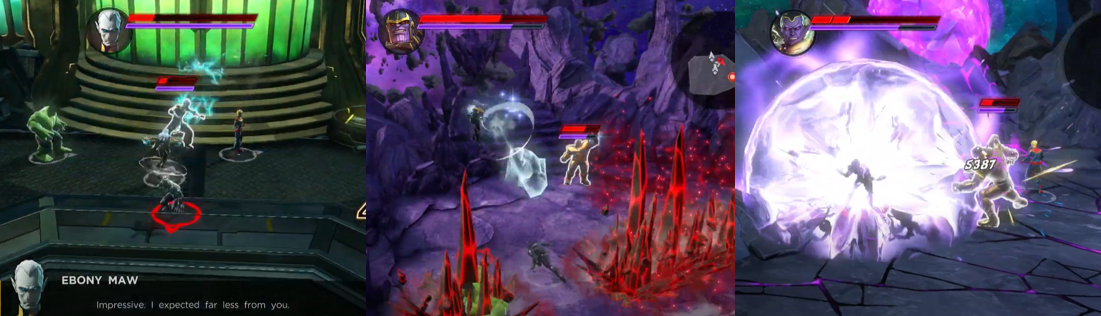
Though your goal in Hel is to confront Hela, you’ll actually battle the fire demon, Surtur, in another giant boss battle. This was a bit of a difficulty spike for me as Surtur’s flaming sword has a long reach and he causes the ground to erupt in flames, to say nothing of stun locking you with repeat sword strikes! Best him and Hela sets Johann Schmidt/The Red Skull on you, with the Nazi madman firing a powerful revolver and sapping your health with his “Dust of Death”. Hela gives the Red Skull a boost, protecting him with a shield and allowing him to fire a Bifrost-like laser, before placing his consciousness into the Destroyer armour. Though bolstered by Hydra forces and boasting a sweeping face beam, you can get a power-up from glowing crystals to overcome this destructive force. Finally, you venture to Knowhere and must run the Black Order gauntlet to retrieve the Infinity Stones, with checkpoints between each fight. Ebony Maw is first, firing a spread of projectiles and rocks and using the Soul Stone to create portals to trip you up. Supergiant tosses dark spheres and a golden homing shot that messes up your controls, though you can toss explosive cores from her minions to deal big damage. Cull Obsidian infuses his battleaxe with the Power Stone, sending out waves of purple energy and massive purple shockwaves, though he’s far slower and also susceptible to the nearby bombs. Corvus Glaive is much faster, landing multiple hits with his lance and using the Reality Stone to spring spikes form the ground and conjure duplicates who fill the arena with energy waves that can stun lock you. Finally, Proxima Midnight takes her fellow’s teleportation trick to the next level with the Space Stone and fills the arena with lightning bolts and strikes. All these powers are then recycled when you face Thanos, who gathers the six Infinity Stones into the Infinity Gauntlet to rain meteors, teleport, mess up your controls, freeze time, and fire his signature eyebeams. Thanos then joins you to battle Thane, who usurps him and boasts similar powers, though also upgraded by the Infinity Armour. Thane exhibits superhuman speed, traps you in a cube, fills the arena with portals and flames, and explodes in fury, though both battles were fun challenges rather than impossible tasks.

Additional Features:
Unlike in the previous two games, you won’t be finding data logs, action figures, or meeting certain requirements to unlock new attacks or costumes. You just fight over and over, earning whatever you need to unlock, buy, or upgrade whatever you wish and finding some concept art in treasure chests. A far harder (but more rewarding) “Superior” difficulty unlocks upon clearing the game alongside an additional “Nightmare” mode, accessible via the “Curse of the Vampire” campaign. You also unlock Thanos and can freely replay any mission on any difficulty (though you must start a new save to play on “Superior”) to grind and enhance your characters and ISO-8. Dimensional Rifts transport you to special challenges (not unlike the S.H.I.E.L.D. Simulator discs from the first game) that are often rematches with bosses or gauntlet challenges, though far tougher and gifting better rewards if you succeed. There are also three additional modes; however, though you can play a taster of each, you must purchase the expansion pass to fully unlock them. “Curse of the Vampire” adds vampiric enemies to the main story in “Nightmare” mode and offers a “Gauntlet” mode where you battle waves of enemies and bosses against both a time limit and a range of debuffs (including limited health restoration and draining EP). You can also tackle an “Endless” mode that’s pretty self-explanatory, and unlock additional characters like Frank Castle/The Punisher and Eric Brooks/Bladeif you buy the DLC. “Rise of the Phoenix” sees you form a four-person team and go head-to-head with a friend or the computer in three-round Danger Room scenarios. These see you tackling bosses again or wiping out hordes of enemies, awarding additional buffs and effects if you meet certain criteria (such as using any Ability or Synergy attack four times). You can only tackle the first challenge without the DLC, so I didn’t get very far, but this could be a fun distraction for those looking to test their skills against a friend. “Shadow of Doom” adds an epilogue story campaign that sees you return to Wakanda to oppose Doctor Victor Von Doom’s invasion. Dr. Doom’s Doombots endlessly spawn unless you destroy their teleporters, and you even battle the arrogant dictator in the recycled Necropolis, with him teleporting, firing lasers form his palms, and having his health restored by his Doombots. You’ll add Marvel’s First Family to your roster (alongside an alternative Thanos and other characters) by buying the expansion pass and battle Annihilus, a gigantic Celestial, and even “God Emperor” Doom!

The Summary:
I quite enjoyed the first two Ultimate Alliance games. They were mindless and largely repetitive, but I liked the large cast of characters and all the different references and locations from the comic books. Still, I put off Marvel: Ultimate Alliance 3: The Black Order for some time, mainly because I was annoyed by it being a Nintendo Switch exclusive; however it turned out to be a decent enough brawler. Despite the different development team, a few tweaks, and an apparent disconnection from the previous games, Marvel: Ultimate Alliance 3 offers a lot of the same gameplay and enjoyment as its predecessors, which is great for long-time fans of the franchise. Unfortunately, it doesn’t improve on these elements in a meaningful way and actually removes some content that I found enjoyable from the last two. There are no optional missions, for example, no alternative endings, no choices, and no character-specific challenges beyond fighting and levelling-up. I found this made the tedious combat even more aggravating after a while as I wasn’t being rewarded with gear or costumes or anything other than stat boosts. Even the skill tree was limited since you must grind to acquire enough credits and expendables to enhance your team, and I found the ISO-8 mode to be more confusing than engaging. The game also does little to improve the boss battles. Very few were very innovative or required more of you than to strike fast, avoid shockwaves and projectiles, and unleash your Extreme attack. The giant bosses were more of a challenge and I liked the final fight against Thanos and Thane, but I was hoping for a bit more complexity, especially given the possibilities offered by the Infinity Stones. There is a fun selection of characters, but they don’t offer much more than what we saw in the last two games and actually offer less as there are no character-specific team-up moves. While I enjoyed the visual influence from the MCU and the variety, I feel like Marvel: Ultimate Alliance 3 played things a little too safe by relying so heavily on combat and not mixing up the gameplay with a few other puzzles and challenges. Overall, it’s a good enough game and a worthy entry in the series, but it’s a shame that the developers didn’t try to be a bit more innovative and offer some more incentive to keep slogging away in endless fights.

My Rating:

Rating: 3 out of 5.

Pretty Good

Did you enjoy Marvel: Ultimate Alliance 3: The Black Order? How do you think it holds up against the previous two games? Which characters did you choose for your team? Were you disappointed that the combat was so similar to the last two games and the bosses so repetitive? Did you ever conquer all the Rift challenges? What did you think to the MCU influences and the final battle with Thanos and Thane? Did you ever play through the DLC? Would you like to see another Ultimate Alliance game? Whatever your thoughts, leave a comment below, support me on Ko-Fi, and go check out my other superhero content across the site.

Game Corner [Spidey Month]: Spider-Man: Shattered Dimensions (Xbox 360)


Easily Marvel Comic’s most recognisable and popular superhero, unsuspecting teenage nerd Peter Parker was first bitten by a radioactive spider and learned the true meaning of power and responsibility in Amazing Fantasy #15, which was first published in August 1962. Since then, the Amazing Spider-Man has featured in numerous cartoons, live-action movies, videogames, action figures, and countless comic book titles and, in celebration of his debut and his very own day of celebration, I’ll be dedicating every Friday of August to talk about everyone’s favourite web-head!


Released: 7 September 2010
Developer: Beenox
Also Available For: Nintendo DS, Nintendo Wii, PC, and PlayStation 3

The Background:
Eager to capitalise on his success with the Fantastic Four, Marvel Comics editor and head writer Stan Lee conceived of Peter Parker/Spider-Man alongside Steve Ditko and the troubled teenage superhero first appeared in the pages of Amazing Fantasy #15. A near-instant hit, Spider-Man quickly made the leap to cartoons, films, action figures, and a number of videogames as well as seeing numerous other incarnations in the pages of Marvel Comics. In 2010, developers Beenox brought together four distinct versions of Spider-Man, each with their own aesthetic design and playstyle, for Activision’s next Spider-Man game. The developers sought to have the bosses of the game be just as distinct, as well as including some first-person sequences to break up the action and employing the talents of many notable Spider-Man voice actors to pay homage to the character’s long history. Although the game received mostly positive reviews, in addition to some downloadable content (DLC), it was eventually de-listed after Activision lost the Spider-Man license.

The Plot:
During a fight between Spider-Man and Quentin Beck/Mysterio, the mythical Tablet of Order and Chaos is shattered into fragments, causing chaos throughout the multiverse and falling into the hands of some of Spidey’s most notorious foes. To retrieve the pieces of the Tablet, Cassandra Webb/Madame Web unites four versions of Spider-Man from across the multiverse: the classic “Amazing” Spider-Man, the grim and stoic Spider-Man Noir, Miguel O’Hara of the futuristic 2099, and the black-suited teenaged “Ultimate” Spider-Man.

Gameplay:
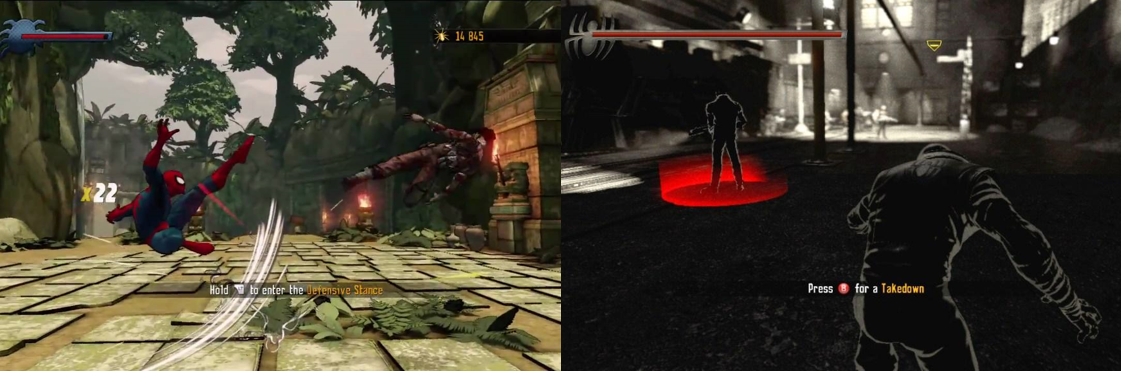
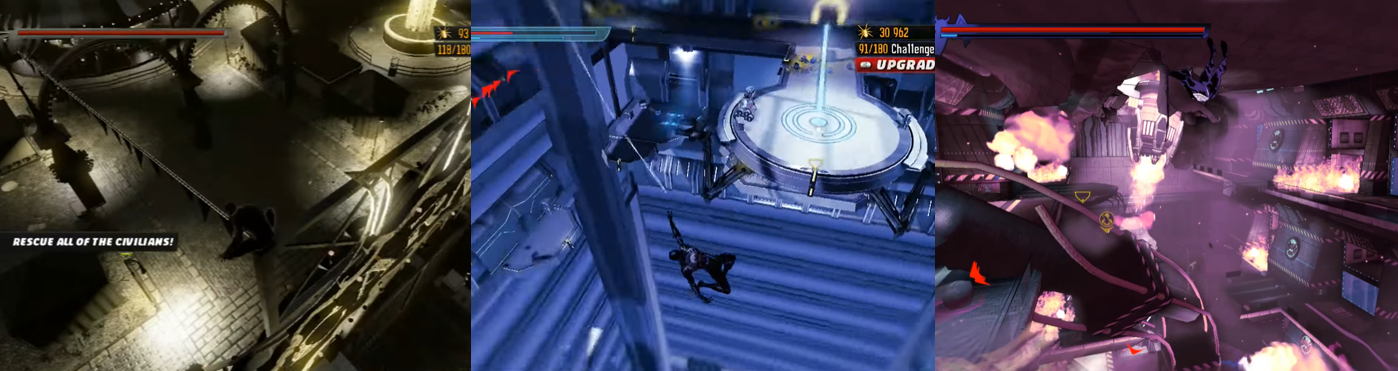
Spider-Man: Shattered Dimensions is a linear, mission-based third-person action title that has players battle a number of Spider-Man’s most iconic foes as four distinctively different versions of Spider-Man, each with their own unique appearance, levels, and personality. While some Spider-Men have slightly different abilities, combat styles, and gameplay, there are many fundamental gameplay mechanics which the four Spider-Men share: they all jump with A (and tapping A again in mid-air will perform a double jump), can land a fast strike with X and a strong attack with Y (and holding down either button performs a charge attack and an air launcher, respectively), and web or grab objects and enemies with B and you can mix and match these attack commands to string together a few basic combos. Naturally, you can web-sling by holding the Right Trigger; release the trigger and hold it again to perform successive web-slings or tap RT to perform a super handy web-zip to quickly dash to perches and platforms. Tapping the Right Bumper sees you fire off a quick web shot (which I found to be largely useless), you can press up on the directional pad to enable the spider-sense (which acts almost exactly like the “Detective Mode” from the Batman: Arkham videogames (Rocksteady Studios/Various, 2009 to 2015) and allows you to see through walls and obstacles to highlight enemies and collectibles), and you can also hold the Left Trigger to enter an “Evasive Stance” that lets you dodge and roll away from enemy attacks.

While the Amazing Spider-Man takes the direct approach, his Noir counterpart sticks to the shadows.

Each Spider-Man has a few different options available to them that make their gameplay a little different; the Amazing variant is a pretty standard Spider-Man with no additional abilities whose gameplay consists of a mixture of combat, web-slinging, and wall-crawling with some very light puzzle-solving thrown in for good measure. His Noir counterpart may not have any additional abilities but he plays considerably different from his mulitversal allies; for one thing, Spider-Man Noir’s world is rendered entirely in the moody black-and-white of the 1930s and, for another, he’s far more reliant on stealth. Again, like the Batman: Arkham games, Spider-Man Noir has to stick to the shadows and avoid spotlights and being spotted by gangsters, who will fill him full of lead if they spot him and briefly hunt him down unless you flee to the shadows. This means you have to stay up high, out of the way, and in the darkness, sneaking up on enemies or taking them down from a variety of positions with the B button. Spider-Man Noir does also get to engage enemies in direct combat but only in specifically designed sections; most of your time will be spent webbing up gangsters from the shadows, which is pretty fun but nowhere near as challenging or varied as in the Batman: Arkham games as Spider-Man Noir doesn’t have any gadgets or options to distract or toy with his prey.

Ultimate Spider-Man and Spider-Man 2099 have special abilities that are unique to them.

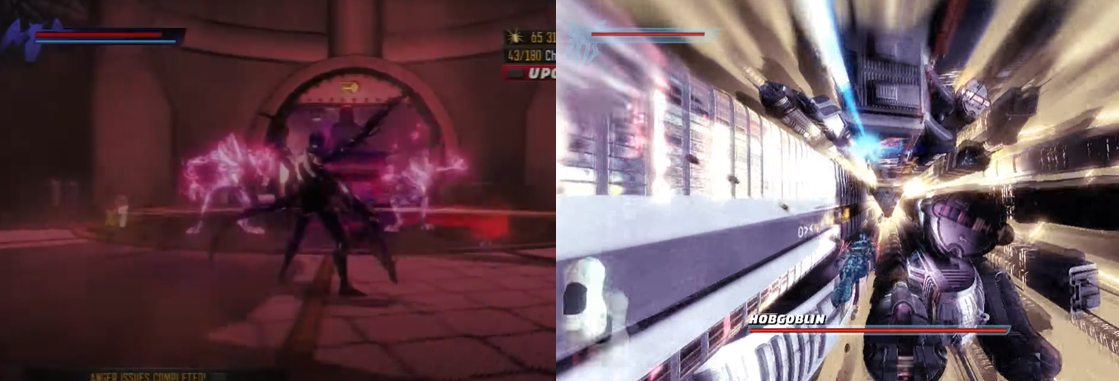
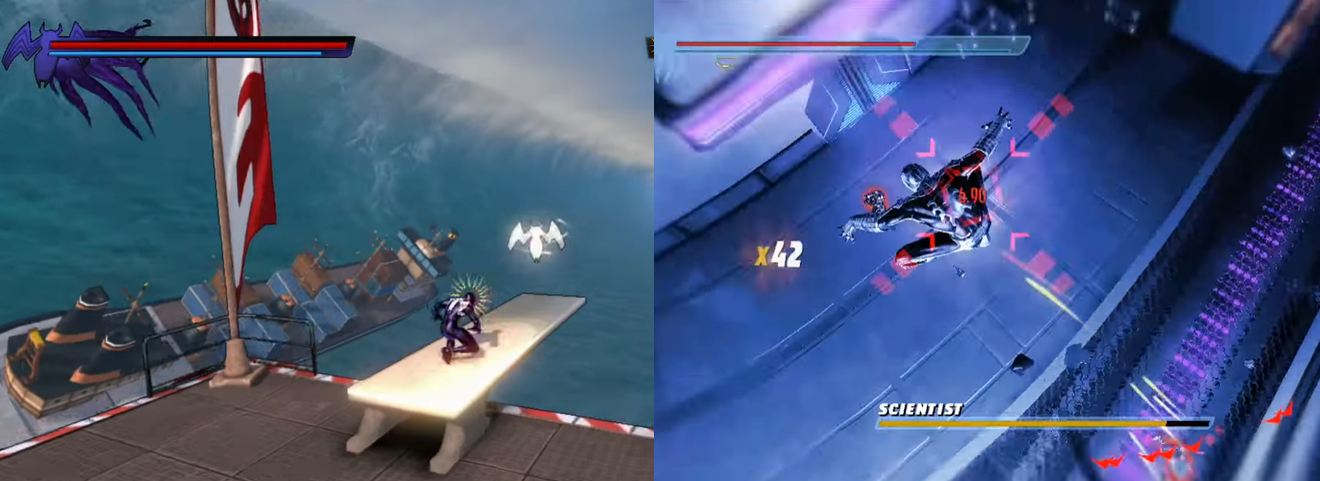
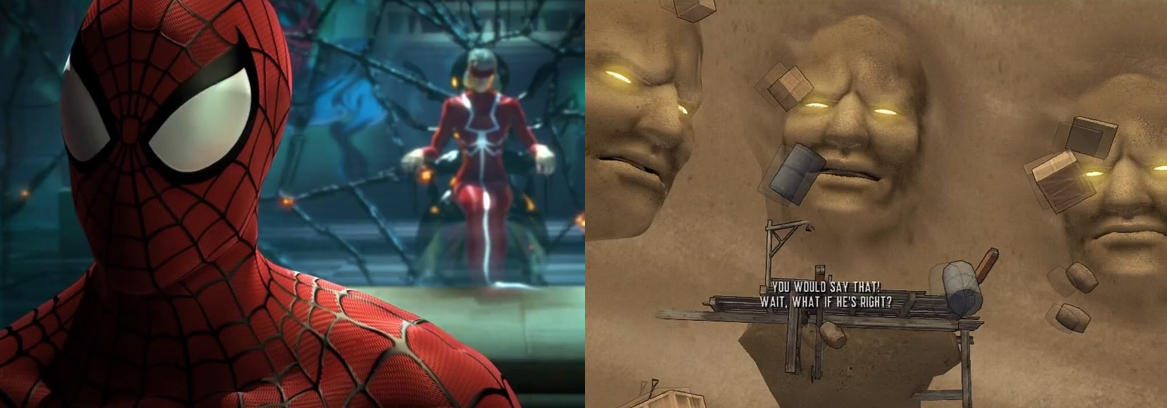
Both Spider-Man 2099 and Ultimate Spider-Man make use of the Left Bumper; since he’s wearing the bestial black suit, Ultimate Spider-Man can build up a “Rage” meter by attacking enemies and, when it’s full, pressing LB sees him fly into a rage and attack enemies faster and with more powerful tendril attacks. In this regard, Ultimate Spider-Man seems to be more geared towards combat but, in practise, I found his gameplay mostly the same to his Amazing counterpart but with the added bonus of a useful attack buff. Spider-Man 2099 can utilise LB to activate his “Accelerated Vision”, which briefly slows down time and allows him to better dodge and react to incoming attacks and obstacles, and this meter will automatically refills over time. Spider-Man 2099 also has to endure a number of freefall sections that see you holding A to dive faster towards a target and use B to grab them and X to punch them all while avoiding debris and other obstacles.

Annoying first-person segments and rescue missions mix up the gameplay.

Other than that, the four Spider-Men share the remaining gameplay mechanics: this means you’ll be mashing B on certain walls and objects to rip them down or toss them at enemies and bosses, rescuing and protecting civilians and scientists by fending off enemies, swinging over to them, picking them up with B, and carrying them to a safety point; and taking part in some awkward first-person punching sequences. These appear during the majority of the game’s boss battles and see you using the two analogue sticks to punch or dodge, which is an interesting mechanic to add in but ultimately seems like something that could have been restricted to just the Amazing Spider-Man to help him stand out from the others. Other challenges include web-slinging away from danger (sometimes towards the camera, which can be very disorientating), web-zipping to enemies perched above, destroying certain objects, or activating or deactivating generators. Each level generally repeats these sections at least three times; if you have to rescue three civilians in the early part of a level, you can bet that you’ll be rescuing five a little later on, for example.

The game’s not especially difficult but can be long and tedious at times.

When not in combat or an action situation, each Spider-Man’s health will slowly regenerate, though you can also replenish it with Gold Spider Emblems scattered throughout each level. Occasionally, you’ll find water, acid, or electrified pits that will cause an instant respawn; other times, if you fall or fail a web-sling, you can recover with RT to save yourself. Spider-Man: Shattered Dimensions has three difficulty settings (Easy, Normal, and Hard), though the game isn’t massively difficult on Normal. Hard mode obviously results in more durable and aggressive enemies, and mixes up their placement and how many hits will defeat a boss, but there are many checkpoints and respawn points sprinkled through the game’s levels, which can get quite long and tedious as you progress. Additionally, like many Spider-Man videogames, mechanics such as wall-crawling and web-slinging can get a bit janky in Spider-Man: Shattered Dimensions thanks to the controls bugging out when on walls and ceilings and the camera proving unreliable and jerky at times.

Graphics and Sound:
Spider-Man: Shattered Dimension’s levels are entirely linear; there’s no free roaming or overworld to be found here, which is fine as that can be a little daunting, and instead you’ll explore a variety of levels that can be both large and intimidating and narrow and claustrophobic. When in wider, more open areas, your options for exploration are largely limited by walls (both visible and invisible) and gameplay objectives that constantly push you forwards. Still, there are at least a wide variety of locations on offer; you’ll scale Osborn Tower in the city, a disused desert mine, a ruin-filled jungle, and a hydroelectric dam amongst others. Primarily, the game leans towards a vibrant, quasi-cel-shaded style, especially for the Amazing and Ultimate Spider-Men, though not to the extent where it looks like ugly 2D characters monstrously rendered in 3D as in other games.

The game is full of visual variety in its levels, graphics, and characters.

Where the game really shines, though, are in the Noir and 2099 levels; the Noir levels are rendered entirely in monochrome, with sporadic use of colour only appearing when using the spider-sense. The heavy shadows and stark contrast of white on black immediately makes these sections stand out not just from the rest of the game but also its closest competitors, the Batman: Arkham titles, and reminds more of MadWorld (PlatinumGames, 2009) and Frank Miller’s Sin City comics and films (ibid, 1991 to 2002; ibid and Rodriguez, 2005; 2014). Similarly, the 2099 levels are an explosion of futuristic neon and technology; indeed, I found the 2009 levels to be a bit of a sensory overload and a bit difficult to digest, making it tricky to know where I was supposed to go since every level was so bustling with lights, metal, and colours. Still, it’s a great way to make each Spider-Man’s locations even more visually distinct from each other, though there was maybe a missed opportunity to mix things up a bit later in the game to have, say, Spider-Man Noir in the 2099 world.

The graphics hold up really well but it’s the voice work that really makes the game shine.

While the game’s music isn’t much more than the standard superhero fare of rousing horns and tunes, the voice acting is absolutely top notch! Each Spider-Man is voiced by a notable and popular Spidey voice actor from his many cartoons, which saw not only Dan Gilvezan’s return to the character after a twenty-five year absence but also the return of Christopher Daniel Bares, who voiced the Spider-Man I grew up with in the nineties cartoon. Neil Patrick Harris is easily the best of the four, though; he always makes for a fun and fitting Spider-Man and his delivery really sells the character’s many quips and witticisms. Stan Lee narrates the start and end of each chapter and Nolan North even reprises his role as Wade W. Wilson/Deadpool, who steals the show in his oil rig-turned-reality show by constantly berating and taunting Ultimate Spider-Man and breaking the fourth wall at every opportunity. The in-game graphics are brilliant; levels and enemies are as visually distinct as the four Spider-Man and the game runs very fast and smooth (when the camera isn’t freaking out on you). The cutscenes are equally impressive, if a bit inconsistent as they’re comprised of the in-game graphics, higher quality cinematics, and partially animated sequences, but they tell the story well enough and are always fun to watch.

Enemies and Bosses:
There are a number of goons to pit your spider-powers against in Spider-Man: Shattered Dimensions but, for the most part, once you’ve faced the first wave of enemies in the first level, you’ll encounter the same troupes again and again but in new skins. You’ll find regular enemies who come at you with their fists and melee weapons (baseball bats and swords and such), gun-toting enemies who either chip away at your health or blast you full of holes when playing as Spider-Man Noir, shield-carrying enemies who you must zip towards and hop over with A to attack from behind, and larger enemies who will put up a block that you need to break with your air launcher attack. Other enemies include smaller versions or duplicates of the level’s main foe that can generally be taken out in one or two hits but swarm all over you, larger enemies that toss out grenades or seeking rockets, and all manner of zombies and genetically-engineered monstrosities. One aspect I really enjoyed was that enemies can actually attack and harm each other, which is incredibly helpful when swarmed by foes, and you can also throw objects such as barrels and flaming debris at enemies to help whittle them (or, at least, their health) down.

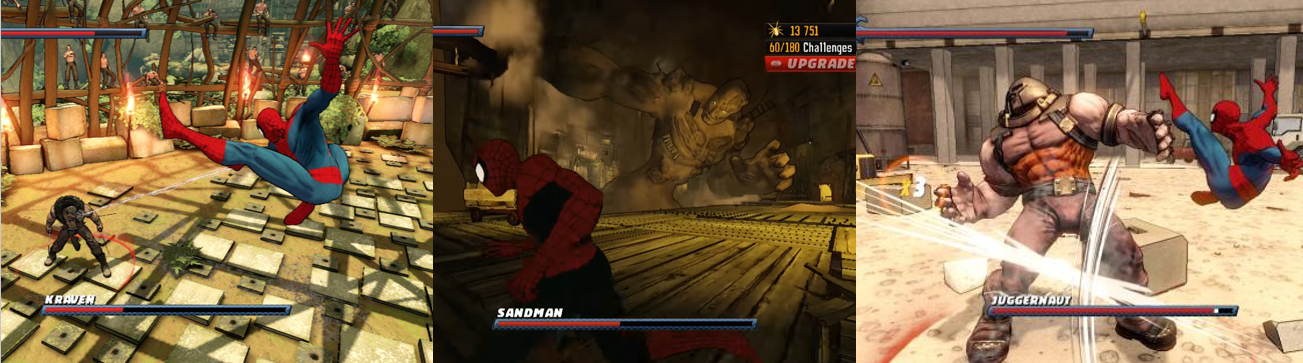
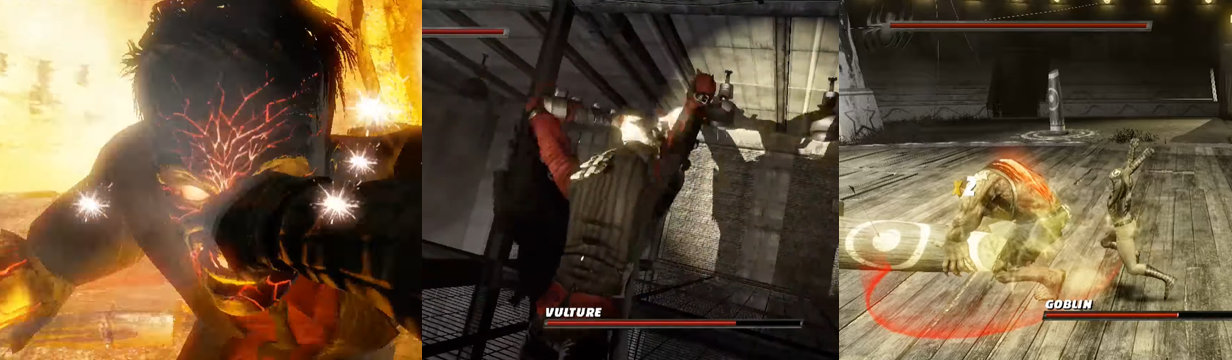
The Amazing Spider-Man battles Kraven, the Sandman, and the Juggernaut for the Tablet pieces.

Each level is structured around locating, pursuing, and/or confronting one of Spider-Man’s villains and retrieving a piece of the Tablet from them; thus, each level concludes in a boss battle but you’ll actually battle each boss a number of times throughout each level. The first boss the Amazing Spider-Man comes up against is Sergei Kravinoff/Kraven the Hunter, who leads you on a merry jaunt through the jungle, shoots at you through his sniper rifle, and initially battles you inside of a caged arena. Here, you’ll need to dodge and evade his jumping strikes and counterattack in response, web-zip to the convenient columns to avoid the floor spikes, and finish him off with some first-person punching. In the second battle, he’s much stronger and faster thanks to the Tablet fragment but the strategy remains the same; take advantage of the spawning columns to avoid his attacks and strike as and when you can but don’t linger in one area for too long or he’ll knock your ass down. Later, you’ll have to pursue Flint Marko/The Sandman through an abandoned mine, using your web pull to drench his raging sand tornado and battle his gigantic form within the mine itself. Here, you must trick him into slamming his fists into water carts to muddy them up and make them vulnerable, then toss barrels at his face to defeat him. Afterwards, he draws you within his chaotic sandstorm and his personality begins to unravel; you must web-zip around the floating debris avoiding his giant fists and tossing water barrels at his face so you can deal some real damage and put him down once and for all. Finally, you’ll battle and purse Cain Marko/The Juggernaut in a construction site, through the city, and in the wreckage of Osborn Tower; initially, you simply have to avoid his charge attack to cause him to ram into specific towers and beat on him when he’s lodged in the ground, but his later empowered form sees him add a whole bunch of annoying ground pounds and smashes to his repertoire. Still, as long as you dodge away and stay away from his powerful grapple moves, it’s not too difficult to avoid his attacks and projectiles and put a big beating on him when prompted.  

Spider-Man Noir’s bosses can be a bit tricky, confusing, and mundane, respectively.

In the train yard, Spider-Man Noir follows Joseph Lorenzini/Hammerhead and it’s in the first fight against him that you might hit a considerable difficulty wall; Hammerhead uses a huge Gatling gun to keep you at bay whenever his lights (or the spotlights in the arena) spot even the slightest part of you. After taking cover behind walls, you must wait for Hammerhead to rotate away and run around behind him, staying wide and in the shadows, and press B when prompted to put a beating on him but the game doesn’t make this very clear and Hammerhead spots you way too easily. In the second fight, you have to avoid his machine gun fire and toss barrels at him to force him to blow up a piece of machinery with his rocket launcher, then zip up to the higher platform as he fires wildly into the fog to do big damage with a takedown, and then avoid his head-on charge to finish him off. Later, Spider-Man Noir pursues Adrian Toomes/The Vulture through the grimy streets and confronts him in a large warehouse; the Vulture is another annoying and confusing boss as he darts around slicing at you and tossing knives and you’re encouraged to use the spotlights to blind him and deal big damage but it’s unnecessarily random and difficult to get him into position to actually utilise this mechanic. When powered by the Tablet fragment, the Vulture’s claws and bite need to be avoided in first-person and then you go through the previous battle again but this time he also tosses Molotov cocktails at you (which you can cause him to drop to damage him instead). Finally, Spider-Man Noir tracks Norman Osborn/The Goblin to a warped fairground and has a number of first-person encounters with him before finally facing him inside the circus tent. The Goblin isn’t really all that, though; simply web towards him and jump over him to attack the glowing weak spot on his back, then zip up to higher ground when the lights go out to hit a takedown, before fending off his goons (or causing the Goblin to attack them himself) and avoiding the swipes from his column and pummel him when he’s stuck in the ground.

Ultimate Spider-Man’s bosses were probably the most fun and varied for me.

Ultimate Spider-Man’s first foe is Max Dillon/Electro, who he battles and pursues through a hydroelectric power plant to a huge dam; the first fight is quite annoying as Electro blasts at you with a huge laser and protects himself with an electrical field but the second bout is initially quite confusing as Electro teleports across generators and shields himself from your attacks. Soon, he drops to the floor and sends electrical blasts your way, but these leave him exhausted and vulnerable to your attacks. After fending off his electrical minions and draining his health, he’ll use the Tablet fragment to grow to gigantic properties and become invulnerable, similar to the Sandman fight. To defeat this giant Electro, you need to use your webbing on his hands to cause him to damage the dam behind him while avoiding his laser beams. When the fight switches to the other side of the dam, you’ll need to survive against the enemies he spawns and avoid his fists on an increasingly-small platform until prompted to web his head so the breached dam can finish him. While on the oil rig, Spider-Man is forced to take part in Deadpool’s warped reality show; this inevitably leads to a showdown between them that sees Deadpool teleporting around, slicing at you with his swords, and shooting at you all while his devoted fanboys rush in to join the fight. When he’s standing with a B prompt above his head, don’t web-zip over to him or else he’ll just teleport away; instead, rush over and approach from the ground to best him. After outrunning a tidal wave, you’ll battle him inside a caged arena, where he uses the Tablet to duplicate himself and rains explosive punching bags between rounds. However, simply evade these, and his attacks, and target each of his duplicates in turn and he’ll soon go down, but the final battle against Carnage is particularly striking since the creature has ransacked the Triskelion and corrupted its inhabitants into bloodthirsty monsters! In the first fight against Carnage, it leaps about the remains and wreckage of Quinjets and Helicarriers swiping and skewering you with spikes, but is perfectly susceptible to your attacks and can be dealt big damage by web-zipping it into the conveniently-placed furnaces nearby. In the second phase, Carnage encases itself in a bulbous, tentacled shield that some mechs will destroy with flamethrowers; this leads to a first-person sequence and Carnage blasting spikes, maniacally hopping around the place, and it draining your health to replenish its own if it gets hold of you!

Spider-Man 2099’s bosses tend to be very samey, tedious, and chaotic.

Spider-Man 2099 first butts heads with the Hobgoblin during a freefall sequence that sees you pummelling him and smashing him through obstacles. When you hit the ground, Hobgoblin hovers out of reach and tosses pumpkin bombs at you that you must grab with your webs and throw back at him to down him for a beating. After being empowered by the Tablet, the Hobgoblin conjures gargoyles to distract you and adds a bombardment of bombs to his arsenal, but the strategy remains the same; he’s just faster and more aggressive and you have to finish him off with a mid-air, first-person pummelling. O’Hara’s second boss is Kron Stone/The Scorpion, who leaves explosive, acidic eggs and spawns smaller versions of himself; the Scorpion initially charges at you and tries to smash you with his tail, but if you evade these attacks he’s left vulnerable to a beating and you can easily toss his eggs at him when he takes the high ground to spit acid at you and use B to beat him down. When powered by the Tablet, things are mostly the same but there’s also a large pit in middle of the room that Scorpion pounces at you in and fills with acid; however, throwing eggs at him will cause him to take a dip and be left wide open for a beating. Finally, O’Hara has to fight through Doctor Serena Patel/Doctor Octopus’ elaborate facility, avoiding her mechanical arms in freefall and trashing her gigantic Mecharms before confronting her at the heart of the complex. Here, you need to web pull three generators to lower her shield while avoiding her lasers, then jump over her energy shockwaves to do damage on her. When she powers up, she scuttles around fully shielded and firing lasers across the ground, but you can easily trick her into offing her own minions and defeat her by tossing their explosive cores at her.

All four Spider-Man take it in turns to whittle down and defeat Mysterio in the finale.

Once all of the bosses are beaten, the levels cleared, and the Tablets recovered, all four Spider-Man are thrown into a dimension of pure chaos as Mysterio uses the completed Tablet to become a gigantic, all-powerful God. First, you have to web-zip across floating, fragment platforms as Spider-Man Noir; there are no enemies to fight but you must make sure to avoid the light or else Mysterio will fire projectiles your way, and then simply press B when prompted to web pull his head into a rock. Ultimate Spider-Man then has to fend off a whole bunch of illusionary goons and then destroy the floating orbs after they’ve conjured an illusionary version of a boss, which hurts Mysterio, before quickly web-zipping across the wreckage when Mysterio destroys your platform and then hitting another web pull. Spider-Man 2099 has the easiest time in this fight as you simply have to freefall past Mysterio’s projectiles and magic obstacles to grab and pummel him, but the Amazing Spider-Man has to endure a gruelling gauntlet against a whole bunch of monsters while avoiding Mysterio’s projectiles. Once the enemies are cleared away, you can use the web pull to send a rock flying at Mysterio and must then web-zip to another, smaller platform and repeat the process until he’s downed for one last smash of his helmet to defeat his aspirations for good.

Power-Ups and Bonuses:
As you explore the various levels in Spider-Man: Shattered Dimensions, you may be disappointed to find that there aren’t any power-ups to find beyond the odd health-restoring Gold Spider Emblem. However, every level contains a number of challenges that make up the “Web of Destiny”; while most of these are unavoidable and story-based, many others are optional an easily missed unless you check the Web in each level. You may have to complete certain sections under a time limit, defeat certain enemies in certain ways, or perform certain moves a number of times in order to clear the challenges but the reward is some extra “Spider Essence”.

Collecting Spider Essence allows you to upgrade your abilities and unlock new costumes.

As you clear defeat enemies and bosses, clear levels, and complete these challenges, you’ll be awarded with Spider Essence, which essentially acts as a combination of currency and experience points and can be spent upgrading your health and regenerative capabilities, and unlocking new costumes and attacks, all of which make the game even easier and more chaotic as you plough through enemies with a longer health bar and additional strikes. You can also acquire additional Spider Essence by finding Silver Spider Tokens and Hidden Spiders in every level, which also count towards completing the Web of Destiny, so it pays to give each area a quick scan with your spider-sense for any collectibles.

Additional Features:
Spider-Man: Shattered Dimensions has forty-two Achievements on offer, with the vast majority of them popping as you play through the story and take down the game’s villains. There are also Achievements for completing the Web of Destiny, unlocking all the upgrades, and finding every Spider Token and Hidden Spider, which adds some replayability to the game. Other Achievements pop when you defeat up to five-hundred enemies, complete the game on each difficulty (which are stackable), maintain Ultimate Spider-Man’s Rage mode for a full minute, and perform a combo of up to two-hundred hits but there aren’t too many fun or quirky ones that ask you to go off the beaten track. Otherwise, that’s about it; you receive either a Bronze, Silver, or Gold Medal and unlock character models and concept art after clearing levels and there were some additional costumes for those who pre-ordered the game back in the day but there’s not really anything else to come back to besides any Achievements you missed. It might have been nice to include a boss rush or a survival mode, or as mentioned earlier mix and match the Spider-Man in a free play mode, but the Web of Destiny will keep you pretty busy for a few hours, I’m sure.

The Summary:
I’ve wanted to play Spider-Man: Shattered Dimensions for years; sadly, I missed out on it when it first released, and the game has become very expensive and hard to come by since then. Thankfully, I was able to snap it up and finally get to grips with it and it was actually a pretty good way to spend a few hours. It’s not especially long or difficult, at least not on Normal mode, and can probably be finished in a day if you play non-stop from morning the late evening but there’s a fair amount to come back to once you’re done. Fittingly, the four Spider-Men are the main highlight of the game; each one looks, sounds, and plays a little differently from the other and it’s fun to go nuts with Ultimate Spider-Man’s rage and then stealthily stalk gangster as Spider-Man Noir. Splitting the game into individual levels helps to keep things interesting and fun, but levels do tend to drag on and enemy and boss variety doesn’t really hold up under close scrutiny. Most of the bosses boil down to winning one of those annoying first-person sequences, pursuing them through the level, battling their first form (usually with hit-and-run tactics, using their own attacks against them, or taking advantage of them getting stuck) and then fighting their Tablet form, which is either a giant version of the boss or a faster, more powerful version. A janky camera and awkward wall-crawling and web-slinging can make the game frustrating but these are recurring concerns in Spider-Man videogames and, overall, I found the game to be pretty fun and entertaining for the voice acting and visual variety alone.

My Rating:

Rating: 3 out of 5.

Pretty Good

Have you played Spider-Man: Shattered Dimensions? If so, what did you think to it? Which of the four Spider-Men was your favourite? What did you think to the way the game handled the four Spider-Men and the different playstyles? Which level and boss battle was your favourite (or most frustrating)? Are you a fan of Spider-Man teaming up with his multiversal incarnations?? Which Spider-Man videogame is your favourite? Whatever you think, sign up and leave a comment or let me know on my social media and check in next Friday for more from Spider-Man Month.

Movie Night: Spider-Man: No Way Home

Released: 17 December 2021
Director: Jon Watts
Distributor: Sony Pictures Releasing
Budget: $200 million
Stars: Tom Holland, Zendaya, Jacob Batalon, Willem Dafoe, Alfred Molina, Jamie Foxx, and Benedict Cumberbatch

The Plot:
After having his secret identity publicly outed, Peter Parker/Spider-Man (Holland) finds himself branded a murderer and requests Doctor Stephen Strange (Cumberbatch) cast a spell to make everyone forget his identity. However, when the spell is corrupted, reality is fractured and Peter is beset by foes from across the multiverse seeking to avenge themselves against Spider-Man, no matter what world he’s from!

The Background:
Following the massive success of the original Spider-Man trilogy (Raimi, 2000 to 2007) and the largely mediocre reception of the poorly-timed reboot films, Marvel Studios were finally able to achieve the impossible when they reached an agreement to include a new version of the iconic web-slinger in their interconnected Marvel Cinematic Universe (MCU). Tom Holland took on the role of a young, fresh-faced take on the character and debuted in spectacular fashion in Captain America: Civil War (Russo and Russo, 2016) before spinning off (no pun intended) into the incredibly successful Spider-Man: Homecoming (Watts, 2017). Spider-Man: Far From Home’s (ibid, 2019) impressive $1.132 million box office proved that the MCU could sustain the success it had amassed even after the cataclysmic events of Avengers: Endgame (Russo and Russo, 2019) but development of a third outing for the character was initially stalled when financial disputes threatened to see the character once again pulled from Marvel’s control. After these issues were resolved, and following a delay due to the Covid-19 pandemic, production finally got underway in late-2020 and, almost immediately, rumours began circulating regarding the possible return of actors from the previous Spider-Man franchises. These were only exacerbated when Benedict Cumberbatch was confirmed to reprise his role as Dr. Strange, a character who was already scheduled to have his own multiversal adventure, and when the long-awaited trailer was finally released following a leak, confirming that Alfred Molina would be returning as Doctor Otto Octavius/Doctor Octopus thanks to digital de-aging. Finally, after months of speculation and wild fan rumours, the film’s final trailers confirmed that this story would tackle Spider-Man’s varied cinematic multiverse and the film received an official release date. Thanks to bringing together elements from across Spider-Man’s cinematic legacy, Spider-Man: No Way Home was met by unanimous praise; critics lauded the performances and heart of the film, in addition to atmosphere and chemistry between the actors, and the film made a mammoth $1.916 billion at the box office.

The Review:
I feel it’s only fair to emphasise here that I simply cannot find the language to talk about this film without using spoilers. If the title and various warnings aren’t enough for you, then this text should be: here be spoilers, and I’m not planning on holding back as I feel the movie deserves to be discussed in detail and the only way to do that is to talk about spoilers. Also, I was initially torn when it came to this film; the build up to it saw some really toxic opinions and members of the fandom rear their ugly heads, and the marketing has been a bit all over the place. Sony showed a surprising amount of restraint with their trailers, and maybe held them off a little too long, but it definitely built up a great deal of hype and intrigue surrounding it and it felt good to be excited and curious about a movie for a change. Having said that, though…be better, people, come on. If you have a favourite Spider-Man, that’s great, but don’t rag on people for having a different opinion. Spider-Man is really lucky as he has had so many adaptations and so much representation, so many live-action portrayals, and all of them have been extremely accurate to the source material and exciting outings in their own right, so maybe just be thankful that the web-head gets so much love and is so popular rather than being ungrateful or attacking others for their opinions?

Jameson’s smear campaign spells personal trouble for Spider-Man and his friends.

Spider-Man: No Way Home picks up immediately where Spider-Man: Far From Home left off, with blustering, loud-mouthing online personality J. Jonah Jameson (J. K. Simmons) gleefully broadcasting edited footage sent to him by Quentin Beck/Mysterio (Jake Gyllenhaal) that not only implicates Peter as a murderer but also outs his secret identity to the entire world. Naturally, this sends New York City into a bit of an uproar and, pretty much immediately, both Spider-Man and his new girlfriend Michelle Jones-Watson/M. J. (Zendaya) are swamped by a mob that is split between worshipping and condemning Spider-Man, paparazzi looking to get a sound bite, and cops seeking to question Peter’s involvement in Beck’s death. Despite his best efforts to escape the chaos, and to break the news to his beloved Aunt May (Marisa Tomei) and his begrudging friend and handler, Harold “Happy” Hogan (Jon Favreau), Peter and his friends and family are soon apprehended by the Department of Damage Control (DODC), which has now extended its scope into being a federal agency responsible for such matters. Although M. J. and May remain tight-lipped on the matter, Peter’s bungling but loyal friend Ned Leeds (Batalon) and Peter himself don’t exactly help his case, and Peter is left overwhelmed by the barrage of accusations and the public’s awareness of his true identity. Any legal ramifications concerning these matters are quickly swept under the table, however; although Happy and May recently ended their fling (much to Happy’s dismay), the Parkers are given sanctuary at Happy’s secure apartment and an especially good blind lawyer is able to ensure that the charges against Peter are dropped. However, public opinion remains divided; since the world considers Mysterio a hero, many people condemn Spider-Man (which isn’t helped by Jameson’s continuing smear campaign against Peter) and Peter is treated with both awe, fear, and adulation by his fellow pupils. Thankfully, he has M. J. and Ned there to support him through it; despite the revelation uprooting their lives and thrusting them into the spotlight as well, they remain his loyal and understanding companions, which is always sweet to see. While Peter appreciates this, and could probably have adjusted to the major changes in his life with their support, his guilt and shame are magnified when neither her, Ned, or M. J. are able to successfully get into college.

Peter turns to Dr. Strange for help, but muddles the spell and causes reality to fracture as a result.

Because of the media storm and controversy surrounding Peter, no college wants to risk being associated with any of them, and Peter is guilt-ridden at having cost his loved ones the chance of realising their dreams. Yet, even though this has happened, M. J. and Ned still take it on the chin and remain optimistic (or, at least, put on a brave face, in M. J.’s case) and neither of them blame Peter for this, but it does little to alleviate his guilt. Desperate for a solution, Peter seeks out the council of Dr. Strange (who, it is amusingly revealed, is no longer the Sorcerer Supreme thanks to being snapped away for five years; Wong (Benedict Wong) has assumed the position instead, which could potentially be explored to greater humourous effect in Strange’s upcoming movie). Although Wong cautions against it, Dr. Strange offers to cast a complicated and dangerous spell that will erase the knowledge of Peter’s secret identity from everyone in the world; however, Peter starts to panic mid-way through the spell and requests that May, M. J., Ned, and Happy be exempt from the erasure, which causes Strange to lose control of the spell and contain it within a jewel least it wreak havoc upon the world…and the multiverse. The relationship between Dr. Strange and Peter is notably different to what we saw between Peter and Tony Stark/Iron Man (Robert Downey, Jr); Strange isn’t a mentor to Peter, he’s more like a work associate, and he’s willing to help the kid out because of his efforts at restoring half the population, but he’s easily frustrated by Peter’s naivety and ignorance, especially when it comes to the world of magic, and angered that Peter risked tampering with the fabric of reality before properly exploring all of the real-world options available to him or learning to adapt to the changes in his life.

Molina makes a triumphant return as the crazed Doc Ock, who’s intrigued by the MCU.

Determined to make up for this, Peter tracks down a college professor to plead M. J. and Ned’s case, only to suddenly be attacked by a face very familiar to us but completely alien to him as Dr. Octopus attacks the Queensboro Bridge in a confused rage, ranting at Peter and demanding to know what happened to his “machine”. Though confused by the villain’s sudden appearance, Spider-Man holds his own in impressive fashion thanks to the advanced technology and gadgets built into his Iron Spider costume, saving lives while fending off Doc Ock’s mechanical arms; his genius mind addled by the corrupting influence of his mechanical tentacles, Doc Ock is intrigued by the Iron Spider’s nanotechnology but startled to find a very different face behind the mask. His confusion soon turns to manic frustration when Peter is able to use the suit’s nanotech to take control of Doc Ock’s arms and render him helpless, and Octavius’s rage is only incensed further when he suddenly finds himself a prisoner in a dark catacomb beneath Dr. Strange’s Sanctum Sanctorum. Although dismissive of the idea of magic and vehemently rejecting the idea that he needs help or to be fixed, Doc Ock is intrigued to see the evidence of a multiverse surrounding him; not only has he met the MCU version of Peter and M. J., but he shares his prison with Doctor Curt Connors/The Lizard (Rhys Ifans), a monstrous creature Dr. Strange was able to subdue offscreen and who is very clearly from another reality. Ock’s curiosity is only piqued further when he and Peter catch a fleeting glimpse of another Spider-foe Octavius knows all-too-well, Doctor Norman Osbourn/The Green Goblin (Dafoe), before being imprisoned.

Peter finds a number of monstrous, and maniacal, villains have crossed over into the MCU.

Angered at the incursions that have slipped into their world because of Peter’s ignorance, Dr. Strange demands that he and his friends “Scooby-Doo this shit!” and round up the visitors so they can be sent home; he grants Peter a magically-charged gadget that allows him to shoot a web that instantly teleports the villains to the prison, and Peter is forced to turn his suit inside-out after it gets ruined by paint thrown by a mob. Although he initially heads out to track down the Green Goblin, Peter instead finds Max Dillon/Electro (Foxx), who draws power from electricity lines to regain his physical form and alter the nature of his powers. Disorientated at having being violently ripped from his reality, Electro lashes out in anger, and Peter is only saved by the timely intervention of Flint Marko/The Sandman (Thomas Hayden Church), who helps Peter subdue and capture Electro. However, upon realising that he’s trapped on another world, the Sandman also grows antagonistic and winds up confined as a result, and Peter learns from each of them the nature of their personalities, their worlds, and their fates: Green Goblin, Doc Ock, and Electro are all fated to die in battle with Spider-Man, and returning them home would seal that fate, and that’s something Peter cannot, in good conscience, allow.

The Green Goblin quickly re-establishes himself as Peter’s greatest threat.

This brings him into conflict with Dr. Strange, who is determined to activate the jewel and send the visitors back home regardless since he’s weighing the fate and stability of the entire multiverse rather than the lives of a few villains. When Peter tries to take the jewel from him, a bit of a scuffle ensues in which we see Peter is able to control his body even while forced into his astral force thanks to this spider-sense, and his knowledge of geometry also allows him to figure out the mirror dimensions, web up Strange, and leave him stranded there while he works to cure the villains. While he has good intentions, and his friends and family support his efforts, and he is even able to convince the villains to trust him to help keep them alive, Peter underestimates the depths of Norman’s psychosis. Rendered a meek, bewildered scientist who is lost and in pain, Norman willingly works alongside Peter to help fix Doc Ock, returning the tentacled menace to his more good-natured self, but Norman’s dark half, the Green Goblin, soon resurfaces to throw Peter’s entire plan out the window. I got a real kick out of seeing Norman and Otto being familiar with each other, and the Lizard and Electro also having a familiarity with each other, it really helped to flesh out their respective worlds and deliver exposition regarding the characters to those who might not be familiar with them. While it’s disappointing that the Sandman was rendered entirely in his sand form for 90% of the movie, and the Lizard was basically a non-factor (there’s even a moment where he is simply confined to a van and forgotten about until the film’s big climax needs to happen), both Doc Ock and the Green Goblin play significant roles in the story. The Goblin wraps the remains of his God-awful suit in a tatter cloak and Dafoe’s demented facial expressions get to shine trough as he operates entirely unmasked throughout the film; he’s also far more vicious and deadly than ever before, cackling in Peter’s face and taunting him at every turn. While all of these returning actors slipped back into their roles perfectly (and even got a chance at redemption, in Electro’s case), Dafoe steals the show ones again as a maniacal and vicious villain who simply wants to cause Peter pain, no matter which Peter it is!

The Nitty-Gritty :
When I first heard that Tom Holland’s third solo movie was going to delve into the multiverse, I have to admit that I was disappointed and annoyed; I enjoyed Spider-Man: Into the Spider-Verse (Persichetti, Ramsey, and Rothman, 2018) but even with that film I questioned the logic of confusing matters with multidimensional shenanigans. The MCU definitely seems to be gearing towards exploring the multiverse, but I expected this to be confined to Dr. Strange’s solo films and worried that bringing in faces from the Sam Raimi and Marc Webb films would just be pandering and confusing. Not only that, but I’m of the firm belief that every role can be recast: Dafoe, Simmons, and Molina were all fantastic in their previous iterations but who’s to say that another actor wouldn’t be just as good, if not better? I expected this third Spider-Man movie would be the perfect excuse to finally bring the Sinister Six to life using the villains already established in the MCU: Adrian Toomes/The Vulture (Michael Keaton), Herman Schultz/The Shocker (Bokeem Woodbine), Mac Gargan/The Scorpion (Michael Mando), and even Mysterio (he was the master of illusions, after all) could all have returned and joined forces with two new villains (ideally an all-new Doc Ock) to collect a bounty on Spider-Man. Hell, I was more excited at the prospect of Charlie Cox returning as Matt Murdock/Daredevil or Spider-Man being forced to go on the run and teaming up with the Netflix Defenders than complicating things with multiverse hijinks, and I still maintain that it makes zero sense to have Eddie Brock/Venom (Tom Hardy) exist in a separate universe when it would have been far simpler to have him be based in San Francisco but still exist in the MCU (like how other MCU heroes and movies take place in different cities but those characters don’t have to be transported through time and space to interact).

Spider-Man butts heads with Dr. Strange regarding how to deal with the villains.

And yet….man, was it a thrill to see Alfred Molina return in the role! Bringing back these iconic actors in their most famous villain roles might be unapologetic fan service but it was fan service executed almost to perfection. I say “almost” as we were one villain short from an iteration of the Sinister Six; Eddie doesn’t show up into the mid-credits scene and he is teleported back where he came from without having any impact on the movie (though he does leave a part of himself behind…) and there was no secret sixth villain added to the roster. However, that’s not to say that the five villains we did get were disappointing…far from it! Since the MCU is different to where he came from, Electro is able to not only reconstitute his body, but also alters his powers; the addition of an Arc Reactor only pushes his powers even further, allowing him to resemble his traditional comic book appearance far closer than in his original iteration. The Sandman may be in sand form for the majority of the film, but he remains an emotionally conflicted character; at first, he helps Peter, and even tries to talk sense into some of the villains, but the idea of being kept from his home world and his daughter pushes him against the web-slinger out of pure self-preservation. This motivation is the driving force behind many of the villains, as they have either accepted their monstrous new powers or have no wish to be sent away to die. In the case of Doc Ock and the Lizard, this is due to technology or mutation clouding their judgement; when Peter repairs the inhibitor chip on Ock’s neck, he becomes much more agreeable and even helps Peter to hold off the villains in the finale, and when the Lizard ingests the cure and returns to his human form, he returns to his more docile personality.

Peter is devastated by loss and pushed to the edge by the Green Goblin.

The same is also true of the Green Goblin, however Norman’s psychosis is far more manipulative, calculating, and violent. He has no desire to return home to meet his end and absolutely brutalises Peter to keep him from trying to cure him; the Goblin quickly re-establishes himself as Peter’s most dangerous and notorious foe not only by swaying the other villains into turning on Peter, but delivering a massive beatdown on him that leaves him helpless to keep his Aunt May from harm. Although Peter manages to shield May from the Goblin’s pumpkin bomb, the glider blindsides her and leaves her with a fatal wound, and she tragically dies in his arms, leaving him heartbroken and with her final words of encouragement ringing in his ears: “With great power, there must also come great responsibility.” May’s death devastates Peter, and drives him into a quest for revenge against the Goblin; no longer merely satisfied to cure or help the villains, he wishes nothing less than the Goblin’s death at his hands, and it’s a true moment of despair for the young Avenger. No Way Home really puts Peter through the wringer, pushing his morals and optimistic outlook to breaking point, and really burdens him with the guilt of having indirectly caused his mother-figure’s death by trying to help the villains rather than allowing them to return home and potentially die as fated.

Spider-Man gets some unexpected help to fend off the combined threat of these multiversal villains.

Desperate to find Peter and give their support, M. J. and Ned mess about with one of Dr. Strange’s sling-rings and discover the presence of two more familiar faces who slipped through the dimensional barriers and are determined to help and let me tell you…I have never seen a cinema explode into rapturous applause before but my screening blew the roof off when Andrew Garfield and Tobey Maguire made their long-awaited, and long-rumoured, return to their famous roles. Both arrived due to Strange’s spell and have been trying to track down MCU-Peter, and both have arrived from later in their careers, finally giving us a coda to their stories: Webb-Peter reveals that he struggled to cope after failing to save Gwen Stacy (Emma Stone), and almost lost himself to his rage at one point, and that he has thrown himself into his duties as Spider-Man to cope. Raimi-Peter is noticeably older, but still in good shape, and, though haunted by his failures and losses, maintains that he and M. J. (Kirsten Dunst) found a way to carry on). The scenes with the three Peters are an obvious highlight and they share some fantastic line sand banter together; Webb-Peter is elated to have found “brothers” and they work together to synthesise cures for the villains based on their previous experiences and scientific acumen. They also share stories of their adventures and powers, with Webb-Peter and MCU-Peter both being astounded (and a little disturbed) by Raimi-Peter’s organic webbing, Raimi-Peter extending a much-needed pep talk to Webb-Peter, and both Webb- and Raimi-Peter being impressed by MCU-Peter’s space adventures. Seeing them work together, offering MCU-Peter support and understanding, is fantastic as Webb-Peter delivers an emotional soliloquy about his failures (and gets to make amends for it by catching M. J. in a truly emotional moment) and Raimi-Peter relates the messages passed on to him by his beloved Uncle Ben (Cliff Robertson), and MCU-Peter is even able to help them get past being solo heroes and work together using his experiences of teamwork as an Avenger.

The multiversal breach rages out of control, leading to Peter making a selfless sacrifice…

With three Spider-Man working together, the Lizard, the Sandman, and Electro are all subdued and returned to their human forms, presumably alleviating them of their madness and violent tendencies, in a mind-blowing final confrontation around the Statue of Liberty (which is being refurbished to hold Captain America’s shield aloft). Despite the best efforts of his alternative counterparts, though, MCU-Peter is driven into a rage and attacks the Green Goblin mercilessly and even prepares to deliver a fatal blow with his own glider, only for Raimi-Peter to intervene (and get stabbed in the back for his efforts). Ultimately, MCU-Peter delivers a cure, rather than a kill, to his newest foe and Norman is left an emotional and remorseful wreck, though this pales in comparison to the threat unleashed by one of his pumpkin bombs as Strange’s spell is blown free and miscellaneous, vaguely-defined villains and intruders from all across the multiverse threaten to converge on the MCU. Dr. Strange struggles to contain the spell and, determined to make amends for his previous mistake, MCU-Peter decides to make the ultimate sacrifice and has Strange cast a new spell that will make everyone, everywhere, forget all about Peter Parker. He thanks his counterparts for their help and bids an emotional farewell to M. J. and Ned, promising to find them and rekindle their friendship/relationship after the spell is cast, but hesitates upon seeing how happy and better off M. J. and Ned are without him in their lives. Ultimately, Peter chooses to leave them be and fashions a new, 100% comic accurate costume for himself using his counterparts’ suits as inspiration and finally gets his big, triumphant final swing as he begins a new life safe in the knowledge that no one knows his true identity any more…and that he’s not alone in the vast, dangerous multiverse.

The Summary:
After viewing that first trailer and seeing Doc Ock show up once again, my mind was pretty much blown when it came to this movie. It raised so many questions, many of them being concerns that Tom’s third solo outing would get overwhelmed or bogged down by multiverse shenanigans and blatant fan service. Subsequent trailers helped shed a bit more light on the film, and I began to calm down a bit and predict that these returning characters wouldn’t be as integral to the narrative as many were making out. This turned out to be true, to a degree; the villains are definitely a big part of the film, but Spider-Man: No Way Home still does a fantastic job of focusing on Peter, his relationships, his growth, and his identity crisis. Could we have seen a grittier, more grounded film that dealt with him being on the run and learning to adapt to his tumultuous new public life? For sure, yes, and I would also argue that many of these villains could have been recast and reimagined as MCU characters and it would have worked just as well, but again there is such a thrill to be had at seeing these actors return to their iconic roles and, in many cases, reinvigorate their characters with the benefit of hindsight. I loved that Peter’s focus was on others the entire time; his selflessness is a driving force of his character, and every decision he makes is to try and benefit either his friends or family or to save lives. This is motivated by his guilt, of course, as they would only be in danger because of him, and he remains a flawed character trying to make amends for his mistakes, which is the quintessential essence of Spider-Man for me. More than any other Spider-Man, MCU-Peter tries to help even the most villainous characters rather than condemn them to death, it was truly heart-breaking to see him o devastated by Aunt May’s death that he was willing to cross that line. Of course, the undisputable highlight is seeing Tom Holland share the screen with Tobey Maguire and Andrew Garfield; while it’s painfully obvious that all three actors weren’t on set or in the studio at the same time for every shot (whether due to Covid or scheduling), it’s still a blast to see them interacting, hearing those iconic themes, and seeing them in action. Once I accepted that No Way Home was going to be a multiverse adventure, my hope was that the film would go all-out to deliver on its potential…and I’m happy to say that it went above and beyond! Action-packed, emotional, and amusing throughout, Spider-Man: No Way Home may very well be in the top-tier of Spider-Man adventures and I am very excited to see where Peter’s journey takes him now that his status quo has been so dramatically changed.

My Rating:

Rating: 5 out of 5.

Fantastic

Have you seen Spider-Man: No Way Home? Were you excited at the idea of iconic Spider-Man villains making their return or do you think that the multiverse stuff should stay in the Dr. Strange movies? What did you think to the way the film handled the public’s knowledge of Spider-Man’s identity and would you have preferred to see this explored a little more in-depth? Which of the returning villains was your favourite, and how excited were you to see Tobey Maguire and Andrew Garfield return (and Charlie Cox finally be incorporated into the movies)? Were you disappointed that we came so close to the Sinister Six and that Venom didn’t have a role in the film? Where do you see the MCU-Spider-Man’s story going from here? Whatever your thoughts on Spider-Man: No Way Home, leave a comment below.

Game Corner [Spidey Month]: Spider-Man: The Video Game (Arcade)


Easily Marvel Comics’ most recognisable and popular superhero, unsuspecting teenage nerd Peter Parker was first bitten by a radioactive spider and learned the true meaning of power and responsibility in Amazing Fantasy #15, which was first published in August 1962. Since then, the Amazing Spider-Man has featured in numerous cartoons, live-action movies, videogames, action figures, and countless comic book titles and, in celebration of his debut and his very own day of celebration, I’ve been dedicating every Wednesday to talk about everyone’s favourite web-head!


Released: 1991
Developer: SEGA

The Background:
Having achieved success with the creation of the Fantastic Four, Marvel Comics editor and head writer, the immortal Stan Lee, was searching for another title to match the success of Marvel’s first family. Inspired by a spider climbing up a wall, influenced by pulp vigilante the Spider, eager to capitalise on the surge in teenage demand for comic books, and working alongside artist Steve Ditko, Lee conceived of Spider-Man and was granted permission to feature the teenage superhero in the final issue of Amazing Fantasy. Marvel publisher Martin Goodman was shocked to find that Amazing Fantasy #15 was one of the publication’s highest-selling comics and a solo Spider-Man series soon followed, with Spidey quickly becoming Marvel’s most popular comic book character. Since then, Spider-Man has seen success in numerous other media; in 1967, he featured in a self-titled animated series, he famously appeared as a guest character on The Electric Company (1971 to 1977) and starred in his own live-action series in 1978, and heavily influenced my childhood through the fantastic Spider-Man cartoon (1994 to 1998) before eventually featuring in a number of live-action films. Furthermore, Spider-Man has also featured in numerous videogames, the first of which was the aggravating Spider-Man (Parker Brothers, 1982) for the Atari 2600. Before debuting in arcades, the majority of Spidey’s videogame efforts were sidescrolling action/platformers but this was the early nineties and button-mashing beat-‘em-ups were all the rage thanks to titles like Double Dragon (Technōs Japan, 1987), Final Fight (Capcom, 1989), and The Simpsons (Konami, 1991) so Spidey’s arcade debut naturally came in the form of a sidescrolling beat-‘em-up.

The Plot:
Wilson Fisk, the Kingpin of Crime in New York City, has sent his minions out into the city to retrieve a mystical artefact and only Spider-Man and his allies (Prince Namor McKenzie/The Sub-Mariner, Clint Barton/Hawkeye, and Felicia Hardy/Black Cat) can hope to defeat some of Spidey’s most powerful and iconic villains and oppose the Kingpin’s plans for domination.

Gameplay:
Spider-Man: The Video Game is a fairly standard sidescrolling beat-‘em-up in which players can pick from one of four characters (Spider-Man (obviously), Sub-Mariner, Hawkeye, and Black Cat) and make their way from the left side of the screen to the right beating up wave-upon-wave of nameless thugs. The game allows any player to select any character and allows for up to four players to play simultaneously, which is always an appreciated feature of such titles.

Each character is sluggish and gameplay is shaken up by some ugly platforming sections.

Upon selecting your character, you’re dropped into the streets of New York and quickly learn that the game is quite limited in terms of the moves available to you. Each character controls in exactly the same way, with a few subtle differences: Spidey and Black Cat can swing from webs/lines to attack enemies (if you can pull off the attack, which kind of requires a very specific combination of jumping and attacking) and each has a slightly different jumping attack (Namor dives fist-first down into enemies, for example) and melee attacks (Black Cat is much more about the fancy kicks than Hawkeye). While you can perform a signature special attack (shooting webs or arrows, for example) at the cost of some health points, each character is just as sluggish and apathetic as the next thanks to a lack of a dash function. However, after beating up a few thugs and taking out a sub-boss, the game suddenly shifts to an entirely different perspective; the camera zooms out and the game becomes more of an action/platformer as your character must scale a vertical and horizontal map taking out more goons as they go. In this zoomed out mode, your characters are no longer able to perform melee attacks and must rely on their projectile attacks: Spidey shoots webs, Hawkeye shoots arrows, Black Cat attacks with a grapple hook, and Namor….shoots lightning…? Spidey and Black Cat can also scale and climb walls to navigate these areas faster and Hawkeye and Namor can hang on to overhead platforms to shoot at enemies but it’s a bit weird that you’re not given full access to each character’s abilities in this mode.

Your health drains constantly and players are rated after each stage.

Unlike many videogames and beat-‘em-ups, inserting coins not only allows you to continue from death but also boosts your health, which is represented by a series of numbers under your character’s name. Your health numbers also double as a time limit as they’re constantly ticking down and this is quite a unique and clever way to get kids to waste their hard-earned pocket money as, while you can find health (in the form of hearts) strewn around the game’s stages at various points, you’ll quickly be pummelled into submission by the game’s enemies and forced to drop more coins to pump up your health and continue on a little further. Sadly, in a marketplace crowded by fantastic beat-‘em-ups, Spider-Man: The Video game fails to stand out in a lot of ways; you can attack and destroy parts of the environment but there’s not much motivation to do this as there are no weapons to find and use and no items to pick up to increase your score. Your score isn’t even displayed onscreen as you play, for God’s sake, which is really unusual, despite the fact that your progress is rated at the end of each stage. Instead, the game’s primary selling point appears to be exclusively the Spider-Man brand and the odd inclusion of action/platforming sections.

Graphics and Sound:
For the most part, Spider-Man: The Video Game looks serviceable enough; sprites are large and colourful but, like the backgrounds, are a little lacking in variety and detail. None of the playable characters have an idle animation, which lets the game down somewhat, and Spider-Man, especially, just looks bored and depressed as he plods around at a sluggish speed. When the game zooms out for its platforming sections, sprites take on a largely pixelated appearance but the backgrounds become much bigger and more detailed. Stages initially seem quite short as you come up against your first sub-boss in almost no time at all and, after defeating them, you’re tasked with climbing up to the rooftops of New York’s skyscrapers and the stages really open up.

Platforming sections expand the game, with “Latvelia” being the most visually interesting.

As you attack enemies, and are attacked, big comic book-style sound effects appear onscreen (as is pretty standard for comic book beat-‘em-ups) but I found sprites go a bit transparent when they pass over other sprites and graphics (though this could be due to emulation issues rather than a flaw of the title itself). The game does feature some limited voice acting but, despite featuring a female voice (who just loves to cry out “Spider-Man!” every time you insert a coin), no female voice work accompanies Black Cat. This isn’t necessarily a bad thing as the male voice acting is the same for every character and hardly of a high standard and when you realise that Namor and Black Cat’s attacks are accompanied by some really weird sound effects that make them sound like they’re drowning or a robot, respectively. As you might expect, comic book-style cutscenes tell the game’s story; these take the form of still images with some accompanying text (though these don’t change depending on your character and mostly just feature Spidey by himself) and in-game cutscenes with some fitting word balloons. Finally, while the game’s stages are fairly standard (the streets, the rooftops, flying through the skies, construction sites and the like), they don’t really stand out much until you crash-land into the hellscape of “Latvelia” and the game suddenly busts out some decent fire effects. Finally, the game’s music, while interesting and serviceable enough, doesn’t really feel very unique to the Spider-Man brand or compared to other beat-‘em-ups.

Enemies and Bosses:
The majority of the enemies you’ll encounter throughout your journey are literally nameless, faceless goons; weird kabuki-mask-wearing, purple-spandex-clad thugs are the order of the day here but they are soon joined by such cliché beat-‘em-up enemies as martial artists (who can duck your attacks), rotund enemies (who can belly flop you), and robots (which shoot projectiles). Spider-Man: The Video Game honestly doesn’t have much going for it in terms of enemy variety; you’ll fight the same enemies over and over and only encounter some weird and memorable foes with you reach “Latvelia” and encounter some weird ape-like monstrosities. However, Spider-Man: The Video Game is absolutely loaded with some of Spidey’s most iconic villains; after only a couple of minutes into the first stage, you’ll encounter Mac Gargan/Scorpion and, just as you’re getting into that fight, a massive containment unit opens up and Eddie Brock/Venom emerges.

You’ll face Spidey’s most iconic foes while swarms of enemies pile in on the action!

Although Scorpion soon runs off after a few hits, you’ll have to endure a handicap situation for a while as enemies spawn in, Venom teleports around the arena and chokes you with their goo, and Scorpion attacks you relentlessly. Once you whittle down Venom’s health, they use a mysterious artefact to grow to monstrous size and you’ll have to chase them to the rooftops for another encounter. This becomes the basic set-up for the majority of the game’s sub-bosses and bosses; you’ll fight them at one point and then have to give chase and battle them again in a slightly different situation after navigating the game’s zoomed out sections. You’ll battle Dr. Curt Connors/The Lizard (who has a nasty tendency to chomp down on your crotch), Flint Marko/Sandman, and Venom in a pretty standard beat-‘em-up format where you’ll be confined to an arena and have to fend off waves of additional enemies. Each boss reappears for a rematch later in the game but the strategy remains largely the same; keep your distance and land attacks while dispatching their support and things only really get hairy when Venom spawns a bunch of symbiote clones to fight alongside them!

While Kingpin is a marginal threat, Electro and Doc Ock really get the shaft!

Boss battles are mixed up a bit when you take on Norman Osborn/Green Goblin and Jason Macendale/Hobgoblin; while you’ll battle the Green Goblin on the ground, dodging his weird glowing hand attack, these two bosses stand out by taking to their iconic gliders and rushing at you from the air while tossing pumpkin bombs at you. These can be troublesome encounters as it’s difficult to judge where the Goblins are positioned to land your attacks or to successfully hit them with your jump attacks. Plus, when you battle Hobgoblin, you’re limited to your zoom-out attacks and will have to blast him with your projectiles and destroy large cannons to make things easier. You’ll also do battle with the Kingpin in a standard beat-‘em-up encounter; Kingpin’s attacks are limited to headbutts, swipes, and a shoulder barge, making him little more than an inconvenience than a formidable boss fight even in his second phase. Still, at least he actually gets a proper boss fight; Max Dillon/Electro and perhaps Spidey’s most famous foe, Dr. Otto Octavius/Doctor Octopus are relegated to mere semi-sub-bosses who randomly appear as you’re navigating the game’s later platform stages and they’re little more than a joke as you can easily damage boost through their attacks and pummel them into submission.

Doctor Doom is the game’s final boss and takes numerous forms.

After defeating the Kingpin, though, Dr. Victor Von Doom/Doctor Doom randomly appears to claim the mysterious artefact and reveal himself to be the game’s true big bad. When you reach Doom’s Castle, you’ll have to dodge mines and battle through the game’s previous sub-bosses and bosses to confront Doctor Doom…only to find you’ve battled a Doombot all along! However, when you finally do get your hands on the real Doctor Doom, the fight is still little more than a standard affair once you take out Doom’s nifty floating battle craft: Doom is fast and slippery but doesn’t attack with magical bolts until the final confrontation and even then he’s not much more of a threat than the likes of the Sandman or the Lizard.

Power-Ups and Bonuses:
As mentioned, there’s pretty much nothing on offer to spice up your gameplay in Spider-Man: The Video Game. You can’t pick up and use weapons or power-ups and the only thing for you to pick up is hearts to increase your health, making gameplay decidedly more repetitive and monotonous compared to other beat-‘em-ups.

Additional Features:
Again, there’s basically nothing here (as is pretty much the standard for most arcade games). However, the fact that you can select any character to play as and play with up to four players, each who accumulate their own separate score at the end of each stage, does add some replay value (if you have friends to play with, of course…)

The Summary:
Spider-Man: The Video Game is a decent enough beat-‘em-up; it’s bright and colourful and includes all of Spider-Man’s most iconic villains but it doesn’t really offer a whole hell of a lot when it comes to gameplay or variety. Beat-‘em-ups are generally quite monotonous as a rule but they usually compensate for this with kick-ass music, detailed sprites, and some cool weapons and super moves; Spider-Man: The Video Game has none of these attributes, meaning it’s a step behind other arcade titles released at the same time and even ones released years prior. The game’s unique selling point of having action/platforming sections incorporated into the usual beat-‘em-up formula is interesting but its execution is flawed thanks to the graphics taking a hit. Throw in an odd assortment of playable characters (I get why Black Cat is there but why are Namor and Hawkeye here?), some repetitive boss battles, and disappointing use of some of Spidey’s more visually striking foes and you have a gameplay experience that is fun enough (and probably better alongside friends) but hardly worth choosing over the likes of Final Fight or even Double Dragon. Put it this way: X-Men (Konami, 1992) released the very next year and is everything Spider-Man: The Video Game wishes it could be; hell, even Captain America and the Avengers (Data East, 1991) offers more in terms of gameplay variety and character abilities despite being graphically less impressive and that’s really saying something.

My Rating:

Rating: 2 out of 5.

Could Be Better

Did you ever play Spider-Man: The Video Game out in the wild? Which character did you pick, or get lumbered with, and which did you think was the best or the worst? What did you think of the game’s unique incorporation of platforming elements and the way it handled Spidey’s villains? Which characters do you think would have been more suitable to play in place of Namor and Hawkeye? Which Spider-Man videogame, or arcade beat-’em-up, is your favourite? Whatever you think, feel free to drop a comment below and be sure to check out my other Spider-Man content.