Back Issues: Hulk #1-6

Writer: Jeph Loeb Artist: Ed McGuinness

Story Title: “Who is the Hulk?”
Published: 4 January 2008 (cover-dated: March 2008)

Story Title: “The Smoking Gun”
Published: 20 February 2008 (cover-dated: April 2008)

Story Title: “Creatures on the Loose”
Published: 23 April 2008 (cover-dated: June 2008)

Story Title: “Red Light, Green Light”
Published: 25 June 2008 (cover-dated: August 2008)

Story Title: “Rolling Thunder”
Published: 6 August 2008 (cover-dated: October 2008)

Story Title: “Blood Red”
Published: 24 September 2008 (cover-dated: November 2008)

The Background:
Created by legendary Marvel duo Stan Lee and Jack Kirby, the depiction of Doctor Robert Bruce Banner transforming into the monstrous Incredible Hulk was inspired by a story of a hysterical mother summoning superhuman strength to rescue her child and classic screen monsters Frankenstein’s Monster and Doctor Jekyll and Mister Hyde. Initially appearing as a stone-grey creature, the Hulk has appeared in many forms and at different levels of strength and intelligence over the years. We’ve seen an old, dictator-like Hulk, an intelligent gangster Hulk, a “Smart Hulk”, and even a “Devil Hulk” so why not a Red Hulk? The idea of a Red Hulk can be traced back to Kenny Johnson, producer of the popular and iconic Incredible Hulk television series (1977 to 1982), who lobbied for the colour change since red is commonly associated with rage, the Hulk’s defining characteristic, only to have his logic dismissed. However, a mere thirty-odd years later, then-Marvel editor-in-chief Joe Quesada officially introduced a red variant of the Green Goliath, one whose identity was kept a closely-guarded secret for about three years. A dangerous, intelligent, and tactically-savvy villain who grew hotter the angrier he got, the Red Hulk was eventually revealed to be Banner and the Hulk’s long-time enemy, General Thaddeus “Thunderbolt” Ross, a cantankerous military man who hounded both characters for decades. Naturally, General Ross appeared prominently in the Hulk’s ancillary media, appearing in cartoons and live-action many times, but the Red Hulk (or “Rulk” as he’s colloquially known) has not only been a card-carrying member of the Avengers but has also appeared in Hulk-centric cartoons and even unexpectedly appeared in the Marvel Cinematic Universe, courtesy of Harrison Ford.
The Review:
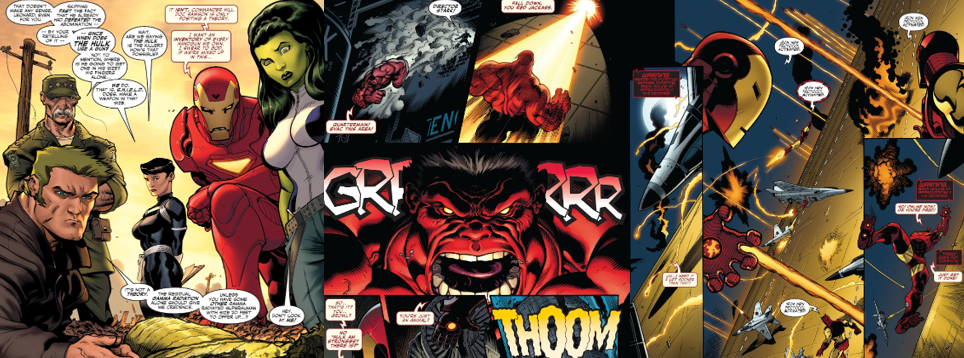
Our story begins in Russia, where Doctor Leonard Samson/Doc Samson and Jennifer Walters/She-Hulk investigate the sight of a fierce battle between the Hulk and his monstrous rival, Emil Blonsky/The Abomination. Begrudgingly, She-Hulk allows Samson to recreate the fight, deftly surmising and reenacting both character’s movements based on footprints and the surrounding devastation. It’s Doc Samson’s learned belief that the Hulk was unusually vicious, that he sought to beat the Abomination to death no matter what damage he caused in the process, and that, with his foe at his mercy, the Hulk drew a pistol and shot the creature at point-blank range. General Ross, Strategic Homeland Intervention, Enforcement, and Logistics Division (S.H.I.E.L.D.) commander Maria Hill, and S.H.I.E.L.D. director Anthony “Tony” Stark/Iron Man, who are also present, question the legitimacy of such an outrageous claim. However, when Hill reveals that S.H.I.E.L.D. does make a weapon big enough for the Hulk to fire and Doc Samson points out the residual Gamma radiation, the evidence, however unlikely, becomes difficult to ignore. She-Hulk and Samson also note that the Hulk is apparently emitting so much radiation that he’s scorching the earth with each footprint. The team’s squabbling and theorising is interrupted by Russia’s equivalent to the Avengers, the Winter Guard, led by Anton/The Red Guardian, who demand to take charge of the investigation. Despite being invited by the Russian government, the Red Guard have issue with their unauthorised personnel, like Samson, who reacts by starting a fight with the Red Guardian. Not to be outdone, Mikhail Ursus/Ursa Major, Boris Vadim/Crimson Dynamo, and Sasha Roerich/Darkstar join the fracas, with the bear-like Ursa clawing She-Hulk’s arm and Iron Man blasting the mech-armoured Crimson Dynamo right in the face. The battle is violent but short-lived as General Ross discovers a survivor, a traumatised boy who can only repeat the word “Красногоin” (or “red”) over and over.

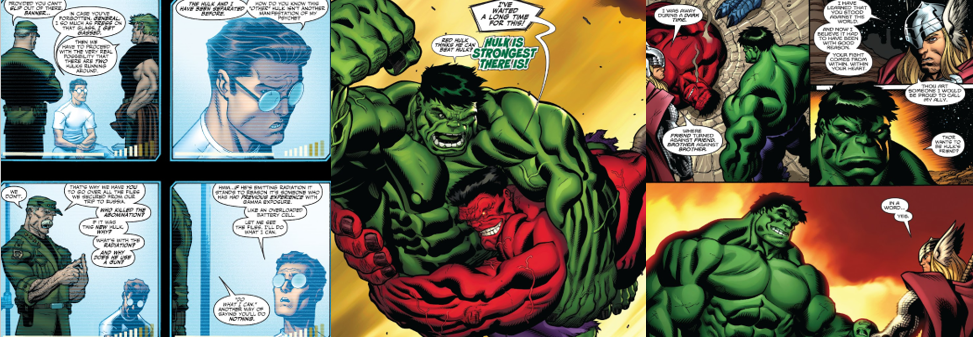
A mysterious Red Hulk murders the Abomination and trashes the S.H.I.E.L.D. Helicarrier,

On the S.H.I.E.L.D. Helicarrier, Maria shows Stark a version of the gun used to kill Blonsky, a weapon he had no knowledge of. However, their discussion is interrupted when She-Hulk is suddenly attacked by a monstrous, Hulk-like figure. Though Stark barely glimpses the creature, he sees that it’s red, not green, and is stunned when the unconscious and badly beaten She-Hulk is dumped at his feet. Stark armours up and meets agent Clay Quartermain, who’s been injured by the monster but no less determined to bring him, and any and all Hulks, down. Iron Man’s orders are cut short when the Red Hulk suddenly tackles him through a wall. Noting the strange contradiction of a Hulk that growls like an animal but apparently wields a pistol and systematically targets a Helicarrier, Iron Man scrambles to fend off the brute’s vicious attack and deploy his spare armours to help stabilise the Helicarrier and catch the jets that tumble from it following the Red Hulk’s attack. Though his armour’s severely damaged, Iron Man is saved from a plummet by She-Hulk, who reveals that the Red Hulk wiped S.H.I.E.L.D.’s secure files with a sophisticated virus, and that the Red Hulk threatened her with an eloquence not shown to Stark. Despite Iron Man’s best efforts, the gold-plated Helicarrier crashes in a New Jersey field (with, surprisingly, no causalities). Iron Man’s attempts to formulate an effective counterattack are put on hold when Maria shows him video footage of General Ross and Doc Samson meeting with Bruce Banner, who’s held captive in the Gamma Base located in Death Valley, Nevada. The footage confirms that there is another Hulk out there, one very different from Banner’s mindless alter ego, and Banner suggests it’s someone who’s previously been exposed to high levels of Gamma radiation. However, Iron Man’s enraged when a crucial exchange between Banner and Ross is rendered unintelligible and orders Maria to clean up the recording. Later, Iron Man is brought to a meat packing plant where Agent Quartermain has been found dead alongside a severely torn, Gamma-irradiated coat belonging to Doc Samson, framing the superhuman psychiatrist as the Red Hulk.

The Red Hulk easily overpowers A-Bomb and even the rampaging Green Goliath!

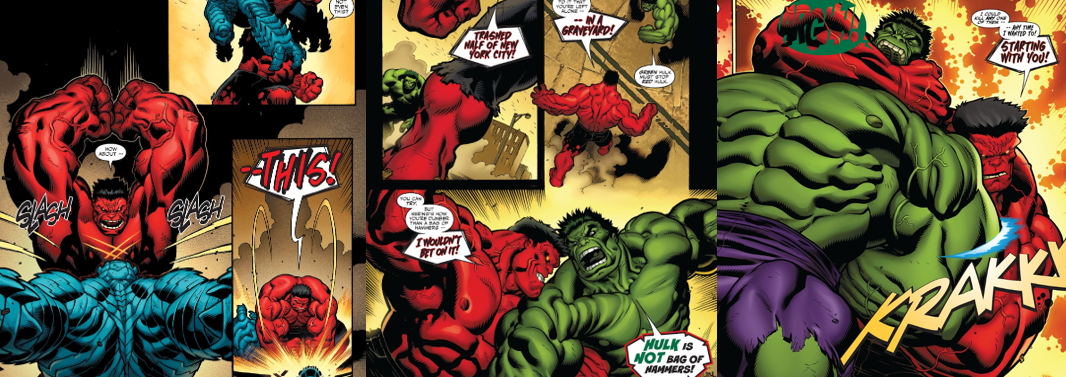
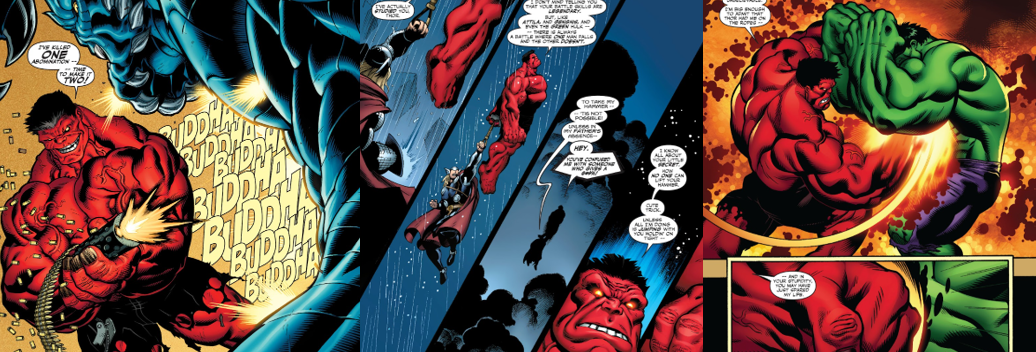
Elsewhere, the Red Hulk blindsides perennial sidekick Rick Jones outside Gamma Base, transforming him into his own Gamma monstrosity, the A-Bomb. It’s in this fight that we learn just how intelligent the Red Hulk is. While A-Bomb can only bark childish threats, the Red Hulk is goading, intelligent, and aware of his surroundings. Although Gamma Base recognises the Red Hulk as an authorised entrant, its defences fire on A-Bomb and Red Hulk takes advantage, swiping a massive cannon and taking great pleasure in riddling the armoured monster with bullets. When A-Bomb spits claims of his invulnerability, the Red Hulk gleefully tests his theory by pummelling him into the ground. The sheer force of the assault sends seismic shocks through the entire base and triggers Banner’s transformation into the Hulk when his cage attempts to gas him. As the battle rages, the base unleashes its Adamantium-taloned harpy robots (modelled after Banner’s long-time love, Doctor Betty Ross) to carry the two away. Unfortunately, the machines are no match for either monster’s strength, though the distraction separates them long enough for the Hulk to confront his red-skinned doppelgänger. Before the two can lock horns, however, the Red Hulk casually punches out Uatu the Watcher, who randomly popped up due to the significance of these two immensely powerful beings coming to blows (and, I guess, to show how tough this new Hulk is). After humbling the cosmic overseer, the Red Hulk finds the Hulk enraged by his appearance. The Hulk sees his red double an imitation and challenger to his title of “The Strongest One There Is”, a title he vehemently seeks to defend as aggressively as ever. Red Hulk, however, dives into the fight with relish, determined to make the Hulk pay for years of death and destruction, and for waging war against the entire planet after his return from Sakaar. Though the Hulk’s no longer as intelligent as his “World Breaker” persona, his strength only increases with his anger. However, the Red Hulk weathers the beating and easily grabs the Hulk’s wrist, breaking his arm and causing him to pass out.

Though he humbles Thor, the Red Hulk is outsmarted by the Hulk, his true identity left a mystery…

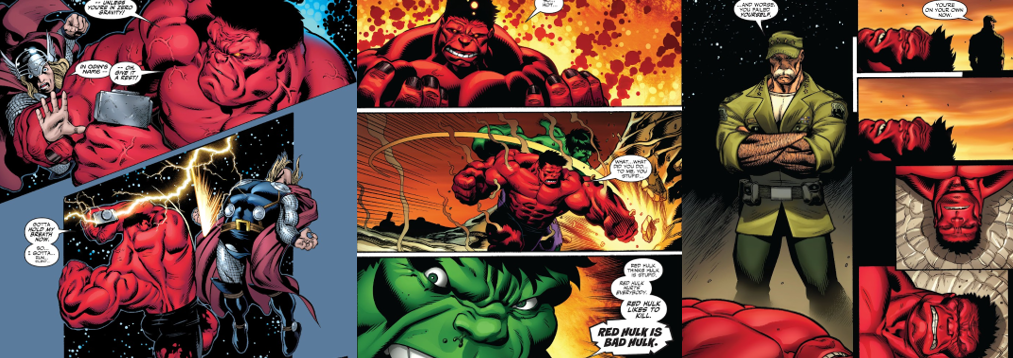
The Hulk awakens atop the Golden Gate Bridge and avoids a public execution by biting the Red Hulk’s gun. For his insolence, the Red Hulk decides to let his foe live with the knowledge that he’s not the strongest and knocks him into the bay, trigging the San Andreas fault. Thor Odinson then confronts the monster, only for the God of Thunder to be stunned when the Red Hulk shrugs off a blow from the mighty Mjöllnir. Savouring the chance to beat a God to death, the Red Hulk backs his words with blows powerful enough to draw blood and knock Thor flying. Thor fights back, not realising his foe is a different Hulk to the one he knows and is therefore left speechless when the intelligent Red Hulk gets around Mjöllnir’s enchantment by launching them out of Earth’s atmosphere. In zero gravity, the Red Hulk humbles Thor by beating him with his own hammer and dumping him on the Moon. After the Fantastic Four seemingly confirm that the Red Hulk is Doc Samson and A-Bomb pulls the Hulk from San Francisco Bay, Iron Man, She-Hulk, Ben Grimm/The Thing, Johnny Storm/The Human Torch, Prince Namor McKenzie/The Sub-Mariner, and Ares, the God of War, arrive to help save the city. While the Hulk initially rejects their assistance, he begrudgingly agrees to let them get San Francisco under control so he can confront the Red Hulk in Monument Valley. The Hulk’s efforts are aided by the returning Thor and A-Bomb, with the latter revealing the Red Hulk’s weakness (that he gets hotter the madder he gets) and restraining Thor so the Hulk can settle the score alone. Smartly, the Hulk absorbs the Red Hulk’s horrendous assault, causing the monster to overheat and grow weaker. The Hulk then asserts his dominance and knocks the Red Hulk out with a single punch. He then parts ways with Thor as friends before wandering into the desert, exhausted and reverting to Banner. However, when A-Bomb turns back into Rick and tries to reveal the Red Hulk’s identity, he’s shot in the back by Doc Samson. Both Samson and General Ross express disappointment with the Red Hulk, who they leave lying in the dirt as his eyes snap open…

The Summary:
First of all, I have to say that I love Ed McGuinness’s artwork. His work is always hyper-stylised and very bold and cartoonish, and he draws a wonderful Hulk and Hulk-like creatures, with them all being brutish monsters full of life and personality. You can tell so much about each of the Hulks in the way Ed McGuinness draws them: A-Bomb is constantly hunched over, as though weighed down by his armoured scales; the Hulk is always bulging and ready for a scrap; and the Red Hulk stands tall and confident, with a condescending smirk plastered to his face most of the time. The glue that holds this story together is the mystery of who the new Red Hulk is. At first, Doc Samson believes the Hulk is behind the Abomination’s murder. This is an odd hypothesis given he knows as well as General Ross that Bruce Banner is locked up in Gamma Base, but not one without merit; after all, Doc Samson himself once split Banner and the Hulk into separate beings. Naturally, given he was a bit of a dick around this time, Iron Man’s primary thought is to his culpability; he snaps and rages at Maria Hill about the Hulk-sized weapons S.H.I.E.L.D. developed and is desperate to ensure he can’t be held accountable for the murder. The evidence seems to ring true, but for the use of a gun and the scorched footprints, though She-Hulk remains unconvinced that her cousin was capable for such a cold-blooded act. Little moments throughout the story give some hints towards the Red Hulk’s identity, but there are numerous red herrings as well: Rick Jones, for example, seems tormented at the events, initially framing him as a suspect. We see that both Samson and Ross are authorised Gamma Base personnel, and that the base’s security recognises the Red Hulk’s iris. The garbled security footage seems to implicate Samson, as does his tattered coat, and the story even ends with the suggest that Doc Samson is the Red Hulk…until it’s revealed he’s not. But then again, General Ross is also seen standing over the Red Hulk’s unconscious body and he was right there when the Red Hulk attacked the Helicarrier, and he later turns out to be the Red Hulk! Indeed, the ending suggests more that Samson and Ross were in league with the Red Hulk, rather than being him, and I’d be interested to know or try and remember exactly how they explained how Ross and the Red Hulk could be in the same place at the same time (though it was probably a Life-Model Decoy).

The Red Hulk is an overpowered, egotistical, and incredibly dangerous Hulk.

As for the Red Hulk…well, this is a glorious showcase. Doc Samson’s intuitive nature reveals that the Red Hulk is a formidable foe, capable of beating even the super-tough Abomination into submission and fighting with a ferocity and power comparable to the Hulk. The Red Hulk is also seen to be tactically minded, launching an all-out assault against Iron Man’s fancy-pants gold Helicarrier and even wiping S.H.I.E.L.D.’s files. The Red Hulk’s intelligence is showcased in his eloquence; he delights in goading and taunting his foes as he fights them, displaying a familiarity with each and the defences of Gamma base. He repeatedly demonstrates a personal vendetta against the Hulk, first happy to frame him for murder and then delightedly besting him in a straight-up fight, even going so far as to break the Green Goliath’s arm and wish to publicly execute him. This, as he says, is payback for the Hulk’s years of death and destruction and more recent assault against the entire planet. The Red Hulk sees the Hulk as the true threat and is determined to stamp him out, but he’s also out to prove himself the superior being in mind and body. And what better way to do this than by not just beating the piss out of the Hulk and kicking him to the bottom of the San Francisco Bay, not just by punching out the Watcher, but by besting Thor in combat! Seriously, the Red Hulk is so massively overpowered it’s not even funny. Not only does he outmatch and humiliate Thor, even using insane logic to rob him of Mjöllnir, the Red Hulk completely disrespects and disregards the God of Thunder like he was nothing. A vindictive, calculating, ferocious opponent, the Red Hulk is so much than just another “Smart Hulk”. His blows have a purpose, striking at weak points and mixing pure power with tactical precision; he knows what he’s doing and enjoys doing it. His only weakness, one he doesn’t seem to realise, is that his body temperature rises exponentially when he gets mad, weakening him significantly. Well, it’s not his only weakness: he still needs to breathe, but that isn’t much of an issue considering he effortlessly trounced Thor while holding his breath.

The Hulk doesn’t care who his new foe is. He just wants to prove he’s the strongest!

The Red Hulk’s debut starts off as a showcase for the new Hulk on the block and a superpowered murder mystery. The investigation into the Abomination’s murder, the murder weapon, and the mystery of what’s happened to drive the Hulk to such an uncharacteristic action frames the first issue and a half. Once the Red Hulk makes his presence know, there’s some brief confusion as even Banner states that he’s been split in two and assumed different forms before, but then the crux of the story becomes trying to work out who this new Hulk is. Thus, everyone’s favourite Jade Giant doesn’t factor into the story for a few issues. Indeed, it’s up to the decidedly Hulk-like A-Bomb to carry the load when the Red Hulk targets him, but the action really ramps up when the two Hulks come to blows. I’m not sure what happened between Green Scar’s return to Earth and this story, but the Hulk has regressed to his mindless, child-like persona and is therefore at an initial disadvantage against his more tactile-minded doppelgänger. The Hulk’s driven to fight the Red Hulk out of a sense of pride (“Hulk is Hulk!”, after all) rather than to protect others, but his need to prove himself superior aligns with defending his few friends (such as A-Bomb) and allowing Iron Man and the others to save San Francisco. Thanks to Ed McGuiness, the Hulk-on-Hulk action is dynamic and interesting; it’s not just a senseless brawl as both Hulks weather their opponent’s onslaught to tire them out or strike when the opportunity presents itself. The Red Hulk, especially, stands out by using an enemy’s momentum against them and mixing brain with brawn, while the Hulk is naturally more savage and only tries a different tactic after seeing how dangerous his foe is. The art definitely makes his story a visually enjoyable experience and I did like the intrigue surrounding the Red Hulk. The red herrings and revelations are kind of odd knowing what I know now about the character, but it’s always nice seeing 2008-era Iron Man get his smug face smashed in and I loved that an intelligent Hulk proved to be such a threat. There’s definitely enough here to make me want to read up on what happened next with the Red Hulk and the lingering plot threat regarding Doc Samson, and the mixture of action and mystery were highly entertaining all-in-all.

My Rating:

Rating: 4 out of 5.

Great Stuff

Did you enjoy the Red Hulk’s explosive first appearance? Do you think the writers went a bit over the top in showcasing his threat, power, and intelligence? What did you think to the murder mystery sub-plot and who did you think the Red Hulk was? Were you impressed by the way the Hulk defeated his doppelgänger at the end? Which alternative version of the Hulk is your favourite? What are some of your favourite Red Hulk moments? Tell me your opinions on the Red Hulk in the comments and be sure to check out my other Marvel and Hulk content.

Back Issues & Knuckles: StC & Knuckles 2


With the release of Sonic the Hedgehog 3 (SEGA Technical Institute, 1994) in February 1994, gamers were introduced to Knuckles the Echidna. This mischievous, dreadlocked antagonist was created by Takashi Yuda and is my favourite of Sonic’s supporting cast so I’m dedicating every Sunday to Rad Red!


Story Titles: “Mystery of the Sandopolis Zone” (Part 1 and 2), “Count Down to Disaster” (Part 1 and 2), and “Disaster!” (Part 1 to 3)
Published: 17 March 1995 to 9 June 1995
Writer: Nigel Kitching
Artist: Richard Elson

The Background:
After SEGA finally knocked Nintendo from the top of the videogame industry, the company almost immediately set about transforming Sonic’s popularity into mainstream success with a slew of ancillary merchandise, principally cartoons and comic books. Around six months after Archie Comics published their first Sonic stories, United Kingdom publisher Fleetway Editions Limited began their own series with “Britain’s Official SEGA Comic”, Sonic the Comic (StC), a fortnightly publication I collected diligently until its unfortunate end. Heavily influenced by the now defunct Mobius and Doctor Ovi Kintobor storyline that was popular outside of Japan, StC soon deviated from the source material, portraying Sonic the a mean-spirited leader of the rebellious Freedom Fighters, a group made up of both familiar characters and anthropomorphic characters adapted from the videogames. Like Archie Comics, StC featured some very loose adaptations of the videogames; these were often truncated or heavily altered to align with the comic’s noticeably different lore. Their introduction of Knuckles and their subsequent adaptation Sonic 3 was no different, though that multi-part arc did lead to the first of many solo ventures for the stubborn echidna. Many months later, StC’s creatives brought Sonic and Knuckles together as an unlikely and abrasive team in this loose adaptation of Sonic & Knuckles (SEGA Technical Institute, 1994).

The Review:
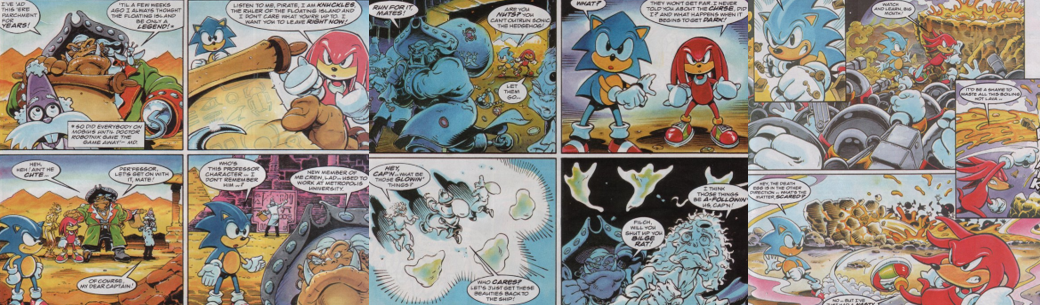
StC’s continuation of their Sonic 3 & Knuckles arc begins with Sonic and his sidekick, the perennial put down upon Miles “Tails” Prower, flying through the skies of Mobius to the Floating Island (as it was then known) in their biplane (which we now call the Tornado). Despite Tails’ worries, Sonic leaps off solo and lands in the arid desert of the Sandopolis Zone. He’s there to scope out some intel from his friend, fellow Freedom Fighter Porker Lewis, that maniacal despite Doctor Ivo Robotnik (who, at this point, currently dominates the entire planet) has secretly been repairing his ultimate weapon, the spherical Death Egg battle station, on the far side of the Floating Island. From the ancient ruins of Sandopolis Zone, Sonic spots the space station at the nearby Launch Base Zone but, before he can race to keep Dr. Robotnik from completing his repairs, he’s attacked by a particularly aggressive Sandworm Badnik. Caught off-guard, Sonic’s counterattack is interrupted by Knuckles, the pig-headed, super strong guardian of the Floating Island. The two immediately resume their rivalry, trading barbs with each other, and Knuckles clearly enjoys watching Sonic stubbornly refuse help. Of course, bashing Badniks is Sonic’s thing so he quickly trashes the Sandworm and the two realise that they’re there for the same reason since Knuckles is still cleaning up loose ends after he was tricked into helping Dr. Robotnik. Before they can reluctantly join forces to fight their common enemy, Captain Plunder and his Sky Pirates appear, angering Knuckles since he’s sick and tired of everyone and their mother showing up unannounced on his secluded island.

Sonic and Knuckles begrudgingly team up to intercept the Death Egg’s launch.

No strangers to each other, Sonic demands to know what the grim-faced walrus is doing there, and Captain Plunder eagerly reveals that he’s following an ancient treasure map, one he now realises led to the Floating Island since the mythical location has become common knowledge. With the aid of his newest crewman, known only as the Professor, Captain Plunder activates an ages-old control console and successfully raises the legendary Lost Pyramid of Sandopolis. The rag-tag group are immediately confronted by the pyramid’s guardian, a towering stone sentinel who easily reconstructs himself after being blasted with Sonic’s patented Spin Attack. Using his unparalleled knowledge of the island, Knuckles uses his head rather than his muscles and lures the guardian to some quicksand, subduing the titan just as the player would in the game. In the confusion, Captain Plunder and his cronies sneak into the cursed pyramid and discover a tomb full of riches, which they immediately pilfer. Naturally, Knuckles isn’t best pleased by this but, before he can stop the pirates, the tomb is plunged into darkness as the pyramid’s curse takes effect. Demonic ghosts chase them from the tomb, leaving them humiliated and penniless (though Captain Plunder spins a yarn of great danger and heroism to his crew). As for Sonic and Knuckles, they escape when Knuckles smashes a jar, flooding the room with sand and boosting them to a secret exit through a series of underground tunnels towards the live volcano that houses the looming Death Egg. When they reach the Lava Reef Zone, the duo is set upon by Dr. Robotnik’s rotund Eggrobos, which don’t just sport their master’s visage; Dr. Robotnik can see and hear everything through them. Sonic immediately attacks and is sceptical when Knuckles states he has a faster way to deal with them, though Rad Red comes through by smashing a nearby boulder and melting the hoard with a torrent of lava.

Though Super Sonic defeats Metallix, the Death Egg launches and prepares to fire.

Naturally (and correctly) surmising that Dr. Robotnik’s goal is the all-powerful Master Emerald, the gigantic jewel that keeps the Floating Island aloft, Knuckles leads Sonic to the Hidden Palace, where the Chaos Emeralds reside. Unfortunately, the Master Emerald is gone, dooming the island to drop into the ocean in mere hours. As for Dr. Robotnik, he’s already gloating about his supreme victory, not just because he’s close to the gem that will finally allow him to avenge himself upon the Emerald Hill Zone folk who so openly defy him, but also because an armour-clad, upgraded version of his ultimate creation, Metallix, is already drawing power from the Master Emerald. Sonic’s naturally shocked since the last time he tangled with Metallix, Sonic did a bit of time travel shenanigans to erase his metallic doppelgänger from history. The only explanation we get about how Metallix can still be around is a brief mention of a “brotherhood” of Badniks since exposition gives way to an all-out battle. Teleporting to the Sky Sanctuary Zone, the new Metallix proves its superiority by absorbing power from the Master Emerald and knocking Knuckles out. Despite Sonic trying to whip up a vortex to tear Metallix apart, he’s whacked by the Badnik’s extendable arm and socked into the air with a rushing uppercut. Unfortunately for Metallix, the shot sends Sonic flying towards the Master Emerald and, upon contact, the surge of Chaos energy transforms Sonic into his raging, demonic, invincible alter ego, Super Sonic. Super Sonic decapitates Metallix’s head with one blow and rips its remains apart in a mindless rage. Super Sonic then turns his wrath against Knuckles before the transformation wears off and Sonic regains his senses. Knuckles’ bruises are nothing compared to the sudden, dreadful realisation that the Master Emerald has been teleported away in the fracas. The two watch with horror as the mighty Death Egg finally launches, shaking what’s left of the Sky Sanctuary Zone apart with its vibrations.

An interior and external assault sees the Death Egg blasted from orbit once more.

Ecstatic at finally piloting his spherical space station once more, Dr. Robotnik sends a wave of Eggrobos after his foes. However, Knuckles begrudgingly carries them to safety by gliding on the turbulent winds. Sonic then pinballs off the Badniks to infiltrate the space station while Knuckles heads to a hidden chamber. Looking over some wizened scrolls, he activates an antiquated control console and literally pilots the Floating Island towards the Death Egg. Unlike the last time we saw Sonic explore the Death Egg, this rendition is gigantic, ominous, and filled with traps and Badniks. Sonic obliterates the Spikebonkers and then feigns surrender to enter  Dr. Robotnik’s main control room. There, he spots the Master Emerald and makes a beeline for it, desperate to remove the space station’s main power source before Dr. Robotnik can disintegrate the Emerald Hill Zone folk. Luckily, the Floating Island opens fire on the Death Egg using energy drawn from the very island. Enraged, Dr. Robotnik demands that his assistant, the long-suffering Grimer, turn the Death Egg’s main cannon on the Floating Island. However, the rotund dictator’s so caught up in his boastful gloating that Sonic knocks the Master Emerald free, disabling the Death Egg and leaving it wide open to Knuckles’ unrelenting barrage.

With Dr. Robotnik’s threat ended, Knuckles agrees to shelter Sonic’s friends on his secluded island.

Tumbling from the disintegrating space station, Sonic spots an Eggrobo snatching the Master Emerald. Thinking fast, Sonic swipes a laser blaster and destroys the Eggrobo, causing the Master Emerald to safely fall to the Floating Island. Sonic then saves himself by relieving another Eggrobo of its jetpack and riding it to safety, gloating as the exploding Death Egg falls from the sky. Upon spotting the Master Emerald, Sonic hefts it up (with no sign of Super Sonic this time around), determined to return it to the Emerald Chamber before the Floating Island crashes to the surface. Unfortunately, he’s taken by surprise when Dr. Robotnik fires upon a concussive laser blast from a gigantic suit of armour somewhat similar to the Giant Eggman Robo from the source material. Unlike that gruelling fight, where the mech boasted gigantic crushing fingers, fireball-sprouting nostrils, and a gigantic, Master Emerald-powered laser cannon, this suit’s primary attack is to try and crush Sonic with its fists. The desperation and high stakes see Sonic unleash aggressive Spin Attacks so savage that even Dr. Robotnik comments upon Sonic’s grim attitude. Still, Sonic is horrified when his final blow causes Dr. Robotnik to topple over the island’s edge. However, the maniacal dictator’s luck holds out as his damaged jet propulsion system means the fall isn’t fatal. Sonic’s equally as unimpressed to see Knuckles rushing up to him, too late to help with the battle and demanding the safe return of the Master Emerald. However, Sonic doesn’t hand over the gem that easily. Realising that Dr. Robotnik will never rest until he’s destroyed the Emerald Hill folk, Sonic agrees to return the Master Emerald in return for safe shelter for his friends. Thus, amidst the last vestiges of a downpour, the displaced Emerald Hill folk are safely hidden from Dr. Robotnik’s repercussions in the island’s Mushroom Hill Zone, high up in the sky. And good thing, too, since the injured Dr. Robotnik swears revenge against both Sonic and Knuckles.

The Summary:
StC was really at its peak around this time. This second round of Sonic 3 & Knuckles stories really ups the ante from Knuckles’ first introduction, which barely touched upon the gameplay mechanics, locations, and intricacies of the source material. To be fair, this was common in StC’s adaptations and subsequent stories did explore other aspects from the game, so basically Angel Island’s areas were incorporated into StC canon and formed the basis of plenty of other stories, short and long. But, at its core, the first arc was more concerned with the rivalry between Sonic and Knuckles, the fusion of the twelve Chaos Emeralds, and Dr. Robotnik’s attempt to attain Godhood. This second arc visits far more locations from the game and even incorporates mechanics seen in those areas, such as the pyramid from Sandopolis, the light gimmick and scary ghosts, and the crumbling Sky Sanctuary Zone. Every location and character is brought to life by the peerless Richard Elson, who brings a kinetic, visual power to every action. This is best evidenced in Sonic and Knuckles’ battle against Metallix, which conveys the speed and raw power of the Badnik like never before, instantly differentiating it from its predecessor and emphasising its threat. Things only escalate when Knuckles pilots the Floating Island and fires on the Death Egg, a unique plot thread obviously missing from the videogames but which adds further lore to the mysterious nature of the island, which holds secrets even Knuckles is just now discovering. While Super Sonic wasn’t much of a factor, his appearance was a welcome one and helped sell the threat of the Metallix, itself a lingering plot threat explored in later issues. I really liked that Sonic and Knuckles were teamed up this time around; Tails and the other Freedom Fighters were basically absent but it was a nice bookend to their previous meeting, where they fought against each other and begrudgingly teamed up in the finale.

Rivals Sonic and Knuckles team up against a common foe.

The two work surprisingly well together here. Perhaps because of their common enemy and the very real threat the Death Egg poses, there’s little bickering between the two. They’re largely on the same page, save for a few barbs here and there, and Sonic defers to Knuckles’ expertise regarding the island numerous times. Naturally, a spirited rivalry remains, with Sonic being the flashy showman who never admits when he’s wrong and Knuckles taking a more measured approach, utilising the environment or his know-how to quickly dispatch enemies and focus on the big picture. His primary concern is the safety of the Floating Island, which he feels has been defiled ever since Dr. Robotnik and Sonic arrived there. He just wants to clear out Dr. Robotnik’s influence and get things back to normal and is extremely intolerant of any intruders, even allies like Sonic. Unfortunately for Knuckles, he’s become part of a larger world, something even he acknowledges since he attacks the Death Egg not just for the Floating Island, but to safeguard the entire planet. Having previously experienced the Death Egg’s power before, Sonic knows all-too-well with the space station is capable of. Readers got a taste of this a few issues back when Dr. Robotnik ran a simulation that resulted in Sonic and Tails being vaporised, and the ever-present threat posed by the Death Egg clearly weighs heavily on Sonic’s mind. Sonic gives Badniks and Dr. Robotnik alike a taste of his smart mouth, but he knows what’s at stake and even welcomes transforming into Super Sonic if it means dispatching his metallic doppelgänger and safeguarding the Master Emerald. Consequently, Sonic defiantly battles a roomful of Spikebonkers, desperate to knock out the Master Emerald, only to despair when, for the first time in his life, he’s too slow to save his friends. It’s only because of Knuckles’ attack that Sonic dislodges the power source, and even Sonic must commend the echidna’s thinking (though, tellingly he, never expresses gratitude to his rival at any point in this arc).

Dr. Robotnik’ mad ambitions almost succeed but for the intervention of his worst enemies.

This focus on Sonic and Knuckles means there’s not much panel time for Dr. Robotnik. When we do see him, he’s raving about his need to acquire the Master Emerald, boasting about having acquired it, or anguished at having lost it. He constantly brags to Grimer about his superiority and the power of the Death Egg and relishes having a front row seat to witness the demise of his foes. Once the Death Egg launches, Dr. Robotnik is practically giddy with glee and immediately aims his ultimate weapon at the Emerald Hill Zone, ready to wipe the whole town and its inhabitants out. He’s aghast when Sonic and Knuckles destroy his beloved space station and finally takes matters into his own hands, piloting a mech suit far larger than the one seen in the last arc and taking the fight directly to Sonic. However, even Dr. Robotnik underestimates Sonic’s anger and determination; in the face of Sonic’s raw speed and power, the malevolent dictator is helpless, mech suit or not, and sent plummeting to a nasty landing, his dreams of all-out destruction quashed for now. By spreading the Sonic 3 & Knuckles story across intervening stories and giving the source material time to breath in this main arc, these issues tell one of the first great epics in StC’s run. The stakes were high and tangible: Dr. Robotnik wasn’t using magic gems to become a God or anything like that. He built the Death Egg just as he built Metallix and his Badniks, and it stands as the ultimate weapon of his vengeance upon those who defy him. Seeing Sonic and Knuckles properly team up, utilising their individual strengths in creative ways, was a blast and a taste of an ongoing begrudging alliance that would last until the comics were cancelled. Newcomers may be confused about Captain Plunder, Metallix, Super Sonic’s portrayal, and Dr. Robotnik’s vendetta against the Emerald Hill folk, but I’d still rate this as one of the best adaptations of Sonic 3 & Knuckles just because it takes the time to explore different locations from the games and provide a unique spin (pun intended) on some recognisable elements rather than simply taking the basics and weaving it into an all-new canon, as is usually the case.

My Rating:

Rating: 4 out of 5.

Great Stuff

Have you ever read Sonic the Comic’s second Sonic 3 & Knuckles arc? Did you enjoy seeing Sonic and Knuckles team up this time? What did you think to the use of locations and mechanics from the games? Were you surprised that Knuckles turned the Floating Island into a weapon? Which of StC’s videogame adaptations was your favourite? How are you celebrating the debut of Knuckles today? Please feel free to share your memories of StC and Sonic 3 & Knuckles below and go check out my other Sonic and Knuckles content.

Back Issues: Captain America #117-119

Writer: Stan Lee – Artist: Gene Colon

Story Title: “The Coming of…The Falcon!”
Published: 3 June 1969 (cover-dated: September 1969)

Story Title: “The Falcon Fights On!”
Published: 1 July 1969 (cover-dated: October 1969)

Story Title: “Now Falls the Skull!”
Published: 30 July 1969 (cover-dated: November 1969)

The Background:
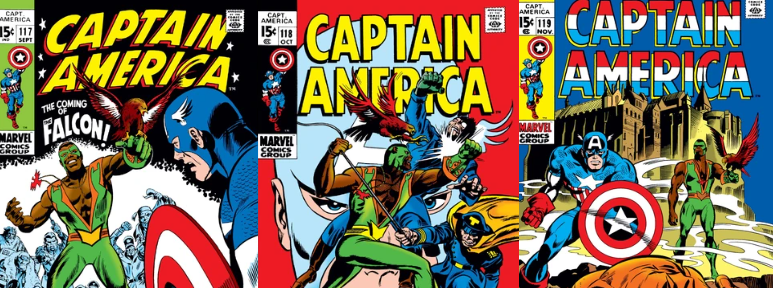
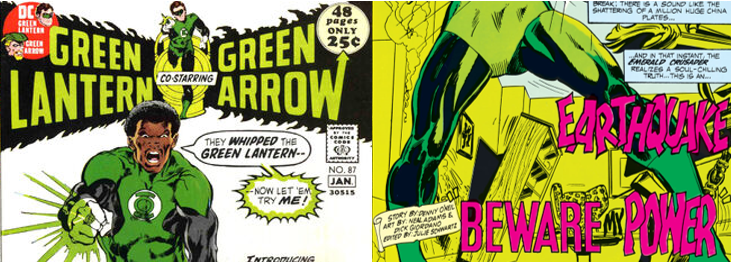
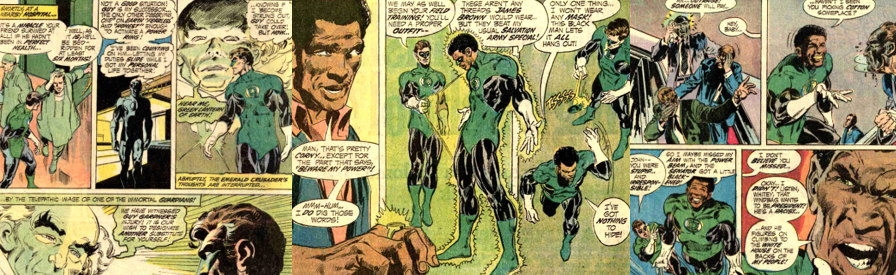
World War Two was in full swing by 1941. Nazi Germany had barrelled through Denmark and Norway in April 1940 and, after initially resisting joining the war, the United States entered the fray and provided much needed support against the “Axis powers” of Germany, Japan, and Italy. Patriotism and national pride was high at the time, especially in America, and it was during these dark days that Joe Simon and the legendary Jack Kirby introduced readers Captain Steve Rogers/Captain America and his kid sidekick, James Buchanan Barnes/Bucky, to encourage support of the war effort. However, after the end of the War superheroes declined in popularity and Captain America’s solo comic was cancelled in 1954. Luckily, Cap got a second chance as a “man out of time” when he joined the Avengers, reigniting his superhero career and butting heads with such iconic villains as Johann Shmidt/The Red Skull and even eventually battling his fellow superheroes. In the aftermath of this civil war, Cap was left seemingly dead and his mantle passed to his troubled sidekick, now also a superhuman figure, who operated in the role until Steve’s inevitable resurrection and, in 2014, Sam Wilson took on the mantle, to much undue controversy. Created by Stan Lee and Gene Colon, the man better known as the Falcon was the first Black American superhero in mainstream comic books. Specifically created to be a trendsetter during turbulent times, the Falcon went on to have a lengthy career in Marvel Comics, though mostly as a bit-player until his promotion into the shield-slinging role of Captain America, and has achieved mainstream recognition thanks to Anthony Mackie’s celebrated portrayal of the character in the Marvel Cinematic Universe.

The Review:
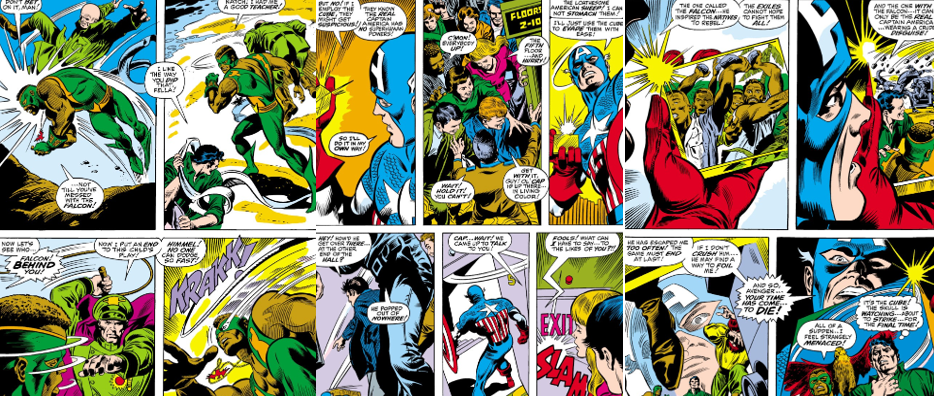
Sam Wilson’s debut in Captain America’s solo title came in the middle of a particularly trying time for the Star-Spangled Avenger. After almost having his identity made public, Cap was ambushed by his old foe, the gruesome Red Skull, who used the power of the Cosmic Cube to switch bodies with his hated enemy! As if being tapped in the body of a skull-faced Nazi wasn’t bad enough, the Cosmic Cube’s near-limitless power dumped Cap on a remote island home to the Exiles, a misfit group of would-be conquerors who hate the Red Skull with a passion. Observing through the Cosmic Cube’s omnipotent power, the Red Skull watches as the wheelchair-bound Franz Cadavus leads his venge-filled fellows in search of the one who robbed them of the Cosmic Cube’s power. When Cap crashes before them after falling from his hiding spot in a tree, he doesn’t even bother trying to explain the situation. Instead, he defends himself against Angelo Baldini and his deadly scarf, easily using his knowledge of his foe’s abilities to his advantage. Cap then uses his incredible agility to dodge Cadavus’s “murder chair” cannons, tossing sand in his eyes, and disarms Jun Ching. However, the numbers soon overwhelm the celebrated Avenger when Eric Gruning restrains him with his whip and “Iron-Hand” Jurgen Hauptmann closes in for the kill. For the observing Red Skull, the irony and glory of it all are too much to witness. Confident that his plot has succeeded, he decides not to witness his hated enemy’s final moments and turns his attention towards his greater goals.

Trapped in the Red Skull’s body, Cap nevertheless inspires young Sam to become a hero.

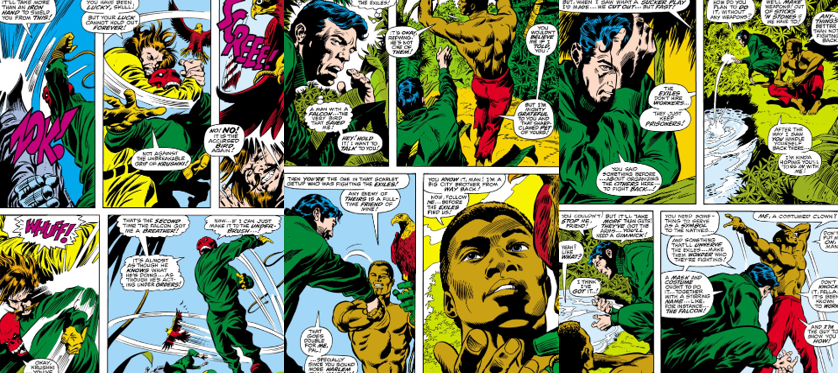
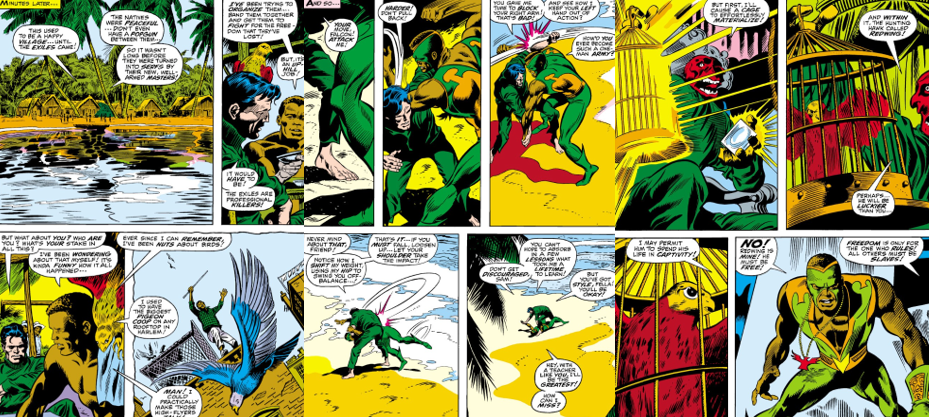
Consequently, the Red Skull doesn’t see the timely intervention of a falcon, later identified as “Redwing”, who distracts Iron-Hand long enough for Cap to fight him off with a swift uppercut. Redwing also helps Cap escape the iron grip of the brutish Ivan Krushki and, as Cap flees to the bushes, he notes that the bird seems to be trained, as if following orders. Cap surmises that the Exiles probably haven’t seen the Red Skull’s true face, so he removes the gruesome mask and manipulates his features with clay to move more freely around the island. In contrast, the Red Skull walks in the guise of Captain America, disgusted by the adulation and awe his appearance inspires and secretly conspiring to enslave everyone. The Red Skull revels in deceiving the masses, taking advantage of their goodwill, before deciding to further his victory against Captain America by destroying his enemy’s distinguished reputation. He is completely unaware that the Mental Organism Designed Only for Killing/MODOK and his beekeeper-suit flunkies at Advanced Idea Mechanics (A.I.M.) are working to render the Cosmic Cube they created powerless to avoid it being used against them. Back on the island, Redwing returns to his master, the jovial Sam Wilson, a lone vigilante against the Exiles. When Cap spots him, he thanks Sam for his assistance and learns that he’s a simple Harlem man who came to the long-peaceful island to organize a resistance against the Exiles. Sam relates that he had an affinity for birds since boyhood, communicating with them in a way beyond a simple animal trainer. When he unwittingly answered the Exiles’ call for a hunting falcon, Sam turned on them, unwilling to help them enslave others. While he initially laughs at Cap’s suggestion that he turn his love for falcons into a symbol, a costumed identity for the natives to rally behind, Cap soon organizes the creation of a garish outfit that will better suit his radical goals and dubs him “The Falcon”.

Despite this God-like power, the Red Skull doesn’t foresee Cap training a new ally.

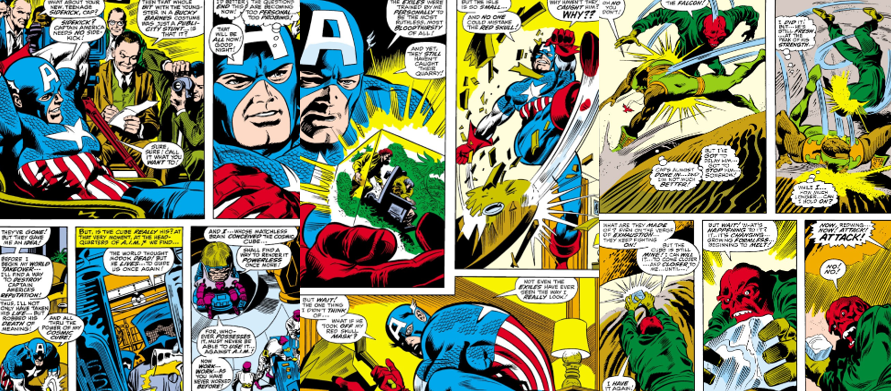
Back in New York City, the Red Skull finally realises, with anger, that his protégés have failed to find or kill their quarry. Realising that Cap must’ve taken off his skull-like visage, he resigns himself to the inevitability that his enemy can’t hide forever. Yet, the Red Skull decides he’s not willing to aid the Exiles or simply blink Cap out of existence with his God-like power and thus doesn’t bother to look in on Cap or witness him bonding with his new friend, whose connection with Redwing constantly impresses the disguised Avenger. Cap teaches the Falcon the basics of superheroing…And by that I mean they spar on the beach, Cap instructing Sam how to fight properly and use an enemy’s momentum and strength against them. Sam’s experience fighting for survival on the mean streets of Harlem see him take to the training like a natural, quickly becoming stronger and more sure of himself, and Cap impresses upon him that he must embody his new identity whenever he’s wearing his awful costume. When the Red Skull is awoken by concerns of an overexcited rabble of Cap fans in the lobby of his hotel, he sees it as the perfect opportunity to discredit Cap’s name. He shouts at the hotel manager and berates the fans, spitting spiteful insults every chance he can get, and even ostracises perennial hanger-on Rick Jones, who had aspirations of becoming Cap’s new sidekick. While A.I.M. continue their experiments, Cap and the Falcon blindside the Exiles, easily besting them even though Cap’s speed and strength are lessened in the Red Skull’s body. The Falcon proves very adept, dodging Gruning’s whip and inspiring the natives to rise up and drive the Exiles into fleeing for their lives.

Ultimately, it’s A.I.M. who quash the red Skull’s dreams of ultimate victory,

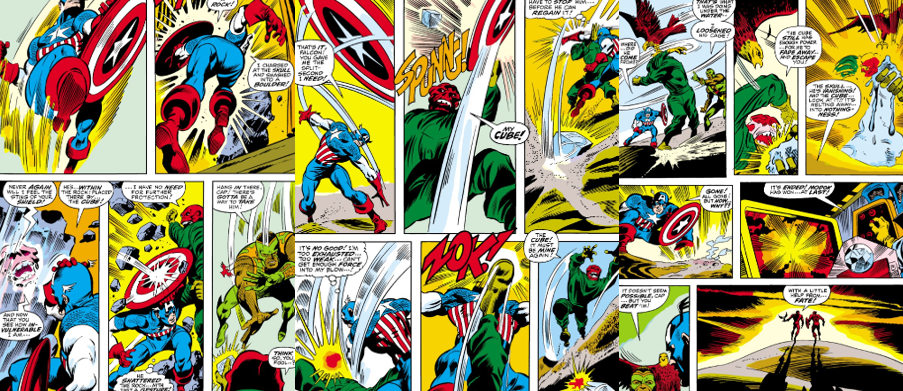
Unfortunately for them, the Red Skull happened to be looking in. Angered and determined to finish his enemy and his new ally off, the Red Skull assumes his more familiar appearance and effortlessly teleports himself to Berchtesgaden Castle, where he once conspired with Adolf Hitler to conquer the world, ravenous to stage his final victory in the castle’s opulent halls. Cap and the Falcon are then violently transported halfway across the world to Berchtesgaden Castle. Though Cap bemoans getting the Falcon caught up in his ages-old rivalry with the skull-faced dictator, Sam vows to face the threat no matter the outcome, but is enraged when the Red Skull’s first act is to cage Redwing. The Red Skull feeds the Falcon’s anger and spirit, goading him into attacking so that he can repel the fledgling hero with a forcefield. Sam is then stunned when the Red Skull uses the Cosmic Cube to undo the mind and body transfer, reverting Cap to his colourful costume and rearming him once more. Galvanised by this revelation, the Falcon willing follows Cap into battle, despite the Red Skull encasing himself in a protective rocky shell and spontaneously conjuring a tidal wave that threatens to drown the two heroes. While the Falcon’s caught off-guard by such tricks, Cap warns of the Red Skull’s power and insanity, which see the villain whisk them to an arid desert. With Sam exhausted, Cap hurls his shield and, incredibly, causes the Red Skull to drop the Cosmic Cube! The two fight valiantly over the prize but, just as the Red Skull reclaims the Cosmic Cube, he watches in horror as it melts between his fingers thanks to MODOK and A.I.M. activating their “Catholite Block” and rendering the weapon inert. Despite this, the Red Skull uses the melting cube’s fading power to teleport away, leaving MODOK victorious and Cap and the Falcon to head into the sunset as triumphant new allies.

The Summary:
I’m honestly not very familiar with the Falcon. This may very well be the first story I’ve ever read where he’s a part of the plot. I’m much more aware of his film counterpart and, honestly, never thought too much of him since his gimmick is very similar to Adrian Toomes/The Vulture, another character I traditionally find lacklustre compared to other, more colourful and appealing characters. However, his appearance here was enjoyable for what it was. There are some holes in his backstory, though, that the story didn’t satisfactorily explain for me. So, he’s a bird-lover, that’s great; he can communicate with Redwing on a near-telepathic level, sure, I’m all for that. But…why did he answer the ad for a hunting falcon? I mean, I guess he just wanted to leave Harlem and I can understand that, but it’s a bit random to jet off to a secluded island on a whim. Also, why did the Exiles need a hunting falcon anyway? Sure, they’re repeatedly shown to be useless at tracking their enemies but still…a falcon? And how did they place an ad for that when they’re exiled to the island? Still, Sam’s heart is in the right place; he won’t stand for injustice, especially slavery, and is determined to encourage the remaining natives to reclaim their land. It’s obviously a very racially and politically charged motivation and character, but I think it’s a universal truth we can all agree to: slavery and mistreatment of others is bad and should be opposed. Sam embodies this ideal before Cap shows up but lacks the proper means to enforce it. He seems to operate mainly from the shadows, but Cap encourages him to stand in the spotlight as a symbol for people to believe in, not unlike he is when in full costume.

It’s a good job Sam’s such a likeable guy because his superhero costume is unsightly!

Unfortunately for Sam, Cap and the natives whisk up one of the worst costumes I’ve ever seen. God, it’s so awful, with its lime-green and brown-gold edging, it’s weird-ass cowl and strangely angled boots. Considering Cap encourages him to take inspiration from his love and use the moniker “The Falcon”, nothing about Sam’s outfit screams “Falcon” to me. He doesn’t have a bird-like cowl like, say, Katar Hall/Hawkman, doesn’t match Redwing’s gold and red/brown feathers, and doesn’t even have his now-iconic wings. Just about the only thing this outfit has going for it is its sense of native tribalism, but otherwise it’s truly a ghastly sight. Luckily, Sam’s personality makes up for it. He’s not some jive-talking street tough or a shallow Blaxploitation cliché; he’s just a regular guy from Harlem with a friendly disposition who wants to do what’s right. His time on the mean streets toughened him, sure, but there’s no sense of malice or ego. The only time he shows any anger is when Redwing is threatened and when confronted by the embodiment of xenophobic oppression. Otherwise, he’s a level-headed, affable young man who luckily turns out to be a natural when it comes to learning how to fight. In a short time, Cap teaches Sam how to defend himself, how to fight smartly, and leads him into battle against the Exiles, a fight that puts them at a disadvantage due to the group’s numbers and weapons but which the heroes ultimately triumph thanks to putting their skills to good use. This also sees the Falcon inspire the natives to rise up, though this was very rushed for me. There was never any indication that the people even know the Falcon was heading into battle that day. All they knew was that Sam was wearing a costume now, not that he’d done anything worth riling them up. Of course, Sam’s natural abilities are only half the story; Redwing gives him a memorable gimmick that helps him stand out against his peers. The bird is exceptionally well trained and intelligent, turning the tide in every battle the Falcon is involved in and proving invaluable to their cause.

The story completely wastes the potential of the Red Skull’s unlimited power.

Beyond this, the story is a bit of a mess. I love the idea of the Red Skull attaining God-like power, and the Cosmic Cube effectively allows him to do anything. He can see anything he likes at will, switch bodies with people, teleport, conjure forcefields and the elements, and is functionally untouchable as long as the cube is in his hands. Unfortunately, the Red Skull is a cackling buffoon. Rather than simply will Captain America out of existence, he swaps bodies with him and dumps him on an island, where inept forces fail time and again to do his dirty work. Rather than reshaping reality in his image, brainwashing the masses and conquering the world a piece at a time, the Red Skull parades around in Cap’s body to take advantage of their goodwill, all while ruminating about how much he hates Americans and the many ways he’ll subjugate and destroy those around him. Rather than doing this, the Red Skull plots to destroy Cap’s reputation by…being rude to people! It’s ridiculous! He doesn’t even watch what’s happening on the island until it’s too late and gets so distracted bringing himself, Cap, and the Falcon to Berchtesgaden Castle that he doesn’t think to set aside his pride and just snuff their lives out with a thought. It’s typical, cliché supervillain behaviour to assume victory, bask in your superiority, and to toy with your enemies but I expected more from someone like the Red Skull! Despite demonstrating that he can protect himself from any attack with a thought, Shmidt is disarmed by a simple throw of Cap’s shield and then he completely fails to consider that A.I.M. might be angry at him swiping their most powerful weapon, leaving him undone not by his enemy, but by his own lack of foresight. Overall, this was a decent enough introduction for Sam Wilson; his costume was awful, but I liked his attitude and his gimmick. What lets it down, though, is the nonsensical main plot regarding Cap and the red Skull switching bodies. It’s a great concept but the story completely wastes it, having Shmidt lounge around thinking nasty thoughts but squandering his great power, leaving him undone in the lamest way possible.

My Rating:

Rating: 3 out of 5.

Pretty Good

What did you think to the Falcon’s debut story? Were you as repulsed by his costume as I was? What did you think to his moxie and his gimmick with Redwing? Were you also disappointed that the red Skull squandered his potential here? What are some of your favourite moments in the Falcon’s long history? There’s a comment section down below; use it to share your thoughts and then go check out my other Marvel content.

Back Issues [Sci-Fanuary]: Tales to Astonish #13


January celebrates two notable dates in science-fiction history, “National Science Fiction Day” on January 2 and Arthur C. Clarke’s HAL 9000’s birthday on January 12. Accordingly, I’m dedicating January to celebrating sci-fi with an event I call “Sci-Fanuary”.


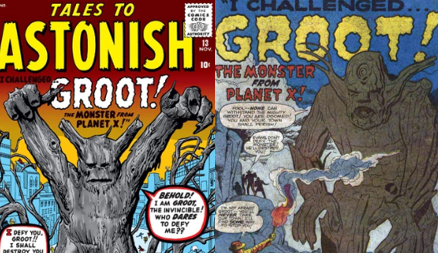
Story Title: “I Challenged… Groot! The Monster from Planet X!”
Published: 27 June 1960 (cover-dated: November 1960) 
Writers: Stan Lee and Larry Lieber
Artist: Jack Kirby 

The Background:
Nowadays, the lovable tree-monster Groot is all-but a household name thanks to his celebrated appearances in the Marvel Cinematic Universe (MCU), courtesy of Vin Diesel’s surprisingly complex performance considering the character simply says “I am Groot” over and over. While Groot is best known as a key member of the Guardians of the Galaxy, his first appearance was in a decidedly less heroic role. Debuting in Tales to Astonish, a science-fiction anthology series perhaps best known for introducing readers to Doctor Hank Pym/Ant-Man, this far more eloquent portrayal of Groot sought to capture and study humankind. This version of Groot later joined the Howling Commandos, a paranormal strike team working under the Strategic Hazard Intervention Espionage Logistics Directorate (S.H.I.E.L.D.) He was largely supplanted by a different member of his species, also called Groot, who first appeared in the Annihilation: Conquest event (Various, 2007 to 2008) before joining the Guardians of the Galaxy and being the inspiration for the MCU’s version of the character.

The Review:
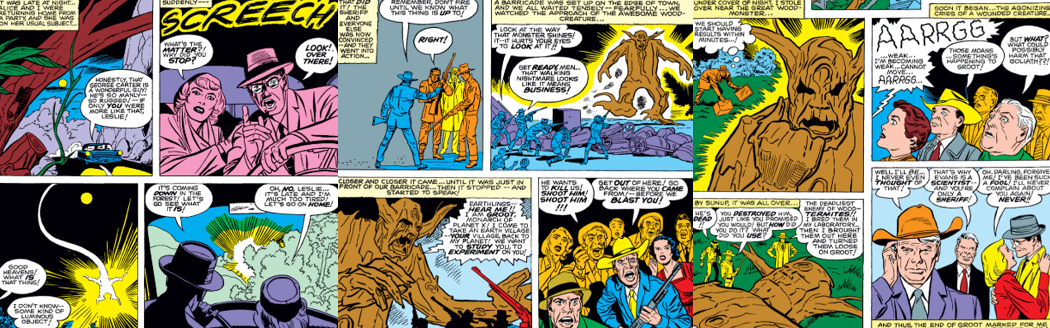
The story of how one brave man stood up to the hulking tree-monster from Planet X, Groot, begins late one night as married couple Leslie and Alice Evans return home from a trip to the cinema. Their mundane drive through the night is interrupted when Leslie spots a brilliant luminous object falling from the heavens and crashlanding in a nearby forest. While he’s eager to check it out, Alice easily convinces him to ignore it and take her home because she’s “tired” (*wink-wink, nudge-nudge*). However, being a curious biologist, Leslie can’t help himself and goes to investigate off-panel, bringing a sample of the mysterious object to his laboratory for study. One day, Alice comes charging into the lab claiming that two of their trees (as well as some of their neighbour’s trees) are missing. Though he brushes the phenomenon off as a cheap prank, Leslie’s sure that what he saw in the forest is somehow connect and heads over there. However, when he arrives, Leslie’s astonished to find the glowing object emitting a powerful light and to witness a gigantic wooden giant, a living tree, commanding and controlling wooden objects to fly to him and add to his monstrous stature. Panicked, Leslie naturally rushes into town to warn the sheriff. Luckily, one of the lawman’s men is on hand to report that the creature is heading to town and, before long, a barricade is erected and armed men are confronting the giant.

Unassuming biologist Leslie holds the key to defeating the monstrous, tree-like Groot.

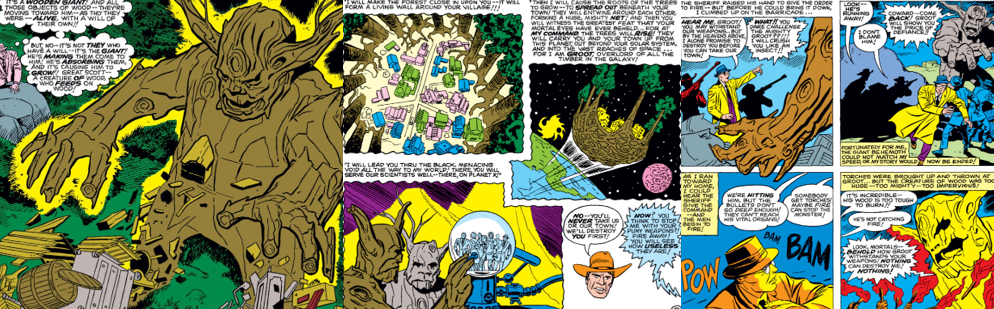
Surprisingly, the titan halts its march and addresses the townsfolk, introducing itself as Groot, monarch of Planet X, and his intentions to take the entire village back to his home world to study the Earthlings. Terrified, the townsfolk prepare to defend themselves, only for Groot to mentally command the surrounding trees to encircle the town. Its intention is that the trees will bury beneath the town’s very foundations to form a giant net that will whisk the town and all its inhabitants into space, presumably somehow sustaining them for their journey back to Groot’s world. There, he proclaims he and his kind will conduct research on them; the exact specifics aren’t clear, but the threat is enough to rile up the townsfolk. Unfortunately for them, Groot easily shrugs off their small arms fire; however, Leslie bravely steps up and claims to know the key to stopping Groot’s plot. Yet, when he immediately runs off, his peers and even mighty Groot believe him to be a coward. Since the town’s bullets and even flaming torches cannot penetrate Groot’s thick hide, there’s nothing to stop the creature enacting his plan, and even Alice chastises Leslie’s apparently cowardice back at his lab. However, she and the others are amazed when Leslie rushes back to Groot and deposits two boxes to the ground. To their shock and relief, Groot is painfully felled and killed by “the deadliest enemy of wood”, termites! With the towering goliath slain, the town is in Leslie’s debt, stunned at such a simple solution, and even Alice sees her man in a new light by the end.

The Summary:
Well, this was a bit of schlock, B-movie-level fun! The entire setup is like something ripped straight out of a Roger Corman flick and the execution is on the same level as an ambitious monster movie from the 1950s. Our main protagonist is not some muscle-headed jock or even a cop; he’s just a simple biologist, one whose wife constantly chastises him for not being a “real man”. He’s much happier with his lab equipment and studying animals and fauna, it seems, and motivated by scientific curiosity first and foremost. Leslie wants to investigate the crash site simply to see what wonders fell from beyond our world and is driven to distraction studying a sample of the glowing material. It’s not made clear what he’s looking at or what it really does; I assume it’s a small piece of what would become Groot, but the story glosses over what Leslie’s research uncovers. It might’ve been good to setup the ending in these panels; have Leslie’s study of Groot reveal the key to defeating the monstrous giant rather than randomly having Leslie pull termites from his ass. While Alice doesn’t get much to do but react to stuff and criticise her sapling husband, the town sheriff and inhabitants are certainly gung-ho. Thankfully, we’re spared any lengthy scenes of Leslie being branded a madman and the cops and townsfolk are soon grabbing guns and torches to defend themselves against Groot. However, like Alice, they see action and gusto as the true mark of bravery. Thus, they throw insults and judgement at Leslie when he seemingly flees in fear and are confused and perplexed when their weapons and moxie are nothing compared to a few termites.

The mighty Groot has come to enslave, not conquer, but poses a significant threat.

Naturally, Groot is the main reason to read this bizarre story from Marvel’s golden age. The build up towards the creature’s big reveal is both brief and tense. Due to the limited page count, there’s only so much the writers can do, but I liked that the town’s trees went missing as a foreshadowing of Groot’s reveal. Those more familiar with the heroic Groot may be shocked by this creature’s more grotesque appearance. Groot is a towering, tree-like alien who adopts a menacing stance at all times. Interestingly, though, Groot is seemingly a scientist, like Leslie. It’s there to capture and study the town, not conquer the Earth, and makes no aggressive moves towards the humans even as they fire upon it. I mean sure, it wants to wrap the town up in a ridiculous cage of trees and branches, whisk them away to Planet X, and perform God-knows-what on them in its lab, but it’s not rampaging through town, squashing people beneath its trunk-like feet, or otherwise attacking them. Yet, Groot is framed as being “unconquerable” due to its incredible size and strength. However, it’s notable that the townsfolk only have small arms and flaming torches on hand; we have no idea how heavier ordinance would’ve fared against Groot. Of course, we have no need to discover this since Groot is easily and painfully taken down and killed by a group of termites. This simple solution is straight out of The War of the Worlds (Wells, 1898; Pal, 1953) and shows how man’s ingenuity is our greatest asset, rather than brute force. A peculiar and whimsical science-fiction tale clearly inspired by 1950s B-movies, “I Challenged… Groot! The Monster from Planet X!” is notable for its early depiction of what would become one of Marvel’s most endearing characters and short enough to provide a brief bit of entertainment, but you’re not really missing much if you’ve skipped this one and I wouldn’t say it’s really worth seeking out unless you’re really curious about Groot’s understated first appearance.

My Rating:

Rating: 2 out of 5.

Could Be Better

Have you ever read “I Challenged… Groot! The Monster from Planet X!”? If so, what did you think to it? Did you enjoy the B-movie feel of the story? What did you think to Groot, its design and motivations? Were you amused by the way Leslie managed to destroy the creature? Would you like to see Marvel bring back sci-fi anthologies like Tales to Astonish? What are some of your favourite Groot stories and moments? Feel free to share your thoughts on Groot in the comments and go check out my other sci-fi content on the site.

Back Issues [Sci-Fanuary]: Tales of Suspense #93/94


January celebrates two notable dates in science-fiction history, “National Science Fiction Day” on January 2 and Arthur C. Clarke’s HAL 9000’s birthday on January 12. Accordingly, I’m dedicating January to celebrating sci-fi in an event I call “Sci-Fanuary”.


Writer: Stan Lee – Artist: Jack Kirby 

Story Title: “Into the Jaws of… A.I.M.!”
Published: 1 June 1967 (cover-dated: September 1967) 

Story Title: “If This Be… Modok!”
Published: 29 June 1967 (cover-dated: October 1967) 

The Background:
In addition to their colourful superhero efforts, Marvel Comics was once known for publishing various anthology comics. One of these was Tales of Suspense, a science-fiction anthology series that later hosted the first appearance of Anthony “Tony” Stark/Iron Man. In time, Marvel’s peerless superheroes came to be featured in two-in-one stories and it was in Tales of Suspense that readers were first introduced to George Tarleton, a technician for noted supervillain organisation Advanced Idea Mechanics (A.I.M.) who was transformed by “mutagenics” into a grotesque, deranged cybernetic head dubbed MODOK (or, “Mental Organism Designed Only for Killing”). I’m most familiar with MODOK from the Iron Man animated series (1994 to 1996), where he was voiced by the legendary Jim Cummings and served as a secondary antagonist and lackey to the show’s big bad, the Mandarin (Ed Gilbert/Robert Ito). Though most mainstream audiences are probably more familiar with MODOK’s questionable appearance and portrayal in the Marvel Cinematic Universe, he had better luck in his Robot Chicken-esque (2005 to present) animated series. Generally popping up as a boss character in Marvel videogames, MODOK has been a pretty significant villain in the comic books, tangling with various Avengers, directing A.I.M. towards world conquest, aggressively pursuing the Cosmic Cube, and eventually upgrading himself to a far superior form.

The Review:
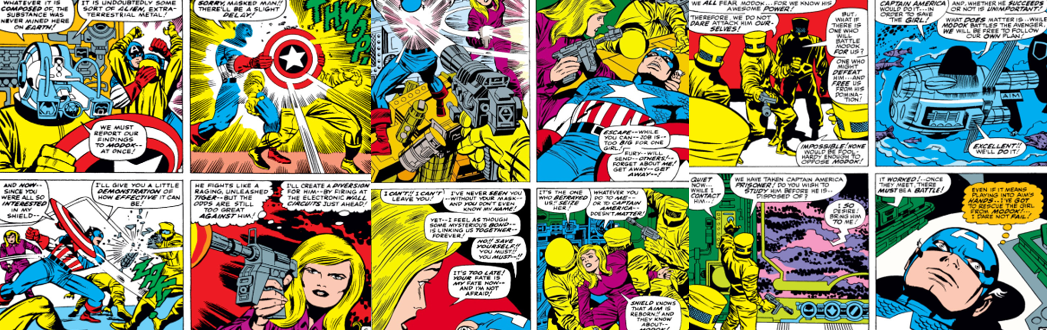
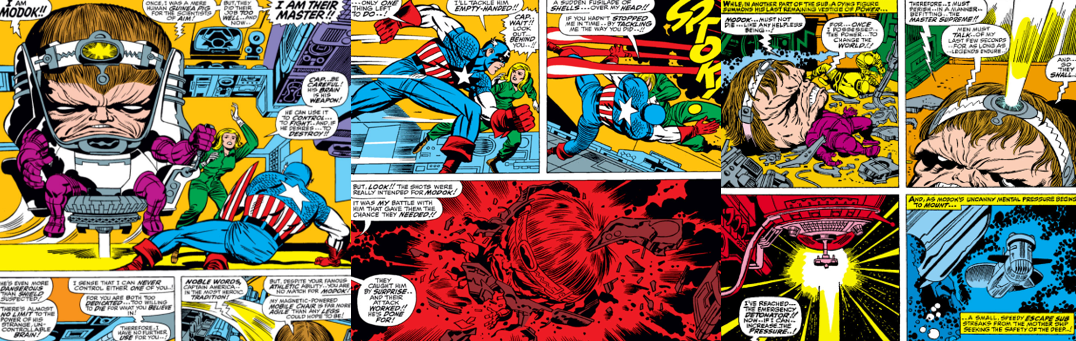
The entire crux of this two-part story centres around Captain Steve Rogers/Captain America’s efforts to rescue Nick Fury, the gruff and tumble top agent of the Supreme Headquarters, International Espionage and Law-Enforcement Division (S.H.I.E.L.D.) spy organisation. To accomplish this task, Cap was forced to place the one woman he loves, the mysterious Sharon Carter/Agent-13, in mortal peril and, as this story opens, he’s hell-bent on avenging himself against, A.I.M., the group responsible for it all. Outfitted with a suitably Kirby-esque breathing apparatus, Cap follow his radar to a set of underwater coordinates provided to him by Fury, eventually locating A.I.M.’s massive submarine base deep beneath the ocean. Unfortunately for the star-spangled hero, the “eyes of MODOK are everywhere” and A.I.M.’s bee-suit-wearing operatives easily spot him, blasting him with knockout gas and bringing him aboard, where he’s held to a table by “sheer magnetic force” and told stories of MODOK’s dreams of world conquest. Though Cap’s mind is working a mile a minute to think of some way to escape, he’s relieved when Agent-13 is revealed to be alive. Although she makes a big show of chastising him for stupidly risking his life to rescue her, Agent-13 secretly releases his magnetic trappings with her convenient “anti-polar coveralls” when she leans in for a kiss. Though A.I.M.’s soldiers try to blast Cap, he easily and effortlessly dispatches them, much to Agent-13’s amazement, and rushes to retrieve his iconic shield.

Cap and Agent-13 infiltrate A.I.M.’s submarine base to learn the truth about MODOK.

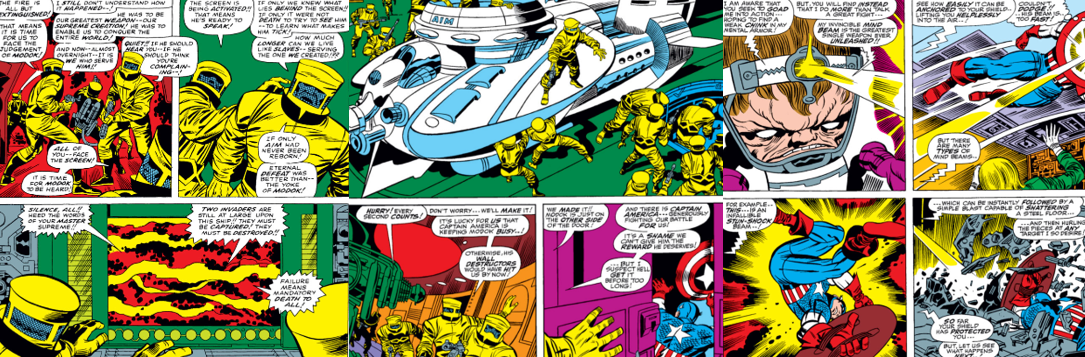
A.I.M.’s scientists are conducting a series of test on the indestructible weapon, marvelling at its unique properties and preparing to present their findings to their mysterious master, MODOK. Naturally, Cap and Agent-13 get to them first, beating up the scientists and reducing their lab to flaming wreckage. Cap then follows Agent-13’s lead in taking cover to avoid A.I.M.’s shock troopers and agrees to stick around and help her complete her mission. Namely, discovering who or what MODOK is to better determine and combat his threat. MODOK’s authority is so absolute that A.I.M.’s troopers dare not speak against him or the strange circumstances that transformed their greatest weapon into their oppressive master, especially as his disembodied voice orders their death for failing him so completely. Watching from the shadows, the two heroes eagerly await MODOK’s big reveal but are suddenly attacked by a shock trooper. Cap bravely takes the shot, ending up paralysed as a result. His sacrifice is largely in vain since Agent-13 refuses to flee and is easily captured and brought before MODOK’s large viewscreen, where she’s dropped through the floor in dramatic fashion. Although an A.I.M. soldier is prepared to finish Cap off, one of his peers stays his hand since only MODOK can issue such an order. Angered, the soldier speaks of rebelling against their master and, though his fellows are sceptical of their chances against MODOK’s supreme power, they’re convinced to go along with an elaborate scheme to have Captain America defeat their oppressor to save his ally.

MODOK’s awesome power terrifies even A.I.M. and sees him fatally betrayed.

Thus, Cap is also teleported to another location to confront MODOK. Though freed from his paralysis, Cap is immediately felled by MODOK’s “brain beam” and approached by the man himself, a massive cybernetic head with tiny arms and legs that floats about! Once a “human guinea pig” for A.I.M.’s experiments, he has come to rule the organisation with his vast power thanks to his comically enlarged brain. Agent-13 is on hand to further MODOK’s narrative, urging Cap not to attack since MODOK’s “uncontrollable brain” is far too powerful. Yet, MODOK swiftly moves to strike, giving the Avenger no choice but to defend himself. Despite Cap’s superhuman deftness, MODOK easily manipulates his shield to toss him about and then sends him crashing to the floor. MODOK’s mind beams are incredibly versatile, allowing him to psychokinetically direct debris at Cap and causing the floor to erupt in flames. As the two battle, A.I.M. prepare to rally; while one squad escapes, another mobilises to attack MODOK while he’s distracted. MODOK’s power is so great he can freeze Cap’s shield as it flies through the air with “the speed of thought”, yet he fails to detect the betrayal of his own people, who open fire with a fusillade of shells that shatter MODOK’s cybernetic chair. A.I.M. then turn their weapons on Cap, who easily takes them out with an assist from Agent-13 before commandeering the escaping craft and apprehending the remaining scientists. As for MODOK, he’s left broken and dying. Refusing to go out in such a disgraceful way, MODOK uses the last of his power to overload the submarine base and cause a massive explosion, which Cap and Agent-13 assume means the end for A.I.M.’s grotesque commander.

The Summary:
This was an interesting two-part tale for me. My experience with Captain America’s adventures is quite limited and usually more focused on his team-based exploits, so it was a nice change of pace to see him in action. He’s working with S.H.I.E.L.D. here, which isn’t too uncommon these days; but back then, S.H.I.E.L.D. was more of a clandestine spy organisation than a global military power. Still, they have plenty of technology and resources on hand, enough to not only plant Agent-13 as a double agent in A.I.M. but also to get Cap to the group’s hidden submarine base. Although Cap and Agent-13 don’t know each other’s true identities at this point, it’s clear the two are smitten by each other. Cap goes solo to rescue her and constantly moves to protect her throughout these issues, and Agent-13 is in awe of his physical abilities and moral compass. Unfortunately, Cap does come off as a bit condescending here, referring to Afent-13 as “little girl” and “lady” a few too many times and Agent-13 mostly chips in here and there rather than being portrayed as Cap’s equal. Still, she’s not some blonde bimbo and she’s clearly a capable spy; her anti-polar outfit and A.I.M.’s respect for her reputation as a S.H.I.E.L.D. agent speak to that. She’s also as stubborn and dedicated to her duty as he is; she refuses to flee when they have the chance since she has a mission to accomplish, and then equally refuses to abandon Cap to die. Still, it’s Cap who gets all the big action scenes, throwing punches, his shield, and cannonballing about the place like a man possessed while Agent-13 just fires her pistol. AI.M.’s nameless, faceless soldiers and scientists were very entertaining here. Though they appear ridiculous in their haz-mat suits, they’re well organised and have the numbers advantage. It’s nothing compared to Cap, but they give it a good go, retreating when necessary and even unloading enough firepower to seemingly kill MODOK.

The feared MODOK is a force to be reckoned with despite his ridiculous appearance.

At first, they’re depicted as the typical minions of an oppressive master; terrified into servitude since failure is punishable by death, they’re subservient to MODOK’s incredible power and forced to obey his every command. However, many of them speak out against MODOK, questioning why a creation of theirs is giving them orders. Though talk of insurrection is forbidden, they’re encouraged to turn on their grotesque creation and manipulate Cap to fight on their behalf, showcasing a deceitful nature that’s unlike most common minions. As for MODOK himself, he’s a bizarre and ludicrous figure with his useless little limbs and enlarged cranium, but he showcases a wide array of powers that have Cap on the ropes before A.I.M. turns against him. We don’t learn the specifics about who he is or what A.I.M. did to him, but we learn he was their greatest experiment and built to be their deadliest weapon, but he took control of the organisation when they succeeded a little too well in their efforts. Now an all-seeing, overpowered commander who violently punishes any transgression, MODOK exhibits cybernetically endowed “brain beams” that can stun, hurl, and blast his foes with ease. Essentially immune to conventional attack, MODOK’s only weakness is underestimating his downtrodden minions, who leave him to die as little more than a useless cripple. Yet, despite his explosive end and his absurd appearance, MODOK is seen as a very real threat. A.I.M. fears him and Cap struggles to fight him, making him a strangely menacing figure with a laughable visage. These stories were a fun exploration of A.I.M.’s goals and inner workings and I enjoyed seeing MODOK as the outrageous face of their organisation. There was a lot of action, and it built upon the relationship and mutual respect between Cap and Agent-13. MODOK definitely stole the show, but I would’ve liked to see him showcased a little more. Perhaps a three-part story would’ve worked better in this regard, with the first part building up to the reveal, the second showcasing his powers and origins, and the third detailing A.I.M.’s betrayal and MODOK’s vulnerabilities. Still, it was a fun read with some striking art and MODOK remains one of Marvel’s strangest villains yet and it was fun to see his first appearance.

My Rating:

Rating: 3 out of 5.

Pretty Good

What did you think to MODOK’s dramatic first appearance? Were you put off by his bizarre appearance or did you find his powers impressive? What did you think to the relationship between Cap and Agent-13? Did you enjoy seeing A.I.M. turn against MODOK and stage a revolution? Would you like to see Marvel bring back the Tales of Suspense anthology? What are some of your favourite MODOK stories and moments? Tell me your thoughts on MODOK down below and go check out my other sci-fi content.

Back Issues: The Amazing Spider-Man #15

Story Title: “Kraven the Hunter!”
Published: 12 May 1964 (cover-dated: August 1964)
Writer: Stan Lee
Artist: Steve Ditko

The Background:
After his success with the Fantastic Four, Marvel editor and head writer Stan Lee created teenage superhero Peter Parker/Spider-Man, whose debut issue became one of Marvel’s best selling publications. Spider-Man’s popularity grew to the point that he headlined other comics, including being partnered up with other, less mainstream superheroes in the pages of Marvel Team-Up, and amassed one of the most colourful and memorable rogues galleries in all of comics. Sergei Kravinoff (better known as Kraven the Hunter) was created by Spider-Man co-creators Stan Lee and Steve Ditko and made his debut in this story, though he’s perhaps best known for his epic (if temporary) death in the celebrated story arc “Kraven’s Last Hunt” (DeMatteis, et al, 1987). Kraven has long hounded the web-slinger as part of the Sinister Six and across a variety of media, featuring in videogames and the 1990’s Spider-Man cartoon. Finally, after years of stop/start efforts to make it onto the silver screen, Kraven inexplicably made his live-action debut in 2024.

The Review:
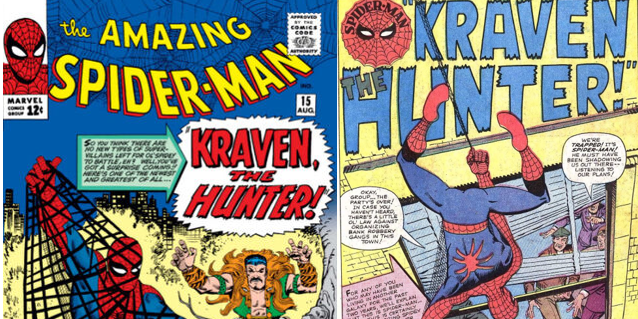
Our story begins in classic sixties Spider-Man fare, with Spidey dropping in on a bunch of crooks and breaking up their party. In a change of pace, though, Spider-Man doesn’t just beat them up with ease and grace while expositing how his super strength gives him the edge of New York City’s normal, everyday mooks. Instead, he shoots out a web to trap three of the would-be bank robbers but the fourth, who he presumes is their leader, makes a hasty exit out the window. The leader manages to give Spider-Man the slip by activating a special gas from the inside of his suit that instantly changes his appearance into a harmless old man and, when he gets back to his apartment, reveals his true identity as Dmitri Smerdyakov/The Chameleon, the man of many faces who was the very first supervillain Spider-Man ever encountered. Realising the threat Spider-Man poses, and bitter about being deported and exiled after their last encounter, the Chameleon decides to hire an “old friend”, Kraven the Hunter, to destroy the web-spinner once and for all! It turns out that Kraven has amassed a hell of a reputation as the world’s most accomplished hunter. His achievement of having trapped and defeated every type of animal with his bare hands is so impressive that even cantankerous Daily Bugle editor J. Jonah Jameson is in awe of the hunter’s prowess.

Kraven’s world-famous prowess initially sees him get the upper hand on Spider-Man.

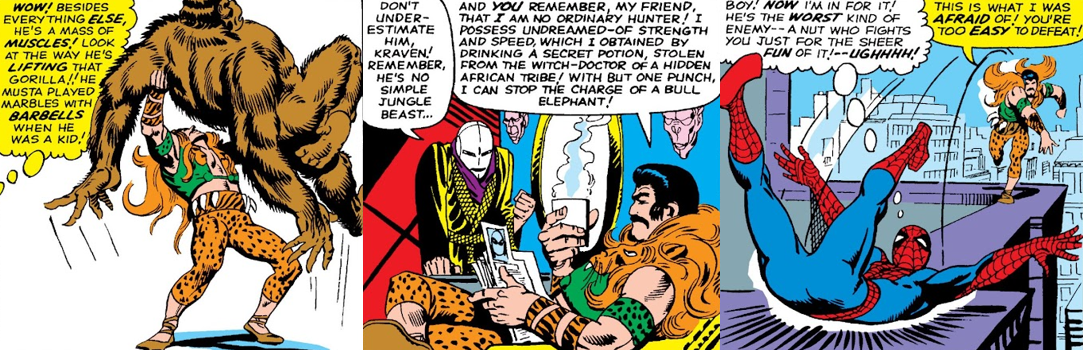
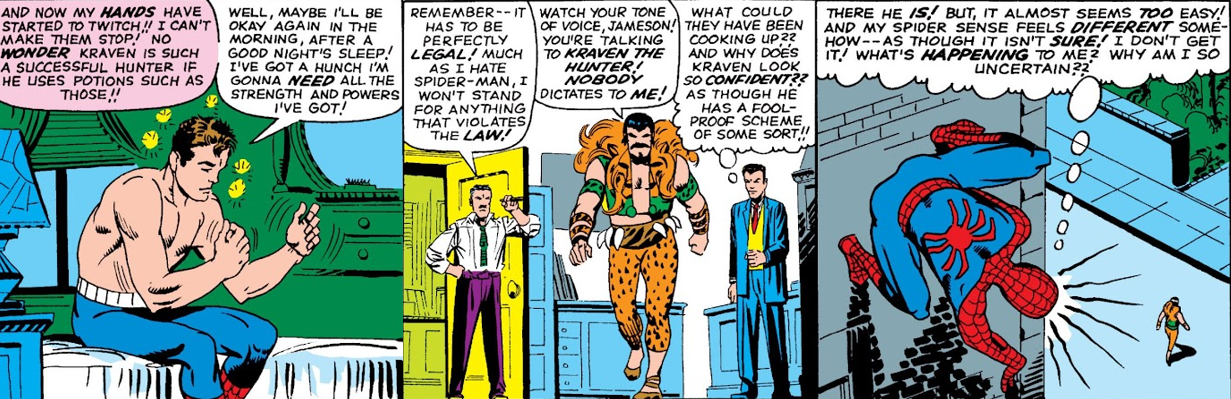
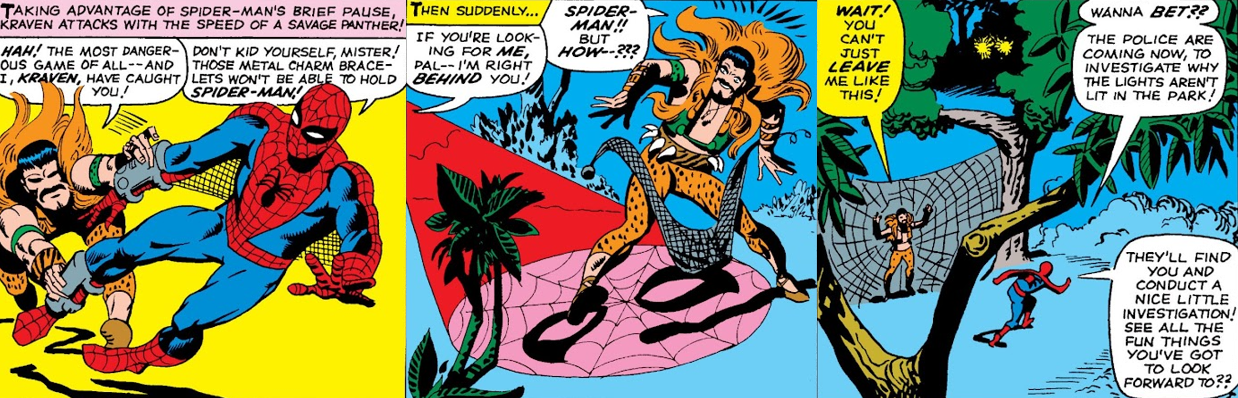
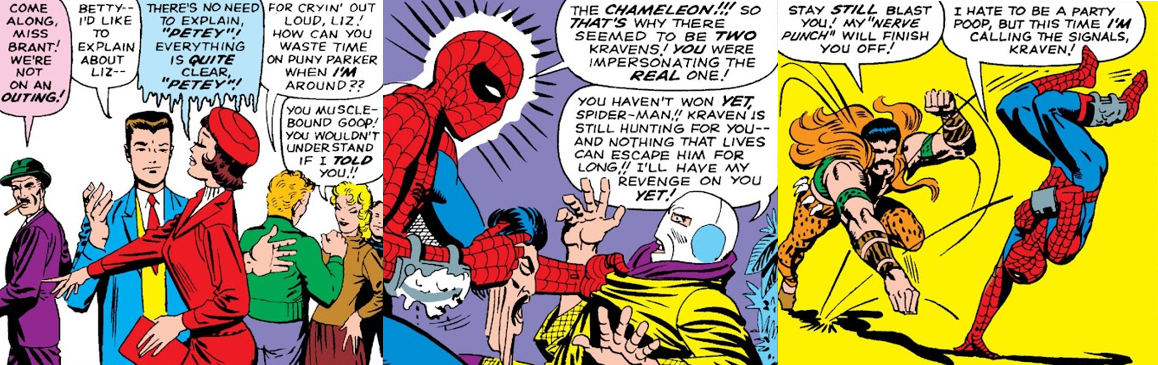
Seeing Kraven’s arrival in the United States as a big scoop, Jameson orders his secretary, Betty Brant, and his long-suffering freelance photographer, Peter Parker, to accompany him to the pier to get an exclusive. There, Betty is unreasonably salty when Peter arrives at the same time as Liz Allen and Eugene “Flash” Thompson but Kraven’s mere presence and physical stature are enough to turn their heads and put a stop to the relationship drama. Kraven turns down Jameson’s request for an exclusive with a dismissive bark, so determined is he to “hunt the most dangerous game of all”, and then gives Peter the shock of his life when he single-handedly rounds up the ship’s animal cargo with speed, strength, and wiles so honed that all Spidey can do is watch in amazement. So fantastic is Kraven’s display of power that Spidey completely forgets to take any pictures, angering Jameson. The newspaper editor’s vexation is replaced with intrigue, however, when Kraven lets slip that he’s there to hunt Spider-Man. Peter’s so stunned by this revelation that he’s speechless when Betty gives him the cold shoulder after Liz showers him with attention, which also riles up her muscle-bound flame, Flash. After all that drama, Kraven meets with the Chameleon to read up on his prey using the research and first-hand experience he has acquired, confidentially assuring his ally that the superhuman strength and reflexes he has been afforded by a witch-doctor’s secret potion will enable him to succeed where others have failed. To allow Kraven to stalk Spider-Man more effectively, the Chameleon hires some goons to cause a ruckus, which naturally attracts Spider-Man. Kraven watches with a begrudging respect for his foe’s power, agility, and cunning, impressed with how easily he fights, evades, and subdues multiple crooks, and then catches the web-spinner by surprise by waiting for him on a nearby rooftop.

Kraven’s potion and confidence cause undue stress to the troubled teenage superhero.

Kraven rushes his quarry, explaining that he’s motivated only by the hunt and the personal triumph that defeating Spider-Man will bring him. He immediately puts his enhanced abilities and research to good use by snatching Spidey out of mid-air and tossing him to the ground. Relentless, Kraven presses his attack with a “nerve punch” that Kraven boasts can “down a full-grown charging rhino”. Spidey takes the shot on the arm, which goes completely numb, and surprises Kraven by fending him off with just one arm. In desperation, the hunter resorts to pricking Spidey with one of his special potions, a concoction designed to sap his spider-strength. Kraven then makes a tactical retreat to allow the drug to do its work and Peter returns home, woozy and suffering from tremors as a result, while Kraven astonishes the Chameleon by revelling in the thrill of the encounter and the battle yet to come. Although Peter awakens back at full strength, he’s alarmed to find his hands are still twitching uncontrollably. He desperately tries to hide his condition from his doting Aunt May, who has arranged a blind date with him the niece of their neighbour, Anna Watson, and is relieved when the twitching dies down by the time he gets to the Daily Bugle. There, his exasperation with Betty’s unprovoked jealousy is quickly replaced by astonishment when Kraven comes barging out of Jameson’s office. Although Jameson hates Spider-Man with a vengeance, he refuses to endorse Kraven’s methods since there are laws against hunting human beings. Kraven’s confidence shakes Peter so badly that his hand tremors make a dramatic and embarrassing return while he’s in Science class, much to the amusement of his peers and the annoyance of his professor, Miles Warren. Peter’s condition is so bad that he can’t aim his webs straight and he’s forced to resort to leaping from building to building as Spider-Man as he aimlessly searches for any sign of his would-be hunter.

Kraven’s cunning and prowess ultimately fail to match with Spidey’s spider-sense.

Fully aware that his prey would seek him out, Kraven arranges for the Chameleon to brazenly walk around town in disguise as the world-famous hunter and lure Spider-Man into Central Park to renew the hunt. Despite his suspicions and his blaring spider-sense, Spidey follows the fake and ends up briefly trapped beneath one of Kraven’s nets. Thankfully, exerting the full limits of his spider strength is enough to snap one of the connecting chains, but he’s so disorientated by one of the Kraven’s loudly beating a drum that he’s unable to stop the other Kraven from slapping metal braces to his right forearm and calf. Designed to “hold a hunger-mad tiger”, the manacles have a magnetic attraction so strong that it takes all Spidey’s incredible strength to keep them apart. They also jingle every time he moves to instantly alert Kraven to his presence, however. Relying on his superhuman reflexes and spider-sense, Spidey stays one step ahead of his hunter and buys enough time to spray the manacles with “liquid web fluid”, which successfully negates their properties. His uncanny sixth sense alerts him to someone hiding in the nearby bushes and Spidey is stunned to unmask the Chameleon as the fake Kraven. This victory reinvigorates the web-head, however, and he quickly turns the hunt against his foe, chasing Kraven deep into the woods using his spider signal. No matter where or how he tries to run and hide, Kraven is continually spotted by his foe and resorts to trying to sneak attack him with his nerve punch, only for Spidey’s spider sense and unmatched agility to keep him off-guard. Angered by Spider-Man’s mocking taunts and realising that he’s lost every advantage, Kraven again tries to make a tactical retreat, but this time runs head-first into one of Spider-Man’s webs. Spidey thus leaves him and the Chameleon there, beaten and humiliated, to be deported by the authorities (though, naturally, they both swear revenge). In the aftermath, Jameson is so elated by Peter’s photographs of the action that he allows Peter to have one of his secret stash of chocolate bars. However, the youngster’s relationship dramas continue to mount even after Mrs. Watson’s niece cancels their blind that as Betty gives him the brush-off and Liz goes out dancing with the hunky Flash.

The Summary:
Considering I don’t think much of Kraven and consider both him and the Chameleon to be two of Spider-Man’s bottom-tier foes, I actually enjoyed “Kraven the Hunter!” quite a bit. Steve Ditko continues to set the standard for how Spider-Man should move and fight in his comics and the action is fast and packs a hell of a punch whenever the two are trading blows or showing off their superhuman skills. I always enjoy the visual difference between Peter and Spider-Man, how being in the costume is such an exhilarating and freeing experience for the socially-inept photographer, and it was a neat twist to see him go toe-to-toe with someone not just seemingly as strong and agile as he, but also far more cunning and ruthless. As ever, Peter’s relationship and personal drama is a constant distraction from his current predicament. While I’m always glad when stories from this era don’t reduce females to babbling bimbos, Betty’s raging jealousy was a serious pain in the ass here. She gets mad at Peter simply because he arrives at the same time as Liz and Flash, assuming he “[came] with her” even though they’re not even near each other in the panel, and acting like a clingy, co-dependent brat just because Liz fixes his tie and calls him “Petey”. While it’s true that Betty probably should be worried about Liz, especially as she’s one of the few to admonish Flash for his attitude towards Peter, all she ends up doing is pushing him towards Liz, with comical results. This may very well have been the first of many hints towards Peter’s most famous love interest, Mary Jane Watson, though Peter’s actually relieved when she cancels their blind date as he already has enough troubles on his plate and isn’t optimistic about the state of Mrs. Watson’s mysterious niece.

Despite the relationship drama and the Chameleon’s presence, Kraven gets a good showing.

Although this issue features the return of the Chameleon, his presence is thankfully downplayed in favour of the far more visually and physically interesting Kraven. The two are depicted as close friends, which is a nice change as it’s not every day you see supervillains palling about so amicably. Naturally, the story goes out of its way to show that Kraven more than meets expectations. The ship’s animal cargo spontaneously getting loose is the perfect excuse to show how fast, smart, and strong he is and prove that he’s more than capable of subduing even the most dangerous of animals with his bare hands. Living for and relishing the thrill of the hunt, Kraven sees Spider-Man as the ultimate prey and goes to some lengths to get a sense of his prowess. I say “some” as Kraven only spends a few panels observing Spider-Man rather than days, which may have contributed to his downfall as he underestimated Spider-Man’s strength and tenacity and was forced to resort to one of his potions and a hasty retreat. Although Kraven’s potion causes Spider-Man some troubles, all it really does is take away his ability to shoot webs straight and in the end all Spider-Man needed to win was his extraordinary spider-sense and superhuman reflexes. Still, Kraven does match blows with Spider-Man and even briefly cripples one of his arms and is proven to be just as agile and physically strong as the web-spinner but, ultimately, he’s undone, in part, by his own hubris. This all made for a surprisingly enjoyable first appearance of Kraven the Hunter. I can’t say it’s changed my opinion of him, or his lame outfit, but it definitely made for a pretty entertaining villain-of-the month Spider-Man story.

My Rating:

Rating: 4 out of 5.

Great Stuff

What are your thoughts on Kraven’s debut? Are you a fan of the character and, if so, what are some of your favourite Kraven tales? Were you annoyed by the relationship drama in Peter’s life, or did you enjoy it as a character-building tool? What did you think to Kraven’s depiction, powers, and personality? Are you a fan of the Chameleon or, like me, do you find him disappointing? How excited were you for Kraven’s live-action debut? Feel free to leave your thoughts on Kraven below and be sure to check out my other Spider-Man content.

Back Issues [F4iday]: Fantastic Four #48-50


In November 1961, Marvel Comics readers witnessed four intrepid explorers be forever changed by mysterious cosmic rays. Marvel’s “First Family” of superheroes were the first of many colourful superheroes for Marvel Comics and are more than deserving of some attention today.


Writer: Stan Lee – Artist: Jack Kirby

Story Title: “The Coming of Galactus!”
Published:
9 December 1965 (cover-dated March 1966)

Story Title: “If This Be Doomsday!”
Published: 11 January1966 (cover-dated April 1966)

Story Title: “The Startling Saga of the Silver Surfer!”
Published:
10 February 1966 (cover dated May 1966)

The Background:
In 1961, Stan Lee and Jack Kirby introduced readers of Marvel Comics to the dysfunctional Fantastic Four in a direct response to DC Comics’ Justice League of America. While the team’s creation has been contested by both, Lee and Kirby popularised the “Marvel Method” of writer/artist collaboration and brought comic fans real and relatable characters who introduced pivotal Marvel staples in the following years. Perhaps none are more crucial than the cosmic devourer of worlds himself Galactus. Created by Lee and Kirby and debuting in this trilogy of issues, the entity once known as Galan had Biblical connotations and was specifically designed to challenge pre-conceived notions of “good” and “evil”. Many subsequent stories have characterised Galactus as a force of nature, if not the universe, as inevitable and necessary as life and death. A complex being who spreads genocidal destruction to satiate his never-ending hunger, Galactus is typically served by equally mighty “heralds”, most notably Norrin Radd/The Silver Surfer, and either at the forefront or lurking in the background of Marvel’s cosmic crossover events. Galactus has brought to life in Marvel’s various animated ventures, often appears in Marvel videogames, and was notoriously represented as an indistinct swirling cloud in Fantastic Four: Rise of the Silver Surfer (Story, 2007) before finally being brought to life in live-action in the Marvel Cinematic Universe in 2025.

The Review:
The Fantastic Four’s greatest threat begins with them still struggling against Marvel’s newest batch of bizarre costumed superhumans, the Inhumans. Specifically, Maximus Boltagon/Maximums the Magnificent (or, more accurately, Maximus the Mad) has set off the dreaded “Atmo Gun”. While this has no effect on his Inhuman brethren, it’s caused deadly planet-wide vibrations that threaten all human life. While even the hyper-intelligent Doctor Reed Richards/Mister Fantastic cannot fathom the cause of such an event, Blackagar Boltagon/Black Bolt, leader and monarch of the Inhumans, immediately confronts his insane brother, a creature so vile and spiteful that he’d happily destroy every human just so the Inhumans could walk the Earth uncontested. For his mad schemes, Maximus earns a swift backhand from the dangerously mute Black Bolt and is both astonished to find the Fantastic Four still alive and dismayed when his brother easily disables the Atmo Gun’s effects. Regardless of the pleas of the beautiful, red-headed Inhuman Medusalith Amaquelin/Medusa, who’s pledged her life, heart, and loyalty to Black Bolt, Maximus refuses to accept any similarities between the two races. Stubborn to the end, he throws off the Inhumans restraining him and lunges for the Atmo Gun once, more, maliciously reversing its effects before anyone can stop him. The result is the entire Inhuman sanctuary, Attilan, being encased within an impenetrable “Negative Zone”. Thinking fast, the Fantastic Four race to safety and escape before they are also trapped inside, leaving Johnny Storm/The Human Torch heartbroken at being separated from Crystal Amaquelin, Medusa’s pretty little sister who Johnny immediately fell for and who unwittingly brought the two groups together in the first place. Johnny reacts with anger, desperate to burn his way back into Attilan and pleading with Reed to find some way to be reunited with Crystal. However, Johnny’s left to despondently realise that there’s no hope and, sympathetic to his plight, Ben Grimm/The Thing secretly vows that none of them will ever give up hope that the two can see other someday.

Johnny’s anguish at being separated from crystal is supplanted by Galactus’ dreaded arrival.

With the Inhuman saga wrapped up for now, the story then switches to the vast depths of the cosmos where we’re introduced to the enigmatic Silver Surfer for the first time. Deftly dodging a meteor shower as he rides through the void, the Silver Surfer catches the watchful eyes of the Skrulls, who react with panic at detecting his presence, knowing that where the Silver Surfer rides, mighty Galactus is sure to follow. Using their incredible technology, the Skrulls “[black] out” their solar system, apparently causing the dreaded Silver Surfer to pass by. Thus, the Silver Surfer rockets to our solar system, spotting a lush and fertile planet that will satisfy his master’s needs. Meanwhile, while returning from Attilan, the Fantastic Four are stunned to see a second Sun appear in the sky and then flames seemingly engulf the atmosphere. When the Human Torch investigates, the predictably fickle and understandably panicked New Yorkers blame him for the phenomenon and attack. Thankfully, Reed, Ben, and Susan Storm/The Invisible Girl arrive on a suitably Kirby-esque sky cycle and the Thing quickly quells the enraged mob, and Reed ushers them back to his lab to investigate further. A time jump apparently occurs between panels as Reed is suddenly sporting some five o’clock shadow and working himself into a stress, snapping at Sue for interrupting him and, predictably, upsetting her since he’s too busy trying to figure out what’s going on to pay attention to his wife. More concerned for her husband’s wellbeing than the mysterious rocks that’ve now appeared in the sky and determined to not be shut out, Sue forces her way into his lab and is stunned to find Uatu the Watcher has been causing the strange events using his “Matter Mobilizer”. Though normally unable or unwilling to interfere in human history, Uatu has tried to shield the Earth from the Silver Surfer, knowing that catastrophe that will come if he arrives. Unfortunately, the Watcher was unsuccessful; the Silver Surfer arrives, easily evades the Human Torch, and signals for Galactus.

Even the Fantastic Four are powerless to oppose Galactus, who seeks to devour the Earth.

Although the Thing gives the gleaming alien a good clobberin’, the Silver Surfer simply uses the attack as a good excuse to depart and prepare for his master’s arrival, which comes moments later courtesy of an oddly surreal, photorealistic depiction of the being’s incredible technology. A gigantic ship then lands and from it steps forth not the purple/blue, armour clad devourer you may recognise by a massive titan decked out in green and red with a big, stupid “G” on his chest. This colour issue is corrected in the next issue (and can be explained by the Watcher’s statement that “[Galactus] is what he wishes to be!”), in which the giant ignores the Fantastic Four as though they were less than gnats and argues morals with the defiant Watcher. Galactus immediately reveals himself to be a creature of surprising depth by expressing his displeasure at having to harm living creatures, though he’s no less determined to destroy the Earth to sustain his vast energy and quell his never-ending hunger. Displeased by the Thing’s insolent tone, Galactus refuses to find a suitable dead world and, when the enraged Thing dares to strike him, gasses the stony superhero like an insect. Despite the Watcher’s warnings, the Human Torch tries his luck, only to be blasted by Galactus’ eye beams and have his flame doused by soot and ash. Humbled, the Fantastic Four regroup within the Baxter Building, bickering with each other as they lick their wounds, completely unaware that the unconscious Silver Surfer has collapsed into blind sculptor Alcia Marsters’ apartment. Ben’s caring, concerned love immediately tends to the stranger and reveals himself to be a melancholy creature, one baffled by Earth customs and seemingly resigned to sweeping such lives away in service of his demanding master. Galactus sets to work achieving this by constructing an elaborate machine – the “Elemental Converter” – around the Baxter Building, one that will siphon Earth’s very elements into his being as a source of sustenance. The Fantastic Four are horrified when the Watcher shows the destructive impact this weapon will have, reducing the Earth first to a lifeless husk and the shattering the remains before Galactus searches for another world to repeat the process.

It’s only when the Silver Surfer is convinced to help that the battle turns in Earth’s favour.

Alicia is similarly horrified to learn this from the impassive Silver Surfer. She lashes out at him with an emotional outburst, emphasising the strength of the human heart and questioning his aloof servitude. For a moment, the Silver Surfer falters, admiring her courage and feeling the first stirrings of an emotion, one he soon identifies as pity as he sees the panicked masses react to Galactus. The titan is enraged, however, when the Thing delays his plan by trashing a vital part of the Elemental Converter. Angered and insulted when Mr. Fantastic dares to strike him, Galactus summons the Punisher (no, not that one), a strange, frog-like android, to deal with the impudent mortals while he repairs the damage. Though Johnny is eager to help his family in the fight, he’s held back by the Watcher, who has a plan to stop Galactus that requires Johnny’s abilities. Trusting the stoic overseer, Johnny is teleported across space and time to Galactus’ massive, mechanical space station at “the center of infinity”. While the pig-headed Thing tests his mettle against the Punisher’s raw power, Sue keeps the creature at bay with her forcefield long enough for Galactus to tire of the conflict and withdraw his pet. Meanwhile, the Silver Surfer is aghast at the suggestion that he use his great Power Cosmic to defy his master; yet he cannot deny that Alicia’s belief in his quiet nobility has some merit. Thus, having found a world worthy of his protection, the Silver Surfer pleads with Galactus to spare the human race. However, mighty Galactus is unimpressed by his newfound compassion, forcing the Silver Surfer to turn his powers against his master. Amazed by his herald’s betrayal, Galactus is trapped within a vortex and encased within a cocoon, for the Silver Surfer wishes only that they leave the Earth rather than to harm his master. Unfortunately, Galactus is not so easily caged and quickly breaks free, enraged and easily deflecting his herald’s attacks, bombarding him with flaming meteors and offering to spare him harm if he but reaffirm his allegiance.

Galactus begrudgingly leaves to avoid his destruction. but not without punishing his herald.

Powerless to aid their new ally, the Fantastic Four place their faith in the Watcher, a faith rewarded when the Human Torch arrives back on the Earthly plane, briefly overwhelmed by the cosmic wonders he’s seen, and hands Reed a mysterious device he acquired from Galactus’ space station. The Watcher immediately advises caution lest Reed foolishly annihilate the entire solar system trying to explore the machine, which Galactus identifies as the “Ultimate Nullifier”. The Silver Surfer fights valiantly, despite his blasts having no effect on Galactus, who effortlessly conjures giant icicles and threatening to turn his wrath against the humans. Tired of the conflict, Galactus prepares to destroy his once loyal herald, only to react with shock when Reed threatens him with the Ultimate Nullifier. Astonished to see a mere human wielding a weapon so powerful that it could destroy the entire universe, Galactus demands that Reed relinquish the weapon and then chastises the Watcher, stunned that he would “[give] a match to a child who lives in a tinderbox!” However, the Watcher simply affirms that humanity has the right to defend themselves and emphasises their great courage. Weary of the battle and in need of sustenance, Galactus agrees to spare the Earth in return for the weapon. Reed hands it over peacefully as the Watcher swears Galactus to stay true to his word, however the world devourer makes sure to punish his herald before departing. With a blast of his eye beams, Galactus removes the Silver Surfer’s ability to roam the galaxies and banishes him to the planet he defended so bravely. And, with that, Galactus disappears in a brilliant flash of light, leaving the Fantastic Four relieved and amazed. In the aftermath, Ben is distraught by how captivated Alicia seems by the eloquent Silver Surfer and falls into a depression. The Silver Surfer departs to explore his new world, Reed continues to anger Sue by focusing on his work, and Johnny heads off to college, meeting the annoying Wyatt Wingfoot for the first time and still pining for Crystal.

The Summary:
The “Galactus Trilogy” is unquestionably one of the most important story arcs not just for the Fantastic Four, but for Marvel Comics in general. It wraps up the initial Inhumans arc, trapping them in Attilan for a spell and adding some significant character growth for Johnny, who spends his days pining over his lost love. While I question how he can be so attached to Crystal despite barely knowing her, it’s a humbling experience for the outspoken Human Torch, who reacts with equal parts and anger and despair, and this informs his defiance of Galactus. Indeed, he shows an unprecedented emotional maturity when he willing goes along with the Watcher’s plan to steal the Ultimate Nullifier, despite being transported to a part of the universe so unknowable and strange that it briefly warps his mind. His characterisation is more akin to the Thing’s at times, since Ben is so often decrying his monstrous appearance and feeling like an outcast. This isn’t a factor until the final parts of the story, where he feels incomparable to the articulate and mysterious Silver Surfer. His reaction, however, comes from his own insecurities and the commonplace reaction to his appearance rather than being reflective of Alicia’s true feelings. Though she finds the Silver Surfer alluring and wishes to foster his emotions and humanity, Alicia breaks a common cycle in comics from this time by not instantly falling in love with the mysterious stranger and is instead more focused on encouraging him to turn on his master and spare the planet. Relationships are a focal part of this arc, as is often the case with the Fantastic Four. As ever, Sue is constantly, selfishly slighted by Reed pouring more of his time into his research than her, a characterisation I normally can’t stand but I enjoyed the wrinkle that Sue is concerned for his welfare rather than simply being upset at being ignored. Though Reed works tirelessly to understand what’s happening, he’s as astonished and powerless as the others against Galactus’ threat. While Ben and Johnny are happy to attack without thinking, Reed holds back and tries to think up a more viable plan, only to end up relying on the Watcher to provide a solution to their unbeatable foe.

The mysterious, enigmatic Silver Surfer is convinced to defy his all-powerful master.

Before I talk about Galactus, let’s discuss the Silver Surfer a bit. An impassive and stoic individual, we learn nothing of the Silver Surfer’s origins here. Indeed, he doesn’t even speak until partway through the second part, though his mere presence is enough to terrify even the mighty Skrull empire. The Silver Surfer’s powers are vast and unquantifiable; slicing through the skies and the cosmos on his signature board, his very appearance summons a being beyond human understanding and, once Galactus arrives, the Silver Surfer simply lets nature take its course. Unlike their previous exploits, the Silver Surfer makes an emotional connection with Alicia. Though confused by human customs such as eating and emotions, Alicia’s mere presence stirs feelings in him long forgotten and, having heard her pleas and seen the panic in the streets, the Silver Surfer comes to admire the human heart and spirit. Thus, he does the unthinkable and turns his powers against his master. These powers are, of course, vaguely defined; he has no need for air or sustenance and simply converts matter into energy to sustain himself, but it’s enough to stun and even briefly imprison his titanic master. Despite Galactus regarding humans, and even the Fantastic Four, as mere annoyances and little more than insects, he’s aghast when his herald turns on him. Indeed, Galactus goes to great lengths to avoid injuring or killing the Silver Surfer during his attack, showing that he does care for and value his herald, but even Galactus’ patience has its limits. Thus, though Galactus admires his herald’s passion, he spitefully banishes him to Earth to teach him a lesson, proving that Galactus triumphs even in defeat. Of course, the star of the show here is Galactus himself, a being so powerful and terrifying that the Skrulls choose to hide themselves rather than risk his attention and the Watcher, a cosmic being sworn never to interfere in human lives, breaks his sacred vows to defend the Earth. Bizarre colourations and stupefying “G” emblem aside, Galactus is an awe-inspiring being, a creature said to be capable of altering his appearance at will and who travels the space ways in a spherical craft around the size of our Moon.

Galactus is a terrifying, complex cosmic being who defies general conventions.

Galactus is an imposing presence, one so vast that he barely acknowledges the presence of humans, even ones as awesome as the Fantastic Four. He sees them as peons, meaningless lives beneath his stature, and refuses to listen to their pleas, much less those of the Watcher. While he and the Watcher don’t come to blows, Uatu does provide the Fantastic Four with the means to deter Galactus, showing that even a being as mighty as he fears utter annihilation. In fact, Galactus shows a lot of depth, far more than you might expect from a cosmic, world-devouring being. He doesn’t relish or enjoy snuffling out billions of lives and has no interest in conflict, shrugging or swatting away attacks or unleashing his cybernetic lapdog on the Fantastic Four when they interfere with his Elemental Converter. Though the Punisher probably could’ve broken through Sue’s forcefield (her strength was already weakening during its attack), Galactus calls it off. Similarly, he tires of the debate and conflict at the end and simply acquiesces. However, he does this on the condition that Reed hand over the Ultimate Nullifier, a small weapon powerful enough to lay waste to the entire universe. Faced with the very real possibility of his destruction and weary from hunger and moral debates, Galactus leaves, promising never to return. While the public naturally debate whether the whole thing was some elaborate hoax, Galactus fundamentally changes the nature of the Marvel Universe, not least because he remains a viable threat but also because the Silver Surfer ends up trapped on Earth. Thus, Marvel’s characters and readers were introduced to two of the most powerful and important beings in this colourful universe. The story is essentially a humbling experience for the Fantastic Four, who are powerless to intervene without the Watcher’s aid, and a debate on the morality of the fickle and dangerous human race. The conflict between the heroes and Galactus is enjoyably one-sided and devolves into a Mexican standoff, with Reed having to bluff his way to a temporary victory, and Galactus is presented as a strangely compelling, morally dubious force of nature, making him a fresh (if ungainly designed) take on the standard depiction of a villain.

My Rating:

Rating: 3 out of 5.

Pretty Good

What did you think to the first appearance of Galactus and the Silver Surfer? Were you impressed by his stature and complex characterisation? What did you think to the Silver Surfer’s change of heart and the battle between him and Galactus? Were you surprised at how powerless the Fantastic Four were against Galactus? Can you name some of your favourite Galactus stories and moments? Whatever you think about Galactus or the Fantastic Four, go ahead and leave a comment below and check out my other Fantastic Four content.

Back Issues [Asterix Anniversary]: Asterix the Gaul


Asterix the Gaul (and his best friend Obelix) first debuted on 29 October 1959 as a serial in the French/Belgium magazine Pilote. Since then, the plucky Gauls have gone on to have many adventures in comic books, videogames, and feature-length productions and Asterix himself has become a popular and enduring character in his native France and around the world as Asterix’s stories have been translated into over a hundred languages across the world.


Story Title: “Asterix the Gaul” (French: “Astérix le Gaulois”)
Published: 29 October 1959 to 14 July 1960
Writer: René Goscinny
Artist: Albert Uderzo

The Background: 
After years of struggling to find work as a comic strip writer, René Goscinny met reluctant artist Albert Uderzo while working for the World Press agency in 1951. The two worked on many projects over the next ten years before they created an instant hit in the pages of Franco-Belgian comics magazine Pilote with Asterix, a plucky Gaulish warrior who battled invading Roman forces alongside his wacky friends. The idea came about through a brainstorming session between the two. Inspired by the mostly overlooked Gaulish period in French history, the two were enthused at the potential and relished infusing the stories with as many puns as they could. After being serialised in Pilote, Asterix’s first adventure was released in a single volume, the first of an annual series, until 1997 when Goscinny tragically died. Although he continued solo for a while, Uderzo eventually signed the rights over to a new generation of creators so that Asterix’s stories could continue. Since then, Asterix has become an incredibly popular character all over the world, selling nearly 400 million books, and has been adapted into videogames, toys, and both live-action and animated features (the first of which was, fittingly, an adaptation of this very story). 

The Review:
If you’ve ever read an Asterix book or watched one of the movies (or even played one of the games), you’ll know there’s always a little introduction piece that sets the scene for the story and the world of these books. Asterix the Gaul is, naturally, the first instance of that and expands upon this paragraph of text in its first few panels. The year is 50 B.C. and ancient France (known as “Gaul”) has been conquered by the Romans. In the face of such overwhelming military might, Gaulish chiefs like the legendary Vercingetorix (literally) lay their arms at the feet of the power-hungry Julius Caesar and “peace” reigns throughout conquered Gaul. However, while the Romans have laid claim to the entirety of ancient France, one small village of indomitable Gauls refuses to surrender. Baffled by the Gaul’s stubborn nature, Caesar sets up four Roman camps (Aquarium, Totorum, Laudanium, and Compendium) to surround the village and orders repeated attacks, only for his troops to be bested time and again by brave warriors such as our titular hero, Asterix, and his hulking friend, Obelix. Over a dinner of piping hot roast boar, Asterix laughs off the Roman threat, which he and his fellows constantly repel thanks to the magic potion brewed by their druid, the venerable Getafix. As luck would have it, Asterix is due his daily dose of the potion so he and Obelix pay Getafix a visit. Getafix cooks up a batch of the magic potion, whose recipe is a closely guarded secret amongst his kind and one sip of which bestows incredible superhuman strength, but only for a short time. Since he fell into a cauldron of potion as a baby and drank the entire batch, Obelix is permanently empowered and is denied any potion out of fear for his safety, though he believes the druid is treating him unfairly.

Crismus Bonus sends Caligula Minus in to discover the Gauls’ secret.

At Compendium, the camp centurion, Crismus Bonus, is enraged that four of his soldiers could be so easily bested by one measly Gaul and vows to discover the secret of their superhuman strength. However, the Gauls strength is so feared that volunteers to infiltrate their village are scarce. Thus, Crismus orders his troops to play musical chairs to decide on a volunteer, and poor Caligula Minus loses out. Since his only options are to act as a spy or be roasted alive, Caligula reluctantly agrees to be disguised as a Gaul, much to the amusement of his peers, and paraded through the forest as bait for the Gauls. Luckily, Asterix and Obelix just so happen to be strolling through the forest looking for a fight. They don’t suspect a thing and make short work of Caligula’s “captors”, rescuing him and bringing him back to their village to keep him safe, where he gives his name as “Caliguliminix”. Caligula is astounded by the Gaul’s village, where everyone (even the children) is armed and ready to fend off Roman attacks. He’s welcomed by the village chief, Vitalstatistix, and amazed to see that the Gauls use their bare hands to temper metal, deliver menhirs, and lug around giant carts full of felled trees. While eating with Asterix and Obelix, Caligula enquires about the secret to their strength and produces crocodile tears when Asterix initially refuses to share their secret. Deciding to help their fellow “Gaul”, the duo take him to Getafix, who’s equally convinced to help when Asterix and Obelix guilt-trip him into it to get Caliguliminix back “home” to his “family”.

Asterix arrives to rescue Getafix but decides to stick around and have some fun with the Romans.

Though initially uncertain of the potion’s effect, Caligula revels in his ability to manhandle a giant boulder, but learns the hard way that the potion only makes one super strong, not invulnerable. His cover is quickly blown when his fake moustache is pulled off during a traditional Gaulish dance and he blasts back to Compendium at super speed before the Gauls can stop him. Back at Compendium, Caligula excitedly reveals the secret to Crismus and demonstrates the potion’s power, first by beating up a bunch of soldiers and then holding a large boulder over his head. Despite the Gauls stating that the potion’s effects are only temporary, it takes “several hours” before Caligula returns to normal. As the soldiers take their revenge for their earlier beating, Crismus dreams of stealing the potion for himself to usurp Caesar and orders his troops to kidnap Getafix when he goes into the woods for ingredients. When Getafix refuses to divulge his secret, Crismus straps him to a table and subjects him to the horrific torture of…having his feet tickled by a feather! Yet, the druid holds his resolve, even when Crismus tries to bribe him with “Sestertii”, the currency of the era. Concerned about Getafix’s welfare, Asterix searches the forest and comes across an ox dealer with a quandary: if he sells his oxen, he won’t be able to pull his cart. He’s so grateful to Asterix for providing him with a solution (selling his cart and keeping the oxen) that he gladly gives the Gaul a lift to Compendium after revealing he saw a druid being taken there in chains. After sneaking through the camp, Asterix first overhears Crismus’ plan to overthrow Caeser with the aid of his number two, Marcus Giantonicus (though the two secretly plan to betray each other), and then discovers Getafix. Rather than rescue the druid, though, Asterix decides to have some fun with the Romans and promptly surrenders to them, winding up in chains alongside his friend.

The Gauls make fools of the Romans and are set free by Caesar’s grace.

When Asterix refuses to speak, Crismus brings in his overly enthusiastic torturer and prepares to loosen Getafix’s tongue by having him witness his friend’s suffering. However, when Asterix comically pleads for mercy at the torturer’s merest touch, Getafix finally caves and requests to go into the forest for ingredients. After making fools of his escort, Getafix insists that he needs strawberries to complete the potion. Despite them being out of season, Crismus orders his troops to go find some and, days later, one soldier returns with a tiny (and expensive) punnet…only for Asterix and Getafix to scoff the lot and demand more! Driven to tears by frustration and rage, Crismus is ecstatic when Getafix whips up the potion regardless and forces the ox dealer to try it in case it’s poisonous. Since the Romans are reluctant to take another bashing, Asterix volunteers to test the man’s newfound strength and summarily drops to the ground as though the “sky had fallen on [his] head”. The ox dealer leaves, dreaming of profiting from his great strength, and Crismus and his troops greedily devour the potion, convinced of its potency, only to find it’s caused the hair of their heads and faces to grow uncontrollably! The duo tease Crismus with their lackadaisical attitude and hair-related puns, but promise to make an antidote. After another amusing trip to the forest, Getafix makes a big cauldron to cure the hair problem and a small pot of real magic potion for Asterix. Once they’ve had their antidote, Crismus orders his troops to attack, only for Marcus to summarily manhandled. Although the Gauls find themselves surrounded when they leave the camp and Crismus delights in his pending victory, they’re all stunned when Julius Caesar himself shows up for an update. After learning of Crismus’ ambitions, Caesar banishes him to out Mongolia and allows the Gauls to go free, though both promise to continue their vendetta.

The Summary:
As big a fan of Asterix as I am, I have to say that I’ve never been a big fan of this book, or the character’s early tales. The artwork is a little off; it’s less cartoony and more “sketchy” than in later stories, and the characters aren’t quite themselves yet. The most obvious example is Obelix, who’s less of a simple-minded, brutish oaf and more a morose bystander who doesn’t get much of anything to do here. The same is true for all the villagers who aren’t Asterix and Getafix; the only other one who stands out is Cacofonix, whose musical arts aren’t appreciated (unless they want to dance and then they’re all for it). I don’t say this to knock Asterix the Gaul; it’s the first story so obviously I don’t expect every character to be fully fleshed out and it’s true most of them become one-note caricatures as the books continue on, it’s just a little jarring when compared to later stories. Still, much of the patented Asterix humour is here; that means puns aplenty, especially in the characters’ names, and some fun fisticuffs. However, there’s a lot of padding here: the characters visit Getafix and pop into the forest more times than the story needs, repeating a lot of the same gags (like Getafix pricking himself on his sickle) and demonstrating the potion’s abilities in scenes that not only read the same, but look the same, too. It is essential, of course, for showcasing the effects of the magic potion to the Romans and the reader, but I do wonder if a bit of visual variety wouldn’t have worked better than seeing characters lift rocks over their heads all the time (though I do admit that the payoff – “I’ve done it! I’m a superman!” – always makes me giggle).

Though not infallible, Asterix is presented as a capable and shrewd warrior.

Much of the story is focused, fittingly, around establishing Asterix as a character. Not only is he a capable fighter, but he’s shown to be cunning, mischievous, and intelligent, too. He could’ve easily rescued Getafix and stormed out of Compendium, but he chose to stick around and have some fun with the bungling Romans, making fools out of them with needless tasks, mockery, and Getafix’s hair growth potion. He’s shown to be shrewd enough to sneak into the camp and adaptable enough to tattle on Crismus to Caesar, thereby ensuring his and Getafix’s safe return to the village and the first of many feasts. However, he’s not perfect; he’s as fooled as anyone else by Caligula’s Gaulish disguise and decides to help his fellow “Gaul” despite the village keeping their potion a closely guarded secret. While this doesn’t really result in any immediate consequences for the village beyond the Romans discovering the source of their strength is a potion and thus targeting Getafix, it does show that even the insightful Asterix makes mistakes, which the druid calls him out on. While I much prefer these stories to have a bit more Roman bashing, there’s some fun to be had in Asterix the Gaul. I liked the wild strawberry chase Asterix sends them on and him and Getafix messing with Crismus, and the book nicely lays the foundation for what would become long-running gags for the next seventy-odd years and, while I prefer other Asterix stories, this is still a highly recommended read.

My Rating:

Rating: 3 out of 5.

Pretty Good

What did you think to Asterix’s first story? Did you like the less cartoony art style of his earlier adventures? Were you disappointed that Obelix and the others didn’t have more to do or did you like the way the story established Asterix’s character traits? Which of the puns was your favourite? How are you celebrating Asterix today and what are your favourite books or moments of his? Whatever your thoughts on Asterix, please leave a comment below  and go check out my other Asterix content!

Back Issues [Brightest Month]: Green Lantern Co-Starring Green Arrow #87


Although February 2014 was dubbed “Green Lantern Day” (because, by the American calendar, the date read as “2814”, the sector of space assigned to Earth in DC Comics), the significance of this date has passed as the years have changed. Instead, as perhaps the most popular iteration of the character, Hal Jordan, first appeared in October of 1959, I’ve been dedicating every Sunday of October to the Green Lantern Corps!


Story Title: “Beware My Power!”
Published: January 1972
Writer: Dennis O’Neil
Artist: Neal Adams

The Background:
Initially presented as magically empowered railroad engineer Alan Scott, Martin Nodell and Bill Finger’s colourful Green Lantern was significantly reinvented by writer John Broome and artist Gil Kane in 1959, becoming a more science-fiction-oriented superhero. Almost ten years later, Groome and Kane planted the seeds for a diverse peacekeeping force, a Green Lantern Corps, with the introduction of Guy Gardner, a volatile individual who acted as a backup to Harold “Hal” Jordan, popularly known as the greatest Green Lantern of all time. Arguably, however, many fans are more familiar with military-minded John Stewart as Earth’s go-to Green Lantern, particularly after his inclusion in the popular Justice League cartoons (2001 to 2004; 2004 to 2006). Created by Neal Adams, who favoured shelving Guy Gardner for an African-American Green Lantern, John was originally depicted as a belligerent architect whose methods and sensibilities clashed widely with Hal’s, and famously refused to hide his identity. John was later retconned to be a former United States Marine, a change that would come to define his character, and became burdened by guilt after accidentally committing genocide. In addition to serving on the Justice League, John became the first mortal Guardian of the Universe, was one of the rare male members of the Star Sapphires, and has prominently featured in DC adaptations, appearing as a skin for Green Lantern in multiple videogames and very nearly making it to live-action on more than one occasion.

The Review:
Things get off to a dramatic start here as an earthquake rocks Southern California just as Hal Jordan is charging up his ring. Although the tremors are brief and have cause only minor damage, Green Lantern swoops over the city to help out where he can, do-gooder that he is. And he’s not the only one; outside the city, the quake has wrecked a bridge and sees little Suzie teetering over a fatal drop. Luckily, Guy Gardner is on hand to help talk her down, but the poor girl’s so terrified that she’s rooted to the spot. With the remains of the bridge unstable and a plummet into the canyon awaiting them both, Guy makes a desperate run for the girl just as Green Lantern arrives to help. Hal shows up just in time to see Guy get smashed by a bus(!) as the section collapses, rescuing them both from the fall but grieved to see that Guy was critically injured from the impact. When doctors at a local hospital inform Green Lantern that Guy should fully recover in six months’ time, Hal is left dejected. Since Guy has been pegged as his successor, Hal has been relying on him taking over if his personal issues become too overwhelming. Luckily, one of the enigmatic and all-power Guardians of the Universe senses Hal’s anxiety and, aware of the situation, suggests that a new substitute be picked in case the worst should happen. Hal agrees and the Guardian takes him to meet his new replacement in the last place Hal expected to go: an urban ghetto. 

When Guy is injured, Hal begins training socially-minded John to be his backup.

There, we’re introduced to John Stewart in a way that perfectly encapsulates his alternative sensibilities. When a police officer threatens two Black youths with disciplinary action for playing dominoes on the pavement, John intervenes, questioning his authority and calling the cop out on his obvious racism. Hal, however, is unimpressed (though not, as the Guardian suggests, because he’s equally prejudiced) by John’s apparent ego. Though he disagrees with the choice, Hal agrees to approach John as Green Lantern and offer him the position as his backup and John, who’s struggled to find work as an architect because of his race, readily agrees to the opportunity to shake off his reputation as a “square” as a superhero, jokingly suggesting he change his name to “Black Lantern”. Thus, Green Lantern (who doesn’t reveal his true identity to John) begins teaching John about the powers and limitations of the power battery and the ring. Hal teaches John the Green Lantern oath (which he finds “corny”), reminds him to charge his ring every twenty-four hours, and temporarily empowers John with his own Green Lantern uniform so they can begin field training, John, however, refuses to hide his identity behind a mask. He also takes to his training like a natural, mastering the ring easier than avoiding muggers and bigots, and is quickly given the chance to put his skills to the test when they spot an out of control fuel tanker heading towards a crowd at the airport. Although they succeed, Hal is enraged when John purposely causes Senator Jeremiah Clutcher to receive a face full of oil, giving John the chance to insult him with a racist quip. John, however, justifies his actions since Clutcher is a known racist who openly oppresses John’s people in his bid to become President of the United States. 

Despite their clash of personalities, John earns Hal’s resect for his deductive reasoning.

Hal chastises John and, to teach him a lesson, orders him to guard Clutcher from reprisals; he also objects to being called “Whitey”, especially considering John’s so pent-up about racism. Later, Clutcher makes an impassioned speech to his supporters, openly mocking “The Darkies” and accusing them of being of lesser intelligence, which only further raises John’s ire. Although Hal doesn’t approve of Clutcher’s insensitive attitudes, he’s so strait-laced that he believes the senator has the God-given right to free speech, meaning he leaps into action when a Black man suddenly shoots at Clutcher during his tirade while John refuses to get involved. Hal quickly tackles the gunmen, noting that the assassin never tried to put up a fight, while John subdues a White gunman outside the stadium. Hal reprimands John for his prejudice, accusing him of bringing disgrace to his uniform, but John simply shrugs him off and teaches Hal a lesson of his own: he spotted both gunmen at the airport and was suspicious to note that one was shooting and the other was missing. Hal’s stunned to learn that the Black man’s gun was filled with blanks as part of an elaborate frame. The Black man was a patsy, setup to make it look like the “Blacks are on a rampage” and winning Clutcher the Presidency at the cost of an all-out civil war. Hal condemns the senator’s actions and is impressed by John’s deductive reasoning. Hal still has apprehensions about John’s methods and style, but the content architect simply brushes it off and the two seem to finish the story with a mutual respect for each other. 

The Summary:
First and foremost, I have to praise the stunning artwork of the late, great Neal Adams. Adams first came to my attention when I read Batman annuals as a kid and I’ve always loved his bold, kinetic, square-jawed depictions of DC’s superheroes. He brings Hal and John to life in such a dynamic way, depicting them as lean, muscular heroes and giving a fluidity to their actions, and it’s always a joy to see his art on the page. Sadly, the scans I’m reading don’t do the art justice. The colours are muted, messy, and robbed of their “pop”, though this does give “Beware My Power” a bit of a dark edge to it that is reflected in the nature of the plot. Next, I have to comment on Guy Gardner. While he tries to help a girl endangered by the earthquake, he’s unceremoniously taken out when a bus smashes into him, leaving him bedridden like a chump. This element was so random, so unnecessarily over the top, that it may as well have killed Guy (and, realistically, should’ve) since it was a pretty extreme and unintentionally hilarious way to put him on the shelf. It was also weird that Hal’s concern was less for Guy’s welfare and more for his own. His entire concern is on what will happen to him and the Green Lantern mantle if he’s unable to perform his duties and less on how the injuries will impact Guy’s future. It’s pretty selfish, if I’m honest, and does as little to endear me towards the “greatest Green Lantern” as his unwavering commitment to the concepts such as authority and free speech. 

With his outspoken nature and unique appearance, John makes a great first impression.

This means he naturally clashes with John Stewart. While John admittedly has a chip on his shoulder and is overly suspicious of authority figures, he has every right to be since he’s an out of work Black man struggling to make a living in the ghetto and facing unfair persecution wherever he goes simply for the colour of his skin. His attitude might be confrontational, and he might ruffle Hal’s feathers with his cavalier nature, but John’s entirely justified since the story depicts a cop persecuting young Blacks for no justifiable reason and then paints Senator Clutcher as such an exaggerated racist bastard that it’s almost comical. Of course, this is probably truer to reality at the time than we realise. The segregation and public dismissal of Blacks was commonplace and African-Americans had every right to take issue with it. Unlike many of them, John is given the power to affect real change when he agrees to become Hal’s backup Green Lantern. He easily masters the ring (potentially because of his creativity as an architect but also because of the strong sense of injustice he feels) and immediately clashes with Hal in his approach towards using his power. While Hal obviously doesn’t agree with racism, he’s a stickler for the rules and believes everyone should have basic human rights, even dirty scum like Clutcher, so he constantly reprimands John, who frankly doesn’t give a shit about Hal’s opinion. Being a product of the 1970s, the story naturally infuses John’s dialect with a bit too cliché “Jive talk” for my tastes, but it instantly gives him more personality than Guy; as does his refusal to wear a mask, his confrontational behaviour, and his unique look. Consequently, I’d definitely say John makes a better first impression than Guy, Hal, or even Alan. While they were all quite bland and cookie cutter in the debuts, John is bold and outspoken.  He might be a bit of a hypocrite at times (he exhibits the same prejudices towards Whites as he receives from them) and in need of some seasoning, but his introduction was the shake-up the book needed at the time and I’d go as far as to say that both Guy and Hal should’ve been taken out by that bus so the Guardian could’ve empowered John to take over the comic! 

My Rating:

Rating: 3 out of 5.

Pretty Good

Did you enjoy John Stewart’s debut story? What did you think to his characterisation and the personality clash between him and Hal? Were you as unimpressed by Guy’s accident as I was? What did you think to the racism angle threaded throughout this story? Do you think John was justified in his actions or do you think he needed tempering a little to approach things more diplomatically? Where does John rank in the Green Lantern hierarchy for you and what are some of your favourite stories and moments of his? How are you celebrating Green Lantern this month? I’d love to hear your thoughts on John Stewart so leave them below, and go check out my other Green Lantern content across the site! 

Back Issues: Spawn #1-4

Story Title: “Questions” (Part One to Four)
Published: May 1992 to September 1992
Writer / Artist: Todd McFarlane

The Background:
Born in Calgary, Alberta, Canada, artist and comic creator Todd McFarlane started drawing at an early age and cut his teeth in the comic book industry working on Coyote before getting his big break illustrating Batman: Year Two (Barr, et al, 1987). After jumping to Marvel Comics and working on The Incredible Hulk, McFarlane made a name for himself for his dynamic and kinetic work on The Amazing Spider-Man. Bringing new life to Spidey through his art and his hand in creating popular anti-hero Eddie Brock/Venom, McFarlane eventually became dissatisfied with his lack of creative control over stories and, alongside other Marvel creatives, quit the company and formed their own independent comic book publisher, Image Comics. To spearhead this new venture, McFarlane revisited an old sketch from his teenage years and revised the concept into Al Simmons/Spawn, a former mercenary reborn as a brooding warrior for Hell’s army. Spawn’s debut issue became a record-setting release; selling 1.7 million copies, it was the most successful creator-owned comic of all-time. This success put Image Comics on the map and, aside from a few slumps here and there, Spawn has remained a popular and successful publication for the upstart publisher. This success catapulted McFarlane to new heights, leading to a successful line of action figures, solo and guest spots in videogames, a cult hit animated series, crossovers with DC Comics, and even a muchmaligned live-action adaptation in 1997.

The Review:
The saga of Spawn begins with Al Simmons, fittingly, tormented by questions. Although Al’s aware of some aspects of what’s happened to him (he died and made a deal to return), he doesn’t know what compelled him to come back from the beyond and feels separated from the mortal realm. His memories are fragmented, giving him flashes of a life he can’t quite recall. He remembers he was in love, though he can’t picture her face; he remembers there’s someone he hates, though he can’t recall his name; and he remembers that he was a good and loyal soldier for his country. Crucially, he’s haunted by the grinning visage of a skull and the feeling of being betrayed and brutally murdered. The more Al broods on his disparate memories, the more scant images come to mind. He pictures a beautiful woman, one who he was so desperate to return to that a wicked demon granted his request but on his terms, dumping him back on Earth with incredible power and an awesome costume but with no idea who he is or what any of his memories mean. Confident that the beautiful woman he sold his soul for will remember him and fill in the blanks, Spawn heads into the night to find her and the one who betrayed him, his thoughts already turning to revenge. Of course, we get scant clues to his true origin through McFarlane’s employment of media reports relating to Al’s decorated career, his untimely death, and Wanda Blake’s grieving process. These are presented in a very Dark Knight Returns (Miller, et al, 1986) format, showing reporters and pundits addressing the reader next to blocks of text, all accompanied by a mysterious countdown that we later learn tracks Spawn’s current power supply. Such interludes are juxtaposed with our first introductions of detective duo Sam Burke and Maximillian Williams/Twitch, who are currently baffled by gruesome murders that’ve left the victims without their hearts.

The tormented Spawn finds only further pain and questions at every turn.

Spawn’s journey across town takes a detour when he spots a gang of lowlifes attacking a woman. Though he effortlessly dispatches the punks, Spawn terrifies the young lady when he’s suddenly bombarded by memories. The woman’s face taunts him and bleeds into memories of his funeral, where his disembodied soul cried out in anguish only to be ignored by his love. Thanks to the girl he rescued comforting him and bringing him back to reality, Spawn slowly realises that the woman he’s been seeing was his wife and that he’s been gone for five years. Desperate for answers, he claws away his mask and talon-like gloves, horrified to find a scarified body beneath his skin-tight leather and chains. While Spawn weeps in the dank alley and Sam and Twitch stew over reports of a costumed figure in a red cape and chains taking out street punks, the wicked, horned demon Malebolgia relishes in Spawn’s pain from his burning inferno. As Spawn broods, questioning his humanity and feeling comforted by his costume and defending the innocent, he ponders the limits of his powers. Focusing his will, he turns his power on himself to restore his human visage and is aghast to find he’s been transformed into a bleach-blonde surfer dude instead of his true form as a Black man. Enraged, realising that he’s being toyed with, Spawn explodes with anger, trigging a fresh set of memories. He puts a face to new name of his employer and mentor: Jason Wynn moulded him into the perfect soldier, only for them to clash when Simmons took issue with Wynn’s increasingly brutal and cold-hearted ways. Overcome with emotion, Spawn collapses in the alley, where he’s approached by a comical, clown-like figure. Spawn had spotted this squat, colourful individual earlier and readers were treated to him dramatically introducing himself and all the ways he plans on torturing and humbling Spawn to appease his boss, the aforementioned Malebolgia. The clown, introducing himself as the Violator, piques Spawn’s interest when he dubs him a Hellspawn and quickly blows his cover.

Spawn’s outrage at having his life stolen is preyed upon by the demonic Violator.

The Violator goes on a tirade, listing all the ways he could slaughter Hell’s newest soldier. Naturally, given the clown’s diminutive stature, Spawn scoffs at his threats and walks away, completely missing the clown’s transformation into a large, horned, slack-jawed demon, the same creature that’s been ripping the hearts out of mafia bosses all over town. Still, for now, the Violator is content to let Spawn go, primarily because Malebolgia gets off on making his creation suffer. As he aimlessly wanders, Spawn is elated to finally remember his wife’s name. He also remembers having parents and brothers and the location of the Central Intelligence Agency (CIA) headquarters and an armoury. He stops by the CIA skyscraper first, accosting creep Billy Miller and threatening him to keep his hands to himself and pay his child support, and retrieves Wanda’s file. However, Al’s distraught to learn she’s moved to Queens and engaged to his former best friend, Terry Fitzgerald. With no other choice, Spawn assumes his blonde visage and heads over there with the vague hope of convincing her to see past his façade, only to be left speechless by her beauty and the unexpected presence of a child, Cyan. The added realisation that he was the problem when it came to giving Wanda a child adds to Spawn’s mental anguish and causes him to black out. Wanda and Terry tend to him and he shares some of his pain with them, only to be met with warmth and kindness. Retreating back to the alleys, Spawns rages, openly challenges the being that’s toying with him and fed up with playing games. Luckily for him, the Violator answers his challenge and, this time, Spawn witnesses the clown’s transformation into his true, horrific form. Caught completely off-guard, Spawn is powerless to keep the Violator from plucking his still-beating heart from his chest. However, the crude, leering demon is stunned when Spawn gets up, a burning hole in his chest and all fired up for a scuffle.

Malebolgia interrupts his “children’s” squabbling to torment and punish them.

This leads into the final issue of this four-part arc, which finds the Violator incensed to learn that Malebolgia lied to him about Spawn’s powers. Fully expecting to have killed the Hellspawn with his attack, apparently unaware that humans are being gifted powers greater than the denizens of Hell. After expending energy reattaching his heart and healing from the damage, Spawn launches a blast of hellfire at his foe, returning the favour by blasting a hole right through the demon. However, the Violator easily survives the attack, boasting of his superiority, and manhandles Spawn. To the Violator’s frustration, Spawn meets his arrogance with disrespect and the two start shamelessly mutilating each other over a two-page spread consisting solely of dismembered limbs and sound effects. The mindless battle grows so intense that Malebolgia himself manifests in the alley to break them up, chastising such pointless escapades. Addressing the two as unruly siblings, Malebolgia lays out his grand plans to storm the gates of Heaven and go to war with God, a concept baffling to a lifelong atheist like Simmons. Still, Malebolgia emphasises that God is now Spawn’s enemy and details that Spawn’s past life as a hired killer made him the perfect candidate to become a Hellspawn. Malebolgia also explains that Spawn’s power, though vast, is not infinite and relishes in giving him a simple choice: bow to Hell’s whim, expend his power killing “bad guys” and accelerate his return to Hell while bolstering Malebolgia’s armies, or do nothing and watch innocents suffer. Malebolgia then fully heals Spawn, reattaching his arm so as not to waste any more of his energy, and angrily rebukes the Violator when he takes exception to this. Malebolgia punishes him by banishing him to Earth, removing his ability to switch forms, and returns to Hell. Insulted and frustrated, the Violator storms off in a huff, leaving Spawn to brood over his newfound lot in life. Meanwhile, across town, Wanda awakens from a terrible nightmare in which she sees Al begging for help and it’s revealed she’s as haunted by her memories and love for him as he is of her.

The Summary:
I mean…first things first, let’s talk about Todd McFarlane’s unparalleled artwork. Every page, every panel, is so detailed and full of edgy, moody visuals. Barely a scene takes place in the daytime, bathing New York City, its depressing alleys, and, crucially, Spawn himself in oppressive darkness and shadow. Thus, when Spawn goes to Wanda’s in his forced guise of a blonde, white man, the juxtaposition of colour is like a slap in the face. It clearly shows that a normal, human, happy life is now far beyond Spawn’s reach and he stands out, despite his seemingly normal appearance, due to his jagged and distorted speech bubbles, hammering home that he doesn’t belong in that world any more. Spawn himself makes an immediate visual impression. Sure, there’s a lot of Spider-Man, Venom, and Danny Ketch/Ghost Rider in his design but he’s actually more like Bruce Wayne/Batman since he’s mainly brooding or dramatically standing rather than web-slinging across the city. Garbed in a sleek, black costume, Spawn casts an intimidating figure with his burning green eyes and flowing, blood-red cape and McFarlane never wastes an opportunity to depict him against gargoyles, crosses, cutting through the air like a tiger, or seeped in darkness. Considering his monstrous visage is hidden behind his mask for most of these issues, Spawn expresses a lot of emotion. Tormented by memories, he cries out in pain and anguish and lashes out at every opportunity, unaware that even by doing good he’s fuelling Malebolgia’s will since he’s either expending his finite energy or sending more despicable souls to Hell. While the news report sections are less visually engaging for me and simply a copy of Frank Miller’s narrative style, McFarlane makes up for it with his depiction of demons. The Violator and Malebolgia are horrific, gruesome creatures with a constant cackling visage and they represent an explicit, external personification of the dark power Spawn now wields. This, as much as anything else, is what angers the Violator so since he believes humans are unworthy of such vaulted positions in Malebolgia’s ranks.

Spawn and his demonic adversaries shine thanks to McFarlane’s merticulous artwork.

These first four issues set a precedent that would continue throughout Spawn’s publication, creating a constant air of mystery around the titular anti-hero. Simmons walks the alleys with fragmented memories, barely remembering anything of his past life and being tormented by scattered faces, feelings, and recollections of a previous life that eludes him. This brings him great torment and is the design of Malebolgia, who delights in torturing his “child”, fostering his dark ambitions, and humbling him. Malebolgia gets off on spoon-feeding Spawn memories and information, never once letting him forget who he really serves, and takes great glee in explaining that Spawn serves him no matter what action or inaction he takes. Malebolgia’s chief agent on Earth is, of course, the rancid Violator, a boastful little sprite with a chip on his shoulder. He seeks to spread chaos throughout the city by tearing the hearts from his victims and inciting a gang war, confident in his Hell-born power being greater than Spawn’s and eager to showcase his worth to his master by maiming and killing his newest recruit. Instead, the Violator finds himself in a brutal deadlock, with neither he or Spawn able to land a killing blow. Of course, neither thinks to go for the head and this isn’t strictly true as Spawn would inevitably lose due to his reckless use of his powers. At this point, Spawn barely understands what he is let alone the nature of his “Necroplasm” so he expends his energy without thinking. Healing wounds, firing energy blasts, and transforming his appearance all cause the helpful countdown to decrease, showing the reader just how close Spawn is to ending his new unlife and returning to Hell. Malebolgia explains these rules to him, leading to Spawn constantly considering his energy cost in future issues, but it does give a taste of what Spawn’s capable of since we see him reattach his heart, blow a hole through the Violator, and alter his appearance using his dark magic.

These issues perfectly set the scene for Spawn’s subsequent battle against the dark forces.

Sam and Twitch are also introduced in these issues and offer a fun side plot to Spawn’s constant brooding and rage. Essentially a reimagining of Commissioner James “Jim” Gordon and Detective Harvey Bullock, the two couldn’t be more different: where Sam is loud, gruff, and obnoxious and a lot like the Violator, Twitch is quiet, subdued, and methodical. The two are baffled by the Violator’s brutal murders and somewhat at odds regarding the caped vigilante stalking the streets, since Sam is far more lenient regarding Spawn as he doesn’t have to worry about due process. Spawn’s path doesn’t directly cross with these two here, but they’re nicely set up as supporting characters, as are Wanda and Terry. Again, we don’t learn too much about them at this point, especially Terry, but the story does a decent job of emphasising Wanda’s beauty and Al’s undying love for her. He’s haunted by her face, in agony at being denied her and being able to give her a child, and torn between wanting to confess everything to her and stay away from her idyllic new life. These emotions only fuel his anger and Malebolgia’s glee, driving him to chastise others who so freely take their blessings for granted or brutalise rapists and demons alike to vent his frustrations. While I admit the first issue doesn’t have much going on and largely exists to whet the reader’s appetite and the fourth issue devolves into an exposition dump from Malebolgia, there’s a lot to like in these first four issues. The mystery surrounding Al’s life and death is nicely set up, leaving breadcrumbs regarding Wynn and Al’s killer, as is the uncertainty regarding Spawn’s powers. The artwork is the main reason to delve into these issues, and all of McFarlane’s work, but the narrative is intriguing and strong, appealing to the brooding, edgy nineties kid in me. All the key players make a great first impression through McFarlane’s stunning and visceral art and the stage is set from a dramatic and explosive exploration of the dark path Spawn will eventually follow as he tries to piece together his past, have his revenge, defend the innocent, and defy his demonic master.

My Rating:

Rating: 4 out of 5.

Great Stuff

What did you think to Spawn’s first four issues? Did you pick up a copy of issue one? What did you think to Spawn’s costume and powers? Are you a fan of Todd McFarlane’s art style? What did you think to the demonic antagonistic and the mystery surrounding Spawn? Which Spawn characters and story arcs are your favourite? Whatever you think about Spawn, feel free to leave your thoughts below and be sure to check out my other Spawn and horror-related content on the site.