Screen Time [MK Day]: Mortal Kombat: Conquest: “Warrior Eternal” (E: 1/2)


This image has an empty alt attribute; its file name is mortalmonday.png

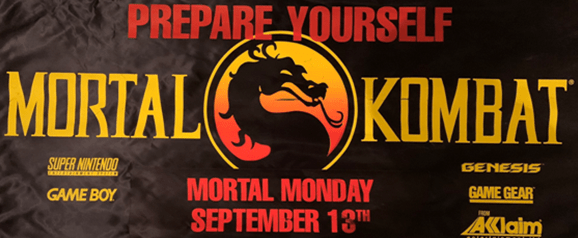
To celebrate the worldwide home console release of Mortal Kombat (Midway, 1992), 13 September 1993 was dubbed “Mortal Monday”. While I’m a day late this year, I always enjoy taking some time to celebrate this influential fighting series.


Episode 1 and 2: “Warrior Eternal”

Director: Oley Sassone
Air Date: 3 October 1998 and 10 October 1998
UK Network: Channel 4
Original Network: The WB Network / Turner Network Television (TNT)
Stars: Paolo Montalban, Daniel Bernhardt, Kristanna Loken, Bruce Locke, Jeff Meek, Chris Casamassa, and Jennifer Renton

The Background:
During the nineties, competitive fighting games took arcades by storm thanks to the many versions of Street Fighter II: The World Warrior (Capcom, 1991). Seeking to compete with Capcom, developers Ed Boon and John Tobias took inspiration from movies like Enter the Dragon (Clouse, 1973), Big Trouble in Little China (Carpenter, 1986), and Bloodsport (Arnold, 1988) to create an ultra-violent tournament fighter that changed the genre with its simple fighting mechanics and ultra-violent content. Development of a live-action Mortal Kombat began with producer Lawrence Kasanoff, who envisioned the venture as a multimedia franchise. Unfortunately, while he and director Paul W.S. Anderson delivered a surprisingly profitable cult hit, Mortal Kombats (ibid, 1995) reputation was tarnished by its laughably bad box office bomb of a sequel. However, Mortal Kombat: Annihilation (Leonetti, 1997) wasn’t the end of Kasanoff’s endeavours as this criminally under-rated and short-lived prequel series aired between 3 October 1998 and 22 May 1999. Though its schedule was often sporadic, Mortal Kombat: Conquest eventually followed episodes of World Championship Wrestling’s WCW Monday Nitro, resulting in cameos by WCW wrestlers, though the show ended on a frustrating cliff-hanger apparently due to its budget. Still, the series developed a cult following and was a spotlight for actors like Daniel Bernhardt and Kristanna Loken, some actors and sequences from the movies returned for the series, and Mortal Kombat: Conquest seems to have been subtly referenced in the franchise’s modern iterations.

The Plot:
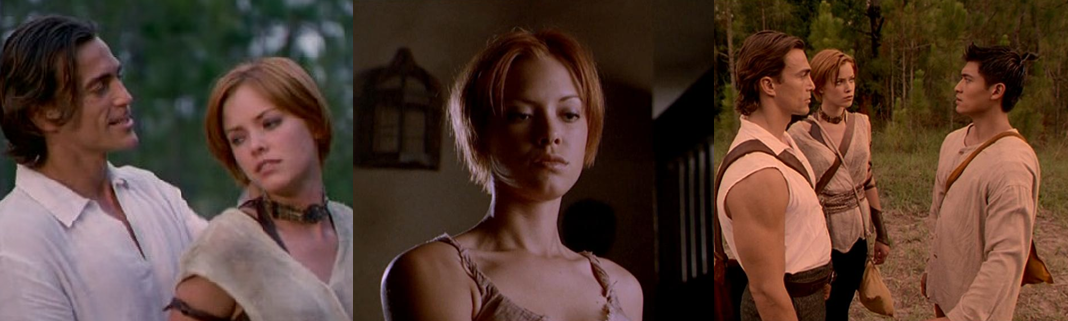
Centauries ago, after safeguarding Earthrealm in a life-or-death tournament called “Mortal Kombat”, Kung Lao (Montalban) seeks a normal life with his love, Geneviere “Jen” Reyland (Renton). However, when fate and scorned sorcerer Shang Tsung (Locke) intervene, Kung Lao must team with an exiled guard and a thief to prepare for the next tournament.

The Review:
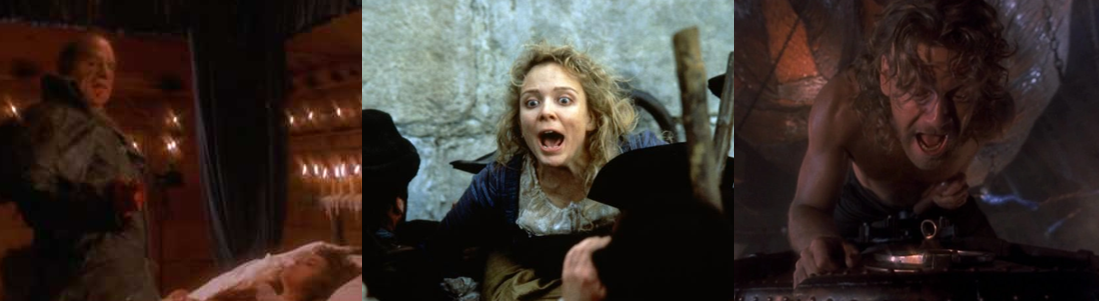
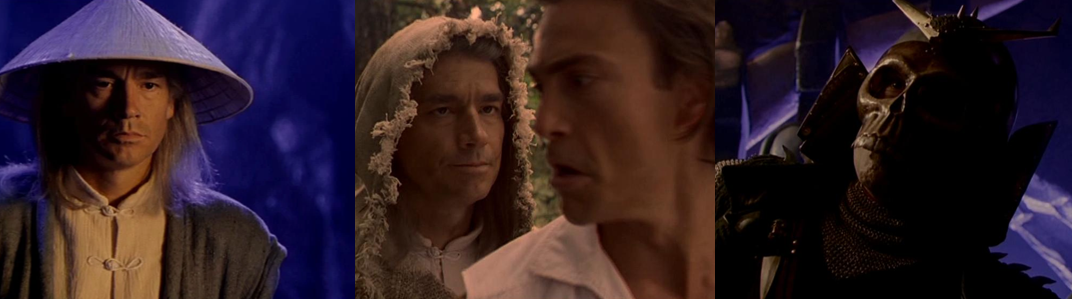
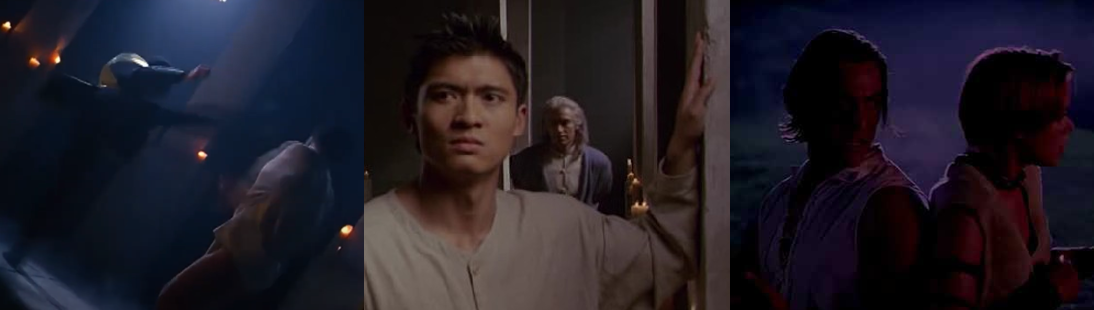
“Warrior Eternal” is the two-part pilot of Mortal Kombat: Conquest a prequel to the first two live-action movies that I watched diligently as a kid. We can tell right away that it’s a prequel not just because it’s set “centuries ago, in a time of darkness and fury” but because it presents younger versions of iconic Mortal Kombat characters Shang Tsung and Shao Kahn (Meek), Emperor of the all-conquering Outworld, but also liberally uses footage from those movies for establishing shots. Footage of Outworld and the Temple of Light establish this is the same continuity and, while they’re generally just random shots or short clips, it’s kind of fun to see shots of the Temple of Light repurposed here. It’s also clear that this is a prequel since we’re following the Great Kung Lao, distant ancestor of Liu Kang (Robin Shou), as he prepares to decide the fate of Earthrealm in the latest Mortal Kombat tournament. A humble man who’s been trained since birth to become the greatest Shaolin warrior, Kung Lao is described as the “best” Earthrealm has to offer and his mentor, the Thunder God Rayden (Meek), even says that, physically, no fighter can match him, a claim tested here and throughout the series. Naturally, Kung Lao is as aware of the realms and Mortal Kombat, and the otherworldly dangers of Outworld, as his fellow monks. While the city of Zhu Zin is close to the Temple of Light and many of its people are respectful of their monks and warriors, and even aware of Mortal Kombat, just as many remain ignorant and mock Kung Lao’s beliefs. Baron Reyland (John Reilly) is the embodiment of this, believing Kung Lao isn’t worthy of his daughter since the monk doesn’t place value in material or financial matters, showcasing that Kung Lao may be a knowledgeable warrior and deeply spiritual character, but he’s somewhat out of place with the world he fights so valiantly to protect.

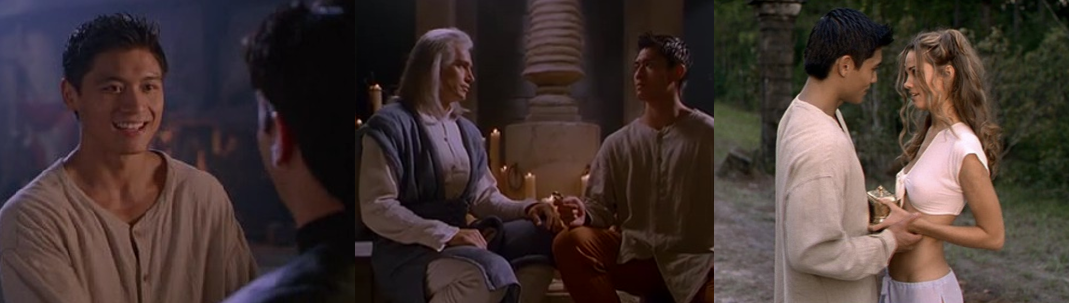
Friendly champion Kung Lao is torn between his destiny and his heart after a lifetime of combat.

Unlike Outworld’s forces, Kung Lao has no supernatural power and is simply at the peak of physical and spiritual ability. While he still has a lot to learn, his commitment to protecting his loved ones and his sheer force of will see him resist even Shang Tsung’s soul-stealing magic and push him to overcome even insurmountable odds. Yet, Kung Lao is often conflicted, doubting himself and his abilities, and initially rejects Rayden’s demands that he prepares the next generation of fighters to compete in Mortal Kombat. Kung Lao is haunted by visions of a disastrous future where his people (and Earthrealm) are slaughtered and he’s pummelled by a barely distinguishable CGI mess (presumably Goro). Despite these visions, Kung Lao resists his destiny to be with Jen, who’s apparently drawn to his belief that all life as sacred (even monsters like Shang Tsung), making him the opposite of her father. Kung Lao shows respect even to Shao Kahn and makes a point to take a higher path, being humble in his victory and even sparing Shang Tsung even though it comes back to bite him. Kung Lao is friendly to all, having befriended the baron’s guards, Takeda (Casamassa) and Siro (Bernhardt), and even stepping in to spare Taja (Loken). While Siro is incredibly overprotective of Jen, Kung Lao pacifies him with compliments but is obviously blinded by his love when he praises her playful sparring. This also sees Kung Lao lie to her regarding his visions since he wishes to shield her from such things. Kung Lao’s outraged when Baron Reyland denies his wish to marry Jen and resolves to abscond with her, hopeful to flee his nightmarish visions and be truly happy. However, he makes peace with the baron in his final moments but is annoyed for dismissing Rayden’s advice, and sparing Shang Tsung, when Jen’s life is endangered. Kung Lao’s understandably devested when Jen dies but finds solace in knowing she’s gone to a better place and in dedicating himself to training new fighters alongside Siro and Taja, just as Rayden encouraged.

Meek impresses in his dual role as the wise-cracking Rayden and menacing Shao Kahn.

Like the movies, Rayden is presented as a mentor figure, while also giving a rundown on the Mortal Kombat tournament and the different realms that resembles the speeches his big-screen counterpart gave. Though he’s an aloof Thunder God with an odd sense of humour, Rayden directly oversaw Kung Lao’s training and gives him many pointers. However, Rayden is forbidden from directly interfering in mortal affairs, especially Mort Kombat, unless the unseen Elder God’s vaguely defined “rules” are broken, as the entire point is that mortals must defend their worlds. Often cryptic and mysterious, Rayden gives just enough hints, often pushing people where they need to be and surreptitiously manipulating them as required. Rayden sees things in very different terms to mortals, however, despite his clear love and affection for them. For him, it’s a simple choice of duty that Kung Lao accepts the responsibility of being Mortal Kombat champion and that the perks of being effectively immortal and serving the greater good outweigh fleeting love and friendships. Still, though exasperated with Kung Lao, Rayden understands his affection for Jen and helps point him find Scorpion by encouraging Kung Lao to figure out his visions. Jeff Meek pulls double duty as Shao Kahn, a menacing figure also handicapped by the Elder Gods’ rules since he cannot directly invade or attack Earthrealm without dire consequences. A master manipulator, shrewd warrior, and cunning strategist, Shao Kahn is constantly thinking up ways to bend or get around these rules, using hidden portals and third-party assassins and mercenaries and thus give Outworld the edge. Although not quite a petulant, childish figure like his movie counterpart, Shao Kahn is prone to fits of rage and mood swings that see him switch from morose and bored to spiteful and angered on a dime. Though he admires Shang Tsung’s ambition, Shao Kahn is a demanding, ruthless, and spiteful emperor, banishing Shang Tsung to the cobalt mines for his failure and deeply humiliated by Kung Lao’s victory.

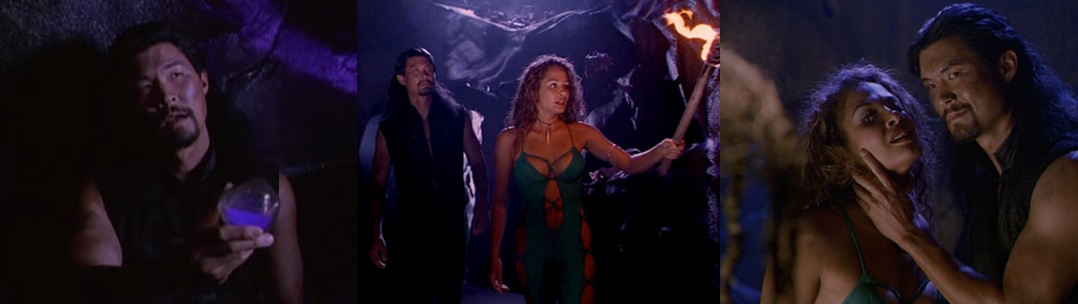
The humiliated Shang Tsung plots his revenge from the desolate cobalt mines.

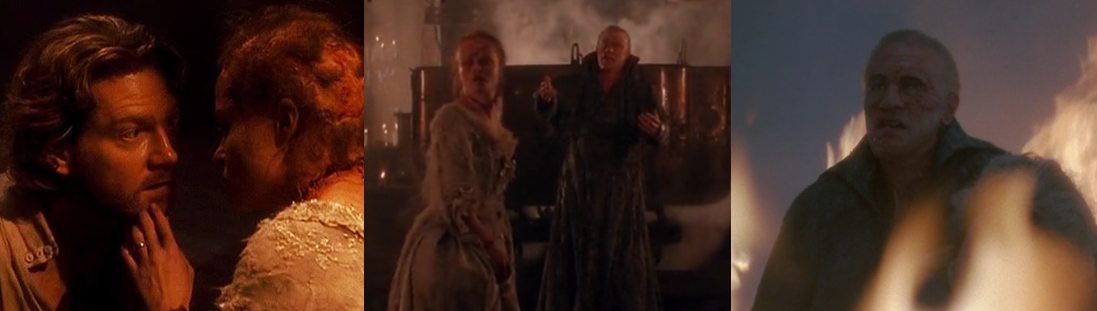
However, in these first two episodes, Shao Kahn is merely a puppet master as he sets in motion many of the events and standards the series will follow. Shang Tsung stars as Shao Kahn’s loyal servant and greatest warrior, with aspirations of ruling alongside his emperor. However, he loses favour when he’s humbled and humiliated by Kung Lao, who shows him mercy, perhaps the greatest dishonour Shang Tsung could face. Shang Tsung’s disgrace and lust for revenge runs deep as he preyed upon Kung Lao’s insecurities and used his decades of fighting experience to put the Shaolin warrior on the ropes, only to be publicly defeated for the first time in who knows how long. Despite knowing Shao Kahn better than perhaps anyone, Shang Tsung begs for death rather than endure the constant torture inflicted upon him following his failure. Shao Kahn cruelly grants a reprieve by banishing the sorcerer to the cobalt mines, though the sorcerer’s powers aren’t negated there like the other inmates. While there, Shang Tsung aligns with the scheming Vorpax (Tracy Douglas), who’s immediately enticed by Shang Tsung, seeing him as a chance to escape. Although Shang Tsung is immune to her charms, asserting dominance over her, he’s convinced to bring her under his heel to get his revenge. Shang Tsung believes he’ll regain Shao Kahn’s favour if he kills Kung Lao and steals his soul. He thus uses black magic to bargain with the soul trapped within a scorpion and have it infect Takada, casting Scorpion as the first of many minions to target the Mortal Kombat champion.

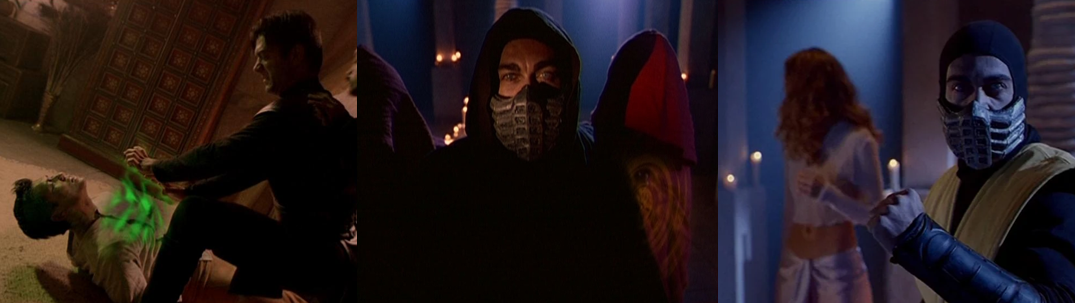
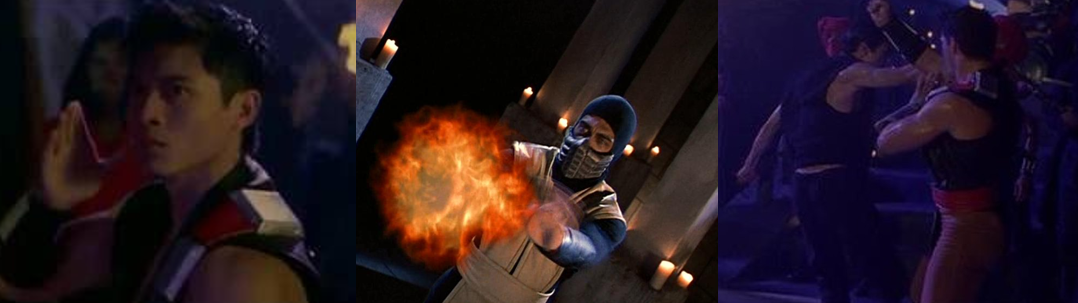
A radically different version of Scorpion steals the show with his malicious actions and fighting skill.

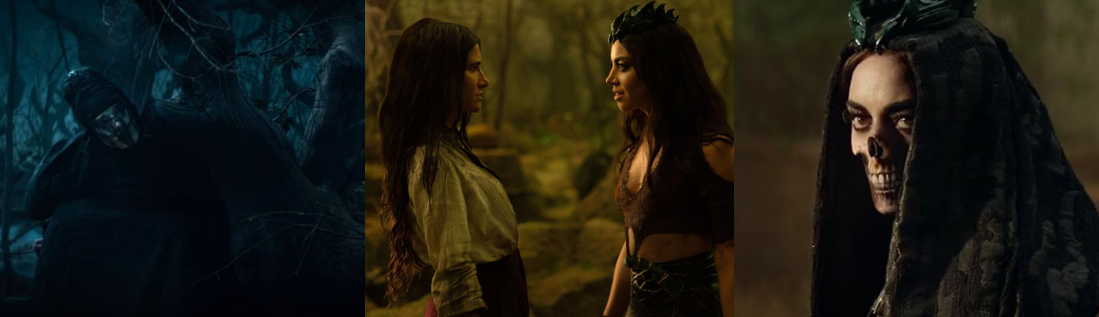
With Shao Kahn brooding in his palace and Shang Tsung confined to the cobalt mines, franchise favourite Scorpion acts as the primary antagonist here. Despite Mortal Kombat: Conquest set well before Hanzo Hasashi was born, it would’ve been folly not to include one of the most popular characters so the show dreams up a brand-new origin for Scorpion. To be fair, we never got any exposition about him in the films so it’s not really contradicting anything there. In this context, Scorpion was a deadly warrior confined to a real scorpion and stolen by Shao Kahn from a conquered realm. Thanks to Shang Tsung, Scorpion possesses Takada, one of the baron’s guards. While Takada was friendly with Kung Lao, he becomes a vindictive villain once consumed by Scorpion’s wicked demeanour. Mortal Kombat: Conquest gives Chris Casamassa a chance to flex his acting muscles alongside his physical ones, portraying Takada as a genial and loyal friend and Scorpion as a spiteful and cruel warrior. Sure, his line delivery is overly theatrical (“I’m going to kill you, Kung Lao” always makes me chuckle), but his fighting skills more than make up for it. Scorpion gains a new ability here to bring others under his sway, enchanting the Shaolin monks to give Siro and Taja someone to fight in the finale. Scorpion still has his snake-like spear-thing, which looks worse than ever and is easily dispatched by Kung Lao, though it’s okay as the Kung Lao/Scorpion fisticuffs are a highlight of these episodes. Scorpion even pulls off his teleport punch and creates ripples that impact the entire series – and Kung Lao’s life – by murdering Jen with a shitty looking fireball, returning to plague our heroes a few times despite inexplicably dropping into Hell (or the Netherrealm) upon defeat.

Despite her pretty face, the best thing Jen can do is die since she’s atrocious to watch.

If there’s a weak link in Mortal Kombat: Conquest, it is and has always been Jennifer Renton’s atrocious acting. Sure, she’s pretty enough but her delivery is robotic and impassionate and it’s legitimately painful whenever she’s on screen. Jen is extremely familiar with her bodyguard, Siro and Jen jumps at the chance to elope with Kung Lao for true happiness, which at least emphasises that she’s not as materialistic as her father. Jen surprisingly gets physical when she works with Taja to free Kung Lao and holds her father at spear-point, heartbroken at him forcing her to choose between the two men she loves. Jen’s recklessness costs her in the end, though, when she tries to interfere in Kung Lao’s fight with Scorpion and gets herself killed, ultimately gifting him the trading post to use as his base for the series. The greedy, cantankerous Baron Reyland operates from this central hub for trade and business in Zhu Zin, and cares only for profit and the power associated with money, believing his little empire to be more important than matters of life and death for the entire realm. When Kung Lao asks for his blessing, Baron Reyland treats the conversation like a trade dispute, criticising Kung Lao’s lack of financial prospects, despite being “well aware” of Mortal Kombat and its stakes. Baron Reyland demands Kung Lao abandon his faith or be forever denied access to his “property” (Jen), even threatening to have him executed if he persists. Thus, already angered at Siro’s betrayal and Jen’s rebelliousness, the baron praises Takada in apprehending Kung Lao and seemingly relishes ordering his execution. Baron Reyland is affronted when Jen and Taja save Kung Lao, disgusted and amazed at his daughter’s betrayal, but is offended when Takada employs sorcery to subdue Kung Lao. This proves to be the baron’s undoing as he’s impaled during the scuffle, though he makes amends with Kung Lao as he dies so…all’s well that ends well, I guess?

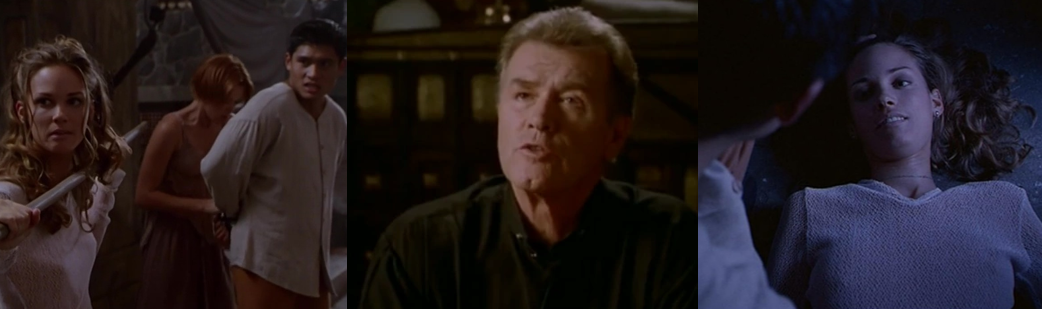
Although they get off on the wrong foot, the three protagonists eventually find common ground.

Finally, Kung Lao crosses paths with two characters who stick by him throughout the series: prideful and devoted bodyguard Siro and scrappy thief Taja. Siro is constantly at Jen’s side and, wishing only the best for her, allows her to leave with Kung Lao and humbly admits his betrayal to his master, taking his banishment despite the crippling blow to his pride and professional stature. An outspoken sceptic, Siro’s uncomfortable when visiting the Temple of Light with Jen and thus amazed when “Takada” leaps from the trading post without breaking his legs. Siro immediately gets off on the wrong foot with Taja when she and her cohorts attack him and Jen at the Temple of Light, with Siro easily besting the gorgeous thief and locking her up. However, Siro sets this aside following his encounter with Rayden and teams with Taja and Kung Lao to rescue Jen. Like Kung Lao, Siro is heartbroken at Jen’s death and despondent about his future before finding new meaning in aiding Kung Lao. Taja is equally cynical but more because of her harsh life stealing and fighting for survival. Defiant even when apprehended by Siro, Taja relies on her smart mouth when physically overpowered or shackled, visibly disgusted at being the baron’s slave and his advances towards her. When she learns of Kung Lao’s pending execution from an incognito Rayden, Taja’s compelled to intervene to ensure her own survival and out of gratitude for him sparing her life. Taja’s not afraid to fight dirty but pays her debts, quickly befriending Jen and showing regret at her harsh life and resorting to thievery, while also seeing it as the reality of her situation, confiding in Kung Lao that she dreams of the kind of luxuries Jen enjoys. Her insight into the baron’s dungeon serves Kung Lao well, as does her stealthier approach to situations as opposed to simply going in half-cocked. The experience changes Taja for the better, giving her an opportunity to do something useful with her life and, despite her doubts, she volunteers to aid Kung Lao in preparing for the next tournament.

The Summary:
I’ve always been a fan of Mortal Kombat: Conquest. It’s cheesy in just the right ways, with a lot of action and some fun reinterpretations of the videogame characters and their lore. Having said that, these aren’t the best episodes of the short-lived series. This makes sense in a way as they’re primarily designed to establish the characters, the show, and its format: Shao Kahn is a looming threat, Shang Tsung plunders the mine for new opportunities for revenge, and our three protagonists face constant battles both to gel as a team and define their destinies. This is all nicely laid out here but there are also some oddities. Kung Lao successfully defends Earthrealm and is charged with preparing for the next tournament, which isn’t for a “generation” (approximately twenty and thirty years). The Elder Gods decree that Kung Lao won’t age, but does that extend to his allies? I guess so, but I feel like the series might’ve benefited from taking place building to the next tournament. Kung Lao questions why Rayden can’t teach the new fighters and this is a great point as Rayden himself states that he’s guided Kung Lao’s training, and Kung Lao was trained to become as good as he is by the Order of Light, so all he really has to offer is first-hand insight into fighting Outworld’s forces, something I’m sure others could impart. Still, while Zhu Zin is obviously a set, it’s always bustling with extras thanks to being a market town and the restricted space is masqueraded (or, at least, justified) quite well. Also, although the violence of the videogames is again severely toned down, there’s still a fair bit of death and danger here. While this is largely embodied by Shang Tsung and Scorpion, who reduce people to ash or murder them with fireballs, Kung Lao’s not to be trifled with either as he’s not above killing when necessary.

Despite some dodgy CGI, the visual references and impressive fights help the show stand out.

Regardless, Mortal Kombat: Conquest also evokes the movies with its intro sequence and the techno-beat soundtrack that punctuates each fight, and by including some interesting references the source material. Costume design remains as accurate to the videogames as in the first movie. Though it’s disappointing Kung Lao only dons his Mortal Kombat II (Midway, 1993) look for a brief scene and Rayden also ditches his iconic hat, I liked Rayden’s robes, Scorpion looks exactly as he did in the first movie, and Shang Tsung closely resembles his Mortal Kombat II appearance. It honestly doesn’t and wouldn’t make sense for Kung Lao to don that outfit anyway as that’s what his successor wore, but it would’ve been nice to mix up Kung Lao’s wardrobe by bringing it back, especially as they went to the trouble of making it. Shao Kahn veers towards cosplay at times, perhaps explaining why he only wears his helmet for one scene. He cuts an intimidating figure (even more so considering it’s Meek in a dual role) and I like the shattered skull mask he wears, but he can look a little goofy at times. Outworld is expanded to include Shao Kahn’s cold and empty throne room and the dingy cobalt mines, which rob anyone not from Earth of their supernatural powers. Jeff Meek shines as Rayden, channelling Christopher Lambert’s playful spirit of and marrying it with the demeanour of an exhausted teacher. While he admires human spirit and encourages free will, Rayden impresses the importance of preparing for the next tournament upon Kung Lao and, when he insists on defining his own destiny, Rayden assumes the guise of a beggar to manipulate Siro and Taja into helping Kung Lao escape from Baron Reyland. Rayden knows exactly how to manipulate Siro, questioning his integrity and insulting his pride to push him back to Zhu Zin to aid Kung Lao. Bruce Locke equally steals the show by channelling Cary-Hiroyuki Tagawa’s energy and menace to present Shang Tsung is a ruthless and vicious fighter who delights in stealing souls and is consumed with the need to avenge himself.

The ambitious fights counterbalance some cheesy moments and drama to lay the foundation for the show.

While the visual effects are often cartoonish, they’re clearly secondary to more traditional displays of martial arts and stunt work. Although the actors partake in each episode’s fights as much as possible, with Bruce Locke and Daniel Bernhardt putting in more of the work (thanks, largely to the latter’s unique stature and legitimate martial arts background), obvious stunt doubles are used for each fight, with Kristanna Loken noticeably being supplanted. While it’s jarring to edit close ups of the actors to sell the illusion, the fights are very well choreographed, with Christopher Leps, Marcus Young, J.J. Perry, and others bringing a grace and tactile believability to each. The battle between Kung Lao and Shang Tsung reflects the animosity between the two, with Shang Tsung growing increasingly frustrated and Kung Lao exuding the speed and precision that made him Earthrealm’s finest. Even when saddled with perhaps the fakest sword I’ve ever seen, Daniel Bernhardt shines, largely because you recognise that the actor is performing many of his stunts and fights. Siro isn’t as slick and graceful as Kung Lao but exudes physical power, having great reach with his kicks (his flying kick being particularly impressive), even if he is out of his depth against more otherworldly opponents. Though she lacks Kung Lao’s skill and Siro’s raw power, Taja is a scrappy fighter who uses underhanded tactics and is seemingly fearless. Kung Lao’s battles with Scorpion are an obvious highlight, with Casamassa bringing an aggression to Scorpion that paints him as a force to be reckoned with, even more so when tossing his snake-like appendage about (not a euphemism). It’s good that the action is so impressive as the drama between Kung Lao and Jen really drags these episodes down, largely because they lack chemistry and Renton’s awful performance. The sting of these scenes is eased by Meek’s theatrical performance as Shao Kahn, his dry sense of humour as Rayden, and a fun energy to the episodes. I got the sense everyone was having a good time and trying their best to start something, and the framework is definitely here, it would just take a few episodes to be as good as it could be.

My Rating:

Rating: 3 out of 5.

Pretty Good

Were you a fan of Mortal Kombat: Conquest back in the day? If so, what did you think to these first two episodes? Do you think I was too harsh on Jennifer Renton or do you agree that she was terrible? Which of the three main characters was your favourite and did you enjoy their chemistry? Were you surprised that Jeff Meek played two roles? What did you think of Scorpion’s new origin? Would you like to see a revival of Mortal Kombat: Conquest, or a new TVG show? How are you celebrating Mortal Kombat today? Whatever you think about Mortal Kombat: Conquest, leave a comment below, go check out my other Mortal Kombat content, and sign up to my Ko-Fi to suggest other Mortal Kombat: Conquest episodes for me to cover.

Back Issues [K-Month]: Skull Island: The Birth of Kong


In the absolutely bonkers science-fiction film Pacific Rim (del Toro, 2013), the monstrous Kaiju first attacked humanity on 10th August 2013, which was subsequently branded “K-DAY”. To celebrate this event, and giant monster movies, I dedicated every Sunday in August to one of cinema’s most prolific monsters: King Kong!


Writer: Arvid Nelson – Artist: Mohammad “Zid” Yazid

Story Title: “Part One: The People Who Came from the Sky”
Published: 12 April 2017

Story Title: “Part Two: The Mountain Who Thunders Death”
Published: 21 June 2017

Story Title: “Part Three: Valley of the Fallen Gods”
Published: 27 September 2017

Story Title: “Part Four: Over the Rainbow”
Published: 21 November 2017

The Background:
As difficult as it may be to believe now, it was about a hundred years ago that former World War I aviator turned filmmaker Merian C. Cooper thought up the iconic visual of a giant gorilla being shot from the Empire State Building by planes. Though one of the most influential movies of all time, King Kong (Cooper and Schoedsack, 1933) was followed by a comedic sequel, a profitable but polarising clash with Godzilla, a “Suitmationblunder that ended Toho’s brief stint with the license, an ambitious remake and its muchmaligned, blockbuster before the almighty Kong once again rubbing shoulders with Godzilla in the “MonsterVerse”. The foundation for this was laid with Kong: Skull Island (Vogt-Roberts, 2017), a critical and financial success that redesigned and recast Kong as a cantankerous, but benevolent, protector. The film’s success paved the way for future MonsterVerse projects but left many questions about this new Kong unanswered, questions this four-issue miniseries sought to partially address. While far from the first literary adaptation of the famous ape (or even the first comic book in the MonsterVerse library), Skull Island: The Birth of Kong aimed to bridge the gap between the film’s period setting and the modern day. The result was a miniseries lauded for its artwork and deeper exploration of Kong’s backstory, as well as expanding upon the MonsterVerse, while also being criticised for its short length and barebones plot.

The Review:
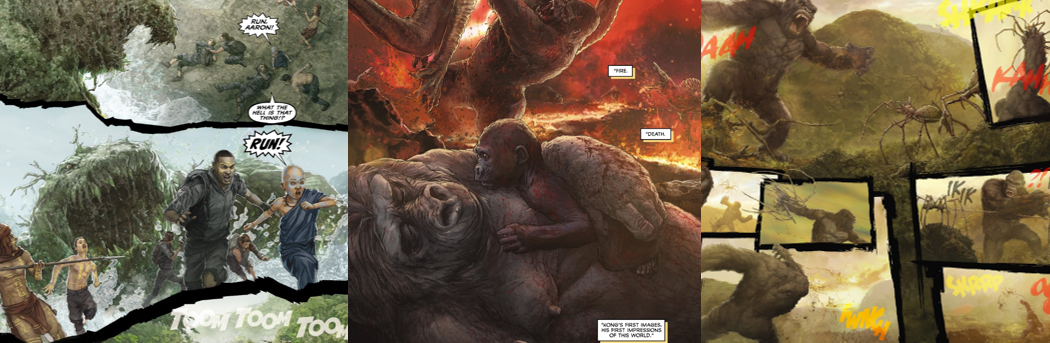
This tie-in comic series begins in 2012 with the Australian Navy finding a bizarre package bearing the Monarch logo floating in the waters of the South Pacific. Two weeks later, Houston Brooks is brought the item by an old friend and it’s revealed to be a recording device belonging to Aaron, Houston’s son who mysteriously disappeared some time ago. After cracking the device’s password, Houston thinks back to seventeen years prior when he and Aaron got into a heated argument regarding Skull Island. Angered that his father would leave an unpredictable wild animal like Kong to keep the Massive Unidentified Terrestrial Organisms (MUTOs) that have migrated there in check, Aaron stormed out to lead a team of crack monster hunters on an expedition to Skull Island. Knowing full well that his father would be pissed, Aaron compiled a complete record of the venture, which saw him team up with cantankerous cryptobiologist Evgenij Medov, enthusiastic Doctor Evelyn Matemavi, sarcastic survival instructor Helen Karsten, and the mysterious mythographer Walter R. Riccio. Determined to find evidence of Skull Island to expose Monarch’s operation, Aaron led the team through the raging storm that protects the island (with far less difficulty than in Kong: Skull Island) and parachuted to the prehistoric paradise after their plane was downed by Psychovultures. After briefly being awed by the beauty, wonder, and danger of the island, the team prepped to retrieve their pilot, Cejudo, secure their supplies, and make contact with the isolated locals, the Iwi tribe. After a pack of Death Jackals tear Karsten to pieces and critically inure Medov, they’re suddenly saved by Kong, allowing them to take cover in a cave. After stabilising Medov, the group are stunned when a handful of Iwi, led by Ato, greet them in English and bring them to their humble village.

Sceptical Aaron leads a team to Skull Island and finds himself on a sacred pilgrimage.

Confused and realising that Skull Island is full of secrets, Aaron learns that the tribe was taught English by Lieutenant Henry “Hank” Marlow during his tenure trapped there. Aaron is as impressed by this as he is by the Iwi’s construction skills, the healing properties of their various medicines, and the speed that Riccio learns their language and culture. Riccio reveals that their coming was foretold in Iwi legend and then dramatically shares a sudden vision of Kong’s family battling the Skull Crawlers to not only defend the island but also assert themselves as the dominant species. Riccio states that they’re to join the Iwi in Atenatua, a pilgrimage to learn the secrets of Kong. Though Aaron is sceptical of the mysticism, he’s determined to ensure Kong’s capable of keeping the “gateway to hell” shut so the island’s monsters don’t threaten civilisation. Riccio embraces the island’s culture for the pilgrimage, Medov makes a full recovery, and Ato leads them on, with the team amazed by a shipwreck that depicts Kong welcoming the Iwi to the island. They also learn that the “Devils of the island” from Riccio’s visions killed Kong’s parents, the last of their kind by the time the tribe arrived. When the gigantic, crocodile-like Sirenjaw suddenly attacks, the group is chased through the jungle. Luckily, they find the supplies left by Houston’s expedition many years prior, allowing the group to arm themselves. This is avoided, however, by the thunderous roar of Kong and, by the time the team races to the source, they find only the Sirenjaw’s dismembered corpse and a flock of hungry, opportunistic Psychovultures. Although they escape the voracious dinosaurs, they run right into a monstrous Swamp Locust and barely escape into the nearby valley. There, Aaron is horrified to learn that the creatures will probably take a week to finish feasting on the Sirenjaw’s remains, though his spirits lift when Cejudo radios in for help. Despite the damage to the plane, Cejudo reveals he’s flight worthy and offers to evacuate the team. However, Ato states that the only safe landing spot is beyond the bone yard, the home of the Skull Crawlers.

Kong foils Riccio’s mad scheme and makes a believer out of Aaron.

Despite Riccio insisting they complete their pilgrimage, the team head to the bone yard, discovering the skeletal remains of Kong’s family, and are promptly ambushed by Skull Crawlers. Ato leads them to another cave, where Riccio is assaulted by visions of Kong’s birth, which occurred in the heat of battle and saw the newborn Kong witness his parents’ brutal last stand against the creatures and left him the last of his kind. Though touched by Kong’s tragedy, Aaron urges them to press on and ultimately leaves Riccio behind when he insists on completing his “communion” with Kong. Thus, when Cejudo arrives to pick them up, Riccio blasts him from the sky with a rocket launcher, shoots Matemavi dead, and holds them at gunpoint to witness Kong’s divine glory. Riccio even attacks Ato, believing the village must fall for them to truly know whether Kong is an ambivalent, benevolent, or malevolent God. When Death Jackels attack, Aaron leads the others in escaping and realises the Riccio plans to use the explosives left behind by his father’s venture to enact his plan. Between panels, Ato leads them back to the village, too late to stop Riccio, whose actions allow a cluster of Mother Longlegs to rampage through the village. This leaves many dead, including Medov, though Riccio’s mad belief in Kong pays off when the great ape rips the giant spider-things apart. Riccio rejoices and praises Kong, proclaiming the ape the “savior of humankind”, only to be dismissively crushed by Kong’s giant fist. When Kong turns to Aaron, the sceptic becomes a believer when the cantankerous beast simply stares him down and Aaron sees that Kong isn’t some mindless beast, but a force of nature set on defending human life. Thus, Aaron makes his recording and sends it to his father on a makeshift sailboat, staying behind to help the Iwi rebuild and making amends with his dad. Having listened to the recording, Houston prepares to return to Skull Island and reunite with his son and the remainder of the book lists some information on all the beasts seen in the story.

The Summary:
Well, this was a lot of nothing. While Zid’s art is very close to Kong: Skull Island and perfectly captures the island, Kong, and the recognisable monsters that dwell there, the story leaves a lot to be desired, and it feels more like a partial retread of what we saw in the movie. While it’s nice to see the older Houston Brooks again, he basically bookends the paper-thin main plot, which revolves around his son and his vague, childish desire to prove his father wrong and paint Kong as a threat. This motivation doesn’t have much basis given Aaron seems to have no experience with Titans beyond Monarch’s records and his dad’s first-hand account, so it seems to come from simple fear rather than any tangible evidence. Aaron’s belief that Kong isn’t to be trusted and his motives and outburst seem like the actions of a disobedient teenager rather than a grown man, completely fracturing the backbone of the entire plot. It would’ve been so much easier to simply have Houston volunteer or encourage his son to join a routine expedition to Skull Island to witness its wonders and settle his scepticism first-hand, or even have Aaron be kidnapped by cutthroat mercenaries looking to somehow profit from Skull Island, or just have Aaron be a keen scientist like his dad. Forcing a conflict between them added little to the story beyond Aaron’s realisation that his father was right about Kong and learning to respect the delicate balance between the Titans, humanity, and nature, things that could easily have been hammered home just as effectively with my suggested changes.

It’s the impressive monsters and Kong’s tragic backstory that carries this lacklustre story.

If you’re hoping there’s some fun Kong action to make up for this, you’d be sadly mistaken. Kong barely appears here though, to be fair, it’s always an event when he does show up. Fittingly, The Birth of Kong focuses more on teasing the backstory of Kong’s species and how they were annihilated by the Skull Crawlers, effectively visualising the legends that were told in the movie. While this makes for some dramatic and bloody reading and casts Kong in a deeply sympathetic light, it is a shame to not have more of the story revolve around the titular ape as he steals the show whenever he appears. Skull Island’s monstrous natives somewhat make up for this, with some familiar faces (particularly the Mother Longlegs) making quite the visual impact. When Kong battles these creatures, the action is rendered in full, brutal glory, with few to no dialogue boxes to obscure or dilute the spectacle. Everyone is in awe of Kong and sees him as a divine figure, even Aaron, who can’t help but be amazed by the ape. It’s weird that the Iwis suddenly speak English, and somewhat unnecessary since sign language and even the master language expert Riccio could’ve filled in the blanks. Speaking of whom, Riccio really eats up the pages and quickly got on my nerves. While I enjoyed his visions of Kong’s family and violent, tragic birth, it’s weird that he’s the only one hit by these considering the others drank the special Iwi juice and his turn towards madness seemed like a vague repeat of Lieutenant Colonel Preston Packard’s insane obsession with bringing Kong down. Sure, Riccio’s more about proving Kong’s divine nature but it’s a similar, self-destructive downward spiral that didn’t really need to be here as we could’ve just as easily had Ato or even Kong’s dreams show the same information and then spent more time seeing the characters fighting monsters. Ultimately, you’re not missing much if you’ve never read The Birth of Kong. It adds little to the MonsterVerse lore and is probably non-canon these days anyway, so you’re better off sticking with IDW’s Godzilla comics, in my opinion.

My Rating:

Rating: 2 out of 5.

Could Be Better

Have you ever read Skull Island: The Birth of Kong? If so, what do you think to it and were you also disappointed by how barebones it was? Did you enjoy seeing some familiar faces return for some scares? What did you think to the depiction of Kong’s birth? Would you like to see more King Kong comics fleshing out his mysterious island? What’s your favourite version of Kong and how are you celebrating K-Day this month? Whatever your thoughts on King Kong and other Kaiju, please leave a comment below, support me on Ko-Fi, and check out my other King Kong and Kaiju content!

Movie Night [Spidey Month]: The Amazing Spider-Man 2


Easily Marvel Comics’ most recognisable superhero, unsuspecting teenage nerd Peter Parker was bitten by a radioactive spider and learned the meaning of power and responsibility in August 1962. Since then, the Amazing Spider-Man has featured in cartoons, movies, videogames, and countless comic books. To coincide with his day of celebration, I’m dedicating every Monday of August to everyone’s favourite web-head!


Released: 2 May 2014
Director: Marc Webb
Distributor: Sony Pictures Releasing
Budget: $200 to 293 million
Stars: Andrew Garfield, Emma Stone, Jamie Foxx, Dane DeHaan, and Sally Field

The Plot:
Already struggling to keep his love Gwen Stacy (Stone) safe from his double life, Peter Parker/Spider-Man’s (Garfield) troubles are compounded when downtrodden electrical engineer Maxwell “Max” Dillon (Foxx) is transformed into pure electricity!

The Background:
Following his debut issue becoming a best selling title for Marvel Comics, Spider-Man became their flagship character and appeared in numerous videogames, cartoons, and even a live-action series. Despite script and legal issues infamously delaying Spidey’s big-screen debut, Sam Raimi’s one-two punch of Spider-Man (Raimi, 2002) and Spider-Man 2 (ibid, 2004) gave us not only critical and commercial hits but also one of the greatest superhero movies ever made, and even the divisive Spider-Man 3 (ibid, 2007) was a huge commercial success. Although Raimi’s plans for a sequel were scrapped in favour of a reboot, The Amazing Spider-Man (Webb, 2012) somewhat reinvented Spider-Man to tell an exciting, if familiar, new story. Its $758.7 million worldwide gross also meant it did well enough for Marc Webb to return for a sequel. The cast also returned, Spidey got a revamped costume, and Sony Pictures Imageworks outdid themselves with an impressive and complex action sequence in Times Square. Yet, The Amazing Spider-Man 2 was plagued by a troubled production that saw an entire character excised and a bloated script. As part of their ongoing plan for multiple Spider-Man spin-offs, Sony insisted on shoe-horning in as many Easter Eggs and as much sequel bait as possible, ignoring Marvel Cinematic Universe head honcho Kevin Feige’s notes and alienating many fans. The film grossed the least of any Spider-Man movie to date and has been ridiculed by critics for years. They tore apart the questionable reimagining of classic Spidey villain Electro, decried the nonsensical side plots, and lamented the overstuffed narrative. Still, Garfield continued to be praised in the lead role, the tragic ending was seen as a highlight, and both Garfield and co-star Jamie Foxx reprised and redeemed their roles about ten years later for the multiversal adventure Spider-Man: No Way Home (Watts, 2021).

The Review:
In a first for Spider-Man’s big-screen outings, The Amazing Spider-Man 2 skips the usual title sequence and jumps straight into expanding upon the fate of Peter’s parents, Doctor Richard Parker (Campbell Scott) and his wife, Mary (Embeth Davidtz). It’s revealed that Richard packed himself and his wife up and dropped young Peter (Max Charles) with his doting aunt, May Parker (Field), after being threatened by his former financial backer and partner, Norman Osborn (Chris Cooper). Although Doctor Curtis “Curt” Connors (Rhys Ifans) is briefly mentioned a few times, he’s missing from these extended flashbacks, which instead focus on Richard and Norman splicing human DNA with spiders so their incredible ability to “self-heal” will not only cure Norman of his terminal, genetic illness (“Retroviral Hyperplasia”), but also help those suffering from life-threatening diseases. Unfortunately, the illness not only deformed and agonised Norman, it also drove him to desperation, leading to him making shady deals with military backers. When Richard discovered how corrupt Norman and Oscorp had become, he sought to expose his wrongdoings and went on the run for Peter’s safety. It’s not clear why Oscorp wouldn’t (and apparently never thought to) target Peter at May’s and the film spends more time focusing on a tense and horrific mid-air confrontation between Richard and an Oscorp assassin (Demián Bichir) that leaves both Parkers dead. Still, Richard and Mary’s shady past and their connection to Oscorp is fed to us (and Peter) through breadcrumbs, revealing that Richard deeply regretted his work being perverted and secretly sought to keep Norman from using his research by infusing the genetically engineered spiders with his DNA, somewhat attributing Peter’s spider powers to his father. The loss of his parents still weighs heavily on Peter, who laments their absence at his graduation as much as his beloved Uncle Ben’s (Martin Sheen) and who confesses to old friend Harry Osborn (DeHaan) that he actively avoids thinking about his parents. When his curiosity leads him to investigate his father’s satchel, Peter seeks to discover more about his late father, leading to a sweet moment between him and May where she chastises his father and vehemently asserts her place as Peter’s mother. Indeed, Peter and May’s relationship continues to be a highlight, with her despairing of her nephew’s strange behaviour and absences but still showing him nothing but love and affection.

Peter’s haunted by the previous film and forced to keep Gwen at arm’s length to protect her.

Unfortunately, despite still revelling in his abilities as Spider-Man and enjoying his spark-filled relationship with the gorgeous Gwen Stacy, Peter is haunted by Gwen’s father, Captain George Stacy (Denis Leary), whose grim visage serves as a reminder of his promise to keep Gwen safe. Though he loves Gwen dearly and the two still have amazing screen chemistry, Peter’s burdened by guilt, agonised at the thought that he could endanger her. Although Gwen loves Peter and is willing to take the risk, she ultimately ends their relationship when she becomes sick of his flip-flopping. Heartbroken, Peter throws himself into his antics as Spider-Man, dividing public opinion as the Daily Bugle’s smear campaign paints Spider-Man as a menace despite many praising him. Still, try as he might, Peter can’t keep himself away from Gwen and watches over her in a way that could be creepy but comes across as sad and sweet. While Spider-Man saves lives, Gwen faces a dilemma when she’s offered a prestigious scholarship in London, one she’s excited to take despite her unresolved feelings for Peter. Peter’s stunned and equally torn between his love for her and wanting the best for her, meaning he doesn’t react well upon learning of her news and embarrasses Gwen prior to her interview for the scholarship. Ultimately, Gwen chooses to go, believing that’s better for them both, compelling Peter to finally confess (in elaborate fashion) his true feelings, and even his willingness to go to London with her. As much as I love Andrew and Emma’s onscreen banter and chemistry (their escape from Oscorp was a particular highlight), I do think the film suffers a bit from Peter immediately reneging on his promise at the end of the last film. The Amazing Spider-Man 2 may have benefitted from Peter and Gwen’s relationship being frosty and unresolved from the start to focus more on how Peter has to choose a difficult path since he doesn’t want to risk endangering or losing someone he loves, though this would make the first half of the film too similar to Spider-Man 2.

When Peter and Spidey refuse to help him, a desperate Harry turns to Electro.

Following Norman Osborn’s death, Peter’s compelled to reconnect with Harry Osborn, a hitherto-unknown childhood friend who was sent to boarding school at eleven and spent most of the intervening years travelling the world and resenting his father for sending him away. Thus, Harry is spiteful and dismissive of his father, and rightfully so as Norman spends his final hours spitting insults at his son and effectively cursing him with the same degenerative illness. In the aftermath, Harry (…somehow…) assumes control of Oscorp, riling up Vice President Donald Menken (Colm Feore) and revelling in flaunting his newfound power, appointing Norman’s secretary, Felicia Hardy (Felicity Jones), as his second-in-command. Though delighted to reunite with Peter, Harry’s clearly maladjusted and his erratic behaviour only spirals as his disease takes greater hold, giving him the shakes and strange lesions (despite Norman living many years with the illness). Desperate for a cure, Harry accesses Oscorp’s secure files and believes the answer lies in Spider-Man’s blood, begging and even offering to pay the web-slinger for a sample, only to be incensed when Spidey refuses out of fear for Harry’s safety. This, and Menken’s machinations, sends Harry over the edge and leads to him making a deal with Electro to access Oscorp’s secret basement of origins special projects laboratory, where he finds the means to first cure himself and then avenge himself against those who’ve wronged him. Overall, I liked DeHann’s depiction of Harry. He was a bit sullener and more vindictive and flaunted his authority compared to James Franco, and he presented an interesting dilemma for Peter, who wanted to help his friend but was worried about killing him or turning him into a monster like the Lizard. Harry’s vendetta against Spider-Man is a touch rushed and I think it would’ve been better for him to put two and two together when he first approached Peter for help, just to put a further spin on their relationship. It also would’ve benefited to save Harry’s descent into manic Green Goblin mode for a third film.

Spidey super fan Max is driven to rage and insanity upon becoming powerful enough to be noticed.

Rather than being a simple electrical engineer who turns to a crime after being zapped by lightning, The Amazing Spider-Man 2 recasts Electro as a hopeless outcast who’s socially awkward and bumbling. Pushed around and ignored by everyone, from pedestrians to his boss, Alistair Smythe (B. J. Novak), Max is a sad, worthless nobody who becomes enamoured by Spider-Man after Spidey saves his life and offers him encouragement. This leads to Max imagining  conversations between the two and describing the webslinger as his best friend since he was the first person to “see” and “need” him. This later extends to Gwen, who also shows kindness to Max where everyone else treats him like shit, with Smythe forcing him to fix a maintenance issue (on his birthday, no less!) and leading to Max falling into a vat of genetically engineered eels. These not only fix Max’s crooked teeth but also transform him into Electro, a man of first partial and then almost pure electricity, allowing him to see, sense, and control electrical currents. The experience leaves him disoriented, confused, and enraged, leading to him first accidentally and then purposely endangering others when cops fire at him, Spidey hesitates to remember him, and the newfound voices in his head compel him to lash out. Although subdued, Electro is tortured by the sadistic and overly theatrical Doctor Ashley Kafka (Marton Csokas), though Max invites the experience to test his power and is fuelled by the pain to accept Harry’s offer for a partnership and avenge himself on his captors. Once freed, Electro assumes a more menacing form and demeanour, having now mastered his powers to ensnare and kill with a flick of his hands and desperate not only to destroy Spider-Man after he “betrayed” him, but also to plunge the city into darkness so they can feel his pain. Although somewhat similar to the sympathetic angle applied to some of his predecessors in Raimi’s films (and a far more well-rounded character than the comic Electro, who was just a crook with powers who rarely reached his full potential), I do have an issue with depicted Max as the stereotypical outcast “geek”. It rarely works well and seems a waste of Jamie Foxx’s acting prowess, though I did like Electro’s obsession with being “seen” and his turn towards a crueller and more malicious demeanour after aligning with Harry.

The Nitty-Gritty:
The Amazing Spider-Man 2 benefits from a much more distinctive score, which is less a rehash of Danny Elfman’s work and more a stirring overture for the titular hero. Electro’s theme was particularly memorable; I loved how it incorporated the voices in Max’s head fuelling his rage. However, while the film treads less of the same ground as Raimi’s films compared to its predecessor, it does rehash some of the same beats concerning Richard and Mary from The Amazing Spider-Man. Sure, we learn a bit more about Richard’s relationship with Norman and that he had a weird subway lab that somehow still works after nearly fifteen years, but it still feels like the filmmakers are unsure of the endgame to this sub-plot (though, thankfully, they excised the nonsensical reveal that Richard was still alive, which would’ve tipped this already bloated plot into overdrive). The Amazing Spider-Man 2 touches upon themes of choices, not letting the past define you, and living each day rather than taking things for granted. Although Peter struggles with all of this, Gwen is all for it; her valedictorian speech is all about it and she urges Peter to stop letting her father’s death hold him back. Gwen’s adamant that they should embrace what they have, regardless of her father or the risk, and insists that she makes her own choices, even if it means she’s in danger. While there is a lot happening in the Amazing Spider-Man 2, I don’t think it’s not as badly paced as some would say. As much as I hate to say it, they made the right choice to cut Shailene Woodley as I’m not sure how she would’ve factored into the plot, though it was weird to include Felicia when she was just a secretary rather than a cat burglar. I also think it might’ve been better to end the story on a cliffhanger concerning Harry, not just because the finale with his Green Goblin is a bit rushed but also because we’d seen the Green Goblin done to death and I could’ve done without retreading that narrative (even if it was a little different here).

Despite some great effects and sequences, the film is bloated with characters and sub-plots.

The Amazing Spider-Man 2’s costume is, for my money, the best and most comic accurate depiction we’ve ever seen (though I miss the distinctiveness of the one from the last film). Harry’s final Green Goblin form is also more monstrous and closer to the comics, though still a bit lacking (and rushed) and we were denied a truly gruesome transformation sequence. The Amazing Spider-Man 2 ups the focus on action thanks to not having to waste an hour of its runtime redoing Spidey’s origin, giving us a handful of montages and fun action sequences that continue to showcase why Andrew Garfield is the best Spider-Man. There’s more emphasis on slow-mo sequences to show how Spider-Man reacts to danger and thinks about saving people. It’s used to great effect in the Times Square sequence, giving us a fantastic depiction of Spidey’s speed and strength alongside his compassionate nature as he first tries to appeal to Max’s reason. Electro is depicted as an unpredictable threat, especially when he first emerges since his powers are unstable. While it’s disappointing that he doesn’t resemble his mainstream comic counterpart, and that Max didn’t take on aspects of this design after being freed by Harry, Electro is very to his Ultimate comics counterpart and is depicted as both incredibly powerful and emotionally unstable. Electro can fly, dissolve bullets, and absorb and emit electricity, so Peter has to science up solutions to counteract and ultimately overload Electro’s powers. Although the first-person sequences are gone, Spider-Man’s web-slinging and Electro’s bolts all popped off the screen when viewed in 3D and I enjoyed the opening sequence where Spidey toys with the crazed Aleksei Sytsevich (Paul Giamatti). While Spidey maybe mocks the brutish mafia thug a bit too much and endangers a few lives, this was a great showcase of how Peter’s embraced his role as Spider-Man, something reinforced in the finale when Aleksei returns in a mechanised rhino suit…only for the film to end right before we get to see the fight! I really wish we’d gotten at least an animated rendition of Spidey’s battle with the Rhino in the credits as I loved the lumbering mech and its many weapons, and Giamatti’s scenery-chewing performance as Aleksei, though his return probably should’ve been left for a third film.

Harry’s revenge leaves Peter heartbroken, though sadly immune from future threats…

Desperate to avoid his father’s fate, Harry begs first Peter and then Spider-Man for help and is enraged when he’s denied, believing Spidey is a fraud despite him reasonably worrying about the effect his blood would have on the emotional Osborn. After being double-crossed by Menken, Harry begs Max to help him access Oscorp’s hidden bunker, where he forces Menken to inject him with a serum derived from Richard’s spiders, believing it to be a “cure”, only to be horrifically mutated as it both accelerates his condition and further alters him. Luckily, a convenient “healing” battlesuit keeps Harry from dying but the whole ordeal drives him as batty as Max, whose reward for helping is the freedom to absorb power from the electrical grid he created and was denied credit for to plunge the city into darkness and strike back at everyone who ignored him and idolised Spider-Man. Peter and Gwen’s reconciliation is interrupted by Electro’s revenge and Gwen insists on helping Spider-Man, putting herself in danger despite his protests. Spidey holds off Electro, done trying to reason with him, and risks his life grounding the misguided villain so Gwen can overload and seemingly destroy Electro. Their victory is short-lived, however, as the now demonic Harry swoops in on an Oscorp glider looking for revenge, figures out that Peter is Spider-Man, and spitefully threatens Gwen. This leads to a short and sadly rushed (but also brutal fight) between Spider-Man and the cackling Green Goblin that ultimately ends with Harry being knocked out and Gwen plummeting down a bell tower. Despite Peter’s best efforts and a heart wrenching image of him (and his webbing) reaching for her in freefall, Gwen suffers a similar (but far more horrific) fatal fall and Peter is left devastated. So much so that he spends five months so stricken by grief than he constantly visits Gwen’s graves and denounces Spide-Man. However, Peter suits up once more after a pep talk from Aunt May, reviewing Gwen’s speech about embracing life, and to confront the Rhino. Oh, and that mysterious gentleman (Michael Massee) also colludes with the incarcerated Harry to recruit a few individuals to use Oscorp’s secret projects to destroy Spider-Man.

The Summary:
I’ve always quite liked The Amazing Spider-Man 2. I remember liking it more than the first film when I first saw it and was glad to see it mostly leaning into new territory, though I could’ve done without the retread of the Osborn/Green Goblin plot. Still, the suit was fantastic and Andrew Garfield cemented his status as the best live-action Spider-Man in this film, still showcasing the wit, brains, and charisma I associate with the character. His chemistry with Emma Stone remains a highlight, though it does feel like the filmmakers walked back the ending of the last film after rushing to the rekindling of their romance. While I’m not a fan of the changes made to Electro’s personality, he grew on me as the film progressed, and I liked how he was desperate to be acknowledged and became obsessed with proving his worth and power. Dane DeHaan was a great Harry Osborn, though it’s weird that his illness is so advanced when it took decades for Norman to die, and his characterisation is a bit all over the place at times. While it’s utterly heartbreaking to witness Gwen’s death and Andrew sells it so well, I do think the Green Goblin, Rhino, and Gwen’s death should’ve been saved for a third film to devote the proper amount of screentime to those plots rather than rushing through them right at the end. There’s a lot happening in The Amazing Spider-Man 2 thanks to Sony’s obsession with bringing the Sinister Six to life and it definitely would’ve benefitted from a few more sub-plots being trimmed, but I still think it’s better than most people think. The exploration of guilt and grief is great, the effects and action are exhilarating, and it delivers a hell of a gut punch at the end, ultimately resulting in a film that’s still pretty decent despite some flaws.

My Rating:

Rating: 3 out of 5.

Pretty Good

Do you agree that The Amazing Spider-Man 2 isn’t as bad as its reputation? What did you think to Electro’s depiction and were you disappointed he didn’t resemble his classic look? Were you happy to see Peter don a more familiar suit? What did you think to the drama between him and Gwen and Harry’s depiction? Do you agree that there’s too much happening in the film? Would you have liked to see a third entry for these characters? How are you celebrating the wall-crawler this month? Whatever you think about The Amazing Spider-Man 2, leave a comment below, support me on Ko-Fi, and go check out my other Spider-Man reviews.

Back Issues [Sonic CDay]: The Brotherhood of Metallix


Developed alongside the blockbuster Sonic the Hedgehog 2 (SEGA Technical Institute, 1992), Sonic the Hedgehog CD (Sonic Team, 1993) released on this day back in 1993. Expanding upon the Blue Blur’s debut title, Sonic CD introduced Metal Sonic (one of Sonic’s most popular and enduring rivals) and Amy Rose, and is considered by many to be one of the best of the classic Sonic titles.


Story Title: “The Brotherhood of Metallix (Part 1 to 4)”
Published: 1 September 1995 to 13 October 1995
Writer: Nigel Kitching
Artist: Richard Elson

The Background:
After Sonic the Hedgehog became a mainstream success and SEGA usurped Nintendo’s position at the top of the videogame industry, SEGA quickly capitalised on Sonic’s popularity not just with videogames but a slew of ancillary merchandise, including cartoons and comic books. About six months after Archie Comics started publishing a weird amalgamation of the Adventures of Sonic the Hedgehog (1993 to 1996) and Sonic the Hedgehog/SatAM (1993 to 1994) cartoons, United Kingdom publisher Fleetway Editions Limited started “Britain’s Official SEGA Comic”, Sonic the Comic (StC), a fortnightly publication that was a favourite of mine until its unfortunate end. Though StC pulled much of its lore from the now defunct Mobius and Doctor Ovi Kintobor storyline that was prevalent outside of Japan, StC quickly veered from the source material, portraying Sonic the a mean-spirited leader of a gang of Freedom Fighters comprised of videogame characters and anthropomorphic original characters. Like Archie’s comics, StC included some very loose adaptations of the videogames that truncated or adapted the source material to fit with its noticeably different lore. When StC adapted Sonic CD, they reimagined Metal Sonic as “Metallix” and told a self-contained time travel story. However, some years later, a second Metallix appeared and teased a “brotherhood” of Badniks, which was paid off in these issues and solidified Sonic’s robotic doppelgänger as one StC’s more dangerous and persistent secondary antagonists.

The Review:
“The Brotherhood of Metallix” takes place in the middle of Doctor Ivo Robotnik’s merciless rule over the planet Mobius. Having conquered the entire world thanks to a time dilation, Dr. Robotnik has become all powerful save for the efforts of Sonic and his friends, who’ve been driven from their homes and roam the Zones disguised as Bob Beaky’s Travelling Circus. The story begins with Porker Lewis, the technical support of the team, activating a security field around their caravan while the Freedom Fighters investigate reports of a new Badnik in Metropolis City, which is essentially Dr. Robotnik’s headquarters. Expecting some all-powerful death machine, the cocksure Sonic is incredulous by the clown-like Mister Blobnik (a thinly veiled parody of British television icon Mister Blobby). A ludicrous Badnik who staggers about blowing bubbles and fumbling with its weaponry, Mr. Blobnik nevertheless proves more durable than regular Badniks and Troopers, withstanding a Sonic Spin Attack and trapping Sonic in a an inescapable bubble upon defeat. Having successfully fooled the Freedom Fighters with a variation of the “Drunken Fist” technique, Mr. Blobnik’s head detaches from its remains and carries Sonic to Citadel Robotnik. However, rather than being tortured, transformed into a Badnik, or executed, Sonic is stunned when a panicked Dr. Robotnik reveals he needs to join forces with Sonic to oppose the “Brotherhood of Metallix”. While Sonic battled Mr. Blobnik, Dr. Robotnik was shocked when a Metallix teleported into his citadel via a corrupt version of the Omni-Viewer (a sentient television screen that resides in the Special Zone) and kidnapped his long-suffering assistant, Grimer. After learning that the Metallix, who were set to automatically replicate and improve themselves in Dr. Robotnik’s abandoned Egg Fortress base in the Special Zone, have gained sentience and are now ruled over by a gigantic Emperor, Grimer’s forced to aid their scheme for true autonomy.

When the Metallix mysteriously return, Sonic’s forced to join forces with Dr. Robotnik to investigate.

Although Sonic’s sceptical of Dr. Robotnik’s claims, he remembers his last encounter with an upgraded Metallix mentioned a “brotherhood” and reluctantly agrees to use his super speed to enter the Special Zone via a Star Post and investigate. Sonic arrives to find the Egg Fortress heavily damaged and seemingly abandoned, until he explores further and witnesses Grimer handing the Emperor Metallix a mechanical staff, the “Alpha Device”. With this in hand, the Emperor Metallix and its troops prepare to teleport to the Miracle Planet via their Omni-Viewer, only for Sonic to attack, reasoning that the Badniks are obviously up to no good. The Emperor Metallix silently commands two minions to attack. While they land a few good blows on the Blue Blur, Sonic dispatches them far easier than their predecessors by tricking one into blowing its fellow up with its chest cannon and simply smashing the other into junk with a swing of the Alpha Device. Sonic’s victory is short-lived, however, when the Emperor Metallix takes Grimer hostage and threatens to crush the life out of him unless Sonic hands over the Alpha Device. With no choice but to acquiesce as he can’t allow even his enemy to be killed, Sonic can only watch as the Emperor Metallix departs. Luckily, since the Miracle Planet has arrived in orbit once again, Sonic and his friends follow the Brotherhood of Metallix using the massive magic chain that binds the planetoid to Mobius. Despite their temporary truce, Sonic refuses to allow Grimer or Dr. Robotnik’s forces or weaponry to go with the Freedom Fighters, meaning we’re denied a true team up between the long-term allies. Instead, the Freedom Fighters witness the Emperor Metallix preparing to usher in a “new age” for its brotherhood via the Alpha Device, which has been created to reshape the mysterious Miracle Planet into Metallix’s form and provide them with the near-limitless power to conquer the world.

Thanks to Porker’s bravery and ingenuity, the Metallix are seemingly foiled on the Miracle Planet.

Detected by the Metallix, Sonic leads his friends into an immense network of caves (where, it’s revealed, he hid from Amy Rose for two days when they were trapped there some years ago). A Metallix stalks them through the tunnels and easily shrugs off Johnny Lightfoot’s attack. A Super Sonic Spin stuns the robot, however, allowing Amy Rose to take it out with a well-aimed crossbow to its neck (its one weak spot, as identified by Dr. Robotnik). The distraction is enough for the Emperor Metallix to enact its plan, however, and the Alpha Device begins transforming the Miracle Planet into a world of metal. The Emperor Metallix gloats when one of its troops arrives with Sonic, Johnny, and Amy, but is too late to notice that the unit has been tampered with by Porker Lewis. Porker presses a button on his remote and causes the Metallix to self-destruct, taking out all the emperor’s troops and severely damaging the big red overlord. For his efforts, Porker receives a kiss on the cheek from Amy Rose and even kudos from Sonic, traditionally a more hard-assed character in StC. Unfortunately, the Alpha Device is still functioning and rigged to explode if it’s tampered with. Thus, Porker steps up again, navigating the booby traps to shut down the Alpha Device and undo the damage being done to the Miracle Planet. With Mobius fading, Sonic ushers his friends down the magical chain, only for the Emperor Metallix to lurch to life and reactivate the Alpha Device before collapsing. With no other choice, Porker bravely returns to the Miracle Planet to shut the Alpha Device down once more, trapping himself on the magical world for a month and leaving Sonic with no choice but to wait and see if his friend was successful.

The Summary:
“The Brotherhood of Metallix” has one very obvious positive going for it right off the bat: it’s illustrated by Richard Elson, easily the best artist in Sonic the Comic’s all-too-short history. He brings Sonic and StC’s original characters to life with such a peerless flair and stories always felt more important when his name was attached to them. Unfortunately, it appears Elson was rushed during this particular story as I saw a lot of repetition in “The Brotherhood of Metallix”. Some panels during Sonic’s battles with the Metallix, for example, are directly lifted from Elson’s work in “The Sonic Terminator” (Kitching, et al, 1994) and many of Sonic’s poses looked familiar, too. It’s a minor thing and it’s not like every panel is like that, but it was noticeable and a little odd considering the detail seen in Mr. Blobnik and the Emperor Metallix. The story also suffers from promising a team up between Dr. Robotnik and Sonic and failing to deliver on almost every level. They don’t join forces or oppose the Metallix as a team; instead, Dr. Robotnik simply warns Sonic of the threat, tells him of the Metallix’s weak spot, and that’s it. It’s pretty disappointing as this could’ve been a longer, multi-part story where Sonic shuns his usual allies to team up with Dr. Robotnik instead, making his friends question his decision and having the mad dictator betray him to seize the Miracle Planet for himself. The cliff-hanger of Porker Lewis being left behind was resolved in a later story and expanded into a full-on nervous breakdown for the character, but it could’ve easily been Dr. Robotnik who rigged that Metallix to blow and was left trapped on the Miracle Planet. Consequently, as amusing as the Mr. Blobnik stuff was, I feel these panels were wasted and could’ve been better served showing a proper, awkward team up between Sonic and Dr. Robotnik where they battle at least one Metallix together.

As great as the art is, Metallix is strangely inconsistent and the story squanders its potential.

Speaking of which, the Metallix are a bit hit and miss here. In his first encounter with his robotic double, Sonic struggled to compensate for Metallix’s super speed, power, and armaments. This was taken one step further in Sonic’s second encounter with the robot, which was so powerful that it made mincemeat of Knuckles the Echidna and Sonic was forced to transform into his demonic, unstoppable alter ego, Super Sonic, to destroy it. Metallix has always shrugged off Sonic’s best shots and has always been depicted as being, as the kids say, “built different” from Dr. Robotnik’s other creations. While that’s somewhat true here, it’s pretty inconsistent: sometimes they shrug off the Super Sonic Spin Attack, sometimes it stuns them, sometimes they barely flinch when struck and sometimes Sonic shatters them with a glorified pole! To make matters worse, Porker Lewis easily blows a bunch of them up with a single explosion, severely diminishing their threat despite one or two of them being framed as formidable and menacing robots when they’re pursuing the Freedom Fighters. I did enjoy seeing Metal Sonic Kai from Knuckles’ Chaotix (SEGA, 1995) reimagined as the brotherhood’s emperor. It’s a fantastic design and almost resembles Davros at times, with the gigantic emperor floating about in its throne and spearheading the creation of a Metallix army to take over the world. The Emperor Metallix’s plot is somewhat vague and generic – it wants to transform the Miracle Planet and use its mysterious energies to produce more troops – but it’s at least framed as a threat in its large and menacing stature…until it’s easily disabled by Porker’s explosion! In the end, this was a decent enough follow-up to “The Sonic Terminator” but didn’t live up to its full potential, in my opinion. We didn’t get to see anything new from the Miracle Planet, we lost out on a proper Sonic/Dr. Robotnik team up, and the whole story seems to be more set up for future stories rather than properly standing on its own two feet.

My Rating:

Rating: 2 out of 5.

Could Be Better

Have you ever read “The Brotherhood of Metallix”, or any issues of Sonic the Comic? If so, what did you think of the story and the return of this version of Metal Sonic? Were you also disappointed that we didn’t get a true team up between Sonic and Dr. Robotnik? What did you think to the Emperor Metallix and the depiction of the Metallix in this story? How are you celebrating Sonic CD’s anniversary this year? Whatever your thoughts on Sonic CD, or Sonic in general, feel free to leave a comment below, support me on Ko-Fi, and check out my other Sonic content.

Game Corner [K-Month]: Peter Jackson’s King Kong: The Official Game of the Movie (Xbox 360)


In the absolutely bonkers science-fiction film Pacific Rim (del Toro, 2013), the monstrous Kaiju first attacked humanity on 10th August 2013, which was subsequently branded “K-DAY”. To celebrate this event, and giant monster movies, I dedicated every Sunday in August to one of cinema’s most prolific monsters: King Kong!


Released: 22 November 2005
Developer: Ubisoft Montpellier
Also Available For: Game Boy Advance, GameCube, Mobile, Nintendo DS, PC, PlayStation 2, PlayStation Portable, Xbox

The Background:
Considering his status as one of the titans of the monster movie genre, it’s kind of surprising that King Kong hasn’t featured in more videogames. Between his debut in 1933 and the release of Peter Jackson’s blockbuster remake of the influential original, King Kong had only featured in three videogames and was perhaps best represented by unsubtle knock-offs like Donkey Kong and the Rampage series (Various, 1986 to 2018). After a long period of dormancy following a slew of questionable sequels and the impressive 1976 remake, King Kong returned with a bang when life-long King Kong fan Peter Jackson reimagined the original into a critical success. Though plans for a sequel were scrapped in favour of a later reboot, the 2005 King Kong was accompanied by this videogame, whose Xbox 360 drew initial criticism for being unsuitable for standard-definition televisions. Heralded as an innovative title due to its cinematic presentation and minimal use of onscreen text, Peter Jackson’s King Kong: The Official Game of the Movie allowed players to explore Skull Island as a first-person shooter or as the titular ape, though the visuals were criticised compared to the elaborate environments. A commercial success, the game was praised for being ahead of its time and one of the rare, more competent tie-in games, though the simplistic gameplay was noted.

The Plot:
In 1933, film director Carl Denham coerces playwright Jack Driscoll and struggling actress Ann Darrow into accompanying him to Skull Island, a treacherous, forgotten land populated by dinosaurs, savage natives, and a gigantic ape who becomes besotted by Ann and the focus of Carl’s excursion.

Gameplay and Power-Ups:
Peter Jackson’s King Kong: The Official Game of the Movie (which I’ll simply be referring to as King Kong going forward because that is a ridiculously long and convoluted title) is a hybrid first-person shooter (FPS) and action game based, obviously, on the big-budget, long-winded remake of the same name. The game is split into a number of chapters that vary in length and primarily takes place entirely on Skull Island, with the bulk of the action seeing you controlling screenwriter Jack Driscoll, who turns out to be very handy with a variety of firearms (though he can always rely on his fists or one of the many spears). You get a pistol, a shotgun, a sniper rifle, and a Thompson machine gun, with this latter being the best weapon in my opinion. When playing as Jack, you’ll use the Left Trigger to aim your weapon, the Right Trigger to shoot, and (oddly) the Left Bumper to reload. RT also allows you to grab new weapons, swapping out your current one (Jack can only hold one firearm and one torch at a time), “repel” with a melee attack, or use levers. Y drops any spears you’re carrying, B checks your ammo (which is simply Jack commenting on how many rounds or magazines he has left), A lets you talk to nearby non-playable characters (NPCs), and X does nothing. Jack can crouch when you press in the left stick (though I found minimal use for this), zoom in by pressing in the right stick, and can bash open wooden barricades and push rotating locks with RT. If he runs out of ammo, Jack can use his fists or any spears nearby, or can smash ammo crates that drop from planes or even grab more ammo or a weapon from helpful NPCs. He can also light spears using any fire sources to solve puzzles or burn down thorny bushes to clear a path. Fire can deal additional damage, and take out some of the game’s smaller enemies, but don’t get too close as it’ll quickly sap your health, too.

Kong uses his size and strength to make short work of the monstrous enemies that prey on Jack,

Neither Jack or Kong need to worry about grabbing health kits as they’ll automatically regenerate health if you avoid damage for a bit, but there are also no power-ups to find beyond ammo crates and Kong’s “Fury Mode”, meaning there’s no real incentive to explore beyond trying to find a lever. If you’re hoping for some fun King Kong action, then you’ll be left disappointed. The titular ape is only playable a few times, and each is little more than chasing and mindless combat sequences that somewhat break up the monotony of the FPS sections. Kong is a massive, lumbering beast able to swing from branches and leap to handholds, cliffs, and vine-encrusted walls to chase his quarry. These actions are performed with X and see Kong rampage through the jungle and primitive settlements like a heavy, unstoppable beast. Kong can also push enemies, bite them or enter “Fury Mode” if you rapidly tap Y. This slows time and seems to empower Kong to easily dispatch the island’s biggest predators. He does this with A, which sees Kong hit enemies with clubbing blows or simply break their jaw if you tap the button like a madman. Kong can also grab Ann with B to carry her or put her down, and Ann will helpfully open doors or burn down obstacles so Kong to progress, though you’ll need to protect her by fending off any incoming attacks. Kong can also muscle obstacles out of the way, bash down doors, and clamber up buildings in downtown New York. However, he’s as vulnerable to harm as Jack. Both automatically regain health if you avoid danger for a short time, but Kong tends to jump from perfectly fine to near death with just a few attacks, meaning you’re best off activating Fury Mode before you tackle the game’s larger, more aggressive enemies. When in the city streets at the end of the game, Kong must avoid the military’s heavy cannons and take out spotlights on rooftops as artillery fire will quickly cut him down. He can also grab and pound the island’s monstrous inhabitants with relatively ease but you’ll be more concerned about being hit mid-jump and plummeting to your death.

Jack’s gameplay loop is sadly as repetitive as Kong’s, with little variety on offer.

Just as the movie plodded along and quickly outstayed its welcome, so too does King Kong very quickly fall into a repetitive series of simple tasks and annoying hazards. The gimmick of having no or very minimal information onscreen is interesting, but hardly anything game-changing and actually makes it more annoying to navigate or locate levers and keep track of your ammo. Jack repeats the same basic puzzles again and again, blasting monstrous creatures, finding levers, and pushing doors with NPCs. Sometimes you must defend Ann and your other allies (and you’ll be met with failure if they die); others, you must carefully cross narrow wooden platforms that collapse under your feet. One of the most common tasks is using fire to burn thorns to uncover new areas, find levers, or reach a goal. You can do this either by lighting your spear or breaking flaming skull symbols around the environment, and you must light multiple torches, with one enjoyable moment seeing you avoiding a herd of Brontosaurus’. Occasionally, you’ll be chased by the ravenous Vastatosaurus rex or King Kong himself and must  use flaming spears, stone buildings for cover, and distract the beasts util doorways open. One key way of achieving this is using the game’s “food chain” system, where enemies are distracted by your kills or various bait (large worms and flies) to allow you to escape or ambush them, which is essential for clearing spiders from levers. As for Kong, he has an even simpler gameplay loop; you just swing and jump and chase Ann as she’s carried away, and battle V. rexes and the bat-like Terapusmordax obscenus. It is fun playing as Kong, but his sections are far too brief. However, I did enjoy ploughing through the native’s village, clambering about avoiding a lava pit, and the parts where Kong’s massive hands and face burst through the scenery as he follows Ann when she’s rescued by Jack.

Presentation:
King Kong uses clips and footage from the movie its based on very sparingly. So sparingly, in fact, that they only really appear in the game’s opening, which tells an incredibly truncated version of the events that bring these characters to Skull Island. I don’t necessarily mind this as the movie spent what felt like an age set on the Venture, but there were plenty of times where film footage could’ve been used as cutscenes or to bolster the in-game action, but the game chooses to use its in-game graphics instead. Luckily, these aren’t too bad…for the most part. While characters have the voices and likenesses of their movie actors, they resemble marionettes more than anything; however, they are a little more lively than regular NPCs. Carl will continuously stop to bust out his camera and chastise you for obstructing his shot, Ann is actually very helpful and will burn thorns or open paths, and NPCs are always gifting you weapons or chiming in on the bizarre events around them. The game’s environments are quite impressive, too. While it gets repetitive exploring the thick jungle of Skull Island, rain and thunderstorm effects are used very effectively and the island is very alive thanks to the food chain system and a great deal of care has been put into creating the aesthetic of the movie, it’s just a shame there’s no collectibles or interesting Easter Eggs to find.

Although it faithfully echoes the movie, the game is quite bland and visually uninspired at times.

While the game runs fairly smoothly, I noticed some graphical pop-up, slow down, and fogging that’s used to obscure more complex models (however appropriate the fog is to the setting). You’ll venture into a number of dank, dark caves, so you might want to turn up the brightness settings. I’d also advise saving often as I had a few instances where the game wouldn’t load in a scripted sequence, forcing me to reload and do the section again to progress. There are some fun moments that break up the gameplay, such as when you’re forced onto makeshift rafts in tumultuous rapids or when Kong or the V. rex are chasing you, and it’s quite exhilarating playing as Kong. Kong feels large and sluggish but also nimble and powerful, exactly as I expect he would, and there are some impressive sections involving him, such as when you creep through his bone-littered lair to rescue Ann or when he first appears as you’re tied to a stake. Kong also hounds you, dropping you into a cave filled with giant insects, and there are times when you can set large parts of the jungle ablaze and explore some interesting ruins, but these are merely stop-gaps in the endless gameplay cycle. The finale sees Kong rampaging through downtown New York City, which should be an epic and thrilling experience but it’s actually quite claustrophobic and restrictive. The game doesn’t immediately tell you to clamber up buildings to use the rooftops, meaning you’re left wandering around and getting shot at, and it’s really more of an extended, interactive cutscene as there’s nothing to do except plough through obstructions and climb the Empire State Building.

Enemies and Bosses:
Jack and Kong will be set upon by the numerous prehistoric creatures that inhabit Skull Island, from giant bats and insects to more formidable dinosaurs. Even the island’s natives get in on the action, hurling spears and causing the environment to catch fire as they either chase you or desperately fend off your rampage. Typically, you’ll contend with giant insects and giant bats, which slither from every dark corner and swamp the skies at times but are easily put down with your basic pistol. If you don’t have any ammo, a spear will do the trick, or you can distract them using the food chain system, which is true of all the game’s enemies. Although Jack can’t kill or even damage to V. rex, he can put down the smaller Venatosaurs, which regularly attack in voracious packs. He also has to contend with scorpion-like creatures, blast at lizard-like beasties when his allies are crossing banks of water, and make sure that he’s keeping his friends alive whenever hordes of creatures close in. While Jack is limited in his means of fending these off, King is not. He doesn’t have to worry about ammo, only the game’s janky camera, his inability to lock-on to a target, and his inconsistent durability.

While Jack is spared fighting the bigger dinosaurs, Kong must wrestle them alongside the controls.

Kong simply pummels enemies that Jack has to pick off either strategically or in a frenzy. Kong can grab Megapedes and pound them into the dirt or toss them about, swat Terapusmordaxes out of the air, and flatten the natives, and offers players a fighting chance against the larger Queen Terapusmordaxes and the V. rexes. These are essentially the game’s boss battes; while Jack has to run and hide from these creatures, Kong tackles them head-on, to varying degrees of enjoyability. The Queen Terapusmordax is flanked by any of her smaller minions; she’ll dive at you, whereupon the game prompts you to hit X and A together to tackle her out of the sky, which can be tricky to master. When battling the V. rexes, you must avoid their tail swipes, bites, and claw attacks. The V. rexes will try and bite Kong’s neck, so you must mash buttons to escape, and you’ll often fight two or three at once. Your best bet when faced with Kong’s monstrous enemies is to quickly enter Fury Mode and swipe at them a few times. This quickly allows Kong to perform his jaw snap finishing move, allowing you to make short work of them, which is preferable as these can be frustrating sections. In the finale, Kong swats at biplanes from atop the Empire State Building, but there’s obviously no way to win this fight as Kong simply plummets to his death as always.

Additional Features:
If there’s one benefit to King Kong it’s that the game is short and the Achievements are simple to attain. Just play through the game and all nine Achievements will pop as you complete each chapter. It’s good in the sense you can rush through for an easy 1000G but disappointing that there aren’t any fun Achievements here. There are no collectibles to find, no Easter Eggs that net you extra Achievements, and not even basic stuff like “Kill 100 Enemies” or “Clear a Chapter Without Taking Damage”. Some extra content unlocks in the game’s gallery as you play, but it’s nothing but images and videos and such. There is no two-player mode where you and a friend work together as Jack and Hayes (or one of the other NPCs), no battle mode where you fight as Kong against the game’s bosses, no skins, and no real incentive to play the game again once you’ve beaten it as its so unremarkable and easy. There are push-button codes that’ll grant you unlimited spears, questionable invincibility (you have to enter the cheat every chapter and I found it often didn’t work), or gift you specific weapons but the game’s so easy that you shouldn’t need them and they don’t exactly make it more fun anyway.

The Summary:
Peter Jackson’s King Kong: The Official Game of the Movie tries to go for a unique, cinematic presentation to stand out from the many terrible videogame adaptations and, in some ways, it achieves this. The game lovingly and faithfully recreates the visual aesthetic and atmosphere of Jackson’s overblown remake and you definitely feel immersed when exploring the dense jungles and ruins of Skull Island. It’s interesting incorporating a food chain system and giving Jack such limited ammunition to increase the tension felt when enemies attack, but the repetitive gameplay cycle soon wears thin. While King Kong should offer some entertaining alternatives to this system, he doesn’t feature enough for it to be anything other than a glorified mini game and a boss battle system. I definitely would’ve preferred to see Kong’s gameplay fleshed out more, perhaps telling a prequel to the film’s events and then showing his perspective on what happens in the game. Rather than switching between characters, you could’ve had two story modes: one with ten longer, more unique missions as Jack and one with ten, more action-packed missions as Kong. Instead, we get an overall bland experience that suffers from pacing issues. Some chapters are over in a minute or so, others drag on needlessly, and none of them offer any variations on the gameplay beyond mixing up the enemies you fight. Ultimately, this is a game only worth playing to quickly add 1000G to your Gamer Score and is far from the definitive, immersive King Kong videogame I’d like to see.
My Rating:

Rating: 1 out of 5.

Terrible

What did you think to Peter Jackson’s King Kong: The Official Game of the Movie? Were you disappointed by how repetitive it became and the odd pacing of the chapters? Did you enjoy utilising the food chain system? What did you think to Kong’s gameplay, and would you have liked to see him included more? What’s your favourite videogame featuring giant monsters? Would you like to see a new King Kong videogame someday? Whatever you think, comment below, support me on Ko-Fi, and check out my other King Kong content.

Movie Night [Spidey Month]: The Amazing Spider-Man


Easily Marvel Comics’ most recognisable superhero, unsuspecting teenage nerd Peter Parker was bitten by a radioactive spider and learned the meaning of power and responsibility in August 1962. Since then, the Amazing Spider-Man has featured in cartoons, movies, videogames, and countless comic books. To coincide with his day of celebration, I’m dedicating every Monday of August to everyone’s favourite web-head!


Released: 3 July 2012
Director: Marc Webb
Distributor: Sony Pictures Releasing
Budget: $200 to 230 million
Stars: Andrew Garfield, Emma Stone, Rhys Ifans, Denis Leary, Sally Field, and Martin Sheen

The Plot:
Bitten by a genetically enhanced spider, Peter Parker (Garfield) tries to atone for the death of his beloved Uncle Ben (Sheen) as Spider-Man while romancing science-whiz Gwen Stacy (Stone) and opposing Doctor Curtis “Curt” Connors’ (Ifans) mad plot to turn New York City into lizard people like him!

The Background:
After his debut issue became one of Marvel’s best selling titles, Spider-Man’s popularity cemented him as their flagship character, though his cinematic debut was infamously delayed by rewrites and legal issues. Eventually, Sam Raimi and Sony Pictures Entertainment produced a critical and commercial success with Spider-Man (Raimi, 2002), and one of the greatest superhero movies ever made with Spider-Man 2 (ibid, 2004), before closing the trilogy with the profitable but divisive Spider-Man 3 (ibid, 2007). Initially, Sam Raimi and star Tobey Maguire were set to return for a fourth movie and Raimi even got as far as casting and storyboarding the film before creative and deadline issues saw the sequel scrapped and Mark Webb hired to helm a reboot. Determined to reinvent Spider-Man, Webb insisted upon including Spidey’s web shooters and worked with costume designer Kym Barrett to create a darker, sleeker costume. Andrew Garfield, a fan of Tobey’s portrayal, took over the title role and went to a lot of effort to research how to move in the suit, as well as legitimately falling for co-star Emma Stone during filming. Though striving for a grounded approach to the action, 3ality Technica presented the new Spidey’s swinging and like never before with their 3D conversion process, and Sony Pictures Imageworks brought classic, tragic Spidey villain the Lizard to life using a mixture of stand-ins, motion capture, and star Rhys Ifans’ performance. The result was a film that earned a little under Spider-Man 2’s final gross and somewhat divided critics. While most of the cast, particularly Garfield, were as praised for their performances as the impressive Spidey effects, the Lizard’s CGI was slated and many labelled the film as an unnecessary rehash of Raimi’s previous efforts. Still, The Amazing Spider-Man did well enough to get a notoriously lambasted sequel two years later, and both Garfield and Ifans reprised their roles about ten years later for the multiversal epic Spider-Man: No Way Home (Watts, 2021).

The Review:
Personally, I’ve always felt it was a bit odd to do a full-on Spider-Man reboot just five years after the end of Sam Raimi’s trilogy. Considering how much The Amazing Spider-Man borrows and rehashes form Raimi’s films, I’ve often wondered if it might’ve been better to simply recast and continue in the world he established, like with the James Bond films or Joel Schumacher’s Batman movies. Even The Amazing Spider-Man’s title sequence is a truncated version of Raimi’s, and James Horner’s score is stylistically similar to Danny Elfman’s. Still, The Amazing Spider-Man tries to separate itself in the early going by showing a glimpse into Peter’s past, where young Peter (Max Charles), is spirited away in the middle of the night by his parents, his heartbroken mother, Mary (Embeth Davidtz) and his secretive scientist father, Richard (Campbell Scott), after his father’s office and work was ransacked during the night. Of course, the confused and scared Peter is left with his doting Aunt May (Field) and Uncle Ben Parker, who raise him after his parents die, offscreen, in a plane crash. The loss of Peter’s parents weighs heavily on him, despite his close relationship with Ben and May, and he’s left with many questions regarding their disappearance and feeling an outcast at home and at school, since he inherited his father’s aptitude for science. However, while Tobey Maguire was a moronic geek who clammed up at the first sign of confrontation, Andrew Garfield is a snarky, skateboarding kid who stands up to the bullish antics of Eugene “Flash” Thompson (Chris Zylka) despite being physically outmatched and who’s more quirky and reclusive than a stereotypical bookworm. When he’s not skateboarding or studying, Peter’s taking photographs for the school bulletin board and helping his uncle with odd jobs, which is how he discovers his father’s battered old briefcase and discovers a bunch of scientific documents and a photograph of his father with a mysterious, one-armed scientist. This piques Peter’s curiosity and leads Ben, remorseful at rarely speaking about Richard, to identify the scientist as Dr. Curt Connors.

Greif-stricken outcast Peter embarks on a vigilante quest for revenge after his beloved uncle is killed.

This leads Peter to amusingly tag along with an intern group at the towering, high-tech Oscorp skyscraper, where the beautiful Gwen Stacy works alongside Dr. Connors as his head intern. There, Peter impresses Dr. Connors (while shocking Gwen with hiss appearance) with his knowledge of cross-species genetics, the very subject Dr. Connors and Richard Parker worked on in the hopes of curing diseases and ailments by infusing the DNA of other species into sick or maimed people. Despite Gwen warning Peter to behave, his curiosity gets the better of him and he wanders into a restricted laboratory, where he discovers a batch of genetically modified spiders created by his father and, while being chastised by Gwen, receives a painful bite. As in Raimi’s first film, Peter experiences bouts of nausea and passes out, only this time he blacks out on the subway and discovers his powers purely on instinct when he’s accosted by other passengers, suddenly springing and clinging to the ceiling and demonstrating superhuman strength and reflexes. This Peter is far more unnerved by his powers, which initially make him anxious and eccentric as he reacts to his enhanced senses, leading to an insatiable hunger, him snatching a fly in mind-air, and some pratfalls as he adapts to his incredible strength. This also gives him the edge to humiliate Flash, much to his uncle’s chagrin, and the additional confidence to up his adorable flirting with Gwen. However, while the film wastes a good hour with all this setup and exploring Peter’s abilities with a skateboarding montage, the euphoria again leads him to forget his responsibilities, leading to a chewing out by his uncle that sees Peter storm out. This time, Peter runs afoul of a convenience store clerk (Michael Barra) and is therefore dismissive when a thuggish gunman (Leif Gantvoort) robs the place. Unfortunately, Uncle Ben gets shot when confronting the robber, leaving Peter grief-stricken and embarking on late-night searches for the killer, accosting any street thugs he encounters and continuously coming up short, eventually crafting a disguise after punks see his face and being inspired by luchador masks.

While Dr. Connors get some spotlight, it’s the chemistry between Peter and Gwen that really impresses.

However, this Spider-Man far less virtuous. Although Peter later gets into a heated debate with Police Captain George Stacy (Leary) he’s about “protecting people” and “stopping bad guys”, Spider-Man is obsessed with finding his uncle’s killer, neglecting his aunt, constantly bruised and morose, and only saves innocents by proxy. It isn’t until Dr. Connors’ first rampage as the monstrous Lizard that Peter realises Spider-Man is capable of more, saving saves young Jack (Jake Ryan Keiffer) from a fall and earning his father’s (C. Thomas Howell) eternal gratitude. This Spider-Man is also far more scientifically gifted, cobbling together his trademark webshooters, piecing together the solution to the “decay-rate algorithm” that’s been dogging Dr. Connors’ work, and helping to synthesise a cure for the Lizard alongside Gwen. Gwen is far more capable than her predecessor as well. Not only does she have fantastic sexual chemistry with Peter, but she’s just as much of a science nerd as he is and aids him in created the cure in the finale. Though attracted to Peter, Gwen’s interest skyrockets when he impulsively reveals his identity, and she remains infatuated despite her apprehension due to her father’s dangerous profession. Similarly, I adored Sally Field as Aunt May. She’s a lot younger than Rosemary Harris and much more of a working-class Aunt May than a doting old woman, but her grief at losing her husband and her anguish at Peter’s constant injuries is palpable. Yet, her love for him remains strong and she desperately tries to reach him even when he’s consumed by anger and guilt, something reflected in the change in Peter’s relationship with Flash. While he starts out as a jock asshole, Flash awkwardly tries to connect with Peter after Ben’s death, leading to them forming a more stable friendship by the film’s end.

While the Lizard suffers from questionable CGI, Stacy embodies the spirit of J. Jonah Jameson.

Although Peter investigates Oscorp and Dr. Connors works there, and the criminally underutilised Doctor Rajit Ratha (Irrfan Khan) exudes the same shady menace as the laughably faceless Norman Osborn, the company merely facilitates the film’s drama and action. Dr. Connors has dreamed of improving himself (and curing others) with his research, only to be labelled a mad scientist and be frustrated by roadblocks, both scientifically and politically. When Peter offers a solution, Dr. Connors’ hope and excitement is reignited, especially after they successfully implant lizard DNA into a rat and regrow its limb. However, when Ratha steals his research and fires him for his hesitance to start human testing, a desperate Dr. Connors injects himself with the serum and is elated when his arm grows back. This quickly turns to horror, however, as he undergoes a startling and monstrous transformation, losing his rational mind to animalistic rage. Stunned by the Lizard, Peter investigates and stupidly leads the crazed scientist to him by leaving his name on one of his cameras! Thirsty for revenge, the Lizard attacks Midtown Science High School and, when Spider-Man pursues him to his makeshift sewer lab, Peter discovers his identity and his plot. Dr. Connors, driven mad, plots to use a mutagenic solution to twist his dream of making everyone “equal” and healthy by transforming them into lizards! As much as I enjoyed finally seeing the Lizard get his time to shine, I have to admit I’ve always been disappointed by his appearance. He looks very off and far too dinosaur-like, sadly shedding his signature tattered lab coat. The film also wastes so much time retreading Spidey’s origin that Dr. Connors’ family is omitted, meaning he lacks a lot of the sympathy often associated with the character. Though Peter tries to warn Captain Stacy of the threat, he’s dismissed, largely because Stacy was unimpressed by Peter’s defence of what he sees as a dangerous and unpredictable vigilante. Indeed, while J. Jonah Jameson is absent, his spirit lives on in Captain Stacy, who publicly denounces Spider-Man, orders his arrest, and hounds him on sight. Still, Stacy’s sharp enough to investigate Dr. Connors and later sees the true threat first-hand, leading to an unlikely team up between the webslinger and the police captain in the finale.

The Nitty-Gritty:
The Amazing Spider-Man initially advertised itself as the “untold story” of Spider-Man and, if you squint, some of that remains amidst all the rehashing of Raimi’s films. The sub-sub-plot about Richard and Mary Parker is intriguing, but sadly little more than a tease as we learn nothing about what happened to them beyond a brief flash of a headline and it’s left somewhat vague about what they were working on and why that was a threat. While threatening Dr. Connors, Ratha suggests the Parkers’ deaths were due to Oscorp but it all feels very tenuous and isn’t as big a deal as I would’ve liked. Instead, The Amazing Spider-Man wastes a lot of time retreading familiar ground, dwelling on Peter’s pre-Spidey life, showing him exploring his powers and making his suit, and detailing how he abandons his selfish crusade for a higher purpose. As much as I loved all the actors and performances, I really think this is a detriment to the film and things could’ve been sped up. It means Dr. Connors doesn’t get much screen time and it makes it harder for Andrew to stand out from Tobey, despite being a far better fit for the role with his uncanny physical performance and much more natural smart mouth. I absolutely think rewriting the film to be a continuation of Raimi’s movies would’ve been far better. We could’ve reduced the origin to a montage and jumped into the action, with Gwen still being the love interest and exploring Peter’s relationship with Dr. Connors in more detail. To its credit, The Amazing Spider-Man does a lot better than Raimi: the webslinging is much more exciting, Peter’s characterisation is a vast improvement, and even the webshooters are a fun addition (as much as I like and prefer organic webbing). It just really hurts the pacing to waste a whole hour redoing the origin rather than getting to the action, especially when the chemistry between Peter and Gwen is so captivating…and hot! Seriously, these two are horny for each other and I am all for it!

While Spidey has never looked or been embodied better, the Lizard’s CGI is questionable, at best.

Still, The Amazing Spider-Man separates itself from Raimi’s films in a few ways, most obviously the redesigned Spidey suit. While I recall many hating the redesign, I’ve always been a fan of it and I was actually a bit disappointed that they switched to a more traditional costume for the sequel. Just as Andrew’s performance and poses are more animalistic and bug-like, so too is his suit more menacing and insectile, sporting a slick, almost wet-looking texture that makes it seem otherworldly. Another way the film stands out is by his dark it is! So much of The Amazing Spider-Man takes place at night, obscuring a lot of the action and CGI (a conscious decision, I’m sure) and also giving an additional menace to Spider-Man, especially when he’s unloading on thugs and evading the cops. Ironically, this Spider-Man is the wittiest and most amusing yet; I especially loved when he feigned horror when a carjacker (Keith Campbell) pulled a small knife on him! This Spidey is faster and leans into his bug-like nature more than ever, cocooning the Lizard in webbing, making a spread of webs to detect the Lizard in the sewers, and being hyperaware of his surroundings in a way not seen before. I was strangely okay with the first-person shots and odd camera choices, and even the obvious moments shot for 3D viewings, especially as I first saw this in 3D and it absolutely worked like a charm. It’s unfortunate, then, that the Lizard looks so awful. I’ve always been forgiving and understanding of this since it’s a difficult, CGI-heavy character and the film had a reduced budget compared to the last film, but the rest of the movie looks so slick and gorgeous (when you can make out the actions) that the Lizard can’t help but be a letdown. Perhaps if the filmmakers had gone for a gradual transformation, using prosthetics with CGI enhancements and saving the final, complete transformation until the end (or using the heavy shadows), it might’ve been executed better. It’s a shame as the Lizard is pretty impressive, slashing and smashing everything in sight and giving Spider-Man not only a far greater physical challenge but also a mental one, as he (and Gwen) must science-up a way to reverse the mad scientist’s formula.

While Spidey foils the Lizard’s plot, the cost is high and a mysterious threat lingers in the background…

This culminates in an action-packed and emotionally charged finale. After clashing with Captain Stacy over branzino and their different opinions on Spider-Man, Stacy goes all-out to try and apprehend Spider-Man even after confirmation of the Lizard’s threat. After realising Dr. Connor’s plot, Spidey races to stop him and is accosted by the cops, eventually shot mid-swing with a taser bolt and left unmasked before the police captain. Stunned, realising he’s been mistaken and yet conflicted between his duty and his morals, Stacy reluctantly allows Peter to leave but Spidey takes a bullet in the process. Luckily, Jack’s father organises some crane operators to clear a path to Oscorp Tower, though the injured Spidey is physically outmatched by the monstrous scientist. Luckily, Stacy (…somehow…) arrives in time to help with a shotgun and the anti-lizard cure, courtesy of the resourceful Gwen. Unfortunately, though Stacy slows the Lizard with repeated shots and some well-placed liquid nitrogen, he gets skewered through the gut, though Spidey just manages to insert the cure before the device activates. The results are near-instantaneous, painfully reverting the Lizard and restoring his sanity in time to not only save Peter and lament the loss of his arm but to realise the gravity of his murderous actions. Though Peter tries to save him, the mortally wounded Stacy begs him off and reconciles with the young hero, begging Peter, with his dying breath, to leave Gwen out of his double life for her safety. Though grief stricken, Peter honours Stacy’s wishes, ending the relationship, only for Gwen to realise it’s because of her father and for Peter to almost immediately walk back his promise, which I think was supposed to be a subversion of Spider-Man’s ending but came across as a bit awkward and spiteful on Peter’s part. Though Peter heads out into the night for a celebratory swing, now fully embracing his newfound purpose as Spider-Man, he’s unaware that a mysterious individual (Michael Massee) visits the remorseful, incarcerated Dr. Connors regarding the Parkers, hinting at some deeper plot concerning Peter’s parents…

The Summary:
Despite the circumstances surrounding its creation, I think time has been quite kind to The Amazing Spider-Man and, on the whole, removed from the confusion and disappointment of the time period, it holds up pretty well. Andrew Garfield remains my favourite Peter Parker/Spider-Man, embodying the character like never before at the time with his physicality, his wit a d his quirky performance. His absolutely raw emotional range and chemistry with Emma Stone oozes off the screen and I loved how capable and smart and sassy Gwen was, a far cry from the source material and her wooden predecessor. The cast, all around, is superb here, with Rhys Ifans giving a sombre and magnetic performance that turns into the right level of over-the-top camp once he transforms and Denis Leary grumbling his way through every line. I just wish we’d gotten more time with some of the actors. Spidey’s suit, movements, and action sequences were top-notch as well, far beyond anything Raimi’s films did, and I loved the subtle edge given to him, where he’s initially driven more by anger and revenge. Unfortunately, The Amazing Spider-Man stumbles due to a hesitancy to go all-in with the reboot idea. Visually and thematically, it’s very similar to Raimi’s films and it retreads far too much of Spidey’s origin to truly stand alone, again making me wish it had simply been a soft reboot set in the same world. Any intrigue surrounding Peter’s parents is swept under the rug and it’s simply there as sequel bait and to make you think this is something new and the reliance on Oscorp was disappointing after three movies of Osborn shenanigans. As much as I enjoyed Ifans as Dr. Connors, the Lizard is painful to watch at times, barely resembling the source material and losing many of the qualities that made him such a strong and sympathetic villain, meaning the film falls back on the tired “crazy scientist” trope that Raimi drove into the ground. It’s a thrilling and exciting adventure at times with some incredible visuals and moments, but a lot of it is lost in all the darkness and poor lighting, meaning Spider-Man doesn’t pop with colour like he should. It’s a shame as there’s a lot to like here, but The Amazing Spider-Man stumbles more than it strides and it’s difficult to look past some of its failings, despite the appeal of its charismatic cast.

My Rating:

Rating: 3 out of 5.

Pretty Good

Were you a fan of the Amazing Spider-Man or were you surprised to see a reboot so soon after Raimi’s films? What did you think to Andrew Garfield’s performance and his suit? Were you also disappointed by how much of the origin was rehashed and how dark the film was? What did you think to the chemistry between Peter and Gwen? Which Spider-Man film is your favourite and how are you celebrating the wall-crawler this month? Let me know what you think about The Amazing Spider-Man in the comments, support me on Ko-Fi, and check out my other Spider-Man content.

Movie Night: The Fantastic Four: First Steps

Released: 25 July 2025
Director: Matt Shakman
Distributor: Walt Disney Studios Motion Pictures
Budget: $200 million
Stars:
Pedro Pascal, Vanessa Kirby, Joseph Quinn, Ebon Moss-Bachrach, Julia Garner, and Ralph Ineson

The Plot:
On a 1960s-inspired retro-futuristic parallel Earth, the celebrated superpowered adventures, the Fantastic Four, are called to save the world when a mysterious silver entity (Garner) heralds the arrival of the planet-consuming Galactus (Ineson).

The Background:
Considering the controversy behind the creation of Marvel’s dysfunctional First Family of superheroes, it’s poetic that Stan Lee and Jack Kirby’s colourful adventurers have had some ups and downs on the big screen. German producer Bernd Eichinger’s first attempt at an adaptation saw the production shut down and the negatives confiscated, Tim Story’s efforts were modest successes met with mixed reviews, and Josh Trank’s gritty reboot was a universally panned box office flop. 20th Century Fox thus quietly removed a sequel from their slate and the characters became the property of Marvel Studios when Disney purchased 20th Century Fox in 2017, eventually leading to a new reboot set in the Marvel Cinematic Universe (MCU). MCU head honcho Kevin Feige was excited to do the characters justice and Jon Watts was initially tapped to direct, before stepping away from superhero films and being replaced by Matt Shakman, who was attracted to the sci-fi elements and family dynamic. Although John Krasinski and Chris Evans portrayed variants of Doctor Reed Richards/Mister Fantastic and Johnny Storm/The Human Torch in the MCU, Pedro Pascal took over as Reed after an extensive search and Joseph Quinn took on Johnny. The filmmakers went to great lengths to find the perfect actress for Susan Storm/The Invisible Woman, attracted mindless bigots by featuring the Shalla-Bal incarnation of the Silver Surfer, and surprised audiences by including Galactus right away. Pitched as a retro-futuristic family drama, the film chose to gloss over the team’s origin and utilise practical effects wherever possible, leading to star Ralph Ineson being fitted into a fully practical armoured suit to portray the world-devourer. Alongside a box office gross of over $470 million, The Fantastic Four: First Steps broke the trend of its predecessors by being widely praised. Reviews praised that the film jumped right into the action with a pre-established team, the unique setting of the movie, and the riveting performances by the lead actors.

The Review:
In keeping with the whole “Multiverse Saga” the MCU was going through at the time, The Fantastic Four: First Steps takes place on an alternative version of Earth, Earth-828, a world that’s essentially a live-action version of The Jetsons (1962 to 1963; 1985 to 1987). This world is very much trapped in the swinging sixties, but with a super fun sci-fi twist. Flying cars are everywhere and the Fantastic Four’s Baxter Building is kitted out with all sorts of funky, throwback tech, including their adorable and much appreciate robot helper, Humanoid Experimental Robot B-Type Integrated Electronics/H.E.R.B.I.E. (Matthew Wood). This world doesn’t seem to have any superheroes apart from the titular team, who are so beloved and world renowned that they’ve monopolised space travel and saved the world countless times from the likes of the sadly excised Ivan Kragoff/Red Ghost (John Malkovich) and the maniacal Harvey Elder/Mole Man (Paul Walter Hauser). The Fantastic Four are more than just superheroes, though; they’re celebrities and even politicians, establishing the “Future Foundation” to share their knowledge with other world leaders and broker peace dealers while also hosting science programmes and advertising products. In a welcome change of pace, their origin is largely glossed over with a montage: four years ago, Doctor Reed Richards (Pascal) led his wife, Susan Storm (Kirby), her hotshot brother Johnny (Quinn), and ace pilot Benjamin “Ben” Grimm (Moss-Bachrach) on a space expedition and, due to an unforeseen event, the group were forever changed by cosmic radiation. In another nice change of pace, the team has been active for four years at the start of the film and well acclimatised to both their powers and their celebrity status. Thus, while it’s clear Mister Fantastic still carries a lot of guilt for his friend’s transformation into a gruesome rock-thing (and it’s implied this is why the team hasn’t returned to space since their ill-fated voyage), Ben has accepted his appearance and is a cherished national treasure.

The dynamic between the team is not only at the forefront, but better and richer than ever before.

As the team live in the limelight, it’s no surprise that the world is deeply invested in the Invisible Woman’s surprise pregnancy, an event that brings Reed much joy but also sees his over analytical brain kick into overdrive babyproofing the building and running countless tests to ensure their baby hasn’t been negatively affected by their mutated DNA. This concern also comes from a place of guilt (he clearly worries his mistakes may harm Sue and the baby) but also doubt as he finds himself out of his depth concerning fatherhood and Reed, being the smartest man alive, is thrown off when he doesn’t know all the answers. The Human Torch and the Thing delight in ribbing Reed about this, which is just one way First Steps perfectly captures the spirit of these characters being more than a team: they’re a family. Rather than Johnny being a mean-spirited prankster or an egotistical skirt-chaser, he’s seen to be surprisingly smart in his won right, approaching problems from a different angle and figuring out a way to communicate with the implacable Shalla-Bal/Silver Surfer when she comes heralding the destruction of the world. While Johnny and Ben bicker at times, it’s nowhere near as hostile as in previous films and is very light-hearted, with Johnny giving backhanded compliments about Ben’s rock beard that see him rock the unconventional look. The group has fantastic chemistry together, with Reed and Sue working perfectly as a duo and yet still butting heads when contemplating Galactus’s outrageous demands. Nowhere is the team’s dynamic more apparent than when they take the Excelsior into space to confront Galactus and work in harmony to guide and maintain the ship. Later, they work in unison to collaborate with the world’s governments on defence plans, though they constantly underestimate Johnny and are therefore stunned when he figures out the Silver Surfer’s native tongue and attempts to parlay with her.

When the Silver Surfer heralds Galactus, the team desperately try to find solutions to the threat.

The Fantastic Four’s elation at their pending arrival is dashed when the Silver Surfer suddenly arrives to warn the planet of its eventual destruction at the hands of Galactus. While immediately smitten by the stoic, metallic alien, Johnny tirelessly goes over recordings to learn her origin and try to save the world from another angle. With the world under threat, Reed reluctantly agrees to refit the Excelsior and utilise his faster-than-light technology to get intel on Galactus, assuring the world that they will confront and defeat the treat as ever. Despite Sue being heavily pregnant, she joins them for the jaunt, arriving in time to see a faraway world decimated by Galactus’s titanic world-breaker. The Silver Surfer greets them and dispassionately allows them to converse with her master, easily evading their futile attacks and chasing them through a wormhole when they flee following Galactus’s demands, yet she vehemently defends her master when the team oppose him. It’s only when Johnny reminds her of her tragic past and the bargain she made with Galactus, and the countless lives she’s ended in serving him, that the Silver Surfer is taken off the board (no pun intended). Rather than being some stupid space cloud or shying away from his outrageous appearance, Galactus is a towering, God-like celestial being who is intrigued by the Fantastic Four’s curiosity and bravery but nonetheless determined to devour their world since he’s driven by an insatiable hunger. However, Galactus offers to spare the Earth if the four hand over Sue’s child. Franklin (Various/Ada Scott), whom the world-eater sees is a being of such vast cosmic power that he could be his successor. Naturally, Sue and the others strongly reject this offer, causing the world to turn against them since they refuse to sacrifice one life for billions. While Sue is outraged that Reed would even consider the possibility of acquiescing, he steadfastly refuses to entertain the idea, and she eventually placates the masses with the promise that the team will do whatever it takes to fend off the looming threat.

The Nitty-Gritty:
I was surprised to find that First Steps is sent entirely on Earth-828 and that the team appear to be natives of this world. I suspected that they would’ve been trapped there somehow and even speculated that they’d fail to save their world and be driven to the mainstream MCU by the end. Instead, the Fantastic Four inhabit this retro sci-fi world and act is its guardians and leaders, with the Thing exchanging pleasantries with the Yancy Street locals, Sue acting as a diplomat, Johnny being a poser boy, and Reed teaching science. This world has become so reliant on the fantastic Four that they’re almost powerless without them as they dictate politics and defend the masses from numerous supervillains. The world is thus amazed to learn that the team couldn’t defeat Galactus and turn to anger and resentment when a shellshocked Reed makes the bizarre choice to tell them of Galactus’s demands. This raises many ethical and moral quandaries that the film briefly touches upon, with the public largely calling for Franklin to be sacrificed and the team desperately exploring other options. Reed finds himself at a loss to think of alternative plans but ultimately embraces the uncertainty about Franklin’s destiny and fatherhood, taking inspiration from Sue’s speech to adapt his teleportation technology in a desperate bid to move the Earth. This sees the second act of the film emulate classic doomsday movies as the team scramble to assemble giant devices and conserve energy to enact the plan, only for it to be immediately undone when the besmirched Silver Surfer returns from a black hole and wrecks their toys. I love seeing Reed’s hopeless desperation as he struggles to conjure up the formulas to present alternatives, and that Ben and Johnny remained optimistic, searching for other ways to defend themselves and eager to take the fight to Galactus if necessary.

For the first time, these bizarre characters were done justice in live-action.

Though it’s a shame the Fantastic Four aren’t based in the mainstream MCU, this unique world allows them to take centre stage and steal the show. For the first time since the 1994 movie, the team have been ripped right out of the comic books, sporting throwback outfits that appear functional and comfortable. While I usually prefer practical suits wherever possible, the Thing has never looked better, perfectly emulating Jack Kirby’s art style and sporting some nifty threads throughout the film (including his iconic trenchcoat and hat). While First Steps largely deals with the interpersonal drama between the team and preparing for Galactus’s arrival, they do get a chance to shine in fun montages, including a recreation of their first appearance and numerous good deeds. Of all the team, Sue really impressed here. Not only was she a strong-willing and believable matriarch and team member, but she displayed some awesome feats of power, being so desperate to protect Franklin that she threw even mighty Galactus off-balance. Sue’s powers are represented wonderfully here, appearing as shimmering tricks of light rather than cartoonish bubbles or blue aura, while Johnny’s flame effects also looked better than ever. Reed was a little short-changed as his stretching powers are used sparingly, but his genius intellect and leadership skills were emphasised instead. Reed is a little awkward and analytical at times, but he also isn’t afraid to tackle Galactus when diplomacy fail, strategically targeting vents on the giant’s back to slow him down and get his attention. Reed’s smarts also enable the construction of the main generators the team initially hope to use to teleport Earth to safety, led to the creation of the versatile H.E.R.B.I.E., and see the team fly around in a super sleek modified Firebird IV. However, it was Galactus that caused me to smile from ear to ear as we finally got to see him in all his glory and watching him nonchalantly stride through the streets of New York City, absently swatting away the Fantastic Four’s attacks, was like seeing Alex Ross’s beautiful artwork come to life.

After refusing Galactus’s demands, the team pushes their fantastic abilities to the limit to fend him off.

Desperate to come up with a solution that doesn’t involve handing their newborn son over to a cosmic being, Reed hits upon the idea of co-ordinating the world’s resources into building teleporter relays to get the Earth to safety. When the Silver Surfer destroys all but one of these and flees after being grief-stricken by the Human Torch, Sue begrudgingly agrees to use Franklin as bait and the team enact a risky plan to first convince the Mole Man to shelter the city’s inhabitants and then lure Galactus onto the teleporter pad and send him to parts unknown. At first, the plan works: Galactus heads to baby Franklin despite the obvious signs of a trap, barely registering when the team attack him. Thanks to Sue’s forcefield, Johnny temporarily blinds Galactus, allowing Franklin to be switched for a decoy. Right at the last second, almighty Galactus senses something’s wrong and reacquires his target, easily snatching Franklin from the Baxter Building and finally readying himself to be free of his cursed existence. In a fit of motherly rage, Sue unleashes her full power upon Galactus, restraining him long enough for Reed to rescue the baby and then overexerting herself to force Galactus into the teleporter. When Galactus attempts to reemerge in a rage, Johnny prepares to sacrifice himself for his family, only for the Silver Surfer to take his place, determined to atone for presumably eons of death caused by her master. Though Galactus and the Silver Surfer are teleported away, Sue’s efforts prove fatal and, despite Reed’s desperate attempts, she dies on the street. However, it turns out Franklin really does have some cosmic significance as his mere touch brings Sue back to life, much to the relief of her family. Although the team is uncertain what the future holds for Franklin, they resolve to face it together and spend the next four years raising him as a normal boy, only for Sue to be shocked when a cloaked, iron-masked figure (Robert Downey Jr.) suddenly appears before the boy in the mid-credits sequence…

The Summary:
I was really looking forward to The Fantastic Four: First Steps and the team’s introduction to the MCU, having previously speculated on casting and the direction the film should go. While the movie obviously went in a very different direction, I think this was for the best as it allowed the movie to be solely focused on the team, their relationship with each other, and how they react to the crisis at hand. The retro sci-fi aesthetic of Earth-828 resulted in a unique visual treat, one that expertly brings Jack Kirby’s characteristic art to life while also showcasing the Fantastic Four’s incredible powers.  was surprised, maybe even sceptical, when Galactus was chosen as the antagonist, but I was so happy to finally see him brought to life with near-perfect fidelity to the source material. Depicted as a somewhat tragic and apathetic force of nature, Galactus simply is and I really enjoyed how disinterested he was in “little people”, at least until he senses Franklin’s awesome potential. The sense of scale given to Galactus was honestly awe-inspiring and terrifying and it was super fitting to see the middle half of the film resemble end of the world movies. I also liked the twist of using Shalla-Bal as the Silver Surfer and Julia Garner captured the tortured essence of the herald well. The chemistry between the four leads was easily the best we’ve ever seen from live-action interpretations of the characters, with them portrayed as a well-established and celebrated group and a functioning team and family dynamic. I loved the changes made to Johnny’s character, how he was a quick study and not just some hotshot with a hard on, and that Ben had fully come to terms with his position while still showcasing some regret when tempted by beautiful schoolteacher Rachel Rozman (Natasha Lyonne). Reed and Sue were the main draws for me, though. Sue was such a strong character, both in her convictions and her raw power, and I loved seeing Reed struggle with considering the worst decisions and being at a loss to think of alternatives. For me, this was the most faithful filmic adaptation of Marvel’s First Family to date, one that perfectly represented their unique family dynamics and presented them as an intelligent, quirky, and formidable team to hopefully make an unforgettable impact in the wider MCU.

My Rating:

Rating: 4 out of 5.

Great Stuff

Did you enjoy The Fantastic Four: First Steps? How do you think it compared against the previous live-action films? Were you surprised to find it set on an alternative Earth? Did you enjoy the cast, their chemistry, and the way their powers were represented? Were you glad to see Galactus finally brought to life in full armour? Would you have given up your child to save the world? Where would you like to see the MCU take the Fantastic Four? Let .e know your thoughts on The Fantastic Four: First Steps in the comments, go check out my other Fantastic Four content, and donate to my Ko-Fi to support the site.

Movie Night: Conan the Barbarian (1982)

Released: 14 May 1982
Director: John Milius
Distributor: Tri-Star Pictures
Budget: $20 million
Stars: Arnold Schwarzenegger, James Earl Jones, Gerry Lopez, Bergman, Ben Davidson, and Mako

The Plot:
Cimmerian barbarian brute Conan (Schwarzenegger) is freed from slavery, falls in with a gang of thieves, and quests for revenge against Thulsa Doom (Jones), the mystical cult leader who slaughtered his family.

The Background:
Readers were first introduced to Robert E. Howard’s Conan in the pages of Weird Tales, after he expanded on the lore while vacationing by repurposing a previously rejected Kull of Atlantis story. Before his unfortunate suicide in 1936, Howard had written twenty-one complete Conan stories, published seventeen of them, and left behind multiple unfinished fragments. Development of a film adaptation can be traced back to the 1970s when, after a lengthy battle, Edward R. Pressman acquired the franchise rights. Eager to helm a Viking-inspired film, director John Milius joined the project (despite having no knowledge of Conan) and Oliver Stone penned a costly script that was reworked after Dino De Laurentiis provided additional funding. After considering Sylvester Stallone and Charles Bronson for the lead, the producers cast relative unknown Arnold Schwarzenegger after being impressed by his bodybuilder physique. In addition to undergoing rigorous training and learning sword fighting for the role, Schwarzenegger was forced to do all his own stunts, resulting in some nasty injuries during filming. The magnetic James Earl Jones was cast as the main antagonist and offered Schwarzenegger many pointers on set and the filmmakers used incredibly detailed miniatures to save money on expensive sets, alongside a large-scale animatronic snake. With a box office of somewhere between $68.9 and 79.1 million, Conan the Barbarian was a modest success met with mixed reviews. While some praised it as a fantasy thriller and championed the gory action, others decried the violence and criticised Schwarzenegger’s performance. Praised for its adaptation of Howard’s writing and for re-popularising the sword-and-sorcery genre, Conan the Barbarian shot Schwarzenegger to superstardom. Unfortunately, its sequel failed to recapture the same success, the 2011 reboot proved unfairly divisive, and a third movie has been stuck in Development Hell for decades.

The Review:
Conan the Barbarian is set during a fictional, lost age of mankind – the “Hyborian Age”, as stated in the books – a time of much conflict and where scattered tribes and pockets of civilisation worshipped many Gods. For young Conan (Jorge Sanz) and his people, the Viking-like Cimmerians, the only God worth talking about is Crom, a miserable, Odin-like figure who sits atop a mountain and actively ignores the prayers of those who worship him. Those who die worshipping Crom must answer a simple question to take a seat in Valhalla: What is the riddle of steel? Conan’s father and tribe leader (William Smith) impresses upon him from a young age how important steel is to their culture, stating that a man can only trust his blade and that steel came about after man harnessed the “secret of fire” following a battle between the Gods and the Great Giants. Conan listens attentively and seems a willing student, yet he can only watch in horror when Thulsa Doom and his cohorts – namely Rexor (Davidson) and Thorgrim (Sven-Ole Thorsen) – suddenly attack their village and slaughter his people. While his father fights valiantly, Conan watches, shielded by his mother (Nadiuska), as he’s mortally wounded by an axe and then torn apart by attack dogs. Thulsa Doom then claims his father’s sword and mesmerises his mother, lopping her head off and forcing the surviving children to toil day and night, through all seasons, pushing the “Wheel of Pain”. This entire opening sequence is conveyed without any dialogue (beyond the wizard Akio’s (Mako) narration and the teachings of Conan’s father), so we don’t learn the reason behind the attack until much later, when a nonplussed Thulsa Doom muses that he once pursued steel before learning of the strength of flesh. This strength comes to be embodied by the largely silent and stoic Conan, who pushes the wheel seemingly non-stop for years, outlasting his peers and growing to maturity as a man so massive and musclebound that he can push the wheel alone without exerting himself. Conan’s seemingly forgotten in that time and is therefore forcibly taken from the wheel and pushed into vicious pit fights where he quickly gains acclaim as a natural gladiator and efficient killer.

From orphan to gladiator to warrior, Conan’s life of hardship prepares him for battle.

Turning a profit for his captors, Conan is afforded  luxuries like language and writing, beautiful women to “breed” with, and training from master swordsmen. Eventually, Conan earns his freedom and is let loose into the wilderness, with no home and little understanding of anything other than violence. Chased by wild dogs, he stumbles into the tomb of a long-dead warrior and acquires a sword, garbing himself in wolf skin and embarking on a quest to track down those responsible for the death of his people. All he knows is Thulsa Doom’s symbol (“two snakes coming together… facing each other… but they’re one!”) but, luckily for him, an extremely horny and animalistic witch (Cassandra Gaviola) points him in the right direction… “for a price!” Conan’s mission is one of vengeance; he wants the man who killed his parents and stole his father’s sword, and braves any hardship without fear to accomplish this goal. A towering man-mountain, Conan is effectively superhuman at times, easily sprinting long distances while carrying his gear and besting multiple enemies not just with his incredible strength, but his skill with a blade. Conan is described as a barbarian but isn’t just some mindless brute; he’s more of a nomad, with allegiance to none other than himself. He’s a man of great honour and loyalty, however, and is surprisingly affectionate towards women (unless he’s drunk, and then they’re “all sluts!”) Conan becomes more loquacious and carefree after meeting Subotai (Lopez), a thief and archer he quickly befriends despite them worshipping different Gods, and who teaches him to be a thief. Subotai’s far less serious than his cohort, unless it comes to jewels and gold, though he aids Conan in investigating the Thulsa Doom cult. This leads them to cross paths with fearless fellow thief Valeria (Bergman) and King Osric (Max Von Sydow), a burned-out monarch who’s impressed by their gall at defying the much-feared death cult. Their raid gives Conan a rare chance to come out of his shell as he tosses his jewels around and indulges in alcohol and passionate sex with Valeria, only for his revelry to comically take a toll on him. When brought before King Osric, Conan shows visible shame for his actions but gladly accepts the king’s plea to rescue his wayward daughter, Princess Yasmina (Valérie Quennessen), from Thulsa Doom.

Conan’s colourful allies not only aid him in a fight but also help to humanise the stoic barbarian.

Subotai and Valeria are not so keen to get involved however, so the stoic Conan infiltrates Thusla Doom’s temple alone. Along the way, he bumps into Akio, an eccentric and aged wizard who keeps a tentative commune with the Gods and offers Conan some advice. When he’s discovered, beaten, and brought to Thulsa Doom a blood mess, Conan’s angered to learn that his lifelong vendetta is of little consequence to Thulsa Doom, who callously dismisses and lectures the barbarian on the superiority of flesh over steel. Thulsa Doom orders Conan to be crucified and, by the time Subotai tracks him down, the barbarian is near death. Desperate to save her man, Valeria first begs and then threatens Akio to pull any mystical strings he can, gladly prepared to pay the “price” the Gods demand for sending wrathful spirits to heal Conan. Fully restored, Conan continues his quest, seemingly set on murdering Thulsa Doom but ultimately heeding Subotai’s reasoning and simply rescuing Princess Yasmina from the Temple of Set. However, Thulsa Doom’s retaliation is swift and brutal as he fires a snake like an arrow and mortally wounds Valeria. Though Conan’s creed means he’s incapable of showing true emotion regarding his lover’s death (hence why Subotai “[cries] for him”), he visibly mourns her, ensures she gets a proper send-off, and is clearly enraged by her death. His subsequent retaliation sees him lure Rexor, Thorgrim, and Thulsa Doom’s disposable soldiers into a confrontation. In this instance, Conan fights with his head rather than pure, brute strength and he and his remaining allies triumph through wiles, determination, specially laid traps…and a touch of divine intervention as Valeria briefly returns as a Valkyrie to make good on her promise to fight by her lover’s side in the event of her death.

The strange and enigmatic Thulsa Doom is bolstered by mindless slaves and soldiers.

Although much of Conan the Barbarian is very grounded (people talk of Gods but they’re largely absent, save of Valeria’s brief return), there are supernatural elements here, specifically regarding Thulsa Doom. Said to be thousands of years old, Thulsa Doom is an enigmatic and mysterious individual who boasts hypnotic powers that work in tandem with his silver tongue to brainwash countless numbers into become his slaves, followers, and soldiers. Initially, Thulsa Doom seems merely a raider, slaughtering people, stealing their steel, and using their children as slaves. Thulsa Doom seems nonplussed by his actions and even somewhat bored during the sacking of Conan’s village, leaving the heavy lifting to Rexor and Thorgrim, and basically never needs to take up a blade since his hypnotic eyes leave all powerless before his gaze. While Conan grows and embarks on his quest, Thulsa Doom builds a feared and oppressive cult worshipping the snake-God Set, and spends his days overseeing orgies and twisting people to his whims. While we never learn the source of his power or much about him, Thulsa Doom reveals that he once coveted the “Riddle of Steel”, as the Cimmerians did, and ultimately found that flesh had more power over steel. Thulsa Doom’s subsequent exploration of the flesh sees him brainwash even princesses into concubines so blindly loyal that they call him “father” and hang on his every word, die in his name (or at his command), and are seemingly willing to commit mass suicide to embrace the ”emptiness” he often touts. Though Thulsa Doom carries blades, he rarely uses them. Instead, he relies on his mysterious command over snakes, firing them as arrows and even transforming  into one. Thorgrim echoes his master’s love of snakes, raising a giant serpent to guard Thulsa Doom’s greatest treasures and flying into a rage after Conan hacks the creature to pieces. Indeed, both Rexor and Thorgrim take after Conan with a vengeance after being repeatedly humiliated by him. Armed with a giant Warhammer and Conan’s father’s sword, respectively, the two largely silent henchmen are formidable warriors and carry their master’s standard into battle, though are ultimately deemed as worthless to Thulsa Doom as any of his underlings.

The Nitty-Gritty:
I’ve never read any of the Conan books or even the comics. My knowledge of the character is exclusively limited to the films, though I have heard that Conan the Barbarian has more in common with Robert E. Howard’s other pulp creation, Kull the Conqueror. However, I am a big Arnold Schwarzenegger fan and Conan was one of the first (if not the first) films of his I saw as a kid. However, I’ve not always been its biggest fan. The film’s a bit too long and drags quite a lot. It doesn’t help that there isn’t much dialogue, especially from Conan, which may be off-putting for some. It certainly gives the film a moody, introspective atmosphere, one bolstered by the late, great Basil Poledouris’ thumping orchestra. I also appreciate that much of the nuance is conveyed through body language, but it does make Conan a less attractive watch than some of Schwarzenegger’s other films. Still, he looks phenomenal here, swelling with muscles and yet swinging his sword with a deftness and skill that’s almost unmatched. Though Conan is a stoic and silent character, he showcases a fair bit of personality at times, especially with Subotai or when seducing women. Conan has a very charismatic presence that instantly catches the eye, and is absolutely merciless in a fight, cutting down foes with a near-superhuman strength and coming out of every encounter unscathed. Yet, he remains vulnerable, as seen when he’s beaten and tortured basically to death by Thulsa Doom’s minions. This is the only time we see Conan as a mere man, bloody and raging at his tormentor, and powerless to fight back. Even when crucified on the tree of wool, Conan fights against a vulture picking at his wounds and, upon being healed by the dark spirits, has only a moment of quiet, internal reflection before returning to his quest for revenge.

The brutal, bloody violence helps break up the slow pacing, and even includes a monstrous snake!

And what a quest it is! Conan the Barbarian is a hell of a bloody time, with blood splattering from neck and gut wounds in nearly every fight and most conflicts seeing limbs and heads being hacked off. Our three anti-heroes show absolutely no mercy to their opponents, whether they’re regular guards or Thulsa Doom’s soldiers, and happily stab them in the neck, cut open their bellies, and bash their heads against stone walls. Conan is depicted as a fierce and formidable fighter when without a weapon, enduring horrific beatings in pit fights and overpowering even heavily armed foes with his superior strength. He knows when to take a stealthier approach and is smart enough to use his environment as a weapon, muscling over a giant cauldron of stew to fend off Thulsa Doom’s soldiers and beating one of his followers to steal his robes. Conan faces a daunting opponent when attacked by Thorgrim’s snake, but it’s one he handily overcomes (with some assistance from Subotai) through sheer tenacity. This is a man who’s spent his entire life fighting and is “survival of the fittest” in physical form, giving Conan incredible endurance both when running and when faced with torture. Yet, even Conan is mortal and can’t take on Thulsa Doom’s entire army. Luckily, Subotai is handy in a fight, attacking from afar with arrows and using stealth and cunning to shop down foes. Valeria is similar as, like Subotai, she can’t rely on brute strength to win the day. Instead, she sticks to the shadows, scales walls using ropes, and utilises disguises to gain an edge. As a more carefree and impulsive spirit, she’s more likely to taunt her opponents to throw them off balance and to throw herself off a building while laughing. Yet, she and Subotai also recognise a good deal and urge Conan to simply take King Osric’s riches and disappear, but Conan refuses, both because of his vendetta and to rescue the princess. While they lose a formidable adversary and close friend when Valeria is killed, Conan, Subotai, and Akiro outfit the area with booby-traps and weapons to whittle down Thulsa Doom’s forces. This is by far the film’s biggest action set piece and sees Conan settle the score with Rexor and Thorgrim, impaling Thorgrim on a massive wooden spike and going toe-to-toe with Rexor. This fight sees Conan briefly overwhelmed but, after Valeria’s spirit buys him some time, he redoubles his attack, shattering his father’s sword and cutting down his foe to avenge his people and being sure to offer praise to Crom after.

A touch of divine intervention sees Conan get his revenge and prepare for greater adventures…

Thulsa Doom’ s campaign sees him spread across the lands like a plague, pillaging and converting over the years until he’s amassed incredible wealth and power. His symbol is feared by many and his actions abhorred, but none, not even King Osric, can stand against him. Conan and his allies, however, have no fear of the cult and strike critical blows against Thulsa Doom by infiltrating his temples, stealing his treasure, killing his giant snake, and kidnapping Princess Yasmina from under his nose. While Thulsa Doom retaliates with a vengeance, his greatest flaw is his arrogance. Seeing himself as an all-powerful messenger for his God, Set, Thulsa Doom is visibly disturbed when Conan and his friends cut down his stories with their traps and weapons. Before fleeing like a coward, Thulsa Doom attempts to execute Yasmina, thereby convincing the princess to lead Conan into the cult leader’s main base after seeing her beloved “father” turn against her so callously. Conan easily slips into the temple via a back entrance as Thulsa Doom prepares his followers to set themselves on fire in hopes of being granted eternal life upon their death. Thanks to his commanding voice and hypnotic powers, they stand as poised to follow his command as the poor girl he convinced to leap to her death earlier. Luckily, Conan confronts him but, rather than being enraged or engaging the barbarian in a sword fight, Thulsa Doom greets his foe as a wayward son. Indeed, Thulsa Doom confidently quells Conan’s rage by claiming that the barbarian would have no purpose if he were to strike down his “father” and, for a moment, Conan seems to be as mesmerised as his mother was in the opening. However, Conan quickly comes to his senses and strikes with the shattered remains of his father’s blade, hacking Thulsa Doom’s head off and tossing it to his stunned followers. Freed from the villain’s spell, the cultists abandon their religion and, after some quiet brooding, Conan sets the temple ablaze and leaves to return Princess Yasmina to her father…and to go on to further adventures!

The Summary:
As I alluded to earlier, I have a bit of a love/hate relationship with Conan the Barbarian. It’s rare that I make the effort to put it on and, when I do, it’s the kind of movie that demands my attention since you have to endure a lot of long, intense moments without much dialogue or even much happening. Then, it suddenly spikes to eleven and you’ve got blood splattering the camera, brutal sword combat, a giant snake and what-not! Arnold Schwarzenegger gives a commanding performance as the titular Conan, drawing the eye with his impressive, God-like physique and portraying Conan as a fairly nuanced character. He’s a man of few words, unless he’s drunk or totally relaxed and having fun, and a man of unbreakable conviction. He’s determined to avenge his people, no matter the odds, and fights past every obstacle. Even the death of his lover doesn’t break him, so strong is his upbringing and stoic fortitude, and Conan even denounces his cantankerous God when faced with seemingly impossible odds, so powerful is his defiance. Conan’s surrounded by some fun supporting characters: I really enjoyed Mako’s unhinged, scenery-chewing performance as Akio and Subotai made for a likeable and light-hearted counterpart to Conan’s stone-faced resolve. Valeria was also great, being as fierce and formidable as her male peers but also showcasing a devil-may-care attitude and a devotion so strong it allowed her to return from the beyond. Of course, it’s James Earl Jones who steals the show here, delivering a magnetic performance as the mesmerising and callous Thulsa Doom. He demands your attention every time he appears and delivers every line with the right level of silky-smooth, bombastic glee that it’s not hard to see why so many tripped over themselves to follow his every command. The film’s bolstered by an infectious score and some brutal, bloody action sequence, impressive animatronics, sweeping locations, and painstakingly crafted costuming, and there’s even some sex and boobs to keep the slower, more introspective pace moving. It’s not a typical action flick, that’s for sure, and Schwarzenegger is somewhat limited in the role, but he makes up for it with his larger-than-life presence and endlessly quotable lines. While Conan the Barbarian isn’t really a favourite of mine and avid fans of the character may not enjoy how much was changed during the adaptation process, there’s a decent amount to like here if you can give the film your full attention.

My Rating:

Rating: 3 out of 5.

Pretty Good

Do you enjoy Conan the Barbarian? If you’re a fan of the books, what did you think of this adaptation and where would you rank it against Arnold’s other films? What did you think of Conan’s portrayal as a stoic and determined warrior? Were you shocked when Valeria died and happy to see her brief return? What did you think of Thulsa Doom, his sway, and this strange ability to turn into a giant snake? Can you answer the Riddle of Steel? How are you celebrating Schwarzenegger’s birthday today and what is your favourite Schwarzenegger film? Whatever you think, go ahead and leave your thoughts below, support the site on Ko-Fi, and check out my other Schwarzenegger content on the site.

Back Issues: Shinobi

Writer: Alan McKenzie – Artist: Jon Haward

Story Title: “The Dark Circle”
Published: April / May 1993

Story Title: “The Fear Pavilion” (Part 1 to 6)
Published: 29 May 1993 to 7 August 1993

Story Title: “The Art of War” (Part 1 to 6)
Published: 5 February 1994 to 16 April 1994

Story Title: “Way of the Warrior”
Published: 23 April 1994

Story Title: “Power of the Elements” (Part 1 to 7)
Published: 4 March 1995 to 27 May 1995

The Background:
For a while there, back in the eighties and nineties, ninjas were a big deal in movies, comic books, cartoons, and videogames. Mysterious and deadly assassins often dogged comicdom’s most popular superheroes and these agile, well-armed martial artists also inspired some of the most difficult videogames of the era. In 1987, SEGA entered this arena with Shinobi, a challenging critical and commercial success that was later refined for its home console release. Director Noriyoshi Ohba pulled out all the stops for the sequel, The Revenge of Shinobi (SEGA, 1989), to showcase the capabilities of SEGA’s all-powerful Mega Drive. A notorious release praised for its visuals and gameplay variety and heralded as a Mega Drive classic, The Revenge of Shinobi spearheaded a brief period of relevancy for SEGA’s long-forgotten sub-series, with additional sequels and spin-offs released for their 8- and 16-bit consoles. These videogames also served as the basis for a series of comic strip adaptations exclusive to the United Kingdom. The first Shinobi strip appeared in the 1993 Sonic the Hedgehog Yearbook, the precursor to Sonic the Comic (StC), a fortnightly publication first debuting that same year and which I diligently collected as a kid until its unfortunate end in 2002. Joe Musashi featured in three multi-part adventures in the main comic over the course of three years, as well as a one-off appearance in the short-lived Sonic the Poster Mag, and his first six-part adventure was even collected in a trade paperback courtesy of Ravette Books. I have to admit, though, that I often skipped the Shinobi stories when I read StC as a kid so this will be my first time sitting down and giving them some attention for many years.

The Review:
When we first meet Joe Musashi, the titular Shinobi, in the 1993 Sonic the Hedgehog Yearbook, he’s in Tokyo, Japan and hot on the trail of his lover, Naoko, who’s been abducted by Neo Zeed, the same malevolent ninja clan that murdered Musashi’s teacher (or “sensei”) in what is essentially the same setup as in The Revenge of Shinobi. Musashi easily identifies a Neo Zeed hideout and blasts his way in with a touch of plastic explosive, only to be met by rats and dust. Taking a moment to explore using the mystic art of haregai (billed as a “sixth sense” employed by highly trained ninja), Musashi moves to an elaborate foyer, the omniscient narrator downplaying rumours that Neo Zeed have begun dabbling in dark magic, only to be surprised by a gas bomb. A black-clad ninja assaults Musashi through the smoke, blinding his haregai and striking from behind. Even when the smoke clears and the assailant (somewhat analogous to the Shadow Dancer boss encountered in The Revenge of Shinobi) reveals himself, Musashi’s senses are dulled and Shinobi struggles to stay conscious from the vicious assault. Rallying his celebrated ninjitsu skill, Musashi wields his Oborozuki blade and matches the ninja blow for blown, eventually emerging the superior and opting to spare his opponent’s life since Musashi has pledged to take a higher path. Despite his investigation leading to a dead end, Musashi disappears into the night still determined to find his kidnapped lover. This is where we find him in his first multi-part story in StC, sneaking into a towering pagoda controlled by Neo Zeed that’s somewhat similar to the beginning of The Revenge of Shinobi. After easily subduing the clan’s attack dogs, Musashi clambers up the pagoda wall using a grappling hook and clawed appendages on his gauntlets, sneaking behind two unsuspecting guards and non-lethally taking them out. Musashi sneaks through the building, passing the clan’s deadly training areas, and catching another group of ninjas as they drink saké. Demanding to be taken to Naoko, Shinobi is inevitably drawn into battle with the group, easily deflecting their shuriken and whacking them with the hilt of his sword.

Musashi infiltrates Neo Zeed’s pavilion, only to walk into a trap and run a dangerous gauntlet.

Despite their superior numbers and deadly weapons, Musashi triumphs but is frustrated when the final foe reveals Naoko isn’t in the pavilion and that he has been lured into a trap. Despite being warned of formidable martial artists awaiting him in the pavilion, Musashi descends downwards undeterred and meets an elderly warrior who presents himself as an ally and impresses Shinobi with his deft skill. Reagrdless of the threat, and the elder’s surprising speed, Musashi eventually ties the holy man up in his own robes, leaving him cursing on the floor. Next, Musashi comes across an elaborate stage and a Neo Zeed assassin painted like the Monkey King, a kabuki character renowned in Chinese opera for his kung-fu prowess. Attacking with a viciousness befitting of his clan and throwing Musashi off with his “monkey-style kung-fu”, the Monkey King proves a formidable threat…until Musashi rams the hilt of his sword into the foe’s gut, leaving him a winded and blubbering mess. On the next level of the titular fear pavilion, Musashi meets a muscular warrior who stomps about with stilts strapped to his legs. As if the additional power and reach offered by these appendages wasn’t enough, the fighter also mocks Musashi’s size and skill, breaking a few of Shinobi’s ribs, though Musashi cuts the warrior down to size and limps on. In the next room, Musashi is stunned to find Naoko waiting for him in an unguarded room, cautious despite his haregai not detecting any threat. His wariness turns out to be true as “Naoko” reveals herself to be “Water”, one of the legendary “Four Elements” who control Neo Zeed. Unprepared to face one of Neo Zeed’s daunting commanders and realising that he’s not only outmatched but that Naoko isn’t in the pavilion, Shinobi tosses a smoke bomb and flees from the hazardous pagoda, vowing to confront his enemy on equal ground later.

While his Sun Tzu needs some work, Musashi finally rescues his lover from Neo Zeed.

Sometime later, having recovered from his injuries, a disguised Musashi observes Neo Zeed’s corporate headquarters in downtown Tokyo. Seeing that the skyscraper is nigh-impenetrable and well-guarded, Musashi realises he needs to find another way inside and recalls not only the teachings of Sun Tzu but his training on Mount Hotaka five years previously. Back then, while Musashi’s skills impressed his sensei, he was chastised for his naivety regarding dishonourable methods, such as striking armed enemies from behind, since his foes will not adhere to the rules of Bushido. Musashi learned this the hard way as Neo Zeed poisoned the old man like cowards and kidnapped an innocent girl, so Musashi busts out a hang glider to cross to the skyscraper’s rooftop, reasoning that Neo Zeed wouldn’t anticipate such an attack. Again taking inspiration from Sun Tzu, Shinobi climbs down the building on a rope, slips inside via a conveniently open window, and accesses a computer terminal to better “know [his] enemy”. Musashi proves a master hacker, easily guessing Neo Zeed’s password and searching for Naoko. All too late, Musashi remembers how he honed his haregi through blindfold combat and equally learned that even this superhuman sense can be tricked, causing him to realise his actions have put the building on high alert. Although Shinobi easily subdues a heavily-armed guard, Neo Zeed’s ninjas pursue him down an elevator shaft and, facing a deadly plummet, seemingly breaks his no-killing rule before barely escaping through a ventilation shaft. Remembering his sensei’s teachings, which emphasised that winning is all that matters in a life-or-death confrontation, Musashi knocks out an amusingly inept ninja and assumes his identity only to walk into another trap! Musashi avoids flames, spikes, shuriken, and scythe-like blades but falls victim to a blast of knockout gas and is brought before the Void, Neo Zeed’s “supreme ninja”, who apparently has authority over even the Four Elements since he orders the hulking “Earth” around like a mere underling.

After humiliating the Void, Musashi makes chumps of the Yakuza and angers the Four Elements.

After finally reuniting with Naoko, Musashi springs up, fooling the Void’s minions with prana (death-like trance), and once again escapes rather than fight overwhelming odds. While Water is eager to pursue, the Void forces her to focus on the bigger picture; thus, Musashi and Naoko glide to safety and finally lovingly embrace. After returning Naoko home, Musashi pursues the Void to the Hakima industrial estate and, though he easily dispatches the supreme ninja’s underlings, Shinobi is overwhelmed by the grand master’s mystical power. Utilising the ancient “iron hand technique”, the Void not only physically overpowers Musashi, he also shatters his Oborozuki and leaves Shinobi desperate to come up with a counterattack that won’t violate his code against killing. Thus, Musashi utilises his prana again, focusing it through his body and into his hands to match the Void’s iron fist technique. While the supreme ninja mocks Shinobi’s efforts, their clash leaves the Void’s hand shattered and the Neo Zeed commander humbled. Spared by his foe, the Void has no choice but to slink away with Musashi’s warnings ringing in his ears. About a year later, the Four Elements, now directionless ronin, end up working for the Yakuza (the Japanese mafia) in downtown Tokyo, peddling drugs and gambling, and leading Musashi to track them to Yakuza boss Mitsugi’s casino. Frustrated at Mitsugi’s refusal to employ their unique talents and his ignorance about Musashi, the Four Elements gatecrash the boss’s poker night and demand satisfaction, which the heavily tattooed crime lord agrees to out of curiosity about Musashi. Thus, despite his clever disguise and dodging a barrage of shuriken, Musashi is easily subdued by “Air” and brought before Mitsugi. However, Musashi once again fools his foes with his prana, wounding Mitsugi with a kunai and the death of one of his minions (again, so much for that “no-kill” rule!) Seemingly wishing to see the Yakuza humbled, Water orders her cohorts not to interfere as Shinobi easily escapes their grasp with his patented somersault. Naturally, Mitsugi is displeased by Air’s deception since she knew that Shinobi wasn’t to be trifled with, but she emphasises that it was the only way to demonstrate Musashi’s threat and get approval to hunt Shinobi down.

After a hard fought battle, Musashi defeats the Four Elements but continues his vendetta against Neo Zeed.

Fleeing across the city’s rooftops, the disguised Musashi is jumped by the “Roofworlders”, vagrants who dwell above to avoid the “jackals” on the streets. Their leader, Kotomi-Sensei, recognises Musashi’s garb and, regretful of the attack, invites Shinobi to stay with them. While touring their makeshift shanty town, Musashi learns that Kotomi-Sensei rescued his fellow homeless and taught them to defend themselves. Though Shinobi doesn’t want to endanger the Roofworlders’ sanctuary by bringing the Yakuza to their doorstep, Kotomi-Sensei insists that, together, they can repel the attackers. While the Yakuza scoff at Air’s superstitions, her intuitions turn out to be correct as Shinobi and his new allies blindside her and her goons. Despite having some backup, Musashi is still sent reeling by the mystical power of Earth, which shakes the ground, though he quickly counters by knocking Air unconscious and sending Earth tumbling to the ground below after blinding him with a magnesium pellet. Simultaneously, “Fire” and Water rush Kotomi-Sensei, believing the old man is no threat, only for Wind to fly into a rage when this underestimation sees Fire reeling in agony from a nerve strike. Disturbed, the Four Elements order a tactical retreat, and Shinobi is kept from pursuing when Kotomi-Sensei is wounded by gunfire. Luckily, not only is this merely a flesh wound but the old man knows a mystical technique to heal his injuries. After regrouping, Musashi and the Roofworlders prepare for the inevitable counterattack, striking from the shadows to subdue the Four Elements’ Yakuza cronies. Though Fire tries to roast Kotomi-Sensei, the old man shields himself with a mystical barrier and the other Roofworlders battle the other warriors while Air once again fights with Musashi. Thanks to her agility and flight, Air soon has Musashi hanging on for dear life but, when he makes a desperate leap, she’s sent crashing into a wall. Though Kotomi-Sensei generates a sword of pure chi to battle Fire, he’s hit with the “poison hand technique” and left facing a swift death, which rallies his comrades to overpower Earth and dispel Fire and Water. Luckily, Musashi applies some chi of his own to save Kotomi-Sensei, though he politely refuses to stay with the Roofworlders since his war against Neo Zeed is far from over.

The Summary:
Yeah… there’s a reason I often skipped the Shinobi stories when reading Sonic the Comic. It was honestly rare for any of the backup stories based on SEGA’s other properties to be any good and some, like the Decap Attack (Vik Tokai, 1991) strips, far outstayed their welcome, and I have to say that Shinobi falls into this category as well. On the plus side, the art and writing is very consistent, with the same duo working on all of Joe Musashi’s appearances, and the stories have a far more mature edge compared to StC’s norm. While Musashi naturally has a code against killing and thus isn’t slicing his opponents up with his sword, there’s a touch of blood across these stories, many references to death, a fair bit of violence (Musashi gets his ass kicked a lot and even suffers broken ribs), and there is that one panel where a Yakuza gets gunned down! The writing does fall apart under close scrutiny, however, with Musashi being an avid reader of Sun Tzu and yet constantly being tricked and falling into obvious traps. He often finds innovative ways to counterattack physically superior foes and isn’t averse to fighting dishonourably, but it’s odd seeing his vow against killing be repeated so often and to then watch him send a ninja plummeting down an elevator shaft without even a moment’s reflection. I did like the flashbacks to his training, where Musashi was a capable and formidable warrior in all aspects of combat and yet still somewhat naïve, reluctant to break the Bushido code and needing to learn that the rules must be bent in real-world conflicts. He still sees himself as walking a higher path compared to his enemies, sparing their lives whenever he can and always attacking with the hilt of his sword or opting to knock out his enemies. However, even Shinobi still has much to learn as Kotomi-Sensei exhibits mystical abilities that dwarf even his unreliable haregai and his overused prana.

Musashi is a talented and formidable ninja, but also flawed at times and with much to learn.

Indeed, even Musashi scoffs at mysticism throughout these stories, which is a bit odd considering he utilises magic in the Shinobi games and later draws strength from the prana to match the Void’s iron hand technique and utilises chi to counteract the poison fist technique. Portrayed as a cunning and talented swordsman, Musashi is also a master of disguise, dressing up as an old man to case out Neo Zeed’s headquarters and Mitsugi’s casino and even stealing a ninja’s uniform at one point. Sure, he’s regularly discovered, or his deception is anticipated, but I appreciated the effort, at least. Musashi also has a fair few tricks up his sleeve; he doesn’t have his surfboard or canine companion, but he does use a hang glider, smoke bombs, and flash grenades. Although the stories focus more on their own narrative, one heavily inspired by The Revenge of Shinobi, a few elements from the videogame appear. Musashi deflects shuriken like in the opening, slashes his sword as he does during combat, and performs his rolling somersault, though very few of the enemies he faces or the locations he visits are from the games. This is a bit of a shame as it would’ve been nice to see the bosses used in place of the Four Elements and the masked Ninja Master instead the Void. Musashi’s primary goal is rescuing Naoko and bringing down Neo Zeed, just like in the videogame, though he encounters no knock-off characters, supercomputers, or robots here. He’s pretty much exclusively fighting ninjas, as in the original Shinobi, and is generally depicted as being superior to every foe thanks to his Bushido skills. Musashi fights with grace and intelligence, rarely blundering in head-first and never letting his emotions overwhelm him. Occasionally, his resolve does falter, such as when Water masquerades as Naoko or Kotomi-Sensei is endangered, but even then Shinobi gathers his strength and senses to fight back or retreats to regroup and return all the stronger.

There’s no or force Mushashi can’t overcome if he just tries a little harder or gets creative.

While Neo Zeed’s ninjas are no match for Shinobi, Musashi faces an uphill battle since he takes on the ninja clan alone. In “The Dark Circle”, Musashi’s haregai is rendered mute against his assailant’s speed and smoke and, unlike Shinobi, Neo Zeed are happy to kill, with the Monkey Kong proving an especially aggressive and dangerous foe due to his wild fighting stile. The stilt fighter also causes Musashi trouble, as does the old man waiting in “The Fear Pavilion”, though Musashi’s quest always drives him to overcome pain, superior numbers, and even more powerful opponents. While Neo Zeed rigorously trains its members and their locations are filled with traps and martial arts masters, Musashi’s rarely on the backfoot and, even when he is, it’s always revealed to be a ruse by his prana. While the Void is portrayed as a significant threat and certainly has an imposing presence, bossing about the Four Elements and displaying mystical power, he’s left broken and humbled by Musashi simply fighting better. The Four Elements are equally spoken of in hushed tones and Musashi even flees when ambushed by Water, but they’re painfully one note and their threat diminishes over time. Air and Water are given more dialogue and chances to match skills with Shinobi, who tires of their antics, meaning the surprisingly lethal Fire and the hulking Earth toil in the background. Mitsugi is by far the worst villain, happily lording over his criminal empire in ignorance and eager to learn more about Musashi despite literally having the Shinobi tattooed on his chest! It’s telling that Mitsugi vanishes halfway through “The Power of the Elements”; maybe he was to return in a future Shinobi story, as hinted at in the final text box, or maybe he was just a weak ass crime lord who took space away from the visually more engaging Four Elements. While Shinobi had a decent run in StC and there are some enjoyable elements to these strips, I can’t say I missed his presence after the stories ended, despite the loose ends left hanging at the end. There are far better backup stories based on SEGA properties in StC, but at least SEGA bothered to license the character and try and keep him relevant, which is more than can be said of how he’s been treated since the nineties!

My Rating:

Rating: 3 out of 5.

Pretty Good

Did you enjoy Shinobi’s appearances in Sonic the Comic? Which of his stories was your favourite and why? What did you think to the way they adapted elements of The Revenge of Shinobi and would you have liked to see something closer to the videogames? Were you surprised by how mature and violent the strips were? What did you think to the characterisation of Shinobi and his enemies? Would you have liked to see more Shinobi stories in StC? What were some of your favourite non-Sonic stories in Sonic the Comic? Let me know what you think in the comments, support me on Ko-Fi, and go check out my other Shinobi reviews.

Back Issues: Sparkster

Story Title: “Last of the Rocket Knights!”
Published: 9 June 1995 to 18 August 1995
Writer: Nigel Kitching
Artist: Keith Page

The Background:
The incredible success of Sonic the Hedgehog (Sonic Team, 1991) saw anthropomorphic mascot platformers take the 1990s by storm, birthing everything from a sentient period, a gun-toting jackrabbit, a superpowered earthworm, and an intergalactic adventurer. Therefore, Nobuya Nakazato’s rocket pack-wearing possum fit right in at the time and delivered one of the best action platformers on the Mega Drive. Rocket Knight Adventures (Konami, 1993) was popular enough to get not one, but to sequels. While one was exclusive to the Super Nintendo, Sparkster: Rocket Knight Adventures 2 (ibid, 1994) was a well-received (if expensive and obscure) Mega Drive sequel that served as the inspiration for Sparkster’s one and only comic book appearance. This was a six-part story published in issue 53 to 58 of Sonic the Comic, a fortnightly publication I diligently collected as a kid which regularly included back-up stories adapting other SEGA-based franchises. Although writer Nigel Kitching was said to have worked on a follow-up story, it was scrapped when it turned out the publishers had lost the license, bringing Sparkster’s life outside the videogames to an end as he didn’t get an animated spin-off like some of this peers.

The Review:
“Last of the Rocket Knights” begins with Sparkster in a spot of bother. Where he was once the celebrated hero of the planet Elhorn who led their famous Rocket Knights to countless victories, those days are long in the past and Sparkster is now a wanted man possum. Forced to skulk around Zebulos City incognito, Sparkster returns to find himself wrongly persecuted thanks to the efforts of the malicious lizard king, King Gedol. As Sparkster ponders this state of affairs, he’s accosted by Paerie, King Gedol’s commander, who favours action over explanations. His lackadaisical subordinate, Grum, takes his orders a little too seriously and blasts Sparkster with a flame burst from his titanic mech armour, earning Grum a chastising since King Gedol is eager to acquire Sparkster’s mystical armour. Luckily for him, and the titular Rocket Knight, Sparkster avoids being barbecued thanks to his rocket pack and quickly bests Paerie’s troops, including blowing Grum and his towering armour to kingdom come by exploiting an old flaw in the mech’s design. Injured and defeated, Paerie nevertheless delights in informing Sparkster that he’s the last of the Rocket Knights and that King Gedol has conquered all of Elhorn in the hero’s absence. Consequently, the once tranquil realm has become a dark world where despair and mistrust run rampant. Having captured Castle Zebulan, King Gedol rules with an iron fist, punishing insurrection by death and entrancing their monarch, Princess Shelly. However, when Sparkster heads to the princess’s bedchambers, his very presence snaps her from the spell that King Gedol cast over the entire kingdom to seize control. Thanks to his enchanted armour, Sparkster is immune to the incantation and just being close to him is enough to dispel it.

Sparkster fights to free the people of his kingdom, and Princess Shelly, from King Gedol’s dark magic.

Unfortunately, this proves a temporary cure as King Gedol’s spell takes hold over Princess Shelly when Sparkster moves to brood by the window, causing her to alert the lizard guards. Although Sparkster easily holds them off, their monstrous ruler, King Gedol, appears in Princess Shelly’s room and expresses his dark desire to marry her, a whim that the enchanted princess is happy to oblige. Stunned and overwhelmed by King Gedol’s guards, Sparkster is powerless to keep the monster monarch from gloating of his plot to make his rule legitimate through the marriage and his lust for the Rocket Knight’s enchanted armour. After ordering Sparkster to be hauled to the castle dungeon, King Gedol makes preparations for the wedding, including garbing Princess Shelly in an elaborate gown and introducing her to his mother, Stubb, who’s overly critical of Princess Shelly’s skinny disposition and more interested in devouring the possum princess! They’re interrupted by news of Sparkster’s escape, having once again surprised and overwhelmed his captors with his rocket pack. Rather than flee, Sparkster fights through the castle to rescue Princess Shelly, discovering that the palace guards of Zebulos have also been brought under King Gedol’s sway. Luckily, he frees them from their enchantment with his armour and gains a couple of allies for his venture. Keeping them close by to ensure King Gedol’s spell doesn’t take hold again, Sparkster is distraught to spot the elaborate wedding procession passing by outside, with the deluded crowd cheering in support. When his allies feel the spell returning, Sparkster locks them up to keep them safe and blasts off alone, fighting past King Gedol’s guards. However, he’s overwhelmed by the pure, dark magic of a gigantic green crystal, the source of King Gedol’s enchantment over the people of Elhorn and a gemstone of such awesome evil power that it brings Sparkster to his knees, despite his magical armour.

Sparkster easily bests his demons and rescues the princess, freeing Zebulous from King Gedol’s rule.

While Sparkster struggles to compose himself, King Gedol is driven to a frenzy when Stubb stubbornly refuses to hand over her wedding ring, disapproving of his son’s choice in women and forcing King Gedol to swipe a replacement from the archbishop. As Sparkster shakily gets to his feet, the gemstone unleashes warped reflections of him, manifesting his darker impulses into physical form and forcing him to literally and figuratively battle himself. The twisted, leering reflections taunt him, effortlessly avoiding his sword swipes and rocket charges, but are easily dispelled once the heroic Rocket Knight realises that they’re simply figments of his imagination. Thus, Sparkster shatters the gemstone, dispelling his evil doubles and freeing the people of Elhorn from King Gedol’s dark spell. Consequently, just as the archbishop is about to conclude the wedding ceremony, the attendees object to the union in droves, scuppering the monster’s plot. When Princess Shelly and the attendees physically rally against him, King Gedol takes his mother’s advice and retreats up the cathedral wall with Princess Shelly as collateral. He’s so determined to escape that he leaves his mother behind and, in her desperation, Stubb attempts to claim that she’s merely a frail, manipulated old lizard. Emboldened by the rebelling masses, Sparkster finally reaches the cathedral, where King Gedol threatens to harm the princess unless his demands for a rocket pack and safe passage are met. However, Princess Shelly isn’t a helpless maiden and defiantly elbows King Gedol in his bad eye, only to tumble over the edge. Rather than let King Gedol save her, Princess Shelly chooses to drop to her death. Luckily, Sparkster swoops in to save her and, when King Gedol flies in a rage, the lizard king seemingly plummets to his death. Unable to save him and low on fuel, Sparkster chooses to get Princess Shelly to safety rather than investigate and stands ready to aid the princess, and his people, in rebuilding following the mad tyrant’s takeover.

The Summary:
Like a lot of the additional stories from Sonic the Comic, “Last of the Rocket Knights” is a very different story to Sonic’s more action-packed adventures. Leaning heavily into its fantasy setting and being more of a dramatic piece, the story essential acts as a follow-up to Sparkster: Rocket Knight Adventures 2 and is focused more on the titular hero’s desperate attempts to free his people from enslavement. Keith Page does an excellent job in recreating the anime-style aesthetic of the Rocket Knight videogames, particularly their cover and manual art, adding a great deal of depth and detail to his backgrounds even if the action mostly takes place in the same locations (either the city or inside the castles). While Sparkster appears as a quirky, cutesy character sprite, he’s a determined and experienced veteran soldier here, easily dispatching multiple armed guards and taking out towering mech armours by fighting smarter, rather than harder. This is emphasised multiple times in the story, with Sparkster quickly targeting the source of the reflections hounding him (which has the knock-on effect of keeping the populace from attacking him) and luring King Gedol into defeating himself by taunting him at the end. It’s not clear how long Sparkster has been gone but it’s seemingly long enough for King Gedol’s forces to have wiped out the Rocket Knights (by implication) and to have forgotten how to fight them. Time and again, Sparkster easily evades his foes and outsmarts them by using his rocket pack and, time and again, they fail to take into account his unique abilities, which paint King Gedol’s forces as largely incompetent. Sparkster’s abilities extend to his armour, which is described as magical and having once belonged to the first Rocket Knight. King Gedol covets it for its vaguely defined power and simply being in its presence is enough to weaking the monster’s spell, with the armour being the only thing keeping Sparkster from being overwhelmed by the gemstone’s dark magic. I would’ve liked to see this element given more time or perhaps been explored in a follow-up, as it’s not entirely clear how acquiring the armour will benefit King Gedol, who’s obviously too big to fit into it.

A very different, dramatic fantasy story that’s enjoyable enough, despite some flaws.

Despite its darker narrative and comparatively stoic protagonist, “Last of the Rocket Knights” has some goofy moments that perfectly fit with Sonic the Comic’s distinctly British sense of humour. While King Gedol is introduced as a menacing figure with an intimidating presence in his regal outfit and monstrous visage, he’s quickly shown to be a hot-headed, blundering mummy’s boy who legitimately pines over Princess Shelly and wishes to legitimise his rule. King Gedol is humiliated by his mother, who objects to his bride and delays the wedding, and King Gedol seems to have little true power, despite his vast army, since he only conquered Elhorn because of an evil gemstone. Once that’s destroyed and the people turn against him, King Gedol is sent running and he chooses to make demands rather than fight, showcasing no physical or magical powers to justify his lofty position. Although Princess Shelly spends the entire story under King Gedol’s spell, she’s clearly distraught by the state of her kingdom and refuses to be a mere pawn once she regains her senses. She fights back and is even willing to die rather than be King Gedol’s captive or unwilling bride, showing she’s got a fair bit of moxie. The story is bolstered by some decent action that recreates Sparkster’s abilities from the comics and he’s rarely shown to be on the back foot, even though everyone in Elhorn is against him. It does waste time having Sparkster free some Zebulan guards only to almost immediately lock them up, the two merely being there to give Sparkster someone to talk to, which is a shame as it would’ve been nice to use those panels to showcase some more action. There was a lot of potential to show Sparkster fighting a city full of enemies and painting him as an underdog figure but, instead, he flies straight to the source of the problem and solves it with only a slight delay when he’s apprehended by King Gedol’s guards. I definitely think the story would’ve benefitted from a follow-up or two as we saw other spin-off stories benefit in this way, but this one-off story was enjoyable enough and stands out a little more thanks to being a self-contained tale.

My Rating:

Rating: 3 out of 5.

Pretty Good

Did you enjoy Sparkster’s one and only appearance in Sonic the Comic? What did you think to the way it adapted the story and characters of the videogames? Were you disappointed that there wasn’t a greater focus on action? What did you think to the characterisation of Sparkster and King Gedol? Would you have liked to see follow-up stories, or other adaptations of the Rocket Knight videogames? What were some of your favourite non-Sonic stories in Sonic the Comic? Share your thoughts down in the comments, support me on Ko-Fi for more StC content, and go check out my other Rocket Knight reviews.