Movie Night [Alien Day]: Alien: The Director’s Cut


Audiences were first introduced to the horrific, biomechanical Xenomorphs in this classic science-fiction horror film in which an unsuspecting cargo crew investigates a beacon on the barren world of LV-426 and, as a result, the 26th of April is widely celebrated as “Alien Day”, a day to celebrate one of the greatest sci-fi/horror franchises ever created.


Released: 31 October 2003
Originally Released: 25 May 1979
Director: Ridley Scott
Distributor:
20th Century Fox
Budget:
$11 million
Stars:
Sigourney Weaver, Tom Skerritt, Ian Holm, Veronica Cartwright, Yaphett Kotto, Harry Dean Stanton, John Hurt, and Bolaji Badejo

The Plot:
When the crew of deep space haulage vehicle the Nostromo are awoken from stasis to investigate a possible distress signal, they find themselves terrorised by a biomechanical lifeform (Badejo) that gestates inside a human host and emerges as the perfect killing machine!

The Background:
Alien was the brainchild of writer Dan O’Bannon who, after working with director John Carpenter on the sci-fi/comedy Dark Star (Carpenter, 1974), desired to craft a more realistic and far more terrifying sci-fi horror that would be set entirely in space. O’Bannon’s work on Dark Star impressed fellow writer Ronald Shusett and the two collaborated on the project, which was initially titled Memory, then Starbeast, before Shusett suggested the simple and evocative title of Alien. Pitching the concept as “Jaws (Spielberg, 1975) in space”, the duo were inspired by the surreal and nightmarish work of Swiss artist H. R. Giger, who was later brought onboard to help design the Xenomorph’s various life cycles and the unsettling architecture of the alien spacecraft. Thanks to the success of Star Wars (Lucas, 1977), sci-fi was now a hot commodity in Hollywood and, eager to capitalise on that, 20th Century Fox greenlit the project and brought up-and-coming director Ridley Scott onboard (and even doubled the budget based on his storyboards alone). O’Bannon and Shusett left the genders of the film’s characters intentionally vague and malleable and Scott sought to expand upon the “lived-in” nature of Star Wars by presenting the crew as “truckers in space”. He often filmed the cast’s rehearsals and pushed them to develop both a natural chemistry and a believable animosity towards each other to make their interactions more authentic, which ended up augmenting one of the film’s most gruesome scenes. Upon release, Alien was a commercial success; it made over $11 million at the box office but received somewhat mixed reviews at the time. Since then, of course, the film has not only inspired an entire series and sub-series of sequels and spin-offs but is widely regarded as one of the greatest movies of all time. In 2003, to commemorate the film’s release on DVD, Scott returned to the film, restoring previously excised scenes and digitally remastering it for this Director’s Cut version of Alien that is, for me, the quintessential version of this classic sci-fi horror.

The Review:
Alien begins with the crew of the Nostromo being pulled out of stasis when their ship’s computer, Mother (Helen Horton), picks up a potential distress signal from a nearby planet, LV-426. Almost immediately, over something as simple as a meal, we’re introduced to the complex dynamic of the Nostromo’s crew, which is made up of a group of egos and conflicting personalities who are just about able to work together to keep things ticking along. We don’t really learn a huge amount about each of them beyond a few disparate pieces of dialogue but, through their individual and combined interactions, it’s immediately and abundantly clear that they’ve worked together for some time, certainly long enough for some friction to have developed between certain crewmembers. Captain Dallas (Skerritt) has very little actual authority on the ship; a jaded veteran of many long-haul trips, he begrudgingly goes along with any and all orders from the mysterious and shady “Company” even when they go against their standard protocol and what their ship is technically capable of.
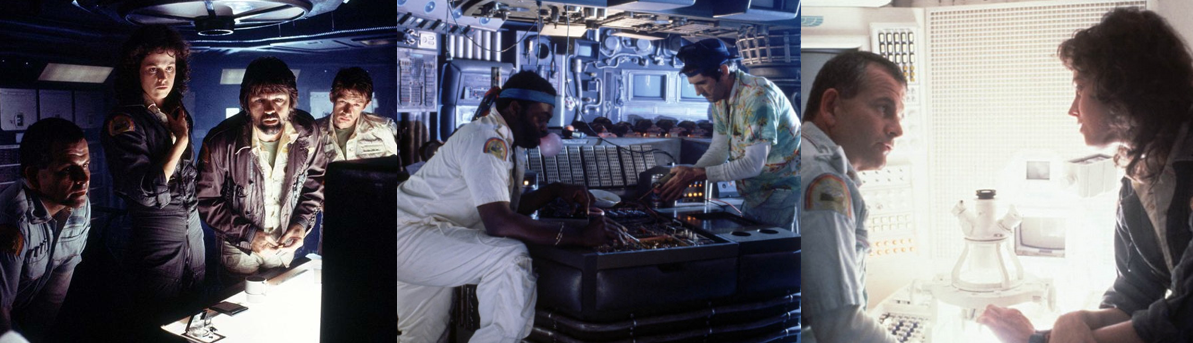
From the banter and class-based tensions, it’s clear that this crew is very familiar with each other.

While navigation officer Lambert (Cartwright) is sceptical of their new orders, Brett (Stanton) and Parker (Kotto), the Nostromo’s engineers, are concerned with more practical considerations; namely, compensation for their efforts. Feeling undervalued and underappreciated compared to the other members of the crew (especially as they are largely responsible for keeping the ship running), they attempt to weasel their way out of landing on LV-426 and it falls not to Dallas but to the Nostromo’s science officer, Ash (Holm), to point out that they (and the entire crew) are contractually obligated to investigate any distress calls and the potential of extraterrestrial life or forfeit their entire earnings. This does little to improve their already dour mood and brings them into further conflict with Lieutenant Ellen Ripley (Weaver), a by-the-numbers officer who likes to do things by the book. She also butts heads with Ash, who not only keeps her from following Dallas, Lambert, and Kane to the derelict alien spacecraft after she determines the distress call to be a warning but also breaks quarantine procedures by allowing the away team back onto the ship even though Kane (Hurt) has an unidentified alien parasite attached to his face.
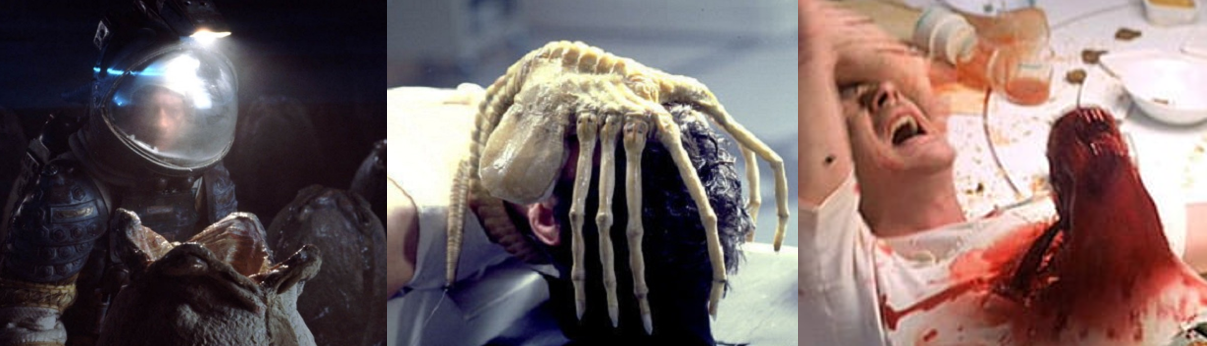
Kane brings an unexpected, and unwelcome, visitor back from the derelict spacecraft.

This “Facehugger” attacks Kane when he discovers a cargo hold, of sorts, on the derelict craft that is full of ominous-looking eggs. Allowing his curiosity to get the better of him, Kane is left in a comatose state and the crew are left unable to help him since the Facehugger threatens to choke him to death or dissolve the Nostromo with its acidic blood. Dallas is left practically impotent in his helplessness, Ash becomes consumed with researching and investigating the parasite’s capabilities, and Lambert is left enraged that Ripley was willing to sacrifice them just to maintain protocol. The tension amongst the crew is momentarily alleviated, however, when the Facehugger simply falls off and dies and Kane seemingly makes a full recovery, only for him to unexpectedly and viciously explode at the dinner table when a ferocious little “Chestburster” forces its way out of his body, killing him in the process and fleeing into the darkest recesses of the ship.
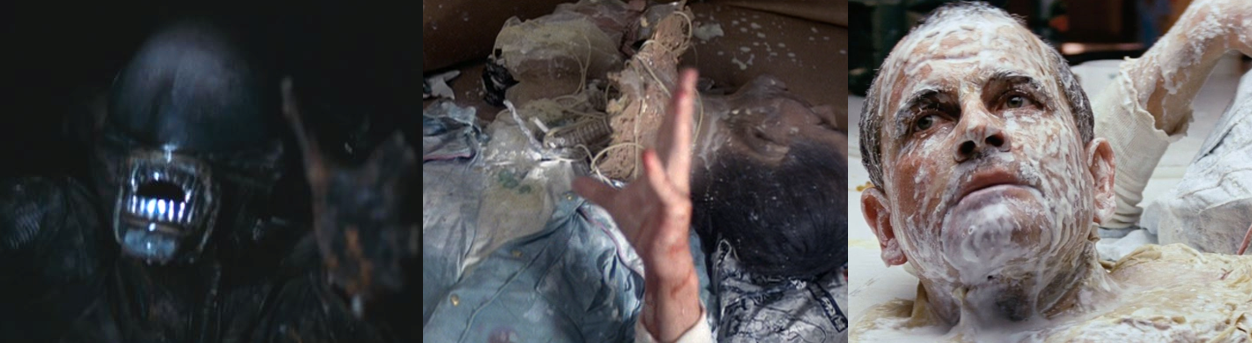
As if a seven-foot alien killer wasn’t bad enough, Ash turns out to be a Goddamn robot!

Despite the shock and terror of this sudden development, the crew scrambles to track down the Chestburster and are horrified to find that the creature has quickly gestated into a seven-foot alien killing machine! With no reliable means of tracking the Xenomorph, and being picked off one at a time, the crew struggles to unite against this common foe; tensions between Parker and Ripley escalate and things only become more complicated when Ash is revealed to be a life-like android placed on the ship by the Company to ensure the Xenomorph’s recovery. This revelation goes a long way to explaining Ash’s odd behaviour throughout the film; he willingly breaks protocol at every opportunity, which Ripley finds aggravating and suspicious since he is supposed to be the science officer, and seems morbidly obsessed with the alien life form in its various stages of life. When the Company’s true motivations are revealed, Ash drops all sense of subterfuge and attempts to kill Ripley; the ensuing melee reveals his true nature in a startlingly shocking scene that leaves him beheaded at Parker’s hands! He’s reactivated just long enough to deliver an ominous threat regarding the alien’s capabilities and to gleefully reveal that their lives are expandable compared to the alien’s acquisition, leaving the remaining survivors with no other choice than to try and evade the Xenomorph in order to set the Nostromo to self-destruct while they escape in the shuttle.

Some impressive practical effects and camera work add to the film’s timeless aura.

Undeniably, one aspect of Alien that remains intact and impressive to this day are the practical effects; model shots and miniatures do a wonderful job of conveying the weight and scale of the ships and space, and a fantastic use of lighting (particularly shadows), smoke, and flashgun lights help to increase the dread and allure of the titular alien. These are only further bolstered by the intricately-designed, heavily claustrophobic sets; clearly evoking a 2001: A Space Odyssey (Kubrick, 1969) aesthetic mixed with Star Wars’ more gritty set design, Alien definitely feels like a lived-in future where technology is as vaguely anachronistic and unreliable as it is advanced while also effectively coming across as a monster or slasher film in space thanks to the ship’s darker, grottier areas. Easily the most impressive set of the film, though, is the derelict spacecraft where Kane discovers the alien eggs; a combination of miniatures, model shots, and even children create a sense of awesome scale that is made only more foreboding by Giger’s disturbing set design and the presence of the half-fossilised “Space Jockey”.

The Nitty-Gritty:
One thing to note about Alien is that it was made at a very different time in cinema, a time when sci-fi and horror was a much more atmospheric affair and involved a lot of slow, ominous shots and tense, foreboding music all designed to build a sense of dread in the viewer. This is best evidenced in the movie’s overly long and slow-paced opening, which includes a full cast and credits and a deliberate tour of the Nostromo to help familiarise us with the ship’s aesthetic, narrow corridors, and the lived-in nature of the film’s sci-fi. Consequently, the film requires a certain mindset; rather than bombarding you with action, viscera, and loud explosions, it’s much more of a methodical exploration of the slow dissection of an already tumultuous group stuck at the mercy of a vicious creature.
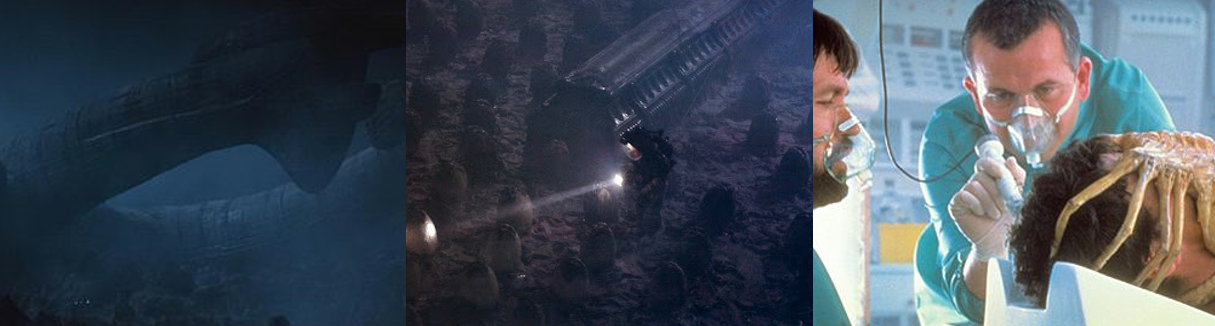
Much of the Xenomorph’s origins and biology is left intentionally vague.

The whole first act of the film is specifically designed to introduce us to the idea of the unknown, the dangerous and terrifying prospect of what may be lurking in the furthest reaches of deep space. It’s made abundantly clear by Parker and Brett that the Nostromo is not built, or properly equipped, to be investigating strange signals, much less landing on alien worlds, which proves to be true when the shuttle suffers severe damage simply by landing on LV-426. Of course, their concerns are either ignored or outright overruled simply by Company protocol, which dictates that “all other priorities are rescinded” when compared to the Xenomorph. At this point, the Xenomorph itself is a mystery al its own; the derelict spacecraft is beyond any sense of human understanding, to say nothing of the gigantic skeleton of the Space Jockey that serves as an ominous warning to deter the crew. Where did the eggs come from? What purpose did they serve? How did the Space Jockey get infected with a Chestburster? These are all questions the film purposely leaves unanswered and which only add to the sense of mystery and terror as the alien’s true origins and purpose are unknown and, ultimately, inconsequential since, once its aboard the Nostromo, all that matters is trying to survive rather than working out who created it and why.

The Alien’s phallic design makes it as disturbing as it is terrifying.

The Xenomorph’s design, however, is no accident; consciously designed to evoke uncomfortable feelings of visceral terror, each stage of the creature’s life cycle resembles genitalia in some way and its threat is as sexual as it is physical. The Director’s Cut is notable for included a previously excised scene in which Dallas is revealed to not have been killed by the Xenomorph but, instead, is being transformed into one of the same eggs Kane discovered on the crashed ship. This would have suggested a complete, self-sustaining life cycle and only added to the mystery and horror of the alien; obviously, the sequel abandoned this in favour of an egg-laying Queen but I still feel like this concept works in the overall context as the extended Alien canon showed that the Xenomorphs were capable of undergoing further, life-sustaining transformations. Still, the Facehugger effectively rapes Kane, pouncing on him and impregnating him against his will and causing a phallic, carnivorous parasite to puncture its way from his chest. Even when fully grown, the Xenomorph remains disturbingly phallic in its design and the way it approaches and kills its prey; from its long, phallic head and tail to its dangerous retractable inner mouth, the creature stalks, overwhelms, and consumes its victims with a disturbingly serene grace that is punctuated by a sudden and brutal aggression.
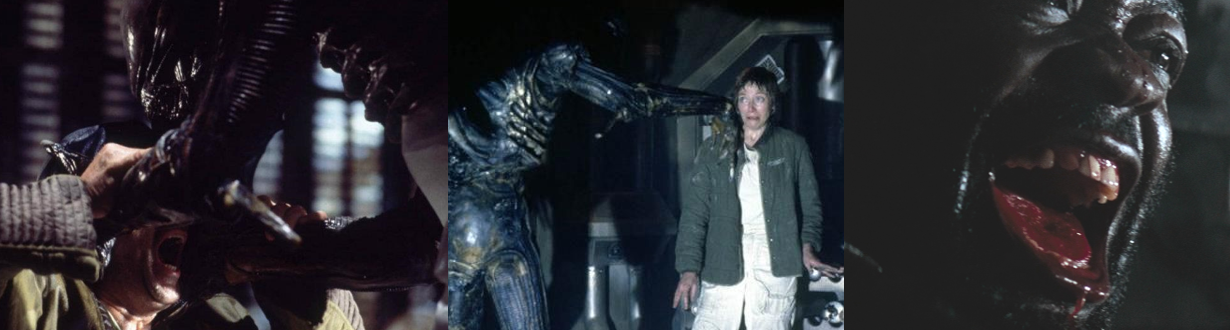
The crew are undone by their own character flaws as much as the viscous alien threat.

In the Xenomorph, the crew are faced with the threat of the unknown in physical form; thanks to the network of air ducts, the abundance of shadows, and its sheer tremendous ferocity, the crew are effectively powerless against its will. It’s not even as though they can rely on any futuristic technology to assist them as the Nostromo has very little in the way of armaments; all they’re left with is a crude motion tracker and the one piece of technology they do have (Ash) ultimately proves to be just as dangerous as the Xenomorph itself. Thanks to the class-based tensions that already existed at the start of the film (particularly between Parker and Ripley) and the sheer terror of the situation (primarily embodied in Lambert), the survivors are unable to properly get their shit together fight the creature. The Xenomorph itself remains mostly hidden in shadows and tantalisingly kept off-screen for large portions of the film to only increase its shock value and horror when it does appear; appearing as little more than a living shadow of talons and teeth, when it is seen, it is an incredibly impressive piece of practical work that remains as terrifying now as it was back then.

Thanks to keeping her shit together, Ripley ultimately triumphs over her androgynous stalker.

What make Ripley such an effective protagonist is the way in which she embodies all of the traits of the different crew members and balances them out so that no one emotion or personality overwhelms her. She starts the film very much a semi-stuck-up stickler for the rules (though it must be said that she was right all along and Ash never should be broken the quarantine procedure); like Dallas, she is used to simply following orders but, while he boldly chooses to lead team to the crashed ship and venture into the ducts in some foolhardy attempt at heroics, she opts to follow protocols designed to keep them alive. Kane’s sense of curiosity is also present in Ripley, but it’s tempered with a caution that she is level-headed enough to keep from spilling over into aggression like Parker. As we see in the sequel, the entire experience scars her enough to leave her disillusioned with the Company, similar to Brett and, while Lambert is basically reduced to a quivering wreck when faced with the Xenomorph, Ripley (despite clearly being terrified out of her mind) is able to hold herself together enough (and be adaptable enough) to find ways to stave off and, ultimately, kill the creature. Consequently, Ripley encompasses the traits of each member in the perfect storm of survival, turning her into an independent and forthright heroine. Adaptable and desperate, she is not only able to naturally assume command of her more emotionally unstable crewmates but also temper her fear with a determination that makes her as relentless as the alien, meaning that she is fully capable of holding her own against the Xenomorph’s vaguely androgynous horror despite being more reactive than her more proactive characterisation in the sequels.

The Summary:
Alien is a thrilling and exhausting experience; thanks to a masterful, deliberate pace, the film masterfully builds a sense of dread and tension through some long, lingering shots and a fantastic use of lighting and ominous, understated music. The characters are all fantastically realised; speaking over each other and full of conflicting egos and personalities, there’s a sense of familiarity and tension that really helps to make the entire film believable and the characters immediately relatable even though we don’t learn a whole hell of a lot about them. Similar to the alien, what we learn of the characters is told throughout the film and the way they act, and interact, with each other and the escalating horror they find themselves facing. The vast expanse of the unknown is given tangible, disturbing form in the Xenomorph, which attacks and brutalises its prey through means as uncomfortable as they are ferocious and, in many ways, the entire film is an allegory of the dangers of the unknown and sexual assault. At its core, the film is about a group of working-class Joes forced into a nightmarish situation and their ability (or inability, in many cases) to adapt and react to this threat determines who lives and dies. Ripley, as the only one capable and adaptable enough to balance emotions and characteristics that otherwise overwhelm her crewmates, is left the sole survivor but the cost of her victory is high as it is only through the sacrifice of everything and everyone she knows that she is able to triumph. In many ways, Alien was incredibly ahead of its time; it’s easy to almost forget that it’s a science-fiction film since, fundamentally, Alien is a twist on the classic slasher or haunted house formula and technology plays a very small role in battling the Xenomorph. Thanks to the efforts of Ridley Scott, and his cast and crew, one of the most terrifying monsters in all of cinema was effectively realised and while subsequent sequels somewhat diminished the Xenomorph’s ominous threat and menace, that doesn’t take away from this more terrifying and deliberately-paced first film in the series, which has stood the test of time and remains, despite some outdated onscreen technology, a timeless classic.

My Rating:

Rating: 5 out of 5.

Fantastic

Are you a fan of Alien? What did you think to the additional scenes added to the Director’s Cut? Which member of the crew was your favourite and why? What did you think was the backstory of the Xenomorph and the Space Jockey at the time? Did you guess that Ash was an android? Did you expect Ripley to end up as the sole survivor and, if not, who did you think would make it out alive? Which of the Alien movies is your favourite and why and how are you celebrating Alien Day this year? Whatever your thoughts, stay frosty and drop a comment below!

Game Corner [Robin Month]: Young Justice: Legacy (Xbox 360)


In April of 1940, about a year after the debut of arguably their most popular character, Bruce Wayne/Batman, DC Comics debuted “the sensational find of [that year]”, Dick Grayson/Robin. Since then, Batman’s pixie-boots-wearing partner has changed outfits and a number of different characters have assumed the mantle as the Dynamic Duo of Batman and Robin have become an iconic staple of DC Comics. Considering my fondness for the character and those who assumed the mantle over the years, what better way to celebrate this dynamic debut than to dedicate every Monday of April to celebrating the character?


Released: 19 November 2013
Developer: Freedom Factory Studios
Also Available For: Nintendo 3DS, PC, and PlayStation 3

The Background:
After debuting in the pages of The Brave and the Bold #54 in 1964, the Teen Titans had a relatively consistent presence throughout the 1960s and 1970s and acted as a way for DC Comics to appeal to younger audiences. The team arguably achieved their greatest mainstream success when writer Marv Wolfman and George Pérez breathed new life into the concept by introducing many characters who are now synonymous with the team but I actually became a fan of the group after reading the adventures of their later contemporaries, Young Justice. Although functionally similar to the Teen Titans, Young Justice brought together the then-modern incarnations of their predecessors, who had long since grown up and assumed other identities. Created by Todd Dezago, Todd Nauck, and Lary Stucker the team operated between 1998 and 2003 before disbanding (most likely so that DC Comics could captalise on the success of the Teen Titans cartoon (2003 to 2006)) before reuniting in 2019. Some four years after Teen Titans ended, the Young Justice concept was evoked for a new DC animated series that ran from 2010 to 2013 before finally receiving a long-awaited revival in 2020. Young Justice’s critical acclaim and popularity also led to the development of this videogame adaptation; unfortunately, the game suffered delays, ports to other consoles were cancelled, and it released to mainly negative reviews.

The Plot:
Taking place in the five-year gap between season one and season two of the cartoon, Young Justice sees the titular team joining forces against the combined might of “The Light”, a cabal of supervillains with intentions to take over (or destroy) the world.

Gameplay:
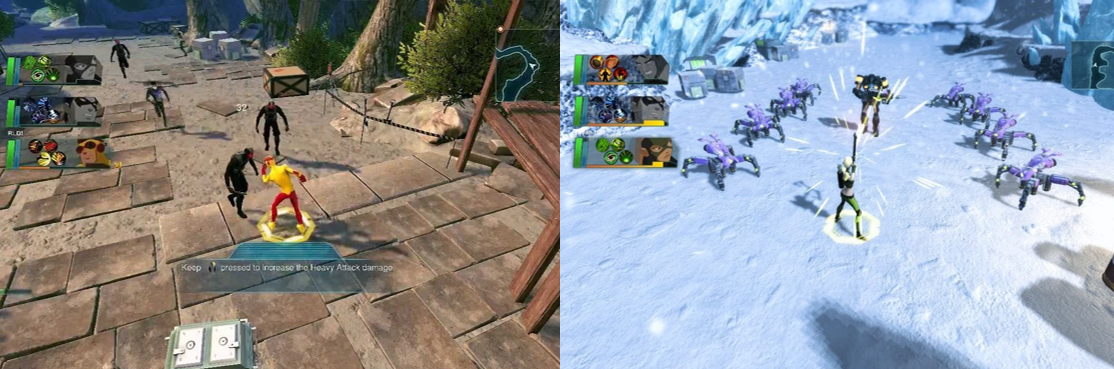
Young Justice: Legacy is a team-based beat-‘em-up with very light puzzle elements that sees players form a team of three (why it isn’t four is beyond me…) characters from a roster of twelve and fight their way through fifteen missions. If you don’t have one or two friends to play alongside, you can switch between the three characters with a press of left or right on the directional pad and, when you’re not playing as them, the computer will take over and batter any nearby enemies with a reasonable amount of competence. When selecting a team for the game’s main campaign, you’re unable to alter the story-based team leader, which can mean that you’re stuck with a character you don’t really like and limits the customisation options available to you, but that doesn’t really matter as, essentially, every single character plays the same way. Tapping X performs a light attack while pressing Y performs a heavy attack (you can also hold Y to charge this up) and you can mix up these button presses to perform a few clunky combos (although it has to be said that you can easily just run past the vast majority of the game’s enemies and not get bogged down in the monotonous combat). You can jump with A and certain characters can fly (more of a hover) with a subsequent press of A, perform an awkward dash with B that can help you move a little faster or dodge incoming attacks, hold the Left Trigger to block, and pick up and throw objects with B and X, respectively.

Combat is laborious and characters don’t really feel that different from each other.

Each character has four superpowers available to use; these are performed by holding the Right Trigger and pressing either X, Y, A , or B and can be performed as long as the blue bar on the heads-up display is full. This bar fills up over time and you’re able to pull off such ranged attacks as tossing Batarangs, shooting arrows, throwing fireballs, and blasting enemies with water, area blast attacks that may stun or knock back enemies, cast a healing spell or boost your attack, defence, and energy consumption, or freeze enemies, compel them to attack their allies, or turn your character briefly invisible. As you defeat enemies, you’ll build up your character’s “Hero Boost” meter; once it’s full, you can pull off a Hero Boost than defeats or heavily damages all onscreen enemies by holding RT and pressing the Right Bumper or build up all three characters’ bars and unleash a massive “Squad Boost” attack by holding RT and pressing the Left Bumper. Sadly, every character has the same Hero Boost attack and animation, which really limits the distinctiveness of each character beyond their individual superpowers. Combat in Young Justice: Legacy is mind-numbingly simple; as you run through painfully linear environments, you’ll be set upon by a near-endless supply of goons, all of whom might look a bit different area to area but basically attack in the same ways and can be put down with a bit of mindless button-mashing (or, as I said, avoided completely in some instances).

Combat is broken up by simple puzzles and a few tedious tasks.

Opportunities for exploration are limited; sometimes you can (and have to) smash through rock walls to access secret areas that lead to some collectibles or control panels and such but you won’t really find multiple paths through stages or areas that can only be accessed by certain characters and/or team combinations. The game also tries to mix things up with some extremely simple puzzles; these generally involve smashing something, usually a generator, activating a console to open a door, or pushing something big to activate bridges, open doors, or reach new areas. Stages are super linear but there’s a helpful mini map on screen at all times to point you in the right direction and you can look up your current objectives with a press of the ‘Back’ button but, while missions are split into three sub-missions at a time, the game’s monotony is made all the more frustrating by a serious lack of checkpoints. While you can’t pick anything up to refill your health, it will automatically refill once all onscreen enemies have been defeated and, if an ally is knocked out, you can revive them by pressing B. You can select from two difficulty settings (Normal and Hard) which, obviously make the game’s enemies a bit tougher and what-not but it can be extremely aggravating to get knee-deep into a mission only to have your health drained to nothing by instant-kill laser traps. Some stages are full of environmental hazards like this, such as flames and spikes from the floor and large statues that come to life as you progress through rooms. Other missions also prove unnecessarily frustrating, such as forcing you to clear out all onscreen enemies in a time limit (bizarrely without an onscreen timer to gauge your progress), rescue hostages, defend John Stewart/Green Lantern while health-sapping debris and waves of enemies attack you, avoid enemy-spawning search lights, smash engines or generators while avoiding missile-shooting turrets, or push forklift trucks to avoid being taken out by snipers.

Graphics and Sound:
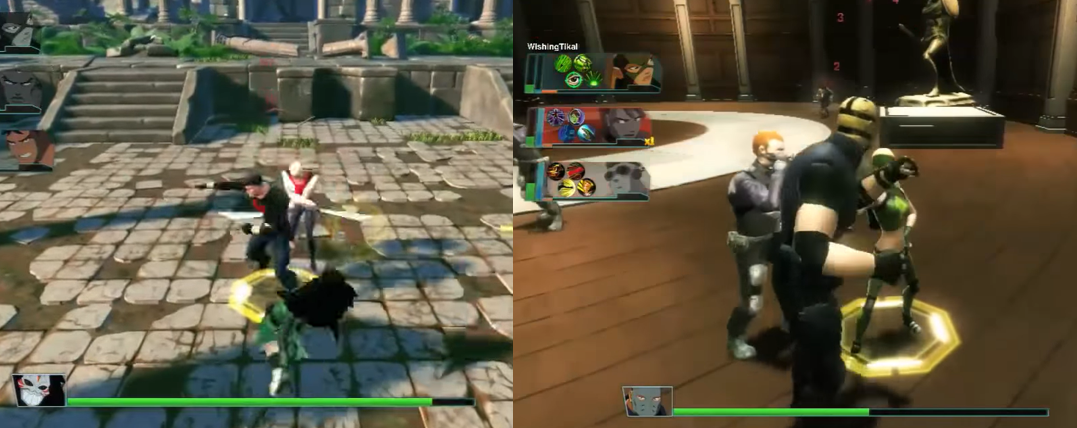
I should stress here that I haven’t ever seen the cartoon that Young Justice: Legacy is based on but the game opts to use a variation of cel-shaded graphics to recreate the look of its source material and, for the most part, this works…unless you’re watching the game’s cutscenes. When playing the game, thanks to the skewed, top-down perspective, the lack of detail and rigidity of the character models isn’t as noticeable since you’re so focused on combat and the perspective is quite zoomed out but, when the game tells its story, characters are all very flat and kind of resemble lifeless puppets more often than not. While the main characters look fine for what they need to be, the enemies aren’t so great; you’ll fight the same goons and robots over and over, which all gets very monotonous very quickly.

Character models are okay but environments and cutscenes are a bit bland and stilted.

Environments are surprisingly big considering how linear and empty they are; there’s usually a lot of open room to manoeuvre and you’re rarely forced to fight down boring, narrow grey corridors. You’ll visit places like Siberia, Santa Prisca, Gotham City, and battle on LexCorp hovercrafts, all of which provide a decent amount of visual variety to the game. It’s just a shame, then, that there’s very little opportunity to explore; you can go off the beaten path but will often find only a dead end or useless boxes to smash, and there’s no opportunities to platform or utilise specific character powers outside of combat. At one point, Edward Nygma/The Riddler challenges you to solve a light-based puzzle in a neon-drenched sewer system-made-funhouse, which is quite a unique area, but there’s really not that much on display here to keep you that engaged, which only adds to the game’s repetitiveness. The music and sound effects are equally bland but, while the game appears to utilise the same voice cast from the cartoon, this is actually to its detriment; characters will spout the same quips and lines over and over again and I was about ready to snap the disc in half after hearing Dick Grayson/Nightwing moan about being “whelmed” all the damn time!

Enemies and Bosses:
A slew of generic goons will dog your progress in every mission. After playing through the first stage, you’ll basically have encountered every enemy the game has to offer as they simply get swapped out with different character models in each mission. You’ll battle teleporting, sword-wielding members of the League of Shadows, a variety of robots (Spider Bots and larger, more humanoid robots being the most common), Bane and David Hyde/Black Manta’s mercenaries, and the Riddler’s baton and shotgun-wielding goons throughout the game’s story. Things get interesting in the game’s final missions, where you’ll battle a larger mech, fight against mummies, and come up against gigantic statues that deal massive damage and get jumped by an assortment of enemies in enclosed areas.

Cheshire and Sportsmaster require a hit-and-run strategy to whittle down.

Each mission culminates in a boss fight against at least one member of the supervillain cabal known as The Light; the first mission ends with you battling Jade Nguyen/Cheshire, who teleports around the arena in a puff of smoke and throws projectiles your way but, while she’s the toughest enemy you’ll have faced at that point, she leaves herself wide open for an attack when she pauses to setup an explosive device and isn’t too difficult to whittle down as long as you keep moving, attacking, and reviving as necessary. This strategy basically applies to every boss but will become abundantly clear when you battle the second boss, Lawrence “Crusher” Crock/Sportsmaster. Sportsmaster is accompanied by a seemingly endless supply of goons, all of whom cause a massive headache when you’re trying to dodge Sprotsmaster’s health-sapping spinning and charge attacks. Thankfully, though, these enemies are finite and, if you quickly take them all out, you can focus on battling Sportsmaster using hit-and-run and ranged attacks.

Many of the bosses cannot be attacked directly and must be stunned first.

In Siberia, you’ll fight Crystal Frost/Killer Frost as Spider Bots attack you; Frost can’t be attacked head-on as she hides atop an ice column and blasts ice attacks at you, so you need to destroy her platform to knock her down and then beat on her before she can build a new one. Cameron Mahkent/Icicle Jr. takes over the ice-based duties for the next boss battle, where he teams up with Sportsmaster. You can utilise the same tactics to take out Sportsmaster and it’s best to focus on one enemy at a time; Icicle Jr. is different from Killer Frost in that he can freeze you and encases himself in an ice sphere that refills his health. After defeating them, you’re faced with a harrowing mission where you must battle through rooms of annoying enemies with no checkpoints and no refillable health as Clark Kent/Superman holds back an incoming avalanche, which was one of the most aggravating parts of the game on my first playthrough. Afterwards, in Santa Prisca, you’ll battle against Bane who, again, requires a little more strategy; when pumped full of Venom, Bane is invincible and you need to lure him into charging the nearby columns to stun him. He also busts out a big ground pound attack and can bash your brains in if you get too close for too long, so again it’s best to hit and run and use ranged attacks to whittle him down.

While you can bypass Black Manta, Psimon and Riddler require a more hands-on approach.

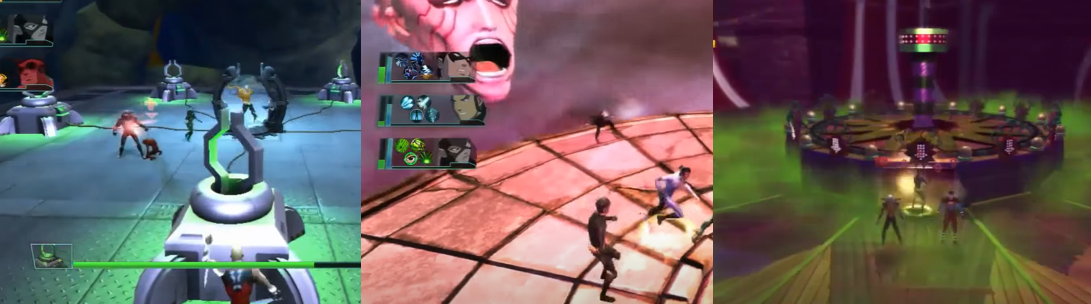
Next up, you’ll have a tough battle where you must disable Black Manta’s submarine; the game doesn’t make it massively clear how you do this but basically you have to fight off Black Manta’s goons and push these red bars near the large generators to overload his sub, all while avoiding his instant-kill lasers by taking advantage of the big metal shields that rotate around the arena. After that, you’ll fight Black Manta himself; make sure you avoid his massive eye beams but don’t worry about fighting him or his goons as you can simply attack and destroy the shield generators to end the fight that way. While at Haly’s Circus, you’ll have to fight through waves of enemies in a mini gauntlet before battling with Doctor Simon Jones/Psimon, who spawns in mirror versions of your team (who seem to randomly stun and defeat you without really landing any attacks) and then rains massive red energy lasers into the arena but if you simply mash the attack button, he’ll go down pretty easily. Finally, you’ll have to do battle with the Riddler, who randomly spawns bombs, poison gas, goons, and other hazards into the arena. To defeat the Riddler, simply ignore everything and attack and destroy the panels on his big circus-wheel-thing in perhaps the game’s easiest (if tedious) boss battle.

The final boss battle just goes on and on and even contains a game-breaking glitch!

The game ends with a gruelling and aggravating multi-stage fight against Klarion Bleak/Klarion the Witch Boy, Mark Desmond/Blockbuster, and the eldritch beast known as Tiamat. While Klarion and Blockbuster aren’t too difficult to best (simply lure Blockbuster into Klarion’s meteor attack to stun him and then beat on him until he goes down), the fight against Tiamat feels like it’s never-ending! In the first phase, he blasts the arena with water attacks that will basically kill you in one or two hits and he can only be damaged when he dips down into the water. In the second phase, he shoots a massive mouth laser at you and tries to swipe and squash you with his claws and fists; after avoiding his attacks, pummel the limb with everything you have until his health is drained. In Tiamat’s final phase, he flies about above you and comes crashing to the ground, unleashing a devastating series of attacks that will leave you “whelmed” in seconds. The only way to damage him is to attack the minions that spawn into the arena; after defeating two, you’ll build up your Hero Boost and you must unleash your Squad Boost to damage Tiamat, and then attack him immediately afterwards to whittle him down even more. This is easily the most frustrating boss battle in the entire game because of how tough Tiamat is; make sure to bring a healer like Zantanna Zatara or M’Gann M’orzz/Miss Martian or else you’re gonna have a bad time but be warned as there’s an almost-game-breaking glitch in this fight that can see the enemies stop spawning in, leaving you unable to finish the fight and forcing you to quit the game and try again but, thankfully, there are save points between each phase of this finale.

Power-Ups and Bonuses:
As you defeat enemies, you’ll gain experience points (XP) that will cause you to level-up; each character has different statistics that affect how much health, power, and energy that have and levelling-up allows you to increase the power and range of each character’s superpowers. You can also find crates in stages and earn “Hero Points”, which can be spent on Wayne Industries upgrades, two of which can be equipped to each character after being purchased and will increase your melee or weapon attacks, energy consumption, and a host of other stats. Thankfully, these Hero Points seem to be shared amongst every character; so, if you have ten Hero Points, you can spend them upgrading Tim Drake/Robin’s superpowers and then switch out to Kaldur’ahm/Aqualad and spend the same ten Hero Points upgrading him, too. Sadly, though, there are no pick-ups on offer; yes, you can pick up and throw boxes and barrels and such, but you can’t pick up weapons or power-ups during gameplay, making smashing all those boxes pretty pointless.

Additional Features:
Young Justice: Legacy comes with forty-eight Achievements for you to earn; many of these pop simply by playing the main campaign and defeating a certain number of enemies, the game’s bosses, and finishing the game on Normal or Hard. You can also snag some G by destroying crates, finding collectibles, or playing the game in co-up but there are also some stage-specific Achievements, such as avoiding searchlights in the Gotham City docks and solving a puzzle in a certain way. Every stage in the game has a few collectibles to find; these include dioramas, additional costumes for the game’s characters, and journals left behind by Roy Harper/Red Arrow. Playing through the campaign on Normal and Hard will see you unlocking additional characters, which is always nice, and there are four additional characters available to purchase as downloadable content if you like the sort of thing. Also on offer are an array of challenges; while these can only be played in single-player, these will pit you against ten waves of enemies that progress in difficulty, or have you battling against a time limit and you’ll unlock additional challenges and stages by playing the story mode. You can also view character biographies, concept art, and take part in a quiz that will test your knowledge of the cartoon to earn points.

The Summary:
I wasn’t expecting much from Young Justice: Legacy except some mindless, arcade-style beat-‘em-up action; I’ve played team-based, top-down fighters like this before and been perfectly satisfied with them but I have to say that this game is just a repetitive, tedious, aggravating experience from start to finish. There’s a decent amount of characters on offer and some of them have more appeal than others, but they all essentially play exactly the same way. Since they lack character-specific super moves, you may as well just pick anyone and it’s ridiculous how you can just run past enemies to progress or simply look away from the screen and mash the X button to win. There’s very little actual skill or intelligence needed for this game, which would be fine if it was actually fun but it really isn’t; it’s dull and down-right infuriating at times, with some bland bosses, linear and empty stages, and very little incentive to replay the game beyond mopping up any missed Achievements.

My Rating:

Rating: 1 out of 5.

Terrible

Have you ever played Young Justice: Legacy? If so, what did you think to it? What character and team combination was your favourite? What did you think to the combat and gameplay and which of the game’s missions and bosses was your favourite? Were you a fan of the cartoon and, if so, do you think the game did a good job of recreating the action and energy of the show? Would you like to see more videogames based on Young Justice and/or the Teen Titans? Feel free to share your thoughts on Young Justice: Legacy, and Young Justice, down in the comments.

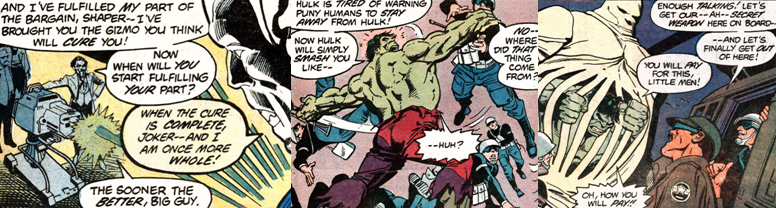
Movie Night [Dare-DAY-vil]: The Trial of the Incredible Hulk


Blind lawyer Matt Murdock first made his debut in Daredevil #1 in April of 1964 and was co-created by writer/editor Stan Lee and artist Bill Everett, with input from the legendary Jack Kirby. While perhaps not as mainstream as characters like Peter Parker/Spider-Man, Daredevil has become one of Marvel Comics’ greatest creations and has featured in a number of ancillary media and merchandise, included a questionably-received big-screen adaptation in 2003 and a critically-successful Netflix series. Still, he’s one of my favourite Marvel superheroes so what better excuse to pay homage to the “Devil of Hell’s Kitchen” than by spending the day celebrating the character?


Released: 7 May 1989
Director: Bill Bixby
Distributor: New World International
Budget: Unknown
Stars: Bill Bixby, Lou Ferrigno, Rex Smith, Marta DuBois, Nicholas Hormann, and John Rhys-Davies

The Plot:
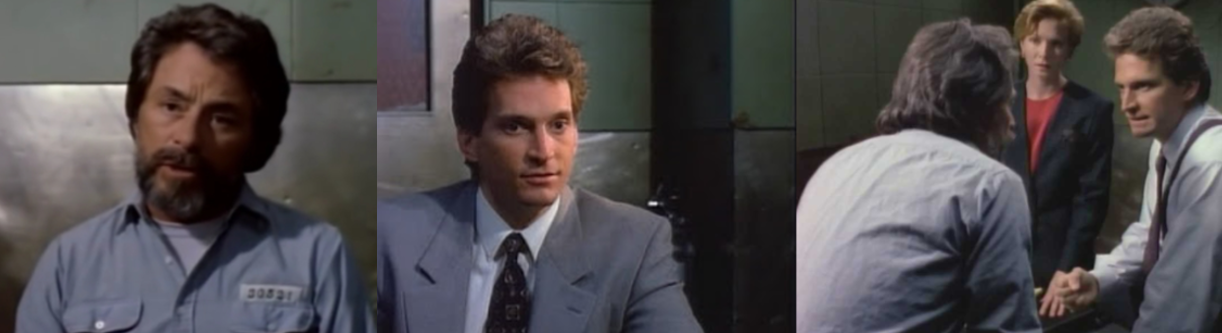
Back on the run and having lost all hope for a cure for his green-skinned alter-ego, Doctor David Banner (Bixby) wanders into a city under the control of crime boss Wilson Fisk (Rhys-Davis). After witnessing Fisk’s men accost Ellie Mendez (DuBois) on the subway, Banner transforms into the Hulk (Ferrigno), framed for the crime, and subsequently arrested. Refusing to stand trial lest the Hulk be unleashed, he offers no co-operation to his blind lawyer, Matt Murdock (Smith), but the two find themselves teaming up against Fisk when Murdock is revealed to be the masked crimefighter known as Daredevil.

The Background:
I’ve mentioned it at length before but, long before the Marvel Cinematic Universe (MCU) dominated cinema screens, Marvel Comics had a decent amount of success with live-action adaptations thanks to the iconic Incredible Hulk television series (1977 to 1982). The show, which coined the unforgettable line “Don’t make me angry. You wouldn’t like me when I’m angry”, ran for eighty episodes before finally coming to an end on 12 May 1982 and firmly entrenched the Green Goliath in the cultural consciousness thanks to standout performances by stars Bill Bixby and Lou Ferrigno, who would go on to voice the character for years to come. About six years after the end of the series, the first of three made-for-television movies was produced; although intended as a backdoor pilot for a Thor (Eric Kramer) spin-off, The Incredible Hulk Returns (Corea, 1988) was, apparently, a ratings success and a second feature-length film was produced to capitalise on the renewed interest. The Trial of the Incredible Hulk was one of my first exposures to the Incredible Hulk show; like The Incredible Hulk Returns, the feature debuted another Marvel superhero, Daredevil, in the hopes of producing a spin-off that never came to pass and also featured Stan Lee’s first ever onscreen cameo in a Marvel production. Overall, though, the film seems to have garnered mixed reviews, with the general consensus being that it didn’t quite deliver on its title or premise.

The Review:
Rather than open with a version of the traditional, iconic opening from the television show, The Trial of the Incredible Hulk begins with a morose narration from David Banner (now using the pseudonym “David Belson”), who catches any newcomers up to speed with his current predicament (literally just a case of, “Gamma Rays turned me into a monster” with a few shots from the pilot episode). We then join Banner, now sporting a thick head of hair and full beard, working a demeaning job digging a trench or a ditch or some such. When a co-worker attempts to rile him up and Banner is barely able to keep his anger in check, he once again regretfully hits the road and heads towards the city, despite warnings that he could “get lost there”.

Though Banner resigns himself to a life in prison, Murdock is determined to bring Fisk down.

Haunted by his many years on the road and inability to cure his unique condition, Banner remains a lost, tortured soul who drifts from place to place and job to job, refusing to put down any roots and to keep himself to himself and on the move. Despite this, however, he is unable to stand idly by when Ellie Mendez is hounded by a couple of goons on the subway; for his troubles, not only does he transform into the Hulk once more but he also winds up in jail and accused of attacking the woman. Although he knows he is innocent, he adamantly refuses to stand trial out of fear of the damage he might do lest the stress trigger another transformation, and feels that prison is a fitting place for him. The city (which, despite never being named, appears to be New York City) is a bustling metropolis and home to blind lawyer Matt Murdock, a seemingly unassuming man who regularly makes light of his condition with his co-workers. He also has a friendly banter with his staff, Christa Klein (Nancy Everhard) and Al Pettiman (Richard Cummings Jr.), whom he wows with his enhanced senses (which they put down to him making wild, if uncannily accurate, guesses). At the heart of the city is Fisk Tower, a large and ominous structure that dominates the city skyline, and Matt has made it his solemn vow to tear the building down, and Fisk with it, once they have concrete proof that he is involved in the city’s underworld.

Fisk plot to control of the criminal underworld is opposed by Daredevil and his newfound ally.

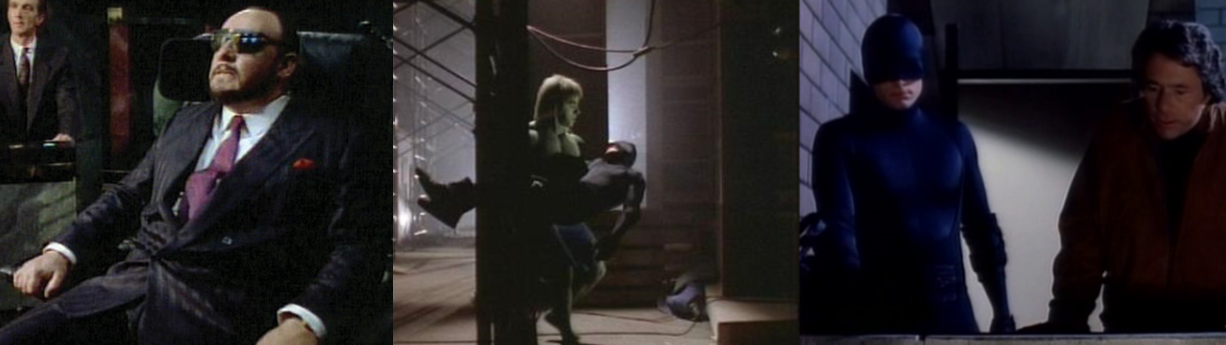
Matt’s suspicions about Fisk are entirely well-founded as the criminal mastermind directs, via radio and video, two of his henchmen in the systematic robbery of a jewellery store. An enigmatic and authoritative figure, Fisk conducts all of his business with precision and immaculate detail, directing every movement and having the entire operation planned to the smallest detail. Untouchable and in full control of the criminal underworld. Fisk’s operation is put at risk when his goons accost Ellie on the subway; when Banner gets involved in the matter, Fisk begins targeting them both in order to avoid linking him to the crime. When Matt is appointed as Banner’s lawyer, he sees this as the perfect opportunity to get a lead on Fisk and is confused and angered at Banner’s unwillingness to co-operate and refusal to divulge his true name and origins. When the stress of an impending trial, Ellie lying about the subway attack (due to Fisk threatening her with reprisals), and his position in general trigger a transformation, Banner is convinced to trust Murdock when the lawyer reveals his duel identity as the masked vigilante Daredevil. Although Banner has reached the end of his rope and lost all faith in the science that was once his life, he finds himself reinvigorated by Murdock’s plight since he was transformed by the better by radioactive substances and he leaves the film far more optimistic and content to have a “brother in the world”.

The Nitty-Gritty:
The Trial of the Incredible Hulk is a relatively inoffensive little extension of the television show but nothing massively spectacular, though I never really watched the show as a kid as it wasn’t really on TV over here in the United Kingdom, as far as I am aware. As a result, I remember being somewhat impressed with the film back then since it wasn’t as if live-action superhero productions were as accessible as they are today. Even now, it’s still pretty entertaining; sure, it doesn’t deliver on its premise at all (the “trial” only happens in a nightmare of Banner’s and seems to refer more to the emotional trial that Banner is going through) but it’s an interesting time capsule of a bygone era when live-action superhero adaptations were certainly ambitious, if nothing else.

The Hulk’s screen time is sadly limited but he sure makes an impression when he does appear.

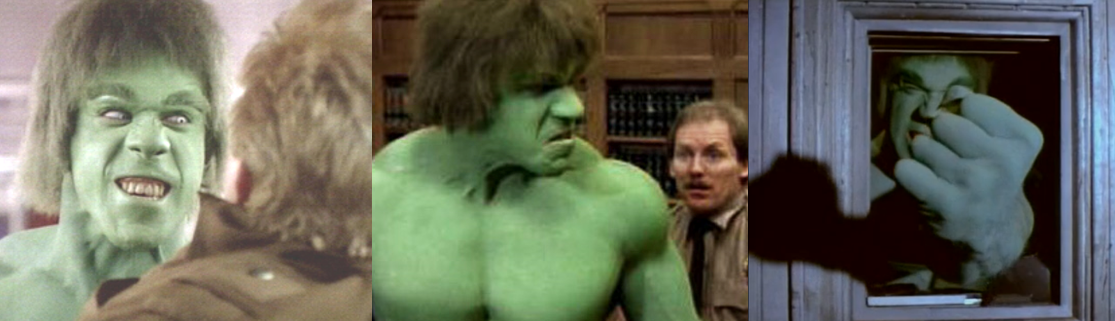
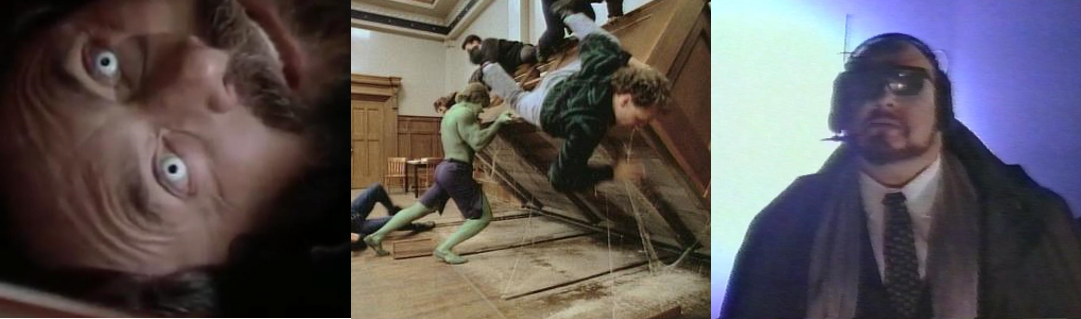
As is the case with much of the Incredible Hulk TV show, the Hulk himself is unquestionably the star of the film. Sadly, he gets very little screen time; Banner doesn’t even transform into the Hulk for the finale but, when he does turn green, it’s treated as a pretty big deal. This is, however, par for the course for The Incredible Hulk; the episodes I have seen generally focus much more on the drama surrounding Banner, the people he meets, and his weekly attempts to find a cure for himself or help those in need and the Hulk appears very sporadically as a result. While the Hulk’s rampage in Banner’s nightmare is a standout moment in the film, and is a great showcase of the Hulk raging against a room full of people for a change, it’s still just a dream sequence. Luckily, there’s a particularly decent follow-up scene later on when, having witnessed Daredevil be pummelled by Fisk’s men, Banner transforms to save him and, in the process, forms a kinship with the blind crimefighter.

The film was intended as a backdoor pilot for Daredevil, who’s decent enough, if a little boring.

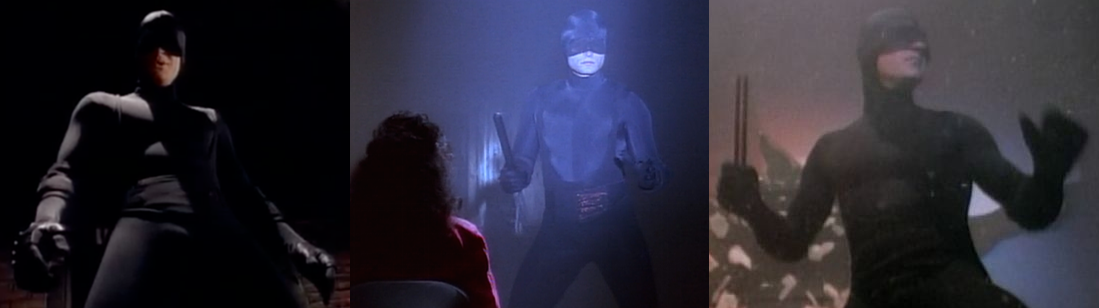
This, coincidentally, brings me on to the subject of Daredevil; Daredevil’s presence is hinted at early in the film as graffiti carrying his name adorns the walls of the city and the film spends a great deal of time setting up Murdock’s day-to-day life, introducing his enhanced senses (although the depiction of his radar sense is a bit questionable), and making him a prominent figure all before he first appears in an all-black ninja outfit to save Ellie’s life. Despite the fact that his outfit is disappointingly barebones, I appreciate that Daredevil is sporting a look straight out of “The Man Without Fear” (Miller, et al, 1993), one of the first Daredevil stories I ever read. Daredevil is something of an urban legend in the film but he is also unofficially sanctioned by police chief Albert G. Tendelli (Joseph Mascolo), who even has a direct line to contact Daredevil when he needs help outside of the normal confines of the law, and allies like Turk (Mark Acheson) to feed him leads. Rex Smith may not always be performing Daredevil’s few limited fight scenes or acrobatic feats (which are incredibly limited) but he does a decent enough job in the role; while the film alters his origin somewhat to have him begin his training as Daredevil as an adult and after being inspired by Tendelli, he undergoes a trial of his own when Fisk’s men put a severe beating on him and leave him feeling humiliated.

While it drops the ball on the title, the film entertains with some decent sequences and performances.

Undeniably, though, The Trial of the Incredible Hulk is elevated by the presence of the bombastic and alluring John Rhys-Davies; despite never using the name “Kingpin”, Rhys-Davies is perfectly cast as Fisk and brings just the right level of authority and scene-stealing charisma to the role to make him larger than life but also threatening. Even better, he’s not just some one-dimensional gangster, either; he’s incredibly lenient with his right-hand man, Edgar (Hormann), even when he has a change of heart and helps Ellie escape from Fisk’s captivity. At the same time, though, Fisk is absolutely ruthless; having grown weary of Daredevil’s interference and wishing to consolidate his power over the city’s underworld, he presents his rivals not just with a number of jewels but also video evidence of Daredevil’s beating. While he fully believes that this has resulted in Daredevil’s demise, his plans are ultimately ruined when Banner and Daredevil crash the party and force Fisk to flee to fight another day.

The Summary:
In many ways, it’s a bit of a shame that The Trial of the Incredible Hulk didn’t lead to a spin-off for Daredevil; even back then, a TV show about a black-suited vigilante had to have cost less to make than one about a scientist who turns into a musclebound strongman. However, I can kind of see why a Daredevil spin-off wasn’t produced; as much as I enjoy the character, his portrayal in the film, and the magnetic presence of John Rhys-Davies, Murdock and Daredevil are nowhere near as compelling or visually interesting as the Hulk. It’s equally a shame, then, that the Hulk has such limited screen time in the film but I can forgive a lot of that as, again, the main focus of the show was always the drama surrounding Banner and the film does a serviceable job of trying to introduce Daredevil and make us care about him. Ultimately, while it’s probably the most boring interpretation of Daredevil you’ll see, I can’t help but have a soft spot for The Trial of the Incredible Hulk; it was my introduction to the TV show and a vital part of my childhood so I have a lot of nostalgic affection for it and it’s worth watching for John Rhys-Davies’ performance alone, to say nothing of the dramatic allegorical and physical trial that Banner and Murdock, respectively, endure in the film.

My Rating:

Rating: 2 out of 5.

Could Be Better

Have you ever seen The Trial of the Incredible Hulk? If so, what did you think to it and its portrayal of Daredevil? Were you a fan of the Incredible Hulk TV show back in the day and what did you think to the feature-length films? Do you think including other Marvel Comics characters benefitted these films or do you think they took the focus away from the Banner/Hulk conflict that made the show so memorable? What do you think of Daredevil as a character and which storyline of his do you think is the best, or the worst? How are you celebrating Daredevil’s debut this year? Whatever you think about Daredevil, drop a comment below.

Back Issues [Crossover Crisis]: The Uncanny X-Men and The New Teen Titans


In April 1985, the first issue of the ground-breaking Crisis on Infinite Earths (Wolfman, et al, 1986) released and saw the temporary destruction of the “Multiverse”. To celebrate this momentous event, I’m discussing multiversal crossovers all throughout April in an event I dubbed “Crossover Crisis”.


Story Title: “Apokolips… Now!”
Published: January 1982
Writer: Chris Claremont
Artist: Walt Simonson

The Background:
As I’ve mentioned on a couple of occasions, DC Comics and Marvel Comics have had a surprisingly collaborative and amicable relationship over the years that has led to some inter-company friendships, homages, and co-publications between the two comic book giants. By 1982, both Marvel’s Uncanny X-Men and DC’s Teen Titans were seeing a resurgence in popularity thanks to both teams featuring an exciting new creative and character line-up. Over in Marvel Comics, writer Chris Claremont had revitalised Marvel’s Mutant team by introducing a group of diverse and multi-cultural new characters while the New Teen Titans, under the pen of Marv Wolfman, had been aged up and also included some of the title’s most synonymous characters. With so many similarities between the two teams, and considering the success of the two titles were selling at the time, a crossover between the two was a smart business move for both parties.

The Review:
“Apokolips… Now!” begins at the Source Wall, an impossibly large stone wall that represents the edge of the known universe and which is comprised of the legendary Promethean Giants, who were turned to stone for trying to breach the boundaries of the cosmos. There, we find Metron, the generally impartial intellectual of the New Gods, conversing with all-mighty Darkseid, who gifts him with the “Omega-Phase Helmet”, a highly advanced crown that allows Metron’s Mobius Chair to achieve the impossible and penetrate the great stone wall in order for them both to achieve their heart’s desire (Metron for knowledge and Darkseid for power).

A normal day at the X-Mansion is interrupted by a vision of Jean.

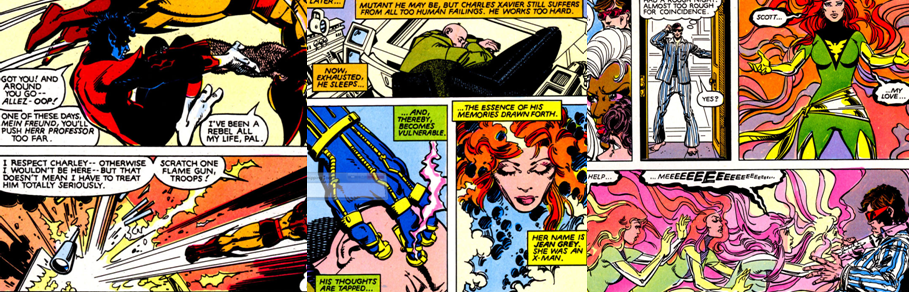
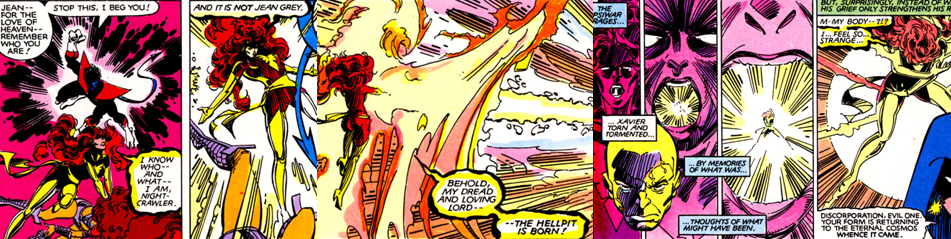
The story then jumps to Westchester, New York where Professor Xavier’s X-Men are engaging in a training session within the Danger Room, an exercise that grates on Logan/Wolverine’s patience despite his respect for the professor. After impressing Xavier with their teamwork, the Mutants retire for dinner and the story takes the opportunity to catch us up not only with the current X-Men roster and their powers (the aforementioned Wolverine, Scott Summers/Cyclops, Ororo Munroe/Storm, Piotr “Peter” Rasputin/Colossus, Kurt Wagner/Nightcrawler, and Kitty Pryde/Shadowcat) but also the tragic rise and downfall of Jean Grey, who attained incredible cosmic powers as the Phoenix that eventually corrupted and consumed her. The X-Men’s memories of Jean are extracted by Darkseid and the Phoenix briefly assumes a corporeal form where she begs for help from Cyclops much like Barry Allen/The Flash did in Crisis on Infinite Earths.

Raven and Starfire are spooked by Phoenix while Robin is jumped by Deathstroke!

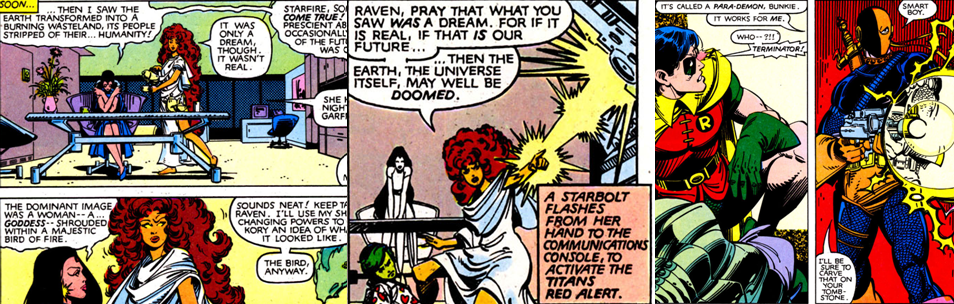
Meanwhile, over at Titans Tower (yes, in this story, the Marvel and DC universes again exist in a shared world rather than being separate, parallel worlds), Rachel Roth/Raven of the New Teen Titans finds her dreams interrupted by a prophetic nightmare of a woman, taking the shape of a flaming bird, destroying their world. When Garfield Logan/Changeling assumes the form of a similar bird, Koriand’r/Starfire randomly loses control of herself and attacks him; well aware of the threat that the Phoenix poses, Starfire summons the remaining members of the team (Wally West/Kid Flash, Donna Troy/Wonder Girl, and Victor Stone/Cyborg) away from their procrastinations, personal lives, and crimefighting antics to bring them up to speed on the Phoenix’s destructive power. Dick Grayson/Robin, however, is kept from joining his team mates when he butts heads with one of Darkseid’s Parademons only to be attacked by Slade Wilson/Deathstroke the Terminator, who not only reveals that he’s in cahoots with Darkseid but is easily able to knock Robin unconscious thanks to his superior physical and mental abilities. The X-Men discover that Jean’s parents and other areas across the world have also witnessed visions of Jean and mysterious incidents all linked to Jean’s past. After locating Robin, Starfire relates Phoenix’s legend as the “chaos-bringer” and a cataclysmic force; although Robin points out that cosmic threats are a little out of their league, and the more pressing issue of Deathstroke’s current plot, he promises Starfire that they’ll do everything they can to track down and stop Phoenix. The story then introduces us to Ravok the Ravager, another of Darkseid’s henchmen who he recruits as part of his plot to siphon the Phoenix’s vast cosmic powers.

Both the X-Men and Teen Titans are captured with a ridiculous amount of ease.

Weary from pushing himself too far, Xavier enters a deep sleep and barely has enough time to defend himself when Starfire bursts into the X-Mansion and attacks him in a rage. Xavier’s unparalleled psychic powers are subdued by a combination of Cyborg’s ultrasonic blasts and Raven’s dark “Soul-Self”, however Robin is disturbed and irritated at his team’s recklessness in breaking into the mansion and attacking Xavier without provocation. His reprimanding is interrupted by the arrival of Ravok and his Shock Commandos, who storm the mansion looking for the X-Men but quickly adapt to defeat and kidnap all of the Teen Titans but Changeling, who follows along undetected. While investigating New Mexico, the X-Men comes across Deathstroke and one of Darkseid’s “Psi-phons”; although they easily destroy the Psi-phon and are able to fend off the Parademons, Deathstroke quickly recovers from Wolverine’s initial attack to take each of the Mutants out with a “fear ray” that grounds Storm, a “toxi-grenade” that renders Shadowcat, Nightcrawler, and even Wolverine unconscious while a Parademon blasts Cyclops, and overpowers even Colossus’ hulking metallic form. Deathstroke and Ravok bring their captives to all-mighty Darkseid, who waits at the Source Wall and immediately sees through Changeling’s deception to subdue him, and then kills Ravok for his ineptitude with his destructive “Omega Beams”.

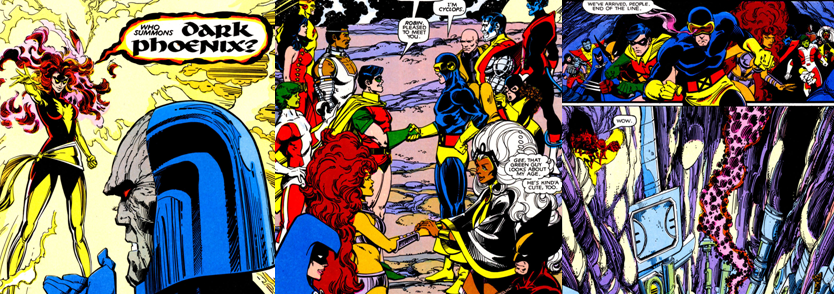
Darkseid summons Dark Phoenix but the heroes quickly join forces to confront the New God.

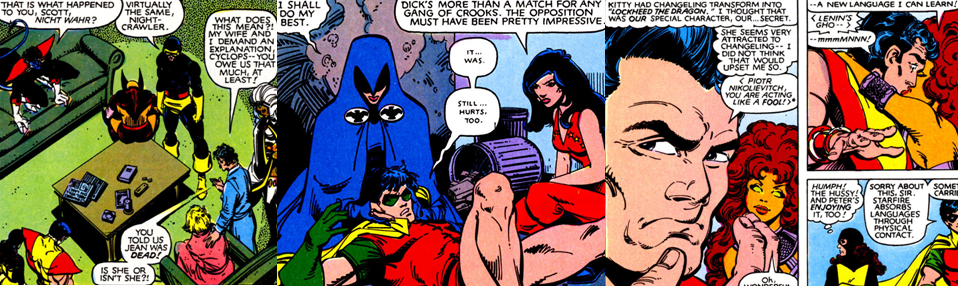
Darkseid secures his captives to a gigantic machine, the “Psychon-Wave”, which painfully and forcefully draws upon their superhuman powers and the Mutants’ memories of Jean, concentrating them on the breach in the Source Wall to bring Dark Phoenix back to life. He then regales the inquisitive Changeling with the reason for this plot (basically, he wants to use the Phoenix to transform the Earth into a new Apokolips that will allow him to conquer first New Genesis and then the length and breadth of reality itself). Hungry for destruction, Phoenix willingly accompanies Darkseid through a Boom Tube to begin this plot but, quite ludicrously, the heroes’ restraints disappear when Darkseid departs! Freed from captivity, the Teen Titans and the X-Men immediately agree to work together to stop Darkseid and Phoenix despite Wolverine not being happy about working with kids. While Shadowcat tries to flirt with Changeling and Kid Flash comments on the diversity of the X-Men, Cyborg, Xavier, Starfire, and Cyclops locate and acquire the Mobius Chair, which Shadowcat and Changeling accidentally activate to provide them with a means of escape. Tensions are stirred when Colossus sees Shadowcat flirting with Changeling and when Starfire kisses Colossus in order to learn Russian, but the team are soon carried back to New York in order to fulfil Cyclops’ solemn vow to make Darkseid pay for violating Jean’s memory and peace. They follow Phoenix’s unique psychic trail to a series of underground tunnels beneath the city where they are attacked by Deathstroke’s Parademons once more. Rather than waste time in a pointless battle, Robin and Cyclops give the order to collapse the tunnel and blast an escape route for their two teams, which conveniently brings them out right at Darkseid’s main base.

Dark Phoenix threatens the Earth’s safety so is subjected to a psychic attack.

Impressed at the tenacity of his foes, Darkseid dispatches Deathstroke and Dark Phoenix to hold the two groups off while he complete his work; although Starfire attacks Dark Phoenix in a fury, her starbolts succeed only in further empowering the corrupted Jean, who vehemently resists Nightcrawler’s attempts to reason with her and equally overwhelms even Raven’s Soul-Self. Dark Phoenix then powers up Darkseid’s “Hellpit” and Darkseid boasts about how this will transform Earth into Apokolips within mere minutes. Interestingly, he actually offers the X-Men and the Teen Titans the opportunity to yield and join his cause, which isn’t something I’ve ever seen Darkseid do before, but Shadowcat and Changeling opt instead to use their powers to try and disrupt and destroy the technology powering the Hellpit. For their insubordination, Darkseid commands Dark Phoenix to destroy them but they are saved at the last second by the combined power of Raven, Xavier, and the Mobius Chair. After Cyclops subdues Deathstroke and Robin spirits Shadowcat and Changeling out of danger, Dark Phoenix is bombarded by a psychic assault that simultaneously drains her rage and hatred and overwhelms her with love and affection.

Darkseid is defeated when the Phoenix Force is unleashed against him.

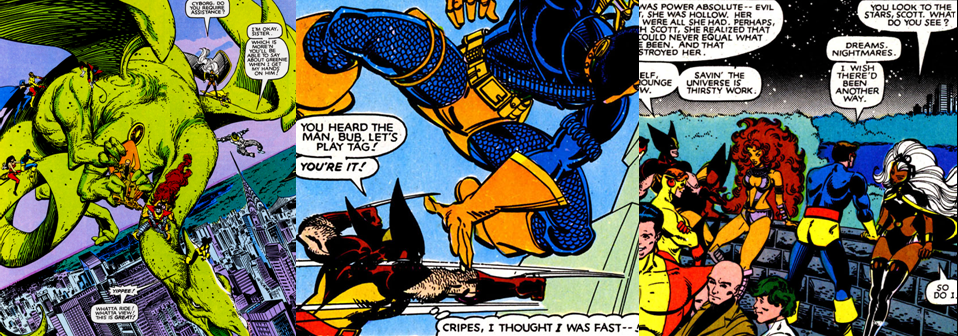
Drained, and close to unravelling, Dark Phoenix is easily goaded into reabsorbing the blast she fired at the Earth to sustain herself. When Darkseid moves to intervene, he is assaulted first by Kid Flash and then the combined forces of Cyborg, Wonder Girl, Colossus, and Starfire, who force his Omega Beams back into his eyes and therefore keep him from stopping Dark Phoenix from empowering herself and thus sparing the Earth. However, still at risk from being consumed by her raging power, Phoenix heeds Darkseid’s advice to focus her energies through a physical form and bonds herself to Cyclops. This, however, proves to be her undoing as Cyclops channels her powers with his undying devotion to his lost love and then turns the full Phoenix Force against Darkseid. The chaotic, flaming energy blasts itself, and Darkseid, across the vast cosmos of the universe to return to the Source Wall and thus imprison the New God within the Wall alongside the doomed giants of yore. Victorious, the two teams revel in how close they came to being destroyed and how fantastic their triumph was, while Scott finds some solace in Storm’s suggestion that Jean’s good soul ultimately saved them in the end. Finally, Metron returns to his chair and bids farewell to the imprisoned Darkseid, commenting that everything has returned as it once was as is to be expected.

The Summary:
“Apokolips…Now!” is quite the chaotic story; considering how many characters it has to juggle, it’s honestly surprising how coherent the story ends up being. If there’s one thing that always puts me off about team-based comics, especially X-Men and the Teen Titans, it’s the sheer abundance of characters and lore a single issue has to deal with so to mash the two together is no mean feat. The result is that no one single character from either team really gets any focus; indeed, many of the characters have next to nothing to do and the focus is, instead, on the meeting of the two teams rather than a bunch of separate interactions between them.

There are a lot of characters who don’t always get time to shine and whose interactions are limited.

This is best seen in the fact that neither Robin or Cyclops get much of a chance to act as a field leader; Nightcrawler is basically a non-factor, and Wonder Girl may as well not be there. Sure, most of the characters are assumed to be busy in fisticuffs with the Parademons and the Shock Commandos but we don’t really get to see much of this. Indeed, we’re even denied a proper fight involving Deathstroke; he takes out Robin with a ridiculous amount of ease, subdues all of the X-Men largely single-handedly, and his fight with Wolverine all takes place off-panel! These days, I like to believe that you’d never see that happen given how prominent Deathstroke and Wolverine are but, in this, Deathstroke is little more than one of Darkseid’s minions who gets taken out pretty quickly to continue the focus on Dark Phoenix. Indeed, Jean’s presence gets more play here than a lot of the other characters; her death was still relatively new at the time and hadn’t been driven into the ground yet so her reappearance is a particularly emotional moment for the X-Men, particularly Cyclops. However, while it’s pretty cool to see Dark Phoenix enamoured with Darkseid and willing to commit global destruction on his behalf, it’s not really enough to elevate this story for me.

While the art is great, the story is just okay and wastes a lot of potential.

I’m not entirely sure where Metron went or what happened to him when he breached the Source Wall and Darkseid’s plot basically boils down to every other plan he has (he’s either seeking out the Anti-Life Equation or trying to conquer the universe, it seems) and, again, he really doesn’t do all that much. This isn’t entirely out of character for Darkseid, who typically allows his underlings to do his work for him, but it’s kind of weird to see him team up with Deathstroke. Like…did Darkseid pay Slade off? I can’t help but feel Trigon might have been a more suitable villain for the New God to ally with. Overall, it’s a pretty decent tale; we don’t get to see the X-Men and the Teen Titans facing off against each other (the closest we get to that is when the Teen Titans attack a weakened Xavier), which is a shame, but it’s fun seeing the teams co-operate. There’s a little tension in the brief Colossus/Shadowcat/Changeling “love triangle” but that’s about all the dissention we get; I would have liked to see how Robin and Cyclop’s leadership styles differ and more interactions from Kid Flash, Wolverine, Wonder Girl, and Storm. Instead, the comic is all about the spectacle of seeing these different comic publisher’s heroes and villains interact in as unspectacular a way as possible. A fun adventure, to be sure, but maybe a little too “safe” and it could very easily be any one of a hundred other X-Men or Teen Titan stories with a few tweaks…but at least the artwork is good.

My Rating:

Rating: 2 out of 5.

Could Be Better

Have you ever read The Uncanny X-Men and the New Teen Titans? If so, what did you think to it? Do you own a copy of the original comic or do you remember reading it when it was first published? Were you disappointed that the two teams didn’t come to blows or were you happy to see them just working together with no issues? Would you have preferred to see different characters in each team’s line-ups? What did you think to Darkseid’s plan and the return of Dark Phoenix? Would you like to see the X-Men interact with Marvel heroes again in the future and, if so, what stories would you like to see? Whatever your thoughts on The Uncanny X-Men and the New Teen Titans, and comic book crossovers of this kind, drop a comment down below and check back next Wednesday for the final instalment of Crossover Crisis.

Movie Night [Robin Month]: Teen Titans: The Judas Contract


In April of 1940, about a year after the debut of arguably their most popular character, Bruce Wayne/Batman, DC Comics debuted “the sensational find of [that year]”, Dick Grayson/Robin. Since then, Batman’s pixie-boots-wearing partner has changed outfits and a number of different characters have assumed the mantle as the Dynamic Duo of Batman and Robin have become an iconic staple of DC Comics. Considering my fondness for the character and those who assumed the mantle over the years, what better way to celebrate this dynamic debut debut than to dedicate every Sunday of April to celebrating the character?


Released: 4 April 2017
Director: Sam Liu
Distributor: Warner Home Video
Budget: Unknown
Stars: Sean Maher, Kari Wahlgren, Stuart Allan, Christina Ricci, Gregg Henry, and Miguel Ferrer

The Plot:
Dick Grayson/Nightwing (Maher) rejoins his old team mates, the Teen Titans, who are now training a new generation of costumed heroes. Alongside their newest recruit, Tara Markov/Terra (Ricci), the Titans work to end the maniacal aspirations of Sebastian Blood/Brother Blood (Henry). However, things escalate when Blood hires mercenary Slade Wilson/Deathstroke (Ferrer) to kill the Titans and the team are faced not only with Slade’s burning desire for revenge against them but also a very real threat from within their ranks.

The Background:
The Teen Titans first came together in the pages of The Brave and the Bold #54 in 1964, some four years after the debut of their adult counterparts, the Justice League of America. The team was comprised entirely of the teenage sidekicks of DC Comic’s adult superheroes, potentially to appeal to younger audiences. The team had a relatively consistent presence throughout the 1960s and 1970s but was given new life when writer Marv Wolfman and George Pérez, who introduced characters like Victor Stone/Cyborg and Princess Koriand’r/Starfire who would become synonymous with the team for years to come. One of the team’s most celebrated stories was “The Judas Contract” (Wolfman, et al, 1984) in which they were betrayed by one of their own thanks to the machinations of the vindictive Deathstroke. An animated adaptation had been in the works for some time but, after a few false starts, finally came to life as part of the DC Universe Animated Original Movies series. The film, which was the third in this new animated continuity of films and iconic actor Miguel Ferrer’s last role before his untimely death, made over $3,250,000 in home video sales and was modestly received compared to what had come before it.

The Review:
The film begins with the original incarnation of the Teen Titans – comprised of Dick Grayson/Robin (Maher), Wally West/Kid Flash (Jason Spisak), Roy Harper/Speedy (Crispin Freeman), Garfield Logan/Beast Boy (Brandon Soo Hoo), and Karen Beecher/Bumblebee (Masasa Moyo) – meeting Starfire (Wahlgren) for the first time. If you’ve watched the awesome Teen Titans (2003 to 2006) cartoon before then many of the Titans’ characterisations will be instantly familiar: Robin is the composed leader, Beast Boy is the comic relief, Kid Flash is impatient, and so forth. This version of Starfire, while still being somewhat naïve and innocent, is far less childish compared to her counterpart; however, she nevertheless forms an immediate bond with the team after learning to communicate through kissing.

After a random flashback, we rejoin the Teen Titans adjusting to their new team dynamic.

We then jump ahead to “NOW” to find Brother Blood and his lover and right-hand, Mother Mayhem (Meg Foster), packing up their most recent Hive base. Choosing to ignore Deathstroke’s warning, the cult are caught completely off-guard when the Titans – now made up of Nightwing, Starfire, Beast Boy, Rachel Roth/Raven (Taissa Farmiga), Jaime Reyes/Blue Beetle (Jake T. Austin), Damian Wayne/Robin (Allan), and newcomer Terra – break into the facility using Terra’s power over earth and rock. Nightwing, who has only recently rejoined the team, finds it difficult adjusting to the new dynamic, which places Starfire as the field commander, but his experience and combat strategies are nevertheless appreciated by Starfire and his older teammates. There is, however, some discord within the team; not only are Nightwing and Starfire a little distracted by their intimate relationship outside of the team but she doubts her place as the team’s leader (despite Robin approving of her) and Robin constantly clashes with Blue Beetle over the unpredictability of Jaime’s alien Scarab suit. Still, the team takes out Blood’s goons and reconvenes at Titan Towers, where their teamwork and interpersonal relationships are developed a little more. Damian continues to have a somewhat disconnected and abrasive personality and remains fully committed to his role as Robin (he’s the only member to never appear outside of his costume during the film) and, interestingly, the film makes a subtle allusion to unpredictability of the Scarab to puberty during Jaime’s video call with his parents (Maria Canals-Barrera and David Zayas, respectively) and his interactions with a young girl he is attracted to that helps to highlight how, despite their superpowers or physical abilities, the Teen Titans remain just that: troubled teenagers trying to find their place in the world.

Blood is a twisted zealot who hires Deathstroke to capture the Titans and fuel his desires for Godhood.

Brother Blood is a ruthless zealot of a man; having organised Hive into a cult-like following, he believes that he has the gift of foresight and is fully willing to kill any who blasphemes against his beliefs. Regularly bathing in the blood of his enemies to maintain his youth and vigour and with a penchant for hanging out in graveyards, Blood has constructed an elaborate machine that is powered by the lifeforce of those connected to it that he plans to use to absorb the Titans’ superpowers and abilities to become a demigod. To that end, he hires Deathstroke to deliver the Titans to him, a task he takes great pleasure in given his past history with Damian and has prepared for by augmenting his already-impressive physical abilities by regularly bathing in a Lazarus Pit.

Deathstroke manipulates Terra into infiltrating the Titans to get revenge on Robin.

Terra constantly feels underappreciated by the team and perturbed by Beast Boy’s constant attentions and remains dismissive and bitter towards their personalities, hobbies, or issues. Aggressive and snappy, Terra has little interest in helping others in a way that doesn’t involve busting heads with her powers and is weary of the team’s constant attempts to reach and befriend her. Tormented by memories of her life in Markovia, where she was beaten and hounded and accused of being a witch, Terra has grown angry at and resentful towards humanity and has no interest in serving it for the greater good. Thus, she willingly infiltrates the team on Deathstroke’s behalf and allows him to capture Damian for Blood. Terra is absolutely besotted with Deathstroke after he saved her life in Markovia prior to the start of the film; devoted to him, she sees him as more than a mentor and father-figure and constantly attempts to seduce him in some truly awkward scenes that have her dressed in an overly provocative outfit. Although he rebukes her advances, he nevertheless commands her complicit behaviour by promising that they’ll be a couple and take command of the League of Assassins once the contract is fulfilled. Thus, begrudgingly, she returns to Titans Tower, now equipped with an audio/visual link up to Deathstroke, to continue her subterfuge. Though her anti-social personality begins to crack when she sees just how appreciative they are of her and she even shares a kiss with Beast Boy, she nevertheless lures each of the Titans into a series of traps that lead to them all being captured by Deathstroke and placed in Blood’s machine.

The Nitty-Gritty:
Teen Titans: The Judas Contract shares the same quasi-anime, stilted animation as other DC Universe Animated Original Movies. Still, the animation and visual presentation is made more appealing due to the aesthetic distinctiveness of each of the Titans and their individual powers. Raven, for example, exudes dark, ethereal magic while Beast Boy cycles between a variety of amusing animal forms as part of his somewhat awkward and hyperactive personality. Unfortunately for me, many of the Team’s appearances are taken from their New 52 designs, meaning that Nightwing is wearing his awful red suit; however, Deathstroke more than makes up for this with his bad-ass outfit that is only made all the more intimidating thanks to Ferrer’s distinctive gravely tones. The voice acting, in general, is really good, actually; Stuart Allan is particularly great at capturing Damian’s dickish attitude, I’ve always had a soft spot for Christina Ricci (and it’s great to see her voicing Terra rather than someone more cliché, like Raven), and (though I’m not really his biggest fan) the film even includes a brief cameo by Kevin Smith.

Terra’s abrasive attitude cracks but she remains loyal to Slade … right up until he betrays her.

Having the reveal of Terra’s dual nature quite early into the film makes for a great bit of suspense as we see her emotionally and physically manipulate each of the Titans into Deathstroke’s traps. The relationship between Terra and Slade has always been an unnerving and disgusting one full of appalling sexual subtext and this remains largely prevalent in the film as Deathstroke manipulates Terra’s motions in order to craft her into the perfect double agent. Even though Damian, with his unique insight into both Deathstroke and the League of Assassins, attempts to reach her, Terra is ruled by her bitterness and anger and is thus completely blindsided when Deathstroke betrays her in order to fully deliver on his contract with Blood.

Ultimately, Terra shows her true colours and sacrifices herself to stop Blood and Deathstroke.

In the finale, Nightwing frees his friends thanks to faking his death at Deathstroke’s hands and interrupting the party. Still, Blood is able to absorbs most of the Titans’ powers, which transforms him into a demonic creature and makes him more than a match for Starfire, Beast Boy, Raven, and Blue Beetle while Nightwing and Robin attack Deathstroke head-on in easily the film’s most impressive fight scene. Despite his near-unstoppable new powers, the Titans are only able to overcome Blood when Raven unleashes the full extent of her supernatural powers to strip him of his abilities and render him helpless, though Mother Mayhem kills Blood before he can be brought into the Titans’ custody. At the same time Terra, enraged at Deathstroke’s betrayal, mercilessly attacks and kills him with her incredible powers by bringing the entire area down him. Unable to live with her betrayal and pain, she then destroys the entire temple, taking herself along with it in recompense for her actions but, while Beast Boy is left heartbroken, the team honour their former comrade as a Teen Titan to the end.

The Summary:
As an adaptation of the source material, Teen Titans: The Judas Contract does the best that it can in its limited time; obviously, the story has been changed a little, the team is almost completely different, and even Deathstroke’s motivations are very different compared to in the original story but a lot of this is to be expected from the adaptation process. The film’s main concern seems to be with telling another story in the  DC Universe Animated Original Movies series; however, while it might be beneficial to have seen Justice League vs. Teen Titans (Liu, 2016) for a bit of additional context, it works pretty well as a standalone story. I do question why the film went to the effort of including a prelude where an almost completely different version of the team first meets Starfire as this doesn’t really tie into the main story (maybe it would’ve been better to have the older team be comprised of grown-up versions of the characters seen in the prelude) and I also feel like the story might have been better served by removing Brother Blood completely and instead focusing on Deathstroke and his vendetta against the Titans as the primary antagonist. Still, it’s a decent enough animated venture and adaptation of the seminal storyline, with some engaging action and intriguing character beats and some great vocal work from Allan, Ricci, and the late, great Miguel Ferrer especially.

My Rating:

Rating: 3 out of 5.

Pretty Good

Did you enjoy Teen Titans: The Judas Contract? Were you a fan of the changes that the film made to the story and the new team line-up? Have you ever read the original comic book the film is based on and, if so, where does it rank for you amongst other Teen Titans stories? Who is your favourite Robin and how are you celebrating the Boy Wonder’s debut this month? Whatever your thoughts on this film, Teen Titans, and Robin, leave a comment below and thanks for joining me for Robin Month!

Movie Night [National Anime Day]: Akira


15 April has been designated National Anime Day to celebrate the stylistic genre, which achieved mainstream success thanks to animators like Osamu Tezuka.


Released: 16 July 1988
Director: Katsuhiro Otomo
Distributor:
Toho
Budget: ¥700 million
Stars:
Cam Clarke, Jan Rabson, Lara Cody, Tony Pope, Lewis Arquette, and Bob Bergen

The Plot:
The year is 2019 and Neo-Tokyo is plagued by corruption, anti-government sentiment, and terrorism following Tokyo’s sudden destruction on 16 July 1988. Amidst the chaos, biker Shōtarō Kaneda (Clarke) uncovers a diabolical government conspiracy when his friend, Tetsuo Shima (Jabson), acquires incredible telekinetic abilities after a motorcycle accident that eventually threaten an entire military complex.

The Background:
It’s hard, if not practically impossible, to talk about anime without mentioning Akira; pretty much single-handedly responsible for the popularity of the genre outside of Japan, Akira remains an incredibly influential and popular animated feature and, arguably, the principal reason why anime remains so prevalent in the western world. Akira began life as a cyberpunk manga series written and illustrated by Katsuhiro Otomo. What was initially thought to be a short work of only ten chapters ended up ballooning into a 120 chapter piece that was serialised bi-weekly in Young Magazine from 20 December 1982 to 25 June 1990. Akira proved such a success in its native Japan that Otomo was approached to publish an English language version in 1983; indeed, Akira is often credited for introducing manga to Western audiences, and Otomo was eventually intrigued at the prospect of adapting his story for the screen…as long as he retained creative control, which meant not only collaborating on the screenplay, but also helming the adaptation, which was the most expensive anime film at the time. In a first for the genre, Akira used pre-scored dialogue where the dialogue was recorded first and the animation was keyed to match it and over 16,000 animation cels were used to bring the story to life, although Otomo later expressed disappointment at making the anime before the manga was finished due to how many omissions had to be made. Although a moderate success at the Japanese box office, Akira eventually grossed $49 million worldwide, and its success on home video basically kick-started the widespread release of anime outside of Japan. Anyone with even a passing knowledge of anime will be unsurprised to learn that Akira is held in extremely high regard; critics praised the dubbing and presentation, especially the slick animation and kinetic action, and film went on to be extremely popular and influential on a generation of writers, filmmakers, and creators and is widely regarded as one of the greatest anime films ever made.

The Review:
I feel like it’s important to preface this review by saying that I’m watching the original 1989 version of the film, dubbed into English; I know a lot of anime purists” might take exception to this, but I always prefer a dubbed version over subtitles or the original Japanese language as it’s easier for me to digest it and understand the content. Secondly, I never really cared for Akira; I’ve seen this version, and the 2001 re-dub, a few times both dubbed and with subtitles and, while the animation and attention to detail and the premise has always intrigued me, it tends to lose me about halfway through so I went into this viewing a little hesitant, to say the least. The film opens on 16th July 1988 to dramatically set the stage for its narrative by showing the utter obliteration of Tokyo from a massive energy blast; thirty-one years later, Neo-Tokyo was built on artificial islands nearby and all that’s left of the once bustling metropolis is an ominous crater. 2019 Neo-Tokyo is both a technologically advanced civilisation and a crime-ridden cesspit full of seedy bars and dilapidated back alleys. It’s in both of these locations that we meet our two main characters; abrasive Kaneda, the leader of a biker gang known as the Capsules (who are embroiled in a bitter feud with the rival Clown gang), and Tetsuo, a young, embittered member of the Capsules who both idolises Kaneda and is envious of his iconic high-tech bike. A brutal high-speed chase between the Capsules and the Clowns is cut short when the cops arrive to chase them off and, amidst all of this, the city is under lockdown following a student riot; armed police are called in to help manage the chaos, and end up shooting an armed man as he tries to desperately protect Takashi (Barbara Goodson), a young boy with a wizened appearance who exhibits incredible psychic powers when under stress.

A chance encounter with a strange child sees angst-ridden Tetsuo develop incredible powers.

The streets are thrown into chaos as the cops use gas to disperse the crowd, and Tetsuo takes a bad fall from his bike after running across Takashi; Takashi’s abilities attract the attention of Masaru (Bob Bergen), a fellow ESPer, who leads Colonel Shikishima (Pope) of the Japan Self-Defence Forces right to him, resulting in Takashi, Tetsuo, Kaneda, and the rest of the Capsule gang being apprehended. While the injured Tetsuo is transported away, Kaneda and his gang prove too clueless to be involved in the greater concerns of anti-government protesters and resistance fighters, and are released from custody. However, Kaneda spots Kei (Cody) amidst the suspects and, taking a shine to her, manages to trick the cops into releasing her alongside them by claiming she’s part of his gang, though she rebukes his advances afterwards. At school, Kaneda and his gang are severely disciplined for their actions, which only riles the anti-authority biker up even more; he and the Capsules attract a lot of female attention for their bad boy antics, but he’s in no mood for socialising after the night he’s had, and openly criticises Tetsuo for “showing off”. Only Tetsuo’s girlfriend, Kaori (Barbara Goodson), shows concern for the boy, and he goes to her after escaping from the military facility; traumatised by his experiences, and fearing for his life, he steals Kaneda’s bike and prepares to leave the city with Kaori, but their escape is cut short by a group of vengeful Clowns. They attack Kaori, humiliating and hurting her as Tetsuo is held helpless and, though they’re saved by Kaneda and the Capsules, Tetsuo is angered at Kaneda’s constant interference in his life. Suffering from crippling headaches, nightmarish visions, and a voice tormenting him with an unknown name, “Akira”, over and over, Tetsuo is easily detained and returned to the facility for further observation by Shikishima’s staff.

Shikishima is a complex soldier who takes the ESPer’s word, and threat, very seriously.

Shikishima acts as the stubborn, pig-headed, yet surprisingly complex antagonist of the feature; convinced that there’s a mole within the executive council and determined to shut down any anti-government sentiment and apprehend anyone who learns of the ESPers no matter the cost. With no time for political games, Shikishima is more concerned with identifying and controlling telekinetic abilities so that the military can gain a formidable weapon without the risk of mass destruction exhibited by Akira; when Doctor Ōnishi (Lewis Arquette) identifies that Tetsuo has the potential to become as powerful as Akira, Shikishima orders that he be subjected to a series of painful and invasive procedures to unlock that potential but warns that the angst-ridden biker is to be terminated the minute any danger arises. Despite his implacable, hardened exterior, Shikishima seems to have a greater deal of respect and admiration for the ESPers in his employee and care and thus takes Kiyoko’s (Melora Harte) warnings of Neo-Tokyo’s impending destruction very seriously. Although he is disgusted at how quickly the city has degenerated into a den for hedonistic excess and believes that the people have lost their way, he’s not a scientist or an optimist and instead sees the world in very black and white terms and from a strict military perspective of action versus inaction, with little room for debate or hesitation between these extremes. Unfortunately, the supreme council fail to heed his warnings or to grant him the funding necessary to prepare against Kiyoko’s prediction; instead, they cast doubt over Akira’s existence and involvement in the last World War, call the colonel’s integrity into question, and would rather bicker and squabble about preparations for the upcoming Olympics, which only enrages Shikishima. Determined to track Tetsuo down and contain him before his powers reach their full, destructive potential, Shikishima takes control of the government and the entire military in a coup d’état and engages Tetsuo with the military’s full force, which results only in countless soldiers perishing and tanks being destroyed by Tetsuo’s raging powers, which allow him to form protective shields, toss back tank shells, and tear apart an entire bridge in his fury.

Tetsuo is a slave to his emotions, consumed by rage, envy, and his own monstrous body!

Kaneda continuously runs across Kei and is so besotted by her that he even tries to downplay her first kill and ends up following her to a resistance safehouse; there, he learns not only that they are trying to free the ESPers from their confinement but also that Tetsuo has become the military’s newest test subject, and he agrees to join their efforts both to help his friend and get close to Kei (and he’s allowed to if only to serve as a patsy for the resistance’s actions). While at the hospital, Tetsuo is plagued by vivid and disturbing nightmares of both his childhood, his destructive powers, and the mysterious Akira, the most powerful of all the ESPers who once potentially represented the next stage in human evolution. Akira’s power was virtually limitless, but when the government tried to take control of him, he lashed out in self defence and caused the catastrophe that decimated Tokyo. His remains are kept in cryogenic suspense beneath the Olympic Stadium’s construction site, and Shikishima has no desire to see that destructive power unleashed once more, and takes a vested interested into making sure that the remains stay dormant, though Akira still has a strong influence as many zealots in the city foretell of his destructive return. Sensing that Tetsuo’s powers are raging out of control, the ESPers try to kill him before he can awaken Akira and trigger another catastrophe; however, despite them being more adept at creating illusions and wielding their psychic powers, Tetsuo’s abilities are exacerbated by his anger, confusion, and trauma, which makes him more than a match for them, to say nothing of Shikishima’s forces. Revelling in his newfound powers, Tetsuo is driven to near insanity, lashing out at friend and foe alike with a maniacal glee; he kills a couple of his former comrades in search of Kaneda’s bike, garbs himself in a dramatic cloak, and is heralded as the returning “Lord Akira” for his immense powers. Despite Kiyoko’s best efforts, Tetsuo exhumes Akira’s tomb and is astounded to find that the feared psychic is nothing more than just organs and remains in jars; Kaneda attacks Tetsuo with a high-powered laser rifle and berates his friend with taunts, only to be outmatched by Tetsuo’s powers and at the mercy of his power-drunk friend. Despite losing at arm to Shikishima’s orbital cannon, Sol, Tetsuo proves his superiority by flying into space and obliterating the orbital weapon before constructing a replacement mechanical arm for himself. Although Kaori tries to comfort him, and even Shikishima tries to talk him into returning to the hospital for treatment, Tetsuo’s powers grow dangerous and out of control; wracked with constant pain and mutating at an alarming rate, Tetsuo metamorphosises into a horrific, foetus-like monstrosity that is only stopped by the ESPers reviving Akira and drawing him into a singularity.

The Nitty-Gritty:
The animation quality in Akira remains almost unparalleled; the feature-length anime definitely set a standard for all to follow with its gorgeous chase sequences, intense attention to detail, and slick, striking character designs. Neo-Tokyo is a neon-drenched metropolis that owes more than a debt to Blade Runner (Scott, 1982) and, alongside that classic science-fiction thriller, helped popularise the “cyberpunk” art style and genre. The city is ruled by the classic class system, with the lower-class and impoverished literally fighting for survival in the filthy back alleys and the upper-class living in opulence and luxury in the high-rise skyscrapers, far above the violence on the city streets. Neo-Tokyo is under constant threat from terrorist attacks by resistance fighters, who set of explosions across the city and cause anarchy in the streets in a desperate effort to fight back against an oppressive government. The city is alive with advanced technology, from futuristic motorcycles, flying craft, and complex machinery to monitor and contain the ESPers, the city, and the people and this is juxtaposed with rancid sewers and the comparative squalor of the alleys and lower street levels. The facility where Tetsuo and the other ESPers is kept is both a sophisticated military hospital and a bizarre nursery for the decrepit, child-like psychics, but the triumph of the modern age is Sol, a weaponised space station that Shikishima turns on Tetsuo in a desperate attempt to destroy him before his powers can rage out of control.

Akira is full of horrific imagery and body horror as Tetsuo’s powers rage out of control.

One thing that separates Akira from other traditional cartoons and animation is the gritty, unabashed adult themes and content in the feature; biker gangs race through the streets at high speeds, with little protection and even less regard for who they hurt or the damage they cause in their wake, curse words are dropped with reckless abandon by the hot-headed youngsters who make up our main characters, and bodies break and blood splatters as characters beat and pummel each other. This latter aspect is only escalated by the trigger-happy Neo-Tokyo police, who brutally gun down Takashi’s handler without a second thought, and both the visions Tetsuo is plagued by and the horrific mutations he undergoes as his powers rage out of control. Tetsuo is tormented by hallucinations of demonic toys and, angry and afraid, lashes out at everyone around him to leave orderlies and guards a mere bloody mess on the hospital walls. As Tetsuo’s powers grow, his ability to control them wanes; overcome by pain and hatred, he lashes out in a mindless fury and ends up becoming a rampaging monstrosity that kills Kaori and threatens to absorb Kaneda, the ESPers, and Shikishima. This replaces Tetsuo’s fanatical lunacy with outright panic as his body refuses to listen to his demands; as if the sight of him raging into the upper atmosphere with a bloody mess where his arm once was wasn’t bad enough, the sight of this grotesque mass of screaming flesh and muscle engulfing everything in its path certainly escalates the stakes of Akira from one boy’s madness to a disaster that potentially threatens all life in Neo-Tokyo and beyond.

Kaneda’s confrontation with Tetsuo results in widespread destruction…and the birth of a new God!

Tetsuo is a tragic figure, one filled with conflicting emotions of abandonment, resentment, and anger; the more his abilities grow, the more overwhelmed and out of control he becomes. Finally given the power to strike back at those who seek to use or hurt him, Tetsuo’s confusion and fury are only exacerbated by the ESPers, Shikishima’s vendetta, and even Kaneda, who mocks his friend even as his body horrifyingly transforms. Realising that they’re not powerful to oppose Tetsuo, the ESPers revive Akira, who sucks the monstrous beast into a sphere of pure light. Kaneda is drawn inside this singularity and relives Tetsuo’s memories of his traumatic childhood, a time of abuse and fear where he idolised Kaneda; the ESPers willingly enter the singularity as well in an attempt to rescue Kaneda, and their memories of being subjugated to experimentation are also revealed to him. Shikishima, Kei, and Tetsuo’s remaining friends watch from a safe distance as Neo-Tokyo is engulfed by the singularity, destroying it in much the same way as its predecessor was obliterated some thirty years ago, and the ESPers are able to return Tetsuo to the remains of his home so that he can help Kei during the development of her own psychic powers. As for Tetsuo, the feature concludes with the ESPers and Akira using all the power at their disposal to help him fully transcend beyond the mortal realm; having tapping into the limitless energy and primordial power that exists within all humans, Tetsuo ascends to the level of an omniscient God and, to herald his birth, gives life to an entirely new universe! This, honestly, is not massively clear by the finale which is an ambiguous and surreal series of images, memories, and half-finished sentences, but brings the film to a conclusion that I have to say was very much out of left field considering it started off as a simple tale of an angsty gang of bikers.

The Summary:
Even now, after a few viewings of Akira, I struggle a bit with this film; while it’s undeniably beautiful to look at and full of some absolutely stunning animation, its surreal metaphysical undertones always knock me for a loop. Like a lot of anime and manga, there’s a lot happening here, from street-level violence and social discord, to childhood trauma, to government experiments and children developing psychic powers. It’s definitely a very complex and multifaceted world, with a lot of layers and sub-plots happening all at once that some characters, like Kaneda, aren’t entirely aware of; people revere Akira as some kind of prophet and saviour, resistance fighters bomb buildings and kill to try and expose the government’s experiments, and shrivelled up children with telekinetic powers bring toys to life in the most disturbing way possible. I think the concept has a lot of legs, however; this idea of a screwed up little biker kid being empowered by these destructive abilities and lashing out at the chaotic world around him leads to some of Akira’s most dramatic and memorable moments, and the relationship between Kaneda and Tetsuo as these kind of traumatised kids with a chip on their shoulder bonded by a lifetime of hardship results in them being the clear standout characters. Shikishima is also surprisingly well-rounded, and every character, even the ESPers, is seeped in shades of grey rather than being morally black or white. Of course, Akira will forever be remembered and praised for its slick and detailed animation, which results in some stunning chase sequences, dramatic moments, and grotesque imagery to really inspire the viewer to think about what they’re seeing, what it means, and rethink their surface evaluation of these characters. It can be a lot to take in, no doubt, but the visuals and narrative intrigue are well worth taking the time to give Akira a watch and, if it hooks you, check out other similar anime or even read through the manga if you want your mind blown even further.

My Rating:

Rating: 3 out of 5.

Pretty Good

Are you a fan of Akira? Which of the characters was your favourite and what did you think to the morally ambiguous nature of its cast? What did you think to Tetsuo, his emotional outbursts, and his eventual monstrous transformation? Were you a fan of the film’s cyberpunk setting and the escalation from street gangs to psychically-endowed children? How did you interpret the ending, and were you a fan of how the story wrapped up? Have you ever read the original manga and, if so, how does the film compare as an adaptation? Was Akira your introduction to anime or did a different feature make you a fan of the genre? How are you celebrating National Anime Day today? Whatever you think about Akira, or anime in general, sign up to drop your thoughts below.

Movie Night: Sonic the Hedgehog 2

Released: 8 April 2022
Director: Jeff Fowler
Distributor: Paramount Pictures
Budget: $110 million
Stars: Ben Schwartz, Jim Carrey, Colleen O’Shaughnessey, Idris Elba, James Marsden, Tika Sumpter, and Tom Butler

The Plot:
After banishing Doctor Ivo Robotnik (Carrey) to a mushroom planet, Sonic the Hedgehog (Schwartz) is determined to defend Green Hills. However, when Dr. Robotnik returns alongside Knuckles the Echidna (Elba) in search of the mysterious Master Emerald, Sonic must join forces with Miles “Tails” Prower (O’Shaughnessey) to find the emerald before its too late.

The Background:
As a principal figurehead in the escalating Console War between Nintendo and SEGA, Sonic has seen his fair share of adaptations, starring in numerous comic books and animated ventures over the years, with each one altering his appearance and backstory and making him one of the most iconic and, yet, convoluted videogame mascots. Development of a Sonic the Hedgehog movie can be traced back to 1993, when the character dominated television screens with his numerous animated adventures, but, thanks to numerous legal and creative issues, the best Sonic had to settle for was the gorgeous original video animation (OVA), Sonic the Hedgehog: The Movie (Ikegami, 1996). However, after Paramount Pictures acquired the rights to the franchise, development of a live-action/CGI hybrid movie finally entered production in earnest; fans, and audiences the world over, were horrified when the first teaser released, however, and the studio scrambled to redesign Sonic into something a little less nightmare-inducing. Surprisingly, Sonic the Hedgehog (Fowler, 2020) bucked the trend of most videogame adaptations by being critically and commercially successful, and a sequel was soon pushed into development. Also surprisingly, star Jim Carrey expressed interest and excitement in returning to the role and portraying a more physically accurate version of Dr. Robotnik, and the cast was bolstered not only by expanding upon Tails brief cameo at the end of the first movie but also by the genius decision to cast Idris Elba as Knuckles and introduce more elements from the videogames that were missing from the first film. Sonic the Hedgehog 2 was met with fairly positive reviews that praised the action and humour but criticised the runtime and pacing. The film also grossed over $400 million worldwide, fully justifying both a third movie, and a Knuckles-centric spin-off, despite Carrey announcing his retirement from acting.

The Review:
Like many, I’m sure, I was very surprised by how good Sonic the Hedgehog turned out. Considering I felt (and, to be fair, still feel) like an all-CGI movie would’ve been a better, less restrictive, and cheaper option (with Carrey the only human character and donning a fat suit), it was a pretty fun road trip adventure that did a decent job of capturing the spirit of the videogames while also presenting a new take on SEGA’s super-fast mascot. All of the fan service definitely helped, as well; while I had the post-credits scene spoiled for me, I was very happy to see an echidna tribe cameo at the start of the film and felt like the film did just enough to establish its premise to build upon its lore in sequels.

Sonic is determined to use his powers for good, which makes him somewhat reckless and impulsive.

Sonic the Hedgehog 2 finds Sonic in a much more stable and confident position than where he started in the first film; where he was once a lonely outcast, hiding out and barely really understanding his incredible supersonic speed, he’s now a happy and energetic bundle of spines thanks to being taken in by Tom (Marsden) and Maddie Wachowski (Sumpter). Pumped up from discovering his superspeed can allow him to do incredible things, Sonic has been trying to make a name for himself as a superhero in nearby Seattle, however his enthusiasm has a tendency to make him reckless; rather than simply allow local law enforcement to handle such occurrences as bank robberies and high-speed chases, Sonic feels obligated to step in and help out, which generally results in cartoonish chaos due to his immaturity. Though Tom tries to explain to Sonic that his powers will be useful in time, and that his moment to shine as a hero is inevitable, he also stresses that Sonic is still just a kid and needs to let that moment come naturally rather than force it. Thankfully, Sonic doesn’t outright reject his friend’s advice, but he does feel a duty to make Longclaw’s (Donna Jay Fulks) sacrifice worthwhile and to make her proud by using his powers to help others and protect his newfound friends. While they were a central aspect of the first film, Tom and Maddie really don’t get all that much to do here; they treat Sonic as a combination of a pet, a friend, and a surrogate son and the three have an adorable family unit going on, which is nice to see. There’s no dissension between them, even though they may despair of Sonic’s recklessness and immaturity at times, but they don’t really factor all that much into the plot beyond Tom being a loyal, if goofy, friend and Maddie being a supportive influence.

While the human characters are pushed aside, Sonic gains a new friend in Tails.

I can’t say that I’m massively disappointed by this, as I’d much rather these films focus on the videogame characters, but it does lead to some odd pacing moments. The big gag of the film is that Maddie’s sister, Rachel (Natasha Rothwell), still doesn’t care for Tom and doesn’t want him ruining her wedding. Unfortunately for Rachel, Tom accidentally swaps out her wedding ring for one of Sonic’s Golden Rings, causing her wedding to be ruined by a snowstorm, and then there’s a noticeable lag in the second act as Rachel and Maddie team up to help rescue Sonic from Commander Walters (Butler) of the Guardian of United Nations (G.U.N.) and confront her would-be husband, Randall (Shemar Moore), in scenes that really interrupt the pace of the film. Thankfully, Tails is on hand to add to Sonic’s circle of friends; here portrayed as a young mechanic from another world who is awestruck by Sonic’s speed and bravery, Tails travels to Green Hills to warn Sonic of Dr. Robotnik’s return and gets swept up in his globe-trotting adventure to find the Master Emerald. A skilled inventor, Tails lacks confidence in a fight and is plagued by self-doubt after a lifetime of bullying for his extra tail, which allows him to fly by spinning his tails like helicopter blades. However, his self-esteem is boosted by Sonic’s mere presence as he pushes Tails to accompany him to Siberia, encourages him to compete in a protracted and lengthy dance-off, and is impressed at the young fox’s inventions, which include a translator, a laser pistol, and a hologram projector. Tails arrives at just the right time as, while Sonic has found a stable family unit with Tom and Maddie, he still doesn’t really have any real friends, much less anthropomorphic kin such as himself; having observed Sonic for some time using his machines, Tails is eager to just be around him and is overjoyed when they form a fast friendship due to the pressing nature of the current crisis. Tails gives Sonic the chance to pay forward the kindness Tom showed him in the last film, but his attempts to show Tails Earth customs tend to lead to cartoonish pratfalls or are cut short by Dr. Robotnik’s repeated attacks. However, Sonic quickly takes a liking to Tails and sees him as a little brother, of sorts; he’s distraught when Tails his hurt because of his recklessness and fully prepared to put himself on the line to keep his new friend from being hurt again, but comes to trust in him, and their unlikely ally, for the finale, which requires a team effort rather than Sonic shouldering the burden alone.

Dr. Robotnik returns more wacko than ever, and joined by the aggressive and prideful Knuckles!

While Tails’s intentions are noble, he sadly arrives too late to warn Sonic of Dr. Robotnik’s return, or the presence of Knuckles, a super-strong echidna from a long-dead tribe who is as prideful as he is aggressive. Having been marooned on the Mushroom Planet for nearly a year, Dr. Robotnik has gone even more wacko than he was before; embracing his baldness and his wild moustache, he spent his days trying to brew tea from the native foliage and constructing a machine to attract the attention of other lifeforms using one of Sonic’s quills. This led Knuckles to him, and the mad scientist was easily able to foster an alliance with the headstrong echidna by leading him to Sonic, whom Knuckles blames for the death of his father and his tribe since his people never returned from their mission to retrieve the Master Emerald’s location from Longclaw. Exhibiting physical abilities similar to Sonic’s Knuckles brings a raw, primal power that, coupled with his naïvety and pride, make him a formidable foe. Thanks to Knuckles’s blind vendetta against Sonic, Dr. Robotnik s able to reunite with Agent Stone (Lee Majdoub), reassume control of his machines, and begin a quest to locate the Master Emerald to not only get revenge against Sonic but to subjugate the entire world to his mad desires since the Master Emerald has to power to turn wishes into reality. Jim Carrey is clearly having the time of his life as Dr. Robotnik, meaning he devours every scene he’s in and is a constant highlight of the movie, but this does come with some detriments; some scenes of him going off the rails drag on a little, I felt like Agent Stone was a waste of screen time, and it’s still disappointing that he’s not wearing a fat suit. Knuckles, however, was a fantastic inclusion; he has a real weight to him, and his habit of taking everything literally reminded me of Drax the Destroyer (Dave Bautista) and made for some fun moments. Rather than being a complete moron as in some depictions, Knuckles is a misguided and sheltered warrior who’s burdened by his losses and is trying to fulfil his destiny, just like Sonic, and this means he has some heart and poignancy alongside being a hostile meathead.

The Nitty-Gritty:
The first movie was all about telling a heartfelt story about the power of friendship, and helping Sonic to move past his traumatic childhood and become an accepted part of Tom and Maddie’s life. Here, the central theme of the movie is destiny; Sonic is in a rush to realise his true calling and to make Longclaw proud, just as Knuckles is so blinded by his duty to retrieve the Master Emerald that it makes him susceptible to Dr. Robotnik’s obvious manipulations. Despite his recklessness, Sonic’s heroic nature allows him to recognise when his friends (Tom, mostly) are trying to help him rather than push them away, and, while he’s determined to oppose Dr. Robotnik and fend off Knuckles, he eventually reaches a point where he can see that Knuckles has been manipulated by the mad doctor and so focuses on trying to keep the Master Emerald out of Robotnik’s hands rather than waste time fighting Knuckles. Fans of the Sonic franchise will find Sonic the Hedgehog 2 as littered with Easter Eggs and reference as the first film: Tom’s ring tone is the iconic Sonic theme, Agent Stone uses a brewery called Mean Bean as cover, and there more than a few visual cues taken from Sonic Adventure (Sonic Team, 1998) such as Sonic snowboarding away from an avalanche, the Seattle sewers exploding in water geysers, and Sonic striking a pose ripped straight from the Dreamcast cover art. While I remain somewhat disappointed that these films don’t take place in a fantasy, full-CGI world, these references help to alleviate that and the addition of Knuckles only helps to infuse further visual cues from the games. The hidden temple is almost exactly like the Echidna architecture seen in Sonic Adventure, and the interior is heavily inspired by the traps, water, and layout of Labyrinth Zone.

After going head-to-dread, Sonic and Knuckles team up to put a stop to Robotnik’s mad schemes.

The battles between Sonic and Knuckles are easily the film’s biggest highlight, though; exhibiting superhuman strength, Knuckles can both keep up with Sonic’s speed, leap vast distances, and easily overpower him with a single punch, crackling with red energy, Knuckles can scale walls, catch Sonic’s spinning form in mid-air, and unleash a flurry of punches without breaking a sweat, and his incredible strength is matched only by his no-nonsense attitude as he doesn’t hesitate to smash first and ask questions later. Dr. Robotnik returns in full force with his army of drones; however, while some resemble Buzz Bombers, his traditional Badniks continue to be absent from the films. He does pilot a far more faithful Egg-O-Matic pod this time around, though, and Carrey is constantly wriggling his fingers and striking wild poses as he directs and controls his machines to unleash laser blasts and a barrage of missiles at every turn. Dr. Robotnik’s true goal, however, is to seize the all-powerful Master Emerald for himself; thanks to hacking Sonic’s phone, and his network of satellites, Dr. Robotnik is easily able to track Sonic’s movements after Longclaw’s map leads them (somewhat inexplicably, it has to be said) to a compass that will reveal the Master Emerald’s hidden temple. Stealing it and braving the temple’s many death traps using his machines, Dr. Robotnik turns on Knuckles and transforms into a literal God after laying his hands on the Master Emerald. His first thought is to unleash his newfound Chaos powers upon Green Hills, and it’s only after Sonic offers Knuckles a chance at redemption (and a hand of friendship) that any kind of hope of stopping Dr. Robotnik’s nigh-limitless powers becomes possible. After assembling a gigantic mechanical exoskeleton in his visage, Dr. Robotnik lays waste to Green Hills, and Sonic, Tails, and Knuckles are forced to work together to stop him. with Tails having commandeered a biplane for their use, the three brave the onslaught of missiles and the mechanical monstrosity’s stomping feet to get close to Dr. Robotnik and lure him away from the populace by using Sonic as bait. Their combined efforts allow Knuckles to land a blow on the mad doctor, knocking the Master Emerald from his body, but he remains a clear and present danger thanks to assuming command of his robot using traditional controls. This leaves Sonic, Tom, and Maddie in mortal danger but, thanks to absorbing the powers of the seven Chaos Emeralds released from the Master Emerald, Sonic becomes empowered with a golden energy that allows him to easily lay waste to Dr. Robotnik’s mech and, apparently, end his threat once and for all. In the aftermath, Sonic willingly and humbly gives up his God-like powers and he and his new friends set about making a new life for themselves with Tom and Maddie, unaware that a mysterious new foe lurks in the shadows…

The Summary:
There’s no doubt that Sonic the Hedgehog 2 goes out of its way to be bigger and better than its predecessor; the film is full of gags, exhilarating action, and fun sequences that shine all the more from the CGI models being far more detailed and expressive than before. While there are times when the film slows down to pad out its runtime with dance-offs and lingering on Jim Carrey’s madcap ab-libbing, it still does a brilliant job of being a fun adventure film, even if it’s primarily targeted at a younger audience. The addition of Tails and Knuckles really bolstered the scope of this new take on Sonic’s world; while I would’ve preferred the films just went all-in right from the start with a CGI movie that has all these characters existing in a fantasy world like in the games, I appreciate the little references and the way these films hint at there being more behind these characters. The addition of two more anthropomorphic characters also helps to shift the focus more onto these unique and colourful characters; while this means the humans are pushed to aside and reduced to supporting roles of comic relief, I’m okay with this as it means more time for Tails and Knuckles to shine. And shine they do thanks to some intense action and fight sequences which, while breaking all the laws of physics, make for the film’s most exhilarating moments. While Sonic, Tails, and Knuckles still stand out as being overly cartoony and the film missed a film tricks by not including more musical cues from the videogames, this was a really fun escalation of everything we saw in the film and did a really good job of capturing the spirit of the source material and splicing it into this new interpretation of the world’s most famous hedgehog.

My Rating:

Rating: 4 out of 5.

Great Stuff

Did you enjoy Sonic the Hedgehog 2? How do you feel it holds up compared to the first film? Did you enjoy the addition of Tails and Knuckles to the film and what did you think to Knuckles’s portrayal? What did you think to Jim Carrey’s more unhinged performance this time around? Are you disappointed that he wasn’t in a fat suit and which of the many references to the videogames was your favourite Easter Egg? Where do you see the films going from here and are there any Sonic games or characters you’d like to see make an appearance in the future? To share your thoughts on Sonic the Hedgehog 2, sign up to reply below or leave a comment on my social media, and be sure to check back in for more Sonic content in the near future!

Back Issues [Crossover Crisis]: Batman vs. The Incredible Hulk


In April 1985, the first issue of the ground-breaking Crisis on Infinite Earths (Wolfman, et al, 1986) released and saw the temporary destruction of the “Multiverse”. To celebrate this momentous event, I’m discussing multiversal crossovers all throughout April in an event I dubbed “Crossover Crisis”.


Story Title: “The Monster and the Madman”
Published: September 1981
Writer: Len Wein
Artist: José Luis García-López

The Background:
Although the two companies both publish stories of colourful, superpowered heroes in a cut-throat industry, the relationship between DC Comics and Marvel Comics has been surprisingly collaborative and amicable over the years (especially compared to many of the toxic fans” who argue on social media every day…) Sure, there’s been lawsuits and underhanded tactics from both companies, but not only were the legendary Stan Lee and the disreputable sham Bob Kane actually good friends but both companies borrowed from and inspired each other and they’ve even collaborated on many joint publications in the past. Having already pitted Clark Kent/Superman against Peter Parker/Spider-Man in Superman vs. The Amazing Spider-Man: The Battle of the Century (Conway, et al, 1976), DC and Marvel brought these two characters together again in 1981. That same year, the two companies also produced a sixty-four-page “Treasury Edition” comic book that pitted Bruce Wayne/Batman against Doctor Bruce Banner/The Hulk. At the time, graphic novels were nowhere near as commonplace as they are today and both characters were experienced a way of renewed mainstream interest off the back of a popular television series and moving away from the camp aesthetic of the 1960s, respectively. Like many of these early DC/Marvel crossovers, Batman vs. The Incredible Hulk can fetch a pretty high price these days, and it also wouldn’t be the last time that their paths crossed in one form or another.

The Review:
One of the most reliable constants of many comic books, especially back in the 1960s through to the mid-1990s, was that many stories derail or pad out their narrative with a recap of their character’s origins and background. This seems to mostly happen to Spider-Man, who often interrupts whatever problem he’s having in the issue to recap his iconic origin and, don’t get me wrong, I get why this happens (you can’t expect every reader to be familiar with your characters, after all) but I much prefer it when comics simply have a bit of text before the story to catch readers up. Batman vs. The Incredible Hulk opts for this latter option and is all the better for it; before the story starts, we get a one page, two-column spread the recaps how Bruce Wayne saw his parents shot and trained his body and mind to become Batman and how Dr. Banner was bombarded with Gamma radiation and subsequently transforms into the rampaging Hulk whenever stressed or angry. Like Superman vs. Spider-Man, Batman vs. The Incredible Hulk begins with a prologue that establishes the villains of the story; the first is more of an abstract introduction as people all over Gotham City suffer from horrific and disturbing nightmares while the second is far more tangible as is shows that the Joker is back in town and has joined forces with a disembodied voice for nefarious reasons. The story then shifts to find Banner, under the pseudonym of “David Banks”, working a menial job for Wayne Research in order to get close to their “experimental Gamma-Gun”, and who is the only person to act fast enough to slip into a radiation suit and avoid the Joker’s debilitating laughing gas when the Harlequin of Hate and his goons show up to steal that same device!

Outmatched against the Hulk’s sheer power, Batman out-thinks the brute to take him down.

When Banner moves to raise the alarm, he is tackled and beaten by Joker’s thugs which, of course, causes him to transform into the Hulk! Quickly realising that their firepower is absolutely useless against the creature, the Joker orders his men to grab the Gamma-Gun and flee but their escape is impeded by the sudden arrival of the Batman! Unfortunately for Batman, the Joker immediately takes advantage of the Hulk’s child-like demeanour to convince the Green Goliath that Batman is his enemy and thus the two engage in fist fight! Batman initially holds back from confusing and potentially further antagonising the Hulk but finds his attempts to paralyse his foe by striking his nerve centres fruitless. Unable to harm the Hulk, Batman tries to keep his distance and out-think the creature and almost gets his spine snapped as a result! Batman is finally able to subdue the Hulk, however, by forcing him to breathe in a big lungful of his special Bat-gas but, though the Hulk is finally toppled, the Joker escapes with the Gamma-Gun. Batman returns to the facility as Bruce Wayne and immediately enlists the services of the grief-stricken Banner in the construction of a replacement Gamma-Gun.

The Joker and the Shaper conspire to capture the help using fake soldiers.

Back at the docks, the Joker activates the Gamma-Gun and allows his newfound friend, the Shaper of Worlds, to partially manifest in the real world and give us all a run-down on his origin as a parasite who feeds upon the dreams of others and bring them to life. He’s struck a bargain with the Joker (whose insane mind makes him “unique in all the universe”) to help restore the Shaper’s failing abilities, though exactly what the Joker is getting out of this deal is left unclear (and it is heavily implied that the Shaper scares even the Joker!) While Batman hits up Gotham’s underworld in search of the Joker, Banner finds the stress of his assignment putting him on edge. Although he’s briefly calmed down by a cup of Alfred Pennyworth’s tea, he continues to push himself without food or proper rest. Thus, when the Joker’s men arrive disguised as military officials charged with arresting Banner, it isn’t long before he turns green once again. When a specially-designed taser-rifle fails to have the desired effect on the Hulk, a massive blob-like creature enters the fray. Despite the Hulk’s increasing rage and best attempts, the creature is effectively able to absorb and contain the Hulk and spirit him away and Batman arrives in time only to hear Commissioner Jim Gordon receiving confirmation from General Thaddeus “Thunderbolt” Ross that the soldiers were fakes. Back at the Joker’s warehouse, the Hulk goes on a rampage when he hears the Clown Prince of Crime’s plan to revert him to Banner in order to make adjustments to the Gamma-Gun; despite the Shaper’s best efforts to quell the beast’s rage, both he and the Hulk are tormented by disturbing nightmares that leave the two physically and emotionally drained. Bored by the conflict, the Hulk flees but the Shaper comes to the conclusion that the crippling pain and madness his condition brings him can be cured not by the Gamma-Gun…but by the Hulk himself thanks to his unique Gamma properties and orders the Joker to recapture the beast. To facilitate this, the Joker explains the bind he’s in to Batman and enlists his aid, which soon leads to a second confrontation between the two characters. Bored of Batman and being constantly hounded by “puny humans”, the Hulk chooses to flee but a fight soon inevitably breaks out.

Despite his vast cosmic powers, Batman is able to trick the Joker into leaving himself vulnerable.

Once again, Batman chooses to fight smarter rather than harder, rolling with and doing everything he can to avoid or survive the Hulk’s attacks while trying to talk sense into the increasingly-enraged Hulk. Batman’s tricks result in the Hulk demolishing the building the two were fighting in and once again fleeing in order to be left in peace. Batman is finally able to get through to the Hulk by posing as a harmless old blind man and offering the creature his friendship, which calms the Hulk enough to the point where he willingly goes along with the Joker to confront the Shaper. However, angered that the Joker is willing to let the Hulk face this foe alone, Batman slaps his archenemy down and finally joins forces with the Jade Giant to battle a legion of their enemies brought to life by the Shaper’s powers. Finally on the same page, the two are easily able to overcome the living nightmares and fight their way to the Shaper, who holds them at bay with an impenetrable barrier. Angered at the idea of anything being stronger than he is, the Hulk charges ahead at full speed and exhausts his Gamma energy, reverting to Banner and curing the Shaper. Despite Batman’s pleas, the Shaper honours the bargain he made with the Joker and, having been cured, bestows the Joker with “limitless, infinite power”. Effectively acting as a genie for the Joker, the Shaper makes all of the Joker’s wishes come true, transforming him into a God-like jester who unleashes chaos and madness throughout Gotham City and uses his reality-warping powers to shape the city, its people, and even Batman however he sees fit. When the Shaper refuses to renege on his word, Banner transforms back into the Hulk and finds himself transported to the Joker’s increasingly mental world. Batman goads the Joker into pushing his powers to the limit by criticising his creativity and lack of imagination; although this results in things becoming even more warped and abstract, it also has the intended side effect of overwhelming the Joker, leaving him wide open for a knockout punch. In the aftermath, the Shaper takes his leave, the Joker is confined to Arkham Asylum once again, and Batman allows Banner to slip away in order to find the peace he so desperately desires.

The Summary:
Given that I grew up mainly reading DC and Marvel Comics and annuals published in the seventies and eighties, Batman vs. The Incredible Hulk’s presentation is immediately recognisable to me and these are the quintessential representations of these characters at that time, in my opinion. Batman is much more of a stoic tactician and a fair-minded vigilante than a grim, overly paranoid avenger of the night and the Hulk speaks with a child-like demeanour and, while he just wants to be left alone, is more than ready to throw hands when provoked. Thanks to the Hulk’s unpredictable and explosive demeanour, Batman vs. The Incredible Hulk features a couple of fights between the two characters that are instantly believable. It’s not the first time that someone/a villain has manipulated the Hulk into trusting them or going nuts on a specific target and Batman is smart enough to not try and match the Hulk blow for blow. Instead, their fights are more about Batman trying to outmanoeuvre his foe, trying to reason with him, and using his physical skills and gadgets to stay out of the Hulk’s reach and to subdue him. It’s definitely a battle of brains versus brawn, which isn’t unusual when characters fight the Hulk but it’s definitely a spectacle seeing Batman trying to take on such an overwhelming foe. Superman versus the Hulk obviously makes more sense on paper but I don’t think it would have resulted in as interesting a story and probably would have descended into a slugfest instead.

Batman and Hulk tangle more than once in a brain vs. brawn bouts.

I’m not familiar with the Shaper of Worlds but the story does a pretty good job of establishing his powers and what he wants; desperate to cure the crippling pain and madness caused by his fading abilities, he enters into a partnership with the Joker to use Gamma radiation to stabilise him. It’s unusual to see the Joker acting out of fear or subordinate to another but his characterisation remains completely on point and he never seems to be a diminished threat. Instead, he remains in control and a tangible menace throughout; he’s smart enough to manipulate the Hulk and even convince Batman to help him, and then obtains God-like power and goes berserk bending and twisting reality, forcing Batman to think of ways to outsmart him, which is always fun to see. Overall, it was quite a decent crossover between the two. The Hulk typically doesn’t have one set location so setting the entire story in Gotham City was a good idea; seeing Banner and Wayne (and Alfred) interact was a nice little inclusion and something missing from Superman vs. The Amazing Spider-Man. While neither character’s supporting cast have very much to do, it was nice to see Gordon show up (and to have him communicate with Ross) and having the Shaper conjure up nightmarish visions of both character’s foes was pretty awesome, especially when the Hulk reacted to Batman’s enemies with disinterested rage. There could have been more interactions between Batman and the Hulk; entire pages and chapters go past without the two interacting at all, either in or out of costume/form, which is in contrast to Superman vs. The Amazing Spider-Man but I think this was done to keep the story from descending into a series of one-sided fights. After all, there’s only so many ways you can show Batman avoiding being pummelled by the Hulk before it gets repetitive, and we do get to see interesting character combinations and interactions (and a pretty decent Batman story featuring the Hulk) as a result.

My Rating:

Rating: 3 out of 5.

Pretty Good

Have you ever read Batman vs. The Incredible Hulk? If so, what did you think to it? Do you own a copy of the original comic or do you remember reading it when it was first published? Were you surprised that Batman was pitted against the Hulk? Do you think he should have met a different Marvel character instead? What did you think to the team-up between the Joker and the Shaper and the Joker’s acquisition of phenomenal cosmic powers? Would you like to see DC and Marvel collaborate again in the future and, if so, what stories would you like to see? Whatever your thoughts on Batman vs. The Incredible Hulk, and comic book crossovers of this kind, drop a comment down below and check out my other Crossover Crisis reviews!

Movie Night [Robin Month]: Batman: Under the Red Hood


In April of 1940, about a year after the debut of arguably their most popular character, Bruce Wayne/Batman, DC Comics debuted “the sensational find of [that year]”, Dick Grayson/Robin. Since then, Batman’s pixie-boots-wearing partner has changed outfits and a number of different characters have assumed the mantle as the Dynamic Duo of Batman and Robin have become an iconic staple of DC Comics. Considering my fondness for the character and those who assumed the mantle over the years, what better way to celebrate this dynamic debut than to dedicate every Sunday of April to celebrating the character?


Released: 27 July 2010
Director: Brandon Vietti
Distributor: Warner Home Video
Budget: Unknown
Stars: Bruce Greenwood, Jensen Ackles, John DiMaggio, Wade Williams, and Jason Isaacs

The Plot:
Gotham City’s underworld is terrorised by a murderous vigilante known only as “The Red Hood” (Ackles). In investigating this new threat, Batman (Greenwood) is forced to face the greatest failure of his career as old wounds reopen and old, once buried memories come into the light.

The Background:
As I detailed in my review of A Death in the Family (Starlin, et al, 1988), readers were first introduced to Jason Todd in March 1963. With the original Robin, Dick Grayson, having grown up and gone away to college, Jason was initially almost indistinguishable from his predecessor until he was given an “edge” by writer Jim Starlin following the Crisis on Infinite Earths (Wolfman, et al, 1985 to 1986). Readers didn’t take kindly to the new Robin and, in a moment that went on to define Batman for years to come, DC Comics made the decision to kill the character off in the aforementioned Death in the Family storyline. For over fifteen years, Jason Todd stayed dead and his death haunted Batman; his monument in the Batcave served as a constant reminder of Batman’s greatest failure and he was long considered one of only a handful of comic cook characters who would stay dead. The character made a surprise return during the “Hush” storyline (Loeb, et al, 2002 to 2003) before being officially brought back to life (through cosmic, reality-bending shenanigans, of course) in the “Under the Hood” arc (Winick, et al, 2004 to 2005; 2005 to 2006). Jason’s resurrection was generally positively received and he has gone on to become a popular anti-hero as the Red Hood and, 2010, Winick came onboard to write the animated adaptation of his influential storyline. Batman: Under the Red Hood was the eighth animated feature of the DC Universe Animated Original Movies line-up, which aimed to be more mature than the DC Animated Universe popularised by Bruce Tim and Paul Dini. Batman: Under the Red Hood was one of the most successful of DC’s animated ventures, making over $12 million in sales and being critically applauded; a follow-up even surprisingly landed in 2020 in the form of an interactive animated feature that was also quite well received.

The Review:
I never really had any strong feelings for or against Jason Todd as I read comic books so sporadically as a kid that, by the time I even read A Death in the Family, Dick Grayson had already become Nightwing and Tim Drake was already the third Robin so, if I didn’t like what happened to him, it was too late to be mad about it. I do feel, though, like the idea of bringing him back was great…on paper….but that DC Comics screwed it up in execution. Personally, I think Jason should have been Hush all along as his outfit in Hush was way better than the Red Hood look and, considering DC kind of retconned that Jason was present during Hush anyway, I think this would have made a lot more sense. Plus, it took DC a long time to find a way to mention Jason’s dramatic return without having to reference the reality-breaking shenanigans of Infinite Crisis (Johns et al, 2005 to 2006) and, in that regard, if feels like Under the Red Hood tells a far simpler and much more coherent version of events surrounding Jason’s resurrection thanks to the benefit of hindsight.

Still haunted by Jason’s death, Batman hears of a new player muscling into Gotham’s underworld.

Under the Red Hood opens with its interpretation of the events of A Death in the Family; in this adaptation, Ra’s al Ghul (Isaacs) allied with the Joker (DiMaggio) in his latest bid to disrupt Europe’s economy. He realises the error in his judgement all-too-late as the Joker captured Jason Todd/Robin (Vincent Martella) and was busy amusing himself by taunting Robin and mercilessly beating him with a crowbar. Although Jason remained defiant, even with a collapsed lung and having been beaten half to death, he was helpless against the Harlequin of Hate. Despite Jason struggles with all his failing might to hold out for Batman, who raced to aid his young partner, he was killed when the warehouse that he was trapped in explodes (again, take note: Jason is killed by the explosion and not by the crowbar!) The film then jumps ahead five years to find Gotham’s criminal figureheads lured into a meeting and confronted by the mysterious Red Hood. Red Hood delights in taunting the criminals and muscles his way into the operation, promising to protect them from both Batman and Roman Sionis/Black Mask (Williams) on the proviso that they don’t peddle their wares on young kids and proves himself a credible threat by presenting a bag full of the severed heads of their lieutenants. Meanwhile, Batman continues to operate within the city; however, his experiences with Jason have left him more of a loner than ever, to the point where he even out-right refuses Nightwing’s (Harris) help in taking down Amazo (Fred Tatasciore), a superpowered android with all of the powers of the Justice League. Nightwing, of course, completely disregards this and helps anyway and, in the process, the two learn of the Red Hood’s bid to muscle the Black Mask out of power and control Gotham’s underworld.

The Red Hood makes an enemy of both Batman and Black Mask through his violent actions.

When the Red Hood kills the thugs transporting Amazo, Batman gives chase in the Batwing but loses him in the Axis Chemical Plant (though not before having a flashback to his first encounter with the Joker, who, at that time, was hidden under the guise of the original Red Hood). Back at the Batcave, Batman and Nightwing analyse the footage of the biker-gear-clad vigilante and note that, since he arrived in town, crime has fallen significantly. Suspecting that the Joker may be behind the new Red Hood, they head to Arkham Asylum to interrogate the Clown Prince of Crime, who denies any involvement in his activities but takes the opportunity to rile Batman up over failing to save the former Robin. Meanwhile, the Red Hood’s activities have angered Black Mask, the ruling mob boss of Gotham City. In this incarnation, Black Mask is similar to Johann Schmidt/The Red Skull in that, rather than wearing a mask or a helmet, his head is literally a charred black skull. Apart from that, he’s a bombastic, maniacal gangster who viciously beats anyone who dares to stare at his gruesome appearance. His efforts to kill the Red Hood meet in failure as he is closely monitoring Black Mask’s meetings and movements so that he can steal his weapons and merchandise. Thankfully, Batman has also been monitoring Black Mask, correctly guessing that the Red Hood would hijack his latest shipment, and as a result comes face-to-face with Gotham’s newest vigilante once more after an exhilarating chase through a construction site, across the city rooftops, and even across the city’s famously impractical blimps.

Revived by the Lazarus Pit, Jason enacts a plan of revenge against the Joker.

Thanks to the Red Hood’s impressive skills, physical aptitude, and apparent knowledge of Batman’s weapons and tactics (all of which Nightwing, and even Batman, admit to being amazed by), this proves to be a trap as Batman and Nightwing are lured into an explosion that leaves Dick’s leg injured. Both of them marvel at the Red Hood’s physical abilities and skills and knowledge of Batman’s tactics but Batman is stunned when he reviews the playback of their encounter and hears the Red Hood calling him “Bruce”. Black Mask steps up his campaign against the Red Hood, beating, threatening, and killing all of those who have sold out to him and hiring mech-wearing mercenaries to hunt him down, but Batman interrupts the fracas and takes the mercs out alongside Red Hood. Although Batman is disgusted when the Red Hood uses lethal force to kill one of the mercenaries, he nevertheless attempts to offer Red Hood help but the helmet-clad vigilante angrily refuses, believing that his willingness to kill is making an actual difference as opposed to Batman’s more merciful ways. By analysing the Red Hood’s blood, Batman confirms, without a doubt, that he is Jason Todd resurrected. Realising that only one man could possibly have been responsible for Jason’s return to life, Bruce angrily confronts Ra’s and learns about what happened all those years ago: remorseful for allowing the Joker to kill Bruce’s young partner, Ra’s recovered Jason’s body (leaving a dummy in his grave) and revived him by submerging him in the restorative Lazarus Pit.

The Nitty-Gritty:
Aesthetically, Under the Red Hood greatly resembles many of DC’s other animated efforts; characters aren’t quite as exaggerated or cartoony as they are in the DCAU but are still quite stiff and rigid. Luckily, this allows the film’s many chase and fight sequences to shine even more, but it does make prolonged scenes of dialogue and exposition to appear a bit inflexible. The voice cast, however, is pretty stellar; Bruce Greenwood makes for a gravelly and intimidating Batman, even if he is imitating the iconic Kevin Conway somewhat, and the film does a pretty good job of showcasing the impact Jason’s death had on him and his rage at allowing himself to be so easily duped by Ra’s’ deception. John DiMaggio makes for a serious and menacing Joker who appears to be evoking both Mark Hamill and Heath Ledger’s take on the character, and Neil Patrick Harris makes for a great Nightwing as well and makes an impression despite being taken out of the film before long (although it’s a bit odd that common thugs know about his past as Robin) but it’s Jensen Ackles’ wit and biting tongue as the Red Hood and Wade William’s explosive portrayal of Black Mask that are the highlights of the feature for me.

Jason goes from carefree youth to violent and unhinged vigilante as he grows and changes.

The film is peppered with flashbacks to Batman’s time working alongside Jason; during the boy’s (Alexander Martella) first year as Robin, he was an excitable, carefree Boy Wonder who Batman first met as he was in the process of stealing the tyres off the Batmobile and delighted in being Batman’s brightly-coloured, hyper-chatty crimefighting partner. As he grew into a teen, however, he became and angry and bitter young man who constantly defied Batman’s orders and brutalised criminals without mercy. His dip in the Lazarus Pit saw him awaken from death half-crazed and unstable and set him on the path towards becoming a murderous vigilante and making both Batman, and the Joker, pay for their actions. Driven to the edge by the Red Hood’s disruptive actions, and the vigilante’s direct assault on his offices with a rocket launcher, Black Mask arranges for the Joker to be smuggled out of Arkham and sets him loose to kill the Red Hood on his behalf. This, however, was exactly what the Red Hood wanted as it allows him to get his hands on the man who murdered him and deliver a measure of payback with a crowbar.

Batman refuses to compromise his moral integrity and remains haunted by his failures.

Luring Batman to Crime Alley, the Red Hood finally reveals his face to his former mentor and demands to know why the Joker is still alive after everything he’s done but especially for taking Jason away from Bruce. He makes a damn good point, one that has been endlessly debated, and states that he can forgive everything Bruce has done and that he’s not talking about mass murder of every two-bit thug or supervillain, but he cannot forgive (or understand why) the fact that Batman hasn’t killed the Joker in recompense for his years of slaughter and for killing him (as in Jason). After a brutal fist fight between the two, Batman apologises but states that he could never kill anyone, not even the Joker, because it would be “too easy” and lead to him becoming just as bad as the criminals he hunts on a nightly basis. Enraged and distraught, Jason demands that Batman shoot him before he executes the Joker; when Batman adamantly refuses to betray his morals, Jason triggers an explosion and disappears once again. In the aftermath, Bruce refuses to have Jason’s monument removed from the Batcave as he never wants to forget how badly he failed young Jason and turned him from a cheery youth and into a damaged, violent killer.  

The Summary:
Batman: Under the Red Hood is an incredibly bleak and sombre examination of Batman’s greatest failure; one thing I always liked about Jason being dead was how this incident weighed heavily on Batman’s mind and that a constant reminder sat in the Batcave for years so that he (and the reader) would never forget those dramatic events. When Jason returns to life as a violent and unhinged vigilante and twists Batman’s teachings and moral codes into a spiteful vendetta, Batman is forced to confront his failure, and his past, head-on and the film does an excellent job of not only adapting the source material it is based on but also adding to it and, in many ways, improving it. Having Ra’s be the one responsible for Jason’s resurrection as opposed to an alternative version of Superman punching reality just makes so much more sense and seeing Jason snark, shoot, and muscle his way into Black Mask’s dealings was really great thanks to Ackles’ portrayal of the character. I also enjoyed the flashbacks to Jason’s youth and even the Joker’s origin, which helped add some additional context to those who may be unfamiliar with these elements, and overall the film is a great example of the unwavering commitment Batman has to his “no-kill” rule and the impact that has on his never-ending war against crime.

My Rating:

Rating: 4 out of 5.

Great Stuff

Are you a fan of Batman: Under the Red Hood? How do you feel it works as an adaptation of A Death in the Family and Under the Hood and did you enjoy the changes that the film made to the story and Jason’s resurrection? What did you think to the voice cast, particularly Greenwood, DiMaggio, and Ackles? Were you a fan of Jason Todd when he was Robin, or do you prefer his anti-hero persona? Would you like to see elements of this story make their way into a live-action Batman movie someday? Who is your favourite Robin and how are you celebrating the Boy Wonder’s debut this month?  Whatever your thoughts on this film, Jason Todd, and Robin, leave a comment below and check back next Monday as Robin Month continues!

Movie Night: Morbius

Released: 28 January 2022
Director: Daniel Espinosa
Distributor: Sony Pictures Releasing
Budget: $75 million
Stars: Jared Leto, Matt Smith, Adria Arjona, Tyrese Gibson, Al Madrigal, and Jared Harris

The Plot:
Doctor Michael Morbius (Leto) is a Nobel Prize-nominated scientist desperate to find a cure for his crippling blood disease. After experimenting with vampire bats, he becomes imbued with the strengths and abilities of a vampire, but also cursed with a thirst for blood! However, his life becomes even more complicated when his friend and colleague, Milo (Smith), seeks to learn the secrets of Morbius’ newfound abilities…by any means necessary!

The Background:
Following the massive success of Sam Raimi’s Spider-Man trilogy (2000 to 2007) and the sadly unspectacular reception of Marc Webb’s reboot films, Marvel Studios were finally able to achieve the impossible and fold the iconic web-slinger into the Marvel Cinematic Universe (MCU). The incredible success of Spider-Man: Homecoming (Watts, 2017) was enough to excite Sony into producing a number of spin-offs that would focus on some of Spidey’s supporting characters and anti-heroes; the success of Venom (Fleischer, 2018) meant that Roy Thomas and Gil Kane’sLiving Vampire” would finally get his time in the sun. Eccentric method actor Jared Leto was attached to the project from the early going, and helped bring in director Daniel Espinosa to officially begin the production in June 2018. Producers were reportedly excited about the project for its unique take on having a doctor undergo a gruesome metamorphosis, but audiences were left confused as to Morbius’s continuity after the trailers seemed to reference multiple competing timelines. After repeated delays due to the COVID-19 pandemic, Morbius went on the gross just over $163 million at the box office and was met with overwhelmingly negative reviews. Reviews criticised the film’s poor characterisations and humourless narrative, the bloodless action scenes, and generally regarded it as a confused mess that barely qualifies as a coherent film. Although star Leto claimed that there have been talks for future films and appearances from the title character, this negative reaction puts the question of any potential crossovers in doubt, though Sony continue to push ahead with solo projects for other Spider-Man villains.

The Review:
I’ll never understand Sony; they were making big bank with the Spider-Man license after the success of the first two live-action films, but then they let Avi Arad stick his oar in and complicate Spider-Man 3 (Rami, 2007) with a multitude of villains and plot points. Then they rebooted the franchise, which is fair enough, but chose to retell the origin story in its entirety all over again and, rather than building up their audience with a measured approach, they threw all of Kevin Feige’s notes out of the window and crammed at least three movie’s worth of content into The Amazing Spider-Man 2 (Webb, 2014) in a long-running, misguided attempt to get a Sinister Six movie off the ground. Then they had the audacity to make a Venom solo film without Spider-Man in it…Spider-Man, y’know, the who caused Venom in the first place ,was omitted from the film and there was this weird, awkward question of whether Sony’s films were linked to the MCU or not. And yet, annoyingly, Sony persisted because their films continue to make money regardless of things like this and, in a desperate bid to make tangentially related Spider-Man properties without actually including Tom Holland (why they don’t just make live-action Miles Morales films is beyond me!), they’ve given Morbius, of all people, his own solo film I just…I just can’t. To me Morbius is a nobody; he doesn’t deserve his own solo film at all. Hell, I’d be hard pressed to be excited if he showed up as supporting character in Moon Knight (Various, 2022) or the upcoming Blade reboot, but to give him, of all people his own film? And to cast Jared Leto, a guy who I really don’t get the hype for considering how bat-shit crazy he is, really had me doubted that this would be any good at all and I literally went to see it out of sheer, morbid curiosity.

Sickly Dr. Morbius is transformed into a monstrous vampire with a thirst for human blood.

Naturally, given he’s the title character, Morbius is the story of Dr. Michael Morbius, who begins the film as a frail, sickly, but brilliant scientist. Despite being crippled by an undisclosed and unspecified blood disease, has become the world’s foremost authority on blood-related illnesses. Morbius is so accomplished that his artificial blood has, somehow, “saved more lives then penicillin” (which a quick Google search will tell you is pretty much an impossible claim) but, for all his genius, Morbius is crippled not just physically but also by arrogance. He not only refuses to accept his Nobel Prize, but apparently insults his peers, the nation of Sweden, and the entire scientific community at the ceremony (though we don’t actually hear what he says and there are pretty much no repercussions from this accept some rolled eyes and, presumably, the loss of the substantial cash prize that comes with the award). Morbius has lived his whole life in agonising pain, requiring multiple blood transfusions a day just to stay alive, and also being the smartest person in the room; even as a child (Charlie Shotwell), his brilliance impressed, and he has dedicated his entire life to finding a cure not just for himself, but also for the only friend he has in the entire world, Lucien, whom he treats as a brother despite lumbering him with the nickname “Milo” since he was used to his dormitory buddies having a short life expectancy. Morbius’s search for a cure naturally leads him to studying the unique blood-eating properties of vampire bats, which allows him to develop a serum that promises to reverse his condition. Thanks to Milo’s wealth and resources (which the film makes no effort to explain the source of), Morbius and his absolutely stunning fellow doctor and co-worker, Martine Bancroft (Arjona), sail out into international waters to test the serum out on his rapidly deteriorating body and, to the surprise of them both, he undergoes a startling transformation. The serum fundamentally alters his DNA structure, transforming him into a bat-man hybrid (a “Living Vampire”, if you will) who craves human blood and is (…somehow…) bestowed a range of superhuman abilities: he’s transformed to the peak of human physical condition…and beyond, capable of manhandling armed foes, ripping through human flesh with his talon-like claws, leaping vast distances and scaling walls with ease, and apparently gaining high levels of durability. Furthermore, he acquires a form of echolocation, which leads to some of the films more visually interesting moments as his ears ripple, his eyes turn all goopy, and the world gains this distorted, smoky, rippley x-ray-like sheen whenever he focuses his hearing. Morbius also develops a kinship with vampire bats, which “welcome him like a bother” and obey his commands, learns how to travel along air currents to glide and fly (it’s not state din the film but I assume he has hollow bones as a result of his transformation…maybe..?), but all of these fantastic abilities come at the cost of his humanity.

Unlike Morbius, Milo has no qualms about indulging his bloodlust and revelling in his newfound powers.

The taste of human blood turns Morbius into a monstrous, fanged creature who attacks those around him in a rabid bloodlust; though he’s able to stave off his cravings using his artificial blood, it very quickly (and I mean within a matter of days) loses its effectiveness and, terrified of becoming a bloodsucking monster, Morbius tries to do everything he possibly can to reverse his transformation. He can’t simply go without blood either, as this causes his debilitating condition to return in full force and threatens to kill him from blood starvation, so he spends the remainder of the film trying to repress his inner monster while also searching for a solution to his problem. Morbius’s plight becomes all the more complicated when Milo discovers his condition and is slighted that his life-long friend denies him access to the life-saving condition. Wishing to spare his friend from the curse of vampirism, Morbius instead drives Milo to steal the serum and take it for himself by pushing his friend away and appearing to be a selfish prick who has no interest in sharing. Unlike Morbius, Milo has no compunction about embracing the physical benefits of the serum, and delights in indulging his bloodlust at every opportunity. This means, you guessed it, that not only does he become a dark mirror of the titular anti-hero (Morbius has his fair share of bloodshed in this film, and it’s barely touched upon how betraying his Hippocratic Oath affects him beyond inconveniencing his life) but he also dons a suit and a tie to stalk the streets as a bloodthirsty vampire. Although Milo shares many of the same powers as Morbius some are inexplicably denied him; he can’t fly like Morbius, and never demonstrates the ability to control bats, though both are able to leap and seemingly teleport vast distances accompanied by an unexplained ethereal smoke. It should also be noted that neither of these artificial vampires are vulnerable to sunlight, and other traditional tropes like Holy Water and a stake through the heart are openly mocked in the film, meaning that Morbius’s only hope of putting an end to Milo’s rampage is to synthesise a fatal anti-serum in his makeshift lab (which, of course, he’s able to do without any difficulty at all). The film wants you to see Morbius and Milo’s relationship as a tragedy of two brothers coming to blows because of a fundamental difference in ideology; Milo wants to embrace his new lease of life and is only too happy to suck the blood from anyone he can to stay healthy and strong, while Morbius sees himself as a monster who has brought an unspeakable atrocity into the world, and his efforts to create a cure and confront Milo are only compounded when Milo’s actions lead to him (as in Morbius) being arrested for murder.

Sadly, the supporting cast really doesn’t get much to do or time to shine and are pretty one-note.

Indeed, Morbius’s actions don’t go unnoticed, or unpunished, throughout the film. He slaughters the ship full of trigger-happy mercenaries in a pretty creepy scene and the bodies catch the attention of Federal Bureau of Investigation (FBI) agents Simon Stroud (Gibson) and Alberto “Al” Rodriguez (Madrigal), who quickly piece together that the ship was being used by Morbius for some bizarre experiment. These two, while a highlight, are severely underused and underdeveloped in the film; they have a bit of back and forth banter, which is amusing, and are readily accepting of the possibility that Morbius is an actual vampire, but they really don’t actually get to do all that much accept discover the crime scenes, interrogate Morbius, and arrive too late to really help with anything, and we learn next to nothing about them beyond the fact that they’re dedicated FBI agents who’ve worked together for a while. Sadly, the same can be said about all of the film’s supporting characters, particularly Martine and Morbius and Milo’s lifelong doctor and father figure, Doctor Emil Nicholas (Harris).Martine isn’t just some assistant to Morbius or the object of his affections; she’s a smart and capable doctor and, while he’s clearly attracted to her (how could he not be, after all?), his focus has always been on the research since he believes he has nothing to offer because of his crippling condition. After witnessing his starling transformation, Martine works to protect and help cure him, covering for him even when seeing the monster Milo has become, and the two (as in her and Morbius) develop a romantic attraction that has all the chemistry of a wet paper bag simply to emphasise that Morbius has more of a heart and a conscience than his bloodthirsty counterpart. Still, she has a bit more to do than Emil, who’s mainly there to support Morbius’s brilliance and take care of Milo, and to give one a kindly target to rip open and the other a mentor to avenge.

The Nitty-Gritty:
Morbius primarily focuses on many of the same cliché tropes as any other “man-made-monster” film you’ve seen before, or any movie that deals with the potential horrors of reckless scientific experimentation. Morbius is an arrogant and brilliant scientist, but one driven to desperation by his rapidly deteriorating condition and the promise he made to Milo to cure them both. When he turns, he’s horrified by his actions and struggles to keep his monstrous side at bay, while also relishing the power and freedom offered by his abilities. though he goes out of his way to target disreputable types, he can’t help but deliver some smarmy backtalk to Stroud and Rodriguez when they start asking questions, and even tells a horrified money forger “I am Venom!” when intimidating him and his friends into vacating their makeshift lab. As I expected upon seeing the many different trailers to this film, many of the more explicit references to Spider-Man and the MCU have been excised from Morbius; this “Venom” line and a throwaway comment by Rodriguez seem to suggest that it takes place in the same universe as the Venom films, but the “Murderer!” graffiti over a Spider-Man poster is missing and, while Adrian Toomes/The Vulture (Michael Keaton) does make a cameo, it’s in completely different scenes and contexts first suggested and only serve to muddy the waters when it comes to these standalone Sony films. Indeed, this cameo along makes absolutely no sense as Toomes somehow transports over to this world thanks to the events of Spider-Man: No Way Home (Watts, 2021), somehow cobbles together a new flight suit, and then suggests the two team up…which Morbius randomly agrees to for no reason. Why they couldn’t have just had Eddie Brock/Venom (Tom Hardy) make a cameo, or even Andrew Garfield’s Spider-Man, is beyond me; instead, Sony continue to just desperately try to get in with the MCU in the most ham-fisted way possible and I dread to think what sort of ridiculous Sinister Six they’ll eventually put together will look like.

Despite some cool visuals and horror elements, Morbius is a confusing mess of a film.

I went into Morbius with low expectations; I make no apologies over not being a fan of the character, the lead actor, to the concept of wasting millions of dollars on a standalone film for the character, but there were times when Morbius impressed me…just a little. While the film plays it as safe as the Venom movies when it comes to violence and gore, and it doesn’t even contain the one f-bomb its rating would allow, some of the scenes of Morbius’s feral attacks are framed quite well, with a good use of shadows, tension, and quick, brutal cuts to imply some ferocious action without necessarily dwelling on the gore. Morbius rips open people’s throats, mauls them, and drains their blood all, mostly, offscreen, making for a decidedly toothless vampire film but I was actually okay with this as at least something interesting was actually happening. Morbius looks pretty decent when he’s all vamped up as well; while his monstrous visage comes and goes and is realised pretty much entirely through CGI, it’s present a lot more than I expected (I was almost certain he wouldn’t go full on vampire until the very end) and a pretty decent adaptation of the source material. While it makes no sense that he’s able to teleport in a puff of smoke or slide like he does, Morbius generally looks pretty cool when he’s bouncing all over the place, swinging from poles, and going all feral, so it’s a shame that his scuffles with Milo descend into a confusing and blurry CGI slugfest full of gratuitous slow motion and frantic, poorly lit shots. I can understand when the Venom films generally become a CHI mess since those characters are brought to life exclusively through CGI, but Morbius offered the opportunity to craft a ore traditional, cheaper horror/action film that relied more on practical effects than bonkers CGI someone at Sony, however, clearly didn’t get that memo and what we’re left with is a confusing mess of a finale that pits the two Living Vampires against each other in a wild brawl of questionable CGI and nonsense editing.  

The Summary:
As I said, I had low expectations for Morbius; I don’t even like the character so I couldn’t even begin to hope that it’d be this sleeper hit or a surprisingly enjoyable action/horror romp as I would forever be questioning just why the hell anyone would ever invest millions of dollars in a standalone film about Michael friggin’ Morbius of all people! If you’re gonna do Morbius, you stick him in a Blade film or in an episode of one of Marvel’s many TV shows, you don’t give him his own movie, let alone one that doesn’t even have Spider-Man in it. Yet, Sony continues to be absolutely clueless regarding their license rights, and it boggles my mind how they were ever able to be successful with the Spider-Man property in the first place with decisions like this! Setting aside my bias, Morbius wasn’t as bad as I was expecting it to be; there are some decent moments, Jared Leto actually does a decent job in the title role, and I quite liked seeing Morbius go full-on vampire and bamf! all over the place, slashing at people and baring his fangs. Sadly, though, those moments are fleeting and tarnished by an abundance of cartoony, dodgy CGI; both Morbius and Milo’s vampiric forms look like something out of a videogame, and the film itself is a massive step back fort he superhero genre, almost back to the mid-2000s era of throwing messy CGI fights at the screen amidst a few quips, attractive actors, and middling action scenes and hoping it’ll stick. I can just about understand banking on Venom, even without Spider-Man, since Venom have always been popular but…Morbius is a nobody. Even if Spider-Man had been in this, or if it had been part of the MCU, this film would have been dead on arrival for me and the only way it could’ve even been remotely salvaged is if it had been part of the Venom franchise but Sony couldn’t even do that right! In the end, it was a poorly paced, messy piece of nonsense with a few decent visuals and action scenes but which squanders whatever potential it could’ve had with a middling narrative and crippling case of identity crisis.

My Rating:

Rating: 2 out of 5.

Could Be Better

Did you enjoy Morbius? If so…what’s the matter with you? What did you think to Jared Leto’s performance and Morbius’s relationship with Milo? Did you enjoy how the film portrayed Morbius and his powers? Which villain or context do you think would’ve worked better for the Living Vampire? Were you confused by the film’s identity and the odd post-credits scenes? Are you a fan of the character in general (and, if so, again…why?) and would you like to see Morbius return in some capacity? What Spider-Man villain would you like to see get a standalone movie? I’d love to know your opinion of Morbius, so leave them below and be sure to check in for more Spider-Man and Marvel content in the near future.