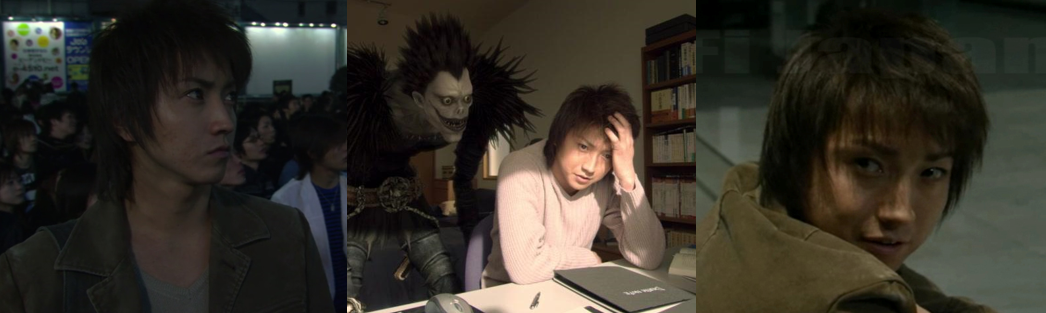
Movie Night: Death Note 2: The Last Name

Released: 3 November 2006
Director: Shūsuke Kaneko
Distributor:
Warner Bros. Pictures
Budget: $20 million (estimated)
Stars:
Tatsuya Fujiwara, Kenichi Matsuyama, Erika Toda, Takeshi Kaga, Nana Katase, Shidou Nakamura, and Shinnosuke Ikehata

The Plot:
The battle of wits and wills between Light Yagami (Fujiwara) and the eccentric “L” (Matsuyama) is taken to the next level with Light joins a task force dedicated to stopping the murderous “Kira” but his delicate plot to advance his career as judge, jury, and execution with his mysterious Death Note is threatened when another killer notebook and Shinigami enter the playing field.

The Background:
Between 1 December 2003 and 15 May 2006, author Tsugumi Ohba and artist Takeshi Obata’s Death Note (or “DEATH NOTE” as it is stylised) was published in the pages of Weekly Shōnen Jump. Originating as a broad concept that saw Ohba visualising the panels in his downtime and Obata incorporating pacing and action into them, Death Note was incredibly successful and widely praised for its art, complex characters, and elaborate twists and turns. This popularity soon translated into an equally well-regarded anime that originally aired between 3 October 2006 and 26 June 2007 and was accompanied by two feature-length specials retelling the story with new footage in late-2007 and 2008, respectively. Director Shūsuke Kaneko didn’t take this task of creating a live-action adaptation lightly; he gambled on filming not one, but two movies back-to-back just to do the source material justice, and insisted on using computer effects to bring the Shinigami to life, which this time included the less mischievous and more good-natured Rem (Ikehata). Like its predecessor, Death Note 2: The Last Name topped the Japanese box office and received a limited overseas release, but far exceeded the first film’s box office with its worldwide gross of over $54 million. Critically, the film also performed notably better; reviews praised it as being stronger, delving much deeper into the characters, and greatly expanding the tension and intrigue between the two main characters. A somewhat divisive L-centric spin-off followed the film’s success, which later received a more direct miniseries and follow-up film in 2016 that also garnered mixed reactions.

The Review:
So, as mentioned in my review of the first film, I haven’t actually watched the original anime or read the Death Note manga, despite being tempted on many occasions to get into both. It’s definitely on my ever-expanding to-do list but, for now, I’m more than happy to call myself a fan of the franchise based on these two live-action adaptations. Again, I’m watching the original Japanese audio version with English subtitles, which isn’t my preferred way of watching Japanese media but it’s ever stunted my enjoyment of the film, and I distinctly remember first watching this sequel back-to-back with the first film years ago when they were included in a late-night double feature. And it’s a good job, too, for as good as Death Note was, it ends of a massive, tantalising cliff-hanger that cries out for further resolution, and much of that film was focused on establishing the rules of the killer notebook, the role of the Shinigami, and the degradation of Light Yagami’s morals. Beginning the last film as an intelligent, if overconfident, law student, Light quickly becomes intoxicated with the power of the Death Note; that many in the general public claim his actions as the murderous “Kira” as being the just work of God doesn’t help, and Light’s ego has become so immense that he’s willing to sacrifice friend, lover, and lawmen alike in order to keep himself from being exposed as the “God of the New World”.

Light is fully prepared to manipulate, and sacrifice, anyone to one-up L.

Death Note 2: The Last Name opens with a quick recap of the previous film and with Light having successfully manipulated events so that his girlfriend, Shiori Akino (Yuu Kashii), was killed in order to gain sympathy from his father, Detective Superintendent Souichirou Yagami (Kaga), and the task force he’s assembled to track Kira down under the supervision of the eccentric, renowned detective, L/ Ryuzaki. Playing the part of a victim of Kira’s brutal wrath, Light joins the team with the express intention of tracking down the man responsible for the deaths of his girlfriend and countless criminals, with none suspecting that he is the true culprit behind the mysterious deaths except for L. L has correctly deduced every piece of the puzzle and has all the evidence he needs, in theory, to pin Kira’s actions onto Light except for concrete proof and an explanation as to how he’s able to kill with just a glance. Because of this, Light is able to give L the run-around and stay one step ahead of him while secretly manipulating events with his Death Note to both take suspicion away from him and to learn L’s true name. Light could learn this simply enough by trading half of his lifespan for the Shinigami eyes, which would let her see the true name and remaining years of anyone he looks at, but e’s determined to usher in his new age and to outwit L with his mind. When another Kira (quickly dubbed “Kira II”) starts issuing threats and killing not just criminals but anyone who even dares publicly speak out against Kira, Light sees an opportunity to realise his goals by manipulating the new Kira to his advantage. So complete is Light’s arrogance that he even goes as far as to manipulate the film’s new Shinigami, Rem (Ikehata), to write new rules into the Death Note to bamboozle the Kira task force, and to surrender both his Death Note (and his memories of his actions as Kira) and himself to a period of isolation all to win L’s trust in order to learn his name and cement himself as the God of the New World.
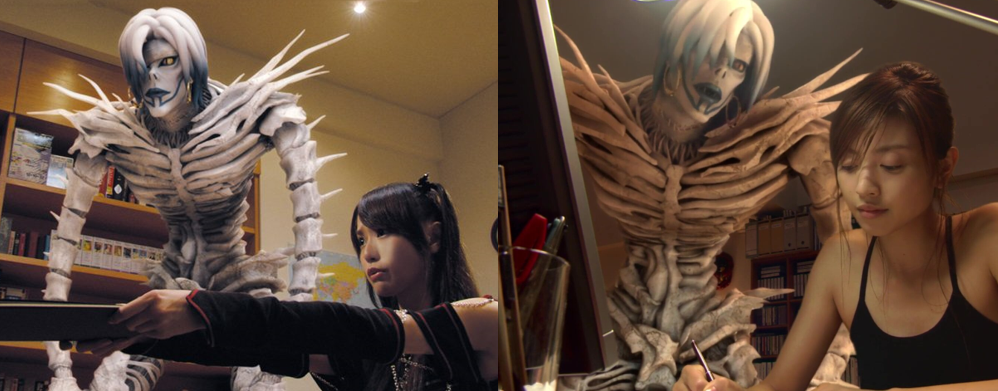
Both Misa and Kiyomi are determined to continue what they see as Kira’s righteous crusade.

Young celebrity Misa Amane (Toda) is the new Kira in town thanks to acquiring her own Death Note. When she was just a schoolgirl, Misa came home to find her family slaughtered by a sadistic killer and became obsessed with Kira after her family’s killer fell victim to his judgement and she’s only too eager to continue his work, and publicly propose an alliance, as Kira II. While Light primarily targeted criminals, he was known for killing federal agents if they threatened to expose him, but Misa continues his work with a far more brutal flair, felling lawbreakers and lawgivers alike and even killing innocent people just because they speak out against Kira. Thanks to sacrificing half of her lifespan to acquire the Shinigami eyes, Misa is easily able to target and kill anyone and everyone who dares speak out against her hero; the eyes also allow her to deduce Kira’s true identity and seek Light out to forge an alliance, not just as co-Kira’s but also as lovers. Since Misa is absolutely besotted with him, Light is easily able to use her feelings and her naïvety with the Death Note to his advantage; Light agrees to the alliance simply to use Misa’s eyes to learn L’s true name but, sadly, Misa isn’t anywhere near as thorough as Light wen it comes to covering her tracks and ends up captured by L and his task force. With both of them having lost their memories as part of Light’s grand scheme, Misa’s Death Note falls to budding reporter and Kira supporter Kiyomi Takada (Katase); she’s also so pleased to have been chosen as Kira’s “partner” that she trades half her life for the eyes and kills indiscriminately to both continue his work and further her career, but is just as sloppy about covering her tracks and easily apprehended by the unmatched team of Light and L. This allows Light to regain his memories and, in a flash, sacrifice Kiyomi and pin all of Kira’s murders on her in a perfect loop; it also completes the puzzle for L and the task force as they touch the Death Note and become aware of the Shinigami, though this also raises the question of how they’re going to explain that literal Gods of Death and killer notebooks are behind the recent murder spree.

Even with two Shingami to contend with, Light’s main concern is learning L’s true name.

Speaking of which, Ryuk returns, still following Light around and offering commentary, taking amusement in his game of cat-and-mouse with L, and enjoying apples as and when. Thanks to Light having to constantly be on guard and hide his true intentions, Ryuk grows bored and frustrated, and basically disappears for a big chunk of the middle of the film after Light gives up the Death Note and his memories of it. There’s also a new Shinigami on the block, the androgynous Rem; this skeletal, far less mischievous Shinigami is Misa’s constant companion and is watching over her in place of her friend, the diminutive Shinigami Gelus, who had taken a shine to Misa and committed the cardinal sin of protecting her from an obsessive fan with his Death Note, thus dooming himself to oblivion. Unlike the cheeky and outspoken Ryuk, Rem is soft-spoken and fiercely loyal; she vows to punish anyone who threatens Misa and is even forced to turn herself to dust to save Misa’s life after Light manipulates events to put her in danger, which again adds credence to Light’s monstrous nature. The Shinigami are exposed to L and the task force, first through mentions dropped by Kira II, then by observing Kiyomi, and finally after touching the Death Note and conversing with Rem. Interestingly, while Light was stunned by Ryuk’s presence and Misa was awestruck by Rem’s, L initially reacts with a mixture of dear and incredulity. Once he accepts that the Shinigami are real, he’s satisfied that he’s finally wrapped up this strange case, which sees him reluctantly join forces with Light after his nagging suspicions cannot be proven and then subject both Light and Misa to near-torturous isolation in a bid to force a confession rom them. As ever, L’s deductive reasoning is almost supernatural; he’s able to correctly guess everything that’s happening, even without proof, as though he’s read ahead in the script, but even he can’t predict the lengths of Light’s depravity and it costs him dearly when his mentor and father-figure, Watari (Shunji Fujimura), falls victim to the Death Note after Misa is threatened.

The Nitty-Gritty:
Thanks to Light now being officially integrated onto the task force, there are far more face-to-face interactions between him and L this time around. The two play chess, literally and figuratively, against each other, with each throwing out accusations, explanations, and questions in a bid to outwit the other. Even if he couldn’t manipulate life and death with the Death Note, Light is extremely thorough at covering his tracks; he has not only won the support of his father and colleagues thanks to sacrificing Shiori but he has cold hard facts on his side since L cannot pin anything on him, nor explain how he could kill so many so easily as Kira. When Kira II surfaces, Light sees an opportunity to shunt suspicion from him completely and throws himself into the investigation after his sister and father almost fall victim to the new Kira’s wrath. Similarly, he orchestrates events to place Kiyomi into the firing line and, free from his memories of the Death Note, proves himself just as capable a detective as L by cobbling together graphs and data to pinpoint who these new Kiras are. When Light gives up his memories, we see him briefly return to his pre-Death Note character and get a sense of how deeply the book has corrupted his morals and intelligence; for a short time, we see how positive a force he could be, especially when he and L unite against the new Kiras, which only makes his devilish turn back to a callous puppet master all the more harrowing after he regains his memories and is revealed to have manipulate man and Death God alike to his own ends.

Light freely manipulates others, Death Gods, and even himself to outwit L.

The nature of the Death Note and the Shinigami realm is delved into a little more here; as before, the book is filled with rules regarding its use, though Misa and Kiyomi don’t utilise its true potential in the same way that Light did and are content to simply jot down names and cause their victims to die from heart attacks. We get to briefly see the Shinigami world, a desolate realm where the Gods of Death watch humans and live off the years of those they write in their notebooks. The Shinigami cannot use their Death Notes to prolong lives, however, and doing so causes them to turn to sand, as it does to Gelus and, eventually, Rem. As in the first film, the world is dividing in their opinion of Kira. Well, not quite divided, as Kiyomi’s research shows; not only does a sizable percentage of the country support Kira, prominent members of the government have also taken to praising the murderous vigilante. Even Kira’s strongest supporters are shocked, however, when they witness his brand of justice first-hand and when Kira II effectively holds a news station hostage to both deliver a warning to any who would dare oppose Kira in any way and to broadcast a series of live executions. Thankfully, Misa is so besotted with Light that she not only agrees to follow his every order and to kill anyone he asks but she also gives her Death Note to him in order to win his trust. Realising that he can use her to learn L’s new, Light reluctantly agrees to enter a relationship and partnership with her, though he cares little for her or the fact that she’s sacrificed half her life for him (she’s so devoted to Light that she does this again after regaining her memories since she’s forgotten L’s true name and lost the Shinigami eyes when she gave up her Death Note). When Misa resumes her killing spree, she immediately makes herself a target once more and, when the shrewd L is able to figure out that Kira has added fake rules to the Death Note, Light is forced to take even more extreme measures in order to protect himself, remembering his true callous nature and even writing his own father’s name in the Death Note.

In the end, Light is outsmarted but it’s a hollow victory for the doomed L.

Light’s obsession and delusions come full circle by the finale. He fully believes he’s a God now, and it’s hard to deny it given how he’s able to puppet people around with the Death Note, but he ultimately falls victim to his own arrogance and having vastly underestimated L’s deductive abilities. L tricks Light with a fake Death Note, and even fakes his own death at Light’s hands in order to learn the horrifying truth behind his duel identity, all to bring Light into the…well, the light… and expose him. With Light having hidden a piece of the Death Note in his watch and jotting down names with his own blood as and when people threaten to expose him, the game of one-upmanship between him and L escalates to the point where L is forced to his own name in the Death Note in order to circumnavigate his murder at a Kira’s hands and confront Light alongside a shame-filled Souichirou. Held at gunpoint and with nowhere left to run and no excuses left, Light refuses to bow acknowledge L’s intellectual superiority and spits criticism of his father’s broken system and the failure of the law to match the impact he had as Kira. After all his machinations and desperate attempts to cover his tracks, Light’s true nature as a reprehensible, egotistical, power-mad killer rise to the surface during this dramatic finale, which sees his sneaky watch destroyed and leaves him with a bullet in his leg. Raving about his destiny to be the saviour of a new, crime-free world, Light is so convinced of his superiority and Godhood that he outright demands that Ryuk kill everyone present and bend to his will and, in doing so, seals his fate. While the Shinigami will die if they protect humans, they are able to take lives using the Death Note and, similar to how Ryuk despaired of Light’s lack of humanity and compassion at the end of the last film, the Shinigami is somewhat disgusted to see the once intelligent and adaptable Light reduced to begging for supernatural help and writes his name instead. As Light enters his death throes and spits declarations of his he’ll be remembered as a hero, Ryuk solemnly informs him that Death Note users are doomed to limbo rather than going to Heaven or Hell. Sadly, there’s no way to save L; having arranged for his peaceful death, L quietly passes away a few days later after expressing his gratitude and appreciation to Souichirou. Though Souichirou condemns his son’s actions, the official word is that he died by Kira’s hands and that Kira’s reign of terror is finally over, leaving Light’s family mourning their loss, Misa with no memory of her love or the Death Note, and the cackling Ryuk free to cause further havoc as he sees fit.

The Summary:
It’s honestly a little tough for me to pick with is the better film between Death Note and Death Note 2: The Last Name. The first is maybe a little more cerebral in its focus on showing how the Death Note twists Light into this cruel and arrogant murderer, while the sequel is full of twists and turns and an escalating cat-and-mouse between L and Light. Ultimately, I’d highly advise watching both back-to-back as they’re clearly intended to be two parts of a larger whole. While the first film includes more variety in the use of the Death Note, the second really shows just how adapt Light is with the notebook since his would-be successors are sloppy and unimaginative. Both Misa and Kiyomi use the Death Note indiscriminately, lacking even Light’s skewed moral code, and think only in the short-term, giving up half their lives simply because it’s easier to use the Shinigami eyes than to figure out other ways of targeting and killing their victims. I enjoyed the addition of Rem and the brief glimpse into the Shinigami realm and life; she and Ryuk remain a captivating and visual highlight and its fun seeing the differences between the two, with Rem being more stoic and sombre and Ryuk being this cackling maniac at times. The true draw of the film is the intense back and forth between Light and L; it’s maddening seeing that L has figured everything out except for the means and I enjoyed seeing the strange friendship between the two, which is made all the more awkward as L is so peculiar and never truly gives up his suspicions about Light. The two are constantly one-upping each other, with Light seeming to be one step ahead of everyone, but seeing L sacrifice his own life in order to expose Light and watching Light descending into raving vitriol was a truly cathartic moment. While Light may have had a point about the unjust legal system, his superiority complex and sheer lack of empathy ultimately made him no better than his successors and worse than a literal Death God. This results in him become a tragic anti-hero of sorts who fully deserves to be brought down, but there’s little celebration surrounding Light’s death and, indeed, the film ends with the suggestion that Kira’s death has cause crime to increase once more, leaving the moral ambiguity of his actions up for debate.

My Rating:

Rating: 4 out of 5.

Great Stuff

What did you think to Death Note 2: The Last Name? If you’re a fan of the anime or manga, how did it work as an adaptation for you? What did you think to the changes made to the source material? What did you think to the new Kiras and how they differed from Light? Were you a fan of the cat-and-mouse game between Light and L? What did you think to Rem and Ryuk and the way they were manipulated by Light? How would you use a Death Note? Whatever your thoughts on Death Note, feel free to share them in the comments or on my social media.


Game Corner [Spidey Month]: Spider-Man (PlayStation 2)


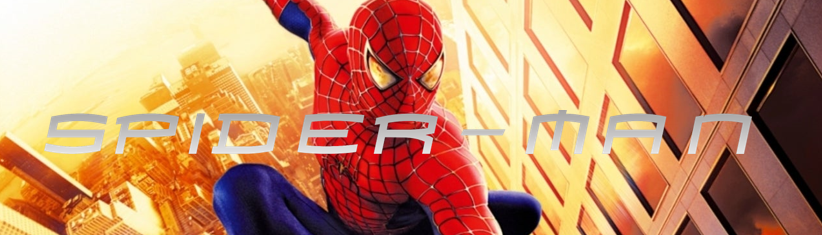
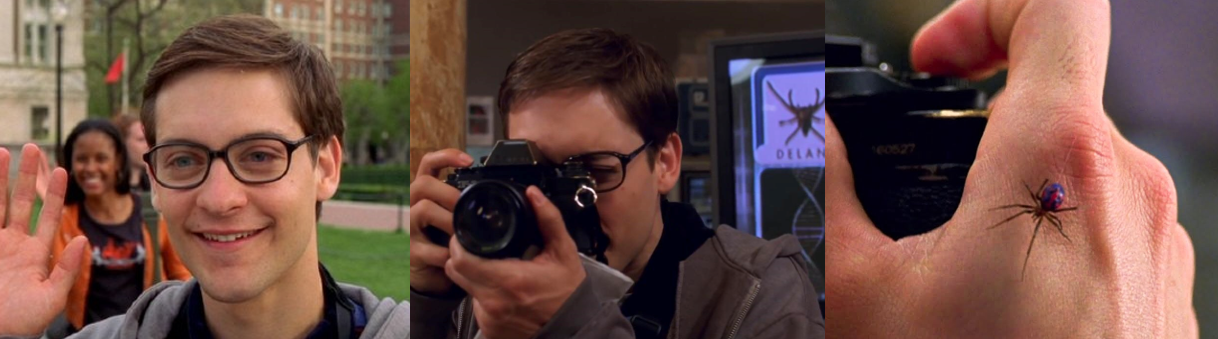
Easily Marvel Comic’s most recognisable and popular superhero, unsuspecting teenage nerd Peter Parker was first bitten by a radioactive spider and learned the true meaning of power and responsibility in Amazing Fantasy #15, which was first published in August 1962. Since then, the Amazing Spider-Man has featured in numerous cartoons, live-action movies, videogames, action figures, and countless comic book titles and, in celebration of his debut and his very own day of celebration, I’ve been dedicating every Friday of August to talk about everyone’s favourite web-head!


Released: 16 April 2002
Developer: Treyarch
Also Available For: Game Boy Advance, GameCube, PC, and Xbox

The Background:
There was a time when it seemed like every single cinema release had to be accompanied by a videogame adaptation; big-budget movies, especially, were often released alongside a hastily created videogame tie-in that often failed to properly capture the spirit of the film they were based on. As the flagship character of Marvel Comics, Spider-Man has a long and varied history with videogame adaptations across a variety of platforms so it was perhaps no surprise that Sam Raimi’s 2002 live-action $825 million blockbuster would be accompanied by a videogame tie-in. To be fair, Spider-Man benefitted from that fact that it was developed by Treyarch, who had previously had success with the character; indeed, much of Spider-Man’s combat and level progression was based on Treyarch’s previous Spider-Man game. This was reflected in the game’s reception as Spider-Man became the fifteen highest-selling videogame of 2002 and enjoyed high scores across all platforms. While some reviews criticised the game’s claustrophobic indoor sections and short length, it was generally regarded as the best Spider-Man videogame at the time of release. I remember buying the game for the GameCube after seeing the movie, having been won over by the game’s trailer and the film itself, but being underwhelmed by it after playing it to completion so I’m curious to see how it holds up today after the success of Spider-Man’s subsequent videogames.

The Plot:
After being bitten by a genetically-enhanced arachnid, high school senior Peter Parker finds himself endowed with the proportional strength and agility of a spider, and, when his beloved Uncle Ben is killed due to his irresponsibility, Peter puts his spider powers to good use as a masked crimefighter. After failing to capture and study this “Spider-Man”, who overcomes a variety of costumed menaces and robots, Doctor Norman Osborn transforms himself into the web-slinger’s most dangerous threat yet: the maniacal Green Goblin!

Gameplay:
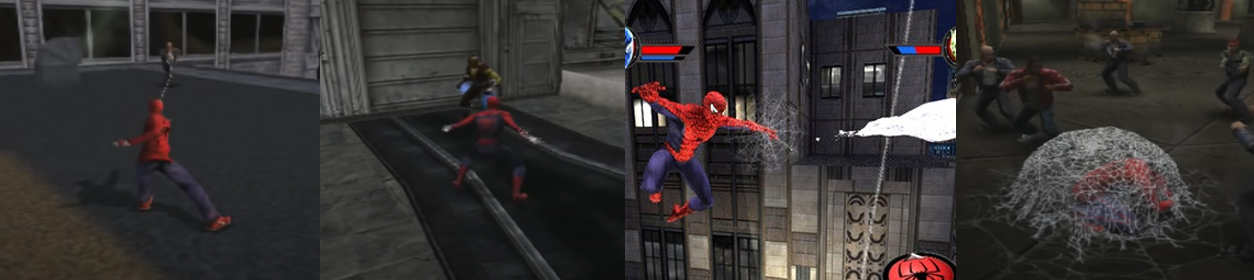
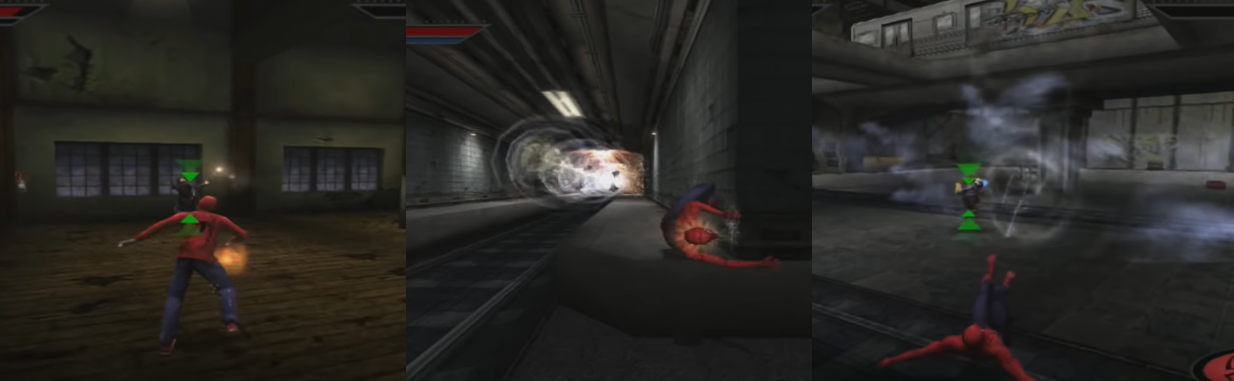
Spider-Man is a third-person action game with a primary focus on beat-‘em-up action but which also includes a fair amount of web-slinging and a little bit of awkward stealth and extremely simplistic puzzle solving. As you might expect, players assume command of Peter Parker; the game begins right after Uncle Ben has been shot and at the very beginning of his crimefighting career as Spider-Man, and players are given a number of standard options when it comes to combat: X lets you jump and you can press it again in mid-air for a double jump, while Square throws a punch and Circle unleashes a kick. You can mix and match these button inputs to execute quick combo attacks (which you can review from the pause menu), and pressing either button near certain objects will allow you to pick up and throw them at your enemies. Of course, it’s not all about beating up random thugs across the city; at any time, you can press R2 and Spider-Man will start slinging webs (yes, they just attach to nothing, get over it) and won’t stop until you press X or slam into a wall. You can hold down R2 to speed up your web-slinging, though this does limit your turning ability, and you can press R1 to quickly zip upwards or straight ahead on a web zip-line; you can also press L1 to lock onto enemies, which is super useful when you’re swinging around and asked to attack enemies in mid-air.

Spidey can use his webs to attack his enemies but, unlike in the film, is limited by web fluid.

Spider-Man will automatically save himself with his webs if you fall while traversing the city rooftops and will automatically climb walls when close to them, though you can press the left analogue stick to enter a crawling state and the camera does tend to get very jerky and annoying when you’re clambering around on walls and ceilings as your perspective can get turned around pretty easily. If you’ve played the fantastic Spider-Man (Neversoft, 2000), you’ll be immediately familiar not only with Spider-Man’s combat and web-slinging but also with his web-based attacks. Pressing Triangle sees Spidey shoot out a quick web, but holding it allows him to web enemies up; if you press up, down, left, or right on the left analogue stick (or directional pad, if that’s your preference), Spider-Man will send out a high-impact ball of webbing, yank his foe towards him, wrap his hands in webbing to increase his punching power, or create a web dome to shield himself and send enemies flying with a press of X. You can also switch to different control styles that see you utilise the other face buttons for these commands, but you’ll find that these web attacks consume your web fluid (represented as a blue bar under your life meter), which is very strange considering Spidey had organic webbing in the film. Spider-Man can also dodge incoming attacks by using the left stick in conjunction with X to hop out of danger, though I found this to be awkward at best and unreliable at worst, and you can even press in the right analogue stick to look around and set your target for a zip-line.

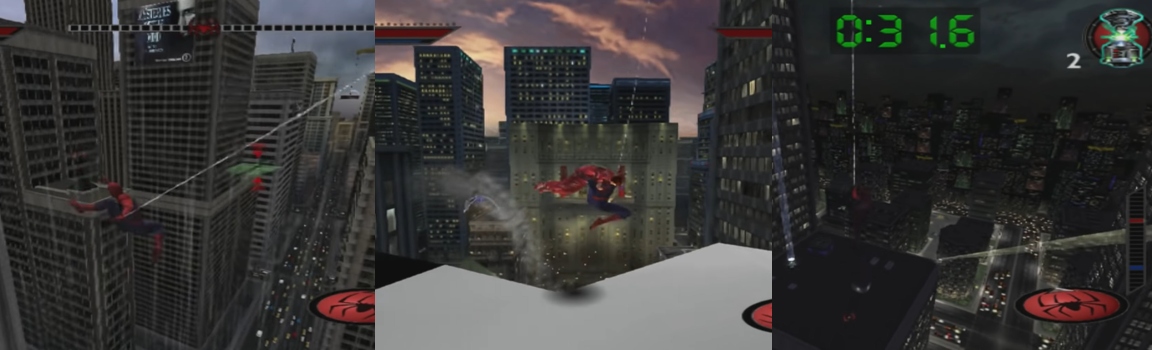
Web-slinging sections see you using the compass to chase villains, rescue civilians, and disarm bombs.

All of these controls and gameplay mechanics can be reviewed in an optional tutorial mode, where the legendary Bruce Campbell snarkily talks you through all of Spider-Man’s abilities, and you’ll find question mark hints occasionally dotted around levels to help you out as and when. Like the 2000 game, Spider-Man is basically divided into two distinct gameplay styles: one sees you out in the city, swinging about the place, and the other sees you confined inside buildings. When out in the city, you’ll need to make use of a compass to navigate towards your next objective or keep track of your current target; you need to use this in conjunction with a Height Meter that shows your position compared to that of your objective, which can be a very clunky system as it’s not always clear where you need to go. Basically, just follow the compass direction until it flashes white, and then try to orientate yourself up or down to get to where you need to go, but invariably your compass will be absent when inside buildings. When web-slinging around the city, you’ll be tasked with hunting down thugs and putting a beating on them until you find information on where you need to go, racing after a target as they fly away from you, hunting down bombs or taking out robotic drones (often against a tight time limit), rescuing civilians from harm, and using your webs to secure water towers, bridges, and other objects to stop them from hurting civilians. When trying to keep track of a specific target, you really need to make use of the lock-on feature or else it’s very easy to lose sight of them and thus fail the mission; I also found that spamming Triangle was the fastest way to actually attack enemies in mid-air, but of course this will drain your web fluid. Luckily, the pick-ups that refill your health and web fluid will respawn so you can swing back over and grab them if you need to, but this will cost you time and probably see you fail your objective. Checkpoints in Spider-Man are few and far between; you can only save your progress after completing a level and, if you die or fail your mission, you’ll have to restart from the beginning of the level, which can lead to you repeating frustrating sections again and again.

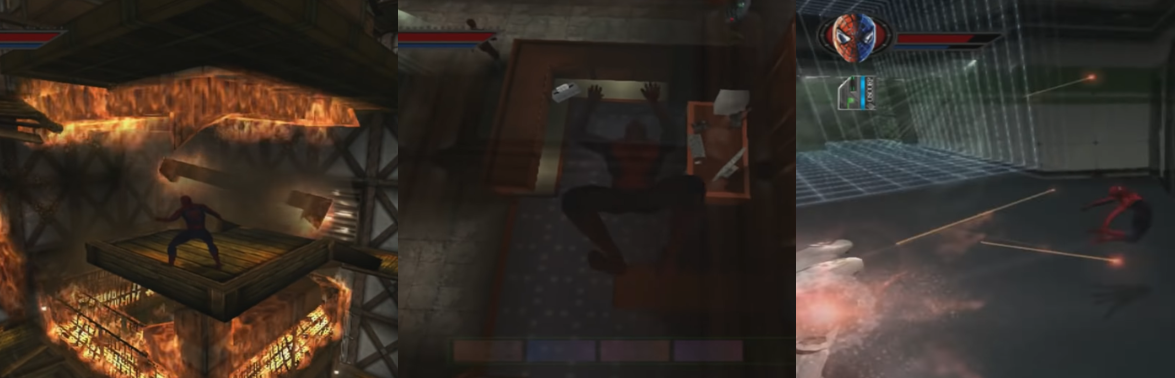
Spidey must crawl and fight around claustrophobic interiors using a clunky stealth mechanic.

When confined to the interior of buildings, the game introduces a clunky stealth element; when Spider-Man is in certain shadows, the face on his heads-up display will turn dark blue and he’ll be hidden from enemies. This is essential to safely sneaking past cameras and enemies in many levels; though you won’t fail the mission if you’re spotted, an alarm will be raised and mechanical Super Soldiers will relentlessly chase after you, forcing you to quickly zip away and find a shadowy area to wait out the alarm. One of the most common tasks when in these claustrophobic areas will be heading through or acquiring keys to unlock doors; these doors can be difficult to identify as the areas are so bland and boring, and the enemies holding the key tend to be a little tougher than the usual mooks. Other times, you’ll need to use X to activate consoles, sometimes in a certain order, acquire codes from active PCs, web-zip past steam vents or through laser trip wires, and zipping up into vents to awkwardly crawl around and progress further. These levels also have much more focus on grounded beat-‘em-up combat, but the game quickly emphasises that discretion is the better part of valour and you’ll be tasked with deactivating security walls and laser traps in order to progress a little safer. The game comes with a number of different difficulty modes that obviously make enemies tougher and increase the game’s challenge; completing the game on higher difficulties also allows you to unlock additional content, which can be further unlocked by acquiring points for your combat, stealth, and level-completion strategies.

Graphics and Sound:
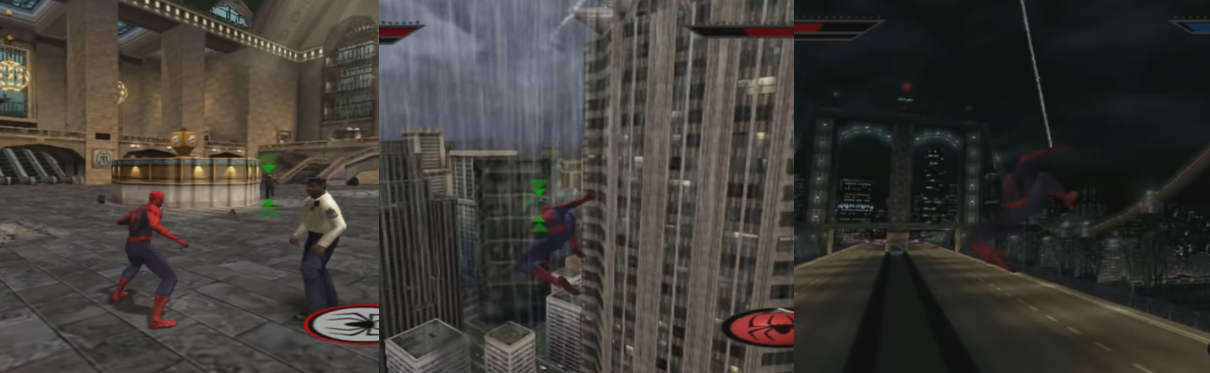
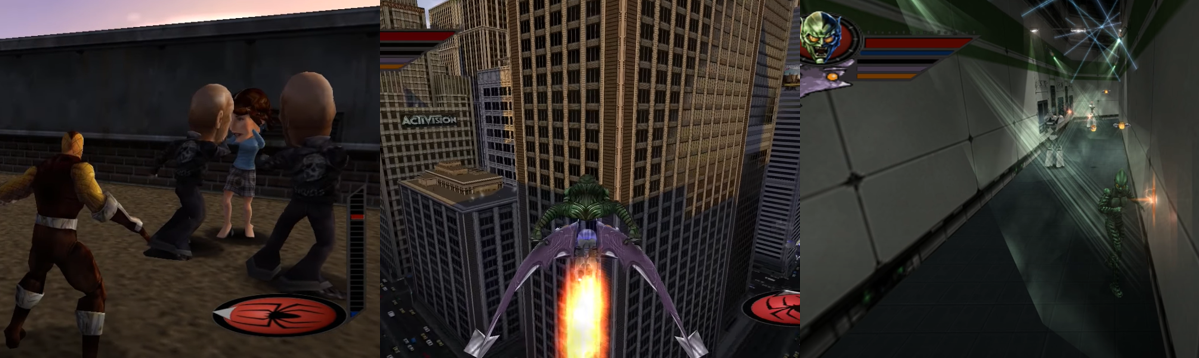
Obviously, Spider-Man is a videogame tie-in that came out on the PlayStation 2, so you can’t expect super high-quality in-game or cutscene graphics. However, Spider-Man is reasonably impressive and I can see why people would have considered it the best Spider-Man videogame at the time; New York City is rendered as a large map and even subject to rain and lightning storms and rendered in both day and night-time depending on the level you’re playing. However, it’s not a sprawling open world with numerous side quests or non-playable characters to interact with; although you can see traffic moving down below, you can’t go down to street level and the city is basically completely lifeless save for thugs, bosses, and a few civilians in need of rescue.

Environments can be quite bland and lifeless but some shine through weather and lighting effects.

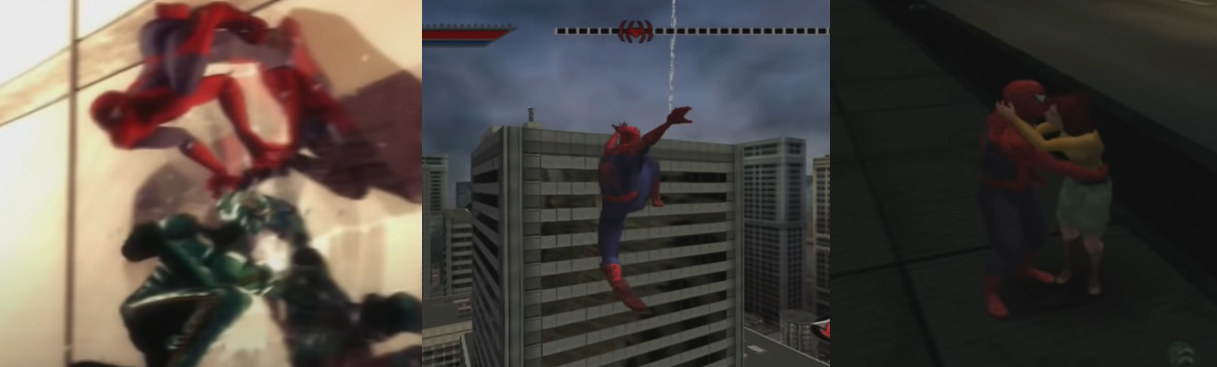
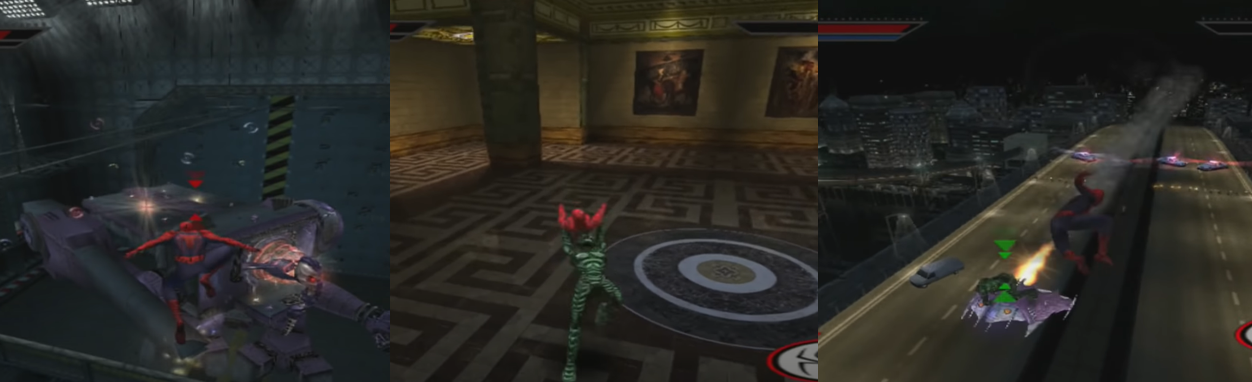
The interiors are where the game really fails to impress, however; you’ll explore such dynamic and exciting areas as…a bland warehouse, the sewers and subway tunnels, and the high-tech Oscorp building. This latter is easily the most visually impressive and interesting of all of the game’s environments, inside or out; while it is a bit confusing as every area looks grey and bland, it’s given some variety with some blinking lights, laser traps, and different rooms containing consoles and power generators. Another interesting area is a bank, though you’re only really in here for one boss battle, and you’ll even be treated to a very mediocre interpretation of the balloon parade from the film, which includes a single inflatable panda bear and a sequence where you crash down through skylights while battling the Green Goblin, and of course conclude the game in a showdown on the Queensboro Bridge.

Cinematics are quite blurry and the awkward in-game cutscenes are quite laughable.

While the game’s thugs and enemies aren’t much to shout about, being largely generic and unimpressive, Spider-Man is rendered quite well despite every character model appearing as a stiff mannequin. Spidey does little hops and flips when climbing over ledges, assumes comic-accurate poses when left idle, and even busts out fancy animations when web-slinging that closely emulate the film. The game uses both pre-rendered and in-game graphics for its cutscenes, with the pre-rendered ones obviously being the more impressive of the two; the in-game models don’t even move their mouths and the voice acting is more miss rather than hit. Tobey Maguire, especially, sounds more wooden and awkward than ever, especially when trying to deliver quips as Spider-Man, and the game is sadly completely lacking Danny Elfman’s awesome and iconic score. The music that does play during levels is generally suitable enough, if a bit generic, but it does clumsily and noticeably loop, which just screams of low production values, and of course you’ll be faced with the long load times symptomatic of that era of videogaming.

Enemies and Bosses:
Spider-Man is faced with a number of nameless, faceless, disposable goons as he swings around the city and tries to use his powers responsibly; at first, he’s tasked with tracking down Uncle Ben’s killer, who here is interpreted as part of the Skulls gang, so you’ll be beating up unscrupulous street thugs in the early going. Some of these have pistols to defend themselves with, and they’ll also put up a block to defend themselves against your attacks. These thugs get a reskin as guards working for Oscorp who must largely be avoided and webbed up to stop them from raising the alarm and bringing in the Super Soldier robots. Wile Osborn’s miniature Spider Slayers are annoying robotic enemies who zip around on claw-like lines and try to roast you alive, these Super Soldiers are a massive pain in the ass. They relentlessly hunt you down, blasting at you with explosive bolts that are near-impossible to avoid, and the levels can be so restrictive that you’re better off just restarting the level rather than trying to desperately find shadows to hide from them.

After tracking down his uncle’s killer, Spidey must avoid the Shocker’s blasts in the city sewers.

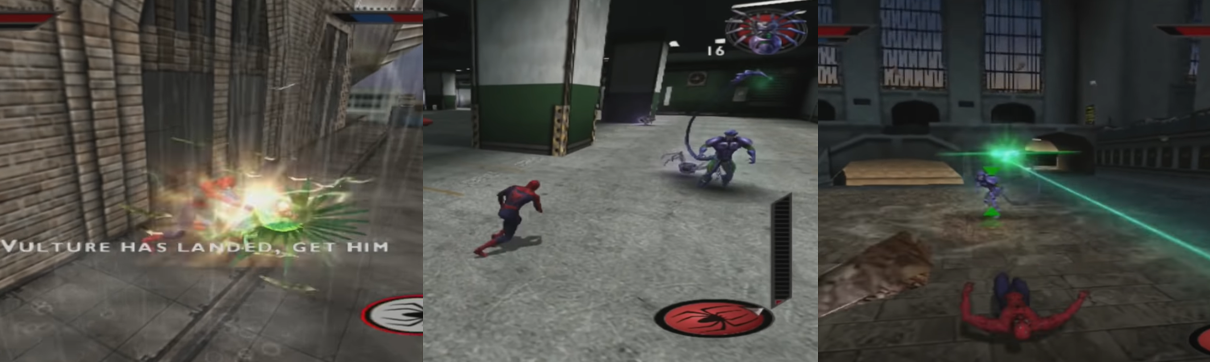
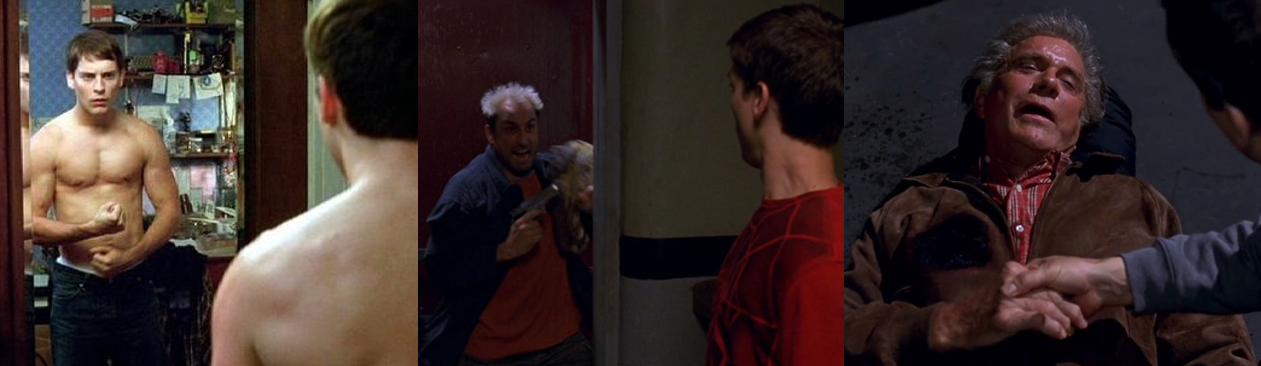
Spider-Man’s first mission is to hunt down Uncle Ben’s killer; after beating up a bunch of his fellow gang members, Spidey finally tracks him down and faces off with him, only to be blasted full-force in the face over and over by the murderer’s shotgun! The killer sets a precedent for the game’s boss battles in that he, like all of the other bosses, is spry and tough enough to shrug off, dodge, and no-sell all of your web attacks except for the web-hands, so you’re best bet is to zip up to the ceiling and stay out of his sight, blasting at him with your impact webbing or dropping down to deliver a beatdown when he’s suitably confused. After a quick side quest where you swing around towards red balloons to take snapshots of Spidey for the Daily Bugle, you’ll need to rescue security guards being threatened by Herman Schultz/The Shocker. Once they’re safe, you’ll pursue him into the sewers and subway tunnels, where he’ll send blasts of concussive sound at you that you’ll need to dodge using your web-zip; this isn’t too much of a challenge to overcome and, afterwards, you’ll get to face him in combat. The Shocker launches projectiles of sound at you and can protect himself with a devastating whirlwind of damaging soundwaves, but was actually easier for me to pummel into submission than Uncle Ben’s killer.

After making short work of the Vulture, you must defend and then subdue the maniacal Scorpion.

Spider-Man’s next test comes when Adrian Toomes/The Vulture robs a bank; Spider-Man first chases after the Vulture by progressing vertically up a tower that catches fire and sees you slipping through holes and under stairs to zip your way upwards, then you need to chase after him as he flies away through the city and puts citizens at risk. Finally, the two face off in the skies around the Chrysler Building as rain and lighting fill the arena; Spidey must fire webbing at the Vulture while avoiding his charges and attacks in order to force him to land so he can put a beating on him, making him the easiest boss of the game by far. Afterwards, Spidey crosses paths with MacDonald “Mac” Gargan/The Scorpion, who just randomly appears out of nowhere; at first, you’ll need to protect him from Oscorp’s miniature spider-bots but then he turns against you and forces you to fight him. This is quite a tough fight even on Easy mode as the Scorpion leaps and scrambles all over the place, blasting at you with his tail, and grappling with you whenever you get close to him. It’s best to keep your distance and fire off impact webbing from afar, and then dodge his attacks so you can hit a few combos on him and put him down. Fittingly, the Green Goblin is the game’s most recurring villain and, though you won’t encounter him face-to-face until you’re halfway through the game, he more than makes up for it in his appearances; the first time you face him, you need to avoid his glider attacks and missiles and rescue Mary Jane Watson from the aforementioned panda balloon before battling him head-on.

As annoying as Oscorp’s mech is, the Green Goblins persistence and aggression is even worse!

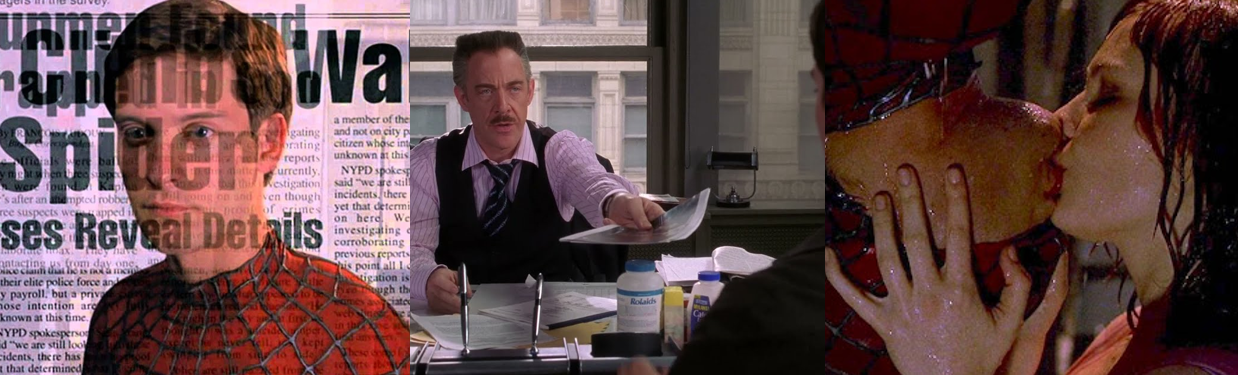
Whilst on his glider, the Green Goblin is basically a tougher version of the Vulture as he flies around tossing pumpkin bombs and firing bullets and missiles at you, forcing you to fire off your webbing or striking at him when he comes close. Afterwards, you’ll have to chase after him and web up parts of the environment that he damages, before forcing him through a skylight for some ground combat. These fights are easily the toughest of the game as the Green Goblin bombards you with pumpkin bombs, blinds you with flashbangs, and can easily choke the life out of you and snatch you out of the air. Your best bet is to stick near the respawning health power-up, dodge his combos and hit some of your own, and blast him with impact webbing whenever you can. Afterwards, you’ll be forced to swing across the city against a time limit disarming his bombs, which is an annoying mission thanks to the janky compass and drones flying around the city, then destroy fifty of his Razor Bats before taking a detour through Oscorp and battling a giant mech. Before you can attack this directly, you’ll need to desperately swing around the enclosed arena destroying shield generators and being pummelled by missile turrets, constantly spawning drones, and avoiding the mech’s gigantic laser. Thankfully, there’s plenty of pick-ups in the area and the mech goes down pretty easily with a few web shots once the shield is lowered. Afterwards, you’ll have to chase after the Green Goblin as he flies off with Mary Jane and tosses explosive traps in your way, before finally facing off with him on the Queensboro Bridge. After getting Mary Jane to safety, you then need to repeat the same tactics as in the first couple of fights against him but now in the same battle; swing around firing webs at him to ground him and then dodge his melee attacks to land a few combos, but watch out for his big bomb blast attack. By this point, you should know how to dodge and go grab a pick-up when needed, and I know I found finishing the Green Goblin off actually easier than the first fist fight with him. After you end him, Mary Jane awkwardly gives Spider-Man a big ol’ snog on top of his mask while they stand over the lifeless body of Peter’s best friend.

Power-Ups and Bonuses:
Unlike in pretty much every modern videogame, Spider-Man is not blessed with regenerating health; as a result, you’ll need to pick up red and red-and-blue Spider Icons to restore half or all of your health. Also, like in the 2000 game, Spider-Man can run out of web fluid so you’ll need to grab blue and blue-and-silver Spider Icons to refill this bar. As mentioned, I find this an odd inclusion as Spider-Man had unlimited organic webbing in the movie but I guess it makes sense to keep him from being too overpowered. Luckily, these restorative pick-ups respawn after a while so if you find yourself struggling against a particular boss, you can usually backtrack or swing back around to collect a pick-up and keep yourself from losing a life. If you search around your environments, you’ll also find gold Spider Icons that will unlock additional combos to add to your repertoire, but that’s about it in terms of power-ups; you don’t earn experience points and can’t upgrade any of Spider-Man’s abilities or pick up temporary power-ups, meaning you basically end the game exactly as you started it but with maybe a few additional combos.

Additional Features:
If you visit the game’s ‘Gallery’, you’ll be able to view movies and artwork for the game, and you’ll be able to revisit any level you’ve cleared from the main menu as you progress. As mentioned, you’ll receive points every time you clear a level; these are awarded for your combat variety, stealth, and the amount of damage you take. Once you hit a certain number of points, you’ll automatically unlock some additional content from daft stuff like big hands and feet and exaggerated ragdoll physics to skins for Spider-Man, such as his wrestler outfit and acclaimed artist Alex Ross’s rejected design for the movie suit. You can also unlock a Peter Parker skin and enter cheat codes to play as guys like the Shocker and other enemies, though they all play the same as Spider-Man and don’t change the story in any way.

There are a number of cheats and unlockables, including a fully playable Green Goblin!

However, if you beat the game on the “Hero” difficulty, you’ll unlock the ability to play as Harry Osborn under the guise of the Green Goblin! This eliminates the pre-rendered cutscenes and alters the plot somewhat as this story picks up after the conclusion of the game and sees Harry take up his father’s mantle to research his death, and gives you access to an entirely new set of abilities. The Green Goblin can’t web-sling or climb walls but, with a press of R2, you’ll hop onto his glider and can rocket around the place at will; you can fire bullets, missiles, and bombs while on the glider, but your weapons will overheat in time so you’ll need to wait for them to cool down. On the ground, the Green Goblin’s melee attacks are the same as Spider-Man’s but, in place of webs, you have access to pumpkin bombs and Razor Bats and can race around on rocket boots like a madman to send enemies flying! Honestly, this was an incredible addition to the game and is a great way to encourage a second playthrough that adds an extra layer of challenge to the game as the Green Goblin can’t hide in the shadows, but can jump on his glider to blast enemies with missiles even when inside the most claustrophobic environments!

The Summary:
I remember being so hyped for Spider-Man’s first big-screen adventure, and so won over by the trailer for the videogame that ran before the film, that I went out and bought this for the GameCube that same week (if not that same day). I also remember finishing it pretty quickly, and this second playthrough was no different; as is the case with almost every videogame tie-in to a movie, Spider-Man isn’t an especially long game; levels aren’t built to allow exploration and are incredibly linear, so all you’ll have to worry about is trying to cope with how bland and similar the areas can look in each level. There’s also not a huge amount really asked of you; maybe you need to activate a console here and there, or input a code to open a door, or rescue a civilian, but these instances are few and far between and the game soon falls back into a routine of either web-slinging or clunky stealth sections. “Clunky” is the best way to describe this game; Spider-Man controls like he thinks he should be using tank controls, the camera and mechanics make web-slinging and wall-crawling very cumbersome at times, and your combos and dodging abilities are severely limited, making everything quite basic and monotonous. This may explain the game’s short length, as it’s over before it can become truly mind-numbing, but some levels are more frustrating than others; the stealth system is poorly implemented and it’s disappointing to see Spider-Man restricted to claustrophobic interiors rather than free to swing around the city. Basically, the game is a reskin of the 2000 Spider-Man title but stripped back in terms of bonuses, unlockables, and variety; there’s some fun to be had here, mostly in how cheesy the dialogue and cutscenes are, but you’re not really missing much if you skip this one for one of the many other Spider-Man games available even on the PlayStation 2.

My Rating:

Rating: 2 out of 5.

Could Be Better

Have you ever played the videogame tie-in to Spider-Man? Which console did you buy it for and were you impressed with it back in the day? What did you think to the web-slinging and combat mechanics? Which of the enemies added to the game was your favourite and would you have liked to see the likes of the Vulture and the Scorpion in Raimi’s films? What did you think to the game’s stealth gameplay and the unlockables on offer? Which Spider-Man videogame or movie adaptation is your favourite? Sign up to leave a reply below or drop a comment on my social media to share your thoughts on Spider-Man.

Back Issues [Sonic CDay]: The Sonic Terminator


Developed alongside the blockbuster Sonic the Hedgehog 2 (SEGA Technical Institute, 1992), Sonic the Hedgehog CD (Sonic Team, 1993) released on this day back in 1993. Expanding upon the Blue Blur’s debut title, Sonic CD introduced Metal Sonic (one of Sonic’s most popular and enduring rivals) and Amy Rose, and is considered by many to be one of the best of the classic Sonic titles.


Story Title: “The Sonic Terminator (Part 1 to 5)”
Published: 29 April 1994 to 24 June 1994
Writer: Nigel Kitching
Artist: Richard Elson

The Background:
After Sonic the Hedgehog catapulted to mainstream success and helped SEGA to usurp Nintendo’s position at the top of the videogame industry, SEGA were quick to capitalise on Sonic’s popularity not just with videogames but also a slew of merchandise, including cartoons and comic books. About six months after Archie Comics began publishing a weird amalgamation of the Adventures of Sonic the Hedgehog (1993 to 1996) and Sonic the Hedgehog/SatAM (1993 to 1994) cartoons, United Kingdom publisher Fleetway Editions Limited began publishing “Britain’s Official SEGA Comic”, Sonic the Comic (StC), a fortnightly publication that I collected diligently until its unfortunate end. Though pulling much of its lore from the now defunct Mobius and Doctor Ovi Kintobor storyline that was prevalent outside of Japan, StC was its own beast entirely and quickly veered away from the source material to recast Sonic the a mean-spirited leader of a gang of Freedom Fighters made up of both videogame characters and anthropomorphic characters adapted from the videogames. Like the Archie comics, StC often included a few very loose adaptations of the videogames, though these were often truncated or took the very basic idea of the source material and adapted it to fit with its noticeably different lore. Their adaptation of Sonic CD was no different, renaming Metal Sonic to Metallix and introducing one of the comic’s more dangerous and persistent secondary antagonists.

The Review:
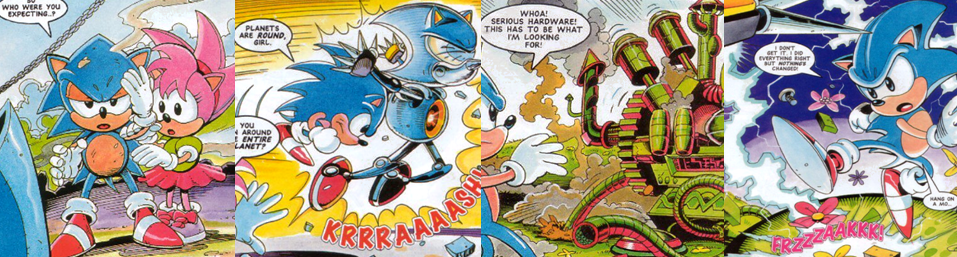
“The Sonic Terminator” begins with the dramatic and violent death of Sonic the Hedgehog! Not to worry, though, this is simply a “practice robot” that was trashed by a blindly fast, electrically-charged figure that is kept in the shadows and only vaguely hinted at. Both Doctor Ivo Robotnik (who, at this point, was directly modelled on the character’s look from Adventures of Sonic the Hedgehog) and his assistant, Grimer, are pleased as punch with the results of this final test and prepare to send their new creation out to kill the real Sonic. Speaking of whom, Sonic is currently in the Emerald Hill Zone, where Robotnik’s Troopers (basically StC’s version of Swat-Bots in that they are humanoid robots that Sonic is able to smash without holding back as, unlike Badniks, they’re not powered by woodland critters) are arresting an entire village. Despite the concerns of his fellow Freedom Fighters (Porker Lewis, Johnny Lightfoot, Amy Rose, and Miles “Tails” Prower), Sonic rushes in to save the villagers and the entire gang winds up captured as a result, much to Johnny’s chagrin. Sonic, however, retains his steadfast cocky attitude; even when they come face-to-face with Trusk, the captain of the prison ship, and are told that they are being taken directly to Robotnik’s Badnik processing plant at the Veg-O-Fortress, Sonic simply yawns with boredom.

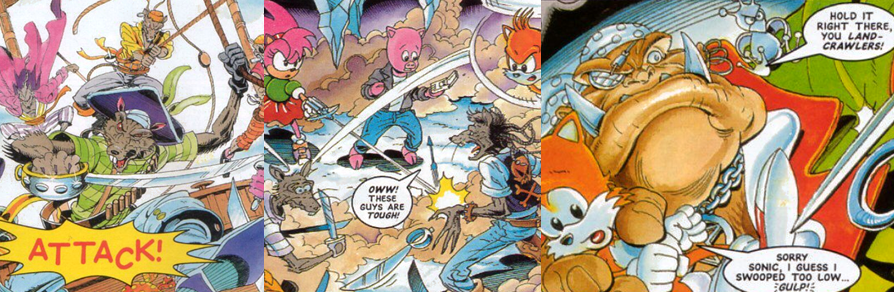
The first two issues are more concerned with a side plot involving the Sky Pirates.

This turns out to be because Sonic has some formidable backup on hand in the form of Captain Plunder and his Sky Pirates, a group of mercenaries and…well, pirates…who Sonic encountered in the Mystic Cave Zone in a previous issue. Thanks to Captain Plunder, Trusk is captured and the prisoners are freed but Porker accidentally lets slip to Filch the Poltergeist where Sonic’s cache of Chaos Emeralds is hidden and the pirates speed off the steal the booty. However, Sonic and the gang are easily able to follow them to North Cave and a fight breaks out; although Sonic is able to incapacitate most of Captain Plunder’s crew using his Super Spin Attack and both Amy and Tails are able to fight them off with their crossbow and a rock, respectively, Captain Plunder gets the upper hand when he takes Tails hostage. This, of course, earns Tails Sonic’s exasperated disdain (not only is StC-Sonic incredibly arrogant, pig-headed, and rude, he also has a tendency to insult his closest friends and constantly degrades Tails with the nickname “Pixel Brain”. It’s actually pretty fantastic to see him be such a snarky asshole all the time) and he is forced to allow Captain Plunder to take the six Chaos Emeralds.

Metallix is immediately established as a fearsome and merciless opponent.

Amusingly, however, rather than the evil energy of the Chaos Emeralds augmenting the Sky Pirates’ disreputable demeanours, they actually have the opposite effect since they absorb evil rather than radiate it and, as a result, Sonic is easily able to retrieve the gems from the now docile (and hippy-like) thieves. This happy ending, however, is mired in the dramatic reveal of StC’s version of Metal Sonic, Metallix, which attacks the Emerald Hill Zone with destructive energy blasts from its stomach laser and demands Sonic’s presence for “extermination”. “Part 3” of the story continues this threat and finally gets around to actually adapting the story of Sonic CD by having Metallix kidnap Amy to lure Sonic the Never Lake; although Sonic is busy playing Marxio Brothers, and despite his grouchy nature, he immediately rushes over to Never Lake and is shocked to find the forest that is usually growing there is gone and that the Miracle Planet has been transformed into a mechanical hellscape. After rescuing Amy from atop a steep column of rock, he snaps at her to cut out the hero worship and tell him what’s been going on. She manages to tell him that Dr. Robotnik has chained the Miracle Planet to Never Lake and transformed it into his newest base before any further exposition is rudely interrupted by Metallix.

Metallix takes Amy to the Miracle Planet and they are trapped there, cut off from greater Mobius.

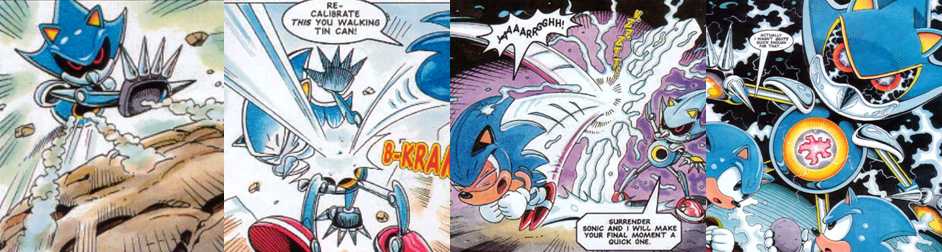
Over the course of a few action-packed panels, a fight breaks out between Sonic and his unusually loquacious doppelgänger. Metallix tosses boulders at Sonic, all of which he is able to expertly hop over and burrow through, but he is surprised by the robot’s chest laser. The two them battle so fast and so aggressively that neither Amy, nor the reader, are able to make out the action. In the aftermath, Metallix emerges from the dust and smoke as the apparent victor before collapsing into shutdown. Sonic, battered and weary, still finds the energy to insult Amy but, while he appears to have defeated his robotic counterpart, Metallix hits him with a cheap shot and takes Amy to the Miracle Planet as “live bait” and the unimpressed Sonic races off in pursuit. By the time the Freedom Fighters arrive to help, they’re already too late as the Miracle Planet disappears before their eyes, trapping all on its surface in another dimension for an entire month. On the miniature world, Sonic quickly reunites with Amy (much to his dismay) in what appears to be the Bad Future of Metallic Madness. Both characters question how Dr. Robotnik was able to convert the Miracle Planet so quickly, given that the previous month showed no signs of his influence, but their conversation (and the prospect of them being marooned there for a month) is soon interrupted by Metallix. Uncharacteristically, Sonic chooses to flee rather than fight but, as Metallix charges its laser to kill Amy, he comes flying back in with a big Spin Attack after running around the entire planet in a few seconds. Metallix, however, is able to draw additional power from the mechanical surface of the planet; this allows him to erect an electrical shield and charge up a kill shot for his prey after Sonic trips on a loose cable.

Thanks to time travel shenanigans, Metallix is soundly defeated…for now..

Sonic and Amy are saved, however, by the sudden appearance by another Sonic, this one diminutive in stature and holding a grey stone. Sonic #1 is immediately suspicious of the newcomer but Sonic #2 forces him into an energy beam that turns him into a midget as well. Sonic #2 is able to tell Sonic #1 about the grey object he’s holding; it’s the Time Stone, a relic able to transport the holder back into the past and, while Sonic #2 distracts the recovered (and now, from their perspective, gigantic) Metallix, Sonic #1 races off to the past. Arriving in what appears to be Palmtree Panic before Dr. Robotnik polluted the Miracle Planet with his machinery, Sonic’s shock over the sudden disappearance of the Time Stone gives way to his awe at the presence of a massive piece of mechanical hardware. This is StC’s version of the Robot Transporter from the game, which is in the process of transforming and polluting the environment; thanks to having been shrunk, Sonic is easily able to hop inside of the machine and remove its power source, the Time Stone. Having destroyed the machine, Sonic uses the Time Stone to travel back to the present and, in the process, becomes Sonic #2 as he saves his past-self from Metallix, gifts him the Time Stone, and orders him to race off just as he was directed in order to continue the time loop. Although Metallix attacks Sonic with all its power, the environment begins to change around them as his actions in the past catch up to the present; as a result, not only is Dr. Robotnik’s influence erased from the Miracle Planet and Sonic returned to his normal height but Metallix is wiped from existence and the story ends with Sonic facing an entire month alone with Amy.

The Summary:
Now remember, I read Sonic the Comic religiously as a kid; for me, it was one of three influential factors into my fandom for Sonic (the others being the cartoons and, of course, the games themselves) so there is not only a lot of nostalgia there whenever I revisit the comic but quite a bit of bias as I was a big fan of the original stories StC told, its characterisations, and the way they included some elements from the videogames. As a result, I remember enjoying “The Sonic Terminator” as a kid but, as an adaptation of Sonic CD, it’s definitely lacking in many areas. Perhaps the biggest drawback to the story is that it spends two issues messing about with a side plot involving Captain Plunder. At the time, each story in StC was about five pages long so right away the writers have wasted ten pages of story on something that has nothing to do with Sonic CD, though it also appears as though the writers and artists had very little to work with when putting this story together.

Metallix steals the show and comes across as a formidable new villain for Sonic.

Indeed, they must have seen the opening video and maybe a few screenshots and had a rudimentary understanding of the game but there is next to nothing from Sonic CD included beyond the absolute bare minimum. There is only one Time Stone, for example; hardly any locations from the game are used, no enemies or Badniks beyond Metal Sonic appear, and Dr. Robotnik is practically non-existent for the entire story. One benefit of this, however, is that it means Metallix takes centre stage as the primary antagonist. Unlike other interpretations of Metal Sonic, Metallix is very chatty; it taunts Sonic, constantly calculates the odds of success and failure, and comes across as a very threatening and formidable foe not only in its array of attacks and blinding speed but also in its durability. It’s not often in StC that Sonic is unable to trash his robotic foes in one hit and Metallix was certainly the most persistent enemy he has encountered at this point. Even though this story seems to spell the end of the character, Metallix would return with a vengeance later down the line as part of the Brotherhood of Metallix and would be a formidable recurring adversary for Sonic, his friends, and even Dr. Robotnik.

The story’s art is incredible and elevates it despite lacking fidelity to Sonic CD.

What really makes “The Sonic Terminator” shine is the excellent artwork from the always incredible Richard Elson. Elson was to StC what Patrick “Spaz” Spaziante was to the Archie comics and he always delivered on portraying Sonic and the other characters in such a dynamic way. His rendition of Metal Sonic is fantastic and the way he conveys Sonic’s speed is brilliant, allowing for some action-packed panels that really sell the gruelling nature of Sonic’s clash against his doppelgänger. While there isn’t much for the other Freedom Fighters to do, this is at least in keeping with the solo nature of Sonic CD and, while the story isn’t a direct one-to-one adaptation of the source material, StC pretty much never did this when producing the few adaptations they did do over the years. As a result, “The Sonic Terminator” is a great story in the StC canon and perfectly sets Metallix up as a frightening adversary (and therefore a significant story in the large StC lore) but is maybe not so great for those expecting a more literal adaptation of Sonic CD.

My Rating:

Rating: 3 out of 5.

Pretty Good

Have you ever read “The Sonic Terminator”, or any issues of Sonic the Comic for that matter? If so, what did you think of the story and the way it introduced its version of Metal Sonic? Were you disappointed by how few elements from Sonic CD were present in the story or were you just happy to see Sonic and Metallix go at it? Which of StC’s original characters was your favourite and what did you think to Sonic’s characterisation? How are you celebrating Sonic CD’s anniversary this year? Whatever your thoughts on Sonic CD, or Sonic in general, feel free to leave a comment below.

Game Corner: Terminator 2: Judgment Day (Arcade)

Released: 31 October 1991
Developer: Midway
Also Available For: Commodore Amiga, Game Boy, Game Gear, Master System, Mega Drive, PC, Super Nintendo Entertainment System (SNES)

The Background:
Terminator 2: Judgment Day (Cameron, 1991) was a blockbuster critical and commercial success; the film made over $520 million at the box office against a $94 to 102 million budget and is widely regarded as one of the greatest science-fiction movies ever made, and one of the greatest movie sequels of all time. As is the case with most of the Terminator movies (Various, 1984 to 2019), the film was accompanied by a number of videogame adaptations. The most prominent of these, for me, was T2: The Arcade Game (Probe Software, 1991), which was one of the first games I ever owned for the SEGA Mega Drive back in the day. The game was the home console port of a light gun arcade cabinet developed by Midway, which I did play as a kid but more recently got the chance to play all the way through at an arcade near where I live. While I have fond memories of the Mega Drive game, the home console ports received mostly average reviews and it’s gratifying to see how successful the arcade cabinet was at the time.

The Plot:
In the nuclear wasteland of 2029, the human race has been driven to near extinction by Skynet, a malevolent artificial intelligence that relentlessly hunts humankind using cybernetic killers, the most prominent of which is their T-880 Terminator infiltrator. In an effort to preserve their victory, Skynet sends an advanced prototype T-1000 composed of liquid metal (or “mimetic polyalloy”) to kill young John Connor before he can grow up to lead the human resistance to victory and only a reprogrammed T-800 (or two, if you have a friend to play with) can protect him…and the future.

Gameplay:
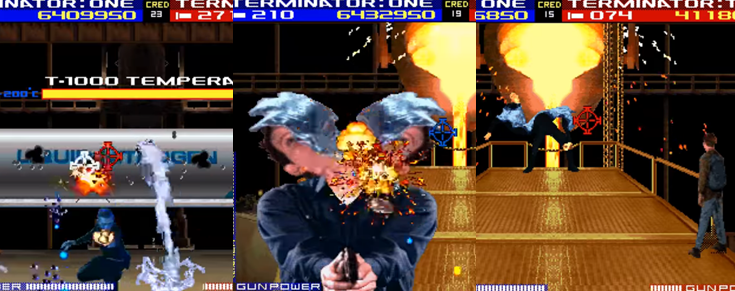
Terminator 2: Judgment Day is a first-person light gun game in which you take on the role of a reprogrammed T-800, just like in the film it is based on, and work to safeguard the future of humanity by blasting everything you see onscreen before it can hit you. In the arcades, you do this by manipulating a big light gun that has two very simple functions: a trigger to shoot and a red button to launch either missiles or blast enemies with shotgun shells depending on the stage (or “Mission”) you’re playing. With your onscreen presence limited to a blue or red crosshair, you’ll have to keep a keen eye on the game’s heads-up display (HUD). Your character’s health is measured in the form of an energy bar running down the left (or right) side of the screen, your supply of missiles or shells is at the top alongside your current score and remaining credits, but the main bar to watch out for is the “Gunpower” meter.

Keep an eye on your Gunpower meter as it’ll drain pretty quick if you’re too trigger happy.

Unlike other light gun games, which have you shooting outside of the screen or pressing a pedal to reload your gun, there is no reload function in Terminator 2 and, instead, you can blast enemies for as long as your Gunpower meter stays full. Thus, if you’re too trigger happy and drain the meter, you’ll fire less and less shots at a far slower and less powerful rate until you give the meter a chance to refill or grab a power-up. Enemies are in high abundance in Terminator 2, way more than I remember from the Mega Drive version; the screen automatically scrolls to the right to pan across the stage but will lock into place quite often and force you to fend off waves of Terminators, Hunter-Killers (HKs), and other enemies, all of whom constantly fire missiles, plasma shots, and bullets at you. Sometimes, they’ll pop up in the foreground and try to fill you full of holes; others, they’ll toss pipe bombs or other such items at you which must be shot out of the air. In a lot of areas, you’ll find members of the human Resistance exchanging fire with Skynet’s forces, usually behind a destructible barricade. Take care when spraying the area with you fire, though, as this can cost you points and destroying barricades will only mean more shots come your way.

Gameplay gets very repetitive, and frustrating, very quickly.

Gameplay is extremely simple and full of intense, arcade shooting action but quickly becomes very monotonous as wave upon wave of enemies fills the screen. Things are shaken up a bit in certain missions, though; two missions see you having to protect John Connor while he’s in a vehicle. These vehicles take up a large portion of the screen and can be damaged by your fire, meaning it’s extremely easy to destroy the vehicle completely by accident and, if this happens, you’ll lose a massive chunk of health and have to restart from the very beginning, which is extremely annoying. When in the Cyberdyne Systems office building, you’ll be tasked with destroying everything you see to erase all evidence of their research into Skynet; thankfully, you can complete the mission without literally destroying very single piece of the environment but it pays to shoot at anything and everything you see to snag a hefty bonus score and beat out your partner.

Graphics and Sound:
Terminator 2: Judgment Day recreates the look and feel of the movie’s biggest action scenes through the use of digitised environments, graphics, and sprites. While they do appear quite pixelated and blurry at times, when playing the actual arcade cabinet you never need to worry about the graphical fidelity as there’s way too much happening onscreen at any one time to really nitpick. While the game’s use of still images and text for cutscenes isn’t really all that much to write home about, the game makes great use of the iconic Terminator theme and sound effects and is full of voice clips from the film (mainly from Arnold Schwarzenegger) and features digitised versions of the film’s key characters, all of whom lend their likenesses to the game with the exception of Linda Hamilton (though you’d never be able to tell).

The game faithfully recreates enemies and locations from the film and creates fitting new ones, too.

Despite being quite a short and repetitive title, Terminator 2 artificially extends its length by having you battle seemingly endless waves of enemies at any one time. Nowhere is this more apparent and monotonous than in the very first stage, which is set during the Future War seen in the opening of the film. The game faithfully recreates the desolate, bleak, post-apocalyptic future and even pulls from the flashbacks seen in the first film for its rendition of the Resistance base and the third mission, which sees your protecting John Connor from an aerial HK. The dark, desolate future soon gives way to the sleek, mechanical construct of Skynet’s main base and the glass-and-steel office building of Cyberdyne Systems as the game veers towards recreating notable action sequences from the film. This all culminates in a lovingly recreated version of the steel mill for the finale and every stage in the game is punctuated by destructible objects (which generally yield various power-ups) and big digitised renditions of enemies as they pop up in the foreground to attack you.

Enemies and Bosses:
Each mission of the game features a variety of enemies; in the first few missions, you’ll exclusively battle against Skynet’s forces, most commonly represented by the T-800 endoskeletons that wander around the war-torn future and blast at you with plasma rifles. T-800 infiltrator units (who are, oddly, dressed exactly like Arnold’s character in the film) can be found in the Resistance base and will take a few more hits to put down as you blast away their living tissue exteriors, and tougher gold variants of the endoskeletons will also appear near the end of this mission.

Enemies will be relentlessly filling the screen and bombarding you with shots to take your money.

You’ll also have to blow aerial HKs out of the sky and contend with snake-like Terminators and little floating orbs that crack open from egg-like shells and buzz around the screen. When you time travel to the past, though, you’ll mainly be met with armed SWAT teams and human scientists in haz-mat suits. These guys are all weaker than the Terminators you’ve fought but no less dangerous; they’ll hang on the outside of buildings firing at you, toss caustic acid in your face, and pop up in the foreground to try and end your mission as good as any machine and there’s a constant, inexhaustible supply of them at all times.

Skynet busts out their biggest and most powerful defences to sap your pocket money.

Each Mission of Terminator 2 culminates in some kind of big finale, generally against a boss but often having you protect John while he’s in a vehicle. At the end of the first Mission, you’ll have to battle a HK Tank which rolls along firing heavy weapons at you from its turret-like arms, “eyes”, and a little opening in its treadmill. Take note of these areas as this is where you should concentrate your fire to keep incoming attacks to a minimum and then put it down quickly; even after you blast off each appendage, though, the battle rages on as a slew of gold endoskeletons pours out so don’t let your guard down for a second. If you manage to defend John Connor from aerial HKs, you’ll battle another HK Tank before storming Skynet’s defence grid, which is a massive wall-like super computer that spits missiles and snake-Terminators from numerous different openings that you’ll need to destroy one by one to access the time displacement chamber.

The T-1000 is a gruelling battle that’ll physically wear you out with its longevity.

Surprisingly, there is no boss battle at the end of the Cyberdyne mission; instead, you simply dispatch wave upon wave of scientists and SWAT police while John steals the CPU and severed arm of the first Terminator. However, the game makes up for it with its most gruelling stages yet; first, you have to fend off the T-1000’s helicopter as it tries to ram into the van John and Sarah are escaping in. This is very tricky without another player as it’s far easier to have one person cover the left-side of the screen and another to cover the top but you only have a few seconds to blast the helicopter and the van is extremely fragile. Once you’re in the steel mill, the difficulty and frustration really ramp up as simply shooting the T-1000 isn’t enough; instead, you have to blast the liquid nitrogen tuck behind it in order to lower its temperature. This is much harder than I remember it being on the Mega Drive as the T-100 is super quick, rolling and “teleporting” around the screen with its liquid metal ability, and its temperate bar refills so fast that I can see kids wasting loads of their pocket money on this boss alone. When you finally get through this bit, you must fend the T-1000 off before it gets close enough to kill John; land enough shots and it’ll back up towards the molten steel, where you must grab a grenade launcher and bombard it with shots to eventually finish it off for good. Fail, and you have to restart all the way from the liquid nitrogen truck, which is more frustrating than you can possibly imagine.

Power-Ups and Bonuses:
As you strafe fire across the game’s various locations, you’ll notice a few little boxes appearing at the bottom of the screen. Be sure to shoot these as they contain all sorts of power-ups that will grant you a temporary shield, full power-up your Gunpower meter or your health (or both), a screen-clearing smart bomb, or even you additional missiles and shots to deal greater damage. When enemies pop up in front of you, try to aim for their heads as Terminators will sometimes spit out their CPU upon defeat, which will grant one of these random power-ups, and try to avoid hitting John and Sarah as they’ll often drop mini guns that will let you blast away at your enemies without fear of losing power.

Additional Features:
As an arcade title, there really isn’t much more on offer here than beating your high score and playing alongside a friend. I highly recommend having another player with you as this game is a long old slog and, if you’re playing with money or on home consoles, you can except to burn through a lot of credits very quickly as just beating the first Mission takes quite a bit of time and energy.

The Summary:
I remember having a blast with Terminator 2’s Mega Drive port. It was clunky to play with the Mega Drive’s controller (I had a Menacer, once, but it was pretty uncomfortable and unwieldy) but I remember being able to play through it without any real issues. When I saw it in my local arcade, it was a must-play title as I had fond memories of playing it as a kid but, while the original arcade cabinet does deliver (especially since the one I played was set to free play), it is a very monotonous and draining game to play. Even with a friend, this is no walk in the park as stages drag on and on and enemies are absolutely relentless; bosses are fine, they’re nice and big and should be a bullet-hell experience, but even regular stages can drag on for a long time thanks to the waves of enemies. The sections where you have to protect John’s vehicles are easily the worst and forcing you to repeat the entire final boss if you die is needlessly frustrating but, at the same time, Terminator 2 is an incredibly enjoyable experience and a faithful recreation of the film’s more action-packed moments. Just be sure to bring some water and settle in for a long-old haul with this one!

My Rating:

Rating: 3 out of 5.

Pretty Good

Have you every played the arcade version of Terminator 2: Judgment Day? How did you find it and where would you rate it against other, similar light gun games? How does it compare to other Terminator videogames? Did you ever own one of the many home consoles ports? If so, which was your favourite? How are you panning on celebrating Judgment Day this year? Whatever your thoughts, drop a comment below and check back in next Monday for more Terminator content!

Movie Night: Death Note (2006)

Released: 17 June 2006
Director: Shūsuke Kaneko
Distributor:
Warner Bros. Pictures
Budget: $20 million (estimated)
Stars:
Tatsuya Fujiwara, Kenichi Matsuyama, Yuu Kashii, Asaka Seto, Takeshi Kaga, and Shidou Nakamura

The Plot:
A battle between the world’s two greatest minds begins when Light Yagami (Fujiwara) finds the Death Note, a notebook with the power to kill, and decides to rid the world of criminals. Advised by the Shinigami, Ryuk (Nakamura), Light’s crusade to bring his own brand of justice to the world soon brings him into a game of cat and mouse with an eccentric detective known as “L” (Matsuyama).

The Background:
Death Note (or “DEATH NOTE” as it is stylised) began life as a manga created by author Tsugumi Ohba and illustrated by Takeshi Obata; starting out as a very broad and basic concept regarding Shinigami and strict rules, Ohba and Obata developed a system whereby both of them would draft and storyboards alongside their editor. Ohba would visualise the panels during his downtime and Obata would incorporate pacing and action into them, and was afforded a great deal of creative license when it came to his artwork. Originally published in Weekly Shōnen Jump between 1 December 2003 and 15 May 2006, Death Note was incredibly successful and widely praised for its art, compelling characters, and elaborate twists and turns. So popular was Death Note that was adapted into an equally well-regarded thirty-seven episode anime between 3 October 2006 and 26 June 2007, which received two feature-length specials retelling the anime’s story with new footage in late-2007 and 2008, respectively. Considering how popular both the manga and the anime are, it was perhaps inevitable that a live-action adaptation would follow; director Shūsuke Kaneko didn’t take this task lightly and even gambled on filming two movies back-to-back just to try and do the source material justice. To bring the Shinigami Ryuk to life, Kaneko chose to utilise computer effects so that audiences would be into him being a fantastical and artificial character, though insisted that the animators at Digital Frontier create him as though he were a man in a suit. After topping the Japanese box office, Death Note received a brief cinema release overseas alongside both subtitled and dubbed versions of the film, and eventually made over $31 million at the box office. The film was relatively well regarded by critics, with reviews praising it as a tense thriller and faithful adaptation and placing specific emphasis on the interplay between Light and L. The film was followed by a sequel, just as Kaneko intended, that proved to be even more successful and spawned not only a somewhat divisive L-centric spin-off but also a miniseries and follow-up film in 2016 that also garnered mixed reactions.

The Review:
So, I have to preface this review by saying that, as of this writing, I haven’t actually read the original Death Note manga or watched the anime series; I’ve been meaning to, but never seem to be able to find the time for either, which is a bit of a shame as I really dig the concept and the characters. Death Note (as in, this movie) was my introduction to the franchise; I remember it and its sequel randomly being on Film4, I believe it was, years and years ago when I was taking my undergraduate studies and I stayed up later then usual to watc  h them purely on the strength of the brief screen time Ryuk received in the promos. I was intrigued and have been a big fan of the franchise since…and I hope to one day get around to checking out the original source material. The second thing to note is that I’m watching the original Japanese audio with English subtitles; apparently, there is a dubbed version out there (and, honestly, I would prefer that) but that’s not included in my box set. The film is initially framed as a bit of a mystery, and out of sequence, showing the names of the Death Note’s victims onscreen before they collapse from a fatal heart attack before a gaggle of stunned onlookers, including the police, the press, and everyday civilians.

Disillusioned by the judicial system, Light judges those he deems guilty with the accursed Death Note.

The film follows university student Light Yagama, a young prodigy wo dreams of joining Japan’s National Police Agency and working alongside his father, Detective Superintendent Souichirou Yagami (Kaga). A highly intelligent young man, Light is something of a brash youth who believes he’s smart enough to justify skipping years of on-the-job experience and intuition. Strongly opposed to criminals and in favour of swift, uncompromising justice, Light hacks into the police database and is disheartened to see criminals slip through what he perceives as a broken system, one that he can strengthen and make more efficient. The Death Note gives him the power to do that; initially afraid of Ryuk and sceptical, he tests the books’ power and is stunned at first but soon gets into the habit of offing known criminals. Light’s crusade doesn’t simply stop at murders and rapists; he judges anyone and everyone for their crimes and targets corrupt politicians and, eventually, anyone who threatens to get in his way or expose him. Once the deaths become a regular thing, the press and public have a field day; dubbing the one responsible “Kira” (a Japanese approximation of the word “killer”), cults and online followings start to crop up praising Kira for doing God’s work and punishing the wicked, seeing him as a saviour and begging him to punish more evildoers. This goes both ways, though, as there are also those who see Kira as being just as bad, if not worse, than those he targets but his impact is widespread; bullies stop harassing students and wrongdoers are scared shitless, but even those who “praise” Kira are stunned when the vigilante force strikes down those who dare speak up against him in public. Without a doubt, the power of the Death Note and the fanatical nature of Kira’s followers inflates Light’s ego to breaking point; he sees himself as the saviour of the world, the divine hand of God, and as the only one capable of brining peace, order, and justice to an increasingly unfair world. For all his lofty talk, however, Light has a selfish, vindictive side to him that skews much of good his killings may do; he hopes to use the crisis as a means to fast track his appointment to the National Police Agency and goes to any means necessary to ensure he’s positioned as the only one capable of stopping the mysterious Kira.

The demonic Ryuk observes Light’s killing spree with mild amusement and curiosity.

Light’s constant companion on his descent into madness is Ryuk, a demonic Shinigami with a taste of apples and a mischievous nature. Having grown bored in the Shinigami realm, he drops the Death Note into the human world in hopes of some entertainment; the book itself contains instructions, purposely written in English as that’s the most common language on Earth, and a series of rules that dictate how the book works. Any name written in it will suffer a fatal heart attack within forty seconds unless the writer states otherwise; the writer must picture their victim when writing their name so as not to target those that share the same name, and the book’s power is virtually unlimited. Light spends great deal of time testing the limits and rules of the book (and wasting entire pages on just a few names), witnessing its effects first-hand and eventually detailing more complicated instructions, essentially playing God and manipulating those who would root him out or opposing him into bending to his will. Ryuk is, for the most part, nonplussed by all of this. Invisible to anyone who hasn’t touched the book (unless Light wishes another to see them), Ryuk is similarly incorporeal and is driven only to find some amusement; he makes no effort to assist in any way Light, preferring to remain neutral and throwing temper tantrums when Light ignores him and stops giving him apples to avoid suspicion. ; he offers commentary and is curious about Light’s motives and intentions, but is content to simply let events play out as they do. However, Light is able to manipulate even Ryuk into assisting him by denying him attention and apples unless he helps him locate the surveillance devices placed in his room and spot when people are following him. Ryuk exists by taking the years the Death Note’s victims would have lived were it not for their untimely deaths. Furthermore, if requested, the holder of the Death Note can also dramatically cut their lifespan in order to receive the Shinigami eyes, which allow them to perceive the world as Ryuk does and thus see the real name and lifespan of those around them, and they can also choose to cast away the book, which will cause them to lose all memory of it, though the power and allure of the Death Note prove as enticing and irresistible to Light as apples are to Ryuk.

Stumped by Kira’s mystery, the cops turn to the eccentric L, while Naomi conducts her own investigation.

Souichirou and his team work tireless to solve the mystery of Kira; Souichirou is (somehow) convinced that a singular individual is behind all the killings and his team pledge their unfaltering support to his efforts to bring Kira to justice. However, after hitting a wall in their investigation, they have no alternative but to turn to the mysterious, world-renowned detective known only as “L”. Initially, L contacts them through his assistant and father-figure, Watari (Shunji Fujimura), and appears as little more than a distorted voice on a laptop but turns out to actually a highly intelligent, if socially inept and quirky, young man named Ryûzaki, L’s powers of deduction border on the supernatural; he correctly surmises that Kira’s killings are the result of some malicious intent rather than mere coincidences, though is unable to figure out the cause of the murders since even he has no reason to believe that the Shinigami are real. An eccentric figure always seen sitting in odd positions and snacking on desserts or drinking sugary drinks, never blinking, and his mind constantly pondering the mystery of Kira, L produces complex charts and data to prove his theories that Kira is a single individual rather than a virus, and narrow down that he’s likely to be a university student judging by the time of the unexplained deaths. L also brings in agents from the Federal Bureau of Investigation (FBI); Light is annoyed to find agent Raye Iwamatsu (Shigeki Hosokawa) following him but this is where he really starts to get creative with the Death Note. Ralising that Raye can’t be the only FBI agent assigned to the Kira case, Light uses the Death Note to have him doom his colleagues by writing their name on pages of the book, thereby showing that his quest to usher in a new world now includes murdering even those who would uphold the law if they threaten his work. After witnessing his death, Raye’s fiancée, Naomi Misora (Seto), a former associate of L’s, is left devastated. She undertakes her own investigation and easily singles out and accuses Light using a false name as part of her quest for revenge against the man responsible for her beloved’s death. Kira’s impact on the world is staggering; far more people support his brutal methods than they do oppose them, but those that are against the wholesale murder of any and all criminals make valid points regarding due process and false accusations. One of the principal anti-Kira crowd is also Light’s girlfriend, Shiori Akino (Yuu Kashii), who dreams of being distract attorney and cannot sanction Kira’s particular brand of justice or Light’s support of him. Despite this, Light believes that she would understand that he was acting for the greater good and a higher cause and taking the action no one else could, so confident is he in his appeal and her love for him.

The Nitty-Gritty:
A principal theme in Death Note is that of obsession; once he sees the cult following building around Kira, Light becomes convinced that he’s at the forefront of a fundamental change in the history not just of Japan, but the entire world. Seeing himself as the God of Justice and fully believing that he’s the saviour the world needs, Light dreams of a world without crime, where the guilty and the evil are punished instantly and without compromise, and is so blinkered by his vision for this new world that he never even stops of consider the moral ramifications of his actions. Instead, he simply punishes those he deems guilty without hesitation but he more than meets his match in L; since L doesn’t know about the Death Note of the Shinigami, he’s somewhat on the backfoot when it comes t his adversary, but they’re actually on equal ground as Light is unable to simply strike L down because he doesn’t know the eccentric detective’s real name and doesn’t want to sacrifice his lifespan to learn it. L is able to use this to his advantage, sacrificing a death row convict, “Lind L. Taylor” (Matt Lagan), to learn more about Kira’s capabilities, a cold-blooded tactic that Souichirou cannot condone but he and his team are so baffled by Kira’s killings that they have no choice but to put their faith in the unorthodox L. Light’s reaction to L outsmarting him is outright insult; he’s clearly not used to being outsmarted or made a fool of, so he makes it his mission to figure out L’s true identity and prove his intellectual superiority, which thus becomes his new obsession throughout the film.

Light and L embark on a game of cat-and-mouse to try and expose each other.

Thus, a cat-and-mouse game between the two ensues; since Souichirou refuses to allow Light to get in one the case, seeing it as both a personal challenge and too dangerous for his smart but headstrong son, and Light is forced to alter his methods after L figures out that his killings align with his class schedule. After the FBI agents are killed, Souichirou loses the vast majority of his investigation team as many leave to protect themselves and their families and he all-but demands that L reveal himself since, up until that point, he’s remained safely hidden. Watari takes the remaining group to L’s hotel room and the unusual stealth forbids them from openly revealing their names going forward and shares his deductions about Kira’s ability to manipulate life and death, which are so on the money that he may as well have read the script. Through sheer reasoning, L figures out that Kira is someone who doesn’t like to lose, is immature, and who can dictate the time, place, and way a person dies as well as needing to know that person’s name and face; indeed, he knows everything but the who and how, which continue to elude him throughout the film. In this regard, the two are very similar; L is also quite immature and persistent, and Light would very much like to put an end t his rival but cannot without getting close enough to him to learn his real name. after narrowing down his chief suspects to Souichirou’s team and family, L has them isolate in the hotel room and places bugs and camera sin their homes to monitor their families, but Light is shrewd enough to not only discover this but also continue to murder as Kira using a miniature television hidden in a big bag of crisps. Like Naomi, L is convinced that Light is Kira and insists on monitoring him to prove that theory, even after there’s no evidence to support it; it’s intriguing to see everyone so close to nailing their man and yet lacking the crucial proof to pin him to the wall, and Light delights in outsmarting them all, even his father, at every turn.

Ultimately, Light proves a reprehensible monster who sacrifices his girlfriend to clear his name.

While Ryuk can appear overly cartoony at times, he’s an otherworldly being designed to be out of proportion and extreme in his movements and appearance. With his wide, manic eyes, devilish smile, and gothic attire, he certainly cuts an iconic figure, especially when flying about on his bat wings, and a big part of Death Note’s appeal for me is his appearance and the allure behind him and his kind. The other appealing factor is the battle of wits between Light and L; both are morally skewed individuals, willing to put others at risk to prove a point and succeed in their game, but only Light is willing to manipulate and sacrifice those nearest to him to get what he wants. At first, it seems as though the grief-stricken Naomi has taken Shiori hostage in order to force a confession from Light; L watches, fixated on figuring out how Light has been killing people as Kira, but Light pleads with Naomi and is left distraught when Shiori is short and killed while trying to escape from Naomi! With the police closing in and seeing that she’s killed an innocent girl apparently for no reason, Naomi shoots herself in the head and the anguished Light, seen as a sympathetic and wrong young man, is gratefully accepted by L onto Souichirou’s investigation team. However, Light reveals to the audience (and Ryuk) that he found out Naomi’s true name ahead of time and manipulated everything, forcing her to take a hostage and commit suicide in order to clear him from all suspicion and get his police career on track. Even Ryuk expresses disgust at Light’s lack of empathy and inhumanity after learning that he purposely wrote a companion piece for Shiori, thereby sacrificing her for his own ends, and the film ends not only with Light having degenerated into a old-blooded monster and the hint that L still has his suspicions about him, but also with young celebrity Misa Amane (Erika Toda) being saved from an obsessive fan by the appearance of a second Death Note!

The Summary:
Death Note is quite the oddity; the premise itself is both alluring and ludicrous and the leaps in logic are almost laughable at times. The very idea that L could figure out some kind of connection to a single individual screams of convenience and it almost feels like the narrative would’ve been served slightly better by not revealing that Light was behind all the murders, or quite how he was going about it (maybe paint Ryuk as the killer) until halfway through. However, a great deal of the film’s appeal is seeing Light operate undetected, jotting down names without anyone noticing and amassing this huge following and controversial discussion regarding Kira’s morals and methods, often acting in plain sight. I love how he’s easily whittled down to the top suspect and then has to change his methods and go to extremes to avoid being exposed and give L the run-around, and it’s fun seeing these two infallible and super intelligence individuals clash as they try to one up each other. Ryuk, and the very idea of a killer notebook, is an extremely appealing and interesting anti-hero; more of mischievous sprite than a malicious demon, it’s interesting seeing him follow Light around and question him and watching Light become as monstrous on the inside as Ryuk is on the outside. Death Note’s main hook is the game of cat-and-mouse between Light and L, which here primarily revolves around L desperately trying to prove that Light is Kira and Light outsmarting his rival and manipulating events to get his career and his desire to be the God of the New World underway. In this way, the film really excels; it can be a bit daft and cartoony at times, but for the most part everyone plays it completely straight and it ends up being a pretty tense, fantasy-laced thriller.

My Rating:

Rating: 4 out of 5.

Great Stuff

What did you think to the live-action adaptation of Death Note? If you’re a fan of the anime or manga, how did it work as an adaptation for you? What did you think to the changes made to the source material? Were you a fan of Light’s and where do you fall on the debate about his actions as Kira? What did you think to Ryuk and the concept of a killer notebook? Would you take advantage of such power? What did you think to L and his massive leaps in deductive logic? Whatever your thoughts on Death Note, feel free to share them in the comments or on my social media.

Movie Night [Spidey Month]: Spider-Man


Easily Marvel Comics’ most recognisable and popular superhero, unsuspecting teenage nerd Peter Parker was first b bitten by a radioactive spider and learned the true meaning of power and responsibility in Amazing Fantasy #15, which was first published in August 1962. Since then, the Amazing Spider-Man has featured in numerous cartoons, live-action movies, videogames, action figures, and countless comic book titles and, in celebration of his debut and his very own day of celebration, I’m dedicating every Friday of August to talk about everyone’s favourite web-head!


Released: 3 May 2002
Director:
Sam Raimi
Distributor:
Sony Pictures Releasing
Budget:
$139 million
Stars:
Tobey Maguire, Willem Dafoe, Kirsten Dunst, James Franco, Rosemary Harris, and Cliff Robertson

The Plot:
Academically-gifted but socially inept high school senior Peter Parker (Maguire) suddenly finds himself endowed with the proportional strength and agility of a spider. After his beloved Uncle Ben (Robertson) is killed due to his irresponsibility, Peter becomes a masked crimefighter but is tested when scientist and industrialist Doctor Norman Osborn (Dafoe) becomes the maniacal Green Goblin.

The Background:
After achieving incredible success with the Fantastic Four, Marvel editor and head writer Stan Lee collaborated with artist Steve Ditko to create Spider-Man, whose debut issue became one of Marvel’s best selling titles at the time and whose subsequent popularity has seen him become the flagship character of Marvel Comics. Although Spider-Man enjoyed some success in animated adaptations and even had a live-action series back in the seventies, the story of his big-screen debut is a long and complicated one fraught with legal issues. Development of a Spider-Man movie can be traced back to the early 1980s, when producer Roger Corman tried to get a film off the ground with Orion Pictures. After that fell through, Tobe Hooper came close to directing a more horror-themed take on the character before the Cannon Group began financing a new script and initially brought in Joseph Zito to direct. Cannon’s financial difficulties saw the project fall apart and producer Menahem Golan took the film rights with him to 20th Century Film Corporation, where he divided the distribution, home video, and theatrical rights up and hired James Cameron to write and direct a new Spider-Man adaptation. Cameron was the one who introduced the idea of Spider-Man having organic webbing, which was just about the only element retained from his script as the film rights became mired in lawsuits and Marvel’s legal troubles. Eventually, Marvel recovered and sold the Spider-Man film rights to Sony Pictures Entertainment for $7 million; the studio turned down David Fincher’s pitch in favour of Sam Raimi, who was a life-long fan of the character. Many young, fresh-faced stars were considered for or interested in the lead role before Raimi cast Tobey Magiure, who underwent a physical transformation for the role. Raimi, whose background was more in traditional and practical effects, was convinced by visual effects supervisor John Dykstra to bring Spider-Man’s superhuman feats to life using CGI but still used practical stunts wherever possible. Finally, after decades in aborted attempts and a hasty edit following the 9/11 terrorist attacks, Spider-Man released to overwhelmingly positive reviews that praised the cast and visuals while also criticising the Green Goblin’s suit. The film’s worldwide gross of just under $830 million meant that it was a phenomenal box office success; Spider-Man was accompanied by action figures, comic book tie-ins, and a videogame adaptation and also kick-started one of the most successful and beloved comic book trilogies in all of cinema.

The Review:
The hype for Spider-Man was absolutely palpable back in the day; the film came out around about the same sort of time that my friends and I were old enough to travel to the next town over easily enough ad see films and the trailers and marketing were absolutely everywhere. I remember being so excited for the film just based on the brief snippets in the music video for the film’s excellent hit single, “Hero”, and I bought the videogame adaptation for the GameCube the same day that I saw the film based entirely on its trailer and how good the film was. I grew up reading Spider-Man comics from the seventies and eighties and watching the nineties cartoon, and up until this point the only live-action Spider-Man I’d been exposed to was the Nicholas Hammond version from the seventies which, while ambitious, was obviously limited by the budget and restrictions of the time. This was a big deal; a big-budget, special effects laden superhero film during the days when the industry wasn’t awash with blockbuster comic book releases and I remember being absolutely ready for it at the time.

Nerdy outcast Peter Parker finds his life changed forever by an errant spider bite.

Spider-Man is the story of Peter Parker, a nerdy high school senior who is unpopular with pretty much everyone in his school. A regular target of bully and brutish jock Eugene “Flash” Thompson (Joe Manganiello), Peter is subjected to cruel pranks and harassment on a daily basis despite being something of a scientific prodigy. Since his parents died when he was young, Peter has been raised by his doting, loving, and supportive Aunt May (Harris) and Uncle Ben, who provide for him as best they can on their shoe-string budget. He also enjoys the friendship of Harry Osborn (Franco), a spoiled rich kid who is struggling to succeed academically and to live up to the expectations and standards set by his influential father, Norman Osborn. Crucially, though, Peter pines for his neighbour, the gorgeous and popular Mary Jane Watson/M. J. (Dunst), one of the few people to actually show some kind of decency towards him despite hanging off Flash’s arm. Peter’s life changes forever during a routine science trip to a genetics laboratory; fascinated by the institute’s work in gene-splicing the various abilities of different spiders into a “super-spider”, Peter is concerned only with snapping a few photos for the school paper and awkwardly trying to find the courage to speak to M. J. Consequently, he doesn’t notice an errant super-spider biting him until it’s too late and, upon returning home, he crashes out and is subjected to vivid dreams as his body undergoes a startling physical transformation.

Peter initially uses his newfound powers for personal gain, with dire consequences.

When he awakens, Peter is better than ever: his eyesight has improved, his body is muscular and defined and his reflexes are so attuned that time seems to slow when he perceives danger. Most obviously, he can now eject sticky webbing from his wrists and adhere to surfaces just like a spider and Peter is overjoyed at the revelation that he has gained the proportionate arachnid’s abilities. So caught up in his newfound superhuman powers is Peter that he forgets all about his chores at home and easily bests Flash in a fight; concerned about Peter’s welfare, Uncle Ben tries to reach out to his young nephew, understanding that he is going through “changes” that will come to define his adult life, but Peter spitefully rejects Ben’s advice and heads off to try and earn some money at a wrestling event. Wishing to buy a car to impress Mary Jane, Peter crafts a bright, colourful outfit for himself and takes on Bonesaw McGraw (“Macho Man” Randy Savage) inside a steal cage, easily toppling the muscle-bound braggart. However, when the wrestling promoter (Larry Joshua) stiffs him on the pay cheque, Peter willingly allows a thief (Michael Papajohn) to escape with the promoter’s money. This decision comes back to haunt him, though, when he leaves the arena and finds his beloved uncle dying in the street from a gunshot wound. Driven to a mindless rage at seeing his father-figure die, Peter puts aside his apprehension and uses his webs to swing across the city in pursuit of the culprit, only to find it’s the same thief he let escape earlier!

Spider-Man makes an impact upon his debut, riling up Jameson and captivating Mary Jane.

Heartbroken at having indirectly caused his uncle’s death by not using his great powers responsibly, Peter crafts a new costume for himself and vows to honour his uncle’s memory by fighting crime as Spider-Man. Although he quickly gains a reputation as a mysterious masked saviour, Spider-Man’s presence and motives are questioned by the pugnacious J. Jonah Jameson (J. K. Simmons), the editor of the Daily Bugle, who does everything in his power to tarnish Spider-Man’s name by branding him as a vigilante menace. This works in Peter’s favour, however, as he is able to sell Jameson exclusive and improbable pictures of Spider-Man in order to pay his way through college. However, his obsessive dedication to helping others as Spider-Man begins to put a strain on his personal life; Peter is fired from his job for being late and completely misses that Harry is now dating Mary Jane. On the plus side, this means Peter gets to interact with M. J. a bit more; since Harry is constantly trying to impress his father, he isn’t as attuned to her feelings and his solution to any problem is to spend money. As M. J. comes from an abusive home life, she wants more than frivolities; she needs to be seen as more than just a piece of eye candy for a change to have her voice and dreams heard. Although she is amazing by Spider-Man and fascinated by his mystery and abilities, Peter makes an equal impression by actually being there for her, listening to her, and offering advice, which soon comes to cause a bit of friction between him and Harry.

Osborn, obsessed with maintaining his funding, transforms himself into a supervillain.

Amidst all of this personal drama there’s Harry’s father, Norman. An affluent and well-respected scientist and businessman, Norman is absolutely dedicated to both his research and his company, to the point where he often neglects his son and appears to be somewhat ashamed of him for not aspiring to be more. Norman takes an immediate liking to Peter and the two bond over their shared love of science; Norman even offers Peter the respect he’s never shown to Harry when Peter graciously turns down a potential job offer and soon comes to be a surrogate father-figure in the troubled teen’s life. However, Norman is under an immense amount of pressure from his Board of Trustees; his experiments and research into producing a performance-enhancing drug and a weapons-capable glider have failed to impress and, desperate to ensure OsCorp continues to receive military funding, Norman test his drug on himself. The result is a violent and painful physical transformation that also causes his mind to snap, birthing the maniacal and uninhibited personality of the Green Goblin. Succumbing to his darker impulses, Norman avenges himself against the Board as the Green Goblin and comes into conflict with Spider-Man; unlike the petty thugs and criminals he’s fought before, Spider-Man finds the Green Goblin to be just as tough and durable as he but with the added benefit of all kinds of dangerous toys and weapons in his suit and glider. The Green Goblin admires the strength of Spider-Man’s heart and conviction and initially tries to tempt him into an alliance rather than causing death and destruction in needless conflict. Since this goes against his strict moral code, Spider-Man of course rejects this offer but their antagonism only escalates when Norman (who becomes increasingly unstable the more he gives in to the Goblin’s influence) pieces together that Peter and Spider-Man are one and the same. Armed with this knowledge, the Green Goblin targets Peter’s nearest in dearest, putting Aunt May in the hospital and luring him to the Queensboro Bridge (and a final confrontation) by taking Mary Jane as a hostage.

The Nitty-Gritty:
Right away, I need to take some time to talk about Danny Elfman’s score. Initially, I wasn’t that big a fan of it; in typical Elfman fashion, it’s very dark and moody, which didn’t seem to immediately fit for a Spider-Man theme but it quickly grew on me and has since become synonymous with the character. It’s a little scary, a little ominous, but then it builds to this rousing crescendo that perfectly encapsulates the freedom, power, and fortitude of Spider-Man. It builds a sense of mystery and intrigue over the opening title sequence and is peppered throughout the film at key emotional moments but really comes to the forefront for the iconic final swing of the film, which was what sold the composition as a legitimate Spider-Man theme for me even if I hear a little too much Batman (Burton, 1989) and Darkman (Raimi, 1990) in it at times. Before I get into some of the film’s standout moments, I want to take some time to address some negatives. First of all, Maguire’s Spider-Man isn’t too great with the quips. One of the best things about Spider-Man is that he’s constantly babbling witticisms, insults, and nonsense while web-slinging and beating up bad guys. Even when being assaulted by the Sinister Six, he still has a daft comment to make and it’s one of his most enduring characteristics. Here, Peter does quip when under the mask but Maguire’s deliver is very stilted and uncomfortable (“It’s you who’s out, Gobby! Out of your mind!” stands out as a particularly low point) and, as much as I enjoy Tobey’s performance, he seems a little bit lost at times. Though he’s a great Peter and perfectly captures that nerdy, seventies characterisation of the character, it definitely took him a while to grow into the Spider-Man role and I think he just needed a little bit more direction and tutoring on how to work under the mask.

A coming-of-age story about teenagers on the cusp of adulthood and at a crossroads in their lives.

Similarly, I’m not a massive fan of Kirsten Dunst; she’s not so bad here but there just doesn’t seem to be that much chemistry between her and Maguire. She’s pretty enough and conveys a lot of layers to M. J.’s personality but she definitely improved in the sequels, though I can’t help but notice that she’s a bit of a slut (like, she’s dating Harry but flirts with Peter and then snogs Spider-Man?) Finally, some of the special effects obviously haven’t aged too well but I don’t begrudge the film for that as it basically set the standard and laid the foundation for all Spider-Man films to follow. There are also a lot of interesting and relatable themes at work in Spider-Man; crucially, the film is obviously about power and responsibility. Peter was so powerless for much of his life that he easily gets carried away by his superhuman abilities; at first, when he hits Flash, this isn’t a conscious decision on his part but he chooses to spend his day exploring his newfound abilities and to selfishly use them to try and earn money and impress a girl. While many bemoaned the addition of organic webbing to Peter’s repertoire, I always thought it was an inspired change; it made (and still makes) total sense to me that Peter would inherit that ability from the spider bite and it’s not like we don’t get that he’s a science nerd so I always thought (and still do) that this alteration was for the better and should’ve become the status quo. Plus, it plays into another theme of the movie: puberty. Spider-Man is a coming-of-age story for all three of its young characters but especially for Peter; they’re each at a crossroads, on the cusp of becoming adults, and trying to find their place in the world outside of high school but only Peter has the added pressure of actually, explicitly, becoming something else. Considering all of the pressure and confusion raging within him, it’s no wonder that he blows up in front of his uncle or that he selflessly and completely devotes himself to saving lives as Spider-Man after his tragic death.

Willem Dafoe steals the show as the Green Goblin by effortlessly switching personas on the fly.

Conversely, there are a number of amazing performances in the film; Cliff Robertson is superb as the kindly and benevolent Uncle Ben, conveying a stern, but fair, fatherly warmth and it’s utterly heart-breaking to see Peter go off at him in an adolescent rage and to then have to watch him die. Rosemary Harris is similarly loveable as Aunt May; far from the fragile, ignorant, annoying burden she is in the comics, Aunt May is a supportive, wise, and loving while still being a concern for Peter since she’s the only family he has left. Additionally, James Franco more than makes up for Maguire’s stumbles; there’s not a huge amount for him to do in this film and yet he manages to convey all of these complex and conflicting emotions and facets of Harry’s character. Harry craves Norman’s attention and affection but feels inadequate against his father, and Peter; even “stealing” M. J. from him doesn’t bring him the satisfaction he desires since, by then, Norman’s sanity is fraying and his obsession has shifted towards Spider-Man. The absolute highlight of the film’s supporting characters is, of course, J. K. Simmons as Jameson; I remember having such a smile on my  face when I first saw him and, even now, he so perfectly embodies the loud, obnoxious, demanding editor. Though essentially a tyrant who uses his paper to spread his own agenda, even Jameson is shown to have a moral code when he lies to the Green Goblin to protect Peter in a surprisingly impactful moment. If Simmons was having fun in his small role then Dafoe appears to be having the time of his life! Easily the most charismatic and memorable part of the film, Dafoe expertly walks the fine line between over the top and dead serious, switching on a dime between his two personalities and absolutely chewing up the scenery every time he’s on screen. The Green Goblin is fearsome, vindictive, and deadly, incinerating the Board members (some of whom were his close friends) and endangering lives without a second’s hesitation all to satisfy himself and, later, to lure out Spider-Man.

While many dislike the Goblin’s suit, I found the costumes and visuals to be impressive and fitting.

Unlike Maguire, Dafoe also knows exactly how to use the Goblin’s restrictive suit to his strengths, altering his voice and exaggerating his movements at every opportunity, and the scene where he talks to himself in the mirror (and to his mask) are all the proof you need that Dafoe made for one of the best supervillains in the genre. I mentioned before that some of the special effects haven’t held up too well and, while that is true (Spider-Man can look a little plastic-y at times, for example), the majority of them hold up extremely well thanks, largely, to Raimi incorporating a lot of traditional, practical effects; the Goblin’s suit and glider, for example, are usually always practical, as is the Spider-Man suit. While I’m not a massive fan of the raised webbing and the mask is a little too stiff, the Spidey suit looks absolutely incredible and is a fantastic recreation of the comic book artwork. I was never really too bothered by the Green Goblin’s restrictive, military suit; he wasn’t really a villain I had encountered all that much so I didn’t really care that he’d been visually altered. Now…yeah, I can see why people would be disappointed (especially considering Raimi dabbled in more faithful designs) but I find the helmet and its permanent, vicious smile to be quite unsettling and there’s something very off-putting about barely being able to see a masked killer’s eyes through a gruesome visage. Plus, the fights between Spider-Man and Green Goblin more than make up for this and I enjoy how they escalate throughout the film from a mid-air scuffle to the Goblin threatening Aunt May and their climatic (and vicious) battle.

Peter is devastated to unmask his foe and find his mentor, whose death only adds to his guilt.

Having pieced together Spider-Man’s true identity, the Green Goblin terrorises Aunt May and kidnaps M. J. (since “everyone” knows that Peter has been in love with her since he was a kid) to goad Spider-Man into a confrontation. Earlier, the Green Goblin offered Spider-Man the choice to join him, something Peter adamantly refused; angered by the insult, the Green Goblin forces him to make another choice: between M. J.’s life and the lives of a trolley car full of little kids. Like any good superhero, Spider-Man finds a way to save both, though at great physical strain on his part. Thanks to a gaggle of prideful New Yorkers, he’s able to lower M. J. and the kids to safety but is violently dragged into a brutal fist fight with the Green Goblin. Assaulted by the Goblin’s superior technology, Spider-Man is bloodied, beaten, and battered, his reflexes and strength effectively neutered by the Goblin’s unrelenting assault. Spider-Man’s vicious counterattack is halted by the revelation that it’s Norman under the helmet; pleading with Peter to spare him, Norman tries to manipulate and prey upon Peter’s good heart in one last cruel effort to kill his foe. Of course, Spidey’s reflexes kick in and Norman ends up skewered on his own glider; with his last breath, he begs Peter to keep the truth from Harry, a decision that weighs even heavier upon Peter when Harry swears on his father’s grave to make Spider-Man pay for killing him. Additionally, the entire escapade has taught Peter that his powers and responsibilities as Spider-Man mean that those closest to him will always be at risk, so he selflessly chooses to walk away from Mary Jane after she suddenly professes her love for him in order to continue putting others first as everyone’s friendly neighbourhood Spider-Man.

The Summary:
There’s something very pure, innocent, and wholesome about Spider-Man; since superhero films didn’t dominate the box office at the time, it was incredibly refreshing to see big-budget, serious adaptations being made of beloved comic book characters. Alongside Blade (Norrington, 1998) and X-Men (Singer, 2000), Spider-Man laid the foundations of the unstoppable juggernaut that we now know as the Marvel Cinematic Universe and changed the way audiences (and Hollywood) thought about superhero films. Fundamentally, though, Spider-Man works as a love letter to the classic sixties and seventies Spider-Man stories; like Superman (Donner, 1978), the film can be cheesy and a little campy at times but that’s all part of the charm and direction Raimi is clearly shooting for. It’s not some gritty reimagining or part of a wider, colourful world of superheroes; it’s a very focused, carefree and yet poignant action/adventure film that exists within its own bubble, one that’s very close to our world but also a little brighter and maybe a little more fanciful and exaggerated but in all the right ways and it totally works for this version of the character. Spider-Man set the standard for how superhero films were made going forward; every subsequent adaptation had an origin story, a bit of a romantic sub-plot, and a villain who was in some way connected to the hero and it took a while for the genre to shake off those trappings but, here, they’re all fresh, new, and entirely fitting thanks to its timeless themes of power, responsibility, and maturity. Furthermore, it set the standard for all future Spider-Man movies. Without Spider-Man, we wouldn’t have Andrew Garfield or Tom Holland, and without Raimi filmmakers wouldn’t have the visual language for how to convey Spider-Man’s costume, powers, and moral integrity. The technology, performances, villains, and scope of the character has changed, improved, and been expanded upon over time, even in Raimi’s sequels, but it all started here with this entertaining and whimsical roll of the dice that hits far more than it misses and still holds up incredibly well to this day.

My Rating:

Rating: 4 out of 5.

Great Stuff

Are you a fan of Spider-Man? How excited were you for the film back in the day and where does it rank for you against the many other Spider-Man movies? What did you think to Raimi’s approach to the character? Were you a fan of Tobey Maguire’s portrayal of Peter and the Spider-Suit, and were you excited to see him return to the role? What did you think to the Green Goblin’s suit and Willem Dafoe’s performance? Do you think the film still holds up or do you prefer other filmic interpretations of the character? Whatever your opinion on Spider-Man, leave a comment and be sure to check out my other Spider-Man content!

Movie Night: The Butterfly Effect: The Director’s Cut

Released: 6 July 2004
Originally Released: 23 January 2004
Director: Eric Bress and J. Mackye Gruber
Distributor:
New Line Cinema
Budget: $13 million
Stars:
Ashton Kutcher, Amy Smart, William Lee Scott, Elden Henson, and Eric Stoltz

The Plot:
All his life, Evan Treborn (Kutcher) has suffered from mysterious blackouts and a traumatic childhood but, in his twenties, he finds he can travel back in time to inhabit his former self during those periods of blackout. However, while he attempts to improve the present by changing his past behaviors and set things right for himself and his friends, there are unintended consequences for all.

The Background:
The Butterfly Effect was the brainchild of writer/director duo Eric Bress and J. Mackye Gruber, who initially faced some difficulty in shopping the concept around Hollywood due to the film’s dark and complicated premise; they wrote the first screenplay in 1995 but no one would touch it until they proved themselves with their work on Final Destination 2 (Ellis, 2003). The duo traded different ideas for sequences in the film and enjoyed working in new twists and turns to the script, and even defended casting the somewhat-controversial Ashton Kutcher since they absolutely believed in his ability as an actor. To his credit, Kutcher fully committed to the role; in spite of his tendency to misbehave when bored, he brought a lot of his own emotions and experiences to the main character. However, despite making over $96 million at the box office, critical reception to The Butterfly Effect was generally poor; reviews criticised the inconsistency of the central premise and saw it as an unpleasant and sloppy affair, though many have come to regard its harsh criticism as being unjust and see it as a flawed but entertaining thriller. For its home video release, The Butterfly Effect was accompanied by this Director’s Cut edition, which added about five minutes of extra footage alongside a completely new, far bleaker ending and the film was followed by two pretty dire, barely-connected, straight-to-DVD sequels and is apparently tapped to receive a remake at some point.

The Review:
It think it’s only fair to start this review by saying that I’m not really, and have never been, much of an Ashton Kutcher fan. Or Amy Smart fan, for that matter. In my teenage years (and still to this day), I enjoyed my fair share of tweener sex-comedies like the American Pie films (Various, 1999 to present) and was more a fan of guys like Seann William Scott rather than Kutcher and, while I enjoy Road Trip (Phillips, 2000), Smart didn’t exactly do much to stand out for me against a sea of other attractive blondes so, in terms of the casting, The Butterfly Effect wasn’t exactly my usual forte. In fact, thinking about it now, I’m not even sure how I became aware of the film; I think it must’ve come to my attention around about the same time I was discovering Donnie Darko (Kelly, 2001), and certainly must’ve been added to my film collection around this time, and I was more than surprised to find how much I enjoyed both the performances and the premise of this movie. To begin with, the film subscribes to a very linear format as we follow young Evan Treborn (Logan Lerman at seven and John Patrick Amedori at thirteen) and his childhood friends, Kayleigh Miller (Irene Gorovaia), her brother Tommy (Jesse James), and Evan’s best friend Lenny Kagan (Kevin G. Schmidt). Evan is the only son of hardworking single mother Andrea (Melora Walters), who grows disturbed by his frequent blackouts; rather than fainting or going into a catatonic state during these moments, Evan simply loses all awareness of what’s happened around him and “comes to” only after the moment has passed, meaning he has no memory of drawing a disturbing picture of a knife crime in school or of why he’s standing in the kitchen holding a knife. Concerned for his wellbeing and desperate to avoid him becoming institutionalised like his father, Jason (Callum Keith Rennie), Andrea takes Evan to Dr. Redfield (Nathaniel Deveaux) who suggests that he start keeping regular diaries to help jog his memory and that his blackouts may stem from abandonment issues with his father.

Evan tries to correct his traumatic childhood with his time travel abilities and ends up a murderer!

To try and rectify this, he’s granted a heavily supervised visit to his father in hospital, only to blackout and awaken to find his father ranting and raving and attempting to throttle him to death, subsequently witnessing Jason being accidentally killed right before his eyes. Not only do Evan’s blackouts continue as he grows into a teen, but his childhood traumas quickly mount up as well; he blacks out during a trip to the basement of Kayleigh’s disturbed father, George (Stoltz), whose physical and sexual abuse of his kids causes Kayleigh to grow up ashamed of her body and sexuality and Tommy to become more than a little disturbed. Tommy constantly manipulates and insults both Evan and Lenny, flies into a rage at the slightest provocation, and even sets fire to Evan’s beloved dog after seeing a tender moment between him and Kayleigh. Eventually, Andrea reaches her breaking point and moves them away, much to Evan’s anguish as it means leaving his childhood sweetheart behind, though he vows to come back to her. When the story jumps ahead to find the now grown-up Evan acing his way through university, he’s stunned to find that reading his diaries triggers a reverse blackout; while his older self spaces out and becomes unresponsive, his conscious mind inhabits the body of his younger self, allowing him to experience moments he missed out on as a child and understand just how depraved George was. Confused, he turns to the only person who can corroborate what he experienced and finds Kayleigh (Smart) working as an abused waitress and deeply traumatised by her disturbing upbringing; when Evan’s questions only cause her further distress and drive her to suicide, he’s devastated when an angry Tommy (Scott) calls vowing to make him pay. Realising that he has the power to change events for the better, Evan travels back in time and delivers a scathing and unexpected tirade to George, altering events so that Kayleigh was spared her father’s wrath and lusts and resulting in the two of them being together in a fraternity at university. However, all is not entirely right in this new timeline; not only does Evan suffer a painful and disturbing convulsion as a new set of memories is crammed into his brain, but he’s now seen as a rich, douchebag frat boy who’s failing his classes. To make matters worse, George misinterpreted Evan’s message and poured all of his abuse into Tommy, who becomes even more maladjusted as a result and, during a violent confrontation between the two, ends up bludgeoned to death at Evan’s hands as payback for killing his dog and ruining Lenny’s life.

Evan’s repeated attempts to change things for the better only lead to more pain and suffering.

This timeline thus goes from bad from worse for Evan as he ends up in prison alongside some seriously depraved inmates who attack him, sexually violate him, and end up in possession of his only way of escaping: his diaries. Thanks to using his strange abilities to convince the religious Carlos (Kevin Durand) into helping him, Evan is able to jump back into his teenage body to try again. Unfortunately, this time he makes things better for himself but much, much worse for Lenny and Kayleigh; in an attempt to keep his dog from being burned alive, Evan unwittingly gives Lenny a sharp tool to stab and kill Tommy, leaving him (as in Lenny) in a vegetative state. As if this (and carrying the memories of his time in prison with him) wasn’t bad enough, Kayleigh has resorted to drugs and prostitution to get by and offers Evan little more than scorn, resentment, and derision when he tells her the truth about his condition and prepares to give up altering the timeline since he constantly makes things worse in ways he cannot predict. Despite her vitriol, however, Kayleigh offers Evan one last inspiration to set things right and he goes back in time to find out what happened when he and his friends left a stick of dynamite in a neighbour’s post box. Originally, this left Lenny psychologically broken as he was coerced by Tommy into placing the explosive that caused the death of her mother and baby but, this time, Evan tries to save those lives and ends up a multiple quadriplegic as a result of being caught in the explosion himself. However, things are much better for Lenny and Kayleigh, who are at university with Evan, caring for him, and in a loving relationship, and even Tommy has turned his life around and found God after tackling the neighbour and seeing himself as a hero. While Evan’s disabled alternative self is seen to have accepted his lot in life, he’s left a broken shell of his former self as he’s now completely helpless without the aid of others, his mother is suffering from lung cancer after taking to chain smoking, and he’s distraught to find that he can’t even kill himself since he’s so immobile. At the end of his tether, Evan tries one last time to set things right, returning to George’s basement once more, only to cause an even worse result when Kayleigh is killed, and he awakens to find himself in an institution under the care of Dr. Redfield and believed to be as crazy as his father was.

The Nitty-Gritty:
I couldn’t talk about The Butterfly Effect without mentioning Michael Suby’s haunting, deeply affecting score; an evocative melody that perfectly captures the desperation, action, and emotion of every scene, the soundtrack really hits its apex during Kayleigh’s funeral. As if Evan’s heartbreak wasn’t evident enough from his stunned, stoic, regretful poise and features, Suby’s rising, poignant music really hammers home the pain and sorrow he’s feeling in that moment. While I remember being mildly invested in the film up until that point, it was this moment that the film really caught my attention and, even now, it often makes me a little teary-eyed; it’s just such a great, incredibly moving score (and scene) and it never fails to draw me into Evan’s anguish. Also key to this is Kutcher’s performance in the role; while I’m not really normally too fussed about him either way, he really impressed me here with the ease at which he jumped between being a relatively well-adjusted young man, to realising how screwed up his childhood was, and the lengths to which he went to try and make things better for himself and his friends. His joy at creating a world where he and Kayleigh are together is quickly dashed when he realises that he’s seen as a privileged layabout in this timeline and his hopes sink into depression and suicide once he accidentally blows his limbs off.

Evan’s time travel ability is unique but he’s unable to make things right for everyone, try as he might.

The time travel mechanic, while somewhat flawed, is extremely inventive; Evan can inhabit his younger body and relive pockets of time he missed, which then fundamentally changes the present, and he’s able to retain full memories of every lifetime upon returning. While this causes brain haemorrhaging that eventually threatens his life, he’s pretty good at keeping track of where he’s been and what he’s lived through, thanks in no small part to his diaries. However, as the world changes in more drastic ways, he loses pages and even entire books of his journals and has to resort to violence and other extreme methods to make a jump. It turns out that his condition is hereditary, passed down from his father who was able to make similar trips using photographs, which makes his name (“Evan Treborn”, as in “Event Reborn”) take on a double meaning (if you think this is lacking in subtlety, I’m pretty sure the directors say in the movie commentary that they originally named him “Chris Treborn”, which is about as subtle as a brick). Quite how the males in the family have this ability isn’t explained, though Evan finds that his grandfather also had it but, when he tries to get answers from Jason, he ends up being strangled by his father for his arrogant assumption that he’ll be able to succeed where Jason failed and create a better life for everyone. Of course, Evan’s aspirations are doomed to fail; every time he makes a change, it has disastrous ramifications for either himself or those around him. He’s able to “fix” him and Kayleigh but at the cost of turning Tommy into even more of a psycho; when he tries to fix this, he improves his life at the cost of Tommy’s, Lenny’s sanity, and Kayleigh’s health; and, when he tries to fix that, he ends up a quadriplegic with a dying mother, but his friends are much happier in this timeline.

Suffering from lifetimes of memories, Evan sacrifices himself to ensure his friends and family live better lives.

His repeated attempts to save and change lives result only in failure or further suffering, driving him to the point of suicide but, desperate to fix his mother and regain his limbs, he tries one more jaunt to his boyhood and ends up accidentally killing Kayleigh and making it so that he didn’t write any diaries beyond that point due to being committed to a hospital. It’s at this point that The Butterfly Effect briefly toys with the notion that everything we’ve witnessed up until this moment has been a delusion of Evan’s, a manic fabrication to cope with the guilt of Kayleigh’s death, since Dr. Redfield sees the same similarities between Evan’s demands for diaries that don’t exist and Jason’s requests to view photographs he never took. Suffering from irreparable damage to his brain, which has been strained to breaking point after being overloaded with about eighty years’ worth of memories, Evan sees only one way out; he makes a daring escape from his room to view footage of his birth, and leaps into the body of his baby self to strangle himself to death with his umbilical cord. Although this leaves Andrea devastated at having lost another child, the knock-on effect is the birth of a happy, healthy girl not afflicted with the time travel curse and better, healthier lives for Kayleigh, Tommy, and Lenny without Evan’s influence. This harrowing and disturbing ending is, of course, very different from the theatrical cut, in which Evan simply scared Kayleigh off when they were kids and seemed tempted to woo her when their paths later happened to cross, but remains one of the bleakest and most affecting examples of self-sacrifice I’ve ever seen. Although Evan wasn’t a disruptive or toxic influence on his friends (at least he wasn’t before he started meddling with time travel), his absence means that Kayleigh and Tommy never went to live wither their father, sparing them from his maltreatment and Lenny from Tommy’s abuse, and effectively ends his family curse and results in improved lives for all at the cost of his own, something hinted at in an earlier scene also new to this version where a fortune teller (Chapelle Jaffe) reveals that he has no lifeline and was “never meant to be”.

The Summary:
Believe me, no one’s more surprised than me at how much I enjoy The Butterfly Effect. While I’m a big science-fiction fan, enjoy time travel stories, and have a twisted appreciation for a good old bleak ending, it definitely helps when actors I actually enjoy or believe in are involved but Ashton Kutcher really surprised me in this one. It’s a shame that I haven’t seen him do more thrillers or more serious roles as he really brought a surprising level of emotion and anguish to this film, which was a necessity given how dark and unsettling The Butterfly Effect’s content can be. While flawed at times (Evan’s “stigmata” trick really shouldn’t have worked, for example), the time travel mechanic is very unique; I liked that Evan was limited to where and when he could travel back to and how his attempts to improve things had devastating knock-on effects. All of the characters are traumatised in some way, having experienced some horrifying events throughout their childhood, and I liked that Evan wasn’t just trying to make things better for him; he wanted to improve Kayleigh’s life, then Lenny’s, then save his mother, alongside his own selfish desires for happiness. It’s only when he’s been left a heavily disabled shadow of his former self that he acts selfishly, and he pays the ultimate price by first losing his diaries and then having to give up his life to ensure a good future for everyone else. Those who find child sexual abuse, suicide, and the unsettling ending particularly triggering may lash out at this film, but it never fails to make an impression on me, and I feel it’s unfairly overlooked. The score, performances, and concept are all executed really well and it’s definitely a top-tier harrowing, sci-fi thriller for me that I often find myself returning to.

My Rating:

Rating: 4 out of 5.

Great Stuff

Are you a fan of The Butterfly Effect? Which version of the film did you prefer and what did you think to the Director’s Cut’s new, disturbing ending? Were you a fan of Ashton Kutcher’s performance in this film and what did you think to the traumas he experienced throughout? Which of the alternative timelines was your favourite and how do you think you would use Evan’s power? Have you seen any of the sequels and, if so, how do you rate them compared to this film? What are some of your favourite time travel and Ashton Kutcher films? I’d love to know what you think about The Butterfly Effect so sign up to leave your thoughts below or drop a comment on my social media.

Movie Night: South Park: Bigger, Longer & Uncut

Released: 30 June 1999
Director: Trey Parker
Distributor:
Paramount Pictures/Warner Bros.
Budget:
$21 million
Stars:
Trey Parker, Matt Stone, Mary Kay Bergman, and Isaac Hayes

The Plot:
After seeing the new Terrence and Philip movie, the kids of South Park cause controversy when they freely spout a whole slew of new swear words and profanity. This leads to Kyle Broflovski’s (Stone) mother, Sheila (Bergman), becoming so outraged that she pushes for all-out war against Canada! However, the situation escalates when, after dying, Kenny McCormick (Stone) uncovers a plot between Saddam Hussein (ibid) and Satan (Parker) to use these events as a catalyst to bring an age of darkness to the entire world!

The Background:
Back in 1992, Matt Stone and Trey Parker created a crude animated film using only glue, construction paper, and an old 8mm film camera. After being commissioned to create a follow-up short, the pilot episode first aired on this day in 1997 and a full series soon followed, which saw the duo joined by a team of around seventy employees. The duo also switched to replicating their cardboard cut-out style with computers, and the popularity of the show’s first season led to discussions of a feature-length production in 1998. Right off the bat, Stone and Parker made it clear that a feature-length film would have to be R-rated and eventually got this wish even after studio executives tried to sway them to tone things down. The filmmakers used a variety of additional computer effects to help the film stand out from its television counterpart, something further bolstered by the duo’s decision to make the film a musical, though production was made tense due to several battles with producers and executives regarding the film’s tone and marketing. Despite its vulgar humour, South Park: Bigger, Longer & Uncut released to widespread critical praise and earned over $83 million at the box office, making it the highest-grossing R-rated movie until it was knocked from its perch about sixteen years later.

The Review:
Man, I was so hyped for this film as a kid; funnily enough, though, I don’t actually remember if I knew that it was a musical until I was sitting in the cinema with my friend and the opening sequence started. As surprising as this may have been, it definitely didn’t put me off and only added to the film’s charm. Considering how popular and notorious South Park was when the film released, it’s unlikely that many audiences went into it without at least some knowledge of the show, its crude humour, and its colourful cast of characters and yet the film helpfully introduces us to the snowy, quiet, and apparently unassuming town with its opening song (“Mountain Town”) and by having Stan Marsh (Trey Parker) tour through the streets recruiting his friends to the cinema event of their lives, Terrance Henry Stoot (Matt Stone) and Phillip Niles Argyle’s (Parker) Asses of Fire. Fans of the show will remember Terrence and Phillip from the season episode “Death” (Stone, 1997), which actually contained a similar sub-plot to this movie; the duo (sometimes depicted as crudely animated cartoon characters) are a couple of vulgar Canadian comedians known for foul language and toilet humour but they’re heroes to the South Park kids.

The kids pick up some new curses but Stan is preoccupied by Wendy’s new flame.

This opening song not only introduces the four main characters but also sets up many of the themes of the movie; Stan’s mother, Sharon (Bergman), sings about Stan’s pure-hearted innocence, Kenny’s mother, Carol (ibid), chastises him for skipping church to see the film and warns him that he’ll have to answer for Satan for his actions, and Kyle’s overbearing and controlling mother forces him to not only lie about where he’s going to avoid upsetting her further but to also take his adopted baby brother Ike (Various) along with them. Of course, Eric Cartman (Parker) doesn’t have to worry about his mother, his family, or money troubles like his friends since he emotionally manipulates his kind-hearted and doting mother, Liane (Bergman), with his callous and demanding persona but even he can’t get past the movie rating laws that forbid them from seeing Asses of Fire due to being underage. Stan, however, bribes a homeless man to pose as their legal guardian and get them into the film, which is a typical nonsense Terrence and Phillip affair of fart jokes and baloney but with the added bonus of including a whole new array of uncensored swear words and insults for the kids to pick up (“Uncle Fucka”). While the adults in the audience are horrified by the vulgarity, the kids are captivated and waste no time in impressing their fellow kids with their new vocabulary. Stan, however, is disheartened to find his long-time crush and on-again/off-again girlfriend, Wendy Testaburger (Bergman), has latched on to newcomer Gregory (Parker), an eloquent and sophisticated transfer student who appeals to her sensible and rational mindset.

Following Kenny’s death, Sheila rallies the town against Canada and their vulgar humour.

To try and win her back, Stan goes to Jerome McElroy/Chef (Isaac Hayes) for advice but the smooth-talking womaniser accidentally informs him that the best way to make a woman like him is to “find the clitoris”; since Stan is too young to understand this, he believes that this is more of a spiritual quest and begins a sub-plot revolving around him trying to decipher Chef’s words and win back Wendy’s affections. Thanks to the kids, though, the rest of their class bribes their way into Assess of Fire and, before long, they’re all singing and quoting lines from the film (with the exception of the sensible Gregory and Wendy). Stan, Kyle, Cartman, and Kenny’s blatant use of swears horrifies their teacher, Herbert Garrison (ibid), and sees them sent to the school councillor, Mister Mackey (ibid), and lands them in hot water with their mothers. Although Mr. Mackey tries to dissuade the children from swearing (“It’s Easy, M’Kay”) and the school places a ban on Terrance and Phillip apparel, the kids continue to sneak into the film at every opportunity and Asses of Fire becomes a huge hit all across the country despite concerns that its content is ruining America’s youth. This all comes to a head when the kids try to recreate a scene from the film and, in the process, Kenny burns himself to death trying to light his fart. For Sheila, this is the final straw; not only do the mothers ground their kids for two weeks but she takes her opposition to the movie, and all of Canada, to the next level by reorganising the Parent/Teacher Association into Mothers Against Canada (M.A.C.) and vehemently opposing any and all Canadian products and imports in the town (“Blame Canada”).

The arresting of Terrence and Phillip and war against Canada turn out to be signs of Satan’s return.

After paying off Conan O’Brien (Brent Spiner), Sheila then has Terrence and Phillip arrested for corrupting America’s youth; when the American ambassador (Stone) refuses to let the duo go and insults his Canadian counterpart (Parker), Canada responds by bombing and killing the Baldwin family and before long an all-out war between America and Canada is declared, with Sheila positioned as President Bill Clinton’s (ibid) chief advisor and Terrence and Phillip set to be executed as war criminals. While Kyle is angered at Cartman’s views on his mother (“Kyle’s Mom’s a Bitch”), the kids agree that they have to do something to stop their mothers and the war (“What Would Brian Boitano Do?”) and so unite the town’s kids under the banner of “La Resistance”. While they struggle to come up with a practical plan, Gregory leads them to Christophe/The Mole (Parker), who helps them to infiltrate the United Service Organisations (USO) show where the duo are set to be executed. Their motivations are only bolstered when Cartman is visited by Kenny’s ghost, who warns that this is all playing into an age-old prophecy that will allow Satan to rise up and bring devastation to the world. Having been denied entrance into Heaven, Kenny’s soul is cast down to the fiery depths of Hell where he finds Satan in a toxic relationship with former Iraqi dictator Saddam Hussein. While Satan is trying to focus on his opportunity to finally have his time in the sun (“Up There”) and wants more from their relationship, Saddam is an egotistical and self-centred schemer who’s focused only on sex. Although Kenny tries to convince Satan to leave his abusive partner, Saddam is easily able to emotionally manipulate Satan’s good nature (“I Can Change”) and, when the war culminates in Terrance and Phillip’s deaths despite the best efforts of La Resistance, he immediately usurps Satan’s position to steal the spotlight as the new dark ruler of the world.

The Nitty-Gritty:
As you might expect from South Park, the film is full of crude humour, sight gags, and ridiculous jokes; we see this right from the start as Cartman accuses Terrence and Phillip of having crappy animation and the kids are immediately seen jerking along in stilted movements. Cartman shines even brighter during his big solo where he complains about Kyle’s mother, his little gag with the microphone where he tells Mr. Garrison to suck his balls never fails to amuse, and he even absurdly tries to beat Kenny’s flames out with a stick! Kenny’s botched operation is similarly hilarious as Dr. Gouache (George Clooney) and his attendants slice his charred corpse up, beat him with a hammer, and accidentally replace his heart with a baked potato! The film also dips into comical satire with the “March of War” promotional video, Kyle randomly tapping keys on his computer to “re-route the encryptions” and get a message to the town’s kids (Cartman’s insistence on advertising that they’ll have punch and pie is a riot), and while Chef only has a small role he’s perfectly placed to lampoon the army’s notorious racism. Although created solely for the film, Christophe proves to be a true highlight; a foul-mouthed atheist with a dodgy French accent, the Mole provides some of the best and most absurd lines of the film with his rants about God, his mother (who stabbed him with a coat hanger while still in the womb!), and his “butt for” gag that are matched only by the wacky levels of blood and violence during the final conflict between the American and Canadian armies.

M.A.C.’s campaign against Canada quickly escalates to bigotry, a special chip, and all-out war.

In true South Park fashion, the reaction to a vulgar film is suitably over the top and comical; all of the town’s adults are outraged that their children have become “corrupted” by Terrence and Phillip and resort to more extreme measures when their attempts to ground their kids fail. In addition to burning all Canadian paraphernalia and causing all Americans of Canadian descent and blood to be sent to death camps, M.A.C. employs the services of Doctor Vosknocker (Eric Idle) to create the “V-chip”, an electronic device that is implanted into Cartman against his will and delivers a painful electric shock any time he speaks a swear word. As if these extreme methods weren’t bad enough, Sheila’s commitment to opposing the vulgarity of Asses of Fire expose her as an all-out racist; as Kyle says, she even forgets that her adopted son is Canadian and not only takes every opportunity to attack the physical characteristics of Canadians (which are exaggerated in the film’s animation) but to wage all-out war against them. She’s so obsessed with blaming and punishing everyone else, that she’s willing to put countless lives at risk in a senseless and bloody war simply because of a few swear words, which is just another fantastic example of how clever South Park’s social commentary can be as it parodies how extreme parents and social groups can be when opposing things they believe to be morally questionable.  

Thanks to Kenny, Satan overcomes his dependency on Saddam and the town is saved.

As a result of Sheila’s pompous and fanatical ways, Satan comes across as a far more sympathetic and relatable character; while you can kind of see where Sheila’s coming from, she quickly goes to unbelievable extremes to persecute Canadians under the façade of protecting her son that it makes her thoroughly unlikeable, whereas Satan simply longs to escape his aeons of banishment to the netherworld and claim the world as his own. Not only that, it’s clear that he’s a sensitive and introspective demon who’s being manipulated by Saddam Hussein; when he spreads his army of darkness across the world and begins his reign of terror, he specifically states that it’s in reaction to Sheila’s bigotry and that the world must pay for her actions but he’s quickly pushed aside by Saddam’s own desire for power and conquest. Initially unable to work up the courage to stand against Saddam, Satan finally frees himself from his lover’s toxic influence after seeing him unsuccessful try and fool Cartman with the same lies he used on Satan earlier and, in gratitude for Kenny’s help in seeing Saddam for what he truly is, Satan agrees to restore the world and the lives lost prior to the war. Unfortunately, this means that Kenny has to go back too and, in a surprisingly poignant moment, he reveals his face for the first time and bids a fond farewell to his friends and ascends to Heaven as peace and understanding returns to the world (“Mountain Town (Reprise)”).

The Summary:
Even after all this time, my love and appreciation for South Park: Bigger, Longer & Uncut remains unchanged; it’s as fun, entertaining, and poignant to me now as it was back when it first came out, when the hype and excitement about South Park was at its most palpable. Indeed, the one complaint I have about the film is that it came maybe a little too soon in the show’s lifecycle, meaning that later breakout characters like Leopold Stotch/Butters (Stone), Tweek Tweak (ibid), Jimmy Valmer (Parker), and Timmy Burch (ibid) either don’t feature (due to not being created yet) or have extremely minor roles. This, however, is a revisionist criticism and does absolutely nothing to reduce my enjoyment of the film; by recycling a few of the gags from the show’s first two seasons and expanding upon the premise, South Park: Bigger, Longer & Uncut proves to be as thought-provoking and surprisingly touching as it is vulgar and controversial. Many like to criticise South Park for appealing to the lowest common denominator with its immature jokes and crude humour but the showrunners often lace their episodes with commentary of modern society and media and the film is no different; by parodying the extreme reaction to vulgar content, the film holds a mirror up to South Park’s own critics and shows how there are things that are far worse than some naughty language. Add to that the legitimately funny jokes, the tight writing, a whole slew of catchy songs, some fun new characters, and the moving reveal of Kenny’s face and you’ve got an extremely humorous, witty, and touching animated feature that I enjoy just as much now as I did all those years ago when I first saw it at the cinema.

My Rating:

Rating: 5 out of 5.

Fantastic

Did you enjoy South Park: Bigger, Longer & Uncut? Were you a fan of the musical approach and, if so, which of the songs was your favourite? Which of the kids is your favourite and did you enjoy Kenny’s side plot in Hell and Cartman’s troubles with the V-chip? Were you a fan of the film’s satire on the extreme reaction to bad language in films and cartoons? Do you agree that Canada isn’t a real country? Would you have liked to see a sequel made that included some of the show’s later breakout characters? How are you celebrating South Park’s anniversary this year? No matter what your thoughts on South Park: Bigger, Longer & Uncut, or South Park in general, I’d love to hear from you so feel free to leave a comment below by signing up or on my social media.
Back Issues [Spidey Month]: The Amazing Spider-Man #14


Easily Marvel Comic’s most recognisable and popular superhero, unsuspecting teenage nerd Peter Parker was first bitten by a radioactive spider and learned the true meaning of power and responsibility in Amazing Fantasy #15, which was first published in August 1962. Since then, the Amazing Spider-Man has featured in numerous cartoons, live-action movies, videogames, action figures, and countless comic book titles and, in celebration of his debut and his very own day of celebration, I’m dedicating every Friday of August to talk about everyone’s favourite web-head!


Story Title: “The Grotesque Adventure of the Green Goblin”
Published: 9 April 1964 (cover-dated July 1964)
Writer: Stan Lee
Artist: Steve Ditko

The Background:
In 1962, Marvel Comics editor and head writer Stan Lee followed up on his success with the Fantastic Four with Spider-Man; his debut in Amazing Fantasy #15 proved to be one of Marvel’s best selling titles and Spider-Man’s popularity led to him getting his own solo title barely a year later and he quickly amassed one of the most colourful and memorable rogues galleries in all of comics. Easily one of Spider-Man’s most devious and iconic enemies is the Green Goblin; although a number of people have assumed this elf-like guise, the most famous face behind the mask is Norman Osborn, industrialist and father to Peter’s best friend. Stan Lee’s initial pitch was very different from what the Green Goblin turned out to be, and he continued to clash with artist Steve Ditko over the character’s true identity. Although his identity was initially a mystery, the Green Goblin would go on to be a central figure in many of Spider-Man’s most prominent storylines and a recurring figure in Spidey’s life both in and outside of comics.

The Review:
According to the issue’s first splash page, the Green Goblin came about after a concentrated effort by the Marvel writing staff to deliver “the greatest 12¢ worth [they] can” and wastes no time in introducing readers to “a really different villain” by opening with the shadowy wrongdoer hard at work in his high-tech basement laboratory. There, the mysterious Green Goblin puts the finishing touches to his “flying broomstick”, a rocket-powered flying device that completes his fearsome, colourful costume. With his look complete, the Green Goblin meets with the Enforcers (Montana, Fancy Dan, and Ox), a trio of the city’s most notorious gangsters, and coerces them into working for him to defeat Spider-Man (who previously got the Enforcers arrested some time prior to this story) by intimidating them with sparks shot from his fingers. Strangely, the Green Goblin’s plan involves offering struggling filmmaker B. J. Cosmos the chance of a lifetime: a sure-fire action movie with the Green Goblin and the real Spider-Man as the stars! We then catch up with Peter Parker, who’s in a far better position, socially at least, than usual; not only did he get a 100% score in his last exam, but his intelligence earns him the admiration of Liz Allen, who not only coos over him but actually stands up to Eugene “Flash” Thompson when the football star continues to mock Peter for his lack of physical acumen. Peter’s surprise at seeing Liz leap to his defence and joy at seeing Flash taken down a peg or two is cut short when he hears news of the Green Goblin flying around the skies of Manhattan, so he quickly dashes off to confront the garishly garbed goblin as Spider-Man. Rather than getting into a fist fight, however, the Green Goblin tells Spidey about the movie opportunity and, despite his better judgement, the web-head goes to check it out and finds that the filmmaker is willing to pay him $50,000 to star in a movie that pits him against the Enforcers and the Green Goblin.

The mysterious Green Goblin offers Spider-Man the chance to make bank on a Hollywood movie.

Despite the fact that the last time he cashed in on his spider powers, Peter learned a harsh lesson about using his abilities responsibly, Spider-Man actually agrees and signs a contract since the cash would allow him to provide for his beloved Aunt May. Although receptionist Betty Brant isn’t best pleased at her man socialising with Hollywood starlets, and Aunt May worries about him making a big trip out to California, Peter is not only given license to get out on his trip but even assigned to cover the movie shoot by editor J. Jonah Jameson, thus promising even more profit from the gig. Upon arrival, Spider-Man is amazed at B. J.’s make-up effects and doesn’t suspect that anything’s amiss (so much for his much-lauded spider-sense…), but quickly learns that he’s blundered into a trap when the Enforcers attack him during a “rehearsal”. Spider-Man’s agility and spider-sense help him to largely avoid the trio’s attacks, but he’s several disorientated when the Green Goblin tosses stun grenades at him and deftly avoids his web shooters thanks to his…*sigh*….rocket-powered broomstick. This gives the Enforcers the opportunity they need to dog-pile him, pummelling him mercilessly and leading to a common sequence where Peter musters all of his spider strength to throw them off and then whips up a “man-made dust storm” to temporarily blind his foes. The story then jumps back over the New York to find Aunt May already writing a letter to her nephew, Liz again standing up for Peter to Flash, and Betty continuing to suspect that Peter’s cheating on her over in Hollywood; I guess the point of this is to show that the never-ending drama in Peter’s life continues to churn over even when he’s not around, but the leaps in logic these characters make never fails to astound!

Of course the Hulk randomly shows up! I mean, why not?!

Thankfully, the story quickly returns to Spider-Man’s plight; the web-slinger takes cover in a nearby cave to catch his breath and ends up being trapped inside by, and with, the Enforcers and the Green Goblin. One by one, Spider-Man picks off the Enforcers; he nabs Montana, webs up Fancy Dan, and knocks out Ox with a single punch to the jaw, but the Green Goblin is not so easily ensnared thanks to burning away Spidey’s web net with his broomstick. As if things weren’t already complicated enough, who else should randomly appear in the cave but Doctor Bruce Banner’s enraged alter ego, the Incredible Hulk! Naturally, the Hulk attacks Spider-Man on sight and goes on a rampage, much to the Green Goblin’s glee. When Spider-Man’s attempts to reason with the Green Goliath fall on deaf ears, he’s forced to rely on his agility to avoid the Hulk’s attacks, stunned to see the beast tear through his webbing, and succeeds only in almost breaking his hand when he wallops the Hulk in the face! Realising that he can’t reason with or out-fight the Hulk, Spider-Man puts his health (and life) at risk by tricking the Hulk into smashing the boulder and freeing them from their confinement.

Spider-Man must settle for having survived as he’s left out of pocket and clueless to the Goblin’s identity.

Now back out in the open and able to swing again, Spider-Man turns his attention back to the Green Goblin; however, he’s too weak to properly overpower the Goblin’s broomstick and ends up falling to the water below. When he spots the Hulk heading back into the cave, Spider-Man is duty-bound to rescue the Enforcers before the Green Goliath can find and hurt them, and flees the scene to confront B. J. over his business associates. B. J. is aghast that the army would arrest his stars, but quickly hits on the genius idea of trying to sign the Hulk to an exclusive contract as a replacement antagonist. When Spidey arrives to talk about his fee, the web-slinger is left out of pocket due to the film being cancelled and given just enough money to cover his trip back to New York. Rather than be concerned about the Hulk being free out in the desert or question his willingness to sell his abilities out for fame and fortune, Peter returns to the city and ponders where and when the mysterious Green Goblin will strike next. Speaking of Spidey’s fiendish new foe, the story ends with the Green Goblin returning to his lair and lamenting his failure to destroy the web-spinner and position himself as the new head of a worldwide criminal syndicate. Still, the experience (and the unexpected appearance of the Hulk) teaches the Green Goblin the valuable lesson that one can never think of everything, but he consoles himself in his anonymity and resolves to strike even harder in his next criminal escapade.

The Summary:
Um…okay, so…Marvel claim, right from the first page of the story, that the Green Goblin will be this big, impressive, unbelievable new foe for Spider-Man and the fiend’s big debut plot is to trick Spider-Man into signing on the a film so the Green Goblin and his unimpressive goons can try and beat him up. I mean, as far as villainous plots go, it’s hardly tossing your girlfriend off a bridge or murdering countless innocents! While the Green Goblin would eventually live up to his hype and become arguably Spider-Man’s most dangerous villain ever, you’d never know it from this first issue; and you can’t even say that Marvel didn’t know how to debut new Spidey foes at the time as Doctor Otto Octavius/Doctor Octopus made a much more impressive debut that same year some months prior and he came across as a far more formidable foe.

Considering how important he would become, the Green Goblin makes an inauspicious debut.

Just about the only thing that the Green Goblin has going for him is the question of his true identity; when he’s not wearing his mask, his face is constantly obscured or in shadow and I can imagine this was incredibly intriguing at the time as it was uncommon for us readers to not know who Spidey’s villains were behind their colourful costumes. Rather than flying his iconic glider, the Green Goblin straddles a ridiculous rocket-power broomstick and tosses stun grenades instead of his trademark pumpkin bombs; he doesn’t seem to exhibit any superhuman powers, and yet is able to intimidate the Enforcers just by causing some sparkles to fly from his fingers (an ability that doesn’t show up again this issue and appears to have no actual function). The Green Goblin barely even fights with Spider-Man; instead, he sets the Enforcers against him, and these three are incredibly underwhelming characters. Sure, Ox is a brute and Montana has his trusty lasso and I guess Fancy Dan is supposed to be quite agile, but they’re never really portrayed as an actual threat even when they have the numbers advantage.

The Hulk completely overshadows the Green Goblin and only adds to the mess of the issue’s plot.

Then there’s the nonsensical inclusion of the Hulk! Now, I get it; Marvel loved to cram in random cameos from their other characters into stories at the time, and it’s incredibly possible that there’s more context for his appearance in his own comic, but all he really does is completely overshadow the Green Goblin and the main plot. Not only that, but Peter acts really out of character here; he signs up for a movie deal without hesitation despite his vow to use his powers responsibly rather than for personal gain and is not only easily duped by the Green Goblin but is spider-sense is unreliable, at best, at warning him of the obvious dangers around him. The action is pretty good, to be fair, but then it always is in Spider-Man comics; ultimately, this is a good showcase for Spidey as you get to see him hold his own against the Hulk, but the entire selling point of the story was the conflict between Spider-Man and the Green Goblin and we get so little of that that the Goblin may as well have not been in the story at all. This is the very definition of style over substance; the Green Goblin is mysterious and colourful but hardly makes a great first impression and the story is full of filler, nonsense, and overshadowed by the Hulk. This could have been a cool opportunity to have this strange, maniacal imp-like villain torment Spider-Man and constantly give Spidey the slip but, instead, we get this weird plot about him duping him with a movie deal, and then Spidey just checks out of there rather than trying to chase after him, resulting in an inauspicious first appearance for someone who would become one of Spider-Man’s most dangerous foes.

My Rating:

Rating: 2 out of 5.

Could Be Better

What are your thoughts on the Green Goblin’s inauspicious debut? Were you a fan of the villain at the time or did he win you over in a different story (and, if so, which one?) What did you think to Peter’s willingness to sign up for a movie deal and shirk his responsibilities? Who is your favourite Spider-Man villain and why? What did you think to the Hulk showing up in this story? Whatever your thoughts on the Green Goblin, sign up to share them below or leave a comment on my social media and be sure to check back in next Friday as Spider-Man Month continues!

Movie Night: Thor: The Dark World

Released: 8 November 2018
Director: Alan Taylor
Distributor:
Walt Disney Studios Motion Pictures
Budget:
$150 to 170 million
Stars:
Chris Hemsworth, Natalie Portman, Tom Hiddleston, Christopher Eccleston, Stellan Skarsgård, Rene Russo, and Anthony Hopkins

The Plot:
After defeating his step-brother, Loki Laufeyson (Hiddleston) alongside his fellow Avengers, Thor Odinson (Hemsworth) has been fighting disorder across the Nine Realms. However, after Doctor Jane Foster (Portman) is infected by the mysterious “Aether” and targeted by the malevolent Dark Elf, Malekith (Eccleston), Thor must team up with his brother to confront this dangerous new threat.

The Background:
Even before the blockbuster release of Avengers Assemble/The Avengers (Whedon, 2012), Kevin Feige, head honcho of the Marvel Cinematic Universe (MCU), promised that Thor would have another adventure. The team-up’s unprecedented box office success meant the MCU entered is second phase with a huge amount of momentum and expectation, but the experience of directing Thor (Branagh, 2011) left director Kenneth Branagh drained and reluctant to return for the sequel. At one point, Patty Jenkins was attached to direct but left due to “creative differences”, a decision that angered star Natalie Portman. Once Alan Taylor secured the director’s chair, the filmmakers set about progressing Thor’s relationship with Loki and expanding upon the gritty, more grounded approach to the merger of science and magic seen in the first film. Although Thor: The Dark World surpassed its predecessor’s box office with its worldwide gross of almost $645 million, the film wasn’t as well received as others in the MCU; while the performances and fantastical elements were praised, many criticised the film’s pace and weaker elements.

The Review:
Like the first film, Thor: The Dark World opens with some narration and scene-setting from the wise and powerful Odin Allfather (Hopkins), who tells the story of the Dark Elves (an ancient, malevolent race from the time before there was light in the universe) and their leader, Malekith, who sought to return the Realms back to darkness using the destructive power of the Aether before he was stopped by Odin’s father, Bor (Tony Curran). Unable to destroy the Aether, Bor buried it deep in a far away Realm and Malekith disappeared for aeons to Svartalfheim at the darkest corner of the cosmos. Sadly, this time around the narration falls into the same trap that so many narrations do in that we end up hearing the story all over again when Jane arrives on Asgard; it would have been just as effective to show the opening scene without Odin’s narration and then have him fill the gaps in later, or flash back to the opening battle later in the film to combine them into one scene.

Still a mighty warrior, Thor has matured a lot, though is preoccupied with thoughts of Jane.

Thanks to Loki’s attack on New York City, the balance between the Nine Realms has been upset and Thor has been too busy setting things right alongside his allies to make good on his promise to return to Jane. Thor still retains much of his arrogance in battle (but then again, when he can explode a Kronan with one swing of Mjölnir, I feel a little pride is understandable) but he’s noticeably changed since learning humility in the first film; he’s far more respectful to Odin, who treats him as more of an equal for his good deeds, but the two disagree on Thor’s feelings for Jane. Odin believes that, since human lives are so fleeting, Thor would be better served turning his attentions towards his ally and comrade, Lady Sif (Jaimie Alexander), but the Thunder God is driven to distraction by his yearning for Jane. This actually sows the seeds for an eventual character arc for Thor in the MCU; since the first film, Thor has been groomed for and expected to take the throne but, here, we see that his adoration for Jane and Earth means that he cannot focus on the remaining Realms in the way a true king of Asgard should. We’d see the culmination of this in Avengers: Endgame (Russo and Russo, 2019), of course, where he abdicates his royal responsibilities and finally embraces his true self but, here, he’s at a crossroads between doing what’s right for him and doing what’s right for the cosmos.

Thanks to being possessed by the Aether, Jane visits Asgard and we see more of the mighty Realm.

Despite her half-hearted attempts to move on from the hunky Thunder God, Jane remains equally distracted by thoughts of Thor; however, when Darcy Lewis (Kat Dennings) alerts her to odd readings nearby, she can’t help but investigate in hopes of seeing Thor return to Earth. Instead, they find odd gravitational and special anomalies at an abandoned industrial district in London that render some objects weightless and transport others to another dimension. Following the source of the signal, Jane is unwittingly sucked into the Aether’s hidden dimension and absorbs the protoplasmic Infinity Stone. Their paths finally cross again when Heimdall (Idris Elba) loses sight of her in this moment and Thor returns to check on her, finding her not only as feisty as ever but also incredibly dangerous thanks to the Aether’s influence. This results in one of the best things a sequel can do and that’s taking a character tied to one world in the first film (Jane) and bringing her to another (Asgard) in the sequel; just as Thor was a stranger in a world beneath him in Thor, so too is Jane a stranger in a world beyond her here. Odin is unimpressed, nay angered, that Thor would bring a mortal to all-mighty Asgard and Jane is both overwhelmed and captivated by the technology and culture of the Golden Realm.

Malekith might be a bit of a weak villain and a waste of Eccleston but damn, does he look bad-ass.

Malekith’s plot can only occur at a specific time when the Nine Realms are in perfect alignment known as the “Convergence”, which temporally sees brief portals to the Nine Realms open up and cause all kinds of disruption and conveniently comes around at the same time as the Aether is discovered. Having fled to the further reaches of the universe with what little remained of his army following his defeat, Malekith is also awoken when the Aether is disrupted by Jane and immediately restarts his campaign to claim its awesome power. Considering how strong and complex a villain Loki was in the first film, it is admittedly disappointing to see him followed by Malekith, a character whose motivations basically boil down to wanting to spread darkness and discord throughout the known universe simply because he wants to. Indeed, Malekith is so obsessed with his plot for power and destruction that he willingly sacrificed a great number of his own people during the great war with Bor. However, I don’t really know much about the character as he’s only popped up in a couple of the Thor comics I’ve read, so all I’m really looking for in a superhero villain is someone who looks cool, is vaguely threatening, and for the hero to butt heads with (anything else is just a bonus for me), so my main gripe with Malekith is that the filmmakers completely wasted an actor of Eccleston’s talents since the Dark Elf disappears for massive chunks of the film and is mainly just seen posturing and monologuing until the finale.

Loki steals the show in every scene he’s in and completely overshadows Malekith.

It doesn’t help that Loki returns to this film and not only overshadows Malekith at every turn thanks to Hiddleston’s effortless charisma but also steals every scene he’s in. Following his defeat in Avengers Assemble, Loki is brought before his father to explain his actions; Loki is unapologetic and even arrogantly justifies his actions as simply being his divine right to conquer and rule lesser beings such as humankind. Odin, however, is unimpressed, countering that it was Loki’s destiny to die and that only Odin’s mercy spared him from that fate so that he could grow to hate him. Indeed, Odin specifically states that it’s only because of the mercy of his wife, Frigga (Russo), that Loki has been condemned to an eternity in the dungeons of Asgard rather than execution for his heinous acts. Ever the petulant child, Loki remains an emotionally complex and damaged character; he is deeply resentful of his father and brother, and yet still has much love for his mother and truly believes that he was simply doing what was destined of him to do and that his actions pale in comparison to the blood Odin has spilt in his aeons of conquest. Although they lack the numbers they once had (largely because of Malekith nonsensically killing most of them), the Dark Elves are quite a formidable army; wielding energy weapons and grenade-like devices that cause miniature black holes that destroy everything in range, their numbers are further bolstered by Algrim (Adewale Akinnuoye-Agbaje), a Dark Elf that Malekith transforms into Kurse, a monstrous being of pure rage and animalistic strength.

Malekith’s army, led by the monstrous Kurse, storm Asgard and kill Frigga.
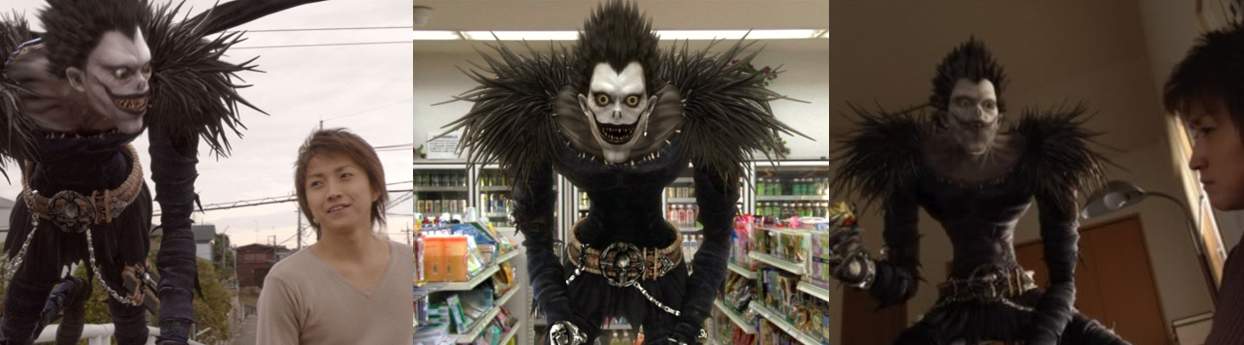
Having infiltrated the prisoners being taken to Asgard, Kurse causes a jailbreak; though he amusingly decides against freeing Loki, the God of Mischief directs him in Odin’s direction and unintentionally causes his beloved mother’s death when Kurse delivers a fatal stab wound to Frigga after she chooses to protect Jane. Just as Frigga’s death sends Thor into a blind rage, scarring half of Malekith’s face in the process, so too is Loki distraught by her loss; united in their grief, Loki agrees to assist Thor in once more defying Odin’s decree to remain on Asgard and use a secret exit to track the Dark Elves to Svartalfheim. Seeing Thor, Jane, and their allies interacting with Loki is a source of great amusement since none of them like or trust him but are forced to rely on him, and Loki of course uses the situation to his advantage to fake his death as part of his ultimate scheme to seize Asgard’s throne. In a surprising twist, the consequences for Loki’s brain tampering are seen in Doctor Erik Selvig (Skarsgård), who has been driven to near madness by what he saw and learned while under the spell of Loki and the Tesseract. Despite his unpredictable and wild demeanour, this proves to be valuable information in helping Thor and his allies oppose Malekith’s plot. Unfortunately, the Warriors Three – Volstagg (Ray Stevenson), Fandral (Zachary Levi), and Hogun (Tadanobu Asano) – are still largely used for little more than comic relief and to add recognisable Asgardian bodies to the fight scenes but Thor: The Dark World does manage to squeeze in a far larger role for Heimdall; he not only takes down a Dark Elf ship with nothing but knives(!) also suffers a crisis of conscience when his duties as Gatekeeper are rendered superfluous by Malekith’s looming threat. Similarly, Odin is greatly expanded upon; grief-stricken by his beloved’s death, he prepares to fortify Asgard’s defences and sacrifice as many Asgardian lives as it takes to ensure ultimate victory, once more pushing Thor into taking matters into her own hands.

The Nitty-Gritty:
In a nice change of pace, much of the Earth-bound side of the story is set in good old Blighty so we get to see London under threat from cataclysmic destruction rather than the United States, which is nice, and much more of the film takes place on Asgard. Jane’s arrival causes much consternation among the Asgardians, who believe her to be largely inconsequential and meaningless even though she possesses the Aether, with only Thor and Frigga treating her with any kind of respect and kindness. While awestruck by the beauty and magnificence of Asgard (she has, after all, effectively paid a visit to Heaven), Jane still manages to hold her nerve; she openly challenges Odin’s boorish attitude towards her and even slaps Loki right in the face for the destruction he caused in Avengers Assemble. As for Loki, he adds a great deal of comedy to the film through his witty criticisms of Thor’s plan, demeanour, and actions; he even assumes Steve Rogers/ Captain America’s (Chris Evans) form in an amusing scene and seems to live to mock and critique his brutish brother.

Thor: The Dark World wonderfully expands the cosmic scope of the MCU.

While Thor masterfully introduced the idea of the MCU’s vast cosmic universe, Thor: The Dark World expands upon it wonderfully; as mentioned, a great deal takes place on Asgard and just the film’s very existence was further proof that there are many competing legends, stories, and warmongering races out in the galaxy just waiting for their time to strike. Accordingly, the film is much bigger and action-packed in its scope; unlike the first film, Thor is at full power for the entire movie and we get to see him and his people in far more battles than before. The opening depiction of Asgard’s war with the Dark Elves effectively set up how desperate and obsessed Malekith is with obtaining the power to achieve his goals, the prison breakout was a great way to showcase Loki’s indifference (however true or false) to the fate of his adopted people, and Malekith’s merciless campaign against Asgard made sure that both Thor and Loki would have personal stakes in the battle against Malekith. Of course, it’s not all perfect: the destruction of the Bifröst Bridge was this big, emotional event in Thor but it’s since been rebuilt and the status quo has returned as a result, which kind of undermines the first film’s ending (though, to be fair, that already happened in Avengers Assemble so I’m really not sure why a line or something wasn’t added in to Thor to downplay this event or at least plant the seeds of hope for Thor).

Loki plays on his brother’s affections to weasel his way to a position of power once more.

Still, the costume design remains incredible; of all the MCU characters, Thor may very well be my favourite both in terms of his character and his visual representation. His always looks fantastic, as do all of the Asgardians, and I really like the threatening and somewhat alien design of the Dark Elves; Malekith may be a bit of a weak villain in terms of characterisation but he definitely cuts an intimidating figure. The film also beautifully and naturally continues the ongoing sibling rivalry between Thor and Loki; Loki’s deceptive nature is key to tricking Malekith into freeing Jane from the Aether and, while he initially appears to have double-crossed his brother and reverted to his vindictive ways, it turns out that Loki was simply playing a role to give Thor the opportunity to try and destroy the Aether. So committed to this role is Loki that he even shields, an actively saves, Jane from attack and ultimately dies in Thor’s arms in an emotionally weighty scene after suffering mortal wounds to destroy Kurse. Of course, this is later revealed to all be part of a grander deception by Loki as the film ends with the twist that he has somehow disposed of Odin and taken his form as king, a surprise that the third film would unfortunately simply explain away in anticlimactic fashion rather than capitalise on the potential of Loki ruling Asgard under the guise of his father.

Thanks to his allies, Thor is able to end Malekith’s dark ambitions and save the Earth once more.

Of course, there has to be a big, climatic battle between Thor and Malekith at the end of the film. Having absorbed the Aether, Malekith wields incredible cosmic power that more than makes him a match for Thor’s brute strength. Easily able to take Thor’s blows, and even his lightning, the battle between Thor and Malekith rages through the Nine Realms thanks to the Convergence, which makes for a striking visual as they topple and tumble between the Realms (and, amusingly, all over London) and Malekith teleports around, renders himself incorporeal, and attacks with tendrils of red energy. Unlike in the last film, where Thor took out the Destroyer in a triumphant return to full power and bested Loki in a dramatic battle between siblings, Thor actually has help this time around as Jane, Selvig, Darcy, and Darcy’s intern Ian Boothby (Jonathan Howard) construct and place the specialist scientific equipment needed to send Malekith packing back to Svartalfheim, where he is subsequently crushed by his own ship. It’s definitely a bigger and more bombastic finale than the first film, which was obviously much more focused on Thor proving his worth as a hero and a warrior, but Phase Two of the MCU was all about kicking things up a notch and Thor: The Dark World definitely does that while still addressing and hitting the same emotional beats and themes of the first film.

The Summary:
Honestly, to this day I still don’t understand why people don’t like Thor: The Dark World; it’s very similar to how I don’t get why people rag on Iron Man 2 (Favreau, 2010) but I think some of the problem might be that the first films were so well done and Phase One of the MCU was such a massive surprise in terms of success and consistent quality that expectations were maybe a bit too high going into the sequels. Now, obviously Thor: The Dark World isn’t quite as good or memorable as the first film (primarily because of how weak Malekith is) but it’s a really good follow-up to the themes and characters set up in Thor and Thor’s character progression in Avengers Assemble. I like how the scope is so much bigger, how the society and inhabitants of Asgard are expanded upon, and how well it sets up the Infinity Stones and contributes towards the larger overall narrative of the MCU’s second phase. The film is far more action-packed while still being humorous and heartfelt, developing the complex relationship between Thor and Loki while also showing how much Thor has grown as a character since the first film. Maintaining the franchise’s incredible costume design, special effects, and visual style, there’s a lot to enjoy in Thor: The Dark World and I definitely feel like it’s worth another look with fresh eyes.

My Rating:

Rating: 4 out of 5.

Great Stuff

Are you a fan of Thor: The Dark World? If not, what is it about the film that you dislike, specifically? What did you think to Malekith as a character and a villain? Did you enjoy Thor’s character progression and the expansion of his relationship with Odin and Loki? What did you think to setting more of the film off-world and in a location other than the United States for a change? How are you celebrating Thor’s debut this month, if at all? Whatever you think about Thor: The Dark World, sign up and leave a comment below or drop a line on my social media.