Game Corner: Super Street Fighter II Turbo HD Remix (Xbox 360)

Released: 26 November 2008
Developer: Backbone Entertainment
Also Available For: PlayStation 3

The Background:
In 1987, Capcom released Street Fighter onto the arcade scene; this oft-forgotten one-on-one brawler may have been criticised for its repetitive gameplay and dodgy controls but it certainly laid the groundwork for probably one of the most recognised fighting games ever created. Thanks to game’s special moves, pulled off using directional inputs in conjunction with button commands, and the introduction of a six-button cabinet, Street Fighter gained a modicum of intrigue on the growing arcade scene that exploded with the release of Street Fighter II: The World Warrior (Capcom, 1991). Expanding the playable roster to eight, Street Fighter II changed the genre forever through the accidental introduction of combo moves and gave Nintendo a much-needed edge in the “Console Wars“ of the nineties with its blockbuster release on the Super Nintendo Entertainment System. Street Fighter II was so universally popular that it revitalised the arcade scene and was bolstered by a number of revisions and expansions that increased the number of playable characters, special moves, and vastly sped up the gameplay. By 2008, there had been at least five of these revisions as Capcom desperately milked their popular title for all its worth, but the idea of giving the title a whole new gloss of HD paint came at the suggestion of Backbone producer David Sirlin, who spearheaded the game’s development, although sacrifices had to be made to keep the digital release small. In addition to a slick graphical aesthetic courtesy of artists at UDON Entertainment, the game also included an overhauled soundtrack by music tribute website OverClocked ReMix and even saw a limited physical release on the Xbox 360. In keeping with the success and popularity of Street Fighter II, Super Street Fighter II Turbo HD Remix was met with largely unanimous praise; reviews lauded the new graphical style and arcade-perfect controls, though the lack of additional options was noted as a downside. While it wouldn’t go down in history as the definitive version of Street Fighter II, this HD re-release ensured that Capcom’s influential fighter lived on through another console generation.

The Plot:
The malevolent M. Bison, ruler of the criminal organisation Shadaloo, is sponsoring a martial arts tournament for the world’s best fighters. Twelve such fighters join the fight, battling each other for the right to face M. Bison’s four Grand Masters, with each of them having their own motivations for personal vendetta against the dictator.

Gameplay:
I should preface this review by pointing out a couple of things; the first is that I first played Super Street Fighter II Turbo HD Remix on the PlayStation 3 after buying it on a whim (I think, or at least hope, it was on sale at the time), most likely because I realised that I didn’t currently only a version of Street Fighter II. The second thing to note is that there’s a very good reason for that and it’s simply that I’m not a fan of the series; I’m much more of a Mortal Kombat (Various, 1992 to present) kinda guy as I prefer the simplicity and brutal nature of that franchise to Street Fighter’s more intricate mechanics. I owned a cracked version of Street Fighter II for the Amiga as a kid, which fooled me into thinking I was somewhat competent at the game (infinite health will do that to you), but this didn’t translate when I played versions on the Mega Drive and PlayStation 2. Hell, I struggled with the later games in the series despite desperately wanting to get into it since they all look so appealing and everyone always raves about them, but for the life of me I just cannot seem to click with the franchise and always end up feeling frustrated and defeated as a result. I only say this because my enjoyment and opinion of this game, and the entire series, is thus inherently soured; I can’t be anything but biased against it despite my best efforts, but I went into this new playthrough of Super Street Fighter II Turbo HD Remix hoping that maybe things would be different as I do have a lot of fondness for the franchise.
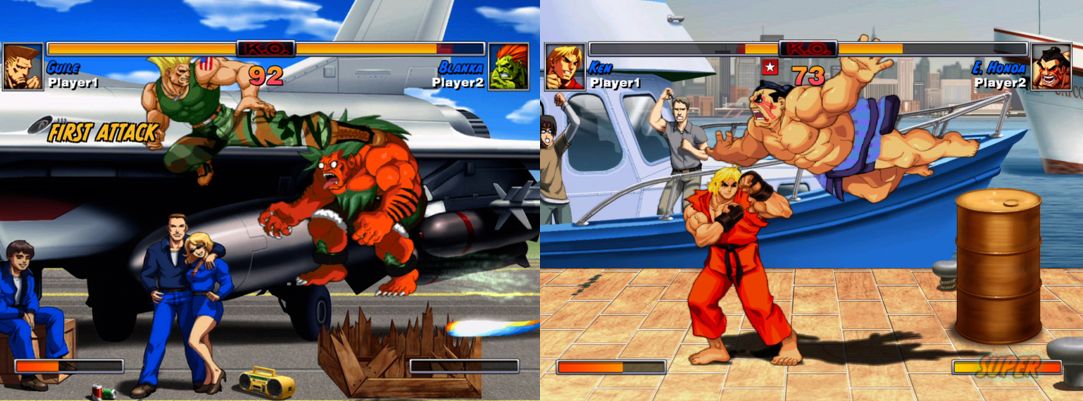
Be sure to press your attack with the game’s combo system and to be on your guard at all times.

As any gamer will be able to tell you, Super Street Fighter II Turbo HD Remix is a 2D, one-on-one tournament fighter in which players pick from a roster of sixteen playable fighters and either take on either the computer in a series of battles in a bid to get to M. Bison and his four Grand Masters or go head-to-head with another player, either on or offline. The game’s controls are exactly as you might expect from a Street Fighter II title; you have three types of punch and kick, ranging from a weak, strong, and fierce attack, with each assigned to different buttons. X throws a jab, Y a strong punch, and the Left Bumper a fierce punch while A throws a shot kick, B a roundhouse kick, and the Right Button launches a fierce kick, though all of these controls can be fully customised to your liking. Combining these button inputs, and directional controls, will allow you to pull off various move combinations to dish out greater damage or pull off your character’s special moves, which are helpfully listed in the game’s pause menu. In Street Fighter II, you hold back to block incoming attacks and use up to jump; you can also throw and grab your opponents, sometimes in mid-air, to deal a ridiculous amount of damage. While you can hit buttons to recover from throws, getting stuck in an enemy’s grasp is basically a death sentence and will see your health whittled down in the blink of an eye; you can also be stunned if you take too much successful damage, which can be catastrophic. Fights are decided in rounds, with the default set to best two out of three, though you can change this to as little as one and as many as five (and rights may go to a sudden death final round in the rare instances of a double knock-out). You’re also battling a timer, though you can again disable this option, and can increase the game’s speed on a scale of one to five (with five being the fastest, which also seems to equate to attacks dealing more damage). Finally, you can set player handicaps for player-on-player fighters and choose from four difficult settings to challenge the game’s two arcade modes.
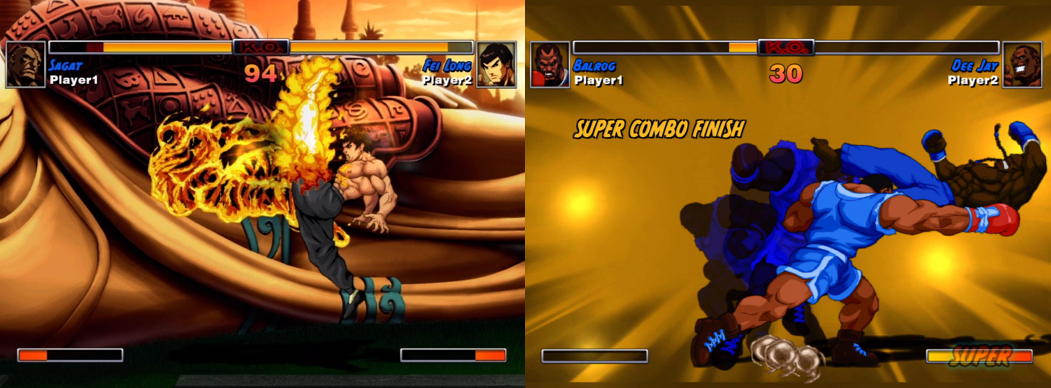
Stagger your foe with special moves or finish them off with a grandiose Super Finish.

For me, these difficulty settings are a joke; I played with the game speed set to five and on the ‘Easy’ difficulty and still struggled to get past even the first few fighters even with the timer disabled. The computer is an absolute unrelenting machine, making use of combos, frame damage, and cancels to land strings of attacks you have little hope of blocking or counterattacking. The computer is somehow able to hit through your moves at times, grab you in the middle of attacks, and even hit you out of mid-air with low attacks and projectiles, making for an uphill battle right off the bat. As mentioned, you can pull off special moves with each character, though I find these difficult to figure out even with the helpful move list as the require complicated half-turns, charging, and diagonal inputs on the control stick. I find even some of the easiest moves, like Ryu and Ken’s Hadoken, inconsistent to pull off, though projectiles such as this will cancel each other out, which is extremely useful when fighting against spam-artists like Sagat and his constant barrage of TIGER! TIGER! TIGER! shots. As you fight, you’ll build up a little Super meter and, when it’s full, you can try and pull off your character’s Super move, but these are even more complicated to execute and the computer is an expert at blocking and negating all incoming damage. I couldn’t tell you the difference between the ‘HD Remix’ and ‘Classic’ arcade modes as I was barely able to scrape through the ‘HD Remix’ arcade on the lowest difficulty; ‘Classic’ thus seems harder but that might also be because I changed the rounds to win to one, which seems to put the computer in a hyper-aggressive “pinch” mode. Consequently, I can’t say if the classic bonus stages are present in this mode; they weren’t in the ‘HD Remix’ arcade mode I played so, from my perspective, the entirety of the game was geared around tournament fighting, fighting with friends, or desperately trying to get to grips with your character in the game’s training mode.

Graphics and Sound:  
Graphically, I don’t think I’ve ever seen Street Fighter II looking better than it does here; the slick UDON aesthetic really makes all of the fighters and their stages pop out and makes the most of HD overhaul the game has received. Every character has their own eccentricities, loudly announcing their special moves and pulling off a couple of victory poses when the fight goes their way in addition to being followed by a shadowy double whenever they execute a Super move. Little touches such as every character’s unique fighting pose, being able to hit off Vega’s iconic claw, M. Bison tossing aside his cape, and characters like Chun-Li being able to spring off the sides of the screen help to make the game more immersive, and this carries over to the stages as well. Some stages have destructible elements such as crates and barrels to smash your opponent into, and all of them include some kind of animation in the background, from cheering crowds to roaring elephants to fighting cages being lowers and boats rising and falling. The remixed soundtrack is a joy to listen to; memorable tuns such as Ken and Guile’s themes sound great, though the fight announcer remains merely serviceable. Although the game lacks a memorable introductory sequence, each character has their own ending, which you’ll get to see even on the easiest difficulty; rendered using text and static artwork in the style of the UDON comic series, the only thing letting these down is that you can’t unlock them to view anywhere else in the game.
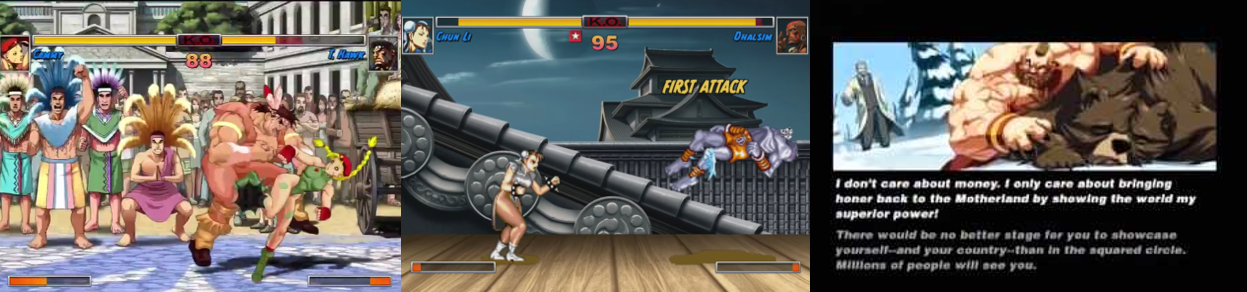
The UDON aesthetic is far more visually engaging than the distorted classic sprites.

If you’re a purist and prefer the classic look of the original games, Super Street Fighter II Turbo HD Remix has you covered; you can enable not just a classic option for the in-game sprites but the music as well. Unfortunately, the sprites really don’t benefit from this; they appear large, garbled messes against an otherwise pristine background and hearing the classic arcade-style move announcements and music doesn’t make this any better to look at. It would’ve been better if the game had the option to switch everything to an optimised pixel-art aesthetic but, as is, it’s a garish reskin that’s probably not going to appeal to fans of the original releases. One area where the game does get some credit, though, is in the inclusion of palette swaps for each character; each button corresponds to a different palette for each character on the character selection screen, which adds a touch of variety to the game as your opponent’s randomly pick different palettes for each bout, though you can’t switch between different styles of fighting like in other Street Fighter games. The game does run as smooth as butter, though; I noticed no input lag or slowdown, even on the highest speed setting, and I’m sure an accomplished Street Fighter II player would appreciate such a smooth presentation to the game’s action. Every bout also ends with with the victory taunting the loser, who’s left a battered mess, and I’ve always found these jabs entertaining; a helpful countdown gives you ten seconds to continue fighting, which will reinvigorate your fighter and return you to the character selection screen to challenge your opponent again.

Enemies and Bosses:
Being a one-on-one fighter with sixteen characters to pick from, every fighter in Super Street Fighter II Turbo HD Remix will inevitably be your enemy at some point and each offers a slightly different, if also similar, level of challenge. It’s not uncommon to have to switch to a different fighter depending on your opponent as it’s some fighters are better geared towards dealing with certain opponents, though I find it better to stick to one fighter (Ken) and power through with an attack that favours fast-paced button mashing and aggression over any kind of actual strategy. Some fighters, like Zangief, E. Honda, and Balrog are slower, much heavier characters who rely more on grapples, powerful punches, and slams; you can sue faster characters, like Chun-Li and Cammy, to negate their power but this isn’t always a guarantee as they’re still able to close the distance despite lacking projectiles thanks to diving headbutts and screen-covering uppercuts, for example. Dhalsim is a pretty unique fighter in that he has super stretchy limbs to attack from afar, can teleport about the screen, and will set you ablaze with his Yoga Fire and Yoga Flame attacks, making him quite the slippery opponent. Similarly, Chun-Li is extremely quick on her feet, able to flip around behind you and send fireballs your way at a higher speed than Ken or Ryu, who are equally formidable thanks to their Shoryuken and throws. Other fighters, like T. Hawk and Fei Long, present their own challenges thanks to their bulk and lightning-fast speed so it’s recommended that you spend a bit of time playing as each fighter and seeing what they can do before you head into a fighter.
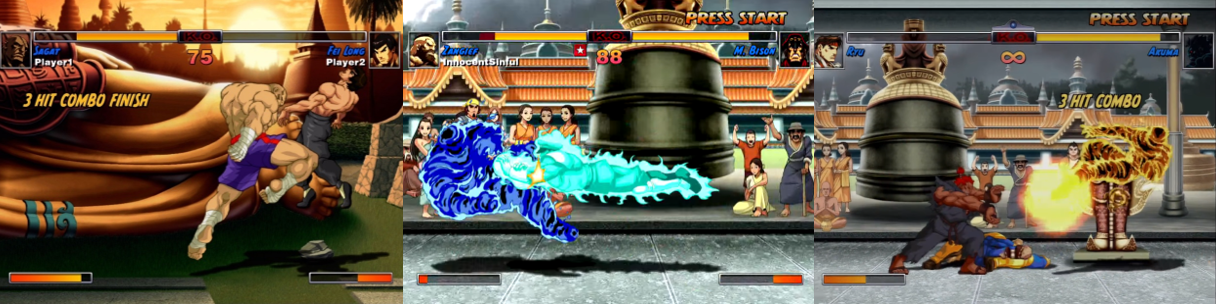
Surviving Sagat’s spam and M. Bison is one thing but challenging Akuma is a true test.

Some characters, like my favourite (but not to play as), Blanka, fall back on the unpredictable; not only can Blanka barrel across the screen in a cannonball roll but he can also fry you and chow down on your head if you get up close. Others, like Guile, require more patience to execute their special moves; you’ll need to hold back to charge up before pressing the attack button, for example, but they can catch you unawares because of it as they lure you in for the kill. None exemplify this more than M. Bison and his four Grand Masters, who act as the game’s bosses. Things start off pretty simple against Balrog; while he can deal tremendous damage with his charged-up punches, he’s slow and not too difficult to get around. Vega, on the other hand, is the exact opposite; he flips and whoops about the place, dancing around you and slashing with his claw and easily catching you in a German Suplex or a horrendous rolling throw. Vega can also scale the cage in the background to dive down at you and has a great aerial game, which can make him a tough opponent, but I’ve hit a brick wall with DeeJay just as often as Vega thanks to the former’s aggravating Capoeira style. Things really get serious when you face off against the walking mountain of muscle that is Sagat, the former Street Fighter champion; this absolute spam-artist of a bastard will relentlessly throw projectiles high and low, lure you in to knock you flying wit his TIGER!UPPER-CUT!! and flies across the screen with his TIGER!KNEEEE! attack, all of which make him easily the most formidable of the four Grand Masters on Easy. M. Bison represents the game’s final challenge but is nowhere near as spam-happy as his chief lieutenant, though he’s no less dangerous as a result. M. Bison likes to bounce off your head, land multiple hits with his bicycle kick, and send you careening through the stage statues with his Psycho Crusher attack. On higher difficulties, his challenge only increases with a heightened aggression, but you’ll need to get to M. Bison within twenty minutes if you want the honour of being absolutely obliterated by the game’s secret boss, Akuma, a psychotic variant of Ryu who fills the screen with fireballs and leaves you lying with his destructive Shun Goku Satsu Super move.

Power-Ups and Bonuses:
As it’s a one-on-one fighter, there’s nothing to help you out here except for the Super meter; land hits, blocks, and reversals and you’ll build it up and then it’s just a question of mastering the button inputs and landing the move through your opponent’s block to hopefully score an impressive finish to your fight.

Additional Features:
Super Street Fighter II Turbo HD Remix has twelve Achievements on offer, though I’m not holding out hope in earning any more than the paltry one I got for limping my way through the game’s arcade mode. You’ll snag an Achievement for earning five perfect rounds in a row (achieved by not taking a single hit, so well outside my skill), landing a Super Finish (possible, but most times when I tried it the computer obliterated me as I was trying to input the combo), winning a round in fifteen seconds (I was thoroughly slaughtered on every attempt), and landing ten throws in a single match (also not outside the realm of possibility, though I have trouble executing throws). In addition to a bunch of Achievements being dished out for online play, there’s also Achievements for beating Akuma in arcade mode and for landing Ryu’s Super Finish on Sagat, all of which is probably very doable and appealing for more accomplished Street Fighter II players. Other than that, there’s not much on offer here beyond some run of the mill online modes (including ranked matches and the like) and player-on-player play, though you can input a button code to play as Akuma if you fancy it.

The Summary:
Look, okay, I’m sorry I’m not a more accomplished Street Fighter II player. I’m sorry I haven’t master frame-perfect combos and move cancels and all that nonsense. I’m sorry that it was a constant fight against not only the computer but my desire to rage-quit the game and just relegate this to a Bite-Size review, but I’ve just never got on with Street Fighter II. Having said that, I don’t think I’m wrong to say that the difficulty curve here is pretty unforgiving; you can’t just pick up and play Super Street Fighter II Turbo HD Remix and expect to be good at it; button mashing works, to be sure, but only on occasion and some rounds will fly by in the blink of an eye without you even landing a single hit if you’re not using a bit of skill. Consequently, as always, I struggled with Super Street Fighter II Turbo HD Remix; I was able to make it through the ‘HD Remix’ arcade with Ken after numerous losses, but I couldn’t make a dent in the ‘Classic’ mode and the experience is so draining that I’m not sure when or even if I’ll go back to try and get at least one more Achievement. The fact of the matter is that no game should every require you to go into it as a master, or even a high-intermediate, player; that’s what difficulty settings are supposed to be there for, to incentivise replay and the building of confidence and skill. Super Street Fighter II Turbo HD Remix opts instead to whack you over the head with its unforgiving arcade-style difficulty and force you to earn every win, no matter how cheap. On the plus side, the game looks, sounds, and plays great; I might suck with the combos and special moves, but everything runs super smooth here, it’s just a pity that it’s such a barebones release. It can’t be denied that there are better versions of Street Fighter II out there, and compilations that allow you to sample the length of the series, but this is still a pretty decent conversion and representation of one of gaming’s most successful and influential fighters…I’m just hopelessly bad at it and that apparently will never change.

My Rating:

Rating: 3 out of 5.

Pretty Good

Have you ever played Super Street Fighter II Turbo HD Remix? If so, what did you think to it and how do you think it holds up against other versions of Street Fighter II? Which version of the game is your favourite, or which one did you play the most back in the day? What did you think to the game’s graphical overhaul and lack of additional features? Which fighter was your favourite, or least favourite? Have you ever beaten this game on the hardest difficulty? Are you an accomplished Street Fighter II player and, if so, how much of a noob do you think I am? Which fighting game franchise is your favourite? Whatever your thoughts on Super Street Fighter II Turbo HD Remix, your memories of Street Fighter II, and your opinions on the franchise in general, feel free to share them below or on my social media.

Author’s Spotlight: J.M. McKenzie Interview

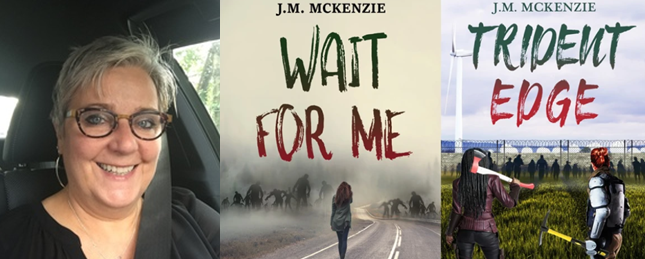
J.M. McKenzie, author of Wait for Me and Trident Edge

1. First, introduce yourself a bit. What is your name (or pen name) and where are you from?

I write under the pen name J.M. McKenzie. I’m Scottish but live in the UK Midlands.

2. Next, tell us a bit about your most recent work. Is this your first published book? What is it about and what genre would you classify it as?

I’m the author of Wait for Me and Trident Edge, which are both set in the UK after a bio terror attack and tell the story of an ordinary woman on an extraordinary journey to survive and get home in a world that has changed forever and is now dangerous and unpredictable. My genre is zombie apocalypse.

3. Tell us a bit about your main character; what are they like, how did they come about, and what are some of their strengths and weaknesses?

Lisa, my main character, is introverted and analytical. She is not your typical machete wielding, gun toting, alpha male zombie apocalypse survivor. I wanted to write a story about how an ordinary woman would react and behave in an apocalyptic scenario.

4. What was your hardest scene to write in this (or any) book?

The hardest scene to write was a chapter in the first book involving an evil and violent group of survivors. The scene did not feature in the first draft but was added after feedback from Beta readers – against my better judgment.

5. Did you go the traditional route when publishing your book or did you choose to self-publish?

After dipping my toe into the lottery of traditional publishing I decided to self-publish and have no regrets about my decision. I have more control over my content, a bigger share of my royalties and people are reading and enjoying my books!

6. What would you say is the most difficult part of your writing journey and what advice would you give to other writers?

I think the most difficult part of my writing journey was getting the first book finished. It was a slog, a constant battle with confidence and self-belief and a steep learning curve. I’ve very much been on a roll since then.

7. Do you want each book to stand on its own, or are you trying to build a body of work with connections between each book?

The first two books are a series. Trident Edge is set six months after Wait for Me and is a continuation of Lisa’s story. My current work-in-progress, Amenti Rising, is a stand-alone story about a different group of survivors in a different location but in the same zombie apocalypse.

8. Who are some of your favourite authors, what are some of your favourite books, and what inspired you to become a writer in the first place?

I read a lot in many different genres. A few of my favourite non-horror authors include Margaret Atwood, Donna Tart and Emily St. John Mandel. In the horror genre I like Stephen King and Paul Tremblay. In the zombie genre I like M.R. Carey, Chris Philbrook, Rhiannon Frater, Sarah Lyons Fleming, Mira Grant, Max Brooks and Carrie Ryan. I love all of their books but a few stand outs are Alias Grace, A Secret History, Station Eleven, The Stand, Survivor Song, The Girl with all the Gifts and Adrian’s Undead Diaries … I could go on but I’ll stop here.

9. What would you say has been the best way to market your books?

I have done most of my marketing on social media, Facebook and Twitter in the main. Just starting to have a go on Instagram. This year I’m going to come off KUP and try a Book Bub ad!

10. Are there any tropes, clichés, or writing styles that you dislike and, if so, what are they and why?

I don’t like the fact that many zombie apocalypse books are so macho with lots of guns and very big knives and people who adapt to extreme violence so easily and quickly- real life is not like that and neither are my books!

11. Do you read reviews of your book and, if so, how do you handle negative feedback?

I read all my reviews and use the best ones for marketing purposes. Generally they have been positive but I’ve had an occasional negative comment. I don’t take it to heart- you can’t please all of the people all of the time. Sometimes I even agree with them. Reference “evil” scene in Wait for Me. I’ll follow my own judgement in the future!

12. What are some of your quirks as a writer? Do you like to plot everything out or do you prefer to just “wing it” and see where the story takes you? Do you listen to music when writing and, if so, what do you listen to?

I write in silence. I hate being interrupted! When I get into the zone I can write for hours without a break. I used to be a “pantser” but I have plotted out every scene in Amenti Rising and am loving the process. I think the book will be all the better for it!

13. What is the best advice you’ve ever had when it comes to writing and what advice would you give to new writers?

The best advice I got as a writer was from Chris Philbrook, author of Adrian’s Undead Diaries. He said that whoever you are and whatever you write there will always be someone out there who loves your book.

14. What’s next for you? Are you currently working on any new books or stories?

I’m currently 40K words into Amenti Rising and I think it’s going to be a corker! I already have the cover!

15. Finally, feel free to plug your social media, website, and links to Amazon, GoodReads, and other relevant sites below, and detail any current offers available for your book/s:

If you’d like to be featured in an interview, please check out the interview submissions page to submit your answers.

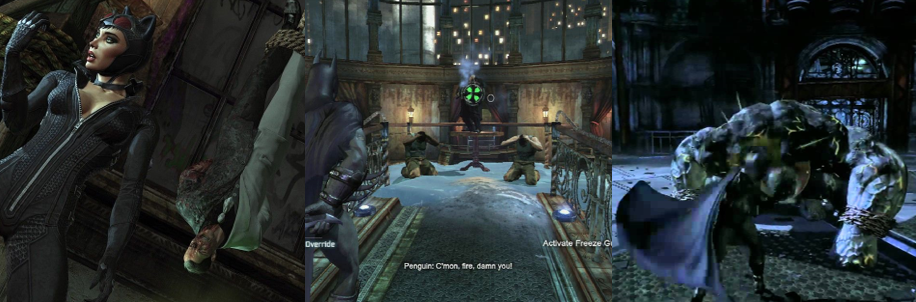
Game Corner [Bat-Month]: Batman: Arkham Origins (Xbox 360)


In the decades since his first dramatic appearance in the pages of Detective Comics, Bruce Wayne/Batman has become a mainstream, worldwide, pop culture icon. The brainchild of writer Bob Kane, Batman was brought to life by artist Bill Finger and has been a popular staple of DC Comics and countless movies, videogames, and cartoons over the years. Accordingly, September celebrates “Batman Day” and is just another perfect excuse to celebrate comic’s grim and broody vigilante and, this year, I’m dedicating every Wednesday to Gotham’s Dark Knight Detective.


Released: 25 October 2013
Developer: WB Games Montréal
Also Available For: PC, PlayStation 3, PlayStation 4 (via PlayStation Now) Wii U, Xbox One and Xbox Series X/S (Backwards Compatible)

The Background:
Batman’s, shall we say “difficult” relationship with videogames was forever turned around when Eidos Interactive, Rocksteady Studios, and celebrated Batman scribe Paul Dini collaborated on the critically and commercially successful Batman: Arkham Asylum (Rocksteady Studios, 2009). They followed this success with the bigger and better sequel, Batman: Arkham City (ibid, 2011), that was even more well-received than its predecessor, ranking as one of the best videogames ever released. Arkham City’s monumental success meant that the bar was raised and expectations were even higher for another sequel after the developers left so many loose threads dangling in the game’s side missions. However, Rocksteady Studios required a lot of time to craft the sequel they had in mind and Warner Bros. Interactive Entertainment were in no mood to wait that long. So, they turned to WB Games Montréal to develop a prequel set during Batman’s early days and placed more emphasis on vertical movement and Batman’s detective skills. The result was a game that was met with mixed reviews; although the plot and certain mechanics drew praise, the game was seen as largely derivative rather than properly expanding upon, Arkham City’s mechanics. Still, Arkham Origins was expanded upon with a fair amount of downloadable content (DLC) and I remember it being more of a good thing when I first played it on PlayStation 3 and particularly enjoying the new Christmas aesthetic and the game’s more challenging boss battles.

The Plot:
Two years into Bruce Wayne’s crimefighting career, Roman Sionis/Black Mask puts a $50 million bounty on the Batman! However, the eight assassins are nothing compared to the appearance of a new, sadistic villain known as “The Joker”.

Gameplay:
Just like the last two games, Batman: Arkham Origins is a third-person, action/adventure game. This time around, rather than change the formula too much, the new developers simply took the gameplay mechanics and game world of Arkham City and tweaked them, expanding on a few areas here and there and basically coating the previous game with a slightly different coat of paint. The result is a game that is immediately (and, perhaps for some, disconcertingly) similar to the last Arkham title in numerous ways but still different enough, in my opinion, to stand alongside its predecessors and, as I always say, there’s no such thing as too much of a good thing.

Batman’s abilities and skills are almost unchanged from Arkham City.

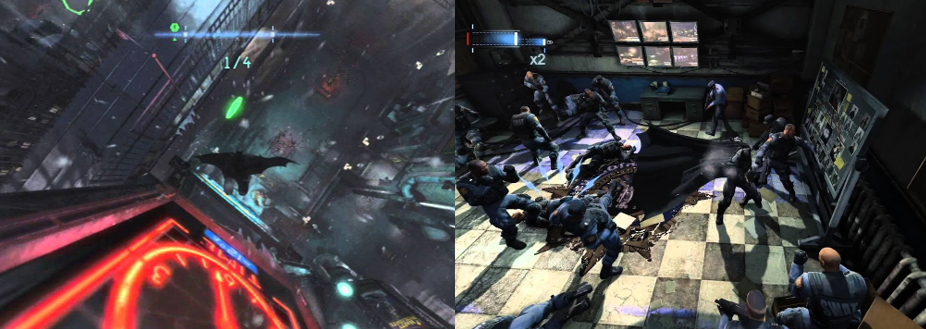
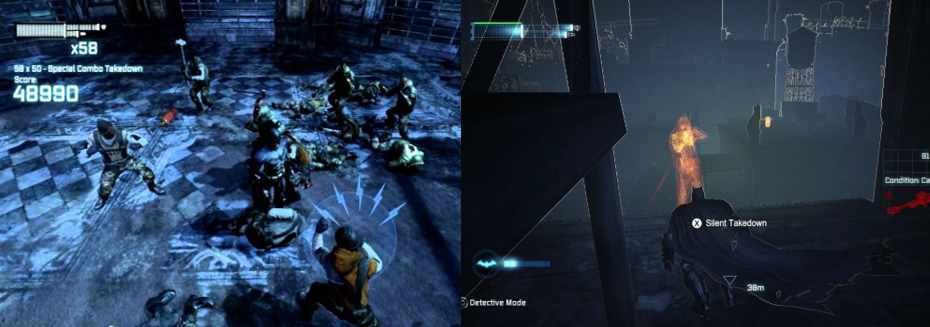
In terms of controls, they remain exactly the same as before (which is interesting as I could have sworn that they were a little different when I first played it on PlayStation 3…). You still select one of Batman’s many gadgets and weapons (the majority of which return from Arkham City in some way, shape, or form even when they don’t make narrative sense) using the directional pad, ready a gadget or quick-fire with the Left Trigger and press the Right Trigger to use the gadget or crouch, and you can still use Batman’s cape to stun enemies, glide around the city, and dive bomb onto enemies or to gain extra height and distance. Similarly, the “freeflow combat” remains virtually identical to that seen in Arkham City; you strike with X, counter incoming attacks with Y, and build up combos by directing Batman towards different enemies, mixing up your attacks, and performing takedowns to disarm and/or knock out foes one at a time as gangs of thugs swarm over you. Stealth remains an important aspect of the game and, just like in the last game, Batman can crouch around undetected, grapple to vantage points (usually stone gargoyles) to observe groups of enemies, and perform double or even triple takedowns in certain situations. Batman can venture through vents to avoid detection and take down enemies, interact with his environment using his gadgets to take enemies down or disorientate them, smash enemies into walls and floors and other parts of the environment when he’s near them, interrogate certain enemies for information and to uncover secrets, and deliver a “Knockout Smash” when choking thugs out (though this will attract nearby enemies).

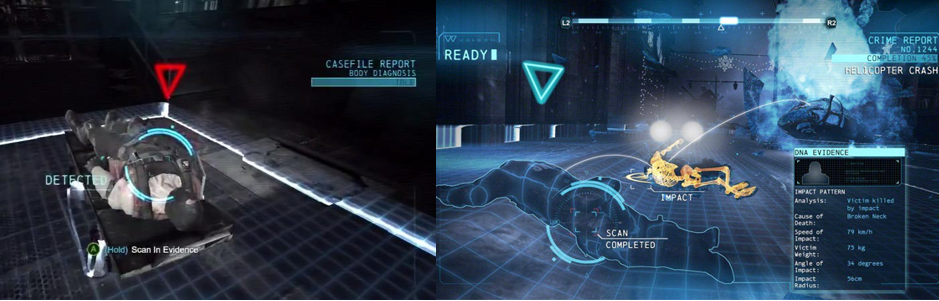
Batman’s detective skills get much more focus this time and allow him to reconstruct crime scenes.

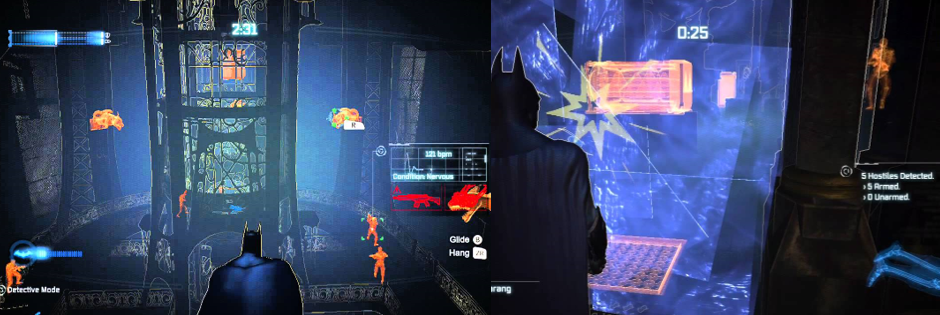
As always, these tactics are best utilised during the “Predator” sections of the game and using Batman’s patented “Detective Vision”; tapping the Left Bumper allows Batman to see an x-ray-like layout of the game world and highlight nearby enemies, secrets, and points of interest, all of which are invaluable when going up against armed thugs. Detective Vision is greatly expanded upon in Arkham Origins, though, and the game goes to great lengths to emphasise the “detective” aspects of Batman’s character at numerous points and during side missions. When discovering a dead body or the scene of a crime, Batman can set up a crime scene with LB and you must hold the A button to scan in various pieces of evidence. As you do, Batman will piece together the crime not only through his monologue but also through the use of a holographic recreation, which you must advance and rewind to solve the crime or locate objects in order to progress. At the same time, though, the Detective Vision often feels a little neutered in some situations; like, I found myself stuck in rooms and locations with no real idea of where I was supposed to be going, which was very confusing. Although the map and onscreen compass return just as in Arkham City and it’s great for directing you to where you need to go in the overworld, it falters a bit inside buildings and locations at times, which can get annoying.

The game world is bigger than ever but, luckily, Batman can fast travel by using the Batwing.

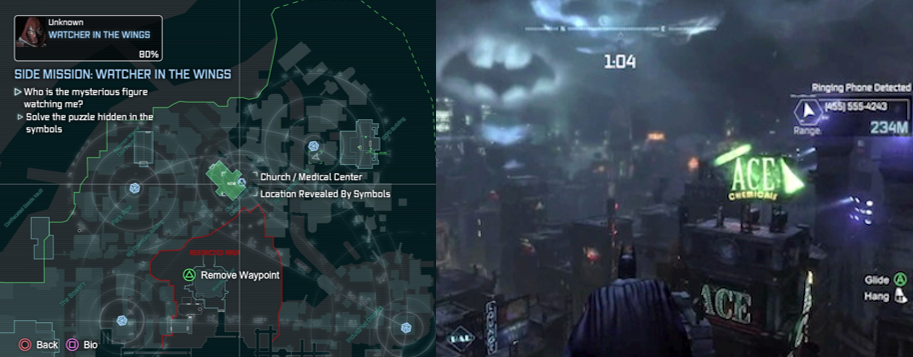
As for the game world, while it contains the same locations and areas seen in Arkham City, it’s actually far bigger thanks to the addition of a (super long) bridge connecting the recognisable parts of the city to a new area down South. You’ll notice that the recognisable areas are in much better shape than in Arkham City since the area hasn’t been condemned or turned into a prison and some buildings that were only background elements or Easter Eggs in the last game can now be entered to complete story or side missions. The game world is so much bigger that the developers saw fit to include a fast travel mechanic; after hacking into various control towers across the city and liberating them from the control of Edward Nashton/Enigma, Batman can freely fast travel to every prominent area of the map via the Batwing. While this does result in more loading times than in the previous two games, and you cannot control the Batwing or fast exit areas, it is really handy for quickly getting from one end of the city to the other. Also included for the first time is the ability to visit the Batcave; from here, you can converse with Batman’s loyal butler and father-figure, Alfred Pennyworth, progress the story, acquire new gadgets and upgrades, switch to a different costume, or engage in some training by taking on various combat and stealth challenges. It’s not an especially big or well-implemented area, to be fair, and you’re only really forced to go there a handful of times in the main story but it’s a nice addition, at least.

Arkham Origins has some odd difficulty spikes that aren’t present in the previous two games.

There are, however, far less destructible elements dotted around the city this time around but you can still earn experience points (XP) and level-up to upgrade Batman’s suit and gadgets and stuff by taking out thugs, scanning points of interest with your Detective Vision, or finding Engima’s informants and Data Packs (which replace the usual Riddler Trophies). Batman: Arkham Origins is probably the hardest of the Arkham games so far; perhaps because of the developers assuming players would be familiar with the franchise and the gameplay, you quickly encounter armoured thugs, goons with knives, batons, and shields, and bigger, more formidable enemies during the opening part of the game. The city is, again, awash with thugs from different gangs (mostly Black Mask’s but also Oswald Cobblepott/The Penguin’s) and you’ll even have to fight against the Gotham City police, specifically their S.W.A.T. division, given that Batman is seen as a disruptive vigilante in this game. The game’s difficulty can, again, be set by the player to increase the challenge offered to you but the two hardest modes, “New Game Plus” and “I Am The Night”, will remove the counter indicators, increase enemy aggressiveness and mix up their placement, and give you only one try to finish the game in the latter mode. This can be extremely challenging when facing off with the game’s bosses, the majority of which will tear through you like paper or have you ripping your hair out trying to figure out how to beat them and counter their attacks as the counter indicators are basically useless.

While the menus can be difficult to navigate, the increased puzzles adds a new dimension to the game.

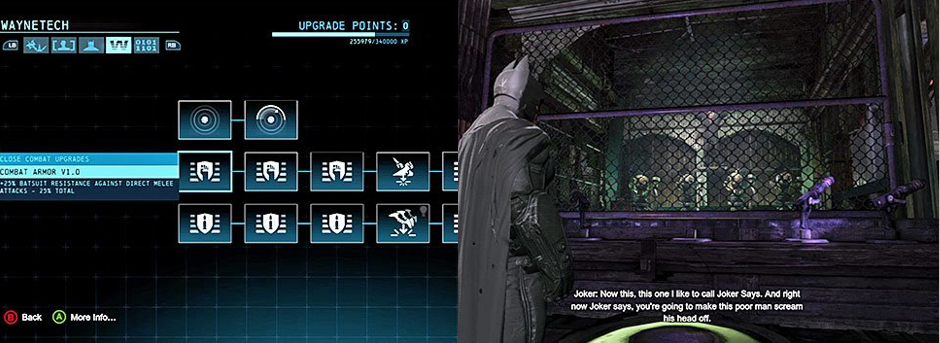
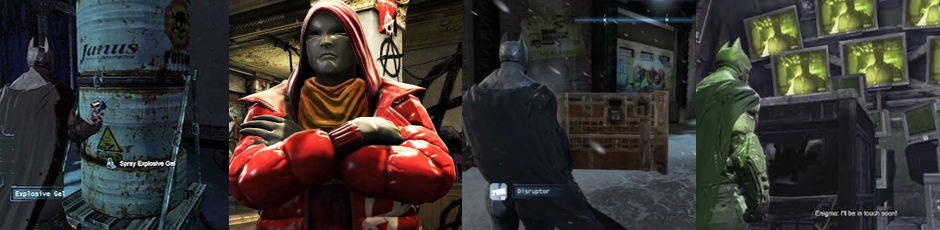
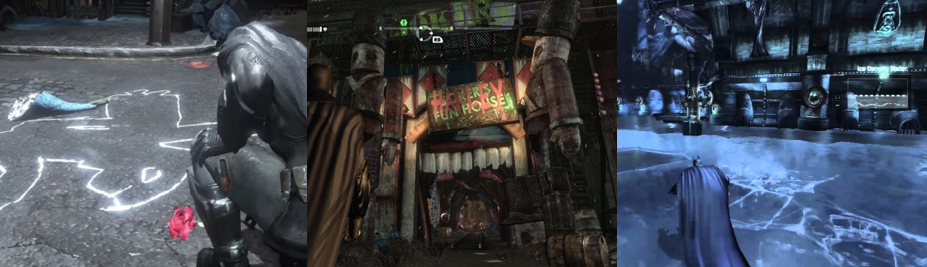
Although Arkham Origins is bigger than its predecessor and instantly familiar, there are some things that let it down in terms of its presentation. For one thing, the menus (particularly the upgrade trees) are much more cluttered and far less intuitive to navigate. It seems like the developers were running out of ideas for things for you to unlock and view from these menus, though you’ll get all the usuals (biographies, side stories, story synopses and the like) and be able to chart the progress of your side missions, set waypoints to travel to, and see secrets or points of interest on the comprehensive map but, again, I found it stupidly easy to get trapped in a room and unable to figure out where I was supposed to go. There are also far more quick-time event-like moments in this game where you must counter an attack during a cutscene or mash A to open a door or break free of an enemy’s grip or avoid an attack, which can actually be more laborious than fun. Finally, you’ll find that there is a far greater emphasis on vertical traversal and puzzle solving this time around; you’ll have to activate a lot more consoles to break through walls or open doors, for example, and when navigating through the Joker’s funhouse in the Gotham Royal Hotel you need to use Batman’s Batarangs and gadgets to free hostages from timed traps and scale up the outside of the buildings using his grapnel gun. Entering an area or hacking a device is also generally made much more annoying thanks to the inclusion of jamming devices that you’ll need to disable with the new Disruptor gadget, meaning that a lot of your traversal is hindered by “busy work” at times.

Graphics and Sound:
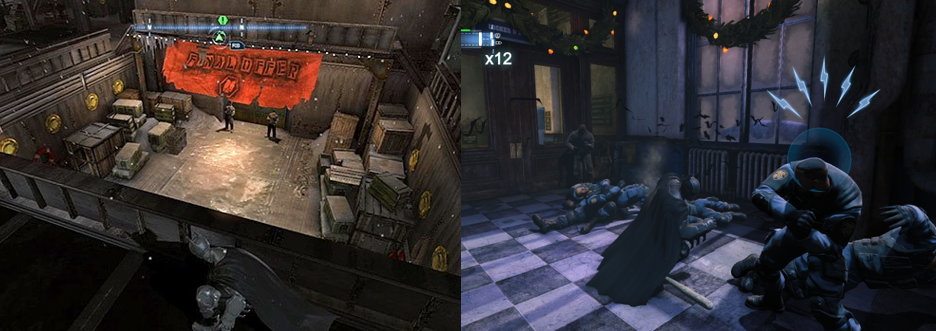
Fittingly, given that its basically just slapping some additions onto Arkham City, Arkham Origins continues to be an impressive feat in terms of rendering the gothic, crime-ridden, anachronistic streets of Gotham City. Yes, many of the areas will be familiar to you but they’re far less rundown and have been recontextualised thanks to the Christmas time setting. Snow falls constantly, covering the ground, and Christmas decorations, trees, lights, and presents are in abundance; some enemies even wear Father Christmas hats and even the score is punctuated by Christmassy bells and all of the dialogue you overhear makes constant reference to the Yuletide season. It’s just enough of an aesthetic reskin to make the game world look and feel new and different and it’s great seeing ice in the water, the Penguin’s ship, the Final Offer, moored up at the docks, and buildings like the police station and steel mill in full, working order rather than abandoned like in the last game.

Gotham is expanded to include new areas and territories alongside familiar regions.

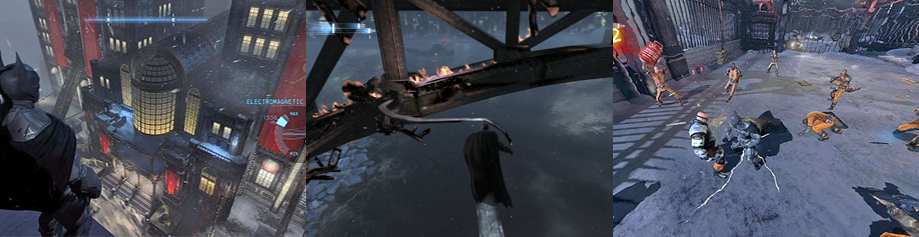
All of the regions from Arkham City return but you’ll enter different buildings and explore different areas this time, such as the haberdashery in the Bowery and the courthouse, but you’ll also be traversing (or fast travelling) the Gotham Pioneers Bridge down to the new areas in the South of the game map. Here, you’ll explore a high-end apartment building to solve Black Mask’s apparent murder, battle and scale up the aforementioned Gotham Royal Hotel, and fight and sneak your way through the hallways of the Gotham City Police Department. Of course, it wouldn’t be an Arkham game without a load of dank sewers and catacombs to explore and it seems you venture down into these depths a bit more often this time around but they’re a little easier to navigate through. You’ll also fly over to Blackgate Prison to quell a riot there, where the game’s visual presentation closely emulates that of the penitentiary on Arkham Island thanks to its large, automated doors and prison aesthetic.

Nightmarish renditions of Wonderland and Batman’s worst fears twist the game world.

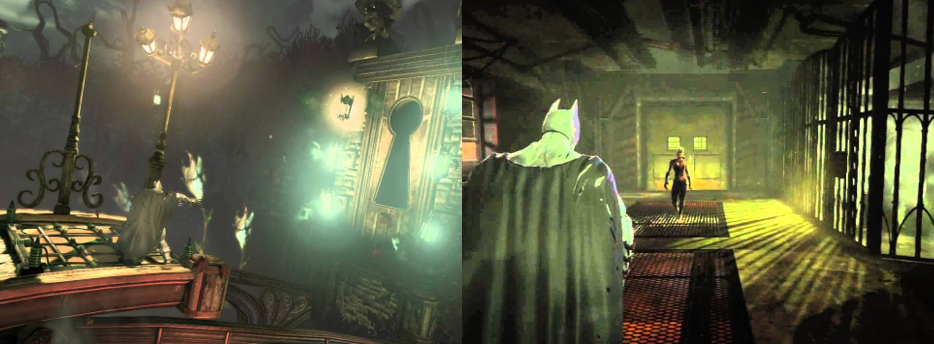
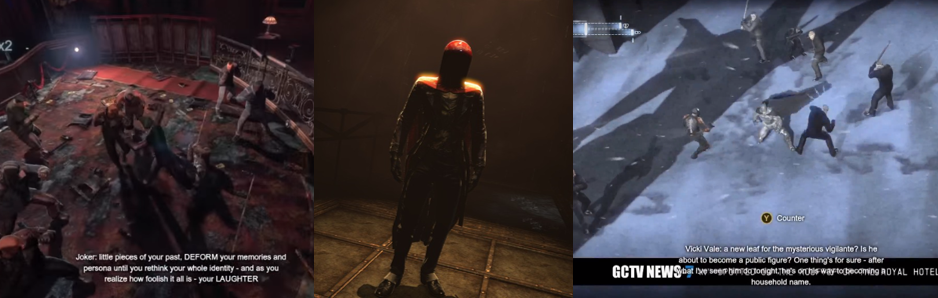
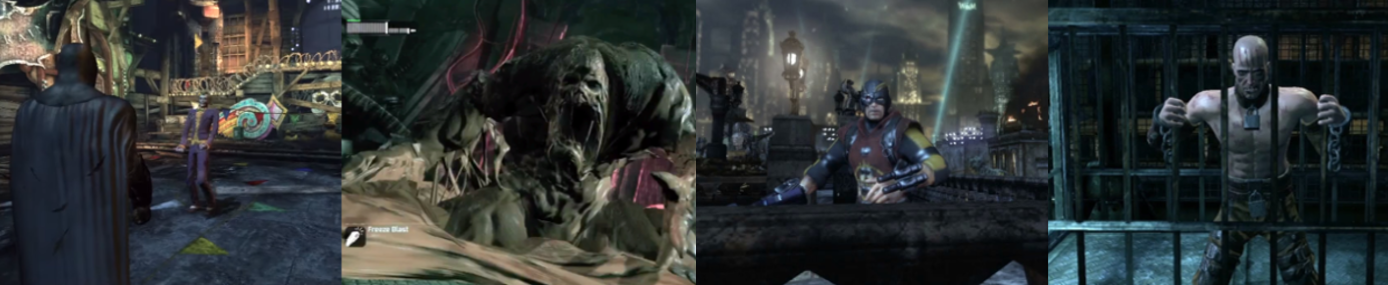
As is a tradition with the Arkham games, things also take a turn to the bizarre when you hunt down Jervis Tetch/The Mad Hatter, who drugs Batman and forces him to navigate through a twisted version of wonderland in sections very closely modelled after the nightmarish sequences that pitted him against Doctor Jonathan Crane/The Scarecrow in the first game. Here, you’ll need to dodge electrified floors while using Batman’s gadgets to progress through sidescrolling sections, battle thugs in his mind-controlling rabbit masks who pour through a mirrored doorway, and scale up a twisted clock tower. It’s only one section, unlike the Scarecrow’s three, but it lasts quite a while and can get a bit annoying, especially the part where your vision is reduced to seeing through a keyhole and you must guide Batman through the correct doors to progress. Another standout moment comes late into the game and sees you taking control of the Joker as he recounts a version of his origin story to Doctor Harleen Quinzel; similar to how he played in the DLC for the first game, the Joker is a wild and crazed character who attacks in manic bursts, tosses razor sharp playing cards, and electrocutes enemies with his joy buzzer and you also get to guide him in his Red Hood persona past bursts of flames in a nightmarish funhouse of sorts. There’s also another opportunity to revisit the deaths of Bruce Wayne’s parents and suffer a bunch of unnerving hallucinations after Batman is poisoned by Copperhead, which distorts the screen and your controls at various points throughout the fight, and a pretty cool (if all-too-brief) moment where you must fight some thugs on a rooftop from the perspective of Vicki Vale’s helicopter.

Some shifts in perspective help to keep things interesting and add some variety.

The in-game graphics are just as impressive as the last two games; the game engine is tighter than ever, allowing for the biggest game world yet that is full of thugs and Easter Eggs and things to see and do, and character models still look really good. Batman’s suit, especially, is much better in this game, resembling military/riot armour and, in many ways, actually looks more durable and plausible than his suits from the previous games (which take place after this one). He still accumulates battle damage as the game progresses, which is always a nice touch and even though Kevin Conroy and Mark Hamill aren’t present, their replacements (Roger Craig Smith and Troy Baker) do an excellent job of filling in (even if they do seem emulating their predecessors a little too closely, which I guess is natural but keeps them from doing their own take on the characters). However, the game kind of drops the ball a little with its pre-rendered cutscenes, which look…a little more out of place compared to the in-game graphics and the previous Arkham games. Everything in these cinematics seems a little too plasticy and hyper-realised; it’s not a game-breaker, though, just something I happened to notice.

Enemies and Bosses:
All of the standard thugs and enemies you encountered in Arkham City are back this time around, but with a new coat of paint in many cases. Gangs of thugs roam the streets or patrol rooftops, often with sniper rifles; enemies will grab broken bottles or slash at you with knives, swing metal bars and baseball bats at your head, and even lay mines and booby-trap vantage points to reduce your manoeuvrability in Predator sections. The sword-wielding assassin enemies return from the last game, as do the bigger, more armoured enemies who require you to cape stun them and beat them down by mashing X, but there are a bunch of brand new enemies in this game, too. One of the most prominent are the martial artists you’ll encounter, who will test your countering ability with their quick kicks and shoves; another are the muscle-bound thugs juiced up on Venom who you must beat down and use takedowns to pull out the tubes feeding them the substance. Larger, more powerful enemies will rush at you and grab you or hold you in place so other enemies can beat on you and you’ll have to battle variations of these as the game progresses, which forces you to adapt your combat strategies on the fly.

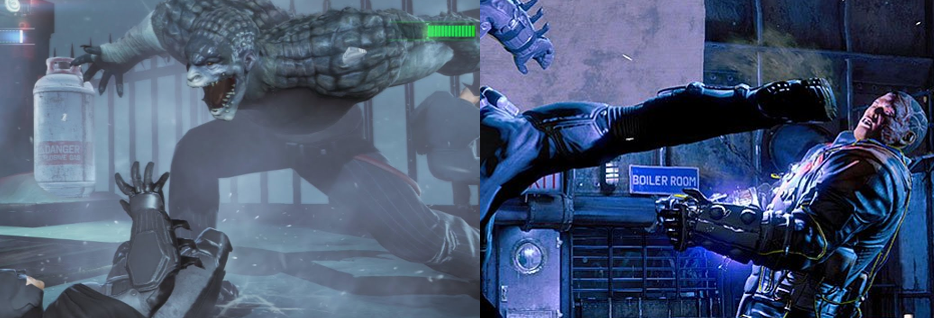
While Killer Croc is similar to battles you’ve fought before, the Electrocutioner is a complete joke.

Of course, the main thrust of the story is that the Joker (under the guise of Black Mask) has hired eight assassins to take out Batman on Christmas Eve so, of course, that means you’ll encounter these assassins throughout the course of the game. The first of these is Waylon Jones/Killer Croc, which is a fight you should be well familiar with at this point as it’s the standard fare of stunning him three times with your cape and putting a beatdown on him. Things do get spiced up a little but when he grabs a gas canister to throw at you; at this point, you have to quick-fire a Batarang to explode it and whittle his health down. in a recurring theme, you’ll need to mash A to fend him off when he tries to bite you and also have to battle waves of thugs who jump into support him and distract you but, as first boss battles go, it’s pretty simple and basically the same as fighting the TITAN enemies and even Bane from the previous games. The next assassin you’ll battle is Lester Buchinsky/The Electrocutioner but this is played more for laughs as you take him out in one hit and then have to battle a gauntlet of the Penguin’s goons before he’s unceremoniously killed off by the Joker later on.

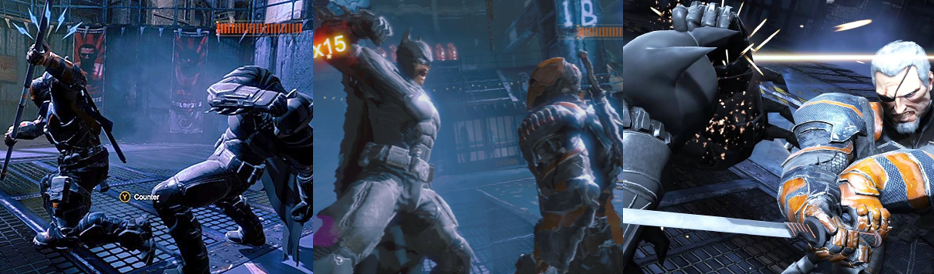
Deathstroke will truly test your mettle in one of the more frustrating boss battles.

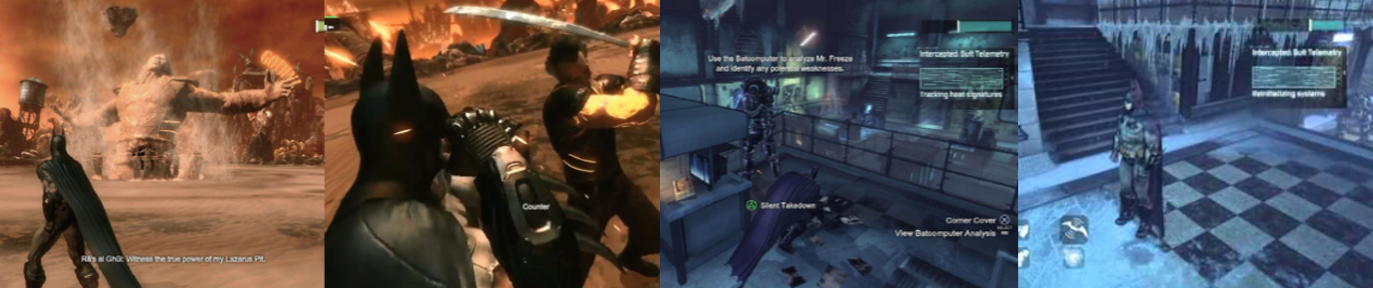
The battle against Slade Wilson/Deathstroke, however, more than makes up for this. This is a complex and multi-stage fight that really comes out of left field and suddenly spikes the game’s difficulty in frustrating ways. Deathstroke has a counter for all of your attacks, many of which are nigh-impossible to defend or counterattack as the counter indicator window is next to useless in this fight. Without it, it’s damn near impossible but, by staying on the move, dodging over him, and utilising the quick-fire Batclaw, you can slowly (and I mean slowly) whittle his health down enough to trigger the next phase. Deathstroke tosses a smoke grenade to sneak attack you with his bo staff, forcing you to mash Y to counter his attacks and then mash X to beat him down, similar to the fight against Rā’s al Ghūl in Arkham City, but he also fires his Remote Claw at your chest to send an explosive barrel flying at you. You need to quickly counter this and throw it at him to keep him from shooting you and, eventually, you’ll snap his bo staff and the fight continues with Deathstroke now attacking with a sword! This doesn’t make things any easier as it’s hard to build up your combos and strikes or get a rhythm going since he counters you so quickly and hits so hard that you can only afford to make a couple of mistakes throughout the fight (which has no checkpoints). This fight is easily the most challenging in the series so far and it would be fun if the counter window wasn’t so damn small but, as it is, it can be one of the most aggravating boss battles in any of the Arkham games because of how brutally unfair it gets.

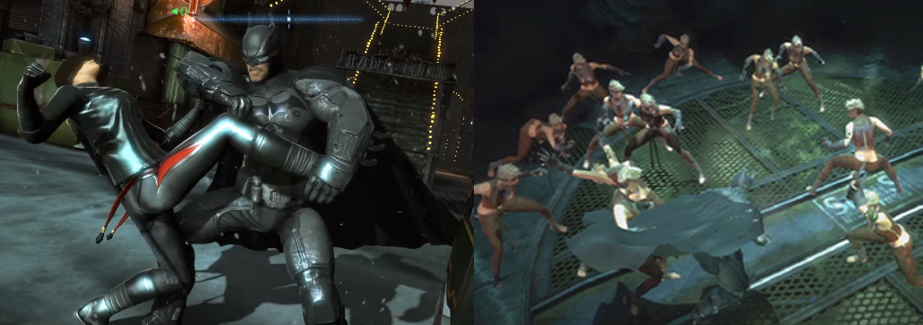
Lady Shiva and Copperhead recall previous battles against Rā’s al Ghūl and his assassins.

One of the other assassins is Lady Shiva, who is relegated more to a side mission and who challenges you to rescue an innocent man from a death trap. In doing so, you have to battle her sword-wielding ninjas and, similar to when you tracked the assassin’s blood in Arkham City, track her down by following a blood trail to the bottom of Wonder Tower using your Detective Vision. This leads to a fight against her, her ninjas, some martial artists, and a bigger martial artist variant in what is, essentially, a scaled down version of the sword fight with Rā’s al Ghūl (or, alternatively, a more troublesome version of the fights against the assassins in Arkham City). Basically, your standard striking, counter, and combat skills are more than enough to win the day here but watch out for Shiva’s random attacks in the city as you’ll need to be quick to counter these. The fight against Copperhead also recalls the Rā’s al Ghūl fight; she poisons Batman and causes him to hallucinate being attacked by multiple versions of herself, dashing at him from the darkness much like Rā’s al Ghūl but attacking with agility and claws similar to Selina Kyle/Catwoman. She also leaps onto you, requiring you to mash A to throw her off, and it can be quite a headache dealing with the distorted camera and trying to land a decisive hit on the real Copperhead (though, once Batman is cured, she goes down in one hit).

Bane is your most recurring foe and requires both agility, brute force, and stealth to defeat.

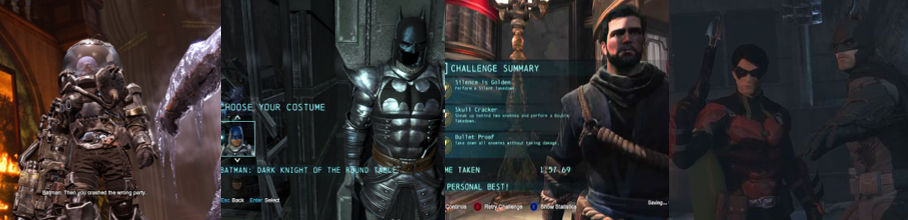
One of the more recurring antagonists in the game is Bane, who you’ll battle multiple times throughout the story. In the first instance, he charges at you very much like a TITAN enemy and will deal massive damage if he hits you or grabs a hold of you. Simply cape stun him three times and beat him down and then perform a takedown, however, and he’s not too difficult to overcome. However, he then overdoses on Venom and takes the fight out onto the rooftop; when full of Venom, he charges at you like a rhino and is very hard to dodge out of the way of, and he also leaps at you, causes shockwaves to ripple across the ground, and can easily spam-charge you to death if you’re not careful. You also have to be wary of the never-ending supply of goons who join the fight to distract you but, again, your cape stun and beatdown will do the trick, as will the Shock Gloves, but it can get very aggravating trying to avoid his charges. Later, in the finale, you have to go through it all again but this time, Bane also powers himself up with TN-01 and becomes a hulking, mindless brute who rips you out of floor grates and stomps around a small enclosed area looking for you. Similar to the fight against Doctor Victor Fries/Mister Freeze in Arkham City, you must sneak around behind Bane and use the vents to your advantage to surprise him from behind and then ram him into electrified walls before finally subduing him in a QTE with your Remote Claw.

While Firefly requires your projectile-based gadgets, the Joker fight is basically a QTE.

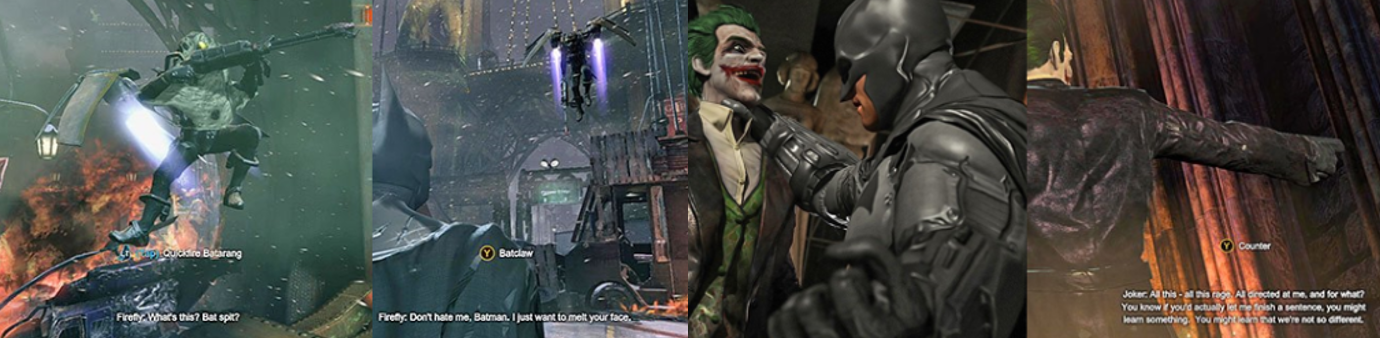
Another of the game’s more troublesome and complex boss battles is the encounter with Garfield Lynns/Firefly, who is raining destruction down on the bridge. Before you can even reach him, you need to take out his goons and disarm three bombs while forging a practical relationship with Gordon and then battle Firefly amidst the wreckage on the bridge. Firefly hovers out of reach of your strikes, blasting at you with his flamethrower, so you need to dive out of harm’s way and toss Batarangs, Concussion Detonators, and Glue Grenades at him until he’s stunned. Then you can quick-fire your Batclaw, mash A to haul him down, and put a beating on him and damage one of his wings. In the second phase, after chasing you around the twisted underside of the bridge, you have even less opportunities for cover and Firefly now tosses grenades at you but the tactic remains the same. It can be tricky to dodge and quick-fire your gadgets at him but by far the hardest part is firing your Batclaw and countering his final attack when he flies off with you attached to him via your line so be sure to keep your wits about you. The final moments of the game finally see you track down and get your hands on the Joker, the mysterious anarchist who has been causing death and destruction across the city and who causes a full-blown riot at Blackgate Prison that more than recalls the tense, claustrophobic moments of the first game where the Joker would taunt you constantly. This fight is little more than a QTE, really, requiring you to hit Y to counter the Joker’s attacks and then pummel him into submission with presses of X. It’s a satisfying conclusion given all the chaos the Joker has wrought and how quickly the animosity between him and Batman escalates and, fittingly, is in no way a physical challenge for Batman (there’s enough of that with the likes of Deathstroke and Bane).

Power-Ups and Bonuses:
Like its predecessors, Arkham Origins features a level-up progression system; every time you defeat enemies, pick up Data Packs, scan parts of the environment, and such, you’ll gain XP and, eventually, level-up. This allows you to upgrade Batman’s armour (again, into two blocks to improve damage from melee attacks and gunfire, respectively), add more elaborate takedowns to his repertoire (all of which return from Arkham City), and upgrade his various gadgets to improve their range and efficiency. Upgrading can be tricky this time around, though, as the menus aren’t as easy to navigate; you can still view tutorials and such and you’ll actually receive a grade and additional XP depending on how dangerous a combat or Predator scenario was and how versatile you were in beating it, which will net you more XP if you happen to meet certain criteria in movement, combat, or Predator scenarios and you can get more by talking to Alfred in the Batcave and hearing his wisdom. All of Batman’s gadgets from Arkham City make a return, with many looking and acting a little differently or being expanded upon in new ways. The main exception to this is the Line Launcher, which is entirely absent and replaced with the Remote Claw; this fires a line between two specific points that you can grapple up to, crouch-walk across, or speed along on a zip wire to effectively fulfil the same function but in a way that ties into the game’s more vertical layout.

Batman has a few new gadgets, most of them repurposed variants of those from Arkham City.

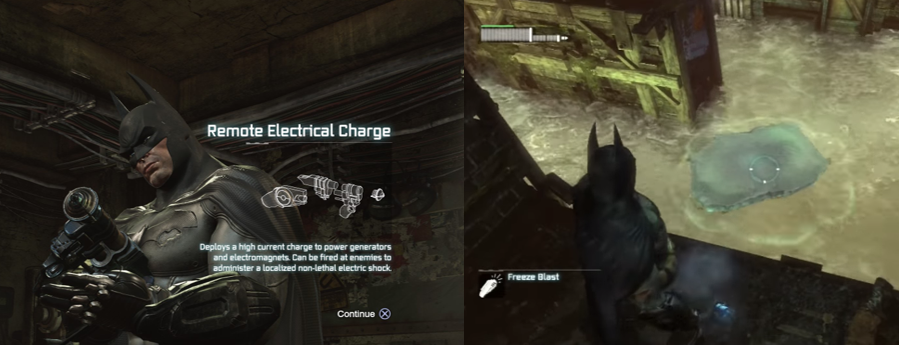
There are some other new gadgets here, too. The Disruptor is now a gun-like device that disables enemy weapons, speakers, and jamming devices from a distance (which is super useful when facing armed goons), and the Freeze Blast is eventually evoked in Batman’s Glue Grenades, which can trap enemies in glue and allow him to form rafts. The Remote Electrical Charge gun is gone but Batman acquires the Electrocutioner’s Shock Gloves, which charge up as he deals damage and can dish out extra hurt to enemies (even punching through shields and negating the need to cape stun) once activated by pressing in the analogue sticks (they also come in handy for charging electrical panels and opening doors and for resuscitating characters). The Concussion Detonator is a bit like the R.E.C. blast in that it goes of and disorientates and confuses enemies after a short time and, if you purchase the ‘Cold, Cold Heart’ DLC, you’ll gain access to a new Batsuit and thermal gloves to dethaw Mr. Freeze’s victims and heat up your Batarangs.

Additional Features:
Batman: Arkham Origins has fifty Achievements to earn, the vast majority of which will pop as you play through the story, taking down the assassins, and completing side missions. There are specific Achievements for taking out thugs in certain ways (such as not being seen), stopping twenty random assaults in the city as they pop up on your radar, gliding a certain distance, and fast travelling to every point on the map but you’ll also get them for collecting all of Enigma’s Data Packs and finishing the game on New Game Plus. Doing this unlocks the one-life, “I Am The Night” mode that sounds gruelling, at best, though all of your XP and upgrades do carry over to each of these save files.

Batman encounters some of his most infamous rouges for the first time in side missions.

As in Arkham City, there are numerous side missions to fill up your time with: Enigma’s data collectors need to be interrogated and his Data Packs found to bring him to justice, Black Mask’s drug stashes need to be destroyed (similar to the Bane side mission in Arkham City), and Barbara Gordon tasks you with destroying the Penguin’s weapons caches across the city. You’ll also have to find and deactivate three bombs placed around the city by Lonnie Machin/Anarky (and you’ll find his tags spray painted all over, too) before confronting him at the courthouse (where you’ll have to fight a wave of goons and Anarky himself, who is armed with stun batons). One of Bane’s henchmen, Bird, is also at large and inspiring gang fights all over the city, as is Floyd Lawton/Deadshot, and the chaos doesn’t end after the main story is cleared as Gordon tasks you with hunting down a number of escapees from Blackgate. Challenge Mode appears once again, now accessible from the main menu and from the Batcave in the main game world. Just like in Arkham City, you can take on self-contained combat and stealth challenges based on encounters in the game that see you battling waves of increasingly difficult enemies and racking up points by sustaining and varying your combos, or picking off goons from the shadows while handicapped by a number of modifiers (such as enemies having access to gun racks and weapons or Batman’s gadgets or combos being disabled).

Replayability is bolstered by a variety of DLC and a team-based multiplayer mode.

There is also a series of “Campaign” maps that mix up the two challenges to present a sort of adjacent side story to the main game and you can compare your high scores against friends and other using the online leaderboards. As before, all of this can be further expanded by purchasing a range of DLC. This includes a whole bunch of new skins for Batman (including Jean-Paul Valley’s “AzBats” armour), additional challenge packs that see you playing as Bruce Wayne during his training years, and even the ability to play as Deathstroke in the Challenge Mode, which is pretty cool. The “Cold, Cold Heart” story pack adds a whole extra story-based mission that takes place after the main campaign and features an encounter with Mr. Freeze; it even includes additional Achievements, gadgets, and things to scan and find (though they are limited only to this story mode). The biggest additional mode to Arkham Origin, though, was the inclusion of an online multiplayer that sees players battling as a member of the Joker’s gang, Bane’s gang, or Batman and Dick Grayson/Robin. Unfortunately, though, I never experienced this mode even when I played on the PlayStation 3 so I can’t really comment too much on it but it sounds like a standard, team-based deathmatch kind of mode; my only real grip is that the developers didn’t incorporate Robin into the main game or even as a playable character in the Challenge Mode this time around, and that the DLC can no longer be purchased.

The Summary:
Even now, Batman: Arkham City remains one of my favourite videogames and a standout in the Arkham series; it expanded upon all of the mechanics and features of the first game and truly defined the standard for Batman videogames. For me, then, Batman: Arkham Origins is a lot of fun; it’s (literally) everything Arkham City was but more; it’s not like they just slapped on a reskin or opened up the map a little bit either like some glorified DLC, there is a lot of story and additional features at work here that expand the game world considerably. The Christmas setting is inspired and seeing Batman nearer to the beginning of his career and encountering some of his famous villains for the first time is a blast, as is the intricate development of Batman’s character from a wanted vigilante to a trusted ally of the city and, especially, Jim Gordon. The Batwing, additional gadgets, bigger emphasis on Batman’s detective skills, and the unique, challenging boss battles are all really solid additions and help to make the game very unique. What lets Arkham Origins down a bit, especially compared to its predecessor, is undoubtedly how derivative it can be and how needlessly frustrating many of these boss fights can be. The lack of inspiration in the game’s Enigma puzzles, simple reuse of many of Batman’s gadgets (when this would have been a great opportunity to strip him of many of them to really evoke the gritty feel of the first game), and reskinning of areas we’d explored to death in the last game do take it down a notch but I still maintain that there’s plenty to like about Arkham Origins. I’m not sure if it was worth developing the multiplayer component and it would have been nice to see some of these elements incorporated into the single player story but, overall, I feel if you enjoyed Arkham City then you kind of have to enjoy Arkham Origins as it’s the same game but with a new coat of paint.

My Rating:

Rating: 4 out of 5.

Great Stuff

What did you think to Batman: Arkham Origins? How do you feel it compares to the other Arkham games, particularly Arkham City? Did you think the game was too derivative or did you enjoy the additions it made to the gameplay mechanics and revisiting the world in a new, expanded way? Which of the game’s assassins was your your favourite, and how did you fare against the likes of Deathstroke and Bane? Did you ever play the online multiplayer mode and, if so, what did you think to it? Did you enjoy the game’s DLC and the side missions? How are you celebrating Batman Day and what is your favourite Batman videogame? Whatever you think about Batman: Arkham Origins, or Batman in general, please leave a comment below and check back in next Wednesday for one more Arkham review!

Game Corner & Knuckles: Knuckles’ Chaotix (SEGA 32X)


With the release of Sonic the Hedgehog 3 (SEGA Technical Institute, 1994), gamers were introduced to Knuckles the Echidna. This mischievous, dreadlocked antagonist was created by Takashi Yuda and his debut was made all the more impressive by virtue of the fact that Sonic 3 was too big to fit on one cartridge, which meant that Knuckles was the first of Sonic’s supporting characters to co-star in a main series videogame when Sonic & Knuckles (ibid) was released on this very day in 1994.


Released: April 1995
Developer: SEGA

The Background:
Following the release of Sonic 3 and Sonic & Knuckles, SEGA looked to be unstoppable with their Sonic franchise; the latter title was a huge game for SEGA, backed by an impressive marketing campaign, and the franchise had sold over $1 billion in total revenue by 1994. With the Mega Drive nearing the end of its life cycle, and the videogame industry on the cusp of entering a new generation of 3D gaming, SEGA attempted to prolong the Mega Drive’s lifespan and appeal with a series of expensive add-ons like the Mega-CD and the Mega Drive 32X. Like the Mega-CD, however, the 32X was doomed to failure primarily because SEGA were planning on releasing an entirely new console, the SEGA Saturn, just a few months later and gamers just couldn’t afford the clunky peripheral. With the benefit of hindsight, I truly believe that SEGA would have fared much better had they simply continued with the Mega-CD, producing a combination Mega Drive/CD console and releasing all 32X and Saturn games on this platform rather than wasting time, effort, and money on expensive add-ons. Regardless, one title that sticks out to me from the 32X library is Knuckles’ Chaotix; initially designed as Sonic Crackers, the game’s big mechanic was that players controlled two characters simultaneously and were joined by a special, elastic “Combi Ring”. The game, which was Knuckles’ one and only solo title, also saw the return and redesign of obscure Sonic character Mighty the Armadillo and Vector the Crocodile into fully playable characters. However, thanks primarily to the failure of the 32X, the title has largely been doomed to obscurity and SEGA’s continued refusal to port or re-release the game to modern consoles means that the only way to play the game is by using emulators or spending extortionate prices.

The Plot:
Doctor Eggman discovers the seven Chaos Rings on Carnival Island and attacks alongside Metal Sonic. When Knuckles investigates, he rescues Espio the Chameleon from Dr. Eggman’s Combi Confiner and joins forces with Espio’s cohorts (Mighty, Vector, and Charmy Bee – the titular Chaotix) to put a stop to Dr. Eggman’s schemes using the power of the Combi Ring.

Gameplay:
As is to be expected of a classic Sonic the Hedgehog title, Knuckles’ Chaotix is a 2D, sidescrolling action/platformer that is heavily geared towards speed but, in a change of pace, actually has far more emphasis on vertical platforming and progression that any of its predecessors. The game takes place in Newtronic High Zone and is comprised of six stages referred to as “Attractions”; each Attraction is made up of five levels (called “Acts”) rather than the usual two or three, and each of these pushes you to run up loops and walls or jump to higher areas in order to reach the end goal. In another change of pace, the game immediately begins with a practice area, in which you play as Knuckles. After scaring away Dr. Eggman, Knuckles rescues Espio from the mad scientist and players can choose to play through a quick tutorial to familiarise themselves with Knuckles’ Chaotix’s new mechanics.

Knuckles and his new friends are inexplicably tethered together for some clunky gameplay.

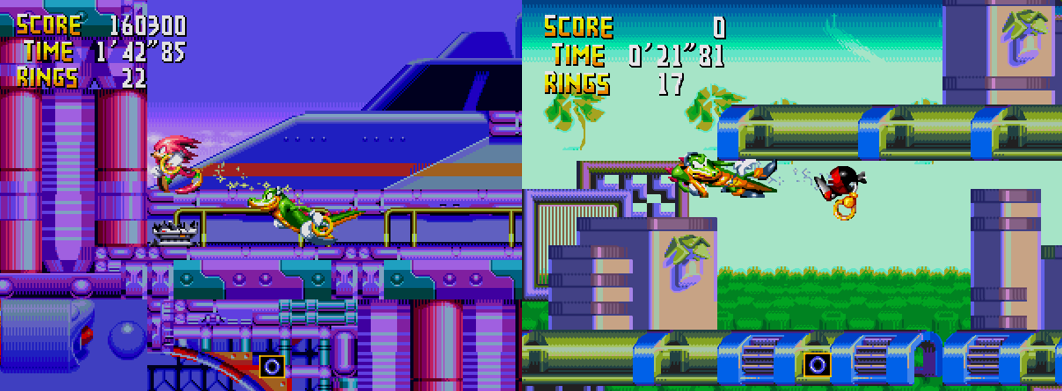
All of the basic controls of a classic Sonic remain intact and as you’d expect; players can run, jump, and perform a Spin Dash to speed ahead with all but three of the available characters, and you’ll find that each playable character has their own unique qualities. Knuckles, for example, can glide and climb walls as in his previous appearances; Espio spins like a top instead of Spin Dashing and can cling to walls but cannot climb them; Vector is the biggest character and so has a greater chance of hitting Badniks or taking damage but he can also perform a double jump or mid-air dash; Mighty is basically a thinly veiled stand-in for Sonic and can perform a wall jump; and Charmy is the smallest and fastest character and constantly flies about but at the cost of severely reduced visibility. Players can also be impeded by Heavy and Bomb, two Badniks who cannot Spin Dash or climb walls, explode on contact or severely weigh you down, and you’ll have to leave it up to a mixture of fate and luck as to which character you get as your partner as the main Scenario Quest forces you to pick one at random using the “Combi-Catcher”, a mechanical claw game like you see at seaside amusements. Of course, the unique selling point of Knuckles’ Chaotix is the frankly bizarre decision to tether two characters together using the Combi-Ring. This means that there are always two characters on screen at once, and you can choose to play either with a computer-controlled partner or with a human friend. Players can call their partner to them at any time with the A button or hold down B to “hold” their partner in place to activate switches; when they stand in place, you can also build up a head of steam to blast ahead, which is honestly more beneficial than the Spin Dash in this game. This also allows you to grab your partner and fling them at switches, Badniks, bosses, or up to higher areas; however, it can be extremely clunky trying to slingshot your way up to where your partner is, and more often than not you end up hanging in place or ricocheting about like a pinball just trying to progress upwards. Furthermore, calling your partner back costs you Golden Rings, the lifeforce of the series, and you can even drop the Ring counter into negative numbers as a result of this.

You’ll must master (or bungle) the Combi-Ring and make use of gimmicks to progress ever upwards.

While each character is very visually interesting in their own right and the idea of working together to progress is an interesting one, tethering the characters together is extremely restrictive in practise; the majority of the time, your biggest struggle won’t be with the game’s Badniks or the tedious nature of the gameplay, it’ll be with trying to navigate the environment using this clunky, awkward mechanic and getting frustrated when you finally get where you need to be only to drop down a second later. Indeed, the level of difficulty in Knuckles’ Chaotix is extremely low compared to the games that came before it; the life system and checkpoints are now gone, there are no bottomless pits or bodies of water to worry about falling or drowning in, and you don’t even need to worry too much about being hit without any Rings as you’ll either lose your partner for a short time or be booted out to the main hub world to try again. Like Sonic 3, the game comes with a save system that allows you to have three saved games, though the only way you can replay the game’s Attractions is to play through the Training Mode. This mode also allows you to set your playable character and partner, which is more freedom than the main Scenario Quest offers, but the most tedious aspects of Knuckles’ Chaotix come from how unnecessarily long and annoying some of its gameplay elements are. While the Attractions are a visual eye fest there’s not much to distinguish each Act from the other within a set stage (I swear some of them have exactly the same layouts bar some very minor changes), there’s next to no hazards or Badniks to worry about, and you don’t even really need to worry all that much about the time limit.

Most stages are painfully barren and linear, but there are some instances of variety.

Instead, the game is built around randomness; it’s pot luck that you’ll pick a decent partner (I recommend a Knuckles/Espio team, personally) and as to which Attraction you’ll play. Between each stage, you’re returned to the hub world and must hit a bumper to randomly select your next area, meaning that you’re literally bouncing all over the place and will most likely play the game’s Attractions out of order. This may go a long way to explaining the uniformity and ease of the game’s stages, however, as it wouldn’t be fair to be randomly dropped into a tough stage before you’re ready, but it does make playing through the Scenario Quest quite a long old slog. While the basics of the gameplay are very much familiar to anyone who’s played a Sonic game before, Knuckles’ Chaotix feels very slow and sluggish at times and you won’t really find much here you haven’t seen both. Sure, there’s a few more switches and a bit of variety in the likes of Marina Madness and Amazing Arena (you can hop on a rising/falling ship in the background in the former and must light up each Act to get a successful clear in the latter) but, for the most part, you’re just running up walls, hopping over spiked balls, bouncing off springs and bumpers, and scaling upwards (always upwards) on platforms and elevators. The Acts do eventually appear to become more dangerous as you progress, but by then it’s too little too late and I can’t help but feel that things would have been much better if there had just been three Acts per Attraction and then a final area to play through before battling the final boss.

Graphics and Sound:
If there’s one area where Knuckles’ Chaotix excels, it’s the presentation; the game is undeniably gorgeous to look at, and easily the most vibrant and colourful Sonic title of its era. Each of the playable characters (with the exception of Heavy and Bomb) has an idle animation unique to them (Knuckles twirls his Combi-Ring in boredom, Espio cycles through different colours, Vector jams to his music, Mighty impatiently taps his foot like Sonic, and Charmy looks at you incredulously) and are some of the finest sprite work in the series. It’s such a shame, then, that Charmy is so goddamn small; obviously, he’s a bee and is supposed to be tiny but half the time you can barely see him, which is almost as disappointing as Mighty being a simple sprite swap of Sonic. Still, Espio and Vector look fantastic; each has unique and quirky running and jumping animations, and Knuckles’ sprites have been completely overhauled to make him more detailed and expressive than ever.

Sprites and environments are extremely colourful and detailed, sometimes to a fault.

Sadly, the game is let down by how bland and uninteresting its level design is. Knuckles’ Chaotix is very similar to Sonic the Hedgehog CD (SEGA, 1993) in a lot of ways but primarily in how confusing and clumsy its stages are laid out; when Badniks do appear, it seems completely at random, and the few hazards you come across are so oddly placed that it’s easy to run head-first into them. Stages are also extremely cluttered at times; there’s often too much colour, too much sensory overload, and it makes everything blend together or difficult to look at, which really doesn’t help when you’re trying to figure out where the hell you’re supposed to be going. The game’s Attractions play things extremely safe with the likes of Botanic Base being a lush forest, Speed Slider being an amusement park, and Techno Tower being Dr. Eggman’s industrial blemish on the natural environment, much like the classic Green Hill, Star Light, and Scrap Brain Zones. The aforementioned Marina Madness and Amazing Arena thus stand out even more thanks to the their unique gameplay mechanics and presentation, and the game does get extra points for featuring different colour palettes for each Act to indicate a different time of day (morning, noon, evening, and night), though this really doesn’t help to stave off the recycled nature of each Act.

Sprite manipulation, isometric graphics, and some funky effects hint to the 32X’s potential.

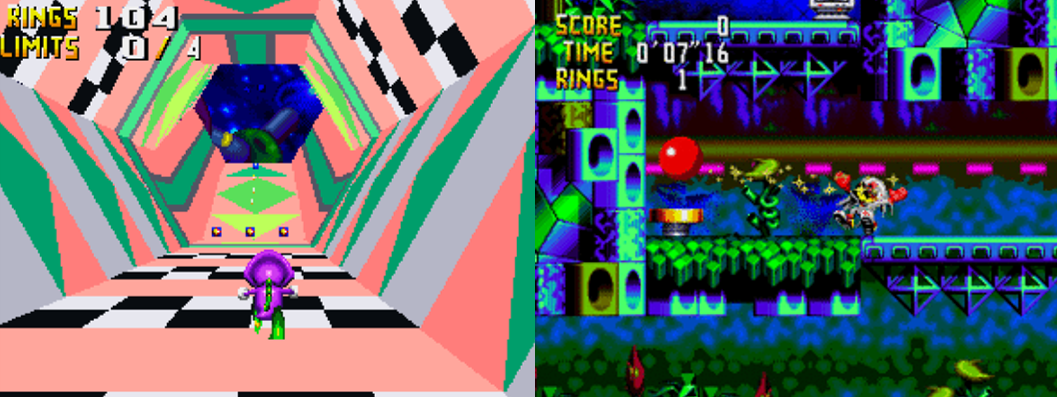
Also like Sonic CD, Knuckles’ Chaotix makes an impact with one of the best of the classic Sonic’s soundtracks; there are so many jaunty, catchy tunes peppered throughout this game that it really helps to take your mind off how empty the stages are and how monotonous the gameplay can be. Since it’s running on 32-bit hardware, the game also features a great deal of isometric 3D graphics; Dr. Eggman shields himself being a polygonal diamond, some lifts and bosses are built out of the same graphics, and you’ll find the bonus and Special Stages also contain a fair bit of this technique (and suffer from jerkiness, slowdown, and perspective issues as a result). There’s also a big emphasis on sprite manipulation; characters can grow or shrink with monitors, and bosses, Badniks, and sprites will fill up or fly into the screen. Unlike Sonic CD, however, the game doesn’t feature any anime cutscenes; in fact, even sprite-based cutscenes are few and far between here, relegated to the opening and before the final boss, and although the bosses are proceeded by a short cutscene, the game prefers to just show a partially animated image of the main cast for the title screen and credits. This is a bit of a shame, really; I wasn’t expecting full blown animated sequences but both Sonic 3 and Sonic CD featured more sprite-based cutscenes than Knuckles’ Chaotix, so the game ends up feel quite rushed and a bit of a step back.

Enemies and Bosses:
Dr. Eggman hasn’t really tried to reinvent the wheel in Knuckles’ Chaotix and is still using his tried-and-tested robotic creations, the Badniks, to hinder your progress. Unlike in the majority of other 2D Sonic titles, destroying Badniks doesn’t free a cute little woodland critter; instead, an uncollectible Dark Ring will drop out and disappear soon after, meaning that the few times Badniks do appear you’re robbed of any sense of satisfaction from destroying them. These Badniks are some of the oddest in the classic series, resembling a mish-mash of insects, tanks, and other creatures and mostly just floating around here and there. The only real standouts for me were Burboom and Blitz; Burboom can catch your partner and hold them captive and Blitz target you with homing missiles that fly across the immediate area to hurt you. While in Amazing Arena, you’ll also have battle a sub-boss, which is a massive mechanical version of Dr. Eggman that stretches its fists at you. The only way to damage it is to toss your partner into the head, which routinely floats back and forth at the top of the screen; although you can simply wait it out and the boss will deactivate, you won’t get the benefit of the Ring Monitors defeating it bestows upon you.

Bosses can be either stupidly simply or needlessly frustrating thanks to the Combi-Ring mechanic.

Since you’ll play the game’s Attractions at random, the main five bosses can be fought in any order, and you’ll probably tackle them at different times each time you play through the game. It’s also worth noting that you must play each Attraction’s entire fifth Act to reach the boss, and if you fail you’ll be kicked back to the hub world and have to play through the whole Act all over again, which can make these battles very tedious. I fought the Botanic Base boss first; in this fight, Dr. Eggman holds your partner in a mechanical claw and shields his craft with electrical currents, meaning you’re left frantically trying to figure out how to bounce around using the bumper and ram into the craft. After that, I took on the Amazing Arena boss, which sees Dr. Eggman spawn in Badniks using a projector screen and protecting himself with a sphere. Simply fend off the Badniks, avoid his mace-like arms, and toss your partner up into him to take him out. I then fought the Marina Madness boss, which sees Dr. Eggman hide behind a polygonal shield and then protect his craft with slivers of it, not unlike the Metropolis Zone boss, forcing you to time your attacks to avoid damage. The Speed Slider boss is one of the trickiest in the game as Dr. Eggman essentially commands a huge, dangerous carousel; the floor constantly moves you towards the spiked cups that rotate around the main machine, so you have to fight against the inertia, avoid the spikes, and ram the blue spherical weak spot of his machine. Contrasting this is the Techno Tower boss, which is easily the game’s simplest boss by far; despite the lasers and the swinging arms of Dr. Eggman’s rotund mech, I was able to batter the red sphere that is its weak spot in no time at all thanks to simply taking advantage of invincibility frames.

Metal Sonic transforms into a massive mechanical monstrosity for the finale.

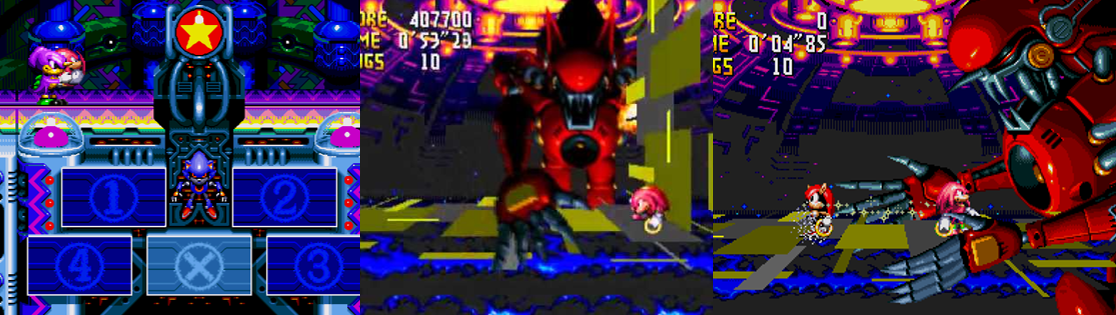
Once you have defeated all five of the main bosses, you’re returned to the hub world, where Metal Sonic takes over the stage select machine. Just as you need to hit a bumper to select a stage, so to do you have to hit the bumper to try and deal damage to Metal Sonic; if the indicator lands on the X, one of the other numbered panels will be destroyed and the hub world will become more and more damaged. However, if you land on one of the numbered panels, you’ll have to dodge one of four different attacks as Metal Sonic tries to force you into spiked walls, rains missiles down on you, sends buzzsaws across the floor, and tries to hit you with bouncing tentacles. You’ll need to avoid these as you can only take two hits in this boss battle due to the lack of Rings; the first hit will cost you your partner, and you’ll need to wait for him to respawn or you’ll be kicked back to the hub world and have to start over. With Metal Sonic heavily damaged, Dr. Eggman repairs and powers it up with a huge Dark Ring, transforming it into the massive, monstrous “Metal Sonic Kai”. This is a three-stage boss battle in an enclosed, cyberspace-like arena, where you’re afforded ten Rings and must avoid its huge claw arm to strike its chest, then Spin Dash into its remaining arm while it hovers in the background, and then avoid its massive near-screen-filling chest beam to finish it off in a pretty simple, but surprisingly impressive, final battle.

Power-Ups and Bonuses:
Pretty much all of the classic Sonic power-ups are available to you in Knuckles Chaotix; while there are no Elemental Shields or extra life monitors, you can grab ten Rings, a speed up, a one-hit shield, and an invincibility from the different monitors you can find in each Act. There are some new power-ups here as well, though: you can briefly switch your playable character (or switch your partner to a different one depending on whose face is on the monitor when you smash it) and either grow to plough through the few enemies onscreen or shrink to find your jump and abilities painfully stunted for a short time. Perhaps the most useful item is the Combi-Ring Monitor, which stays with you until you’re hit; then, when you are hit, one large Ring is thrown from you rather than all of them scattering around and collecting that one Ring restores all of your Rings. Another interesting twist is that your partner can also collect and be affected by the monitors, meaning they could be invincible, big, small, or protected by a shield while you are not.

Additional Features:
As you might expect, finishing any Act except the ones containing a boss while holding fifty Rings or more spawns a Big Ring. Entering it takes you (or your partner, if they enter or are thrown into it) to an isometric Special Stage where you continuously lap the environment until you have collected enough Blue Spheres to proceed. Collecting Rings will afford you more time to do this, and you must dodge buzzsaws and spiked balls and the myriad of gaps in the floor in order to reach your goal. While these aren’t necessarily the worst Special Stages I’ve ever played, they can be extremely difficult; it’s very hard to see what’s coming ahead of you or to anticipate which “lane” you need to be in to find a Blue Sphere, and all too easy to slip to failure. On the plus side, there are only six Special Stages; you’ll be awarded one of the six coloured Chaos Rings upon completion and will be treated to a slightly different end credits screen that adds Sonic and Miles “Tails” Prower to the cast and avoids Metal Sonic Kai wrecking havoc.

Snag the six Chaos Rings for the good ending, or mess about with the game’s debug mode.

Unfortunately, there are no Super transformations or additional bonuses; however, if you enter a Special Stage after collecting all the Chaos Rings, you’ll simply challenge them again in an even more headache-inducing wireframe mode. If you’re holding twenty Rings or more, you may encounter Big Rings hidden within the Acts; these transport you to a bonus stage that sees you constantly falling and trying to hit blocks for points and Rings. However, your Rings are constantly being drained in this stage, making it more of a hinderance than a benefit. Outside of the regular game, you’ll find a sound select and “colour test” in the main menu; messing around with this allows you to activate a debug mode, have Amy Rose appear in the sound test, activate a stage and character select, and even play as a glitched version of Knuckles. Since the only way you can play Knuckles’ Chaotix is to emulate it, you can obviously also make liberal use of the save state features included in most emulators to make the game a bit less annoying to play through.

The Summary:
Knuckles’ Chaotix is such an oddity to me. The entire game feels like a barely finished proof of concept, with empty environments and clunky mechanics that all needed to be addressed before the game was completed, and yet it’s such a lush and stunningly well-presented package that I find it all the more disappointing how lacklustre the actual gameplay and content are. Rather than trying to emulate the size, scope, and variety of Sonic 3, Knuckles’ Chaotix takes a step backwards for a far more linear and mundane experience and hedges all its bets on the unique Combi-Ring mechanic and the random, amusement park-like structure of the main campaign. Sadly, neither are all that much fun to play; five Acts per stage would be a lot to get through even in a traditionally paced Sonic title but the lack of enemies and variety are a real issue, despite how pretty the game looks. It’s a shame as the character designs are really unique and it could have been a really good continuation of the classic Sonic series, but it’s just lacking in a lot of ways that make it inferior to Sonic 3. The bosses aren’t too bad, especially the final battle, but the Special Stages are extremely disorientating and I can’t imagine the game is very enjoyable in two-player. At the same time, though, I’d love to see this get a remaster or a port to modern consoles with a few quality-of-life fixes, and it boggles my mind that we haven’t seen it re-released in all this time, but I can decisively say that you’re really not missing out on much by skipping over this one.

My Rating:

Rating: 2 out of 5.

Could Be Better

Have you ever played Knuckles’ Chaotix? If so, did you play it on the original hardware or, like me, did you discover it through emulation? What did you think to the Combi-Ring mechanic, and which combination of characters was your favourite? Were you a fan of the random aspects of the game and the five-Act structure? Did you ever collect all the Chaos Rings and what did you think to the Special Stages? How are you celebrating Knuckles’ big day today? Sign up to leave your thoughts on Knuckles’ Chaotix down below or drop a comment on my social media, and check back in for more Sonic content a little later in the year.

Author’s Spotlight: Ambrose Stolliker Interview

Ambrose Stolliker, author of The Strange Nighttime Journey of Father Stephen Marlowe and others

1. First, introduce yourself a bit. What is your name (or pen name) and where are you from?

My name is Ambrose Stolliker. I grew up in the New York Metro area but have lived in the Seattle area for the last twenty-three years.

2. Next, tell us a bit about your most recent work. Is this your first published book? What is it about and what genre would you classify it as?

The Strange Nighttime Journey of Father Stephen Marlowe is a supernatural horror novel and was released by indie publishing house Muddy Paw Press in late May 2022. Here’s the back of the book summary:

In the year since his brother, Chris, committed suicide, Father Stephen Marlowe has not been able to pick up the pieces. He is racked with guilt over what he believes was his part in Chris’ death and his once-meteoric rise through the Catholic Church in New York City has come to an ignominious end. Haunted by disturbing dreams of his brother suffering in a hellish underworld, Marlowe is at the breaking point. At the behest of his superiors, he goes to St. Michael the Archangel Church in the Bronx to seek counsel from a mysterious priest who specializes in helping spiritually troubled clergy. There, as he reluctantly attempts to make confession and unburden his soul, the church is rocked by a powerful earthquake. The confessional disintegrates, the floor crumbles away beneath him, and Marlowe is plunged into a world both wondrous and terrifying where he must fight to save his brother’s immortal soul.

3. Tell us a bit about your main character; what are they like, how did they come about, and what are some of their strengths and weaknesses?

Father Stephen Marlowe is a Roman Catholic priest who serves as pastor of St. Francis of Assisi Church in Queens, N.Y. When we first meet Father Marlowe, he is in a profound state of spiritual crisis and is doubting his ability to continue on in his vocation as a priest. Deep down, Marlowe is a good and decent man, but he has his failings, one of which is an imperfect understanding of what it means to love unconditionally.

In earlier iterations of the story, Marlowe was portrayed as a much younger man, a priest fresh out of seminary who sees the world in very black and white terms and with a confidence he probably has not earned. As I developed the story through subsequent drafts, I felt like he needed to be an older, perhaps middle-aged man who has been beaten down by the harshness of the outside world and weighed down by the guilt and shame associated with what he sees as his own failings. I felt that in order for him to be a more compelling character readers would empathize with, he needed to be in a dark place when the story opens so he can evolve into a different and, hopefully, wiser and more hopeful person by the time his journey ends.

4. What was your hardest scene to write in this (or any) book?

That’s a tough question. There are a lot of scenes in the book that contribute to Father Marlowe’s character arc, but I’d say my favorite one is the opening scene. The story begins with Marlowe arriving on a pediatric cancer ward in New York City so he can administer Last Rites to a young girl dying of cancer. I’ve heard some readers describe the scene as “an emotional gut punch” that sets the stage for the central conflict of the story, which is Marlowe’s profound crisis of faith. By the time the scene ends, it is very clear that Marlowe no longer believes in God and the only course of action he can see is to leave the priesthood for good.

The scene was difficult to write, not only because of the emotional impact of trying to portray the death of an innocent child, but because there’s a fine line between drama and melodrama. I probably put the scene through at least three drafts before I was satisfied with it, though, like most writers, I’m NEVER completely satisfied with anything I write.

5. Did you go the traditional route when publishing your book or did you choose to self-publish?

I went the traditional route. The Strange Nighttime Journey of Father Stephen Marlowe was submitted to around thirty or forty literary agents, and didn’t get a single sniff. Not one. After a while, I began to suspect it MIGHT be because, as a novel, it IS on the short side at only 47,000 words. That’s just a guess though. It’s such a subjective business as all writers know, so perhaps the premise just didn’t resonate with the agents I targeted.

In any case, I eventually gave up on trying to secure an agent and instead began submitting it to independent and small horror presses. At first, it was tough going, but, eventually, I had a press ask for the full manuscript. My hopes were dashed when, several weeks later, they told me they enjoyed it but they wouldn’t take it on. I remained undeterred, however, and continued to submit it.

Then, one day last summer, Tyler Hauth, founder of Muddy Paw Press, called me on the phone and told me he had read half of the novel and he wanted to publish it. I was really caught off guard because no publisher or editor had ever taken the time to actually pick up the phone and call me about anything I’d written. We had a great conversation and, as we talked about the story, it was very clear Tyler understood what I was trying to say. He was a great editor and his feedback really helped make the story better, especially in terms of pacing. He’s been a great partner and I highly encourage all horror writers who don’t have traditional agent representation to give small presses a chance. These indie houses are much more likely to take on stories that don’t fit into the mainstream of what sells and what doesn’t sell. So, a short novel like Father Marlowe probably had a better chance with the indie presses than the traditional big publishers.

6. What would you say is the most difficult part of your writing journey and what advice would you give to other writers?

This should not come as a surprise to anyone who has been writing and trying to get published for a while, but the hardest part is dealing with the rejection.

For my part, I feel like my career as a newspaper reporter and magazine journalist trained me for the constant rejection from editors, agents and publishers. To be honest, it never really phased me enough to make me think about giving up on a career as a fiction writer. That said, I did, of course, have moments of doubt, especially in the years before I landed my first publishing credit (a short horror story entitled Ghosts of Annapurna, which was published in Ghostlight Magazine around 2010.) They say getting that first writing credit is the toughest nut to crack, and it is, but I just always kind of believed my stories were pretty good and there was an audience out there for them somewhere, I just had to find it.

So, I guess if I have one piece of advice to writers, it would be, if you really love to write, don’t ever give up. The only way you can fail is if you stop writing. And, of course, practice your craft as often as possible by writing on a regular basis and by reading both within and outside of your chosen genre.

7. Do you want each book to stand on its own, or are you trying to build a body of work with connections between each book?

As of today, I’ve published more than a dozen short horror stories, two horror novellas and one horror novel. None of them are connected. That said, the ending of The Strange Nighttime Journey of Father Stephen Marlowe makes it clear that his story is just beginning, and there MAY be more stories to come. I haven’t thought of a new story for Stephen yet, but if there’s one out there for him, I’ll find it and write it.

8. What are some of your favourite authors and books and what inspired you to become a writer in the first place?

I read a lot of different types of fiction and nonfiction. On the fiction side, I tend to read a lot of horror, obviously. I’m a huge fan of Edgar Allan Poe, Ambrose Bierce, H.P. Lovecraft, Richard Matheson, Ray Bradbury, Shirley Jackson, William Peter Blatty, Susan Hill, Clive Barker, Dan Simmons, Thomas Ligotti, and Stephen King. On the more contemporary front, I’ve very much enjoyed the books of Stephen Graham Jones, Paul Trembley, Brian Keene, John Langan, and V Castro.

I am also a big fan of fantasy. My favorite all-time book is The Crystal Cave by Lady Mary Stewart, who died a few years ago. That book, more than any other, inspired me to become a fiction writer. Her vivid use of language and innovative re-telling of the Arthurian legend through Merlin’s eyes was captivating. Marion Zimmer Bradley, George R.R. Martin and J.R.R. Tolkien are also favorites of mine.

I also LOVE good historical fiction – the work of John Jakes (the North & South trilogy), Sharon Kay Penman (Norman, Welsh and Scottish history), Herman Wouk (The Winds of War and War and Remembrance) are among the best historical fiction writers out there.

On the non-fiction front, I read a great deal about American history, especially the Civil War and WWII. Bruce Catton and William Shirer come to mind. I also love the history of baseball, especially the so-called “golden age” of baseball of the 1920s-60s, so Roger Kahn (The Boys of Summer), Doris Kearns Goodwin (Wait Till Next Year) and David Halbestrom, who we just lost as well (Summer of ’49 and October 1964 are two of his best) also sit on my shelf. The history of Negro League baseball has also become a passion of mine, and I have excellent biographies of Satchel Page, Josh Gibson and many other African-American greats who never got to play in the big leagues that I’ve voraciously consumed over the years.

9. What would you say has been the best way to market your books?

This is the toughest aspect of getting published. Once your book is out there, it’s incredibly difficult to rise above all the noise and get your book noticed. I’m a digital marketer in my day job, so I know how challenging it can be to make your voice heard.

Most of the success I’ve seen has been in engaging directly with book bloggers and reviewers on social media and finding podcasts that will give indie authors an opportunity to come on their shows and talk about their books. It’s a time consuming and somewhat thankless job, but you have to do it. Book signings are fun and I’ve done a few over the course of my three books getting released. It’s a great way to get out there and talk to readers at local bookstores.

10. Are there any tropes, clichés, or writing styles that you dislike and, if so, what are they and why?

Not particularly. The thing is, it’s all already been written before. There aren’t really any purely original stories to tell. What makes your story worthwhile is your personal spin on tropes and clichés we’ve all seen countless times before. As a writer, you just have to try and find a way to make those tropes and clichés your own, and you do that, I think, by injecting some of yourself into every story you write. There’s only one you – only one – and that is what makes your stories unique.

11. Do you read reviews of your book and, if so, how do you handle negative feedback?

I read all of them. Again, maybe my career as a journalist prepared me for harsh feedback, but, in my humble opinion, there is only one appropriate response to a negative review: Thanks for taking the time to read my work. That’s it. The bottom line is this – reviews are subjective and you can’t take it personally. I don’t see any upside to responding to negative reviews. Just move on to the next thing. You’re never going to write something that EVERYONE likes. It’s just not going to happen.

12. What are some of your quirks as a writer? Do you like to plot everything out or do you prefer to just “wing it” and see where the story takes you? Do you listen to music when writing and, if so, what do you listen to?

I rarely “wing” it. In most cases, I know the rough outlines of the beginning, middle and ending of my stories. I do often get stuck because I don’t know always know the answer to “and then what happened”, but I just write through it until I get the characters where they need to go.

Do I listen to music while I write? Never. It’s too distracting. I need quiet.

The only quirk I can think of is that, on occasion, I’ll have a glass of whiskey while I write, but those occasions are few and far between.

13. What is the best advice you’ve ever had when it comes to writing and what advice would you give to new writers?

Again, just don’t ever give up. And write for yourself, not what you think the market wants.

Also, when I was a English Literature and Creative Writing student back in the mid-nineties, I learned pretty quickly that you really have to be judicious about what feedback you listen to when you’re working on something. Again, it’s all incredibly subjective, and the honest to God truth is that there isn’t really anyone out there who knows what you’re trying to say or the best way to say it better than you do. You have to trust your instincts as a writer.

So, when I see writers on social media saying they have a dozen beta readers on their current work in progress, I have to wonder how much true value they get out of that. I have three or four beta readers, people I have known for many years, that I trust, and that’s it. And I don’t even act on all of their feedback. They’re there as a sounding board. That’s it.

14. What’s next for you? Are you currently working on any new books or stories?

I am just about to wrap up a collection of a dozen or so short horror stories (okay, one is actually now heading into novella/novel territory) set just before, during and after the U.S. Civil War. I feel like these are some of the best stories I’ve ever written and I hope they find an audience.

15. Finally, feel free to plug your social media, website, and links to Amazon, GoodReads, and other relevant sites below, and detail any current offers available for your book/s:

This is so kind of you! Thank you so very much for giving an indie author like me the chance to pontificate and share my experience with other writers.

Thank you again, Dr. K! You’re wonderful!

If you’d like to be featured in an interview, please check out the interview submissions page to submit your answers.

Game Corner [Bat-Month]: Batman: Arkham City (Xbox 360)


In the decades since his first dramatic appearance in the pages of Detective Comics, Bruce Wayne/Batman has become a mainstream, worldwide, pop culture icon. The brainchild of writer Bob Kane, Batman was brought to life by artist Bill Finger and has been a popular staple of DC Comics and countless movies, videogames, and cartoons over the years. Accordingly, September celebrates “Batman Day” and is just another perfect excuse to celebrate comic’s grim and broody vigilante and, this year, I’m dedicating every Wednesday of September to Gotham’s Dark Knight Detective.


Released: 18 October 2011
Developer: Rocksteady Studios
Also Available For: PC, PlayStation 3, PlayStation 4, Wii U, Xbox One, Xbox Series S/X

The Background:
Batman quickly became a successful and dynamic character after his 1939 debut in DC Comics; over the years, the character’s world and mythos has grown considerably to include numerous spin-off comics and adaptations into not just cartoons and movies but also videogames. While Batman has fared rather well in that department, it can’t be denied that there were a few stinkers as well before Eidos Interactive acquired the rights to make a Batman game and brought in both Rocksteady Studios and celebrated Batman scribe writer Paul Dini to create the critically and commercially successful Batman: Arkham Asylum (ibid, 2009) at a time when the character was hot off a resurgence thanks to the recent success of The Dark Knight (Nolan, 2008). Development of a sequel began work before Arkham Asylum had even been completed; despite apprehensions about system limitations, Rocksteady had big ideas for the sequel, which would move away from the claustrophobic trappings of Arkham Island and into more open world territory. Having learned from their mistakes and feedback from the first game, the developers greatly expanded Batman’s arsenal, animations, and gadgets to make him a more capable character and significantly expanded the range of exploration and side missions available to players in the much-larger game world. All of that hard work paid off as Arkham City became one of the fastest selling videogames in history. Critically, the response was universally positive; critics lauded the voice acting and additional features and the high quality of the game’s mechanics and content. The game was so successful that it was released in multiple editions with access to different downloadable content (DLC) and won numerous awards for the sheer expansiveness of its included, and additional, content.

The Plot:
After the events of Arkham Asylum, the city’s criminals have been locked up inside a walled off section of Gotham City known as Arkham City, where supervillains and TYGER mercenaries under the command of Doctor Hugo Strange enforce martial law. Infiltrating the prison to investigate Strange’s unlawful incarceration of those who spoke out against him, the odds against Batman increase when the Joker shows up, apparently dying from TITAN poisoning, and infects Batman with his blood, forcing him to delve into the city’s underworld to find a cure.

Gameplay:
Like its predecessor, Batman: Arkham City is a third-person, action/adventure game but, this time, you’re prowling the streets and rooftops of “Old Gotham”, a dilapidated and rundown area of Gotham that has been encased in high perimeter walls sporting gun turrets to house the city’s undesirables. Arkham City’s game world is five times the size of the one seen in Arkham Asylum and features even more recognisable landmarks from Batman’s famous city and areas to explore, as well as an endless supply of inmates and lowlifes to get your fists on. One of the best things about Arkham City is how the control scheme and core mechanics remain exactly as in the first game, just expanded considerably. Once again, Batman’s main method of traversal is his operatic cape and grapnel gun, which can now be used in conjunction and upgraded to allow him to effortlessly zip across the city. You can also dive bomb while gliding to take out enemies or pull up and gain additional height and length on your glide, allowing you to traverse the city prison in no time at all.

Combat and stealth are more fluid and satisfying than ever thanks to additional animations and options.

This more than makes up for Batman’s continued inability to jump and allows him to easily dart out of danger when spotted; Batman can still crouch with the Right Trigger and toss a quick Batarang with the Left Trigger, but now he can also quick-fire other gadgets, which is incredibly useful in combat and for solving the myriad of brain-teasing puzzles scattered around the city by Edward Nashton/Edward Nygma/The Riddler. The “freeflow combat” mechanic of the previous game returns intact but greatly expanded thanks to the addition of more attack animations and combos; X allows you to strike in quick succession while a well-timed press of Y (indicated when the “counter” indicator appears) will allow you to block and counter incoming attacks and rack up a bigger and more fluid combo. The higher your combo, the more damage you’ll deal and the more dynamic the perfectly-placed fight camera will move to allow you to lunge at other enemies before they can land a blow. Since the streets are crawling with a seemingly inexhaustible supply of thugs this time around, there are far more opportunities to sneak up on them and perform a “Silent Takedown”, but this time you can perform a “Knockout Smash” (though this will attract nearby enemies) and you can even perform takedowns from floor grates, double or even triple counters and takedowns when in combat, attack parts of the environment (like fire extinguishers and electrical boxes) to disorientate or disarm opponents, and even slam inmates into walls or dangle them over ledges during combat or interrogations.

New additions to the Predator sections increase the threat to Batman and his takedown options.

Also returning is the stealth-based “Predator” mechanic; in addition to sneaking up on enemies, Batman can grapple up to stone gargoyles and other high ledges to review rooms of armed thugs using the x-ray and thermal vision offered by his “Detective Mode”. A simple press of the Left Bumper and you’ll be able to see enemies by their body heat, their current condition, and any interactable parts of the environment. Batman’s new array of gadgets (easily accessed using the directional pad) can also be used in new ways to lure enemies into traps or take them down and, while traversing the city, you’ll need to make liberal use of these (and Batman’s new smoke pellets) to dart away from gunfire and dispatch gun-toting enemies. Again, Batman is tough but can’t take sustained gunfire or explosions; however, his health will replenish after you clear out all nearby enemies, solve riddles, or find the many Riddler Trophies. These same criteria will earn you experience points (XP) to improve Batman’s armour, abilities, and weaponry once more but the game definitely mixes things up by having enemies be able to jam your Detective Vision and electronics and lay traps of their own.

Navigation is easier than ever thanks to a comprehensive map, waypoint, and compass system.

If you thought Arkham Asylum had a lot of riddles and Riddler Trophies, then Arkham City will blow your mind! The Riddler has placed his trophies not just out in the open but hidden behind walls, in cages, and a myriad of pressure pads and context-sensitive puzzles that will require all of Batman’s skills and gadgets to acquire. Similarly, there are riddles to find across the city and you can solve them by tapped LB to scan the environment when you spot glowing green question marks or the answer to the riddle. This time, there are also far more destructible elements to snag you some XP; the chattering Joker teeth return but you’ll also be destroying TYGER security cameras, balloons, and massive bobbleheads of Doctor Harleen Quinzel/Harley Quinn, which all adds to the fun, as well as more opportunities to use your gadgets to open vents or shut off steam from pipes. The map screen returns, far more expansive and user friendly (as are all of the menus) than before; you can now set waypoints to your next mission or any other location on the map and a very useful onscreen compass and Bat-Signal will direct you towards your location with a minimum of fuss. Take note, though, that these features are suppressed when you have Detective Mode activated but, again, there are some opportunities to track targets using this vision mode.

The streets are crawling with more baddies than ever and they’ll repopulate areas as you progress.

Like the first game, Batman: Arkham City gets progressively difficult as you play but this is expanded upon greatly. You might come across a gang of Harvey Dent/Two-Face’s minions and engage them in combat, only for more and more nearby inmates to hear the fight and join in, for one thing. These enemies will, eventually, repopulate areas after you’ve cleared them out so you constantly have to be aware of enemies on the streets and rooftops and, like in the last game, enemies will increase in their aggressiveness and capabilities as you progress through the story. Also, like before, you can select different difficulty levels to play the game on from the start, with “Hard” mode including counter indicators this time but increasing the damage enemies will put out, but there are no Achievements tied to playing on Hard mode so you may as well play on “Easy” or “Normal” since “New Game Plus” offers an even tougher challenge than the game’s Hard mode. Where Arkham City excels, though, is in its sheer size; Arkham City is full of buildings to enter, Easter Eggs and references, riddles to solve, and side quests to keep you busy. For a returning player like me, it’s really easy to get distracted with side quests on your way to the main story objective and you can keep track of all outstanding missions from the main menu. From here, you can also view stories and character biographies, review Batman’s moves and abilities (and even view a tutorial if you need a refresher), and check up on any outstanding riddles and such. In fact, the only real downside to Arkham City is, again, the inability to quickly exit an area, which can be particularly bothersome when deep in the bowels of the city subway or the forgotten steampunk city, Wonder City, as it can still be a tad laborious to find your way back out sometimes.

Graphics and Sound:
Batman: Arkham Asylum managed to hold up impressively well over time and Arkham City holds up even better; it was already a big step up in terms of graphical quality and visual presentation so it’s only natural that it’s aged even better. As before, it’s a very dark game and takes place in one night so you might be relying on your Detective Vision or brightness settings to navigate in some areas but, thanks to many of the game’s locations taking place in indoor, more suburban (if equally dilapidated) areas, there are far more opportunities to bask in the impressive art direction of the game. Arkham City is split into different regions, with each one being primarily controlled by gangs of thugs affiliated with a different supervillain (Oswald Cobblepott/The Penguin, Two-Face, and the Joker) and having a distinctive feel to them.

Each region of Arkham City is controlled by a different villain and has a different look to it.

Because the game takes place within a walled off cityscape, it must be said that it’s not immediately as visually distinctive compared to its predecessor as you’re surrounded by skyscrapers but I can forgive this as there are far more opportunities to see and explore the wider mythos of Batman’s world. You’ll stumble across Crime Alley, explore the remains of the old Gotham City Police Department (complete with Bat-Signal on the roof), fight through the museum and into the Penguin’s Iceberg Lounge, and take on the Joker’s gang at the dilapidated remains of the Sionis steel mill over on Amusement Mile. Similar to Arkham Island (which you can still see lingering in the misty distance), the city prison is a rundown, desolate place full of graffiti, burned out cars, litter, and chaos and there’s a real sense that the dogs have been literally let loose within its high walls and have turned the city into a veritable war zone. As you might expect, there are some more intricate and elaborate areas of the city, too. You can venture down into the abandoned subway and, of course, navigate through some stony catacombs and sewers beneath the city but, luckily, the game is far bigger and makes much better use of these environments when it comes to utilising Batman’s abilities so there’s far less awkward jumping and climbing and much more emphasis on the Line Launcher and grapnel boost, though you will need to get used to the new dive bomb mechanic in order to swoop in through some tight areas and get 100% completion.

Some nightmarish sequences, jump scares, and chilling encounters add to the world’s mythos.

Things definitely start to take a more visually interesting turn once you venture into the abandoned Wonder City, a town populated by deactivated robots and lost to the midst of times, and scale Wonder Tower to confront Hugo Strange. Sadly, there aren’t the same dynamic sections as those involving Doctor Jonathan Crane/Scarecrow from the last game but Arkham City does go to some lengths to recreate these sections when the plot demands that Batman suffer the effects of his poisoning. Later, during a side quest involving Jervis Tetch/The Mad Hatter, you’ll experience a much more similar, twisted nightmare world but the game does include far more elaborate and layered areas to explore that change as the story progresses. The GCPD will freeze over because of Doctor Victor Fries/Mister Freeze, the steel mill needs to be cooled down and then you have to enter through a different entrance that involves navigating past giant machinery and drills, Julian Day/Calendar Man is imprisoned beneath the courthouse, and the museum contains a gigantic frozen pool with a very large and unfriendly denizen awaiting you.

The attention to detail, new villains, and cameos are even better than ever this time around.

Thanks to the diversity in the game’s inmates, enemies have a lot more visual variety this time around as they wear different colourings and outfits. There is also a lot more chatter as Batman picks up on his enemy’s radio signals and broadcasts, with both Joker and villains like Penguin taunting you and issuing commands to their underlings. Batman’s suit, while visually very similar to the last one, still takes on battle damage as the story progresses and, as you’d expect, both Kevin Conroy and Mark Hamill knock it out of the park with their stellar work as Batman and Joker, respectively. Like before, Batman stops to converse with Barbara Gordon/Oracle but he also talks with his faithful butler and father-figure, Alfred Pennyworth, who sends additional equipment and offers council. The game also features far more references to Batman’s cast of characters and the wider DC universe and there’s even a much-appreciated cameo from a really well-designed version of Tim Drake/Robin for good measure. Cutscenes still make liberal use of the in-game graphics, which are even closer to the higher quality cinematics, and you’ll now see a helpful little recap of the story and your current outstanding missions when reloading a save.

Enemies and Bosses:
With Arkham Asylum gone, its inmates and the rest of Gotham’s criminals have been tossed into Arkham City instead; for the most part, the bulk of the game’s enemies are the same scumbags you fought in the last game but in different clothing and with more jeers to throw your way. Inmates will throw punches, grab weapons, toss items at you, and attack with both knives, guns, grenades (in a new twist), electrical batons, and will even pick up car doors to use as shields and ram you. Eventually, you’ll also have to contend with snipers, enemies wearing collars that will attract their allies when they’re downed, enemies that can jam your technology, ones that take hostages, and thugs will even use thermal vision to spot you and start destroying the ledges you’re hiding on if you linger too long or fail to stay hidden. While the crazed lunatics from the last game are gone, the TITAN monsters make a return and some inmates with be decked out in protective armour. A simple Batarang to the face is no longer enough to dispatch these goons; this time, you must use three cape swipes to stun them and mash X to beat them into submission while also countering incoming attacks. You’ll also have to contend with the one-armed Abramovici twins a number of times; these big bastards swing huge sledgehammers or scythes and must be blasted with a bolt from Batman’s Remote Electrical Charge gun to inflict damage on nearby enemies and pummelled with your attacks as they can’t be stunned so you have to strike, hop over to avoid their swings, and strike again to defeat them.

Solomon Grundy more than makes up for Two-Face and Penguin’s lack of physical challenge.

Arkham City is populated by a number of Batman’s most notorious rogues, basically all of them being new additions to the roster of bosses. The first you’ll encounter is Two-Face, who has taken over the courthouse and held Selina Kyle/Catwoman hostage. This is more of a tutorial for the basics of combat and Dent is dispatched by Catwoman in a cutscene rather than in an actual boss fight, and the following encounter with the Penguin is quite similar. This is basically the culmination of a side mission that sees you rescuing frozen police officers, freeing Mr. Freeze, and acquiring tech from his suit to deactivate his freezing gun (which the Penguin is using to keep you at bay). In fact, the first real physical challenge you have (aside from gladiatorial bouts against swarms of inmates or fights against one of the Abramovici twins) follows this encounter with the Penguin, which sees you facing off against the hulking zombie Solomon Grundy. You fight Grundy in a kind of gothic laboratory and must use your quick-fire explosive gel to close up three holes on the floor that regenerate Grundy’s health with lightning (while dodging said lightning) and allow you to put a beating on Grundy. This continues into the next phase, where Grundy tries to crush you with leaping attacks and two giant wrecking balls and sends weird little mice-things scuttling towards you. The third phase is more of the same but Grundy has one arm trapped in a machine; this time, the floor holes open sporadically for even shorter bursts and you need to avoid the shockwaves Grundy produces. Once he’s finally defeated, you have to dodge out of the way of the Penguin’s missile to punch him out once and for all, all of which is more interesting and engaging than the final boss of the last game.

While Rā’s tests your reflexes, you’ll need to use all of Batman’s skills and gadgets to bring down Mr. Freeze.

The next main story boss you’ll battle is Rā’s al Ghūl but, before this, you must first track down one of his ninja assassins by her blood trail, get past more of them in Wonder City (they can dodge your strikes and teleport in puffs of smoke before attacking with sword swipes), and endure the “Demon Trials” (gliding sections through a twisted hellscape where you can’t touch anything but the highlighted areas). You’ll face Rā’s in a desert that is part delusion, part reality, and have to take out hoards of sand men while he dashes at you from out of nowhere. Once you get past them, you must dodge the shurikens and blades he sends your way while blasting at him through his human shield with your Disruptor, and then mash Y to counter his attacks. The speed and aggressiveness of his attacks increases as the fight goes on but the final blow comes down to a well-timed toss of the reverse Batarang and Rā’ later meets a very gruesome end for his part in the game’s events. Next, you’ll have to take on easily the most intricate and complex boss of the game (or most games, for that matter) as Mr. Freeze betrays you and forces you into a confrontation. Depending on the difficulty you’re playing on, you may be forced to use every single one of Batman’s gadgets and abilities to deal damage and leave him vulnerable for a beatdown as Mr. Freeze learns and adapts his strategy as the fight progresses. Mr. Freeze will plod around the laboratory searching for you and sending heat-seeking globes to seek you out; you can use Batman’s glide attack, takedowns, and gadgets (like the explosive gel and Remote Electrical Charge gun) to deal damage but he’ll take action to ensure that you can’t do this twice (he freezes the ledges, grapple points, and vents, destroys parts of the environment, erects a shield, among other defensive measures), which forces you to think on your feet and explore options you might not normally use.

After stopping Strange and defeating Clayface, you’ll find some other villains to take down.

In the game’s finale, Strange activates the mysterious “Protocol 10” and commences a strategic bombardment of Arkham City; this briefly forces you to hack into circling helicopters in order to get inside of Wonder Tower and shut Strange down but, after you do, you’re forced into a confrontation with the Joker, who seems revitalised and has taken Talia al Ghūl hostage. Earlier in the game, you actually fight the Joker in his base form while his goons and out of control dodgem cars fill the arena but, when you confront him at the end, it’s revealed to have been Basil Karlo/Clayface in disguise; thus, the finale is, again, a battle against a hulking enemy. This time, you have to dodge Clayface’s cannonball attack and swinging arms while repeatedly spamming Freeze Blasts to whittle his health down. In the second phase, you grab a sword and slice up the mud men he spawns while repeating these tactics and avoiding his big sledgehammer shot in order to take him down. In between each of these main mission boss fights, you’ll come across a number of side missions that will draw you into confrontations with more of Batman’s rogues gallery: Floyd Lawton/Deadshot has been killing targets all over the city but Batman eventually tracks him down and must sneak past his one-shot rifle-arm to take him down; Victor Zsasz/Mister Zsasz has been killing people by luring them to ringing phones so Batman has to listen to his macabre life story to triangulate his location and then sneak around him in a partially flooded area to rescue his hostages; the Mad Hatter abducts you and forces you to battle waves of demonic rabbits; and the Riddler has also taken five hostages and placed them in Saw (Wan, 2004)-like traps. These hostages can only be saved by finding the Riddler’s Trophies, solving riddles, and interrogating his informants (highlighted in green) to gain access to his “Enigma Device” and locate each one in turn using the Cryptographic Sequencer.

Power-Ups and Bonuses:
As before, Arkham City features a level-up progression system; every time you defeat enemies, solve riddles, or pick up Riddler Trophies and destroy cameras and such, you’ll gain XP. Upon levelling-up, you can again upgrade Batman’s armour (now separated into one that improves damage from melee attacks and one from gunfire) to gain additional health, add more elaborate takedowns to his repertoire (including a swarm of disorientating bats, bone-breaking takedowns, and weapon disarmaments), and upgrade his various gadgets to improve their range and efficiency. Again, it’s pretty easy to fully upgrade all of Batman’s abilities if you engage with enemies and search out riddles on a regular basis, and it’s best to mix and match your upgrades for a balanced playthrough but you can choose to focus on making Batman more durable if you so wish.

Batman’s new toys let him charge power points and create temporary platforms, among other things.

Batman begins the game with many of the gadgets he had at the end of the last one, making him far more equipped for the rigours of Arkham City; many of his weapons, such as the grapnel gun and explosive gel, can now be used as quick-fire attacks to mix up your combos to allow for more diverse combat. Although Batman can no longer rip down walls with his grapnel gun, the Line Launcher can be upgraded to fire a second line and allow Batman to walk along it like a tightrope and he also has access to some new toys. The smoke pellets allow him to disorientate enemies and make an escape if needed, the Remote Electrical Charge gun allows him to power up electrical appliances, the Disruptor deactivates mines and renders up to two enemy guns useless, and the Freeze Blast (and upgraded Freeze Cluster) can plug up steam pipes and form ice floats on bodies or water to allow Batman to float around by grappling onto conveniently-placed hooks around the environment.

Additional Features:
Batman: Arkham City has fifty Achievements to earn, with the bulk of these popping simply by playing through the story, meeting certain objectives, and defeating bosses. One has you fiddling with the Xbox’s internal date and time in order to hear Calendar Man ’s chilling acts while most of the others are tied specifically towards starting or completing the game’s many side missions rather than solving or finding riddles (although this is a factor since you need to do this to rescue the Riddler’s hostages). No matter what difficulty you complete the game on, you’ll unlock a New Game Plus mode that offers and additional difficult challenge, mixes up the enemy placements, allows you to play the story with any additional DLC costumes, and carries over all of your gadgets and upgrades to a new game file. You’ll also be able to return to your original save file in a post-game world where the inmates will comment on the dramatic conclusion of the game and be freely able to switch to Catwoman at certain points on the map.

Alongside the Riddler challenges, there are a number of additional side quests to occupy your time.

This is super useful if you have any outstanding side missions to complete; not only are there some diving simulations to complete and a bunch of Riddler challenges tied to performing combat and gameplay manoeuvres, there are many other mysteries and villains out there to confront, such as tracking down Thomas Elliot/Hush (who has been mutilating victims to impersonate Bruce Wayne), figuring out the motives of the mysterious Michael Lane/Azrael, saving a number of political prisoners from random acts of violence, locating and reunited Nora Fries’ cryogenically frozen body with Mr. Freeze, and destroying TITAN containers in a fragile alliance with Bane. Additionally, there are way more Riddler Trophies hidden throughout Arkham City, many of which require precision gliding, pressing pressure pads, and using a variety of Batman’s gadgets to pick them up. Catwoman also has her own Riddler Trophies to pick up and, while there are no audio tapes to find this time, you can still unlock biographies, news stories, and audio clips by solving and finding riddles. As before, the game features a Challenge Mode, now rebranded as “Riddler’s Revenge”, which allows you to take on self-contained combat and predator challenges based on encounters in the game. You’ll battle a few waves of increasingly difficult enemies and rack up points by sustaining and varying your combos and pick off goons from the shadows while handicapped by a number of modifiers (such as disabling your Detective Mode, shielding enemies from damage, or having reduced health).

Arkham City makes up for the last game with a whole bunch DLC skins, characters, and challenge maps.

There is also a new series of “Campaign” maps that mix up the two challenges to present a sort of adjacent side story to the main game and you can compare your high scores against friends and other using the online leaderboards. These challenge maps, and the main game itself, can be expanded by purchasing the many different DLC packs for the game. As mentioned, Catwoman was a big selling point of the game and those who pre-ordered Arkham City or purchased her DLC can switch to playing as Catwoman during the story to follow a side mission involving Poison Ivy and stealing from Hugo Strange. The DLC for Arkham City is such a massive step up compared to the last game, adding twenty Achievements to collect and numerous costumes for Batman to use in New Game Plus and on challenge maps, and, best of all, the ability to play as Robin and Dick Grayson/Nightwing in the challenge maps. Each of the four playable characters plays a little differently (Catwoman is faster but weaker, slashes with her claws and tosses bolas; Robin uses his bo staff, riot shield, and faster (but shorter) version of the Batclaw; and Nightwing batters thugs with batons and utilises his acrobatic skill to take out enemies) and has their own gadgets but, sadly, only Catwoman is available to play as in the main game. Robin does take centre stage in a post-game DLC story, “Harley Quinn’s Revenge”, that sees him infiltrating the steel mill to rescue Batman; I had all of this DLC on the PlayStation 3 and greatly enjoyed the variety offered by the skins and each character but I do wish that the studio had allowed these additional characters to be used in the actual main game.

The Summary:
I was massively impressed with Batman: Arkham City when I first played it on the PlayStation 3; the game was just so much bigger and better than the original thanks to expanding the scope of the game world and the range of Batman’s abilities and gadgets. Everything that worked in the original game is back and improved upon, making combat even more fluid and diverse and truly defining the essence of Batman to set the standard for the remainder of the series. Rather than being confined to a claustrophobic, gothic prison, Batman is freely able to roam and fight around a dilapidated, walled off section of the city full of Easter Eggs, references, inmates to fight, secrets to find, and side missions to keep you busy for far longer than the first game. Best of all, the game is packed full of post-game and additional content thanks to these side missions, the New Game Plus mode, the expanded Challenge Mode, and the impressive abundance of DLC. Including additional skins, a short post-game story, and two of my favourite Batman characters in Robin and Nightwing really helps to expand the lore of this interpretation of Batman’s world and offers far more replay value. For me, Arkham City is still the gold standard for the Batman: Arkham series (Various, 2009 to 2015) and, while Arkham Asylum finally offered all of Batman’s abilities in a fun and engaging way, Arkham City expanded on them to the nth degree and truly defined what it means to play as Batman in an open world environment and it definitely deserves all of the praise it earned upon release and even to this day.

My Rating:

Rating: 5 out of 5.

Fantastic

What did you think about Batman: Arkham City? How do you feel it holds up compared to the original games and its sequels? Did you enjoy that the game world was expanded into a city-sized open world or did you prefer to more claustrophobic aesthetic of the first game? Which of Batman’s new gadgets and rogues were your favourite to use or fight against and why? Did you ever track down all of the Riddler’s trophies and secrets? Which of the side missions was your favourite to complete? What did you think to the game’s DLC and would you have liked to see Robin and Nightwing playable in the main game? How are you planning on celebrating Batman Day this year and what is your favourite Batman videogame? Whatever you think about Batman: Arkham City, or Batman in general, please leave a comment below and check back in next Wednesday for my review of the next Arkham videogame!

Movie Night [MK Day]: Mortal Kombat (1995)


This image has an empty alt attribute; its file name is mortalmonday.png

To celebrate the simultaneous worldwide release of Mortal Kombat (Midway, 1992) on home consoles, 13 September 1993 was dubbed “Mortal Monday”. Mortal Kombat’s move to home consoles impacted not only the ongoing “Console War” between SEGA and Nintendo but also videogames forever thanks to its controversial violence and I think that it’s only fitting that we continue celebrating this influential fighting series every September 13th.


Released: 18 August 1995
Director: Paul W. S. Anderson
Distributor: New Line Cinema
Budget: $18 million
Stars: Robin Shou, Linden Ashby, Bridgette Wilson, Cary-Hiroyuki Tagawa, Trevor Goddard, Talisa Soto, and Christopher Lambert

The Plot:
To decide the fate of Earthrealm, warriors fight in a generational life-or-death tournament called “Mortal Kombat”, hosted by Outworld sorcerer Shang Tsung (Tagawa). Lord Rayden (Lambert), God of Thunder and protector of Earthrealm, gathers his forces but his chosen champions, disillusioned former monk Liu Kang (Shou), egotistical movie star Johnny Cage (Ashby), and stubborn soldier Lieutenant Sonya Blade (Wilson) must first overcome their own demons before they can hope to save their world.

The Background:
I’ve already detailed how, during the nineties, competitive fighting games were all the rage thanks to the many iterations of Street Fighter II: The World Warrior (Capcom, 1991). To compete with this title, developers Ed Boon and John Tobias took inspiration from movies like Enter the Dragon (Clouse, 1973), Bloodsport (Arnold, 1988) and Big Trouble in Little China (Carpenter, 1986) to create an ultra-violent tournament fighter that changed the genre with its simple fighting mechanics and controversial violence. Development of a live-action adaptation began with producer Lawrence Kasanoff, who saw the potential of the videogame not just as a live-action movie but as an entire multimedia franchise. Spearheaded by Kasanoff, the project took shape with the hiring of director Paul W. S. Anderson, who substituted the videogame’s brutal violence for a focus on the game’s more fantastical elements and martial arts. Although the filmmakers failed to secure Jean-Claude Van Damme for the film, they incorporated both ambitious animatronics and early CGI effects alongside Shou’s martial arts background to make the fights as engaging as possible to help bolster the special effects. Mortal Kombat was a smash hit, making over $122 million at the box office. While videogame adaptations are often criticised for being universally bad, Mortal Kombat was notably praised at the time and has gone on to break free of its cult following to be largely regarded as one of the best videogame adaptations. The film and its depictions of these characters came to be incredibly influential on the videogames and, while the sequel was a monumental flop, the original film has always been one of my favourites, so much so that I dedicated an entire year of my life to researching and studying it as part of my PhD thesis.

The Review:
I mentioned up top that Ed Boon and John Tobias were influenced by martial arts films like Enter the Dragon and action films like Big Trouble in Little China when developing Mortal Kombat, but this is honestly just scratching the surface of the influence of kung fu and martial arts movies on not just Mortal Kombat but the entire fighting game genre as we know it today. Martial arts (or wu xia pian) films been produced overseas since 1905, with kung fu movies being around since 1949, but became incredibly popular between the early-sixties through to the 1970s once Bruce Lee was introduced to the world in Five Fingers of Death/King Boxer (Chung, 1972). Bruce Lee’s skill, charisma, and heavily kinetic energy was the perfect platform for this new style of cinematic combat that emphasised realistic action and application of martial arts. Lee famously multiple martial arts styles into his trans-cultural Jeet Kune Do style that showcased the best of Chinese martial arts, and Enter the Dragon not only reinvented him as an introspective Shaolin monk who could instantly become a lethal whirlwind but it was also engineered as a showcase of Lee’s unparalleled charisma and unique choreography. Lee became a national (and international) sensation after the film’s success, but tragically died six days before Enter the Dragon’s U.S. premiere, and has “haunted” martial arts films for decades as producers and filmmakers both perverted his legacy by awkwardly using limited footage of him and presenting it as new and attempting to substitute him with lookalikes and replacements.

Enter the Dragon had a profound influence on the Mortal Kombat games and movie.

The most obvious link between the fighting videogames and martial arts films is their inclination towards tournament structures, which allows fights to be staged onscreen not merely for our viewing pleasure but as necessary narrative components. These battles become a literal “game of death” based around increasingly-difficult fights between diverse characters, and related the two mediums in their ability to instill an intense excitement in the viewer (and/or player) through the gratification (or humiliation) of the fight. The film’s influence on the fighting game genre couldn’t be more explicit in the first two Street Fighter games; the plots are essentially the same (evil mastermind hosts a fighting tournament) and characters (such as Ryu, Ken, Geki, and Balrog/Vega) owe their design and personalities to those seen in the film. However, it’s in the Mortal Kombat movie that we see the most direct influences of the film, and fittingly so; there’s something poetic about Enter the Dragon influencing the Mortal Kombat videogame and the Mortal Kombat adaptation turning to Lee’s popular martial arts classic for inspiration. Indeed, I’ve long argued that Mortal Kombat is essentially a remake of Enter the Dragon: a host of martial artists (including three distinct main characters) are drawn to a mysterious island to fight in a tournament and battle an aging madman. Despite their different levels of knowledge and skill, and their conflicting personalities, they bond and are faced with tougher and tougher opponents until the righteous monk ends the antagonist’s threat in one-on-one combat skewed in the bad guy’s favour. The structure of the narrative and fight scenes are all very reminiscent of Enter the Dragon, but made all the more unique through the steady introduction of Mortal Kombat’s more fantastical elements; these are introduced to us slowly throughout the film, and explained in a way that both we and our sceptical main characters can understand them. While this means that we don’t get to see many of the superhuman and mystical special moves of the videogames, it does help to keep the focus on the characters and the film’s impressive fight scenes.

Tormented by guilt and self-doubt, Liu Kang’s greatest enemy is himself.

Although Mortal Kombat has three main protagonists, it’s fundamentally Liu Kang’s story; the pure-hearted hero of the franchise since game one, Liu Kang is presented as a disenchanted and doubt-ridden former Shaolin monk who rejected his upbringing at the Temple of Light in favour of the bright lights and excitement of the United States. Having been raised with full knowledge of the Mortal Kombat tournament, Liu Kang believes that the legends of Outworld are little more than nonsense fairytales designed to indoctrinate and brainwash the Order’s pupils. Indeed, while his grandfather (Lloyd Kino) fully believes in the tournament and pays reverence to Lord Rayden, Liu Kang angrily rejects the stories and questions Rayden’s legitimacy out of anger since he believes that the Order’s teachings were directly responsible for the death of his younger brother, Chan (Steven Ho). Crucially, Liu Kang enters the tournament not to defend Earthrealm but to avenge his brother’s death and is stunned to learn that not only is Rayden truly the God of Thunder but all of the legends he grew up with about Outworld are true; he quickly turns from a sceptic to a source of exposition for his new allies, but remains haunted by his doubts regarding his destiny. Rayden claims that Liu Kang fled the temple because he couldn’t handle the responsibility that comes from being the “Chosen One” and Liu Kang struggles with his heritage as he’s the descendant of the Great Kung Lao, a martial artist who secured Earthrealm’s fate generations ago. As a result, Liu Kang’s greatest enemy is not the array of fantastical and monstrous fighters placed in his path by Shang Tsung, it is himself and his character arc involves learning to overcome his doubts and embrace his destiny as the saviour of Earthrealm.

The egotistical Johnny Cage sees to prove himself and provides much of the comic relief.

As charismatic and likeable as Liu Kang is, however, it’s the egotistical showboat Johnny Cage who steals the show at every opportunity. Played to perfection by Linden Ashby, Cage is an arrogant braggart and something of a diva when on set, but his failings as a character come from a deep-seated frustration at being labelled a fake by the press and media. In actual fact, Cage is one of the greatest martial artists in the world and the tournament gives him the opportunity to prove that on the grandest and greatest stage possible; desperate to be taken seriously as a fighter, he willingly makes the journey and remains oblivious to the tournament’s true purpose. Cage acts as the film’s comic relief and every line and character beat of his lands perfectly (his assumption that Liu Kang is a porter is hilarious, as is his struggles with his luggage upon arriving on the island, and he’s never a moment away from a witty retort); while Ashby is far from the accomplished martial artist like Shou, he holds his own in fight scenes and is presented in a way that plays into his strengths, which helps make Cage a very grounded and realistic character. Instantly taking a shine to Sonya, Cage tries and fails to win her over with his boastful character but soon forms a real bond with her, and Liu Kang, based on their shared sense of awe at the scale of the tournament. While Cage goes out of his way to protect Sonya out of a mixture of chivalry and confidence, his character arc is specifically geared towards accepting his limitations and his abilities; rather than rushing head-first into battle to prove himself a legitimate fighter, Cage must learn to use his head and plan ahead, something that he accomplishes when he’s able to outwit and outmatch the lumbering man-mountain that is Goro (Tom Woodruff Jr./Kevin Michael Richardson/Frank Welker).

Sonya is obsessed with her vendetta against Kano and is forced to learn to rely on others for help.

Finally, there’s Sonya Blade; a strict and focused soldier, Sonya is a grim and stoic young woman whose military drive has been superseded by a bloodthirsty vendetta against Kano (Goddard), the unscrupulous criminal who murdered her partner. Sonya has become so razor-focused on pursing Kano, that she ignores the warnings of her partner, “Jaxx” (Gregory McKinney), and boards Shang Tsung’s boat to apprehend her target. Accordingly, Sonya has no clue about what’s really going on and is incredulous to the advances of Shang Tsung and the supernatural events happening around her; of the three, she’s the most cynical and dismissive of the tournament’s true purpose and she remains obsessed with bringing Kano to justice even after learning of Mortal Kombat’s true nature and the legitimacy of its mystical elements. Initially, Sonya pursues Shang Tsung to get closer to Kano and is reluctant to join forces with Liu Kang and Johnny Cage; her character arc revolves around her being afraid to trust others, which goes a long way to explain her prickly demeanour as she makes a conscious effort to push others way to avoid losing someone she cares about, like her partner. This pays off in the finale, where she’s reduced to a mere hostage and is forced to rely on her newfound friends to come for her since she’s no match for Shang Tsung.

The enigmatic Shang Tsung has some formidable and sadistic minions at his disposal.

Speaking of whom, Cary-Hiroyuki Tagawa makes for a truly fearsome and enigmatic villain; Shang Tsung commands the screen whenever he appears with his presentation, charisma, line delivery, and tangible magnetism. Shang Tsung is presented as a cold, sadistic threat; despite appearing to be a middle-aged man, he’s described as being “far more dangerous” than even the fearsome Goro since he can literally steal souls at will. An alluring and cruel villain, Shang Tsung delights in witnessing his forces triumph over Rayden’s chosen warriors and exudes authority and menace simply by being present in a scene or with a few ominous words. His unsettlingly sexual perversion towards Sonya and vehement hatred of Liu Kang only add to his disturbing aura and, while he bends and manipulates events to avoid fighting Liu Kang, he proves himself to be every bit the formidable opponent in the finale thanks to his centuries of experience and the power and knowledge of the souls he has absorbed. Similarly, Trevor Goddard clearly threw everything he had into making Kano an absolutely reprehensible villain who makes a distinctive impression thanks to his guttural grunts, faux Australian accent, and sadistic mean streak that forever changed Kano’s portrayal in the videogames. Both villains convey so much personality and menace whenever they’re onscreen and through their sheer demeanour and a few lines of dialogue; we get a glimpse into Kano’s background but his callous mean streak and attitude help make him a surprisingly well-rounded character and elevate Kano beyond a mere one-dimensional henchman. Both Shang Tsung and his chief champion, Goro, are seeped in mystery and menace; each one are pawns of the ominous Emperor (voiced by Frank Welker) but are significant physical threats in their own right and there’s a real sense of desperation behind them as they’ve never been so close to absolute victory before and are determined to please their Emperor by besting Rayden’s warriors.

Our heroes meet a number of cryptic, ill-fated, and beautiful allies in their quest to save their world.

Like Tagawa, Lambert perfectly embodies Rayden and his portrayal of Rayden forever changed the Thunder God from a destructive deity who is blasé about destroying life into a wise and benevolent mentor figure; Lambert’s distinctive, rasping voice makes for a strangely ominous character who exudes an absolute confidence thanks to his status as a God. Rayden offers both cryptic council to the protagonists and exposits information about the tournament and the plot that is necessary for them (and us, the audience) to hear but it’s never laborious to sit through thanks to Rayden having a cackling, mocking sense of humour that makes for some truly amusing moments. Johnny Cage meets a fan and makes a fast friend in bit-player Art Lean (Kenneth Edwards), an original character who mainly exists simply to fuel Cage’s animosity towards Goro, and Liu Kang becomes enamoured by the alluring and mysterious Princess Kitana (Soto). Though not really asked to do more than be beautiful and captivating, Kitana plays a pivotal role in delivering another layer of exposition to the protagonists about Outworld and helping facilitate Liu Kang’s larger character arc, and the character is an interesting shade of grey in a film of extreme black and white since she’s technically allied with Outworld but is secretly plotting to aid Earthrealm since the Emperor destroyed her realm.

Despite some dodgy CGI and being reduced to minions, the three ninjas remain a highlight of the film.

The deck is definitely stacked against our heroes, though, as they are also faced with a couple of menacing ninjas, Sub-Zero (François Petit) and Scorpion (Chris Casamassa/Ed Boon), two largely mute henchmen whom Shang Tsung has made into mindless slaves with his power. As a big fan of both characters, I am understandably disappointed that their famous rivalry is entirely absent from the film and Mortal Kombat definitely set an annoying precedent for Scorpion being portrayed as a purely evil character (when, in actuality, he’s either neutral or the more virtuous of the two), but as a kid I had absolutely no complaints at all about how the two were portrayed because they stole every scene they were in. Both characters represent how dire the stakes are for our more recognisably human characters; Sub-Zero is able to summon ice and freeze opponents in an instant and Scorpion can send out a deadly, serpent-like tentacle at will and, while these effects haven’t aged too well (and it’s still really weird that Scorpion’s roped kunai was interpreted as a living extension of himself), they clearly define these characters as being otherworldly and a danger that is far beyond a simple martial arts contest. Compounding matters further is the presence of Reptile (Keith Cooke/Frank Welker), an absolutely ugly CGI monster that stalks Kitana (and our heroes) at every turn from the shadows; Reptile is constantly seen following the protagonists while cloaked but proves to be every bit as daunting an opponent as his videogame counterpart when he’s tossed into a corpse and takes physical form. Again, this is a very strange interpretation of the character, but my God does it make for an awesome fight scene between him and Liu Kang! Bolstered by Traci Lords’ incredible techno beat, “Control”, this fight represents Liu Kang’s final hurdle on the road to Shang Tsung and, when placed alongside the battles and scene-stealing, ominous presence of his similarly-attire cohorts, goes a long way to making the masked ninjas an undeniable highlight of the film even if it’s true that they were the most changed by the adaptation process.

The Nitty-Gritty:
One of the many ways Mortal Kombat has earned its reputation as one of the best videogame adaptations is in the fantastic and pulse-pounding techno-inspired soundtrack; the Immortals’ iconic title theme remains one of the best and most memorable theme songs of all time and I’m honestly disappointed that it hasn’t been evoked in the videogames more often. Many of the film’s characterisations and environments would eventually make their way into the videogames and other Mortal Kombat adaptations, with Cary-Hiroyuki Tagawa, especially, reprising his unforgettable role more than once, though again I can’t help but be disappointed that the film’s cast weren’t brought back to voice their polygonal counterparts sooner in the modern videogames, so iconic are their performances. I think what makes Mortal Kombat such a good videogame adaptation, though, is how perfectly it encapsulates the spirit of the source material; one of the difficulties of videogame adaptations is the fact that you’re taking an interactive medium and making it a purely passive piece of media, so the audience’s engagement with the media is very different. Players relish the opportunity to pummel their opponents and the thrill of making a comeback from a beating or executing one of the franchise’s patented Fatalities, so if you’re going to remove that element you need to replace it with an enjoyable film full of engaging characters and exciting action, and Mortal Kombat definitely delivers in that regard. This is why I continually argue that you can’t go into a videogame adaptation expecting it to be the same as the source material because, by its very nature as a different medium, it can’t be the same; instead, you have to see if it works as an enjoyable film first and foremost and then hope that it’s as faithful to the source material as the new medium allows.

Although the movie’s tamer than the videogames, it’s still pretty violent and captures the game’s spirit.

I can understand why fans of the videogame may have been disappointed that characters aren’t all tossing out fireballs and energy waves, however; such abilities are specifically limited to the forces of Outworld or magical beings like Rayden, which is a conscious decision that frames the foreign “other” and otherworldly aspects of the film as being strange, different, and (most importantly) a force to be feared. Sub-Zero and Scorpion are given basically no backstory in the film, and it’s heavily implied that they’re aligned with (or even part of) the mysterious Outworld, so when we see that they wield these incredible and deadly powers, we know that the odds are heavily stacked against our more traditionally-armed protagonists far beyond more explicit threats like the monstrous Goro. Of course, one of the disappointments about Mortal Kombat is the lack of gore and the tame nature of its Fatalities compared to the source material. This can be directly attributed to producer Lawrence Kasanoff, who specifically sold and marketing the Mortal Kombat property not on the violence, but on the story: Kasanoff saw the story as “the centre of the wheel and the videogame [as] the extension of one of the spokes” (Russell, quoting Kasanoff, 2012: 148), and as being “rich in mythology, character, adventure, excitement and positive messages” regarding the sanctity of life (Derek, 1996). Kasanoff believed in Mortal Kombat so much that he sold it as a multimedia franchise rather than simply one violent movie that would appeal to a small segment of the audience, and his focus on the story permeated every aspect of Mortal Kombat’s production: both writer Kevin Droney and director Paul W. S. Anderson emphasised the diversity and realism of the characters and worked to present intense and impactful martial arts fights that would live up to Lee’s high standards.

Focusing on the characters keeps the film entertaining and grounded, even when things get crazy.

Accordingly, much of the film’s appeal and popularity can be traced to the personalities of the three main characters and their supporting cast; each actor underwent unique and intense fight training so that they’d be able to pull off a lot of the moves seen onscreen and the rapport between Johnny Cage, Liu Kang, and Sonya Blade is one of the film’s many highlights. Ashby shines as the arrogant and snarky Cage, offering glib quips and conceited remarks about seemingly everything around him but still being brave-hearted and loyal. Robin Shou is so much more than a Bruce Lee standee, exhibiting a likeability and vulnerability as Liu Kang that makes him a compelling and enjoyable character to watch; he’s filled with doubts about his “destiny” and has been trying to hide from his true calling. He is unique among the three because he has been raised on the Mortal Kombat legend but is just as awestruck to find that it’s real and not just a myth; additionally, he has a further emotional stake in the tournament thanks to his personal animosity towards Shang Tsung, all of which tells a fantastic tale of a man learning to fulfil his true potential and safeguard the world in the process. If there’s a weak link of the three, it’s definitely Bridgette Wilson but, even then, it actually works in the context of the film: Sonya is a stoic, no-nonsense military brat who is obsessed with the mission and her vendetta against Kano. She has no time for Cage’s posturing, is highly sceptical of the supernatural and mystical events happening around her, and is focused solely on getting her hands on Kano. However, like the others, she has a lesson to learn (to trust) that comes to fruition as she bonds with her newfound allies and is forced to rely on them when she’s taken hostage in the finale.

The three ninjas deliver the film’s most intense and exciting fight scenes.

One element I’ve always enjoyed about Mortal Kombat is how well it juggles its pacing and cast; rather than cramming every single character from the first two games into the film, Mortal Kombat primarily focuses on the nine characters featured in the first game, with Kitana included as a further source of exposition and a potential love interest for Liu Kang. Sadly, for many fans (including myself), Sub-Zero, Scorpion, and Reptile suffer a bit from the film’s construction; while it makes sense for Reptile to be depicted as a minion of Shang Tsung, the brutal and complex rivalry between Sub-Zero and Scorpion is completely swept under the carpet to make them largely mute henchmen for the enigmatic sorcerer. Still, all three more than make up for this with their impressively faithful outfits and absolutely incredible fight scenes; the battles between Cage and Scorpion, Liu Kang and Sub-Zero, and Liu Kang and Reptile are three of the best (if not arguably the best) fights in the entire film, with each one doing a wonderful job of being both an intense and exciting martial arts showcase while capturing the spirit of the source material brilliantly. Cage/Scorpion is bolstered by being visually distinct from other fights in the film, beginning in a forest of dense, thin tree trucks and ending in what appears to be the Hell-like Netherrealm; not only that, but it features Scorpion’s iconic “Toasty!” Fatality and even a fun little nod to Cage’s Friendship. Liu Kang’s fights against the masked ninjas are far more intense, however, thanks largely to Shou’s involvement in the fight choreography and the undeniable skill of his onscreen opponents; Shou flips and kicks and strikes at his foes with an incredible intensity, and both Sub-Zero and Reptile prove themselves to be formidable and incredibly aggressive opponents. Reptile especially, pushes Liu Kang to the limit (it’s fitting that this is Liu Kang’s most difficult fight considering how cheap and challenging Reptile was in the original Mortal Kombat) and sparks a killer instinct in the former monk that serves him will in his climatic battle with Shang Tsung, while Sub-Zero’s ice powers force Liu Kang to act on Kitana’s cryptic advice to turn his opponent’s deadly magical abilities against him.

Goro, like Kano, is intimidating and menacing but ultimately defeated by his own hubris.

We see similar tactics in other fights in the film, too; while the battle between Kano and Sonya may be one of the weaker bouts (succeeded only by the half-hearted, semi-flirtatious “fight” between Liu Kang and Kitana), it’s quite brutal in its own way as Kano has no compunction about striking a woman or kicking her when she’s down. Kano’s arrogance in his greater strength and knowledge of Sonya’s abilities proves to be his downfall, however, as he’s easily caught off-guard by Sonya’s impressive (and incredibly sexy) head scissors and finally put out of his misery with a quick (if somewhat anti-climatic) neck snap. Fittingly, there’s a great deal of effort put into building up the reveal and threat of the monstrous Goro; this titanic creature may look a little too tall and janky nowadays but that doesn’t stop Goro from being a triumph of practical effects and complex animatronics that cost Amalgamated Dynamics $1 million to bring to life. The massive suit and puppet creature makes a lasting impression thanks to being an actual, tangible, in-camera effect and easily sits alongside Jim Henson’s best work; although his fight scenes are often, understandably, a little clunky (or avoided entirely in favour of a quick montage), Goro is presented as the ultimate, unconquerable force who can easily beat an opponent to death and shrug off attacks. Enraged at having witnessed the death of his friend, Art Lean, at the creature’s hands, Cage finally puts aside his ego (…mostly) to challenge Goro in order to take him off the board. What follows is an amusing and innovative glorified chase sequence rather than a traditional fight as Cage delivers his patented split/nut punch and then lures Goro to the top of a nearby mountain, where he’s able to catch the prideful champion by surprise and send him plummeting to his death.

Liu defeats Shang Tsung and frees Chan’s soul, but his victory is short lived when the Emperor shows up!

Of course, it all culminates with a showdown between Liu Kang and Shang Tsung; Shang Tsung does everything he can to avoid battling the descendant of his hated enemy but, when backed into a corner, accepts the challenge and relishes the opportunity to taunt and overwhelm the Shaolin monk with his impressive fighting skill. However, Liu Kang doesn’t just face one foe when fighting Shang Tsung, he faces three, both literally and figuratively; by calling upon the thousands of souls he has absorbed over his centuries of life, Shang Tsung is able to conjure a number of minions that Liu Kang must fight through and Liu Kang also has to face “himself” (as in, accept the destiny he has long avoided) and his worst fear. For Liu Kang, this is personified by his younger brother, Chan, whose form Shang Tsung assumes to lure Liu Kang into lowering his guard. However, thanks to Rayden’s teachings and the lessons he has learned throughout the film, Liu Kang finally accepts that he was powerless to help Chan, and all Shang Tsung’s deception does is give Liu Kang the motivation to pummel his foe into submission and deliver a blast (that somewhat resembles his trademark fireball) that sends the sorcerer careening down onto a bed of spikes below. Defeated, Shang Tsung instantly decays into a corpse and all of the souls he has taken are finally freed, allowing Liu Kang to have one final, emotional farewell with his brother and return to Earthrealm victorious. However, while he and his friends celebrate their victory, the Temple of Light suddenly bursts apart as the hulking, monstrous Emperor bursts onto the scene and ends the film on a massive cliffhanger that had me so excited for a follow-up…only to end up being massively disappointed (though that’s a story for another time).

The Summary:
It might be difficult for younger people to understand just how big of a deal Mortal Kombat was back in the day; videogame adaptations were still quite rare at the time and all me and my friends cared about was seeing our favourite videogame characters in a movie. It was exciting and mind-blowing, especially as we were big videogame fans and Street Fighter II and Mortal Kombat were so big and popular at the time; I remember going out of my way to rent Mortal Kombat on video to watch with my friends on my birthday, convincing my mum to let me buy a copy from a market stall, and waiting for what felt like an eternity for the sequel to come out, all while absorbing every piece of related media available that I could. It’s crazy how good this film is; yes, the plot is pretty basic, the concept is outlandish, and some of the performances and effects don’t land quite well, but the film is full of humour, character, and spectacular fight scenes that more than make up for these failings. By focusing on Mortal Kombat’s rich lore and marrying the series’ more fantastical elements with some grounded, relatable, and humorous characters, the film excels at being an entertaining fantasy/action piece. Bolstered by an iconic soundtrack and some fantastic performances from the main cast, Mortal Kombat more than makes an impression with its intense martial arts scenes and wonderfully transplants the themes and spirit of the source material into the familiar trappings of classic kung fu movies like Enter the Dragon. It’s astounding that more videogame adaptations (including those by this film’s director) weren’t able to learn from the standards set by Mortal Kombat; it’s difficult to adapt videogames into movies but I maintain that it’s not impossible, and one must strive to make an entertaining film first and foremost and then find ways for the source material to work in its new medium. Mortal Kombat does this expertly at a time when no one was expecting it and remains so much more than a cult classic; it’s honestly one of the most entertaining films I’ve ever seen and a must watch for fans of the series even with its tame depiction of the franchise’s more violent aspects.

My Rating:

Rating: 5 out of 5.

Fantastic

What are your thoughts on Mortal Kombat? How do you feel it holds up today and when compared to the sequels, remake, and other adaptations of the source material (and other videogames) that have come since? Which of the three protagonists your favourite? Were you a fan of the villains in the film and what did you think to the depiction of Goro and Reptile? Were you disappointed to see Scorpion and Sub-Zero neutured into mere henchmen? Do you have any fond memories of this film or the franchise from your childhood? Whatever you think about Mortal Kombat, either leave a comment on my social media or sign up and write your thoughts below.

If you’re interested in learning more about the history of Hong Kong cinema, the impact and legacy of Bruce Lee, and how Mortal Kombat was adapted into a feature film, check out my PhD thesis or some of these resouces:

Derek, S. C. (1996) A Writer’s Guide to Mortal Kombat.

Hunt, L. (2002) ‘‘I Know Kung Fu!’: The Martial Arts in the Age of Digital Reproduction’ in King, G. and Krzywinska, T. (eds.) ScreenPlay: videogames/interfaces. London: Wallflower Press: pages 196 to 201.
________ (2003) Kung Fu Cult Masters: From Bruce Lee to Crouching Tiger. London: Wallflower Press.

Logan, B. (1995) Hong Kong Action Cinema. London: Titan Books.

Russell, J. (2012) Generation Xbox: How Video Games Invaded Hollywood. East Sussex: Yellow Ant.

West, D. (2006) Chasing Dragons: An Introduction to the Martial Arts Film. London: I.B. Tauris & Co Limited.

Movie Night [A-Day]: Avengers: Age of Ultron


Having introduced comic readers to a whole host of colourful characters, in September of 1963 the legendary duo of Stan Lee and Jack Kirby brought together six of Earth’s mightiest heroes to form the Avengers. A super team like no other, with a constantly rotating roster, the Avengers has become the premier team of Marvel Comics and, thanks to the team and its individual members forming the backbone of the Marvel Cinematic Universe (MCU), have become an unbelievably popular and successful franchise in their own right.


Released: 1 May 2015
Director: Joss Whedon
Distributor: Walt Disney Studios Motion Pictures
Budget: $365 million
Stars: Robert Downey Jr, Chris Evans, Mark Ruffalo, Chris Hemsworth, Scarlett Johansson, Jeremy Renner, James Spader, Elizabeth Olsen, Aaron Taylor-Johnson, and Paul Bettany

The Plot:
After finally defeating the last remnants of Hydra, Tony Stark/Iron Man (Downey Jr), Steve Rogers/Captain America (Evans), Doctor Bruce Banner/The Hulk (Ruffalo), Thor Odinson (Hemsworth), Natasha Romanoff/Black Widow (Johansson), and Clint Barton/Hawkeye (Renner) face an even greater threat when Stark and Banner’s prototype for an artificial intelligence, Ultron (Spader), becomes self-aware and concocts a diabolical scheme to unleash an extinction-level event upon the world.

The Background:
After the unprecedented success of Avengers Assemble/The Avengers (Whedon, 2012), the MCU was well and truly on its way to becoming an unstoppable multimedia juggernaut. Following the conclusion of that film, the MCU firmly entered its second phase and director Joss Whedon stated early on that his intention for an Avengers sequel was to tell a more personal and intimate story rather than necessarily being bigger and better. Taking inspiration more from the likes of Star Wars: Episode V: The Empire Strikes Back (Kershner, 1980) than the Marvel Comics story of the same name, the script initially included the first appearance of Carol Danvers/Captain Marvel, and many were surprised to see Whedon focus on Ultron after teasing Thanos (Damion Poitier) the end of the first film. The script also saw the introduction of Wanda (Olsen) and Pietro Maximoff/Quicksilver (Johnson), who both Marvel Studios and 20th Century Fox were allowed to include in separate film franchises thanks to a legal loophole. Tensions were frayed between Whedon and Marvel’s executives, however, as they disagreed with some of his scenes and choices, which eventually led to Whedon parting ways with the studio. Although Avengers: Age of Ultron made about $100,000 less than its predecessor, it still grossed $1,404 billion at the box office. Critical reception wasn’t quite as universally positive as with the first film, however; while the effects and action were praised, many were disappointed with how overstuffed and mundane the film was.

The Review:
Much has changed in the MCU since the conclusion of Avengers Assemble; not only has the entire world seen that extraterrestrial threats lie beyond our planet, but all manner of strange and powerful cosmic artefacts and concepts are now loosed upon the Earth. One positive that came out of the whole debacle, though, was the formation of the Avengers themselves and, since the last film and the fall of the Strategic Homeland Intervention, Enforcement, and Logistics Division (S.H.I.E.L.D.), the team have dedicated themselves to tracking down Loki Laufeyson’s (Tom Hiddleston) sceptre and erasing the last remnants of the clandestine organisation Hydra, which has secretly been manipulating events behind the scenes ever since World War Two.

Inspired my Loki’s sceptre, Stark convinces Banner to help him create Ultron.

The retrieval of the sceptre is a cause for much celebration within the team as it marks the end of a lengthy campaign against Hydra, but it leads into not only all of the film’s subsequent problems but also opens the MCU up to an ever greater threat lurking deep amongst the stars. Within the sceptre, Tony Stark and Bruce Banner (who had bonded over their keen love for science in the first film) discover a powerful gem, just one of the many Infinity Stones, that holds the key to completing Stark’s plans for a global defence program known as “Ultron” that he is desperate to deploy to protect the world form extraterrestrial threats. Shaken by his experiences in the last film, where he saw just how outgunned and outmatched the Earth was compared to the vastness of the galaxy, Stark is keen to build a metaphorical suit of armour around the world and encourages Banner to assist him in completing Ultron despite the doctor’s reservations. Banner, still a timid and cautious fellow, argues the moral and potentially dangerous consequences of giving birth to an artificial intelligence without the approval of the entire team and without proper testing, but is persuaded to co-operate by the force of Stark’s conviction.

Banner and Romanoff struggle with their pasts, natures, and feelings for each other.

Although in a far more comfortable position within the team and with himself, Banner is still subject to the whim of his green-skinned alter ego. Thanks to his ability to summon the Hulk at will, Banner is a valuable asset to the Avengers out in the field and, in an unexpected turn of events, the Hulk is easily subdued and calmed down by the influence of Romanoff. When in his more stable and timid human form, Banner has a close relationship with Romanoff that sees him clearly besotted by her but missing or ignoring her obvious flirtatious advances. He explains this as him being aware that Romanoff flirts with everyone, and the obvious interpretation is that he is afraid to act on his feelings because of his monstrous passenger, but he later reveals that he is holding himself back because he cannot offer her anything resembling a “normal” life. After the accident that first triggered his transformation, Banner has been rendered sterile and potentially dangerous by the sheer amount of Gamma radiation coursing through his veins, to say nothing of the fact that he can’t allow himself to get too excited for fear of triggering a transformation, burdening the doctor with a tragic loneliness no matter how close he is to his team mates. While it may seem strange that Romanoff is suddenly so infatuated with Banner, he represents a sense of kindness and stability that is often missing from her chaotic and deceptive life; even when Banner is explaining himself to her, she opens up to him and reveals some of the horrendous experiences she suffered in the “Red Room” while being trained as an efficient and ruthless spy. Since this also involved a full hysterectomy, she also sees herself as inadequate and monstrous since she’s not only done countless despicable things in the past but is so pained by her inability to be a “real” woman that she feels she can’t be anything more than the famed Black Widow.

While Thor’s side quest derails things somewhat, it’s great to see Barton’s personality fleshed out.

For Thor, recovering the sceptre spells the end to his brother’s impact upon his beloved adopted world; since the last film, Thor has built quite the rapport with his team mates and their extended families and revels with them as he would conquering Asgardian comrades. Thor is enraged, however, when he sees Loki’s magic perverted into Ultron and very nearly comes to blows with Stark over his reckless actions in meddling with cosmic powers beyond his comprehension. Thor’s concerns over the gem are only exacerbated after his encounter with Wanda, which causes him to suspect a greater threat and seek out his friend, Doctor Erik Selvig (Stellan Skarsgård), to accompany him on a short side quest to learn more about the mysterious gems that keep popping up in his life. After spending the majority of the first film under Loki’s control, Barton gets far more screen time and relevance in the sequel than I think many people expected; rather than focusing on his relationship with Romanoff, the film initially suggests that he may be a double-agent or keeping his own secrets from the team, but dramatically reveals that he has a wife and kids that he has kept quiet from everyone except for Romanoff. Protected and hidden from official records by former S.H.I.E.L.D. director Nick Fury (Samuel L. Jackson), Barton’s family provides refuge for the wounded and exhausted team after their encounter with the twins and goes a long way to fleshing out Barton’s character beyond just being “the guy with the arrows”.

Tensions rise between Steve and Stark as both have very different methods and ideologies.

Finally, there’s Captain America himself, Steve Rogers. Still very much the field leader and default commander of the superhero team, Steve has committed himself to tracking down and eradicating Hydra’s influence as part of the guilt he feels over not finishing the job back in World War Two. Steve’s old-fashioned sensibilities are a source of much amusing banter within the team, but his pure heart, dedication, and moral integrity mean that he’s devoted to saving and protected all lives above anything else. Indeed, he’s so pure-hearted that he’s even able to ever so slightly budge Mjölnir during a friendly competition, is the only one of the team not driven into a paranoid frenzy by Wanda’s cruel visions, and, of course, takes the moral high ground when he sees the consequences of Stark’s arrogance first stumble to life. Burned by the events of Captain America: The Winter Soldier (Russo and Russo, 2014), Cap is understandably annoyed that Stark would go behind their backs and unleash a potentially world-ending threat upon the world, but is also fair and just enough to try and convince the twins of Ultron’s threat and accept them into the team despite the destruction their actions have caused.

Ultron twists Stark’s vision for peace and personality quirks into a megalomaniacal plot for extinction.

As for Ultron…Like a lot of people, I was surprised to see the second Avengers film make a sudden left turn towards Marvel’s famous cyborg maniac, but curious to see how the character would be brought to life. Since Doctor Hank Pym (Michael Douglas) would not make his debut until the following year, the film alters Ultron’s origins and has it be a creation of Stark and Banner (though mainly Stark); personally, I feel like another redraft of the script could have restored Pym as Ultron’s creator and introduced the character earlier, perhaps with Pym also taking the place of Doctor Helen Cho (Claudia Kim) and helping to further set up his antagonism towards Stark and the Avengers in Ant-Man (Reed, 2015). Regardless, I can understand the change, and Ultron’s depiction as this conceited, self-righteous, boastful villain makes for one of the MCU’s most loquacious and enigmatic antagonists if nothing else. Positioned as a dark reflection and extreme perversion of Stark’s desire to protect the world, Ultron learns of humanity’s tendency towards war and self-destruction by first absorbing Stark’s resident A.I., Just A Rather Very Intelligent System (J.A.R.V.I.S.; Paul Bettany) and then trawling the internet. It concludes, as many sentient A.I.’s do, that humanity can only be truly united and learn to survive and prove their worth after suffering from near extinction and sets in motion a dual plot to spread his influence through multiple, disposable copies of itself while forced Cho to construct a near-invulnerable synthetic body and to turn the ravaged nation of Sokovia into a gigantic meteor to drop onto the planet and bring humanity to the brink of desperation…and greatness.

The twins cause havoc with the Avengers before reluctantly joining forces with them to oppose Ultron.

Ultron is assisted by the twins Wanda and Pietro, who were subjected to bizarre and horrendous experiments by Baron Wolfgang von Strucker (Thomas Kretschmann), a Hydra commander who unfortunately gets very little screen time before being killed offscreen but who leaves a lasting impact in his influence on the twins. While the brash and snarky Pietro exhibits superhuman speed, Wanda wields a dangerous and unpredictable red energy that allows her to fire off psionic bolts and manipulate the minds of others. It’s thanks to her influence that Stark sees a vision of the Avengers left decimated and the Earth vulnerable to alien invasion (which compels him to create Ultron in the first place), that Romanoff is forced to relive her traumatic experiences in the Red Room, that Thor learns of the cosmic disaster threatened by the Infinity Stones, and that the Hulk goes on a mindless rampage through Johannesburg. Wanda and Pietro have their own vendetta against Stark that causes them to willingly assist Ultron; Stark’s weapons caused the deaths of their parents and left them trapped, fearing their own death, for two days when they were children. However, when Wanda learns that Ultron’s plan extends beyond killing Stark and destroying the Avengers and into worldwide genocide, the twins turn against the maniacal machine and reluctantly join forces with the Avengers for the action-packed finale.

The Nitty-Gritty:
It’s true that Avengers: Age of Ultron had a lot to live up to; not only was Avengers Assemble a massive, massive box office event, but it changed the course of the MCU and both comic book films and cinema forever. Add to that the decision to title the film after one of the biggest and most complex crossovers in then-recent Marvel Comics and the film definitely had a bit of an uphill battle; I get that titling films “Age of…” was a common practice in Hollywood for a while, and the desire to capitalise on Brian Michael Bendis’ story arc, but I would have picked Ultron Unleashed instead, which would have both paid homage to the comics while also slightly lowering audience’s expectations somewhat. Still, the banter and wit on offer is just as entertaining and compelling as in the first film; the team give Steve a hard time for calling out Stark’s bad language, Thor’s mission report on the Hulk’s actions against Strucker’s forces is amusing (as is his banter with Stark regarding their girlfriends), and it’s nice just see the team relaxing and socialising outside of battle.

While the action is big and exciting, the film primarily sows seeds of dissension between the Avengers.

I think the film gets a bit of a bad reputation because it opts for a more subdued and interpersonal story rather than necessarily being bigger and better; the film starts basically where the first film left off, with the Avengers operating as a co-ordinated and efficient team, sharing banter and doing their parts individually and collectively in the assault on Strucker’s fortress. It took basically the entirety of Avengers Assemble to get these big egos and characters to work through their issues and set aside their personal grievances for the greater good, so to see them in action as a fortified unit is incredibly gratifying as a comic book fan. When Ultron first reveals itself to the team, they instinctively leap into action and the question isn’t whether they can fight together, but whether they can co-exist and stay on the same page regarding the greater threats. While Stark’s actions in trying to pre-empt their defences against these dangers were irresponsible, his motivations are entirely understandable and he was right: the Earth did need to prepare itself for a greater threat, but arguably they would have been in a better position to do that if Stark had consulted with his team mates first. As angry as Thor is with Stark for meddling in cosmic powers, Steve is equally disappointed in his friend’s recklessness and the first hints of friction between the two are sowed in this film; while Steve fully believes that the team is best served working together, win or lose, Stark would rather prepare for the best-case scenario and have contingencies in place, no matter how morally questionable they are.

When Wanda screws with the Hulk, Stark is forced to bust out the awesome Hulkbuster mech!

This is further evidenced in the dramatic and exciting depiction of “Veronica”, a massive mech-suit designed by Stark and Banner specifically to combat the Hulk. A contingency neither wish to see put into action, Stark is forced to call upon this “Hulkbuster” armour when Wanda screws with Banner’s mind and sends the Hulk on a mindless rampage. Although we don’t get to see Banner’s nightmarish vision, we can assume that it must be either incredibly devastating, traumatic, or tragic based on what Stark, Cap, Thor, and Romanoff are forced to relive, and it’s most likely something that ties into the fear Banner and the Hulk have of each other. Either way, the rest is an absolutely massive and incredible impressive brawl between the Hulk and the Hulkbuster; easily Stark’s biggest and most powerful armour yet, the Hulkbuster quickly repairs and rearms itself when damaged by the Hulk and is more than capable of going toe-to-toe with the Green Goliath, however it’s still heavily implied that the suit was designed to quickly overpower and subdue the Hulk, something easier said than done considering the Hulk’s ever-growing rage. Indeed, it’s only after a prolonged beatdown and having a building dropped on his head that Wanda’s influence is finally shaken for the Hulk, who’s left visibly distraught at the damage and destruction he has wrought.

Although the Hulk doesn’t get to talk, the film is full of fun cameos to set up the new Avengers team.

Sadly, despite the Hulk clearly uttering words in Avengers Assemble, the Green Goliath returns to being a largely mute creature who communicates only in growls, grunts, and facial expressions; indeed, he kind of fades into the background by the finale before jetting off to places unknown in order to keep Romanoff safe from his violent nature. While I was quite happy with the amount of Hulk action on offer in the film, it is disappointing that he wasn’t depicted as talking here as I was expecting him to be fleshed out more in that regard. Age of Ultron does, however, have time for a few fun cameos from Colonel James “Rhodey” Rhodes/War Machine (Don Cheadle) and Sam Wilson/The Falcon (Anthony Mackie), who officially join the Avengers by the end of the film, and provides a slightly bigger role for former S.H.I.E.L.D. agent Maria Hill (Cobie Smulders), who largely replaces Phil Coulson (Clark Gregg) and even Fury as the Avengers’ go-to liaison, and all of these characters (except, obviously, for Coulson) play a part in the final battle against Ultron. Another criticism of the film was the shoe-horning in of unnecessary world-building, specifically Thor’s “vision quest” that seems to serve little purpose other than reminding audiences of Thanos’ (Josh Brolin) looming threat. Personally, I never had much of a problem with this as it made Thor pivotal to the creation of the Vision (Bettany); furthermore, much of the film is devoted towards further exploring Stark’s guilt and desperation regarding his friendship with the team and his desire to protect the world, all of which paid off beautifully as the MCU progressed.

Hawkeye forms a bond with Wanda and seems destined to die but it’s Pietro who takes one for the team.

Thanks to being revealed to be a loving and devoted father and husband, Hawkeye slips naturally into the role of a mentor to the twins and the heart of the team; he initially has an antagonistic rivalry with the condescending Pietro but is the only one of the team to anticipate and counteract Wanda’s mind control. When the twins join the team, he helps to integrate them into the Avengers’ code and nowhere is this more evident in the pragmatic and honest pep talk he gives to Wanda, who is overwhelmed by the chaos and insanity of the battle against Ultron’s drones. This perfectly encapsulates not just Barton’s moral centre but also the entire point of the Avengers as a team and a concept: no matter how crazy things get or how unwinnable the odds seem, they shake it off and keep fighting until the very end, regardless of the outcome. Cap reinforces this philosophy when he tells the team: “If you get hurt, hurt ‘em back. If you get killed, walk it off”, and these words have a significant impact not only in encouraging Wanda not to hold herself back in the battle against Ultron but also in Pietro’s decision to be selfless for the first time in his life. Seeing Barton using himself as a human shield to try and protect an innocent child, Pietro rushes in and saves them both at the cost of his own life, a random and absolutely unexpected (and potentially unnecessary) sacrifice that continues to be a little confusing. It appears Whedon decided to kill off Pietro because it would have been too obvious to off Barton, a character who had been set up throughout the entire film as basically doomed and living on borrowed time, but keeping him alive ended up paying off on a longer story arc for the character within the MCU.

Ultron aims to transfer itself into the perfect body, but its Vision grows to oppose and destroy it.

Ultron begins life as a confused and disembodied artificial intelligence; as it quickly absorbs information, its curiosity turns to contempt and it soon perverts Stark’s desire for “peace in our time” to the extreme. It regards Stark’s other creations as mere puppets and is quickly able to learn everything about the team, and the world, and evade true destruction by escaping through the internet and transferring its consciousness halfway across the world into a slew of disposable bodies. As a fully CGI character, Ultron is certainly impressive; the only real complain I have is that I don’t think it needed to have lips. Thankfully, Spader provides an enigmatic and surprisingly layered performance; Ultron fully believes that its actions are just and truly cares for the twins, and is unsettling in its unpredictability as it can be charismatic and almost kind-hearted one minute and then a complete psychopath the next. To help position itself as an unstoppable overlord in its new world, Ultron has Cho create a perfect synthetic body; however, the Avengers are able to intercept this form and, despite concerns about Stark’s recklessness, infuse it with J.A.R.V.I.S.’s consciousness, Thor’s lightning, and the mysterious Mind Stone that was contained within Loki’s sceptre, thus giving birth to a new artificial lifeform dubbed the Vision. Understandably cautious and wary of this new individual, the Avengers’ fears of the Vision’s intentions are immediately set aside when he proves his mettle by being capable of wielding Mjölnir; while I can understand the argument that the Vision’s introduction is a bit rushed and his powers somewhat ill-defined, having him grab Mjölnir like it’s nothing was a great shorthand to tell us everything we needed to know about the character at that point, and he plays a pivotal role in paralleling Ultron’s destructive megalomania with a more pragmatic and reasonable logic.

The Avengers stop Ultron and avert worldwide disaster, unaware of an even greater threat on the horizon.

Having used Stark’s technology, Cho’s research, the power of the Mind Stone, and the near-limitless potential of Wakanda’s Vibranium, Ultron succeeds in lifting Sokovia high up into Earth’s atmosphere. Its inexhaustible army of drones may be simply disposable minions for the Avengers to tear apart, much like the Chitauri, but the stakes are far bigger this time around as the Avengers are forced to hold off Ultron and its copies while also trying to slow or safely stop its make-shift meteor, all while trying to evacuate the entire city onto Fury’s repurposed Helicarrier. They’re successful largely thanks to Wanda who, devastated by her brother’s death, decimates Ultron’s drones and crushes its primary body, ripping its heart out for good measure before the Hulk sends it flying off the floating city. Thanks to Stark and Thor, the landmass is overloaded and blasted to smithereens before it can pose a threat, and Ultron’s final form is seemingly eradicated forever following a philosophical debate with its “son”, the Vision. In the aftermath, Thor returns to Asgard to investigate the Infinity Stones and Stark officially leaves the team to follow through with the promise he made to Virginia “Pepper” Potts (Gwyneth Paltrow) in Iron Man 3 (Black, 2013) and Cap and Romanoff move to a new Avengers facility far outside of the city where they prepare to train a new team of Avengers. However, while all seems well between the team, the Mad Titan, Thanos, arms himself with a glistening gauntlet and prepares to take care of matters personally.

The Summary:
I remember being somewhat underwhelmed by Avengers: Age of Ultron when I first saw it at the cinema; it wasn’t that it was bad, or necessarily worse than Avengers Assemble, but it didn’t really seem to be much better than its predecessor. Avengers Assemble was such a big event because it was the first time these characters were coming together onscreen and I had waited so long so see comic book characters in a shared universe rather than being restricted to isolated worlds, so it always gets extra credit for me due to that and the power of nostalgia. Being just as good as one of the MCU’s best films is nothing to be ashamed of, however, but I think I, like many audiences, was just expecting something a little more substantial from the team’s next big outing. Still, it’s definitely gotten better over time and remains an action-packed spectacle that ties into Phase Two’s themes of challenging the status quo of the MCU and lays the first hints of dissension within the Avengers. Seeing the Avengers in full force never gets old; as much as I enjoy the direction the MCU took, part of me would have liked to see one more film of them as a cohesive unit with the resources of S.H.I.E.L.D. behind them, possibly battling the Masters of Evil, simply because I enjoy the banter and teamwork of the Avengers so much and it’s always a spectacular moment whenever that rousing theme kicks in and the team appears onscreen. While it’s not a perfect film by any means, Age of Ultron introduces a lot of new elements to the MCU and makes an impact with its entertaining action scenes; it’s still amazing seeing Iron Man don the Hulkbuster armour, Pietro’s superspeed and Wanda’s freaky magic add some unique pizazz to the film’s events and finale, but the film really makes its mark with the introduction of the Vision and Spader’s performance as Ultron. A complex and psychotic villain who is all the worst parts of Stark dialled up to eleven, Ultron is both menacing and amusing thanks to its overabundance of personality and snark, and is perfectly juxtaposed by the more life-affirming and analytical Vision. Overall, I feel it’s an under-rated entry in the MCU that is more than deserving of a little more respect and credibility; sure, it’s a little overstuffed and introduces a lot of new elements but, as Ultron states, “with the benefit of hindsight” I think there’s a lot on offer in Avengers: Age of Ultron and that it works wonders for encapsulating the spirit and integrity of the team, perfectly setting them up for their eventual disassembling and climatic reassembling against their greatest every threat, so I’d say it’s a more than worthy follow-up despite some flaws here and there.

My Rating:

Rating: 4 out of 5.

Great Stuff

Are you a fan of Avengers: Age of Ultron? How do you feel it holds up against the first film, and the other Phase Two movies? Were you disappointed with the depiction of the Hulk, Banner’s romance sub-plot with Romanoff, and Pietro’s sudden and dramatic death? What did you think to the new characters introduced to the team in this film, specifically Wanda and the Vision? Where does Ultron rank amongst the Avengers’ villains for you and what did you think to the alterations made to his origin, and Spader’s performance? Would you have liked to see one more Avengers movie before the team splintered and, if so, which characters would you have liked to see added to the team? How are you celebrating the debut of the Avengers today and what are some of your favourite Avengers storylines, characters, or adaptations? Feel free to sign up and share your thoughts and opinions on the Avengers in the comments below, or drop me a line on my social media.
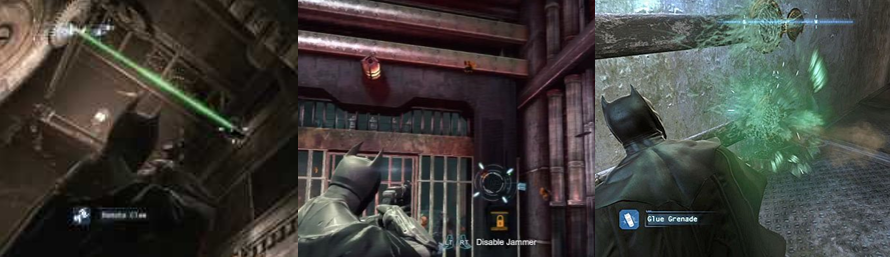
Author’s Spotlight: Chris Jones Interview

Chris Jones, author of the Mean Lou Green series of flash fiction

1. First, introduce yourself a bit. What is your name (or pen name) and where are you from?

My pen name is Chris Jones and I’m from Massachusetts USA. Maybe once I become famous I’ll be forced to reveal my true name…

2. Next, tell us a bit about your most recent work. Is this your first published book? What is it about and what genre would you classify it as?

I just released the first three volumes of a brand new style of fiction. Each volume has ten separate super-short flash fiction stories about the same characters. This series is called Mean Lou Green: Only Outlaws are Free, and it’s a raucous, untamed Wild West pulp fiction series. It’s only digital right now, but once I have six volumes I’ll release them together in paperback.

3. Tell us a bit about your main character; what are they like, how did they come about, and what are some of their strengths and weaknesses?

Mean Lou Green is a rambling gunslinger who turned to bounty hunting after his family met a grisly end. He’s on a quest to reach the Pacific and dip his dead son’s silver dollar into the salt water to fulfill a promise he made to his wife, but his lifestyle and fears about what comes after that keep him running in circles, jumping from one hair-raising adventure to the next.

4. What was your hardest scene to write in this (or any) book?

I wrote a scene/story about Lou getting a bullet dug out of his guts without anesthetic by a local sawbones. I did a lot of research about Civil War era medicine and amputations, and that was a horrifying process… Made me thankful to have all my limbs intact!

5. Did you go the traditional route when publishing your book or did you choose to self-publish?

Self-publishing. Both because I’m too small at the moment to work through a publisher and because I like to have complete creative freedom over my writing, distribution, marketing, and everything else… Especially since my work isn’t exactly PC or made for the masses.

6. What would you say is the most difficult part of your writing journey and what advice would you give to other writers?

Writing consistently every day. A quote by Faulkner I always keep in mind is: “I only write when I’m inspired. Luckily, inspiration hits at 9am sharp every morning.”

7. Do you want each book to stand on its own, or are you trying to build a body of work with connections between each book?

I’ll be writing in all different settings and genres so the series will be disconnected, but I’ll be writing many volumes in each series. I want my readers to know that whether it’s cowboys, pirates, Vikings, or knights, they’re in for an action-packed fun ride.

8. What are some of your favourite authors and books and what inspired you to become a writer in the first place?

Robert E. Howard’s Conan is a huge inspiration. Raymond Chandler’s pulp novels are the best and set the standard for my style. It’s a bit cliché, but I didn’t decide to become a writer… I’ve actually run from it my whole life, but I’ve always known since I wrote my first story about sea-raiders ransacking a medieval village when I was around eight or nine that it was what I was born to do. I wrestle back and forth with it, but in the end, it feels like my inescapable fate.

9. What would you say has been the best way to market your books?

I’ll let you know once I’m a bestseller 😉

10. Are there any tropes, clichés, or writing styles that you dislike and, if so, what are they and why?

I don’t like long, difficult writing that I have to slog through. I quoted Faulkner earlier, but his books are actually the worst I’ve ever (not) read. I like fast, fun, and easy. If I wanted verbose intellectual meanderings and cumbersome vocab (like that) I’d read a textbook instead.

11. Do you read reviews of your book and, if so, how do you handle negative feedback?

Yes, the negative ones are actually the most valuable, especially if they’re from someone you know. I’ve made enormous improvements in my writing after getting negative feedback. Positive feedback is a little hit of pleasure, but negative feedback is a GOLDMINE.

12. What are some of your quirks as a writer? Do you like to plot everything out or do you prefer to just “wing it” and see where the story takes you? Do you listen to music when writing and, if so, what do you listen to?

I’ve tried plotting and failed… Tried again and again, failed… I can’t do it. It’s not how my brain works. That’s why I’m developing a completely new style of fiction around the way I write. I get a quick idea, then I sit down and hammer away at the keyboard while the story tells itself in my head. I never plan events, endings, characters, nothing. I just let the story unfold in my mind and try to put it down accurately on paper. I think that’s what gives my writing such a light and wild feel. I rarely go back and edit storylines, rarely spend much time polishing. I let the story tell itself. I’ll never write a Game of Thrones, and that’s just fine by me!

13. What is the best advice you’ve ever had when it comes to writing and what advice would you give to new writers?

I think it’s crucial to prioritize execution and not try to be the next Cormac McCarthy. Writers often get caught up in trying to put out some grand Shakespearean masterpiece and agonize over every little detail, and 9/10 times it never even gets released. I try to live by the Pareto Principle and focus on action, speed, and RELEASING my work, even if it’s only 80% perfect. There will be plenty of time later to edit and release second editions. An imperfect work that gets released is infinitely better than a “masterpiece” that you never hit the Send button on. You’ll keep learning and improving as long as you’re releasing and getting feedback, and eventually the masterpieces will flow out effortlessly. Everything is all about just building up that momentum and never letting it die.

To put it very bluntly: Perfectionists never get anything DONE.

14. What’s next for you? Are you currently working on any new books or stories?

I’m slamming out as many of these short volumes as I possibly can, across all different settings and genres. I’m starting a new pirate series now. Adventure and conquest on the high seas. I plan to completely revolutionize the modern fiction and entertainment industry and bring back the epic, fun, heroic tales from the 20th century, in a format specifically designed for modern readers who are losing their taste (and attention spans) for long-form.

I’ll soon be bringing on other writers, as well as artists and designers and storytellers of all kinds. Together we will spearhead a new era of entertainment and make fiction great again.

15. Finally, feel free to plug your social media, website, and links to Amazon, GoodReads, and other relevant sites below, and detail any current offers available for your book/s:

Right now I’m most active on Instagram as I’m growing my new business. I post lots of art and cool graphics that I like to create an awesome and aesthetic atmosphere on my page.

You can check out my work at my website. It goes to my Gumroad store for now, where you can download my various flash-fiction volumes for dirt cheap. Mean Lou Green Vol. 1 is FREE, so anyone can check it out and see if they dig my style. They’re formatted super clean for mobile, PC, or e-reader so you’ll be able to read them easily.

You can also snag the first three volumes of Mean Lou Green on Amazon (Kindle only). Each volume is $1 on Amazon since I can’t make it free there.

So if you like lightning-fast stories, high adventure, and pulse-pounding action, then strap in for a wild ride with Chris Jones Pulp Fiction Empire.

If you’d like to be featured in an interview, please check out the interview submissions page to submit your answers.

Movie Night [Star Trek Day]: Star Trek II: The Wrath of Khan


On this day, 8th September 1966, the first episode of Star Trek (1966 to 1969), “The Man Trap” (Daniels, 1966), first aired. Since then, Star Trek has become a massive cultural phenomenon that still endures to this day, spawning numerous continuations, spin-offs, and ancillary media to become perhaps the most influential science-fiction franchise of all time. Accordingly, the 8th of September has been deemed “Star Trek Day” and is thus the perfect excuse to dedicate some more time to, and celebrate, this massive sci-fi franchise.


Released: 4 June 1982
Director: Nicholas Meyer
Distributor: Paramount Pictures
Budget: $12 million
Stars: William Shatner, Ricardo Montalbán, Leonard Nimoy, DeForest Kelley, Kirstie Alley, Bibi Besch, and Merritt Butrick

The Plot:
In the midst of dealing with a mid-life crisis, Admiral James T. Kirk (Shatner) and the crew of the starship U.S.S. Enterprise face their greatest threat yet when the genetically engineered tyrant Khan Noonien Singh (Montalbán) escapes from a fifteen-year exile to exact revenge on Kirk and acquire a powerful terraforming device named “Genesis”.

The Background:
Although Star Trek: The Motion Picture (Wise, 1979) grossed nearly $140 million, Paramount were disappointed that it didn’t perform better and Star Trek’s first big-screen outing was met with mixed to negative reviews. Paramount placed the blame for The Motion Picture’s failure on Star Trek-creator Gene Roddenberry’s many rewrites and, after rejecting his idea for a time travel plot for the sequel, removed him from the follow-up’s production and left him with the purely ceremonial position of “Executive Consultant”. Thus, it fell to Harve Bennett to put together the idea for the sequel, which would be much more focused on themes of old age and friendship. After familiarising himself with the television show, Harve settled on the character of Kahn (who first appeared in the episode “Space Seed” (Daniels, 1967)) as the natural choice for a compelling villain. The script went through numerous revisions, the most significant of which coming after the script was leaked; while many of the sets and models from The Motion Picture were repurposed and reused, the Starfleet uniforms underwent a dramatic redesign to fit the film’s more nautical atmosphere. Although Star Trek II: The Wrath of Khan’s $97 million worldwide gross actually meant that it made less than its predecessor, it also cost a lot less to make and was received far better as critics praised the character interactions, Montalbán’s performance, and Captain Spock’s (Nimoy) poignant send-off. The film went on to be incredibly influential and is widely considered to be one of the best Star Trek movies.

The Review:
The film famously opens with what can retroactively be seen as one of the most layered and blatant pieces of foreshadowing in all of cinema; Vulcan newcomer Lieutenant Saavik (Alley) commands the Enterprise in the infamous Kobayashi Maru, a purposely-unwinnable scenario design to teach Starfleet recruits that they will inevitably face a no-win situation when out in the field. Opting to cross the Neutral Zone and thus provoke conflict with the warmongering Klingons, Saavik’s decision sees the death of the entire bridge crew and the destruction of the Enterprise. When James T. Kirk, still an admiral like in the last film, ends the simulation to provide his feedback, he explains to Saavik that it was more a test of character to see how she (and the other trainees) cope in the face of mortal danger, but also cynically states to Doctor Leonard “Bones” McCoy (Kelley) that “galloping around the cosmos is a game for the young”.

Kirk, feeling the pressure of his advanced age, finds himself tested by an old foe.

Immediately, then, we’re introduced to a couple of themes that become increasingly important: the first is that Kirk, despite all of his close calls and adventures, has never truly faced his own death (we later learn that, while he’s the only Starfleet officer to have ever bested Kobayashi Maru, he did so by cheating since he doesn’t believe in a no-win situation) and that Kirk is struggling with his feelings of inadequacy and redundancy. Indeed, the film begins on Kirk’s birthday, an event that Bones likens more to a funeral than a celebration; Kirk is despondent to learn that his eyesight isn’t what it once was and that he now requires glasses to read and feels too old and worn out to be where he belongs (i.e. at the command of a starship). Bones candidly calls Kirk out and encourages him to get back his command before it’s too late; Kirk’s reluctance to entertain the notion is soon rendered mute, however, when he is ordered by Starfleet Command to reassume command of the Enterprise to answer a distress call from the Regula I space station (as always, the Enterprise is the closest ship in range). Unlike in the first film, where Kirk muscled his way back into a position of command when he was unsuitable for the role and floundered with the ship’s new capabilities, here he is initially willing to allow Spock to remain as the ship’s captain but it’s clear that Kirk feels a spark of his old self once he sits back in his chair.

Spock is training a new Enterprise crew that is bolstered by a few familiar faces.

Speaking of Spock, a few things have changed for the loyal Vulcan; first, he’s now the captain of the Enterprise and is directly training the ship’s new crew. Saavik, being a Vulcan, is something of a protégé of his and he seems far more comfortable and less conflicted in his loyalties to Vulcan and Starfleet. Ever the logical pragmatist, he remains on the Enterprise while Kirk and the others beam onto Regula I but is the only one smart enough to recognise a flaw in Khan’s attack patterns that helps Kirk turn the tide against his foe during their climatic space battle. McCoy gets a little more play as he accompanies Kirk to the space station, while Hikaru Sulu (Takei) and Lieutenant Nyota Uhura (Nichelle Nichols) don’t really get all that much to do beyond their standard roles as helmsman and communications officer, respectively. Similarly, Montgomery “Scotty” Scott (James Doohan) spends the majority of the film battling to re-route power and keep the Enterprise from falling apart from the engineering room, but expresses heartbreak at the toll Khan’s attack has taken on the ship.

Chekov is horrified to discover Khan, who wishes to use the destructive Genesis device to his own ends.

Surprisingly, it’s Pavel Chekov (Walter Koenig) who gets a fair amount of screen time in the film’s early going; now a first officer aboard the Reliant, Chekov is the one who picks up signs of life on a planet he (and the rest of the Reliant) believe to be Ceti Alpha VI and, since Doctor Carol Marcus’ (Besch) terraforming Genesis device requires a completely lifeless planet for its deployment, he accompanies Reliant captain Clark Terrell (Paul Winfield) to the surface of the barren, chaotic world that is ravaged by tumultuous sandstorms. Considering that Chekov wasn’t actually seen in “Space Seed”, it’s something of a blunder that he first recognises the wreckage of the Botany Bay and then the man himself (in hindsight, maybe swapping Chekov for Sulu would have eliminated this mistake), but it allows the under-rated Russian officer to play a pivotal role in the film’s early going by helping to exposit information on Khan both to the audience and the Kirk. As for Carol, she’s one of Kirk’s many former flames now devoted to the unlimited potential of the Genesis device, which promises to create life from death and turn barren worlds and moons into lush, hospitable environments. Her son, David (Butrick), is equally instrumental in Genesis’ construction but is wary of Starfleet; he fears that they (or someone else) may try to appropriate the device as a weapon and is initially antagonistic towards Kirk since he has no idea of his true parentage.

Khan is obsessed with avenging himself on Kirk and proving his physical and intellectual superiority.

David’s fears become all too real when Khan learns of the device from Chekov and Terrell; an enigmatic and charismatic villain, Khan is both eloquent, charming, and loquacious while being absolutely out of his mind. Sadistic and cruel, he delights in lording his physical and intellectual superiority over others and uses any means at his disposal (from disturbing, mind-controlling eels to commandeering the Reliant for his own uses) to achieve his goals. Gifted with genetically engineered strength and intellect, Khan is eager to relive his glory days from over two centuries ago and believes that he is destined for conquest and power. His men, especially Joachim (Judson Scott), have sworn to live and die at is command and obey his orders without question; however, Khan’s obsession with besting Kirk blinds him to all other concerns. Indeed, Joachim plays Devil’s advocate by suggesting that escaping their exile is proof enough of Khan’s superiority and that they should take the chance to flee unopposed into the galaxy but Khan adamantly refuses to deviate from his obsession with avenging himself upon Kirk. Believing that Kirk is testing him, and consumed by his fanatical desire to make Kirk pay for outsmarting him and unintentionally causing the death of his wife, Khan initially plots not to kill his foe, but to hurt him and leave Kirk as helpless as Khan as his crew were on Ceti Alpha V.

The Nitty-Gritty:
One of the many ways that Star Trek II excels and set the standard for subsequent Original Series movies is in the greater focus on the amusing and complex friendship between Kirk, Bones, and Spock. Each of them share a degree of banter and familiarity that makes for a very relatable and realistic relationship between the three; while they maintain a degree of professionalism in the line of duty, Bones isn’t afraid to call Kirk out in front of other officers and Spock is duty-bound to point out any logical observations even when they imply a greater threat to the crew. Additionally, the banter between the crotchety Bones and the impassive Spock makes for some entertaining exchanges between the two, and also gives Bones an opportunity to speak out against the destructive and moral implications of the Genesis device (indeed, it’s somewhat odd that Starfleet would allow such a device to be created since Carol is effectively playing God and potentially creating a weapon of mass destruction). Of course, it’s Spock who shines the most of the three; he willingly insists on handing over the Enterprise to Kirk (since, as a Vulcan, he “has no ego to bruise”) and, like Bones, submits his opinion that Kirk made a mistake in accepting his promotion since it’s his best destiny to command a starship. Finally, Spock showcases a great deal of emotion throughout the film; he is clearly protective and proud of his trainees, expresses grief at the losses suffered from Khan’s attack, bends the rules to deliver exaggerated repair times to Kirk, and surprisingly declares his affection and appreciation for the captain in a touching scene between the two.

The sets and uniforms are much more visually interesting and became the standard going forward.

Since we spend a great deal of time onboard the Enterprise, Reliant, and Regula I, it’s a good job that the sets look so good; though similar (or, in many cases, practically identical) to the first film, they’re shot and presented in a way that’s far more pleasing to the eye. In the first film, everything seemed too panoramic and brightly lit for such bland and uninspiring locations. Here, though, the bridge is seeped in an almost ominous darkness that allows the blinking lights and glowing consoles to really pop out and separates it from the more colourful Reliant and Regula I. Since I grew up watching science-fiction films of this era, I’ve always had a fondness for the impractical anachronisms of early-Star Trek; they hadn’t completely abandoned actual buttons and levers and the technology looked far less futuristic as a result, giving everything a tangible reality that helps to sell the illusion. At the same time, Star Trek II feels much more like a big-budget version of the show with its sets and environments; the first film felt like it was trying too hard to be different and change things up for the cinema screen, but Star Trek II hits the right balance between familiar and cinematic. It also helps that the Starfleet uniforms look far better in this film; no longer the bland, dull, uninspiring grey and beige attire seen in the first film, the crew are decked out in a striking maroon red ensemble that (despite the old-fashioned bell bottoms) would become the standard for the remainder of the Original Series films. The deviation more towards a naval/military look for the uniforms also helps Khan and his men stand out even more; having been marooned on a desolate planet for fifteen years, they’re decked out in shredded clothing that gives them the appearance of primitive savages that not only betrays their cunning and guile but also makes for a stark contrast once they seize control of the Reliant for themselves.

While some model shots are a little dodgy, the cat and mouse between Kirk and Khan is suitably intense.

Of course, it’s 1982 so some of the film’s special effects still look a little dodgy; while they’re far better overall compared to the last film, some shots of space and planets like Ceti Alpha VI don’t hold up as well as others but that’s to be expected and I’m hardly going to knock the film for the technology of the time. Plus, one of the biggest complaints I had about the first film was the lack of any actual, exciting space battles and Star Trek II more than makes up for that once Khan takes control of the Reliant; since Kirk has no reason to suspect that his old foe is controlling the ship, he and the Enterprise are taken completely off-guard when the Reliant opens fire on them, crippling the Enterprise and causing a number of deaths. Both ships, and space stations like Regula I, are of course represented by extremely impressive model shots; the Enterprise and Reliant circle and engage each other like humongous warships adrift at sea, which is only fitting given the film’s thematic parallels to Moby-Dick; or, The Whale (Melville, 1851), and Kirk and Khan more than make up for their lack of actual screen time together through an ever-escalating game of cat and mouse between their two ships and their respective captains. However, if you need further proof of the superiority of this film over the original, you need look no further than Kirk’s arrival on the Enterprise for inspection and the ship’s departure from the space dock; in the first film, this took about two ice ages but, here, it’s just a quick sequence for us to marvel at the depiction of the Enterprise before the plot gets underway.

Kirk is reunited with an old flame and discovers a son, and his zest for life, in the process.

Kirk is stunned when Carol sends a garbled transmission accusing him of trying to steal her work; like Spock and Bones, he’s fascinated by the implications of Genesis but is clearly torn between reuniting with Carol as their relationship fell apart when she distanced not only herself from him and his spacefaring adventures but also her son. The film implies that Kirk knew that he had a son out there in the galaxy all this time, but he’s seen to be more than startled to find David on Regula; David is initially antagonistic towards Kirk because he believes Kirk is responsible for the death and chaos wrought by Khan, which stems from a deep-rooted distrust for Starfleet and their military. Seeing how much David hates him deeply hurts Kirk, who sees in the boy a life he could have had if he hadn’t been busy chasing around the galaxy. However, when Khan leaves them marooned in the centre of the planet, the two begin to bond and David’s mere presence and existence has a rejuvenating effect on Kirk, who finally has a lasting legacy to leave behind. I always felt like David got dealt a raw deal in the Star Trek films; he really had the potential to breathe new life into Kirk’s character and to potentially lead to a new generation of Starfleet officers taking command of the Enterprise but was unfortunately robbed of any of this by being unceremoniously killed off in the very next film simply to foster additional animosity between Kirk and his foe.

Spock makes the ultimate sacrifice to save the ship, forcing Kirk to truly face death for the first time.

Although Khan appears to be victorious and takes control of Genesis, Kirk is able to outwit him and then taunt him into taking the Reliant into a dangerous nebula. With their experience in navigating and battling in three-dimensional space, the Enterprise is finally able to land a crippling blow to the Reliant that mortally wounds Khan and kills his crew; forced into his own no-win situation, Khan refuses to give up and activates the Genesis device, determined to take his hated enemy with him. As the Enterprise has no hope of escaping the blast without their warp drive, Spock takes it upon himself to enter the engine room and restore power to the ship, incapacitating Bones and subsequently ignoring the doctor and Scotty’s warnings of the lethal radiation leaking from the core. Thus, the film comes full circle as Kirk is forced to look death in the face; separated by a pane of transparent glass, Kirk is helpless to help his dying friend, who delivers a heartful goodbye in which he reaffirms his affection for his captain and asks him not to grieve before succumbing to radiation poisoning. In the aftermath, Kirk is deeply affected by Spock’s noble sacrifice, delivering an emotional eulogy in which he pays tribute to Spock’s humanity and bravery, but finds his zest for life and adventure reinvigorated from the entire experience; finally being forced to face death has made Kirk all the stronger, and he has new reason to keep going in the form of David…and to hope, since Spock’s body is jettisoned down to the surface of the lush and vibrant world that formed from the Genesis device.
The Summary:
There’s a reason Star Trek II: The Wrath of Khan is so beloved among Star Trek fans; its themes of life, death, and rebirth are as prominent now as they were when it first released and it delivers both as a fantastic Star Trek film and an engaging and poignant sci-fi film. This makes it a far better introduction to the film series, and the franchise in general, than the first film thanks to it dropping the slow, introspective pacing of its predecessor in favour of an emotionally charged, intense showdown between Kirk and one of his most influential and persistent foes. Although Khan and Kirk sadly never meet in person in the film, it’s hardly a negative as there’s something far more powerful in them trading threats and taunts through the viewscreen and matching their wits against each other in space combat. Arguably, Ricardo Montalbán’s performance as Khan has never been surpassed in subsequent Original Series films and he makes an immediate and lasting impression even without knowledge of his prior appearance in the show. Furthermore, Kirk’s vulnerability and relatability as a character makes him far more layered and human than in the first film (where he was a condescending egomaniac) and even the series (where he was a charming and arrogant womaniser); seeing him feeling the effects of his advanced age and losing his zest for life is incredibly significant to grounding the film in relatable themes and it’s a nice change of pace to see him both face his worst nightmare and gain a son in his quest to reignite his enthusiasm. Of course, Star Trek II earns its reputation through Spock’s emotional sacrifice alone; although this was immediately undone in the very next film, it doesn’t detract from the character’s touching end and went a long way to adding actual stakes to the Enterprise’s conflicts beyond disposable “red shirts”. Honestly, if you only watch one Original Series film, it’s got to be this one; Kirk and the crew would go on to have a few more film outings, a couple of which were pretty decent, but it’s hard to deny that this is the best of their six dedicated cinematic outings and it’s just as great now as it was when I first watched it as a kid.

My Rating:

Rating: 5 out of 5.

Fantastic

Where does Star Trek II: The Wrath of Khan rate for you amongst the other Star Trek films? What did you think to Khan’s dramatic return to the series; were you familiar with his previous appearance or, like me, were you introduced to him here? Were you a fan of the film’s themes of age, the inevitability of death, and the allusions to Moby-Dick? What did you think to the cat and mouse game between Kirk and Khan and would have have liked to see them face off in person? How did Spock’s death affect you at the time and do you think he should have stayed dead? Which Star Trek captain, crew, show, or movie is your favourite and why? How are you celebrating Star Trek Day today? No matter what you think, sign up to leave your thoughts down below or leave a comment on my social media.