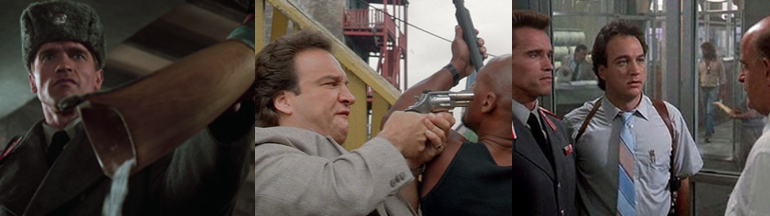
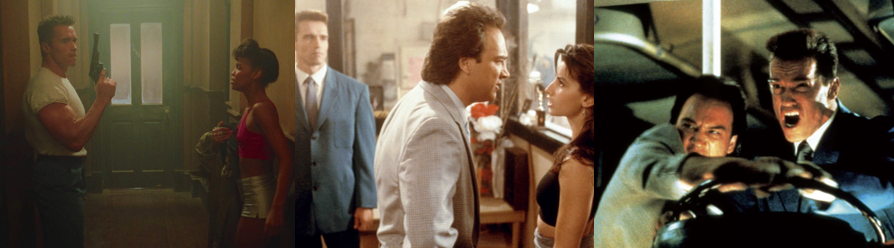
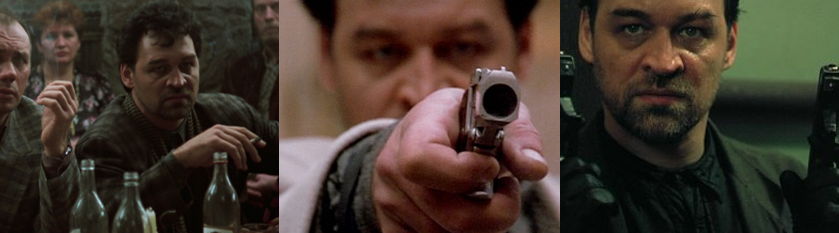
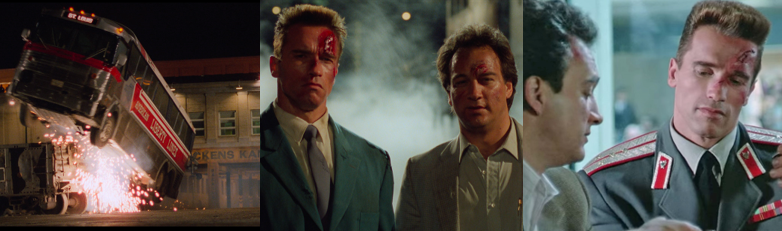
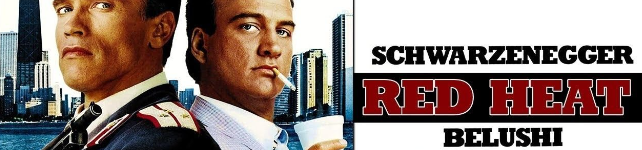
Released: 17 June 1988 Director: Walter Hill Distributor: Tri-Star Pictures Budget: $29 million (estimated) Stars: Arnold Schwarzenegger, James Belushi, Ed O’Ross, Larry Fishburne, and Peter Boyle
The Plot: When drug kingpin Viktor Rostavili (O’Ross) kills Captain Ivan Danko’s (Schwarzenegger) partner and flees to the United States, Danko is partnered with Chicago police detective Art Ridzik (Belushi). Echoing the tensions between the US and the Soviet Union, the odd couple must set aside their differences to keep Rostavili from smuggling cocaine into Russia.
The Background: Following the end of the Second World War, the United States and the Soviet Union frequently clashed in a “Cold War”, a nearly-fifty-year political stalemate in which the threat of all-out nuclear annihilation was high as tensions escalated between the two superpowers. Consequently, Russians were frequently vilified in Hollywood productions, characterised as stoic, almost machine-like, and cruel, with perhaps the most memorable fictional Russian being the ice-cold genetic freak Captain Ivan Drago (Dolph Lundgren). In 1987, Mel Gibson and Danny Glover saw critical and financial success as mis-matched police officers in Lethal Weapon (Donner, 1987), which inspired a slew of similar odd-couple, buddy cop action/comedies. With Arnold Schwarzenegger a hot commodity after the success of The Terminator(Cameron, 1984), writer/director Walter Hill combined these two elements into the basic premise of Red Heat and approached Schwarzenegger to star. Despite the lack of a complete script, Schwarzenegger agree to join the production based on Hill’s success with the buddy cop hit 48 Hrs. (Hill, 1982), and Hill purposely aimed to tone down Schwarzenegger’s bombastic persona in favour of a more realistic performance. Schwarzenegger was joined by comedy actor James Belushi, who saw the contentious relationship between their characters as the heart of the movie above all else. With a $34.9 million box office, Red Heat was a modest financial success; it briefly held the number one spot at the box office, but was met with mixed reviews. Many criticised the gratuitous violence and middling pace, though the film has since been seen as a cult classic. Since today is Arnold’s birthday, this is the perfect time to revisit the film and see if it’s worthy of being classified as an under-rated entry in Schwarzenegger’s filmography.
The Review: Red Heat begins, appropriately enough, in the frigid yet architecturally stunning city of Moscow. There we find Yuri Ogarkov (Oleg Vidov) amidst a bunch of surly, beefed-up Russians and naked babes working out and relaxing in a gym; among them is Captain Ivan Danko, who seemingly fits right in with his intense, stone-faced expression and peak, Olympian physique. They’re there looking for a lead on drug baron Viktor Rostavili, but Danko is forced to take a more direct approach when he’s challenged by the other men. Luckily, Danko is more than capable, handling a boiling-hot stone without flinching and easily beating the shit out of his hulking attackers despite wearing nothing but a little shawl to cover his modesty. The fight spills to the outside where, in the freezing snow, Danko absorbs some comically enhanced shots and demands information on Viktor’s whereabouts, learning that he’s holed up at the Druzhba Café. After a tense confrontation and a shoot-out (that includes the amusing reveal that Rostavili’s underling is hiding cocaine in his artificial leg), Danko pursues and guns down Rostavili’s brother, Vagran (Gábor Koncz), but the man himself manages to slip away after surprising Yuri with a spring-loaded pistol attached to his wrist. Though impassive at his friend’s funeral, Danko is clearly seething and grateful to be given the chance to retrieve Rostavili from Chicago.
Ridzik’s hot-headed temperament clashes with Danko’s more subdued demeanour.
While Danko is introduced as a serious, focused man who’s all business on the job, the opposite is true of Art Ridzik, who we first meet ogling women, much to the exasperation of Lieutenant Charlie Stobbs (Fishburne) and Sergeant Max Gallagher (Richard Bright). A natural smart mouth who’s become somewhat disillusioned with the daily grind of the job, Ridzik’s outspoken and cynical nature rubs his superiors the wrong way since he’d rather make snappy quips than focus on the job. Although he facies himself a ladies’ man, Ridzik is beset by rejections at every turn, which he brushes off with a casual disinterest, though he’s frustrated by Stobbs’ low opinion of him (but, it has to be said, not enough to actually buck up his ideas, knuckle down, and be less snarky and lackadaisical). Ridzik almost immediately gets on the wrong side of Danko with his irritating curiosity and sarcastic nature; Ridzik sees chaperoning and being lumbered with Danko as a shitty deal, one akin to babysitting, which is a constant headache to his overly stressed superior, Commander Lou Donnelly (Boyle). Hot-headed and trigger happy, Ridzik is eventually shown to be incensed when Rostavili’s goons callously gun down Gallagher to rescue their boss and at being constantly left in the dark (and the lurch) by Danko’s standoffish nature. Although their personalities and methods clash and Ridzik is irritated at being stuck with “Gumby” and having to deal with his strait-laced, blunt attitude, Ridzik proves invaluable to Danko’s investigation. He takes him to visit the enigmatic, blind, drug dealer Abdul Elijah (Brent Jennings) in prison and learns that Rostavili has been working with the local street gangs to smuggle cocaine into Moscow. Unfortunately, whether because of cruel fate or his own abrasive behaviour and questionable methods, Ridzik is beset by misfortune no matter how hard he tries; he gets hot coffee splashed on his crotch, is forced to endure a tetanus shot, and is constantly being reprimanded even for things out of his control. However, he and Danko have more in common than they’d care to admit, which ultimately leads to them reaching a mutual respect and understanding when it comes to nailing Rostavili by any means necessary.
Danko’s blunt methods and standoffish personality bring major headaches for Ridzig.
Although Danko is generally portrayed as a stoic and almost emotionless machine (especially compared to his more emotional and bombastic peers in Chicago) and with an extremely strong sense of duty, he’s not above moments of levity and emotion. He owns a parakeet that he’s extremely protective of, is clearly rattled when his superiors blame him for Rostavili’s escape (even though he did nothing wrong), and shown to have a close relationship with Yuri, one that sees him both amused by his partner’s brand of banter and driven into an obsession towards Rostavili, whom he relentlessly pursues to make pay not just for the laundry list of crimes he’s perpetrated against the Soviet Union, but for Yuri’s death as well. Upon landing in Chicago, Danko doesn’t waste time or words getting right down to business; he bluntly greets his peers and impassively liaises with Donnelly and his officers simply to get his hands on Rostavili and reacts with stoic disinterest when Donnelly and even Ridzik challenge his aggressive methods and unlicensed firearm. Danko’s standoffish demeanour is exacerbated not just by the tensions surrounding the two nations but by his direct orders not to air Russia’s political and social problems in public, and his obvious embarrassment regarding the violent past of his country. It also doesn’t help that he’s largely disgusted by the decadent West and the excess of Capitalism; he despairs at their lack of discipline, the lawlessness of their streets, and their obsession with sex and debauchery. Danko’s has a very methodical approach to his job (even though all he has is a mysterious locker key to go on) and is granted license by Donnelly to continue his investigation since he’s a “loose cannon” that will either get results or take the fall through his actions, but not above being reprimanded when he pushes his luck too far. An extremely private individual, Danko reluctantly shares details of his life and career with Ridzik, revealing a morbid background that has hardened him into an instrument of uncompromising justice, yet even he shows sympathy towards deluded fitness trainer Catherine “Cat” Manzetti (Gina Gershon), just one of many women Rostavili has wooed into marrying him and acting as a patsy for his operations out of misguided devotion.
Rosta is a cruel manipulator with an underused gimmick who plots to spread cocaine throughout Moscow.
Rostavili (who has taken the clever alias Viktor Rosta) is depicted as a reprehensible and callous criminal, one who is seen as a poison to the great Soviet Union because he floods Moscow with drugs and threatens to upset the strict, carefully maintained balance of law and order. A snarling, embittered Georgian man who feels slighted by prejudice towards his people, Rosta has nothing but disgust for authority, especially the Moscow Militsiya, and delights in defying them both explicitly and in the peddling of cocaine. Rosta flees to Chicago after being outed in Moscow and immediately sets himself up as the newest crime boss in town; alongside his fellow Georgians, he establishes an intricate network of underworld contacts and associates and a simple system of communication using go-fers, telephone booths, and torn bills to peddle his wares with the aim of smuggling $5 million worth of cocaine into Moscow using local gangs and even a shame marriage, one he ends in brutal fashion after Cat tries to escape his clutches, revealing himself to be as calculating as he is cruel. Unfortunately, a disruption in his operation causes him to get a little sloppy and be arrested for speeding, alerting Moscow to his presence and causing Danko to pursue him with a vengeance. Although Rosta escapes custody, he loses the key to his drug stash in the process, and this naturally becomes his primary goal; he lures Danko into an ambush and attempts to first appeal to his patriotism and then bribe him into handing it over, to no avail, much to Rosta’s disgust. Rosta then has his assassin, Josip Baroda (Tengiz Borisoff), impersonate a nurse to murder his own man (Roger Callard) before he can talk, before using his gang buddies as bait to distract Danko so he can retrieve his key and callously murdering Cat, bringing major heat on both Danko and Ridzik.
The Nitty-Gritty: As was often the case around this time, the depiction of the Soviet Union and Russians is greatly exaggerated for comedic effect. Well, I say that but for all I know Russians really were massive, surly, patriotic robots during this time, but just going by the bombastic soundtrack and the in-your-face presentation of Moscow and Russian culture as this uncompromising and ruthless society makes me assume that these elements were enhanced to paint them comedic opposites to the more laidback and carefree United States. This forms much of the film’s comedy; Danko’s peers and superiors mock America’s theatricality, Danko (regal in his pressed uniform) stands out like a sore thumb on the streets of Chicago, and then there’s the obvious contentious relationship between him and Ridzik. Given the genre of the film, it’s tempting to make parallels to Lethal Weapon, but they don’t really have much relevance here beyond some superficial similarities; for all his talk of “Miranda Rights” and due process, Ridzik isn’t exactly a by-the-book cop so seeing him chew Danko out for his more extreme and blunt methods is oddly hypocritical considering he openly plants incriminating evidence on “Streak” (Brion James). Some of the best moments in Red Heat are born from Danko’s inability to understand American slang and humour and his commentary on the decadent West compared to the more efficient (and brutal) nature of the Soviet Union when it comes to punishing criminals and dealing with politicians and drugs alike. With Schwarzenegger being at his physical peak, Danko’s punches land with comic book-style power and he’s shown to be extremely formidable. Even he isn’t impervious to damage, however, as seen when Rosta’s attack leaves him with a nasty concussion, but naturally he’s up and about before too long.
Despite their differences, Danko and Ridzik work together to stop Rosta and part as friends.
Of course, it wouldn’t be a buddy cop movie without some shoot-outs: Danko gets into violent gunfight at the beginning (somehow avoiding being shot despite being such a big target in a small space), but Ridzik’s bust of Salim’s (J.W. Smith) apartment is noticeably more frantic and involves a lot more guns and chaotic shouting. Danko also impresses with his massive Soviet cannon and .44 Magnum, gunning down Rosta’s goons in glorious ‘80’s fashion, complete with blood squibs and crashing glass. Uniquely, Red Heat concludes with a bus chase through the busy Chicago streets; this comes after Ridzik’s sleazy brother-in-law, Pat Nunn (Michael Hagerty), inadvertently solves the mystery of the locker key, which sees Ridzik and Danko confront Rosta at the bus station. Unfortunately, a conflict of opinion regarding which one of them gets to take him in allows Rosta to flee in a stolen bus, so the two commandeer one of their own to pursue him. This results in a surprisingly frantic chase considering the size and unwieldy nature of the buses and sees them careening through traffic and landmarks alike, all while Ridzik loudly curses in frustration. Ultimately, Danko and Rosta drive at each other, each one determined to see the other dead regardless of their own life. Luckily for Danko, Ridzik is on hand to force a last-second swerve, resulting in minor injuries for them and a final, blood-soaked showdown between Danko and Rosta that sees the despicable drug pusher gunned down. Despite their differences, Ridzik and Danko part as friends; they even exchange wrist watches in the time-honoured tradition of the Soviets (though Ridzik gets amusingly shafted on the exchange) and agree that, while their countries may have their differences, they’re “police officers, not politicians”.
The Summary: Although I grew up watching Arnold Schwarzenegger films and I was (and still am) a massive fan of his, Red Heat is one of his movies I’m not as familiar with. I didn’t see it until I was much older, so I don’t have the same nostalgia for it as I do his other films. While this doesn’t mean I’m any less entertained by it, I can’t say I often choose to watch it over his other films or other, more enjoyable buddy cop flicks. Schwarzenegger is great in this role; it plays into the strengths that made him so memorable in The Terminator while also allowing him to showcase a different range of emotions, such as a subdued sense of duty and an implacable determination to get his man. I also really enjoyed Belushi here as the wise-ass jerk of the two, and I think they had real chemistry together, but I feel like the film never lives up to the potential this pairing has. It’s weird seeing Ridzik be such a smart-ass to everyone and yet lecture Danko on proper procedures even when he’s (as in Ridzik) brazenly breaking the rules; their relationship is made wildly inconsistent because of this and I think it would’ve been better if Ridzik had been the hot-headed loose cannon and Danko had been the by-the-books military man, with the two then learning from and understanding each other’s perspective across the film. Instead, while it seems to lean that way, Ridzik wildly jumps from doing things right, to defying his orders or openly insulting his superiors, and between criticising and admiring Danko from scene to scene, needlessly complicating their pursuit of Rosta. The action and gunplay was decent, and the film’s definitely leaning more into the cop drama aspects of Lethal Weapon rather than the comedy/action of its sequels, but I don’t think it really out-does Lethal Weapon in this regard. Its main unique aspect is the dichotomy between the US and Russia, with the US being mocked and criticised for its debauchery and Russia for being so uptight. It’s amusing, and I liked the clash of styles and methods, but it loses a lot of impact due to the aforementioned inconsistent tone and kind of feels like it was just an excuse to poke fun at the militant Russians. Ultimately, it’s a decent enough movie but there are better Schwarzenegger and buddy cop movies out there; it’s a quick watch (maybe too quick at times, resulting in a serious lack of screen time for Rosta) with some potential, but I can’t rate it much higher (despite the chemistry between the two leads) since it squanders a lot of that potential.
My Rating:
⭐⭐⭐
Rating: 3 out of 5.
Pretty Good
What do you think to Red Heat? How do you think the film holds up against other buddy cop movies and where would you rank it against Arnold’s other films? What did you think to Schwarzenegger’s portrayal of the stoic Danko and his banter with Ridzik? Do you feel the film had the right balance of action and comedy or were you also left a bit deflated by it? What did you think to Rosta and commentary on US and Russian society? Do you have any memories of the Cold War? How are you celebrating Schwarzenegger’s birthday today and what is your favourite Schwarzenegger film? Whatever you think, go ahead and leave your thoughts below or drop a comment on my social media.
Story Title: “It’s D-D-Deadpool Folks!” Published: December 1994 Writer: Larry Hama Artists: Adam Kubert and Fabio Laguna
The Background: In 1974, Roy Thomas charged writer Len Wein to create the first Canadian superhero; a short, feisty character named “Wolverine”. After the legendary John Romita Sr sketched the original design for Wolverine and came up his now-iconic retractable claws, artist Herb Trimbe finalised the character’s design for his debut in the pages of The Incredible Hulk. Of course, nowadays, James Howlett (better known as “Logan”) is one of Marvel’s most well-known characters thanks to his association with the X-Men, but he’s not the only popular fast-healing Canadian Mutant anti-hero in Marvel Comics. In 1991, Fabian Nicieza and Rob Liefeld debuted Wade W. Wilson/Deadpool in the pages of The New Mutants. Heavily inspired by Wolverine, Peter Parker/Spider-Man, Slade Wilson/Deathstroke the Terminator, the self-styled “Merc With a Mouth” was initially introduced in an antagonistic role but eventually proved popular enough to graduate to his ongoing solo title. In time, Wolverine and Deadpool’s pasts would be intertwined to give them a shared history with the infamous Weapon X project and the two would cross paths as both rivals and team mates as members of the black ops X-Men team X-Force. Although both characters achieved greater mainstream success with their live-action movies, a properbig screen team up between the two seemed impossible after Hugh Jackman retired from the Wolverine role in 2017. However, in 2022, Ryan Reynolds shocked everyone by revealing that Jackman would return as Wolverine for Deadpool and Wolverine (Levy, 2024) and what better way to mark this momentous occasion than be revisiting the first-ever meeting of these two immensely popular characters?
The Review: Our story opens with Wolverine back in the Great White North; he’s tracking down Garrison Kane/Weapon X as a favour to James Hudson/Guardian and (despite his heightened senses) is surprised to find the wacky mercenary Deadpool in Kane’s pimped out apartment. The hyperactive Deadpool immediately opens fire on Wolverine and promises to “put [him] out of [his] interminable suffering” if Logan can tell him where Kane took his “ex-squeeze”, Vanessa Carlysle/Copycat. Naturally, Wolverine refuses to rat out the two and fights back, slashing at Deadpool’s arm and trading insults as they clash. During their brutal combat, Deadpool boasts of his own healing factor, which gives him the edge over Wolverine since this story takes place during a time when Logan’s healing powers were on the fritz and he no longer had his Adamantium skeleton or claws thanks to Erik Lehnsherr/Magneto ripping it from his bones. While Wolverine still has the skills and ferocity to go toe-to-toe with Deadpool, his feral rage and curiosity about Deadpool’s vendetta against Kane cause him to leave himself wide open for the Merc with a Mouth to ram his swords through his back and into his lungs.
After incapacitating Wolverine, the deranged Deadpool attacks Kane and Vanessa.
Victorious, Deadpool spots a poster for the Grand Guigol theatre, realises that’s where his targets are, and skedaddles, leaving the critically injured Wolverine bleeding on the floor. At the Grand Guigol theatre, Kane and Vanessa are trying to establish normal lives for themselves as stage actors. Kane struggles with his lines and to find his motivation as an actor, but Vanessa encourages him to channel his infatuation with her and his desire to leave behind their tumultuous past into his acting. She’s ecstatic when this appears to result in a more convincing performance, only to find that he was startled by the sudden appearance of Deadpool. Delighted to find his targets and begging to know that Kane’s fighting skills have become as bad as his acting, Deadpool leaps at Weapon X, swords drawn, only to find his strike deflected by Kane’s mechanical arms. When Deadpool refuses to leave them be or forgive Kane for stealing his girl, he gets a beatdown from an enraged Vanessa and doesn’t hesitate to take a swipe at her, too. Kane gets in on the action, pummelling Deadpool and chastising him for interfering in their lives, but he loses the advantage when Deadpool temporarily blinds him with a flash of light from…somewhere… Back at Kane’s apartment, the wounded Wolverine struggles to his feet, his healing factor slowly taking care of his injuries, and cottons on to Deadpool’s lead. Wrapping the worst of himself up in a kimono, he stumbles out into the streets and into the back of a taxi that he demands take him to the theatre.
After healing, Wolverine makes a timely intervention that sees Deadpool make a desperate escape.
During the taxi ride, Wolverine endures a particularly chatty cab driver and is grateful to find his wounds have healed. However, when the cab’s brakes malfunction halfway to the theatre, Wolverine’s frustrations get the better of him and he slices off the cab door and opts to skate the rest of the way on the severed cab door! Although Vanessa intervenes before Deadpool can decapitate Kane, she ends up getting knocked on her ass by Wade’s unpredictable agility and Deadpool offers Kane a choice: defend himself from one sword or catch the other sword tossed right at Vanessa’s heart. Luckily, Wolverine shows up, bursting in “like a runaway freight train” and intercepts the blade, saving Vanessa. Deadpool’s stunned to see Wolverine alive and well and finds himself outnumbered by the three unlikely allies; as such, he chooses to toss a grenade into the group and beat a hasty retreat. In the aftermath, Wolverine helps tidy up Kane and Vanessa’s apartment and offers them advice about moving on from their violent and chaotic pasts. He also helps Vanessa to see that Kane chose to save himself so that he’d be able to help Vanessa rather than being selfish, and then rides off after noting that they were lucky he didn’t catch a cab with good brakes.
The Summary: I often find that the comics I review are a little light on action and fight scenes; characterisation, interpersonal drama, angst, and outdated sensibilities are often the order of the day, meaning fights and visual spectacle are few and far between. That’s not the case with Wolverine #88; if anything, the opposite is true, and the issue is more style over substance. It’s definitely a side chapter in Wolverine’s larger story; we’re seeing how Logan is coping being “the best there is at what he does” with a less reliable healing factor and his awful bone claws, which often puts him at a disadvantage and makes him more vulnerable. This is the case here; while he’s still a skilled fighter and his feral nature allows him to go all-out against the likes of Deadpool, he can’t just leap head-first into fights these days and that costs him. In fact, Wolverine even notes that if he’d been injured like he was at Deadpool’s hands just a few months ago, he’d probably have been killed, though Wolverine’s mortality was often emphasised even before he had the Adamantium ripped from his bones. I quite like seeing Wolverine going out and doing his own thing, though, and having loyalties and adventures beyond the X-Men. It would’ve helped to emphasise this if he’d been wearing his brown/tan uniform instead of his yellow/blue one, but it adds a lot to his character that he’d do a favour for James Hudson and go out of his way to protect Garrison Kane and Vanessa despite them not really being in his close circle and their ties to the Weapon X project. I quite enjoyed seeing Wolverine stumble about, bleeding out in a daze, and struggling to knit himself back together in the back of the taxi. He had some amusing moments here, such as accidentally smashing his face into a picture of the Grand Guigol theatre and “skateboarding” through the streets on a car door, while still being a formidable and honourable (and brutal) fighter.
Some humorous moments and brutal fights help this otherwise shallow issue to stand out.
As ever, Deadpool really makes an impression here; this is still before he started breaking the fourth wall and being depicted as a nigh-immortal, ultra-skilled character, but he’s still absolutely out of his mind. The unique depiction of his speech bubbles and his hyperactive, deranged nature match perfectly with his dynamic agility, which allows him to perform physics-defying moves that out-fight the legendary Wolverine and fend off attacks from both Kane and Vanessa. Deadpool’s despicable nature means he’s not above fighting dirty and he’s perfectly happy to attack and even attempt to kill Vanessa, which only goes to show how warped he is since his entire motivation here is to kill Kane for stealing his ex and presumably win her back from him. Deadpool’s fighting skill, marksmanship, and swordplay are only part of the story here; he now sports an advanced healing factor that lets him fight Wolverine up close and dirty and isn’t afraid to use the small arsenal he carries both as offensive and defensive weapons. I still don’t really get what that blinding flash was supposed to be since he’s not shown pulling out a flash grenade or anything. In fact, as fun and dynamic and vicious as the issue’s art is, some of the fight scenes and narrative pacing was a little confusing (such as Vanessa randomly querying Kane’s actions at the end completely unprovoked) but there’s a visceral “nineties” feel to the issue that helps make everything feel entertaining and chaotic. This suits both Wolverine’s volatile nature and Deadpool’s madcap demeanour and results in Wolverine #88 being a visually fun, if narratively light, first meeting between the two; they establish an instant animosity based on how similar there are as fighters and in their Mutant abilities and it was fun seeing them tangle. I would’ve liked to delve a little deeper into that dynamic and maybe focus a little more on Wolverine as a protector to Kane and Vanessa, but I liked the race against his own body and time to intercept Deadpool and how open-ended the story finished so I’m excited to check out future meetings between the two someday.
My Rating:
⭐⭐⭐
Rating: 3 out of 5.
Pretty Good
What did you think to the first meeting of Wolverine and Deadpool? Were you disappointed by the lack of plot or did the brutal fighting win you over? Were you a fan of Wolverine’s bone claws? What did you think to Deadpool’s characterisation as a deranged psychopath? What are some of your favourite moments between Wolverine and Deadpool? Whatever your thoughts on Wolverine and Deadpool, feel free to share them below or on my social media, and be sure to check out my other Wolverine and Deadpool content across the site.
Dr. Stuart Knott is a PhD graduate and a writer of horror fiction. A lifelong fan of videogames, comic books, and horror, action, and science-fiction films, Dr. Stuart Knott has published several short stories, novellas, and novels ranging from traditional slashers to surreal terrors. Here’s what Stuart had to say: FR: What sparked your story […]
In July 1981, Shigeru Miyamoto and his team at Nintendo R&D1 created Donkey Kong, an arcade title that was not only one of the earliest examples of the platform genre but also introduced gamers everywhere to two of Nintendo’s most recognisable characters: Mario and Donkey Kong. Mario, of course, shot to super stardom but July’s a good excuse to celebrate everyone’s favourite King Kongknock-off.
Released: 5 April 2019 Originally Released: 28 September 1983 Developer: Nintendo R&D2 Also Available For: Arcade, Family Computer Disk System (Famicom), Game & Watch, Game Boy Advance, Nintendo 3DS (Virtual Console), Nintendo Entertainment System (NES), Nintendo Wii, Nintendo Wii U (Virtual Console)
A Brief Background: At the start of the eighties, Nintendo had run into some issues when their plan to expand into North America with Radar Scope (Nintendo R&D2/Ikegami Tsushinki, 1980) failed. Nintendo’s then-president Hiroshi Yamauchi thus tasked young designer Shigeru Miyamoto with creating a new arcade cabinet to get the company back on track. When his plan to base it on popular comic strip character Popeye fell apart, Miyamoto took inspiration from Beauty and the Beast (Barbot de Villeneuve, 1740) and King Kong (Cooper and Schoedsack, 1933) to create Donkey Kong (Nintendo R&D1/Ikegami Tsushinki, 1981). A financial and critical success that introduced players to “Jumpman” (now known as Nintendo’s mascot, Super Mario), Donkey Kong was followed by the equally successful (if obscure) Donkey Kong Jr.(Nintendo R&D2, 1982) the very next year. Based on this success, Donkey Kong 3 came the year after that, with the gameplay significantly altered; even Mario was gone, in favour of bug exterminator Stanley. Although allegedly successful in Japan, the videogame crash of 1983 stunted its release in North America and, while somewhat praised upon release, it hasn’t stood the test of time and effectively killed the franchise until the 16-bit era of gaming rolled around.
The Review: Donkey Kong 3 deviates wildly from its predecessors in a few ways; first, Mario is strangely absent, replaced by Stanley the Exterminator and, secondly, it’s now a 2D shooter-type game not unlike Space Invaders (Taito, 1978) or Galaga (Namco, 1981). Secondly, Donkey Kong is now a central antagonistic figure, appearing in the vines atop each screen (or “Round”) and shaking beehives to spawn enemies that swoop in and take away your flowers (and your lives). Thirdly, the game has a traditional timer; you have a limited amount of time to fend off the enemies and Donkey Kong himself before you lose a life, but you also have to keep the pressure on Donkey Kong with your bug spray or else he’ll come crashing down and cost you a life. Once again, you can pick between two one-player games and two two-player games, with “Game B” offering a greater challenge, though the controls are a little more versatile. You fire your bug spray with A or B (sadly, there’s no auto- or continuous fire option), jump by pressing up on the control stick and drop down a level with down. Falling won’t cost you a life but Stanley is hard-pressed to jump over enemies; instead, you must drop down and move about to get underneath them and spray them. Very rarely (literally once per life), you’ll be able to make use of a super bug spray power-up that’ll make fending off Donkey Kong and defeating enemies much easier; this even carries over between Rounds, but its effects wear off after a few seconds. As before, defeating enemies awards you points; if you clear a Round with all flowers intact, you’ll get a point bonus, with an extra life being awarded for every 50,000 points you earn, though there’s still no high score table, so it’s all about maintaining the top score at the top of the screen.
Blast at bugs and a looming Donkey Kong with your bug spray to keep your flowers safe.
Donkey Kong 3 also deviates from its predecessors by sporting two screens that repeat in a perpetual loop until you lose all your lives or get bored and quit, though they are made a little more varied in the colour palettes changing, the platforms being trickier, and the number of enemies increasing as the loops recycle. The first Round is in the forest and sees you hopping up stone platforms to fend off Donkey Kong, and the second Round is in the treetops and sports vines that annoying worms crawl across to block your shots. Once you’ve played both screens, you’ve basically seen everything Donkey Kong 3 has to offer, and you can even clear Rounds in a couple of seconds if you’re quick enough. Sure, faster, more aggressive enemies appear later, darting at you or sending out stingers, and Donkey Kong will toss coconuts at you, and the trees might be red or green, but there’s even less visual variety here than in the last two games. Stanley doesn’t make as much of an impression as Mario and I found myself easily losing him against the stone platforms. His bug spray is weak and incredibly limited, he can’t jump over enemies, and there’s often so much onscreen that you’re guaranteed to lose a flower, if not a life. Although the music also isn’t all that much to shout about, being on the same level as the previous games, Donkey Kong is now a large, detailed, and animated sprite; he’s mischievous and daunting, grinning at you and always edging closer. Though there’s no true final showdown or end to the game, you can force him up the vines and trap his big, stupid head in a beehive, which I counted as a victory. As ever, you can use save states and rewind the game to address any mistakes, but it can be tricky to figure out your attack strategy as, unlike in the last two games, pausing the game inexplicably covers the in-game action with a black screen.
The Summary: I, like I suspect a lot of people, was not very familiar with Donkey Kong 3 before heading into it. In fact, I’m not sure I’d ever even seen a screenshot of it, let alone really knew it existed, and I have to say that it really isn’t worth your time. It borrows more elements from other games than it innovates and lacks even the mild appeal of Donkey Kong Jr. since Mario is entirely absent. It’s nice to see Donkey Kong back as a big, foreboding antagonist and there was some fun to be had in blasting him up the ass with bug spray, but that’s about where my praise ends. Even compared to the last two games, Donkey Kong 3 wears out its welcome pretty quickly; there’s just not enough variety to hold my attention and very little incentive to keep playing without a high score table. I liked that the palette changed as you progress, but the lack of visual variety really hurts the game. The enemies are little more than uninspired and annoying bugs, too, and the lack of other power-ups and mechanics just makes this a bland and forgettable title. It seems like Nintendo were trying to milk Donkey Kong a little too hard back in the day, including similar gameplay mechanics but adding one or two tweaks to try and keep things fresh, but I wonder if simply expanding on Donkey Kong, adding new mechanics and stages and such like in the Game Boy release, wouldn’t have been a better idea than releasing dull titles like this. These days, Donkey Kong 3 is all-but forgotten, and with good reason; just play the original or the 16-bit titles if you’re itching for some nostalgic ape action and leave this one in the dirt where it belongs.
My Rating:
⭐
Rating: 1 out of 5.
Terrible
Was Donkey Kong3 in your NES library back in the day? How do you think it compares to the last two games? What did you think to Stanley and the new shooting mechanics? How far did you get in the game before you failed or quit? Which Donkey Kong videogame is your favourite and why? How are you celebrating Donkey Kong’s anniversary this year? Whatever your thoughts on Donkey Kong, feel free to leave a comment below or on my social media, and check out my other Donkey Kong content on the site.
The Date: 18 June 2010 The Venue: Sprint Center; Kansas City, Missouri The Commentary: Michael Cole, Jerry “The King” Lawler, and Matt Striker The Referees: Mike Chioda, John Cone, et al The Stakes: Two eight-man ladder matches for a chance to cash-in on a World Heavyweight Championship or a WWE Championship at any time within a year
The Build-Up: Thanks to their uncontested dominance of the wrestling landscape, World Wrestling Entertainment (WWE) has been at the forefront of creativity with their celebrated Superstars, pay-per-views, and memorable matches. Since 1993, Superstars could earn a first-class ticket to a World Championship match at WrestleMania by winning the annual thirty-man Royal Rumble match, and fans had been enamoured by ladder matches and their excitingvariants, but it was long-time veteran “Y2J” Chris Jericho who conceived of combining these concepts with the “Money in the Bank” ladder match. Debuting at WrestleMania 21, this multi-man ladder match (which saw the winner retrieve a briefcase to cash in for a championship match anywhere, anytime) became an annual fixture of the Showcase of the Immortals until 2010, where it not only featured on the WrestleMania XXVI card but also got its own self-titled event. By this point, WWE had split their rosters into two brands and, rather than mix Raw and SmackDown! competitors together in a single eight-man Money in the Bank ladder match, each brand got their own match at this inaugural Money in the Bank pay-per-view. 2010 was quite the tumultuous year for the WWE: their ill-fated revival of Extreme Championship Wrestling (ECW) gave way to the first questionable season of NXT, leading to the doomed Nexus stable, and the company was full of highs and lows as Superstars left, returned, and won and lost championships. Most of the drama heading into these matches was found on Raw; initially, R-Truth was supposed to take part in the Raw match but an attack from the Miz saw him unable to compete and replaced with Mark Henry. Over on SmackDown!, two matches were held to determine the final two men in the other match, with the “Chosen One” Drew McIntyre earning a spot by pinning fellow competitor (and reigning Intercontinental Champion) Kofi Kingston and Dolph Ziggler (who was being given preferential treatment by SmackDown!’s General Manager, Vicki Guerrero) overcoming Montel Vontavious Portal/MVP and Chavo Guerrero in a triple threat match to get added to the match.
The Review: I have to say that as exciting as the prospect of the Money in the Bank ladder match is, I’ve never been a fan of it having its own pay-per-view; I get why it does, since it’s basically akin to the Royal Rumble match, but it seems like overkill. But nothing’s more overkill than hosting two Money in the Bank ladder matches on the same event on the same night! To me, I think it would have made more sense and kept the match from growing stale to just have four to six men from each brand compete in one big, longer match for the briefcase, especially later down the line when the brand-specific rule for the Money in the Bank contract got waved. Still, it is what it is, and we can’t change it now and, at this first-ever Money in the Bank pay-per-view, the SmackDown! contest kicked things off. This match for a World Heavyweight Championship opportunity featured then-Intercontinental Champion Kofi Kingston, Dolph Ziggler, Christian (who Michael Cole pegged as his favourite due to his previous experiences with the match), “Dashing” Cody Rhodes, Matt Hardy (who Matt Striker called the “sentimental favourite”), Drew McIntyre, Kane (who’d been driven into a psychotic frenzy after his brother, the Undertaker, was taken out by an unknown attacker), and, incredibly, the Big Show! Although the competitors waited patiently until the bell rang to get into it, the six smaller men immediately targeted the two giants once the match got underway. The long-time rivals and former Tag Team Champions soon swatted away their attackers, though, and even worked together to slap down Cody when he tried to make a climb for the briefcase amidst the chaos, only to inevitably come to blows. After knocking Kane down with a big shoulder block and clearing the ring, the Big Show tried to climb the ladder only for the rungs to break under his weight! Exasperated, he fought off the other competitors and tossed the ladder right in Kane’s face before the others got on the same page long enough to gang up on him and temporarily take him out of the equation by running him into the ring steps.
While the Big Show struggled to utilise the regular ladders, the other competitors were free to go nuts!
It was Drew McIntyre who came out on top of the predictable melee that followed. He booted and smacked down each man with ease, catapulted Christian face-first into a ladder, but took so long setting the ladder up in the ring that Matt Hardy was able to bash him in the spine and gut with another ladder. Matt then made the first significant climb up the ladder, only to be intercepted by old rival Christian. Matt returned the favour soon after and the two ended up brawling out of the ring, leaving Cody and Kofi to fight over the ladder. After bashing Cody’s face off the ladder, Kofi tried to go for the briefcase, but Dolph Ziggler intercepted him, clambered to the top, and was just seconds away from unhooking the briefcase when Christian interrupted him. The two exchanged blows at the top of the ladder but it was Ziggler who took the big fall to the canvas. There was a bit of a botch afterwards as Matt toppled the ladder and it seemed like Christian was supposed to spill out of the ring and onto the Big Show, but the positioning was off so he simply dropped to the ring and a slugfest broke out between the two, Cody, and Kofi to try and cover for it. Matt and Christian then worked together to counter an attempted double Chokeslam from Kane into a double DDT and then crushed him between two ladders before getting back into it in an exchange that saw Christian counter Matt’s Twist of Fate into a flapjack onto a ladder and then being crushed underfoot. Christian’s next attempt to climb the ladder saw that planned spot finally come to fruition as Cody toppled the ladder and Christian went flying into the Big Show on the outside. Cody, Kofi, and Matt then worked together to subdue Kane with a finisher-fest before McIntyre reinserted himself into the match by pushing Matt and Cody off the ladder and ramming both (and Ziggler) shoulder-first into the ring post, but it was Kane’s timely intervention that kept him from climbing. A baseball slide into a ladder ended Kane’s brief rampage; Kofi then resumed his recent rivalry with McIntyre by laying him out over the announce table with a Trouble in Paradise and then crushing the Sinister Scotsman through the table with a Boom Drop off a ladder!
After some shenanigans with a giant ladder, Kane ended up the unlikely winner!
Just as Ziggler grabbed at the briefcase, the Big Show knocked him down, drilled him with a One-Handed Chokeslam, and then took Kane out with a ladder and his massive bulk. Enraged, the Big Show shrugged off every attempt to topple him, crushed Matt and Christian with a body splash to a ladder placed over both men, and then pulled a massive, reinforced, “350lbs” ladder out from under the ring! With a supreme effort, the Big Show hefted the gigantic apparatus into the ring, but Cody smashed a step ladder into the giant’s ankle to keep him from climbing. Although Ziggler intercepted Cody with an electric chair drop, the Big Show recovered but was too hobbled to make the climb and was planted with a ridiculously impressive jumping DDT from Kofi off the ladder! Cody’s beautiful Missile Dropkick knocked Kofi from the ladder and his shitty Cross Rhodes finisher smashed the Intercontinental Champion into a ladder before Ziggler bashed the back of Cody’s head off the big ladder with a Zig-Zag, by which point the Big Show was back up and dishing out headbutts. However, Kane returned and toppled the massive ladder, spilling the Big Show to the outside where he was buried under a pile of ladders! Kane then frantically fought off Christian, Matt, Cody, and Kofi as the four scrambled up the ladder, but Kane was almost too slow to intercept Cody’s grab for the briefcase. Ziggler suddenly returned to the ring, climbed over Kane, and even slapped on his Sleeper Hold before getting his head bounced off the ladder and awkwardly being choke-shoved off the ring apron to the pile of ladders below. Kane then Chokeslammed Kofi to this same pile, rammed Cody face-first into a truck by the entrance way, and then ate a slam off the ladder courtesy of Matt and Christian. The two battled for the briefcase and took nasty spills to the canvas for their troubles; finally recovered, McIntyre seemed poised to steal the victory, but Kane intercepted him, tossed him off the ladder, and unhooked the briefcase for the win to a massive ovation! I really enjoyed the story being told with the Big Show being too big, heavy, and strong for a normal ladder but he was a bit of a slug here. There was a lot of dead air where some of the guys just vanished and not enough of a desperate scramble to take out the two big men, but some impressive physicality from Kofi, the speed and explosive intensity of McIntyre, and Kane’s righteous victory helped to pull together into a decent opening contest.
As impressive as Bourne’s agility was, it was Mark Henry’s strength that stood out in the early going.
The Raw Money in the Bank ladder match was the penultimate match of the show. “The Viper” Randy Orton, The Miz (who was the reigning United States Champion, and Michael Cole’s “dark horse” pick), “The World’s Strongest Man” Mark Henry, Ted DiBiase (who was the current Million Dollar Champion and came to the ring with Maryse, though neither really upped his charisma-less void), John Morrison, Chris Jericho (Lawler’s pick to win), Evan Bourne (fresh off that RKO), and the “Rated-R Superstar” Edge (Striker’s pick to win) were the competitors for this match and a chance at the WWE Championship. Edge immediately stirred the pot by sliding a ladder into the ring and then retreating to the outside to watch as the other guys fought over it. Mark Henry then asserted himself as the biggest, strongest guy in the ring but Bourne, far from intimidated, assaulted him in the corner and the fight spilled to the outside. Seizing his opportunity, Edge dashed inside and came within a hair of unhooking the briefcase before Orton intercepted him. Orton’s need to avenge himself against Edge saw him temporarily forget about the ladder to deliver more punishment on the outside, allowing DiBiase and Morrison to fight in the ring, but it was a cartwheel dropkick from Bourne that put a stop to Ted’s short-lived ladder-based offense. The Miz attacked Bourne from behind and tossed him from the ring before getting into a fist fight with Jericho, but Henry shut this down by blasting both guys with a ladder and damn-near breaking the Miz’s neck by crushing him between the ropes! Jericho made the big man pay with a ladder shot to the face before getting smashed into the same ladder after Bourne dodged his attack and kicked him in the back of the head. Although Bourne took Edge out with a headscissors off the ladder, this distraction allowed Orton to target the high-flier. The “Apex Predator” then planted Bourne with his Draping DDT through the ladder rungs before being smacked with a springboard kick from Morrison. After bashing his own head off a ladder, Morrison faced a double team assault from the Miz and DiBiase but recovered and caused both men to run face-first into a ladder set up in the far corner. Morrison then tried to make a climb using a ladder set just to the side of the briefcase; despite Striker’s best attempts to provide a reason behind this, it soon became clear that it was to set up a double ladder spot as Jericho climbed up a second ladder and he, Morrison, Edge, and Orton all exchanged blows and tried to grab the swinging briefcase. The payoff for this was Mark Henry standing between the ladders and toppling both over, spilling all four men out of the ring in one huge show of strength, before Bourne used another ladder to leverage a swinging springboard kick to take out Henry!
While every man scrambled to win with high-risk chances, the Miz ultimately stole the victory!
Maryse then distracted Morrison by trying to climb the ladder, which allowed DiBiase to almost grab the briefcase before being crushed chest-first against a ladder and smashed off the barricade courtesy of Morrison. As Cole cheered him on, the Miz gave Morrison a taste of his own medicine on the outside, but Morrison fought him off and intercepted Edge’s climb by riding a toppling ladder into the ring! Edge responded by wedging Morrison between the ladder rungs and working with the Miz to crush his ribs with another ladder. Edge’s next climb was interrupted by DiBiase, who fought off Jericho and Orton and set a couple of ladders up in a strange configuration before getting drilled to the mat by Mark Henry’s World’s Strongest Slam. As Henry started to climb, Bourne, Edge, and Orton swarmed him; Bourne ended up tossed into Henry’s arms and crushed to the floor outside by a World’s Strongest Slam. A finisher-fest to Henry took him out of the match and allowed the remaining men to scramble up the ladder; DiBiase created a ladder bridge, which he smashed Miz into before Orton and Edge sent him sliding out of the ring in a nasty-looking bump to the floor outside. An RKO outta nowhere downed Edge and Jericho ended up dangling from the ladder when he traded blows with Morrison; after another RKO to Morrison, Orton got crushed by Air Bourne but Jericho sent Bourne crashing to the canvas after bashing him with the briefcase. Jericho’s desperate attempt to grab the swinging briefcase was interrupted by Edge but it was an RKO that put an end to Jericho’s title aspirations. Orton then yanked Edge off the ladder and right into the ladders stacked up in the ring (which had to hurt!) and climbed the ladder unopposed to thunderous applause. However, right as he was unhooking the briefcase, the Miz came out of nowhere, toppled the ladder, and snatched the briefcase for himself to a sea of boos and the irritating adulation of Michael Cole. While I feel the structure of this match was paced a little better and geared more towards high spots, I feel it lacked a bit of star power. DiBiase was as forgettable as ever, I can never bring myself to care about Mark Henry, and as good as Evan Bourne was, he wasn’t quite on the same level as some of the other guys. The Miz winning was the right call as he was almost universally despised and none of the other guys really needed the win, though I do wish the WWE had done more with John Morrison as the guy screamed “superstar” but never really got a decent main event run in the company. Ultimately, both matches had positives and negatives that might’ve resulted in a higher rating if it had been one big chaotic match but it’s pretty neck and neck from where I’m sitting.
The Aftermath: Kane didn’t waste any time cashing in his Money in the Bank contract; he suddenly burst back into the arena after Rey Mysterio successfully retained the World Heavyweight Championship against Jack Swagger. Already injured from a post-match attack, the luchador stood no chance and was summarily dethroned in less than a minute. Kane would then go on to accuse Mysterio of attacking the Undertaker and the two faced off for the belt at SummerSlam, which revealed that it was actually Kane who had attacked his brother, reigniting their feud and resulting in a series of wins for Kane over the Deadman. The Miz held on to his Money in the Bank contract until November, when he successfully cashed in on Randy Orton (who had become the WWE Champion at Night of Champions). This, of course, led to an unlikely championship run for the Miz and an even more unlikely WrestleMania main event, where he infamously got seriously concussed, played second fiddle to the Rock, and defeated John Cena in the main event of WrestleMania XVII! Dolph Ziggler and Kofi Kingston went on the feud over the Intercontinental Championship, the Big Show got into it with CM Punk’sStraight Edge Society, Chris Jericho stayed in the WWE Championship mix until taking a brief hiatus from wrestling, and Matt Hardy was also gone a few months later after the WWE’s European tour. John Morrison notoriously ended up teaming up with Nicole “Snooki” Polizzi and Trish Status against Dolph Ziggler, Layla, and Michelle McCool at WrestleMania XVII, Mark Henry and Evan Bourne formed a brief tag team, Ted DiBiase tried and failed to win the United States Championship, and Christian would be in Edge’s corner at WrestleMania XXVII for his successful World Heavyweight Championship defence. After this, Edge was forced to retire for a spell and Christian realised his own short-lived championship ambitions, and the Money in the Bank pay-per-views continued to be an annual occurrence following this inaugural event.
SmackDown! Money in the Bank Match Rating:
Raw Money in the Bank Match Rating:
⭐⭐⭐
Rating: 3 out of 5.
⭐⭐⭐
Rating: 3 out of 5.
Pretty Good
Pretty Good
What did you think to the inaugural Money in the Bank pay-per-view? Which of the Money in the Bank ladder matches was your favourite? Do you agree that it dilutes the concept to have two or more of the matches on the same show? Were you happy that Kane and the Miz won or would you have liked to see someone else grab the briefcases? What did you think to the Big Show’s massive ladder and Evan Bourne’s athleticism? Which of the competitors was your favourite? Were there any competitors you would’ve liked to see included in these matches? What’s your favourite Money in the Bank match? Whatever your thoughts on the Money in the Bank match, share them below or leave a comment on my social media and be sure to check out my other wrestling reviews!
First appearing in 1941, Marvel Comics’ star-spangled super soldier, Captain Steve Rogers/Captain America, has become one of Marvel’s most recognisable and celebrated characters not just for his super patriotism but also for being a prominent member and leader of Marvel’s premier super team, the Avengers. Having successfully made the jump to live-action, Cap is now a widely celebrated, mainstream superhero and, given that today is Independence Day, this seems like the perfect excuse to pay tribute to the star-spangled man with a plan himself!
Story Title: “Captain America Joins…The Avengers!” Published: 1 March 1964 Writer: Stan Lee Artist: Jack Kirby
The Background: In 1941, the Second World War was well under way; Nazi Germany overtook Denmark and Norway in April 1940 and the United States finally entered the fray in 1941 to oppose the combined “Axis powers” of Germany, Japan, and Italy. Due to the ever-escalating conflict, patriotism and national pride ran rampant in America, leading to Joe Simon and the legendary Jack Kirby debuting Captain America and his kid sidekick, James Buchanan Barnes/Bucky, who took the fight directly to the enemies of America and encouraged readers to support the war effort by any means necessary. However, after the War ended, superheroes saw a decline in popularity and Captain America’s solo title was cancelled in 1954, but the character got a second chance when he was recast as a “man out of time” in this issue of The Avengers. The Avengers came about as a direct response to rival DC Comics’ Justice League of America; Martin Goodman tasked Stan Lee with bringing together Tony Stark/Iron Man, Doctor Bruce Banner/The Hulk, Doctor Donald Blake/Thor Odinson, Doctor Hank Pym/Ant-Man, and Janet van Dyne/The Wasp as Marvel’s premier superhero team. With their ever-changing roster and prominence in some of Marvel’s biggest events and stories, the Avengers became a consistent and influential presence in Marvel Comics, even more so after the Star-Spangled Avenger joined their ranks in this historic issue.
The Review: Marvel Comics always liked to hype up their stories and issues back during this time period; front covers would proclaim even the most bizarre-looking characters as being must-see events and issues generally always featured celebratory mentions of the creatives involved, and The Avengers #4 is no different. There are a couple of notable unique features in the full-page title splash for this story, though; first, a big explosive bubble of text directly attributes the return of Captain America to an “avalanche of fan mail” and a dialogue box at the bottom of the page makes sure to mention that “glorious” Stan Lee and “grand” Jack Kirby both collaborated on Captain America’s debut story, thereby lending further prestige to his return to the then-modern era of Marvel Comics. The story itself takes a little while to get started as the first page of panels is dedicated to recapping the Avengers’ battle against Prince Namor McKenzie/The Sub-Mariner and the Hulk in the previous issue; after the Hulk disappeared, Namor was forced to flee from the overwhelming odds and returned to the depths of the ocean. The sting of defeat is great for the proud Mutant but pales in comparison to the frustration he feels at being abandoned by his people after the inhabitants of Atlantis questioned his loyalty. Vowing to never stop searching for his lost people, Namor finds himself lost amidst the frozen wastes of the North Sea, where he comes across a tribe of Eskimos who worship a mysterious figure frozen in a block of ice. Interestingly, despite the Eskimos being isolated from the rest of the world, they instantly recognise “the dreaded Namor”, who wastes no time in mocking their idol and turning his anger upon them. In his rage, Namor decimates the frozen landscape, terrorises the simple folk, and hurls their frozen idol into the sea.
The Avengers are awestruck when they recover the perfectly-preserved body of the legendary Captain America!
Free from the frigid temperatures of the northern climate, the ice block slowly melts and, by the time the Avengers come across it in their little submarine (I assume they were tracking Namor, that seems to make sense as to why they’d randomly be out there), the ice has completely melted, freeing the unconscious body trapped within. Giant-Man brings the body aboard and the team are stunned to find that it’s none other than the slumbering body of the legendary Captain America, a star-spangled crusader of justice so prolific that even Norse God Thor is aware of his accolades. The team’s shock at this discovery turns to panic when Cap suddenly awakens and lashes out in a confused daze, desperate to keep his kid sidekick, Bucky, from harm. Thor, Iron Man, and Giant-Man leap in to restrain the raging legend, but his madness quickly passes. Within the space of five panels, he resigns himself to the memory that Bucky is dead and reclaims his identity, shield, and mantle of Captain America. Though impressed, the Avengers are so puzzled by Cap’s youth and vigour that they suspect some kind of trick. Thus, Cap invites them to test him, easily dodging Thor’s magical hammer, overpowering even the hulking Giant-Man, and is only kept from embarrassing the group further when Wasp stops him in his tracks by challenging his chivalry. Suitably convinced that Cap is the real deal, tensions calm long enough for Cap to tell the tragic story of how he came to be encased within a block of ice. Back during the Second World War, Cap and Bucky were posing as security guards at an Army base when a mysterious Nazi figure launched an explosive-filled drone in a bid to either kill the two or rob the United States of a powerful weapon. Although Cap failed to reach the plane in time, Bucky leapt onboard and was seemingly vaporised when the plane exploded; the heartbroken Cap was hurtled into the ocean depths off the coast of Newfoundland, where he became encased in ice and effectively held in suspended animation. When the Avengers reach New York City, they’re greeted by the press, hungry for the big scoop on their battle against Namor and the Hulk, but the team are suddenly and inexplicably turned into stone statues by a flash of light! Cap missed the event since he was still inside the craft and, when he emerges topside to find everyone gone, he assumes that the statues are in honour of the colourful heroes and ventures out to explore the strange new world he’s found himself in without a second thought.
Cap tracks down the one responsible for petrifying the Avengers, an alien whom he vows to assist.
Cap is impressed by how much has changed, from clothing and fashion to the establishment of the United Nations and the upgrades to everyday vehicles, and stuns the public, who instantly recognise him as the legendary hero of World War II. Directed to a hotel by a helpful police officer, Cap briefly marvels at the wonders of television before dozing off in a troubled exhaustion. Already questioning his place in the modern age, Cap is startled to wake up and find Bucky alive and well in his hotel room…only to realise that it’s perennial sidekick and Avengers mascot Rick Jones. Concerned by the Avengers’ disappearance, Rick confronts Cap; since Cap was the last person to see them, Rick basically accuses him of being involved and threatens to set the Hulk on him if he doesn’t help find the team. This threat means little to Cap since he doesn’t know who the Hulk is and he’s still struggling with the uncanny resemblance between Rick and Bucky, but he promises to help find the team despite Rick’s rude demeanour. After reviewing the photos taken of the team by the press, Cap spies a suspicious man holding a camera-like gun and Rick wastes no time in contacting his “teen brigade” to try and find him amongst the teeming masses. Laughably, the teens come up with nothing but dead ends and false leads, but Cap finds the guy seemingly at random just by scouring the city’s rooftops. Once he spots the man he’s looking for, Cap wastes no time in springing into action and confronting him and his armed goons. Even these lowly mobsters recognise Cap and they’re easily overwhelmed by his indomitable shield, uncanny agility, and Herculean strength; while the goons quickly surrender, their leader desperately tries to turn Cap to stone with his ray gun, only to miss and be unmasked as a bizarre extraterrestrial lifeform! Unfazed by this, Cap threatens the alien (who goes unnamed in this issue but is eventually revealed to be named Vuk), who gladly tells his story to avoid being handled by “primitive beings”. Vuk crash-landed on Earth centuries ago and, encountering nothing but fear and hostility, would turn men to stone with his ray gun in self-defence, which Cap realises directly led to the myth of the hydra-haired, stone-eyed Medusa. Vuk relates that the Sub-Mariner promised to help Vuk return to the stars if he turned his weapon against the Avengers and, recognising the Sub-Mariner’s name from the past, Cap vows to help Vuk in return for undoing the damage he’s inflicted upon the Avengers.
As impressed by the team as much as they are with him, Cap helps fight Namor and joins the Avengers.
Namor witnesses these events from his deserted imperial castle using his “undersea scanner” and vows to avenge himself upon his enemies, a promise that suddenly becomes more viable when he conveniently stumbles upon a loyal troop of his elite guard. True to his word, Cap leads the Avengers in finding and freeing Vuk’s ship from the ocean depths, an act that earns them Vuk’s eternal gratitude and Cap’s admiration for the group’s unparalleled teamwork. Their victory is short-lived, however, as Namor and his elite guard suddenly attack the group; Iron Man goes toe-to-toe with Namor but his armour struggles to withstand the sledgehammer-like blows of the Sub-Mariner. In desperation, Iron Man blasts Namor with a “full [intensity] magnetic ray”, but this only grants him a temporary reprieve; with his armoured foe’s “greatest weapon” exhausted, Namor redoubles his attack, smashing a rock over Iron Man’s head and manhandling him to the ground. Momentarily powerless as he waits for his transistors to recharge, Iron Man is saved from certain death by the timely intervention of the Wasp, who Namor easily shrugs off before answering his lieutenant’s plea for help in subduing the rampaging Thor. Thanks to his mighty hammer, Thor easily holds back Namor’s forces by himself and repels the energy bolts fired at him by their ray guns, forcing Namor to leap at the Thunder God to tackle him directly. After slipping free of the Atlantean’s net and saving himself from drowning, Giant-Man returns to the fray to assist Iron Man, hurling the Atlanteans off-panel with his massive strength before rushing to aid Thor in tussling with Namor, who’s become obsessed with wrestling Mjölnir from Thor’s grasp. Watching from the side lines, Cap can’t help but be impressed by the power and courage of the Avengers and in awe of Mjölnir, a weapon so powerful that only the Mighty Thor can lift it. Although the Avengers clearly have Namor beat, the proud prince refuses to surrender and lowers himself to threatening Rick’s life. This irks Cap so much that he finally leaps into action, tackling Namor’s elite guard and briefly being overpowered by the Sub-Mariner before the tiny isle on which they’re all fighting suddenly (and conveniently) breaks apart from an undersea explosion caused by Vuk’s ship. Confident that his enemies will drown beneath the resulting waves, Namor commands his forces to retreat, unaware that the heroes easily survived by clinging to the remains of the island. Impressed by Cap’s prowess in battle, the Avengers ask him to join their little team and he gratefully accepts, but Rick is left pondering the fate of his friend and partner, the Hulk, whose rage at being “replaced” by Captain America is as sure as the inevitability that the Avengers will butt heads with the Sub-Mariner again before long.
The Summary: I quite enjoyed “Captain America Joins…The Avengers!” I sometimes struggle with Jack Kirby’s more bizarre artwork and designs but there was none of that here (save for the Avengers’ submarine and the brief depictions of Atlantean technology), which really helped these colourful characters to stand out all the more prominently. I especially liked Cap’s brief walk around New York City and him being impressed by the advances in technology and society since his day, and the panels that took place underwater, which evoked a murky, almost alien environment. Unfortunately, paralleling this was the pretty haphazard and confusing flashback to Bucky’s final mission, where it’s a bit difficult to make out where the characters are in relation to the plane, and the depiction of Vuk, who ends up looking more like Beaker than anything remotely impressive. I also really didn’t care for the reveal that an alien was behind the Avengers’ petrification; it was weird that Cap took it in stride and that the story didn’t treat it as a big deal, and it just came out of nowhere. I think it would’ve been far better to have it be an Atlantean in disguise, maybe switch the order of events to show Namor recruiting his elite guard before the Avengers reach New York, and then Cap could just threaten the Atlantean into helping him. It’s a minor thing to complain about but that’s kind of the problem; Vuk doesn’t even get a name and it just seems so random to just insert a Medusa-like alien into the story when the primary focus is the antagonism against Namor. Normally, I’d also complain about the depiction of women and youth during this time but, aside from being a bit too rude and confrontational, I didn’t have much of an issue with Rick Jones here and I was actually very impressed by the restraint show with the Wasp. She doesn’t fawn or coo over Cap upon seeing him and actually proves quite useful in the scuffle with him and Namor…but then all that goodwill gets thrown away on the very last page where it’s revealed that the Wasp disappeared from the battle to powder her nose!
Cap impresses with his abilities and characterisation, as does Namor’s unquenchable pride.
However, I enjoyed the angst of the Sub-Mariner as depicted here; Namor’s anger against he surface world has only exacerbated since his people abandoned him after questioning his loyalty due to his mixed heritage and he’s desperate not only to find his people, but to subjugate humanity to prove his superiority. There’s a tragedy to Namor that’s present even here; he lashes out at everyone and everything because he doesn’t want to be alone and craves power and adulation, but he’s tormented by being a child of both worlds and his status as a Mutant amongst even his bizarre people. Depicted as both an underhanded tactician and a formidable physical force, Namor’s threat is enough to require the attention of all the Avengers even without his elite guard and I liked how he easily overpowered Iron Man and matched even Thor’s God-like power (even if he was unable to lift Mjölnir). Of course, the true star of this story is Captain America; I really enjoyed how the issue went to great lengths to talk up Cap’s status as a legendary figure and that even randomers in the street recognised him as a hero from their youth. The Avengers are awestruck by his presence and seem delighted to not only have him amongst them, but also to test his abilities in battle, and Cap is equally impressed by the team, who he wishes could’ve been by his side during World War II. While it seems like Cap quickly regains his senses and returns to his confident and commanding persona, the story does touch upon the grief and anguish he feels at Bucky’s death and his feelings of belonging in the then-modern world. Though impressed by how far the world has come since his day, Cap briefly feels as though he doesn’t belong there, and it isn’t until he’s back in action, tracking down the Avengers’ mystery attacker and engaging with the Sub-Mariner, that he truly feels himself again. This was the perfect way to sell newcomers and sceptics on Cap’s return and make him relevant amongst his modern contemporaries and I really enjoyed how he meshed with the Avengers and their mutual respect for each other. Take out the Vuk stuff (or replace it with something better) and this would’ve gotten full marks from me, but it’s still a blast to read and one of the quintessential Avengers and Captain America stories.
My Rating:
⭐⭐⭐⭐
Rating: 4 out of 5.
Great Stuff
Have you ever read “Captain America Joins…The Avengers!”? If so, what did you think of it and did you enjoy seeing Captain America join the Avengers? Was this your first exposure to Captain America, and if not what was? Were you also disappointed by the inclusion of Vuk? What did you think to the depiction of Namor and Cap’s introduction to the then-modern world? Which of the Avengers is your favourite? How are you celebrating Independence Day today? Whatever your thoughts, drop a comment below or on my social media and be sure to check out my other Captain America content across the site!
Released: 21 December 2018 Originally Released: 30 June 1982 Developer: Nintendo R&D2 Also Available For: Arcade, Atari, BBC Micro, Coleco Adam, ColecoVision, Family Computer Disk System (Famicom), Intellivision, GameCube (via Animal Crossing (Nintendo EAD, 2001)), Nintendo 3DS (Virtual Console), Nintendo Entertainment System (NES), Nintendo Wii, Nintendo Wii U (Virtual Console)
A Brief Background: In early 1980, Nintendo were in a spot of bother; their plans to expand into North America with Radar Scope (Nintendo R&D2/Ikegami Tsushinki, 1980) had failed, so then-president Hiroshi Yamauchi tasked young designer Shigeru Miyamoto to create a new arcade cabinet to turn things around. After plans to adapt popular comic strip character Popeye fell apart, Miyamoto took inspiration from Beauty and the Beast (Barbot de Villeneuve, 1740) and King Kong(Cooper and Schoedsack, 1933) to create Donkey Kong (Nintendo R&D1/Ikegami Tsushinki, 1981), a financial and critical success that introduced players to “Jumpman”, who would go on to become Nintendo’s mascot, Super Mario. During Donkey Kong’s development, many of the team’s concepts had to be cut due to time and hardware constraints. As they worked to develop these further, and given Donkey Kong’s success, the team developed a follow-up title that was initially planned to star the cantankerous ape himself before a smaller, more manageable substitute was created. Although Donkey Kong Jr. is now one of Nintendo’s more obscure characters, having largely been supplanted in the 16-bit era, Donkey Kong Jr. was very successful in its native Japan. Reviews praised the colourful presentation and gameplay loop and the game became very popular in the competitive play arena.
The Review: Donkey Kong Jr. is, essentially, more of the same game as its predecessor. Like Donkey Kong, players can pick from four game modes: two single-player options and two two-player options, with “Game B” being the more difficult of the two as it includes more onscreen enemies. Regardless of which mode you pick, Donkey Kong Jr. utilises the same simplistic control scheme as before, with A being the only button you need to press to jump over enemies, to vines, and across platforms. Donkey Kong Jr. has the rare distinction of being perhaps the only Mario-adjacent videogame where the portly plumber is an antagonist. Players now control the titular Donkey Kong Jr., a stout baby ape who slowly clambers up vines, quickly slides down them, and whose only method of attacking the many critters Mario sends out to obstruct him is to touch various fruits high up on vines; these will then fall, destroying any enemies beneath them. While Donkey Kong Jr. is a far more complex-looking sprite, with a humorous and over the top death animation and being slightly more animated overall, he’s no less clunky and actually less useful than Mario was in the last game as his hit box is bigger and he doesn’t get a hammer power-up. There is a spring on one screen, but it’s just as likely to send you plummeting to your death as it is to the next platform, so you’ll need to carefully time your jumps to avoid enemies and snag some points. But don’t take too long; like in Donkey Kong, the longer you take, the lower your bonus score will be upon completing a screen, which in turn impacts your high score. While you don’t seem to earn extra lives by accumulating points and there’s no high score table to display your best score, it is displayed at the top of the screen and is the only goal available to work towards so you may be somewhat protective of this.
Junior must clamber up vines, jump over hazards, and use keys to rescue his dad from Mario.
Donkey Kong Jr. is comprised of four screens that repeat in a nigh-never-ending loop until you finally die, with the enemies increasing in number and aggression the more you play. In three screens, your goal is to reach the top, acquire a key, and scare off Mario, and this culminates in a final showdown where you need to take down the devious plumber and rescue your kidnapped father. In the first screen, you simply navigate between vines being careful not to fall in the static water below or even drop a short distance as both will instantly kill you. In the second screen, you’ll bounce on the spring to smaller moving platforms and use a pulley to cross a gap and, in the third screen, you’ll hop over electrical hazards that erratically move back and forth across the platforms. Finally, you’ll climb up six chains, pushing six keys up to a bridge and avoiding bees and little alligators. Once you’ve pushed all six up to the top, the bridge is destroyed, Mario is defeated, and Donkey Kong is rescued and it all begins again until you either lose all your lives or quit from boredom. Although the game lacks the iconic music of its predecessor, each screen has some fun little jingles and sound effects but nothing especially innovative. Donkey Kong and his son are the most colourful and visually interesting sprites, with Mario only impressing due to him wielding a whip this time around, and the enemies are simply snapping alligators, egg-dropping birds, and electrical bolts. Naturally, this version allows you to create save states and rewind the game if you make a mistake, effectively destroying any difficulty curve it might’ve had and reducing the average playtime to around ten minutes.
The Summary: Donkey Kong Jr. reeks of cheap, money-grabbing desperation. Donkey Kong was an innovative and popular arcade release and it’s obvious that Nintendo simply wanted to capitalise on that with a “new title”, but there’s very little new about this game. Sure, moving to vines is different and having to time fruit-grabbing to defeat enemies adds a little more strategy and I quite liked the final showdown with the keys on the chains, but the gameplay experience is largely the same and lacks a lot of the nostalgia and charm of its predecessor as the setting is so weird. Even now, it’s bizarre seeing Mario as a whip-cracking antagonist. Donkey Kong Jr. has a lot of visual appeal, but I wonder if this game might’ve been better if Junior actively chased Mario across the stages? Or if a two-player mode saw one player as Junior and the other as Mario trying to intercept him? I feel like Nintendo could’ve bundled these two games together into one experience at the time, creating an eight-screen loop where you first track down and capture Donkey Kong and then switch to Junior to rescue him, but, as is, I can’t see myself choosing to play Donkey Kong Jr. over its more popular and nostalgic predecessor.
My Rating:
⭐⭐
Rating: 2 out of 5.
Could Be Better
Did you ever own Donkey KongJr. for the NES back in the day, or play the arcade version out in the wild? How do you think it compares to Donkey Kong? What did you think to Junior and seeing Mario as an antagonist? How far did you get in the game before you failed or quit? Which Donkey Kong videogame is your favourite and why? How are you celebrating Donkey Kong’s anniversary this year? Whatever your thoughts on Donkey Kong, feel free to leave a comment below or on my social media, and check out my other Donkey Kong (and Mario) content on the site.
The Date: 9 July 2000 The Venue: Ocean Center; Daytona Beach, Florida The Commentary: Tony Schiavone, Scott Hudson, and Mark Madden The Referee: Billy Silverman The Stakes: Main event match for the WCW World Heavyweight Championship
The Build-Up: On 4 September 1995, World Championship Wrestling (WCW) changed the face of the wrestling industry with the debut of WCW Monday Nitro, a weekly broadcast that kicked off the “Monday Night Wars” by directly competing with the World Wrestling Federation’s (WWF) Raw is War. Over eighty-four weeks, WCW dominated this ratings war thanks to signing wrestling’s biggest names to lucrative contracts and the incredible success of the New World Order (nWo). Unfortunately, this boom period wasn’t to last; the nWo soon outlived its welcome and the WWF’s dramatic change of attitude saw them outpace and ultimately dethrone WCW before long. In desperation, WCW turned to controversial wrestling writer and figurehead Vince Russo, who spearheaded a bold new direction for the company that focused on dramatic swerves, blurring the lines between what was “real” and “fake”, and pushing his favourite talents at the expense of WCW’s established stars. This earned him the ire not just of thousands of wrestling fans for years to come thanks to his wacky match concepts and inconsistent storytelling, but also famed wrestling icon “Hollywood” Hulk Hogan, who infamously clashed with Russo over the direction of this pay-per-view event and their dramatic on-air grievances overshadow what little intriguing in-ring action remained in the dying WCW.
The Match: To say that WCW, and the state of their World Championship scene, was in chaos during the year 2000 would be an understatement. WCW had tried everything, from an ill-fated rebranding, to stripping all their championships, reviving the nWo and trying to push young stars, to regain their foothold in the ratings but a slew of departures and backstage politics and drama meant that the company was haemorrhaging money and effectively on life support at this point. For me, the two biggest indicators of this were the increased, obnoxious onscreen presence of the divisive Vince Russo and the unlikely appointment of perennial mid-carder “The Chosen One” Jeff Jarrett not just to the main event, but into the role of WCW World Heavyweight Champion. WCW’s desire to blur the lines between fantasy and reality backfired big-time at this event, which saw Russo, Hogan, and the commentary team make numerous scathing insider references to the backstage politics, Hogan’s lucrative contract, and the state of the company, and this all came to a head earlier in the pay-per-view when “the biggest stars in the universe”, WCW Champion Jeff Jarrett and “Hollywood” Hulk Hogan met for a championship contest. Rather than actually fighting for the company’s richest prize, Hogan was left incensed when Russo simply tossed him the belt and ordered Jarrett to lay down for the Hulkster, who pinned the champion with one foot after going on a tirade about Russo’s “bullshit” influence. Russo later returned to the ring and fired back with his own “shoot” outburst, burying Hogan for holding down WCW’s rising stars, firing him onscreen, and announcing that Jarrett would defend the belt against Booker T in the main event. The commentary team begrudgingly lauded Russo’s declaration and spent most of the night, and this match, attacking the Hulkster for being a politician and a negative influence on guys like Booker T, Jarrett, and keeping WCW from moving forward with new blood.
With Hogan out in controversial fashion, Booker T finally got his shot at the belt.
Thus, with all that drama and confusing nonsense clouding the entire event, the company, and this match, Bash at the Beach concluded with reigning WCW Champion Jeff Jarrett facing Booker T, who had previously appeared on the event in a losing effort against “Positively” Chris Kanyon but was awarded this shot simply because of his work ethic. The commentary team spend a lot of time hyping up that Booker, despite being unprepared for the match, wasn’t going to turn down the opportunity and casting both guys as being the fresh blood WCW has needed for some time, which might be true about Booker, but I’ll never see any positives in pushing Jarrett to the top. Regardless, the match begins with the crowd firmly behind Booker and Jarrett reluctant to lockup with the fired-up challenger; indeed, while Jarrett wins the early exchange, Booker easily overpowers him and shoves him down to build anticipation. The two continued to exchange fundamentals, an odd choice for such a match and it’s almost as if the two weren’t sure what to do with each other. Despite eating a shoulder block, Booker showcased his speed and agility with a leapfrog and a dropkick that saw Jarrett take a powder to the outside to regroup. Back in the ring, Jarrett resorted to straight shots and slamming Booker’s head off the turnbuckle pad to build some momentum, but Booker shut him down with a big jumping side kick and took the fight to the barricade with a double axe handle off the ring apron. Booker and Jarrett wandered through the raucous crowd for a bit but didn’t really do anything before returning to the ringside area, where Jarrett smashed a steel chair over his spine and hit a super stiff looking piledriver on the announce table (which didn’t budge an inch), which the referee apparently was okay with despite this not being a no disqualification match.
After enduring Jarrett’s dull offense and underhanded tactics, Booker T finally captured the gold!
Back in the ring, Jarrett pressed his advantage with some stomps and punches and shut down Booker’s rally with a sleeper hold to really grind the match to a halt. Naturally, Booker fought out of it, feeding off the energy of the crowd, and returned the favour with a sleeper of his own. Jarrett escaped by attacking Booker’s leg for the first time with a single move, which was all the opportunity he needed to go for his patented Figure Four Leglock. However, Jarrett was almost pinned when Booker countered into a sudden roll up. Jarrett retaliated with the Figure Four, forcing Booker to again feed off the crowd’s support, turn the move in his favour, and reverse the pressure to force Jarrett to scramble out of the hold. Jarrett continued to target Booker’s leg afterwards, but Booker fired back with the Scissors Kick, celebrated with a Spinaroonie, and planted Jarrett with a spinebuster for a close two count. Jarrett wisely dodged another Harlem Sidekick, causing Booker to get hung up on the top rope, and then briefly took the referee out of the match by shoving Booker into him. Jarrett tried to take advantage with a belt shot but Booker ducked and decked Jarrett with the title belt, but the referee was a little too slow to make the three count and too dazed to notice when Jarrett hit Booker in the nuts. Although Booker avoided being rammed into the chair and drove Jarrett into it instead, the champion still kicked out of the follow-up pin attempt. Jarrett then snapped and attacked the referee, laying him out with the Stroke and kicking Booker in the dick for good measure. Jarrett grabbed his guitar and went to the top rope, but Booker caught him with the Book End and referee Mark Johnson hit the ring to make the three count and award Booker his first of what would eventually be five reigns with the WCW World Heavyweight Championship. A monumental moment for Booker, to be sure, and one he truly deserved, but this was a lethargic and cumbersome main event match. It really needed some energy, some underhanded tactics from Jarrett to keep the heat up, and a bit more life to it. The opening sequence where they traded lock-ups and takedowns should’ve been replaced with Booker going on a tear and forced Jarrett to resort to cheating to regain the momentum. Still, it’s a great moment for Booker T, it’s just a shame it came when WCW was spiralling the drain.
The Aftermath: This wouldn’t be the end of Jeff Jarrett’s quest to be the top dog in WCW; he and Booker T squared off again at the following month’s pay-per-view, New Blood Rising, in a losing effort at an event apparently so bad that the crowd were openly calling for Russo’s firing. Although Booker T would lose the belt to “Big Sexy” Kevin Nash not long after New Blood Rising, he regained it by defeating Nash in a steel cage match at Fall Brawl by the end of the month, before trading the belt with Jarrett and, of all people, Vince Russo, and securing his fourth World Heavyweight Championship after feuding with “Big Poppa Pump” Scott Steiner in the last days of WCW. Of course, the real story coming out of Bash at the Beach 2000 was the fallout from the Hogan/Russo drama; Hogan would sue both Russo and WCW’s parent company, Turner/Time Warner, for defamation of character and never returned to the company, choosing to sit out his lucrative contract until he finally returned to the WWF in 2002.
My Rating:
⭐⭐
Rating: 2 out of 5.
Could Be Better
What did you think to Booker T’s historical first WCW World Heavyweight Championship win? Were you engaged with the chaos surrounding WCW at the time or did all the shoot promos and swerves put you off? What did you think to Jeff Jarrett’s rise to the top of the WCW main event scene and how did you rate this match? What are some of your favourite matches and moments from WCW’s Bash at the Beach pay-per-views? Whatever your thoughts on Bash at the Beach, and WCW, feel free to voice them below or leave a comment on my social media.
Sonic the Hedgehog was first introduced to gamers worldwide on June 23 1991 and, since then, has become not only SEGA’s most enduring and popular character but also a beloved videogame icon and, in keeping with tradition, I have been dedicating the entire month to celebrating SEGA’s supersonic mascot.
Released: 17 October 2023 Developer: Arzest / Sonic Team Also Available For: Nintendo Switch, PC, PlayStation 4, PlayStation 5, Xbox One, Xbox Series S
The Background: After SEGA created a mascotviable enough to rival Super Mario, Sonic the Hedgehog expanded into mainstream popularity with Sonic the Hedgehog 2 (SEGA Technical Institute, 1992) and saw further success with subsequent sequels and his first 3D adventures, After later withdrawing from from console manufacture, SEGA brought Sonic to multiple platforms, but struggled to maintain consistent quality, with even their more enjoyable titles drawing notable criticism. Despite this, SEGA scored a hit when they brought in noted indie developers to work on Sonic Mania (Christian Whitehead/PagodaWest Games/Headcannon, 2017), a much-lauded throwback to Sonic’s heyday. Rather than capitalise on Sonic Mania’s success, SEGA opted to continue with hit-and-miss 3D adventures, primarily because Sonic Mania’s developers wanted to branch out from the Sonic franchise. Still, Sonic Team producer Takashi Iizuka saw the potential for a spiritual successor and convinced Sonic co-creator Naoto Ohshima to return to the series and help develop a new 2.5D adventure. While Ohshima’s studio, Arzest, develop the game’s environments, drawing fromSonic Mania and the classic 2D Sonic titles, Ohshima himself designed new character Trip the Sungazer to add to the classic cast and the developers not only added Amy Rose to the roster but finally brought back obscure bounty hunter Nack the Weasel Fang the Sniper Fang the Hunter after a decades-long absence. Sonic Superstars was also designed and marketed with co-op play in mind and the team expanded the gameplay mechanics by awarded players new abilities when they collected the mythical Chaos Emeralds. Unfortunately, Sonic Superstars released to mixed reviews; while it was praised as a throwback to Sonic’s classic titles and for its colourful visuals, critics disliked the level layouts, multiplayer features, and its unnecessarily aggravating boss battles. Still, the game was bolstered by some interesting downloadable content (DLC) that featured various skin packs and even included the rabbit concept that was ditched early in Sonic’s development!
The Plot: When Doctor Eggman heads to the North Star Islands to transform their giant animals into a powerful Badnik army, Sonic the Hedgehog and his friends follow, only to find the mad scientist has enlisted the notorious Fang the Hunter and naïve local Trip the Sungazer to seek out the legendary Chaos Emeralds and weaponise the natural landscape!
Gameplay: Sonic Superstars doesn’t buck tradition; it’s a 2.5D, sidescrolling action platformer just like the classic 2D Sonic games and with all the traditional tropes you’d expect returning. You take control of one of four familiar faces and race through twelve colourful levels (known as “Zones”), each with anywhere from one to three stages (or “Acts”) within them, freeing woodland critters from Badniks, collecting Golden Rings to stave off death, pinballing all over the place on springs, bumpers, and boost pads, and striving to blast through Acts as quickly as possible. However, unlike in the classic games, you’re no longer penalised if you take more than ten minutes to finish an Act; the timer simply runs out and the game continues, which is good as some of the later bosses take at least ten minutes to battle against, so you’d be dying over and over to time outs if they were still a thing. Another noticeable change is the complete absence of a life system; you’ll hit Star Posts to create checkpoints across each Act and you’ll respawn at these when you inevitably die, but you won’t ever have to worry about running out of lives or continues or getting a game over, which again is good as some of the later Acts and bosses will see you crushed, zapped, or plummeting to your death to an almost spiteful degree. Otherwise, many of the same mechanics are here; you’ll suck in air bubbles to avoid drowning, run through loops, crash through walls, and take multiple paths through each Act, with the higher route usually being the fastest but most dangerous, to finish faster or find goodies. Like Sonic 3 & Knuckles (SEGA Technical Institute, 1994, Sonic Superstars uses save files for your playthrough (though, oddly, you can’t copy your save file) and, like Sonic Generations(Sonic Team, 2011), you can run around a limited hub world between Acts where you can access Acts, bonus Acts, switch characters, and play some tutorials to get to grips with the game’s new mechanics.
Team up with friends and use the gang’s classic abilities to conquer new, but familiar, Zones.
From the start, players can pick to play as Sonic the Hedgehog, Miles “Tails” Prower, Knuckles the Echidna, and, in what’s still a rare inclusion, Amy Rose. The basic controls for these characters are universal: A and B are your action buttons, allowing you to jump, perform the character’s special attack, or Spin Dash; X or Y (if configured) will activate the Emerald Power you select after using the Right Bumper to bring up the selection wheel, and that’s it for button commands. Each character performs the Super Sonic Spin Attack when jumping; holding down the button sees you jumping higher and pressing or holding it a second time in mid-air sees each character perform a signature special attack. Sonic performs the Drop Dash, which I finally found somewhat useful here (though I still miss the Insta-Shield), Tails can fly for a short time (and doggy paddle underwater), Knuckles can glide (and will cling to and climb most walls he glides into), and Amy will swing her hammer in her spin for a super useful double jump and flail it around for a ground attack if you hold the button. If you press down while running, you’ll roll into a ball; if you stand still and press down and A or B, you’ll charge up the Spin Dash for a burst of speed and, while there is no Super Peel-Out here, Sonic’s run greatly resembles it. Because of their individual abilities, you’ll have an easier time with the likes of Tails or Knuckles and even Amy thanks to their mid-air tricks, while Sonic often has to rely on the Emerald Powers to reach higher areas and find secrets. Mostly, the controls and physics work well; they’re not as slippery as some games and everything feels more akin to the classics, though there are still moments where characters slip from precarious footing and struggle to make jumps, but this isn’t helped by some badly placed enemies and hazards. Sonic Superstars can also be played in co-op with a group of friends, but I wouldn’t recommend it; it’s basically like playing Sonic 2 in co-op, with any players that are too slow or who get stuck or who take a different path disappearing from the main action and having to respawn in. There are also no team-up moves beyond Tails carrying a character, which is a shame, but it’s still nice to see it incorporated, even if it’s not very sustainable.
Autoscrolling sections, shoot-’em-up stages, and unique level-changing gimmicks are notable inclusions.
I mentioned the enemy and hazard placement just now and it’s true that Sonic Superstars suffers a bit from this, especially in later Zones, primarily because the camera is a little too zoomed in and the level designers seem to be taking inspiration from Sonic the Hedgehog CD (SEGA, 1993) at times by placing ceiling and wall spikes and Badniks just offscreen. Still, there are times when the mechanics are really fun; there’s some new additions here, such as being shot or blasted onto a background plane, running around loops, grabbing pulleys, or bouncing around inside rings for Ring bonuses, and even some autoscrolling sections. The one in Golden Capital Zone sees you dodging waves of lava, while the one in Frozen Base Zone is effectively a mash up of Sky Chase Zone and a remix of Fantasy Zone (ibid, 1986), with you piloting one of Dr. Eggman’s crafts and blasting at redesigned Fantasy Zone enemies and bosses with A and dropping bombs with B. While things start out very familiar, and many Zones include recycled gimmicks from classic Sonic titles (Lagoon City Zone, for example, recycles just about every underwater gimmick from the previous games and Pinball Carnival Zone and Sand Sanctuary Zone owe a lot to previous casino-theme Zones and Sandopolis Zone, respectively), I mostly enjoyed how these elements were implemented, even if they were very familiar. There are some really unique additions included here, too; Press Factory Zone sees a giant piston in the background smash into the ground and bump you about if you’re not grounded, while Act 2 sees Dr. Eggman’s hovering drone grow closer and closer to detonating every explosive device in the Act unless you find switches to briefly reset the counter. Speed Jungle Zone sees you creating bridges by hitting switches and using nearby butterflies to light up dark areas, Sky Temple Zone incorporates wind gimmicks using fans, Cyber Station Zone sees you travel on electrical currents and expands on Sonic CD’s shrinking mechanic by transforming you into pixelized animals to navigate past dangerous area (with the mouse lines being the most aggravating), and Egg Fortress Act 2 sees you running from the right to the left as the damaged space station is repaired thanks to Dr. Eggman’s time warping machine, which I thought was a really novel idea.
Graphics and Sound: Although I would’ve preferred to see a bigger, more colourful and adventurous sequel to Sonic Mania that continued to use charmingly detailed sprite art, Sonic Superstars may be the best of the 2.5D Sonic titles in recent years. The game perfectly translates the classic aesthetic of Sonic 1 and Sonic CD, especially, into a quasi-3D style, with characters all performing idle poses, victory celebrations, and exuding a lot of personality in the game’s fun, pantomime-like cutscenes. These primarily tell the story of the gang trying to catch up to Dr. Eggman or Fang, clumsy Trip’s efforts to impress her masters and change of heart after being befriended by Amy (you’ll carry Trip around in an Amy-focused bonus Act), and Fang’s delight at tormenting Knuckles. The Acts are also full of fun elements; sometimes, you’ll see other characters racing along in the background and not just baddies like Fang, but Sonic, Knuckles, and Amy, which adds a layer of scope to the game. The large animals of the North Star Islands often show up to help out, hang out in the background, or celebrate with you at the end of the Act, and they’ll pop up on the hub world as well to give a sense of progression. While some Acts can be a bit cluttered at times, with some clashing colour schemes and visuals making it difficult to know where’s safe and what’s a bottomless pit, I had no issues with the game’s visuals; even the various DLC costumes appear in cutscenes, which was a nice touch. To make things even better, the anime cutscenes made famous in Sonic CD and brought back in Sonic Origins(Sonic Team, 2022) return here, which is most welcome, though you can’t watch them back. As much as I like the visuals though, and little touches like the title screen and enemies encountered in Trip’s story changing as you play, I wasn’t impressed by the game’s soundtrack; it’s serviceable enough but failed to make much of an impact, with no tunes staying in my head after I finished, some haunting my nightmares as I struggled to clear the more aggravating bosses, and some actually cutting out due to odd glitches.
While some Zones are quite derivative, the game’s overall visual style is impeccable.
Sonic Superstars evokes the classic games in its Zones, even bringing previously discarded concept art from Sonic 1 to life for the first time, and mixing and matching classic gimmicks with new ones. The game begins with the classic Green Hill Zone archetype, one that incorporates waterfalls, floating boost pads, wall running, and swinging springs to try and mix things up a bit. Speed Jungle Zone owes a fair bit to Sonic’s often forgotten 8-bit adventure, incorporating vines and grinding into the gameplay, while Sky Temple Zone focuses more on tricky platforming on small, moving, or temporary platforms and trying to avoid enemy fire when you’re being blown about by the fans. Pinball Carnival Zone is about where I started to make the most apt comparison for Sonic Superstars’ Zones; they’re very similar to those seen in the Sonic the Hedgehog 4games (Dimps/Sonic Team, 2010; 2012), mashing together classic gimmicks to try and create something new and giving us theme-park levels and snowy mechanical bases. Luckily, this is executed far better here but I wonder if this was a conscious decision to try and make good on some of Sonic 4’s better ideas or just coincidence and laziness, since Sonic games love to reuse the same tropes over and over. For me, this was most evident in Sand Sanctuary Zone, which is just Sandopolis Zone again, but it’s only one Act in the main story this time. Luckily, Press Factory Zone made up for this, being a mechanical obstacle course in Act 1 and a tense face against a fiery death in Act 2. Golden Capital Zone also impressed, despite initially appearing quite bland; there’s a fun rotation gimmick where you end up running on the ceiling with the ground above you and it switches to a lava-infested furnace for Act 2. While Cyber Station could also get very cluttered, I loved the pixelated visuals applied to the character and enemy models; everyone looks like LEGO here and it really made the Zone stand out (and make me wish we could play as those models as skins in other Zones). Frozen Base Zone saved itself from blandness with its random shoot-‘em-up mechanics in Act 2 and I did enjoy how Egg Fortress Zone crumbles around you in Act 1 and unwinds in Act 2, that was really fun, even if it led to some cheap deaths from crushing, spikes, and sudden pits.
Enemies and Bosses: Many of Sonic Superstars’ Badniks are recycled from Sonic 1, Sonic CD, and Sonic 2 though some have been slightly tweaked; Buzz Bombers use sweeping lasers, for example. Choppers, Orbinauts, Slicers, and buzzsaw-wielding Robot Beetles pepper each Act but the most reoccurring classic Badnik is strangely the Batbrain, which appears in Zones that really don’t fit its aesthetic. Still, Sonic Superstars does have some new Badniks on offer; one of the worst, for me, were the Jellyfish Mechas, which float up and down with drill-like appendages on their tentacles. You’re supposed to attack them when these are pointing away, but I seemed to always mess up the timing, and they’re often found floating between bumpers and other gimmicks. I quite like the seahorse-like Soap Bubble Mecha, which is largely harmless but spits out bubbles you can use to boost your jumps to higher areas. The Elephant Mecha, Electrical Discharge Mecha, and Kanga Clangas and Barrel Throwers were all visually very fun, too; the Elephant Mecha is more like a blowtorch, the Electrical Discharge Mecha is a cloud that fires thunderbolts if you don’t destroy it quickly, and Kanga Clangas and Barrel Throwers are kangaroo and sea lion-themed robots that toss explosives and barrels at you. The Trampling Mecha was an odd on for me; this vulture-like Badnik rears up and tries to squish you, so you have to wait for it to appear on your level pane before you can attack, something that happens in many of the boss battles, too. Splats also makes a return here, alongside the Eggrobos in Trip’s story (now able to fire in multiple directions, and from offscreen, just to really wind you up), and you’ll come across multiple disposable Badniks, like Antons and Mole Mechas, that primarily serve as an annoyance but are also used as projectiles in certain boss battles. Speaking of which, while the bosses start out as expanded versions of those seen in Sonic CD and Sonic 3 & Knuckles, sporting multiple phases and attacks, they quickly become very tedious as you’re forced to loiter around, unable to attack, as you wait for your one opening and it can be laborious starting all over again if you make a mistake and fail thanks to the lack of checkpoints, making many of the bosses a rage-inducing chore to fight.
Giant robotic animals will expose the game’s lengthy boss battles.
Like in Sonic 3 & Knuckles, many Act 1’s end with a battle against one of Dr. Eggman’s larger mechanical monstrosities. The first of these is the Mosasaurus, though this is more of a chase; you can hit it when it leaps into the foreground, but just run to the right, avoiding pits, and it’ll crash into a wall, defeated. In Speed Jungle Zone, you face a giant mosquito-bot that can only be damaged by Spin Dashing up the chain it shoots at you. You’ll have to watch for spike pits, projectiles, and its charge attack near the end, too. Pinball Carnival Zone pits you against a maniacal clown merged with a giant bumper; this thing will float around dropping explosives and shielding itself with electricity, and the only way you can make it vulnerable is to jump at the tokens in the arena to flip it around, with these (and the hazards) increasing as the battle progresses. Lagoon City Zone’s robotic guardian is a giant jellyfish that spits out a bunch of minions to distract you, fires its tentacles at the floor, and then electrifies the water you’re standing on before trying to crush you. As you damage it, it’ll also fill the screen with projectiles and strike with multiple limbs. Press Factory Zone’s giant mechanical ape harkens back to Sonic 1’s Final Zone boss; when in the background, it causes giant pistons to come crashing down on you, so you need to find the safe spot to avoid being crushed then wait for it to finish jumping about in the foreground so you can ram it, not unlike the Flying Battery Zone boss battle. Golden Capital Zone’s robot pig can be a bit tricky as it sucks up all your Rings at the start of the fight but it’s actually pretty simple; just race around the rotating arena as it charges you until you can hit the big button on its back, something made ridiculously easy with Tails or Amy thanks to their greater air time. Finally, Frozen Base Zone sees you running along (and against) conveyer belts and battling a bird-like mech that spits targeted mines, ice cubs, and other Badniks that must be avoided before you desperately try to jump up and hit it before it disappears to the background again.
All the Emerald Powers in the world can’t save you from the tedious boss battles.
Speaking of Dr. Eggman, you’ll naturally battle him multiple times in various contraptions. In his first appearance at the end of Bridge Island Zone, Dr. Eggman pilots a massive mech suit that resembles him (a common occurrence in this game) and attacks by spinning its mace-like arms, firing its arms at you, and leaping at you, where it becomes vulnerable. After enough hits, parts of the mecha break away and the torso, now a UFO-like craft, tries to slam into you. Dr. Eggman encases himself in an impenetrable sphere in Speed Jungle Zone; not only does he try to crush you, but he also summons spear-like chains to try and skewer you, but you can lure these to attack his craft pretty easily. When it goes a bit mental and starts spinning around and firing projectiles, hit the blue ones to reflect them back and land an extra hit. Sky Temple Zone features a particularly annoying boss battle that sees you dodging Dr. Eggman’s many buzzsaw projectiles in free fall and hopping to floating debris, avoiding more projectiles, to land a single hit, all while a giant fan looms at the bottom of the screen, with the battle looping until Dr. Eggman tries a kamikaze attack! I never really figured out Pinball Carnival Zone’s boss; it appears to be a roulette-style battle where you need to dodge mines and electrical bursts and use momentum to reach Dr. Eggman, but I just used Amy’s double jump to cheese through his and I suggest you do the same. Sadly, there’s no cheesing the Lagoon City Zone boss; this battle takes place underwater, so you’ll need to grab air bubbles regularly to keep from drowning. First, you must jump up a vertical shaft avoiding projectiles and using the wake from Dr. Eggman’s drills to boost you higher. Soon, Dr. Eggman fires homing missiles and rotating lasers, then the battle shifts to a side-on view and you have to awkwardly avoid incoming attacks to hit Dr. Eggman’s craft, which now resembles a wall. While this one was tough, the Sand Sanctuary Zone boss is where I started to see how tedious the game’s bosses are. Here, Dr. Eggman fires giant stone stabs at you from the foreground and sends Badniks tunnelling towards you; hit the right ones at the right time (in mid-air) and you’ll reflect them back at him, and you can ram him when he pops up from the ground, but otherwise this is a lot of waiting around for a small opportunity to attack. In comparison, the Press Factory Zone boss is much preferable, despite the constant threat of being crushed by its giant piston. Simply avoid its projectiles, jump when the piston comes down to avoid being bounced about, Spin Dash through its legs, and ram the unprotected cockpit whenever you can.
Encounters with Fang, the Metal Fighter, and the finale are particularly lengthy and aggravating.
Of course, Dr. Eggman isn’t the only baddie in Sonic Superstars; you’ll encounter Fang quite a lot, taunting you or firing missiles and lasers at you, completely out of reach until you reach Golden Capital Zone, where you battle him in an autoscrolling section. Piloting a weaponised version of the Marvellous Queen, Fang fires lasers at the ceiling and lava, causing debris to fall and lava to rise, fires three more lasers from drone-like appendages and shields himself with destructible hexagons. Between each encounter, you must dodge flame plumes and falling lava; Fang’s projectiles and dangers increase as the fight drags on, too, making this a hell of a chore. After a battle against Dr. Eggman’s prototype Metal Fighter (which is the “Battle Mode” avatar you created) that draws from the classic Metal Sonic battle from Sonic CD and the Death Egg Zone boss from Sonic 3 & Knuckles (but with more pits and less Rings), and a shoot-‘em-up battle against two redesigned Fantasy Zone bosses (one a cylindrical mech that spits bullets, the other a sphere resembling Dr. Eggman’s face that rains projectiles) and working your way back through Egg Fortress Zone, you’ll have a climatic two-stage battle against Dr. Eggman’s biggest mech yet. In the first phase, you run around a circular platform devoid of Rings dodging his missiles; run around the mech and hit the blue missiles to score a hit, but don’t bother from the front as it’ll block them. The mech also swipes at you with its buzzsaw-like arms and fires an energy wall that you can avoid by jumping through the gap and, after enough hits, it’ll switch to attacking from the foreground (again, like Sonic 3 & Knuckles’ Death Egg Robot). This is the toughest phase of the boss as you need to avoid falling, dodge his hand smashes, hide behind any nearby walls to keep from being trapped in his anti-gravity beam and roasted by his projectiles, and must to dodge the multiple giant lasers, all while striking at a precise moment to land a hit. This becomes especially frustrating as there are no Rings in the arena, no checkpoints between phases, and the fight drags on and on since it takes so long between each attack and before you can land a hit.
Power-Ups and Bonuses: Since the game doesn’t use lives, there are no 1-Up monitors to be found; collecting 100 Rings grants you a Medal rather than an extra life and you’ll find similar Medals hidden in Acts and collected from Bonus Stages for use in the game’s Battle Mode. Monitors, however, are present and will grant you additional Rings, a temporary speed up or invincibility, and a shield that’ll protect you from one non-lethal hazard. The magnetic shield also returns but, while this still attracts nearby Rings to you, it oddly no longer protects you for a hit, severely reducing its appeal as a power-up. As you play, you’ll notice warps appear in Acts; jumping into these will take you to a freefall section where you float about grabbing a few extra Rings and then emerge nearby, effectively acting as a shortcut. Other times, you’ll rocket along grabbing Rings, smashing Badniks, and avoiding touching the environment, search for Fruit that you can cash in on the hub world to play bonus Act Fruit obstacle courses where you grab Rings, pop balloons, and hit tokens to win Medals, and each character also has their own Act to play that serves as a way to get to grips with their mechanics and expand the story. As in Sonic 3 & Knuckles, Giant Rings can be found in each Act; blue ones transport you to a Bonus Stage modelled after the Sonic 1 Special Stages, where you must navigate past warps, change the maze’s rotation, and swap the environment around to grab Medals, and gold ones that take you to the game’s Special Stages.
It’s cool that the Emeralds bestow powers, but most of them are pointless and circumstantial.
Completing a Special Stage awards you with a Chaos Emerald but, this time, these are actually a game-changing mechanic. Each Chaos Emerald bestows you with an Emerald Power, selected with RB and activated with X, which will last for as long as the meter lasts or until you take a hit and will be replenished at each Star Post. As cool as this idea is, I found the Emerald Powers to be more miss than hit; some are only useful in certain situations, like Water, which lets you swim up waterfalls or through underwater sections much more freely, or Vision, which reveals hidden platforms. An indicator will appear to let you know when it’s a good time to use these abilities, but a lot of them are redundant when playing as Tails, Knuckles, Amy, and Trip; Bullet and Ivy, for example, are only really useful for getting Sonic to higher areas outside his skills. The most useful Emerald Power, for me, was the first one you get, Avatar; this swarms to screen with a bunch of (at times distracting) duplicates of your character and can help get a free hit in on bosses. I never used Slow at all in the main game; it was much more prominent in Trip’s story, where you need to use it to slow down rapid hazards to pass by safely. Perhaps the most disappointing Emerald Power was Extra, which grants each character a new special ability, but I only found two to be of any use; Sonic gets a stunted Homing Attack, Tails swipes with his tails, Knuckles gets a projectile punch, Amy tosses her hammers like in Sonic Origins, and Trip throws bouncy fireballs, with these latter two being the only ones I found beneficial.
Additional Features: There are thirty-eight Achievements in Sonic Superstars, with eleven awarded after clearing each Zone, seven awarded after using each Emerald power, one for clearing any Act with a friend, and one for collecting all seven Chaos Emeralds. You can earn five Achievements for destroying 100 enemies with each character’s special attack (so, 100 enemies with the Drop Dash, 100 while gliding, etc), one for finding and destroying the special Golden Badnik in each Act (though be warned as you’ll have to destroy it again, or restart the Act, if you lose a life after destroying it), one for collecting 100 Medals from Bonus Stages, and one for finishing Frozen Base Zone’s shoot-‘em-up section without taking damage. Your Medals can be spent in the game’s shop; here, you can purchase heads, torsos, arms, legs, and spray paint for your Metal Fighter, a custom robot you use in the game’s Battle Mode. While parts for metal versions of the five playable characters exist, the shop is really expensive, so you’ll need a lot of Medals to create classic characters like Metal Sonic and Metal Knuckles, and the Battle Mode isn’t that great. You battle friends or CPU-controlled robots in three arenas, either to the death, while avoiding missile bombardments, or collecting items to win, using X to attack with an electrical burst and being underwhelmed by the entire thing. Although you can access additional skins for this mode (and the main game) via DLC, there are no Achievements tied to the Battle Mode, so I’d just avoid it; there’s a Time Attack mode as well, but again there are no Achievements associated with this.
Snag the Chaos Emeralds, endure Trip’s ridiculously hard story, and take on the arduous true final boss.
As mentioned, you’ll warp to Special Stages by finding Giant Rings. These are pretty simple, unique bonus areas where you have to tap and hold A to latch on to glowing blue orbs, boost points, or Rings to chase after a Chaos Emerald. You can latch onto mines, too, but these will explode to slow you down and you’ll need to avoid crystalline structures and collect Rings for more time. While the later ones can get very challenging, it’s not too difficult to get all seven Chaos Emeralds, which unlocks the final Emerald Power, where you’ll turn Super after collecting 50 Rings and selecting the ability from the wheel. After clearing the main story, you’ll unlock Trip as a playable character and “Trip’s Story”, which picks up where the main story ends and sees Trip battle through remixed versions of each Act, encountering an army of Eggrobos led by a primary Eggrobo. Trip has all the same abilities as the other characters in addition to a double jump and the ability to cling to walls and ceilings, which is incorporated into her Acts. Her Super form is also a flying, fire-breathing dragon that absolutely breaks the game, but its advantages are offset by her story being so damn hard. Acts are redesigned to have more enemies, more hazards, and more bottomless pits, as well as required more Emerald Powers to bypass obstacles. Her bosses also seem tougher, with new attacks in their arsenal; the Eggrobo takes Dr. Eggman’s place until the end, where you must battle Fang in a gruelling final boss full of one-hit kills and frustrating sections that nearly had me rage-quitting! Complete “Trip’s Story” and you’ll get an Achievement and access to the true final boss, the Black Dragon, in a battle that’ll take at least ten minutes to complete. This sees you, as Super Sonic, smacking back blue comets, avoiding instant-death black holes, ramming the dragon’s chest, and tearing your hair out trying to hit five incoming projectiles with frame-perfect timing as the game suddenly introduces quick-time events! Not only does the boss constantly hide in the background, but its attacks are completely random, your opportunities to hit it are ridiculously limited, and you’ll burn through Rings if you keep tapping the Boost button. Rings randomly rain from the sky and Sonic’s friends will randomly appear to offer more, but this and the rage-inducing fight against Fang’s mech cast a dark shadow over the whole game for me that ruined the entire experience.
The Summary: I was surprised when I first saw the announcement of Sonic Superstars; although disappointed that we weren’t getting Sonic Mania 2, I was cautiously optimistic, especially as it had that classic Sonic aesthetic, included a playable Amy and the welcome return of Fang, and incorporated the Chaos Emeralds in a new, more practical way. Sonic Superstars definitely makes a great first impression; it ticks all the nostalgia boxes and is fun to play, with lively, animated characters, bright and colourful Zones, and challenging (but not impossible) Special Stages. I loved seeing all the little details in the backgrounds, watching the hub world change, and seeing the story unfold; I even enjoyed the recycled gimmicks from old games, even if I was disappointed by the Badnik variety. Soon, though, cracks started to appear; Acts ran a bit too long or strangely short and bosses started to become a chore as I was left standing around, watching the timer run out, waiting for the game to let me attack. The main reason for this, of course, is that the Emerald Powers would decimate most bosses but I think a compromise could’ve been reached. At least speed up or tone down the waiting time between the boss’s attacks, or maybe even disable Emerald Powers altogether for the fights. But it was those final battles against Dr. Eggman and Fang’s giant mechs and that random-ass dragon that pulled the rug right out from Sonic Superstars. It’s bad enough that you must beat “Trip’s Story” to unlock the final boss; it’s bad enough that “Trip’s Story” is cheap as hell with its pits and hazards; but to put insta-deaths in the boss fight? Seriously, it can take five minutes to reach Fang’s second phase and you can die five seconds into it, meaning you have to do the whole thing all over again. The Black Dragon fight may be the worst Super Sonic fight I’ve ever played, as well, which is a shame as the game was doing so well until those final battles; I could even forgive the drawn out nature of the previous bosses if Sonic Superstars had stuck the landing but, sadly, it drops the ball right at the end, leaving a sour taste in the mouth. Yes, it’s a beautiful game with lots of fun elements, but that just makes its flaws all the more glaring; I really hope SEGA patch the bosses to make them more enjoyable, but I wouldn’t hold my breath on that.
My Rating:
⭐⭐⭐
Rating: 3 out of 5.
Pretty Good
What did you think to Sonic Superstars? Did you enjoy the new Emerald Powers or, like me, did you find them to be a missed opportunity? What did you think to Trip, her gameplay and her character arc? Did you also find the bosses arduous and aggravating? Does this game have the hardest, most unfair bosses of any Sonic title? Did you play the game’s Battle Mode? Would you like to see Trip make a return in a future game? How did you celebrate the Sonic franchise this month? Whatever your thoughts on Sonic Superstars, leave a comment below or on my social media and go check out my other Sonic content.
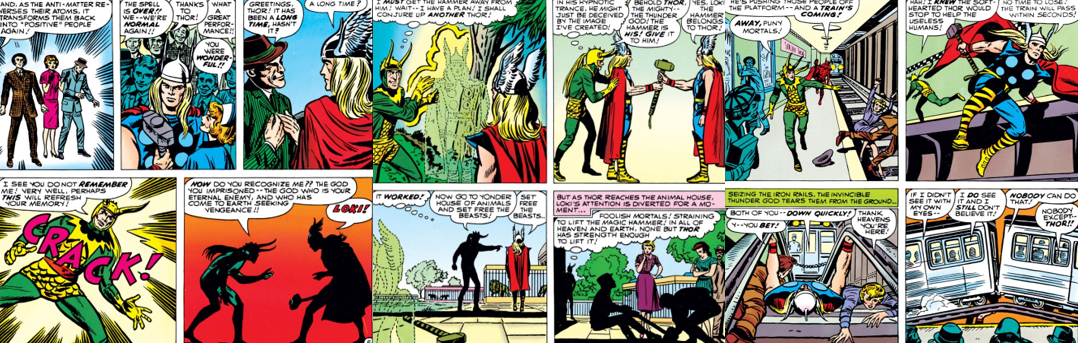
Sonic the Hedgehog was first introduced to gamers worldwide on this day back in 1991 and, since then, has become not only SEGA’s most enduring and popular character but also a beloved videogame icon and, in keeping with tradition, I have been dedicating the entire month to celebrating SEGA’s supersonic mascot.
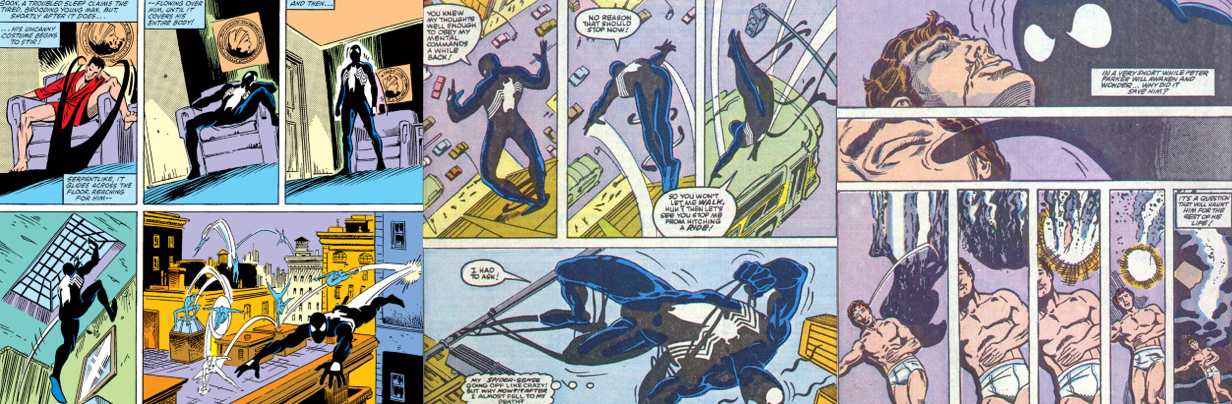
Released: 7 October 2010; 15 May 2012 Developer: Dimps / Sonic Team Also Available For: Mobile, Nintendo Wii, Ouya, PC, PlayStation 3, PlayStation 4, PlayStation 5, Shield, Xbox One, Xbox Series S, Xbox Series X
The Background: In 1991, after much development and strategic planning to create a mascoticonic enough to rival Super Mario, SEGA introduced gamers to Sonic the Hedgehog. Sonic’s initial success (thanks, largely, his debut game being bundled with the Mega Drive) exploded into mainstream popularity with Sonic the Hedgehog 2 (SEGA Technical Institute, 1992) and, from there, the sky seemed to be the limit. So big was Sonic’s blockbuster third outing that it was split into two parts to save costs and meet deadlines; nevertheless, Sonic 3 & Knuckles(ibid, 1994) is widely regarded as one of the best of the classic 2D Sonic games, though SEGA strangely followed this success with several lacklustre spin-offs before transitioning to 3D in 1999. By 2010, Sonic had appeared in around sixty titles, with SEGA outsourcing their supersonic mascot to Dimps for the Sonic Advance series (2001 to 2004), which seemed to be the closest fans could hope for a Sonic 4. Conscious of the demand for a classic Sonic experience, SEGA again teamed with Dimps for a secret project originally codenamed “Project Needlemouse” in a nod to Sonic’s origins. Sonic 4 was conceived of as a throwback title, one that would mix modern elements with the classic formula, and incorporate gyroscope functions for mobile players. Episode I released to mixed reviews; despite criticisms of the poor physics, the game was a commercial success and development began on Episode II, with the specific intention to introduce new elements. With the digital re-release of the celebratedSonic the Hedgehog CD(SEGA, 1993) looming, Episode II was developed to tie up loose threads from that game, as well as introducing team-based mechanics by including Sonic’s sidekick, Miles “Tails” Prower. Episode II was also met with mixed reviews; while largely seen as an improvement over Episode I, the boss battles and level designs drew criticism. Although players could access a side story with both titles, Episode Metal, plans for a third entry were mysteriously abandoned and the game has largely been discarded by all, especially after more fitting throwbacks to the classic era were laterreleased.
The Plot: Doctor Eggman is back, having refined some of his past creations and seeking to conquer new lands with the Chaos Emeralds. When Sonic inevitably arrives to stop him, Dr. Eggman calls in Metal Sonic to hold off his foe while he again works to harness the power of Little Planet.
Gameplay: In the tradition of the classic Sonic titles, Sonic the Hedgehog 4 is a 2.5D, sidescrolling action platformer in which players blast through ten levels (known as “Zones”), with most having three stages (or “Acts”) each, culminating in a boss battle against Dr. Eggman or Metal Sonic. Fundamentally, the basic controls are as familiar as ever; players can pick up speed to blast through Acts, spinning to crash through Badniks, walls, and acquire power-ups with the A or B button, or charge up a Spin Dash by pressing down and either A or B. Oddly, the Spin Dash is actually quite nerfed and doesn’t give you the usual speed boost you’d expect compared to simply running, and Sonic uncurls when flying off curves and springs, leaving him vulnerable to attack. However, this is somewhat explained by the incorporation of the Homing Attack; by pressing A or B after a jump, Sonic will fly towards the nearest target (“helpfully” indicated by an onscreen reticule and targeting sound), which is all-but required as you chain together Homing Attacks to cross gaps. In Episode II, the controls are slightly expanded; here, Tails constantly follows you around, snagging Golden Rings and bopping Badniks, and can be called to your side at any time by pressing the Right Trigger or performing one of the three new Tag Actions with X. Sonic and Tails can either curl up into a massive ball to break through walls with the Rolling Combo or Tails can indefinitely swim Sonic around underwater with the Submarine Combo or briefly carry him with his helicopter tails with the Copter Combo. Each has different strengths and weaknesses; the Rolling Combo is quite fast and unwieldy, the Submarine Combo can be a bit slippery to control, and the Copter Combo only allows for a short burst of flight, though it’s very handy to use to save you from one of Episode II’s many bottomless pits.
Episode I poorly apes the original classics, marrying bad physics with wonky mechanics.
The basic gameplay mechanics are also very familiar; players must collect Golden Rings to stave off death, with the Rings scattering when you’re hit so you can snag them to protect yourself, in addition to swallowing air bubbles to keep from drowning. Acts are played against a ten minute time limit, after which players will lose a life, though you can earn extra lives by racking up points, collecting 100 Rings, or breaking open 1-up monitors. The more points you acquire, and the faster you finish Acts, the more likely it is you’ll earn continues to carry on playing after you’ve exhausted your lives, and you can respawn from checkpoints by running past Star Posts. Zones are filled with robotic enemies and cheap obstacles to sap your Rings and lives, however, from spikes jutting out of floors, walls, and ceilings, to bottomless pits, crushing hazards, and a massive wall-like drill machine that relentlessly chases you down. In Episode I, you’ll play through Zones heavily inspired by the classic Sonic games, meaning you’ll run through loops, mobius strips, jump to moving or temporary platforms, press switches to open doors, and ricochet all over the place on bumpers, springs, bouncers, and steam vents. A few new gimmicks are also present, though; Sonic can swing from vines and zip lines in Splash Hill Zone, ride playing card bridges and cross flipping cards in Casino Street Zone, awkwardly run on giant cogs in Mad Gear Zone to cross tracks, and light dynamite and ride mine carts in Lost Labyrinth Zone. It’s this latter Zone that has some of the most frustrating elements of Episode I, however; not only is it full of water that threatens your life and slows you down and all the same gimmicks as Labyrinth Zone, but you must also run across giant balls in Act 1, carry a flaming torch to light the way in Act 2 (including an annoying light puzzle that can easily cause you to time out if you don’t light the torches in the right order), and struggle with an underwater maze and some bizarre tilting mechanics in Act 3. Indeed, Episode I suffers greatly by its reliance on the original games, especially the first two, and its obnoxious use of Homing Attack chains; every Zone is simply a remix of those seen in Sonic 1 and 2, with a few things shuffled about and some sluggish, clunky physics thrown in to sour the experience.
Episode II expands the gameplay to include tag-based mechanics and fun flying sections.
Episode II addresses many of the issues with Episode I, providing more unique gimmicks and reimagining of old gameplay mechanics along with new elements that can be both enjoyable and frustrating. The Spin Dash pads from Marble Garden Zone are back, for example, and there are now warning signs alerting you to bottomless pits; tilt mechanics are gone, replaced by platforms you can hit with the Homing Attack to make horizontal or springs, and there’s less reliance on Homing Attack chains and more emphasis placed on the Tag Actions. This is especially true in White Park Zone, where you’ll need to make ample use of the Submarine Combo to navigate the ice-cold waters, and Sky Fortress Zone, where you’ll have to expertly use both the Homing Attack and carefully-planned execution of the Copter Combo to cross gaps and avoid spiked ceilings. This Zone also sees the return of the Tornado in a very Sky Chase-inspired sequence; Sonic can now perform the Homing Attack from the Tornado’s wings and you can barrel through obstacles with X, though this’ll leave Tails dizzy for a few seconds. This was a fun autoscrolling section that focused more on avoiding Metal Sonic’s attacks and minions and trying to not get crushed by hazards but, like much of Episode II, it does go on for some time. Zones are much bigger with more varied paths, which is a good thing, and give you lots of options to use the Tag Combo or roll snowballs or take oil slides to different areas, but things can get quite aggravating due to their length and the eventual number of cheap instant deaths. Some Zones uses their gimmicks in interesting ways; Oil Desert Zone, for example, mixes together elements of Oil Ocean and Sandopolis Zone, including quicksand, rising sand you must outrun, and the aforementioned oil slicks but you’ll also lose traction on oily surfaces and these can even briefly be set alight! Sky Fortress Zone makes liberal use of propellers and wind to blow you about, rocket boosters to fry you, and chain-link fences littered with explosives for you to run across. White Park doesn’t just see you swimming through icy water, ploughing through snowdrifts, or snowboarding on avalanches but also includes a rollercoaster aesthetic, which sees you racing along at high speeds and springing to the foreground and background in a fun (if, at times, disorientating) mechanic, while Sylvania Castle Zone makes use of destructible ruins, water, springs, rotating platforms, and shortcuts across the water’s surface like in Hydrocity Zone.
Graphics and Sound: Sonic the Hedgehog 4 opts to ditch the classic sprite art (except, bizarrely, for loading screens and certain icons) and go for a sleek, plasticine aesthetic that seems to be trying to bridge the gap between the classics and the then-modern games but ultimately ends up being quite an unsightly, unnecessarily shiny, and cluttered mess of colours, especially in Episode I. Sonic takes far too long to get to top speed here and looks daft when he does; every movement feels like you’re underwater and the screen is zoomed in a little too close, making it difficult to see what’s ahead of you. Sonic has his usual idle poses and looks up cheerfully enough, but this is also slow and doesn’t even scroll the screen; the sound effect of his Spin Dash is also wrong, with the “release” sound used for the ”wind up” and vice versa, and all of the game’s story is told through the in-game manual and a couple of simple, pantomime-like cutscenes that are just ripped off from the first game. Although many of the same sound effects are recycled for the in-game action and menus, the soundtrack is actually pretty good; it’s stronger in Episode II, but even Episode I has some catchy tunes going on, especially the boss theme. Each Act also has slightly different gimmicks and colour palettes to mix things up, and there’s even a world map where you can freely choose which Zone and Act to play, though I disliked that the game automatically returns you to this screen after you clear an Act unless you press Y to play the next Act.
Episode I can be quite cluttered and fundamentally cripples Sonic’s momentum.
Episode I is, however, an unsightly mishmash of conflicting effects and colours. There is a lot going on in the foregrounds and backgrounds, especially in Mad Gear Zone, which takes Metropolis Zone and ups the ante to eleven, with pistons and gears and steam vents and moving parts cluttering up the screen and making it difficult to see enemies, hazards, and even the way forward. It’s a shame as I quite like the redesign given to classic Zones like Green Hill and Labyrinth Zone, with a greater level of detail and lighting applied to make them pop and feel “busier” than before with the inclusion of waterfalls and crumbling effects. However, that doesn’t change the fact that it looks and feels like you’re playing with toys or plasticine; everything is unnecessarily busy and lacks the charm of traditional sprite art, meaning there’s no “weight” to anything. This isn’t helped by the dreadful physics; Sonic is constantly struggling against gravity, loses all momentum when hitting the ground after flying through the air, and can easily walk up slopes and loops without fear of falling. If you play fast and hard, you can avoid much of this, but Zones like Lost Labyrinth force you to slow down, and Casino Street Zone’s curved surfaces lose all their appeal when you can just trot up them without curling into a ball or using the Spin Dash. The Homing Attack is also finicky, stuttering when multiple targets are onscreen and sometimes causing you to drop to your death with it fails to lock-on. Finally, Episode I just feels like a cheap and thrown together knockoff; five Zones and one playable character, with no two-player options and very few new gameplay options, make it feel less like a continuation of the classics and more like a reimagining for the mobile generation (indeed, I argued at the time – and even now – that the game might’ve been better served being titled Sonic the Hedgehog HD).
Episode II is visually far more interesting and unique, and handles far better.
Episode II is, technically, a vast improvement over its predecessor; the menu screens are more detailed and lively, the physics are far more polished (Sonic doesn’t always uncurl off a ramp and no longer feels floaty and heavy), and the soundtrack is even better, boasting catchy tunes and a remixed boss theme that kept me invested even at the game’s most frustrating sections. The world map has been cleverly expanded, Sonic’s running animation is far better, and the addition of Tails really adds to the gameplay. Unfortunately, Zones are still quite cluttered; White Park Zone, especially, can be very busy with all the foreground and background elements overlapping, but I enjoyed how they retained different times of day and the looming presence of the mechanised Little Planet or Metal Sonic in the background of many Acts. In fact, every Act has something interesting happening in the background; you can see the rollercoaster and theme park in the background of White Park Zone: Act 1, drilling platforms and machinery at work in the background of Oil Desert Zone, and holographic screens and foreboding machinery all over the gravity-skewing Death Egg mk. II Zone. Episode II incorporates far more cutscenes, with them being similar to those of Sonic 3 & Knuckles, but to the game’s detriment; you’ll have to sit through numerous unskippable scenes of Sonic and Tails being taunted by Metal Sonic or Dr. Eggman getting his newest mech ready to battle you, which can make replaying these sections after failing a real chore. However, I really liked the way Episode II presented far more unique Zones; yes, there are influences and borrowings from previous mechanics here, but it feels like some actual effort went into giving the new Zones distinct identities rather than being rip-offs of previous efforts, and the gameplay experience was far more enjoyable here, even if the difficulty has spiked somewhat as a payoff. Indeed, hazard and enemy placement and Zone construction seems to take a leaf out of Sonic CD’s playbook, with many high-speed paths running you head-first into danger and awkward platforms, though it’s nowhere near as slapdash as in Sonic CD and seems like a balanced marriage of all five of the classic 2D Sonic titles.
Power-Ups and Bonuses: If you’ve ever played a Sonic game before, you’ll know exactly what’s on offer here. In addition to the life-preserving (and granting) Golden Rings, you can break open monitors to earn an extra ten Rings, grab a bubble that will protect you from one hit, a temporary speed up, and a briefly period of invincibility, as well as the odd extra life monitor. Sadly, none of the elemental shields appear here, neither does Sonic’s insta-shield, and there are no new or returning additional power-ups with the exception of Episode II’s “Special Combination” item box. These are pretty rare (I only found two throughout my entire playthrough) but see Sonic and Tails bounce across the screen, racking up points and destroying all onscreen enemies as you tap A and being showered with Rings, not unlike the “Team Blast” function of Sonic Heroes (Sonic Team USA, 2003). Episode II’s Special Stages also include the new “Combination Dash” pickup, which tethers Sonic and Tails together to allow them to pickup more Rings, a clunky mechanic that relies on momentum as much as your current speed.
Enemies and Bosses: When playing Episode I, you may be equal parts excited and disappointed, depending on your nostalgia for the classics and desire for fresh Sonic content, by the enemy selection on offer. Every Badnik encountered is ripped straight from Sonic 1 and 2, with only the Batbot and Bubbles returning from Sonic 3 & Knuckles. This means you’ll be bopping Motobugs, smashing Buzzers, dodging spiked balls thrown by Orbinauts, and cursing with frustration when you run head-first into Shellcracker’s clawed fist or Slicer’s annoying bladed projectiles. Episode II continues this recycling of classic Badniks, primarily focusing on enemies encountered in the old Wing Fortress Zone, but also includes a bunch of brand-new Badniks for you to go up against. Some of these are intimidating in their size; Snowy the massive mechanical polar bear is almost akin to a mini boss as it takes a couple of hits to destroy while giant robotic Sandworms will burst from the sand in a surprise attack. Others, however, are more aggravating: Flamers can set fire to Oil Desert Zone’s oil slicks, the dung-beetle-like Scarabesque always seem to sap your Rings with their explosive balls, and the seal-like Steelions will be the bane of your life in White Park Zone’s waters as they flash-freeze the nearby area and cause you to drown. Each Badnik you destroy releases a furry woodland critter, with a whole bunch being freed after boss encounters, nets you some points, and can be used to cross gaps with your Homing Attack but don’t get too cocky as some will sprout spikes to ruin your chain and send you plummeting to your death.
Episode I recycles classic bosses, adding new attack patterns and strategies to them to mix things up.
After clearing each Act of every Zone, you’ll have to do battle with Dr. Eggman (and/or, in Episode II, Metal Sonic). In Episode I, there are five boss encounters, with all of them being recycled battles from Sonic 1 and 2 but with a new coat of paint and an extra “pinch” mode after you deal enough damage. First up, you’ll once again battle Dr. Eggman in his classic (and overused) Egg Wrecker; as before, you need to attack Dr. Eggman’s craft while avoiding his massive wrecking ball, which is a lot easier now that you have the Homing Attack and a higher rebound after landing a hit, meaning it’s simple to put him down even when he spins around and tries to crush you with the ball. Casino Street Zone revisits the Egg Claw boss; again, you need to run up the pinball table-like arena or use the bouncers to attack Dr. Eggman, this time while avoiding a claw-like appendage and an electrical shield that will damage you on contact. In Lost Labyrinth, you’ll again have to chase after Dr. Eggman’s Eggmobile, avoiding spikes and drowning, until he locks you in an enclosed arena. Here, he summons a series of horizontal and vertical columns that will crush you if you’re not careful, forcing you to quickly hop up and target him as he hides in a safe corner for easily the most aggravating boss of the game. Finally, in Mad Gear Zone, Dr. Eggman busts out a new version of the Egg Bouncer; as in Sonic 2, you’ll need to watch out for the mini Dr. Eggman bubbles that detach from his craft, which become a deadly hazard in the second phase. In this section. The game takes a page out of the Sonic Advance 2 (Dimps/Sonic Team, 2002) bosses and forces you to run at Dr. Eggman, avoiding spiked balls and his erratic duplicates to land hits. As if that isn’t bad enough, you’ll have to battle all four bosses in their “pinch” phases again in the secret final Zone, E.G.G. Station, in a boss rush. Luckily, there are Rings and checkpoints between each bout, though they’ve also got added hazards thrown in, such as moving platforms in the Egg Wrecker section and additional projectiles in the Egg Bouncer section.
Episode II‘s bosses are larger and more complex but long-winded and tedious at times.
Episode II is once again a double-edged sword when it comes to bosses; while they’re largely far more unique and offer more of a challenge, they’re long, tedious, and involve a lot of waiting around. Episode II takes inspiration from Sonic CD for its bosses, giving them complex attack patterns and more visually interesting and tricky pinch phases, which is either a good or a bad thing depending on how patient you are. In Episode II, you’ll battle Dr. Eggman twice; in Sylvania Castle Zone, he pilots the Egg Serpentleaf, a massive plant-like mech that tries to swat you with its many tentacles and shields him behind a spiked bud. You’ll need to use the Copter Combo to avoid being smacked and land a few hits on Dr. Eggman, which will eventually cause more tentacles to appear and the mad scientist to blast the arena with a massive cannon. You’ll next encounter him in Oil Desert Zone in an even more irritating boss battle; Dr. Eggman assembles a massive mech out of scrap metal and you must pursue him up a garbage disposal, dodging his buzzsaws and the crates he drops (which thankfully aren’t instant-kill hazards but can contain spikes or bombs) and smacking his cockpit when he appears. When you reach the surface, the Egg Scrap Mech rapidly jumps between the foreground and background before trying to crush you; you’ll need to hit its feet with the Rolling Combo to stun it and finish off this pain in the ass boss. The other two boss battles are against Metal Sonic; like Sonic CD and Sonic Advance 2, these are auto-runners and autoscrollers. In White Park Zone, you must race towards Metal Sonic and attack him, then dodge his charge attack (either by jumping or springing to the foreground or background) and hop over the electrical traps he lays for you. After a few hits, he’ll start destroying the rollercoaster track so you’ll have to take care not to fall when attacking him. In Sky Fortress Zone, Metal Sonic pesters you in his Metal Carrier and then battles you directly, blasting electrical bolts that you need to dodge to smack his cockpit. He’ll then face you head-on, firing energy beams that you need to avoid and then jettisoning booster rockets that can crush you if you’re not careful. This can be a very annoying boss battle if you fail as there’s a lot of downtime at the start and between phases; while you can easily amass 100 Rings for an extra life, it doesn’t help with the frustration that can build in this encounter.
Sonic’s return to the Death Egg is either overly familiar or erratically tough, but always an uphill battle.
Once you’ve cleared every Zone and bested Dr. Eggman’s boss rush in Episode I, you’ll face a final confrontation with the mad scientist in a refurbished Death Egg Robot. This is easily the most tedious and frustrating boss battle of Episode I as the Death Egg Robot takes nearly thirty hits to destroy and the battle involves a lot of waiting around. To start with, it’s exactly the same as in Sonic 2 but easier thanks to you having Rings and the Homing Attack; simply stay away from the mech, attacking its torso and avoiding its rocket arms, until it starts to malfunction. In this phase, the Death Egg Robot cannot be directly attacked; you need to quickly dash under it as it hops about and then use the Homing Attack to blast one of its rocket arms back at it, avoiding the sporadic laser blasts as you go, to land a few precious hits. Once you’ve done this enough, Dr. Eggman will try one last attack, forcing you to quickly dodge out of the way and land the finishing blow before you’re dropped to your death. In Episode II, you’ll rush at Dr. Eggman and Metal Sonic aboard the Death Egg mk. II; you need to get past the invulnerable Dr. Eggman and ram Metal Sonic a few times, avoiding the giant energy balls unleashed, before racing against your robotic doppelgänger like in Stardust Speedway, only this time with more doors to bash through. Finally, you’ll battle Dr. Eggman’s Egg Heart at the heart of the mechanised Little Planet; this battle is fought on constantly rotating mechanical rings that will burst with electricity, forcing you to quickly hop between them and ram Dr. Eggman’s cockpit. The more damage you do, the more erratic the rings move and the more dangerous the hazards become; Dr. Eggman even erects an energy shield that you’ll need to break with a Rolling Combo, making for a far more unique but equally frustrating final boss encounter.
Additional Features: There are twenty-four Achievements to earn in Sonic 4, twelve for each Episode, and they’re pretty basic, for the most part. You’ll get an Achievement for clearing the first Act of each game’s first Zone, one for clearing each game, one for completing first Act of each game’s first Zone in a strict time limit, and one for collecting first one and then all the Chaos Emeralds. In Episode I, you’ll get an Achievement for defeating 1000 enemies and accumulating 99 extra lives, while in Episode II you’ll add to your Gamer Score by playing as Tails fifty times and performing the Rolling Combo. Each Act in Episode II also hides a Red Star Ring; collect them all and finish the game for another Achievement, and upload your best scores in each Episode for another. I mentioned Chaos Emeralds just now and, as you’d expect, the seven gems are collectible in each Episode. You’ll earn them by beating Special Stages, which are accessed by finishing Act 1 to 3 with fifty Rings and entering a Big Ring, but the Special Stages vary drastically between each Episode. In Episode 1, they’re based on Sonic 1’s Special Stages, featuring a floating maze filled with Rings, bumpers, and exit pads; you need to collect Rings to lower barriers and reach the Chaos Emerald before the time runs out, collecting time bonuses and making use of the ‘Retry’ option in the pause menu if you’re sensing failure. As bad as Sonic 1’s Special Stages were, these are far worse; you rotate the maze here, not Sonic, which is extremely awkward and disorientating. Sonic can also jump but all this does is shake the screen in a nauseating way and, while you can replay the Special Stages from the world map, you can only retry those you’ve beaten and you must enter a Special Stage from a different Act to get a different Chaos Emerald.
Conquer the aggravating Special Stages or take on a harder challenge in Episode Metal.
In Episode II, the Special Stages are redesigned and now influenced by the half-pipe stages from Sonic 2. Here, Sonic and Tails must collect a set number of Rings to progress, dodging bombs and electrical hazards and making use of the awkward tether mechanic in the final two Special Stages. While these are a lot more enjoyable and it’s much easier to retry if you’re struggling, they can get really annoying as the difficulty increases; you’ll need pixel-perfect timing and to make good use of the boost and momentum to snag all the Rings and the Chaos Emeralds here. In both Episodes, collecting the seven Chaos Emeralds allows you to transform into Super Sonic once you collect fifty Rings and double press A or B. this makes you super fast and completely invincible unless you’re crushed or drop down a pit, though it only lasts for as long as you hold Rings. Unlike Episode I, Episode II also features a multiplayer component; you and a friend can play the game in co-op like in Sonic 2, either locally or online, though this is strangely the only way you can play as Tails alone. Finally, completing Episode II unlocks Episode Metal, a side story in which you play as Metal Sonic and work your way backwards through remixed versions of Episode I’s Zones with all new cutscenes setting the stage for Metal Sonic’s return. Despite some new animations and sound effects, Metal Sonic is simply a reskin of Sonic and doesn’t have any new attacks; he also has to smash Badniks as well, which is a bit odd but I guess speaks to his superiority complex. There are no Achievements tied to Episode Metal, which is significantly harder then either Episode I or II; enemies, hazards, instant-death traps, and Act layouts have all be increased, altered, and made far more challenging, though there are sadly no bosses to contend with here, meaning this is more of a distraction for players who have mastered the base games.
The Summary: Honestly, calling any title Sonic the Hedgehog 4 was going to be asking for trouble; Sonic the Hedgehog HD or Sonic Returns or Sonic Redux would’ve been far more appropriate titles and would’ve tempered expectations for these sadly unfinished titles. It just baffles me how SEGA thought it was acceptable to go from the sprawling, multi-character epic that was Sonic 3 & Knuckles to this tame, cheap, stripped down bastardisation of the first two games. Playing Episode I alone is a joke; the game is functionally playable but visually a mess, with wonky physics, a lack of replay value, and too many recycled gimmicks and elements from Sonic 1 and 2. Thank God for Episode II, which fixes many of these issues; Sonic controls a lot better, the Zones are far more visually interesting and unique, and the bosses have more effort put into them. The team-based mechanics were fun; they could’ve easily been overused but they were enjoyable when you weren’t being asked to fly over bottomless pits, though I’m confused as to why there’s no option to play as Tails in the lead. The inclusion of Episode Metal was also a nice touch, though I think more could’ve been done with this. At least give Metal Sonic his electrical boost or some new gameplay mechanic, or have him face off against Sonic, rather than just being relegated to a hard mode add-on. Truthfully, I am sad we never got the planned Episode III as it’s possible that more unique elements would’ve been added in, including a playable Knuckles the Echidna and other more engaging elements, but sadly we’ll never know. As a complete package, Sonic the Hedgehog 4 is widely inconsistent; in addressing errors from Episode I, the game just feels like a disjointed mess, even when it’s doing something new and enjoyable. It’s obvious the developers tried to address these issues in Episode II, providing a more challenging and versatile gameplay experience, but at the cost of upping the difficulty in some areas and making it equally as frustrating as Episode I but in different ways. Ultimately, Sonic the Hedgehog 4 is a disappointment; it not only fails to live up to its title, but also fails to match the quality of Sonic’s Game Boy Advance titles. I can understand why SEGA distanced themselves from it (though not its hefty price tag), though luckily these mistakes were atoned for in the years to come with better, more enjoyable throwbacks to Sonic’s heyday being released.
My Rating:
⭐⭐
Rating: 2 out of 5.
Could Be Better
Are you a fan of Sonic the Hedgehog 4? Which Episode did you prefer and what did you think to the presentation and stripped down mechanics? Were you disappointed by how much Episode I drew from the original games and the poor selection of Zones and modes? What did you think to the team up moves in Episode II and the return of Metal Sonic? Which of the game’s bosses and Zones was your favourite, and would you have liked to see an Episode III tie everything up? How are you celebrating Sonic’s anniversary this year, and what are some of your favourite Sonic games? Whatever you think, leave a comment below or on my social media and go check out my other Sonic content across the site!
You must be logged in to post a comment.