In August 1962, Stan Lee, Larry Lieber, and Jack Kirby introduced readers of Marvel Comics to the God of Thunder, Thor Odinson. Through associations with Marvel’s premier super team, the Avengers, and many cosmic, mythological adventures, Thor became another of Marvel’s most successful and versatile characters, with appearances in cartoons, videogames, and incredibly profitable live-action movies. Being as it’s the first Thursday (or “Thor’s Day”) of the month, this is the perfect time to celebrate the God of Thunder!

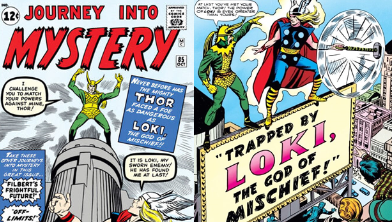
Story Titles: “Trapped by Loki, The God of Mischief” and “Part 2: The Vengeance of Loki”
Published: 2 August 1962 (cover-dated October 1962)
Writers: Stan Lee and Larry Lieber
Artist: Jack Kirby
The Background:
After creating Doctor Bruce Banner/The Incredible Hulk, legendary Marvel Comics writer, editor, and creator Stan Lee was inspired by Norse legends to dream up an even more powerful superhero and, alongside Larry Lieber and the renowned Jack Kirby, crafted a new version of the Norse God Thor Odinson who effectively took over Journey into Mystery until it became his own self-titled comic in 1970. Thor became a founding member of Marvel’s premier super team, the Avengers, and eventually took on more aspects of his inspiration, with one of the most notable of these being Thor’s adopted brother, Loki Laufeyson. Like Thor, a version of Loki appeared in Marvel’s predecessor, Timely Comics, years earlier in 1949, where he was depicted as a hatemongering member of the Olympian Gods, but it was Lee and Lieber who redesigned Loki as Thor’s most persistent nemesis in this issue of Journey into Mystery. Like his half-brother, Loki was instrumental in the first appearance of the Avengers and went on to dog many of Marvel’s superheroes as part of the Masters of Evil, to say nothing of waging war against Asgard and even having a turn as a more heroic character. Of course, Loki has seen immense popularity in recent years thanks to Tom Hiddleston’s portrayal of the character in the Marvel Cinematic Universe, where he was depicted as a tragic, flawed, misguided character who went from wanting to conquer the Earth to sacrificing his life to protect his brother and his adopted world.
The Review:
“Trapped by Loki, The God of Mischief” begins in the golden realm of Asgard, a citadel separated from time and space by the rainbow bridge, Bifrost. There, deep in a remote area of Asgard, stands a tree that acts as the prison for Loki, the devious God of Mischief, who was condemned to this prison ages ago, with his only hope of escape being if someone is driven to tears by his plight. Although he’s well aware that no Asgardian would ever weep for him since he’s hated by all, he’s able to exert some measure of control over the tree; enough to cause a stray leaf to drop into the eye of Heimdall as he passes by. Apparently, the single tera he sheds as a result is enough to break the curse and Loki slips free undetected, finally giving him license to cause mischief, spread discord, and seek revenge on the one responsible for this capture: Thor! Although Thor hasn’t been in Asgard for some time, Loki had the incredible foresight to forge a “mental link” with Mjölnir before his imprisonment. This allows him to locate the uru-made magical hammer and its thunder-commanding master, who’s currently entertaining children in a hospital, so Loki hops onto the Bifrost and heads to Earth “at the speed of thought”.
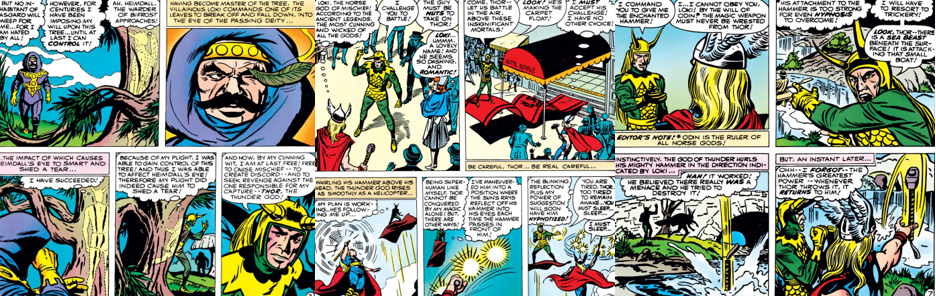
Once there, Loki magically assumes the guise of a normal, everyday man about town but finds that Thor has already left the hospital by the time he arrives. Rather than reveal his presence prematurely, Loki decides to use his incredible powers to cause a disturbance (namely transforming innocent bystanders into negatives) to lure Thor to him. Conveniently, Thor (in his alias as the lame Doctor Donald Blake), happens to be on his way to a nearby house call; upon seeing the phenomenon, Dr. Blake strikes his walking stick to the ground and is transformed into the Mighty Thor once more. Thor then spins Mjölnir at an incredible speed, fast enough to emit anti-matter particles that he then blows towards the victims using his magical hammer, restoring them to normal in a head-scratching piece of pseudo-science. Naturally, the people are awestruck by this feat and Thor is heralded as a hero. Amidst the gaggle of onlookers, Loki approaches Thor and reveals himself to the Thunder God (whose internal dialogue seems to indicate that he’s only aware of Loki from Norse mythology, again making me question whether Dr. Blake and Thor are two different people or if Don’s consciousness is simply within Thor’s body since Thor should know who Loki is considering he imprisoned him in that tree…) and challenges him to a battle. Loki uses his powers to turn a nearby carpet into a flying carpet and Thor follows him into the air but Loki, realising that it will take more than brute strength and magic to conquer Thor, uses this to his advantage by causing the sun’s rays to reflect off Mjölnir in a series of blinking lights that leaves Thor effectively hypnotised and under Loki’s command! Although this means Thor is compelled to obey Loki, he’s unable to hand over Mjölnir thanks to the will of his father, Odin Allfather, so Loki tries to trick him into hurling his hammer at an imaginary sea beast, only to be thwarted when the enchanted weapon returns to Thor’s hand like a magnet.
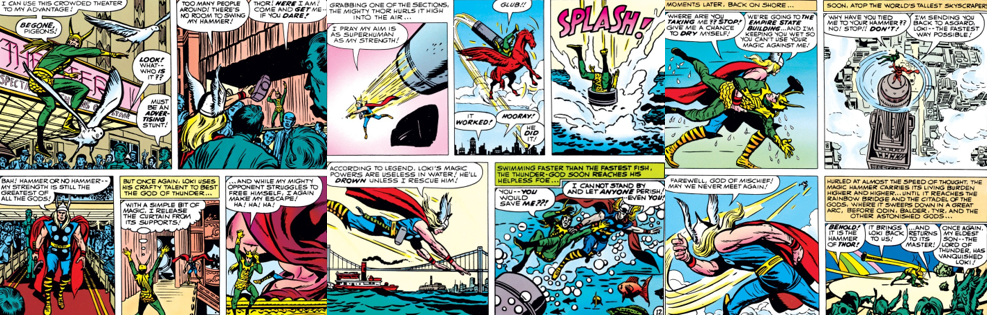
However, Loki comes up with the brilliant plan to conjure up a duplicate image of Thor; since only Thor can hold the hammer, Thor hands Mjölnir to the illusion and is finally relieved of his weapon. Loki then directs Thor to release the wild beasts from the city zoo but is distracted from witnessing this event by mocking a gaggle of civilians who try, unsuccessfully, to lift the enchanted hammer. Loki’s momentary distraction means he misses Thor reverting back to Dr. Blake, an automatic transformation that occurred whenever Thor was separated from Mjölnir for about a minute. This also has the added benefit of undoing Loki’s hypnosis, allowing Dr. Blake to reunite with Mjölnir and return at full power to Thor. Realising that he no longer has the advantage over his foe, Loki gathers a flock of nearby pigeons to fly him to safety so he can think up a new plot but is forced to land when he sees Thor pursuing him with a vengeance. Thanks to the dense crowd making it too dangerous for Thor to swing Mjölnir, Loki ducks into theatre and entangles the God of Thunder within the stage curtain. This is only a momentary setback for Thor, however, so Loki dashes into the subway and distracts his foe further by shoving civilians onto the train tracks. Rather than simply carry them to safety, Thor goes to the effort of showcasing his strength by hoisting up the tracks, allowing the train to pass safely overhead, and then watches on, helpless to pursue, as Loki flies off on horse statue he brought to life, smashing up Times Square as he goes. Although Loki plans to lure Thor to the Statue of Liberty for a final showdown, Thor simply tosses a massive section of a pipe at the God of Mischief that sends him plummeting to the water below. Since, according to legend, Loki’s magic powers are apparently “useless” in water, Thor rushes to save his foe, much to Loki’s shock and revulsion. Because Loki’s soaking wet, he’s powerless to keep Thor from taking him to the top of the Empire State Building, attaching him to Mjölnir, and hurling him back to Asgard through sheer brute force to the astonishment of his fellow Gods.
The Summary:
Considering how pivotal Loki now is to Thor’s mythology and the popularity of the misguided God of Mischief, Journey into Mystery #85 is a pretty poor showing for Thor’s half-brother. Indeed, no mention is made of Loki’s familial ties to Thor, their sibling rivalry, or his status as a Frost Giant. There’s not even any real detail as to why Thor imprisoned him within a tree beyond Loki delighting in causing chaos and some cursory mentions of Norse mythology, something I very much doubt readers of Marvel Comics had much knowledge of back in the day (or even now, if I’m honest). Instead, we’re left with the paper-thin exposition that everyone in Asgard hates Loki and that he himself hates Thor because he bested him ages ago, and even this falls apart since Thor acts like this is the first time he’s ever encountered Loki. A couple of panels showing their previous encounter might’ve been a nice inclusion; that space could’ve been used in place of the brief and pointless fawning of nurse Jane Foster, who’s immediately enamoured by Loki for no real reason and is simply there to help paint Dr. Blake as a milksop compared to the mighty Thor. The story even contradicts its own lore within the first few panels: Loki specifically says that only someone taking pity on his plight can free him, yet a brief bit of eye water from a leaf is enough to break his curse, to say nothing of going to the effort of stating that Loki has some divine link to Mjölnir when it would’ve been enough to simply show him capable of magically seeing across the Realms.
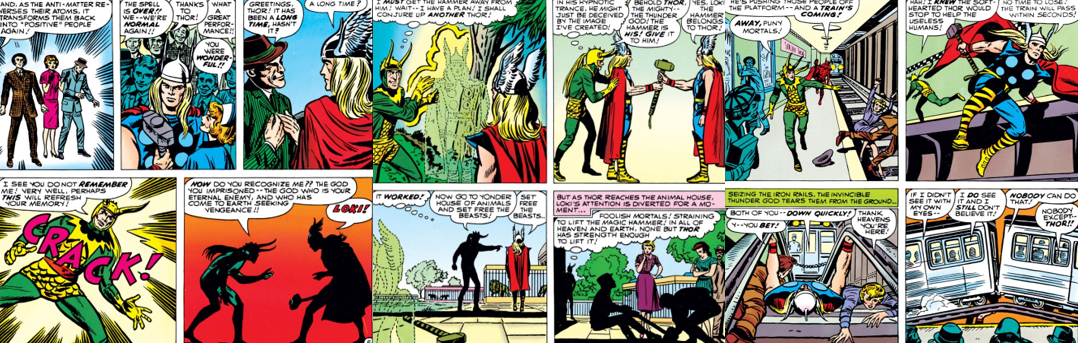
The artwork is bright and colourful and quite fun, but disappointingly basic at times, and strangely bizarre at others. We’re denied seeing Thor tussle with bears and lions at the zoo but have to see him bend rail tracks rather than just carry Loki’s victims to safety, and Loki’s powers are some of the lamest and most disappointing from this era of comics. We’ve got a God capable of bringing inanimate objects to life, but his plan is to simply hypnotise Thor? He creates an illusion of Thor but is incapable of conjuring an actual sea beast to accomplish the same means, instead resorting to basically shouting, “Look over there!”, and his powers are suppressed by water? I had no idea that was a thing, but it’s pretty bloody lame. Almost as lame as forcibly nerfing Thor by sticking him in dense crowds and thus incapable of swinging Mjölnir without hurting someone since Thor is quite clearly and obviously depicted as Loki’s physical superior even before he literally throws him across time and space back to Asgard. So, no, I really wasn’t very impressed by Loki; he barely did anything except briefly hypnotise Thor, his motivations were woefully pitiable, and his powers were far from visually interesting. Luckily, he looked very visually appealing with his bright green and gold outfit and trademark horned helmet but neither he nor this story lived up to its potential. Loki was defeated with laughable ease once Thor shrugged off his hypnotism and got his hands on him, and this ended up being a pretty disappointing first encounter between the two legendary rivals even by the standards of the 1960s.
My Rating:
Could Be Better
What are your thoughts on Loki’s debut appearance? Were you also disappointed by his ineptitude and depiction, or did he impress you with his colourful attire and mischievous nature? Did you enjoy seeing the two clash or would you have preferred to see something more visually interesting? What are some of your favourite Loki moments in and out of the comics? Do you have a favourite character, arc, or era in Thor’s long publication history? How are you celebrating Thor’s debut this month, if at all? I’d love to hear your thoughts on Thor in the comments below or on my social media, and it’d be great if you checked out my other Thor content across the site.


