Movie Night [K-DAY]: King Kong (1933)


In the absolutely bonkers science-fiction film Pacific Rim (del Toro, 2013), the monstrous Kaiju first attacked humanity on 10th August 2013. The attack ended a few days later on August 15th but, in that time, San Francisco, Sacramento, and Oakland were completely devastated and the Kaiju War officially began. Accordingly, August 10th became known as “K-DAY” and is, for me, a fantastic excuse to talk about some giant monster movies!


Released: 7 April 1933
Director: Merian C. Cooper and Ernest B. Schoedsack
Distributor: Radio Pictures
Budget: $672,254.75
Stars: Fay Wray, Robert Armstrong, Bruce Cabot, and Frank Reicher

The Plot:
Renowned filmmaker Carl Denham (Armstrong) charters a ship to Skull Island in search of an elusive, prehistoric creature known as “Kong”. When Ann Darrow (Wray) is captured by the creature, Denham and first-mate Jack Driscoll (Cabot) resolve to rescue her and capture the beast to showcase it as a Broadway attraction.

The Background:
It’s hard to believe now but it was nearly a hundred years ago that filmmaker, adventurer, and former World War I aviator Merian C. Cooper first conceived of the iconic visual of a giant gorilla climbing to the top of the Empire State Building and being felled by modern technology. Initially wishing to produce a semi-documentary piece depicting a fight between actual gorillas and Komodo dragons, Cooper was inspired by the cost-cutting appeal of stop-motion technology to retool his concept using existing sets, props, and filmmaking techniques. The various dinosaurs of Skull Island, and King Kong himself, were designed by Marcel Delgado and brought to life using painstaking stop-motion techniques under the supervision of Willis O’Brien. A revolutionary filmmaking technique known as the “Dunning process” was employed to combine stop-motion and miniature shots with live-action actors and a huge animatronic bust of Kong’s head and body was constructed to capture close-ups of the creature. Audiences were in awe of the film and its ground-breaking effects, lining up to see the film upon its release, which was both staggered and somewhat limited but still brought in a profit of $650,000, with subsequent re-releases bringing King Kong’s total gross closer to $5.3 million. King Kong’s legacy, of course, speaks for itself, as it is widely regarded as one of the most influential movies of all time, has been preserved in the United States National Film Registry for its cultural and historical significance. It also spawned a few remakes and was one of the first and most prominent of the giant monster movies that would later be popularised by the Kaiju films of Japan.

The Review:
The first thing to note about King Kong is that, yes, it is filmed in black and white; while colourised versions of the film do exist, I recommend sticking to the original monochrome version for the true authentic experience. I understand, however, that black and white films can be off-putting for some but you’re simply robbing yourself of a true piece of cinematic history. 1933 was also a very different time in human history, to say nothing of cinema; as a result, dialogue is often loud, full of clunky exposition, and largely a product of its time. This means there’s a great deal of conveniences, contrivances, and sexist comments levelled in the film towards Ann; as the only female on the Venture, Denham’s chartered ship, she’s seen as a fragile and desirable object by many and little more than a prop for Denham, who needs a “pretty face” for the public to look at.
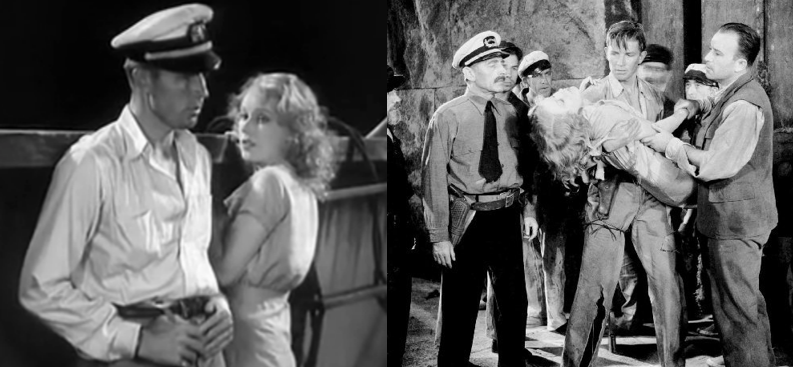
A gruff and cynical first-mate, Driscoll’s love for Ann comes against his better nature.

Denham is an unscrupulous and demanding egotist whose obsession with creating spellbinding films and content drives him to launch an expedition into the dangerous unknown; seemingly blind to the risks that the journey may bring, he cares only for capturing amazing sights on film and purposely misleads his cast and crew regarding their destination. Upon seeing Kong, Denham’s curiosity and greed are inspired and, regardless of the lives that have already been lost and the immense danger to Ann, he is driven to a crazed obsession at capturing the beast simply to string it up for the amusement of the paying public. Annoyed at backlash from the critics and the public for never featuring a girl in his films before, Denham is determined to silence his detractors but isn’t happy about it; he, like many of the Venture’s crew, see women as little more than a distraction. Driscoll echoes many of these sentiments, believing women to be a nuisance, especially out at sea. Despite his gruff demeanour and cynicism and believing her mere presence troublesome to the attentions of himself and the other men, he can’t help but be attracted to her and concerned for her well-being considering Denham is being disconcertingly secretive about their destination and intentions for them all. This, as much as anything, makes him incredibly protective of Ann and compels him to, begrudgingly and awkwardly, admit his love for her after her safety is threatened by the island’s natives.
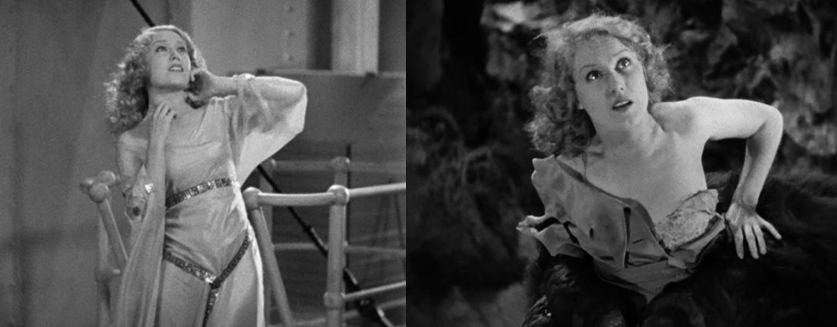
Ann is the original damsel in distress, though she does exude a modicum of personality at times.

Ann, for her part, is a gorgeous and fiery girl but does little to really assuage such preconceptions; driven to stealing to survive, she’s overwhelmed by Denham’s proposal for “money, adventure, and fame” and with little other choice, she signs on to the Venture out of desperation as much as the thrill. Her demeanour, however, is something of a handicap at best and a distraction at worst as she’s prone to swooning, screaming, and flights of emotional fancy. When captured by Kong, she’s, obviously, largely defenceless and helpless against his might and, yet, despite her traumatic experience with the creature, is truly heartbroken when he is killed at the film’s conclusion. Indeed, the savagery and primal nature of the beast may be frightening to Ann but she still has a respect and admiration for Kong’s uniqueness and the ferocity with which he fought to protect her. The remainder of the Venture’s crew is largely expendable and inconsequential; of them all, only Captain Englehorn (Reicher) plays a notable role since he’s…well, the captain of the ship and acting as an interpreter to the island natives. The other crew members are simply bodies to cast lewd aspersions towards Ann, question their mission, and to fall victim to Skull Island’s many hazards and dinosaurs. Speaking of which, Skull Island is home to a primitive tribe who live in fear and awe of Kong, offering him sacrifices and keeping him at bay with a gigantic wall, and, enamoured by Ann’s stark contrast to their women, kidnap her in attempt to appease the God-like creature.
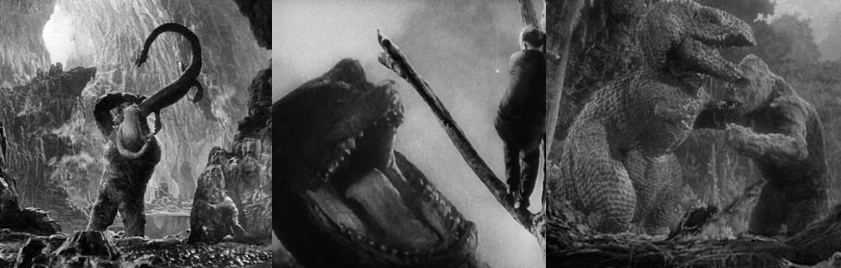
Skull Island is home to many monstrous creatures that have escaped the ravages of time.

Kong’s presence hangs in the air like an ominous cloud; his mere name piques Denham’s curiosity and he and the crew are puzzled by the constant chanting of his name when they reach the island. This builds the tension to the creature’s eventual, memorable reveal to a crescendo since the size of the walls imply a gigantic creature but the result is somewhat almost unimaginable: a monstrous, twenty-foot-tall ape who becomes besotted by his latest prize and flees deep into the jungle with Ann as his “bride”. As protective and smitten by Ann as Jack, Kong exhibits a playful curiosity towards her and is especially taken by her golden hair; so infatuated with Ann is Kong that he rampages through the natives’ village after she is taken from him, destroying their homes, crushing them beneath his massive feet, and biting them in two and also engages in brutal combat with the dinosaurs of Skull Island to both keep her safe and to assert his unmatched dominance. Indeed, as impressive as Kong is, he’s not the only giant on Skull Island; dinosaurs still walk the Earth on its hidden lands, challenging Kong’s position as “King” and killing many of Englehorn’s crew. Even traditionally omnivorous creatures like the Stegosaurus and Brontosaurus are monstrous, dangerous killing machines on Skull Island but, of course, none are more formidable than the Tyrannosaurus rex. The battle with the T-Rex is especially brutal and impressive and shows off not only the film’s impressive stop-motion effects but also Kong’s versatility and unnatural capability as a fighter by overpowering the T-Rex and snapping its jaw. Clearly, Kong is not just a giant gorilla as his dimensions, form, and movements indicate he’s something truly unique even on an island of giant monsters!

The Nitty-Gritty:
One of the things I enjoy about King Kong is that it, like the old Universal Monsters films from back in the thirties, is a brisk and entertaining film; clocking in about around one hundred minutes, the film wastes little time in getting to the meat and potatoes of its concept (Skull Island). This is in stark contrast to Peter Jackson’s 2005 remake, which spent what felt like two ice ages aboard the ship (I still feel like they’re travelling there even now…), and which convoluted the simple premise of the original by trying to be bigger and better. In truth, this had already been accomplished by the impressive John Guillermin’s 1976 remake, which sported an incredibly extraordinary animatronic version of Kong, but even that has its slower, more laborious moments. The same can’t be said about the classic original, which establishes the suggestion of personality for its three leads and then promptly focuses on the remarkable creatures of Skull Island.
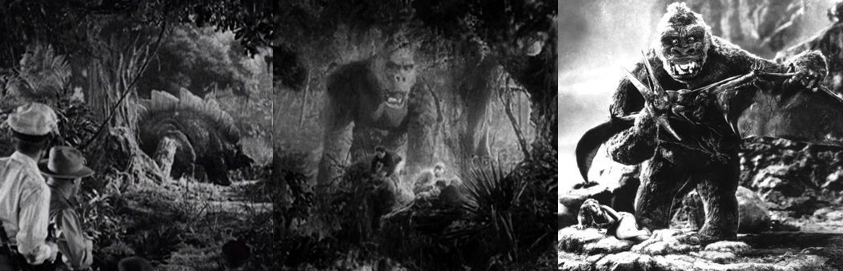
Impressive filmmaking techniques merge stop-motion effects with live-action shots.

Naturally, King Kong’s biggest appeal is in the painstakingly realised stop-motion effects that are used to bring these to life; thanks to arduous time, effort, and clever filmmaking techniques, the film is able to blend together stop-motion models with live-action shots or depict battles between monstrous creatures while characters look on in awe and fear. Obviously, some of these aren’t as impressive as they once were and it’s easy to see how the shots have been blended or merged together; the stop-motion is also noticeably jerked and somewhat crude at times, especially when depicting Kong’s facial expressions and emotions, and yet it’s still an incredible achievement for the time, impressive to behold, and extremely ambitious considering the restrictions and that the techniques were still new and being developed during this era. It would have been easy to simply focus on one beast, the titular Kong, but the filmmakers opted to go all-in and showcase a variety of complex dinosaurs on Skull Island, which really adds to the mystery and otherworldliness of the location, and the film does a pretty decent job of showing Denham, Driscoll, and the Venture’s expendable crew members battling with the various monsters of the island.

Though a king in his native land, Kong is overwhelmed by the ferocity of man.

Of course, it’s one thing to see Kong in the deep jungles of a fantasy island that time forgot but it’s another thing entirely to see him first bound and then tearing through the streets of downtown New York City! Once a king, now reduced to a mere spectacle to be ogled at, Kong’s escape and subsequent rampage is a stark reminder of the brutality and fierceness of nature as Kong steps on pedestrians, crushes cars, destroys trains, and even devours humans in his relentless pursuit of the object of his affections. Love, tragedy, and the brutality of nature are prominent themes throughout the film; Driscoll is driven to read head-first into the unknown to rescue Ann, just as Kong is when he ends up in New York. As iconic and timeless as King Kong is for its effects it is, perhaps, equally as memorable for its tragic ending; so obsessed with holding on to Ann is Kong that he is forced into climbing the Empire State Building in an attempt to get up high and in a position of dominance. Unfortunately, while the human characters are able to adapt to and conquer Skull Island with their weapons and fortitude, Kong is ultimately overwhelmed by the modern world and unable to probably navigate, respond to, or combat it and, as a result, he is gunned down and meets an inauspicious, tragic, and unforgettable end in his efforts to protect his “bride”.
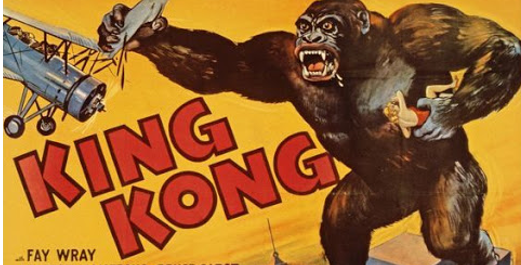
The Summary:
Undeniably, King Kong is an absolute classic and near-timeless movie; it’s one of those films that everyone should take the time to watch simply for its contribution to cinema through its ground-breaking and incredibly ambitious special effects. Obviously, there are elements of the film that haven’t aged too well thanks to how society has changed and the effects look rather primitive compared to what Hollywood is capable of today but many of those techniques would not have been possible without King Kong, which still holds up remarkably well thanks to the impressive way that it blends live-action shots, sets, and stop-motion techniques together to create a truly moving and emotional tragedy about a misunderstood and savage beast being smitten by a gorgeous and emotional beauty. As creative as subsequent Kong films as been, and for all the monster movies that have followed, few have the spectacle and timelessness of King Kong, which continues to impress through its ambition and is well recommended not just for fans of monster movies but for fans of cinema in general.

My Rating:

Rating: 4 out of 5.

Great Stuff

Have you ever seen the original 1933 version of King Kong? If so, what do you think to it and how do you think it holds up today, especially compared to other monster films and subsequent remake sand interpretations of Kong? What did you think to the stop-motion effects? Do you think they were the best option available or would you have preferred to see a man in a suit or some other technique used? What’s your favourite version of Kong, or your favourite Kaiju movie, and how are you celebrating K-Day today? Whatever your thoughts on King Kong, Kaiju, or monster movies in general, please do leave a comment below and be sure to check back in for more giant monster content in the near future!

Movie Night: The Suicide Squad

Released: 30 July 2021
Director: James Gunn
Distributor: Warner Bros. Pictures
Budget: $34 million
Stars: Idris Elba, Margot Robbie, John Cena, Sylvester Stallone/Steve Agee, David Dastmalchian, Daniela Melchior, Joel Kinnaman, Peter Capaldi, and Viola Davis

The Plot:
After Colonel Rick Flag (Kinnaman) and Doctor Harleen Quinzel/Harley Quinn (Robbie) are captured and presumed killed during a mission into the war-torn nation of Corto Maltese, Amanda Waller (Davis) blackmails former mercenary and marksman Robert DuBois/Bloodsport (Elba) into leading a new Task Force X team on a suicide mission into the nation to acquire Gaius Grieves/The Thinker (Capaldi), who has vital information regarding the mysterious and potentially cataclysmic “Project: Starfish”.

The Background:
Task Force X, otherwise known by the more colourful sobriquet of “The Suicide Squad”, is a team of supervillains, anti-heroes, and convicts that first appeared in The Brave and the Bold #25 in September 1059. Created by Robert Kanigher and Ross Andru, the team’s initial six-issue run was later expanded upon exponentially by writer John Ostrander in 1987; Ostrander defined many of the elements that are now closely associated with the team, such as them being commanded by Amanda Waller and forced into behaving under threat of remote execution. Due to the very nature of the team (the clue’s in the name after all), the Suicide Squad has seen many different incarnations over the years and has featured in a number of adaptations outside of the comics. They made their live-action debut in Suicide Squad (Ayer, 2016), a film that arguably was the DC Extended Universe’s (DCEU) attempt to emulate the success of Guardians of the Galaxy (Gunn, 2014); despite heavyweights like Will Smith and Jared Leto attached and bringing in nearly $750 million against a $175 million budget, Suicide Squad was a critical disaster. However, Suicide Squad did give us Margot Robbie’s fantastic portrayal of Harley Quinn, which received significant praise (and her own spin-off), and there has been a major fan demand for Warner Bros. to release the director’s cut of the film. Still, Suicide Squad made money and had a bankable star so a sequel (and several other spin-offs) was put into development. Perhaps because of Ayer’s public lambasting of Warner Bros.’ interference with his film, a new director was courted for the follow-up, with James Gunn being hired after he was briefly fired from Disney and Marvel Studios. Given complete creative control of the project, Gunn decided to produce a standalone sequel that featured some of DC’s most ridiculous villains and mashed them into a team of losers, misfits, and combustible personalities. Delayed due to the COVID-19 pandemic, The Suicide Squad was eventually released to overwhelmingly positive reviews that praised its action, gore, and humour. As of this writing, the film has only grossed $7 million at the box office but is projected to bring in $35 to 60 million and Gunn has already completed a spin-off series for HBO Max starring Christopher Smith/Peacemaker (John Cena).

The Review:
My experience of the Suicide Squad is basically almost zero; they rarely appear as a team in the DC Comics I read and usually just kind of crop up as a team of misfits for DC’s superheroes to fight with. As a result, when I heard that Warner Bros. were going to be putting time, effort, and money into a big-screen version of the team, my first question was…why? Why are we getting that and not a standalone Batman movie for Ben Affleck, or a Flash movie, or a Cyborg one…anything but randomly tossing out a Suicide Squad film. To this day, I’ll never understand why Warner Bros. didn’t retool the script to have Batman battling against Waller’s team that acted as a prequel to Batman v Superman: Dawn of Justice (Snyder, 2014) and showed exactly how and why Batman has fallen so far into the dark by explicitly centring around the Joker (Jared Leto) killing Jason Todd/Robin. Instead, the film didn’t really add all that much to the DCEU; it completely wasted Will Smith on a nobody like Floyd Lawton/Deadshot (he really should have been Slade Wilson/Deathstroke) and was so cut up by the studio that it’s basically been swept under the carpet now, and that’s a shame as its cast and concepts could have been used to far greater effect in a Ben Affleck-led Batman film.

Blackmailed by Amanda Waller, Bloodsport is forced to lead the new team to spare his daughter.

Thankfully, The Suicide Squad doesn’t go out of its way to retcon or erase the original film form continuity; I never expected that it would since Flag, Quinn, Waller, and Digger Harkness/Captain Boomerang (Jai Courtney) all returned to the film but you wouldn’t believe the arguments I had online with people who insisted that this wasn’t a sequel…when it clearly is. Sure, Harley’s reasoning for being back on the team is kind of hand-waved away and they don’t explicitly refer to events of any prefers DCEU films, but there’s an obvious and oft-stated familiarity between these characters, which is enough for me. Of course, we have a slew of new characters here, many of whom I am completely unfamiliar with, such as Bloodsport and Peacemaker. Although Gunn stated that he wrote the script specifically with Elba in mind for Bloodsport rather than a replacement for Deadshot…he basically is Deadshot but with a fancier suit. Like Deadshot, Bloodsport has a strained relationship with his daughter and is an expert marksman but he’s made a character all his own through his disinterest in joining the team, working with others, doing good, and his high-tech, quasi-alien suit that allows him to generate and assemble a wide variety of weaponry.

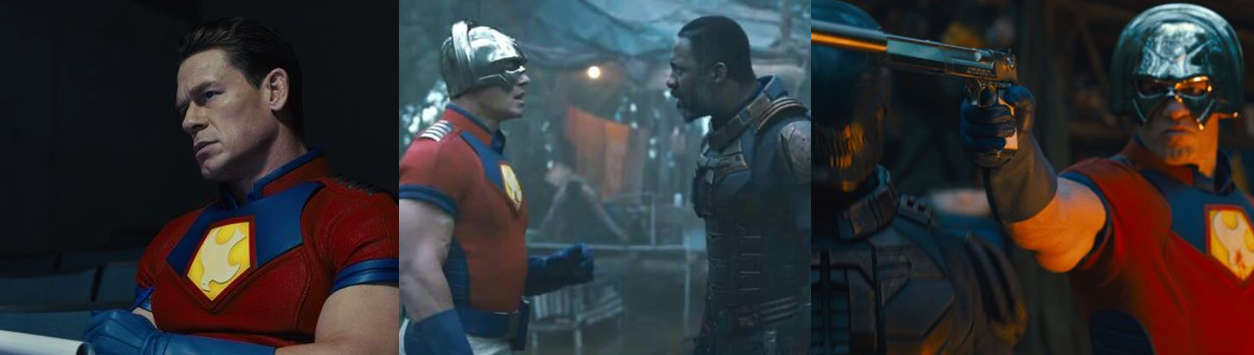
Peacemaker loves peace so much that he’s willing to kill for it!

Bloodsport not only immediately clashes with Waller when she threatens his daughter to coerce him into leading her new Suicide Squad, he also forms a fast rivalry with Peacemaker; another character I’m not too familiar with, Peacemaker is a unit of man who is so obsessed with peace that he’s willing to kill anyone to attain it. A psychopath hiding behind patriotism, Peacemaker is adept with melee weapons and guns but his presence by no means makes Bloodsport redundant as their personalities and methods are entirely different. Garbed in a ludicrous comic-accurate costume and built like a brick shithouse, Peacemaker is seemingly willing to align with the team to achieve peace but continuously grates against his teammates. He and Bloodsport often engage in a silent, unstated competition to see who can kill the most people in the most flamboyant or impressive ways but he does find common ground with the team when they share a few drinks while staking out the Thinker’s favourite night club.

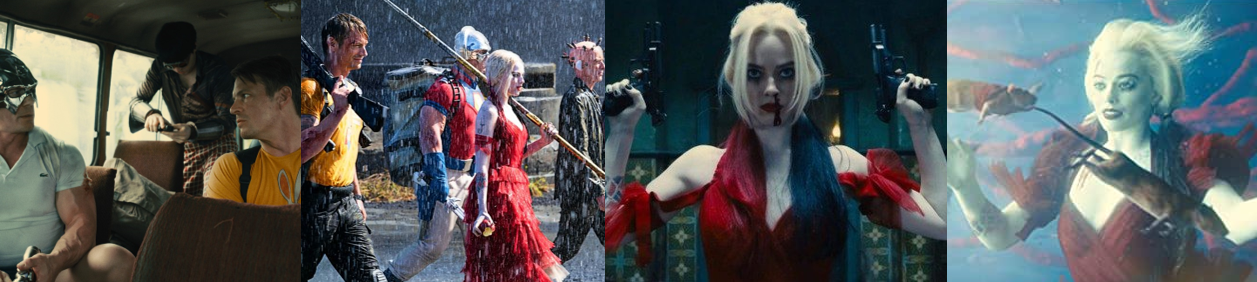
Flag is a far more amiable character this time, while Harley’s crazy has been dialled up a notch.

Returning from the last film are Rick Flag and Harley Quinn; unlike in the first film, Flag has, apparently, lost the rod up his ass and is a far more laid back and amiable character. Rather than seeing commanding Task Force X as his duty or a punishment of sorts, he treats them like friends or comrades and strikes up a camaraderie with most of them. While he also butts heads with Peacemaker, he has a former relationship with Bloodsport that allows the two to work as a more cohesive unit and, in turn, help galvanise the team of misfits into coming together in a workable strategy. Harley, by comparison, is largely the same character as before except her craziness has been dialled up somewhat. Still a bit of an odd choice for such a team, Harley proves that appearances are deceiving as her craziness makes her a formidable and unpredictable opponent who is just as likely to bust out a rocket launcher as she is to strangle a man to death with her legs during severe torture. Harley has a bit of a side story where she’s courted by President Silvio Luna (Juan Diego Botto) and provides much of the more explicit comedic moments thanks to her trademark mad-cap nature and her gunning down countless soldiers while animated flowers and birds fly around in the background.

The team is rounded about by some of DC’s most ridiculous characters.

The team is rounded out by a couple of new characters, most notably Cleo Cazo/Ratcatcher II (Melchior), Nanaue/King Shark (Stallone/Agee), and Abner Krill/Polka-Dot Man (Dastmalchian). While we learn a bit about Bloodsport and his relationship with his daughter and there’s a bit of character development for Quinn in her vow to not let men use her again, we don’t really learn too much about Peacemaker’s background and these three latter characters get quite a bit of play and have quite an impact on the film. We learn all about Ratcatcher II’s childhood, for example, and her fondness for rats (which Bloodsport is deathly afraid of); despite her lethargic attitude and borderline narcolepsy, she is also the only one of the team to actually befriend and treat King Shark like an actual person rather than a burden. King Shark looks absolutely fantastic and is characterised as a ravenous, child-like creature who is often the butt of the team’s mistreatment, though he is also responsible for some of the film’s most humorous moments. And then there’s Polka-Dot Man, a ridiculous character on paper who is given new life as a bat-shit insane psychopath who is constantly spawning and at threat from cosmic polka dots thanks to his mother’s experimentations. By the finale, his character arc becomes a tragic story of redemption, of sorts, since he begins the film literally hoping for them all to die and end sit ready to sacrifice himself to save Corto Maltese from a rampaging monster.

Waller is determined to use the Thinker to keep America’s role in Project: Starfish under wraps.

Behind the team, safe in the United States, is the ice-queen herself; Amanda Waller is just as impassive and manipulative as ever, fully prepared to use any means necessary to coerce the convicts into getting bombs implanted into their necks and heading out on a suicide mission in the hopes of shaving ten years off their sentences. Once they’re out in the field, Waller tells them only what they need to know and, the moment they go off-mission, doesn’t hesitate to remote detonate the bombs and blow their heads off. Similar to the last film, Waller’s motivations for the team’s excursion into Corto Maltese are shrouded in deception and revolve more around trying to cover up America’s part in Project Starfish rather than destroying the weapon but, this time around, her control staff are aghast at her extreme methods. Also similar to the first film is the fact that the team is battling against an army of foes rather than tackling a singular enemy head-on; the Thinker fills the roles of a secondary antagonist to a degree, being a maniacal scientist who has gleefully spent the last thirty years experimenting with Project: Starfish on humans in a variety of gruesome and reprehensible ways though, in the end, his role in the story is quite small beyond the team forcing him to get them into Jötunheim, the Nazi-era bunker where the project is based.

The Nitty-Gritty:
Like the first film, The Suicide Squad (terrible title, by the way; adding a “The” to a sequel’s title is always a red flag for me and smacks of laziness) uses music to punctuate many of its scenes. Unlike that film, though, it benefits from far better editing and pacing; where Suicide Squad was like a frenetic music video (especially in the first ten minutes or so, which bombard the viewer with so much sensory input that it’s nearly impossible to know what’s going on), The Suicide Squad is far more deliberate and conservative with its use of music and edits. The film begins in media res and then flashes back to show us how Waller’s two teams ended up being recruited and sent off to Jötunheim and, at various points, the film cuts off a dramatic reveal or moment to skip over to the other characters and show us what they’ve been up to. The film also contains a number of creative on-screen titles, presumably to make the film easier to watch when on HBO Max or simply to add to the zany nature of the film.

The Suicide Squad trumps its predecessor by upping the action, violence, and destruction.

Where The Suicide Squad really stands out from, and trumps, the last film is in its use of gore, copious swearing, violence, and explosive action. The first film felt like it was holding back by having the team battling glorified zombies but this one pulls absolutely no punches; the opening scene alone sets the tone by showing Flag lead a doomed beach-front assault that sees members of his team getting immolate, shot to pieces, and blown into bloody chunks. King Shark is responsible for many moments of bloody violent thanks to his ravenous hunger and the competition between Bloodsport and Peacemaker lead the two to murdering numerous members of the Corto Maltese rebellion. Hell, Harley gets an entire side plot where she fights, shoots, and kills her way out of Luna’s mansion and the film’s hard-hitting action scenes are punctuated by endlessly entertaining explosions, gore, and over the top violence that finally does what the first film so desperately tried to do (i.e. take what we saw in the first two Deadpool films (Miller, 2016; Leitch, 2018) and ramp it up a few notches).

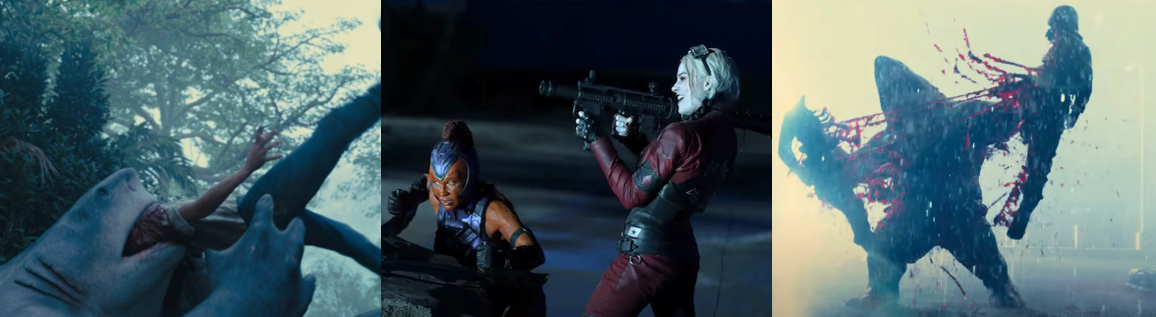
Based on the team’s nature, not every character survives, especially when Starro goes on a rampage!

Gunn packs the film with all kinds of C- to G-tier characters from DC Comics’ vast library; given free reign to use, and kill, whichever characters he wanted, no character is safe no matter how powerful they are or how established they are from the first film. This is exemplified in the gory opening but continues throughout the film as the team are constantly against the odds, and themselves, and comes to a head in the finale. I don’t think it’s really a spoiler to say that the team end up battling against Starro the Conqueror since trailers and interviews have already shown this but seeing Starro, of all things, onscreen is just…exhilarating. Reminiscent of the Stay Puft Marshmallow Man, Starro goes on a rampage through Corto Maltese, spewing out tiny Facehugger extensions of itself to instantly create an army of brainless zombies to spread its influence and oppose the Suicide Squad. Even better, Starro is presented in full daylight and looks equal parts incredible and ludicrous, which is entirely the point, of course. Still, I am a little confused as to where these Suicide Squad films feel they have to pit the team against armies of zombie-like enemies and cosmic-level threats when they’re arguably better suited to black ops missions and such but seeing the remnants of the team come together as a unit to try and take Starro down is something that appeals to the comic book, action, and Kaiju fan in me and it was massively entertaining as a finale. It’s just a shame that we’ll probably never see these characters interacting with the Justice League given the state of the DCEU.

The Summary:
While I don’t agree with the state of the DCEU, or Warner Bros. decision to funnel funds and certain actors into projects like The Suicide Squad when they should be concentrating on bringing some of their more well-known heroes and properties to life, and while I had some problems with the film’s presentation (those titles, for example, were a little distracting at times), The Suicide Squad was an absolute blast. Clearly evoking the bombastic action movies of the eighties and nineties and embracing the most ridiculous aspects of the source material, it presents its over the top characters and premise without shame or embarrassment and goes all-in with the concept of a team of disposable misfits being in over their heads. Punctuated by some amusing moments and character beats, copious amounts of gratuitous gore and violence, and a surprising amount of poignant heart and characterisation (to say nothing of a few unexpected twists along the way), The Suicide Squad more than makes up for the failings of the last film. Again, it’s just a shame that it’s so unpredictable as to whether or not these characters will actually interact with their respective heroes in the wider DCEU as I’d love to see more of them and for the DCEU to actually, properly bring all these disparate threads together but if all you’re looking for is a kick-ass action film that isn’t shy about pulling its punches then The Suicide Squad has you well covered!

My Rating:

Rating: 4 out of 5.

Great Stuff

Have you seen The Suicide Squad? If so, what did you think to it and how would you rate it compared to the first film? Which of the new characters was your favourite? Who did you think was going to die and who were you surprised to see survive? Are you a fan of the Suicide Squad concept and comics? Would you have preferred to see the villains appear elsewhere, like in a solo Batman or Flash movie or do you think it’s a good thing that the DCEU is so sporadic? Are there any villains you’d like to see included in another Suicide Squad film and are you going to be watching the Peacemaker spin-off? Whatever your thoughts about The Suicide Squad, feel free to leave a comment below.

Author’s Spotlight: Shantel Brunton Interview

Shantel Brunton, author ofTortured Innocence

1. First, introduce yourself a bit. What is your name (or pen name) and where are you from?

My name is Shantel Brunton, and I’m from Alberta, Canada. I was born and raised here and I just never left. I’m going to run the risk of quoting country songs but I’m Alberta bound.

2. Next, tell us a bit about your most recent work. Is this your first published book? What is it about and what genre would you classify it as?

My book is called Tortured Innocence. I just published it again. I relaunched it August 1st of 2020 and I initially published it back in 2017.

3. Tell us a bit about your main character; what are they like, how did they come about, and what are some of their strengths and weaknesses?

My main character, my victim, my fictional voodoo doll puppet is named Nicole. I put Nicole through hell, but she keeps on fighting. She’s got this internal fire that keeps on burning, and despite her suffering she really keeps everything together. Then there’s my villain/ anti-hero Twenty. Twenty is intelligent, dark, sadistic, cruel, kind, and confusing. I think that’s his biggest weakness is that he’s just confusing, and sometimes I don’t know what to do with him. His character has so many opposing aspects of kindness and cruelty, and it leaves people questioning is he good or bad.

4. What was your hardest scene to write in this (or any) book?

A really hard scene for me to write involves Nicole and a nasty character Kyle. I don’t want to give away spoilers.

5. Did you go the traditional route when publishing your book or did you choose to self-publish?

I self-published the book.

6. What would you say is the most difficult part of your writing journey and what advice would you give to other writers?

The most difficult part of the journey has been receiving low reviews and doing my best to separate myself from my art, and not view a low review as a personal critique on my character. My piece of advice for authors is do your best to focus on the positive and know you can’t please everyone.

7. Do you want each book to stand on its own, or are you trying to build a body of work with connections between each book?

I want to do an entire body of work for Tortured Innocence and build the dark and dreary lands of the Shadowlands. I’m talking prequels, sequels, character backstories.

8. What are some of your favourite authors and books and what inspired you to become a writer in the first place?

Some of my favourite authors… hmmm there are so many. I love the classics like Dracula, and pretty much everything Edgar Allan Poe wrote. I had some Young Adult books that really inspired me such as Speak by Laurie Halse Anderson, Some Girls Are by Courtney Summers, and Cut by Patricia McCormick. The book Cut was the one that really inspired me to get into writing, because I saw in the back of the book an ad for a novel writing contest, and I thought “I can write a novel”.

9. What would you say has been the best way to market your books?

Instagram has been fantastic for marketing my book.

10. Are there any tropes, clichés, or writing styles that you dislike and, if so, what are they and why?

In terms of writing styles I don’t like, I don’t like writing where I can’t picture things. I’m not a fan of minimalistic writing and I prefer long flowing prose.

11. Do you read reviews of your book and, if so, how do you handle negative feedback?

Yes, I’ve read all my reviews. The low ones do sting, but I try to tell myself it’s a critique of a piece of work and not of me.

12. What are some of your quirks as a writer? Do you like to plot everything out or do you prefer to just “wing it” and see where the story takes you? Do you listen to music when writing and, if so, what do you listen to?

I’m obsessive about my plotting and I have to have an outline or else I get stressed and I can’t write. I listen to a lot of Aesthetic Perfection, Disturbed, Three Days Grace, and classical music such as Swan Lake when I’m writing.

13. What is the best advice you’ve ever had when it comes to writing and what advice would you give to new writers?

I think the best advice about writing is if you want to be a writer, then write. Try to write something everyday. Even if you’re extremely busy, jot down a couple of sentences. If you’re writing then you’re a writer. I would also advise new writers to be reading as much as they’re writing. There are so many good books out there and the more you read, the more you’ll improve your vocabulary and learn all kinds of techniques.

14. What’s next for you? Are you currently working on any new books or stories?

I’m working on the backstory for my villain Twenty and I’m so excited about it.

15. Finally, feel free to plug your social media, website, and links to Amazon, GoodReads, and other relevant sites below, and detail any current offers available for your book/s:

Feel free to follow me on Instagram and the book is 99cents USD for the ebook version. I’m keeping it like this most likely for the month of August.

If you’d like to be featured in an interview, please check out the interview submissions page to submit your answers.

Back Issues [Thor’s Day]: Journey into Mystery #83


In August 1962, Stan Lee, Larry Lieber, and Jack Kirby introduced readers of Marvel Comics (specifically Journey into Mystery) to Thor Odinson, God of Thunder and mightiest of the Asgardian deities. Through associations with Marvel’s premier super team, the Avengers, and a number of cosmic, mythological adventures, Thor has gone on to become another of Marvel’s most successful and versatile characters, with appearances in cartoons, videogames, and a number of incredibly profitable live-action movies. Being as it’s the first Thursday (or “Thor’s Day”) of the month, what better way to celebrate the God of Thunder than to take a look back at his debut appearance!


Story Title: Thor the Mighty! and the Stone Men from Saturn! (also comprised of “Part 2: The Power of Thor!” and Part 3: Thor the Mighty Strikes Back!”)
Published: August 1962
Writers: Stan Lee, Larry Lieber, and Jack Kirby
Artist: Jack Kirby

The Background:
Following the creation of Doctor Bruce Banner/The Incredible Hulk, legendary Marvel writer, editor, and creator Stan Lee was inspired by Norse mythology and legends to create an even more powerful superheroic character, one who was more than human…a literal God among men! In collaboration with Larry Lieber and the renowned Jack Kirby, Lee crafted a version of the character quite different from those that had appeared before, one who debuted in Journey into Mystery and effectively took over that title until eventually replacing it with a self-titled comic in 1970. Thor would go on to become a founding member of Marvel’s premier super team, the Avengers, and his stories became increasingly elaborate and over the top, with the character undergoing numerous changes throughout the years whilst also taking on more of the mythological aspects of his inspiration. Adopting flamboyant, archaic speech patterns and wielding the indestructible, all-powerful, magical hammer Mjölnir, I’ve always enjoyed Thor’s aesthetic and unique qualities and he’s one of my favourite characters in the Marvel Cinematic Universe but his comics can be a little impenetrable for me due to their dense and complex nature.

The Review:
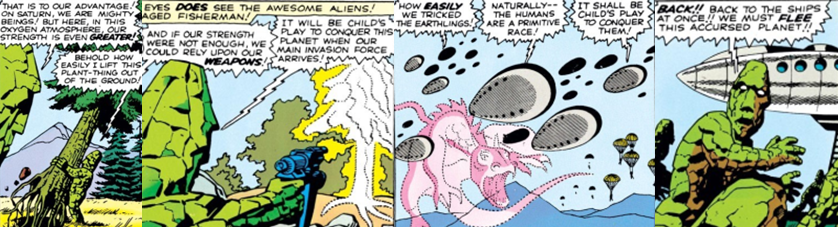
“Thor the Mighty! and the Stone Men from Saturn!” introduces us to Doctor Donald Blake, a frail and lame figure who walks with a cane and is vacationing in Norway at exactly the same time as the titular Stone Men from Saturn arrive on Earth. Like Clark Kent/Superman, the Stone Men find that Earth’s vastly different atmosphere affords them incredible superhuman strength in addition to the relative invulnerability of their stone bodies. As if that wasn’t enough, the Stone Men are also packing advanced weaponry that can vaporise objects in a flash of light, as witnessed by a stunned old man. Though the aged fisherman’s stories of stone creatures from outer space are met with ridicule and mockery by the local villagers, it catches the attention of the curious Blake, who heads out to the coastal region to investigate and soon stumbles upon the Stone Men! Unfortunately, Blake steps on a twig and gives away his presence and, thanks to his unexplained lame leg and losing his walking stick after a trip, has no hope of escaping from the aliens.

Blake discovers an enchanted cane and is imbued with the power of the mighty Thor!

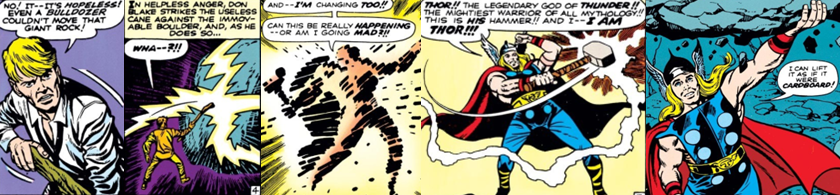
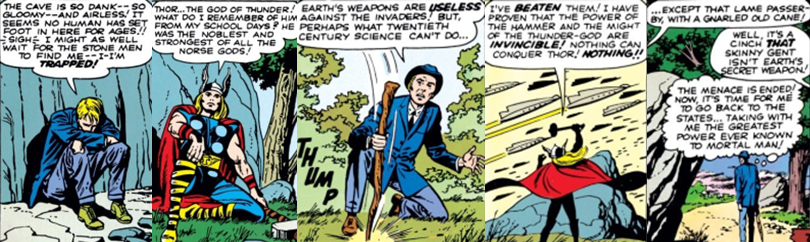
Blake finds refuge in a nearby cave but is disheartened to find that it’s a literal dead end; trapped, he begins to despair but is awestruck when a hidden stone wall suddenly opens and leads him to a secret chamber that houses a “gnarled wooden stick”. Ever the innovator, Blake attempts to use the cane as a lever but is unsuccessful and, in helpless anger, strikes the cane against the boulder which blocks his only viable exit. In a flash of blinding light, Blake and the cane are magically transformed into a heavily muscular, elaborately garbed form and an enchanted hammer, respectively. Overwhelmed by the power courses through his body, the figure observes the hammer’s iconic inscription (“Whosoever holds this hammer, if he be worthy, shall possess the power of… Thor”) and quickly realises that the hammer is Mjölnir, the weapon of the mythological God of Thunder, and that he is now Thor!

Much time is spent explaining Thor’s powers in a way that interrupts what little plot there is.

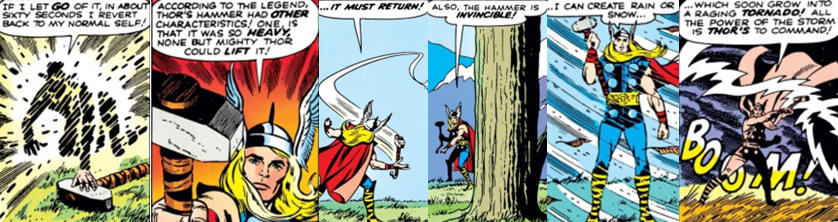
Now possessing the power of a God, Thor easily lifts the boulder that was blocking his exit and, now safe and free from his prison, ponders the mystery of his newfound power. You’ll notice that, when he’s Thor, Blake retains his speech patterns and personality rather than switching places with the Norse God or having his personality fundamentally altered by the transformation; it’s basically a Billy Batson/Shazam situation where he magically transforms but retains his personality. Using what little he knows of Thor from Norse mythology, Thor walks us through the “rules” of the character’s early days: Blake transforms into Thor when he touches the hammer but, if he is separated from it for more than sixty seconds, he magically reverts back to Blake. In addition, Mjölnir is magically enchanted so that only he can wield it, it always returns to his hand after being thrown, and is functionally indestructible. Finally, by stamping the hammer on the ground twice, Thor can conjure storms or rain or snow and whip up a raging tornado, all of which can be dispelled with three hits of the hammer on the ground.

Despite the Stone Men’s threat, they are absolutely no match for Thor, who bests them with ease!

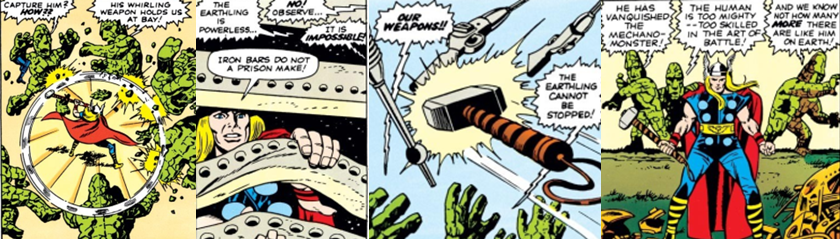
Before Blake can warn the world of the presence of the Stone Men, the aliens unleash a “three-dimensional picture” (basically a holographic projection) of a fearsome dragon to scare off incoming armed aircraft and shield themselves and their ship from reprisals and attacks with their advanced forcefield. Blake observes this with horror and, resolved to oppose the invading alien forces, he showcases one of his most iconic abilities: by swinging around Mjölnir as fast as possible, he can fly through the air and cover vast distances by hurling the hammer but holding on to the handle. It’s not quite flying and not quite the Hulk’s massive leaps but it’s something unique that no other hero can replicate. Astounded by Thor’s abilities, the Stone Men attempt to capture him but Thor is easily able to fend them off, break free of their prison, and use Mjölnir to disarm the aliens. In response, the Stone Men unleash their “Mechano-Monster”, a robot enforcer of theirs that is immediately and anti-climatically smashed to junk with one swing of Thor’s hammer. This is enough to scare off the Stone Men, who immediately flee alongside their entire fleet to avoid having to battle Thor and, possibly, more like him. The issue ends with the military dumbfounded as to what drove off the alien invaders and Blake resolving to head back to the United States with his newfound power.

The Summary:
“Thor the Mighty! and the Stone Men from Saturn!” is an absolutely bat-shit crazy story; much like the Hulk’s debut, Thor’s first appearance isn’t a typical superhero story, being more a tale of random alien invasion that just so happens to feature a guy stumbling upon a magical weapon. The Stone Men get a lot of time in the comic but we’re not really told much about them; they simply arrive as a superior alien force and prepare to use their advanced weaponry and augmented physical abilities to dominate the planet.

The Stone Men seem to be a formidable threat but are easily scared off by Thor’s power.

Yet, despite how formidable they seem to be, they’re actually some of the most ineffectual villains I’ve ever seen; they utilise holographic technology and laser weapons and have an entire fleet of ships ready to attack but they’re no match for Mjölnir, Thor tears through their weapons like they’re paper, and their ace in the hole, the Mechano-Monster is an absolute joke. Of course, the Stone Men would later be retconned into the Kronans and one of their race, Korg, would become an important ally of the Hulk many years later.

We don’t learn much about Blake but he’s morally pure enough to put Thor’s power to good use.

Perhaps because of the presence of the aliens, we don’t really get to learn anything about Donald Blake; it’s not said what kind of doctor he is, why he chose Norway for his vacation, or what caused his lame leg. All we really learn about him is that he appreciates the beauty and ambiance of Norway and that he’s curious enough to investigate the claims of aliens nearby. When he’s on the run and hiding from the Stone Men, Blake fall into despair and is all but ready to accept what he sees as his inevitable death until he stumbles upon the power of Thor. Once he becomes Thor, he immediately proves why the hammer deemed him so worthy as he leaps into action to oppose the aliens but, again, we don’t really get a sense of why Blake is so morally inclined towards using his awesome power for the benefit of mankind. Obviously, as with many debuts of superheroes, much of Thor’s backstory and motivation would be revealed in time but, even with that in mind, “Thor the Mighty! and the Stone Men from Saturn!” is surprisingly light on characterisation for its debuting protagonist; even Tony Stark/Iron Man got a brief mention of his carefree ways before his life-changing transformation but Blake, instead, is a bit of a blank slate compared to Lee’s previous heroes.

My Rating:

Rating: 1 out of 5.

Terrible

What are your thoughts on Thor’s debut appearance? Do you like that Marvel constantly tried to mix up all their new superheroes and characters with vastly different origins and backstories? What did you think to the Stone Men and the pacing of the story? What is your favourite character, arc, or era in Thor’s long publication history and where does Thor rank for you against Marvel’s other superheroes? How are you celebrating Thor’s debut this month, if at all? I’d love to hear your thoughts on Thor in the comments below so be sure to drop a line down there.

Game Corner [Spidey Month]: Spider-Man: The Video Game (Arcade)


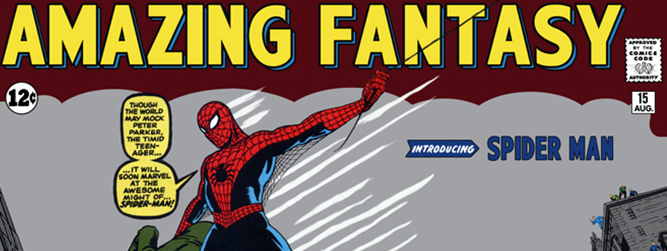
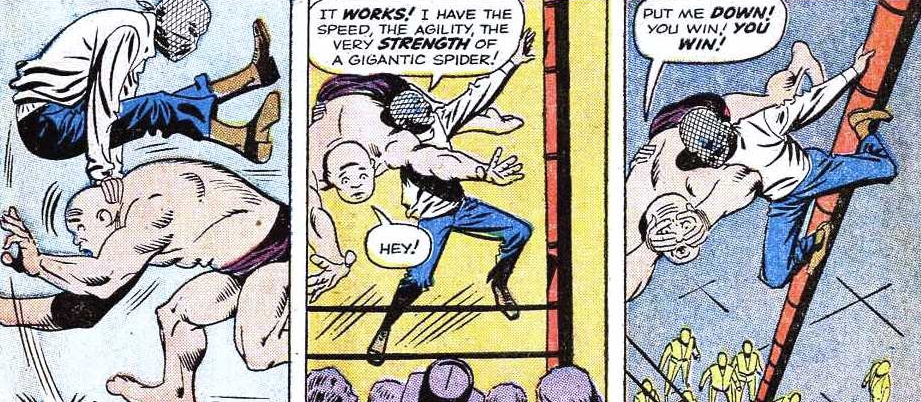
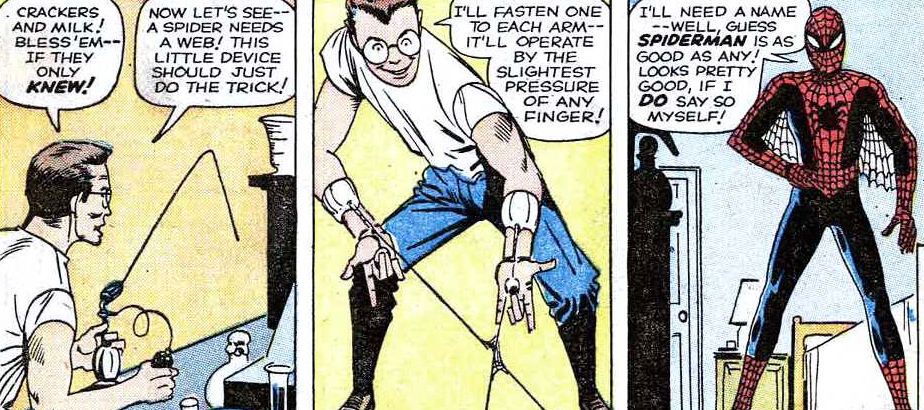
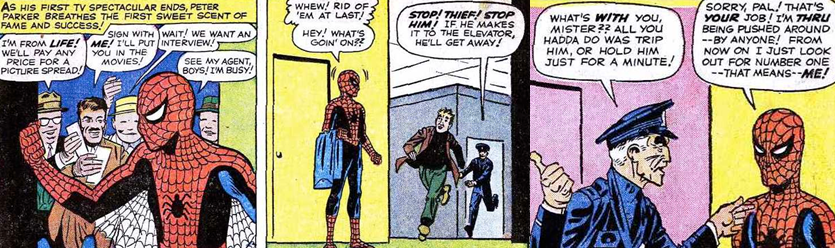
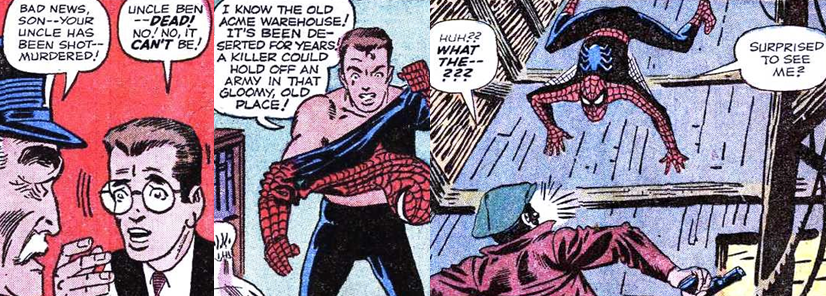
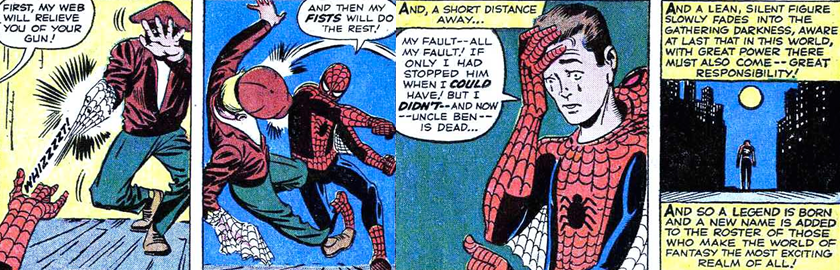
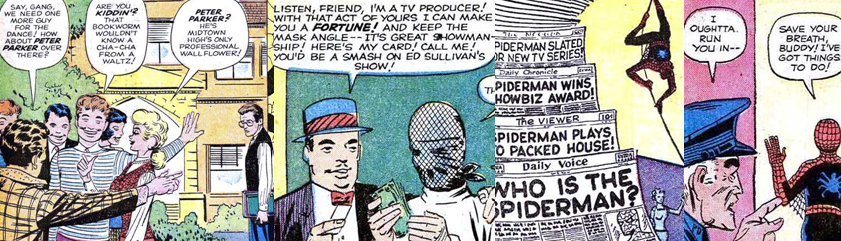
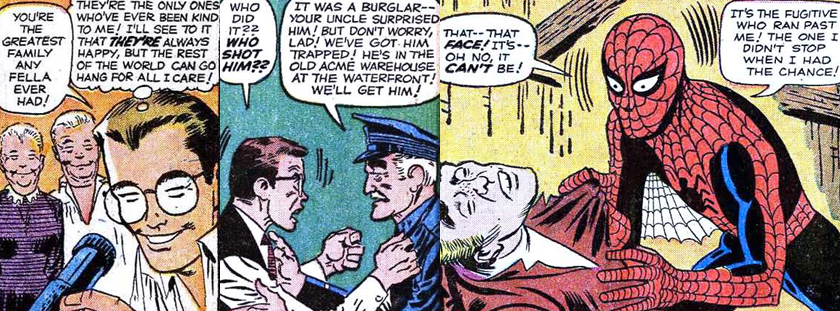
Easily Marvel Comics’ most recognisable and popular superhero, unsuspecting teenage nerd Peter Parker was first bitten by a radioactive spider and learned the true meaning of power and responsibility in Amazing Fantasy #15, which was first published in August 1962. Since then, the Amazing Spider-Man has featured in numerous cartoons, live-action movies, videogames, action figures, and countless comic book titles and, in celebration of his debut and his very own day of celebration, I’ve been dedicating every Wednesday to talk about everyone’s favourite web-head!


Released: 1991
Developer: SEGA

The Background:
Having achieved success with the creation of the Fantastic Four, Marvel Comics editor and head writer, the immortal Stan Lee, was searching for another title to match the success of Marvel’s first family. Inspired by a spider climbing up a wall, influenced by pulp vigilante the Spider, eager to capitalise on the surge in teenage demand for comic books, and working alongside artist Steve Ditko, Lee conceived of Spider-Man and was granted permission to feature the teenage superhero in the final issue of Amazing Fantasy. Marvel publisher Martin Goodman was shocked to find that Amazing Fantasy #15 was one of the publication’s highest-selling comics and a solo Spider-Man series soon followed, with Spidey quickly becoming Marvel’s most popular comic book character. Since then, Spider-Man has seen success in numerous other media; in 1967, he featured in a self-titled animated series, he famously appeared as a guest character on The Electric Company (1971 to 1977) and starred in his own live-action series in 1978, and heavily influenced my childhood through the fantastic Spider-Man cartoon (1994 to 1998) before eventually featuring in a number of live-action films. Furthermore, Spider-Man has also featured in numerous videogames, the first of which was the aggravating Spider-Man (Parker Brothers, 1982) for the Atari 2600. Before debuting in arcades, the majority of Spidey’s videogame efforts were sidescrolling action/platformers but this was the early nineties and button-mashing beat-‘em-ups were all the rage thanks to titles like Double Dragon (Technōs Japan, 1987), Final Fight (Capcom, 1989), and The Simpsons (Konami, 1991) so Spidey’s arcade debut naturally came in the form of a sidescrolling beat-‘em-up.

The Plot:
Wilson Fisk, the Kingpin of Crime in New York City, has sent his minions out into the city to retrieve a mystical artefact and only Spider-Man and his allies (Prince Namor McKenzie/The Sub-Mariner, Clint Barton/Hawkeye, and Felicia Hardy/Black Cat) can hope to defeat some of Spidey’s most powerful and iconic villains and oppose the Kingpin’s plans for domination.

Gameplay:
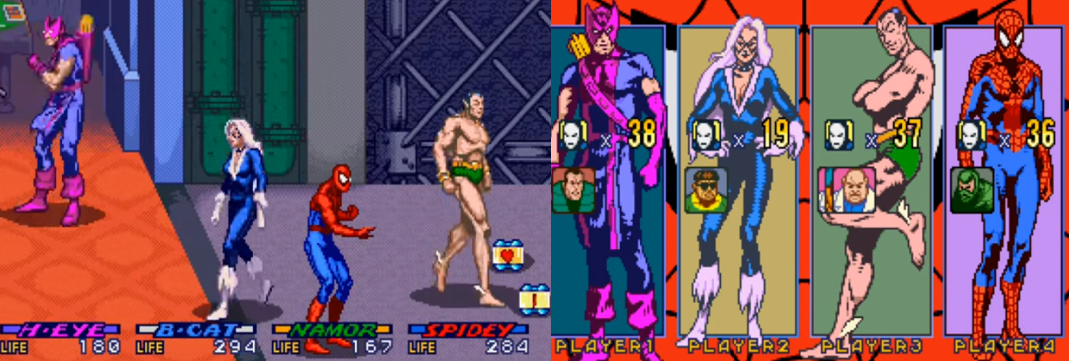
Spider-Man: The Video Game is a fairly standard sidescrolling beat-‘em-up in which players can pick from one of four characters (Spider-Man (obviously), Sub-Mariner, Hawkeye, and Black Cat) and make their way from the left side of the screen to the right beating up wave-upon-wave of nameless thugs. The game allows any player to select any character and allows for up to four players to play simultaneously, which is always an appreciated feature of such titles.

Each character is sluggish and gameplay is shaken up by some ugly platforming sections.

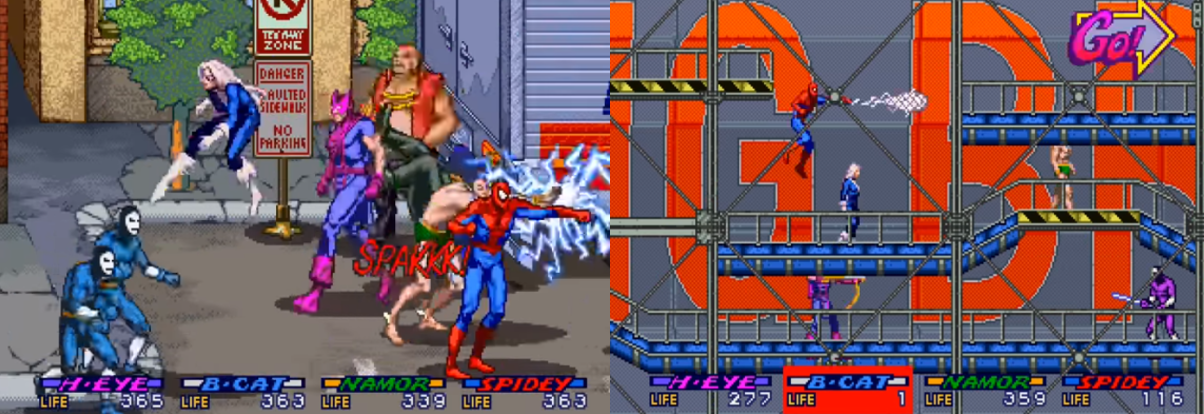
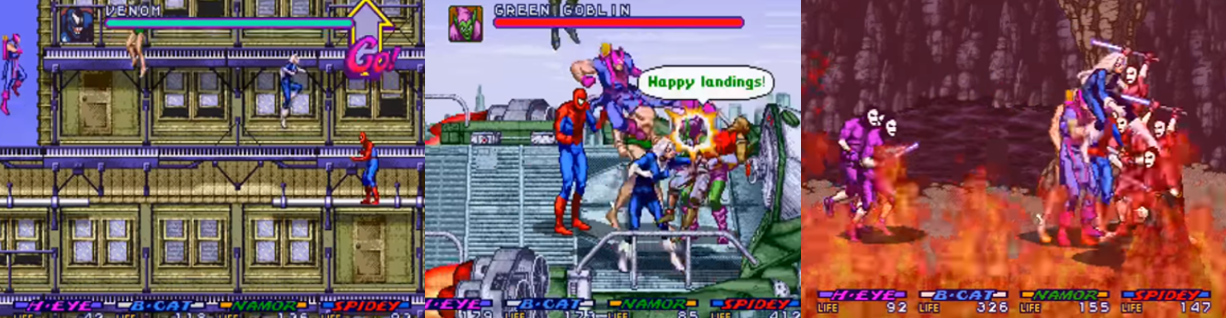
Upon selecting your character, you’re dropped into the streets of New York and quickly learn that the game is quite limited in terms of the moves available to you. Each character controls in exactly the same way, with a few subtle differences: Spidey and Black Cat can swing from webs/lines to attack enemies (if you can pull off the attack, which kind of requires a very specific combination of jumping and attacking) and each has a slightly different jumping attack (Namor dives fist-first down into enemies, for example) and melee attacks (Black Cat is much more about the fancy kicks than Hawkeye). While you can perform a signature special attack (shooting webs or arrows, for example) at the cost of some health points, each character is just as sluggish and apathetic as the next thanks to a lack of a dash function. However, after beating up a few thugs and taking out a sub-boss, the game suddenly shifts to an entirely different perspective; the camera zooms out and the game becomes more of an action/platformer as your character must scale a vertical and horizontal map taking out more goons as they go. In this zoomed out mode, your characters are no longer able to perform melee attacks and must rely on their projectile attacks: Spidey shoots webs, Hawkeye shoots arrows, Black Cat attacks with a grapple hook, and Namor….shoots lightning…? Spidey and Black Cat can also scale and climb walls to navigate these areas faster and Hawkeye and Namor can hang on to overhead platforms to shoot at enemies but it’s a bit weird that you’re not given full access to each character’s abilities in this mode.

Your health drains constantly and players are rated after each stage.

Unlike many videogames and beat-‘em-ups, inserting coins not only allows you to continue from death but also boosts your health, which is represented by a series of numbers under your character’s name. Your health numbers also double as a time limit as they’re constantly ticking down and this is quite a unique and clever way to get kids to waste their hard-earned pocket money as, while you can find health (in the form of hearts) strewn around the game’s stages at various points, you’ll quickly be pummelled into submission by the game’s enemies and forced to drop more coins to pump up your health and continue on a little further. Sadly, in a marketplace crowded by fantastic beat-‘em-ups, Spider-Man: The Video game fails to stand out in a lot of ways; you can attack and destroy parts of the environment but there’s not much motivation to do this as there are no weapons to find and use and no items to pick up to increase your score. Your score isn’t even displayed onscreen as you play, for God’s sake, which is really unusual, despite the fact that your progress is rated at the end of each stage. Instead, the game’s primary selling point appears to be exclusively the Spider-Man brand and the odd inclusion of action/platforming sections.

Graphics and Sound:
For the most part, Spider-Man: The Video Game looks serviceable enough; sprites are large and colourful but, like the backgrounds, are a little lacking in variety and detail. None of the playable characters have an idle animation, which lets the game down somewhat, and Spider-Man, especially, just looks bored and depressed as he plods around at a sluggish speed. When the game zooms out for its platforming sections, sprites take on a largely pixelated appearance but the backgrounds become much bigger and more detailed. Stages initially seem quite short as you come up against your first sub-boss in almost no time at all and, after defeating them, you’re tasked with climbing up to the rooftops of New York’s skyscrapers and the stages really open up.

Platforming sections expand the game, with “Latvelia” being the most visually interesting.

As you attack enemies, and are attacked, big comic book-style sound effects appear onscreen (as is pretty standard for comic book beat-‘em-ups) but I found sprites go a bit transparent when they pass over other sprites and graphics (though this could be due to emulation issues rather than a flaw of the title itself). The game does feature some limited voice acting but, despite featuring a female voice (who just loves to cry out “Spider-Man!” every time you insert a coin), no female voice work accompanies Black Cat. This isn’t necessarily a bad thing as the male voice acting is the same for every character and hardly of a high standard and when you realise that Namor and Black Cat’s attacks are accompanied by some really weird sound effects that make them sound like they’re drowning or a robot, respectively. As you might expect, comic book-style cutscenes tell the game’s story; these take the form of still images with some accompanying text (though these don’t change depending on your character and mostly just feature Spidey by himself) and in-game cutscenes with some fitting word balloons. Finally, while the game’s stages are fairly standard (the streets, the rooftops, flying through the skies, construction sites and the like), they don’t really stand out much until you crash-land into the hellscape of “Latvelia” and the game suddenly busts out some decent fire effects. Finally, the game’s music, while interesting and serviceable enough, doesn’t really feel very unique to the Spider-Man brand or compared to other beat-‘em-ups.

Enemies and Bosses:
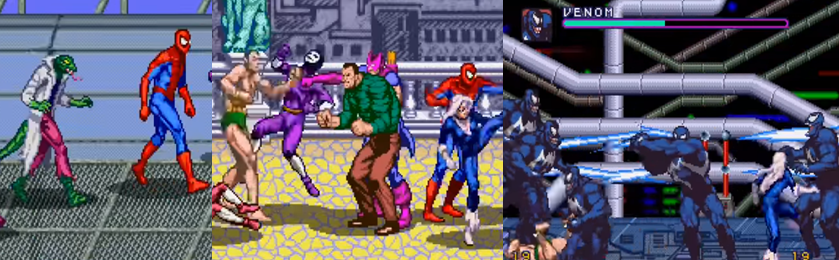
The majority of the enemies you’ll encounter throughout your journey are literally nameless, faceless goons; weird kabuki-mask-wearing, purple-spandex-clad thugs are the order of the day here but they are soon joined by such cliché beat-‘em-up enemies as martial artists (who can duck your attacks), rotund enemies (who can belly flop you), and robots (which shoot projectiles). Spider-Man: The Video Game honestly doesn’t have much going for it in terms of enemy variety; you’ll fight the same enemies over and over and only encounter some weird and memorable foes with you reach “Latvelia” and encounter some weird ape-like monstrosities. However, Spider-Man: The Video Game is absolutely loaded with some of Spidey’s most iconic villains; after only a couple of minutes into the first stage, you’ll encounter Mac Gargan/Scorpion and, just as you’re getting into that fight, a massive containment unit opens up and Eddie Brock/Venom emerges.

You’ll face Spidey’s most iconic foes while swarms of enemies pile in on the action!

Although Scorpion soon runs off after a few hits, you’ll have to endure a handicap situation for a while as enemies spawn in, Venom teleports around the arena and chokes you with their goo, and Scorpion attacks you relentlessly. Once you whittle down Venom’s health, they use a mysterious artefact to grow to monstrous size and you’ll have to chase them to the rooftops for another encounter. This becomes the basic set-up for the majority of the game’s sub-bosses and bosses; you’ll fight them at one point and then have to give chase and battle them again in a slightly different situation after navigating the game’s zoomed out sections. You’ll battle Dr. Curt Connors/The Lizard (who has a nasty tendency to chomp down on your crotch), Flint Marko/Sandman, and Venom in a pretty standard beat-‘em-up format where you’ll be confined to an arena and have to fend off waves of additional enemies. Each boss reappears for a rematch later in the game but the strategy remains largely the same; keep your distance and land attacks while dispatching their support and things only really get hairy when Venom spawns a bunch of symbiote clones to fight alongside them!

While Kingpin is a marginal threat, Electro and Doc Ock really get the shaft!

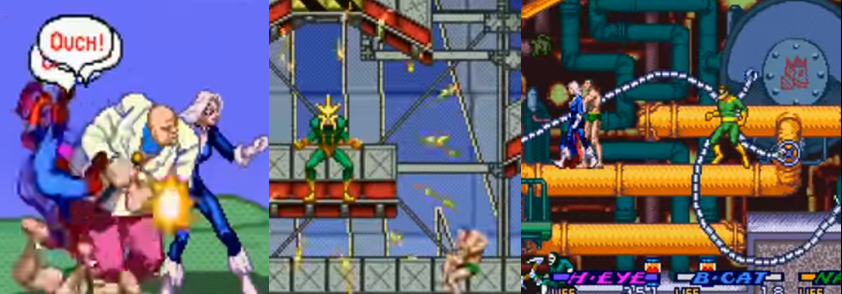
Boss battles are mixed up a bit when you take on Norman Osborn/Green Goblin and Jason Macendale/Hobgoblin; while you’ll battle the Green Goblin on the ground, dodging his weird glowing hand attack, these two bosses stand out by taking to their iconic gliders and rushing at you from the air while tossing pumpkin bombs at you. These can be troublesome encounters as it’s difficult to judge where the Goblins are positioned to land your attacks or to successfully hit them with your jump attacks. Plus, when you battle Hobgoblin, you’re limited to your zoom-out attacks and will have to blast him with your projectiles and destroy large cannons to make things easier. You’ll also do battle with the Kingpin in a standard beat-‘em-up encounter; Kingpin’s attacks are limited to headbutts, swipes, and a shoulder barge, making him little more than an inconvenience than a formidable boss fight even in his second phase. Still, at least he actually gets a proper boss fight; Max Dillon/Electro and perhaps Spidey’s most famous foe, Dr. Otto Octavius/Doctor Octopus are relegated to mere semi-sub-bosses who randomly appear as you’re navigating the game’s later platform stages and they’re little more than a joke as you can easily damage boost through their attacks and pummel them into submission.

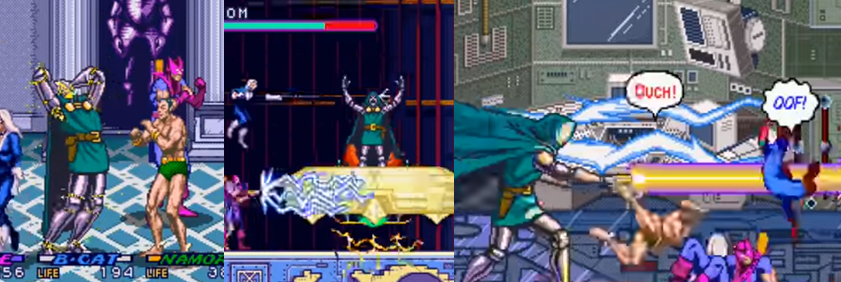
Doctor Doom is the game’s final boss and takes numerous forms.

After defeating the Kingpin, though, Dr. Victor Von Doom/Doctor Doom randomly appears to claim the mysterious artefact and reveal himself to be the game’s true big bad. When you reach Doom’s Castle, you’ll have to dodge mines and battle through the game’s previous sub-bosses and bosses to confront Doctor Doom…only to find you’ve battled a Doombot all along! However, when you finally do get your hands on the real Doctor Doom, the fight is still little more than a standard affair once you take out Doom’s nifty floating battle craft: Doom is fast and slippery but doesn’t attack with magical bolts until the final confrontation and even then he’s not much more of a threat than the likes of the Sandman or the Lizard.

Power-Ups and Bonuses:
As mentioned, there’s pretty much nothing on offer to spice up your gameplay in Spider-Man: The Video Game. You can’t pick up and use weapons or power-ups and the only thing for you to pick up is hearts to increase your health, making gameplay decidedly more repetitive and monotonous compared to other beat-‘em-ups.

Additional Features:
Again, there’s basically nothing here (as is pretty much the standard for most arcade games). However, the fact that you can select any character to play as and play with up to four players, each who accumulate their own separate score at the end of each stage, does add some replay value (if you have friends to play with, of course…)

The Summary:
Spider-Man: The Video Game is a decent enough beat-‘em-up; it’s bright and colourful and includes all of Spider-Man’s most iconic villains but it doesn’t really offer a whole hell of a lot when it comes to gameplay or variety. Beat-‘em-ups are generally quite monotonous as a rule but they usually compensate for this with kick-ass music, detailed sprites, and some cool weapons and super moves; Spider-Man: The Video Game has none of these attributes, meaning it’s a step behind other arcade titles released at the same time and even ones released years prior. The game’s unique selling point of having action/platforming sections incorporated into the usual beat-‘em-up formula is interesting but its execution is flawed thanks to the graphics taking a hit. Throw in an odd assortment of playable characters (I get why Black Cat is there but why are Namor and Hawkeye here?), some repetitive boss battles, and disappointing use of some of Spidey’s more visually striking foes and you have a gameplay experience that is fun enough (and probably better alongside friends) but hardly worth choosing over the likes of Final Fight or even Double Dragon. Put it this way: X-Men (Konami, 1992) released the very next year and is everything Spider-Man: The Video Game wishes it could be; hell, even Captain America and the Avengers (Data East, 1991) offers more in terms of gameplay variety and character abilities despite being graphically less impressive and that’s really saying something.

My Rating:

Rating: 2 out of 5.

Could Be Better

Did you ever play Spider-Man: The Video Game out in the wild? Which character did you pick, or get lumbered with, and which did you think was the best or the worst? What did you think of the game’s unique incorporation of platforming elements and the way it handled Spidey’s villains? Which characters do you think would have been more suitable to play in place of Namor and Hawkeye? Which Spider-Man videogame, or arcade beat-’em-up, is your favourite? Whatever you think, feel free to drop a comment below and be sure to check out my other Spider-Man content.

Author’s Spotlight: Tortured Innocence

Author: Shantel Brunton
Genre: Horror/Thriller
Publication Date: 1 August 2021
Pages: 366

Available As: Paperback and e-book


The Synopsis:
Nicole faced a horrific tragedy at a young age. Ten years later, everything seems to be okay. She is happy with her life and she feels content. This quickly begins to change when she receives disturbing letters that appear from nowhere and voices haunt her waking thoughts. The voices say the most disturbing things. Her nightmares feel more and more real. She has no idea why this is happening to her.

What is lurking in the shadows? Maybe the better question is who?

The Review:
Tortured Innocence is the debut novel of Shantel Brunton; interestingly, the book actually first released in 2017 but, after learning more about writing and marketing, Shantel has revisited the text and re-released it with a new cover and to a wider audience.

Tortured Innocence is written from the first-person perspective of its main character, Nicole (or “Nikki”), a young girl who witnessed a traumatic event as a child and has a strong bond with her father. Growing up idolising him and mostly alone, she suffers from both a bit of social anxiety around others her age, terribly explicit nightmares (which begin to bleed into her waking life), and comes to hear voices that taunt her at every turn.

The book is very much like reading an unending nightmare of various different complexities and layers. Shantel makes a point to warn readers beforehand (both in the book and on social media) of the book’s explicit content and make no mistake, there is a great deal of uncomfortable imagery and situations in Tortured Innocence. These elements of the book really made me think of the Hellraiser film series (Various, 1987 to present); the use of knifes, whips, bondage, and imagery of flayed skin and Shantel’s vivid descriptions of blood and suffering conjured this imagery to my mind and it was intriguing seeing how unrelenting these sections of the book are.

Personally, I don’t have a problem with this; Shantel is scarily good at describing the ghastly torture and abuse that Nicole comes to endure throughout her tumultuous life but, for those easily triggered by scene imagery, it may be better to exercise some caution before starting Tortured Innocence. Others who had lived through similar trauma, however, maybe find that they connect with the book on a deeper, more emotional level; Shantel’s themes of loss, torture, abuse, and mistreatment are potent and near constant and assault Nicole (and, by extension, the reader) in a barrage that she is forced to endure.

Tortured Innocence has a bit of a disjointed flow and pace but this actually factors into the book’s overall, surprisingly surreal conclusion. Despite the isolation and trauma of her childhood, Nicole is a relatively normal young girl at the start of the book who continually becomes targeted by more and more reprehensible individuals seeking to use and abuse her. Add to that the semi-supernatural elements of the story, which taunt and haunt Nicole with words and nightmares of great loss and torture, and the book ends up taking numerous unexpected twists and turns.

“Unpredictable” is actually a perfect way to describe Tortured Innocence; every time I thought I had a handle of where the story would go, Shantel throws a sharp turn into the macabre or the bizarre before finally embracing that latter thread with the introduction of her own, unique supernatural entities, the “Mecrathin”, and the surreal, nightmarish nature of their ways and world. This was an intriguing twist, one that turns a lot of the book’s previous direction and not only ups the ante of the book’s explicit content but also serves as a significant turning point for Nicole as a main character and a woman.

Startling and unrelenting in its escalating, grisly content and subject matter, Tortured Innocence is a hell of a debut for Shantel Brunton and positions her as one of the more macabre-minded independent authors I follow. I never knew what to expect from the book as I read it and it felt as though there was never a safe moment to stop and process what was going on, which is a great reflection of the chaotic and horrific events that the main character has to endure. It may be a difficult, almost traumatising read for some but I do think it has a strong underlying message of perseverance through harrowing events and maintaining the fortitude to stand up to that adversity wherever possible.

My Rating:

Rating: 3 out of 5.

Pretty Good

If you’re interested in checking out Tortured Innocence, the book is available to purchase on Amazon. To learn more about Shantel Brunton and her journey as an author, visit the links at the top of this review.

Movie Night [Brightest Day]: Green Lantern: Extended Cut


In 2014, the 2nd of February was dubbed “Green Lantern Day” because, by the American calendar, the date read as “2814”, the space sector assigned to Earth in DC Comics. While the significance of this date has passed as the years have changed, it seems like a great excuse to celebrate DC Comics’ green-garbed intergalactic police corps but, sadly, the date clashes with another important anniversary so, this year, I’m switching it to today, the 2nd of August, instead since this would have been 2/8/14 back then as well.


Released: 14 October 2011
Originally Released: 17 June 2011
Director: Martin Campbell
Distributor: Warner Bros. Pictures
Budget: $200 million
Stars: Ryan Reynolds, Blake Lively, Mark Strong, Peter Sarsgaard, and Clancy Brown

The Plot:
When test pilot Hal Jordan (Reynolds) is bequeathed a powerful ring that can make his thoughts reality, he becomes a member of the Green Lantern Corps, a vast organisation of intergalactic lawmen. However, Hal’s will is tested when Parallax (Brown), a malevolent entity and the embodiment of fear, is awakened and threatens the safety of not just Earth but the entire universe!

The Background:
The Green Lantern character first appeared in All-American Publications’ (a precursor of DC Comics) All-American Comics #16 in July 1940. Then, the pseudonym was the alter-ego of Alan Scott but, in 1959, DC Comics editor Julius Schwartz enlisted writer John Broome and artist Gil Kane to reinvent the character as Hal Jordan and, in the process, create countless other Green Lanterns in the establishment of an intergalactic police force. Production of a live-action adaptation of the character can be traced back to 1997 and, at one point, Jack Black was set to start in what sounds like would have been an absolutely dreadful action/comedy take on the character. With the Marvel Cinematic Universe (MCU) impressing at the box office with its first phase of movies, Warner Bros. made significant strides towards a Green Lantern film with a script heavily influenced by the seminal “Secret Origin” (Johns, et al, 2008) story arc, and director Martin Campbell and star Ryan Reynolds locked in to bring to life the daunting, effects-heavy superhero sci-fi. Unfortunately, Green Lantern proved to be a critical and commercial failure; the movie made just under $220 million at the box office and reviews were scathing, scuppering Warner’s hopes for a sequel and delaying the start of their own cinematic universe. As much as I am a fan of Reynolds, I can’t say that I was too impressed with how much he has bad-mouthed this film (which really isn’t as bad as people think) in the years since its release, especially after he was well into honouring the legacy and influence of the role during production.

The Review:
When we’re first introduced to Hal in the modern day, he’s a far cry from the straight-laced, serious space cop of the comic books; perhaps thanks to having Reynolds in the role, Hal is a womanising, snarky, and arrogant test pilot who drives a muscle car, frequently shows up late to work, and generally shirks responsibility at every opportunity. The only time he takes any situation serious is when he’s sat in a cockpit, where he’s all business and undeniably the best test pilot on the Ferris payroll but his attitude leaves a lot to be desired. It’s interesting that the filmmakers chose to make these changes and portray Hal as a far more immature and flawed character; it works for his overall story arc as he has to grow into his role as a superhero and learn the usual, cliché lessons about responsibility and duty and gives Hal a snarky edge that makes for the film’s more comedic moments but it’s difficult to believe that this version of Hall will ever grow into the Corps’ most revered soldier.

Hal’s cavalier attitude makes him a great test pilot but causes friction with those around him.

Hal’s attitude stems, largely, from the trauma of experiencing the death of his father, Martin (Jon Tenney), who died during a test flight right before Hal’s eyes when Hal was just a kid. Having witnessed the most distressing and harrowing event possible, Hal has grown up entirely fearless; he never worries about his safety, takes unnecessary risks, doesn’t let anything or anyone get to him, and doesn’t believe in a no-win situation. This, naturally, doesn’t sit well with his friends, family, co-workers, or superiors, who all believe that Hal has a death wish and is being unreasonably irresponsible with his life. Despite this, he has a close relationship with his nephew, Jason (Dylan James), and there are clearly unresolved issues between him and childhood friend, co-pilot, and boss Carol Ferris (Lively).

Carol believes in and is attracted to Hal but cannot sanction his lackadaisical attitude.

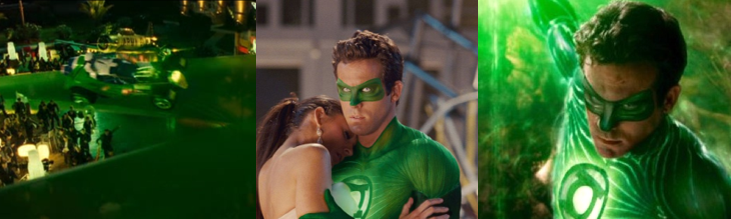
Hal believes that Carol has lost her way somewhat since she has, largely, traded the cockpit for a desk, though Carol asserts that she’s simply grown up and accepted her responsibilities. She cares for Hal and is clearly still attracted to him but despairs of his lackadaisical and cavalier attitude; she just wants him to grow up a bit and to be responsible for once in his life rather than coasting along on his admittedly impressive abilities. In a refreshing change of pace, she immediately sees through his rudimentary disguise as Green Lantern (even comment on the ridiculousness of such an ineffective mask) and accepts and supports his newfound superhero life. Indeed, she urges him that the power and responsibility of the ring isn’t something that he can just walk away from and encourages him to actually try and live up to his potential for a change. Far more than just an achingly gorgeous face, Carol actually helps Hal out when Parallax comes to Earth and isn’t afraid to speak her mind, making her more than a match for his trademark snark.

Hal is subjected to harsh training and criticism from the likes of Sinestro.

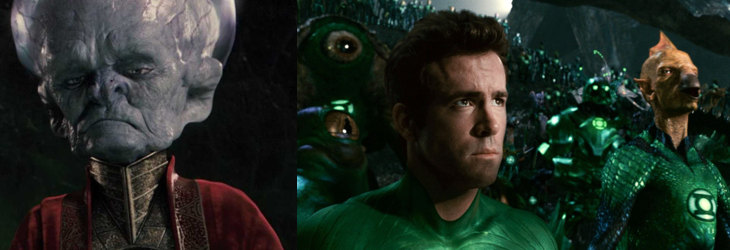
However, while Hal describes himself as a “screw up” and even his friend, Thomas Kalmaku (Taika Waititi) believes him to be an asshole, he doesn’t hesitate to pull Abin Sur (Temuera Morrison) from his crashed spacecraft, does everything he can to keep him alive, and is genuinely distraught when Abin dies in his arms (he even takes the time to bury Abin’s body after he dies). Confused and overwhelmed at the alien and the strange ring now in his possession, Hal is equally blown away when the ring transports him to Oa and garbs him in the uniform of the Green Lantern Corps; however, Hal adjusts to these alien sights and concepts with an awe-struck bewilderment and struggles to come to grips with his ring’s capabilities and the focusing of his willpower. On Oa, Hal is greeted by Tomar-Re (Geoffrey Rush), who introduces him to the planet and briefs him on the basics of the Green Lantern Corps. Hal’s training is very much a crash course and, honestly, should have taken up a greater deal of the film’s focus and screen time as Hal is put through a tough and uncompromising boot camp at the hands of Kilowog (Michael Clarke Duncan). Almost immediately, before Hal even has a chance to master the basics of ring-slinging, Thaal Sinestro (Strong) interrupts to put Hal through his paces; a being of immense pride and a much-respected member of the Corps, Sinestro was Abin’s friend and former protégé and regards Hal as a disappointment to his mentor’s legacy. Sinestro’s opinion is only fuelled by the fact that Hal is (somehow…) the first ever human being to become a Green Lantern but, truthfully, his focus and mentality comes more from his overwhelming militant mindset. Sinestro believes, to his very core, in the power and authority of the Guardians and the Corps and devotes himself entirely to their cause, rallying his fellow Green Lanterns in a unified, if futile, effort to oppose Parallax and maintain the sanctity of their intergalactic police force.

Hector, already a troubled scientist, is driven to maniacal insanity by Parallax’s influence.

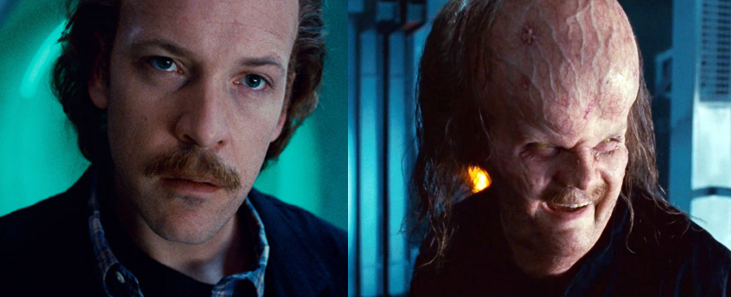
As if that wasn’t bad enough, Hal also faces significant threats at home in the form of his childhood friend Doctor Hector Hammond (Sarsgaard); sadly, Hector isn’t that threatening or impressive as a villain and is more like a quirky, disassociated, unhinged child in a man’s body. Hector resents Hal’s cocky attitude, rugged good looks, and relationship with Carol, harbours unrequited feelings of his own for Carol, and is constantly trying to please his father, Robert (Tim Robbins), a United States senator who Hector feels is constantly disappointed and embarrassed by him. Hector believes his genius and ability are finally being acknowledged when he is hand-picked by Doctor Amanda Waller (Angela Bassett) to perform the autopsy on Abin’s body and is enraged when he finds out that his father arranged it; having been possessed by exposure to Parallax’s yellow fear energy, Hammond slowly develops mental abilities and degenerates into a hideous, hunchback like creature, his inner bitterness and ugliness reflected in his warped and transformed exterior. However, given the larger threat of Parallax and the fact that we briefly see how big and limitless the universe is, Hector isn’t much of a threat and is easily bested by Hal with the simplest of deceptions. Not that Parallax himself fairs much better; rather than the giant, intergalactic space bug and the embodiment of fear, Parallax is, instead, a fallen Guardian as the filmmakers merged elements of Parallax and the dark Guardian Krona (which, to be fair, I feel does work in the context of the film and simplifies the story somewhat). Sadly, because the Guardians look so damn goofy, Parallax doesn’t look all that intimidating and just appears to be a big, angry-looking, cartoony head and that’s when we can actually see him since, for the most part, he takes the form of an ethereal, destructive cloud and, if there’s anything experience has told us, it’s that clouds are never scary or intimidating.

The Nitty-Gritty:
The extended version of the film only adds about ten minutes to the film’s run time but the majority of this is used to further develop Hal’s childhood and his relationship with his friends and family. Indeed, the extended version includes an entirely new opening sequence that shows more of Hal, Carol, and Hector’s childhood and the bond between Hal and his father, and his nephew. It’s not much extra footage but it does help to flesh Hal’s character out a little bit more and to build up an understanding of why he is the way he is.

Green Lantern‘s abundance of CGI makes the film resemble a cartoon more often than not.

Of course, one of the major problems with Green Lantern is the quality of the special effects; given the concept is quite unique and necessitates a great deal of work to render not just the Green Lantern’s constructs but also the various worlds and aliens that make up the Green Lantern Corps, and the universe, a great deal of special effects are necessary for a film such as this. Unfortunately, many of the film’s CGI just doesn’t work and is flawed; Parallax and the Guardians, especially, look pretty terrible, to say nothing of Kilowog, Tomar-Re, and, yes, the Green Lantern suits themselves. Personally, I think the idea to render them full in CGI was a really good idea (…on paper) given their otherworldly make up and the fact that they’re generated from the ring and the problem isn’t so much that the suits don’t look good (though they, like a lot of the CGI, do appear disturbingly cartoony) it’s that Hal’s mask looks so damn goofy. This is a shame because Green Lantern does a pretty decent job at adapting the concept and bringing to life such an abstract and near-limitless superhero. As I mentioned, the idea of the suit works really well and Oa, especially, looks pretty good; however, while I like that it’s teeming with life and various alien races, it’s very…busy and kind of looks like a mess of conflicting colours and dodgy CGI. Such shots are contrasted by how good the film’s more practical effects are; the scene where Hal and Carol out-pace automated aircraft is an exhilarating sequence and the make-up effects used to bring Sinestro and Abin Sur to life are top-notch (hell, even Hector looks suitably horrific when he mutates into little more than a hunchbacked man-monster). It’s almost as if the filmmakers should have veered more towards practical effects, maybe even employing the use of traditional puppets and animatronics for the Guardians and Kilowog, and use the CGI sparingly rather than rendering 90% of the film in a mess of computer effects.

Hal eventually comes to accept the responsibility of the ring and grows into his heroic role.

A central theme of the film is Hal’s inability to live up to the expectations placed upon him and to accept responsibility. On Earth, this makes him a highly skilled but unreliable test pilot; when on Oa, it leads to him walking away from the Green Lantern Corps after what feels like maybe an hour, tops, of training. He takes Sinestro’s criticisms regarding him (and the human race) to heart and uses his condemnation as the perfect excuse to reject the destiny placed upon him by Abin Sur; however, for some reason, he is allowed to retain possession of the ring and, reluctantly, becomes a superhero back on Earth. This is directly paralleled with Hector’s own arc as he struggles to live up to his father’s expectations and gives in to the hate, fear, and power of Parallax’s influence; fuelled by his negative emotions, he forces Hal into acting with the ring’s power and, thus, into a heroic role that he, eventually, willingly assumes in order to defend the Earth from Parallax.

Despite Hal’s victory, Sinestro switches to the yellow ring for an unresolved cliffhanger.

Parallax, while an unimposing and disappointing villain compared to both his comic book counterpart and other villains of superhero films, is certainly built up to be an intimidating threat. His ability to induce fear and then suck the life out of his victims is certainly unique and his power only grows as he absorbs the lifeforce of others. While the Green Lanterns are notoriously supposed to be entirely without fear, it’s clear that the Guardians fear Parallax’s power; indeed, they are reluctant to send their corps against Parallax out of fear for their lives and they only divulge Parallax’s true origins to Sinestro after he pleads with them for the knowledge to oppose his power. While Sinestro comes to believe that the only way to defeat Parallax is with fear itself (forging a yellow ring in the process), he eventually saves Hal after his battle and defeat of the creature in the finale and, despite having witnessed that the green light of willpower is powerful enough to overcome even the embodiment of fear, decides to switch to a yellow power ring in, perhaps, one of the most tantalising mid-credits scenes in all of cinema.

The Summary:
Green Lantern is a perfectly fine and action-packed science-fiction spectacle; it’s full of humour and big special effects and has a really strong cast, with Mark Strong, especially, standing out as a perfect choice for Hal’s mentor and rival, Sinestro. I think the main problem with Green Lantern, though, is that it isn’t really sure what it wants to be; it’s not a sci-fi epic as a disappointing amount of the film is set on Earth, and the time spent on Earth is nowhere near as interesting as the potential of space and the Green Lantern Corps. When I saw Green Lantern, it was a month or so after seeing Thor (Branagh, 2011), a film that did a much better job of balancing its cosmic, otherworldly elements in a grounded and relatable way and I think that’s the problem with Green Lantern: it’s too confused about its disparate elements and I can’t help but feel a more elaborate approach in the vein of Guardians of the Galaxy (Gunn, 2014) and Serenity (Whedon, 2005) would be a far more fitting direction if we ever see the Green Lantern Corps in live-action again. Personally, though, it’s not as bad as people make it out to be and there’s plenty here that’s worth keeping around (Mark Strong, for one) and it really wouldn’t have taken much to fold this film into the existing DC Extended Universe at one point but, ultimately, it’s just a shame that we never got a sequel to improve upon the film’s high (and low) points beyond the tie-in videogame and that the film failed to properly live up to the potential of the concept.

My Rating:

Rating: 3 out of 5.

Pretty Good

What did you think to Green Lantern? Were you a fan of the movie when it first released or did you warm to it over time? What did you think to Reynolds in the title role and who would you prefer to see take up the mantle at some point? Were you a fan of the film’s overuse of CGI? What did you think to the animated suit and depiction of Parallax? Would you have liked to see where a sequel would have taken the story or do you think a full reboot is the way to go? Which Green Lantern character, villain, or story is your favourite and why? How are you celebrating this pseudo-Green Lantern day today? Whatever you think about Green Lantern, and the Green Lantern comics books, feel free to leave a comment below.

Back Issues [Spider-Man Day]: Amazing Fantasy #15


Easily Marvel Comics’ most recognisable and popular superhero, unsuspecting teenage nerd Peter Parker was first bitten by a radioactive spider and learned the true meaning of power and responsibility in Amazing Fantasy #15, which was first published in August 1962. Since then, the Amazing Spider-Man has featured in numerous cartoons, live-action movies, videogames, action figures, and countless comic book titles and, in celebration of his debut and his very own day of celebration, I’ll be dedicating every Wednesday of August to talk about everyone’s favourite web-head!


Story Title: Spider-Man!
Published: August 1962
Writer: Stan Lee
Artist: Steve Ditko

The Background:
The year was 1962 and Marvel Comics had seen incredible success with the Fantastic Four; wishing to capitalise on this, Marvel editor and head writer Stan Lee wanted to create a teenaged superhero for his younger readers to identify with. After being inspired by a fly climbing his office wall, Lee experimented with different insect names before settling on Spider-Man (eventually placing emphasis on the hyphen to avoid associations with Clark Kent/Superman) and, after being dissatisfied with Jack Kirby’s interpretation of his new young superhero, Lee turned to artist Steve Ditko to finalise Spider-Man’s costume and accessories.

Spider-Man was an incredible success and has gone on to become a mainstream pop culture icon.

Stan Lee purposely set out to make Spider-Man a troubled young teenager rather than a flawless character or the sidekick to an older hero, one who was constantly struggling with relatable issues such as money, love, and the health of his family. Despite the success of the Fantastic Four, Stan Lee also still needed the approval of Marvel publisher Martin Goodman, who disliked the character and the concept and only allowed Lee to feature Spider-Man in Amazing Fantasy as the comic was scheduled to be cancelled with its fifteenth issue. Despite this, Amazing Fantasy #15 proved to be one of the company’s best selling titles and the character’s popularity led to him not only getting his own solo title, The Amazing Spider-Man, in 1963 barely a year after his debut but also catapulting Spider-Man into mainstream popularity that endures to this day.

The Review:
“Spider-Man!” immediately begins with Stan Lee’s peerless narration setting up just how different the concept is and the art delivers on this promise by introducing us to Peter Parker, a bespectacled teenager who is the subject of much abuse and ridicule from his peers who ostracise him and see him as nothing more than a bookworm and a wallflower.

Peter has a loving home life and excels in his studies but is relentlessly teased at school.

Peter lives with his aged and doting Uncle Ben and Aunt May, who shower him with love and affection, and excels in his studies, particularly in science (which his aunt and uncle actively encourage), but is incredibly shy and awkward around his fellow students. When he ineptly attempts to ask Sally out, she rudely rebuffs him and his efforts to impress her, and the others, with an invitation to a science exhibit are drowned out by the braying taunting and arrogance of Flash Thompson, the most popular guy in school.

The dying radioactive spider bites Peter’s hand and he immediately feels its effects.

Though upset at the mockery of his classmates, Peter joins a number of other attendees in witnessing a demonstration of the latest in cutting edge atomic science, specifically the mysterious power of radioactive rays. As the head scientist begins the experiment, though, an unassuming spider, unseen and unnoticed by all, is bathed in a full blast of radiation and, with its dying breath, bites the back of Peter’s hand and immediately sends him a bit queasy (to the mockery of those in attendance because it’s not just teenagers who take the piss out of poor old Peter!)

Peter is startled to discover he has all the strength and abilities of a spider!

Distracted by the sudden charge of energy that flows through his body, Peter narrowly avoids being run down in the street but leaping up a nearby building! Astounded, Peter finds he can cling to the wall as easily as…well, a spider…and that he can crush a steel pipe as though it were mere paper! As if that wasn’t enough, he suddenly has superhuman dexterity and balance, which allows him to easily and fearlessly traverse a cable as effortlessly as a spider would crawl along a web.

Proto-Spidey easily overpowers and humiliates Crusher Hogan.

Excited at his newfound powers, Peter does the first thing anyone would in this situation and throws on a makeshift disguise to test his abilities in the ring against Crusher Hogan (and earn a cushy $100 in the process). Though initially dismissive of the proto-Spider-Man’s slight physical stature, Hogan is almost immediately left flustered and humbled when Peter effortlessly dodges his attack, hoists him up, and holds him precariously over the ring.

Peter puts his skills to use creating a spider-themed costume and accessories.

After the match, as Peter is counting his winnings, a television producer approaches him with an offer to appear on Ed Sullivan’s show. Overwhelmed at his incredible abilities and enthusiastic at appearing on television, Peter sets to work designing a colourful costume for himself; it’s not made clear why he choose red and black/blue but it certainly makes for a colourful, striking appearance. As if Peter’s sewing skills weren’t impressive enough, he also uses his scientific aptitude to construct a pair of mechanical web-shooters so that he can fire off webs just like a spider. Honestly, as much as I like Peter’s practical web-shooters, I always felt like the organic web-shooters made much more sense rather than him being “imparted” with the knowledge of how to make his own web-shooters because…you know, he gets a spider’s strength, speed, agility, well-clinging, and a version of their multiple eyes with the spider-sense but he can’t naturally produce webs?

Spider-Man revels in his newfound fame and refuses to stop a thief from escaping.

Anyway, Spider-Man makes his big television debut, wowing the audience with his many abilities; he becomes an immediate headline sensation and is suddenly inundated with offers for interviews, photo shoots, and even movies (imagine that!) However, as he is making his way back to the changing room, a security guard is in the process of chasing down a thief; Spider-Man allows the thief to escape unhindered to the elevator, rightfully but crucially stating that it’s not his job to stop criminals since he’s a performer, not a cop!

Peter is horrified to find his uncle dead and angrily confronts the man responsible.

Peter revels in his newfound fame but, one fateful evening (not that same evening, it’s interesting to note), he returns home to be told the news that his beloved Uncle Ben has been shot and killed by a house burglar! Overcome with grief and a burning desire for revenge, Peter races to his bedroom and pulls on his Spider-Man costume to confront the burglar after the cops tell him (Peter) where he’s holed up. Thanks to his web-slinging abilities, Spider-Man easily crosses town to reach the warehouse where the thief is hiding out and gets the drop on him.

Peter learns a harsh and humbling lesson to use his great powers selflessly.

Of course, Spider-Man is easily able to corner the thief, disable his gun with his webs, and knock him out with one right hook. However, Peter is devastated when he sees the face of his uncle’s killer and recognises him as the same thief he refused to stop a few days earlier! Peter leaves the thief in the custody of the police and wanders off into the night, distraught with grief and guilt at his selfish ways and learning, as the narrator sombrely informs us, the harsh lesson that “With great power there must also come — great responsibility!”

The Summary:
“Spider-Man!” is a brilliant, almost timeless tale; of course, it’s obviously full of allusions and references to the time period it was created in but none of these elements really overwhelm the general pace, direction, and themes of the story. Spider-Man was the first superhero to be a normal, everyday, awkward teenager; shunned by his peers for being a bookworm, he’s far outside of the popular social circle yet, though he’s clearly affected and upset by the teasing he constantly endures, he never falls into angst or despair and, instead, revels in the love and affection his adoring aunt and uncle constantly show him.

After years of being bullied for being a wallflower, Peter revels in his newfound fame.

Upon being granted his amazing spider abilities, Peter is immediately fascinated and excited and jumps at the chance to flex his newfound muscles in the ring. Finally, after years of persecution for being a wallflower, he has the power to topple even large, muscular wrestlers like Crusher Hogan and quickly becomes a television sensation. It’s clear that Peter is both overwhelmed and enthusiastic by the fame (and, presumably, brief fortune) his celebrity status brings him; there’s a sense that all these opportunists and media moguls are simply using Spider-Man and taking advantage of him but Peter is too distracted by the applause and adulation to even care.

Spidey’s dramatic origin is easily one of the most iconic and memorable in all of comics.

So overcome by this admiration and fame is Peter that his selfish actions cause him to make one fateful error in letting a seemingly harmless thief escape punishment and, of course, pays for it when that same thief kills his beloved Uncle Ben. The sight of Peter staring at the face of his uncle’s killer and realising that he (Peter) could have easily stopped him is a haunting and enduring image, as is the valuable life lesson that would go on to not only define Spider-Man’s superhero career but also become largely synonymous with the character. This origin, one born out of pure, unadulterated grief, is perhaps second only to the traumatic murder of Thomas and Martha Wayne in its significance, iconography, and impact on both the character and the comics and subsequent media he appeared in and ensures that Spider-Man’s dramatic debut is both memorable and relatable since Peter’s actions, though selfish, were completely understandable and natural. He didn’t get his powers and immediately become a crimefighter; he used them for fortune and glory and who among us can say we wouldn’t do the same?

My Rating:

Rating: 4 out of 5.

Great Stuff

What are your thoughts on Spider-Man’s iconic debut? Were you a fan of the character at the time or were you introduced to him through some other means and, if so, what were they? How would you rank Spider-Man’s traumatic origin story and how important would you say it is to the character and the comics industry as a whole? What is your favourite Spider-Man storyline, costume, or character and why? Do you prefer mechanical or organic web-shooters? Why do you think Peter chose red and black/blue for his costume? How are you celebrating Spider-Man Day today? Whatever your thoughts on Spider-Man, leave a comment below and be sure to stick around for Spider-Man Month starting this Wednesday!

Movie Night: Total Recall

Released: 1 June 1990
Director: Paul Verhoeven
Distributor: TriStar Pictures
Budget: $50 to 60 million
Stars: Arnold Schwarzenegger, Rachel Ticotin, Sharon Stone, Michael Ironside, and Ronny Cox

The Plot:
Construction worker Douglas Quaid (Schwarzenegger) pays for memories of a trip to Mars and awakens to find himself caught up in an interplanetary conspiracy.

The Background:
Total Recall began life as We Can Remember It for You Wholesale, a short story written by renowned science-fiction writer Philip K. Dick and first published in 1966. The story told of a man, obsessed with Mars, who finds that he actually has hidden memories of being a secret agent on the Red Planet and an adaptation of the story, first drafted by Alien (Scott, 1979) writers Dan O’Bannon and Ronald Shusett, languished in development hell for many years. The adaptation passed through many drafts and the hands of the likes of Dino De Laurentis and David Cronenberg before Schwarzenegger, who had been aware of the project and lobbied for a starring role, convinced Carolco to buy the film rights and personally recruited Paul Verhoeven to direct. Total Recall was one of the most expensive films ever produced at the time of release, with much of its enormous budget needed for the copious special effects; practical filmmaking techniques such as animatronics, miniatures, and lavish, futuristic sets brought the world to life and created numerous challenges for the filmmakers. After being frustrated with the initial lacklustre trailers, Schwarzenegger made efforts to improve the film’s marketing, which resulted in Total Recall debuting at number one at the box office upon release and grossing over $260 million. Although the film’s excessive violence drew some criticism, Total Recall was, largely, a critical success and has since been regarded favourably as one of the greatest science-fiction/action movies ever made for its frantic action, enjoyable excess, and thought-provoking themes regarding reality and identity. Considering Total Recall was one of the formative movies of my childhood, and that today is Schwarzenegger’s 74th birthday, this seems like an appropriate time to revisit the film and talk about why it’s such a classic of its genre.

The Review:
I mentioned just now that Total Recall was a massively influential film on my childhood and it’s true; it was unlike anything I’d seen at the time, with its fantastic visuals and bombastic, haunting score by Jerry Goldsmith. Many years later, I jumped at the chance to revisit the film as part of my Master’s degree to talk about its status as an adaptation. In truth, very little is actually inspired by the original short story (with the film’s first thirty minutes or so being the closest to the text) but the story’s themes of reality, identity, and paranoia are clearly evoked throughout the film, which is littered with allusions and references and minor elements that both explicitly, and subtly, tie in to Quaid’s chaotic story. When we first meet Quaid, he’s a relatively mundane character and, despite being happily married to Lori (the delectable Sharon Stone at her best), Quaid feels his life has reached something of a rut; he’s stuck in a dead-end job and distracted by dreams of Mars and a mysterious brunette, Melina (Ticotin), and a desire to be more than he is. Unable to convince Lori to move or take a trip to Mars, he is inspired by advertisements for Rekall Incorporated, a futuristic travel agency that implants personalised memories of one’s dream vacation. Despite the warnings of his friend, Harry (Robert Costanzo), that Rekall’s procedures carry a high risk of lobotomy, Quaid opts to pay the company a visit and signs up to their “ego trip”, which allows him to live out the fantasy of being a secret agent on Mars.

After visiting Rekall, Quaid is relentlessly hounded by friend and foe alike!

However, during the procedure, Quaid suddenly freaks out and starts attacking the Rekall staff; ranting and raving about Mars, Rekall spokesman Bob McClane (Ray Baker) makes the decision to subdue Quaid, partially wipe his memory, and send him on his way. However, almost immediately Quaid is attacked by Harry, who accuses him of “[blabbing] about Mars”, and is shocked to find he has a penchant for killing and action. Returning home, he is even more shocked and massively confused when Lori suddenly attacks him with a ruthless aggression and he is forced to go on the run as mysterious killers, led by Richter (Ironside), hound him at every turn.

As expected, Ronny Cox makes for a fantastically unlikeable and cruel villain.

In the process, he receives mysterious messages from people who claim to have known him on Mars and even from himself under the name Carl Hauser; Hauser’s video message informs Quaid that he’s actual a double agent who used to work for the malicious Vilos Cohaagen (Cox) but switched sides to join the resistance movement after falling in love with Melina. Cohaagen is a cruel and vindictive corporate figurehead who basically controls the Martian colony since he owns the monopoly on air, charging the colonists extortionate prices for the luxury of breathing, and the flow of “turbinium”, a mysterious Martian mineral that allows him to be an extremely powerful and influential figure. Ronny Cox is a fantastic actor and always made for a chilling, supremely confident villain; his motivations, while based on greed and power, are surprisingly complex as well since he truly valued his friendship with Hauser and is visibly enraged when he is forced to order Quaid’s death. Cox commands every scene he’s in with a subtle authority and explodes into an unmatched fury at a moment’s notice but he’s also fully capable of chewing the scenery and portraying Cohaagen as a bit of a smarmy, self-righteous dictator who doesn’t hesitate to order the deaths of countless innocent people simply to send a message to those that dare defy him.

Richter is a vindictive and ruthless mercenary with a personal vendetta against Quaid.

Cohaagen’s agent in retrieving Quiad is Richter, a ruthless mercenary with a personal vendetta against Quaid who relentlessly hunts down and tries to kill him at every turn. Richter, for all his aggression and sadistic intelligence, is merely Cohaagen’s pawn, however, and angers his boss with his attempts to kill Quaid (since Cohaagen wants him alive) and escalates events at every turn with his reckless and aggressive ways. Richter treats his assignment as a merciless crusade since he’s clearly harbouring a deep-rooted hatred of Quaid not just because Lori is actually his (as in Richter’s) wife but also stemming from unresolved and vaguely hinted events prior to the film’s beginning. A persistent and increasingly enraged individual, Richter doesn’t hesitate to gun down innocents or employ every resource at his disposal to hunt Quaid down; he also proves to be a considerable physical threat for Quaid and their final confrontation is one of the most brutal and memorable fight scenes in the movie.

Fights are bloody, dirty affairs with a near-constant risk of explosive decontamination.

Not that Total Recall is short on action or fight scenes, mind you. Quaid gets hit in the bollocks a cringe-worthy amount of times throughout the film in his numerous fist fights with Lori, who fills the role of a secondary antagonist. Though far sultrier and more manipulative than Richter, she’s still perfectly happy to engage Quaid in hand-to-hand combat and, largely, manages to hold her own. When not fighting Richter or Lori, Quaid is engaged in several massive shootouts in a variety of locations; these are made especially visceral thanks to the abundance of blood squibs and escalate once Quaid reaches Mars and the threat of explosive decontamination looms in the background of every subsequent firefight.

Aggressive and independent, Melina is more than a match, and an equal, for Quaid.

Quaid is also assisted by the literal woman of his dreams, Melina, a principal figurehead of the resistance who is initially antagonistic towards Quaid since he disappeared without a word some time ago and then reveals that he’s married. Despite this, she believes that he is crucial to their success against Cohaagen and comes to his rescue when Lori manages to subdue him; this leads to a more even fight between her and Lori that is literally over Quaid’s fate (and affections). Still, while Total Recall is an extremely macho film, Melina is able to hold her own and break out of her cliché labels (she is literally described, and “made”, to be “Brunette, athletic, sleazy and demure”) to be an extremely capable and aggressive character. Once she rescues Quaid, they basically team up for the remainder of the movie, fighting side-by-side and facing the same odds as equals.

The resistance is largely comprised of mutant colonists who despite Cohaagan’s dictatorship.

Total Recall is full of memorable and rather shifty supporting characters; each of them, even the most helpful ones, seem a little off in ways that are clearly meant to rattle both Quaid and the audience. One of the most prominent is, of course, Benny (Mel Johnson Jr), a chatty and lewd taxi driver who Quaid meets on Mars. Though he seems to be a helpful ally and proves his credentials by revealing that he’s a mutant (Cohaagen’s cheap domes caused horrific disfigurements to certain colonists), he turns out to be a traitor to the resistance, resulting in a dramatic and imposing showdown between him, Quaid, and Melina in which Benny tries to run them down in a massive Martian excavator. Other supporting characters include notable members of the resistance Tony (Dean Norris) and George (Marshall Bell); George turns out to be the conjoined brother of Kuato, the semi-psychic mutant leader of the resistance who lives on George’s stomach. Revered by the colonists and seen as a hero of the rebellion, Kuato uses his abilities to reveal to Quaid that the Martian technology he briefly glimpsed at Rekall is the key to liberating Mars. A frightening aberration, Kuato is just one of many fantastic practical animatronic effects in the film, which also includes a life-like head of Schwarzenegger for the scene where Quaid painfully removes a tracking device from his head, numerous bloodied and desecrated corpses caught between the film’s many firefights, and, of course, the film’s depiction of explosive decompression. Despite the cartoonish nature of the visual, which sees Quaid, Melina, and Cohaagen’s eyes bulge comically from their sockets, this depiction of the characters violently convulsing and suffocating to death has some basis in reality but, regardless, remains an impressive and gruesome effect thanks to the grisly animatronics.

The Nitty-Gritty:
Given that it’s set in the still-far-future of 2084, technology plays a big part in Total Recall. The world is heavily reliant upon gadgets, gizmos, and automatons of all kinds, employing robotic taxis, holograms, and space-faring technology at every turn. Security is high in this world, ensuring that weapons cannot be smuggled into the subway or across planets, and Mars has been largely colonised thanks to a series of self-sustaining domed cities. As slick and impressive as a lot of Total Recall’s futuristic tech is, though, characters still rely on traditional firearms and melee weapons for many of the action scenes (there are no laser rifles here). This allows the use of technology to stand out even more, however, leading to a fantastic scene where Quaid and Melina utilise holograms to run rings around Richter’s men and ultimately bring a breathable atmosphere to Mars using ancient alien technology.

There’s plenty of evidence to suggest that most of the film is a delusional, psychotic episode.

One of the biggest themes in the film is that of identity; Quaid is unhappy with his everyday life and the person he is and wants more out of life but is shocked to discover that his dream of action and adventure appears to be a reality and that he really has no idea of who he really is since he is missing memories of a previous life as Hauser. No one is who they say they are, with friends turning into foes on a whim and strangers turning out to be trusted allies, and these themes are first (and expertly) sold to us by McClane, who literally sells customers entirely new identities and the prospect of improving their perception of themselves. Another major theme is, of course, of reality; the film opens itself up to interpretation, featuring an ambiguous ending and inviting multiple re-watches to try and ascertain if the film’s events are real or simply a “schizoid embolism” experienced by Quaid during his trip to Rekall. There is plenty of evidence to support both theories, meaning no two viewings of the film are ever the same: McClane basically lays out the first half to the movie to Quaid at Rekall as part of his ego trip but the narrative often jumps away from Quaid’s perspective to follow Richter and/or Cohaagen, which would imply that the events we’re witnessing are actually real. However, later in the film, Quaid is visited by Doctor Edgemar (Roy Brocksmith), who relates that Quaid has suffered a paranoid episode and is stuck in a dream world of his own creation. He offers Quaid a pill that will allow him to “wake up” from his fantasy and return to reality but, at the last minute, Quaid rejects the offer as another of Cohaagen’s tricks and commits himself to opposing Cohaagen’s domination of Mars.

The film’s content, and ending, is intentionally left ambiguous and open to interpretation.

Ultimately, everything prophesised to Quaid comes to pass and the film ends with the happiest, and most unbelievable, of endings; Quaid gets the girl, kills the bad guys, and saves the entire planet, bringing a breathable atmosphere to Mars and ending the story on a white out, a popular filmmaking device used to imply a degree of ambiguity to a film’s ending. In the end, whether Total Recall is real or a dream is entirely up to your interpretation; I like to believe that it’s real, since the majority of the film is framed that way but, sometimes, it’s fun to see it all as a chaotic delusion of Quaid’s that paints him as an invincible secret agent who never needs to reload his gun (seriously, watch the film again: Quaid never reloads, he simply tosses guns away).

The Summary:
Even now, over thirty years after its release, Total Recall remains an almost timeless and undeniably classic piece of science-fiction cinema. Endlessly quotable and full of brutal fight scenes, gory shoot-outs, and some truly impressive animatronics, miniatures, and practical effects, Total Recall stands the test of time not just thanks to the meticulous attention to detail and tangibility of its special effects but its thought-provoking themes of reality and identity. Allowing for multiple interpretations and constantly throwing curveballs at the viewer, Total Recall demands several rewatches not just for the performances, action, and quotes but also to see all the subtle nuance and little details spread throughout the film that lend credibility to either perspective. Although nostalgia plays a large part in my affection for Total Recall, I’m hard pressed to deny its appeal and legacy even now, having seen the film countless times over the years. Everything about Total Recall has a slick, tangible quality to it thanks to the elaborate sets, amazingly detailed miniatures, and the abundance of gruesome practical effects that serve to punctuate every scene, making it absolutely gorgeous to look at even when Schwarzenegger is ramming a pole through some guy’s head! Even better, the film invites discussion and allows audiences to debate on whether they think it is real or a dream and, if you think the movie is a bit of a mind-bender, I would absolutely recommend reading the original short story some time since it’s one of Dick’s most interesting works.

My Rating:

Rating: 5 out of 5.

Fantastic

What are your thoughts on Total Recall? How do you interpret the film; do you believe it was real or was it all the chaotic fantasy of a lowly construction worker? What did you think to Schwarzenegger’s performance and Quaid’s rivalry with Richter? Were you impressed with the film’s special effects or do you feel they are a little outdated in today’s CGI-dominated productions? Have you ever read We Can Remember It for You Wholesale and, if so, how do you feel the film works as an adaptation and what is your favourite Philip K. Dick book or movie? Were you more a fan of the 2010 remake and would you like to see Total Recall done again, perhaps in a way that is closer to the original story? How are you celebrating Schwarzenegger’s birthday today and what is your favourite Schwarzenegger film? Whatever your thoughts, go ahead and leave a comment down below.

Back Issues: Doomsday Clock

Published: 22 November 2017 to 18 December 2019
Writer: Geoff Johns
Artist: Gary Frank

The Background:
Ever since Watchmen (Moore, et al, 1986 to 1987) proved to be a critical and commercial hit, DC Comics have attempted to milk the property to capitalise on its popularity. A film adaptation had been in the works for decades and, when it was finally produced, spawned a videogame tie-in; finally, after years of trying to convince Moore and Gibbons to return to the franchise, DC drafted in a crop of the industry’s most talented creators (against Moore’s wishes, of course) to produce a prequel series. After years of subjecting readers to the largely-awful “New 52” era, DC finally decided to relaunch and reboot their continuity with another of their trademark Crises; “DC Rebirth” not only returned a lot of characters and concepts to their pre-New 52 portrayals but also concluded with Bruce Wayne/Batman discovering Edward Blake/The Comedian’s iconic, bloodstained button in the Batcave and the first hints that Doctor Jon Osterman/Doctor Manhattan was observing the DC Universe. Doomsday Clock finally saw the worlds of Watchman and the DC Universe come together and, despite a questionable release schedule and wonky canonicity (the story took years to be told and its placement in the timeline is confusing, at best), was met with critical acclaim and even led to a solo book for the series’ popular vigilante, Rorschach.

The Plot:
So, like Watchmen, Doomsday Clock is quite a dense text with a lot of things happening all at once and a lot of lore to dissect so I’m going to expand upon my breakdown of the story as I did with that graphic novel. The story’s plot is split between different characters and complex concepts like the multiverse, perceptions of time, and public’s opinion of superheroes in the DC Universe. One of the central concerns of Doomsday Clock is the state of Watchmen’s alternate world, now firmly established as one of the many parallel worlds in the DC multiverse. Seven years after Adrian Veidt/Ozymandias dropped his genetically-engineered squid into Times Square and killed millions of people, his dreams of world peace have been dashed after Walter Kovacs/Rorschach’s journal exposing his actions was published. As a result, the United States is once again on the brink of nuclear war with Russia and, desperate to save the world once more, Veidt allies with the new Rorschach, Reggie Long (son of Malcolm Long, Kovacs’ psychiatrist from Watchmen), and two of Dr. Manhattan’s former enemies, Erika Manson/Marionette and her husband, Marcos Maez/Mime.

Tensions between the public, the government, and superheroes are fragile on Earth-0.

The group uses a refitted version of Daniel Dreiberg/Nite Owl’s (sadly, once again, entirely absent from the tale) Owlship to then follow Dr. Manhattan’s unique energy signature to the mainstream DC Universe just as their world is destroyed by nuclear war. However, life on Earth-0 isn’t exactly much better; riots and violent protests against Batman’s presence run rampant in Gotham City and the public’s perception of superheroes has soured thanks to the publication of the “Supermen Theory”, which uncomfortably pointed out that the vast majority of the world’s superheroes are white American men and suggested quite explicitly that the American government (clearly led by President Donald Trump) have manufactured their superheroes through a series of clandestine experiments and operations. The only superhero that the public and the world’s governments has any faith in is Clark Kent/Superman, who is still regarded as a worldwide icon and allowed to freely cross borders. The linchpin of the animosity towards superheroes is the outspoken and volatile Ronnie Raymond/Professor Martin Stein/Firestorm and, to compound matters, the Russian government (led by Vladimir Putin) forms their own team of metahumans to protect their borders, while Teth-Adam/Black Adam offers sanctuary to all metahumans, good and bad, in the sovereign nation of Kahndaq.

Dr. Manhattan has been manipulating and altering the DC Universe for some time.

Amidst all of this is the mystery of Dr. Manhattan himself; at the end of Watchmen, Dr. Manhattan left to create some life of his own but, instead, was drawn to the DC Universe and discovers what is referred to as the “Metaverse”. The tumultuous nature of the DC Universe, which is not only populated by a wide variety of metahumans and magic but also subject to near-annual cosmic events and reality-shifting Crises, intrigues Dr. Manhattan, who begins to experiment with altering Earth-0’s history by subtly changing events in the past. This leads to the creation of multiple, widely different timelines and realities but, no matter what Dr. Manhattan does, Superman continues to emerge as the premier superhero of this world. Haunted by a vision of Superman flying at him in a rage and once again curious at his inability to see beyond this point, Dr. Manhattan observes the turbulent events unfolding around him with a morbid interest as he awaits to see if he destroys all reality or is himself destroyed by Superman.

The Review:
In the unfortunate absence of Nite Owl and Laurie Juspeczyk/Silk Spectre, and with Kovacs dead, there’s not a lot of opportunities for the iconic characters of Watchmen to interact with the mainstream DC Universe. Indeed, Doomsday Clock is less “DC Universe Meets Watchmen” and more “Some of the Watchmen characters pop over to Earth-0 alongside characters you’ve never heard of and a new Rorschach”, which is honestly a little disappointing. Like the television show, Doomsday Clock is a sequel to Watchmen but, because of its very nature as a comic book and its integration into the larger DC canon, is actually considered to be the true follow-up to the original graphic novel. Similar to the show, though, the future is depressingly bleak for Alan Moore’s characters; Veidt’s attempt at world peace was almost immediately undone and that world is quickly destroyed early into the story, making you question what the point of all that death and drama even was.

In a bid to save his world, Veidt once again lies and manipulates others to satisfy his ego.

Veidt, however, is largely undeterred by the state of his world; though he sees a macabre irony in his elaborate plan falling apart and despairs at the world’s insistence on destroying itself, he immediately concocts another desperate plot to save the world by tracking Dr. Manhattan down and convincing him to intervene. As is his way, Veidt’s scheme involves deceit, lies, subterfuge, and his unmatched intelligence; smug as ever, Veidt easily manipulates Reggie Long into assisting him by faking that he (as in Veidt) has a tumour on his brain (and feigning remorse for his actions, which led to the death of Reggie’s parents) and has him recruit Marionette and Mime to their cause specifically because he knows that Dr. Manhattan once spared Marionette’s life in a past encounter. Upon arriving on Earth-0, Veidt attempts to recruit Lex Luthor and is met only with scorn and a surprise attack by the Comedian, whom Dr. Manhattan transported to Earth-0 moments before his death. Having read Kovacs’ journal, Batman is also less than impressed with Veidt’s actions and megalomania; Veidt, however, maintains that he did what he did in an attempt to save and unite a world on the brink of destruction and attacks his new scheme with just as much blind obsession. Thanks to a cute little clone of his lynx, Bubastis, the green lantern of Alan Scott, and the presence of another temporal anomaly, Imra Ardeen/Saturn Girl, Veidt is able to forcibly summon Dr. Manhattan, who not only refuses to help but also exposes Veidt’s lies. Veidt orchestrates a massive conflict between Superman and other metahumans in order to inspire Jon to finally intervene and, though this does result in the restoration of Earth-0, the Watchmen world, and the entire multi/metaverse, he ends up imprisoned at the conclusion of the story.

Traumatised by Veidt’s squid, Reggie comes to assume the mask and identity of Rorschach.

One of the things that disappointed me about the television show was the absence of Rorschach; I know we’re not supposed to like Rorschach but I don’t give a shit, he’s still the most interesting and compelling character in Watchmen. Although Kovacs is dead, his spirit and influence lives on in Doomsday Clock; not only was his tell-all journal instrumental in revealing Veidt’s deception, his crusade is taken up by Reggie Long, a confused and volatile young man traumatised by the effects of Veidt’s destructive squid. Like many exposed to the squid’s nightmarish psychic field, Reggie was driven to near insanity and spent a great deal of time confined to a mental hospital. There, he befriended former Minuteman Byron Lewis/Mothman, who becomes a friend and mentor to Reggie but ultimate contributes to Reggie assuming Rorschach’s mantle by purposely hiding the truth of Kovacs’ relationship with Reggie’s father.

Reggie’s crusade briefly falters, sadly removing him from the story until the finale.

Believing that Rorschach and his father were friends and that Malcolm was able to reach and help Kovacs, Reggie is initially focused on killing Veidt for his actions but is convinced to aid him when Veidt claims to be dying and remorseful for his actions. Having read truncated versions of his father’s notes and Kovacs’ journal, Reggie assumes Rorschach’s costume and mannerisms and initially goes to Batman for help and finds himself imprisoned in Arkham Asylum for his trouble. Like in Watchmen, an entire issue is dedicated into delving into Reggie’s past and psychosis but he quickly gets lost in the shuffle as more and more characters and conflicts bog down the tale, even abandoning the mask and his crusade after Veidt’s lies are exposed. Ultimately, Alfred Pennyworth and Batman are able to convince Reggie to mask up and join the fight and Reggie even chooses to spare Veidt to see him brought to justice, claiming “Rorschach is me” but, while I appreciate the presence of a Rorschach, Reggie fails to be as compelling and instrumental as the real Rorschach and I think I would have preferred it if Dr. Manhattan had undone his actions or brought Kovacs forward in time as he did with the Comedian.

Dr. Manhattan screws with the DC timeline, creating different realities and outcomes as a result.

Speaking of Dr. Manhattan, he, too, gets another entire issue dedicated to him and his journey throughout the DC Universe. It’s basically exactly the same as issue four of Watchmen, with Jon spending a lot of time on Mars, ruminating about his origins and past with Janey Slater, and recapping the events of Watchmen. Although Jon appeared to have somewhat rediscovered his humanity at the end of Watchmen, to the point where he willingly went along with Veidt’s plan and even killed Rorschach to protect it, and his desire to reconnect with humanity was a big aspect of the TV show, in Doomsday Clock he’s basically exactly the same disconnected and emotionless demigod he was in the original graphic novel. He is despondent to discover that he feels just as out of place in a world of metahumans and magic as he did amongst mortals and takes to exploring and experimenting with the DC Universe’s fragile reality to keep himself from growing bored. Dr. Manhattan’s perception of time is both the same as in Watchmen (he can see the past, present, and future simultaneously but cannot see anything past his vision of Superman rushing at him) but different. I always assumed from Watchmen that Jon could only perceive time from his lifetime since he never visits the past beyond his lifetime in Watchmen but, in Doomsday Clock, he can freely walk between the past, present, and future of the entire DC canon, including a multitude of parallel worlds. Fascinated by the metaverse and the role Superman plays in this world, he purposely messes with time, killing Clark’s parents before their time and causing Alan Scott/Green Lantern to die, thus removing the Justice Society of America (JSA) from continuity, intervening in Flashpoint (Johns, et al, 2011), and basically creating the New 52 and Rebirth continuities through his actions.

Even with the world falling into anarchy, Superman is able to inspire Dr. Manhattan to intervene.

Accordingly, Superman is a central figure in Doomsday Clock; Dr. Manhattan is curious to see whether the Man of Steel kills him for his actions or whether he (as in Jon) destroys all reality and, still vehemently refusing to even try and go against the inevitability of fate, he refuses to intervene or to help Superman when he ends up battling against a horde of metahumans. As the only superhero who maintains the trust and respect of the public and world’s governments, Superman desperately tries to keep the peace, repair relations, and to help Firestorm after he accidentally turns a bunch of people to glass. However, he ends up making things worse and escalates the tensions between the world’s governments and metahumans, leading to an all-out war. Though disgusted at Dr. Manhattan’s refusal to get involved, and his part in causing not only the events of Doomsday Clock but also the tragedies of his life, Superman is ultimately able to inspire Jon into restoring the worlds and multi/metaverse to normal through his selfless nature.

Doomsday Clock is stuffed full of characters and and cameos, more of whom derail the plot.

I mentioned before that Doomsday Clock is swamped with characters and it really is; a handful of the Watchmen characters obviously feature, including a brief appearance by the Comedian, who mainly features to try and kill Veidt for his attack on him at the beginning of Watchmen and to be a pain in the ass. Marionette and Mime, two completely original characters, feature extensively as Dr. Manhattan imbues their child with his powers in the finale to, presumably, become the Watchmen version of Superman. Additionally, a whole host of DC characters play a role in the story: Batman finally solves the puzzle of the mysterious bloodstained button but uncharacteristically chooses not to believe Reggie’s claims and has him locked up in Arkham, leaving him underequipped to intercede in the events of the story; Firestorm, here a volatile and immature character, escalates much of the tension regarding the perception of metahumans and the Supermen Theory when he is unable to control his powers; and, of course, the Joker makes an appearance but does little more than derail the main plot with an ultimately pointless side story.

Allegorical and metaphysical ruminations and canon fixes largely supplant big fight scenes.

Like Watchmen, Doomsday Clock contains an allegorical story-within-a-story, in this case the films of Carver Coleman, with whom Jon forms a strange kind of bond and how becomes his “anchor” in this new world. Carver’s hit film, The Adjournment, parallels the mystery that permeates Doomsday Clock and Jon’s own struggle against his true identity. Doomsday Clock also goes out of its way to closely emulate the art style and presentation of Watchmen but greatly overdoes its commitment to this by slavishly sticking to a rigid 3×3 panel structure. Like Watchmen, Doomsday Clock is also rather light on action and packs a whole bunch of symbolism, imagery, and references into each panel, mainly to Watchmen but also to the long and convoluted history of the DC Universe. The conclusion of the book sees the JSA returned to continuity, Clark’s parents and Alan Scott returned to life, and the restoration of the multi/metaverse but also leaves the story open ended for further continuations down the line exploring the restored Watchmen universe.

The Summary:
It seems that DC’s attempts at recapturing and revisiting Alan Moore’s seminal work are doomed to fail; just as I was unimpressed by the TV show, I can’t help but feel let down by Doomsday Clock, which is a quagmire of convoluted plot threads, self-indulgent allusions to Watchmen, and is a largely confusing and uninteresting mess. I feel like the book focuses too much on being sequel to Watchmen but it doesn’t really work since seven years have passed since the end of that book and we only spend about an issue and a half really reconnecting to Moore’s world before it’s destroyed. After that, it’s just another elaborate “Crisis” event as the few surviving Watchmen characters mingle about in the DC Universe and spend far too much time interacting with obscure characters like Johnny Thunder and Saturn Girl rather than the big guns like Batman and Diana Prince/Wonder Woman.

Dr. Manhattan’s God-like powers make him largely immune to conventional attack.

The story is framed around this epic, potentially cataclysmic battle between Superman and Dr. Manhattan, a concept that feels like a betrayal of Jon’s character as he’s largely a pacifist because of his stubborn refusal and disinterest in getting involved in the affairs of mortals. Yes, he fought crime and waged war against the Vietnamese but that was a long time ago by the present day events of Watchmen, where he was simply content to just let life play out as is preordained so, while the idea of these two titans clashing sounds good on paper, it seems like the sort of thing a child would think up while bashing action figures together. To me, Dr. Manhattan has always seemed more like Jim Corrigan/The Spectre, a being of incredible power who shapes events but only really gets involved in them when the cosmic shit is about the hit the fan, which is kind of how he ends up being in the end since we don’t really get to see him fight with Superman because the entire promise of their conflict was a big fake out. There is, however, a pretty good scene where a whole gaggle of DC’s superheroes and Green Lanterns confront Dr. Manhattan on Mars only to be easily subdued by his near-limitless powers

Sadly, there just aren’t enough interactions between the DC and Watchmen characters.

Similarly, the idea of Rorschach meeting Batman and Ozymandias meeting Lex Luthor sounds great…on paper but this isn’t the same Rorschach and, no matter how hard Reggie tries, he will never be that same character so it wouldn’t really work even if Batman didn’t just disregard him and lock him up in Arkham. Luthor is scornful towards Ozymandias and a potential team up between these two is also immediately cast aside, with Luthor mocking Veidt’s intelligence and plan as though Johns is poking fun at the very work he is so blatantly trying to homage and leech off of. The absence of Nite Owl and Silk Spectre equally hurts not just the story’s plot but also Doomsday Clock’s legitimacy as a Watchmen sequel; again, it feels less like the characters of Watchmen meeting the DC Universe and more like a handful of them dropped into the unexplainably chaotic DC Universe and struggling to make sense of it.

The attempts to recapture Watchmen‘s bleak political undertones largely fall flat.

Basically, Doomsday Clock tries and fails to emulate the unique narrative and approach that Watchmen took; Watchmen’s bleak, uncompromising and, dare I say it, adult themes don’t mesh well at all with the mainstream DC Universe and I can’t help but feel like it would have been better to supplant the Watchmen characters mid-way through the events of Moore’s book so that we could see all their recognisable and flawed heroes actually butting heads with DC’s big guns in a clash of both ideals and fists. Dr. Manhattan could have been responsible for this, manipulating events from behind the scenes to cause the two worlds to emerge, and we could have seen interesting team ups and interactions between these characters (Batman and Nite Owl and Wonder Woman and Silk Spectre spring instantly to mind) but, instead, we get this weird mess of a story that’s more concerned with turning superheroes into hated figures, destroying or leeching off of DC’s Golden Age and Watchmen’s legacy, and desperately attempting to address some of the issues with the Rebirth universe.

In the end, Doomsday Clock was just another convoluted “Crisis” event.

Ultimately, I feel like I have to recommend Doomsday Clock, though, if only to see the botch job DC makes of officially canonising Watchmen into the DC Universe. As a love letter to Watchmen, it’s not so bad; the way it evokes the imagery and atmosphere of Moore’s work is pretty astounding and the artwork is quite appealing but the problem is that, while reading it, I just felt like I’d rather be reading Watchmen or any other “Crisis” event. It’s better than the TV show, I’ll give it that, if only because it actually includes a number of recognisable Watchmen characters but it similarly fails to properly recapture the magic of Moore’s story because the characters haven’t really changed and they don’t really fit in the mainstream DC Universe. This is brought up a few times but not often enough as the story has to make way for the escalating conflict between Superman and other metahumans and its confusing ending, and I can’t help but feel like Johns dropped the ball and that Doomsday Clock failed to really live up to all the hype and potential it had.

My Rating:

Rating: 2 out of 5.

Could Be Better

Did you enjoy Doomsday Clock? Did you suffer through the comic’s long publication or did you pick up the collected edition, like I did? Were you excited to see the Watchmen characters interact and be integrated into the DC Universe and were you disappointed with how the story turned out? What did you think to the new Rorschach and Dr. Manhattan’s role in the DC Universe? Were you a fan of the interactions, characterisations, and references included in the story or do you agree that it failed to live up to its potential as a concept? Would you like to see the Watchmen characters interact with the DC Universe again in the future or do you think it’s best that it stays separate from mainstream canon? Whatever your thoughts on Doomsday Clock and Watchmen in general, drop a comment below and thanks for joining me for Watchmen Wednesday.