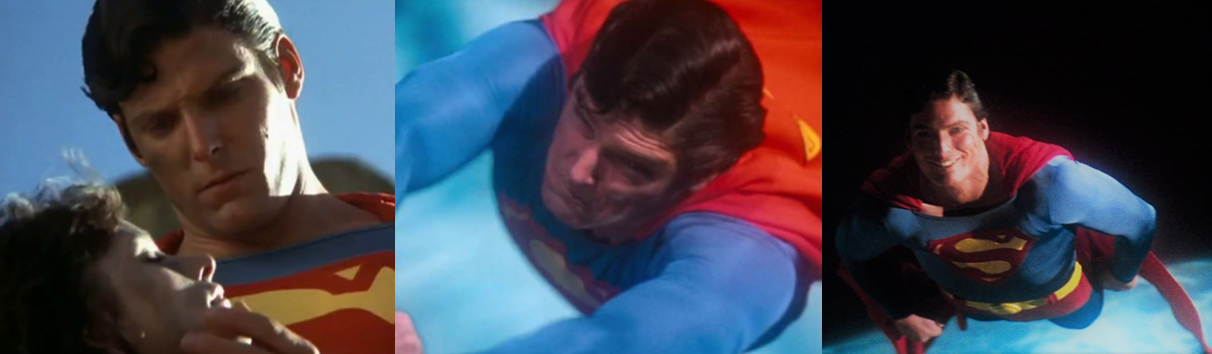
Movie Night [Superman Month]: Superman II


In 2013, DC Comics declared the 12th of June as “Superman Day”, a day for fans of the Man of Steel the world over to celebrate Clark Kent/Kal-El/Superman, the superpowered virtue of “Truth, Justice, and the American Way” who is widely regarded as the first ever costumed superhero. This year, I’m spending every Sunday of June celebrating the Man of Steel as I expand Superman Day to “Superman Month“.

Released: 9 April 1981
Director: Richard Lester
Distributor:
Warner Bros. / Columbia–EMI–Warner Distributors
Budget:
$54 million
Stars:
Christopher Reeve, Margot Kidder, Terence Stamp, Sarah Douglas, Jack O’Halloran, and Gene Hackman

The Plot:
Having thwarted Lex Luthor’s (Hackman) maniacal plans, Clark Kent/Superman (Reeve) faces a new challenge when intrepid reporter Lois Lane (Kidder) manages to deduce his secret identity. While Clark prepares to give up his incredible powers to be with Lois, General Zod (Stamp) and his two followers escape from the Phantom Zone and begin terrorising the planet, leading Clark to choose between his happiness and his responsibilities to mankind.

The Background:
As I detailed in my review of Superman (Donner, 1978), producers Ilya and Alexander Salkind and Pierre Spengler convinced Warner Bros. to produce a two-film adaptation of the character back in the late seventies. However, the production was fraught with issues, both financially and creatively; director Richard Donner frequently clashed with the producers and Richard Lester was brought in as a mediator to allow the filmmakers to focus on the first film, which was a financial and critical success. Despite having shot 75% of the sequel, Donner was replaced as director with Richard Lester, a decision that irked star Gene Hackman so much that he refused to return for the necessary reshoots. Lester shot an entirely new opening for Superman II in addition to making numerous changes to the tone of Donner’s original version to place more emphasis on slapstick silliness. Star Christopher Reeve returned to the project after negotiating a better deal with more artistic control for himself but Marlon Brando was excised completely from the film due to his unrealistic financial demands. Despite all the behind the scenes turmoil, Superman II was still a financial success; its worldwide box office gross of just over $190 million might’ve been less than its predecessor but it was still highly praised, with Stamp’s turn as Zod drawing particular acclaim. Many years later, of course, in the build-up to Superman Returns (Singer, 2008), Donner would finally return to the film to assemble a version that closely resembled his original vision of the film.

The Review:
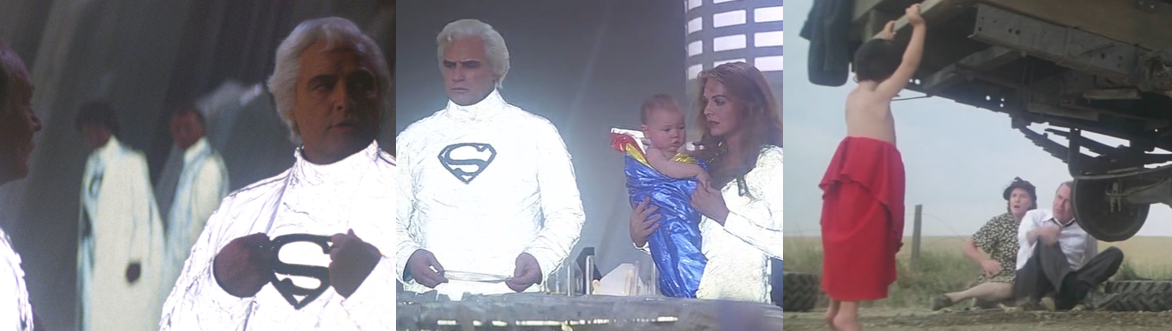
As far as I can remember, Superman II is another of those instances where I actually saw the sequel before the original; consequently, the film had much more of an impact on my childhood and I remember being more entertained by it thanks to it having a far brisker, more action-orientated flow and featuring villains who could actually match Superman in combat rather than simply just outwitting him. Not that I have a problem with the “mind over muscle” concept, it’s just far more gratifying to me to see Superman getting into a superpowered scrap as Superman II definitely delivers in that regard. Thankfully, for those who haven’t seen the first film, the movie opens with both a quick recap of the first movie over the opening credits and a return to Krypton to show exactly how General Zod, Ursa (Douglas), and Non (O’Halloran) got themselves banished to the mysterious “Phantom Zone”. Basically, they broke into one of the Kryptonian council’s crystal chambers and destroyed one of their fancy little crystals; since Jor-El (Marlon Brando) is entirely absent from this film, the three are sentenced and imprisoned by the nameless Kryptonian council yet, as they’re being thrust into the void of space in their mirror prison, Zod vows revenge upon Superman’s birth father regardless.
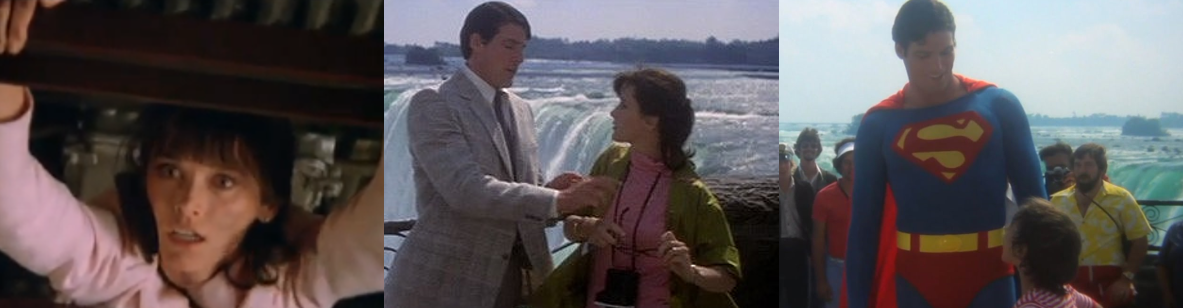
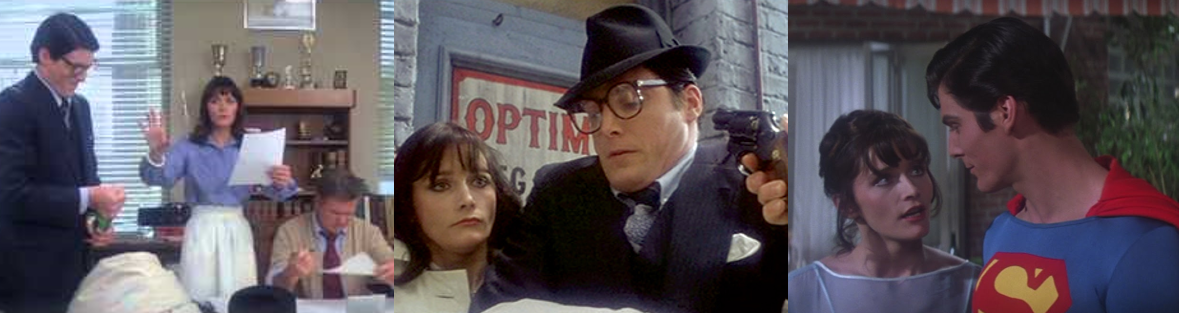
Lois begins to suspect that mild-mannered Clark Kent isn’t all that he seems…

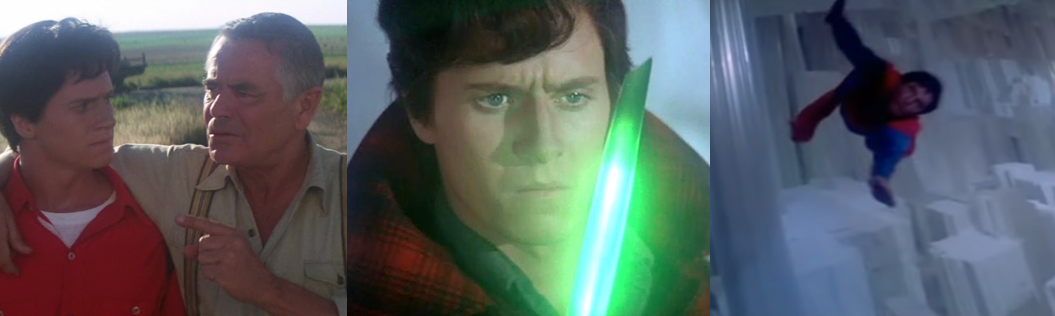
The film then picks up shortly after the events of the last film to find the Eiffel Tower overtaken by terrorists who are holding a bunch of people hostage and threatening to detonate a hydrogen bomb if their demands aren’t met. Being the feisty, fearless reporter that she is, obviously Lois Lane is right in the middle of the story and her boldness leaves her in danger of being killed; thankfully, Superman is again on hand to save her and disposes of the bomb-filled elevator by tossing it into space and unknowingly releasing the three Kryptonian criminals form their prison. Still playing the part of the lovable, bumbling goofball, Clark stumbles his way through his assignment with Lois in Niagara Falls but, after springing into action to save a young boy from a fatal fall into the waters, Lois’ suspicions are raised to the point where she willingly puts herself in danger in order to prove that the two are one and the same.
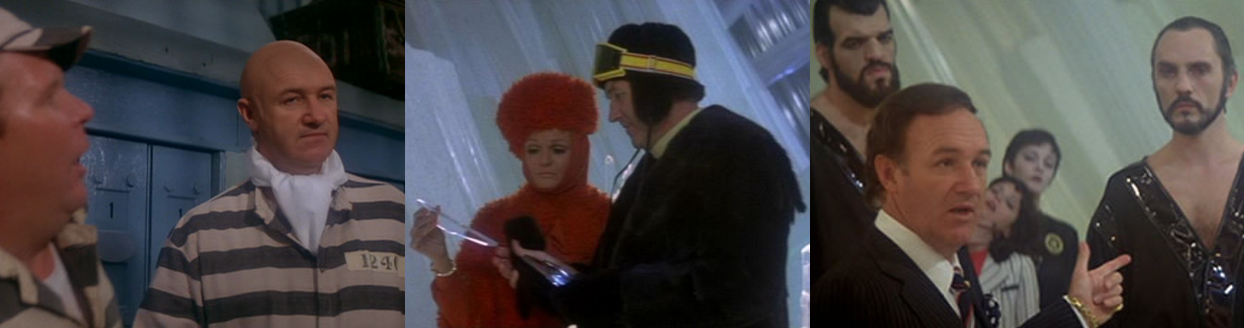
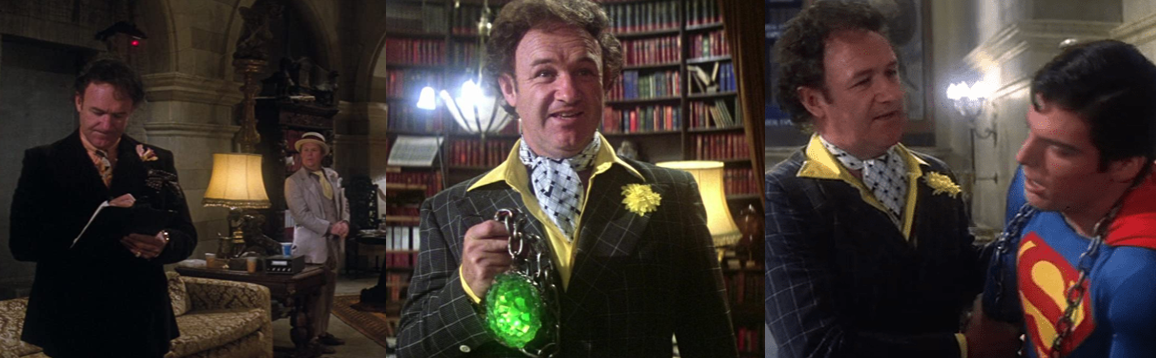
Luthor escapes from prisons, learns Superman’s secrets, and forges a fragile alliance with Zod.

Despite being arrested and locked up at the end of the first film, Lex Luthor (Hackman), the self-proclaimed greatest criminal mind of all time, quickly breaks his way out of prison with the help of a holographic projector of his own making and the assistance of Eve Teschmacher (Valerie Perrine), thankfully leaving the bumbling Otis (Ned Beatty) behind. Not only does Luthor now largely sport his traditional bald head, he also has a far better plan than simple real estate; having deduced that Superman has a tendency to travel north, he tracks the Man of Steel and discovers his Fortress of Solitude, boning up on the three Kryptonian criminals and using this knowledge to charm his way into General Zod’s good graces. There’s something disconcerting about seeing Luthor in the Fortress of Solitude and poking around in his private archives and materials; although Luthor doesn’t learn that Clark Kent is Superman from this excursion, he learns more than enough to be able to barter with General Zod and spare him from the Kryptonian’s unending wrath in exchange for being able to rule over Australia after the three Kryptonians consolidate their control over the entire world.
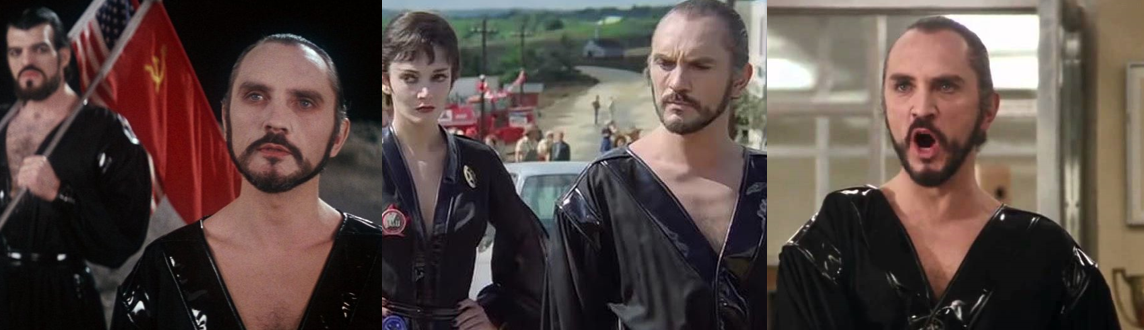
Led by power-hungry Zod, the Kryptonian criminals quickly claim dominion over the world.

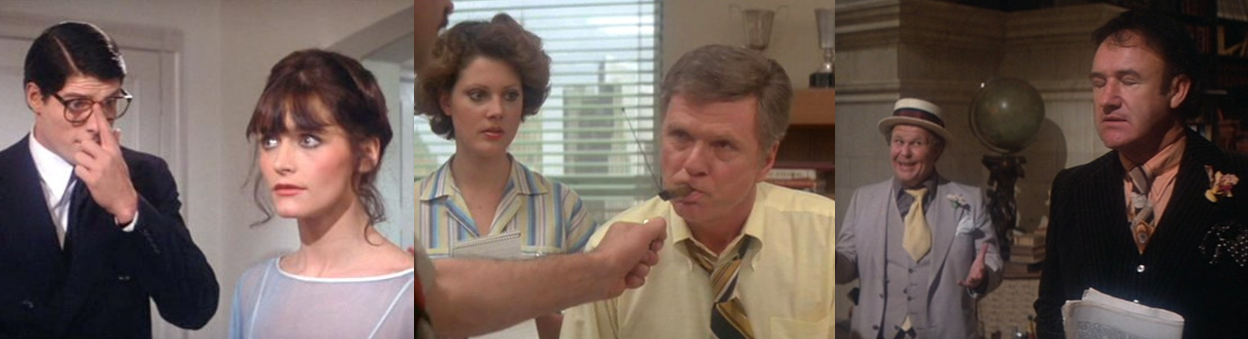
Still, even Luthor is fearful of his new tentative allies; Zod, a verbose egomaniac who craves power and acknowledgement, strikes fear into the hearts of those around him with not only his sadistic and cold-hearted demeanour but also his inclination to fly into an intense rage when his power is defied. The alluring and callous Ursa revels in causing destruction and acquiring new badges and trinkets for her uniform, while the imposing brute Non is as childlike as he is silent and literally follows his General’s orders without question. The three quickly discover and reveal in the superhuman powers afforded by the Earth’s yellow sun, which immediately grants them all of Superman’s powers but with none of his moral compass. They start small, toying with a group of astronauts on the Moon and terrorising a small town in the United States before identifying where the true power of the U.S. lies and laying seize on the White House in a harrowing scene where he forces the President of the United States (E.G. Marshall) to transfer all control to their General.

The Nitty-Gritty:
Of course, it’s difficult to talk about Superman II without addressing some of the film’s more ridiculous aspects; Otis might not be around but his status as the comic relief is usurped by Non’s infantile nature. While things quickly take a turn for the dramatic when Zod steps in out of boredom, it’s initially played for laughs when the three are causing trouble in Houston; similarly, when the three are terrorising Metropolis to goad Superman into a conflict, there’s an awful lot of slapstick and tomfoolery for what is meant to be an imposing scene. And let’s not forget the outrageous superpowers introduced in the film; while traditional Kryptonian powers like heat vision, super breath, and freeze breath are all on display to great effect when the three are causing destruction and fighting with Superman, there’s all kinds of crazy stuff added to the film. Zod is somehow able to levitate objects with a point of his finger, the three of them deface Mount Rushmore by simply blasting it, all four Kryptonians are all able to duplicate themselves in the finale (which I can only assume was originally supposed to be some kind of depiction of superspeed that was limited by the technology of the time), and don’t even get me started on Superman’s weird s-shield attack-thing! Yet, as mental as all of this, it’s actually nowhere near as insane as some of the stuff Superman was doing in the comic books at the time!
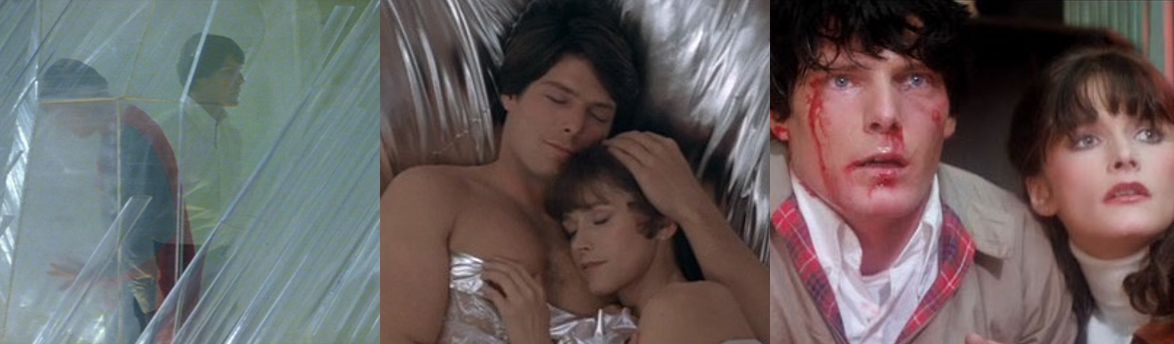
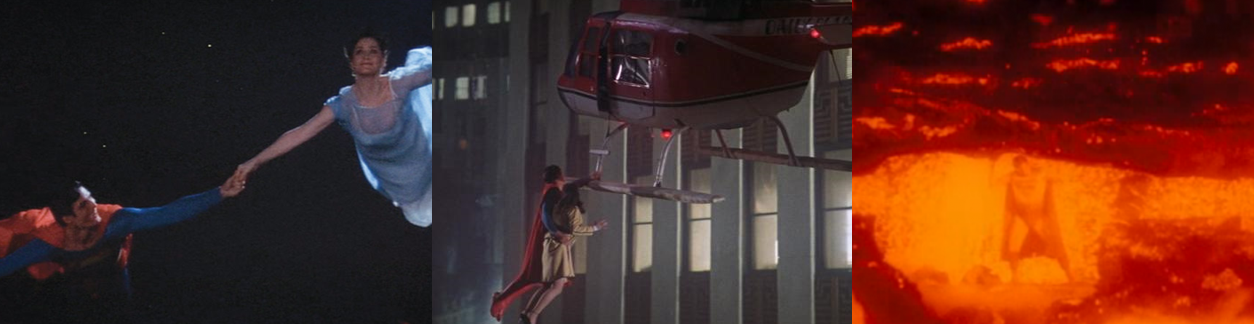
Superman willing gives up his powers to be with Lois.

While a romantic element was present in the first film (and gave us the God awful cringey scene of Superman and Lois flying together), it’s far more prominent here. Although Clark is able to momentarily quash Lois’s suspicions about him, his dual nature is ultimately revealed after an accidental stumble. Of course, bearing in mind that Clark is clearly besotted with Lois and was tempted to reveal himself to her in the first film, both Clark and Lois suggest that this was anything but an accident and that Clark subconsciously wanted Lois to learn the truth and made sure that it happened. Regardless, the two embark on a romantic tryst that sees Clark focus on her above all other concerns. Busy wooing her with flowers and food from the far corners of the world at his Fortress, Superman ignores the chaos caused by General Zod and his subordinates and makes the ultimate sacrifice when the consciousness/artificial intelligence of is mother, Lara (Susannah York), dictates that to live with a mortal, he must live as a mortal. This wrinkle, which results in the destruction of the main control console in the Fortress, goes a long way to showing just how serious Clark is about his love for Lois; indeed, he willingly gives up all of his superpowers just to be with her despite the fact he can hear that people are pleading for his intervention. Clark’s adjustment to mortal life is a tough one; almost immediately, he feels the fatigue and pains of us normal folk and runs afoul of mouthy trucker Rocky (Pepper Martin). Humbled and humiliated, Clark is horrified to find that Zod has taken control of the world and immediately journeys back to the Fortress (from what looks like Canada…because I guess there’s a direct road from Canada to the Arctic now?) in a desperate bid to regain his powers. Although the Fortress appears dead and his father Jor-El doesn’t answer his son’s desperate plea, Clark finds the green crystal that birthed the Fortress and this, somehow, restores his powers. Although this whole sequence is a little sloppy, mainly thanks to the way the film was cut up and re-edited from Donner’s original version, I can’t say that I was ever really a fan of it; we’ve seen in the comics, and other adaptations, that Superman is fully capable of being in a relationship with Lois without having to give up his powers and it seems like this aspect was only included to give some humanity to the all-power Man of Steel. One part of it that does work for me was the emphasis on Lara; since Jor-El is entirely absent, Lara’s importance is greatly increased and makes Superman II an interesting companion piece to the first film by placing the focus on his mother rather than his father.
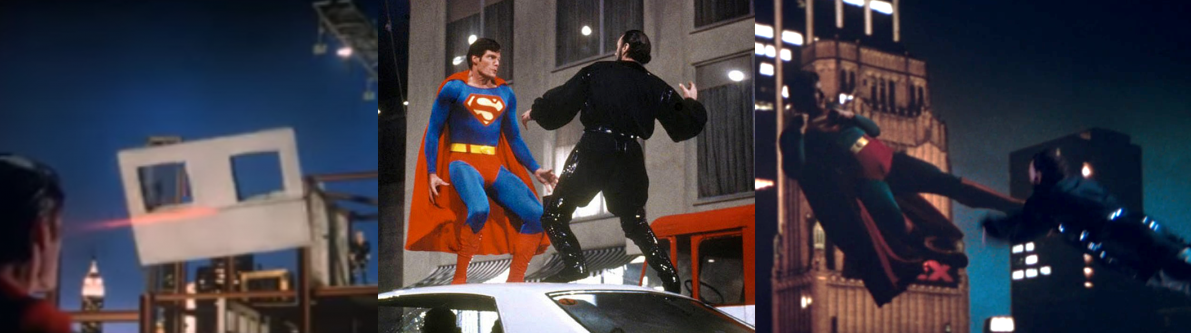
It’s clear the budget was stretched to its limit to depict the superpowered brawl.

Armed with Luthor’s knowledge of Superman’s true heritage and affinity for Lois Lane, Zod, who quickly grows bored of having absolute power, relishes the opportunity to exact his revenge upon Jor-El’s progeny. To this end, the three ransack the Daily Planet and then cause destruction in downtown Metropolis in entertaining scenes of devastation that were certainly ambitious and in stark contrast to the first film’s slower, more subdued tone. It’s clear that the budget is being pushed to its limits to show all four characters flying and fighting in the skies and streets of Metropolis and, while the special effects and the quality of the fight does suffer a bit as a result (there’s a lot of awkward standing around, posturing, and slow, easily telegraphed attacks on show), it’s still a commendable effort for the time. Crucially, Superman goes out of his way to draw the fight away from the city and to save lives rather than mindlessly ploughing his opponents through buildings and causing as much damage as the film’s villains, which goes a long way to emphasising Superman’s selfless and heroic nature (something that arguably needed to be reinforced after he seemed to abandon his responsibilities in favour of getting laid).

Superman turns the tide on his foes but is forced to erased Lois’s memory of his dual nature.

Although the three have the numbers advantage, and are clearly better fighters than he, Superman manages to hold his own but, realising that continuing the fight would only endanger further lives (despite the commendable spirit of the Metropolis citizens in their willingness to stand up to the three after Superman appears to be killed), he flees from the city and lures them to his Fortress for a final showdown. The three are led their by Luthor with Lois as their hostage; when Zod declares that Luthor has outlived his usefulness, the criminal mastermind attempts to double-cross Superman in order to regain favour with the General and, in the process, unwittingly plays right into Superman’s plan. Having reversed the molecule chamber so that Krypton’s red sun rays erase the three’s powers, Superman and Lois are easily able to best their foes and send them hurtling to their deaths. However, in the aftermath, Clark and Lois split up since Superman can’t prioritise one life over the lives of the world and, to spare his love further pain from the burden of knowledge, Superman busts out another new power: the ability to erase minds with a kiss. With Luthor back in prison, the Earth saved, and the status quo restored, Superman promises the President that he’ll never abandon his responsibilities again and heads off for his victory lap.

The Summary:
When I was a kid, I absolutely loved this film; it was probably the closest and most accurate depiction of a live-action Superman I had seen and definitely set a high standard for superhero movies in general for its mixture of heart, action, and comedy. Even now, thanks to the ambitious and impressive special effects, the film holds up surprisingly well; once again, it’s the performances that help bolster the film, with Terrence Stamp putting in a scene-stealing turn as General Zod. The inclusion of three evil Kryptonians to match Superman blow-for-blow was a great way to raise the stakes from the first film and Superman II definitely builds upon the themes and standards of the first film. While I still have a lot of affection for Superman II and definitely prefer it to the first movie, it’s difficult for me to rate it much higher as there are a number of aspects of Superman II that don’t sit too well with me. The same can be said of the first film, and the rest in the series, but I’m still a little baffled by the idea of stripping Superman of his powers and then immediately restoring them and the absurd memory erasing kiss that is almost as preposterous as Superman turning back time at the finale of the first film. Still, it’s easily the best film out of the original four for me and, crazy superpowers aside, deserves to be rated as being at least on par with the influential original and is well worth a watch of only for Stamp’s iconic performance and the battle between Superman and his Kryptonian adversaries.

My Rating:

Rating: 3 out of 5.

Pretty Good

What are your thoughts on Superman II? Did you feel like it measured up to the first film or do you perhaps consider it to be superior, or inferior? What did you think to the introduction of more physically capable villains for Superman to fight and were you a fan of Terrence Stamp’s performance as General Zod? What did you think to Superman sacrificing his powers for Lois and then erasing her mind with a kiss? Do you prefer the theatrical cut of the film or do you think the Donner Cut is the superior version? What is your favourite Superman story, character, or piece of media? How are you planning to celebrate Superman Day today? Whatever you think, feel free to share your opinion and thoughts on Superman in the comments below.

Game Corner [Sonic Month]: Sonic Boom: Fire & Ice (Nintendo 3DS)


Sonic the Hedgehog was first introduced to gamers worldwide on 23 June 1991 and, since then, has become not only SEGA’s most enduring and popular character but also a beloved videogame icon and, in keeping with tradition, I will be dedicating an entire month’s worth of content to SEGA’s supersonic mascot.


GameCorner

Released: 27 September 2016
Developer: Sanzaru Games

The Background:
As I mentioned in my review of Sonic Boom: Shattered Crystal (ibid, 2014), Sonic is no stranger to reinvention and adaptation; even before the release of Sonic the Hedgehog (Sonic Team, 1991), Sonic’s appearance and backstory were notably different from the Japanese designs and long-term Sonic fans saw the character interpreted as a slapstick Freedom Fighter, a rock star prince, and an angst-ridden superhero across numerous cartoons and comic books, to say nothing of the anime-inspired makeover he received in Sonic Adventure (ibid, 1998). Yet one of the more controversial redesigns for the character (aside from the initial design for the live-action movie) came when SEGA commissioned the production of a computer-animated series, Sonic Boom (2014 to 2017). For me, these new designs actually made a lot of sense (aside from the sports tape) and I think SEGA should have started over with a complete franchise reboot with these designs. Unfortunately, concerns over this new direction and the negative reception of the Wii U spin-off title significantly soured the impact of this new series. Although not nearly as derided as its Wii U counterpart, Shattered Crystal still considered to be a disappointment so the announcement of a sequel came as something of a surprise for me. Even more surprising to many was the fact that the developers’ claims to have learned from their mistakes actually paid off, resulting in Fire & Ice receiving a far more positive reception from critics and fans alike.

The Plot:
After discovering an element known as “Ragnium”, Doctor Eggman harnesses its powers to create robots fast enough to outrun Sonic and his friends and pollute the environment to his liking. With the planet suffering from a series of earthquakes, and opposed by Eggman’s newest creation, D-Fekt, Sonic and his friends race to put an end to Eggman’s schemes using their newly-acquired powers of fire and ice.

Gameplay:
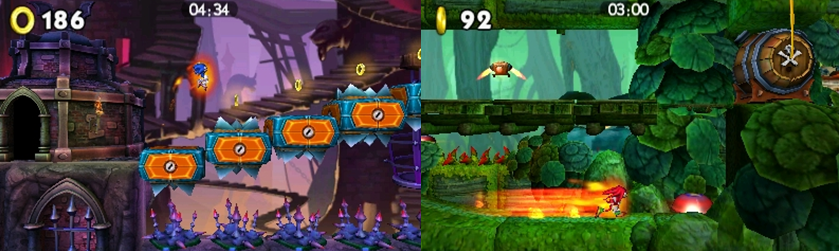
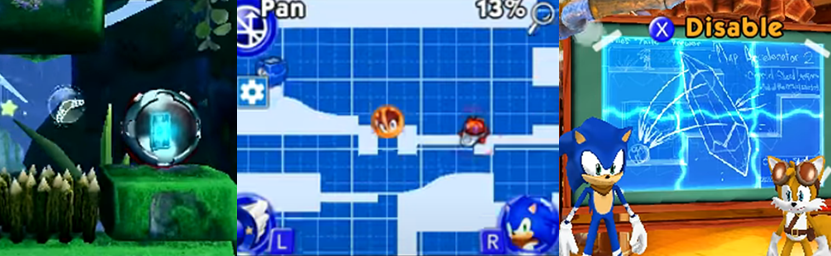
Like its predecessor, Sonic Boom: Fire & Ice is a 2.5D action/adventure platformer that involves a fair amount of exploration and character switching. Interestingly, though, there is nowhere near as much of this as in the previous game; because the map (helpfully displayed on the lower screen) shows the entirety of every stage, exploration is easier than ever and, since Sonic Tokens are no longer a thing and the game simply unlocks automatically as you clear each stage, there’s far less emphasis on backtracking and replaying previous stages. You’ll have to do it if you’re going for 100% completion but, this time around, the rewards for this are tied to additional gameplay options rather than story progression so you’re free to blast through stages as just Sonic if you want.

All the characters return with a handful of new abilities and a new playable character in the form of Amy Rose.

Just like in the last game, you can only play as Sonic at the start but you’ll unlock the other playable characters (Miles “Tails” Prower, Sticks the Badger, Knuckles the Echidna, and Amy Rose) as you complete stages and advance through the story. Once again, you can switch between each character on the fly using either the directional pad or the touch screen, and all of their basic abilities carry over from the last game (they can all jump, use the Homing Attack, sprint along, and swing around using the “Enerbeam”). Their unique character abilities also remain intact but with a few added extras: when performing Knuckles’ dig move or Sticks’ boomerang throw, you no longer have to worry about a meter running down so you’re free to use them as much as you like and Tails’ Sea Fox sections have been moved to a dedicated spot on the overworld map.

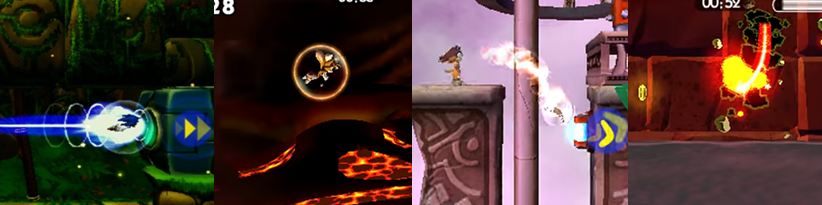
Switch between fire and ice to create and destroy platforms and progress through stages.

Otherwise, things are very much the same but slightly tweaked: Sonic can still perform the Spin Dash and air boost and Tails can still hover along air currents but he now fires a reflecting laser rather than tossing bombs and Knuckles can also now perform a flying punch attack. The addition of Amy to the playable roster adds her patented Piko-Piko Hammer to your arsenal, which is primarily used to lower or move platforms and blocks with a tap of the X button. New to the game, though, are the random powers of fire and ice each character possesses; with a press of either L or R, you’ll switch between a fire and ice aura, each of which allows you to traverse stages in different ways. Switching to ice, for example, allows you to run across bodies of water by turning them into temporary ice blocks and using fire allows you to melt through ice; Tails’ laser can also be powered up with these elemental powers to reflect off surfaces and clear obstacles and, as the game progresses, you’ll be tasked with quickly switching between ice and fire to complete stages. As always, Golden Rings will protect you from damage and the continued absence of a traditional life system means that you’ll simply lose Rings if you fall down bottomless pits or enter water. As long as you passed by a checkpoint, you’ll respawn in the stage you were in if you fall or get hit without any Rings, once again meaning that the game is far easier than most traditional Sonic titles.

Challenge Rooms and Dragon Rings add a bit of variety to the stages and award you with collectibles.

Sadly, while much of the game is improved (or, at least, streamlined) over its predecessor, the controls are still a bit unintuitive (at least for me) since the developers made sure to use every single button available on the 3DS this time around. Thankfully, though, stages are no longer locked out by Sonic Tokens; instead, the overworld map (which is now much bigger than before and features more stages per island than the last game) opens up as you complete each stage. You can even fast travel to a specific stage and island from the main overworld screen, which is very helpful, but this fast travel screen doesn’t tell you anything other than the stage names so you’ll need to know where you missed any collectibles when using it. When playing stages, you no longer have to worry about being slingshot all over the place by Enerbeam points; instead, traditional springs and grinding rails are the order of the day, making the game far more linear. While this is great for blasting through it, it does mean you’ll have to replay each stage from the start if you missed any of the collectibles rather than being able to backtrack within the stage as before. Again, the average game speed is quite slow, meaning you have to hold Y to sprint ahead and control is frequently taken out of your hands by loops, speed boosts, and auto-running sections. Every stage also includes a “Challenge Room” that is hidden a little bit out of the way; enter it and you’ll be tasked with completing a short obstacle course of sorts and navigating through a few hazards to grab a Trading Card. Also, you’ll find “Dragon Rings” in each stage; grab one and ten more will spawn along a path for you to collect within a time limit to earn a piece of Ragnium.

Alongside returning Sea Fox and racing sections, the new hovercraft and tunnel races add some variety.

Trading Cards and Ragnium are essential if you’re going for 100% completion as they can be used to unlock courses and Bot Racers on Thunder Island. This new gameplay element is presented alongside the aforementioned returning Sea Fox sections; now found on the main overworld map, they are much bigger and have more hazards and requirements than before but the controls remain the same (tap the screen to activate the sonar and see hazards and collectibles and fire missiles with X). This time around, though, once you’ve blasted the Trading Card, the stage will end automatically and you can try to finish them (and every stage) faster for a Ragnium shard. The racing stages also make a return, though this time they take place in a three lap format and pit you against Eggman’s Bot Racers rather than traditional Sonic rivals. Again, you’ll need to switch between fire and ice and use rails, stomps, and the Homing Attack to win and these races are often quite tricky as the computer controlled Bot is easily able to overtake or match pace with you. Also returning are the Worm Tunnel stages from the last game but without the worms and themed after ice and fire instead; while you still boost along down an auto-run tunnel and switch lanes to avoid bombs, this time you’ll need to switch to ice to run across frozen surfaces and fire to blast through ice blocks and will have to avoid more obstacles and race against much tighter time limits than before. A new bonus stage is also included, however, which sees you piloting Tails’ hovercraft in a vertical shooter of sorts. You can boost ahead by holding R and shoot missiles at icebergs with X but also have to watch out for whirlpools and mines, collecting clocks to extend your time and trying to reach the goal to earn another Trading Card before you’re destroyed or run out of time.

Graphics and Sound:
Graphically, not much has really changed from the last game; in fact, everything basically looks and sounds and plays exactly the same except with a stronger emphasis on ice and fire scattered throughout each stage. The camera is still positioned in this awkward way where your character and enemies are big enough but you don’t necessarily get fair warning of any hazards that might be in your way but, again, the game’s slower pace does somewhat compensate for this. As before, the game’s overworld is divided into islands; this time, there are seven, with six being home to the playable action stages where you’ll progress the story and the seventh being home exclusively to your upgrades and Bot Racers.

Some islands feature a bit more life and unique aesthetic and mechanics but they’re few and far between.

Thanks to the emphasis on ice and ice, you can expect to see a lot of elemental hazards and themes used throughout each stage, which again largely stick to the usual platforming clichés such as forests, deserts, and volcanoes but each island does try to add some variety in its bonus stages (such as the race missions, for example, which take place in a much more industrial, mechanical environment and the tunnels, which are all in caverns). Just like the last game, though, stages often appear largely barren and lifeless even though they’re generally much brighter and more varied in their appearance. You’ll notice that there is an abundance of spikes this time around and far more rails to grind and springs to hit than there are Enerbeam swing points this time around, which contributes to the game trying to be a bit more like a traditional Sonic title, and islands like Cutthroat Cove and Gothic Gardens try to bring some visual flair to the proceedings by including skeletal remains, haunted graveyard-like aesthetics, and having you explode barrels with your fire ability but, again, stage variety mainly comes down to a reskin of the same mechanics, meaning that the game can get quite boring quite quickly even with the added mechanics.

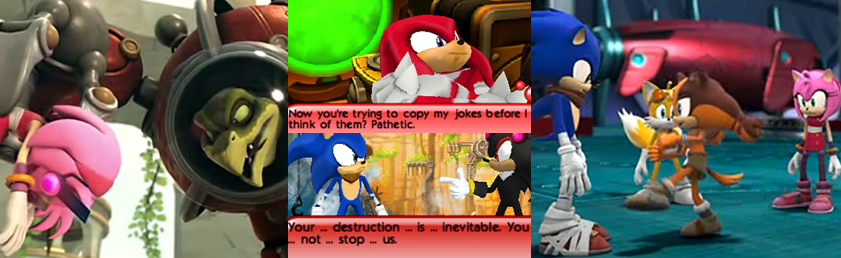
Thankfully, not only does the game utilise CG cutscenes for its story but Dr. Eggman is back as the central antagonist.

Thankfully, Fire & Ice ditches the boring speech bubbles and partially-animated cutscenes of its predecessor and doubles down on the CG cutscenes. Any time there’s a new story element or the plot progresses, a fully animated and fully voiced cutscene is used to show this progression and, even better, these look and feel exactly like an episode of the cartoon, containing all of the same wacky banter and hijinx you expect from these characters. These cutscenes, and the game in general, are bolstered further by the presence of the bombastic Dr. Eggman, whose absence really sucked a lot of the life out of the last game, though, again, I can’t say that I was blown away by much of the music, with is serviceable enough, at best.

Enemies and Bosses:
Although Dr. Eggman returns as the primary antagonist, many of the robots you’ll encounter are just as uninspired as in the last game; again, they don’t release little woodland critters upon destruction and generally appear sporadically throughout stages to act as destructible platforms to higher areas or brief hazards to shed you of your Rings. You can still use the Enerbeam to relieve them of their shields and many of them will respawn when you leave the screen to be used again but, for the most part, they’re nowhere near as memorable or quirky as Eggman’s usual Badniks.

Switch between the different characters to dodge Unga Bunga’s hands and avoid sticky tar.

However, this time around Fire & Ice actually includes boss battles! Four of them, in fact, with each one featuring an auto tag mechanic that has you (as Sonic) switching out with another of your team mates during the battle (unlike the last game, which ditched your teammates altogether for its one boss battle). Each boss is a massive mechanical monstrosity piloted by D-Fekt in his desperate attempt to win his master’s affections by destroying Sonic and his friends and requires a bit more strategy than just bouncing into a cockpit to bring down. The first boss, Unga Bunga, sees Sonic and Amy team up against a giant series of totem poles that tries to smash you with its flaming hands. Once you’ve dodged out of the way and scored with the Homing Attack enough times as Sonic, Amy will tag in and needs to use her fire hammer to melt the ice blocks to that Sonic can alternate between fire and ice to climb the totem pole and attack the boss’s head. Honestly, the hardest part about this fight for me was the brief moment of stupidity where I didn’t realise that Amy needed to be in fire mode to destroy the ice blocks; once you crack that, though, it’s simply a case of having the right element equipped to attack its head. The second boss has Sonic and Tails take turns battling a giant golem-like robot that drops sticky blobs of tar into the arena; if you get stuck in the tar, you’ll have to mash B to free yourself before the boss attacks with its claw-like tentacles. When these fly across the arena, hop up and use the Homing Attack as Sonic to deal damage and then, as Tails, you’ll have to use the air vents on each side of the arena to hover between the floating bubbles and avoid dropping into the damaging tar that floods to floor until the golem collapses and opens itself up for another Homing Attack. You can also use Tails’ laser blaster to clear out the tar bubbles, which is handy to know was the hazards, speed, and aggression of the bosses attacks increase as the fight progresses, making this a bit more frustrating than the first boss simply because of the limited nature of Tails’ hover.

Disposing of the spider’s mines can be quite tricky, but the final boss is the easiest of the game’s bosses.

Next, Sonic and Knuckles team up against a huge spider cobbled together from nearby junk; the spider likes to try and ram into you in its first phase, though you can take advantage of the nearby temporary platforms to avoid it and hit it with a Homing Attack (but watch out for the lingering acid residue it leaves in its wake). After the first portion of its health bar has been drained (this is the only boss in the game with three health bars, oddly enough), it’ll spit web balls at you that you must hit back at it with a well-timed Homing Attack. Finally, you’re forced to burrow into the ground with Knuckles; the spider releases a number of mines into the dirt that will explode if you don’t burrow around them in a circle with the right element equipped to send them back at the boss, which I found to be one of the more frustrating parts of this boss as it can be a bit difficult to make a circle in the restrictive area you’re trapped in. Finally, after enduring the hardest race, Worm Tunnel, Sea Fox, and hovercraft stages in the game, you’ll have a final showdown with D-Fekt on the volcanic island of Ragna Rock. This time, Sonic teams up with Sticks and must either dodge the falling boulders or use Sticks’ boomerang (in conjunction with your elemental abilities) to destroy them as they rain from the sky while also jumping over the flaming shockwaves they leave as they land. When the two-headed dragon’s tail appears onscreen, quickly hit it with a Homing Attack with the right element equipped to deal damage and, before you know it, this disappointing final boss will be done and you’ll be victorious.

Power-Ups and Bonuses:
Like its predecessor, Fire & Ice is sadly missing many of the power-ups you might expect from a Sonic title and actually has even less on offer to help you out than Shattered Crystal as you can only find shield capsules in stages rather than ones containing additional Rings. On the flip side, though, the game is also much easier in a lot of ways since the stages may have increased but they’re also much shorter and, again, there’s little to no danger of dying and even less emphasis on collecting Rings as you don’t need to do this to earn collectibles this time around. Similar to the last game, though, each stage features a number of collectibles for you to find either by finishing the stage, completing Challenge Rooms, or exploring using the character’s unique abilities.

Trade your Ragnium for upgrades and Bots or collect hammers to equip reskins for Amy’s signature mallet.

Once you have collected enough Trading Cards, you can bring them to Knuckles at Tails’ Workshop on the overworld to complete a variation of the first game’s jigsaw mini games and unlock additional courses for your Bot Racers. You can also find junk in each stage that you must deliver to Sticks’ Burrow, similar to the crystal shards from the first game, in order to unlock a special Bot Racer. Every time you complete a stage, defeat enemies, or fulfil certain objectives, you’ll earn a piece of Ragnium; with enough of these, you can purchase additional Bot Racers and the same upgrades from the last game (an instant shield at your first checkpoint, a Ring attractor, and the ability to destroy enemies with the spring function) however these came at a much higher cost than in the last game. Finally, you’ll also be able to find hammers in each stage; collect enough of these and you’ll unlock different hammer skins for Amy that serve no function as far as I can tell other than looking different.

Additional Features:
Sadly, there’s far less on offer in Fire & Ice for 100% completion than in Shattered Crystal; you don’t need to collect every piece of Ragnium to finish the game, it doesn’t take much to find all the junk, hammers, and Trading Cards, and the rewards for finding these collectibles are minimal, at best. While you can still visit Sonic’s Shack to view cutscenes, listen to music, and read a bonus comic, the toy shop is gone so you can’t even view character models any more and you don’t even unlock a lame party like in the last game. Instead, the bulk of the game’s additional features are focused entirely around Bot Racing; you can purchase new Bot Racers on Thunder Island and use the 3DS’ wireless connectivity to race against other players across a variety of courses but I don’t know anyone else who has a copy of the game so this was completely wasted on me and I never got to experience it.

The Summary:
If you’ve played Sonic Boom: Shattered Crystal then there’s not much new on offer in Sonic Boom: Fire & Ice; the game looks and plays pretty much exactly the same just with a fire and ice mechanic tacked on with very little explanation and to add a slight wrinkle to the formula from the last game. Fire & Ice is both easier but artificially longer than Shattered Crystal thanks to the stages being better spread across the overworld, meaning it’s much easier to play in short bursts, and the story is much funnier and feels more authentic thanks to the inclusion of Dr. Eggman. However, while the team-based mechanic is better emphasised in the inclusion of actual boss battles, I found myself switching characters far less than in the first game; Knuckles, especially, is massively underutilised in the game and it’s perfectly viable to just stick with Sonic and still succeed without much issue. Separating the different gameplay mechanics like the Sea Fox into their own stages helps to make things a bit more manageable and provide a bit of variety to the gameplay and not locking progression behind arbitrary tokens make the game less of a chore to play, to be sure. However, much of the replayability is similarly arbitrary as Amy’s hammers are largely cosmetic and there’s far less reward for your efforts after finishing the game and collecting everything unless you’re able to connect to another player. It’s definitely better than the first game thanks to your abilities not being tied to a damaging meter and the improvements to the story and progression but it’s still a far cry from a classic Sonic title. I appreciate all the little improvements and additions but, in the end, it fails to really be any better or worse than its predecessor even with the improved cutscenes and more action-orientated gameplay.

My Rating:

Rating: 2 out of 5.

Could Be Better

What did you think to Sonic Boom: Fire & Ice? Do you think the game was an improvement over its predecessor or were you just as unimpressed with its offerings? Were you happy to see Amy Rose added to the playable roster and which of the characters was your favourite to play as? What did you think to the Sonic Boom cartoon, redesigns, and the introduction of Sticks? Would like to see more Sonic Boom content from SEGA or do you think it’s best to move on from that experiment? Whatever your thoughts on Sonic Boom: Fire & Ice, good or bad, leave a comment below and check back in next Saturday for more Sonic content.

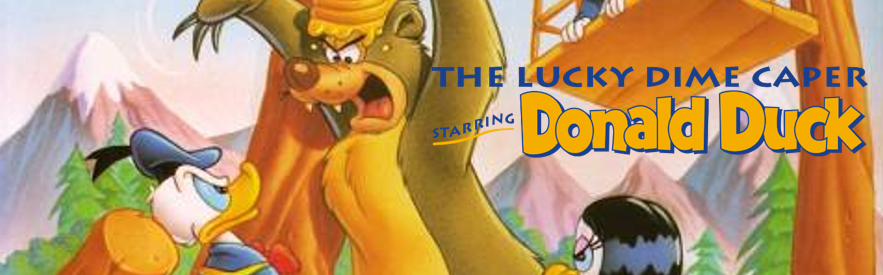
Game Corner [Donald Duck Day]: The Lucky Dime Caper Starring Donald Duck (Master System)


DonaldDuckDay

It’s June 9th, which means that it’s National Donald Duck Day! Disney’s foul-tempered fowl first debuted in The Wise Little Hen (Jackson, 1934) way, way back on 9 June 1934 and has since become one of the multimedia conglomerate’s most enduring and popular characters, featuring in a variety of cartoons, videogames, and other merchandise.


GameCorner

Released: October 1991
Developer: SEGA (AM7)
Also Available For: Game Gear

The Background:
Back in the nineties, it was tough to find better licensed videogames than those produced by Disney; bright, colourful platformers featuring their popular characters and adaptations of their film franchises are highly regarded as some of the best 8- and 16-bit action/platformers on Nintendo and SEGA’s home consoles. While their mascot, Mickey Mouse, obviously featured in the majority of these titles, Donald Duck had his fair share of pixelated adventures over the years as well. The Lucky Dime Caper was technically very similar to Castle of Illusion Starring Mickey Mouse (ibid, 1990) with a few notable alterations; first was that Donald was afforded a melee and ranged attack and, second, was that he was exploring a version of the real world rather than fantasy lands. The Lucky Dime Caper was also one of the very first videogames I ever played and owned for the Master System; over the years, I have never managed to finish it so I’m very excited to be returning to it for Donald’s big day!

The Plot:
One day, while showing his prized “Number One Dime” to his nephews, Huey, Dewy, and Louie, Scrooge McDuck is attacked by the evil Magica De Spell, who steals the lucky dime and kidnaps his nephews! Donald hops into his bi-plane and journeys across the world to rescue his nephews, recover the Number One Dime, and put a stop to Magica’s evil aspirations of amassing her own vast fortune.

Gameplay:
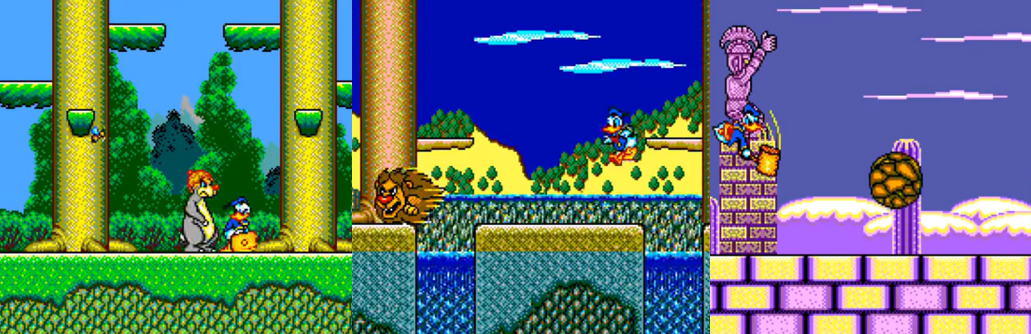
If you’ve played Castle of Illusion Starring Mickey Mouse, you’ll be immediately familiar with the gameplay and controls in The Lucky Dime Caper Starring Donald Duck; there are no options available to you to change up the game’s difficulty or controls and, following a brief and impressive little introduction video, you’re taken to a world map and given the option to play one of three stages right off the bat. Whichever one you pick, you’ll be placed in the sailor hat and outfit of Disney’s foul-tempered fowl. Donald has a fairly fast standard walking speed, which is nice; he doesn’t race along but it’s also not like he has lead in his non-existent shoes, either. He can jump on enemies to defeat them, which is always a plus, and can hop up to higher levels by holding the 2 button when bouncing off enemies or certain platforms. Donald can also jump onto vines to swing over gaps, though it can be a little clunky to detach him once you’re over to the other side. Donald’s default method of attack is to swing a hefty mallet, which you can bust out with a press of the 1 button; pretty much every enemy dies after one hit and Donald can even smash enemies while in mid-air and can duck to avoid incoming projectiles (though many of these can be jumped on as well).

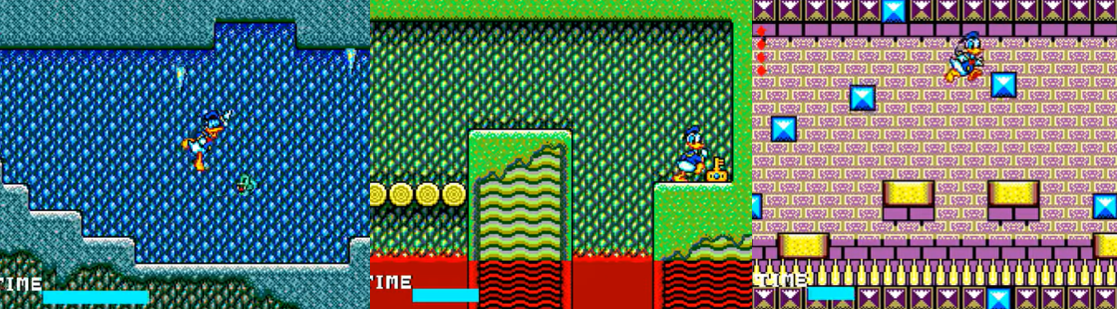
Swim, collect keys, and dodge blocks over spike pits all while a timer decreases for added pressure.

The game is divided into seven stages, and every single stage has a number of different areas with the except of Stage 1, which consists of a simple trek through the woods to rescue Louie; other stages end at the entrance to a cave or other interior area, which Donald either automatically enters or will open with either a key or a press of up on the directional pad. Although a number of bottomless pits are present in numerous areas, Donald can enter certain bodies of water and swim by furiously tapping the 2 button; luckily, this really doesn’t come up very often as Donald is completely vulnerable while swimming and has no method of fighting back. Donald is mildly durable; when hit my an enemy or spikes, Donald will lose whatever weapon he’s currently holding, leaving him vulnerable, and he’ll lose a life if he’s then hit a second time. As you battle your way through each stage, you’ll also be up against a constant timer; a bar decreases as you progress, turning from blue to yellow to red as you go, and you’ll lose a life if it completely drains. However, the bar regenerates to full when you leave one screen to the next in the longer stages and none of the game’s stages are long enough to drain it unless you just leave the game idle. Donald also carries his current weapon to each stage and even after dying, and he is even blessed with an infinite number of continues; however, you’ll have to restart the stage right from the beginning if you use a continue, as opposed to when you lose a life, which sees you return to the start of the last area you were in.

A number of environmental hazards and spikes will test your platforming skills.

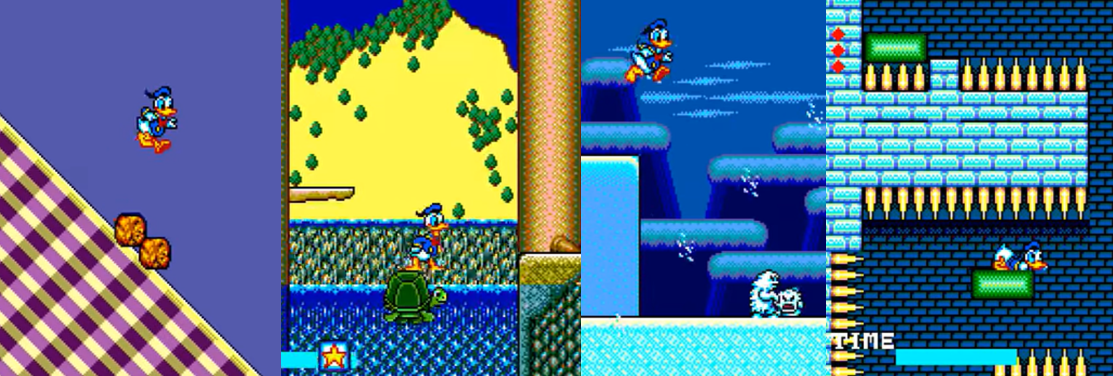
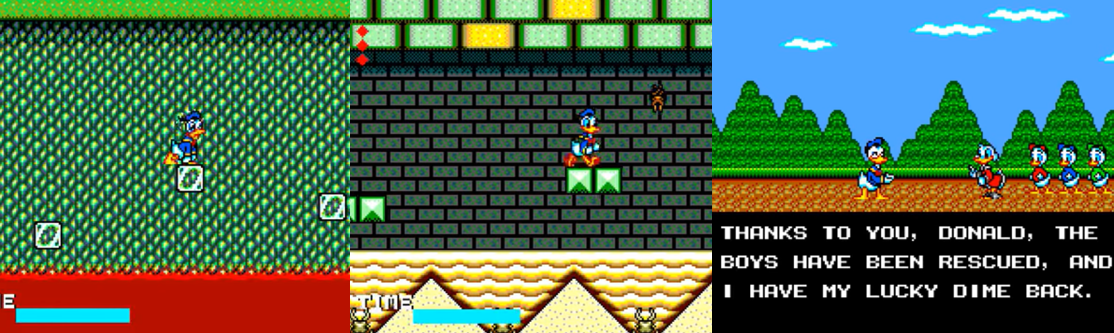
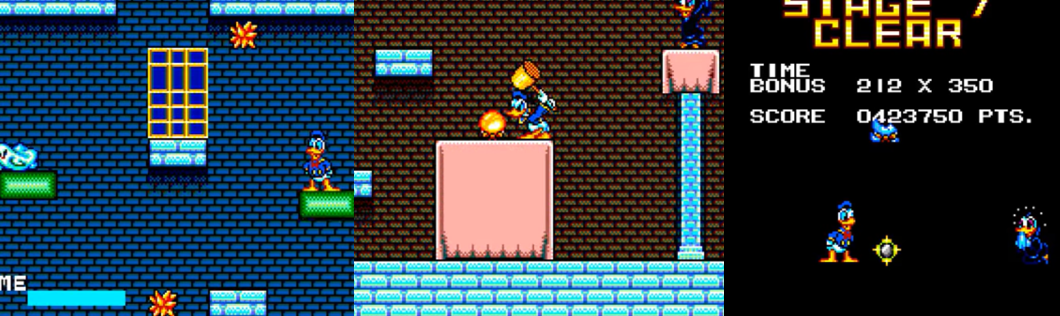
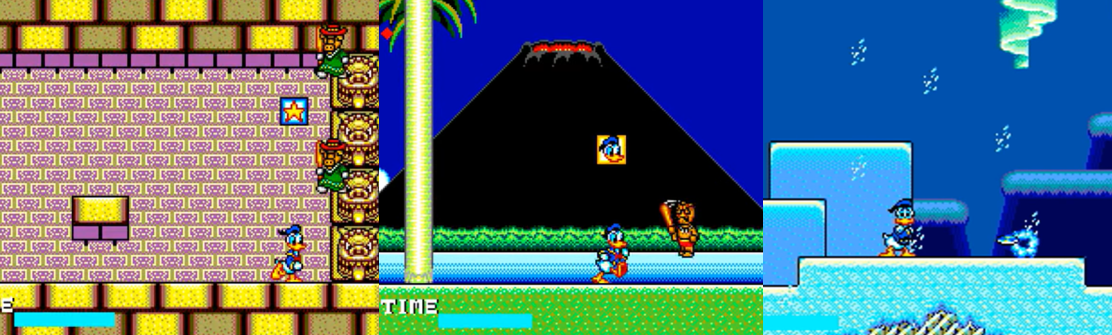
I mentioned keys earlier; this is about as complicated as the game’s stages will get, for the most part. Occasionally, you’ll come across a locked door and will need to progress a little further along to collect a key, and then backtrack to open that door. When in the Pyramids stage, you’ll be able to press up to open doors somewhat hidden in the background tiles, and Magica’s Castle includes a bit of a maze element where you can end up looping around the castle and having to trek back through it again to actually progress. In the Great American Forest, you’ll need to ride on a turtle to cross bodies of water, run down steep slopes making tricky last second jumps over enemies and blocks in the Andes Mountains as well as hopping over a spike pit while avoiding floating blocks that try to smack you out of the air, and avoid fireballs raining down from a volcano in the background of the Tropical Isles. A blizzard will push you onwards, and backwards, across the slippery ground in the South Pole stage (though you can use this to clear longer gaps), and you’ll be forced to duck under and make precarious jumps over spiked walls and ceilings in Magica’s Castle while avoiding a whole mess of obstacles just to reach an anticlimactic showdown with the evil witch.

Graphics and Sound:
The Lucky Dime Caper is a bright, vibrant, colourful little platformer for your favourite 8-bit home console. Donald pops out from the backgrounds and is instantly recognisable no matter what stage he’s in or what types of enemies are onscreen, and exhibits a great deal of character in his every movement. He bops along to the cheery in-game music, throws a tantrum when left idle, pants with heat exhaustion when inside the volcano, and shivers when in the South Pole. Sadly, the same can’t be said for his enemies, which are generally very basic, and I did have one instance where the music cut out after my invincibility status ended.

Stages are varied, if a bit cliché, but the use of sprites and animations all add to the game’s charm.

The same can also be said for the stages you’ll journey through; initially, you are presented with just three stages but, once you rescue Huey, Dewy, and Louie, you’ll have to take on three more stages to track down Magica and the lucky dime. It’s cool that you can freely select your stage from the map screen as some stages are trickier than others, but the stages fall into the same platformer clichés such as woods, deserts, and snow levels. While you’ll typically travel from the left side of the screen to the right, Magica’s Castle has you taking upper paths using moving platforms and you’ll drop down into water in the Great American Forest stage. Generally, though, the game is very colourful and surprisingly detailed; it’s all obviously a bit basic compared to 16-bit titles but there are little things to see in the backgrounds, such as a volcano and ice floats and so forth, and the music is very jaunty and cheerful. There is some slowdown here and there when there’s a lot of sprites on the screen, and a noticeable loading time to spawn in the stage boss, but generally the game is quite quick and stable. In addition to the opening and closing cutscenes, you’ll see big partially animated sprites at the end of each stage where Donald chats with his nephews or interrogates Magica’s lieutenants, in addition to using the in-game sprites to show him rescuing his nephews from their cages.

Enemies and Bosses:
I mentioned above that the game’s enemies are very basic and it’s true; you’ll battle killer mushrooms, bees, and spiders, club-wielding Mexicans, mummies, bats, and fire-spitting statues, yetis, bone-throwing skeletons, scorpions, and ghosts. Most of these can be defeated in one hit, while others (like the spiders) take two or can’t actually be defeated (like Magica’s skeletons and falling paintings); spikes will dog your progress later in the game and have quite a large hit box (they can even damage and kill you when you’re invincible), lava droplets will cause temporary ice blocks to disappear and drop you into lava, and you’ll also get stuck in rooms where the ceiling threatens to crush you until you open all of the Treasure Boxes contained within.

Of the first three bosses, only the vicious lion provides anything close to a challenge.

At the end of every stage, you’ll have to take on a boss to rescue one of Donald’s nephews or get information from Magica’s lieutenants. When rescuing Louie, you’ll battle a big bear with a bee’s nest on its head; simply jump over him when he rushes at you and whack him with your hammer or toss a frisbee at him and he’ll go down in just a few hits without any real difficulty. Dewey is held captive by a vicious lion that charges at you in a blur; you can use the nearby platforms to avoid this attack but you’ll also need to jump over him when he hops at you. Thankfully, he stops to taunt quite often, leaving him wide open to attack, though he’s noticeably a little trickier than the bear, at least. Finally, you’ll need to take out a couple of possessed statues and an odd floating head to rescue Huey; this boss is actually easier than the bear in a lot of ways as all you have to do is stay to the far left or right of the screen to avoid the boulders they throw and then jump up and smash each statue, before whacking the head as it pinballs around the arena in a slow and predictable pattern.

When armed with the frisbee, Magica’s crow underlings are easily bested.

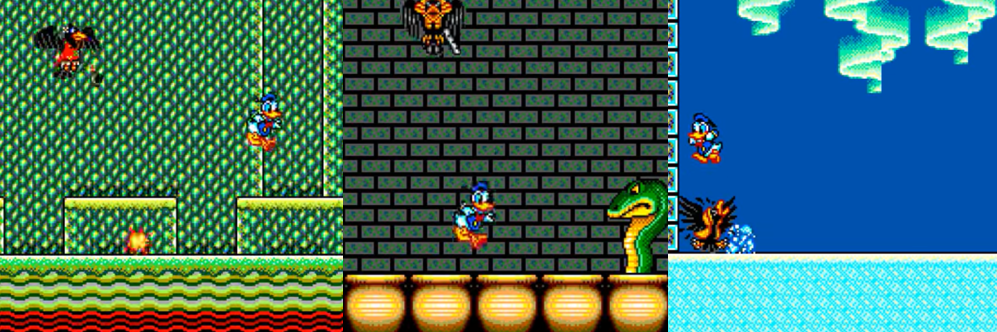
Once they’re saved, you’ll need to visit three more stages to retrieve their lucky dimes from Magica’s lieutenants, each of which is a large black crow. The Tropical Isles crow flies around above you dropping bombs as it passes, but you can simply stay on the middle platform and either whack it as it flies by or toss frisbees at it without ever being hit. The Pyramids boss can be a little more frustrating; this crow flies around dropping musical notes and a big snake will rise up to spit fireballs at you. If you have the hammer (or no weapons at all), you’ll need to use the snake to get high enough to hit the boss but you’ll need to watch out for the snake’s tongue attack as well, but the boss is a complete joke if you have the frisbee as you can simply toss them upwards to hit it and all you’ll have to do is dodge the projectiles. Finally, at the end of the South Pole, another crow will drop an ice block into an enclosed arena and then try to take a dive at you. However, you can destroy his ice block and simply attack the bird as it lowers itself down to drop another, making it ridiculously easy to defeat once you get into a routine.

Getting through Magica’s Castle is far more difficult than actually battling her.

The final battle against Magica herself is equally just as simple; she positions herself up on a ledge and out of the way and conjures a bunch of different magical attacks to rain down into the arena. However, all you have to do is attack the crystal ball in the middle of the arena and she’ll be defeated; a weapon will help with this but you can just as easily jump on the crystal ball a few times and that’s it. I don’t think I got hit a single time during this battle, meaning that some of the previous bosses were actually harder than the game’s final boss! However, Magica’s Castle is easily the game’s trickiest and most frustrating stage; not only do you have to work out which route actually allows you to progress, you also have to get around the respawning enemies and make pixel-perfect jumps and ducks to avoid spikes and progress through the stage, which can be very annoying.

Power-Ups and Bonuses:
There are a number of random items for Donald to collect as he defeats enemies in each stage; although time is against you, you can easily backtrack ever so slightly to respawn enemies and farm items if you need to, which makes stocking up on extra lives or gaining an invincibility pretty simple and key to progressing through Magica’s Castle, which can get very unfair near the end.

Donald can grab a few items to power himself up and launch a ranged attack.

As mentioned, Donald’s default weapon is a mallet but you can also grab a frisbee that allows you to perform a ranged attack; you can also press up and 1 to fire a frisbee upwards, which makes fighting the three crows a complete joke. You’ll also grab two gems for a score bonus if you like racking up a high score, extra lives, and Star items. Each Star will increase the speed of Donald’s attack but will also make him invincible for a very brief period of time once you collect five of them (though don’t get cocky as you can inexplicably still be hurt by spikes while invincible).

Additional Features:
There’s nothing, I’m afraid to say. The game doesn’t even have any credits when you beat it, so the main incentive to go back to it is to try and earn a better high score or simply to replay a fun, colourful platformer. There is apparently a push-button cheat to grant Donald infinite lives on the continue screen but I couldn’t get this to work, and you can play the stages in a different order on each playthrough if you like, but it won’t change anything significant about the game.

The Summary:
The Lucky Dime Caper Starring Donald Duck has been a staple of my Master System library for about thirty years; I played it over and over as a kid but could never complete it. I don’t really remember if I ever actually managed to make it through one of the three stages after rescuing Donald’s nephews, so I was very excited to come back to it and actually finish it for this review. Considering the game has infinite continues, I must have just gotten frustrated with some of the game’s harder sections and not stopped to stock up on extra lives, which doesn’t take very long to do and makes it a simple test of patience and memorisation to get past those trickier sections. The game is bright, cheery, and full of character; Donald controls really well and has a nice range of attacks, the music and Donald’s animations are terrific, and the stages and bosses are pretty decent in terms of the level of challenge on offer. It’s not really doing anything other platformers, especially those produced by Disney, weren’t doing at the time but there’s enough here to keep you busy for about an hour and a half and it remains a fun and colourful little platformer for SEGA’s 8-bit system.

My Rating:

Rating: 4 out of 5.

Great Stuff

What did you think of The Lucky Dime Caper Starring Donald Duck? Where do you rate the game compared to other Disney titles of that era? Which of the game’s stages and bosses was the most difficult for you? What game/s did you struggle to finish as a kid and have to revisit years later? How are you celebrating National Donald Duck Day? Whatever you think about The Lucky Dime Caper, Donald Duck, or Disney in general, sign up to drop a comment below or let me know on my social media, and have a great Donald Duck Day!

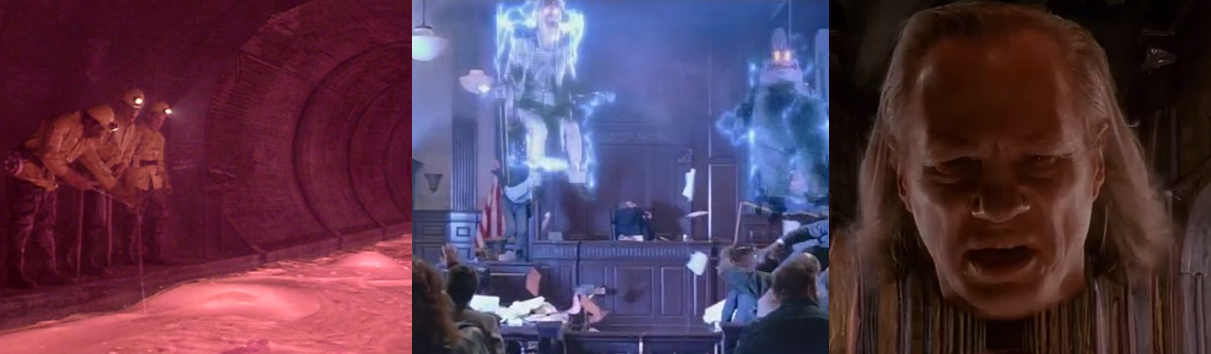
Movie Night [Ghostbusters Day]: Ghostbusters II


Throw on your proton pack and get ready to bust some ghosts because June 8th is officially “Ghostbusters Day”! Ghostbusters (Reitman, 1984) was first released on this day back in 1984 and, since then, has become a major pop culture franchise that includes comic books, a popular cartoon and line of action figures, and videogames and it is, easily, one of my favourite films and franchises from that era.


Released: 16 June 1989
Director: Ivan Reitman
Distributor: Columbia Pictures
Budget: $25 to 30 million
Stars: Dan Aykroyd, Bill Murray, Harold Ramis, Ernie Hudson, Sigourney Weaver, Rick Moranis, Annie Potts, Peter MacNicol, and Wilhelm von Homburg/Max von Sydow

The Plot:
Five years after the events of the first film, the Ghostbusters are no more and are legally forbidden from conducting any ghostbusting or paranormal investigations. However, when a mood-altering slime is discovered beneath the city and the spirit of an ancient Carpathian warlord awakens, the four return to action to once again defend New York from malevolent spirits.

The Background:
Originally developed by actor Dan Aykroyd as a project for himself, Eddie Murphy, and close friend John Belushi, Ghostbusters finally took shape when director Ivan Reitman, writer/actor Harold Ramis, and Bill Murray came onboard. The film was an incredible critical and financial success and, despite the movie intending to be a simple standalone affair, a sequel was considered inevitable. However, Ghostbusters II was a publicly arduous production; Columbia Pictures’ new chairman, David Puttnam, wasn’t interested in making big-budget blockbusters and the creation of a script stalled as the director and actors all required unanimous approval before shooting could begin. After Puttnam was replaced by Dawn Steel, Ghostbusters II finally got underway. Having left acting following Ghostbusters’ success and with a dismissive attitude towards sequels, star Bill Murray demanded an outrageous $10 million salary and his co-stars naturally wanted the same and, after months of negotiations, a fair salary and percentage of the film’s profits was agreed upon for all involved. The script also underwent numerous issues; Aykroyd’s first draft had the team battling witches in Scotland before Ramis helped to shape the sequel towards the film we know today while also factoring in the popularity of the first film’s cartoon spin-off. After a lacklustre response from test audiences, Reitman added an additional twenty-five minutes to the film’s ending and the film eventually grossed just over $215 million, some $67 million less than its predecessor. While I consider it an under-rated sequel, Ghostbusters II was met with mostly negative reviews; its derivative nature, pacing, and performances were criticised and both director Reitman and star Murray found the film to be a disappointing and unsatisfying experience.

The Review:
By the time I was old enough to really have any idea of what was going on in life, both Ghostbusters and Ghostbusters II had been out for some time. Consequently, as a kid, there was very little delay for me between seeing the first film and its often-maligned sequel, meaning that both were formative influences on my childhood. I’ve always held the two in equal regard as a result; yes, the first had the Stay Puft Marshmallow Man but the second had the mood slime and benefitted from a slightly brisker pace so I’ve always thought that Ghostbusters II did a pretty decent job of capturing the same spirit as the first film and building on its foundations with a natural continuation.

No longer allowed to bust ghosts, the Ghostbusters have been forced into other avenues.

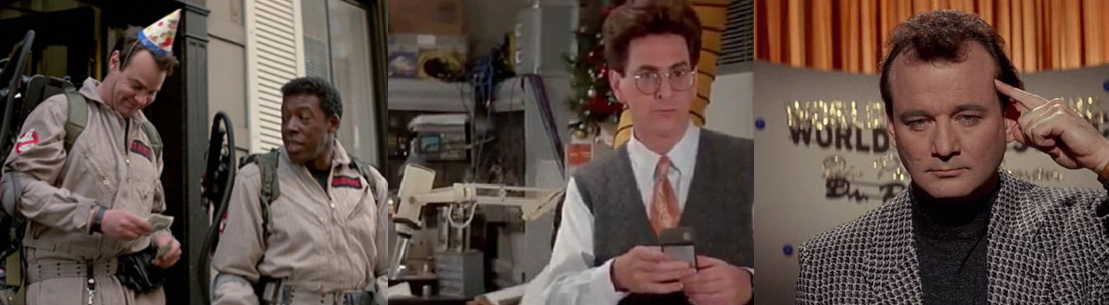
The film begins five years after the events of the first film to find our beloved characters in very different situations; after being sued out of business, the Ghostbusters have had to close their doors and have largely gone their separate ways. Only the heart of the team, Doctor Raymond Stantz (Ackroyd), and the “Everyman” of the group,  Winston Zeddemore (Hudson), keep the brand alive by degrading themselves with appearances at children’s birthday parties. While Doctor Egon Spengler (Ramis) has returned to science and is busying himself testing the specifics of human emotions, Doctor Peter Venkman (Murray) has found minor success as a talk show host where he interviews eccentrics who claim to have psychic powers or other inexplicable tales, and Ray has also set up a small occult bookshop for himself. While the four remain on friendly terms, there is a clear sense of discontentment amongst most of them; Ray longs for their glory days as celebrities, Winston glibly remarks that their efforts went unappreciated by the masses, and even Peter, despite his celebrity status, seems unfulfilled, especially as he is widely (and accurately) regarded as being a fraud.

Dana’s newest plight reunites her with the Ghostbusters and rekindles her romance with Peter.

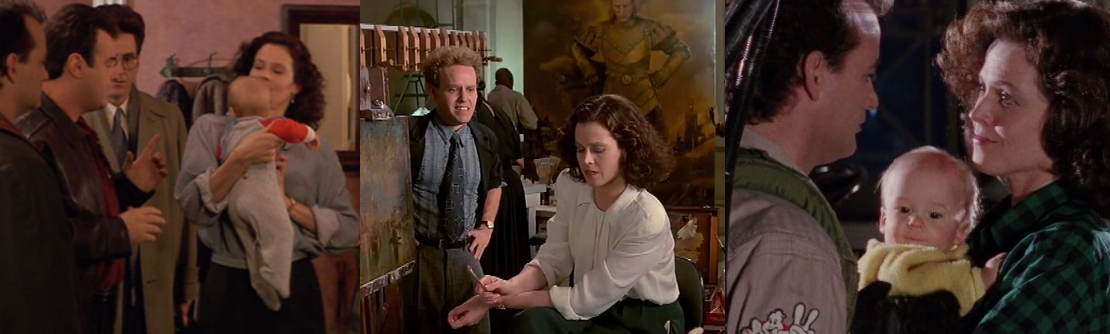
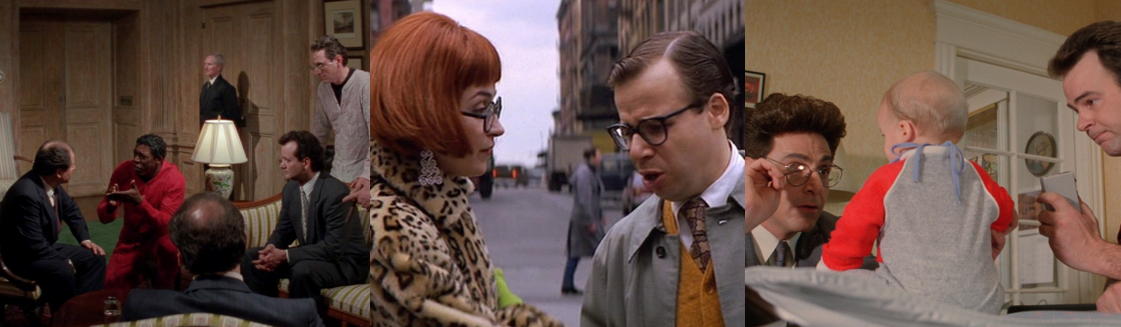
Since the last film, Dana Barrett (Weaver) has split up with Peter, birthed a son, Oscar (William T. and Hank J. Deutschendorf II), with her ex, and has moved away from the orchestra and into the art world. Cleaning paintings at a New York museum, Dana’s life is mired only by her quirky and overeager boss, Doctor Janosz Poha (played with glee by MacNicol), who, like Louis Tully (Moranis), harbours unrequited affections for her. When Oscar’s pram carriage suddenly becomes possessed and escapes from her in the street after she unknowingly rolls over a puddle of “mood slime”, Dana immediately turns to Egon for help and he and Ray investigate her apartment once again. Despite her attempts to keep Peter out of the loop, he forces himself into the investigation and the two reunite once more; despite them having split up over his childish antics, there’s still an attraction there and he laments that he missed the opportunity to be Oscar’s father, and the two eventually rekindle their romance as the film progresses.

A river of evil slime incites new paranormal activity and precedes Vigo’s return to power.

The investigation quickly leads to Egon, Ray, and Peter tearing up the section of the street where Oscar’s possession occurred under the amusing guise of Consolidated Edison (ConEd) workmen; this leads to them discovering that the abandoned Beach Pneumatic Transit system is literally flooded with writhing, pink mood slime that exhibits both paranormal and sentient behaviour. Since they were conducting paranormal investigations, the three are soon brought before a court and face prosecution for their actions (which caused a city-wide blackout); thankfully, however, the mood slime reacts violently to Judge Stephen Wexler’s (Harris Yulin) aggressive outburst and causes two ghosts to manifest in the courtroom and run riot, giving Wexler no choice but to rescind the mandate against the Ghostbusters and allow them to return to work. And just in time, too, as the build-up of the mood slime is no accident; it coincides with the awakening of the brutal and malevolent Vigo the Carpathian (von Homburg/von Sydow), a ruthless Carpathian dictator whose spirit is trapped in a painting in Janosz’s museum. Mustering all of his evil energy, Vigo desires to possess the body of a child in order to live again and easily manipulates Janosz into finding him a suitable host. In exchange for being with Dana, Janosz offers to bring the spirit Oscar so that the two of them can raise the would-be conqueror as their own, and the influx of mood slime causes a new wave of restless spirits to terrorise the city.

Returning characters and a fantastic balance of comedy and horror make for a worthy follow-up.

As if that wasn’t bad enough, Mayor Lenny Clotch’s (David Margulies) sleazeball assistant, Jack Hardemeyer (Kurt Fuller), dogs the Ghostbusters at every turn and ends up going behind the Mayor’s back to have them committed to keep them from threating Clotch’s election for Governor with their maniacal outbursts. Also returning from the first film are the aforementioned Luis and the Ghostbuster’s sharp-tongued receptionist, Janine Melnitz (Potts); while there were hints towards a romance between Janine and Egon in the first film, the focus shifts to the odd couple of Luis and Janine in the sequel and the two comically indulge their whims while babysitting for Dana when the Ghostbusters are briefly arrested. As in the first film, comedy is a large part of Ghostbusters II and is handled beautifully; the courtroom scene where Louis struggles though defending the Ghostbusters is a particular highlight and the Ghostbusters’ various pratfalls, childish antics, and witty retorts provide the same level of bickering entertainment as the first film. I’ve always had a lot of admiration for how these original Ghostbusters films handle the balance of romance, action, comedy, horror, and fantastical science-fiction and, for me, Ghostbusters II more than holds its own when compared to the first although I am still disappointed that the script doesn’t give Winston more to do (he literally disappears for big chunks of the film’s first act and, most notably, isn’t even with the other three when they dig up the street and end up in court).

The Nitty-Gritty:
Thirty-five minutes into the film, the Ghostbusters are legally allowed to return to action and the film noticeably picks up as the foursome return to chasing down and trapping ghosts all over the city. This sees the team wear new versions of their traditional boiler suits, adopt a new logo and produce more (if equally cringey) television advertisements, and even upgrade Ecto-1. I can understand the argument that the film might have been better off had it picked up here, with the Ghostbusters at the height of their popularity and ability, and the film kind of glosses over how the city coped with its supernatural occurrences without the Ghostbusters (who, I feel, have been proven to not be frauds by this point) but I never really minded the narrative structure of the film as it not only echoed the first one but also gave the characters something to overcome and showcased different sides to their personalities by showing us what they get up to when not busting ghosts.

Once the ghosts start popping up, all kinds of terrifying visuals hit the screen!

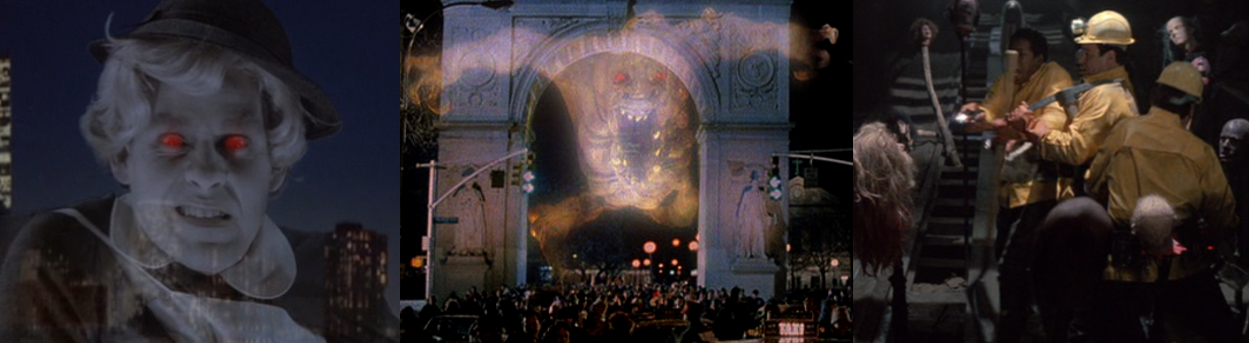
A central aspect of the movie is the mood slime; although ectoplasmic residue played only a minor role in the first film as a by-product of paranormal activity, here the slime is directly responsible for the resurgence in supernatural activity across the city. When Winston and Ray take an accidental dip in the slime, it immediately heightens their aggression and emotions and the two almost come to blows but, after investigating the substance, Egon discovers that the slime can be equally affected by positive emotions and finds a way to effectively weaponise it to their benefit. This becomes a prominent element of the film as the Ghostbusters must galvanise the positive feelings of the city to counteract the build-up of negative energy that threatens to bring about Vigo’s resurrection and gives them additional weapons to use alongside their traditional proton packs. Like the first movie, Ghostbusters II is bolstered by a number of truly frightening visuals; although the Terror Dogs are gone, Janosz’s glowing eyes in Dana’s hallway are pretty creepy, to say nothing of his ghastly ghostly form when he flies in to kidnap Oscar! Seriously, I remember that creeping me out so badly as a kid and, even now, it’s an uncomfortable scene that manages to be both chilling and amusing thanks to McNicol’s gloating expression. Oh, and did I mention the scene in the subway where a demonic voice calls to Winston and the guys are spooked by severed heads on pikes!? Absolutely crazy stuff that I was shocked to see and which work beautifully alongside the film’s new ghosts; once again rendered through traditional composite effects, animatronics, and practical filmmaking techniques; we get such apparitions as a ghostly jogger, a massive beast under the Washington Square Arch, a monstrous bathtub, a living fur coat, a brief cameo from Slimer, and even the Titanic showing up in the middle of the city!

The finale sees the Ghostbusters bring Lady Liberty to life to confront Vigo!

This all culminates the film’s finale where, rather than having to fend off a gigantic apparition, the Ghostbusters use their positively-charged mood slime and a modified Nintendo Entertainment System Advantage control stick to take control of Lady Liberty! I’ve seen people complain about how the film doesn’t feature the Stay Puft Marshmallow Man but, honestly, that wouldn’t make any sense at all and by no means diminishes the impact of seeing the Statue of Liberty come to life and casually stroll through New York City. In many ways, the finale is actually better than the original since, rather than simply standing around and crossing the streams to win the day, the Ghostbusters have to rappel down into the museum to confront Vigo and Janosz and even have to content with a possessed version of Ray when Vigo briefly takes control of his body after his resurrection is interrupted. This time around, in order to save the city (and the entire world) from falling under Vigo’s influence, the Ghostbusters need more than just their proton packs; they need the combined goodwill of the city and a hefty hosing of their positive-charged mood slime in order to force Vigo back into his painting, end his threat, and presumably fully repair their reputation.

The Summary:
Now, look…I get it. Ghostbusters II isn’t as good as the first film; honestly, Ghostbusters set a high bar that would be difficult for any sequel to reach but, for my money, Ghostbusters II does a really good job of continuing the story from the first film. While many of the story beats are similar, the film adds plenty of fun, scary new stuff to make it well worth your while, especially for fans of the first movie. Thanks to the immortal Max von Sydow’s booming tones, Vigo makes for a compelling and intimidating villain and the addition of the mood slime allows for some gruesome and comedic scenes. All of the characters are just as likeable and entertaining as in the first film, and even fleshed out a little more (sadly, with the exception of Winston…) by seeing their interests outside of work, and the balance of horror and comedy continues to be handled masterfully. I can understand why many were left disappointed by the film, to a degree, but I’ve always had a soft spot for Ghostbusters II and think it makes for a great companion piece to the first film; watch them both back-to-back and you have one pretty consistent and enjoyable story. I’ll always step up to defend this film when I see people talking shit about it because it’s a fun little romp that deserves more attention, and has a great message of positivity that we could all stand to learn from.

My Rating:

Rating: 4 out of 5.

Great Stuff

Are you a fan of Ghostbusters II? Do you think it deserves the negativity it often gets? What did you think to the five year time jump and the plot of the Ghostbusters being barred from working? Were you a fan of Vigo and Janosz and what did you think to the overall plot? Which of the film’s ghosts and scares were your favourite? Perhaps you grew up with the cartoon and action figures; if so, what memories do you have of them? How are you celebrating Ghostbusters Day today? Whatever your thoughts and memories of Ghostbusters, drop a comment down below.

Movie Night: The Grey

Released: 27 January 2012
Director: Joe Carnahan
Distributor: Open Road Films
Budget: $25 million
Stars: Liam Neeson, Frank Grillo, Dallas Roberts, Dermot Mulroney, and Nonso Anozie

The Plot:
Following a devastating plane crash, suicidal marksman John Otway (Neeson) finds himself stranded in the desolate Alaskan wilderness alongside a handful of survivors. Battling mortal injuries and merciless weather, the survivors find themselves hunted and hounded by a pack of wild, ravenous wolves and in a race against time (and nature) to find safety.

The Background:
The Grey was based on the short story Ghost Walker by Ian MacKenzie Jeffers, who also co-wrote the screenplay, and reunited director Joe Carnahan with his A-Team (ibid, 2010) star Liam Neeson. Neeson, who was still enjoying a career resurgence after the success of Taken (Morel, 2008), replaced his A-Team co-star Bradley Cooper in the main role. The gruelling shoot, which drew controversy after it was revealed that the cast got to eat actual wolf meat during filming and for furthering the negative depiction of wolves in popular media, gave Neeson the opportunity to channel his grief over the death of his wife into his performance. Still, the film’s worldwide box office gross of just over $80 million made it a modest success and it earned mostly positive reviews despite its unrelating nature. Personally, I found it to be a poignant and surprisingly tragic story of survival and the harsh reality of nature and I’ll take any excuse to revisit it and today seems like the perfect opportunity given that it’s Liam Neeson’s birthday.

The Review:
Our main character, John Ottway is a haunted man; stuck in a job at the farthest corner of the world, he feels he belongs isolated from the larger world and surrounded by assholes and ex-cons. A sombre, stoic man whose narration sporadically accompanies the film’s bleak and sparse score, he actively avoids others wherever possible and torments himself with memories of his beloved dead wife, Ana (Anne Openshaw), whom he longs to have back in his life. Although he plays a pivotal role in protecting the workers of the oil refinery from ravenous wolves with his expert marksmanship, so great is his anguish that he is fully prepared to kill himself at the start of the film. Despite being literally at the end of his rope and admitting to being scared shitless, Ottway’s survival instinct kicks into full effect after surviving the plane crash; although he has no wish to be a leader, and despite believing that he no longer has anything useful to offer the world, Ottway doesn’t hesitate to help and rally the injured survivors in pooling their few resources and hiking their way through the wilderness.

Ottway begins the film in a dark place before having to lead the survivors of a plane crash.

The plane crash is depicted as a sudden and violent event that perfectly encapsulates why I hate flying; while I find it difficult to believe that anyone, much less a handful of people, would be capable of surviving such an impact, the film does a great job of showing Ottway’s adaptability in his foresight to prepare himself for the crash and we immediately see the fallout from the devastating accident. Bodies and wreckage are strewn everywhere and Ottway immediately shows his pragmatic, realistic approach to the situation when he levels with the trapped Duke Chavis (Adrian Hein) that his injuries are fatal. The ragtag survivors are forced to rally together despite suffering from shock and the extreme cold (and, most probably, a few concussions); it’s not long before injuries and wolves begin to pick off the weaker members, however, or before the affable Jackson Burke (Anozie) succumbs to the hypoxia he has been hiding from his comrades.

While the others defer to Ottway, Diaz challenges him before being humbled into co-operation.

While the other survivors – Dwayne Hernandez (Ben Bray), Todd Flannery (Joe Anderson), Pete Hendrick (Roberts), and Jerome Talget (Mulroney) – defer to Ottway’s knowledge of the area and its wildlife, John Diaz (Grillo) frequently challenges Ottway’s leadership and decisions. An abrasive and antagonistic pessimist, Diaz doesn’t appreciate Ottway’s authority and constantly mocks Ottway’s decisions (or lack thereof); he finds it laughable that Ottway goes out of his way to collect the wallets of the dead for their families, refuses to help the group in scavenging for supplies, and frequently boasts of his ability to survive without Ottway’s assistance. However, for all his fire and bluster, the simple truth is that he is as strung out and scared to death as the rest of them. Overwhelmed by the desperation of their situation, Diaz almost comes to blows with Ottway before he is attacked by a wolf; after focusing his aggression and panic on brutally slaughtering and beheading the creature, Diaz’s demeanour changes to one of humble co-operation and he ultimately proves himself to be a valuable ally and brave-hearted survivor.

The survivors are stalked and set upon by a pack of ravenous wolves.

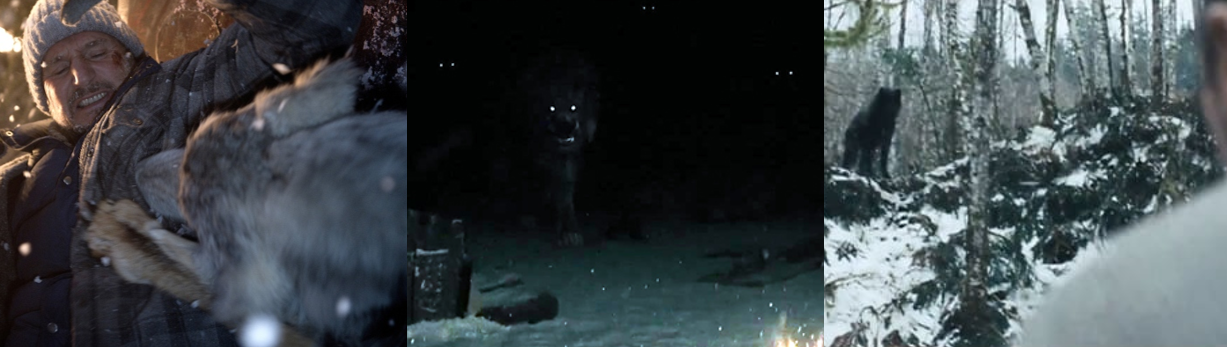
It isn’t long before the group has their first encounter with one of the many wild and ravenous wolves that populate the area; one attacks Ottway after he interrupts it chowing down on a corpse and, as the group struggles to find their way and set aside their differences, a pack of wolves constantly stalks them from the shadows and the thick, impenetrable woods like an ominous supernatural force. Armed with a wealth of knowledge of the wolves’ behavioural and territorial nature, Ottway desperately tries to keep the group alive as the wolves test them with infrequent attacks and seemingly taunt them with howls and growls from the darkness. As the survivors have trespassed into the wolves’ territory (and are, it turns out, walking right towards and through their den), they are unusually aggressive and bold; intelligent enough not to swarm the group, even with their greater numbers, the wolves bide their time and pick off the weakest and the stragglers one at a time as the film, assuring that the tension and dread escalates to the film’s dramatic climax.

The Nitty-Gritty:
Set in the bleak, barren mountains of Alaska, the environment of The Grey is just as ominous and harsh and as much of an antagonist as the wolves; the survivors are relentlessly besieged by bitter winds, knee-deep snow, harsh blizzards, and below-freezing temperatures that cause them nothing but pain and further tumult within their already highly-strung group. Even in the film’s few daytime scenes, the feeling of helplessness and isolation is palpable and, at every turn, the environment worsens their situation: they have few opportunities for cover and safety, even fewer options in terms of food (the group relishes the chance to cook and eat a wolf in order to intimidate their stalkers), and are often gravely and fatally injured or obstructed by the threes, canyons, and ice-cold rivers that surround them

Every obstacle extracts a price as the unforgiving environment whittles the group down.

Survival is, of course, a key theme in the film and is emphasised through Ottway’s persistent reflection on a short poem written by his father that speaks of a man’s final push into “the fray” and the “last good fight [he’ll] ever know”. Although the plane crash was devastating, the group are able to salvage some fuel for fires and Ottway is able to cobble together some crude weaponry for them to defend themselves with, much to Diaz’s initial chagrin. Thanks to their few resources, the group are just barely able to limp along and find ways to overcome the obstacles they face but, every time they do (whether it’s a wolf or a part of the environment), it extracts a price: each hurdle sees at least one man either injured or horribly killed until the group is whittled down to just three survivors left fatigued and disheartened. A few scenes that stand out for their intensity are the moment where the guys are left with no choice but to scramble across a precarious rope from a cliff edge into the trees below in order to find a river that could lead them to safety (which leaves Talget critically injured and at the mercy of the wolves), Diaz’s decision to ultimately give up fighting and succumb to the ravages of nature (a poignant and utterly heart-breaking scene where he gives Ottway a heartfelt thank you for getting them so far), and the absolutely brutal and abrupt drowning of Hendrick after making the first aforementioned jump into the trees.   

Ottway goes from suicidal to ready to fight for his life as he makes a desperate last stand.

In a nutshell, The Grey is the ultimate depiction of man versus nature; out in the barren wilds, the group cannot depend on anyone or anything but themselves and this is beautifully emphasised in the bleak atheism that permeates the film. To stave off the terror and despair of their situation, the group share stories of their loved ones: Ottway encourages this as it gives the guys something to fight for when their backs are against the wall and he believes not in God but in the stark reality that he is faced with. The wolves are depicted as monstrous, unrelenting extensions of the environment, often appearing as little more than a blurry mess of fur and teeth or simply the pinpricks of their eyes glistening in the darkness. With all the other men dead, Ottway finds himself stranded in the middle of the den with nothing but a bag full of wallets; after sombrely buring the wallets, Ottway first challenges God to intervene and then rejects Him entirely in a powerfully relatable scene before preparing himself for a fight to the death with the Alpha wolf. I can fully understand people being disappointed that the film abruptly cuts to the credits and leaves us with a brief, ambiguous post-credits scene rather than depicting a full-on, bloody brawl between Ottway and the Alpha but I feel this sudden end is just as powerful and effective. By this point, Ottway has overcome so much hardship and pain, seen so many good and brave men die in their attempts to beat nature, and is faced with the startling realisation that he had been leading them in the wrong direction the entire time that he has absolutely nothing left to fight for but himself. Seeing Ottway strap broken bottles and a knife to his hands and prepare to fight to his last breath is a stark contrast to where we find Ottway at the start of the film, where he was all-but-ready to put a bullet in his head and makes for an impactful and memorable end to a powerful and intense film.  

The Summary:
Like many, I’m sure, I was sold on The Grey on my fondness for Liam Neeson and the idea of seeing him having a fist fight with a wolf. What I got was one of the most uncompromisingly bleak and brutal tales of survival against the ravages of nature that I have ever seen. A dismal and startling mediation on the harsh and cruel nature of the wilderness, The Grey may not do much for the depiction of wolves but it never fails to have an impact on me for the way it portrays them as savage, almost demonic arms of nature itself. Bolstered by some understated performances, to say nothing of Neeson’s grim but dogged Ottway, The Grey remains an intense and deeply affecting experience for me; the lack of catharsis in a definitive ending only punctuates what is a harrowing tale of survival and the fortitude of man’s willingness to do anything to overcome the odds. Even if we ultimately fail, in those moments we find the best of ourselves, the ability to set aside grievances, pull together what few resources we have, and make a definitive, if ultimately futile, stand in the effort to stay alive.

My Rating:

Rating: 4 out of 5.

Great Stuff

Are you a fan of The Grey? What did you think to its portrayal of wolves as viscous, ravenous predators? Like me, do you enjoy the film’s bleak tone and the themes of survival and man against nature? How does the film affect you, emotionally, spiritually, or otherwise? What did you think to Liam Neeson’s performance and Diaz’s character development? Do you think you would be able to survive under the same harsh conditions seen in the film? How are you celebrating Liam Neeson’s birthday and what is your favourite Liam Neeson film? Whatever your thoughts, feel free to leave a comment below and let me know what you think.

Movie Night [Superman Month]: Superman


In 2013, DC Comics declared the 12th of June as “Superman Day”, a day for fans of the Man of Steel the world over to celebrate Clark Kent/Kal-El/Superman, the superpowered virtue of “Truth, Justice, and the American Way” who is widely regarded as the first ever costumed superhero. This year, I’ll be spending every Sunday of June celebrating the Man of Steel as I expand Superman Day to “Superman Month“.


Released: 14 December 1978
Director: Richard Donner
Distributor:
Warner Bros. / Columbia–EMI–Warner Distributors
Budget:
$55 million
Stars:
Christopher Reeve, Gene Hackman, Margot Kidder, Valerie Perrine, and Marlon Brando

The Plot:
In the dying moments of the planet Krypton, scientist Jor-El (Brando) rockets his son away to Earth. After learning of his alien origins and discovering the limits of the fantastic superhuman powers afforded him by Earth’s yellow sun, the now-adult Clark Kent (Reeve) assumes the costume identity of “Superman” while disguising himself as a mild-mannered reporter. However, he faces his greatest test when genius criminal mastermind Lex Luthor (Hackman) hatches a plot to cause devastating earthquakes west of the San Andreas Fault.

The Background:
In the years since his dramatic debut, Superman quickly became the subject of numerous adaptations and his 1940 radio drama even introduced many aspects that became synonymous with the character. The idea of a feature-length Superman film was first conceived of by producer Ilya Salkind in 1973; entering into a partnership with his father, Alexander, and Pierre Spengler, the filmmakers were able to convince Warner Bros. to produce a two-film adaptation of the character and paid screenwriter Mario Puzo (of Godfather (ibid, 1969/Coppola, 1972) fame) $600,000 to write the screenplay. Steven Spielberg was courted to direct but was unable to commit and, while Guy Hamilton was attached to the project, the producers eventually settled on Richard Donner, who immediately ditched the campy tone of Puzo’s 400-plus-page script. The first actor signed to the film was Marlon Brando (who had some pretty funny ideas about Jor-El’s appearance and characterisation and had a lackadaisical attitude towards the film) and Oscar winner Gene Hackman soon followed, with the two receiving top billing. Many notable names were considered for the title role before relative-unknown Christopher Reeve was cast after a laborious casting process. Having bulked up for the role, Reeve’s experience as a pilot paid off when performing the film’s complex flying sequences, which were achieved through a combination of green screens, wire work, and other camera tricks while the striking Kryptonian suits were the result of a happy accident with a reflective material. Very quickly, the film’s budget ballooned and filming began to over-run, causing tensions between Donner and the producers; Richard Lester was brought on board as a mediator and work on the sequel halted to concentrate on the first film. After several delays, Superman (also marketed as Superman: The Movie) released to rave reviews and was an incredible financial success, making over $300 million. Although the producers continued production of the sequel immediately, the damage was done and Donner did not return, necessitating a series of expensive reshoots and raising the ire of many of the film’s actors. Still, the first film was an incredible achievement, massively influential on Superman’s comic books, and was eventually preserved in the United States Library of Congress National Film Registry.

The Review:
Superman begins, as most Superman origin stories do, on the far away world of Krypton (or “Krypt’n”, if you’re Marlon Brando), a technologically advanced civilisation that inhabits a largely barren, crystalline world. In a fantastic seed for the sequel, Jor-El sentences three seditious criminals – Non (Jack O’Halloran), Ursa (Sarah Douglas), and their leader, General Zod (Terence Stamp) – to the mysterious “Phantom Zone” for their treasonous and destructive efforts to usurp the Kryptonian council and subjugate the world to Zod’s will. Defiant to the last, Zod vows to avenge himself upon Jor-El and his heirs, no matter how long it takes and against all odds, before the three are cast into the strange mirror prison. Following this, Jor-El is unable to convince the council that Krypton is doomed to be destroyed by its red giant sun within thirty days; indeed, despite being a highly respected and rational member of the council, Jor-El’s claims are so adamantly refuted that he is threatened with being labelled a terrorist himself.

Unable to save his planet, Jor-El sends his infant son to Earth, where he gains awesome powers.

Apparently despondent (it’s hard to tell with Brando…), Jor-El resigns himself to ensuring the survival of his young son, Kal-El; his wife, Lara (Susannah York), laments that their son will forever be an outcast amongst the “primitives” of Earth but Jor-El remains confident that the powers bestowed upon Kal-El by Earth’s yellow sun will make him a symbol of hope and afford him physical advantages beyond all known understanding. As Krypton shatters around them, the baby is rocketed away and, guided by his father’s voice, slowly grows into an infant within his escape craft; Jor-El, who encoded all of his knowledge and wisdom into the crystalline form of the ship, stresses that his son is “forbidden” to interfere in Earth’s history and instead let his example inspire others. In time, many thousands of years after Krypton’s destruction, the ship crash lands on Earth and is stumbled upon by kindly, elderly couple Jonathan (Glenn Ford) and Martha Kent (Phyllis Thaxter) who are awestruck by the child’s super strength and, despite Jonathan’s concerns, take him in as their own.

After losing his adopted father, Clark learns the extent of his powers and reveals himself to the world.

About fifteen years later, the boy has grown into well-meaning teenager Clark Kent (Jeff East, with Christopher Reeve dubbing his voice); though Clark is frustrated that he has to hide his physical capabilities from the world, Jonathan stresses that the boy was sent to them (and the world) for a greater reason than to simply score touchdowns or show off to the other kids. As he just wants to make his parents proud, Clark takes his father’s advice to heart but is left utterly heartbroken when Jonathan suffers a fatal heart attack. At his graveside, a devastated Clark laments that his awesome powers were ultimately useless in saving his father and thus learns a valuable lesson about the limits of his superhuman abilities. Drawn to the remains of his ship (which the Kents kept hidden in their barn), Clark discovers a glowing green crystal that leads him far north, all the way to the Arctic, where the crystal births a piece of his home planet on Earth. In this Fortress of Solitude, Clark communes with the spirit of his father, who lives on as a glorified artificial intelligence, and spends a further twelve years absorbing all of Jor-El’s knowledge and teachings of his newfound abilities. After his training is completed, Clark emerges as Christopher Reeve and garbed in a bright Kryptonian costume and ready to share his abilities with the world as Superman.

Clark poses as a mild-mannered reporter, which allows Superman to captivate Lois.

Clark sets himself up as a reporter at the Daily Planet (apparently it’s as easy as being able to type incredibly fast and being overly polite), meeting hot-tempered editor-in-chief Perry White (Jackie Cooper), enthusiastic young photographer Jimmy Olsen (Marc McClure), and feisty reporter Lois Lane (Kidder). Despite her inability to spell, Lois is a lively and fearless journalist and, consequently, she both despairs of Clark’s overly friendly nature and sees him as a bit of a dorky milksop and finds her curiosity sparked by some of his oddities. In comparison, Lois is immediately captivated by Superman when he not only catches her in mid-air as she’s plummeting to her death but also snags the helicopter she was falling from. Enamoured by his mystery, confidence, and the seemingly limitless superhuman abilities he possesses, her normally controlled and forthright demeanour is shattered and she’s left absolutely awestruck during (and following) her exclusive interview with the Man of Steel (where she names him and he also, curiously, divulges a number of secrets about himself that later come back to bite him in the ass).  

The maniacal Lex Luthor plots to destroy Superman in his quest to profit from real estate.

The villain of the piece, the enthralling Lex Luthor, has set up an impressive hideout beneath the city streets; there, protected by a series of cameras and deadly booby traps, he surrounds himself with the dim-witted Otis (Ned Beatty) and sexy but cynical Eve Teschmacher (Valerie Perrine). Egotistical and arrogant in his intellect, Luthor sees himself as the world’s greatest criminal mind and is busy planning the crime of the century, which involves the acquisition of seemingly worthless land and profiting from it by causing a cataclysmic flood, endangering and ending countless lives in the process. Luthor immediately surmises that Superman is not of this Earth and relishes the opportunity to pit himself against the Man of Steel, and to both prove his intellectual superiority over him and destroy the very virtues that Superman stands for, seeing the Man of Steel as the ultimate challenge for his self-proclaimed criminal genius.

The Nitty-Gritty:
Of course, you can’t really talk about Superman without mentioning John Williams’ bombastic and immediately iconic “Superman” theme that is rendered in full glory over the opening credits. While this theme has become so synonymous with the character that no composer or filmmaker since has come close to crafting a more suitable melody for the Man of Steel, I continue to be baffled by the absolutely cringe-worthy “Can You Read my Mind?” sequence. Like, I get it; it’s supposed to be this big romantic moment between the Lois and Superman and to showcase the film’s wirework, but it stands out like a sore thumb and is all kinds of different flavours of cheese.

While Reeve set the standard for Clark/Superman, other performances are a bit hit and miss.

If I’m being brutally honest, the film’s performances are a bit hit and miss; despite being a relative unknown, Reeve provides the quintessential portrayal of Superman and simply exudes confidence and sociability as Superman while masking his true nature as loveable, bumbling fool. Indeed, by simply straightening his posture and slightly altering his voice, Reeve effortlessly depicts the simple differences between his two persona and his performance so explicitly set the standard for the character that it continues to be emulated to this day. Once the story shifts to Metropolis, the film becomes a much more vivid and over-the-top production that emphasises buffoonery and comic book camp; nobody embodies this more than the bumbling Otis, who is mostly here for comic relief, but there’s also the suggestion that Luthor socialises with cretins simply to have someone to lord over. While Beatty and Cooper seem to have stepped out of a pantomime for their roles as the goofy Otis and bombastic Mr. White, respectively, Hackman brings a certain gravitas to the film that perfectly walks a fine line between camp and severe. Hackman seems to be enjoying himself in the role and commands every scene and room that he’s in; though he lacks Luthor’s bald head, he sports a variety of wigs and exudes a sadistic menace in his willingness to kill millions of innocent people in his quest for power, profit, and to have his matchless intelligence recognised by the world.

While some effects don’t hold up well, they’re all very ambitious and impressive for the time.

Obviously, you have to expect that some of the effects aren’t as impressive and haven’t aged as well as others, as ambitious as they are; the Arctic is clearly a set like something out of Star Trek (1966 to 1969) and I can only assume that Krypton is so barren and lifeless because it was cheaper and easier (though it also makes it cold and alien and a stark contrast to our lush world). The young Clark’s running effect and a number of the rear-projection and miniature shots leave a lot to be desired and almost every skyline appears to simply be a gigantic matte painting as the film is heavily reliant upon impressive sets the likes of which are akin to a James Bond film. While Clark’s super fast changes to Superman and his little spin down into Luthor’s lair aren’t that great, easily the weakest effects come in the conclusion as the San Andreas Fault is ruptured and painstakingly crafted models are washed away by water and dirt before Superman circles the globe at superspeed. To be fair, though, the film’s effects are still incredibly impressive; the helicopter sequence is an ambitious and remarkable composite of miniatures, rear-projection, and live-action wire work that makes for a suitable debut for the Man of Steel and, overall, the film has largely stood the test of time thanks to its practical effects and undeniable charm. As you might expect, Superman’s powers and abilities are the highlight of the film; Superman’s invulnerability, super strength, and superspeed are all accounted for and realised well enough and Superman’s first night on duty provides a great showcase of what he is capable of. No job is too big or too small for Superman, who does everything from rescuing a cat from a tree to apprehending jewel thieves as they clamber up the outside of buildings using sucker pads.

Superman comes up with a unique solution to save the day.

Naturally, it’s the flying sequences that are the true spectacle of the film; even now, the rear-projection holds up pretty well in these scenes but what really sells it is Reeve’s dynamic and believably movements. Reeve banks and turns with an elegant grace and really sells the illusion that we’re seeing a man fly and makes even the most ridiculous aspects of the film (from the 100% comic-accurate suit to using his own body to repair a broken train track to repairing the San Andreas Fault by ploughing through questionable-looking magma) seem entirely plausible thanks to his charming smile and undeniable charisma. Of course, when talking about Superman, you have address the ending. Thanks to acquiring a chunk of Kryptonite, Luthor is able to weaken and cause incredible agony to Superman and it is only thanks to Ms. Teschmacher’s change of heart that he’s able to recoup his strength and intercept Luthor’s missiles. However, while he’s able to stop one, he’s unable to keep the other from striking the San Andreas Fault and is so busy repairing the damage it causes that he’s unable to save Lois from being crushed to death by debris. Devastated and overcome with grief, Superman flies into the upper atmosphere and defies his birth father’s warnings of interfering in human history to favour his adopted father’s advice and is able to literally turn back time by reversing the rotation of the planet. This undoes all of the damage caused by Luthor’s missiles and prevents Lois’s death but remains the most ludicrous aspect of the entire movie and just ends up raising all kinds of questions like…wouldn’t there be two Superman? Why doesn’t he just turn back time all the time? Ultimately, it’s just one of those crazy, over-powered feats that we’ve come to expect from older versions of Superman and I guess it works to show that Superman is capable of overcoming even his limits by pushing hard enough (plus, Reeve’s anguished cry does make for an incredibly intense scene).

The Summary:
I honestly went into Superman ready to give it a lower score of two stars; it’s never really been my favourite superhero, or Superman, film as it’s just got a little too much cheese and cringe in it for my tastes. There’s an undeniable level of camp at work in the film that makes it very cartoony and over-the-top in places, to say nothing of long, oddly paced inclusions that seem decidedly at odds with the rest of the film. However, all of these elements are in perfect balance with the film’s more dramatic and spectacular sequences; this is a film that is, primarily, a showcase of ambitious and trend-setting cinematic techniques as much as it is perhaps the most influential interpretation of Superman ever seen outside of the comic books. While not every effect has aged too well, the majority have stood the test of time remarkably well and there’s just the right balance of goofy comedy, heart-warming charm, and exciting spectacle that simply scream “Superman”, a character who is often characterised as being the world’s biggest Boy Scout and embodying timeless (if slightly antiquated) ideals. There’s no denying that Superman is an absolute classic; while I cannot sanction Marlon Brando’s attitude and I may not be a fan of some of Donner’s choices (Luthor being a real estate maniac, the barren depiction of Krypton, and the time travel ending are all cons of the film for me), Superman remains a delightful and enjoyable little slice of camp goodness that is worth it for Reeve’s incredible and career-making turn in the title role if nothing else.

My Rating:

Rating: 3 out of 5.

Pretty Good

Are you a fan of Superman? What did you think to Christopher Reeve’s portrayal of the character and were you a fan of Lex Luthor’s interpretation in the film? How influential was Donner’s film on your perception of Superman and are there any aspects you would prefer to see films and media move away from? What did you think to the film’s campier elements and were you a fan of the ending? What is your favourite Superman story, character, or piece of media? How are you planning to celebrate Superman Day next week? Whatever you think, feel free to share your opinion and thoughts on Superman in the comments below.

Game Corner [Sonic Month]: Sonic Boom: Shattered Crystal (Nintendo 3DS)


Sonic the Hedgehog was first introduced to gamers worldwide on 23 June 1991 and, since then, has become not only SEGA’s most enduring and popular character but also a beloved videogame icon and, in keeping with tradition, I will be dedicating an entire month’s worth of content to SEGA’s supersonic mascot.


GameCorner

Released: 11 November 2014
Developer: Sanzaru Games

The Background:
Sonic the Hedgehog is no stranger to reinvention and adaptation; as I’ve already detailed, Sonic’s design and backstory were dramatically different outside of Japan, where he was more of a snarky rock star as opposed to a Freedom Fighter who was once friends with the kindly Professor Ovi Kintobor. Sonic’s design was further altered for his jump to 3D, where he was redesigned as a more aerodynamic, anime character and many long-term Sonic fans have seen Sonic’s lore go through numerous changes so it’s honestly strange to me that there was such a negative backlash when Sonic and his friends were redesigned once more for SEGA’s CGI Sonic series, Sonic Boom (2014 to 2017). While the over abundance of sports tape was a bit strange, I was actually very much onboard with the redesigns at the time and fully believe that SEGA should have wiped the slate clean and started over with a fresh, new take on the franchise. Unfortunately, as great as the Sonic Boom cartoon was, the accompanying videogames irrevocably damaged the spin-off’s appeal; the Wii U title, Sonic Boom: Rise of Lyric (Big Red Button, 2014) was notoriously glitchy and is generally regarded as one of the worst games in the franchise. The 3DS counterpart, however, was developed by a completely different team and, while Shattered Crystal was met with criticism for its lacklustre, repetitive gameplay, it was still received slightly more favourably than Rise of Lyric.

The Plot:
In a prequel to the Sonic Boom cartoon, Sonic and his friends race to rescue Amy Rose from the clutches of the malevolent, serpentine cyborg Lyric, the recently awakened Last Ancient who seeks to claim the fragmented Lost Crystal and, with it, the power to dominate the world!

Gameplay:
Sonic Boom: Shattered Crystal is a 2.5D action/adventure platform title with a heavy emphasis on exploration, character switching, and both finding collectibles and finishing stages as quickly as possible. If you don’t mind the headaches and eye strain, you can adjust the 3DS’s slider to activate the 3D effect, which adds a decent amount of depth and causes the colourful graphics to pop out nicely enough but I prefer to have this turned off to avoid being distracted by this effect. Like in Sonic Adventure (Sonic Team, 1998), when you first start the game you can only play as Sonic and will unlock the other playable characters (Miles “Tails” Prower, Sticks the Badger, and Knuckles the Echidna) as you complete stages and advance through the story. Each character can be switched to on the fly using either the directional pad or the touch screen, allowing you to quickly swap between the different characters and their unique abilities quickly enough, but all characters share some basic abilities. They can all jump with B, Homing Attack nearby enemies, springs, and other objects by pressing B again in mid-air, sprint by holding Y (basically the same as the Boost function that has become a staple of Sonic games), perform a stomp by pressing down and X in mid-air, and bust out the “Enerbeam” by pressing A to swing from certain platforms and remove shields from enemies.

Each character can use their unique abilities to traverse stages and reach new areas and secrets.

Each character also has their own unique mechanics to help you explore the game’s locations: Sonic can perform the Spin Dash when on the group and a vertical and horizontal air dash by pressing up, left, or right and X in mid-air to smash through blue blocks, and Tails can hover by holding B in mid-air (which he can use to ride air currents but this isn’t the same as his usual flying mechanic as he’ll quickly descend downwards as soon as you start hovering), toss bombs with X, and use his submarine, the Sea Fox, in certain areas. Sticks’ main gimmick is her boomerang, which you can throw with X to activate switches, collect Golden Rings and items, or defeat enemies; you can even hold X to manually guide her boomerang for as long as the onscreen meter lasts but you’ll have to be very precise when trying to guide it through narrow passageways. Finally, there’s Knuckles, who disappointingly can’t glide or climb walls anymore but he can punch with X and burrow through specific parts of the environment to reach new areas and items; however, if his meter runs out when you’re burrowing, you’ll be deposited back where you started and take damage so be sure to hold Y to burrow faster, avoid any mines, and pop out of the ground before you lose all of your Rings! Speaking of which, as always, Golden Rings will protect you from damage and can be found…sporadically….across each of the game’s locations. Unlike pretty much every single Sonic game, though, Shattered Crystal doesn’t have a standard life system; collecting one hundred Rings will earn you a Token but doesn’t grant you an extra life and, if you fall down one of the many bottomless pits or fall into water, you’ll be deposited back to the last piece of solid ground you were on and take damage rather than dying. If you get hurt without any Rings, you’ll simply respawn at the last checkpoint you passed (or at the start of the stage) and can continue on, all of which makes the game significantly easier than most Sonic games as you never have to worry about running out of lives. This is helpful as I found myself struggling a bit with the controls; for some reason, I just didn’t find them very intuitive and it seemed like the developers went out of their way to use all of the buttons (except for L and R) when they really didn’t need to.

The map is a bit limited and areas are often locked out until you collect enough Sonic Badges.

I mentioned Tokens just now and you can earn these in every stage by finishing with a hundred Rings and/or within a specific time limit. If you take too long to finish a stage, you’ll simply miss out on the Token rather than having to restart, which is helpful, but Tokens are a mere distraction rather than an incentive to play as they’re simply used to purchase “Toys” from a shop and to add to your overall completion percentage. Each stage also hides a number of Crystal shards and Blueprints, both of which also unlock additional, extraneous features, but the main reason you’ll want to find these and finish stages is that they award “Sonic Badges” (kind of like the Emblems in Sonic Adventure) which are necessary to unlock stages. If you don’t collect enough, you’ll have to go back and replay previous stages and explore a bit more to find these items and earn a Sonic badge in order to progress the story, which is a bit like Sonic Unleashed’s (ibid, 2008) Sun and Moon Medals (though I never had any instances in that game where I was locked out of stages like I was here). Thus, the best thing to do is to take your time and explore every stage as thoroughly as possible and then replay it afterwards to go for the fastest time since the Sonic Badges are actually needed to progress. Stages in Shattered Crystal are unlike anything I’ve seen in a Sonic game before; you enter them from a limited overworld map (from which you can also access Tails’ Workshop and the aforementioned shop and travel to other islands to take on more stages) and, rather than being divided into or labelled as “Zones” or “Acts”, you’re simply presented with a large, multi-layered stage to explore.

Gameplay is spiced up a bit by some submarine, auto-run, and racing sections.

The game runs at a pretty slow speed for the most part; you have to hold Y to move faster and there are an abundance of automatic boost sections where you can literally take your hands off the 3DS since your input is not required, but speed is not the objective of this Sonic game. Instead, you need to explore high and low using each character’s abilities to find all the hidden times. Sometimes, you’ll need to grind on some rails and quickly chain together Homing Attacks or ride air currents and swing across gaps on the fly to reach these items, while others you just use the touch screen to slingshot your way to different parts of the stage to find them and work you way towards the exit. Gameplay is mixed up a little bit in the Sea Fox sections, which see you controlling the submarine in a series of underwater caves lined with mines. By touching the touch screen, you’ll activate the radar and get a brief look at the layout of the area and you can fire missiles with X to destroy mines and rocks that block your progress but be sure to keep an eye on the meter and avoid getting hit as this will cost you time (though you can, and absolutely should, collect the clocks scattered around the area to refill this meter). Each of the game’s islands also includes an auto-running section where, you (as Sonic) must race along a tunnel very similar to the Special Stages from Sonic the Hedgehog 2 (SEGA Technical Institute, 1992), avoiding electrified barriers, switching lanes, Boosting through walls, collecting Rings, and using the Enerbeam to grapple onto overhead lines. If you fail to grapple at the right time or hit a barrier, you have to start from the beginning again and you can’t switch lanes while Boosting or jumping, which is extremely annoying, but, while these sections get faster and trickier as the game progresses, they’re pretty simple to complete on one or two (maybe three) tries. Similarly, you’ll also be asked to race against certain characters (including criminally underused cameos from Shadow the Hedgehog and Metal Sonic) in sidescrolling races that remind me of those from the Sonic Rivals games (Backbone Entertainment/Sega Studio USA, 2006 to 2007) except you can’t attack your rival like in those games.

Graphics and Sound:
Sonic Boom: Shattered Crystal looks serviceable enough, for the most part; the graphics seem a little distorted at times but, to be fair, I find that to be a common issue with the 3DS. The camera is maybe zoomed out a little too much, though, or in this weird, awkward position where you can’t really see enough of what’s ahead to make the split-second jumps or actions required of you. It’s also, at times, a little difficult to see what’s part of the environment and what can hurt you; I found this especially troublesome in the Ancient City stages, where it wasn’t immediately clear that pools of water or waterfalls could damage you.

The game’s a mixture of the usual clichés but they can be quite colourful and make decent use of the 3D effects.

The game is split into six islands, each with up to three stages to play. Each island is modelled after such age old gaming clichés as a beach, a canyon, or a volcano and is distinguished by little more than a slight change in the overworld design and layout of the levels. As you progress, you’ll notice more breaks in the grinding rails, for example, or more air currents and switches, or a mixture of these and other mechanics to put everything you’ve learned along the way to the test. By the time you reach the final island, Air Fortress, the game finally ditches the hint balloons and leaves you to figure out for yourself to switch to Tails at the last second or has you desperately trying to hit switches with Sticks as platforms appear and disappear beneath your feet. Sadly, there really isn’t all the much to make each island unique; the aforementioned temporary platforms and rails look the same no matter which island you’re on and it’s rare that stages get a chance to be much more than a skin swap.

Sadly, the game relies too much on speech bubbles to tell its story rather than CG cutscenes.

The Scrapyard and Robot Facility give it a go by introducing a grimy, industrial aesthetic and substituting spikes for jet flames, but you’ll see these elements repeated in the Volcanic Caverns and Air Fortress, which takes away from their distinctiveness. Some stages, like the Ancient Ruins, remind me a little of similar “Ruins” stages from other Sonic titles, which is a nice call-back if nothing else. The game’s story is told using both CG cutscenes in the style of the Sonic Boom cartoon and partially animated sequences where characters talk using speech balloons that are often way too big for the words they are saying. Voice clips are also used in these sections, and during gameplay, and the writing is about on point for the show, being an amusing mixture of bickering, confidence, and absurdity amongst the main four characters. As for music, I can’t really say I was massively impressed with what Shattered Crystal had to offer; it was catchy and fitting enough but nothing too special and the sound effects were the same recycled tunes we’ve heard over and over again from recent Sonic releases.

Enemies and Bosses:
In a rare change of pace for a Sonic title, Shattered Crystal does not feature the traditional Badnik enemies we’ve all come to know and love; indeed, Dr. Eggman himself appears only in one, very brief scene and he and his robot army are, instead, supplanted by Lyric and his…robot army. Lyric’s robots are very similar to the Badniks of old, firing projectiles your way and generally being a nuisance, but lack a lot of the character and charm of Sonic’s usual enemies. Occasionally, you’ll have to use the Enerbeam to relieve an enemy of its shield or maybe switch to Tails or Sticks to attack from a distance but, for the most part, robots exist simply to be an annoyance or act as an alternative route to new areas and goodies, often respawning in order to fulfil this function, and aren’t even made satisfying to smash since no little woodland critters are released upon their destruction. In another change of pace for not just a Sonic game but videogames in general, Shattered Crystal doesn’t actually have any boss battles except for the final bout against Lyric. Instead, you’ll race down the Worm Tunnels as a giant mechanic worm tears up the environment around you; the worm itself, however, cannot harm you and all you really need to do is stay alive through quick lane switching to win.

Lyric, the only boss in the game, is a joke and easily beaten with the bare minimum of skill.

In fact, the closest thing the game has to traditional boss battles before the finale are the racing sections, which have Sonic race against Sticks, Shadow, and Metal Sonic towards a goal, hopping from springs, rails, swinging over gaps and dashing through objects as you go. These can be a bit challenging as your rival is often only a few steps behind you so it’s best to try and take the higher path wherever possible and keep your thumb pressed to the Y button to sprint ahead. Once you reach the Air Fortress, you’ll have to battle Lyric in a three stage boss battle that is broken up by similar race sections; Sonic’s friends are all captured, completely neutering the game’s core mechanic and theme of teamwork, and you must chase after them between Lyric’s phases. When you battle Lyric, it’s on a progressively smaller and dangerous platform; if you fall or are knocked off, you’ll respawn back on it but it’ll cost you Rings or possibly kill you if you don’t have any Rings left. Lyric’s attacks increase in speed and ferocity as the battle progresses and you’re given less time to counterattack but, fundamentally, the core strategy remains the same and ridiculously easy throughout the fight: avoid his vertical and horizontal lasers, dodge the missiles (grabbing any Rings as they appear), and Homing Attack his tentacles to dispel his energy shield and Homing Attack his cockpit (which you can also attack when he fires his horizontal laser).

Power-Ups and Bonuses:
Just as it’s disappointingly light on boss battles, Shattered Crystal is equally light on power-ups; you’ll find capsules containing Rings and a protective shield in the stages but that’s all. There is no speed up shoes or invincibility monitors here, no Special Stages to play or Chaos Emeralds to collect for a power-up, and characters are limited to their specific abilities, with no option to upgrade them or learn new ones.

Explore to find Blueprints, which can be assembled to earn upgrades and make the game even easier.

If you collect all of the Blueprints in each stage, though, you’ll be able to build an upgrade at Tails’ Workshop by completing a simple jigsaw puzzle mini game. These allow you to upgrade the map up to three times to highlight secrets and nearby bonuses, grant you an instant shield at your first checkpoint, cause Rings to be attracted to you, halve the amount of Rings you lose when taking damage, and instantly destroy enemies with the Enerbeam or whilst sprinting (effectively turning this function into the actual Boost function).

Additional Features:
Shattered Crystal makes every effort to encourage you to explore every stage with each character in order to find all of the Crystal shards and Blueprints and to meet the criteria to win every Token in the game (which you can also earn by working out with Knuckles every twenty-four hours). Sadly, as mentioned, these Tokens are pretty useless; if you want to get 100% and see all the toys the game has on offer, it’s not a bad incentive to keep playing but it’s not that great either as the toys basically amount to character models of the characters and enemies and not much else.

Read a comic, collect some toys, and watch the characters dance. All honestly really rubbish bonus features.

Thankfully, you don’t need to find all of the Crystal shards to finish the game but, thanks to the map upgrades, it’s very easy to find them all; when you find them, you can restore the titular shattered crystal at Sticks’s Burrow and, once it’s fully restored, you’ll get the grand prize of a Purple Token and a special toy of the main characters. If you then collect all of the Sonic Badges, you can unlock Amy’s House and are treated to an amusing (if awkward) scene of the five main characters dancing to a bit of disco music and…that’s it. You can’t unlock Amy as a playable character, don’t unlock any additional forms or skins, and the only reason you’d really want to go back and find everything is so that your save file reads 100%. You can also visit Sonic’s Shack to watch the game’s cutscenes and read a bonus comic, and use the 3DS’ Streetpass function and to connect to the Wii U but I have no idea what these functions do, if anything.

The Summary:
I’d heard nothing but negative feedback regarding Sonic Boom: Shattered Crystal; this didn’t necessarily put me off the game as, being a die-hard Sonic fan, I’m happy to play any and all Sonic titles and make my own opinions but I had put this game off for way too long and was happy to finally bite the bullet and experience it for myself. Overall, I have to say that it’s nowhere near as bad as I was led to believe; it’s not great, certainly, and is a very different type of Sonic game but it’s pretty simple to play and complete and was fun enough as a brief distraction. Having said that, though, it’s a tough game to recommend; it’s annoying that you can’t destroy enemies by jumping on them (you have to use the Homing Attack or character’s abilities) and it’s very tedious to lock out your progression with the Sonic Badges and force you to replay other stages just to progress the story. Similarly, even with all the map upgrades, you still need to explore every stage to the fullest as Blueprints and Crystals will only appear when they’re nearby and the lack of a real reward for finding everything is a big letdown. Still, there’s enough here to distract you (especially younger players) for a day or two and it’s not bad as an action/adventure platformer if you keep your expectations low.

My Rating:

Rating: 2 out of 5.

Could Be Better

What did you think about Sonic Boom: Shattered Crystal? Did you enjoy the game or were you put off by the emphasis on exploration instead of speed and action? What did you think to the different characters and which was your favourite to play as? Were you disappointed with the game and, if so, what were some of the flaws that put you off it? What did you think to the Sonic Boom cartoon, redesigns, and the introduction of Sticks? Would you have liked to see SEGA replace the existing Sonic designs with those from Sonic Boom and apply them to more traditional Sonic games? Whatever your thoughts on Sonic Boom: Shattered Crystal, good or bad, leave a comment below and be sure to check out my review of the sequel.

Movie Night [RoboCop Day]: RoboCop: Director’s Cut


To celebrate the release of the dismal RoboCop (Padilha, 2014) on home media, June 3rd was declared “RoboCop Day” in the city of Detroit. While that movie wasn’t too impressive and had nothing on the original, this does give us the perfect excuse to talk, and celebrate, all things RoboCop on a specific day each year.


Director’s Cut

Released: 17 July 1987
Director: Paul Verhoeven
Distributor:
Orion Pictures
Budget:
$13.7 million
Stars:
Peter Weller, Kurtwood Smith, Ronny Cox, Nancy Allen, Miguel Ferrer, and Daniel O’Herlihy

The Plot:
In the not too distant future, crime and corruption are rampant in Detroit, where Omni Consumer Products (OCP) are actively trying to cause civil unrest in order to schedule construction of Delta City. Violence rules the streets thanks to the efforts of notorious criminal Clarence Boddicker (Smith). However, when police officer Alex Murphy (Weller) is ruthlessly murdered by Boddicker and his gang, OCP turn what’s left of Murphy into the ultimate crime-fighting cyborg, RoboCop.

The Background:
RoboCop was the brainchild of Universal Pictures junior story executive and aspiring screenwriter Edward Neumeier; inspired by science-fiction films, particularly Blade Runner (Scott, 1982), Neumeier eventually gained a partner in the form of aspiring director Michael Miner. Together, they crafted a satirical take on 1980s business culture, commercialisation, corporations, and the media with more than a little influence of Judge Dredd spliced into the mix. The script was eventually purchased by Orion Pictures but eventual director Paul Verhoeven initially passed on the project until he found a way to connect with the satire and the themes of identity and humanity. Orion originally wanted Arnold Schwarzenegger in the title role but Peter Weller was eventually cast thanks to his commitment to the part, lower salary, and good range of body language; Kurtwood Smith and Ronny Cox, by comparison, joined the film to shake off their type casting as “nice guys”. All of the work Weller did with Moni Yakim to develop RoboCop’s unique movements had to be scrapped in favour of slower, more deliberate movements once he put on the RoboCop suit. Designed by Rob Bottin, the expensive suit took six months to build from flexible foam latex, was supported by an internal harness during action-heavy scenes, and was one of the film’s most impressive practical effects alongside Phil Tippet’s monstrous Enforcement Droid-209 (ED-209), which was brought to life through both practical and laborious stop motion effects. Despite some difficulties with the film’s marketing, RoboCop was a modest hit for Orion; it made just over $53 million at the box office and was met with generally positive reviews. While filming was a gruelling experience for the director and main star, RoboCop went on to be an extremely influential movie, spawning a number of sequels, spin-offs, and ancillary media in the form of toys, cartoons, and videogames.

The Review:
RoboCop takes place in a semi-dystopian future that looks remarkably like the late eighties; in Detroit, crime and violence are so out of control that cops, understandably fed up of being killed on the streets, are close to going on strike! The very suggestion of leaving the already chaotic streets undefended angers Metro West Sergeant Reed (Robert DoQui), a hard taskmaster who delivers the iconic line: “We’re not plumbers! We’re police officers! And police officers don’t strike!” Still, Reed is exasperated by scumbag criminals and their equally sleazy lawyers who downplay the significance of crimes such as attempted murder, and the city cops certainly have the odds stacked against them; they’re under-staffed, under-paid, out-gunned, and out-numbered and their lot only gets worse day by day as OCP has made moves to privatise law enforcement in order to justify the construction of Delta City, a modern industrial utopia that is the lifelong dream of their chief executive officer, referred to simply as the Old Man (O’Herlihy).

OCP is determined to build Delta City, even if it means causing a crime wave and developing robots!

It is into this tumultuous situation that we are introduced to Murphy, a veteran officer transferring in from Metro South; partnered with the tough-as-nails Officer Anne Lewis (Allen), Murphy is just one of many officers moved over to more violent areas of the city at the direct order of OCP junior executive Bob Morton (Ferrer) specifically because they fit the physical and psychological profile for his RoboCop project. A devoted husband and father, Murphy is a simple family man and a good cop; he’s impressed with Lewis’ physicality and builds a fast rapport with her but their partnership is tragically cut short when they respond to reports of a robbery. OCP is the very definition of an untouchable, greedy, malevolent corporation; the very definition of eighties excess, even, as OCP has incredible influence across the city thanks to their power and military contracts. Comprised of a number of unscrupulous Board members who care only for profit and expanding their own ambitions, OCP have few qualms about sacrificing others in their quest for greater profits. After orchestrating the rising crime in the city, Senior President Richard “Dick” Jones (Cox) proudly unveils his mammoth ED-209 robot as the answer to “urban pacification”. Unlike in the later sequels, where the Old Man is seen as a strictly malicious figure, his motivations seem far more ambivalent here; while Jones is in league with Boddicker and actively murders those who get in his way, the Old Man seems to genuinely want to improve Detroit with the construction of Delta City. However, when ED-209 malfunctions and murders a junior executive, the Old Man’s focus is still, amusingly, more on the financial losses Dick’s “glitch” will cost the company.

Boddicker and his gang of sadists delight in torturing and blowing Murphy to pieces.

This violent incident sets the entire main plot in motion as, with Dick humiliated in front of the Board and the Old Man, Morton takes advantage of the situation to get approval for his RoboCop project, earning Dick’s ire in the process. Luckily for them, but not so much for Murphy, Boddicker and his gang (comprised of Emil Antonowsky (Paul McCrane), Leon Nash (Ray Wise), Joe Cox (Jesse D. Goins), and Steve Minh (Calvin Jung)), are in the middle of a desperate getaway after robbing a bank and Murphy and Lewis dutifully chase after them despite not having any back-up. Essentially a group of psychopaths and sadistic killers, Boddicker and his gang take immense pleasure in shooting it out with the cops and running rampant throughout the city and, while we don’t really learn a great deal about them, they are all very colourful, reprehensible, and larger than life villains thanks to being portrayed by some extremely talented character actors who all seem to be having the time of their lives in the roles. They delight in torturing and taunting Murphy, who is left defenceless and helpless when Lewis is cut off from him and, led by Boddicker, they systematically set about blowing him literally to shreds with their high-powered firearms in one of the most brutal and gut-wrenching scenes I’ve ever seen.

Murphy is reborn as RoboCop, a sleek and efficient cyborg cop with no memory of his former life.

With his hand and arm blasted off, Murphy is bombarded by a series of shotgun blasts and yet remains alive thanks to his body armour, until Boddicker executes him with a point-blank shot to the head. After a harrowing scene of Murphy’s death, he is subjected to a lengthy procedure by Morton’s team and reborn as RoboCop. We only see bits and pieces of this transition, and all from Murphy’s disjointed and fragmented perspective as he comes online in a cybernetic body and is unveiled in all his armoured glory. Sustained by a rudimentary paste and installed in the Metro West facility, RoboCop is a captivating and alluring presence for both criminals and cops alike. Bound by three “Prime Directives” (and a fourth, classified Directive), RoboCop is programmed to serve the public trust, protect the innocent, and uphold the law, something he does with an unmatched efficiency. After acing the shooting range with his rapid fire Auto-9, RoboCop hits the streets and immediately stops an armed robbery (arguably causing more damage to the store than the robber would have), saves the Mayor from a mad gunman, and saves a woman from a couple of rapist punks by shooting one in the dick and this is all within the first thirty minutes of the movie! Having lost his identity and memories during the process, RoboCop initially has no recollection of his former life as a human cop; however, Lewis’ suspicions are almost immediately raised when she sees RoboCop performing Murphy’s signature gun twirl.

Tormented by fragments of his past, RoboCop hunts down those responsible for his death.

While at rest, RoboCop is tormented by fragmented memories of his murder and his memories are triggered by Lewis, who is convinced that he is Murphy reborn, and Emil’s horror at also recognising one of Murphy’s iconic lines (“Dead or alive you’re coming with me!”) This drives RoboCop to investigate the name Lewis addressed him as, “Murphy”, and paying a visit to his now-abandoned family home, and realising his true origins. Determined to avenge himself on Boddicker, RoboCop tracks the crime boss to a cocaine factory and, though fully intending to beat Boddicker to death, arrests him in accordance with his third Directive: “Uphold the law”. Enraged at Morton’s arrogance and disrespect, Dick is even more incensed at RoboCop’s presence, which not only completely undermines his ED-209 proposal but also leads to Boddicker implicating Dick in his (as in Boddicker’s) desperate pleas for mercy. To that end, Dick arranges for Boddicker’s bail, orders him assassinate Morton, and then cripples RoboCop when the cyborg police officer finds himself unable to arrest him due to Director 4 (which prevents him from acting against an OCP employee). After narrowly surviving a shoot-out with ED-209, RoboCop is set upon by the city Special Weapons and Tactics (S.W.A.T.) team, led by Lieutenant Hedgecock (Michael Gregory), and once again shot to shit. Saved by Lewis, RoboCop struggles with disparate memories of his former life and soon finds himself facing off against his killers, now armed with high-grade military weaponry and set on killing him for good.

The Nitty-Gritty:
For me, you can’t talk about RoboCop without mentioning Basil Poledouris’ iconic and memorable score; a combination of synthesisers and traditional orchestra, the main theme manages to be rousing, heroic, and tragic all at once and perfectly encapsulates one of the main themes of the movie (that of machine and man working in harmony). Murphy’s violent death is punctuated only by his agonised screams and the sounds of guns being fired but, when RoboCop is blasted but Hedgecock’s men, the harrowing scene is accompanied by an poignant series of horns that really add to the tragedy and helplessness of the moment. Similarly, when RoboCop awakens from his dream and begins to piece together the fragments of his former life, it is accentuated by Poledouris’ rousing score that works perfectly with Weller’s unparalleled body language to really sell the RoboCop’s inner turmoil. One of the most entertain aspects of RoboCop are its many instances of social satire and commentary on consumerism, both of which are used to great comedic effect because they’re simultaneously ludicrous and played completely straight and treated so nonchalant by characters in the film. For example, the film is interspersed by regular cutaways to Media Break, a regular scheduled news program whose hosts, Casey Wong (Mario Machado) and Jess Perkins (Leeza Gibbons), deliver reports of nuclear discord in other countries, violence on the Detroit streets, and a whole host of grim news with an unabashed enthusiasm that borders on disinterest.

The film is littered with poignant themes about humanity, identity, and even a subtle Christ allegory.

Indeed, this is a fictional world where death and violence are commonplace and treated as simply routine, resulting in an amusingly blasé approach to the bleakness that grips both the city and are a great way to quickly inform the viewer of what’s happening in Detroit. Alongside these are a number of ridiculous commercials for things such as Yamaha-branded artificial hearts, the hilariously ostentatious 6000 SUX, and a bizarrely popular television show whose womanising main character (S. D. Nemeth) just loves proclaiming: “I’d buy that for a dollar!” There are many themes at work in RoboCop alongside this biting satire, the majority of which are masterfully conveyed through the simple use of music, body language, and subtlety. Yes, the idea of a hulking cybernetic cop blasting scumbags with a massive firearm isn’t exactly the definition of the word subtle but the core concepts of identity and humanity are especially poignant. One that you might not have picked up on is a sly Christ allegory; Murphy suffers and dies, is resurrected, and even walks across (well, technically through) water by the conclusion. You can argue that this is a bit of a reach but there’s definitely enough evidence to delve deeply into this reading and the very fact that this is the case shows that RoboCop isn’t just some mindless eighties action movie. The movie asks audiences to consider the question of whether Murphy’s soul lives on in RoboCop or whether he’s simply a machine with fragments of a dead man’s memories and whether having those lingering memories and feelings are enough to say that Murphy lives in in his new mechanical body. By the end of the film, of course, RoboCop has fully evolved away from his cold, efficient programming and has accepted his humanity; he ditches his visor and proudly proclaims his name to be “Murphy” and, though the status quo is largely reset by start of the sequel, that doesn’t undermine the triumph of this character arc here as RoboCop is able to reaffirm his humanity while making his murderers pay for their actions.

The effects, especially RoboCop’s suit, look great and still hold up today.

Of course, that’s not to undermine the action that is on display here; thanks to Weller’s slick, fluid movements, RoboCop is an efficient and impressive screen character, able to blast his foes through a series of swift movements often without even looking! Not only that, the film is hilariously violent, especially in this Director’s Cut, where scenes such as ED-209’s violent introduction, Murphy’s unsettling execution, and Boddicker’s cathartic death are all expanded upon in gruesome detail. Honestly, if you’re tired of today’s modern CGI effects, you could do a lot worse than to pop in RoboCop for some proper old school, practical effects; blood squibs are everywhere, animatronics, puppetry, and traditional stop motion techniques are used to fantastic effect to bring ED-209 to life and make for an effective and exciting clash between it and RoboCop, and that’s not forgetting the RoboCop suit itself. Excuse me while I gush for a minute but this suit is a thing of absolute beauty and totally sells the idea that this is a machine-man thanks to how layered and intricate it is, to say nothing of the iconic thomp-thomp-thomp footsteps he makes. When RoboCop removes his helmet and gazes upon the remains of his face, it’s an especially touching scene (even though he randomly loses his chin guard in the process) thanks, largely, to a combination of Weller’s powerfully understated performance and the fantastically realised special effects. Finally, there’s the “melting man” effect used to show Emil’s well-deserved death; bathed in toxic waste, his skin melts and leaves him a gaunt, agonised figure that injects a real horror into this bombastic sci-fi action piece.

The Summary:
RoboCop is another of the quintessential, formative movies of my childhood; I grew up watching this, and other similar sci-fi and action movies of the eighties, and it’s had a profound influence on my likes, personality, and academic decisions over time. A brisk, action-packed sci-fi classic with a number of poignant themes regarding humanity and the nature of the soul, RoboCop is so much more than just a mindless action film. Having lost his humanity and his memories during the process of being resurrected, RoboCop sets aside his stringent programming in order to piece together his former life. Lewis is fully accepting of him once she realises his true identity, standing by him as he faces off with Boddicker and his gang and the underpinning message of the film seems to be that humanity is not defined by ones physical trappings. At the same time, RoboCop is an endlessly entertaining commentary on the consumerism and excess of the eighties and is full of amusing social satire that is perfectly realised to avoid coming across as slapstick or a parody. Similarly, the film is chock full of blood, violence, and hard-hitting action and some of the most impressive and ambitious practical and special effects ever put to film. Honestly, I could talk about this film all day and never get bored, but suffice it to say that RoboCop is an absolute classic of its genre and it still holds up to this day.

My Rating:

Rating: 5 out of 5.

Fantastic

Are you a fan of RoboCop? Did you see the film when it first released or did you discover it on home video? Were you a fan of the film’s themes, social satire, and unapologetic violence? What did you think to the effects, particularly the RoboCop suit and ED-209? Which RoboCop movie is your favourite? How are you celebrating RoboCop Day today? Whatever you think about RoboCop, feel free to leave your thoughts in the comments below.

Movie Night [Dinosaur Day]: Jurassic Park


Sixty-five million years ago, dinosaurs ruled the Earth. These massive beasts existed for about 180 million years and came in all shapes and sizes, before finally going extinct following a cataclysmic event that forever changed our world and rendered these creatures mere fossils to be discovered and studied. Fittingly, “Dinosaur Day” is actually celebrated twice a year, giving dino fans the world over ample opportunities to pay homage to this near-mythical titans.


Released: 11 June 1993
Director: Steven Spielberg
Distributor:
Universal Pictures
Budget: $63 million
Stars:
Sam Neill, Laura Dern, Jeff Goldblum, Joseph Mazzello, Ariana Richards, and Richard Attenborough

The Plot:
Wealthy eccentric John Hammond (Attenborough) invites a group of scientists and experts to his private island, where his team of scientists have created a wildlife park populated by genetically engineered dinosaurs! However, when industrial sabotage leads to a catastrophic shutdown of the park’s power facilities, a desperate bid for survival and escape ensues when the dinosaurs run amok across the island.

The Background:
In many ways, it’s fitting that director Steven Spielberg turned Jurassic Park into one of the most influential movies ever made as it originally began life as a screenplay by noted writer Michael Crichton; given how expensive genetic research is, his original idea to tell a story of a graduate student genetically recreating a dinosaur soon evolved into a cautionary tale about science, DNA tampering, and a theme park thrown into chaos when its star attractions get loose. Although I personally didn’t care for it, Crichton’s 1990 novel became a bestseller and easily his most celebrated work, and soon caught Spielberg’s eye as a thinking-man’s monster movie. Inspired by classic movie monsters like King Kong and Godzilla, Spielberg sought out special effects wizards like Stan Winston, Phil Tippett, and Dennis Muren to craft the complex animatronics, miniatures, and stop-motion effects needed to bring these long-dead titans to life. Although the special effects team produced high-quality results using “go-motion”, Spielberg made the bold decision to switch to computer-generated visual effects for many of his dinosaur shots, effectively creating many of the CGI techniques we still see in Hollywood today.

Inspired by Crichton’s book, Spielberg’s team used cutting-edge SFX to bring the dinosaurs to life.

Of course, the CGI is only half of the story; the effects still hold up so well today because they were worked alongside a series of practical puppets and animatronics, with the most impressive and complex being the mammoth hydraulic Tyrannosaurus rex created for the film; though this animatronic frequently caused trouble on-set, Spielberg recognised the T. rex as the true star of the film and changed the ending accordingly. Numerous changes were made from the source material, including excising other dinosaurs and changing the nature of some of the characters, and filming was also interrupted by the untimely arrival of a hurricane, footage of which can be seen in the film. Universal Pictures took advantage of the film’s lengthy pre-production period to accompany Jurassic Park with a merchandising campaign ironically not too dissimilar to the one seen in the film for the titular, fictional park, and the film went on to become the highest-grossing film released worldwide at the time. It grossed over $1.030 billion at the box office and was swamped with overwhelmingly positive reviews; critics praised it as a milestone picture and it was widely regarded as one of the greatest blockbusters of all time. Of course, Jurassic Park’s legacy speaks for itself: it was followed by two less-than-popular sequels before taking audiences by storm once more in 2015, and forever changed cinema with its innovative special effects and advances in CGI that became the foundation for many other films going forward.

The Review:
So, it’s only fair to preface this review with a couple of points. The first is that Jurassic Park was one of the first films I remember going to see at the cinema; I believe my parents took me and my sister for my eighth birthday, and I remember it not just because Jurassic Park and dinosaurs became the big thing in school and the media following the film’s blockbuster release, but also because we arrived about ten minutes late to the screening (not that it meant I really missed anything massively significant). The second point I need to make is that I’m really not a fan of the book upon which the film is based; I found it a slow, laborious text that was more concerned with the science behind the dinosaurs and the park than it was with the spectacle of dinosaurs being recreated. Many of the characters were very different in the book as well, and I found it a very impenetrable text in a lot of ways, so I was left disappointed that it wasn’t as thrilling as the big-screen adaptation.

Grant and Ellie are brought in to endorse the park and end up fighting for survival when things go awry!

Although Jurassic Park is very much an ensemble piece, palaeontologist Doctor Alan Grant (Neill) is the clear focus of much of the character development. Grant is a passionate excavator of dinosaur bones and remains who specialises in the ferocious Velociraptor; believing that dinosaurs eventually evolved into what we commonly know as birds and extremely respectful of the nature and instincts of the extinct titans, Grant is far more concerned with the traditional hands-on approach to his craft and emphasising how intelligent creatures like the ‘raptors were, but his efforts are stunted by a lack of funding and ignorant children. Hammond provides the key to both of these problems; not only is he willing to fund Grant’s research for another three years in return for his expert opinion and sign-off on Jurassic Park, but Grant’s trip causes him to meet Hammond’s grandkids, Lex (Richards) and Tim Murphy (Mazzello), forcing him to overcome his wariness of children by becoming a protector and surrogate father to them both when they’re left stranded in the middle of the dangerous park. As far as I remember, Grant is quite different from how he was portrayed in the book, where I believe he was a lot older and possibly a bit more cynical; one difference I definitely recall is that there was no romantic subplot between Grant and palaeobotanist Doctor Ellie Sattler (Dern) in the book but, in the film they’re very much an item. However, the two are portrayed far more as partners and scientific equals rather than being in a massively loving relationship; it’s clear that they are together, but they’re never shown kissing or really being that affectionate with each other. Grant’s difficulty with children is a point of contention between the two since Ellie is eager to have a child of her own, and she’s pleased to see that, by the end of the film, Grant has become much more comfortable with children. While Grant clearly gets more to do of the two, Ellie pulls her weight in other ways by deducing what’s made a Triceratops sick and quickly sets aside her amazement to admonish Hammond on the moral implications of his work, which has been fraught with assumptions and underestimation regarding nature.

Malcolm openly questions Hammond’s morality, who’s forced to acknowledge his mistakes.

Contrasting the more subdued and logical Grant and Ellie is mathematician chaotician Doctor Ian Malcolm (Goldblum), an outspoken and excitable advocate of the morality surrounding Hammond’s park who effortlessly steals every scene he’s in with his whimsical delivery and endlessly quotable lines. Unlike the others, Malcolm specialises in chaos-theory, the idea that small events can have massive consequences, and his theories regarding the return of dinosaurs potentially upsetting the natural balance of the world are routinely waved off by Hammond due to Malcolm’s aggravating personality and irreverent sense of humour. While the others are concerned with the financial implications of the park or the question of whether it was right to bring dinosaurs back, Malcolm is aghast at how recklessly Hammond upset the balance of nature and his inability to recognise that nature is known to adapt (as he puts it, “Life, uh…finds a way”) and is thus the only one to truly get that the park (and the ability to genetically engineer any creature) is potentially dangerous. In contrast to Grant, Malcolm is a confident (crucially, overconfident) womaniser with many ex-wives and children; he’s also much more impulsive, which leads to him putting himself in danger and ending up critically injured for most of the film (in contrast to his book counterpart, who clearly dies despite the awkward retcon in the second book). Industrialist John Hammond is the driving force behind Jurassic Park; contrary to his book counterpart, Hammond is far from a grouchy, gruff, self-serving old man and is much more of a benevolent, if misguided, grandfatherly figure. A wealthy entrepreneur who has long wished to captivate audiences with attractions that will instil a sense of wonder, Hammond is like an excitable child who is far more concerned with putting on a good show regardless of the cost. However, while he’s clearly a visionary, his park and the research conducted to make it a reality are not based in science that he has any real understanding of or claim to; as Malcom so eloquently puts it, Hammond has “stood on the shoulders of geniuses to accomplish something as fast as he could” in order to, essentially, sell a product without any appreciation for the implications of his actions. Consequently, Hammond is absolutely blinkered to the potential danger of his park and the moral question of bringing dinosaurs back to life; he is absolutely convinced that the park’s teething problems are a mere hiccup and is so sure of his state-of-the-art park and fool proof systems that he even has his grandchildren visit alongside his experts. However, when the park’s safety measures are disrupted by sabotage, Hammond is eventually, begrudgingly, forced to admit that his reach has exceeded his grasp and refocus on atoning for his actions by leading the survivors, and his beloved grandchildren, to safety and left morosely contemplating the consequences of his recklessness.

Grant becomes a protector to Lex and Tim when they’re stranded on an island full of dinosaurs.

Hammond’s grandkids, Lex and Tim, are unexpected additions to the weekend tour for Hammond’s guests. Young, enthusiastic children who are clearly besotted with their grandfather, they’re only too happy to visit the island and witness the technological and biological wonders their grandfather has built there over the last five years. For Grant, this poses a bit of a problem as he doesn’t really know how to talk to children, but things are made even more uncomfortable for him when Tim exhibits a hero’s worship of him and his writing (he even models his look on Grant’s) and Lex immediately develops a schoolgirl crush on him, much to Ellie’s amusement. Representing Hammond’s “target demographic”, Lex and Tim are absolutely blown away when they get up close and personal to a sick Triceratops but they (and the others) are left disappointed when the park’s main attractions fail to adhere to Hammond’s expectations and schedule. The two bickering siblings quickly get more than they bargained for when the T. rex bursts free from its paddock and attacks their van, an experience that leaves Lex severely traumatised and in a state of shock after lawyer Donald Gennaro (Martin Ferrero) chooses to abandon them to their fate. Thanks to Grant’s knowledge of the T. rex, the kids are momentarily saved from danger, but he ends up stranded in the park with two shellshocked kids to look out for. This proves to be a surprising bonding experience for Grant, who comes to appreciate Tim’s dinosaur knowledge, and he repeatedly goes out of his way to keep the kids safe, teach them about dinosaur behaviours, and to encourage them to keep moving in order to get them to safety. The kids are also a little different from the book, as I recall, as Lex is now a gifted “hacker” and is instrumental in restoring Jurassic Park’s systems and safety protocols in the film’s final act and Tim proves almost as knowledgeable as Grant when it comes to dinosaur identification. While the two tend to descend into aggravating screaming and are often bratty and a hinderance to Grant, they’re surprisingly well-rounded child characters with a lot of personality and likeable qualities; Lex is a bit of a quiet introvert, whereas Tim is much more outspoken and cheeky, but both are left dazed and terrified by their experiences with the T. rex and ‘raptors, as one might expect. Still, while they squabble and bicker like all children and siblings, they work well as a team and look out for each other, which is most evident when they’re pinned down by two ‘raptors in the kitchen and must work together to outsmart and escape from the vicious carnivores.

Thanks to Nedry, many of the other supporting characters become prey to the voracious dinosaurs.

Other notable names include Ray Arnold (Samuel L. Jackson), Jurassic Park’s chief engineer whose frustrations with the bugs and teething problems caused by the park are only exacerbated when industrial sabotage shuts off all the safety measures. Though cynical and crotchety, he works tirelessly to restore power to the park, which ultimately leads to his horrific offscreen death at the claws of the ‘raptors. Robert Muldoon (Bob Peck) knows the dangers of the park’s attractions only too well; the resident game warden, he, like Grant, has an incredible respect for the intelligence and ferocity of the dinosaurs, especially the ‘raptors, and takes handling and caring for the creatures very seriously. However, despite all of this (and presumably being an experienced hunter), he also falls prey to the ‘raptors when he underestimates their intelligence. Following the death of a park worker, Donald Gennaro is incredibly concerned about the potential danger that the park poses and, at the behest of Hammond’s investors, he is charged with launching a safety evaluation of Jurassic Park and thus invites industry experts to evaluate the facility to appease both himself and the underwriters. Although initially seen as little more than a cliché, pen-pushing bureaucrat, Gennaro is awestruck by the financial potential of Jurassic Park and keen to reap the rewards of its unique attractions, which quickly override his initial concerns about safety and lawsuits. Pragmatic and officious, he shows his true colours during the T. rex’s escape from her paddock and receives easily the most shocking and brutal death in the entire film simply because he let his fear and panic overwhelm him. Easily the most significant of the film’s side characters is programmer Dennis Nedry (Wayne Knight), a disgruntled and underappreciated member of Hammond’s staff who feels so underpaid and undervalued that he’s only too happy to sabotage the park and steal samples of the dinosaur DNA for Hammond’s rival, Doctor Lewis Dodgson (Cameron Thor). This, of course, is the catalyst for all of the troubles that befall the park as Nedry shuts down the security protocols and then stumps Arnold and the others with his “hacker crap”. Unfortunately for the selfish and egotistical Nedry, his escape from the park is hindered by a devastating storm and he ends up falling victim to a savage Dilophosaurus, thus meaning his betrayal of his employer was all for naught.

As spectacular as the dinosaurs are, the T. rex and ‘raptors are the stars of the show.

Naturally, the dinosaurs are the star of the show and, truthfully, what we all came to see. The sense of scale and wonder evoked by the creatures is perfectly captured right from the off as Grant, Ellie, Malcolm, and Gennaro are absolutely captivated at the sight of a massive Brachiosaurus and Parasaurolophus herds grazing on the open plains. Of course, we all came to see the true show-stealer, the T. rex; the undisputed king of dinosaurs is an elusive fascination for the first hour or so of the film but makes a dramatic and instantly memorable first appearance when she bursts out of her paddock to attack Hammond’s guests. A titanic, monstrous creature that exudes viciousness, her coming is heralded by the impact of her feet, the iconic rippling of water, and her screeching roar; the way she rips at the tour vehicles and charges relentlessly after her prey makes her a real and terrifying threat, made all the more tangible by the ridiculously impressive animatronic used during her first appearance. The T. rex remains a constant threat for Grant, Lex, and Tim as they make their way back to the visitor’s centre, slaughtering Gallimimus as they flee for their lives, but is rendered in a far more heroic light by the finale thanks to how fierce and calculating the ‘raptors have been in her absence. As massive and undeniably intimidating as the T. rex is, however, the Velociraptors are unquestionably the primary antagonists of the film and their threat is established right from the first scene. Grant also gives an intimidating lecture about how intelligent and dangerous the creatures were back in the day, a sentiment echoed by Muldoon, and it’s through both of them that the film very quickly and clearly establishes that the ‘raptors are highly intelligent and vicious creatures who used co-ordinated attack patterns to hunt down their prey. While the Dilophosaurus easily takes second place as a dangerous creature in the park and makes a lasting impression with its snake-like hiss, neck frills, and blinding venom, the ‘raptors are portrayed as surprisingly smart, incredibly fast and agile, and relentless pack hunters who quickly work out how to open doors by twisting handles, lure in prey using decoys, and claim the highest body count of all of the park’s attractions.

The Nitty-Gritty:
If you can’t suspend your disbelief to accept the science of the film then you’re probably better off reading the book, which devoted entire chapters to detailing the scientific process behind the dinosaur’s resurrection. The film makes things much more audience friendly thanks to an animated sequence in which the park’s mascot, Mr. DNA (Greg Burson), very simply explains how InGen’s scientists extracted dinosaur DNA from fossilised mosquitos, mapped the genetic code, and filled in any gaps in the DNA sequencing with frog DNA to create the park’s dinosaurs. The man behind all this is Doctor Henry Wu (B. D. Wong), who explains that Jurassic Park’s dinosaurs are carefully monitored and engineered to prevent unauthorised breeding by making them all female. Malcolm’s scepticism regarding this later turns out to be true as Grant discovers life has indeed found a way and some of the dinosaurs have spontaneously changed sex in order to breed like “some West African frogs”, but it’s also stated that Hammond’s scientists implemented a “Lysine Contingency” to ensure the dinosaurs can’t survive without regular doses of Lysine. I think it’s only fair to point out that the film never claims that their dinosaurs are 100% scientifically accurate; it’s openly stated that they’ve have been genetically altered, thereby explaining any physical or behavioural differences. What isn’t quite as easily explained is how Grant, the unquestionable expert on Velociraptors, isn’t able to recognise a baby ‘raptor when one is in his hands, but it’s a small issue compared to how entertaining the rest of the film is. So revolutionary is Hammond’s research that it attracts the attention of rival company Biosyn, whose head of research, Dr. Dodgson, pays Nedry an extortionate amount of money to steal viable dinosaur embryos from Hammond’s laboratory. If I remember right, Dodgson had a much larger role in the book (or maybe it was in the follow-up; it’s hard to remember as the books were so dull) but, in the film, Dodgson is simply a mysterious figure who wants to catch up to (and, presumably, overtake) InGen’s genetic engineering research. Although it’s only a small role, Dr. Dodgson can thus be seen as a dark opposite of Hammond since both took shortcuts to get ahead, but neither of them really got what they wanted in the end as Hammond loses faith in his vision for Jurassic Park and Dodgson is denied the embryos after Nedry is killed.

The CGI stands the test of time thanks to the incredible animatronics used to bring the dinosaurs to life.

I think it’s only fair to offer some praise to John Williams’ orchestral score, which is almost as iconic as the film’s much-lauded special effects and perfectly captures the sense of awe, amazement, and spectacle offered by the film. Indeed, “spectacle” is the most appropriate one-word summation of Jurassic Park; even comparatively trivial things like the arrival on Isla Nubar and the massive, King Kong-like gates are treated as a marvel, to say nothing of the sense of grandeur offered to the dinosaurs. It should be no surprise considering Spielberg’s body of work, but Jurassic Park does a wonderful job of building tension and anticipation to the reveal of its dinosaurs; the opening sequence is a pretty horrific snapshot of just how ferocious the ‘raptors are but it takes some time before we properly see the dinosaurs in full. Even after we’ve had a taste of the park’s residents thanks to the dramatic reveal of the Brachiosaurus, the guests (and Hammond) are left disappointed when the dinosaurs fail to appear during their tour, which only increases the anticipation of the dinosaur’s appearances. Of course, as fantastic as the CGI is, it holds up so well even today thanks to the incredible animatronics used to bring the dinosaurs to life; when Grant and the others tend to the sick Triceratops, it’s a fully practical effect that really helps to sell the weight and believability of the creatures. The special effects on show were not only pioneering and game-changing for cinema, but also forever set the standard for how dinosaurs are portrayed in media going forward; even now, the look, sound, and depiction of dinosaurs still takes a lot of its influence from Jurassic Park, despite how scientifically inaccurate a lot of the creatures are. Sure, we know now that Velociraptors were much smaller and had feathers and even the book debunked the belief that the T. rex was a purely visual hunter, but this was unquestionably the closest depiction of dinosaurs ever put to screen and it remains a genre and industry standard thanks to the ground-breaking special effects.

With the power restored, the T. rex to makes a last-minute save so the survivors can escape.

Jurassic Park is very much a mixture of genres; it’s primarily a sci-fi cautionary tale, but Spielberg does a fantastic job of weaving interpersonal dramas and morality tales into the narrative, as well as framing dinosaurs like the T. rex and ‘raptors as creatures ruled by their instincts but filmed in a way that evokes horror and monster movies. This is obviously most explicitly seen in the T. rex’s paddock escape, a harrowing sequence where the human characters are rendered defenceless, powerless bugs compared to the size and might of the T rex. Their only means of survival is standing completely still and quiet, something the kids obviously find near impossible to achieve given how terrifying the situation is, and Grant is constantly having to find ways to distract and get around the T. rex as there’s no question of being able to fight back against the mighty titan. Although the ‘raptors are smaller and the protagonists have weapons that could conceivably be used to kill them, they never get the chance to really fight back; Muldoon, the most experienced person on the island, is killed off before he can fire a single shot and the others are more concerned with survival than trying to fight off their attackers. This goes some way to explaining why Ellie didn’t use the shotgun to shoot the ‘raptors; she’s a palaeobotanist after all, not a game hunter. Ultimately, despite restoring power to the park, the survivors end up pinned down by the voracious ‘raptors but find an unlikely saviour in the T. rex, which shows up for a dramatic last-minute “rescue” of sorts that allows the survivors to slip away to safety and fly away from Isla Nubar forever changed by their harrowing experiences with the reborn dinosaurs.

The Summary:
There’s a reason that Jurassic Park has stood the test of time. It’s actually kind of crazy how well the CGI holds up even to this day and the reason for that is not just the meticulous attention to detail and tireless efforts of the team at Industrial Light & Magic (ILM) but also the incredibly realistic and complex animatronics used to bring the dinosaurs to life. The blend between the two is largely seamless and I’ve seen modern-day movies that can only dream of this kind of flawless digital composition. The spectacle on offer here is, quite literally, timeless and Spielberg crafted an instant classic based on the thrilling concept alone. However, it’s not simply a mindless monster movie and there’s more on offer than just the dinosaurs; the characters are all very well realised, with nuances and unique aspects to their personalities that make them all very believable and relatable. Even experts like Grant and Ellie are terrified when the dinosaurs are set loose, and I think it was a smart decision to frame the narrative around survival and the insignificance of man compared to these long-dead and dangerous, near-mythical beasts. There’s a fantastic blend of wonder and horror here, with the dinosaurs being awesome, remarkable creatures but also ferocious and surprisingly intelligent hunters. They’re portrayed as being both extremely gentle and terrifyingly vicious, acting purely on instinct and able to adapt to the then-modern world in ways that make them incredibly dangerous. Alongside this is, of course, the introspective commentary on our place as the dominant species of the planet, the morality of using science to play God and restore long-extinct creatures to life, and the ferocity of nature, with the overriding message being that man should never exceed his grasp lest he underestimate the consequences of his actions. Compared to the book, which was a tedious read from start to finish, Jurassic Park is an absolute thrill all the way through; the spectacle alone explains why it performed so well and remains a modern classic, and even the far less memorable sequels can’t dilute the allure of this original masterpiece of digital and practical effects wizardry.

My Rating:

Rating: 5 out of 5.

Fantastic

What are your thoughts and memories of Jurassic Park? If you saw it in the cinema when it first released, what was your reaction at the time and how do you think it holds up today? Are you a fan of the book and, if so, did you still enjoy the film or was there too much changed in the adaptation process? Which of the human characters was your favourite and were you shocked by the amount of blood and death seen in the film? What’s your favourite dinosaur, either in this film or in general? Are you a fan of Jurassic Park’s sequels or do you consider the first one to be the best? How are you celebrating Dinosaur Day this year? Whatever your thoughts on Jurassic Park, and dinosaurs in general, sign up to leave them below or drop a comment on my social media.