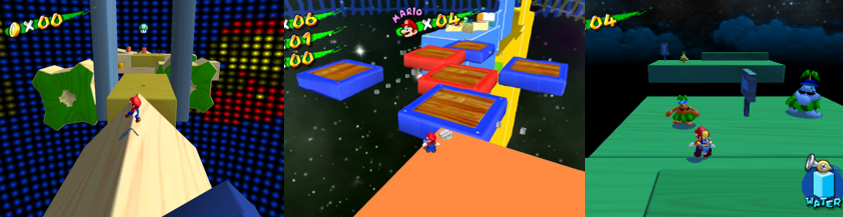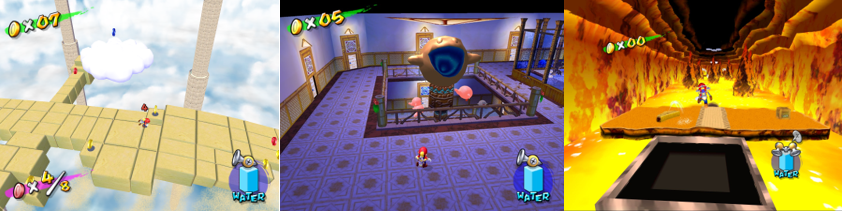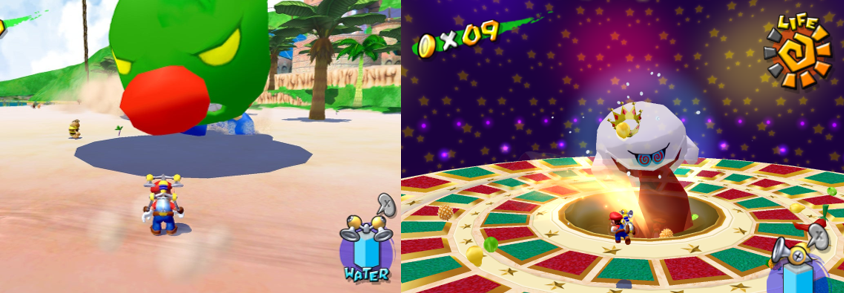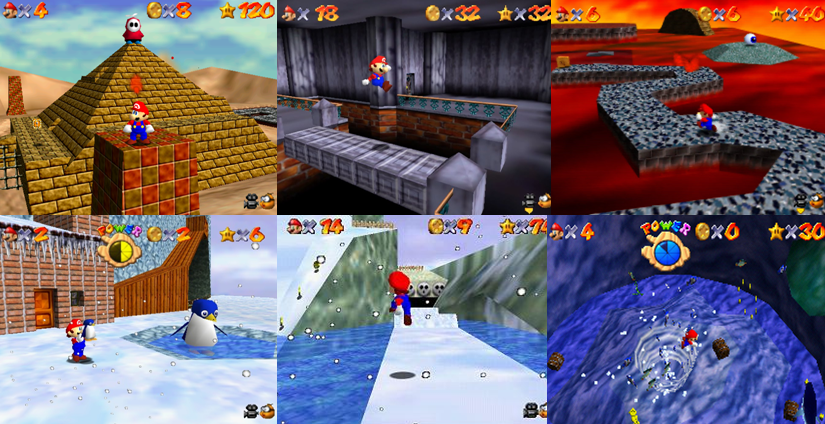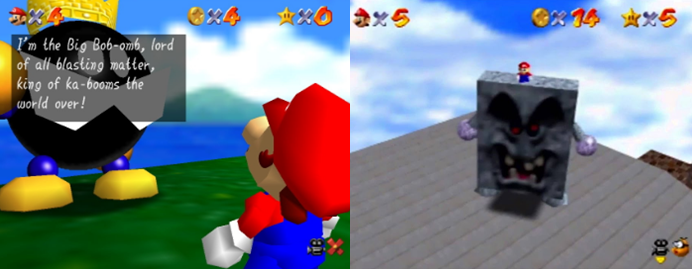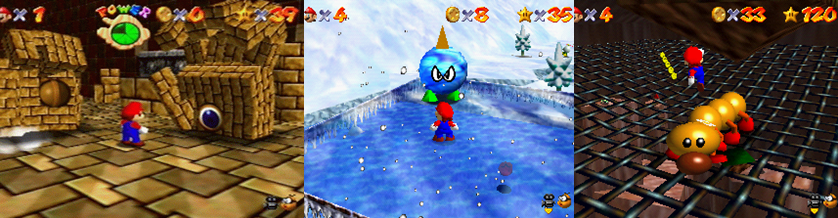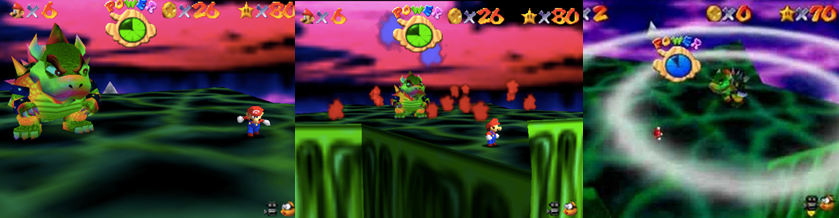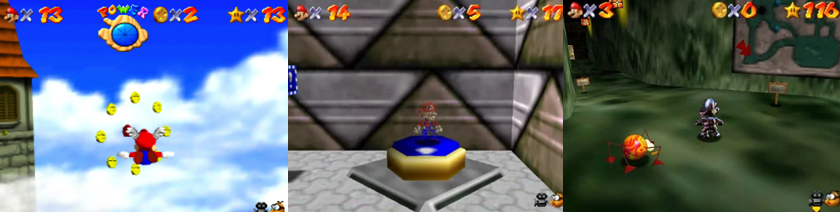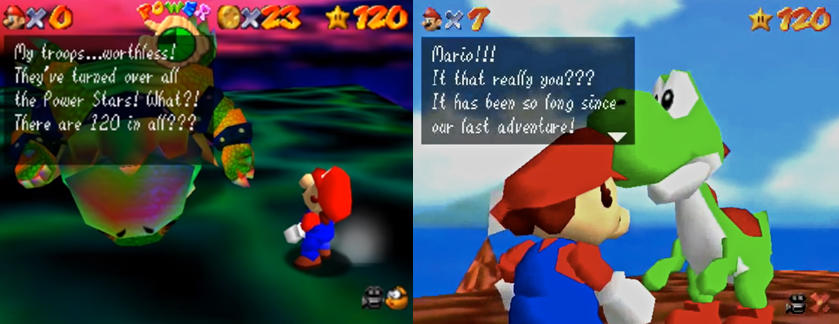
Game Corner [Mario Month]: Super Mario Galaxy (Nintendo Switch)


So, for no better reason than “Mar.10” resembling Mario’s name, March 10th is widely regarded as being “Mario Day”, a day to celebrate Nintendo’s portly plumber, an overalls-wearing mascot who literally changed the videogame industry forever and shaped the home console market of the nineties. To commemorate Mario Day this year, March has been “Mario Month” as I have celebrated everyone’s favourite Koopa-flattening plumber on each Wednesday of the month.


Released: 18 September 2020
Originally Released: 1 November 2007
Developer: Nintendo
Original Developer: Nintendo EAD Tokyo
Also Available For: Nintendo Wii and Nvidia Shield

The Background:
The concept of Super Mario Galaxy’s gameplay finds its genesis in Super Mario 128, a tech demo designed to showcase the power of Nintendo’s GameCube compared to the Nintendo 64 and other consoles at the time. Specifically, it was the concept of running, jumping, and exploring shifting, spherical bodies that caught Mario creator Shigeru Miyamoto’s imagination and many of the game’s concepts and ideas were thought up before Nintendo Wii was even developed, including new gameplay mechanics such as adding a spin attack to Mario’s arsenal to make it easier to attack enemies on spherical, 3D plane. After tweaking the gameplay to make things a bit more challenging for players, the team worked on implementing unique ways to take advantage of Mario’s space-based adventure, including gravity-based mechanics, new transformations and ways to play, and focusing on making the game fun to play rather than simply rushing to finish it. Super Mario Galaxy was a critical and commercial success, selling over 350,000 units in Japan during its first week alone and over 12.80 million copies worldwide by March 2020. The game also won, or was nominated for, numerous gaming awards and received an equally-well-received sequel in 2020. While that game wasn’t included in Super Mario 3D All-Stars (Nintendo, 2020) for the Nintendo Switch, Super Mario Galaxy was, meaning that I recently finally got the chance to play this game through, my to my delight.

The Plot:
All of the Mushroom Kingdom has gathered together for the centennial Star Festival. Unfortunately, the diabolical Bowser, King of the Koopas, gatecrashes the celebrations and kidnaps not just Princess Peach but her entire castle, hurtling them into outer space! Guided by Rosalina and the Lumas, Mario resolves to explore the entire galaxy, collecting both Power Stars and Grand Stars to power Rosalina’s Comet Observatory and rescue Princess Peach.

Gameplay:
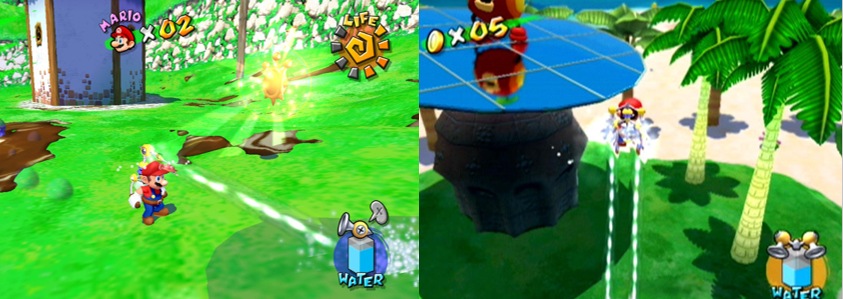
Super Mario Galaxy is a 3D action/platformer that brings back many of Mario’s controls and abilities from Super Mario 64 (Nintendo EAD, 1996); not longer hampered by a water-spewing jetpack, Mario is, thankfully, once again able to backflip and long jump in addition to using his patented triple jump, side jump, and wall kicks to navigate the game’s many and varied Galaxies.

Mario has a few new tricks up his sleeve that change the way you play.

Mario can still hop on the heads of his enemies to dispatch them or use his ample rump to squash them flat but, in the absence of his punching attacks, players can now use the touch screen to gather and launch “Star Bits” at the screen to attack enemies, destroy certain objects, and reveal Yellow Coins. This allows a second player to work alongside Mario in a pretty lacklustre implementation of a two-player co-op mode but, thankfully, Mario is gifted with a new spin attack that allows him to take out enemies and helicopter his way across tricky gaps. As in the previous 3D Mario games, Super Mario Galaxy is structured around a central hub world (in this case Rosalina’s “Comet Observatory”) from which you can enter the game’s forty-two different stages (referred to as “Galaxies”) from different areas in the hub world. Each Galaxy has anywhere from one to six different missions, the completion of which awards you with a Power Star; once you collect sixty Power Stars, you’ll be able to access the game’s final Galaxy and battle Bowser, but you’ll need all 120 to see the game’s true ending.
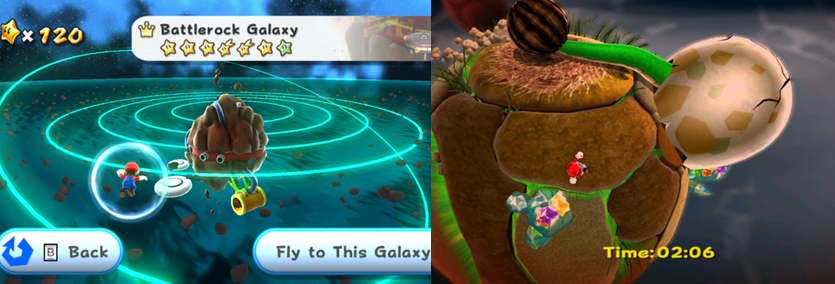
There are many Galaxies and missions to complete, with additional challenges on offer.

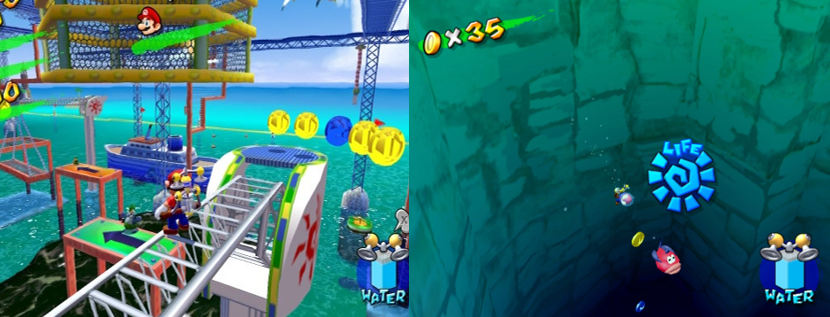
It may seem, on the surface, that Super Mario Galaxy has far too many stages on offer but not all of the Galaxies are accessible right from the start or even while you’re visiting that Galaxy. Other areas of the Comet Observatory will open up as you collect Power Stars, with numerous small, more challenging Galaxies cropping up along the way and Mario’s skills being tested by a series of “Prankster Comets”. These see you return to previous Galaxies to earn a new Power Star with only one sliver of health, racing against Mario’s doppelgänger, “Cosmic Mario”, completing the Galaxy within a time limit, and contending with much faster enemies and obstacles. Furthermore, Galaxies are actually quite small in a lot of ways and tackled in sections; you’ll be dropped into a Galaxy and be tasked with navigating spheres, jumping to platforms, and blasting across the area using Launch Stars, with each mission allowing you, and tasking you, to access different areas of the Galaxy to mix up the stage each time you visit. Super Mario Galaxy’s main selling point is its use of gravity- and space-based stages; almost every planet, block, or platform you stand on has its own gravitational force, allowing you to run all around it without fear of falling to your death and you can easily jump to another traversable body and get sucked into its gravity to make platforming a simple but, eventually, challenging affair as you’ll have to use all of Mario’s skills to jump and navigate across Galaxies without being sucked into a black hole and to his death.

Ride the air currents with a Floaty Fluff or put Mario’s Olympic skills to good use when on ice.

Gravity also comes into play in other ways, such as hitting clock-like arrows to change its direction or navigating across walls, blocks, and platforms while the gravity shifts in different directions. You’ll also be required to perform specific tasks or do some extremely light puzzle solving to cross the Galaxy or access the Power Star. This includes pounding on switches, collecting five yellow Star Chips to assemble a Launch Star, directing Banzai Bills or tossing Bob-ombs to blow up cages, hopping up or across temporary platforms, collecting five Silver Stars, finding Star Bunnies, racing against certain enemies or a time limit, or using a Koopa shell or manta ray to dart through rings underwater or through a water slide. Other times, the environment will assemble itself around you or become intangible thanks to a ghostly light, which will test your reaction times as much as your patience, or Mario will have to run over flip switches to progress, collect a Key, or grab a ? Coin to spawn musical notes to collect. You’ll also have to grab on to a Floaty Fluff to float across air currents, rotate Bolt Lifts by running on them to reach platforms, hitch a ride in a bubble, awkwardly run across (or skate by pressing Y) icy platforms, smash coconuts to damage certain enemies, hit levers, or fling Mario across the arena using sticky Sling Pods.
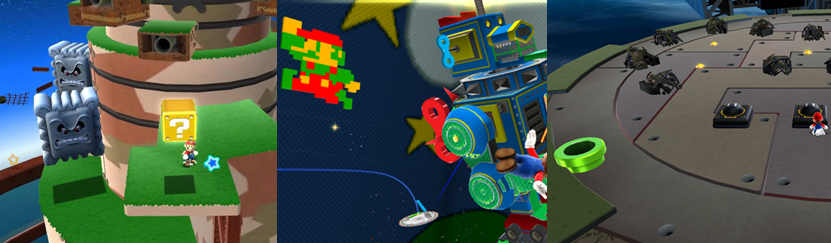
Many classic Mario staples make a welcome return in Super Mario Galaxy.

Some of the game’s more troublesome sections come from the inclusion of blue Pull Stars; you need to tap the screen to draw Mario towards these little bastards, holding down to keep him hovering there and releasing it at the right moment to slingshot across the area, usually while in a race, against a time limit, or avoiding a load of obstacles. By far the most frustrating gameplay element, though, are the missions that require you to hop onto a Star Ball and navigate mini golf-like obstacle courses full of hazards and platforms to roll off. Though Mario can jump when on the Star Ball, you are forced to use the Nintendo Switch’s lousy gyroscopic controls to roll him about, which is needlessly annoying since I found it extremely difficult to hold the machine in a way that actually made Mario move where I wanted him to and, often, Mario simply rolled wherever he wanted, often to his death. Similar to its predecessors, Mario’s health is again measured with a pie chart but, this time around, Mario can only take three hits before he’ll lose a life. Mario can still replenish his health by collecting Yellow Coins, though, and a number of checkpoints appear in the game’s Galaxies (though I found there was no onscreen indication of when you had passed one of these checkpoints) which means you won’t always have to restart the Galaxy from the very beginning. Extra lives are extremely plentiful, however, with 1-Up Mushrooms placed helpfully in or near the game’s trickier sections and Mario can earn an extra life for every fifty Coins and/or Star Bits he collects and, later in the game, Princess Peach will gift you with five extra lives via a Toad courier.It’s highly advisable to collect every Star Bit you see as hungry Lumas will appear within the Galaxies and in the Comet Observatory and feeding them is the only way to unlock all of the game’s Galaxies. You can keep track of your progress by speaking to various non-playable characters (NPCs), such as Rosalina, the Toads, and the Lumas and a map of the Comet Observatory shows you which Galaxies you need to revisit by use of a little crown to indicate when a Galaxy has been completed. Finally, unlike its predecessor, Super Mario Galaxy not only returns to the kind of stage variety we saw in Super Mario 64 but also brings back classic 2D Mario staples such as warp pipes and ? Blocks.

Graphics and Sound:
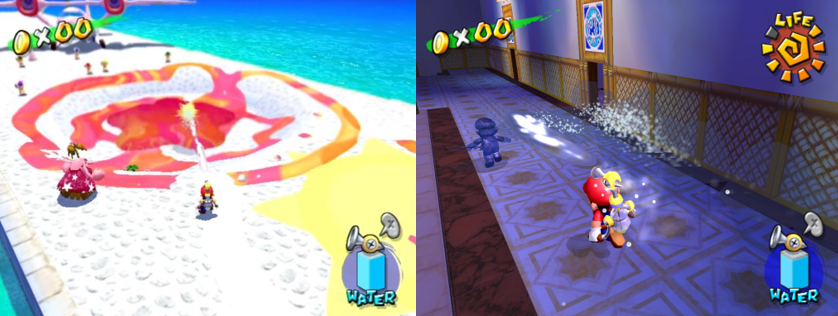
If there’s one area that Super Mario Galaxy excels in it’s presentation; the game is absolutely gorgeous, popping with colour and variety and oozing a cartoonish charm at every turn. It retains the cute, cuddly, almost action figure aesthetic of Super Mario Sunshine but improves upon it immensely, with all of the game’s environments brought to life through a fantastic use of colour, lighting, music, and intractable elements. Each Galaxy is populated by a variety of NPCs, including Toads, Lumas, Honeybees, Gearmos, and Penguins, all of whom each talk to you through speech bubbles or can be spoken to for hints or more useful rewards like Power Stars. Toads and Lumas also begin to populate the Comet Observatory as you progress, which really helps to bring some life to the hub world, which disappointingly otherwise takes more inspiration from Princess Peach’s Castle in Super Mario 64 than the lively Delfino Plaza.
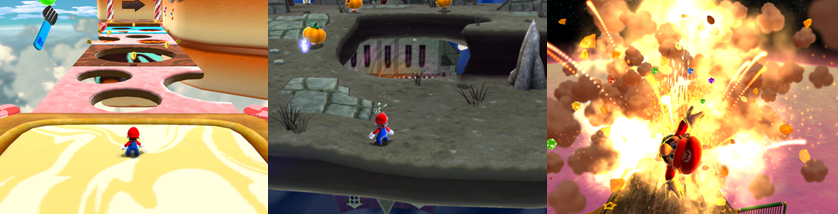
Super Mario Galaxy‘s stages are full of colour, challenge, and variety.

Thankfully, Super Mario Galaxy is almost the exact opposite of Super Mario Sunshine when it comes to level and gameplay variety. Each of the game’s Galaxies is unique in its presentation, with Mario visiting Galaxies of ice, lava, water, sand battleships, beachfronts, and toy-strewn bedrooms. In the Ghostly Galaxy, you’ll explore a haunted mansion that is reminiscent of both Big Boo’s Mansion from Super Mario 64 and the titular mansion of Luigi’s Mansion (ibid, 2001), explore sunken pirate ships, clamber up honey-drenched walls, race across stony platforms to avoid being sucked into deadly quicksand, and blast out from an active volcano, with every Galaxy and Star mission being an energetic and fun, yet challenging, burst of action and, at times, intensity. Perhaps best of all, Super Mario Galaxy brings back a lot of classic Mario tunes and sound effects to really bring the title back to its roots. Rather than using full blown voice acting, the game opts for speech bubbles, brief voice clips, and a heavy use of gibberish and pantomime for the few instances of dialogue. Cutscenes are also heavily reduced compared to its predecessor, with the opening cinematic split across a brief tutorial and the game opting to tell the story of Rosalina and the Luma’s through an adorable children’s book.

Enemies and Bosses:
Many of Mario’s recognisable enemies make their return in Super Mario Galaxy, with each one being slightly tweaked to accommodate Mario’s new mechanics. You can jump on Goombas to dispatch them, which will produce a Coin, but if you spin into them and kick them away you can get Star Bits, for example, adding a little strategy to how you play. Bullet Bills are often fired at you from the cannons of Bowser’s many battleships, you’ll need to toss Bob-ombs to destroy garbage or break open cages, Bloopers patrol beneath the waves, and Chomps freely roll around various Galaxies looking to take a bite out of you. Boos also make a return, now being completely immune to all of Mario’s attacks and only vulnerable to beams of light, and you’ll also encounter old favourites such as Koopas, Pokeys, Wrigglers, Twomps, Piranha Plants, and Magikoopas (who conjure fireballs your way and teleport to avoid your attacks).

Enemies old and new provide a minor nuisance to Mario’s galaxy-spanning quest.

New enemies include the bomb-throwing Cluckbooms, explosive Bomb Boos, electrified jellyfish, and easily-dispatched bugs. Just as Gombeetle’s protect themselves from your Star Bits and standard jump attacks with an armoured shell, Crabber’s can only be attacked from their exposed rear and you’ll need to use your spin attack to put out Lil’ Cinder’s flames before you can dispatch them. Mandibugs will charge at you with their pincer-like jaws, Micro Mecha-Bower’s try to roast your behind, and Monty Moles like to burrow under the dirt to catch you off guard but, while your butt stomp will serve you well in taking care of these enemies, you’ll need to use your spin attack to push the members of the Topman tribe into electrified walls to end their threat.

Run around the Dino Piranha to whack its tail but watch out for the flames!

You’ll battle sixteen bosses throughout the course of Super Mario Galaxy, with eight of them needing to be fought more than once. The first boss you’ll have to contend with is the Dino Piranha, a large, aggressive, and hungry variant of Petey Piranha. This boss stomps around a small sphere trying to trample you to death and can only be defeated by hitting its rock-encrusted tail with a spin attack. Later in the game you battle a far more formidable version of this boss, the Fiery Dino Piranha, in the Melting Molten Galaxy. Though the strategy remains the same, this battle is much more difficult by the fact that the Fiery Dino Piranha’s tail becomes engulfed in flames and the boss’s ability to spit fireballs out at you.

Use Mario’s spin attack to knock King Kaliente’s shots back at him.

Another boss you’ll go up against twice is King Kaliente, a gigantic octopus that emerges from lava to shoot flaming projectiles at you; unfortunately for him, though, he also spits out a coconut, which you can hit with your spin attack to damage him. He crops up again in Bower Jr’s Lava Reactor with the battle being made more difficult by the fact that you’re now stood on a series of small platforms that sink into lava and King Kaliente’s more frequent and aggressive attacks (though, again, the strategy remains the same; you should also be prepared to parry coconuts with the boss since it likes to knock them away as the fight progresses).

Major Burrows and Bouldergeist require a little more strategy on your part.

Major Burrows and Bouldergeist are also fought twice across the course of the game, with the battle being much tougher the second time around. Major Burrows is, basically, a giant Monty Mole and is only vulnerable when he pops up from the ground; once he does, you can perform a ground pound to scare him completely out of his hole and then attack him as he runs around the spherical stage. Bouldergeist is, by comparison, much tougher since the only way you can break off his rock-like hide is to trick Bomb Boos into colliding with him. Once his exterior is smashed, Mario must then swing a Bomb Boo into Bouldergeist’s exposed core using his spin attack but before it explodes in his face, all of which is made much more troublesome by Bouldergeist’s desire to pummel you with his hands, smash you with boulders, and erect destructible rocky walls to box you in.

Super Mario Galaxy features some big, colourful, and unique bosses battles.

Interestingly, the boss you’ll encounter the most isn’t Bowser; it’s Topmaniac, the gigantic leader of the Topman tribe who is easily disposed of by jumping on its head to get rid of its spikes and then using your spin attack to bash it into the electrified walls of the arena. The game’s bosses are all quite large, memorable affairs though: you’ll need to lure Bullet Bills over Megaleg’s legs to destroy the cages on its head; navigate icy platforms and use wall jumps to reach Baron Burr and thaw him out with Mario’s spin attack; dispatch waves of Mandibugs to ground pound the large Stink Bug Parent; you’ll need to use similar tactics (in conjunction with Banandelions and Mario’s Bee power-up) to defeat the bomb-dropping Bugaboom; fire yourself at Tarantox’s glowing red boils with Sling Pods; and fire Koopa shells at the skeletal remains of Kingfin as it swims through the dark waters.

You’ll face Bowser three times, with the final fight being a three stage boss battle.

Despite his prominence in the last game and frequent appearances throughout Super Mario Galaxy, you’ll only battle Bowser Jr the one time; Bowser Jr shoots cannonballs at you from his flying pirate ship and can only be damaged by throwing Koopa shells at him. This gets very intense during the final stages as Bowser Jr also starts firing Banzai Bills at you, meaning there are a lot of projectiles and hazards to watch out for at the same time. In comparison, you’ll fight Kamella three times, with each battle having a very similar strategy to fighting Bowser Jr; Kamella conjures both fireballs and green shells that you can throw at her, though she also summons Magikoopas, wandering fireballs, and teleports about the arena to make it harder for you to hit her. As in Super Mario 64,you’ll also battle Bowser three times throughout the game, with your strategy to defeating him remaining relatively unchanged in each bout. Bowser likes to generate shockwaves across the small spherical planet you fight him on and must be lured into pounding through a sheet of glass to set his tail on fire; as he flees in pain, you can hit him with your spin attack, which can be hard to do as Bowser slides all over the sphere in an erratic pattern on the back of his shell. When you encounter Bowser again, he’ll perform his own spinning attack and launch numerous fireballs your way but it’s the finale battle of the game where Bowser is at his most formidable. This is a three phase boss battle that first sees Mario having to time his spin attack just right to hit Bowser out of the rocky exterior he has protected himself with, desperately outrun Bowser’s powerful spinning attack, and puts your jumping and reaction skills to the test avoiding the many shockwaves and fireballs that Bowser fills the small arena with. As long as you keep your wits about you and watch Bowser’s frenzied spinning, charging, and jumping attacks, these battles mainly come down to a question of properly timing your spin attack to put en end to Bowser’s latest threat.

Power-Ups and Bonuses:
As in all Mario games, you can collect Yellow Coins in each Galaxy; you no longer need to worry about collecting a hundred of these for a hidden Power Star, or any Red Coins (which is a blessing after Super Mario Sunshine’s massive overuse of the concept), but you will get an extra life for every fifty Coins you collect. The game’s big, new feature is the Star Bit mechanic, which allows you to fire at enemies and objects on the screen; it’s advisable to frantically swipe at any and all Star Bits you see to add to your grand total and collect extra lives but don’t get so distracted to you lose focus on what you’re doing! At various points throughout the game, you’ll find or be given the opportunity to purchase a Life Mushroom, which will double Mario’s health meter; if you spot one of these, grab it as you’ll probably need it for an upcoming boss battle or tricky section. Mario also has a number of transformations this time around, some which are familiar, some which are new, but none of which are as prominent as you might expect. You can grab a Rainbow Star to briefly become invincible, allowing you to run through enemies and hazards without fear, for example, but this only lasts for a short period of time.
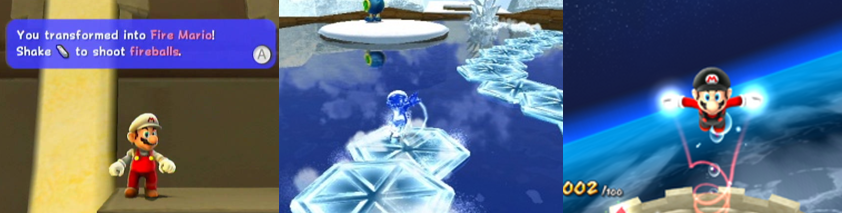
Grab a power-up to temporarily gain access to some new, and familiar, abilities.

Other temporary power-ups include the returning Fire Flower (which allows you to shoot fireballs and defrost snowmen), the Ice Flower (which allows you to walk across water and wall jump up waterfalls using ice platforms), and the Red Star (which allows Mario to fly unimpeded like an upgraded version of the Wing Cap). It’s a shame that these power-ups are so limited in their appearances and use, to be honest, as it would be fun to revisit the game’s Galaxies and explore them using Flying Mario or open new areas as Fire Mario, for example. Mario has other, less temporary power-ups at his disposal as well: the Bee Mushroom allows him to fly for a short time by tapping or holding A and to climb up honey-covered walls; the Boo Mushroom transforms Mario into a Boo, which allows him to float indefinitely and pass through certain walls by becoming temporarily incorporeal; and the Spring Mushroom allows Mario to bounce extremely high into the air with a well-timed press of the A button. Each of these transformations will be lost if Mario touches water or an enemy and, of the three, Bee Mario is the most often used and Spring Mario is easily the most unwieldy thanks to Mario bouncing all over the place, but none of them are as prominent as power-ups in previous Mario titles such as the Wing Cap and Raccoon Mario (which both feature on the front covers of their respective games).

Additional Features:
As in its predecessors, Super Mario Galaxy requires you to collect a number of special objects to progress further. There are 120 Power Stars to be found in the game, including Grand Stars to be won from boss battles, and rarer Green and Red Power Stars found in hidden Galaxies or from finding Mario’s brother, Luigi, in specific areas of each Galaxy. You only need sixty Power Stars to battle the final boss but, once you finish the game, a new Galaxy will appear and you’ll be tasked with collecting the remaining Power Stars to see the game’s true ending. This new Galaxy introduces you to the Purple Comet mechanic; when the Purple Comet is in orbit around a Galaxy, you’ll have to collect one hundred Purple Coins to earn a Power Star. This can be quite frustrating and troublesome as you’re often racing against a time limit, which continues to count down even after the Power Star spawns, with Luigi’s Purple Coin mission being easily the most maddening trial of them all since it forces you to run across disappearing and rotating platforms over an endless void and against a time limit. If you’ve missed any of the other Prankster Comet Stars, you’ll have to chat to a Luma in the Comet Observatory to put them in orbit and collect any you’re missing.
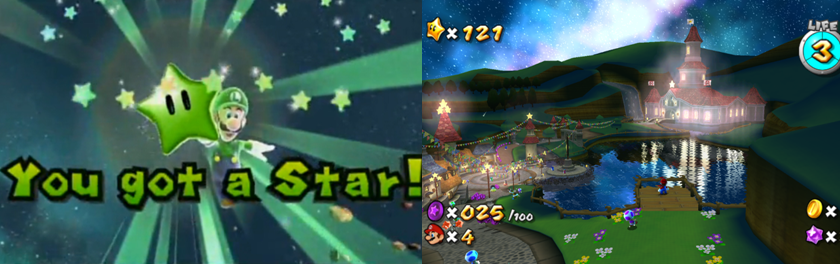
Collect all 120 Stars to play through the entire game again as Luigi and earn that elusive 121st Star.

Once you have all 120, you then have to go through the game’s gruelling final Galaxy and battle Bowser again in order to see an additional cutscene and unlock Luigi as a playable character! Yes, finally, after the lacklustre rewards of the last two games you actually get something substantial for all your hard work. You can switch to Luigi when accessing your saved file, which will begin a new game from the start as Luigi, who jumps higher and further than his stoutly brother. Sadly, though, you must then play through the entire game all over again, collecting the same 120 Power Stars as Luigi, in order to access the game’s final final Galaxy and claim the elusive 121st Power Star by collecting another one hundred Purple Coins during the Star Festival celebrations. I don’t mean to complain about this since I have been waiting to play as Luigi, and get a decent completion reward, since Super Mario 64 but, as much as I enjoyed the game, it’s a bit much to ask players to do everything all over again as Luigi since you’re pretty exhausted after getting the first 120 Stars.

The Summary:
Super Mario Galaxy was an incredibly enjoyable experience; right from the start, as soon as I experimented with Mario’s controls, I knew that I would prefer this game over Super Mario Sunshine. It plays much more like Super Mario 64, returning a lot of Mario’s abilities and controls from that game, which makes platforming and gameplay all the better. Add to that the game’s fantastic presentation, use of classic Mario elements, and unique setting and you have an extremely grandiose and accessible Mario adventure. While it was disappointing to see Mario still confined to a hub world and acquiring Power Stars on a mission-by-mission basis, and the game was maddeningly frustrating at times, Super Mario Galaxy does some pretty impressive things with its unique concept. Through clever use of its gravity mechanics, a rising level of challenge, and being packed full of bright, colourful environments, characters, and content, there’s certainly a lot more on offer in Super Mario Galaxy than in its predecessors and the game is presented in a way that encourages short bursts of gameplay, making it a perfect title to play on the go or in your down time.

My Rating:

Rating: 4 out of 5.

Great Stuff

What did you think of Super Mario Galaxy? Did you play the original Wii version and, if so, how do you find the Switch remaster holds up? Were you a fan of the game’s space- and gravity-orientated gameplay or do you feel like the concept was a bit outlandish even for Mario? What did you think to the game’s level of challenge? Which Power Star did you struggle the most with, which Galaxy was your favourite, and what did you think of the new characters the game introduced? Did you ever finish the game as Luigi and get all 121 Power Stars? Either way, I’d love to hear your thoughts and memories of Super Mario Galaxy, and your feedback regarding Mario Month, in the comments below.


Game Corner: Captain America and the Avengers (Arcade)

Released: 1991
Developer: Data East
Also Available For: Game Boy, Game Gear, Mega Drive, Nintendo Entertainment System (NES), Super Nintendo Entertainment System (SNES)

The Background:
First created in 1940 by Joe Simon and Jack Kirby, Steve Rogers/Captain America was an icon of the Second World War, embodying America’s obsession with patriotism and pride by taking the fight directly to the Axis Forces. Superhero comics went on a bit of a decline after the war and Captain America wouldn’t return to prominence until 1964, when he was famously revived to join Marvel Comics’ all-star team, the Avengers. Since then, the character has been largely synonymous with Earth’s Mightiest Mortals, often acting as the team’s moral compass and leader. In 1991, both comics and arcades were undergoing something of a renaissance; Marvel published the influential Infinity Gauntlet (Starlin, et al, 1991) during this time and sidescrolling beat-‘em-ups like Final Fight (Capcom, 1989) and The Simpsons (Konami, 1991) were proving popular coin munchers. It is perhaps these factors that led to Data East developing a four-player beat-‘em-up game centred around Marvel’s popular super team, a game that is often forgotten because of genre-defining titles like X-Men (Konami, 1992) and a title I first played on the SEGA Mega Drive in all its inauspicious glory.

The Plot:
Johann Schmidt/The Red Skull has assembled an army of the world’s most dangerous supervillains in order to take over the world using a gigantic, Moon-based laser! Answering the call to action and adventure are Captain America, Tony Stark/Iron Man, Clint Barton/Hawkeye, and the Vision – the Avengers – who are the only ones capable of putting a stop to the Red Skull’s nefarious plans for world domination!

Gameplay:
Captain America and the Avengers is a 2D, sidescrolling beat-‘em-up in which you, and another player if you have a friend, control one of the four Avengers and mindlessly pummel a bunch of robots, cyborgs, and iconic Marvel bad guys across five different stages (referred to as “Scenes”). No matter which character you choose to play as, the game pretty much plays exactly the same with only some minor aesthetic differences separating the characters.

Each Avenger has their own special attack but, otherwise, controls exactly the same.

Despite this, though, I found Cap the most enjoyable character to play as, with Iron Man a close second. The controls are as simple as you could want: you can beat down your enemies with some simple punches and kicks, charge through them with a dash attack, block by holding down the punch button, and perform two different jumping attacks depending on how high you’re jumping. You can also grab and throw enemies (and objects) and unleash a unique ranged attack by pressing down the attack and jump button simultaneously: Captain America hurls his mighty shield, Iron Man fires his repulsor rays, Hawkeye fires arrows, and Vision fires laser blasts from his forehead. I found there to be a bit of a delay in activating these special attacks, however, which can leave you vulnerable but at least they don’t drain your health. Speaking of which, your health is measured in hundreds; you begin each Scene/life with 100 health but can increase it by grabbed the rarely-seen small blue orbs or the power-ups dropped by other Avengers like Prince Namor McKenzie/The Sub-Mariner and Pietro Maximoff/Quicksilver.

Autoscrolling shooting sections help to add some variety to the gameplay.

You can also increase your health, all the way up to “Max”, by entering coins to keep you alive and kicking, effectively sacrificing your pocket money and extra lives for more health. Thankfully, emulation means you don’t need to worry about wasting your hard-earned pocket money so you never have to worry about running out of lives or health. Unlike a lot of arcade games, Captain America and the Avengers doesn’t feature a time limit; however, if you stand around idle for too long, an explosion randomly drains your health until you either die or get moving, which is a cruel but unique inclusion. It’s not all mindless right-to-left fighting, either; Scene 2, Scene 3, and Scene 5 feature autoscrolling shooting sections that take place in the skies of a wrecked city, deep underwater, and in the cold vastness of outer space. If you’re playing as Cap or Hawkeye, you’ll get to pilot a Sky-Cycle in the first of these stages, but for the others you’ll throw on some scuba gear and a rudimentary space suit. Either way, you must blast enemies with your ranged attack (which is now just a simple button press), avoiding their projectiles and holding down punch to block. These sections are only short but they held to mix things up a bit and, when it comes to sidescrolling beat-‘em-ups, variety is hard to find so it’s appreciated.

Graphics and Sound:
I remember Captain America and the Avengers looking very unimpressive on the Mega Drive, with small sprites in large areas and lacking a lot of the detail and quality of other games of the time. In that regard, the arcade game is better since the sprites are much bigger and more distinct and detailed but you’ll notice that they’re not as large, colourful, or intricate as those seen in games like X-Men, for example. Still, it does a decent enough job; the camera is zoomed out quite far compared to other beat-‘em-ups, though, giving you a much larger battlefield which would be a positive but, while areas can get swamped with enemies and do feature interactive elements (mainly barrels and other objects to throw or explode), they are quite empty and there’s little benefit to exploring or attacking your surroundings.

The game is colourful and varied but not as impressive as others in its genre.

You will find some interesting elements, though, such as enemies bursting out of windows and the background, an Avengers mural, burning cars, wrecked buildings, and both a sprawling city in the background and water rushing beneath you as you fly, with comic book sound effects punctuating the onscreen violence. As you might expect, comic book-like panels and text are used to convey the bulk of the story; each character is given a brief demonstration of their in-game abilities and a biography, which is a nice touch, and the game is peppered with some in-game cutscenes that feature dialogue between the Avengers and their enemies. These are some of the most ludicrous examples of mistranslation ever, which hilarious exchanges such as “Seeeeee my powerrr!”, “Where is the laser?”/“Ask the police!”, “You can’t escape!”/“You will be the one escaping!”, and “Why should it goes well!?” It’s cheesy and ridiculous in a “Welcome to die!!” kind of way that adds some unintentional entertainment value to the game, which also features a suitably heroic soundtrack; you’ll hear the main theme quite a bit, since it kicks in once bosses are close to defeat, and while it’s nothing special it’s very catchy and rousing and gives the game a stirring, stimulating gallant feel.

Enemies and Bosses:
For the most part, you’ll battle seemingly endless wave upon wave of robots or cybernetic enemies; the most common of these incessantly shoot at you with lasers, sometimes while jumping, while others carry shields or can grab and hold you with retractable arms. You’ll also battle enemies that hover in jetpacks, bigger, more muscle-bound variants that squeeze the life out of you with a bear hug, and hopping bug-like robots. Underwater, enemies will fire harpoons at you while you try to dodge mines and, in the air, they’ll circle around firing lasers in a simple formation. Most of these are destroyed in just a few hits, and both increase in number and become tougher to defeat as you progress, exploding upon defeat, making me believe them to be cyborgs and mechanical rather than flesh and blood.

In Scene 1, you’ll battle some minor Marvel foes after they rob a bank.

One thing Captain America and the Avengers does really well, though, is its expansive use of Marvel’s rouges gallery; in each Scene, you’ll have to contend with a main boss and a series of sub-bosses, many of whom will be recognisable to fans of the source material (and even the movies, to a degree). In Scene 1, you’ll have to contend with the duo of Arthur Parks/The Living Laser and Ulysses Klaw/Klaw mid-way through the stage as they cover David Cannon/Whirlwind’s escape following a bank robbery. Laser and Klaw are best faced with a partner since they hop around the screen, blasting lasers and projectiles at you, but, like all of the game’s sub-bosses and bosses, can be easily pummelled solo as well. When you do go toe-to-toe with Whirlwind, it’s dead easy to just wail away on him, with his only threat being his ability to transform into a literal whirlwind to dash about the screen and whip up nearby objects to rain them down on you.

After disposing of a Sentinel, you’ll fight the Grim Reaper, though the Wizard or the Mech. Taco are a threat.

Scene 2 sees you having to relentlessly blast away at a Hydra aircraft on your way to the wrecked city and a confrontation with the gigantic, screen-filling “Giant Robot” (clearly a Sentinel). The Sentinel is a slow, plodding sub-boss who tries to smack you out of the sky, fires lasers, and grabs you in its near-endless supply of robot hands. After blowing it to pieces, you’ll battle through the ruins of the city and into a confrontation with Eric Williams/The Grim Reaper, one of the game’s tougher bosses. Grim Reaper can block your projectile attack with his spinning scythe, rush across the screen with lightning speed to slash and strike you, hover in the air, and fires explosive projectiles as the fight progresses. In Scene 3, you’ll battle Bentley Wittman/The Wizard on the deck of a wrecked battleship; the Wizard favours diving punches, throwing discs, and quick-firing laser bolts but is, otherwise, a minor inconvenience at best. After exploring the depths of the ocean, you’ll encounter a giant mechanical octopus referred to as “Mech. Taco”; this is functionally the same fight as against the Sentinel, requiring you to avoid the Taco’s tentacles, swim beneath its lasers, and simply fire at it relentlessly until it explodes.

Even some of Marvel’s most recognisable villains end up being a bit of a pushover.

After emerging victorious, you’ll battle through a submarine and into a confrontation with the Mandarin; the Mandarin is a bit of a trickster, floating around the arena, rocketing into the air, firing at you with lasers, encasing you in ice, and even duplicating himself for double the threat. The Mandarin can command his duplicate to charge at you, send you flying with his floaty movements, and loves to bash you senseless when he gets up close. Like all the other bosses, though, he might have a lot of flair but he’s got a glass jaw and it’s easy to land a few combos and whittle his health down in seconds. Scene 4 sees you infiltrating the Red Skull’s Moon base, where you’ll have to contend with Cain Marko/Juggernaut (who is, ironically, actually smaller than the game’s bruiser enemies…). Juggy likes to roll around the arena in a ball, land big uppercuts, charge at you with a shoulder barge, and trying to cave your skull in with a big double axehandle smash. Oddly, the most difficult thing about fighting him isn’t his much-vaulted strength but actually his speed, since he cannot be damaged in his ball form and likes to speed around the arena like a whippet. After defeating Juggernaut, you’ll eventually battle Ultron, who fires electrical beams from his face, dashes across the screen in a fireball-like form, fires lasers blasts from his hands, pummels you with punches, and causes lasers to rain down across the arena once his health gets low. It’s not an especially difficult fight but, thanks to Ultron’s array of abilities and speedy, damage-dealing moves, it’s comparable to the ones against the Grim Reaper and the Mandarin in that it can be frustrating navigating through Ultron’s attacks but, once you get some hits in, he goes down as easily as any other boss.

Surprisingly, Crossbones is pretty tough, but the final confrontation with the Red Skull couldn’t be simpler.

Having destroyed the Red Skull’s giant laser in Scene 5, you’ll again battle two sub-bosses at once; in this case, “Control” (who is possibly supposed to be Basil Sandhurst/The Controller). This fight is made more troublesome by the buzzsaws that travel across the grid on the ground but is still easier than the first fight against the Living Laser and Klaw since Control just tries to grab you and land flying kicks. Once they’re dealt with, your penultimate boss is against Brock Rumlow/Crossbones, of all people. Not gonna lie but Crossbones is a bit disappointing as a penultimate boss in terms of his character and stature but he’s no pushover; Crossbones leaps, bounds, and tumbles across the arena leaving a shadow in his wake and raining explosive mines (which home in on you) down around you. He also pulls out a pistol to fire at you from a distance and isn’t afraid to either rush at you with his trusty knife or toss the blade your way in rapid succession. Because of his speed and relentless attacks, Crossbones is no pushover but you can tip the tide in your favour by throwing his explosives back at him. Once you corner the Red Skull (who is seen smoking a cigarette in his introduction idle animation!), you’ll go head-to-head with the Nazi superman in a good, old-fashioned slugfest. If you’re wondering where the cliché elevator stage is, it’s right here in this simple fight that turns out to be a trap! Once you drain the Red Skull’s health, he grows into a massive mechanical form and it’s revealed you’ve been fighting a decoy all along. The real Red Skull watches, safely protected within a glass tube, as you battle the formidable “Mech. Skull”, which boasts such devastating attacks as twin gatling guns, energy bolts, massive melee attacks, rockets, a big slam attack, and can summon whirlwinds to mess you up. Still, it’s a big, largely stationary target so it’s pretty simple to get close to it to avoid the majority of its attacks and just pummel away until it explodes, seemingly taking out the Red Skull with it and destroying the Red Skull’s entire Moon base in the process.

Power-Ups and Bonuses:
Unlike most sidescrolling beat-‘em-ups, there aren’t many power-ups to be found in Captain America and the Avengers. Very rarely, in the autoscrolling stages, you’ll find small blue orbs to restore your health and there are a variety of objects to pick up and throw but there are none of the traditional health power-ups, invincibilities, or melee weapons to be found. At certain, predefined points in a lot of Scenes, another Avenger will make a brief cameo and toss out a big health-restoring power-up, which is a fun inclusion. In the autoscrolling sections, you can also pick up a “W” icon and gain the help of Janet van Dyne/Wasp, who encircles your character and can be shot forwards to deal additional damage for a limited time. It’s a shame that more of the other non-playable Avengers don’t aid you in the same way (though Namor does provide some brief assistance in Scene 3).

Additional Features:
It’s an old arcade beat-‘em-up so, of course, there’s really nothing else on offer here except for obtaining or beating the high score or playing alongside a friend. Apparently, some versions of the arcade cabinet supported four-player co-op, which seems like a missed opportunity, but I do know that the consoles versions included different difficulty settings and a “Training” mode that allows you to pit each playable character against each other in a pale imitation of games like Street Fighter II: The World Warrior (Capcom, 1991).

The Summary:
If you’re looking for a classic, sidescrolling arcade beat-‘em-up, you can do a lot better than Captain America and the Avengers. It’s a decent way to waste about half an hour or so and is big, colourful, mindless fun but there are far better arcade beat-‘em-ups out there, whether carrying the Marvel license or not. The game is fun with a second player and for the completely off-the-wall voice acting and dialogue but it’s very empty and basic, even for an early-nineties beat-‘em-up title. I will say, though, having previously owned the Mega Drive version, that the arcade version of the game is the superior of the two so I would recommend playing this version over any of the others…and then jump back into X-Men right after.

My Rating:

Rating: 2 out of 5.

Could Be Better

Have you ever played Captain America and the Avengers? If so, which version did you play and which do you feel was the superior iteration? Which of the four Avengers was your go-to character and which of the unplayable Avengers would you have liked to see made playable characters? What did you think to the game’s many sub-bosses and bosses and cheesy, terribly translated dialogue? Have you got a favourite arcade beat-‘em-up or Marvel videogame; if so, what is it? Either way, I’d love to hear your thoughts so drop a comment below.

Back Issues: Detective Comics #27

Story Title: The Case of the Chemical Syndicate
Published: March 1939 (cover-dated May 1939)
Writer: Bill Finger
Artist: Bob Kane (with sole credit going to “Rob’t Kane”)

The Background:
Seeking to capitalise on the success of Clark Kent/Superman in their Action Comics publication, the editors of National Comics Publications wanted more superheroes under their banner. In response to this, artist Bob Kane, inspired by pulp heroes like Kit Walker/The Phantom and Lamont Cranston/The Shadow and Leonardo Da Vinci’s sketch of an ornithopter flying device, drew up a design for a new masked crimefighter, the “Bat-Man”. This design, however, was wildly different from the image of the Caped Crusader we know and love today and it was only thanks to the long-suppressed influence of artist Bill Finger that the Bat-Man gained his iconic cape, cowl, and darker, more gothic uniform. In the years since his debut, Batman has become not only one of DC Comics’ most popular characters but also a mainstream cultural icon, appearing in numerous other comics, movies, cartoons, and videogames and it all began way back in 1939 when one man chanced upon the nucleus of a blockbuster idea and decided to exploit his partner, and his character, for all they were worth.

The Review:
Batman’s first ever story is a brisk, six page adventure that begins shortly after the masked man’s debut. Unlike other superhero debuts, the Bat-Man is not afforded an origin story and his true identity isn’t revealed to the reader until the very last panel, creating a sense of mystery around the character. You’ll also notice that many of Batman’s popular and familiar elements are missing: there’s no Alfred Pennyworth, no Dick Grayson/Robin, no Batarang or Bat-Cave, Batman drives a big, red, clunky automobile rather than the Batmobile, and the story doesn’t even take place in Gotham City!

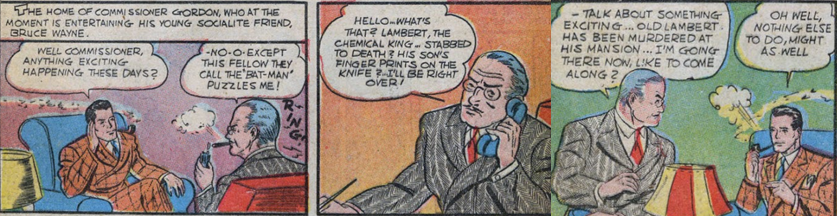
Gordon’s young friend seems to lead a boring, uneventual life.

The story begins with Police Commissioner Gordon entertaining “his young socialite friend”, Bruce Wayne; the two are enjoying a good, old fashioned bit of smoking (with Bruce puffing away on a pipe as characters were known to do in those days) and Gordon blatantly disregarding police protocol by expressing his bemusement at the mysterious “Bat-Man”. Gordon is interrupted by a report of the murder of Lambert, the “chemical king”, apparently at the hands of his own son and Gordon invites Bruce to accompany him to the scene of the murder. Yes, that’s right, the commissioner of the police invites his bored, young playboy pal to visit a murder investigation. At the scene of the crime, Gordon bluntly confronts the young Lambert about his father’s death and, after working himself into hysterics, the young man relates that he returned home early to find his father on the floor with a knife in his back and moaning about a “contract” with his dying breath. Although the young Lambert isn’t able to name any potential enemies of his father, he does name his three business partners and, quite coincidentally, Gordon gets a call that one of these, Steven Crane, received a threat against his life that very day!

The Bat-Man makes short work of Crane’s murderers and retrieves a vital clue.

Unfortunately, Crane is shot and killed in the very next panel before Gordon can even begin to mobilise a response unit but, as the killers make their escape via the rooftop, they are confronted by the Bat-Man! Garbed head to toe in black and grey, the Bat-Man sports some oddly unfitting purple gloves and showcases incredible physical strength, easily knocking out one man and sending the other “flying through space” following a “deadly headlock”. Though Gordon and his cops arrive soon after and attempt to pursue him, the Bat-Man manages to escape with the paper the murderer’s stole from Crane. Meanwhile, Lambert’s other partner, Paul Rogers, having just learned of Lambert’s death, pays a visit to their third and final partner, Alfred Stryker, only to be knocked unconscious by Stryker’s assistant, Jennings. Jennings ties Rogers up and prepares to seal him within a gas chamber in order to gas the man to death, his speech punctuated by loathsome little giggles. Luckily for Roger, the Bat-Man makes a dramatic entrance and first plugs the gas-jet with his handkerchief (…how very…low-tech of you, Batman…) and then smashes them to freedom with a wrench. Although Jennings is packing heat, the sight of the Bat-Man is enough to cause him to hesitate and be felled by a brutal tackle and a swift left hook.

*shrug* I guess that’ll save the expense of a trial…

Stryker walks in and looks to finish the job on Rogers with a knife but the Bat-Man stops him, revealing that Stryker was behind all the murders in an attempt to become the sole owner of their company, the Apex Chemical Corporation, and to get out of having to pay his former partners off. In a moment of desperation, Stryker breaks free of the Bat-Man’s grip in an attempt to escape so the Bat-Man smacks him in the jaw and sends him tumbling into an acid tank, offering only a dry comment on Stryker’s fate. The next day, Bruce Wayne appears to be unimpressed with Gordon’s telling of the story, appearing to be little more than a bored, easily distracted rich man but the final panel of the story reveals to the reader that Bruce Wayne is actually the mysterious Bat-Man which, I don’t know about you, I never saw coming!  

The Summary:
“The Case of the Chemical Syndicate” is quite a dull story, in a lot of ways; it’s definitely an inauspicious debut for one of DC’s most iconic and popular characters and could even be a bit off-putting for modern readers, who would be more used to all the familiar trappings and elements of Batman and may be perturbed by their absence. Without the Bat-Signal, the many Bat-gadgets, or the other myriad of Bat-related elements, “The Case of the Chemical Syndicate” is definitely much more of a pulp mystery than a traditional superhero story. Obviously, this is mainly because superheroes were still in their genesis during this time and to be expected given the Bat-Man’s pulp influences and it does work for the context of the story.

The Bat-Man debuted as a very simple character and lacked many of his recognisable elements.

The plot revolves first around the mystery of the business partners being offed and secondly around the enigma of the “Bat-Man”, a vigilante who puzzles the police commissioner and whose motivations and backstory are a complete mystery at this point. Even learning that Bruce Wayne is the man behind the mask doesn’t really tell us anything about the character except that Bruce is clearly hiding behind the façade of a wealthy socialite. Of course, the main takeaway from this story is the Bat-Man’s callous murder of Stryker and his nonchalant reaction to it. Nowadays, Batman is notorious for his staunch “no kill” rule and would never be written to kill a man in such a malicious way but, back in 1939, that’s just what pulp heroes did and it was widely accepted. Nobody bats an eyelid and even Gordon seems in awe of the Bat-Man’s mystery and motivations and it would take a number of subsequent stories and significant developments and additions to the Bat-Man mythos to transform the character into the Batman we know and love today.

My Rating:

Rating: 3 out of 5.

Pretty Good

Have you ever read “The Case of the Chemical Syndicate”? What did you think of the Bat-Man’s memorable debut? What are your thoughts on the Batman, or other costumed heroes, killing? Did you guess that Bruce Wayne was the man under the mask? Do you think Bob Kane’s original Bat-Man concept would have been as successful as the character eventually became? What was your first experience of Batman and how are you celebrating his debut this month? Whatever your thoughts, drop a comment below and be sure to stick around for more Batman content throughout the year.

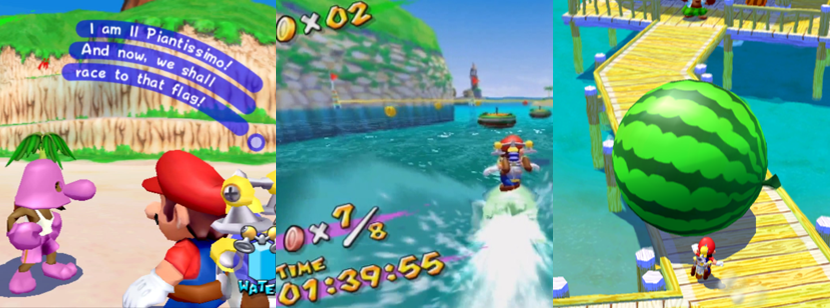
Game Corner [Mario Month]: Super Mario Sunshine (Nintendo Switch)


So, for no better reason than “Mar.10” resembling Mario’s name, March 10th is widely regarded as being “Mario Day”, a day to celebrate Nintendo’s portly plumber, an overalls-wearing mascot who literally changed the videogame industry forever and shaped the home console market of the nineties. To commemorate Mario Day this year, I’ve made March “Mario Month” and am spending each Wednesday talking about everyone’s favourite Koopa-flattening plumber.


Released: 18 September 2020
Originally Released: 19 July 2002
Developer: Nintendo EAD
Also Available For: Nintendo GameCube

The Background:
After the success of Super Mario 64 (ibid, 1996), a sequel had been in development for several years; however, despite a title apparently in line to be released in the early days of the Nintendo GameCube’s release, Nintendo opted to focus on Mario’s brother, Luigi, for the GameCube’s launch. Beginning life as a tech demo tentatively titled Super Mario 128, Super Mario Sunshine was retooled to both expand upon the mechanics and gameplay of its predecessor and to have Mario utilise a water pump as both a weapon and to navigate his environment. Upon release, the game garnered widespread critical acclaim for its presentation, music, and gameplay, though some did criticise the game’s camera and more frustrating moments. For my part, I had been attempting to buy a copy of the game for many years, having only found it to be extortionately expensive for such an old title, so I was delighted when the title was included in Super Mario 3D All-Stars (Nintendo, 2020) for the Nintendo Switch, which is the version I’ll be looking at today.

The Plot:
Mario arrives at Isle Delfino for a vacation with Princess Peach, her long-time steward Toadsworth, and several other Toads. However, upon arrival, they find that the once-pristine island has been polluted and plastered with graffiti and Mario, as the prime suspect, is charged with cleaning up the graffiti, recovering the missing Shine Sprites, and uncovering the mystery of his shadowy doppelgänger.

Gameplay:
Like Super Mario 64, Super Mario Sunshine is a 3D action/platformer. However, while Super Mario 64 had you leaping through magical paintings inside of Princess Peach’s castle, Mario finds himself jumping and hopping around the tropical island resort of Isle Delfino and its surrounding areas. While, at first, it seems as though Mario retains all of his abilities from Super Mario 64, this isn’t actually the case; Mario can still run, jump, double-, and triple-jump, wall jump, and perform a sideways jump to reach higher areas but he can no longer duck, crawl, long jump, or perform a backwards somersault. This is massively problematic coming into this game right after playing Super Mario 64 as you don’t realise how helpful those abilities are until they’re missing.

Use F.L.U.D.D. to attack enemies and hover to out-of-reach areas.

Also, Mario can no longer punch or kick enemies. He can still perform a running dive (and can now use this to slide away like a rocket if he dives onto wet ground) and a ground pound, which is useful, but his primary mode of attack and manoeuvring is to utilise Professor E. Gadd’s Flash Liquidizer Ultra Dousing Device (“F.L.U.D.D.”), a water-blasting jetpack, of sorts, that not only allows Mario to clean up toxic waste, sludge, and graffiti but also to blast at enemies to stun them or topple them over and hover short distances. Mario gains a slight amount of height the longer you hold the jump button to help him reach higher areas but it’s an awkward and cumbersome system, one that makes platforming and jumping far more frustrating than it needs to be as Mario tends to spiral off like a madman, spewing water everywhere, or fall just short or reaching far away (or high up) platforms thanks to F.L.U.D.D.’s limited tank and the game’s bothersome controls.

Shadow Mario has framed Mario and spread goop and graffiti throughout Isle Delfino.

Since Isle Delfino has been polluted and graffitied by “Shadow Mario”, and the population holds Mario himself responsible, you’ll be spending a lot of your time spraying your environment with water. Entering any of the many (many) bodies of water allows Mario to not only swim and dive but also refill F.L.U.D.D. Even when F.L.U.D.D. is full, though, you can’t just spray until the tank is empty; instead, your water will sputter out after a short time whenever you try to spray stuff for a long time. If you get muck on you, you can wash it off in water or by wriggling the control stick, which can also double as a whirlwind-like jump that I, honestly, found little use for.

This time, there’s no reprieve in water or from Coins other than the common yellow variants.

As in Super Mario 64, Mario has a health meter, this time measured by a glowing sun. While health can be replenished by collecting Yellow Coins, you’ll no longer instantly regain health by entering water, though you can keep yourself from drowning by collecting Coins and sucking in air bubbles. Also, while you’ll still find Red and Blue Coins in the game’s various stages, these won’t refill your health, though Mario is far less likely to plummet to his doom this time around since there is always a massive body of water to break his fall. Rather than being confined to a castle, Mario has the run of Isle Delfino, a bright and lively seaside port town that is populated by Piantas (goofy little characters who offer vague hints and task you with bringing them fruit) and a few of Peach’s Toads. Still, the general premise is the same; explore a hub world and enter into one of the game’s eight stages, seven of which featuring eight missions (known as “Episodes”) that allow Mario to recover one of Isle Delfino’s 120 Shine Sprites.

Shine missions range from the easy, to the lazy, to the maddeningly annoying!

Mario can, again, also find Shines in the hub world and by collecting 100 Coins in each of the stages (and easily keep track of any missing Shines using the map/totals screen) but, unlike in Super Mario 64, each Shine can only be obtained in its corresponding Episode (the Red Coins, for example, don’t appear in every Episode) and you’re still unceremoniously spat out of the current stage every time you collect a Shine (even a 100 Coin Shine), all of which means that, while each stage changes in various ways from Episode to Episode, there’s a lot less freedom and choice to how you recover the Shines. To recover the Shines, you’ll be tasked with performing such familiar tasks as defeating bosses, collecting eight Red Coins, or racing against another character. Each Episode also has you chasing after Shadow Mario, spraying him as you go until he yields a Shine, while some have you collecting another eight Red Coins in a startling example of laziness on the developers’ part. Other times, you’ll be running around in circles desperately trying to figure out what you need to do; each Episode opens with a short cutscene to help guide you in how to obtain its Shine but a lot of the time it’s very difficult to figure out what you need to do. Other times, you’ll be racing or collecting Red Coins against a time limit, returning to previous stages with new upgrades and abilities to get missing Shines or be tasked with performing needlessly difficult tasks, such as rolling watermelons to a pier or surfing on a Blooper without touching anything as you’ll have to start all over again or lose a life, respectively!

The damn obstacle course stages can go burn in a fiery pit!

While the game is much prettier and far more aesthetically pleasing than Super Mario 64, the same blocky visuals make an unwelcome return in the game’s many obstacle course stages; these hidden areas are found in each stage and see Shadow Mario steal away F.L.U.D.D., leaving you to run and jump across various moving, rotating, and temporary platforms without the aid of your water jet or Mario’s more useful jumping skills from the previous game. Generally, you can find at least one, if not two, 1-Up Mushrooms in these secret stages and you are going to need them as, while the game’s camera allows for full 360 degree control and is much improved over the last game’s camera, it’s still sometimes painfully difficult to get a decent angle, to say nothing of Mario’s continued slipperiness and instability (seriously, it’s like he doesn’t even try to stay on or hang from ledges!) Add to that the fact that you’ll have to frantically run around long rotating platforms, try not to slide off of cog-like blocks, and be reliant on Piantas throwing you to far away or high up platforms in these stages and it all amounts to the game’s most frustrating moments by far.

While the game is gorgeous to look at, I wasn’t exactly blown away with the stage variety.

While Isle Delfino is a much livelier and visually interesting environment, with lots to see, do, and find compared to Peach’s Castle, the variety in the game’s stages leaves a lot to be desired. It sounds stupid but the game really does rely way too much on F.L.U.D.D. and its tropical island theme; this means that every stage is full of water and such clichés as beach fronts, theme parks, and ports. While it’s nice that you’re far less likely to fall down a bottomless pit and that you can see the other stages way off in the distance, it got pretty tiresome and boring quite quickly as all of the game’s stages felt far too visually similar. Super Mario 64 was full of stage variety; one minute you’d be exploring sunken depths or sliding about in an ice and snow world, the next you’d be flying through the clouds or exploring a gas-filled maze. While some Episodes in Super Mario Sunshine inject some variety, with a haunted hotel being the focus for most of Sirena Beach and Pianta Village featuring a distinct (if frustrating) cage maze beneath it, I never got the same feeling of diversity while playing through the game and, when it did try something new, it was often frustrating shit like clambering up temporary platforms, trying to not slide off of moving and twisting fairground rides, or shooting yourself into the air using spontaneous sandscastles.

Graphics and Sound:
If there’s one thing Super Mario Sunshine has going for it, it’s its bright, colourful, and attractive graphics and presentation. In keeping with the tropical theme of the game, Mario is wearing a short-sleeved shirt and will not only doze off when left idle but also wipe sweat from his brow when in the shade. He, and all of the game’s characters, also have a plastic, action figure-like quality to them and are far more expressive thanks to the game’s greater processing power. While I grew tired of the tropical theme pretty quickly, the developers definitely went all-in with it; the water effects are amazing, with waves rippling, rising, and falling in the many instances of sea, and the lighting effects really make it feel as though you’re caught in the unrelenting heat of tropical sunshine.

Some Episodes spice things up but the game’s aesthetic doesn’t really alter until the final stage!

Each of the game’s worlds, and the hub world, are populated by Pinatas, all of whom have funny little reactions to being squirted or jumping on and offer vague hints to your goal for that Episode, which really helps to make the place feel alive compared to Peach’s Castle, which was basically deserted. Though each stage doesn’t really deviate from the overall tropical theme, there are some distinctions to help them stand out; you’ll be traversing ropes and running up a hill in Bianco Hills, fly on the back of a stone bird through the skies of Gelato Beach, and dive into the polluted depths of Noki Bay, with different Episodes offering slightly different variations on each stage in an attempt to spice things up. Things don’t really become visually different until you reach the eighth and final stage, Corona Mountain, which is a volcano full of instant death spikes and lava and awkward boat steering sections. The game relates its incredibly basic story with beautiful, fully voiced cutscenes. While Mario still only communicates through pantomime and characters use the tried-and-tested speech bubbles outside of the cutscenes, it’s refreshing to see Mario embracing full motion cutscenes for a change. As for its soundtrack, long-time series composer Koji Kondo and Shinobu Tanaka largely eschew the traditional Mario themes for an appropriately tropical theme which, while fitting for the game’s aesthetic, wasn’t quite as memorable to me as Super Mario 64’s music.

Enemies and Bosses:
Despite taking place in an entirely new environment, Super Mario Sunshine sees the return of a number of Mario’s traditional enemies, though many have undergone a slight aesthetic change to better fit in with their tropical locations. This means you’ll be coming across Bob-ombs, Boos, Bullet Bills, and Piranha Plants but you won’t just be able to smack them or jump on the to take them out this time. Instead, you generally must make use of F.L.U.D.D. to clean them off, whittle them down, expose them, or stun them to toss them at other enemies. You’ll also come across a number of new enemies as you explore Isle Delfino’s sun-drenched locations, many of which are rather troublesome to take care of: Chain Chomplets must be doused with water until they cool off and then ricocheted into water to dispose of them; Cataquacks will fling you into the air when you get near and must be stunned with water so you can butt stomp them; and the Electrokoopas will throw their electrifying shell at you and are only vulnerable for a short time. By far one of the worst obstacles, though, are the swirling clouds that appear in various Episodes; these will dart at you and are very difficult to dodge, meaning you’ll probably be knocked out of the air mid-jump or sent plummeting off a high ledge to have to climb all the way back up again.

Petey Piranha and Glooper Blooper pop up for a couple of boss battles.

Super Mario Sunshine features far more bosses than its predecessor; some of these are more like mini bosses, such as the aforementioned chases against Shadow Mario, the Piranha Plants made of sludge that need water sprayed into their mouths until they are defeated in order to open up new areas, and the Monty Moles who incessantly shoot Bob-ombs and Bullet Bills at you from cannons. Twice in the game you’ll have to contend with Petey Piranha and Glooper Blooper in Bianco Hills and Rico Harbour, respectively. The first time you battle Petey, it’s in an enclosed area and he shoots gunk at you that spawns enemies or headbutts you if you get too close. The second time, he’s flying around Biano Hills and must be shot out of the sky but, in both battles, you must frantically squirt water into his mouth to make him reel over and vulnerable to a ground pound. Glooper Blooper, meanwhile, sits there spitting ink at you and trying to squash you with its tentacles; you must ground pound all (or most) of his tentacles to give yourself enough time to pull out the cork stuck in his mouth and send him flying away (though you can make this easier by pulling off his tentacles in the same way).

Wiggler and King Boo return, bigger and badder than ever!

As in Super Mario 64, you’ll also battle Wiggler and King Boo; this time around, Wiggler is a far more troublesome foe as he stomps around Gelato Beach in random patterns and can only be toppled over by causing sandcastles to spring up beneath his feet, leaving him open for a ground pound or three. King Boo is also far more formidable; this time, you have to content with three spinning rings and a roulette, which will see enemies, Coins, and fruit tossed into the arena. The only way to damage this King Boo is to grab a spicy red pepper, toss it at him, and then toss a different fruit at him three times, which isn’t immediately obvious when you first drop into the arena.

Phantamanta and Eely-Mouth can be frustrating boss battles.

Two of the game’s more unique, if frustrating and troublesome, bosses, for me, were Sirena Beach’s Phantamanta and Noki Bay’s Eely-Mouth. The Phantamanta is little more than a shadow that glides over the sandy beaches and resort leaving icky sludge in its wake; spraying it with water is the key to defeating it but, every time you do, it splits into smaller and smaller parts which, combined with the life-sapping sludge, can make this a tricky battle. Eely-Mouth is a giant eel fought in the dark depths of Noki Bay; Mario dons a diver’s suit for this battle, which means you are constantly fighting with the controls as Mario bops and hovers and darts all over the place seemingly at random, slowly drowning as time passing, and you’re desperately left trying to clean the eel’s foul, rotten teeth with F.L.U.D.D. to unearth a golden tooth that is your true goal without drowning or being eaten up.

Bowser might be gigantic but the biggest hazard is the precarious nature of the boss arena.

Though a prominent force throughout the game, you never actually battle Shadow Mario in a boss battle; after being revealed to be Bowser Jr in disguise, you take on a giant mechanical version of Bowser in Pinna Park. In this battle, you’re forced into a rollercoaster and must shoot rockets at Mecha Bowser while also blasting Bullet Bills out of the sky. While this is good practice for a particularly annoying timed Shine mission that has you shooting balloons with just as little control, the rollercoaster’s constant speed and spinning means getting a clear shot is easier said than done and that’s without factoring in Mecha Bowser’s fire breath. After finally getting through the treacherous Coronoa Mountain, you’ll go head-to-head with Bowser once more; this time, he’s grown to giant size and is sitting inside of a jacuzzi tub full of caustic water. Bowser tries to fry you with his fire breath and burn you with the acid-like sludge while Bowser Jr shoots homing Bullet Bills at you. The only way to win this battle is to use F.L.U.D.D.’s rocket nozzle to perform five rocket-powered ground pounds at the five spokes of the arena. However, while this eventually leads to Bowser’s defeat, it causes the already-unstable arena to further crumble and the two dragon-turtle’s attacks to increase in speed. Still, probably the hardest thing about this boss battle is not slipping or tumbling from the arena and to your death.

Power-Ups and Bonuses:
Although Mario can still collect 1-Up Mushrooms for extra lives, Yellow Coins for health, and both Red and Blue Coins for Shines, there are no invincibility power-ups to be found this time around and, after swapping flowers and capes for special caps in Super Mario 64, Super Mario Sunshine primarily revolves around you making good use of F.L.U.D.D. to traverse the game’s various tropical environments. Though versatile, F.L.U.D.D. is largely more of a pain in the ass than an asset thanks to some awkward controls and mechanics at times. However, you can acquire a couple of additional nozzles to make things a bit easier; the rocket nozzle allows you to charge up and release a burst of water to go flying high into the sky and the turbo nozzle allows you to blast away across both land and water, both of which are incredibly useful for reaching new areas and out of reach or temporary Blue Coins.

Yoshi finally gets his time in the sun (…literally) but be sure to keep him away from water!

After being relegated to an after-game cameo in Super Mario 64, clearing the fourth Episode of Pinna Park will see Yoshi eggs appear in each of Super Mario Sunshine’s stages (with the exception of Corona Mountain) and the hub world. If you bring the egg the fruit it asks for, it will hatch and you’ll finally be able to ride either a pink, orange, or purple Yoshi! Yoshi can eat up fruits and certain enemies with his long tongue, use his flutter jump to reach platforms, and each Yoshi can create goopy platforms of a different nature (ascending, stationary, and forward-moving, respectively). As great as it is to actually be able to ride on Yoshi, though, there are some drawbacks; the first is that you can’t ride the traditional green Yoshi, then there’s the fact that he can’t spit fireballs and his supply of fruit drains over time, and, of course, the glaring flaw that your Yoshi will explode when it comes into contact with water, which is particularly frustrating when trying to reach a secret Shine in Delfino Plaza.

Additional Features:
Similar to how Mario’s brother was left with a purely solo adventure for his GameCube outing, this is once again a solo adventure for Mario; even after clearing the game, you can’t unlock any additional characters to play as, which is a real shame considering we missed out on playing as Luigi in Super Mario 64. If you talk to the various Pinatas in the game’s Episodes after collecting enough Shines, they’ll eventually gift you a pair of sunglasses that slightly darken the game’s presentation. After clearing the game for the first time, you can pair these with a super snazzy Hawaiian shirt (though neither of these can be worn outside of the Episode you are playing, unfortunately). Clearing the game once also allows you to return to the Delfino Airstrip to collect eight Red Coins for another Shine. While that’s slightly more than in Super Mario 64, it’s still a bit disappointing; once again, you don’t need all 120 Shines to clear the game but having them all slightly changes the ending you get. However, obtaining them all is no mean feat; I finished the game with 90 Shines, which was all eight stage-based Shines, all 100 Coin Shines, and a handful found around the hub world but, to get them all, you’re going to need to find all of those Blue Coins and secret stages, which can be needlessly frustrating.

The Summary:
I was super excited to finally play Super Mario Sunshine; I missed out on it back when I was playing the GameCube on the regular and have been putting off getting it for ages (literally years). The bright, colourful graphics and my fond memories of Super Mario 64 really appealed to me and fuelled my desire to finally get my hands on this game. Yet, despite a promising start, I was left disappointed. There’s a lot to see and do and to like; the graphics are gorgeous, the F.L.U.D.D. concept is interesting (if flawed), and it’s great to be able to ride Yoshi again but there are so many frustrating elements to the game that really let it down. There’s very little stage variety, too many missions per stage (with too many repeating, such as the Red Coin challenges), too much water for my liking (no matter how fitting it is for the game’s setting), and just far too many instances where you slip or fall from platforms, ledges, or ceilings or fail to make jumps because of an awkward camera angle or Mario just deciding to miss or fall. The secret obstacle course stages are an absolute ball ache and, just as the game seems to be getting interesting, it’s over in uncharacteristically anticlimactic fashion, leaving me feeling disheartened and drained rather than encouraged to hunt down the last few Shines.

My Rating:

Rating: 2 out of 5.

Could Be Better

What are your thoughts on Super Mario Sunshine? Did you play it on the GameCube back in the day or, like me, did you first experience it on the Nintendo Switch? What did you think to F.L.U.D.D. and the game’s tropical island setting? Were you also frustrated by the controls, mechanics, and over-reliance on the setting or did you, perhaps, enjoy the different direction the game took and the challenge it offered? Were you glad to be riding Yoshi again and did you manage to find all 120 Shines? What other setting would you like to see Mario placed into? Whatever your thoughts, drop a comment below and pop back next Wednesday for the final instalment of Mario Month!

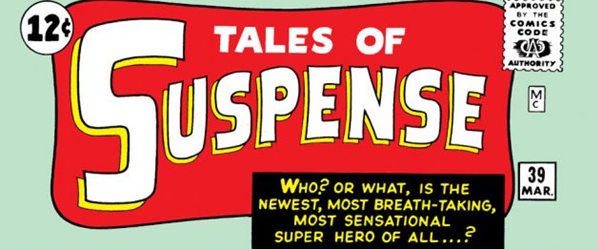
Back Issues: Tales of Suspense #39

Story Title: Iron Man is Born!
Published: March 1963
Writers: Stan Lee and Larry Lieber
Artist: Don Heck

The Background:
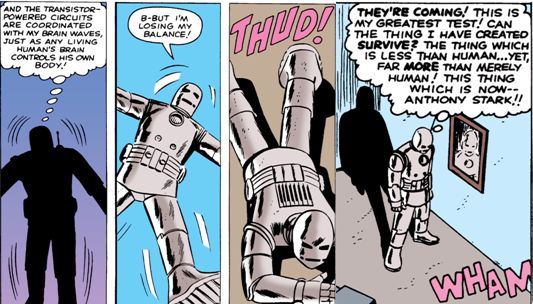
Long before Robert Downey Jr. uttered that unforgettable line, “I am Iron Man”, Stan Lee’s original idea behind creating Iron Man was to take a concept his readers would hate (a rich, military industrialist), throw in a little inspiration from Howard Hughes, toss in a little vulnerability and personal tragedy, and make him a character they would root for. Although Lee intended to write Iron Man’s debut, mounting deadlines saw him turn to his younger brother, Larry Lieber, to flesh out this concept. Though artist Don Heck drew the interior artwork, the cover art (which posits the question “Who? Who? Who?” and depicts Iron Man’s awesome, super chunky grey armour) was done by the legendary Jack Kirby. Stark and his armoured alter-ego was initially a whimsical, Errol Flynn-type anti-communist who existed, largely, for Lee to comment on both industrialism and the Cold War, and debuted in the pages of Tales of Suspense, a title known for including science-fiction mystery and (fittingly) suspense stories.

The Review:
“Iron Man is Born!” begins in “a secluded area somewhere in the U.S. perimeter” where Anthony Stark is demonstrating the power and awesome potential of his “tiny transistors”. Though the General is initially unimpressed with Stark’s grandstanding, with just a flick of a switch, Stark’s transistor technology increases the power of even the smallest magnet a thousandfold to tear open even a heavily-sealed vault door in an impressive demonstration of the technology he believes to be “capable of solving [the] problem in Vietnam”.

Stark impresses both military officials and ladies alike with his many talents.

Having introduced us to Stark’s impressive technological genius, the story then spends the next couple of panels giving us a glimpse into the type of character Stark is. A rich, handsome, glamorous playboy, Stark is seemingly lusted after by every woman who lays eyes on him and is both a sophisticate, millionaire bachelor and a scientist who wants for nothing, is capable of getting, making, or having anything he wants, and who is one of the premier hot-shotters in the U.S.

Wong-Chu has been terrorising South Vietnam, trouncing all who dare oppose him.

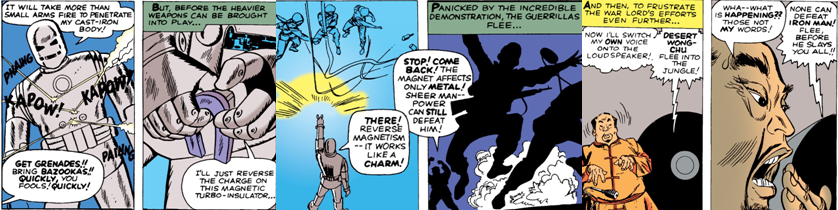
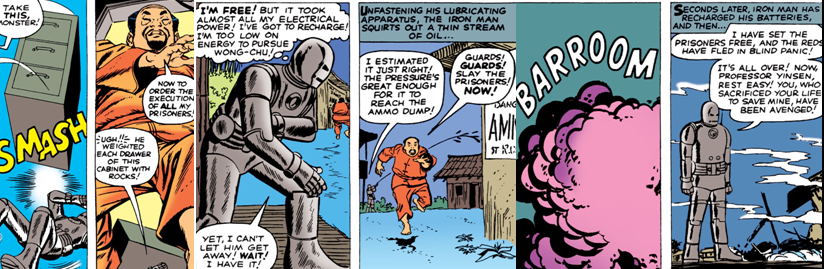
We’re then introduced to the tyrannical Wong-Chu , a stereotypical “Yellow Peril” menace who has mercilessly dominated the majority of South Vietnam, bringing village after village to its knees and besting all who dare challenge him in single combat and plundering without compassion. Wong-Chu and his “Red Guerrillas” vastly outnumber the stationed U.S. forces and have the advantage of being able to navigate through the dense jungle, which keeps the U.S. military’s heavy weapons and armaments at bay. Considering it’s Vietnam and we all know how messed up that particular conflict was, it’s a bit odd that the army would rather employ Stark’s transistor technology (as groundbreaking as it apparently is) to solve this problem rather than, I dunno, simply burning the jungle.

A booby trap causes sharpnel to become lodged near Stark’s heart, giving him just days to live!

However, while wandering around in the jungle for apparently little other reason than to deliver exposition, Stark triggers an unseen booby trap and is captured by the Red Guerrillas while he lies wounded. At the Guerrilla chief’s headquarters, their physician reveals that Stark is in critical condition; shrapnel near his heart makes it impossible for them to operate and Stark will be dead within about a week. Undeterred, Wong-Chu decides to coerce Stark into using what little time he has left to make weapons for them instead. Immediately sensing Wong-Chu’s deception, Stark agrees to their terms if only to use their resources in one last, desperate attempt to keep himself from dying. Considering he has untold pieces of shrapnel lodged in his chest and is, apparently, in critical condition and mere days away from death, Stark is rather spirited, able to stand, walk around, and work himself around the clock with only the looming threat of his impending demise working against him rather than, you know, agonising pain.

Yinsen helped Stark, and sacrifices himself, to create a powerful suit of armour to save his life.

On the second day, Wong-Chu bring Stark an assistant, the aged Professor Yinsen, a man whom Stark recognises and seems to idolise after studying Yinsen’s texts while in college. Stark shares his plans with Yinsen and they work together to complete Stark’s imaginative solution to his problem: a mighty electronic body powered by Stark’s transistor technology. This massive iron frame is specifically crafted to replicate all the natural movements of a man and to work in conjunct with Stark’s transistors to both keep him alive and grant him freedom of movement. With Stark’s conditioning worsening as time goes on, Yinsen presents him with the iron chest-plate to applies it, and the remainder of the suit, to Stark’s body. However, after powering up the generator, Yinsen selflessly rushes out to keep Wong-Chu’s forces at bay while Stark lies motionless and helpless.

The suit saves Tony’s life but it takes him some to adjust and adapt to it.

As the transistors charge up Stark’s suit, he is devastated to hear the sound of his friend being shot and killed and swears vengeance for him. Once the suit is fully charged, Stark’s life is saved; the transistors imbedded in the chest plate are vaguely depicted as being something akin to a life support machine that keeps Stark’s heart beating but we know, from the demonstration of the transistor’s magnetic powers that we saw earlier and from subsequent stories, that the suit is actually keeping the shrapnel at bay to keep Stark from dying. Surprisingly, and somewhat hilariously, Stark struggles to adjust to his new armoured suit, falling and having to take a panel or two to master the awesome power of the suit. Even more surprisingly, as Wong-Chu’s men head towards his cell, Stark has a moment of despair; he sees the oncoming battle as his “greatest test” and wonders if his suit will be up to the task while simultaneously doubting his own humanity and the unknown future that lays ahead of him as he must remain reliant upon, and encased within, his iron suit. It’s a startlingly affecting couple of panels and really shows just how much the experience has affected the formally carefree Stark.

Iron Man’s armour affords Stark many abilities and allows him to easily best Wong-Chu in combat.

Pragmatic as ever, Stark utilises his “transistor-powered air-pressure jets” to perform a great vertical leap and hides from Wong-Chu’s forces using “suction cups” to cling to the ceiling. After hearing clarification of Yinsen’s death, Stark again swears to make the Red Guerrilla’s pay for killing an innocent, harmless old man as Iron Man. Out in the courtyard, Wong-Chu is celebrating another victory over a hapless villager when Here Comes a New Challenger!! Iron Man approaches Wong-Chu and challenges him to single combat, easily besting him with his transistor-powered strength.

Iron Man uses his many gadgets and gizmos to deter and and demoralise Wong-Chu’s forces.

Iron Man’s reinforced metallic shell is even capable of deflecting bullets and, when Wong-Chu orders the use of grenades, Iron Man simply “[reverses] the charge in [a] magnetic turbo-insulator” and “[uses] a top-hat transistor to increase its repelling power a thousandfold” to deflect the incoming projectiles. Wong-Chu is incensed when his men flee from Iron Man’s power and uses a loudspeaker to offer a thousand yen reward to the man who can destroy the metallic menace who threatens his rule; however, Iron Man uses “electrical interference” to drown out Wong-Chu’s words and replace them with an order for the Red Guerrillas to flee in panic.

Though stunned by a rock-filled filing cabinet, Iron Man brings an end to Wong-Chu’s threat.

Though he easily uses his miniature buzz saw to cut through the locked door that hides Wong-Chu, Iron Man is briefly incapacitated when Wong-Chi is able to topple a rock-filled filing cabinet on top of him. Okay…first of all: where did Wong-Chu get the rocks to fill the filing cabinet and, secondly, how was is it he had the strength to push it down the stairs but Iron Man, with all his transistor-powered strength, struggled to lift it off of him? Regardless, Iron Man soon lifts the weight off of him but finds that he has exerted his power levels far too much and cannot pursue Wong-Chu. However, determined to keep the tyrant from slaughtering all of the prisoners in the camp, Iron Man squirts a thin stream of oil towards the ammunition storage building Wong-Chu is running past and ignites it, blowing Wong-Chu to smithereens without hesitation and leaving Stark to ponder his unknown future that lies before him as Iron Man.

Tony does not initially appear to be made out of traditional hero material…

The Summary:
“Iron Man is Born!” is quite the snappy little story; Tony Stark is indeed a very different character compared to some of Marvel’s other heroes in that he is a womanising philanthropist. While he’s not shown to be aloof or carefree, the panels depicting him as a billionaire playboy certainly indicate that this is the case; sure, he’s clearly a patriot but he seems to assist the military effort more out of personal pride and to show off his technology rather than out of any real inherent duty to his homeland.

A prisoner with only days to live, Stark falls back on his intellect to save his life.

Yet, when captured by the Red Guerrilla’s, Stark comes face-to-face not only with the true extent of the brutality of the Vietnam conflict but also his own mortality; where other Marvel heroes may have faced this threat with a witty remark or a patriotic resolve, Stark instead invests himself in the only thing he really knows: his science and genius. He works tirelessly to construct the Iron Man armour, crafting a sophisticated, life-saving machine out of a smattering of resources and technology, not just to save his own life but also to take Wong-Chu down with him.

Stark faces an uncertain future as he is initially bound to the armour in order to survive.

Indeed, initially, Stark seems to accept that this will be a suicide mission and that he may very well fail before he can even complete the armour; his motivations turn to revenge after the death of Yinsen, however, and he becomes quite the unlikely hero thanks to the experience of being held prisoner, coming to terms with his mortality, and the unlimited potential of his transistor-powered Iron Man persona. In the end, I actually felt like Stark had a lot in common with Doctor Bruce Banner/The Hulk in that he is somewhat horrified by the monster he has made himself into; he is not only overwhelmed by the implications of being trapped within the armour but ends the story satisfied with his vengeance but uncertain how the man once known as Tony Stark can continue to live in the world as an Iron Man.

My Rating:

Rating: 3 out of 5.

Pretty Good

Have you ever read “Iron Man is Born!”? How did you find it as a story and as an origin for ol’ shellhead? What did you think of Tony Stark compared to other Marvel superheroes at the time? What are some of your favourite Iron Man characters or stories? Where does Iron Man rank in your hierarchy of comic book characters? Are you doing anything to commemorate Iron Man’s debut appearance and, if so, what is it? Either way, I’d love to hear your thoughts on Iron Man so leave a comment below.

Movie Night: Stung

Released: 3 July 2015
Director: Benni Diez
Distributor: IFC Midnight
Budget: $2,500 (estimated)
Stars: Matt O’Leary, Jessica Cook, Clifton Collins Jr, Cecilia Pillado, Eve Slatner, and Lance Henriksen

The Plot:
Paul (O’Leary) and Julia (Cook) cater for Mrs. Perch (Slatner) when the elaborate affair is attacked by genetically mutated wasps!

The Background:
If there are two genres of horror movies I always have time for it’s the body horror and horror/comedy sub-genres; I grew up watching classic films of this kind like John Carpenter’s The Thing (Carpenter, 1982), The Fly (Cronenberg, 1986), and Tremors (Underwood, 1990) so I was naturally intrigued when I came across Stung a while ago while browsing through Bloody Disgusting. Helmed by German director Benni Diez, Stung was a crowd funded independent horror/comedy that began life as the winning script for a screenwriting contest hosted by German production company Rat Pack. With such a low budget, the filmmakers had to be careful when casting the film but, with little more than a whim and just for the fun of it, opted to ask Lance Henriksen to join the production and, to their surprise, he agreed. Stung premiered at the 2015 Tribeca Film festival, where it was a noted highlight, before receiving a wider theatrical release later that year snd earning mixed reviews that focused on the quality of the special effects or the film’s ridiculous concept and tone. Because of its limited release, Stung only made $75,000 in worldwide gross but it did win the Best International Film award at the 2015 Fantaspoa International Fantastic Film Festival.

The Review:
Like any good horror film worth its salt, Stung sets itself in a largely familiar environment with a variety of normal, everyday characters; while the unfamiliar is a perfectly good setting for horror, I find some of the best takes place in places where you could conceivably, believably, and easily find yourself. Stung’s narrative primarily revolves around Julia, a caterer, and Paul, her assistant; Julia, having inherited the company from her father, is somewhat highly strung and has little time for Paul’s clumsy flirting and buffoonery. Paul, meanwhile, is clearly attracted to Julia and feels somewhat underappreciated for his efforts; he may play the fool at times but it’s mainly for levity and to help encourage Julia to relax since he puts a lot of work and effort into setting the venue up and tending the bar despite his tomfoolery.

While the well-to-do fall victim to the wasps, the working class have the moxie to survive.

Mrs. Perch’s shindig may be an intimate affair but all kinds of guests are in attendance, including her quirky son Sydney (Collins Jr), Larry the piano player (Daniele Rizzo), the cook and an old family friend of Julia’s, Flora (Pillado), and Mayor Caruthers (Henriksen). When Larry, Mrs. Perch, and Flora quickly become victims of the giant wasps, the remaining survivors are forced into Mrs. Perch’s vast estate where they attempt to barricade themselves within while being stalked by the giant wasps that were once their friends, family, and acquaintances. While hiding out in the estate’s fortified basement, the survivors get a bit of breathing time to interact and flesh out their characters a bit: we learn about Paul’s instinct towards saving lives from his time as a lifeguard and he begins to bond with Julia, who clearly exhibits a fondness and attraction for him but is only really driven to expressing those feelings because of the astonishing situation they find themselves in.

Caruthers proves to be a cool-headed and supportive character.

Sydney, meanwhile, already an eccentric and awkward character, descends into irrational fear and paranoia after witnessing his mother’s brutal transformation and reveals resentment towards his family. However, it’s thanks to him that the wasps have undergone their dramatic mutation since he mixed growth hormones with imported plant fertilize. Conversely, Mayor Caruthers is largely presented as the pragmatic voice of reason and a seasoned, rational presence; he compliments Paul and Julia for their ability and adaptability to the situation and approaches the horrific circumstances with a rational calm thanks to his experiences as an infantryman. He also exhibits a dry sense of humour and a gruff approach to both Sydney’s attitude and the growing intelligence of the wasp creatures.

Sydney becomes a brief secondary antagonist thanks to the wasps’ influence.

While the film features a few additional cast members such as these and numerous guests, they all quickly fall victim to the wasps and Stung, first and foremost, revolves around Paul and Julia; they end up the sole survivors and we learn the most about them and watch their relationship evolve throughout the course of the film. Unexpectedly, Stung mixes things up a bit by featuring an articulate antagonist; when Sydney is stung, his transformation is radically different as he’s influenced by (if not out-right controlled by) the smaller wasp parasite that emerges from his shoulder that forces to do the bidding of his “mother”, the giant queen wasp that burst out of Mrs. Perch.

The Nitty-Gritty:
There are several themes at work in Stung amidst its ridiculous horror/comedy presence; the brutality and adaptability of nature, for one thing, and the lethargy of the capitalist elite (it’s notable that it’s the working class characters who are the most capable and forced to save the day), for another. Another prevalent sub-plot concerns Paul’s attraction to Julia, which is initially played for laughs and generally a vehicle to showcase Paul’s relatable awkwardness but also shows the differences between their social classes. Julia, while mostly not a complete bitch, is desperately trying to be professional and to make a good impression on Mrs. Perch and her high class guests in the hopes of increasing her business profile but she’s clearly Paul’s boss first and above him in the pecking order as he’s left doing all the heavy lifting and manual labour.

Stung‘s practical effects are as gruesome and top-notch as they are ludicrous.

Of course, any good monster movie lives and dies on the strength of its creature design and Stung is certainly unique in its approach to this; whenever a character is stung by one of the giant, mutated wasps, a parasite soon hatches from within them, bursting out in truly gruesome fashion. The first time we see this happen, it is honestly an impressive and ghastly effect achieved though a clear combination of practical and special effects that is both shocking and disconcerting as the unfortunate victim is literally split in half and the resulting creature stalks further victims with the girl’s head still impaled on one of its arms! The second time, poor old Mrs. Perch literally explodes in a shower of gore and viscera!

There are many different variants of monstrous wasp for our heroes to contend with.

After the initial emergence of the wasps, the film slows down and becomes a much more intense, atmospheric experience as the survivors hide in the estate’s basement and attempt to come up with a plan to escape. This gives the film time to breathe, allows for some commendable character development and moments (particularly from Paul and Mayor Caruthers, the two most appealing characters in the film), and builds a creepy sense of dread and atmosphere. There’s a sense that the wasps could break in at any moment and, indeed, several are already stalking through the mansion thanks to Mrs. Perch, creating an ominous ambience that only escalates when Sydney undergoes his unique transformation. The effect of seeing the wasp parasite emerge from his shoulder is as grisly as it is amusing and, alongside the wasp that emerges from the little dog, helps to keep the creature effects varied and interesting. It’s not just a swarm of mutated wasps or giant, man-sized creatures coming after the survivors, so they’re forced to constantly adapt and meet each new threat as it emerges while, thankfully, never descending into in-fighting or class warfare.

The CGI is pretty commendable considering the budget and used sparingly, and to decent effect.

Thanks to the tension built up in the film’s slower, more atmospheric scenes, Stung’s creature effects and gore become so much more visceral when they are onscreen; sure, the CGI effects aren’t as polished as most big budget affairs but, for a low budget, independent horror film, they’re decent enough and the filmmakers more than make up for it with some impressive practical effects. The giant wasps are dripping in blood and guts and are, for most of the film, kept in darkness to both hide the effects and augment their horror. By the time Paul and Julia escape the estate, day has dawned and we get to see a fully CGI giant wasp in all its glory and it works, for the most part, since there’s a blending of practical and special effects, and the result is a creature that is both threatening but absurd in its appearance (which, to be fair, is a large part of the point and appeal of the film).

The Summary:
I really enjoyed Stung, to be honest. It was a wacky, over the top horror/comedy with a truly outlandish concept but I found it incredibly enjoyable. The creature effects and practical work is amazing considering the budget and the special effects and CGI are serviceable and forgivable enough for me (I’ve certainly seen worse, even in big budget movies!) Beyond the gore and the visceral brutality of the film’s unique creatures, I also found the leads very appealing; I totally bought Paul and Julia as believable, everyday people just trying to get by and being flawed, relatable characters and Lance Henricksen is always a pleasure to see (I really got the sense that he was just enjoying himself in the role and being on set). Not every film, certainly not every horror film, needs to be this deep, thought-provoking masterpiece; sometimes it’s perfectly fine and fun to just switch off and enjoy a good, old-fashioned creature feature and Stung certainly delivers in that regard, balancing its horror with an easy and believable humour and moments of surprising dread through clever pacing and filmmaking techniques. It’s obviously not going to be for everyone but, for fans of similar horror/comedies like Tremors and Slither (Gunn, 2006) there’s a lot to like here and it’s worth a watch for gore hounds and the absolutely outrageous ending that would make for an even more ludicrous concept were a follow-up ever produced!  

My Rating:

Rating: 3 out of 5.

Pretty Good

Have you ever seen Stung? If so, what did you think of it? What did you think to the concept, execution, and special effects and how did you find the characters and more amusing elements? Are you a fan of old school creature feature horrors or do you prefer a different horror sub-genre; if so, what is it? Is there a creature feature concept you haven’t seen yet and would like to? What’s your favourite giant monster movie? No matter what you think, feel free to leave a comment down below and be sure to check back in for more horror content throughout the year!

Game Corner: Star Wars Jedi: Fallen Order (Xbox One)

GameCorner

Released: 15 November 2019
Developer: Respawn Entertainment
Also Available For: PC, Playstation 4, PlayStation 5, Stadia, Xbox Series X

The Background:
In 2013, Disney paid a paltry $4 billion for Lucasfilm Ltd and thus added the influential and immensely popular Star Wars franchise (Various, 1977 to present) to their ever-growing itinerary of properties and licenses. In addition to producing numerous films and television projects to expand and continue the franchise, Disney also sought to cash in on their purchase through videogames and quickly struck up a collaboration with Electronic Arts (EA) in order to facilitate this. After their attempts to revive the Star Wars: Battlefront series (Pandemic Studios, 2004 to 2005) were met with criticism and controversy, the pressure was on the studio to repair their damaged reputation with fans and gamers. Thus, in collaboration with Lucasfilm and drawing inspiration from the “Metroidvania” style of exploration and combat, EA turned to Respawn Entertainment to further (and officially) expand on the twenty year gap between the end of Star Wars: Episode III: Revenge of the Sith (Lucas, 2005) and the beginning of Star Wars: Episode IV: A New Hope (ibid, 1977). This approach appears to have paid off as Star Wars Jedi: Fallen Order was largely praised and sold over ten million units by 31 March 2020 and a sequel is rumoured to be in development.

The Plot:
Five years after the Great Jedi Purge, former Jedi apprentice Cal Kestis is hunted by the Galactic Empire’s Inquisitors, led by the mysterious and malevolent Second Sister, and he soon finds himself travelling with a rag-tag crew of misfits to secure a Jedi Holocron that names potential Force-sensitive children.

Gameplay:
Star Wars Jedi: Fallen Order is an action/adventure videogame with a heavy emphasis on backtracking, story, and learning and upgrading Force abilities using Skill Points earned from battle and finding secrets, similar to a role-playing game. Players take control of former Jedi apprentice Cal Kestis, a young man who has suppressed his connection to the Force and must rediscover his abilities through the course of his journey. However, the emphasis on exploration and searching through long-defunct Jedi Temples and the general thrust of the gameplay reminded me much more of the likes of Tomb Raider (Crystal Dynamics, 2013) than the Star Wars: The Force Unleashed videogames (LucasArts/Various, 2008/2010).

Cal’s lightsaber combat is comprised of quick attacks and well-timed parries.

Cal has a range of abilities that are simple to learn but can take some time to master; he can jump with a press of the A button, evade with B, and sprint ahead by pressing in the left analogue stick. Although his Force abilities are quite light to begin with, they can be upgraded with Skill Points and you’ll be using the Force to push, pull, slow down, and freeze enemies and objects with the Right and Left Triggers. The Force also comes into play with your lightsaber attacks, allowing you to press Y to pull off stronger attacks in conjunction with mashing X as long as your Force Meter is full. Similar to the Force Unleashed games, lightsaber combat is pretty simple, for the most part; you simply hit X to unleash a number of combos and mix your attacks up with Force manoeuvres and evades to avoid taking damage and deliver a swift kick or counterattack. Key to lightsaber combat is the game’s block and parry system; you can hold down the Left Bumper to automatically block incoming attacks but, with a well-timed press of LB, you’ll reflect blaster bolts back at your enemies and parry incoming melee attacks. This will leave your foe vulnerable and allow you to follow up with an attack of your own in a system that reminded me of the Batman: Arkham games (Rocksteady Studios/Various, 2009 to 2015) but it’s not quite the same in that, despite being attuned to the Force, there’s much less indication of when to parry and combat can get a bit hectic.

Wall run, slide, and swing your way across the galaxy’s dingiest corridors and environments.

You can target an enemy by pressing in the right analogue stick but this only really helps in one-on-one situations; when groups of enemies attack you, you better be prepared to be attacked from behind and off-camera quite often even after acquiring a double-bladed lightsaber to help deal with multiple enemies. As you cut down enemies, you’ll build up your Force Meter but the only way to restore your health is to press up on the directional pad (D-Pad) to have your cute little droid companion, BD-1, administer you with a Stim Canister or find a special glowing meditation circle. Here, you can save your game, spend Skill Points, and choose to completely refill your health and Stim Canisters (though every enemy you’ve killed will respawn once you leave the circle). Like The Legend of Zelda: Breath of the Wild (Nintendo NPD, 2017), climbing is an important mechanic in Jedi: Fallen Order; however, unlike in that game, Cal isn’t hampered by a stamina meter and you can even set up the option to auto-climb climbable surfaces from the game’s settings. Anytime you see vines or serrated surfaces or a splash of white paint on a ledge, you can usually climb up it with LT, jumping up and across to cover a greater distance (though, thanks to the game’s janky camera and perspective, you’re just as likely to leap into the void). You can also run along walls, slide down…slides…and swing from ropes, chains, and vines, and you will also eventually learn to bring these to you with the Force to swing about like Peter Parker/Spider-Man but, again, the game’s camera and wonky physics often cause you to fly past your target or ragdoll down a bottomless pit. Jedi: Fallen Order takes Cal on a journey back and forth across a whole five planets (not counting the areas you can’t revisit from Cal’s ship, the Stinger Mantis). Once Cal leaves Bracca, the salvage planet he has been hiding out on, he travels to Zeffo and begins his quest to reconnect with the Force and recover a Jedi Holocron from a vault hidden on the planet. This quest takes him to recognisable worlds from the Star Wars saga, such as Dathomir and Kashyyyk, and worlds I’m unfamiliar with, each one with their own visual style and with secrets to uncover and enemies to fight.

Cal’s reawakened Force abilities will allow him to access new shortcuts and paths.

Unfortunately, the game loves to lock areas off from you and to send you all over the place to learn new abilities just to replay through entire sections all over again to progress further. Don’t get me wrong, I get it and I don’t mind a bit of backtracking and the “Metroidvania” style of videogames but Jedi: Fallen Order really takes the piss with it. So, you’ll visit, say, Dathomir and be able to progress to a certain point but you’ll have to come back once you’ve learned the Jedi Flip to jump further. Similarly, the Force Push will allow you to break through certain walls and doors to explore further but the problem is that, despite the planets each looking and feeling different, many of them are occupied by the Empire and have a lot of similar-looking grey corridors and areas and, despite an abundance of meditation rings, there’s no fast travel system on each world so it’s pretty easy to get lost and turned around. You can create shortcuts and are provided with a map but, honestly, it’s not that helpful as I found it really difficult to see how the different levels of each environment connected and could have really done with an onscreen mini map to help with this.

The game slows to a crawl whenever you’re forced to figure out its annoying puzzles.

Gameplay isn’t all combat or exploration; Jedi: Fallen Order is also very heavy on the puzzles, particularly involving giant spheres. Unlike in some Star Wars games, you can’t actually freely manipulate objects with the Force; you simply freeze them in place or push them forwards, which is not helpful at all when you’re moving spheres. At one point, Cal is captured by the bounty hunter Null Chance and stripped of his lightsaber and BD-1, meaning you have to rely on your awkward Force powers to power up generators and rescue your little droid pal. The game often encourages you to ask BD-1 for a hint but these are generally very vague and unhelpful; he does, however, help you out by “splicing” open doors and crates for you to create shortcuts and unlock additional items; you can also use him to travel across zip wires, which is especially useful once you upgrade him with a motor, and have him scan enemies so you can better prepare from future encounters. Occasionally, you’ll be asked to perform a couple of button mashing quick-time events (QTEs), usually in boss battles, but you can helpfully turn these off from the settings if you’re not into that and they’re nowhere near as abundant as in the Force Unleashed games. There are also four different difficulty levels to choose from, with each one altering the aggressiveness of enemies and the parry system, but there are no Achievements tied to them so you may as well play on the easiest mode. Finally, while you spend a lot of time on a ship, there’s no space combat in Jedi: Fallen Order but you do get to take the controls of an All-Terrain Armoured Transport (AT-AT). You might think this would be pretty cool but it’s not that great and all too brief; the controls are a bit clunky (which I guess makes sense given the AT-AT’s size) and all the weapons come with a cooldown period so you can’t just mindlessly blast away.

Graphics and Sound:
Heading into Jedi: Fallen Order, I’d heard that it was a highly detailed and photorealistic game and one of the best games of its generation and, at first, this definitely seemed to be the case; Cal looks startling like his voice actor and likeness, Cameron Monaghan, and all of the game’s worlds and environments are full of little details such as weather effects, ships and monsters in the background, and have that lived-in aesthetic that permeates a lot of Star Wars lore.

Worlds appear vast and full of details but it’s easy to get lost thanks to the bland colour scheme.

Ships, characters, and technology are startlingly close to the source material; the many different Stormtroopers and the new Inquisitors all look exactly as you’d expect and the Stormtroopers even share some amusing dialogue that helps to humanise them beyond being mere cannon fodder. Droids, especially, look fantastic, and the game does a decent job of distinguishing its different worlds…again, until the Empire’s influence creeps into the environment. Grey is the order of the day here and, while each of the Imperial outposts and locations differs, it’s easy to get them mixed up and to get a bit lost when revisiting worlds.

The high quality cutscees are not reflective of the in-game graphics or the game’s stability.

Sadly, outside of the high-quality cinematics, things start to take a bit of a drop; the in-game graphics see a significant dip in quality, resulting in character models becoming noticeably low resolution. The crew of the Mantis ends up being comprised of several different races and characters, each of whom are very distinct and well-rounded in their own way, but they end up just standing around like action figures outside of cutscenes. Worst of all, the game is plagued by long load times, graphical pop up, and a whole bevvy of glitches; characters and enemies will blink in and out of existence, slide along as if on ice, ragdoll all over the place, and I even had the game crash on me on more than one occasion (usually when planning my next hyperspace jump). Honestly, it might be the most bug-filled videogame I’ve ever played; textures sometimes take a long time to load, the frame rate stutters when there’s a lot happening onscreen, voices, music, and sound effects would frequently cut off or out entirely and, honestly, I expected a lot more from a triple-A title such as this and it really lets the game down and makes it almost unplayable at certain points.

Enemies and Bosses:
As is the case in pretty much every Star Wars videogame, your primary enemies will be the Empire’s finest Stormtroopers. Regular ‘Troopers will blast at you from afar and try to bash your head in with the butt of their rifles but are notoriously bad shots and easily offed with a single swing of your lightsaber (but you can’t dismember them, unfortunately). Very soon, you’ll encounter Scout Troopers wielding electrified staffs that will require you to parry their attacks, ‘Troopers with flamethrowers, and ‘Troopers with heavy machine guns and small shields, though it’s pretty simple to reflect their shots back at them despite their rapid fire. You’ll also come up against the much more competent Purge Troopers; these black-clad bastards make Jedi hunting their speciality and wield a variety of lightsaber-rebelling weaponry, including electrostaffs and electrohammers. Faster and much more aggressive, they’re also capable of negating or recovering from your Jedi attacks so you’ll have to weaken them a bit before tossing them off a cliff and breaking through their guard so you can deliver a swift finishing blow. Similarly, the Nightbrothers await you on Dathomir and will attack you with magically-charged clubs and arrows but the strategy remains, largely the same. Later, you’re attack by undead Nightsisters who swarm and grab at you but are easily cut down with your double-blade dlightsaber.

You’ll also have to contend with droids and bounty hunters as the game progresses.

Each world you visit is also home to a number of creatures; Bog Rats headbutt and charge at you, Scazz’s pop out of burrow holes to attack (often shoving you off a cliff in the process), Phillaks bash you with their horned heads and will kick you with their hooves; and Mykals will swoop at you from above. You’ll also encounter some larger, more formidable enemies, with even bigger and more aggressive variants of these popping up from time to time; Oggdos will try to suck you into their jaws with their sticky tongues, Wyyyschokks pounce out of nowhere and try to either bite your face off or tie you up in their webbing, and Nydaks will thrash at you with their powerful claws. With a lot of these creatures, it’s best to wait for them to glow red and dodge out of the way and then follow up with a quick combo or to hang back and let them attack any nearby Stormtroopers to level the playing field somewhat. Compounding matters are the presence of the Empire’s Security Droids; while the astromech droids can be simply sliced in two, you’ll need to dish out quite a bit of lightsaber damage to take out their bigger cousins but, with a later upgrade, you can have BD-01 hack the droids so that they’ll attack enemies on your behalf. You can also do this with the Probe Droids that hover throughout later areas of the game’s worlds; these little buggers float just out of reach until they’re damaged enough and then they’ll charge at you in a suicide run! Later, you’ll also find a number of bounty hunters are suddenly waiting for you when you revisit worlds; these range from jetpack-wearing Boba Fett wannabes, shield-wielding mercenaries, and large battle droids and will often attack in pairs but are, in actual fact, some of the more interesting and entertaining battles in the game.

AT-STs are ridiculously easy to take down compared to Dathomir’s resident giant bat.

Bosses are a bit of a mixed bag, to be honest. You’ll have to contend with a number of large ships and creatures but some are more like underwhelming mini bosses; an attack ship blasts at you at the beginning of the game and forces you to dash between cover to avoid being blasted to pieces and, later, you’ll trade shots with a shuttlecraft while piloting your AT-AT. You’ll also have to fight against All-Terrain Scout Transports (AT-STs) more than once but, unlike in most Star Wars games, these are stupidly easy to take down as you can reflect their blaster bolts, easily jump over or reflect back their electrical bombs, and just hack away at their legs or cockpit until they go down (but remember to kill the pilot afterwards or you’re likely to be shot in the back). On Dathomir, you’ll also have to fight a giant bat, the Gorgara, in the game’s most unique battle; this thing stamps around the arena to produce shockwaves and screeches at you as you attack its wings. It’s also stupidly persistent, cashing you up a wall as you frantically climb away, before you end up having to free fall through the air, cling on to it with LT, and smash it into a series of structures until it finally goes down.

You’ll fight with the Second Sister multiple times but can only defeat her in the finale.

The game’s primary antagonist, the Second Sister, is yet another Darth Vader wannabe, one who draws more than a little inspiration from Kylo Ren, and you’ll battle her on numerous occasions throughout the game’s story. However, in each battle, there’s no point in trying to defeat her as she’s not only more powerful than you and incredibly aggressive, but the game is programmed in such a way where the point is that you’re not supposed to win; you simply have to knock her health down enough until a cutscene plays, which gets really old after a while. Eventually, you will battle her in a proper, no-holds-barred boss battle right at the end of the game; she’s faster and more aggressive than ever, tossing flashbangs and dashing around the arena, but isn’t too difficult to best if you watch her attacks, dodge, and parry properly.

Jedi boss battles are few and far between and not too challenging if you dodge and parry properly.

You’ll also engage with the Ninth Sister, a ridiculous and cartoony-looking member of the Second Sister’s group; after quite an intense chase sequence on Kashyyyk, you’ll fight her one-on-one in a battle that sees you parrying her lightsaber attacks and leaping over the shockwaves she produces. The fight is also split into stages that are separated by QTEs and cutscenes, which can get a bit distracting. Later, on Dathomir, you’ll also have to battle the fallen Jedi, Taron Malicos; Malicos dual-wields his lightsabers, tosses boulders at you, and leaps in to attack. The gorgeous Nightsister Merrin helps even the odds in this battle, however, allowing you to easily break his block and cut him down with your more powerful attacks so neither of these battles are particularly difficult.

Darth Vader makes a surprise and mostly unwelcome appearance to usurp the game’s antagonist.

After defeating the Second Sister, Darth Vader comes in and kills her with absolutely no effort at all and completely robs her of any menace and steals the show for the last part of the game. You can battle with Vader but, again, it’s a fruitless endeavour and basically an interactive cutscene prior to you having to madly escape from the Fortress Inquisitorius as Vader tears it apart with his Force abilities. It’s an intense end to the game, one that sees you having to quickly jump across floating platforms and run across walls as Vader pursues you, but it’s a bit of a shame that the game spends so much time building up the backstory between the Second Sister and Cal’s crewmate, Cere, only to have Vader come in and undo it all with his presence.

Power-Ups and Bonuses:
As you defeat enemies and scan your environment, you’ll acquire Skill Points that can be used to purchase new Force abilities; you’ll unlock more as you play through the game’s story mode and also be able to upgrade existing ones to extend your health, Force Meter, increase the range and power of your push, and learn new combat moves that see you throwing your lightsaber or performing more powerful melee attacks. Be warned, though, as these will expend your Force Meter but you can extend this, and your health, by finding “essences” hidden throughout the game’s environments. Similarly, BD-1 can scan enemies, plants, and other notable parts of the environment to add to your various databases and earn you more Skill Points and Achievements so, if you see him hop off your shoulders, be sure to stop and let him scan whatever’s caught his attention. This will also allow you to grow plants in the Mantis’s terrarium and open up better crates to acquire more Stim Canisters and find new materials for your outfit, lightsaber, BD-1 himself, and ship. Each of these can be customised with a variety of colour schemes; for BD-1 and the Mantis, this is sadly just a series of palette swaps and, unlike the Force Unleashed games, Cal’s wardrobe is depressingly light on options. Cal’s under outfit can be customised with a handful of colours and you can choose to garb him in different poncho designs or a jacket but none of them are that interesting and this feature disappointingly lacks options for other skins or recognisable clothing from the saga. Similarly, the various elements of Cal’s lightsaber can be customised to your liking; you can change the blade’s colour (initially, you can only pick from three colours but you unlock more later, though the options are still surprisingly limited) and equip different materials for the hilt and switch and such but, honestly, you rarely notice these changes when playing the game and they add nothing to your attack power or prowess.

Additional Features:
Star Wars Jedi: Fallen Order has thirty-nine Achievements for you to earn; most of them are tied to the main story campaign and unlocking the Skill Tree and, as a result, are quite time consuming to achieve. You also get Achievements for parrying attacks, taking out certain monsters, offing enemies in certain ways, and scanning everything in sight and opening every chest. Others are slightly more obscure, requiring you to kick a Phillak after it’s kicked you, defeat a Stormtrooper with their own slowed blaster bolt, cut out an Oggdo’s tongue when it grabs you, and recruit an elusive animal on Zeffo to join your crew. After you finish the game, you’ll unlock “New Journey+” mode which, as you might expect, carries over most of your unlocks for your next playthrough; you also unlock a bad-ass Inquistor outfit and red lightsaber for Cal and gain access to “Meditation Training” from save points. These are kind of like the challenge maps in the Arkham games and allow you to take on a pre-set or customised series of challenges against a variety of enemies but, while you can use this as a good excuse to quickly mop up any combat-related Achievements you’re missing, there aren’t any Achievements specifically tied to these modes, which is a bit of a missed opportunity and, while you can return to your save file to mop up anything you’re missing, the New Journey+ cosmetics can’t be used in your old save file.

The Summary:
Star Wars Jedi: Fallen Order has a lot going for it; it may be, on many levels, the best and most impressive Star Wars game I’ve ever played thanks to how large and fitting its scope is compared to the movies. The attention to detail is impressive and the sense of immersion is fantastic; the decision to slowly integrate Cal into the ongoing battle against the Empire helps to keep things grounded and build up towards the more elaborate and intense moments as Cal’s skills in the Force are reawakened. Unfortunately, it’s also a glitchy, bug-filled mess of a game full of graphical errors, instabilities, and frustrating moments that, in just as many ways, place it on exactly the same level as the Force Unleashed games. Add to that the abundance of backtracking and how poor the map and level layouts are and Jedi: Fallen Order is a chore to get through sometimes. When the game shines, it shines brightly but, at the same time, the good moments only serve to highlight how disappointing the game’s flaws are. I feel like a bit more cohesion, a bit more focus on travelling to distinct worlds or ships, and a bit more time testing would have greatly benefitted the game but the lack of unlockables and customisation features, combined with the unpredictability of the game’s performance, result in an underwhelming experience overall.

My Rating:

Rating: 2 out of 5.

Could Be Better

Are you a fan of Star Wars Jedi: Fallen Order? Do you feel EA redeemed themselves or were you also put off by the amount of bugs and glitches in the game? Perhaps you played on an Xbox Series X or PlayStation 5 and never encountered these issues; if so, what are your thoughts on the game’s stability and performance? Were you a fan of the new characters introuced in the game and, if so, which was your favourite and why? What did you think to the Second Sister and Darth Vader’s sudden appearance at the end of the game? Were you also disappointed by the customisation options available or did you enjoy cobbling together your own unique lightsaber? Which Star Wars videogame is your favourite? No matter what you think about Star Wars Jedi: Fallen Order, and Star Wars videogames in general, drop a comment down below and check back in for more Star Wars content in the near future.

Game Corner [Mario Month]: Super Mario 64 (Nintendo Switch)


So, for no better reason than “Mar.10” resembling Mario’s name, March 10th is widely regarded as being “Mario Day”, a day to celebrate Nintendo’s portly plumber, an overalls-wearing mascot who literally changed the videogame industry forever and shaped the home console market of the nineties. To commemorate Mario Day this year, I’ve made March “Mario Month” and am spending each Wednesday talking about everyone’s favourite Koopa-flattening plumber.


Released: 18 September 2020
Originally Released: 23 June 1996
Developer: Nintendo
Original Developer: Nintendo EAD
Also Available For: Nintendo 64, Nintendo DS (Remake), Nintendo Wii (Virtual Console)

The Background:
By the end of 1983, the videogame industry was dead after crumbling under the weight of countless overpriced consoles and poor quality titles. From the ashes, Nintendo stepped in and pretty much single-handedly rebuilt the industry with the release of the Nintendo Family Computer (Famicom)/Nintendo Entertainment System (NES), a machine marketed not as another home videogame console but as a more market-friendly “Entertainment System”. The videogame industry was resurrected from the dead with the NES and the blockbuster success of Super Mario Bros. (Nintendo EAD, 1985) and given a massive kick into overdrive following the release of the SEGA Mega Drive and Sonic the Hedgehog (Sonic Team, 1991). The “Console Wars” of the mid-nineties resulted in some of the greatest 8- and 16-bit releases, a series of videogames that defined an entire generation, and ensured that videogames were big business once more. Very quickly, though, the story became about which developer could be the more innovative than the other and who would crack 3D gaming first. SEGA attempted to break into the 32-bit arena with a series of expensive add-ons for the Mega Drive while Nintendo played the long game, discussing various CD-based options with both Sony and Panasonic and inadvertently creating one of the industry’s biggest gaming powerhouses, the PlayStation, when talks with Sony fell apart. Initially developed as the “Ultra 64”, the Nintendo 64 was Nintendo’s first fully-3D home console and was officially announced to the world on 24 November 1995; although the console favoured more expensive and limited cartridges over CD-ROMS, this dramatically sped up the load times of its titles and helped to reduce piracy. The console also utilised a unique (and massively under-rated) controller that included an analogue stick for full 3600 movement and could be fitted with Rumble and Memory Paks, and the system launched a number of first- and third-party titles that would be exclusive to the console. One such title was, of course, Super Mario 64. Developed over the course of three years, Super Mario 64 sought to showcase exactly what the Nintendo 64 was capable of by offering large, open 3D worlds that allowed for exploration, experimentation, and offered a diverse field of view. The game was a massive critical and financial success and is still the best-selling Nintendo 64 videogame of all time; just as Super Mario Bros. had set the standard for 2D sidescrolling platformers back in the day, so too did Super Mario 64 set the standard for 3D platformers in this new era of gaming. The game was later ported to the Nintendo DS in what is, in my view, the definitive version of the game thanks to the additional elements it provides but it was also included in Super Mario 3D All-Stars (Nintendo, 2020) for the Nintendo Switch, which is the version I’ll be looking at today.

The Plot:
Princess Toadstool (finally referred to as “Peach” for the first time outside of Japan) invites Mario to her castle with the promise of cake but, when he arrives, he finds that the diabolical Bowser, King of the Koopas, has kidnapped the Princess and hidden the castle’s Power Stars within a series of paintings throughout the castle. Never one to back down from a challenge, and motivated by the promise of a sweet treat, Mario leaps into the castle’s magical paintings to retrieve the Stars and rescue Peach and the castle’s Toad guards from Bowser’s clutches.

Gameplay:
I think it’s safe to say that everyone who owned a Nintendo 64 back in the day also owned Super Mario 64; it was the first (and, for a long time, the only) Nintendo 64 title I had when I got the console and all of my friends had it, too. Thanks to the realities of life, it was also the first Nintendo home console I owned and the first main-line Mario game I had ever owned and, honestly, it was a pretty great way to experience of Mario’s unique world and cast of characters (not to mention mind-boggling through its crisp 3D models and tight controls). Super Mario 64 is a 3D action/platformer in which you play as the titular Mario. The game takes place entirely within Princess Peach’s Castle and the grounds outside of it; within the castle are a series of magical paintings that lead Mario to a total of fifteen Courses, each with six mission-based Power Stars to collect and one hidden Star. You can also find a number of additional secret Stars in other paintings and mini Courses scattered throughout the castle and you’ll need to collect a certain amount in order to open doors to more Courses. Once you have enough Stars, however, Courses can be attempted in any order you wish but you may be limited in what you can do if you haven’t unlocked the game’s three cap-based power-ups and you’ll need a boss key to access the castle’s upper and lower areas, plus at least seventy Power Stars to battle the final boss and all 120 to see the game through to 100% completion.

Peach’s Castle is the game’s hub world, with Stars hidden in paintings and needed to open doors.

When you enter a Course, you must select a Star Mission to tackle; at first, you’ll only be told of the first mission but, once you’re in the Course, you can generally attempt to obtain any Star you wish (with some exceptions). This means that you can free the Chain-Chomp instead of racing Koopa the Quick, for example. Each Star comes with a vague hint about how to acquire it (“Lil’ Penguin Lost” or “Shining Atop the Pyramid”) but it’s not always massively clear what you have to do to obtain these Stars, encouraging exploration and experimentation (or a quick Google search). Collecting one hundred Yellow Coins in every Course will also award you with a Power Star and, sometimes, you’ll have to revisit secret Courses to obtain another Star you may have missed but, generally, the Star Missions are quite similar across all courses (battle a boss, find five secret areas, utilise a cap, scale to the top, etc). As in his 2D outings, Mario’s primary form of traversal and attacking is his ability to jump but this ability has been expanded exponentially to allow for a far more diverse means of movement and to showcase the capabilities of the Nintendo 64. Pressing jump once will see Mario perform a hop; press it again and he will jump higher, and press it a third time while running and Mario will somersault even higher, allowing him to reach out-of-reach ledges with ease. If you press the R button while running and then press jump, Mario will throw himself forwards to cover faster distances in one dramatic leap, which is great for reaching faraway platforms or navigating Mario at a faster pace. It doesn’t end there, either; Mario gains momentum as he runs and jumps, meaning if you jump onto an enemy’s head while running, you’ll get a boost upwards and jump further.

You’re required to fulfil certain objectives to acquire each Course’s Stars.

Mario can also perform a wall kick to scale vertical shafts quickly but not, it has to be said, with a great deal of ease; as will come up numerous times in this review, the wall kick is somewhat hampered by the game’s janky camera and how difficult it can be to properly judge your perspective and alignment to certain walls and objects. When you can pull it off though (which, to be fair, is more often than not and can be perfected with practise), it’s a nifty little trick that you can combine with long jumps and triple jumps to move Mario’s pudgy behind at a break-neck pace. For what I believe is a first in the series, Mario can also perform a series of melee attacks to fend off his foes. Pressing the attack button once will see him perform a punch but press it twice more and he’ll perform another punch followed by a big ol’ kick to send enemies flying. You can also perform a sweep kick while crouching, a jump kick, and a diving attack by running, jumping, and hitting the attack button, a ground-pound (where Mario will flatten enemies with his butt), and also pick up certain blocks and even enemies to toss them at other enemies. It’s quite a deep control scheme, to be honest, offering a range of smooth and crisp combat and movement options; you can run Mario in any direction at full speed and, with a twitch of the analogue stick and a press of the jump button, side-flip around to get the drop on enemies, wall kick your way up to otherwise inaccessible areas, or backflip your way to another Power Star with ease.

Mario visibly shows the affects of low health but it’s easily replenished through a variety of means.

Mario can also grab onto ledges to save himself from accidental falls and pull himself up from tricky jumps; however, this isn’t as reliable as you might think and it’s just as easy to bounce head-first off of a platform or ledge and fall to your death or go careening down a bottomless pit or into a river of butt-burning lava. Similarly, the game’s camera can sometimes get stuck behind other objects, which can cause it (and Mario) to freak out a bit; Mario also stutters and jitters if positioned too close to an edge and will most likely fall to his death if you don’t quickly tap that jump button. Thankfully, Mario is far more durable than in the majority of Mario videogames; he has a life bar (represented be a colourful pie chart) that loses a segment each time he takes a hit or other damage. Once all segments are drained, Mario loses a life and is unceremoniously spat out of the Course he was in and will have to attempt the Course over from the beginning. Luckily, Mario can refill his health by running through spinning Hearts dotted around each Course, collecting Coins, or taking a dip in water and is only dependant on Mushrooms to gain an extra life. Take care when swimming, however, as Mario’s health will slowly deplete and he’ll eventually drown unless you collect Coins or suck in an air bubble and he’s also not capable of surviving being sucked into quicksand. Compounding matters is the fact that certain enemies and hazards will cause Mario’s iconic cap to fly off; if you lose your cap, be sure to collect it as quickly as possible as you’ll take double damage without it!

Graphics and Sound:
Even now, after the release of so many technically superior 3D action/platformers, Super Mario 64 holds up ridiculously well. It’s a testament to how diligently Shigeru Miyamoto and his team worked to showcase the power and capability of the Nintendo 64 as character models still look spot on to this day, seamlessly retaining their quality and stability (unless you move Mario too far away from the camera, of course), and the game is just as silky smooth as ever. Sure, Bowser doesn’t look so great these days (and he, along with all of the character models, were vastly improved in the DS remake) but it’s cute to see all of Mario’s eccentricities, from his enthusiastic shouts when he hops around, his triumphant cry of “Her-r-re we go-o-o!” whenever he grabs a Star, and the way he falls into a mumbling sleep when he’s left idle for a short time.

In most Courses, you’re only one stupid mistake away from plummeting to your death.

Having said that, though, there are some issues that are more noticeable with the benefit of hindsight. The game’s Courses vary wildly in their scope and quality; the first, Bob-omb Battlefield, is basically a tutorial area where you’ll quickly get to grips with the game’s controls and mechanics. As user friendly as you could like, Bob-omb Battlefield features some basic enemies and hazards and is completely devoid of bottomless pits, something the vast majority of the game’s other Course cannot say. Courses like Whomp’s Fortress, Cool, Cool Mountain, and Tall, Tall Mountain are all much more limited in their scope, substituting a quasi-sandbox arena for vertically-themed stages that hover over a bottomless pit, meaning you’re always one stupid mistake away from falling to your death. Things don’t get really frustrating, however, until you reach the game’s final Courses; Tick Tock Clock and Rainbow Ride suspend you over a vast, empty void that will truly test your skill and patience thanks to the game’s dodgy camera and some very tricky and frustrating platforming elements. Other stages, like Jolly Roger Bay and Hazy Maze Cave, also feature an abundance of water; this isn’t a massive issue as Mario is quite a capable swimmer but he’s not exactly a fast swimmer and the game’s controls noticeably lag when he’s under water. Combine this with the aforementioned camera troubles and how easy it is for the camera to get stuck behind objects and these Courses can be difficult to navigate. The camera is serviceable for the most part, to be fair, and automatically and diligently following Mario around to provide the optimal viewpoint but Nintendo really should have integrated full 3600 camera control into the Switch version to correct this one glaring flaw.

There’s both variety and a lack of variety in Super Mario 64‘s Courses…

Still, the game offers a fair amount of variety in its Courses; Big Boo’s Haunt and Lethal Lava Land are standouts for me thanks to their unique mechanics and visual presentation but, at the same time, it lacks variety in a number of other instances. For example, Jolly Roger Bay and Dire, Dire Docks are essentially the same stage with the same music and, as much as I like Snowman’s Land, did we really need two snow/ice-themed stages? Plus, playing the game now, it’s really hard not to notice how basic a lot of the stage geometry is; everything is very angular and blocky, which isn’t surprising given it was a Nintendo 64 launch title, but it’s one of the many reasons why I prefer Banjo-Kazooie (Rare, 1998) since it improved and expanded upon everything Super Mario 64 pioneered. The game only really has a handful of cutscenes, all of which are rendered using the in-game graphics and are simply there to establish the game’s simple plot, relay that you’ve opened up new areas or discovered a Star, and convey the game’s ending. These are accompanied by a few instances of voice acting from Peach as Mario, Bowser, and other enemies are limited to a few sound bites, grunts, and yelps, which adds to the game’s cartoonish charm. Finally, Super Mario 64 is bolstered by a bombastic and catchy soundtrack from long-time Mario and Nintendo composer Koji Kondo; a lot of the tracks are re-used on multiple Courses but they’re so fitting and memorable that I can forgive it and if you don’t find yourself humming along to the main castle theme then you honestly have no soul.

Enemies and Bosses:
If I’m being brutally honest, Super Mario 64 doesn’t feature much in the way of enemy variety; within the first handful of Courses, you’ll have encountered pretty much all of the enemies and hazards the game has to offer but, to be fair, these are all used sparingly and to great effect. They’re generally present to cause you some issues when trying to jump and clamber up to new areas rather than being formidable challenges in their own right; you’re far more likely to get bumped off a ledge and to your death rather than beaten to a pulp by these enemies. You’ll come up against classic Mario enemies such as Goombas (who now hop up in alarm and charge at you head-first when you cross their eye line), Bob-ombs (who chase you relentlessly as their fuse ominously burns down before exploding in a shower of Coins), Boos (who turn incorporeal when you face them so you’ll have to sneak up on them from behind or perform a backflip into a ground-pound), Koopas (give them a thump to ride their shell like a skateboard), and Shy Guys (annoying little bastards that buzz all around you shooting fireballs your way and send Mario into a whirlwind spin if he jumps on them). Each of these has been brought to life with a snazzy 3D makeover that imbues them with simple, but charming, attack and movement patterns and characteristics.

The strategy for beating these two will serve you well for the remainder of the game’s bosses.

You’ll also come up against some new enemies; Amps will spin around in a tight circle and electrocute Mario if he touches them, Bubba will swallow him whole if he enters the water while exploring the “Tiny” side of Tiny-Huge Island, three different varieties of Bullies will try to knock Mario off platforms and to his death, Chuckyas and Heave-Hos will also try to throw Mario to his doom, and Klepto and Ukkiki will steal Mario’s cap if given half a chance. You’ll also have to sneak up on the sleeping Piranha Plants to knock them out without getting bitten and watch out for that Goddamn piano in Big Boo’s Haunt as it’ll randomly spring to life to scare the piss out of you! Not every Course in Super Mario 64 has a boss battle but nine out of fourteen isn’t bad. The first one you come across, King Bob-omb, teaches you the fundamental mechanics Mario will need to defeat not only Chuckyas but also Bowser himself as you’ll have to run around the King to grab him from behind and then throw him three times without being thrown off the top of his mountain to defeat him. The second boss, the Whomp King, is even easier to defeat; simply run beneath him or dodge out of the way when he tries to squash you and ground-pound his back three times and he’ll burst into pieces to award you a Star.

Bosses might be big and talk a good game but they go down pretty easily.

In Big Boo’s Haunt, you’ll do battle with three Big Boos but, despite their intimidating size, they’re as easily dispatched as any other Boo with the only troublesome one being the Big Boo you battle on the balcony at the top of the haunted house because of the risk of falling. You’ll also encounter a large variant of the Mr. I enemy in this Course but, again, it’s defeated in exactly the same way as any other Mr. I (simply run around it until it gets dizzy and explodes). You’ll also encounter larger variants of existing enemies in Lethal Lava Land and Snowman’s Land, in this case the Bullies; again, though, the hardest thing about fighting these guys is making sure you don’t accidentally slip off the small platform you fight them on or let them push you into the molten lava or freezing water, respectively. Finally, you’ll have to do battle with the Eyerock inside the pyramid in Shifting Sand Land and a Wiggler on Tiny-Huge Island; the Eyerock is probably the most challenging boss before the final battle with Bowser as it constantly shields its one (well, two really) weak point (the eye) in its rock-like fists, tries to squash you at every opportunity, and can easily shove you off the platform and to your death (luckily, though, you’ll restart right before this battle if you immediately enter the painting again). The Wrigger is pretty much the same basic deal as the Whomp King; although he looks intimidating due to his size, he only looks big because you’re small and you simply ground-pound him three times to take him out, making sure to dodge him as he wriggles around the arena faster and faster with each hit.

Bowser isn’t messing around in the third and final fight and throws everything he has at Mario!

The game’s true boss is, of course, Bowser, Mario’s long-time enemy and most persistent foe. You’ll battle Bowser three times and each time you must have the correct number of Stars to access a troublesome mini Course that leads to the Warp Pipe into Bower’s arena. Each time you face Bowser, the general strategy is the same; avoid his attacks and run around him to grab his tail, then rotate the analogue stick to swing him around and then press the attack button to send him flying into one of the many bombs that line the outskirts of each arena. The first time you face Bowser, he’s pretty weak; he’ll stomp around in a circle, slowly spitting fireballs at you, and isn’t much of a threat as long as you don’t run into him, get hit by his burning flames, or fall off the platform and you’ll only have to toss him into a bomb once to take him out, making him functionally weaker than King Bob-omb. The second battle ramps things up a bit; Bowser can still be defeated with one bomb but he’ll now jump up and come crashing down on the platform, tilting it into a steep angle that will send you sliding into a bomb yourself or down to the fiery depths below. Bowser also now teleports across the arena if you get too close to him to prolong the battle and will tilt the stage each time he leaps up to the arena from a missed throw so make sure your accuracy is on point when you send him flying. The final battle is where Bowser really brings his A game; the music is far more ominous and foreboding and Bowser can now charge at you, spit a slew of fireballs onto the arena (including blue ones that bounce all over the place) and produce shockwaves that must be jumped over every time he lands from a jump. To make matters worse, Bowser must now be thrown three times before he is defeated and, after taking two hits, will stomp around the arena in a tantrum, causing parts of it break off until it resembles a Star and limiting your options for escape and movement. It’s not all bad, though; some of Bowser’s flames will produce Coins to replenish your health and, technically, the strategy remains the same; as with every Bowser battle, it’s just a question of patience and getting your shot lined up to throw him into the final bomb and finally get your cake!
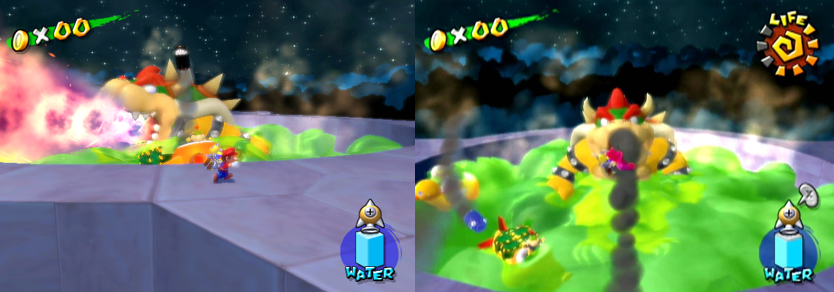
Power-Ups and Bonuses:
Although Mario can still collect a 1-Up Mushroom for an instant extra life and three different types of Coins (Gold, Red, and Blue, each offering different increments to your total Coin count), no other traditional Mario power-ups are present and unlike in other Mario videogames where Mario would collect a Super Mushroom to grow bigger and gain an extra hit or a Fire Flower to throw fireballs at enemies, Super Mario 64 takes inspiration from Super Mario Land 2: 6 Golden Coins (Nintendo R&D1, 1992) and Wario Land: Super Mario Land 3 (ibid, 1994) by giving Mario access to three different caps to aid his progress.

Soar through the sky, pass through walls, or become invincible with Mario’s special caps.

The Wing Cap gives Mario the ability to fly after performing a triple jump or being shot out of a cannon; by diving and pulling up, you can fly higher and further but just make sure you land before it wears off or you’ll suffer a damaging fall. The Vanish Cap turns Mario invisible and incorporeal, allowing him to walk through enemies and wired cages and the Metal Cap allows Mario to walk underwater and renders him functionally invincible at the cost of his speed and more elaborate jumping mechanics. Each cap must be activated by ground-pounding giant switches inside three different hidden mini Courses and are essential to collecting all 120 Power Stars but, it has to be said, their use is surprisingly sparse and you’ll be relying on Mario’s base moveset for the vast majority of the castle’s challenges.

Additional Features:
As big and involving as Super Mario 64 is, there’s sadly not a whole lot of replay value to be had especially compared to the DS remake, which featured four playable characters, additional Courses and Stars, and mini games to pass the time. You can mess around with Mario’s big, goofy 3D face on the title screen, stretching and distorting it at your leisure, which is a nice touch, and the game also allows you to have four different save files and to erase or copy each one, allowing for multiple playthroughs. Additionally, while you only need seventy Stars to take on the final battle against Bowser and clear the game, you won’t get 100% completion unless you collect all 120 Stars. This is easier said than done, especially on Courses like Wet-Dry World, Tall, Tall Mountain, and Rainbow Ride which have lots of difficult platforming sections, bottomless pits, and barely enough Coins for you to get those hidden one hundred Stars. You’ll also need to search the castle thoroughly for hidden Courses (like the Princess’s secret slide), talk to the Toads scattered throughout the castle, and catch Mips the Rabbit to find some hidden Stars.

Find all 120 Stars and you’ll get…very little of value, to be honest…

Stars are also obtained by finding eight Red Coins in the cap and Bowser stages and other hidden Courses around the castle; luckily, you can track your progress from the pause menu and from the file selection screen so you always know where you might have missed a Star or two. Sadly, though, finding all 120 Stars doesn’t really offer much in terms of a reward. If you defeat Bowser with all 120, he’ll have some slightly different dialogue to acknowledge your efforts and, after reloading your completed save file, you’ll find you now have access to a cannon on the castle grounds. Use this to blast yourself onto the castle rooftop and you’ll find Yoshi, who has a special thank you message from the developers and awards you with one hundred lives before buggering off. Unfortunately, though, this is completely redundant as you’ve beaten the game and acquired every Star so there’s no real incentive to explore the completed Courses again with your abundance of lives. Perhaps it would have been better to have Yoshi be accessible from a new save file, or even placed within Courses to offer a new Star challenge. Hell, I would have even accepted a ‘New Game+’ mode where the entire game is mirrored but, instead, you get a tantalising cameo and a whole shit load of extra lives that are basically pointless as you’re more likely to just start a new game from scratch than to go back through stages you’ve already completed to 100%.

The Summary:
Super Mario 64 is still an absolutely gorgeous and incredibly fun gaming experience; even now, some twenty-three years after its release, it still holds up remarkable well as one of the tightest, slickest, and most engaging 3D platformers ever. While the likes of Banjo-Kazooie and Sonic Adventure (Sonic Team, 1998) are technically far superior games, Super Mario 64 set a standard for all 3D platformers to strive to achieve and which many failed to match. It cannot be denied, however, that the game does still have some lingering issues; the camera, for all its diversity, is the most glaring and Mario’s tendency to get a bit stuck on platform edges or to hug walls when standing too close to them as well as his willingness to just slip to his death can all lead to some frustratingly unfair deaths and game overs but, for the most part, all of the game’s shortcomings can be overcome with the right degree of patience, skill, and experience. Once you master the game’s simple controls and mechanics, you can perform all kinds of nifty tricks and feats to aid your progress and you’ll find that the game has given you more than enough tools to find all 120 Stars if you’re skilled enough. With its stunning, colourful visuals, tight and responsive controls, catchy music, and addictive gameplay that is easy to learn and master, Super Mario 64 is positively brimming with gameplay variety. There’s always a new area to unlock and explore, new Courses and hidden Stars to discover, and the attention to detail is staggering for a Nintendo 64 launch title. My only regret is that Nintendo didn’t add in a widescreen feature or patch in that two player co-op mode they had planned or even the ability to play as Luigi after finding all 120 Stars in the Switch version but none of that diminishes the fundamental appeal of Super Mario 64.

My Rating:

Rating: 5 out of 5.

Fantastic

Did you play Super Mario 64 back in the day? Was it your first game for the Nintendo 64 or did you pick it up later? Perhaps you first experienced it on the Nintendo DS; if so, which version of the game do you think is the best? Which of the game’s Power Stars, Courses, enemies, or bosses caused you the most (or the least) hassle? Do you think Yoshi and his one hundred lives was a good enough reward or would you have liked to see something else; if so, what? What are your fondest memories of the Nintendo 64? Perhaps you hated the system; if so, why (and what’s wrong with you?) Whatever you think, comment below and let me know and don’t forget to come back next week for more Mario content.

Wrestling Recap [3:16 Day]: Rock vs. Austin (WrestleMania X-Seven)


“Talk about your psalms, talk about “John 3:16”…Austin 3:16 says I just whupped your ass!”

With those immortal words, spoken by the legendary pro wrestler “Stone Cold” Steve Austin after winning the King of the Ring tournament on 23 June 1996, a momentous wrestling career was about to unfold before our eyes that would see everyone’s favourite beer-swigging, finger-gesturing anti-hero become not just an industry icon but a mainstream icon as well. Here’s to yah, Steve!


The Date: 1 April 2001
The Venue: Reliant Astrodome; Houston, Texas
The Commentary: Jim “J.R.” Ross and Paul Heyman
The Referee: Earl Hebner
The Stakes: Main event, no disqualification match for the WWF Championship

The Build-Up:
Man, I tell you what, if you were a wrestling fan between 1998 and 2001 you were living the high life! After losing to World Championship Wrestling’s (WCW) Monday Nitro in the weekly television ratings for nearly two years, the World Wrestling Federation (WWF) finally began to turn a corner by ushering their “Attitude Era”, a central focus of which was the rivalry between the loud-mouthed, anti-authority “Stone Cold” Steve Austin and WWF Chairman Vince McMahon. One key aspect of this feud also involved Austin’s various run-ins with the Rock; the two had previously clashed over the WWF Championship at WrestleMania XV: The Ragin’ Climax, where the Rock (then endorsed as McMahon’s “Corporate Champion”) dropped the belt to Austin but the two had plenty of history prior to that as they had feuded over the Intercontinental Championship some years prior. After Austin won the Royal Rumble and the Rock recaptured the belt from Kurt Angle at No Way Out just a few months prior, tensions began to boil between the two now-friendly rivals; Austin’s wife Debra was forced to be Rock’s manager for a while, the two frequently brawled or left each other at the mercy of other wrestlers, and Austin, still on his big comeback from a career-threatening neck injury, famously warned the Rock: “I need to beat you, Rock. I need it more than anything you could ever imagine”.

The Match:
Of course, it’s hard to talk about this match without mentioning the excellent video package that told the story of the tumultuous build-up towards it by charting Austin’s big comeback, Rock’s WWF Championship win, and the rising tensions between the two following Austin’s Royal Rumble win. Originally set to Limp Bizkit’s “My Way”, even without this music this is one of the best hype packages the WWE has ever put together and really sold the intensity of this confrontation. Emotions were high going into this match thanks not just to the clearly partisan crowd but also J.R.’s rousing commentary and personal investment in the match; J.R. was widely recognised as Austin’s best friend and, as such, he spends the majority of the match selling the story of Austin’s big comeback and that this match is this the culmination of Austin’s journey through spinal surgeries, injuries, and adversity. Accordingly, he was outraged by the unexplained, last-second announcement that the match had been made a no disqualification contest, believing that there is some kind of conspiracy behind that decision despite the fact that both he and Heyman mention more than once that a no disqualification stipulation actually gives Austin, known for his wild brawling, the advantage.

Austin was noticably more aggressive, utilising many underhanded tactics throughout the match.

Austin came to the ring first to a raucous reception; this was during the time when Austin was coming out to Disturbed’s “Glass Shatters”, a rockin’ version of his iconic theme, though the massive ovation he received largely crowned out any music and even the commentary at times. Given that Austin was the home state hero, and that audiences were still high on rediscovering their love for him after all of his time out with injuries, this isn’t all that surprising and meant that the Rock, arguably the most popular wrestler in the WWF at that time, received a showering of boos not only during his entrance but also throughout the match. Honestly, this match was loud and boisterous right from the word “Go!” thanks to the crowd, who are a sea of cheers, reluctant boos towards the Rock, and a cacophony of emotion all throughout. You could feel the tension and anticipation in the air from the moment the match begins and it stayed at a constant level throughout, rising to a crescendo whenever Austin is on the attack. Accordingly, there was no standing on ceremony here and the match began with a full-on slugfest between the two. Austin even went for a belt shot in the early going, which might seem surprising but, watching the match in hindsight, you can see how Austin is pulling out all kinds of heel tactics throughout (shots with the ring bell, using his knee braces to attack the Rock’s forehead, undoing the corner turnbuckle pad, choking Rock with the ropes, among other notable moments). Though J.R. largely glossed over a lot of these elements, Heyman sold it well to remind audiences that Austin is driven, obsessed, with becoming the WWF Champion and willing to do anything and everything to emerge the victor.

Despite the no DQ stipulation, Hebner tried to appeal to each man’s reason and maintain order.

Austin dominated the match in the early going thanks to hitting a Lou Thesz Press, escaping the Rock Bottom, and taking the fight to the outside after Rock avoided being hit with a Stone Cold Stunner. The two brawled by the announce table for a bit before heading over the barricade and into the crowd; this wouldn’t be the first time the action spilled to the outside and, if anything, that tactic is a little over-used in this match but it plays to Austin’s strengths since he was largely a brawler by this point and his matches were more about high intensity, a series of punches, stomps, and recognisable spots, and, of course, the Stunner. The emotion of the contest wasn’t lost on the Rock, either, though, and this cost him during their ringside scrap as he allowed himself to get distracted by Hebner, giving Austin the chance to bash him in the head with the ring bell and bust him open. Hebner, easily my favourite referee and, arguably, the WWF’s most recognisable official, could always be counted on to be a big part of every match he was in but in a way that remained professional and subtle. Here, he spends the majority of the match appealing to each man’s reason; it was no disqualification but he still admonished the two for fighting at ringside, using weapons, and forced them to break submission holds when their opponent was in the ropes. However, because of how high the stakes and the personal animosity between the two rivals were, he often found himself being accosted or threatened by both men.

The two men traded Sharpshooters and Austin even busted out the Million Dollar Dream!

As Heyman was fond of saying during this time, Austin was “like a shark that smells blood” the moment the blood began flowing and began to relentlessly target the Rock’s lacerated forehead with a barrage of fists, shutting down a potential comeback with a Neckbreaker, and stomping away on the Rock in the corner of the ring. It was only when Austin found himself distracted by Hebner’s interference that the Rock was able to finally make a proper comeback by launching Austin into the exposed turnbuckle and gaining a little retribution by bashing Austin in the head with the ring bell, busting him open before Austin was able to regain control of the match with a wicked catapult into the ring post. Rock sold the hell out of that move, snapping his head back at the very last second to really sell the idea that he had collided with the post in a sickening way, which more than made up for the announce table simply collapsing under his weight and, potentially, ruining a planned table spot. Austin continued his assault by bashing Rock in the head with a monitor but Rock managed to finally turn the tide by locking Austin into the Sharpshooter; the crowd was thrust into a tumultuous sea of conflict as Austin screamed in agony, refused to quit, and desperately reached for the ropes but Rock shifted him back to the middle of the ring! Austin, though, was able to reach the ropes and then put the Rock into a Sharpshooter, with the crowd being far less divided about this and even less impressed when the Rock powered out of the move. Annoyed, and growing increasingly frustrated, Austin followed up with the Million Dollar Dream!

McMahon cost the Rock his best opportunity to win the match.

J.R. was as surprised as anyone else about Austin dusting off this long-forgotten piece of his arsenal but it was enough to drive the Rock to his knees and set up for the old “three arm” spot. The Rock, of course, kept his arm up at the last second (has this spot ever gone any other way?) and uniquely kicked himself off the corner of the ring to first counter into close two count and then hit a Stunner out of nowhere! Unfortunately, the Rock was too fatigued and hurt to cover quickly enough so Austin kicked out at two and it was at this point that Vince McMahon wandered down to ringside, much to the anger of both J.R. and the crowd. In the ring, Rock and Austin went back to exchanging blows and trading their signature Spinebusters; Rock, of course, followed his Spinebuster up with the People’s Elbow but McMahon broke up the pin. Incensed, the Rock chased McMahon around the ring and ran right into a Rock Bottom from Austin, though he managed to kick out at two for a dramatic near fall.

Austin sold his soul to the Devil himself to once again become the WWF Champion.

After the Rock countered out of a Stunner attempt, Hebner got knocked out of the ring and, in the carnage, Austin ordered McMahon to bring a steel chair into the ring. In a sickening moment, Austin held the Rock in place so that McMahon could deliver a vicious chair shot right to his head. It still wasn’t enough to keep the Rock down, though, and Austin was so infuriated that he got caught with a Rock Bottom. Luckily for Austin, though, McMahon distracted Hebner, and the Rock, long enough for Austin to recover and hit the Rock with a massive Stunner (which, of course, the Rock sold with a theatrical panache). Driven to the limit by the Rock’s tenacity, Austin began assaulting him with McMahon’s steel chair; he then delivered another sick shot to the head before driving it into the Rock’s chest and bashing him over the spine with it over and over and over, beating him to a pulp, and finally scoring the three count! The crowd erupted into thunderous applause but they, and J.R,, soon reacted in shock and anger as Austin and McMahon shook hands and shared a beer over the Rock’s bloodied and prone body. When the Rock stumbled to his feet, Austin put him down with one last belt shot to emphasise his sudden and unexpected change of character. J.R. was disgusted, appalled, and betrayed by the alliance between Austin and McMahon but Heyman, though shocked, believed that this was totally in character since Austin had promised to do anything to win and was always fond of the mantra: “DTA – Don’t Trust Anybody!”

The Aftermath:
The very next night on Raw is War, Austin and the Rock faced off in a rematch inside of a steel cage. It was during this match that Triple H forged an alliance with his much-hated rival and he and Austin came to be known as the “Two-Man Power Trip”. The Rock was subsequently assaulted by the two and suspended by McMahon to allow him the time off required to film The Scorpion King (Russell, 2002). After Triple H won the Intercontinental Championship, the Two-Man Power Trip went on a…well, a power trip, dominating the WWF and coming into contact with the only team big, mean, and powerful enough to oppose them: the WWF Tag Team Champions, Kane and the Undertaker, the Brothers of Destruction. Austin and Triple H were able to best the Brothers, though, but their reign of terror was cut short when Triple H suffered a horrific quadriceps tear. Austin continued on as a heel regardless, however, changing his music and becoming a more paranoid, unpredictable, and cowardly bad guy who turned his back on both the fans and his friends (resulting in a vicious beat down of J.R.). Although he briefly seemed to be returning back to the “old Stone Cold” in the face of the invasion from WCW and Extreme Championship Wrestling (ECW), Austin ultimately joined forces with the WCW/ECW alliance and became this erratic, overbearing, narcissistic heel obsessed with the belt and being treated like the star of the show. Eventually, after the collapse of the WCW/ECW alliance, Austin would return to his roots as a babyface and begin the final stage of his career. Mounting injuries began to take their toll and Austin began to lose his passion for the sport, culminating in one last match against the Rock at WrestleMania XIX but that is a story for another day.
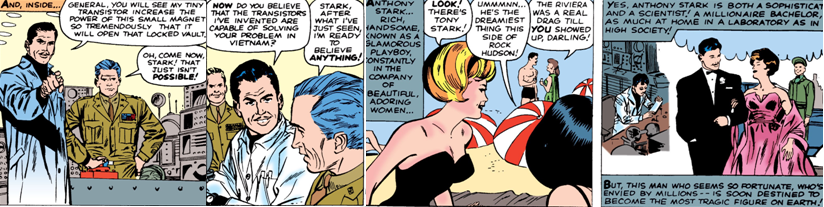
My Rating:

Rating: 5 out of 5.

Fantastic

What did you think to the contest between the Rock and Steve Austin at WrestleMania X-Seven? How would you rate it compared to their other bouts and which of their feuds, matches, and moments is your favourite? Were you a fan of Austin’s unexpected heel turn or do you think he should have called an audible and remained as a tweener? How are you celebrating 3:16 Day this year, what are some of your favourite matches and moments from Austin’s illustrious career, and what dream match would you have liked to see him involved in? Whatever your thoughts, drop a comment below and let me know what you think about “Stone Cold” Steve Austin.

Back Issues: Captain America Comics #1

Story Titles: “Case No.1. Meet Captain America”, “Captain America and The Riddle of the Red Skull”, and other untitled stories
Published: March 1941
Writer: Joe Simon
Artist: Jack Kirby

The Background:
By 1941, World War Two was in full swing; Nazi Germany had overtaken Denmark and Norway in April 1940 and, after a period of resistance to joining the war effort, the United States entered the fray during 1941, providing much needed support against the combined “Axis powers” of Germany, Japan, and Italy. As a result of the ever-escalating conflict, patriotism and national pride was high, especially in America, and it was at this turbulent time that Joe Simon and the legendary Jack Kirby first debuted Steve Rogers/Captain America and his kid sidekick, James Buchanan Barnes/Bucky, two characters who would not only take the fight directly to the enemies of America and the free world but also encourage readers to support the war effort by any means necessary.

The Review:
Captain America Comics #1 is a bumper forty-five page debut issue for the First Avenger that features four short stories (and even a two-page text story with only a couple of accompanying drawings and panels) but only two of these stories have actual titles. The first, “Case No.1. Meet Captain America”, details the origin of the titular star-spangled Avenger; the War is in full swing and, while America faces real threat from the vast Axis armies overseas, they also face the threat of sabotage, treason, and terrorist bombings on their home turf thanks to the actions of the “Fifth Column”, spies and traitors from the Axis forces who perpetrated such heinous attacks. To combat this threat, the President of the United States has J. Arthur Grover of the Federal Bureau of Investigation (F.B.I.) take two high-ranking military officers to “a sinister-looking Curio Shop” in a “shabby tenement district” in Washington, D.C. that is actually the front for a highly sophisticated laboratory. There, they join other attendees in witnessing a frail, young man who was deemed unfit for active service be miraculously transformed into a man in peak mental and physical condition by Professor Reinstein’s mysterious serum.

Frail Steve Rogers is transformed into the peak of human physical ability!

Reinstein thus dubs the young man “Captain America” and explains to his awestruck audience that he is to be the first in a “corps of super-agents” who will actively oppose spies and saboteurs on America’s home turf. Unfortunately, one of the men in attendance is one of these spies (so much for the military’s stringent background checks…); with only a few frantic shots, the spy kills both Reinstein and Grover and destroys the only remaining vial of the super-soldier serum! Luckily, Captain America is able to subdue the spy, driving him to stumble into a bank of laboratory equipment and causing him to be summarily electrocuted to death. Sadly, though, the damage is done; with Reinstein dead, the serum destroyed, and the laboratory trashed, America’s hopes of building an army of super solders are dashed. Undeterred, Cap enlists in the army as Private Steve Rogers whilst also battling enemies of American soil as Captain America. Cap’s heroic antics catch the awe and imagination of his regiment’s mascot, young Bucky Barnes. Bucky is both stunned and exhilarated to stumble onto the fact that Steve is his patriotic hero, literally walking in as Steve is halfway through changing into his Captain America costume in perhaps the most anticlimactic and convenient of accidents. If you thought that was contrived and ridiculous though, Steve decides that the only logical course of action is for Bucky to join him as his partner. And so, donning a brightly-coloured outfit, a domino mask, and the laziest codename ever (Bucky goes by “Bucky”…), Captain America and his woefully-inexperienced sidekick pledge themselves to opposing the Axis powers in all their forms.

Cap and Bucky subdue the Nazi goons and put a stop to their nefarious plot.

They continue this fight in the issue’s next story, which goes untitled; in this story, a stage performer known as Sando has his diminutive, hunchbacked accomplice Omar stun audiences with predictions of the future, all of which detail terrorist attacks or destructive events. Although Bucky believes the two to be fakes, Cap is convinced when Omar’s prediction of the destruction of a nearby bridge comes true and the two suit up to confront the two stage performers. Cap doesn’t pull any punches, aggressively questioning Sando and then laying him out with a punch while Omar makes a quick getaway. I wouldn’t mind but the two haven’t even done anything yet or been proven to be responsible! Luckily Conveniently, Cap’s war-time paranoia turns out to be true as, when he races after Omar, he finds both Bucky and a beautiful reporter named Betty Ross (no relation, I’m sure) being held hostage at gunpoint by Sando and Omar, who are revealed to be working in league with Hitler’s spies to cause disasters across the country. Unimpressed, Cap and Bucky make short work of the Fuehrer’s goons, with Bucky swiftly tackling one and tossing the bomb he planned to use to kill them all out of the window before disappearing into the night. The issue’s third story also goes untitled and introduces a crazed Nazi who is known only as Rathcone but who comes to brand himself “The Dictator”. A malformed, goblin-like man, Rathcone has his own plans for world conquest and favours crafting little chess pieces that resemble his opposition, announcing his intentions to kill a target over the radio, and then employing a number of Nazi agents to carry out the deed. Captain America and Bucky seek Rathcone out after the self-styled Dictator makes good on his promise to kill Admiral Perkins; the witnesses to the gruesome visage of Perkins’ execution are whipped into a frenzy and baying for blood but Cap and Bucky waste no time in tracking down the assassin responsible for the murder.

Honestly, Steve, your constant snark to your superior officers isn’t helping the situation!

Despite Cap questioning (presumably in jest) Bucky’s ability to handle “a man’s job”, Bucky successfully tackles the killer and Cap is all set to force information out of him when an unseen assailant kills the man. This is also the first instance of Cap using his shield to…well, shield himself from gunfire, however neither he nor his kid partner are able to find the shooter. Next, Rathcone targets General Ellsworth; coincidentally (and conveniently) enough, Rogers and Bucky are ordered to report for “special duties” at Ellsworth’s hut, which means that they are the first to discover the General dead at his table! The media, of course, has a field day and Rathcone is so enthused by the two murders he has orchestrated that he begins to set his sights on the lofty goal of invasion; but first, he plots to remove Cap and Bucky from his chess board by…having his goons lure them into a trap that Bucky walks right into. Returning to his tent and finding that Bucky has gone off alone, Steve pulls on the stars and stripes and sets out to rescue him, making short work of Rathcone’s muscleman, Herr Strangler, in the process.

Rathcone captures Bucky but wastes time monologuing so Cap lays him out.

Rathcone, however, holds Cap at gunpoint and, typically, wastes his best chance to off the two masked men by explaining his master plan, which gives Cap the chance to lay him out with a good, old-fashioned punch to the jaw. After freeing Bucky, the two are set upon by Rathcone’s goons, with Bucky again requiring Cap’s assistance when two Nazis pin him down and try to stab him (I mean, it’s almost as if Cap has partnered up with a child with no training or physical acumen of any kind…). Although Rathcone recovers, tries to make a break for it, and even attempts to fight Cap off by smashing a chair over the Avenger’s head, Cap easily puts him down for the count and they uncover detailed documents of the self-styled Dictator’s plans to put an end to his scheming. The issue concludes with the first ever appearance of the Red Skull, Cap’s Nazi counterpart who would go on to be his most iconic, and enduring, archenemy. Though the Red Skull is typically the codename of Johann Schmidt, in his debut story it’s actually the persona adopted by George Maxon, a seemingly innocuous American businessman who has turned traitor and is working for the Nazis. Like Rathcone, the Red Skull’s modus operandi is to target influential military personnel in order to weaken America’s will and capabilities; he does this by stalking them, attacking them, and getting them in a choke hold all while chanting “Look at me! Look at death!” to, apparently, will his victims to death with a death gaze. So notorious is the Red Skull that he’s become something of an urban legend amongst the military personnel but, when Major Croy is found dead, the latest victim of the Red Skull, Cap takes it upon himself to investigate.
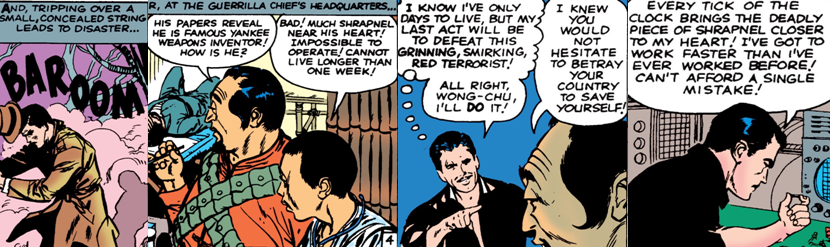
The Red Skull’s ability to apparently will his victims to death gives Cap reason enough to go solo…

Annoyed at being left behind (to be fair, I don’t blame Cap for this but, at the same time, it is extremely random (and, again, convenient) that he decided not to bring Bucky along this time…), Bucky decides to conduct his own investigation and (…somehow) stumbles upon the Red Skull’s secret lair where he is outlying his plan to overthrow the American government by “[looting] the First National Bank” because nothing says “Superhuman Nazi Terrorist” like a bit of old-fashioned bank robbery! Thanks to some shoddy masonry, Bucky falls into the villain’s lair as he moves to warn Cap of the Red Skull’s plan and, once again, finds himself being held as a hostage; this time around, though, Bucky’s slightly more feisty and doesn’t let himself get captured without a fight but, wouldn’t you know it, Cap also found the Red Skull’s lair and arrives just in time to bash up his goons, though the Red Skull manages to slip away. The next day, Steve, Bucky, and their squad are introduced to Mister Maxon who has come to join them in watching his new plane take a test flight. However, the plane catches fire in mid-flight and plummets to the ground in a fireball. Steve is disgusted that Maxon only cares about the loss of the plan rather than the men who were in it and is reprimanded by his superior officer as a result but vows to investigate further as Captain America.

Despite a brief setback, Cap is finally able to take out the Red Skull.

Later that evening, the Red Skull strikes again, literally crossing General Manor off his hit list, but is distracted from escaping into the night by the General’s wife. Though this allows Cap to get the drop on the Red Skull, he is knocked out cold when the nefarious Nazi smashes a chair over his head (which is odd as Cap shrugged off a similar shot easily enough earlier in the comic…). Luckily, Bucky flies in and rescues Cap from the Red Skull’s death gaze and, upon regaining consciousness, Cap fells his foe with a punch so hard that it shatters the Red Skull’s head! It turns out, of course, that the Red Skull was wearing a “false-face” and that Maxon had used the guise of the Red Skull, and a hypodermic needle filled with poison, to terrorise and murder his victims. Quite why he felt the need to make such a dramatic affair of it all with his “look at death” spiel is beyond me; it’s not like any of his killings took place in public or had any witnesses, after all.Anyway, Maxon makes one last, desperate lunge for Bucky and, in the fracas, rolls over onto his own needle and dies! Interestingly, Bucky questions why Cap didn’t try to intervene and he simply replies: “I’m not talking, Bucky”. Regardless, with the Red Skull dead, Cap and Bucky flee into the night, returning to their tent for some much-needed rest (Steve loves to puff away on his pipe after a good bit of manslaughter…), and ready for more adventures as Captain America and Bucky!

The Summary:
Captain America Comics #1 is little more than what you might expect it to be; a bright, colourful piece of patriotic propaganda featuring a superhero literally wrapped in Ol’ Glory herself and tackling foreign enemies on American soil. It’s a brief, action-packed affair full of contrivances, conveniences, and long out-dated dialogue and virtues, but it’s a product of its time so you kind of have to expect that. You’ll notice, of course, that Captain America uses a completely different shield in his debut appearance; Cap wields a diamond-shaped shield in these stories, one far less versati le and iconic as the discus-shaped shield he would acquire in the very next issue and generally favour over the next eighty-odd years. As a result, there’s very little shield-based action or combat in this issue; Cap only uses it as a shield once, never throws it, and the rest of the time it’s more of a prop than anything else as Cap prefers to use his fists to settle his foes.

Cap’s exact strengths and limitations are quite vaguely defined in his debut appearance.

Speaking of which, Cap’s a bit of a blunt instrument here; in contrast to the majority of superhero origin stories, literally no time at all is spent showcasing Rogers’ training or physical abilities (and even less is spent on Bucky’s) and Cap’s exact strengths and limitations are extremely vague. He’s described as hitting hard and fast and can clearly take a good deal of punishment, and yet he can be stopped in his tracks by a gun, knocked out cold, and never displays any of the near-superhuman levels of strength we’ve come to associate with the character. Stylistically, the comic is obviously designed to make monsters out of the Axis powers, specifically Nazis and their ilk. Both Rathcone and the Red Skull take on grotesque visages and appearances, appearing more like demons than humans, and their underlings are depicted as slimy, cowardly traitors or muscle-bound henchmen who all blindly follow the Fuehrer’s commands even to their deaths. The idea is pretty simple: America is the bastion of all that is good and just, with their army made up of red-blooded men and patriots who are giving it all for their country, and the Axis powers are misshapen, demonic, nefarious devils who revel in spreading death and terror. In that regard, Captain America Comics #1 does its job extremely well but, overall, I can only really recommend it for containing Cap’s iconic origin story and the first appearance of the Red Skull.

My Rating:

Rating: 3 out of 5.

Pretty Good

Have you ever read Captain America Comics #1? If so, what did you think of it and the early adventures of Captain America and Bucky? What was your first exposure to Captain America and where do you rank him against other superheroes, Marvel or otherwise? What story or character of his is your favourite and why? How are you celebrating Captain America’s star-spangled debut today? Whatever your thoughts, drop a comment below and check out my other Captain America content!