With the release of Sonic the Hedgehog 3(SEGA Technical Institute, 1994) in February 1994, gamers were introduced to Knuckles the Echidna. This mischievous, dreadlocked antagonist was created by Takashi Yuda and is my favourite of Sonic’s supporting cast so I’ve been dedicating every Sunday to Rad Red!
Story Title: “Total Chaotix” (Part 1 to 6) Published: 27 May 1995 (cover-dated: 9 June 1995) to 5 August 1995 (cover-dated: 18 August 1995) Writer: Nigel Kitching Artist: Richard Elson
The Background: After finally knocking Nintendo from the top of the videogame industry, SEGA almost immediately transformed Sonic’s popularity into mainstream success with an influx of ancillary merchandise, mainly cartoons and comic books. Six months or so after Archie Comics published their first Sonic miniseries, United Kingdom publisher Fleetway Editions Limited published “Britain’s Official SEGA Comic”, Sonic the Comic (StC), a fortnightly comic book I collected diligently until its unfortunate end. Largely taking its lore from the now defunct Mobius/Doctor Ovi Kintobor storyline that originated outside of Japan, StC portrayed Sonic as a mean-spirited leader of the rebellious Freedom Fighters. Like the Archie comics, StC included someloose adaptations that recontextualised the videogames to fit its noticeably different lore. After his introduction in a multi-part story loosely based on Sonic 3, Knuckles immediately graduated to his own back-up stories that, after tying up loose ends from his debuted, eventually expanded on Knuckles’s vague backstory. His second solo feature, however, would be this loose adaptation of Knuckles’ Chaotix (SEGA, 1995), a bizarre and obscure title released solely for SEGA’s doomed 32X peripheral, which dramatically reinterpreted the titular Chaotix Crew for StC’s purposes.
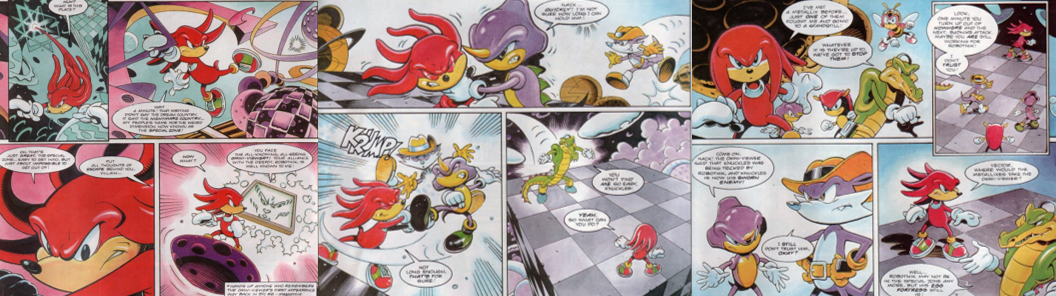
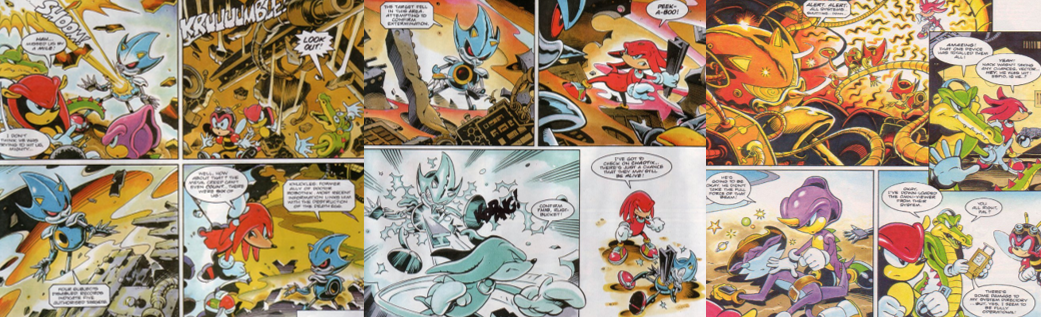
The Review: “Total Chaotix” begins immediately after (or, at least, not long after) Sonic and Knuckles finally rid the Floating Island of Doctor Ivo Robotnik’s forces, bring down his Death Egg space station, and return the all-powerful Master Emerald to the island’s hot-headed guardian. Thus, Knuckles is in high spirits at the start of the story as, for the first time in centauries, the seven Chaos Emeralds and their gigantic master are fully powered, increasing them in size, keeping the Floating Island high in the sky, and protecting the island with an energy barrier to deter unwanted visitors. Speaking of which, Knuckles takes a Zoom Tube to check in on his new guests in the Mushroom Hill Zone. Realising that Dr. Robotnik would turn his wrath on the Emerald Hill Zone inhabitants, Sonic arranged a deal with Knuckles to shelter the Emerald Hill folk on the Floating Island in return for the Master Emerald. While Knuckles isn’t exactly happy with this arrangement since he prefers to live in solitude, he honours the agreement and hopes his new guests won’t bother him. While investigating the damage done to the Floating Island by the Death Egg’s powerful eye lasers, Knuckles is shocked to discover an old echidna relic: a stone ring whose ancient writing apparently reveals it to be a gateway to a “dream country”. Before Knuckles can properly examine the artefact, a portal suddenly opens and sucks him through, depositing the naïve guardian in the Special Zone. Bombarded by the bizarre dimension’s kaleidoscope of colours and surreal imagery, Knuckles realises he mistranslated the stone and prepares for a rough ride since the Special Zone is almost impossible to escape from. At that moment, Knuckles is confronted by the Omni-Viewer, a sentient television screen who watches over the Special Zone and allows for transport to and from the dimension. While the Omni-Viewer is an ally of Sonic’s and was once forced to do Dr. Robotnik’s bidding, his intelligence is massively out of date and he still believes Knuckles is the dictator’s partner. Thus, he ignores Knuckles’ pleas and teleports in the “Guardians of the Special Zone”, the Chaotix (Vector the Crocodile, Mighty the Armadillo, Espio the Chameleon, Charmy Bee (referred to as “Charmee”), and Nack the Weasel) to deal with the perceived threat.
Knuckles runs afoul of the Chaotix and discovers a Metallix plot in the Special Zone.
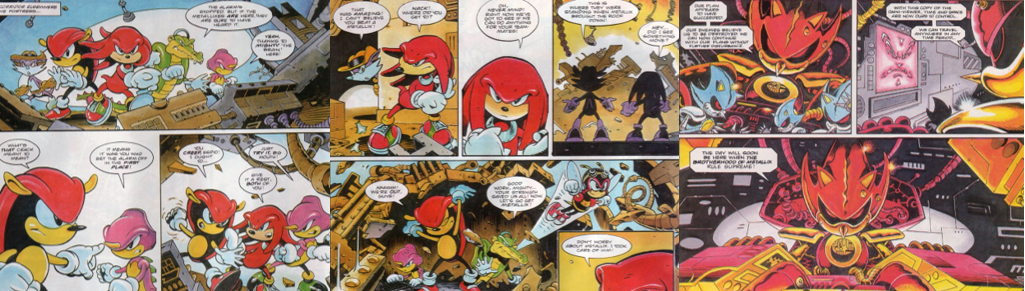
On Vector’s order, the group’s muscle, Mighty, leaps in to land the first blow, leaving him plummeting into the void when Knuckles glides to safety. Luckily, the peppy “Charmee” is on hand to rescue his cohort, who doesn’t care for the enthusiastic youngster’s commentary on his humiliation. While trying to escape the unreasonable group, Knuckles is blindsided by Espio’s camouflage ability. The chameleon then throttles Knuckles (!) and calls Nack for an assist, only for both to be shrugged off by the echidna’s superior strength. Vector then enters the fray and tries to snap his powerful jaws onto Knuckles’ head; however, Knuckles dodges and lands a solid uppercut to Vector’s chin, causing him to bite his tongue. The fracas is halted by the Omni-Viewer, who does a bit of research and finds that Knuckles is telling the truth. However, just as tensions are beginning to cool, “Charmee” notices some distortion appearing on the Omni-Viewer’s “face” and, to the horror of all, the warping solidifies to show not one, but two Metallixes forming within the Omni-Viewer! Despite recognising Sonic’s robotic doppelgänger from a precious encounter in Sky Sanctuary Zone, Knuckles is as powerless as Vector to keep the Omni-Viewer from being downloaded to a handheld device wielded by one of the Badniks. The Metallix then flee the scene, leaving the Omni-Viewer an empty void and giving the group no chance but to team up to rescue him, despite Nack’s suspicions that Knuckles is still working for Dr. Robotnik. When Vector mentions the ovoid dictator’s abandoned Egg Fortress base, the group makes haste on a rescue mission, unaware that the Metallixes are working under the command of a gigantic Emperor Metallix! Thanks to Mighty flying head-first at the Egg Fortress, the group’s infiltration doesn’t go as quietly as Knuckles wished, though it’s Rad Red who must keep Mighty and Espio from coming to blows when the short-tempered armadillo trips the base’s alarm. After “Charmee” warns of an incoming Metallix, the group squeeze into the base’s ventilation system. However, an errant kick from Nack compromises their position, forcing the wayward weasel to flee when they’re spotted by the Metallix.
Despite a double cross from Nack, Knuckles and the Chaotix defeat the Metallix…for now…
The Metallix attacks without mercy, blasting the group with its chest laser, easily sends them flying with a swing of its clawed arm, then buries them beneath debris by blasting the roof above. Although the Metallix believes it has killed its foes, Knuckles claws his way from the wreckage and flies into a rage. While the Metallix tanks his best shot and its speed throws Knuckles off-balance, Knuckles subdues the robot by hurling a girder through its chest. Though only a temporary reprieve, it’s enough for Nack to come out of hiding and for Mighty to muscle the debris off his team. With the damaged Metallix in hot pursuit and the Emperor Metallix’s plot to create a copy of the Omni-Viewer almost complete, Nack leads the team right into the “lion’s den” (as Vector puts it), betraying his team mates to the Emperor Metallix in return for “money, what else?” Although the Emperor Metallix thanks Nack for giving them the access codes to the Omni-Viewer, it immediately orders its Metallixes to attack him alongside his former allies, double-crossing the opportunistic weasel. Despite Nack busting out a hidden disruptor for just such a double-cross, he’s blasted by a Metallix. Still, Knuckles grabs the weapon and fires it, emitting what appears to be an electro-magnetic pulse that instantly disables the Emperor Metallix and its two minions. With the threat ended in surprisingly anti-climactic fashion, the Chaotix retrieve Nack and the Omni-Viewer and drop Knuckles back on the Floating Island. However, Knuckles can’t shake the feeling that there was something off about the Metallix and the Omni-Viewer finds he’s missing some memory banks from the ordeal. They’re right to be concerned by this for the story ends to show the Emperor Metallix and its brotherhood reactivating, having successfully feigned defeat, and that they now possess a corrupted version of the Omni-Viewer that will allow them to travel through time and space to realise their goal of world conquest!
The Summary: As is often the case, “Total Chaotix” is bolstered by Richard Elson’s stirring and visually engaging art. Having him work on Knuckles’ early solo strips gave them an air of legitimacy not afforded to other back-up stories in StC and showed that they were just as important to the ongoing storylines (especially StC’s multi-part adaptation of Sonic 3 & Knuckles). Elson draws a fantastic Knuckles, capturing his toothy smirk and temperamental demeanour, and a wonderful Metallix. Unlike the Mecha-Metallix last seen in StC, these Metallix are a return to form, featuring that sleek, sexy aesthetic that’s become so iconic. Knowing how troublesome just one of these Badniks was makes seeing two quite the moment and the Metallix retain their menace by how fast and lethal they’re portrayed. They make mincemeat of the Chaotix, who get no chance to fight back and are nearly killed by just one Metallix. Even Knuckles struggles to go toe-to-toe with the doppelgänger since it’s built to match Sonic’s speed and even a girder to the chest doesn’t put the Metallix down, so seeing a whole army of the robotic doubles ends the story on one hell of a cliff-hanger! “Total Chaotix” also introduces the Davros-like Emperor Metallix, a gigantic robot hedgehog permanently sat in a massive throne and who’s modelled after Metal Sonic Kai (fitting, considering this is a loose adaptation of Knuckles’ Chaotix). Knuckles suspects that the Metallix have split from Dr. Robotnik and that’s revealed to be true. The Emperor Metallix no longer serves its rotund master and has instead commands a “brotherhood” of robotic Sonics to make its own bid for world conquest. Its scheme to facilitate this is to download a copy of the all-powerful Omni-Viewer, a scheme that works despite Knuckles’ best efforts and which ends the story on a cliff-hanger that’s not only picked up in a later Sonic story, but which lays the foundation for future appearances of the Metallix.
It’s nothing like the game but “Total Chaotix” sets up some big storylines for Sonic the Comic.
Naturally, the titular Chaotix make quite an impact in the story thanks, again, to Richard Elson’s artwork, which closely emulates the artwork seen in their debut title. It’s interesting seeing them reinterpreted as the “Guardians of the Special Zone” considering they had no stronger ties to the Special Stages than Sonic and the other characters, but it makes sense in the context given (the Metallix are based in the Special Zone and this story is about introducing their “brotherhood”). Each character gets a little time to showcase their personality but, with so many of them, they’re largely one-dimensional. Vector is the leader (his headphones and love of music don’t come into play here, or ever, as I recall); Mighty is the hot-tempered muscle; and “Charmee” is the annoying little kid who gets on all their nerves. Surprisingly, considering he gets second billing in Knuckles’ Chaotix and is now known as a stoic ninja, Espio is probably the least developed of the group. He turns invisible, which is cool, but doesn’t seem that different a personality from Mighty, with the two almost coming to blows at one point. If course, the odd man weasel out is Nack, who’s less of a disreputable treasure hunter and more of a self-serving sell-out. It’s implied that this group has been together for a while, so it makes me wonder how deep Nack’s infiltration went or if he just decided to betray the team in this story. I guess anyone who had played Sonic the Hedgehog: Triple Trouble(Aspect, 1994) would’ve seen this betrayal coming, but then nothing’s for sure in StC, which plays it fast and loose with fidelity. The Chaotix are seen to be a relatively competent group when faced with a reasonable threat like Knuckles but are ridiculously outclassed against a single Metallix and don’t showcase much of their abilities beyond the basics, which is a shame. Still, the art and the significance of this story in both the wider StC canon and the context of its ongoing Sonic 3 & Knuckles adaptation make “Total Chaotix” a decent story. The new characters add a lot, visually, to Sonic’s extended cast and I enjoyed the ominous nature of the Brotherhood of Metallix, even if the story barely has anything to do with Knuckles’ Chaotix.
My Rating:
⭐⭐⭐⭐
Rating: 4 out of 5.
Great Stuff
Have you ever read “Total Chaotix”? What did you think to Fleetway’s version of the Chaotix and the reinterpretation of Nack as a traitor in their ranks? Were you happy to see the Metallix return? Would you have liked to see more elements from the videogame included in the story? Which of Fleetway’s Knuckles and/or Chaotix stories was your favourite and why? Are you celebrating Knuckles this month? Whatever you think about Sonic the Comic, and especially Knuckles and Chaotix, leave a comment down below and go show me some love on Ko-Fi.
With the release of Sonic the Hedgehog 3(SEGA Technical Institute, 1994) in February 1994, gamers were introduced to Knuckles the Echidna. This mischievous, dreadlocked antagonist was created by Takashi Yuda and is my favourite of Sonic’s supporting cast so I’m dedicating every Sunday to Rad Red!
Story Titles: “Mystery of the Sandopolis Zone” (Part 1 and 2), “Count Down to Disaster” (Part 1 and 2), and “Disaster!” (Part 1 to 3) Published: 17 March 1995 to 9 June 1995 Writer: Nigel Kitching Artist: Richard Elson
The Background: After SEGA finally knocked Nintendo from the top of the videogame industry, the company almost immediately set about transforming Sonic’s popularity into mainstream success with a slew of ancillary merchandise, principally cartoons and comic books. Around six months after Archie Comics published their first Sonic stories, United Kingdom publisher Fleetway Editions Limited began their own series with “Britain’s Official SEGA Comic”, Sonic the Comic (StC), a fortnightly publication I collected diligently until its unfortunate end. Heavily influenced by the now defunct Mobius and Doctor Ovi Kintobor storyline that was popular outside of Japan, StC soon deviated from the source material, portraying Sonic the a mean-spirited leader of the rebellious Freedom Fighters, a group made up of both familiar characters and anthropomorphic characters adapted from the videogames. Like Archie Comics, StC featured some very loose adaptations of the videogames; these were often truncated or heavily altered to align with the comic’s noticeably different lore. Their introduction of Knuckles and their subsequent adaptation Sonic 3 was no different, though that multi-part arc did lead to the first of many solo ventures for the stubborn echidna. Many months later, StC’s creatives brought Sonic and Knuckles together as an unlikely and abrasive team in this loose adaptation of Sonic & Knuckles (SEGA Technical Institute, 1994).
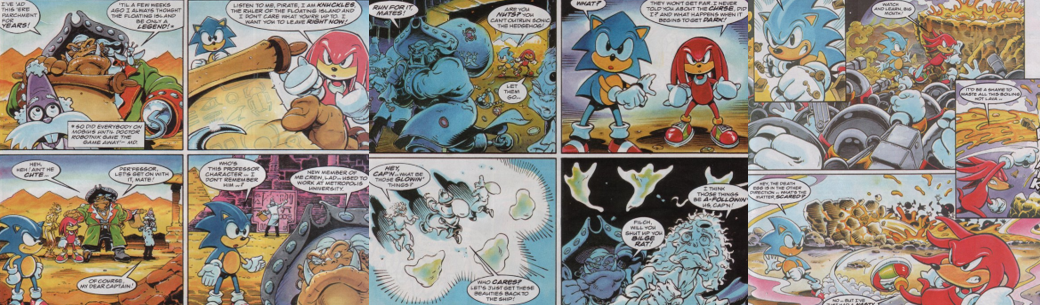
The Review: StC’s continuation of their Sonic 3 & Knuckles arc begins with Sonic and his sidekick, the perennial put down upon Miles “Tails” Prower, flying through the skies of Mobius to the Floating Island (as it was then known) in their biplane (which we now call the Tornado). Despite Tails’ worries, Sonic leaps off solo and lands in the arid desert of the Sandopolis Zone. He’s there to scope out some intel from his friend, fellow Freedom Fighter Porker Lewis, that maniacal despite Doctor Ivo Robotnik (who, at this point, currently dominates the entire planet) has secretly been repairing his ultimate weapon, the spherical Death Egg battle station, on the far side of the Floating Island. From the ancient ruins of Sandopolis Zone, Sonic spots the space station at the nearby Launch Base Zone but, before he can race to keep Dr. Robotnik from completing his repairs, he’s attacked by a particularly aggressive Sandworm Badnik. Caught off-guard, Sonic’s counterattack is interrupted by Knuckles, the pig-headed, super strong guardian of the Floating Island. The two immediately resume their rivalry, trading barbs with each other, and Knuckles clearly enjoys watching Sonic stubbornly refuse help. Of course, bashing Badniks is Sonic’s thing so he quickly trashes the Sandworm and the two realise that they’re there for the same reason since Knuckles is still cleaning up loose ends after he was tricked into helping Dr. Robotnik. Before they can reluctantly join forces to fight their common enemy, Captain Plunder and his Sky Pirates appear, angering Knuckles since he’s sick and tired of everyone and their mother showing up unannounced on his secluded island.
Sonic and Knuckles begrudgingly team up to intercept the Death Egg’s launch.
No strangers to each other, Sonic demands to know what the grim-faced walrus is doing there, and Captain Plunder eagerly reveals that he’s following an ancient treasure map, one he now realises led to the Floating Island since the mythical location has become common knowledge. With the aid of his newest crewman, known only as the Professor, Captain Plunder activates an ages-old control console and successfully raises the legendary Lost Pyramid of Sandopolis. The rag-tag group are immediately confronted by the pyramid’s guardian, a towering stone sentinel who easily reconstructs himself after being blasted with Sonic’s patented Spin Attack. Using his unparalleled knowledge of the island, Knuckles uses his head rather than his muscles and lures the guardian to some quicksand, subduing the titan just as the player would in the game. In the confusion, Captain Plunder and his cronies sneak into the cursed pyramid and discover a tomb full of riches, which they immediately pilfer. Naturally, Knuckles isn’t best pleased by this but, before he can stop the pirates, the tomb is plunged into darkness as the pyramid’s curse takes effect. Demonic ghosts chase them from the tomb, leaving them humiliated and penniless (though Captain Plunder spins a yarn of great danger and heroism to his crew). As for Sonic and Knuckles, they escape when Knuckles smashes a jar, flooding the room with sand and boosting them to a secret exit through a series of underground tunnels towards the live volcano that houses the looming Death Egg. When they reach the Lava Reef Zone, the duo is set upon by Dr. Robotnik’s rotund Eggrobos, which don’t just sport their master’s visage; Dr. Robotnik can see and hear everything through them. Sonic immediately attacks and is sceptical when Knuckles states he has a faster way to deal with them, though Rad Red comes through by smashing a nearby boulder and melting the hoard with a torrent of lava.
Though Super Sonic defeats Metallix, the Death Egg launches and prepares to fire.
Naturally (and correctly) surmising that Dr. Robotnik’s goal is the all-powerful Master Emerald, the gigantic jewel that keeps the Floating Island aloft, Knuckles leads Sonic to the Hidden Palace, where the Chaos Emeralds reside. Unfortunately, the Master Emerald is gone, dooming the island to drop into the ocean in mere hours. As for Dr. Robotnik, he’s already gloating about his supreme victory, not just because he’s close to the gem that will finally allow him to avenge himself upon the Emerald Hill Zone folk who so openly defy him, but also because an armour-clad, upgraded version of his ultimate creation, Metallix, is already drawing power from the Master Emerald. Sonic’s naturally shocked since the last time he tangled with Metallix, Sonic did a bit of time travel shenanigans to erase his metallic doppelgänger from history. The only explanation we get about how Metallix can still be around is a brief mention of a “brotherhood” of Badniks since exposition gives way to an all-out battle. Teleporting to the Sky Sanctuary Zone, the new Metallix proves its superiority by absorbing power from the Master Emerald and knocking Knuckles out. Despite Sonic trying to whip up a vortex to tear Metallix apart, he’s whacked by the Badnik’s extendable arm and socked into the air with a rushing uppercut. Unfortunately for Metallix, the shot sends Sonic flying towards the Master Emerald and, upon contact, the surge of Chaos energy transforms Sonic into his raging, demonic, invincible alter ego, Super Sonic. Super Sonic decapitates Metallix’s head with one blow and rips its remains apart in a mindless rage. Super Sonic then turns his wrath against Knuckles before the transformation wears off and Sonic regains his senses. Knuckles’ bruises are nothing compared to the sudden, dreadful realisation that the Master Emerald has been teleported away in the fracas. The two watch with horror as the mighty Death Egg finally launches, shaking what’s left of the Sky Sanctuary Zone apart with its vibrations.
An interior and external assault sees the Death Egg blasted from orbit once more.
Ecstatic at finally piloting his spherical space station once more, Dr. Robotnik sends a wave of Eggrobos after his foes. However, Knuckles begrudgingly carries them to safety by gliding on the turbulent winds. Sonic then pinballs off the Badniks to infiltrate the space station while Knuckles heads to a hidden chamber. Looking over some wizened scrolls, he activates an antiquated control console and literally pilots the Floating Island towards the Death Egg. Unlike the last time we saw Sonic explore the Death Egg, this rendition is gigantic, ominous, and filled with traps and Badniks. Sonic obliterates the Spikebonkers and then feigns surrender to enter Dr. Robotnik’s main control room. There, he spots the Master Emerald and makes a beeline for it, desperate to remove the space station’s main power source before Dr. Robotnik can disintegrate the Emerald Hill Zone folk. Luckily, the Floating Island opens fire on the Death Egg using energy drawn from the very island. Enraged, Dr. Robotnik demands that his assistant, the long-suffering Grimer, turn the Death Egg’s main cannon on the Floating Island. However, the rotund dictator’s so caught up in his boastful gloating that Sonic knocks the Master Emerald free, disabling the Death Egg and leaving it wide open to Knuckles’ unrelenting barrage.
With Dr. Robotnik’s threat ended, Knuckles agrees to shelter Sonic’s friends on his secluded island.
Tumbling from the disintegrating space station, Sonic spots an Eggrobo snatching the Master Emerald. Thinking fast, Sonic swipes a laser blaster and destroys the Eggrobo, causing the Master Emerald to safely fall to the Floating Island. Sonic then saves himself by relieving another Eggrobo of its jetpack and riding it to safety, gloating as the exploding Death Egg falls from the sky. Upon spotting the Master Emerald, Sonic hefts it up (with no sign of Super Sonic this time around), determined to return it to the Emerald Chamber before the Floating Island crashes to the surface. Unfortunately, he’s taken by surprise when Dr. Robotnik fires upon a concussive laser blast from a gigantic suit of armour somewhat similar to the Giant Eggman Robo from the source material. Unlike that gruelling fight, where the mech boasted gigantic crushing fingers, fireball-sprouting nostrils, and a gigantic, Master Emerald-powered laser cannon, this suit’s primary attack is to try and crush Sonic with its fists. The desperation and high stakes see Sonic unleash aggressive Spin Attacks so savage that even Dr. Robotnik comments upon Sonic’s grim attitude. Still, Sonic is horrified when his final blow causes Dr. Robotnik to topple over the island’s edge. However, the maniacal dictator’s luck holds out as his damaged jet propulsion system means the fall isn’t fatal. Sonic’s equally as unimpressed to see Knuckles rushing up to him, too late to help with the battle and demanding the safe return of the Master Emerald. However, Sonic doesn’t hand over the gem that easily. Realising that Dr. Robotnik will never rest until he’s destroyed the Emerald Hill folk, Sonic agrees to return the Master Emerald in return for safe shelter for his friends. Thus, amidst the last vestiges of a downpour, the displaced Emerald Hill folk are safely hidden from Dr. Robotnik’s repercussions in the island’s Mushroom Hill Zone, high up in the sky. And good thing, too, since the injured Dr. Robotnik swears revenge against both Sonic and Knuckles.
The Summary: StC was really at its peak around this time. This second round of Sonic 3 & Knuckles stories really ups the ante from Knuckles’ first introduction, which barely touched upon the gameplay mechanics, locations, and intricacies of the source material. To be fair, this was common in StC’s adaptations and subsequent stories did explore other aspects from the game, so basically Angel Island’s areas were incorporated into StC canon and formed the basis of plenty of other stories, short and long. But, at its core, the first arc was more concerned with the rivalry between Sonic and Knuckles, the fusion of the twelve Chaos Emeralds, and Dr. Robotnik’s attempt to attain Godhood. This second arc visits far more locations from the game and even incorporates mechanics seen in those areas, such as the pyramid from Sandopolis, the light gimmick and scary ghosts, and the crumbling Sky Sanctuary Zone. Every location and character is brought to life by the peerless Richard Elson, who brings a kinetic, visual power to every action. This is best evidenced in Sonic and Knuckles’ battle against Metallix, which conveys the speed and raw power of the Badnik like never before, instantly differentiating it from its predecessor and emphasising its threat. Things only escalate when Knuckles pilots the Floating Island and fires on the Death Egg, a unique plot thread obviously missing from the videogames but which adds further lore to the mysterious nature of the island, which holds secrets even Knuckles is just now discovering. While Super Sonic wasn’t much of a factor, his appearance was a welcome one and helped sell the threat of the Metallix, itself a lingering plot threat explored in later issues. I really liked that Sonic and Knuckles were teamed up this time around; Tails and the other Freedom Fighters were basically absent but it was a nice bookend to their previous meeting, where they fought against each other and begrudgingly teamed up in the finale.
Rivals Sonic and Knuckles team up against a common foe.
The two work surprisingly well together here. Perhaps because of their common enemy and the very real threat the Death Egg poses, there’s little bickering between the two. They’re largely on the same page, save for a few barbs here and there, and Sonic defers to Knuckles’ expertise regarding the island numerous times. Naturally, a spirited rivalry remains, with Sonic being the flashy showman who never admits when he’s wrong and Knuckles taking a more measured approach, utilising the environment or his know-how to quickly dispatch enemies and focus on the big picture. His primary concern is the safety of the Floating Island, which he feels has been defiled ever since Dr. Robotnik and Sonic arrived there. He just wants to clear out Dr. Robotnik’s influence and get things back to normal and is extremely intolerant of any intruders, even allies like Sonic. Unfortunately for Knuckles, he’s become part of a larger world, something even he acknowledges since he attacks the Death Egg not just for the Floating Island, but to safeguard the entire planet. Having previously experienced the Death Egg’s power before, Sonic knows all-too-well with the space station is capable of. Readers got a taste of this a few issues back when Dr. Robotnik ran a simulation that resulted in Sonic and Tails being vaporised, and the ever-present threat posed by the Death Egg clearly weighs heavily on Sonic’s mind. Sonic gives Badniks and Dr. Robotnik alike a taste of his smart mouth, but he knows what’s at stake and even welcomes transforming into Super Sonic if it means dispatching his metallic doppelgänger and safeguarding the Master Emerald. Consequently, Sonic defiantly battles a roomful of Spikebonkers, desperate to knock out the Master Emerald, only to despair when, for the first time in his life, he’s too slow to save his friends. It’s only because of Knuckles’ attack that Sonic dislodges the power source, and even Sonic must commend the echidna’s thinking (though, tellingly he, never expresses gratitude to his rival at any point in this arc).
Dr. Robotnik’ mad ambitions almost succeed but for the intervention of his worst enemies.
This focus on Sonic and Knuckles means there’s not much panel time for Dr. Robotnik. When we do see him, he’s raving about his need to acquire the Master Emerald, boasting about having acquired it, or anguished at having lost it. He constantly brags to Grimer about his superiority and the power of the Death Egg and relishes having a front row seat to witness the demise of his foes. Once the Death Egg launches, Dr. Robotnik is practically giddy with glee and immediately aims his ultimate weapon at the Emerald Hill Zone, ready to wipe the whole town and its inhabitants out. He’s aghast when Sonic and Knuckles destroy his beloved space station and finally takes matters into his own hands, piloting a mech suit far larger than the one seen in the last arc and taking the fight directly to Sonic. However, even Dr. Robotnik underestimates Sonic’s anger and determination; in the face of Sonic’s raw speed and power, the malevolent dictator is helpless, mech suit or not, and sent plummeting to a nasty landing, his dreams of all-out destruction quashed for now. By spreading the Sonic 3 & Knuckles story across intervening stories and giving the source material time to breath in this main arc, these issues tell one of the first great epics in StC’s run. The stakes were high and tangible: Dr. Robotnik wasn’t using magic gems to become a God or anything like that. He built the Death Egg just as he built Metallix and his Badniks, and it stands as the ultimate weapon of his vengeance upon those who defy him. Seeing Sonic and Knuckles properly team up, utilising their individual strengths in creative ways, was a blast and a taste of an ongoing begrudging alliance that would last until the comics were cancelled. Newcomers may be confused about Captain Plunder, Metallix, Super Sonic’s portrayal, and Dr. Robotnik’s vendetta against the Emerald Hill folk, but I’d still rate this as one of the best adaptations of Sonic 3 & Knuckles just because it takes the time to explore different locations from the games and provide a unique spin (pun intended) on some recognisable elements rather than simply taking the basics and weaving it into an all-new canon, as is usually the case.
My Rating:
⭐⭐⭐⭐
Rating: 4 out of 5.
Great Stuff
Have you ever read Sonic the Comic’s second Sonic 3 & Knuckles arc? Did you enjoy seeing Sonic and Knuckles team up this time? What did you think to the use of locations and mechanics from the games? Were you surprised that Knuckles turned the Floating Island into a weapon? Which of StC’s videogame adaptations was your favourite? How are you celebrating the debut of Knuckles today? Please feel free to share your memories of StC and Sonic 3 & Knuckles below and go check out my other Sonic and Knuckles content.
With the release of Sonic the Hedgehog 3(SEGA Technical Institute, 1994) on this day in 1994, gamers were introduced to Knuckles the Echidna. This mischievous, dreadlocked antagonist was created by Takashi Yuda and is my favourite of Sonic’s supporting cast so excuse me while I celebrate his debut today (every Sunday in February!)
Story Title: “This Island Hedgehog” (Part 1 and 2) Published: 16 May 1994 (cover-dated: August 1994) Writers: Mike Kanterovich and Ken Penders Artist: Dave Manak
The Background: When Sonic the Hedgehog made his dramatic videogame debut in 1991, he was an immediate hit thanks to SEGA’s aggressive marketing campaign seeing his debut title being bundled with the Mega Drive. Sonic the Hedgehog 2(SEGA Technical Institute, 1992) expanded his popularity and, suddenly, Sonic merchandise was suddenly everywhere! He was included not only in the Macy’s Day Parade, but in cartoons and numerous comic books. Following the initial four-part miniseries, which combined narrative elements of Sonic’s cartoon adventures, Archie Comics published what would become the longest-running videogame comic book of all time. In time, to better capitalise on Sonic’s continued popularity, Archie also produced various Sonic spin-off comics, with the Knuckles the Echidna sister series being the most prominent. Long before writers like Ken Penders lumbered Knuckles with a convoluted lore and launched a bitter lawsuit that forever changed Archie’s Sonic comics, Knuckles debuted in this issue as one of Archie’s many loose videogame adaptations.
The Review: Sonic and his perennial kid sidekick, Miles “Tails” Prower, first encounter Knuckles, the last of the echidna race and guardian of what was then known as the Floating Island, completely by chance. While flying through the skies of Mobius in search of Doctor Ivo Robotnik’s “hovercraft”, the two stumble upon a mysterious island in the sky. Interestingly, unlike in Fleetway’s comics, the two have no knowledge of the Floating Island and can thus only speculate how it stays afloat, with Sonic guessing (correctly, it turns out) that it’s held aloft by one of the (many) Chaos Emeralds. As the two come in to land to investigate further, unaware that they’re being watched by a mysterious, spike-fisted individual, their biplane is knocked from the sky by a literal “unwelcome mat” and Tails is forced to air-lift the duo to the ground. With no choice but to investigate further to find some way back to Knothole Forest, Sonic and Tails venture into a close approximation of Angel Island Zone and are attacked by an “Assaulting Batter Blimp” (essentially the “Fire Breath” mech from Sonic the Hedgehog 3, but with a far less intimidating white paint job). Assaulted by the blimp’s flame bursts, Sonic is randomly shielded by “some sort of energy shield” (visually similar to his Insta-Shield ability, though Sonic seems unaware of how this happened) and forced to dive into the nearby water. Caught in an inescapable current and blasted past spikes and through crumbling walls in what I guess is supposed to be Hydrocity Zone (but which looks more like Labyrinth Zone), the duo find themselves blacking out from the strain and the force of the suction. They awaken in a dark room with their arms and legs bound and are stunned when they’re greeted by Knuckles, who steps from the shadows and introduces himself as the island’s guardian.
After Sonic and Tails prove their innocence, Knuckles joins them in fighting Dr. Robotnik.
Knuckles also reveals that he’s formed a friendship with Dr. Robotnik, who’s fed him lies about the two’s intentions to steal the island’s Chaos Emerald! Dr. Robotnik observes the events with glee alongside his long-suffering right-hand and nephew, Snively, and reveals that he’s misled the naïve echidna in order to steal the Chaos Emerald for himself to recharge his hovercraft. Having successfully duped Knuckles, Dr. Robotnik sits back and watches as the echidna’s riled up by Sonic and Tails’s defiant attitude. Still, Knuckles offers to give them ten minutes to get off the Floating Island before he hunts them down like wild dogs. While Sonic and Tails instead resolve to use the time limit to prove their innocence, Dr. Robotnik berates Knuckles for not finishing off the “jewel thieves” when he had the chance. Thus, Dr. Robotnik moves up his schedule and, after snatching the Chaos Emerald from his minion, Crabmeat, prepares to enact his dastardly plot. Angered that Sonic and Tails are still hanging around, Knuckles takes a short-cut to the Chaos Emerald and is horrified to find it’s been swiped from its simple stone pedestal. When Sonic and Tails arrive immediately after, Knuckles realise that he’s been duped and demands to be taken to Dr. Robotnik. The three arrive just as the semi-cybernetic dictator is preparing to take off and, after swiping the gem, reduce his SWATbot guards to scrap metal. However, Dr. Robotnik manages to elude them by powering up his hovercraft (how he does this without the Chaos Emerald is beyond me) and awkwardly escaping across the sea. To thank his newfound allies, Knuckles gathers the pieces of Sonic’s trashed plane so Sonic can reassemble it at super speed and then sees the two off, sure that it won’t be the last time their paths cross.
The Summary: My first observation about this story is that the art is pretty atrocious. A lot of it was back then in the Archie comics as their artists opted for a more cartoony approach to these characters, one that emulated the cartoons that inspired them, yes, but which was also somewhat dumbed down and a far cry from SEGA’s official artwork. Most of this criticism is aimed towards Knuckles, who looks decidedly off-model here. Judging by the poses he strikes and the limited exploration of Sonic 3’s environments, I wouldn’t be surprised if the writers and artists only had access to limited materials to produce their story. It seems like they had footage or screenshots of Angel Island Zone (at least Act 1) and Hydrocity Zone and images of Knuckles, and that was it as this story explores even less of the Floating Island than in the Fleetway adaptation! As was the style at the time, “This Island Hedgehog” is seemingly more concerned with awful puns and pop culture references than emulating the source material. While the “unwelcome mat” was kind of funny, ““plane” crazy” was very cringe, Tails’s reaction when Sonic says they should “hit the drink” probably went over most kids’ heads, and “cute” references to Super Mario and the 1960s Batman television show just come across as corny. Sonic’s “energy shield” really bugged me since it appears out of sheer convenience to save him from being roasted, is never seen again, and never gets explained. Again, it’s like the writers just watched some footage of Sonic 3 and had no idea how the Insta-Shield works, making its inclusion even more egregious than how Fleetway handled it. Couple that with the Master Emerald and Hidden Palace Zone shrine being reduced to a simple, run-of-the-mill Chaos Emerald and a pile of rocks, and that Dr. Robotnik’s plot is to power up his hovercraft rather than the Death Egg, and you have a very poor representation of the source material, even by Archie’s standards!
More focused on bad art and worst puns, this story is a poor showing for Knuckles and Sonic 3.
I wish I could say that Knuckles, at least, comes off well, but it’s a bit of a mixed bag, to be honest. I liked that he was kept hidden, seen as merely a fist and speech bubbles for most of Part 1, and that he was shown to be responsible for the traps and pitfalls that deter Sonic and Tails. His reveal was somewhat dramatic, but a far cry from how he made an immediate impact in Sonic 3 and his impactful introduction to Sonic in Sonic the Comic. I will say, though, that I liked Knuckles’ more relaxed way of speaking (he often drops g’s from his words) and that he gave Sonic and Tails a fighting chance to leave the island, showing he has some pride and honour despite being duty-bound to protect his home. He’s still easily fooled by Dr. Robotnik (though we’re not seen how) and quick to assume Sonic and Tails are jewel thieves based on paltry evidence, but he’s also seen to be quite eloquent and intelligent rather than a meathead. However, in saying that, we don’t get to see any of Knuckles’ abilities here: he’s not seen gliding, digging, or climbing and never throws a punch. Sure, he and Sonic trash some SWATbots but the action is obscured by sound effects and dust, so there’s no indication of his physical strength…again, almost as though the writers only had promotional art to work from. Knuckles does part on far friendlier terms with Sonic and Tails than in most adaptations, however, but is a far cry from the character he should be. The story is also an extremely weak adaptation of Sonic 3, serving only to touch upon the most basic of elements and leave the door open for further adventures. Perhaps if Archie has spread the story out across a few issues, or dedicated this entire issue to Sonic dealing with Knuckles rather than wasting pages with a back-up story, things might’ve been different but, as is, this is probably the worst comic book adaptation of Sonic 3 I’ve ever read!
My Rating:
⭐
Rating: 1 out of 5.
Terrible
What did you think to Knuckles’ first appearance inArchie’s Sonic comics? Were you also disappointed by how poorly he and Sonic 3 were represented here? What did you think to Dr. Robotnik’s drastically reduced plot for the Chaos Emerald? Which of Archie’s Knuckles stories and/or characters was your favourite and why? Are you celebrating Knuckles’ debut this month? Whatever you think about Archie’s Sonic comics, and especially Knuckles, leave a comment down below and let me know, support me on Ko-Fi, and check out my other Knuckles content!
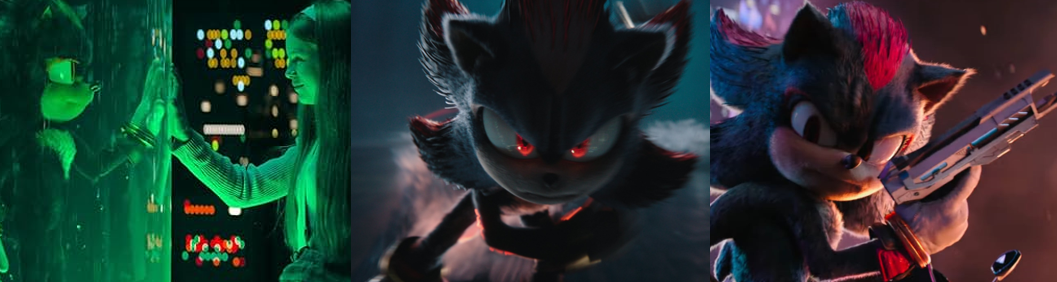
Released: 20 December 2024 Director: Jeff Fowler Distributor: Paramount Pictures Budget: $122 million Stars: Ben Schwartz, Keanu Reeves, Jim Carrey, Colleen O’Shaughnessey, Idris Elba, and James Marsden
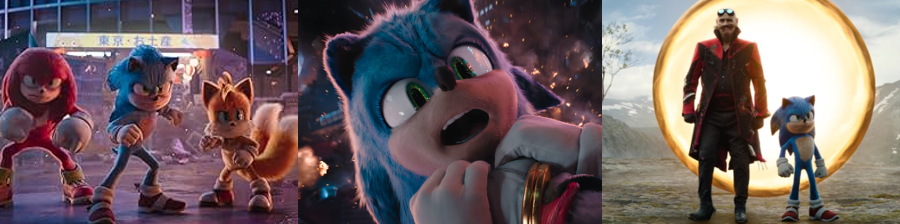
The Plot: When a mysterious black hedgehog known as Shadow (Reeves) escapes from captivity and goes on a rampage, Sonic the Hedgehog (Schwartz) and his friends – Miles “Tails” Prower (O’Shaughnessey) and Knuckles the Echidna (Elba) – must team up with their old foe, Doctor Ivo Robotnik (Carrey), against a common enemy.
The Review: If there are two things I’ve never been shy about, it’s my love for the Sonic the Hedgehog franchise and my dismay that his big-screen adventures haven’t been all-CGI animated affairs. Yet, despite this (and the notorious reputation movie adaptations of videogames have), the live-action/CGI hybrid Sonic adventures have actually been pretty good. Blending elements of Sonic’s long defunct, Western canon with more modern elements of his lore, the films recast Sonic as an adventurous and enthusiastic, high-speed hero from another world. After coming to Earth and living alone, desperate for friends and acceptance, Sonic has found a surrogate family alongside Tails, Knuckles (fresh off his solo series), and their human family, Tom (Marsden) and Maddie Wachowski (Tika Sumpter). On the anniversary of Sonic’s b-Earth-day, Sonic and Tom reflect on the hedgehog’s journey, how he found friends and a place in the world despite experiencing great pain as a child and being separated from his parental figure. Having formed a brotherhood during their last adventure, the trio (colloquially known as “Team Sonic”) perfectly complement each other’s abilities: Sonic’s the leader, Knuckles is the muscle, and Tails is the gadget guy. Though they banter at times and Knuckles is often the butt of many jokes due to his thick-headedness, the three vowed to never again use the Master Emerald lest its power threaten the world and are depicted as a tight-knit group of friends. Team Sonic are also closely affiliated with the Guardian Units of Nations (G.U.N.), a military division established to monitor and respond to alien threats, with the three now regarded as trusted allies of the G.U.N. overseer, Commander Walters (Butler). Unlike in Sonic Adventure 2, where Sonic was targeted by G.U.N. because they ridiculously mistook him for Shadow, G.U.N. Director Rockwell (Krysten Ritter) is dispatched to recruit Team Sonic’s aid, a task she performs reluctantly as she’s suspicious and distrustful of the “aliens”.
Overwhelmed by Shadow’s speed and power, Team Sonic are forced to join forces with Dr. Robotnik.
Though Team Sonic and the Wachowskis enjoy their peaceful downtime, they jump at the chance for some action (Team Sonic at the beginning and the Wachowskis later, when the boys ask for their help infiltrating the G.U.N. headquarters). However, while Knuckles is eager to test his mettle against the new hedgehog, Sonic calls for cooler heads, despite the chaos and destruction Shadow unleashes upon the city. Angered and suspicious of the “colourful bunch” since they arrived in a G.U.N. helicopter and Shadow’s vendetta is primarily against G.U.N., the enraged hedgehog refuses to listen to reason and easily trounces the three with his impressive physical strength and powers of teleportation. As if that wasn’t bad enough, Shadow’s rocket boots and natural Chaos Energy make him more than a match for Sonic, resulting in a resounding defeat for the trio. After learning of Shadow’s tragic origins from Commander Walters, the three are suddenly attacked by Dr. Robotnik’s egg drones, only to learn from the doctor’s long-suffering right-hand man, Agent Stone (Lee Majdoub), that the increasingly manic (and finally overweight) Dr. Robotnik is not only alive but not behind the attack. Incensed to learn that his machines have been hijacked, Dr. Robotnik begrudgingly agrees to a short-lived team up to track down their common foe. Naturally suspicious of the mad scientist, Sonic keeps a close eye on the maniacal doctor and shares his regret for Shadow’s pain. Their conversation leads Dr. Robotnik to “trauma dump” to his foe and reveal that he also had a tragic childhood filled with bad choices and a lack of parental figures, echoing the main theme of the film (essentially, don’t let your past/pain define you). Equally, discussions with Tails regarding the nature of Team Sonic’s relationship leads Agent Stone to question his devotion to Dr. Robotnik, who routinely humiliates and belittles Stone despite his clear awe and loyalty. We don’t get too much additional insight into Knuckles and he remains and arrogant and proud warrior who takes things far too literally. However, Knuckles proves to be an extremely loyal friend; even when an emotional Sonic is ready to go to blows with Knuckles, Rad Red takes the high road and falls back on the trust he placed in his family.
Desperate to connect with the family he never had, Dr. Robotnik teams up with his maniacal grandfather.
The team up between Team Sonic and Dr. Robotnik is tenuous, at best, given the doctor’s past actions and unstable disposition, but it quickly falls apart when they explore the G.U.N. facility where Shadow was once experimented on. There, the bald lunatic is surprised to meet his long-lost grandfather, Professor Gerald Robotnik (Carrey), an equally devious and intelligent scientist who once ran tests on Shadow and who has returned after fifty years in prison to enact revenge through the angst-ridden hedgehog. Playing dual roles really allows Jim Carrey’s natural, madcap comedy stylings to take centre stage here. Both Robotniks are very similar, sharing an eccentric and dark sense of humour and a desire to vent their personal frustrations upon not just their enemies, but the entire world. Elated to finally meet a member of his family, Dr. Robotnik abandons his newfound allies and devotes himself to Gerald’s cause, using the power of virtual reality and amusing montages to bond with his elder and feel a sense of belonging so strong that he angrily rebukes and dismisses Agent Stone when he raises concerns about Gerald’s intentions. While Dr. Robotnik employs a few mechanical aids throughout the film, they’re secondary to the duo’s more threatening objective: the Eclipse Cannon, a world-ending space station Gerald built for G.U.N. back in the day. Perfectly matched in their mania, genius, and physical abilities, the Robotniks are also cunning and spiteful. While infiltrating the G.U.N. headquarters, Dr. Robotnik tests his laser-reflective clothing by threatening his grandfather’s life, much to Gerald’s respect. Though distrustful of Shadow, Dr. Robotnik relishes the chance to have the power to prove his superiority over the world and his fleet-footed foe, a mad desire that sees him finally donning a game accurate outfit and standing beside his grandfather on the Eclipse Cannon. Unfortunately for the pining doctor, Gerald’s ambitions extend far beyond subjugating the world. Intent on eradicating all human life, including his own, Gerald’s mad plans clash with Dr. Robotnik’s desire to rule, turning the crazed scientist into a reluctant ally for the final act.
Consumed by anger, Shadow vents his wrath upon the world to avenge his lost friend.
Of course, the central antagonist the entire film revolves around is Shadow, a dark and brooding hedgehog from beyond the stars who’s focused only on revenge. While the trailers made it seem like Keanu was phoning in his performance, his growling delivery is pitch-perfect for the enraged anti-hero and he perfectly captures Shadow’s pain and rage. Falling to Earth over fifty years ago and subjected to years of experiments to harness his powerful (but unstable) Chaos Energy, Shadow was treated as a mere lab rat and shown none of the warmth and affection that shaped Sonic into a self-serving hero. Shadow’s only friend was Maria (Alyla Browne), Gerald’s well-meaning granddaughter who bonded with Shadow, giving him someone to care about. After realising Shadow’s powers were too dangerous to contain, G.U.N. sought to keep him in stasis and, during an escape attempt, Maria was accidentally killed, fuelling Shadow’s rage. Shadow’s so consumed by his anger and pain that he attacks G.U.N. and anyone who gets in his way on sight. Thus, when he sees Commander Walters, Shadow doesn’t hesitate to strike to retrieve one of the Eclipse Cannon’s keycards. Unfortunately, Shadow actually attacked Tom in disguise, causing him to not only question his vendetta but enrage Sonic, who abandons his family to extract a measure of revenge from his dark doppelgänger. Although you might not be surprised to learn that Tom isn’t killed, it is touch and go for a moment and the risk against him is great considering the destruction Shadow causes when unloading on G.U.N.’s soldiers. Unlike in the videogames, Shadow doesn’t need a Chaos Emerald to teleport or reach blinding speeds; equally, he’s specifically said to be from the stars, rather than a result of Gerald’s experiments. Yet, he’s just as angry and misguided as in the source material, and equally unstoppable. Even Team Sonic’s combined might cannot match with Shadow’s powers, making him an incredible formidable foe.
The Nitty-Gritty: Sonic the Hedgehog 3 is a story about choices; specifically, the choices we make that shape us. Sonic chose not to let his pain rule his heart and to be a selfless hero, whereas Shadow is consumed by his grief and is turning his rage upon the world he believes wronged him. Similarly, years of rejection and abandonment issues shaped Dr. Robotnik into a spiteful and malicious supervillain, just as decades in prison and the loss of his granddaughter twisted Gerald into a crazed madman ready to destroy himself alongside the world. Sonic, Tails, and Knuckles are depicted as brothers as much as friends and teammates; together, they’re their greatest source of power and inspiration. While this doesn’t give them the edge against Shadow, their combined abilities and resourcefulness see them explore other options to subdue their foe. It’s therefore incredible tense and heartbreaking when Sonic, consumed by anger and a lust for revenge after Shadow hurts Tom, is ready to fight Knuckles to learn the location of the Master Emerald. Tails, in particular, is distraught by Sonic’s emotional state and his refusal to listen to reason, just as Knuckles is angered that his friend would abandon his morals and their vow. Yet, Knuckles refuses to betray their bond, even if Sonic is ready to, and Sonic’s subsequent efforts to beat Shadow into submission as Super Sonic serve as a character test for the misguided hero. Indeed, during their fight, Shadow not only riles Sonic up more and transforms into his own Super form, he also spits Sonic’s rage in his face and draws comparisons between them. Despite Sonic rejecting the notion that he’s anything like his destructive foe, he’s forced to face reality when he remembers Tom’s words and teachings and, thankfully, lets go of his rage to find common ground with Shadow. Similarly, Sonic learns there’s more to Dr. Robotnik than just a crazed supervillain during their short-lived team up. Much of Dr. Robotnik’s lust for power comes from not having strong moral influences and a resentment towards the world though, ultimately, all three learn to set aside their personal grievances to protect the world.
Shadow’s power makes him a formidable threat, even to Super Sonic!
Like its predecessors, Sonic the Hedgehog 3 is full of colourful, fast-paced action and adventure. Sonic, Tails, Knuckles, and Shadow all sport poses, lines, and abilities from the videogames, with Shadow riding through Tokyo on a motorcycle while blasting at Sonic with a laser pistol and many of his dramatic, angst-filled poses being ripped right out of Sonic Adventure 2 and Shadow the Hedgehog. It’s a joy to see and witnessing Shadow’s raw power is endlessly exciting; he zips about, blasting foes with kicks and punches, and laying waste to everyone. Equally, Team Sonic continue to impress: Sonic defies all laws of physics, Spin Dashing and blasting around at incredible speeds, Tails keeps pace with his helicopter blade tails, and Knuckles easily hefts around objects as though they were weightless. Of the three, Sonic has the best chance of fighting Shadow thanks to Knuckles’ hot-headedness and Tails’ comparative fragility. However, it takes all three (and Tom and Maddie utilising holographic disguises) to breach G.U.N.’s headquarters. After Tom is left fighting for his life, we see the triumphant and dramatic return of Super Sonic; however, Shadow’s power is so immense that he blasts the Chaos Emeralds from his foe with one blow and absorbs them in turn. The battle between Super Sonic and Super Shadow sees them literally tear up the landscape, causing volcanoes to erupt and them to battle across the globe and eventual on the surface of the Moon! Setting aside everyone’s ability to breathe in space, these are some of the film’s most exhilarating moments and seeing Super Sonic and Super Shadow team up to stop the Eclipse Cannon was an exciting finale. Although the Biolizard and Finalhazard don’t appear, there was a cute reference to it and other Easter Eggs for eagle-eyed fans. The Eclipse Cannon console is modelled after a Mega Drive, for example, Dr. Robotnik’s ring tone is Paul Shortino’s “E.G.G.M.A.N”, a hard rock cover of “Live and Learn” plays when Super Sonic and Super Shadow team up, and Team Sonic regroup in a super fun Chao Garden restaurant!
Unexpected alliances and sacrifices see Team Sonic save the world from destruction.
One of the best aspects of Sonic the Hedgehog 3 is how it focuses more on the videogame characters and yet still finds a way to keep Tom and Maddie relevant. They’re there to reinforce the familial bond that separates Sonic from Shadow and contrast the Robotniks’ volatile and twisted relationship. While Director Rockwell added little to the plot and could’ve easily been supplanted with Commander Walters and another fight against Shadow, the infiltration of G.U.N. headquarters was a fun sequence that culminated in the Eclipse Cannon dramatically launching from the River Thames! After being reminded of everything he’s lost, the enraged Shadow powers up the cannon and battles with Super Sonic before realising that he’s been walking the wrong path, one that would dishonour Maria’s memory rather than avenge her. Similarly, Dr. Robotnik is aghast to learn of his grandfather’s suicidal plot and battles him aboard the Eclipse Cannon, matching his nanotech against Gerald’s, and only coming out victorious thanks to a last-minute save from Tails and Knuckles. Thus, with the world in peril from the Eclipse Cannon’s devastating death beam, Super Sonic and Super Shadow block its path while Dr. Robotnik, Tails, and Knuckles fight to redirect the space station, saving the world but blasting half of the Moon! The effort drains the Chaos Energy from Sonic and sees him plummet through the atmosphere; bravely, Tails and Knuckles follow and succeed in saving him. Unfortunately, the Eclipse Cannon’s core overloads and the only ones capable of sparing the Earth from a cataclysmic event are Dr. Robotnik and Shadow. While Super Shadow expends the last of his energy pushing the space station as far away from the Earth as possible, Dr. Robotnik fights to stabilise the core. After delivering a heartfelt message to Agent Stone and thanking him for his loyalty and friendship, Dr. Robotnik and Shadow are seemingly vaporised when the Eclipse Cannon explodes. After making amends with his friends, Sonic returns to his family, grateful for their love and friendship, only to be attacked by a robotic doppelgänger (and a hoard – or “brotherhood” – of the machines) on the outskirts of New York City. Thankfully, he’s saved by a mysterious pink hedgehog and the post-credits reveal that Shadow survived the explosion, setting up further adventures.
The Summary: Sonic the Hedgehog 3 is a rare gem, for sure. Not only is it an enjoyable movie adaptation of a videogame franchise, but it’s also an entertaining third entry in a film series, and the first time Jim Carrey’s ever portrayed a character three times, making it incredibly rare in the grand scheme of Hollywood. Naturally, given the source material, the film is a tad darker than its predecessors; Shadow alone is a grim, edgy figure, to say nothing of his tragic backstory. There’s far more action and peril this time around and the world is not only endangered, but humanity faces global annihilation from Gerald’s insane plot. Still, there’s a lot of fun, colourful action and humour at work here, including Jim Carrey’s physical comedy, references for the fans, and topical gags for mainstream audiences. Jim Carrey steals the show, throwing his all into both Robotniks, devouring the scenery, and commanding the screen whenever he’s present. I loved the energy and enthusiasm he brought to both roles and it was an inspired decision to expand Gerald’s character into an even darker and more insane mirror of his grandson. However, it’s Shadow that’s the star of the show here. Keanu Reeves perfectly captured Shadow’s angst and pain and flawlessly brought the misguided and outraged anti-hero to life. I enjoyed the tweaks to his backstory and the parallels between him, Sonic, and Dr. Robotnik that reinforced the film’s themes of family, choices, and overcoming grief. Add to that some enjoyable references to the videogames, particularly Shadow’s outings, and some fun gags and you have a hugely enjoyable adventure that successfully appeals to kids, adults, game fans, and mainstream audiences.
My Rating:
⭐⭐⭐⭐
Rating: 4 out of 5.
Great Stuff
Did you enjoy Sonic the Hedgehog 3? How do you feel it holds up compared to the previous films? Did you enjoy the addition of Shadow and the changes made to his backstory? What did you think of Jim Carrey’s dual performance as Dr. Robotnik and Gerald? Did you enjoy the fight between Super Sonic and Super Shadow and the many references to the videogames? Where do you see the films going from here and are there any Sonic games or characters you’d like to see make an appearance in the future? To share your thoughts on Sonic the Hedgehog 3, leave a comment below and be sure to check out my other Sonic content on the site!
After the release of Sonic the Hedgehog (Sonic Team, 1991), Sonic was established as the hottest videogame icon. In anticipation for the sequel, SEGA dubbed November 24, 1992 as “Sonic 2sday”. Accordingly, this seems like a great excuse to celebrate Sonic’s faithful sidekick, Miles “Tails” Prower, who debuted in that title.
Story Title: “The Nameless Zone” (Parts 1 and 2) Published: 25 December 1993 to 8 January 1994 Writer: Nigel Kitching Artist: Dave Windett
The Background: Sonic the Hedgehog was a huge success for SEGA. Thanks to an aggressive marketing campaign and being included with the all-powerful 16-bit Mega Drive, Sonic sold over 15 million copies upon release. After a tumultuousdevelopment, Sonic the Hedgehog 2 (SEGA Technical Institute, 1992) surpassed its predecessor by a country mile! 400,000 copies were sold in its first week alone, 6 million units during the Mega Drive’s lifespan, and the game increased SEGA’s control of the home console market by 40%. Widely praised and highly regarded, Sonic 2 also debuted a kid sidekick for Sonic. The result of an internal contest, Miles “Tails” Prower was created by Yasushi Yamaguchi, modelled after the mythical kitsune, and greatly admired his super-fast hero. Well regarded as a popular staple in the Sonic franchise, Tails has the distinction of being one of the few of Sonic’s supporting cast to star in his own divisivesolo outings and he was also the first to get his own solo stories in Sonic’s comic book adventures. The first of these was this two-part adventure that featured in Sonic the Comic (StC), a fortnightly comic book published in the United Kingdom that pulled much of its lore from the now defunct Mobius and Doctor Ovi Kintobor storyline. Tails’ adventures in StC cast him as an unlikely hero in a fantasy setting where he struggled to live up to the reputation he’d made for himself, and his adventures continued to feature in StC even as it transitioned to a fan-made digital format.
The Review: Remember that flashback Tails had in Sonic Adventure(Sonic Team, 1998)? You know, the one where he sees Sonic running past and chases after him, all excited and happy? Well, “The Nameless Zone” begins with a similar scene of Tails chasing after Sonic only it’s very different. In case you forgot or didn’t know, StC-Sonic was a bit of a dick; he truly did have an attitude and he constantly berated his friends, especially Tails. Frequently referring to the young fox as “pixel brain” and chastising him, it’s a wonder Tails bothered to put up with it for so long. Sonic’s no different here; he’s in such a hurry that the last thing he needs is Tails shadowing him and slowing him down. Thus, the super-fast hedgehog speeds off, ordering Tails to stay out of his way, and leaving the young fox cub dejected. He’s so upset at not being able to prove himself to his hero that he’s completely blindsided when a mystical portal opens behind him and a mysterious voice beckons him from beyond, using his real name and calling for his aid. Tails immediately recognises the portal, and the voice, and his heart sinks ever further. Unable to escape his fate, he begrudgingly enters the portal and returns to the titular “Nameless Zone”, a fantasy realm adjacent to Mobius where Tails grew up. Tails is shocked to be greeted by the Enchanter Kings, the two rulers of the sword-and-sorcery world who have reached out to him on the mistaken belief that he’s become a great hero in his absence. They believe this because Tails foolishly wrote letters to his family in which he took credit for Sonic’s heroic acts, spinning a yarn in which Sonic is his sidekick and he, not the Blue Blur, is the true hero of Mobius. Realising that his exaggerated claims have landed him in hot water, Tails tries to explain the situation only for the Enchanter Kings to brush it off as false modesty.
Believed to be a legendary hero, Tails is forced to defend his estranged home from a demonic creature.
They present Tails with an enchanted set of nifty battle armour that’s magically designed to be near weightless when worn. Despite his protests, Tails is fitted with the armour and the Enchanter Kings prepare him to put his legendary heroism to the test to defend their kingdom. The test? Well, it’s none other than a monstrous, demonic creature known as Trogg who has crossed the dimensional bridge to the Nameless Zone from his realm, the “Land Beyond”, and demanded to face their champion in mortal combat. Trogg desires nothing less than to invade the Nameless Zone with his berserker army and is unimpressed with the “shrimp” heralded as their champion. His protests falling on deaf ears, Tails has no choice but to take up his sword and meet Trogg on the bridge. When Trogg demands that Tails take his “best shot”, Tails bravely swings his sword in a clumsy effort and gets a kick to the chest (although it looks like it hits him in the balls!) for his efforts. Seeing his ultimate victory within reach, Trogg goes for the killing blow; however, it turns out Tails’ swing weakened the rope holding up the bridge. The rope snaps, collapsing the structure, and the two take a plummet. Trogg instinctively grabs the flailing rope and assumes that Tails has perished, only to be stunned when Tails flies to safety. Trogg is then forced to surrender to avoid a plunge into the abyss, much to the elation of the fox people. Luckily, Tails is spared any further awkwardness as the portal back to Mobius begins to fade so he quickly hops back through, his armour magically detaching since it cannot exist outside of the Nameless Zone. Back on Mobius, Sonic praises Tails for staying out of his way but, when questioned, Tails chooses not to reveal what he’s been up to, a plot point that would be revisited in Tails’ subsequent adventures in his home realm.
The Summary: This was a short and relatively inoffensive side story for Sonic’s oft-bullied sidekick. There’s not much to it and we get only the barest glimpse into Tails’ backstory, which is as far removed from the source material as Sonic’s was in these comics. There was a belief back then that Tails originated from a distant Zone and came to the Emerald Hill Zone after being bullied for his twin tails, mistakenly believing the Zone contained actual emeralds and seeking to make his fortune. While later issues would show some of this, including Tails being bullied, learning he can fly, and his first meeting with Sonic where the hot-headed hero rescued him from drowning in a bog, we get none of it here and very little detail into Tails’ family life or even the nature of the Nameless Zone. It’s a fantasy realm populated exclusively by foxes and under constant threat from the goblins and monsters that lurk in the Land Beyond, with Trogg as the neighbouring realm’s horrific figurehead. While interdimensional and inti-Zone travel had been established in Sonic the Comic by this point, it was always conveyed through traditional means, such as using Starposts or Big Rings. Here, Tails is called from a magical portal, one with a finite lifespan. Indeed, it’s said at the end of the story that Tails risks being trapped there forever if he doesn’t leave right away, making me wonder how he even left in the first place. The story makes it seem like the Enchanter Kings conjure the portal, so perhaps they did this for him back in the day, or maybe the portals just open randomly (or predictably), allowing for brief travel. It’s also not clear if the Nameless Zone is even on Mobius as it appears to be an alternative dimension, not unlike the comic’s depiction of the Special Stages, though one more aesthetically similar to Sonic the Comic’s Golden Axe (Various, 1989 to 2008) adaptations.
Tails’ wish to be seen as a hero is granted, much to his embarrassment.
Indeed, it’s clear that this is a realm of fantasy and magic. The Enchanter Kings charm Tails’ armour and the backgrounds are all very Tolkien-esque in their depictions, to say nothing of the griffin-like Trogg. Of course, the primary humour in this story is the Enchanter King’s belief that Tails is a legendary hero. Thanks to his frequent letters home in which he takes credit not just for Sonic’s heroics but also details how he defeated Doctor Ivo Robotnik, Tails is lauded throughout the Nameless Zone as a near-mythical champion and therefore the only person their monarchs can turn to when Trogg comes calling. Tails’ awkwardness at this hero worship is hilariously British; he repeatedly tries to politely explain the situation, only to be labelled as modest and pushed into battle. It’s a fun juxtaposition as he starts the story desperate to prove himself to his hero and is suddenly thrust into a life-or-death battle he’s not prepared for and met with the kind of adulation normally reserved for Sonic. He’s extremely embarrassed by this, but more because he’s made a rod for his own back with his tall tales and is now forced to face a monstrous opponent who could easily cut him down. Still, despite the situation, Tails doesn’t back down from the fight. He could’ve easily fled or flown away at any time but he chooses to walk onto the bridge, sword in hand, and meet Trogg and give it his all to live up to his reputation and defend his estranged people. Luckily for him, Trogg is overconfident and insolent; he constantly mocks Tails and toys with him, hesitating just long enough to be undone by a frayed rope. Tails’ natural ability to fly ensures his victory and sees Trogg surrender, and he luckily scarpers before people start asking too many questions. The art was colourful and fun, but the story’s too brief to really rate much higher; it’s definitely a weird little side story for Tails and leaves a lot of questions unanswered. However, this would be the first of many returns to the Nameless Zone for the young fox and the start of him living this secret life as a celebrated hero to rival Sonic, a plot thread only a few choice people become aware of.
My Rating:
⭐⭐
Rating: 2 out of 5.
Could Be Better
What did you think to Tails’ first solo story in Sonic the Comic? Were you surprised to find he came from a fantasy realm? What did you think to the twist that he’s secretly a hero in his homeland? Would you have liked to see more of his past explored her? What did you think to Trogg and his overconfidence? Which of Tails’ solo stories is your favourite? How are you celebrating Tails and “Sonic 2sday” this year? Whatever your opinion on Tails, or Sonic 2 in general, drop a comment below and go check out my other Sonic content.
Season Two, Episode 17 and 18: “Blast to the Past”
Air Date: 1 October 1994 and 8 October 1994 Director: Ron Myrick US Network: ABC UK Network: Channel 4 Stars: Jaleel White, Kath Soucie, Jim Cummings, Tahj Mowry, Lindsay Ridgeway, Tim Curry, and William Windom
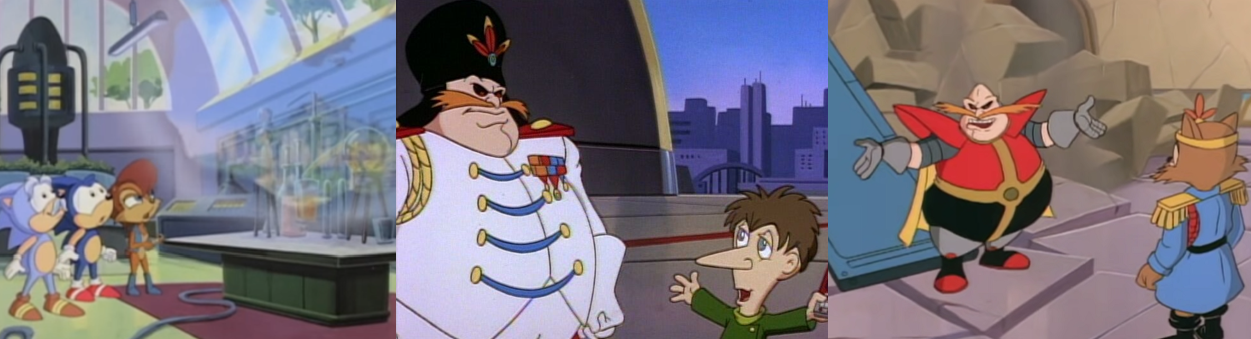
The Background: Sonic the Hedgehog took the videogame industry by storm thanks to SEGA’s aggressive marketing campaign. Sonic the Hedgehog (Sonic Team, 1991) was a huge success and Sonic’s popularity exploded after the release of Sonic the Hedgehog 2. Suddenly, Sonic was everywhere: not only was he included in the Macy’s Day Parade but he also made the jump to television with two concurrent cartoons. After seeing the success that DiC Entertainment had producing cartoons that were effectively little more than half-hour advertisements for Nintendo’s videogames, SEGA of America partnered with DiC to develop an animated series for their super-sonic mascot. To help sell their pitch to ABC, DiC signed Jaleel White for the title role but ABC believed their original slapstick pitch was unsuitable for a Saturday morning slot. Undeterred, producer Robby London simply developed an entirely separateSonic cartoon for the prime Saturday morning slot, giving audiences two very different Sonic cartoons, each with their own tone and animation style. While Adventures of Sonic the Hedgehog (1993; 1996) emphasised over-the-top, meme–worthy, slapstick humour, Sonic the Hedgehog (or “SatAM”) was a far darker take on the franchise. Though both cartoons awkwardly collided when Archie Comics published Sonic comic books, the majority of Adventures’ influence was eventually stripped away in favour of those from SatAM and Adventures is generally regarded less favourably than its darker counterpart. For many, SatAM was a defining aspect of their childhood and impressed with its more mature themes. Although it exhibited only questionable fidelity to the source material, SatAM did, occasionally, include elements from the videogames, with this two-part story being one of the most notable examples.
The Plot: In a bid to stop Doctor Robotnik (Cummings) from conquering the Planet Mobius, Sonic the Hedgehog (White) and Princess Sally Acorn (Soucie) use the legendary Time Stones to travel back in time, only for an error to land them right in the middle of the dictator’s life-changing coup d’état.
The Review: When I was a kid, I used to watch Adventures of Sonic the Hedgehog religiously. Every Sunday morning (as I recall; it might’ve been Saturday…), I would sit and watch it, usually record it, and delight in seeing Sonic’s slapstick antics. Then, one morning, something was different. The entire tone and cast of the show had changed; suddenly, Sonic wasn’t dressing up in ridiculous costumes and acting like a super-fast version of Bugs Bunny (Mel Blanc/Various) and Dr. Robotnik (Long John Baldry) wasn’t a comical, bumbling buffoon. Instead, Sonic was the point man in an outnumbered resistance movement against a far darker, semi-cybernetic dictator. Miles “Tails” Prower (Christopher Stephen Welch; Bradley Pierce) was completely absent in the first episode I watched, “Sonic Boom” (Sebast, 1993), and the bright, zany world of Adventures was replaced with a grim, polluted hellhole. It was a jarring change for me, but I loved Sonic so I quickly adapted. It helped that SatAM opened with an absolutely jamming theme song and that a lot of its presentation was very close to what was happening in Sonic the Comic (1993 to 2002) at the time, and that the visual style of the show and Sonic’s battle against this far more malevolent Dr. Robotnik were so compelling.
Desperate to defeat Dr. Robotnik, Sonic and Sally seek out the legendary Time Stones.
Although SatAM’s second season would later include concurrent narratives, and there was always an ongoing theme of the Knothole Freedom Fighters desperately opposing Dr. Robotnik’s regime, “Blast from the Past” is the only two-part story arc in the series. The first part opens, as many episodes do, with Sonic, Sally, and some unnamed Freedom Fighters on a covert mission in the polluted hellscape known as Robotropolis. Although a brash and reckless egomaniac, Sonic is instrumental to the Freedom Fighters; he’s classified as “Hedgehog: Priority One” by Dr. Robotmik’s SWATbots (Frank Welker), which immediately deviate from their regular patrols to chase him. While this creates enough of a distraction for their unnamed allies to sabotage Robotropolis’s main power grid, their friends are captured and taken to Dr. Robotnik’s citadel, and summarily roboticized. Although the jovial dragon Dulcy (Cree Summer) tries to alleviate the guilt Sonic and Sally feel for this loss by pointing out that all the planning and moxie in the world can’t oppose Dr. Robotnik’s resources or malice, Sonic can’t help but wish they’d fought back harder when Dr. Robotnik first took over, even though they were only five years old back then. Dulcy suggests that they use the legendary Time Stones to travel back in time and fulfil this wish. Sceptical, an exasperated Sally initially shoots down the plan as she believes the Time Stones and their equally mythological home, the Floating Island, are nothing more than a fantasy, to say nothing of the moral and scientific dangers of violating the time stream. However, Sally reluctantly agrees when the clumsy Dulcy reveals that she once crashed into the Floating Island, but she remains sceptical until Dulcy braves a tumultuous storm and crashes the three on the fabled island. Rather than being home to Knuckles the Echidna and the Master Emerald, the Floating Island is represented as a much smaller land mass that houses an ornate palace guarded by two stone gargoyles. Sonic outraces the guardians and causes them to vanish by running himself and Sally off the island. After being rescued by Dulcy, the two enter the palace and navigate a confusing M. C. Escher-esque labyrinth before being confront by the owl-like Keeper of the Time Stones (Curry). Despite Sonic’s blockheadedness, Sally solves the Keeper’s riddle (the answer is “time”) and the Keeper explains how to use the Time Stones’ power.
Unfortunately, Sonic and Sally are too late to stop Dr. Robotnik enacting a destructive coup d’état.
However, despite Sonic’s best attempts to focus only on the palace fountain in Mobotropolis circa 3224, his mind wanders to chili dogs, throwing off their arrival. The two are overwhelmed to find their home lush and verdant and alive, but even more stunned when their younger selves (Mowry and Ridgeway, respectively) wander by. It turns out that Sonic never really grew out of his childish, arrogant ways as his younger self delights in gobbling down chilli dogs and boasting of his super speed, much to the chagrin of the younger princess. Sonic and Sally go straight to Sonic’s beloved uncle, genius inventor, and loveable father-figure Sir Charles “Chuck” Hedgehog (Windom) and reveal the impending threat to the city. Back in this time, Sally’s father, King Maximillian Acorn (Curry), ruled a thriving, technologically robust city thanks to support from his Grand Vizier, Julian. Julian helped Mobotropolis win the “Great War” with his machinery, earning him a promotion to Minister of Science, though he secretly conspires with his long-suffering nephew, Snively (Charlie Adler), to take over Mobotropolis using not only the decommissioned war machines but Uncle Chuck’s Roboticizer machine. As shocked as Sonic and Sally are to discover that Uncle Chuck invented the nightmarish device, Uncle Chuck is horrified to learn this his invention (which was created to help old people “live longer”) is to be perverted into a tool for evil. Although they initially stay avoid their younger selves, they inevitably meet; introducing themselves as “Alicia” and “Juice” and presented as distant cousins, the Sallys despair of their childish antics and Sonic is stunned to find that his younger self is actually faster than him! However, their fun is interrupted by the realisation that they’ve arrived on the eve of Julian’s destructive coup d’état. Uncle Chuck has Sally’s nanny, Rosie (April Winchell), take the kids to safety in Knothole then introduces Sally to her father. Understandably emotional given that her father has been trapped in the “Void” for most of her life, their heartfelt reunion convinces King Acorn to trust Uncle Chuck’s warnings about Julian. Unfortunately, they’re too late to intercede; Julian reprograms the city’s robotic defences to recognise his commands and sends them to capture the inhabitants, including the young Sonic and his friends, before storming into the king’s throne room. Now garbed in his iconic red outfit, Julian rechristens himself Doctor Robotnik, and Mobotropolis “Robotropolis”, much to the anger and horror of Sonic and his friends.
Although they humiliate Snively, Sonic and Sally are faced with a race against time to salvage the timeline.
After a brief recap, part two picks up with Uncle Chuck disabling the SWATbots and causing a distraction so that Sonic can speed Sally to safety. However, they’re quickly imprisoned alongside their younger counterparts and forced to watch from their cell as Dr. Robotnik’s massive mechanical blimp, the Destroyer, spreads a polluting cloud over Mobotropolis that instantly kills all plant life, transforms the once idyllic landscape into a mechanical hell, just like before. Thanks to the schematics of Dr. Robotnik’s citadel on her pocket computer, Nicole (Soucie), Sally directs Sonic in burrowing them to safety, though Dr. Robotnik arrogantly dismisses the potential threat since he’s already imprisoned 80% of the population. Unfortunately, Sonic and Sally are too late to save their younger selves; since their very existence is threatened by this, the two buy themselves some time by having Nicole cause a brief power outage in the Roboticizer. To amuse himself in the meantime, Dr. Robotnik takes great pleasure in banishing King Acorn to the Void, an extradimensional portal where he once banished his rival, the sorcerer Ixis Naugus (Michael Bell). Luckily, the power outage allows Sally to download the machine’s schematics for future reference, but things are exacerbated when they spot the Destroyer heading for the Great Forest and threatening Knothole and, once again, their futures. Faced with a ticking clock, the two blast away to intercept the Destroyer, earning Snively’s ire by stripping him of his hair with a sonic boom and briefly stopping to rescue Dulcy’s mother, Sabina, from Dr. Robotnik’s forces.
Although they fail to save Mobius, Sonic and Sally’s jaunt isn’t a total loss and renews their fighting spirit.
Using a Power Ring for a speed boost and his anti-gravity sneakers, Sonic rockets himself and Sally up to the Destroyer, where even Sonic’s breezy demeanour is strained by Dr. Robotnik’s inexhaustible forces. Luckily, Sabina fends them off and brings the Destroyer crashing to the ground, so Sonic and Sally race back to Robotropolis to save their younger selves. Sadly, Sonic fails to prevent his defiant uncle’s roboticization, meaning his younger self has to endure the horror of watching the only family he has be transformed into a mindless robotic slave, though Sonic assures the grieving boy that Uncle Chuck will be restored in time. Sonic and Sally get the kids to safety and, in the process, Sonic earns Dr. Robotnik’s boundless fury by not only mocking and defying him, but also roboticizing his left arm. After teaching the younger Sonic a thing or two about trashing robots, the kids are brought to Rosie and spirited to the safety of Knothole. Before she goes, Sally makes Rosie promise to never leave the village to avoid her becoming another of Dr. Robotnik’s minions in the near future. With Dr. Robontik’s full force closing in, Sonic and Sally use the Time Stones to return to the future, infuriating the newly-crowned dictator. Although Sonic believes the entire escapade was a waste of time since they never changed the past like they intended, Sally is bolstered by the odds now that they have the Roboticizer plans, and Sonic is left nursing a migraine when he tries to understand how Rosie is still in Knothole…despite being right there when Sally told her not to leave.
The Summary: I’ll be the first to admit that reviewing “Blast to the Past” as an adaptation of Sonic CD is a bit of a monumental stretch. To be honest, the tangential link was enough of an excuse for me to talk about SatAM, one of a handful of cartoons that defined my childhood. While, on the surface, there doesn’t appear to be much of a relation between the two, they actually have a fair amount in common: obviously, the Time Stones appear (though in a vastly different format) and Sonic travels through time (again, in a very different way to Sonic CD), but there’s also shared themes of pollution and time paradoxes at work in the episodes. Sonic and Sally travel to the past, where Mobius and Mobotropolis especially were free from pollution and war, in an attempt to stop Dr. Robotnik before he can rise to power. When they fail in this endeavour, the once lush and thriving landscape becomes a dark, grimy, mechanical hellhole (a “Bad Future”, if you will) and we clearly see the consequences of their time travel onscreen just like in Sonic CD’s gameplay. Again, that might seem like a stretch, but you have to remember how few inspirations SatAM took from the source material. While I was disappointed that we never got Knuckles, the Chaos Emeralds, Metal or Super Sonic in the series (especially the first two in these episodes), it was still fun to see gameplay elements adapted to fit the context of this dark and mature series.
While things get very bleak very quickly, the time travel plot showcases our hero’s vulnerable sides.
“Blast from the Past” is easily one of the strongest arcs of SatAM. For the first time, we get to see what life was like before Dr. Robotnik took over. We’re so used to seeing Knothole and the Great Forest being the one bastion of nature in an otherwise ransacked, almost post-apocalyptic world that it’s extremely poignant to see Sonic and Sally react in awe when they walk the streets of the thriving Mobotropolis once more. The episodes give both characters a chance to show some vulnerability; this wasn’t uncommon in SatAM given how bleak their situation was, but it’s heart-warming (and breaking) to see Sonic reunited with his unroboticized uncle and Sally finally reunited with her beloved and long-lost father. It was also quite fun seeing Sonic and Sally interact with their younger selves; their personalities haven’t changed much over the years, with Sonic being impulsive and Sally being more restrained, but the younger Sonic makes an impression by outpacing his elder (and even referring to Sonic as “old”) and breaking down in tears when his cherished uncle is roboticized before his eyes. Although characterised as a brash, headstrong, and snarky speedster, Sonic showcased some surprising emotional depth in SatAM and “Blast to the Past” emphasises that beautifully. We see his anger at Dr. Robotnik’s heinous actions, his desperation to save the future, and the guilt he feels at having potentially screwed up their best chance of saving the world before it goes to hell. Although functionally unstoppable and capable of physics-bending feats, Sonic isn’t beyond fatigue or weakness. Mainly, this is realised in his inability to sit still, focus, or think of or work to a plan, which is why he and Sally work so well together as she does the thinking and he does the fighting (though she’s perfectly capable of holding her own in a pinch, too).
Dr. Robotnik is at his most malicious in SatAM and this two-parter showcases his rise to power.
As ever with SatAM, the star of the show is the reprehensible Dr. Robotnik. Never before or since has the rotund dictator been portrayed as such a malevolent and spiteful force (well, maybe in Sonic the Comic and obviously in the Archie comics…). SatAM-Robotnik was a serious threat, even when he was doing more comical stuff or being humiliated by his foes. Thanks to his incredible resources and relentless craving for power and conquest, Dr. Robotnik delights in subjecting his captives to the Roboticizer and turning them into his mindless, obedient slaves. Abusive towards his long-suffering nephew, Dr. Robotnik cares only about himself and his insane lust for power. Despite his prominent position of trust and authority alongside King Acorn, Dr. Robotnik has grander designs for himself and easily takes what he wants by force, without any real resistance. This oppressive, suffocating malevolence makes battling Dr. Robotnik an uphill, almost unwinnable battle even when Sonic has the speed and power advantage, and even time on his side as in this two-parter. Ultimately, Sonic and Sally’s efforts to prevent Dr. Robotnik’s coup d’état are met with failure but they are bolstered enough to continue fighting after remembering what they’re fighting for. While Rosie ironically didn’t actually show up in future episodes, “Blast to the Past” led to the creation of the De-Roboticizer and the Freedom Fighters’ attempts to restore Dr. Robotnik’s victims to normal. So, yeah, while it may have almost nothing to do with Sonic CD and vastly reimagines the Floating Island, “Blast to the Past” is still an enjoyable and significant two-part arc. SatAM remains one of the most influential Sonic canons and is still heralded as one of the best cartoons of the nineties. While it wasn’t exactly true to the source material and has, in my view, since been surpassed, I can’t deny my love for the series, especially darker and more introspective episodes like these two, so I’m always happy to return to the series and relive my youth.
My Rating:
⭐⭐⭐⭐
Rating: 4 out of 5.
Great Stuff
Did you enjoy “Blast to the Past”? Were you disappointed by how few elements from Sonic CD were present in the story or were you just happy to see videogame elements incorporated into SatAM? Did you enjoy SatAM as a kid? What did you think to the depiction of Dr. Robotnik’s rise to power? Which of SatAM’s original characters was your favourite and what did you think to Sonic’s characterisation in the show? How are you celebrating Sonic CD’s anniversary this year? Whatever your thoughts on Sonic CD, or SatAM in general, feel free to leave a comment below or on my social media.
Sonic the Hedgehog was first introduced to gamers worldwide on June 23 1991 and, since then, has become not only SEGA’s most enduring and popular character but also a beloved videogame icon and, in keeping with tradition, I have been dedicating the entire month to celebrating SEGA’s supersonic mascot.
Released: 17 October 2023 Developer: Arzest / Sonic Team Also Available For: Nintendo Switch, PC, PlayStation 4, PlayStation 5, Xbox One, Xbox Series S
The Background: After SEGA created a mascotviable enough to rival Super Mario, Sonic the Hedgehog expanded into mainstream popularity with Sonic the Hedgehog 2 (SEGA Technical Institute, 1992) and saw further success with subsequent sequels and his first 3D adventures, After later withdrawing from from console manufacture, SEGA brought Sonic to multiple platforms, but struggled to maintain consistent quality, with even their more enjoyable titles drawing notable criticism. Despite this, SEGA scored a hit when they brought in noted indie developers to work on Sonic Mania (Christian Whitehead/PagodaWest Games/Headcannon, 2017), a much-lauded throwback to Sonic’s heyday. Rather than capitalise on Sonic Mania’s success, SEGA opted to continue with hit-and-miss 3D adventures, primarily because Sonic Mania’s developers wanted to branch out from the Sonic franchise. Still, Sonic Team producer Takashi Iizuka saw the potential for a spiritual successor and convinced Sonic co-creator Naoto Ohshima to return to the series and help develop a new 2.5D adventure. While Ohshima’s studio, Arzest, develop the game’s environments, drawing fromSonic Mania and the classic 2D Sonic titles, Ohshima himself designed new character Trip the Sungazer to add to the classic cast and the developers not only added Amy Rose to the roster but finally brought back obscure bounty hunter Nack the Weasel Fang the Sniper Fang the Hunter after a decades-long absence. Sonic Superstars was also designed and marketed with co-op play in mind and the team expanded the gameplay mechanics by awarded players new abilities when they collected the mythical Chaos Emeralds. Unfortunately, Sonic Superstars released to mixed reviews; while it was praised as a throwback to Sonic’s classic titles and for its colourful visuals, critics disliked the level layouts, multiplayer features, and its unnecessarily aggravating boss battles. Still, the game was bolstered by some interesting downloadable content (DLC) that featured various skin packs and even included the rabbit concept that was ditched early in Sonic’s development!
The Plot: When Doctor Eggman heads to the North Star Islands to transform their giant animals into a powerful Badnik army, Sonic the Hedgehog and his friends follow, only to find the mad scientist has enlisted the notorious Fang the Hunter and naïve local Trip the Sungazer to seek out the legendary Chaos Emeralds and weaponise the natural landscape!
Gameplay: Sonic Superstars doesn’t buck tradition; it’s a 2.5D, sidescrolling action platformer just like the classic 2D Sonic games and with all the traditional tropes you’d expect returning. You take control of one of four familiar faces and race through twelve colourful levels (known as “Zones”), each with anywhere from one to three stages (or “Acts”) within them, freeing woodland critters from Badniks, collecting Golden Rings to stave off death, pinballing all over the place on springs, bumpers, and boost pads, and striving to blast through Acts as quickly as possible. However, unlike in the classic games, you’re no longer penalised if you take more than ten minutes to finish an Act; the timer simply runs out and the game continues, which is good as some of the later bosses take at least ten minutes to battle against, so you’d be dying over and over to time outs if they were still a thing. Another noticeable change is the complete absence of a life system; you’ll hit Star Posts to create checkpoints across each Act and you’ll respawn at these when you inevitably die, but you won’t ever have to worry about running out of lives or continues or getting a game over, which again is good as some of the later Acts and bosses will see you crushed, zapped, or plummeting to your death to an almost spiteful degree. Otherwise, many of the same mechanics are here; you’ll suck in air bubbles to avoid drowning, run through loops, crash through walls, and take multiple paths through each Act, with the higher route usually being the fastest but most dangerous, to finish faster or find goodies. Like Sonic 3 & Knuckles (SEGA Technical Institute, 1994, Sonic Superstars uses save files for your playthrough (though, oddly, you can’t copy your save file) and, like Sonic Generations(Sonic Team, 2011), you can run around a limited hub world between Acts where you can access Acts, bonus Acts, switch characters, and play some tutorials to get to grips with the game’s new mechanics.
Team up with friends and use the gang’s classic abilities to conquer new, but familiar, Zones.
From the start, players can pick to play as Sonic the Hedgehog, Miles “Tails” Prower, Knuckles the Echidna, and, in what’s still a rare inclusion, Amy Rose. The basic controls for these characters are universal: A and B are your action buttons, allowing you to jump, perform the character’s special attack, or Spin Dash; X or Y (if configured) will activate the Emerald Power you select after using the Right Bumper to bring up the selection wheel, and that’s it for button commands. Each character performs the Super Sonic Spin Attack when jumping; holding down the button sees you jumping higher and pressing or holding it a second time in mid-air sees each character perform a signature special attack. Sonic performs the Drop Dash, which I finally found somewhat useful here (though I still miss the Insta-Shield), Tails can fly for a short time (and doggy paddle underwater), Knuckles can glide (and will cling to and climb most walls he glides into), and Amy will swing her hammer in her spin for a super useful double jump and flail it around for a ground attack if you hold the button. If you press down while running, you’ll roll into a ball; if you stand still and press down and A or B, you’ll charge up the Spin Dash for a burst of speed and, while there is no Super Peel-Out here, Sonic’s run greatly resembles it. Because of their individual abilities, you’ll have an easier time with the likes of Tails or Knuckles and even Amy thanks to their mid-air tricks, while Sonic often has to rely on the Emerald Powers to reach higher areas and find secrets. Mostly, the controls and physics work well; they’re not as slippery as some games and everything feels more akin to the classics, though there are still moments where characters slip from precarious footing and struggle to make jumps, but this isn’t helped by some badly placed enemies and hazards. Sonic Superstars can also be played in co-op with a group of friends, but I wouldn’t recommend it; it’s basically like playing Sonic 2 in co-op, with any players that are too slow or who get stuck or who take a different path disappearing from the main action and having to respawn in. There are also no team-up moves beyond Tails carrying a character, which is a shame, but it’s still nice to see it incorporated, even if it’s not very sustainable.
Autoscrolling sections, shoot-’em-up stages, and unique level-changing gimmicks are notable inclusions.
I mentioned the enemy and hazard placement just now and it’s true that Sonic Superstars suffers a bit from this, especially in later Zones, primarily because the camera is a little too zoomed in and the level designers seem to be taking inspiration from Sonic the Hedgehog CD (SEGA, 1993) at times by placing ceiling and wall spikes and Badniks just offscreen. Still, there are times when the mechanics are really fun; there’s some new additions here, such as being shot or blasted onto a background plane, running around loops, grabbing pulleys, or bouncing around inside rings for Ring bonuses, and even some autoscrolling sections. The one in Golden Capital Zone sees you dodging waves of lava, while the one in Frozen Base Zone is effectively a mash up of Sky Chase Zone and a remix of Fantasy Zone (ibid, 1986), with you piloting one of Dr. Eggman’s crafts and blasting at redesigned Fantasy Zone enemies and bosses with A and dropping bombs with B. While things start out very familiar, and many Zones include recycled gimmicks from classic Sonic titles (Lagoon City Zone, for example, recycles just about every underwater gimmick from the previous games and Pinball Carnival Zone and Sand Sanctuary Zone owe a lot to previous casino-theme Zones and Sandopolis Zone, respectively), I mostly enjoyed how these elements were implemented, even if they were very familiar. There are some really unique additions included here, too; Press Factory Zone sees a giant piston in the background smash into the ground and bump you about if you’re not grounded, while Act 2 sees Dr. Eggman’s hovering drone grow closer and closer to detonating every explosive device in the Act unless you find switches to briefly reset the counter. Speed Jungle Zone sees you creating bridges by hitting switches and using nearby butterflies to light up dark areas, Sky Temple Zone incorporates wind gimmicks using fans, Cyber Station Zone sees you travel on electrical currents and expands on Sonic CD’s shrinking mechanic by transforming you into pixelized animals to navigate past dangerous area (with the mouse lines being the most aggravating), and Egg Fortress Act 2 sees you running from the right to the left as the damaged space station is repaired thanks to Dr. Eggman’s time warping machine, which I thought was a really novel idea.
Graphics and Sound: Although I would’ve preferred to see a bigger, more colourful and adventurous sequel to Sonic Mania that continued to use charmingly detailed sprite art, Sonic Superstars may be the best of the 2.5D Sonic titles in recent years. The game perfectly translates the classic aesthetic of Sonic 1 and Sonic CD, especially, into a quasi-3D style, with characters all performing idle poses, victory celebrations, and exuding a lot of personality in the game’s fun, pantomime-like cutscenes. These primarily tell the story of the gang trying to catch up to Dr. Eggman or Fang, clumsy Trip’s efforts to impress her masters and change of heart after being befriended by Amy (you’ll carry Trip around in an Amy-focused bonus Act), and Fang’s delight at tormenting Knuckles. The Acts are also full of fun elements; sometimes, you’ll see other characters racing along in the background and not just baddies like Fang, but Sonic, Knuckles, and Amy, which adds a layer of scope to the game. The large animals of the North Star Islands often show up to help out, hang out in the background, or celebrate with you at the end of the Act, and they’ll pop up on the hub world as well to give a sense of progression. While some Acts can be a bit cluttered at times, with some clashing colour schemes and visuals making it difficult to know where’s safe and what’s a bottomless pit, I had no issues with the game’s visuals; even the various DLC costumes appear in cutscenes, which was a nice touch. To make things even better, the anime cutscenes made famous in Sonic CD and brought back in Sonic Origins(Sonic Team, 2022) return here, which is most welcome, though you can’t watch them back. As much as I like the visuals though, and little touches like the title screen and enemies encountered in Trip’s story changing as you play, I wasn’t impressed by the game’s soundtrack; it’s serviceable enough but failed to make much of an impact, with no tunes staying in my head after I finished, some haunting my nightmares as I struggled to clear the more aggravating bosses, and some actually cutting out due to odd glitches.
While some Zones are quite derivative, the game’s overall visual style is impeccable.
Sonic Superstars evokes the classic games in its Zones, even bringing previously discarded concept art from Sonic 1 to life for the first time, and mixing and matching classic gimmicks with new ones. The game begins with the classic Green Hill Zone archetype, one that incorporates waterfalls, floating boost pads, wall running, and swinging springs to try and mix things up a bit. Speed Jungle Zone owes a fair bit to Sonic’s often forgotten 8-bit adventure, incorporating vines and grinding into the gameplay, while Sky Temple Zone focuses more on tricky platforming on small, moving, or temporary platforms and trying to avoid enemy fire when you’re being blown about by the fans. Pinball Carnival Zone is about where I started to make the most apt comparison for Sonic Superstars’ Zones; they’re very similar to those seen in the Sonic the Hedgehog 4games (Dimps/Sonic Team, 2010; 2012), mashing together classic gimmicks to try and create something new and giving us theme-park levels and snowy mechanical bases. Luckily, this is executed far better here but I wonder if this was a conscious decision to try and make good on some of Sonic 4’s better ideas or just coincidence and laziness, since Sonic games love to reuse the same tropes over and over. For me, this was most evident in Sand Sanctuary Zone, which is just Sandopolis Zone again, but it’s only one Act in the main story this time. Luckily, Press Factory Zone made up for this, being a mechanical obstacle course in Act 1 and a tense face against a fiery death in Act 2. Golden Capital Zone also impressed, despite initially appearing quite bland; there’s a fun rotation gimmick where you end up running on the ceiling with the ground above you and it switches to a lava-infested furnace for Act 2. While Cyber Station could also get very cluttered, I loved the pixelated visuals applied to the character and enemy models; everyone looks like LEGO here and it really made the Zone stand out (and make me wish we could play as those models as skins in other Zones). Frozen Base Zone saved itself from blandness with its random shoot-‘em-up mechanics in Act 2 and I did enjoy how Egg Fortress Zone crumbles around you in Act 1 and unwinds in Act 2, that was really fun, even if it led to some cheap deaths from crushing, spikes, and sudden pits.
Enemies and Bosses: Many of Sonic Superstars’ Badniks are recycled from Sonic 1, Sonic CD, and Sonic 2 though some have been slightly tweaked; Buzz Bombers use sweeping lasers, for example. Choppers, Orbinauts, Slicers, and buzzsaw-wielding Robot Beetles pepper each Act but the most reoccurring classic Badnik is strangely the Batbrain, which appears in Zones that really don’t fit its aesthetic. Still, Sonic Superstars does have some new Badniks on offer; one of the worst, for me, were the Jellyfish Mechas, which float up and down with drill-like appendages on their tentacles. You’re supposed to attack them when these are pointing away, but I seemed to always mess up the timing, and they’re often found floating between bumpers and other gimmicks. I quite like the seahorse-like Soap Bubble Mecha, which is largely harmless but spits out bubbles you can use to boost your jumps to higher areas. The Elephant Mecha, Electrical Discharge Mecha, and Kanga Clangas and Barrel Throwers were all visually very fun, too; the Elephant Mecha is more like a blowtorch, the Electrical Discharge Mecha is a cloud that fires thunderbolts if you don’t destroy it quickly, and Kanga Clangas and Barrel Throwers are kangaroo and sea lion-themed robots that toss explosives and barrels at you. The Trampling Mecha was an odd on for me; this vulture-like Badnik rears up and tries to squish you, so you have to wait for it to appear on your level pane before you can attack, something that happens in many of the boss battles, too. Splats also makes a return here, alongside the Eggrobos in Trip’s story (now able to fire in multiple directions, and from offscreen, just to really wind you up), and you’ll come across multiple disposable Badniks, like Antons and Mole Mechas, that primarily serve as an annoyance but are also used as projectiles in certain boss battles. Speaking of which, while the bosses start out as expanded versions of those seen in Sonic CD and Sonic 3 & Knuckles, sporting multiple phases and attacks, they quickly become very tedious as you’re forced to loiter around, unable to attack, as you wait for your one opening and it can be laborious starting all over again if you make a mistake and fail thanks to the lack of checkpoints, making many of the bosses a rage-inducing chore to fight.
Giant robotic animals will expose the game’s lengthy boss battles.
Like in Sonic 3 & Knuckles, many Act 1’s end with a battle against one of Dr. Eggman’s larger mechanical monstrosities. The first of these is the Mosasaurus, though this is more of a chase; you can hit it when it leaps into the foreground, but just run to the right, avoiding pits, and it’ll crash into a wall, defeated. In Speed Jungle Zone, you face a giant mosquito-bot that can only be damaged by Spin Dashing up the chain it shoots at you. You’ll have to watch for spike pits, projectiles, and its charge attack near the end, too. Pinball Carnival Zone pits you against a maniacal clown merged with a giant bumper; this thing will float around dropping explosives and shielding itself with electricity, and the only way you can make it vulnerable is to jump at the tokens in the arena to flip it around, with these (and the hazards) increasing as the battle progresses. Lagoon City Zone’s robotic guardian is a giant jellyfish that spits out a bunch of minions to distract you, fires its tentacles at the floor, and then electrifies the water you’re standing on before trying to crush you. As you damage it, it’ll also fill the screen with projectiles and strike with multiple limbs. Press Factory Zone’s giant mechanical ape harkens back to Sonic 1’s Final Zone boss; when in the background, it causes giant pistons to come crashing down on you, so you need to find the safe spot to avoid being crushed then wait for it to finish jumping about in the foreground so you can ram it, not unlike the Flying Battery Zone boss battle. Golden Capital Zone’s robot pig can be a bit tricky as it sucks up all your Rings at the start of the fight but it’s actually pretty simple; just race around the rotating arena as it charges you until you can hit the big button on its back, something made ridiculously easy with Tails or Amy thanks to their greater air time. Finally, Frozen Base Zone sees you running along (and against) conveyer belts and battling a bird-like mech that spits targeted mines, ice cubs, and other Badniks that must be avoided before you desperately try to jump up and hit it before it disappears to the background again.
All the Emerald Powers in the world can’t save you from the tedious boss battles.
Speaking of Dr. Eggman, you’ll naturally battle him multiple times in various contraptions. In his first appearance at the end of Bridge Island Zone, Dr. Eggman pilots a massive mech suit that resembles him (a common occurrence in this game) and attacks by spinning its mace-like arms, firing its arms at you, and leaping at you, where it becomes vulnerable. After enough hits, parts of the mecha break away and the torso, now a UFO-like craft, tries to slam into you. Dr. Eggman encases himself in an impenetrable sphere in Speed Jungle Zone; not only does he try to crush you, but he also summons spear-like chains to try and skewer you, but you can lure these to attack his craft pretty easily. When it goes a bit mental and starts spinning around and firing projectiles, hit the blue ones to reflect them back and land an extra hit. Sky Temple Zone features a particularly annoying boss battle that sees you dodging Dr. Eggman’s many buzzsaw projectiles in free fall and hopping to floating debris, avoiding more projectiles, to land a single hit, all while a giant fan looms at the bottom of the screen, with the battle looping until Dr. Eggman tries a kamikaze attack! I never really figured out Pinball Carnival Zone’s boss; it appears to be a roulette-style battle where you need to dodge mines and electrical bursts and use momentum to reach Dr. Eggman, but I just used Amy’s double jump to cheese through his and I suggest you do the same. Sadly, there’s no cheesing the Lagoon City Zone boss; this battle takes place underwater, so you’ll need to grab air bubbles regularly to keep from drowning. First, you must jump up a vertical shaft avoiding projectiles and using the wake from Dr. Eggman’s drills to boost you higher. Soon, Dr. Eggman fires homing missiles and rotating lasers, then the battle shifts to a side-on view and you have to awkwardly avoid incoming attacks to hit Dr. Eggman’s craft, which now resembles a wall. While this one was tough, the Sand Sanctuary Zone boss is where I started to see how tedious the game’s bosses are. Here, Dr. Eggman fires giant stone stabs at you from the foreground and sends Badniks tunnelling towards you; hit the right ones at the right time (in mid-air) and you’ll reflect them back at him, and you can ram him when he pops up from the ground, but otherwise this is a lot of waiting around for a small opportunity to attack. In comparison, the Press Factory Zone boss is much preferable, despite the constant threat of being crushed by its giant piston. Simply avoid its projectiles, jump when the piston comes down to avoid being bounced about, Spin Dash through its legs, and ram the unprotected cockpit whenever you can.
Encounters with Fang, the Metal Fighter, and the finale are particularly lengthy and aggravating.
Of course, Dr. Eggman isn’t the only baddie in Sonic Superstars; you’ll encounter Fang quite a lot, taunting you or firing missiles and lasers at you, completely out of reach until you reach Golden Capital Zone, where you battle him in an autoscrolling section. Piloting a weaponised version of the Marvellous Queen, Fang fires lasers at the ceiling and lava, causing debris to fall and lava to rise, fires three more lasers from drone-like appendages and shields himself with destructible hexagons. Between each encounter, you must dodge flame plumes and falling lava; Fang’s projectiles and dangers increase as the fight drags on, too, making this a hell of a chore. After a battle against Dr. Eggman’s prototype Metal Fighter (which is the “Battle Mode” avatar you created) that draws from the classic Metal Sonic battle from Sonic CD and the Death Egg Zone boss from Sonic 3 & Knuckles (but with more pits and less Rings), and a shoot-‘em-up battle against two redesigned Fantasy Zone bosses (one a cylindrical mech that spits bullets, the other a sphere resembling Dr. Eggman’s face that rains projectiles) and working your way back through Egg Fortress Zone, you’ll have a climatic two-stage battle against Dr. Eggman’s biggest mech yet. In the first phase, you run around a circular platform devoid of Rings dodging his missiles; run around the mech and hit the blue missiles to score a hit, but don’t bother from the front as it’ll block them. The mech also swipes at you with its buzzsaw-like arms and fires an energy wall that you can avoid by jumping through the gap and, after enough hits, it’ll switch to attacking from the foreground (again, like Sonic 3 & Knuckles’ Death Egg Robot). This is the toughest phase of the boss as you need to avoid falling, dodge his hand smashes, hide behind any nearby walls to keep from being trapped in his anti-gravity beam and roasted by his projectiles, and must to dodge the multiple giant lasers, all while striking at a precise moment to land a hit. This becomes especially frustrating as there are no Rings in the arena, no checkpoints between phases, and the fight drags on and on since it takes so long between each attack and before you can land a hit.
Power-Ups and Bonuses: Since the game doesn’t use lives, there are no 1-Up monitors to be found; collecting 100 Rings grants you a Medal rather than an extra life and you’ll find similar Medals hidden in Acts and collected from Bonus Stages for use in the game’s Battle Mode. Monitors, however, are present and will grant you additional Rings, a temporary speed up or invincibility, and a shield that’ll protect you from one non-lethal hazard. The magnetic shield also returns but, while this still attracts nearby Rings to you, it oddly no longer protects you for a hit, severely reducing its appeal as a power-up. As you play, you’ll notice warps appear in Acts; jumping into these will take you to a freefall section where you float about grabbing a few extra Rings and then emerge nearby, effectively acting as a shortcut. Other times, you’ll rocket along grabbing Rings, smashing Badniks, and avoiding touching the environment, search for Fruit that you can cash in on the hub world to play bonus Act Fruit obstacle courses where you grab Rings, pop balloons, and hit tokens to win Medals, and each character also has their own Act to play that serves as a way to get to grips with their mechanics and expand the story. As in Sonic 3 & Knuckles, Giant Rings can be found in each Act; blue ones transport you to a Bonus Stage modelled after the Sonic 1 Special Stages, where you must navigate past warps, change the maze’s rotation, and swap the environment around to grab Medals, and gold ones that take you to the game’s Special Stages.
It’s cool that the Emeralds bestow powers, but most of them are pointless and circumstantial.
Completing a Special Stage awards you with a Chaos Emerald but, this time, these are actually a game-changing mechanic. Each Chaos Emerald bestows you with an Emerald Power, selected with RB and activated with X, which will last for as long as the meter lasts or until you take a hit and will be replenished at each Star Post. As cool as this idea is, I found the Emerald Powers to be more miss than hit; some are only useful in certain situations, like Water, which lets you swim up waterfalls or through underwater sections much more freely, or Vision, which reveals hidden platforms. An indicator will appear to let you know when it’s a good time to use these abilities, but a lot of them are redundant when playing as Tails, Knuckles, Amy, and Trip; Bullet and Ivy, for example, are only really useful for getting Sonic to higher areas outside his skills. The most useful Emerald Power, for me, was the first one you get, Avatar; this swarms to screen with a bunch of (at times distracting) duplicates of your character and can help get a free hit in on bosses. I never used Slow at all in the main game; it was much more prominent in Trip’s story, where you need to use it to slow down rapid hazards to pass by safely. Perhaps the most disappointing Emerald Power was Extra, which grants each character a new special ability, but I only found two to be of any use; Sonic gets a stunted Homing Attack, Tails swipes with his tails, Knuckles gets a projectile punch, Amy tosses her hammers like in Sonic Origins, and Trip throws bouncy fireballs, with these latter two being the only ones I found beneficial.
Additional Features: There are thirty-eight Achievements in Sonic Superstars, with eleven awarded after clearing each Zone, seven awarded after using each Emerald power, one for clearing any Act with a friend, and one for collecting all seven Chaos Emeralds. You can earn five Achievements for destroying 100 enemies with each character’s special attack (so, 100 enemies with the Drop Dash, 100 while gliding, etc), one for finding and destroying the special Golden Badnik in each Act (though be warned as you’ll have to destroy it again, or restart the Act, if you lose a life after destroying it), one for collecting 100 Medals from Bonus Stages, and one for finishing Frozen Base Zone’s shoot-‘em-up section without taking damage. Your Medals can be spent in the game’s shop; here, you can purchase heads, torsos, arms, legs, and spray paint for your Metal Fighter, a custom robot you use in the game’s Battle Mode. While parts for metal versions of the five playable characters exist, the shop is really expensive, so you’ll need a lot of Medals to create classic characters like Metal Sonic and Metal Knuckles, and the Battle Mode isn’t that great. You battle friends or CPU-controlled robots in three arenas, either to the death, while avoiding missile bombardments, or collecting items to win, using X to attack with an electrical burst and being underwhelmed by the entire thing. Although you can access additional skins for this mode (and the main game) via DLC, there are no Achievements tied to the Battle Mode, so I’d just avoid it; there’s a Time Attack mode as well, but again there are no Achievements associated with this.
Snag the Chaos Emeralds, endure Trip’s ridiculously hard story, and take on the arduous true final boss.
As mentioned, you’ll warp to Special Stages by finding Giant Rings. These are pretty simple, unique bonus areas where you have to tap and hold A to latch on to glowing blue orbs, boost points, or Rings to chase after a Chaos Emerald. You can latch onto mines, too, but these will explode to slow you down and you’ll need to avoid crystalline structures and collect Rings for more time. While the later ones can get very challenging, it’s not too difficult to get all seven Chaos Emeralds, which unlocks the final Emerald Power, where you’ll turn Super after collecting 50 Rings and selecting the ability from the wheel. After clearing the main story, you’ll unlock Trip as a playable character and “Trip’s Story”, which picks up where the main story ends and sees Trip battle through remixed versions of each Act, encountering an army of Eggrobos led by a primary Eggrobo. Trip has all the same abilities as the other characters in addition to a double jump and the ability to cling to walls and ceilings, which is incorporated into her Acts. Her Super form is also a flying, fire-breathing dragon that absolutely breaks the game, but its advantages are offset by her story being so damn hard. Acts are redesigned to have more enemies, more hazards, and more bottomless pits, as well as required more Emerald Powers to bypass obstacles. Her bosses also seem tougher, with new attacks in their arsenal; the Eggrobo takes Dr. Eggman’s place until the end, where you must battle Fang in a gruelling final boss full of one-hit kills and frustrating sections that nearly had me rage-quitting! Complete “Trip’s Story” and you’ll get an Achievement and access to the true final boss, the Black Dragon, in a battle that’ll take at least ten minutes to complete. This sees you, as Super Sonic, smacking back blue comets, avoiding instant-death black holes, ramming the dragon’s chest, and tearing your hair out trying to hit five incoming projectiles with frame-perfect timing as the game suddenly introduces quick-time events! Not only does the boss constantly hide in the background, but its attacks are completely random, your opportunities to hit it are ridiculously limited, and you’ll burn through Rings if you keep tapping the Boost button. Rings randomly rain from the sky and Sonic’s friends will randomly appear to offer more, but this and the rage-inducing fight against Fang’s mech cast a dark shadow over the whole game for me that ruined the entire experience.
The Summary: I was surprised when I first saw the announcement of Sonic Superstars; although disappointed that we weren’t getting Sonic Mania 2, I was cautiously optimistic, especially as it had that classic Sonic aesthetic, included a playable Amy and the welcome return of Fang, and incorporated the Chaos Emeralds in a new, more practical way. Sonic Superstars definitely makes a great first impression; it ticks all the nostalgia boxes and is fun to play, with lively, animated characters, bright and colourful Zones, and challenging (but not impossible) Special Stages. I loved seeing all the little details in the backgrounds, watching the hub world change, and seeing the story unfold; I even enjoyed the recycled gimmicks from old games, even if I was disappointed by the Badnik variety. Soon, though, cracks started to appear; Acts ran a bit too long or strangely short and bosses started to become a chore as I was left standing around, watching the timer run out, waiting for the game to let me attack. The main reason for this, of course, is that the Emerald Powers would decimate most bosses but I think a compromise could’ve been reached. At least speed up or tone down the waiting time between the boss’s attacks, or maybe even disable Emerald Powers altogether for the fights. But it was those final battles against Dr. Eggman and Fang’s giant mechs and that random-ass dragon that pulled the rug right out from Sonic Superstars. It’s bad enough that you must beat “Trip’s Story” to unlock the final boss; it’s bad enough that “Trip’s Story” is cheap as hell with its pits and hazards; but to put insta-deaths in the boss fight? Seriously, it can take five minutes to reach Fang’s second phase and you can die five seconds into it, meaning you have to do the whole thing all over again. The Black Dragon fight may be the worst Super Sonic fight I’ve ever played, as well, which is a shame as the game was doing so well until those final battles; I could even forgive the drawn out nature of the previous bosses if Sonic Superstars had stuck the landing but, sadly, it drops the ball right at the end, leaving a sour taste in the mouth. Yes, it’s a beautiful game with lots of fun elements, but that just makes its flaws all the more glaring; I really hope SEGA patch the bosses to make them more enjoyable, but I wouldn’t hold my breath on that.
My Rating:
⭐⭐⭐
Rating: 3 out of 5.
Pretty Good
What did you think to Sonic Superstars? Did you enjoy the new Emerald Powers or, like me, did you find them to be a missed opportunity? What did you think to Trip, her gameplay and her character arc? Did you also find the bosses arduous and aggravating? Does this game have the hardest, most unfair bosses of any Sonic title? Did you play the game’s Battle Mode? Would you like to see Trip make a return in a future game? How did you celebrate the Sonic franchise this month? Whatever your thoughts on Sonic Superstars, leave a comment below or on my social media and go check out my other Sonic content.
Sonic the Hedgehog was first introduced to gamers worldwide on this day back in 1991 and, since then, has become not only SEGA’s most enduring and popular character but also a beloved videogame icon and, in keeping with tradition, I have been dedicating the entire month to celebrating SEGA’s supersonic mascot.
Released: 7 October 2010; 15 May 2012 Developer: Dimps / Sonic Team Also Available For: Mobile, Nintendo Wii, Ouya, PC, PlayStation 3, PlayStation 4, PlayStation 5, Shield, Xbox One, Xbox Series S, Xbox Series X
The Background: In 1991, after much development and strategic planning to create a mascoticonic enough to rival Super Mario, SEGA introduced gamers to Sonic the Hedgehog. Sonic’s initial success (thanks, largely, his debut game being bundled with the Mega Drive) exploded into mainstream popularity with Sonic the Hedgehog 2 (SEGA Technical Institute, 1992) and, from there, the sky seemed to be the limit. So big was Sonic’s blockbuster third outing that it was split into two parts to save costs and meet deadlines; nevertheless, Sonic 3 & Knuckles(ibid, 1994) is widely regarded as one of the best of the classic 2D Sonic games, though SEGA strangely followed this success with several lacklustre spin-offs before transitioning to 3D in 1999. By 2010, Sonic had appeared in around sixty titles, with SEGA outsourcing their supersonic mascot to Dimps for the Sonic Advance series (2001 to 2004), which seemed to be the closest fans could hope for a Sonic 4. Conscious of the demand for a classic Sonic experience, SEGA again teamed with Dimps for a secret project originally codenamed “Project Needlemouse” in a nod to Sonic’s origins. Sonic 4 was conceived of as a throwback title, one that would mix modern elements with the classic formula, and incorporate gyroscope functions for mobile players. Episode I released to mixed reviews; despite criticisms of the poor physics, the game was a commercial success and development began on Episode II, with the specific intention to introduce new elements. With the digital re-release of the celebratedSonic the Hedgehog CD(SEGA, 1993) looming, Episode II was developed to tie up loose threads from that game, as well as introducing team-based mechanics by including Sonic’s sidekick, Miles “Tails” Prower. Episode II was also met with mixed reviews; while largely seen as an improvement over Episode I, the boss battles and level designs drew criticism. Although players could access a side story with both titles, Episode Metal, plans for a third entry were mysteriously abandoned and the game has largely been discarded by all, especially after more fitting throwbacks to the classic era were laterreleased.
The Plot: Doctor Eggman is back, having refined some of his past creations and seeking to conquer new lands with the Chaos Emeralds. When Sonic inevitably arrives to stop him, Dr. Eggman calls in Metal Sonic to hold off his foe while he again works to harness the power of Little Planet.
Gameplay: In the tradition of the classic Sonic titles, Sonic the Hedgehog 4 is a 2.5D, sidescrolling action platformer in which players blast through ten levels (known as “Zones”), with most having three stages (or “Acts”) each, culminating in a boss battle against Dr. Eggman or Metal Sonic. Fundamentally, the basic controls are as familiar as ever; players can pick up speed to blast through Acts, spinning to crash through Badniks, walls, and acquire power-ups with the A or B button, or charge up a Spin Dash by pressing down and either A or B. Oddly, the Spin Dash is actually quite nerfed and doesn’t give you the usual speed boost you’d expect compared to simply running, and Sonic uncurls when flying off curves and springs, leaving him vulnerable to attack. However, this is somewhat explained by the incorporation of the Homing Attack; by pressing A or B after a jump, Sonic will fly towards the nearest target (“helpfully” indicated by an onscreen reticule and targeting sound), which is all-but required as you chain together Homing Attacks to cross gaps. In Episode II, the controls are slightly expanded; here, Tails constantly follows you around, snagging Golden Rings and bopping Badniks, and can be called to your side at any time by pressing the Right Trigger or performing one of the three new Tag Actions with X. Sonic and Tails can either curl up into a massive ball to break through walls with the Rolling Combo or Tails can indefinitely swim Sonic around underwater with the Submarine Combo or briefly carry him with his helicopter tails with the Copter Combo. Each has different strengths and weaknesses; the Rolling Combo is quite fast and unwieldy, the Submarine Combo can be a bit slippery to control, and the Copter Combo only allows for a short burst of flight, though it’s very handy to use to save you from one of Episode II’s many bottomless pits.
Episode I poorly apes the original classics, marrying bad physics with wonky mechanics.
The basic gameplay mechanics are also very familiar; players must collect Golden Rings to stave off death, with the Rings scattering when you’re hit so you can snag them to protect yourself, in addition to swallowing air bubbles to keep from drowning. Acts are played against a ten minute time limit, after which players will lose a life, though you can earn extra lives by racking up points, collecting 100 Rings, or breaking open 1-up monitors. The more points you acquire, and the faster you finish Acts, the more likely it is you’ll earn continues to carry on playing after you’ve exhausted your lives, and you can respawn from checkpoints by running past Star Posts. Zones are filled with robotic enemies and cheap obstacles to sap your Rings and lives, however, from spikes jutting out of floors, walls, and ceilings, to bottomless pits, crushing hazards, and a massive wall-like drill machine that relentlessly chases you down. In Episode I, you’ll play through Zones heavily inspired by the classic Sonic games, meaning you’ll run through loops, mobius strips, jump to moving or temporary platforms, press switches to open doors, and ricochet all over the place on bumpers, springs, bouncers, and steam vents. A few new gimmicks are also present, though; Sonic can swing from vines and zip lines in Splash Hill Zone, ride playing card bridges and cross flipping cards in Casino Street Zone, awkwardly run on giant cogs in Mad Gear Zone to cross tracks, and light dynamite and ride mine carts in Lost Labyrinth Zone. It’s this latter Zone that has some of the most frustrating elements of Episode I, however; not only is it full of water that threatens your life and slows you down and all the same gimmicks as Labyrinth Zone, but you must also run across giant balls in Act 1, carry a flaming torch to light the way in Act 2 (including an annoying light puzzle that can easily cause you to time out if you don’t light the torches in the right order), and struggle with an underwater maze and some bizarre tilting mechanics in Act 3. Indeed, Episode I suffers greatly by its reliance on the original games, especially the first two, and its obnoxious use of Homing Attack chains; every Zone is simply a remix of those seen in Sonic 1 and 2, with a few things shuffled about and some sluggish, clunky physics thrown in to sour the experience.
Episode II expands the gameplay to include tag-based mechanics and fun flying sections.
Episode II addresses many of the issues with Episode I, providing more unique gimmicks and reimagining of old gameplay mechanics along with new elements that can be both enjoyable and frustrating. The Spin Dash pads from Marble Garden Zone are back, for example, and there are now warning signs alerting you to bottomless pits; tilt mechanics are gone, replaced by platforms you can hit with the Homing Attack to make horizontal or springs, and there’s less reliance on Homing Attack chains and more emphasis placed on the Tag Actions. This is especially true in White Park Zone, where you’ll need to make ample use of the Submarine Combo to navigate the ice-cold waters, and Sky Fortress Zone, where you’ll have to expertly use both the Homing Attack and carefully-planned execution of the Copter Combo to cross gaps and avoid spiked ceilings. This Zone also sees the return of the Tornado in a very Sky Chase-inspired sequence; Sonic can now perform the Homing Attack from the Tornado’s wings and you can barrel through obstacles with X, though this’ll leave Tails dizzy for a few seconds. This was a fun autoscrolling section that focused more on avoiding Metal Sonic’s attacks and minions and trying to not get crushed by hazards but, like much of Episode II, it does go on for some time. Zones are much bigger with more varied paths, which is a good thing, and give you lots of options to use the Tag Combo or roll snowballs or take oil slides to different areas, but things can get quite aggravating due to their length and the eventual number of cheap instant deaths. Some Zones uses their gimmicks in interesting ways; Oil Desert Zone, for example, mixes together elements of Oil Ocean and Sandopolis Zone, including quicksand, rising sand you must outrun, and the aforementioned oil slicks but you’ll also lose traction on oily surfaces and these can even briefly be set alight! Sky Fortress Zone makes liberal use of propellers and wind to blow you about, rocket boosters to fry you, and chain-link fences littered with explosives for you to run across. White Park doesn’t just see you swimming through icy water, ploughing through snowdrifts, or snowboarding on avalanches but also includes a rollercoaster aesthetic, which sees you racing along at high speeds and springing to the foreground and background in a fun (if, at times, disorientating) mechanic, while Sylvania Castle Zone makes use of destructible ruins, water, springs, rotating platforms, and shortcuts across the water’s surface like in Hydrocity Zone.
Graphics and Sound: Sonic the Hedgehog 4 opts to ditch the classic sprite art (except, bizarrely, for loading screens and certain icons) and go for a sleek, plasticine aesthetic that seems to be trying to bridge the gap between the classics and the then-modern games but ultimately ends up being quite an unsightly, unnecessarily shiny, and cluttered mess of colours, especially in Episode I. Sonic takes far too long to get to top speed here and looks daft when he does; every movement feels like you’re underwater and the screen is zoomed in a little too close, making it difficult to see what’s ahead of you. Sonic has his usual idle poses and looks up cheerfully enough, but this is also slow and doesn’t even scroll the screen; the sound effect of his Spin Dash is also wrong, with the “release” sound used for the ”wind up” and vice versa, and all of the game’s story is told through the in-game manual and a couple of simple, pantomime-like cutscenes that are just ripped off from the first game. Although many of the same sound effects are recycled for the in-game action and menus, the soundtrack is actually pretty good; it’s stronger in Episode II, but even Episode I has some catchy tunes going on, especially the boss theme. Each Act also has slightly different gimmicks and colour palettes to mix things up, and there’s even a world map where you can freely choose which Zone and Act to play, though I disliked that the game automatically returns you to this screen after you clear an Act unless you press Y to play the next Act.
Episode I can be quite cluttered and fundamentally cripples Sonic’s momentum.
Episode I is, however, an unsightly mishmash of conflicting effects and colours. There is a lot going on in the foregrounds and backgrounds, especially in Mad Gear Zone, which takes Metropolis Zone and ups the ante to eleven, with pistons and gears and steam vents and moving parts cluttering up the screen and making it difficult to see enemies, hazards, and even the way forward. It’s a shame as I quite like the redesign given to classic Zones like Green Hill and Labyrinth Zone, with a greater level of detail and lighting applied to make them pop and feel “busier” than before with the inclusion of waterfalls and crumbling effects. However, that doesn’t change the fact that it looks and feels like you’re playing with toys or plasticine; everything is unnecessarily busy and lacks the charm of traditional sprite art, meaning there’s no “weight” to anything. This isn’t helped by the dreadful physics; Sonic is constantly struggling against gravity, loses all momentum when hitting the ground after flying through the air, and can easily walk up slopes and loops without fear of falling. If you play fast and hard, you can avoid much of this, but Zones like Lost Labyrinth force you to slow down, and Casino Street Zone’s curved surfaces lose all their appeal when you can just trot up them without curling into a ball or using the Spin Dash. The Homing Attack is also finicky, stuttering when multiple targets are onscreen and sometimes causing you to drop to your death with it fails to lock-on. Finally, Episode I just feels like a cheap and thrown together knockoff; five Zones and one playable character, with no two-player options and very few new gameplay options, make it feel less like a continuation of the classics and more like a reimagining for the mobile generation (indeed, I argued at the time – and even now – that the game might’ve been better served being titled Sonic the Hedgehog HD).
Episode II is visually far more interesting and unique, and handles far better.
Episode II is, technically, a vast improvement over its predecessor; the menu screens are more detailed and lively, the physics are far more polished (Sonic doesn’t always uncurl off a ramp and no longer feels floaty and heavy), and the soundtrack is even better, boasting catchy tunes and a remixed boss theme that kept me invested even at the game’s most frustrating sections. The world map has been cleverly expanded, Sonic’s running animation is far better, and the addition of Tails really adds to the gameplay. Unfortunately, Zones are still quite cluttered; White Park Zone, especially, can be very busy with all the foreground and background elements overlapping, but I enjoyed how they retained different times of day and the looming presence of the mechanised Little Planet or Metal Sonic in the background of many Acts. In fact, every Act has something interesting happening in the background; you can see the rollercoaster and theme park in the background of White Park Zone: Act 1, drilling platforms and machinery at work in the background of Oil Desert Zone, and holographic screens and foreboding machinery all over the gravity-skewing Death Egg mk. II Zone. Episode II incorporates far more cutscenes, with them being similar to those of Sonic 3 & Knuckles, but to the game’s detriment; you’ll have to sit through numerous unskippable scenes of Sonic and Tails being taunted by Metal Sonic or Dr. Eggman getting his newest mech ready to battle you, which can make replaying these sections after failing a real chore. However, I really liked the way Episode II presented far more unique Zones; yes, there are influences and borrowings from previous mechanics here, but it feels like some actual effort went into giving the new Zones distinct identities rather than being rip-offs of previous efforts, and the gameplay experience was far more enjoyable here, even if the difficulty has spiked somewhat as a payoff. Indeed, hazard and enemy placement and Zone construction seems to take a leaf out of Sonic CD’s playbook, with many high-speed paths running you head-first into danger and awkward platforms, though it’s nowhere near as slapdash as in Sonic CD and seems like a balanced marriage of all five of the classic 2D Sonic titles.
Power-Ups and Bonuses: If you’ve ever played a Sonic game before, you’ll know exactly what’s on offer here. In addition to the life-preserving (and granting) Golden Rings, you can break open monitors to earn an extra ten Rings, grab a bubble that will protect you from one hit, a temporary speed up, and a briefly period of invincibility, as well as the odd extra life monitor. Sadly, none of the elemental shields appear here, neither does Sonic’s insta-shield, and there are no new or returning additional power-ups with the exception of Episode II’s “Special Combination” item box. These are pretty rare (I only found two throughout my entire playthrough) but see Sonic and Tails bounce across the screen, racking up points and destroying all onscreen enemies as you tap A and being showered with Rings, not unlike the “Team Blast” function of Sonic Heroes (Sonic Team USA, 2003). Episode II’s Special Stages also include the new “Combination Dash” pickup, which tethers Sonic and Tails together to allow them to pickup more Rings, a clunky mechanic that relies on momentum as much as your current speed.
Enemies and Bosses: When playing Episode I, you may be equal parts excited and disappointed, depending on your nostalgia for the classics and desire for fresh Sonic content, by the enemy selection on offer. Every Badnik encountered is ripped straight from Sonic 1 and 2, with only the Batbot and Bubbles returning from Sonic 3 & Knuckles. This means you’ll be bopping Motobugs, smashing Buzzers, dodging spiked balls thrown by Orbinauts, and cursing with frustration when you run head-first into Shellcracker’s clawed fist or Slicer’s annoying bladed projectiles. Episode II continues this recycling of classic Badniks, primarily focusing on enemies encountered in the old Wing Fortress Zone, but also includes a bunch of brand-new Badniks for you to go up against. Some of these are intimidating in their size; Snowy the massive mechanical polar bear is almost akin to a mini boss as it takes a couple of hits to destroy while giant robotic Sandworms will burst from the sand in a surprise attack. Others, however, are more aggravating: Flamers can set fire to Oil Desert Zone’s oil slicks, the dung-beetle-like Scarabesque always seem to sap your Rings with their explosive balls, and the seal-like Steelions will be the bane of your life in White Park Zone’s waters as they flash-freeze the nearby area and cause you to drown. Each Badnik you destroy releases a furry woodland critter, with a whole bunch being freed after boss encounters, nets you some points, and can be used to cross gaps with your Homing Attack but don’t get too cocky as some will sprout spikes to ruin your chain and send you plummeting to your death.
Episode I recycles classic bosses, adding new attack patterns and strategies to them to mix things up.
After clearing each Act of every Zone, you’ll have to do battle with Dr. Eggman (and/or, in Episode II, Metal Sonic). In Episode I, there are five boss encounters, with all of them being recycled battles from Sonic 1 and 2 but with a new coat of paint and an extra “pinch” mode after you deal enough damage. First up, you’ll once again battle Dr. Eggman in his classic (and overused) Egg Wrecker; as before, you need to attack Dr. Eggman’s craft while avoiding his massive wrecking ball, which is a lot easier now that you have the Homing Attack and a higher rebound after landing a hit, meaning it’s simple to put him down even when he spins around and tries to crush you with the ball. Casino Street Zone revisits the Egg Claw boss; again, you need to run up the pinball table-like arena or use the bouncers to attack Dr. Eggman, this time while avoiding a claw-like appendage and an electrical shield that will damage you on contact. In Lost Labyrinth, you’ll again have to chase after Dr. Eggman’s Eggmobile, avoiding spikes and drowning, until he locks you in an enclosed arena. Here, he summons a series of horizontal and vertical columns that will crush you if you’re not careful, forcing you to quickly hop up and target him as he hides in a safe corner for easily the most aggravating boss of the game. Finally, in Mad Gear Zone, Dr. Eggman busts out a new version of the Egg Bouncer; as in Sonic 2, you’ll need to watch out for the mini Dr. Eggman bubbles that detach from his craft, which become a deadly hazard in the second phase. In this section. The game takes a page out of the Sonic Advance 2 (Dimps/Sonic Team, 2002) bosses and forces you to run at Dr. Eggman, avoiding spiked balls and his erratic duplicates to land hits. As if that isn’t bad enough, you’ll have to battle all four bosses in their “pinch” phases again in the secret final Zone, E.G.G. Station, in a boss rush. Luckily, there are Rings and checkpoints between each bout, though they’ve also got added hazards thrown in, such as moving platforms in the Egg Wrecker section and additional projectiles in the Egg Bouncer section.
Episode II‘s bosses are larger and more complex but long-winded and tedious at times.
Episode II is once again a double-edged sword when it comes to bosses; while they’re largely far more unique and offer more of a challenge, they’re long, tedious, and involve a lot of waiting around. Episode II takes inspiration from Sonic CD for its bosses, giving them complex attack patterns and more visually interesting and tricky pinch phases, which is either a good or a bad thing depending on how patient you are. In Episode II, you’ll battle Dr. Eggman twice; in Sylvania Castle Zone, he pilots the Egg Serpentleaf, a massive plant-like mech that tries to swat you with its many tentacles and shields him behind a spiked bud. You’ll need to use the Copter Combo to avoid being smacked and land a few hits on Dr. Eggman, which will eventually cause more tentacles to appear and the mad scientist to blast the arena with a massive cannon. You’ll next encounter him in Oil Desert Zone in an even more irritating boss battle; Dr. Eggman assembles a massive mech out of scrap metal and you must pursue him up a garbage disposal, dodging his buzzsaws and the crates he drops (which thankfully aren’t instant-kill hazards but can contain spikes or bombs) and smacking his cockpit when he appears. When you reach the surface, the Egg Scrap Mech rapidly jumps between the foreground and background before trying to crush you; you’ll need to hit its feet with the Rolling Combo to stun it and finish off this pain in the ass boss. The other two boss battles are against Metal Sonic; like Sonic CD and Sonic Advance 2, these are auto-runners and autoscrollers. In White Park Zone, you must race towards Metal Sonic and attack him, then dodge his charge attack (either by jumping or springing to the foreground or background) and hop over the electrical traps he lays for you. After a few hits, he’ll start destroying the rollercoaster track so you’ll have to take care not to fall when attacking him. In Sky Fortress Zone, Metal Sonic pesters you in his Metal Carrier and then battles you directly, blasting electrical bolts that you need to dodge to smack his cockpit. He’ll then face you head-on, firing energy beams that you need to avoid and then jettisoning booster rockets that can crush you if you’re not careful. This can be a very annoying boss battle if you fail as there’s a lot of downtime at the start and between phases; while you can easily amass 100 Rings for an extra life, it doesn’t help with the frustration that can build in this encounter.
Sonic’s return to the Death Egg is either overly familiar or erratically tough, but always an uphill battle.
Once you’ve cleared every Zone and bested Dr. Eggman’s boss rush in Episode I, you’ll face a final confrontation with the mad scientist in a refurbished Death Egg Robot. This is easily the most tedious and frustrating boss battle of Episode I as the Death Egg Robot takes nearly thirty hits to destroy and the battle involves a lot of waiting around. To start with, it’s exactly the same as in Sonic 2 but easier thanks to you having Rings and the Homing Attack; simply stay away from the mech, attacking its torso and avoiding its rocket arms, until it starts to malfunction. In this phase, the Death Egg Robot cannot be directly attacked; you need to quickly dash under it as it hops about and then use the Homing Attack to blast one of its rocket arms back at it, avoiding the sporadic laser blasts as you go, to land a few precious hits. Once you’ve done this enough, Dr. Eggman will try one last attack, forcing you to quickly dodge out of the way and land the finishing blow before you’re dropped to your death. In Episode II, you’ll rush at Dr. Eggman and Metal Sonic aboard the Death Egg mk. II; you need to get past the invulnerable Dr. Eggman and ram Metal Sonic a few times, avoiding the giant energy balls unleashed, before racing against your robotic doppelgänger like in Stardust Speedway, only this time with more doors to bash through. Finally, you’ll battle Dr. Eggman’s Egg Heart at the heart of the mechanised Little Planet; this battle is fought on constantly rotating mechanical rings that will burst with electricity, forcing you to quickly hop between them and ram Dr. Eggman’s cockpit. The more damage you do, the more erratic the rings move and the more dangerous the hazards become; Dr. Eggman even erects an energy shield that you’ll need to break with a Rolling Combo, making for a far more unique but equally frustrating final boss encounter.
Additional Features: There are twenty-four Achievements to earn in Sonic 4, twelve for each Episode, and they’re pretty basic, for the most part. You’ll get an Achievement for clearing the first Act of each game’s first Zone, one for clearing each game, one for completing first Act of each game’s first Zone in a strict time limit, and one for collecting first one and then all the Chaos Emeralds. In Episode I, you’ll get an Achievement for defeating 1000 enemies and accumulating 99 extra lives, while in Episode II you’ll add to your Gamer Score by playing as Tails fifty times and performing the Rolling Combo. Each Act in Episode II also hides a Red Star Ring; collect them all and finish the game for another Achievement, and upload your best scores in each Episode for another. I mentioned Chaos Emeralds just now and, as you’d expect, the seven gems are collectible in each Episode. You’ll earn them by beating Special Stages, which are accessed by finishing Act 1 to 3 with fifty Rings and entering a Big Ring, but the Special Stages vary drastically between each Episode. In Episode 1, they’re based on Sonic 1’s Special Stages, featuring a floating maze filled with Rings, bumpers, and exit pads; you need to collect Rings to lower barriers and reach the Chaos Emerald before the time runs out, collecting time bonuses and making use of the ‘Retry’ option in the pause menu if you’re sensing failure. As bad as Sonic 1’s Special Stages were, these are far worse; you rotate the maze here, not Sonic, which is extremely awkward and disorientating. Sonic can also jump but all this does is shake the screen in a nauseating way and, while you can replay the Special Stages from the world map, you can only retry those you’ve beaten and you must enter a Special Stage from a different Act to get a different Chaos Emerald.
Conquer the aggravating Special Stages or take on a harder challenge in Episode Metal.
In Episode II, the Special Stages are redesigned and now influenced by the half-pipe stages from Sonic 2. Here, Sonic and Tails must collect a set number of Rings to progress, dodging bombs and electrical hazards and making use of the awkward tether mechanic in the final two Special Stages. While these are a lot more enjoyable and it’s much easier to retry if you’re struggling, they can get really annoying as the difficulty increases; you’ll need pixel-perfect timing and to make good use of the boost and momentum to snag all the Rings and the Chaos Emeralds here. In both Episodes, collecting the seven Chaos Emeralds allows you to transform into Super Sonic once you collect fifty Rings and double press A or B. this makes you super fast and completely invincible unless you’re crushed or drop down a pit, though it only lasts for as long as you hold Rings. Unlike Episode I, Episode II also features a multiplayer component; you and a friend can play the game in co-op like in Sonic 2, either locally or online, though this is strangely the only way you can play as Tails alone. Finally, completing Episode II unlocks Episode Metal, a side story in which you play as Metal Sonic and work your way backwards through remixed versions of Episode I’s Zones with all new cutscenes setting the stage for Metal Sonic’s return. Despite some new animations and sound effects, Metal Sonic is simply a reskin of Sonic and doesn’t have any new attacks; he also has to smash Badniks as well, which is a bit odd but I guess speaks to his superiority complex. There are no Achievements tied to Episode Metal, which is significantly harder then either Episode I or II; enemies, hazards, instant-death traps, and Act layouts have all be increased, altered, and made far more challenging, though there are sadly no bosses to contend with here, meaning this is more of a distraction for players who have mastered the base games.
The Summary: Honestly, calling any title Sonic the Hedgehog 4 was going to be asking for trouble; Sonic the Hedgehog HD or Sonic Returns or Sonic Redux would’ve been far more appropriate titles and would’ve tempered expectations for these sadly unfinished titles. It just baffles me how SEGA thought it was acceptable to go from the sprawling, multi-character epic that was Sonic 3 & Knuckles to this tame, cheap, stripped down bastardisation of the first two games. Playing Episode I alone is a joke; the game is functionally playable but visually a mess, with wonky physics, a lack of replay value, and too many recycled gimmicks and elements from Sonic 1 and 2. Thank God for Episode II, which fixes many of these issues; Sonic controls a lot better, the Zones are far more visually interesting and unique, and the bosses have more effort put into them. The team-based mechanics were fun; they could’ve easily been overused but they were enjoyable when you weren’t being asked to fly over bottomless pits, though I’m confused as to why there’s no option to play as Tails in the lead. The inclusion of Episode Metal was also a nice touch, though I think more could’ve been done with this. At least give Metal Sonic his electrical boost or some new gameplay mechanic, or have him face off against Sonic, rather than just being relegated to a hard mode add-on. Truthfully, I am sad we never got the planned Episode III as it’s possible that more unique elements would’ve been added in, including a playable Knuckles the Echidna and other more engaging elements, but sadly we’ll never know. As a complete package, Sonic the Hedgehog 4 is widely inconsistent; in addressing errors from Episode I, the game just feels like a disjointed mess, even when it’s doing something new and enjoyable. It’s obvious the developers tried to address these issues in Episode II, providing a more challenging and versatile gameplay experience, but at the cost of upping the difficulty in some areas and making it equally as frustrating as Episode I but in different ways. Ultimately, Sonic the Hedgehog 4 is a disappointment; it not only fails to live up to its title, but also fails to match the quality of Sonic’s Game Boy Advance titles. I can understand why SEGA distanced themselves from it (though not its hefty price tag), though luckily these mistakes were atoned for in the years to come with better, more enjoyable throwbacks to Sonic’s heyday being released.
My Rating:
⭐⭐
Rating: 2 out of 5.
Could Be Better
Are you a fan of Sonic the Hedgehog 4? Which Episode did you prefer and what did you think to the presentation and stripped down mechanics? Were you disappointed by how much Episode I drew from the original games and the poor selection of Zones and modes? What did you think to the team up moves in Episode II and the return of Metal Sonic? Which of the game’s bosses and Zones was your favourite, and would you have liked to see an Episode III tie everything up? How are you celebrating Sonic’s anniversary this year, and what are some of your favourite Sonic games? Whatever you think, leave a comment below or on my social media and go check out my other Sonic content across the site!
Sonic the Hedgehog was first introduced to gamers worldwide on June 23 1991 and, since then, has become not only SEGA’s most enduring and popular character but also a beloved videogame icon and, in keeping with tradition, I have been dedicating the entire month to celebrating SEGA’s supersonic mascot.
Released: 15 November 2005 Developer: Dimps / Sonic Team
The Plot: When Doctor Eggman steals the seven Sol Emeralds, their stoic guardian, Blaze the Cat, journeys to Sonic’s world to recover them. However, her nemesis, Doctor Eggman Nega, has followed her and in search of the seven Chaos Emeralds, leading Sonic the Hedgehog to oppose his mad plot for worldwide destruction.
Gameplay: Sonic Rush is a 2.5D action platformer much like most classic Sonic titles and his 2D outings on the Game Boy Advance. Players can initially only control Sonic but will unlock new character Blaze after clearing the first level (known as a “Zone”). As is often the case, each Zone is comprised of two stages (or “Acts”), with a third dedicated to a boss battle against either Dr. Eggman or Eggman Nega. By entering the “Options” menu on the main menu screen, players can tweak some of the game’s settings, setting it to Easy, Normal, or Hard (which I believe impacts the amount of lives you start with and hits bosses take), disable the ten minute time limit for Acts, listen to the game’s soundtrack, or allow a friend to download a demo version of the game to their Nintendo DS. One new feature rarely seen in 2D Sonic titles is the presence of a world map; styled after the map screen in Sonic Adventure 2 (Sonic Team USA, 2001), this allows players to wander about a static screen to replay previous Zones or visit their allies. Miles “Tails” Prower and Cream the Rabbit will offer encouragement and enthusiastic support to each character, keeping track of how many lives they have, how many of the Chaos and Sol Emeralds they’ve collected, and the percentage that their worlds have unmerged (reduced as you clear Zones). Despite visually appearing very different, and their contrasting personalities (Sonic is all brash and happy-go-lucky and Blaze is quiet and reserved), Sonic and Blaze play in almost exactly the same way, visit the same Zones (albeit in a different order), and battle the same bosses (just with different madmen at the helms), though Blaze doesn’t have to worry about beating Special Stages to acquire her Emeralds.
Sonic and new ally Blaze can blast through Zones with their new Boost mechanic and abilities.
Both characters can jump with a press of A or B; holding the button lets them jump a bit higher and pressing down and A or B charges up either the Spin Dash or the Burst Dash so you can blast ahead in a burst of speed. When jumping, you can press the right bumper to perform an air dash as Sonic or Blaze’s Burst Hover, which gives her a little more airtime courtesy of a rocket boost from her boots. Unfortunately, Blaze is little more than a reskin of Sonic; her gameplay is slightly different thanks to her limited hover but it’s essentially exactly the same as Sonic’s, lacking additional features such as climbing or flying to really make her stand out despite her visual appeal, to the point where I wonder if it might’ve been better to have Blaze be incapable of boosting just to make her gameplay a bit different and challenging compared to Sonic’s. When flying off ramps, springs, or propelled through the air, you can press B, A, and R to perform tricks; these will both boost you higher and further, which is necessary to reach platforms and switches, and build up your “Tension Gauge”. When partially or completely full, you can hold down X or Y to blast off with the Super Boost or Fire Boost, respectively, which sees you plough through Badniks and breakable walls at breakneck speeds, completely invulnerable and surrounded by waves of supersonic or flaming energy. This boost mode allows Sonic Rush to reach speeds classic Sonic games could only dream of and is essential for outrunning giant rolling balls, blasting through enemies and Acts alike, building momentum with some of the game’s gimmicks, and entering Special Stages. It can be unwieldy at times, though; just as you should exercise caution with your trick moves, you should use the boost sparingly as you could overshoot platforms or run head-first into one of the game’s many bottomless pits. Sonic and Blaze can also grind on rails to pick up speed and perform tricks, fill the Tension Gauge by defeating enemies, and make use of giant bullets and hovering UFO-like vehicles, though these latter two are equally cumbersome due to being difficult to control and having to use the Nintendo DS’s dual screens to navigate.
Despite a few new gimmicks, both characters sadly share the exact same playstyle.
Sonic Rush uniquely uses the dual screens to spread its action out vertically; you’ll often by sprinting down slopes from the top screen to the bottom, which is quite fun, and you’ll need to pay attention to the top screen when planning jumps to avoid Badniks or spot platforms and switches. Otherwise, the bottom touchscreen is mostly relegated to menus and the Special Stages, which I’ll talk about later, and the bulk of the game is comprised of tried-and-true Sonic gimmicks. You’ll grab Golden Rings to survive hits and earn extra lives when you collect 100, suck in air bubbles when lumbering underwater, run through loops, bounce from springs, and avoid or be frustrated by sudden spiked hazards as you blast through the game’s seven Zones. There’s a lot that’s familiar about Sonic Rush; the ramps, boosters, and many of the Zones and enemies are modelled after Sonic Adventure 2 and married with a tweaked version of the classic gameplay mechanics, effectively bridging the gap between the “Classic” and “Modern” iterations of Sonic and laying the foundation for Sonic’s mid-2000s Boost-centric gameplay. You’ll spring from bungees, be blasted about by water jets and cannons, jump to moving or temporary platforms, boost into giant propellers to cover greater distances, resist the urge to pull off tricks after being blasted through the sky by rocket sledges, temporarily light up rails and platforms or ride blocks of light by hitting switches, run along the ceilings, and even be whisked through the cloudy sky on a hang glider (though, thankfully, it’s a largely automated section that’s much easier to control this time). Often, you’ll be trapped in a small arena and have to destroy all onscreen enemies to escape, sometimes while avoiding crushing hazards; other times, you’ll swing from chains and ropes (again resisting the urge to press any inputs except to jump to safety) and desperately avoiding instant-kill lasers or the numerous bottomless pits. These cheap hazards crop up from the first Zone and only increase by the time you reach Dead Line; it can be extremely aggravating being in the swing of a fun boost run, pulling off nifty tricks and building momentum, only to cause yourself to fly past a platform or spring or through a rail and plummet to your death.
Graphics and Sound: Although Sonic Rush employs traditional sprite art for its backgrounds and environments and even oddly includes some Sonic Advance-style sprites in its endings, character models are all polygonal this time around, which is a bit hit and miss. Sonic and Blaze make a big show of looking up, dying, and encouraging you to get a move on but lack a lot of the detail seen in the Game Boy Advance games as their character models are a bit blocky and indistinct at times. Sure, they express a lot of personality when pulling off tricks, vocalising their enthusiasm, and when clearing an Act and getting their final letter grade, but I can’t help but think it might’ve been better if the environments were polygonal and the characters were nicely-animated sprites instead. On the plus side, despite the bland title screen and menu selection, Sonic Rush has an absolutely killer soundtrack; Hideki Naganuma and Teruhiko Nakagawa went above and beyond to really produce some infectious ear worms. This is evident from Sonic’s first Zone, Leaf Storm and its upbeat “Right There, Ride On” tune and continues with tracks like “Back 2 Back”. Every Zone makes an impression with its soundtrack, which really helps the game stand out from the usual punk rock tunes of the main console games and the traditional chirpy music from the classics. Cutscenes are a bit of a mixed bag; the story is primarily told using barely animated in-game models accompanied by dialogue boxes and you’ll see the same cutscenes repeated over and over after you defeat each boss, though there are some fun cameos here and there.
While the environments looks great, I’m not impressed with the polygonal models.
As mentioned before, Sonic Rush’s Zones are modelled after Sonic Adventure 2’s, for the most part. Leaf Storm is like a 2.5D version of Green Forest, Mirage Road resembles Hidden Base/Sand Ocean, and Huge Crisis takes place on battleships and in the middle of a Naval fleet like Metal Harbor. Other Zones are a little more traditional, with the Casino Night/Carnival Night Zone-inspired Night Carnival and Dead Line essentially being another run-through of a Death Egg-style space station. There’s quite a bit of detail packed into each Act, though they can be a little barren of enemies at times; you’ll see critters freed from every enemy or fluttering about, vines twisted over rails, flashing neon billboards, and fighter jets all lurking in the background. Hieroglyphics, giant stone statues, and fast sand slides await in Mirage Road, with these latter two gimmicks enlarging the character models as they’re brought closer to the camera. Similarly, you’ll precariously run along fencing, parachute past enemies and spikes in Altitude Limit, and illuminate entire areas with spotlights or glowing platforms in Night Carnival. Sonic’s opening Zones, Leaf Storm and Water Park, made the strongest impression on me; I enjoyed the ripple effect on the water, that you can run across it, and the Greece-inspired architecture in Water Park and the sheer colourful depth of Leaf Storm that helped to showcase the upgrade in power from the Game Boy Advance. Sadly, even these Zones are let down by an abundance of death pits, but the way the action spreads across both screens can be really fun, especially when you’re building up speed. The touchscreen comes to the forefront in the Special Stages, which are modelled after Sonic 2’s half-pipe stages and see you using the stylus (or your finger) to control a fully 3D Sonic model as he grabs Rings, avoids obstacles, and hits numbered targets to score extra Rings.
Enemies and Bosses: There are two types of robotic enemies you’ll encounter in Sonic Rush: Egg Pawns and the minions of the Eggman Empire modelled after those seen in Sonic Heroes (Sonic Team USA, 2003) and security droids not unlike those employed by the Guardian Units of Nations (G.U.N.) in Sonic Adventure 2. Egg Pawns are the most common and have a few variants, from being relatively harmless to packing rifles and bazookas and even blocking your direct attacks with shields. A larger variant, the Egg Hammer, also appears, usually when you’re confined to on area, and takes multiple hits to defeat and could be classified as a mini boss. You’ll also encounter Dr. Eggman’s flying forces, often placed right where you’re about to spring into the air or dive-bombing you when you’re navigating a bottomless pit or bed of spikes or dropping bombs on you at the worst possible time. Egg Bishops also reappear from Sonic Heroes, though they’re limited to simply firing projectiles from their wands. Knight Pawns also appear but, despite their fun armoured appearance and lance, they’re simply another Egg Pawn to plough through, same with the G.U.N. Hunter that can catch you with its bullets but is otherwise just there to build up your Tension Gauge. Sadly, no classic Badniks appear but you often get a great feeling of empowerment ploughing through multiple enemies with your boost attack, which I guess is a good compromise.
Though large, bosses are repetitive and time consuming chores you fight multiple times.
Each Zone ends in a boss battle against either Dr. Eggman or Eggman Nega; sadly, both pilot the same machines so, while you’ll battle them in a different order with each character, both Sonic and Blaze have the same boss encounters with the same strategies employed each time, making for a bit of a repetitive experience. Bosses are fought either on a single platform or a circular loop, with their health measured on the bottom screen where Tails or Cream constantly shout encouragement, end in a dramatic freeze frame, and the arenas hold a handful of Rings to keep you going. The first boss you fight is the Egg Hammer Mega, a snake-like mech that tries to crush you with singular or multiple head slam and sends its cockpit rolling across the ground to try and damage you. Simply dash out of the way then its head slams down, jumping over any shockwaves, and ram the cockpit to do damage. This boss is repeated in Huge Crisis, where it now launches missiles from the battleship in the background and charges up an instant-kill slam, and it was during this fight that I realised how long-winded the game’s bosses are as there’s a lot of waiting around and few opportunities to attack. Water Park sees you battling the Egg Turtle; although much of this fight is underwater, you won’t have to worry about drowning and must simply avoid the mech’s belly flop and propeller butt, smacking its glowing head whenever you get the chance. Things pick up a little when you fight the Egg Beetle; you need to hit the explosive ball it sends rolling at you when its spikes are withdrawn and it’s flashing to do damage, often a couple of times when it jumps over you, and avoid the bombardment of projectiles when the mech takes to the sky. Similarly, you’ll need good timing when fighting the Egg Libra; you need to hit the weighted ball when its shield drops to lower the cockpit and land a hit, then avoid the bolts running across the ground and use the springing robot to score an extra hit, which can be a bit frantic as there’s a lot happening onscreen. Finally, in Altitude Limit, you’ll battle the Egg Eagle, one of the toughest and most annoying bosses because of how long the battle takes. You’ll need to avoid its bullet barrage and frantically mash A and B when it lands and tries to blow you off the platform! You can score a hit when it lands and tries to peck at you, but it’s a small window and it’s easy to take damage so you’ll need to be quick with your reactions.
After settling their differences, Sonic and Blaze must team up against the Eggmans!
When you reach the end of Dead Line, you’ll battle ither Sonic or Blaze in a one-on-one fight not unlike the Hidden Palace Zone bout against Knuckles the Echidna. Both have the exact same moves as they do when playing as them in the game but seem to be nerfed in their intelligence, meaning it’s pretty simply to bop or dash into them to whittle their health down, but you’ll need to mash A and B to win the boost-off head-to-head at the end. The main story ends in a battle against the titanic Egg King, which sees you frantically dodging its sporadic eye lasers and jumping over up to three shockwaves when it smacks your platform. You then need to hit its arm and run towards the cockpit for a hit, but hold down when prompted or you’ll be flung off. The Egg King also tries to smush you with a double axhandle smash and speeds up its attacks as the fight progresses, eventually ramming into the platform for a kamikaze attack at the end that you have to quickly avoid to land the final blow. Once you’ve acquired all seven Chaos Emeralds, Sonic and Blaze power-up to their Super forms for a Doomsday Zone-esque showdown with the two Eggman’s underwhelming Egg Salamander. This is fought on each screen, with each hero taking it in turns to avoid or destroy asteroids, dodge lasers, and land a hit, which switches the action to the other screen and character. The Egg Salamander shoots laser orbs at Super Sonic which must be awkwardly bounced back into it using the Super Boost (A or B); it also swipes at you with its claws, and you’ll need to grab Rings to keep from powering down. Burning Blaze has to charge up and launch a fireball with A, which has a significant delay and is equally difficult to aim. She can also have her Rings sapped when the mech tears open a hole in the fabric of space/time, and this is another fight made unnecessarily tense and frustrating by how long it drags on, how difficult it is to land hits, and how few windows of opportunity you get (though I found that when I respawned after a late stage death, I didn’t have to start all over again, which was unexpected).
Power-Ups and Bonuses: All the power-ups seen in the Sonic Advance games return here; you can add anywhere from one to fifty Rings to your tally with a Super Ring box, gain temporary invincibility or earn an extra life, or protect yourself from a bit with a barrier or attract nearby Rings with its magnetic variant. The new power-up on the block here are the two Tension Gauge boxes, which partially or fully fill your boost meter, usually right before you need to use it to get past a section of an Act.
Additional Features: When playing as Sonic, you’ll need to keep your Tension Gauge filled to the maximum for when you stumble upon Special Generators; grab onto these and hold X or Y to open the rift to the Special Stage, though keep in mind that you can only challenge one Special Stage per Act. So, if you want to try for a different Chaos Emerald, you’ll need to complete the Act and replay it; if you earn a Chaos Emerald in an Act and then enter another Special Stage in the same Act, you simply replay the same Special Stage. Special Stages aren’t too bad this time around; based on Sonic 2’s half-pipe, they task you with acquiring two totals of Rings, avoiding spikes and other hazards and flicking Sonic off the pipes to grab Ring clusters or hit springs. When you do, you’ll need to quickly tap the numbered icons for a Ring bonus; you can also hit boost pads and switches to grab bigger Ring clusters, but your skill at Sonic Rush’s Special Stages all comes down to the quality of your touchscreen and how good your stylus game is. It can be janky and awkward making precise or quick movements and you’ll often miss large clusters of Rings trying to get others, though the fact you can easily access and practise the Special Stages makes them leagues better than any in the Game Boy Advance games. Collecting all seven Chaos Emeralds unlocks the final “Extra” story, which is the only way you can play as Super Sonic and Burning Blaze. Otherwise, you can replay previous Acts to try and get all S-ranks for bragging rights or try out the game’s multiplayer mode, in which two players race head-to-head as Sonic and Blaze to finish Acts the fastest, though I’ve never played this mode. Sadly, there’s no boss rush to unlock or even the ability to watch back the game’s cutscenes, though I guess you could try playing on a harder difficulty if you want a bit more of a challenge.
The Summary: This is my first time playing Sonic Rush in over a decade, certainly since I first completed it. I always had pretty fond memories of it; the visuals, Blaze’s design, and the action-packed gameplay stood out, especially because it was the first Sonic game to incorporate the Boost mechanic, but it was surpassed not just by the sequel but by other, bigger Sonic games. Revisiting it now was a lot of fun; the environments, especially, look fantastic, really translating a lot of the visual style of the 3D games of the time into a handheld title and I especially enjoyed being able to let loose with the boost and plough through enemies. Sadly, the polygonal models aren’t as appealing and I didn’t like how long-winded and repetitive the bosses were; sure, Blaze fights them in a different order but nothing else is different about them, which is very disappointing. Blaze, in general, was a bit of a let-down in this regard; she plays the same as Sonic except for a bit more airtime and her Zone order being mixed up, meaning the difficulty curve of her story is a bit out of whack yet she’s paradoxically easier to play as since you don’t have to worry about Special Stages. I like her design, but I do think her gameplay should’ve been altered to make her more like a “Hard Mode” compared to Sonic’s “Normal”. While the Special Stages can be finnicky, I liked that I was actually able to access and beat them all and the Act layouts, while sometimes a bit barren and strewn with instant-death traps, where much improved, showing the developers learned from their mistakes on the Game Boy Advance. I really liked the verticality of the game and how it used the dual screens in an interesting way, but this was a bit of a barebones presentation for such a powerful handheld. It’s great as a fun, back-to-basics return to Sonic’s roots, with just enough familiar and new mechanics to make things exciting, but there’s not a lot of incentive to revisit it once you’ve unlocked and beaten the “Extra” story and there are a few too many missed opportunities to really make Blaze’s gameplay as unique as her appearance.
My Rating:
⭐⭐⭐
Rating: 3 out of 5.
Pretty Good
Was Sonic Rush a part of your Nintendo DS library back in the day? What did you think to the new boost mechanic and the way it utilised the dual screens? Were you a fan of Blaze, and were you also disappointed that she was basically a reskin of Sonic? What did you think to the game’s bosses and Special Stages? Did you ever defeat the Egg Salamander, and were you a fan of Eggman Nega? Which of Sonic’s handheld adventures is your favourite and how are you celebrating him this month? I’d love to know your thoughts and memories of Sonic Rush so leave them in the comments, or on my social media, and be sure to check out my other Sonic content.
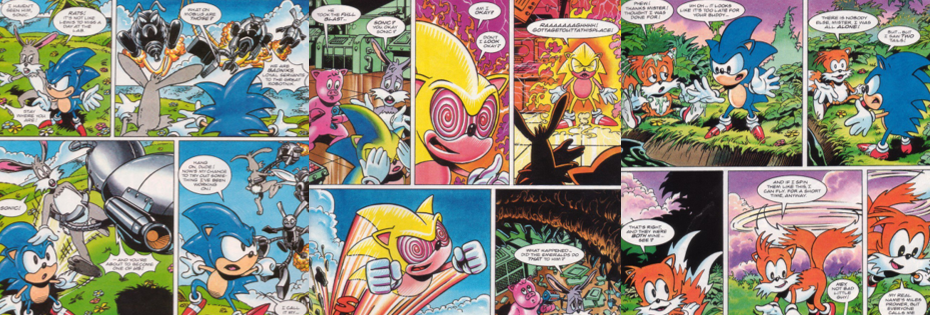
Sonic the Hedgehog was first introduced to gamers worldwide on June 23 1991 and, since then, has become not only SEGA’s most enduring and popular character but also a beloved videogame icon and, in keeping with tradition, I have been dedicating the entire month to celebrating SEGA’s supersonic mascot.
Released: 20 December 2001 Developer: Dimps / Sonic Team Also Available For: Android, Nintendo Wii U (Virtual Console, Japan only), J2ME, and N-Gage
The Background: After a long development process and strategic planning to create a mascoticonic enough to rival Super Mario, SEGA’s initial success with Sonic the Hedgehog expanded into mainstream popularity with Sonic the Hedgehog 2 (SEGA Technical Institute, 1992). Sonic was on a serious roll at this time; the spectacularSonic 3 & Knuckles(ibid, 1994) was too big for one cartridge, became one of the best classic Sonic games, and was naturally followed by…numerous disappointing spin-offs before making the jump to 3D in 1999. As wellreceived as Sonic Adventure (Sonic Team, 1999) and Sonic Adventure 2(Sonic Team USA, 2001) were, however, SEGA was in dire straights; numerous delays, blunders, and over spending saw them lose their foothold in the home console market, bringing the “Console War” of the nineties to an anti-climatic end. Now focusing on software development, the unthinkable happened when SEGA produced ports of the Sonic Adventure games for Nintendo’s often-underappreciated GameCube console and, to commemorate the tenth anniversary of the franchise, SEGA turned to Dimps to create a 2D throwback to the classic games that also incorporated the art style and some mechanics from the 3D games. The result was Sonic Advance, which became a best-selling Game Boy Advance title and was met with largely positive reviews. Critics lauded the presentation and tight gameplay mechanics, though elements like the Special Stages and an overreliance on nostalgia were criticised. Still, Sonic Advance was regarded as one of the best Nintendo games and helped solidify SEGA ’s new relationship with Nintendo; it was followed not just by two sequels, but numerous handheld spin-offs and spiritual successors that further refined the gameplay and mechanics for Sonic’s portable adventures.
The Plot: Doctor Eggman has returned, with his sights once again set on enslaving woodland creatures into metallic Badniks, gathering the legendary Chaos Emeralds, and constructing an elaborate space base! Luckily, Sonic the Hedgehog and his friends – Miles “Tails” Prower, Knuckles the Echidna, and Amy Rose – are on hand to oppose his evil schemes once more.
Gameplay: When Sonic Advance released, the Sonic franchise was firmly in the midst of its 3D era. 2D, sidescrolling action-based platformers were out for the Blue Blur and elaborate, action-packed 3D rollercoasters with varying gameplay were in, so Sonic Advance was a bit of a throwback to Sonic’s classic 2D roots, and in many ways the long awaited fourth entry in the classic series. In addition to the plot being as basic as the classics, the control scheme is immediately familiar to anyone who’s played Sonic 3 & Knuckles: A lets you jump, pressing it again initiates a jump attack or move, you use up and down to scroll the screen and duck under obstacles, and press down and A to charge up a Spin Dash for a speed boost. You can pick from four characters – with Amy Rose making her playable debut in a sidescrolling game – and journey through seven levels (known as “Zones”), with two final Zones awaiting after clearing certain objectives, with each Zone split into two parts (known as “Acts”) and featuring a boss battle in each Act 2. Players must collect Golden Rings to stay alive, with the glittering Rings scattering when you’re hit so you can collect them again, and race against a ten-minute time limit, which can thankfully be disabled in the “Options” menu. This menu also allows you to pick between “Easy” or “Normal” mode (with the differences I believe boiling down to how many lives you start with and the amount of hits bosses take), configure the control scheme, and select different language options, though there is no story text to worry about here as everything’s taking its cue more from the 2D games than the 3D ones when it comes to storytelling.
Each character’s unique abilities changes the way you play and the game’s difficulty.
So far, so familiar. However, gameplay changes depending on which character you pick, with Tails effectively being the easy mode thanks to his propeller-like twin tails and Amy being the hard mode since she doesn’t curl into a ball. Each character has different abilities to traverse Zones and take out enemies; you can perform Sonic’s Insta-Shield by pressing A twice, pressing B sees him perform a sliding ground somersault, and you can perform a back jump by pressing B and then A (though I found little use for this). Sonic can also pull off a limited and frankly useless mid-air dash by pressing right and A twice and is somewhat limited in his options since he can’t fly or climb, so his gameplay is more about speed and ploughing head-first through obstacles. Tails can, of course, fly for a short time by pressing A twice, and his tails will often inflict damage on whatever’s underneath him. When in water, Tails can doggy paddle indefinitely by tapping A and pressing B on solid ground sees him whip his twin tails in a melee attack. Knuckles has a shorter jump height but makes up for it by being able to glide with a double tap of A and cling to and climb most walls. He can also swim by tapping A and perform a standing three-punch combo with A, though I didn’t have much use for this as the regular spinning and rolling methods work fine. Amy, however, is all about mele attacks; she can’t curl into a ball or Spin Dash, making her much more vulnerable, but she is armed with her signature Piko-Piko Hammer. You can smash enemies with B, use down and B to spring into the air with a hammer-assisted jump, and hold down and B when jumping to spin with the hammer, all of which is quite slow and clunky and makes battling bosses quite a chore for Amy. Amy can also take a giant leap by pressing down and A and can slide ahead by pressing right and B, but she sure does present a significant challenge even for seasoned players since she lacks all the basic Sonic abilities. Sonic and Amy can also hop on rails to do a bit of grinding and each character can grab overhead poles to shimmy along, bounce to higher areas using springs, run through loops, smash boulders or ice to occasionally reveal item capsules or springs, and must grab air bubbles to keep from drowning when underwater.
Gimmicks old and new are far more fun than the annoying enemy and hazard placement.
In terms of gameplay and stage design, Sonic Advance keeps things quite safe: Zones start off pretty simple, utilising recycled gimmicks and certain aesthetic themes from the classic games, but things become very cheap, frustrating, and difficult as the game progresses. You’ll be hopping to moving and temporary platforms, avoiding spikes, and trying to stick to the higher, faster path in most Acts but you’ll also be forced into the sluggish water, have to ride zip-wires, be blown into the air by fans, and pinball all over the place on bumpers. At first, enemies and hazards aren’t too difficult to avoid; the Game Boy Advance screen does limit your view a lot of the time, meaning it’s easy to jump or spring head-first into a projectile or unseen Badnik, but later Zones like Angel Island Zone and Egg Rocket Zone can easily see you jump, fall, or be blasted into a bottomless pit for a cheap death. Boost pads are used sparingly, thankfully, but are present, as are tunnels, air cannons, spinning spiked platforms, conveyer belts, bouncy platforms (and clouds), and lava pits. Ice Mountain Zone sees you riding iceberg floats, Angel Island Zone incorporates rolling boulders and sand gimmicks from Sandopolis Zone, and Egg Rocket Zone splits apart as you traverse higher, taking you further into the atmosphere, and briefly utilises the Death Egg Zone’s gravity mechanic. Claws will carry you across gaps, you’ll need to run on spheres to reach higher platforms, you’ll be jumping to swinging chained hooks, riding jets and streams of water, and dodging crushing hazards and warping across Zones. A lot of it is immediately familiar to long-time Sonic gamers, with just enough of a twist to make it more unique, but much of the game relies on slower, strategic platforming, blind jumps, or cheap deaths and enemy placements. Luckily, you can still hit lampposts to create a checkpoint if you die; collecting 100 Rings grants you an extra life, and there are 1-Up capsules hidden about the place. However, I actually found myself playing on zero lives at one point, which rarely, if ever, happens to me when playing 2D Sonic games and speaks to how challenging the later Zones can be largely due to placing Badniks, spikes, and bottomless pits just out of view to mess up your run.
Graphics and Sound: There’s a reason I used the Sonic Advance sprites and backgrounds back when I used to make sprite comics; they are absolutely gorgeous and really capture the feel of the Sonic Adventure games and artwork. Sonic and his friends are full of life and personality, more than ever before; not only to they perform idle poses when left alone, urging you to get moving, but that also jig about with enthusiasm whenever you leave them standing. Although the introduction cutscene is extremely basic and focuses on the characters rather than delivering any kind of ground-breaking story, the in-game sprites more than make up for this; each character has lots of frames of animation, always pops against the background no matter how busy it gets, and performs a little victory pose when clearing Acts and bosses. Sadly, the music doesn’t fair as well; outside of some fun, if underutilised, remixes from the classic games, I found myself largely forgetting the themes for each Zone and the Game Boy Advance’s sound chip seems poorly suited to bringing the kind of energy I expect from a Sonic title. The stage select screen is also very basic and, while the ending makes up for this by featuring some fun sprite art and big victory poses, it’s simply a rehash of Sonic 2’s ending and doesn’t really offer anything new.
Despite some impressive sprites, some Zones are needlessly cluttered and unsightly.
The same can also be said of the Zones; while it’s great to start off in a beach location for a change, Neo Green Hill Zone owes a lot to Green Hill Zone and Emerald Coast. Casino Paradise Zone is simply Casino Night Zone, though lacking a few of its gimmicks; Ice Mountain is basically Ice Cap Zone, Angel Island is an ancient ruins retread of Sky Sanctuary, and Egg Rocket Zone is a mish-mash of Launch Base Zone, Wing Fortress Zone, Flying Battery Zone, and Death Egg Zone. This continues in Cosmic Angel Zone and X-Zone, which are basically Death Egg Zone all over again, and even the final area, Moon Zone, is a reskin of Doomsday Zone. However, for the most part, the recycled gimmicks and aesthetics are presented just differently enough to make them unique: Neo Green Hill Zone has sandy beaches, wooden piers, and a thick overgrowth; Secret Base Zone is an industrial hell-hole full of lava, girders, and swamped by searchlights; you can see fireworks in the background of Casino Paradise, which incorporates balloons to reach higher areas; snow falls in Ice Mountain Zone, where snow and ice cover the trees and rails and ground, there’s a hell of a view of what I assume is the Mystic Ruins in Angel Island Zone, and I enjoyed seeing the big rocket boosters and the separating sections of Egg Rocket Zone. Unfortunately, many areas are also quite loud and cluttered; Secret Base Zone is a mess of conflicting oranges and browns, for example, and Cosmic Angel Zone is a nauseating kaleidoscope of purple and grey that is distracting to look at. For the most part, the game runs really well; it can be slow at times, but mostly you’ll be blasted along at breakneck speed, outrunning the camera and most likely smashing into an obstacle or to your death. Had the game been a little more zoomed out, featured some catchier tunes, and rethought its colour palette and layout, it might’ve improved my experience. As is, though, these elements make the later Zones a chore to play and the homages to the classics more annoying than endearing.
Enemies and Bosses: Dr. Eggman’s Badniks are all heavily inspired by the mechanical enemies seen in the classic Sonic games and Sonic Adventure; we’ve got the Crabmeat-like GamiGami, the Rhinobot-like Rhinotank, the Coconuts-like Kiki, the Jaws-like Drisame that burst out of walls at the worst possible moments, and the Burrobot-like Mogu that are also placed in the most annoying areas, like right when you need to jump or dash through. Lizard- and frog-like Badniks Hanabii and KeroKero roll or hop about spitting projectiles, Stingers do their best Buzzer and Buzz Bomber impression by blasting projectiles at you right as you’re making a tricky jump, bat-like Slots swoop in from offscreen, and the jellyfish-like Kuraa add to their annoyance by briefly erecting an electrifying shield. As is tradition for a Sonic title, smashing Badniks releases a cute little woodland critter and nets you some points, and they’re often placed at the apex of jumps, right in your path, or near spikes. Speaking of which, spikes can be on the floor, walls, and ceilings, sometimes shoot up from the ground to ruin your day, and are occasionally on spinning platforms. You’ll also need to avoid being roasted by fireballs in Secret Base Zone, watch for crushing cubes in Casino Paradise Zone, hop to small rising stone platforms (often while avoiding spikes) in Angel Island Zone, and trust your fate to the will of the gaming gods when making blind jumps over the constant death pit in Egg Rocket Zone.
While bosses start off easily enough, later game encounters can be quite tricky, especially with Amy.
Naturally, every Zone culminates in a boss battle; you’ll face off against Dr. Eggman eight times in a regular playthrough, and a final time after finding all seven Chaos Emeralds, with each encounter seeing him man a new contraption and featuring two phases to the battle. The Egg Hammer Tank awaits in Neo Gren Hill Zone; a strange combination of the Egg Wrecker and Egg Mobile from Sonic 1 and 2, this fight sees Dr. Eggman driving from left to right and right to left trying to smash you with a massive hammer, and erratically bouncing about when near defeat. Dr. Eggman mans the Egg Press machine in Secret Base Zone for a boss not a million miles away from the first phase of the final boss of Sonic the Hedgehog: Triple Trouble(Aspect, 1994); Dr. Eggman hops around trying to squash you, then does a big jump off screen that you need to anticipate to finish him off. Casino Paradise Zone features one of the easiest boss battles; Dr. Eggman emerges from one of several pipes, while his spiked Egg Ball tries to hurt you. Simply duck down in the middle and ram him when he appears; not even the two speeding up near the end present much challenge here. Ice Mountain Zone’s Egg Spider ramps up the difficulty, however, as the fight takes place underwater and Dr. Eggman is completely out of reach. You need to use the icicle hazards he drops to reach him, and take a breath of air, but this can be tricky as they fall randomly, in greater numbers near the end, and your movements are super sluggish underwater. Dr. Eggman isn’t fought in Angel Island Zone or Egg Rocket Zone, but returns in the Egg Snake in Cosmic Angel Zone, a boss that’s considerably difficult for Amy. Dr. Eggman’s pod is protected by spikes so you and to wait for him to flip over to hit him, all while dodging his projectiles and his craft as it slides back and forth, which is particularly hard to do with Amy since she can’t Spin Attack.
Despite a fun fight with Mecha Knuckles, the final battles with Dr. Eggman are disappointing affairs.
In Angel Island Zone, you’ll battle Mecha Knuckles; at first, this fight is very similar to the one against regular Knuckles from Sonic 3 & Knuckles and sees Mecha Knuckles glide about, throw punches, and try to Spin Dash into you. A few hits destroys its outer shell and reveals its true metallic self, which now spits missiles at you! When you reach the X-Zone, you’ll first endure a fun gauntlet against two classic boss battles, the Egg Wrecker and the Egg Mobile, not unlike in Sky Sanctuary Zone and with nothing changed about your attack strategy. Sadly, this is followed by an underwhelming battle against Dr. Eggman’s Egg X, a spinning cannon-like mech that spits bouncy explosive balls, tries to ram you, and grabs and shakes you with a mechanical pincer. While this appendage can be tricky to avoid and jump over, it’s ridiculously easy to bash Dr. Eggman as he flies past or stops to fire a projectile, making for a really disappointing final boss to the main portion of the game. Naturally, after collecting all seven Chaos Emeralds with any character, you’ll unlock the true final boss, the Super Egg Robot, a humanoid mech fought by Super Sonic on the surface of the Moon. Unfortunately, as I’ll detail later, I’ve never experienced this boss battle but I can tell you that your time is limited as Super Sonic’s Rings constantly deplete, meaning you’ll need to grab more to stay alive and in the fight, and that you must use the Super Sonic Boost with the B button to dodge or destroy incoming lunar rocks spewed up by Dr. Eggman. The Super Egg Robot also blasts you with a sweeping eye laser, causes energy pillars to erupt from the ground, and spews out orbs that will either incapacitate you for a few seconds or yield Rings when destroyed. The Super Egg Robot can also block your attacks with its drill-like arms, is constantly flying away from you, and can only be damaged by hitting its head. Although the music and presentation seem quite epic, it does seem a relatively simple encounter, and defeating Dr. Eggman awards you with the true ending…which honestly isn’t really all that different to the regular ending, just with more of that impressive sprite art and animation.
Power-Ups and Bonuses: All the classic Sonic power-ups are on offer in Sonic Advance, this time in capsules like in Sonic Adventure. You can snag five, ten, or a random number of Rings, grab a temporary speed-up or invincibility, and occasionally gift yourself an extra life. You can also find a shield (or “Barrier”) that will protect you from damage for one hit, though it looks really unsightly here, or grab the Magnet Barrier for the same benefit with the added bonus of attracting any nearby Rings. That’s it, though; there are no other elemental shields, no new power-ups to find, and very little reason to explore your environment. As mentioned, each character boasts a mele attack, which is a fun alternative, but you can just as easily use the classic Spin Attack to defeat Badniks so there’s not much us for these attacks…unless you’re playing as Amy, who is entirely reliant upon them.
Additional Features: As in the classic 2D Sonic titles, you can enter Special Stages to try and collect one of the seven Chaos Emeralds, however the way you get to these Special Stages is a bit different to what we’ve seen before. You need to find a Special Spring hidden in each Act, something Sonic and Amy will struggle to do, which grants you one try at easily one of the worst designed Special Stages in the franchise. You’re on a snowboard and constantly falling down a ringed shaft full of Rings, obstacles, and bombs. You can speed up your descent with A or perform a trick with B, which increases your Ring count, and can boost along paths of Rings, though it’s extremely difficult to actually collect Rings due to the odd angle. The perspective is all out of whack, meaning you often pass over or right by Rings, and in all my years of owning and playing this game, I’ve never completed a single Special Stage; hell, I’m lucky to even find a Special Spring, let along snag a Chaos Emerald! Collecting all seven unlocks the Moon Zone and the final battle against the Super Egg Robot, though this is the only way you get to play as Super Sonic. Beyond that, there’s a sound test in the “Options” menu, a Vs. mode that allows players to battle against each other or compete in races to collect the most Rings or find hidden Chao, even if you only have one cartridge between you, and a Time Attack mode for those who want to impress with their best clear times. If you enter a button code on the character select screen, you can play as Sonic with a computer-controlled Tails following him like in Sonic 2, and you can even visit the Tiny Chao Garden. In here. you can raise and pet a Chao, feeding it fruit or giving it toys to play with using Rings you collect in the main game and in the mini games within the garden that see you matching cards or playing rock/paper/scissors. You can also transfer this Chao to and from the GameCube Sonic Adventure games, which you’ll probably want to do as the Tiny Chao Garden’s features are far more limited than its bigger brothers.
The Summary: I have a lot of nostalgia for Sonic Advance. It was still a novelty to see Sonic games released for Nintendo consoles at the time and I liked that it was a throwback to the classic 2D games, capturing the spirit of what made them so enjoyable, recontextualising a lot of the gameplay and gimmicks in new locations, and giving it that Yuji Uekawa aesthetic I enjoyed so much at the time (and even now). Technically, the game is solid enough; the physics work, Act layouts aren’t too dissimilar from the classics, and it offers a decent level of challenge, with some unfair moments peppered in the late-game Zones. I really liked that you could pick from four playable characters right from the start, and that Amy was included, and that their different abilities correlated with how difficult the game can be. I enjoyed most of the new Zones, despite how much they borrowed from the previous games, and really liked how this game bridged the gap between Sonic 3 & Knuckles and Sonic Adventure by incorporating elements from both. Unfortunately, it’s not perfect; and when it’s bad, Sonic Advance is quite a chore. First of all, it’s quite slow and is restricted by the Game Boy Advance’s screen size; Act layouts can be aggravating at times, with enemies and hazards placed just offscreen for maximum frustration, and I really didn’t like the way you access and play Special Stages. It’s rare that I fail to collect the Chaos Emeralds in a Sonic game and I’m still frustrated that I can’t do it over twenty years later. The bosses were quite fun, if a little easy, but the X-Zone boss was pathetic and the soundtrack was pretty forgettable. I liked the addition of the Tiny Chao Garden, though more could’ve been done with this, and it’s safe to say that Sonic Advance just plays things a bit too safe, something its sequels would address and improve upon with new mechanics and unique features. Still, there’s a lot to like in Sonic Advance; it really was the closest thing we had to a Sonic 4 at the time, and it was surprising to me that later 2.5D throwbacks didn’t take more inspiration from it and its sequels, but it’s hard to deny that it’s a sub-par experience compared to its successors and even Sonic 3 & Knuckles.
My Rating:
⭐⭐⭐
Rating: 3 out of 5.
Pretty Good
Did you own Sonic Advance back in the day? If so, did you enjoy it and how do think it’s aged, especially compared to its sequels? Which character was your favourite and did you like their expanded move sets? What did you think to the Zones on offer and the recycling of previous gimmicks? Do you think the game played it too safe or do you consider this the true Sonic 4? Did you ever collect the Chaos Emeralds and, if so, how and what did you think to the Special Stages? Which of Sonic’s Game Boy Advance titles is your favourite and how are you celebrating Sonic’s anniversary this year? Whatever your thoughts on Sonic Advance, leave a comment below or on my social media and go check out my other Sonic content!